Posted in SAINT of the DAY

Saint of the Day – 5 April – St Vincent Ferrer

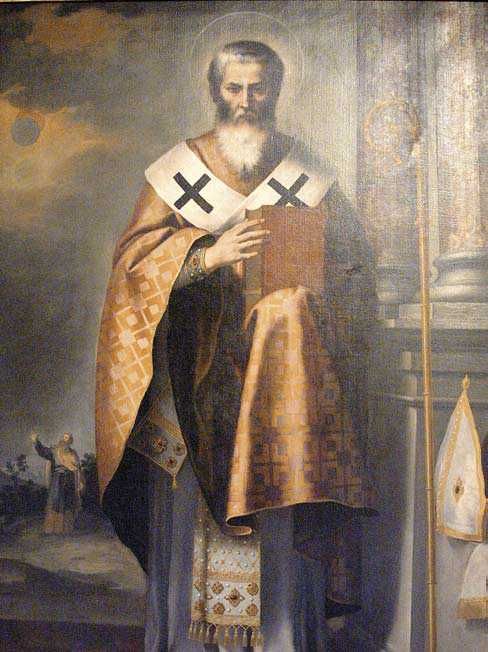
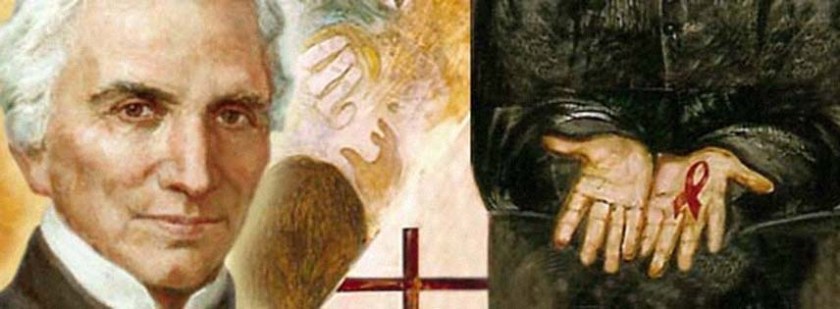
Saint of the Day – 5 April – St Vincent Ferrer O.P. (1530-1419 aged 69) Religious Priest, Miracle-worker, Logician, Preacher, Missionary, Confessor, Teacher, Philosopher, Theologian known as the “Angel of the Apocalypse” and the “Mouthpiece of God” – Patron of  brick makers, builders, Calamonaci, Italy, Casteltermini, Agrigento, Italy, construction workers, Leganes, Philippines, Orihuela-Alicante, Spain, diocese of, pavement workers, plumbers, .  tile makers.   Representation: Bible, cardinal’s hat, Dominican preacher with a flame on his hand, Dominican preacher with a flame on his head, Dominican holding an open book while preaching, Dominican with a cardinal’s hat, Dominican with a crucifix, Dominican with a trumpet nearby, often coming down from heaven, referring to his vision, Dominican with wings, referring to his vision as being an ‘angel of the apocalypse’, pulpit, representing his life as a preacher, flame, referring to his gifts from the Holy Spirit.

saint-vincent-ferrer-01


Vincent was the fourth child of the nobleman Guillem Ferrer, a notary who came from Palamós and wife, Constança Miquel, apparently from Valencia itself or Girona.   Legends surround his birth.    It was said that his father was told in a dream by a Dominican friar that his son would be famous throughout the world.    His mother is said never to have experienced pain when she gave birth to him.    He was named after St. Vincent Martyr, the patron saint of Valencia.   He would fast on Wednesdays and Fridays and he loved the Passion of Christ very much.    He would help the poor and distribute alms to them.    He began his classical studies at the age of eight, his study of theology and philosophy at fourteen.

Four years later, at the age of nineteen, Ferrer entered the Order of Preachers, commonly called the Dominican Order, in England also known as Blackfriars.    As soon as he had entered the novitiate of the Order, though, he experienced temptations urging him to leave.    Even his parents pleaded with him to do so and become a secular priest. He prayed and practiced penance to overcome these trials.    Thus he succeeded in completing the year of probation and advancing to his profession.

924f0ba36b2d72c2e396fe5df0adc509

For a period of three years, he read solely Sacred Scripture and eventually committed it to memory.    He published a treatise on Dialectic Suppositions after his solemn profession, and in 1379 was ordained a Catholic priest at Barcelona.    He eventually became a Master of Sacred Theology and was commissioned by the Order to deliver lectures on philosophy.    He was then sent to Barcelona and eventually to the University of Lleida, where he earned his doctorate in theology.

Vincent Ferrer is described as a man of medium height, with a lofty forehead and very distinct features.    His hair was fair in colour and tonsured.    His eyes were very dark and expressive;   his manner gentle.    Pale was his ordinary colour.    His voice was strong and powerful, at times gentle, resonant and vibrant.

Three men claimed to be pope in the 1300s and 1400s. Kings, princes, priests, and laypeople fought one another to support the different claimants for the Chair of Peter. This chaos led to the Western Schism, and God raised up Vincent Ferrer.

When Vincent joined the Dominicans, he zealously practiced penance, study and prayer. He was a teacher of philosophy and a naturally gifted preacher called the “mouthpiece of God.”  His saintly life was what made his preaching so effective.  Vincent’s subjects were judgment, heaven, hell and the need for repentance.

Even the holiest people can be misled. Pope Urban VI was the real pope and lived in Rome but Vincent and many others thought that Clement VII and his successor Benedict XIII, who lived in Avignon, France, were the true popes. Vincent convinced kings, princes, clergy and almost all of Spain to give loyalty to them.   After Clement VII died, Vincent tried to get both Benedict and the pope in Rome to abdicate so that a new election could be held. It hurt Vincent when Benedict refused.

Vincent came to see the error in Benedict’s claim to the papacy.   Discouraged and ill, Vincent begged Christ to show him the truth.    In a vision, he saw Jesus with Saint Dominic and Saint Francis, commanding him to “go through the world preaching Christ.” For the next 20 years, Vincent spread the Good News throughout Europe.    He fasted, preached, worked miracles and drew many people to become faithful Christians.   Vincent returned to Benedict in Avignon and asked him to resign.    Benedict refused. One day while Benedict was presiding over an enormous assembly, Vincent, though close to death, mounted the pulpit and denounced him as the false pope.    He encouraged everyone to be faithful to the one, true Catholic Church in Rome.    Benedict fled, knowing his supporters had deserted him.   Later, the Council of Constance met to end the Western Schism.

St Vincent always slept on the floor, he had the gift of tongues (he spoke only Spanish but all listeners understood him, he lived in an endless fast, celebrated Mass daily and known as a miracle worker;  he is reported to have brought a murdered man back to life to prove the power of Christianity to the onlookers and he would heal people throughout a hospital just by praying in front of it.   He worked so hard to build up the Church that he became the patron of people in building trades.

Because of the Spanish’s harsh methods of converting Jews at the time, the means which Vincent had at his disposal were either baptism or spoliation.   He won them over by his preaching, estimated at 25,000.   Vincent also attended the Disputation of Tortosa (1413–14), called by Avignon Pope Benedict XIII in an effort to convert Jews to Catholicism after a debate among scholars of both faiths.

Vincent died on 5 April 1419 at Vannes in Brittany, at the age of sixty-nine and was buried in Vannes Cathedral.    He was canonised by Pope Calixtus III on 3 June 1455.  His feast day is celebrated on 5 April.   The Fraternity of Saint Vincent Ferrer, a pontifical religious institute founded in 1979, is named for him.

Posted in SAINT of the DAY

Saints- 5 April

St Vincent Ferrer (Optional Memorial)

St Albert of Montecorvino
Bl Antonius Fuster
St Becan
Bl Blasius of Auvergne
St Claudius of Mesopotamia
St Derferl Gadarn
St Gerald of Sauve-Majeure
St Irene of Thessalonica
St Maria Crescentia Hoss
St Mariano de la Mata Aparicio
St Pausilippus
Bl Peter Cerdan
St Theodore the Martyr
St Zeno the Martyr

Martyrs of Lesbos – 5 saints – Five young Christian women martyred together for their faith. We don’t even know their names. island of Lesbos, Greece
Martyrs of North-West Africa – Large group of Christians murdered while celebrating Easter Mass during the persecutions of Genseric, the Arian king of the Vandals. 459 at Arbal (in modern Algeria)

Posted in LENT, MORNING Prayers, QUOTES of the SAINTS

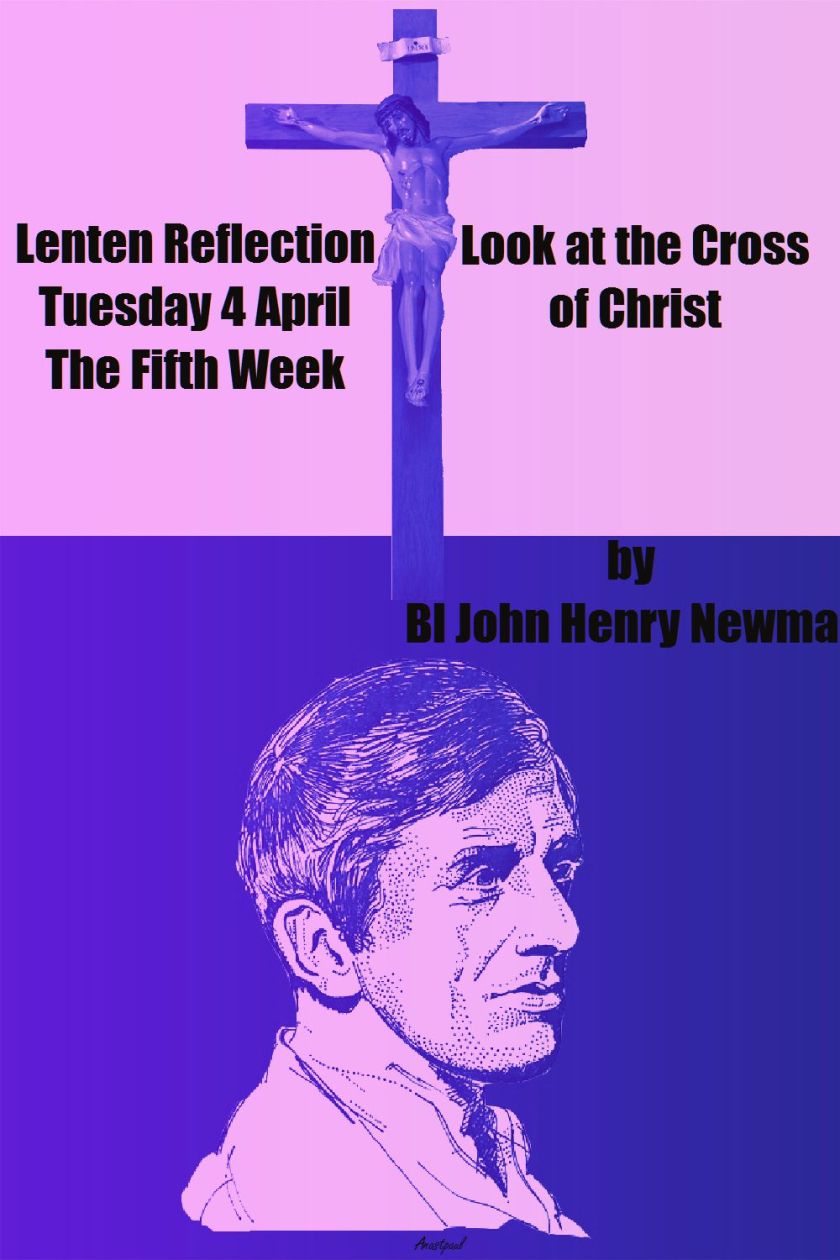
LENTEN REFLECTION – Tuesday of the Fifth Week – 4 April 2017

LENTEN REFLECTION – Tuesday of the Fifth Week – 4 April 2017

Look at the cross of Christ – Blessed John Henry Newman

“Look around, and see what the world presents of high and low.    Go to the court of princes.    See the treasure and skill of all nations brought together to honour a child of man.    Observe the prostration of the many before the few.    Consider the form and ceremonial, the pomp, the state, the circumstance and the vainglory.    Do you wish to know the worth of it all? Look at the cross of Christ.

Go to the political world.    See nation jealous of nation, trade rivalling trade, armies and fleets matched against each other.    Survey the various ranks of the community, its parties and their contests, the strivings of the ambitious, the intrigues of the crafty.    What is the end of all this turmoil – the grave!    What is the measure – the cross.

Go, again, to the world of intellect and science.    Consider the wonderful discoveries which the human mind is making, the variety of arts to which its discoveries give rise, the all but miracles by which it shows its power.    And next, the pride and confidence of reason and the absorbing devotion of thought to transitory objects, which is the consequence.    Would you form a right judgment of all this?    Look at the cross.

Again, look at misery, look at poverty and destitution, look at oppression and captivity. Go where food is scanty, and lodging unhealthy.    Consider pain and suffering, diseases long or violent, all that is frightful and revolting.   Would you know how to rate all these? Gaze upon the cross.

Thus in the cross, and Him who hung upon it, all things meet.    All things subserve it, all things need it.    It is their centre and their interpretation.    For He was lifted up upon it, that He might draw all peoples and all things to himself.

………………..And so, too, as regards this world, with all its enjoyments, yet disappointments, let us not trust it.    Let us not give our hearts to it.    Let us not begin with it.    Let us begin with faith.    Let us begin with Christ.    Let us begin with His cross and the humiliation to which it leads.    Let us first be drawn to Him who is lifted up, that so He may, with Himself, freely give us all things.    Let us “seek first the kingdom of God and his righteousness,” and then all those things of this world “will be added to us.”

They alone are able truly to enjoy this world, who begin with the world unseen.    They alone enjoy it, who have first abstained from it.    They alone can truly feast, who have first fasted.    They alone are able to use the world, who have learned not to abuse it. They alone inherit it, who take it as a shadow of the world to come and who for that world to come relinquish it.”

LOOK AT THE CROSS OF CHRIST - NEWMAN

Posted in DOCTORS of the Church, FATHERS of the Church, MORNING Prayers, SAINT of the DAY

Thought for the Day – 4 April

Thought for the Day – 4 April

How amazing it is – what one person can accomplish when he works for God alone!   We all find ourselves in situations of leadership or influence and the good we can do by our labour and our example knows no bounds.    Look around, see the lives you can touch – become a genuine influence and example to others.   We have every tool we need AND we have every reason to work for the glory of the Kingdom!

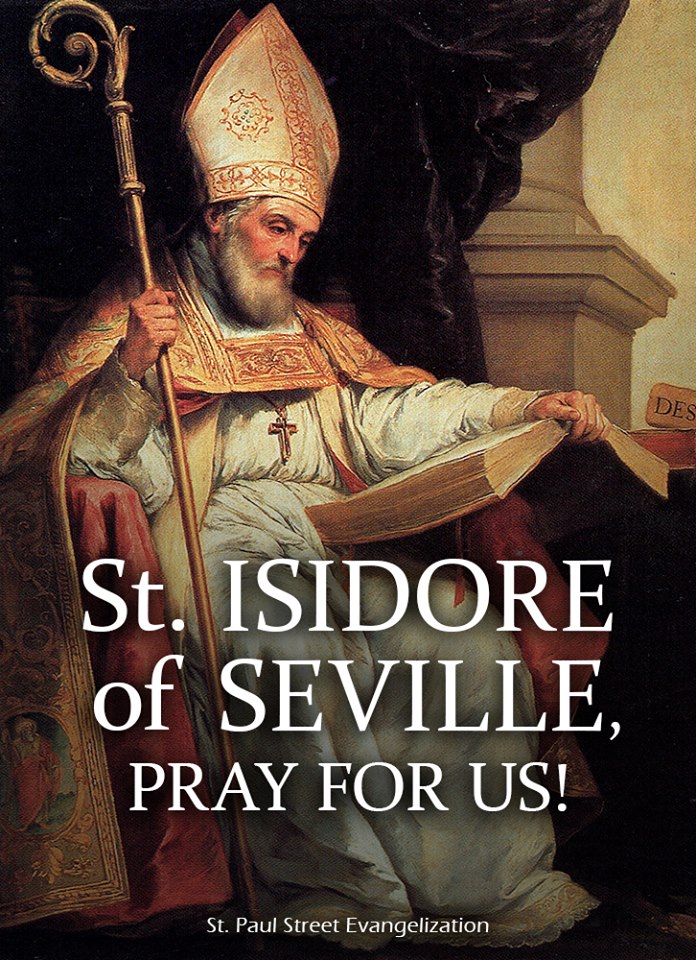
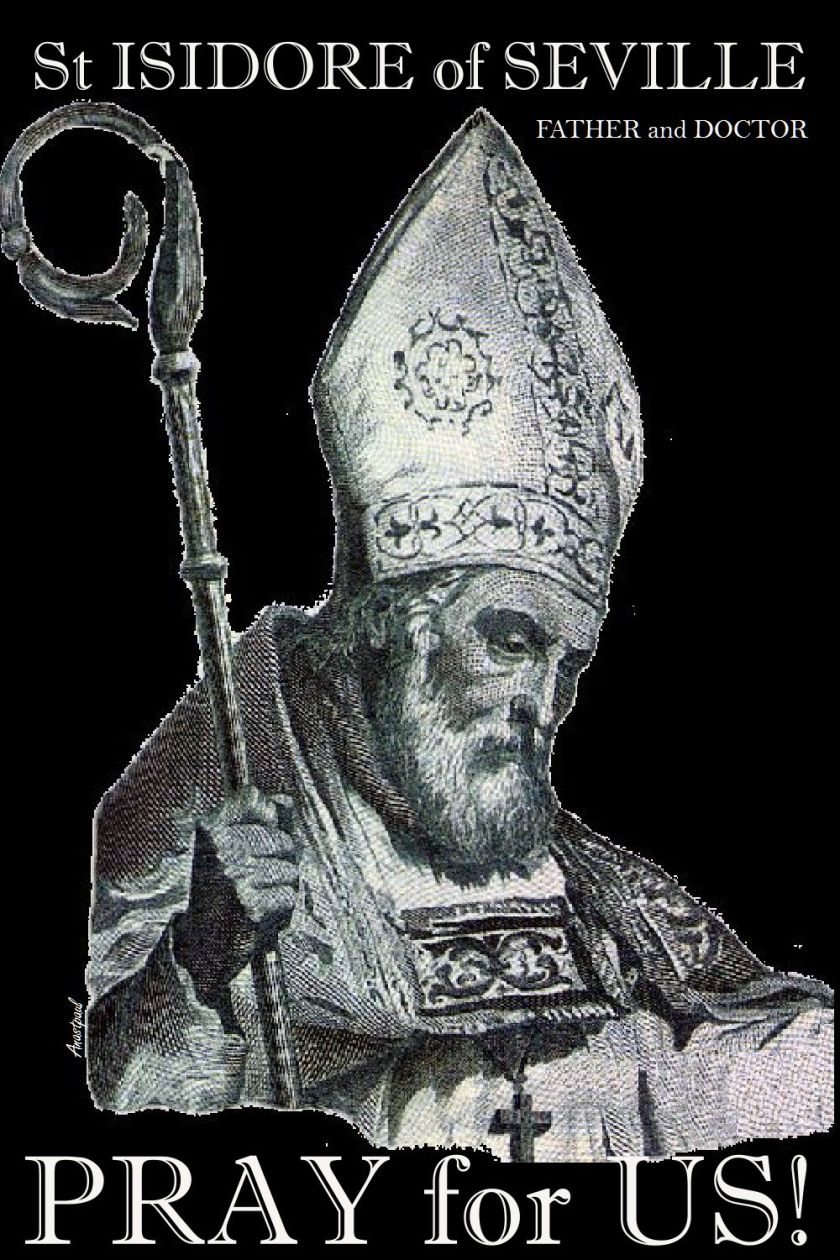
St Isidore of Seville, pray for us!

ST ISIDORE PRAY FOR US 2ST ISIDORE OF SEVILLE - APRIL 4

Posted in DOCTORS of the Church, FATHERS of the Church, QUOTES of the SAINTS, SAINT of the DAY

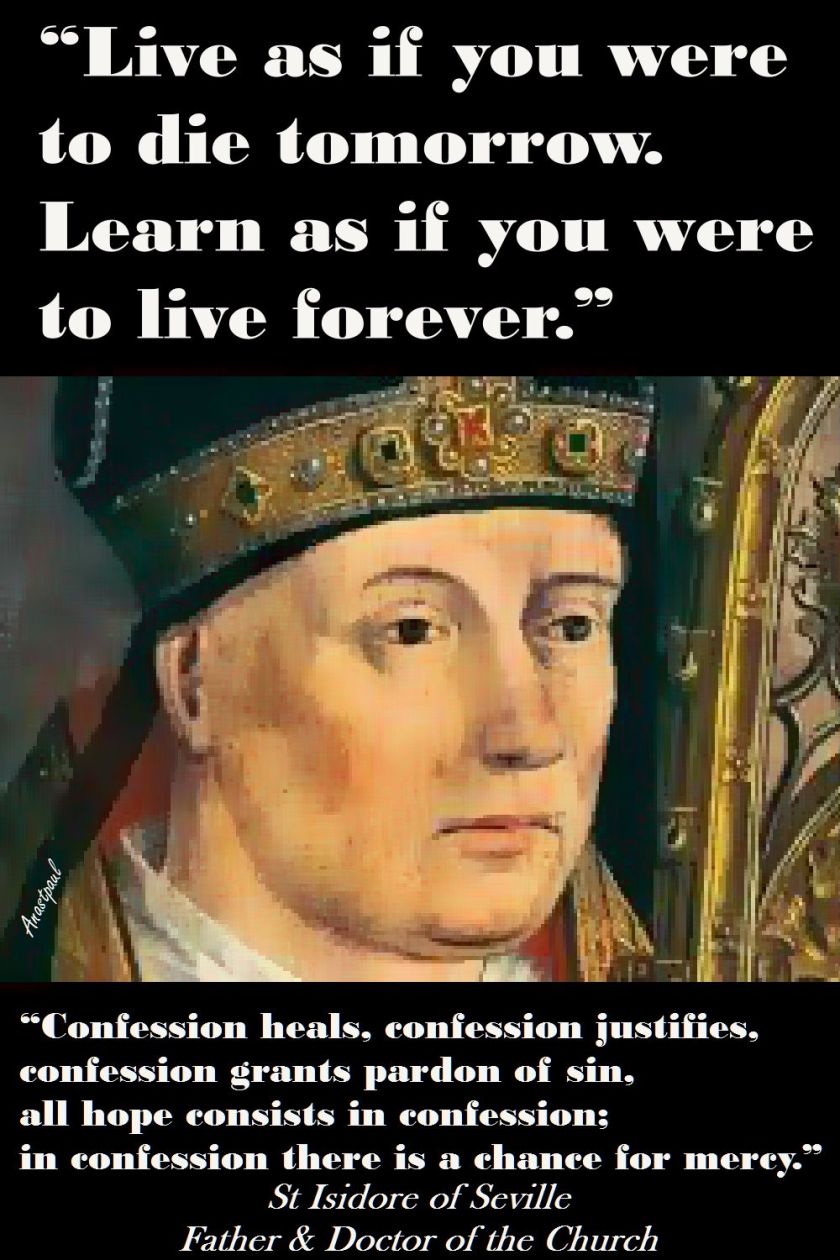
Quote/s of the Day – 4 April

Quote/s of the Day – 4 April

“Live as if you were to die tomorrow.
Learn as if you were to live forever.”

“Confession heals, confession justifies,
confession grants pardon of sin,
all hope consists in confession;
in confession there is a chance for mercy.”

St Isidore of Seville – Father & Doctor of the Church

QUOTES - ST ISIDORE

Posted in DOCTORS of the Church, FATHERS of the Church, MORNING Prayers, QUOTES of the SAINTS, SAINT of the DAY, The WORD

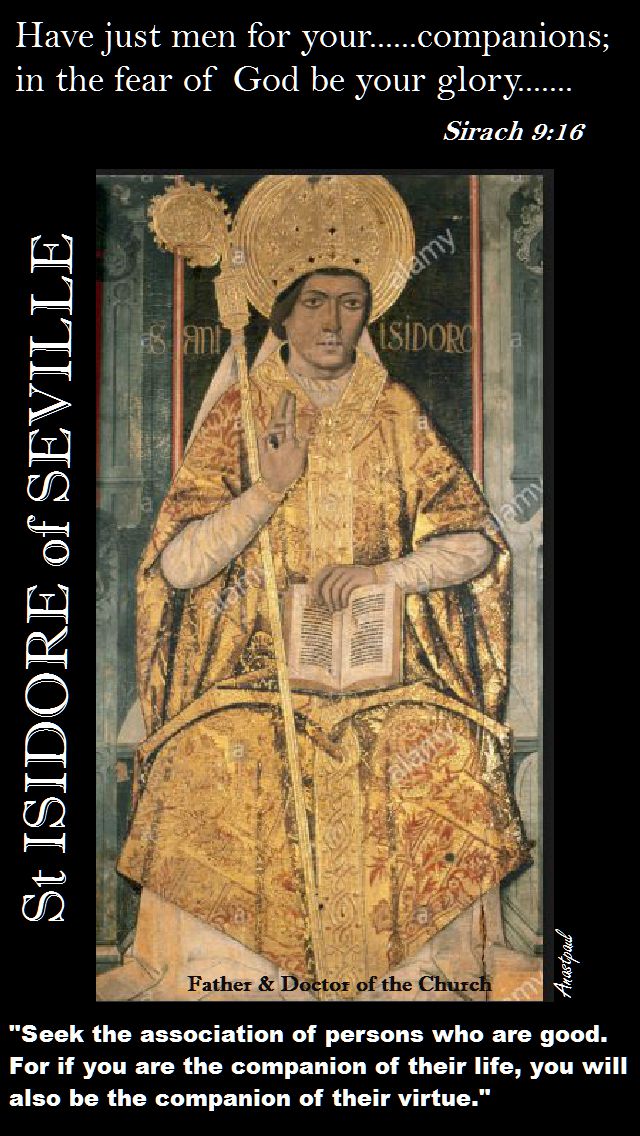
One Minute Reflection – 4 April

One Minute Reflection – 4 April

Have just men for your……companions;
in the fear of God be your glory…………Sirach 9:16

REFLECTION – “Seek the association of persons who are good. For if you are the companion of their life, you will also be the companion of their virtue.”…….St Isidore of Seville

PRAYER – God of goodness, help me to be continually in the company of true Christians.
Let me be edified by their virtues and their works and let our association bring us all to heavenly glory.   St Isidore of Seville, pray for us, amen.

ST ISIDORE-QUOTEST ISIDORE PRAY FOR US

Posted in DOCTORS of the Church, MORNING Prayers, PRAYERS of the SAINTS

Our Morning Offering – 4 April

Our Morning Offering – 4 April

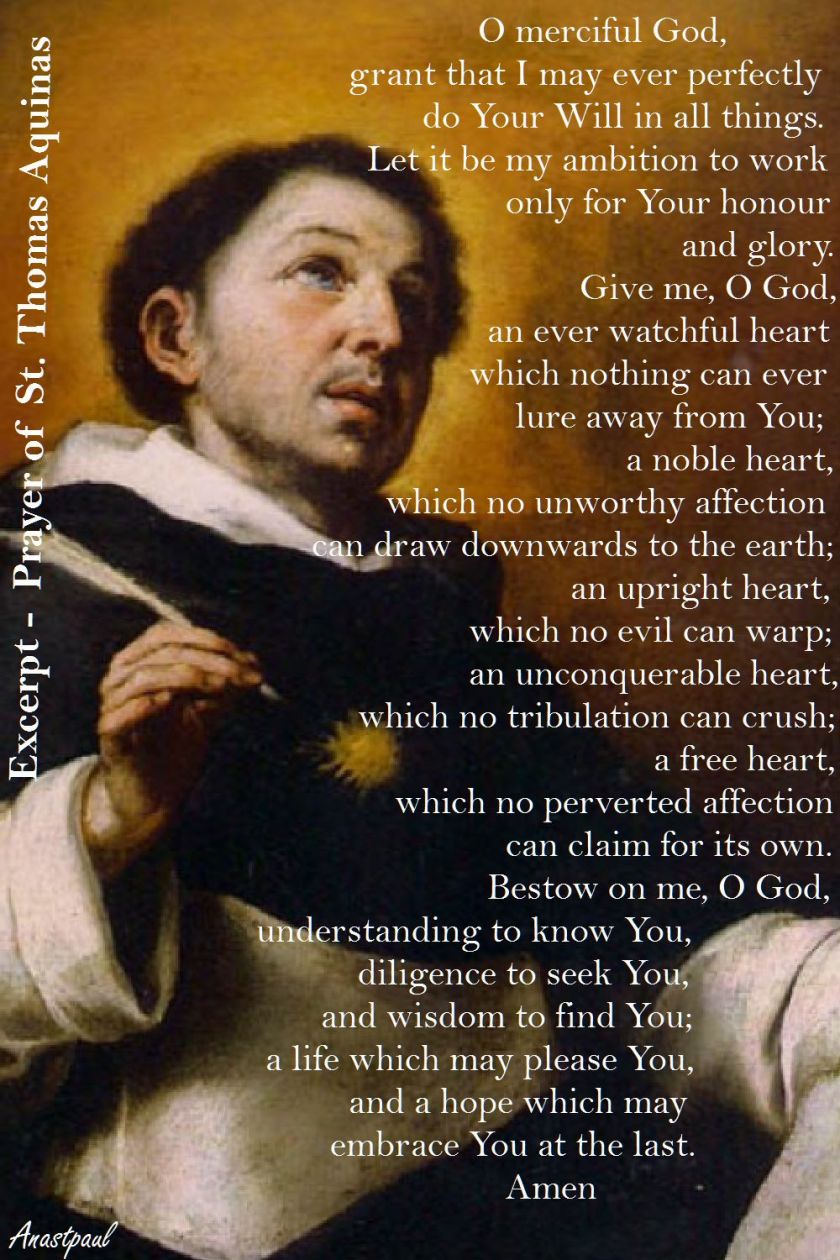
Excerpt from a Prayer of St. Thomas Aquinas

O merciful God,
grant that I may ever perfectly
do Your Will in all things.
Let it be my ambition to work
only for Your honour and glory.
Give me, O God,
an ever watchful heart
which nothing can ever
lure away from You;
a noble heart,
which no unworthy affection
can draw downwards to the earth;
an upright heart,
which no evil can warp;
an unconquerable heart,
which no tribulation can crush;
a free heart,
which no perverted affection
can claim for its own.
Bestow on me, O God,
understanding to know You,
diligence to seek You,
and wisdom to find You;
a life which may please You,
and a hope which may
embrace You at the last.
Amen

Prayer of St. Thomas Aquinas

Posted in DOCTORS of the Church, FATHERS of the Church, PATRONAGE-INTERNET, COMPUTERS, IT Technicians, PC Propgrammers,, etc, QUOTES of the SAINTS, QUOTES on HELL, QUOTES on SUFFERING, SAINT of the DAY

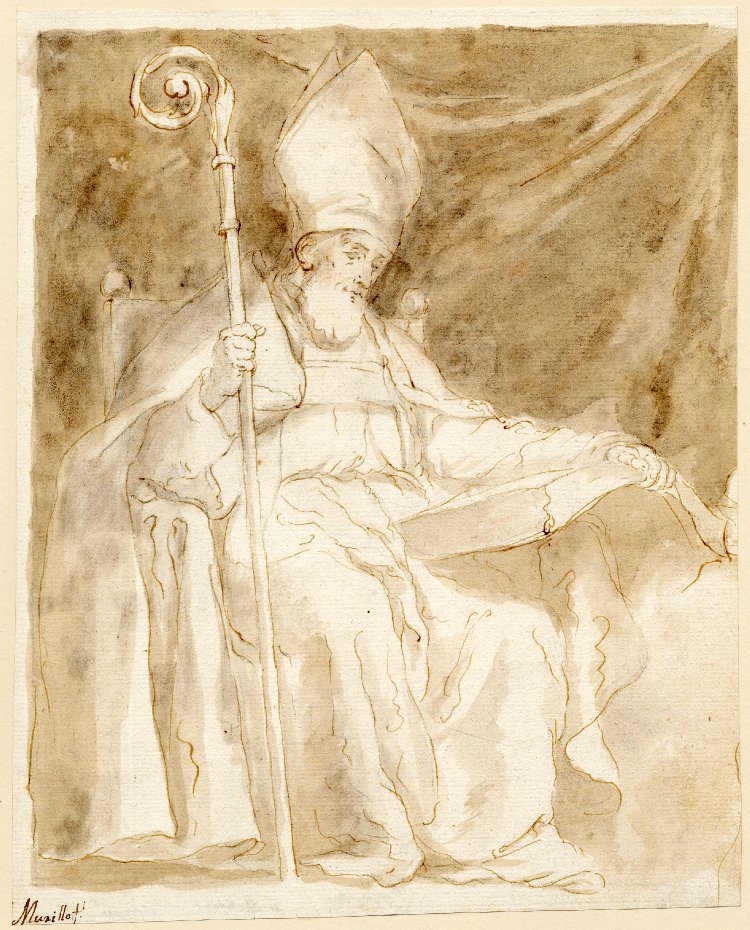
Saint of the Day – 4 April – St Isidore of Seville – Father and Doctor of the Church

Saint of the Day – 4 April – St Isidore of Seville – Father and Doctor of the Church (560-636) Bishop, Confessor, Father, Doctor, Scholar, Writer, Teacher, Reformer and Evangelist – Patron of newsagents, the internet (not officially appointed), computer programmers and technicians, 2 Diocese, 13 Cities.  He was, for over three decades, the Archbishop of Seville.  The 19th-century historian Montalembert called him, in an oft-quoted phrase, “The Last Scholar of the Ancient World.”   Born in Cartagena of a family that included three other sibling Saints–Leander, Fulgentius and Florentina–he was educated by his elder brother, Leander, whom he succeeded as the Bishop of Seville.1 isisdore.jpg

St Isidore of Seville is sometimes called “the schoolmaster of the Middle Ages” because his books and schools helped shape the education and culture of medieval Europe.   For ten centuries, Isidore’s voluminous works were among those most quoted by other writers.   And his establishment of cathedral schools laid a foundation for the medieval universities and for education in the West.2-saint-isidore-isidro-of-seville-mary-evans-picture-library.jpg

In 599, Isidore became bishop of Seville and for thirty-seven years led the Spanish church through a period of intense religious development.    Isidore also organised representative councils that established the structure and discipline of the church in Spain.    At the Council of Toledo in 633 he obtained a decree that required the establishment of a school in every diocese.    Reflecting the saint’s broad interests, the schools taught every branch of knowledge, including the liberal arts, medicine, law, Hebrew, and Greek.Isidor_von_Sevilla.jpeg
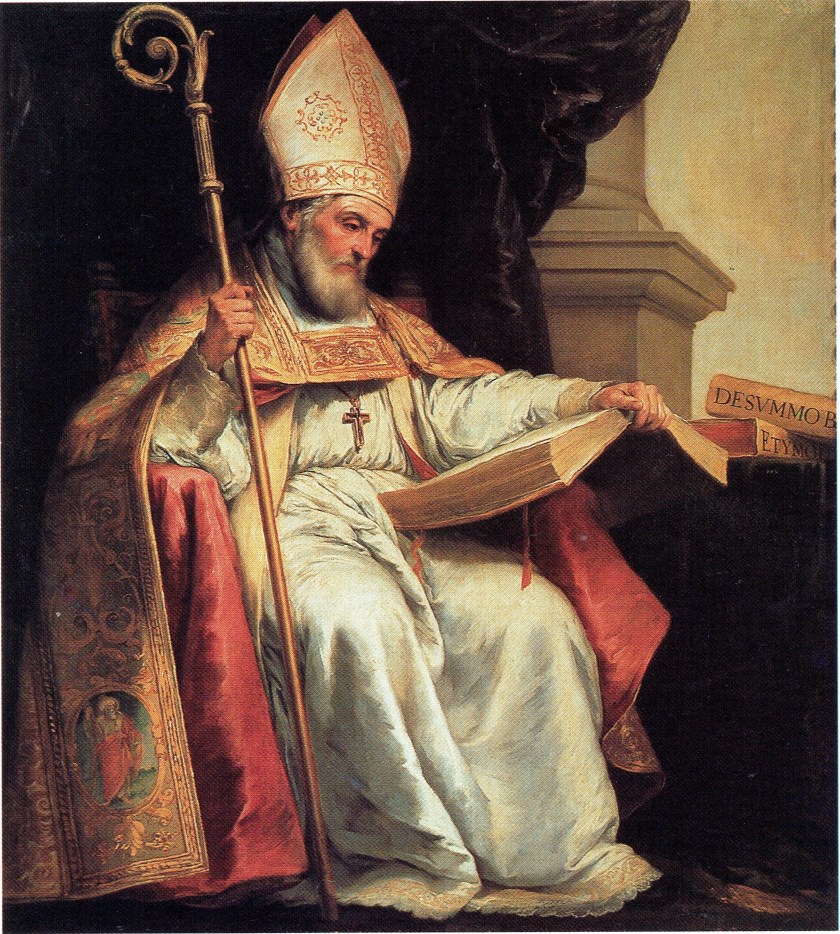
Isidore wrote many books, the most famous being the Etymologies, an encyclopedia of grammar, rhetoric, theology, history, medicine, and mathematics.   He also wrote a dictionary of synonyms, brief biographies of illustrious men, treatises on theological and philosophical subjects, a history of world events since the creation and a history of the Goths, which is our only source of information about them.   Throughout his long life, Isidore lived austerely so that he could give to the poor.   But while Isidore had compassion for needy, he thought they were better off than their oppressors, as he explains in this selection:

We ought to sorrow for people who do evil rather than for people who suffer it. The wrongdoing of the first leads them further into evil.   The others’ suffering corrects them from evil.   Through the evil wills of some, God works much good in others. Some people, resisting the will of God, unwittingly do His purpose.   Understand then that so truly are all things subject to God that even those who oppose His law nevertheless fulfil His will.

Evil men are necessary so that through them the good may be scourged when they do wrong…Some simple men, not understanding the dispensation of God, are scandalised by the success of evil men.   They say with the prophet: “Why does the way of the wicked prosper?”   Those who speak thus should not wonder to see the frail temporal happiness of the wicked.   Rather they should consider the final end of evil men and the everlasting torments prepared for them.   As the prophet says: “They spend their days in wealth and in a moment they go down to hell.”

Shortly before his death, Isidore had two friends clothe him in sackcloth and rub ashes on his head so that he could come before God as a poor penitent.   He died peacefully at Seville in 636.

ST ISIDORE

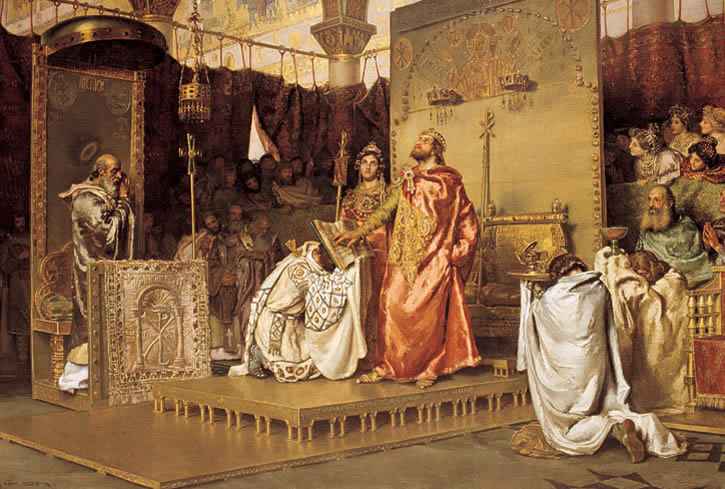
King Reccared abjures his heresy before St. Leander.
King Reccared abjures his heresy before St Isidore
Posted in SAINT of the DAY

Saints’ Memorials – 4 April

St Isidore of Seville (Optional Memorial)

Bl Abraham of Strelna
St Agathopus of Thessalonica
St Aleth of Dijon
St Benedict the Black
St Gaetano Catanoso
Bl Giuseppe Benedetto Dusmet
St Gwerir of Liskeard
St Henry of Gheest
St Hildebert of Ghent
St Peter of Poitiers
St Plato
St Theodulus of Thessalonica
St Theonas of Egypt
St Tigernach of Clogher
St Zosimus of Palestine

Posted in CATHOLIC DEVOTIONS of the Month

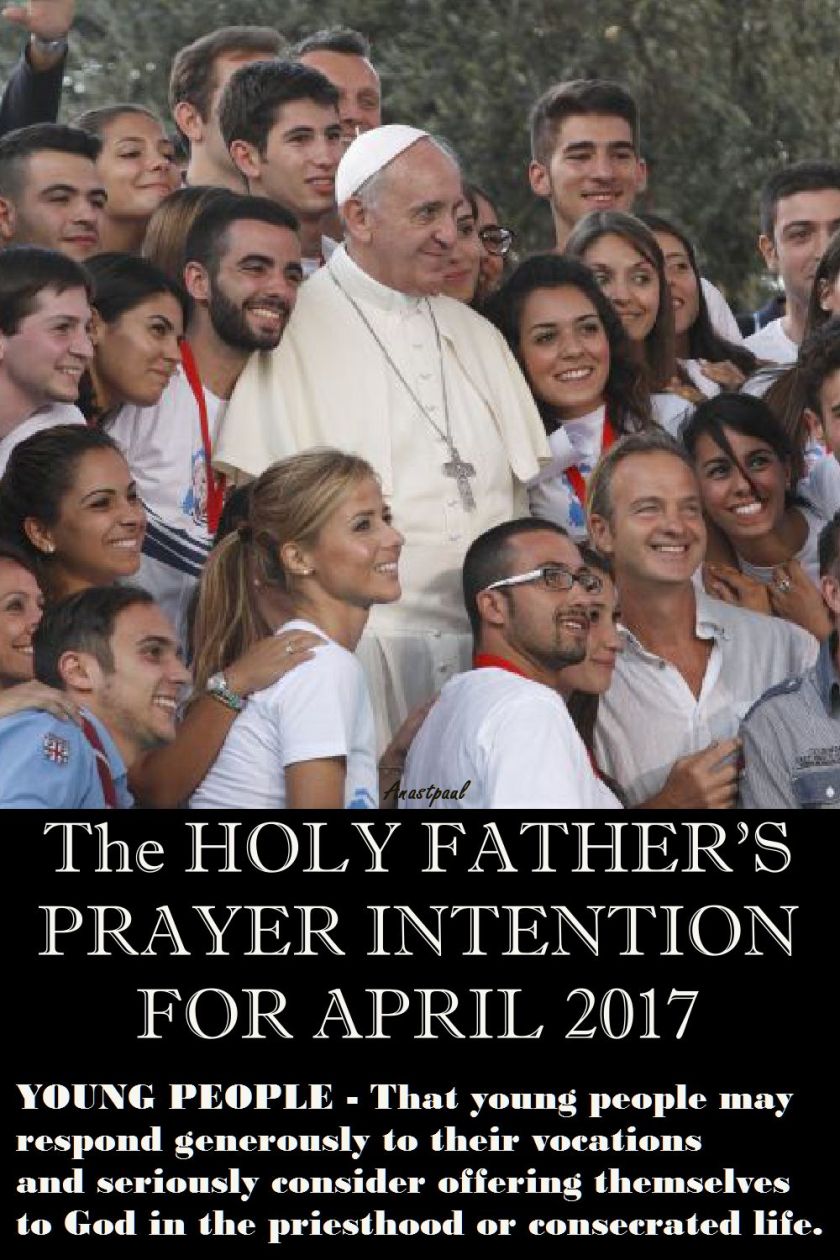
The HOLY FATHER’S PRAYER INTENTION FOR APRIL 2017

The HOLY FATHER’S PRAYER INTENTION FOR APRIL 2017

Young People. 

That young people may respond generously to their vocations and seriously consider offering themselves to God in the priesthood or consecrated life.

PRAYER INTENTIONS APRIL 2017

Posted in CATHOLIC DEVOTIONS of the Month, EUCHARISTIC Adoration

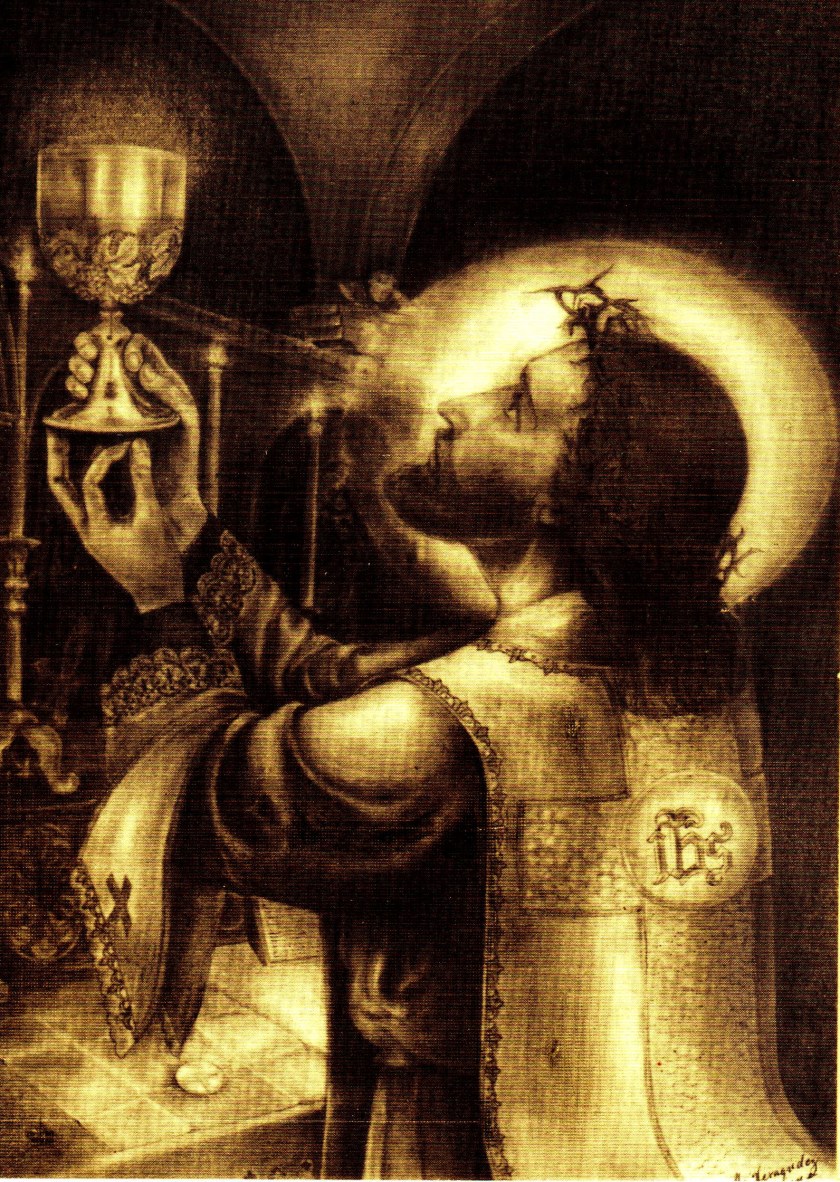
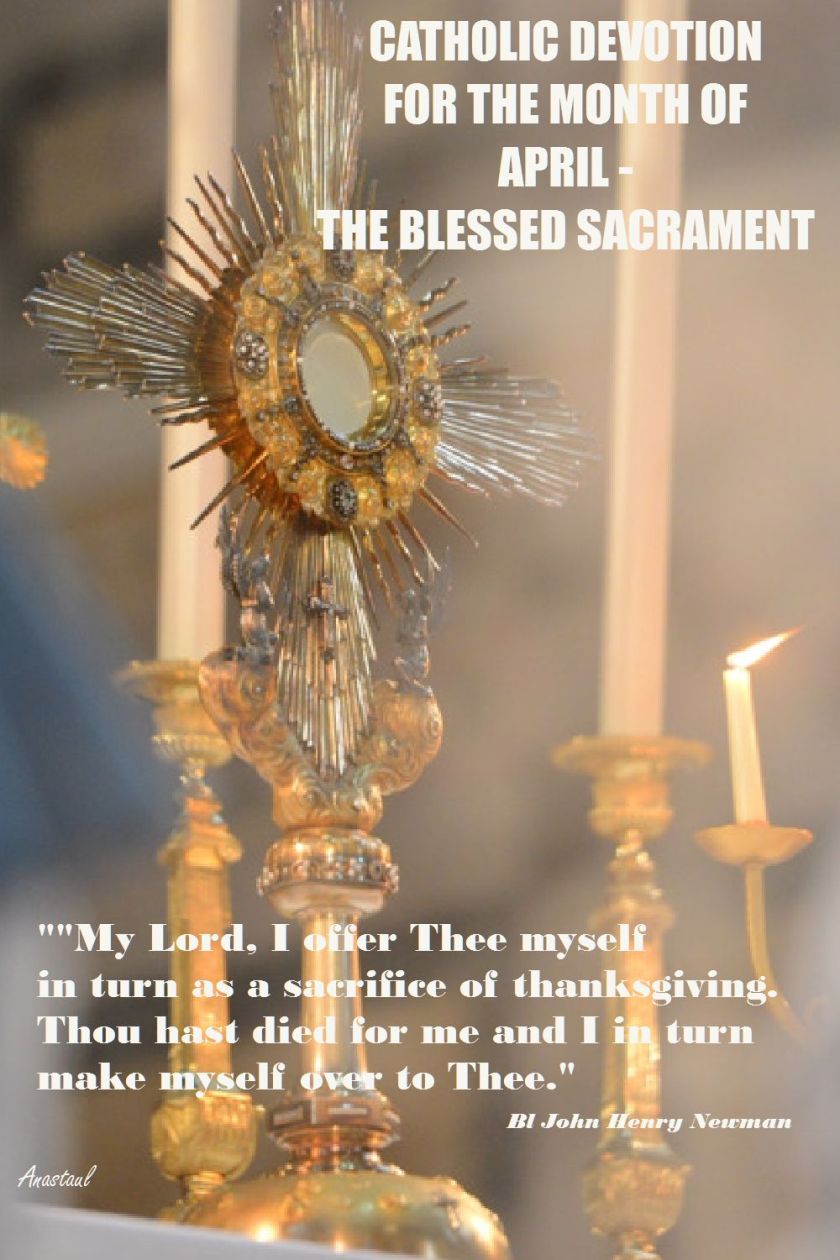
Devotion for the Month of April – The Blessed Sacrament

Devotion for the Month of April – The Blessed SacramentHOLY MASS AND JESUS AS PRIEST


Every Catholic Church contains a tabernacle in which the Body of Christ is reserved between Masses and the faithful are encouraged to come and pray before the Blessed Sacrament.   Frequent prayer before the Blessed Sacrament is a path to spiritual growth.

EUCHARISTIC ADORATION

The practice of Eucharistic adoration on earth not only brings us grace but prepares us for our life in Heaven. As Pope Pius XII wrote in Mediator Dei (1947):

“These exercises of piety have brought a wonderful increase in faith and supernatural life to the Church militant upon earth and they are re-echoed to a certain extent by the Church triumphant in heaven which sings continually a hymn of praise to God and to the Lamb “who was slain.”

This month, why not make a special effort to spend some time in prayer before the Blessed Sacrament? It doesn’t need to be long or elaborate:  You can start simply by making the Sign of the Cross and uttering a short profession of faith, such as “My Lord and my God!” as you pass a Catholic church.   If you have the time to stop for five minutes, all the better.

“My Lord, I offer Thee myself in turn as a sacrifice of thanksgiving.    Thou hast died for me and I in turn make myself over to Thee.    I am not my own.    Thou hast bought me;  I will by my own act and deed complete the purchase.    My wish is to be separated from everything of this world;  to cleanse myself simply from sin; to put away from me even what is innocent, if used for its own sake, and not for Thine.    I put away reputation and honour and influence and power, for my praise and strength shall be in Thee.   Enable me to carry on what I profess. Amen.”

AN EXPLANATION OF AN OFFERING OF ONESELF TO CHRIST IN THE EUCHARIST
We should leave each visit to the Blessed Sacrament renewed in our commitment to live a Christian life. This Offering of Oneself to Christ in the Eucharist, written by John Henry Cardinal Newman, reminds us of the sacrifice that Christ made for us, in dying on the Cross and asks Christ in the Blessed Sacrament to help us to dedicate our lives to Him.   It is the perfect prayer to end a visit to the Blessed Sacrament.

APRIL DEVOTION

Posted in DOCTORS of the Church, FATHERS of the Church, LENT, MORNING Prayers, QUOTES of the SAINTS

LENTEN REFLECTION – The Fifth Week – Monday 3 April 2017

LENTEN REFLECTION – The Fifth Week – Monday 3 April 2017

ALMSGIVING

Excerpt from a Homily of St John Chrysostum Doctor and Father of the Church (347-407

Nay, if you desire to honour the sacrifice, offer your soul, for which also it was slain; cause that to become golden;  but if that remain worse than lead or potter’s clay, while the vessel is of gold, what is the profit?

Let not this therefore be our aim, to offer golden vessels only but to do so from honest earnings likewise.   For these are of the sort that is more precious even than gold, these that are without injuriousness.   For the church is not a gold foundry nor a workshop for silver but an assembly of angels.   Wherefore it is souls which we require, since in fact God accepts these for the souls’ sake.

That table at that time was not of silver nor that cup of gold, out of which Christ gave His disciples His own blood; but precious was everything there….

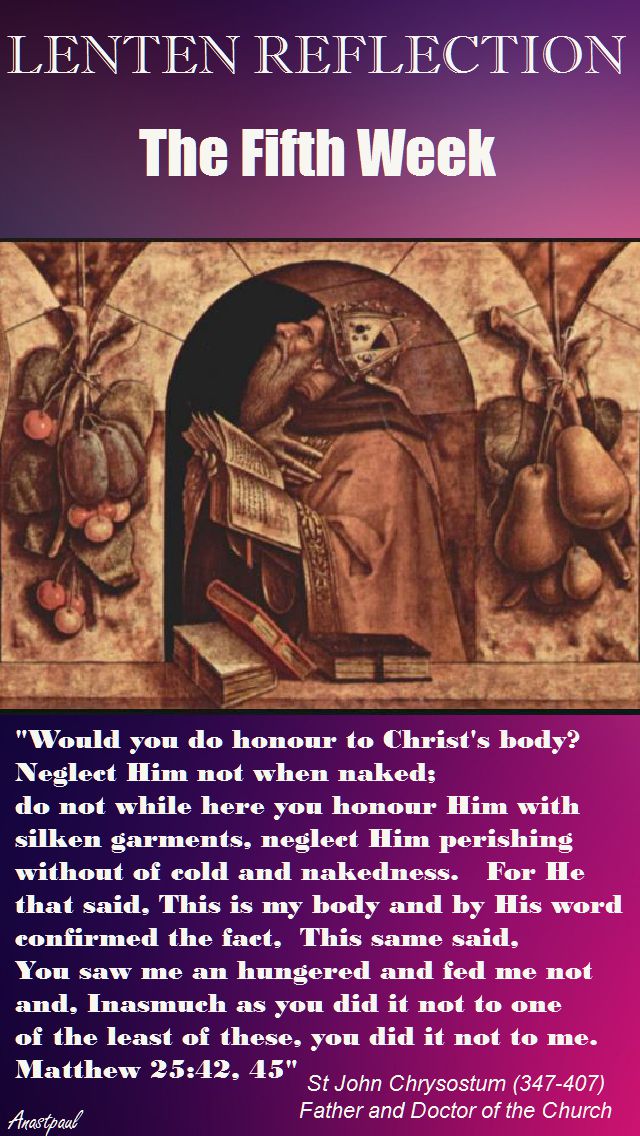
Would you do honour to Christ’s body? Neglect Him not when naked; do not while here you honour Him with silken garments, neglect Him perishing without of cold and nakedness.   For He that said, This is my body, and by His word confirmed the fact, This same said, You saw me an hungered, and fed me not; and, Inasmuch as you did it not to one of the least of these, you did it not to me. Matthew 25:42, 45   For this indeed needs not coverings, but a pure soul; but that requires much attention.

Let us learn therefore to be strict in life and to honour Christ as He Himself desires.   For to Him who is honoured that honour is most pleasing, which it is His own will to have, not that which we account best.   Since Peter too thought to honour Him by forbidding Him to wash his feet but his doing so was not an honour, but the contrary.

Even so do thou honour Him with this honour, which He ordained, spending your wealth on poor people.   Since God has no need at all of golden vessels but of golden souls.

And these things I say, not forbidding such offerings to be provided;  but requiring you, together with them and before them, to give alms………..

For what is the profit, when His table indeed is full of golden cups but He perishes with hunger?   First fill Him, being an hungered and then abundantly deck out His table also. Do you make Him a cup of gold, while you give Him not a cup of cold water?   And what is the profit?   Do you furnish His table with cloths bespangled with gold, while to Himself you afford not even the necessary covering?   And what good comes of it?   For tell me, should you see one at a loss for necessary food and omit appeasing his hunger, while you first overlaid his table with silver;  would He indeed thank you and not rather be indignant?   What, again, if seeing one wrapped in rags and stiff with cold, you should neglect giving him a garment and build golden columns, saying, thou were doing it to His honour, would He not say that thou were mocking and account it an insult and that the most extreme?

Let this then be your thought with regard to Christ also, when He is going about a wanderer and a stranger, needing a roof to cover Him;   and thou, neglecting to receive Him, deckest out a pavement, and walls, and capitals of columns and hangest up silver chains by means of lamps but Himself bound in prison you will not even look upon.

ALMSGIVING-STJOHNCHRYSOSTUM LENT MON 3 APRIL

Posted in MORNING Prayers, QUOTES of the SAINTS, SAINT of the DAY, The WORD

Thought for the Day – 3 April

Thought for the Day – 3 April

Gradually Father Luigi took on the fundamental traits of a spiritual life centred on Jesus Christ, loved and imitated in the humility and poverty of His incarnation in Bethlehem, in the simplicity of His working life at Nazareth, in His total immolation on the cross on Calvary and in the silence of the Eucharist.   And since Jesus had said: “Whatever you did to one of the least of these my brethren you did it to me”, it is to them that every day Father Luigi devoted his life with the practical commitment to “seek first the kingdom of God and his justice” convinced that all the rest will be given according to the gospel promise.   All the works he set in motion during his life reflect this preferential option for the poorest, the lowliest, the abandoned.
The more we read of the Saints, the more we know the answer without any doubt.   For it has been given to us by God Himself, “whatever you do unto the least of these my brethren you did it to me.” (Matthew 25:45) So why on earth do we keep asking the same questions?

“At the evening of life, we shall be judged on our love” (CCC 1022; by St. John of the Cross)”

St Luigi Scrosoppi Pray for us!

ST LUIGI PRAY FOR US.jpg

ST LUIGI SCROSOPPI - APRIL 3

Posted in MORNING Prayers, QUOTES of the SAINTS, SAINT of the DAY

Quote of the Day – 3 April

Quote of the Day – 3 April

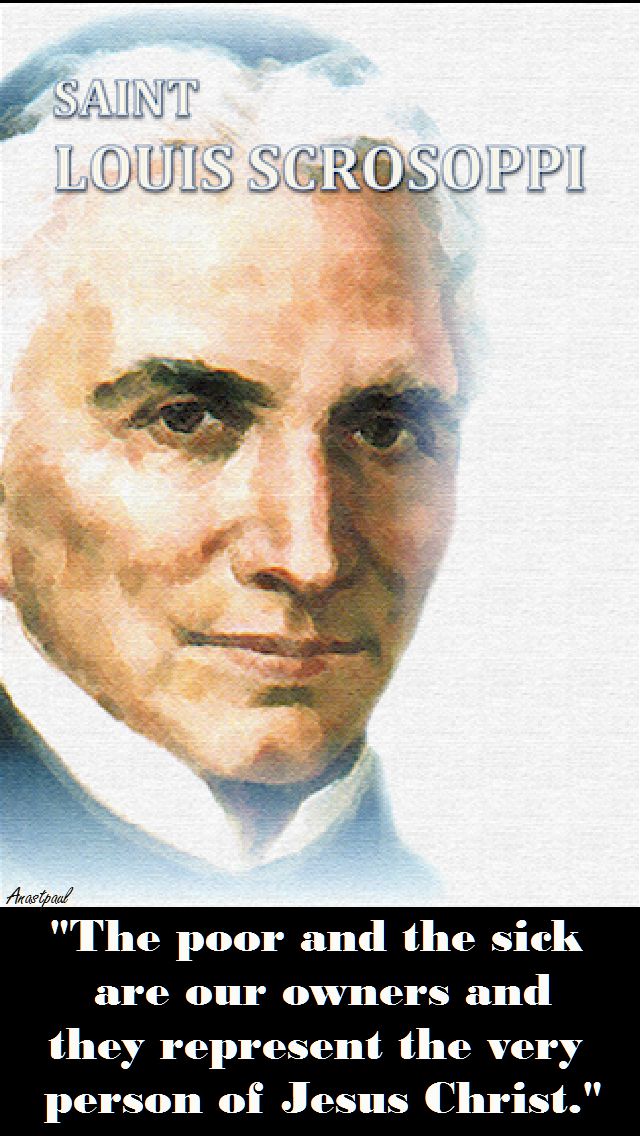
“The poor and the sick are our owners
and they represent the very person of Jesus Christ.”

St Luigi Scrosoppi

THE POOR AND THE SICK - ST LUIGI SCROSOPPIE

Posted in MORNING Prayers, QUOTES of the SAINTS, SAINT of the DAY, The WORD

One Minute Reflection – 3 April 2017

One Minute Reflection – 3 April 2017

I am not seekng my own will but the will of him who sent me…………….John 5:30

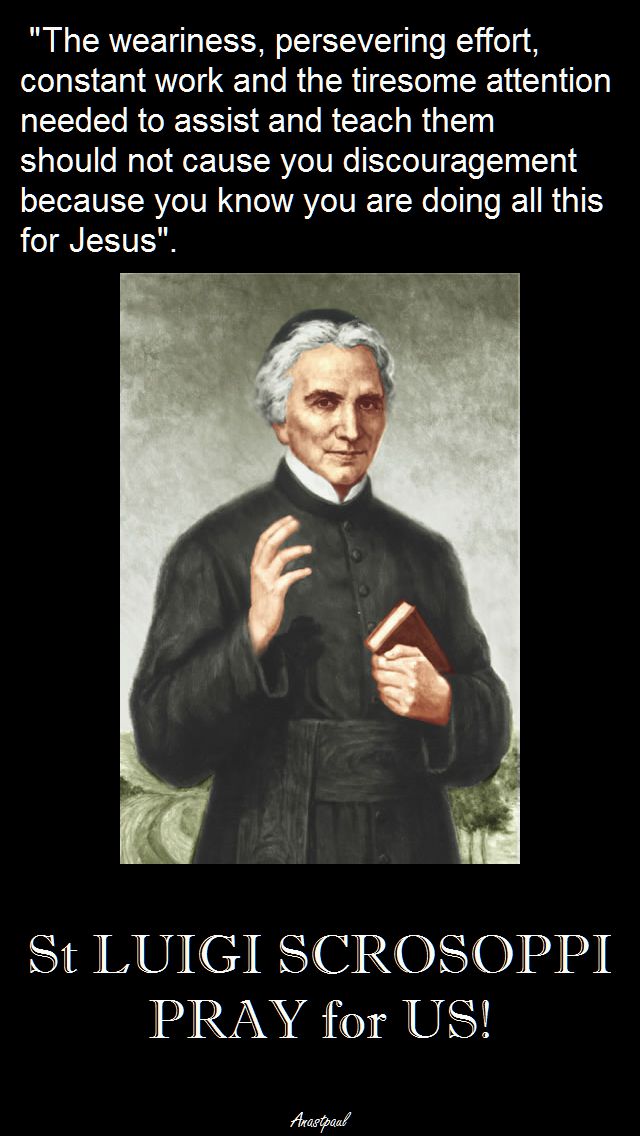
REFLECTION – “The weariness, persevering effort, constant work
and the tiresome attention needed to assist
and teach them should not cause you discouragement
because you know you are doing all this for Jesus”.

PRAYER – Heavenly Father, let me strive – through constant prayer and careful reflection to know Your will for me. Then help me Lord to offer You what You desire rather than what I want. Let me love You first and above all and then my neighbour as myself. St Luigi Scrosoppi, pray for us, amen.

JOHN 5-30ST LUIGI SCROSOPPI- QUOTE

Posted in BREVIARY Prayers, LENT, MORNING Prayers

Our Morning Offering – 3 April

Our Morning Offering – 3 April

Lord Jesus, think on me,
and purge away my sin.
From earth-born passions set me free,
and make me pure within.
Lord Jesus, think on me,
amid the battle’s strife.
In all my pain and misery
be Thou my health and life.
Lord Jesus, think on me,
nor let me go astray.
Through darkness and perplexity
point Thou the heavenly way.
Lord Jesus, think on me,
that, when this life is past,
I may the eternal brightness see,
and share Thy joy at last.

By Bishop Synesius of Cyrene (370-430)

From the Breviary – Lent

LORD JESUS THINK ON ME


Posted in SAINT of the DAY

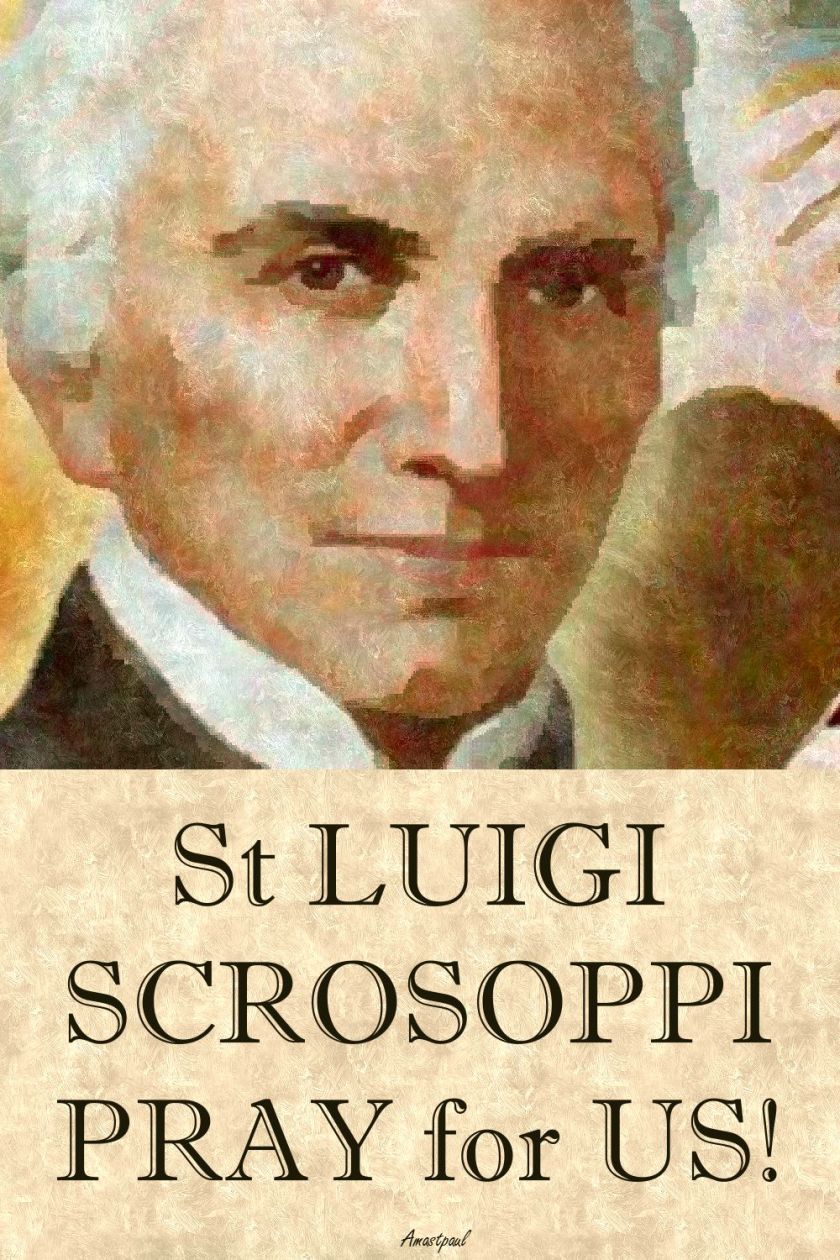
Saint of the Day – 3 April – St Luigi Scrosoppi

Saint of the Day – 3 April – St Luigi Scrosoppi C.O. (1804-1884 died aged 79) – Priest, Founder, Apostle of Charity – Patron of Sisters of Providence of Saint Cajetan of Thiene, footballers and Aids sufferers.

Luigi Scrosoppi (1804-84) spent much of his life fighting anti-clericalism in Italy and brought comfort to the poor.   The son of a jeweller, Aloysius Scrosoppi – always known as Luigi – was born in Udine, in northeast Italy.   His family was extremely devout, and his two elder brothers, Carlo and Giovanni, were ordained before him.

Luigi grew up during with famine, typhus and smallpox endemic.   Even as a boy he felt the obligation to provide relief, inspired by Matthew 25:40: “Inasmuch as you have done it unto one of the least of these my brethren, you have done it unto me.”   At 25, the year before he was ordained, Luigi joined a group of priests and young teachers dedicated to educating poor and abandoned girls, both in the town of Udine and in the surrounding countryside.

He gave himself tirelessly to fundraising and was soon running an organisation which accommodated over 300 students in a building which became known as the House of the Destitute. Scrosoppi, however, was not inclined to take any credit. “The Providence of God,” he wrote, “who prepares minds and hearts to undertake his works, was alone the founder of this Institute.”

He gathered together a team of young women to teach sewing and embroidery. Nine of them decided to mark their dedication more formally and in 1837, under Luigi Scrosoppi’s direction, constituted themselves the Sisters of Providence.   The congregation received official recognition from Pope Pius IX in 1871.

luigi-scrosoppi

In 1846, aged 42, Luigi Scrosoppi, joined the Congregation of the Oratory in Udine and redoubled his work for the Sisters of Providence, promising to found 12 houses for them before he died.   This target he achieved and also opened a school for deaf-mute girls.   In the 1860s the anti-clerical policies of the government in the Udine region forced the Oratory to close. But Luigi Scrosoppi’s determination and practical support enabled the Sisters of Providence to carry on their work.

Now an old man, but with his habitual openness of spirit, he understood that the time had come to hand over the reins to the Sisters, and this he did with tranquility and hope. At the same time he maintained contact with them all through his letters in which he strengthened the ties of affection and love, and in his paternal concern never tired of recommending community spirit and trust.

Through his deep union with God and his experience over many years Father Luigi had acquired a special spiritual wisdom and intuition which enabled him to read hearts: sometimes he even revealed the gift of knowledge about secret inner thoughts and situations which were known only to the person concerned.

At the end of 1883, as his strength began to decline, he was forced to give up all work, and he constantly suffered from a high fever.   The illness took its inexorable course.   He refold the Sisters not to be afraid “because it was God who raised up their religious family and made it grow and He it is who will see to its future”.

When he knew the end was near, he wished to greet everyone. So he wrote his last words to the Sisters: “After my death, your Congregation will have many troubles but afterwards it will have a new life. Charity! Charity!    This is the spirit of your religious family:  to save souls and to save them with Charity”.

During the night of Thursday, the 3rd of April 1884, he finally went to meet Jesus.    The whole of Udine and the people of the surrounding countryside hastened to see him one last time and to beg his protection from heaven.

Through his efforts on behalf of the little ones, of the poor, of young people in difficulty, of those who are suffering, of all those living in trying circumstances, Father Luigi still continues today to show everyone the path of union with God, of compassion and of love, and is still ready to accompany the steps of those who entrust themselves to the Providence of God.

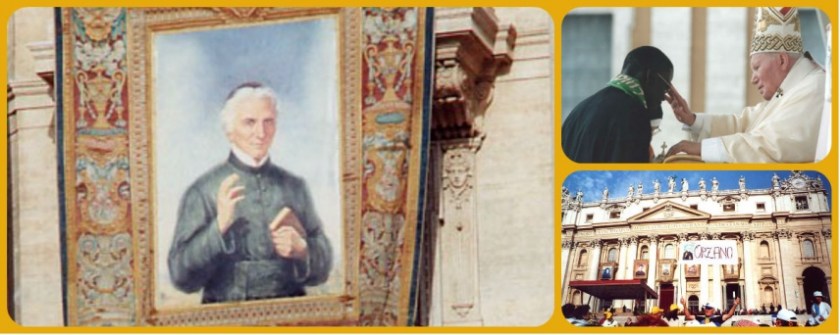
St. Luigi Scrosoppi was canonised on June 10, 2001 – It was at the intercession of St Luigi that a Zambian man, now Fr Peter Changu Shitima, was miraculously cured of AIDS in 1996.   He was at that time a member of the Oratory at Oudtshoorn, near Cape Town in South Africa and it was to a member of St Philip’s family that his friends turned for help. Read the full story here https://zenit.org/articles/the-aids-miracle-that-led-to-a-canonization/

463052dad9377fe2445d3b1bfb5f62a3_L

and here is Fr Shitima at St Luigi’s Canonisation.

475699d297afae315ef802312426354e_Generic

Nine years later, he was named as patron saint of footballers (soccer players) by Bishop Alois Schwarz.   Today his name is invoked by sufferers from Aids.

Posted in SAINT of the DAY

Saints – 3 April

Bl Alexandrina di Letto
St Attala of Taormina
St Benignus of Tomi
St Burgundofara
St Chrestus
St Evagrius of Tomi
Bl Francisco Solís Pedrajas
Bl Gandulphus of Binasco
Bl Iacobus Won Si-bo
Bl John of Penna
St Joseph the Hymnographer
Bl Juan Otazua Madariaga
Bl Lawrence Pak Chwi-deuk
St Luigi Scrosoppi of Udine
Bl Maria Teresa Casini
St Nicetas of Medicion
Bl Piotr Edward Dankowski
St Richard of Chichester
Bl Robert Middleton
Bl Stephen Rowsham
Bl Thurstan Hunt
St Vulpian of Tyre

Posted in LENT

Lenten Reflection – 2 April 2017 – The Eucharist, Our Sanctification Fr Raniero Cantalamessa

Lenten Reflection – 2 April 2017

The Eucharist, Our Sanctification
Fr Raniero Cantalamessa

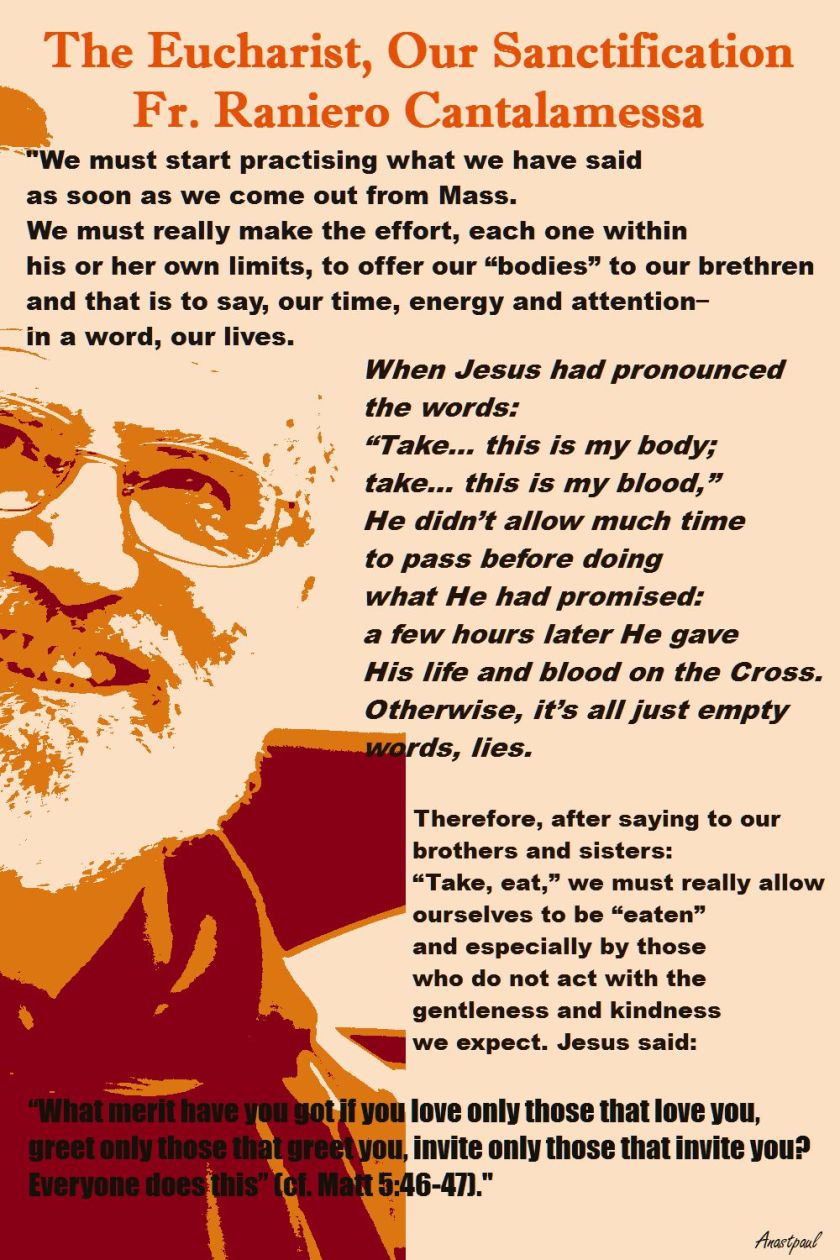
“We must start practising what we have said as soon as we come out from Mass.   We must really make the effort, each one within his or her own limits, to offer our “bodies” to our brethren and that is to say, our time, energy and attention–in a word, our lives. When Jesus had pronounced the words:  “Take… this is my body; take… this is my blood,”    He didn’t allow much time to pass before doing what He had promised: a few hours later He gave His life and blood on the Cross.    Otherwise, it’s all just empty words, lies.    Therefore, after saying to our brothers and sisters: “Take, eat,” we must really allow ourselves to be “eaten” and especially by those who do not act with the gentleness and kindness we expect.    Jesus said: “What merit have you got if you love only those that love you, greet only those that greet you, invite only those that invite you? Everyone does this” (cf. Matt 5:46-47).    On his way to Rome where he was to die a martyr, St. Ignatius of Antioch wrote: “I am the grain of Christ; that I may be ground by the teeth of wild beasts to become pure bread for the Lord.”   If we think about it, each one of us will realise that there are sharp teeth grinding us: criticisms, contrasts, hidden or open oppositions, different ideas in those surrounding us, differences in character.   We should even be grateful to those who help us like this.   They are of infinitely more benefit to us than those who approve or flatter us.   In another letter, the same holy martyr wrote: “Those that praise me, scourge me.”

(2 images to choose from)

THE EUCHARIST OUR SANCTIFICATION - FR RANEIRO CANTALAMESSA LENT 2017THE EUCHARIST OUR SANCTIFICATION - FR RANEIRO CANTALAMESSA LENT 2017.jpg PURPLE