Quote/s of the Day – 3 September – The Memorial of St Pope Gregory the Great (540-604) – Father & Doctor of the Church
“If we knew at what time we were to depart from this world, we would be able to select a season for pleasure and another for repentance. But God, who has promised pardon to every repentant sinner, has not promised us tomorrow. Therefore we must always dread the final day, which we can never foresee. This VERY DAY is a day of truce, a day for conversion. And yet we refuse to cry over the evil we have done! Not only do we not weep for the sins we have committed, we even add to them…”
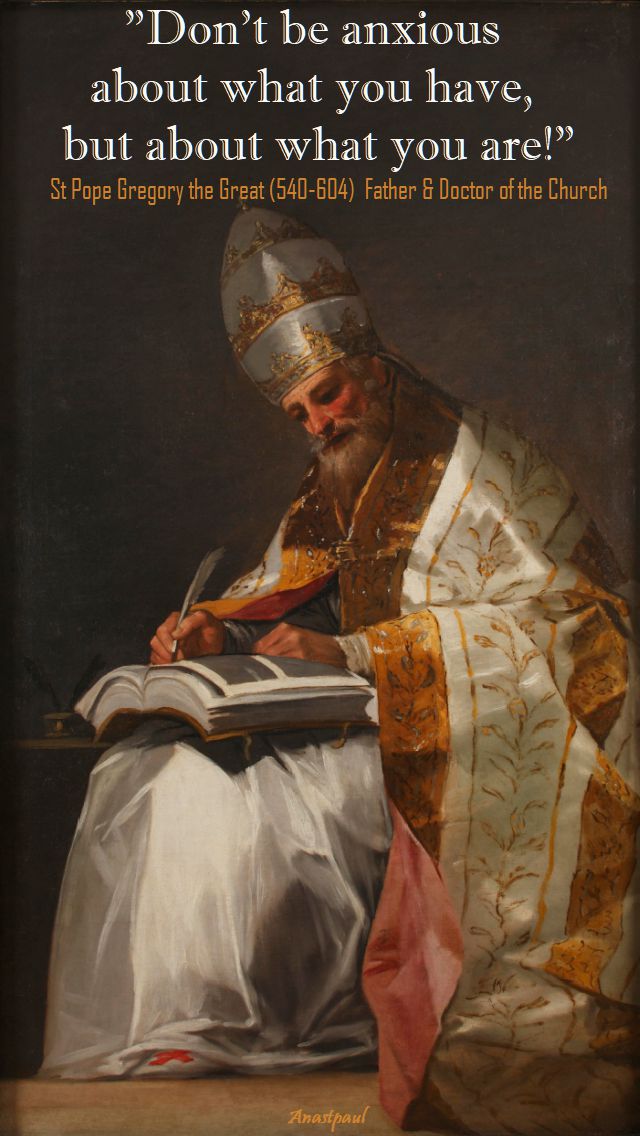
“Don’t be anxious about what you have, but about what you are!”
“When we attend to the needs of those in want, we give them what is theirs, not ours. More than performing works of mercy, we are paying a debt of justice.”
“The Emperor of heaven, the Lord of men and of angels, has sent you His epistles for your life’s advantage— and yet you neglect to read them eagerly. Study them, I beg you and meditate daily on the words of your Creator. Learn the heart of God in the words of God, that you may sigh more eagerly for things eternal, that your soul may be kindled with greater longings for heavenly joy.”
St Pope Gregory the Great (540-604) – Father & Doctor of the Church
One Minute Reflection –3 September – The Memorial of St Pope Gregory the Great (540-604) – Father & Doctor of the Church
Since the Creation of the world….God’s eternal power and divinity have become visible, recognised through the things he has made..Romans 1:20
REFLECTION – “God is within all things but not included; outside all things but not excluded. God is above all things but not beyond their reach.”….St Pope Gregory the Great
PRAYER – Lord of creation, grant me the grace to see You in all things and in all places on earth. Help me to seek and reach You in all the events I experience and all the persons I encounter every day of my life. St Pope Gregory the Great, Pray for us! Amen
Saint of the Day – 3 September – St Pope Gregory the Great (540-604) – Father & Doctor of the Church. Also known as “Father of the Fathers” (c 540 at Rome, Italy – Papal Ascension: 3 September 590 – 12 March 604 at Rome, Italy of natural causes). Pope, Prefect of Rome, Monk, Abbot, Writer, Theologian, Teacher, Liturgist. Patronages – • against gout • against plague/epidemics,• choir boys,• teachers• stone masons, stonecutters, • students, school children,• Popes, the Papacy,• musicians,• singers,• England, • West Indies,• Legazpi, Philippines, Diocese of,• Order of Knights of Saint Gregory, • Kercem, Malta,• Montone, Italy,• San Gregorio nelle Alpi, Italy. Attributes – • crozier
• dove,• pope working on sheet music,• pope writing,• tiara.
4 Original Latin Fathers – Jerome, Gregory, Ambrose, Augustine
Pope St. Gregory was born in Rome, the son of a wealthy Roman Senator. His mother was St. Sylvia. He followed the career of public service that was usual for the son of an aristocratic family, becoming Prefect of the City of Rome but resigned within a year to pursue monastic life.
He founded with the help of his vast financial holdings seven monasteries, of which six were on family estates in Sicily. A seventh, which he placed under the patronage of St. Andrew and which he himself joined, was erected on the Clivus Scauri in Rome. For several years, he lived as a good and holy Benedictine monk.
Then Pope Pelagius made him one of the seven deacons of Rome. For six years, he served as permanent ambassador to the Court of Byzantium. In the year 586, he was recalled to Rome and with great joy returned to St Andrew’s Monastery. He became abbot soon afterwards and the monastery grew famous under his energetic rule. When the Pope died, Gregory was unanimously elected to take his place because of his great piety and wisdom. However, Gregory did not want that honour, so he disguised himself and hid in a cave but was found and made Pope anyway.
He was elected Pope on 3 September 590, the first monk to be elected to this office. For fourteen years he ruled the Church. Even though he was always sick, Gregory was one of the greatest popes the Church has ever had. He reformed the administration of the Church’s estates and devoted the resulting surplus to the assistance of the poor and the ransoming of prisoners. He negotiated treaties with the Lombard tribes who were ravaging northern Italy and by cultivating good relations with these and other barbarians he was able to keep the Church’s position secure in areas where Roman rule had broken down.
His works for the propagation of the faith include the sending of St Augustine of Canterbury and his monks as missionaries to England in 596, providing them with continuing advice and support and (in 601) sending reinforcements. He wrote extensively on pastoral care, spirituality and morals and designated himself “servant of the servants of God”, a title which all Popes have used since that time.
He never rested and wore himself down to almost a skeleton. Even as he lay dying, he directed the affairs of the Church and continued his spiritual writing.
He codified the rules for selecting deacons to make these offices more spiritual. Prior to this, deacons were selected on their ability to sing the liturgy and chosen if they had good voices.
Because he loved the solemn celebration of the Eucharist, St. Grergory devoted himself to compiling the Antiphonary, which contains the chants of the Church used during the liturgy (the Gregorian Chant). He also set up the Schola Cantorum, Roman’s famous training school for chorusters.
St Gregory died on March 12, 604 and was buried in St Peter’s Church. He is designated as the fourth Doctor of the Latin Church. His feast is celebrated on the date of his election as Pope.
The Eucharistic Miracle of St Pope Gregory
St Gregory the Great is perhaps especially remembered by many for the Eucharistic Miracle that occurred in 595 during the Holy Sacrifice. This famous incident was related by Paul the Deacon in his 8th century biography of the holy pope, Vita Beati Gregorii Papae.
Pope Gregory was distributing Holy Communion during a Sunday Mass and noticed amongst those in line a woman who had helped make the hosts was laughing. This disturbed him greatly and so he inquired what was the cause of her unusual behaviour. The woman replied that she could not believe how the hosts she had prepared could become the Body and Blood of Christ just by the words of consecration.
Hearing this disbelief, St. Gregory refused to give her Communion and prayed that God would enlighten her with the truth. Just after making this plea to God, the pope witnessed some consecrated Hosts (which appeared as bread) change Their appearance into actual flesh and blood. Showing this miracle to the woman, she was moved to repentance for her disbelief and knelt weeping. Today, two of these miraculous Hosts can still be venerated at Andechs Abbey in Germany (with a third miraculous Host from Pope Leo IX [11th century], thus the Feast of the Three Hosts of Andechs [Dreihostienfest]).
During the Middle Ages, the event of the Miraculous Mass of St. Gregory was gradually stylised in several ways. First the doubting woman was often replaced by a deacon, while the crowd was often comprised of the papal court of cardinals and other retinue. Another important feature was the pious representation of the Man of Sorrows rising from a sarcophagus and surrounded by the Arma Christi, or the victorious display of the various instruments of the Passion.
The artistic representation of this Eucharistic Miracle became especially prominent in Europe during the Protestant Reformation in reaction to the heretical denial of the doctrine of the Real Presence.
Our Morning Offering – 3 September – The Memorial of St Pope Gregory the Great – Father & Doctor
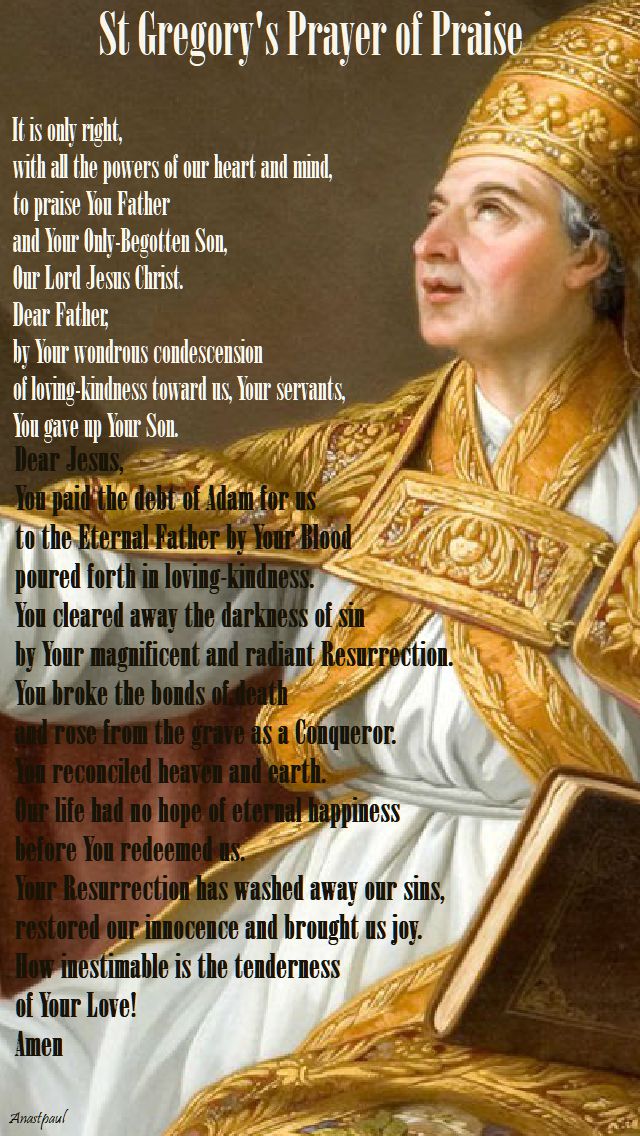
St Gregory’s Prayer of Praise
It is only right,
with all the powers of our heart and mind,
to praise You Father
and Your Only-Begotten Son,
Our Lord Jesus Christ.
Dear Father,
by Your wondrous condescension
of loving-kindness toward us, Your servants,
You gave up Your Son.
Dear Jesus,
You paid the debt of Adam for us
to the Eternal Father by Your Blood
poured forth in loving-kindness.
You cleared away the darkness of sin
by Your magnificent and radiant Resurrection.
You broke the bonds of death
and rose from the grave as a Conqueror.
You reconciled heaven and earth.
Our life had no hope of eternal happiness
before You redeemed us.
Your Resurrection has washed away our sins,
restored our innocence and brought us joy.
How inestimable is the tenderness
of Your Love!
Amen
St Gregory the Great, Pope (Memorial) – https://www.youtube.com/watch?v=IpR9Mv63AY0
—
St Aigulphus of Lérins
St Ambrose of Sens
St Ammon of Heraclea
Bl Andrew Dotti
St Auxanus
St Balin
St Basilissa of Nicomedia
Bl Brigida of Jesus
St Chariton
St Chrodegang of Séez
St Frugentius the Martyr
Bl Guala of Brescia
St Hereswitha
Bl Herman of Heidelberg
St Macanisius
St Mansuetus of Toul
St Marinus
St Martiniano of Como
St Natalis of Casale
St Phoebe
St Regulus of Rheims
St Remaclus
St Sandila of Cordoba
St Zeno
—
Martyrs of Aquileia – 4 saints: Four young women, variously sisters and cousins, who were born to the nobility, the daughters of the pagans Valentinianus of Aquileia and Valentius of Aquileia. Each woman converted and made private vows, dedicating themselves to God. They were arrested, tortured and martyred by order of Valentius for becoming a Christian. We know little else but their names – Dorothy, Erasma, Euphemia and Thecla. They were martyred by beheaded in the 1st century in Aquileia, Italy and their bodies were thrown into a nearby river.
Martyrs of Nagasaki – 6 beati: A group of priests and clerics, native and foreign, murdered together in the anti-Christian persecutions in Japan. They were scalded in boiling water and then burned alive on 3 September 1632 in Nishizaka, Nagasaki, Japan and Beatified on 7 May 1867 by Pope Pius IX.
• Anthony Ishida
• Bartolomé Gutiérrez Rodríguez
• Francisco Terrero de Ortega Pérez
• Gabriel Tarazona Rodríguez
• Jerome of the Cross de Torres
• Vicente Simões de Carvalho
Martyrs of Seoul – 6 saints: A group of Christian lay people martyred together in the persecutions in Korea. They were beheaded on 3 September 1839 at the Small West Gate, Seoul, South Korea and Canonised on 6 May 1984 by Pope John Paul II.
• Agnes Kim Hyo-Ch’u
• Barbara Kwon Hui
• Barbara Yi Chong-hui
• Ioannes Pak Hu-jae
• Maria Pak K’Un-agi
• Maria Yi Yon-hui
Martyred in the Spanish Civil War:
• Blessed Andrea Calle González
• Blessed Concepción Pérez Giral
• Blessed Dolores Úrsula Caro Martín
• Blessed Joaquim Balcells Bosch
• Blessed Pius Salvans Corominas
Thought for the Day – 2 September – The Memorial of St Solomon Le Clercq FSC (1767-1792)
It seems highly appropriate that St Solomon’s memorial coninsides with today’s Gospel of the Talents – “Fear is the wrong attitude….” (Pope Benedict XVI)
“The glorification of our first martyr will be held at the closing of the “Year of Mercy.” As stressed so many times by Pope Francis during the Jubilee Year, to understand what it means “mercy” is to understand the core of Jesus’ teaching. Mercy is love and for love He is willing to do everything, even to give his own life. This is what our Brother Solomon, is teaching us by his heroic fidelity The canonisation of Brother Solomon will certainly be a blessing for our Institute. Together, let us thank the Lord. The example set by our Brother must push us to follow Christ day after day. Although we are not called to give a bloody witness we are called anyway to do this in the “terrible day to day task ” of our apostolic life. On the occasion of the feast of St Bartholomew, our Founder writes: “You have to suffer a constant martyrdom that is no less violent for the spirit than Saint Bartholomew’s was for his body. You must, so to speak, tear off your own skin, which Saint Paul calls the old man, in order to be clothed with the Spirit of Jesus Christ, which is, according to the same Apostle, the new man.” (Brother Robert Schieler, FSC – Superior General)
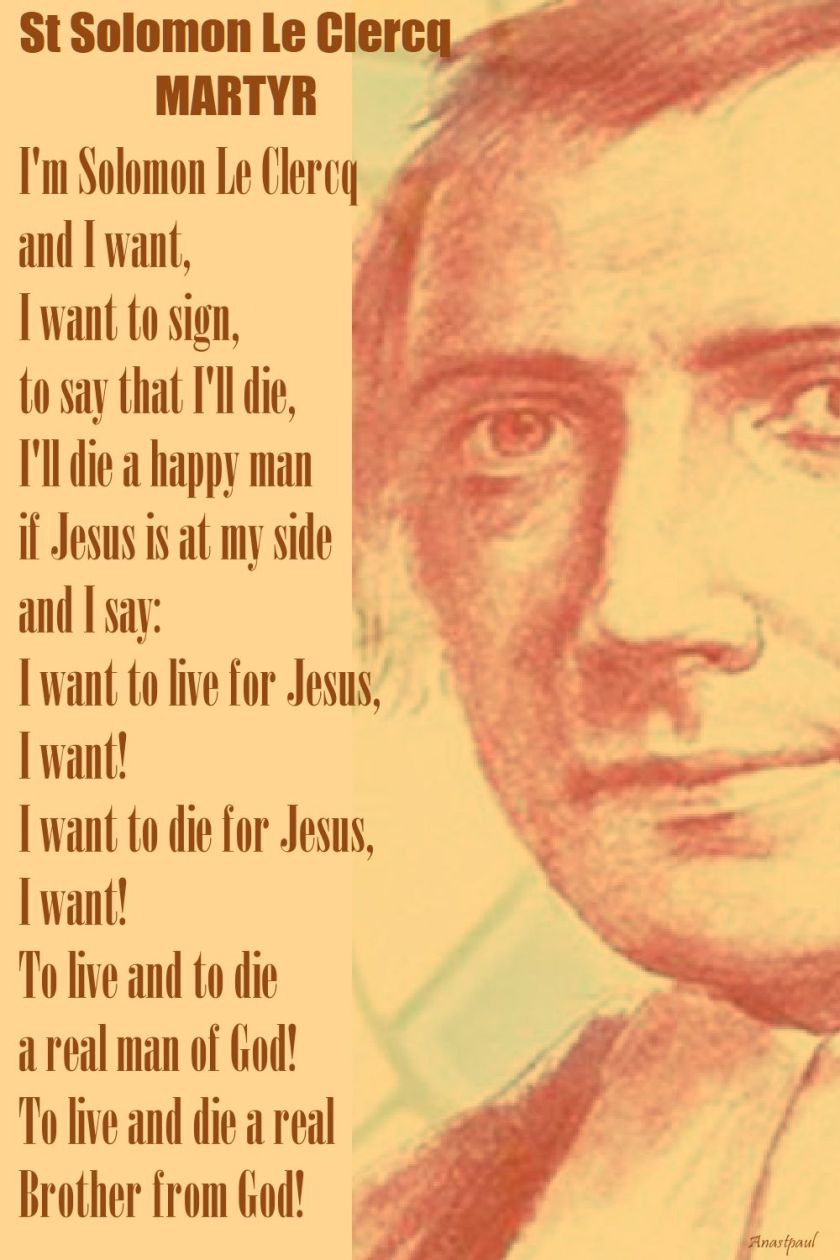
“I’m Solomon Le Clercq and I want, I want to sign, to say that I’ll die, I’ll die a happy man if Jesus is at my side and I say: I want to live for Jesus, I want! I want to die for Jesus, I want! To live and to die a real man of God! To live and die a real Brother from God!”
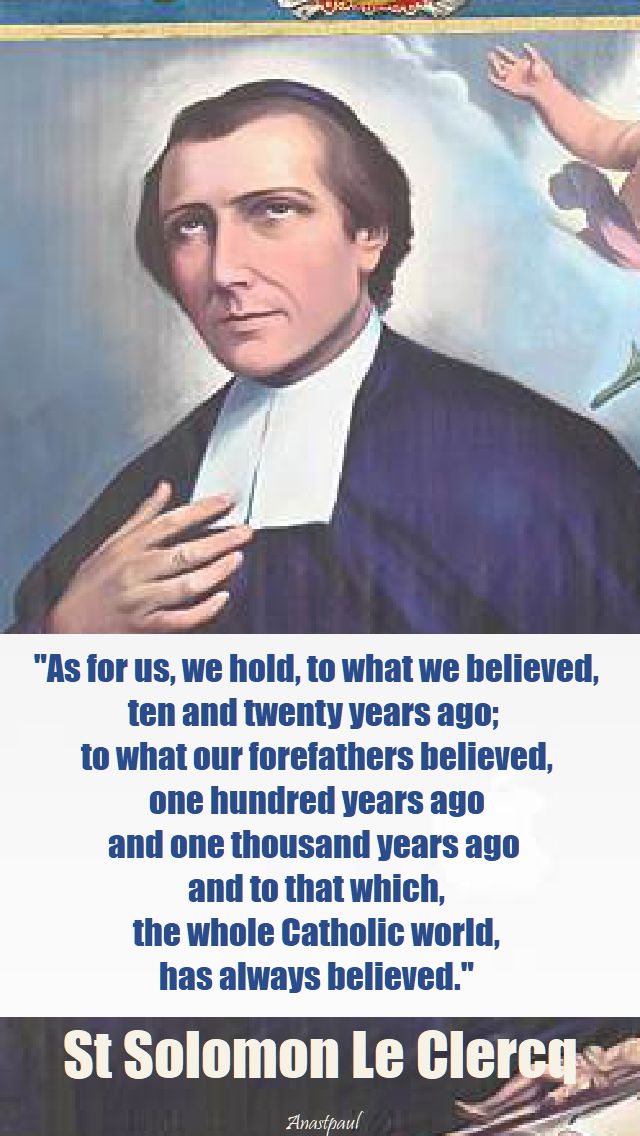
“As for us, we hold, to what we believed, ten and twenty years ago; to what our forefathers believed, one hundred years ago and one thousand years ago and to that which, the whole Catholic world, has always believed.”
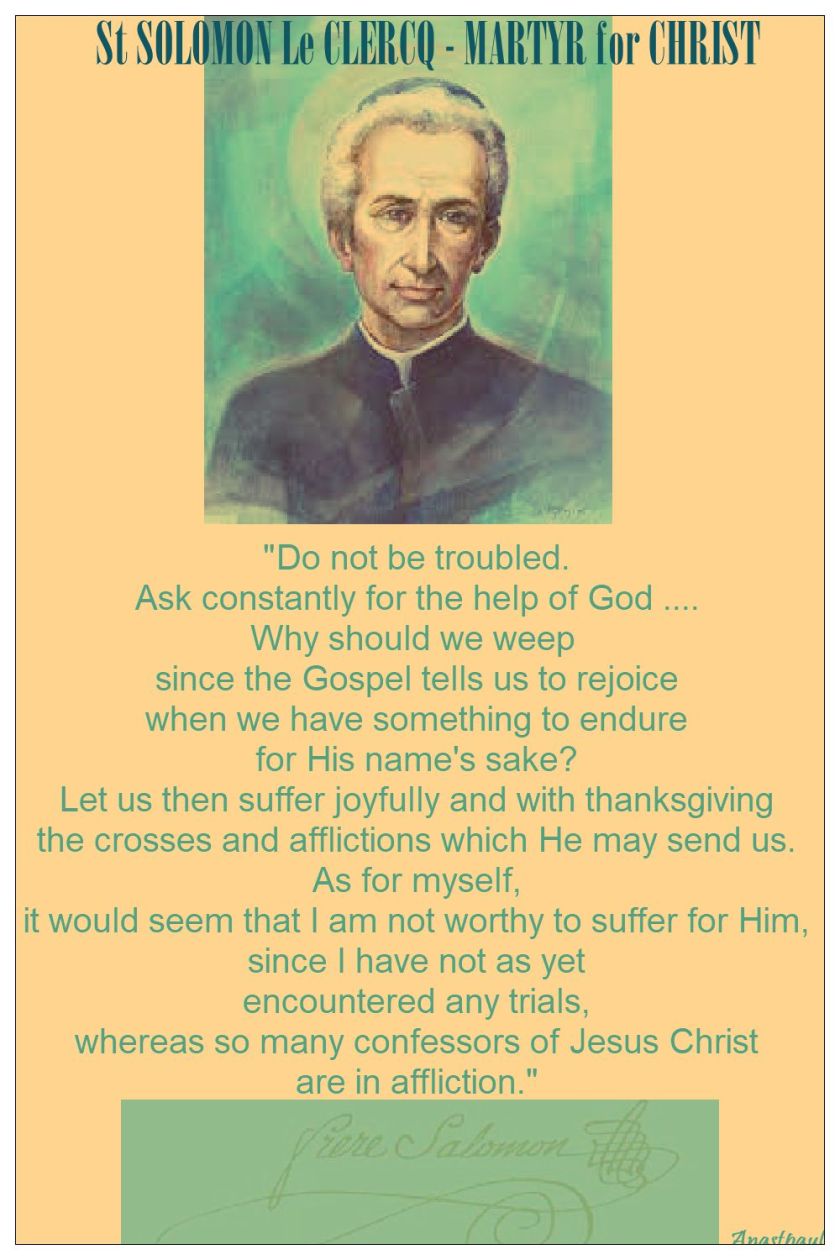
“Do not be troubled. Ask constantly for the help of God …. Why should we weep since the Gospel tells us to rejoice when we have something to endure for His name’s sake? Let us then suffer joyfully and with thanksgiving the crosses and afflictions which He may send us. As for myself, it would seem that I am not worthy to suffer for Him, since I have not as yet encountered any trials, whereas so many confessors of Jesus Christ are in affliction.”
One Minute Reflection – 2 September – Today’s Gospel Matthew 25:14-30
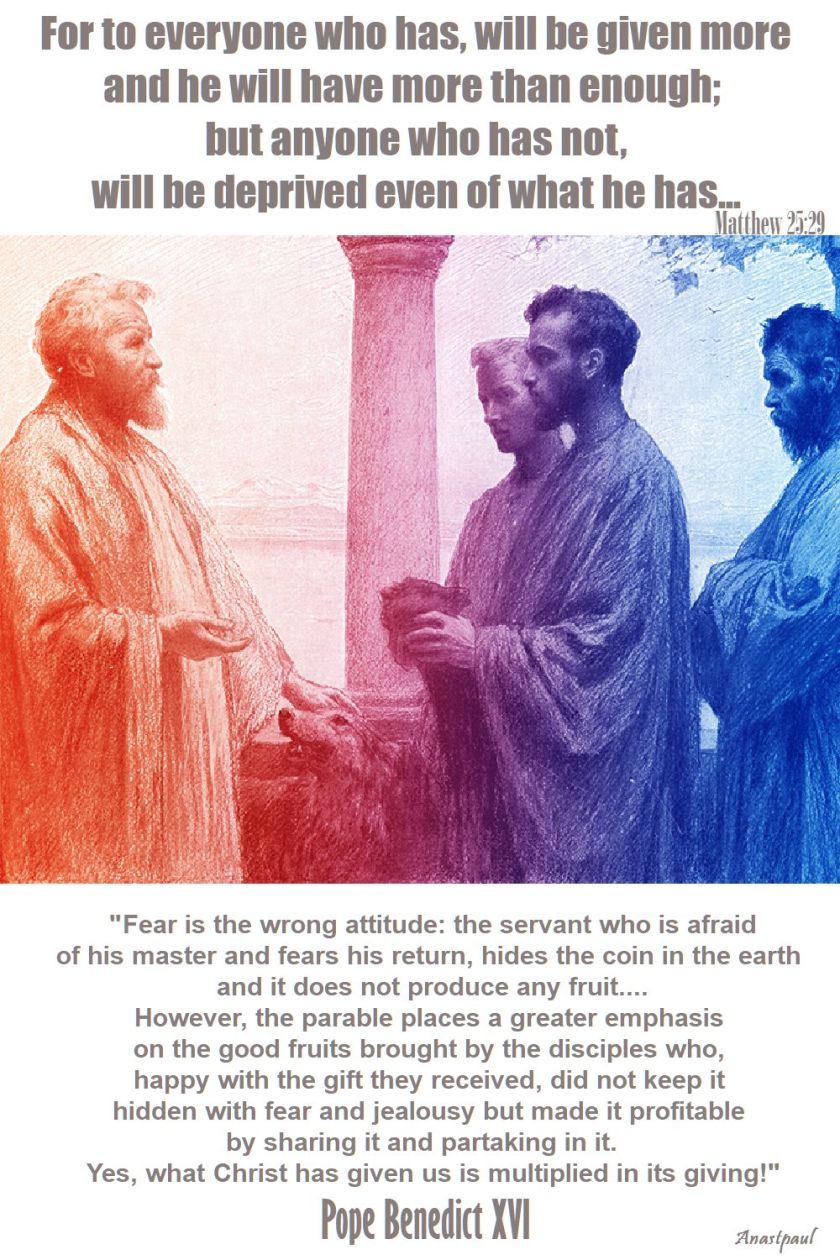
For to everyone who has will be given more, and he will have more than enough; but anyone who has not, will be deprived even of what he has.…Matthew 25:29
REFLECTION – ” Fear is the wrong attitude: the servant who is afraid of his master and fears his return hides the coin in the earth and it does not produce any fruit. This happens, for example, to those who after receiving Baptism, Communion and Confirmation subsequently bury these gifts beneath a blanket of prejudice, beneath a false image of God that paralyses faith and good works, thus betraying the Lord’s expectations. However, the parable places a greater emphasis on the good fruits brought by the disciples who, happy with the gift they received, did not keep it hidden with fear and jealousy but made it profitable by sharing it and partaking in it. Yes, what Christ has given us is multiplied in its giving!” …Pope Benedict XVI ( Angelus address of Sunday, 16 November 2008)
PRAYER – Lord my God, teach me to be unafraid to share the Light of the Gospel with all. Teach me to go out and spread Your gifts with all who enter my life. For You have called me and I must respond without fear but with joy and love. St Solomon Le Clercq – you ‘wanted’ to be all for God! Please pray for us all, amen.
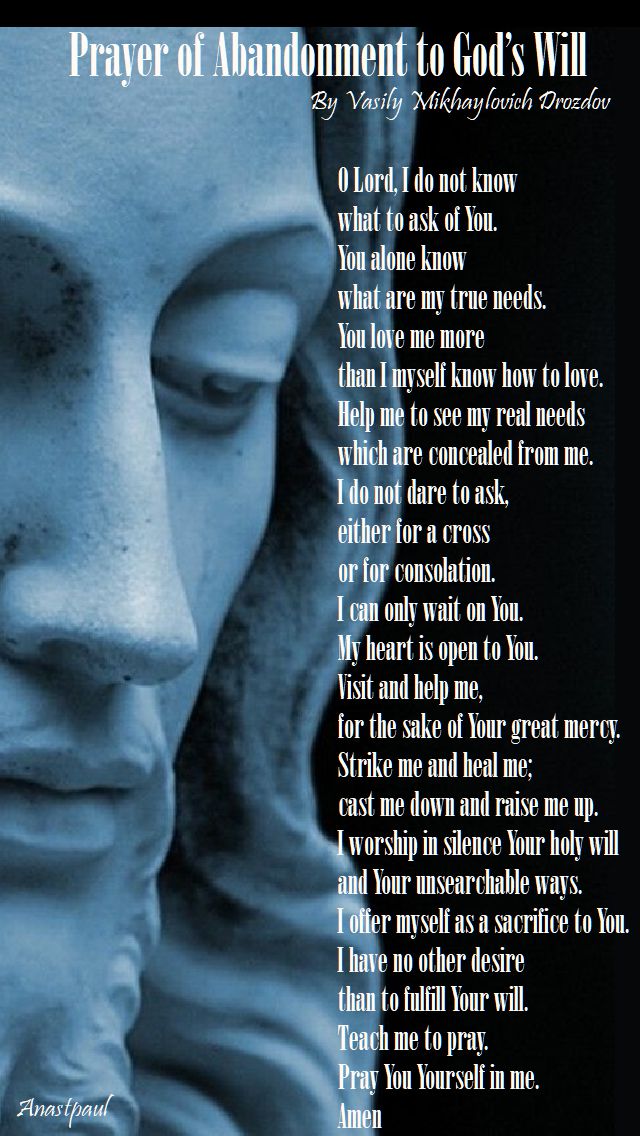
O Lord, I do not know
what to ask of You.
You alone know
what are my true needs.
You love me more
than I myself know how to love.
Help me to see my real needs
which are concealed from me.
I do not dare to ask,
either for a cross
or for consolation.
I can only wait on You.
My heart is open to You.
Visit and help me,
for the sake of Your great mercy.
Strike me and heal me;
cast me down and raise me up.
I worship in silence Your holy will
and Your unsearchable ways.
I offer myself as a sacrifice to You.
I have no other desire
than to fulfill Your will.
Teach me to pray.
Pray You Yourself in me.
Amen
by Metropolitan Philaret of Moscow Vasily Mikhaylovich Drozdov
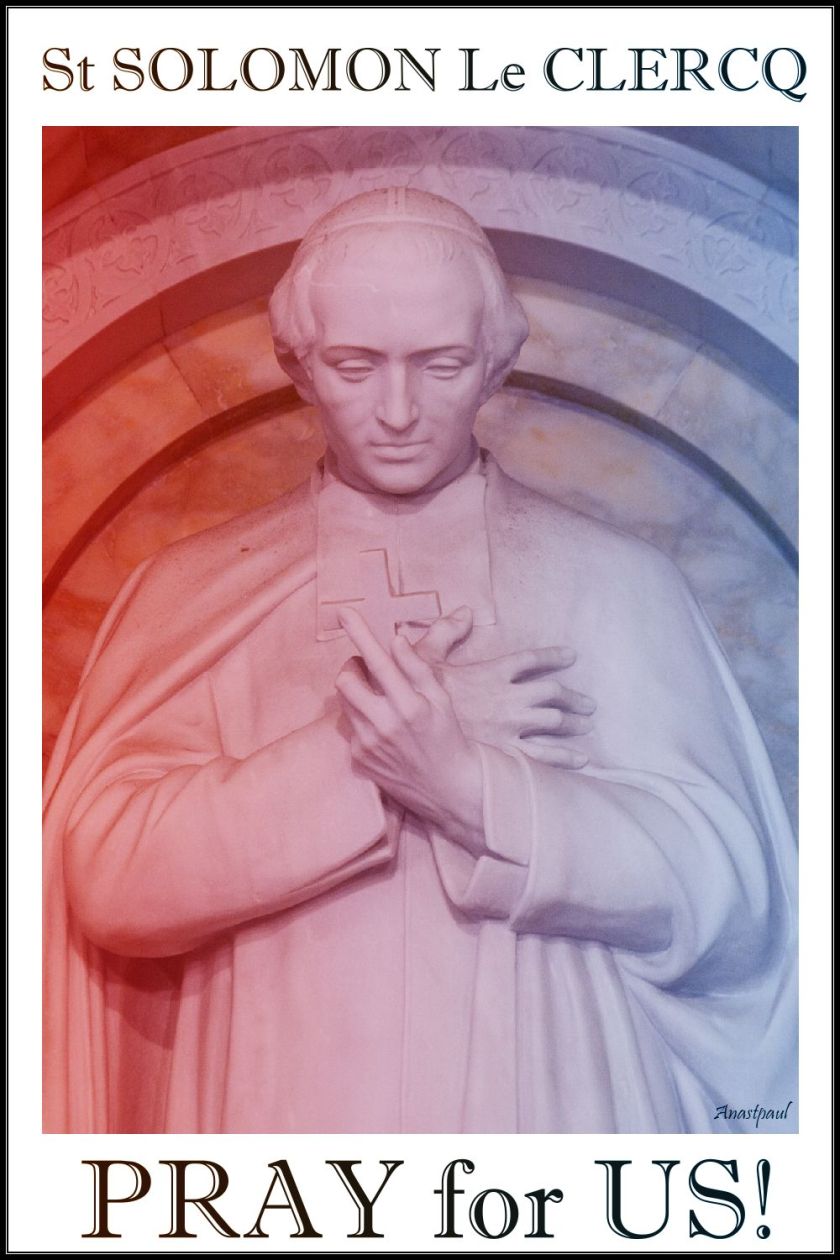
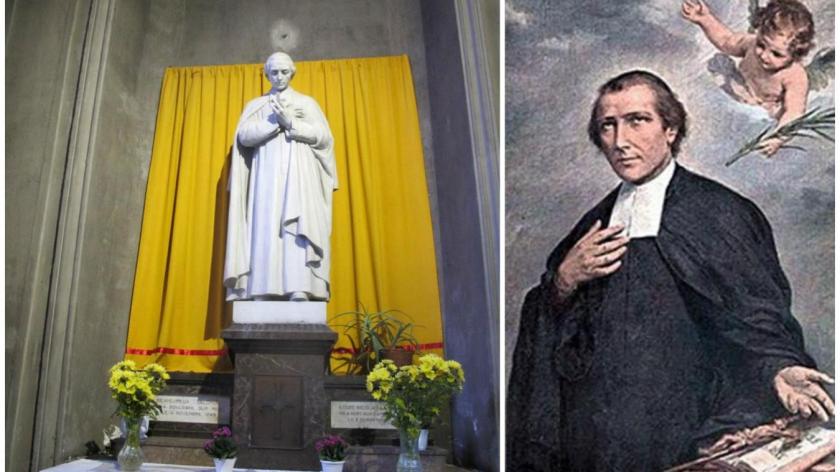
Saint of the Day – 2 September – St Solomon Le Clercq FSC MARTYR and Religious Brother – St Solomon Le Clercq FSC (born Guillaume-Nicolas-Louis) Martyr, Religious Brother of the De La Salle Brothers, Teacher (Born at Boulogne, France 14 November 1745 – Martyred 2 September 1792). Beatified by Pope Pius XI in 1926 and Canonised by Pope Francis on 16 October 2016. Patronage – Persecuted Christians. Attributes – Cassock, Palm.
French Revolution
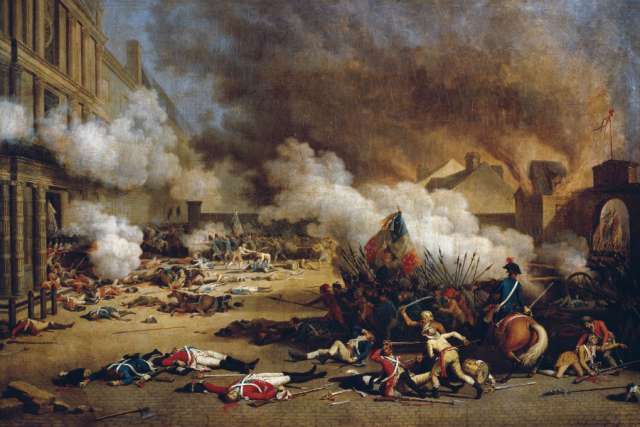
St Solomon was the son of a wealthy wine merchant. In 1767 he entered the novitiate of the Brothers of the Christian Schools, taking the name Solomon. Solomon went into hiding when religious orders were outlawed during the French Revolution. He was martyred, along with nearly 200 hundred others, during the September Massacres of 1792.
In August that year the Legislative Assembly had closed all Catholic schools in Paris and outlawed the wearing of religious habits or vestments in public. On 18 August the Assembly suppressed all Catholic institutions and religious orders. Priests had to swear an oath to the Civil Constitution of the Clergy, which had taken over the Church, or leave the country. Some 25,000 priests left.
In the first week of September, between 1,247 and 1,368 people were killed in what became known as the September Massacres. Blessed Solomon was arrested, taken to a Carmelite monastery which the authorities had converted into a prison, and executed on 2 September. He was among nearly 200 Catholics who refused to abandon their faith; they were beatified by Pope Pius XI in 1926.
Once the monarchy had been overthrown early in the French Revolution, the next target was the Church. In 1790 the Civil Constitution of the Clergy gave the state complete control over the Church in France. In order to continue to function, priests and religious were forced to take an oath to support the constitution. Most of the Brothers refused and so were forced gradually to abandon their schools and communities. Eventually the Institute was deprived altogether of legal status in France.
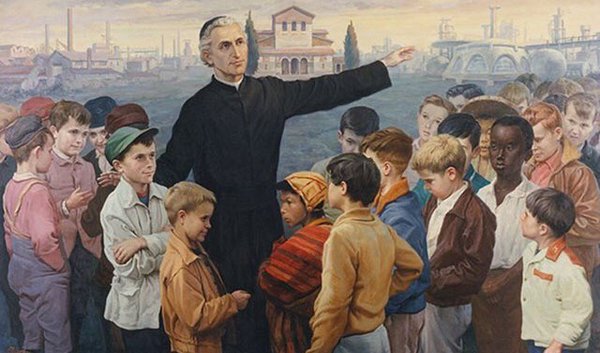
Brother Solomon was secretary to Brother Agathon, the Superior General, after having been a teacher, director and bursar. He always showed a great love for people and a great attachment to his work. Having refused to take an oath, he lived alone in Paris in secrecy We still have many of his letters to his family. The last one is dated 15 August 1792. That very day he was arrested and imprisoned in the Carmelite monastery, which had become a prison, together with several bishops and priests. On 2 September, almost all the prisoners were killed by sword in the monastery garden. He was beatified on 17 October 1926, together with 188 of his fellow martyrs. He was the first one of our martyrs and also the first Brother to be beatified.
He has now been Canonised on 16 October last year by Pope Francis. Alleluia!
The miracle that would lead to his eventual sanctification was investigated in the diocese of its origin in Venezuela from 19 January 2011 to 29 September 2011 and was sent to the Congregation for the Causes of Saints for further investigation. The consulting medical board approved the miracle on 3 March 2016 while theologians approved it the following month on 5 April 2016. The C.C.S. approved the miracle on 3 May 2016 and passed it onto Pope Francis who approved for Leclercq’s canonization on 9 May 2016. Normally in the process of canonization, two miracles attributed to the saint are needed – one for beatification, and one for canonization. However, the miracle necessary for beatification in the case of martyrs can be waived, since martyrdom itself is considered a miracle of grace.
The miracle being attributed to the intercession of Blessed Solomon Leclercq, declared by the medical consultant of the Sacred Congregation for the Causes of Saints and approved by Pope Francis, is the inexplicable cure of a Venezuelan girl who had been bitten by a venomous snake.
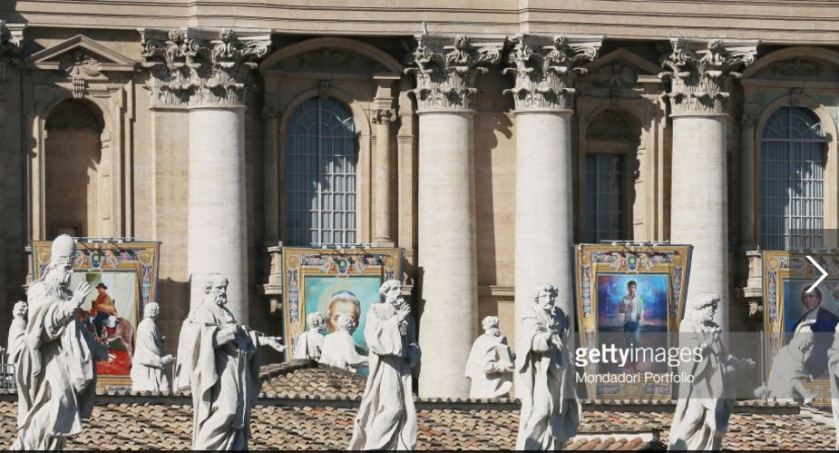
The date of canonization was decided at a gathering of cardinals on 20 June 2016 and the canonisation itself was celebrated in Saint Peter’s Square on 16 October 2016.
The postulator at the time of canonization was Rodolfo Cosimo Meoli.
St Abibus of Edessa
St Agricola of Avignon
Bl Albert of Pontida
St Antoninus of Pamiers
St Antoninus of Syria
Bl Antonio Franco
St Brocard
St Castor of Apt
St Comus of Crete
St Eleazar the Patriarch
St Elpidius of Lyon
St Elpidius the Cappadocian
St Hieu
St Ingrid of Sweden
St Justus of Lyons
St Lanfranco of Vercelli
St Lolanus
St Margaret of Louvain
St Maxima
St Nonnossus
St Prospero of Tarragona
St Solomon le Clerq
St Theodota of Bithynia
St Valentine of Strasbourg
St William of Roeskilde
—
Marytrs of Nicomedia – 3 saints: Three Christians who were martyred together in the persecutions of Diocletian. No details about them but their names have survived – Concordius, Theodore and Zenone. They were martyrd in
Nicomedia, Bithynia (in modern Turkey).
Martyrs of September – 191 beati: Also known as – • Martyrs of Paris,• Martyrs of Carmes.
A group of 191 martyrs who died in the French Revolution. They were imprisoned in the Abbey of St-Germain-des-Prés, Hôtel des Carmes in the rue de Rennes, Prison de la Force and Seminaire de Saint-Firmin in Paris, France by the Legislative Assembly for refusing to take the oath to support the civil constitution of the clergy. This act placed priests under the control of the state, and had been condemned by the Vatican.
They were massacred by a mob on 2 September and 3 September 1792 and Beatified on 17 October 1926 by Pope Pius XI.
Martyrs of 2 September – 10 saints: A group of ten Christian martyrs; their names are on old martyrologies but we have lost all record of their lives and deaths. They were canonised.
• Antoninus
• Diomedes
• Eutychian
• Hesychius
• Julian
• Leonides
• Menalippus
• Pantagapes
• Philadelphus
• Philip
Martyred in the Spanish Civil War:
• Blessed Baldomer Margenat Puigmitja
• Blessed Fortunato Barrón Nanclares
• Blessed Joan Franquesa Costa
• Blessed José María Laguía Puerto
• Blessed Lorenzo Insa Celma
September: Month of the Seven Sorrows of the Blessed Virgin Mary
The Seven Sorrows of the Blessed Virgin Mary
1. The prophecy of Simeon
2. The Flight to Egypt
3. Loss of Child Jesus for 3 days
4. Meeting Jesus carrying His Cross
5. The Crucifixion of Jesus
6. The Pieta – receiving Jesus’ Body
7. The Burial of Jesus
The month of September is dedicated to the Seven Sorrows of Mary.
Devotion to the sorrows of the Virgin Mary dates from the twelfth century, when it made its appearance in monastic circles under the influence of St Anselm and St Bernard.
The Cistercians and then the Servites undertook to propagate it.
The Devotion became widespread in the fourteenth and especially the fifteenth centuries, particularly in the Rhineland and Flanders, where Confraternities of the Sorrowful Mother sprang up. It was in this context that the first liturgical formularies in her honour were composed. A provincial council of Mainz in 1423 made use of these in establishing a “Feast of the Sorrows of Mary” in reparation for Hussite profanations of her images.
In 1494 the feast appeared in Bruges, where the Precious Blood of Christ was venerated; later on it made its way into France. It did not, however, become widespread in France before Benedict XIII included it in the Roman Calendar in 1727.
God vouchsafed to select the very things about Him which are most incommunicable and in a most mysteriously real way communicate them to her. See how He had already mixed her up with the eternal designs of creation, making her almost a partial cause and partial model of it. Our Lady’s co-operation in the redemption of the world gives us a fresh view of her magnificence. Neither the Immaculate Conception nor the Assumption will give us a higher idea of Mary’s exaltation than the title of co-redemptress. Her sorrows were not necessary for the redemption of the world but in the counsels of God they were inseparable from it. They belong to the integrity of the divine plan. Are not Mary’s mysteries Jesus’ mysteries and His mysteries hers? The truth appears to be that all the mysteries of Jesus and Mary were in God’s design as one mystery. Jesus Himself was Mary’s sorrow, seven times repeated, aggravated sevenfold. During the hours of the Passion, the offering of Jesus and the offering of Mary were tied in one. They kept pace together; they were made of the same materials; they were perfumed with kindred fragrance; they were lighted with the same fire; they were offered with kindred dispositions. The two things were one simultaneous oblation, interwoven each moment through the thickly crowded mysteries of that dread time, unto the eternal Father, out of two sinless hearts, that were the hearts of Son and Mother, for the sins of a guilty world which fell on them contrary to their merits but according to their own free will.
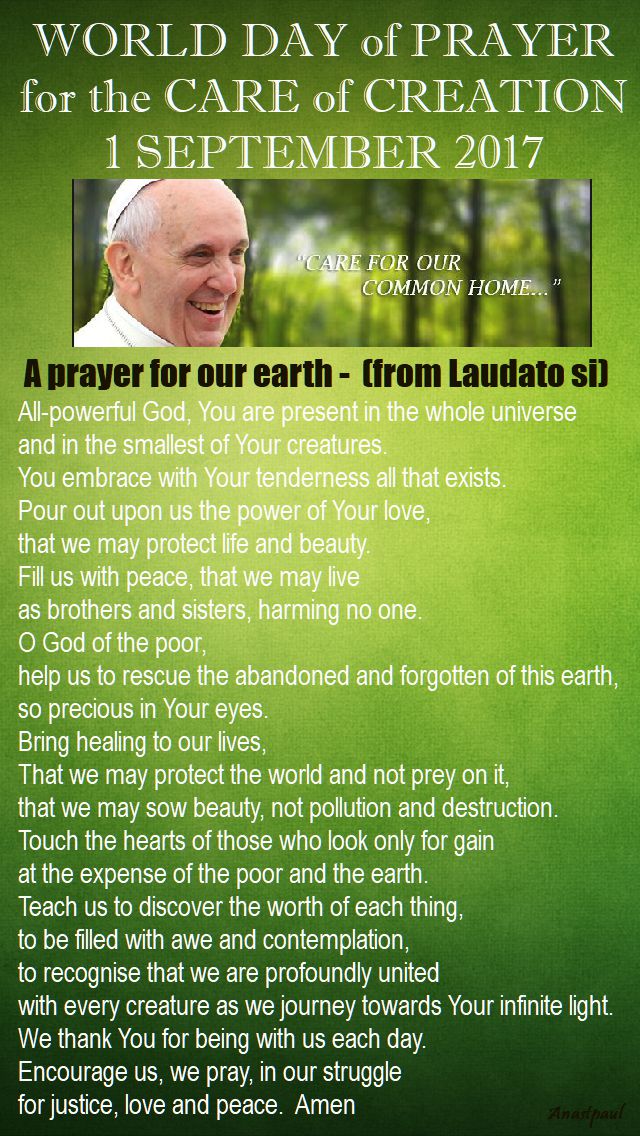
World Day of Prayer for the Care of Creation – 1 September 2017
Pope Francis has designated 1 September as the annual World Day of Prayer for the Care of Creation. He hopes this day will be a time for individuals and communities to “reaffirm their personal vocation to be stewards of creation, to thank God for the wonderful handiwork which He has entrusted to our care and to implore His help for the protection of creation as well as His pardon for the sins committed against the world in which we live.”
On June 18, 2015, Pope Francis released an encyclical on ecology entitled, “Laudato Si: On Care for Our Common Home.” Prior to the public release, the Holy Father sent the encyclical to all Bishops around the world with a handwritten note, seen below.
All-powerful God, You are present in the whole universe
and in the smallest of Your creatures.
You embrace with Your tenderness all that exists.
Pour out upon us the power of Your love,
that we may protect life and beauty.
Fill us with peace, that we may live
as brothers and sisters, harming no one.
O God of the poor,
help us to rescue the abandoned and forgotten of this earth,
so precious in Your eyes.
Bring healing to our lives,
That we may protect the world and not prey on it,
that we may sow beauty, not pollution and destruction.
Touch the hearts of those who look only for gain
at the expense of the poor and the earth.
Teach us to discover the worth of each thing,
to be filled with awe and contemplation,
to recognise that we are profoundly united
with every creature as we journey towards Your infinite light.
We thank You for being with us each day.
Encourage us, we pray, in our struggle
for justice, love and peace. Amen
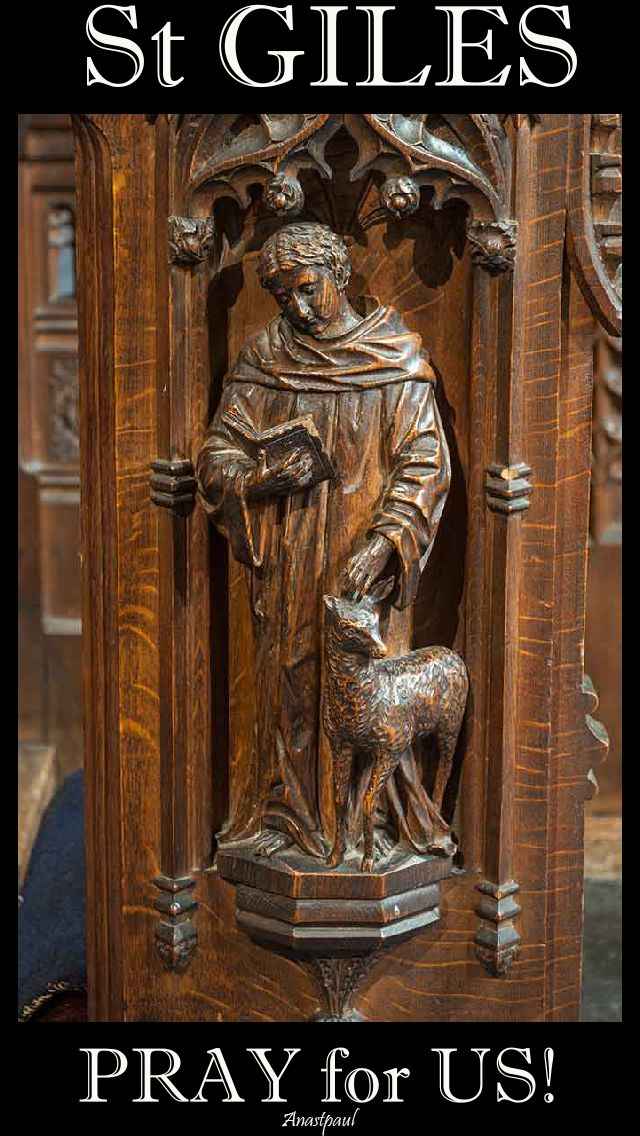
Thought for the Day – 1 September – the Memorial of St Giles, one of th Fourteen Holy Helpers
Despite the fact that much about St Giles is shrouded in mystery, we can say that he was one of the most popular saints in the Middle Ages. St Giles may not have been a martyr but, as the word martyr means, he was a true witness to the faith. This is attested to by the faith of the People of God in the Middle Ages. He became one of the “holy helpers” and can still function in that role for us today.
It seems appropriate, that St Giles, who loved nature and whom nature loved, who made his home in a forest, in a hollow tree, should have his feast day today, 1 September, the World Day of Prayer for the Care of Creation.
There is nothing random, nothing that happens by chance – all is held in God’s hands!
St Giles pray for us and for all of God’s creation.
Quote/s of the Day – Pope Francis – Laudato Si – – 1 September – World Day of Prayer for the Care of Creation
“Creatures are not just resources but have value in and of themselves and give glory to God
It is not enough, however, to think of different species merely as potential “resources” to be exploited, while overlooking the fact that they have value in themselves. Each year sees the disappearance of thousands of plant and animal species which we will never know, which our children will never see because they have been lost for ever. The great majority become extinct for reasons related to human activity. Because of us, thousands of species will no longer give glory to God by their very existence, nor convey their message to us. We have no such right. (33)”
“Overpopulation is not the problem
Instead of resolving the problems of the poor and thinking of how the world can be different, some can only propose a reduction in the birth rate. At times, developing countries face forms of international pressure which make economic assistance contingent on certain policies of “reproductive health”. […] To blame population growth instead of extreme and selective consumerism on the part of some, is one way of refusing to face the issues. It is an attempt to legitimise the present model of distribution, where a minority believes that it has the right to consume in a way which can never be universalised, since the planet could not even contain the waste products of such consumption. (50)”
Pope Francis – Laudato Si
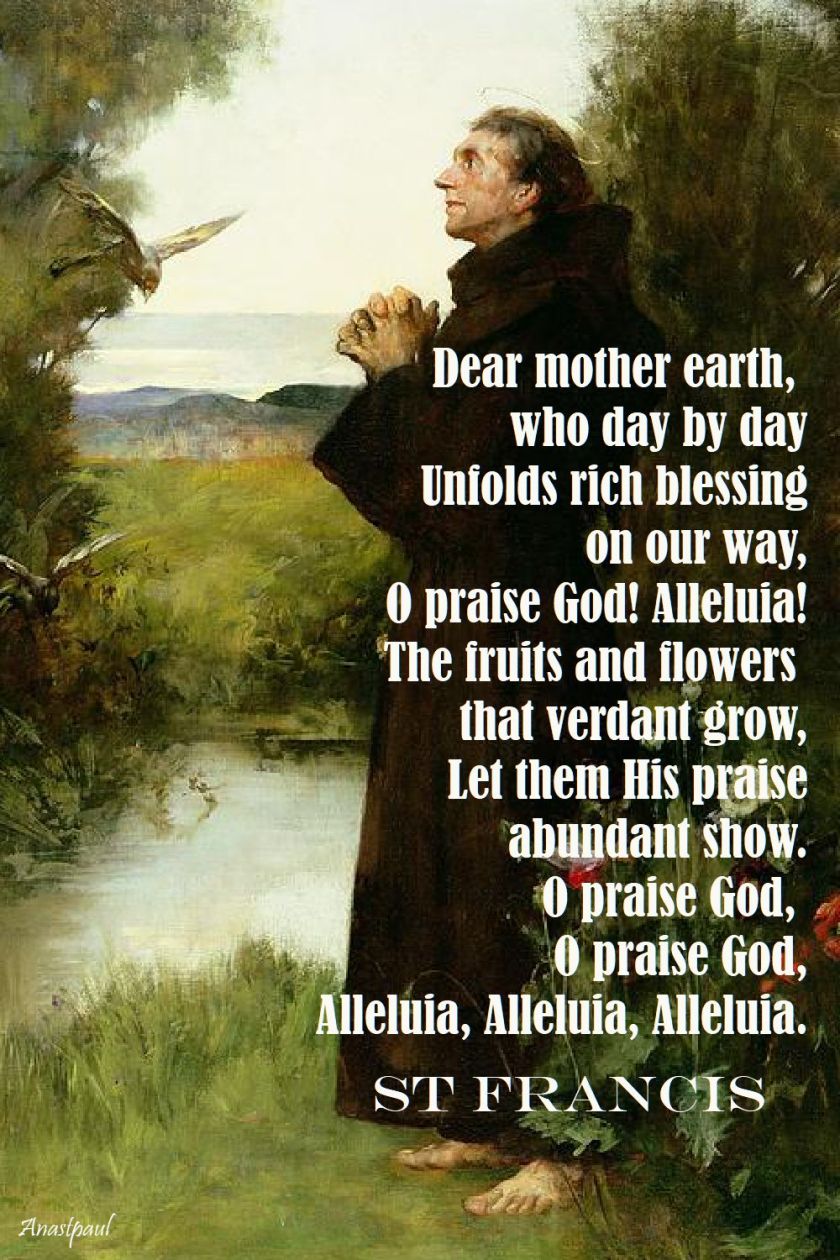
Dear mother earth, who day by day
Unfolds rich blessing on our way,
O praise God! Alleluia!
The fruits and flowers that verdant grow,
Let them His praise abundant show.
O praise God, O praise God,
Alleluia, Alleluia, Alleluia.
St. Francis of Assisi
(Translated by William H Draper) (Image by St Francis by Albert Chevallier Tayler)
One Minute Reflection – 1 September – World Day of Prayer for the Care of Creation
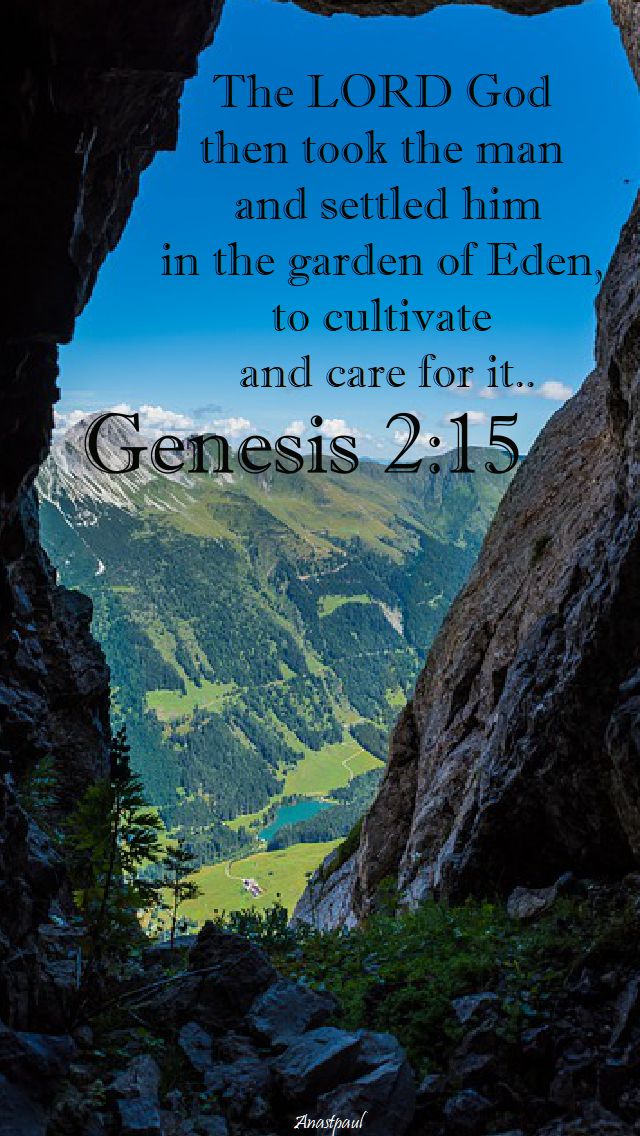
The LORD God then took the man and settled him in the garden of Eden, to cultivate and care for it...Genesis 2:15
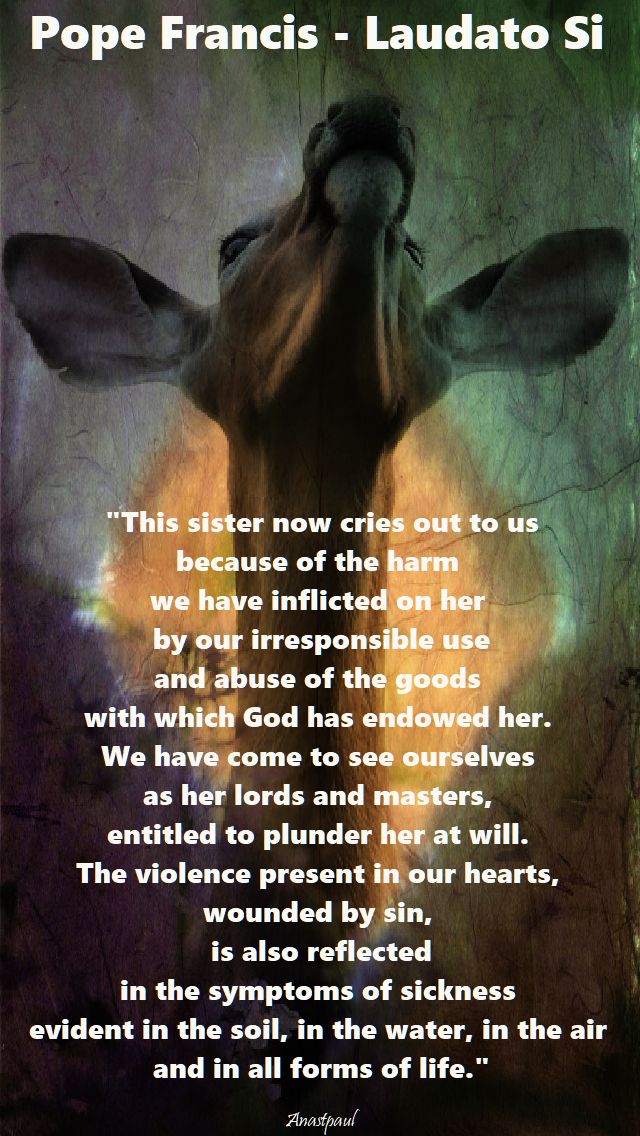
REFLECTION – “This sister now cries out to us because of the harm we have inflicted on her by our irresponsible use and abuse of the goods with which God has endowed her. We have come to see ourselves as her lords and masters, entitled to plunder her at will. The violence present in our hearts, wounded by sin, is also reflected in the symptoms of sickness evident in the soil, in the water, in the air and in all forms of life. This is why the earth herself, burdened and laid waste, is among the most abandoned and maltreated of our poor; she “groans in travail” (Rom 8:22). We have forgotten that we ourselves are dust of the earth (cf. Gen 2:7); our very bodies are made up of her elements, we breathe her air and we receive life and refreshment from her waters.”..Pope Francis “LAUDATO SI’
PRAYER – O God, from the very beginning of time You commanded the earth to bring forth vegetation and every fruit of every kind. You provide the sower with seed and give bread to eat. Grant, we pray, that this land, enriched by Your bounty and cultivated by human hands, may be fertile with abundant crops. Then Your people, enriched by the gifts of Your goodness, will praise You unceasingly now and for all ages unending. Through our Lord Jesus Christ in union with the Holy Spirit, one God forever and ever, amen.
Saint of the Day – 1 September – St Giles (c 650 at Athens, Greece – between 710 and 724 in France of natural causes). Monk, Hermit, Abbot. St Giles is also known as Giles the Hermit, was a Greek, Christian, hermit saint from Athens, whose legend is centered in Provence and Septimania. Giles founded the abbey in Saint-Gilles-du-Gard whose tomb became a place of pilgrimage. It was a stop on the road that led from Arles to Santiago de Compostela, the pilgrim Way of St. James. Giles is one of the Fourteen Holy Helpers. Patronages: • cancer patients; against breast cancer• epileptics; against epilepsy• against fear of night or noctiphobia• mentally ill people; against insanity or mental illness• lepers, against leprosy• against sterility• beggars• blacksmiths• breast feeding• disabled, handicapped, crippled or physically challenged people• forests, woods• hermits• horses• paupers, poor people• rams• spur makers• Monte San Savino, Italy• Tolfa, Italy• Edinburgh, Scotland.
The life of St Giles, known in early writings as Aegidius, is derived from a mixture of legend and history woven together around the deeds of a saint. He is reputed to have been born in Athens, the son of Theodore and Pelagia, in about 640. When he was twenty-four his parents died and Giles, stricken by the double loss and unconsoled by the pleasures of fashionable life, sold all that he had and gave to the poor in order to follow Christ.
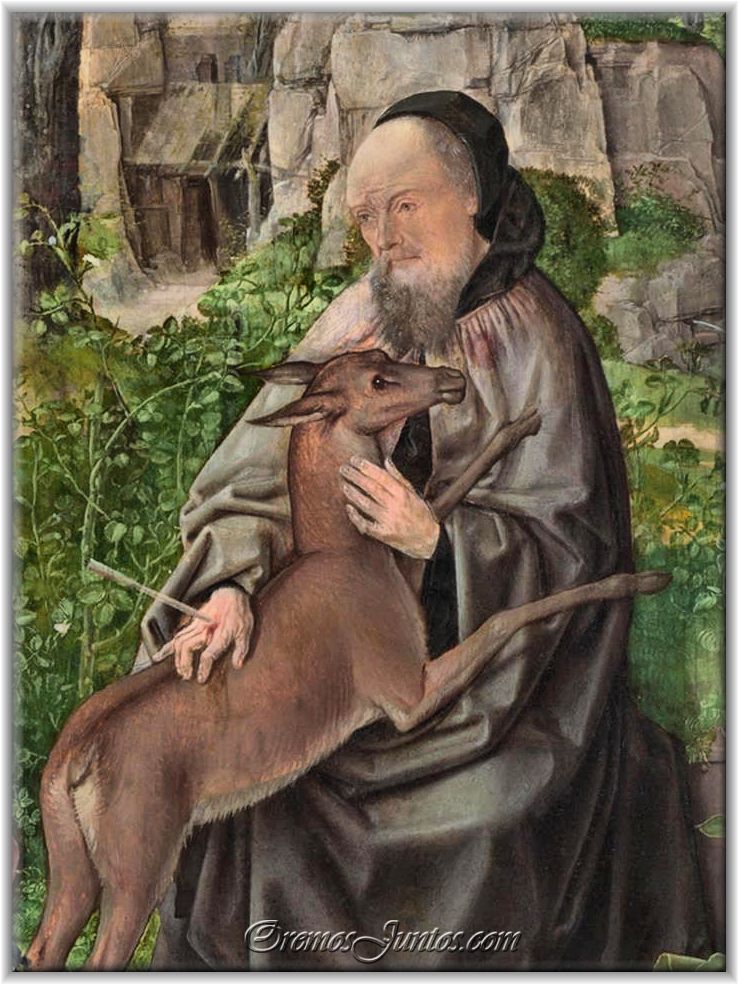
He took to sea and landed on the coast of Provence. On the shore he saw human footsteps and following these, he found a cave in which an old hermit had lived for years on roots and herbs and who was content to share his cave, his food and his prayers with the young man. After three days Giles began to fear his friends might find him, so he hailed a passing ship and sailed on further westwards to Marseilles. Still seeking solitude, he crossed the Rhone and travelled towards a rocky promontory above the river Gardon and here, in a cave, the entrance of which was hidden by a thicket, he found another solitary, also a Greek. He stayed only a short time before continuing his journey until, finally, in the depth of a forest near Nimes, he found a hollow of a rock in a green glade by a stream, shaded by four gigantic oaks. There he lived in peace and prayer, his only companion a gentle hind (his emblem), whose milk he drank.
Founding a monastery: Here he was discovered by Flavius (Wamba), king of the VisiGoths. The king was out hunting and shot an arrow at the hind, missed it and hit Giles, who was at his devotions. One hunter shot an arrow into the thorn bush, hoping to hit the deer but instead hit Giles in the leg, crippling him. The king sent doctors to care for hermit’s wound and though Giles begged to be left alone, the king came often to see him. Though wounded, Giles continued at his prayers and refused all compensation for the injury done to his body. This incident made him a great favourite at Court, especially with Wamba, who pressed him to stay. The king would have given him lands for any foundation he chose, but no entreaties would persuade him to desert his life of solitude and prayer.
From this, Gile’s fame as sage and miracle worker spread and would-be followers gathered near the cave. The French king, because of his admiration, built the monastery of Saint Gilles du Gard for these followers and Giles became its first abbot, establishing his own discipline there. Legend goes on to say that Giles consented to be the founder of the monastery near Nimes about 673, which flourished till the Saracen invasion, when it was burned down and he and his monks took refuge with Charles Martel, aiding him by their prayers in his great battle for Christianity in the West. St. Giles’ monastery was restored, and with the words, ” Lord, now lettest Thou Thy servant depart in peace,” he died on September 1st, 720.
The patron saint of the outcast: St Giles became one of the most popular saints in the West, the patron saint of woodland, of lepers, beggars, cripples and of those struck by sudden misery and driven into solitude like the hind, which, according to one tradition, came to St. Giles wounded.
The combination of the town, monastery, shrine and pilgrims led to many handicapped beggars hoping for alms; this and Giles’ insistence that he wished to live outside the walls of the city and his own damaged leg, led to his patronage of beggars, and to cripples since begging was the only source of income for many. Hospitals and safe houses for the poor, crippled, and leprous were constructed in England and Scotland, and were built so cripples could reach them easily. On their passage to Tyburn for execution, convicts were allowed to stop at Saint Giles’ Hospital where they were presented with a bowl of ale called Saint Giles’ Bowl, “thereof to drink at their pleasure, as their last refreshing in this life.” Once in Scotland during the seventeenth century his relics were stolen from a church and a great riot occurred.
In Spain, shepherds consider Giles the protector of rams. It was formerly the custom to wash the rams and colour their wool a bright shade on Giles’ feast day, tie lighted candles to their horns and bring the animals down the mountain paths to the chapels and churches to have them blessed. Among the Basques, the shepherds come down from the Pyrenees on 1 September, attired in full costume, sheepskin coats, staves and crooks, to attend Mass with their best rams, an event that marks the beginning of autumn festivals, marked by processions and dancing in the fields.
He is also the patron saint of over one hundred and fifty churches in the United Kingdom, (though not to be confused with another abbot of the same name, who was in the same province two hundred years earlier). In the Prayer Book he is described as “St. Giles, Abbot and Confessor”
Our Lady of Montevergine: Also known as –
• Madonna di Montevergine
• Madonna Bruna
• Mamma Schiavona
One of the so-called Black Madonnas, image of the Blessed Virgin Mary, normally holding the Christ Child, who have been “inculturated”, that is, made the little Jewish girl Mary look more like the people in the area of the artist, or which are actually black in color. This one serves as part of the altar piece of the Sanctuary on Montevergine. This site is the goal of thousands of pilgrims each year.
—
Abigail the Matriarch
St Aegidius
St Agia
St Anea
St Arcanus
St Arealdo of Brescia
Bl Colomba of Mount Brancastello
St Constantius the Bishop
St Donatus of Sentianum
St Felix of Sentianum
St Gideon the Judge
St Giles
St Giles of Castaneda
Bl Giustino of Paris
Bl Giovanna Soderini
St Jane Soderini
St Joshua the Patriarch
Bl Juliana of Collalto
St Laetus of Dax
St Lupus of Sens
St Lythan
St Nivard of Rheims
St Priscus
St Regulus
St Sixtus of Rheims
St Terentian
St Verena
St Victorious
St Vincent of Xaintes
—
Exiles of Campania
Twelve Holy Brothers: Martyrs of the South –
A group of martyrs who died c 303 at various places in southern Italy. In 760 their relics were brought together and enshrined in Benevento, Italy as a group.
• Saint Arontius of Potenza
• Saint Donatus of Sentianum
• Saint Felix of Sentianum
• Saint Felix of Venosa
• Saint Fortunatus of Potenza
• Saint Honoratus of Potenza
• Saint Januarius of Venosa
• Saint Repositus of Velleianum
• Saint Sabinian of Potenza
• Saint Sator of Velleianum
• Saint Septiminus of Venosa
• Saint Vitalis of Velleianum
One tradition describes Saint Boniface of Hadrumetum and Saint Thecla of Hadrumetum as their parents.
Martyred in the Spanish Civil War:
Martyred Hospitallers of Saint John of God – (12 beati)
• Blessed Alejandro Cobos Celada
• Blessed Alfonso Sebastiá Viñals
• Blessed Amparo Carbonell Muñoz
• Blessed Antonio Villanueva Igual
• Blessed Carmen Moreno Benítez
• Blessed Crescencio Lasheras Aizcorbe
• Blessed Enrique López y López
• Blessed Francesc Trullen Gilisbarts
• Blessed Guillermo Rubio Alonso
• Blessed Isidro Gil Arano
• Blessed Joaquim Pallerola Feu
• Blessed Joaquín Ruiz Cascales
• Blessed José Franco Gómez
• Blessed José Prats Sanjuán
• Blessed Josep Samsó y Elias
• Blessed Manuel Mateo Calvo
• Blessed Mariano Niño Pérez
• Blessed Maximiano Fierro Pérez
• Blessed Miquel Roca Huguet
• Blessed Nicolás Aramendía García
• Blessed Pedro Rivera
• Blessed Pio Ruiz De La Torre
• Blessed Simó Isidre Joaquím Brun Ararà




![Bartolo-di-Fredi-xx-A-Papal-Saint-Saint-Gregory-the-Great-1380s[1]](https://i0.wp.com/anastpaul.com/wp-content/uploads/2017/09/bartolo-di-fredi-xx-a-papal-saint-saint-gregory-the-great-1380s1.jpg?w=166&h=330&ssl=1 "Bartolo-di-Fredi-xx-A-Papal-Saint-Saint-Gregory-the-Great-1380s[1]")









 AnaStpaul
You must be logged in to post a comment.