Quote of the Day – 2 February – Feast of the Presentation of the Lord
Come then, my brethren, give an eye to that candle burning in Simeon’s hands. Light your candles too by borrowing from that Light, for these candles I speak of are the lamps which the Lord orders us to have in our hands (Mt 25:1; Lk 12:35). Come to Him and be enlightened (Ps 34[33], 6), so as to be not merely carrying lamps but to be very lamps yourselves, shining inside and out, for yourselves and for your neighbours.
Be a lamp then in heart, in hand, in lips. The lamp in your heart will shine for you, the lamp in your hand or on your lips will shine out for your neighbours. T he lamp in the heart is loving faith, the lamp in the hand is the example of good works, the lamp on the lips is edifying speech. But not just before men must we shine by works and word but before angels too by prayer and before God Himself, by pure intention. Our lamp before the angels is the purity of our devotion when in the sight of angels we chant the psalms with care or pray with burning ardour, our lamp before God is the honesty of our intention to please Him only, whose approval we have won…
There are so many lamps then, my brethren, to lighten your way, if only you will come to the source of all light and be enlightened.
Come, I say, to Jesus who shines out to us from Simeon’s arms. He will give light to your faith, lustre to your works, meaning to your words for men, ardour to your prayer, purity to your intentions… And when this life’s lamp is extinguished there will arise a life’s light which can never be extinguished, a shimmering noonday light, arising as it were at the evening of your life.
Blessed Guerric of Igny O.Cist. (c 1080-1157)
Cistercian abbot
One Minute Reflection – 2 February – Feast of the Presentation of the Lord, Gospel: Luke 2:22–40 and the World Day of Prayer for Consecrated Life
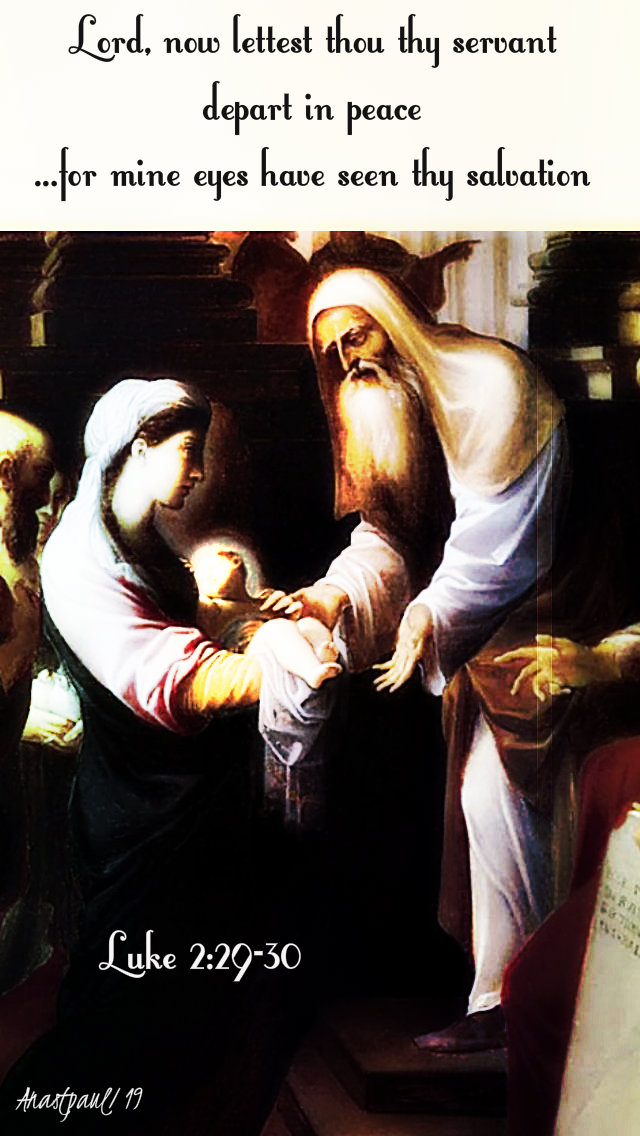
“Lord, now lettest thou thy servant depart in peace, according to thy word; for mine eyes have seen thy salvation which thou hast prepared in the presence of all peoples, a light for revelation to the Gentiles and for glory to thy people Israel.”...Luke 2:29-32
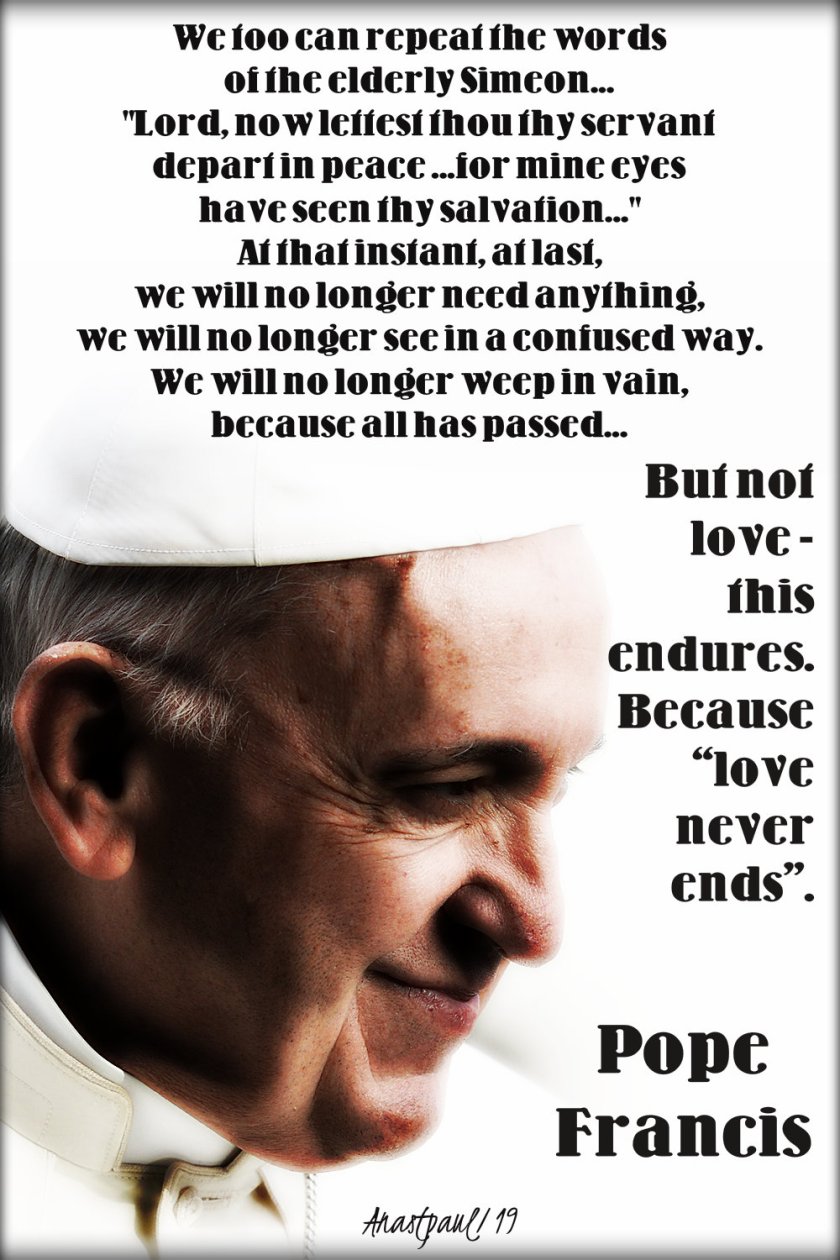
REFLECTION – “Those who have met Jesus no longer fear anything. We too can repeat the words of the elderly Simeon, he too was blessed by the encounter with Christ, after a lifetime spent in anticipation of this event: “Lord, now lettest thou thy servant depart in peace, according to thy word; for mine eyes have seen thy salvation” (Lk 2:29-30). At that instant, at last, we will no longer need anything, we will no longer see in a confused way. We will no longer weep in vain, because all has passed, even the prophecies, even consciousness. But not love – this endures. Because “love never ends” (1 Cor 13:8).”…Pope Francis – General Audience, 25 October 2017
PRAYER – May the Lord renew in you and in all consecrated people each day the joyful response to His freely given and faithful love. Dear brothers and sisters, like lighted candles, always and everywhere shine with the love of Christ, Light of the world. May Mary Most Holy, the consecrated Woman, help you to live to the full, your special vocation and mission in the Church for the world’s salvation. And may we all follow our Lord in obedience. Amen!
Our Morning Offering – 2 February – The Feast of the Presentation of the Lord
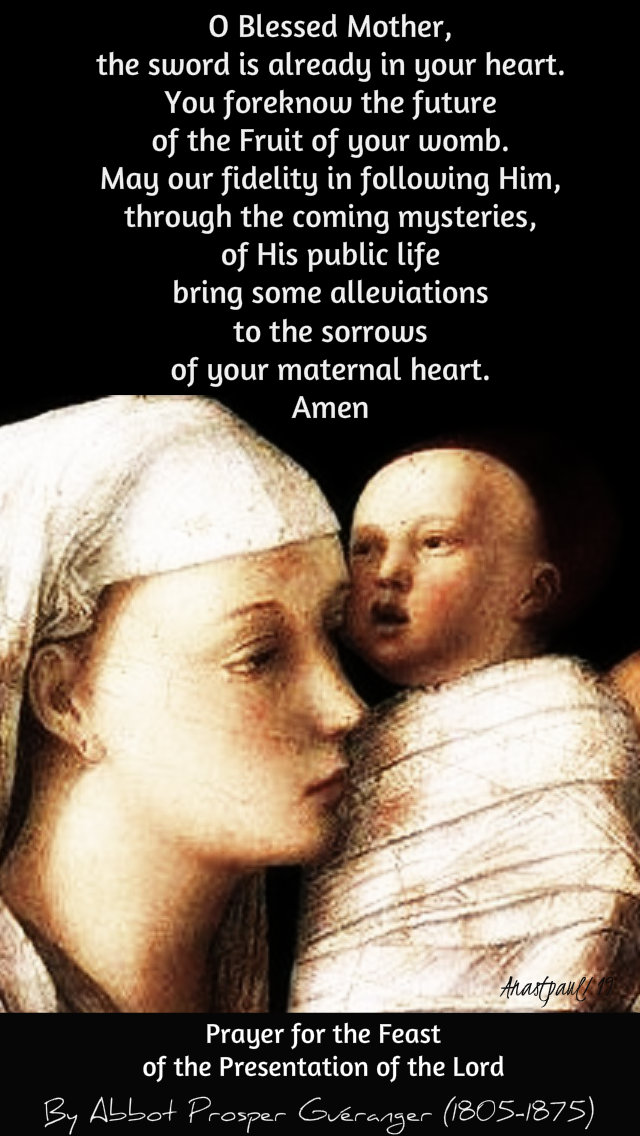
Prayer for the Feast of the Presentation of the Lord By Abbot Prosper Guéranger OSB (1805-1875)
O Blessed Mother,
the sword is already in your heart.
You foreknow the future
of the Fruit of your womb.
May our fidelity in following Him,
through the coming mysteries,
of His public life
bring some alleviations
to the sorrows
of your maternal heart.
Amen
The feast of Jesus’ presentation in the temple forty days after his birth, celebrated on 2 February, has a long history in the Eastern and Western Church.
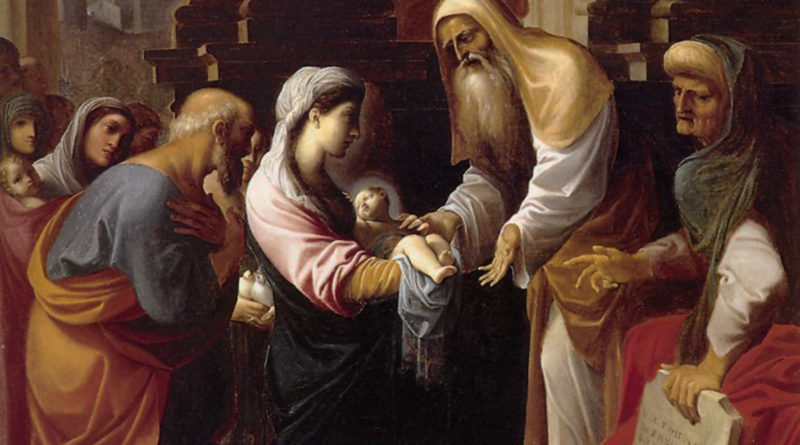
The Mosaic law prescribed that every firstborn male in Israel had to be consecrated to God forty days after birth and redeemed with a sum deposited in the Temple treasury. This was in remembrance of the firstborn sons being preserved from death on the night of the first Passover during the exodus from Egypt. The Gospel according to St. Luke gives us this account of Jesus’ presentation in the Temple: when the time came for their purification according to the law of Moses, they brought him up to Jerusalem to present him to the Lord, as it is written in the law of the Lord, “Every male that opens the womb shall be called holy to the Lord.” St Joseph and our Lady entered the temple, unnoticed among the crowd. The “desired of all nations” came to the house of his Father in his Mother’s arms. The liturgy of this feast-day exhorts us, in the Responsorial Psalm, to adore the King of Glory in the heart of his humble family “Lift up your heads, O gates! and be lifted up, O ancient doors! that the King of glory may come in.”
The Church of Jerusalem began the annual commemoration of this mystery in the 4th century. The feast was celebrated on 14 February forty days after the Epiphany because the Jerusalem liturgy had not yet adopted the Roman custom of celebrating Christmas on 25 December. That is why when this became the common custom throughout the whole Christian world, the feast of the Presentation was moved to 2 February and was soon celebrated throughout the entire East. In Byzantium, the emperor Justinian I introduced it in the 6th century, under the title “Hypapante” or “encounter,” referring to Jesus’ encounter with the aged Simeon, who was a figure of the just men of Israel who had patiently awaited the fulfilment of the messianic prophecies for so many years.
During the 7th century, the celebration also took root in the West. The widespread name of Candlemas comes from the tradition instituted by Pope Sergius I of having a procession with candles. As the elderly Simeon proclaimed, Jesus is the Saviour, prepared in the presence of all peoples, a light for revelation to the Gentiles. In commemorating the arrival and manifestation of the divine light to the world, the Church each year blesses candles, symbol of Jesus’ perennial presence and the light of faith that the faithful receive in the sacrament of Baptism. The procession with lighted candles thus becomes an expression of Christian life: a pathway illuminated by the light of Christ.
The annual commemoration of the Presentation of the Lord in the Temple is also a Marian celebration and therefore at certain times in the past it was also known as the feast of the Purification of Mary. Even though Mary was preserved by God from original sin, as a Hebrew mother she chose to submit to the Law of the Lord and therefore offered a pair of turtledoves or two young pigeons. Mary’s offering was thus a sign of her prompt obedience to God’s commands.
Feast of the Presentation of the Lord: The feast commemorates the purifying of the Blessed Virgin according to the Mosaic Law, 40 days after the birth of Christ and the presentation of the Infant Jesus in the Temple. The feast was introduced into the Eastern Empire by Emperor Justinian I and is mentioned in the Western Church in the Gelasian Sacramentary of the 7th century. Candles are blessed on that day in commemoration of the words of Holy Simeon concerning Christ “a light to the revelation of the Gentiles” (Luke 2) and a procession with lighted candles is held in the church to represent the entry of Christ, the Light of the World, into the Temple of Jerusalem. “Candlemas” is still the name in Scotland for a legal term-day on which interest and rents are payable (2 February).
Patronage
• Jaro, Philippines
• Western Visayas, Philippines
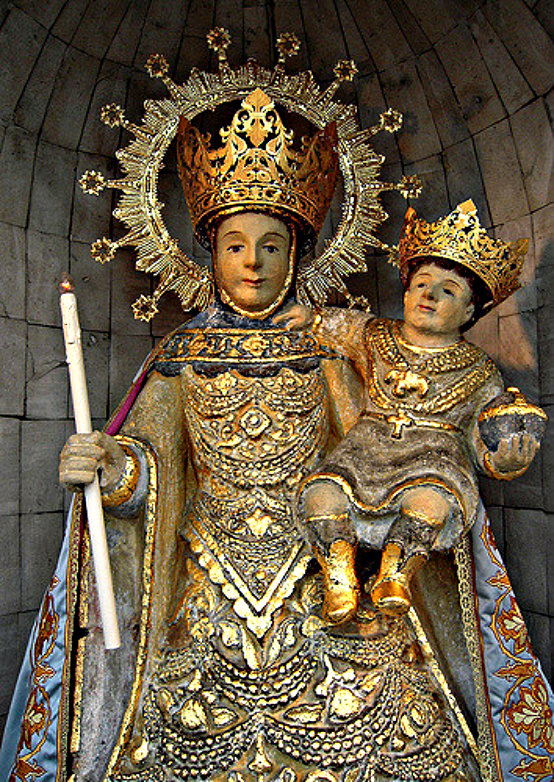
Our Lady of the Candles – (formally known as Nuestra Señora de la Purificación y la Candelaria) is a Marian title and image venerated by Filipino Catholics. The image, which is enshrined on the balcony of Jaro Cathedral, is known as the patroness of Jaro District of Iloilo City and the whole of the Western Visayas.
The feast day of Our Lady of the Candles is on Candlemas (2 February) and is celebrated in Iloilo City with a Solemn Pontifical Mass presided by the Archbishop of Jaro. St Pope John Paul II personally issued a Canonical coronation towards the venerated image on 21 February 1981.
World Day of Prayer for Consecrated Life: Begun in 1997 by St Pope John Paul II, the World Day for Consecrated Life was intended to serve three purposes:
• to praise the Lord and thank Him for the great gift of consecrated life;
• to promote a knowledge of and esteem for the consecrated life by the entire People of God;
• to allow those in consecrated life to celebrate together the marvels which the Lord has accomplished in them, to discover by a more illumined faith the rays of divine beauty, spread by the Spirit in their way of life and to acquire a more vivid consciousness of their irreplaceable mission, in the Church and in the world;
It serves an opportunity to highlight the extraordinary contributions of men and women religious, as well as a time to pray for vocations to the consecrated life.
—
St Adalbald of Ostrevant
St Adeloga of Kitzingen
St Agathodoros of Tyana
St Andrea Carlo Ferrari
St Apronian the Executioner
St Bruno of Ebsdorf
St Burchard of Wurzburg
St St Candidus the Martyr
St Columbanus of Ghent
St Cornelius the Centurion
St Felician the Martyr
St Feock
St Firmus of Rome
St Flosculus of Orléans
St Fortunatus the Martyr
St Giovanni Battista Clemente Saggio
St Hilarus the Martyr
St Jean Theophane Venard
St Jeanne de Lestonnac
St Lawrence of Canterbury
Bl Louis Alexander Alphonse Brisson
Bl Maria Domenica Mantovani
St Marquard of Hildesheim
St Mun
Bl Peter Cambiano
St Rogatus the Martyr
St Saturninus the Martyr
St Sicharia of Orleans
St Simon of Cassia Fidati
Bl Stephen Bellesini
St Theodoric of Ninden
St Victoria the Martyr
—
Martyrs of Ebsdorf: Members of the army of King Louis III of France under the leadership of Duke Saint Bruno of Ebsdorf. The martyrs died fighting invading pagan Norsemen, and defending the local Christian population. Four bishops, including Saint Marquard of Hildesheim and Saint Theodoric of Ninden, eleven nobles, and countless unnamed foot soldiers died repelling the invaders. They were martyred in the winter of 880 in battle at Luneberg Heath and Ebsdorf, Saxony (modern Germany).
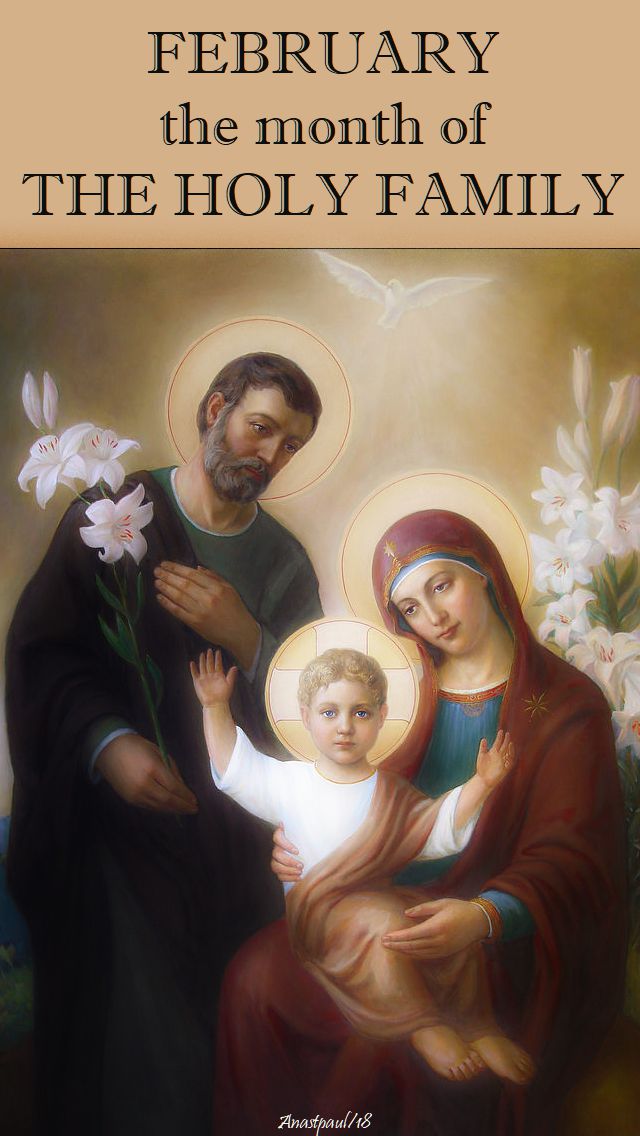
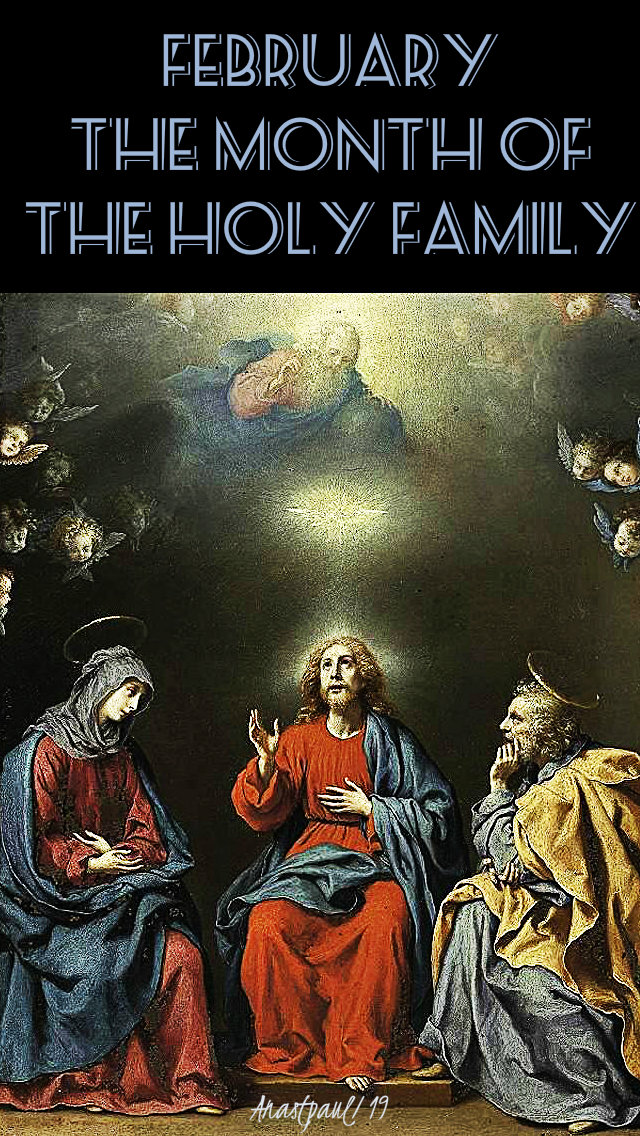
In January, the Catholic Church celebrated the Month of the Holy Name of Jesus and in February, we turn to the entire Holy Family—Jesus, Mary and Joseph.
The special devotion which proposes the Holy Family of Jesus, Mary and Joseph as the model of virtue of all Christian households began in the 17th century. It started almost in France – the Association of the Holy Family was founded by the Daughters of the Holy Family in Paris in 1674.
This devotion soon spread and in 1893 Pope Leo XIII expressed his approval of a feast under this title and himself composed part of the Office. On account of the flight into Egypt this feast has been observed by the Copts from early times.
The feast was welcomed by succeeding Pontiffs as an efficacious means for bringing home to the Christian people the example of the Holy Family at Nazareth and by the restoration of the true spirit of family life, stemming, in some measure, the evils of present-day society.
In the words of His Holiness Pope Leo XIII, “Nothing truly can be more salutary or efficacious for Christian families to meditate upon than the example of this Holy Family, which embraces the perfection and completeness of all domestic virtues.”
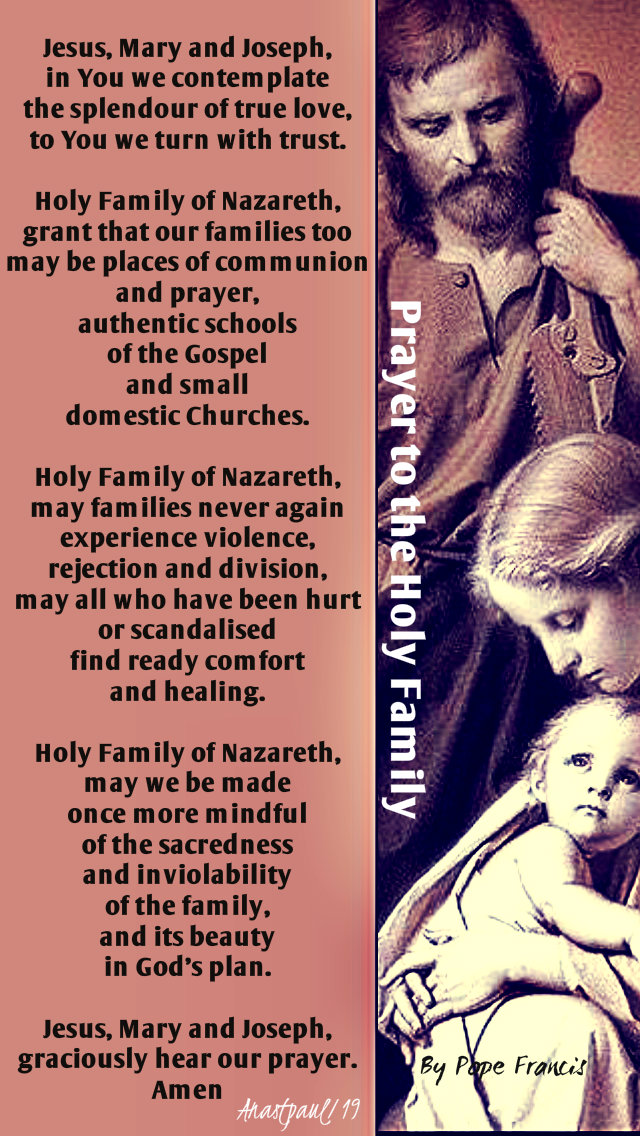
Prayer to the Holy Family By Pope Francis Angelus, 29 December 2013
Jesus, Mary and Joseph,
in You we contemplate
the splendour of true love,
to You we turn with trust.
Holy Family of Nazareth,
grant that our families too
may be places of communion and prayer,
authentic schools of the Gospel
and small domestic Churches.
Holy Family of Nazareth,
may families never again
experience violence, rejection and division:
may all who have been hurt or scandalised
find ready comfort and healing.
Holy Family of Nazareth,
may we be made
once more mindful
of the sacredness
and inviolability of the family,
and its beauty in God’s plan.
Jesus, Mary and Joseph,
graciously hear our prayer.
Amen
(This prayer was composed for the Synod of the Family in 2014, so it has been very slightly adapted to remove the reference to the said Synod).
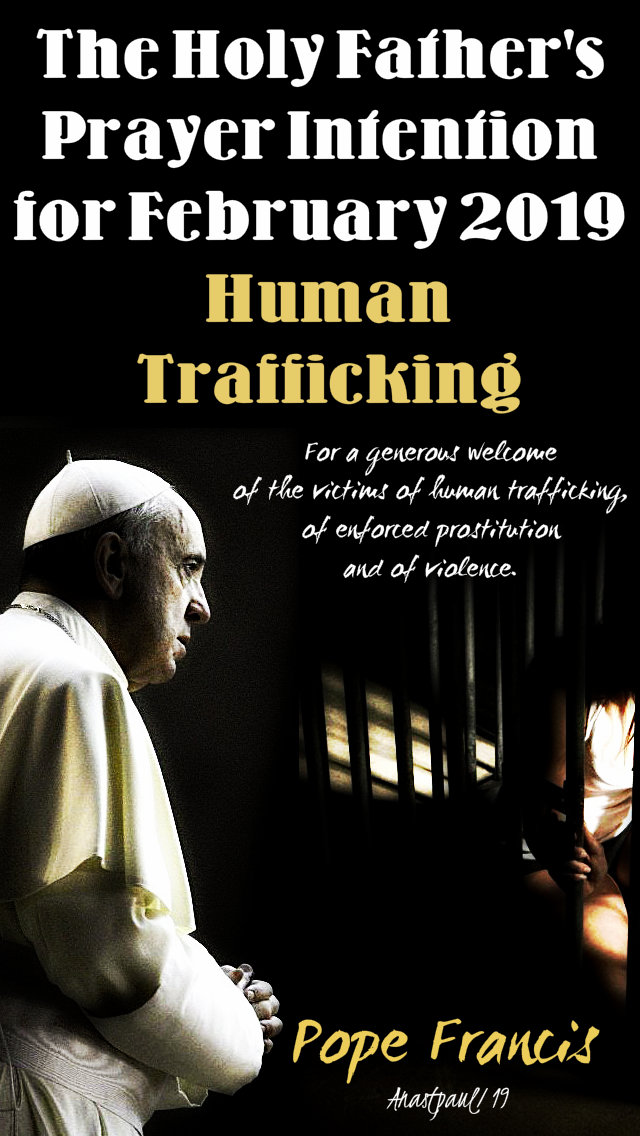
The Holy Father’s Prayer Intention for February 2019
FEBRUARY 2019
Human Trafficking
For a generous welcome of the victims of human trafficking, of enforced prostitution and of violence.
Let us pray:
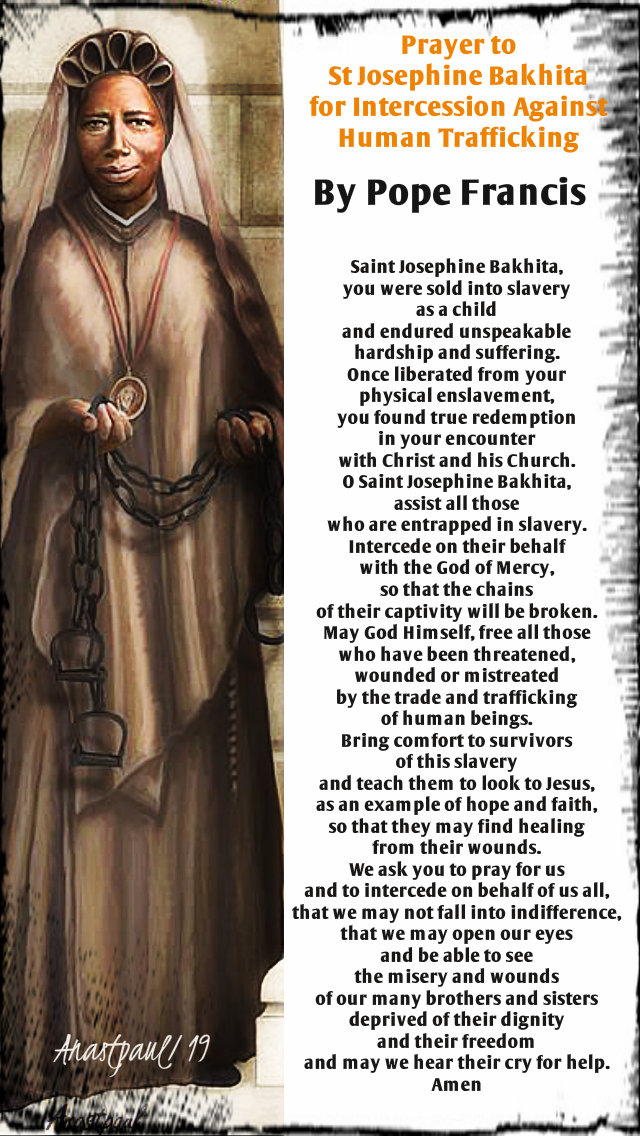
Prayer to St Josephine Bakhita for Intercession Against Human Trafficking By Pope Francis
Saint Josephine Bakhita, you were sold into slavery as a child and endured unspeakable hardship and suffering. Once liberated from your physical enslavement, you found true redemption in your encounter with Christ and his Church. O Saint Josephine Bakhita, assist all those who are entrapped in slavery. Intercede on their behalf with the God of Mercy, so that the chains of their captivity will be broken. May God Himself free all those who have been threatened, wounded or mistreated by the trade and trafficking of human beings. Bring comfort to survivors of this slavery and teach them to look to Jesus, as an example of hope and faith, so that they may find healing from their wounds. We ask you to pray for us and to intercede on behalf of us al, that we may not fall into indifference, that we may open our eyes and be able to see the misery and wounds of our many brothers and sisters deprived of their dignity and their freedom and may we hear their cry for help. Amen
PRAYER FROM THE ADDRESS OF HIS HOLINESS POPE FRANCIS TO PARTICIPANTS IN THE WORLD DAY OF PRAYER, REFLECTION AND ACTION AGAINST HUMAN TRAFFICKING
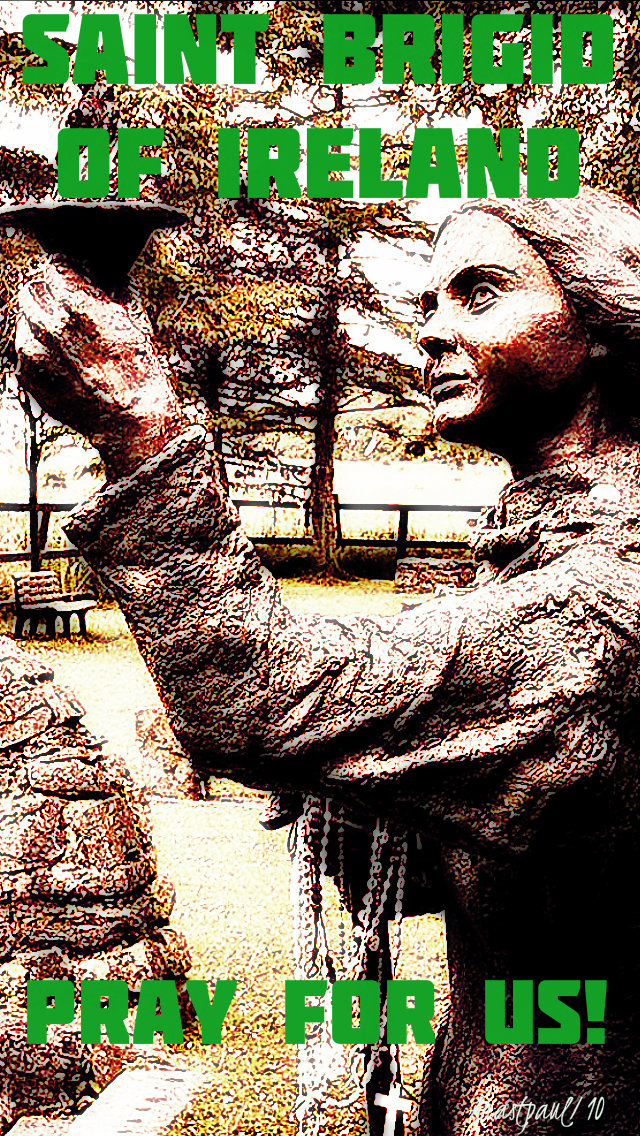
Thought for the Day – 1 February – the Memorial of St Brigid of Ireland (c 453-523)
St Brigid directly influenced several other future saints of Ireland and her many religious communities helped to secure the country’s conversion from paganism to the Catholic faith.
The Irish call on her in every need, for, as the ancient legends run, “everything that Brigid asked of the Lord, was granted her at once. For this was her desire – to satisfy the poor, to expel every hardship, to spare every miserable man.” And, she still carries on this mission today.
St Brigid took the whole of humanity into her heart and 1500 years after her death, the power of goodness and holiness reaches down through the centuries. There was no limit to her charity and her love for all. God thus graced her with great power to do good for all. There should be no limit to ours – imagine a world such as this!
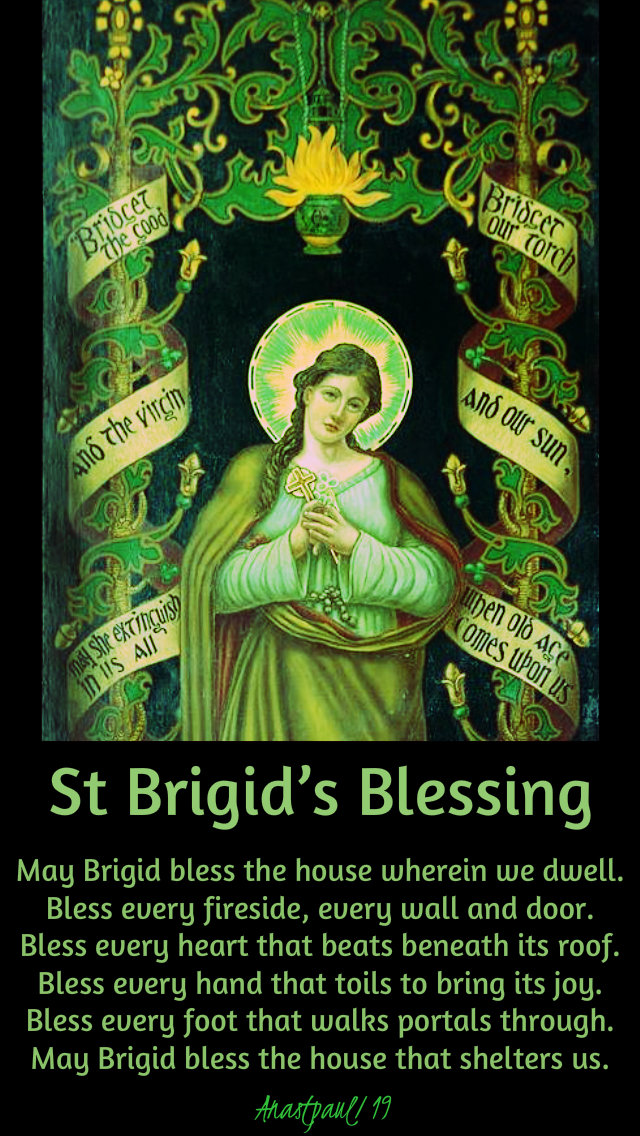
St Brigid’s Blessing
May Brigid bless the house wherein we dwell. Bless every fireside, every wall and door. Bless every heart that beats beneath its roof. Bless every hand that toils to bring its joy. Bless every foot that walks portals through. May Brigid bless the house that shelters us.
Quote of the Day – 1 February – the Memorial of St Brigid of Ireland (c 453-523)
I would like the angels of Heaven to be among us. I would like an abundance of peace. I would like full vessels of charity. I would like rich treasures of mercy. I would like cheerfulness to preside over all. I would like Jesus to be present. I would like the three Marys of illustrious renown to be with us. I would like the friends of Heaven, to be gathered around us, from all parts. I would like myself to be a rent-payer to the Lord, that I should suffer distress, that He would bestow a good blessing upon me. I would like a great lake of beer for the King of Kings. I would like to be watching Heaven’s family drinking it through all eternity.
One Minute Reflection – 1 February – Friday of the Third week in Ordinary Time, Year Gospel: Mark 4:26–34 and the Memorial of St Brigid of Ireland (c 453-523)
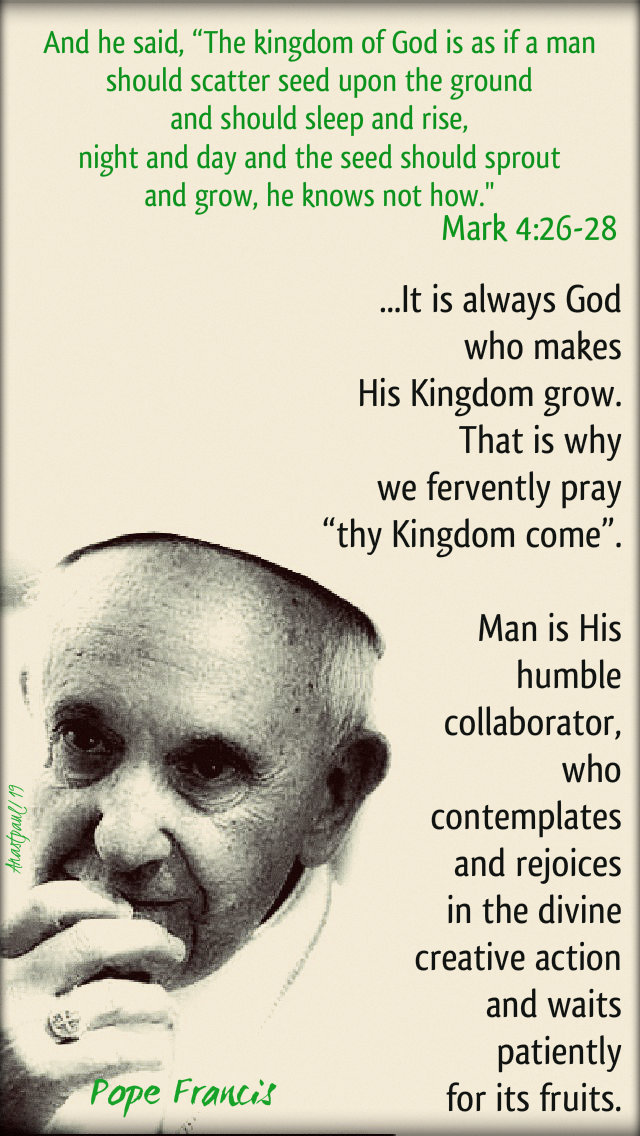
And he said, “The kingdom of God is as if a man should scatter seed upon the ground and should sleep and rise, night and day and the seed should sprout and grow, he knows not how.”...Mark 4:26-28
REFLECTION – “We can be confident because the Word of God is a creative word, destined to become the “full grain in the ear” (v. 28). This Word, if accepted, certainly bears fruit, for God Himself makes it sprout and grow in ways that we cannot always verify or understand. (cf. v. 27). All this tells us that it is always God, it is always God who makes His Kingdom grow. That is why we fervently pray “thy Kingdom come”. It is He who makes it grow. Man is His humble collaborator, who contemplates and rejoices in divine creative action and waits patiently for its fruits.”…Pope Francis – Angelus, 14 June 2015
PRAYER – Almighty Father, we bless You Lord of life, through whom all living things tend. You are the source of all, our first beginning and our end! Grant holy Father, that we may allow the Word to enter our hearts and grow by Your grace, so that we may always live for Your glory. May the intercession of St Brigid of Ireland, who consistently tended Your seed, grant us strength and zeal. Through Jesus Christ, our Lord with the Holy Spirit, God forever, amen.
Our Morning Offering – 1 February – Friday of the Third week in Ordinary Time, Year C
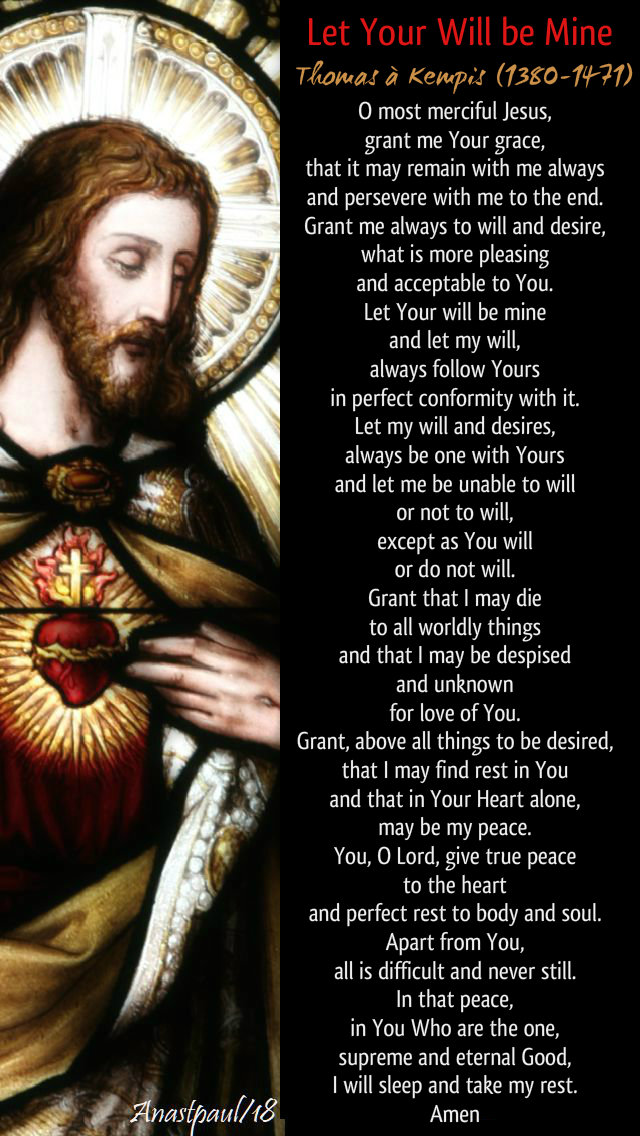
Let Your Will be Mine A Prayer for Fulfilling the Will of God Thomas à Kempis (1380-1471)
O most merciful Jesus,
grant me Your grace,
that it may remain with me always
and persevere with me to the end.
Grant me always to will and desire,
what is more pleasing and acceptable to You.
Let Your will be mine
and let my will always follow Yours
in perfect conformity with it.
Let my will and desires, always be one with Yours
and let me be unable to will or not to will,
except as You will or do not will.
Grant that I may die to all worldly things
and that I may be despised and unknown
for love of You.
Grant, above all things to be desired,
that I may find rest in You
and that in Your Heart alone, may be my peace.
You, O Lord, give true peace to the heart
and perfect rest to body and soul.
Apart from You, all is difficult and never still.
In that peace, in You Who are the one,
supreme and eternal Good,
I will sleep and take my rest.
Amen
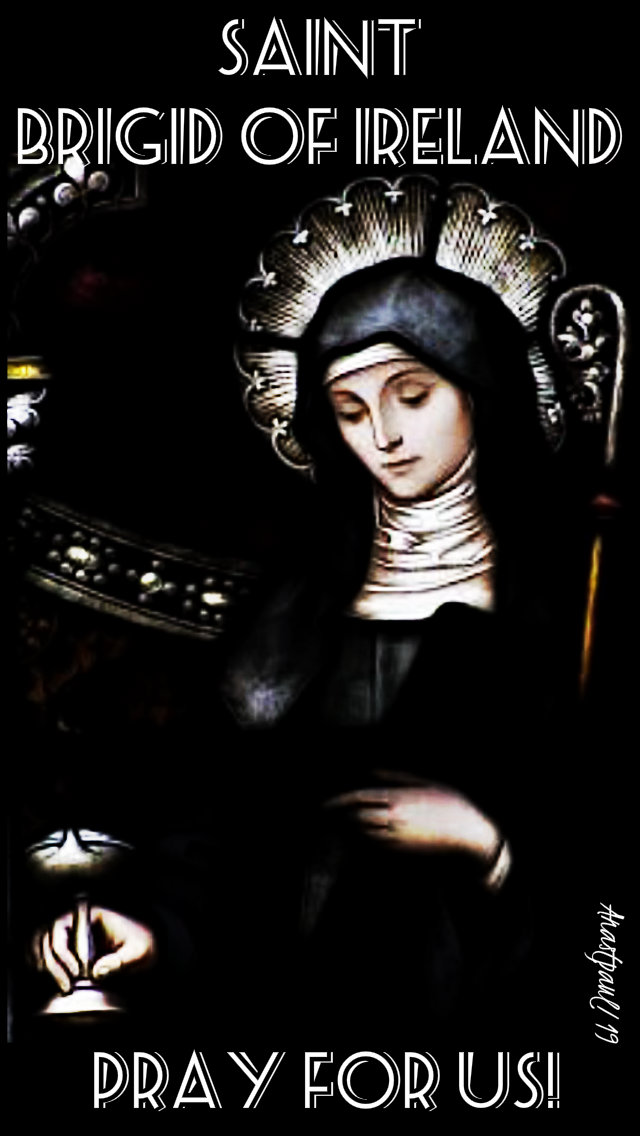
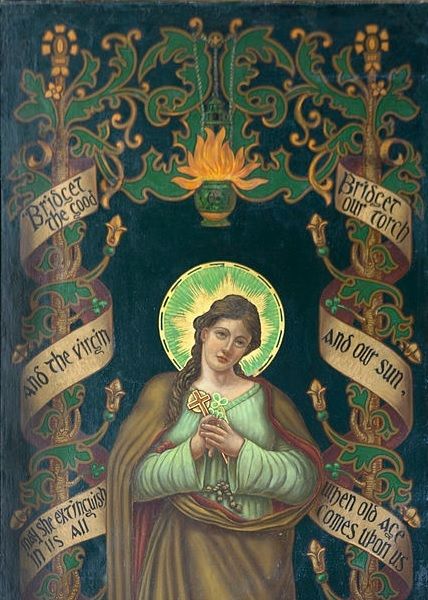
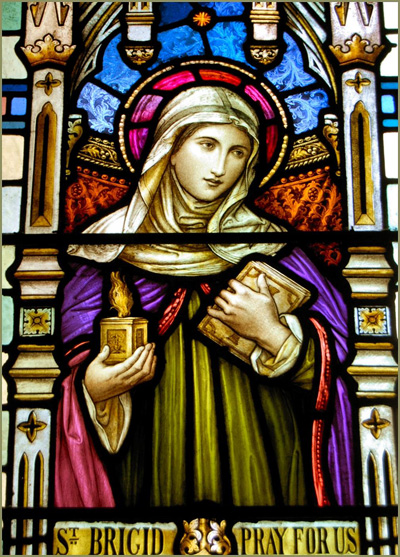
Saint of the Day – 1 February – St Brigid of Ireland/Kildare (c 453-523) Virgin, Abbess, Apostle of Charity and foundress of several Monasteries of Nuns, including that of Kildare in Ireland, which was famous and was greatly revered – born in 453 at Faughart, County Louth, Ireland and died on 1 February 523 at Kildare, Ireland of natural causes. Patronages – Ireland, babies, blacksmiths, sailors, brewers, cattle, chicken farmers, children whose parents are not married, children with abusive fathers, children born into abusive unions, Clan Douglas, dairy workers, Florida, fugitives, Leinster, midwives, Nuns, poets, the poor, printing presses, students, travellers.
Next to the glorious St Patrick, St Brigid, whom we may consider his spiritual daughter in Christ, has ever been held in singular veneration in Ireland.
Historians say we know a lot more about St Brigid than we have facts, a polite way of saying that legends swirl about Ireland’s most celebrated woman. But even legends may have cores of truth. And some miracle stories are not legends at all but true accounts of God’s interventions.
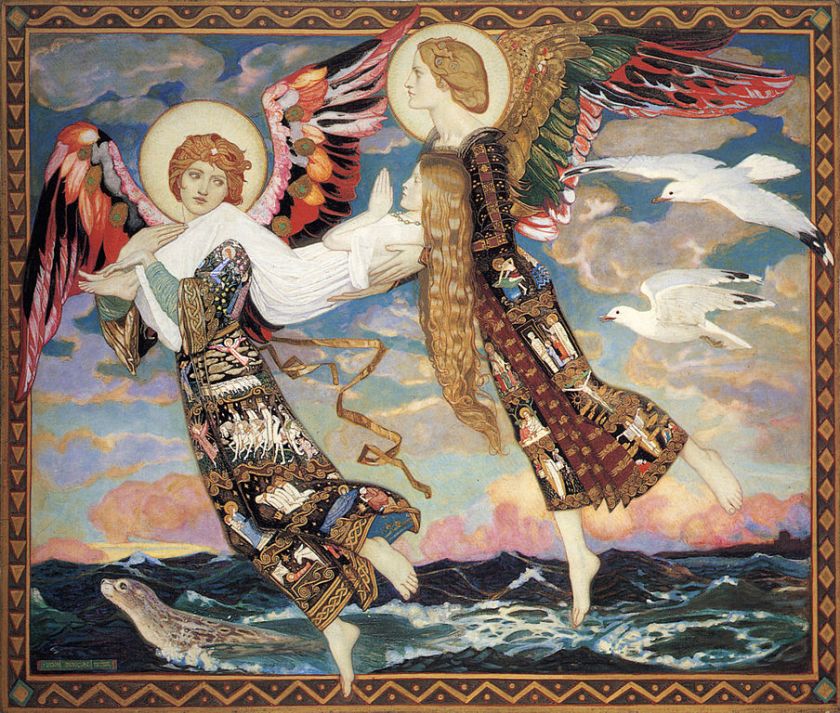
St Bride (Brigid) Carried By Angels, a painting by Scottish artist, John Duncan, 1913.
Brigid was the daughter of a slave woman and a chieftain, who liberated her at the urging of his overlord. As a girl she sensed a call to become a nun and St Mel, bishop of Armagh, received her vows. Before Brigid, consecrated virgins lived at home with their families. But the saint, imitating Patrick, began to assemble nuns in communities, a historic move which enriched the church in Ireland.
In 471, Brigid founded a monastery for both women and men at Kildare. This was the first convent in Ireland and Brigid was the abbess. Under her leadership Kildare became a centre of learning and spirituality. Her school of art fashioned both lovely utensils for worship and beautifully illustrated manuscripts. Again following Patrick’s model, Brigid used Kildare as a base and built convents throughout the island. The renown of Brigid’s unbounded charity drew multitudes of the poor to Kildare, the fame of her piety attracted thither many persons anxious to solicit her prayers or to profit by her holy example. In course of time the number of these so much increased that it became necessary to provide accommodation for them in the neighbourhood of the new monastery and thus was laid the foundation and origin of the town of Kildare.
Brigid’s hallmark was uninhibited, generous giving to anyone in need. Many of the saint’s earliest miracles seem to have rescued her from punishment for having given something to the poor that was intended for someone else. For example, once as a child she gave a piece of bacon to a dog and was glad to find it replaced when she was about to be disciplined. Brigid exhibited this unbounded charity all her life, giving away valuables, clothing, food—anything close by—to anyone who asked.
One of the most appealing things told of Brigid is her contemporaries’ belief that there was peace in her blessing. Not merely did contentiousness die out in her presence but just as by the touch of her hand she healed leprosy, so by her very will for peace she healed strife and laid antiseptics on the suppurating bitterness that foments it.
In the ninth century, the country being desolated by the Danes, the remains of St Brigid were removed in order to secure them from irreverence and, being transferred to Down-Patrick, were deposited in the same grave with those of the glorious St Patrick. Their bodies, together with that of St Columba, were translated afterwards to the cathedral of the same city but their monument was destroyed in the reign of King Henry VIII. The head of St Brigid is now kept in the church of the Jesuits at Lisbon.
Saint Brigid’s Cross
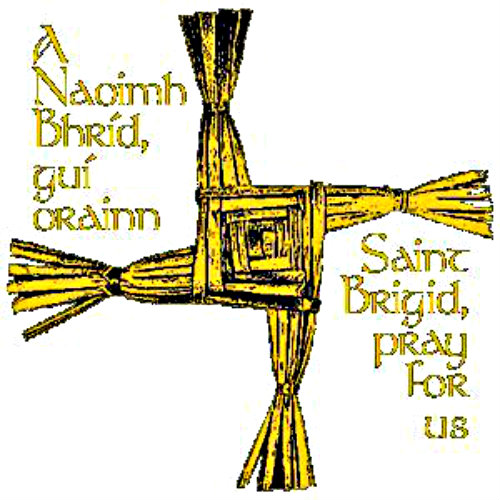
A special type of cross known as “Saint Brigid’s cross” is popular throughout Ireland. It commemorates a famous story in which Brigid went to the home of a pagan leader when people told her that he was dying and needed to hear the Gospel message quickly. When Brigid arrived, the man was delirious and upset, unwilling to listen to what Brigid had to say. So she sat with him and prayed and while she did, she took some of the straw from the floor and began weaving it into the shape of a cross. Gradually the man quieted down and asked Brigid what she was doing. She then explained the Gospel to him, using her handmade cross as a visual aid. The man then came to faith in Jesus Christ and Brigid baptised him just before he died.
Today, many Irish people display a Saint Brigid’s cross in their homes, since it is said to help ward off evil and welcome good. Brigid died in 523 and after her death people began to venerate her as a saint, praying to her for help seeking to heal from God, since many of the miracles during her lifetime related to healing.
Blessing of St Brigid’s Crosses
Father of all creation and Lord of Light,
You have given us life and entrusted Your creation to us, to use it and to care for it.
We ask You to bless these crosses made of green rushes in memory of holy Brigid,
who used the cross to recall and to teach Your Son’s life, death and resurrection.
May these crosses be a sign of our sharing in the Paschal Mystery of your Son
and a sign of Your protection of our lives, our land and its creatures,
through Brigid’s intercession, during the coming year and always.
We ask this through Christ our Lord.
The crosses are sprinkled with holy water:
May the blessing of God, Father, Son and Holy Spirit
be on these crosses and on the places where they hang
and on everyone who looks at them.
Amen
St Brigid of Fiesole St Brigid of Ireland/Kildare (c 453-523)
St Cecilius of Granada
St Cinnia of Ulster
St Clarus of Seligenstadt
Bl Conor O’Devany
St Crewenna
St Darlaugdach of Kildare
St Henry Morse
St Ioannes Yi Mun-u
St Jarlath
Bl John of the Grating
St Kinnia
Bl Luigi Variara
Bl Patrick O’Lougham
St Paul of Trois-Châteaux
St Paulus Hong Yong-ju
St Raymond of Fitero
St Sabinus
St Severus of Avranches
St Severus of Ravenna
St Sigebert III of Austrasia
St Tryphon of Lampsacus
St Ursus of Aosta
St Veridiana
—
Martyrs of Avrillé – 47 beati: Forty-seven Christians executed together for their faith in the anti-Catholic persecution of the French Revolution.
• Anne-François de Villeneuve
• Anne Hamard
• Catherine Cottenceau
• Charlotte Davy
• François Bellanger
• François Bonneau
• François Michau
• François Pagis epouse Railleau
• Gabrielle Androuin
• Jacquine Monnier
• Jeanne Bourigault
• Jeanne Fouchard épouse Chalonneau
• Jeanne Gruget veuve Doly
• Jeanne-Marie Sailland d’Epinatz
• Louise-Aimée Dean de Luigné
• Louise-Olympe Rallier de la Tertinière veuve Déan de Luigné
• Madeleine Blond
• Madeleine Perrotin veuve Rousseau
• Madeleine Sailland d’Epinatz
• Marguerite Rivière epouse Huau
• Marie Anne Pichery épouse Delahaye
• Marie-Anne Vaillot
• Marie Cassin épouse Moreau
• Marie Fausseuse épouse Banchereau
• Marie Gallard épouse Quesson
• Marie Gasnier épouse Mercier
• Marie Grillard
• Marie-Jeanne Chauvigné épouse Rorteau
• Marie Lenée épouse Lepage de Varancé
• Marie Leroy
• Marie Leroy épouse Brevet
• Marie Roualt épouse Bouju
• Odilia Baumgarten
• Perrine Androuin
• Perrine Besson
• Perrine-Charlotte Phelippeaux épouse Sailland d’Epinatz
• Perrine Grille
• Perrine Ledoyen
• Perrine Sailland d’Epinatz
• Renée Cailleau épouse Girault
• Renée Grillard
• Renée Martin épouse Martin
• Renée Valin
• Rose Quenion
• Simone Chauvigné veuve Charbonneau
• Suzanne Androuin
• Victoire Bauduceau epouse Réveillère
They were martyred on 1 February 1794 in Avrillé, Maine-et-Loire, France and Beatified on 19 February 1984 by St Pope John Paul II at Rome, Italy.
Martyrs of Korea: Thousands of people were murdered in the anti-Catholic persecutions in Korea. Today we celebrate and honour:
• Saint Barbara Ch’oe Yong-i
• Saint Ioannes Yi Mun-u
• Saint Paulus Hong Yong-ju










 AnaStpaul
You must be logged in to post a comment.