Thought for the Day -12 June – “Month of the Sacred Heart” – Meditations with Antonio Cardinal Bacci (1881-1971)
“Unless You Turn and Become Like Little Children, You Will Not Enter into the Kingdom of Heaven”
“At the beginning of their ministry, before they had been strengthened and enlightened by the Holy Spirit, the Apostles were as ambitious as most other men.
One day, the mother of John and James, the sons of Zebedee, came to Jesus and asked Him, if her two sons could have precedence over the other Apostles and sit on the highest thrones in His kingdom, one at His right hand and the other at His left.
Jesus disapproved of this desire to predominate. “Whoever wishes to become great among you,” He said, “shall be your servant and, whoever wishes to be first among you shall be your slave; even as the Son of Man has not come to be served but to serve and to give his life as a ransom for many” (Mt 20:26-28).
On another occasion, the Apostles came to Jesus and asked Him, which of them would be the greatest in the kingdom of Heaven.
Jesus’ only answer was to call a little child and to place him in the centre of the group. “Amen, I say to you, unless you turn and become like little children, you shall not enter into the kingdom of heaven. Whoever, therefore, humbles himself as this little child, he is the greatest in the kingdom of heaven” (Mt 18:3-4).
This is the lofty teaching of the Gospel.
If we wish to be great and pleasing in the eyes of God, we must be unimportant in our own regard and in our relations with men.
The Gospel involves an overthrow of human values.
Anyone who makes himself insignificant, will become great.
Anyone who tries to make himself out to be a great man, becomes of little account in the eyes of God. “God resists the proud but gives grace to the humble” (Cf Js 4:6; 1 Peter 5:5).
If we wish to please the Sacred Heart of Jesus, the first thing we must do, is become as little children.
In other words, we shall have to suppress our ambition and vanity and destroy our self-love, so that, the Sacred Heart may fill our hearts with the love of God alone!”
Quote/s of the Day – 12 June – “Month of the Sacred Heart” – Friday of the Tenth Week of Ordinary Time, Year A, Readings: 1 Kings 19:9, 11-16, Psalm 27:7-9, 13-14, Matthew 5:27-32
Speaking of: Sin
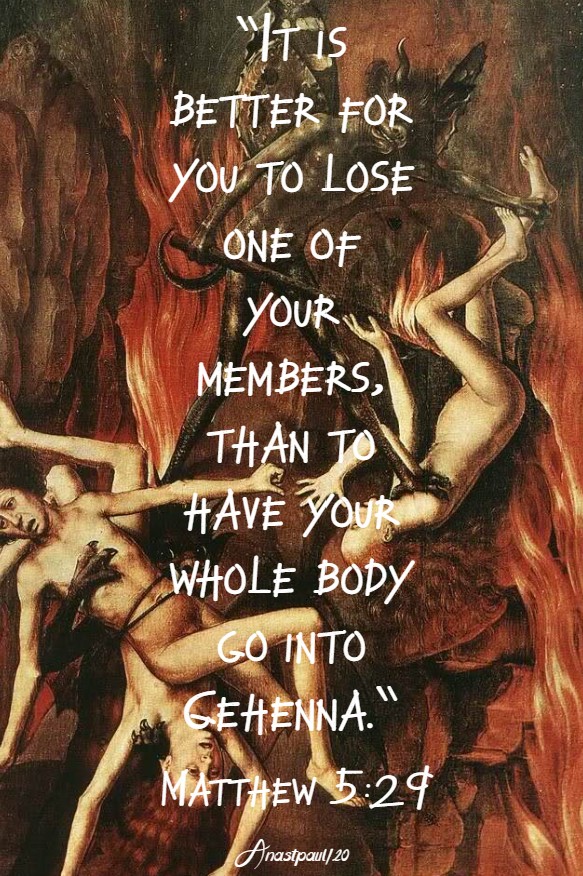
” It is better for you to lose one of your members, than to have your whole body go into Gehenna.”
Matthew 5:29
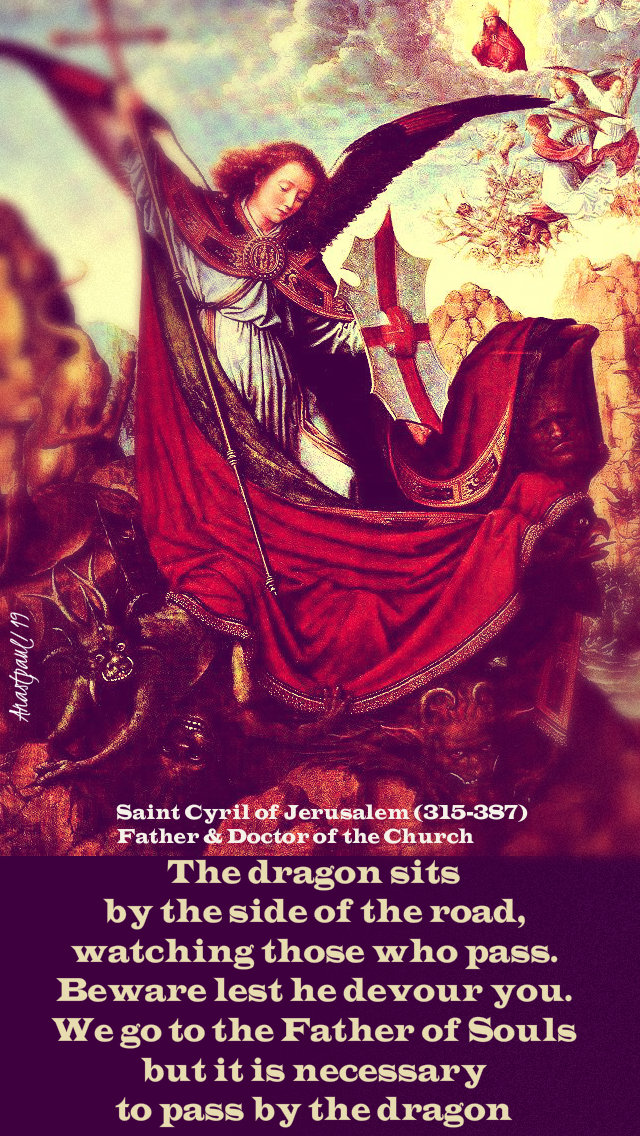
“The dragon sits by the side of the road, watching those who pass. Beware lest he devour you. We go to the Father of Souls but it is necessary to pass by the dragon.”
St Cyril of Jerusalem (315-387)
Father and Doctor of the Church
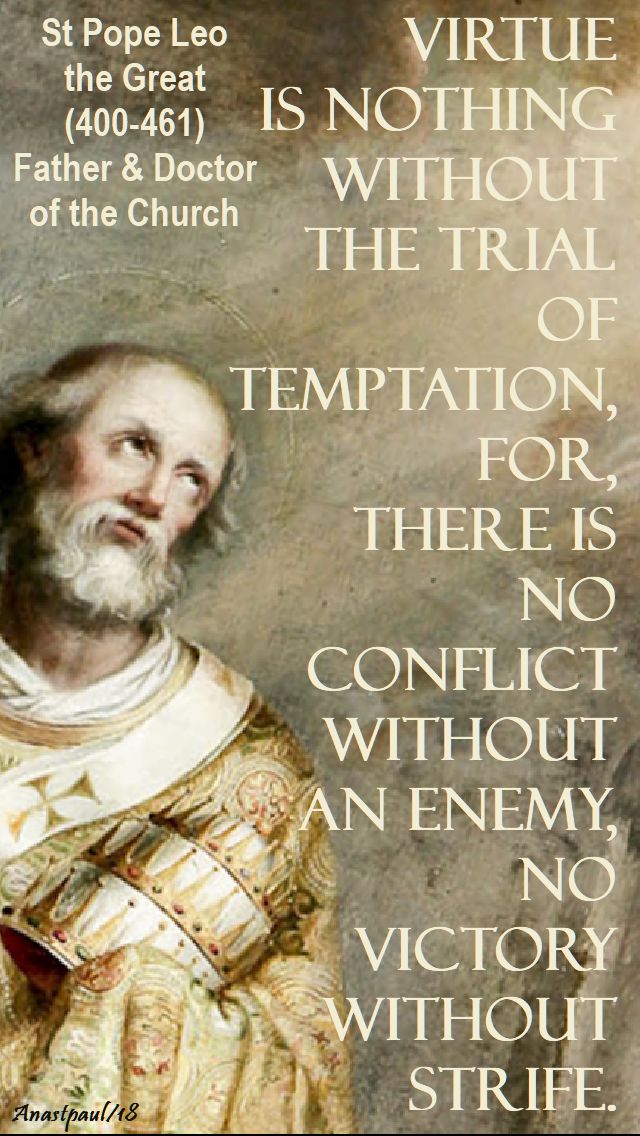
“Virtue is nothing without the trial of temptation, for there is no conflict without an enemy, no victory without strife.”
St Pope Leo the Great (400-461)
Father and Doctor of the Church
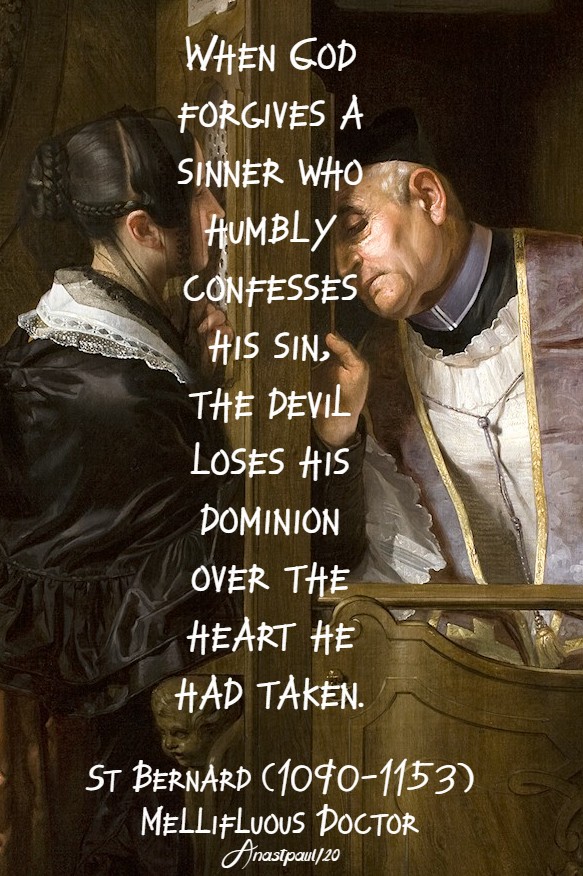
“When God forgives a sinner who humbly confesses his sin, the devil loses his dominion over the heart he had taken.”
St Bernard (1090-1153)
Mellifluous Doctor
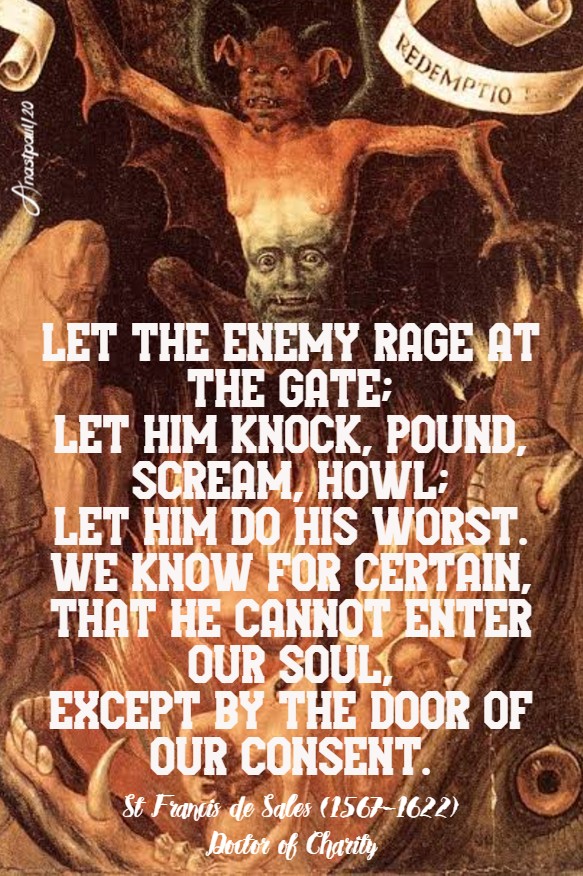
“Let the enemy rage at the gate; let him knock, pound, scream, howl; let him do his worst. We know for certain, that he cannot enter our soul, except by the door of our consent.”
St Francis de Sales (1567-1622)
Doctor of Charity
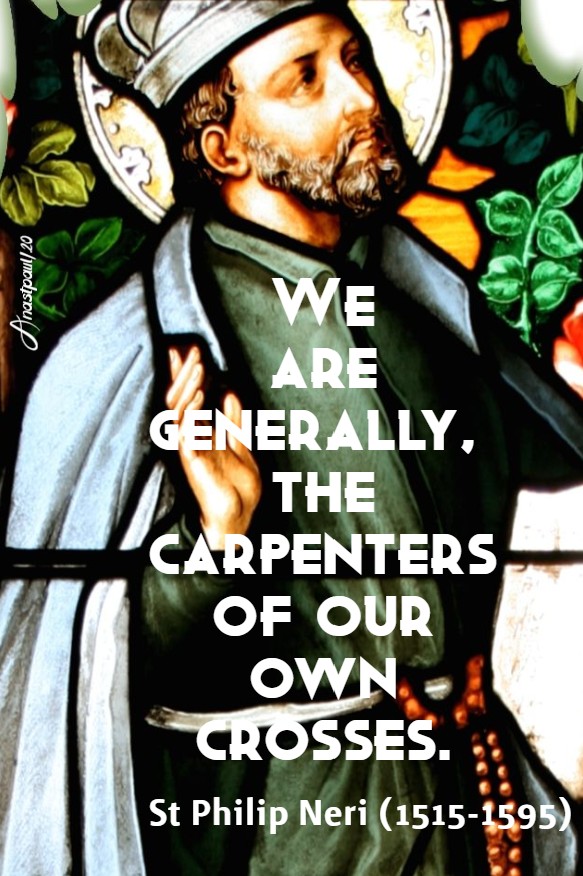
“We are generally, the carpenters of our own crosses.”
St Philip Neri (1515-1595)
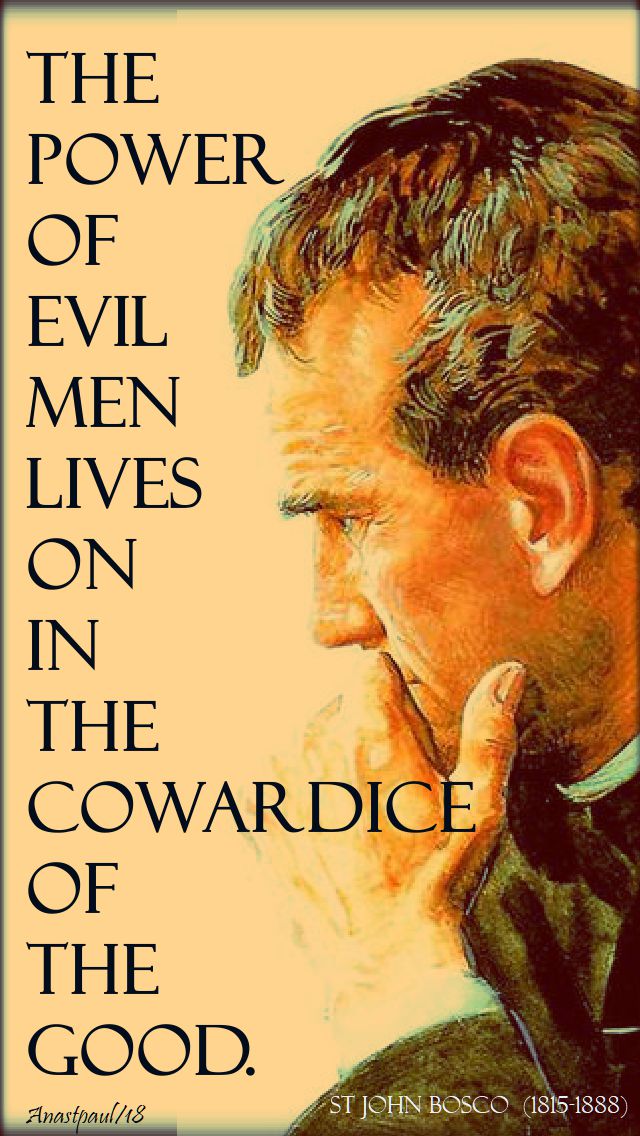
“The power of evil men lives on the cowardice of the good.”
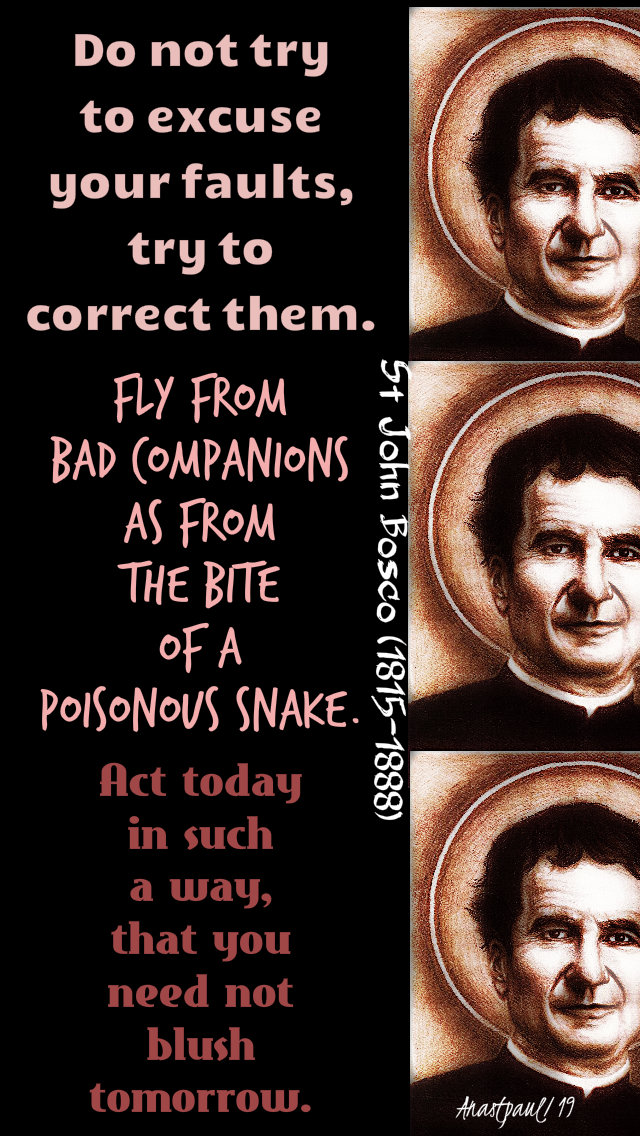
“Do not try to excuse your faults, try to correct them.”
“Fly from bad companions as from the bite of a poisonous snake.”
“Act today in such a way, that you need not blush tomorrow.”
St John Bosco (1815-1888)
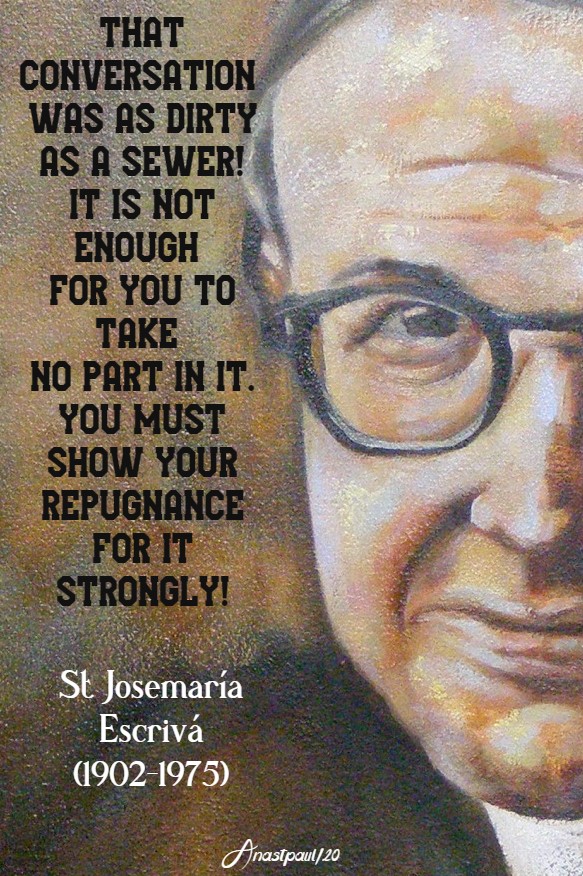
“That conversation… was as dirty as a sewer! It is not enough for you to take no part in it. You must show your repugnance for it strongly!”
St Josemaría Escrivá (1902-1975)
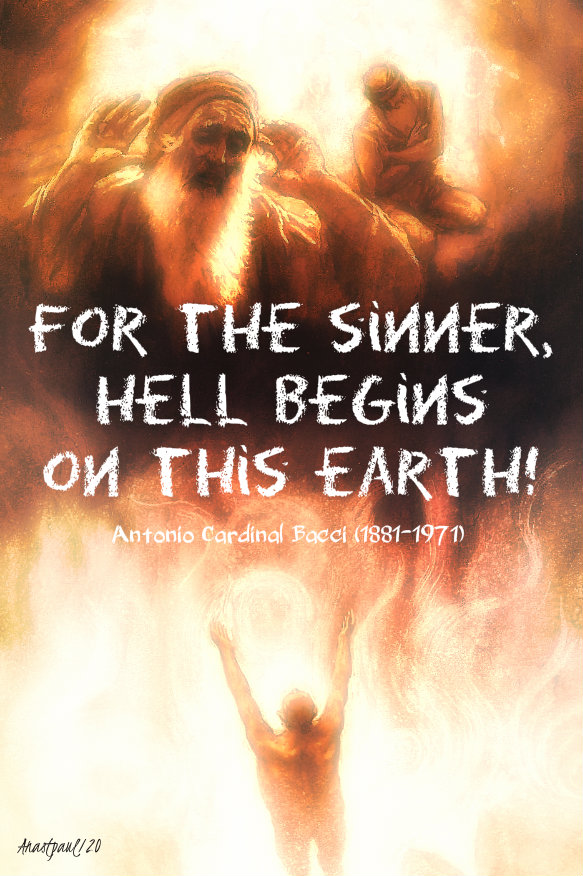
“For the sinner, hell begins on this earth!”
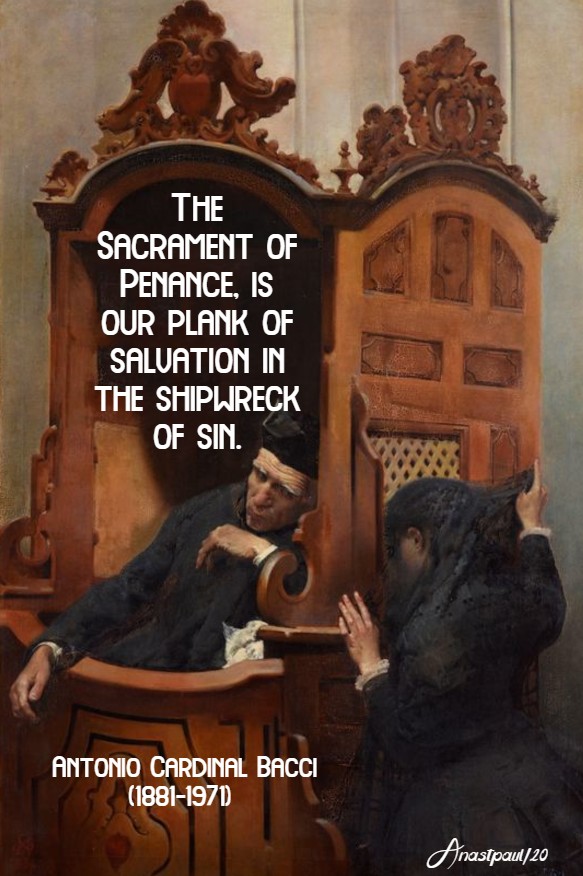
“The Sacrament of Penance, is our plank of salvation in the shipwreck of sin.”
One Minute Reflection – 12 June – “Month of the Sacred Heart” – Friday of the Tenth Week of Ordinary Time, Year A, Readings: 1 Kings 19:9, 11-16, Psalm 27:7-9, 13-14, Matthew 5:27-32
“If your right eye causes you to sin, tear it out and throw it away. It is better for you to lose one of your members than to have your whole body thrown into Gehenna.” … Matthew 5:29
REFLECTION – “As the degree of innocence increases, faith becomes more advanced. For we are advised to be free, not only from our own particular faults but also from those things, which affect us outwardly. For is it not because of sin, that the bodily members were condemned in the first place? The right eye is no less sinister than the left. It is pointless to chastise a foot that is unaware of lust and thus involves no grounds for punishment. But our members indeed do differ from each other while we are all one body. We are here being advised to pluck out inordinate loves or friendships, if they are the occasion that leads us further into wrongdoing. We would do well, to not even have the benefit of a member, like an eye or a foot, if it furnishes the avenue, by which one is drawn by excessive affections into a partnership with hell. Even the cutting away of a member might be beneficial, if the heart (figuratively speaking), were also able to be cut away. But, if the impulse of the heart is left unchanged, the cutting away of a member would be pointless.” … St Hilary of Poitiers (315-368) Father and Doctor of the Divinity of Christ – On Matthew, Ch 4
PRAYER – Yours is the day and Yours, the night, Lord God and we are Your children. Grant we pray, that the weakness of our humanity, the drive of our emotions and flesh may not overpower us. Lead us Lord, through the dangers of our day, give us strength and true love, wishing only, our final home, for those who share our lives, especially our spouse. Mary, pray for us, that we may imitate your faithfulness in all things. We make our prayer through Christ our Lord, in the unity of the Holy Spirit, one God forever, amen.
Our Morning Offering – 12 June – “Month of the Sacred Heart” – Friday of the Tenth Week of Ordinary Time, Year A
Act of Love to the Sacred Heart By Servant of God Cardinal Rafael Merry del Val (1865-1930)
Reveal Your Sacred Heart to me, O Jesus
and show me Its attractions.
Unite me to It forever.
Grant that all my aspirations
and all the beats of my heart,
which cease, not even while I sleep,
may be a testimonial to You,
of my love for You
and may say to You –
“Yes, Lord, I am all Yours”
the pledge of my allegiance to You,
rests forever in my heart
and will never cease to be there.
May You accept,
the slight amount of good that I do
and be graciously pleased,
to repair all my wrong-doing;
so that I may be able,
to bless You in time
and in eternity.
Amen
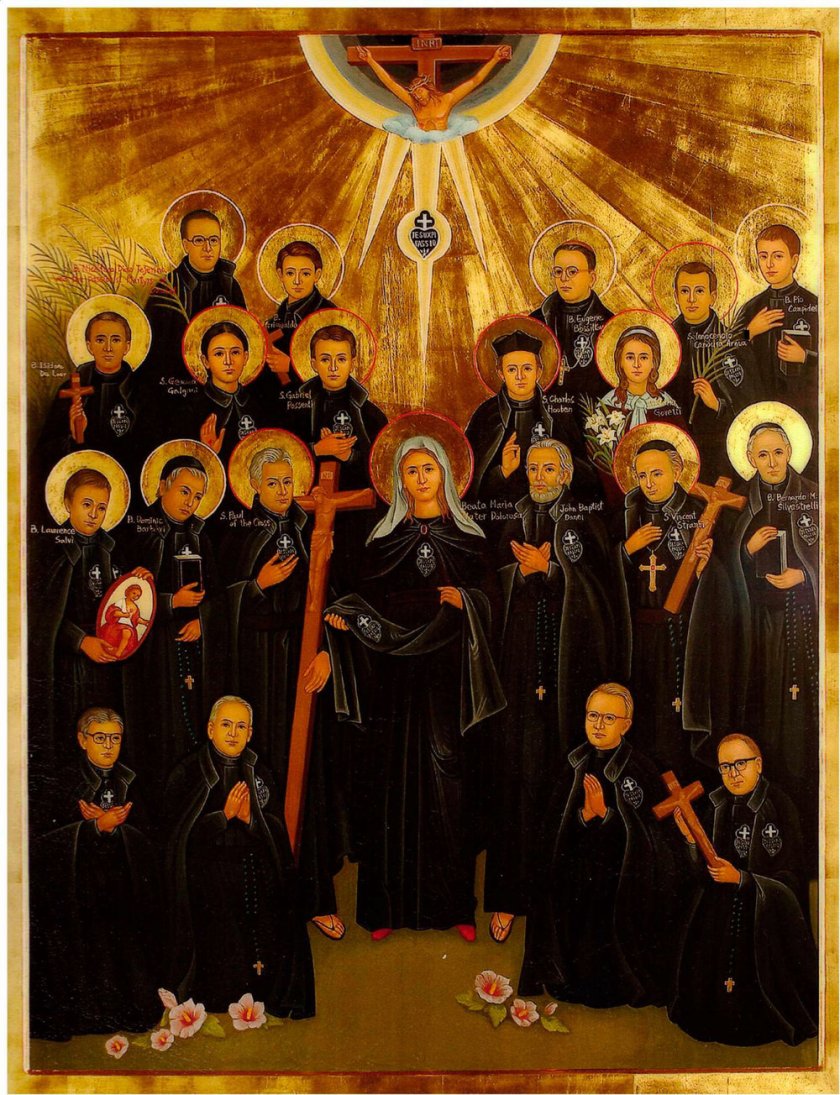
Saint of the Day – 12 June – Blessed Lorenzo Maria of Saint Francis Xavier Salvi CP (1782-1856) (also known as Lorenzo Salvi), Priest of the Passionist Congregation – born as Lorenzo Gaetano Maria Salvi on 30 October 1782 in Rome, Italy and died on 12 June 1856 in Capranica, Viterbo, Italy of natural causes.
Lorenzo was greatly impressed by the preaching and zeal of Saint Vincent Strambi (1745-1824) (here: https://anastpaul.com/2018/09/25/saint-of-the-day-25-september-st-vincent-strambi-c-p-1745-1824/) and soon followed him into the Passionist Congregation. He became a novice at Monte Argentario in 1801, the first monastery of the Passionists. He received the religious name Lorenzo Maria of Saint Francis Xavier and professed his vows on 20 November 1802. He studied for the Priesthood at Jesuit-run the Collegio Romano in Rome, his classmates included the future Pope Gregory XVI and was Ordained a Priest on 29 December 1805. He followed closely in the footsteps of the Founder of the Passionists, St Paul of the Cross.
The anti-clerical laws of Napoleon saw the Passionist house suppressed and its members dispersed. When at last Lorenzo was able to return to Passionist life he preached missions and encouraged devotion to the Passion of Christ, these two things are the hallmarks of the Passionist life. But he also gained the reputation of a most wise and admired Superior for his ability to ably lead communities.
He had great devotion to the Infant Jesus and was steadfast in promoting, in every circumstance, prayerful devotion to the holy childhood of Jesus, not only through his untiring work but also, through his constant example and his proliferation of writings. He often wrote about and preached on the wonders of the Incarnation. Because of this great devotion, he is usually depicted in religious art with a picture of the Child Jesus.
Blessed Lorenzo died 12 June 1856 at Capranica, Viterbo, Italy. He is buried in the Passionist Church of St Angelo, Vetralla (Viterbo).
Passionist Saints
On 1 October 1989 Lorenzo Maria of St Francis Xavier was Beatified by St Pope John Paul II.
Blessed are Thou, O God our Father,
for Thy gift of Blessed Lorenzo Maria of St Francis Xavier,
for his life, his witness
and for the love Thou didst give him for the mystery of the Nativity and Infancy of Thy Son Jesus.
We ask Thee to reawaken in Thy Church,
the awareness of the great gift of the Incarnation
and the desire to imitate Jesus with simplicity of heart
and total trust in Thy Love and Thy Providence.
We thank Thee for the deep compassion
for the suffering Thou didst grant Blessed Lorenzo
and for the strength of his prayer to the Infant Jesus.
We believe that he still intercedes for us.
We confide to Thee our good desires,
for ourselves and for our neighbours,
secure to obtain Thy Grace
and the protection of Blessed Lorenzo.
Amen
Our Lady of Montalto: Shrine of Our Lady of Montalto in Messina, Italy
In 1282, the Virgin Mary appeared in a dream to a friar named Nicholas. During the apparition she promised to send a white dove to the Caperrina hill where she wanted a church built in her name. The cornerstone for the Shrine of Our Lady of Montalto was laid in 1295 by Queen Constance of Sicily. It was a monastery for Cistercian nuns from 1389 until 1866. The Santuario della Madonna di Montalto was severely damaged during the 1908 earthquake and rebuilt in 1930. This view of the bell tower gives you a hint at the beauty of this Gothic and Romanesque structure.
St Amphion of Nicomedia
Bl Antonia Maria Verna
Bl Antonio de Pietra
St Arsenius of Konev
St Christian O’Morgair of Clogher
St Chrodobald of Marchiennes
St Cominus
Bl Conrad of Maleville
St Cunera
St Cuniald
St Cyrinus of Antwerp
St Eskil
St Galen of Armenia St Gaspar Bertoni CSS (1777-1853) – Priest and Founder Biography:
St Gerebald of Châlons-sur-Seine
St Geslar
Bl Guy Vignotelli of Cortona St Juan de Sahagun OESA (1419-1479) BUT his Memorial has been moved to yesterday 11 June. Biography:
St Pope Leo III
St Lochinia of Ireland Blessed Lorenzo Maria of Saint Francis Xavier Salvi CP
Bl Mercedes Maria of Jesus
St Odulf of Utrecht
St Olympius of AEnos
St Onuphrius of Egypt
Bl Pelagia Leonti of Milazzo
St Peter of Mount Athos
St Placid of Val d’Ocre
Bl Stanislaw Kubista
Bl Stefan Grelewski
Bl Stefan Kielman
St Ternan of Culross
St Valerius of Armenia
Martyrs of Bologna: Three Christians who were martyred at different times and places, but whose relics have been collected and enshrined together – Celsus, Dionysius, and Marcellinus. Their relics were enshrined in churches in Bologna and Rome in Italy.
Martyrs of Rome: Four members of the Imperial Roman nobility. They were all soldiers, one or more may have been officers, and all were martyred in the persecutions of Diocletian – Basilides, Cyrinus, Nabor and Nazarius.
They were martyred in 304 outside Rome, Italy and buried along the Aurelian Way.
Three Holy Exiles: Three Christian men who became Benedictine monks at the Saint James Abbey in Regensburg, Germany, then hermits at Griestatten, and whose lives and piety are celebrated together. – Marinus, Vimius and Zimius.
108 Martyrs of World War II:
Also known as
• Polish Martyrs
• 108 Polish Martyrs of the Nazis
• 108 Blessed Polish Martyrs
Among the millions murdered by Nazis in World War II, many were Poles killed for being Poles and many were Catholics killed for being Catholic. As emblematic of this group, 108 Polish Catholics who were murdered for their faith, and whose faithfulness was attested by by witnesses, were beatified as a group of by Pope John Paul II. They each have a separate memorial day on the calendar but they are celebrated as a group today.
• Adalbert Nierychlewski • Adam Bargielski • Aleksy Sobaszek • Alfons Maria Mazurek • Alicja Maria Jadwiga Kotowska • Alojzy Liguda • Anastazy Jakub Pankiewicz • Anicet Koplinski • Antoni Beszta-Borowski • Antoni Julian Nowowiejski • Antoni Leszczewicz • Antoni Rewera • Antoni Swiadek • Antoni Zawistowski • Bogumila Noiszewska • Boleslas Strzelecki • Boniface Zukowski • Bronislao Kostkowski • Bronislaw Komorowski • Bruno Zembol • Czeslaw Jozwiak • Dominik Jedrzejewski • Edward Detkens • Edward Grzymala • Edward Kazmierski • Edward Klinik • Emil Szramek • Fidelis Jerome Chojnacki • Florian Stepniak • Franciszek Dachtera • Franciszek Drzewiecki • Franciszek Kesy • Franciszek Rogaczewski • Franciszek Roslaniec • Franciszek Stryjas • Grzegorz Boleslaw Frackowiak • Henryk Hlebowicz • Henryk Kaczorowski • Henryk Krzysztofik • Hilary Pawel Januszewski • Jan Eugeniusz Bajewski • Jan Franciszek Czartoryski • Jan Nepomucen Chrzan • Jan Oprzadek • Jarogniew Wojciechowski • Jerzy Kaszyra • Jozef Achilles Puchala • Józef Cebula • Jozef Czempiel • Józef Jankowski • Jozef Kowalski • Józef Kurzawa • Jozef Kut • Józef Pawlowski • Jozef Stanek • Jozef Straszewski • Józef Wojciech Guz • Jozef Zaplata • Julia Rodzinska • Karol Herman Stepien • Katarzyna Faron • Kazimiera Wolowska • Kazimierz Gostynski • Kazimierz Grelewski • Kazimierz Tomasz Sykulski • Leon Nowakowski • Leon Wetmanski • Ludwik Mzyk • Ludwik Roch Gietyngier • Maksymilian Binkiewicz • Marcin Oprzadek • Maria Antonina Kratochwil • Maria Klemensa Staszewska • Marian Gorecki • Marian Konopinski • Marian Skrzypczak • Marianna Biernacka • Michal Ozieblowski • Michal Piaszczynski • Michal Wozniak • Mieczyslaw Bohatkiewicz • Mieczyslawa Kowalska • Narcyz Putz • Narcyz Turchan • Natalia Tulasiewicz • Piotr Edward Dankowski • Roman Archutowski • Roman Sitko • Stanislaw Antoni Trojanowski • Stanislaw Kostka Starowieyski • Stanislaw Kubista • Stanislaw Kubski • Stanislaw Mysakowski • Stanislaw Pyrtek • Stanislaw Starowieyski • Stefan Grelewski • Stefan Wincenty Frelichowski • Symforian Ducki • Tadeusz Dulny • Wincenty Matuszewski • Wladyslaw Bladzinski • Wladyslaw Demski • Wladyslaw Goral • Wladyslaw Maczkowski • Wladyslaw Miegon • Wlodzimierz Laskowski • Wojciech Gondek • Zygmunt Pisarski • Zygmunt Sajna
Died
between 5 October 1939 and April 1945 in Germany and Nazi-occupied Poland and were Beatified on 13 June 1999 by St Pope John Paul II in Warsaw, Poland.
Thought for the Day – 11 June – “Month of the Sacred Heart” – Meditations with Antonio Cardinal Bacci (1881-1971)
“Learn From Me, For I Am Meek and Humble of Heart”
“Jesus is perfection itself.
In Him, therefore, every virtue is to be found.
He could truly claim that He fulfilled in Himself the precept: “You are to be perfect, even as your heavenly Father is perfect” (Mt 5:48).
Throughout His life, He performed in a perfect manner, the will of His heavenly Father: “I do always the things that are pleasing to Him” (Jn 8:29).
Jesus Christ provided us with an example of every virtue.
As the foundation of all the virtues, He insisted on the great precept of loving God above all things and our neighbour as ourselves.
In proposing Himself as a model, however, this is what He said: “Learn from me, for I am meek and humble of heart and ou will find rest for your souls” (Mt 11:29).
The outstanding example which Jesus gave us for our imitation, was this meekness and humility of heart.
We shall have peace of soul only, if we are meek and humble.
In what did the humility of Jesus consist?
He was God and He became man.
He Who possessed everything was born poor in a wretched stable and lived as a lowly workman for thirty years.
He allowed Himself to be betrayed by one of His Apostles, to be sentenced to death as an evildoer and, finally, to be executed on the Cross.
He combined humility with gentleness.
He was happy when He could receive back penitent sinners and grant them forgiveness and peace.
Let us recall the examples of Mary Magdalen, the adulteress, the lost sheep, the prodigal son and, finally, the repentant thief, to whom He promised the reward of Heaven.
What greater gentleness and mercy could we ever find?
To the present day, moreover, Jesus Christ is hidden in the Blessed Eucharist under the consecrated species and appeals to us to imitate and love Him.
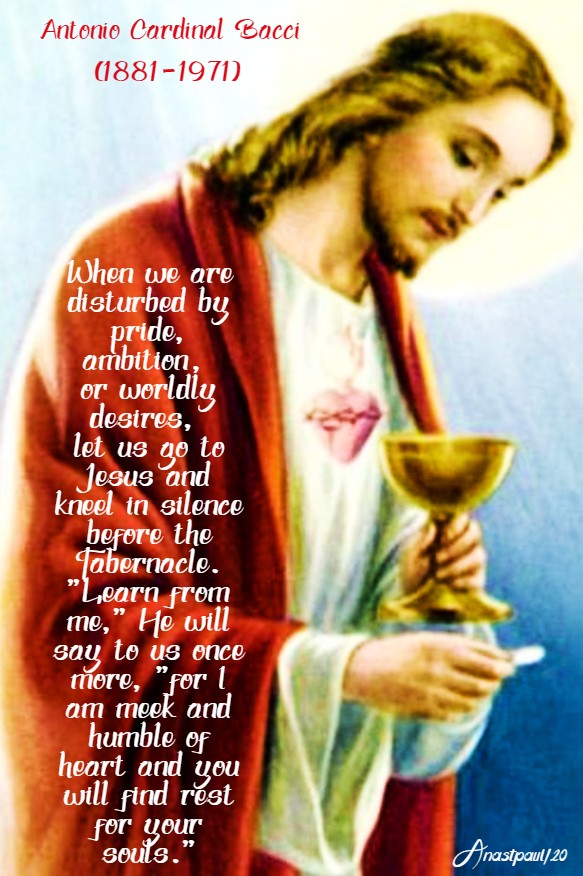
When we are disturbed by pride, ambition, or worldly desires, let us go to Jesus and kneel in silence before the Tabernacle. “Learn from me,” He will say to us once more, “for I am meek and humble of heart and you will find rest for your souls.”
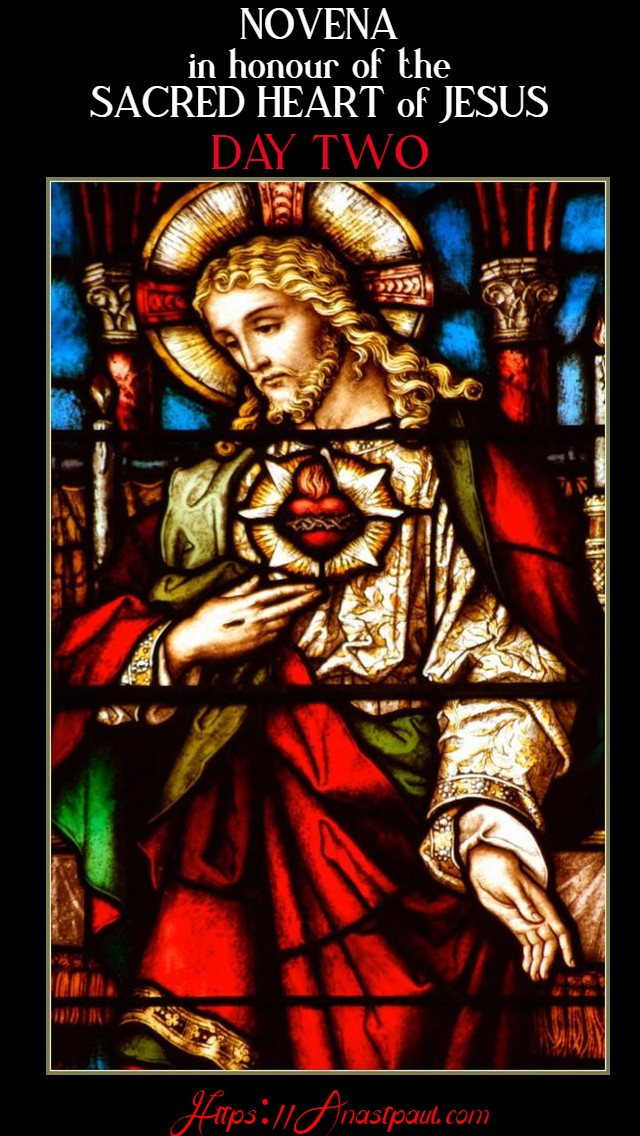
Novena in Honour of the Sacred Heart of Jesus Day Two – 11 June
What Does God Desire?
Today’s Scripture ‘So I say to you, ask and it will be given to you; seek and you will find; knock and the door will be opened for you. For everyone who asks, receives and everyone who seeks, finds and for everyone who knocks, the door will be opened. … Luke 11: 9-10
Reflection for the Second Day
St Augustine said, ‘For yourself you have made us, O Lord and our hearts are restless, until they rest in you.’
I love a change a modern theologian has made in those lines – he writes: ‘Your heart is restless, until we rest in you.’
Our God is vulnerable to our free response.
He waits for our love.
Today’s Prayer
Lord, I come to You full of needs.
But my deepest need,
is to become more convinced of Your love for me.
Help me to believe
that You are with me today,
tomorrow and always
because, You love me!
Amen
Daily Invocation Sacred Heart of Jesus, I place all my trust in you.
Novena Prayer
Lord Jesus,
the needs of Your people open Your heart in love for each of us.
You care for us when we are lost,
sympathise with us in loneliness
and comfort us in mourning;
You are closest to us where we are weakest.
You love us most, when we love ourselves least;
You forgive us mos, when we forgive ourselves least
and You call us to spread Your love in whatever way we can.
Lord Jesus, Your heart is moved with compassion
when we are suffering,
when we need your help
and when we pray for each other.
I ask You to listen to my prayer during this Novena
and grant what I ask.
…………………………. (Mention your intention silently.)
If what I ask, is not for my own good and the good of others,
grant me what is best,
that I may build up Your kingdom of love in our world.
Amen
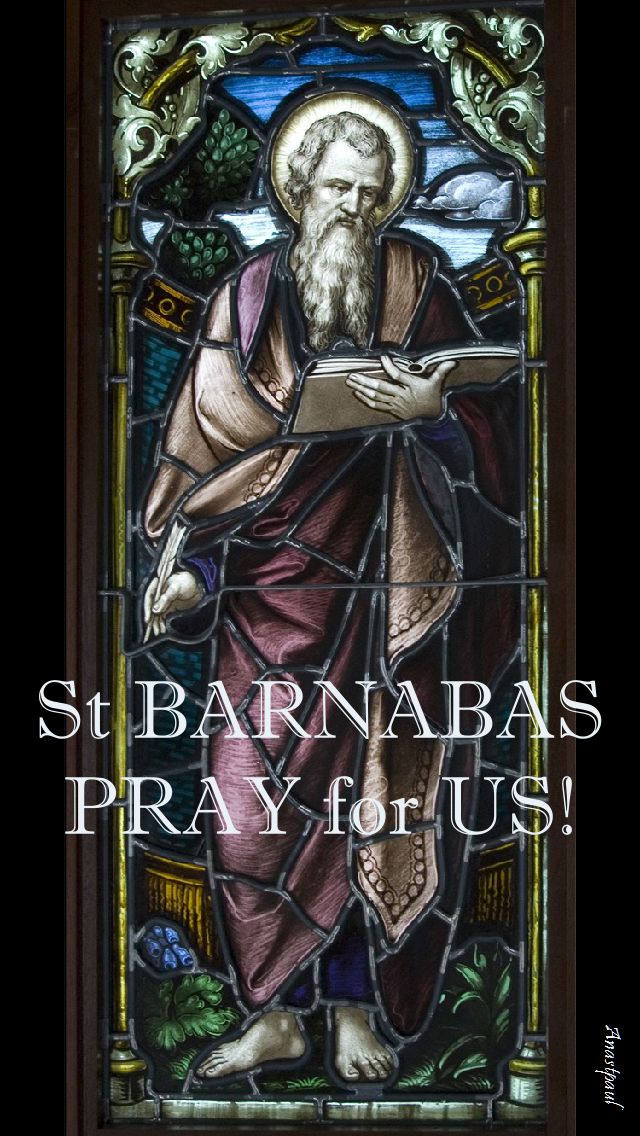
Quote/s of the Day – 11 June – Thursday of the Tenth Week in Ordinary Time, Year A, Readings: Acts: 11:21b-26; 12:1-3, Psalm 98(97),1.2-3ab.3cd-4.5-6, Matthew 10:7-13 and the Memorial of St Barnabas, Apostle of Christ
“Freely you have received, freely you are to give.”
Matthew 10:8 (DR)
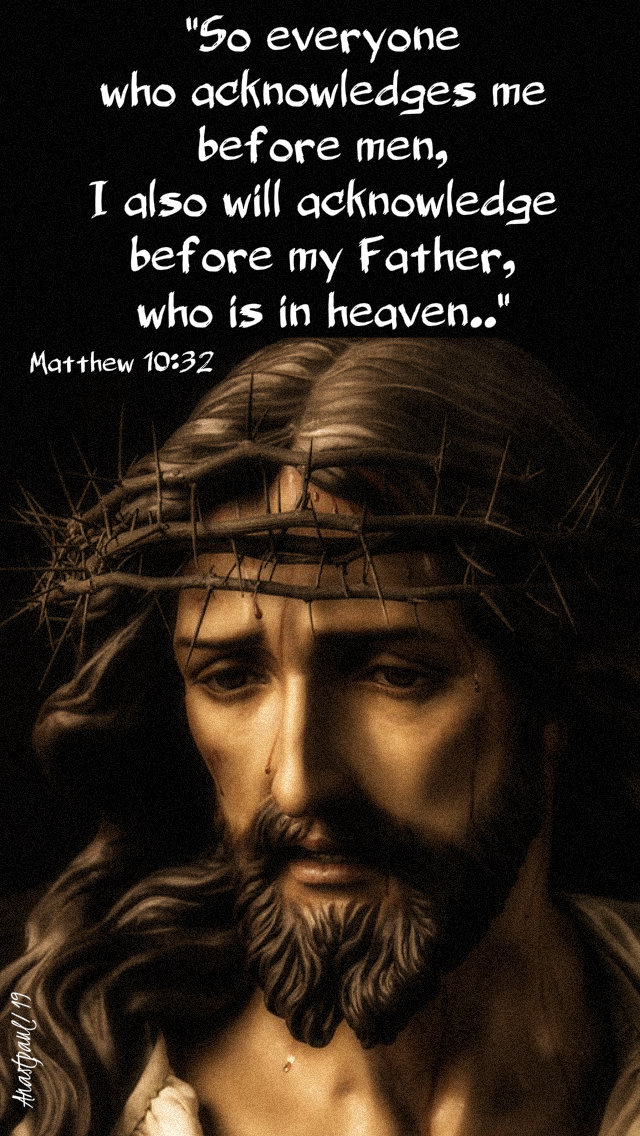
“So everyone who acknowledges me before men, I also will acknowledge before my Father, who is in heaven…”
Matthew 10:32
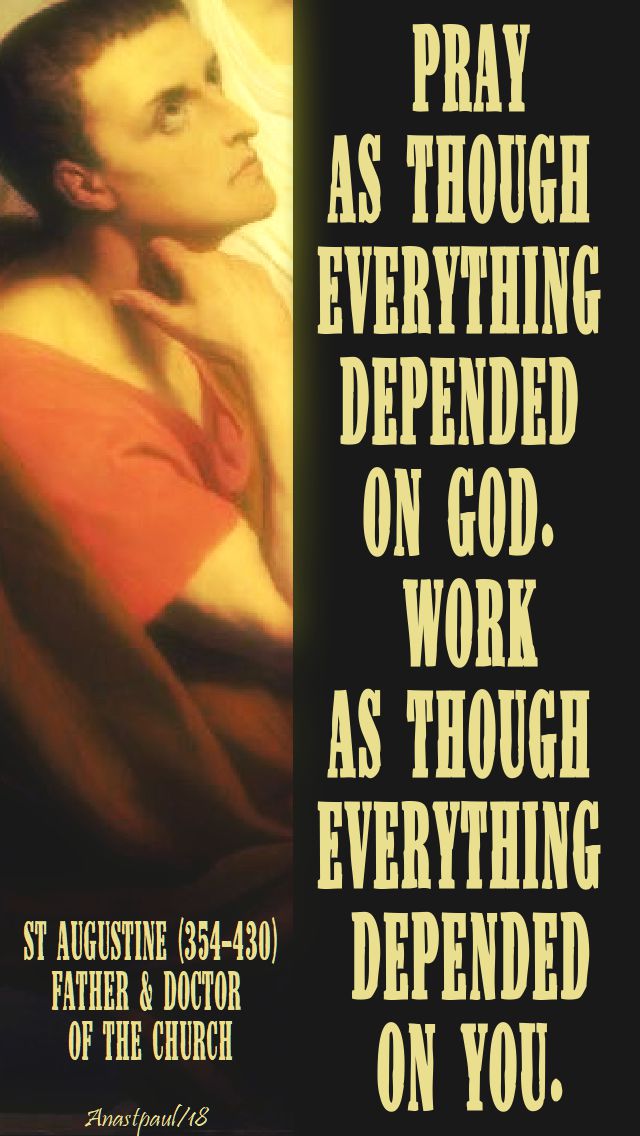
“Pray as though everything depended on God. Work as though everything depended on you.”
St Augustine (354-430)
Father & Doctor of the Church
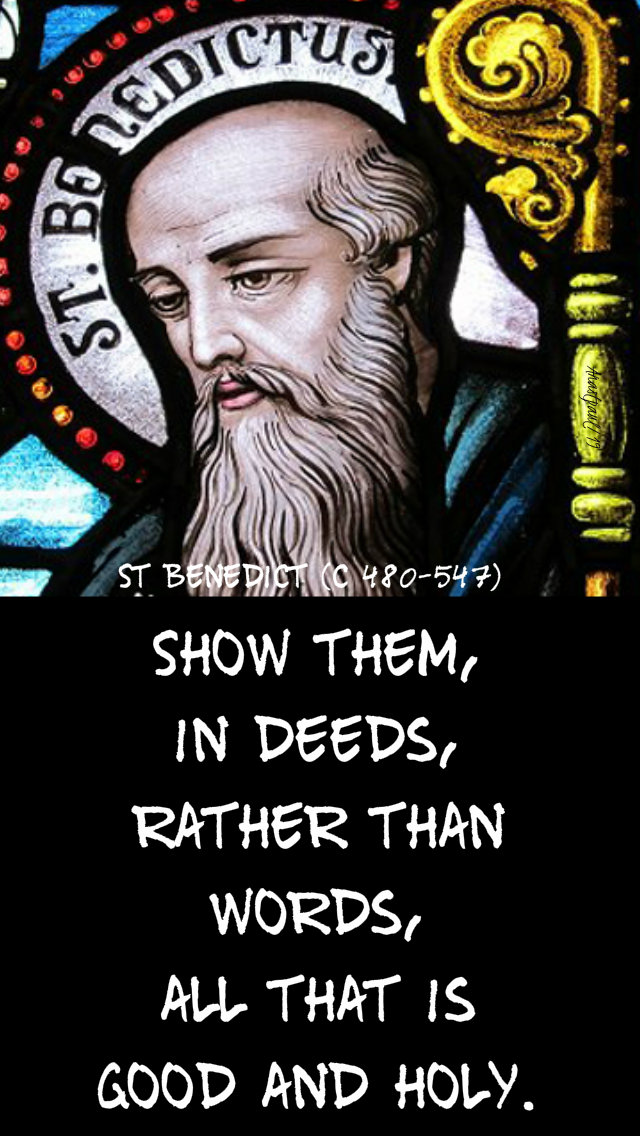
“He should first show them, in deeds, rather than words, all that is good and holy.”
St Benedict (c 480-547)
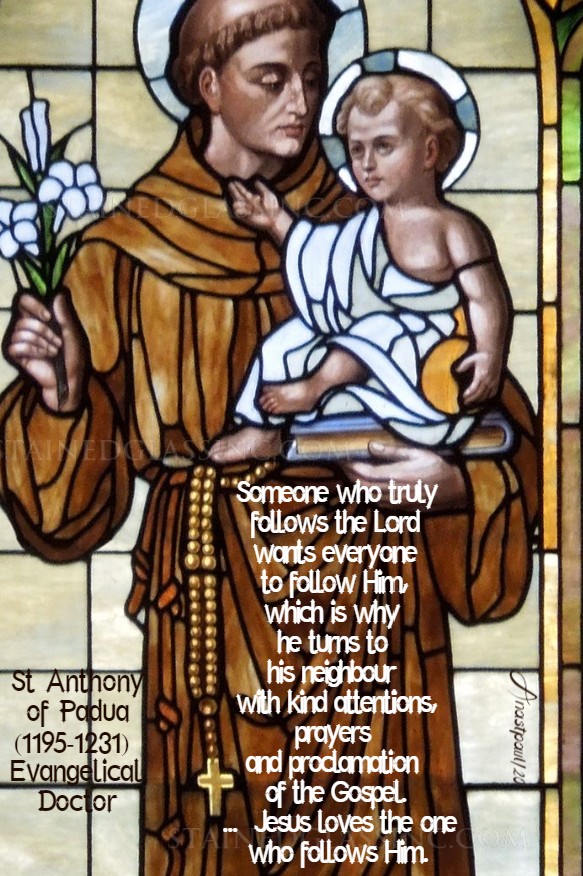
“Someone who truly follows the Lord wants everyone to follow Him, which is why he turns to his neighbour with kind attentions, prayers and proclamation of the Gospel. … Jesus loves the one who follows Him.”
St Anthony of Padua (1195-1231)
Evangelical Doctor
“Teach us to give and not to count the cost.”
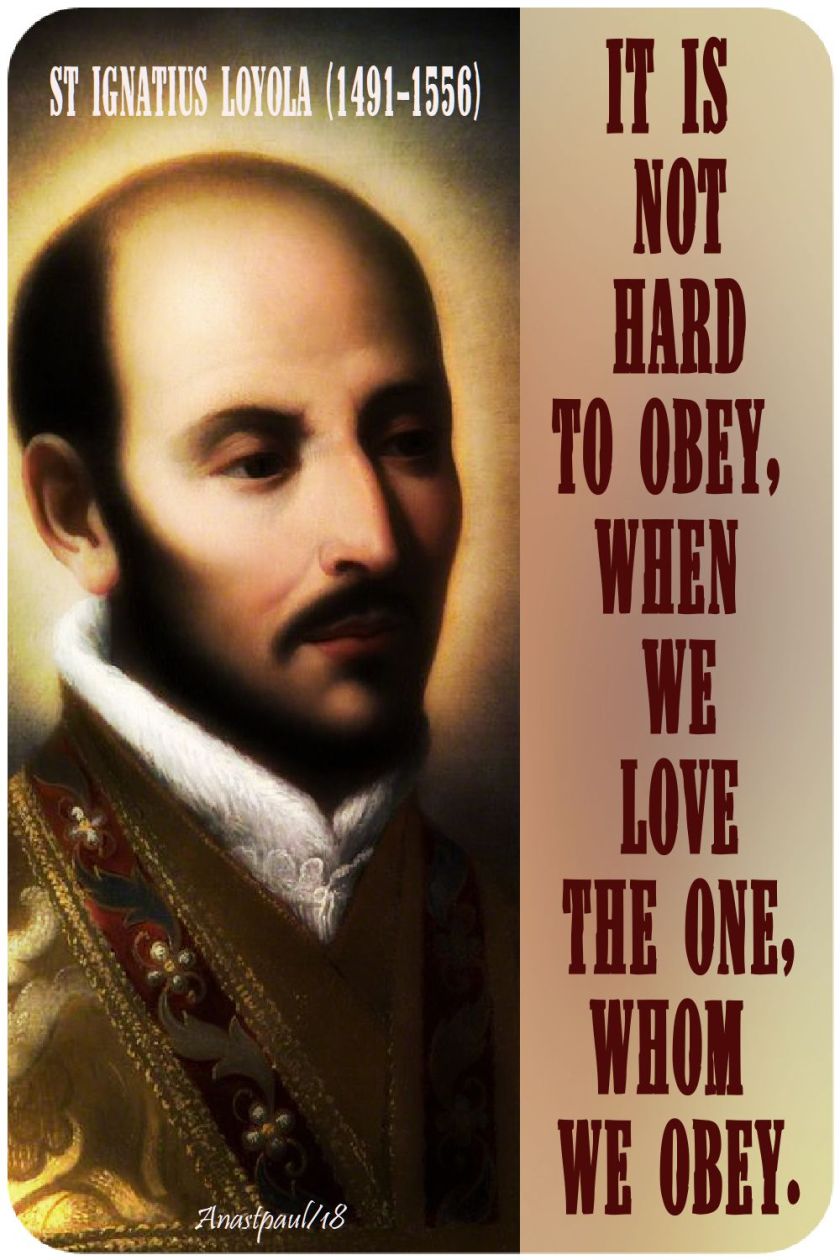
“It is not hard to obey when we love the one, whom we obey.”
St Ignatius Loyola (1491-1556)
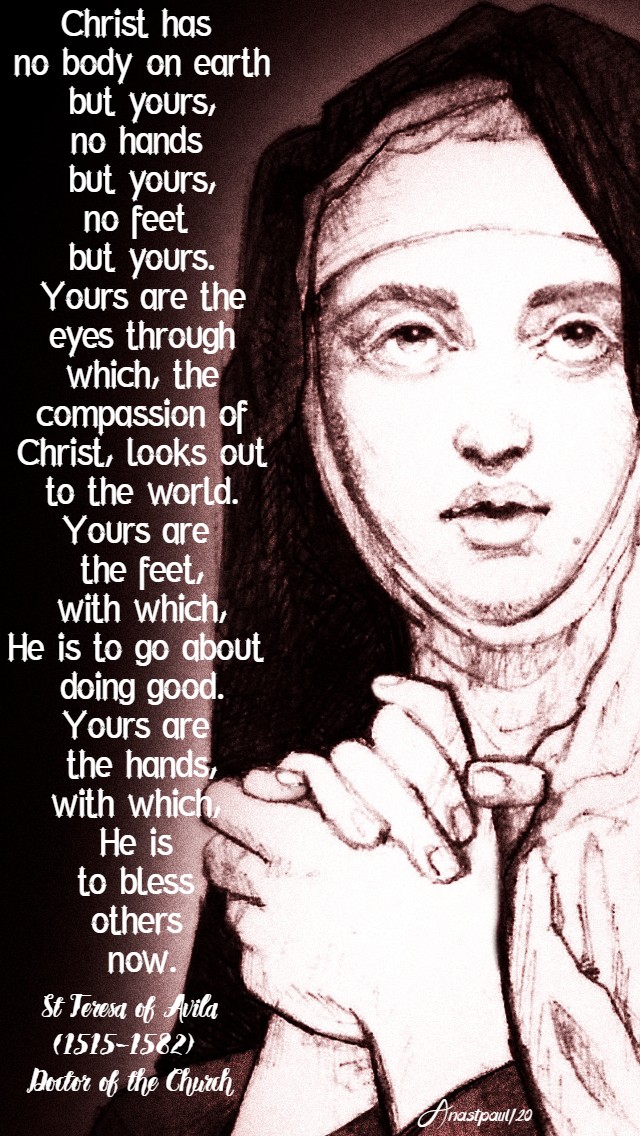
“Christ has no body on earth but yours, no hands but yours, no feet but yours. Yours are the eyes through which, the compassion of Christ, looks out to the world. Yours are the feet, with which, He is to go about doing good. Yours are the hands, with which, He is to bless others now.”
St Teresa of Avila (1515-1582)
Doctor of the Church
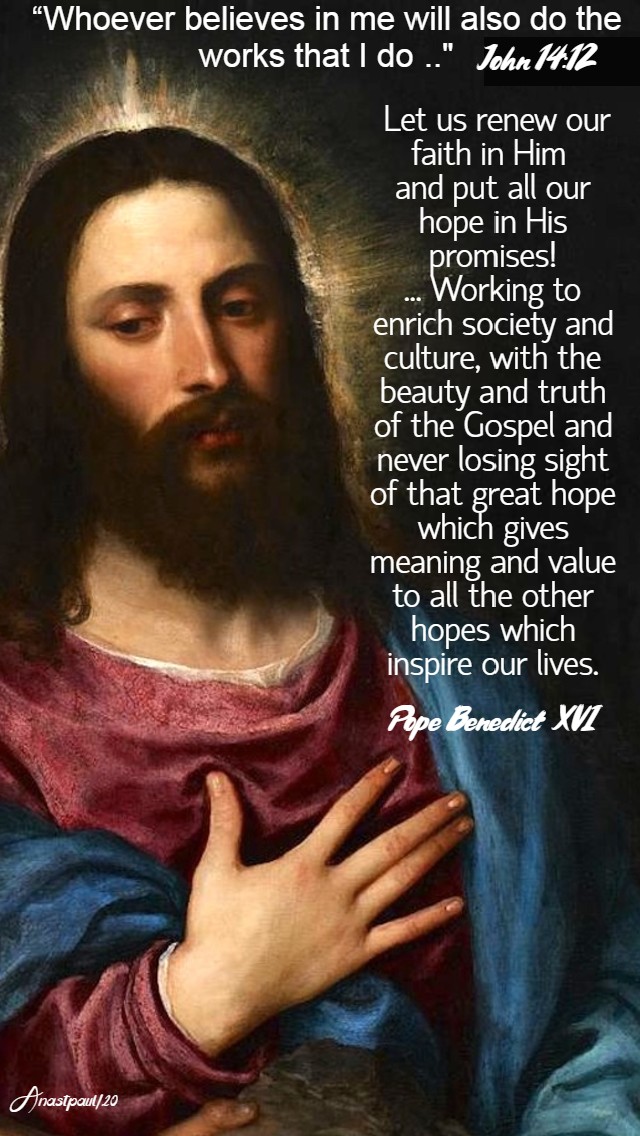
“Let us renew our faith in Him and put all our hope in His promises! … Working to enrich … society and culture with the beauty and truth of the Gospel and never losing sight of that great hope which gives meaning and value to all the other hopes which inspire our lives.”
Pope Benedict XVI
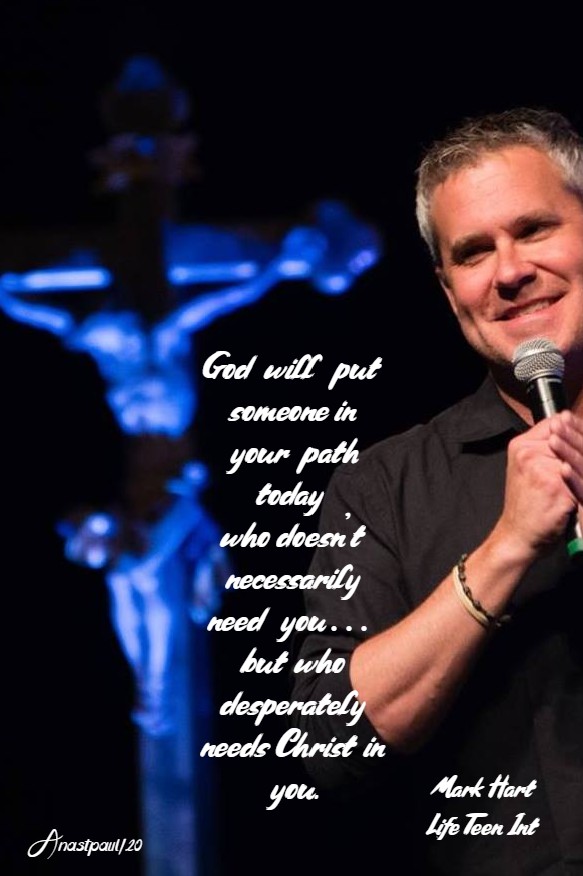
“God will put someone in your path today who doesn’t necessarily need you… but who desperately needs Christ in you.”
Mark Hart
Executive Vice President for Life Teen International.
One Minute Reflection – 11 June -“Month of the Sacred Heart” – Thursday of the Tenth Week in Ordinary Time, Year A, Readings: Acts: 11:21b-26; 12:1-3, Psalm 98(97),1.2-3ab.3cd-4.5-6, Matthew 10:7-13 and the Memorial of St Barnabas, Apostle of Christ
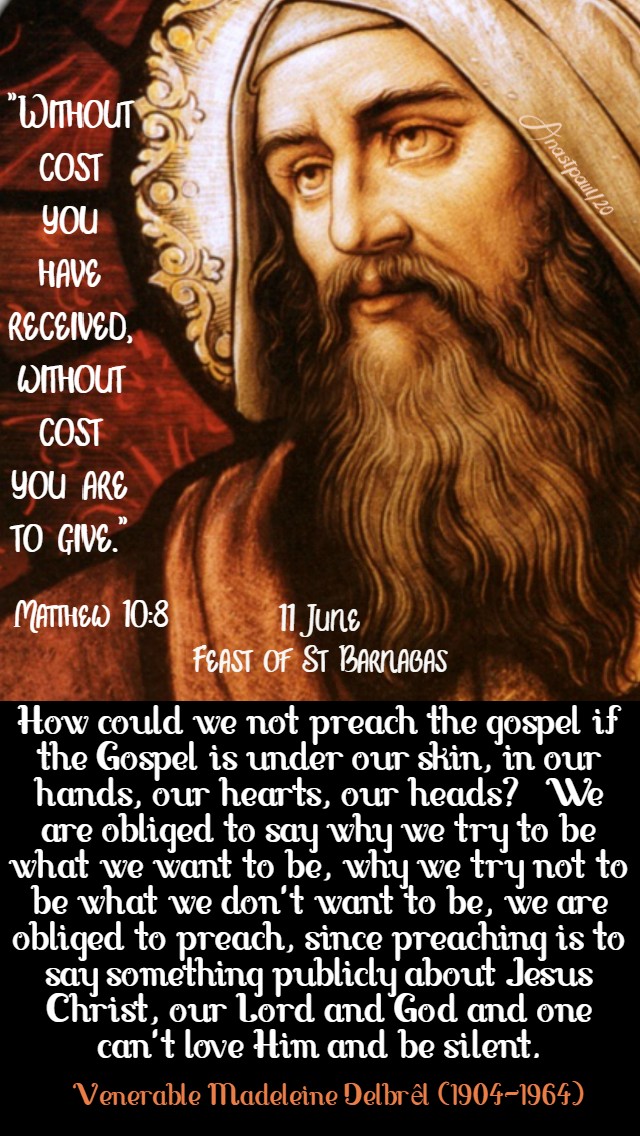
Jesus said to his Apostles: “As you go, make this proclamation: ‘The kingdom of heaven is at hand.’ Cure the sick, raise the dead, cleanse lepers, drive out demons. Without cost you have received; without cost you are to give.” ... Matthew 10:7-8
REFLECTION – “It is not we who look for an apostolate – it looks for us; God, in loving us first, makes apostles of us. How could we share bread, a roof, our heart with the neighbour who is our own flesh and not be overflowing with the love of our God for him, if that neighbour does not know him? Everything is miserable without God; we cannot tolerate wretchedness for someone we love, least of all the greatest. Not be apostolic? Not be missionaries? But then what would it mean to belong to this God who has sent His Son so that the world might be saved by Him… and how?
However, we don’t “think” about being apostles; we think of being – in God’s hands, in the body of Christ, under the moving of His Spirit – the Christ we wish to become, the Christ who is never love without being light and there is no light except at the price of light. We imitate Him, badly but without stopping, we enter into Him, dissimilarly but tenaciously, how could we not be, at least in will, apostles? in all our being, disposed as, missionaries?…
How could we not preach the gospel if the Gospel is under our skin, in our hands, our hearts, our heads? We are obliged to say why we try to be what we want to be, why we try not to be what we don’t want to be, we are obliged to preach, since preaching is to say something publicly about Jesus Christ, our Lord and God and one can’t love Him and be silent.” … Venerable Madeleine Delbrêl (1904-1964) – Missionary to the outcasts – A vocation for God among men (The Joy of Believing)
PRAYER – O God, who decreed that Saint Barnabas, a man filled with faith and the Holy Spirit, should be set apart to convert the nations, grant that the Gospel of Christ, which he strenuously preached, may be faithfully proclaimed by word and by deed. We pray you Lord, that by the intercession of St Barnabas, we too may grow in faith and love and live to glorify Your kingdom. Through our Lord Jesus Christ, Your Son, who lives and reigns with you in the unity of the Holy Spirit, one God, forever and ever. Amen.
Our Morning Offering – 11 June -“Month of the Sacred Heart” – Thursday of the Tenth Week in Ordinary Time, Year A
Unite Me to Your Sacred Heart By Blessed Angela Truszkowska (1825-1899)
My Lord, You bid us to suffer,
therefore, my poor soul desires it.
I want to suffer, O Jesus but with You,
to suffer but for the love of You,
to suffer but in silence and in solitude,
so that no-one would know that I suffer, only You,
so that only You would hear the groanings of my soul
and only You would see my tears.
Ah! Teach me, O Lord,
to suffer in that way,
teach me to suffer, without seeking any consolation,
to suffer, without craving the sympathy of creatures,
to suffer, without even expecting the eternal joys of heaven.
Teach me to suffer,
not because suffering is the source of merit and glory
but because, it unites us to You and makes our hearts
like unto your Sacred Heart.
Amen
(The text was written on sheets of paper bound together with two works of St Alphonsus Ligouri. Mother Angela gave this book to Sr Anna Bielska as a gift on the first anniversary of her profession, 8 December 1861.)
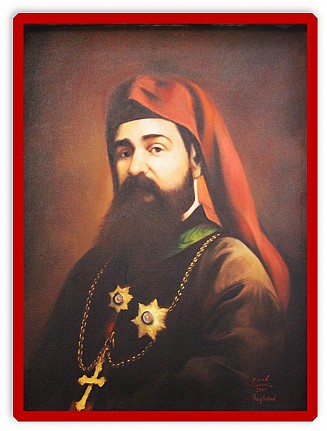
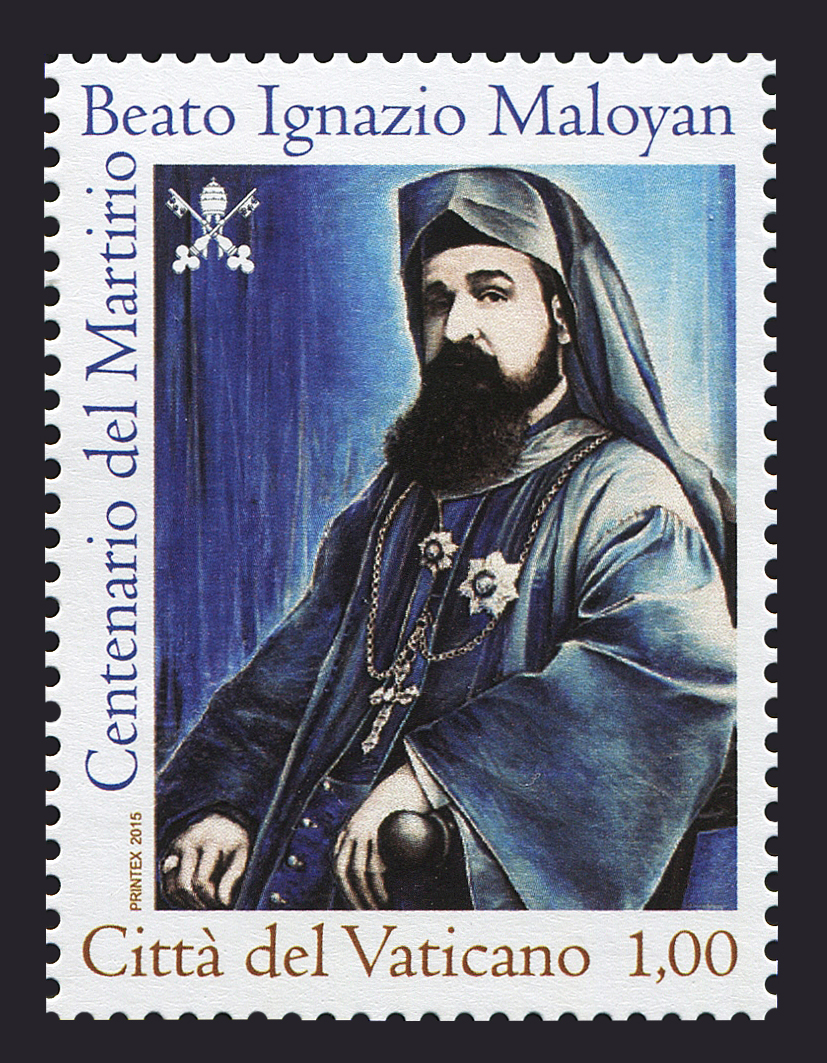
Saint of the Day – 11 June -Blessed Ignazio Shoukrallah Maloyan ICPB (1869-1915) Bishop and Martyr – born as Shoukrallah Maloyan on 18 April 1869 at Mardin, Turkey and died by being shot to death on 11 June 1915 by Mamdooh Bek at Zerzevan Castle, Çinar, Diyarbakir, Turkey.
Ignazio Maloyan (Shoukrallah), son of Melkon and Faridé, was born in 1869, in Mardin, Turkey. His parish priest, noticed in him signs of a priestly vocation, so he sent him to the convent of Bzommar-Lebanon; he was fourteen years old.
After finishing his superior studies in 1896, the day dedicated to the Sacred Heart of Jesus, he was Ordained Priest in the Church of Bzommar convent, became a member of the Bzommar Institute and adopted the name of Ignatius in remembrance of the famous Martyr of Antioch. During the years 1897-1910, Father Ignazio was appointed as Parish Priest in Alexandria and Cairo, where his good reputation was wide-spread.
His Beatitude Patriarch Boghos Bedros XII appointed him as his assistant in 1904. Because of a disease that hit his eyes and suffocating difficulty in breathing, he returned to Egypt and stayed there till 1910.
The Diocese of Mardin was in a state of anarchy, so Patriarch Sabbaghian sent Father Ignazio Maloyan to restore order.
On 22 October 1911, the Bishops’ Synod assembled in Rome elected Father Ignazio Archbishop of Mardin. He took over his new assignment and planned on renewing the wrecked Diocese, encouraging especially the devotion to the Sacred Heart.
Unfortunately, at the outbreak of the First World War, the Armenians resident in Turkey (which was allied with Germany) began to endure unspeakable sufferings. In fact, 24 April 1915 marked the beginning of a veritable campaign of extermination. On 30 April 1915, the Turkish soldiers surrounded the Armenian Catholic Bishopric and church in Mardin on the basis that they were hide-outs for arms.
At the beginning of May, the Bishop gathered his priests and informed them of the dangerous situation. On 3 June 1915, Turkish soldiers dragged Bishop Maloyan in chains to court with twenty seven other Armenian Catholic personalities. The next day, twenty five Priests and eight hundred and sixty two believers were held in chains. During trial, the chief of the police, Mamdooh Bek, asked the Bishop to convert to Islam. The Bishop answered that he would never betray Christ and His Church. The good shepherd told him that he was ready to suffer all kinds of ill-treatments and even death and in this, will be his happiness.
Mamdooh Bek hit him on the head with the rear of his pistol and ordered to put him in jail. The soldiers chained his feet and hands, threw him on the ground and hit him mercilessly. With each blow, the Bishop was heard saying “Oh Lord, have mercy on me, oh Lord, give me strength,”and asked the Priests present for absolution. With that, the soldiers went back to hitting him and they extracted his toe nails.
On 9 June, his mother visited him and cried for his state. But the valiant Bishop encouraged her. On the next day, the soldiers gathered four hundred and forty seven Armenians. The soldiers along with the convoys took the desert route.
The Bishop encouraged his parishioners to remain firm in their faith. Then all knelt with him. He prayed to God that they accept Martyrdom with patience and courage. The Priests granted the believers absolution. The Bishop took out a piece of bread, blessed it, recited the words of the Eucharist and gave it to his Priests to distribute among the people.
One of the soldiers, an eye witness, recounted this scene: “That hour, I saw a cloud covering the prisoners and from all, emitted a perfumed scent. There was a look of joy and serenity on their faces.” As they were all going to die out of love for Jesus. After a two-hour walk, hungry, naked and chained, the soldiers attacked the prisoners and killed them before the Bishop’s eyes. After the massacre of the two convoys came the turn of Bishop Maloyan.
Mamdooh Bek then asked Maloyan again to convert to Islam. The soldier of Christ answered: “I’ve told you I shall live and die for the sake of my faith and religion. I take pride in the Cross of my God and Lord.” Mamdooh got very angry, he drew his pistol and shot Maloyan. Before he breathed his last breath he cried out loud: “My God, have mercy on me, into your hands I commend my spirit.” Bl Ignazio was 46 years old. … Vatican.va
Ignazio was Beatified on 7 October 2001 at Saint Peter’s Basilica, Vatican City, by St Pope John Paul II, when he said:
“Archbishop Ignatius Maloyan, who died a Martyr when he was 46, reminds us of every Christian’s spiritual combat, whose faith is exposed to the attacks of evil. It is in the Eucharist that he drew, day by day, the force necessary to accomplish his Priestly ministry with generosity and passion, dedicating himself to preaching, to a pastoral life connected with the celebration of the sacraments and to the service of the neediest.
Throughout his existence, he fully lived the words of St Paul: “God has not given us a spirit of fear but a spirit of courage, of love and self control” (II Tim 1,14. 7). Before the dangers of persecution, Bl Ignatius did not accept any compromise, declaring to those who were putting pressure on him, “It does not please God that I should deny Jesus my Saviour. To shed my blood for my faith is the strongest desire of my heart.” May his example enlighten all those who today wish to be witnesses of the Gospel, for the glory of God and for the salvation of their neighbour.”
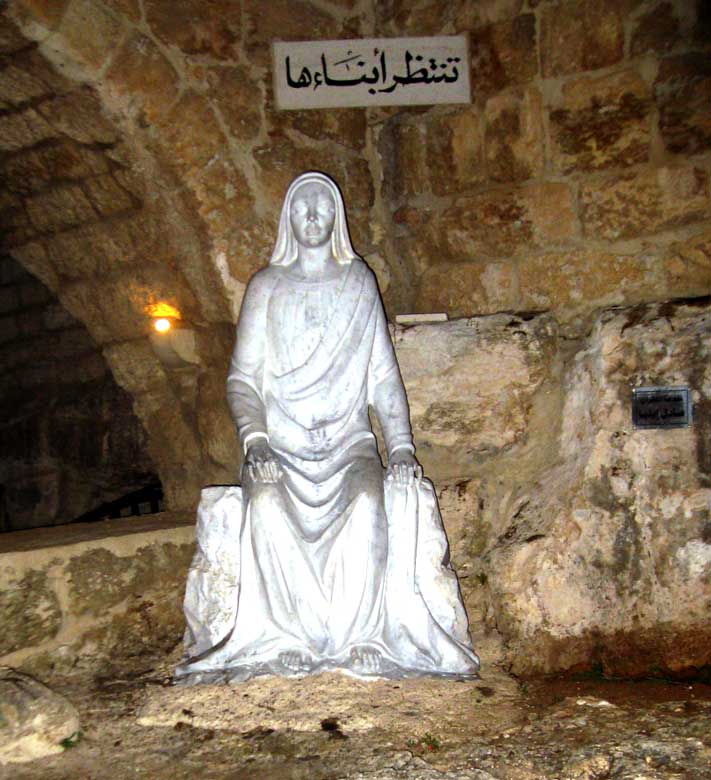
Our Lady of Mantara/Awaiting: Our Lady of Mantara, also known as Our Lady of Awaiting, is a Melkite Greek Catholic Marian shrine in Maghdouché, Lebanon, discovered on 8 September 1721 by a young shepherd. The grotto, which according to a legend dates to ancient times, was subsequently cared after by Monsignor Eftemios Saïfi, Melkite Catholic bishop of the Melkite Greek Catholic Archeparchy of Sidon. The shrine consists of a tower crowned with the statue of the Virgin and Child, a cathedral, a cemetery and a sacred cave believed to be the one where the Virgin Mary rested while she waited for Jesus. Since its discovery, it has been steadily visited by families particularly each year on the occasion of the feast of the Nativity of Mary on 8 September.
St Aleydis of Schaerbeek St Blitharius of Seganne St Herebald of Bretagne Bl Hugh of Marchiennes Blessed Ignazio Shoukrallah Maloyan ICPB (1869-1915) Bishop and Martyr Bl Jean de Bracq St Juan de Sahagun OESA (1419-1479) Biography: His Memorial was on 12 June but moved in 1969. https://anastpaul.com/2017/06/12/saint-of-the-day-12-june-st-john-of-sahagun-o-e-s-a/ Bl Kasper of Grimbergen St Maximus of Naples St Parisius St Paula Frasinetti St Riagail of Bangor St Tochumra of Kilmore St Tochumra of Tuam — Martyrs of Tavira – 7 beati: Members of the Knights of Santiago de Castilla. During the re-conquest of the Iberian peninsula from the Muslims by Christian forces, in a period of truce between the armies, the group was allowed to leave the Portuguese camp to hunt. Near Tavira, Portugal, he and his companions were ambushed and killed by a Muslim force. Making a reprisal attack, the Portuguese army took the city of Tavira. The murdered knights were considered to be martyrs as they died in an action defending the faith. They were – • Blessed Alvarus Garcia • Blessed Beltrão de Caia • Blessed Damião Vaz • Blessed Estêvão Vasques • Blessed Garcia Roiz • Blessed Mendus Valle • Blessed Pedro Rodrigues They were martyred in 1242 outside Tavira, Faro, Portugal. Their relics are enshrined under the altar of Saint Barnabas in the Church of Our Lady, Queen of the Angels (modern Santa Maria do Castelo) in Tavria
Mercedarian Martyrs of Damietta: Three Mercedarian lay knights who worked to ransom Christians enslaved by Muslims. During the 7th Crusade, a plague swept through the Christian army and these knights volunteered to work with the sick. During this work they were captured by Muslims and ordered to convert to Islam; they refused. They were tortured, taken to Damietta, Egypt where they were murdered for their faith. They were thrown from a tower in the mid-13th century in Damietta, Egypt.
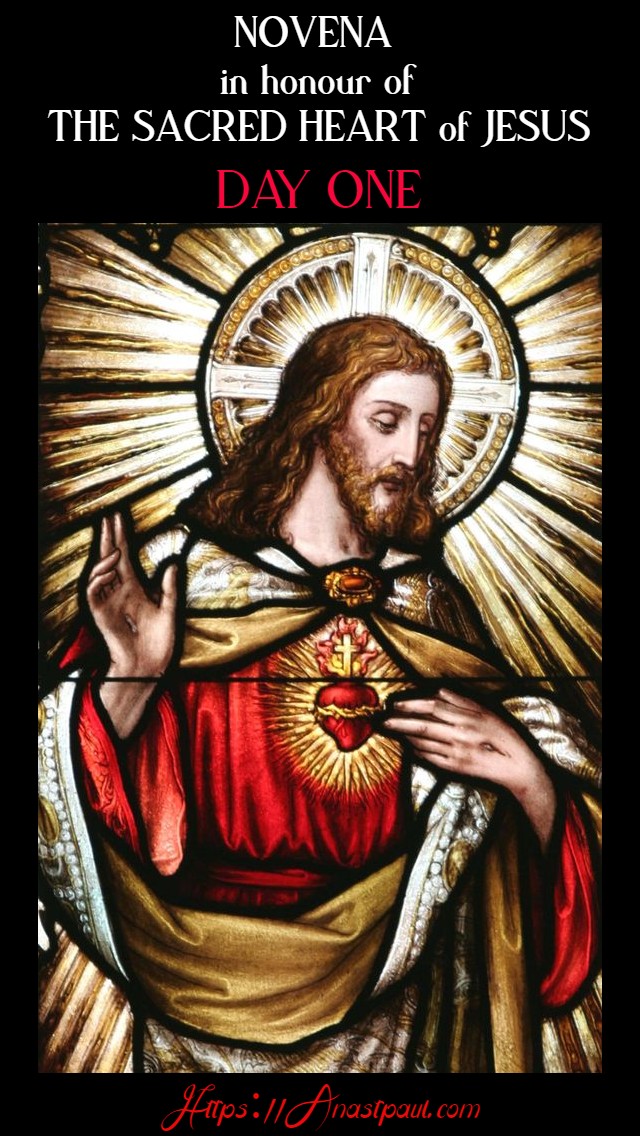
Novena in Honour of the Sacred Heart of Jesus
Day One
What do You Desire?
Today’s Scripture The next day John again was standing with two of his disciples and, as he watched Jesus walk by, he exclaimed, ‘Look, here is the Lamb of God!’ The two disciples heard him say this and they followed Jesus. … John 1: 35-3
Reflection for the First Day
Jesus addresses the same question to you at the beginning of this novena
‘What do you want?’
St Augustine said that all our desires are really a longing for God in disguise, where there is real desire, there is prayer. So, be at peace in your desire, you are already praying!
Today’s Prayer
Lord, I come to You at the start of this Novena
with a muddle of desires.
Give me courage,
to listen to what You want to say to me
and give me the strength
to accept Your loving desires for me and for my loved ones.
Daily Invocation Sacred Heart of Jesus, I place all my trust in You.
Novena Prayer
Lord Jesus,
the needs of Your people open Your heart in love for each of us.
You care for us when we are lost,
sympathise with us in loneliness
and comfort us in mourning.
You are closest to us, when we are weakest.
You love us most, when we love ourselves least.
You forgive us most, when we forgive ourselves least
and You call us to spread Your love, in whatever way we can.
Lord Jesus, Your heart is moved with compassion
when we are suffering,
when we need Your help
and, when we pray for each other.
I ask You to listen to my prayer during this Novena
and grant what I ask.
…………………………. (Mention your intention)
If what I ask, is not for my own good and the good of others,
grant me what is best,
that I may build up Your kingdom of love in our world.
Amen
Thought for the Day – 10 June – “Month of the Sacred Heart” – Meditations with Antonio Cardinal Bacci (1881-1971)
The Sacred Heart of Jesus Surmounted by a Flaming Cross
“St Margaret Mary saw the Sacred Heart of Jesus, surmounted by flames in the midst of which, a Cross was raised on high.
These flames and this Cross, were the symbol of the infinite love of Jesus.
Let us reflect a little.
God, immeasurably happy in Himself, wished to communicate a share in His happiness to men, whom He created in a state of earthly happiness.
He was offended by men and, when He saw that they were heading for destruction, He sent His Eternal Word to them.
The Word took a human nature and became our brother; He preached the way to Heaven and gave us the means to achieve it.
More than this, He offered Himself as a divine victim of expiation for our sins.
Having been condemned by those whom He had come to show the way, He died on the Cross and shed all His Blood, for our salvation.
Pagans of all times have called this “the folly of the cross.”
In fact, it is the miracle of the infinite love of God for humanity.
Let us remember, however, that, although His love and goodness are infinite, so also is His justice!
It is an overwhelming miracle of love on the part of God, that He became man and died for us.
It will be our own downfall if we fail to co-operate with this miracle of love!
The same Jesus, Who died on the Cross for us and revealed His Heart, pierced and flaming with love, will one day appear with the same glorious sign of the Cross, as our Supreme Judge.
Then, He will say to the wicked: “Depart from me, accursed ones, into everlasting fire!”
God’s justice is, as infinite as His charity!
We must choose either the way of the Cross, the way of love and goodness to which the Sacred Heart of Jesus invites us, or the way of sin, which leads to the gulf of ruin and the final condemnation of the Supreme Judge.
This is the tremendous choice we have to make.”
Quote/s of the Day – 10 June – “Month of the Sacred Heart” – Wednesday of the Tenth week in Ordinary Time, Year A, Readings: 1 Kings 18:20-39, Psalm 16:1-2, 4-5, 8, 11, Matthew 5:17-19
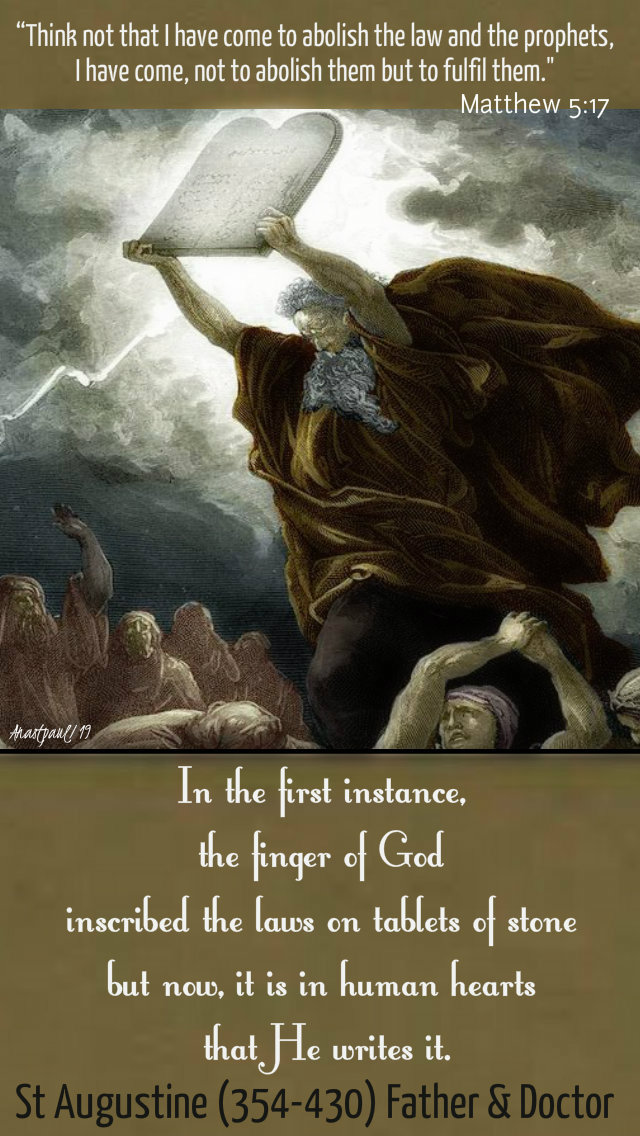
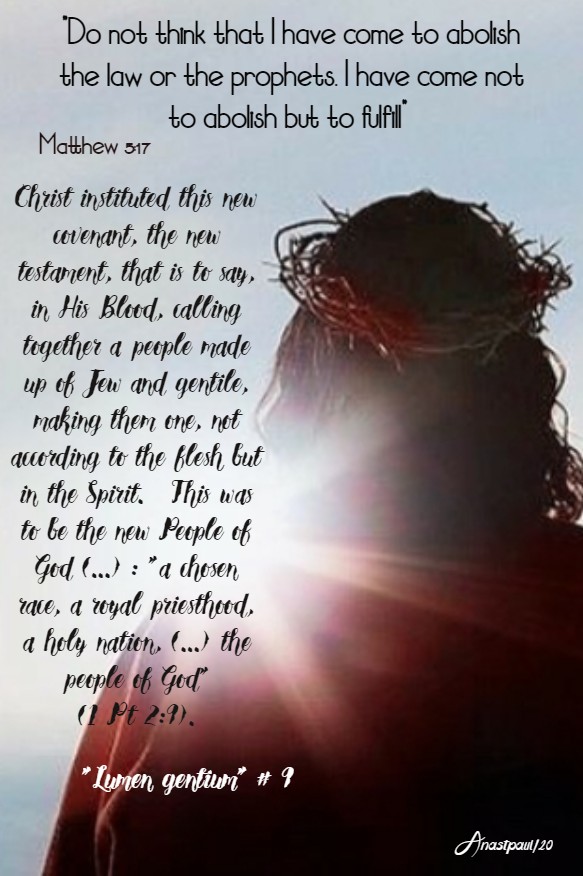
“I have come not to abolish but to fulfil.”
Matthew 5:17
“In the first instance, the finger of God inscribed the laws on tablets of stone but now, it is in human hearts, that He writes it (Ex 31:18; 2 Cor 3:3).“
“The New Testament lies hidden, in the Old; the Old is made accessible, by the New.”
“His mother is the whole Church, since it is she, who, by God’s grace, gives birth to Christ’s members, that is to say, those who are faithful to Him. Again, His mother is every holy soul who does the Father’s will and whose fruitful charity is made known in those, to whom she gives birth for Him, “until he has been formed in them” (cf Gal 4:19)”
St Augustine (354-430)
Father and Doctor of Grace
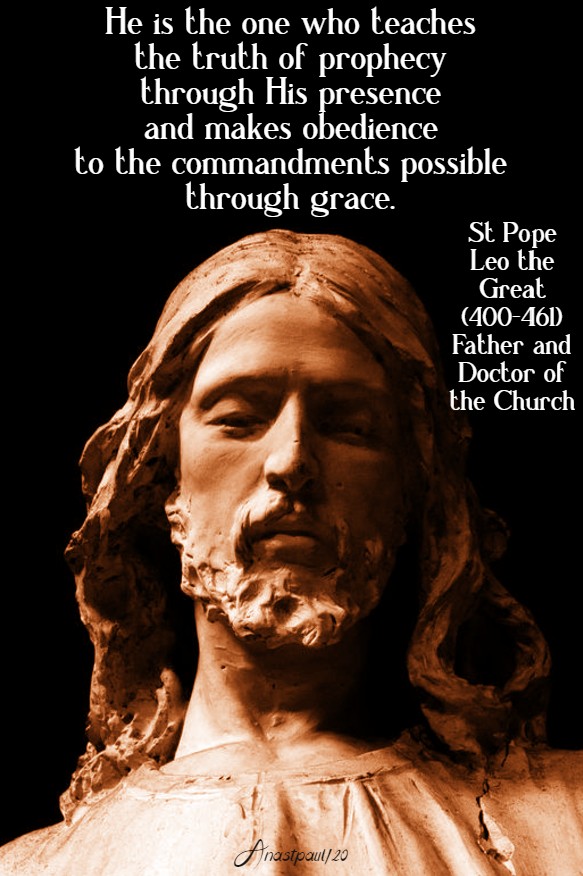
“He is the one who teaches the truth of prophecy through His presence and makes obedience to the commandments possible through grace.”
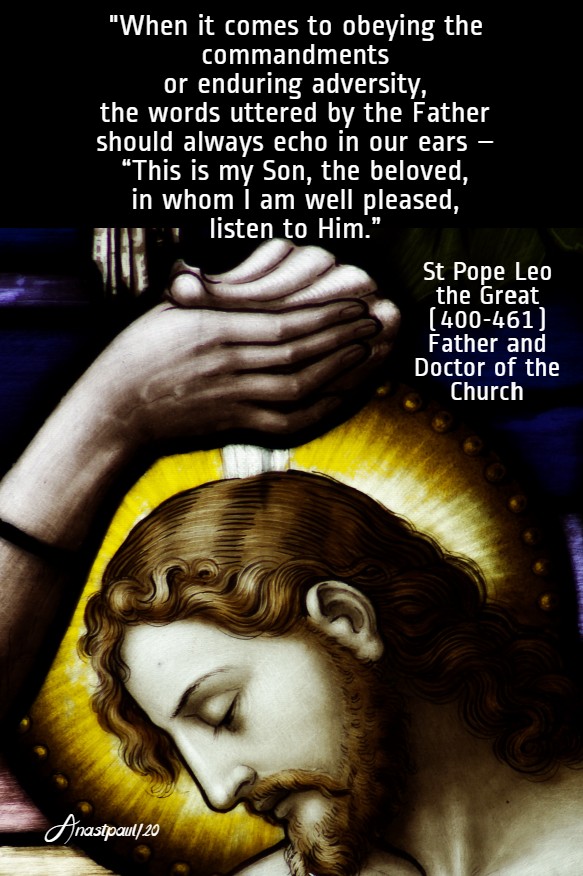
“When it comes to obeying the commandments or enduring adversity, the words uttered by the Father should always echo in our ears – “This is my Son, the beloved, in whom I am well pleased, listen to Him.”
St Pope Leo the Great (400-461)
Father and Doctor of the Church
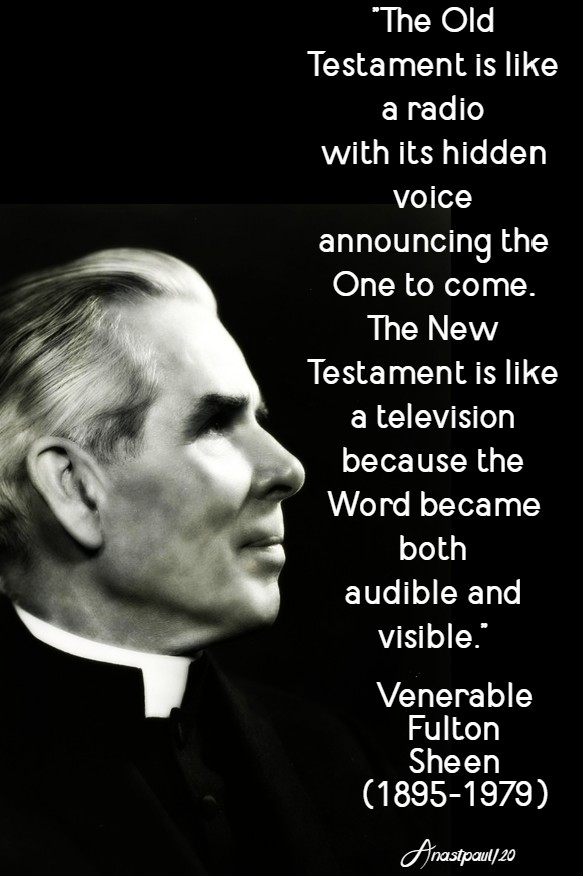
“The Old Testament is like a radio with its hidden voice announcing the One to come. The New Testament is like a television because the Word became both audible and visible.”
Venerable Fulton Sheen (1895-1979)
” Christ instituted this new covenant, the new testament, that is to say, in His Blood, (1 Cor 11:25) c alling together a people made up of Jew and gentile, making them one, not according to the flesh but in the Spirit. This was to be the new People of God … : “a chosen race, a royal priesthood, a holy nation, … the people of God” (1 Pt 2:9).”
Vatican Council II –
Constitution on the Church “Lumen gentium” # 9
One Minute Reflection – 10 June – “Month of the Sacred Heart” – Wednesday of the Tenth week in Ordinary Time, Year A, Readings: 1 Kings 18:20-39, Psalm 16:1-2, 4-5, 8, 11, Matthew 5:17-19
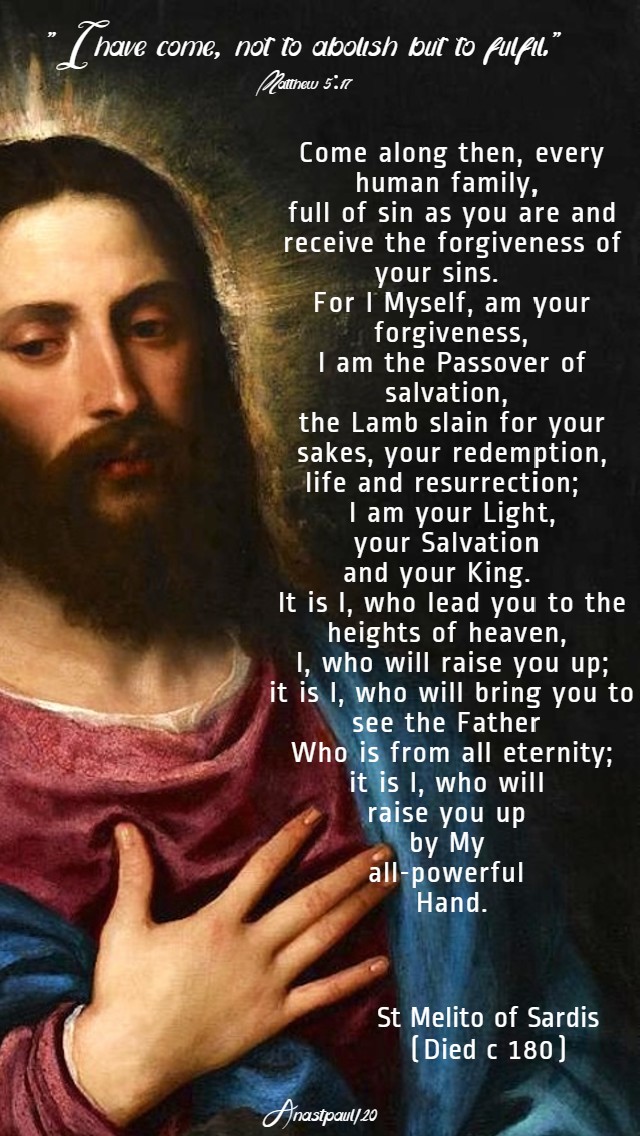
“I have come, not to abolish but to fulfil.” … Matthew 5:17
REFLECTION – “The sacrifice of the lamb, the Passover rite and the letter of the Law, have reached their term in Jesus Christ, in view of Whom, everything in the ancient Law took place – and, even more so, in the new dispensation. For the Law became the Word; from being old it became new … the commandments have been transformed into Grace and the foreshadowing into truth; the lamb has become the Son, the sheep has become man and man has become God. …
God though He was, the Lord put on our humanity; He suffered for him who was suffering, was bound for him who was captive, was judged for the guilty, was buried for him who was buried. He was raised from the dead and cried out in a loud voice: “If anyone wishes to oppose me, let us appear together” (Is 50,8). It is I who delivered the condemned man; I who restored life to the dead; I who raised up those in the grave. “Who disputes my right?” It is I, He says, I, who am the Christ, I, who destroyed death, who triumphed over the enemy, who bound the mighty enemy and carried off man to the heights of heaven; it is I, He says, who am the Christ.
Come along then, every human family, full of sin as you are and receive the forgiveness of your sins. For I Myself, am your forgiveness, I am the Passover of salvation, the Lamb slain for your sakes, your redemption, life and resurrection; I am your Light, your Salvation and your King. It is I, who lead you to the heights of heaven, I, who will raise you up; it is I, who will bring you to see the Father who is from all eternity; it is I, who will raise you up by My all-powerful Hand.” … St Melito of Sardis (Died c 180) Bishop, Apologist – Paschal Homily
PRAYER – Shed your clear light on our hearts, Lord, so that walking continually in the way of Your commandments, we may never be deceived or misled. May your Angels and Saints, pray for us. May the Mother of Our God and our Mother, be at our side and guide our way. We make our prayer through our Lord Jesus Christ in the unity of the Holy Spirit, one God forever and ever, amen.
Our Morning Offering – 10 June – “Month of the Sacred Heart” – Wednesday of the Tenth week in Ordinary Time, Year A
Heart Of Jesus By Blessed Miguel Pro – Martyr (1891-1927)
I believe, O Lord
but strengthen my faith,
Heart of Jesus, I love Thee
but increase my love.
Heart of Jesus, I trust in Thee,
but give greater vigour
to my confidence.
Heart of Jesus,
I give my heart to Thee,
but so enclose it in Thee
that it may never
be separated from Thee.
Heart of Jesus, I am all Thine,
but take care of my promise
so that I may be able
to put it into practice even unto
the complete sacrifice of my life.
Amen
Saint of the Day – 10 June – Blessed Henry of Treviso (1250-1315) Layman, Widower and Father – born in c 1250 at Bolzano, Italy and died on 10 June 1315 in Treviso, Italy of natural causes. He is also known as Henry of Bolzano or Blessed Rigo. Patronage – Treviso.
Henry was born in Bolzano, Italy. He lived during the last part of the thirteenth and early part of the fourteenth centuries. Henry’s family was very poor, so he had no opportunity to learn to read and write. When he was a teenager, he moved to Treviso to find work. He became a day labourer. Few people realised that he gave away most of his earnings to the poor. He went to Mass daily and received Holy Communion as often as was permitted. Henry loved the Sacrament of Confession, too and found this Sacrament, of the forgiving God very encouraging.
People began to notice the kind of Christian Henry was. He made it his penance to be very diligent at his work. And he allowed ample time every day for private prayer, usually in a Church. Henry was known for his calm and gentle ways. Sometimes people teased him because he seemed like such a simple person. As he grew older, he began to look shabby and stooped. Children would comment at times on his peculiar appearance. But Henry didn’t mind. He realised that they did not know they were hurting him.
When Henry was too old and frail to work, a friend James Castagnolis, brought him into his own home. Mr Castagnolis gave Henry a room and food when the old man would accept it. Blessed Henry insisted that he live on the alms of the people of Treviso. They were generous in their donations of food because they knew that he shared their gifts with many people, who were poor and homeless. By the end of his life, Henry could barely walk. People watched with awe as the old man dragged himself to morning Mass. Often, he would visit other local Churches as well, painfully moving toward each destination.
What a mystery this good man was. When he died on 10 June 1315, people crowded into his little room. They wanted a Relic, a keepsake. They found his treasures – a prickly hair-shirt, a log of wood that was his pillow, some straw that was the mattress for his bed. They stripped the straw that served for his bed to keep as a Relic – there was not much else to take.
His body was moved to the Cathedral so that all the people could pay their tribute. Over two hundred miracles were reported within a few days after his death. A beautiful Altar was built in a side Chapel of the Cathedral in his honour, see below.
A beautiful Oratory was built in Treviso in honour of Blessed Henry.
Henry of Treviso was declared “Blessed” by Pope Benedict XIV on 23 July 1750 (cultus confirmed).
A Trevisan Priest, Fr Rambaldo degli Azzoni Avogari, published a hagiography of him in 1760.
Our Lady of the Grotto, Mellieħa, Malta:
The Sanctuary of Our Lady of Mellieħa is a Marian shrine in the village of Mellieħa in Malta. It was originally constructed in the late 16th century and contains a Byzantine-style fresco, depicting the Blessed Virgin Mary with Christ on her right arm. Tradition has it that the painting was made by St Luke when he was shipwrecked on the island with St Paul. The church expanded several times to accommodate the growing population of the village and the roofed veranda is considered a classic example of 17th century Renaissance architecture. The sanctuary was blessed by St Pope John Paul II during his visit to Malta in May 1990.
This slideshow requires JavaScript.
—
Bl Amata of San Sisto
St Amantius of Tivoli
St Asterius of Petra
St Bardo of Mainz
Bl Bogumilus of Gniezno
St Caerealis of Tivoli
St Censurius of Auxerre
St Crispulus of Rome Blessed Edward Johannes Maria Poppe (1890-1924) Biography: https://anastpaul.com/2017/06/10/saint-of-the-day-10-june-blessed-edward-joannes-maria-poppe/
Bl Elisabeth Hernden
Bl Elizabeth Guillen
St Evermund of Fontenay
St Faustina of Cyzicus
Bl Gerlac of Obermarchtal
St Getulius of Tivoli Blessed Henry of Treviso (1250-1315)
St Illadan of Rathlihen
St Ithamar of Rochester Blessed John Dominici OP (c 1355-1419) His Life: https://anastpaul.com/2018/06/10/saint-of-the-day-10-june-blessed-john-dominici-o-p-c-1355-1419/
Bl José Manuel Claramonte Agut
Bl Joseph Kugler
St Landericus of Novalese
St Landericus of Paris
Bl Mary Magdalene of Carpi
St Maurinus of Cologne
St Primitivus of Tivoli
St Restitutus of Rome
Bl Thomas Green
St Timothy of Prusa
Bl Walter Pierson
St Zachary of Nicomedia
—
Martyrs of North Africa – 17 saints: A group of seventeen Christians martyred together in North Africa; the only surviving details are two of their names – Aresius and Rogatius. Both the precise location in North Africa and the date are unknown.
Martyrs of the Aurelian Way – 23 saints: A group of 23 martyrs who died together in the persecutions of Aurelian. The only details that survive are three of their names – Basilides, Mandal and Tripos. c.270-275 on the Aurelian Way, Rome, Italy.
Martyrs of the Hulks of Rochefort/Martyrs of La Rochelle – 64 beati: In 1790 the French Revolutionary authorities passed a law requiring priests to swear allegience to the civil constitution, which would effectively remove them from the authority of and allegience to, Rome. Many refused and in 1791 the government began deporting them to French Guyana. 827 priests and religious were imprisoned on hulks (old ships no longer sea-worthy and used for storage, jails, hospitals, etc.) at Rochefort, France to await exile, most on the Deux-Associés and the Washington which had previously been used to house slaves or prisoners. There they were basically ignored to death as there was little provision for food and water, less for sanitation and none at all for medical help. 542 of the prisoners died there.
The survivors were freed on 12 February 1795 and allowed to return to their homes. Many of them wrote about their time on the hulks and many of them wrote about the faith and ministry of those who had died. 64 of them have been positively identified and confirmed to have died as martyrs, dying for their faith, they are:
• Antoine Auriel• Antoine Bannassat• Augustin-Joseph Desgardin• Barthélemy Jarrige de La Morelie de Biars• Charles-Antoine-Nicolas Ancel• Charles-Arnould Hanus• Charles-René Collas du Bignon• Claude Beguignot
• Claude Dumonet• Claude Laplace• Claude Richard• Claude-BarnabéLaurent de Mascloux• Claude-Joseph Jouffret de Bonnefont• élie Leymarie de Laroche• Florent Dumontet de Cardaillac• François d’Oudinot de la Boissière
• François François• François Hunot• François Mayaudon• Gabriel Pergaud
• Georges-Edme René• Gervais-Protais Brunel• Jacques Gagnot• Jacques Lombardie• Jacques Retouret• Jacques-Morelle Dupas• Jean Baptiste Guillaume• Jean Bourdon• Jean Hunot• Jean Mopinot• Jean-Baptiste de Bruxelles• Jean-Baptiste Duverneuil• Jean-Baptiste Laborie du Vivier
• Jean-Baptiste Menestrel• Jean-Baptiste Souzy• Jean-Baptiste-Ignace-Pierre Vernoy de Montjournal• Jean-Baptiste-Xavier Loir• Jean-François Jarrige de la Morelie de Breuil• Jean-Georges Rehm• Jean-Nicolas Cordier
• Joseph Imbert• Joseph Juge de Saint-Martin• Joseph Marchandon
• Lazare Tiersot• Louis-Armand-Joseph Adam• Louis-François Lebrun
• Louis-Wulphy Huppy• Marcel-Gaucher Labiche de Reignefort• Michel-Bernard Marchand• Michel-Louis Brulard• Nicolas Savouret• Nicolas Tabouillot• Noël-Hilaire Le Conte• Paul-Jean Charles• Philippe Papon• Pierre Gabilhaud• Pierre Jarrige de la Morelie de Puyredon• Pierre-Joseph le roing de la Romagère• Pierre-Michel Noël• Pierre-Sulpice-Christophe Faverge• Pierre-Yrieix Labrouhe de Laborderie• Raymond Petiniaud de Jourgnac• Scipion-Jérôme Brigeat Lambert• Sébastien-Loup Hunot.
They died between 19 May 1794 and 23 February 1795 aboard prison ships docked at Rochefort, Charente-Maritime, France and were beatified on
1 October 1995 by St Pope John Paul II.
Thought for the Day – 9 June – “Month of the Sacred Heart” – Meditations with Antonio Cardinal Bacci (1881-1971)
The Crown of Thorns Which Surrounds the Sacred Heart
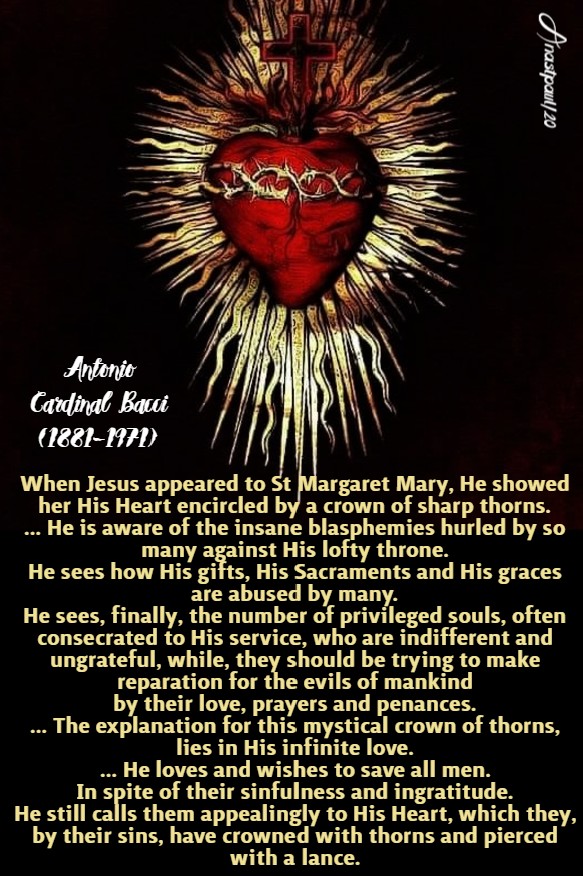
“When Jesus appeared to St Margaret Mary, He showed her His Heart encircled by a crown of sharp thorns.
What is the significance of this?
In Heaven, Jesus is happy and cannot suffer anymore.
The Angels, Saints and the whole of creation, sing a hymn of unceasing praise in His honour.
Nevertheless, He sees the immense tide of sin, which surges forth from the human race which He redeemed by His Precious Blood, a redemption now made futile by many.
He is aware of the insane blasphemies hurled by so many against His lofty throne.
He sees how His gifts, His Sacraments and His graces are abused by many.
He sees, finally, the number of privileged souls, often consecrated to His service, who are indifferent and ungrateful, while, they should be trying to make reparation for the evils of mankind by their love, prayers and penances.
The explanation for this mystical crown of thorns, lies in His infinite love.
He does not suffer anymore because, He cannot suffer but He still has an immense love for all men, even for sinners and for those who are lukewarm and ungrateful.
He loves and wishes to save all men.
In spite of their sinfulness and ingratitude.
He still calls them appealingly to His Heart, which they, by their sins, have crowned with thorns and pierced with a lance.
This is a mystery of love which we cannot properly understand.
Only a man who loves Jesus fervently, can even have the slightest understanding of it.
If we sincerely love the divine Heart of Jesus, we shall realise, that these sharp thorns which once pierced His Heart in Gethsemane and on Calvary, were caused by our sins.
Then, we shall do our best to make a generous return for such love and to make reparation, even with grave sacrifice, for the offences which are still being committed by men against the loving Heart of the Redeemer.”
Quote/s of the Day – 9 June – “Month of the Sacred Heart” – Tuesday of the Tenth Week in Ordinary Time, Year A and the Memorial of St Ephrem of Syria (306-373) Father & Doctor of the Church
“We give glory to You, Lord, who raised up Your Cross to span the jaws of death like a bridge by which souls might pass from the region of the dead to the land of the living. .. You are incontestably alive. Your murderers sowed Your living body in the earth as farmers sow grain but it sprang up and yielded an abundant harvest of men raised from the dead.”
“Jesus, who feared nothing, experienced fear and asked to be freed from death – although He knew it was impossible. How much more, must we persevere in prayer before temptation assails us – so that we may be freed when the test has come!”
“She bore within herself, as a child, Him by whom the world was filled. He descended to become the model that would renew Adam’s ancient image.”
“You gave us so many gifts on the day of Your birth, a treasure chest of spiritual medicines for the sick. spiritual light for the blind, the cup of salvation for the thirsty, the bread of life for the hungry.”
“We have had Your treasure hidden within us, ever since we received baptismal grace, it grows ever richer at Your sacramental table.”
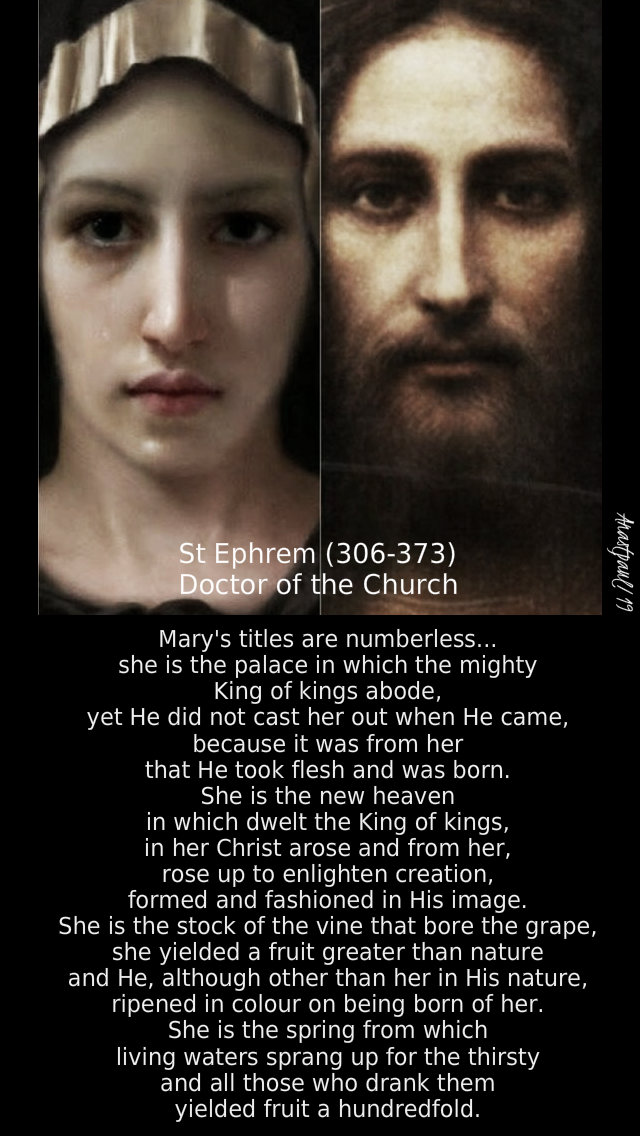
“Mary’s titles are numberless… she is the palace in which the mighty King of kings abode, yet He did not cast her out when He came, because it was from her that He took flesh and was born. She is the new heaven in which dwelt the King of kings, in her, Christ arose and from her, rose up to enlighten creation, formed and fashioned in His image. She is the stock of the vine that bore the grape, she yielded a fruit greater than nature and He, although other than her in His nature, ripened in colour on being born of her. She is the spring from which living waters sprang up for the thirsty and all those who drank them, yielded fruit a hundredfold.”
St Ephrem (306-373)
Father and Doctor of the Church
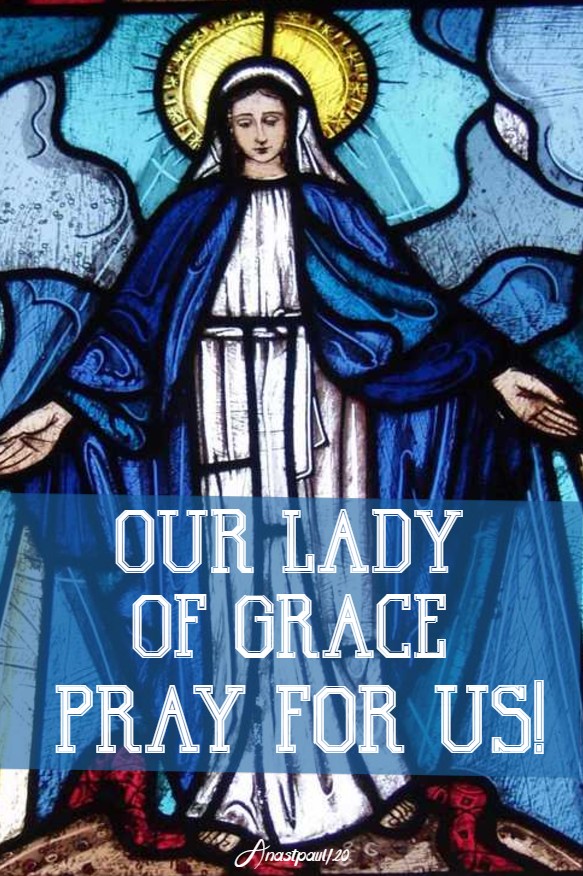
One Minute Reflection – 9 June – “Month of the Sacred Heart” – Tuesday of the Tenth Week in Ordinary Time, Year A, Readings: 1 Kings 17:7-16, Psalm 4:2-5, 7-8, Matthew 5:13-16 and the Feast of Our Lady of Grace and the Memorial of St Columba of Iona (521-597) Apostle of the Picts, Apostle to Scotland
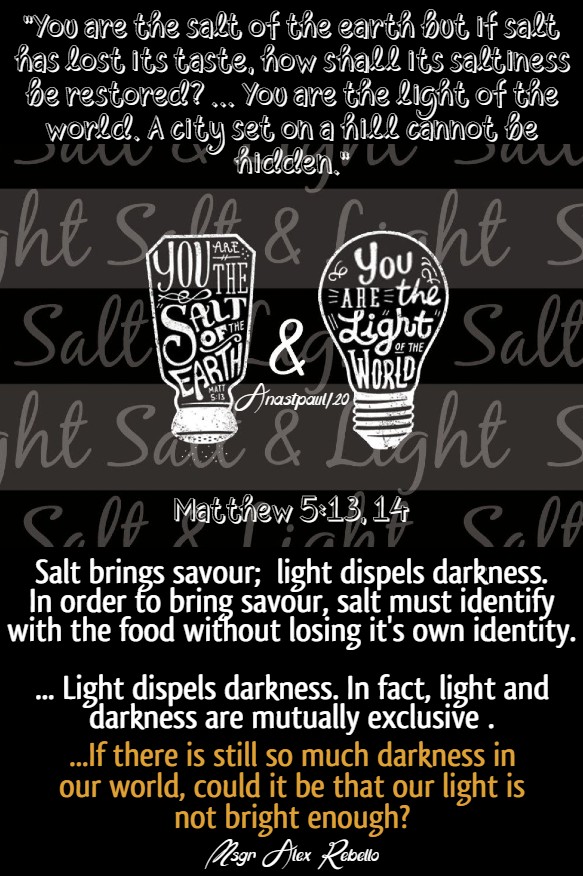
“You are the salt of the earth but if salt has lost its taste, how shall its saltiness be restored? … You are the light of the world. A city set on a hill cannot be hidden.“…Matthew 5:13, 14
REFLECTION – “That is what we are as authentic disciples of Jesus.
Salt bring savour; light dispels darkness.
In order to bring savour, salt must identify with the food without losing it’s own identity. If it loses it’s own identity, it is fit only to be trampled underfoot.
Light dispels darkness. In fact, light and darkness are mutually exclusive because, where there is light there cannot be darkness and where there is darkness, light is absent.
But the light that we, as disciples of Jesus shed, must be mounted high, not for our own glory but that those who are enlightened may glorify and praise the Father.
If there is still so much darkness in our world, could it be that our light is not bright enough?” ,,, Msgr Alex Rebello, Diocese of Wrexham, Wales.
PRAYER – Holy Almighty Father, we pray that we may be the light of Your divine Son and the salt of the earth. Help us, we pray, to ever strive to be both the light and salt of the earth and may the protection of Our Lady of Grace, first disciple of Jesus and model, be of help to believers who live every day their vocation and mission in history. May our Mother help us, to let ourselves always be purified and illumined by the Lord, to become in turn “salt of the earth” and “light of the world. As St Columba of Iona brought both salt and light to the darkness of the pagan Scotland, grant we pray that his prayers may help us in our mission. We make our prayer through Christ our Lord, with the Holy Spirit, one God for all eternity, amen…
Our Morning Offering – 9 June – “Month of the Sacred Heart” – Tuesday of the Tenth Week in Ordinary Time, Year A
May Your Heart Dwell Always in our Hearts! By St Francis de Sales (1567-1622) Doctor of Charity
May Your Heart dwell
always in our hearts!
May Your Blood
ever flow in the veins
of our souls!
O sun of our hearts,
You give life to all things
by the rays of Your goodness!
I will not go,
until Your Heart
has strengthened me,
O Lord Jesus!
May the Heart of Jesus
be the King of my heart!
Blessed be God.
Amen
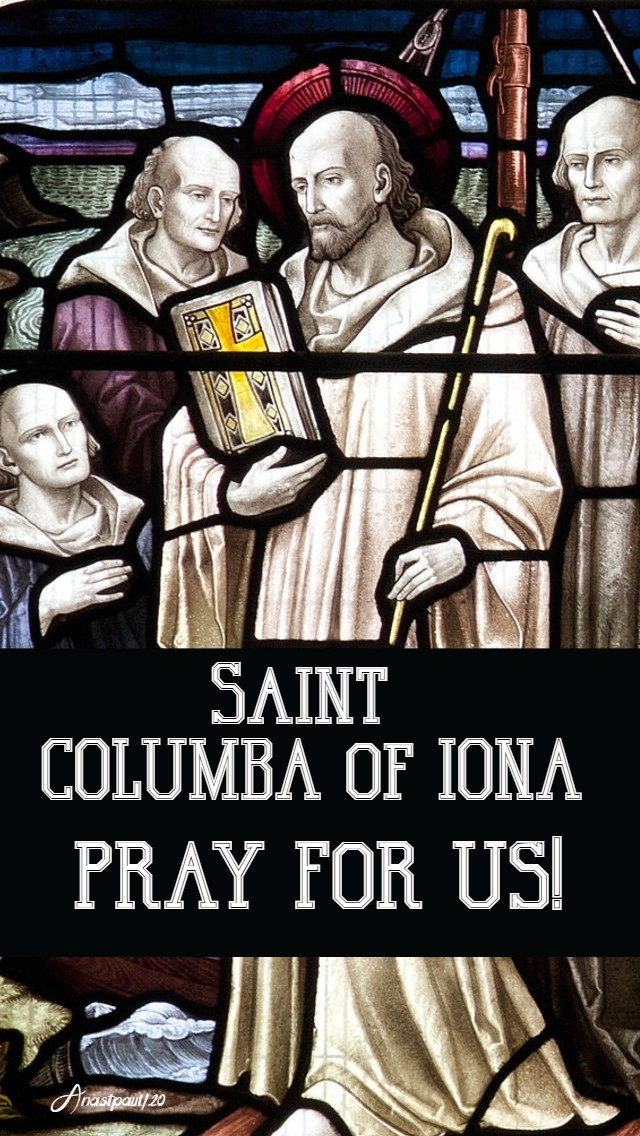
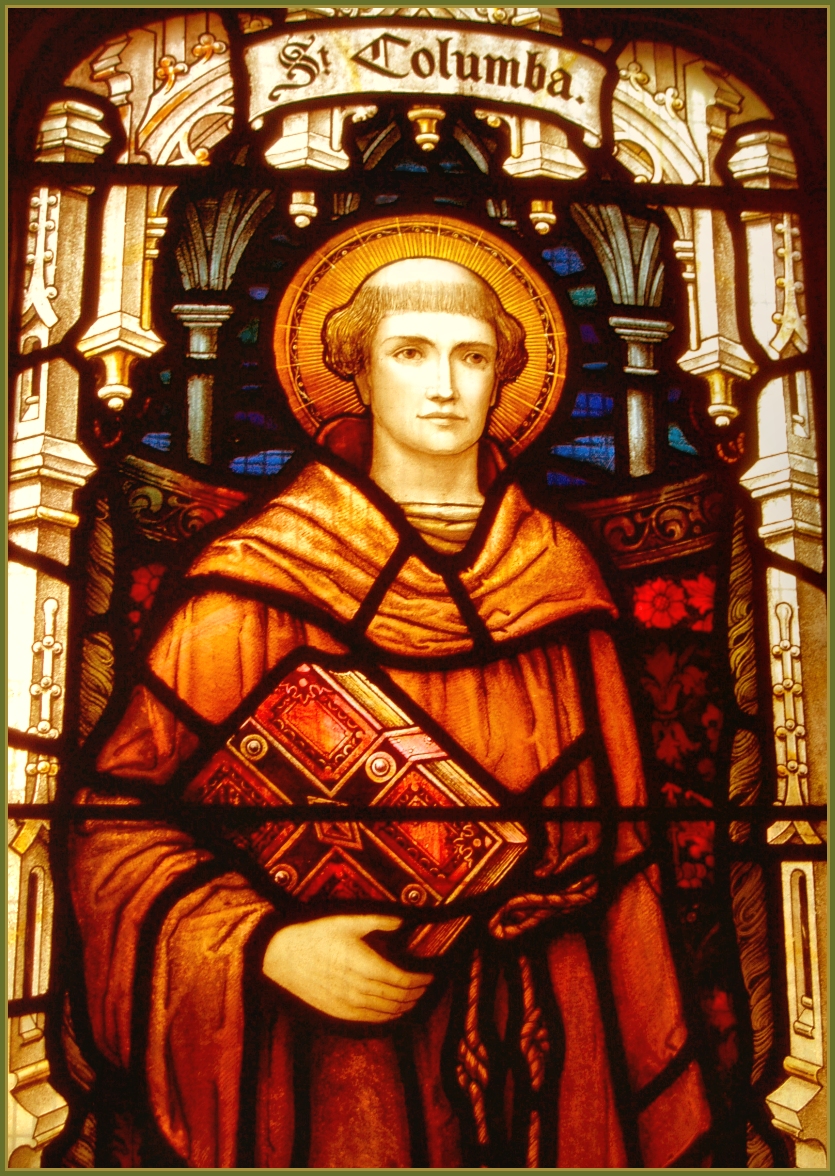
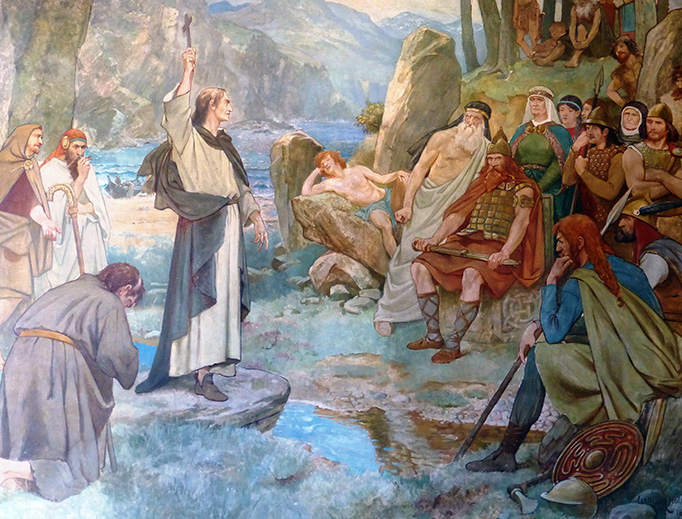
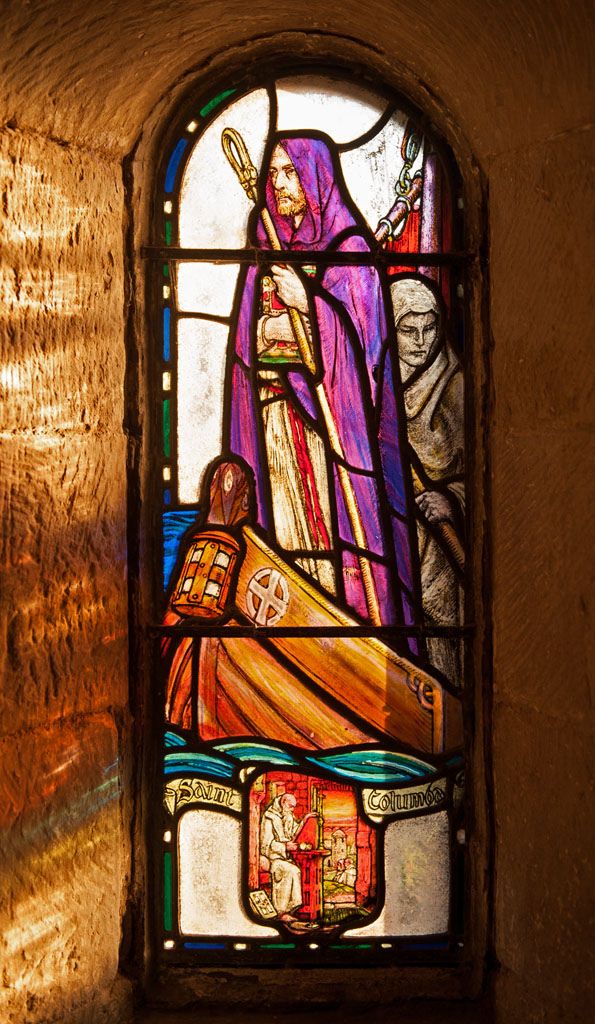
Saint of the Day – 9 June – Saint Columba of Iona (521-597) Apostle of the Picts, Apostle to Scotland, Abbot, Missionary, Evangelist, Poet, Scholar and Writer – born on 7 December 521 at Garton, County Donegal, Ireland and died on 9 June 597 at Iona, Scotland and buried there. Patronages – Derry, against floods, bookbinders, poets, co-patron of Ireland and of Scotland. St Columba is also known as Coim, Colmcille, Colum, Columbkill, Columbkille, Columbus, Columcille, Columkill, Combs. Additional Memorials – 6 January as one of the Twelve Apostles of Ireland, 17 June translation of relics.
His parents named him Crimtham (Pronounced Criffan) meaning “a fox.” This was not an unusual name at the time, as it signifies the type of attributes that a Celtic noble would need throughout his life – those of cunning and stealth. Later on Columba showed such gentleness, sweetness of nature and a desire for things sacred, that those around him called him Colm which means “a dove” and sometimes Colmcille, meaning “dove of the church.” The latter is the name most often given the saint in his native Ireland. More than likely St Columba would have been High King of Ireland had he not devoted his life to the best cause of all – proclaiming the message of Jesus Christ.
The son of a tribal chieftain, Columba was given the name Crimthann when he was Baptised shortly after his birth in Gartan, County Donegal. When he was a boy, he was so often found praying in the town church that his friends called him Colm Cille (Dove of the Church) and it was as Colm, or its Latin form Columba, that he was known for the rest of his life.
In his early 20s, Columba was strongly influenced by one of his teachers, St Finian of Clonard, and asked to be Ordained a Priest. When a prince cousin gave him some land at Derry, he decided to start a Monastery. Because of his love of nature Columba refused to build the Church facing east, as was the custom, he wanted to spare the lives of as many oak trees as he could. His foundation of another Monastery at Durrow 7 years later, was the beginning of an extraordinary decade during which he travelled through northern Ireland teaching about Christianity and inspiring many people by his personal holiness. He founded some 30 Monasteries in those 10 years.
Columba’s strong personality and forceful preaching aroused considerable antagonism. He was accused in 563 of starting a war between two Irish tribes and was sentenced by the high king never to see Ireland again, to spend the rest of his life in exile. This battle it is believed, resulted over what is today seen, as the first Copyright dispute in history – Columba had become involved in a quarrel with Finnian of Moville of Movilla Abbey over a psalter. Columba copied the manuscript at the Scriptorium under Finnian, intending to keep the copy. Finnian disputed his right to keep it.
With 12 companions he sailed from the shores he loved and settled on a bleak island called Iona off the coast of Scotland. The monks made occasional visits to the Scottish mainland, where they preached Christianity. Soon their community had 150 members.
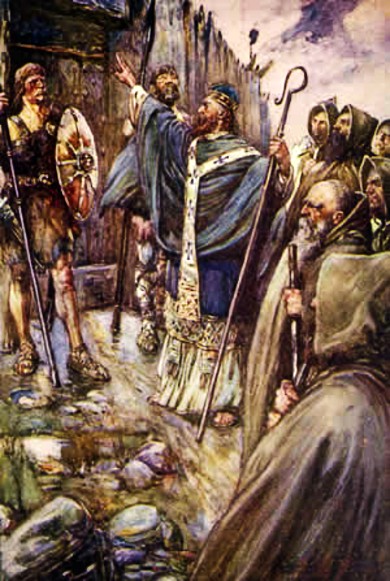
In 575, Columba was persuaded to visit Ireland to mediate a dispute between the high king and the league of poets. Insisting on remaining faithful to the terms of his exile, that he never see Ireland again, he travelled blindfolded. Although his sympathies were with the poets, his reputation was respected by everyone. He spoke to the assembled nobles and clergy with such force and authority that the king was persuaded to reverse his original decree and the hostility between the two parties was calmed.
Columba spent the rest of his life on Iona, praying, fasting and teaching his monks to read and copy the Scriptures. He provided inspiration for their Missionary efforts and was influential, in the politics of Scotland. Long before his death in 597 he was regarded as a saint by his fellow monks and is today a beloved figure in Irish tradition.
Columba died on Iona and was buried in 597 by his monks in the Abbey he created. His relics were removed in 849 and divided between Scotland and Ireland. The parts of the relics which went to Ireland are reputed to be buried in Downpatrick, County Down, with Saint Patrick and Brigid of Kildare and at Saul Church neighbouring Downpatrick.
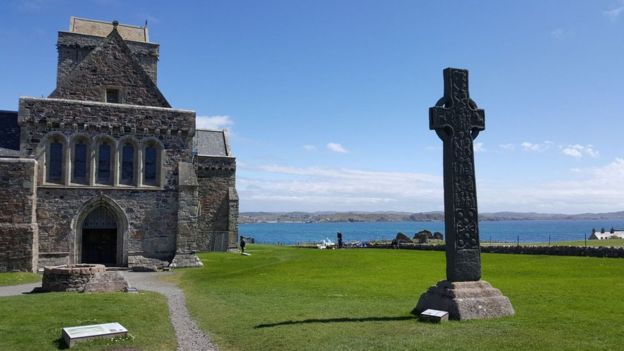
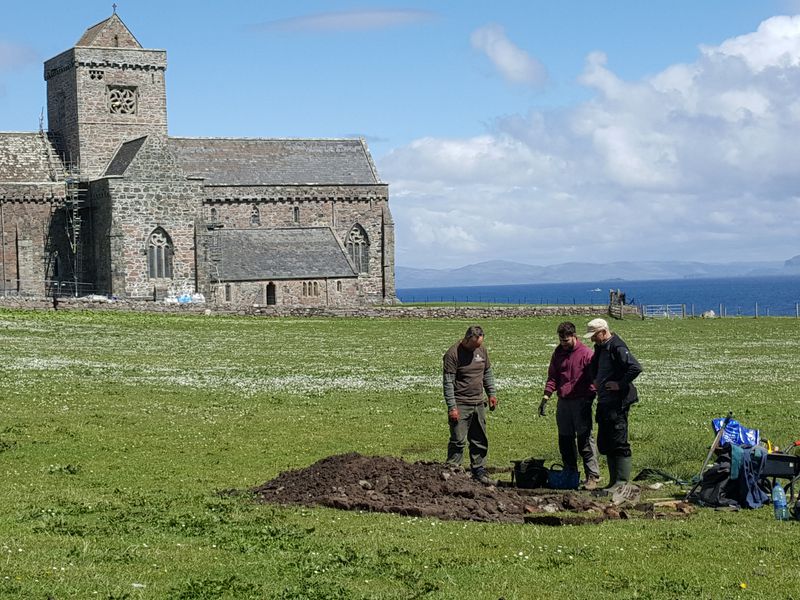
Iona Abbey
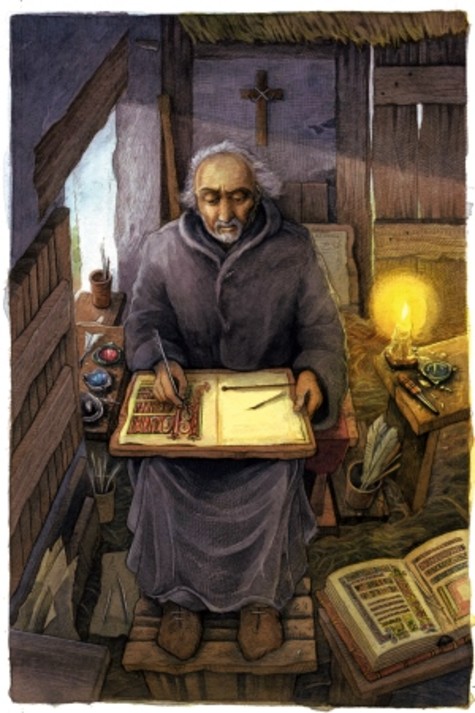
After his death Iona became a place of pilgrimage for kings and commoners. 60,000 of the latter still visit the rebuilt abbey every year. But did Columba leave any physical trace? His successor Adomnán, writing 100 years after the saint’s death, described him working in his cell on a rocky hillock. That knoll is called Tòrr an Aba – “the mound of the Abbot.” In 1957 the site was excavated by a team led by the Cornish historian and archaeologist Charles Thomas. On Tòrr an Aba the diggers found hazel charcoal, apparently the remains of a wattle hut. The site had been deliberately covered with beach pebbles and there was a hole where a post – possibly a cross – had been placed. Were these the remains of Columba’s cell? Charles Thomas thought so. Only 60 years later were carbon tests capable of being done and they have confirmed that this must’ve been St Columba’s cell.
The Dig in 1957
Dr Campbell who did the testing said: “This being St Columba, who is so important as a spiritual figure and as a person who founded this series of Monasteries which cultivated learning which spread throughout Europe, it’s really important. It’s really exciting to be able to touch some of the things that were associated with him.”Sixty years on, some of Prof Thomas’s fellow diggers on Iona are still alive. They were as sure as they could be, that this was the saint’s Scriptorium but lacked the backing of modern radiocarbon dating. Sadly Charles Thomas did not live to see his work vindicated. He died in 2016 a year before the definitive date of his samples could be established.
St Columba’s restored Cell
There is a lovely story, whereby St Columba prophesied his own death. It was the Sabbath and he told his fellow monks that his Sabbath was come, his time of departure, to the Lord.
As St Columba sat down, to rest his weary, aching body, the Monastery’s work horse approached him. It lay its head upon the saint’s shoulder, as though to console him and to wish him farewell. They remained there together for a short while.
Seventy-five years of prayer, mortification and fasting were almost at an end. The north of Scotland was converted. Monks, trained by St Columba had travelled southwards, setting up Monasteries and converting the northern English. Iona was becoming the great place of pilgrimage it has remained for centuries, to his day.
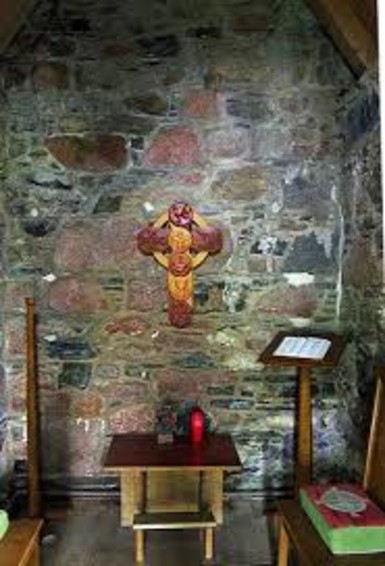
He made his way to the chapel, blessed his fellow monks and took his leave, expiring right there at the foot of the altar.
And I think it is extremely fitting at this time, to petition this great saint of Ireland to prayers of intercession, for the rekindling of the Faith in this land.
St Columba, Pray for Ireland.
St Columba, Pray for Scotland.
St Columba, Pray for Holy Mother Church.
St Columba, Pray for Us All!
Feast of Our Lady of Grace – 9 June – Tuesday of the Tenth Week in Ordinary Time, Year A
Our Lady of Grace is another of the several titles by which Augustinians have traditionally venerated the Blessed Virgin. In fact it is the oldest among these. From the moment that she received the angel’s greeting and gave her consent to God’s invitation to become the mother of the Word made flesh, Mary became the bearer of Grace in this world.
This title of ‘Our Lady of Grace’ is the oldest with which the Order has shown veneration to Mary. The General Chapter of 1284 prescribed the daily recitation or chant of the ‘Benedicta Tu‘ precisely in honour of Our Lady of Grace. The antiphon ‘Ave Regina Caelorum’, also dating back to the 13th Century, is in honour of this same title as well.
A confraternity with the title ‘Lady of Grace’ was established at least as early as 1401 in Augustinian friaries of Spain and Portugal and, over the subsequent one hundred years, had extended widely throughout the Order. New friaries under this title began to be established in Italy and Latin America. In 1807 Pope Pius VII, at the request of Venerable Joseph Menochio, Papal Sacristan and Confessor to the Pope, granted the Order the right to celebrate this Feast on 1 June (or 9 June in some places).
The Virgin Mary, greeted by the angel as ‘full of grace’ became, from that moment, the Mother of Grace. As Mother of the one and only Mediator Jesus, she is Mother of the Author of Grace and dispenser of Grace.
—
Bl Alexander of Kouchta
St Alexander of Prusa
Bl Anne Marie Taigi
St Arnulf of Velseca
St Baithen of Iona St Columba of Iona (521-597) Apostle of the Picts, Apostle to Scotland
St Comus of Scotland
St Cumian of Bobbio
St Cyrus
Bl Diana d’Andalo
St Diomedes of Tarsus
St Felicianus
Bl Henry the Shoemaker
St Jose de Anchieta
Bl Joseph Imbert
St Julian of Mesopotamia
St Luciano Verdejo Acuña
Bl Luigi Boccardo
St Maximian of Syracuse
St Pelagia of Antioch
St Primus
St Richard of Andria
Bl Robert Salt
Bl Sylvester Ventura
St Valerius of Milan
St Vincent of Agen
—
Martyrs of Arbil – 5 saints: Five nuns who were martyred together in the persecutions of Tamsabur for refusing to renounce Christianity for sun-worship – Amai, Mariamne, Martha, Mary and Tecla. They were beheaded on 31 May 347 at Arbil, Assyria (in modern Kurdistan, Iraq)
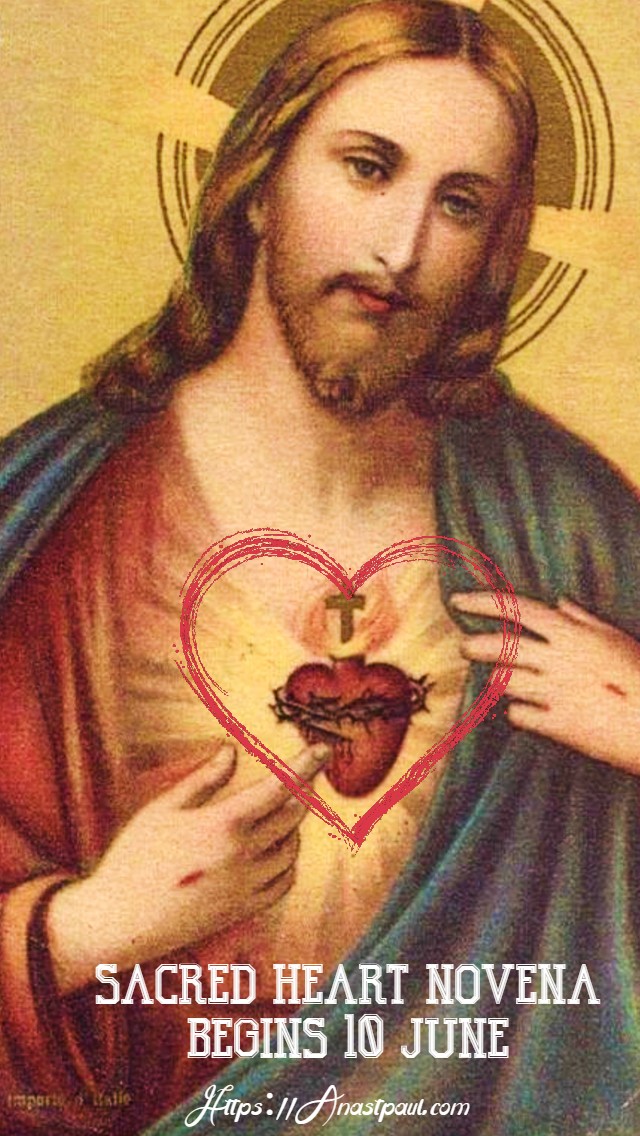
ANNOUNCING the NOVENA to the SACRED HEART BEGINS Wednesday 10 JUNE
This devotion to the Sacred Heart of Jesus Christ is nothing more than an exercise of love towards this amiable Saviour.
But as to the principal object of this devotion, the spiritual object is the love with which the Heart of Jesus Christ is inflamed towards men, because love is generally attributed to the heart, as we read in many places of Scripture: My son, give Me thy heart. [Prov. xxiii. 26] My heart and my flesh have rejoiced in the living God. [Ps. lxxxiii. 3] The God of my heart and the God that is my portion forever. [Ps. lxxii. 26] The charity of God is poured forth in our hearts by the Holy Ghost Who is given to us. [Rom. v. 5]
The material or sensible object is the most Sacred Heart of Jesus, not taken separately by Itself but united to His sacred humanity and, consequently, to the Divine Person of the Word.
“How do we serve God faithfully? We serve Him only as faithfully as we serve Him lovingly, by giving ourselves to the needs of everyone whom God puts into our lives. No-one reaches heaven automatically. Heaven must be dearly paid for. The price of reaching heaven is the practice of selfless love here on earth.
… Devotion of the Sacred Heart is the solution to the gravest problem in the modern world today. How can we give ourselves to those who do not love us, who even positively hate us? We can love them, with the help of divine grace, by following the example of Jesus Christ, who died on the Cross out of love for a sin-laden human race.” … Ven Servant of God Fr John A Hardon SJ (1914-2000)
Thought for the Day – 8 June – “Month of the Sacred Heart” – Meditations with Antonio Cardinal Bacci (1881-1971)
Our Response to the Love
of the Sacred Heart
“The Sacred Heart of Jesus is adorable in itself, not only as the living symbol of His human-divine love but, also, as part of His most holy humanity, insofar as it is hypostatically united to the divinity of the Word.
We should, therefore, pay very special homage to the Sacred Heart.
It is the Heart of the God-Man and, as such, is worthy of our highest adoration.
It’s sentiments harmonised mysteriously with the human will and, at the same time, with the divine Will of the Incarnate Word of God.
Every throb, was a token of an infinite love which we could never fully understand, for we cannot properly “know Christ’s love which surpasses knowledge” (Eph 3:19).
But, we should adore this love as represented by the Sacred Heart of Jesus.
The adoration is not an act of idolatory.
On the contrary, it is a fitting act of worship, because, it’s object is the Heart of the God-Man and, of the human-divine love of which it is the symbol.
Moreover, we owe the Sacred Heart of Jesus, all our gratitude and a return of love.
Let us reflect on how much Jesus has done for us and how much He has loved us.
Let us consider, not only the general work of Redemption and the supernatural gifts and graces connected with it but, also, the particular favours which we received from our childhood, up to the present moment.
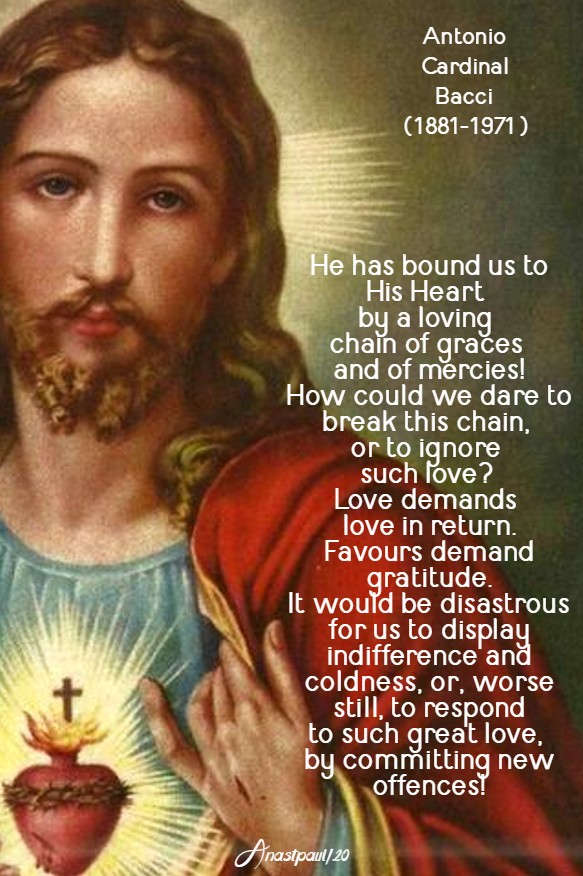
He has bound us to His Heart by a loving chain of graces and of mercies!
How could we dare to break this chain, or to ignore such love?
Love demands love in return.
Favours demand gratitude.
It would be disastrous for us to display indifference and coldness, or, worse still, to respond to such great love, by committing new offences!”
Quote/s of the Day – 8 June – Month of the Sacred Heart” – Monday of the Tenth week in Ordinary Time, Year A, Readings: 1 Kings 17:1-6, Psalm 121:1-8, Matthew 5:1-12
Part One: The Beatitudes (a tiny beginning)
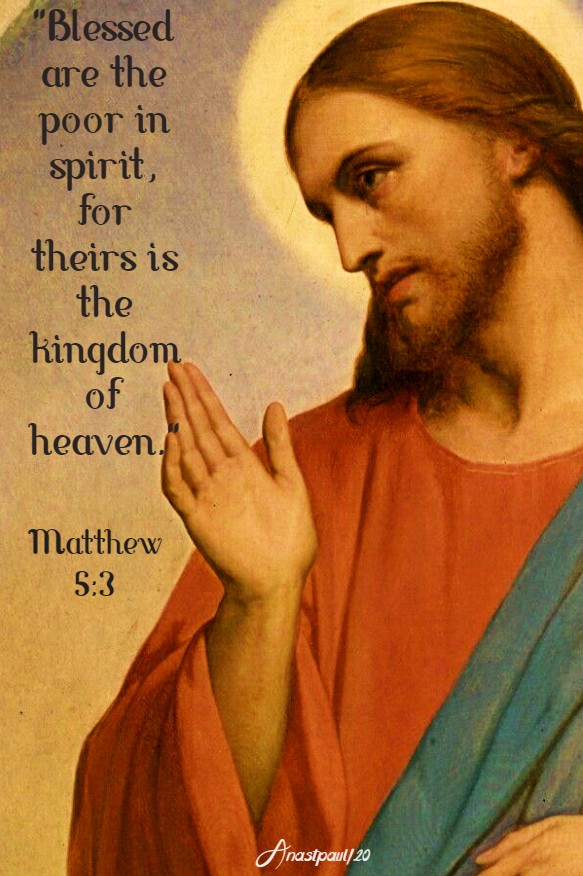
“Blessed are the poor in spirit, for theirs is the kingdom of heaven.”
Matthew 5:3
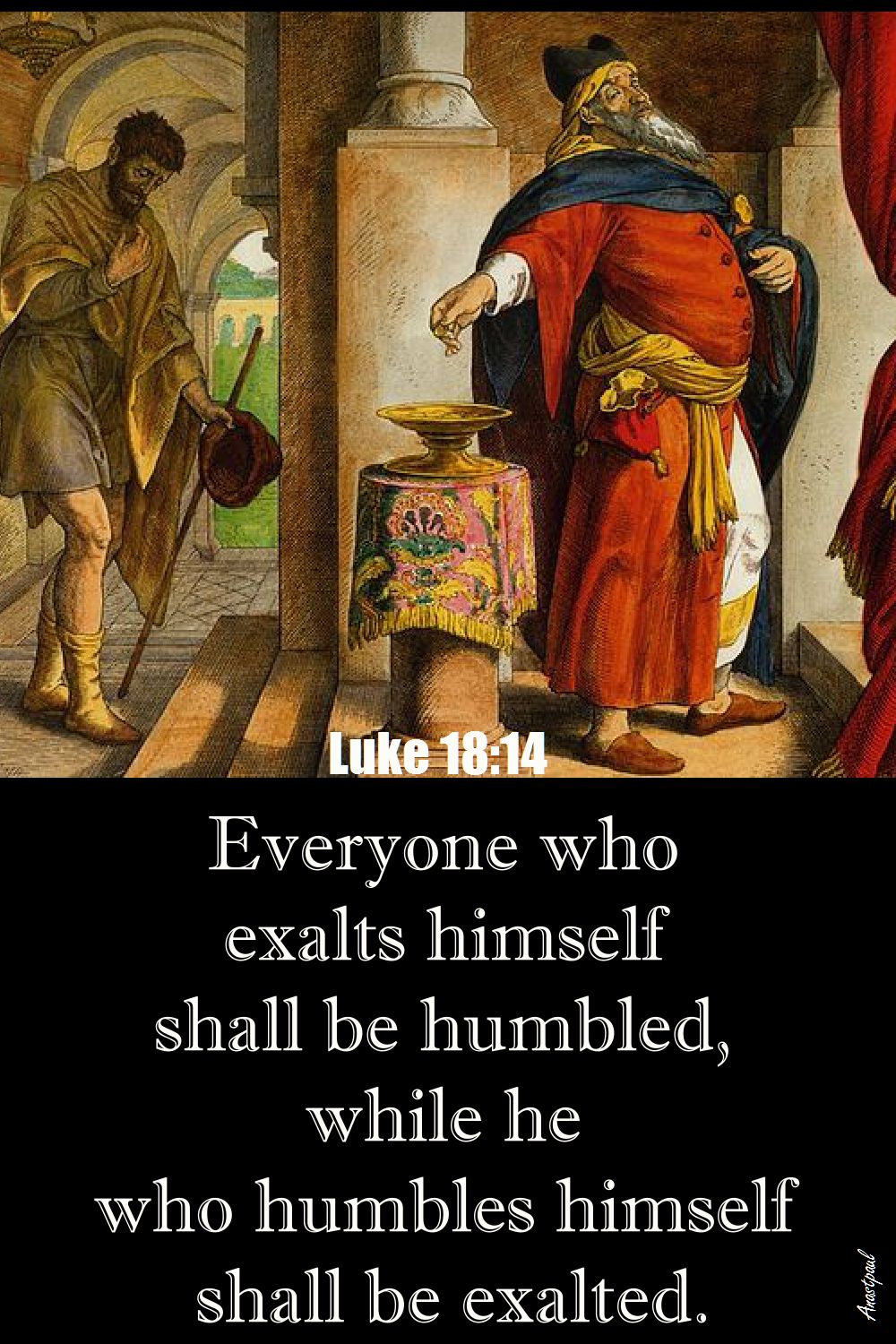
“…For everyone who exalts himself will be humbled but he who humbles himself, will be exalted.”
Luke 18:14
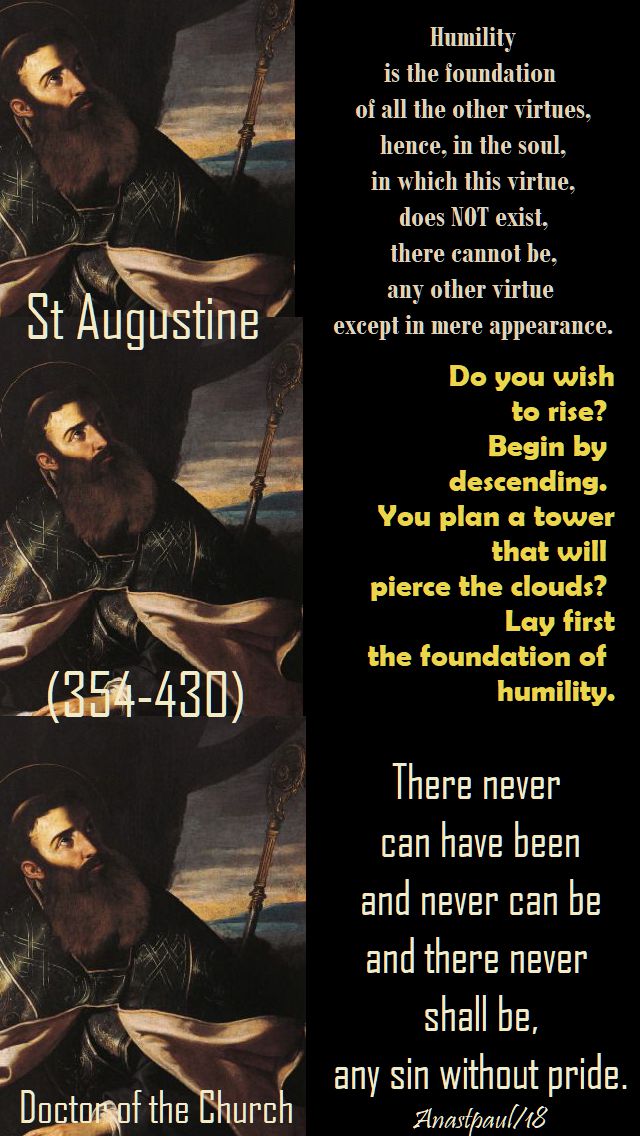
“Humility is the foundation of all the other virtues, hence, in the soul in which this virtue does NOT exist, there cannot be any other virtue except in mere appearance.”
“Do you wish to rise? Begin by descending. You plan a tower, that will pierce the clouds? Lay first, the foundation of humility.”
” There never can have been and never can be and there never shall be, any sin without pride.”
St Augustine (354-430) Doctor of the Church
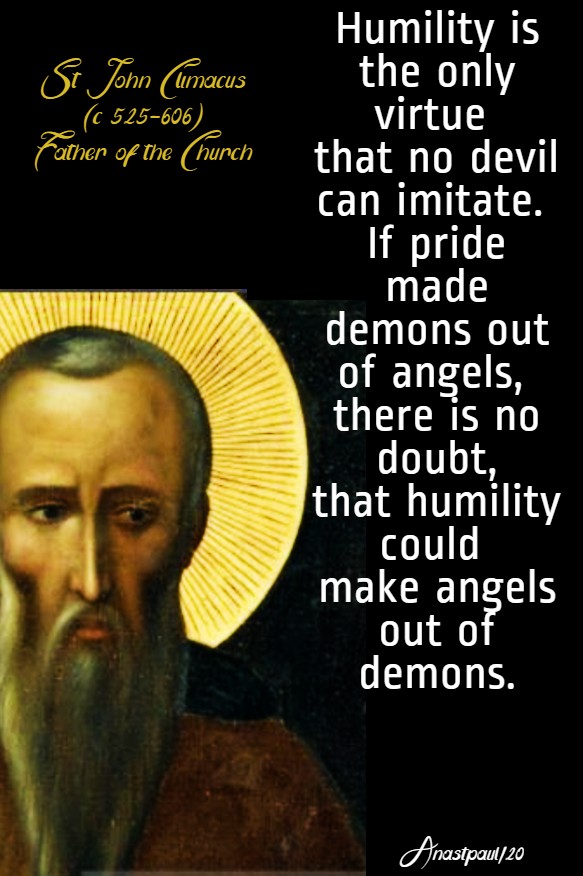
“Humility is the only virtue that no devil can imitate. If pride made demons out of angels, there is no doubt, that humility could make angels out of demons.”
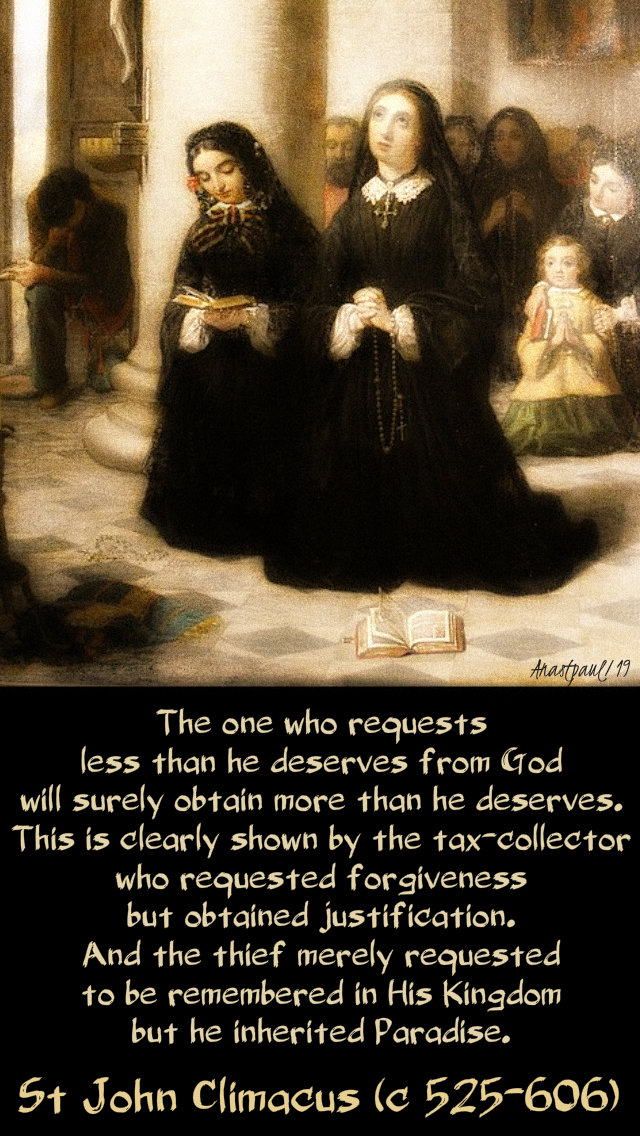
“The one who requests less than he deserves from God will surely obtain more than he deserves. This is clearly shown by the tax-collector who requested forgiveness but obtained justification. And the thief merely requested to be remembered in His Kingdom but he inherited Paradise.”
St John Climacus (c 525-606)
Father of the Church
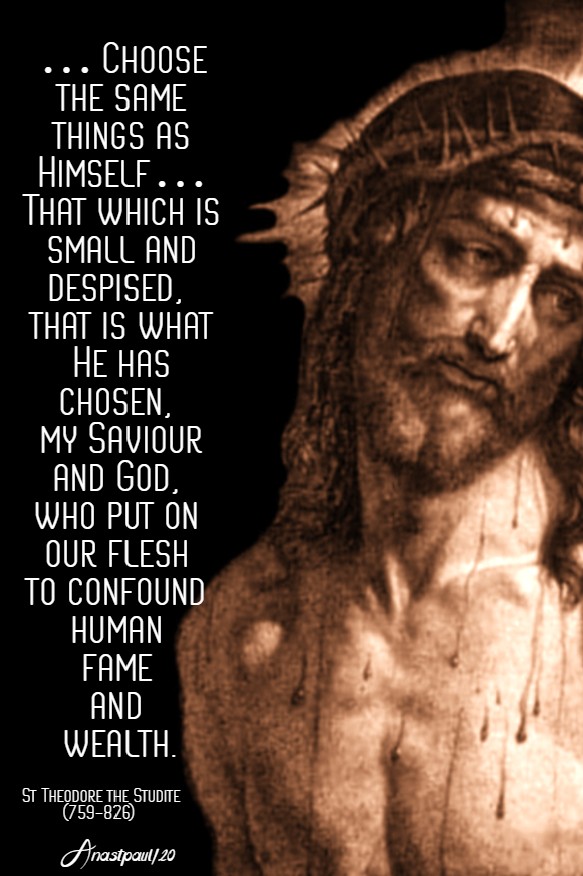
“‘… Choose the same things as Himself…’” That which is small and despised, that is what He has chosen, my Saviour and God, who put on our flesh to confound human fame and wealth.”
St Theodore the Studite (759-826)
Monk and Theologian at Constantinople
Catechesis 78
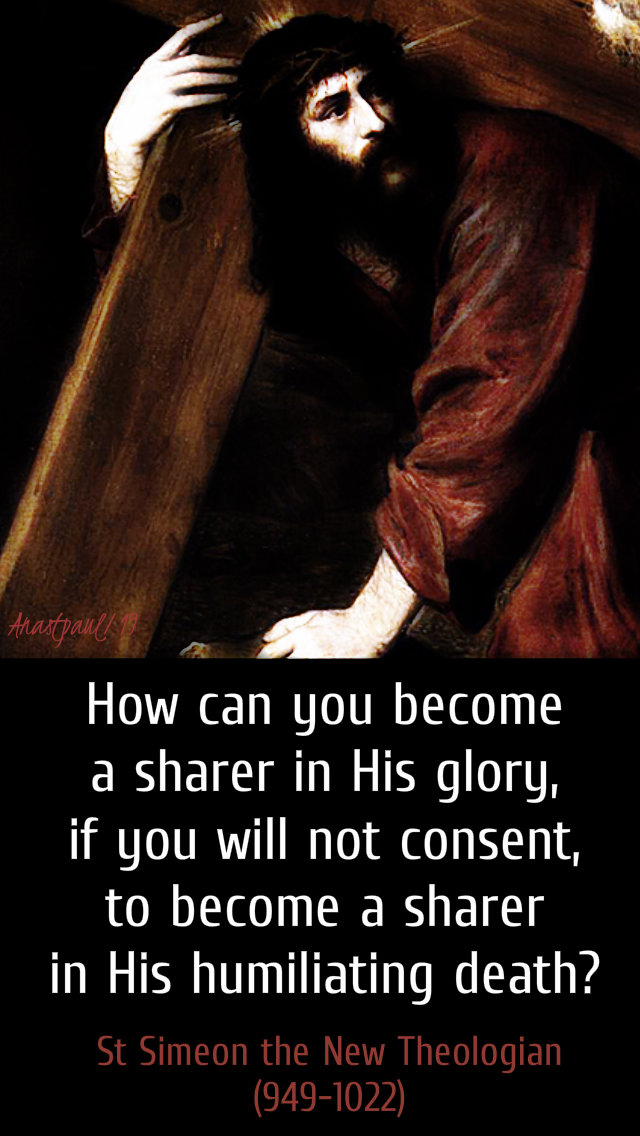
“Your Master is not disturbed by mockery and do you get upset? He bears spittle, blows, strokes of the lash and can you not take a harsh word? He accepts the cross, a humiliating death, the torture of the nails and can you not undertake to carry out the lowliest of tasks? How can you become a sharer in His glory (1 Pt 5:1) if you will not consent to become a sharer in His humiliating death?”
St Simeon the New Theologian (949-1022)
Catechesis 27
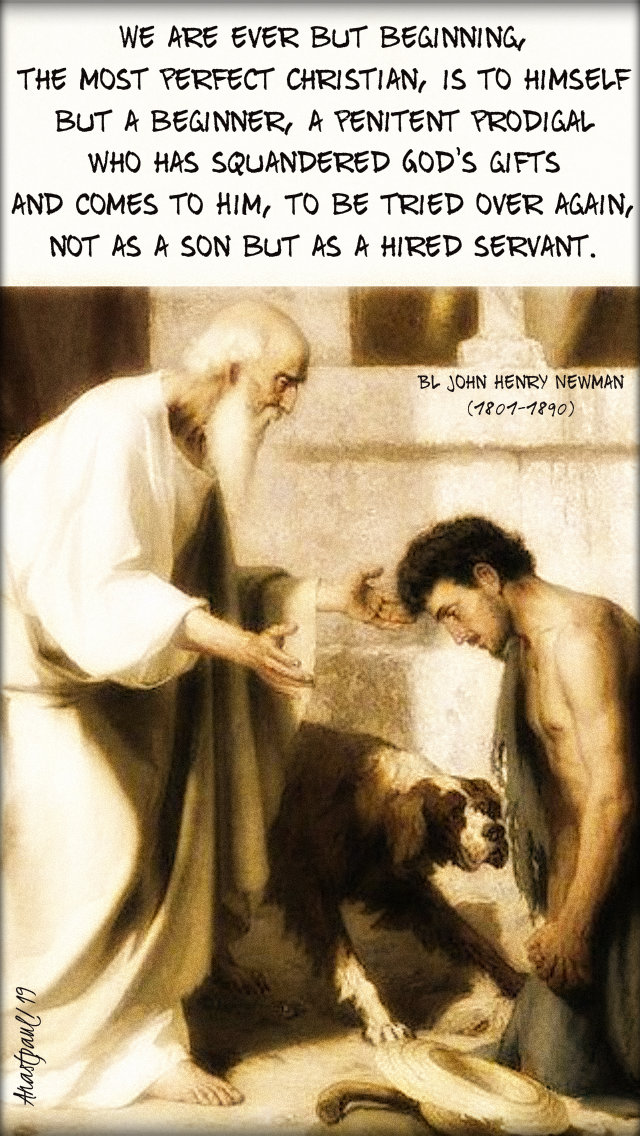
“We are ever but beginning, the most perfect Christian, is to himself but a beginner, a penitent prodigal who has squandered God’s gifts and comes to Him, to be tried over again, not as a son but as a hired servant.”

























 AnaStpaul
You must be logged in to post a comment.