Thought for the Day – 2 July – “Month of the Sacred Heart” – Meditations with Antonio Cardinal Bacci (1881-1971)
The Tabernacle Lamp
“We should find time, everyday, to pay a visit to the Blessed Sacrament.
Jesus Christ is present in all the Churches of the world as a voluntary prisoner of love. He is waiting for us. “I will not leave you orphans,” (Jn 14:18) He promised, for He loves us, with an infinite love which knows no limits of time or place. He has been there, throughout the centuries in every corner of the globe, from the splendid Cathedrals in the noisy cities, to the humble little Chapels of the lonely Missions. No matter where we go, we can find the King of Kings enthroned within the Tabernacle, waiting lovingly for us!
Since we need Him so much, why do we not go to Him? We have many things to do but this is the first and most necessary. It will often require some little sacrifice to spend a quarter of an hour before the Tabernacle but, nothing good can ever be achieved without sacrifice.
Moreover, Jesus deserves this sacrifice, for did He not give Himself entirely for us? Does He not continue to sacrifice Himself in the Sacrament and in the Sacrifice of the Altar? Let us go to Jesus everyday and we shall find comfort for our souls.
When we kneel in front of the Tabernacle and speak with Jesus, we shall feel confident that He is listening to us. We shall be certain that He sympathises with our weaknesses, understands our needs and is anxious to enrich us with His graces.”
One Minute Reflection – 2 July – “Month of the Most Precious Blood” – Thursday of the Thirteenth week in Ordinary Time, Year A, Readings: Amos 7: 10-17, Psalms 19: 8, 9, 10, 11, Matthew 9: 1-8 and the Memorial of St Swithun (c 800-863) Bishop
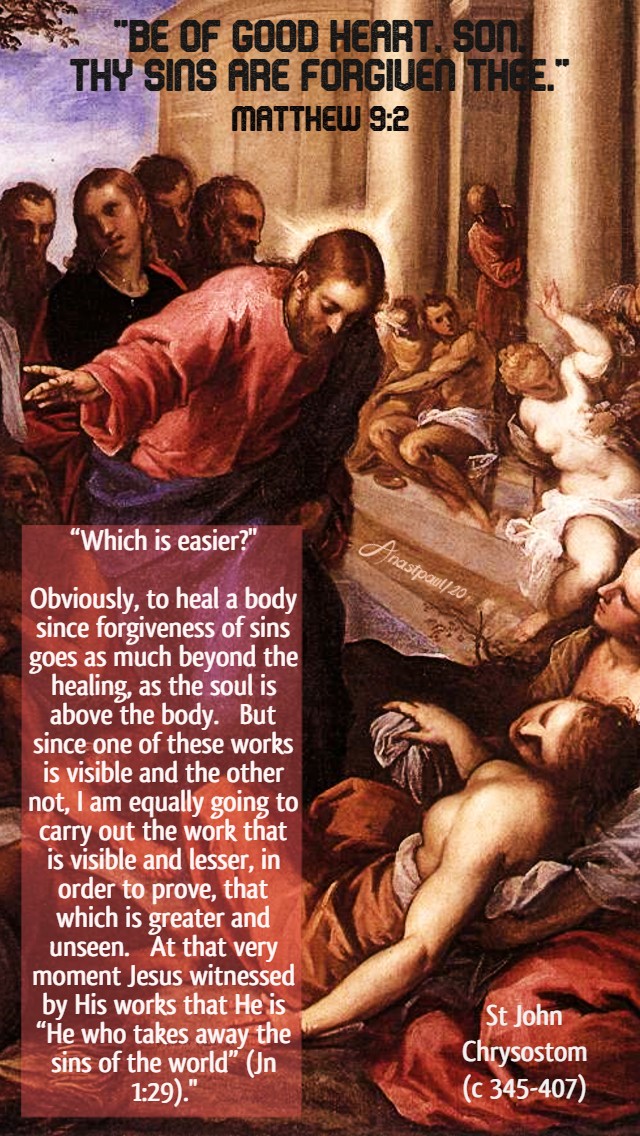
“Be of good heart, son, thy sins are forgiven thee.” … Matthew 9:2
REFLECTION – “The scribes declared that God alone can forgive sins. But Jesus, even before He forgave sins, revealed the secrets of the heart, thereby showing, that He also possessed that other power reserved to God … For it is written: “You alone, O Lord, know the secrets of humankind” and “Man sees the outward appearance but God sees the heart” (2 Chr 6:30; 1 Sam 16:7). In this way Jesus reveals His divinity and equality with the Father, uncovering the depths of their hearts to the scribes and making known those thoughts, they are afraid to speak openly for fear of the crowd. And this He did with great gentleness. …
The lame man might have made his disappointment known to Christ by saying: “OK! You have come to cure another kind of sickness and heal another kind of evil – sin. But what proof am I going to get that my sins are forgiven?” Yet he said nothing of the sort but put his trust in the One who had the power to heal him. …
To the scribes, Christ said: “Which is easier? To say: Your sins are forgiven, or rather: Take up your stretcher and go home?” In other words: ‘What seems easier to you? To strengthen a paralysed body or put aside the sins of the soul?’ Obviously, to heal a body since forgiveness of sins goes as much beyond the healing, as the soul is above the body. But since one of these works is visible and the other not, I am equally going to carry out the work that is visible and lesser, in order to prove, that which is greater and unseen. At that very moment Jesus witnessed by His works that He is “He who takes away the sins of the world” (Jn 1:29).” … St John Chrysostom (c 345-407) – Doctor of the Church – Homilies on Saint Matthew’s Gospel, no. 29, 2 ; PG 57, 359
PRAYER – Lord God, be the beginning and the end of all that we are and do and say. Prompt our actions with Your grace, may Your light be our only way, may Your commands be our only need and complete all, with Your all-powerful help. St Swithun, your love of God in all things proved by Him in your countless miracles, pray for us! We make our prayer through Christ our Lord in the unity of the Holy Spirit, one God with You, forever and ever, amen.
Our Morning Offering – 2 July – “Month of the Most Precious Blood” – Thursday of the Thirteenth week in Ordinary Time
Constant Prayer to the Precious Blood of Jesus By St Catherine of Siena (1347-1380) Doctor of the Church
Precious Blood,
Ocean of Divine Mercy,
Flow upon us!
Precious Blood,
most pure Offering,
Procure us every grace!
Precious Blood,
Hope and Refuge of sinners,
Atone for us!
Precious Blood,
Delight of holy souls,
Draw us!
Amen
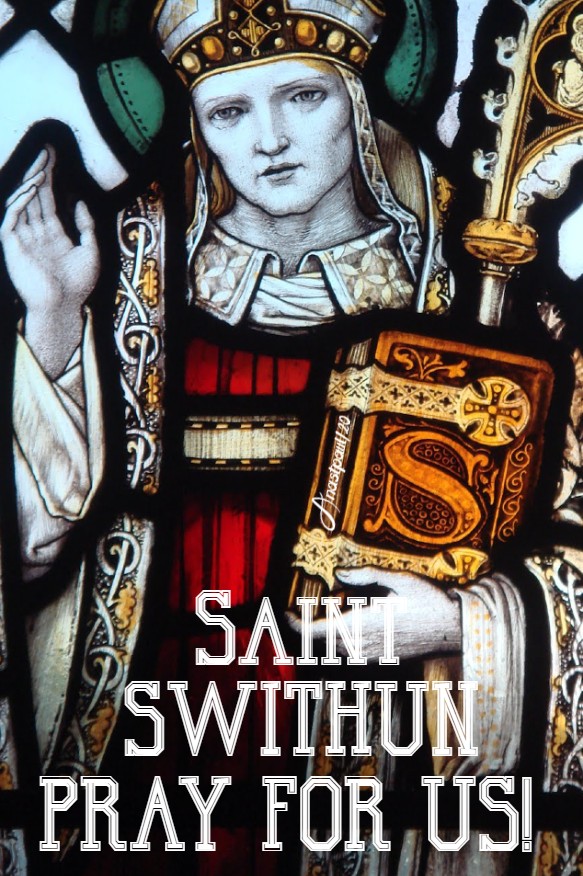
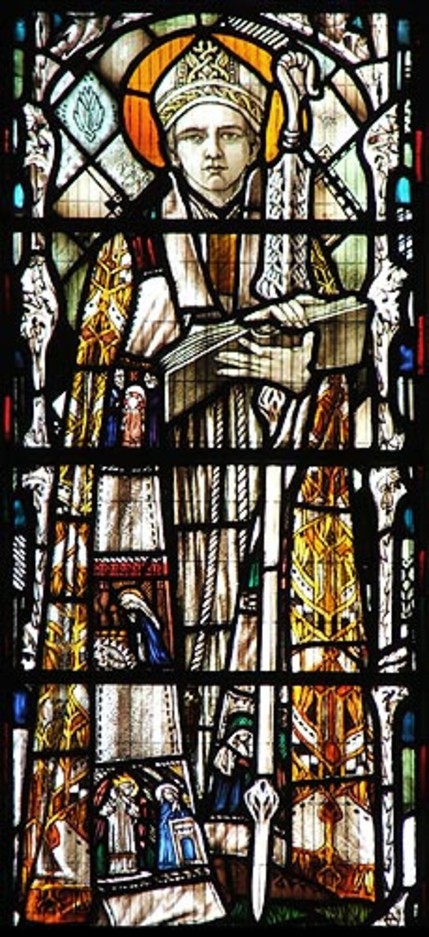
Saint of the Day – 2 July – Saint Swithun (c 800-863) Bishop of Winchester, Miracle-worker – born in c 800 at Wessex, England and died on 2 July 862 of natural causes. Patronages – Hampshire, Winchester, Winchester Cathedral and Diocese, Southwark,the weather, against drought.
He was born in the kingdom of Wessex and educated in its capital, Winchester. He was famous for charitable gifts and building churches. Very little is known for certain about the life of Winchester Cathedral’s first Patron Saint. Some biographies of Swithun state that he was once Prior of Winchester. We do know that he was one of the chief advisors of Egbert, King of the West Saxons and was responsible for the education of Egbert’s son, Ethelwulf. Egbert’s influence procured the post of Bishop of Winchester, which he took up in 852, below is Winchester Cathedral today, obviously, no longer Catholic.
This slideshow requires JavaScript.
Only one miracle is attributed to Swithin while he was alive. An old lady’s eggs had been smashed by workmen building a church. Swithin picked the broken eggs up and, it is said, they miraculously became whole again.
When Swithun’s health failed in 862 and he lay near death, asked that his body be buried outside his Cathedral, rather than within it, as was customary. He wanted passers-by to walk upon his grave and raindrops from the eaves of the Cathedral to fall upon his resting place. Although his wishes were granted, his grave did not long lie undisturbed. In 931 Bishop Ethelwulf had Swithun disinterred and reburied within the walls of the new Church.
The original spot of St Swithun’s tomb
Shortly after, miracles were reported at Swithun’s tomb, which became a popular attraction for pilgrims. So clamorous were the voices reporting these miracles that Swithun’s cult was recognised, which further added to the allure of his shrine. Swithin’s feast day is celebrated in England on 15 July which is the date of the removal of his remains, not the usual day of his entry into life.
St Swithun’s new Tomb
The translation of St Swithun’s relics was accompanied by ferocious and violent rain storms that lasted 40 days and 40 nights and are said to indicate the saint’s displeasure at being moved. This is the origin of the legend. that if it rains on Saint Swithin’s feast day, the rain will continue for 40 more days.
Saint Swithun’s day, if thou dost rain, For forty days it will remain. Saint Swithun’s day, if thou be fair, For forty days ’twill rain nae mair.
His body was probably later split between a number of smaller shrines. His head was certainly detached and, in the Middle Ages, taken to Canterbury Cathedral. Peterborough Abbey has an arm. Yet, still his bones could not rest, for on 15 July 1093 his remains were once more dug up and reburied with great ceremony within the new Cathedral built by Bishop Walkelin. There they remained until the Dissolution of the Monasteries in 1538, when the shrine was destroyed by Henry VIII’s men. A modern representation of it now stands on the site.
Below are extracts from the story of St Swithun as told by Ælfric, the homilist and hagiographer, writing in English in the 990s. Ælfric had been educated under St Æthelwold at Winchester and he gives us a detailed picture of how the cult of Swithun developed at Æthelwold’s instigation.
“In the days of the noble king Edgar, when by the grace of God, Christianity was thriving among the English people under that king, God revealed St Swithun, showing by many signs that he is glorious. His deeds were not known until God himself made them known and we do not find written in books, in what manner the Bishop lived in this world, before he went to Christ. Such was the carelessness of those who knew him in life, that they did not write about his deeds and conduct, for the benefit of future generations, who did not know his virtue but God, nonetheless, made known his life with manifest miracles and wonderful tokens. This Swithun was Bishop of Winchester, that is, over Hampshire, a blessed servant of God, there were eight Bishops between him and St Æthelwold. Now, as we said before, nothing about his life is known to us, except that he was buried at his episcopal seat, to the west of the church and a tomb was built over him, until his miracles revealed that he was especially blessed by God. Æthelwold, the venerable and blessed Bishop, who in those days was Bishop of Winchester, commanded all his monks who lived in the Minster that every time a sick person was healed, they should all go in procession to the Church and praise in song, the merits of the Saint Swithun and glorify God because of the Saint’s holiness. They began to do this straightaway and sang the song of praise, until it grew tiresome for them to have to get up so often – sometimes three times a night, sometimes four – to sing the Te Deum, when they could have been asleep. At last, they all left off singing the hymn because the bishop was busy with the king and did not know that they had ceased their custom of singing.
But then St Swithun himself appeared to a certain good man in a dream, richly attired and said, “Go to the Old Minster and say to the monks that God is greatly displeased by their grumbling and sloth, that everyday they see the miracles of God performed among them but they do not want to praise the Saviour with hymns, as the Bishop commanded the brothers to do. Tell them, that if they do not sing the hymn, the miracles will soon cease bu,t if they sing the Te Deum for the miracles, as often as sick people are healed there, then so many wonders will be performed among them, that no one alive will be able to remember when any man saw such wonders anywhere.
The man woke up from his sweet sleep and mourned that he could no longer see and enjoy the beautiful light which he had seen accompanying Swithun. Nonetheless, he got up and quickly went to Bishop Æthelwold and told him all this. Æthelwold straightaway sent a message from the King’s court to the monks and said that they should sing the Te Deum just as he had set down for them and that anyone who neglected to do this, should heavily atone for it by fasting for seven nights continuously. Afterwards, they always kept this custom, as we have very often seen for ourselves – and we have often sung that hymn with them.
… We cannot write, nor recount in words, all the miracles that the holy man Swithun performed, by the power of God, in the sight of the people, for prisoners in chains and for sick people, to show to everyone that they themselves may earn the kingdom of heaven by good works, just as Swithun did, who is now made glorious by his miracles. The old Church was hung all round with the crutches and stools of cripples who had been healed there, from one end to the other, on either wall – and, even so, they could not put half of them up. Such tokens declare that Christ is Almighty God, who revealed his Saint by such good deeds…“
St Swithin’s Gate at Winchester Cathedral and Abbey
“And if any church fell down, or was in decay, St Swithin would anon amend it at his own cost. Or if any church were not hallowed, he would go thither afoot and hallow it. For he loved no pride, ne to ride on gay horses, ne to be praised ne flattered of the people…”
Martyrs in Carthage by Hunneric – 7 saints: A group of seven Christians tortured and murdered in the persecutions of the Arian Vandal king Hunneric for remaining loyal to the teachings of orthodox Christianity. They were some of the many who died for the faith during a period of active Arian heresy. – Boniface, Liberatus, Maximus, Rogatus, Rusticus, Septimus and Servus.
Martyrs of Campania – 10 saints: A group of ten Christians marytred together in the persecutions of Diocletian. The only details about them to have survived are their names – Ariston, Crescention, Eutychian, Felicissimus, Felix, Justus, Marcia, Symphorosa, Urban and Vitalis. Martyred in 284 in Campania, Italy.
Martyrs of Seoul – 8 saints: Additional Memorial – 20 September as part of the Martyrs of Korea.
A group of eight Christians who were martyred together as part of the lengthy persecutions in Korea.
• Agatha Han Sin-ae
• Antonius Yi Hyeon
• Bibiana Mun Yeong-in
• Columba Gang Wan-suk
• Ignatius Choe In-cheol
• Iuliana Gim Yeon-i
• Matthaeus Gim Hyeon-u
• Susanna Gang Gyeong-bok
They were martyred on 2 July 1801 at the Small West Gate, Seoul, South Korea. Beatified on 15 August 2014 by Pope Francis.
Catholic doctrine teaches the faithful, that the Blood of Jesus Christ is part of His Sacred Humanity and hypostatically united to the Second Person of the Blessed Trinity.
And as such, it is worthy of adoration and veneration proper to latreutical worship (cultus latriae) which is rendered only to God. In other words, we adore the human nature of Christ because of its intimate and eternal union with the Person of the Divine Word.
It is for this same reason, that we honour the Most Sacred Heart or the Wounds of Our Lord Jesus Christ.
The Devotion to the Precious Blood:
This devotion is one of the most ancient of pious Church practices. It is said that the Blessed Virgin venerated the Most Precious Blood of her infant Son on the day of His circumcision as she collected the first relics of His Precious Blood on a piece of cloth.
On that momentous occasion she united her tears with that of the Word Incarnate on account of, not so much of the sensible pain bu,t of His supernatural sorrow for the hard-heartedness of mortals.
This was the first of seven Blood-Sheddings of Our Divine Saviour, The rest being:
2. The Agony in the Garden
3. The Scourging at the Pillar
4. The Crowning with Thorns
5. The Way of the Cross
6. The Crucifixion
7. The Piercing of His Heart
The old sacrifice took a new form in the New Testament when the Immaculate Lamb of God offered Himself on the altar of the Cross, to redeem mankind from sin and the slavery of Satan.
And during the Last Supper, Our Lord offered Himself in an unbloody, yet real sacrifice when He uttered the following words: “For this is my blood of the new testament, which shall be shed for many unto remission of sins.”(Matthew 26: 28)
Truly, this “shedding of blood’ or “pouring out of blood” took place and forms one of the glorious mysteries of our Faith.
Thought for the Day – 1 July – Meditations with Antonio Cardinal Bacci (1881-1971)
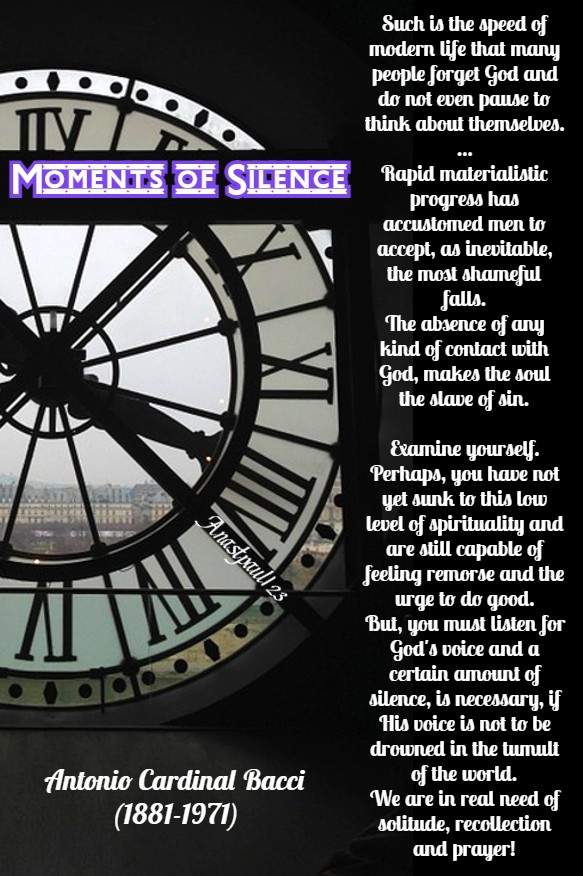
Moments of Silence
“Such is the speed of modern life that many people forget God and do not even pause to think about themselves. Action is everything. There is no time for reflection, no time for prayer. Life has become mechanical and superficial, for nobody has the time, nor the inclination, to think about spiritual matters.
What is the result? Since men are not machines but living beings, composed of soul and body and are capable of feeling and passion, their lower inclinations break loose and insist on being satisfied. In the absence of prayer and of all effort to lead a good life, grace is lacking to inspire the mind, to strengthen the will and to keep the heart pure. Rapid materialistic progress has accustomed men to accept, as inevitable, the most shameful falls. The absence of any kind of contact with God, makes the soul the slave of sin.
Examine yourself. Perhaps, you have not yet sunk to this low level of spirituality and are still capable of feeling remorse and the urge to do good. But, you must listen for God’s voice and a certain amount of silence, is necessary, if His voice is not to be drowned in the tumult of the world. We are in real need of solitude, recollection and prayer!“
Quote/s of the Day – 1 July – “Month of the Most Precious Blood” – Wednesday of the Thirteenth week in Ordinary Time, Year A
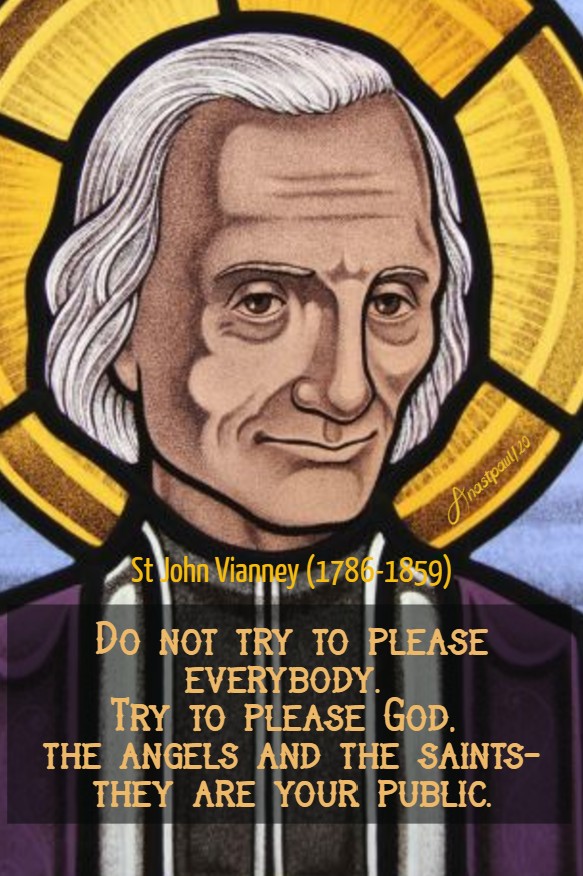
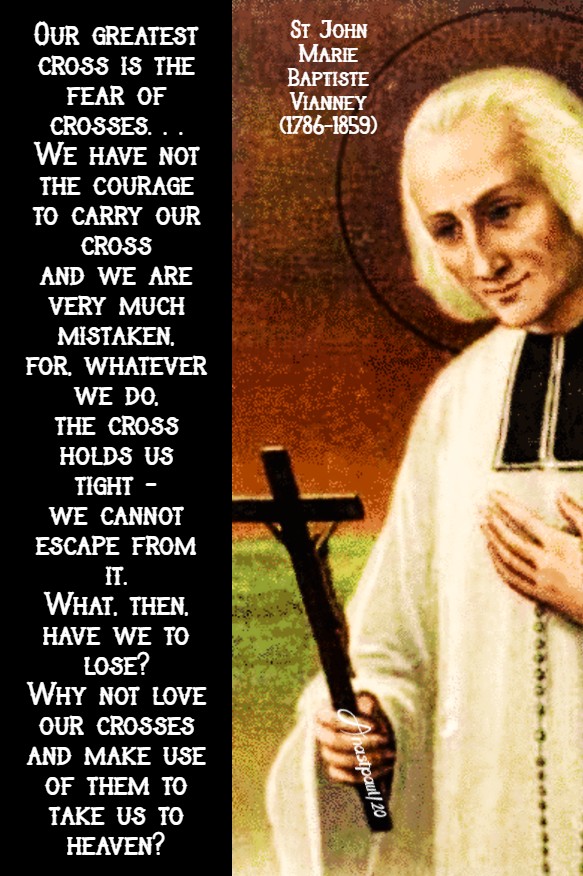
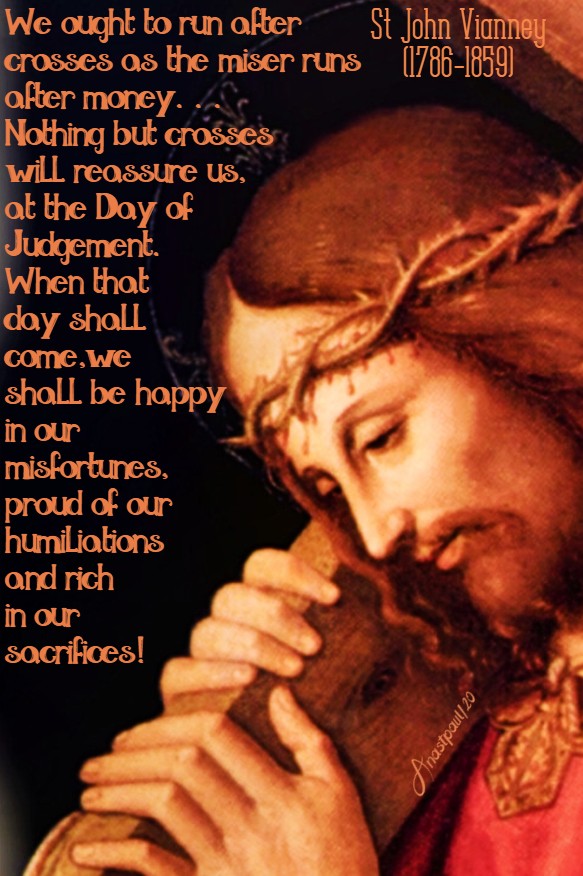
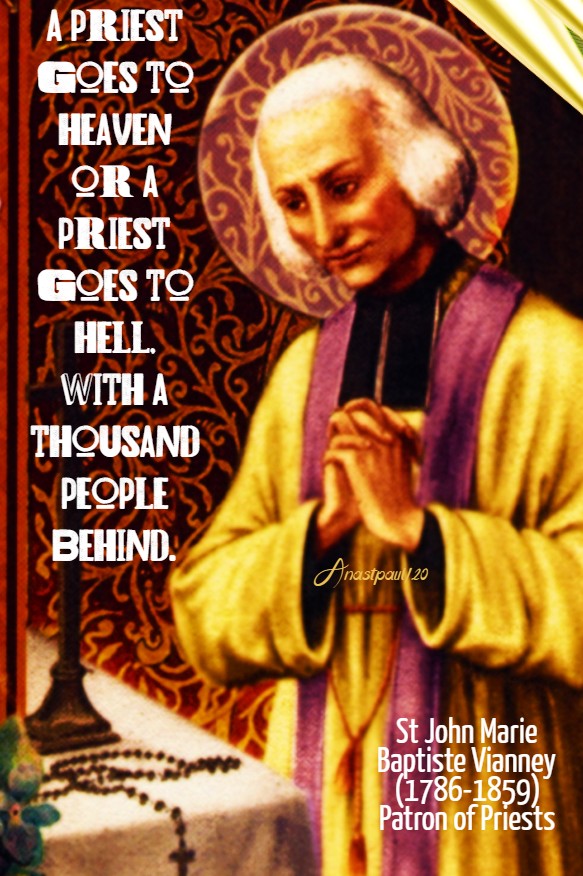
Lessons from St John Marie Baptiste Vianney, the Curé of Ars, Patron of Priests
“Do not try to please everybody. Try to please God, the angels and the saints – they are your public.”
“Our greatest cross is the fear of crosses. . . We have not the courage to carry our cross and we are very much mistaken, for, whatever we do, the cross holds us tight – we cannot escape from it. What, then, have we to lose? Why not love our crosses and make use of them to take us to heaven?”
“We ought to run after crosses as the miser runs after money. . . Nothing but crosses will reassure us, at the Day of Judgement. When that day shall come, we shall be happy in our misfortunes, proud of our humiliations and rich in our sacrifices!”
” A priest goes to Heaven or a priest goes to Hell, with a thousand people behind.”
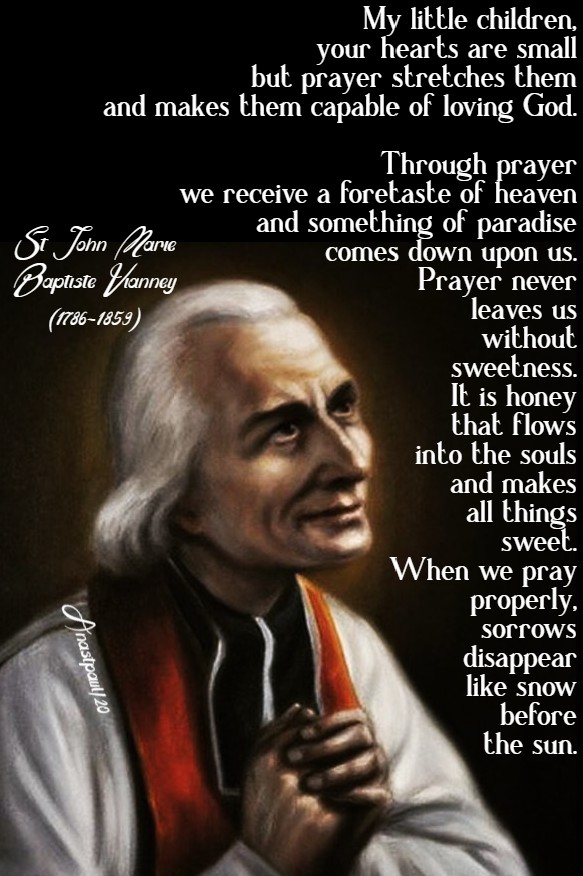
“My little children, your hearts are small but prayer stretches them and makes them capable of loving God. Through prayer we receive a foretaste of heaven and something of paradise comes down upon us. Prayer never leaves us without sweetness. It is honey that flows into the souls and makes all things sweet. When we pray properly, sorrows disappear like snow before the sun.”
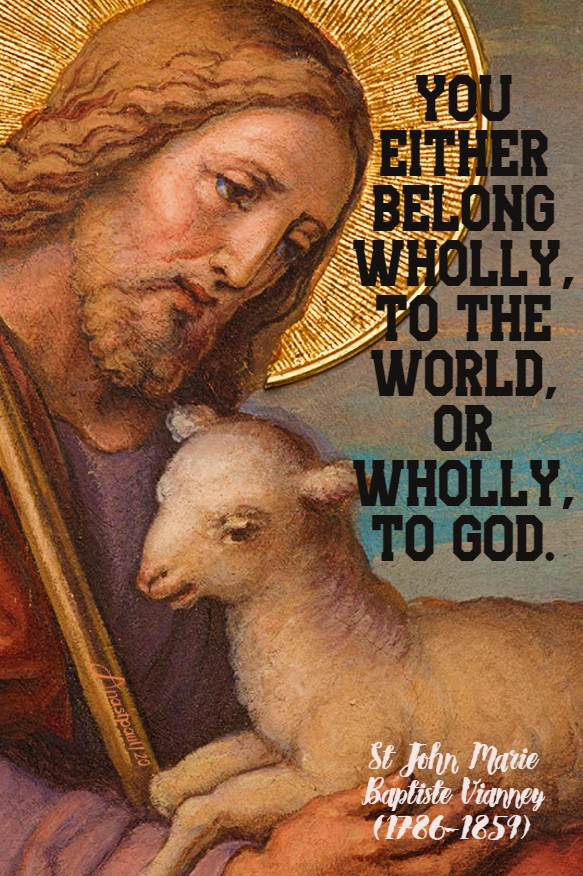
“You either belong wholly, to the world, or wholly, to God.”
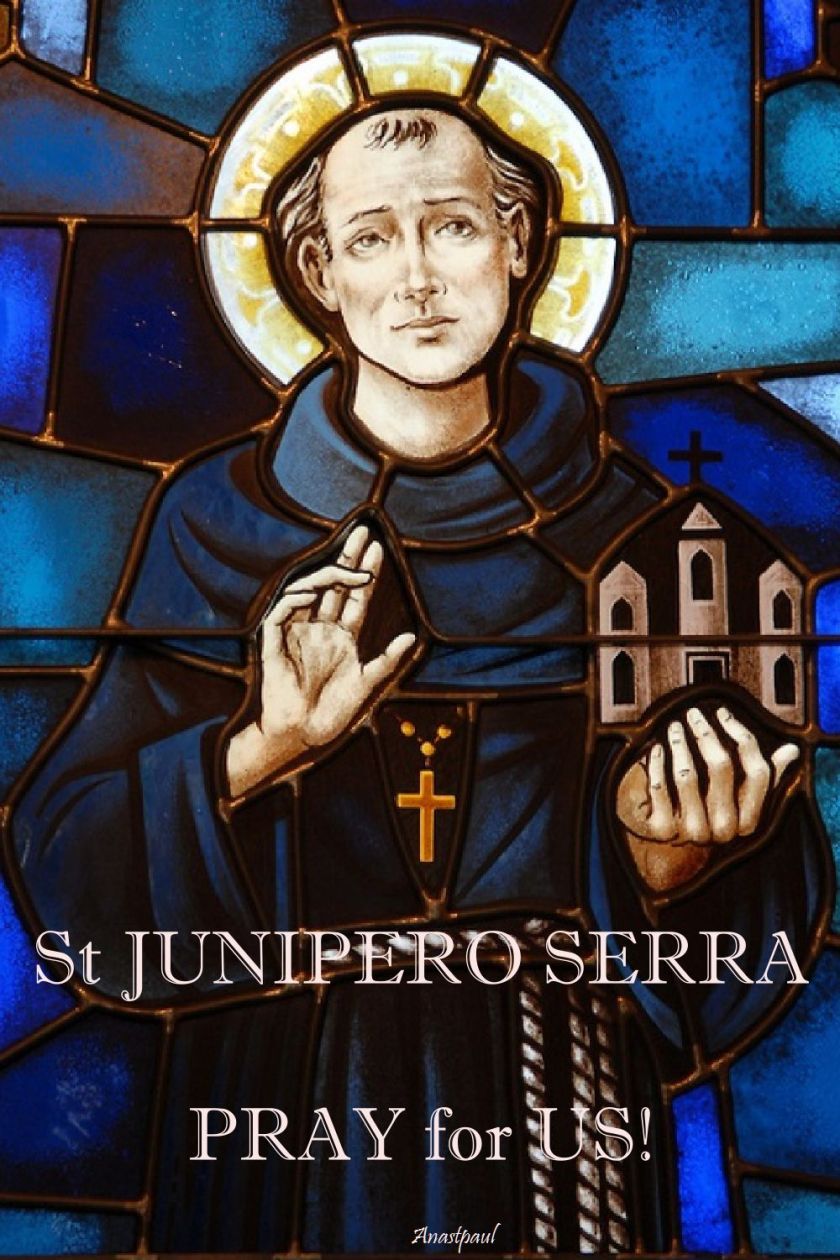
One Minute Reflection – 1 July – “Month of the Most Precious Blood” – Wednesday of the Thirteenth week in Ordinary Time, Year A, Readings: Amos 5: 14-15, 21-24, Psalm 50: 7, 8-9, 10-11, 12-13, 16bc-17, Matthew 8: 28-34 and the Memorial of St Junipero Serra (1713-1784) and Blessed Ignatius “Nazju” Falzon OFS (1813-1865)
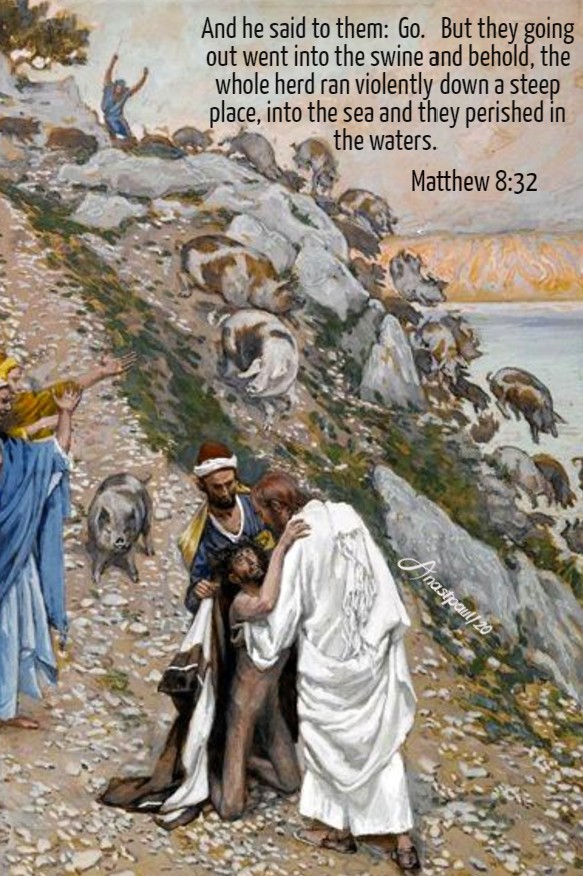
And he said to them: Go. But they going out went into the swine and behold, the whole herd ran violently down a steep place, into the sea and they perished in the waters. And behold the whole city went out to meet Jesus and when they saw him, they besought him, that he would depart from their coasts.. … Matthew 8:32,34… Matthew 8:32-34
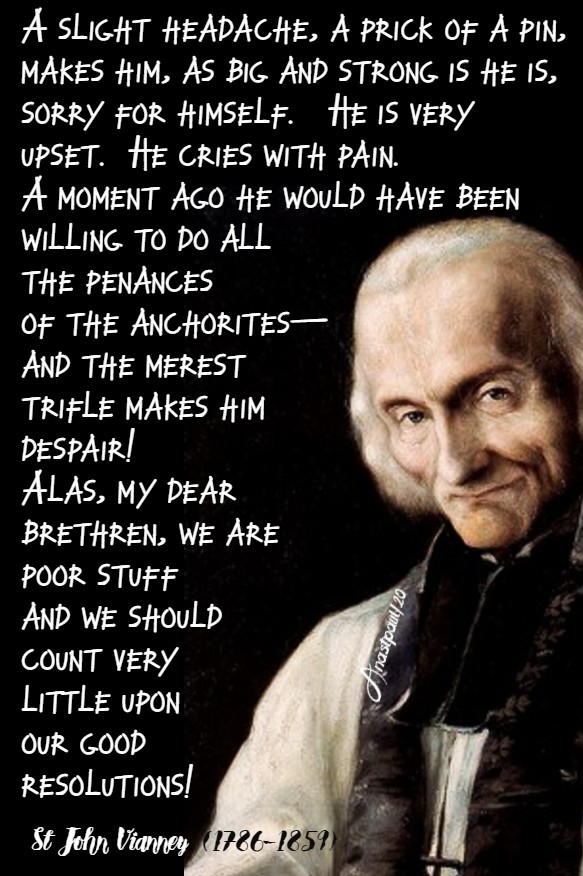
REFLECTION – “Dear Lord, what we are capable of when we are left to ourselves! There are some who, in their own words, are envious of the saints who did great penances. They believe that they could do as well. When we read the lives of some of the martyrs, we would, we think, be ready to suffer all that they suffered for God, the moment is short lived, we say, for an eternity of reward. But what does God do to teach us to know ourselves or, rather, to know that we are nothing? This is all He does – He allows the Devil to come a little closer to us. Look at this Christian who a moment ago was quite envious of the hermit who lived solely on roots and herbs and who made the stern resolution to treat his body as harshly. Alas! A slight headache, a prick of a pin, makes him, as big and strong is he is, sorry for himself. He is very upset. He cries with pain. A moment ago he would have been willing to do all the penances of the anchorites — and the merest trifle makes him despair!
Look at this other one, who seems to want to give his whole life for God, whose ardour all the torments there are cannot damp. A tiny bit of scandalmongering …. a word of calumny …. even a slightly cold reception or a small injustice done to him …. a kindness returned by ingratitude …. immediately gives birth in him to feelings of hatred, of revenge, of dislike, to the point, often, of his never wishing to see his neighbour again, or at least. of treating him coldly with an air which shows very plainly what is going on in his heart. And how many times is this his waking thought, just as it was the thought that almost prevented him from sleeping? Alas, my dear brethren, we are poor stuff and we should count very little upon our good resolutions!” … St John Marie Baptiste Vianney (1786-1859)
PRAYER – All-powerful God, to serve You is to reign. Your love gave St Juniperro Serra and Blessed Nazju Falzon, the courage to proclaim the truth of Christ and to preach and live in the light of the Kingdom. Grant that by their prayers, our lives may bear witness to the faith we profess and our love bring others, to the peace and joy of Your gospel. Through our Lord Jesus Christ, Your Son, who lives and reigns with You in the unity of the Holy Spirit, one God, forever and ever. Amen
Our Morning Offering – 1 July – “Month of the Most Precious Blood” – Wednesday of the Thirteenth Week in Ordinary Tme
Daily Offering to the Father By St Gertrude the Great (1256-1302)
Eternal Father,
I offer Thee the most precious blood
of Thy Divine Son, Jesus,
in union with the Masses said
throughout the world today,
for all the Holy Souls in Purgatory,
for sinners everywhere,
for sinners in the universal Church,
for those in my own home,
and in my family.
Amen
You might see fantastic claims for this prayer, especially printed on Holy Cards, such as the release of 1000 souls from Purgatory, each time it is prayed. Nowhere in St Gertrude’s writings, is this wild promise made so be careful of treating prayers and devotions as amulets or magical charms. The Church has summarily condemned prayer cards containing a promise to release one or more souls from Purgatory, or any other ‘miraculous’ claims. Such an easy way to release 1,000 souls seems inconsistent with the Church’s understanding of Purgatory, given that ordinarily, to release one soul, requires a plenary indulgence which is very difficult to get and, given all the means the Church employs to help the dead, such as special masses or indulgences applicable only to the dead.
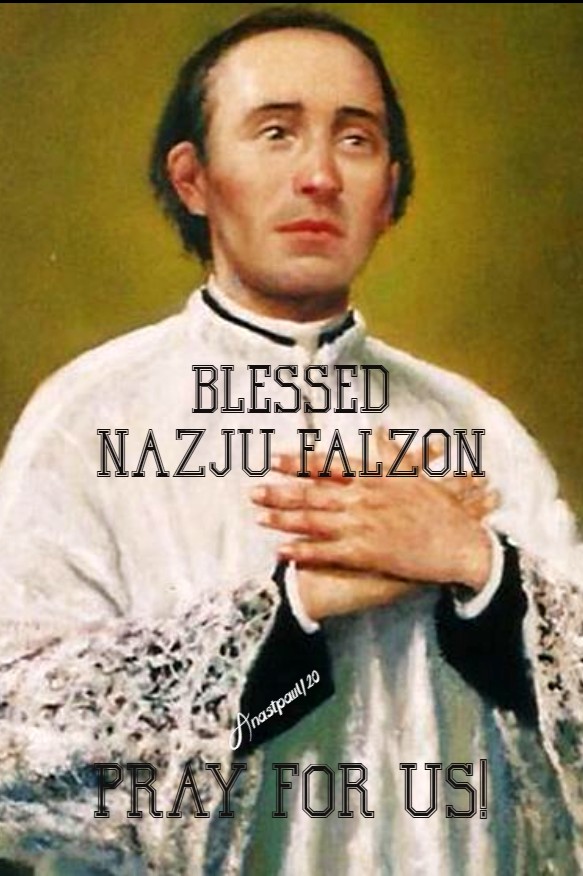
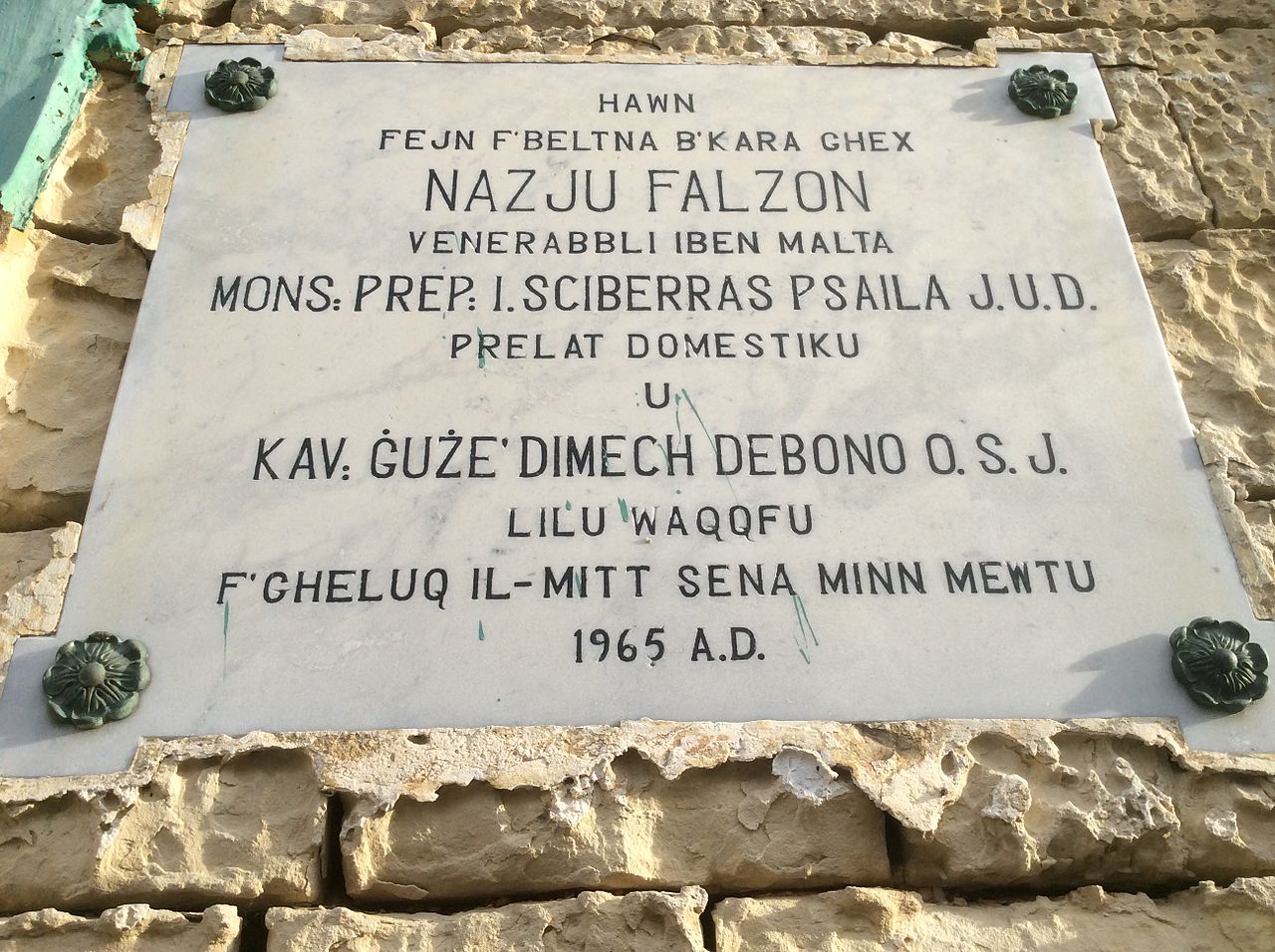
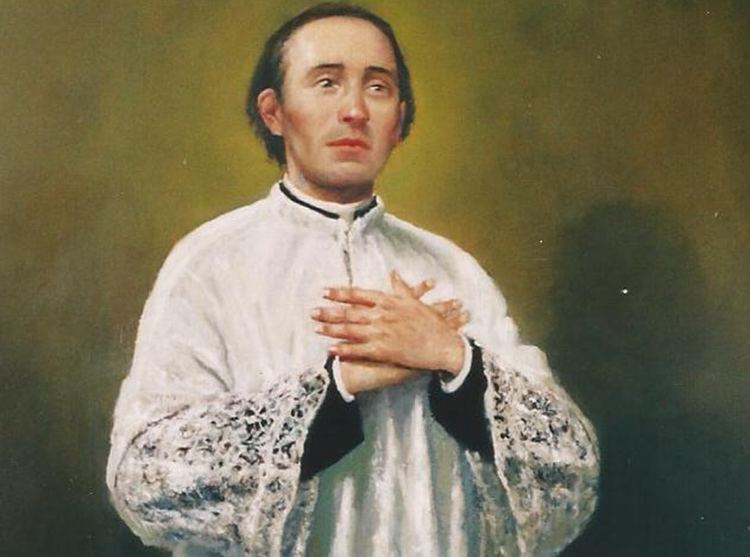
Saint of the Day – 1 July – Blessed Ignatius “Nazju” Falzon OFS (1813-1865) Catechist, Confessor, Evangelist, Apostle of seamen, the poor and the marginalised, Apostle of the Passion of Our Lord and of the Blessed Virgi Mary, Doctor of Civil and Canon Law, Writer. He spread devotion to both the Stations of the Cross and the Holy Rosary in all his works – born on 1 July 1813 at Valletta, Malta and died on 1 July 1865, Valletta, Malta, aged 52. Nazju was baptised on 2 July in the Church of Porto Salvo with the names of “Rocco Angelo Sebastiano Vincenzo Naju Rosario Falzon.” Patronage – Catechists.
Blessed Nazju Falzon was born at 49, Strait Street, Valletta, the capital city of Malta. His parents were Giuseppe Francesco Falzon, a doctor of laws and Maria Teresa Debono, the daughter of a Judge.
Bl Nazju’s Birth home
Nazju had three brothers – all four boys became lawyers and two of the brothers entered the Priesthood. His brother Anthony became a lawyer and married, while his two brothers Kalcidon and Francis, became Priests.
Nazju was instituted a cleric when he was only 15, receiving three years later the Minor Orders from Bishop Publius M Sant OFM. Cap, at the Jesuit church in Valletta but he did not wish to be Ordained as a Priest, as he felt a deep sense of unworthiness, despite the local Bishop’s fervent encouragement. At the age of 20, Nazju graduated as a Doctor of Civil and Canon Law from the University of Malta. He became a lawyer to obey his father and to be able to help the poor who needed his advice, free of charge.
At the time of Nazju, poverty in Malta was rampant after being plagued several times by cholera. Nazju’s love for the poor knew no bounds. He collected the rentals of the many fields his family owned, in different parts of Malta, to be able to help the poor. His love towards the poor knew no limits. His charity was so great, that on one occasion his brothers chided him, saying that his prodigality was ruining the family. However, he took great pains to conceal all his good deeds from the eyes of the people, because he was careful not to yield to the temptation of pride. And although he came from a well-to-do family and of a high social standing, he always manifested poverty. Nazju Falzon led a rather secluded life, shunned all vanities and performed acts of mortification. He blushed whenever he was shown appreciation or was praised by others. He affirmed he was a poor sinner and he attributed to God all his good qualities.
His apostleship consisted in teaching the Christian Catechism to boys and girls in Valletta. Nazju was in fact a pioneer in the teaching of Catechism to the poor children of Valletta. His love for the teaching of Catechism was demonstrated by the fact, that when his family went to Birkirkara. to their summer residence at 284, St Julian’s Road, he went to but primarily to teach Catechism to children at St Helen’s Basilica.
Another branch of his apostolate was the teaching of religion to British servicemen. At the time of the Crimean War, their number amounted to about 20,000. Those who were interested were brought to his own home for lessons and prayer. More grew interested in this and it forced him to move and he soon found a new home for his work, at a Jesuit church in the capital of Valletta. The soldiers would leave their valuables with him if they had to go to the battlefield, in the knowledge, that he would pass them on to their loved ones if killed or missing. Nazju converted 656 Protestants, 4 Arabs and 2 Jews to the Catholic Faith.
Nazju derived his energy for his apostolate from his love for the Eucharist. He received Holy Communion daily and spent quite a long time giving thanks. Nazju used to help Marianna Agius, the family servant in her work to enable her to go to Church to hear Mass and receive Holy Communion daily.
He was a great devotee of the Passion of Our Lord and prayed the way of the cross daily. More than once he was seen elevated from the ground lost in ecstasy.
He had an immense devotion to the Blessed Virgin Mary too and recited the little office of Our Lady daily, together with more than fifteen decades of the Holy Rosary.
Nazju had also a great love for St Joseph. He helped, financially, towards the building of the Parish Church of Mesida which was to be the first Church in Malta, to be dedicated to St Joseph. He died embracing a picture of St Joseph. His love for St Raphael, the Angel guide inspired his guidance of the children, the seaman and the poor and St Joseph Benedict Labre, was his inspiration for poverty of life.
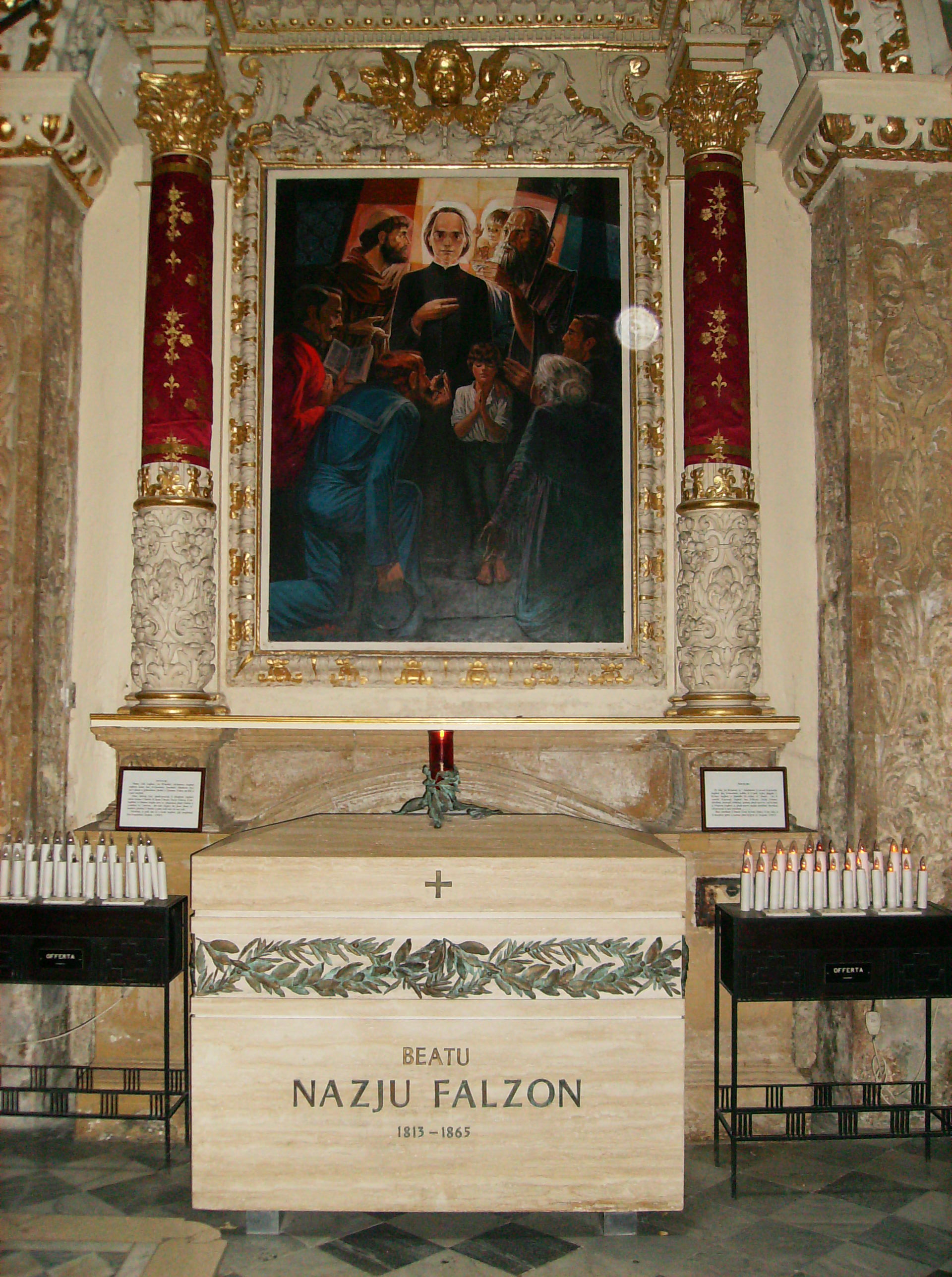
A long time sufferer of heart spasms, he died on the 1 July 1865, as he had foretold, the day of his 52nd birthday. The Funeral Service was held the following day in Ta’ Ġieżu Church in Valletta, where he was also buried in the family vault in the Chapel of the Immaculate Conception in the Church of the Franciscan Minors, Mary of Jesus in Valletta.
The Beatification miracle involved the 1981 cure of a man stricken with cancer, who was totally cured. He was Beatified by St Pope John Paul II on 9 May 2001, in Malta, when he said:
“The Servant of God Ignatius Falzon also had a great passion for preaching the Gospel and teaching the Catholic faith. He too, put his many talents and his intellectual training at the service of Catechetical work. The Apostle Paul wrote that “each one must do as he has made up his mind, not reluctantly or under compulsion, for God loves a cheerful giver” (2 Cor 9:7). Blessed Nazju was one who gave abundantly and cheerfully and people saw in him, not only boundless energy but also deep peace and joy.
He renounced the worldly success for which his background had prepared him, in order to serve the spiritual good of others, including the many British soldiers and sailors stationed in Malta at the time. In his approach to them, few of whom were Catholic, he anticipated the ecumenical spirit of respect and dialogue, which is familiar to us today but which was not always prevalent at that time.
Ignatius Falzon drew his strength and inspiration from the Eucharist, prayer before the Tabernacle, devotion to Mary and the Rosary and imitation of Saint Joseph. These are fountains of grace from which all Christians may drink. Holiness and zeal for God’s Kingdom flourish especially where parishes and communities encourage prayer and devotion to the Blessed Sacrament. I urge you, therefore, to cherish your Maltese traditions of piety, purifying them where necessary and strengthening them with sound instruction and Catechesis. There would be no better way of honouring the memory of Blessed Nazju Falzon. Amen.”
Shrine to Blessed Nazju in the Church of Mary of Jesus in Valletta, where his relics also lie.
The Most Precious Blood of Our Lord, Jesus Christ – 1 July: The feast was removed from the General Roman Calendar in 1969, “because the Most Precious Blood of Christ the Redeemer is already venerated in the solemnities of the Passion, of Corpus Christi, of the Sacred Heart of Jesus and in the feast of the Exaltation of the Holy Cross.” However, as this is the Month of the Most Precious Blood, this day, is most worthy of celebrating this Feast Day everyday.
St Aaron of Caerleon
St Aaron the Patriarch Blessed Antonio Rosmini-Serbati (1797-1855) His Life: https://anastpaul.com/2019/07/01/saint-of-the-day-1-july-blessed-antonio-rosmini-1797-1855/
St Arnulf of Mainz
Bl Assunta Marchetti
St Atilano Cruz Alvarado
St Calais of Anisole
St Carilephus
St Castus of Sinuessa
St Cewydd
St Concordius of Toledo
St Cuimmein of Nendrum
St Domitian of Lerins
Bl Elisabeth de Vans
St Eparchius of Perigord
St Eutychius of Umbria
St Esther the Queen
St Gall of Clermont
Bl George Beesley
St Golvinus of Leon
St Gwenyth of Cornwall
St Huailu Zhang
Bl Jan Nepomucen Chrzan
Bl Jean-Baptiste Duverneuil
St Julius of Caerleon
St Justino Orona Madrigal
St Juthware
St Leonorious of Brittany
St Leontius of Autun
Bl Luis Obdulio Navarro
St Martin of Vienne
Bl Montford Scott Blessed Ignatius “Nazju” Falzon OFS (1813-1865)
St Nicasius of Jerusalem
St Oliver Plunkett (1629-1681) Martyr
Bl Pierre-Yrieix Labrouhe de Laborderie
St Secundinus of Sinuessa
St Servan of Culross
St Theobald of Vicenza
St Theodoric of Mont d’Or
Bl Thomas Maxfield
Bl Tullio Maruzzo
St Veep
—
Martyrs of Rome – 6 saints: Six Christians who were martyred together. No details have survived except their names – Esicius, Antonius, Processus, Marina, Serenus and Victor. They were martyred in Rome, Italy, date unknown.










 AnaStpaul
You must be logged in to post a comment.