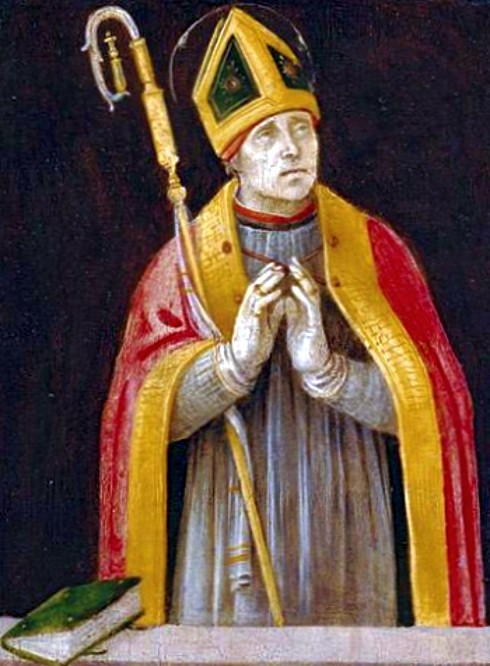
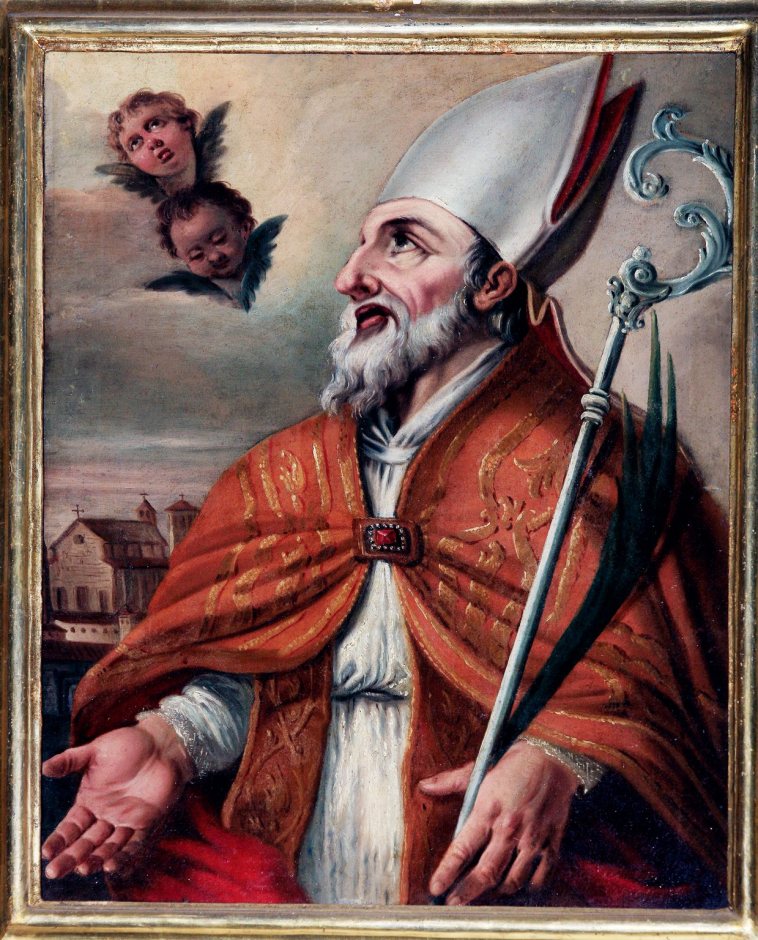
Saint of the Day – 7 August – Saint Donatus of Arezzo (Died 362) Bishop and Martyr, Confessor, Miracle-worker – born in Nicomedia (part of modern Turkey) and died on 7 August in 362. Patronages – Arezzo, Italy, Diocese of Arezzo, Italy, Diocese of Arezzo-Cortona-Sansepolcro, Italy, Cavriglia, Italy, epileptic, bakers, Contursi Terme, Acerno, Anzi, Castel di Ieri, Castel del Monte, Fossacesia, Guardiagrele, Pinerolo, Ranzo, San Donato di Lecce, Montesano Salentino, San Donato di Ninea, San Donato Milanese, San Donato Val di Comino, Soveria Simeri, Val della Torre, Villa Martelli, Monteforte Cilento (Salerno) all in Italy.
A Passio of Donatus’ life was written by a Bishop of Arezzo, Severinus. He calls Donatus a Martyr, although Donatus is described as a Bishop and Confessor of the faith in ancient sources and not as a Martyr. An early hagiography of Donatus was already known to Gregory the Great.
According to Severinus’ account, as a child Donatus came to Rome with his family from Nicomedia. According to Severinus’ account, Donatus was educated by a Priest named Pymenius. His friend and companion in these religious studies, was a boy named Julian –who would later become Emperor Julian the Apostate. Julian rose to the position of sub-deacon; Donatus became a lector. Saint Peter Damian would later write in his Sermones that “in the field of the Lord two sprigs, Donatus and Julian, grow together but one will become a cedar of Paradise, the other coal for the eternal flames of Hell.”
On 4 February 362, Julian promulgated an edict to guarantee freedom of religion. This edict proclaimed that all the religions were equal before the law and that the Roman Empire had to return to its original religious eclecticism, according to which the Roman State did not impose any religion on its provinces. Christian chroniclers considered that it had as it’s purpose, the restoration of paganism at the expense of Christianity.
Catholic tradition states that Julian also persecuted individual Christians and that Donatus’ parents, as well as his teacher Pymenius, would die during these persecutions. Donatus escaped to Arezzo and would work with a Monk named Hilarian, to preach the Christian faith, as well as perform penances and miracles. Severinus’ Passio states that Donatus brought back to life a woman named Euphrosina; fought and slew a dragon who had poisoned the local well; gave sight back to a blind woman named Syriana and, exorcised a demon that had been tormenting Asterius, the son of the Roman prefect of Arezzo.
Donatus was Ordained a Deacon and then Priest by Saint Satyrus of Arezzo, Bishop of that city and continued to preach in the city and in the surrounding region. At the death of Satyrus, Donatus was appointed Bishop by Pope Julius I. A man named Anthimus was Donatus’ deacon.
During a celebration of Mass, at the moment of the giving of Communion, in which a glass chalice was being administered, some pagans entered the church and shattered the chalice in question. Donatus, after intense prayer, collected all of the fragments and joined them together. There was a piece missing from the bottom of the cup, miraculously, however, nothing spilled from the cup. Astounded, seventy-nine pagans converted to Christianity.
St Donatus and the Miracle of the Chalice by Jose de Ribera
A month after this episode, the prefect of Arezzo, Quadratian, arrested Hilarian the Monk and Donatus. Hilarian was Martyred on 16 July 362 and Donatus was beheaded on 7 August at Arezzo.
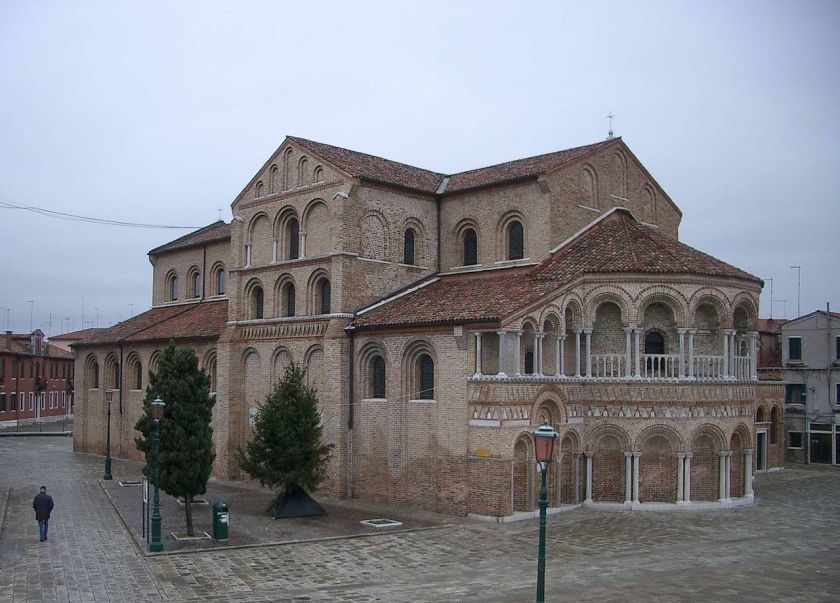
In 1125, some of Donatus’ relics (and those of the alleged dragon said to have been killed by the saint) were brought to the Church of Santa Maria and San Donato on the island of Murano, near Venice.
Church of Santa Maria and San Donato on the island of Murano, near Venice.
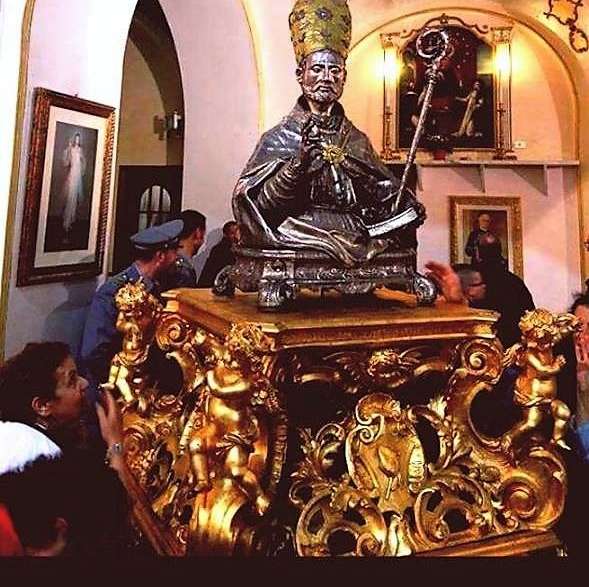
A large silver reliquary bust of Donatus from the 13th century is now found in the National Museum at Naples.
The Patron Saints of Guardiagrele are Donatus of Arezzo and Saint Emidius. Annually between 6 and 8 August, there is a festival celebrating these saints in which the effigy of Donatus is paraded around the streets of Guardiagrele.
In the Cathedral dedicated to St Donatus and where some of his relics lie together with a Shrine to him, there is a magnificent “Arch” depicting his life and miracles.
St Afra of Augsburg
Bl Agathangelus Nourry St Albert of Trapani O.Carm. (c 1240-1307) His Life: https://anastpaul.com/2019/08/07/saint-of-the-day-7-august-saint-albert-of-trapani-o-carm-c-1240-1307/
Bl Cassian Vaz Lopez-Neto
St Claudia of Rome
St Donat
St Donatian of Chalons-sur-Marne St Donatus of Arezzo (Died 362) Bishop and possibly a Martyr
St Donatus of Besancon
Bl Edmund Bojanowski
Bl Edward Bamber
St Faustus of Milan
St Hilarinus of Ostia
St Hyperechios
Bl John Woodcock
Bl Jordan Forzatei
St Julian of Rome
St Miguel de la Mora
Bl Nicholas Postgate
St Peter of Rome
Bl Thomas Whitaker
Bl Vincent de L’Aquila
St Victricius of Rouen
—
Martyred Deacons of Rome – 6 saints: A group of deacons who were martyred with Pope Saint Sixtus II. We know nothing about them but their names and their deaths – Agapitus, Felicissimus, Januarius, Magnus, Stephen and Vincent. They were
beheaded on 6 August 258 in a cemetery on the Appian Way, Rome, Italy.
Martyrs of Como – 6 saints: A group of Christian soldiers in the imperial Roman army. Martyred in the persecutions of Maximian. We know little else but the names – Carpophorus, Cassius, Exanthus, Licinius, Secundus and Severinus. c.295 on the north side of Lake Como, near Samolaco, Italy. Their relics in the church of San Carpoforo, Como, Italy.
Martyred in the Spanish Civil War: 10 Beati
Bl Dalmacio Bellota Perez
Bl Diodorus Hernando Lopez
Bl Francisco Gargallo Gascón
Bl Luis Villanueva Montoya
Bl María del Carmen Zaragoza y Zaragoza
Bl María Rosa Adrover Martí
Bl Rafaél Severiano Rodríguez Navarro
Bl Tomás Carbonell Miquel
Thought for the Day – 6 August – Meditations with Antonio Cardinal Bacci (1881-1971)
How to Remain Aware of the Presence of God
“It is useful to consider the ways in which we can develop a constant and effective awareness of the Presence of God. The first way in which we can do this, is by cultivating a lively faith, which will help us to see God everywhere. “Do not I fill heaven and earth, saith the Lord?” (Jer 23:24).
This kind of faith should deepen our sense of God’s Presence and inspire in us sentiments of love and gratitude, which will guide us in all our actions. We cannot expect that we shall be able to remain in a state of constant contemplation of God, for this is the privilege enjoyed by the blessed in Heaven, for whom faith has been replaced by the Beatific Vision. We must be satisfied with exciting in ourselves, as often as possible, the active awareness of God’s Presence. This should be a quiet and peaceful process, not involving undue mental effort or anxiety.
We should be able to attend quite naturally to our work and other obligations and, we should be helped and consoled in this, by directing our thoughts to God from time to time, in order to offer ourselves to Him. This can easily be done by means of frequent ejaculatory prayer, by renewing, at regular intervals, our intention of doing everything for the love of God and by being prepared to endure, in complete acceptance of the Divine Will, all the hardships and trials of the day. Whenever it is possible moreover, we should escape from the care and confusion of the world into a quiet Church. Here we can kneel in the Real Presence of Jesus in the Blessed Eucharist and express, in intimate prayer, our love for Him and our desire to serve Him.”
Quote/s of the Day – 6 August – Feast of the Transfiguration of the Lord and the Memorial of Justus and Pastor – The Holy Martyred Children of Alcala de Henares in Spain (Died 304)
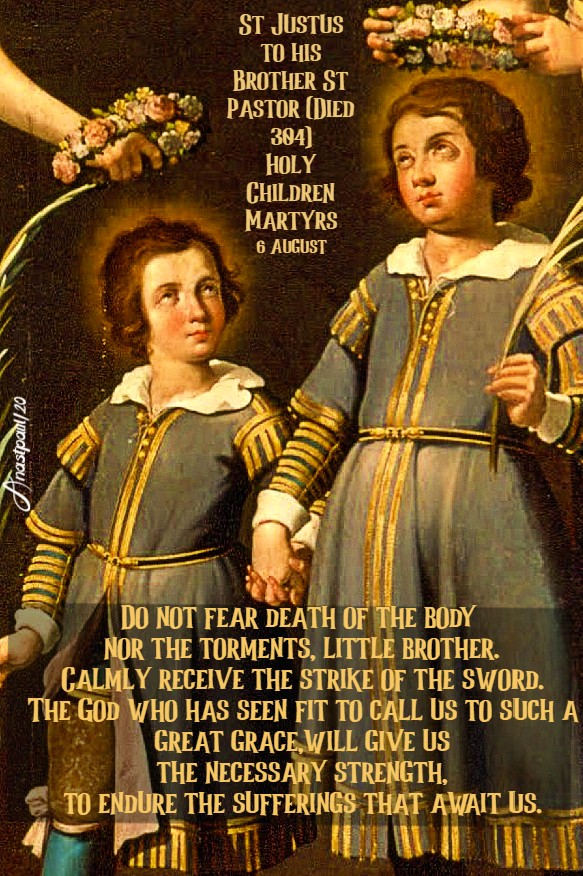
“Do not fear death of the body nor the torments, little brother. Calmly receive the strike of the sword. The God who has seen fit to call us to such a great grace, will give us the necessary strength, to endure the sufferings that await us.”
St Justus to his Brother St Pastor (Died 304) Holy Children Martyrs
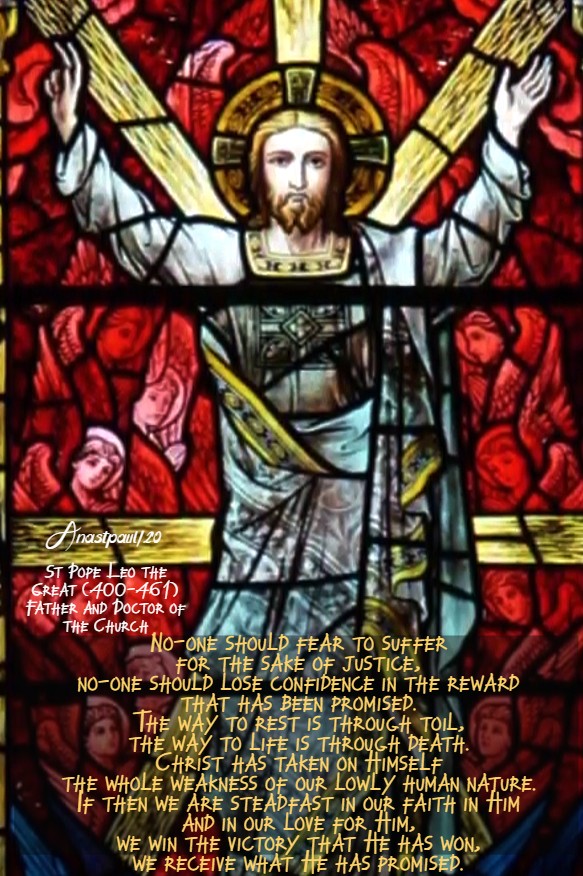
“No-one should fear to suffer for the sake of justice, no-one should lose confidence in the reward that has been promised. The way to rest is through toil, the way to life is through death. Christ has taken on Himself the whole weakness of our lowly human nature. If then we are steadfast in our faith in Him and in our love for Him, we win the victory that He has won, we receive what He has promised.”
St Pope Leo the Great (400-461)
Father and Doctor of the Church
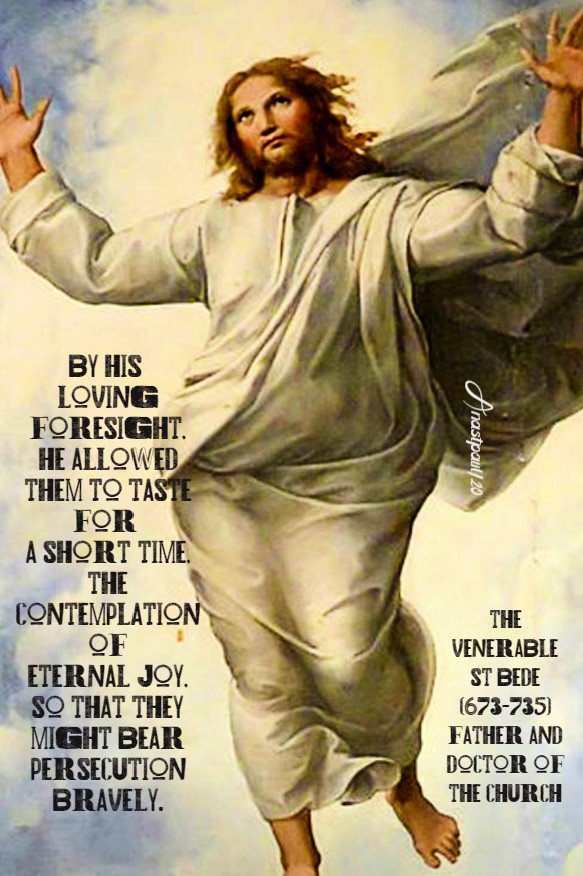
“By His loving foresight, He allowed them to taste for a short time, the contemplation of eternal joy, so that they might bear persecution bravely.”
The Venerable St Bede (673-735) Father and Doctor of the Church
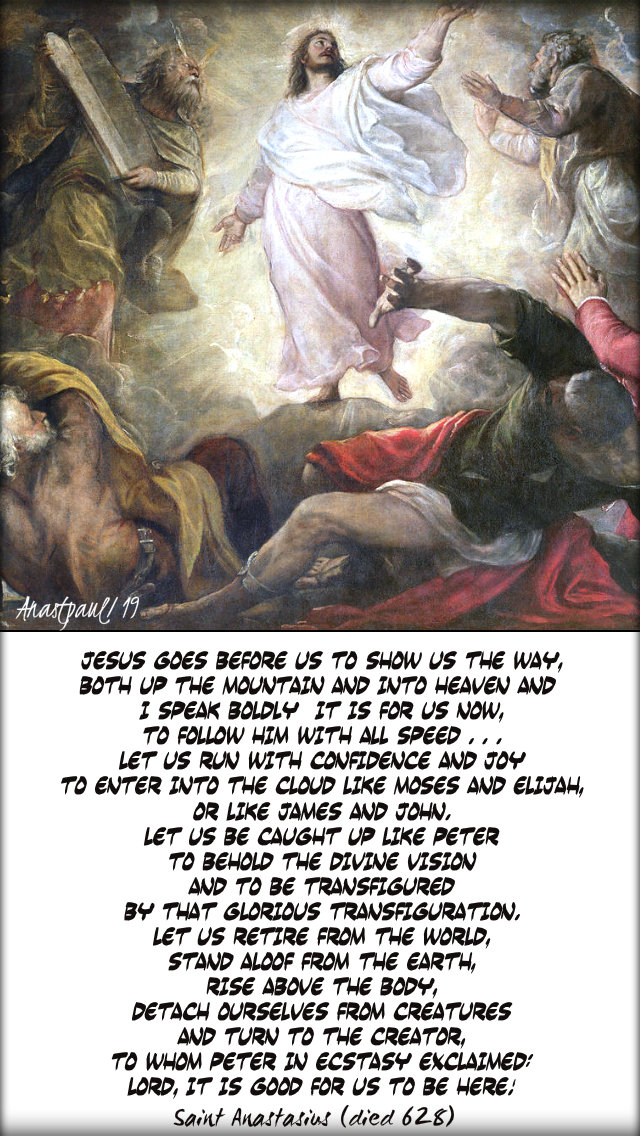
“Jesus goes before us to show us the way, both up the mountain and into heaven and — I speak boldly — it is for us now, to follow him with all speed . . . Let us run with confidence and joy to enter into the cloud like Moses and Elijah, or like James and John. Let us be caught up like Peter to behold the divine vision and to be transfigured by that glorious transfiguration. Let us retire from the world, stand aloof from the earth, rise above the body, detach ourselves from creatures and turn to the Creator, to whom Peter in ecstasy exclaimed: ‘Lord, it is good for us to be here.’”
St Anastasius (Died 628)
“At His Transfiguration Christ showed His disciples, the splendour of His beauty, to which He will shape and colour those who are His: ‘He will reform our lowness configured to the body of his glory.’”
St Thomas Aquinas (1225 – 1274) Doctor of the Church
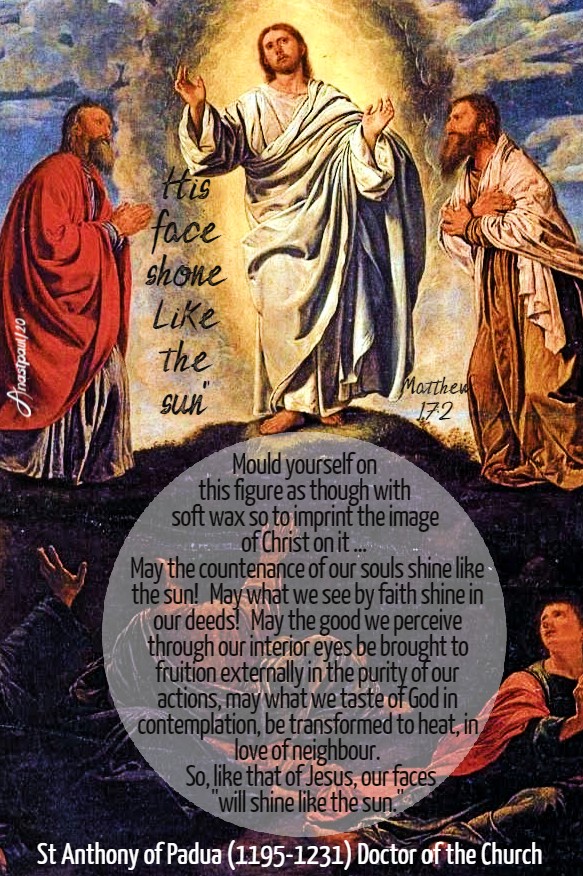
REFLECTION – “He was transfigured before them” (Mt 17:2). Mould yourself on this figure as though with soft wax so to imprint the image of Christ on it, of whom it is said: “His face shone like the sun and his clothes became white as snow.” In this passage you should keep in mind four things – the face, the sun, the clothing and the snow. In the front of the head, which is called a man’s face, there are three senses that are ordered and disposed in a wonderful way. These are sight, smell, taste. In the same sort of way, in the face of our souls, there are the vision of faith, the smell of discretion and the taste of contemplation. (…)
In the sun there is brightness, whiteness and heat. The brightness of the sun accords perfectly with the vision of faith that, together with the clarity of its light, perceives and believes invisible realities. May the countenance of our souls shine like the sun! May what we see by faith shine in our deeds! May the good we perceive through our interior eyes be brought to fruition externally in the purity of our actions, may what we taste of God in contemplation, be transformed to heat, in love of neighbour. So, like that of Jesus, our faces “will shine like the sun.” … St Anthony of Padua (1195-1231) Doctor of the Church – Sermon for Septuagesima Sunday
PRAYER – Father, at the Transfiguration in glory of Your only-begotten Son, You confirmed the mysteries of faith by the witness to Jesus of the prophets Moses and Elijah. You foreshadowed what we shall be when You bring our sonship to its perfection. Grant that by listening to the voice of Jesus, we may become heirs with Him, who lives and reigns with You and the Holy Spirit, God forever and may Mary, our tender and caring Mother, help us to be bright rays of the saving light of her Son Jesus. Amen
Our Morning Offering – 6 August – “Month of the Immaculate Heart of Mary”- Feast of the Transfiguration of the Lord
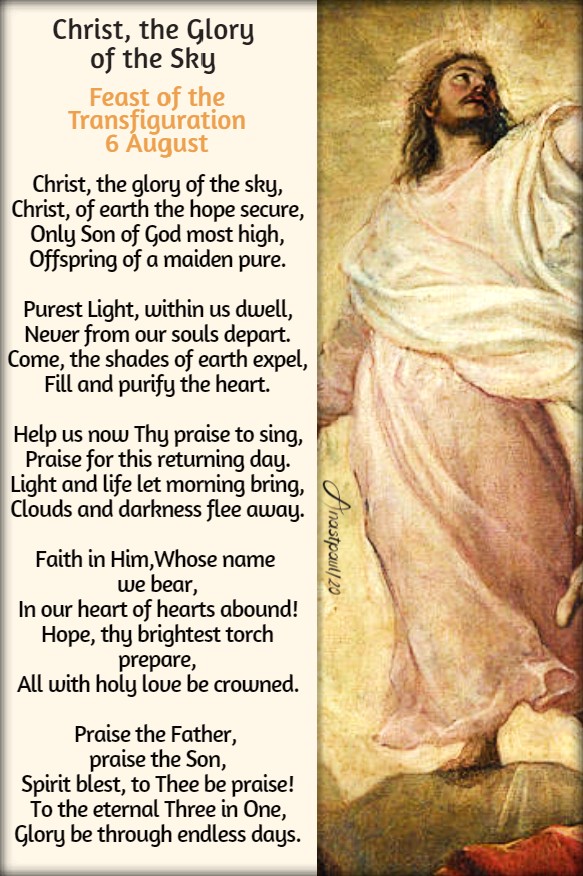
Christ, the Glory of the Sky By Fr Angelus Silesius (1624-1677) Trans Robert Campbell (1814-1868)
Christ, the glory of the sky,
Christ, of earth the hope secure,
Only Son of God most high,
Offspring of a maiden pure.
Purest Light, within us dwell,
Never from our souls depart.
Come, the shades of earth expel,
Fill and purify the heart.
Help us now Thy praise to sing,
Praise for this returning day.
Light and life let morning bring,
Clouds and darkness flee away.
Faith in Him,Whose name we bear,
In our heart of hearts abound!
Hope, thy brightest torch prepare,
All with holy love be crowned.
Praise the Father, praise the Son,
Spirit blest, to Thee be praise!
To the eternal Three in One,
Glory be through endless days.
Fr Angelus Silesius ( c 1624 – 9 July 1677), born Johann Scheffler and also known as Johann Angelus Silesius, was a German Catholic Priest and Physician, known as a Mystic and religious poet.
Robert Campbell (19 December 1814 – 29 December 1868) was a Scottish advocate and hymn writer. Brought up as a Presbyterian, he later joined the Roman Catholic Church. He translated the Latin texts of various hymns and wrote many others. He is remembered for such hymns as “At the Lamb’s high feast we sing”, “Come, pure hearts, in sweetest measures”, “Ye Choirs of New Jerusalem” and “Ye servants of a martyr’d God” which all appeared in the first edition of Hymns Ancient & Modern in 1861.
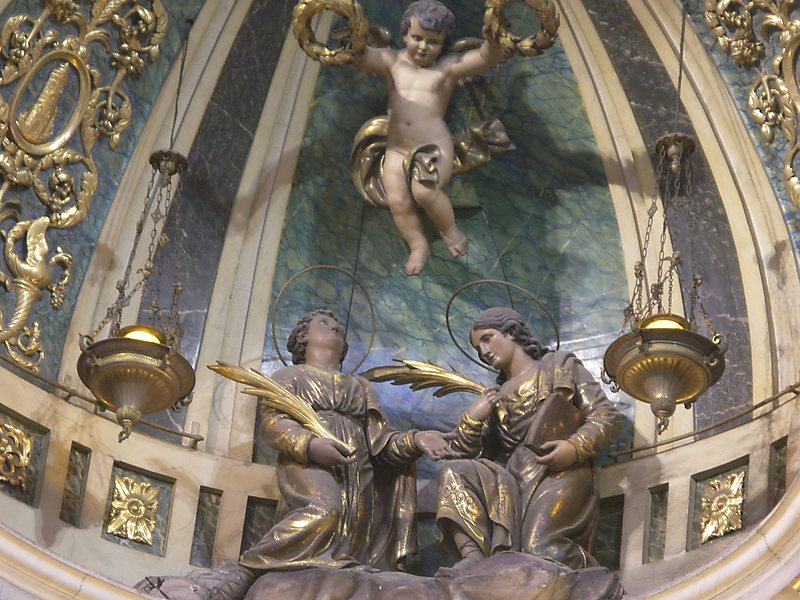
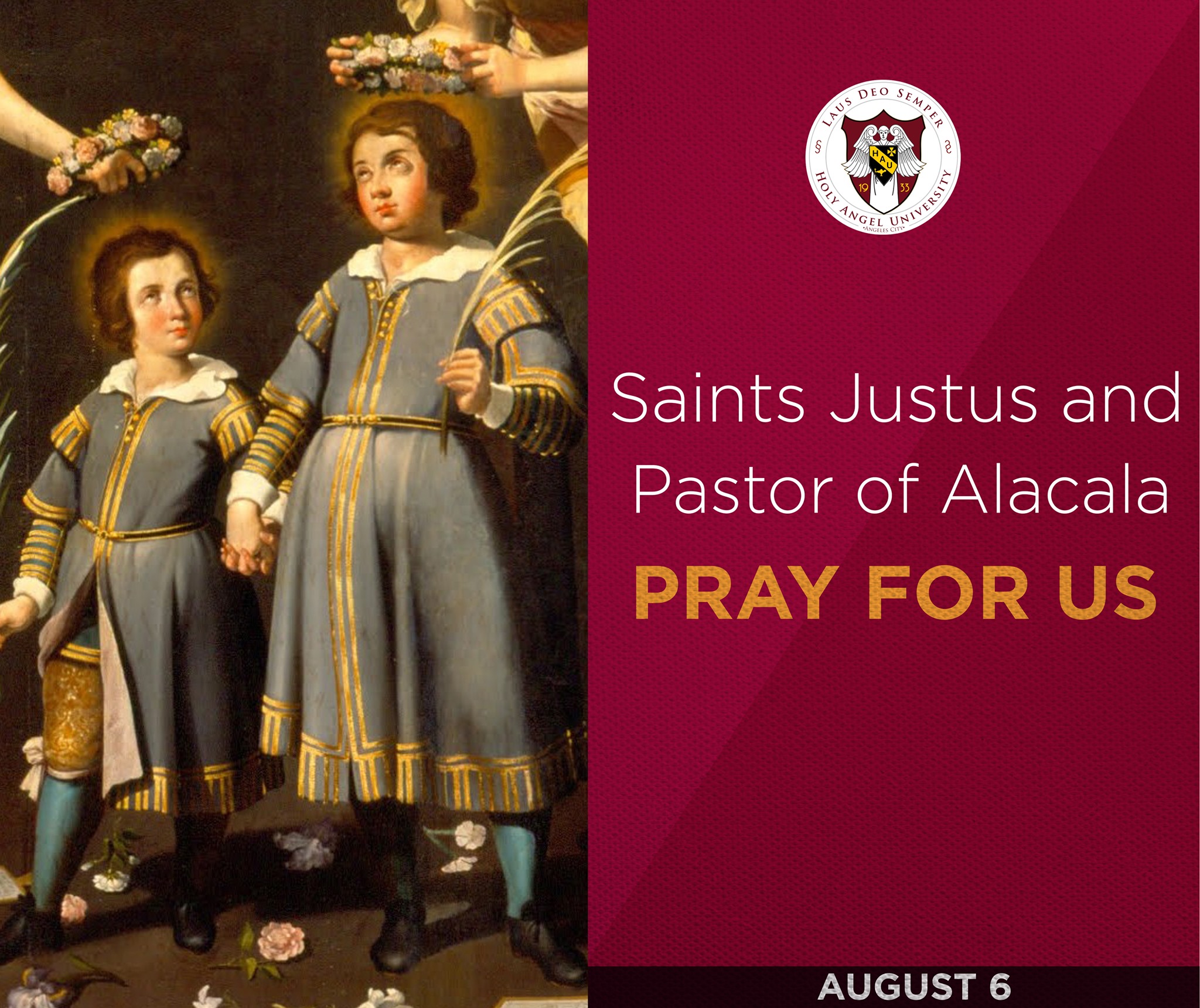
Saints of the Day – 6 August – Saints Justus and Pastor – The Holy Martyred Children of Alcala de Henares in Spain. (Died 304). Born c 295-297 in Spain and died by being scourged and beheaded in 304 at Alcala, Spain at ages 9 and 7. Patronage – Alcalá de Henares; Diocese of Alcalá and Madrid. Saints Justus and Pastor of Alcala were two brothers, who in their tender age overcame, with an heroic courage, the rage and power of Dacian, armed with all the instruments of cruelty.
“Do not fear death of the body nor the torments, little brother. Calmly receive the strike of the sword. The God who has seen fit to call us to such a great grace will give us the necessary strength to endure the sufferings that await us.”
During the Roman Empire, Christians were subjected to numerous persecutions, the harshest of which was perhaps the persecution of the emperor Diocletian in the fourth century. Instigated by Galerius, Diocletian promulgated the first edict against Christians on February 23 in the year 303 in Nicomedia, which demanded the destruction of Christian Churches and holy books and prohibited, that the faithful gather together, causing Christians, established in dignity to lose their honour. Following this first edict were three others – the second edict ordered the arrest and imprisonment of all clergy; the third granted the freedom of imprisoned clergy who apostatised and abandoned Christianity and harsh tortures for those who refused and the fourth obliged Christians to sacrifice to the gods of the Empire or suffer death.
To comply with the edict, the prefect Publius Dacianus was sent to Hispania (Spain) to cruelly and strictly enforce the imperial order. Christianity had taken strong root in Spain, clearly seen from the large number of Martyrs who shed their blood during the prefect’s rule. Among them are St Cucuphas, St Felix the “African,” St Pontius and St Narcissus, St Engracia and her eighteen companions, St Aquilina, etc.
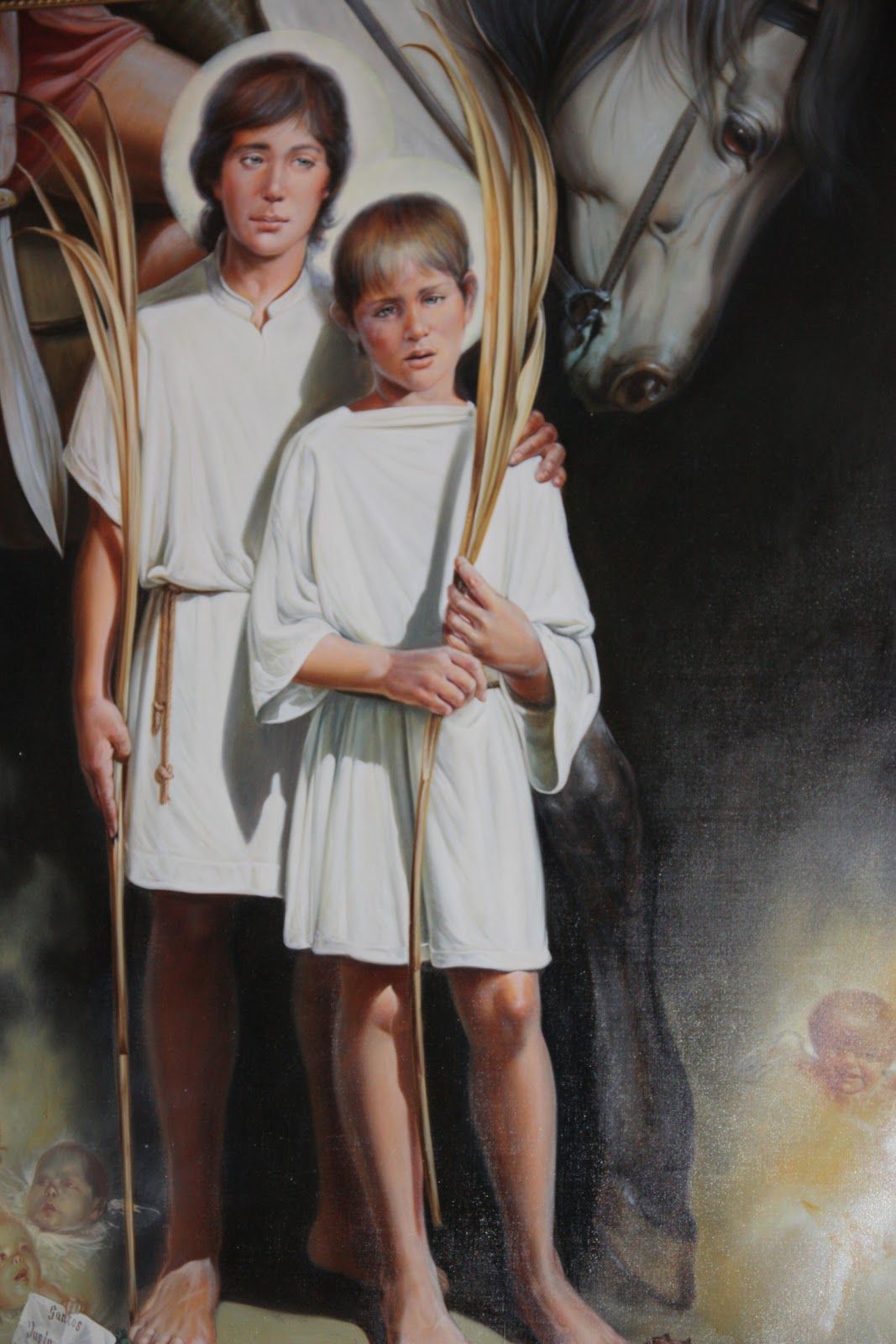
Dacianus reached Complutum, today known as Alcalá de Henares (Madrid) in August of the year 304. Complutum was founded during the first century in the valley of Henares. The city had an ideal central location and enjoyed great prosperity during the third and fourth centuries. In this city, the “holy children,” Justus and Pastor, won the palm of Martyrdom. Very little has been written about them but we do know that they were from a good and holy Christian family. We also know the circumstances of their Martyrdom. The liturgy mentions that they were 7 and 9 years old respectively.
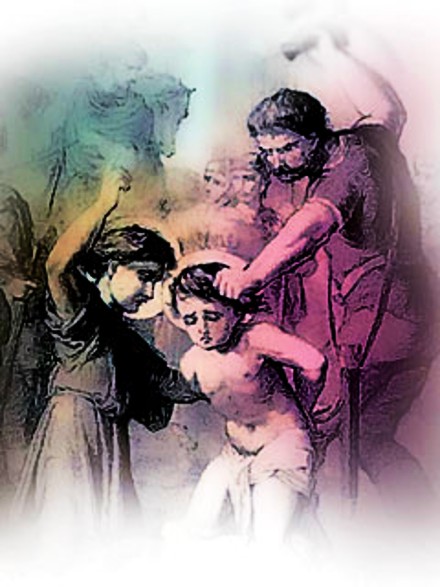
The most important part of the account of their Martyrdom has been passed on to us by tradition. When the imperial edict was made public in Complutum, the two brothers, Justus and Pastor, were at school. Stirred by an interior inspiration and an ardent desire to give their lives for Jesus Christ, they threw the slate tablets they used for writing on the ground and ran in haste to Dacianus’ residence with ardent hearts, ready to bear witness to their faith even to the point of Martyrdom. Despite their young age, the love of Christ had a profound effect in their hearts. They were unwilling to deny their God for anything in the world.
Upon seeing them so young, the doorkeepers thought they were playing but because the young boys insisted on seeing Dacianus, they were eventually taken to his presence. Before the prefect, they confessed firmly and with confidence that they were Christians and that they were unwilling to sacrifice to idols. In vain, the prefect tried to win them over with gifts and appeasements but seeing that he was unable to persuade them, he ordered them to be flogged with rods. The punishment was so severe that the two boys ended up bathed in blood.
The bodies of the children were battered but their souls were anchored in God and their fortitude left those who contemplated them in awe. Justus and Pastor knew well in whom they had believed (cf. 2 Tim 1:12) and desired nothing other than to find the One who first loved them and said, “Let the little children come to Me and do not prevent them” (Mt 19:14). Full of anger and fearful of the courageous example the holy children could give to Christians, Dacianus ordered the executioners to take them out of the city and behead them.
Centuries later, St Isidore of Seville wrote concerning their Martyrdom: “While they were taken to the place of torment, the two little lambs mutually encouraged one another. Justus, the youngest, fearful that his brother would falter, spoke to him thus, ‘Do not fear death of the body nor the torments, little brother. Calmly receive the strike of the sword. The God who has seen fit to call us to such a great grace will give us the necessary strength to endure the sufferings that await us.’ In reply, Pastor said, ‘You have spoken well, my brother. I will gladly accompany you in Martyrdom to gain the glory of this combat.’”
On a stone. in a field outside the city walls of Complutum, later known as Campo Loable or Laudable (Praiseworthy or Laudable Field), the children’s Martyrdom took place. Justus was the first to be beheaded followed by Pastor. Laudate pueri Dominum!Children, praise the Lord!The sacrifice was accomplished. The inhabitants of Complutum zealously guarded the place of the Martyrdom as well as the Martyrs’ remains and later built a chapel over their burial place to honour their memory.
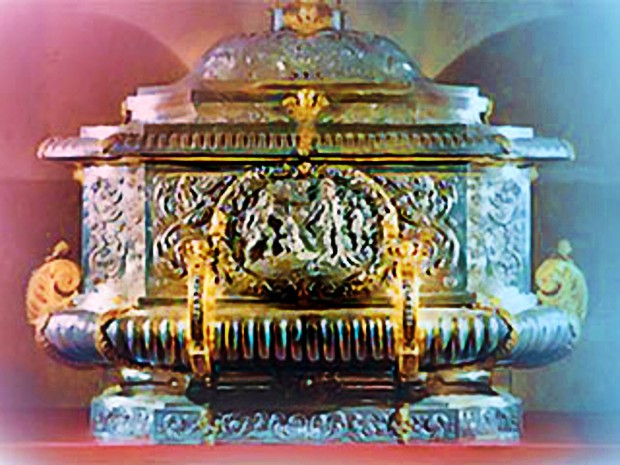
Fearful of what the Muslims could do, in the year 760 St Urbez transferred the relics of the “holy children” to the hermitage of Santa Maria, a remote place in the Valley de Nocito. Later on, they were transferred to San Pedro el Viejo in Huesca.
The Urn containing the Relics of the Holy Children Martyrs, Sts Justus and Pastor
In 1567, St Pius V promulgated a papal bull in which he ordered part of the relics of Saints Justus and Pastor to be taken from Huesca to Alcalá de Henares, the city of their birth and Martyrdom. In November of that same year, Philip II and his son prince Charles sent letters addressed to the Bishop of Huesca so that the Pope’s order could be fulfilled. Thus, part of the relics of Saints Justus and Pastor were sent to the city of Alcalá de Henares where the “Holy Children” were considered patrons.
How did the children Justus and Pastor have the strength to face Martyrdom? God Himself vested them with fortitude and made them ready for battle against the forces of evil, “the grace of God led the conflict against Him and delivered the weak and set them as firm pillars, able through patience to endure all the wrath of the evil one. They joined battle with Him, undergoing all kinds of shame and injury. Regarding their great sufferings as little, they hastened to Christ, revealing truly that ‘the sufferings of this present time are not worthy to be compared with the glory which shall be revealed to us.'” (Eusebius of Caesarea-Bishop and Historian). The power of God is fully made manifest in weakness.
Below is the Basilica of Sts Justus and Pastor in Alcala, Spain
Bl Gezelin of Schlebusch
St Gislain of Luxemburg
St Glisente of Brescia
Bl Goderanno
Bl Guillermo Sanz
St Hardulf of Breedon St Pope Hormisdas (c 450-523) His Life: https://anastpaul.com/2019/08/06/saint-of-the-day-6-august-saint-pope-hormisdas-c-450-523/
St James the Syrian St Justus and St Pastor of Alcala – Holy Martyred Children (Died 304)
Bl Maria Francesca Rubatto
Bl Octavian of Savona
St Stephen of Cardeña
Bl Tadeusz Dulny
Bl William of Altavilla
—
Martyrs of Cardeña: Two hundred Benedictine monks at the Saint Peter of Cardegna monastery, Burgos, Spain who were martyred in the 8th century by invading Saracens. They were buried by local Christians in a nearby churchyard in Burgos, Spain and Beatified in 1603 by Pope Clement VIII (cultus confirmed).
Martyred in the Spanish Civil War: 10 Beati
• Blessed Alejandro Casare Menéndez
• Blessed Andrés Soto Carrera
• Blessed José González Ramos Campos
• Blessed José María Recalde Magúregui
• Blessed Juan Silverio Pérez Ruano
• Blessed Saturnino Ortega Montealegre
Thought for the Day – 5 August – Meditations with Antonio Cardinal Bacci (1881-1971)
Adoration of Jesus in the Blessed Sacrament
“Anyone who loves Jesus sincerely in the Sacrament of the Eucharist, must experience a pang of regret whenever he enters a Church and sees, that the spaces surrounding the Tabernacle are empty. Here and there, a few people may be praying before statues of Our Lady and of the Saints but, too often, there is nobody to worship Jesus in the Blessed Sacrament. Only the dim light of the Tabernacle lamp seems to be attempting to compensate in some small way, for the ingratitude of men. Yet, here is no mere image but the real living Jesus Who loves us and longs to shower His gifts upon us.
We are poor and He is rich; we are weak and He is strong. We are sinners and He wishes us to kneel repentant at His feet so that He may forgive us. We are bent beneath the weight of our cross, which seems too heavy for us to bear and He desires to lighten it by His grace. We are weary and worried and unable to find a friend who will fully understand and comfort us. But, if we go to Jesus, we shall find a Friend and a Comforter. “Come to me,” He says to us, “all you who labour and are burdened and I will give you rest. Take my yoke upon you and learn from me, for I am meek and humble of heart and you will find rest for your souls. For my yoke is easy and my burden light” (Mt 11:28-30). Let us kneel before Jesus in the Tabernacle and confide to Him, our worries, sorrows and desires. He will understand and enlighten us; He will strengthen our wavering resolution and inspire in our hearts, the divine love, which makes it easy to sacrifice ourselves for His sake.“
Quote/s of the Day – 5 August – “Month of the Immaculate Heart of Mary” – Wednesday of the Eighteenth Week in Ordinary Time and the Memorial of the Dedication of Mary Major
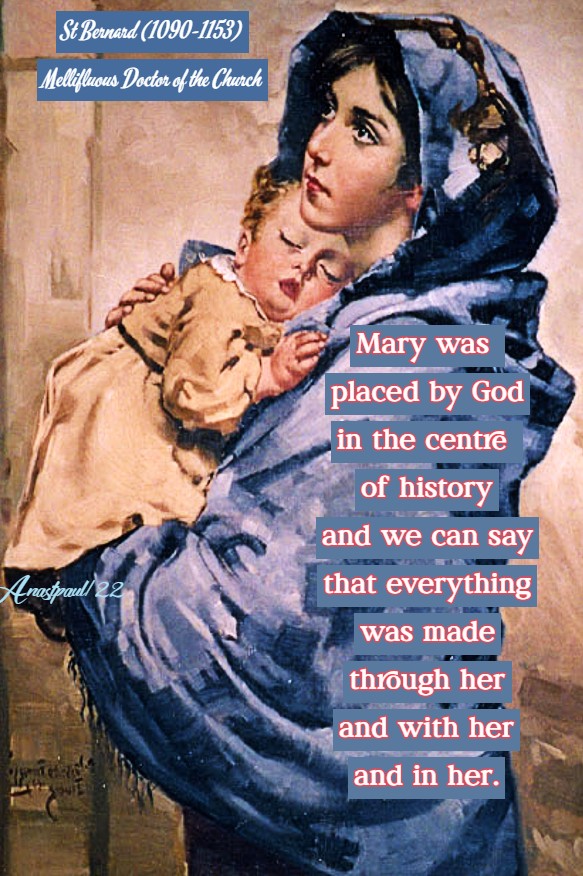
“Mary was placed by God in the centre of history and we can say, that everything was made through her and with her and in her.”
St Bernard (1090-1153) Doctor of the Church
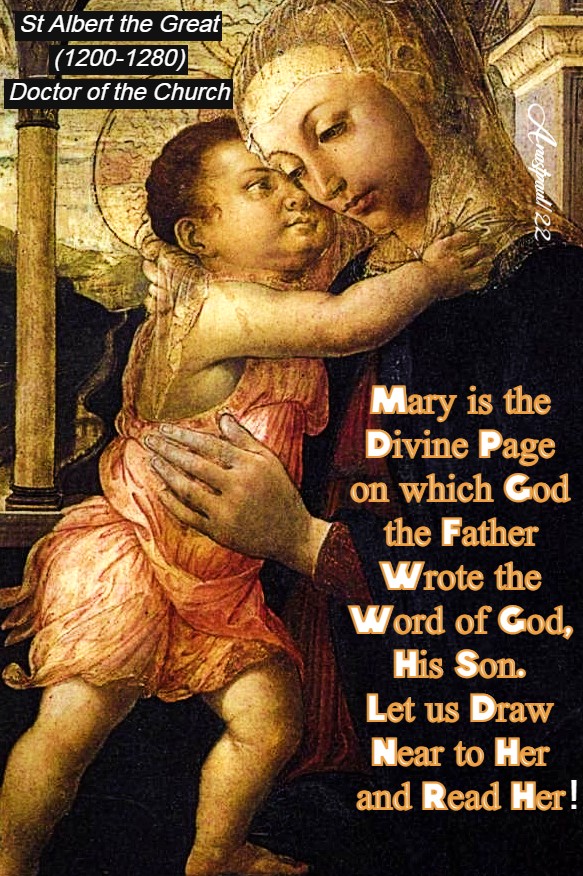
“Mary is the divine Page on which God the Father wrote the Word of God, His Son. Let us draw near to her and read her!”
St Albert the Great (1200-1280) Doctor of the Church
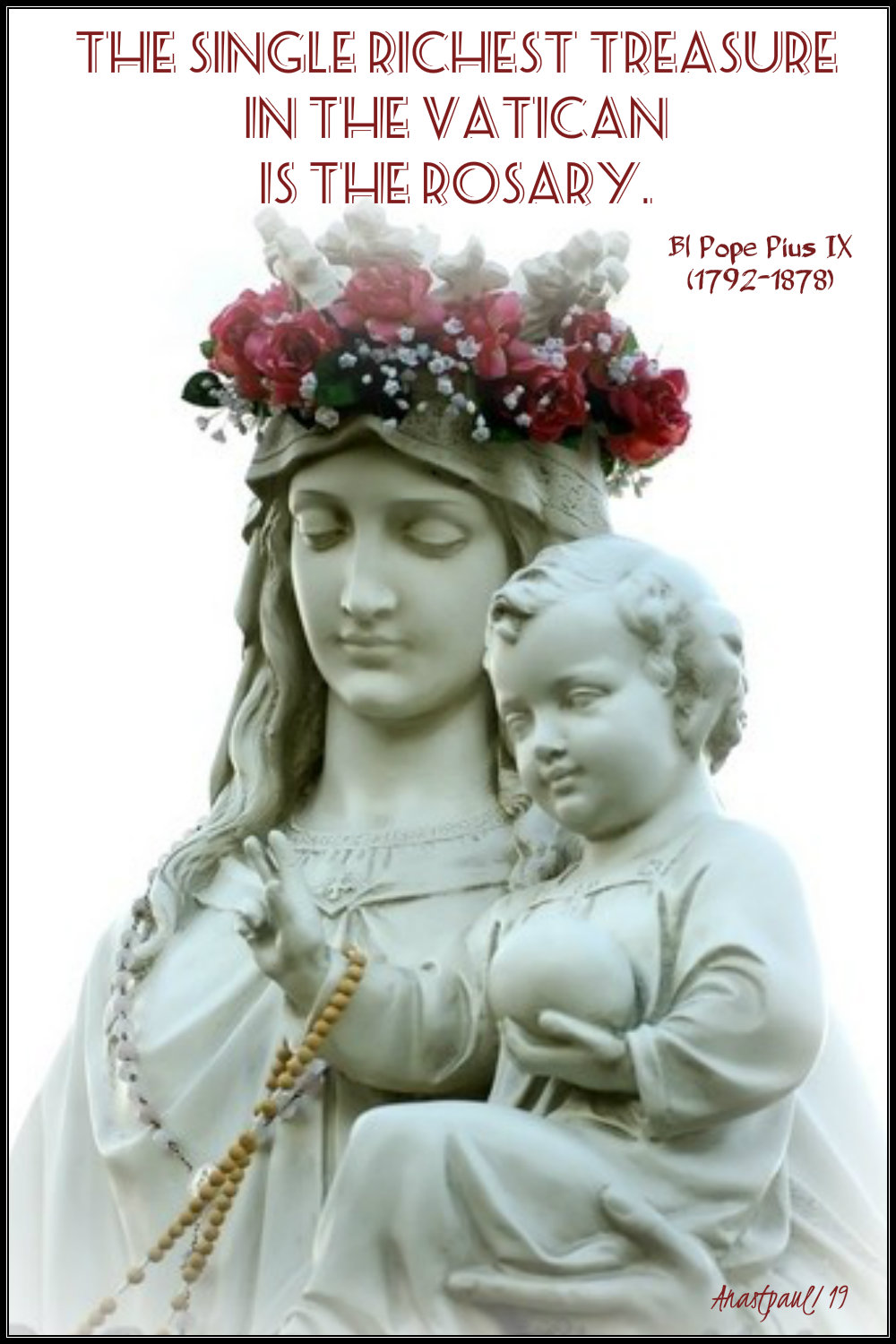
“The single richest treasure in the Vatican is the Rosary.”
Bl Pope Pius IX (1792-1878)
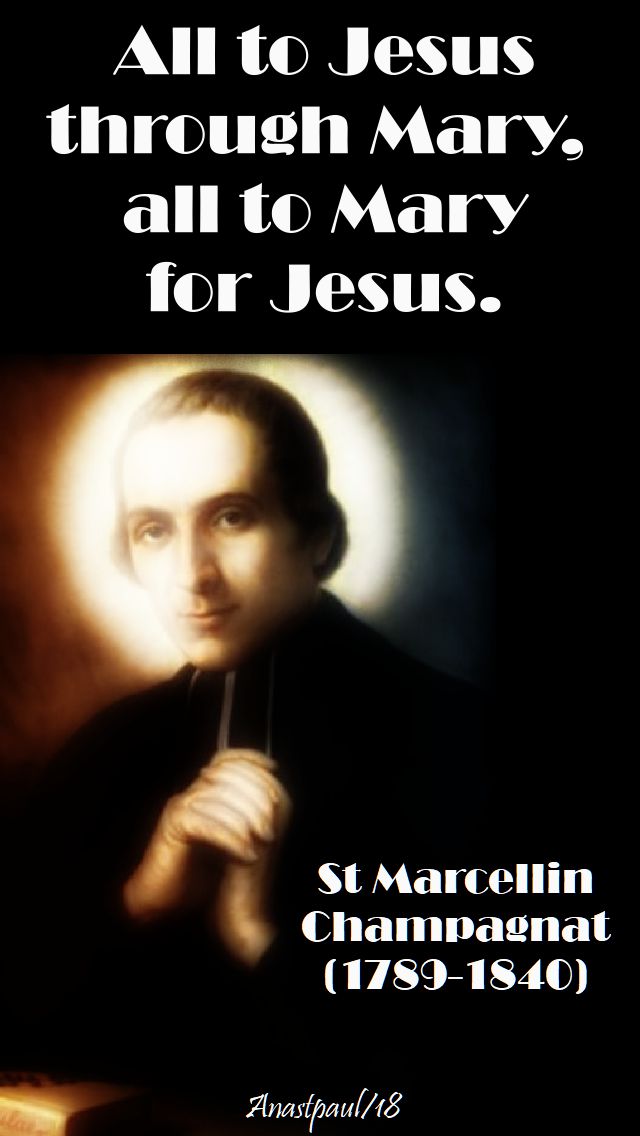
“All to Jesus through Mary, all to Mary for Jesus.”
St Marcellin Champagnat (1789-1840)
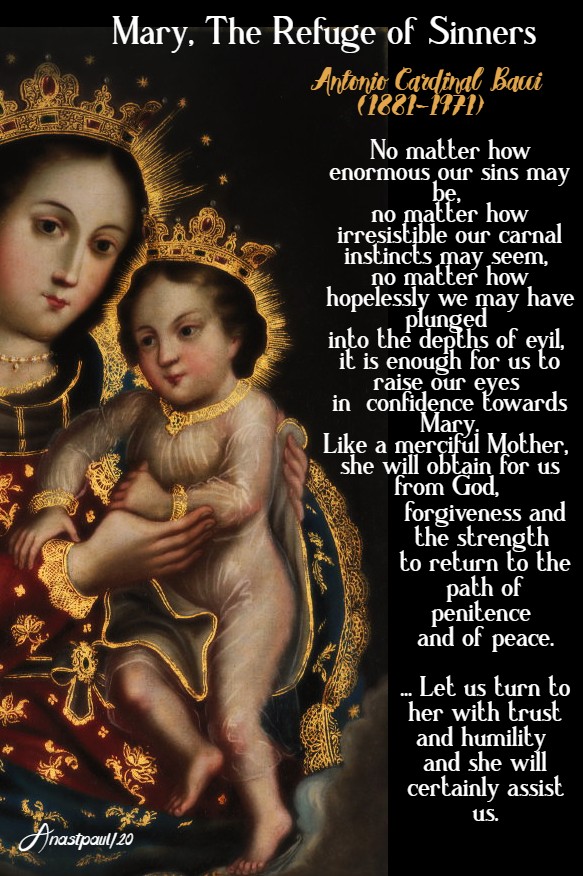
“No matter how enormous our sins may be, no matter how irresistible our carnal instincts may seem, no matter how hopelessly we may have plunged into the depths of evil, it is enough for us to raise our eyes in confidence towards Mary. … Like a merciful Mother, she will obtain for us from God, forgiveness and the strength to return to the path of penitence and of peace. … Let us turn to her with trust and humility and she will certainly assist us.”
One Minute Reflection – 5 August – “Month of the Immaculate Heart of Mary” – Wednesday of the Eighteenth Week in Ordinary Time, Readings: Jeremiah 31:1-7, Responsorial psalm Jeremiah 31:10-13, Matthew 15:21-28 and the Memorial of the Dedication of Mary Major
And Jesus went away from there and withdrew to the district of Tyre and Sidon. … Matthew 15:21
REFLECTION – “Jesus came out of Israel …: “Jesus went from that place and withdrew to the region of Tyre” (Mt 15:21), a name which means “gathering of the nations.”This was so, that, from among the people of that territory, those who believed might be saved when they came out from it.
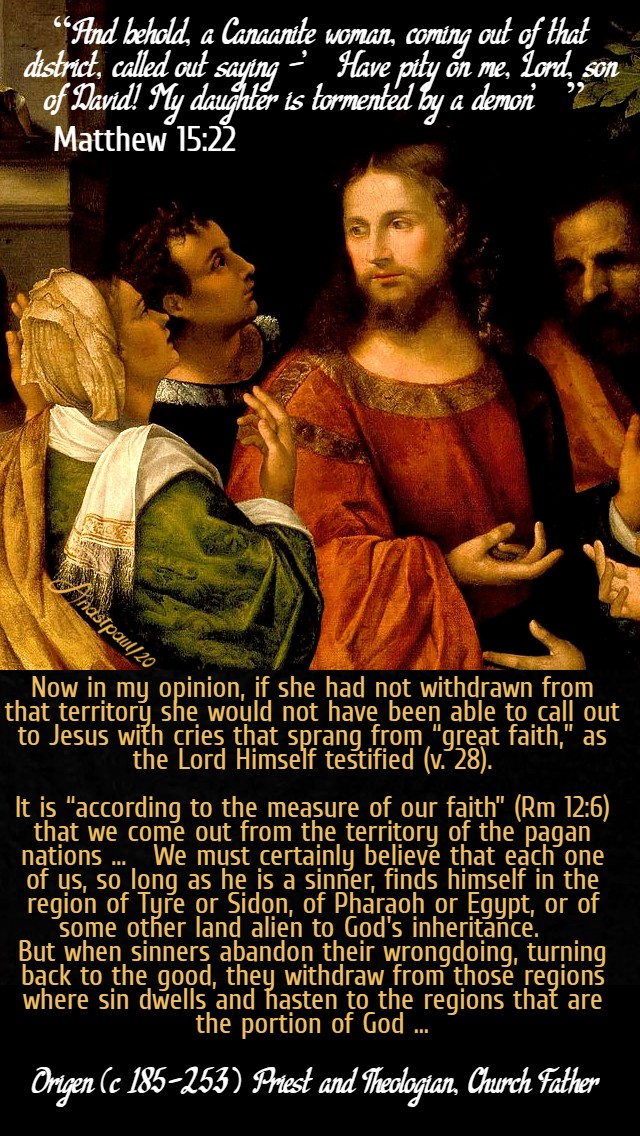
Now, pay attention to these words: “And behold, a Canaanite woman, coming out of that district, called out saying: ‘Have pity on me, Lord, son of David! My daughter is tormented by a demon’” (v. 22). Now in my opinion, if she had not withdrawn from that territory she would not have been able to call out to Jesus with cries that sprang from “great faith,” as the Lord Himself testified (v. 28).
It is “according to the measure of our faith” (Rm 12:6) that we come out from the territory of the pagan nations … We must certainly believe that each one of us, so long as he is a sinner, finds himself in the region of Tyre or Sidon, of Pharaoh or Egypt, or of some other land alien to God’s inheritance. But when sinners abandon their wrongdoing, turning back to the good, they withdraw from those regions where sin dwells and hasten to the regions that are the portion of God …
Notice, too, the sort of journey Jesus makes to meet the Canaanite woman, for he seems to be going towards the region of Tyre and Sidon …. The righteous are directed towards the kingdom of heaven and elevation into the Kingdom of God but sinners are directed towards the outcome of their evildoing …
The Canaanite woman, by leaving these territories, also left that tendency towards decadence, when she cried out and said: “Have pity on me, Lord, Son of David” … All the miracles accomplished by Jesus, as the evangelists have told them, took place, then, so that those who saw them might have faith. But those events are the symbol of what is always been brought about by Jesus’ power, for there is no age when what was written is not being realised in exactly the same way.” … Origen (c 185-253) Priest and Theologian, Church Father – Commentary on Saint Matthew’s gospel, Book XI, ch. 16
PRAYER – Forgive the sins of Your people Lord and since of ourselves, we are unable to do what pleases You, lead us on the way of salvation in Your divine Son who lives in us and gives us life. May the prayers of Mary, His Mother help us to constantly meditate on His eternal sustenance. He is our food, our Lord Jesus Christ, who lives and reigns with You and the Holy Spirit, God forever and ever, amen.
Our Morning Offering – 5 August – “Month of the Immaculate Heart of Mary” – Wednesday of the Eighteenth Week in Ordinary Time and the Memorial of the Dedication of Mary Major
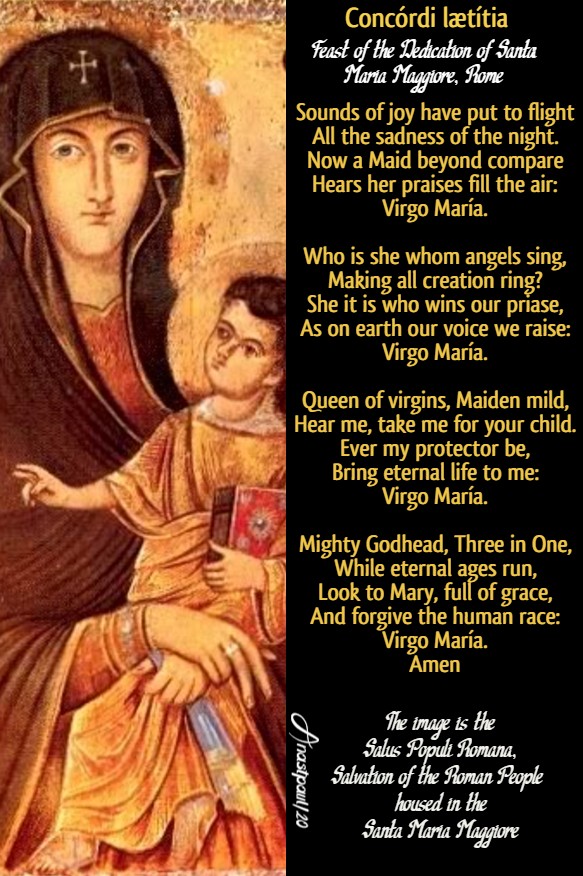
Concórdi lætítia Harmonious Joy
Sounds of joy have put to flight
All the sadness of the night.
Now a Maid beyond compare
Hears her praises fill the air:
Virgo María.
Who is she whom angels sing,
Making all creation ring?
She it is who wins our priase,
As on earth our voice we raise:
Virgo María.
Queen of virgins, Maiden mild,
Hear me, take me for your child.
Ever my protector be,
Bring eternal life to me:
Virgo María.
Mighty Godhead, Three in One,
While eternal ages run,
Look to Mary, full of grace,
And forgive the human race:
Virgo María.
Amen
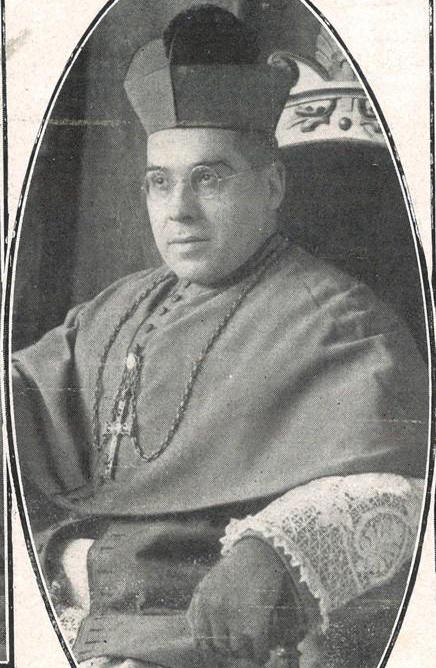
Saint of the Day – 5 August – Blessed Salvio Huix-Miralpeix CO Cong. Orat. (1877–1936) Bishop of Ibiza and later of Lleida, Catalonia and Martyr, Religious of the Congration of the Oratory of St Philip Neri, Professor of Theology, Apostle of the sick – born on 22 December 1877 in Santa Margarida de Vallors, Girona, Spain and died by being shot in the head on the morning of 5 August 1936 in a cemetery in Lleida, Spain.
Salvio Huix was born on 22 December 1877. His family, were fairly well-off and were more than ordinarily devout Catholics — daily Mass, Rosary, Visits to the Blessed Sacrament were built into the life of the family. There were always Priests visiting the home and there were quite a few Priests in the family, so it came as no real surprise, when young Salvio announced his intention to offer himself as a candidate for the Priesthood, leaving home for the local minor seminary at the age of 10. There, he excelled at his studies, not on account of any unusual intelligence but because of his tremendous application to his work. It was said by those who knew him that he would always do whatever was needed as well as he possibly could and, that he was an immensely practical sort of person, not given to day dreams or idling. The virtues noticed by his fellow students were to be those admired by his fellow Oratorians – his obedience, his joy and warm heartedness, his natural interest in others, his capacity for hard work and real leadership, while at the same time, shying away from any publicity. It must be said that this young man was also hot tempered and at times had difficulty in controlling his temper.
Salvio was Ordained Priest on 19th September 1903 and was sent to work as a country curate. He served in two rural Parishes but found there wasn’t work enough to absorb his energies; moreover, he wanted to be near people and to be active in the business of helping people become holy. It was this desire that lead him to enter the Oratory in Vich in 1907. He was then 30 years old.
What was life at the Oratory of Vich like? The fathers would rise each morning at 4:30am, except on Sunday and feast-days, when they would get up half an hour earlier. After an hour of mental prayer, they would go down to the Church to hear Confessions and after the last penitent was done, the fathers would say their Masses at one of the side-altars in the church. The afternoon was spent in the confessional, or working with one of the groups or sodalities which were attached to the church -Brothers of the Little Oratory, groups for young people etc. There were the sick to be visited and children to be catechised. Fr Huix became aware that there was nothing for young married men, who seemed to have no part in the life of the Church. Bl Salvio believed that a religion that attracted only women and children in large numbers was seriously deficient, so he started a confraternity for married men under the patronage of St Joseph. Both these men and the young ,he encouraged in the apostolate. He was anxious to get them working for the sick, not just by visiting them but by actually looking to their physical and material needs. He himself was unafraid to get his hands dirty and when he wasn’t busy in the Confessional or at the Seminary, where he was Professor of Mystical and Ascetical Theology, he was likely to be found tending the sick — washing them if needs be and changing their bed-linen.
In 1927, Fr Salvio, by now provost of the little community, was nominated Bishop of Ibiza. The island had been without a Bishop for 69 years and so his appointment was greeted with great joy. A photograph of his arrival shows the quay crowded with hundreds of cheering people. Even though his Episcopal Consecration (which took place 28 April that year) meant that Fr Huix would have to leave his Congregation, he remained very much a son of St Philip, even in the way he governed his Diocese. As Bishop he showed himself to be a very caring shepherd and very practical one too. Another photograph taken at a reception soon after his appointment as Bishop, shows him, his head inclined towards the person he is talking to, holding his hand, evidently interested in what he is saying. His clergy, he found, were extremely poor and so he organised a life insurance scheme which would guarantee them some security in their old age. He continued to encourage the laity in the social apostolate. He was very much a man for his people.
In 1931, Spain was declared a Republic and although the Spanish Bishops initially urged the faithful to co-operate with the Government, within a few weeks, things began to change and as the new order made itself felt. In Madrid and elsewhere, convents were pillaged and burned; the Jesuits were suppressed; the Archbishop of Toledo was expelled; all schools run by religious orders were closed. Cemeteries were secularised and Catholic burials were forbidden. All Crucifixes were ordered to be removed from the cemeteries. On Ibiza, men carried the great Crucifix from the cemetery to the Cathedral doors, where the Bishop himself shouldered the Crucifix and carried it to the sanctuary. Bl Salvio was unimpressed by the anti-religious laws and ideas and in his Lenten pastoral letter of 1932, he told his people that even though the dogs bark and the pigs grunt, the sun and the moon will continue to shine.
He remained Bishop of Ibiza for 8 years, when in 1935, he was translated to the more prestigious see of Lerida on the mainland. There he hoped to continue his pastoral programme but this was not to be, because within the year, the civil war broke out.
The Cathedral of Lerida
Between July 1936 and March 1937, there was an onslaught of violence against the Church, a few months in which thousands of people died. By the end of the war, it was reckoned that 6,832 priests and religious had been killed, 12 bishops and 283 religious sisters.
On 18 July there was a military uprising against the Republican government. Two days later, the city of Lerida was in the hands of republican forces, who burned the Cathedral and the Churches of the city, killing, in the course of several months, 80% of the Priests of the Diocese. The last photograph of Mgr Huix, taken in June of 1936, shows him flanked by the Priests he had just Ordained; within a month, all but one of those young men, together with their Bishop, were dead. One of his seminarians, aged about 15 was given a mock trial. The crowd shouted for his death and the ‘Judge’, so called, went through the motion of washing his hands, before condemning him to death. The boy was then beaten, stripped and nailed to a beam where he died.
On the night of the 21st July, after republicans had burned the Cathedral, they turned their attention to the Episcopal residence. Whilst they were beating down the doors, Huix, together with his Secretary, the porter and his daughter, confessed, consumed the Blessed Sacrament and escaped by the back door. He had, it seems, expected something of the sort to happen, since he kept a suitcase with a simple suit packed ready, just in case. At first, he took refuge in the house of the gardener but realising the danger to which he was exposing this man and his family, he gave himself up to the police. ‘I am the Bishop of Lerida,’ he said, ‘and I place myself under your protection.’ The police promptly handed him over to the republicans, who imprisoned him. Many of the leading people of the city were already in gaol, also a number of his clergy. All were struck by the Bishop’s cheerfulness and his continuing care for his flock. On St James’ feast, he was able to say Mass, using vessels that had been smuggled in to the prison. He administered Communion and heard Confessions.
Early in the morning (4:30am) on the 5th August, the feast of Our Lady of the Snows, the Bishop and 20 others were told that were going to be taken for trial at Barcelona. Once outside the city, the lorries stopped by the cemetery and the prisoners were instructed to get out. Realising they were about to be killed, the group all asked their Bishop for his blessing. This he gave, telling them, ‘Be brave, for within the hour we shall be reunited in the presence of the Lord.’He is said to have used a popular Catalan saying on reaching the end of a long journey: Ja soms a sants(We are saints). They then recited the Credo together and were made to dig their graves. One account tells that Mgr Huix was offered his life if he would abjure his faith. This he refused to do but asked one favour, that he might be the last to die. As each was killed, he blessed them. One of the militia men, objecting to this, shot him through the hand, he continued to bless with his left In a written testimony after the Martyrdom, the man who had administered the coup de grace to the dying, said how there was much blood and that the sinews of the Bishop’s arms were exposed through having been shot a number of times.
Blessed Salvio was not the only father of the Oratory to lose his life in the tragic events of the Civil War. Four fathers from Barcelona were murdered, five from Gracia and the Provost of Vich. May their blood and that of all the Martyrs, be the seed of a new spring in the life of the Church in his country and their intercession, the means of a true reconciliation and understanding. I have perhaps spoken at too great a length about Blessed Salvio , when it might well have sufficed to quote St Ambrose: ‘I have called him Martyr. I have said everything.’
Blessed Salvio was Beatified on 13 October 2013 by Pope Francis in Tarragona, Spain along with another 521 martyrs. His liturgical feast is kept today, 5 August.
Almighty and eternal God, who in your goodness bestowed on the Bishop and Martyr Salvio Huix, the gift of pastoral charity even to the point of shedding of his blood for Christ and His Church, bestow on us also, the grace to work faithfully in your vineyard and to experience his intercession in this life. Through Christ our Lord. Amen
Our Lady of Copacabana: A statue of the Blessed Virgin Mary standing four feet tall, made of plaster and maguey fibre and created by Francisco Tito Yupanqui. Except for the face and hands, it is covered in gold leaf, dressed like an Inca princess and has jewels on neck, hands and ears. There is no record of what the image looks like under the robes, the carved hair has been covered by a wig and the image never leaves the Basilica. On 21 February 1583 it was enthroned in an adobe church on the Peninsula of Copacabana, which juts into Lake Titicaca nearly 3 miles above sea level. In 1669 the Viceroy of Peru added a straw basket and baton to the statue, which she still holds today. The present shrine dates from 1805. The image was crowned during the reign of Pope Pius XI and it’s sanctuary was promoted to a Basilica in 1949. It has been the recipient of many expensive gifts over the years, most of which were looted by civil authorities in need of quick cash. Patronage – Bolivia, Bolivian navy.
St Abel of Rheims
St Addai
St Aggai of Edessa
Bl Arnaldo Pons
St Cantidianus
St Cantidius
St Cassian of Autun
St Casto of Teano
Bl Corrado of Laodicea
St Emidius of Ascoli Piceno
St Eusignius
St Gormeal of Ardoilen
Bl James Gerius
St Margaret the Barefooted
St Mari
St Memmius of Châlons-sur-Marne
St Nonna St Oswald of Northumbria (604-642) Martyr Biography: https://anastpaul.com/2019/08/05/saint-of-the-day-5-august-saint-oswald-of-northumbria-c-604-642-martyr/
St Paris of Teano
Bl Pierre-Michel Noël Blessed Salvio Huix-Miralpeix C.O. Cong Orat (1877–1936) Bishop and Martyr
St Sobel
St Theodoric of Cambrai-Arras
St Venantius of Viviers
St Viator
—
Martyrs of Fuente la Higuera: A group of Augustinian priests and clerics who were martyred together in the Spanish Civil War. 5 August 1936 in Fuente la Higuera, Valencia, Spain. They were Beatified on 28 October 2007 by Pope Benedict XVI.
10 Beati:
• Anastasio Díez García
• Ángel Pérez Santos
• Cipriano Polo García
• Emilio Camino Noval
• Felipe Barba Chamorro
• Gabino Olaso Zabala
• Luciano Ramos Villafruela
• Luis Blanco Álvarez
• Ubaldo Revilla Rodríguez
• Victor Gaitero González
Martyrs of the Salarian Way: Twenty-three Christians who were martyred together in the persecutions of Diocletian.
303 on the Salarian Way in Rome, Italy.
Martyred in the Spanish Civil War:
Bl Eduardo González Santo Domingo
Bl Jaume Codina Casellas
Bl José Trallero Lou
Bl Lluís Domingo Mariné
Bl Manuel Moreno Martínez
Bl Maximino Fernández Marinas
Bl Victor García Ceballos
Thought for the Day – 4 August – Meditations with Antonio Cardinal Bacci (1881-1971)
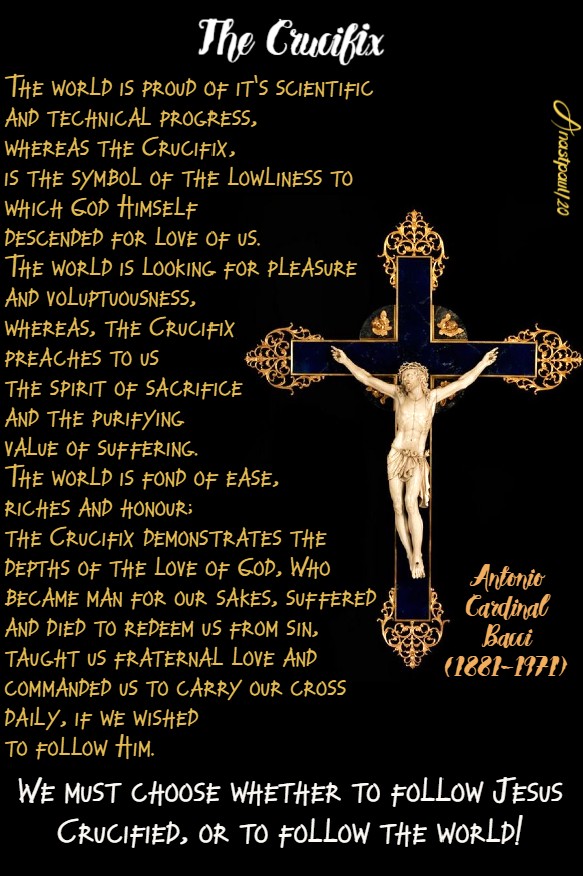
The Crucifix
“I determined not to know anything among you,” wrote St Paul to the Corinthians, “except Jesus Christ and him crucified” (1 Cor 2:2).
It was St Paul’s boast, that while the Jews were looking for signs and the Greeks were searching for wisdom, he continued to preach about Christ on the Cross. “The Jews ask for signs and the Greeks look for ‘wisdom’ but we, for our part, preach a crucified Christ – to the Jews indeed, a stumbling-block and to the Gentiles, foolishness” (1 Cor 1:22-23).
Christian doctrine and Christian living, are centred around Jesus Crucified.
Unfortunately, in modern times, as in the times of St Paul, the Crucifix is either ignored and forgotten, or attacked as a symbol of folly.
There is no need to be amazed at this.
When the holy old man, Simeon, took Jesus in his arms, he made the prophecy that this Child, would be “a sign that shall be contradicted” (Lk 2:34). The world is proud of it’s scientific and technical progress, whereas the Crucifix, is the symbol of the lowliness to which God Himself descended for love of us. The world is looking for pleasure and voluptuousness, whereas, the Crucifix preaches to us the spirit of sacrifice and the purifying value of suffering. The world is fond of ease, riches and honour; the Crucifix demonstrates the depths of the love of God, Who became man for our sakes, suffered and died to redeem us from sin, taught us fraternal love and commanded us to carry our cross daily, if we wished to follow Him.
We must choose whether to follow Jesus Crucified, or to follow the world! The world can only give us a vain and passing satisfaction, while the Crucifix can give us the peace of a good conscience, even in the midst of sorrow and trouble and the hope of lasting happiness in the next life.”
Quote/s of the Day – 4 August – The Memorial of St John Marie Baptiste Vianney (1786-1859)
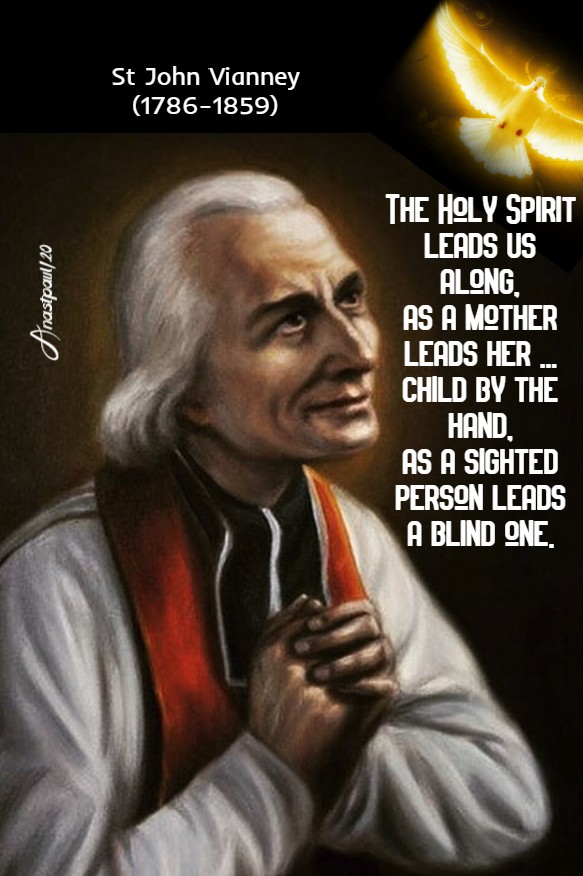
“The Holy Spirit leads us along, as a mother leads her two year old child by the hand, as a sighted person leads a blind one. We should say each morning: “Oh my God, send me Your Holy Spirit who will make me understand what I am and what you are …” A soul who possesses the Holy Spirit enjoys an exquisite taste in prayer, it never loses the holy presence of God.”
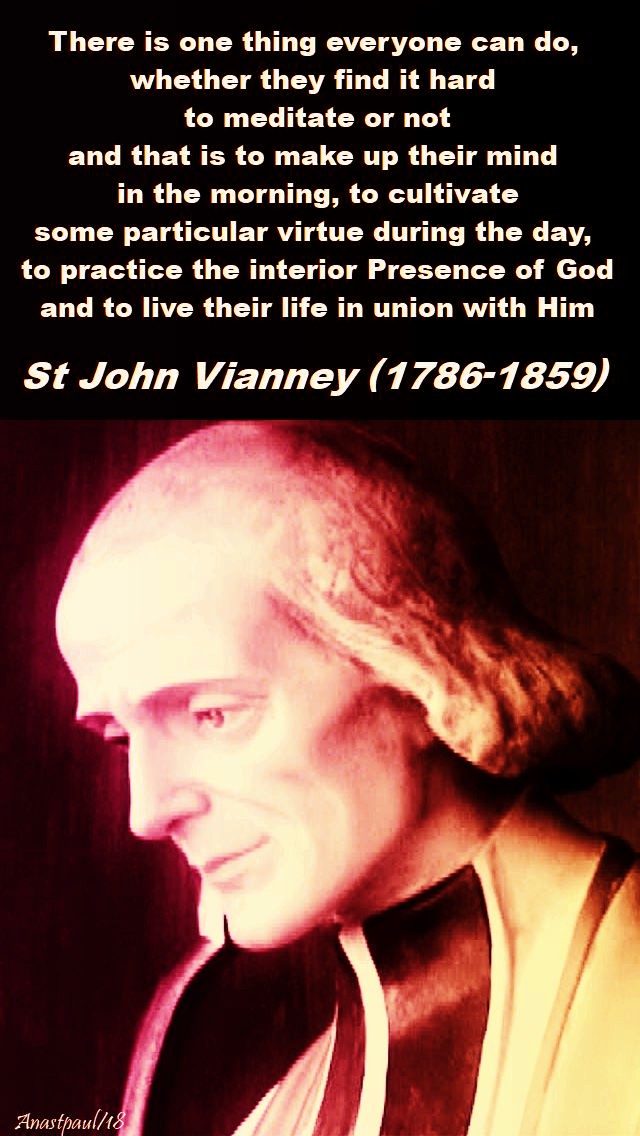
“There is one thing everyone can do, whether they find it hard to meditate or not and that is to make up their mind in the morning, to cultivate some particular virtue during the day, to practice the interior Presence of God and to live their life in union with Him.”
“The sign of the cross is the most terrible weapon against the devil. Thus the Church wishes not only, that we have it continually in front of our minds, to recall to us just what our souls are worth and what they cost Jesus Christ but also that we should make it at every juncture ourselves: when we go to bed, when we awaken during the night, when we get up, when we begin any action, and, above all, when we are tempted.”
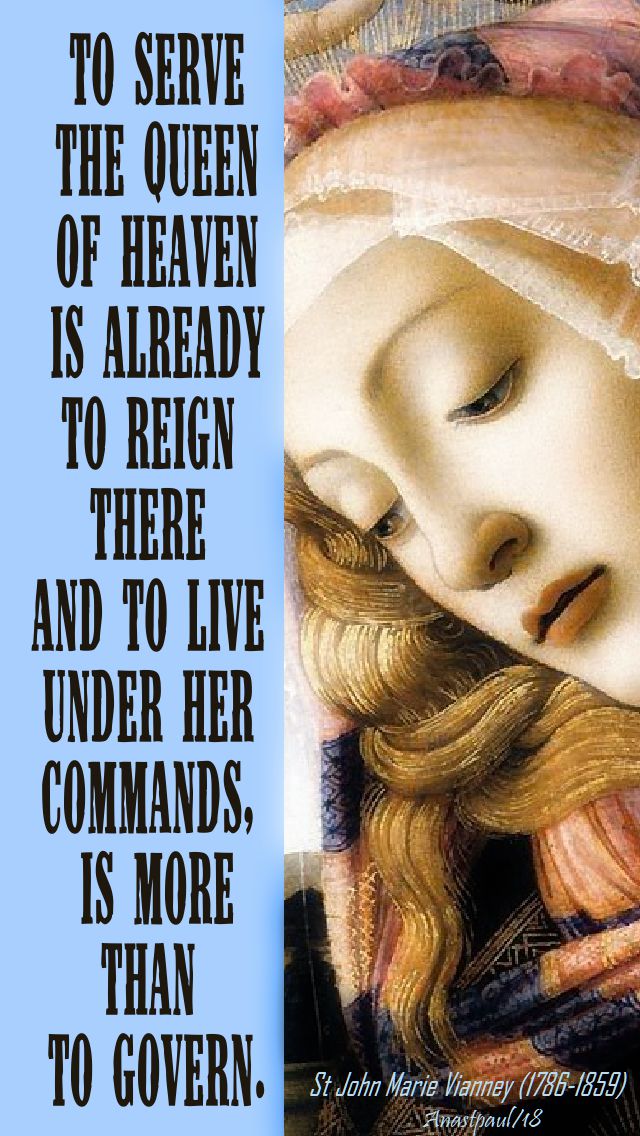
“To serve the Queen of Heaven is already to reign there and to live under her commands, is more than to govern.”
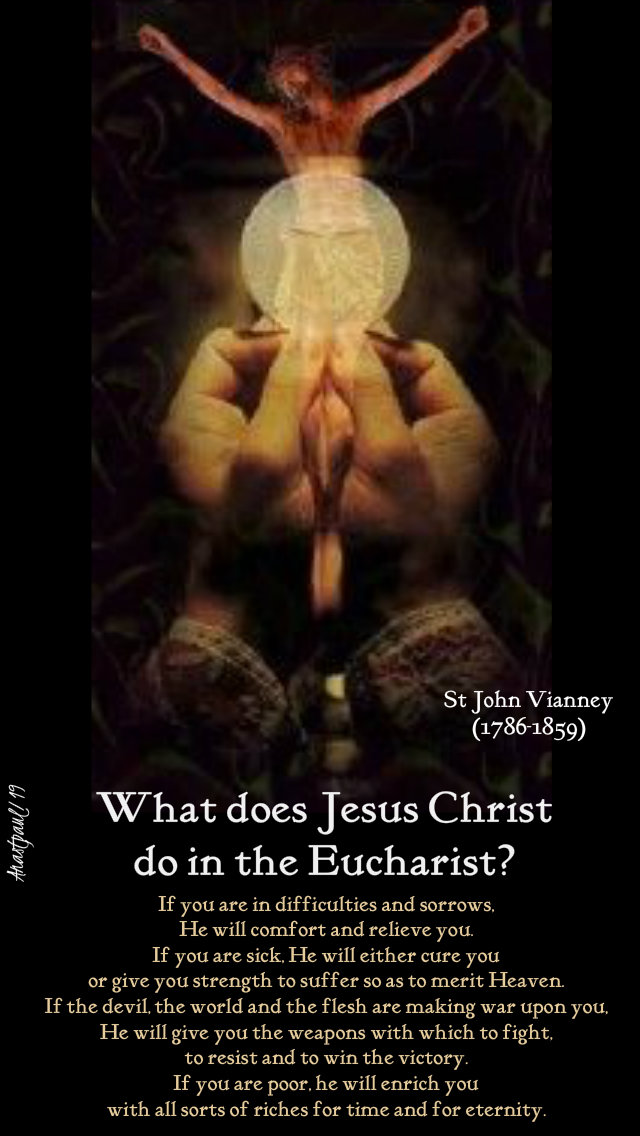
“What does Jesus Christ do in the Eucharist?
It is God, who, as our Saviour, offers Himself each day for us to His Father’s justice.
If you are in difficulties and sorrows, He will comfort and relieve you. If you are sick, He will either cure you or give you strength to suffer, so as to merit Heaven. If the devil, the world and the flesh are making war upon you, He will give you the weapons with which to fight, to resist and to win the victory. If you are poor, he will enrich you with all sorts of riches for time and for eternity. Let us open the door of His Sacred and Adorable Heart and be wrapped about for an instant, by the flames of His love and we shall see, what a God who loves us, can do. O my God, who shall be able to comprehend?”
“We should consider those moments spent before the Blessed Sacrament as the happiest of our lives.”
“We do not have to talk very much to pray well,” we know that God is there in His Holy Tabernacle. Let us open our hearts to Him, let us rejoice in His Sacred Presence. This is the best prayer.”
“When we cannot go to the church, let us turn towards the tabernacle; no wall can shut us out from the good God.”
One Minute Reflection – 4 August – “Month of the Immaculate Heart” – Tuesday of the Eighteenth week in Ordinary Time, Readings: Jeremiah 30:1-2, 12-15, 18-22, Psalm 102:16-21, 29, 22-23, Matthew 15:1-2,10-14 and The Memorial of St John Vianney (1786-1859)
“Let them alone; they are blind guides [of the blind]. If a blind person leads a blind person, both will fall into a pit.” … Matthew 15:14
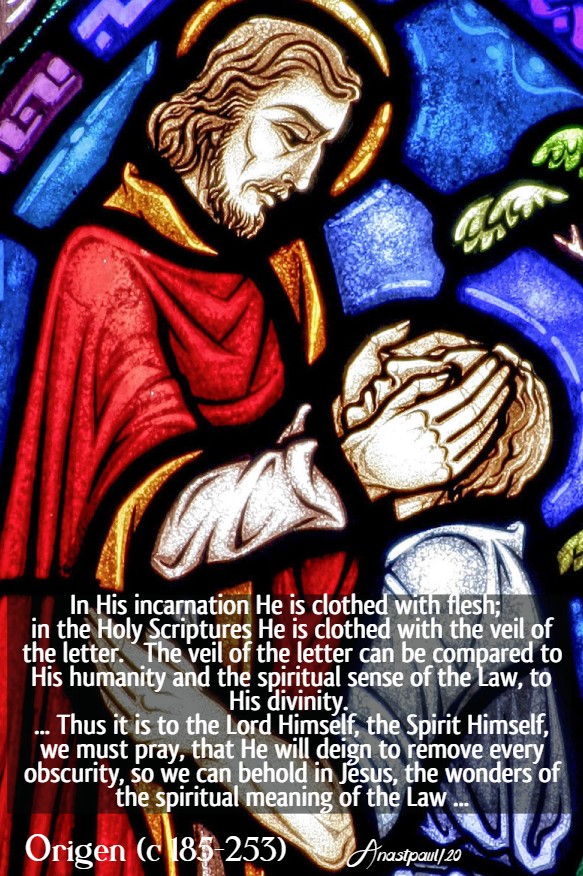
REFLECTION – “When, in these last days, the Word of God was born of Mary, clothed in flesh and revealed to the world, what was seen of Him was something other than the mind could discern. The appearance of His body was clear to all but knowledge of His divinity was only granted to some. Similarly, when the Word of God speaks to us through the Old Law and the prophets, He shows Himself beneath the veil of the appropriate garments.
In His incarnation He is clothed with flesh; in the Holy Scriptures He is clothed with the veil of the letter. The veil of the letter can be compared to His humanity and the spiritual sense of the Law, to His divinity. In the book of Leviticus we find the rites of sacrifice, the various sacrificial animals, the priestly liturgical service … blessed the eyes that discern the divine Spirit hidden beneath the veil …
“Whenever a person turns to the Lord the veil is removed … and, where the Spirit of the Lord is, there is freedom,” says the Apostle Paul (2 Cor 3:16-17). Thus it is to the Lord Himself, the Spirit Himself, we must pray, that He will deign to remove every obscurity, so we can behold in Jesus, the wonders of the spiritual meaning of the Law, like the man who said: “Open my eyes that I may see the wonders of your Law (Ps 119[118]:18).” … Origen (c 185-253) Priest and Theologian, Church Father – Homily 1 on Leviticus
PRAYER – Lord God, light of the faithful and shepherd of souls, who gave blessed John Vianney to Your Church to feed Your flock by his teaching and form them by his example, grant that by his intercession, we may keep the faith which he taught and follow in the way he walked, through our Lord Jesus Christ, in union with the Holy Spirit. St John Vianney, pray for us, amen.
Our Morning Offering – 4 August – “Month of the Immaculate Heart” – Tuesday of the Eighteenth week in Ordinary Time and The Memorial of St John Marie Baptiste Vianney (1786-1859)
St John Vianney’s prayer which is quoted in the CCC
I Love You, O My God By St John Marie Baptiste Vianney (1786-1859)
I love You,
O my God
and my only desire is to love You
until the last breath of my life.
I love You,
O my infinitely lovable God
and I would rather die loving You,
than live without loving You.
I love You, Lord
and the only grace I ask,
is to love You eternally
My God,
if my tongue cannot say
in every moment that I love You,
I want my heart to repeat it to You
as often as I draw breath.
Amen
Saint of the Day – 4 August – Saint Aristarchus of Thessalonica (1st Century) Convert and Disciple of Saint Paul the Apostle, first Bishop of Thessalonica, Martyr. Born in Thessalonica and died by being beheaded in the 1st century in Rome, Italy. Also known as • Aristarco • Aristarque • Arystarch.
He was one of those faithful companions of the Apostle Paul who shared with him his labours and sufferings. He is first mentioned along with Gaius as having been seized by the excited Ephesians during the riot stirred up by the silversmiths (Acts 19:29). They are designated “men of Macedonia, Paul’s companions in travel.”
We learn later that he was a native of Thessalonica (Acts 20:4; 27:2). They were probably seized to extract from them information about their leader Paul but when they could tell nothing and since they were Greeks, nothing further was done to them.
When Aristarchus attached himself to Paul we do not know but he seems to have remained in Paul’s company ever after the Ephesian uproar.
He was one of those who accompanied Paul from Greece via Macedonia (Acts 20:4). Having preceded Paul to Troas, where they waited for him, they travelled with him to Palestine. He is next mentioned as accompanying Paul to Rome (Acts 27:2). There he attended Paul and shared his imprisonment.
He is mentioned in two of the letters of the Roman captivity, in the Epistle to the Church at Colossae (4:10) and in the Epistle to Philemon (1:24), in both of which he sends greetings. In the former Paul calls him “my fellow-prisoner.”
According to tradition he was Martyred during the persecution of Nero. He is mentioned in the Roman Martyrology on 4 August. Aristarchus son of Aristarchus, a politarch of Thessalonica (39/38 BC).
St Agabius of Verona St Aristarchus of Thessalonica (1st Century) Convert and spiritual student of Saint Paul the Apostle, first Bishop of Thessalonica. Martyr.
St Crescentio of Rome
St Eleutherius of Bithynia
St Epiphanes of Besançon
St Euphronius of Tours
St Francesc Mercader Rendé Blessed Frédéric Janssoone OFM (1838-1916) “God’s Pedlar” “Good Father Frédéric” His Life:
St Hyacinth of Rome
St Ia of Persia
St Isidore of Besançon
St Lua of Limerick
St Onofrio of Panaia
St Perpetua of Rome
St Protasius of Cologne
St Rainerio of Split
St Sithney
St Tertullinus of Rome
Bl William Horne
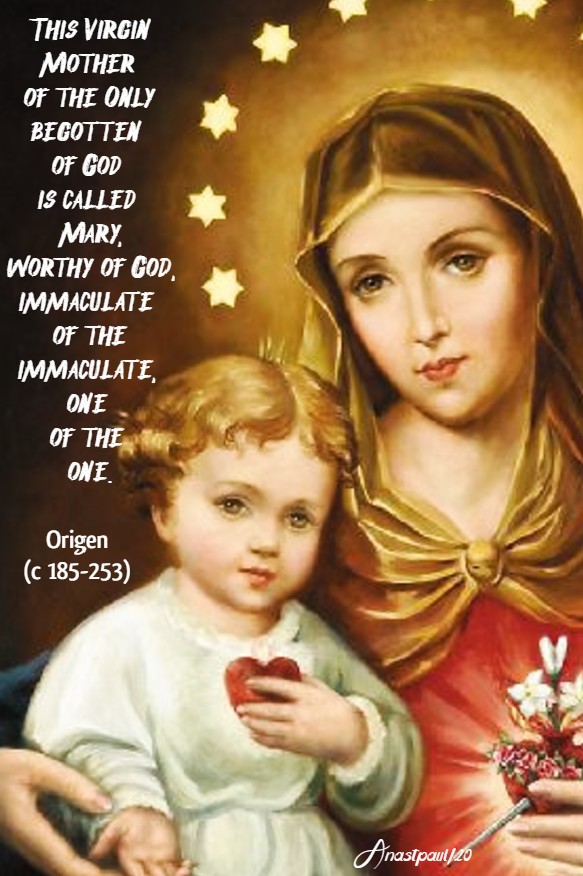
“This Virgin Mother of the Only begotten of God is called Mary, worthy of God, Immaculate of the Immaculate, one of the one.”
Origen (c 185-253)
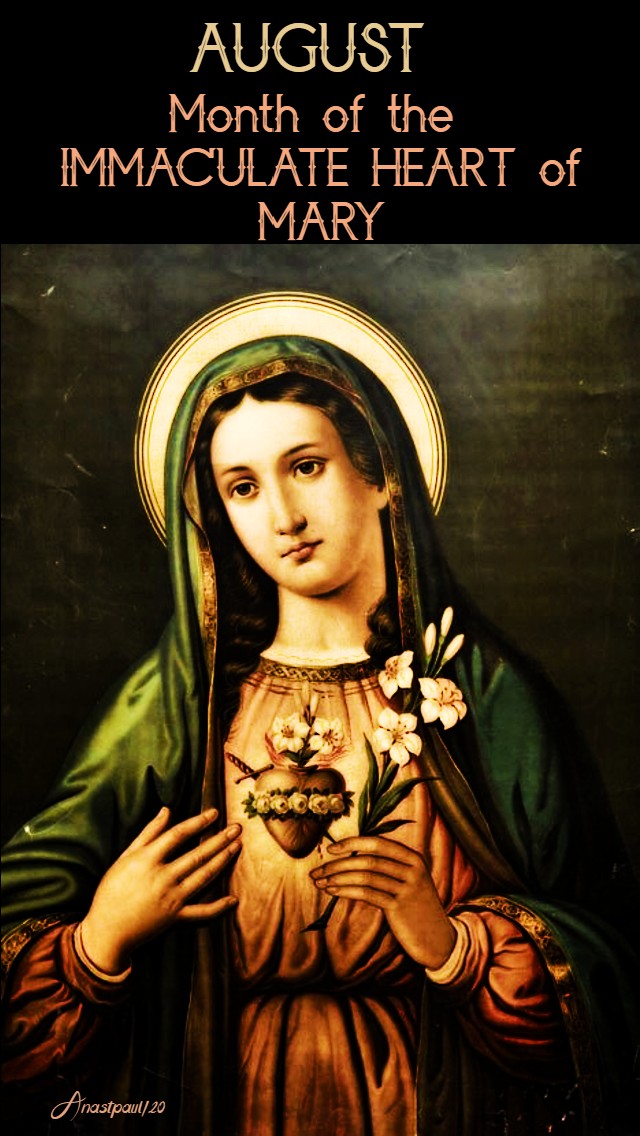
Historically, devotion to Mary Most Holy in the form of her Immaculate Heart first occurs in the thirteenth century with St Mechtilde, St Gertrude, St Bernardine of Siena and others. In the seventeenth century, St Francis de Sales was an exponent of this devotion. But it was St John Eudes the great apostle of the Immaculate Heart (1601-1680), who gave the decisive impulse to the practice.
In the same century, the devotion to the Sacred Heart of Jesus came back to light through St Margaret Mary Alacoque and her confessor, St Claude de La Colombiere. As the devotion to the Sacred Heart spread, so did the devotion to the Immaculate Heart. Both St Margaret Mary and St Claude, were deeply dedicated to the Immaculate Heart of Mary as well.
Beginning with Pope Pius VI, several popes incrementally spread the devotion but in 1944 Pope Pius XII extended it to the whole Church, fixing the Feast Celebration on 22 August. Today, the feast of the Immaculate Heart of Mary is celebrated on the Saturday following the feast of the Sacred Heart of Jesus, which is movable, always observed on a Friday, nineteen days after Pentecost Sunday.
The Physical Heart, Symbol of the Spiritual Heart
The Fathers of the Church consider that when, from the Cross, Our Lord Jesus made the Blessed Lady, the mother of St John and thus He appointed her the mother of all men.
Thus, Mary’s heart is the physical symbol of her boundless love for God and humankind. But Our Lady’s physical heart is also the symbol of her spiritual heart. Thus, in the Immaculate Heart of Mary we also honour her inner life, her virtues, her perfect purity, her boundless humility, her affections and her sorrow.
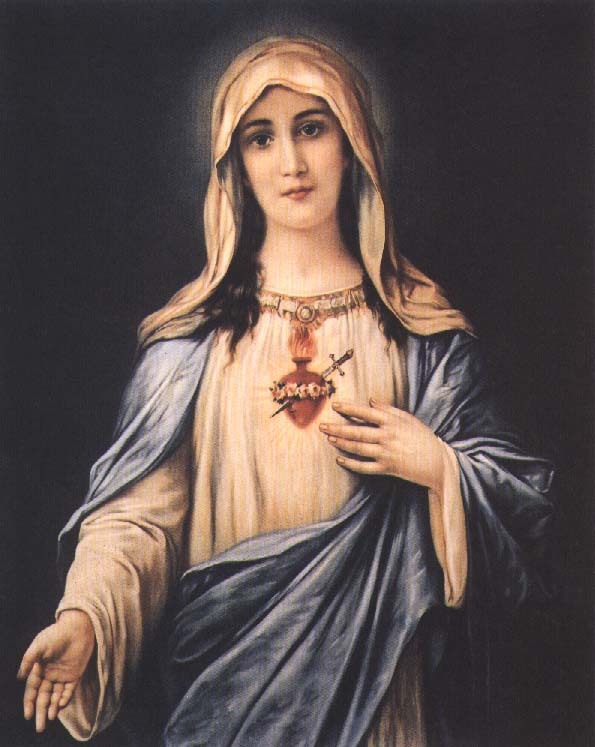
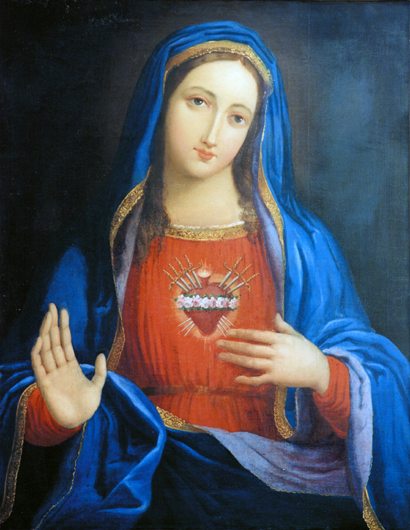
Poignant in Catholic tradition is the representation of Mary’s heart pierced by a sword, symbol of her immense sorrow at witnessing and willing her Son’s passion and death for the salvation of our souls.
Fatima and the Immaculate Heart of Mary
–The Five First Saturdays Devotion
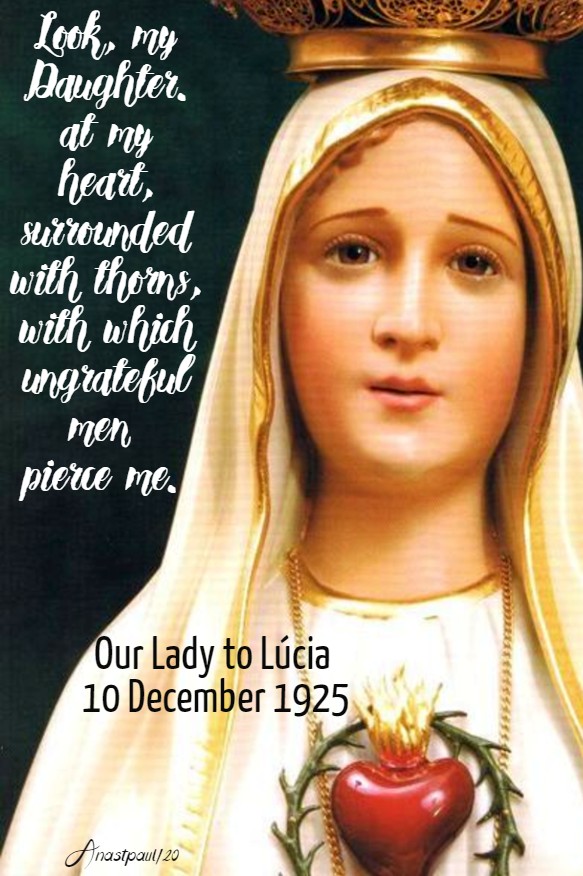
In the second apparition of Fatima, Our Lady showed the seers, Lucia, Francisco and Jacinta, her heart encircled by thorns. Later, on 10 December 1925, in a private apparition to Sister Lucia, she asked for the devotion of reparation of the Five First Saturdays.
The Blessed Mother appeared alongside the Child Jesus who stood over a luminous cloud. Our Lady rested one hand on the Child’s shoulder while she held on the other hand a heart pierced with thorns.
The Child said,
“Have pity on the Heart of your Most Holy Mother which is covered with thorns with which ungrateful men pierce it at every moment with no-one to extract them with an act of reparation.
I want My Church to…put the devotion to this Immaculate Heart beside the devotion to My Sacred Heart.”
“Look, my daughter, My Heart surrounded with thorns with which ungrateful men pierce me at every moment with blasphemies and ingratitude. You, at least, make sure to console me and announce that all those who for five months, on the first Saturdays, go to Confession, receive Communion, say five decades of the Rosary and keep me company for 15 minutes meditating on the Mysteries of the Rosary, with the purpose of making reparation to Me, I promise to assist them at the hour of death with all the graces necessary for the salvation of their souls.”
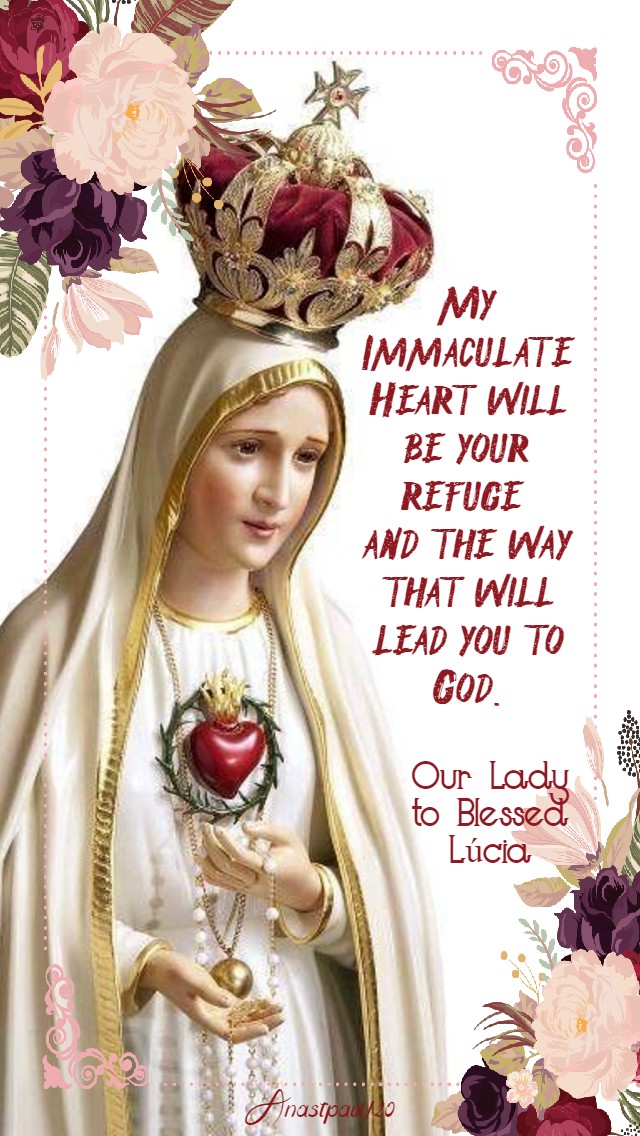
Our Lady assured Lúcia: “My Immaculate Heart will be your refuge and the way that will lead you to God.” Thus, if we devote ourselves to her Immaculate Heart, Mary will lead us to her Son, Jesus Christ and we will be on the way to Heaven.
Our Lady of Fatima
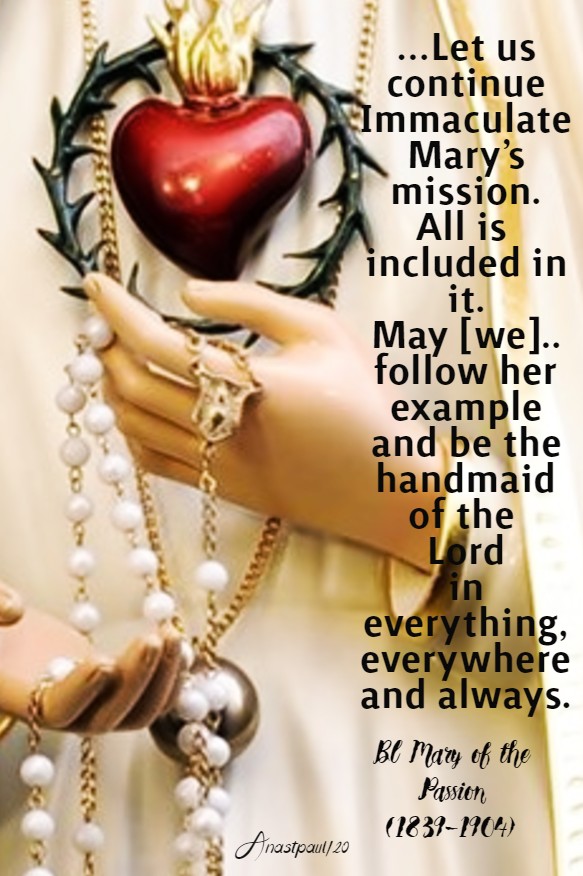
“…Let us continue Immaculate Mary’s mission. All is included in it. May [we].. follow her example and be the handmaid of the Lord in everything, everywhere and always.”












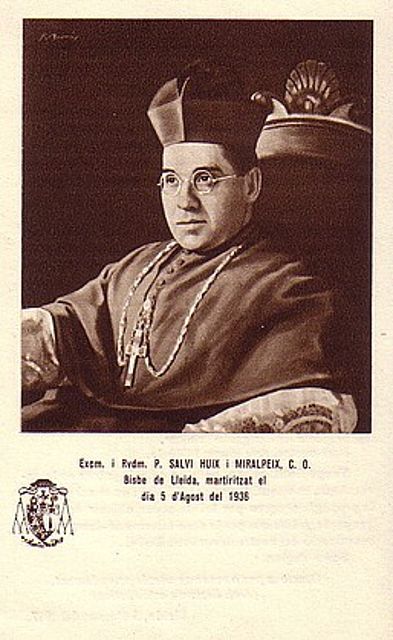 One account tells that Mgr Huix was offered his life if he would abjure his faith. This he refused to do but asked one favour, that he might be the last to die. As each was killed, he blessed them. One of the militia men, objecting to this, shot him through the hand, he continued to bless with his left In a written testimony after the Martyrdom, the man who had administered the coup de grace to the dying, said how there was much blood and that the sinews of the Bishop’s arms were exposed through having been shot a number of times.







 AnaStpaul
You must be logged in to post a comment.