Our Morning Offering – 6 November – The Twenty Second Sunday after Pentecost – Within the All Saints Octave
Nunc, Sancte, nobis Spiritus Come, Holy Ghost, Who ever One By St Ambrose (340-397) Trans John Henry Newman (1801-1890) Trans 1836
Come, Holy Ghost, Who ever One Art with the Father and the Son. Come, Holy Ghost, our souls possess With Thy full flood of holiness.
In will and deed, by heart and tongue, With all our powers, Thy praise be sung. And love light up our mortal frame, Till others catch the living flame.
Almighty Father, hear our cry Through Jesus Christ our Lord most high, Who with the Holy Ghost and Thee Doth live and reign eternally.
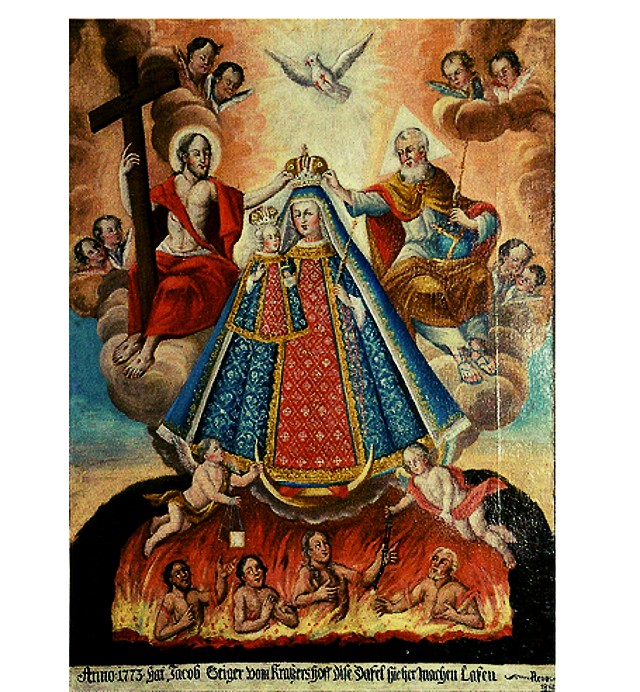
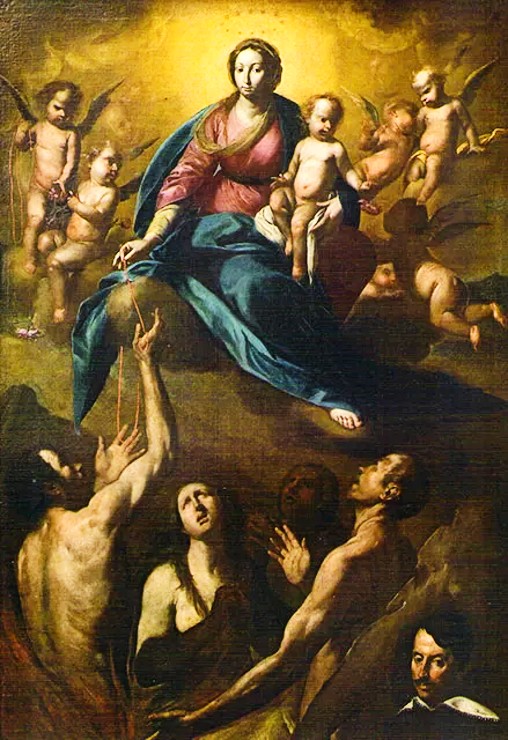
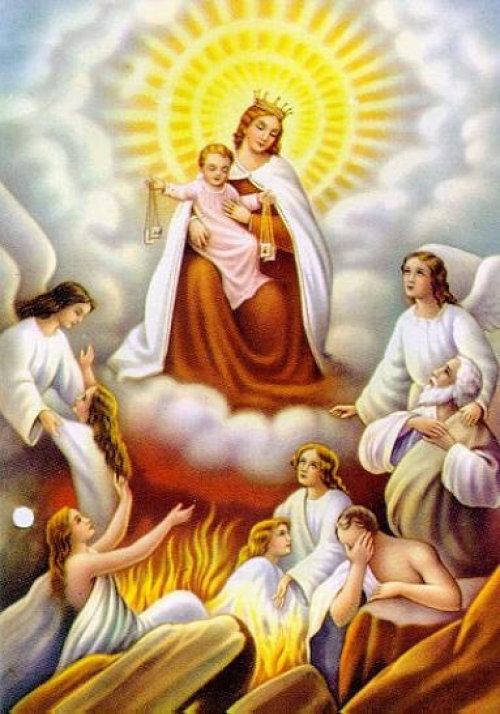
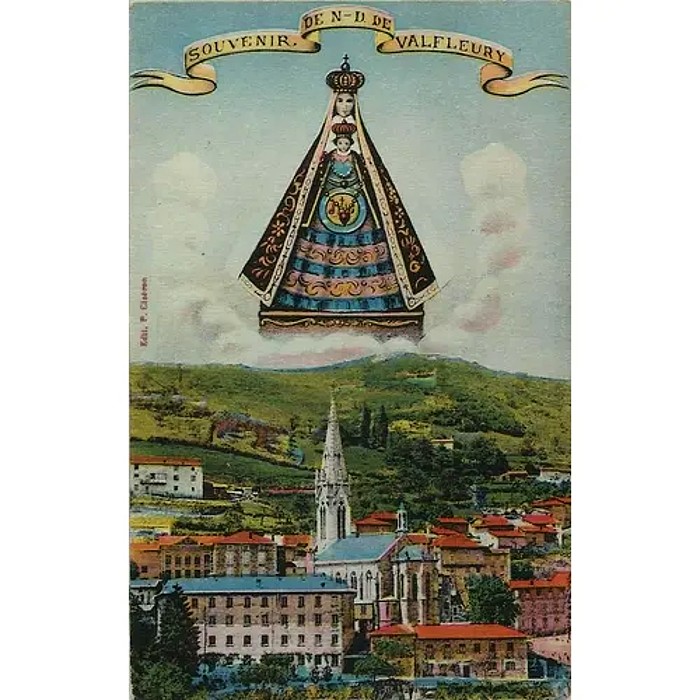
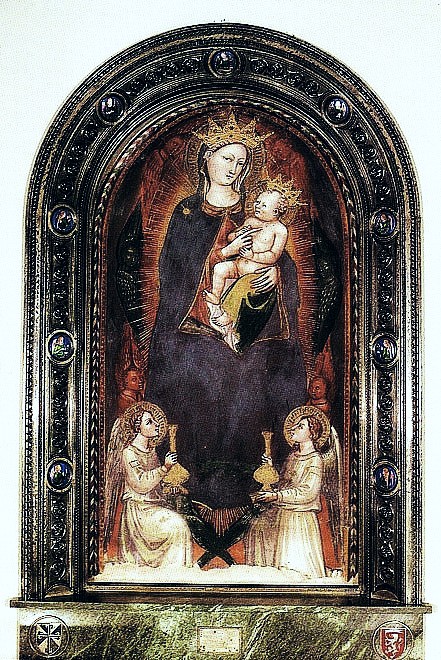
Saint of the Day – 6 November – Nostra Signora del Suffragio / Our Lady of Suffrage for the Souls in Purgatory.
The Archconfraternity of Death and Prayer (mortis et orationis), founded in Rome, 1538, to provide for the burial of the poor and abandoned, still exists (cf. Berignani, loc. cit). At the beginning of the 17th Century, it was granted a new Indulgences by Pope Paul V (Rescr. auth. S. C. Indulg., n. 26, pp. 448 sqq. Moroni, II, 303). About 1687, the Rules for a special Confraternity “for the relief of the Most Needy Souls in Purgatory” under the Sacred Names of Jesus, Mary and Joseph, were approved in Rome. The Confraternity for the relief of the departed under the title of “Jesus Christ on Mount Calvary and the Sorrowful Mother” enjoyed special popularity and on 8 September 1760, inaugurated, the processions of the Way of the Cross in the Roman Coliseum. Among its illustrious members was St Leonard of Port Maurice OFM (1676-1751).
In 1874, the Ingolstadt Mass Association, formed by the Franciscans of Ingolstadt in 1726, to procure for all members the grace of a happy death and for those already deceased, speedy assistance and liberation form the pains of Purgatory, was raised to a formal and legal Confraternity, under the title of the Immaculate Conception. An ancient, highly venerated painting of the Mother of God, was adopted as the Titular image of the Association, which has received all the Indulgences of the Confraternity of the same name, in the Ara Coeli at Rome, that is, the Indulgences of the Blue Scapular. It numbers its members by tens and hundreds of thousands; almost 2000 Masses are daily celebrated for the intentions of the Marian Mass Association, which includes the intention of particularly assisting for the most recently deceased members.
At the close of the Middle Ages, the old Confraternities, generally confined to a town or small district, gradually disappeared, as also did many of the later ones in the confusion at the end of the eighteenth century, while others preserved only a semblance of life. Since the beginning of the 19th Century, they have been replaced by vigorous new Associations, which, richly endowed with Indulgences by ecclesiastical authorities, have rapidly extended to the entire Church.
By brief of 5 October, 1818, Pope Pius VII endowed the Archconfraternity of Our Mother of Sorrows and Suffrage of the Poor Souls in Purgatory, which was erected in the Basilica of San Maria in Trastevere, with rich Indulgences.
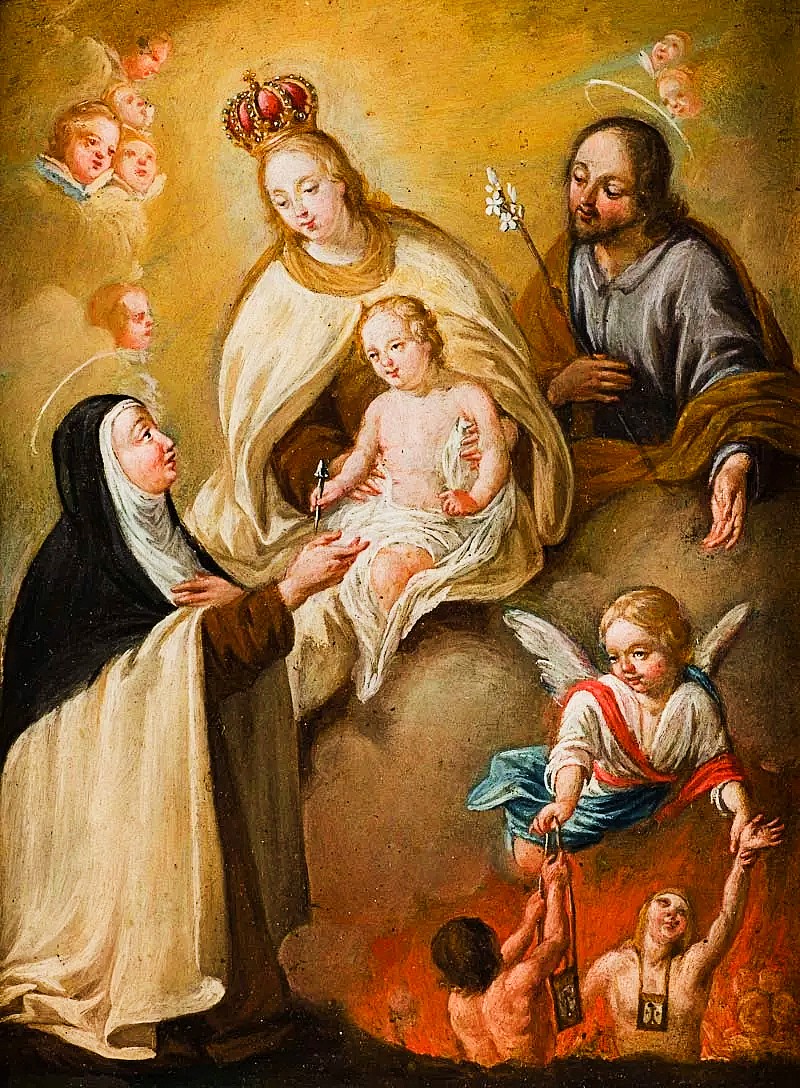
St Teresa of Jesus of Avila, intercedes with Our Lady of Suffrage for the Poor Souls in Purgatory
First among the later Confraternities which have extended throughout Christendom, is the “Archconfraternity for the Relief of the Poor Souls in Purgatory under the title of the Assumption of Mary, in the Redemptorist Church of San Maria in Monterone at Rome.” Founded in 1841, it rapidly developed, especially in England and North America and was endowed with Indulgences in 1841-63. Priests empowered to receive the faithful into the Confraternity enjoy various other faculties. This Confraternity is especially adapted for rapid expansion because in 1860, it was expressly authorised to include, every Confraternity of whatever name and object and to communicate to them its graces and privileges, provide they added to their original Titles “and for the relief of the Poor Souls in Purgatory.” The Redemptorist Fathers conduct this Archconfraternity.
Indulgences of the Confraternities are ever applicable to the Souls in Purgatory and the privileges of the Altar for Churches and for Priests, who are members, may be used in favour of dead members or for all poor souls. The formation of the “Catholic League for Constant Intercession for the Poor Souls in Purgatory” was proposed by certain pious citizens of Rome, approved by Leo XIII in the last years of his reign, and enriched with Indulgences. The only requisite for membership is to recite thrice daily the prayer, “Requiem æternam – Eternal Rest grant unto them O Lord …” thereby gaining, once daily, an Indulgence of 200 days.
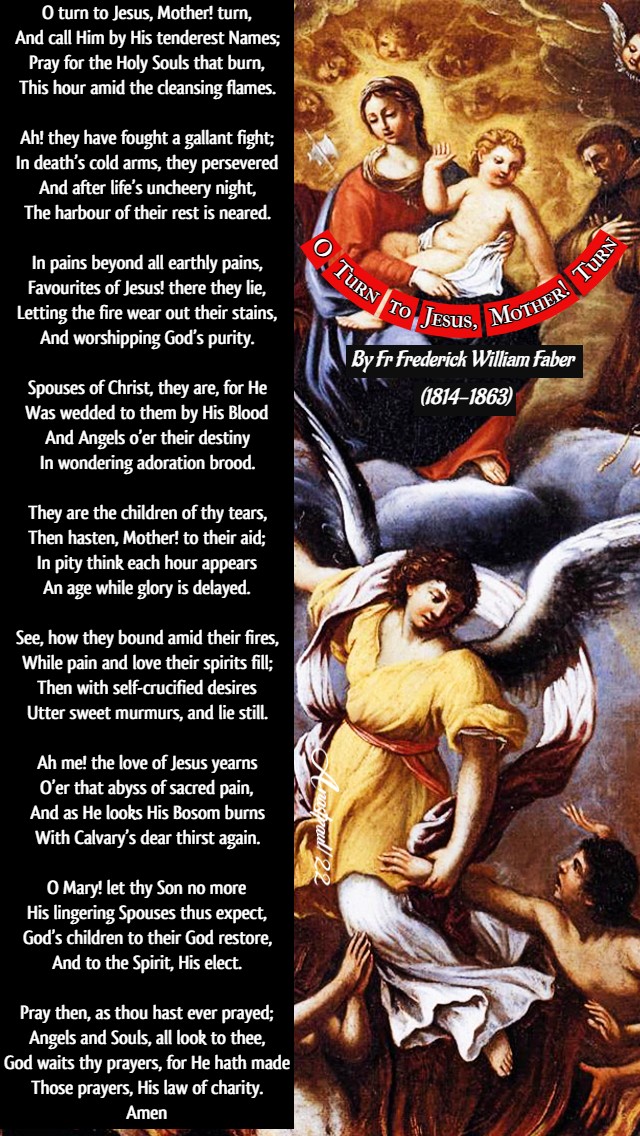
O Turn to Jesus, Mother! Turn By Fr Frederick William Faber CO (1814-1863)
O turn to Jesus, Mother! turn, And call Him by His tenderest Names; Pray for the Holy Souls that burn, This hour amid the cleansing flames.
Ah! they have fought a gallant fight; In death’s cold arms, they persevered And after life’s uncheery night, The harbour of their rest is neared.
In pains beyond all earthly pains, Favourites of Jesus! there they lie, Letting the fire wear out their stains, And worshipping God’s purity.
Spouses of Christ, they are, for He Was wedded to them by His Blood And Angels o’er their destiny In wondering adoration brood.
They are the children of thy tears, Then hasten, Mother! to their aid; In pity think each hour appears An age while glory is delayed.
See, how they bound amid their fires, While pain and love their spirits fill; Then with self-crucified desires Utter sweet murmurs, and lie still.
Ah me! the love of Jesus yearns O’er that abyss of sacred pain, And as He looks His Bosom burns With Calvary’s dear thirst again.
O Mary! let thy Son no more His lingering Spouses thus expect, God’s children to their God restore, And to the Spirit, His elect.
Pray then, as thou hast ever prayed; Angels and Souls, all look to thee, God waits thy prayers, for He hath made Those prayers, His law of charity.
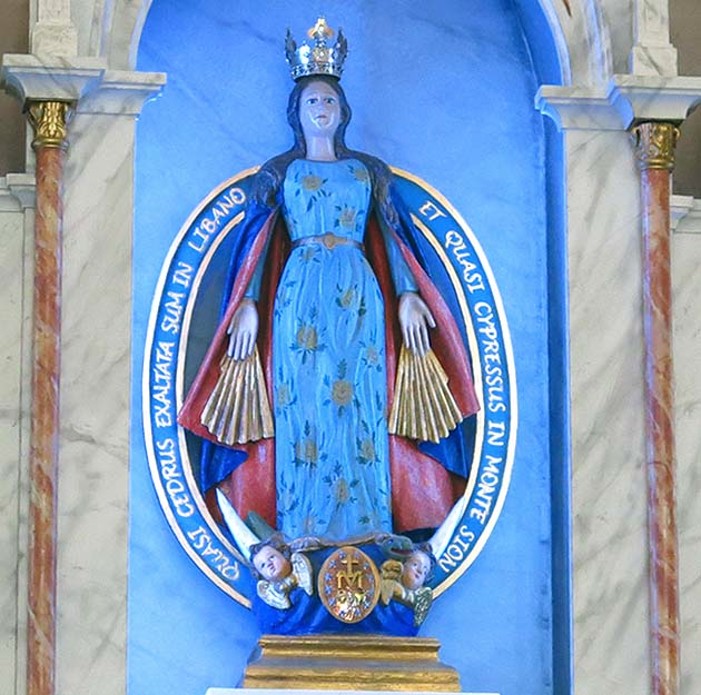
Nostra Signora del Suffragio / Our Lady of Suffrage (For the Souls in Purgatory)
St Atticus St Barlaam of Novgorod Bl Beatrice of Olive Bl Christina of Stommeln St Demetrian of Cyprus St Edwen of Northumbria St Efflam of Brittany St Emilian of Faenza St Erlafrid of Hirschau St Felix of Fondi St Felix of Genoa St Felix of Thynissa St Illtyd St Israel of Limoges
St Leonard of Reresby Bl Leonianus of Autun St Melaine of Rennes St Paul of Constantinople St Pinnock St Protasius of Lausanne St Severus of Barcelona Bl Simon of Aulne St Stephen of Apt St Theobald of Dorat Bl Thomas Ochia Jihyoe St Valentine of Genoa St Victor Chumillas-Fernández
Martyrs of Antioch – 10 Saints: Ten Christians murdered together by Arabs after their seizure of Antioch, Syria. No names or other details about them have come down to us. 637 in Antioch, Syria.
Martyrs of Gaza – 9 Saints: A group of Christian soldiers who were captured by Saracens invading the area of Gaza in Palestine. When the men continued to profess their Christianity, they were executed. We know the names of some of the Martyrs – Himerius, John (2 of them), Kallinikos (Callinoco), Paul, Peter, Stephen and Theodore (2 of them). They were beheaded in Gaza, Palestine.
Thought for the Day – 5 November – Meditations with Antonio Cardinal Bacci (1881-1971)
The Consolations of the Suffering Souls in Purgatory
“In her description of Purgatory, St Catherine of Genoa, writes as follows:
“The soul in Prgatory is happy with its lot but, its happiness is similar to that of the Martyr at the stake. Its happiness, in other words, is of a pure and supernatural kind which the world could not understand. The Martyr allows himself to be put to death, rather than offend God; he feels the pain of dying but, despises death because of his ardent love for God. In the same way because it realises that God desires and commands its agony, the soul in Purgatory, loves Him and is happy to allow Him to refine and purify it spiritually, through suffering.”
In one of her ecstasies, St Mary Magdalen de Pazzi was accorded a vision of Purgatory so terrifying that it caused her to grow pale and cry out. Suddenly she saw her own recently deceased brother among the suffering souls. “My poor brother!” she exclaimed, “how much you are suffering. Yet, I can see too, how greatly you are consoled. Although you are tortured by fire, you are content because, you know that these tortures are the prelude to everlasting happiness.”
Quote/s of the Day – 5 November – All Saints and Blesseds of the Society of Jesus (SJ)
“God’s love calls us to move beyond fear. We ask God for the courage to abandon ourselves unreservedly, so that we might be moulded by God’s grace, even as we cannot see where that path may lead us.”
“Hate what the world seeks and seek, what it avoids.”
“He who carries God in his heart bears heaven with him, wherever he goes.”
St Ignatius Loyola SJ (1491-1556)
“We must make our way towards eternity, never regarding what men think of us, or of our actions, studying only to please God.”
St Francis Borgia SJ (1510-1572)
“Better that only a few Catholics should be left, staunch and sincere in their religion, than that they should, remaining many, desire as it were, to be in collusion with the Church’s enemies and in conformity with the open foes of our faith.”
St Peter Canisius SJ (1521-1597) Doctor of the Church
“The path to Heaven is narrow, rough and full of wearisome and trying ascents, nor can it be trodden without great toil and, therefore, wrong is their way, gross their error and assured their ruin, who, after the testimony of so many thousands of Saints, will not learn where to settle their footing!”
St Robert Southwell SJ (1561-1595) Priest and Martyr
“Recommend yourself to your Angel Guardian three times a day – in the morning. by the prayer “Angele Dei” in the evening, by the same prayer and during the day, when you visit the Altars in Churches. Remember that you are to be guided by your Angel, like a blind man who cannot see the dangers of the streets and trusts entirely. to the person who leads him.”
St Aloysius de Gonzaga (SJ 1568-1591)
“My child, it is indeed the Voice of God you have heard. He has given you a great grace in thus calling you into His one true Church. While you live, never cease to thank Him and bless Him for it.”
St John Francis Régis SJ (1597-1640)
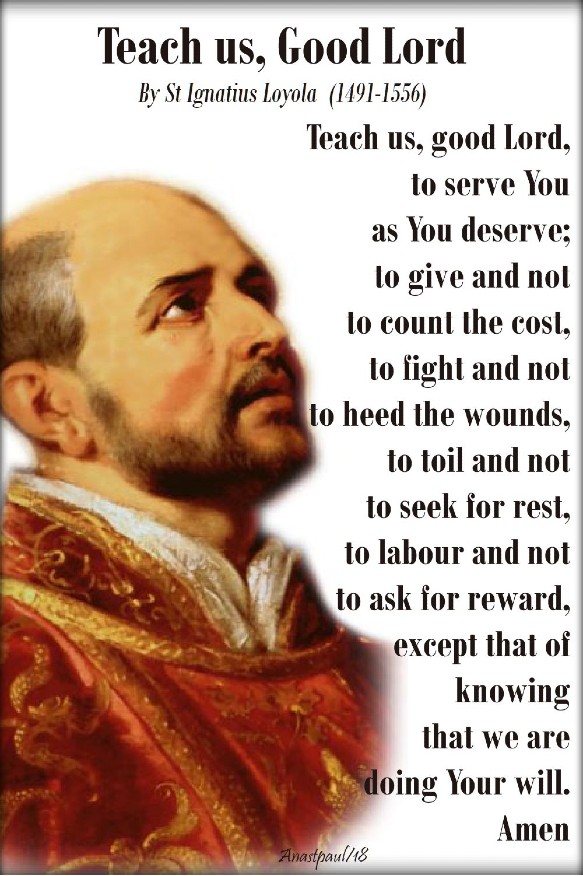
“Teach Us Good Lord” By St Ignatius Loyola SJ (1491-1556) Teach us, good Lord, to serve You as You deserve; to give and not to count the cost, to fight and not to heed the wounds, to toil and not to seek for rest, to labour and not to ask for reward, except that of knowing that we are doing Your will. Amen
My God, I Love Thee By St Francis Xavier (1506-1552) (Attri) Transr: Fr Edward Caswall CO (1814-1878)
My God, I love Thee, not because I hope for heav’n thereby, nor yet for fear, that loving not, I might forever die but for that Thou didst all mankind upon the Cross embrace; for us didst bear the nails and spear and manifold disgrace.
And griefs and torments numberless and sweat of agony; e’en death itself and all for man, who was Thine enemy. Then why, most loving Jesus Christ, should I not love Thee well? Not for the sake of winning heav’n, nor any fear of hell.
Not with the hope of gaining aught, nor seeking a reward but as Thyself hast loved me, O ever loving Lord! E’en so I love Thee and will love and in Thy praise will sing, solely because Thou art my God and my eternal King! Amen
One Minute Reflection – 5 November – “The Month of the Holy Souls in Purgatory – Within the Octave of All Saints and the Feast of the Holy Relics –Apocalypse 7:2-12, Matthew 5:1-12 – Scripture search here: https://www.drbo.org/
“Rejoice and be glad, for your reward will be great in Heaven.” – Matthew 5:12
REFLECTION – “Rejoice in the Lord without ceasing (cf. Phil 4:4), my dear children. I beg you rejoice, citizens of heaven but exiles on earth, inhabitants of the Jerusalem on high (cf. Gal 4:26) but banished from affairs here below, inheritors of the Kingdom of Heaven but disinherited from taking any part at all, in earthly pleasures! Rejoice, ardent travellers, at undergoing exile and maltreatment in a foreign land in the name of the commandment of God! Rejoice, you who are last in this world but lords of blessings that exceed our understanding (cf. Phil 4:7). Rejoice, noble company, brought together by God, assembly united in heart and soul, who give life to filial and fraternal love, a replica on earth of the host of angels! (…) Rejoice, God’s workers, apostolic men. (…) Rejoice, you who set your joy in each other, each making his own the reputation of his brother, you in whom is found neither jealousy, rivalry nor envy but, in their place, peace and charity and life in common. In truth, I do not say that we are not attacked – indeed, who is crowned if not the one who struggles and fights, who exchanges thrusts and wounds with his assailants? – but I say that we should not let ourselves be brought down by the machinations of Satan. Yes, my children, assembly of God, nourish yourselves with the food of the Spirit and drink the water given by the Lord: whoever comes to possess this water will never thirst again but it will become, in Him, a spring of living water welling up to eternal life (cf. Jn 4:14). (…) Yet a little while and we shall have vanquished. And blessed shall we be; blessed also, it shall be said, are the places, family and countries that have borne you (cf. Lk 11:27-28).” – St Theodore the Studite (759-826) – Catechesis 47 (The Great Catecheses)
PRAYER – Almighty, eternal God, Who granted us to honour the merits of all Thy Saints in a single solemn festival, bestow on us, we beseech Thee, through their manifold intercession, that abundance of Thy mercy for which we yearn.Through Jesus Christ our Lord, in the unity of the Holy Ghost, God, world without end. Amen (Collect).
Our Morning Offering – 5 November – Within the Octave of All Saints and the Feast of the Holy Relics
Sanctorum Meritis Inclita Gaudia Sing, O Sons of the Church Unknown Author 8th Century But Attributed to St Rabanus Maurus (c 776-856) Vespers Hymn in the Common of Martyrs
Sing, O Sons of the Church sounding the Martyrs’ praise! God’s true soldiers applaud, who, in their weary days, Won bright trophies of good, glad be the voice ye raise, While these heroes of Christ ye sing!
They, while yet in the world, were by the world abhorred; Felt how fading the joys, fleeting the wealth it stored; Spurned all pleasure for Thee, and at Thy call, O Lord, Came forth strong in Thy Name, as King.
Lord, how bravely they bore fury and pain for Thee! Scourge, rod, sword, and the rack strongly endured; but free Sang out, bold in Thy love, longing on high to be; Earth’s might never their souls could bend.
While they, shedding their blood, victims for Jesus fell, No sound out of their lips came of their throes to tell; Bowed low, patient and meek, loving the Lord so well, Turned they still to the Christ, their Friend.
What joys, bright with the blood shed for Thy love they share, Those brave Martyrs of Thine crowned, with Thy laurels rare; Man’s tongue never can tell, never can half declare, How pure now is their bliss above!
Yet we, Father on high, God of eternal might, Lift weak voices in prayer, asking for peace and light; Cleanse Thou out of our heart,s every stain and blight, So our songs may be songs of love. Amen
There are thirteen translations of this Hymn and five in Liturgical usage. This one by Daniel Joseph Donahoe (1853-1930), an Irish American of Connecticut. A Judge, Poet, Writer and Latin Translator. This from his Early Christian Hymns Vol I or II.
Feast of the Holy Relics – 5 November – From the Liturgical Year, 1901.
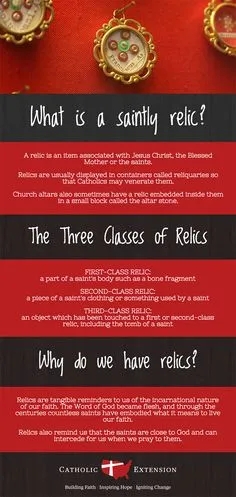
Relics of the Passion conserved in the Roman Basilica of Santa Croce in Jerusalem
Had we Angels’ eyes, we should see the earth as a vast field sown with seed for the Resurrection. The death of Abel opened the first furrow and ever since, the sowing has gone on unceasingly, the wide world over. This land of labour and of suffering, what treasures it already holds laid up in its bosom! And what a harvest for Heaven, when the Sun of Justice, suddenly darting forth His rays, shall cause to spring up, as suddenly from the soil, the elect ears ripe for glory! No wonder that the Church herself blesses and superintends, the laying of the precious grain in the earth.
But the Church is not content to be always sowing. Sometimes, as though impatient of delay, she raises from the ground the chosen seed she had sown therein. Her infallible discernment preserves her from error and, disengaging from the soil the immortal germ, she forestalls the glory of the future. She encloses the treasure in gold or precious stuffs, carries it in triumph, invites the multitudes to come and reverence it; or, she raises new temples to the name of the blessed one and assigns him the highest honour of reposing under the Altar, whereon she offers to God, the tremendous Sacrifice.
Religuary of St Anthony of Padua
“Let your charity understand,” explains St Augustine (Aug. Sermo cccxviii, de Stephano Mart. V): “it is not to Stephen we raise an Altar in this place but of Stephen’s relics, we make an Altar to God. God loves these Altars and, if you ask the reason – Precious in the sight of the Lord is the death of His saints (Ps. cxv, 15).” In obedience to God “the invisible soul has quitted its visible dwelling. But God preserves this dwelling; He is glorified by the honour we pay to this lifeless flesh and, clothing it with the might of His Divinity, He gives it the power of working miracles” (Aug. Sermo cclxxv, de Vincentio Mart. II). Hence the origin of pilgrimages to the Shrines of the Saints.
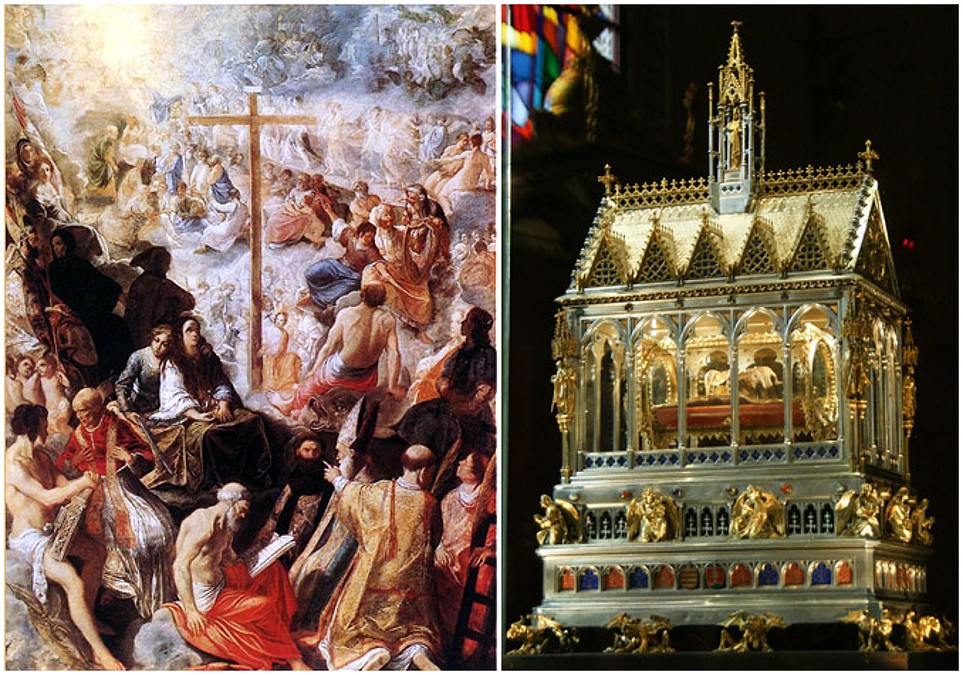
Left–Adoration of the Holy Cross by the Saints in Heaven; Right– Reliquary of St Stephen
“Christian people,” says St Gregory of Nyssa, “wherefore are you assembled here? A tomb has no attractions, nay, the sight of its contents inspires horror! Yet, see what eagerness to approach this sepulchre! So great an object of desire is it, that a little of the dust from around it is esteemed a gift of great price. As to beholding the remains it conceals, that is a rare favour and an enviable one, as those can testify who enjoy the privilege: they embrace the holy body as though it were yet alive, they press their lips and their eyes upon it, shedding tears of love and devotion. What emperor ever received such honour ”(Greg. Nyssa de Theodoro Mart)?”
“Emperors!” rejoins St John Chrysostom; “as the porters at their gates, such have they become with regard to poor fishers. The son of the great Constantine deemed he could not pay a higher honour to his father, than to procure him a place of sepulture in the porch of the fisherman of Galilee” (Chrys. in Epist. II. ad Cor. Hom. xxvi). And again, concluding his commentary on St Paul’s admirable Epistle to the Romans, the golden-mouthed Doctor exclaims: “And now, who will grant me to prostrate myself at Paul’s sepulchre, to contemplate the ashes of that body which, suffering for us, filled up what was wanting of the sufferings of Christ? The dust of that mouth, which spoke boldly before kings, and, showing what Paul was, revealed the Lord of Paul? The dust of that heart, truly the heart of the world, more lofty than the heavens, more vast than the universe, as much, the heart of Christ as of Paul and wherein might be read, the book of grace, graven by the Holy Spirit? Oh! that I might see the remains of the hands, which wrote those Epistles; of the eyes, which were struck with blindness and recovered their sight for our salvation; of the feet which traversed the whole earth! Yes. I would fain contemplate the tomb where repose these instruments of justice and of light, these members of Christ, this temple of the Holy Ghost. O venerable body, which, together with that of Peter, protects Rome more securely, than all ramparts” (Chrys. in Epist. ad Rom. Hom. xxxii)
Chains of St Peter
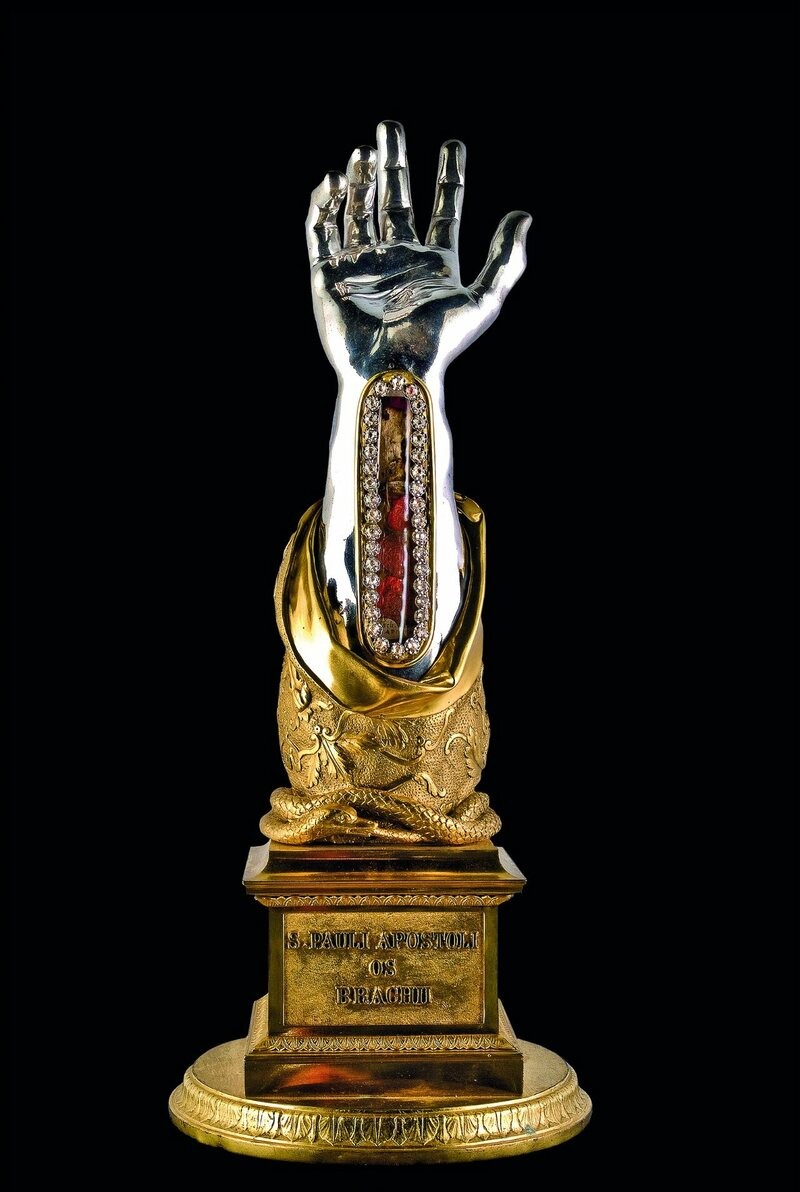
The wrist bone of St Paul held in Goza, Malta
In spite of such teachings as these, the heretics of the sixteenth Century profaned the tombs of the Saints, under pretext of bringing us back to the doctrine of our forefathers. In contradiction to these strange reformers, the Council of Trent expressed the unanimous testimony of Tradition, in the following definition, which sets forth the theological reasons of the honour paid by the Church, to the relics of Saints:,
“Veneration ought to be shown, by the faithful, to the bodies of the Martyrs and other Saints, who live with Jesus Christ. For they were His living members and the temples of the Holy Ghost; He will raise them up again to eternal life and glory and through them, God grants many blessings to mankind. Therefore, those who say that the relics of the Saints are not worthy of veneration, that it is useless for the faithful to honour them, that it is vain to visit the memorials or monuments of the Saints, in order to obtain their aid, are absolutely to be condemned and, as they have already been long ago condemned, (Conc. Nic. II. cap. vii), the Church now condemns them once more” (Conc. Tird. Sess. xxv. De invocatione, veneratione et reliquiis Sanctorum).
All Saints and Blesseds of the Society of Jesus: The Society of Jesus, commonly known as the Jesuits, was Founded in 1534 by Saint Ignatius Loyola (1491-1556) at Montmartre, Paris, France. A body of clerics regular organised for Apostolic work, following a religious rule and relying on alms for their support. It was the chief instrument of the Catholic Reformation. Pope Paul III approved the new rule in 1540 and Ignatius was elected the first general of the order in 1541. The constitutions, drafted by him and based on his Spiritual Exercises were adopted in 1558. It was the first order which enjoined by its constitutions devotion to the cause of education. The ministry of the Society consists chiefly in preaching. teaching catechism. administering the sacraments. conducting missions in parishes, taking care of parishes. organising pious confraternities, teaching in schools of every grade, writing books, pamphlets, periodical articles, going on foreign missions and special missions when ordered by the current Holy Father, to whom they take a vow of total obedience. Our current Holy Father, Pope Francis is a Jesuit and has jokingly wondered aloud who is boss of whom in his Order. The general resides at Rome, Italy and has a council of assistants. The motto of the Society is Ad Majorem Dei Gloriam (For the greater glory of God). All Jesuit Saints and Blesseds: https://anastpaul.com/2018/11/05/feast-of-all-the-saints-and-blesseds-of-the-society-of-jesus/
St Canonica St Comasia St Dominator of Brescia St Elizabeth St Domninus the Physician St Epistemis St Eusebius of Terracina St Felix of Terracina St Fibitius St Galation St Gerald of Beziers Bl Gomidas Keumurjian Bl Gregory Lakota St Guetnoco St Hermenegild St Idda St Juan Antoni Burró Mas St Juan Duarte Martín St Kanten St Kea St Laetus of Orleans St Magnus of Milan St Mamete St Marco of Troia Bl Simon Ballachi St Spinulus of Moyen-Moûtier St Sylvanus of Syria St Zachary
Martyrs of Caesarea Maritima – 4 Saints: Four young Christian men who were Martyred together is the persecutions of Maximian – Aussenzius, Philotheus, Timothy and Theotimus. They were martyred in the arena at Caesarea Maritima, Palestine.
Thought for the Day – 4 November – Meditations with Antonio Cardinal Bacci (1881-1971)
More About the Sufferings of Purgatory
“The vision of Purgatory accorded to St Frances of Rome, is well known. She saw Purgatory divided into three separate sections.
(1) The firs was the part furthest from Heaven and bordering, as it were, on Hell. In it two kinds of people were suffering terrible torments, namely, lay folk who had committed grave sins and postponed their conversion until the moment of death; and – men and women who had dedicated their lives to God but on account of venial sins, neglect of duty, tepidity and lack of gratitude for their great vocations, had heavy debt to pay to Divine Justice.
(2) The second place, was the most crowded. Here, the physical pain was still unimaginably severe, while the desire to be purified and to b with God was the cause of intense spiritual anguish. The souls in this region, however, were not only resigned to their lot but, even longed for greater sufferings which would finally wash away the imperfections which kept them apart from God.
(3) The Third section was the nearest to Heaven and was the abode of purer and more perfect souls. These did not have to endure much sensible pain but, their yearning for God was so insistent that, every moment of separation, seemed like an eternity.”
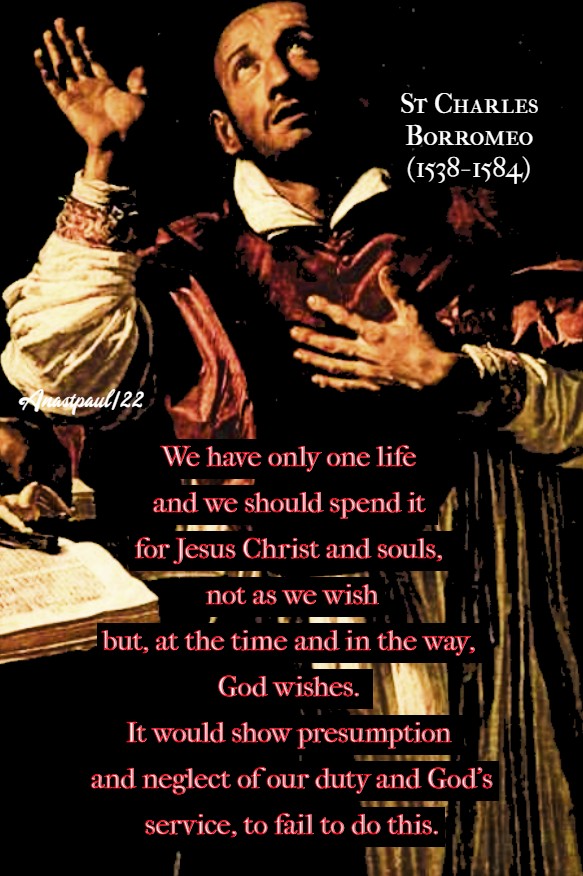
Quote/s of the Day – 4 November – St Charles Borromeo (1538-1584)
“We have only one life and we should spend it for Jesus Christ and souls, not as we wish but, at the time and in the way, God wishes. It would show presumption and neglect of our duty and God’s service, to fail to do this.”
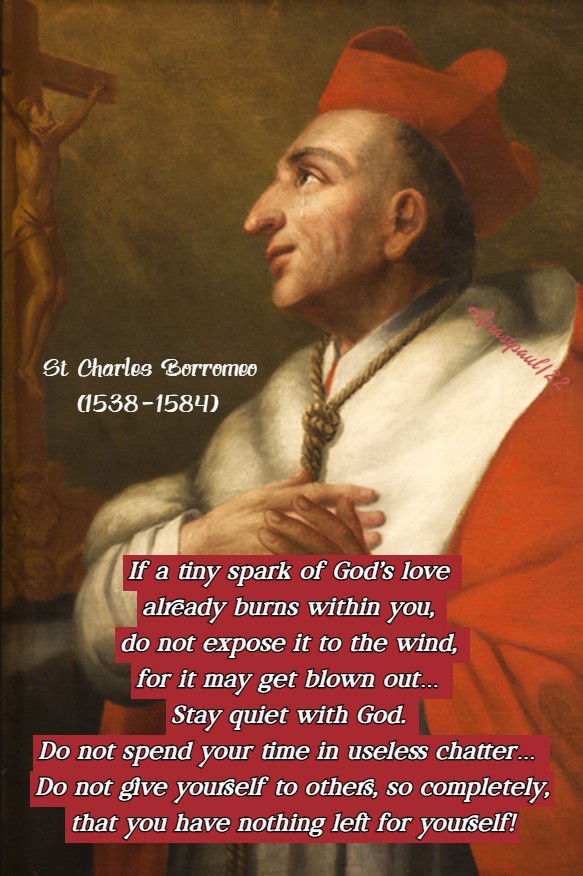
“If a tiny spark of God’s love already burns within you, do not expose it to the wind, for it may get blown out… Stay quiet with God. Do not spend your time in useless chatter… Do not give yourself to others, so completely, that you have nothing left for yourself.”
“Behold Jesus Christ Crucified, Who is the only foundation of our hope; He is our Mediator and Advocate; the Victim and Sacrifice for our sins. He is goodness and patience itself; His mercy is moved by the tears of sinners and He never refuses pardon and grace, to those who ask it, with a truly contrite and humbled heart.”
“The best way not to find the bed too cold, is to go to bed colder, than the bed already is.”
One Minute Reflection – 4 November – “The Month of the Holy Souls in Purgatory – Saint Charles Borromeo (1538-1584) – Sirach 44:16-27; 45:3-20, Matthew 25:14-23 – Scripture search here: https://www.drbo.org/
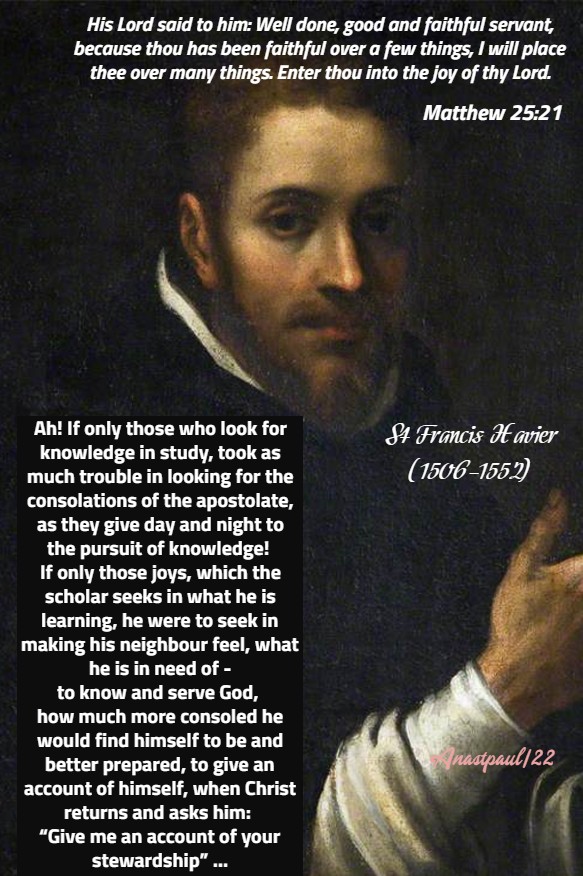
“His Lord said to him: Well done, good and faithful servant because thou has been faithful over a few things, I will place thee over many thing. Enter thou into the joy of thy Lord.” – Matthew 25:21
REFLECTION – “I have no idea what to write you from these parts [India and Sri Lanka] except this – the consolations bestowed by our Lord God, to those who go among the pagans, to convert them to the faith of Christ, are so great that, if there is any joy to be had in this life, it is surely this! I have often heard it said, to someone going about amongst these Christians: “Lord, do not give me so many consolations in this life! Yet since, in Thy infinite goodness and pity, Thou are giving them me, take me into Thine holy glory! For indeed, there is such great suffering in living without seeing Thee, after Thou has shown Thyself to Thy creature, in this way!” Ah! If only those who look for knowledge in study, took as much trouble in looking for the consolations of the apostolate, as they give day and night to the pursuit of knowledge! If only those joys, which the scholar seeks in what he is learning, he were to seek in making his neighbour feel, what he is in need of – to know and serve God, how much more consoled he would find himself to be and better prepared, to give an account of himself, when Christ returns and asks him: “Give me an account of your stewardship” …
I will end, asking our Lord God … to bring us together in His holy glory. And to obtain this blessing, let us take as our intercessors and advocates, all the holy souls of the region, where I now am. … I beg all these holy souls to obtain for us from our Lord God, for as long as we remain separated, the grace of feeling His holy will in the depth of our souls and of fulfilling it perfectly.” – St Francis Xavier (1506-1552) Jesuit missionary (Letter of 15/01/1544).
PRAYER – Safeguard Thy Church, O Lord, under the continual protection of St Charles, Thy Confessor and Bishop, so that just as his concern for his flock made him glorious, so his intercession may make us ever fervent in loving Thee. Through Jesus Christ, Thy Son our Lord, Who lives and reigns with Thee, in the unity of the Holy Ghost, God, world without end. Amen (Collect).
Our Morning Offering – 4 November – “The Month of the Holy Souls in Purgatory” – The Memorial of Saint Charles Borromeo (1538-1584)
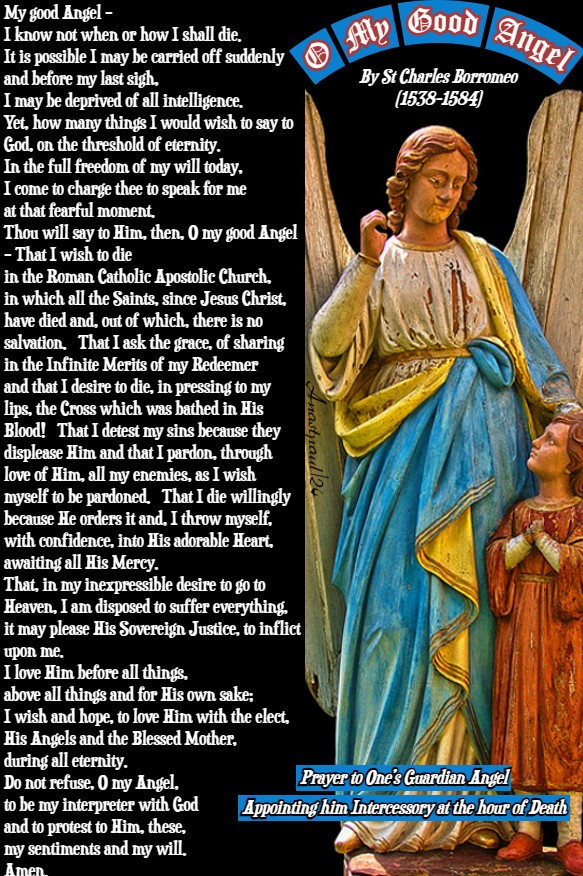
O My Good Angel Prayer to One’s Guardian Angel Appointing him Intercessory at the hour of Death By St Charles Borromeo (1538-1584)
My good Angel – I know not when or how I shall die. It is possible I may be carried off suddenly and before my last sigh, I may be deprived of all intelligence. Yet, how many things I would wish to say to God, on the threshold of eternity. In the full freedom of my will today, I come to charge thee to speak for me at that fearful moment. Thou will say to Him, then, O my good Angel – That I wish to die in the Roman Catholic Apostolic Church, in which all the Saints, since Jesus Christ, have died and, out of which, there is no salvation. That I ask the grace, of sharing in the Infinite Merits of my Redeemer and that I desire to die, in pressing to my lips, the Cross which was bathed in His Blood! That I detest my sins because they displease Him and that I pardon, through love of Him, all my enemies, as I wish myself to be pardoned. That I die willingly because He orders it and, I throw myself, with confidence, into His adorable Heart, awaiting all His Mercy. That, in my inexpressible desire to go to Heaven, I am disposed to suffer everything, it may please His Sovereign Justice, to inflict upon me. I love Him before all things, above all things and for His own sake; I wish and hope, to love Him with the elect, His Angels and the Blessed Mother, during all eternity. Do not refuse, O my Angel, to be my interpreter with God and to protest to Him, these, my sentiments and my will. Amen
Saints of the Day – 4 November – St Vitalis (Died c 304) and St Agricola (Died c 304) Martyrs, Laymen. They died in c 304 in Bologna, Italy in the persecution of Diocletian. Patronage – Bologna.
The Roman Martyrology reads: “In Bologna, Saints Vitalis and Agricola, Martyrs, of whom, according to what Saint Ambrose recounts, the first was first a slave to the other, then a companion in Martyrdom: Vitalis, in fact, suffered such torments that there was no longer any part of his body without wound. Agricola, not at all terrified by the torture of his slave, imitated him in Martyrdom by undergoing crucifixion.”
The painting of Martyrs Vitalis and Agricola in Bologna.
At the roots of the Bolognese Church, there is the figure of two Martyrs, distinguished by social class but united by the Palm of death due to faith. Vitalis and Agricola, servant and master, launched, with their testimony, a message of equality and solidarity that would have public recognition, at the rise of freedom, with the decree of liberation of the serfs (Liber Paradisus).
The oldest memory of the two Proto-martyrs of Bologna, dates back to St Ambrose (340-397) and St Paulinus of Nola (354-431), who attest to their “connection and bonds of Martyrdom.” Their bodies were rediscovered in the Jewish cemetery by Bishop Eusebius and, in 393, were transferred by St Ambrose to the Milan.
Their cult was already widespread in the 5th and 6th Centuries. Their Relics are venerated in the Mother Church of Bologna. At the end of the sixth Century, St Gregory of Tours, in one of his works complained that there was no “passio” of the Saints Vitalis and Agricola. However, this was not entirely correct, as the reports on the two Bolognese Proto-martyrs is based on an authentic statement by the Milanese Bishop St Ambrogio in 392, as well as one of St Paulinus ofi Nola in 403. Two stories have also been included in the Acta Sanctorum also attributed to St Ambrose himself.
In reality, Vitalis and Agricola had been absolutely unknown until 392, the year in which the Bolognese Bishop, St Eusebius, announced the discovery of their remains in a Jewish cemetery in today’s Emilian capital. He gave them a new burial, with a Christian rite, an event which was also attended by St Ambrose, who spoke of the Martyrs in his sermon and invited the population to venerate their Relics.
The cult of the two holy Martyrs spread, thanks to the impulse given by St Ambrose, who, in addition to writing about them, wanted to transfer part of the Relics to Milan and then donated part of them to Florence. Numerous Bishops too, felt compelled to request some for their Cathedrals. However, the cult maintained its epicentre in Bologna, where a Basilica was built specifically to house their remains, which were later transferred to the adjacent Chapel.
So we know little about the life of the two Saints. It seems that Agricola was a Christian citizen of Bologna and Vitalis was his servant. The latter had also followed his master in his religion and was the first to crown his life with Martyrdom. Both were led to the arena, Vitalis was tortured throughout his body until death. The torturers thought that at the sight of his sufferings, Agricola would lose his determination to declare himself a Christian but instead, all this had the opposite effect of what was hoped for. Agricola was in fact fortified and encouraged by the death of his faithful servant and faced the crucifixion with great courage, testifying his Christian faith to the end. His body was also pierced with nails.
PRAYER
We bless and thank Thee, Father, for the gift of Martyrdom in our brothers, Vitalis and Agricola: from their fruitful blood, Thou made the Church of Bologna sprout and in the fraternal solidarity of the slave and the master Thou gave us a shining example of humanity reconciled in the love of Christ. Through their solidarity, grant us to be courageous witnesses of the Faith, living stones of Thy Church, operators of communion and peace. We ask Thee Father, in the Holy Spirit, through Christ our Lord. Amen.
St Vitalis (Died c 304) Martyr and St Agricola (Died c 304) Martyr St Amandus of Avignon St Amandus of Rodez St Birstan St Clarus the Hermit St Clether
Bl Frances d’Amboise St Gerard de Bazonches St Gregory of Burtscheid Bl Helen Enselmini Bl Henry of Zweifalten St Hermas of Myra St Joannicus of Mount Olympus St John Zedazneli St Modesta of Trier St Nicander of Lycia St Patrobas St Perpète St Philologus St Pierius St Proculus of Autun
Thought for the Day – 3 November – Meditations with Antonio Cardinal Bacci (1881-1971)
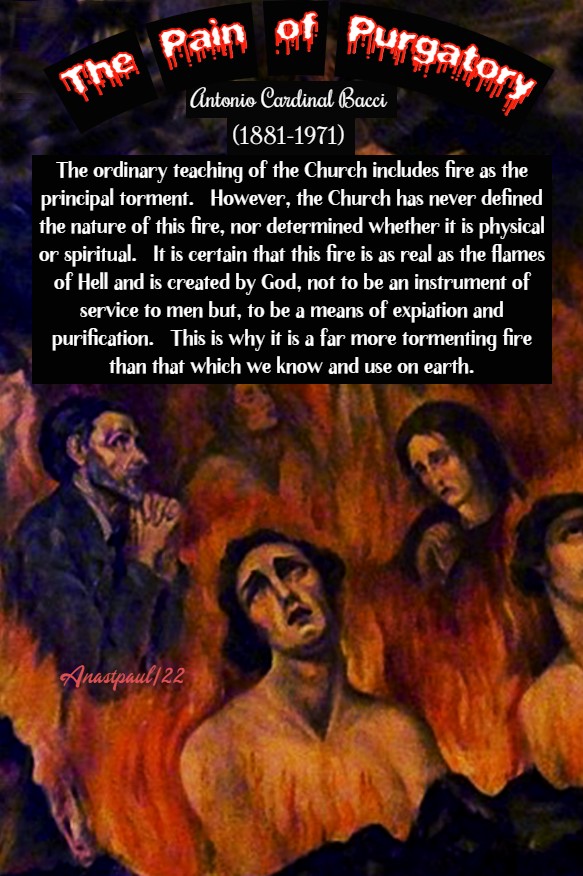
The Pain of Purgatory
“In the course of her vivid description of Purgatory, St Catherine of Genoa writes: “The suffering souls experience such torments as the human tongue could not describe, nor the human intellect comprehend, unless God Himself, revealed them by means of a special grace!”
The ordinary teaching of the Church includes fire as the principal torment. However, the Church has never defined the nature of this fire, nor determined whether it is physical or spiritual. It is certain that this fire is as real as the flames of Hell and is created by God, not to be an instrument of service to men but, to be a means of expiation and purification. This is why it is a far more tormenting fire than that which we know and use on earth. St Thomas Aquinas holds that it is actually a physical fire. He meets the objection that material fire could never touch a spiritual soul by saying that, even as the soul is affected on earth, by the suffering of the body, to which it is joined, so it can be subject in the next life, to the action of the fires of Purgatory (Supplementum Tertiae Partis q7, a3).”
Quote/s of the Day – 3 November – Within the Octave of All Saints – Apocalypse 7:2-12, Matthew 5:1-12– Scripture search here: https://www.drbo.org/
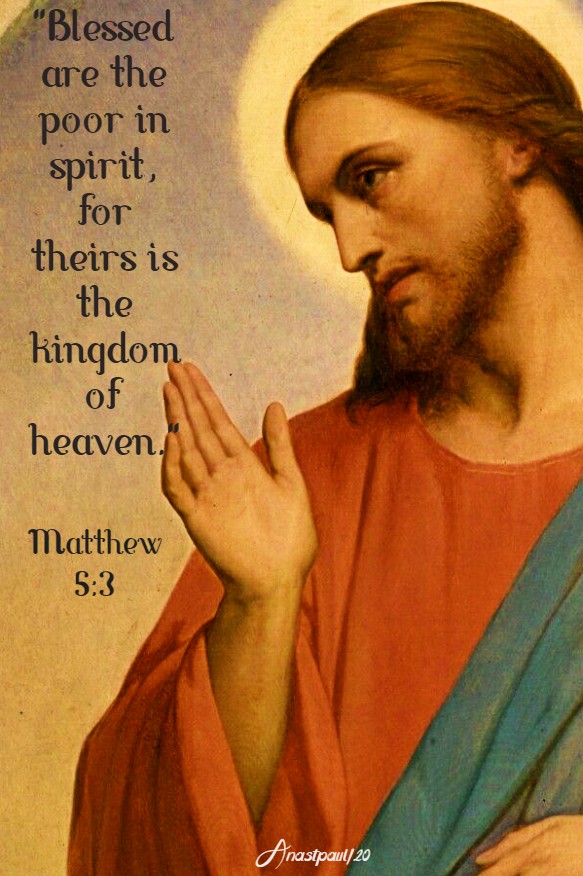
“Blessed are the poor in spirit, for theirs is the Kingdom of Heaven.”
Matthew 5:3
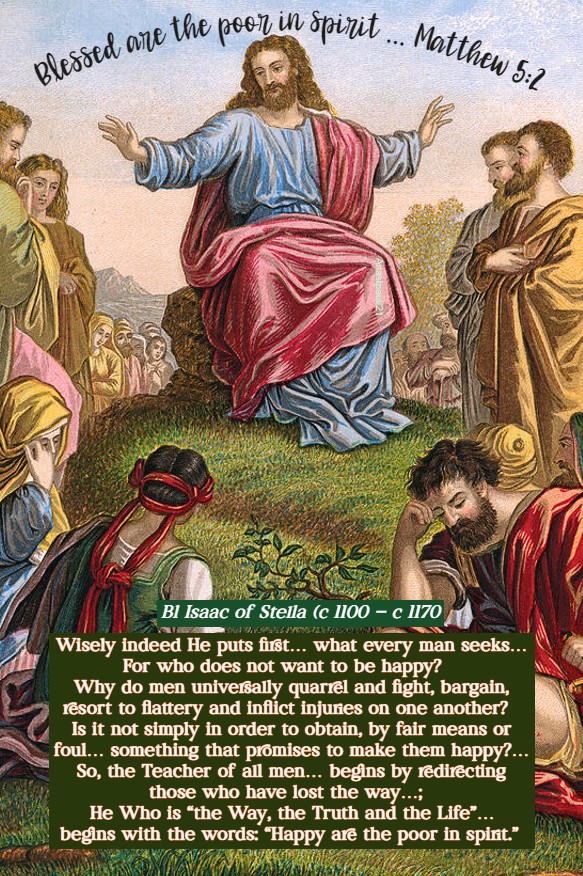
“Blessed are the poor in spirit.” Wisely indeed He puts first… what every man seeks… For who does not want to be happy? Why do men universally quarrel and fight, bargain, resort to flattery and inflict injuries on one another? Is it not simply in order to obtain, by fair means or foul… something that promises to make them happy?… So, the Teacher of all men… begins by redirecting those who have lost the way…; He Who is “the Way, the Truth and the Life”… (Jn 14,16; 6,32;4,6) begins with the words: “Happy are the poor in spirit.”
Bl Isaac of Stella O.Cist. (c 1100–c 1170) Cistercian Monk, Abbot, Theologian, Philosopher
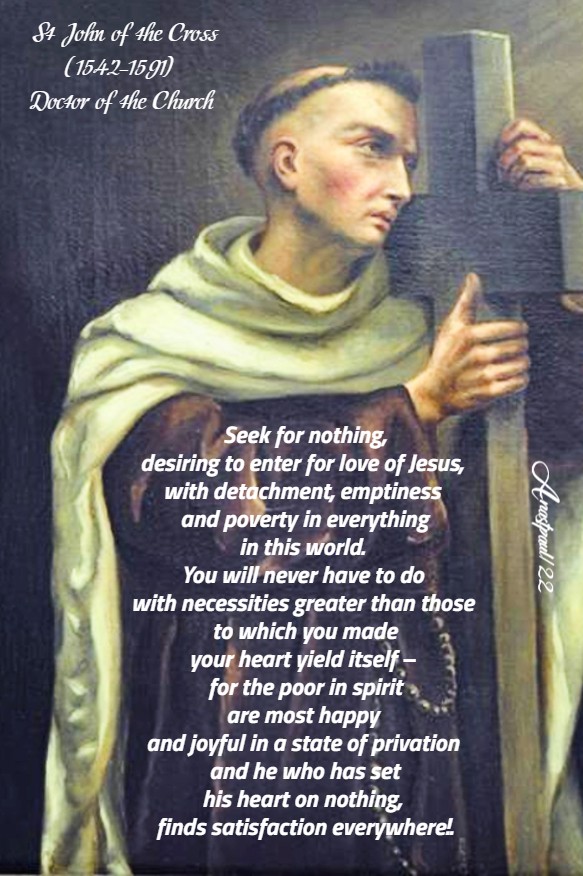
“Seek for nothing, desiring to enter for love of Jesus, with detachment, emptiness and poverty in everything in this world. You will never have to do with necessities greater than those to which you made your heart yield itself – for the poor in spirit are most happy and joyful in a state of privation and he who has set his heart on nothing, finds satisfaction everywhere!”
St John of the Cross (1542-1591) Doctor of the Church
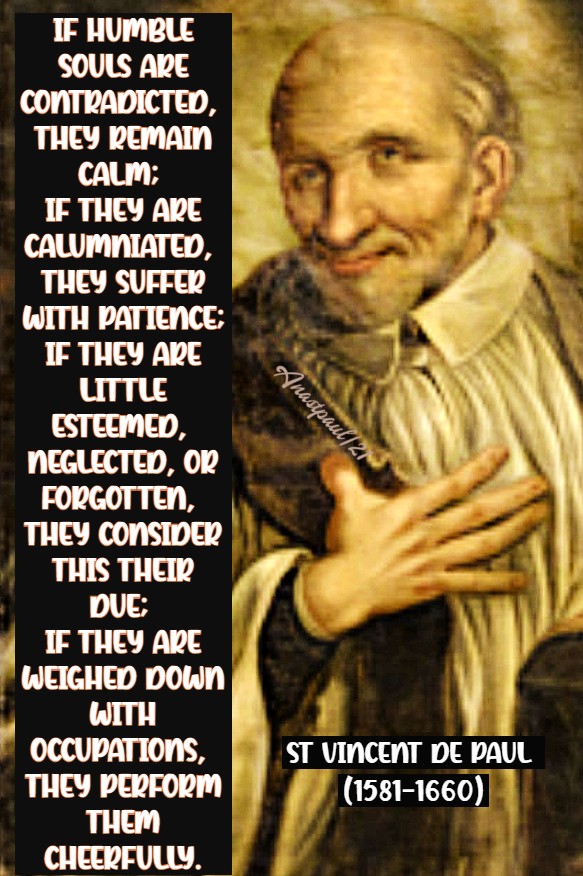
“If humble souls are contradicted, they remain calm; if they are calumniated, they suffer with patience; if they are little esteemed, neglected, or forgotten, they consider this their due; if they are weighed down with occupations, they perform them cheerfully. ”
St Vincent de Paul (1581-1660)
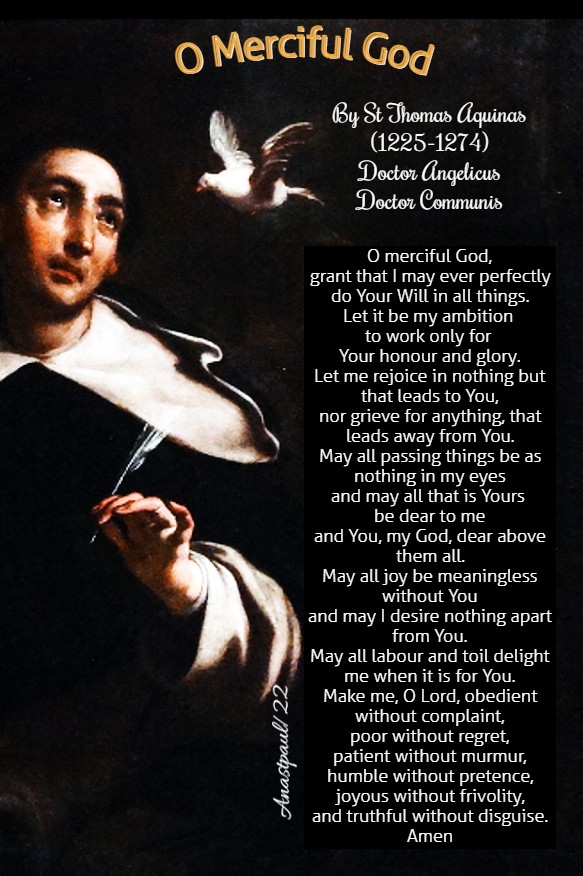
O Merciful God By St Thomas Aquinas (1225-1274) Doctor Angelicus, Doctor Communis
O merciful God, grant that I may ever perfectly do Your Will in all things. Let it be my ambition to work only for Your honour and glory. Let me rejoice in nothing but that leads to You, nor grieve for anything, that leads away from You. May all passing things be as nothing in my eyes and may all that is Yours, be dear to me and You, my God, dear above them all. May all joy be meaningless without You and may I desire nothing, apart from You. May all labour and toil delight me when it is for You. Make me, O Lord, obedient without complaint, poor without regret, patient without murmur, humble without pretence, joyous without frivolity, and truthful without disguise. Amen
One Minute Reflection – 3 November – “The Month of the Holy Souls in Purgatory – Within the Octave of All Saints – Apocalypse 7:2-12, Matthew 5:1-12– Scripture search here: https://www.drbo.org/
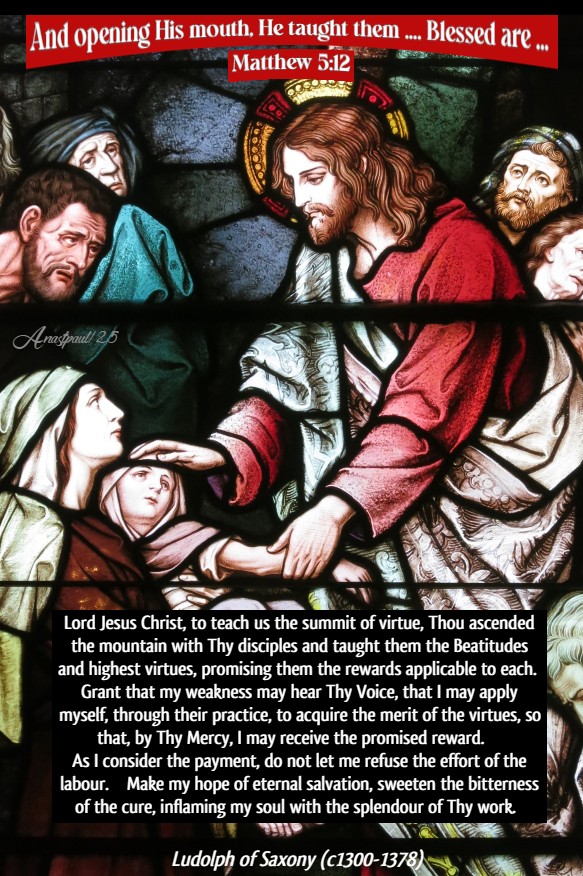
“And seeing the multitudes, He went up into a mountain… And opening His mouth, He taught them … Blessed are …” – Matthew 5:1-2
REFLECTION – “Lord Jesus Christ, to teach us the summit of virtue, Thou ascended the mountain with Thy disciples and taught them the Beatitudes and highest virtues, promising them the rewards applicable to each. Grant that my weakness may hear Thy Voice, that I may apply myself, through their practice, to acquire the merit of the virtues, so that, by Thy Mercy, I may receive the promised reward. As I consider the payment, do not let me refuse the effort of the labour. Make my hope of eternal salvation, sweeten the bitterness of the cure, inflaming my soul with the splendour of Thy work. Out of the wretched person I am, create one of the blessed; from the blessedness here below, lead me through Thy Grace, to the blessedness of the homeland.
Come, Lord Jesus Christ, in search of Thy servant, seeking Thy erring and exhausted sheep. Come, Spouse of the Church, in search of Thy lost coin. Come, Father of mercies, welcome the prodigal son returning to Thee. Come, then, Lord, for Thou art the only One, able to call back the sheep who has strayed, to find the lost drachma, to reconcile the runaway son. Cone, that there may be salvation on earth and joy in Heaven! Turn me towards Thyself and grant that I may carry out a true and perfect repentance, that I may become an occasion for joy, among the angels. Sweetest Jesus, I pray Thee, by the immensity of Thy Love for me, a sinner, grant that I may love Thee alone, above all things, that I maybe consoled by none but Thou, my sweetest God!” – Ludolph of Saxony (c1300-1378) Monk, Theologian, Writer, Dominican then a Carthusian (Prayers to Jesus Christ).
PRAYER – Almighty, eternal God, Who granted us to honour the merits of all Thy Saints in a single solemn festival, bestow on us, we beseech Thee, through their manifold intercession, that abundance of Thy mercy for which we yearn. Through Jesus Christ, Thy Son our Lord, Who lives and reigns with Thee, in the unity of the Holy Ghost, God, world without end. Amen (Collect).
Our Morning Offering – 3 November – “The Month of the Holy Souls in Purgatory”
I Will Love and Follow You By Thomas à Kempis CRSA (1380-1471)
Oh my Lord, Let my heart expand in Your love. Let me learn to know how sweet it is, to serve You, how joyful it is, to praise You and to be absorbed in Your love. Oh, I am possessed by love and rise above myself because of the great fervour I feel, through Your infinite goodness. I will sing the canticle of love to You and I will follow You, my Beloved, wherever You go and may my soul never weary of praising You, rejoicing in Your love. I will love You more than myself and myself, only for Your sake. I will love all others in You and for You, as Your law of love commands. Amen
Saint of the Day – 3 November – Blessed Simon Ballachi OP (c 1210-1319) Lay Brother of the Order of Preachers, Mystic. Born in c 1240 at Santarcangelo di Romagna, Italy and died on 3 November 1319 in Rimini, Italy of natural causes. Also known as Simone Ballachi . Ballachi served as a former soldier in Rimini before renouncing that path in favour of the religious life where he became a gardener noted for his strict adherence to the rule of Saint Dominic. He was Beatified by Pope Pius VII on 14 March 1817.
St Archangel, a village in the northern part of Italy, about three miles distant from Rimini, was the birthplace of Blessed Simon Ballachi, lay-brother of the Order of St Dominic. The Bellachi family was distinguished in both Church and State. Two of Simon’s uncles were successively Bishop of Rimini. One of these, at least, Lawrence Ballachi, who died in 1302, was a Friar Preacher. One of Blessed Simon’s brothers, moreover, was a Priest.
Simon came of a family of lords, to whose care had been entrusted the protection and welfare of the little village in which they lived. Simon, it seems, was to carry on the family name and honour. Since his was to be a life in the world, and therefore more active than contemplative, in accordance with the custom of the times, Blessed Simon received little, if any, knowledge of letters. His early youth was spent in the camp acquiring the tactics of military discipline and the training that made for the successful soldier and knight.
At the age of twenty seven he decided to leave the world and seek admission into some religious order, saying with the Psalmist, “I have chosen to be an abject in my Father’s house, rather than to dwell in the tabernacle of sinners.” Accordingly, he presented himself to the Prior of the Dominican Convent of Rimini and humbly asked to be admitted as a lay-brother. His request met with favour. Once clothed in the Habit of St Dominic, Simon never looked back but gave himself unreservedly to the service of the King of kings.
In the cloister his aim was perfection. He hoped to gain this state by a faithful observance of his Rule and Constitutions. The guides that had directed so many before him, even in the first Century of the Order, could not lead him astray. In the following brief account of his life and labours we read the story of a man of God, animated by the love of Jesus Christ and striving to conform his life in all things to that of his Divine Model.
Realising that anything resembling sloth is incompatible with the religious life, Simon waged incessant warfare against this root of all vices. He strove to be constatly employed. His superiors appointed him overseer of the Convent gardens but Simon was far from content with a position of mere direction. He laboured with his own hands and strove to bring each flower and plant to perfection according to its kind.
The good Brother knew no rest. When his own work was finished, or the weather prevented him from working in the garden, it was his custom to take upon himself the duties of the other brothers. This he did from a spirit of humility because he considered himself the least of all and the servant of all. Each week he swept the entire Convent. With Blessed Simon, to work was to pray. He sanctified even the most lowly occupations by doing everything for the honor and glory of God, remembering the words of St Paul to the Corinthians, “Therefore, whether you eat, or drink, or whatsoever else you do, do all to the glory of God.” (I Cor. 10:31)
Just as he laboured in the garden to bring perfection among the plants and flowers, so too, in the garden of his heart, he sowed the seeds of perfection and labored to bring each to maturity. His penances for this purpose were severe and continual. For all of Lent, he fasted on bread and water. Frequently he passed two whole days without taking even this slight nourishment. His fastings were so excessive that soon he began to weaken and it was necessary for his superiors to mitigate the severity of his penances. For twenty years he wore an iron chain that must have caused him great suffering during his labours in the garden. … In his humble position of lay-brother he strove byhis prayers and penances to assist the Fathers in their work of saving souls.
While at prayer, Satan never failed to annoy him, that he might divide his attention or force’ from him some expression of mpatience. All the attacks of hell, however, proved unavailing to disturb the tranquillity of the servant of God. Like another Tobias, God tried the faithfulness of his servant, by many and severe afflictions. At the age of fifty-seven he became blind.
Little by little the severity of his life undermined his strength until finally, his infirmities became so great that he was forced to remain on a couch in a reclining position. To many this would have been a hard lot but not so with Blessed Simon. He made use even of his infirmities to merit grace and honour God. Our Blessed was frequently favoured with a heavenly visitation. An Angel came to console him and assure him that God was mindful of his sufferings and would make him victorious over all the attacks of hell. At times his couch was seen surrounded by a bright light and a voice was heard, saying, “Fear not, Simon, for thou hast found favour before God.“
Blessed Simon had a special devotion to St Catherine of Alexandria. On one occasion, when he was suffering from a severe headache, the Saint appeared to him and cured him. Nor were these the only favours granted to this humble lay-brother. He was the recipient of many and signal blessings. Among the various visions with which he was favoured was one of Our Lord. Our Blessed Mother, St Dominic and St Peter Martyr appeared to him at different times, to console and assist him in the struggle against the enemy of his soul.
Blessed Simon’s reputation for sanctity was widespread. On 3 November 1319, this faithful servant of the Lord was called to his reward. The people came in such crowds to honour the holy man and to carry away some relic or article that had touched his body, that two days hardly sufficed to accommodate those who would honour him. His Habit was literally cut to pieces, so that.it was necessary to clothe him anew before burial.
Devotion to our Blessed has not waned for many centuries . His body was frequently moved from place to place (mainly due to wars and unrest) but finally on the demand of the people of St Archangel, it was laid to rest in the Collegiate Church of that place, where it lies today.
In the year 1817 Pope Pius VII confirmed by Bull, the cult in honour of Blessed Simon and placed this humble lay-brother of the Order of Friars Preachers, on the Altar of Holy Mother the Church. (By Paul Curran OP – Excerpt).
St Acepsimas St Acheric of Vosges Bl Alphais of Cudot Bl Berardo dei Marsi Bl Berchtold of Engelberg St Caesarius St Cecilio Manrique Arnáiz St Clydog St Cristiolus St Domnus of Vienne St Elerius St Englatius St Florus of Lodeve St Francisco Colom González St Gaudiosus of Tarazona St Germanus St Guenhael St Hermengaudius of Urgell St Hilary of Viterbo
St Papulus St Pirmin St Quartus St Rumwold of Buckingham Blessed Simon Ballachi OP (c 1210-1319) Lay Brother of the Order of Preachers, Mystic. St Sylvia of Rome St Theophilus St Valentine of Viterbo St Valentinian St Vitalis St William of Vosges St Winifred of Wales St Wulganus
Innumerable Martyrs of Saragossa: A large group of Christians martyred in Zaragoza, Spain by Dacian during the persecutions of Diocletian. Dacian ordered all Christians of the city into exile under pain of death; when they were assembled to leave, Dacian ordered imperial soldiers to massacre the lot of them. They were Martyred in 304.
Thought for the Day – 2 Novemer – Meditations with Antonio Cardinal Bacci (1881-1971)
“Purgatory”
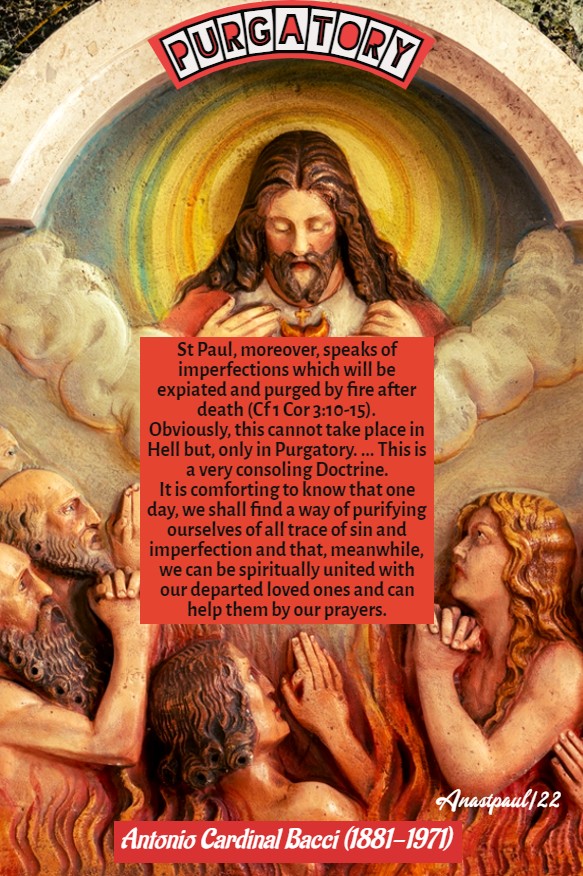
“The clear testimony of the New Testament may also be invoked in support of this teaching. Jesus refers to sins which cannot be forgiven, either in this life or in the next, (Cf Mt 12:31-32) from which, the Fathers deduce that there are sins, namely those of a venial nature, which can be forgiven after death.
St Paul, moreover, speaks of imperfections which will be expiated and purged by fire after death (Cf 1 Cor 3:10-15). Obviously, this cannot take place in Hell but, only in Purgatory. It would be impossible to cite here, all the testamoies of the Fathers and of theological writers. No-one, can deny, that they exist, however, for they combine to build up a tradition which the Council of Trent (Sess XXV) gathered together, when proclaiming the existence of Purgatory and the obligation of the faithful to pray for the dead, who are expiating their sins there.
This is a very consoling Doctrine. It is comforting to know that one day, we shall find a way of purifying ourselves of all trace of sin and imperfection and that, meanwhile, we can be spiritually united with our departed loved ones and can help them by our prayers.”
Quote/s of the Day – 2 November – All Souls Day – “The Month of the Holy Souls in Purgatory”
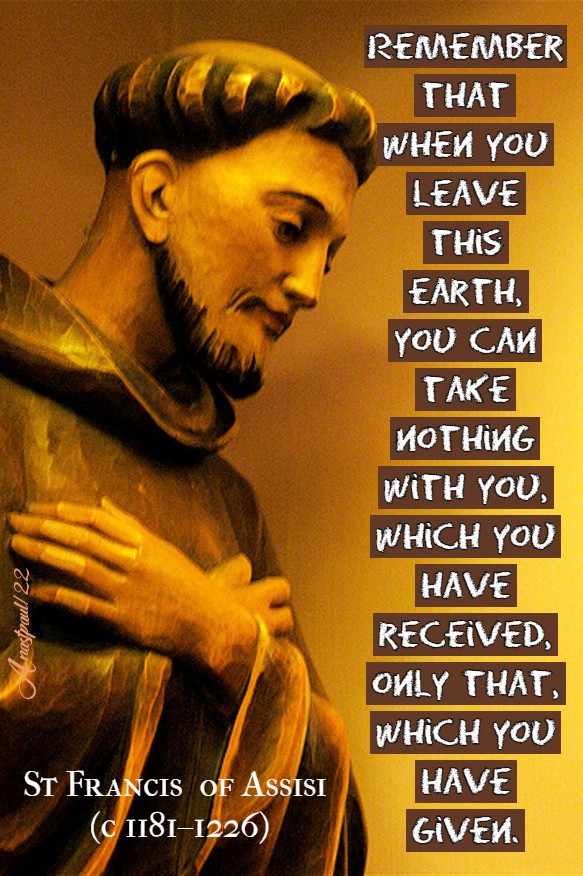
“Remember, when you leave this earth, you can take nothing with you, which you have received, only that, which you have given.”
St Francis of Assisi (c 1181–1226)
“This death … has already levelled his bow to strike me. Is it not prudent to prevent its stroke, by dying now to the world, that at my death, I may live to God?”
St Francis Borgia (1510-1572)
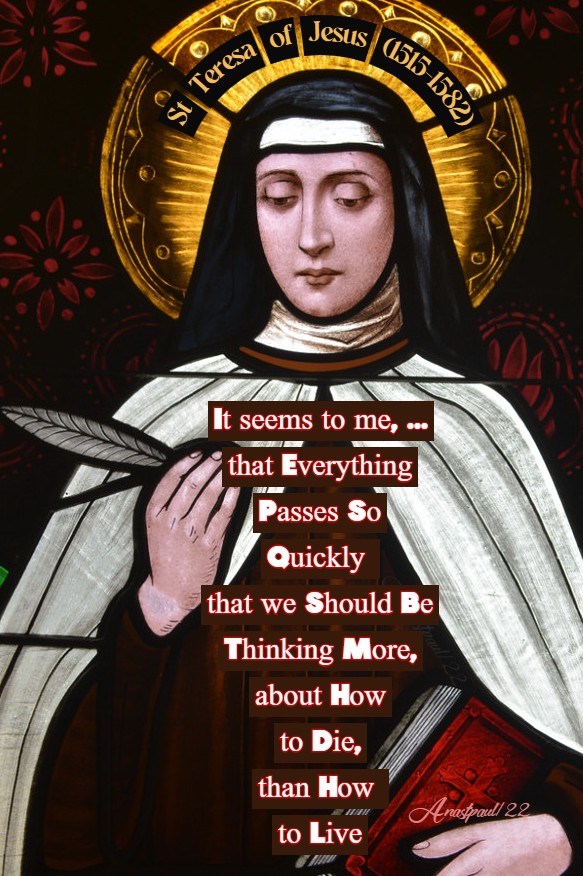
“It seems to me, my daughters, that everything passes so quickly that we should be thinking more, about how to die, than how to live!”
St Teresa of Jesus of Avila (1515-1582) Doctor of the Church
“The powers of hell will assail the dying Christian but his Angel Guardian will come to console him. His Patrons and St Michael, who has been appointed by God to defend his faithful servants, in their last combat with the devils, will come to his aid.”
St Alphonsus Liguori (1696-1787) Most Zealous Doctor
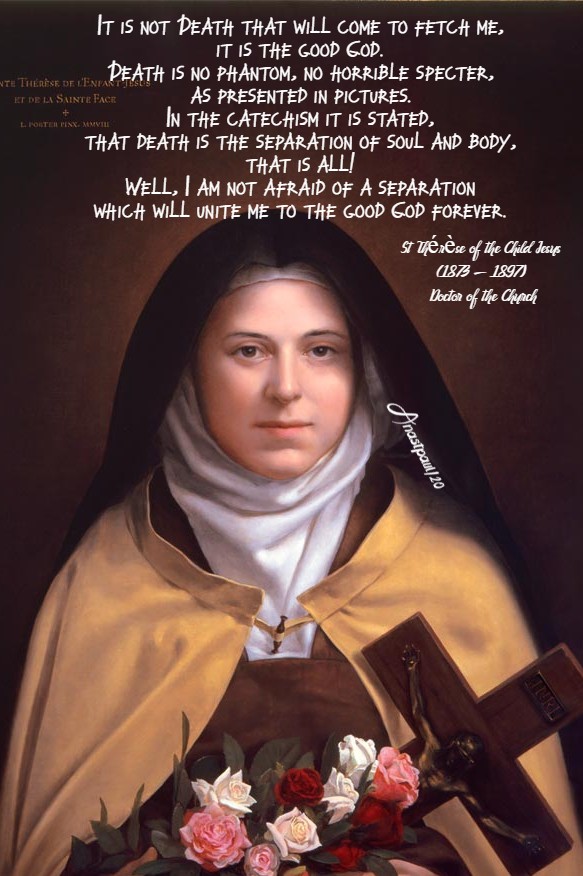
“It is not Death that will come to fetch me, it is the good God. Death is no phantom, no horrible specter, as presented in pictures. In the catechism it is stated, that death is the separation of soul and body, that is all! Well, I am not afraid of a separation which will unite me to the good God forever.”
St Thérèse of the Child Jesus and the Holy Face (1873 – 1897)
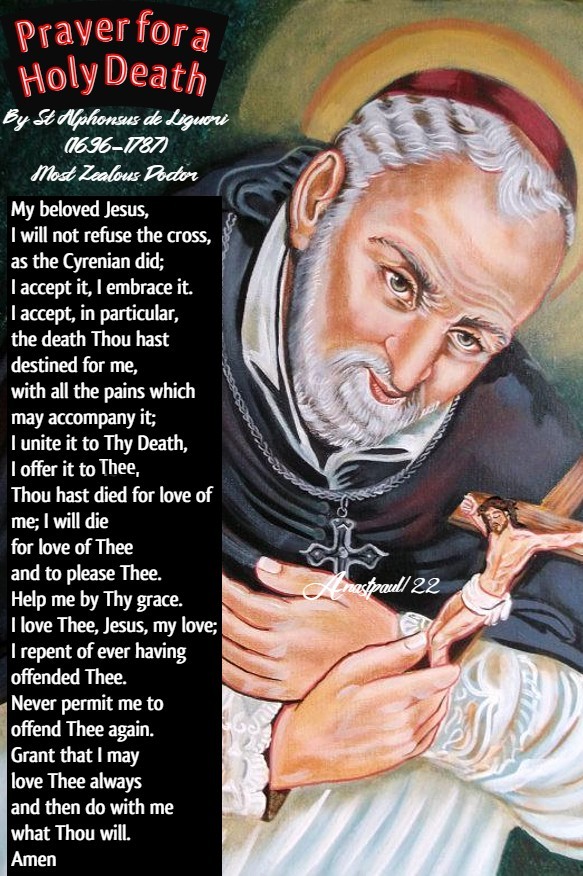
Prayer for a Holy Death By St Alphonsus de Liguori (1696-1787) Most Zealous Doctor
My beloved Jesus, I will not refuse the cross, as the Cyrenian did; I accept it, I embrace it. I accept, in particular, the death Thou hast destined for me, with all the pains which may accompany it; I unite it to Thy Death, I offer it to Thee Thou hast died for love of me; I will die for love of Thee and to please Thee. Help me by Thy grace. I love Thee, Jesus, my love; I repent of ever having offended Thee. Never permit me to offend Thee again. Grant that I may love Thee always and then do with me what Thou will. Amen
One Minute Reflection – 2 November – All Souls Day – “The Month of the Holy Souls in Purgatory” – 1 Corinthian 15:51-57, John 5:25-29 – Scripture search here: https://www.drbo.org/
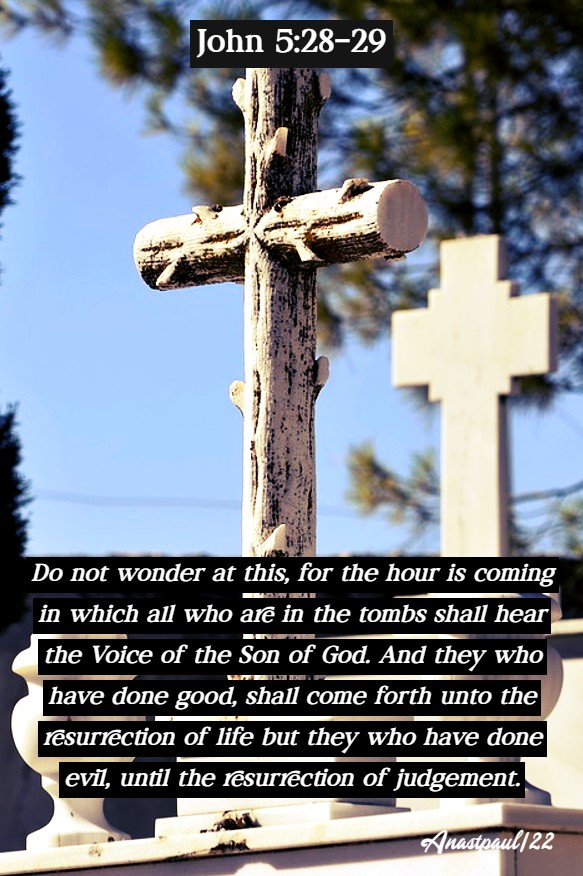
“Do not wonder at this, for the hour is coming in which all who are in the tombs shall hear the Voice of the Son of God. And they who have done good, shall come forth unto the resurrection of life but they who have done evil, until the resurrection of judgement.” – John 5:28-29
REFLECTION – “Let them weep who lack all hope of resurrection; it is not the will of God that takes it away from them but the inflexibility of what they believe. There has to be a difference between the servants of Christ and the pagans. This is what it is – they mourn for those close to them, whom they think to be dead forever; they see no end to their weeping, reach no rest for their grief …, whereas, for us, death is not the end of our existence but the end of our life. Since our existence is restored by a condition that is better, therefore, the coming of death sweeps away all our tears.…
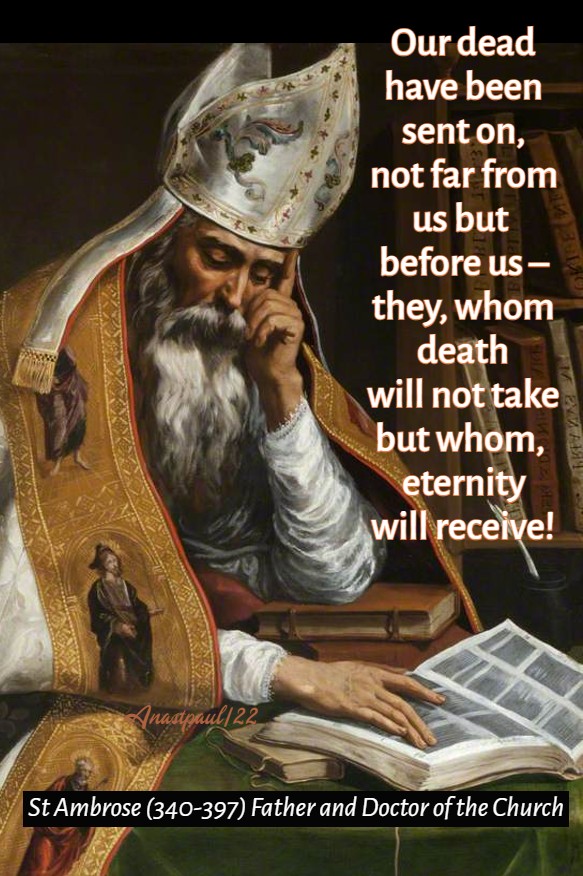
How much greater is our comfort, who believe that our good deeds are the promise, of better rewards after death. As for the pagans, they have their consolation, in thinking that death is a rest from all our trials. Since they think their dead are denied the enjoyment of life, they also think them, to be deprived of every faculty of sense and freed from the pain of the hard and continual sorrows, we bear in this life. We, on the other hand, just as we should have a more elevated spirit because of the reward we expect, so, we should also better bear our pains because of this consolation. … Our dead have been sent on, not far from us but before us – they, whom death will not take but whom, eternity will receive!” – St Ambrose (340-397) Father and Doctor of the Church (On the death of his brother, I, 70-71).
PRAYER – O God, Creator and Redeemer of all the faithful, grant to the souls of Thy servants and handmaids, the remission of all their sins, that they may obtain, by our loving prayer,s the forgiveness which they have always desired. Who lives and reigns with God the Father, in the unity of the Holy Spirit, God, world without end. Amen (Collect).
Our Morning Offering – 2 November – All Souls Day – “The Month of the Holy Souls in Purgatory”
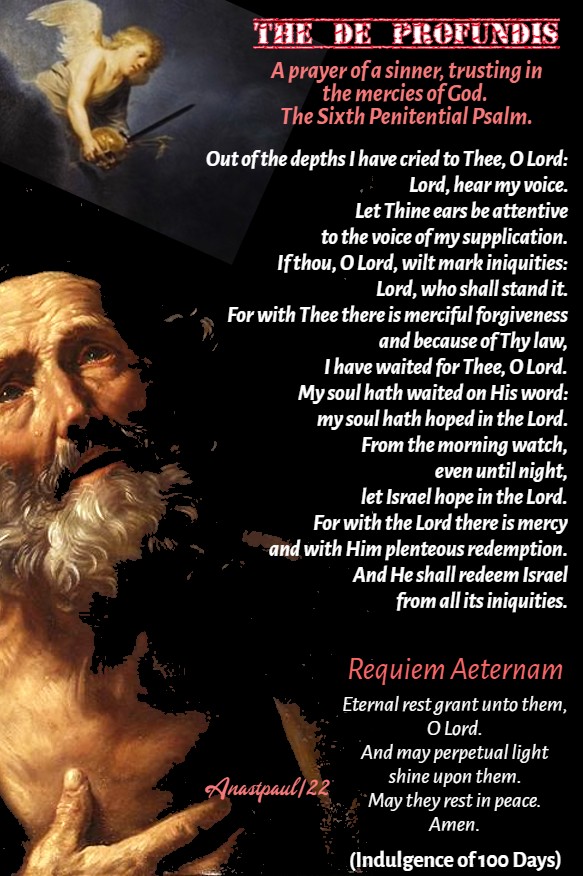
The De Profundis Psalm 129
A prayer of a sinner, trusting in the mercies of God. The Sixth Penitential Psalm.
Out of the depths I have cried to Thee, O Lord: Lord, hear my voice. Let Thine ears be attentive to the voice of my supplication. If thou, O Lord, wilt mark iniquities: Lord, who shall stand it. For with Thee there is merciful forgiveness and because of Thy law, I have waited for Thee, O Lord. My soul hath waited on His word: my soul hath hoped in the Lord. From the morning watch, even until night, let Israel hope in the Lord. For with the Lord there is mercy and with Him plenteous redemption. And He shall redeem Israel from all its iniquities.
(Eternal rest or “Requiem aeternam”) Eternal rest grant unto them, O Lord. And may perpetual light shine upon them. May they rest in peace. Amen.
(Indulgence of 100 Days)
*Psalm 129 in Douay Rheims
Pope Clement XII. was the first who, in order to move the piety of Christians to pray for the souls in Purgatory, granted, by a Brief of 4 August 1736, Coelestes Ecclesiae thesauros – i. The Indulgence of 100 days to all the faithful, everytime that, at the sound of the bell, at the first hour after the evening Ave Maria, they say devoutly, on their knees the psalm De profundis, with a Requiem aAternamat the end of, it. (The evening Ave Maria in Rome varies with the season; it is commonly taken as 6 o’clock.) ii. A Plenary Indulgence to those who perform this pious exercise, for a year, at the hour appointed, once in the year, on any one day, after Confession and Communion. Those who do not know by heart the De Profundis, may gain these Indulgences by saying, in the way already mentioned for the De profundis, one Pater Noster and one Ave Maria, with the Requiem Aeternam. Observe also, that the aforesaid Clement XII. declared, on 12 December 1736, that these Indulgences might be gained by saying the De Profundis etc, as above, although, according to the custom of a particular Church or place, the “signal for the dead,” as it is called, be given by the sound of the bell either before, or after one hour after the evening Ave Maria. Pope Pius VI., by a Rescript of 18 March 1781, granted the above-named Indulgences to all the faithful, who should chance to dwell in any place where no bell for the dead is sounded and who, shall say the De Profundis or Pater Noster, as aforesaid, about the time specified above.
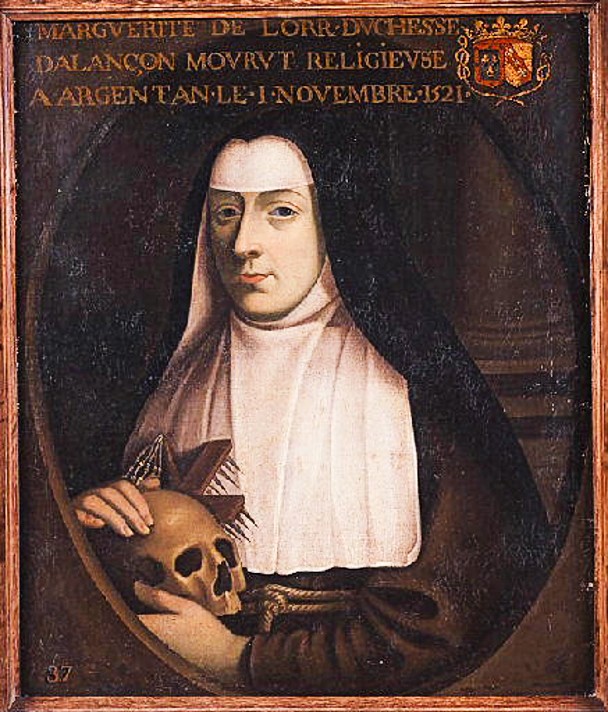
Saint of the Day – 2 November – Blessed Margaret of Lorraine OSC (1463-1521) Duchess of Alençon, Mother, Widow, Nun of the Poor Clares, Apostle of the sick, the poor and those suffering under unjust feudal lords. Born in 1463 as Marguerite de Lorraine-Vaudemont in Vaudemont Castle, Lorraine, France and died on 2 November 1521 at Argentan, Brittany, France of natural causes. Also known as – Margaret Lotarynska, Marguerite de Lorraine-Vaudemont, Margarita, Margherita, Marguerite. Margaret was Beatified on 10 March 1921 by Pope Benedict XV (cultus confirmed).
Blessed Margaret of Lorraine was born of the ancient noble family of the Dukes of Lorraine. Her earnest efforts to lead a virtuous life attracted attention very early in her life. After the death of her husband, Duke Rene of Alençon, she assumed the government of the Duchy. In this, she was guided solely by Catholic principles and by means of prudent economy, she managed to save a significant amount of materials which she used to render aid to the poor and the needy. She took particular pleasure in nursing the sick and the lepers. She built Churches, Convents and hospitals everywhere.
The subject matter taught in the schools and the instruction of the people were objects of particular solicitude to her. Hard-hearted landlords and selfish officials were dealt with by her, with the greatest severity.
Still, she remained very humble and spent a great part of her day in meditating on the sufferings of Christ and in performing works of penance.
In later years, after she had turned the government over to her son, she was invested with the habit of the Third Order. And when that no longer satisfied her desire for perfection, she entered the Convent of the Poor Clares at Alençon, which she herself had founded. Blessed Margaret aspired to perfection as a child, a woman, a ruler, a widow and finally as a religious and she succeeded in achieving her goal.
Every Christian is obliged to strive for perfection. It is not without reason that Our Lord says: “Be you, therefore, perfect as your heavenly Father is perfect” (Mt. 5,48).
This obligation does not require the impossible of us. Everyone can love his neighbour, do good and overcome himself. We must, above all, bear in mind that perfection does not consist in external practices but rather, in the disposition of our heart. The motive must be the love of God. All for the love of God!
Blessed Margaret of Lorraine died a saintly death at the Convent at Alençon in the year 1521. Pope Benedict XV approved her veneration.
In 1792 the body of Blessed Margaret was exhumed and found incorrupt. Inside the casket was found a small reliquary which contained her heart.
During the French Revolution a group of Jacobins disinterred the saint’s body to profane it, later placing it in a common grave. Only the bones and the saint’s heart remain and are now at the Monastery of Clarisses at Alençon
All Souls Day – The Commemoration of All the Faithful Departed: Commemoration of the faithful departed in Purgatory. Abbot Odilo of Cluny instituted it in the Monasteries of his congregation in 998, other religious orders took up the observance and it was adopted by various Diocese and gradually by the whole Church. The Office of the Dead must be recited by the clergy on this day and Pope Benedict XV granted to all Priests, the privilege of saying three Masses of requiem – • one for the souls in Purgatory • one for the intention of the Holy Father • one for the Priest’s intentions If the feast should fall on Sunday it is kept on 3 November. Patronage: Monselice, Italy HERE: https://anastpaul.com/2018/11/02/commemoration-of-all-souls-day-2-november/ AND: https://anastpaul.wordpress.com/2017/11/02/the-commemoration-of-all-the-holy-souls-in-purgatory-2-november/
St Ambrose of Agaune St Ambrose of Agaune St Amicus of Fonte Avellana St Amicus of Rambone St Baya of Scotland St Domninus of Grenoble St Erc of Slane St Eustochium of Tarsus St George of Vienne Bl John Bodey St Jorandus of Kergrist St Justus of Trieste St Marcian of Chalcis Blessed Margaret of Lorraine OSC (1463-1521)Duchess of Alençon, Mother, Widow, Nun of the Poor Clares St Mateo López y López St Maura of Scotland St Theodotus of Laodicea
Martyrs of Isfahan – 5+ Saints: Acindynus, Pegasius and Anempodistus were Persian priests who were imprisoned, tortured, interrogated and Martyred in the persecutions of king Sapor II of Persia; he considered any Christian to be a Roman spy and anti-Persian.
Martyrs of Sebaste – 10 Saints: A group of ten soldiers in the imperial Roman army of Emperor Licinius Licinianus who were executed together for refusing to burn incense as a sacrifice to the emperor. The only details that have survived are five of their names – Agapius, Cartherius, Eudoxius, Styriacus and Tobias. They were burned at the stake in 315 in Sebaste (in modern Turkey).
“By the practice of Indulgences, the Church places at the charitable disposal of the faithful, the inexhaustible treasure accumulated, from age to age, by the superabundant satisfactions of the Saints, added to those of the Martyrs and united to those of our Blessed Lady and the infinite residue of our Lord’s sufferings. These remissions of punishment, she grants to the living, by her own direct power but, she nearly always approves of and permits, their application to the dead, by way of suffrage, that is to say, in the manner in which, as we have seen, each of the faithful may offer to God, Who accepts it, for another, the suffrage or succour of his own satisfactions.” (The Liturgical Year,Abbot Prosper Guéranger OSB (1805-1875).
A Partial Indulgence may be obtained, by devoutly visiting a Cemetery and praying there for the departed, mentally or vocally. One may gain a Plenary Indulgence visiting a Cemetery each day, between 1 November and 8 November. These Indulgences are applicable only to the Souls in Purgatory.
A Plenary Indulgence, again applicable only to the Souls in Purgatory, is also granted when the faithful piously visit a Church or a public Oratory on 2 November. In visiting the Church or Oratory, it is required, that one Our Father and the Creed be recited and then the usual conditions are fulfilled, within 20 days.
A Partial Indulgence, applicable only to the Souls in Purgatory, can be obtained when the Eternal Rest (Requiem aeternam) is prayed:
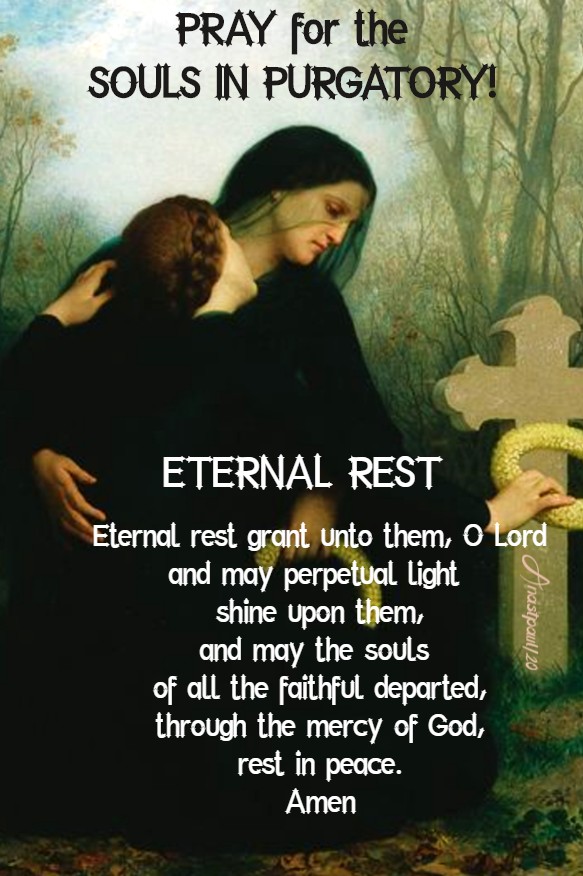
ETERNAL REST
Eternal rest grant unto them, O Lord and may perpetual light shine upon them and may the souls of all the faithful departed, through the mercy of God, rest in peace. Amen
Thought for the Day – 1 November – Meditations with Antonio Cardinal Bacci (1881-1971)
The Feast of All Saints
“In these days when the Church is so anxious to foster devotion to the Saints, let us fervently invoke their patronage. They are our brothers and they reach out lovingly to assist us because, they desire us to share in their glory.
As we know, the Church is threefold. There is the Church Militant, to which we belong; there is the Church Suffering, which consists of the souls in Purgatory and there is the Church Triumphant, which is made up of the Blessed in Heaven. The bond of charity unites all three divisions.
We, who are still on earth, have brothers and sisters in eternal glory who love us and intercede for us. Let us pray to them fervently and constantly. Above all, let us seek to imitate the sanctity which won such glory for them in Heaven.”
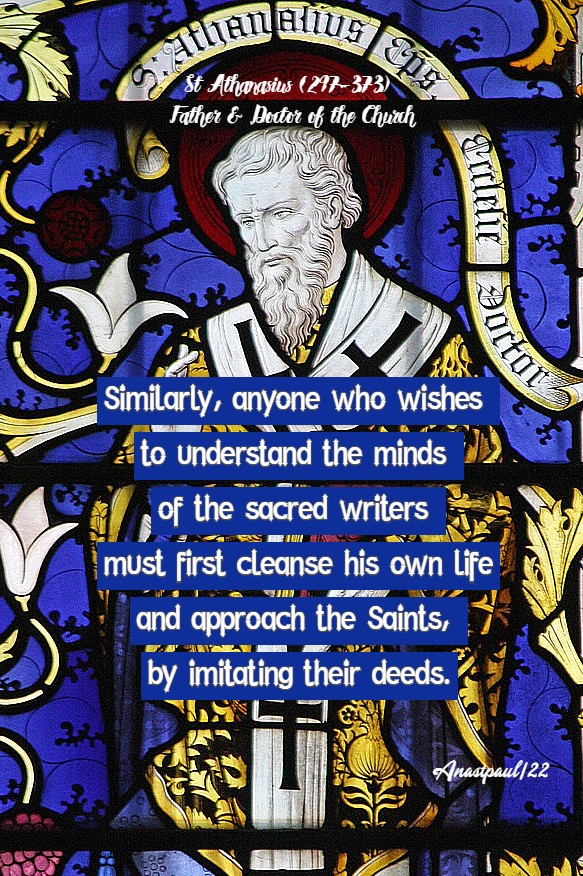
“Similarly, anyone who wishes to understand the minds of the sacred writers must first cleanse his own life and approach the Saints, by imitating their deeds.”
St Athanasius (297-373) Father & Doctor of the Church
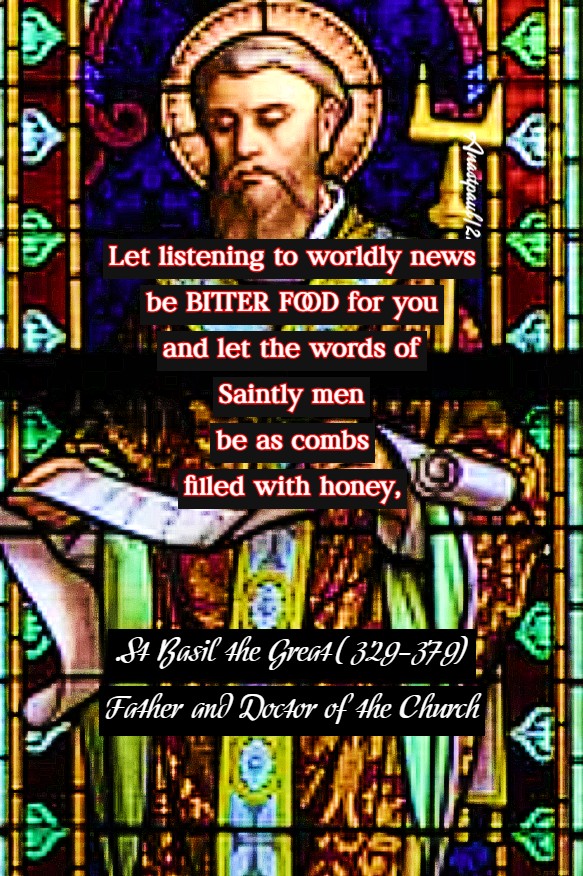
“Let listening to worldly news be BITTER FOOD for you and let the words of Saintly men be as combs filled with honey.”
St Basil the Great (329-379) Father and Doctor of the Church
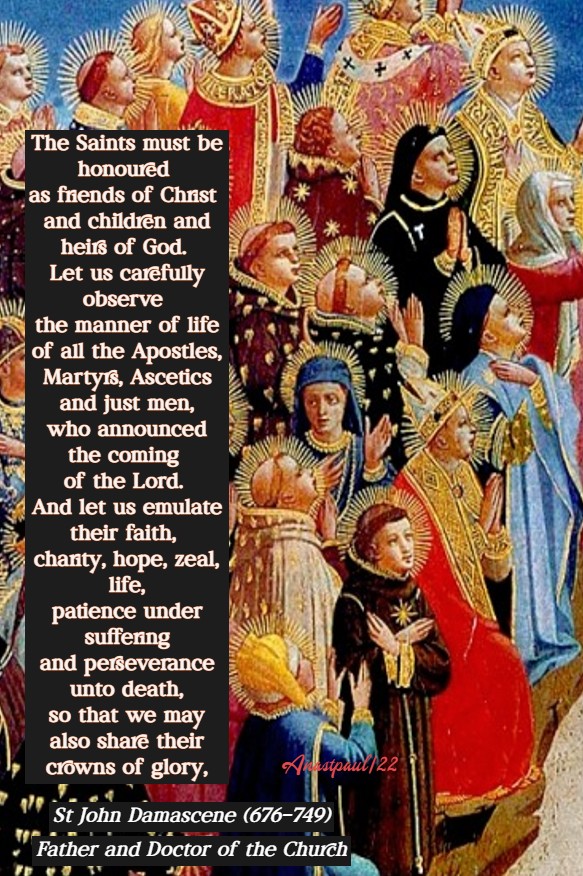
“The Saints must be honoured as friends of Christ and children and heirs of God. Let us carefully observe the manner of life of all the Apostles, Martyrs, Ascetics and just men, who announced the coming of the Lord. And let us emulate their faith, charity, hope, zeal, life, patience under suffering and perseverance unto death, so that we may also share their crowns of glory.”
St John Damascene (676-749) Father and Doctor of the Church
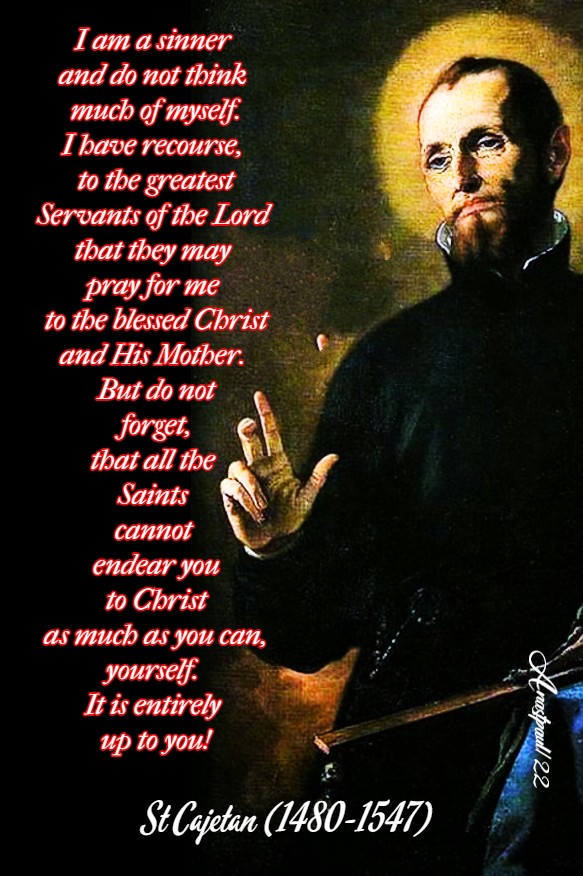
“I am a sinner and do not think much of myself. I have recourse, to the greatest Servants of the Lord that they may pray for me to the blessed Christ and His Mother. But do not forget, that all the Saints cannot endear you to Christ as much as you can yourself. It is entirely up to you!”
St Cajetan (1480-1547) Confessor
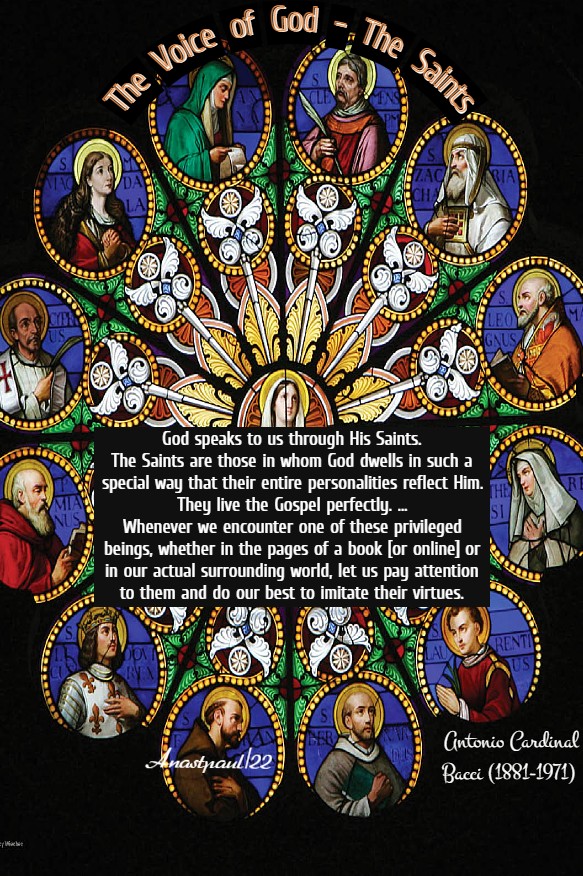
“God speaks to us through His Saints. The Saints are those in whom God dwells in such a special way that their entire personalities reflect Him. They live the Gospel perfectly. Whenever we encounter one of these privileged beings, whether in the pages of a book [or online] or in our actual surrounding world, let us pay attention to them and do our best to imitate their virtues.”
































 AnaStpaul
You must be logged in to post a comment.