Posted in MATER DOLOROSA - Mother of SORROWS, Of UNDERTAKERS, Morticians, Catholic Cemetaries, PALLBEARERS, SAINT of the DAY, The PASSION

Saint of the Day – 31 August – Saint Joseph of Arimathea (Died 1st Century)

Saint of the Day – 31 August – Saint Joseph of Arimathea (Died 1st Century) “The Secret Disciple of Jesus” Born in Arimathea, Palestine and died in the 1st century. Patronages – of pallbearers, funeral directors, morticians, undertakers, tin miners, tin smiths, Catholic Cemeteries of the Archdiocese of Vancouver, Glastonbury Cathedral. Additional Memorial – 16 October (translation of Relics to Jerusalem).
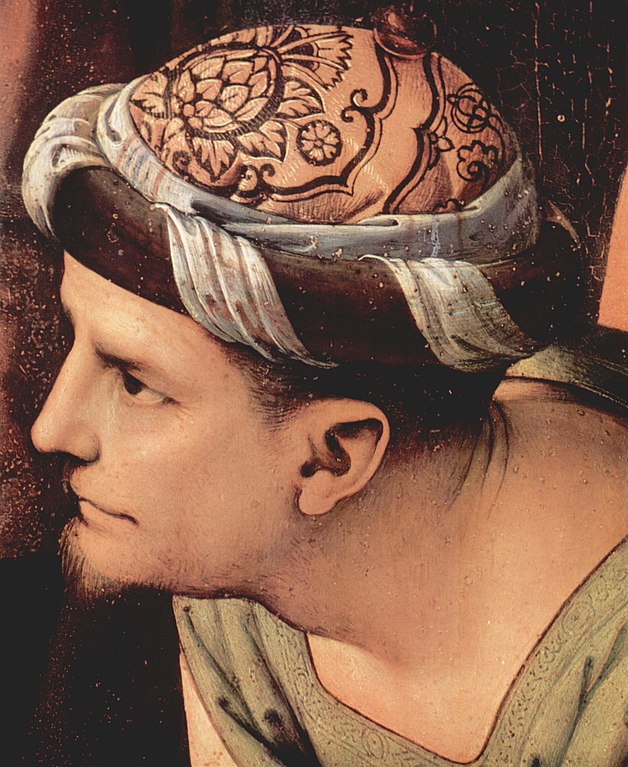
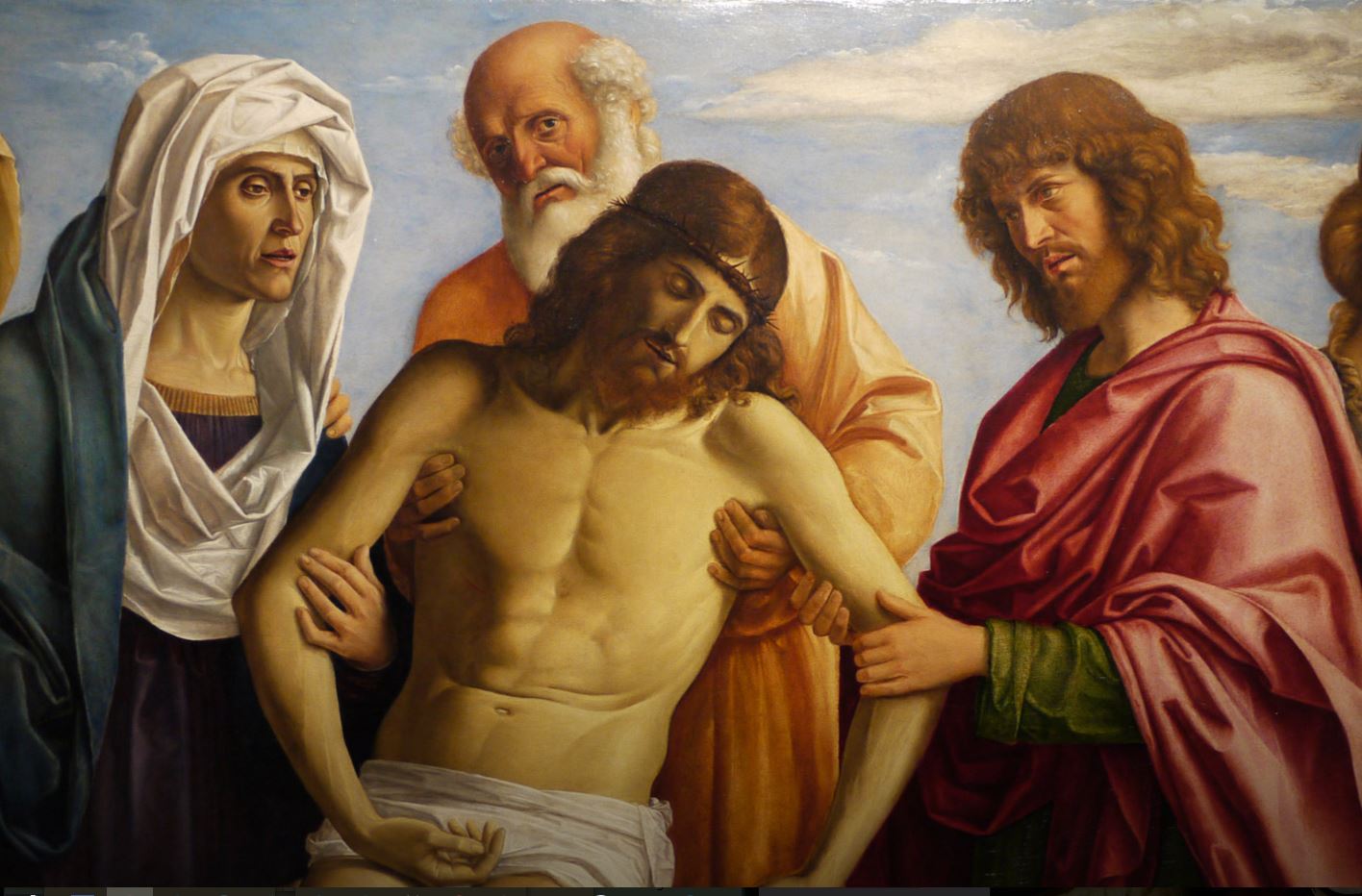
St Joseph of Arimathea by Pietro Perugino, a detail from his Lamentation over the Dead Christ.

The only definitive information we have concerning Joseph of Arimathea comes to us from the four Gospel accounts of Jesus’ Passion, Death and Resurrection. Many other legends exist that detail what happened to him after these events took place and, although they make interesting reading, none of them can be verified as the truth.

What we do know is that Joseph of Arimathea was a wealthy member of the Sanhedrin and a follower of Jesus, although a secret one “for fear of the Jews” (Jn 19:38). Described as a “good and just man” in the Gospel of Luke (23:50), he was one of the Jewish leaders who did not take part in the condemnation of Jesus on the night we call Maundy or Holy Thursday. Instead, after Jesus’ death, Joseph boldly asked Pontius Pilate for His Body so that it could receive a proper burial before the Sabbath, which began at sundown. This was a more courageous act on Joseph’s part than we might imagine, as Jesus had died a condemned criminal, publicly executed for sedition.

Remarkably, Pilate agreed and Joseph, along with another of Jesus’ secret followers, Nicodemus, arranged to have the body prepared for burial according to Jewish custom – Jesus was then laid in Joseph’s own tomb, which was as yet unused and newly hewn out of rock. Finally, a large stone was rolled in front of the tomb’s entrance, the same stone that would later be found rolled away on Easter Sunday morning.
At this point, the biblical story of Joseph comes to a close and the legendary stories begin. During the Middle Ages, Joseph’s narrative somehow became connected with the lore surrounding King Arthur; he is featured in a 12th-century tale by Robert de Boron as the Keeper of the Holy Grail, which was the cup used by Jesus at the Last Supper. An earlier version of the story has Joseph receiving the cup from an apparition of Jesus, which later finds its way to Great Britain by way of some of Joseph’s followers. A revised version has Joseph himself coming to the British Isles with the Grail, which he subsequently buried in a secret place. It was this Holy Grail which was at the centre of so many Arthurian quests.

Glastonbury Abbey also lays claim to part of Joseph’s legend. It is said that when Joseph arrived in Great Britain with the Grail around the year 63, he landed on the island of Avalon and climbed the hill there. Weary from his journey, he thrust his staff into the ground and rested, by morning, the staff had taken root and produced a thorn tree, which reportedly bloomed every Christmas. It was also upon this land that Joseph and 12 of his followers are said to have built Glastonbury Abbey, although it was actually constructed around the seventh century. Today it is maintained as an important archeological site.
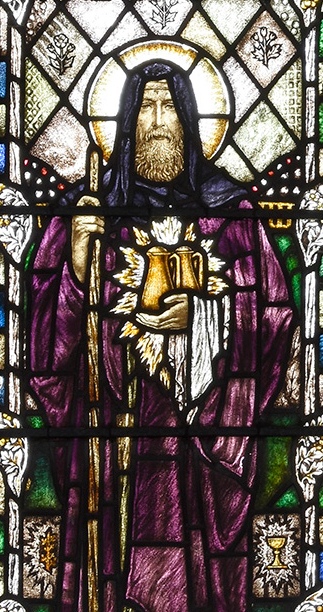
Legends aside, it is Joseph’s service to Jesus our Saviour and Redeemer, that Christians remember today.

Merciful God, Whose servant, Joseph of Arimathaea
with reverence and godly fear,
prepared the Body of our Lord and Saviour for burial
and laid it in his own tomb –
Grant to us, Your faithful people,
grace and courage to love and serve Jesus
with sincere devotion all the days of our life.
Through Jesus Christ our Lord,
Who lives and reigns with You and the Holy Spirit,
one God, forever and ever.
Amen
Posted in MARIAN TITLES, SAINT of the DAY

Our Lady of the Founders (5th Century) Constantinople and Memorials of the Saints – 31 August

Our Lady of the Founders – The Relic of the Girdle of Our Lady, Constantinople (5th Century) – 31 August:

The Abbot Giovanni Battista Orsini tells us the Empress Saint Pulcheria had this Church built, and gave to it the Girdle of Our Lady. A feast of this relic is kept at Constantinople, under the title of the Deposition of Our Lady’s Girdle. The French having taken this City, this precious treasure was carried off by Nivellon, Bishop of Soissons and placed in the celebrated Abbey of Our Lady, with a portion of the veil of that Queen of Heaven.

The Empress Saint Pulcheria lived in Constantinople in the 5th century, and she built many Churches, hospitals and public houses for the destitute. She is responsible for at least three Churches in Constantinople that were dedicated to the Blessed Virgin – the Blachemae, the Chalkoprateia and the Hodegetria.
The Church of the Virgin of Blachernae, now known as the Church of Panagia of Blachernae, is located in Istanbul. It was once the most celebrated Shrine in Constantinople and lies inside the high walls of the City, only a short distance from the Golden Horn. The Church was begun by the Empress Pulcheria, and completed by her husband, the Emperor Marcian. It was built upon the site of what was thought to be a sacred spring, the waters of which are still thought to have therapeutic value. The Emperor Leo I made several additions, including the Hagai Soros, which was actually a small Chapel next to the Church where the Holy Robe and Girdle of the Blessed Virgin Mary were kept in a silver and gold reliquary. The relics had been brought from Palestine in 458.

In the year 911 it was reported that there was a Marian apparition at this Church. The City was under siege by a large Muslim army, so the citizens of Constantinople had recourse to Mary, praying for relief at the Blachernae Church. Very early one morning the Blessed Virgin, preceded by a host of Angels, was seen to enter through the Church doors, escorted by Saint John the Baptist and Saint John the Apostle. She advanced to the centre of the Church and knelt there to pray fervently with tears in her eyes. After a time she moved to the Altar and continued praying before she removed her veil and held it out over the faithful as she ascended back into Heaven. This was seen as a sign that she was taking the City under her protection and so it happened that the Christian’s won a striking victory over their enemies, who were driven off.
The City of Constantinople came under siege during the Fourth Crusade in the year 1203 and was captured in April of 1204. The Bishop Nivelon de Cherisy was one of the first men to scale the walls of mighty Constantinople when it was finally opened to the Crusaders. Despite the fact that there was a stern prohibition against plundering relics from Churches and monasteries, many holy relics were obtained and brought back to the West. Bishop Conrad of Halberstadt, Abbot Martin of Pairis, and Nivelon of Soiccons were known to have taken relics. Nivelon of Soiccons enriched his Cathedral at Soissons with several important relics. Robert of Clari later includes in a list of relics he viewed at the Church of the Blessed Virgin of the Pharos (Lighthouse) the Crown of Thorns, the Virgin’s Robe, the Head of St John the Baptist and two large pieces of the True Cross. The robe was a large portion of the sleeveless shirt worn by the Virgin Mary, as well as her Girdle.

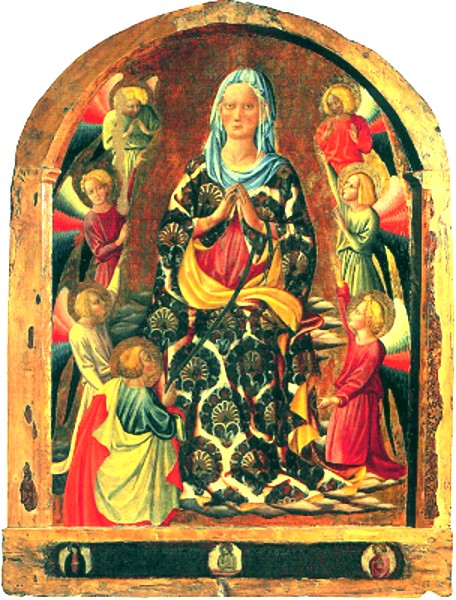
Francesco d’Antonio – Madonna della Cintola

St Aidan of Lindisfarne (Died 651) Apostle of Northumbria, Bishop, Monk, Missionary, Abbot, Ascetic.
St Aidan’s Story:

https://anastpaul.com/2018/08/31/saint-of-the-day-31-august-st-aidan-of-lindisfarne-died-651-apostle-of-northumbria/

St Ammi of Caesarea
St Aristides the Philosopher
St Barbolenus of Bobbio
St Caesidius
St Cuthburgh of Wimborne
St Cwenburgh of Wimborne
St Joseph of Arimathea (Died 1st Century) “The Secret Disciple of Jesus”
St Mark of Milan
St Optatus of Auxerre

St Paulinus of Trier (Died 358) Bishop of Trier, Confessor, Missionary.
About this Saint Paulinus:

https://anastpaul.com/2020/08/31/saint-of-the-day-31-august-saint-paulinus-of-trier-died-358-or-359-bishop/

Blessed Pere (Peter) Tarrés i Claret (1905-1950) Priest, Medical Doctor, Co-Founder, with Dr Gerrado Manresa, of a clinic for the poor, dedicated to the Blessed Mother.
His Life:

https://anastpaul.com/2019/08/31/saint-of-the-day-31-august-blessed-pere-peter-tarres-i-claret-1905-1950/

St Raymond Nonnatus O.deM. (1204-1240) Religious Priest, Confessor, Cardinal, Founder of the Mercedarian Order.
Biography here:

https://anastpaul.wordpress.com/2017/08/31/saint-of-the-day-31-august-st-raymond-nonnatus-o-dem/

St Raymond Nonnatus Robustian of Milan
St Raymond Nonnatus Rufina of Caesarea
St Raymond Nonnatus Theodotus of Caesarea

Martyrs of Prague – 64 beati

Martyred in the Spanish Civil War:
Martyrs of Pozo de la Lagarta – 18 beati:
• Blessed Bernardo Cembranos Nistal
• Blessed Dionisio Ullivarri Barajuán
• Blessed Enrique Vidaurreta Palma
• Blessed Félix Paco Escartín
• Blessed Germán Martín y Martín
• Blessed Isidro Ordóñez Díez
• Blessed José María Palacio Montes
• Blessed Justo Zariquiegui Mendoza
• Blessed Marciano Herrero Martínez
• Blessed Miguel Menéndez García
• Blessed Tomás Alonso Sanjuán
• Blessed Ventureta Sauleda Paulís

Posted in MEDITATIONS - ANTONIO CARD BACCI, QUOTES on GRACE, QUOTES on PERSEVERANCE, QUOTES on PRAYER

Thought for the Day – 30 August – Perseverance

Thought for the Day – 30 August – Meditations with Antonio Cardinal Bacci (1881-1971)

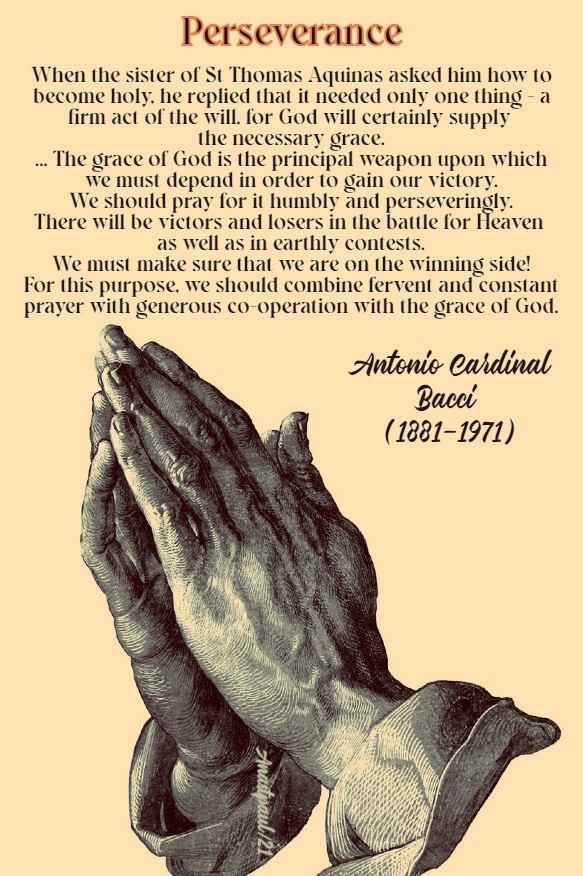
Perseverance

“Perseverance may be a difficult virtue but nothing is really difficult to a person of strong resolution.
When the sister of St Thomas Aquinas asked him how to become holy, he replied that it needed only one thing – a firm act of the will, for God will certainly supply the necessary grace.

Think of how much work and sacrifice is required to achieve worldly success.
Cicero wrote that it required constant and tireless labour in order to become a great orator (Cf De Oratore, 1:39).
St Paul cited the example of athletes who are prepared to make such great sacrifices, in order to train themselves to win.
If they are prepared to do so much to gain a perishable crown, he comments, we should be prepared to do much more to gain an imperishable one (Cf 1 Cor 9:25).

The grace of God is the principal weapon upon which we must depend in order to gain our victory.
We should pray for it humbly and perseveringly.
There will be victors and losers in the battle for Heaven as well as in earthly contests.
We must make sure that we are on the winning side!
For this purpose, we should combine fervent and constant prayer with generous co-operation with the grace of God.

Antonio Cardinal Bacci

PART ONE HERE:
https://anastpaul.com/2020/08/30/thought-for-the-day-30-august-perseverance/

Posted in CHRIST the HIGH PRIEST, CHRIST the JUDGE, CHRIST the KING, CHRIST the LIGHT, CHRIST the PHYSICIAN, CHRIST the WORD and WISDOM, CHRIST, the WAY,TRUTH,LIFE, DOCTORS of the Church, FATHERS of the Church, PRAYERS for VARIOUS NEEDS, PRAYERS of the CHURCH, PRAYERS on FAITH, QUOTES for CHRIST, QUOTES on GRACE, QUOTES on the CROSS of CHRIST, The HOLY CROSS, The PASSION, The WORD

Quote/s of the Day – 30 August – ‘We were the captives. …’

Quote/s of the Day – 30 August – “Month of the Immaculate Heart” – Readings: Thessalonians 4: 13-18; Psalm 96: 1 and 3-5, 11-13; Luke 4: 16-30

“He has sent me to proclaim liberty to captives
and recovery of sight to the blind,
to let the oppressed go free.”

Luke 4:19

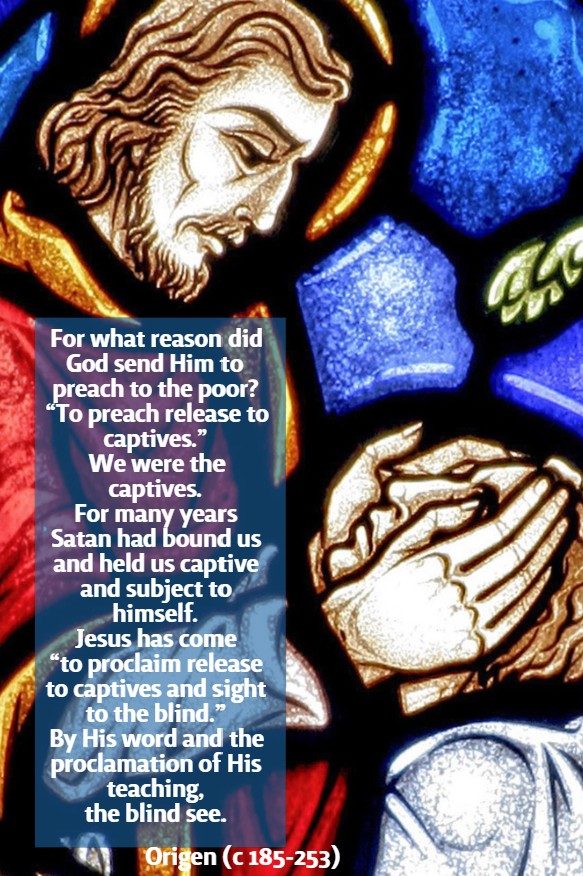
“For what reason did God send Him to preach to the poor?
“To preach release to captives.”
We were the captives.
For many years Satan had bound us
and held us captive and subject to himself.
Jesus has come
“to proclaim release to captives and sight to the blind.”
By His word and the proclamation of His teaching,
the blind see.”

Origen (c 185-253)

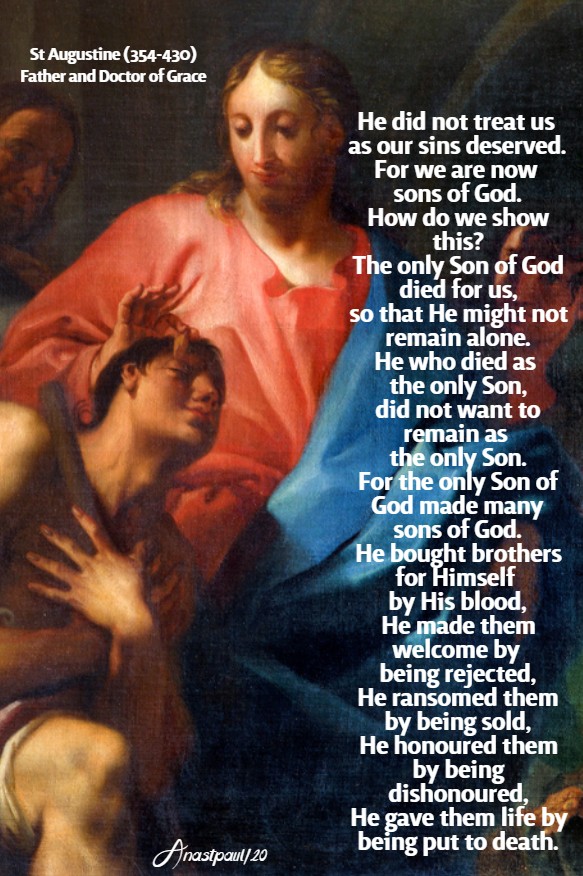
“He did not treat us as our sins deserved.
For we are now sons of God.
How do we show this?
The only Son of God died for us,
so that He might not remain alone.
He who died as the only Son,
did not want to remain as the only Son.
For the only Son of God made many sons of God.
He bought brothers for Himself by His blood,
He made them welcome by being rejected,
He ransomed them by being sold,
He honoured them by being dishonoured,
He gave them life by being put to death.”

St Augustine (354-430)
Bishop, Great Western Father and Doctor of Grace

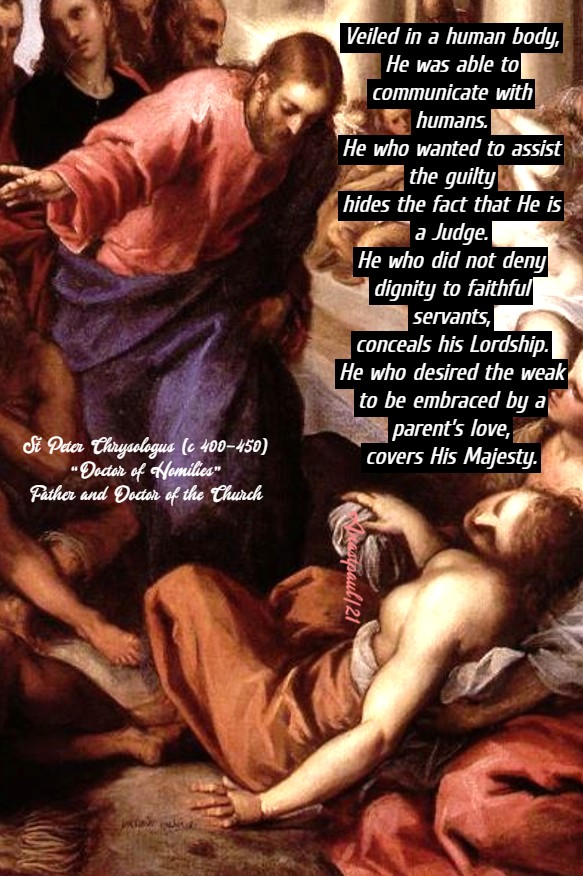
“… Veiled in a human body,
He was able to communicate with humans.
He who wanted to assist the guilty
hides the fact that He is a Judge.
He who did not deny dignity to faithful servants,
conceals his Lordship.
He who desired the weak
to be embraced by a parent’s love,
covers His Majesty.”

St Peter Chrysologus (c 400-450)
“Doctor of Homilies”
Father and Doctor of the Church

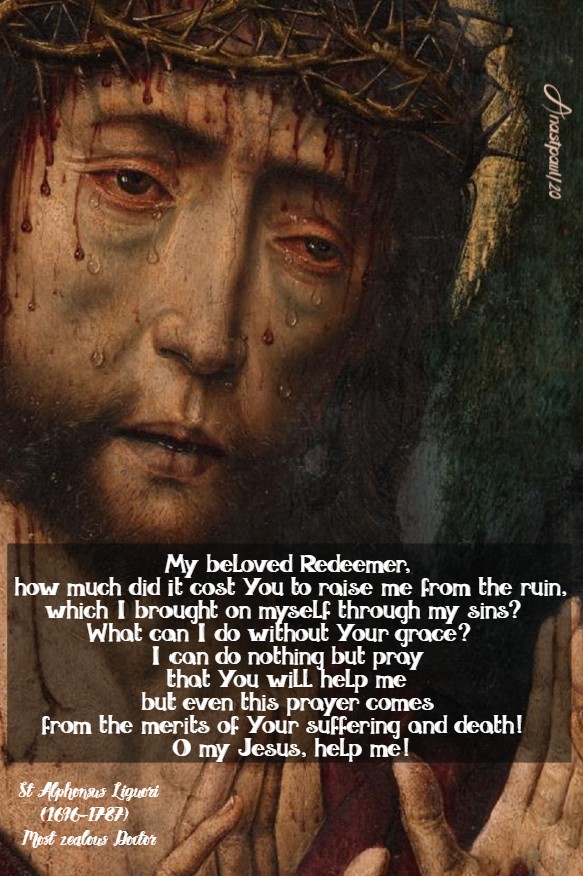
My beloved Redeemer,
how much did it cost You to raise me from the ruin,
which I brought on myself through my sins?
What can I do without Your grace?
I can do nothing but pray
that You will help me
but even this prayer comes
from the merits of Your suffering and death!
O my Jesus, help me!”

St Alphonsus Liguori (1696-1787)
Most zealous Doctor

Posted in CHRIST the HIGH PRIEST, CHRIST the KING, CHRIST, the WAY,TRUTH,LIFE, FATHERS of the Church, The WORD

One Minute Reflection – 30 August – ‘The Anointed One’

One Minute Reflection – 30 August – “Month of the Immaculate Heart” – Readings: Thessalonians 4: 13-18; Psalm 96: 1 and 3-5, 11-13; Luke 4: 16-30

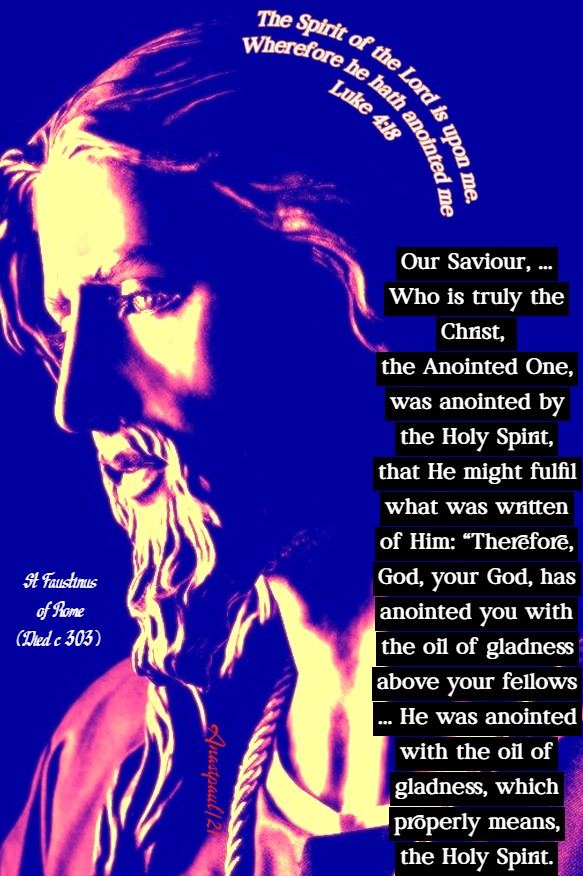
The Spirit of the Lord is upon me. Wherefore he hath anointed me” – Luke 4:18

REFLECTION – “Our Saviour was truly made the Anointed One according to the flesh, becoming true King and true Priest. He was both, so that nothing might be lacking in the Saviour. Notice, therefore, that He became King, when He says: “I was set by the Lord as king on Zion, his holy mountain” (Ps 2,6 Vg). Learn that He is also Priest from the witness of the Father: “You are a priest forever after the order of Melchizedek” (Ps 110[109],4)… He is, therefore, our Saviour according to the flesh and both King and Priest but His anointing is spiritual and not bodily. The kings and priests of the Jews were given their position by bodily anointing with oil. One man was not both – each was either king or priest. To Christ alone belongs perfection and fulness in all things, for He came also to fulfill the law.

Although they could not, as individuals, be both at the same time, they were called “Messiahs” or “anointed ones because they had received bodily anointing as kings or priests (cf. Ps 89[88]). Our Saviour, on the other hand, Who is truly the Christ, the Anointed One, was anointed by the Holy Spirit, that He might fulfil what was written of Him: “Therefore, God, your God, has anointed you with the oil of gladness above your fellows” (Ps 45[44],8). That He was anointed more than those who share the same name “Messiah” lies in the fact, that He was anointed with the oil of gladness, which properly means, the Holy Spirit.” – St Faustinus of Rome (Died c 303) Priest and Martyr – The Trinity, 39-40, CCL 69, 340-341

PRAYER – God our Saviour, through the grace of Baptism you made us children of light. Hear our prayer, that we may always walk in that light and work for truth, love and charity, as Your witnesses before men. Dispel from our hearts the darkness of sin and may the Holy and Immaculate Heart of Mary, be our constant protector and intercessor keeping- us ever watchful for the true light, Christ Your Son, who lives and reigns with You and the Holy Spirit, God forever, amen.

Posted in DOCTORS of the Church, GOD ALONE!, GOD is LOVE, PRAYERS of the SAINTS, QUOTES on GRACE

Our Morning Offering – 30 August – O God of Love

Our Morning Offering – 30 August – “Month of the Immaculate Heart”

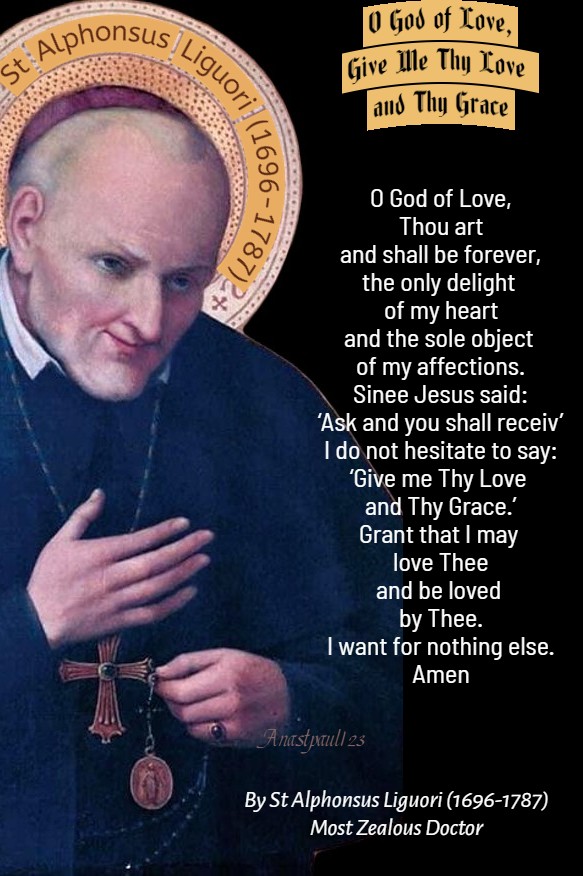
O God of Love,
Give Me Thy Love and Thy Grace
By St Alphonsus Liguori (1696-1787)

Most Zealous Doctor

O God of Love,
Thou art
and shall be forever,
the only delight of my heart
and the sole object of my affections.
Sinee Jesus said:
‘Ask and you shall receive,’
I do not hesitate to say:
‘Give me Thy Love and Thy Grace.’
Grant that I may love Thee
and be loved by Thee.
I want for nothing else.
Amen
Posted in SAILORS, MARINERS, NAVIGATORS, SAINT of the DAY

Saint of the Day – 30 August – Blessed John Roche (Died 1588) Lay Martyr

Saint of the Day – 30 August – Blessed John Roche (Died 1588) Lay Martyr Born in Ireland and died by being hanged on 30 August 1588 at Tyburn, London, England. Also known as – John Neele, John Neale. Patronages – boatmen, mariners, sailors, watermen. Additional feast days – He is counted among the English Martyrs on 22 November and is also venerated in Ireland where his feast is celebrated on 20 June.

John Roche was born in Ireland and, as a young man, he went to London where he found work as a servant and a waterman. As was common at that time, Catholics often worked under an alias and Roche sometimes used the name of John Neale. A devout Catholic, he became involved with Margaret Ward and others who were aiding persecuted Priests. One such Priest was Fr William/Richard Watson.

Fr Watson had been arrested and tortured and, upon learning of this, Margaret Ward began visiting the Priest in Bridewell Prison. Eventually she devised a plan to help him escape. She smuggled a length of rope into the prison and , at a prearranged time, he was to let himself down from his cell which was at the top of the prison building. She found two Catholic watermen who would be waiting nearby with a boat to spirit the Priest away. However, the two watermen lost their nerve and backed out. Margaret did not give up! She approached John Roche who readily agreed to assist the Priest. Disastrously, the rope was too short and the Priest had to jump the remaining distance. He crashed down onto a shed below, breaking his right arm and leg. Immediately, John Roche ran to his assistance and carried him to the boat.

Of course, the clatter had alerted the jailor and others and the rope, still dangling from the cornice, was discovered. Margaret Ward, being Fr Watson’s only visitor, was swiftly arrested.

John had managed to get the Priest to safety and he was recuperating in John’s house. When he had recovered, John swapped clothes with him and the Priest got safely away. Sadly, John, in the Priest’s clothes, was spotted by the jailor who arrested him. He was vigorously interrogated and eventually admitted his role in the escape of Fr Watson. He was charged with treason and condemned to death. Offered a full pardon if he would seek the Queen’s forgiveness and attend a Protestant service, John Roche refused both!

On 30 August 1588, John Roche and Margaret Ward were hanged, drawn and quartered at Tyburn. Four other Catholics, including Welshman Richard Flowers, were executed with them that day.

On 15 December 1929, Pope Pius XI Beatified John Roche.

Posted in MARIAN TITLES, SAINT of the DAY

Santa Maria del Pozzo, Mother and Queen of Mercy / Our Lady of the Well – Capurso, Bari, Italy (1705) and Memorials of the Saints – 30 August

Santa Maria del Pozzo, Mother and Queen of Mercy / Our Lady of the Well – Capurso, Bari, Italy (1705) – 30 August and 20 May:

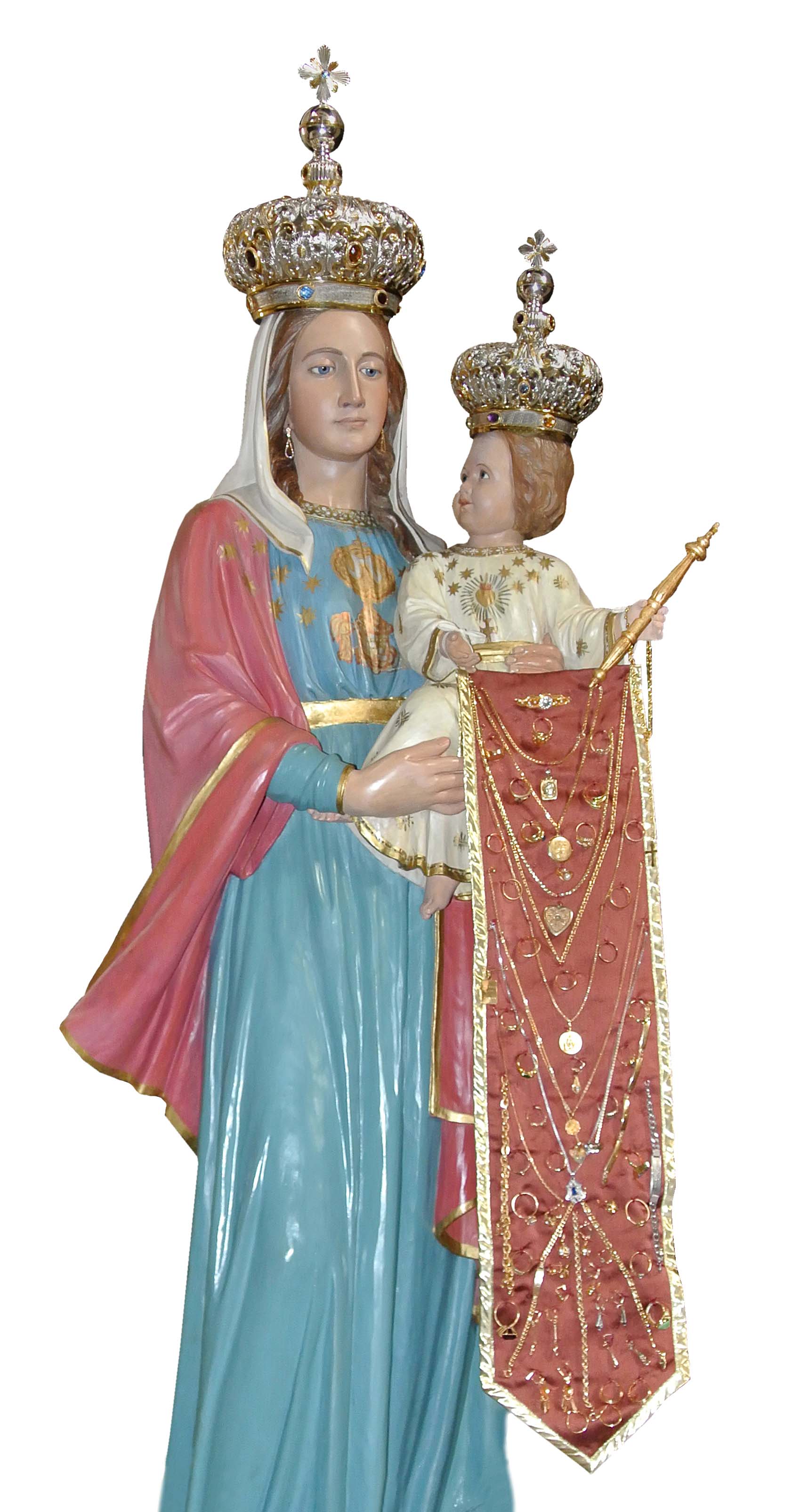
The town of Capurso (Bari), on the east coast of southern Italy, claims Our Lady of the Well as its Patron under the title Madonna del Pozzo. Tradition says that it was on 30 August 1705, that the image of Our Lady sculpted in wood was found in a well. It is now preserved in the Basilica St Maria del Pozzo, construction on which began in 1770. On 20 May 1852, the image of the Blessed Mother was solemnly crowned. The Societá Maria del Pozzo, dedicated to Madonna del Pozzo and her traditions was established in 1922. The Society has its origins at Capursoand its Headquarteredare in Chicago, Illinois,

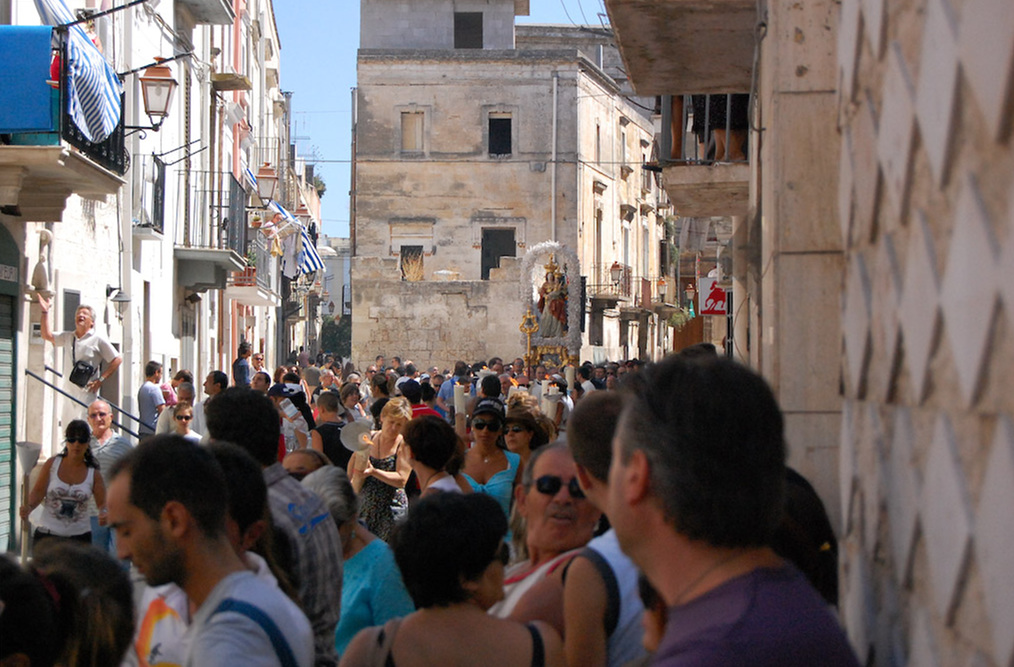
On 30 August 1705, the Priest, Don Domenico Tanzella , after recovering from a serious illness that forced him to bed drinking the water of the well of “Santa Maria”, descending into the hollow shaft of the Piscino found, on the wall, an icon of the Holy Virgin. Don Domenico Capurso exhibited the icon in the Tanzella Chapel dedicated to St Lawrence Martyr . Many miracles, were recorded, one, to a certain Caterina, crippled for many years, wife of Lorenzo Maffiola. Our Lady would appear in a dream and told her that she was to go to the Chapel of Tanzella and she would receive healing grace. The next day Catherine dragged herself there and with tears implored the Madonna for a cure. Suddenly she felt a sensation and tried to walk succeeded! At the news of this new miracle pilgrims began to flow in Capurso from countries near and far, on foot and by every means available at the time, singing hymns glorifying Mary. Today in celebration on 30 August or the last Sunday in August., 100s descend upon the Sanctuary to process the Statue through the streets. Everyone wants to touch and venerate the miraculous Madonna.

St Adauctus of Rome
St Agilus

Blessed Alfredo Ildefonso Schuster OSB (1880-1954) Cardinal, Archbishop of Milan, Benedictine Monk and Abbot, Writer, Liturgical scholar.
His Life:

https://anastpaul.com/2019/08/30/saint-of-the-day-30-august-blessed-alfredo-ildefonso-schuster-osb-1880-1954/

St Arsenius the Hermit
St Boniface of Hadrumetum
St Bononius of Lucedio
Bl Bronislava of Poland
Bl Edward Shelley
Bl Ero di Armenteira
Bl Euphrasia of the Sacred Heart of Jesus (1877-1952)
Bl Eustáquio van Lieshout
St Fantinus of San Mercurius
St Felix of Rome

Saint Fiacre (Died 670) Priest, Abbot, Monk, Hermit, apostle of charity, gardener.
About St Fiacre:

https://anastpaul.com/2019/09/01/saint-of-the-day-1-september-saint-fiacre-died-670/

St Gaudentia of Rome

Blessed Giovanni Giovenale Ancina CO (1545–1604) Bishop of Saluzzo, member of the Oratory of St Philip Neri, Scholar, Musician and Composer, renowned Preacher Doctor of Medicine. Commonly known as Blessed Juvenal Ancina.
The Life of Blessed Juvenal:

https://anastpaul.com/2020/08/30/saint-of-the-day-30-august-blessed-giovanni-giovenale-ancina-co-1545-1604-bishop/

St Jeanne Jugan LSP (Mary of the Cross) (1792 – 1879) Sister and Founder of the Little Sisters of the Poor,
Biography:

https://anastpaul.com/2018/08/30/saint-of-the-day-30-august-st-mary-of-the-cross-1792-1879-jeanne-jugan/

Blessed John Roche (Died 1588) Lay Martyr
St Loarn
St Margaret Ward
Bl María Rafols-Bruna
St Narcisa de Jesus Martillo Moran

St Pammachius (c 340 – 410) Senator, Monk, Apostle of Charity, friend of St Jerome andhe was praised by St Augustine.
Biography:

https://anastpaul.com/2017/08/30/saint-of-the-day-30-august-st-pammachius/

St Pelagius the Hermit
St Peter of Trevi
Bl Riccardo of Lotaringia
Bl Richard Flower
Bl Richard Leigh
Bl Richard Martin
St Rumon of Tavistock
St Sylvanus the Hermit
St Thecla of Hadrumetum
St Theodosius of Oria
Bl Yusuf Nehme

Martyrs of Colonia Suffetulana – 60 saints: A group of 60 Christians martyred for destroying a statue of Hermes.
They were martyred in Colonia Suffetulana, Africa.

Martyred in the Spanish Civil War:
• Blessed José Ferrer Adell
• Blessed Manuel Medina Olmos
• Blessed Vicente Cabanes Badenas
Martyrs of Barranco del Chisme (Spanish Civil War) – 10 beati:
• Blessed Alberto José Larrazábal Michelena
• Blessed Antonio María Arriaga Anduiza
• Carles Canyes Santacana
• Blessed Caterina Margenat Roura
• Diego Ventaja Milán
• Blessed Eleuterio Angulo Ayala
• Blessed Josefa Monrabal Montaner
• Manuel Medina Olmos
• Blessed Maria Dolores Oller Angelats
• Blessed Nicasio Romo Rubio

Posted in NOTES to Followers, QUOTES on PATIENCE

Update

Dear friends, I will be back next week, regardless of how well my eyes work. The Doctor said 2 weeks for the right eye to settle and recover. Those 2 weeks end on Wednesday coming.

At the present moment I cannot focus and type via touch and a prayer. However, I miss you and our friends in Heaven too much and will just struggle on.

Bless you all for your wonderful notes of encouragement and for your prayers. A special note of heartfelt gratitude to those who have continued to support the Site, even though there have been no posts for 10 days, your kindness and charity are humbling and holy. Please keep those prayers rising in supplication and may the good Lord grant us all patience in the trials of this life. Amen 🙏💖
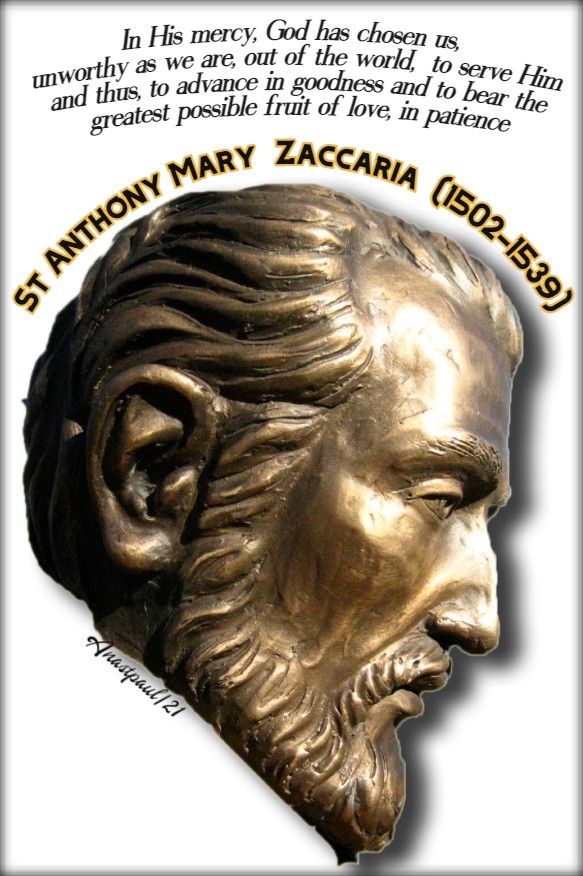
“In His mercy, God has chosen us,
unworthy as we are,
out of the world,
to serve Him and thus, to advance in goodness
and to bear the greatest possible
fruit of love in patience.”

St Anthony Mary Zaccaria (1502-1539)

Posted in NOTES to Followers

I beg your prayers please 🙏🤗

Dear Fellow Pilgrims

I ask for your prayers please as tomorrow I undergo surgery on my right eye. This is just a maintenance procedure and an attempt to keep this eye functioning to the best of it’s, not very good, ability.

Sadly, my left eye is beyond help. BUT we have many Saints who are Patrons of eye ailments and diseases. St Lucy, of course, St Augustine, St Raphael the Archangel (of the blind), St Clare of Assisi, St Odelia, St Leodagar of Poitiers, St Giovanna of Orvieto (25 July posted this year) and MORE ….

🙏🙏🙏

I will be out of action for a few days but you will all remain in my prayers. “May the Lord Jesus touch all our eyes!

Posted in GOD ALONE!, MEDITATIONS - ANTONIO CARD BACCI, QUOTES on CHARITY, QUOTES on LOVE of GOD, QUOTES on THE WORLD, QUOTES on WORK/LABOUR, The WILL of GOD

Thought for the Day – 17 August – Doing Everything for the Love of God

Thought for the Day – 17 August – Meditations with Antonio Cardinal Bacci (1881-1971)

Doing Everything for the Love of God

“In one of his letters, Luther wrote that he was so busy that he had no time to read his Breviary, nor to offer Holy Mass.
There is no doubt that it was this estrangement from prayer and from the love of God, which caused him to finish up as he did.
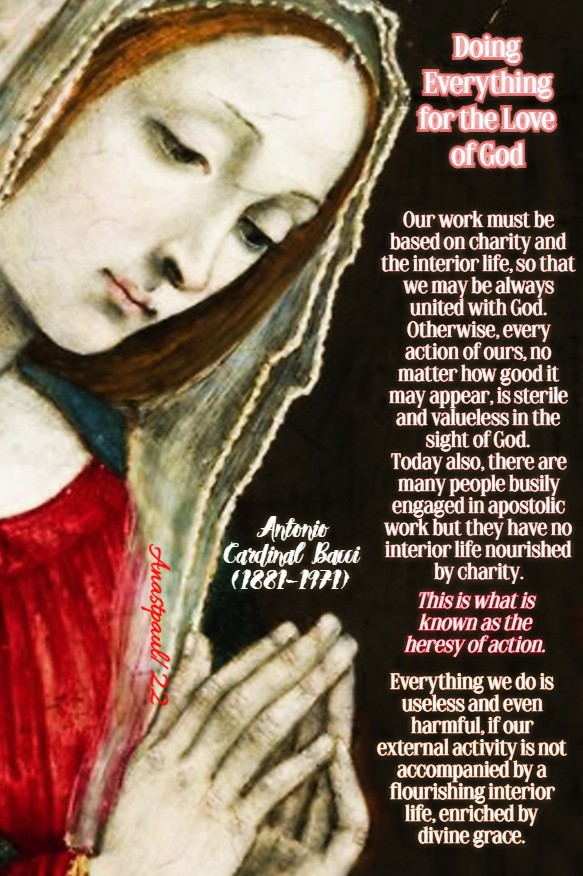
Our work must be based on charity and the interior life, so that we may be always united with God.
Otherwise, every action of ours, no matter how good it may appear, is sterile and valueless in the sight of God.

Today also, there are many people busily engaged in apostolic work but they have no interior life nourished by charity.
This is what is known as the heresy of action.

Everything we do is useless and even harmful, if our external activity is not accompanied by a flourishing interior life, enriched by divine grace.
St Gregory the Great paraphrases the words of the Gospel as follows: “Our Lord says: If anyone loves Me, let him keep my commandments. Love is proved by action. This is why St John (1 Jn 2:4) says, that the man who claims to love God and does not keep His commandments, is a liar. We love God sincerely if we keep His commandments and avoid the immoderate pleasures of our age.
Anyone who surrenders without reserve to the unlawful desires of this world, certainly does not love God because, he is acting contrary to His will
.” (Homil 30 in Ev).”

Antonio Cardinal Bacci

PART ONE HERE:
https://anastpaul.com/2021/02/05/thought-for-the-day-5-february-doing-everything-for-the-love-of-god/
PART TWO HERE:
https://anastpaul.com/2021/02/05/thought-for-the-day-5-february-doing-everything-for-the-love-of-god/

Posted in "Follow Me", CHRIST the LIGHT, CHRIST the WORD and WISDOM, CHRIST, the WAY,TRUTH,LIFE, DOCTORS of the Church, FATHERS of the Church, GOD ALONE!, QUOTES for CHRIST, QUOTES on DISCIPLESHIP, QUOTES on LOVE of GOD, QUOTES on TRUTH, The HEART, The WORD

Quote/s of the Day – 17 August – ‘The only One I wish to love.’

Quote/s of the Day – 17 August – “Month of the Immaculate Heart” – Readings: Judges 6: 11-24a; Psalm 85: 9-14; Matthew 19: 23-30

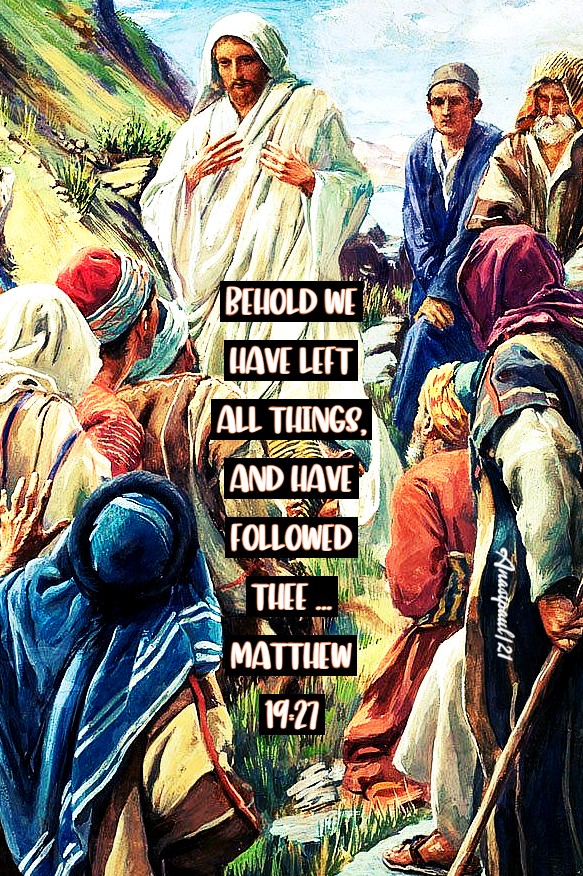
“Behold we have left all things,
and have followed thee”

Matthew 19:27

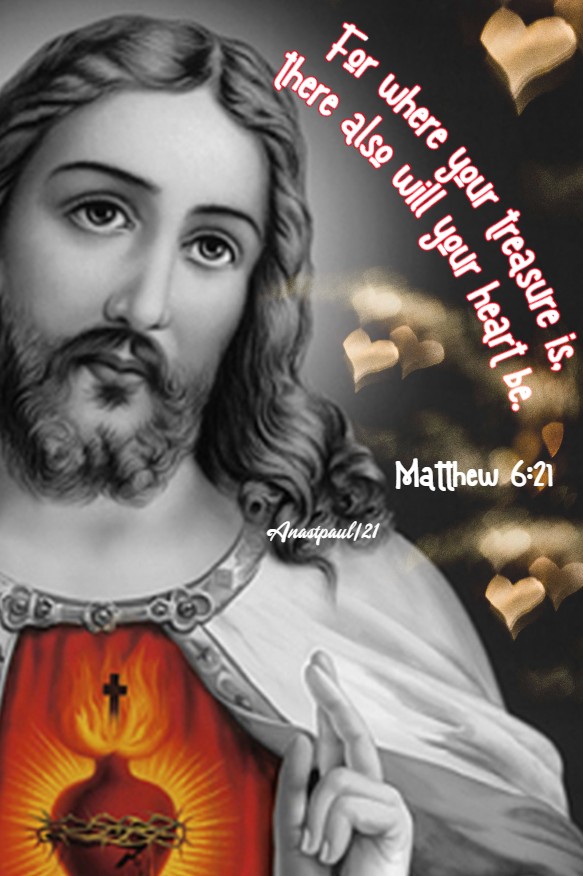
“For where your treasure is,
there also will your heart be.”

Matthew 6:21

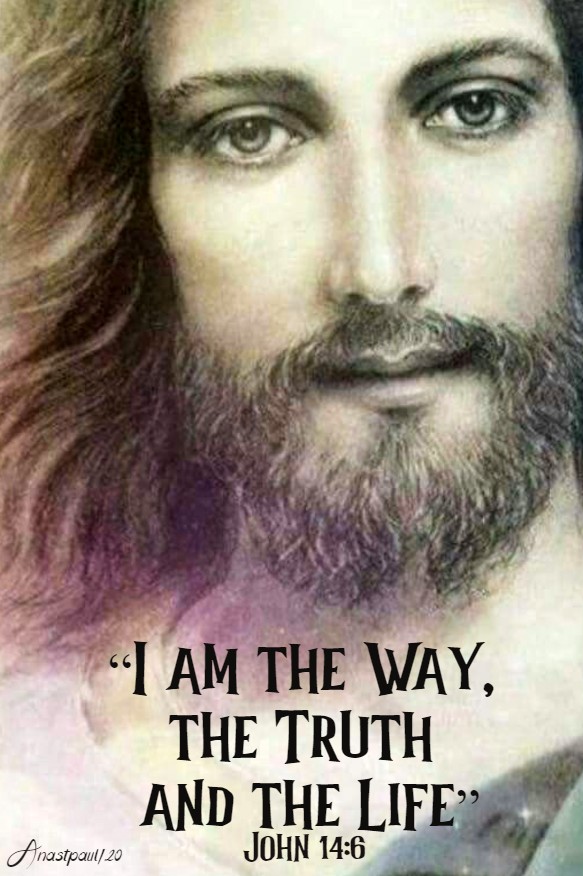
“I am the Way, the Truth and the Life”

John 14:6

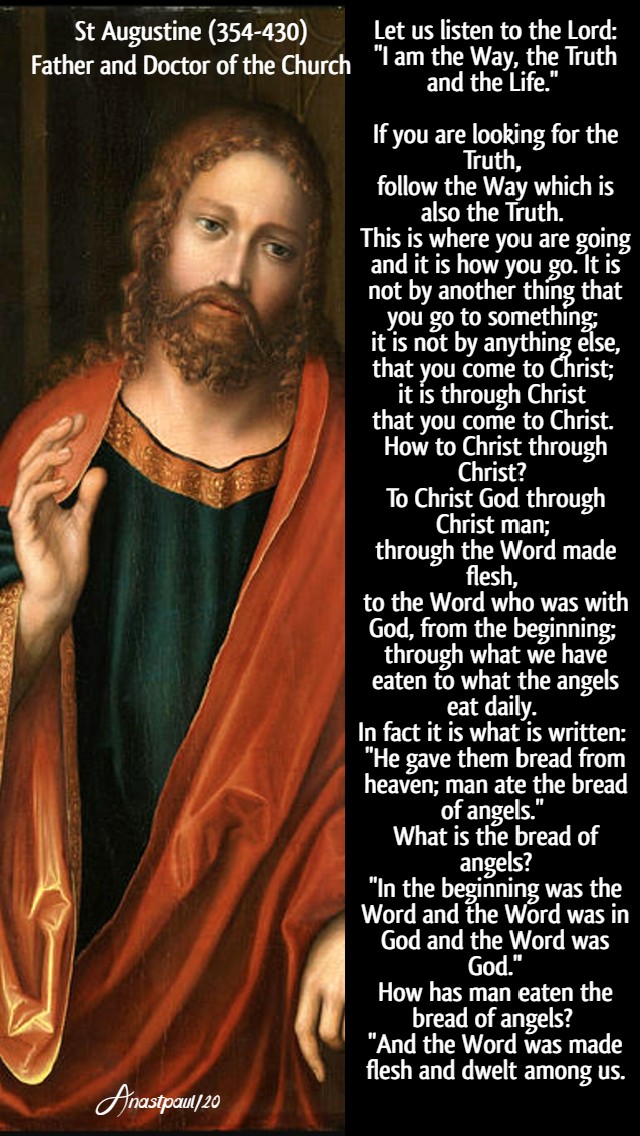
“Let us listen to the Lord:
“I am the Way, the Truth and the Life” (Jn 14:6).
If you are looking for the Truth,
follow the Way which is also the Truth.
This is where you are going and it is how you go.
It is not by another thing that you go to something;
it is not by anything else that you come to Christ;
it is through Christ that you come to Christ.
How to Christ through Christ?
To Christ God through Christ man;
through the Word made flesh,
to the Word who was with God, from the beginning;
through what we have eaten to what the angels eat daily.
In fact it is what is written:
“He gave them bread from heaven; man ate the bread of angels” (Ps 77[78]:24-25).
What is the bread of angels?
“In the beginning was the Word and the Word was in God and the Word was God” (Jn 1:1-3). How has man eaten the bread of angels?
“And the Word was made flesh and dwelt among us.”

Saint Augustine (354-430)
Father and Doctor of Grace

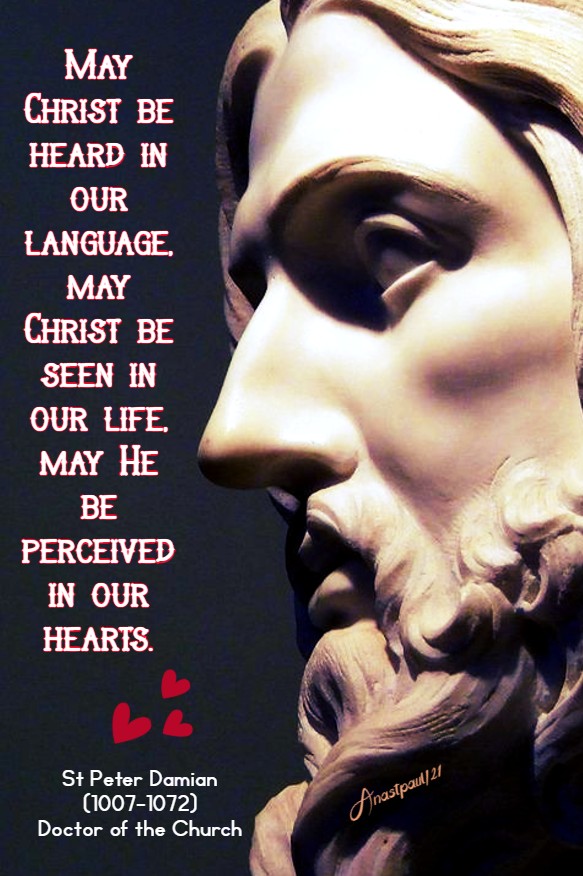
“May Christ be heard in our language,
may Christ be seen in our life,
may He be perceived in our hearts”

St Peter Damian (1007-1072)
Father and Doctor of the Church

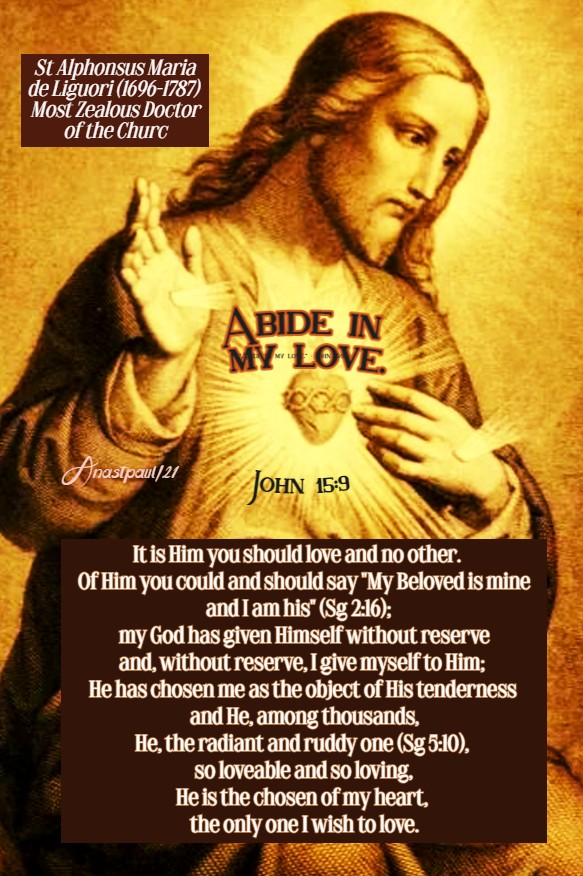
“… It is Him you should love and no other.
Of Him you could and should say
“My Beloved is mine and I am his” (Sg 2:16);
my God has given Himself without reserve
and, without reserve, I give myself to Him;
He has chosen me as the object of His tenderness
and He, among thousands,
He, the radiant and ruddy one (Sg 5:10),
so loveable and so loving,
He is the chosen of my heart,
the only one I wish to love.”

St Alphonsus Maria de Liguori (1696-1787)
Most Zealous Doctor

Posted in CARMELITES, DOCTORS of the Church, GOD ALONE!, ONE Minute REFLECTION, QUOTES on THE WORLD, The WORD

One Minute Reflection – 17 August – ‘Seek for nothing … [save] love of Jesus’

One Minute Reflection – 17 August – “Month of the Immaculate Heart” – Readings: Judges 6: 11-24a; Psalm 85: 9-14; Matthew 19: 23-30

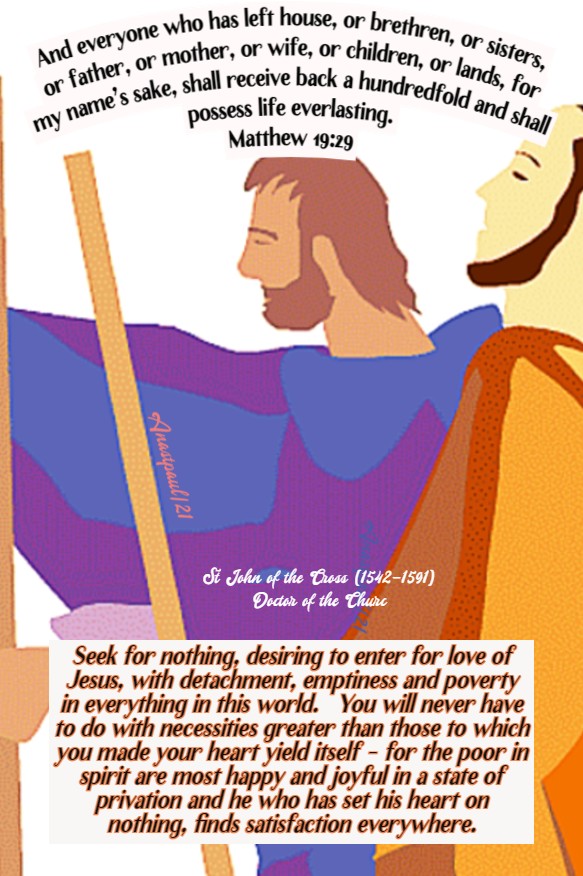
And everyone who has left house, or brethren, or sisters, or father, or mother, or wife, or children, or lands, for my name’s sake, shall receive back a hundredfold and shall possess life everlasting.” – Matthew 19:29

REFLECTION – “Seek for nothing, desiring to enter for love of Jesus, with detachment, emptiness and poverty in everything in this world. You will never have to do with necessities greater than those to which you made your heart yield itself – for the poor in spirit are most happy and joyful in a state of privation and he who has set his heart on nothing, finds satisfaction everywhere.

The poor in spirit (Mt 5:3) give generously all they have and their pleasure consists in being thus deprived of everything for God’s sake and out of love to their neighbour … Not only do temporal goods – the delights and tastes of the sense – hinder and thwart the way of God but spiritual delights and consolations also, if sought for or clung to eagerly, disturb the way of virtue.” – St John of the Cross (1542-1591) Carmelite, Doctor of the Church – Spiritual maxims, nos. 352, 355,356, 364; 1693 edition

PRAYER – Father of might and power, every good and perfect gift comes to us from You. Implant in our hearts the love of Your Name and Your creatures. Increase our zeal for Your service by following behind Your Son with determination and joy. Nourish in us what good and tend it with watchful care. Grant that the prayers and caring love of the Blessed Virgin, our Mother, may help us to follow Jesus our Saviour unreservedly and thus attain eternal life. We make our prayer through Christ, our Lord in the union of the Holy Spirit, one God for all eternity, amen.

Posted in DOCTORS of the Church, EUCHARISTIC Adoration, Our MORNING Offering, QUOTES on LOVE of GOD, SACRED HEART PRAYERS, The HOLY EUCHARIST / The HOLY MASS

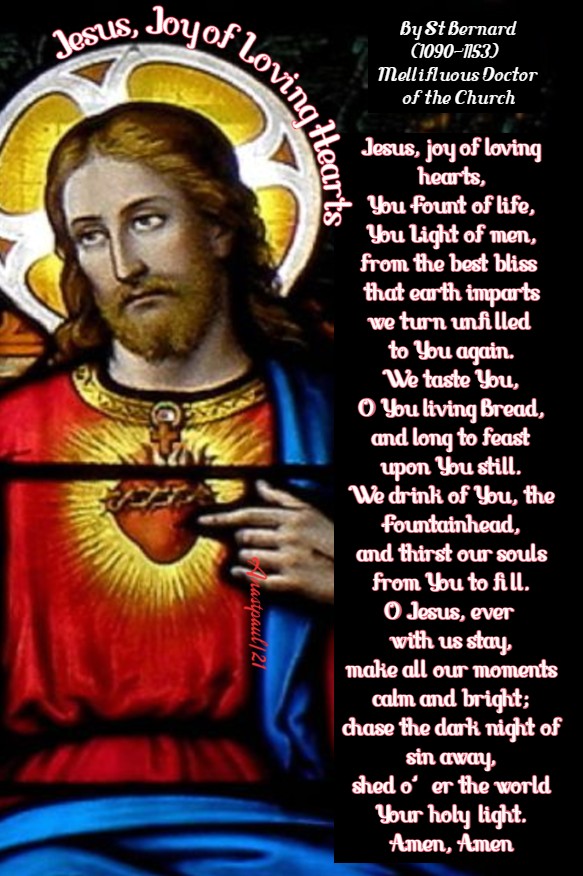
Our Morning Offering – 17 August – Jesus, Joy of Loving Hearts By St Bernard

Our Morning Offering – 17 August – “Month of the Immaculate Heart”

Jesus, Joy of Loving Hearts
By St Bernard (1090-1153)

Mellifluous Doctor of the Church
and the last Father of the Church

Jesus, joy of loving hearts,
You Fount of life,
You Light of men,
from the best bliss that earth imparts
we turn unfilled to You again.
We taste You,
O You living Bread,
and long to feast upon You still.
We drink of You, the Fountainhead,
and thirst our souls from You to fill.
O Jesus, ever with us stay,
make all our moments calm and bright;
chase the dark night of sin away,
shed o’er the world Your holy light.
Amen, Amen
Posted in franciscan OFM, SAINT of the DAY

Saint of the Day – 17 August – Saint Beatrice da Silva Meneses OIC (1424-1492)

Saint of the Day – 17 August – Saint Beatrice da Silva Meneses OIC (1424-1492) Virgin, Founder of The Order of the Immaculate Conception known as the Conceptionists, a contemplative Order of Nuns. Born in 1424 as Beatriz de Menezes da Silva, in Campo Maior, Portalegre, Portugal and died on 17 August 1492 in Toledo, Spain of natural causes. Also known as – Brites, Beatrix da Silva, Beatriz da Silva Meneses. Patronage – prisoners. Additional Memorial – 1 September in the Franciscan Order.

Beatrice da Silva was a Portuguese noble woman, one of eleven children born to Rui Gomes da Silva – first Governor of Campo Major, Portugal, after it was reconquered from Arab rule – and of Isabel de Menezes, the Countess of Portalegre. One of her brothers was the Blessed Amadeus of Portugal, OFM, a noted Confessor and Reformer of the Order of Friars Minor. (His life here: https://anastpaul.com/2018/08/10/saint-of-the-day-blessed-amadeus-of-portugal-o-f-m-1420-1482/.

She was raised in the Castle of Infante John, Lord Reguengos de Monsaraz. In 1447 Beatrice accompanied his daughter, Princess Isabel of Portugal, as her Lady in Waiting when Isabel went to marry King John II of Castile and Leon. She became a close friend of the Queen but unfortunately her beauty made Isabel jealous. It is said that a suitor, whom Beatrice had rejected, insinuated to the Queen that Beatrice was a rival for the King’s affections and she imprisoned Beatrice in a tiny cell. There is a story that she shut her in a chest. After a few days a relative, concerned about Beatrice’s welfare, persisted in questioning Isabel – the Queen showed him the chest where, expecting to find a body, he found Beatrice in perfect health. While imprisoned, Beatrice had a vision of Our Lady, who told her to found a new Order in her name.

Beatrice escaped and went to Toledo. On the journey she met two Franciscan Friars who told her she would be the mother of many children. She protested that she had taken a vow of purity to the Queen of Heaven. “What we have said will come to be,” they told her and then they vanished. Beatrice believed that Mary had sent St Francis and St Anthony to give her consolation.

In Toledo she took refuge with the Dominican nuns and for 37 years led a life of holiness without becoming a member of the Order. In 1484 Beatrice and a few companions took possession of a Palace in Toledo set apart for them by the new Queen Isabella (who married Ferdinand of Aragon). Isabella of Castile was a devout woman and took a great interest in Beatrice’s work. The Monastery was named Santa Fe, which was dedicated to honouring the Immaculate Heart of Mary.

In 1489, with the permission of Pope Innocent VIII, the Nuns adopted the Cistercian rule, bound themselves to daily recitation of the Divine Office of the Immaculate Conception and were placed under obedience to the ordinary of the Diocese. Beatrice chose the habit, which is white with a white scapular and blue mantle with a medallion of Mary under her title of the Immaculate Conception.

Beatrice died in 1492 in the Monastery which she had founded. Her remains are still venerated in the Chapel of that Monastery.

In 1501 Pope Alexander VI united the Nuns of Sante Fe, which Beatrice had founded, with the neighbouring Benedictine Monastery of San Pedro de las Duenas and put them all under the Rule of St Clare. Through this, the Order became connected with the Franciscans. Pope Julius II gave the Order a rule of life of its own in 1511 and special constitutions were drawn up by the Franciscan Cardinal Francisco de Quinones, establishing the community as the Monastery of the Immaculate Conception. The Order spread in Europe and South America. At its height, there were some 2,000 Monasteries of the Order throughout the world.

Beatrice was Beatified on 28 July 1926 by Pope Pius XI and Canonised on 21 January 1974 by Pope Paul VI (decree on heroic virtues). Recorded miracles involved the instantaneous and perfect healing of Sister Mary of Saint Anne, 22, from a hemorrhage subretinica, retinicis and a secondary lesions of the eye on 25 March 1923 in Mexico City;and Elizabeth Orozco Estrada, 63, from the small intestine and colon malignant neoplasia in September 1945 in Mexico City.

Posted in MARIAN TITLES, SAINT of the DAY

Victory of the King of France (Philip the Fair), imploring the help of Our Lady of Chartres (1304) and Memorials of the Saints – 17 August

Victory of the King of France (Philip the Fair), imploring the help of Our Lady of Chartres (1304) – 17 August:

It was on this day in the year 1304 that “Philip the Fair” gained a signal victory over the Flemish after recommending himself to Our Lady of Chartres.

The eldest son of King Philip and Isabella of Aragon, he was nicknamed Philip the Fair while yet a Prince for his handsome features. He became King of France at only 17 years of age and married Joan of Navarre in 1284, which enlarged his Kingdom.
In the year 1302, Philip sent an inadequate army into Flanders to suppress the Flemish, who were making incursions into his realm at will. His army was soundly defeated at the Battle of the Golden Spurs. Philip responded by winning a naval victory over the Flemish at Zierichzee and then met the Flemish army at the Battle of Mons-en-Pevele, also known as Mons-en-Puelle, on 17 August 1304.

King Philip the Fair

The battle was furious, lasting all day in extreme heat. Eventually the majority of the French army fled the field, leaving Philip alone with only ten Knights fighting desperately to save themselves and their King. Philip’s horse collapsed, having been killed under him and his life was in great danger of being lost. At that moment, while facing death and certain defeat in battle, Philip turned to the Queen of Heaven, Our Lady of Chartres, begging her assistance to save the day and his life.
Suddenly the French Knights, who had been fleeing the field, turned and saw the King’s Royal Standard still stood, and that he, himself, fought like a Knight of great renown amidst a sea of raging enemies. Racing to the scene with their swords and lances, they turned the Flemish and drove them from the field in what became a resounding victory for the King of France. The Battle of the Golden Spurs was well compensated.
In gratitude for this victory and favour of Our Lady of Chartres, King Philip went at once to do homage to the Virgin Mary at her Cathedral. He took off his own armour and gave it to the Cathedral at the Altar. He also gave to it, in perpetuity, the land and lordship of Barrus, founded a daily Mass forever and left to this Church ,all of the other accoutrements which he had worn on that day of victory. This feast is kept in the Church of Notre Dame, at Paris, on the following day, the 18th and the office is double. This armour is formerly exhibited in the Church ,on the Anniversary of the battle.

King Philip’s Armour

St Amor of Amorbach
St Anastasius of Terni
St Beatrice da Silva Meneses OIC (1424-1492) Virgin, Nun, Founder

St Benedicta of Lorraine
St Carloman
St Cecilia of Lorraine

St Clare of the Cross of Montefalco (c 1269-1308) Augustinian Nun and Abbess, before becoming a nun, St Clare was a member of the Third Order of St Francis (Secular), Mystic, Penitent, Spiritual adviser,
Her Life:

https://anastpaul.com/2019/08/17/saint-of-the-day-17-august-saint-clare-of-the-cross-of-montefalco-c-1269-1308/

St Donatus of Ripacandida
St Drithelm
St Elias the Younger
Bl Enric Canadell Quintana
Bl Eugenio Sanz-Orozco Mortera
St Pope Eusebius
St Eusebius of Sicily

St Hyacinth OP (1185-1257) ) “Apostle of Poland” and “Apostle of the North” also known as “the Polish St Dominic”– Religious Priest of the Order of Preachers, Confessor, Doctor of Law and Divinity, Missionary, Preacher, Miracle Worker, Mystic.
Biography:

https://anastpaul.wordpress.com/2017/08/17/saint-of-the-day-17-august-st-hyacinth-o-p-apostle-of-poland-and-apostle-of-the-north/

St Jacobo Kyushei Gorobioye Tomonaga
St James the Deacon

St Jeanne of the Cross Delanoue (1666-1736) Virgin, Sister and Foundress of the Congregation of St Anne de la Providence
About St Jeanne:

https://anastpaul.com/2018/08/17/saint-of-the-day-17-august-st-jeanne-delanoue-1666-1736/

St Jeroen of Noordwijk
St Juliana of Ptolemais
St Leopoldina Naudet
St Mamas
Bl Marie-Élisabeth Turgeon
St Michaël Kurobyoie
St Myron of Cyzicus

St Nicolò Politi (1117-1167) Basilian Monk and Hermit. He was known for his miracles even during his childhood and was Venerated as a saint even before his death.
About St Nicolò:

https://anastpaul.com/2020/08/17/saint-of-the-day-17-august-st-nicolo-politi-1117-1167/

Bl Noël-Hilaire Le Conte
St Paul of Ptolemais
St Theodore of Grammont

Martyred in the Spanish Civil War: Bl Antoni Carmaniú Mercarder, Bl Facundo Escanciano Tejerina, Bl Eugenio Sanz-Orozco Mortera, Bl Enric Canadell Quintana, Florencio López Egea and see below –
Martyrs of Malaga – 8 beati: A priest and seven brothers, all members of the Hospitallers of Saint John of God, all martyred together in the Spanish Civil War.

Posted in "Follow Me", GOD ALONE!, MEDITATIONS - ANTONIO CARD BACCI, QUOTES on DISCIPLESHIP, QUOTES on SANCTITY, QUOTES on SIN, QUOTES on THE WORLD

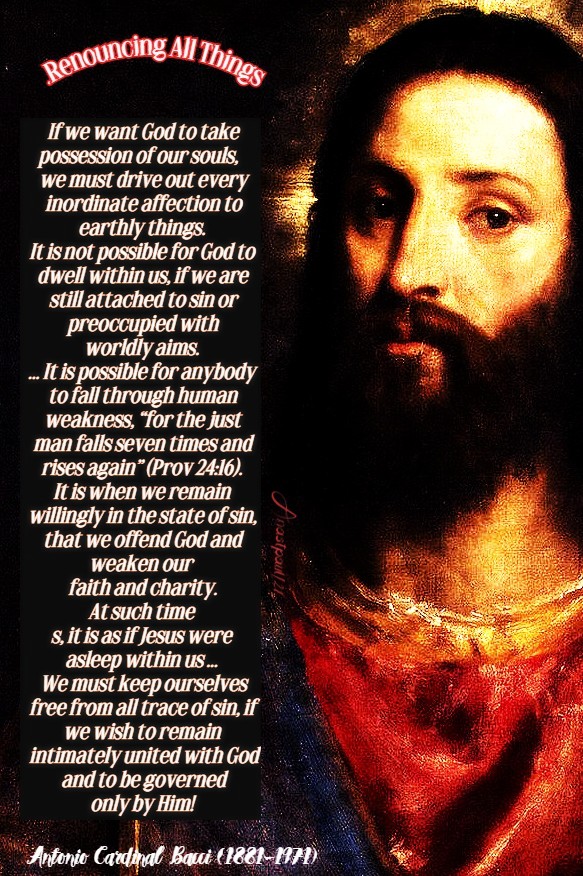
Thought for the Day – 16 August – Renouncing All Things

Thought for the Day – 16 August – Meditations with Antonio Cardinal Bacci (1881-1971)

Renouncing All Things

If we want God to take possession of our souls, we must drive out every inordinate affection to earthly things.
It is not possible for God to dwell within us, if we are still attached to sin or preoccupied with worldly aims.

God should reign supreme in us and inspire all our desires and actions.
This can never happen if we retain an attachment to deliberate sin, even if it is not grave sin.
In the case of venial sin, it is not so much the sin which prevents God from ruling us absolutely, as the attachment to sin.

It is possible for anybody to fall through human weakness, “for the just man falls seven times and rises again” (Prov 24:16).
It is when we remain willingly in the state of sin, that we offend God and weaken our faith and charity.

At such times, it is as if Jesus were asleep within us, as He slept in the boat during the storm on the lake of Galilee, when the terrified Apostles cried out:   “Lord save us! We are perishing!” (Mt 8:25).
We must keep ourselves free from all trace of sin, if we wish to remain intimately united with God and to be governed only by Him!”

Antonio Cardinal Bacci

Posted in "Follow Me", DOCTORS of the Church, FATHERS of the Church, FRUITS of the SPIRIT, GOD ALONE!, QUOTES on DISCIPLESHIP, QUOTES on OBEDIENCE, QUOTES on PERSEVERANCE, The WILL of GOD, The WORD

Quote/s of the Day – 16 August – “Come, follow me”

Quote/s of the Day – 16 August – “Month of the Immaculate Heart” – Readings: Judges 2: 11-19; Psalm 106: 34-7, 39-40, 43ab and 44; Matthew 19: 16-22

Come, follow me”

Matthew 19:21

“You are my friends,
if you do the things
that I command you.”

John 15:14

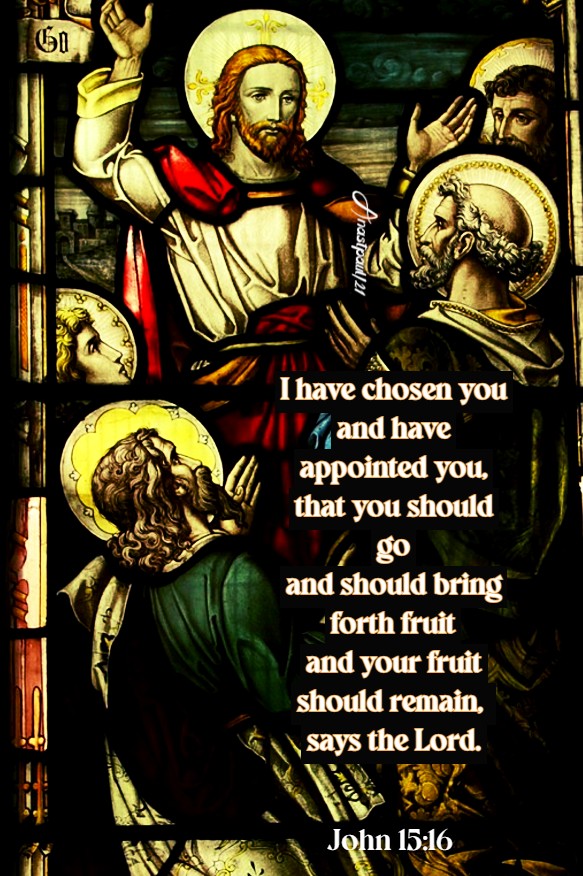
“I have chosen you
and have appointed you,
that you should go
and should bring forth fruit
and your fruit should remain,
says the Lord.”

John 15:16

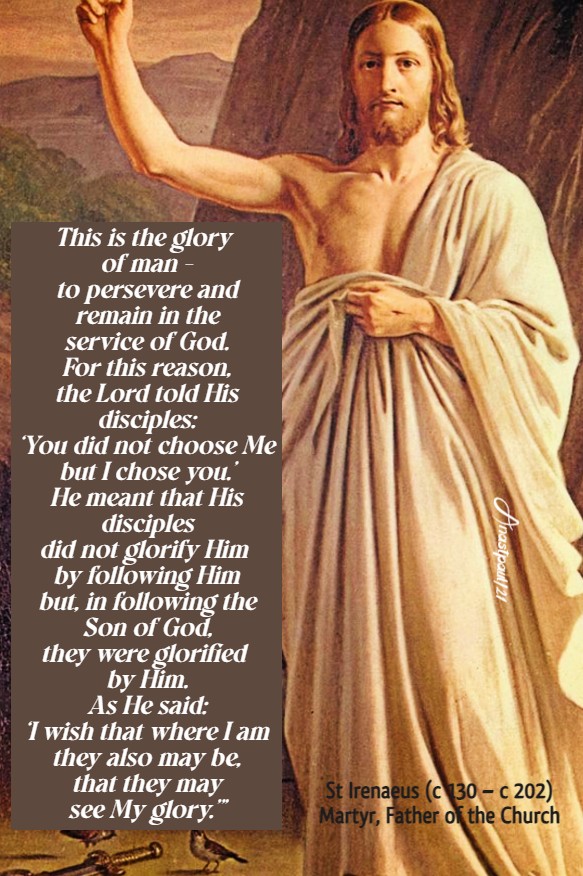
“This is the glory of man –
to persevere and remain
in the service of God.
For this reason,
the Lord told His disciples:

‘You did not choose Me but I chose you.’
He meant that His disciples
did not glorify Him by following Him
but, in following the Son of God,
they were glorified by Him.
As He said:
‘I wish that where I am
they also may be,
that they may see My glory.’”

St Irenaeus (c 130 – c 202)
Bishop & Martyr, Father of the Church

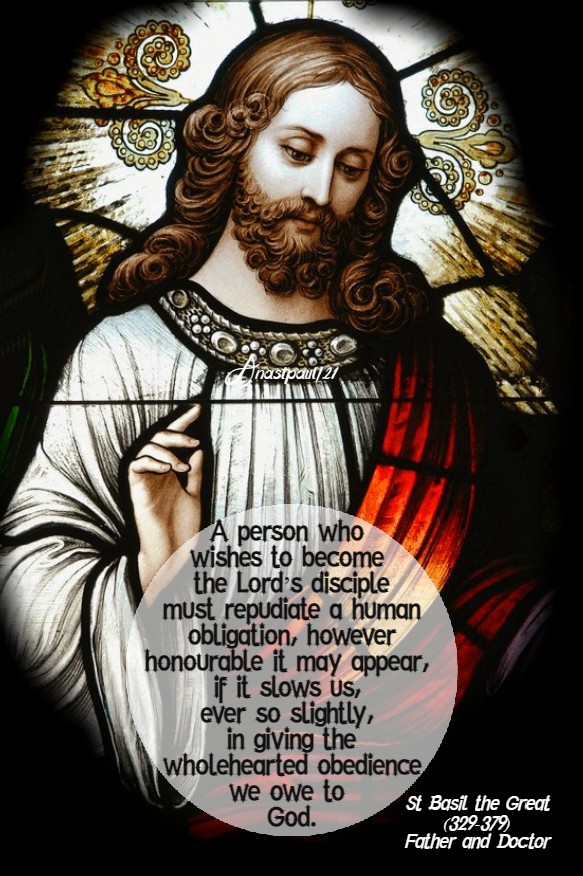
“A person who wishes
to become the Lord’s disciple
must repudiate a human obligation,
however honourable it may appear,
if it slows us, ever so slightly,
in giving the wholehearted obedience
we owe to God.”

St Basil the Great (329-379)
Father and Doctor of the Church

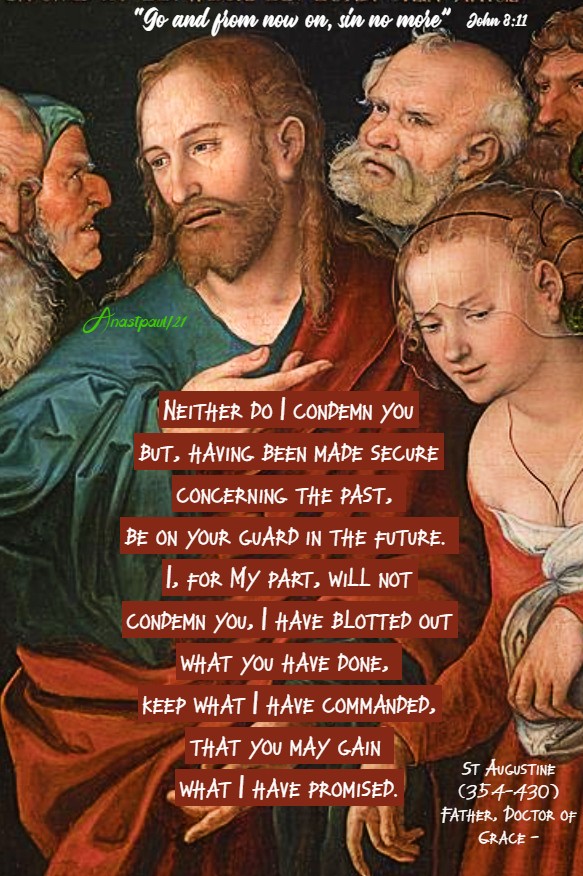
“Neither do I condemn you
but, having been made secure
concerning the past,
be on your guard in the future.
I, for My part, will not condemn you,
I have blotted out what you have done;
keep what I have commanded,
that you may gain
what I have promised.”

St Augustine (354-430)
Father & Doctor of Grace

Posted in "Follow Me", DOCTORS of the Church, FATHERS of the Church, ON the SAINTS, ONE Minute REFLECTION, QUOTES on DISCIPLESHIP, QUOTES on POVERTY, QUOTES on WEALTH/RICHES, The WORD

One Minute Reflection – 16 August – “If you would be perfect … ” Matthew 19:21

One Minute Reflection – 16 August – “Month of the Immaculate Heart” – Readings: Judges 2: 11-19; Psalm 106: 34-7, 39-40, 43ab and 44; Matthew 19: 16-22

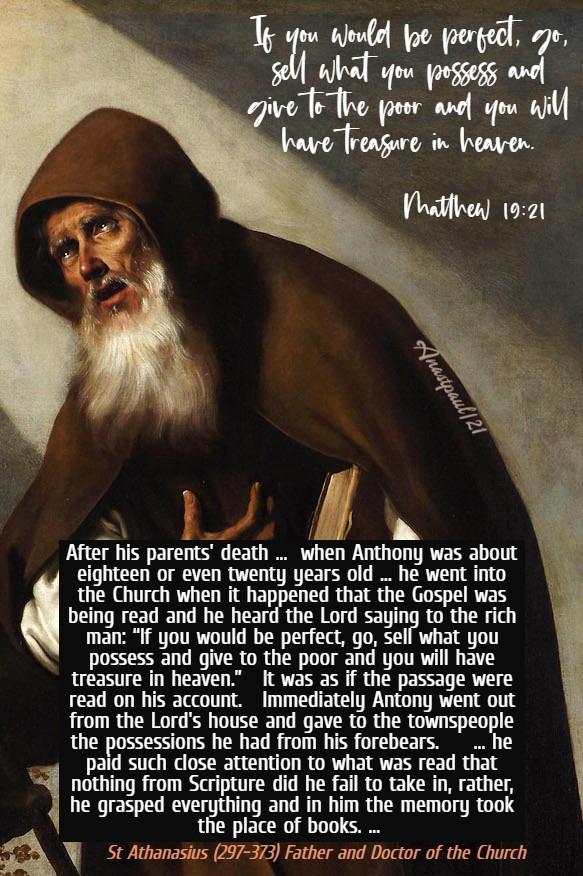
“If you would be perfect, go, sell what you possess and give to the poor and you will have treasure in heaven.” – Matthew 19:21

REFLECTION – “After his parents’ death … when Anthony was about eighteen or even twenty years old …) he went into the Church when it happened that the Gospel was being read,and he heard the Lord saying to the rich man: “If you would be perfect, go, sell what you possess and give to the poor and you will have treasure in heaven.” It was as if the passage were read on his account. Immediately Antony went out from the Lord’s house and gave to the townspeople the possessions he had from his forebears. And selling all the rest that was portable, when he collected sufficient money, he donated it to the poor, keeping a few things for his sister.

But when, entering the Lord’s house once more, he heard in the Gospel the Lord saying, “Do not be anxious about tomorrow” (Mt 6:34), he could not remain any longer but going out he gave those remaining possessions also to the needy. Placing his sister in the charge of respected and trusted virgins, and giving her over to the convent for rearing, he devoted himself from then on to the discipline rather than the household, giving heed to himself and patiently training himself ….

He worked with his hands, though, having heard that “he who is idle, let him not eat” (2 Thess 3:10). And he spent what he made partly for bread and partly on those in need. He prayed constantly, since he learned that it is necessary to “pray unceasingly” (Lk 21:36) in private. For he paid such close attention to what was read that nothing from Scripture did he fail to take in, rather, he grasped everything and in him the memory took the place of books. … All those then, who were from his village and those good people with whom he associated, seeing him living thus, used to call him ‘God-loved‘, and some hailed him as ‘son‘, some as ‘brother‘.” – St Athanasius (297-373) Bishop of Alexandria, Father and Doctor of the Church – Life of Saint Anthony, the Father of Monks, 2-4

PRAYER – Lord God, You filled the Saints with strength and courage and gave them the knowledge of unity with You. Grant, we pray, that in imitation of them, we may defend the Catholic faith and renew all things in Christ, Your Son. Help us Holy Father, to follow the example of the Immaculate Heart of the Mother of Your Son and all Your Saints and finally inherit eternal life ,with Youts. We make our prayer through Christ, our Lord with the Holy Spirit, one God forever, amen.

Posted in DOCTORS of the Church, MARIAN PRAYERS, Our MORNING Offering, PRAYERS of the SAINTS, QUEENSHIP of MARY

Our Morning Offering – 16 August – Mary, our Queen and Mother of Mercy By St Anthony of Padua

Our Morning Offering – 16 August – “Month of the Immaculate Heart”

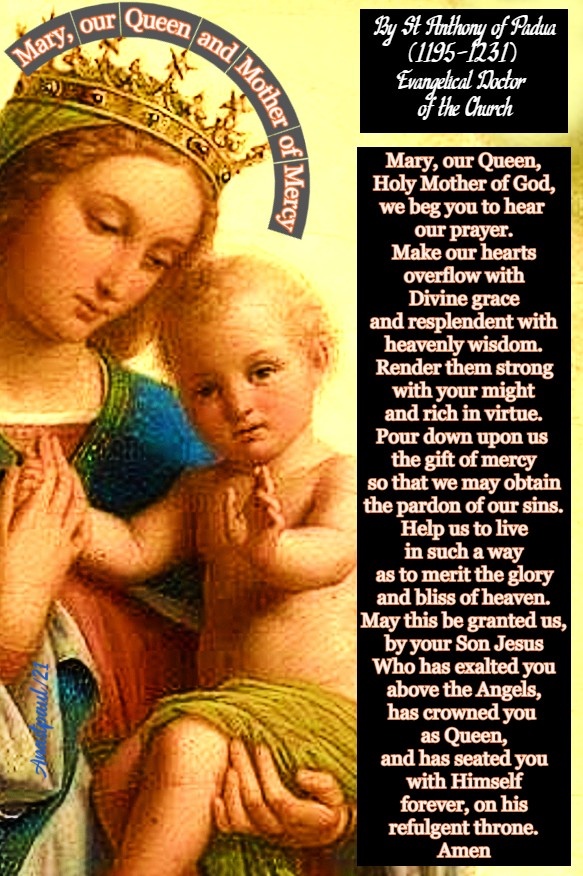
Mary, our Queen and Mother of Mercy
By St Anthony of Padua (1195-1231)
Evangelical Doctor of the Church

Mary, our Queen,
Holy Mother of God,
we beg you to hear our prayer.
Make our hearts overflow with Divine grace
and resplendent with heavenly wisdom.
Render them strong with your might
and rich in virtue.
Pour down upon us the gift of mercy
so that we may obtain the pardon of our sins.
Help us to live in such a way
as to merit the glory and bliss of heaven.
May this be granted us, by your Son Jesus
Who has exalted you above the Angels,
has crowned you as Queen,
and has seated you with Himself
forever, on his refulgent throne.
Amen.

Posted in SAINT of the DAY

Saint of the Day – 16 August – Saint Ugolina of Vercelli (c 1239-c 1300)

Saint of the Day – 16 August – Saint Ugolina of Vercelli (c 1239-c 1300) Virgin, Anchorite Recluse, Penitent, Spiritual advisor. The very strange story that of this Blessed Ugolina who shut herself in a hermitage, representing herself as a man and remained there for forty-seven years! The aim of her subterfuge was to escape the aims of her father, who wished her to marry. In order not to reveal her secret, she called herself Ugo without revealing her identity to anyone. for nearly fifty years. In the hermitage she grew in faith and prayer. When she died then it became known that she was a woman and it was possible to reconstruct her story in the midst of everyone’s surprise and admiration.

The first biographer of St.Ugolina, who wrote immediately after her death, was the Dominican Confessor Father Valentino. These important memories, already unavailable in the 18th century, are cited by the Franciscan, Ludovico della Croce who, consulting them, wrote in the mid-17th century what is today the oldest biography. Unfortunately, the work has the main purpose of handing down the virtues and not the historical information on this Saint, whose life is similar to other figures that arose in the Middle Ages, in imitation of the eastern anchorites.

Ugolina was born in Vercelli in 1239, in the noble and wealthy De Cassami family (or De Cassinis, according to recent studies). Her coming into the world was a grace for the pious parents who saw in her, an only child, a precious gift and surrounded her with thoughtful care.

At the age of ten, she admirably exercised charity towards his neighbour, the constant practice of personal and community prayer and perfect adherence to the teachings of her parents. She had a great love for pilgrims, who were numerous in those times. When she learned that the destination was the Holy Land, her interest became intense, giving them food and money for the journey.

The first great test for the young woman came when she was only fourteen years old – the one who had physically generated her and who had formed her spirit according to the noblest Christian sentiments ,died. So she stayed with her father who, unfortunately, only briefly curbed the urge to seduce her. The most horrendous of family crimes was thus about to be consummated, in that once happy home. The Lord did not abandon Ugolina who, with good manners and, above all with prayer, managed to lead her father back to the right path. The family balance, however, was compromised and Ugolina matured the vocation that she already felt in her heart. The only confidant was a woman named Libera, to whom she manifested the desire to serve Christ with prayer, living withdrawn from the world. Libera told her to ponder the decision thoroughly, waiting for a heavenly sign. Ugolina decided that she would carry out the escape when her father was absent for business and this happened the very next day, when the parent went to Turin. Wearing men’s clothes and a hood, the maiden left the palace.

The extraordinary and dangerous inspiration led her to a wood, a mile away from the City, where the Chapel of St Mary of Bethlehem stood. Next to it was the cell, now empty, of a hermit named Favorino who, on his return from the Holy Land, had built that hermitage to live in holiness. Ugolina decided that it would be her new home.

For forty-seven years, pretending to be a man named Ugone, she lived with the bare necessities, in prayer, between intense talks with God and penances to fight the temptations that certainly were not lacking.

The distance from the City was ,however, short and, therefore ,the Chapel became a point of reference for the whole surrounding area, a place of prayer, comfort, advice, for people of different social classes. Ugolina communicated, without showing her face, through a small window. Only the Confessor and confidant ,Libera, knew who that anchorite really was.

The ancient biographer gives us a singular fact. A poor widow from Vercelli, heavily harassed by the City’s evil Procurator, asked Ugolina for help, who exceptionally let her into her cell. At midnight the following day, in the Chapel next door, an Angel comforted them by telling them that the persecutor would pay for his misdeeds. Shortly thereafter he was in fact condemned. The woman kept the secret, then went every day to see her. So many years passed, until Ugolina’s health declined – stomach upsets and fevers forced her to bed. A few days before her death she called Father Valentino for general Confession and Holy Communion. She died on 16 August c 1300.

The news quickly spread around the City. The Priest went to the Bishop, Aimone di Challant, who was already informed of the facts. In solemn procession, with the clergy and the people, he wanted to pay homage to her. Ugolina, on a poor bed, rested in the peace of the Lord, with the side of the Crucifix, which she held in her hands, resting on her mouth. The Bishop, moved, knelt down and kissed her hands. All the people paraded in front of the body, finally discovering that she was the daughter of the rich De Cassami.

According to her will, she was buried in the cell, then, subsequently, in the Church. The tomb became a destination for pilgrims, often miraculous. She was a Saint by popular acclaim, with a feast on 8 August. In 1453 the Franciscans erected an important Convent next to the Church, called St Maria di Billiemme (from Bethlehem), continuing their devotion to the Saint.
The Chapel, with its ribbed vaults, was exquisitely frescoed in the 16th century, while the cell was destroyed in the siege of 1704. In 1996 the centuries-old presence of the Franciscans ceased, taken over by the Marianist Fathers.

Posted in MARIAN TITLES

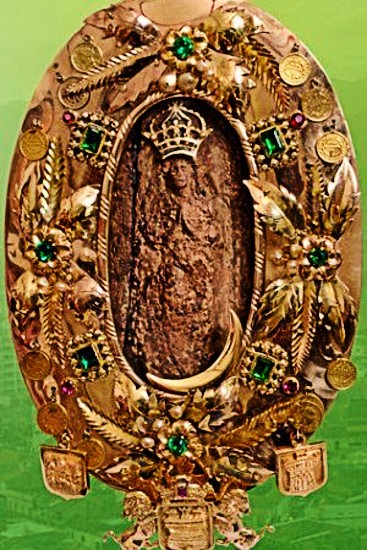
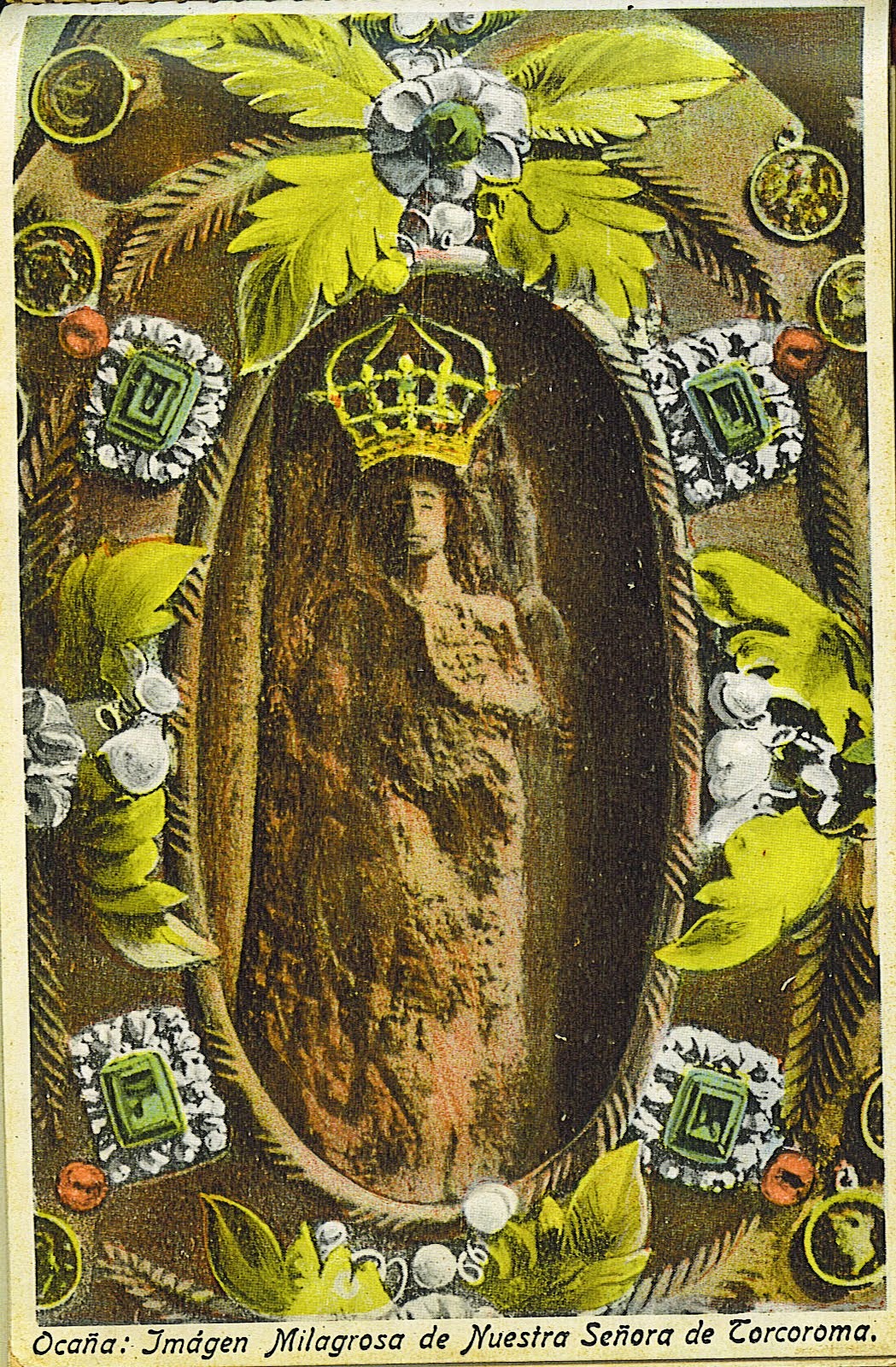
Nuestra Señora de las Gracias de Torcoroma / Our Lady of Graces of Torcoroma, Colombia (1711) and Memorials of the Saints – 16 August

Nuestra Señora de las Gracias de Torcoroma / Our Lady of Graces of Torcoroma, Ocaña, Norte de Santander, Colombia (1711) – 16 August:

The holy apparition took place on 16 August, 1711. At that time, there lived in the Mountains of Torcoroma in the Ocaña region, a peasant family dedicated mainly to the cultivation of cane with which they made sweets. The family consisted of Don Cristóbal Melo, his wife Pascuala Rodríguez and their two children, José and Felipe. According to their contemporaries, the Melo-Rodríguez were people of good morals and a life consecrated to the Christian Faith.
One morning Don Cristóbal sent his children to cut down a tree, that had wood good enough to carve the box or “canoe” with which he made his sweets. The young boys went into the mountain and as they entered the thick of the forest ,they marked the oaks that were suitable for their purpose. Until they found one that was a “wonder” and despite the fact that it was summer, it had fragrant red flowers. Such was the perfume that it could be perceived from afar.
Excited about the great find, they proceeded to cut down the tree. Given its complicated location, when cutting its base, the main part fell into a ravine. It was dusk and the boys resolved to return home and discuss the event with their father. The next day they restarted their search for the appropriate tree, but not finding one that suited their purposes, they determined to use the one already felled and went to the place where it had fallen.
They began to carve the “canoe” right there and shortly after taking the first ax blows, a light so intense came out that it reached out and illumined the lush forest. When the father realised what was lying in the middle of the splinters of the trunk, he, without thinking for a second, put his hands where his sons were preparing to take the next blow, stopping them suddenly. The father and his children were astonished when they saw, in the heart of the trunk, the image of the Virgin, with her hands together and placed on her chest, with the action of her face “as if directed to heaven,” shining with a great light and with an intense and aromatic perfume.
The news of the holy apparition quickly spread through the Ocaña region. Upon reaching the ears of the Priest and Vicar of the City, Fr.Diego Gabino Quintero, he asked Cristóbal Melo to present himself with the image of the Virgin. After carefully examining it and having listened to numerous testimonies that affirmed the divinity of the image, the Priest authorised its private worship.

In 1716 Fray Antonio Monroy y Meneses, Bishop of Santa Marta , came on a pastoral visit and after a rigorous analysis of the image that appeared and the testimony of the witnesses, he granted permission for a Chapel to be erected on the site of the appearance and ordered that the image be brought to the cCty to place it on the Altar of the main Church, today the Cathedral of Santa Ana . The image would rest in the Church for several years while awaiting the Chapel, which was only built in 1882 thanks to the financing of Bogota parishioners. Finally, at the beginning of the 20th century, the image would be definitively transferred to the Sanctuary, where it is visited not only by its faithful but by thousands of pilgrims every year..

St Stephen of Hungary (c 975- 1038) King of Hungary (Optional Memorial) “Apostle of Hungary,” King and Confessor, Marian devotee,  Apostle of Charity, Evangeliser and Missionary. 
Biography:

https://anastpaul.com/2018/08/16/saint-of-the-day-16-august-st-stephen-of-hungary-c-975-038-apostle-of-hungary/

Blessed Angelo Agostini Mazzinghi O.Carm. (1385-1438) was an Italian Priest and a professed member of the Carmelite Order.   He was a noted preacher, prior and reformer, teacher of theology and was known for his pious devotion to the Holy Eucharist, the Blessed Virgin Mary and the Carmelite Rule of Life and to the profession of the Gospel. 
His Life:

https://anastpaul.com/2019/08/16/saint-of-the-day-16-august-blessed-angelo-agostini-mazzinghi-o-carm-1385-1438/

St Armel of Brittany (Died c 570) Priest, Monk, Missionary, Confessor, Evangeliser, spiritual adviser, Miracle-worker .,
His Life:

https://anastpaul.com/2020/08/16/saint-of-the-day-16-august-saint-armel-of-brittany-died-c-570/

St Arsacius of Nicomedia
St Frambaldo
Bl Iacobus Bunzo Gengoro
Bl Jean-Baptiste Menestrel
Bl John of Saint Martha
Bl Laurence Loricatus
Bl Magdalena Kiyota Bokusai
Bl Maria Gengoro
Bl Ralph de la Futaye

St Roch (1295-1327) “Pilgrim,” Confessor, Hermit, Apostle of the Sick, Miracle Worker.
The story of St Roch here:

https://anastpaul.wordpress.com/2017/08/16/saint-of-the-day-16-august-st-roch/

St Serena
Bl Simon Kiyota Bokusai
Bl Thomas Gengoro
St Titus the Deacon
St Ugolina of Vercelli (c 1239-c 1300) Anchorite, Recluse

Martyrs of Palestine – 33 saints: Thirty-three Christians martyred in Palestine; they are commemorated in old martyrologies, but the date and exact location have been lost.

Martyred in the Spanish Civil War:
Bl Amadeu Monje Altés
Bl Antonio María Rodríguez Blanco
Bl José María Sanchís Mompó
Bl Laurentí Basil Matas
Bl Plácido García Gilabert

Posted in FEASTS and SOLEMNITIES, MEDITATIONS - ANTONIO CARD BACCI, QUOTES on DEATH, THE ASSUMPTION

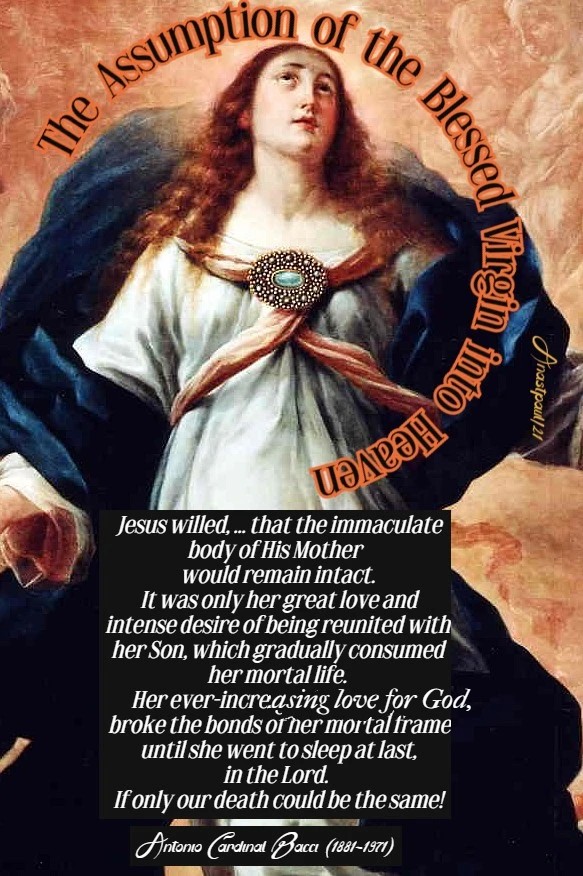
Thought for the Day – 15 August – The Assumption of the Blessed Virgin into Heaven

Thought for the Day – 15 August – Meditations with Antonio Cardinal Bacci (1881-1971)

The Assumption of the Blessed Virgin into Heaven

“The fourth Book of Kings tells us, that the prophet Elias was brought up into Heaven in a fiery chariot without having first endured the pains and humiliations of death (Cf 4 Kings 2:11).
Why did God not do likewise in the case of the Blessed Virgin, commanding His Angels to bear her to Heaven before death struck her innocent body?
As St Paul says, it was sin which caused death to enter the world.
From the moment of her conception, Mary was free from the slightest taint of sin, for she was immaculate and full of grace.
Nevertheless, according to the most widely held tradition, Mary chose to die, even as her divine Son had willed to die.
Jesus “was offered because it was his own will” (Isa 53:7).
The same is true in Mary’s case, with only this difference.
Jesus died a cruel death after the most hideous tortures in the midst of a blaspheming and hate-ridden mob.
Nothing like this happened to Mary, although she is called the Queen of Martyrs because of the sword which pierced her soul at the sight of her divine Son, dying in such agony.

Jesus willed, however, that the immaculate body of His Mother would remain intact.
It was only her great love and intense desire of being reunited with her Son, which gradually consumed her mortal life.
Her ever-incresing love for God, broke the bonds of her mortal frame until she went to sleep at last, in the Lord.

If only our death could be the same!”

Antonio Cardinal Bacci

Posted in DOCTORS of the Church, FATHERS of the Church, MARIAN QUOTES, THE ASSUMPTION

Quote/s of the Day – 15 August – The Assumption

Quote/s of the Day – 15 August – Solemnity of the Assumption of the Blessed Virgin Mary into Heaven

“How can death devour this truly blessed woman,
who gave birth to the Whole Person of the Word of God,
through union with God?
How can hell receive her?
When Christ, who is the way and the truth, said
“Where I am, there will my servant be also, .”
why would there not be a dwelling
for His own Mother with Him,
with an even greater justification?
It is well said, that precious in the sight
of the Lord God of Hosts,
is the death of his saints –
but even more precious,
is the passing of the Mother of God from this life..”

St John Damascene (675-749)
Father and Doctor of the Church

MORE HERE:
https://anastpaul.com/2020/08/15/quote-s-of-the-day-15-august-the-assumption/

Posted in "Follow Me", FEASTS and SOLEMNITIES, THE ASSUMPTION, The WORD

One Minute Reflection – 15 August – ‘ … She “follows the Lamb wherever he goes.”’ – St Aelred

One Minute Reflection – 15 August – Solemnity of the Assumption of the Blessed Virgin Mary into Heaven, Readings: Revelation 11:19; 12:1-6, 10,; Psalm 45: 10-12, 16; 1 Corinthians 15:20-27; Luke 1:39-56

For behold, henceforth, all generations shall call me blessed.” – Luke 1:48

REFLECTION – “If Saint Mary Magdalene – who had been a sinner and from whom the Lord had cast out seven demons – merited to be glorified by him to the extent that her praise abides forever among the assembly of the saints, who can measure the extent to which “the upright rejoice and dance for joy in the presence of the Lord” with regard to holy Mary, who knew not man? … If the Apostle Peter, – who was not only unable to watch for one hour with Christ but, who even went so far as to deny him, – afterwards won such favour that the keys of the Kingdom of Heaven were entrusted to him, of what praises is holy Mary not worthy, who bore the King of Angels Himself in her womb, He Whom the Heavens cannot contain? If Saul, who “breathed murderous threats against the disciples of the Lord” … was the object of such mercy … that he was “caught up to the third heaven, whether in the body or out of the body,” it is not surprising, that the holy Mother of God – who stayed beside her Son through all the trials He endured, from His cradle onwards – should have been lifted up to Heaven, even in her body and exalted high above the Choirs of Angels.

If there is “joy in heaven before the angels over one sinner who repents”, who can tell what joyful and lovely praises rise up before God, concerning Holy Mary who never sinned? … Indeed, if those who “once were darkness” and have now become “light in the Lord” “will shine like the sun in the kingdom of their Father,” who is able to tell “the eternal weight of glory” of Holy Mary, who came into the world “like dawn arising, beautiful as the moon, resplendent as the sun” and of whom was born “the true light which enlightens everyone coming into the world?” Moreover, since our Lord said: “Whoever serves me must follow me and where I am, there will my servant also be,” where do we think His Mother must be, who served Him with such eagerness and fidelity? If she followed Him and obeyed Him, even to death, no-one can wonder, that now, more than anyone else, she “follows the Lamb wherever he goes.” – St Aelred of Rievaulx (1110-1167) – Cistercian Monk – 2nd sermon for the Assumption, from the Durham collection. (Biblical references : Lk 8:2; Ps 149[148]:1; Ps 68[67]:4; Lk 1:34; Mt 26:40.70; Mt 16:19; Acts 9:1; 2 Cor 12:2; Lk 22:28; Lk 15:7; Eph 5:8; Mt 13:43;  2 Cor 4:17; Sg 6:9; Jn 1:9; Jn 12:26; Rv 14:4)

PRAYER – God our Father, You crowned the Blessed Virgin Mary on the day of her Assumption with a glory beyond compare. You had looked on her lowliness and had made her the Mother of our Lord Jesus Christ, Your only-begotten Son. Grant that by her prayers, we may be saved by the mystery of Your redemption and share with her in the glory of eternal life. We make our prayer through Christ Your Son, our Lord, in the unity of the Holy Spirit, one God now and for all eternity, amen.

Posted in MARIAN DEVOTIONS, MARIAN PRAYERS, MARIAN TITLES, Our MORNING Offering, PAPAL PRAYERS, PRAYERS of the SAINTS, THE ASSUMPTION

Our Morning Offering – 15 August – Prayer in Honour of the Assumption

Our Morning Offering – 15 August – The Solemnity of the Assumption of the Blessed Virgin Mary

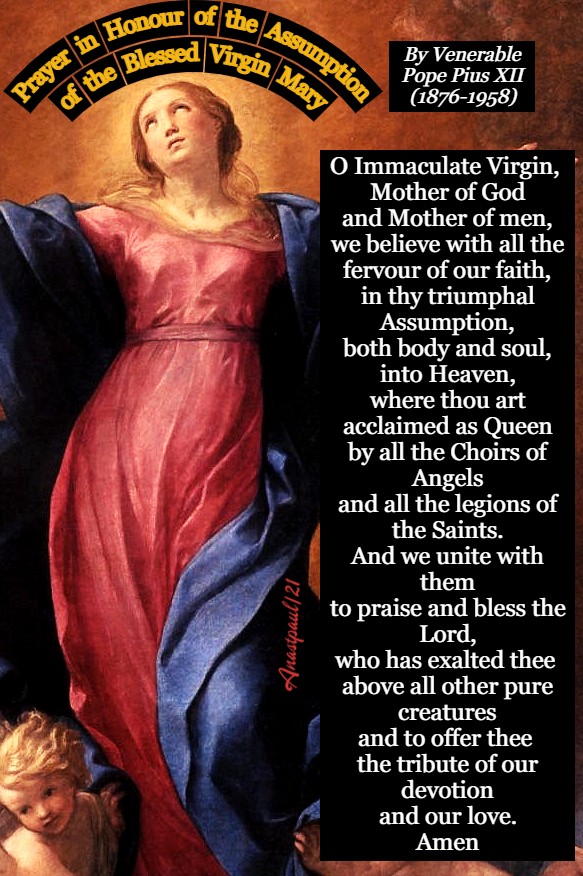
Prayer in Honour of the Assumption
of the Blessed Virgin Mary
By Venerable Pope Pius XII (1876-1958)

O Immaculate Virgin,
Mother of God
and Mother of men,
we believe with all the fervour of our faith,
in thy triumphal Assumption,
both body and soul, into Heaven,
where thou art acclaimed as Queen
by all the Choirs of Angels
and all the legions of the Saints.
And we unite with them
to praise and bless the Lord,
who has exalted thee
above all other pure creatures
and to offer thee
the tribute of our devotion
and our love.
Amen
Posted in SAINT of the DAY

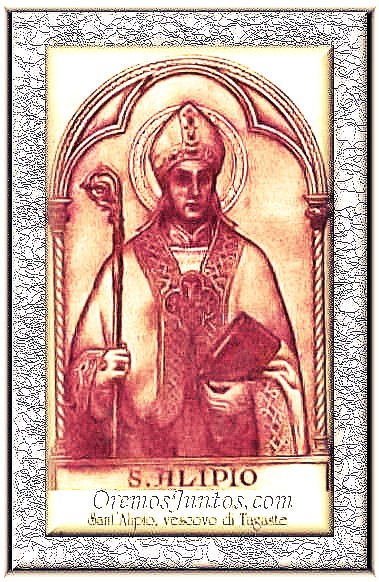
Saint of the Day – Saint Alypius of Thagaste (Died 430)

Saint of the Day – Saint Alypius of Thagaste (Died 430) Bishop of the See of Thagaste (in what is now Algeria) in 394, Confessor, Reformer, Defender of the Faith against heresy, Lawyer, teacher, spiritual advisor. He was a lifelong disciple and friend of Saint Augustine of Hippo and joined him in his conversion (in 386; Confessions 8.12.28) and life in Christianity. He is credited with helping establish Augustine’s Monastery in Africa. Most of what is known about him comes from Augustine’s autobiographical Confessions. Born sometime in the middle of the fourth century in Thagaste, North Africa and died in 430 of natural causes. Also known as – Alipio, Alipius.

The Roman Martyrology states of him today: “In Thagaste in Africa, St Alypius Bishop, who was the friend and disciple of the blessed Augustine and the companion of his conversion, his colleague in the pastoral charge, his valiant fellow-soldier in combating heretics and, finally, his partner in the glory of Heaven.”

He was born in Thagaste (today Souk Ahras, Algeria), to parents who were part of the local noble class. Small in stature but strong-minded and virtuous in character, he established an affectionate and intimate friendship with Augustíne, to the point where they repeatedly call each other “frater cordis mei” – brother of my heart. With him he shared the errors of youth, conversion, religious life and the toil of the apostolate. Saint Augustine describes him as a person of a religious nature, of great honesty and impartiality for his love of justice.

Some years younger than his friend, he attended the grammar schools of his land and the rhetoric schools in Carthage. He preceded him to Rome, where he went to study law and later, accompanied him to Milan. In Rome he was an advisor to the distributor of subsidies to Italy and he showed signs, rare in these circumstances, of integrity and prudence. He energetically resisted the pretensions of a powerful senator who tried to induce him to commit irregularities, showing indifference, with general admiration, both in the face of threats and flattery – “A rare soul,” writes Saint Augustine, “who did not pay attention to friendship, nor did he fear the resentment of such a powerful man, famous for the innumerable means at his disposal to do good or evil. “

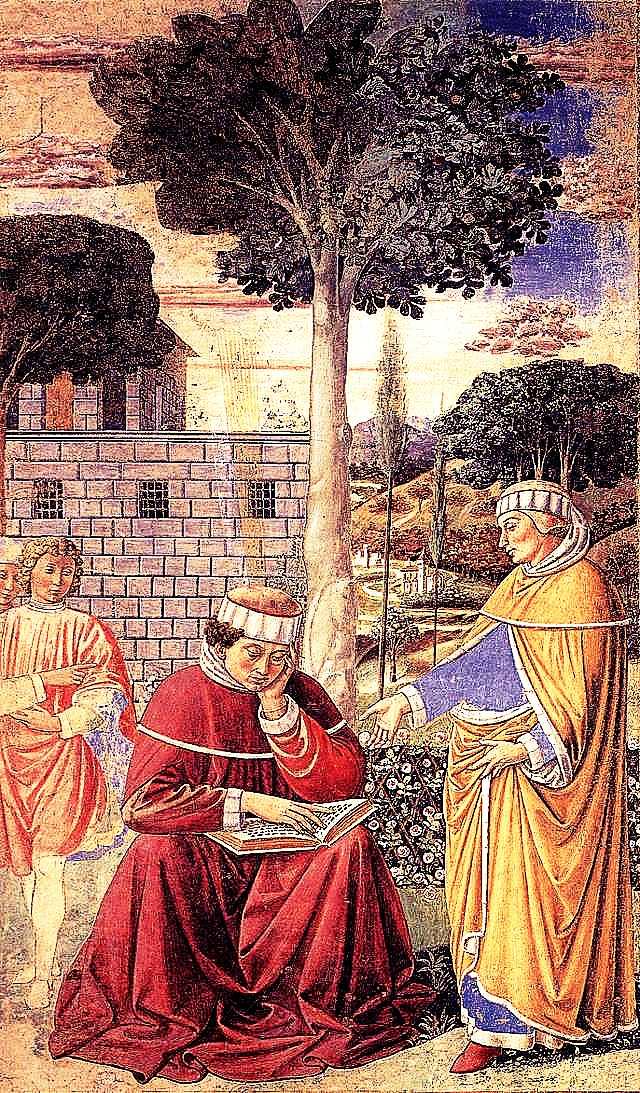
“The Conversion of St. Augustine” (Gozzoli)
The figure on the right isbelieved to St Alypius.

With his friend, Alypius lived the adventure of returning to faith. Chaste of custom, he was a great help in the fight against passions and advised against joining a woman, so as not to give up living freely in the love of wisdom. He was present in the conversion crisis and followed suit. He withdrew with Augustine to Casiciaco, where he participated in philosophical discussions and, together with him, received Baptism on 25 April 387. The following year, Alypius returned to Africa and in Thagaste, he retired with friends to cenobitic life. . In 391 he followed Augustine to the Monastery of Hipona. Soon after,, he travelled to the East and made friends with Saint Jerome. He was esteemed by Saint Paulinus of Nola, who admired his holiness and his zeal.

Elected Bishop of Thagaste, around the year 394, when Augustine was still a Priest. For almost forty years, he shone in the Church of Africa as a reformer of the clergy, teacher of monastic life (Saint Melania, the young woman, remained seven years in Thagaste under his direction) and defender of the faith against Donatists and Pelagians.

In 411 he participated in the Carthage Synod, being one of the seven Catholic Bishops who disputed with the Donatists. In 416 he participated in the Council of Milevi (Numidia) and wrote about this meeting to Pope Innocent.

For the reason of the Pelagian cause he travelled several times to Italy, taking with him the works of St Augustine to present to the Pontiff Boniface. The last news we have from him was in 428 in correspondence to Augustine.

It is believed that he was in Hippo at the time of the death of Saint Augustine and that he died in the same year ,430. He was Canonised in 1584 by Pope Gregory XIII.

Posted in DOGMA, FEASTS and SOLEMNITIES, MARIAN TITLES, SAINT of the DAY, THE ASSUMPTION

The Assumption of the Blessed Virgin Mary and Memorials of the Saints – 15 August

The Assumption of the Blessed Virgin Mary +2021

Fra Angelico, The Death and the Assumption of the Virgin, c1432.  This work combines the ancient iconography of the Dormition–showing the Virgin’s body surrounded by the Apostles, while Christ receives her soul, shown as a baby because she is reborn into Heaven–with the evolving imagery of the Assumption.  

The Feast celebrates the Assumption of the body of the Blessed Virgin Mary into heaven upon her death. According to Pope Benedict XIV, it is a probable opinion, which it is impious to deny, though not an article of faith but has since in 1950 has been raised to a DOGMA of the Faith.
The origin of the Feast day is not known but it was celebrated in Palestine before the year 500.
It is a holy day of obligation, it’s Vigil being a fast day, in many English-speaking countries.
In 1950, Pope Pius XII proclaimed Mary’s Assumption a Catholic Dogma:
the Immaculate Mother of God, the ever Virgin Mary, having completed the course of her earthly life, was assumed body and soul into heavenly glory(Munificentissimus Deus).
He did not specify whether she died first – Catholic Doctrine leaves that open. St Epiphanius of Salamis (Cyprus, died 403) had written, “No-one knows how her life ended.” But the Assumption of Mary is a nexus of Catholic faith in God’s power to resurrect the body and unite it with the soul in everlasting life.
Among the many masters who have painted the subject of the Assumption are Fra Angelico, Ghirlandaio, Rubens, Del Sarto and Titian.
Patronages Acadians, Cajuns, Cistercian Order, Cistercians, fish dealers, fish-mongers, French air crews, harness makers, France, Guatemala, India, Jamaica, Malta, Paraguay, Slovakia, east Africa (region of east Africa which includes diverse countries, proclaimed on 15 March 1952 by Pope Pius XII) South Africa (this is not a region but a country) and the Assumption is, therefore, the Patronal Feast of the Country of South Africa – proclaimed on 15 March 1952 by Pope Pius XII), 24 dioceses, 38 cities.

The Assumption of the Blessed Virgin:
https://anastpaul.com/2018/08/19/the-solemnity-of-the-assumption-of-the-blessed-virgin-mary-19-august/

St Alypius of Thagaste (Died 430) Bishop

Blessed Alfred of Hildesheim OSB (Died 874) Bishop, Benedictine Monk, Confessor, Founder of Essen Abbey, Hildesheim Cathedral, many Convents, Schools and Seminaries, Royal Spiritual Adviser to the East Frankish King Louis the German, Diplomatic Peacemaker, he was know for his great devotion to the Blessed Virgin Mary.
His Lifestory:

https://anastpaul.com/2020/08/15/saint-of-the-day-15-august-blessed-alfred-of-hildesheim-osb-died-874-bishop/

Bl Agustín Hurtado Soler
St Arduinus of Rimini
Bl Claudio Granzotto
Bl George Halley

Blessed Isidore Bakanja (c 1887-1909) Congolese Martyr, Layman, Evangelist, Marian devotee especially of the Holy Rosary and Our Lady of Mount Carmel.
His Life and Death:

https://anastpaul.com/2019/08/15/saint-of-the-day-15-august-blessed-isidore-bakanja-c-1887-1909-martyr/
St Napoleon of Alexandria

St Simplician (c 320-c 401) Archbishop of Milan and Successor of St Ambrose (340-397) Doctor of the Church in the Archdiocese of Milan, Teacher, Catechist, Writer, Mystic.
St Ambrose used to call Simplician father, as a sign of spiritual relationship but they were also great friends. Simplician took also an active part in the conversions of both Alypius of Thagaste and Augustine of Hippo. The meeting between Augustine and Simplican occurred in Milan in 386 and it is recorded in Augustine’s Confessions. After his conversion, Augustine also called Simplician father and in 397 he dedicated to Simplician two books on the issue of predestination, known as De Diversis Quaestionibus ad Simplicianum. St Augustine, remembered and referred to him with deep gratitude, calling him the “spiritual father of my soul” and would submit his own writings to him to review and comment.
Details of the life of St Simplician here:
https://anastpaul.wordpress.com/2017/08/15/saint-of-the-day-15-august-st-simplician-of-milan/

St Stanislaus Kostka SJ (1550-1568) Polish Jesuit Novice.
On the evening of the Feast of Saint Lawrence (10 August), Stanislaus felt a mortal weakness, magnified by a high fever and clearly saw, that his last hour had come. He wrote a letter to the Blessed Virgin begging her to call him to the skies, there to celebrate with her, the glorious Anniversary of her Assumption (15 August). His confidence in the Blessed Virgin, which had already brought him many favours, was this time again rewarded – on 15 August 1568, towards 4:00 in the morning, while he prayed to God, to the Saints and to the Virgin Mary, he died.
Many in the City proclaimed him a saint and people hastened from all parts to venerate his remains and to obtain, if possible, arelic.
St Stanislaus was Beatified on 19 October 1605 by Pope Paul V and Canonised on 31 December 1726 by Pope Benedict XIII.

https://anastpaul.com/2017/11/13/saint-of-the-day-13-november-st-stanislaus-kostka-sj-1550-1568/

St Tarcisius (3rd century) Martyr of the Eucharist – Patronages – altar servers, first communicants.
About St Tarcisius:

https://anastpaul.com/2018/08/15/saint-of-the-day-15-august-st-tarcisius-3rd-century-martyr-of-the-eucharist/

Martyrs of Nicomedia – 3 saints: Three Christians martyred together. No details survive but the names – Eutychian, Philip and Straton. They were martyred in Nicomedia, Bithynia (in modern Turkey).

Martyred in the Mexican Revolution: 4 Saints –
St David Roldán Lara
St Luis Batiz Sainz
St Manuel Moralez
St Salvador Lara Puente

Martyred in the Spanish Civil War: Thousands of people were murdered in the anti-Catholic persecutions of the Spanish Civil War from 1934 to 1939.
• Blessed Agustì Ibarra Angüela
• Blessed Carmelo Sastre y Sastre
• Blessed Clemente Vea Balaguer
• Blessed Francisco Míguez Fernández
• Blessed Ildefonso Alberto Flos
• Blessed Jaume Bonet Nadal
• Blessed Joan Ceró Cedó
• Blessed Josep Santonja Pinsach
• Blessed Juan Francisco Barahona Martín
• Blessed Juan Mesonero Huerta
• Blessed Luis Ros Ezcurra
• Blessed Manuel Formigo Giráldez
• Blessed Miguel Alberto Flos
• Blessed Sebastià Balcells Tonijuan
• Blessed Severiano Montes Fernández

Posted in DOGMA, MARIAN PRAYERS, MARIAN TITLES, NOVENAS, THE ASSUMPTION

Novena to Our Lady of the Assumption – Day Nine – 14 August

Novena to Our Lady of the Assumption

DAY NINE

Daily Prayer:
Lord Jesus Christ,
Thou has destroyed the power of death
and given the hope of eternal life,
for body and soul.
Thou granted Thy Mother
a special place in Thy glory
and did not allow decay to touch her body.
As we rejoice in the Assumption
of the Blessed Virgin Mary,
grant us renewed confidence
in the victory of life over death.
Amen

Day 9:
O Blessed Mother Assumed into Heaven,
after years of heroic martyrdom on earth,
we rejoice that thou hast at last
been taken to the throne
prepared for thee in Heaven by the Holy Trinity.
Lift our hearts with thee in the glory of thy Assumption
above the dreadful touch of sin and impurity.
Teach us how small earth becomes
when viewed from Heaven.
Make us realise,
that death is the triumphant gate
through which we shall pass to thy Son
and that someday, our bodies shall rejoin our souls
in the unending bliss of Heaven.
From this earth, which we tread as pilgrims,
we look to thee for hope and help.
In honour of thy Assumption into Heaven,
we ask for this favour:
………………………………..
(Mention your request)

At the hour of our death,
lead us safely to the presence of Jesus
to enjoy the vision of God for all eternity
together with thee.
O Queen Assumed into Heaven, pray for us,
that we may be made worthy of the promises of Christ.

Amen

Posted in MEDITATIONS - ANTONIO CARD BACCI, QUOTES on CONVERSION

Thought for the Day – 14 August – The New Life

Thought for the Day – 14 August – Meditations with Antonio Cardinal Bacci (1881-1971)

The New Life

Anyone who takes life seriously in the Christian sense, will regard it as a difficult journey towards perfection and towards God.
This journey will be, at the same time, painful and joyful.

On the way, there will be trouble, which will sadden us and vices, which will impede our progress.
Our falls and defeats will cause us to be disheartened.
But, there will also be the grace of God to enlighten and encourage us.
It is our own loss if we sit down lazily on the side of the road, which should lead us to Heaven.
It is even more disastrous if we acknowledge defeat and lay down the spiritual weapons of prayer and renunciation, in order to surrender ourselves to sin or to indifference.
Everyday we should say to ourselves in the presence of God – A new life is beginning … in You, by Your grac and for You! Amen

Antonio Cardinal Bacci

PART ONE HERE:
https://anastpaul.com/2021/07/03/thought-for-the-day-4-july-the-new-life-2/