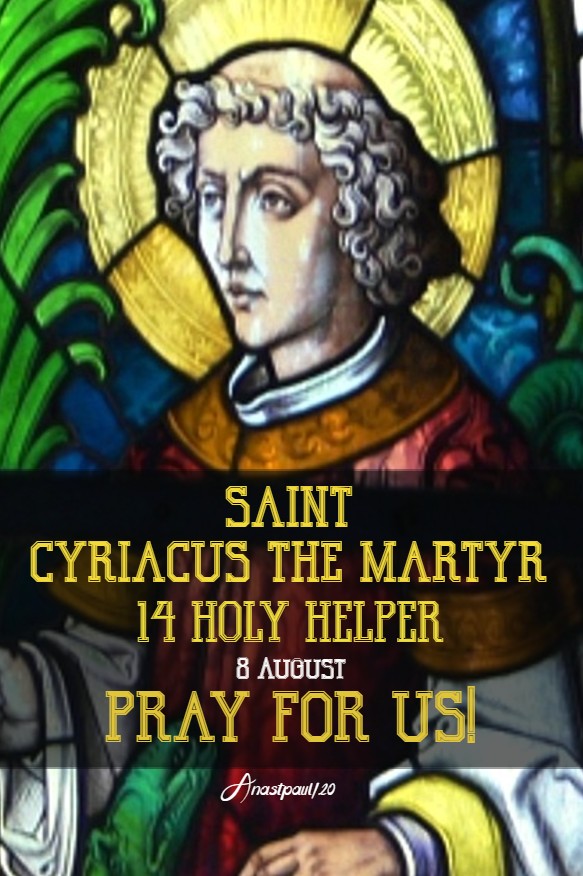
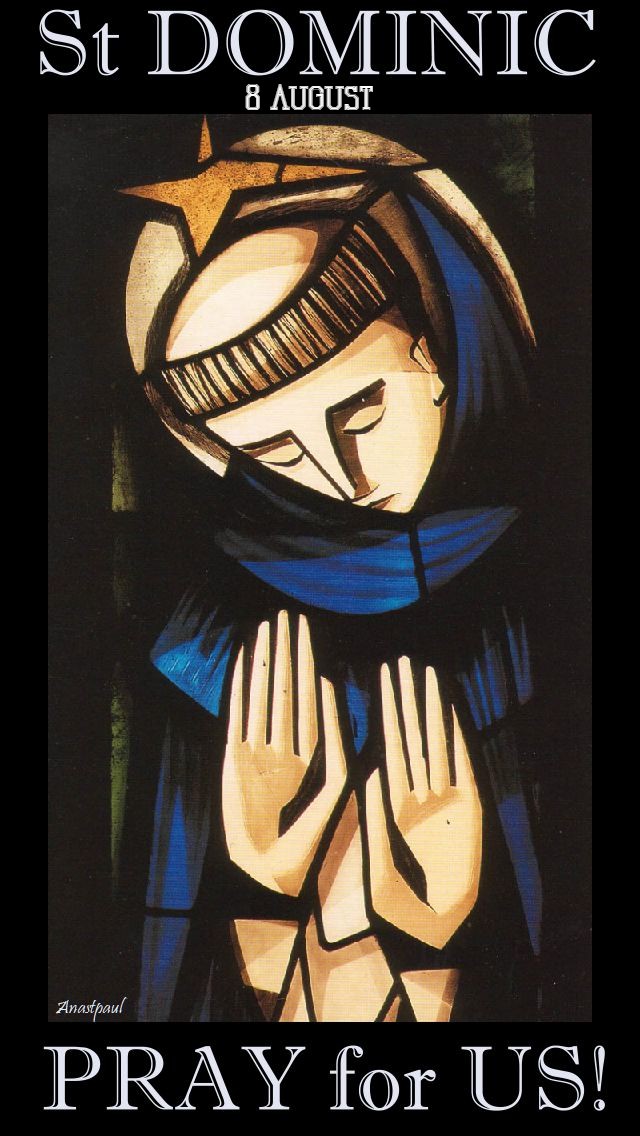
One Minute Reflection – 8 August – Saturday of the Eighteenth week in Ordinary Time, Readings: Habakkuk 112-2, 4, Psalm 9:8-13, Matthew 17:14-20 and the Memorial of St Cyriacus the Martyr, Deacon (Died c 303) One of the Fourteen Holy Helpers and of St Dominic (1170-1221)
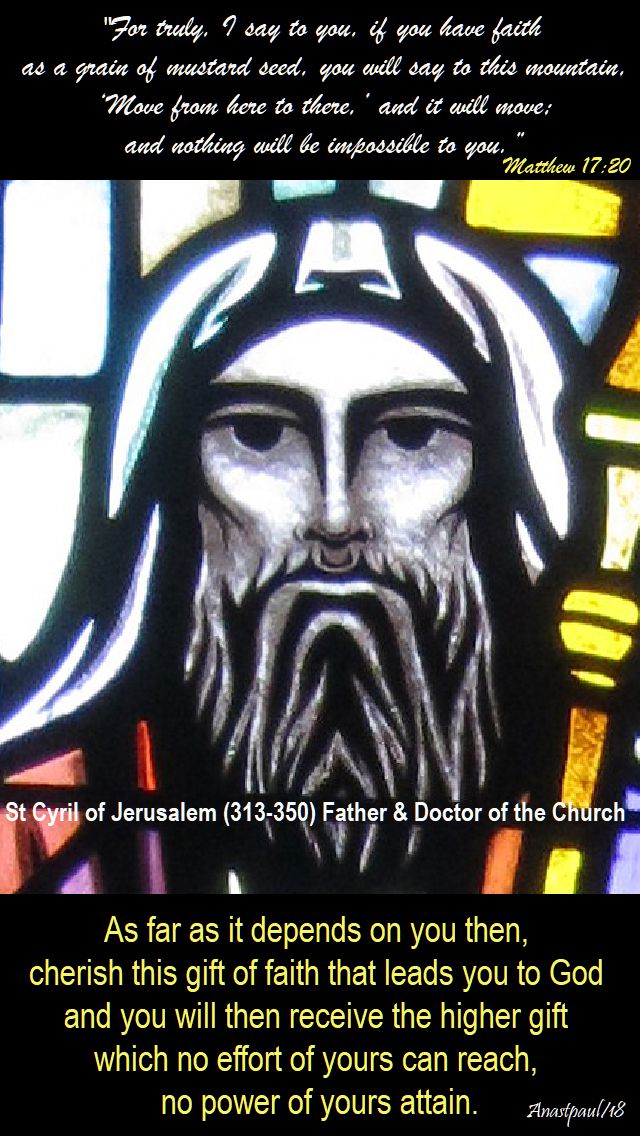
He said to them, “Because of your little faith. For truly, I say to you, if you have faith as a grain of mustard seed, you will say to this mountain, ‘Move from here to there,’ and it will move; and nothing will be impossible to you.”… Matthew 17:20
REFLECTION – “The word “faith” has one syllable but two meanings. First of all it is concerned with doctrine and it denotes the assent of the soul to some truth. Faith in this sense brings blessing and salvation to the soul, as the Lord said: “He who hears my word and believes in him who sent me, has eternal life.” (Jn 5:24)…
The word “faith” has a second meaning – it is a particular gift and grace of Christ. “To one is given through the Spirit the utterance of wisdom and to another the utterance of knowledge according to the same Spirit, to another faith by the same Spirit, to another gifts of healing” (1Cor 12:8-9). Faith in the sense of a particular divine grace conferred by the Spirit is not, then, primarily concerned with doctrine but with giving a person powers, quite beyond their natural capability. Whoever has this faith will say to a mountain: “Move from here to there” and it will move and anyone who can in fact say these words through faith and “believes without hesitation that they will come to pass,” (Mk 11:23) receives this particular grace. It is to this kind of faith that the Lord’s words refer – “If you have faith as a grain of mustard seed.” Now, a mustard seed is small in size but its energy thrusts it upwards with the force of fire. Small are its roots, great the spread of its boughs and once it is fully grown the birds of the air find shelter in its branches (Mt 13:32). So too, in a flash, faith can produce the most wonderful effects in the soul.
Enlightened by faith the soul gazes at the glory of God so far as human nature allows and, even before the consummation of all things, ranging beyond the boundaries of the universe, it has a vision of the judgement and of God making good the rewards he promised. As far as it depends on you then, cherish this gift of faith that leads you to God and you will then receive the higher gift which no effort of yours can reach, no power of yours attain.”…St Cyril of Jerusalem (313-350) Bishop of Jerusalem, Father & Doctor of the Church (Baptismal Catechesis 5)
PRAYER – Holy God, grant we pray, Your Holy Spirit of love and divine grace to grow ever more in faith. By our prayers and love for You and our neighbour, may we merit Your divine assistance. Lord Jesus, help us to dwell often on the manner in which we are following You. Let us strive each day to become more and more like You in all things and, to become beacons of Your Light, to all the world. St Cyriacus Martyr for Christ, you who were and are a light to all, pray for us and may the prayers of St Dominic assist us in our day and may his zeal be our inspiration to always fight the good fight,amen.
St Cyriacus/Cyriac the Martyr, Deacon (Died c 303) One of the Fourteen Holy Helpers
St Eleutherius of Constantinople
St Ellidius
St Famianus of Compostela
St Gedeon of Besancon
St Hormisdas of Persia
Bl John Felton
Bl John Fingley
St Largus
St Leobald of Fleury
St Leonidas of Constantinople
St Marinus of Anzarba St Mary of the Cross/ Mary MacKillop (1842-1909) – the first Australian born Saint Biography:
St Mummolus of Fleury
St Myron the Wonder Worker
St Paulus Ge Tingzhu
St Rathard of Diessen
St Severus of Vienne
St Sigrada
St Smaragdus
St Ternatius of Besançon
St Ultan of Crayke
Bl William of Castellammare di Stabia
Bl Wlodzimierz Laskowski
—
Martyrs of Albano – 4 saints: Four Christians who were martyred together, and about we today know little more than their names – Carpóforo, Secondo, Severiano and Vittorino. They were martyred in Albano, Italy – their remains are interred in the San Senator cemetery, on the Appian Way, 15 miles from Rome, Italy.
Martyrs of Rome – 5 saints: Five Christians martyred together; we know nothing else about them but the names – Ciriaco, Crescenziano, Giuliana, Memmia and Smaragdus. They were martyred at the 7 mile marker, on the Via Ostia, Rome, Italy.
Martyred in the Spanish Civil War – Martyrs of El Saler – 5 beati: Five nuns, all members of the Sisters of the Pious Schools, all teachers, and all martyred together in the Spanish Civil War.
• Antonia Riba Mestres
• Maria Baldillou Bullit
• María Luisa Girón Romera
• Nazaria Gómez Lezaun
• Pascuala Gallén Martí
They were martyred on 8 August 1936 in El Saler, Valencia, Spain and Beatified on 11 March 2001 by Pope John Paul II.
Martyred in the Spanish Civil War:
Bl Cruz Laplana Laguna
Bl Fernando Español Berdie
Bl Leoncio López Ramos
Bl Manuel Aranda Espejo
Bl Mariano Pina Turón
Bl Pedro Álvarez Pérez
Bl Andrew the Catechist
St Austindus of Auch St Bartholomea Capitanio SCCG (1807-1833)
St Benigno of Malcestine
Bl Camilla Gentili
St Charus of Malcestine
Bl Edward Thwing
Bl Élisabeth-Thérèse de Consolin
St Erastus
Bl Évangéliste of Verona
St Exuperia the Martyr
Bl George Swallowell
St Gérontios
Bl Giuseppina Maria de Micheli
St Gothalm
St Hyacinth
Bl Jacques Netsetov
Bl John Ingram
St Joris
Bl Marcel-Gaucher Labiche de Reignefort
Bl Marie-Claire du Bac
Bl Marie-Madeleine Justamond
Bl Marie-Marguerite Bonnet
St Olympius the Tribune
St Parasceva of Rome
St Pastor of Rome
Bl Pérégrin of Verona
Bl Pierre-Joseph le Groing de la Romagère Blessed Robert Nutter OP (c 1557-1600) Martyr His Life: https://anastpaul.com/2019/07/26/saint-of-the-day-26-july-blessed-robert-nutter-op-c-1557-1600-martyr/
St Simeon of Padolirone
St Symphronius the Slave
St Theodulus the Martyr Blessed Titus Brandsma OCD (1881-1942) Martyr of the Faith Biography: https://anastpaul.com/2018/07/26/saint-of-the-day-27-july-blessed-titus-brandsma-o-c-d-1881-1942-martyr-of-the-faith/
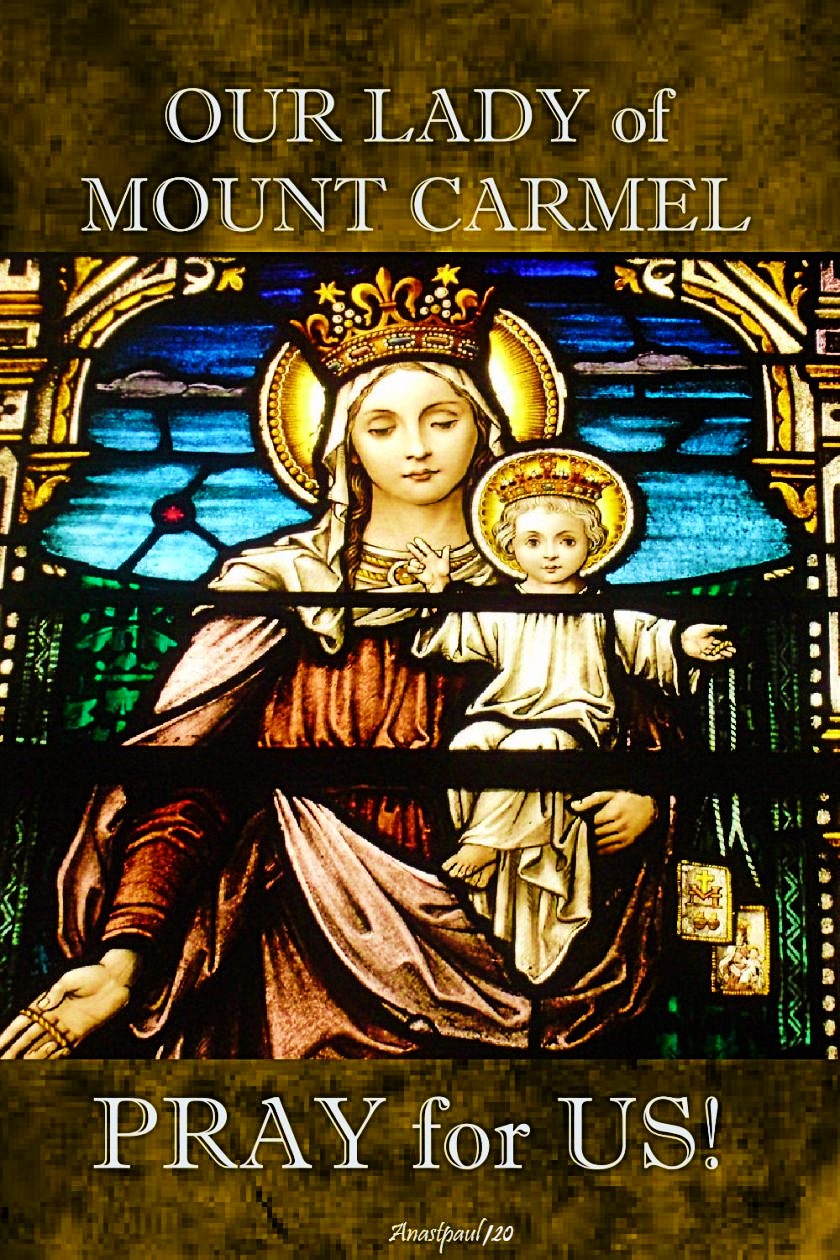
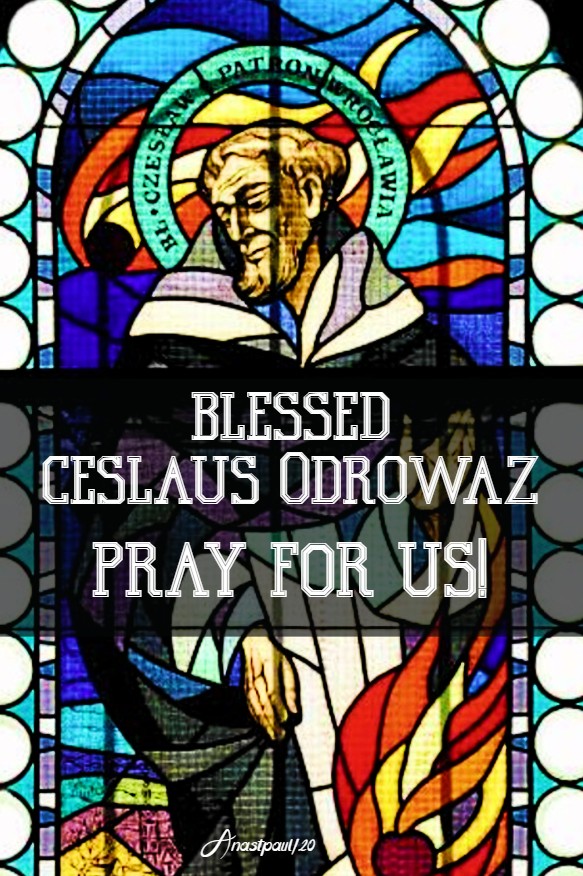
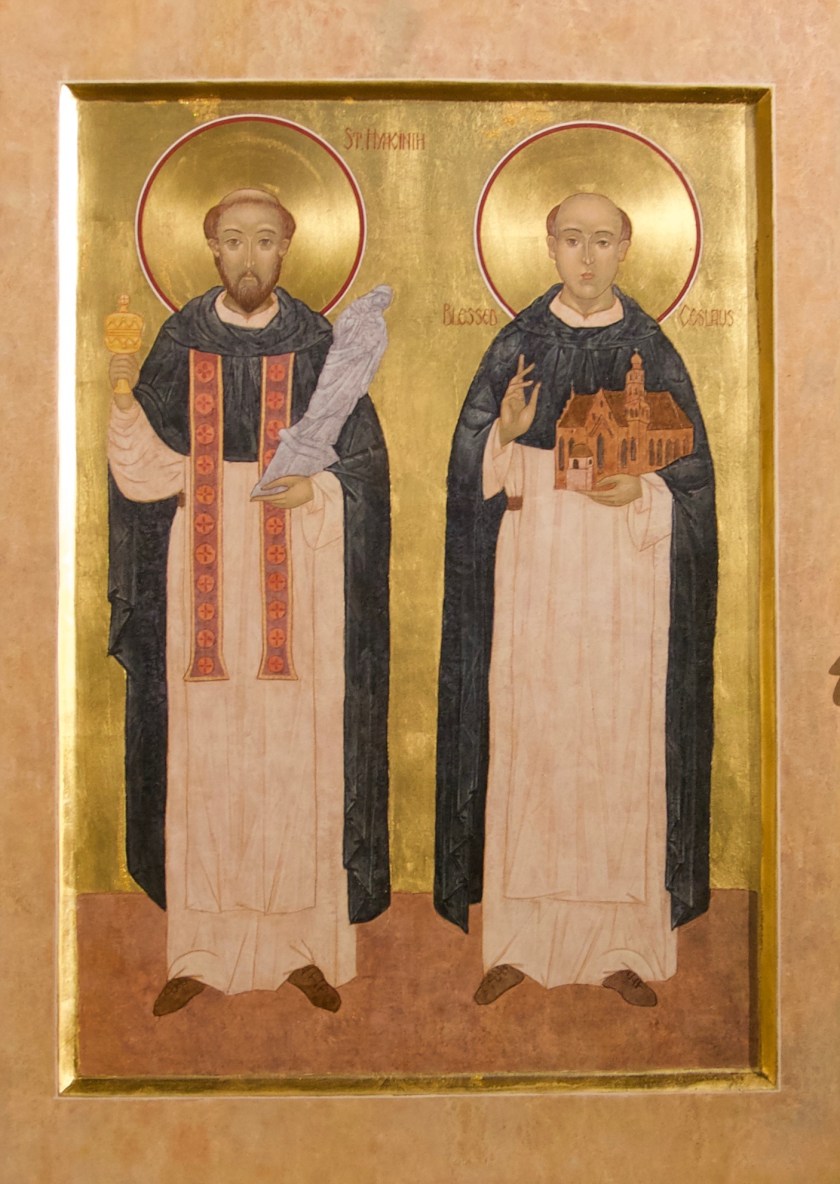
One Minute Reflection – 16 July – “Month of the Most Precious Blood” – Thursday of the Fifteenth week in Ordinary Time, Year A, Readings: Isaiah 26:7-9, 12, 16-19, Psalm 102:13-21, Matthew 11:28-30 and the Memorial of Our Lady of Mount Carmel and of Blessed Ceslaus Odrowaz OP (c 1184– 1242) (Brother of St Hyacinth)
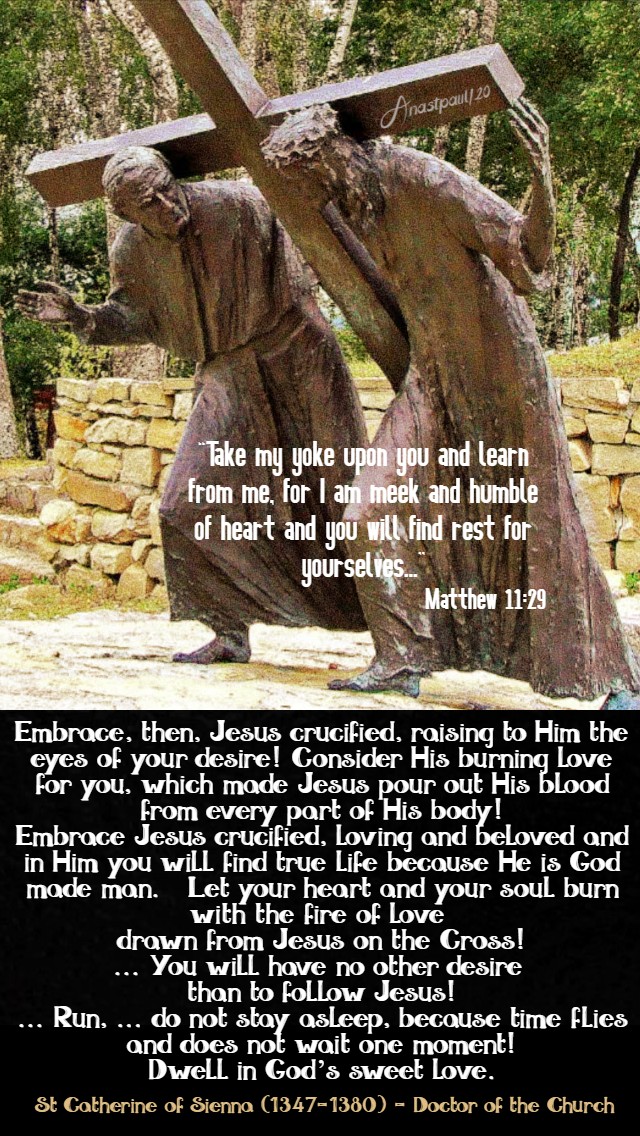
“Take my yoke upon you and learn from me, for I am meek and humble of heart and you will find rest for yourselves…” … Matthew 11:29
REFLECTION – “Dearest sister in Jesus. I, Catherine, servant of the servants of Jesus, write to you in His Precious Blood, wishing only that you feed yourself with God’s love and nourish yourself with it, as at a mother’s breast. Nobody, in fact, can live without this milk!
Who possesses God’s love, finds so much joy that every bitterness transforms itself into sweetness and that every great weight becomes light. One must not be astonished because living in charity you live in God – “God is love and he who abides in love, abides in God and God abides in him”(1 John 4:16)
Thus, living in God, you can have no bitterness because God is delight, gentleness and never-ending joy!
This is why God’s friends are always happy! Even if we are sick, poor, grieved, troubled, persecuted, we are always joyful.
… We do not seek joy elsewhere than in Jesus and we avoid any glory which is not that of the Cross.
Embrace, then, Jesus crucified, raising to Him the eyes of your desire! Consider His burning love for you, which made Jesus pour out His blood from every part of His body!
Embrace Jesus crucified, loving and beloved and in Him you will find true life because He is God made man. Let your heart and your soul burn with the fire of love drawn from Jesus on the Cross!
You must, then, become love, looking at God’s love who loved you so much not because He had any obligation towards you but out of pure gift, urged only by His ineffable love.
You will have no other desire than to follow Jesus! As if you were drunken with Love, it will no longer matter whether you are alone or in company – do not think about many things but only about finding Jesus and following Him!
Run, Bartolomea, do not stay asleep, because time flies and does not wait one moment!
Dwell in God’s sweet love.
Sweet Jesus, Jesus love.” … St Catherine of Sienna (1347-1380) – Doctor of the Church – From the “Letters” (letter no. 165 to Bartolomea, wife of Salviato of Lucca).
PRAYER – “Holy God, our Father, we turn to You in confidence as children and pray, give us meekness of heart, make us “poor in spirit” that we may recognise that we are not self-sufficient, that we are unable to build our lives on our own but need You, we need to encounter You, to listen to You, to speak to You. Help us to understand that we need Your gift, Your wisdom, which is Jesus Himself, in order to do the Your will in our lives and thus to find rest in the hardships of our journey.” Hear the prayers we request of the Mother of our Jesus Crucified and our Mother, Our Lady of Carmel, dear Lord and holy God, which we pray through Christ, our Light, in the Holy Spirit, one God for all eternity, amen. … Pope Benedict XVI, General Audience, 7 December 2011
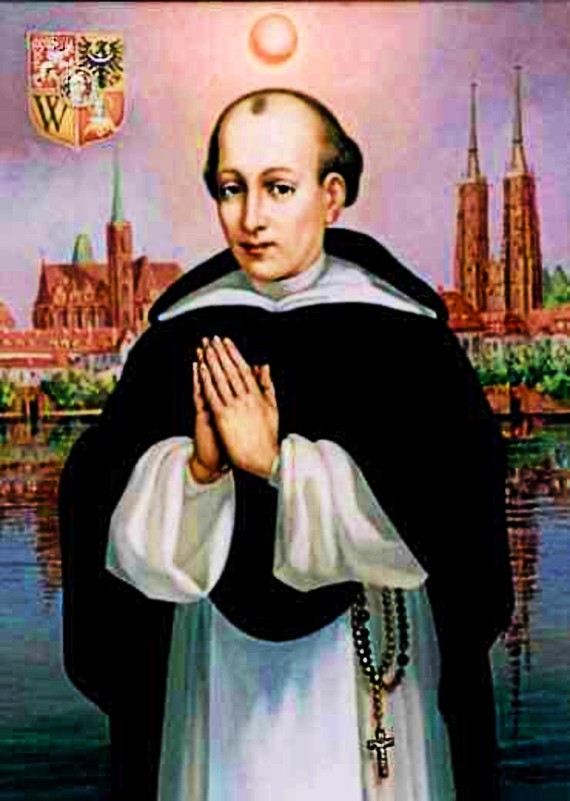
Saint of the Day – 16 July – Blessed Ceslaus Odrowaz OP (c 1184– 1242) (Brother of St Hyacinth – Polish – Jacek) Priest and Friar of the Order of Preachers/Dominicans, Confessor, Spiritual Advisor, miracle-worker – born as Czesław Odrowaz in Kamień Śląski in Silesia, Poland and died in 1242 in Wroclaw, Poland of natural causes. Patronage – Wroclaw.
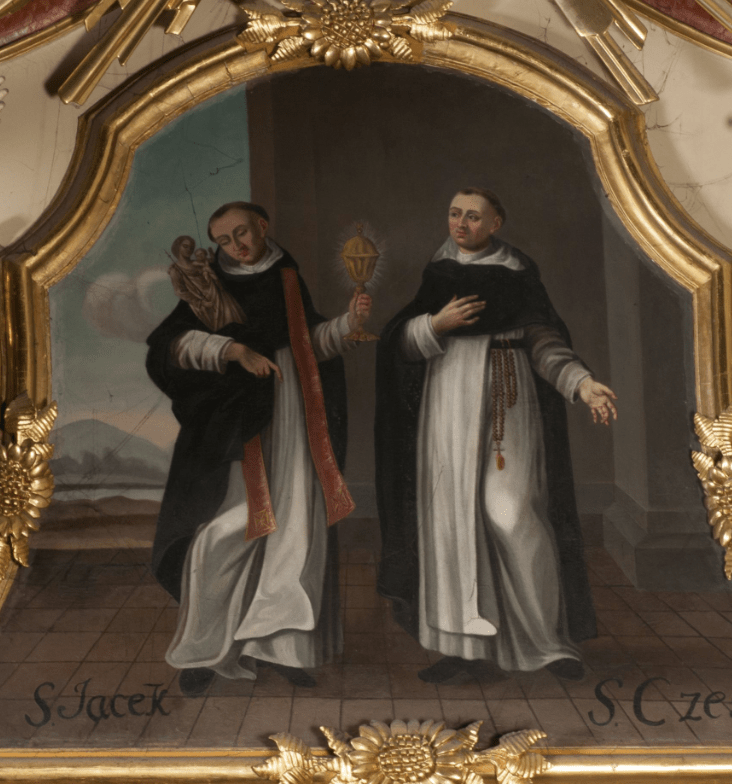
Born of the noble family of Odrowąż in the town of Kamień Śląski in Silesia, Poland, he is believed to have been Saint Hyacinth Odrowąż’s brother.
Having completed his philosophical studies in Prague, he went onto study theology and jurisprudence at the University of Bologna and possibly that of Paris. After being Ordained a Priest, in about 1218 he accompanied his uncle Ivo, Bishop of Cracow, to Rome. Hearing of the great sanctity of Saint Dominic, who had recently been attributed the miracle of resuscitating the nephew of Cardinal Stefano di Fossa Nova who had been killed in a fall from his horse, Ceslaus, together with St Hyacinth, sought admission into the Order of Friars Preachers.
The clothing of the St Hyacinth and Ceslaus by St Dominic
In 1222, accompanied by a group of his fellow friars, he arrived in Cracow whence he soon set off for Prague. It was there that he set up the first Dominican Monastery. A few years later, Ceslaus was appointed Abbot of a Priory in the Polish city of Wrocław.
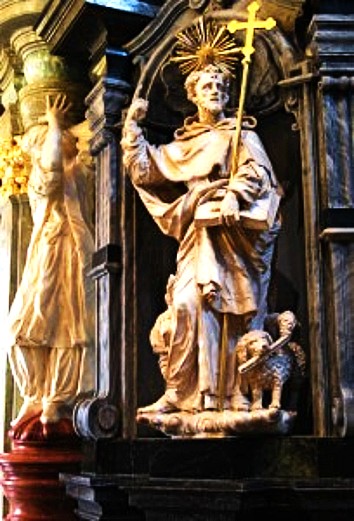
Statue of Bl Ceslaus in Wroclaw
At the feet of the Statue of Blessed Ceslaus above, you will see a dog carrying a torch. The dog is the symbol of the Dominicans. It comes from a play on words in Latin: “Dominicanus” sounds like “Domini canis” – “dog of the Lord.” A traditional story is that when St Dominic’s mother was pregnant with him, she dreamed of a dog running around the whole world with a torch in its mouth. When her son became the Founder of an Order of Preachers – spreading the light of the Gospel throughout the world – this dream was looked on as prophetic. And so the symbol of a dog carrying a torch has become a symbol of the Dominican order.
A pious and generous man, Ceslaus became spiritual advisor to St Hedwig of Silesia. In those days, Poland was plagued by numerous attacks by the Tartars. In 1240 they laid siege to the city of Wrocław and the townspeople naturally turned to Ceslaus, who had made a name for himself as a holy man, for spiritual comfort and help. Ceslaus’ ardent prayers and outstanding moral courage miraculously averted the fall of the city.
Ceslaus remained in Wroclaw until his death in 1242.
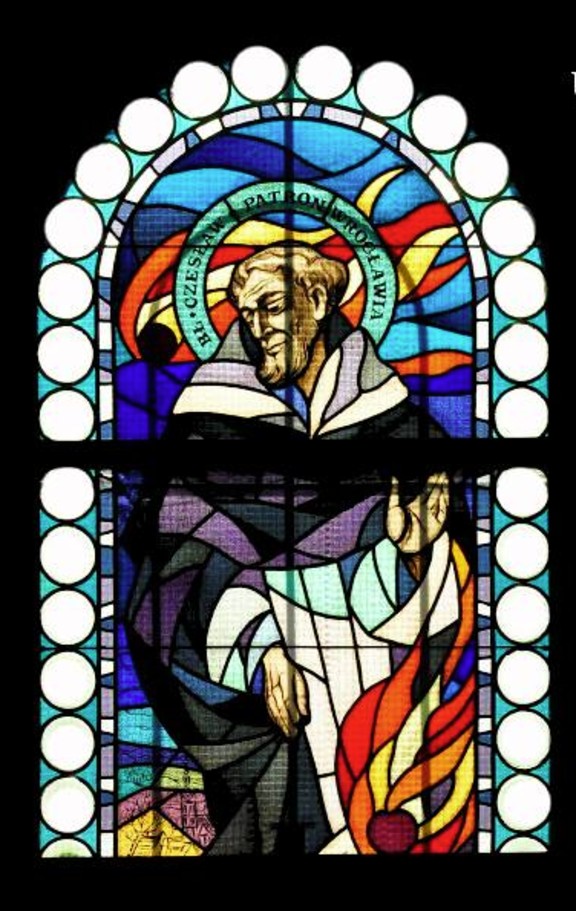
He was raised to the altars by Pope Clement XI in 1713. In 1963, Pope Paul VI recognised Bl Ceslaus – next to St John the Baptist – as the main Patron Saint of City of Wrocław. In iconography, Bl Ceslaus is portrayed with a ball (or column) of fire above his head, which appeared during the siege of Wroclaw. The miracle horrified the invaders and made them run away and subsequently retreat.
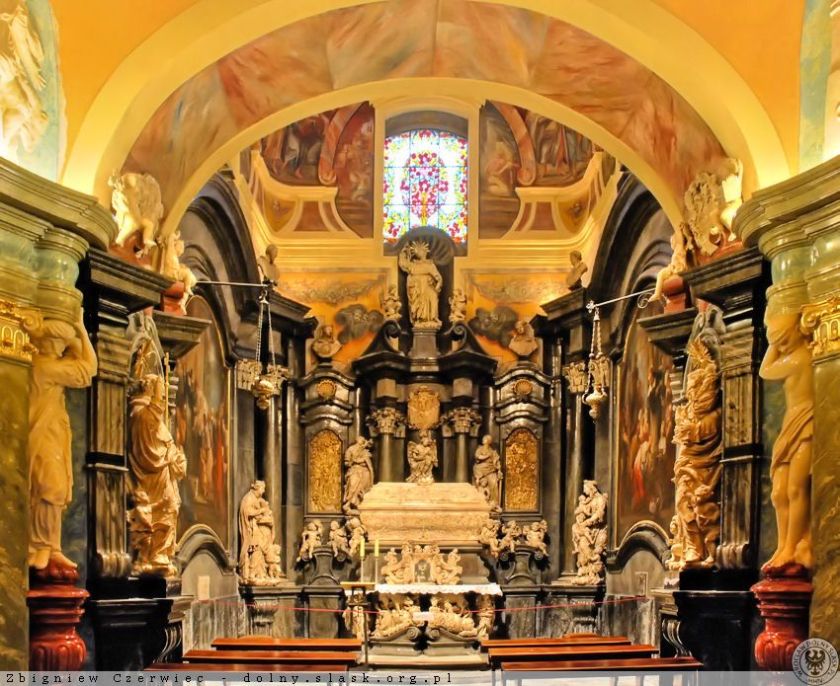
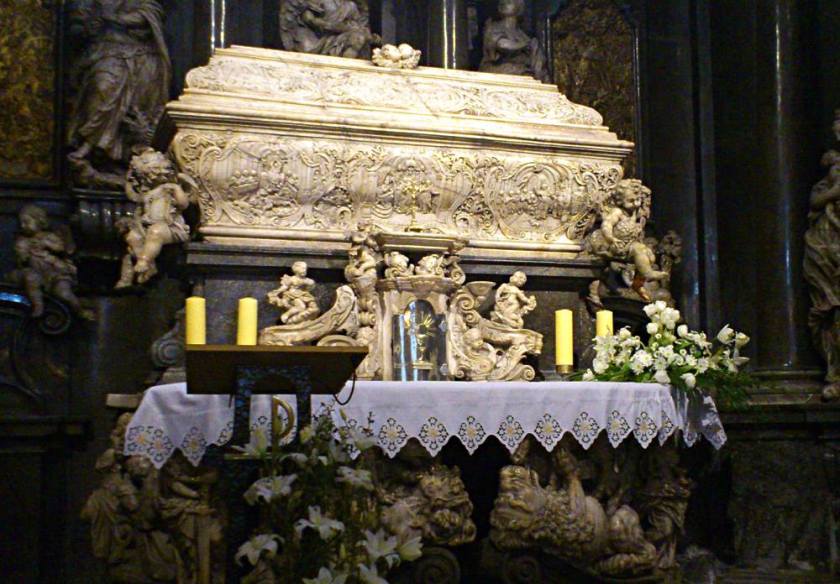
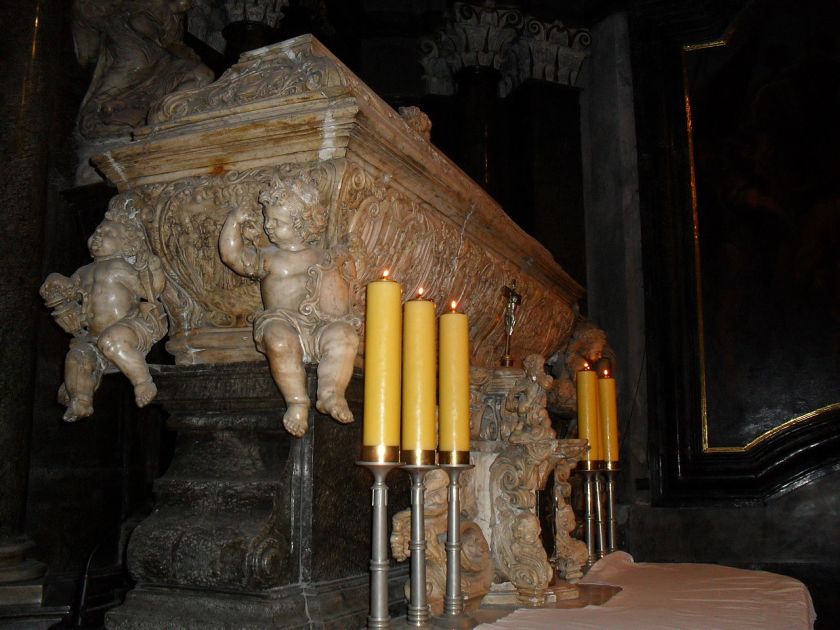
Chapel of Blessed Ceslaus Dominican Church of St Wojciech (Adalbert) Wrocław, PolandSarcophagus of Blessed Ceslaus with relic for veneration of the faithful
Bl André de Soveral
St Andrew the Hermit
St Antiochus of Sebaste
Bl Arnold of Clairvaux
Bl Arnold of Hildesheim
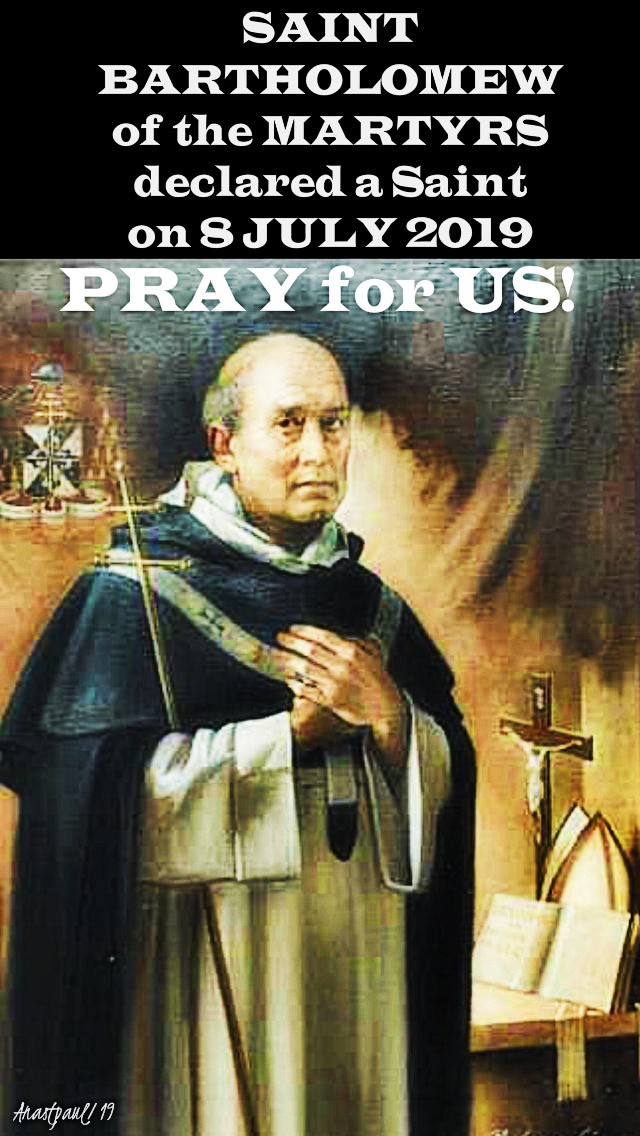
St Athenogenes of Sebaste St Bartholomew of Braga OP – ArchBishop of Braga also known as Bl Bartholomew of the Martyrs (Bartolomeu Fernandez dei Martiri Fernandes) (1514-1590) St Bartholomew: https://anastpaul.com/2018/07/16/saint-of-the-day-16-july-blessed-bartholomew-of-the-martyrs-1514-1590/
On 8 July 2019, Pope Francis approved the favourable votes cast by the Eminent and Excellent members of the Congregation and extended to the Universal Church the liturgical worship in honour of Blessed Bartholomew of the Martyrs (born Bartolomeu Fernandes), of the Order of Preachers, Archbishop of Braga, born in Lisbon, Portugal on 3 May 1514 and died in Viana do Castelo, Portugal, on 16 July 1590, inscribing him in the book of Saints (Equipollent Canonisation).
Alleluia! Saint Bartholomew of the Martyrs, Pray for Us!
St Benedict the Hermit Blessed Ceslaus Odrowaz OP (c 1184– 1242) (Brother of St Hyacinth)
Bl Claude Beguignot
Bl Domingos Carvalho
St Domnin
St Domnio of Bergamo
Bl Dorothée-Madeleine-Julie de Justamond
St Elvira of Ohren
St Eugenius of Noli
St Faustus
St Faustus of Rome and Milan
St Fulrad of Saint Denis
St Generosus of Poitou
St Gobbán Beg
St Gondolf of Saintes
St Grimoald of Saintes
St Helier of Jersey
Bl Irmengard
Bl John Sugar
St Landericus of Séez
Bl Madeleine-Françoise de Justamond
Bl Marguerite-Rose de Gordon
Bl Marguerite-Thérèse Charensol
Bl Marie-Anne Béguin-Royal
Bl Marie-Anne Doux St Marie-Madeline Postel (1756-1846)
Her Life: https://anastpaul.com/2019/07/16/saint-of-the-day-16-july-st-marie-madeline-postel-
Bl Marie-Rose Laye
Bl Milon of Thérouanne
Bl Nicolas Savouret
Bl Ornandus of Vicogne
St Paulus Lang Fu
St Reinildis of Saintes
Bl Robert Grissold
Bl Simão da Costa
St Sisenando of Cordoba
St Tenenan of Léon
St Teresia Zhang Heshi
St Valentine of Trier
St Vitalian of Capua
St Vitaliano of Osimo
St Yangzhi Lang
—
Martyrs of Antioch – 5 saints: Five Christians who were martyred together. No details about them have survived by the names – Dionysius, Eustasius, Maximus, Theodosius and Theodulus. They were Martyred in Antioch, Syria, date unknown.
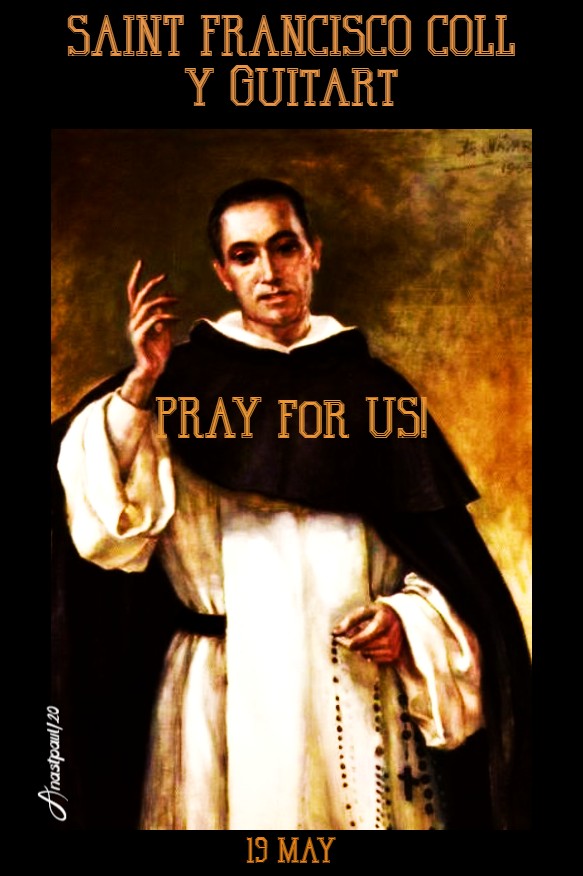
Quote/s of the Day – 19 May – “Mary’s Month” – Tuesday of the Sixth Week of Easter and the Memorial of St Francisco Coll y Guitart OP (1812-1875) “The Apostle of Modern Times”
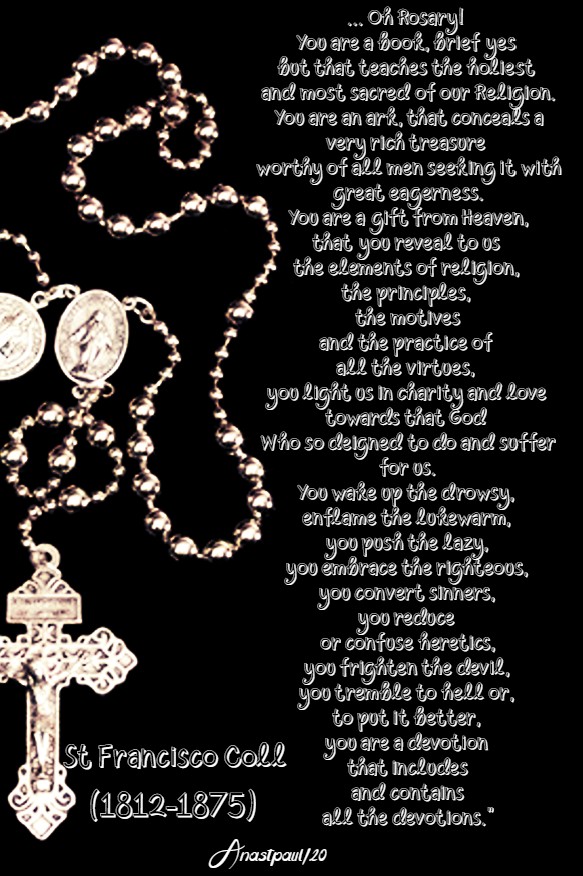
Praise of the Rosary From a sermon of St Francisco Coll
… Oh Rosary! You are a book, brief yes but that teaches the holiest and most sacred of our Religion. You are an ark, that conceals a very rich treasure worthy of all men seeking it with great eagerness. You are a gift from Heaven, that you reveal to us the elements of religion, the principles, the motives and the practice of all the virtues, you light us in charity and love towards that God Who so deigned to do and suffer for us. You wake up the drowsy, enflame the lukewarm, you push the lazy, you embrace the righteous, you convert sinners, you reduce or confuse heretics, you frighten the devil, you tremble to hell or, to put it better, you are a devotion that includes and contains all the devotions.”
“Is this not a work of God and admirable in our eyes? Yes, yes, it is the work of God and given to the world, by the merits of my Father Saint Dominic.”
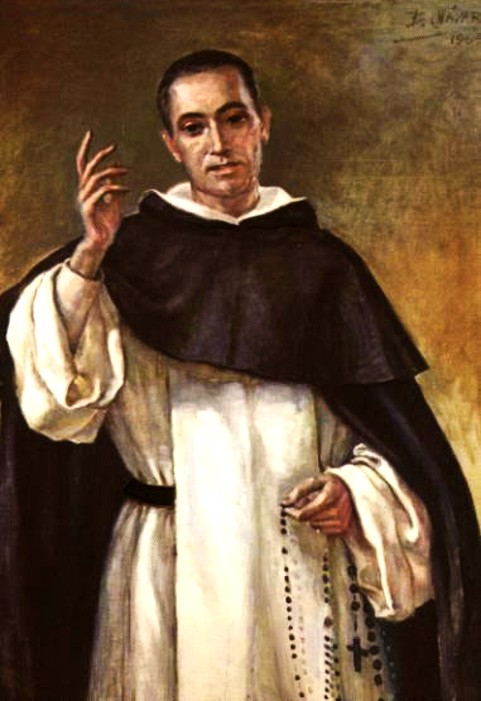
St Francisco Coll (1812-1875)
“The Apostle of Modern Times”
One Minute Reflection – 19 May – “Mary’s Month” – Tuesday of the Sixth Week of Easter,Readings: Acts 16: 22-34, Psalms 138: 1-2, 2-3, 7-8, John 16: 5-11 and the Memorial of St Francisco Coll y Guitart OP (1812-1875) “The Apostle of Modern Times”
“It is better for you that I go. For if I do not go, the Advocate will not come to you. But if I go, I will send him to you.” … John 16:7
REFLECTION – St Teresa Benedicta of the Cross [Edith Stein] OCD (1891-1942) Martyr, Co-Patron of Europe
“Who are You, sweet light, that fills me
and illumines the darkness of my heart? (…)
Are You the master who builds the eternal cathedral,
Which towers from the earth through the heavens?
Animated by You, the columns are raised high
And stand immovably firm.
Marked with the eternal name of God,
They stretch up to the light,
Bearing the dome
That crowns the holy cathedral,
Your work that encircles the world:
Holy Spirit, God’s moulding hand! (…)
Are You the sweet song of love
And of holy awe
That eternally resounds around the triune throne,
That weds in itself, the clear chimes of each and every being?
The harmony
That joins together, the members to the Head,
In which each one
Finds the mysterious meaning of being blessed
And joyously surges forth,
Freely dissolved in Your surging,
Holy Spirit, eternal jubilation!”
PRAYER – Almighty God and Father, Your ways are not our ways, teach us to willingly agree to them, for You know which way we should go. Help us to say “yes” always to Your plan and to render ourselves, as a sacrament of Your divine love to all we meet. Fill us with the Your grace and Your Spirit, to make us Your tools, to bring glory to Your kingdom. Our Father, who art in heaven, may Your Will be done on earth, as it is in heaven. Mary Mother of God, pray for us! St Francisco Coll, you who constantly sought to be a light of the beauty of God, pray for us! Through our Our Lord Jesus Christ with You, in the union of the Holy Spirit, one God forever, amen.
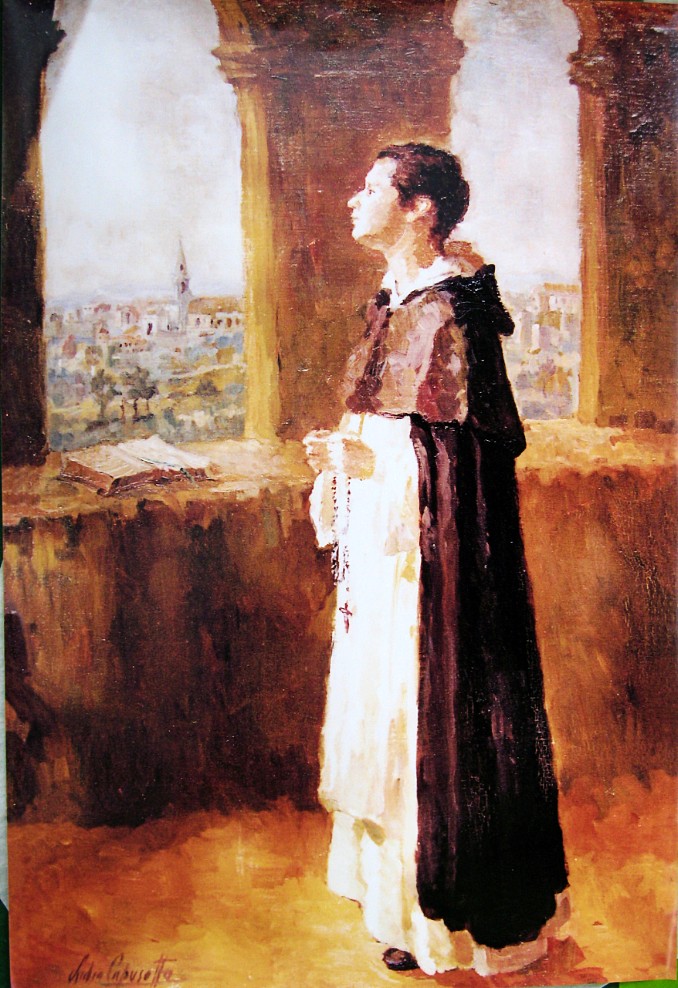
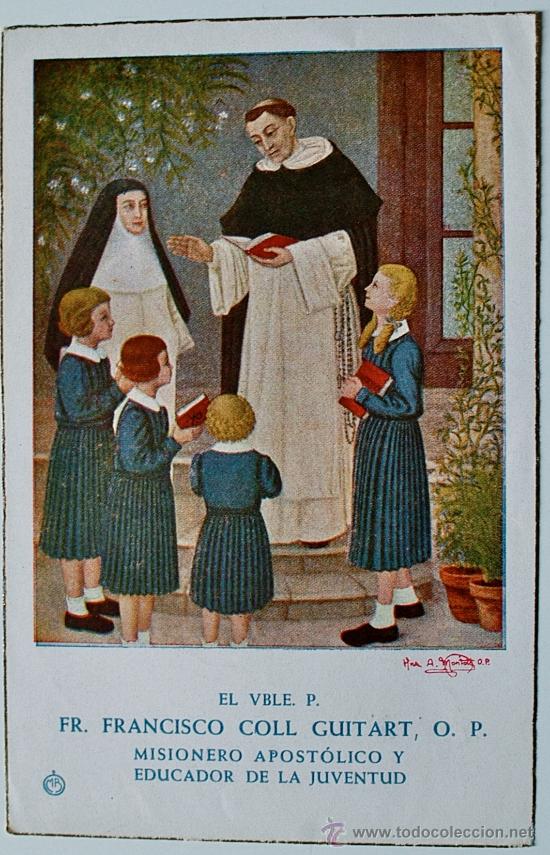
Saint of the Day – 19 May – St Francisco Coll y Guitart OP (1812-1875) Spanish Priest of the Order of Preachers, (the Dominicans), Founder of the Dominican Sisters of the Annunciation of the Blessed Virgin, Confessor, Evangeliser, Missionary Preacher, Apostle of Charity especially to needy children, his Order focusing on young girls especially, who were ignored at that time. He was appointed by the Holy See Apostolic Missionary and was known as “The Apostle of Modern Times.”St Francisco is commonly called St Francisco Coll. Born on 18 May 1812 in Gombrèny, Catalonia, Spain and died on 2 April 1875 (aged 62) at Vic, Barcelona, Catalonia, Spain. His Feast day today, is celebrated on the date of his Baptism, not on the day of his entry into eternal life, as is usual. Patronage – Congregation of the Dominican Sisters of the Annunciation of the Blessed Virgin Mary. St John Paul II Beatified him on 29 April 1979. In his Homily for Fr Coll’s Beatification, the Pope described him as “a transmitter of faith, a sower of hope, a preacher of love, peace and reconciliation among those whom passions, war and hatred keep divided”, and “a real man of God”, a “man of prayer”,who made his Priestly and Religious identity a source of inspiration, with the words, “I am a religious” constantly on his lips.
St Francisco Coll y Guitart was born on 18 May 1812 in the small village of Gombreny, in the Diocese of Vic, Catalonia. He was the 10th and last child of a wool carder.
At the age of 10 he was sent to the Minor Seminary in Vic in 1823. He completed his studies in 1830 and that same year entered the Convent of the Order of Preachers in Gerona, founded only about 35 years after St Dominic de Guzman’s death. He made his solemn profession and received the Diaconate in 1831.
Contemporaries of Fr Coll testify that he always behaved as a man of God and led an exemplary life. In 1835 religious orders in Spain were forcibly suppressed and Friar Francisco Coll, was obliged to abandon his convent and become a secularised Dominican. He was, nevertheless, Ordained a Priest on 28 May 1836 despite the risks involved.
Indeed, in spite of being unable, because of the new anti-clerical laws, to live in his convent or to wear his habit, he remained a Dominican all his life in all that he was and all that he did. Soon after his Ordination Francisco offered his services to his Bishop and for 40 years exercised his ministry as an itinerant Missionary in the Parishes of northeast Spain.
Impelled by an irresistible force, he started to preach as a new apostle, “the Apostle of Modern Times.” Like the Founder of his Order, he received no stipend nor would he accept donations, he was a preacher of popular missions. He prayed for long hours, studied and dedicated a great deal of time to preparing sermons for preaching the missions.
For more than thirty years he exercised his Missionary apostolate, first in the Parish of Artés and Moyá and later as a Missionary in various Dioceses of Catalonia. His fame as a preacher grew rapidly and his word mobilised crowds. His main concern was to carry the Word of God in a cordial, simple and understandable way to the people, to achieve a true interior conversion. To carry out the ministry of preaching, he preferred teamwork as it was capable of creating the most abundant fruit. Hence, his belief in the efficacy of collaboration and thus began with giving spiritual exercises to the Priests in the region. Thereafter, he collaborated with these same Diocesan Priests and with Jesuits, Claretians, Augustinians and fellow Dominicans. With his friend, St Anthony Mary Claret, he assisted in the founding of the “Apostolic Fellowship” for Evangelisation in 1846.
The Town of Moyá with the Church in the background in which St Francisco preached so many of his renowned sermons
He preached to cloistered nuns and prisoners, visited the sick and imparted Catechesis to children, always encouraging devotion to the Virgin Mary. His evangelising activity included a great dedication to the Sacrament of Penance, a prominent emphasis on the Eucharist and a constant insistence on prayer.
His complete trust in God and his apostolic zeal motivated him to gather a group of young women who had already chosen to follow Jesus’ call. In 1850 he was appointed Director of the Secular Order of Dominican Tertiaries, which enabled him to found the Congregation of the Dominican Sisters of the Anunciata in 1856 to solve the problem of the Christian formation of girls, then considered inferior to boys.
Although the beginnings of Fr Coll’s Order were difficult because of the lack of financial means, to the point that the Bishop suggested to Father Coll to close the institute and dismiss the ladies. But thanks to the perseverance of the Founder and also to the help of some religious (like his friend St Anthony María Claret) they were able to make progress. Soon he had the invaluable collaboration of a young teacher, Rosa Santaeugenia (1831-1889), who was the first Prioress General of the Congregation. Despite the difficult beginnings, the Congregation had an extraordinary growth, reaching 50 communities the year of the death of its Founder. From the beginning, Father Coll inserted the new Institute in the Order of Preachers, of Saint Dominic de Guzmán. The first communities of the Dominican Sisters of the Anunciata were located in the rural areas of Catalonia, often obtaining religious places in the public schools. However, as a result of the socio-political situation – the September 1868 revolution – some sisters were forced to leave these schools and the foundation of small private schools was expanded, many of them in the vicinity of textile factories.
When Fr Coll died, according to the Congregation he founded, there were already 300 sisters and 50 communities dedicated to the Christian education of children, mainly girls. Today the Congregation has about 1,039 members in Europe, America, Africa and Asia.
The mission of the Congregation, since its foundation in 1856, is oriented especially towards education and evangelisation, being present in the integral formation of children and youth, parish activity, missionary activity and also in the world of health.
Its objective is to “Announce the message of salvation to all, especially to children and youth,” in large and small towns and form a definitive option for the most needy.
Fr Coll lost his sight and was cared for by the nuns of his Congregation. He died in Vic on 2 April 1875 at the age of 62. His body was exposed in the Chapel of his religious and they buried him in the local cemetery. His mortal remains were later translated to the Chapel of the Mother House. … Vatican.va
Blessed Coll was Canonised on 11 October 2009, Saint Peter’s Square, Vatican City by Pope Benedict XVI. His words during the Canonisation homily:
“… Francisco Coll reached the hearts of others because he transmitted what he himself lived with passion within, what burned in his heart – the love of Christ , his surrender to Him. So that the seed of the Word of God found good land, Francisco founded the congregation of the Dominican Sisters of the Annunciation, in order to give a comprehensive education to children and young people, so that they could discover the unfathomable wealth that is Christ, that faithful friend who never abandons us or who tires of being by our side, encouraging our hope with His Word of life …”
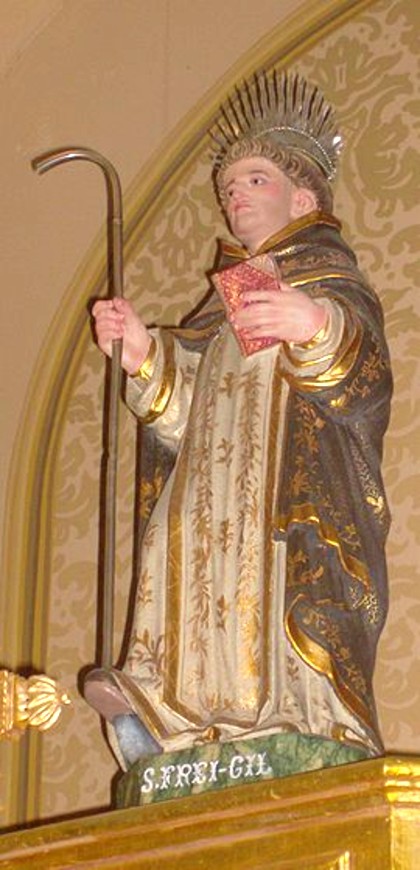
Saint of the Day – 14 May – Blessed Giles of Santarem OP (1185-1265) Dominican Friar, Confessor, Penitent – born Gil Rodrigues de Valadares in 1185 at Vaozela, Portugal and died on 14 May 1265 in Santarem, Portugal of natural causes.
Blessed Giles was born at Vouzella, near Coimbra, Portugal, about in 1185. His father was the governor of Coimbra and a Counsellor of Sancho I, the king of Portugal. Although his father wanted Giles to enter the ecclesiastical state and the King was lavish in bestowing ecclesiastical benefices on Giles, while still a child, Giles, however, wanted to study medicine. After some time studying philosophy in Coimbra, Giles left to study medicine in Paris.
Blessed Giles was intercepted by a kindly stranger on his trip to Paris, who promised to teach him magic if he would sign his soul over to the devil in blood. Blessed Giles, the legend continues, signed away his soul and studied magic for seven years before going to Paris where he excelled in his medical studies and was noted for many fantastic cures. However, we know that at some point Blessed Giles reformed his life and repented.
He returned to Portugal and took the Dominican habit in at a newly erected convent in Palencia in about 1224. Shortly after arriving in Palencia, his Dominican superiors sent Blessed Giles to the Dominican convent at Scallabis, present day Santarem, Portugal. There he led a life of prayer and penance and for seven years was tormented about the compact he had entered into with the devil. However, according to Blessed Giles’ biographer, finally Satan was compelled to surrender Giles’ soul and placed the compact he had signed before the Altar of the Blessed Virgin.
After this experience, Giles returned to Paris to study theology. On his second return to Portugal, he became famous for his piety and learning. He was twice elected provincial of the Dominican Order in Spain.
Noted for his humble service to his brethren, he died at Santarem on 14 May 1265. Blessed Giles was Beatified by Pope Benedict XIV (cultus confirmed) on 9 May 1748.
Saint of the Day – 7 May – Blessed Alberto of Bergamo OP (1214-1279) Layman, Widow, Apostle of Charity, Pilgrim, Third Order Dominican – born at Villa d’Ogna, Italy and died on 7 May 1279 in Cremona, Italy of natural causes. Patronages – Villa d’Ogna, Compagnia dell’Arte dei Brentatori, Farmers, Labourers, Bakers.
Albert “the Farmer” was a peasant farmer who followed his pious and industrious father’s example. His father taught him many practices of penance and piety that later fructified in a saintly life. At seven, Albert was fasting three days a week, giving the foregone food to the poor. Working at the heavy labour of the fields, Albert learned to see God in all things and to listen for His voice in all nature. The beauty of the earth was to him a voice that spoke only of heaven. He grew up pure of heart, discreet and humble–to the edification of the entire village.
Albert married while still quite young. At first his wife made no objection to the generosity and self-denial for which he was known. When his father died, however, she made haste to criticise his every act and word and made his home almost unbearable with her shrewish scolding. “You give too much time to prayer and to the poor!” she charged; Albert only replied that God will return all gifts made to the poor.
In testimony to this, God miraculously restored the meal Albert had given away over his wife’s objections. Finally, softened by Albert’s prayers, she ceased her nagging and became his rival in piety and charity. She died soon after her conversion and Albert, being childless, he left his father’s farm to make a pilgrimage to Jerusalem and Rome.
Stopping at Cremona, Italy, at harvest time, Albert went to work in the fields. He soon earned the name of “the diligent worker.” His guardian angel worked beside him in the fields and, therefore, twice the work was accomplished that might be expected of one man. Weighing in his grain at the end of the day, Albert always received twice as much in wages as the other workers did. Though he gave this to the poor and kept nothing for himself, jealous companions determined to annoy him. Planting pieces of iron in the field where Albert would be working the next day, they watched to see him break or dull his scythe. Miraculously, the scythe cut through iron as it did through the grain, never suffering any harm. In Cremona, Albert’s poverty was also a witness to a group of heretics there who boasted of their own poverty.
In all, Albert visited Rome nine times, Santiago de Compostela eight times and Jerusalem once. He worked his way, giving to the poor every penny he could spare. His pilgrimages were almost unbroken prayer, he walked along singing hymns and chanting Psalms, or conversing on things of God with the people he met along the way.
Appalled at the suffering of pilgrims who fell ill far from home and the penniless, Albert determined to build a hospital for their use. This he actually accomplished by his prayers and diligent work.
In 1256, he met the Dominicans. Attracted by the life of Saint Dominic, Albert joined the Brothers of Penance, which later became the Order of Penance of Saint Dominic and continued his works of charity in his new state. As a lay brother he was closely associated with the religious but lived in the world so that he was able to continue his pilgrimages. At home, he assisted the Dominican fathers in Cremona, working happily in their garden, cultivating the medicinal herbs so necessary at the time and doing cheerfully all the work he could find that was both heavy and humble.
Falling very ill, Albert sent a neighbour for the priest but there was a long delay and a dove came bringing him Holy Viaticum. When he died, the bells of Cremona rang of themselves and people of all classes hurried to view the precious remains. It was planned to bury him in the common cemetery, outside the cloister, as he was a secular tertiary but no spade could be found to break the ground. An unused tomb was discovered in the church of Saint Matthias, where he had so often prayed and he was buried there. Many miracles were attributed to him after his death and the farmer- saint became legendary for his generosity to the poor.
Blessed Alberto was Beatified in 1748 after Pope Benedict XIV confirmed that there existed a longstanding local ‘cultus’ – or popular devotion – to the late farmer.
St Joseph Luu
Bl Juan de Verdegallo
St Longinus of Africa
St Neachtain of Cill-Uinche
St Theodulus of Pamphylia
St Ultan of Péronne
St Vindemialis of Africa
St Waldebert of Luxeuil St Wiborada of Saint Gallen OSB (Died 926) Martyr
Bl William Tirry
St Zoe of Pamphylia
—
Martyrs of Alexandria – 4 saints: A group of Christians marytred together in the persecutions of Diocletian. We know little more than their names – Celestine, Germanus, Neopolus and Saturninus. 304 in Alexandria, Egypt
Our Morning Offering – 29 April – Wednesday of the Third Week of Easter and the Memorial of St Catherine of Siena (1347-1380) Doctor of the Church
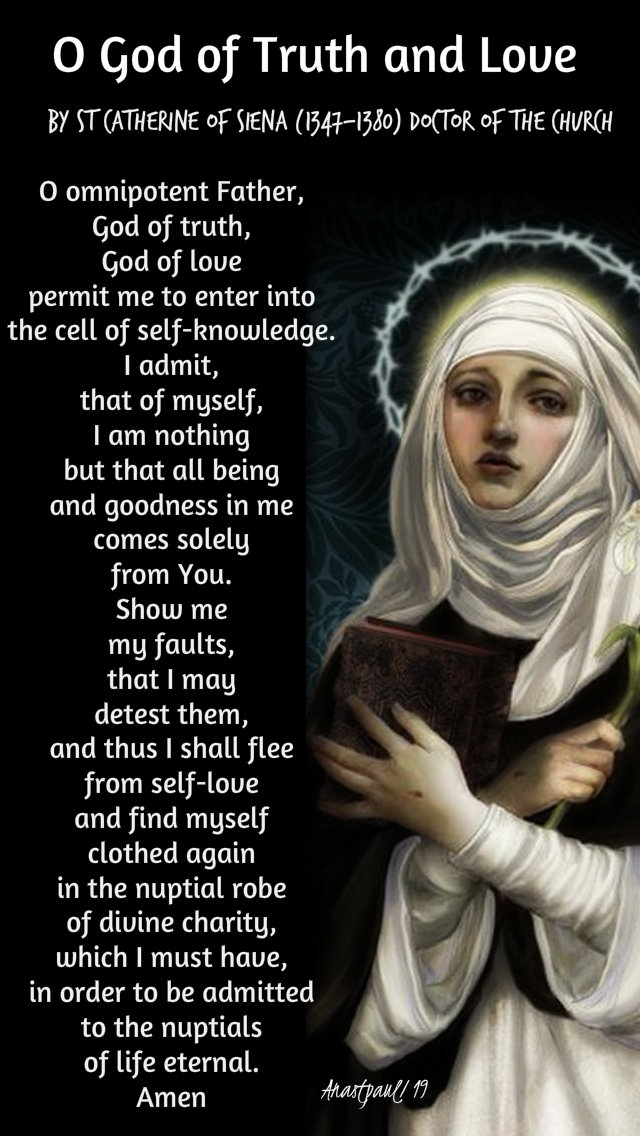
O God of Truth and Love A Prayer of Penitence By St Catherine of Siena (1347-1380)
O omnipotent Father,
God of truth,
God of love
permit me to enter into
the cell of self-knowledge.
I admit, that of myself,
I am nothing
but that all being
and goodness in me
comes solely from You.
Show me my faults,
that I may detest them,
and thus I shall flee from self-love
and find myself clothed again
in the nuptial robe of divine charity,
which I must have,
in order to be admitted
to the nuptials of life eternal.
Amen
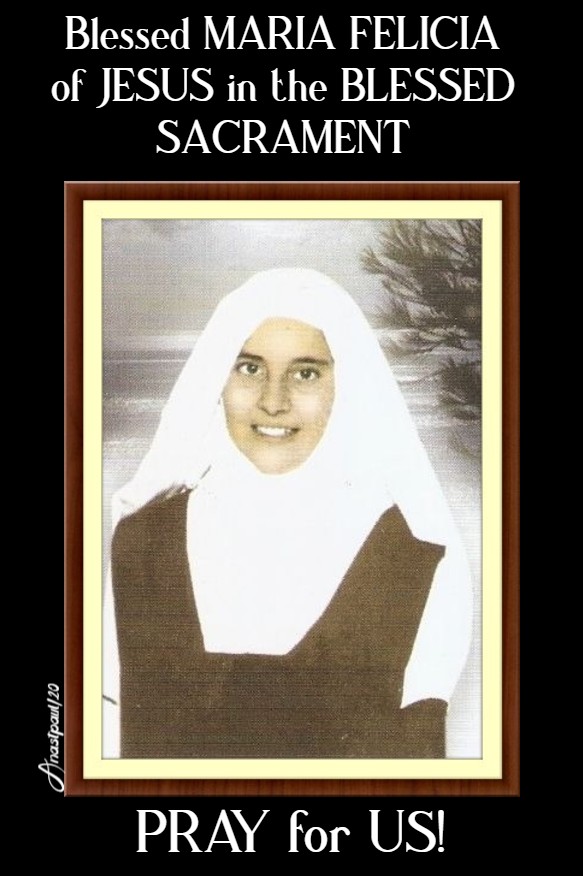
One Minute Reflection – 28 May – Tuesday of the Third Week of Easter, Readings: Acts 7:51–8:1, Psalm 31:3-4, 6-8, 17, 21, John 6:30-35 and the Memorial of Blessed María Felicia of Jesus in the Blessed Sacrament OCD (1925-1959)
“I am the bread of life, whoever comes to me shall not hunger and whoever believes in me shall never thirst.” … John 6:35
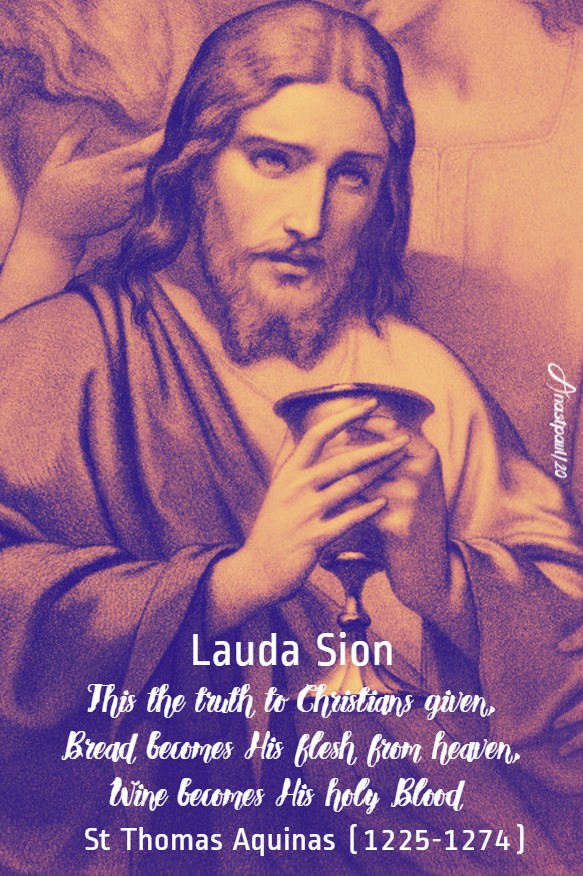
REFLECTION – St Thomas Aquinas (1225-1274) – Sequence for the feast of Corpus Christi “ Lauda Sion ”
Laud, O Sion, thy salvation
Laud with hymns of exultation
Christ, thy King and Shepherd true,
Spend thyself, his honour raising,
Who surpasseth all thy praising,
Never canst thou reach His due.
Sing today, the mystery showing
Of the living, life-bestowing
Bread from heaven before thee set,
E’en the same of old provideth,
Where the Twelve, divinely guided,
At the holy table met.
Full and clear ring out thy chanting,
Joy nor sweetest grace be wanting
To thy heart and soul today …
Lo, the new King’s table gracing,
This new Passover of blessing
Hath fulfilled the elder rite,
Now the new the old effaceth,
Truth revealed, the shadow chaseth,
Day is breaking on the night.
What He did, at Supper seated,
Christ ordained to be repeated,
His memorial ne’er to cease
And His word for guidance taking,
Bread and wine we hallow, making
Thus our sacrifice of peace.
This the truth to Christians given,
Bread becomes His flesh from heaven,
Wine becomes His holy Blood (Jn 6:55). …
Whoso of this food partaketh,
Christ divideth not nor breaketh,
He is whole to all that taste.
Whether one this bread receiveth
Or a thousand, still He giveth
One same Food that cannot waste. …
Lo! the Angel’s Food is given (Ps 78[77]:25)
To the pilgrim who hath striven,
See the children’s Bread from heaven
Which to dogs may not be cast (Mt 15:26).
Truth the ancient types fulfilling,
Isaac bound, a victim willing (Gn 22),
Paschal lamb, its life-blood spilling,
Manna sent in ages past.
O true Bread, good Shepherd, tend us,
Jesu, of Thy love befriend us,
Thou refresh us, Thou defend us,
Thine eternal goodness send us
In the land of life to see (Ps 27[26]:13)
Thou who all things canst and knowest,
Who on earth such Food bestowest,
Grant us with the saints, though lowest,
Where the heavenly Feast Thou showest,
Fellow-heirs and guests to be.
PRAYER – Almighty Father, to whom this world, with all it’s goodness and beauty belongs, give us grace joyfully to begin this day in Your name and to fill it with the active love for You and our neighbour. By the food You give us, to sustain us on this journey, we are brought to holiness in Your Son, our Lord Jesus the Christ, whom You gave to us as our food. May the Mother of Your Son and our mother, lead us to You and may the prayers of Bl Maria Felicia of Jesus in the Blessed Sacrament, be a succour on our way. Through Christ our Lord, with the Holy Spirit, God now and forever, amen.
Our Morning Offering – 23 April – Thursday of the Second Week of Easter
You are the King of All By St Albert the Great (1200-1280) Universal Doctor
We pray to You, O Lord,
who are the supreme Truth,
and all truth is from You.
We beseech You, O Lord,
who are the highest Wisdom,
and all the wise depend on You
for their wisdom.
You are the supreme Joy,
and all who are happy owe it to You.
You are the Light of minds,
and all receive their understanding from You.
We love, we love You above all.
We seek You, we follow You,
and we are ready to serve You.
We desire to dwell under Your power
for You are the King of all.
Amen
Saint of the Day – 19 March – Blessed Sibyllina Biscossi (1287-1367) OP Blind Dominican Virgin and Recluse, Penitent, Miracle-worker – also known as Sibyllina of Pavia, Sybil – Additional Memorials – 20 March (Pavia, Italy) and 23 March (Order of Preachers). Patronages – Children whose parents are not married, illegitimacy, loss of parents, housemaids. Her body is incorrupt.
The Roman Martyrology says of her – In Pavia, in Lombardy, Blessed Sibyllina Biscossi, Virgin, who became blind at the age of twelve, spent sixty-five years imprisoned alongside the Church of the Order of Preachers, shining with its interior light many who flocked to it.
“All things work for the good of those who love the Lord and are called according to His purpose” (Romans 8:28). How many of us would have the faith to trust in God’s providence as did this holy woman? As Mother Angelica has witnessed, true faith is knowing that when the Lord asks you to walk into the void, He will place a rock beneath your feet. True faith is to be able to praise God in all things, to say with Job, “The Lord gives and the Lord takes away. Blessed be the name of the Lord” (Job 1:21).
Sybillina’s parents died when she was tiny and as soon as she was old enough to be of use to anyone, the neighbours, who had taken her in at the time she was orphaned, put her out to work. She must have been very young when she started to work, because at the age of 12, when she became blind and could not work any more, she already had several years of work behind her.
The cause of her blindness is unknown but the child was left doubly destitute with the loss of her sight. The local chapter of the Dominican tertiary sisters took compassion on the child and brought her home to live with them. After a little while of experiencing their kind help, she wanted to join them. They accepted her, young though she was, more out of pity than in any hope of her being able to carry on their busy and varied apostolate.
They were soon agreeably surprised to find out how much she could do. She learned to chant the Office quickly and sweetly and to absorb their teaching about mental prayer as though she had been born for it. She imposed great obligations of prayer on herself, since she could not help them in other ways. Her greatest devotion was to Saint Dominic and it was to him she addressed herself when she finally became convinced that she simply must have her sight back so that she could help the sisters with their work.
Praying earnestly for this intention, Sybillina waited for his feast day. Then, she was certain, he would cure her. Matins came and went with no miracle, little hours, Vespers– and she was still blind. With a sinking heart, Sybillina knelt before Saint Dominic’s statue and begged him to help her. Kneeling there, she was rapt in ecstasy and she saw him come out of the darkness and take her by the hand.
He took her to a dark tunnel entrance and she went into the blackness at his word. Terrified but still clinging to his hand, she advanced past invisible horrors, still guided and protected by his presence. Dawn came gradually and then light, then a blaze of glory. “In eternity, dear child,” he said. “Here, you must suffer darkness so that you may one day behold eternal light.”
Sybillina, the eager child, was replaced by a mature and thoughtful Sybillina who knew that there would be no cure for her, that she must work her way to heaven through the darkness. She decided to become a anchorite and obtained the necessary permission. In 1302, at the age of 15, she was sealed into a tiny cell next to the Dominican church at Pavia. At first she had a companion but her fellow recluse soon gave up the life. Sybillina remained, now alone, as well as blind.
The first seven years were the worst, she later admitted. The cold was intense and she never permitted herself a fire. The church, of course, was not heated and she wore the same clothes winter and summer. In the winter there was only one way to keep from freezing–keep moving–so she genuflected and gave herself the discipline. She slept on a board and ate practically nothing. To the tiny window, that was her only communication with the outside world, came the troubled and the sinful and the sick, all begging for her help. She prayed for all of them and worked many miracles in the lives of the people of Pavia.
One of the more amusing requests came from a woman who was terrified of the dark. Sybillina was praying for her when she saw her in a vision and observed that the woman–who thought she was hearing things–put on a fur hood to shut out the noise. The next day the woman came to see her and Sybillina laughed gaily. “You were really scared last night, weren’t you?” she asked. “I laughed when I saw you pull that hood over your ears.” The legend reports that the woman was never frightened again.
Sybillina had a lively sense of the Real Presence and a deep devotion to the Blessed Sacrament. One day a priest was going past her window with Viaticum for the sick, she knew that the host was not consecrated and told him so. He investigated and found he had indeed taken a host from the wrong container.
Sybillina lived as a recluse for 65 years. She followed all the Masses and Offices in the church, spending what few spare minutes she had working with her hands to earn a few alms for the poor.
She is buried in the Dominican church in Pavia
Her cultus was confirmed in 1853 by Pope Pius IX and she was Beatified by him on 17 August 1854.
From the General Calendar of the Order of Preachers on her Feast Day:
Let us Pray: O God, who wast pleased to enlighten the soul of Blessed Sibyllina, Thy Virgin , with admirable splendour, though she was deprived of bodily sight, grant, through her intercession, that, enlightened with light from above, we may despise earthly things and earnestly strive after those that are eternal. Through Christ our Lord. Amen.
O Lord, enkindle our hearts with the fire of the Spirit, who wonderfully renewed Blessed Sibyllina. Filled with that heavenly light may we come to know Jesus Christ crucified and always grow in Your love. We ask this through our Lord Jesus Christ, Your Son, who lives and reigns with You and the Holy Ghost, one God, forever and ever.
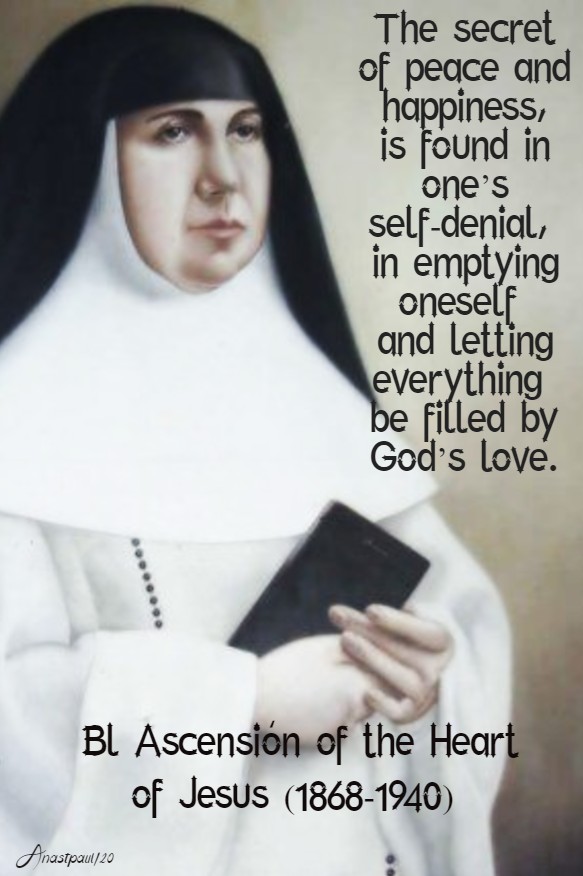
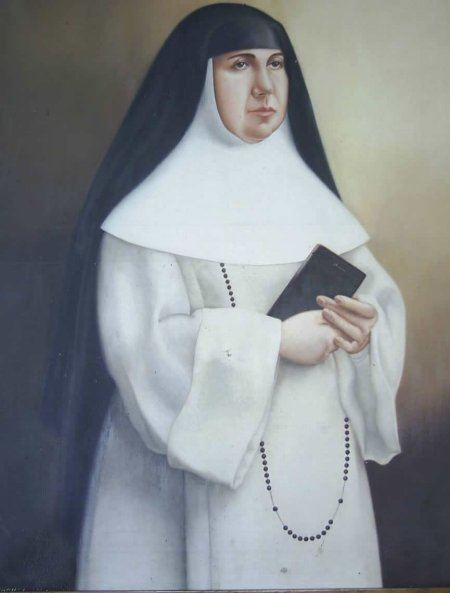
Saint of the Day – 24 February – Blessed Ascensión of the Heart of Jesus OP (1868-1940)
a Spanish Religious sister of the Order of St Dominic, Teacher, Missionary. She co-founded and was the first Prioress General of the Congregation of Dominican Missionary Sisters of the Rosary, which she helped to found in Peru. Born as Florentina Nicol y Goni on 14 March 1868 in Tafalla, Navarre, Spain and died on 24 February 1940 in Peru of natural causes. Also known as Maria Ascension Nicol y Goñi, Mother Ascension del Corazon de Jesus, Mother Ascensión Nicol Goñi, Florentina Nicol Goni. Patronage- Dominican Missionary Sisters of the Rosary.
Florentina was the youngest of four children. She was educated at Saint Rose of Lima Dominican boarding school in Huesca, where she was first introduced to the religious life, which raised questions in her mind about her future. Returning home for a year to reflect on her choices, she later returned to the monastery and became a nun of the Dominican Second Order in 1885, taking the name “Maria Ascension of the Heart of Jesus”. She became a teacher at that school in 1886 and served in that capacity for the next 27 years. Under the anti-clerical laws promulgated in the early 20th century, however, in 1913 the Spanish government took over the school and expelled the Sisters.
Bl. Ascensión of the Heart of Jesus is one of the great missionaries of the last century. From her youth, she viewed life as a gift for the Lord and for her neighbour and she wanted to marry no-one except God, to whom she consecrated herself as a Dominican Missionary Sister at the monastery of St Rose in Huesca, Spain. She lived unreservedly the dynamism of charity which the Holy Spirit generates in those who are open to Him in their hearts.
The first part of her apostolate consisted of being a teacher in the school connected to the monastery. Testimonials recall her as an excellent educator, amiable and strong, understanding and exacting.
But the Lord had different plans in store for her. At age 45, he called her to become a missionary in Peru. With youthful enthusiasm and total trust in Providence, she left her Country and dedicated herself to the evangelisation of the world, beginning on the American Continent. Her work was so generous, vast and efficacious that it left a profound mark on the missionary history of the Church.
She collaborated with the Dominican Bishop, Ramon Zubieta, in founding the Dominican Missionary Sisters of the Rosary, of which she was the first Superior General. Her missionary life was rich in sacrifices, hardships and apostolic fruits. She made many apostolic trips to Peru, to Europe and she even went to China. She had the temperament of an intrepid and tireless fighter, together with a maternal tenderness that was capable of conquering hearts. Driven by charity for Christ, she showed to all, the charisms of spiritual motherhood.
Sustained by a living faith and by a fervent devotion to the Sacred Heart of Jesus and to Our Lady of the Rosary, she dedicated herself to the salvation of souls, even to the sacrifice of her very self. And she frequently urged her Daughters to do the same, saying that souls are not saved without sacrificing themselves. She inspired an ever more pure and intense charity and for this, she offered herself as a victim to the Merciful Love of God.
She also established her congregation in Spain where they were able to recruit and form many missionary vocations. The General Motherhouse of the congregation was established in Pamplona, Navarre, Spain, and became her base.
By 1938 Mother Ascension felt increasingly frail and wanted to retire to prepare herself for her final days. Nevertheless, she accepted her unanimous re-election for a third term as Prioress General at the congregation’s General Chapter of 1939. She died on 24 February 1940.
Today the congregation has 785 Sisters serving in 21 nations on five continents. It’s General Motherhouse is now in Madrid, Spain. Among its members, the congregation counts four Sisters who are considered to be martyrs for the faith, having been tortured and murdered in the former Republic of the Congo on 25 November 1964, in the course of the Simba Rebellion, after they refused to leave the patients in their hospital.
She was Beatified on 14 May 2005 by Pope Benedict XVI. The Recognition Celebration was celebrated by Cardinal Saraiva Martins in Saint Peter’s Basilica, Vatican City.
St Adela of Blois
Bl Antonio Taglia
Bl Arnold of Carcassonne
St Betto of Auxerre
Bl Berta of Busano Bl Constantius of Fabriano OP (1401-1481) Biography: https://anastpaul.com/2019/02/24/saint-of-the-day-24-february-blessed-constantius-of-fabriano-op-1401-1481/
St Cummian Albus of Iona
St Ethelbert of Kent
Evetius of Nicomedia Blessed Ascensión of the Heart of Jesus/Florentina Nicol y Goñi OP (1868-1940)
Bl Ida of Hohenfels
Bl Josefa Naval Girbes
St Liudhard
Bl Lotario Arnari
Bl Marco De’ Marconi
St Modestus of Trier
St Peter the Librarian
St Praetextatus of Rouen
St Primitiva
St Sergius of Caesarea
Bl Simon of Saint Bertin Blessed Tommaso Maria Fusco (1831-1891)
St Gertrude Caterina Comensoli
St Helladius of Toledo
St Ioannes Chen Xianheng
St Ioannes Zhang Tianshen
St Jean-François-Régis Clet
St Jean-Pierre Néel
Bl Jerzy Kaszyra
Bl John Pibush – one of the Martyrs of Douai
St Leo of Patera
St Martinus Wu Xuesheng
Bl Matthew Malaventino
St Paregorius of Patara
St Sadoth of Seleucia
St Simeon
St Tarasius of Constantinople
St Theotonius
Bl William Harrington
—
Martyrs of North Africa – 7 saints: Group of Christians who were martyred together, date unknown. We know nothing else but seven of their names – Classicus, Fructulus, Lucius, Maximus, Rutulus, Secundinus and Silvanus.
They were born and martyred in North Africa.
Martyrs of Rome – 5 saints: A group of Christians martyred together in the persecutions of Diocletian. We know nothing else but their names – Alexander, Claudius, Cutias, Maximus and Praepedigna. They were martyred in 295 in Rome, Italy.
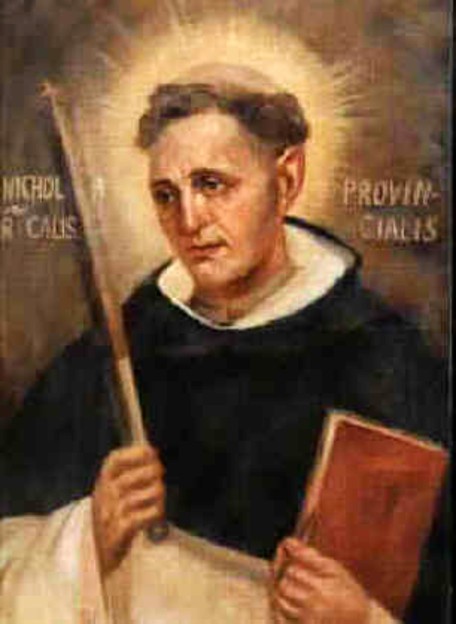
Saint of the Day – 16 February – Blessed Nicola Paglia OP (1197-1256) Priest of the Order of Preachers – Dominicans – born in 1197 in Giovanazzo, Bari, Italy and died aged 58 on 16 February 1256 at Perugia, Italy. From his hometown Giovinazzo went to Bologna to study. Here he was drawn to the Order by the vibrant preaching of St Dominic and became his most faithful companion in apostolic wanderings. Twice he was voted as the Provincial of the Roman province and founded the convents of Perugia and Trani. A cultured and far-sighted man, he promoted the study of Sacred Scripture and the compilation of biblical Concordances. He died in Perugia where he is buried in the church of St Dominic.
Nicola was born in Giovinazzo, in the province of Bari in 1197 of noble parents. His parents, raised him with great care. When he was still a child, an angel appeared to him who ordered him to abstain forever from the flesh because one day he would enter an Order where abstinence was perpetual law. As he was the son of Judge Lupone, Nicola was sent to study in Bologna. Here in 1218 met St Dominic. It was then that the young man decided to enter the Order of the great preacher.
Bl Nicola’s Birthplace
He was received into the Dominican Order and was donned with the habit by the hands of Father St Dominic himself, who later made him his faithful companion in his apostolic journeys. He preached in many cities of Italy with immense results and his ardent words were often confirmed by great miracles.
He was the third Provincial of the Roman Province, which then extended from Tuscany to Sicily, which he exercised with strength and gentleness for two terms. One day, exhorting his religious to mutual charity, he confided to them that a recently died religious had appeared to him for forgiveness, who had been the cause of a serious dispute. Having urged him to ask for forgiveness from God and not himself, the culprit replied that the Lord demanded this satisfaction from him: “See Father Nicola, how serious and dangerous it is to offend your neighbour and how important it is to appease him after having him offended.”
Pope Gregory IX commissioned him to visit monasteries and to preach the Crusade against the Saracens.
After long years of apostolic labours he retired to the convent of Perugia. Here he had a vision. Father Raone Romano, a dear friend of his most fruitful days of religious life, appeared and announced to him, in a message from the Madonna, his near death, which occurred in 1256.
Pope Leo XII confirmed his cultus and named him Blessed on 26 March 1828.
St Faustinus of Brescia
St Gilbert of Sempringham
St Honestus of Nimes
St John III of Constantinople Bl Joseph Allamano (1851–1926) Biography: https://anastpaul.com/2019/02/16/saint-of-the-day-16-february-blessed-joseph-allamano-1851-1926/
St Julian of Egypt
St Juliana of Campania
St Juliana of Nicomedia Blessed Nicola Paglia OP (1197-1256)
St Onesimus of Ephesus
Bl Philippa Mareria
—
Martyrs of Cilicia – 12 saints: A group of Christians who ministered to other Christians who were condemned to work the mines of Cilicia in the persecutions of Maximus. They were arrested, tortured and martryed by order of the governor Firmilian.
• Daniel
• Elias
• Isaias
• Jeremy
• Samuel
The group also includes the three known have been sentenced to the mines –
• Pamphilus
• Paul of Jamnia
• Valens of Jerusalem
and those who were exposed as Christians as a result of these murders –
• Julian of Cappadocia
• Porphyrius of Caesarea
• Seleucius of Caesarea
• Theodule the Servant
They were martyred in 309 in Cilicia, Asia Minor (in modern Turkey).
Quote/s of the Day – 13 February – the Memorial of Blessed Jordan of Saxony OP (1190-1237)
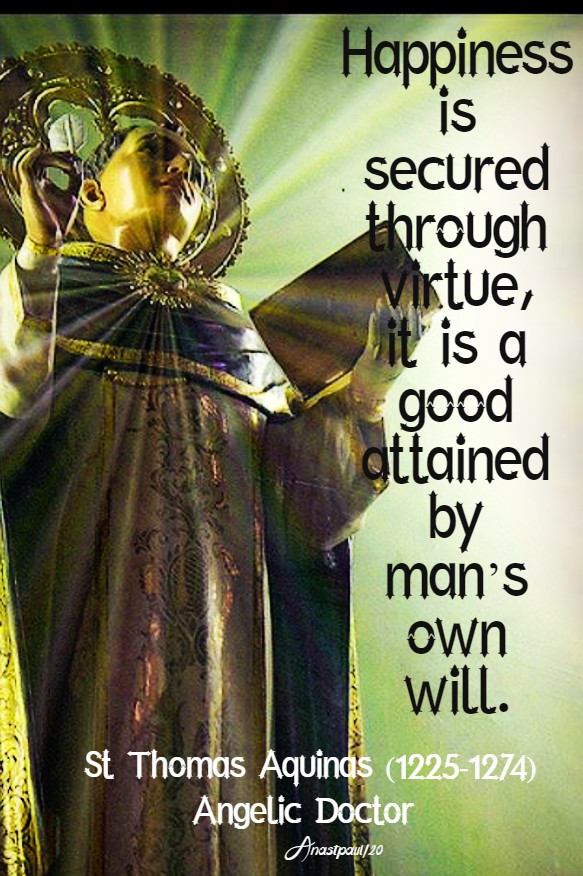
“Happiness is secured through virtue, it is a good attained by man’s own will.”
St Thomas Aquinas (1225-1274)
Angelic Doctor
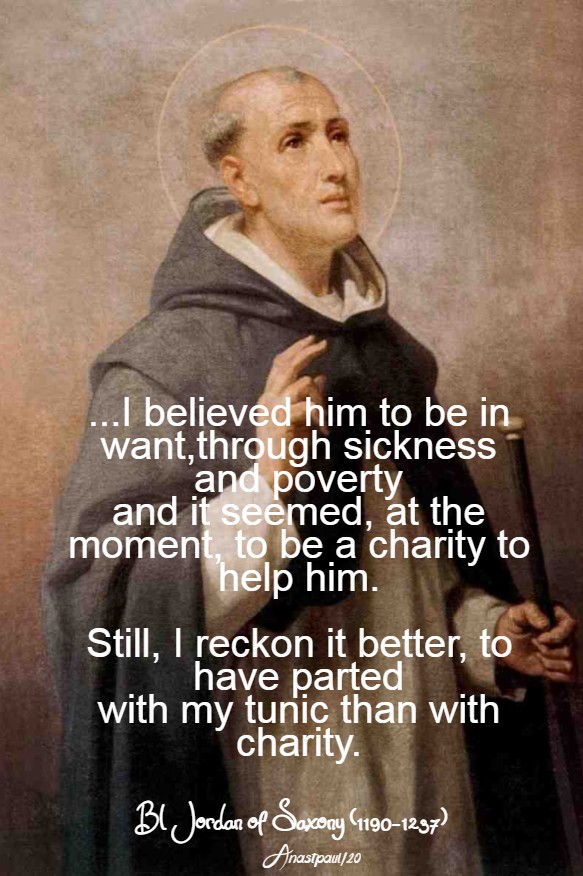
Meeting a vagabond upon the road who feigned sickness and poverty, Blessed Jordan gave him one of his tunics, which the fellow at once carried straight to a tavern for drink. The brethren, seeing this done, taunted him with his simplicity:
‘There now, Master, see how wisely you have bestowed your tunic.’
‘I did so,’ said he, ‘because I believed him to be in want, through sickness and poverty and it seemed, at the moment, to be a charity to help him. Still, I reckon it better, to have parted with my tunic than with charity.’
Blessed Jordan of Saxony (1190-1237)
The Heart of Christ
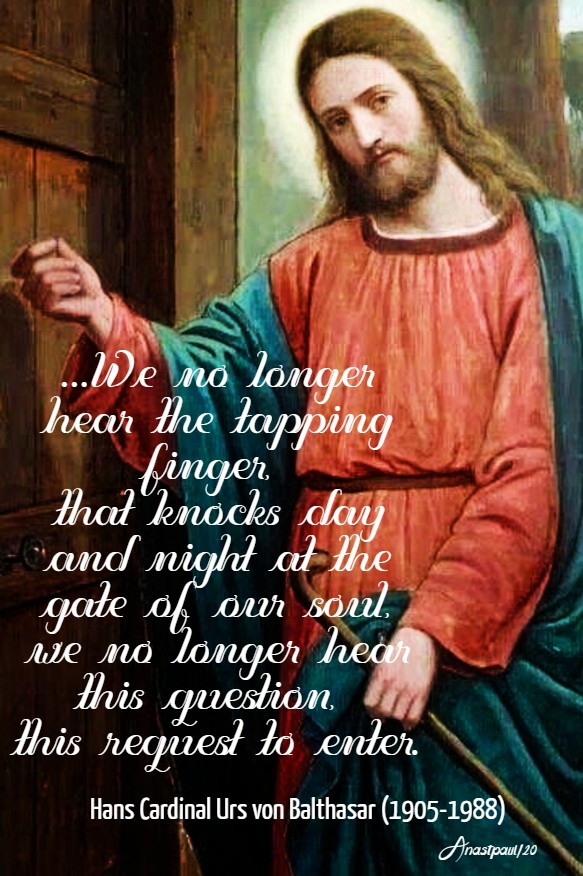
This Heart lives on service. It does not seek to glorify itself but the Father alone. It does not speak of its love. It performs it’s service so unobtrusively, that it is almost forgotten, as we forget our heart under the stress of our affairs. We think that life lives of itself. No-one listens to his own heart, not even for a second — his heart, that bestows life, hour after hour on him. We have grown used to the slight tremor in our being, to the eternal beating of the waves that from within us, dash on the shore of consciousness. We accept it as we do our destiny, or nature, or the course of things. We have grown used to love. And we no longer hear the tapping finger, that knocks day and night at the gate of our soul, we no longer hear this question, this request to enter.
St Julian of Lyon
St Lucinus of Angers
St Marice
St Martinian the Hermit
St Maura of Ravenna
St Modomnoc
St Paulus Lio Hanzuo
St Peter I of Vercelli
St Phaolô Lê Van Loc
St Stephen of Lyons
St Stephen of Rieti
Espousal of the Blessed Virgin Mary – 23 January: Feast in honour of the Blessed Virgin’s espousal to Saint Joseph. It is certain that a real matrimony was contracted by Joseph and Mary. Still Mary is called “espoused” to Joseph (“his mother Mary was espoused to Joseph”, Matthew 1:18) because the matrimony was never consummated. The term spouse is applied to married people until their marriage is consummated. This feast dates from 1517 when it was granted to the nuns of the Annunciation by Pope Leo X with nine other Masses in honour of Our Lady. Adopted by many religious orders and dioceses, it was observed for a time by nearly the whole Church but is no longer in the Calendar.
Bl Joan Font Taulat
St John the Almoner/the Merciful (Died c 620)
Bl Juan Infante
St Jurmin
St Lufthild
St Maimbod
Bl Margaret of Ravenna
Martyrius of Valeria
St Messalina of Foligno
St Ormond of Mairé
St Parmenas the Deacon
St Severian the Martyr
St Agathius the Martyr
St Ammonius of Astas
St Archelais the Martyr
Bl Beatrix of Este the Younger
Bl Charlotte Lucas
St Catus Blessed Cristina Ciccarelli OSA (1481–1543)
St Day/Dye
St Deicola of Lure
Bl Fazzio of Verona
Bl Félicité Pricet
St Leobard of Tours Blessed Maria Teresa Fasce OSA (1881-1947) Blessed Maria Teresa’s Life: https://anastpaul.com/2019/01/18/saint-of-the-day-18-january-blessed-maria-teresa-fasce-osa-1881-1947/
Bl Monique Pichery
St Moseus of Astas
St Prisca of Rome
St Susanna the Martyr
St Thecla the Martyr
St Ulfrid of Sverige
Bl Victoire Gusteau
St Volusian of Tours
—
Martyrs of Carthage – 3 saints
Martyrs of Egypt -37 saints
Martyrs of Nicaea – 3 saints
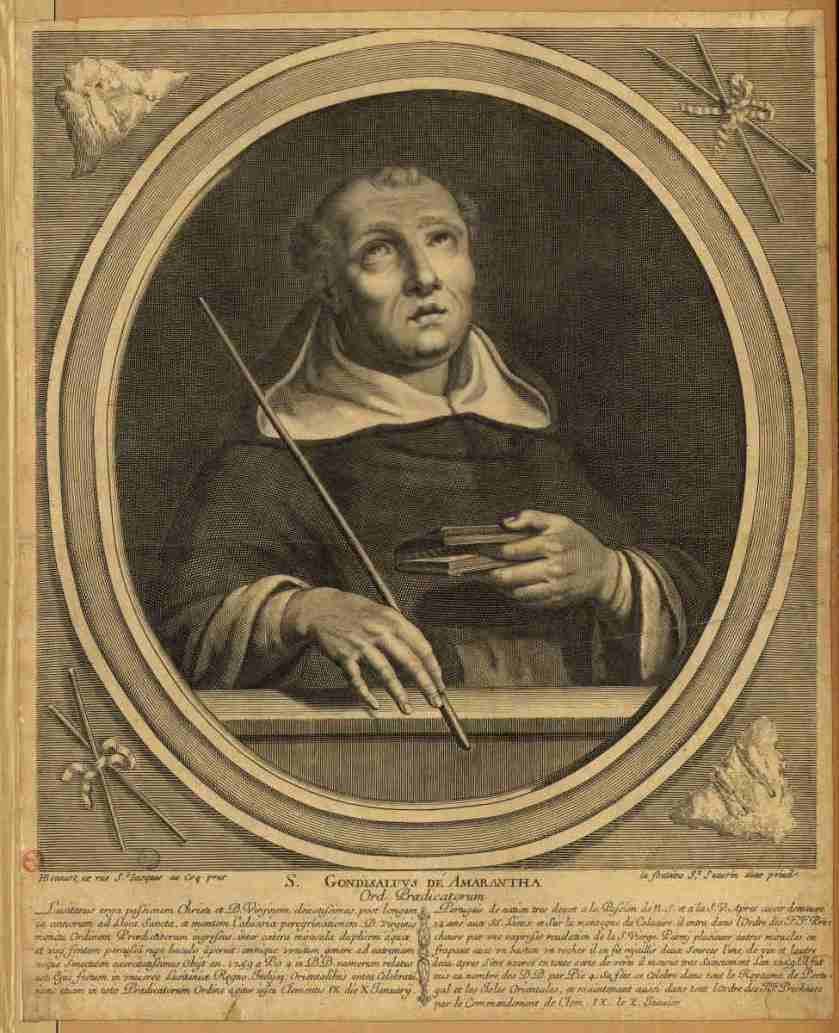
Saint of the Day – 16 January – Blessed Gonzalo de Amarante OP (1187-1259), Dominican Priest, Hermit, Marian Devotee – born as Gonçalo de Amarante in 1187 at Vizella, diocese of Braga, Portugal and died on 10 January 1259 of natural causes. His memorial is celebrated on 10 January by the Dominicans. Patronages – Amarante, Itapissuma, Cajari, Matinha, Viana. He became a Dominican friar and hermit after his return from a long pilgrimage that took him to both Rome and to Jerusalem. He was noted as a wonderworker through whom miracles occurred and he was known for his solitude and silence in reflection, in order to better achieve communication with God.
Gonzalo de Amarante was a true son of the Middle Ages, a man right out of the pages of the ‘Golden Legend.’ His whole life reads like a mural from the wall of a church–full of marvellous things and done up in brilliant colours.
In his boyhood Gonzalo gave wonderful indications of his holiness. As he was being carried to the baptismal font as an infant, he fixed his eyes on the church’s crucifix with a look of extraordinary love. While still young, he was consecrated to study for the Church and received his training in the household of the Archbishop of Braga. After his Ordination he was given charge of a wealthy parish, an assignment that should have made him very happy. Gonzalo was not as interested in choice parishes as some of his companion – he went to his favourite Madonna shrine and begged Our Lady to help him administer this office fairly.
There was no complaint with Gonzalo’s governance of the parish of Saint Pelagius. He was penitential himself but indulgent with everyone else. Revenues that he might have used for himself were used for the poor and the sick. The parish, in fact, was doing very well when he turned it over to his nephew, whom he had carefully tutored, before making a pilgrimage to the Holy Land.
Gonzalo would have remained his entire life in the Holy Land but after 14 years his Archbishop commanded him to return to Portugal. Upon his arrival, he was horrified to see that his nephew had not been the good shepherd that he had promised to be, the money left for the poor had gone to purchase a fine stable of thoroughbred horses and a pack of fine hounds. The nephew had told everyone that his old uncle was dead and he had been appointed pastor in his place by an unsuspecting Archbishop. When the uncle appeared on the scene, a bit ragged and, of course, older but very much alive, the nephew was not happy to see him. Gonzalo seems to have been surprised as well as pained.
The ungrateful nephew settled the matter by turning the dogs on his inconvenient uncle. They would have torn him to pieces but the servants called them off and allowed the ragged pilgrim to escape. Gonzalo decided then, that he had withstood enough parish life and went out into the hills to a place called Amarante. Here he found a cave and other necessities for an eremitical life and lived in peace for several years, spending his time building a little chapel to the Blessed Virgin. He preached to those who came to him and soon there was a steady stream of pilgrims seeking out his retreat.
Happy as he was, Gonzalo felt that this was not his sole mission in life and he prayed to Our Lady to help him to discern his real vocation. She appeared to him one night as he prayed and told him to enter the order that had the custom of beginning the office with “Ave Maria gratia plena.” She told him that this order was very dear to her and under her special protection. Gonzalo set out to learn what order she meant and eventually came to the convent of the Dominicans. Here was the end of the quest and he asked for the habit.
Blessed Peter Gonzales was the Prior and he gave the habit to the new aspirant. After Gonsalvo had gone through his novitiate, he was sent back to Amarante, with a companion, to begin a regular house of the order. The people of the neighbourhood quickly spread the news that the hermit was back. They flocked to hear him preach and begged him to heal their sick.
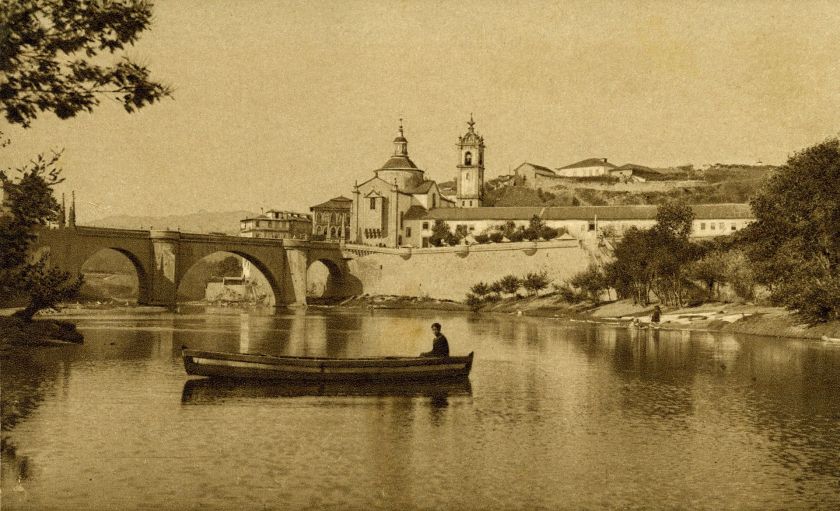
A view of the Monastery and Church in Amarante in 1910
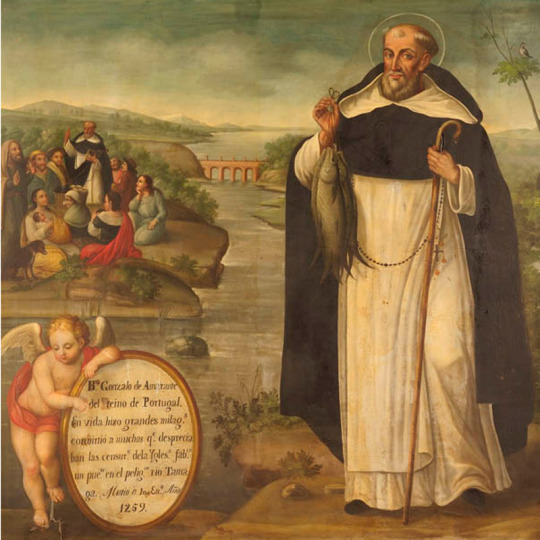
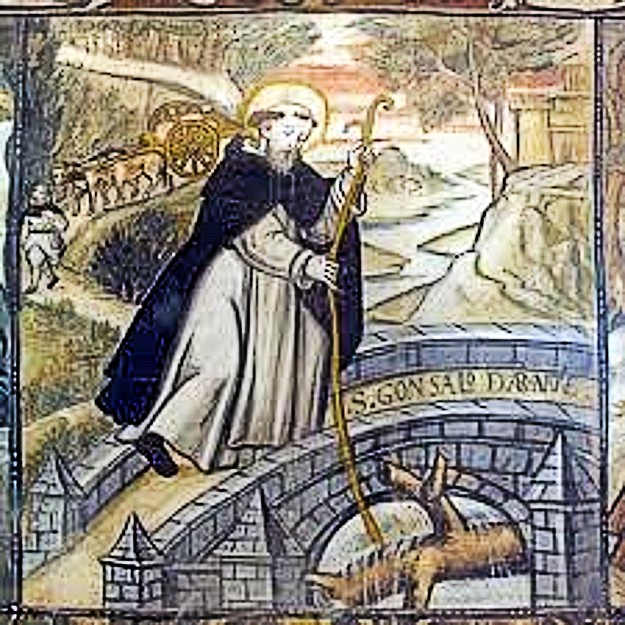
One of the miracles of Blessed Gonzalo concerns the building of a bridge across a swift river that barred many people from reaching the hermitage in wintertime. It was not a good place to build a bridge but Gonsalvo set about it and followed the heavenly directions he had received. Once, during the building of the bridge, he went out collecting and a man, who wanted to brush him off painlessly, sent him away with a note for his wife.
Gonzalo took the note to the man’s wife and she laughed when she read it . “Give him as much gold as will balance with the note I send you,” said the message. Gonzalo told her he thought she ought to obey her husband, so she got out the scales and put the paper in one balance. Then she put a tiny coin in the other balance and another and another–the paper still outweighed her gold–and she kept adding. There was a sizeable pile of coins before the balance with the paper in it swung upwards.
When workers who helped briefly with his bridge building ran out of wine, Gonzalo prayed, smacked a rock with a stick, it split open and wine poured out. When the workers ran out of food, Gonzalo went to the water, called out and fish jumped onto the river bank to feed them.
Gonzalo died on 10 January 1259, after prophesying the day of his death and promising his friends that he would still be able to help them after death. Pilgrimages began soon and a series of miracles indicated that this holy man was indeed the saint he was believed to be. Forty years after his death he appeared to several people who were apprehensively watching a flood on the river. The water had arisen to a dangerous level, just below the bridge, when they saw a tree floating towards the bridge and Gonzalo was balancing capably on its rolling balk. The friar carefully guided the tree under the bridge, preserving the bridge from damage and then disappeared (Benedictines, Dorcy).
Dominicans are noted for their ability to preach. Sermons are their speciality. Yet even among them, Gonzalo must have stood out. During a homily, in which he wanted to show the horror of exclusion from the Church, he ‘excommunicated’ a basket of bread, the loaves immediately became black, rotted and inedible. When he removed the ‘excommunication’ a few minutes later, the bread became fresh and wholesome again.
He was Beatified on 16 September 1561, Saint Peter’s Basilica, Papal States by Pope Pius IV. But Pope Julius III had on 24 April 1551 allowed for public worship in his honour in Portugal though did not allow his Beatification at that time. Pope Clement X – after the Beatification – extended his public worship with a Mass and Divine Office to Portugal and the entire Dominican order.
St Berard and Companions (Peter, Adjute, Accurs, Odo and Vitalis)
St Dana of Leuca
St Dunchaid O’Braoin
St Fulgentius of Ecija
St Fursey of Peronne Blessed Gonzalo de Amarante OP (1187-1259) Blessed Giuseppe Tovini OFS (1841-1897) Blessed Giuseppe’s Life: https://anastpaul.com/2019/01/16/saint-of-the-day-16-january-blessed-giuseppe-tovini-ofs-1841-1897/
St Henry of Coquet
St Honoratus of Arles
St Honoratus of Fondi
Bl James of Luino
St James of Tarentaise
Bl Joan of Bagno di Romagna
St Juana Maria Condesa Lluch
Bl Konrad II of Mondsee
St Leobazio
St Liberata of Pavia
St Pope Marcellus I
St Melas of Rhinocolura
St Priscilla of Rome
St Sigeberht of East Anglia
St Titian of Oderzo
St Triverius
St Valerius of Sorrento
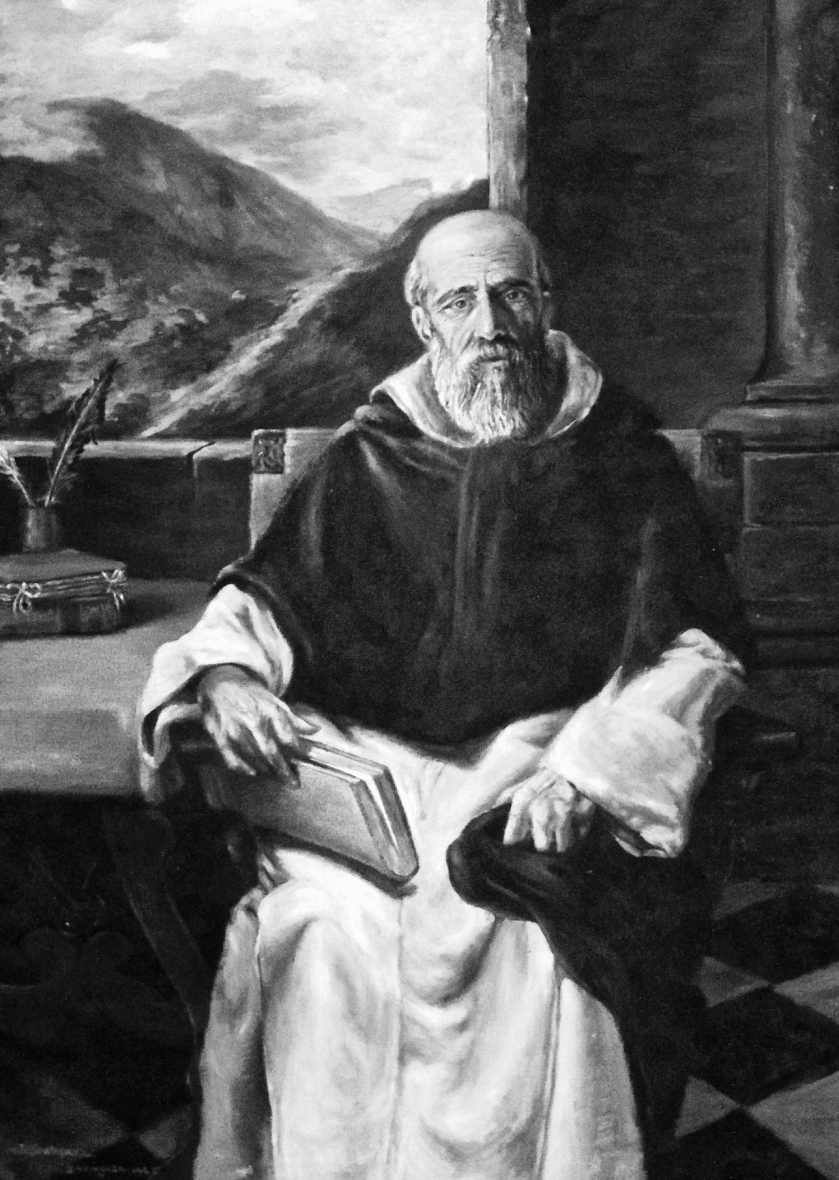
Saint of the Day – 7 January – St Raymond of Peñafort OP (1175-1275) known as the “Father of Canon Law” – Master of the Order of Preachers, Archbishop, Dominican Priest, Confessor, Evangelist, Missionary, Theologian,Teacher, Philosopher, Lawyer of both Canon and Civil Law, Writer, Spiritual Director and Adviser, Preacher, miracle worker. Born as Raimundo de Peñafort in 1175 at Peñafort, Catalonia, Spain and died on 6 January 1275, aged 100 years old, at Barcelona, Spain of natural causes . Patronages – attorneys, barristers, lawyers, canon lawyers, medical record librarians, Barcelona, Spain, Navarre, Spain.
As a lawyer, priest and preacher, St Raymond of Penyafort made a significant mark on the history of Spain and the church. His preaching helped re-Christianise Spain after the Moors were overthrown. And his compilation of papal and conciliar decrees, it was the main source of canon law for seven centuries.
Raymond of Peñafort was born in Vilafranca del Penedès, a small town near Barcelona, Catalonia, around 1175 . Descended from a noble family with ties to the royal house of Aragon, he was educated in Barcelona and at the University of Bologna, where he received doctorates in both civil and canon law.
An accomplished lawyer and scholar, Raymond joined the Dominicans at Barcelona in 1222. The 47-year-old novice was assigned to develop a book of case studies for confessors that helped to shape the medieval church’s penitential system. Also a gifted preacher, Raymond had remarkable success evangelising Moors and Jews. And he travelled throughout Spain rejuvenating the spiritual life of Christians that the Moors had enslaved. Among his main themes were spiritual combat and standing firm in trials. Listen to his voice in this letter:
“The preacher of God’s truth has told us that all who want to live righteously in Christ will suffer persecution. . . . the only exception to this general statement is, I think, the person who either neglects, or does not know how, to live temperately, justly and righteously in this world.
May you never be numbered among those whose house is peaceful, quiet and free from care, those on whom the Lord’s chastisement does not descend, those who live out their days in prosperity and in the twinkling of an eye will go down to hell.
Your purity of life, your devotion, deserve and call for a reward, because you are acceptable and pleasing to God, your purity of life must be made purer still, by frequent buffetings, until you attain perfect sincerity of heart. If from time to time you feel the sword falling on you with double or treble force, this also should be seen as sheer joy and the mark of love. The two-edged sword consists in conflict without, fears within. It falls with double or treble force within, when the cunning spirit troubles the depths of your heart with guile and enticements. . . . The sword falls with double and treble force externally when, without cause, persecution breaks out from within the church, where wounds are more serious, especially when inflicted by friends.
This is that enviable and blessed cross of Christ . . . the cross in which alone we must make our boast, as Paul, God’s chosen instrument, has told us.”
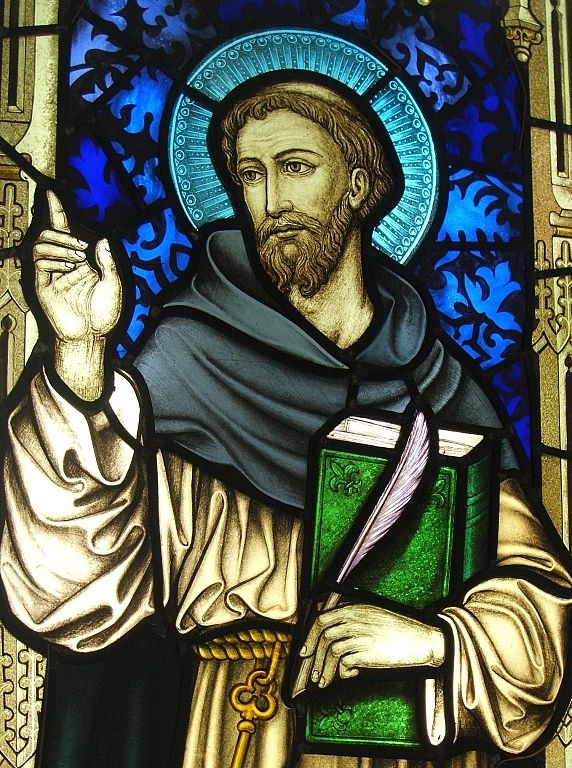
St Raymond on the left with the key which represents his unlocking of the decretals
In 1230, Pope Gregory IX brought Raymond to Rome as his confessor. The reputation of the saint for juridical science decided the pope to employ Raymond of Peñafort’s talents in re-arranging and codifying the canons of the Church. He had to rewrite and condense decrees that had been multiplying for centuries and which were contained in some twelve or fourteen collections already existing. We learn from a Bull of Gregory IX to the Universities of Paris and Bologna, that many of the decrees in the collections were but repetitions of ones issued before, many contradicted what had been determined in previous decrees and many, on account of their great length, led to endless confusion, while others had never been embodied in any collection and were of uncertain authority.
The pope announced the new publication in a Bull directed to the doctors and students of Paris and Bologna in 1231 and commanded that the work of St Raymond alone, should be considered authoritative and should alone, be used in the schools. Because they were so well arranged, canonists relied on Raymond’s Decretals until the new codification of 1917.
When Raymond completed his work, the pope appointed him Archbishop of Tarragona but the saint declined the honour. After declining the appointment of Archbishop, he could not avoid his election as the third general of the Dominicans in 1238. But when he reformed the Dominican rule, he slipped in a clause allowing early retirement of office holders. And he used it to retire in 1240.
But he continued to work 35 more years, focusing on bringing Jews and Moors to Christ. To equip Catholics for this work, he introduced the study of Hebrew and Arabic among Dominicans and persuaded Thomas Aquinas to write his Summa Contra Gentes as an evangelistic tool. Raymond told his general that ten thousand Moors had been baptised through the efforts of the Dominicans. He died at 100 years of age in 1275.
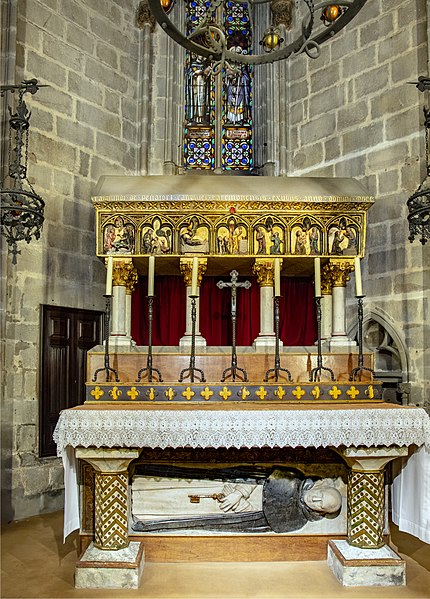
St Raymond was Canonised by Pope Clement VIII in 1601. He was buried in the Cathedral of Santa Eulalia in Barcelona.
st Raymond’s Tomb in Barcelona Cathedral
Most Famous Miracle
Raymond of Penyafort served as the confessor for King James I of Aragon, who was a loyal son of the Church but allowed his lustful desires to shackle him. While on the island of Majorca to initiate a campaign to help convert the Moors living there, the king brought his mistress with him. Raymond reproved the king and asked him repeatedly to dismiss his concubine. This the king refused to do. Finally, the saint told the king that he could remain with him no longer and made plans to leave for Barcelona. But the king forbade Raymond to leave the island and threatened punishment to any ship captain who dared to take him.
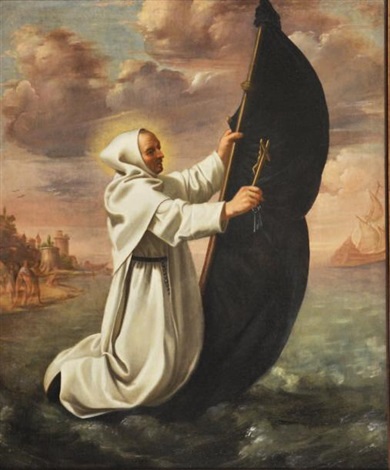
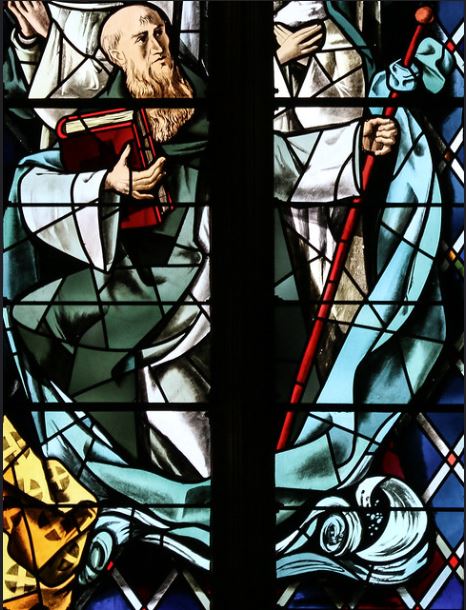
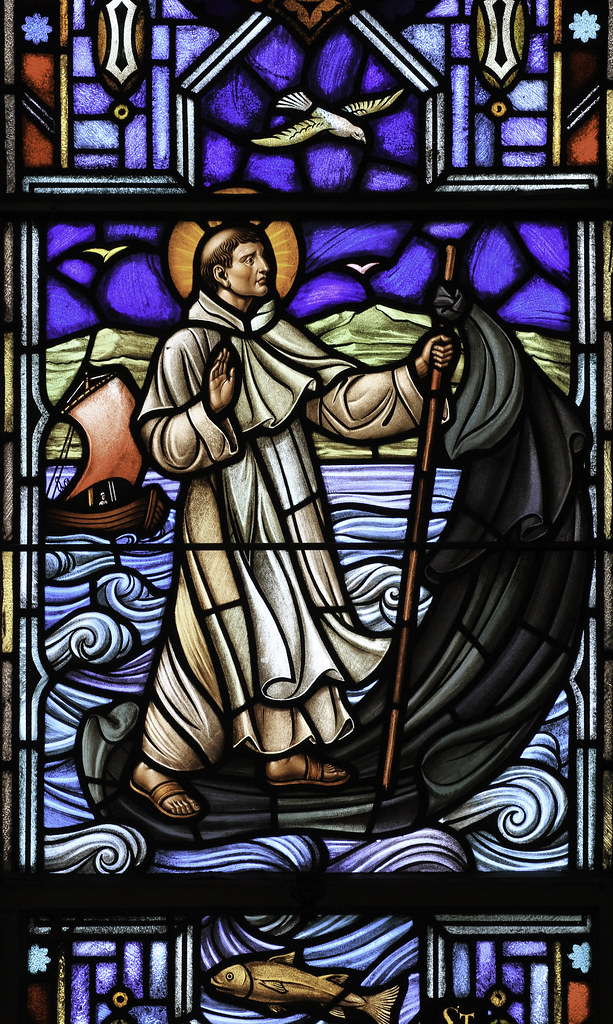
Saint Raymond then said to his Dominican companion, “Soon you will see how the King of heaven will confound the wicked deeds of this earthly king and provide me with a ship!” They then went down to the seashore where Raymond took off his cappa (the long black cloak the Dominicans wear over the white tunic and scapular) and spread one end of it on the water while rigging the other end to his walking staff. Having thus formed a miniature mast, Raymond bid the other Dominican to hop on but his companion, lacking the saint’s faith, refused to do so. Then Raymond bid him farewell and with the Sign of the Cross he pushed away from the shore and miraculously sailed away on his cloak. Skirting around the very boats that had forbidden him passage, the saint was seen by scores of sailors who shouted in astonishment and urged him on.
Raymond sailed the ~160 miles to Barcelona in the space of 6 hours, where his landing was witnessed by a crowd of amazed spectators.
Touched by this miracle, King James I renounced his evil ways and thereafter, led a good life.
St Raymond of Peñafort OP (1175-1275) (“Father of Canon Law”) (Optional Memorial)
St Aldric of Le Mans
Bl Ambrose Fernandez
St Anastasius of Sens
St Brannock of Braunton
St Candida of Greece
St Canute Lavard
St Cedd
St Clerus of Antioch
St Crispin I of Pavia
St Cronan Beg
St Emilian of Saujon
St Felix of Heraclea
Bl Franciscus Bae Gwan-gyeom
St Januarius of Heraclea
St Julian of Cagliari
St Kentigerna
St Lucian of Antioch
Bl Marie-Thérèse Haze
St Pallada of Greece
St Polyeuctus of Melitene
St Reinhold of Cologne
St Spolicostus of Greece
St Theodore of Egypt
St Tillo of Solignac
St Valentine of Passau
St Virginia of Ste-Verge
Bl Wittikund of Westphalia





















 AnaStpaul
You must be logged in to post a comment.