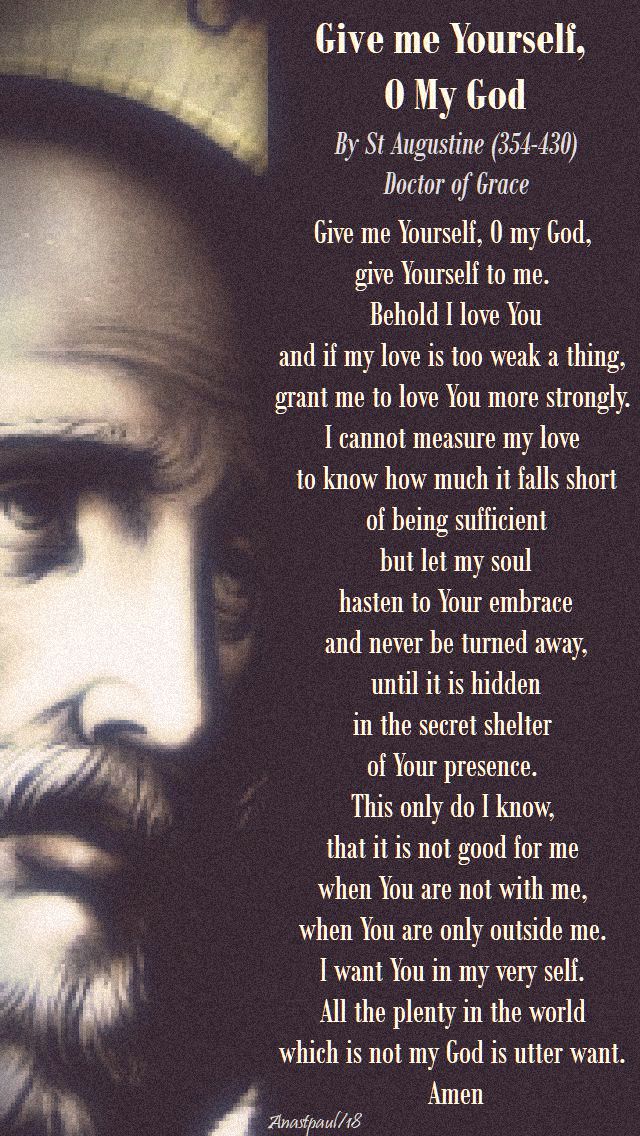
O Lord the House of My Soul is Narrow By St Augustine ((354-430) Father & Doctor of the Church
O God, the Light of the heart that sees You,
The Life of the soul that loves You,
The Strength of the mind that seeks You,
May I ever continue to be steadfast in Your love.
Be the joy of my heart;
Take all of me to Yourself and abide therein.
The house of my soul is, I confess, too narrow for You.
Enlarge it that You may enter.
It is ruinous but do repair it.
It has within it what must offend Your eyes,
I confess and know it,
But whose help shall I seek in cleansing it but Yours alone?
To You, O God, I cry urgently.
Cleanse me from secret faults.
Keep me from false pride and sensuality
That they not get dominion over me.
Amen
One Minute Reflection – 20 October – Today’s Gospel: Luke 12:8-12 = – Saturday of the Twenty-eighth week in Ordinary Time, Year B – The Memorial of The Memorial of Blesseds Okelo & Irwa & (1918) St Maria Bertilla Boscardin
(1888 – 1922)
“…do not be anxious how or what you are to answer or what you are to say; for the Holy Spirit will teach you in that very hour what you ought to say.”…Luke 12:11-12
REFLECTION – “The Christian should not fear or be distressed in difficult circumstances and thus be distracted from trust in God. He should take courage as if the Lord were at hand directing his affairs and strengthening him against all his adversaries. It is as if the Holy Spirit were instructing him, even as to the very replies he should make to his enemies.”… St Augustine (354-430) Father & Doctor of the Church (The Morals, 63)”
PRAYER – All-powerful, eternal God, grant us the grace of Your Spirit and fill us with the light of understanding and love. Grant that by the prayers of your Saints we may be strengthened and depend only on You. Blessed Okelo and Irwa and St Maria Bertilla, pray for us. We make our prayer through Jesus, our Lord with the Holy Spirit, God forever, amen.
Thought for the Day 17 October – St Ignatius of Antioch (c 35 – 107) Father of the Church, Martyr – “Doctor of Unity”
Note: St John Chrysostom (347-407) , who grew up in Antioch, taught that St Ignatius had been ordained at the hands of St Peter. According to ancient tradition, St Ignatius was the child whom Christ had held, as described in Matthew 18:4, as depicted in the fresco below from the Gračanica.
Detail from a fresco depicting Christ picking up the child St Ignatius, from the account in the Gospel of St Matthew 18:4.
Excerpt from Pope Benedict’s Catechesis on St Ignatius
Wednesday, 14 March 2007
For Ignatius unity was first and foremost a prerogative of God, who, since he exists as Three Persons, is One in absolute unity. Ignatius often used to repeat that God is unity and that in God alone is unity found in its pure and original state. Unity to be brought about on this earth by Christians is no more than an imitation as close as possible to the divine archetype.
Overall, it is possible to grasp in the Letters of Ignatius a sort of constant and fruitful dialectic between two characteristic aspects of Christian life: on the one hand, the hierarchical structure of the Ecclesial Community and on the other, the fundamental unity that binds all the faithful in Christ.
Consequently, their roles cannot be opposed to one another. On the contrary, the insistence on communion among believers and of believers with their Pastors was constantly reformulated in eloquent images and analogies – the harp, strings, intonation, the concert, the symphony. The special responsibility of Bishops, priests and deacons in building the community is clear.
This applies first of all to their invitation to love and unity. “Be one”, Ignatius wrote to the Magnesians, echoing the prayer of Jesus at the Last Supper: “one supplication, one mind, one hope in love…. Therefore, all run together as into one temple of God, as to one altar, as to one Jesus Christ who came forth from one Father and is with and has gone to one” (7: 1-2).
Imploring from the Lord this “grace of unity” and in the conviction that the whole Church presides in charity (cf. Romans, Prologue), I address to you yourselves the same hope with which Ignatius ended his Letter to the Trallians: “Love one another with an undivided heart. Let my spirit be sanctified by yours, not only now but also when I shall attain to God…. In [Jesus Christ] may you be found unblemished”(13).
And let us pray that the Lord will help us to attain this unity and to be found at last unstained, because it is love that purifies souls.
Quote/s of the Day – 17 October – The Memorial of St Ignatius of Antioch (c 35 – 107) Father of the Church, Martyr
“Do not have Jesus Christ on your lips and the world in your heart.”
“Therefore run together as into one temple of God, as to one altar, as to one Jesus Christ, who came forth from one Father and is with and has gone to One.”
“I am the wheat of God, and am ground by the teeth of the wild beasts, that I may be found the pure bread of God. I long after the Lord, the Son of the true God and Father, Jesus Christ. Him I seek, who died for us and rose again. I am eager to die for the sake of Christ. My love has been crucified, and there is no fire in me that loves anything. But there is living water springing up in me, and it says to me inwardly: “Come to the Father.”
St Ignatius of Antioch (c 35 – 107) Father of the Church, Martyr
One Minute Reflection- 17 October – Today’s Gospel: Luke 11:42-46 – Wednesday of the Twenty-eighth week in Ordinary Time, Year B and the Memorial of St Ignatius of Antioch (c 35 – 107) Father of the Church, Martyr
“Woe to you Pharisees! for you love the best seat in the synagogues and salutations in the market places.”…Luke 11:43
REFLECTION – “Christianity is not a matter of persuading people of particular ideas but of inviting them to share in the greatness of Christ. So pray that I may never fall into the trap of impressing people with clever speech but instead I may learn to speak with humility, desiring only to impress people with Christ Himself.”…St Ignatius of Antioch
PRAYER – Heavenly Father, grant that I may believe what I have learned, never presuming to know better than the teachings of Holy Mother Church and that I may put into practice what I believe. Let my commitment be like unto the Martyr, St Ignatius of Antioch, who went with joy to his horrific death, for the faith in Christ, Your Son, God with You and the Holy Spirit. St Ignatius, pray for us, amen.
O Lord, show Your mercy to me By St Jerome (347-419) Father and Doctor
O Lord, show Your mercy to me
and gladden my heart.
I am like the man on the way to Jericho
who was overtaken by robbers,
wounded and left for dead.
O Good Samaritan,
come to my aid.
I am like the sheep that went astray.
O Good Shepherd,
seek me out and bring me home
in accord with Your will.
Let me dwell in Your house
all the days of my life
and praise You for ever and ever
with those who are there.
Amen
Saint of the Day – 17 October – St Ignatius of Antioch (c 35 – 107) Father of the Church, Martyr
Excerpt from Pope Benedict’s Catechesis on St Ignatius
Wednesday, 14 March 2007
Today, we will be speaking of St Ignatius, who was the third Bishop of Antioch from 70 to 107, the date of his martyrdom. At that time, Rome, Alexandria and Antioch were the three great metropolises of the Roman Empire. The Council of Nicea mentioned three “primacies”: Rome but also Alexandria and Antioch participated in a certain sense in a “primacy”.
St Ignatius was Bishop of Antioch, which today is located in Turkey. Here in Antioch, as we know from the Acts of the Apostles, a flourishing Christian community developed. Its first Bishop was the Apostle Peter – or so tradition claims – and it was there that the disciples were “for the first time called Christians” (Acts 11: 26). Eusebius of Caesarea, a fourth-century historian, dedicated an entire chapter of his Church History to the life and literary works of Ignatius (cf. 3: 36).
Eusebius writes: “The Report says that he [Ignatius] was sent from Syria to Rome and became food for wild beasts on account of his testimony to Christ. And as he made the journey through Asia under the strictest military surveillance” (he called the guards “ten leopards” in his Letter to the Romans, 5: 1), “he fortified the parishes in the various cities where he stopped by homilies and exhortations and warned them above all to be especially on their guard against the heresies that were then beginning to prevail, and exhorted them to hold fast to the tradition of the Apostles”.
The first place Ignatius stopped on the way to his martyrdom was the city of Smyrna, where St Polycarp, a disciple of St John, was Bishop. Here, Ignatius wrote four letters, respectively to the Churches of Ephesus, Magnesia, Tralli and Rome. “Having left Smyrna”, Eusebius continues, Ignatius reached Troas and “wrote again”: two letters to the Churches of Philadelphia and Smyrna and one to Bishop Polycarp. Thus, Eusebius completes the list of his letters, which have come down to us from the Church of the first century as a precious treasure. In reading these texts one feels the freshness of the faith of the generation which had still known the Apostles. In these letters, the ardent love of a saint can also be felt.
Lastly, the martyr travelled from Troas to Rome, where he was thrown to fierce wild animals in the Flavian Amphitheatre.
No Church Father has expressed the longing for union with Christ and for life in Him with the intensity of Ignatius. We therefore read the Gospel passage on the vine, which according to John’s Gospel is Jesus. In fact, two spiritual “currents” converge in Ignatius, that of Paul, straining with all his might for union with Christ and that of John, concentrated on life in Him. In turn, these two currents translate into the imitation of Christ, whom Ignatius several times proclaimed as “my” or “our God”.
Thus, Ignatius implores the Christians of Rome not to prevent his martyrdom since he is impatient “to attain to Jesus Christ”. And he explains, “It is better for me to die on behalf of Jesus Christ than to reign over all the ends of the earth…. Him I seek, who died for us: Him I desire, who rose again for our sake…. Permit me to be an imitator of the Passion of my God!” (Romans, 5-6).
One can perceive in these words on fire with love, the pronounced Christological “realism” typical of the Church of Antioch, more focused than ever on the Incarnation of the Son of God and on His true and concrete humanity: “Jesus Christ”, St Ignatius wrote to the Smyrnaeans, “was truly of the seed of David”, “he was truly born of a virgin” “and was truly nailed [to the Cross] for us” (1: 1). Ignatius’ irresistible longing for union with Christ was the foundation of a real “mysticism of unity”. He describes himself: “I therefore did what befitted me as a man devoted to unity”(Philadelphians, 8: 1).
For Ignatius unity was first and foremost a prerogative of God, who, since He exists as Three Persons, is One in absolute unity. Ignatius often used to repeat that God is unity and that in God alone is unity found in its pure and original state. Unity to be brought about on this earth by Christians is no more than an imitation as close as possible to the divine archetype.
Ignatius was the first person in Christian literature to attribute to the Church the adjective “catholic” or “universal” – “Wherever Jesus Christ is”, he said, “there is the Catholic Church” (Smyrnaeans, 8: 2). And precisely in the service of unity to the Catholic Church, the Christian community of Rome exercised a sort of primacy of love: “The Church which presides in the place of the region of the Romans and which is worthy of God, worthy of honour, worthy of the highest happiness… and which presides over love, is named from Christ and from the Father…” (Romans, Prologue).
St Ignatius on the South Colonnade St Peter’s Basilica c 1669-1670
As can be seen, Ignatius is truly the “Doctor of Unity” – unity of God and unity of Christ (despite the various heresies gaining ground which separated the human and the divine in Christ), unity of the Church, unity of the faithful in “faith and love, to which nothing is to be preferred”(Smyrnaeans, 6: 1).
Ultimately, Ignatius’ realism invites the faithful of yesterday and today, invites us all, to make a gradual synthesis between configuration to Christ (union with Him, life in Him) and dedication to His Church (unity with the Bishop, generous service to the community and to the world).
One Minute Reflection – 11 October – Today’s Gospel: Luke 11:5–13 – Thursday of the Twenty-seventh week in Ordinary Time and the Memorial of St Pope John XXIII
“For everyone who asks, receives and he who seeks, finds and to him who knocks, it will be opened.”…Luke 11:10
REFLECTION – ” Now by asking, He means prayer but by seeking, zeal and anxiety, as He adds, seek and you shall find. For those things which are sought require great care. And this is particularly the case with God. For there are many things which block up our senses. As then we search for lost gold, so let us anxiously seek after God. He shows also, that though He does not forthwith open the gates, we must yet wait. Hence he adds, knock and it shall be opened to you, for if you continue seeking, you shall surely receive. For this reason and as the door shut makes you knock, therefore He did not at once consent that you might entreat.
Or by the word knock perhaps he means seeking effectually, for one knocks with the hand but the hand is the sign of a good work. Or these three may be distinguished in another way. For it is the beginning of virtue to ask to know the way of truth. But the second step is to seek how we must go by that way. The third step is when a man has reached the virtue to knock at the door, that he may enter upon the wide field of knowledge. All these things a man acquires by prayer . Or to ask indeed, is to pray but to seek, is by good works to do things becoming our prayers. And to knock is to continue in prayer without ceasing.”…St John Chrysostom (347-407) Father & Doctor of the Church
PRAYER – Help us my Lord, to discern through prayer and meditation, what You truly want of us. Then enable us to offer it to You and indeed to offer myself and all I have to You. Teach us to listen that we might hear Your answers, teach us to wait in patience for that which we ask and to trust in Your answer and teach us to constantly knock at Your door in prayer. May St John XXIII, pray for Holy Mother Church, pray for all the members of the Mystical Body, pray for our sons and daughters and for us all, pray for me! Amen
Quote/s of the Day – 8 October – Today’s Gospel: Luke 10:25–37 – Monday of the Twenty-seventh week in Ordinary Time, Year B
Speaking of – Seeking : The Good Samaritan
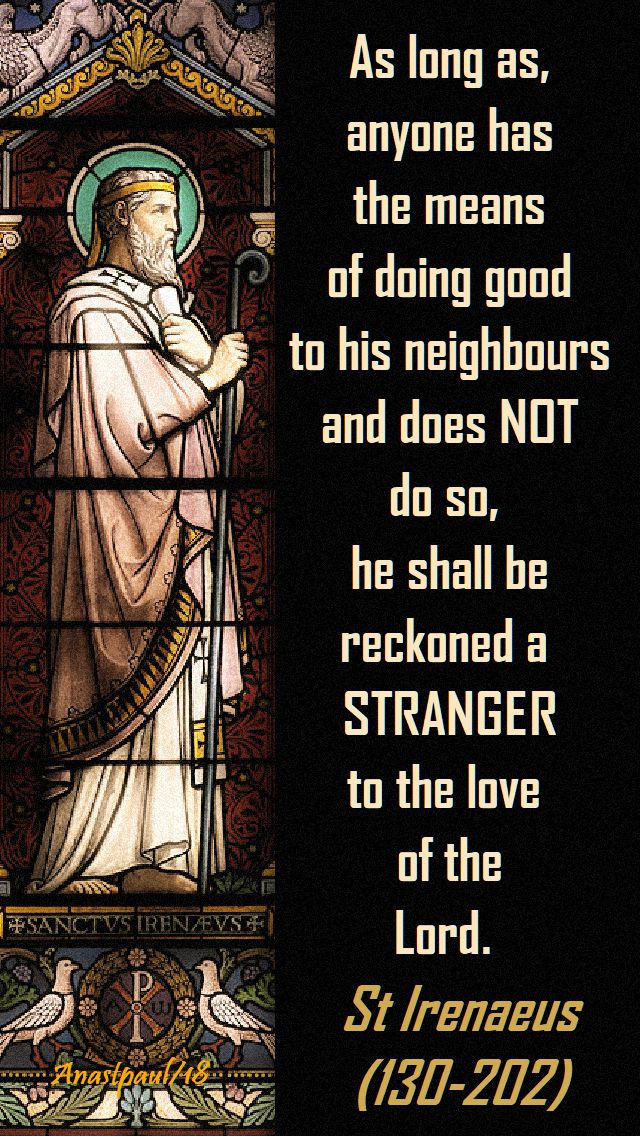
As long as anyone has the means of doing good to his neighbours and does not do so, he shall be reckoned a stranger to the love of the Lord.
St Irenaeus (130-202) Father of the Church
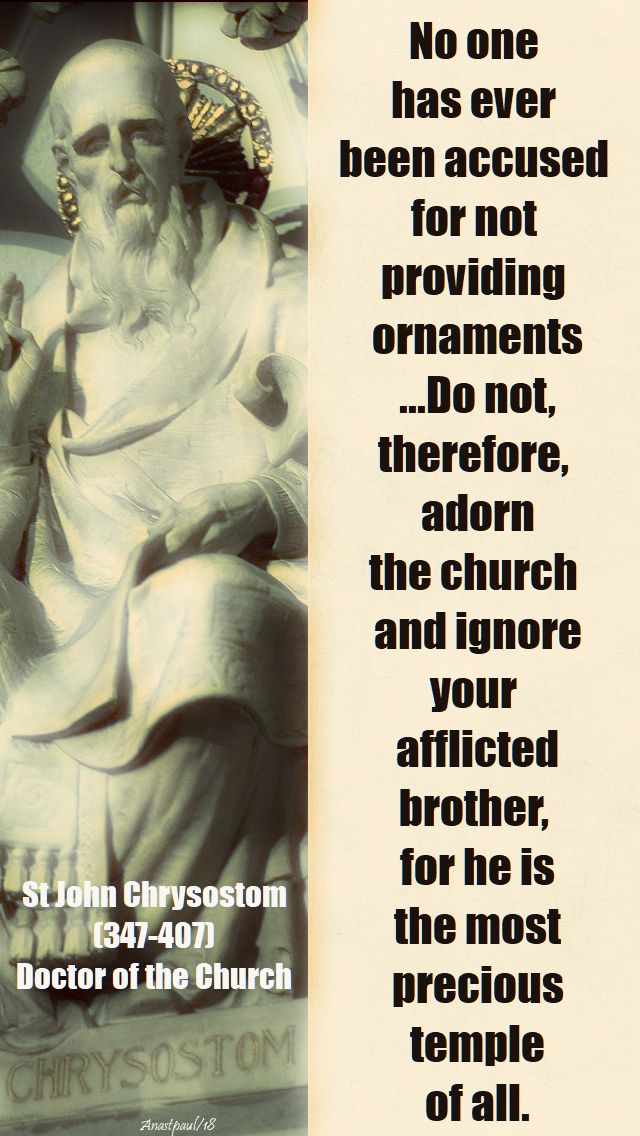
No one has ever been accused for not providing ornaments but for those who neglect their neighbour, a hell awaits with an inextinguishable fire and torment in the company of the demons. Do not, therefore, adorn the church and ignore your afflicted brother, for he is the most precious temple of all.
St John Chrysostom (347-407) Father & Doctor of the Church
We must speak to them with our hands before we speak to them with our lips.
St Peter Claver (1580-1654)
We should strive to keep our hearts open to the sufferings and wretchedness of other people and pray continually, that God may grant us, that spirit of compassion, which is truly the Spirit of God.
St Vincent de Paul (1581-1660)
Since God is perfect in loving man, man must be perfect in loving his neighbour.
St Vincent Pallotti (1795-1850)
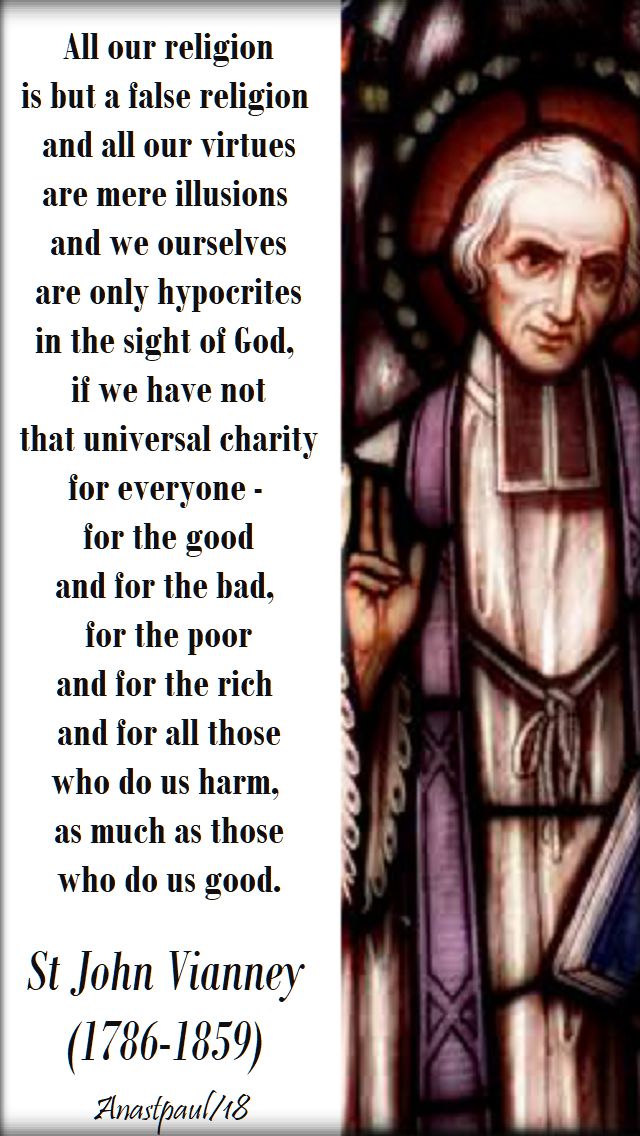
All our religion is but a false religion and all our virtues are mere illusions and we ourselves are only hypocrites in the sight of God, if we have not that universal charity for everyone – for the good and for the bad, for the poor and for the rich and for all those who do us harm, as much as those who do us good.
St John Vianney (1786-1859)
“This parable is a splendid gift for us all and also a task! To each of us Jesus repeats what He said to the doctor of the Law: “Go and do likewise” (v. 37). We are all called to follow the same path of the Good Samaritan, who is the figure of Christ: Jesus bent down to us, He became our servant and thus He has saved us, so that we too might love as He loved us, in the same way.”
One Minute Reflection – 5 October – Today’s Gospel: Luke 10:13–16 – Friday of the Twenty-sixth week in Ordinary Time, Year B and the Memorial of Blesseds Francis Xavier Seelos (1819-1867) and Bartholomew Longo (1841-1926)
“He who hears you, hears me and he who rejects you, rejects me and he who rejects me, rejects him who sent me.”...Luke 10:16
REFLECTION – “Someone, having listened to the verse: “Offer to God a sacrifice of praise” (Ps 50[49].14), said to himself: “I will go to church every day when I get up and sing a morning hymn; then an evening hymn at the end of the day and then, in my own home, a third and fourth hymn. This is how I will make a sacrifice of praise every day and offer it to my God.” It is good to do this if you do it in truth but beware of placing your confidence in what you do and fear lest, while your tongue is speaking eloquently before God, your life may be speaking badly… Take care you don’t live evilly, while speaking well.”…St Augustine (354-430) Father & Doctor of the Church
PRAYER – And we exult you, O Mary Assumed into Heaven, as we contemplate you who have been glorified and, in the risen Christ, have become the co-worker of the Holy Spirit in communicating divine life to mankind. In you we see the goal of holiness to which God calls all the Church’s members. In your life we recognise the clear sign of the path to spiritual maturity and Christian holiness. With you, with Blesseds Francis Xavier Seelos, Bartholomew Longo and with all the saints, we glorify God the Trinity, who sustains our earthly pilgrimage and lives and reigns for ever and ever. Amen (by St Pope John Paul Nov 2000)
Thought for the Day – 30 September – The Memorial of St Jerome (347-419) Father and Doctor
Pope Benedict XVI – 7 November 2007 –
Catechesis on St Jerome (1)
What can we learn from St Jerome? It seems to me, this above all – to love the Word of God in Sacred Scripture.
St Jerome said: “Ignorance of the Scriptures is ignorance of Christ”. It is therefore important that every Christian live in contact and in personal dialogue with the Word of God given to us in Sacred Scripture. This dialogue with Scripture must always have two dimensions: on the one hand, it must be a truly personal dialogue because God speaks with each one of us through Sacred Scripture and it has a message for each one. We must not read Sacred Scripture as a word of the past but as the Word of God that is also addressed to us and we must try to understand what it is that the Lord wants to tell us. However, to avoid falling into individualism, we must bear in mind that the Word of God has been given to us precisely in order to build communion and to join forces in the truth on our journey towards God. Thus, although it is always a personal Word, it is also a Word that builds community, that builds the Church. We must, therefore, read it in communion with the living Church. The privileged place for reading and listening to the Word of God is the liturgy, in which, celebrating the Word and making Christ’s Body present in the Sacrament, we actualise the Word in our lives and make it present among us. We must never forget that the Word of God transcends time . Human opinions come and go. What is very modern today will be very antiquated tomorrow. On the other hand, the Word of God is the Word of eternal life, it bears within it eternity and is valid for ever. By carrying the Word of God within us, we therefore carry within us eternity, eternal life.
I thus conclude with a word St Jerome once addressed to St Paulinus of Nola (354-431). In it the great exegete expressed this very reality, that is, in the Word of God we receive eternity, eternal life. St Jerome said: “Seek to learn on earth those truths which will remain ever valid in Heaven” (Ep. 53, 10)…. Pope Benedict XVI – 7 November 2007 – Catechesis on St Jerome (1)
Quote/s of the Day – 30 September – Memorial of St Jerome (347-419) Father and Doctor
“Love Sacred Scripture and wisdom will love you; love it tenderly and it will protect you; honour it and you will receive its caresses. May it be for you, as your necklaces and your earrings.”
“Love the science of Scripture and you will not love the vices of the flesh”
“The Scriptures are shallow enough, for a babe to come and drink, without fear of drowning and deep enough, for theologians to swim in, without ever reaching the bottom.”
“A false interpretation of Scripture, causes that the gospel of the Lord, becomes the gospel of man, or, which is worse, of the devil.”
“Does one not seem to dwell, already here on earth, in the Kingdom of Heaven, when one lives with these texts, when one meditates on them, when one does not know or seek anything else?”
“Martyrdom does not consist only in dying for one’s faith. Martyrdom also consists, in serving God, with love and purity of heart, every day of one’s life.” Divine Saviour, we come to Your sacred table to nourish ourselves, not with bread but with Yourself, true Bread of eternal life. Help us daily to make a good and perfect meal of this divine food. Let us be continually refreshed by the perfume of Your kindness and goodness. May the Holy Spirit fill us with His Love. Meanwhile, let us prepare a place for this holy food by emptying our hearts.”
“It is our part to seek, His to grant what we ask; ours to make a beginning, His to bring it to completion; ours to offer what we can, His to finish what we cannot.”
“Begin now, what you will be, hereafter.”
“The face is the mirror of the mind and eyes without speaking. confess the secrets of the heart.”
“Instead of speaking saintly words, we must act them.”
Our Morning Offering – 30 September – Memorial of St Jerome (347-419) Father and Doctor
A light for our Path By St Jerome
O Lord,
You have given us Your word
for a light to shine upon our path,
grant us so to meditate on that word
and follow its teaching,
that we may find in it,
the light that shines more and more
until the perfect day.
Amen
Saint of the Day – 30 September – St Jerome (347-419) Father and Doctor of the Church
Saint Jerome, born in Dalmatia in 347, was sent to school in Rome. His boyhood was not free from fault, his thirst for knowledge was excessive and his love of books, a passion. He had studied under the best masters, visited foreign cities and devoted himself to the pursuit of learning.
But Christ had need of his strong will and active intellect for the service of His Church. He told him in a supernatural experience he never forgot, that he was not a Christian, but a Ciceronian – your heart is where your treasure is, said the Lord to him — that is, in the eloquent writings of antique times. Saint Jerome obeyed the divine call, making a vow never again to read profane works and another of celibacy.
In Rome he had already assisted a number of holy women to organise houses of retirement where they consecrated themselves to God by vow. Calumnies, arising from jealousy, made a certain headway against the scholar whose competence was beginning to attract honours.
He fled from Rome to the wild Syrian desert and there for four years learned in solitude, intense sufferings and persecution from the demons, new lessons in humility, penance and prayer and divine wisdom. I was very foolish to want to sing the hymns of the Lord on foreign soil and to abandon the mountain of Sinai to beg help from Egypt, he declared.
Pope Damasus summoned him back to Rome and there assigned to the famous scholar, already expert in Hebrew and other ancient languages, the task of revising the Latin Bible. Saint Jerome obeyed his earthly Head as he had obeyed his Lord. Retiring once more in 386 to Bethlehem, the eloquent hermit sent forth from his solitary cell not only a solidly accurate version of the Scriptures but during thirty years’ time, a veritable stream of luminous writings for the Christian world. He combated with unfailing efficacy several heresies being subtly introduced by various personages in his own region and elsewhere.
For fourteen years the hand of the great scholar could no longer write but Saint Jerome could still dictate to six secretaries at a time, to each on a different subject, in those final years. He died in his beloved Bethlehem in 420, when over 80 years old. His tomb is still in a subterranean chapel of its ancient basilica but his relics were transported to Saint Mary Major Basilica of Rome, where the crib of Bethlehem is conserved.
Quote/s of the Day – 29 September – The Feast of Sts Michael, Gabriel and Raphael
“You should be aware, that the word “angel”, denotes a function, rather than a nature. Those holy spirits of heaven, have indeed always been spirits. They can only be called angels, when they deliver some message. Moreover, those who deliver messages of lesser importance are called angels and those who proclaim messages of supreme importance are called archangels.”
St Pope Gregory the Great (540-604) Father & Doctor of the Church
“Angels take different earthly forms at the bidding of their master, God. They thus reveal themselves to human beings and unveil the Divine Mysteries to them”
St John Damascene (675-749) Father & Doctor of the Church
Quote/s of the Day – 24 September – Today’s Gospel: Luke 8:16–18 – Monday of the Twenty fifth week in Ordinary Time, Year B
“No one after lighting a lamp, covers it with a vessel, or puts it under a bed but puts it on a stand, that those who enter may see the light.”…Luke 8:16
Speaking of: Living the Light
“Do not have Jesus Christ on your lips and the world in your heart?”
“Christianity is not, a matter of persuading people of particular ideas but of inviting them, to share in the greatness of Christ.”
“A Christian is not his own master, since all his time belongs to God.”
“We recognise a tree by its fruit and we ought to be able to recognise a Christian by his action. The fruit of faith should be evident in our lives, for being a Christian is more than making sound professions of faith. It should reveal itself in practical and visible ways. Indeed it is better to keep quiet about our beliefs and live them out, than to talk eloquently about what we believe but fail to live by it.”
“Christianity is not a matter of persuading people of particular ideas but of inviting them to share in the greatness of Christ. So pray that I may never fall into the trap of impressing people with clever speech but instead, I may learn to speak with humility, desiring only to impress people with Christ Himself.”
“Labour together with one another; strive in company together; run together; suffer together; sleep together; and awake together, as the stewards and associates and servants of God. Please Him under whom you fight and from whom you receive your wages. Let none of you be found a deserter. Let your baptism endure as your arms; your faith as your helmet; your love as your spear; your patience as a complete panoply. Let your works be the charge assigned to you, that you may receive a worthy recompense. Be long-suffering, therefore, with one another, in meekness, as God is towards you. May I have joy of you for ever! Give.” … (St Ignatius of Antioch: The Epistles)
“Pray without ceasing on behalf of other men… For cannot he that falls, rise again?”
St Ignatius of Antioch (c 35-c 108) Martyr – Father of the Church
One Minute Reflection – 24 September – Today’s Gospel: Luke 8:16–18 – Monday of the Twenty fifth week in Ordinary Time, Year B
“No one after lighting a lamp, covers it with a vessel, or puts it under a bed but puts it on a stand, that those who enter may see the light.”…Luke 8:16
REFLECTION – “Christ,” wrote a Father of the Church, (Saint John Chrysostom), “has left us in this world to be like lamps…, to act like leaven…, to become seed, to bear fruit.” If our lives were to have this kind of impact, we would not need to open our mouths. Words would be unnecessary if we could show our works. There wouldn’t be a single pagan left if we were truly christians.
We should avoid making the mistake of thinking that the apostolate consists, in the witness of a few pious practices. We are christians, you and I but at the same time and without resolution of continuity, we are citizens and fellow-workers at very clear obligations, which we are to carry out in an exemplary fashion if we want to become holy once and for all. It is Jesus Christ who urges us: “You are the light of the world. A city set on a mountain cannot be hidden. Nor do they light a lamp and then set it under a bushel basket; it is set on a lampstand , where it gives light to all in the house. Just so, your light must shine before others, that they may see your good deeds and glorify your heavenly Father” (Mt 5:14-16)….Saint Josémaria Escriva de Balaguer (1902-1975) Homily in Amigos de Dios
“All of us who have received Baptism, pray that the Holy Spirit help us not to fall into these bad habits that cover the light and that He help us to carry forward, the light we received freely, that light of God that does so much good – the light of friendship, the light of meekness, the light of faith, the light of hope, the light of patience, the light of goodness.”…Pope Francis – Santa Marta, 19 September 2016
PRAYER – Lord, be the beginning and the end of all that we do, all that we say, in every moment be our Light. Prompt our actions with Your grace and complete them with Your all-powerful love. May we always seek Your Face in every circumstance, in every moment, so that Your Light may become our life. Blessed Anton Martin Slomsek, you lived your life in the Presence of the Holy Face of Christ our Lord, please intercede for us and for all the world. We make our prayer through Christ, our Lord with the Holy Spirit, one God forever, amen.
Quote/s of the Day – 21 September – The Feast of St Matthew, Apostle and Evangelist- Today’s Gospel: Matthew 9:9–13
“But as you have seen the power of Him that called, so consider also the obedience of him that was called – how he neither resisted, nor disputing said, ‘What is this? Is it not indeed a deceitful calling, wherewith He calls me, being such as I am?’ nay, for this humility again had been out of season but he obeyed straightaway and did not even request to go home and to communicate with his relations concerning this matter -as neither indeed, did the fishermen but as they left their net and their ship and their father, so did he his receipt of custom and his gain and followed, exhibiting a mind prepared for all things and breaking himself at once away, from all worldly things, by his complete obedience, he bore witness, that He who called him, had chosen a good time.
…Because He who is acquainted with the hearts and knows the secrets of each man’s mind, knew also when each of these would obey.” (Homily 30 on Matthew)
St John Chrysostom (347-407) Father and Doctor of the Church
“On hearing Christ’s voice, we open the door to receive Him, as it were, when we freely assent to His promptings and when we give ourselves over to doing what must be done. Christ, since He dwells in the hearts of His chosen ones through the grace of His love, enters so that He might eat with us and we with Him. He ever refreshes us by the light of His presence insofar as we progress in our devotion to and longing for the things of heaven. He Himself is delighted by such a pleasing banquet.”
St Bede the Venerable (673-735) Doctor of the Church
“That gaze overtook him completely, it changed his life. We say he was converted. He changed his life. As soon as he felt that gaze in his heart, he got up and followed Him. This is true – Jesus’ gaze always lifts us up. It is a look that always lifts us up and never leaves you in your place, never lets us down, never humiliates. It invites you to get up – a look that brings you to grow, to move forward, that encourages you, because the One who looks upon you loves you. The gaze makes you feel that He loves you. This gives the courage to follow Him – ‘and he got up and followed Him.’”
Pope Francis 21 September 2013
“He looked on sinners, called them and brought them to sit beside Him.”
One Minute Reflection – 21 September – The Feast of St Matthew, Apostle and Evangelist- Today’s Gospel: Matthew 9:9–13
“Why does your teacher eat with tax collectors and sinners?” …Matthew 9:11b
REFLECTION – “Our Lord chose Matthew, the tax collector, to encourage his fellows to join Him. He looked on sinners, called them and brought them to sit beside Him. What a wonderful sight! Angels stand trembling while publicans, seated, rejoice. The angels are struck with awe before the Lord’s greatness while sinners eat and drink with Him. The scribes choke with hatred and indignation, the publicans rejoice because of His mercy. The heavens saw the sight and were filled with wonder; hell saw it and was maddened. Satan saw it and was enraged; death saw it and withered; the scribes saw it and were much troubled.
There was joy in heaven and happiness among the angels because the rebellious had been persuaded, the recalcitrant quieted and sinners reformed and because publicans had been made righteous. Just as our Lord did not turn away from the shamefulness of the cross in spite of the entreaties of His friends (Mt 16:22) so he did not refuse the company of publicans in spite of the taunts of His enemies. He despised mockery and scorned praise, thus accomplishing all that is for mankind’s good.”…St Ephrem (306-373) Father & Doctor of the Church – Commentary on the Gospel, or Diatessaron, 5, 17 (SC 121, p.115 rev.)
“He looked at Matthew calmly, peacefully. He looked at him with eyes of mercy; he looked at him as no one had ever looked at him before. And this look unlocked Matthew’s heart; it set him free, it healed him, it gave him hope, a new life, as it did to Zacchaeus, to Bartimaeus, to Mary Magdalene, to Peter, and to each of us. Even if we do not dare raise our eyes to the Lord, he looks at us first. This is our story, and it is like that of so many others. Each of us can say: “I, too, am a sinner, whom Jesus has looked upon”. I ask you, in your homes or in the Church, to be still for a moment and to recall with gratitude and happiness those situations, that moment, when the merciful gaze of God was felt in our lives.”…Pope Francis – 21 September 2015, The Feast of St Matthew
PRAYER – Lord, You showed Your great mercy to Matthew the tax-gatherer,by calling him to become Your Apostle,supported by his prayer and example, may we always answer Your call and live in close union with You. We make our prayer, in union with God our Father and the Holy Spirit, one God forever and ever. St Matthew, Apostle of Christ, pray for us, amen.
God of Our Life St Augustine (354-430) Father & Doctor of the Church
God of our life,
there are days when the burdens we carry
chafe our shoulders and weigh us down;
when the road seems dreary and endless,
the skies gray and threatening;
when our lives have no music in them
and our hearts are lonely
and our souls have lost their courage.
Flood the path with light,
run our eyes to where the skies are full of promise;
tune our hearts to brave music;
give us the sense of comradeship
with heroes and saints of every age;
and so quicken our spirits
that we may be able to encourage the souls of all
who journey with us on the road of life,
to Your honour and glory.
Amen
Quote/s of the Day – The Memorial of St Alonso de Orozco O.S.A. (1500 – 1591) Augustinian Priest
Speaking of: Seeking Augustine
“Your prayer is a conversation with God. When you read, it is God who is speaking, when you pray, it is with God that you are speaking.”
“It is night while this life is lived. And when is this night illuminated? It is lighted when Christ descends to the night. He took the flesh of this generation and our night received the light.” (En. in ps. 138,14)
“I shall know You, You who know me. Virtue of my soul, go deep into it and make it fit for You, so that You may have it and possess it, without stain or wrinkle.”
“I realise what I am and praise You for it. Come to my aid, that I may not stray from the way of salvation.” (Sermo 67, 9)
“If you elevate yourself, God distances Himself from you. If you humble yourself, He leans towards you.”
“Habits support the intelligence just as a way of living leads to a way of life.” (In Io. Ev. XVIII, 7)
St Augustine (354-430) Father & Doctor of the Church
Thought for the Day – 19 September – The Memorial of St Januarius – Martyr (Died c 304)
Many centuries ago, St Januarius died for the Faith in the persecution of Diocletian and, to this day, God confirms the faith of his Church and works a continual miracle, through the blood which Januarius shed for Him.
Little did the heathen Governor think that he was the instrument, in God’s Hand, of ushering in the long succession of miracles which attest to the faith of St Januarius.
The Relics of St Januarius rest in the Cathedral of Naples and it is there that the liquefying of his blood occurs. The blood is congealed in two glass vials but when it is brought near the Martyr’s head it melts and flows like the blood of a living man.
St Alphonsus Liguori wrote regarding St Januarius
“The Neapolitans honour this Saint as the principal Patron of their City and nation and the Lord Himself has continued to honour him, by allowing many miracles to be wrought through his intercession, particularly when the frightful eruptions of Mount Vesuvius, have threatened the City of Naples with utter destruction.
While the Relics of St Januarius were being brought in procession towards this terrific volcano, the torrents of lava and liquid fire which it emitted have ceased, or turned their course from the City. But, the most stupendous miracle and that which is greatly celebrated in the Church, is the liquefying and effervescence, of this blessed Martyr’s blood whenever the Relic Vials are brought into the sight of his head.
This miracle is renewed many times in the year, in the presence of all who desire to witness it; yet, some heretics have endeavoured to throw a doubt upon its authenticity by frivolous and incoherent explanations but, no-one can deny the effect to be miraculous, unless he be prepared to question the evidence of his senses!”
Tertullian said, “The blood of the Martyrs is the seed of the Church.” Sometimes, that blood is bubbling!
Our Morning Offering – 19 September – The Memorial of St Alonso de Orozco O.S.A. (1500 – 1591) Augustinian Priest
Prayer to Seek God Continually By St Augustine (354-430) Father & Doctor
O Lord my God, I believe in You,
Father, Son and Holy Spirit.
Insofar as I can,
insofar as You have given me the power,
I have sought You.
I became weary and I laboured.
O Lord my God, my sole hope,
help me to believe
and never to cease seeking You.
Grant that I may always
and ardently seek out Your countenance.
Give me the strength to seek You,
for You help me to find You
and You have more and more given me,
the hope of finding You.
Here I am before You
with my firmness and my infirmity.
Preserve the first and heal the second.
Here I am before You
with my strength and my ignorance.
Where You have opened the door to me,
welcome me at the entrance;
where you have closed the door to me,
open to my cry;
enable me to remember You,
to understand You
and to love You.
Amen.
Painting: Jeffrey A Gomez – The Confession of St Augustine
Quote/s of the Day – 18 September – Today’s Gospel: Luke 7:11–17, Tuesday of the Twenty-fourth week in Ordinary Time and the Memorial of St Juan Macias O.P. (1585-1645) and St Joseph of Cupertino O.F.M. Conv. (1603-1663)
Speaking of: Living the Word
“The Christian should be an ‘alleluia’ from head to foot.
St Augustine (354-430) Father & Doctor of the Church
“It is no use walking somewhere to preach, unless our walking is our preaching.”
St Francis of Assisi (c 1181-1226)
“To convert somebody, go and take them by the hand and guide them.”
St Thomas Aquinas (1225-1274) Doctor of the Church
“Cook the truth in charity, until it tastes sweet.”
St Francis de Sales (1567-1622) Doctor of the Church
“We must speak to them with our hands before we try to speak with our lips.”
St Peter Claver (1580-1654)
“Modern man listens more willingly to witnesses, than to teachers and if he does listen to teachers, it is because they are witnesses.”
Blessed Pope Paul VI (1897-1978)
“The only way to win audiences, is to tell people about the life and death of Christ. Every other approach is a waste.”
Ven Archbishop Fulton Sheen (1895-1979)
“Stay where you are – find your own Calcutta.”
St Mother Teresa (1910-1997)
“Your faith will grow, only in the measure, that you give it away.”
One Minute Reflection – 18 September – Today’s Gospel: Luke 7:11–17, Tuesday of the Twenty-fourth week in Ordinary Time and the Memorial of St Juan Macias O.P. (1585-1645) and St Joseph of Cupertino O.F.M. Conv. (1603-1663)
And he said, “Young man, I say to you, arise.”...Luke 7:14b
REFLECTION – “Even if the signs of death have removed all hope of life, even if the bodies of the dead lie beside the tomb, yet, at the voice of God, the corpses of those ready to decompose will rise and recover speech. The son is restored to his mother, he is called back from the tomb, snatched out of it. And what is this tomb? Your own. Your bad habits, your lack of faith. This is the tomb from which Christ delivers you, this is the tomb from which you will return to life if you listen to the Word of God. Even if your sin is so grave that you are unable to wash it clean for yourself with your tears of repentance, the Church, your mother, she who intercedes for each one of her children like a widowed mother for her only son, will weep for you. For she feels for it with a kind of spiritual suffering natural to her when she sees her offspring dragged down to death by lamentable vices…
Let her weep, then, this pious mother; let the crowd accompany her – and not just a crowd but a large crowd – and may it show compassion towards this tender mother. Then you will come to life again in your tomb and will be delivered, the bearers will stop and you will start to speak the words of the living; everyone will be astonished. The example of one will correct the many and they will praise God for having granted such remedies to us for escaping death.”…St Ambrose (c 340-397) Father & Doctor (A treatise on the Gospel of Saint Luke)
God wants us to stand upright. He created us to be on our fee,: for this reason, Jesus’ compassion leads to that gesture of healing, to heal us, of which the key phrase is: “Arise! Stand up, as God created you!”. Standing up. “But Father, we fall so often” — “Onward, arise!”. This is Jesus’ word, always. His word revives us, gives us hope, refreshes weary hearts, opens us to a vision of the world and of life which transcends suffering and death…Pope Francis – General audience, 10 August 2016
PRAYER – Heavenly Father, help me to be holy in the way that You have laid out for me. Let me stand upright and carry out my duties of my state of life to the full. Only in You may I attain holiness, learning to give myself, my will, my heart and my to You. St Joseph of Cupertino, you who were so disadvantaged, achieved by the grace of God, sanctity in this life and now behold His Face through all eternity. St Juan, in your lowly work, you stood in the Light of Christ, allowing the lowly and rich, to see Him who saved us. We ask You Holy Father, that You grant, by the intercession pf St Joseph and Juan, that we may reach our heavenly home. We make our prayer through Christ our Lord, with the Holy Spirit, one God forever, amen.
One Minute Reflection – 17 September – Today’s Gospel: Luke 7:1-10 – Monday of the Twenty-fourth week in Ordinary Time and the Memorial of St Robert Bellarmine SJ (1542-1621) and St Hildegard von Bingen OSB (1098-1179) both Doctors of the Church
“Lord, do not trouble yourself, for I am not worthy to have you come under my roof; therefore I did not presume to come to you. But say the word, and let my servant be healed.”…Luke7:6b-7
REFLECTION – “This man was a pagan, for the Jewish people were occupied by the Imperial Roman army at that time. So it was as a centurion in Judaea that he was commanding his soldiers…
But our Lord, although he was in the midst of the people of Judaea, was already talking about the Church being spread all over the earth wherever His apostles were to be sent (Mt 8:11). Indeed, the gentiles believed in Him without having see Him… Our Lord did not physically enter the centurion’s house and, even though absent in body, He was present in majesty and healed both that house and its faith. Similarly, our Lord stood physically only amongst the people of Judaea -other peoples did not see His being born of a virgin, or suffering, or walking, or subject to the condition of human nature, or carrying out divine miracles. None of these things were done amongst the gentiles and yet it was amongst them that what was said about Him was fulfilled: “A people I did not know have served me.” In what way did they serve Him? The Psalm continues: “As soon as they heard me, they obeyed me” (Ps 18[17]:44-45).”…St Augustine (354-430) Father and Doctor of the Church
“When we go out to meet the Lord, we in some sense are masters of the moment. However, when we allow ourselves to be encountered by Him, He enters into us and renews us from within. This is what it means for Christ to come, to renew all things, to renew hearts, souls, lives, hope and the journey. We are on a journey of faith, like the faith of this centurion, to encounter the Lord and to allow ourselves to be encountered by Him.”…Pope Francis – Santa Marta, 2 December 2013
PRAYER – Lord God and holy Father, guard our faith we pray and grace us with Your mercy. Keep us every faithful to Your precepts and bring us to Your home, to look upon Your Face. May the prayers of Your saints assist us on our journey. In your untiring life of trust in God, St Hildegard von Bingen, you sought to make Him the goal of all and the love of all, please pray that we may imitate your zeal and love. St Robert Bellarmine, as you worked tirelessly for the salvation of souls, so now pray for us all, as tirelessly, that we may achieve eternal joy. We ask all this through Christ, our Lord with the Holy Spirit, one God forever, amen.
Quote/s of the Day – 16 September – The Memorial of Sts Cornelius and Cyprian Martyrs
“We must carry out the will of God rather than our own. This is what we pledge to do in the “Our Father”, which we recite every day. What a travesty it would be if, after praying that God’s will be done, we should carry out that will halfheartedly and only because we are obliged to do so!
“We have solemnly renounced the world and therefore, whilst we continue in it, we should behave like strangers and pilgrims.”
“You cannot have God for your Father if you do not have the Church for your mother…. God is one and Christ is one and His Church is one; one is the faith and one is the people cemented together by harmony into the strong unity of a body…. If we are the heirs of Christ, let us abide in the peace of Christ; if we are the sons of God, let us be lovers of peace.”
“You who are envious, let me tell you that however often you may seek for the opportunity of injuring him whom you hate, you will never be able to do him so much harm, as you do harm to yourselves. He whom you would punish through the malice of your envy, may probably escape but you will never be able to fly from yourselves.” (St Cyprian from The Unity of the Catholic Church)
“Let us remember one another in concord and unanimity. Let us on both sides of death always pray for one another. Let us relieve burdens and afflictions by mutual love, that if one of us, by the swiftness of divine condescension, shall go hence the first, our love may continue in the presence of the Lord and our prayers for our brethren and sisters not cease in the presence of the Father’s mercy.” St Cyprian from letters (to St Pope Cornelius no 253)
Sunday Reflection – 16 September – Twenty-fourth Sunday in Ordinary Time, Year B
Excerpt from a Letter of His Holiness Pope Benedict XVI, given on the Occasion of the 16th Centenary of the Death of St John Chrysostom “Doctor of the Eucharist”
“For Chrysostom, the ecclesial unity that is brought about in Christ is attested to in a quite special way in the Eucharist. “Called “Doctor of the Eucharist’ because of the vastness and depth of his teaching on the Most Holy Sacrament”, he taught that the sacramental unity of the Eucharist constitutes the basis of ecclesial unity in and for Christ. “Of course, there are many things to keep us united. A table is prepared before all… all are offered the same drink, or, rather, not only the same drink but also the same cup. Our Father, desiring to lead us to tender affection, has also disposed this – that we drink from one cup, something that is befitting to an intense love”. Reflecting on the words of St Paul’s First Letter to the Corinthians, “The bread which we break, is it not a participation in the body of Christ?”, John commented,for the Apostle, therefore, “just as that body is united to Christ, so we are united to Him through this bread”. And even more clearly, in the light of the Apostle’s subsequent words: “Because there is one bread, we who are many are one body”, John argued: “What is bread? The Body of Christ . And what does it become when we eat it? The Body of Christ – not many bodies but one body. Just as bread becomes one loaf although it is made of numerous grains of wheat…, so we too are united both with one another and with Christ…. Now, if we are nourished by the same loaf and all become the same thing, why do we not also show the same love, so as to become one in this dimension, too?”.
Chrysostom’s faith in the mystery of love that binds believers to Christ and to one another led him to experience profound veneration for the Eucharist, a veneration which he nourished in particular in the celebration of the Divine Liturgy. Indeed, one of the richest forms of the Eastern Liturgy bears his name: “The Divine Liturgy of St John Chrysostom”. John understood that the Divine Liturgy places the believer spiritually between earthly life and the heavenly realities that have been promised by the Lord. He told Basil the Great of the reverential awe he felt in celebrating the sacred mysteries with these words: “When you see the immolated Lord lying on the altar and the priest who, standing, prays over the victim… can you still believe you are among men, that you are on earth? Are you not, on the contrary, suddenly transported to Heaven?” The sacred rites, John said, “are not only marvellous to see but extraordinary because of the reverential awe they inspire. The priest who brings down the Holy Spirit stands there… he prays at length that the grace which descends on the sacrifice may illuminate the minds of all in that place and make them brighter than silver purified in the crucible. Who can spurn this venerable mystery?”.
With great depth, Chrysostom developed his reflection on the effect of sacramental Communion in believers: “The Blood of Christ renews in us the image of our King, it produces an indescribable beauty and does not allow the nobility of our souls to be destroyed but ceaselessly waters and nourishes them”. For this reason, John often and insistently urged the faithful to approach the Lord’s altar in a dignified manner, “not with levity… not by habit or with formality”, but with “sincerity and purity of spirit”. He tirelessly repeated that preparation for Holy Communion must include repentance for sins and gratitude for Christ’s sacrifice made for our salvation. He therefore urged the faithful to participate fully and devoutly in the rites of the Divine Liturgy and to receive Holy Communion with these same dispositions: “Do not permit us, we implore you, to be killed by your irreverence but approach Him with devotion and purity and, when you see Him placed before you, say to yourselves: “By virtue of this Body I am no longer dust and ashes, I am no longer a prisoner but free, by virtue of this, I hope in Heaven and to receive its goods, the inheritance of the angels and to converse with Christ'”.
Of course, he also drew from contemplation of the Mystery the moral consequences in which he involved his listeners: he reminded them that communion with the Body and Blood of Christ obliged them to offer material help to the poor and the hungry who lived among them. The Lord’s table is the place where believers recognise and welcome the poor and needy whom they may have previously ignored. He urged the faithful of all times to look beyond the altar where the Eucharistic Sacrifice is offered and see Christ in the person of the poor, recalling that thanks to their assistance to the needy, they will be able to offer on Christ’s altar a sacrifice pleasing to God.”...Pope Benedict
He said: “Lift up and stretch out your hands, not to heaven but to the poor… if you lift up your hands in prayer without sharing with the poor, it is worth nothing.”
St John Chrysostom (347-407), Father and Doctor of the Eucharist, Pray for us!
One Minute Reflection – 14 September – Feast of the Exaltation of the Holy Cross
“…And as Moses lifted up the serpent in the wilderness, so must the Son of man be lifted up, that whoever believes in him may have eternal life.”...John 3:14-15
REFLECTION – “From now on, through the cross, all shadows have been dispelled and the truth arises, as the apostle John says: “The old order has passed away; all things are new” (Rv 21:4-5). Death has been stripped of prey, hell’s captives liberated; man is set free; the Lord reigns; creation rejoices. The cross is victorious and all nations, races, languages and peoples (Rv 7:9) come to adore him. Together, in the cross we find our joy, exclaiming with blessed Paul: “May I never boast except in the cross of our Lord Jesus Christ” (Gal 6:14). The cross gives light to the whole universe; it casts out darkness and gathers nations together in charity into one Church, one faith, one baptism, from West and East, from the North and from the seas. It stands at the very centre of the world, set up on Calvary.
Armed with the cross, the Apostles go out to preach and gather together in adoration of it the whole universe, treading under foot every hostile power. Through it the martyrs have bravely confessed the faith, fearless of tyrants’ cunning. Having taken it upon themselves, monks have joyfully made solitude their home.
When Christ returns, this cross will first appear in heaven, the Great King’s precious sceptre, living, true and holy. “Then,” says the Lord, “the sign of the Son of Man will appear in heaven” (Mt 24:30). We will see it escorted by angels, illuminating the earth from one end of the universe to the other, brighter than the sun, proclaiming the Day of the Lord.”…Homily attributed to Saint Ephrem (306-373) Father & Doctor of the Church
PRAYER – O God, who willed that your Only Begotten Son should undergo the Cross to save the human race, grant, we pray, that we, who have known his mystery on earth, may merit the grace of His redemption in heaven.
For you placed the salvation of the human race on the wood of the Cross, so that, where death arose, life might again spring forth and the evil one, who conquered on a tree, might likewise on a tree be conquered through Christ. O cross, you are the glorious sign of victory. Through your power may we share in the triumph of Christ Jesus.
We adore You Christ and we praise You, for by Your holy Cross You have redeemed the world. Amen
You must be logged in to post a comment.