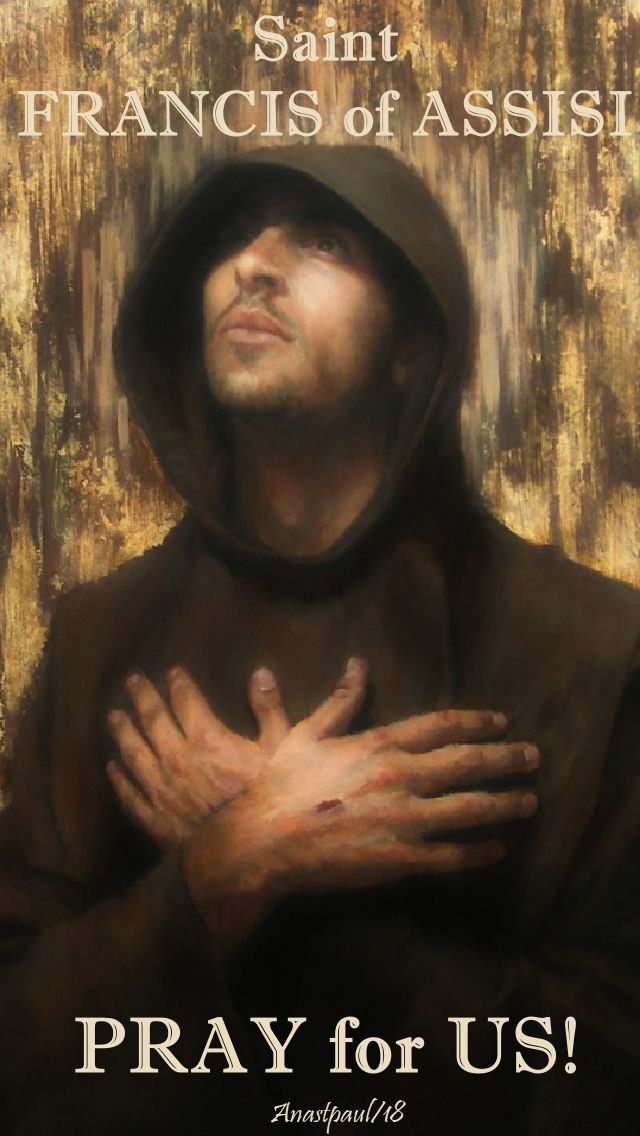
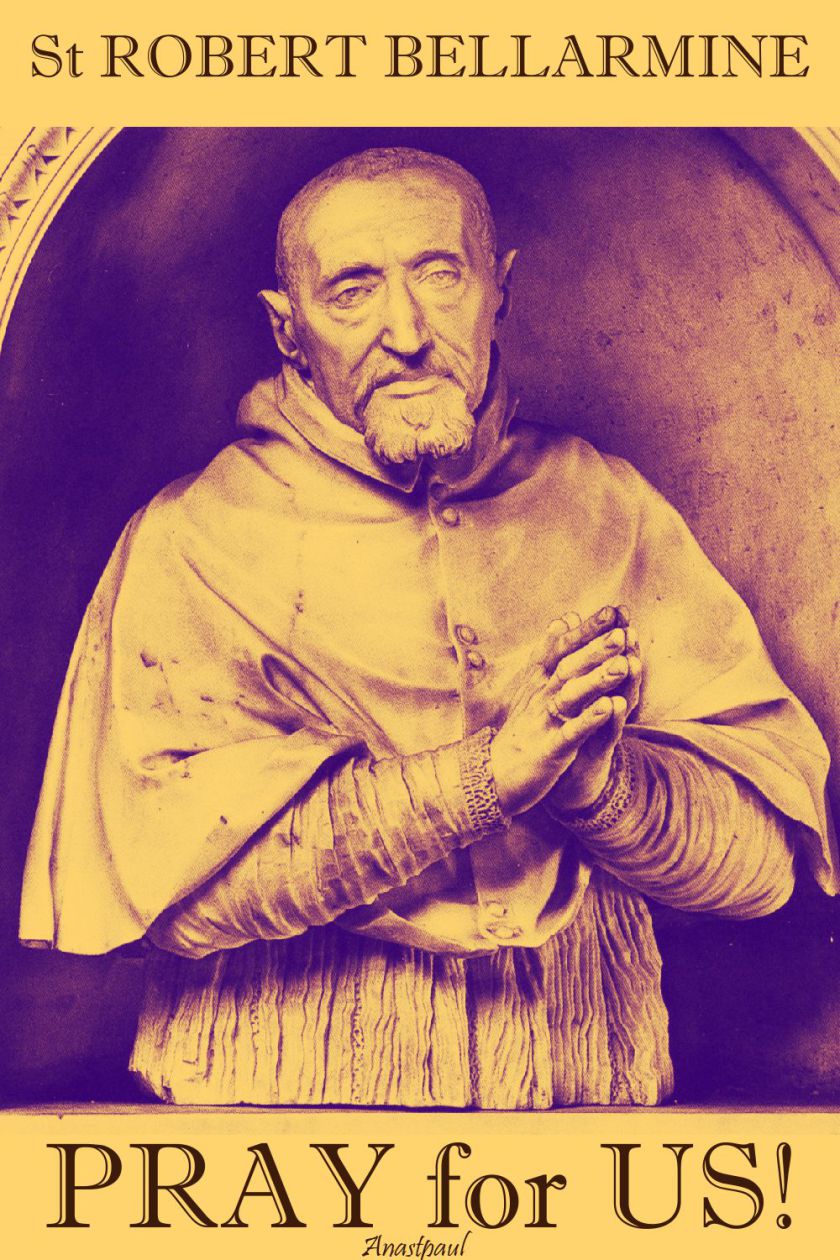
Thought for the Day – 17 September 2018 – The Memorial of Stigmata of St Francis of Assisi & St Robert Bellarmine SJ (1542-1621)
The glory of the Saints and of the Church never ceases to amaze me in every finer detail of the arrangement of our communal life together with them, thus confirming the presence of the Holy Spirit and the Divinity of this Mystical Body of Christ!
St Robert Bellarmine had a great devotion to St Francis of Assisi and was especially devoted to honouring Francis’ stigmata. Bellarmine urged that there be a special feast in honour of the five stigmata of St Francis. Bellarmine had an important position in the Vatican and he made sure that the feast was introduced in the Church, despite strong opposition.
As Providence arranged, Robert Bellarmine died on the feast of the Stigmata of St Francis, 17 September. And in the revised liturgical calendar St Bellarmine’s feast, which used to be celebrated on 13 May, has been moved to 17 September. In the Universal Church today is the feast of both!
St Francis of Assisi and St Robert Bellarmine, pray for us, your family here on earth and in great need of your prayers!
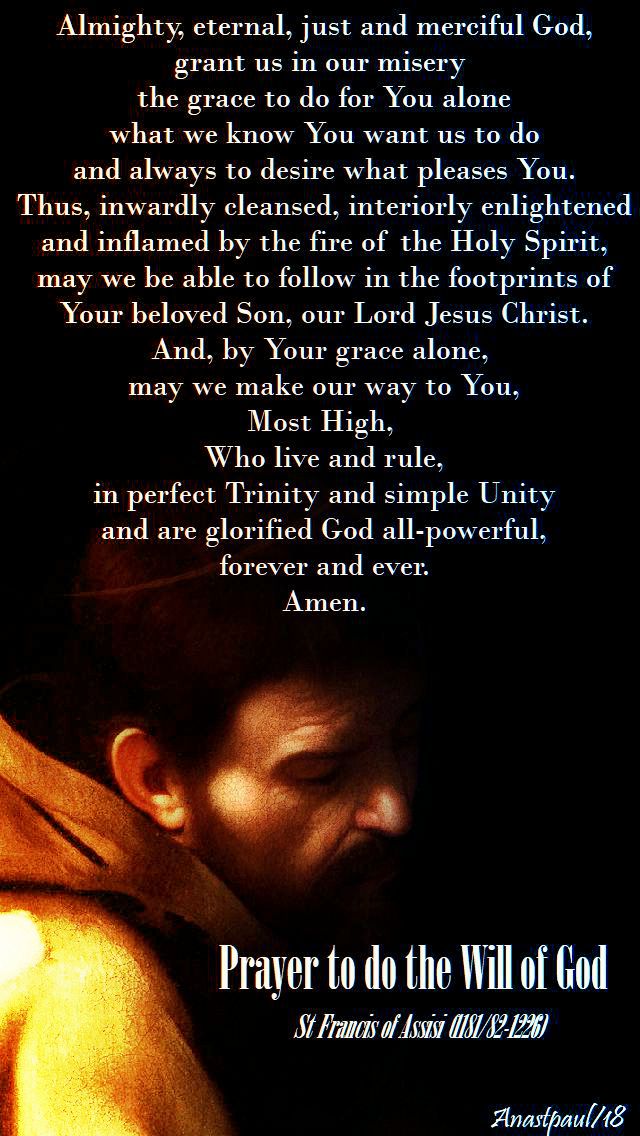
Prayer to do the Will of God By St Francis of Assisi (c 1181-1226)
Almighty, eternal, just and merciful God,
grant us in our misery, the grace to do for You alone
what we know You want us to do
and always to desire, what pleases You.
Thus, inwardly cleansed, interiorly enlightened
and inflamed by the fire of the Holy Spirit,
may we be able to follow in the footprints of
Your beloved Son, our Lord Jesus Christ.
And, by Your grace alone,
may we make our way to You,
Most High, Who live and rule in perfect Trinity and simple Unity
and are glorified God all-powerful, forever and ever.
Amen.
(From “A Letter to the Entire Order”)
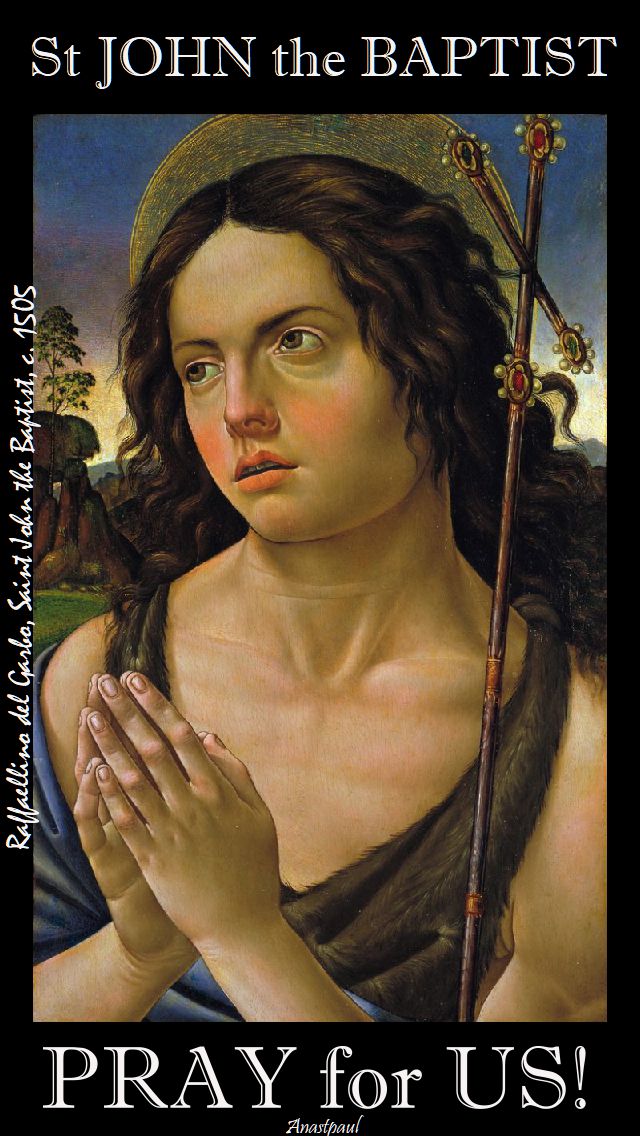
Thought for the Day – 29 August – The Memorial of the Beheading of St John the Baptist
The drunken oath of a king with a shallow sense of honour, a seductive dance and the hateful heart of a queen combined to bring about the martyrdom of John the Baptist. The greatest of prophets suffered the fate of so many Old Testament prophets before him: rejection and martyrdom. The “voice crying in the desert” did not hesitate to accuse the guilty, did not hesitate to speak the truth. But why? What possesses a man that he would give up his very life?
This great religious reformer was sent by God to prepare the people for the Messiah. His vocation was one of selfless giving. The only power that he claimed was the Spirit of yjr Lord. “I am baptizing you with water, for repentance but the one who is coming after me is mightier than I. I am not worthy to carry His sandals. He will baptise you with the Holy Spirit and fire” (Matthew 3:11).
Scripture tells us that many people followed John looking to him for hope, perhaps in anticipation of some great messianic power. John never allowed himself the false honour of receiving these people for his own glory. He knew his calling was one of preparation. When the time came, he led his disciples to Jesus: “The next day John was there again with two of his disciples and as he watched Jesus walk by, he said, ‘Behold, the Lamb of God.’ The two disciples heard what he said and followed Jesus” (John 1:35-37).
It is John the Baptist who has pointed the way to Christ. John’s life and death were a giving over of self for God and other people. His simple style of life was one of complete detachment from earthly possessions . His heart was lifted on God and the call that he heard from the Spirit of God speaking to his heart. Confident of God’s grace, he had the courage to speak words of condemnation, repentance, and salvation.
Each of us has a calling to which we must listen. No-one will ever repeat the mission of John and yet all of us are called to that very mission. It is the role of the Christian to witness to Jesus. Whatever our position in this world, we are called to be disciples of Christ. By our words and deeds, others should realise that we live in the joy of knowing that Jesus is Lord. We do not have to depend upon our own limited resources but can draw strength from the vastness of Christ’s saving grace.
One Minute Reflection – 26 August – 21st Sunday of the Year in Ordinary Time, Year B – Today’s Gospel: John 6:60–69
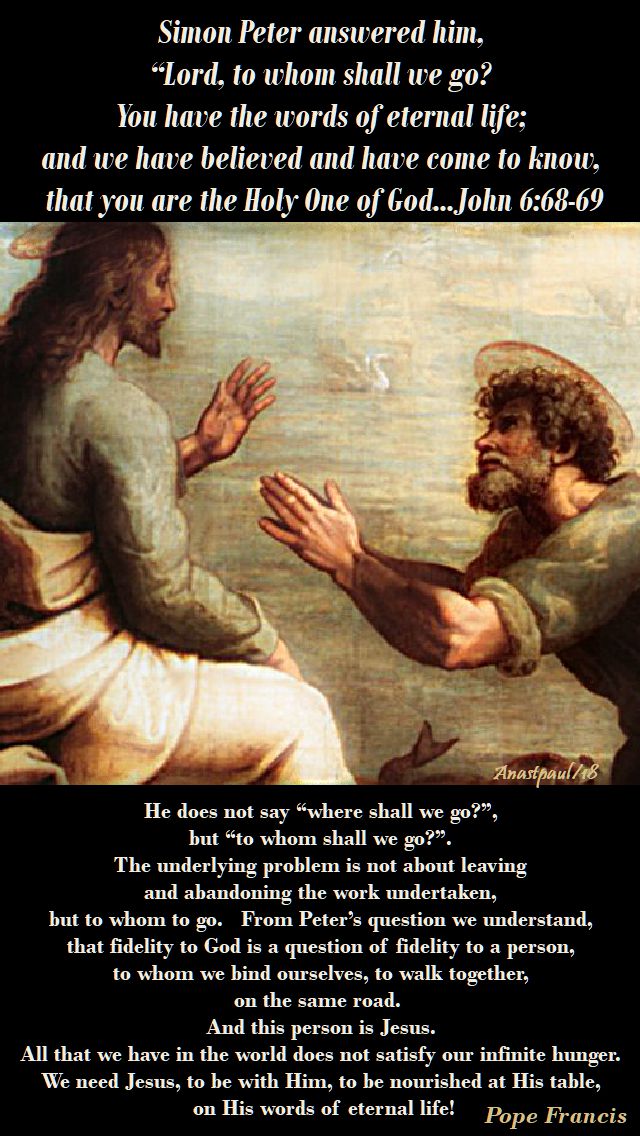
Simon Peter answered him, “Lord, to whom shall we go? You have the words of eternal life and we have believed, and have come to know, that you are the Holy One of God.”...John 6:68-69
REFLECTION – “He does not say “where shall we go?” but “to whom shall we go?” The underlying problem, is not about leaving and abandoning the work undertaken but to whom to go. From Peter’s question, we understand, that fidelity to God is a question of fidelity to a person, to whom we bind ourselves, to walk together on the same road. And this person is Jesus. All that we have in the world does not satisfy our infinite hunger. We need Jesus, to be with Him, to be nourished at His table, on His words of eternal life!”…Pope Francis (Angelus, 23 August 2015)
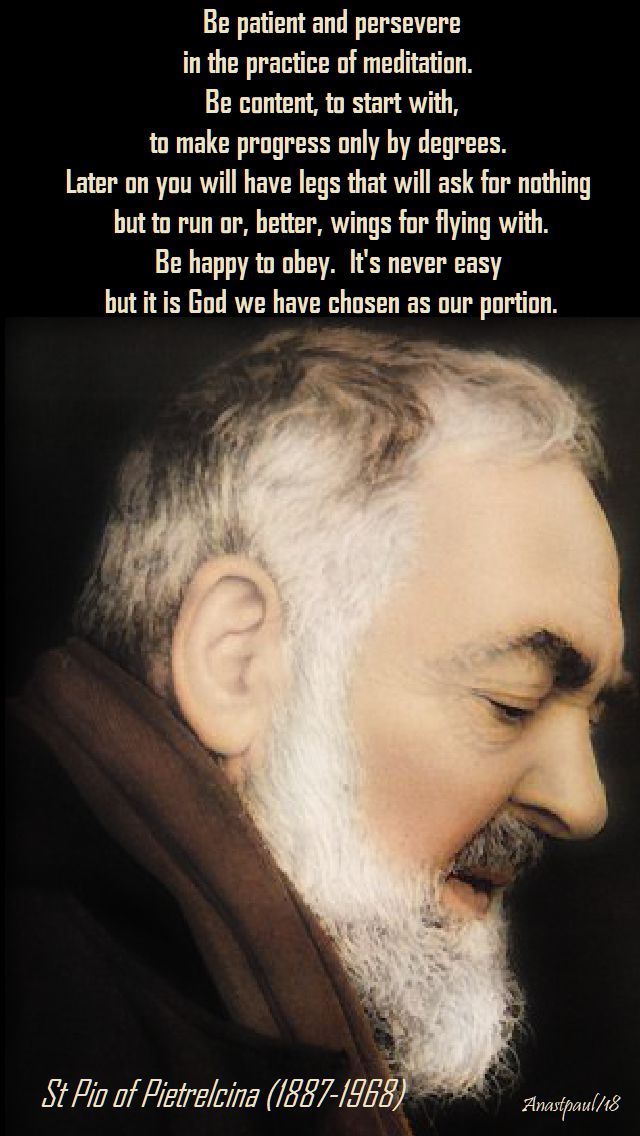
“Be patient and persevere in the practice of meditation. Be content, to start with, to make progress only by degrees. Later on you will have legs that will ask for nothing but to run or, better, wings for flying with.
Be happy to obey. It’s never easy but it is God we have chosen as our portion. Accept that, as yet, you are only a little bee in its nest but, very quickly, it will become one of those wonderful workers so skilful in making honey. Always remain humble before God and men, in love. Then our Lord will speak to you in truth and enrich you with His gifts.”…St Pio of Pietrelcina “Padre Pio” (1887-1968)
PRAYER – Lord, by Your grace, we are made one in mind and heart. Give us a love for what You command and a longing for what You promise, so that, amid this world’s changes, our hearts may be set on the world of lasting joy. May the intercession of Your faithful servant, St Pope Zephyrinus, bring us strength and courage. As it was Your will heavenly Father, that, at the angel’s message, Your Word should be conceived by the Blessed Virgin Mary, grant that as we believe her to be truly the Mother of God, so may we be helped always, by her intercession. Through our Lord, Jesus Christ, in union with the Holy Spirit, ‘totus tuus’ Maria – please pray for us, amen.
Our Morning Offering – 22 August – Memorial of The Queenship of Mary
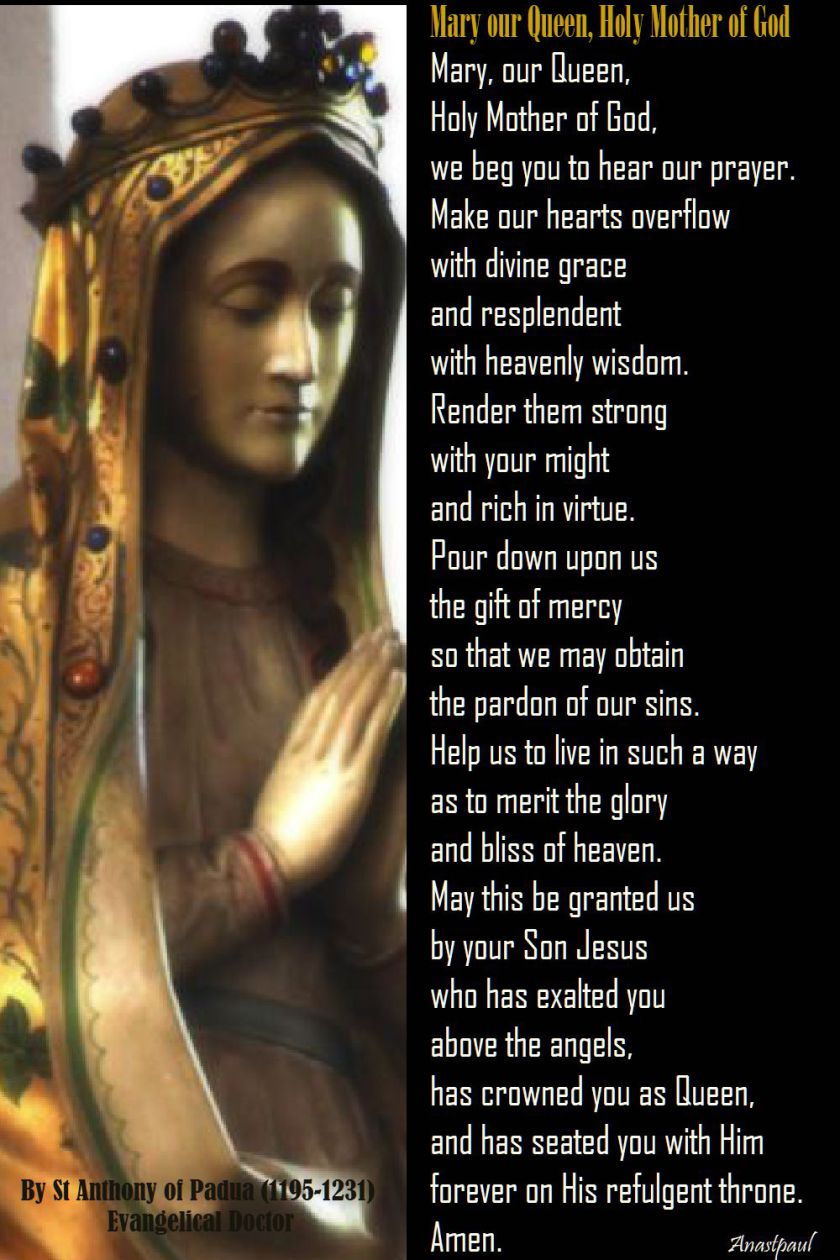
Mary our Queen, Holy Mother of God By St Anthony of Padua (1195-1231) Evangelical Doctor
Mary, our Queen,
Holy Mother of God,
we beg you to hear our prayer.
Make our hearts overflow with divine grace
and resplendent with heavenly wisdom.
Render them strong with your might
and rich in virtue.
Pour down upon us the gift of mercy
so that we may obtain the pardon of our sins.
Help us to live in such a way
as to merit the glory and bliss of heaven.
May this be granted us by your Son Jesus
who has exalted you above the angels,
has crowned you as Queen,
and has seated you with Him
forever on His refulgent throne.
Amen.
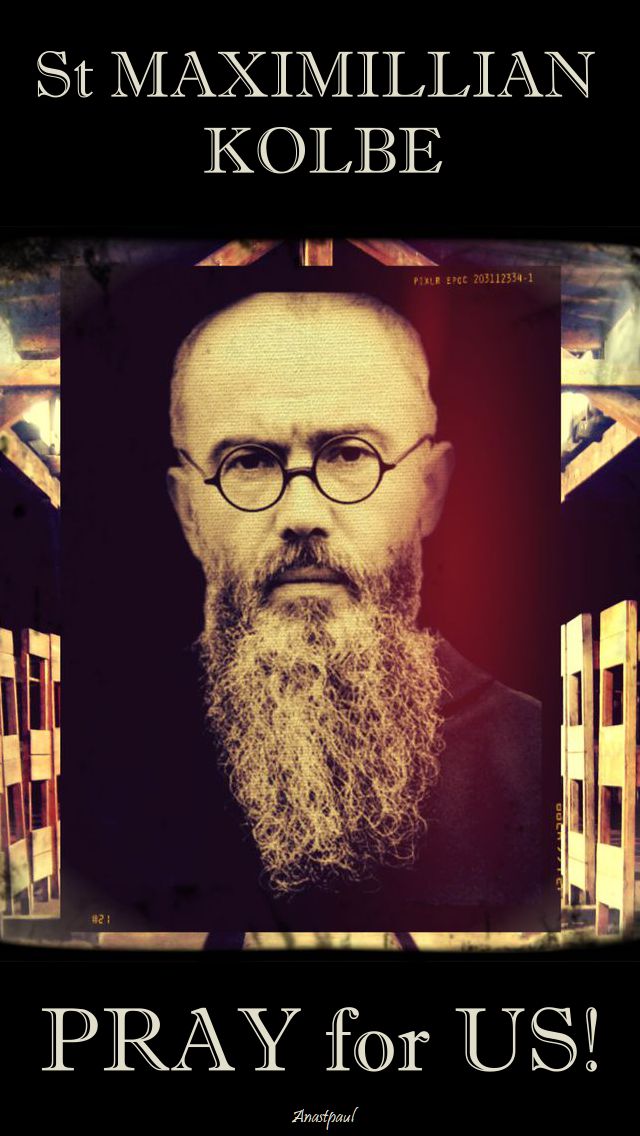
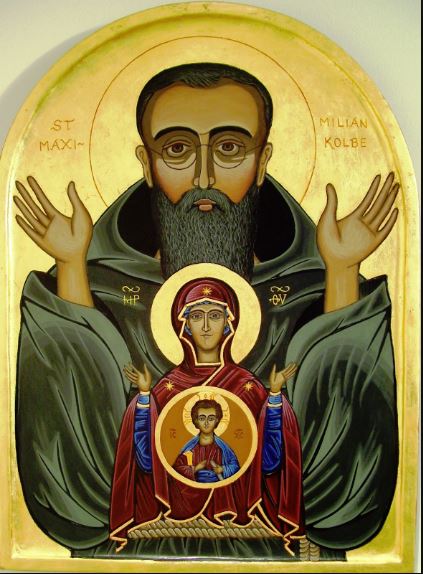
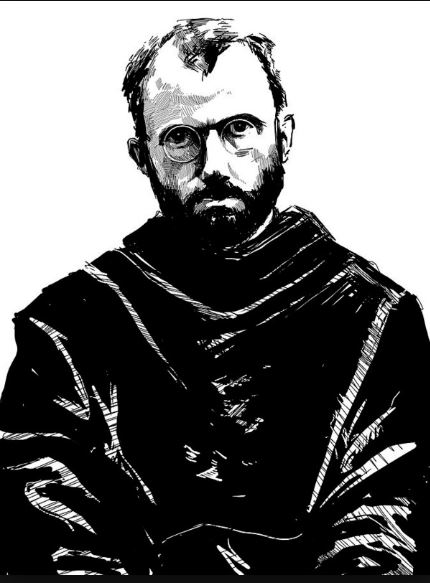
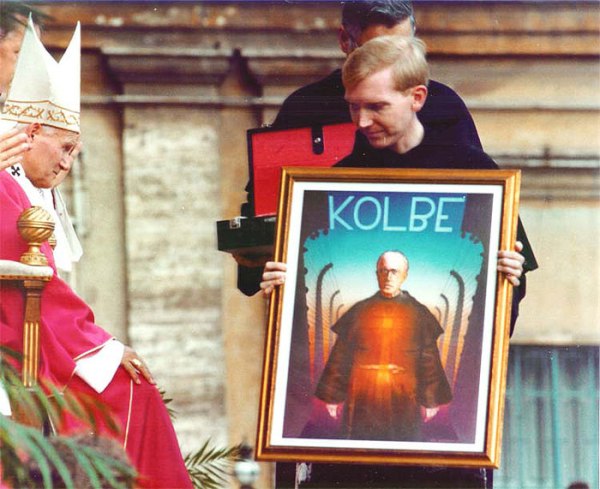
Thought for the Day – 14 August – The Memorial of St Maximillian Kolbe OFM Conv (1894 -1941) “Martyr of Charity”and “Apostle of Consecration to Mary”
“Greater love than this no man hath, that a man lay down his life for his friends.”
John 15:13
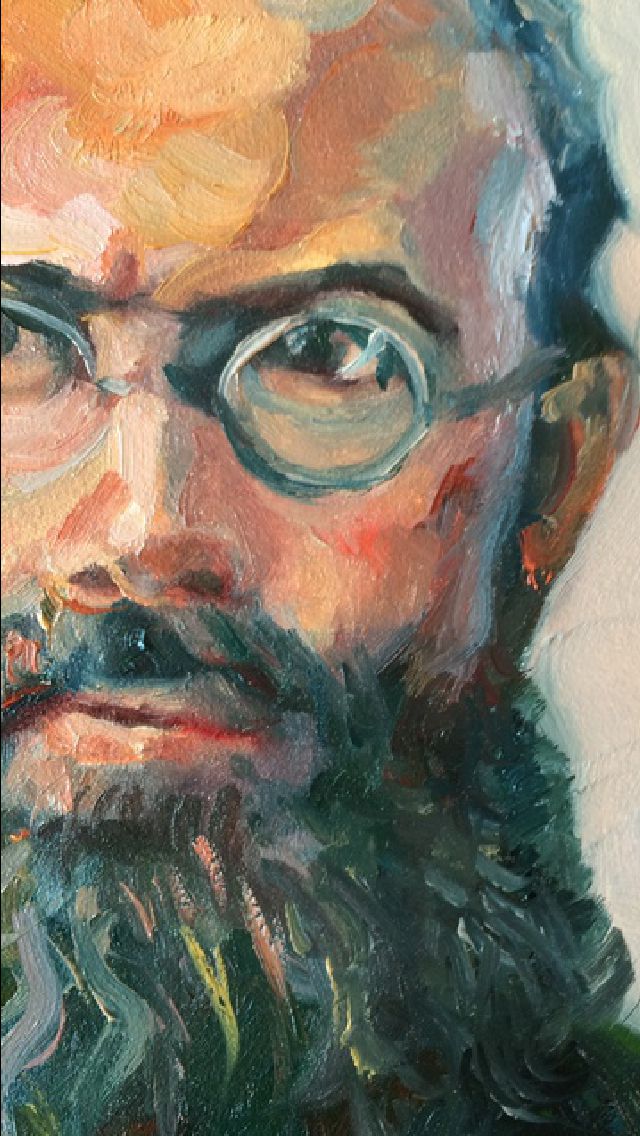
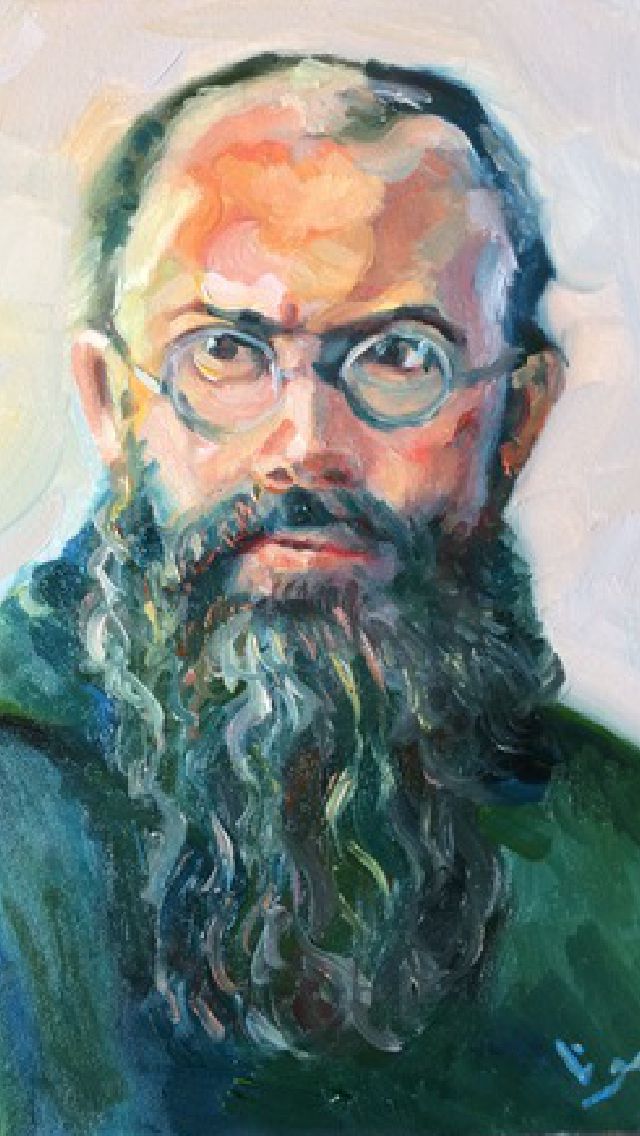
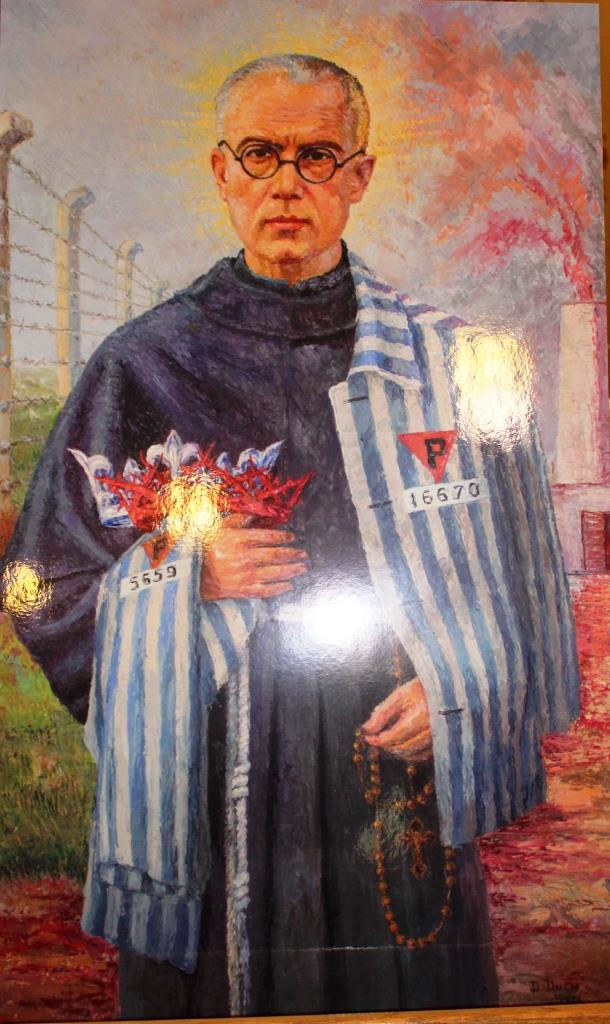
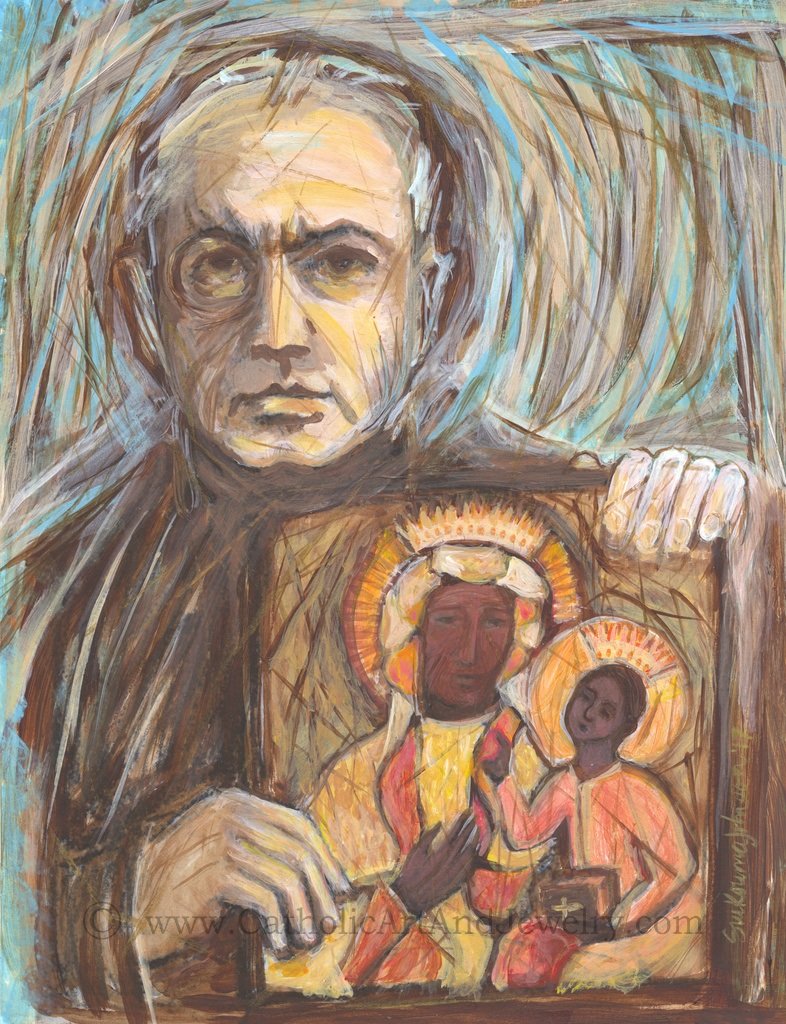
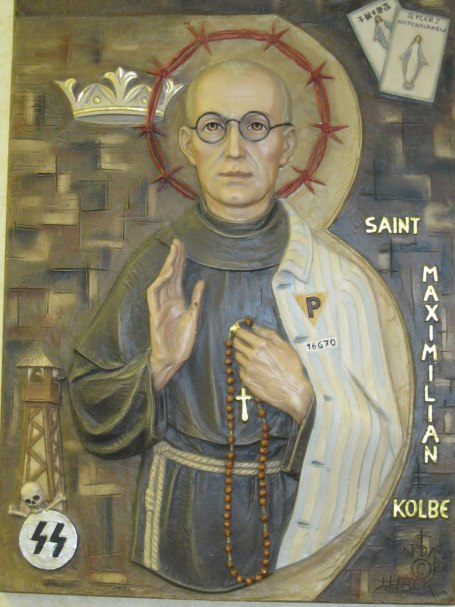
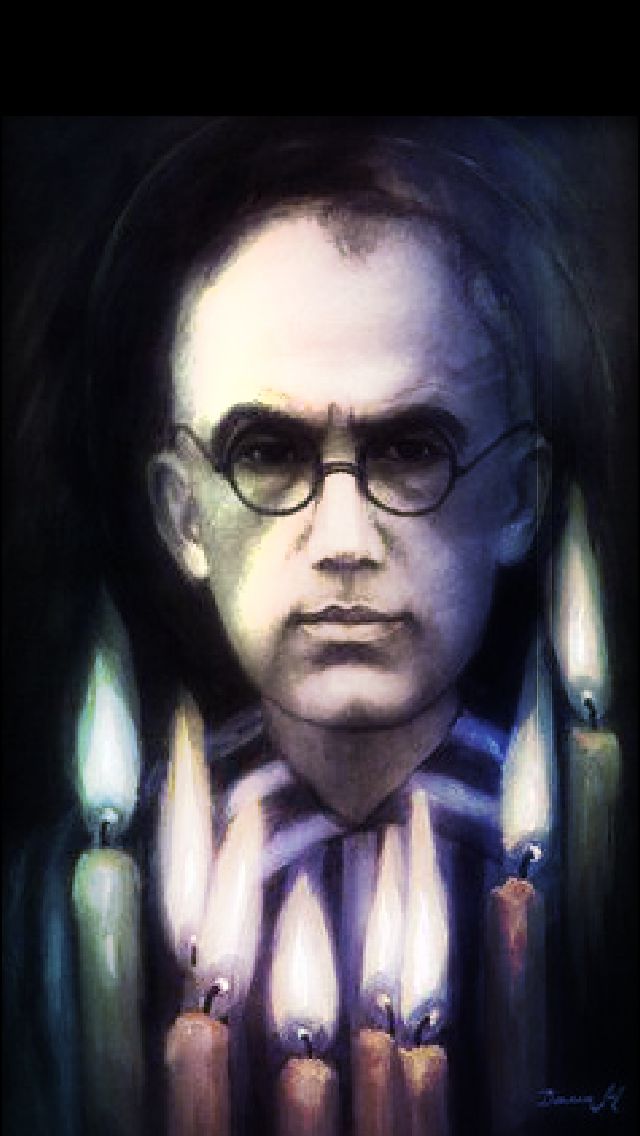
That verse certainly comes to mind whenever I think of St Maximilian Kolbe, whose feast we celebrate today. So it’s not surprising to read that these were the opening words of the papal decree introducing his Beatification. St Maximilian Kolbe was arrested in Poland in February of 1941 and in May sent to the Auschwitz death camp. As prisoner #16670, he eventually laid down his life for another prisoner on 14 August 1941, at the young age of 47.
Father Kolbe’s death was not a sudden, last-minute act of heroism. His whole life had been a preparation. His holiness was a limitless, passionate desire to convert the whole world to God. And his beloved Immaculata, was his inspiration.
St Maximillian is the patron saint of families, prisoners, journalists, political prisoners, drug addicts and the pro-life movement. St John Paul II declared him to be “the patron saint of our difficult century.” The evils which made the twentieth century so difficult were not left behind as we moved into the twenty-first century.
Let us continue to call upon the intercession of this saint and continue to come to Jesus through His mother, Mary, the Immaculata.
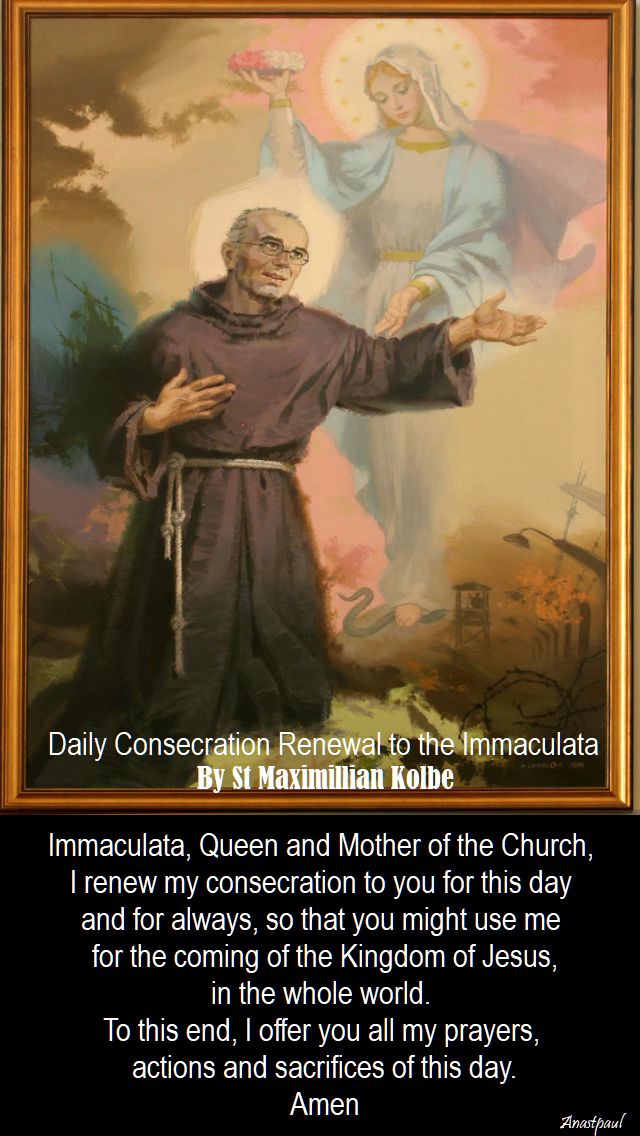
Daily Consecration Renewal to the Immaculata By St Maximillian Kolbe
Immaculata, Queen and Mother of the Church,
I renew my consecration to you for this day
and for always, so that you might use me
for the coming of the Kingdom of Jesus in the whole world.
To this end, I offer you all my prayers,
actions and sacrifices of this day.
Amen
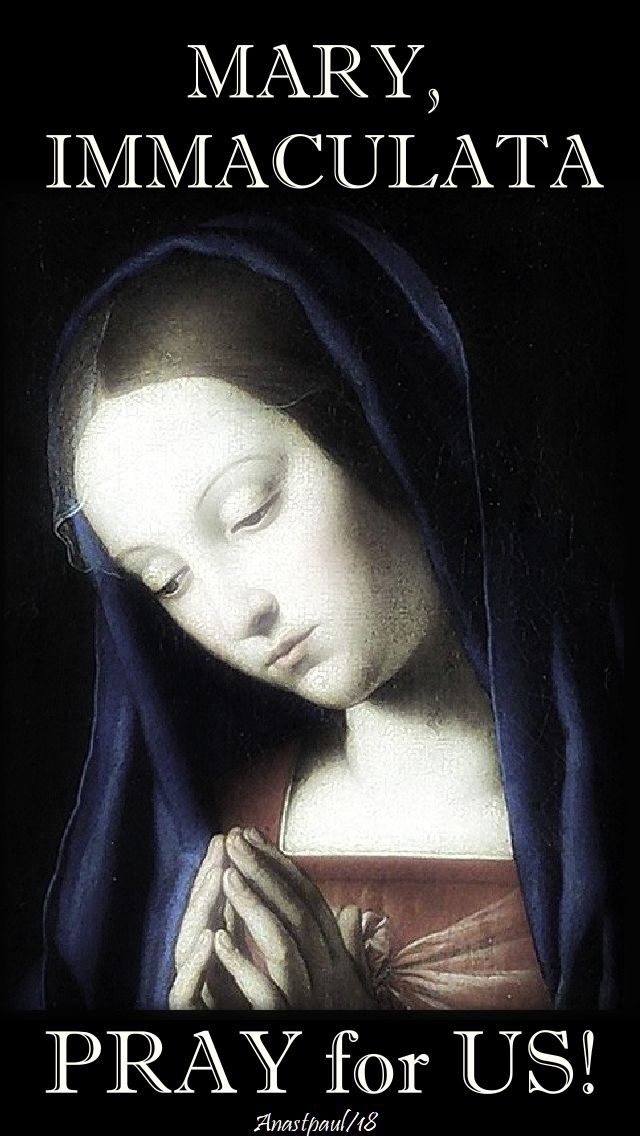
Mary, Immaculata, Pray for us!
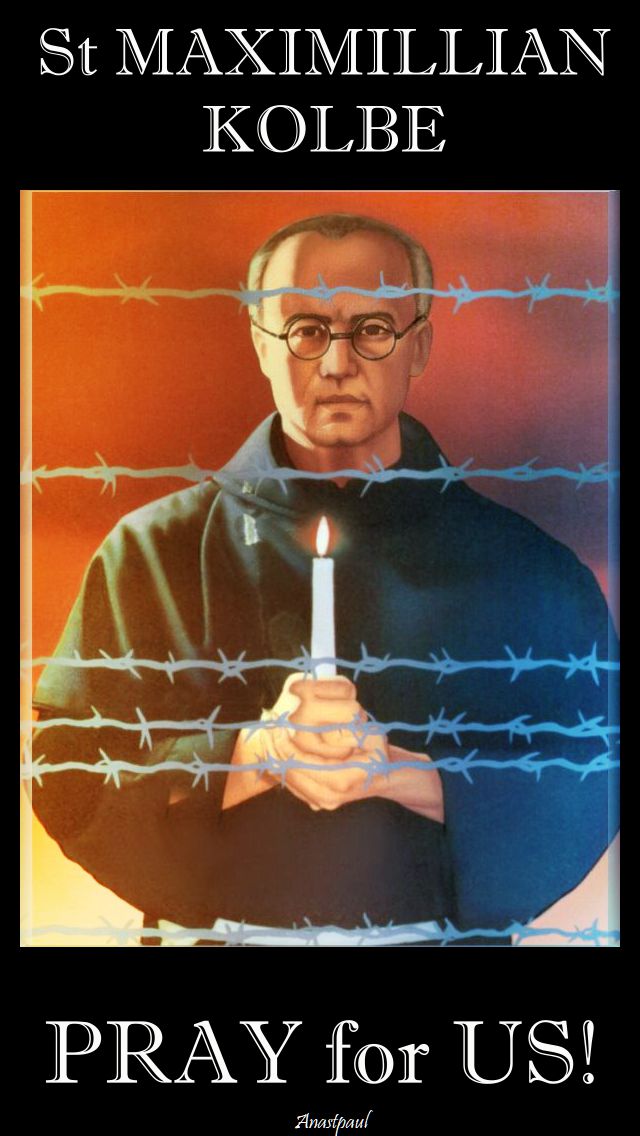
St Maximillian Kolbe, pray for us!
Quote/s of the Day – 14 August – The Memorial of St Maximillian Kolbe OFM Conv (1894 -1941) “Martyr of Charity”and “Apostle of Consecration to Mary”
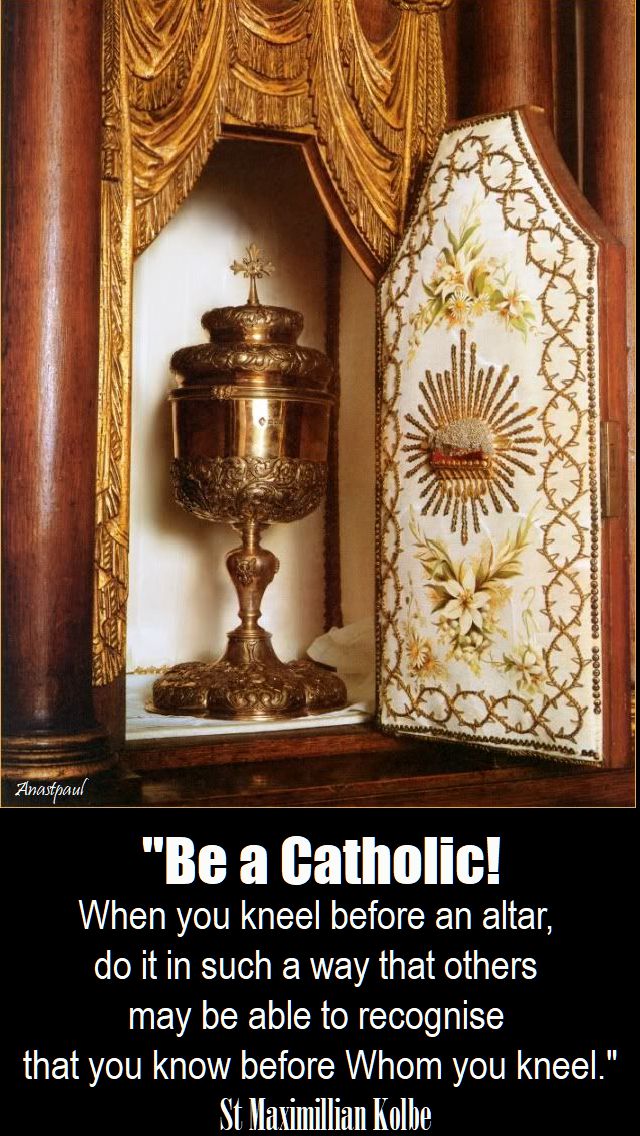
“Be a Catholic! When you kneel before an altar, do it in such a way that others may be able to recognise that you know before Whom you kneel.”
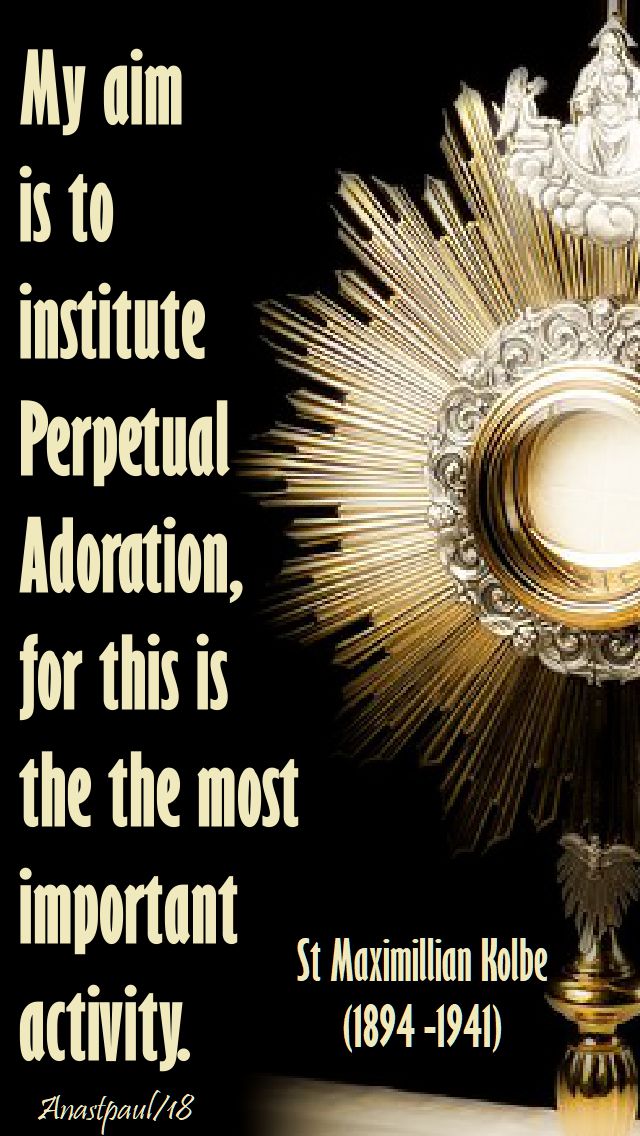
“My aim is to institute Perpetual Adoration, for this is the the most important activity.”
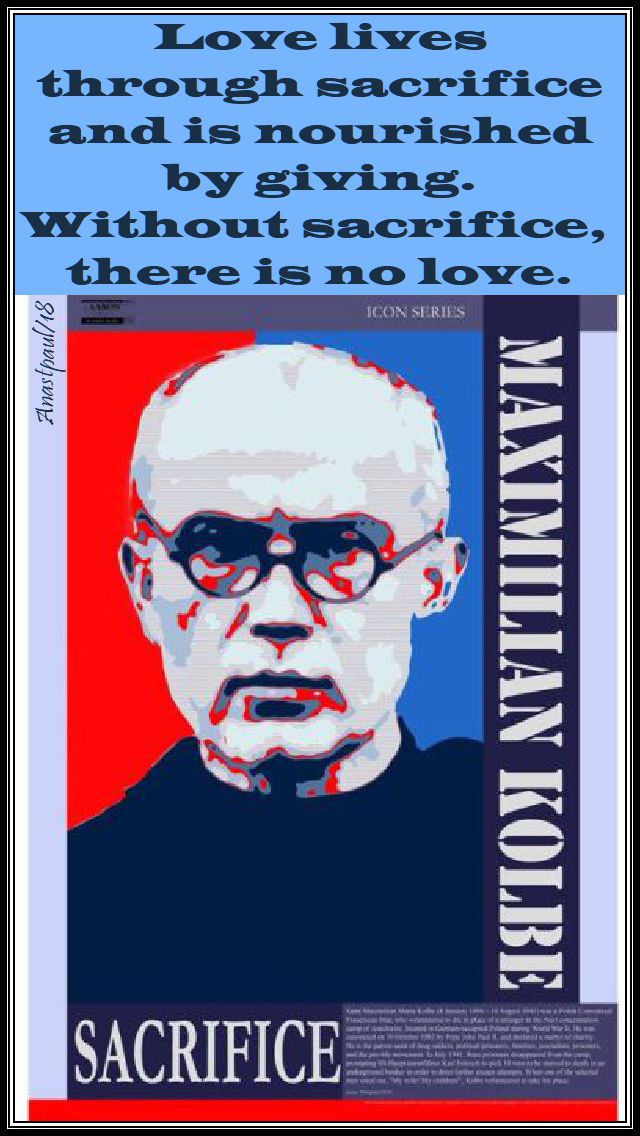
“Let us remember, that love lives through sacrifice and is nourished by giving. Without sacrifice, there is no love.”
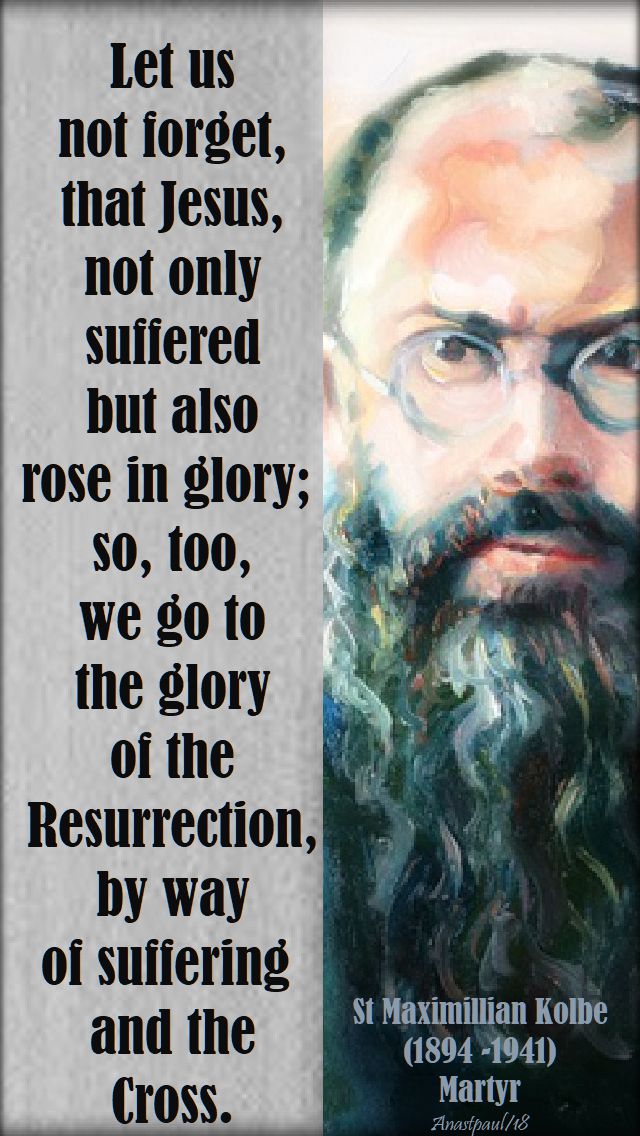
“Let us not forget, that Jesus not only suffered but also rose in glory; so, too, we go to the glory of the Resurrection, by way of suffering and the Cross.”
“Let us give ourselves to the Immaculata. Let her prepare us, let her receive Him in Holy Communion. This is the manner most perfect and pleasing to the Lord Jesus and brings great fruit to us.” Because “the Immaculata knows the secret, how to unite ourselves totally with the heart of the Lord Jesus…”
“We do not limit ourselves in love. We want to love the Lord Jesus, with her heart, or rather, that she would love the Lord, with our heart.”
One Minute Reflection – 14 August – The Memorial of St Maximillian Kolbe OFM Conv (1894 -1941) “Martyr of Charity”and “Apostle of Consecration to Mary”
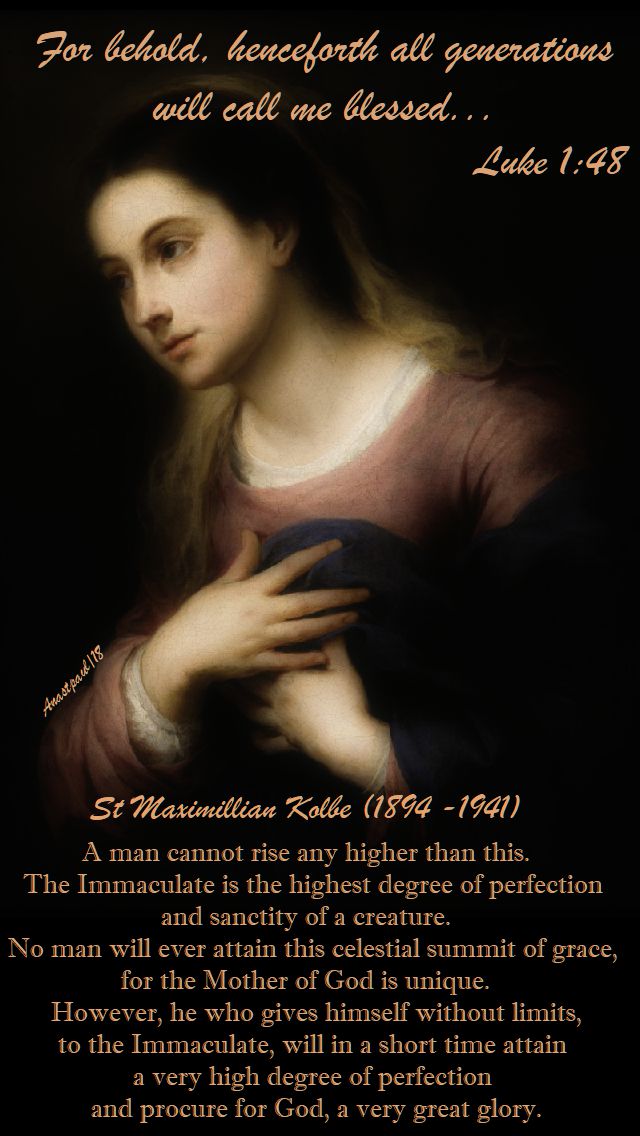
For behold, henceforth all generations will call me blessed…Luke 1:48
REFLECTION – “A man cannot rise any higher than this. The Immaculate is the highest degree of perfection and sanctity of a creature. No man will ever attain this celestial summit of grace, for the Mother of God is unique. However, he who gives himself without limits, to the Immaculate, will in a short time attain a very high degree of perfection and procure for God, a very great glory.”…St Maximillian Kolbe
PRAYER – My Lord and my God, You who are the fruit of Mary’s blessed womb and the most Divine Son of our Father, grant that we may always have recourse to You, through her who bore You. Grant that she may help and comforus me and lead us to You. Mary, Holy and loving Mother of God, pray for us all. Grant O Lord, that through the intercession of St Maximillian, we may entrust ourselves to You through Your and our blessed Mother, amen.
Our Morning Offering – 14 August – The Memorial of St Maximillian Kolbe OFM Conv (1894 -1941) “Martyr of Charity”
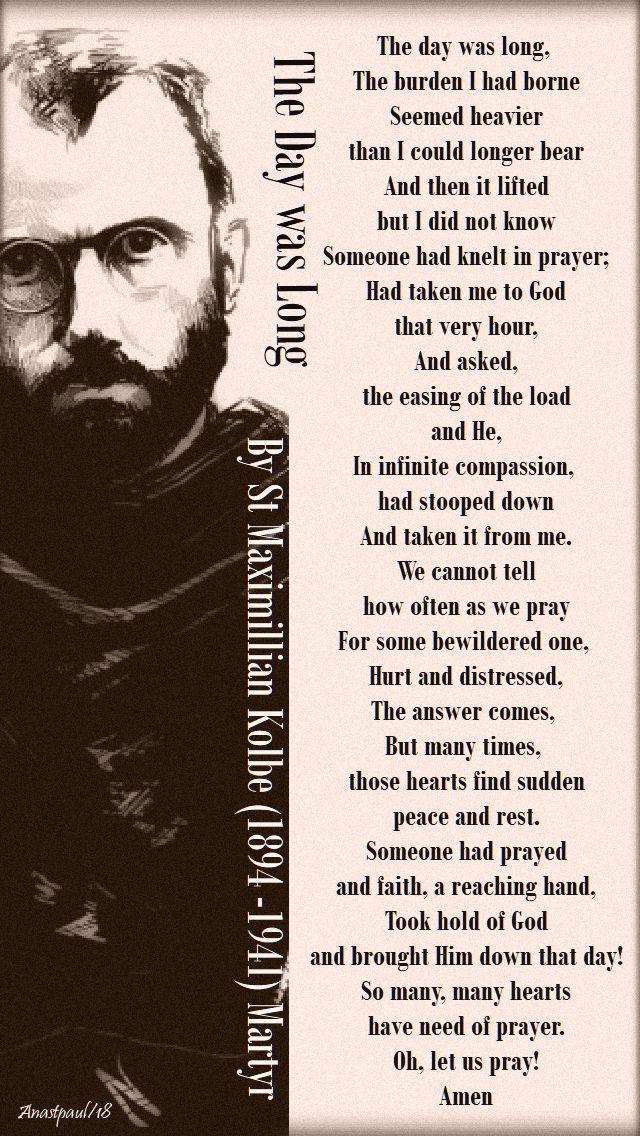
The Day was Long By St Maximillian Kolbe (1894 -1941) Martyr
The day was long,
The burden I had borne
Seemed heavier than I could longer bear
And then it lifted
but I did not know
Someone had knelt in prayer;
Had taken me to God that very hour,
And asked the easing of the load
and He,
In infinite compassion,
had stooped down
And taken it from me.
We cannot tell how often as we pray
For some bewildered one,
Hurt and distressed,
The answer comes,
But many times,
those hearts find sudden peace and rest.
Someone had prayed
and faith, a reaching hand,
Took hold of God
and brought Him down that day!
So many, many hearts have need of prayer.
Oh, let us pray!
Amen
Saint of the Day – 14 August – St Maximilian Kolbe, Priest and Martyr (1894-1941) Prisoner 16670 – “Martyr of Charity”, “Apostle of Consecration to Mary”.
Raymond Kolbe was born on the 8th of January 1894 in Zdunska Wola, which at that time was occupied by Russia. The Kolbe home was poor but full of love. The parents, hardworking and religious, educated their three sons with rectitude.
Around 1906, an event took place that marks a fundamental milestone in the life of the young boy. His mother herself related the event a few months after her son’s martyrdom.
“I knew ahead of time, based on an extraordinary event that took place in his infancy, that Maximilian would die a martyr. I just don’t recall if it took place before or after his first confession. Once I did not like one of his pranks and I reproached him for it: ‘My son, what ever will become of you?!’ Later, I did not think of it again but I noticed that the boy had changed so radically, he was hardly recognisable. We had a small altar hidden between two dressers before which he used to often retire without being noticed and he would pray there crying. In general, he had a conduct superior to his age, always recollected and serious and when he prayed he would burst into tears. I was worried, thinking he had some sort of illness so I asked him: ‘Is there anything wrong? You should share everything with your mommy!’ Trembling with emotion and with his eyes flooded in tears, he shared: ‘Mama, when you reproached me, I pleaded with the Blessed Mother to tell me what would become of me. At Church I did the same, I prayed the same thing again. So then the Blessed Mother appeared to me holding in her hands two crowns: one white the other red. She looked at me with tenderness and asked me if I wanted these two crowns. The white one signified that I would preserve my purity and the red that I would be a martyr. I answered that I accepted them…(both of them). Then the Virgin Mary looked at me with sweetness and disappeared.’ The extraordinary change in the boys’ behaviour testified to me the truth of what he related. He was fully conscious and as he spoke to me, with his face radiatin,; it showed me his desire to die a martyr.”
When he was 13 years old he entered the Franciscan Fathers Seminary in the polish city of Lvov, which was at that time occupied by Austria. It was in the seminary where he adopted the name Maximilian. He completed his studies in Rome. Before his ordination as a priest in 1918, Maximilian founded the Immaculata Movement devoted to our Lady. He spread the movement through a magazine entitled “The Knight of the Immaculata”.“We should conquer the universe and each soul, now and in the future until the end of time, for the Immaculata and through her for the Sacred Heart of Jesus.”(St Maximilian Maria Kolbe, The Knight of the Immaculata)
Maximilian went to Japan and then on to India where he furthered the Movement. After a few years in Japan, St Maximilian was summoned back to Poland, largely due to his ever-declining health.
Three years later, in the midst of the Second World War, he was imprisoned along with other friars and sent to concentration camps in Germany and Poland. In February of 1941 he was again made a prisoner and sent to the concentration camp in Auschwitz, where in spite of the terrible living conditions he continued his ministry.
On 31 July 1941, in reprisal for one prisoner’s escape, ten men were chosen to die. Father Kolbe offered himself in place of a young husband and father. And he was the last to die, enduring two weeks of starvation, thirst and neglect. He was Canonised by St Pope John Paul II in 1982 as a Martyr of Charity.
St Maximillian Kolbe OFM Conv (1894 -1941) “Martyr of Charity” (Memorial)
Full Biography here: https://anastpaul.wordpress.com/2017/08/14/saint-of-the-day-14-august-st-maximillian-kolbe-ofm-conv-martyr-of-charity-and-apostle-of-consecration-to-mary/
Bl Aimo Taparelli
St Antony Primaldo
St Arnulf of Soissons
St Athanasia of Timia
St Callistus of Todi
St Demetrius of Africa
St Domingo Ibáñez de Erquicia
St Eberhard of Einsiedeln
St Eusebius of Palestine
St Eusebius of Rome
St Fachanan of Ross
St Francisco Shoyemon
Bl Juliana Puricelli
St Marcellus of Apamea
Bl Sanctes Brancasino
St Ursicius of Nicomedia
St Werenfridus
__
Martyred in the Spanish Civil War: 11 Beati
• Blessed Ángel de la Red Pérez
• Blessed Antonio María Martín Povea
• Blessed Basilio González Herrero
• Blessed Ezequiél Prieto Otero
• Blessed Félix Yuste Cava
• Blessed Joaquín Frade Eiras
• Blessed Jocund Bonet Mercadé
• Blessed José García Librán
• Blessed Ricardo Atanes Castro
• Blessed Segundo Pérez Arias
• Blessed Vicente Rubiols Castelló
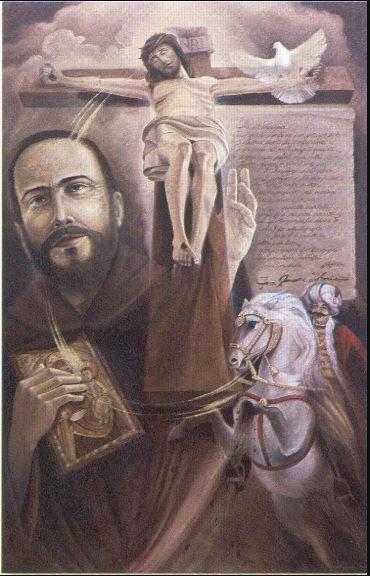
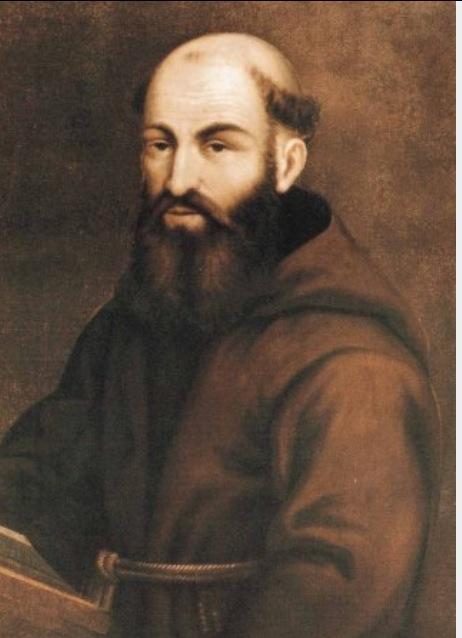
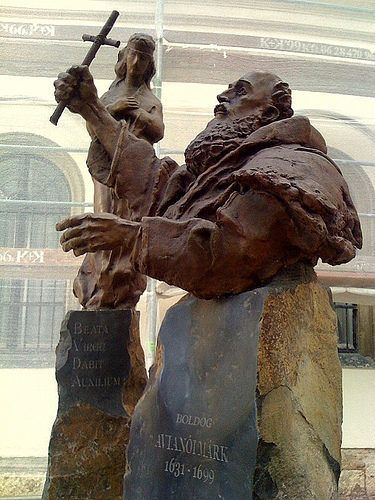
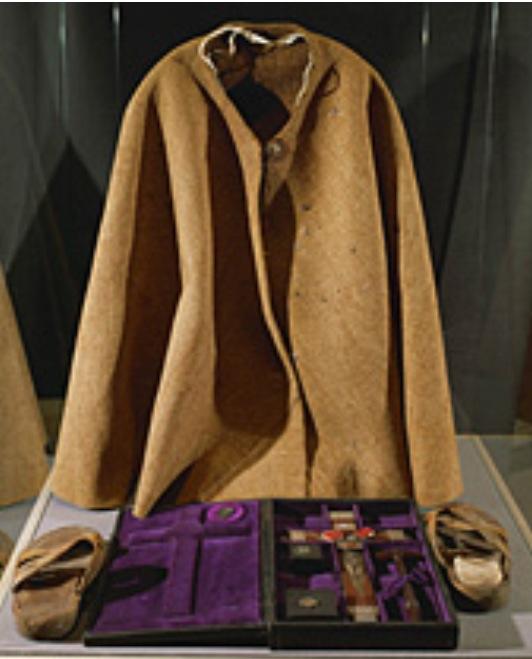
Saint of the Day – 13 August – Blessed Mark of Aviano OFM Cap (1631-1699) – Franciscan Capuchin Friar, Priest, Preacher, Spiritual Advisor, Political Advisor, Peace-maker, Miracle worker and the inventor of Cappuccino– born on 17 November 1631 at Aviano, Italy as Carlo Domenico Cristofori and died on 13 August 1699 of cancer in Vienna, Austria.
Carlo Domenico Cristofori was born in Aviano, a small community in the Republic of Venice (Italy). Educated at the Jesuit College in Gorizia, at 16 he tried to reach the island of Crete, where the Venetians were at war with the Ottoman Turks, in order to preach the Gospel and convert the Muslims to Christianity. On his way, he sought asylum at a Capuchin convent in Capodistria, where he was welcomed by the Superior, who knew his family and who, after providing him with food and rest, advised him to return home.
Inspired by his encounter with the Capuchins, he felt that God was calling him to enter their Order. In 1648, he began his novitiate. A year later, he professed his vows and took his father’s name, Marco, becoming Fra’ Marco d’Aviano. On 18 September 1655 he was ordained a priest in Chioggia. His ministry entered a new phase in 1664, when he received a licence to preach throughout the Republic of Venice and other Italian states, particularly during Advent and Lent. He was also given more responsibility when he was elected Superior of the convents of Belluno in 1672 and Oderzo in 1674.
His life took an unexpected turn in 1676, when he gave his blessing to a nun, bedridden for some 13 years, she was miraculously healed. The news spread far and wide and it was not long before the sick and many others from all social strata, began to seek him out.
Among those who sought his help was Leopold I, Holy Roman Emperor, whose wife had been unable to conceive a male heir. From 1680 to the end of his life, Marco d’Aviano became a close confidant and adviser to him, providing the irresolute and often indecisive emperor with guidance and advice for all problems, political, economic, military or spiritual. His forceful, energetic and sometimes passionate and fiery personality proved a good complement for Leopold’s Hamlet-like tendency to allow endless doubts and scruples to paralyse his capacity for action.
As the danger of war with the Ottoman Turks grew near, Marco d’Aviano was appointed by Pope Innocent XI (Memorial yesterday) as his personal envoy to the Emperor. An impassioned preacher and a skillful mediator, Marco d’Aviano played a crucial role in resolving disputes, restoring unity and energising the armies of the Holy League, which included Austria, Poland, Venice and the Papal States under the leadership of the Polish king Jan III Sobieski. In the decisive Battle of Vienna (1683), the Holy League succeeded in inflicting a defeat on the invading Ottoman Turks. This marked the end of the last Turkish attempt to expand their power in Europe and the beginning of the long European counter-offensive that was to continue ultimately until the disintegration of the Ottoman Empire in 1918. This may therefore be considered one of the decisive battles of history. It also put an end to the period of Ottoman revival in Europe.
From 1683 to 1689 Marco participated in the military campaigns, playing a crucial role in promoting good relations within the Imperial army and encouraging the soldiers. He was present at the liberation of Buda in 1686 and at the siege of Belgrade in 1688. He always maintained a strictly religious spirit, to which any violence and cruelty were repugnant. As a result, at the siege of Belgrade several hundred Muslim soldiers successfully appealed to him personally, in order to avoid being massacred upon capture.
In the 2012 Polish and Italian historical drama film The Day of the Siege: September Eleven 1683 about the Battle of Vienna, Marco d’Aviano is portrayed by F. Murray Abraham.
Legend has it that when the Ottomans fled before the European army, they left behind a lot of their strong, bitter coffee. The Christian soldiers, to make this liberated coffee more palatable, mixed it with honey and milk and named the drink after Mark’s Order, the Capuchins and thus Cappuccino was created. It is probably just a fable but I favour believing it, allowing the reminder of a quick prayer to Blessed Mark whenever I drink one. We can never have too many intercessors, can we?
In the judgement of historians, Marco’s influence over Leopold was exercised responsibly, in the sole interests of Christianity and of the House of Austria. In one of his private letters to the Emperor, Marco actually scolds him quite forcefully for granting a benefit to one of his brothers, reminding him that, by so doing, he was only providing ammunition for the enemies of their cause.
Blessed Mark died of cancer on August 13, 1699 in Vienna. He is buried in the Kapuzinerkirche, in whose vault the Habsburg emperors are buried. He was Beatified on 27 April 2003 by St Pope John Paul II.
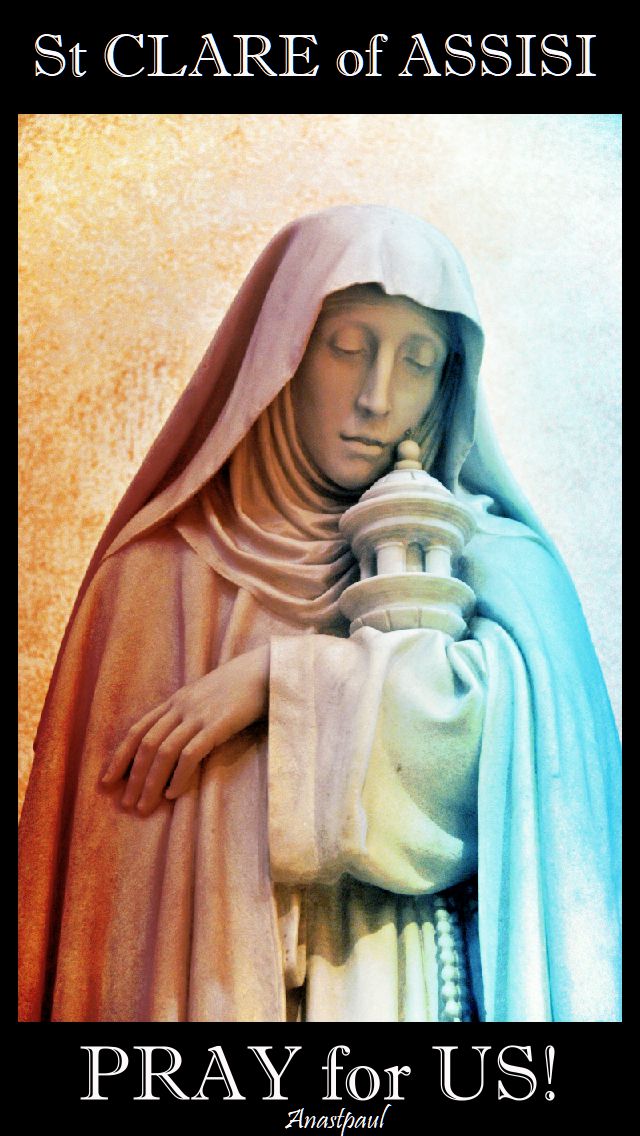
Quote/s of the Day – 11 August – The Memorial of St Clare of Assisi (1194-1253)
“We become what we love and who we love shapes what we become. If we love things, we become a thing. If we love nothing, we become nothing. Imitation is not a literal mimicking of Christ, rather it means becoming the image of the beloved, an image disclosed through transformation. This means we are to become vessels of God’s compassionate love for others.”
St Clare’s second letter to Blessed Agnes of Prague
“ Blessed be You, O God, for having created me. ”
St Clare’s Last Words
“Cling to His most sweet Mother, who carried a Son whom the heavens could not contain; and yet she carried Him in the little enclosure of her holy womb and held Him on her virginal lap.”
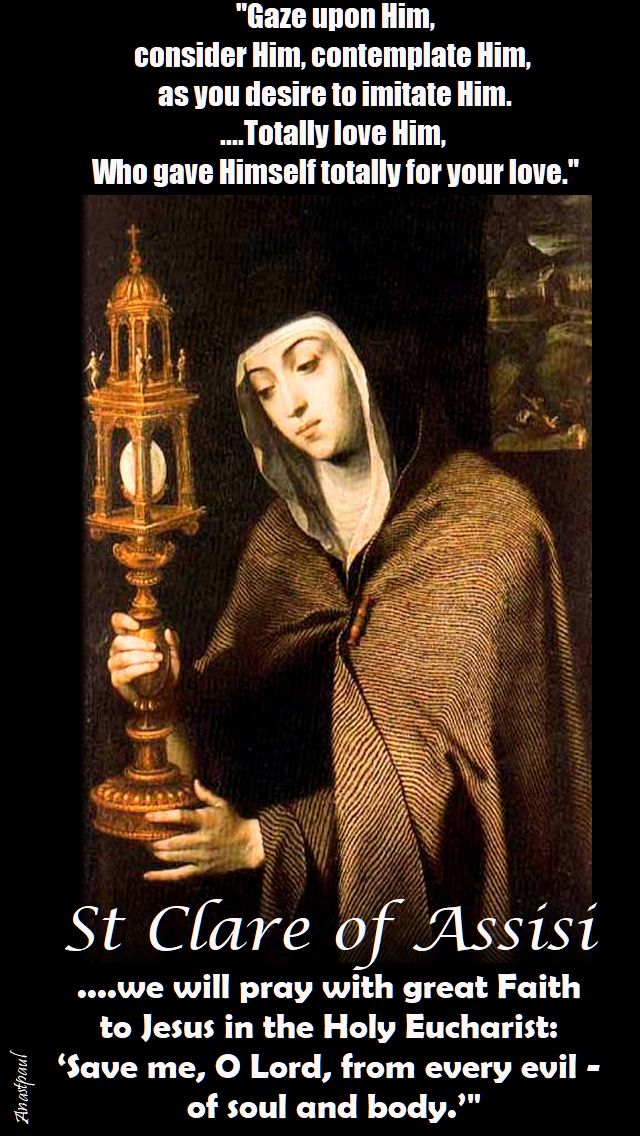
“Gaze upon Him, consider Him, contemplate Him, as you desire to imitate Him. ….Totally love Him, Who gave Himself totally for your love.”
“They say that we are too poor but can a heart which possesses the infinite God be truly called poor? We should remember this miracle of the Blessed Sacrament when in Church. Then we will pray with great Faith to Jesus in the Holy Eucharist: ‘Save me, O Lord, from every evil – of soul and body.’”
St Clare of Assisi (1194-1253)
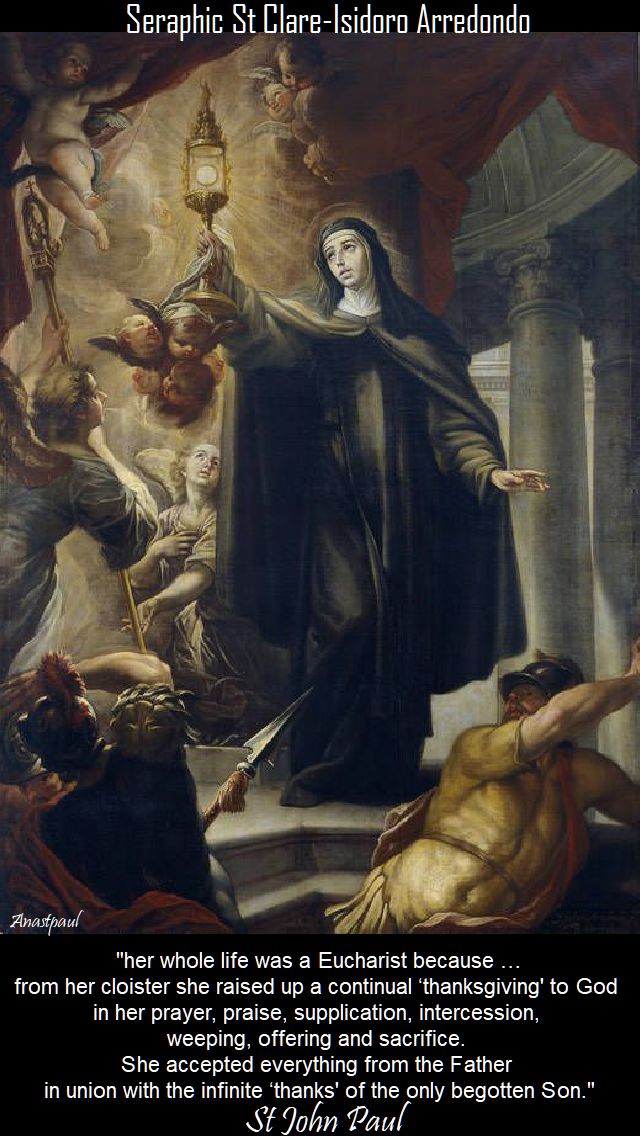
St Pope John Paul II said of Saint Clare: “her whole life was a Eucharist because … from her cloister she raised up a continual ‘thanksgiving’ to God in her prayer, praise, supplication, intercession, weeping, offering and sacrifice.
She accepted everything from the Father in union with the infinite ‘thanks’ of the only begotten Son.”
One Minute Reflection – 11 August – Saturday of the Eighteenth week in Ordinary Time, Year B – Today’s Gospel: Matthew 17:14–20
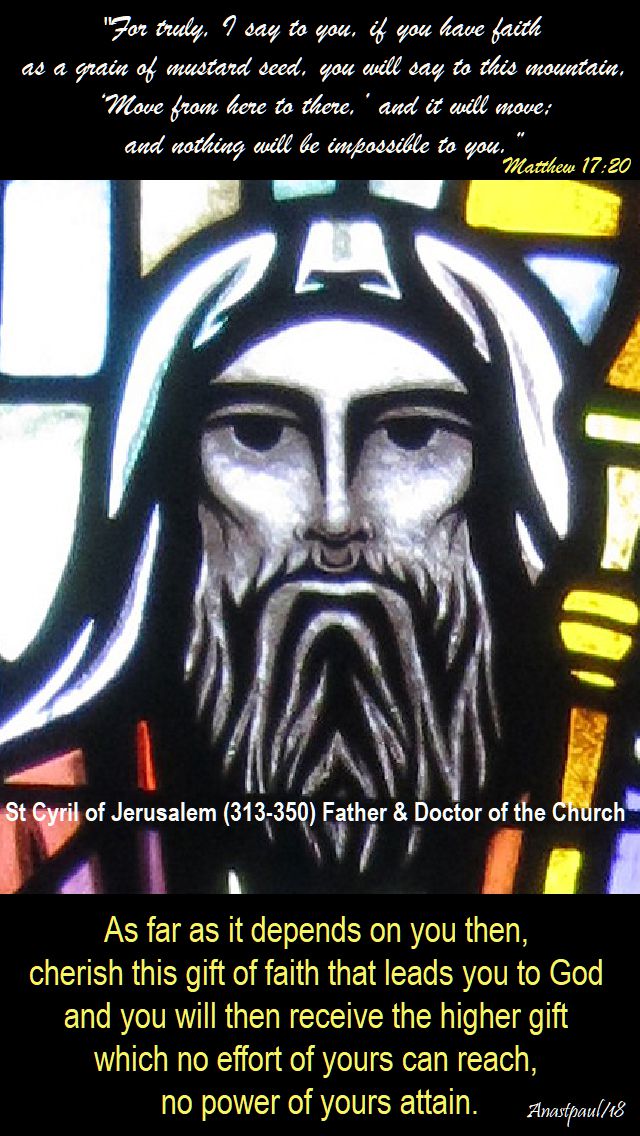
He said to them, “Because of your little faith. For truly, I say to you, if you have faith as a grain of mustard seed, you will say to this mountain, ‘Move from here to there,’ and it will move; and nothing will be impossible to you.”…Matthew 17:20
REFLECTION – “The word “faith” has one syllable but two meanings. First of all it is concerned with doctrine and it denotes the assent of the soul to some truth. Faith in this sense brings blessing and salvation to the soul, as the Lord said: “He who hears my word and believes in him who sent me, has eternal life.” (Jn 5:24)…
The word “faith” has a second meaning: it is a particular gift and grace of Christ. “To one is given throu gh the Spirit the utterance of wisdom and to another the utterance of knowledge according to the same Spirit, to another faith by the same Spirit, to another gifts of healing” (1Cor 12:8-9). Faith in the sense of a particular divine grace conferred by the Spirit is not, then, primarily concerned with doctrine but with giving a person powers quite beyond their natural capability. Whoever has this faith will say to a mountain: “Move from here to there” and it will move and anyone who can in fact say these words through faith and “believes without hesitation that they will come to pass,” (Mk 11:23) receives this particular grace. It is to this kind of faith that the Lord’s words refer: “If you have faith as a grain of mustard seed.” Now a mustard seed is small in size but its energy thrusts it upwards with the force of fire. Small are its roots, great the spread of its boughs and once it is fully grown the birds of the air find shelter in its branches (Mt 13:32). So too, in a flash, faith can produce the most wonderful effects in the soul.
Enlightened by faith the soul gazes at the glory of God so far as human nature allows and, even before the consummation of all things, ranging beyond the boundaries of the universe, it has a vision of the judgement and of God making good the rewards he promised. As far as it depends on you then, cherish this gift of faith that leads you to God and you will then receive the higher gift which no effort of yours can reach, no power of yours attain.”…Saint Cyril of Jerusalem (313-350) Bishop of Jerusalem, Father & Doctor of the Church (Baptismal Catechesis 5)
PRAYER – Holy God, grant we pray, Your Holy Spirit of love and divine grace to grow ever more in faith. By our prayers and love for You and our neighbour, may we merit Your divine assistance. Lord Jesus, help us to dwell often on the manner in which we are following You. Let us strive each day to become more and more like You in all things and, to become beacons of Your Light, to all the world. St Clare of Assisi, you who were a light to all, pray for us, amen.
Our Morning Offering – 11 August – The Memorial of St Clare of Assisi(1194-1253)
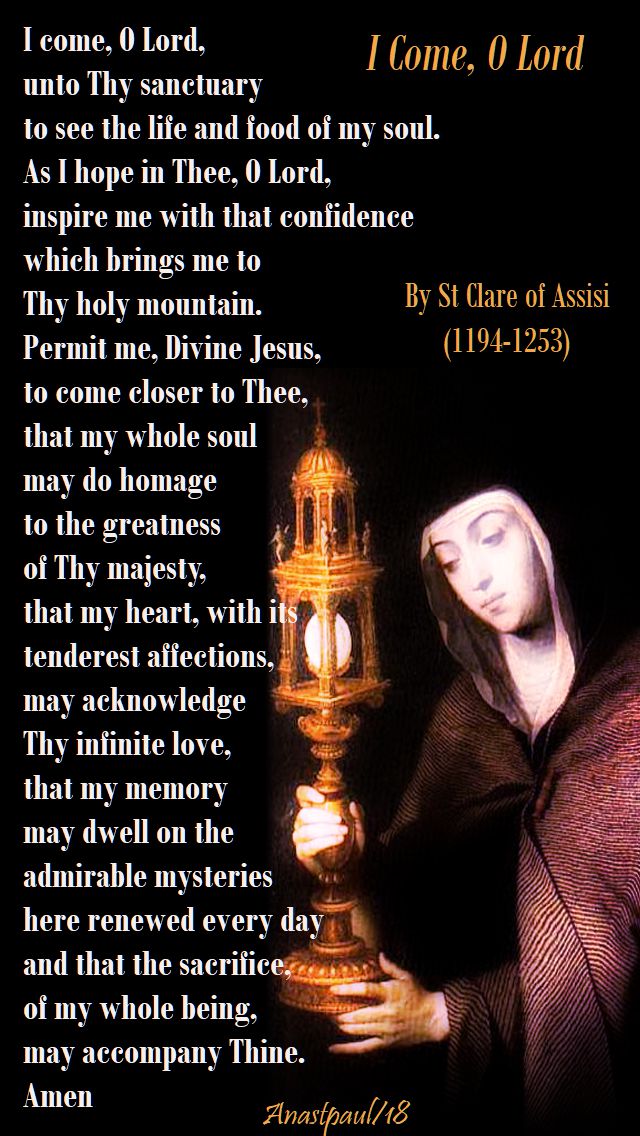
I Come, O Lord By St Clare of Assisi (1194-1253)
I come, O Lord,
unto Thy sanctuary
to see the life and food of my soul.
As I hope in Thee, O Lord,
inspire me with that confidence
which brings me to Thy holy mountain.
Permit me, Divine Jesus,
to come closer to Thee,
that my whole soul may do homage
to the greatness of Thy majesty,
that my heart,
with its tenderest affections,
may acknowledge Thy infinite love,
that my memory may dwell
on the admirable mysteries
here renewed every day
and that the sacrifice,
of my whole being,
may accompany Thine.
Amen
Our Morning Offering – 10 August – Feast of St Lawrence, Martyr (died 258)
O Love Eternal By St Francis De Sales OFM Cap (1567-1622) Doctor of the Church
O love eternal,
my soul needs
and chooses You eternally!
Ah, come Holy Spirit,
and inflame our hearts with Your love!
To love – or to die!
To die – and to love!
To die to all other love
in order to live in Jesus’ love,
so that we may not die eternally.
But that we may live in Your eternal love,
O Saviour of our souls,
we eternally sing,
“Live, Jesus!
Jesus, I love!
Live, Jesus, whom I love!
Jesus, I love,
Jesus who lives and reigns
forever and ever.
Amen
Saint of the Day – Blessed Amadeus of Portugal O.F.M. (1420–1482) Religious, Reformer, Miracle-Worker and Confessor – he was a Portuguese nobleman who became first a monk, then left that life to become a friar of the Franciscan Order. He is also known as Amadeus Menez de Silva, Amedeus…., João de Menezes da Silva, João Mendes de Silva, Peter John Silva Meneses. Later he became a reformer of that Order, which led to his founding of a distinct branch of the Friars Minor that was named after him, later suppressed by the Pope in order to unite them into one great family of Friars Minor Observants (1568). Born in 1420 in Morocco as João de Menezes da Silva and died on 10 August 1482 in Milan, Italy of natural causes. Patronage – against fever (water from a spring at his monastery was reported to heal fever patients).
Blessed Amadeus began his religious life in the Hieronnymite monastery of Notre-Dame de Guadalupe (Spain), where he spent about ten years. Desirous of joining the Franciscans, he went to Italy, where after some delay he was received into the order and, living in various convents, chiefly at Milan, attracted attention by his virtue and miracles.
Under the protection of the Archbishop of Milan, he established the convent of Notre-Dame de la Paix (1469) which became the centre of a Franciscan reform. The minister general of the order Francesco della Rovere, later pope under the name of Sixtus IV, extended his protection to him. Other foundations were made in Italy, among them one in Rome.
Supernatural favours obtained through his intercession aided in the spread of his cult, he was known as ‘blessed’ long before his death. He composed a yet published treatise entitled “De revelationibus et prophetiis”, two copies of which are mentioned by Nicholas Antonio. The work of another Amadeus, “Homilies on the Blessed Virgin”, has been erroneously attributed to him.
The convents he founded continued after his death to form a distinct branch of the Franciscans, the friars were called the Amadeans or Amadists and they had twenty-eight houses in Italy, the chief one, Saint Peter de Montorio, in Rome. Pope Innocent VIII gave them the convent of Saint Genesto near Cartagena in Spain (1493). The successors of Blessed Amadeus, preserved his foundation in its original spirit until Saint Pius V suppressed it along with similar branches of the Franciscan Order and united them into one great family of Friars Minor Observants in 1568.
Blessed Amadeus’ remains are interred under the high altar of his monastery in Milan.
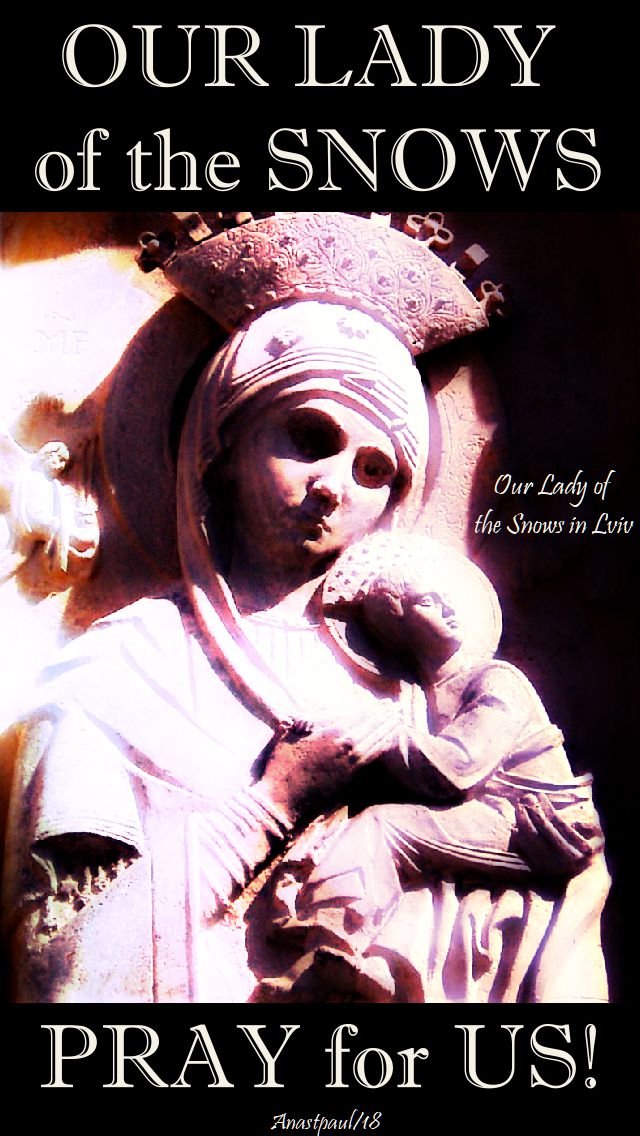
Thought for the Day – 5 August – Dedication of the Basilica of Saint Mary Major/Our Lady of the Snow
St Mary Major is one of the four Roman basilicas known as patriarchal cathedrals in memory of the first centres of the Church. St John Lateran represents Rome, the See of Peter; St Paul Outside the Walls, the See of Alexandria, the see presided over by Mark; St Peter’s, the See of Constantinople and St Mary’s, the See of Antioch, where Mary is believed to have spent most of her later life.
Theological debate over Christ’s nature as God and man reached fever pitch in Constantinople in the early fifth century. The chaplain of Bishop Nestorius began preaching against the title Theotokos, “Mother of God,” insisting that the Virgin was mother only of the human Jesus. Nestorius agreed, decreeing that Mary would henceforth be named “Mother of Christ” in his see. The people of Constantinople virtually revolted against their bishop’s refutation of a cherished belief. When the Council of Ephesus refuted Nestorius, believers took to the streets, enthusiastically chanting, “Theotokos! Theotokos!”
So often I wish we would take to the streets shouting the same, “Mother of God! Mother of God!”
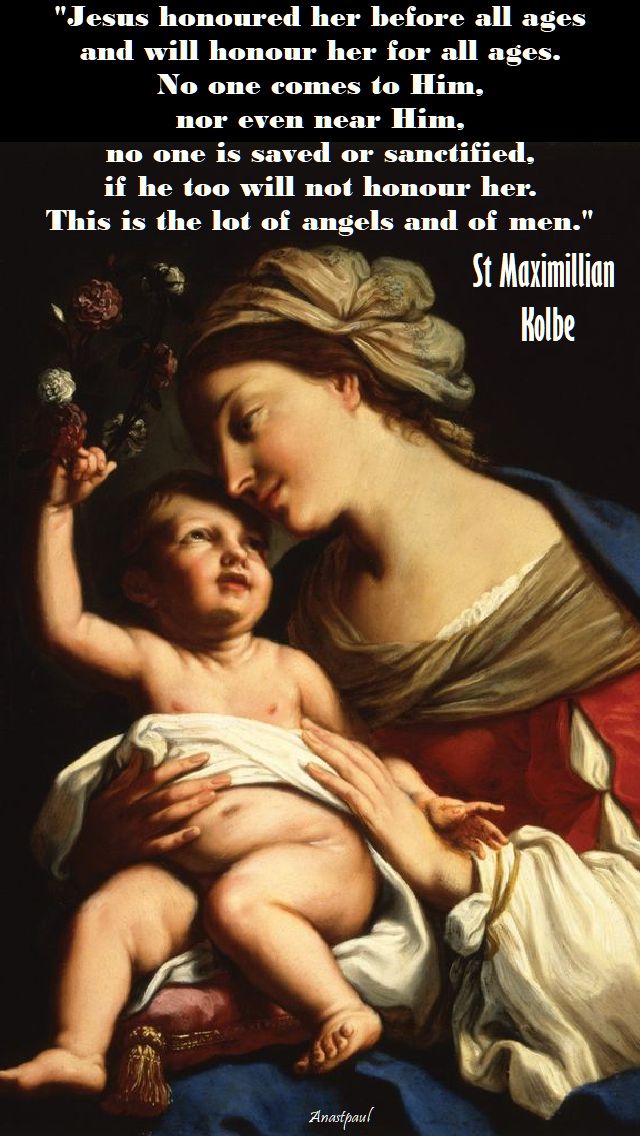
“Jesus honoured her before all ages and will honour her for all ages. No one comes to Him, nor even near Him, no one is saved or sanctified, if he too will not honour her. This is the lot of angels and of men.”
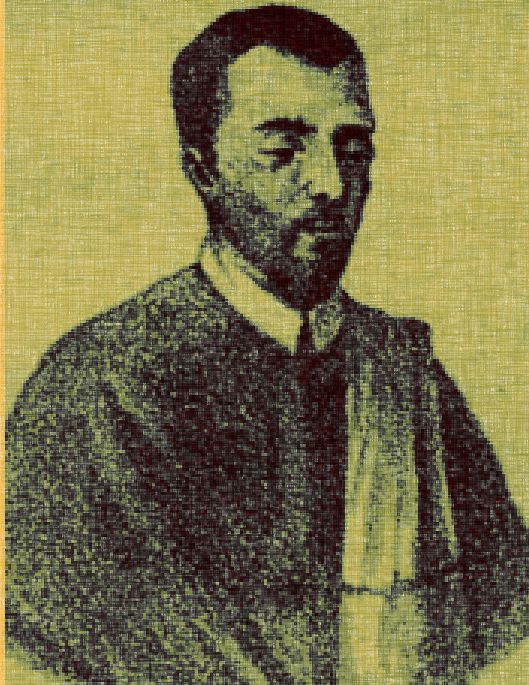
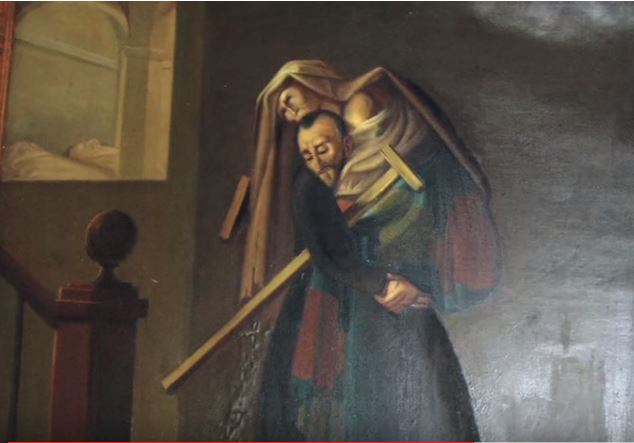
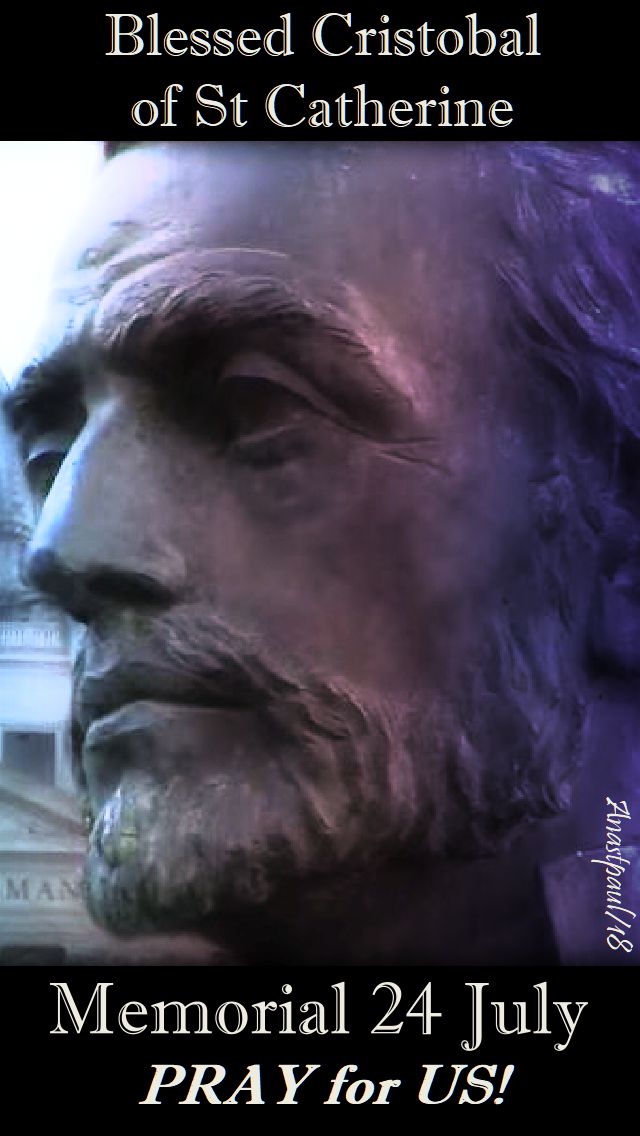
Saint of the Day – 24 July – Bl Cristobal of St Catherine T.O.S.F. (1638-1690) Priest, Founder of the Franciscan Hospitallers of Jesus of Nazareth, Franciscan Tertiary – born Cristóbal López de Valladolid Orea on 25 July 1638 at 8 Calle Baños, Mérida, Badajoz, Spain and died on 21 July 1690 in Córdoba, Spain of cholera. Patronage – the Franciscan Hospitallers of Jesus of Nazareth.
Cristóbal López de Valladolid Orea was born in 1638 as the son of poor labourers (he had five brothers) and was baptised in the church of Santa Eulalia. In either 1645 or 1646 he fled from his home in an effort to join the Order of Friars Minor but he soon returned home after his worried mother sent his brothers to bring him home. He served as an altar server and worked as a nurse in a hospital that the Order of Saint John of God managed.
He was ordained to the priesthood on 20 March 1663 in Badajoz and after was made a chaplain to armed services fighting in Portugal though he had to return home after falling ill. In 1667 he retired to a hermitage in the mountains of El Bañuelo but his desire to follow the Rule and the teachings of Saint Francis of Assisi prompted him to pursue the Franciscan charism in a concrete manner. It was for this reason he became a professed member of the Third Order of Saint Francis in 1671 and he assumed the religious name of “Cristóbal of Saint Catherine”. He established the Franciscan Hospitallers of Jesus of Nazareth in Córdoba on 11 February 1673 which pushed the boundaries of a range of both religious and social issues.
He died in 1690 clutching a Crucifix, a victim of the cholera epidemic in which he tended to the victims. It was said not long after his death, several miracles were attributed to his direct intercession. His order received papal approval from Pope Benedict XIV in 1746.
The cause of beatification commenced on 27 June 1770 under Pope Clement XIV and the late priest was declared a Servant of God. Pope Benedict XVI declared him to have lived a life of heroic virtue on 28 June 2012 and named him Venerable.
On 20 December 2012 the pope approved a decree that recognised a miracle attributed to his intercession which would allow for him to be beatified. The beatification was held on 7 April 2013 and Cardinal Angelo Amato presided over the celebration on the behalf of Pope Francis.
Thought for the Day – 21 July – The Memorial of St Lawrence of Brindisi OFM Cap (1559-1619) Doctor of the Church
St Lawrence’s compassion for the poor moved him to make a dangerous trip to Spain to oppose an oppressive tyrant. He realised that evil has to be opposed and that if good men do not oppose it, the evil will continue and grow.
Our voices – small as they may be – individual or collective – MUST be heard, always, in the cause of truth and justice.
One Minute Reflection – 21 July – Saturday of the Fifteenth week in Ordinary Time – The Memorial of St Lawrence of Brindisi OFM Cap (1559-1619) Doctor of the Church – Today’s Readings: Micah 2:1-5, Psalm 10:1-4, 7-8, 14, Matthew 12:14-21
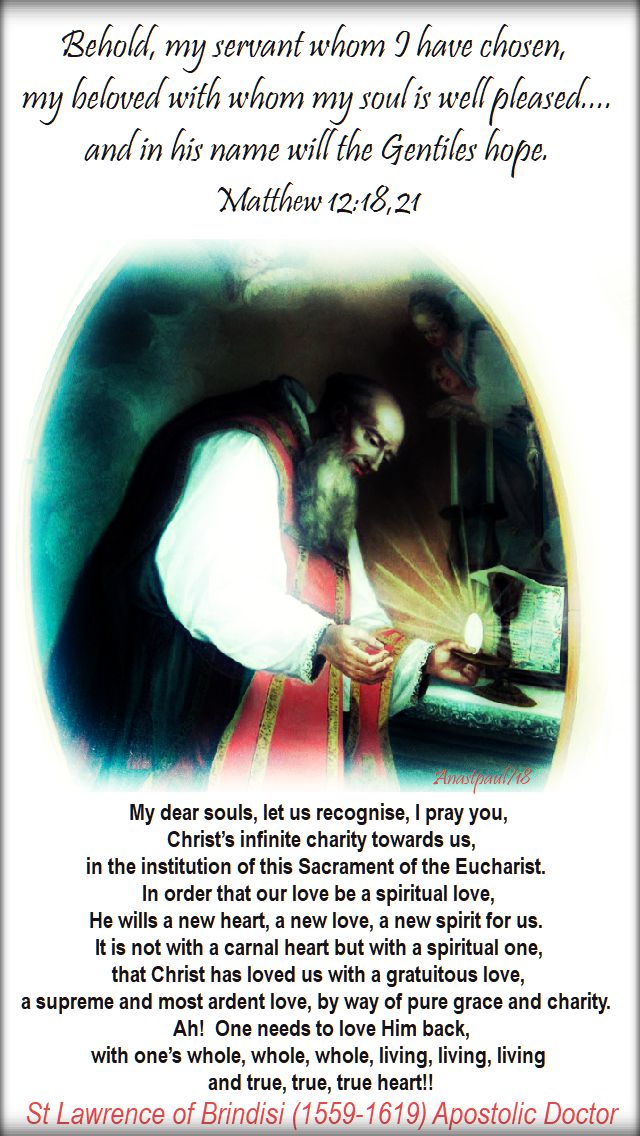
“Behold, my servant whom I have chosen, my beloved with whom my soul is well pleased…. and in his name will the Gentiles hope.”…Matthew 12:18,21
REFLECTION – “My dear souls, let us recognise, I pray you, Christ’s infinite charity towards us, in the institution of this Sacrament of the Eucharist. In order that our love be a spiritual love, He wills a new heart, a new love, a new spirit for us. It is not with a carnal heart but with a spiritual one, that Christ has loved us with a gratuitous love, a supreme and most ardent love, by way of pure grace and charity. Ah! One needs to love Him back with one’s whole, whole, whole, living, living, living and true, true, true heart!!” …… St Lawrence of Brindisi (1559-1619) Apostolic Doctor
PRAYER – Lord God, You bestowed on St Lawrence of Brindisi the spirit of counsel and fortitude, so that Your name might be glorified and souls be saved. At the intercession of St Lawrence, grant that we may see what we have to do and, in Your mercy give us the strength to do it and the courage, love and charity to persevere. Grant above all, that by his prayers we may love You above all and with all we are. St Lawrence pray for us, amen.
Our Morning Offering – 21 July – The Memorial of St Lawrence of Brindisi OFM Cap (1559-1619) Doctor of the Church – Today’s Readings: Micah 2:1-5, Psalm 10:1-4, 7-8, 14, Matthew 12:14-21
“Woe to those who devise wickedness and work evil upon their beds!”…Micah 2:1
The Peace Prayer
By St Francis of Assisi (c 1181-1226)
Lord, make me an instrument of Your peace, where there is hatred, let me sow love, where there is injury, pardon, where there is doubt, faith, where there is despair, hope, where there is darkness, light and where there is sadness, joy. O Divine Master, grant that I may not so much seek to be consoled as to console, to be understood as to understand, to be loved as to love, for it is in giving that we receive, it is in pardoning that we are pardoned and it is in dying that we are born to eternal life.
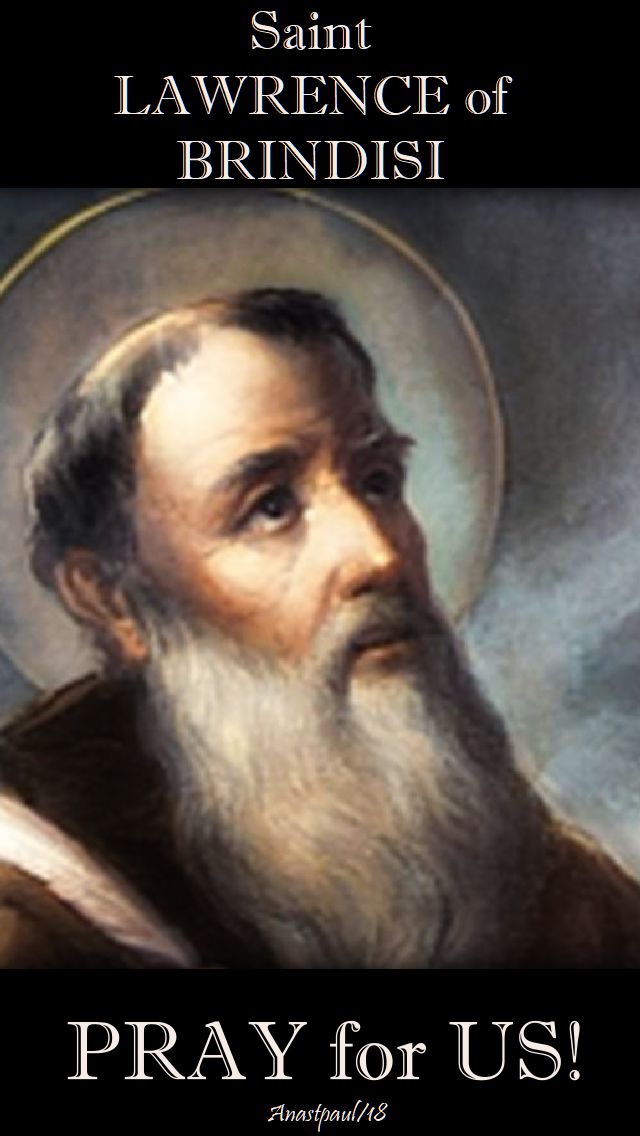
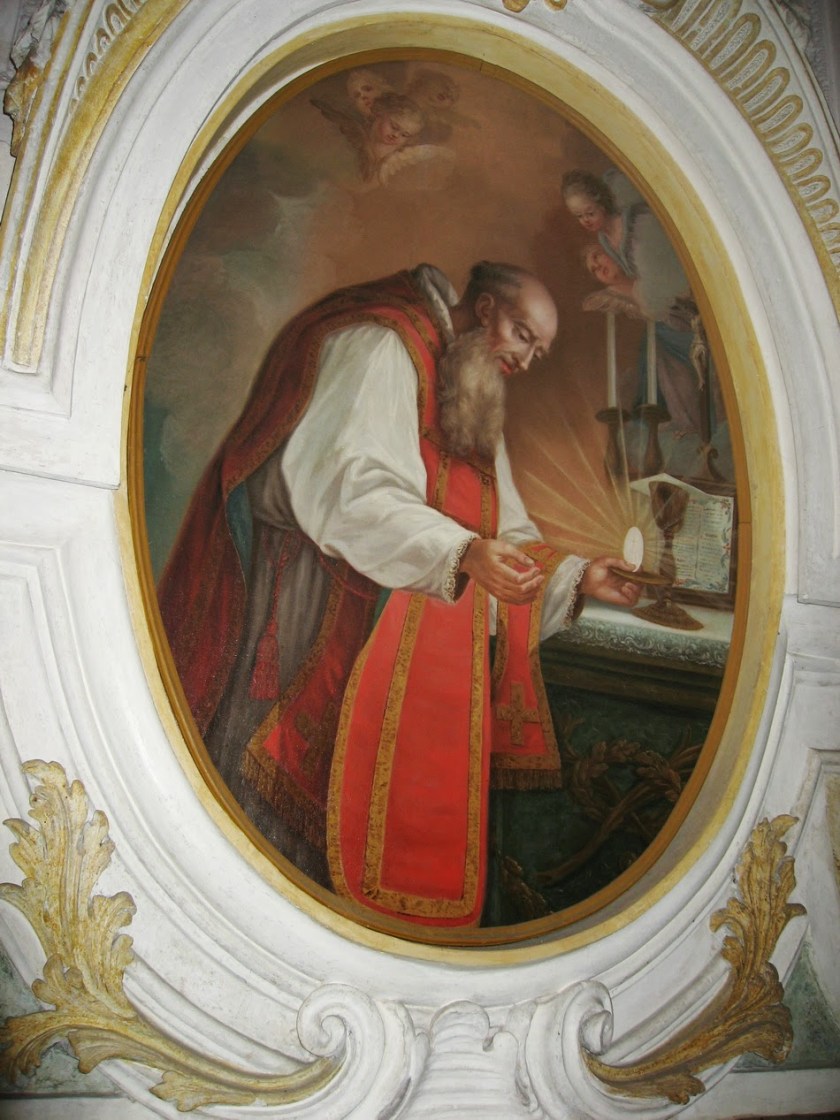
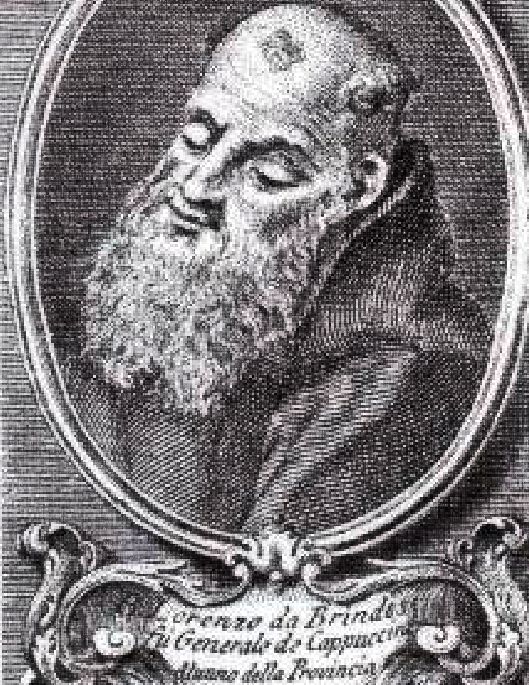
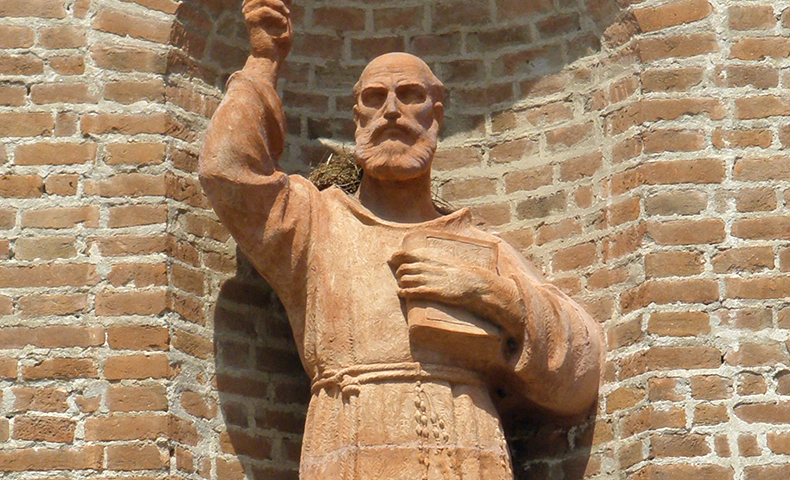
Saint of the Day – 21 July – St Lawrence of Brindisi OFM Cap (1559-1619) Doctor of the Church. He was created a Doctor of the Church by St Pope John XXIII in 1959 with the title Doctor apostolicus (Apostolic Doctor). Patronages – Brindisi, Italy.
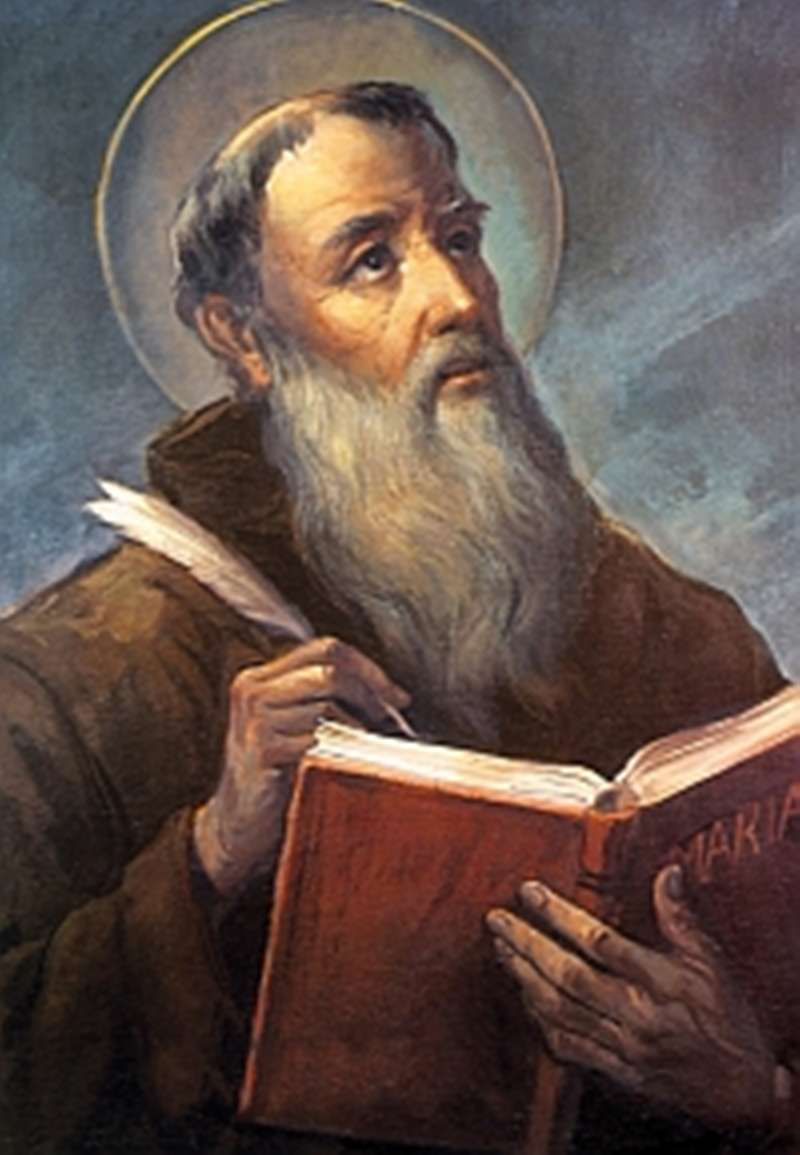
St Lawrence is known as the “Franciscan Renaissance Man” – he was a Religious member of the Franciscan Friars Minor Capuchin, a Priest, Theologian, Vicar General of the Franciscans, Language scholar, Apologist of immense and calm resources, Humanist, Philosopher, Biblicist, Preacher, Missionary, Professor, International Administrator, Confidant of Popes, Emperors, Kings and Princes, Diplomatic envoy, Army Chaplain, Military Strategist and Morale builder, Polemicist, Prolific writer.
Saint Lawrence of Brindisi
By Pope Benedict XVI
General Audience, 23 March 2011
I still remember with joy the festive welcome I was given in Brindisi in 2008. It was in this city that in 1559 was born a distinguished Doctor of the Church, St Lawrence of Brindisi, the name that Julius Caesar Russo took upon entering the Capuchin Order.
He had been attracted since childhood by the family of St Francis of Assisi. In fact, his father died when he was seven years old and his mother entrusted him to the care of the Friars Minor Conventual in his hometown. A few years later, however, Lawrence and his mother moved to Venice and it was precisely there that he became acquainted with the Capuchins who in that period were generously dedicated to serving the whole Church in order to further the important spiritual reform promoted by the Council of Trent.
With his religious profession in 1575, Lawrence became a Capuchin friar and in 1582 he was ordained a priest. During his ecclesiastical studies for the priesthood he already showed the eminent intellectual qualities with which he had been endowed. He learned with ease the ancient languages, such as Greek, Hebrew and Syriac, as well as modern languages, such as French and German. He added these to his knowledge of Italian and of Latin that was once spoken fluently by all clerics and by all cultured people. Thanks to his mastery of so many languages, Lawrence was able to carry out a busy apostolate among the different categories of people. As an effective preacher, his knowledge, not only of the Bible but also of the rabbinic literature, was so profound that even the Rabbis, impressed and full of admiration, treated him with esteem and respect.
As a theologian steeped in Sacred Scripture and in the Fathers of the Church, he was also able to illustrate Catholic doctrine in an exemplary manner to Christians who, especially in Germany, had adhered to the Reformation. With his calm, clear exposition he demonstrated the biblical and patristic foundation of all the articles of faith disputed by Martin Luther. These included the primacy of St Peter and of his Successors, the divine origin of the Episcopate, justification as an inner transformation of man, and the need to do good works for salvation. Lawrence’s success helps us to realise that today too, in pursuing ecumenical dialogue with such great hope, the reference to Sacred Scripture, interpreted in accordance with the Tradition of the Church, is an indispensable element of fundamental importance. I wished to recall this in my Apostolic Exhortation Verbum Domini (n. 46). Even the simplest members of the faithful, those not endowed with great culture, benefited from the convincing words of Lawrence, who addressed humble people to remind them all to make their lives consistent with the faith they professed.
This was a great merit of the Capuchins and of other religious Orders which, in the 16th and 17th centuries, contributed to the renewal of Christian life, penetrating the depths of society with their witness of life and their teaching. Today too, the new evangelisation stands in need of well-trained apostles, zealous and courageous, so that the light and beauty of the Gospel, may prevail over the cultural tendencies of ethical relativism and religious indifference and transform the various ways of thinking and acting into genuine Christian humanism.
It is surprising that St Lawrence of Brindisi was able to continue without interruption his work as an appreciated and unflagging preacher in many cities of Italy and in different countries, in spite of holding other burdensome offices of great responsibility. Indeed, within the Order of Capuchins he was professor of theology, novice master, for several mandates minister provincial and definitor general and finally, from 1602 to 1605, minister general. In the midst of this mountain of work, Lawrence cultivated an exceptionally fervent spiritual life. He devoted much time to prayer and, especially, to the celebration of Holy Mass — often protracted for hours — caught up in and moved by the memorial of the Passion, death and Resurrection of the Lord.
At the school of the saints, every priest, as was emphasised frequently during the recent Year for Priests, may only avoid the danger of activism — acting, that is, without remembering the profound motives of his ministry — if he attends to his own inner life.
In speaking to priests and seminarians in the Cathedral of Brindisi, St Lawrence’s birthplace, I recalled that “the time he spends in prayer is the most important time in a priest’s life, in which divine grace acts with greater effectiveness, making his ministry fruitful. The first service to render to the community is prayer. And, therefore, time for prayer must be given true priority in our life… if we are not interiorly in communion with God, we cannot even give anything to others. Therefore, God is the first priority. We must always reserve the time necessary to be in communion of prayer with Our Lord” (Address of Benedict XVI to priests, deacons and seminarians of the Archdiocese of Brindisi, Cathedral of Brindisi, 15 June 2008).
Moreover, with the unmistakable ardour of his style, Lawrence urged everyone and not only priests, to cultivate a life of prayer, for it is through prayer that we speak to God and that God speaks to us: “Oh, if we were to consider this reality!”, he exclaimed. “In other words that God is truly present to us when we speak to him in prayer; that he truly listens to our prayers, even if we pray only with our hearts and minds. And that not only is he present and hears us, indeed he willingly and with the greatest of pleasure wishes to grant our requests”.
Another trait that characterises the opus of this son of St Frances, is his action for peace. Time and again both Supreme Pontiffs and Catholic Princes entrusted him with important diplomatic missions, to settle controversies and to encourage harmony among the European States, threatened in those days by the Ottoman Empire. The moral authority he enjoyed made him a counsellor both sought after and listened to. Today, as in the times of St Lawrence, the world is in great need of peace, it needs peaceful and peacemaking men and women. All who believe in God must always be sources and artisans of peace.
It was precisely on the occasion of one of these diplomatic missions that Lawrence’s earthly life ended, in 1619 in Lisbon, where he had gone to see King Philip III of Spain, to plead the cause of the Neapolitan subjects oppressed by the local authorities.
He was Canonised in 1881 and his vigorous and intense activity, his vast and harmonious knowledge, earned him the title of Doctor Apostolicus, “Apostolic Doctor”. The title was conferred on him by St Pope John XXIII in 1959, on the occasion of the fourth centenary of his birth. This recognition was also granted to Lawrence of Brindisi because he was the author of numerous works of biblical exegesis, theology and sermons. In them he offers an organic presentation of the history of salvation, centred on the mystery of the Incarnation, the greatest expression of divine love for humankind.
Furthermore, since he was a highly qualified Mariologist, the author of a collection of sermons on Our Lady entitled “Mariale”, he highlighted the unique role of the Virgin Mary, whose Immaculate Conception and whose role in the redemption brought about by Christ he clearly affirms.
With a fine theological sensitivity, Lawrence of Brindisi also pointed out the Holy Spirit’s action in the believer’s life. He reminds us that the Third Person of the Most Holy Trinity illumines and assists us with his gifts in our commitment to live joyously the Gospel message.
“The Holy Spirit”, St Lawrence wrote, “sweetens the yoke of the divine law and lightens its weight, so that we may observe God’s commandments with the greatest of ease and even with pleasure”.
I would like to complete this brief presentation of the life and doctrine of St Lawrence of Brindisi by underlining that the whole of his activity was inspired by great love for Sacred Scripture, which he knew thoroughly and by heart and by the conviction that listening to and the reception of the word of God produces an inner transformation that leads us to holiness.
“The word of the Lord”, he said, “is a light for the mind and a fire for the will, so that man may know and love God. For the inner man, who lives through the living grace of God’s Spirit, it is bread and water but bread sweeter than honey and water better than wine or milk…. It is a weapon against a heart stubbornly entrenched in vice. It is a sword against the flesh, the world and the devil, to destroy every sin”.
St Lawrence of Brindisi teaches us to love Sacred Scripture, to increase in familiarity with it, to cultivate daily relations of friendship with the Lord in prayer, so that our every action, our every activity, may have its beginning and its fulfilment in him. This is the source from which to draw so that our Christian witness may be luminous and able to lead the people of our time to God….vatican.va Pope Benedict
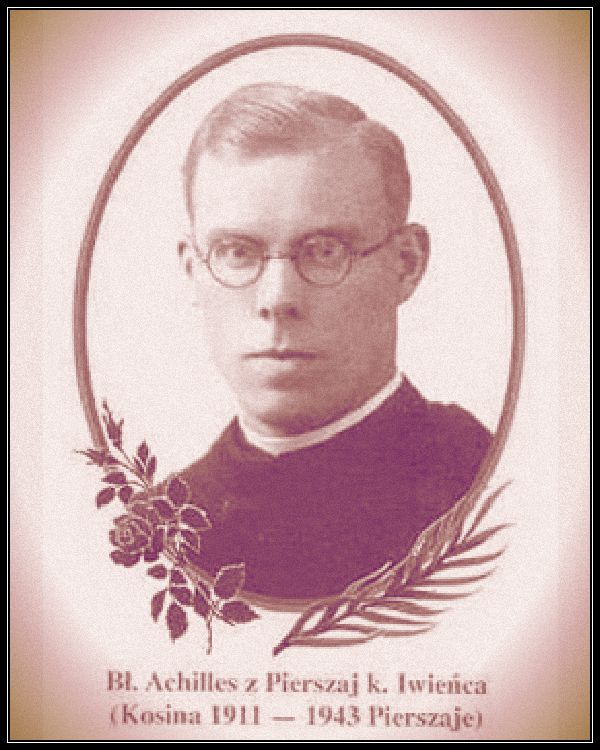
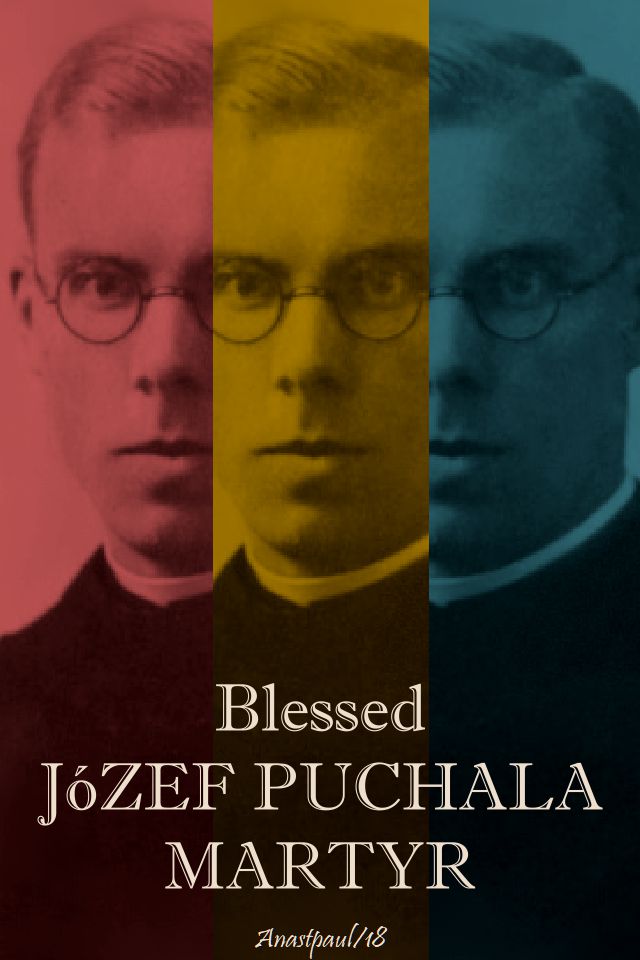
Saint of the Day – 19 July – Blessed Józef Achilles Puchala OFM Conv (1911-1943) Martyr – Priest and Franciscan Friar. Also known as – Achilles Puchala, Brother Achilles, Father Achilles. Born on 18 March 1911 in Kosina, Podkarpackie, Poland and died on 19 July 1943 in a barn outside Borovikovshchina, Minskaya voblasts’, (now) in Belarus. Additional Memorial on 12 June as one of the 108 Martyrs of World War II.
Blessed Jozef was born on 18 March 1911 and baptised on the day of his birth, which is the way Catholics lived and should still live!
He entered the minor seminary in Lviv (in modern Ukraine) in 1924 and once ordained a Deacon, he entered the Monastery of the Franciscan as a Friar Minor Conventual, taking the name Achilles and making his solemn vows on 22 May 1932.
He was ordained as a Priest on 5 July 1936. Before the total devastation of Poland by the Nazis, he served in the Franciscan convents in Grodno and Iwieniec in Poland.
In early 1940 he moved into parish service in Pierszaje, Poland to help with a shortage of priests who had been arrested, murdered or fled ahead of arrest, by the Gestapo during the Nazi occupation and persecutions of World War II.
Finally, Blessed Jozef too was arrested, tortured and eventually murdered by the Gestapo on 19 July 1943. The barn in which he was martyred was set alight but his remains were later retrieved by local Catholics. They were buried in the Parish Church, in which Blessed Jozef had served in in Pierszaje, Poland.
Blessed Jozef was Beatified on 13 June 1999 by St Pope John Paul along with the other 107 (known) Martyrs of World War II. Their liturgical feast day is 12 June. The 108 were Beatified by St Pope John Paul II in Warsaw, Poland. The group comprises 3 bishops, 52 priests, 26 members of male religious, 3 seminarians, 8 female religious and 9 lay people. There are two parishes named for the 108 Martyrs of World War II in Powiercie in Koło County and in Malbork, Poland.
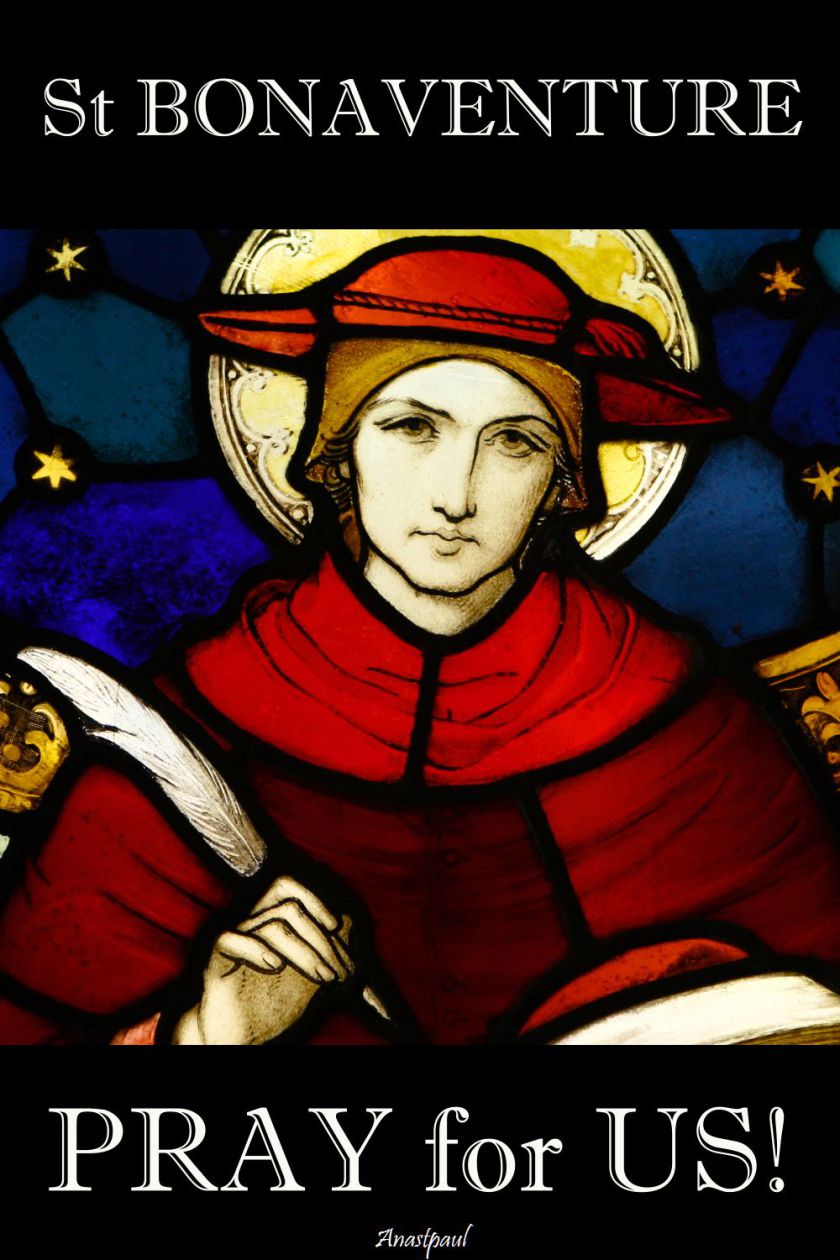
Thought for the Day – 15 July – Fifteenth Sunday of the Year – the Memorial of St Bonaventure (1221-1274) – Seraphic Doctor
Perhaps not a household name for most people, Saint Bonaventure, nevertheless, played an important role in both the medieval Church and the history of the Franciscan Order. A senior faculty member at the University of Paris, Saint Bonaventure certainly captured the hearts of his students through his academic skills and insights. But more importantly, he captured their hearts through his Franciscan love for Jesus and the Church. Like his model, Saint Francis, Jesus was the centre of everything—his teaching, his administration, his writing, and his life . So much so, that he was given the title “Seraphic Doctor.”
Bonaventure so united holiness and theological knowledge that he rose to the heights of mysticism while remaining a very active preacher and teacher, one beloved by all who met him. To know him was to love him; to read him is still for us today to meet a true Franciscan and a gentleman.
In his bull of Canonisation, Pope Sixtus IV wrote:
Bonaventure was great in learning but no less great in humility and holiness. His innocence and dove-like simplicity were such that Alexander of Hales, the renowned doctor whose disciple Saint Bonaventure became, used to say of him that it seemed as though Adam had never sinned in him.
A man of eminent learning and eloquence and of outstanding holiness, he was known for his kindness, approachableness, gentleness and compassion. – Pope Gregory X on hearing of the death of Bonaventure.
Let us learn from the great Saint himself, to grow in the fruits he possessed in such abundance – humility, kindness, gentleness, charity, chastity, generosity, joy, peace, patience, faithfulness, modesty and self-control. (Matthew 7: 15-20)
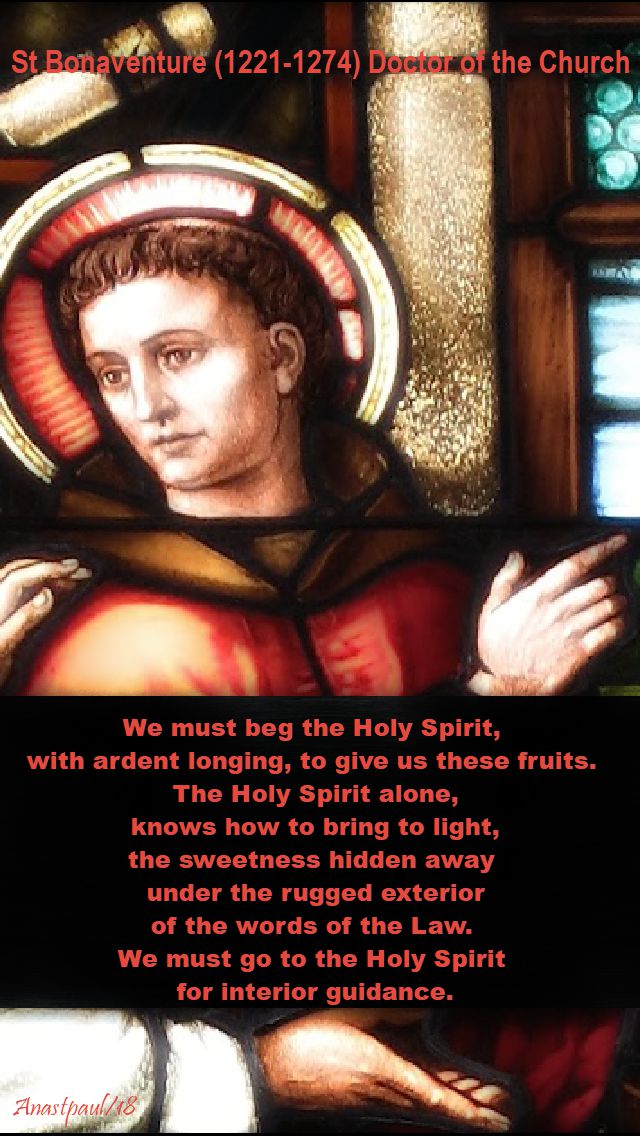
“We must beg the Holy Spirit, with ardent longing, to give us these fruits. The Holy Spirit alone, knows how to bring to light, the sweetness hidden away under the rugged exterior of the words of the Law. We must go to the Holy Spirit for interior guidance.”
St Bonaventure from Holiness of Life
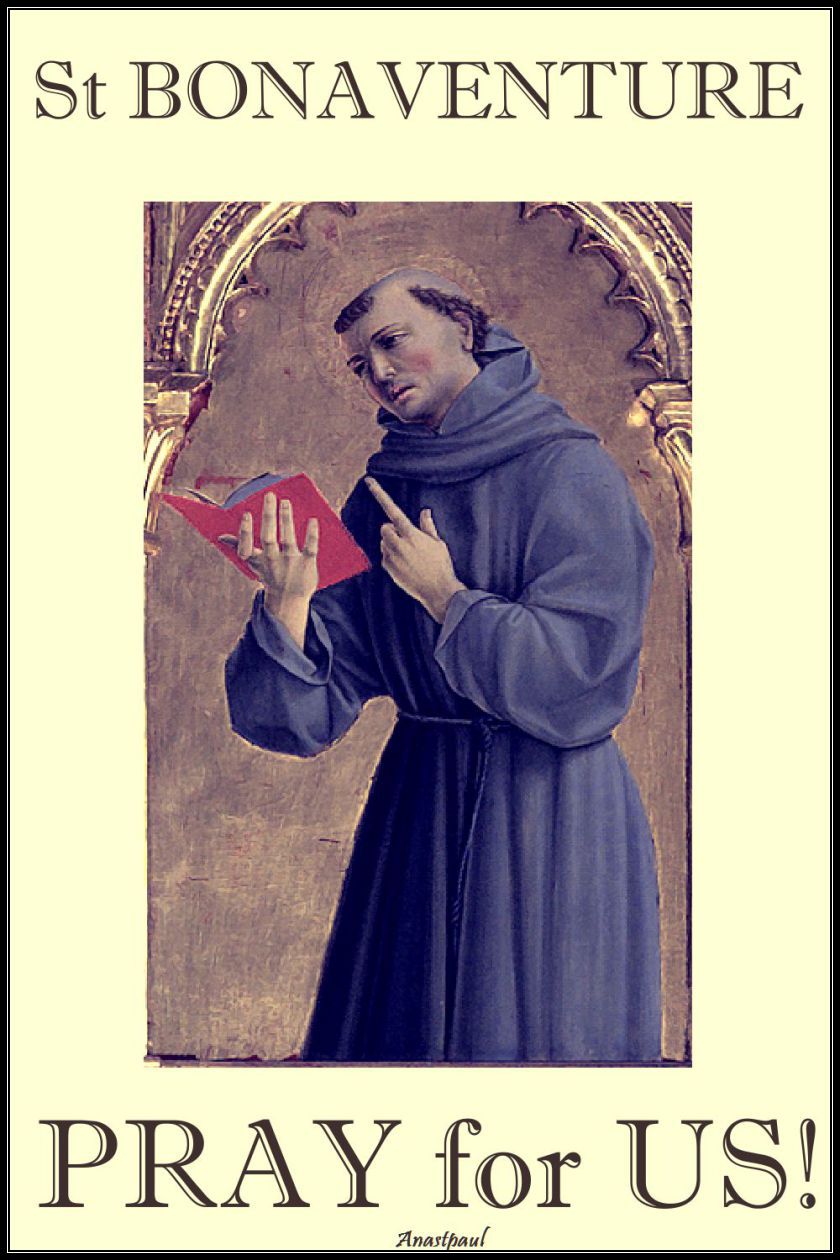
St Bonaventure, Pray for us!
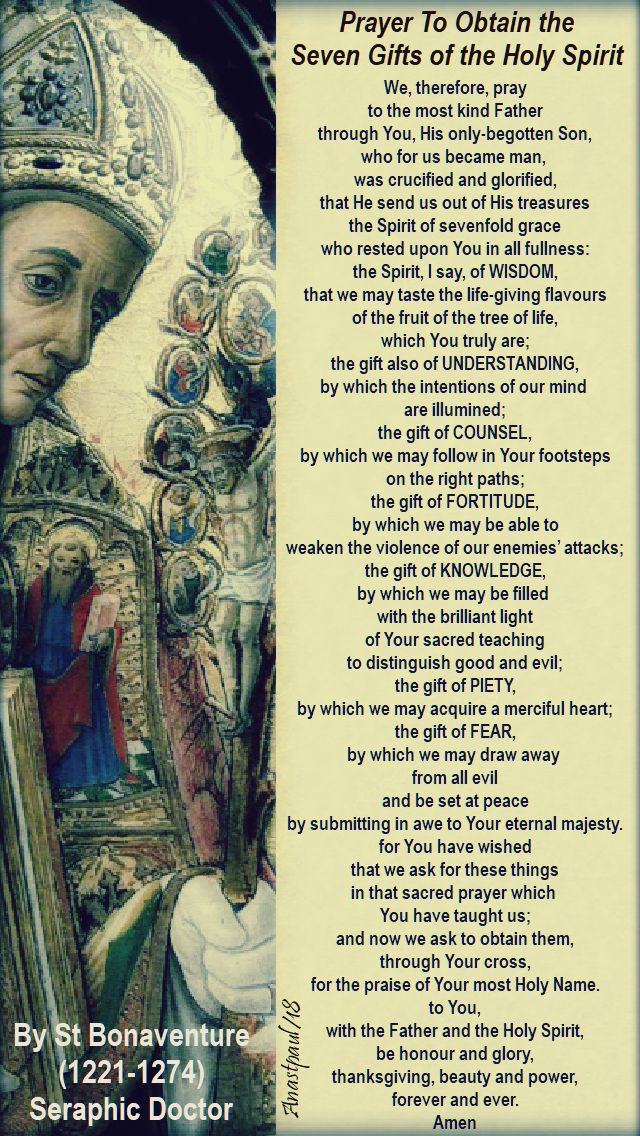
Prayer To Obtain the Seven Gifts of the Holy Spirit By St Bonaventure (1221-1274) – Seraphic Doctor
We, therefore, pray to the most kind Father through You, His only-begotten Son, who for us became man, was crucified and glorified, that He send us out of His treasures the Spirit of sevenfold grace who rested upon You in all fullness: the Spirit, I say, of WISDOM, that we may taste the life-giving flavours of the fruit of the tree of life, which You truly are; the gift also of UNDERSTANDING, by which the intentions of our mind are illumined; the gift of COUNSEL, by which we may follow in Your footsteps on the right paths; the gift of FORTITUDE, by which we may be able to weaken the violence of our enemies’ attacks; the gift of KNOWLEDGE, by which we may be filled with the brilliant light of Your sacred teaching to distinguish good and evil; the gift of PIETY, by which we may acquire a merciful heart; the gift of FEAR, by which we may draw away from all evil and be set at peace by submitting in awe to Your eternal majesty. for You have wished that we ask for these things in that sacred prayer which You have taught us; and now we ask to obtain them, through Your cross, for the praise of Your most Holy Name. to You, with the Father and the Holy Spirit, be honour and glory, thanksgiving, beauty and power, forever and ever. Amen
-From Prayer “To Obtain the Seven Gifts of the Holy Spirit” included at the closing The Tree of Life” ― Bonaventure, Bonaventure: The Soul’s Journey into God, the Tree of Life, the Life of St. Francis
Quote/s of the Day – 15 July – Fifteenth Sunday of the Year – the Memorial of St Bonaventure (1221-1274) – Seraphic Doctor
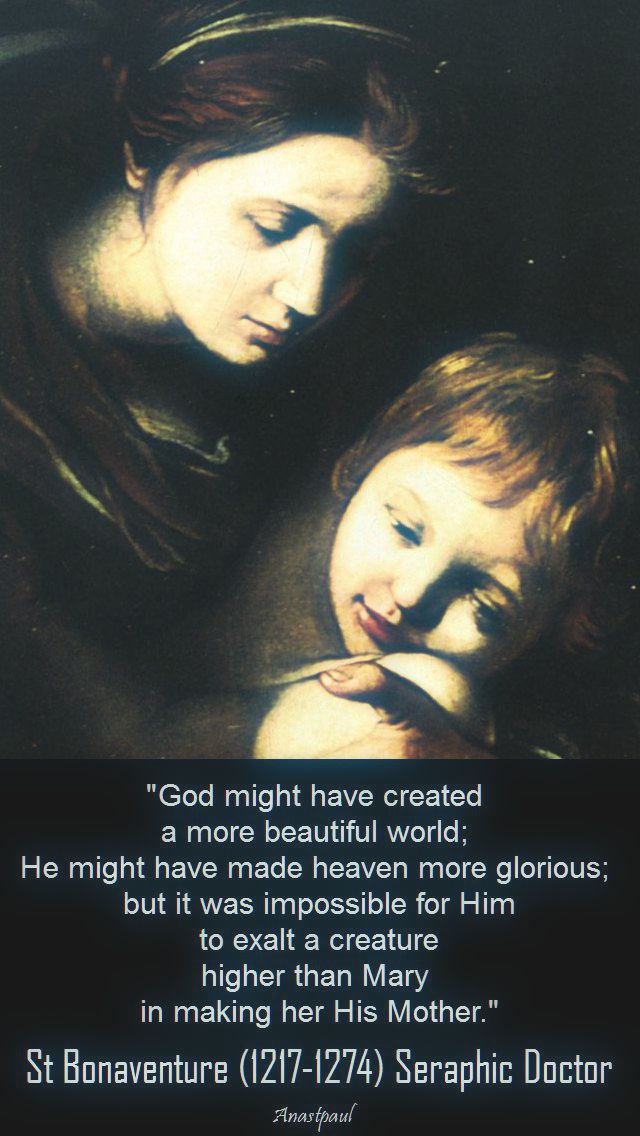
“God might have created a more beautiful world; He might have made heaven more glorious; but it was impossible for Him to exalt a creature higher than Mary in making her His Mother.”
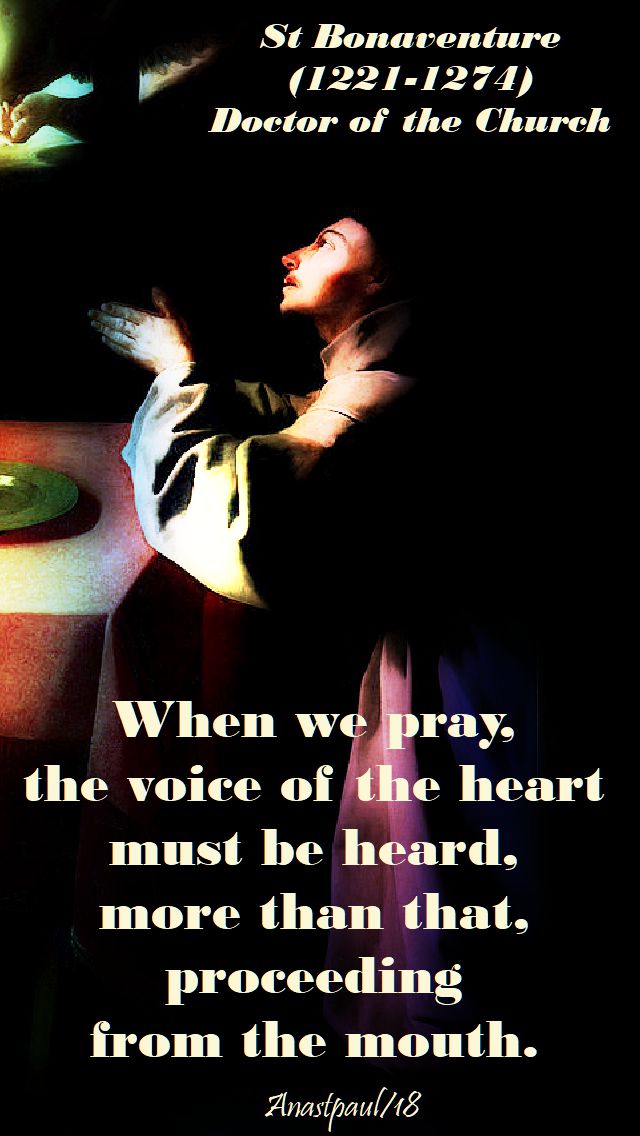
“When we pray, the voice of the heart must be heard, more than that, proceeding from the mouth.”
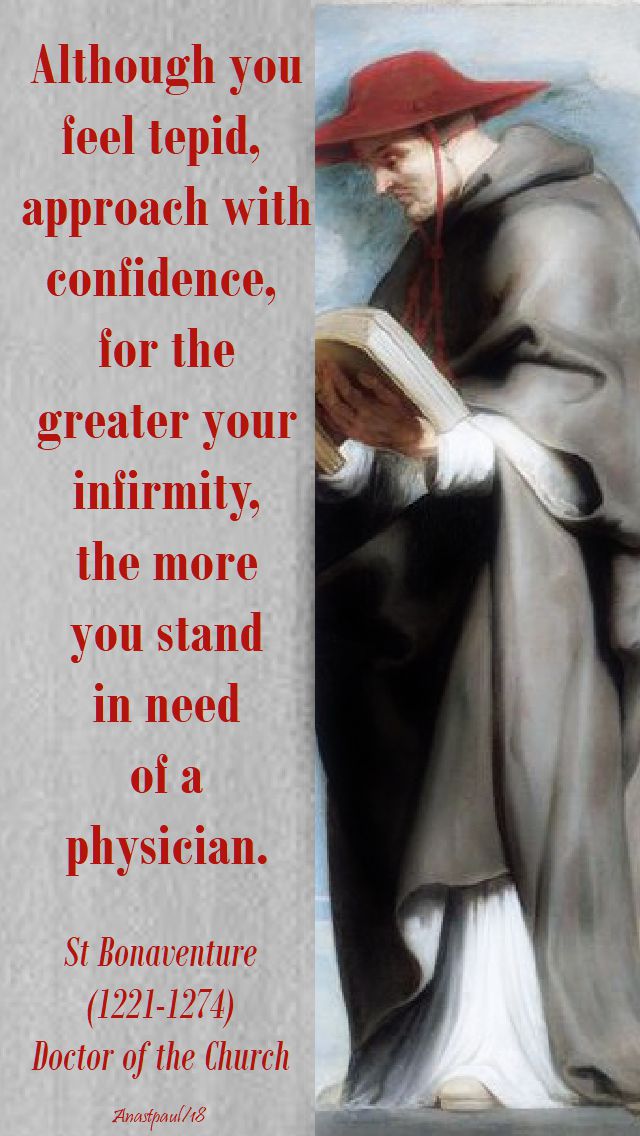
“Although you feel tepid, approach with confidence, for the greater your infirmity, the more you stand in need of a physician.”
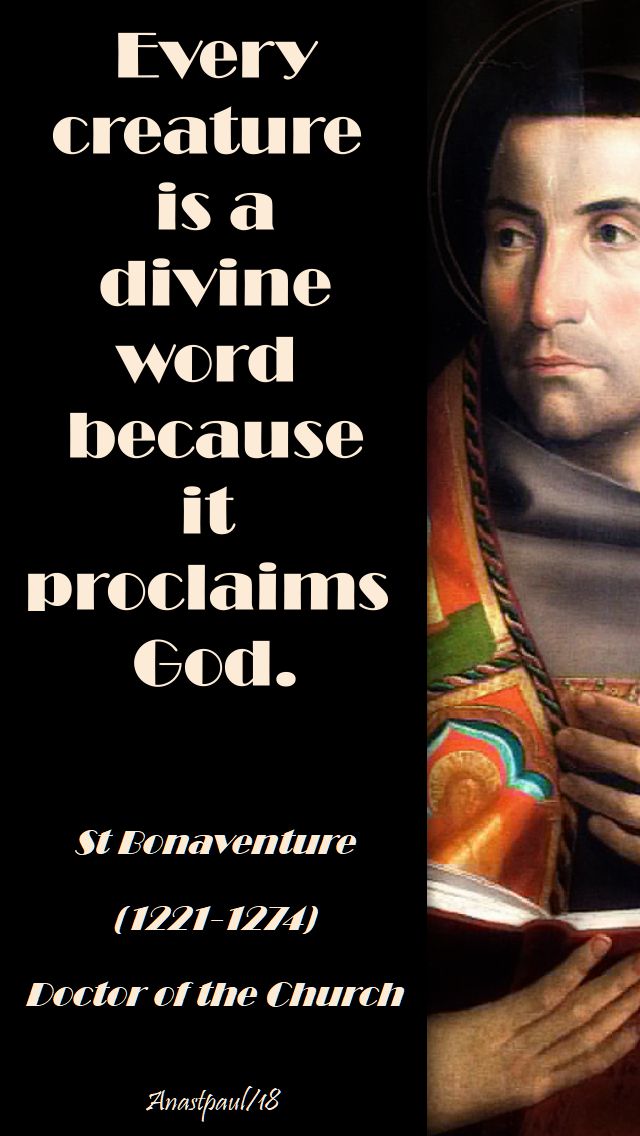
“Every creature is a divine word because it proclaims God.”
“Christ has something in common with all creatures. With the stone He shares existence, with the plants He shares life, with the animals He shares sensation and with the angels He shares intelligence. Thus all things are transformed in Christ since in the fullness of His nature, He embraces some part of every creature.”
One Minute Reflection – 15 July – Fifteenth Sunday of the Year – the Memorial of St Bonaventure (1221-1274) – Seraphic Doctor – 2nd Reading Ephesians 1:3-14.
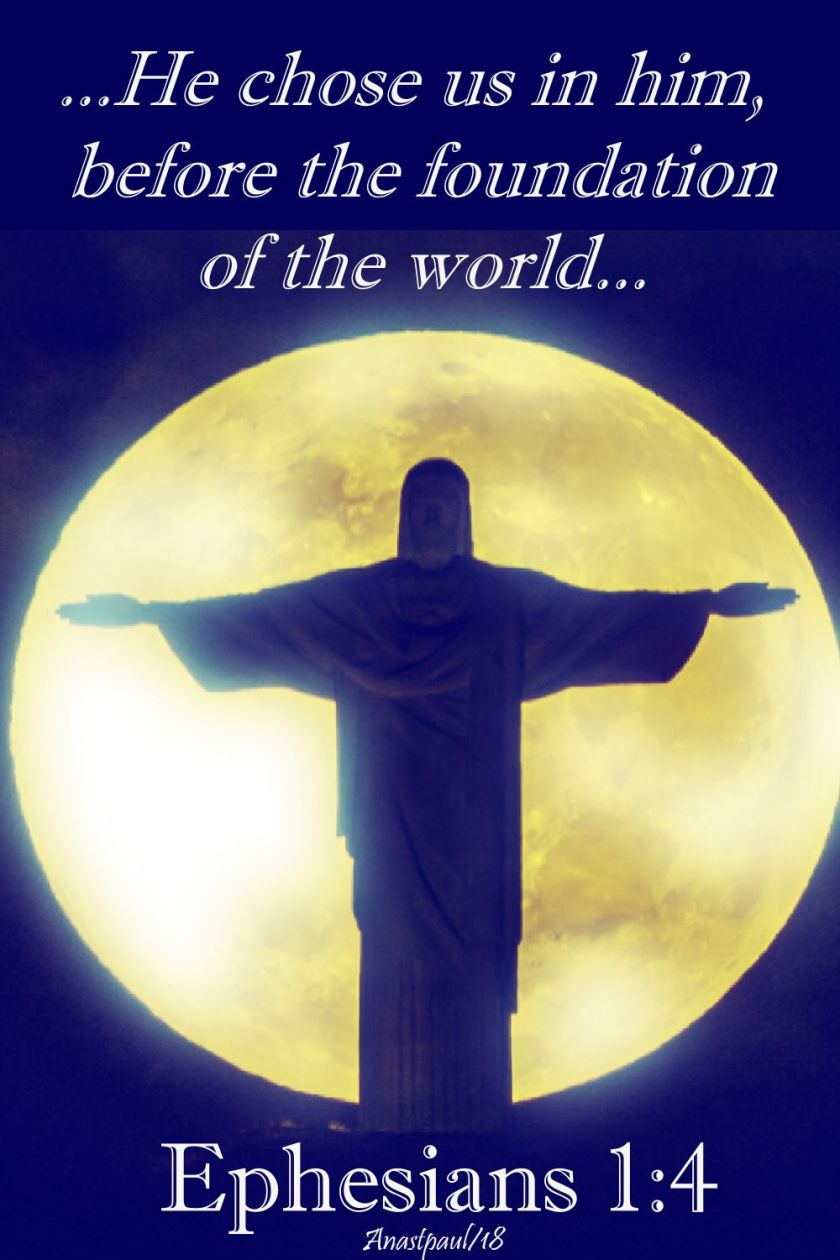
“Blessed be the God and Father of our Lord Jesus Christ, who has blessed us in Christ with every spiritual blessing in the heavens, as he chose us in him, before the foundation of the world, to be holy and without blemish before him.” … Ephesians 1:3-4.
REFLECTION – “Christ is both the way and the door. Christ is the staircase and the vehicle, like the “throne of mercy over the Ark of the Covenant” and “the mystery hidden from the ages.” A man should turn his full attention to this throne of mercy and should gaze at Him hanging on the cross, full of faith, hope and charity, devoted, full of wonder and joy, marked by gratitude and open to praise and jubilation. Then such a man will make with Christ a “pasch,” that is, a passing-over. Through the branches of the cross he will pass over the Red Sea, leaving Egypt and entering the desert. There he will taste the hidden manna and rest with Christ in the sepulcher, as if he were dead to things outside. He will experience, as much as is possible for one who is still living, what was promised to the thief who hung beside Christ: “Today you will be with me in paradise.” – from Journey of the Mind to God by Saint Bonaventure
PRAYER – God our Father, we are Your children and You have set us aside to come home to You by the light of the way of Your divine Son. Grant we pray, that we may grow in faith and love daily, by the intercession of Saint Bonaventure and may be a light of love, to all around us. We make our prayer through our Lord Jesus with You in the unity of the Holy Spirit, God forever, amen.
Our Morning Offering – 15 July – Fifteenth Sunday of the Year – the Memorial of St Bonaventure (1221-1274) – Seraphic Doctor
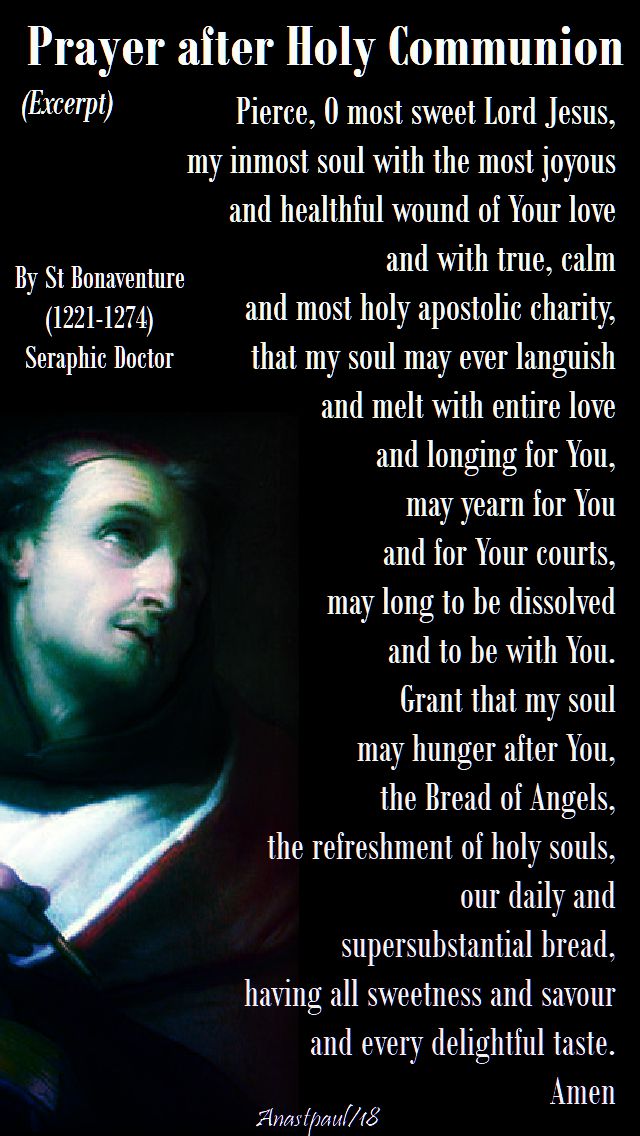
Excerpt from the Prayer after Holy Communion By St Bonaventure (1221-1274) Seraphic Doctor
Pierce, O most sweet Lord Jesus,
my inmost soul with the most joyous
and healthful wound of Your love
and with true, calm
and most holy apostolic charity,
that my soul may ever languish
and melt with entire love
and longing for You,
may yearn for You
and for Your courts,
may long to be dissolved
and to be with You.
Grant that my soul
may hunger after You,
the Bread of Angels,
the refreshment of holy souls,
our daily and supersubstantial bread,
having all sweetness and savour
and every delightful taste.
Amen
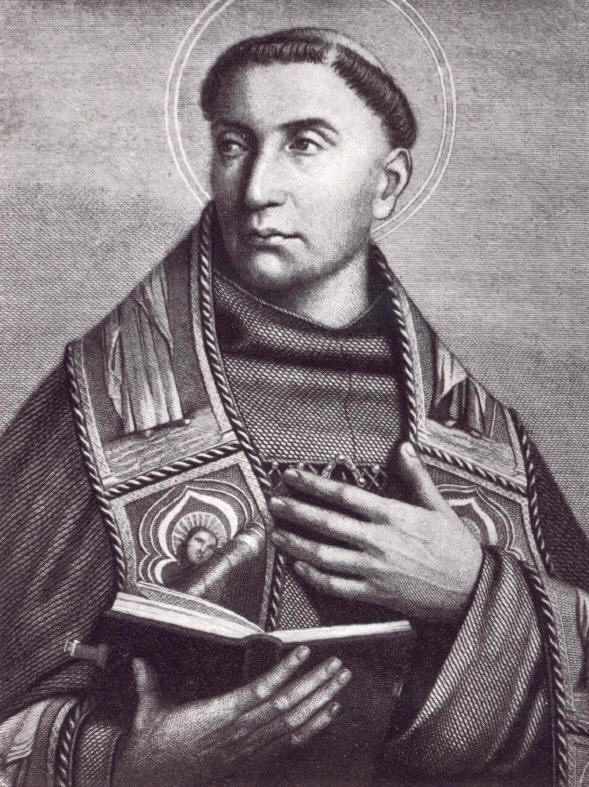
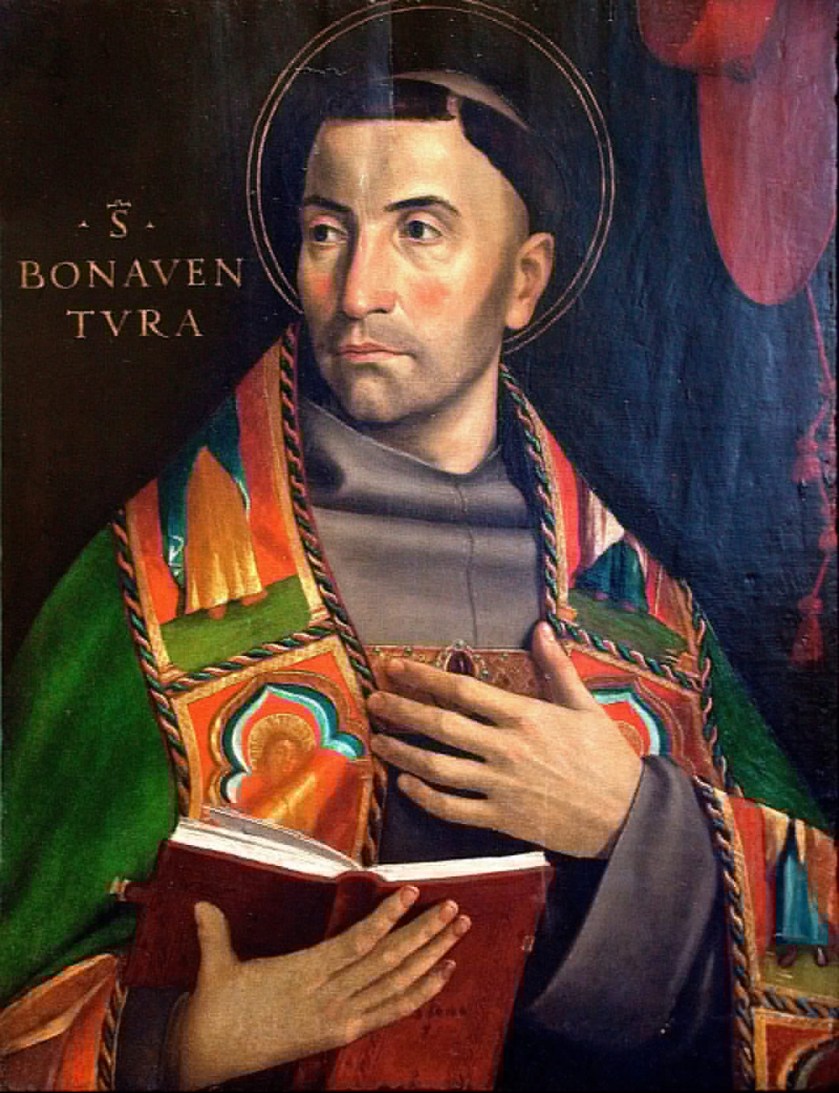
Saint of the Day – 15 July – St Bonaventure O.F.M. (1221-1274) – Doctor of the Church – known as the “Seraphic Doctor” – Friar, Bishop, Theologian, Philosopher, Writer, Mystic, Preacher, Teacher.
Sanctity and learning raised Bonaventure to the Church’s highest honours and from a child he was the companion of Saints. Yet at heart he was ever the poor Franciscan friar and practised and taught humility and mortification.
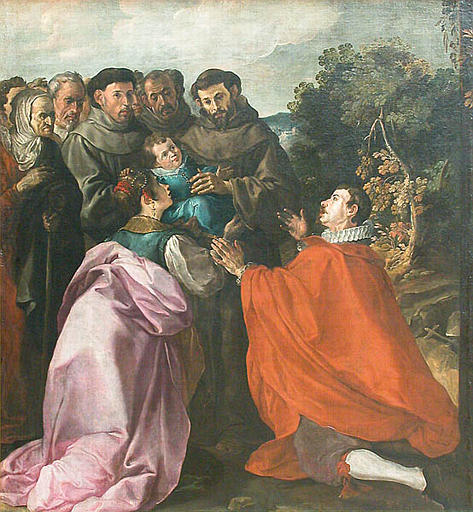
Francisco de Herrera the Elder 1576 – 1656 St Bonaventure Enters the Franciscan Order 1628
St Francis gave him his name, for, having miraculously cured him of a mortal sickness, he prophetically exclaimed of the child, “O bona ventura!”-good luck.
Francisco de Herrera the Elder 1576 – 1656 The Cure of Saint Bonaventure as a Child by St Francis 1628
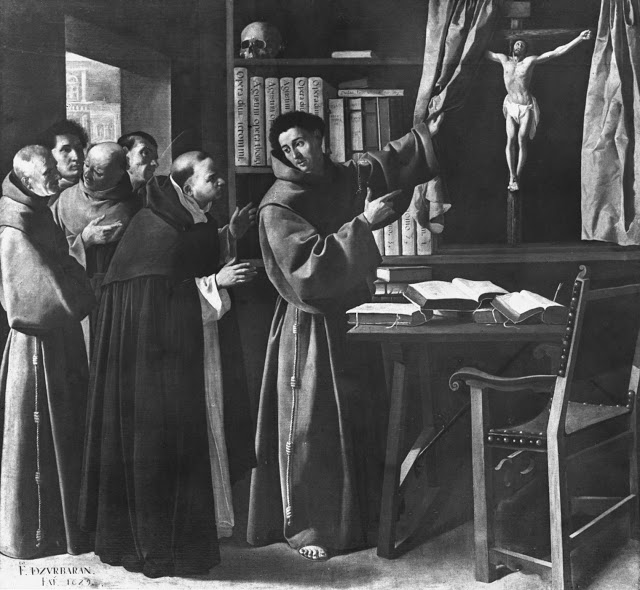
He is known also as the “Seraphic Doctor,” from the fervour of divine love which breathes in his writings. He was the friend of S. Thomas Aquinas, who asked him one day whence he drew his great learning. He replied by pointing to his crucifix. At another time St Thomas found him in ecstasy while writing the life of St Francis and exclaimed, “Let us leave a Saint to write of a Saint.” They received the Doctor’s cap together.
Francisco de Zurbarán 1598 -1664 Saint Bonaventure and St Thomas Aquinas before the Crucifix 1629 (lost in 1945)
He was the guest and adviser of St Louis and the spiritual director of St Isabella, the king’s sister. At the age of thirty-five in 1257 he was made general of his Order and only escaped another dignity, the Archbishopric of York, by dint of tears and entreaties. Gregory X appointed him Cardinal Bishop of Albano.
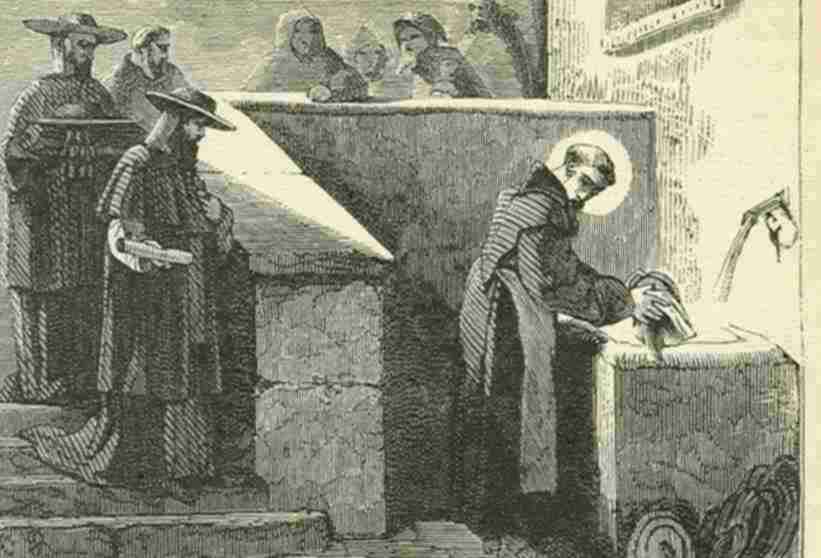
When the Saint heard of the Pope’s resolve to create him a Cardinal, he quietly made his escape from Italy. But Gregory sent him a summons to return to Rome. On his way, he stopped to rest himself at a convent of his Order near Florence and there two Papal messengers, sent to meet him with the Cardinal’s hat, found him washing the dishes. The Saint desired them to hang the hat on a bush that was near and take a walk in the garden until he had finished what he was about. Then taking up the hat with unfeigned sorrow, he joined the messengers and paid them the respect due to their character.
He sat at the Pontiff’s right hand and spoke first at the Council of Lyons. His piety and eloquence won over the Greeks to Catholic union and then his strength failed.
Francisco de Zurbarán 1598 -1664 Saint Bonaventure at the Council of Lyon (1274) (c.1630)
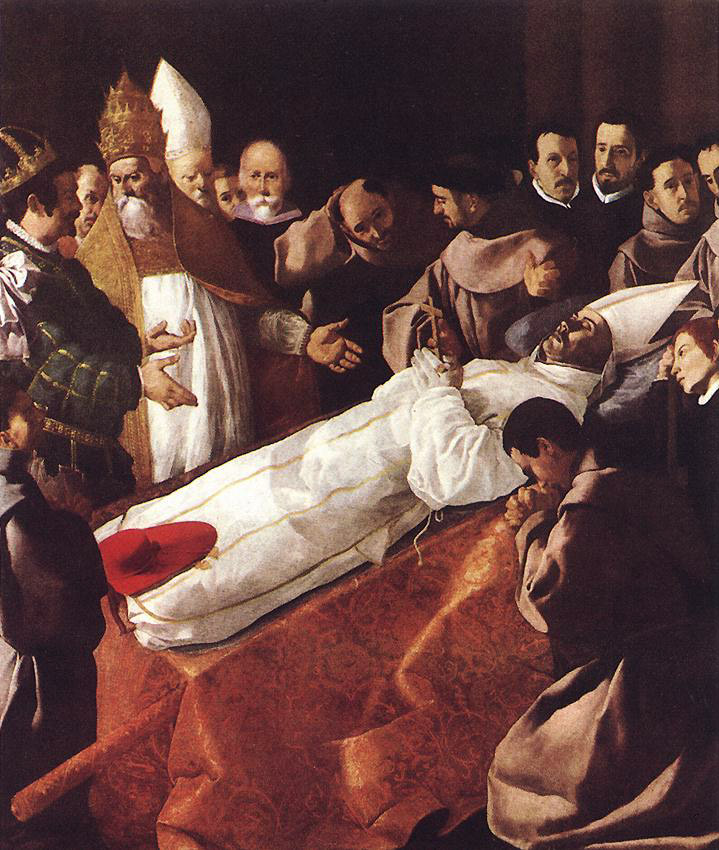
He died while the Council was sitting and was buried by the assembled bishops, on 15 July 1274.
Francisco de Zurbarán 1598 -1664 The Exposition of the Body of St Bonaventure (c.1630)
For more details on St Bonaventure’s life here: https://anastpaul.wordpress.com/2017/07/15/saint-of-the-day-15-july-st-bonaventure-seraphic-doctor/
Saint of the Day – 4 July – St Elizabeth of Portugal T.O.S.F. (1271-1336) Queen Consort, Franciscan Tertiary, Apostle of Charity and Peace, political negotiator and mediator – also known as Elizabeth of Aragon, Elisabet in Catalan, Isabel in Aragonese, Portuguese and Spanish and The Peacemaker, born in 1271 at Aragon, Spain and died on 4 July 1336 at Estremoz, Portugal of a fever. Patronages – Coimbra, Diocese of San Cristóbal de La Laguna, Cathedral of La Laguna.
Elizabeth means “Promise of God”
Saint Elizabeth was the daughter of King Peter III of this kingdom and niece of King James the Conqueror, great-niece of Emperor Frederick II of Germany. They gave her the name Elizabeth after her aunt, Saint Elizabeth of Hungary.
Her formation was formidable and from the time she was very young she had a notable piety. She was taught that, in order to be truly good, she ought to include mortification of her likes and whims along with her prayer. She was careful to order her life toward the love of God and neighbour, disciplining her habits of life. She did not eat between meals.
She was married at the age of 12 to King Dionysius of Portugal. This was a great cross for Elizabeth because he was a man of little morals, being violent an unfaithful. But she endured heroically this trial. She prayed and offered many sacrifices for him. She always treated him with goodness. They had two sons: Alfonso, the future king of Portugal and Constance, future king of Castille. Saint Elizabeth even educated the natural sons of her husband with other women. The king, for his part, admired her and permitted her to live an authentic Christian life, to a certain degree. She would rise very early in the morning and read six psalms, attend Holy Mass and dedicated herself to manage the duties of the palace. In her free time she met with other women to make clothing for the poor. She dedicated the afternoons to visiting the elderly and ill.
She made possible the construction of hostels, a hospital for the poor, a free school, a home for women repenting from a sinful life and a hospice for abandoned children. She also constructed convents and did other good works for the people. She would lend her beautiful dresses and even one of her crowns for the weddings of poor young women.
Saint Elizabeth would frequently distribute coins from the Royal Treasury to the poor so that they could buy their daily bread. On one occasion, King Dionysius, suspicious of her actions, began to spy on her. When the queen began to distribute money among the poor, the king saw and, infuriated, went to reclaim it. But the Lord intervened, in such a way that, when the king ordered that she showed him what she was giving to the poor, the coins turned to roses.
The Peacemaker:
The son of Elizabeth, Alfonso, had a violent character like his father. He was filled with anger at the preference his father showed to his natural children. On two occasions he promoted a civil war against his father. Elizabeth strived for reconciliation between father and son. On one occasion she went on pilgrimage to Santarem, a Eucharistic miracle and, dressed as a penitent, implored the Lord for peace.
Then she went to present herself on the field of battle and, when the armies of her spouse and son were about to engage in battle, the queen kneeled between them and, on her knees, asked her husband and son to be reconciled.
Some of her letters have been preserved, which reflect gospel values and audacity of our Saint. To her husband:“Like an infuriated wolf that is going to kill your Little son, I will fight so that the arms to the King are not unleashed against our own son. But at the same time, I will first make sure that the arms of the army of my son are destroyed, before they are fired against the followers of his father.”
To her son: “By the Blessed Virgin Mary, I ask that you make peace with your father. See, the soldiers are burning houses, destroying crops and breaking everything in pieces. Not with weapons, my son, we cannot fix the problem with weapons, but rather with dialogue, continuing negotiations to fix these conflicts. I will make the troops of the king go away and that the demands of the son be attended to but please remember, that you have a most serious duty to your father as his son and as a subject to his king.”
She obtained peace on more than one occasion, and her husband died repentant, without a doubt due to prayers of his wife.
Because Saint Elizabeth had such a great love for the Eucharist, she dedicated herself to study the lives of the Saints who were most notable in their love for the Eucharist and especially Saint Clare. After becoming a widow, Saint Elizabeth divested herself of all her riches. She went on a pilgrimage to Santiago de Compostela, where she surrendered her crown to the Archbishop in order to receive the habit as a Claretian tertiary. The Archbishop was so moved by this act of the Saint that he gave her his pastoral cross to help her on her return to Portugal. She lived her last years in the convent, dedicated to Eucharistic adoration.
When a war broke out between her son and her son-in-law, the King of Castille, Saint Elizabeth, despite her old age, undertook a long journey by dangerous roads and obtained peace. Nevertheless, the trip cost her life. Feeling herself close to death, she asked to be taken to a Claretian convent that she herself had founded. There she died invoking Our Lady on 4 July 1336.
God blessed her tomb with miracles. Her body can be venerated in the Claretian convent in Coimbra. She was Canonised on 25 May 1625 by Pope Urban VIII.
Saint Elizabeth of Portugal, pray for peace in our world!
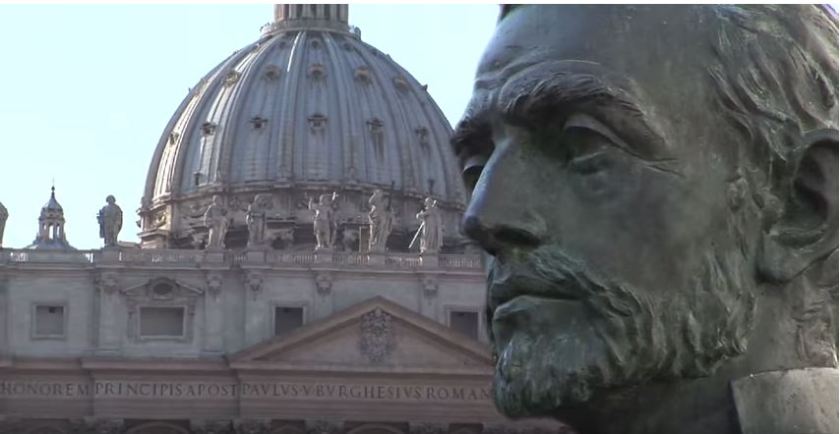
St Elizabeth on the Colonnade at St Peter’s, Rome St Elizabeth on the 50 Escudos Note, prior to the Euro



















 AnaStpaul
You must be logged in to post a comment.