Quote/s of the Day – 31 January – Friday of the Third Week in Ordinary Time, Year A, the Memorial of Saint Francis Xavier Bianchi CRSP (1743-1815) “Apostle of Naples” and St John Bosco (1815-1888)
“When you hear, that I cannot celebrate Mass anymore, count me as dead.”
One Minute Reflection – 31 January – Friday of the Third Week in Ordinary Time, Year A, Readings: 2 Samuel 11:1-10, 13-17, Psalm 51:3-7, 10-11, Mark 4:26-34 and the Memorial of Saint Francis Xavier Bianchi CRSP (1743-1815) “Apostle of Naples” and St John Bosco (1815-1888)
“To what shall we compare the kingdom of God, or what parable can we use for it? It is like a mustard seed…” … Mark 4:30-31
REFLECTION – “The Word of God is like a grain of mustard seed, before cultivation it looks extremely small. But when it is cultivated in the right way, it grows so large, that the highest principles of both sensible and intelligible creation, come like birds to revive themselves in it. For the principles – or inner essences of all things, are embraced by the Word but the Word is not embraced by anything. Hence, the Lord has said, that whoever has faith like a grain of mustard seed, can move a mountain by a word of command (cf. Mt 17:20), that is, he can destroy the devil’s dominion over us and remove it from its foundation.
The grain of mustard seed is the Lord, who by faith is sown spiritually in the hearts of those who accept Him. Whoever diligently cultivates the seed by practising the virtues, moves the mountain of earthbound pride and, through the power thus gained, expels the obdurate habit of sin. In this way, the activity of the principles and qualities, or divine powers, present in the commandments, is revived as though they were birds. (…) Those who seek the Lord should not look for him outside themselves. On the contrary, they must seek Him, within themselves, through faith made manifest in action.
For it is written, “The word is very near to you, in your mouth and in your heart” (Rm 10:8), that is, the word of faith, Christ, being Himself, the word that is sought.” … Saint Maximus the Confessor (c 580-662) Monk and Theologian – Second Century on Theology, nos. 10-11, 35
PRAYER – Almighty Father, we bless You Lord of life, through whom all living things tend. You are the source of all, our first beginning and our end! Grant holy Father, that we may allow the Word to enter our hearts and grow by Your grace, so that we may always live for Your glory. May the intercession of St Francis Xavier Bianchi and St John Bosco, who consistently tended Your seed, grant us strength and zeal. Through Jesus Christ, our Lord with the Holy Spirit, God forever, amen.
Our Morning Offering – 31 January – Friday of the Third Week in Ordinary Time, Year A and the Memorial of St John Bosco (1815-1888) Founder of the Society of St Francis de Sales now known as the Salesians
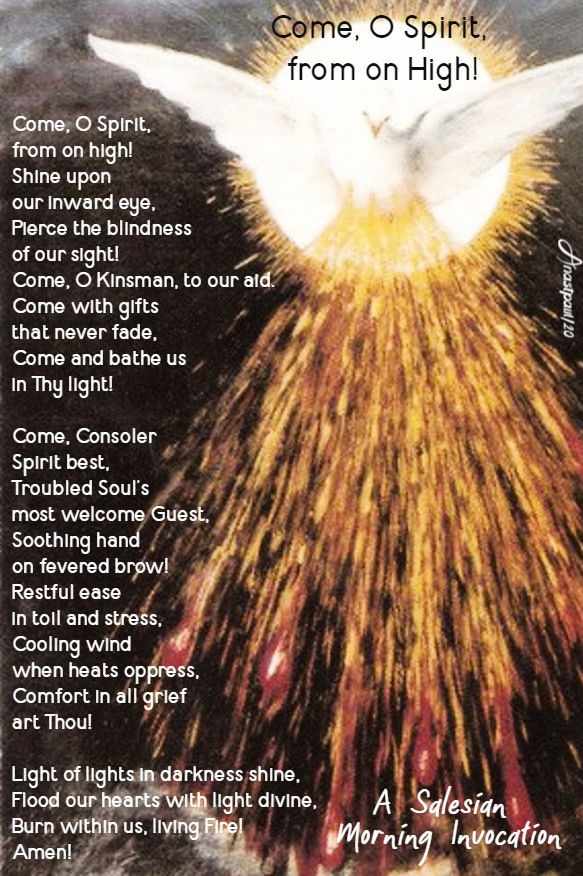
Come, O Spirit, from on High! A Salesian Morning Invocation
Come, O Spirit, from on high!
Shine upon our inward eye,
Pierce the blindness of our sight!
Come, O Kinsman, to our aid.
Come with gifts that never fade,
Come and bathe us in Thy light!
Come, Consoler Spirit best,
Troubled Soul’s most welcome Guest,
Soothing hand on fevered brow!
Restful ease in toil and stress,
Cooling wind when heats oppress,
Comfort in all grief art Thou!
Light of lights in darkness shine,
Flood our hearts with light divine,
Burn within us, living Fire!
Amen!
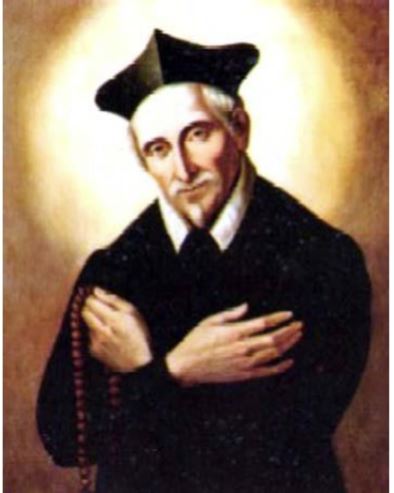
Saint of the Day – 31 January – Saint Francis Xavier Bianchi CRSP (1743-1815) “Apostle of Naples” – Priest of the Barnabite Order (The Clerics Regular of St Paul), Apostle of the poor, Eucharistic Adorer, Marian devotee, Ascetic and Mystic, Spiritual Director and Confessor, Professor – born as Francesco Saverio Maria Bianchi on 2 December 1743 in Arpino, Frosinone, Italy and died on 31 January 1815 in Naples, Italy of natural causes. Patronage – Naples. St Francis gained a reputation for sanctity during his lifetime from his commitment to his students, his guidance of all who sort his spiritual direction and to the poor of Naples.
Francis was born in 1743 in Arpino in the Lazio region, then part of the Papal States, into a loving and pious family. His mother taught him to care for the poor around them, giving him example by setting up a small clinic in the family home where she would nurse up to 16 needy people. He was, nevertheless, far from a standard pious child. He would later confess to how he would occasionally pilfer money from his parents.
He made his first studies in the Collegio dei Santi Carlo e Filippo in Arpino, run by the Regular Clerics of San Paolo, also called Barnabiti, founded in 1530 in Milan by Father Antonio Maria Zaccaria (Canonised in 1897). What changed Bianchi’s life was a slow and steady resolve to conquer his own will. As he grew older, he felt called to religious life. He initially thought of entering the Society of Jesus but then he chose the Order to which his teachers belonged. The parents, on the other hand, would have preferred to see him as a diocesan priest. As a result, at the age of 15 he was enrolled in a minor seminary in Nola, while at the same time, he began the study of law at the University of Naples Federico II. During this period, he came under the spiritual guidance of St Alphonsus Maria de Ligouri, the founder of the Redemptorists.
In 1757, Francis was admitted by the Barnabite Order into their novitiate in Zagarolo that same year, professing religious vows as a member of the Order the following year. He was then sent to pursue his study of philosophy and theology, first at Macerata, followed by Rome and Naples, where he was ordained a priest in 1767. Prior to his ordination he had taught at the Barnabite college in his hometown. He was immediately appointed the Superior of the College of Santa Maria in Cosmedin in Portanova, which office he filled for 12 years.
His superiors then assigned him to the Barnabite monastery attached to the Church of Santa Maria di Caravaggio, Naples, where he was to spend the rest of his life. In 1778 he was appointed a professor at Regia University (now the University of Palermo), as well as a member of the Royal Academy of Science and Letters of the Pontifical Ecclesiastical Academy. Despite his academic honours and pride of place in the Order, his fellow Barnabites also saw another side to him, as he became known among them for the deeply ascetic way of life he followed, with a deeply contemplative prayer life and for his constant concern for the poor of the cities where he lived.
He became part of a circle of notable religious figures living in Naples in that era. He became the Spiritual director and Confessor of Mary Frances of the Five Wounds, a Franciscan tertiary, who lived in one of the most crime-ridden neighbourhoods of the city and is now also honoured as a saint. In turn, he became friends and under the guidance of such figures as Placido Baccher, the Blessed Mariano Arciero, his fellow Barnabite and student, the Venerable Francesco Maria Castelli, Giovanni Battista Jossa, the Servant of God Agnello Coppola. He was in frequent communication with the Blessed Vincent Romano as well as with King Charles Emmanuel IV of Sardinia and his niece, Princess Maria Clotilde of Savoy, then in exile in Naples.
Fr Francis’ life changed in 1800, when he fell into a state of religious ecstasy while praying before the exposed Blessed Sacrament on Pentecost of that year. Shortly after this, he developed an illness which left his legs twisted and with open sores for the rest of his life. During the last three years of his life, he continued to preside daily at Mass, despite the agony of having to stand. Mostly bedridden, he used this time to deepen his spiritual life even further as well as guiding others spiritually and hearing Confessions.
Fr Francis also begun to tremble and experiences palpitations of his heart whenever he prayed, in a manner similar to that which had been experienced by St Philip Neri two centuries earlier. The tertiary Mary Frances commented that we have two Philip’s, one white and one black, which was a pun on the meanings of their family names in Italian.
He was still living in the Barnabite monastery of Naples when it was closed in 1809, as part of the suppression of all monasteries and religious houses under the Napoleonic Kingdom of Naples. He was able to remain in the city, where he died in 1815.
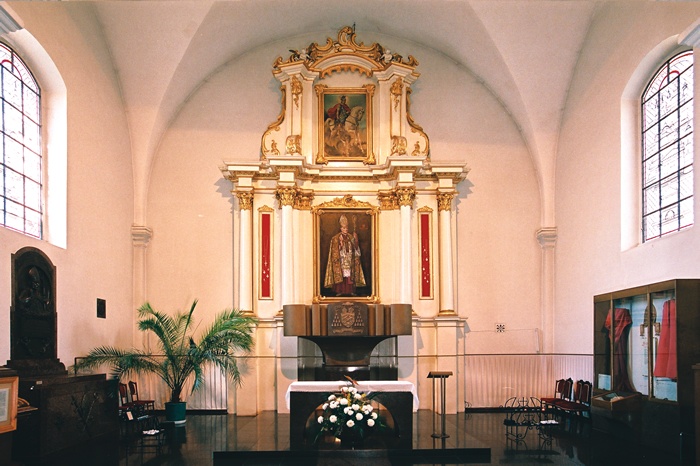
Fr Francis was Beatified on 22 January 1893 by Pope Leo XIII, who also declared him to be the “Apostle of Naples.” He was Canonised on 21 October 1951, by Pope Pius XII. His remains are enshrined in the Church of Santa Maria di Caravaggio in Naples. His feast day is celebrated on 30 January by the Barnabites (moved to avoid being in conflict with St John Bosco’s feast) but the Catholic Church in Naples celebrates today, the feast of their beloved Saint with great honour and festivities each year.
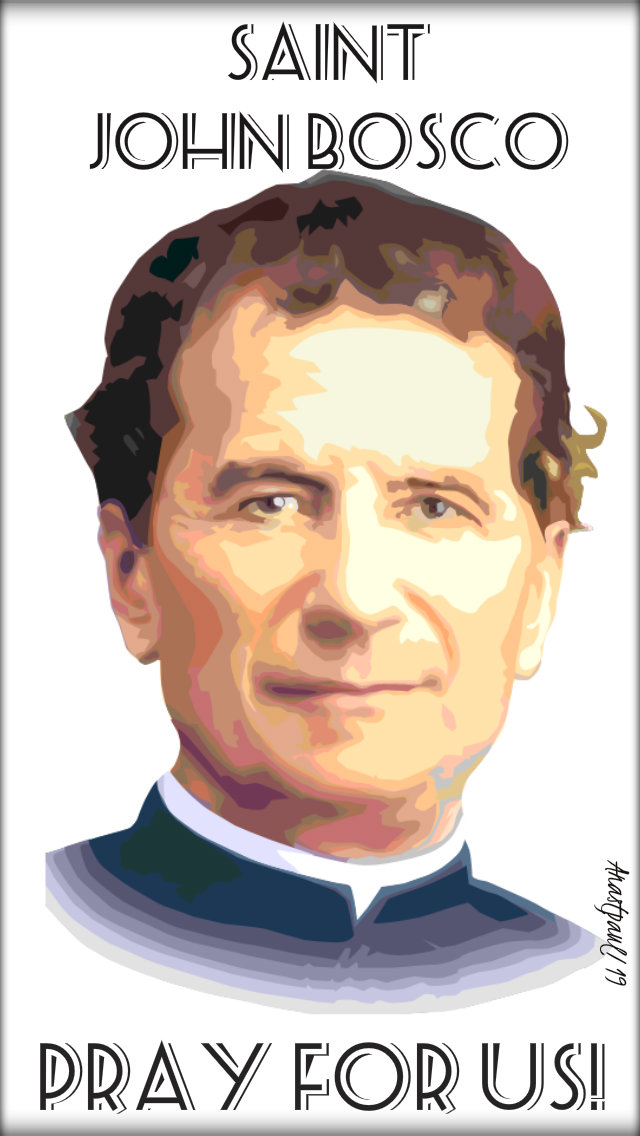
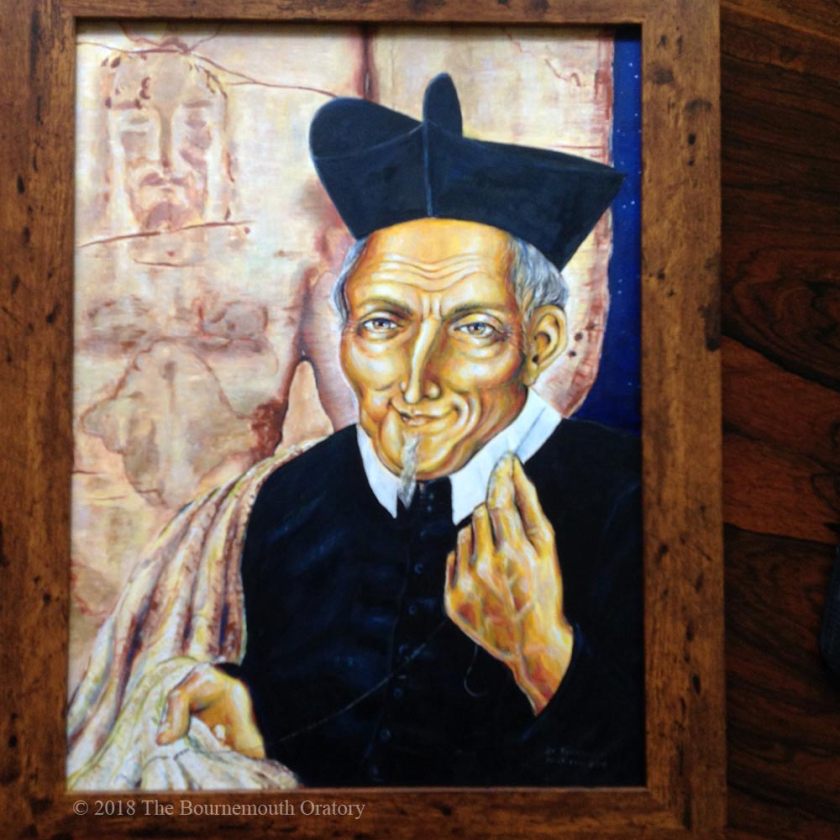
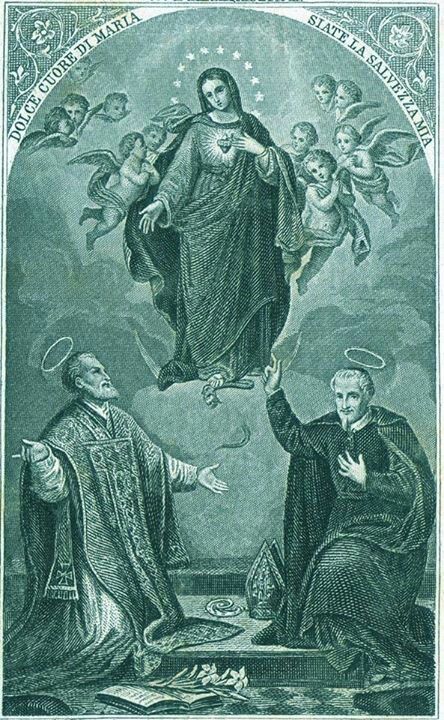
St John Bosco “Don Bosco” SDB (1815-1888) (Memorial) Founder of the Society of St Francis de Sales now known as the Salesians All about beautiful Don Bosco:
St Abraham of Abela
Bl Adamnan of Coldingham
St Aedan of Ferns
St Aiden
St Athanasius of Modon
St Bobinus of Troyes
St Eusebius of Saint Gall St Francesco Saverio Maria Bianchi/Francis Xavier Bianchi CRSP (1743-1815) “Apostle of Naples”
St Geminian of Modena
Bl John Angelus
St Julius of Novara
Bl Louise degli Albertoni
Bl Luigi Talamoni
St Madoes
St Marcella
Bl Maria Cristina di Savoia
St Martin Manuel
St Nicetas of Novgorod
St Tryphaena of Cyzicus
St Tysul
St Ulphia of Amiens
St Waldo of Evreux
St Wilgils
—
Martyrs of Corinth – 14 saints: A group of Christians tortured and martyred together in Corinth, Greece in the persecutions of Decius. We know nothing about them except some names – Anectus, Claudius, Codratus, Crescens, Cyprian, Diodorus, Dionysius, Nicephorus, Papias, Paul, Serapion, Theodora, Victor and Victorinus.
Martyrs of Canope:
Athanasia
Cyrus the Physician
Eudoxia
John the Physician
Theoctista
Theodotia
Martyred in Alexandria, Egypt
Cyriacus
Metranus
Saturninus
Tarskius
Thyrsus
Victor
Zoticus
Martyred in Alexandria, Egypt:
Cyriacus
Metranus
Saturninus
Tarskius
Thyrsus
Victor
Zoticus
Martyred in the Spanish Civil War:
José Acosta Alemán
Juan José Martínez Romero
Pedro José Rodríguez Cabrera
Martyrs of Korea: Thousands of people were murdered in the anti-Catholic persecutions in Korea.
• Saint Agatha Kwon Chin-i
• Saint Agatha Yi Kyong-I
• Saint Augustinus Park Chong-Won
• Saint Magdalena Son So-Byok
• Saint Maria Yi In-Dok
• Saint Petrus Hong Pyong-Ju
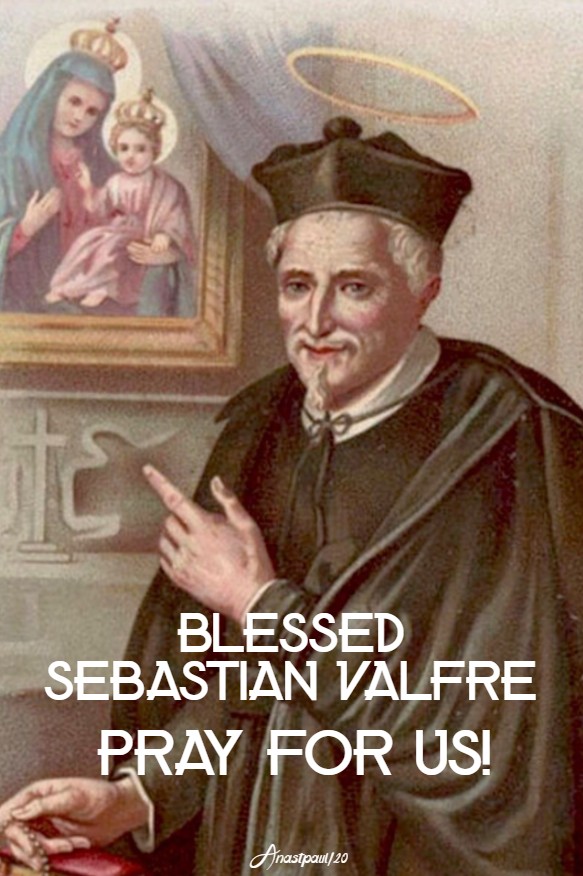
Second Thought for the Day – 30 January – The Memorial of Blessed Sebastian Valfrè CO (1629-1710)
Blessed Sebastian’s sanctity, under God, arose from his struggles to conform himself to Saint Philip – and that was quite a task. Whereas Philip was gentle and kind by nature, Sebastian was harsh and prone to outbursts of anger. Philip had to refrain from extended prayer in public for fear of going into ecstasy. Sebastian experienced nothing but dryness in prayer and had to keep his mind from wandering. The thought of death and judgement so tormented him, that he could not sleep at night.
And Sebastian found one of the principal works of the Oratory – the hearing of confessions – so repugnant that the congregation could not prevail upon him to accept faculties until ten years after his ordination. Yet, he was able to overcome all these difficulties and always to maintain a serene and joyful expression, so that everyone considered him to be another Saint Philip.
Community life presented Sebastian with many opportunities for mortifying his short temper. When teaching theology to the novices, he had to endure a student who had no interest in the subject and showed his annoyance by constantly arguing and contradicting the professor.
Sebastian patiently answered his objections and did not betray his own displeasure, although, as he confided to one of the fathers, the very sight of the man filled him with repugnance. The novice subsequently left the congregation; more serious, however and more enduring was Sebastian’s natural antipathy for one of the fathers. He admitted that there was nothing objectively wrong with the priest but that the dislike was so strong that he had to take a private vow to endure the father’s company. Sebastian believed that he never once betrayed his feelings and was grateful for the opportunity to mortify his nature which he recognised to be imperfect.
Sebastian had a beautiful plaster Crucifix, over the prie-Dieu in his room, to which he was quite attached. He once asked a father to get some papers for him which were inside the flap of the prie-Dieu. In opening the flap, the priest let it slip and it shattered the crucifix into tiny pieces. Sebastian, although he was in the room when it happened, remained calm, told the father not to trouble himself with it and swept up the pieces himself.
The Congregation of the Oratory derives its name from a place of prayer and Saint Philip used to say that anyone who did not intend to pray should leave the community. Sebastian, although he was intent on praying, found prayer extremely difficult. He found it dry and God seemed to be very far away from him. When engaged in mental prayer, Sebastian found it hard to concentrate, although he was careful to prepare his meditations. The inability to concentrate was especially painful to him when saying his office and he seems to have given in to scruples on occasion, reciting the office more than once. And at Mass, too, he found it difficult to concentrate, although for a brief time after Communion, his soul found some peace.
Sebastian remained in this state of anguish for many years. But, although he suffered interiorly, he was able to lead his penitents in the way of Christian joy associated with his spiritual father, Saint Philip. Sebastian, himself, acknowledged the value of these torments in teaching him perfect detachment from all earthly things. Others have seen them as protecting his humility from his admiring disciples who were intent on bestowing every honour upon the Saint.
Blessed Sebastian is a model of perseverance and a great source of hope. He fought against imperfections such as his temper and repugnances and prevailed. And he persevered in prayer although he did not find any consolation there but, more often than not, spiritual torment. Yet, God used these means to purify him and present him to the outside world as a great saint full of Christian joy. His exemplary life of holiness would inspire the Church in Turin for many generations and now, he inspires the faithful in perseverance, hope and humility, knowing that we are all called to be Saints too! It is comforting and a source of consolation to realise, that the Saints too, experienced the hardships we sometimes do – let us never give up the pursuit of holiness, amen.
Quote/s of the Day – 30 January – The Memorial of Blessed Sebastian Valfrè CO (1629-1710)
Some of his advice, given to the novices, suffice for us all:
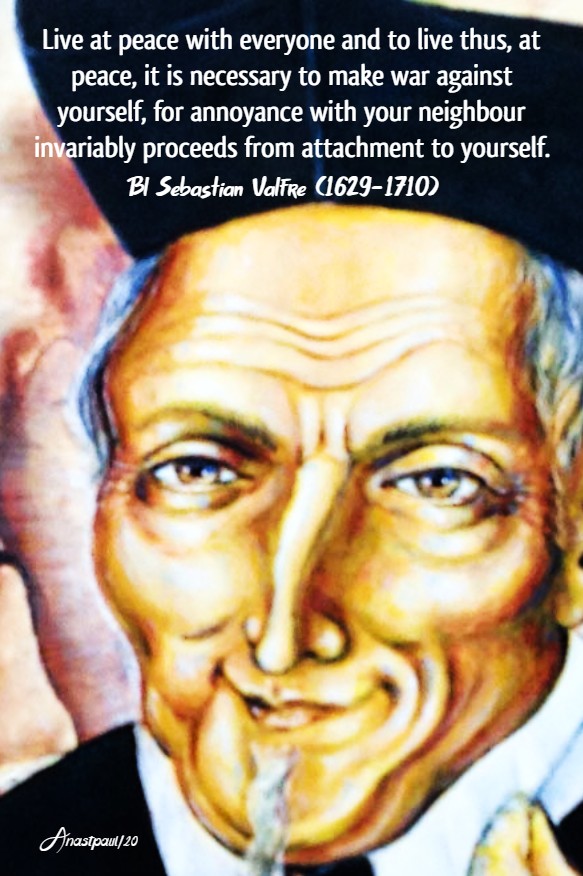
“Live at peace with everyone and to live thus, at peace, it is necessary to make war against yourself, for annoyance with your neighbour invariably proceeds from attachment to yourself.”
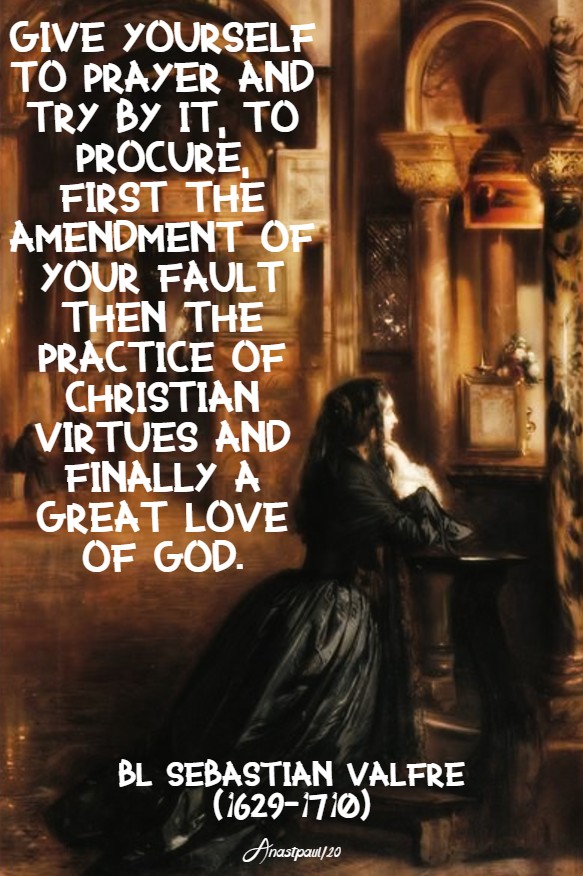
“Give yourself to prayer and try by it, to procure, first the amendment of your fault then the practice of Christian virtues and finally a great love of God.”
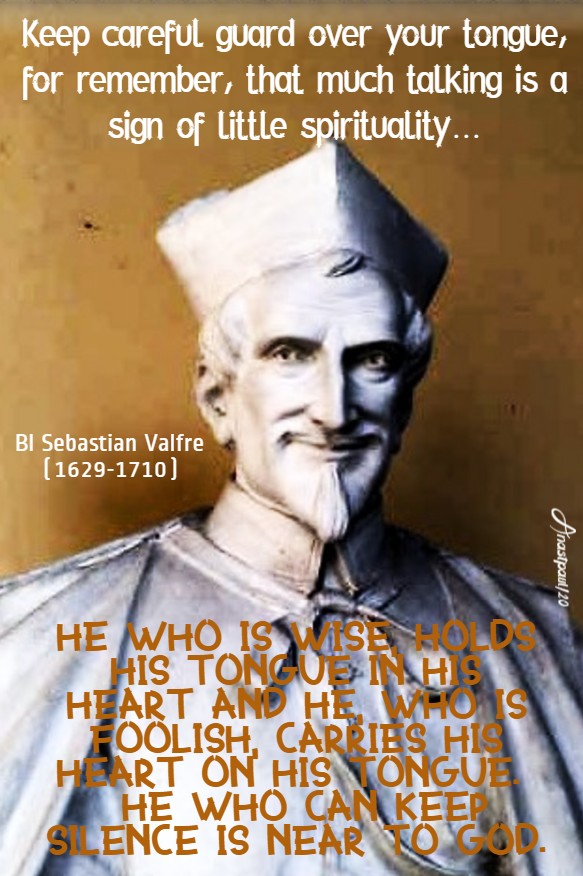
“Keep careful guard over your tongue, for remember, that much talking is a sign of little spirituality…”
“He who is wise, holds his tongue in his heart and he, who is foolish, carries his heart on his tongue. He who can keep silence is near to God.”
He was much in demand as a spiritual father and would advise the Fathers of his Congregation:
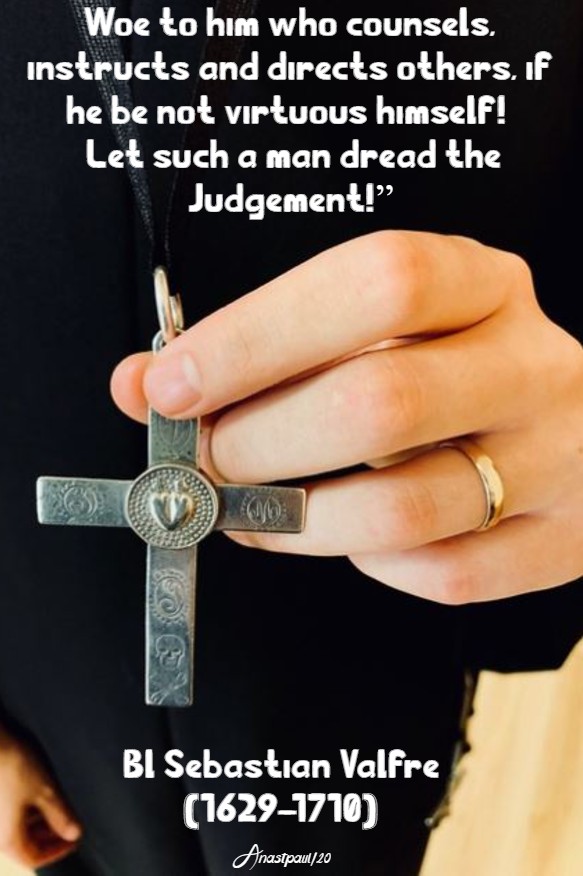
“A confessor should above all, give a good example to his penitents, especially by practising the virtues he wishes to impress upon them. If he exhorts them to humility, let him first be humble; if to devotion, let him be devout himself; if he is to do this he will more readily be believed and obeyed. Woe to confessors and preachers who teach virtue without practising it. Woe to him who counsels, instructs and directs others, if he be not virtuous himself! Let such a man dread the Judgement!”
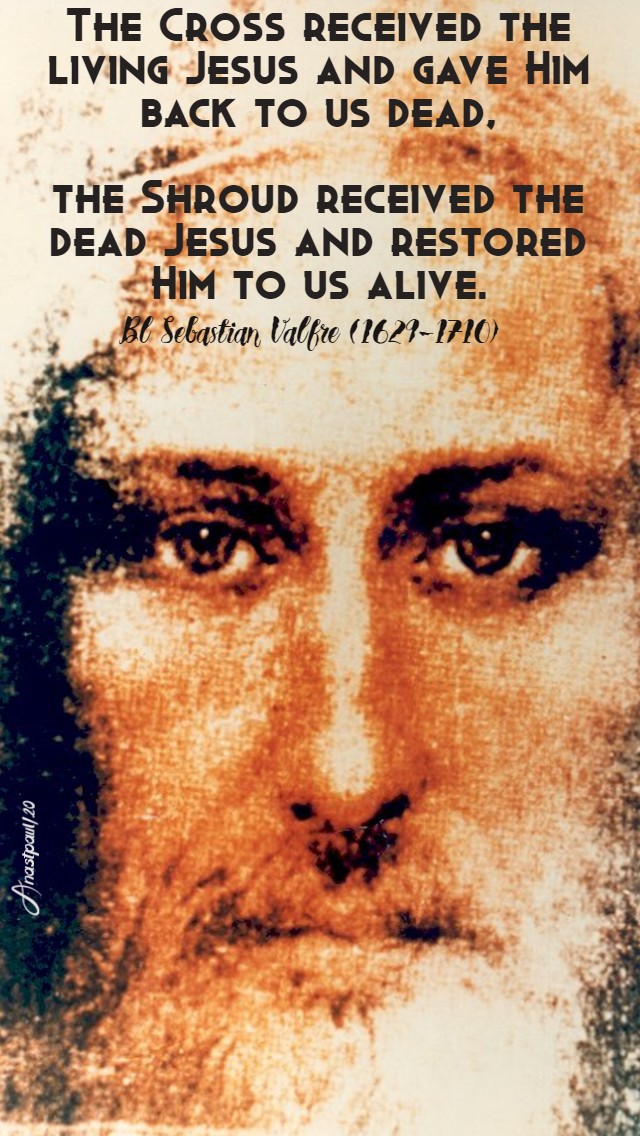
Blessed Sebastian speaking of the Shroud of Turin to which he had a great devotion:
“The Cross received the living Jesus and gave Him back to us dead, the Shroud received the dead Jesus and restored Him to us alive.”
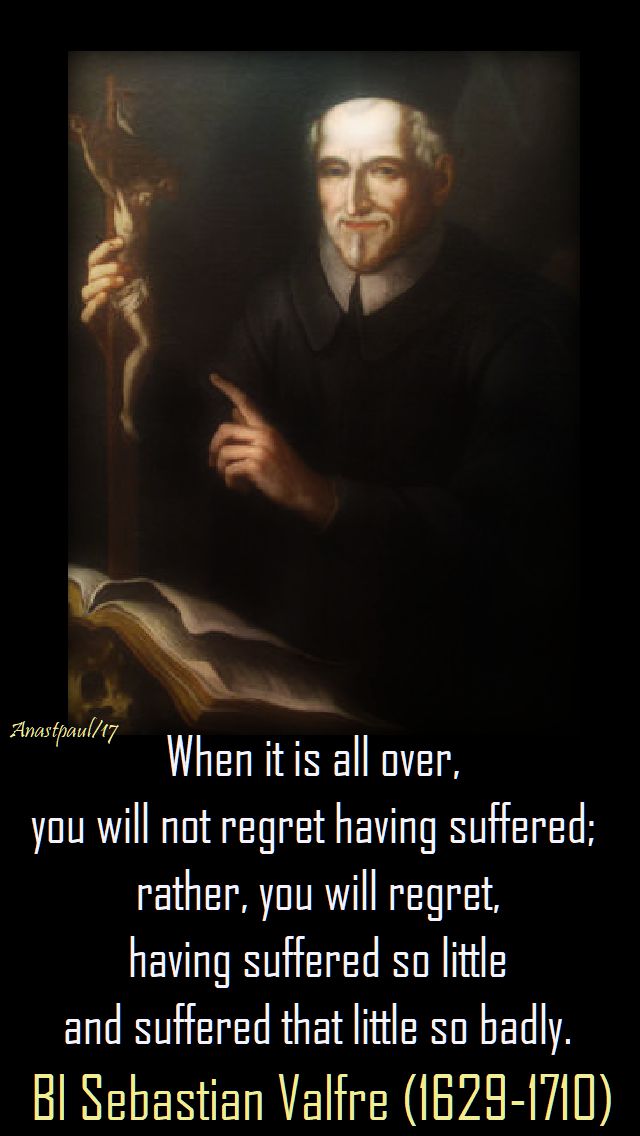
“When it is all over, you will not regret having suffered, rather, you will regret, having suffered so little and suffered that little so badly.”
One Minute Reflection – 30 January – Thursday of the Third week in Ordinary Time, Year A, Readings: 2 Samuel 7:18-19, 24-29, Psalm 132:1-5, 11-14, Mark 4:21-25 and the Memorial of Blessed Sebastian Valfrè CO (1629-1710)
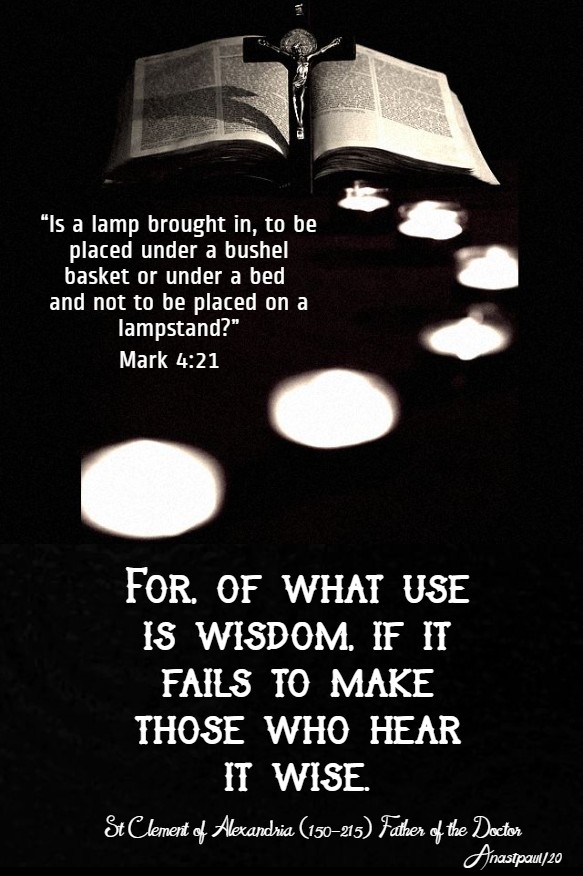
He said to them, “Is a lamp brought in to be placed under a bushel basket or under a bed, and not to be placed on a lampstand?” … Mark 4:21
REFLECTION – “A well, when pumped regularly, produces purer water. If neglected, and no-one uses it, it changes into a source of pollution. Use, keeps metal brighter but disuse produces rust. For, in a word, exercise produces a healthy condition both in souls and bodies. So “No-one lights a candle and puts it under a bowl but upon a candlestick, that it may give light.” For of what use is wisdom, if it fails to make those who hear it wise.” … St Clement of Alexandria (150-215) Father of the Doctor
PRAYER – Lord God, in Your wisdom You created us, by Your providence You rule us, You have planted us, penetrate our inmost being Your holy Light, so that our way of life may always be one of faithful service to You. Grant us the grace and love to walk in Your ways and to radiate Your Light by our lives. May the prayers of all the angels and saints and of Blessed Sebastian Valfrè be unfailing assistance to us. Through Jesus Christ our Lord, with You and the Holy Spirit, one God forever, amen.
Our Morning Offering – 30 January – Thursday of the Third week in Ordinary Time, Year A and the Memorial of Blessed Sebastian Valfrè CO (1629-1710)
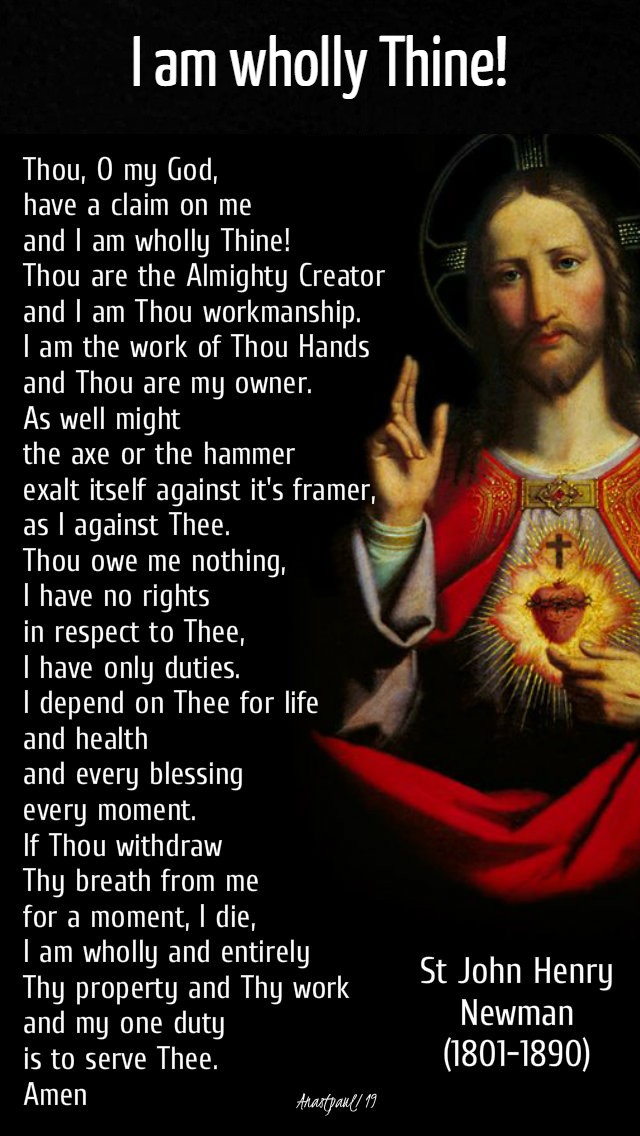
I am wholly Thine! St John Henry Newman CO (1801-1890)
Thou, O my God,
have a claim on me
and I am wholly Thine!
Thou are the Almighty Creator
and I am Thou workmanship.
I am the work of Thou Hands
and Thou are my owner.
As well might the axe or the hammer
exalt itself against it’s framer, as I against Thee.
Thou owe me nothing,
I have no rights in respect to Thee, I have only duties.
I depend on Thee for life and health
and every blessing every moment.
If Thou withdraw Thy breath from me
for a moment, I die, I am wholly and entirely Thy property
and Thy work and my one duty is to serve Thee.
Amen
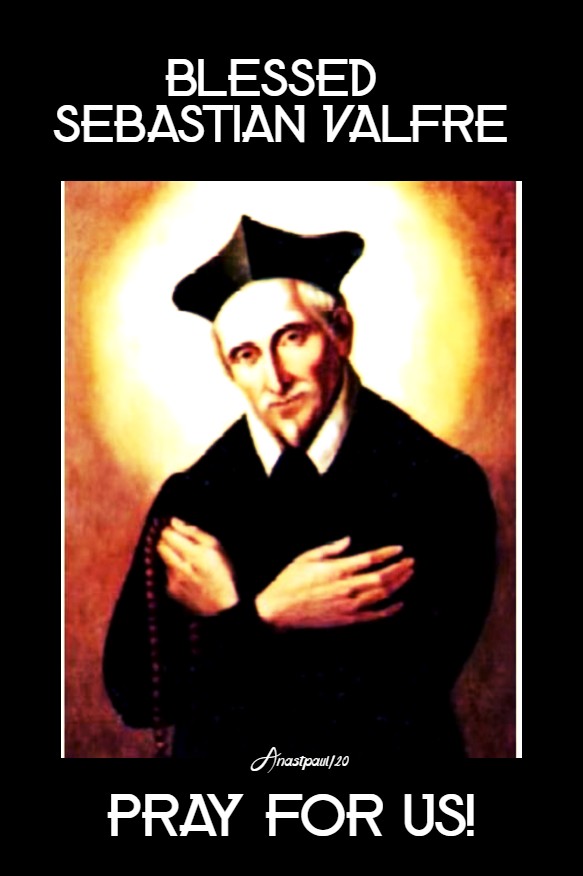
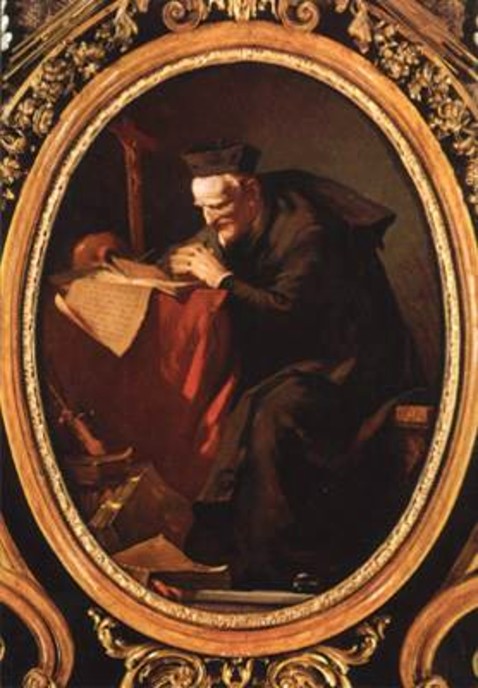
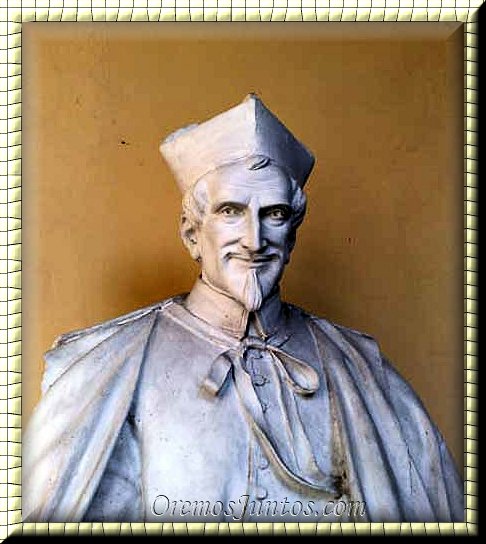
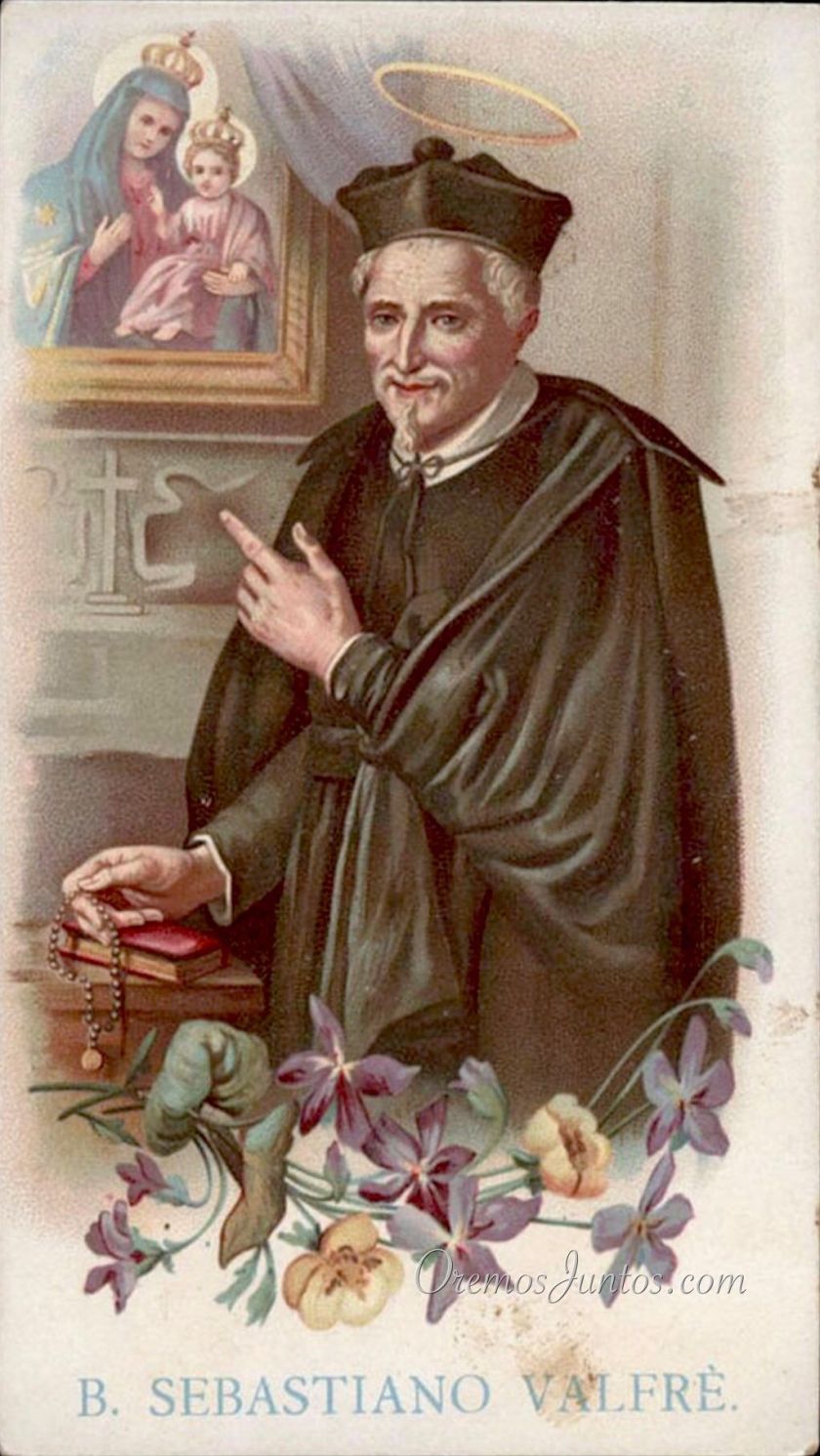
Saint of the Day – 30 January – Blessed Sebastian Valfrè CO (1629-1710) Oratorian Priest, Apostle of the poor, the ill, widows and orphans, prisoners, Confessor with deep insight, Writer – known as the Apostle of Turin and St Philip of Turin, Marian devotee. Born on 9 March 1629 in Verduno, Duchy of Savoy (in modern Italy) and died on 30 January 1711 in Turin, Duchy of Savoy of natural causes. Blessed Sebastian is known for his service to the poor during the famine of 1678-80 and the 17-week siege of Turin during the war between Piemonte and Louis XIV. He is still invoked as patron of Military Chaplains for his ministry to soldiers during the war. Patronage – Turin, the Oratory in Turin and Military Chaplains and soldiers. His body is incorrupt.
Sebastian Valfrè was born on 9 March 1629 at Verduno in the southern Alps. His background was humble – his mother and father were poor farmers and the dull routine of work in the fields with his parents and seven siblings took up much of his childhood. He felt a call to the priesthood at an early age but ran into difficulties with his family, who were loathe to lose his assistance with the farm work, however, he persevered and eventually won them over. He left Verduno to begin his studies in 1641 at the age of twelve and again, these days were not easy for him – at one stage he had to stay up most nights copying out books, to pay for his education, which took him, in its later stages, to Turin for studies with the Jesuits.
Also at Turin was the Oratory, which had in earlier years been influential, particularly on the youth of the city but by 1650 was rather down-at-heel – only one priest, Fr Cambiani, remained and he is described as ‘ragged and eccentric’. It can hardly have been an enticing prospect in human terms but Sebastian nonetheless joined, on St Philip’s Day, 26 May 1651, being Ordained Deacon only a week later. By the end of the year, the community had been bolstered by the arrival of three new priests, so by the time Sebastian was Ordained Priest in February 1652, the Oratory showed signs of life once more.
St Philip Neri, left and Bl Sebastian
Turin soon began to benefit from his presence as a priest. In common with many cities of that and other ages, it had its share of poverty, which Sebastian did much to alleviate. He was not afraid to ask the rich for alms to give to the poor but he took care to be as discreet as possible, doing much of the distribution at night when it was easier to remain anonymous. These activities took on heightened importance from 1678 to 1680, when famine struck Piedmont and again, during the war between Piedmont and Louis XIV, which culminated for Turin in a seventeen-week siege which caused great hardship as well as anxiety — and which Sebastian’s prayers are said to have been efficacious in bringing to a successful end for the inhabitants.
Sebastian’s interests and influence were not limited to the duchy. He helped to found the Pontifical Academy of Ecclesiastical Nobles in Rome in 1701, which was established to train diplomats for the Papal States. Under its current name of the Pontifical Ecclesiastical Academy, it still fulfils that function for the Vatican City State.
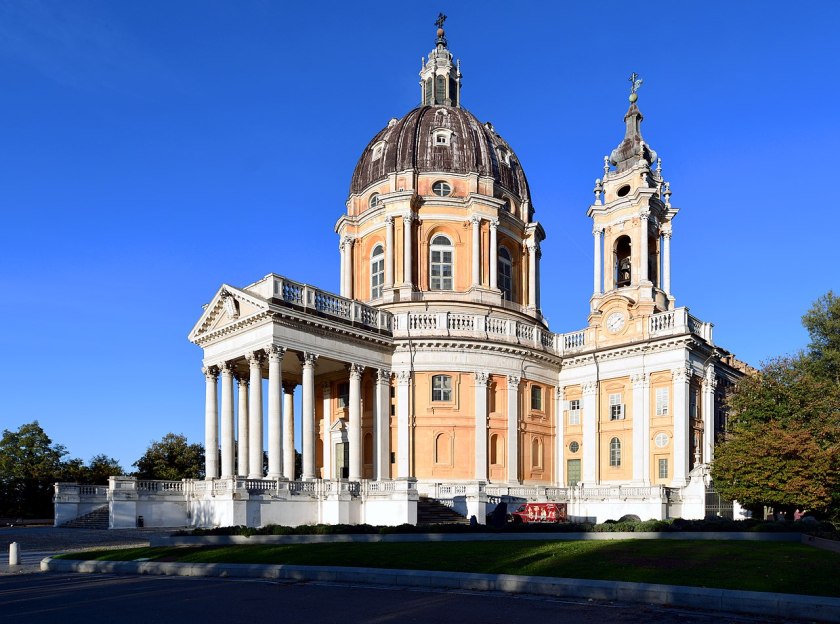
If Sebastian was esteemed by the less well-off, he was also on good terms with those who were more fortunate. In particular, he maintained good relations with the Dukes of Savoy, one of whom, Victor Amadeus II, he had helped to form, from the age of nine, into the just ruler he later became. Sebastian was the spiritual director to the entire court of the Duke and such was the esteem in which he was held, that at one stage the Duke did his best to procure the Archbishopric of Turin for Sebastian. His cause was furthered by the good reputation which he had in the Vatican but Sebastian’s humility led him to dread this ecclesiastical dignity and was profoundly grateful to be able to avoid accepting it. Additionally, through his devotion to the Blessed Mother, he inspired the duke to erect the Basilica of Superga.
Sebastian’s corporal works of mercy went hand- in-hand with the spiritual. He was very reluctant at first to start taking on the special responsibility for souls involved in hearing confessions — again, his humility is evident — but, once he did, his reputation spread throughout the city. He also searched out penitents far and wide — hospitals, schools, convents, barracks, prisons, galleys all benefited from his concern for spiritual well-being. His success in this field, as well as in his approach to life in the Oratory in general, was probably due, above all else, to his blending of careful attention to detail with a genuine compassion and, his penances reflected this. His penitents told of his ability to read souls . Sebastian’s work in the confessional was, at the very least, instrumental in sparking something of a revival of religious observance in Turin – like St Philip, it was said that he had the gift of discernment of spirits.
The life of Sebastian Valfrè was not one of extravagant and heroic deeds done for God but of the sanctification of an existence of regular routine, year in, year out and of service to God in the circumstances of ordinary life. His cheerful and attractive manner were an example to all and he also had his fair share of difficulties which he had to work hard to overcome. He was, for example, rather petulant and sensitive by nature, being easily offended – he remedied this by trying to be unfailingly polite even to those who hurt him. He also knew what it was to suffer from spiritual darkness, finding prayer a real struggle at times and study even more unattractive. But his perseverance, which manifested itself from his earliest years, stood him in good stead.
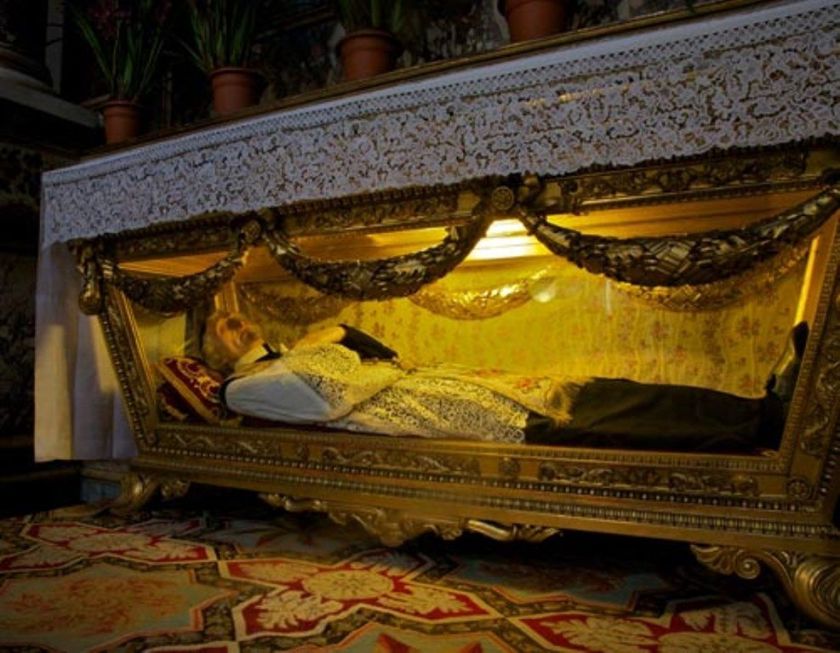
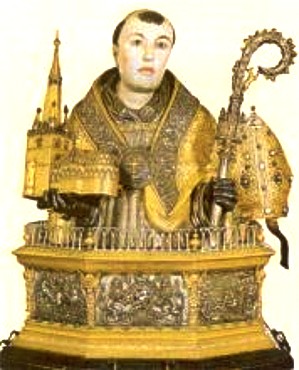
The Father who had Paradise in his eyes, Blessed Sebastian, died early in the morning of 30 January 1710. Miracles began even before he could be buried and he was Beatified by Pope Gregory XVI in 1834. His incorrupt body is now preserved in a silver urn in the Oratory Church of Turin.
When Father Sebastian died and his body was laid out in the church, Turin’s citizens wanted to say goodbye to the priest who walked with them, through all the joys and difficulties in life, for sixty years. Father Sebastian’s legacy was the extroversion of the faith preached by Christ for the dignity of all people, the witness of Christian charity knew no boundaries.
The Archives of the Turin Oratory possess some 22 volumes of his writings. One of his most important works was his ‘Compendium of Christian Doctrine’, a Catechism organised on a question and answer basis. This rapidly became a well-used teaching aid and lasted until the introduction of the Catechism of Pope Pius X.
In 1835, a year after Sebastian was Beatified, there was a solemn translation of his relics.
Overshadowed at the time by royalty and ecclesiastical dignitaries, there were three future saints in the crowd. There was Saint Joseph Benedict Cottolengo (1786-1842) – known as “The Labourer of Divine Providence”, who devoted himself to the care of the destitute sick; Saint Joseph Cafasso (1811-1860) “The Priest of the Gallows”, whose work with prisoners caught the imagination of all Turin and Saint John Bosco (1815-1888), whose work with children is known to the whole world and whose feast day we celebrate tomorrow. All of these could draw their spiritual lineage both by inspiration and imitation to Blessed Sebastian Valfrè .
Grant us, we beseech You, O Lord, that, as You did wonderfully raise Your priest, Blessed Sebastian, for the salvation of many, so we may persevere in Your love, for the sake of helping souls. Through Christ our Lord. Amen.
Bl Carmen Marie Anne García Moyon St David Galván-Bermúdez (1881-1915) Martyr of the Mexican Revolution Biography here: https://anastpaul.wordpress.com/2018/01/30/saint-of-the-day-30-january-st-david-galvan-bermudez-1881-1915-martyr/St Felician of Africa
St Felix IV, Pope
Bl Francis Taylor
Bl Haberilla
St Hippolytus of Antioch
St Hyacintha of Mariscotti
Bl Margaret Ball
Bl Maria Bolognesi
St Martina of Rome
St Matthias of Jerusalem
St Mutien Marie Wiaux
St Paul Ho Hyob
St Philippian of Africa
St Savina of Milan Blessed Sebastian Valfrè CO (1629-1710)
St Theophilus the Younger
St Tôma Khuông
St Tudclyd
Bl Zygmunt Pisarski
Our Morning Offering – 29 January – Wednesday of the Third Week in Ordinary Time, Year A and The Memorial of St Dallan Forgaill (c 530- 598)
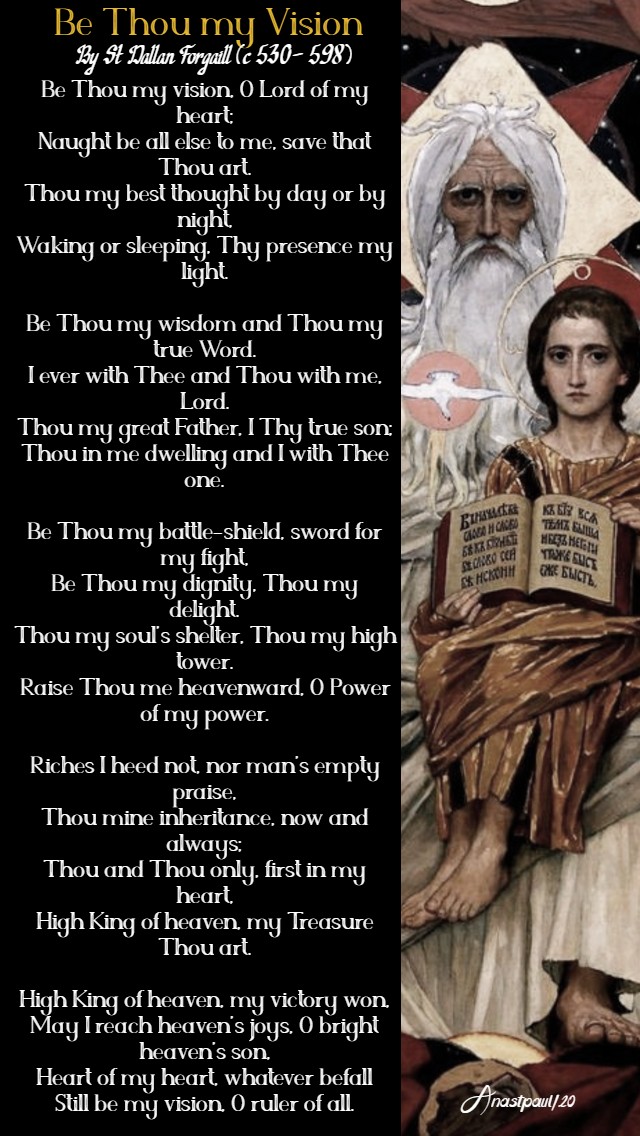
Be Thou my Vision By St Dallan Forgaill (c 530- 598)
Be Thou my vision, O Lord of my heart;
Naught be all else to me, save that Thou art.
Thou my best thought by day or by night,
Waking or sleeping, Thy presence my light.
Be Thou my wisdom and Thou my true Word.
I ever with Thee and Thou with me, Lord.
Thou my great Father, I Thy true son;
Thou in me dwelling and I with Thee one.
Be Thou my battle-shield, sword for my fight,
Be Thou my dignity, Thou my delight.
Thou my soul’s shelter, Thou my high tower.
Raise Thou me heavenward, O Power of my power.
Riches I heed not, nor man’s empty praise,
Thou mine inheritance, now and always;
Thou and Thou only, first in my heart,
High King of heaven, my Treasure Thou art.
High King of heaven, my victory won,
May I reach heaven’s joys, O bright heaven’s son,
Heart of my heart, whatever befall
Still be my vision, O ruler of all.
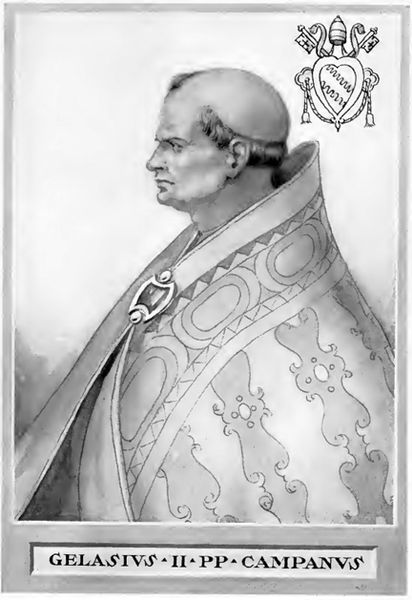
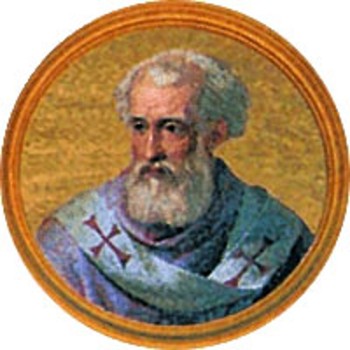
Saint of the Day – 29 January – St Pope Gelasius II (c 1060–1119) born Giovanni Caetani or Giovanni da Gaeta (also called Coniulo), was head of the Catholic Church and ruler of the Papal States from 24 January 1118 to his death in 1119. A monk of Monte Cassino and chancellor of Pope Paschal II, Caetani was unanimously elected to succeed him. In doing so he also succeeded to the conflicts with Emperor Henry V over investiture. Gelasius spent a good part of his brief papacy in exile.
He was born between 1060 and 1064 at Gaeta into the Pisan branch of the Caetani family, and became a monk of Monte Cassino. Pope Urban II, who wished to improve the style of papal documents, brought him to Rome and made Caetani a Papal subdeacon (August 1088) and Cardinal deacon of Santa Maria in Cosmedin (probably on 23 September 1088). As Chancellor of the Holy Roman Church from 1089 to 1118, he drastically reformed the papal administration, establishing a permanent staff of clerks for the papacy, overcoming the previous custom of relying on Roman notaries to write Papal documents and introducing the minuscule curial script. His tenure also established the precedent of the Papal Chancellor always being a cardinal and holding the office for life or until elected pope.
Shortly after his unanimous election to succeed Pope Paschal II in 1118, he was seized by Cencio II Frangipane, a partisan of Holy Roman Emperor Henry V but was freed by a general uprising of the Romans on his behalf.
Henry V sought to enforce the privilege of investiture conceded (and later revoked in 1112) by the Papacy, under duress, by Paschal II. He drove Gelasius II from Rome in March 1118, pronounced his election null and void and set up Maurice Bourdin, Archbishop of Braga, as antipope under the name of Gregory VIII.
Gelasius II fled to Gaeta, where he was Ordained a Priest on 9 March 1118 and on the following day received Episcopal Consecration. He at once excommunicated Henry V and the antipope and, under Norman protection, was able to return to Rome in July. But the disturbances of the imperialist party, especially those of the Frangipani, who attacked the Pope while celebrating Mass in the church of St Prassede, compelled Gelasius II to go once more into exile. He set out for France, consecrating the Cathedral of Pisa on the way and arrived at Marseille in October. He was received with great enthusiasm at Avignon, Montpellier and other cities, held a Synod at Vienne in January 1119 and was planning to hold a General Council to settle the investiture contest when he died at the Abbey of Cluny.
St Abundantia the Martyr
St Aphraates
St Aquilinus of Milan
St Barbea of Edessa
St Blath of Kildare
Bl Boleslawa Maria Lament
St Caesarius of Angoulême
Bl Charles of Sayn
St Constantius of Perugia (Died 170) Martyr St Dallan Forgaill (c 530- 598) Martyr St Dallan’s story: https://anastpaul.wordpress.com/2018/01/29/saint-of-the-day-29-january-st-dallan-forgaill-c-530-598/
Second Thought for the Day – 28 January – The Memorial of St Joseph Freinademetz SVD (1852-1908) “Fu Shenfu” – Lucky Priest
Man of Prayer
Freinademetz was what one would call a ‘great man of prayer’ and a ‘spiritual’ person. In his preparatory work for the first diocesan synod of South Shandong, his fundamental attitude became clear in the synod paper on “The Clergy.” “Do you imagine you can become holy without meditation, something no saint was able to do? Meditation is a waste of time? The very opposite is true. Without meditation life is lost. Furthermore, set aside one day a month for prayer and meditation. Such days, are among life’s most beautiful and enriching. On such days the Holy Spirit has promised to speak to our hearts.”
Just to see him at prayer was edifying for many – “Mostly he knelt in the sanctuary of the church and for us, it was an extraordinary experience, to see him at prayer. The image of that kneeling priest is indelibly impressed in my memory. You got the impression that nothing could disturb him . He was a great man of prayer. His piety was open and aroused fervour” (Cardinal Tien).
Henninghaus states straight out, that “Prayer” was his “life element and life’s joy,” it was the “source from which he lived.” Even when he had to work until late at night, he still took time for prayer and spiritual reading. In summer, Freinademetz often began his working day at 3 a.m., with prayer and meditation. He preferred to pray the breviary kneeling, mainly very erect without any support. He may often have recalled his childhood when the whole family knelt every day on the hard boards of the living room, praying the rosary before the house altar.
He celebrated holy Mass “in a dignified and devout manner, without haste but without irritating slowness” (Henninghaus). The man from Tyrol obviously did not wish to be importunate in these things either.
The official name of the Steyl missionaries, ‘Society of the Divine Word’, fitted as if tailored made for him: “Daily spiritual reading. Do not let even a single day pass without meditating on sacred scripture which has been called the Priest’s Book. Woe to you if the well-springs of devotion in you run dry!” he exhorted in one of the synod papers.
He himself knew the Bible inside out. He frequently quoted scripture, mostly in Latin, and above all he was always able to find suitable comparisons for current situations – i.e. he had truly internalised the Bible. It was not a dead letter for him, not ‘dry’ but full of life, a well from which he knew how to draw water.
With the same intensity he challenged his confreres to continue to update themselves – “Cultivate serious study! Sacred scripture says, ‘Because you have despised wisdom, I will despise you’.” That, too, is an example of the way in which he could quote the Bible.
The cross of Christ, the Eucharist and contemplation of God’s Word were the central pillars of the missionary life of Joseph Freinademetz, may they be our central pillars too!
Prayer to St Joseph for Missionaries
Heavenly Father,
You have given us your graces
and blessings through the saints.
We thank You for choosing St Joseph Freinademetz,
a zealous missionary to China, to be our model.
He was a man of prayer who prayed without growing weary.
Prayer was the air he breathed and the joy of his life.
Prayer nourished his missionary vocation,
his love of neighbour,
his enthusiasm and readiness for sacrifice
and his profound faith.
Through the intercession of St Joseph
we implore You to shower Your graces on all missionaries
so that they become persons of prayer
and adopt the culture of the people they are sent to.
Enlighten them to discover the road
You want them to travel
and the plan You have mapped out for them.
May they have courage like St Joseph to keep going,
in spite of many trials and hardships in their mission work
and to live out their vocation faithfully.
We ask this through Christ our Lord.
Amen.
One Minute Reflection – 28 January – Tuesday of the Third week in Ordinary Time, Year A, Readings: 2 Samuel 6:12-15, 17-19, Psalm 24:7-10, Mark 3:31-35 and the Memorial of Joseph Freinademetz SVD (1852-1908) “Fu Shenfu” – Lucky Priest-
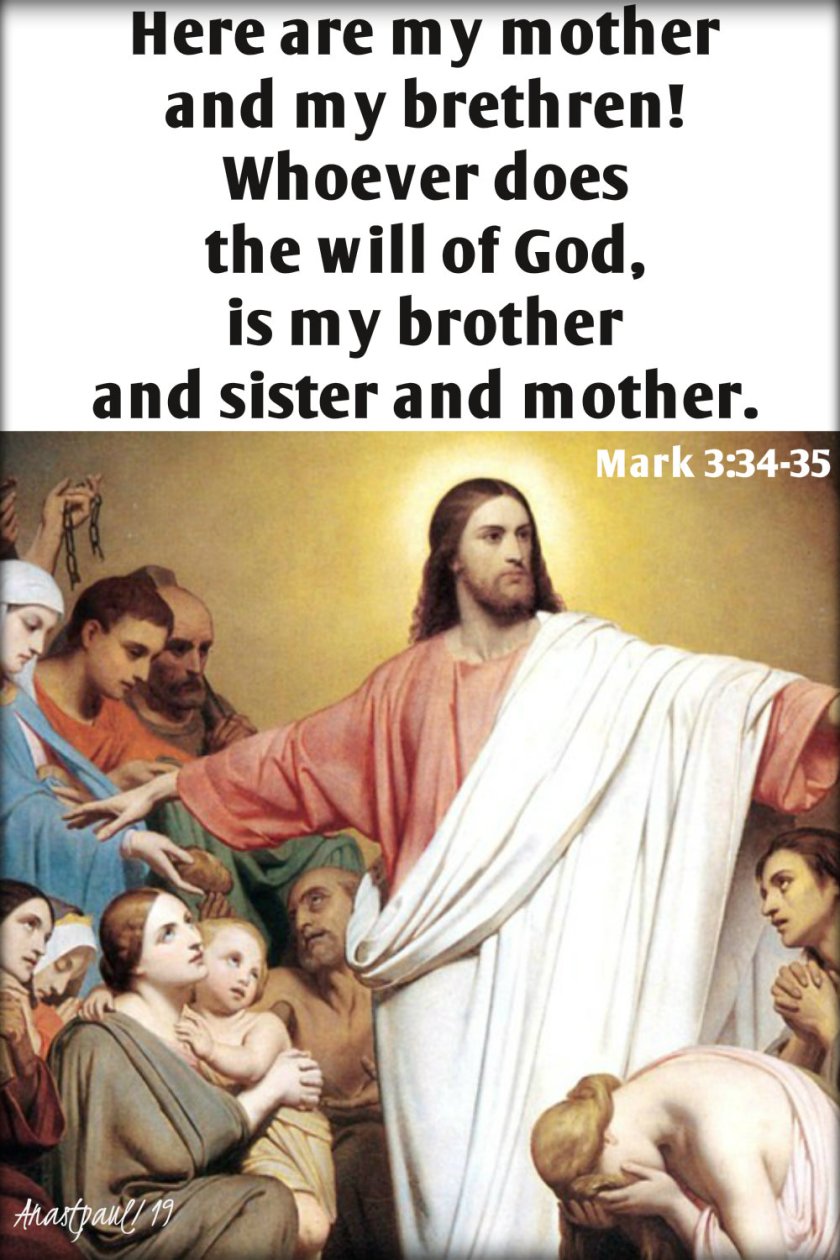
“Here are my mother and my brethren! Whoever does the will of God, is my brother, and sister and mother.”…Mark 34-35
REFLECTION – “Grace is thicker than blood – As mother, Mary made significant appearances in the life of Jesus. She followed Him in His ministry.
In today’s short Gospel text, she is outside with the relatives of Jesus asking for Him.
Notice the delicacy of Mary. She neither interrupts the ministry of Jesus nor enters the room where Jesus is ministering. She waits outside.
The response of Jesus to the one who brought the message seems like a rebuff.
In fact, it is a tribute to Mary.
She was His mother, not merely because she gave Him birth but even more, because she did the will of God.
Blood is thicker than water no doubt – but Grace is thicker than blood.
She conceived Jesus in faith, even before she conceived him in her womb.” … Msgr Alex Rebello – Diocese of Wrexham, Wales – Daily Reflections, Year A
PRAYER – Loving Father, You gave us Your only-begotten Son to teach us, to make us Your adopted children by His adoption of ourselves as His siblings. What grace, what mercy, what love, is this! We give You our gratitude and our love. Mary, holy and blessed Virgin, Mother of God, pray for us. St Joseph Freinademetz, you survived solely on faith in a strange land and brought Christ to those who spoke another language by the language of Grace, please pray for us. Through Jesus, our brother and our Saviour, who gave us His mother to guide and protect us, we pray, with the Holy Spirit, God forever, amen.
Our Morning Offering – 28 January – Tuesday of the Third week in Ordinary Time, Year A and the Memorial of Joseph Freinademetz SVD (1852-1908) “Fu Shenfu” – Lucky Priest – Priest and Missionary of the Society of the Divine Word
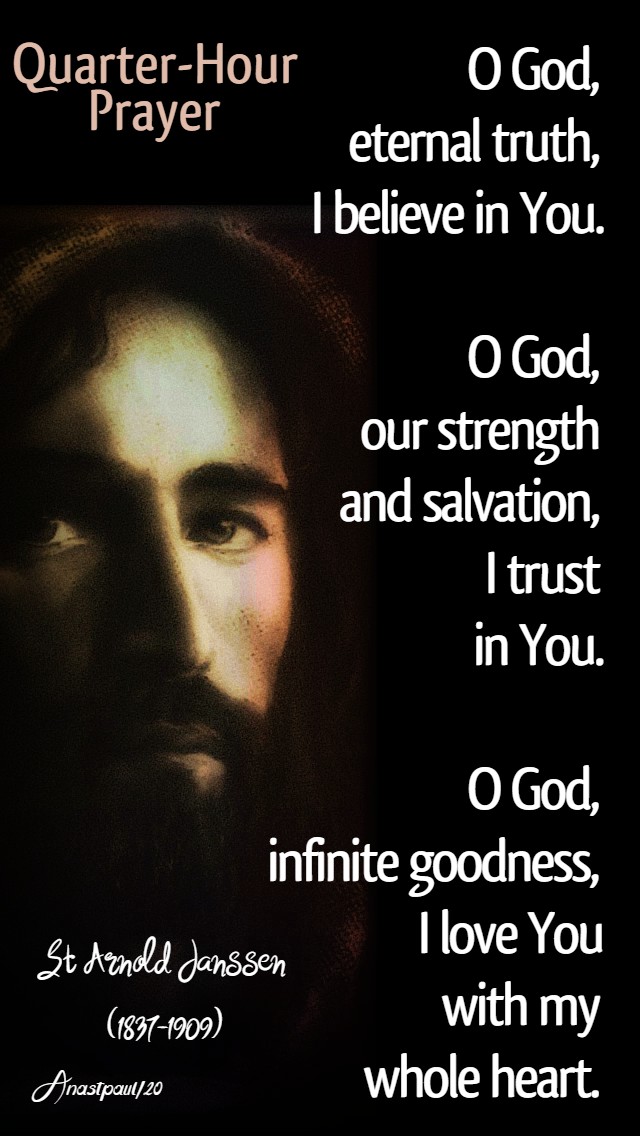
On the Feast Day of St Joseph Freinademetz, let us pray St Arnold’s daily Quarter-Hour Prayer
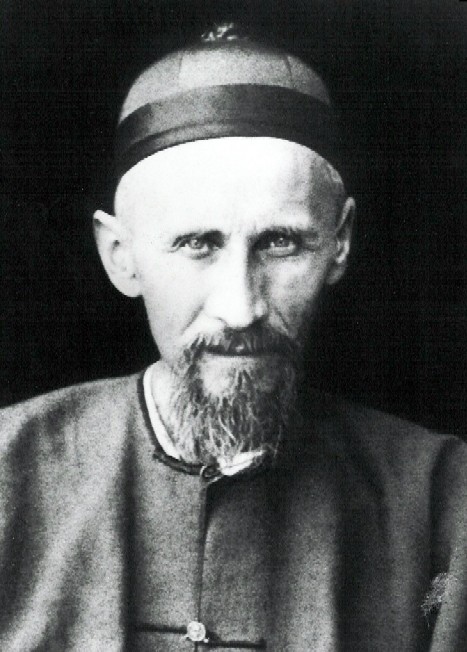
Quarter-Hour Prayer By St Arnold Janssen (1837-1909), Founder of the Missionaries of the Divine Word
O God, eternal truth,
I believe in You.
O God, our strength and salvation,
I trust in You.
O God, infinite goodness,
I love You with my whole heart.
Amen!
St Arnold, in his youth, invented a means of personally keeping in contact with God. To do so, he prayed the acts of faith, hope and charity every quarter hour at the signal of the church tower clock or the chime of the clock at home or in school.
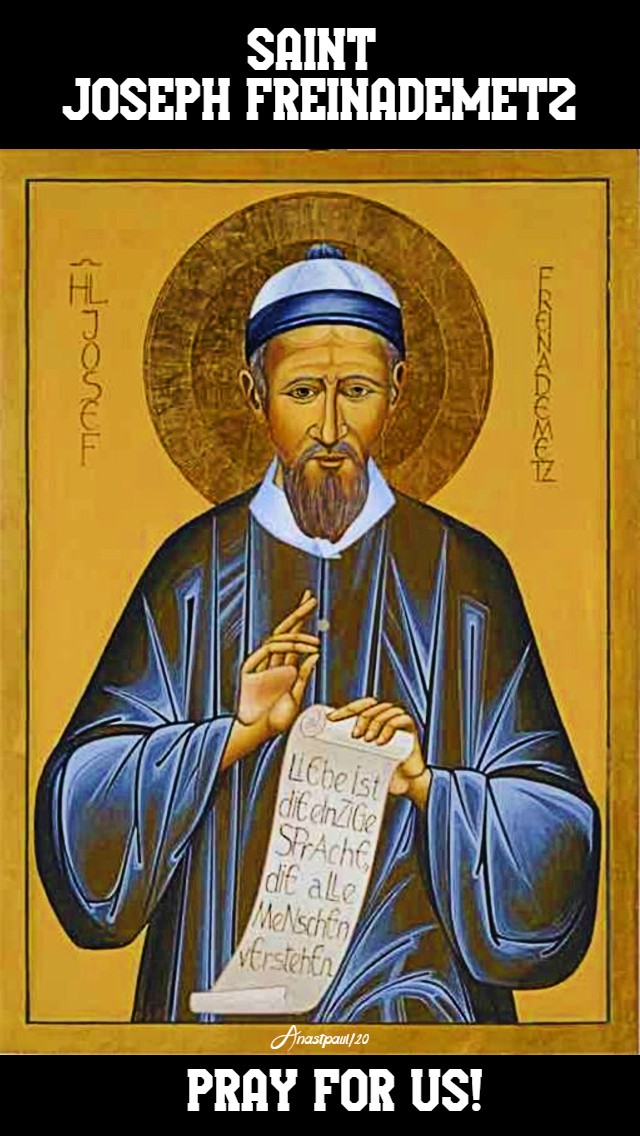
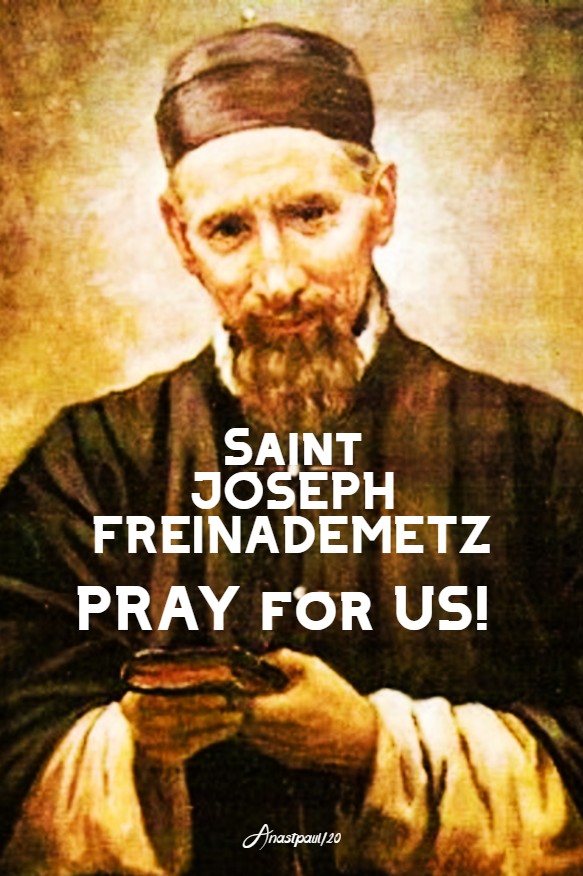
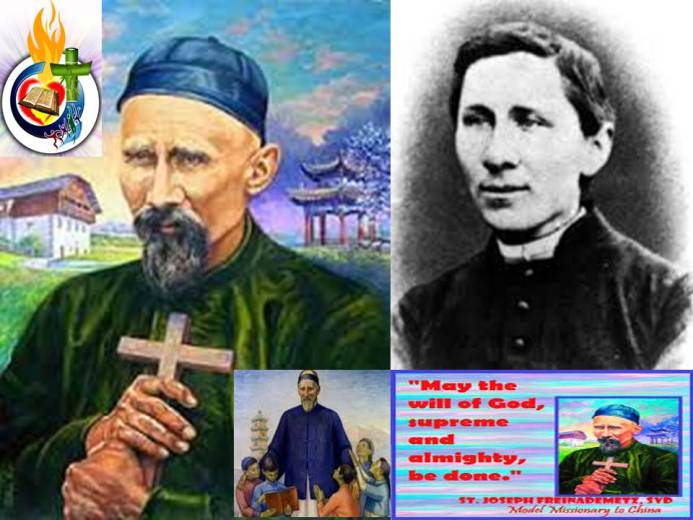
Saint of the Day – 28 January – Saint Joseph Freinademetz SVD (1852-1908) Priest and Missionary of the Society of the Divine Word, the First Saint to Ever Serve in Hong Kong, Missionary to China, St Joseph had an immense devotion to Eucharistic Adoration – born on 15 April 1852 in Pedraces in Val Gadena, the Tyrolean Alps, Italy and died on 28 January 1908 in Taikia, China of tuberculosis and typhus. St Joseph is also known as Giuseppe Freinademetz, Joseph of Shantung, Jozef Freinademetz, Ujoep (nickname), “the Saint of Charity” and his Chinese name “Fu Shenfu” – Lucky Priest.
Joseph Freinademetz was born on 15 April 1852, in Oies, a small hamlet of five houses situated in the Dolomite Alps of northern Italy. The region, known as South Tyrol, was then part of the Austro-Hungarian empire, it is now part of Italy. He was Baptised on the day he was born and he inherited from his family a simple but tenacious faith.
Birthplace of St Joseph in Oies
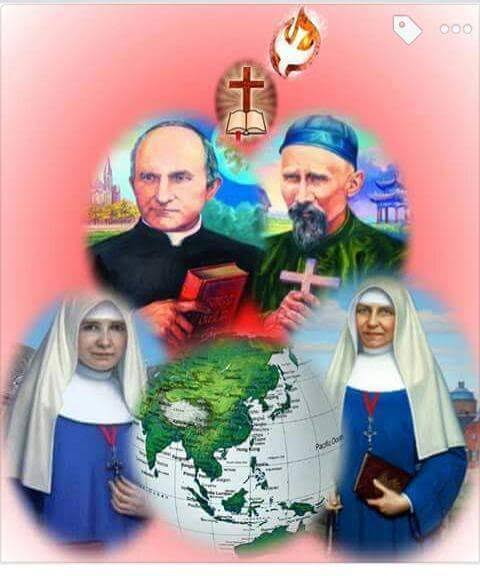
While Joseph was studying theology in the diocesan seminary of Bressanone (Brixen), he began to think seriously of the foreign missions as a way of life. He was ordained a priest on 25 July 1875 and assigned to the community of Saint Martin very near his own home, where he soon won the hearts of the people. However, the call to missionary service did not go away. Just two years after ordination he contacted Fr Arnold Janssen, the founder of a mission house which quickly developed into the Society of the Divine Word.
With his Bishop’s permission, Joseph entered the mission house in Steyl, Netherlands, in August 1878. On 2 March 1879, he received his mission cross and departed for China with Fr John Baptist Anzer, another Divine Word Missionary. Five weeks later they arrived in Hong Kong, where they remained for two years, preparing themselves for the next step. In 1881 they travelled to their new mission in South Shantung, a province with 12 million inhabitants and only 158 Christians.
Those were hard years, marked by long, arduous journeys, assaults by bandits and the difficult work of forming the first Christian communities. As soon as a community was just barely developed, an instruction from the Bishop would arrive, telling him to leave everything and start anew.
Soon Joseph came to appreciate the importance of a committed laity, especially catechists, for first evangelisation. He dedicated much energy to their formation and prepared a catechetical manual in Chinese. At the same time, together with Anzer (who had become Bishop) he put great effort into the preparation, spiritual formation and ongoing education of Chinese priests and other missionaries. His whole life was marked by an effort to become a Chinese among the Chinese, so much so that he wrote to his family: “I love China and the Chinese. I want to die among them and be laid to rest among them.”
In 1898, Freinademetz was sick with laryngitis and had the beginnings of tuberculosis as a result of his heavy workload and many other hardships. So at the insistence of the Bishop and the other priests he was sent for a rest to Japan, with the hope that he could regain his health. He returned to China somewhat recuperated, but not fully cured.
When the Bishop had to travel outside of China in 1907, Freinademetz took on the added burden of the administration of the diocese. During this time there was a severe outbreak of typhus. Joseph, like a good shepherd, offered untiring assistance and visited many communities until he himself became infected. He returned to Taikia, the seat of the diocese, where he died on 28 January 1908. He was buried at the twelfth station on the Way of the Cross and his grave soon became a pilgrimage site for Christians.
This slideshow requires JavaScript.
Freinademetz learned how to discover the greatness and beauty of Chinese culture and to love deeply the people to whom he had been sent. He dedicated his life to proclaiming the gospel message of God’s love for all peoples and to embodying this love in the formation of Chinese Christian communities. He animated these communities to open themselves in solidarity with the surrounding inhabitants. And he encouraged many of the Chinese Christians to be missionaries to their own people as catechists, religious, nuns and priests. His life was an expression of his motto: “The language that all people understand is that of love.” … Vatican.va
He was beatified 19 October 1975 by Pope Paul VI and Canonised by St John Paul II on 5 October 2003, on which occasions he said:
” “And they went forth and preached everywhere” (Mk 16: 20). The Evangelist Mark ends his Gospel with these words. He then adds that the Lord never ceases to accompany the activity of the Apostles with the power of His miracles. Echoing these words of Jesus, the words of St Joseph Freinademetz are filled with faith: “I do not consider missionary life as a sacrifice I offer to God but as the greatest grace, that God, could ever have lavished upon me.” With the tenacity typical of mountain people, this generous “witness of love” made a gift of himself to the Chinese peoples of southern Shandong. For love and with love he embraced their living conditions, in accordance with his own advice to his missionaries: “Missionary work is useless if one does not love and is not loved.” An exemplary model of Gospel inculturation, this Saint imitated Jesus, who saved men and women by sharing their existence to the very end.”
St Aemilian of Trebi
St Agatha Lin
Bl Amadeus of Lausanne
St Antimus of Brantôme
St Archebran
Bl Bartolomé Aiutamicristo
St Brigid of Picardy
St Callinicus
St Cannera of Inis Cathaig
Bl Charlemagne (a decree of canonisation was issued by the anti-pope Paschal III but this was never ratified by valid authority.)
St Constantly
St Flavian of Civita Vecchia
St Glastian of Kinglassie
Bl James the Almsgiver
St James the Hermit
St Jerome Lu
St John of Reomay St Joseph Freinademetz SVD (1852-1908)
Bl Julian Maunoir
St Julian of Cuenca
St Lawrence Wang
St Leucius of Apollonia
Bl María Luisa Montesinos Orduña
St Maura of Picardy
Bl Mosè Tovini
Bl Odo of Beauvais
Bl Olympia Bida
St Palladius of Antioch
St Paulinus of Aquileia
Bl Peter Won Si-jang
St Richard of Vaucelles
St Thyrsus of Apollonia
—
Martyrs of Alexandria: A group of 4th-century parishioners in Alexandria, Egypt. During the celebration of Mass one day an Arian officer named Syrianus led a troop of soldiers into their church and proceded to murder all the orthodox Christians in the place. 356 in Alexandria, Egypt.
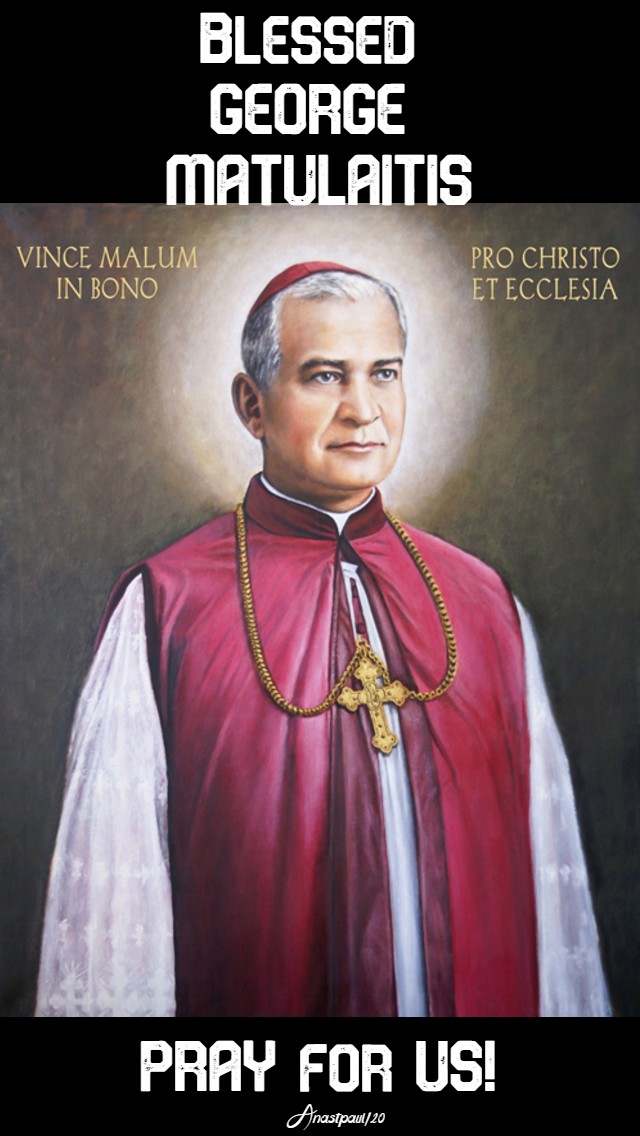
Quote/s of the Day – 27 January – Monday of the Third Week in Ordinary Time, Year A and the Memorial of Blessed George Matulaitis MIC (1871-1927)
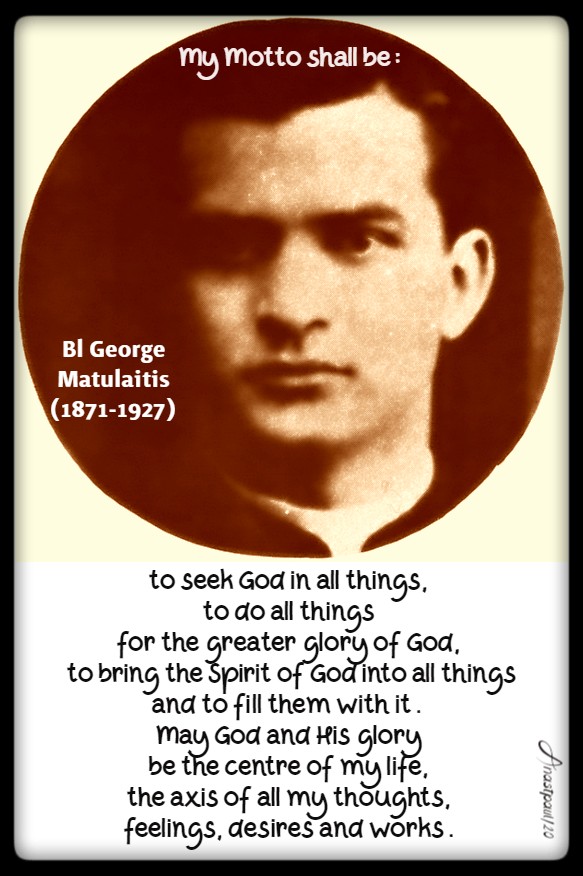
“My motto shall be: to seek God in all things, to do all things for the greater glory of God, to bring the Spirit of God into all things and to fill them with it. May God and His glory be the centre of my life, the axis of all my thoughts, feelings, desires and works.”
From the Journal of Blessed George, Archbishop. (I Part: St Petersburg 1910-1911)
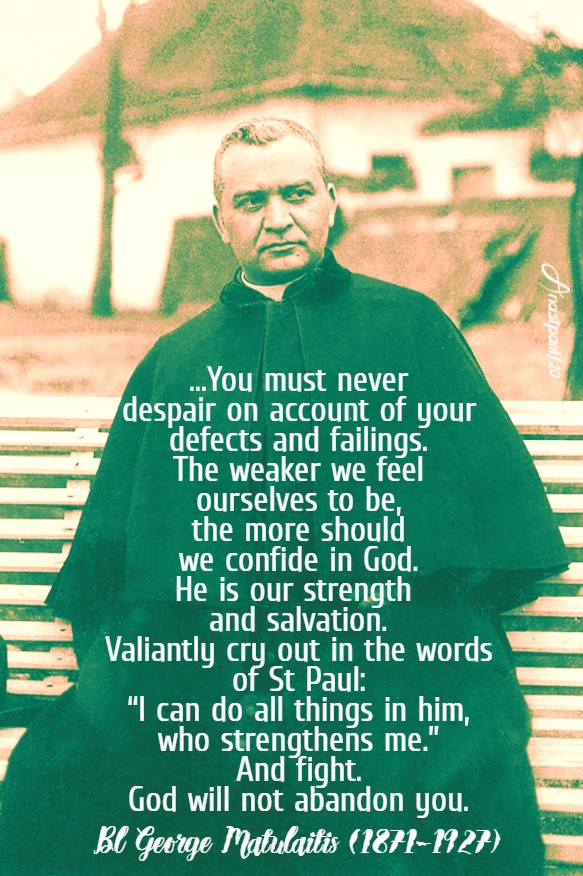
“But you must never despair on account of your defects and failings. The weaker we feel ourselves to be, the more should we confide in God. He is our strength and salvation. Valiantly cry out in the words of St Paul: “I can do all things in him, who strengthens me.” And fight. God will not abandon you.”
From a letter to Miss Minetaite in Obeliai
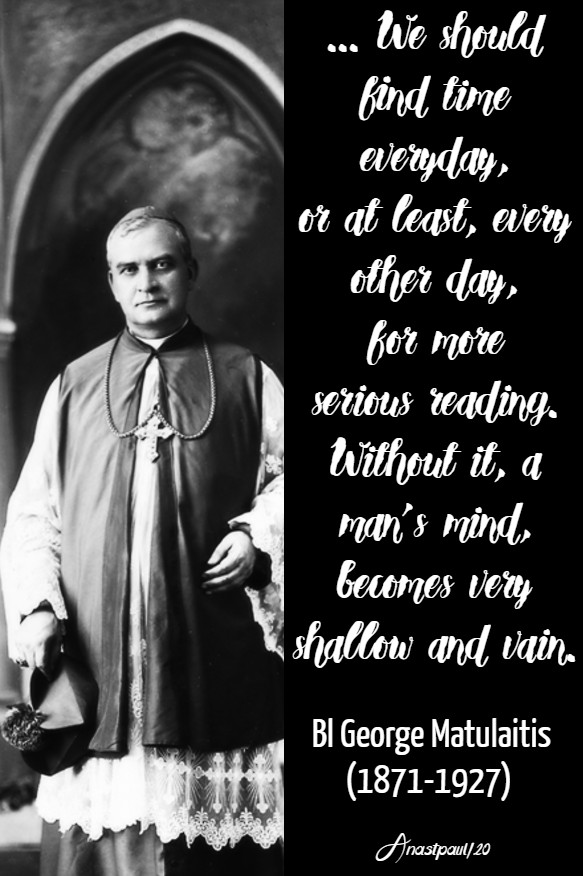
“Moreover, we should find time everyday, or at least, every other day, for more serious reading. Without it, a man’s mind, becomes very shallow and vain.”
From a letter to Rev. Dvaranauskas in Pilypava
“We need patience, too. Once we start a task, trusting in God’s help, we should stubbornly bring it to its conclusion. If it is not a success, we will at least, have the consolation, that it is not our fault – we will perceive that it was not in God’s will.”
From a letter to Rev. Vaitkevičius in Częstochowa
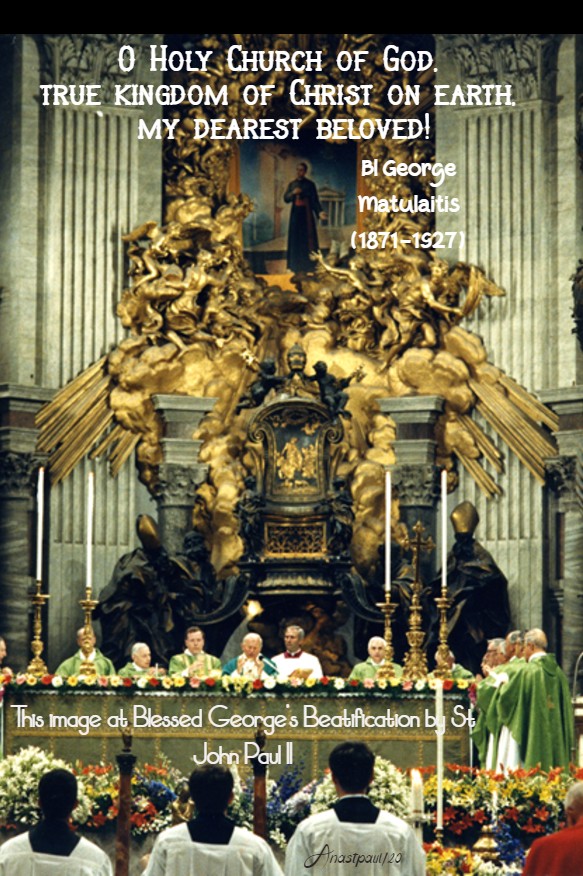
“O Holy Church of God, true kingdom of Christ on earth, my dearest beloved!”
From the Journal of Blessed George, Archbishop. (I Part: St Petersburg 1910-1911)
One Minute Reflection – 27 January – Monday of the Third Week in Ordinary Time, Year A – Readings: 2 Samuel 5:1-7, 10, Psalm 89:20-22, 25-26, Mark 3:22-30 and the Memorial of Blessed George Matulaitis MIC (1871-1927)
And the scribes who came down from Jerusalem said, “He is possessed by Beelzebub and by the prince of demons he casts out the demons.”...Mark 3:22
REFLECTION – “It is characteristic of evildoers, stirred by envy, to shut their eyes as much as they can, to other people’s merits and when, overcome by the evidence, they cannot do so any longer, to depreciate or undervalue it. Thus, when the crowd rejoiced in devotion and marvelled at the sight of Christ’s works, the scribes and Pharisees either closed their eyes to what they knew to be true, or minimised what is great, or undervalued what is good. Once, for example, feigning ignorance, they said to Him who had worked so many wonderful signs: “What sign can you do that we may believe in you?” (Jn 6:30). In this case, unable to blatantly deny the facts, they wickedly depreciate them… and they devalue them by saying: “It is by Beelzebub, the prince of devils, that he casts out devils.”
Now this, dear brethren, is the blasphemy against the Spirit that binds all those he has seized with the bonds of an eternal sin. This is not to say that it would be impossible for the repentant to gain forgiveness for it all if they “produce fruit as evidence of their repentance” (Lk 3:8). The only thing is that, crushed beneath such a weight of malice, they lack the strength to aspire to that praiseworthy repentance worthy of forgiveness… Those who, perceiving the proofs of grace and the Holy Spirit at work in a brother…, are not afraid to undermine and calumniate and brashly ascribe to the evil spirit what they clearly know to be of the Holy Spirit, such as these have been so forsaken by this Spirit of grace, that they no longer even desire the repentance that would obtain pardon. They are completely in the dark, blinded by their own malice. Indeed, what could be more serious than to dare, out of envy for a brother one had been commanded to love as oneself (Mt 19:19), to blaspheme God’s goodness… and insult His majesty by wanting to discredit another?”…Isaac of Stella (c 1100-c.1171) O.Cist. Cistercian monk
PRAYER – Lord, our God, keep us free from envy of others, for this is a poison that can destroy all community and love. Help us to know that to each You have given gifts and all are Your wonder and made to honour You alone. Help us to appreciate our neighbour’s talents and understand that we are all one in the Mystical Body of Your Son. Grant that by the prayers of Bl George Matulaitis, we may grow in love and sanctity. We make our prayer through our Lord Jesus Christ, with the Holy Spirit, God forever, amen.
Our Morning Offering – 27 January – Monday of the Third week in Ordinary Time, Year A and the Memorial of Blessed George Matulaitis MIC (1871-1927)
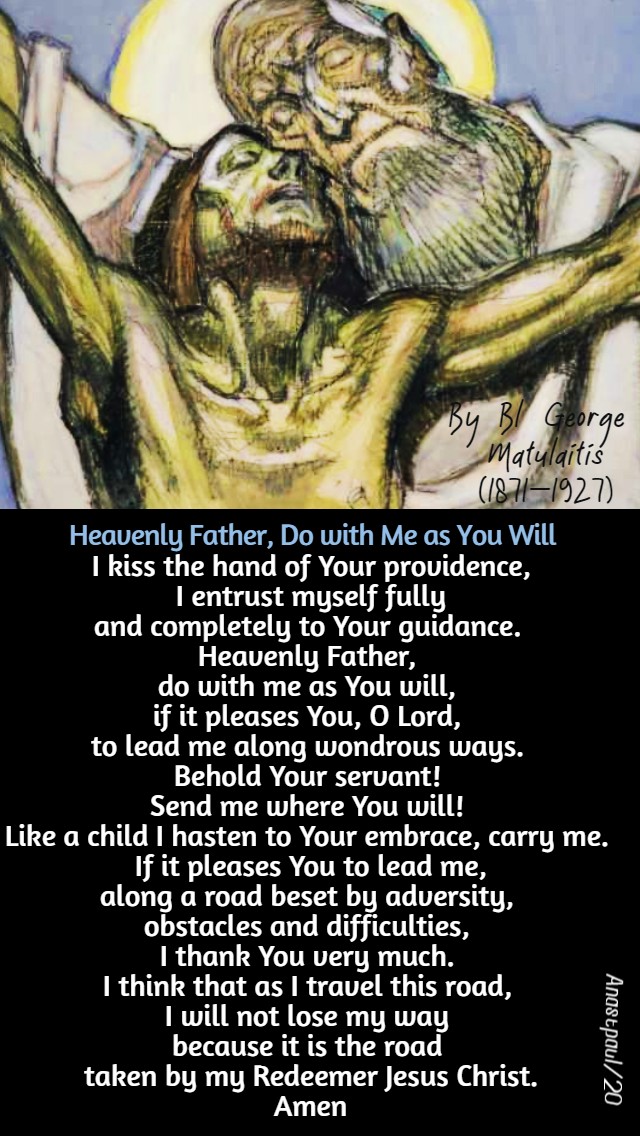
Heavenly Father, Do with Me as You Will By Blessed George Matulaitis MIC (1871-1927)
I kiss the hand of Your providence,
I entrust myself fully
and completely to Your guidance.
Heavenly Father, do with me as You will,
if it pleases You, O Lord,
to lead me along wondrous ways.
Behold Your servant!
Send me where You will!
Like a child I hasten to Your embrace, carry me.
If it pleases You to lead me,
along a road beset by adversity,
obstacles and difficulties,
I thank You very much.
I think that as I travel this road,
I will not lose my way
because it is the road
taken by my Redeemer Jesus Christ.
Amen
From the Journal of Blessed George, Archbishop. (I Part: St Petersburg 1910-1911)
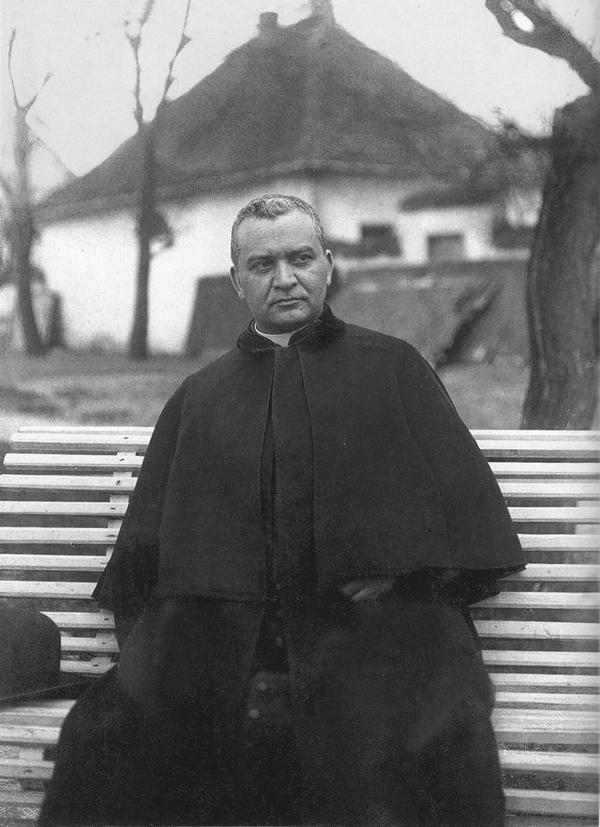
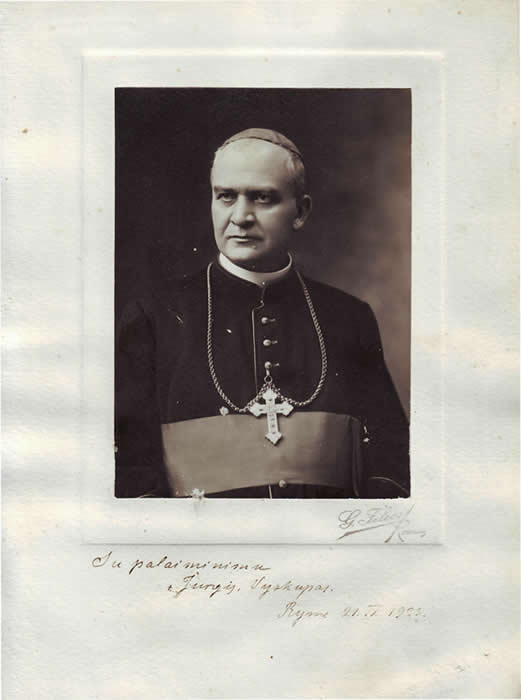
Saint of the Day – 27 January – Blessed George Matulaitis MIC (1871-1927) Archbishop of Vilnius from late 1918 until his resignation in 1925, Apostolic Nuncio in Lithuania, Founder of the Congregation of the Poor Sisters of the Immaculate Conception of the Blessed Virgin Mary and the Handmaids of Jesus in the Eucharist, Professor, Spiritual Director – he served as the Superior-General of the Marian Fathers from 1911 until his death and is known as the “Renovator of The Marians.” Born as Jurgis Matulaitis-Matulevičius on 13 April 1871 at Lugine, Lithuania and died on 27 January 1927 of appendicitis at Kaunas, Lithuania. Patronages – Teachers, Sisters of the Immaculate Conception, Handmaids of Jesus in the Eucharist. He worked in secret to revive the Marian Fathers after the Russian authorities suppressed all religious orders and he even relinquished his teaching position to better dedicate himself to that secret revival. He was a noted teacher and spiritual director who set up other branches of the order, in places such as Switzerland and the United States, far from Russian authorities.
George was born in the village Matulaitis Lithuanian Lugine on 13 April 1971, the last of the eight children of Andrew and Ursula Matulaitis. At age ten he was orphaned and his older brother, John, became his guardian. After after elementary school he was put to work in the countryside. At 18 years, in 1889, he followed the brother John Matulewicz to Poland, where the family name changed from Matulaitis in Matulewicz.
He completed his higher studies at the seminary in Kielce and then in Warsaw and finally at Roman Catholic University in Petersburg, where he was Ordained as a Priest on 20 November 1898. In June 1899 he became a Master in Theology, in December he enrolled at the University of Freiburg in Switzerland, where in 1903 he obtained a degree in theology, with a brilliant thesis on which was published in Krakow.
He was posted immediately as a professor and held the chair of Latin and Literature in the Canon Law Seminar Kielce, from 1902-1904 and from 1907 to 1909 in Dogmatic Theology and Sociology at the Catholic Seminary in Petersburg.
In 1909 while he was still professor at the Theological Academy, 38 years old and with a promising career ahead of him, Matulaitis made a momentous decision. He decided to become a religious, to follow more closely in the footsteps of Christ. Having received permission from Rome, he made the three vows of poverty, chastity and obedience in a private chapel in Warsaw. At the same time, his close friend and fellow professor, Francis Būčys, was received into the novitiate. This was the beginning of the revival of the Marian Congregation. Closed down by the Russian government, it had only one surviving member. Matulaitis was convinced that God was leading him to resurrect this dying community and infuse it with new life.
The Marian Fathers were well known to him — they worked in his parish church at Marijampole in Lithuania. He had been baptised by one of their generals. Now he resolved to revive and prepare them for an apostolate in the modern world. He gave up lecturing on sociology and taught dogmatic theology instead. He began to rewrite the Constitutions and at the same time directed his two novices. In the fall of 1910 he began to keep a journal in which he recorded his thoughts, inspirations and resolutions.
In 1911 Matulaitis was elected superior general of the Marians and remained in this position until his death. He was also novice master since they were so few. That same summer the novitiate was transferred to Fribourg, Switzerland, for St Petersburg proved to be too dangerous – the Russian secret police had been conducting raids and searches for secret religious organisations. Under cover of the life of the University of Fribourg, Matulaitis hoped that the novitiate would be safer and grow more rapidly.
In 1913 he and two young Lithuanian Marians travelled to the United States to start a mission in Chicago. In 1915, unable to leave Poland because of the war, Matulaitis gathered the Polish Marians together at a monastery outside Warsaw. This was the beginning of the Polish province. During this period the Marians and several sisters cared for a number of war orphans. Matulaitis himself would often go into German-occupied Warsaw to beg for provisions for the children. He would often return in the evening sitting on a wagonload of coal or potatoes.
A number of interesting stories circulated in the area about the young priest and professor who was not afraid of the Germans. Once he went to a German official to ask for cots for the children. “You are a priest, you should trust in divine Providence. Why are you bothering me?!” barked the German.“That is true,” replied Matulaitis quietly “but Providence often works through good people.” Shamefaced, the German wrote out an order for the cots. However, the priest kept coming back. He was cursed at for being an infernal nuisance. Matulaitis humbly listened to the tirade, then said: “All that is for me but what do you have for the children?”
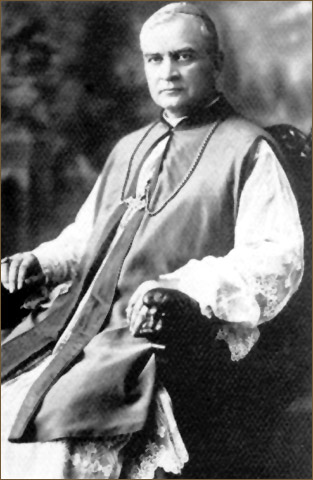
Fr George Matulaitis-Matulewicz at Bielany near Warsaw, Poland, 1917.
Serving the poor was a priority in all the religious communities that Matulaitis founded. In the spring of 1918 he went to Lithuania to restore the Marian monastery in Marijampole and to start a novitiate. In the fall of that same year he founded a Lithuanian community for women, the Sisters of the Immaculate Conception, popularly known as the Sisters of the Poor. Several years later he founded another religious community for women in Belorussia, the Servants of Jesus in the Holy Eucharist. All these communities are still active.
Despite his own wishes to remain a simple religious, in the fall of 1918 George Matulaitis was appointed Bishop of Vilnius by Pope Benedict XV. He was consecrated in Lithuania, at the cathedral in Kaunas on 1 December and the installation ceremonies took place in the Vilnius cathedral on 8 December. He was not well known to the people of Vilnius and was very much aware of the difficulty of his mission. In his inaugural sermon he presented himself to his flock humbly and sincerely: “I stand before you a stranger and therefore, first of all, I ask one thing of you — to regard me as the servant of Christ who has been given you to show you the way to heaven and to guide you to eternal happiness. From now on, we shall live together as one big spiritual family of which I am to be the father and head, as we move forward along our wearisome spiritual journey.”
The years that followed were not easy for the new bishop – the territory of Vilnius in the three following years changed hands and was occupied by eight different governments, German, Russian Bolshevik, Polish, Lithuanian, all of whom called him to interrogation. Because of his refusal to take sides or to promote the interests of one political party or nation against another, Bishop Matulaitis was criticised, attacked and denigrated. Yet, he remained gracious and cordial even to those who publicly vented their antagonism or snubbed him personally. In some cases his goodness won them over.
In the summer of 1925 Matulaitis’ resignation from the diocese of Vilnius was accepted by Pope Pius XI, his personal friend and colleague. Poland had signed its Concordat with the Vatican and Vilnius was going to be made an archdiocese. Matulaitis was well aware that he had to withdraw. He quietly left Vilnius and went to Rome where he hoped to establish the Marian generalate and a house of studies. However, the pope made him titular Archbishop of Adulia and appointed him Apostolic Visitor to Lithuania.
In June he sailed to the United States to attend the International Eucharistic Congress in Chicago. He also visited 92 Lithuanian parishes and gave over 200 homilies and speeches. Everywhere he was welcomed with great enthusiasm. The railway car in which he was travelling was even painted violet in his honour! Back home, he began work on the Concordat between Lithuania and the Vatican. However, he did not live to see its completion. Blessed George, true apostle of his homeland of Lithuania, died after an appendix operation in Kaunas on 27 January 1927 at the age of 56.
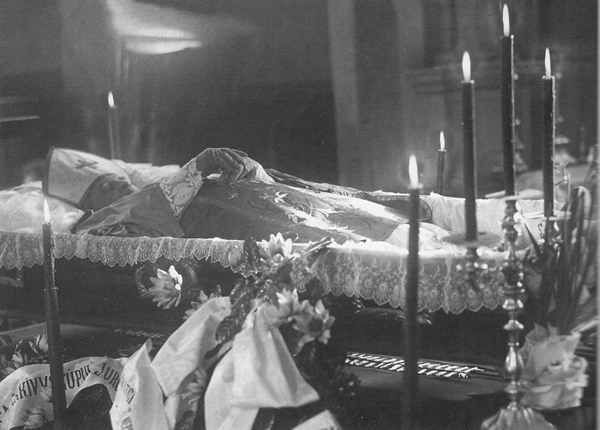
Throngs of people came to mourn him, all the church bells of Kaunas pealed a final farewell. Every national group recognised the enormity of their loss for he had been a father to all. Thousands attended the funeral. He was buried in the crypt of Kaunas cathedral but the remains were transferred to his own parish church in Marijampole in 1934.
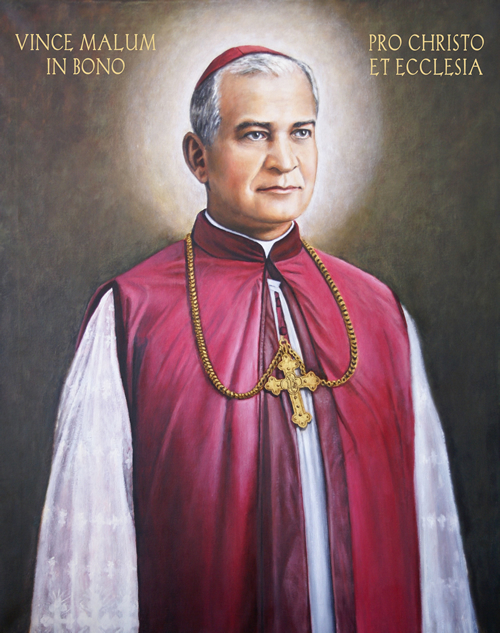
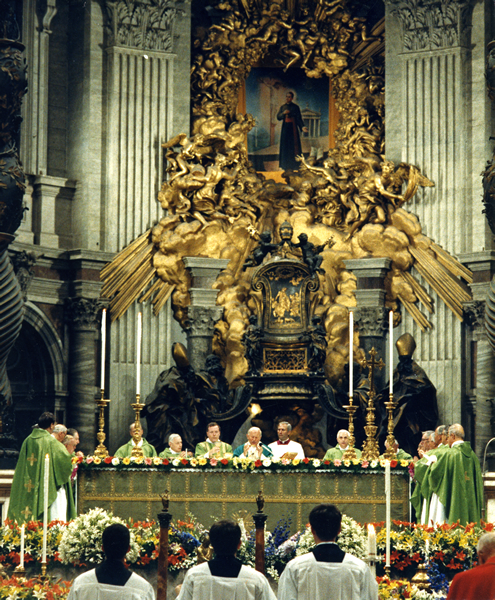
On 11 May 1982, the Congregation for the Saints issued a decree stating that during his lifetime Archbishop George practised virtues to a heroic degree. On 28 June 1987, the Holy Father, St John Paul II solemnly Beatified him at St Peter’s Basilica in Rome.
On the occasion of his Beatification, a special repository was made for the remains and an altar constructed. This has now become a National Shrine where Lithuanians and people from other countries come to pray.
Marijampole Basilica: the altar of Blessed George’s chapel has contained the relics of the Blessed since 1987.
Bl Antonio Mascaró Colomina
St Avitus
St Candida of Bañoles
St Carolina Santocanale
St Devota of Corsica
St Domitian of Melitene
St Emerius of Bañoles Blessed Jurgis Matulaitis-Matulewicz/George Matulaitis MIC (1871-1927)
St Gilduin
Bl Gonzalo Diaz di Amarante
St Henry de Osso y Cervello
St John Maria Muzeyi
Bl John of Warneton
St Julian of Le Mans
St Julian of Sora
St Lupus of Châlons
Bl Manfredo Settala
St Marius of Bodon
Bl Michael Pini
St Natalis of Ulster
St Paul Josef Nardini
Bl Rosalie du Verdier de la Sorinière
St Theodoric of Orléans
St Pope Vitalian
—
Martyrs of North Africa – 30 saints: A group of 30 Christians martyred together by Arian Vandals. The only details to have survived are four of their names – Datius, Julian, Reatrus and Vincent. c 500 in North Africa.
Third Sunday in Ordinary Time, Year A
AND the FIRST SUNDAY OF THE WORD OF GOD +2020
instituted by Pope Francis on 30 September 2019, the 1600th Anniversary of the death of St Jerome.
Pope Francis announced and instated via his Apostolic Letter Aperuit Illis, the Third Sunday in Ordinary Time to be the “Sunday of the Word of God” in order to promote a closer relationship with holy Scripture and its dissemination in the world.
“A day devoted to the Bible should not be seen as a yearly event but, rather, a yearlong event, for we urgently need to grow in our knowledge and love of the Scriptures and of the Risen Lord,”
May the Sunday of the Word of God help his people to grow in religious and intimate familiarity with the sacred Scriptures. For as the sacred author taught of old: “This word is very near to you ,it is in your mouth and in your heart for your observance” (Dt 30:14).
Given in Rome, at the Basilica of Saint John Lateran, on 30 September 2019, the liturgical Memorial of Saint Jerome, on the inauguration of the 1600th anniversary of his death.
Apostolic Letter in the form of a Motu Proprio of the Holy Father Francis, “Aperuit illis”, instituting the Sunday of the Word of God, 30.09.2019
St Alphonsus of Astorga
St Ansurius of Orense
St Athanasius of Sorrento
St Conan of Iona
Bl Eystein Erlandsön
Bl José Gabriel del Rosario Brochero
Bl Marie de la Dive veuve du Verdier de la Sorinière
Bl Michaël Kozal
St Paula of Rome
St Theofrid of Corbie
St Theogenes of Hippo
St Tortgith of Barking
—
Martyred Family of Constantinople: Saint Mary and Saint Xenophon were married and the parents of Saint John and Saint Arcadius. Theirs was a wealthy family of Senatorial rank in 5th century imperial Constantinople, but were known as a Christians who lived simple lives. To give their sons a good education, Xenophon and Mary sent them to university in Beirut, Phoenicia. However, their ship wrecked, there was no communication from them, and the couple assumed, naturally, that the young men had died at sea. In reality, John and Arcadius had survived and decided that instead of continuing to Beirut, they were going to follow a calling to religious life and became monks, eventually living in a monastery in Jerusalem. Years later, Mary and Xenophon made a pilgrimage to Jerusalem – where they encountered their sons. Grateful to have their family re-united and taking it as a sign, Xenophon and Mary gave up their positions in society in Constantinople, and lived the rest of their lives as a monk and anchoress in Jerusalem. A few years later, the entire family was martyred together.
They were martyred in 5th century Jerusalem.
St Xenophon
St Mary
St John
St Arcadius
Saint of the Day – 25 January – Saint Poppo of Stavelot (977-1048) Abbot, Reformer, Ascetic – born in 978 at Flanders, Belgium and died on 25 January 1048 at Marchiennes, France of natural causes. He became one of the best known abbots of Stavelot and was one of the first recorded Flemish pilgrims to the Holy Land.
The Vita Popponis, the biography of Poppo, was written shortly after his death by the monk Onulf and the abbot Everhelm of the abbey of Hautmont. According this source Poppo belonged to a noble family of Flanders, his parents being Tizekinus and Adalwif. About the year 1000 he made a pilgrimage to the Holy Land with two compagnons. Soon after this he also went to Rome. He was about to marry a lady of noble family, when a miraculous experience made him end his military career. Late at night, a flame burst out of the sky and kept his lance radiating. He believed this to be an illumination of the Holy Spirit and soon after, he decided to enter the monastery of Saint Thierry at Rheims (1005).
Around 1008 Abbot Richard of Saint Vannes at Verdun, who was a zealous reformer of monasteries, took Poppo to his monastery. Richard made Poppo prior of St Vaast in Arras, in the Diocese of Cambrai, about 1013. Here Poppo proved to be the right man for the position, reclaimed the lands of the monastery from rapacious vassals and secured the possession of the monastery by deeds. Before 1016 he was appointed to the same position at Vasloges (Beloacum, Beaulieu) in the Diocese of Verdun.
In 1020, the German emperor Henry II, who became acquainted with Poppo in 1016, made him Abbot of the abbeys of Stavelot and Malmedy (in Lower Lorraine, now Belgium) and in 1023 the Abbey of St Maximin at Trier.
He became even more important during the reign of Conrad II. From St Maximin, the Cluniac reform now found its way into the German monasteries. The emperor placed several imperial monasteries under Poppo’s control or supervision, as Limburg an der Hardt, Echternach, St Gislen, Weissenburg, St Gall, Hersfeld, Waulsort, Hautmont and Hastières. Soon after Poppo transferred these positions to his disciples. The Bishops and laymen who had founded monasteries placed a series of other monasteries under his care, like St Laurence at Liège, St Vincent at Metz, St Eucharius at Trier, Hohorst, Brauweiler, St Vaast, Marchiennes etc. However, the reform of Richard of Saint-Vanne had no permanent success in the German Empire.
Personally Poppo practised the most severe asceticism. He had no interest in literary affairs and was neither particularly prominent in politics. During the reign of Henry III he lost influence. Death overtook him while he was staying at the abbey of Marchiennes. Poppo was later buried in the abbey of Stavelot.
St Agape the Martyr
St Agileus of Carthage
St Amarinus of Clermont
St Ananias of Damascus
Bl Antoni Swiadek
St Apollo of Heliopolis
St Artemas of Pozzuoli
St Auxentius of Epirus
St Bretannion of Tomi
St Donatus the Martyr
St Dwynwen
St Emilia Fernández Rodríguez de Cortés
St Eochod of Galloway
St Joel of Pulsano
St Juventinus of Antioch
Bl Manuel Domingo y Sol
St Maximinus of Antioch
St Palaemon St Poppo of Stavelot (977-1048)
St Praejectus of Clermont
St Publius of Zeugma
St Racho of Autun
St Sabinus the Martyr
Second Thought for the Day – 24 January – Friday of the Second week in Ordinary Time, Year A and The Memorial of St Francis de Sales (1567-1622) “The Gentle Christ of Geneva” – Doctor of the Church: Doctor caritatis (Doctor of Charity)
Devotion Must be Practised in Different Ways
Saint Francis de Sales (1567-1622)
Bishop and Doctor of the Church
An excerpt from his Introduction to the Devout Life
“When God the Creator made all things, He commanded the plants to bring forth fruit each according to its own kind, He has likewise commanded Christians, who are the living plants of His Church, to bring forth the fruits of devotion, each one in accord with his character, his station and his calling.
I say that devotion must be practised in different ways by the nobleman and by the working man, by the servant and by the prince, by the widow, by the unmarried girl and by the married woman. But even this distinction is not sufficient, for the practice of devotion must be adapted to the strength, to the occupation and to the duties of each one in particular.
Tell me, please, my Philothea, whether it is proper for a Bishop to want to lead a solitary life like a Carthusian, or for married people to be no more concerned than a Capuchin, about increasing their income, or for a working man to spend his whole day in church like a religious, or on the other hand, for a religious to be constantly exposed like a Bishop to all the events and circumstances, that bear on the needs of our neighbour. Is not this sort of devotion ridiculous, unorganised and intolerable? Yet this absurd error occurs very frequently but in no way, does true devotion, my Philothea, destroy anything at all. On the contrary, it perfects and fulfils all things. In fact if it ever works against, or is inimical to, anyone’s legitimate station and calling, then it is very definitely false devotion.
The bee collects honey from flowers in such a way as to do the least damage or destruction to them and he leaves them whole, undamaged and fresh, just as he found them. True devotion does still better. Not only does it not injure any sort of calling or occupation, it even embellishes and enhances it.
Moreover, just as every sort of gem, cast in honey, becomes brighter and more sparkling, each according to its colour, so, each person, becomes more acceptable and fitting in his own vocation, when he sets his vocation in the context of devotion. Through devotion, your family cares become more peaceful, mutual love between husband and wife becomes more sincere, the service we owe to the Prince becomes more faithful and our work, no matter what it is, becomes more pleasant and agreeable.
It is therefore an error and even a heresy, to wish to exclude the exercise of devotion from military divisions, from the artisans’ shops, from the courts of princes, from family households. I acknowledge, my dear Philothea, that the type of devotion which is purely contemplative, monastic and religious can certainly not be exercised in these sorts of stations and occupations but, besides this threefold type of devotion, there are many others fit for perfecting those who live in a secular state.
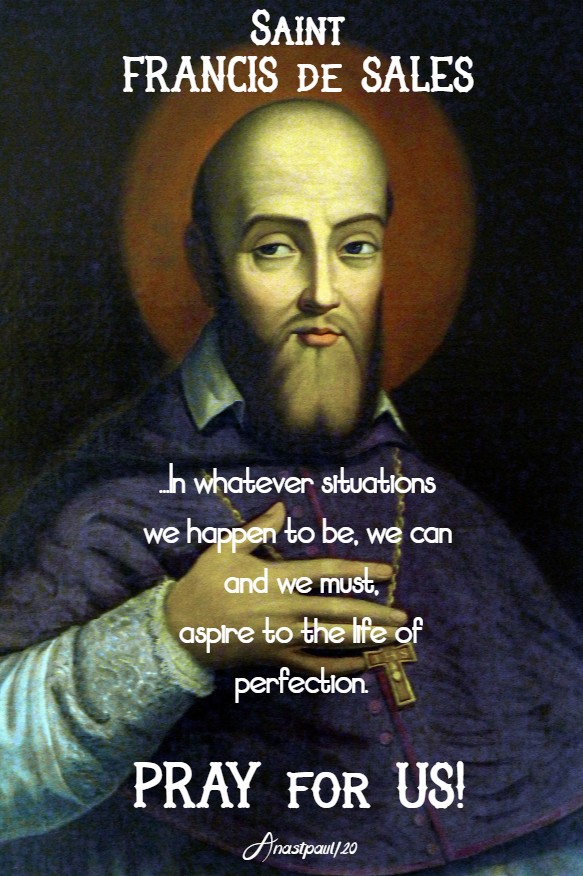
Therefore, in whatever situations we happen to be, we can and we must aspire to the life of perfection.”
Quote/s of the Day – 24 January – Friday of the Second week in Ordinary Time, Year A and The Memorial of St Francis de Sales (1567-1622) “The Gentle Christ of Geneva” – Doctor of the Church: Doctor Caritatis (Doctor of Charity)
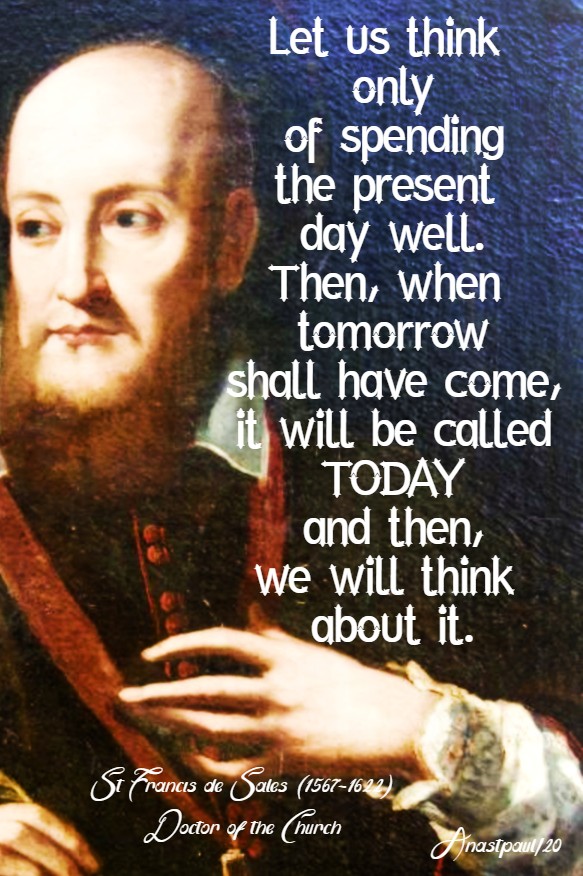
“Let us think only of spending the present day well. Then, when tomorrow shall have come, it will be called TODAY and then, we will think about it.”
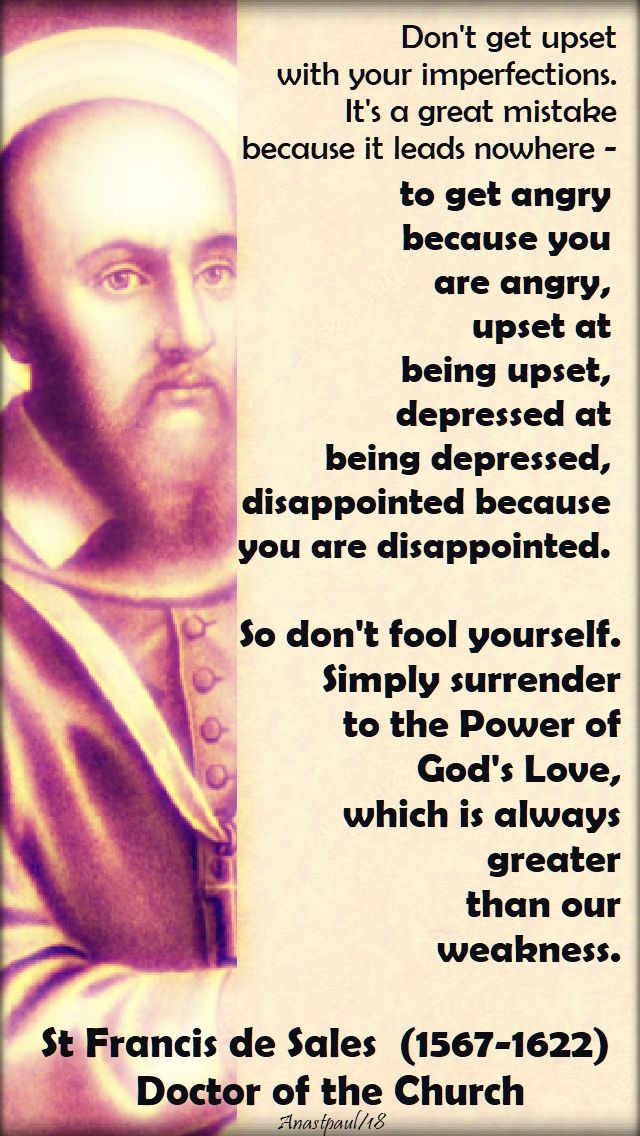
“Don’t get upset with your imperfections. It’s a great mistake, because it leads nowhere – to get angry because, you are angry, upset at being upset, depressed, at being depressed, disappointed, because you are disappointed. So don’t fool yourself. Simply surrender to the Power of God’s Love, which is always greater than our weakness.”
“Don’t sow your desires in someone else’s garden, just cultivate your own, as best you can; don’t long to be other than what you are but desire to be thoroughly what you are. Direct your thoughts, to being very good at that and to bearing the crosses, little or great, that you will find there. Believe me, this is the most important and least understood point to the spiritual life. We all love according to what is our taste, few people like what is according to their duty or to God’s liking. What is the use of building castles in Spain when we have to live in France?”
“The work is never finished, we have continually to begin again and that courageously. What we have done so far is good but what we are going to commence, will be better and when we have finished that, we shall begin something else that will be better still and then another – until we leave this world to begin a new life that will have no end because it is the best that can happen to us.
It is not then a case for tears, that we have so much work to do for our souls, for we need great courage to go ever onwards (since we must never stop) and much resolution to restrain our desires. Observe carefully this precept, that all the Saints have given to those who would emulate them – to speak little, or not at all, of yourself and your own interests.”
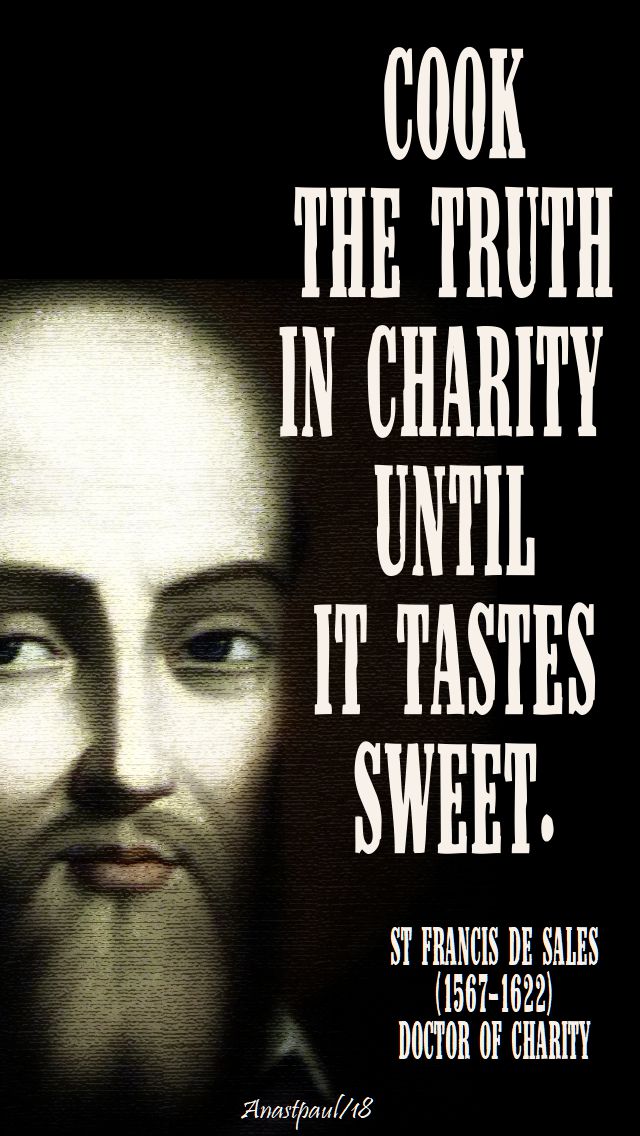
“Cook the truth in charity, until it tastes sweet.”
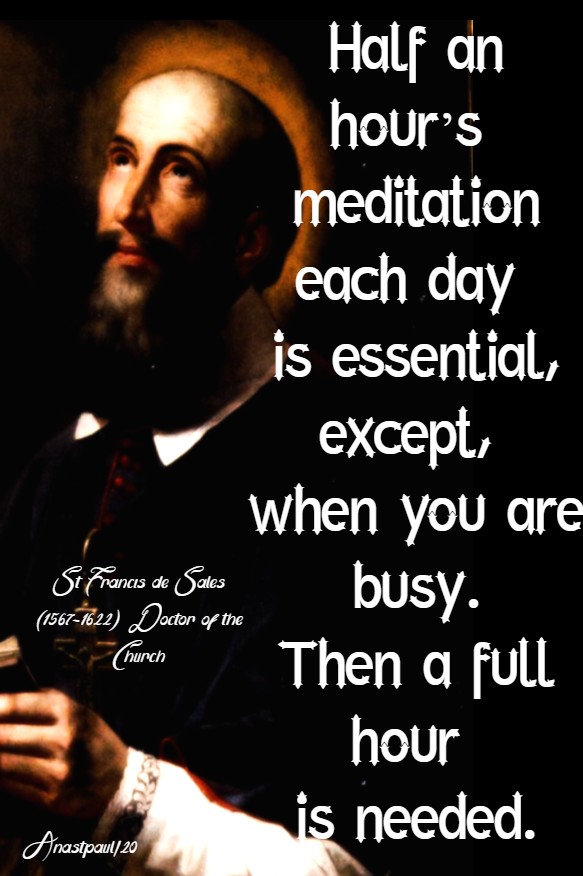
“Half an hour’s meditation each day is essential, except, when you are busy. Then a full hour is needed.”
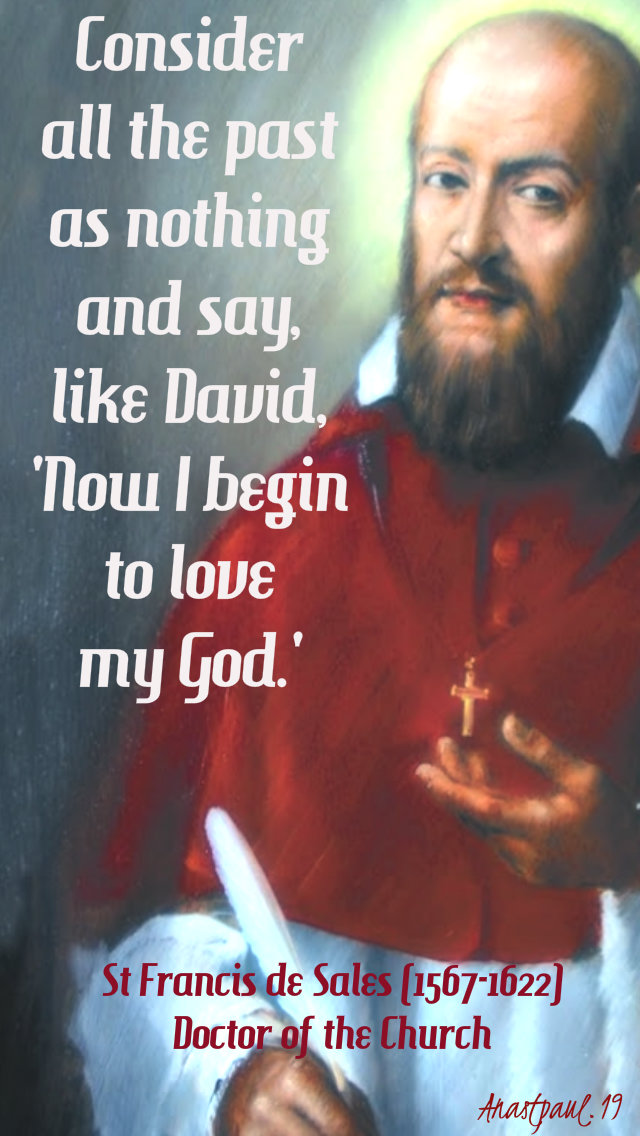
“Consider all the past as nothing and say, like David – Now I begin to love my God.”
St Francis de Sales (1567-1622) Doctor of the Church
One Minute Reflection – 24 January – Friday of the Second week in Ordinary Time, Year A and the Memorial of St Francis De Sales OFM Cap (1567-1622) Doctor of the Church ” – Readings: 1 Samuel 24:2-20 (3-21), Psalm 57:2-4, 6, 11, Mark 3:13-19
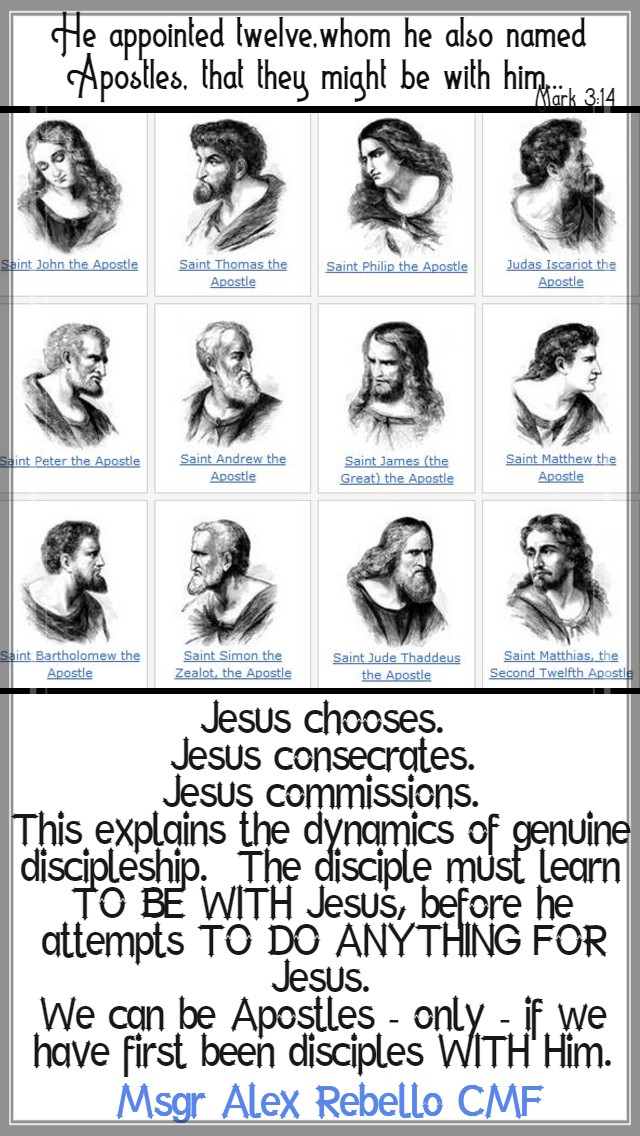
He appointed Twelve, whom he also named Apostles, that they might be with him … Mark 3:14
REFLECTION – “Jesus calls those he wanted. Jesus chooses. They come to him. He calls the Twelve to be with Him. While they are with Him, listening to Him teach, witnessing the miracles He works, living with Him, the Twelve get to know Him, first hand.
They KNOWJesus, not just about Jesus.
Jesus consecrates them as He takes them apart – forming them to carry on and continue His work.
Having consecrated them – he commissions them, as He sends them forth to preach the good news.
Jesus chooses.
Jesus consecrates.
Jesus commissions.
This explains the dynamics of genuine discipleship.
The disciple must learn TO BE WITH Jesus, before he attempts TO DO ANYTHING FORJesus.
We can be Apostles – only – if we have first been disciples WITH Him.” … Msgr Alex Rebello CMF (Diocese Wrexham, Wales) Claretian Priest
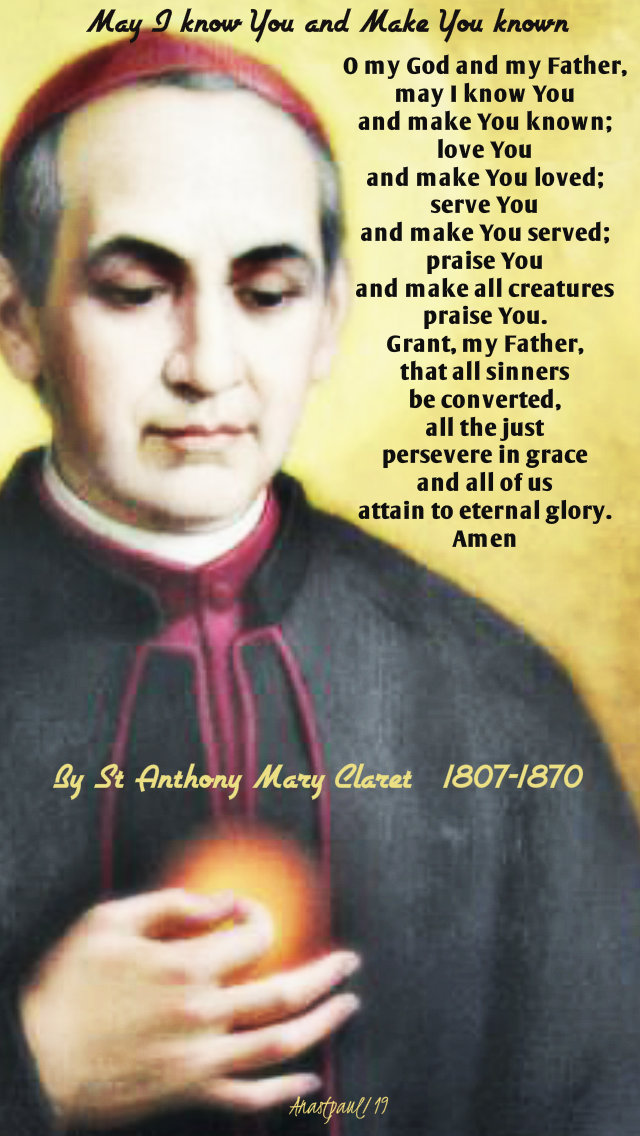
PRAYER – “O my God and my Father, may I know You and make You know, love You and make You loved, serve You and make Your served, praise You and make all creatures, praise You.” [St Anthony Mary Claret CMF (1807-1870)] Lord God, true light and creator of light, grant us the grace to see clearly by the light who is Light, Your only Son. Lead us in His path and send us Your Spirit. Grant us the strength to grow in holiness so that our struggle against the powers of darkness may we a victory over temptation. May the intercession of the master of spirituality, St Francis de Sales, help us and protect us. We make our prayer through Christ our Lord, in the unity of the Holy Spirit, God for all eternity, amen.







 He at once excommunicated Henry V and the antipope and, under Norman protection, was able to return to Rome in July. But the disturbances of the imperialist party, especially those of the Frangipani, who attacked the Pope while celebrating Mass in the church of St Prassede, compelled Gelasius II to go once more into exile. He set out for France, consecrating the Cathedral of Pisa on the way and arrived at Marseille in October. He was received with great enthusiasm at Avignon, Montpellier and other cities, held a Synod at Vienne in January 1119 and was planning to hold a General Council to settle the investiture contest when he died at the Abbey of Cluny.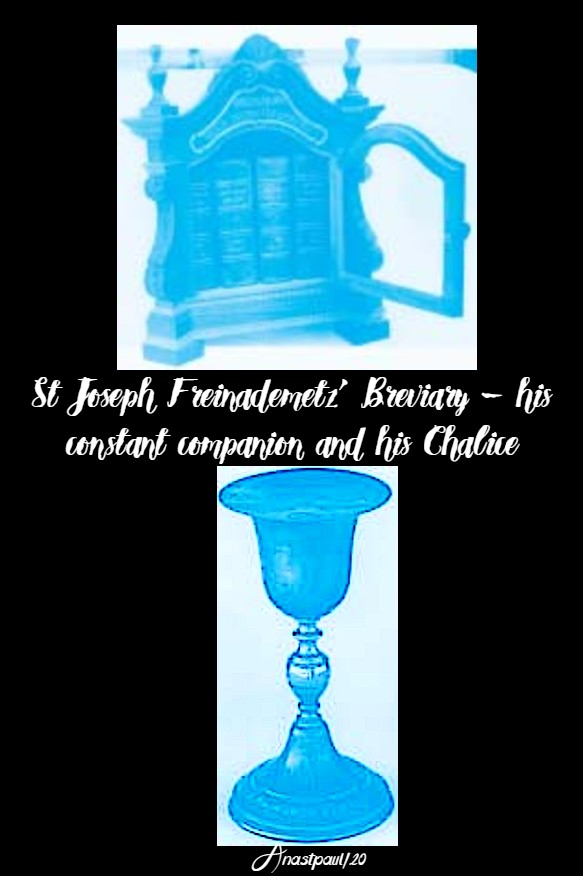












 AnaStpaul
You must be logged in to post a comment.