St Acacius of Amida
St Aedesius of Alexandria Bl Antony of Pavoni OP (1326-1374) Priest and Martyr Biography: https://wordpress.com/post/anastpaul.wordpress.com/9688
St Brogan
St Casilda of Toledo
St Concessus the Martyr
St Demetrius the Martyr
St Dotto
St Eupsychius of Cappadocia
St Gaucherius
St Hedda the Abbot
St Heliodorus of Mesopotamia
St Hilary the Martyr
St Hugh of Rouen
Bl James of Padua
Bl John of Vespignano Blessed Celestyna (Katarzyna) Faron IHM (1913 – 1942) Virgin Martyr (Today’s Saint) St Liborius of Le Mans (early 4th century – 397) St Liborius’ story: https://anastpaul.wordpress.com/2018/04/09/saint-of-the-day-9-april-st-liborius-of-le-mans-early-4th-century-397/
St Madrun of Wales
St Marcellus of Die
Bl Marguerite Rutan
St Maximus of Alexandria
Bl Pierre Camino
St Prochorus Bl Thomas of Tolentino OFM (c 1255–1321) Martyr Blessed Thomas’ Life:
Bl Ubaldo Adimari
St Waltrude of Mons
—
Martyrs of Croyland – 9 saints: A group of Benedictine monks martyred by pagan Danes – Agamund, Askega, Egdred, Elfgete, Grimkeld, Sabinus, Swethin, Theodore and Ulric. Croyland Abbey, England.
Martyrs of Masyla: Massylitan Martyrs Group of Christians martyred in Masyla in northwest Africa.
Martyrs of Pannonia: Seven virgin-martyrs in Sirmium, Pannonia (modern Sremska Mitrovica, Serbia).
Martyrs of Thorney Abbey – 3+ saints: A group of Hermits, hermitesses and monks who lived in or around Thorney Abbey who were martyred together during raids by pagan Danes. We know little more than the names of three – Tancred, Torthred and Tova. 869 by raiders at Thorney Abbey, Cambridgeshire, England.
Saint of the Day – 4 April – St Isidore of Seville (c 560-636) Father & Doctor of the Church, Creator of the first encyclopedia – often called “The Last Scholar of the Ancient World” and “The Schoolmaster of the Middle Ages.” His most well known Patronage is of Computers and the Internet (although not officially so_ – his full story with Patronages is here: https://anastpaul.wordpress.com/2017/04/04/saint-of-the-day-4-april-st-isidore-of-seville-father-and-doctor-of-the-church/ but today we will follow his life with Pope Benedict XVI during his Catechetical audiences on the Doctors of the Church. This was given at St Peter’s on Wednesday, 18 June 2008.
He was a younger brother of St Leander (c 534-c 600) memorial 13 March, Archbishop of Seville and a great friend of St Pope Gregory the Great. Pointing this out is important, because it enables us, to bear in mind, a cultural and spiritual approach, that is indispensable for understanding Isidore’s personality. Indeed, he owed much to Leander, an exacting, studious and austere person who created around his younger brother a family context, marked by the ascetic requirements proper to a monk and from the work pace demanded, by a serious dedication to study. Furthermore, Leander was concerned to have the wherewithal to confront the political and social situation of that time – in those decades in fact, the Visigoths, barbarians and Arians, had invaded the Iberian Peninsula and taken possession of territories that belonged to the Roman Empire. It was essential to regain them for the Roman world and for Catholicism. Leander and Isidore’s home was furnished with a library richly endowed with classical, pagan and Christian works. Isidore, who felt simultaneously attracted to both, was, therefore, taught under the responsibility of his elder brother, to develop a very strong discipline, in devoting himself to study with discretion and discernment.
Thus, a calm and open atmosphere prevailed in the episcopal residence in Seville. We can deduce this from Isidore’s cultural and spiritual interests, as they emerge from his works themselves, which include an encyclopaedic knowledge of pagan classical culture and a thorough knowledge of Christian culture. This explains the eclecticism characteristic of Isidore’s literary opus, who glided with the greatest of ease from Martial to Augustine, or from Cicero to Gregory the Great. The inner strife that the young Isidore had to contend with, having succeeded his brother Leander on the episcopal throne of Seville in 599, was by no means unimportant. The impression of excessive voluntarism that strikes one, on reading the works of this great author, considered to be the last of the Christian Fathers of antiquity, may, perhaps, actually be due to this constant struggle with himself. A few years after his death in 636, the Council of Toledo in 653 described him as “an illustrious teacher of our time and the glory of the Catholic Church.”
Isidore was, without a doubt, a man of accentuated dialectic antitheses. Moreover, he experienced a permanent inner conflict in his personal life, similar to that which Gregory the Great and St Augustine had experienced earlier, between a desire for solitud, to dedicate himself solely to meditation on the word of God and, the demands of charity to his brethren, for whose salvation, as Bishop, he felt responsible. He wrote, for example, with regard to Church leaders: “The man responsible for a Church (vir ecclesiasticus) must on the one hand allow himself to be crucified to the world, with the mortification of his flesh and, on the other, accept the decision of the ecclesiastical order – when it comes from God’s will – to devote himself humbly to government, even if he does not wish to”(Sententiarum liber III, 33, 1: PL 83, col 705 B). Just a paragraph later he adds: “Men of God, (sancti viri), do not in fact desire to dedicate themselves to things of the world and groan when by some mysterious design of God they are charged with certain responsibilities…. They do their utmost to avoid them bu,t accept what they would like to shun and do what they would have preferred to avoid. Indeed, they enter into the secrecy of the heart and seek there to understand what God’s mysterious will is asking of them. And when they realise that they must submit to God’s plans, they bend their hearts to the yoke of the divine decision” (Sententiarum liber III, 33, 3: PL 83, coll. 705-706).
To understand Isidore better, it is first of all, necessary, to recall the complexity of the political situations in his time to which I have already referred – during the years of his boyhood he was obliged to experience the bitterness of exile. He was, nevertheless, pervaded with apostolic enthusiasm. He experienced the rapture of contributing to the formation of a people, that was at last, rediscovering its unity, both political and religious, with the providential conversion of Hermenegild, the heir to the Visigoth throne, from Arianism to the Catholic faith. Yet we must not underestimate the enormous difficulty of coming to grips with such very serious problems as were the relations with heretics and with the Jews. There was a whole series of problems which appear very concrete to us today too, especially if we consider what is happening in certain region, in which we seem almost to be witnessing the recurrence of situations, very similar to those, that existed on the Iberian Peninsular, in that sixth century. The wealth of cultural knowledge that Isidore had assimilated, enabled him to constantly compare the Christian newness with the Greco-Roman cultural heritage, however, rather than the precious gift of synthesis, it would seem that he possessed the gift of collatio, that is, of collecting, which he expressed in an extraordinary personal erudition, although it was not always ordered as might have been desired.
In any case, his nagging worry not to overlook anything, that human experience had produced, in the history of his homeland and of the whole world, is admirable. Isidore did not want to lose anything that man had acquired, in the epochs of antiquity, regardless of whether they had been pagan, Jewish or Christian. Hence, it should not come as a surprise if, in pursuing this goal, he did not always manage to filter the knowledge he possessed sufficiently, in the purifying waters of the Christian faith as he would have wished. The point is, however, that in Isidore’s intentions, the proposals he made, were always in tune with the Catholic faith, which he staunchly upheld. In the discussion of the various theological problems, he showed, that he perceived their complexity and often astutely suggested solutions, that summarise and express, the complete Christian truth. This has enabled believers through the ages and to our times, to profit, with gratitude, from his definitions. A significant example of this is offered by Isidore’s teaching on the relations between active and contemplative life. He wrote: “Those who seek to attain repose in contemplation must first train in the stadium of active life and then, free from the dross of sin, they will be able to display that pure heart which alone makes the vision of God possible”(Differentiarum Lib. II, 34, 133: PL 83, col 91A). Nonetheless, the realism of a true pastor, convinced him of the risk the faithful run, of reducing themselves to one dimension. He therefore added: “The middle way, consisting of both of these forms of life, normally turns out to be more useful in resolving those tensions, which are often aggravated, by the choice of a single way of life and are instead better tempered, by an alternation of the two forms” (op. cit. 134; ibid., col 91B).
Isidore sought in Christ’s example the definitive confirmation of a just orientation of life and said: “The Saviour Jesus offers us the example of active life, when during the day He devoted Himself to working signs and miracles in the town but, He showed the contemplative life, when He withdrew to the mountain and spent the night in prayer”(op. cit. 134: ibid.). In the light of this example of the divine Teacher, Isidore can conclude with this precise moral teaching: “Therefore let the servant of God, imitating Christ, dedicate himself to contemplation without denying himself active life. Behaving otherwise, would not be right. Indeed, just as we must love God in contemplation, so we must love our neighbour with action. It is therefore impossible to live without the presence of both the one and the other form of life, nor can we live without experiencing both the one and the other”(op. cit., 135; ibid. col 91C). I consider that this is the synthesis of a life that seeks contemplation of God, dialogue with God in prayer and in the reading of Sacred Scripture, as well as action at the service of the human community and of our neighbour. This synthesis, is the lesson that the great Bishop of Seville has bequeathed to us, Christians of today, called to witness to Christ at the beginning of a new millennium. Amen … Vatican.va
St Isidore at Seville CathedralSt Isidore on the Facade of Seville Cathedral
Prayer for the Intercession of St Isidore before accessing the Internet
Almighty and eternal God,
who created us in Thy image
and bade us to seek after all that is good,
true and beautiful,
especially in the divine person
of Thy only-begotten Son,
our Lord Jesus Christ,
grant we beseech Thee that,
through the intercession of Saint Isidore,
Bishop and Doctor,
during our journeys through the internet,
we will direct our hands and eyes
only to that which is pleasing to Thee
and treat with charity and patience,
all those souls whom we encounter.
Through Christ our Lord.
Amen
Orátio ante colligatiónem in interrete:
*Omnípotens aetérne Deus,
qui secúndum imáginem Tuam nos plasmásti
et omnia bona, vera, et pulchra,
praesértim in divína persóna Unigéniti Fílii Tui
Dómini nostri Iesu Chrísti, quaérere iussísti,
praesta, quaésumus,
ut, per intercessiónem Sancti Isidóri, Epíscopi et Doctóris,
in peregrinatiónibus per interrete,
et manus oculísque ad quae Tibi sunt plácita intendámus
et omnes quos convenímus cum caritáte ac patiéntia accipiámus.
Per Christum Dóminum nostrum.
Amen
Quote of the Day – 3 April – The Memorial of St Richard of Chichester (1197-1253)
May I Love You More Dearly St Richard of Chichester (1197-1253)
Thanks be to You, my Lord Jesus Christ For all the benefits You have given me, For all the pains and insults You have borne for me. O most merciful Redeemer, friend and brother, May I know You more clearly, Love You more dearly, Follow You more nearly. Amen
St Richard recited this prayer on his deathbed, surrounded by the clergy of the diocese. The words were transcribed, in Latin, by his confessor Ralph Bocking, a Dominican friar and were eventually published in the Acta Sanctorum, an encyclopedic text in 68 folio volumes of documents examining the lives of Christian saints. The British Library copy, contains what is believed to be Bockings transcription of the prayer:
Gratias tibi ago, Domine Jesu Christe,
de omnibus beneficiis quae mihi praestitisti,
pro poenis et opprobriis, quae pro me pertulisti,
propter quae planctus ille lamentabilis vere tibi competebat.
Non est dolor similis sicut dolor meus.
Saint of the Day – 3 April – Blessed John of Jesus and Mary O.SS.T (1895-1937) Priest Martyr, Religious Priest of the The Order of the Holy Trinity and of the Captives, more commonly known as the Trinitarians, Musician – born as Juan Otazua y Madariaga on 8 February 1895 in Rigoitia, Vizcaya, Spain and died by being shot at dawn on 3 April 1937 in the cemetery of Mancha Real, Jaén, Spain. He was 42 years old.
Juan Otazua was born on 8 February 1895 in the small town of Rigoitia, in the province of Vizcaya Spain.
On 30 September 1913, he began his Novitiate with the Trinitarian Religious Order in the Sanctuary of Bien Aparecida (Cantabria). He made his simple profession in said sanctuary, on 11 October 1914, then taking the name of John of Jesus and Mary. He studied philosophy at the Bien Aparecida and Córdoba and theology at La Rambla. He professed his solemn vows at the Trinidad house in Córdoba on 17 May 1918. He was Ordained a Priest on 23 October 1921 in Madrid .
For many years he was a Priest of the house of the Trinity in Madrid and exercised his pastoral work in the Church of the Basques of San Ignacio de Loyola, in the now known Las Letras neighbourhood. He was known for his excellent command of music , especially the cello.
In March 1936 the church of San Ignacio was burned down by the mobs, in the atmosphere of civil war, which led to the disintegration of the Trinitarian community and the distribution of the Religious to various convents in Spain. However some of them were arrested and executed days later. Fr John was sentenced to 20 years in prison. Despite the sentence, on the night of 2 April 1937, militiamen took him out of prison and took him to the La Mancha Real cemetery, where they shot him the following morning. Fr John was 42 years old. His body was buried in a grave to avoid recognition.
Fr John of Jesus and Mary was Beatified by Pope Benedict XVI on 28 October 2007. His Memorial is also celebrated with his fellow Trinatarian Martyrs on 6 November.
Bl Alexandrina di Letto
St Attala of Taormina
St Benatius of Kilcooley
St Benignus of Tomi
St Burgundofara
St Chrestus
St Comman
St Evagrius of Tomi
Bl Francisco Solís Pedrajas Saint or Blessed (conflicting reports?) Gandulphus of Binasco OFM (c 1200-1260)
Bl Iacobus Won Si-bo
St John I of Naples
Bl John of Penna
St Joseph the Hymnographer Blessed John of Jesus and Mary/Juan Otazua Madariaga O.SS.T (1895-1937) Priest Martyr
Bl Lawrence Pak Chwi-deuk St Luigi Scrosoppi Cong. Orat. (1804-1884) About St Luigi:
Quote/s of the Day – 2 April – The Memorial of St Francis of Paola OM (1416-1507)
“Fix your minds on the passion of our Lord Jesus Christ. Inflamed with love for us, He came down from heaven to redeem us. For our sake He endured every torment of body and soul and shrank from no bodily pain. He Himself gave us an example of perfect patience and love. We, then, are to be patient in adversity.”
“See to it that you refrain from harsh words. But if you do speak them, do not be ashamed to apply the remedy from the same lips, that inflicted the wounds.”
Saint of the Day – 2 April – Blessed Vilmos Apor (1892–1945) Bishop Martyr, Chaplain of the Order of Malta – born as Baron Vilmos Apor de Altorja on 29 February 1892 at Segesvár, Transylvania, Hungary and died by shooting on 2 April 1945 at Gyõr, Hungary. (Also known as – Vilhelm, Gulielmus, William). Patronages – Abuse victims, Sexual abuse victims, Activists, Virgins, Military chaplains.
He became famous for protesting against the persecution of the Hungarian Jewish population and for his steadfast commitment to the poor. His outreach also extended to abuse victims with a particular emphasis on the protection of women – it would be this latter point that saw him sustain fatal injuries leading to his death. The Bishop dedicated himself to being an opponent of both communism and Nazism and used his sermons as a chance to condemn them, at a great personal risk to himself. He was a beloved figure in his Diocese where people hailed him as a great saint upon learning of his death which came as a profound shock and loss to the Diocese he had served during the course of most of the war.
Vilmos Apor de Altorja was born in 1892 as the sixth of eight children to the nobles Baron Gábor Apor (1851–98) and Countess Fidelia Pálffy ab Erdöd (1863–1934); one was stillborn and three died in their childhoods. One sister was Gizella and another was Henrietta who was his junior and an elder brother was Gábor. His elder brother served in World War I but later became a Hungarian delegate to the Vatican until his resignation in 1944 in protest of the German occupation of his homeland. His father died in his childhood due to complications from diabetes. His mother was strict but caring and imparted sage religious instruction to her children. He served as an altar server during his childhood and his love for the Priesthood intensified to the stage where he harboured an interest in becoming a Priest himself. Bishop Miklós Széchnyi was his uncle.
Year one of his initial education saw him teach Henrietta how to read and she often got him to instruct her in catechism. He even asked his mother once for a chalice and missal for Christmas. He attended high school at a Jesuit-run school in Kalksburg where his desires to become a Priest intensified further, despite his initial homesickness. Apor liked Latin as well as historical studies and received outstanding marks in these subjects, while a treatise on the historical Church, earned him a prize. He also liked tennis and swimming. He then transferred to another Jesuit school at Kalocsa.
He decided to begin his studies for the Priesthood despite his mother’s wish that he wait a little while longer – she consented at Christmas in 1909 – and the local Bishop was delighted to receive him in 1910. The Bishop sent him to Innsbruck for further studies with the Jesuits in 1910, where he later received a doctorate in theological studies, the rector there was a relative of his. He was made a subdeacon on 22 August 1915 and was elevated to the diaconate on 23 August.
He received his Ordination to the Priesthood on 24 August 1915 and he celebrated his first Mass on 25 August, with his mother and sisters, Henrietta and Gizella, in attendance. Gabor could not be there because he was on the battlefront and was unable to obtain leave. Vilmos was first sent to Gyula on 31 August 1915 and he preached his first sermon on the following 8 September. On 27 March 1916 he opened an office for the protection of women that became a predominant focus for him on his pastoral mission while on 4 January 1917 he was sent as a chaplain to the Italian front before being transferred as such to Austria and then back to Gyula at the start of 1919 at the end of the war.
Pope Pius XII appointed him as a Bishop in 1941 and he received his Episcopal Consecration a month later. His brother, Gabor, paid for his new Episcopal vestments. He took formal possession of his new Episcopal See on 2 March 1941. On 25 February 1941 – in a unanimous decision – the town council of Gyula made him an honorary citizen, due to his commitment to it’s people and his strong and tireless activism. He became noted for his strong dedication to the poor and his tireless commitment to a range of social justice issues.
In summer 1944 he wrote to the Hungarian Primate Jusztinian Serédi to persuade him to take a strong stance against the government. He also appealed to the Gestapo headquarters in Berlin in an attempt to free the Jews of his Diocese from the ghetto and negotiated with the Nazi command to spare the town from a siege. The introduction of racial laws sought to further make matters worse and so the bishop spoke out for those affected from racial slurs and other forms of persecution. He provided supplies to those Jews being deported through his Diocese and also sheltered those made homeless after air raids in the Episcopal palace while he himself withdrew to a small room for himself.
On the afternoon of 28 March 1945 – Good Friday – as Soviet troops reached his Diocese he offered safe haven to numerous women and children in his residence and also protected women who feared being raped. Four or five drunken Soviet soldiers arrived with the intention of bringing 100 women to their barracks but Apor had them well-hidden in the cellar. He refused to give them up and a long altercation saw an officer making threats with his gun and soon gave chase to a girl who came out of her hiding place, the girl screamed “Uncle Vilmos! Help!” and he ran to her defense and shouted at them: “Out! Get out of here!” The officers turned to leave but one officer turned around and opened fire with a machine gun that shot him three times. Apor suffered a first shot that grazed his forehead as well as a second in the right sleeve of his cassock and the third that perforated his abdomen. Meanwhile the soldiers became frightened and fled the scene.
He lent on the arms of two of his aides and walked towards the cellar with blood coming from his forehead. A doctor administered first aid and his sister, Gizella, aided the doctor in placing her brother on a stretcher. But getting to the hospital took longer due to checkpoints and had to stop several times, since the Russians wanted to inspect the ambulance, the blanket had to be taken off him on these occasions so the Russians could see there was no hidden treasure. Professors Jung and Petz – who had known Apor – performed the operation which seemed to be successful and saw a slight improvement on Holy Saturday when he received the Eucharist, with his sister at his side. He thanked God for having accepted his sacrifice and for the fact that the women he protected were still safe. On Easter his condition deteriorated due to an infection – he made his confession and was given the Anointing of the Sick. He remained lucid with his sister and Doctor Jung at his side, in addition to the nurses and the parish priest.
He died from his injuries not long after, in the afternoon of 2 April 1945, Easter Monday. István Sándor witnessed a stretcher on 3 April being carried from the hospital and saw the bishop’s remains as it was being transported. The funeral was put on hold due to conflict in the area but was carried out within a week of his death. His remains were buried in a Carmelite church as his confessor was the Carmelite priest Erno Szeghy. His remains were later relocated to the Diocesan Cathedral. St Pope John Paul II visited his tomb in 1996.
Blessed Vilmos Apor’s tomb carved by the Hungarian sculptor Sándor Boldogfai Farkas (1907–1970)
The theologian and cardinal-elect Hans Urs von Balthasar was his nephew. St Pope John Paul II had named him as Cardinal in 1988 . He died, however, in his home in Basel on 26 June 1988, two days before the ceremony which would have granted him that position, therefore, he is often called “Cardinal” and is also a Servant of God.
St John Paul II confirmed on 7 July 1997 that Blessed Vilmos was killed “in odium fidei” (in hatred of the faith) and thus approved his Beatification. The pope presided over his Beatification on 9 November 1997 in Saint Peter’s Square.
Today, there stands a statue in District XII of Budapest in Hungary in his honour and the place itself has been named Apor Vilmos tér according to the Hungarian standard of name order.
The Collect of the Mass of the Order of Malta on the Memorial of Blessed Vilmos
Almighty and Eternal God, through your grace, Bishop Vilmos, by courageously shedding his blood for his flock, earned a martyr’s crown. Grant that we, despite the difficulties of our daily lives, may do Your will and offer our good works for the salvation of our brothers and sisters. We ask this through Our Lord Jesus Christ, Your Son, who lives and reigns with You and the Holy Spirit, one God, forever and ever. Amen
St Abundius of Como
St Agnofleda of Maine
St Appian of Caesarea
St Bronach of Glen-Seichis
St Constantine of Scotland
St Ðaminh Tuoc
Bl Diego Luis de San Vitores-Alonso
St Ebbe the Younger
St Eustace of Luxeuil
St Francis Coll Guitart
St Gregory of Nicomedia
St John Payne
Bl Leopold of Gaiche
St Lonochilus of Maine
St Musa of Rome
Bl Mykolai Charnetsky
St Nicetius of Lyon St Pedro Calungsod (1654–1672) Martyr His Life and death:st gregory of nicomedia
St Rufus of Glendalough
St Theodora of Tiria
St Urban of Langres
St Victor of Capua Blessed Vilmos Apor (1892–1945) Bishop Martyr
One Minute Reflection – 1 April – Wednesday of the Fifth week of Lent, Readings: Daniel 3:14-20, 91-92, 95, Responsorial psalm Daniel 3:52-56, John 8:31-42 and the Memorial of St Lodovico Pavoni FMI (1784-1849)
“If you continue in my word, you are truly my disciples and you will know the truth and the truth will make you free.”...John 8:31-32
REFLECTION – “By faith we adhere to Christ and the edifice of our spiritual life becomes thereby firm and stable. Christ makes us share in the stability of the divine rock against which even hell’s fury cannot prevail (Mt 16:18).
Thus divinely sustained, we are conquerors over the assaults and temptations of the world and of the devil, the prince of this world (1 Jn 5:4). The devil and the world, which the devil uses as an accomplice, offer violence to us or solicit us; by faith in the word of Jesus we come out victorious from these attacks. …Now, the devil is “the father of lies and the prince of darkness” (cf. Eph 6:12) while God is ” the Truth” and “in Him is no darkness” (cf. Jn 14:6; 1 Jn 1:5). If we always listen to God, we shall always be victorious. When our Lord, who is our model in all things, was tempted, He repulsed temptation by placing the authority of God’s Word in opposition to each solicitation of the Evil One. We ought to do the same and repulse hell’s attacks by faith in Jesus’ word. (…)
What is true of the devil is true of the world – it is by faith that we overcome it. When people have a living faith in Christ, they fear neither difficulties nor opposition, nor the world’s judgement,s because they know that Christ abides in us, by faith and because they rely on Him.” … Blessed Columba Marmion (1858-1923) Abbot – Our faith, the victory over the world (Christ, the Ideal of the Monk, rev.)
PRAYER – God of mercy, shed Your light on our hearts that are being purified by penance and in Your goodness, give us a favourable hearing. Teach us to work with You and for You and thus fill the world with Your Spirit. In Christ our Saviour, we become a new creation and Your adopted children, therefore, all things are renewed. May the prayers of St Lodovico Pavoni, who gave himself completely to You and Your little ones, assist us to do the same. Through Christ our Lord, with the Holy Spirit, God forever, amen.
Saint of the Day – 1 April – Saint Lodovico Pavoni FMI (1784-1849) Priest, Founder of the Sons of Mary Immaculate which came to be known also as the “Pavoniani, “ Pioneer in vocational schools, known as the “Forerunner of St John Bosco” – born on 11 September 1784 at Brescia, Italy and died on Palm Sunday, 1 April 1849 at Saianco, Italy of natural causes. The figure of Pavoni is of a Saint who made a great impact by his work on behalf of youth and persons most in need of support (deaf, disabled, orphans and the poor) while also contributing to the renewal of contemplative life. Patronages – Sons of Mary Immaculate, Vocational and Trade schools.
Blessed Lodovico Pavoni was born in Brescia on 11 September 1784 and, after 30 years of service to young people, died in Saiano, outside Brescia, on 1 April 1849. For 30 years he followed his inspiration to serve the needs of the young boys on the streets with positive methods of education. He began by opening his own oratory (catechetical and recreation centre) that in 1821 he expanded it into a hostel for their shelter and a school to teach them a trade. In 1825 he founded a religious congregation of priests and brothers to run the educational and industrial activities that grew out of his intuition.
Lodovico was a lively and bright child, interested in the world around him and quick to grasp the social problems of his day. He prepared for the priesthood by receiving his theological formation at the home of the Dominican, Fr Carlo Domenico Ferrari, future Bishop of Brescia. During the Napoleonic era in Italy (1799-1814), the French Emperor closed seminaries. In Brescia, in 1807, he was Ordained a Priest and first launched the oratory. A book by Pietro Schedoni, Moral Influences, listed the reasons for the “rebellion” of young boys – leaving inadequate schooling for a job, bad influences of adult workers, poverty and peer pressure. The author confirmed Lodovico in his personalist approach – to concentrate on the personal and social formation of the young, with a positive and preventative approach.
In 1812 when appointed secretary to Bishop Gabrio Nava, he received permission to continue with his “oratory”. In 1818, he was named rector of the Church of St Barnabas with permission to found an orphanage and a vocational school that in 1821 became the “Institute of St Barnabas.” Lodovico decided that the first trade would be book publishin, to this end, in 1823 he set up “The Publishing House of the Institute of St Barnabas,” the precursor of today’s Ancora press. The boys could also choose to be carpenters, silversmiths, blacksmiths, shoemakers, experts in tool and dye making. In 1823, Fr Pavoni welcomed the first deaf mutes to the school. He purchased a farm to set up an Agricultural School.
In 1825 he established a religious institute to continue his work. In 1843 Pope Gregory XVI authorised it for Brescia. On 11 August 1847, the Brescia Vicar Capitular, Msgr Luchi, established the Congregation of the Sons of Mary Immaculate or “Pavoniani.” On 8 December 1847, Lodovico and the first members made their religious profession.
On 24 March 1849, during the “Ten-Days” when Brescia rebelled against the Austrians and both sides were ready to pillage the city, Bl Lodovico, who had taken care of citizens during a cholera epidemic, performed his last heroic act of charity when he led his boys to safety, to the novitiate on the hill of Saiano, 12 kilometres away. A week later he died at the dawn of Palm Sunday, 1 April 1849 as Brescia was in flames. Lodovico’s ideal of education was a broad one, to dispose a person in his wholeness to be good. Fifty years before “Rerum novarum”, he grasped the religious significance of social justice and set an example by his own dealings with his employees.
Like St John Bosco after him, Pavoni’s used encouraging and preventative methods – he preferred gentleness to severity. He used to say, “Rigorism keeps Heaven empty”.
His Congregation numbers 210 members in six nations: Brazil, Colombia, Eritrea, Germany, Italy and Spain. They still publish books . In Rome they run the Ancora bookstore outside St Peter’s Square. As of 2008 there were 34 houses and out of the 210 religious there were 107 of them being Priests…. Vatican.va
There are many reasons why Pavoni can be considered a precursor. Long before Don Bosco or Don Murialdo, Pavoni saw in the phenomenon of juvenile neglect, one of the great dramas that characterised the age of transition, between the old regime and industrialised society. He understood, that the only way of redemption, was through holistic education of the person. Religious education was his fundamental objective but Pavoni saw professional training, as the way that best covers all aspects of the person.
Pavoni was not an teacher but he had a real educational method, which is characterised by an emphasis on prevention. There are many modern congregations that consider it a point of reference.
The centrality of the Christian faith, love for each person, the importance of work as an instrument of human and social development, clear rules within an organisation but implemented as in a family, attention to personal relationship and recourse to reason, rather than imposition, – these are the components of a plan that aims to equip young people with the necessary tools to develop a balanced personality and to recognise their social role, before the impact of the social situation drives them, inexorably to the margins.
In the decree of 5 June 1947 Pope Pius XII described Pavoni as “another Philip Neri, the precursor of St John Bosco and the perfect emulator of St Joseph Cottolengo.” This authoritative judgement has now received the most solemn approval and recognition of a second miracle with the Canonisation of St Lodovico Pavoni on 16 October 2016 by Pope Francis.
This slideshow requires JavaScript.
“This Jesus,God has raised Him up and of that we are all witnesses” (Acts 2:32). The interior consciousness, that became a burning and invincible faith, guided the spiritual and Priestly experience of Lodovico Pavoni, Priest, Founder of the Congregation of the Sons of Mary Immaculate. Gifted with a particularly sensitive spirit, he was totally comitted to the care of poor and abandoned youngsters and even deaf-mutes. His activity branched out in many directions, from that of education to the publishing sector, with original apostolic intuitions and courageous innovations. At the basis of everything, there was a solid spirituality. By his example, he exhorts us to place our confidence in Jesus and to be, ever more immersed, in the mystery of His love. “– from the Beatification homily by St Pope John Paul II on Sunday, 14 April 2002.
Blessed Abraham of Bulgaria
Blessed Alexander of Sicily
Saint Anastasio
Blessed Antonius of Noto
Saint Berhard of Amiens
Blessed Bernhardin of Noto
Saint Celsus of Armagh
Saint Dodolinus of Vienne
Blessed Gerard of Sassoferrato
Saint Gilbert de Moray
Blessed Giuseppe Girotti
Blessed Hugh of Bonnevaux
Saint Hugh of Grenoble
Saint Jacoba of Rome
Blessed John Bretton
Saint Leucone of Troyes Saint Lodovico Pavoni FMI (1784-1849)
Blessed Marcelle
Saint Mary of Egypt Saint Melito Bishop of Sardis (Died c 180) Early Church Father Biography: https://anastpaul.com/2019/04/01/saint-of-the-day-1-april-st-melito-died-c-180/
Blessed Nicolò of Noto
Saint Prudentius of Atina
Saint Tewdrig ap Teithfallt
Saint Theodora of Rome
Saint Valery of Leucone
Saint Venantius of Spalato
Blessed Vinebault
Blessed Zofia Czeska-Maciejowska
—
Apostles of Picardy:
Saint Caidoc
Saint Fricor
Martyrs of Dalmatia and Istria – 9 saints: A group of Christians martyrs who died at various locations in Dalamtia and Istria (in modern Croatia, whose relics were later taken to Rome, Italy, and who are remembered together. We know the names Anastasio, Antiochiano, Asterius, Gaiano, Mauro, Paoliniano, Septimius, Telio and Venantius.
Died
• on the Adriatic coast of modern Croatia
• relics translated to Rome, Italy
Martyrs of Thessalonica – 6 saints: A group of Christians martyred. We know nothing about them but the names Alexander, Dionysius, Ingenianus, Panterus, Parthenius and Saturninus.
Died
Thessalonica, Greece, date unknown
Martyred Sisters of Thessalonica:
Saint Agape
Saint Chionia
Martyred in Alexandria:
Saint Stephen
Saint Victor
Martyred in Armenia:
Saint Irenaeus
Saint Quintian
Martyred in Heraclea:
Saint Castus
Saint Victor
Martyred in the Mexican Revolution
Blessed Anacleto González Flores
Blessed Jorge Vargas González
Blessed Luis Padilla Gómez
Blessed Ramón Vargas González
Saint of the Day – 31 March – Blessed Bonaventure Tornielli OSM (1411-1491) Priest of the Servite Order, called the “Apostolic Preacher”, Confessor, Biblical expert, Missionary Preacher – born in 1411 in Forli, Italy and died on 31 March 1491 of natural causes, aged 80 years old. Patronages – Missionaries, Catechists.
The Roman Martyrology says of him: “In Udine, in the territory of Venice, Blessed Bonaventure Tornielli, Priest of the Order of the Servants of Mary, who moved the villages to penance with his preaching in various regions of Italy. He died as an octogenarian, while preaching a Lenten sermon.”
Bonaventura Tornielli was born in 1411 in Forlì to the nobleman Giacomo Tornielli and he received a devout family education.
He enlisted into the Servite Order in 1448, where he became noted as a Biblical expert and was later Ordained as a Priest. He completed his studies in Venice in 1454 and earned his Master’s Degree in his Theological studies. After he was Ordained to the Priesthood, he made preparation for a life of apostolic work, by a year in solitude. After this period of retirement, he began to preach eloquently and successfully.
He became noted for his love of contemplative silence in which to meditate on the Gospel, while also preaching sermons and missions in the Papal States and in other Italian cities, all on the subject of repentance.
His fame for personal holiness spread at a rapid pace even to the ears of Pope Sixtus IV who named him as the “Apostolic Preacher.” Fr Bonaventura served for an unknown duration as his order’s Vicar-General. In this office, he gave proof of wonderful administrative ability and charity.
In 1468 he led a sermon before the Senate of the Republic of Venice (also to them in 1482) and in 1488 at the San Marco Basilica. He also led sermons in Florence at the Cathedral at the request of their Senate and also at the Cathedral of the Annunciation in 1481 . He preached during a period of plague in 1476 in both Bologna and Perugia . In 1483 he served as Prior of the San Marcello convent in Rome and there decided to retire, with six others, to a hermitage after receiving papal permission to do so. This was short lived, for Pope Sixtus IV on 31 May 1483, requested that he preach in the Papal States.
Fr Bonaventure participated in the General Chapter of his Order in 1485 in Vetralla and again in 1488 at Bologna where he preached.
It was said that he walked barefoot regardless of the weather conditions and also refrained from consuming both meat and wine. Fra Filippo Albrizzi wrote: “He was a priest of great holiness. His beard was unkempt, his feet were bare, suffering the heat of summer and the freezing cold of winter. He never wore shoes and his feet were often seen to be bleeding.” Fr Bonaventure also slept either on the floor or on a bed of wooden planks.
Fr Bonaventure died on 31 March 1491 – on Holy Thursday – in Udine where he was preaching during the Lenten season.
In 1507 the Lieutenant Andrea Loredan was on a trip from Venice to Udine when he fell ill and was cured, after turning to the late Fr Bonaventure for intercession. His remains were moved in 1509 to Venice to the Church of Saint Mary of the Servants that Loredan himself oversaw. His remains were relocated to the private home of a Servite priest – due to the Napoleonic invasion. In 1971 his remains were moved to Udine. In both Udine and the City of Venice, a cultus grew up around him, it was marked by many miraculous cures. This cultus was confirmed in 1911 when he was Beatified by St Pope Pius X.
Oh God, who didst impart to Blessed Bonaventure, the Confessor, the grace of recalling sinners to repentance, grant we beseech Thee, through his merits and intercession, that we may also weep over our sins, so that, renewed in heart and will, we may serve Thee faithfully, until death. Through Jesus Christ, Our Lord. Amen
St Abda
St Acacius Agathangelos of Melitene
St Agigulf
St Aldo of Hasnon
St Balbina of Rome
St Benjamin the Deacon Blessed Bonaventure Tornielli OSM (1411-1491)
Bl Christopher Robinson
St Daniel of Venice St Guy of Pomposa (Died 1046) Biography: https://anastpaul.com/2019/03/31/saint-of-the-day-31-march-st-guy-of-pomposa-died-1046/
Bl Guy of Vicogne
Bl Jane of Toulouse
St Machabeo of Armagh
Bl Mary Mamala
St Mella of Doire-Melle
Bl Natalia Tulasiewicz
St Renovatus of Merida
—
Martyrs of Africa – 4 saints: A group of Christians martyred together for their faith. No details have survived except for of their names – Anesius, Cornelia, Felix and Theodulus. They were martyred in Roman pro-consular Africa.
Quote/s of the Day – 30 March – The Memorial of St John Climacus (c 525-606) Father of the Church
“Humility is the only virtue that no devil can imitate. If pride made demons out of angels, there is no doubt, that humility could make angels out of demons.”
“Obedience is the burial of the will and the resurrection of humility.”
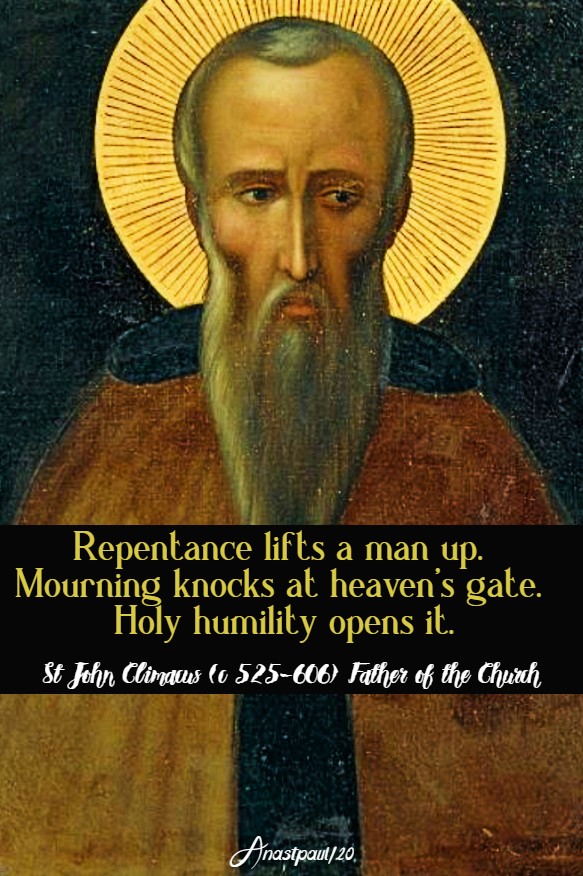
“Repentance lifts a man up. Mourning knocks at heaven’s gate. Holy humility opens it.”
“… A proud soul is the slave of fear, hoping in itself, in comes to such a state, that it is startled by a small noise and is afraid of the dark.”
One Minute Reflection – 30 March – Monday of the Fifth Week of Lent, Readings: Daniel 13:1-9, 15-17, 19-30, 33-62, Psalm 23, John 8:1-11 and the Memorial of St Antoine Daveluy MEP (1818-1866) Martyr
“Neither do I condemn you; go and do not sin again.” … John 8:11
REFLECTION – “The scene is full with drama – the life of that person and also His own life depend on Jesus. Indeed, the hypocritical accusers pretend to entrust the judgement to Him whereas it is actually He, Himself, whom they wish to accuse and judge. Jesus, on the other hand, is “full of grace and truth” (Jn 1: 14) – He can read every human heart, He wants to condemn the sin but save the sinner and unmask hypocrisy. St John the Evangelist highlights one detail – while His accusers are insistently interrogating Him, Jesus bends down and starts writing with His finger on the ground. St Augustine notes that this gesture portrays Christ as the divine legislator, in fact, God wrote the law with His finger on tablets of stone (cf. Commentary on John’s Gospel, 33,5). Thus Jesus is the Legislator, He is Justice in person. And what is His sentence? “Let him who is without sin among you, be the first to throw a stone at her.” These words are full of the disarming power of truth that pulls down the wall of hypocrisy and opens consciences to a greater justice, that of love, in which consists the fulfilment of every precept (cf. Rom 13: 8-10). This is the justice that also saved Saul of Tarsus, transforming him into St Paul (cf. Phil 3: 8-14).
When His accusers “went away, one by one, beginning with the eldest,” Jesus, absolving the woman of her sin, ushers her into a new life oriented to good. “Neither do I condemn you; go and do not sin again.” … Pope Benedict XVI – 21 March 2010
PRAYER – Lord God, Your abounding grace has enriched us with every blessing. Transform us from our sinful condition to newness of life and prepare us for the glory of Your kingdom. Open our eyes to see by the light of Your Son, who always walks with us. Let us lift our eyes to Him, for even now He is preparing for us a place, in His Father’s house. Listen, we pray, to the prayers of all the angels and saints, St Antoine Daveluy a Martyr for Christ, who petition on our behalf and may our Mother Mary, keep ever close to our path. Through Christ, our Lord, in the unity of the Holy Spirit, God for always and forever, amen.
Saint of the Day – 30 March – Saint Marie-Nicolas-Antoine Daveluy MEP (1818-1866) Bishop Martyr, Missionary of the Paris Foreign Missionary Society, Apostolic Vicar to Korea – commonly known as St Antoine Daveluy – born on 16 March 1818 in the parish of Saint-Leu, Amiens, Somme, France and died by beheading on Good Friday, 30 March 1866 at the Galmaemot naval base, Boryeong, Chungcheong-do, South Korea, he was 48, along with two French priests, Pierre Aumaître and Martin-Luc Huin and two lay catechists, Lucas Hwang Sŏk-tu (Bishop Daveluy’s personal assistant) and Joseph Chang Chu-gi. Additional Memorial – 20 September as one of the Martyrs of Korea.
Antoine Daveluy was born 16 March 1818 in Amiens, France. His father was a factory owner, town councilman and government official. The members of his family were devout Catholics and two of his brothers became priests. He entered the St Sulpice Seminary in Issy-les-Moulineaux himself, in October 1834 and was Ordained a Priest on 18 December 1841.
His first assignment was as an assistant Priest in Roye. Despite poor health, he joined the Paris Foreign Missions Society on 4 October 1843. He departed for East Asia on 6 February 1844, intending to serve as a Missionary in the Ryukyu Islands of Japan. He arrived in Macau, where he was persuaded by the newly appointed Apostolic Vicar of Korea, Jean-Joseph-Jean-Baptiste Ferréol, to accompany him there instead. The two were joined by St Andrew Kim Taegŏn, a Korean Seminarian who had been studying for the Priesthood in Macau. They first traveled to Shanghai, where Bishop Ferréol ordained Father Kim on 17 August 1845. The three priests then made a stormy crossing by sea to Korea, arriving in Chungcheong Province in October.
Father Daveluy began work as a Missionary in Korea. Two years later, he was in charge of the Seminary. He then took over the administration of a district, while doing it, he scrupulously prepared a Chinese-Korean-French dictionary, translated several Korean works of history and chronology and revised the books of the Faith.
On 13 November 1855, Pope Pius IX appointed him titular Bishop of Akka and coadjutor to Bishop Siméon-François Berneux, who had been appointed Apostolic Vicar in 1854 after the death of Bishop Ferréol in 1853. He was Consecrated by Bishop Berneux on 25 March 1857.
In 1859 he completed various works for the instruction of Christians, as well as, the the annals of the country’s first Martyrs and wrote biographical notes on most Korean confessors. In the same year, he embarked on a three-month trip to search for and interview, the living witnesses to the persecution of 1801. In October 1802, he sent his work on the history of the mission to the Motherhouse of the Missionary Society in Paris. It is thanks to these documents, often literally reproduced, that Mr Dallet wrote the History of the Church of Korea which, must very largely, be attributed to Bishop Daveluy.
Residence of Bishop Antoine Daveluy between 1845 and 1866 in the village Sin-ri (rural part of Dangjin)
After Bishop Berneux was executed during a campaign by the Korean government against Christians, Bishop Daveluy became Apostolic Vicar on 8 March 1866.
He was promptly arrested on 11 March. Imprisoned and tortured, he staunchly defended his Catholic faith. When he appeared before his judges, he was able, thanks to his in-depth knowledge of the Korean language, to make several long apologetic explanations for Christianity. Perhaps for this reason but above all, because of his dignity as grand master of the Faith in their eyes, he had to suffer more frequently and more severely than his companions – whipping the legs, blows with wooden batons and puncturing with the sharpened rods.
Finally, the court imposed a death sentence against the three prisoners. St Antoine asked to be executed on Good Friday, 30 March. But the king was then sick and numerous sorcerers, assembled in the palace, made to cure him by superstitious ceremonies; moreover, he was soon to celebrate his marriage. It was feared that the torture of the Europeans would harm the effect of the spells and that an outpouring of human blood in the capital, would be an unfortunate omen for the royal wedding. This is why, the regent prescribed that the beheading of the condemned be committed on the peninsula of Syou-yeng, twenty-five miles south of Seoul.
The Bishop and his Priests were led on horseback to the designated place. Their hearts overflowed with joy and, to the astonishment of the officials and the curious, they addressed fervent thanksgiving to God, singing psalms and hymns. On Maundy Thursday, 29 March they had arrived fairly close to Syou-yeng. Archbishop Daveluy heard the officials chatting among themselves, deciding to delay the immolation of the confessors and first to parade them through the neighbouring town. Touched by a strong desire to die on the anniversary of the Saviour’s death, he interrupted them: “No, he cried, what you are saying is impossible. You will go tomorrow, right to the place of execution, because it is tomorrow that we must die.” The prisoner was obeyed and the next day, Good Friday, 30 March 1866, was the day of their Martyrdom.
The mandarin who presided over their torture enjoined the martyrs to bow down to him. It is the custom in Korea for convicts to salute those who kill them. Daveluy replied that he would greet in the French manner and he refused to kneel. A brutal push threw him face down. Another horrific incident marked the death of the holy Bishop, who was beheaded first. The executioner had not set the price for his bloody work. After striking the condemned man with the first blow of his saber, which cut his neck deeply, he stopped and refused to continue, unless he was promised a large sum. The avarice of the mandarin resisted these pretensions. Employees of the prefecture had to be brought together to make a decision. The discussion lasted a long time, the victim struggled on the ground in convulsions of agony, finally the deal was concluded and two new saber strokes delivered the soul of the witness of Jesus Christ.
The bodies of the Martyrs, buried in the sand at the very place of execution by pagans in the neighbourhood, were collected by Christians the following June and buried in the district of Hong-san, 3 miles from the coast. Transferred elsewhere as a result of various circumstances, they were exhumed in March 1882 by order of the preacher, Fr Blanc and in the following November they were sent to Nagasaki (Japan), in order to be protected from any profanation. They were brought back to Korea when there was no longer any fear of persecution and since 1900 they have been buried in the Seoul Cathedral.
Reliquary of saint Anthony Daveluy in Amiens Cathedral
Bishop Daveluy was a stubborn zealous worker. He was also distinguished by his spirit of renunciation and mortification, as much as by his perseverance and humility. Unfortunately, due to this humility, his important dictionary and most of his writings had not been sent to the Motherhouse and they were destroyed during the persecution.
All five were Canonised on 6 May 1984 by St Pope John Paul II, along with Father Kim, Bishop Berneux and 96 other Korean martyrs.
St Julio Álvarez Mendoza
St Leonard Murialdo
St Ludovico of Casoria
St Mamertinus of Auxerre St Marie-Nicolas-Antoine Daveluy MEP (1818-1866) Bishop Martyr
Bl Maria Restituta Kafka
St Osburga of Coventry
St Pastor of Orléans
St Patto of Werden
St Peter Regulatus
St Quirinus the Jailer
St Regulus of Scotland
St Regulus of Senlis
St Secundus of Asti
St Tola
St Zozimus of Syracuse
—
Martyrs of Constantinople: ourth-century Christians who were exiled, branded on the forehead, imprisoned, tortured, impoverished and murdered during the multi-year persecutions of the Arian Emperor Constantius. They were martyred between 351 and 359 in Constantinople.
Martyrs of Korea:
Marie-Nicolas-Antoine Daveluy
Iosephus Chang Chu-gi
Lucas Hwang Sok-tu
Martin-Luc Huin
Pierre Aumaître
Saint of the Day – 29 March – Blessed Bertold of Mount Carmel (Died 1195) Priest, Monk, Hermit, Crusader – born in Limoges, France and died in 1195 of natural causes – also known as Bartoldus of Calabria.
Blessed Bertold was born in France, the son of a Count. He excelled at his studies and was Ordained a Priest. Berthold’s brother, Aymeric, became the Latin Patriarch of Antioch. The two joined together to participate in a Crusade to the Holy Land.
While in the Holy Land, Berthold travelled to Mount Carmel and built a Monastery and Church dedicated to the Prophet Elijah. His reputation for holiness spread, other hermits were attracted to the area, including Saint Brocard. Many hermits who were scattered throughout Palestine, followed Bl Bertold and came to live together in imitation of the life of the great prophet as recorded in the Old Testament.
St Elijah the Prophet
Aymeric appointed Berthold the first Superior and he lived with his community at Mount Carmel for 45 years until his death in 1195. Later the community became known as the Hermit Brothers of St Mary of Mount Carmel.
It was the life and work of Bl Berthold that laid the foundation for the Carmelite Order, which, in 1206 received a written rule from St Albert of Jerusalem, whose rule was approved by Pope Honorius III in 1226. In the same century, some members moved to Europe and established similar groups from Sicily to Oxford.
Carmelites returned to Mount Carmel in 1631 and finally completed the Stella Maris Monastery in the 18th century. Its stout walls and small openings reflect the need for defence against hostilities during its establishment.
Later a lighthouse was built, giving a further meaning to the title Stella Maris. Because of its commanding position, the lighthouse has been commandeered as a military establishment.
Inside the church, the décor features vividly coloured Italian marble and dramatic paintings in the dome, one depicting Elijah being swept up to heaven in a fiery chariot. A cedar and porcelain statue of Mary, Our Lady of Mount Carmel, is above the altar. Steps lead down to a grotto, with a small altar, where the Prophet Elijah is believed to have occasionally lived. People have lived in caves on Mount Carmel since prehistoric times.
St Acacia of Antioch
St Archmimus of Africa
St Armogastes of Africa
St Barachasius Blessed Bertold of Mount Carmel (Died 1195)
St Constantine of Monte Cassino
St Eustachio of Naples
St Firminus of Viviers
St Gladys (Sixth Century)
St Gwynllyw
Bl Hugh of Vaucelles
Bl John Hambley
St Jonas of Hubaham
St Lasar St Ludolf of Ratzeburg O.Praem. (Died 1250) Martyr Biography:
St Mark of Arethusa
St Masculas of Africa
St Pastor of Nicomedia
St Saturus of Africa
St Simplicius of Monte Cassino
St Victorinus of Nicomedia
St William Tempier
Saint of the Day – 28 March – Blessed Conon of Naso (1139-1236) Monk, Hermit and Abbot of the order of St Basil of Caesarea, miracle-worker – born on 3 June 1139 in Naso, Messina, Italy and died on Friday 28 March 1236 in the cave of San Michele near Naso, Italy of natural causes, while in prayer. Patronages – against ear problems, against nose problems, of Naso and San Cono, Italy.
Blessed Conon was the son of a count from Naso, Italy and was a wealthy nobleman. He was a devout young man and at the age of 15 he became a Monk and lived as a Hermit and later was appointed as the Abbot of the Monastery. When his parents died, he distributed his inheritance to the poor.
While on pilgrimage to Jerusalem he had a vision of a Priest he knew, being choked by a snake. Months later, upon his return home to Sicily, Conon told the Priest about the dream. Feeling the pangs of a guilty conscience, the Priest instantly confessed to Conon that he had been stealing funds from the Church and using the money for his own selfish desires. Under Conan’s direction the Priest gave his excessive savings to the poor and recommitted his life to serving others.
Blessed Conan died on Friday 28 March 1236. On that day, the bells in the town of Naso began ringing on their own. The locals went to the holy man to ask him why it was happening but they found him dead and believed that the bells were ringing to announce his passing. Conon was immediately hailed as a miracle worker.
In 1571, over three centuries after Conon’s death, the city of Naso was struck with storms that destroyed crops and stopped shipping trade. The people thereupon, invoked the intercession of Conon. The famine became severe and Conon appeared in a vision to a captain who was transporting grain. He instructed the captain to change his course and deliver the grain to Naso. The captain obeyed and arrived in Naso and relieved it of its famine. Thus, the people of Naso were saved and this miracle has never been forgotten in Naso, where the people still today venerate Blessed Conon and celebrate his Feast with great devotion.
Blessed Conon was Beatified in 1630 by Pope Urban VIII (cultus confirmation).
St Alkelda of Middleham
Bl Antonio Patrizi
St Castor of Tarsus
Bl Christopher Wharton Blessed Conon of Naso (1139-1236)
St Cyril the Deacon
Bl Dedë Maçaj
St Donal O’Neylan
St Dorotheus of Tarsus
St Gundelindis of Niedermünster
St Guntramnus
St Hesychius of Jerusalem
St Hilarion of Pelecete
Bl Jean-Baptiste Malo
Bl Jeanne Marie de Maille
St Proterius of Alexandria
Bl Renée-Marie Feillatreau épouse Dumont
St Rogatus the Martyr
St Successus the Martyr
St Tutilo of Saint-Gall Bl Venturino of Bergamo OP (1304-1346) Biography: https://anastpaul.com/2019/03/28/saint-of-the-day-28-march-blessed-venturino-of-bergamo-op-1304-1346/
Saint of the Day – 27 March – Blessed Giuseppe Ambrosoli MCCI (1923-1987) Priest of the Comboni Missionaries of the Heart of Jesus, Missionary to Uganda, Doctor and Surgeon, he is known in Uganda as the “the Doctor of Charity” and the “Saint Doctor,” Apostle of Charity, medical professor, Founder of a Hospital and a School of Midwifery. Born on 25 July 1923 in Ronago, Como, Italy and died at 1:50pm on 27 March 1987 at the Comboni Mission in Lira, Uganda of renal failure, aged 64. Patronage – the ‘Doctor Ambrosoli Memorial Hospital’ and the Dr Ambrosoli Midwifery School in Uganda. Fr Giuseppe will be (to be Beatified on 22 November 2020). During his studies before World War II, Blessed Giuseppe risked his life to smuggle Jewish people into Switzerland, before returning home to finish his studies in medicine, prior to commencing his ecclesial studies. He joined the Comboni missionaries and was sent to Uganda where he became known as the “Saint Doctor” and the “Doctor of Charity,” for his loving and compassionate treatment of all ill people, to whom he dedicated his life.
Giuseppe Ambrosoli was born in Ronago in 1923 as the seventh son to Giovanni Battista Ambrosoli and Palmira Valli. His paternal great-grandfather worked as a librarian. He studied first in Como and later under the Piarists in Genoa before returning to Como for his high school studies, which he completed in 1942. He joined the “Cenacle” which was a branch of the Azione Cattolica that the Franciscan Silvio Riva ran and Ambrosoli got the chance to get to know Riva who served as a spiritual guide for him and his religious formation.
He studied medicine at the Milanese college but had to stop his studies due to World War II. In September 1943 he risked his own life pledging to save a large number of Jewish people in order to get them safe passage across the border to Switzerland to prevent them from ending up in concentration camps. He returned home to learn from his parents that he was required to join the armed forces on 27 March 1944. He resumed his studies in November 1946 after the war’s end and graduated from the college in Milan as a Doctor of Medicine on 28 July 1949.
It was the summer of 1949 when a young doctor asked to enter the Congregation of the Comboni Missionaries. In his letter of application he wrote: “I would like to place myself at the service of the missions as a qualified doctor.”Before joining, the young doctor decided to go to London for a course in tropical medicine. When he returned to Italy, he entered the Comboni Institute. On 9 September 1953 he made his first profession and on 13 December 1955 he was Ordained Priest by the Cardinal Archbishop of Milan, Giovanni Battista Montini, the future St Pope Paul VI. A few months later, on 1 February 1956, he left for Africa. His destination – Kalongo, in the North of Uganda. The town of Kalongo is located on a plateau 1,100 metres above sea-level. When Father Giuseppe arrived there, it had a population of over 4000. There he found a small Medical Dispensary.
He was not at all discouraged and his plan for a large hospital meant there was a lot of work to do. Working with his own hands, he dug for stones and transported them on a lorry to the building site where he also saw to the making of bricks. Little by little that dispensary grew, one block after another until it had room for 350 patients. There were departments for maternity, paediatrics, medicine, surgery, gynaecology, radiology and infectious diseases; to these were added others for the care of the malnourished, the lepers and tuberculosis patients.
Father Giuseppe immediately understood that, to win the hearts of the Africans, one must sow infinite benevolence. In only a few years, the people began to call him Ajwaka Madit (the great doctor) or Doctor Ladit (the great giver of medicine). Together with his unmistakable smile, his peacefulness became proverbial. But this did not prevent him, as the occasion required, from being strict, with courage and determination and even capable of risking his life for others. He defended the wives of the soldiers and, in general, of the people of the south, upon whom the guerrillas, who were his people of the north, tended to unleash all their aggression.
The faith of the people in the healing powers of Father Giuseppe knew no limits . They saw him as a kind of miraculous healer. In the collective imagination of the people, Father Giuseppe became ‘The man of God with the power to heal.’ To heal not only the body but the spirit and the heart. In his work as a surgeon, Father Giuseppe afforded special care to the women as mothers and bearers of life. He understood that those mothers were capable of heroic acts to make sure their children were born and lived.
Father Giuseppe looked for collaboration and made people responsible – the Doctors working alongside him were duty bound to look upon Kalongo Hospital as ‘their own’. He wanted all the nursing staff to feel directly involved in running the complicated machine that was Kalongo Hospital. For this he valued the local element. His esteem for the Sisters working with him was deep and sincere and he regarded their work as essential.
Towards the end of 1973, Father Giuseppe’s health began to show signs of deteriorating but he gave himself no rest. Even the periods he spent in Italy were a race against time, as he went from one operating theatre to another, to learn the latest surgical techniques. He met with support groups who provided medical equipment. He was well aware of his precarious state of health but he felt it would be a betrayal to hold back with things in Uganda in such a state of emergency. For him, to love others more than himself was the norm.
The year 1986 was certainly the most difficult year for Kalongo, overrun alternatively by rebels and the regular army. On 21 October, the army occupied Kalongo amid indescribable scenes of panic – not only the people but even the patients as well took flight. Relations with the government troops collapsed irremediably, the very fact of having spent a few months with the rebels was interpreted as connivance. This is the destiny of any hospital in a war zone. The situation of the hospital came to a head on 30 January 1987. The military authorities accused the missionaries and hospital personnel of collaborating with the Acholi guerrillas and ordered the evacuation of Kalongo. Having to transfer everything and everyone suddenly to Lira was a real Calvary for Father Giuseppe. His concern was for the doctors, the young women students of the school of midwifery and the Sisters in charge of them. He feared the students would miss a school year, while he wanted them to end their courses with their exams and diploma. Even though he had only one partly-functioning kidney, Father Giuseppe asked his superiors’ permission to delay his return to Italy for treatment. Unfortunately, his health was rapidly deteriorating.
After working unceasingly for 31 years, he died in Lira on 27 March 1987, of a renal infection. He was 64 years old. It was not until seven years later that his remains were exhumed and reburied in Kalongo, close to the hospital that bears his name.
On 28 November 2019, Pope Francis authorised the Congregation for the Causes of the Saints ‘to promulgate, among others, the miracle attributed to the intercession of the Venerable Servant of God Giuseppe Ambrosoli’. The miracle, granted through the intercession of father Giuseppe and which will allow him to be Beatified on 22 November 2020 took place to the benefit of a young Ugandan woman. This was the decision reached in Spring of last year by the medical commission set up by the Congregation for the Causes of the Saints, concluding their examination of ‘an extraordinary and inexplicable cure’ from the clinical and scientific point of view. The beneficiary’s name is Lucia Lomokol. On the evening of 25 October 2008 (she was 20 years old), she lost the child she was carrying in her womb and was dying of septicaemia in Matany hospital, in Northern Uganda where she had been brought in an extremely poor condition. The hospital had no means of helping her. Then Doctor Eric Dominic placed an image of father Giuseppe on her pillow and asked the relatives there to pray to ‘The Saint Doctor.’ The following morning, Lucia was better, something no one expected.
Today the work of Father Giuseppe goes on through his foundation called ‘Doctor Ambrosoli Memorial Hospital.’ The foundation was built in 1998 by the Ambrosoli family and by the Comboni Missionaries to guarantee the continuity and future of the hospital and the school of Midwifery founded by him. Its aim is to ensure access for the population to a qualified health service for their better health and standard of living. The Foundation proceeds together with the local communities and fosters medical training so that Uganda may one day have its own independent health service. Father Ambrosoli will be the first Comboni Missionary to be Beatified.
Bl Aimone of Halberstadt
St Amphilochius of Illyria
St Alexander of Drizipara
St Alexander of Pannonia
St Alkeld the Martyr
St Amator the Hermit
St Augusta of Treviso
St Claudio Gallo
St Cronidas of Illyria
St Ensfrid of Cologne
Bl Francesco Faà di Bruno
Bl Frowin of Engelberg
St Gelasius of Armagh Blessed Giuseppe Ambrosoli MCCI (1923-1987)
St John of Lycopolis
St Matthew of Beauvais
St Macedo of Illyria
St Panacea de’Muzzi of Quarona
Bl Pellegrino of Falerone
Bl Peter Jo Yong-sam
St Philetus
St Romulus the Abbot St Rupert of Salzburg (c 660–710) Biography of St Rupert: https://anastpaul.com/2019/03/27/saint-of-the-day-st-rupert-of-salzburg-c-660-710/
St Suairlech of Fore
St Theoprepius
—
Martyrs of Bardiaboch: A group of Christians who were arrested, tortured and executed together for their faith during the persecutions of Persian king Shapur II. Martyrs. – Abibus, Helias, Lazarus, Mares, Maruthas, Narses, Sabas, Sembeeth and Zanitas. 27 March 326 at Bardiaboch, Persia.
One Minute Reflection – 26 March – Thursday of the Fourth Week of Lent, Readings: Exodus 32:7-14, Psalms 106:19-23, John 5:31-47 and the Blessed Maddalena Caterina Morano (1847-1908)
“If you believed Moses, you would believe me, for he wrote of me. But if you do not believe his writings, how will you believe my words?”… John 5:46-47
REFLECTION – “In the beginning, the Lord, who had created humankind, used to talk to man Himself, in such a way, that man could hear Him. That is how He used to talk to Adam (…) and, later, with Noah and Abraham. So too, even when humankind had thrown itself into the abyss of sin, God did not break His relationship with them, even though it was, necessarily, less familiar since they had made themselves unworthy of it. He consented to renew His kindly feelings towards them, although, as by letters, as with an absent friend. Thus, in His goodness, He could bind all humankind to Himself again. Moses was he, who was the bearer of the letters God sent us.
Let us open these letters – what are their first words? “In the beginning God created the heaven and the earth.” Isn’t that wonderful? … Moses, who came into the world many centuries afterwards, was truly inspired from above, to give us an account of the wonders God made at the world’s creation…. Doesn’t he appear to tell us clearly: “Did men teach me what I’m about to make known? Not at all. The Creator alone, who wrought all these marvels, is the One who guides my tongue, to teach you them. From now on, I beg you, put to silence every argument of human reasoning. Don’t just listen to this account as though it were only Moses’ word. It is God Himself who speaks to you, Moses is only His interpreter.” …
So, brethren, let us receive the Word of God with thankful and humble hearts. … For God is He, who created all things, He it is, who prepares everything and sets it wisely in order. … He it is, who leads man by what can be seen, to a knowledge of the Creator of the universe. He it is, who teaches man to contemplate the supreme Worker in His works, in such a way, that He might be able to worship His Creator.” … Saint John Chrysostom (347-407) – Priest at Antioch then Bishop of Constantinople, Father & Doctor of the Church – 2nd Homily on Genesis
PRAYER – Father almighty, grant us Your good grace to trust completely in the Word made Flesh whom You sent to lead us to our heavenly home and save us from our evil ways. As we proceed by penance and prayer, grant us now, perseverance in listening to Him and learning from Him. May the prayers of Bl Maddalena, assist us on our journey. We make our prayer through Christ our Lord, in the unity of the Holy Spirit, one God with You, now and forever, amen.
Our Morning Offering – 26 March – Thursday of the Fourth Week of Lent
Thy Grace St John Henry Newman (1801-1890)
O my God,
suffer me still!
Bear with me
in spite of my waywardness,
perverseness and ingratitude!
I improve very slowly
but really, I am moving onto heaven,
or at least, I wish to move.
Only give me, Thy grace,
meet me with Thy grace,
I will, through Thy grace,
do what I can
and Thou shall perfect it for me.
Then I shall have happy days
in Thy presence
and in the sight and adoration of
Thy Five Sacred Wounds.
Amen
Saint of the Day – 26 March – Blessed Maddalena Caterina Morano FMA (1847-1908) Virgin, Sister of the Daughters of Mary Help of Christian – the female branch of the Salesians of St Don Bosco, most commonly known as the “Salesian Sisters”, Teacher and Catechist – born on 15 November 1847 at Chieri, Italy and died on 26 March 1908 at Catania, Sicily, Italy of cancer. Patronages – Teachers and Catechists. The Roman Martyrology says of her: “In Catania in Sicily, in the year 1908, Blessed Madeleine-Catherine Morano, virgin, from the Institute of the Daughters of Mary Help of Christians, devoted herself to teaching Catechism, traversing this region up and down endlessly.”
Maddalena Caterina Morano was born in Chieri, in the province of Turin, on 15 November 1847. Her father Francis died when she was eight and she began to help her mother with her work. Thanks to her uncle, a priest, she was able to resume her studies. Her teacher appointed her to help the little ones. Meanwhile she met Don Bosco for the first time, while walking to Buttigliera d’Asti. Maddalena wanted to teach and when she was 17 gained her teacher’s certificate.
Teacher
When she was 19 she began teaching at Montaldo Torinese. She confessed to her mother in 1877 that she wanted to become a nun but her mother could not support herself if Morano left her. She did this with diligence and competence for fourteen years, earning the respect and esteem of the entire neighbourhood. Finally, Maddalena took her spiritual director’s advice and, after having bought a home for her mother with her savings, went to speak to Don Bosco, who directed her towards Mornese, where Mother Mazzarello happily welcomed her.
With Mother Mazzarello
She immediately began teaching. In 1880 she consecrated herself to God through perpetual vows and asked the Lord for the grace “of staying alive until she had become a saint.” In 1881, at the request of the Archbishop of Catania, Maddalena was invited to direct the new work at Trecastagni, where three teachers were working. For four years she was in charge, taught, washed, cooked, was Catechist but was especially a witness to the point where the girls were always repeating – ‘we want to be like her!’
Sicily
After a pause of a year in Turin, where she was in charge of the FMA community at Valdocco, she was sent to Sicily as Visitor, Directress and Novice Mistress. Hers was the task of founding new communities and forming holy Sisters. Constantly with “one glance to earth and ten to heaven,” she opened schools, oratories, hostels, workshops everywhere on the island.
Numerous vocations came, attracted by her zeal and the community spirit she created around her. Her multiple apostolates were welcomed and encouraged by the Bishops. At Catania they gave her all the Catechetics to look after, the foundation of new Oratories and the Teacher’s College.
She was very devoted to Saint Joseph and Mary Help of Christians, who guided her in founding new works and she was successful in spreading Don Bosco’s charism and the Preventive System.
Death
Suffering from a tumour, Sr Morano died at Catania on 26 March 1908 at the age of 61. At her death in 1908, there were 18 Houses in Sicily, 142 Sisters, 20 novices, 9 postulants.
In the city where she died, St Pope John Paul II proclaimed her Blessed on 5 November 1994. Her remains are venerated at Alì Terme in the Salesian Church at Messina.
Mother Morano had a fear – being aware that people considered her a saint, she said: “When I am dead, do not say ‘Mother Morano was a Saint and will be in Heaven’ and with this, you let me burn in Purgatory until the end of the world, if by mercy of God I am saved. Pray, pray for me. ” She knew “that holiness is all about doing God’s will, this being the only way to show our love for Him.”
The Provincial of the Salesian houses in Sicily, Fr Franco Piccollo, wrote: “Certain names […] acquire special meanings and, for those who have known Mother Morano, this name takes on three meanings -that is , unbeatable fortress, authentic and full of sanctity, generosity with God and exquisite goodness with all. [She] showed strength in suffering, for almost all her life she uncomfortable and suffered some very serious ailments, although she kept them secret, true daughter of Blessed Don Bosco, she was waiting for rest in Paradise.”
Don Albera, then spiritual director of the Salesian Society, was amazed to find in her, so many beautiful qualities and one day he said – “Oh this Mother Morano is a wonderful nun! She could govern not only the province but the whole FMA congregation. “
Of Mother Morano, her biographer Don Garneri, states:
“I can say [that] her intimate study was to imitate Jesus in everything.” And she did it also repeating the ejaculations: “All for You my good Jesus, my immense good! Only Your love and glory is enough for me my Jesus. “
Faced with this love, Sister Elisabetta Dispenza confesses: “I felt attracted as if by a magnet … when I saw her go and return from Communion. She no longer looked like a human creature but an angel. In those moments I wanted to imitate her … “ She often spoke of the Madonna and sometimes she also sang her praises in Sicilian dialect with the people – “Long live Mary, may Mary always be alive. Long live Mary and the One who created her, for without Mary you cannot be saved.”
She often said to the Sisters: “Let us remember that we bear the name of Daughters of Mary Help of Christians, therefore, we must be such in words, with deeds, imitating her virtues and with our good example. My sisters, we became Sisters to make us holy and sanctify the souls that the Lord entrusts to us.”
Speaking with her, adds Sister Dispenza: “I had this impression several times that in its spiritual perfection she followed in the footsteps of St Teresa of Avila, St Francis of Sales, St John Bosco, three saints of whom she often spoke and whose lives she knew well.”
Don Monasteri expresses this impression of his: “When I saw her I seemed to be in front of a St Teresa.” Mother Morano “devoted to all the saints, had a special devotion to the Patriarch St Joseph, so much so, that under her protection she placed the Sicilian Province. In honour of the Sain,t she composed a special rosary and in the needs of the House she prayed: “Saint Joseph think of us!”
St Castulus of Rome
St Eutychius of Alexandria
St Felicitas of Padua
St Felix of Trier
St Garbhan
St Govan St Ludger (c 742-809) About St Ludger: https://anastpaul.com/2019/03/26/saint-of-the-day-26-march-st-ludger-c-742-809/ Blessed Maddalena Caterina Morano FMA (1847-1908)
St Maxima the Martyr
St Mochelloc of Kilmallock
St Montanus the Martyr
St Peter of Sebaste
St Sabino of Anatolia
St Sincheall of Killeigh
St Wereka
—
Martyrs of Rome – 5 saints: A group of Christians martyred together. The only details to survive are the names – Cassian, Jovinus, Marcian, Peter and Thecla. Rome, Italy, date unknown.
Saint of the Day – 25 March – St Marie-Alphonsine Danil Ghattas (1843-1927) Palestinian Nun and Founder of the Dominican Sisters of the Most Holy Rosary of Jerusalem (the Rosary Sisters), the first Palestinian congregation, Mystic, Apostle of the Holy Rosary – born as Soultaneh Maria Ghattas on 4 October 1843 in Jerusalem and died on 25 March 1927 at Ain Karim, Jerusalem of natural causes. Patronage – the Dominican Sisters of the Most Holy Rosary of Jerusalem
Sultanah Maria Ghattas was born in Jerusalem on 4 October 1843 and baptised on 19 of November the same year. On 18 July 1852, she received the Sacrament of Confirmation from the hands of His Beatitude Giuseppe Valerga, Latin Patriarch of Jerusalem.
At the age of 14, she joined the Congregation of St Joseph of the Apparition as a Postulant. On 30 June 1860, she received the Holy Habit of the Religious of St Joseph of the Apparition and took the name of Sr Marie-Alphonsine. Two years later, in 1862, she pronounced her three vows. In Bethlehem where she was assigned, she was entrusted with the teaching of Catechism. Besides, she founded Confraternities and Associations and promoted the devotion to Our Lady through the prayer of the Rosary.
She was favoured with several apparitions of Our Lady who revealed to Mother Marie- Alphonsine Her desire to begin the Congregation of the Rosary. The Virgin Mary appointed Fr Joseph Tannous as her Director to administer the Congregation of the Rosary.
Father Tannous rented for the first five postulants – including Sr Marie-Alphonsine – a modest house in Jerusalem in which they entered on 24 July 1880. H.B. Vincent Bracco, Latin Patriarch of Jerusalem, vested them with the Holy Habit on 15 December 1881. Mother Marie-Alphonsine went through many difficult time prior to obtaining the dispensation from her vow of obedience to the Superiors of St Joseph and the permission to enter the new Congregation of the Holy Rosary. Father Tannous was always there to help her during those critical times. On 6 October 1883, she received the Habit of the Rosary Congregation from the hands of Msgr Pascal Appodia, Patriarchal Vicar. On 7 March 1885, together with the first eight sisters, Mother Marie-Alphonsine was admitted to profession and pronounced her three vows in a ceremony presided over by Vincent Bracco, Latin Patriarch of Jerusalem.
On 25 July 1885, Mother Marie-Alphonsine was assigned, together with another sister, to Jaffa in Galilee. There, one day, a miracle happened – Nathira I’d, a young girl, fell into a deep cistern filled with water. The only thing that Mother Marie-Alphonsine could do was to throw her large rosary of 15 decades in the well, to invoke Our Lady to help them and to go into the church with other girls to pray the Rosary. Nathira came out safe and sound, saying that she saw a great light and a ladder shaped like a Rosary which assisted her in climbing her way out.
In October 1886, she was sent to a new foundation in Beit Sahour (the Shepherds’ village) where, it was expected, she would open a school. In 1887, together with three sisters, she left Beit Sahour for Salt, the first mission in Trans-Jordan. Two years later she was sent to Nablus but soon taken to the Mother House in Jerusalem for health reasons. Once healed, she was sent to Zababdeh. In 1892, she was sent to Nazareth to assist Fr Tannous on his deathbed.
In 1893, Mother Marie-Alphonsine established a workshop in Bethlehem, to give work to poor girls. She remained 15 years in Bethlehem, at the end of those years full of zeal and enthusiasm, in 1909, she was recalled to the Mother House in Jerusalem where she remained till 1917, when she was charged with the foundation of an orphanage in the town of Ain-Karem. There she could return to her life of prayer to fulfill Our Lady’s wish that the Rosary may be recited perpetually.
On 25 March 1927, Mother Marie-Alphonsine breathed her last while praying the rosary with her sister, Hanneh Danil Ghattas.
Thus, Mother Marie-Alphonsine was distinguished by her total abandonment to the Divine Providence. She is the apostle of hope and trust in God and Our Lady. She firmly believed in our Lady’s words: “The Rosary is your treasure!”
His Holiness St Pope John Paul II announced the acknowledgement of the heroic virtues of Mother Marie Alphonsine on 15 October 1994 and in 1995 she was proclaimed “Venerable”.
On 22 November 2009, she was Beatified in Nazareth.
At her Canonisation on 17 May 2015 in St Peter’s Square, Pope Francis said:
“An essential aspect of witness to the risen Lord is unity among ourselves, His disciples, in the image of His own unity with the Father. Today too, in the Gospel, we heard Jesus’ prayer on the eve of His passion: “that they may be one, even as we are one” (Jn 17:11). From this eternal love between the Father and the Son, poured into our hearts through the Holy Spirit (cf. Rom 5:5), our mission and our fraternal communion draw strength; this love is the ever-flowing source of our joy in following the Lord along the path of His poverty, His virginity and His obedience and this same love, calls us to cultivate contemplative prayer. Sister Maria-Alphonsine Baouardy experienced this in an outstanding way. Poor and uneducated, she was able to counsel others and provide theological explanations with extreme clarity, the fruit of her constant converse with the Holy Spirit. Her docility to the Holy Spirit made her also a means of encounter and fellowship with the Muslim world. “
The ceremony was attended by more than 2,000 Christian pilgrims from the Middle East and by Palestinian President Mahmoud Abbas. Four days before the Canonisation of Marie-Alphonsine Danil Ghattas, the Vatican announced a treaty that reaffirms Palestinian statehood by the Holy See.
The members of the order she founded run schools, catechetical programs, clinics and orphanages throughout the Middle East.
Blessed Mother Marie-Alphonsine, pray for us and for the Holy Land!
You must be logged in to post a comment.