Posted in SAINT of the DAY

Memorials of the Saints – 22 April

St Abel McAedh
St Aceptismas of Hnaita
St Pope Agapitus I,
St Apelles of Smyrna
St Arwald
St Pope Caius I (Died 296)
Biography:
https://anastpaul.com/2019/04/22/saint-of-the-day-22-april-saint-pope-caius-i-died-613/

St Epipodius of Lyon
St Euflamia
Blessed Francis of Fabriano OFM (1251-1322)
St Helimenas
St Joseph of Persia
St Leo of Sens
St Leonidas of Alexandria
St Lucius of Laodicea
Blessed Maria Gabriella Sagheddu
St Opportuna of Montreuil
St Senorina
St Pope Soter (Died c 174)
St Pope Soter’s Life:
https://anastpaul.wordpress.com/2018/04/22/saint-of-the-day-st-pope-soter-died-c-174/

St Theodore of Sykeon (Died 613)
About St Theordore:
https://anastpaul.wordpress.com/2017/04/22/saint-of-the-day-22-april-st-theodore-of-sykeon/
St Virginio

Martyrs of Alexandria: No info yet

Martyrs of Persia: Bishops, priests, deacons and laity who were martyred in Persia and celebrated together. Several of them have their stories related in the Acta of Saints Abdon and Sennen.
• Abdiesus the Deacon
• Abrosimus
• Aceptismas of Hnaita
• Aithilahas of Persia
• Azadanes the Deacon
• Azades the Eunuch
• Bicor
• Chrysotelus of Persia
• Helimenas of Persia
• James of Persia
• Joseph of Persia
• Lucas of Persia
• Mareas
• Milles of Persia
• Mucius of Persia
• Parmenius of Persia
• Tarbula of Persia

Posted in DOCTORS of the Church, MARIAN QUOTES, QUOTES of the SAINTS, QUOTES on GRACE, QUOTES on REPENTANCE, QUOTES on SIN, QUOTES on WILL (Reasonable or Superior), SAINT of the DAY, The HOLY EUCHARIST / The HOLY MASS

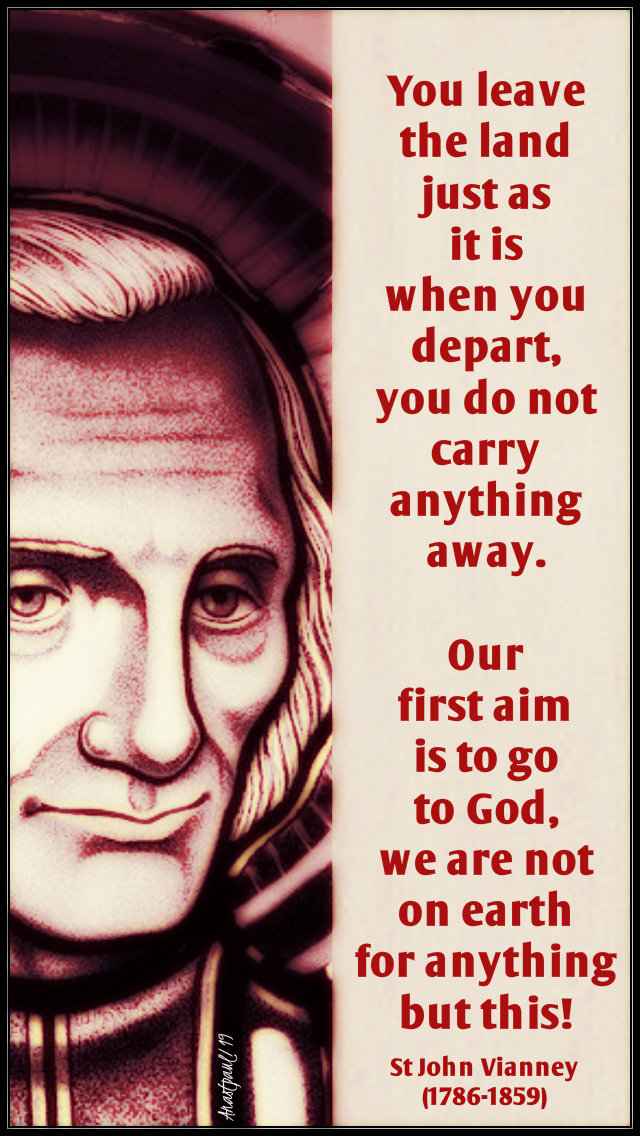
Quote/s of the Day – 21 April – St Anselm

Quote/s of the Day – 21 April –  The Memorial of St Anselm ‬OSB (1033-1109)

Doctor of the Church

“God has promised pardon
to him that REPENTS
but He has NOT
promised repentance
to him that sins.”

god has promised pardon to him that repents but - st anselm 21 april 2020

“A single Mass offered
for oneself during life,
may be worth more,
than a thousand celebrated
for the same intention, after death.”

a single mass offered for oneself during life - st anselm - 21 april 2020

“Remove grace
and you have nothing,
whereby to be saved.
Remove free will
and you have nothing,
that could be saved.”

remove grace and you have nothing - st anselm 21 april 2020

“It is impossible to save one’s soul
without devotion to Mary
and without her protection.”

St Anselm (1033-1109)
Doctor of the Church

it is impossible to save one's soul with devotion to mary - st anselm 21 april 2020

Posted in DOCTORS of the Church, Our MORNING Offering, PRAYER WARRIORS, PRAYERS of the SAINTS, SAINT of the DAY

Our Morning Offering – 21 April – O Lord, Draw Near In Troubles and Perils

Our Morning Offering – 21 April – Tuesday of the Second week of Easter and the Memorial of St Anselm ‬OSB (1033-1109) Doctor of the Church

O Lord, Draw Near
In Troubles and Perils
By St Anselm ‬(1033-1109)
Doctor of the Church

O Lord,
we bring You
the troubles and perils
of peoples and nations,
the sighing of prisoners and captives,
the sorrows of the bereaved,
the needs of strangers,
the helplessness of the weak,
the tiredness of the weary,
the failing powers of the aged.
O Lord, draw near to each,
for the sake of Jesus Christ our Lord.
Amen
o lord draw near in troubles and perils - st anselm 21 april 2020

Posted in SAINT of the DAY

Saint of the Day – 21 April – Saint Román Adame Rosales (1859-1927) Priest and Martyr

Saint of the Day – 21 April – Saint Román Adame Rosales (1859-1927) Priest and Martyr of the Cristero War, St Roman had a great devotion to the Blessed Sacrament and the Blessed Virgin, Founder of the association of the “Daughters of Mary and Nocturnal Adoration,” Apostle of Catechesis and of the poor and the sick, spiritual guide, founder of many schools and Chapels – born on 27 February 1859 at Teocaltiche, Jalisco, Mexico and died by shooting by a firing squad on 21 April 1927 in a cemetery near Yahualican, Jalisco, Mexico.st roman rosales art

More than 80 years ago – between 1914 and 1934 – the Church in Mexico experienced one of the bloodiest religious persecutions in history, in which several religious gave their lives in defence of the Catholic faith.

Among these Mexican martyrs is Saint Román Adame Rosales -priest of deep humility and pastor for several years in Nochistlán, a municipality located in the Mexican state of Zacatecas, whom the Church remembers today in a special way.

The Priest was known for his catechesis, for his great devotion to the Adoration of the Blessed Sacrament – so much so, that part of his action in his parish ministry, was dedicated to the construction of chapels, so that the faithful could have the Blessed Sacrament close by.   He was also reverred for giving great efforts to the care of the sick and the education of the children, both secular and religious.

Fr Román is also remembered for his courage and perseverance in the face of any suffering or difficult situation – such as the harsh persecution that led him to remain hidden and continue to administer the sacraments clandestinely – he always said:  “Let everything be for God.”st roman rosales artwork 2

On 18 April 1927 he conducted a Lenten service at Rancho Veladones.   One of the people at the service betrayed him to a Colonel Quinones and Father Román was arrested the next day.   He was jailed at Mexticacan, Mexico, then forced to walk miles to the parish at Yhualica.   Quinones had commandeered the presbytery for his own use, he kept Fr Román tied to an outdoor post during the day, threw him into a cell at night and neglected to give him food or water.   Some local lay people offered to buy the priest’s freedom. Quinones demanded a $6,000 bribe, pocketed the money and ordered Father Román executed anyway.   On 21 April 1927 he was taken to an open grave, where he was executed by firing squad together with a soldier, Antonio Carrillo, who minutes before opposed the shooting of the priest.

The parish priest was Canonised by St Pope John Paul II on 21 May 2000, along with 25 other faithful, the majority priests, who like him gave their lives for Christ and the faith, their feast is celebrated together on 21 May.st roman adame rosales

Today the saint’s remains are venerated in Nochistlán and according to witnesses to the exhumation of his body, his heart was solidified and his Rosary was embedded in it.

relics of st roman rosales at the church of st michael the archangel in Yahualica
Relics of St Román at the Church of St Michael the Archangel

Almighty God, who gave to Your servant Saint Román Adame Rosales boldness
to confess the Name of our Saviour Jesus Christ before the rulers of this world and great love for the Blessed Sacrament and for the Blessed Virgin Mary,
grant, we pray,  that we may always be ready to give a reason for the hope that is in us
and to suffer gladly, for the sake of the Lord Jesus Christ,
who lives and reigns with You and the Holy Spirit, forever and ever.

AmenCatedral_de_la_Asunción_de_María_Santísima_(Guadalajara,_Jalisco)_-_St._Román_Adame_Rosales_statue

Posted in SAINT of the DAY

Memorials of the Saints – 21 April

St Anselm (of Canterbury) OSB (1033-1109) Doctor of the Church (Optional Memorial)
St Anselm!
https://anastpaul.com/2017/04/21/saint-of-the-day-21-april-st-anselm-of-canterbury-doctor-of-the-church/


St Abdechalas
St Anastasius I of Antioch
St Anastasius of Sinai
St Apollo of Nicomedia
St Apollonius the Apologist
St Arator of Alexandria
St Beuno Gasulsych
St Conrad of Parzham (1818-1894)
Biography:
https://anastpaul.com/2018/04/21/saint-of-the-day-21-april-st-conrad-of-parzham-ofm-cap-1818-1894/

St Crotates of Nicomedia
St Cyprian of Brescia
St Felix of Alexandria
St Fortunatus of Alexandria
St Frodulphus
St Isacius of Nicomedia
Bl John Saziari
St Maelrubba of Applecross
St Román Adame Rosales (1859-1927) Priest and Martyr of the Cristero War
St Silvius of Alexandria
St Simeon of Ctesiphon
St Vitalis of Alexandria
Bl Vitaliy Bayrak
Bl Wolbodó of Liège

Posted in BAPTISM, CATHOLIC-PRAYERS OF THE CHURCH, EASTER, ONE Minute REFLECTION, SAINT of the DAY, The WORD

One Minute Reflection – 20 April – By the power of the Spirit

One Minute Reflection – 20 April – Monday of the Second week of Easter, Readings: Acts 4:23-31, Psalm 2:1-9, John 3:1-8 and the Memorial of Blessed Chiara Bosatta (1858-1887)

Jesus answered, “Amen, amen, I say to you, no-one can enter the kingdom of God without being born of water and Spirit.” … John 3:5

REFLECTIONThe Roman Missal – Prayer for the blessing of baptismal water during the Easter Vigil

Father, You give us grace through sacramental signs,
which tell us of the wonders of Your unseen power.

In baptism we use Your gift of water,
which You have made a rich symbol
of the grace You give us in this sacrament.

At the very dawn of creation
Your Spirit breathed on the waters,
making them the wellspring of all holiness.

The waters of the great flood
You made a sign of the waters of baptism,
that make an end of sin and a new beginning of goodness.

Through the waters of the Red Sea
You led Israel out of slavery,
to be an image of God’s holy people,
set free from sin by baptism.

By the waters of the Jordan
Your Son was baptised by John
and anointed with the Spirit.

Your Son willed that water and blood
should flow from His side
as He hung upon the cross.

After His resurrection, He told his disciples,
‘Go out and teach all nations,
baptising them in the name of the Father
and of the Son and of the Holy Spirit.’

Father, look now with love upon Your Church,
and unseal for her the fountain of baptism.

By the power of the Spirit
give to the water of this font
the grace of Your Son.

You created humankind in Your own likeness:
cleanse us from sin in a new birth of innocence
by water and the Spirit.

We ask You, Father, with Your Son,
to send the Holy Spirit upon the waters of this font.

May all who are buried with Christ
in the death of baptism
rise also with Him to newness of life.john 3 5 nicodemus and jesus no-one can enter - prayer baptismal water roman missal 20 april 2020

PRAYER – Almighty God and Father, grant that Your faithful people who were buried with Your Son in baptism, may by His Resurrection and intercession at Your right hand, obtain for us eternal life.   Send Your Spirit upon Your adopted children and lead us in Your way.   Grant that by the intercession of Blessed Chiara Bosatta, our path may be straightened and glow with Your light.   Through Christ our Lord, with the Holy Spirit, God forever, amen.bl chiara bosatta pray for us 20 april 2020

Posted in SAINT of the DAY

Saint of the Day – 20 April – Blessed Chiara Bosatta DSMP (1858-1887)

Saint of the Day – 20 April – Blessed Chiara Bosatta DSMP (1858-1887) Virgin Religious, Mystic, Apostle of Charity, co-Founder alongside her sister and Saint Luigi Guanella  (1842-1915) – the Daughters of Saint Mary of Providence – born on 27 May 1858 in Pianello del Lario, Como, Italy as Dina Bosatta and died on 20 April 1887 in Pianello del Lario, Como, Italy of natural causes, aged 28.   Patronage – Daughters of Saint Mary of Providence.   Her body is incorrupt.
Blessed Chiara managed the new order of the Daughters of St Mary, in her hometown and the surrounding areas.   In her service to the poor she contracted tuberculosis which caused her death at such a young age, in 1887.bl chiara

Dina Bosatta was born in 1858 in Como to Alessandro Bosatta and Rosa Mazzocchi – her father worked as a silk manufacturer who died in 1861 when she was but a toddler.   She was the last of eleven siblings, 9 brothers and one sister, Marcellina.

She studied with the Daughters of Charity at the age of thirteen in 1871.   She decided to consecrate her life to God and made the decision to become a nun and so entered into the period of novitiate with the Canossians from 1871 to 1878.   However, after a while, she descerned that their charism was not that, of which she felt she was being called and so left that congregation to pursue her vocation elsewhere.   Despite this, she was enthralled with their charism and admired their spirit and strong dedication to their rules of life.

Dina returned to her home and joined with her sister Marcellina and the two joined the Daughters of Mary that Father Carlo Copponi had established.    Marcellina would later become the superior of the order.   The pair also worked at a hospice to tend to neglected children and older people as well as teaching children.19-B-bl chiara bosatta-web-768x1024

The sisters then co-ordinated their efforts in establishing a new religious congregation – the Daughters of Saint Mary of Providence – together with Saint Luigi Guanella.   It was at this point that she took the religious name of “Chiara.”    She was professed as a nun on 27 October 1878.

Tending to the poor bought unwanted consequences for Bosatta when she contracted tuberculosis – this disease would the the cause of her very young death.   She initially went back to her home town in an attempt to stall the illness by a change of climate but she died, not long after, on 20 April 1887.   Her Shrine rests at the Shrine of the Sacred Heart in Como.

Blessed Chiara was Beatified after the approval of a miracle by St Pope John Paul on 21 April 1991 at the Vatican.at-chiara's-deathbed

From the Sisters of the Daughters of St Mary of Providence:

“There is no doubt, that Blessed Chiara contributed with her prayers from heaven, to ensure that Fr Guanella was declared a Saint.   We know that Blessed Chiara had a crucial influence on the Founder’s journey to sainthood.   Still today, those who kneel before their urns at the Shrine of the Sacred Heart in Como, cannot but receive that holy incentive, to integrate hard-working charity, with the contemplation of the sources, from which the grace of our activity comes.
May the memory of Sr Chiara’s Beatification revive in all of us, gratitude to the Lord for our holy origins.   Faithfulness to living their spirit and putting it into practice will increase our faith and love.
Walking towards holiness together, as Fr Guanella, Sr Chiara and all the good people of God did, will reinforce communion and collaboration among the people of God.
We also want to renew our commitment of spreading the devotion to Blessed Chiara and to ask our Blessed for her intercession, so that her holiness may be proposed to the entire Christian world with her Canonisation.
St Luigi Guanella loved Sr Chiara.
In the beginning he was puzzled by her religious life-style.   He had an inspiration that Sr Chiara was a mystic and was, therefore, moved to intensely study the works of St Theresa of Avila.   From then on, he understood that Sr Chiara was a saint and a mystic. She was the “little flower” of Guanellian spirituality.
Fr Guanella wrote a biography of Blessed Chiara.   It is available at the St Louis Centre upon request.”BL CHIARA BOSSATTA

St Luigi’s Biography here:  https://anastpaul.com/2018/10/24/saint-of-the-day-24-october-st-luigi-guanella-1842-1915-servant-of-charity/

Prayer for the Intercession of Blessed Chiara Bosatta

O Jesus, Saviour of the lowly,
who made Blessed Chiara Bosatta shine
through the spirit of sacrifice,
by rendering her an untiring apostle of Your Gospel among the poor.
Teach us her total abandonment to Divine Providence,
her love of prayer,
her patience in suffering
and her spirit of dedication to the most needy.
Grant us, through her intercession,
the grace ………………………
that we ask You trustingly,
through Christ our Lord.
Amen!
Our Father … Hail Mary … Glory Be … Blessed Chiara, intercede for us!053 bl chiara bosatto ComoSCuoreInside

Posted in SAINT of the DAY

Memorials of the Saints – 20 April

St Agnes of Montepulciano OP (1268-1317)
About St Agnes:
https://anastpaul.wordpress.com/2017/04/20/saint-of-the-day-20-april-st-agnes-of-montepulciano/
St Pope Anicetus (Died c 168)
His Life:
https://anastpaul.com/2019/04/20/saint-of-the-day-20-april-st-pope-anicetus-died-c-20-april-168/

Bl Antony Page
St Caedwalla of Wessex
Bl Catwallon
Blessed Chiara Bosatta DSMP (1858-1887)
St Domninus of Digne
Bl Francis Page
Bl Gerald of Salles
Bl Harduin
Bl Hildegun of Schönau
St Hugh of Anzy-le-Duc
Bl James Bell
Bl John Finch
Bl John of Grace-Dieu
St Marcellinus – Bishop of Embrun (born in North Africa- died 374)
Biography:
https://anastpaul.wordpress.com/2018/04/20/saint-of-the-day-20-april-st-marcellinus-of-embrun-born-in-north-africa-died-374/
St Marcian of Auxerre
St Margaret of Amelia
Bl Maurice MacKenraghty
St Michel Coquelet
Bl Oda of Rivreulle
Bl Richard Sergeant
St Sara of Antioch
St Secundinus of Córdoba
St Servilian
Bl Simon Rinalducci
St Sulpicius
St Theodore Trichinas
St Theotimus of Tomi
St Vincent of Digne
St Wiho of Osnabrück
Bl William Thomson

Posted in SAINT of the DAY

Saint of the Day – 19 April – Blessed James Duckett (Died 1602) Layman Martyr

Saint of the Day – 19 April – Blessed James Duckett (Died 1602) Layman Martyr, Bookseller and Publisher – born at Gilfortrigs, Skelsmergh, Westmorland, England and died by hanging on 19 April 1602 at Tyburn, London, England. Patronages – booksellers and publishers.   Blessed James is also celebrated with the 40 Martyrs of England and Wales on 4 May.header for forty martyrs of england and wales banner

James became a bookseller and publisher in London.   Brought up a Protestant, he was converted by a book, a friend of his, Peter Mauson lent him The Foundation of the Catholic Religion while Duckett was serving his apprenticeship in London.   After reading it he became convinced of the truths of the faith and he decided to become a Catholic.   Earlier he had twice been imprisoned in Bridewell for not attending the Protestant services.   Both times, his employer interceded arranged for him to be freed, presumably paying the required bail.    However, it seems his employer was concerned for his own safety and requested James to find a job elsewhere.

He was received into the Catholic Church by an old priest named Weekes who was imprisoned in the Gatehouse at Westminster.   Two or three years later, about 1590, he married a Catholic widow but out of his twelve years of married life, nine were spent in prison for his new faith.    Their son later became a Carthusian monk and recorded much of what we know about his father.

fortyEnglishMartyrs-e1409667175548 tyburn
Tyburn – Martyrs of England and Wales including three Carthusians

He was active in propagating Catholic literature.   He was finally betrayed by Peter Bullock, a bookbinder, who in order to obtain his own release from prison, betrayed James.    Duckett’s house was searched on 4 March 1601 and he was arrested on a charge of having 25 copies of Fr Southwell’s [the Martyr St Robert Southwell (1561-1595)] books on his premises.   For this he was at once thrown into Newgate.

At the trial, Bullock testified that he had bound various Catholic books for Duckett, who admitted this but denied other false accusations in a self-possessed manner.   The jury found him not guilty but the judge, Sir John Popham, the Lord Chief Justice, browbeat the jury, which reversed its verdict and Duckett was found guilty of felony.   Despite the betrayal of Duckett, Bullock was taken to his death at Tyburn in the same cart as Duckett on 19 April 1601.martyrs of england and wales book cover

James Duckett’s son was the John Duckett who later became Prior of the English Carthusians at Nieuwpoort in Flanders.   He related that on the way to Tyburn his father was handed a cup of wine, which he drank and told his wife to drink to Peter Bullock and to forgive him.   When she declined, he chided her gently until she did.   On arrival at Tyburn Tree, James kissed and embraced Bullock, beseeching him to die in the Catholic faith, without success.execution-at-tyburn1

At the same trial, three priests, Thomas Tichborne, Robert Watkinson, and Francis Page, were condemned to death.   For some reason their execution was remanded to the following day.

James Duckett was  Beatified by Pope Pius XI on 15 December 1929.martyrs of england and wales lawrence lew

The Triptych above, with the following quote is from Fr Lawrence Lew OP:

“A tryptich in St James’ church, Spanish Place in London showing some of the martyrs who died for the Catholic faith from 1535 – 1680 and whose memory is kept collectively on 4 May.   In the centre is the triple gallows known as the ‘Tyburn Tree’.

Below is a citation from the Tudor Stuff blog.

From 1535 to 1681 Tyburn was transformed into a place of cruelty, torture and execution for men and women because of their religious belief.   It had become an act of high treason to be a Catholic priest, or to associate with Catholic priests  . It was also legal treason to refuse to accept the monarch as “the only Supreme Head on earth of the Church of England”, in the reign of King Henry VIII, from 1534 onwards under Elizabeth I, Charles I and Charles II.
Tyburn had been a place of public spectacle where crowds gathered for entertainment. The martyrs, however, brought a new spirit into the barbarities and butchery of Tyburn. This new spirit was one of joy, spontaneous humour and wholehearted forgiveness of those who had brought them to their life’s end at Tyburn.   This spirit flowed over into the crowds around the Tyburn Gallows.

“Thus”, write the nuns at Tyburn Convent, dedicated to those who died, “the holy Martyrs transformed Tyburn’s Deadly Nevergreen Tree into the Tree of Life and the Gate of Heaven, which it remains to this very day”.”

Posted in DIVINE Mercy, Goodness, Patience, EASTER, SAINT of the DAY

Low Sunday the Octave Day of Easter, the 20th Divine Mercy Sunday and Memorials of the Saints – 19 April

Low Sunday the Octave Day of Easter and the Twentieth Divine Mercy Sunday

St Alphege of Winchester (c 953–1012) ArchBishop and Martyr

About St Alphege:
https://anastpaul.wordpress.com/2017/04/19/saint-of-the-day-19-april-st-alphege/

St Apollonius the Priest
St Aristonicus of Melitene
St Crescentius of Florence
St Expeditus (Died 303)
His Story:

Saint of the Day – 19 April – St Expeditus (Died 303) Martyr


St Gaius of Melitene
St Galata of Melitene
St George of Antioch
St Gerold of Saxony
Blessed James Duckett (Died 1602) Layman Martyr
Bl Jaume Llach-Candell
St Pope Leo IX (1002-1054)
Biography:
https://anastpaul.wordpress.com/2018/04/19/saint-of-the-day-19-april-st-pope-leo-ix-1002-1954/

St Martha of Persia
Bl Ramon Llach-Candell
St Rufus of Melitene
St Vincent of Collioure

Martyrs of Carthage – 17 saints: A group of Christians martyred in the persecutions of Decius. We know little more than the names – Aristo, Basso, Credula, Donato, Ereda, Eremio, Fermo, Fortunata, Fortunio, Frutto, Julia, Mappalicus, Martial, Paul, Venusto, Victorinus and Victor. Died in the year 250 in prison in Carthage, North Africa (modern Tunis, Tunisia).

Posted in SAINT of the DAY

Saint of the Day – 18 April – Blessed Luca Passi (1789-1866) “Apostolic Missionary”

Saint of the Day – 18 April – Blessed Luca Passi (1789-1866) Priest, Founder of the Teaching Sisters of Saint Dorothy, Apostle of the poor and of education of the young unde the Papal title of “Apostolic Missionary” – born on 22 January 1789 in Bergamo, Italy and died on 18 April 1866 in Venice, Italy of natural causes, aged 77.   Patronage – the Teaching Sisters of Saint Dorothy.   Following the example of their paternal uncle, two of his brothers became Priests and Passi himself, moved to Venice in order to dedicate himself to both his preaching and educational missions.bl luca-passi

Luca was born in 1789 in Bergamo as the first of eleven children to the nobles Enrico Passi (a teacher) and Caterina Corner.   Two brothers were the priests Giuseppe Celio and Marco.   His paternal uncle was the priest Marco Celio Passi.   During his childhood, the volatile political circumstances, forced the family to relocate to a villa in Calcinate.

In 1810 he became the Director of the Confraternity of the Blessed Sacrament at Calcinate and in 1811 became the Director of the Confraternity of the Christian Doctrine.

He began his studies for the priesthood in 1811 and was ordained as such on 13 March 1813.

His brother Marco aided him in founding the Pious Society of Saint Dorothy in 1815 for the education of both children and adolescents.   This was an establishment that Pope Pius VII praised and who also encouraged that the organisation expand and spread to other towns in the region.   In 1838 he founded the Teaching Sisters of Saint Dorothy. Pope Gregory XVI granted him the title of “Apostolic Missionary.”

Blessed Luca died on 18 April 1866.   He is buried at the Motherhouse of the Institute of the Teaching Sisters of Saint Dorothy in Venice.

Pope Benedict XVI approved a miracle on 28 June 2012 and confirmed that Fr Luca could now be Beatified.   Cardinal Angelo Amato Beatified him on 13 April 2013 on behalf of Pope Francis at the Basilica of San Marco, Venice.

During the homily of the Beatification Mass of Fr Luca Passi, Cardinal Angelo Amato, prefect for the Congregation for the Causes of Saints, described the now Blessed Passi, as “a great witness to God for the young and the poor.”

Posted in SAINT of the DAY

Saturday of the Easter Octave +2020 and Memorials of the Saints – 18 April

Saturday of the Easter Octave +2020

St Agia of Hainault
St Anthia of Illyria
St Athanasia of Aegina
St Bitheus
St Calocerus of Brescia
St Cogitosus
St Corebus
St Eleuterius of Illyria
St Elpidius of Melitene
St Eusebius of Fano
St Galdinus of Milan
St Gebuinus of Lyons
St Genocus
St Hermogenes of Melitene
Bl Idesbald of Dunes
Bl James Oldo OFS (1364-1404)
Biography:
https://anastpaul.com/2019/04/18/saint-of-the-day-18-april-blessed-james-oldo-ofs-1364-1404/

Bl Joseph Moreau
St Laserian of Leighlin
Bl Louis Leroy
Blessed Luca Passi (1789-1866)
St Perfecto of Córdoba
St Pusicio
Bl Roman Archutowski
Bl Savina Petrilli
St Ursmar of Lobbes
St Wigbert of Augsburg

Posted in SAINT of the DAY

Saint of the Day – 17 April – Saint Donan of Eigg (Died 617) Priest and Martyr

Saint of the Day – 17 April – Saint Donan of Eigg (Died 617) Priest and Martyr, Monk, Missionary – Patronages – the Island of Eigg, an island in the Inner Hebrides where he was Martyred. He is also known as Dounan, Donnan and Donnanus.st donan sml

Saint Donan, also known as Saint Donnán of Eigg, lived from about 550 to 17 April 617. He was probably Irish in origin and probably of noble birth.  He is known for his efforts to introduce Christianity to the Picts of north west Scotland.   Very little remains of him in the written record but, he is remembered in the quite remarkable number of places named after him, across large parts of modern Scotland.   The only part of his life to have made it into the annals in any detail was his death, when he and 52 of his monks were murdered at their Monastery on the Isle of Eigg.

stdonan-450 eigg
The Isle of Eigg

Donan’s birth date of 550 is a supposition, deriving largely from a comment in a document that he was contemporary of but younger than, St Columba.   He seems to have crossed to south western Scotland early in his adult life, possibly in company with a number of followers.   His progress can then be traced by a series of places named “Kildonan”, “Kildonnan”, “Chapel Donan” and “Eilean Donan” stretching up the western seaboard of Scotland from Ayrshire and the Isle of Arran via the Western Isles to Sutherland.   Additionally, it is said, that at least eleven churches in Scotland are dedicated to St Donan.St-Donan1

It is said that Donan went to visit St Columbanus, asking him to be his anamchara or soul-friend, a spiritual director and that Columbanus refused.   This may have been because Donan was welcomed by the Picts while Columba may have had his difficulties with them.   But another story records that Columba said:   “I will not be anamchara to one, who will inherit red martyrdom along with your people.”st Donnan

It is interesting, that in the centuries during which Celtic missionaries were spreading the Christian faith across Scotland, there are very few examples of any of them coming to any harm, from those whose faiths they were trying to replace.   St Donan is the most notable exception.   He and his followers had established a Monastery on the east side of the Isle of Eigg, facing the Scottish mainland.   It is said that Donan got into a dispute with a local noblewoman over the grazing of sheep on the island.   It seems she chose to resolve the dispute by commissioning a raiding party to remove the Monks from the island in the most permanent and brutal way possible.   On 17 April 617 the raiding party arrived.   They allowed Donan to complete the liturgy before herding him and all his fifty two monks into the refectory and setting it on fire, or beheaded, depending on the source.

St Donan was Canonised on 11 July 1898 by Pope Leo XIII (cultus confirmed).

Posted in SAINT of the DAY

Friday in the Easter Octave +2020 and Memorials of the Saints – 17 April

Friday in the Easter Octave +2020

Bl Andrés Hibernón Real OFM (1534-1602)
Biography:
https://anastpaul.wordpress.com/2018/04/17/saint-of-the-day-17-april-blessed-andres-hibernon-real-o-f-m-1534-1602/

St Agia of Hainault
St Anthia of Illyria
St Athanasia of Aegina
St Bitheus
St Calocerus of Brescia
St Cogitosus
St Corebus
St Donan of Eigg (Died 617) Priest and Martyr
St Eleuterius of Illyria
St Elpidius of Melitene
St Eusebius of Fano
St Galdinus of Milan
St Gebuinus of Lyons
St Genocus
St Hermogenes of Melitene
Bl Idesbald of Dunes
Bl James Oldo
Bl Joseph Moreau
St Laserian of Leighlin
Bl Louis Leroy
Bl Luca Passi
St Perfecto of Córdoba
St Pusicio
St Robert de Turlande/Chaise-Dieu OSB (c 1000-1067)
His Life:
https://anastpaul.com/2019/04/17/saint-of-the-day-17-april-st-robert-de-chaise-dieu-osb-c-1000-1067/
Bl Roman Archutowski
Bl Savina Petrilli
St Stephen Harding O.Cist. (1050-1104) Co-Founder of the Cistercian Order
About St Stephen:
https://anastpaul.wordpress.com/2017/04/17/saint-of-the-day-17-april-st-stephen-harding/
St Ursmar of Lobbes
St Wigbert of Augsburg

Posted in EASTER, FATHERS of the Church, QUOTES of the SAINTS, QUOTES on HELL, QUOTES on REPENTANCE, QUOTES on SIN, SAINT of the DAY, The RESURRECTION, The WORD

Quote/s of the Day – 16 April – Repentance

Quote/s of the Day – 16 April – Easter Thursday, Readings: Acts 3:11-26, Psalm 8:2, 5-9, Luke 24:35-48 and the Memorial of St Benedict Joseph Labre (1748-1783)

“… And said to them,
“Thus it is written, that the Christ should suffer
and on the third day rise from the dead 
and repentance for the forgiveness of sins
should be proclaimed in his name to all nations…”

Luke 24:46-47

luke 24 46-47 thus it is written that the christ - 15 april 2020 easter thursday

“Repentance lifts a man up. 
Mourning knocks at heaven’s gate.
Holy humility opens it.”

St John Climacus (579-649)

“The Ladder of Divine Ascent” (Step 25)

repentance lifts a man up. mourning knocks at heaven's gate - st john climacus 30 march 2020

“Meditate on the horrors of Hell,
which will last for eternity
because of one easily-committed mortal sin.
Try hard to be among the few who are chosen.
Think of the eternal flames of Hell
and how few there are that are saved.”

meditate on the horrors of hell - st benedict joseph labre 16 april 2020

“The want of proper examination,
true contrition and a firm purpose of amendment,
is the cause of bad confessions
and of the ruin of souls.”

St Benedict Joseph Labre (1748-1783)
“The Beggar of Perpetual Adoration”

the want of proper examination, true contrition - st benedict joseph labre 16 april 2020

“The saints understood how great
an outrage sin is against God.
Some of them passed their lives
in weeping for their sins.
St Peter wept all his life;
he was still weeping at his death.
St Bernard used to say,
‘Lord! Lord! it is I who fastened You to the Cross!’”

St John Vianney (1786-1859)

the-saints-understood-st-john-vianney-29-jan-2018 and adpated - 16 april 2020

Posted in SAINT of the DAY

Saint of the Day – 16 April – Saint Fructuosus of Braga (Died 665)

Saint of the Day – 16 April – Saint Fructuosus of Braga (Died 665) Archbishop of Braga, Spain, Hermit, Confessor, Monk, Abbot, a great Founder of Monasteries – born in the early 7th century in Spain and died on 16 April 665 of natural causes.  Patronage – Braga.São_Frutuoso_-_Galeria_dos_Arcebispos_de_Braga

He was the son of a Duke in the region of Bierzo and at a young age accompanied his father on official trips over his estates.   After the death of his parents, Fructuosus first sought instruction from the Bishop of Palencia, studying theology in the Seminary. Fructuosus then sold his estates and distributed most of the proceeds among the poor but saved a portion to establish Monasteries.   He initially retired as a hermit to a desert in Galicia.   Many pupils gathered around him and thus originated the Monastery of Complutum in the El Bierzo region, over which he himself at first presided, later, he appointed an Abbot and again retired into the desert.   In the course of time, he founded nine other Monasteries, including one for women under the Abbess Benedicta.

We have two extant rules composed by Fructuosus – one called Complutum, the other the common rule.   Whole families embraced his rule in community refuges, which he established based on the Rule of Saint Benedict.

His relationship with the kings of his time was not always happy one.   In 652, he wrote,what was apparently a second letter, to King Recceswinth asking for the release of political prisoners held from the reign of King Chintila, some of whom had languished in prison until the reign of King Erwig.   (I can’t resist posting this image I found of King Chintila, at least it is helpful to establish the times in your minds.)

500px-Chintila,_rey_de_los_Visigodos_(Museo_del_Prado)
King Chintila

He was later present at the Eighth Council of Toledo in 653, in place of Bishop Riccimer of Dumio.   It was at this Council that Fructuosus raised the issue of political prisoners once again.   After the death of Bishop Riccimer, Fructuosus succeeded him in the See of Dumio in 654.   In 656, he undertook to plan for a voyage to the Levant.   However, according to the new laws enacted by King Chindasvinth, it was illegal to leave the kingdom without royal permission.   One of the few disciples privy to his plans had given him up to authorities and Fructuosus was subsequently arrested and imprisoned but soon released.st fructuoso de braga unknown

Bishop Fructuosus attended the Tenth Council of Toledo in December 656.   The last will and testament of the recently deceased bishop Riccimer, was disputed by those who saw his freeing of slaves and distribution of church rents to the poor was responsible for the subsequent impoverishment of that see.   The Council agreed that, by not providing compensation, Bishop Riccimer had obviated his duty and the acts of his will were rendered invalid.   They gave the job of correcting the problem to Fructuosus and commanded him to take moderation in the case of the slaves.   At the same Council, Archbishop Potamius of Braga was remanded to a monastery for licentiousness and his archdiocese was given to St Fructuosus on 1 December 656, thus he became an Archbishop.

Fructuosus dressed so poorly as to be mistaken for a slave and he even received a beating from a peasant, from which he was only saved by a miracle (according to the monastic chroniclers).   His Vita is one of the chief sources for writing the history of his age.

His innocence and virtue were no security from the shafts of envy but he overcame injuries by meekness and patience and died, laid on ashes before the altar, as he desired, on the 16th of April, 665.   His relics, which for a time were in the Cathedral of Braga, were later transferred to the Shrine of Santiago de Compostela in the year 1102.   They were returned to their original location in 1966.  Fructuosus is depicted with a stag, which was devoted to him, because he had been saved it from hunters.   Below is the story from “The Little Bollandists” by Monsignor Paul Guérin, 1882:

One day he was going through a forest, when a roe, pursued by hunters, took refuge under his cloak.     The Saint took the animal under his protection and brought it to the monastery, the grateful beast never left it’s liberator,  it followed him about all day, slept at his feet at night and never ceased to cry when he was absent.   More than once, he had it taken back to the forest but it always found the track of its deliverer’s footprints.   At last it was one day killed by a young man who disliked monks.   Fructuosus was absent for a few days and, on his return, he was surprised not to see his roe run to meet him and when he heard that it was dead, he was overcome with grief, his knees trembled and he prostrated himself on the floor of the church.   It is not related whether this was to ask God to punish the cruel man but the latter soon fell ill and sent for the Father to come to his assistance.   Fructuosus took the revenge of a noble Visigoth and Christian.   He cured the murderer of his roe and restored him to health both of soul and body.   It is related of him that, wishing to escape the homage of the people, he retired into the depth of the forest and that the jays which he had brought up in the Monastery, sought him out and betrayed the place of his retreat by the joyous chattering with which they greeted him. Fructuosus is painted with a roe and jays as his emblems.

475px-Sao_Frutuoso

Posted in SAINT of the DAY

Thursday of the Easter Octave +2020 and Memorials of the Saints -16 April 2020

Thursday of the Easter Octave +2020

Bl Arcangelo Canetoli
St Benedict Joseph Labre – Known as the Beggar of Perpetual Adoration (1748-1783)
Dearest St Benedict Joseph:
https://anastpaul.wordpress.com/2017/04/16/saint-of-the-day-16-april-st-benedict-joseph-labre/

St Bernadette of Lourdes – The Visionary of Lourdes (1844-1879)
St Bernadette!
https://anastpaul.wordpress.com/2018/04/16/saint-of-the-day-16-april-saint-bernadette-soubirous-1844-1879/

St Drogo (1105–1186)
His life:
https://anastpaul.com/2019/04/16/saint-of-the-day-16-april-saint-drogo-1105-1186/

St Elias
St Fructuosus of Braga (Died 665)

St Herveus of Tours
Bl Joachim Piccolomini
St Lambert of Saragossa
St Magnus of Orkney
St Turibius of Astorga
St Vaise
St William Gnoffi

Martyrs of Avrillé – 26 beati: – A group of lay people who were executed together for their faith during the anti-Christian persecutions of the French Revolution. They were martyred on 16 April 1794 at Avrillé, Maine-et-Loire, France.
• Blessed Anne Maugrain
• Blessed François Micheneau veuve Gillot
• Blessed François Suhard veuve Ménard
• Blessed Jean Ménard
• Blessed Jeanne Gourdon veuve Moreau
• Blessed Jeanne Leduc épouse Paquier
• Blessed Jeanne Onillon veuve Onillon
• Blessed Jeanne Thomas veuve Delaunay
• Blessed Madeleine Cady épouse Desvignes
• Blessed Madeleine Sallé épouse Havard
• Blessed Marguerite Robin
• Blessed Marie Forestier
• Blessed Marie Gingueneau veuve Coiffard
• Blessed Marie Lardeux
• Blessed Marie Piou épouse Supiot
• Blessed Marie Rechard
• Blessed Marie Roger veuve Chartier
• Blessed Marie-Genevieve Poulain de la Forestrie
• Blessed Marthe Poulain de la Forestrie
• Blessed Perrine Bourigault
• Blessed Perrine Laurent
• Blessed Perrine Pottier épouse Turpault
• Blessed Pierre Delépine
• Blessed Renée Bourgeais veuve Juret
• Blessed Renée Rigault épouse Papin
• Blessed Renée Sechet veuve Davy
16 April 1794 at Avrillé, Maine-et-Loire, France – Beatified: 19 February 1984 by Pope John Paul II at Rome, Italy

Martyrs of Corinth – 9 saints: A group of nine Christians who were tortured and martyred together in the persecutions of Decius. We know little more than three of their names – Callistus, Charisius and Leonide. They were thrown into the sea at Corinth, Greece c250

Martyrs of Saragossa: Group of eighteen martyrs murdered in 304 in Saragossa, Spain in the persecutions of Diocletian and the prefect Dacean. We know little more than the names – Apodemus, Caecilian, Caius, Crementius, Engratia, Eventius, Felix, Fronto, Gaius, Julia, Lambert, Lupercus, Martial, Optatus, Primitivus, Publius, Quintilian, Saturnius (4 men of this name), Succesus and Urban. Their graves re-discovered in 1389 in the crypt under the church of San Encrazia in Saragossa.

Posted in SAINT of the DAY

Saint of the Day – 15 April – St Paternus of Wales (c 482-c 568)

Saint of the Day – 15 April – St Paternus of Wales (c 482-c 568) Bishop, Monk, Hermit, renowned Preacher – he built a Monastery of Llanbadarn Fawr in Wales.    He died in c 568 of natural causes.   He is also known as Padern.Vannes_-_cathédrale,_vitrail_des_saints_Patern_et_Mériadec_Detail_Padarn

Paternus, was born in Brittany to devout parents named Patran and Gwen.   His father received Gwen’s permission to live as a hermit in Ireland and she brought up their son to be pious and godly.   The boy cherished the memory of his father and followed his father’s footsteps, becoming a monk and moving to Wales to become a hermit himself.

He met the great Welsh saints and humbly learned from them.   Instead of leading a solitary life, Paternus was called to found a great Monastery.   He built a Monastey in Cardiganshire that was later known as Llanabarn (Llanbadarn) Fawr, which means, “the church of the great Paternus.”   Over 120 monks joined Paternus and he became Bishop of the area.

Paternus was a bold opponent of the pagan kings of the region, never tiring of preaching in the hope of their conversion.   King Maelgun accused the saint of stealing royal treasure and Paternus proved his innocence by plunging his hand into boiling water and taking it out completely unharmed.   He was known for his preaching, charity and mortifications.

Posted in SAINT of the DAY

Wednesday of the Easter Octave +2020 & Memorials of the Saints – 15 April

Wednesday of the Easter Octave +2020

St Abbo II of Metz
St Abbondio
St Acuta
St Basilissa of Rome
Blessed Cesar de Bus (1544-1607)
Biography:
https://anastpaul.wordpress.com/2017/04/15/saint-of-the-day-15-april-bl-cesar-de-bus/

St Crescens of Myra
St Eutyches of Rome
St Eutychius of Ferentino
St Huna of Slättåkra
St Hunna (of Strasbourg) (died 679)
The life of St Hunna:
https://anastpaul.wordpress.com/2018/04/15/saint-of-the-day-15-april-st-hunna-died-679/

Bl Laurentinus Sossius
St Maro of Rome
St Maximus of Persia
St Mundus
St Nidger of Augsburg
St Olympiades of Persia
St Ortario of Landelles
St Paternus/Padarn of Wales (c 482-c 568)
St Pausilopo of Thrace
St Ruadhan of Lorrha (died 584)
About St Ruadhan:
https://anastpaul.com/2019/04/15/saint-of-the-day-15-april-st-ruadan-died-584/
St Sylvester of Réome
St Theodore of Thrace
St Victorinus of Rome
St Waltmann of Cambrai

Mercedarian Martyrs of Africa: A group of Mercedarian monks sailing to Africa as on a mission to redeem capture Christians. Captured by Moors, they were tortured and executed for their faith. Martyrs. 1393

Posted in INCORRUPTIBLES, Of BACHELORS, Of BUILDERS, CONSTRUCTION WORKERS, SAINT of the DAY

Saint of the Day – 14 April – St Benezet the Bridge Builder (c 1163-1184)

Saint of the Day – 14 April – St Benezet the Bridge Builder (c 1163-1184) Shepherd, Mystic, miracle-worker, Founder of the Fratres Pontifices – the Bridge-Building Brotherhood.   St Benezet is also known as Benezet of Hermillon, Benedict, Bennet, Benet, Benoit, Little Benedict the Bridge Builder.   Born in c 1163 at Hermillon, Savoy, France and died in 1184. Patronages – Avignon, bachelors, bridge-builders and construction workers.   His body is incorrupt.st beneset header

St Benezet, also known as Little Benedict the Bridge Builder, was born somewhere in the countryside of eastern or northeastern France.   As he grew up he tended his mother’s sheep.   Though uneducated and unskilled, gentle Benedict was a quiet, devout youth, thoughtful of others.

One day in 1177, while the sun was in eclipse, Benezet heard a voice, he believed was Jesus, commanding him three times to go to Avignon, where the Rhone current was especially swift and to build a bridge there.   He was also told that angels would watch over his flocks in his absence.  st-benezet holy card

He obeyed the Divine order, without delay and reported immediately to the Bishop of Avignon.   Naturally, the Bishop was hesitant about accepting the word of the frail teenager.   But little Benezet lifted a massive stone to begin the work and announced that it would be the start of the foundation.   This would become the Pont Saint-Bénézet.   Thus he succeeded in convincing the Bishop that the construction of the bridge would be an act of true Christian charity.   Permission was granted and the youth set about his task.   According to the legend, there were shouts of “Miracle! Miracle!” when Bénézet had lifted and laid that first huge stone.   Eighteen miracles occurred in total during the project – the blind had their vision restored, the deaf could hear again, cripples could walk and hunchbacks had their backs straightened.512px-Saint_Bénézet,_Notre_Dame_des_Doms,_Avignon

For the next seven years Benedict worked hard on the project and around 1181 he won support for his project from wealthy sponsors who formed themselves into a Bridge Brotherhood to fund its construction.   This was a religious association active during the 12th and 13th centuries and begun in Avignon but by it’s inspiration, it spread across Europe and whose purpose was building bridges, especially to assist pilgrims.   It was customary for a bishop to grant indulgences to those who, by money or labour, contributed to the construction of a bridge.   They also maintained and/or built hospices at the chief fords of the principal rivers, besides building bridges and looking after ferries.   The Brotherhood consisted of three branches– knights, clergy and artisans, where the knights usually had contributed most of the funds and were sometimes called donati, the clergy were usually monks who represented the church and the artisans were the workers who actually built the bridges.   Sisters are sometimes mentioned as belonging to the same association.   In addition to the construction of bridges, the brotherhood often attended to the lodging and care of pilgrims and travellers and the collection of alms, in this area, the sisters were most active.st benezet sml glass

In 1184, sadly, young Benezet died, some four years before the great stone bridge at Avignon was completed.   The wonders that occurred during the bridge’s erection and the miracles wrought at the Bridge Builder’s tomb convinced the people of Avignon that the young man was a Saint and he was referred to as such as early at 1237.   They, therefore, built a Chapel on the “Bridge of St Benezet” to enshrine his relics  . There the body was venerated until 1669, when floodwaters carried away a large segment of the bridge.   His remains were rescued from the flood and on examination, were found to be incorrupt.   Now they repose in the local church of St Didier.st benezet and relics

Understandably, bridge builders adopted little Benedict as their Patron Saint.   The remains of the bridge still remain a pilgrimage site.  Below are artworks and images showing the bride through the ages.   The last shows it as it is today, only about half is left and that half if filled with pilgrims.

This slideshow requires JavaScript.

St Benezet’s bridge has another claim to fame – it achieved worldwide fame through its commemoration by the song “Sur le Pont d’Avignon” (“On the Bridge of Avignon”).

One can build in a figurative as well as a literal sense.   Bishops, the pope in particular, are often called “pontiffs”, a title derived from the Latin word for “builder of bridges”. Building bridges between God and mankind is their special calling.   Our Lord Himself was a “pontiff” in the sense that He made his Cross a bridge, on which souls could enter heaven.   The beatitude “Blessed are the peacemakers” promises heaven to those who work for reconciliation, that is, “build bridges”.

Some persons labour to raise walls, or “iron curtains” to divide mankind.   Others labour to tear down the walls that divide, straighten the paths that connect, bridge the crevices that separate people.   Surely they come close to fulfilling the great commandment to love our neighbour as oneself.   St Benezet was one such.   He promoted the unity of God’s children.    Little St Benezet, Pray for us!st BENEZET bY becker

st benezet the bridge builder

Posted in SAINT of the DAY

Tuesday of the Easter Octave +2020 and Memorials of the Saints – 14 April

Tuesday of the Easter Octave +2020

St Abundius the Sacristan
St Antony of Vilna
St Ardalion the Actor
St Benezet the Bridge Builder (c 1163-1184)

St Bernhard of Tiron
St Domnina of Terni
St Eustace of Vilna
St Fronto of Nitria
Bl Hadewych
St John of Monte Marano
St John of Vilna
St Lambert of Lyon
Blessed Lucien Botovasoa (1908-1947) Martyr
Blessed Lucien’s life:
https://anastpaul.wordpress.com/2018/04/14/saint-of-the-day-14-april-blessed-lucien-botovasoa-o-f-s-1908-1947-martyr/

St Lydwina of Schiedam (1380-1433)
Biography:
https://anastpaul.com/2019/04/14/saint-of-the-day-14-april-saint-lydwina-of-schiedam-1380-1433/

St Maximus of Rome
St Peter Gonzalez OP (1190 – 1246)
About St Peter:
https://anastpaul.wordpress.com/2017/04/14/saint-of-the-day-14-april-blessed-peter-gonzalez-o-p/

St Tassach of Raholp
St Thomaides of Alexandria
St Tiburtius of Rome
St Valerian of Trastevere

Posted in SAINT of the DAY

Saint of the Day – 13 April – St Jose Sabás Reyes Salazar (1883-1927) Priest and Martyr

Saint of the Day – 13 April – St Jose Sabás Reyes Salazar (1883-1927) Priest and Martyr of the Cristero War, Teacher, Catechist, Protector of children and the youth of Mexico, he had a special devotion to the Holy Trinity and the Souls in Purgatory – born on 5 December 1883 in Cocula, Jalisco, Mexico and died by being shot at 9pm on 13 April 1927 in a cemetery outside Tototlan, Jalisco, Mexico.He was 44 years old.st sabas retes salazar header

He was born in Cocula, Jalisco, the son of Norberto Reyes López and Francisca Salazar Castillo.    He was Baptised on 8 December.   Due to the poverty of the time, his family was moved to Guadalajara for work prospects, where he had an extremely poor childhood.   To mitigate hunger and poverty, he was a newspaper seller and was unable to complete primary school.

He entered the Conciliar Seminary of Guadalajara, where according to the criteria of the time, his lack of education disqualified him to become a clergyman for Guadalajara Diocese, however, taking into account his noble and devout nature, the superiors themselves, recommended that he join a diocese in need.   St Sabás was humble and constant in his vocation and was received in the Diocese of Tamaulipas, where he was Ordained to the sacred orders, on 24 December 1911.   He celebrated his first Mass in Guadalajara in 1912 in the company of his family and friends. st sabas reyes salazar

For two years he exercised the priestly ministry in Tantoyuca, Veracruz.   In 1914 religious persecution was unleashed in the State of Tamaulipas, Father Sabás asked permission to move to the diocese of Guadalajara.st sabas with his catechism class

In the year 1919 he went to the parish of Tototlán, Jalisco, to collaborate with the priest Francisco Vizcarra Ruiz, first as chaplain of the San Antonio de Gómez farm and sanctuary and later in 1921, he was transferred to the main Parish Church.

When the worship had to be suspended in the Churches of the Republic, the Parish Priest of Tototlán left the town and Father Sabás was left in charge, administering the sacraments.   Father Sabás then gave the orphaned children asylum in his own home.st sabas with children

When the federal troops arrived, they murdered the innocent and desecrated the closed Church by using it as stables and destroying all the holy images, then they set it on fire. When the soldiers left, Father Sabás and the faithful came to extinguish the flames.   His parishioners begged him to leave the area but he said: “My superiors sent me here and my parish priest entrusted me with the care of the parish.   If it is God’s will, I will gladly accept martyrdom”

At Easter in 1927, warned that the federal troops would attack Tototlán, he went into hiding at the home of Mrs María Ontiveros, along with three companions – the young José Beltrán and the orphan children Octavio Cárdenas and Salvador Botello   From that moment until his capture, he kept praying the rosary and although, when the soldiers reached his hiding place, the owner of the house denied that he was there, to protect her, her family and the orphans, Father Sabás came out from his hiding and said:  “Here I am, what is do you wish with me? “   In response, they tied his arms tightly and dragged him away.

He was dragged to the parish church, which was now a stable and headquarters for federal soldiers and was tied to a column in the harsh rays of the sun.   For several hours he was denied drinking water and finally, a woman was allowed to provide him with food.   She asked the parishioners to pray to God for him.  For three days through hunger and thirst and with unspeakable sadism they burned his hands because they were consecrated.  On the night of 12 April, tied by the hands and tied to the neck by a rope he was taken before the General who interrogated him, seeking the whereabouts of other priests.   To continue tormenting him, two bonfires were lit, one next to his face and another next to hiss feet.   The latter, meanwhile, muttered over and over again: “Lord of Heaven, my Mother of Guadalupe, grant me strength.”   The brutal torment lasted until the first hours of dawn.   Occasionally, one of the soldiers would stab him with a burning stick and scoff:  “You who say God comes down into your hands, let Him come down now to free you from mine.” San-Sabas-Reyes-Salazar--Mexican-Martyr

At dusk on Holy Wednesday, he was dragged to the cemetary where he was riddled with bullets.    One of his executioners later commented:  “I am very sorry to have killed that Father, he died unfairly.   We had already given him three or four shots and he still got up and shouted “Viva Cristo Rey!” “Long live Christ the King !”

The next day, 14 April, at seven in the morning, two men who were going to prepare a grave for Don Aurelio de la Torre who was murdered for hiding Father José Dolores Guzmán, saw the body of Father Reyes which was lying outside the cemetery, already rigid, with four bullet wounds – two in the chest, one in the right arm and one in the forehead.   The neck, ribs and ankles bore the marked signs of the ropes, his hands were burned and virtually all his bones were broken  . They requested the necessary permission to bury him in Don Aurelio’s own grave.

They placed the body in a box and buried it on Maundy Thursday afternoon.   Later, his remains were transferred to the parish church of San Agustín, in Tototlán.   All the people considered Father Sabás Reyes Salazar as a martyr of Jesus Christ and as such, venerated his relics.relics and tomb of st sabas

The process and cause for his Canonisation along with other priests and laymen murdered during that period began in 1954.   The Decree recognising his martyrdom and that of his fellow martyrs was promulgated on 7 March 1992.   He was Beatified on 22 November 1992 in Rome and Canonised on 21 May 2000, the Jubilee Holy Year, by St John Paul II.

People who knew him and dealt with him during the interrogations of the Cause of Canonisation, related that he was simple, humble and selfless in his care of others.

Saint Sabás Reyes, you dedicated your life to teaching and educating children, assisting your parishioners and spilling your Blood for Christ the King, pray for us!st Sabas_Reyes_Salazar_

Posted in SAINT of the DAY

Monday of the Easter Octave and Memorials of the Saints – 13 April

Monday of the Easter Octave +2020

St Pope Martin I (598-655) Martyr (Optional Memorial)
Biography:
https://anastpaul.wordpress.com/2017/04/13/saint-of-the-day-13-april-st-pope-martin-i/

St Agathonica of Pergamus
St Agathodorus of Pergamus
St Caradoc of Wales
St Carpus of Pergamus
Bl Edward Catherick
Bl Francis Dickenson
St Guinoc
St Hermengild
St Ida of Boulogne
Bl Ida of Louvain
Bl Isabel Calduch Rovira
Bl James of Certaldo
Bl John Lockwood
Bl Margaret of Castello OP (1287-1320)
About Blessed Margaret:
https://anastpaul.wordpress.com/2018/04/13/saint-of-the-day-13-april-blessed-margaret-of-castello-o-p-1287-1320/

St Martius of Auvergne
Bl Miles Gerard
St Papylus of Pergamus
St Proculus of Terni
St Jose Sabás Reyes Salazar (1883-1927) Priest and Martyr of the Cristero War
Bl Scubilion Rousseau FSC (1797-1867)
His life:
https://anastpaul.com/2019/04/13/saint-of-the-day-13-april-blessed-scubilion-rousseau-fsc-1797-1867-the-catechist-of-slaves/

St Ursus of Ravenna

Martyrs of Dorostorum – 3 saints: A lector and two students martyred together in the persecutions of Diocletian – Dadas, Maximus and Quinctillianus. Beheaded c303 in Dorostorum, Lower Mysia (modern Sillistria, Bulgaria.

Posted in SAINT of the DAY

Saint of the Day – 12 April – Saint David Uribe Velasco (1889-1927) Priest and Martyr of the Cristero War

Saint of the Day – 12 April – Saint David Uribe Velasco (1889-1927) Priest and Martyr of the Cristero War – born on 29 December 1888 at Buenavista de Cuellar, Guerrero, Mexico and died by being shot in the back of the neck on 12 April 1927 near San Jose Videl, Morelia, Mexico.

He was born in Buenavista de Cuéllar, (Diocese of Chilapa), on 29 December 1889 as the son of Juan Uribe and Victoria Velasco, a humble couple of few material resources but of many exemlary virtues.   He was the seventh of eleven children.ST DAVID URIBE VELASCO

In 1903 he began his ecclesiastical preparation at the Seminary of Chilapa and was Ordained as a Priest on 2 March 1913.   After his Ordination he left for his hometown and there he celebrated his first Holy Mass on 12 March 1913.   A while later he became the personal secretary to His Excellency, Antonio Hernandez Rodriguez, the Bishop of Tabasco.

After the persecution of the Church was unleashed and his Bishop was exiled, he became the Parish Priest of Iguala, Gro. (Diocese of Chilapa), where he exercised his ministry with exemplary pastoral zeal and prudence, especially in a region which was suffering under the virulent attacks by Freemasonry, Protestantism and a group of schismatics.

Fr David had a great and profound love for the Holy Eucharist and the Virgin of Guadalupe – in his sermons he continually extolled the necessity of constantly crying out for the protection of the Mexican people.ST DAVID URIBE VELASCO PHOTO

On 7 April 1927, the soldier who arrested him proposed all kinds of guarantees and freedom if he accepted the laws including being made a bishop of the schismatic Church created by the Government of the Republic but Father David reaffirmed what he had written a month earlier and which reveals all the strength of his faith and his fidelity –

“If I was anointed with the holy oil that makes me a minister of the Most High, why not be anointed with my blood in defence of souls redeemed with the blood of Christ?
What happiness to die defending the rights of God!
I would die rather than ignore the Vicar of Christ!”

Already, whilst he was in prison he wrote his last words:

“I declare that I am innocent of the crimes that I am accused of.
I am in the hands of God and the Virgin of Guadalupe.
I ask God for forgiveness and I forgive my enemies;
I apologise to those who I might have offended.”

last will and testament of st david uribe
The last Will and Testament of St David

He was taken to a place near the San José Vistahermosa station, called Morelos (Diocese of Cuernavaca).   As he exited the car, he fell on his knees and from the depths of his soul he begged God for the forgiveness of his sins and for the salvation of Mexico and it’s Church.   He got up slowly and addressing the soldiers with a fatherly tone, said to them:

“Brothers, kneel down so that I may bless you.   With all my heart I forgive you and I only ask that you pray to God for my soul.   As for me, I will not forget you when I am before Him.”

He firmly raised his right hand and in the air, traced the Sign of the Cross.   He then divided his possessions between the soldiers, his watch, his Crucifix, his Rosary.

He was then sacrificed with a shot to the neck on 12 April 1927. … Vatican.va

His relics rest in the Church of St Anthony of Padua in his native town of Buenavista de Cuellar.relics st davidrelics st david - st anthony of padua

A Shrine and Chapel dedicated to St David resides in the Church of St Francis of Assisi in Iguala.Fotos Nuevas Nov 2011Saint_David_Uribe_Velasco_Chapel,_Saint_Francis_of_Assisi_Church,_Iguala_de_la_Independencia,_Guerrero,_Mexico_01

Saint David was Beatified on 22 November 1992 and Canonised on 21 May 2000 by St Pope John Paul II .

Posted in EASTER, FEASTS and SOLEMNITIES, SAINT of the DAY

Easter Sunday: The Solemnity of the Resurrection of the Lord +2020 and Memorials of the Saints – 12 April

Easter Sunday:  The Solemnity of the Resurrection of the Lord +2020

Christós anésti.
Jesus Christ is risen! He is truly risen!

resurrection 6

St Acutina
St Alferius of La Cava
Bl Andrew of Montereale
Bl Angelo Carletti di Chivasso OFM (1411-1495)
Blessed Angelo’s Biography:
https://anastpaul.wordpress.com/2017/04/12/saint-of-the-day-12-apil-blessed-angelo-carletti-di-chivasso/

St Artemón of Caesarea

St Basil of Parion
St Constantine of Gap
St Damian of Pavia
St David Uribe Velasco (1889-1927) Priest and Martyr of the Cristero War
St Erkemboden of Thérouanne
St Florentin of Arles
St Pope Julius I
St Lorenzo of Belem
St Peter of Montepiano
St Sabas the Lector
St Teresa de Jesús “de los Andes” OCD (1900-1920)
St Teresa’s Life:
https://anastpaul.com/2019/04/12/saint-of-the-day-12-april-saint-teresa-de-jesus-de-los-andes-ocd-1900-1920/
St Tetricus of Auxerre
St Victor of Braga
St Vissia of Fermo
St Wigbert
St Zeno of Verona (c 300 – 371)
About St Zeno:
https://anastpaul.wordpress.com/2018/04/12/saint-of-the-day-12-april-st-zeno-of-verona-c-300-371/

Posted in SAINT of the DAY

Saint of the Day – 11 April – Saint Barsanuphius the Hermit

Saint of the Day – 11 April – Saint Barsanuphius the Hermit (Died c 563) Hermit, Spiritual guide gifted with the charism of Prophecy, miracle-worker – also known as St Barsanuphius of Gaza, of Palestine and of Oria and Barsanofio (Italian).    Patronage – Oria, City and Diocese.san-barsanofrio

Saint Barsanuphius was born in Egypt (the year of his birth is unknown).   From his youth, he began to lead an ascetic life.   Later he built a cell near the monastery of Saint Seridon of Gaza in Palestine.   Locked in his cell, the ascetic led a life of silence.  He lived in absolute seclusion for fifty years.   ‘United to all and separated from all’.   St Barsanuphius devoted himself entirely to prayer and he attained a high degree of spiritual perfection.

After spending a long time in seclusion, Saint Barsanuphius, thereafter and until the death of Saint John the Prophet, began to serve others by instructing them on the path to salvation, as St Dorotheus testifies.   Saint Barsanuphius replied to those seeking his spiritual direction through Saint John, sometimes instructing him to give the answers.

It is these letters, of varying length, that constitute the “Correspondence” of Barsanuphius, published with that of St John the Prophet in a Collection  . The more than 800 documents preserved, contain, in addition to their spiritual interest, a wealth of information on the situation of the Palestine Church in the sixth century and on the relations of Abbot Seridos’ monastery with the outside world.

The precepts of Saints Barsanuphius and John clearly show the degree of their moral perfection and their love for people but contain scant facts about their lives.   Saint Barsanuphius survived his disciple and friend but after St John’s death, embraced complete silence and refused to give answers to anyone.   We do not know exactly when Saint Barsanuphius died, some sources say around 563.

His relics arrived in Oria, in Italy, with a Palestinian monk in 850 and were placed in the present-day church of San Francesco da Paola by Bishop Theodosius.   During a Moorish siege and taking of the city, the relics were lost but then later rediscovered and placed in the city’s Cathedral Basilica where his feast is celebrated with great devotion, on 20 February each year.   The Statue above is in the Basilica and the one at the end is also somewhere in Oria – see the note from the local news there:    “Oria:  everything is ready for the Feast of the Patron Saint San Barsanofio – At the end of the Mass, after the ritual of the symbolic handover of the keys by the Mayor of Oria to the Statue of San Barsanofio, … a procession will proceed through the City with a stop at the Church of San Francesco di Paola and the crypt of San Barsanofio…ST BARSANUPHIUS

At Oria he is considered to have saved the city from destruction wrought by foreign invaders.   A legend states that he repelled a Spanish invasion by appearing before the Spanish commander armed with a sword. During World War II, he is said to have spread his blue cape across the sky, thus causing a rainstorm and preventing an air bombing by Allied Forces.

From the tenth century onwards, his cult is attested to in Constantinople, where his memory is celebrated in August.San_Barsanofio_in_Oria

Posted in HOLY SATURDAY, SAINT of the DAY

Holy Saturday – Easter Vigil in the Holy Night +2020 and Memorials of the Saints – 11 April

Holy Saturday – Sabbatum Sanctum – Easter Vigil in the Holy Night +2020

Sabbatum Sanctum – Holy Saturday: “Watching” and The Easter Vigil of the Holy Night

On Holy Saturday the Church waits at the Lord’s tomb, meditating on His suffering and death.

The altar is left bare and the sacrifice of the Mass is not celebrated.

Only after the solemn vigil during the night, held in anticipation of the Resurrection, does the Easter celebration begin, with a spirit of joy that overflows into the following period of fifty days.

St Stanislaus (1030-1079) Bishop and Martyr (Memorial)
St Stanislaus life:
https://anastpaul.wordpress.com/2017/04/11/saint-of-the-day-11-april-st-stanislaus/

St Agericus of Tours
St Aid of Achard-Finglas
Bl Angelo Carletti di Chivasso
St Antipas of Pergamon
St Barsanuphius the Hermit (Died c 563)
St Domnio of Salona
Bl Elena Guerra
St Eustorgius of Nicomedia
St Gemma Galgani (1878-1903)
St Gemma:
https://anastpaul.wordpress.com/2018/04/11/saint-of-the-day-11-april-st-gemma-galgani-1878-1903/

Bl George Gervase
St Godeberta of Noyon
St Guthlac of Crowland (674–715)
Biography:

Saint of the Day – 11 April – St Guthlac (674–715)


St Hildebrand of Saint-Gilles
St Isaac of Monteluco
Bl James of Africa
Bl John of Cupramontana
Bl Lanunio
St Machai
St Maedhog of Clonmore
Bl Mechthild of Lappion
Bl Paul of Africa
St Philip of Gortyna
St Raynerius Inclusus
St Sancha of Portugal
St Stephen of Saint-Gilles
Bl Symforian Ducki

Posted in SAINT of the DAY

Saint of the Day – 10 April – St Miguel de Sanctis O.SS.T (1591-1625)

Saint of the Day – 10 April – St Miguel de Sanctis O.SS.T (1591-1625) Priest of the Order of the Most Holy Trinity and of the Captives also known as the Trinitarian Order or the Trinitarians, Mystic, Penitent, Ecstatic, Apostle of prayer, mortification, of the poor and the sick, he had a special devotion to the Blessed Sacrament and would fall into ecstatic prayer during the Consecration at Holy Mass, so much so, that he became known as “El Extático”, “The Ecstatic.”  ST MIGUEL DE SANCTIS SML

Born as Miguel Argemir on 29 September 1591 at Vich, Catalonia, Spain and died on 10 April 1625 at Valladolid, Spain of natural causes, aged 33.   He is also known as Michael of the Saints.    Patronages – Cancer patients, Vich – his hometown.   His brief life of thirty three years was one of great love for Our Lord in the Blessed Sacrament.   His generous service to the poor, the unfortunate and the sick made him a compassionate Priest and a faithful friend.ST MIGUEL DE SANCTIS LG HEADER

At the age of six, he announced to his parents that he would become a monk when he grew up.   His mother told him about the great St Francis and Michael went about imitating the man from Assisi.   He was so zealous in his imitation of Francis that his parents had to prevent him from doing too much for his young age  . Still, his enthusiasm for a life of prayer and poverty and holiness endured.

His parents died while he was still young and he was apprenticed to a merchant.   He did his work well and whenever he had free time, he gave it to prayerful devotions.   Then, at the age of twelve, he went to Madrid and asked to be received into the Monastery of the Trinitarians there.   After his Novitiate in 1607, he took his vows at the Order’s Monastery of St Lambert, at Zaragoza when he took the name of Miguel de Sanctis.sveti-mihael-de-sanctis

After meeting a Discalced Trinitarian Priest, when he was just 17, he felt an overwhelming desire to become a Priest with their Order  . He felt drawn to that Congregations more austere lifestyle and after much deliberation and with the permission of his superior, he entered the Congregation of the Discalced Trinitarians at Madrid.   After being ordained a Priest, he was elected as Superior of the Monastery at Valladolid, for two tenures.   He led the Monastery as Superior by example, living in holiness, often displaying heroic virtues of humility and prayer.st miguel-sanctis

St Miguel died on 10 April 1625 at the age of 33.   Miracles were reported through his intercession both before and after his death.   He was Beatified by Pope Pius VI on 24 May 1779.st miguel pencil artwork

After eleven days of prayer, Frances Sanz was cured through his intercession.   The cancerous tumours on her lip and tongue disappeared.   No scars were left.   Hers was one of many such cures and was presented as one of many miracles when Pope Pius IX Canonised Miguel on 8 June 1862.   The feast of St Miguel de Sanctis is celebrated on 8 June in the Trinatarian Order and today, 10 April, with great joy in his hometown of Vich.ST MIGUEL DE SANCTIS STATUE SPAIN

The Municipality of Saint-Michel-des-Saints, Quebec, Canada, is named in his honour.

576px-091015-ST MIGUEL DE SANCTIS Ausa_021
St Michael de Sanctis,18th century Statue in the Church of Vich
Posted in SAINT of the DAY

Friday of the Passion of the Lord +2020 and Memorials of the Saints -10 April

Friday of the Passion of the Lord +2020

Bl Antony Neyrot OP (1425-1460) Martyr
Biography:
https://anastpaul.wordpress.com/2018/04/10/saint-of-the-day-10-april-blessed-antony-neyrot-o-p-1425-1460-martyr/

Bl Antonio Vallesio
St Apollonius of Alexandria
Bl Archangelus Piacentini
St Bademus
St Bede the Younger
St Beocca of Chertsey
Bl Boniface Zukowski
Bl Eberwin of Helfenstein
St Ethor of Chertsey
St Ezekiel the Prophet
St Fulbert of Chartres (c 960-1029) Bishop
About St Fulbert:
https://anastpaul.wordpress.com/2017/04/10/saint-of-the-day-10-april-st-fulbert-of-chartres/

St Gajan
St Hedda of Peterborough
St Macarius of Antioch
St Magdalena of Canossa (1774-1835)
Her Story:
https://anastpaul.com/2019/04/10/saint-of-the-day-10-april-saint-magdalena-of-canossa-1774-1835/

St Malchus of Waterford
Bl Marco Mattia
Bl Mark Fantucci
St Miguel de Sanctis O.SS.T (1591-1625)
St Palladius of Auxerre
St Paternus the Scot

Martyrs of Carthage – 50 saints: A group of 50 Christians who were imprisoned in a pen of snakes and scorpions, and then martyred, all during the persecutions of Decius. Only six of their names have come down to us – Africanus, Alessandro, Massimo, Pompeius, Terence and Teodoro. Beheaded in 250 at Carthage.

Martyrs of Georgia: Approximately 6,000 Christian monks and lay people martyred in Georgia in 1616 for their faith by a Muslim army led by Shah Abbas I of Persia.

Martyrs of Ostia: A group of criminals who were brought to the faith by Pope Saint Alexander I while he was in prison with them. Drowned by being taken off shore from Ostia, Italy, in a boat which was then scuttled, c 115.

Posted in SAINT of the DAY

Saint of the Day – 9 April – Blessed Celestyna Faron IHM (1913 – 1942) Virgin Martyr

Saint of the Day – 9 April – Blessed Celestyna Faron IHM (1913 – 1942) Virgin Martyr, Religious Sister of the Congregation of the Sisters Servants of the Immaculate Conception, Teacher, Catechist – Born as Katarzyna Stanisława Faron on 24 April 1913 in Zabrzez, Malopolskie, Poland and died on Easter morning, 9 April 1944 in Auschwitz concentration camp, Oswiecim, Malopolskie, Nazi-occupied Poland.   Patronage – Podhale, Poland.bl celestyna

Katarzyna Faron’s early life was filled with sadness and loss as she lost her mother, Maria (née Madoń) when she was five.   Her father, Jozef, sent her to childless relatives living in the town of Kamienica to be educated.   The new carers loved her like their own child and, like her parents, taught to love God and all his children … As a teenage girl she developed a vocation to the religious life.

It was in 1930 that she entered the Congregation of the Sister Servants of Mary Immaculate, taking the Name Sr Celestyna Faron and made her final profession eight years later.   She was encouraged to train as a teacher and developed a particular love for the younger children.   Because of her own difficult and traumatic experiences in early life, Katarzyna cared greatly for those who had lost her parents.   During the occupation of Poland she was the local superior of a religious house and oversaw the running of an orphanage.

As with Blessed Bronislaw Koskowski (the Founder of her Order), the Gestapo arrived one day and searched the orphanage.   Katarzyna was arrested and charged with conspiracy.   After imprisonment in two camps she was transported to Auschwitz where she received camp number 27989, with which she was tattooed, using a metal stamp dipped in ink, into which interchangeable plates with needles were inserted, forming separate numbers.   She also received a camp outfit – called a striped uniform – with a red triangle sewn in, with the letter ” P ” ( Ger. ” polnisch ‘) to designate a political prisoner, a Pole …bl katarzyna celestyna faron artwork header

The Germans drove her to work immediately – she was digging in trenches, standing – almost always hungry, cold – ankle-deep in icy water …. Weakened by this physical labour, she developed tuberculosis and typhoid.

Already in April 1943, with typhus, dulled hearing and pressure sores, the opened wound of a previous appendectomy operation, Sr Celestyna was moved to block 24 – the so-called ” Camp hospita, ” a separate barrack, where the sick were detained, without providing them with medical assistance (although doctors-prisoners did what they could).   Terrible hygiene conditions ( fleas , bed bugs , rat plague), hunger, fever, lack of water caused additional pain.   Despite this, she modestly shared the contents of the parcels received from the superiors of the Congregation with her companions.  Before Christmas 1943, on the patronal feast of the Congregation, the Solemnity of the Immaculate Conception of the Blessed Virgin Mary, Sr Celestyna received her last Communion. – smuggled in by one of the priests who came with the transport of prisoners to Auschwitz …

Only prayer remained.   She prayed intensely for various intentions on her inseparable rosary made of bread.   The Germans could not take away the internal badges of belonging to the Church and the Congregation …bl celestyna faron

Despite suffering and pain, she did not complain about her fate.   She was at peace with everything that happened to her.   Co-sister and fellow prisoner, Sister Cyprian Michalina Babiak (born in 1907, Brandwica), camp number 50184, recalled:  “Although she wanted the end of the war and freedom, she never showed regret that she got there.”  She said:  ” Jesus sent us here to compensate for the sins of the whole world .”   “We prayed for our homeland, for our monastery, for priests, for the conversion of sinners, for persecutors – also for Hitler – for his repentance “…

Another fellow inmate, a teacher from Kielce, Janina Komenda (1889, Kazan – 1968) , camp number: 27233, author of memories from Auschwitz: ” Lager Brzezinka “ last published in 1986, testified:   ” Sr Celestyna was the epitome of gentleness, patience and kindness, extremely … (unknown word) content with everything that happened to her. Despite great suffering, she even managed to humour and cheerfulness.   Initially unknown to anyone, she soon became widely liked. […]   Despite her state of health, she was constantly interested in her surroundings, coming to the aid of those in need of food or words of encouragement . “

She did not leave the Camp Hospital until her death on Easter Sunday in 1944.   Her fellow inmates, dressed Sr Celestyna in a white silk shirt and covered her with a sheet.   A rosary and a cross were placed next to it and two candles obtained from somewhere were lit.   Because the Germans took a break – in connection with Easter – the body of Sr Celestyna stayed in the barrack.   The prisoners prayed alongside her corpse all day.   Even prisoners from other blocks gathered there, taking advantage of the absence of the Germans …   Already then, her fellow inmates called her, this ordinary Polish handmaid, this little immaculate lamb: ” Saint Sister “bl katarzyna celestyna faron

Blessed Celestyna provides a wonderful model for those who have experienced a traumatic childhood.   Despite a difficult start in life she achieved a great deal and cared for the most vulnerable.   Her invincible faith brought her through her early life and sustained her throughout her final suffering.

Sister Celestyna Faron was Beatified by St Pope John Paul II in Warsaw on 13 June 1999 in the group of 108 Polish martyrs who are celebrated on 12 June.

Heavenly Father, thank You for the gift of courage and perseverance in love which You granted to Blessed Katherine Celestyna, who amidst tortures, hunger and debasement in the concentration camp, persevered under the Cross of our Lord Jesus Christ, remaining faithful to the Christian and religious vocation unto martyrdom.

Through her intercession, grant me the grace of ………..… which I humbly implore, through our Lord Jesus Christ.   Amen.

Our Father…

Hail Mary…

Glory be to the Father…bl katarzyna celestyna faron footer

bl Statue_of_Celestyna_Faron_at_Church_of_the_Transfiguration_in_Brzozów_2