Posted in SAINT of the DAY

Memorials of the Saints – 17 March

St Patrick (c 386-461) (Optional Memorial)
About dearly loved St Patrick:
https://anastpaul.wordpress.com/2017/03/17/saint-of-the-day-17-march-st-patrick/

St Agricola of Châlon-sur-Saône
St Alexander
St Ambrose of Alexandria
Bl Conrad of Bavaria
St Diemut of Saint Gall
St Gabriel Lalemant
St Gertrude of Nivelles OSB (626-659)
About St Gertrude:
https://anastpaul.wordpress.com/2018/03/17/saint-of-the-day-17-march-st-gertrude-of-nivelles-o-s-b-626-659/
Bl Gertrude of Trzebnica
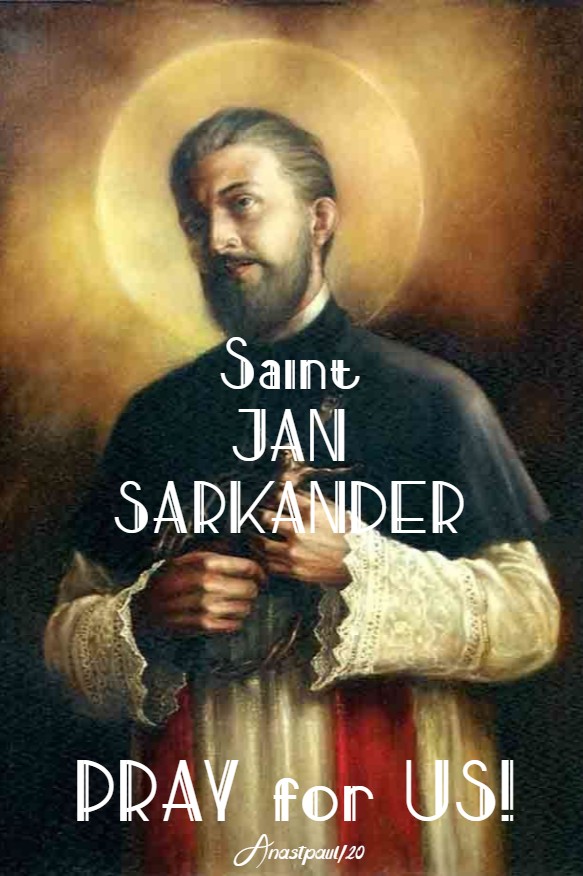
St Jan Sarkander (1576-1620) Priest and Martyr
Bl Josep Mestre Escoda
St Joseph of Arimathea
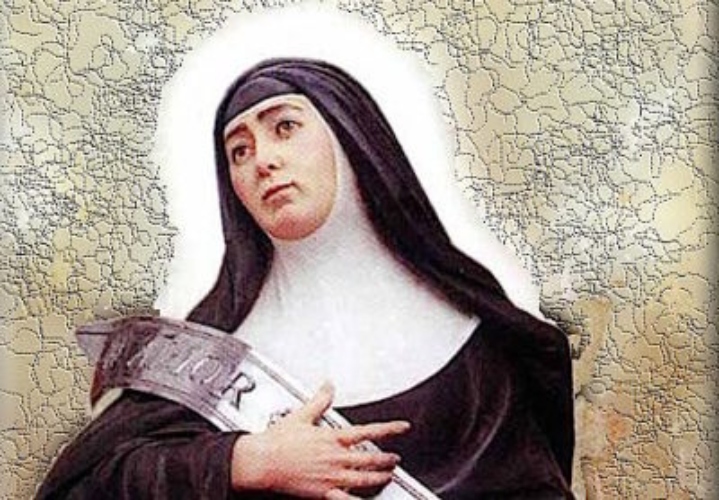
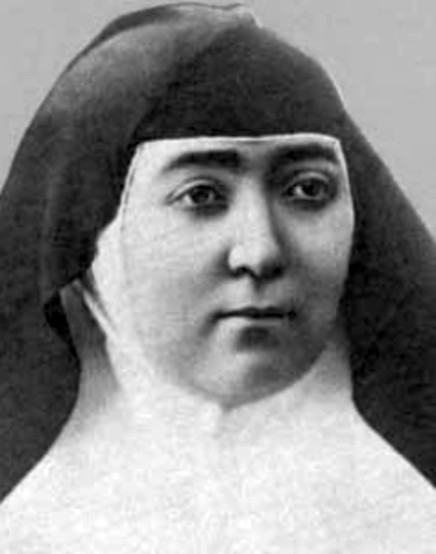
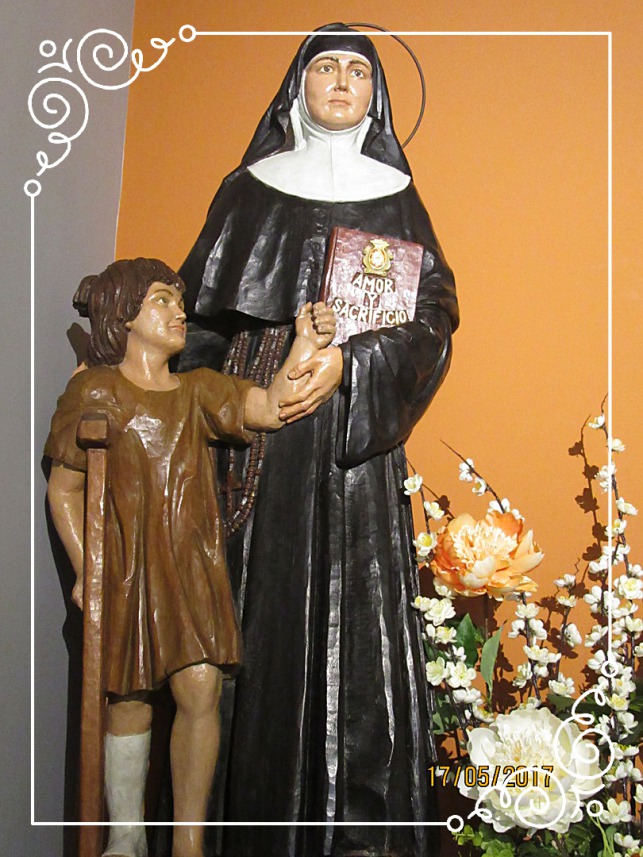
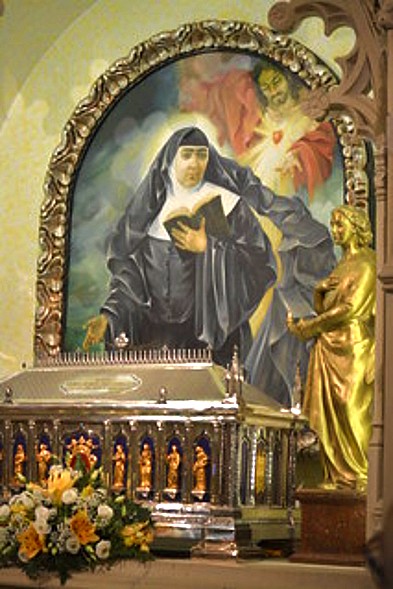
Bl Juan Nepomuceno Zegrí y Moreno (1831-1905)
His life:

Saint of the Day – 17 March – Blessed Juan Nepomuceno Zegri y Moreno (1831-1905)


St Llinio of Llandinam
Bl Maria Bárbara Maix
St Paul of Cyprus
St Stephen of Palestrina
St Theodore of Rome
St Thomasello
St Withburga of Dereham

Martyrs of Alexandria – Also known as Martyrs of Serapis: An unknown number of Christians who were martyred together by a mob of worshippers of the Graeco-Egyptian sun god Serapis. They were Martyred in c 392 in Alexandria, Egypt.

Posted in SAINT of the DAY

Saint of the Day – 16 March – Blessed Giovanni de Surdis Cacciafronte OSB (1125 – 1184)

bl giovanni cacciafronte

Saint of the Day – 16 March – Blessed Giovanni de Surdis Cacciafronte OSB (1125 – 1184) Bishop and Martyr, Monk and Abbot (also known as John Sordi, John Cacciafronte and John de Surdis) – born in 1125 at Cremona, Italy as Giovanni de Surdis and died by being murdered on 16 March 1183 at Vicenza, Italy.   He lived at the time of the struggle waged by the emperor Federico Barbarossa (1125-1190), against the Papacy and the Italian Municipalities. Patronage – persecuted Christians.

Giovanni was born in Cremona around 1125 to Evangelista Sordi and Berta Persico, both of very noble origins.   At an early age Giovanni Sordi lost his father, his mother remarried with the nobleman Adam Cacciafronte, who loved him like a son of his own, giving him his name.   He was educated in an excellent way by the two parents, receiving religious and cultural training.

At sixteen he entered the Benedictine Abbey of St Lorenzo in Cremona as a Benedictine monk.   Over the years his qualities and virtues were increasingly evident, winning the sympathies of his superiors and confreres.   He was first appointed Prior of the small Monastery of St Vittore, dependent on the Abbey of St Lorenzo and then Abbot of the same great Abbey of Cremona.

In those years the schism broke out in the Church, with the election of the antipope Vittore IV (1159-1164), supported by Federico Barbarossa, against the legitimate Pope Alexander III (1159-1181), who opposed the imperial power, supporting the Lombard League of Municipalities, which countered the invasion of Barbarossa’s troops.

The Abbot Cacciafronte by his influence, managed to keep Cremona in obedience to Pope Alexander III but the Emperor had him exiled for this.   Later the Pope entrusted him with the government of the Diocese of Mantua, it is not specified whether as Apostolic Administrator or as Bishop, instead of Bishop Graziadoro who had joined the schism of the antipope Victor IV and his successors Pasquale III (1164-1168) and Callisto III (1168-1179).

After the famous battle of Legano (29 May 1176) lost by the Emperor of the Lombard League, to whose head Pope Alexander III was elected (the foundation of a new City, called in honour of the Pope, Alexandria ).  There was peace deal in Venice in 1179, the antipope in office Callisto III was deposed.

The repentant Bishop Garziadoro returned to the episcopal see of Mantua and in 1179, Giovanni Cacciafronte, was transferred to the Bishopric of Vicenza.   During his tenure he opened a new Seminary and fought against the heresy of the Cathars.

Just two years later, on 16 March 1181, Bishop Cacciafronte was killed by a certain Pietro, feudal lord in concession of the goods of the Vicenza Church, who wanted to take revenge because the Bishop had excommunicated him and deprived him of property, due to his frequent violations of the rights of the Church, which included embezzlement of ecclesiastical funds.

The assassination of the Bishop is mentioned in the “decretals” of Pope Gregory IX (1227-1241), in the text of a letter dated 21 March 1198, sent by Pope Innocent III, to the bishop of Vicenza, Msgr. Pistore, forbidding him to give the property of the Church in fiefdom to the assassins of Bishop Giovanni and their heirs.

Cattedrale_di_Santa_Maria_Annunciata,_abside,_monumento_vescovo_Cacciafronte_(Vicenza) Bl giovanni

The body of the holy Bishop and Martyr was buried in the Cathedral of Vicenza, the Cathedral of the Assumption and moved to the same cathedral in 1441, in a more dignified marble tomb in it’s own side chapel, see the Statue below.

The cult of blessed Giovanni Cacciafronte, Bishop and Martyr, for centuries bestowed on him, was confirmed by Pope Leo XII on 30 March 1824.    As Giovanni died working for the Church and correcting a sinner, he is considered a Martyr.   His liturgical feast is set for 16 March while in the diocese of Mantua his memory is celebrated on 9 July.

Posted in SAINT of the DAY

Memorials of the Saints – 16 March

St Abban of Kill-Abban
St Abraham Kidunaia
St Agapitus of Ravenna
St Aninus of Syria
St Benedicta of Assisi
St Dionysius of Aquileia
St Dentlin of Hainault
Bl Eriberto of Namur
St Eusebia of Hamage
St Felix of Aquileia
St Finian Lobhar
Bl Ferdinand Valdes
Blessed Giovanni de Surdis Cacciafronte OSB (1125 – 1184) Bishop and Martyr
St Gregory Makar
St Heribert of Cologne (c 970–1021)
Biography:

Saint of the Day – 16 March – St Heribert (c 970–1021)


St Hilary of Aquileia
Bl Joan Torrents Figueras
Bl John Amias
St Julian of Anazarbus
St Largus of Aquileia
St Malcoldia of Asti
St Megingaud of Wurzburg

Posted in CHRIST, the WAY,TRUTH,LIFE, DOCTORS of the Church, FATHERS of the Church, ONE Minute REFLECTION, QUOTES for CHRIST, QUOTES of the SAINTS, QUOTES on CONVERSION, QUOTES on GRACE, SAINT of the DAY, The WORD

One Minute Reflection – 15 March – ‘The strength of Christ created you, the weakness of Christ created you anew.’

One Minute Reflection – 15 March – The Third Sunday of Lent, Readings: Exodus 17:3-7, Psalm 95:1- 2, 6-9, Romans 5:1-2, 5-8, John 4:5-42 and the Memorial of Blessed Artemide Zatti SDB (1880-1951)

“Jesus, therefore, being wearied with His journey, sat thus on the well. It was about the sixth hour.” … John 4:6

REFLECTION – “Now begin the mysteries.   For it is not without a purpose that Jesus is weary, not indeed without a purpose that the strength of God is weary, not without a purpose that He is weary, by whom the wearied are refreshed, not without a purpose is He weary, by whose absence we are wearied, by whose presence we are strengthened.
Nevertheless, Jesus is weary and weary with His journey and He sits down and that, too, near a well and it is at the sixth hour that, being wearied, He sits down.
All these things hint something, are intended to intimate something, they make us eager, and encourage us to knock.   May Himself open to us and to you, He who has deigned to exhort us, so as to say, Knock and it shall be opened to you.   It was for you that Jesus was wearied with His journey.
We find Jesus to be strength and we find Jesus to be weak – we find a strong and a weak Jesus – strong, because in the beginning was the Word and the Word was with God and the Word was God, the same was in the beginning with God.   Would you see how this Son of God is strong?   All things were made by Him and without Him was nothing made and without labour, too, were they made.  Then what can be stronger than He, by whom all things were made without labour?   Would you know Him weak?   The Word was made flesh and dwelt among us.
The strength of Christ created you, the weakness of Christ created you anew.   The strength of Christ caused that to be which was not, the weakness of Christ caused that what was, should not perish.   He fashioned us by His strength, He sought us by His weakness.
But why at the sixth hour?   Because at the sixth age of the world.   In the Gospel, count up as an hour each, the first age from Adam to Noah;  the second, from Noah to Abraham;  the third, from Abraham to David; the fourth, from David to the removing to Babylon;  the fifth, from the removing to Babylon to the baptism of John – thence is the sixth being enacted.   Why do you marvel?   Jesus came and, by humbling Himself, came to a well.   He came wearied, because He carried weak flesh.   At the sixth hour, because in the sixth age of the world.   To a well, because to the depth of this our habitation.   For which reason it is said in the psalm – From the depth have I cried unto You, O Lord.   He sat, as I said, because He was humbled.” … St Augustine (354-430) – Father & Doctor of the Church – Tractate 15 (John 4:1-42)john 4 6 jesus therefore being - the strength of christ - st augustine - 15 march 2020

PRAYER – Lord our God, Your Son so loved the world that He gave Himself up to death for our sake.   Strengthen us by His weakness and Your grace and give us a heart willing to live by that same love.   We know His excuses for us and His broken heart at our neglect and sin, make us like unto Him O Father, that we might be holy and come to see His Face.   May the prayers of the angels, Blessed Artemide Zatti and the Blessed Virgin be of assistance to us.   We make our prayer through Christ our Lord, with the Holy Spirit, one God, now and forever, amen.ave-maria-pray-for-us-28-sept-2018-and-24-march-2019-no-2 AND 15 MARCH 2020

bl artemide zatti pray for us 15 march 2020 (2)


Posted in SAINT of the DAY, VATICAN Resources

Saint of the Day – 15 March – Blessed Artemide Zatti SDB (1880-1951)

Saint of the Day – 15 March – Blessed Artemide Zatti SDB (1880-1951) Italian Religious Brother of the Order of the Salesians of John Bosco, Missionary, Apostle of the poor sick, Pharmacist. Nurse – born on 12 October 1880 at Boretto, Reggio Emilia, in northern Italy and died on 15 March 1951 of cancer at Bahia Blanca, Argentina – Patronages Pharmacists and Immigrants.   His nephew was the eighth rector of the Salesians – Juan Edmundo Vecchi.bl artemide zatti

Blessed Artemide Zatti was born on 12 October 1880 in Italy and died on 15 March 1951 at Viedma, Argentina.    As a Salesian religious brother, he became a saint by running a hospital and pharmacy for the sick poor for 40 years in Viedma, Argentina.   In 1897, when Artemide was 17 years old, his family emigrated from Reggio Emilia to join Artemide’s uncle who had a good job in Bahía Blanca, Argentina.   There they found steady work and a livelihood.   In his “new life” in Argentina, Artemide worked in a
hotel and then in a brick factory.   On Sundays the Zatti family faithfully assisted at Mass and other activities in the parish of the Salesian Fathers who in 1890 set up a community in Bahía Blanca.   With true apostolic spirit, Artemide used his free time to help the Salesian parish Priest in his parish activities and, especially, in visiting the sick.

He was inspired by the life of Don Bosco and by the Salesian priests and felt called to imitate him.   In 1900 when he was 19, the Salesians accepted him as a student for the priesthood  . But he had great difficulty with the studies since he had left elementary school long before.   Also, during the novitiate, Artemide contracted a severe case of TB from taking care of a young priest who was a TB victim.

In 1902 Artemide was forced to leave the house of studies to seek a cure in the pure air of Viedma, a city located high in the Andes.   Little did he realise that Viedma was going to be his city for the rest of his life.   Along with the healthy climate, in Viedma there was a hospital and pharmacy attached to the Salesian College run by Fr Evaristo Garrone, a priest and physician who was known for his empirical approach to medicine.   Fr Evaristo was also known for his trust in God’s Providence, he never turned away the poor who could not pay.   Under the guidance of Fr Garrone, Artemide made a promise to Our Lady, Help of Christians, that if she would obtain a cure for him, he would serve the sick poor for the rest of his life. When he was cured, he promptly continued his training as a Salesian religious brother.  bl artmides-zatti-889577ae-8b35-4d07-a956-b2507f71265-resize-750

In 1908 he was professed and began his mission alongside Fr Garrone.   When Fr Garrone died in 1911, Artemide was put in charge of the pharmacy and the hospital. He was a trained pharmacist, nurse, operating-room assistant, as well as juggler of finances and head of personnel.   He followed Fr Garrone’s rule that “he who has little, pays little and the one who has nothing pays nothing”.   In running the hospital, Artemide also depended entirely on Providence and the generosity of the people.   In his 40 years of dedicated service, he found in his religious life with its periods of prayer and community life the secret of balancing the daily tasks of administering the hospital and
pharmacy, taking care of patients inside and outside the hospital  . Despite the demands of the sick and the needs of the hospital, Artemide was known for his “Salesian joy”, a sign of his holiness for those around him.   He was “not only provider of medicine, but was himself a medicine for others by his presence, his songs, his voice …”

Altar_de_Artémides_Zatti_-_Basílica_María_Auxiliadora_y_San_Carlos
Altar in Buenos Aires

In 1913 he was the force behind the building of a new hospital which was demolished in 1941 when the spot was taken as the residence of the Bishop of the newly-founded Diocese.

In July 1950, after falling off a ladder that he was climbing to get on the roof to fix a leaky water tank, Artemide was forced to take a period of rest and recovery.   After a few months the doctors diagnosed his livid skin colour as a serious cancer of the liver.  He was sick from January to March.   He died on 15 March 1951.  His mortal remains repose in the chapel of the Salesians at Viedma.bl artmides-zatti-b0ed617e-472f-463b-8670-e75b8525137-resize-750

Bl. Artemide lived what St John Bosco said to the first Salesians leaving for America: “Take special care of the sick, the children, the elderly, the poor and you will receive God’s blessing and the respect of those around you.”

The process for investigating a miracle opened in Buenos Aires after Jorge Mario Bergoglio – the future Pope Francis – inaugurated the process on 14 April 1998 and closed it one month later on 14 May 1998.   A medical board approved the miracle on 9 March 2000 and theologians followed this decision on 27 October 2000.   The C.C.S. voted in favour as well on 6 February 2001 which led to papal approval on 24 April 2001. Blessed Artimedi was Beatified by St John Paul II on 14 April 2002 in St Peter’s Square….Vatican.vabl artemide zatti middle aged

“Artemide Zatti, Salesian religious brother, left the diocese of Reggio Emilia with his family to seek a better life in Argentina, the land dreamt of by Don Bosco.   There he discovered his Salesian vocation, which took the form of a passionate, competent and loving service to the sick. His almost fifty years in Viedma represent the history of an exemplary religious, careful to accomplish his duties in his community and totally devoted to the service of those in need.   May his example help us to be conscious of the presence of the Lord and bring us to welcome him in all our needy brothers and sisters.” – from the beatification homily by Pope John Paul IIbl artemide street art

The postulator of the cause is the Fr Pierluigi Cameroni and there is currently a miracle being investigated through the intercession of Blessed Artemide which would lead to his Canonisation:

“Indeed the first miracle for the Beatification happened in 1980 to that time Salesian theology student Carlo Bosio (later on SDB provincial) and was the motivation for the Beatification of Br Zatti by St John Paul II in 2002.   Now another presumed miracle is being investigated in the Philippines (Diocesan stage of the investigation) and it looks very serious (according the reports from the Philippines).

Possible canonisation of Br Zatti would remind the whole Catholic community worldwide about the love for the poor, showing all the way how to meet Jesus in the sick people:  ‘Please, prepare the clothes for 12 year old Jesus! or Do you have ready the hot soup for 10 year old Jesus?’

We wish all Salesian family members both in Patagonia – Viedma and in the Philippines that the investigation about the presumed miracle, will bring many pastoral fruits for the growth in faith and charity amongst the Catholic community and beyond.” (by Salesian Sr Denise Sickinger).bl artemide zatti statuestatue bl artemide

Posted in REDEMPTORISTS CSSR, SAINT of the DAY

The Third Sunday of Lent, Year A +2020 and Memorials of the Saints – 15 March

The Third Sunday of Lent, Year A +2020

Bl Anthony of Milan
St Aristobulos of Britannia
Bl Arnold of Siena
Blessed Artemide Zatti SDB (1880-1951)

St Bodian of Hanvec
St Clement Mary Hofbauer C.Ss.R (1751-1820)
Biography:
https://anastpaul.wordpress.com/2018/03/15/saint-of-the-day-15-march-st-clement-mary-
hofbauer-c-ss-r-1751-1820/

St Eoghan of Concullen
St Eusebius II
Bl Francis of Fermo
Blessed Jan Adalbert Balicki (1869-1948)
About Blessed Jan:
https://anastpaul.com/2019/03/15/saint-of-the-day-blessed-jan-adalbert-balicki-1869-1948/
St Leocritia of Córdoba
St Longinus the Centurian
Bl Ludovico de la Pena
St Mancius of Evora
St Matrona of Capua
St Matrona of Thessaloniki
St Menignus of Parium
Bl Monaldus of Ancona
St Nicander of Alexandria
St Peter Pasquale
St Pío Conde y Conde
St Sisebuto
St Speciosus
St Vicenta of Coria
Bl Walter of Quesnoy
Bl William Hart
St Pope Zachary

Posted in GOUT, KNEE PROBLEMS, ARTHRITIS, etc, PATRONAGE - OEDEMA/DROPSY, PATRONAGE - VINTNERS, WINE-FARMERS, SAINT of the DAY

Saint of the Day – 14 March – Saint Leobinus of Chartres (Died c 558)

Saint of the Day – 14 March – Saint Leobinus of Chartres (Died c 558) Bishop of Chartres, Abbot, Hermit, Miracle worker – he had the gift of healing, especially of dropsy or edema – born as Lubin at Poitiers, France and died on 14 March 558 of natural causes.   Patronages – against dropsy/oedema, against rheumatism, of innkeepers and wine merchants.st leobinus of chartres

Leobinus’s parents were peasants from the region of Poitiers in France.   As a young boy, Leobinus had an aptitude for learning and applied to a monastery where he was employed in menial tasks.

His work occupied him the entire day and he was obliged to do most of his studying at night, screening his candle as best he could.   The monks complained that the light disturbed their slumbers but by much humility and perseverance Lubin advanced in knowledge.572px-Chartres_-_Vitrail_de_la_Vie_de_saint_Lubin- leobinus1

He eventually joined the monastery and, probably at the suggestion of St Carilef, for a time lived as a hermit under the guidance of St Avitus.   Later, he settled in an abbey near Lyons, remaining for five years.Mar+14+Leobinus+of+Chartres+1

In a war between the Franks and the Burgundians this monastery was raided and all the monks fled with the exception of Leobinus and an old monk.   The enemy, unable to extort from Leobinus the location of the monastery’s “treasure”, tortured him by first strangling him with a rope and then by tying his feet and dipping him, head first, into the river.   Left for dead, he recovered and was received in the monastery of Le Perche.st leobanus

After Avitus died, Leobinus continued living as a hermit until he was ordained by Bishop. Aetherius of Chartres, who appointed him Abbot of Brou.   He served until apparently deciding he did not like administrative duties.   So he left to become a monk at Lérins.
He remained there until St Caesarius, the Bishop of Arles and a former monk at Lérins convinced him to return to Brou, rather than to leave his people “like sheep without a shepherd.”

Leobinus participated in the Fifth Council of Orleans and in the Second Council of Paris and died on March 14, about the year 558, after a long illness.   He was buried at the Church named for him in Chassant, Eure-et-Loir, France.621px-Buste_saint_lubin leobinas1024px-Saint_Leobinus _église_Saint-Lubin_Chassant_Eure-et-Loir_France

Posted in SAINT of the DAY

Memorials of the Saints – 14 March

St Agno of Zaragoza
St Alexander of Pydna
St Aphrodisius of Africa
Bl Arnold of Padua
St Boniface Curitan
St Diaconus
St Eutychius of Mesopotamia
Bl Eve of Liege
Bl Giacomo Cusmano (1834-1888)
His life:
https://anastpaul.com/2019/03/14/saint-of-the-day-14-march-blessed-giacomo-cusmano-1834- 1888/
St Lazarus of Milan
St Leo of the Agro Verano
St Leobinus of Chartres (Died c 558)
St Matilda of Saxony (c 894-968)
Biography:
https://anastpaul.wordpress.com/2017/03/14/saint-of-the-day-14-march-st-matilda-of-saxony/

St Maximilian
Bl Pauline of Thuringia
St Peter of Africa
St Philip of Turin
St Talmach
Bl Thomas Vives

47 Martyrs of Rome – Forty-seven people who were baptised into the faith in Rome, Italy by Saint
Peter the Apostle, and were later martyred together during the persecutions of Nero. Martyred c.67
in Rome, Italy

Martyrs of Valeria – Two monks martyred by Lombards in Valeria, Italy who were never identified.
After the monks were dead, their killers could still hear them singing psalms. They were hanged on a
tree in Valeria, Italy.

Posted in SAINT of the DAY

Saint of the Day – 13 March – St Heldrad of Novalese (died c 875)

Saint of the Day – 13 March – St Heldrad of Novalese (died c 875) Priest and Benedictine Abbot of the Novalaise in Italy from 816 to 845, according to his first biography in prose written around 1120 by an Italian monk.   He is also known as Aldradus, Eldrad, Eldrado, Eldradus, Heldradus, Heltrodus and has an additional memorial on 31 October in the Benedictine Order.saint-heldrad-returns-from-santiago-de-compostela-in-the-chapel-of-sts-heldrad-and-nicholas_u-l-pq4i3h0

St Heldrad entered the world at Lambec, in Provence, his father was a feudal lord.   The saint spent the entirety of his inheritance on building a church, erecting a hospice and helping the poor.   Then he became a religious pilgrim and visited holy places in Italy, France and Spain.

During a pilgrimage to Rome, he discovered the hospice installed on Mont-Cenis.   He decided to enter this monastic community and, when Father Abbot died, he was called to govern it.   He did so with all the administrative qualities that were his.   At the same time as he enlarged the buildings, he made grow the spiritual life of his monks and the charity towards the travellers.   He also built a hospice there and helped to expand the monastery’s library.

The whole life of Saint Heldrad until his death, is depicted on the frescoes of the chapel which bears his name in the Abbey of Novalese.   Heldrad spent part of his childhood in Ambel.   On the side of the road at the entrance of Ambel is the Saint Heldrad cross and in the parish church we see his statue and his banner.st heldrad glass

He governed the monastery for thirty years, imparting an additional vitality.   He led his flock with wisdom and prudence, ‘his monks obeyed with gaiety of heart’.   La Laus perennis goes hand in hand with charitable works, in particular those of the monks of Mont-Cenis, who rescue travelers lost in the snow.   He also sent monks to found another hospice not far from the Lautaret pass, at a place called Monêtier de Briançon, currently Le Monêtier-les-Bains.   (Sanctoral of the diocese of Gap and Embrun, page 22)

The Roman martyrology says: “At the monastery of Novalèse in the Susa valley, at the foot of Mont-Cenis, around 840, Saint Eldrade, abbot, who was zealous for divine worship, instituted permanent praise psalms and took care to build new churches.”

St Heldrad died on 13 March 875, ‘calm and cheerful as he lived’ (Sanctoral of the diocese of Gap and Embrun, page 22).   His relics were transferred to the parish church in Novalesa, Italy in 1794.   He was Beatified on 9 December 1904 by Pope Saint Pius X (cultus confirmed).

Posted in SAINT of the DAY

Memorials of the Saints – 13 March

Bl Agnellus of Pisa
St Ansovinus of Camerino
Bl Berengar de Alenys
St Christina of Persia
St Euphrasia
Bl Françoise Tréhet (1756-1794) Martyr
Biography:
https://anastpaul.com/2019/03/13/saint-of-the-day-13-march-bl-francoise-trehet-1756-1794-
martyr/
St Gerald of Mayo
St Grace of Saragossa
St Heldrad of Novalese (Died c 875)
Bl Judith of Ringelheim
St Kevoca of Kyle
St Leander of Seville (c 534-c 600)
Biography:
https://anastpaul.wordpress.com/2017/03/13/saint-of-the-day-13-march-st-leander-of-seville/

St Mochoemoc
St Nicephorus of Constantinople
Bl Peter II of La Cava
St Pientius of Poitiers
St Ramirus of Leon
St Sabinus of Egypt
St Sancha of Portugal

Martyrs of Cordoba: Roderick, Salomon,

Martyrs of Nicaea:
Arabia
Horres
Marcus
Nymphora
Theodora
Theusitas
Martyrs of Nicomedia
Eufrasia
Macedonius
Modesta
Patricia
Urpasian

Posted in INCORRUPTIBLES, MYSTICS

Saint of the Day – 12 March – Blessed Giustina Francucci Bezzoli (c 1257-1319)

Saint of the Day – 12 March – Blessed Giustina Francucci Bezzoli (c 1257-1319) Virgin of the Order of St Benedict, Hermitess and Anchoress, Mystic – born in c 1257 in Arezzo, Tuscany, Italy and died on 12 March 1319 in Arezzo, Tuscany, Italy of natural causes while praying.   A white lily grew out of the stone of her tomb.   Her body is incorrupt.   Patronages – eye and sight diseases and problems, demonics.bl giustina_francucci_bezzoli_45_01

In Florence, in the Benedictine monastery of St Maria del Fiore in Lapo, the incorrupt body of Blessed Giustina Bezzoli Francucci is kept and venerated, moved here from the Monastery of the Holy Spirit of Arezzo in 1968, when the two cloistered communities met.   The large church of the monastery, in the centre of the village north of Florence, on Via Faentina, has also been a parish since 1938 and so, in admirable harmony, the two communities live and pray side by side, enriching each other with different gifts of the Spirit.   The nuns’ choir is the extension of the church and in the centre there is the tabernacle.   The community was founded by the wealthy Lapo da Fiesole who in 1350 hosted the first nuns here.   On 13 October of that year, Bishop S. Andrea Corsini consecrated the monastery with the rule of St Augustine and with the title of St Maria del Fiore which is older here than the Florentine cathedral  . The Augustinians remained until 1808, when they had to leave because of the laws for the suppression of religious orders, the Benedictines took over in 1817.   The tomb with the body of the Blessed is placed in a wall that unites the two communities and is visible from both sides – her face looks towards the cloister and seems to invite the lay faithful to dedicate time to prayer.

Blessed Giustina was a descendant of a very noble family, the Bezzoli Francucci and was born in Arezzo between 1257 and 1260.   With a lovable and humble character, she quickly gained a certain maturity.   In the rich paternal home, between ease and comfort, she assimilated with daily prayer, the most genuine religious sentiments.  She often deprived herself of food and loved to retire to her room to pray, thus the decision to consecrate herself to God matured at a very young age.   Her parents refused her permission and denied her any argument.   A single, beloved daughter, heir of conspicuous wealth, she had a very enviable future ahead of her – marriage to a man worthy of her family.   We know, however, that the ways of the Lord are not the ways of men – she first convinced her father with many tears and pleadings, then it was the turn of her paternal uncle, who was also determined not to deprive himself of his only
niece.   A serious illness of the father made everyone reflect on the transience of things and Giustina obtained the desired approval.   She was only twelve years old and this decision is incomprehensible to us but, at that time, important choices were sometimes made at that age.

Giustina was welcomed into the monastery of St Marco (which no longer exists today), bringing only an image of the Crucifix with her.   A dove landed on her head upon entry, an eloquent sign that the Holy Spirit was already assisting the humble daughter of the Holy Father Benedict.  She left everything to devote herself to meditating on the Word of God – the rough habit took the place of opulent silks and satin clothes.    Giustina was an exemplary novice, in the simplest tasks she responded with obedience to the needs of the community.   Giustina stayed in the monastery for about four years, until she was forced to leave with her sisters because of the wars that devastated the city.   With her Crucifix she moved to the Monastery of All Saints but even here the stay was not long.

One day she heard that in a cave, at the Castle of Civitella, a virgin named Lucia voluntarily lived.   To join this Lucis, it to share the most austere practice of Christian virtues became her greatest desire.   With the permission of Bishop Guglielmo Umbertini she moved to the hermitage where Lucia, very happily, welcomed her.   In extreme poverty they received a visit from Giustina’s father who, we can imagine with how much anguish, he tried in vain to bring her home.

The coexistence of the two anchorites lasted only a few years, until Lucia became seriously ill and the young companion assisted her with love until the moment of her death.   Left alone, Giustina continued to live devoted only to prayer and penance, visibly comforted by the Celestial Bridegroom who, through an angel, defended her several times from the attacks of wolves.   Such and many deprivations could not fail to undermine her health and at only thirty-five she began to have serious vision problems. She was forced to return to the monastery amidst the jubilation of the sisters who
now saw in her a heavenly soul.   However, the monastery was subject to soldiers’ raids
and the bishop Ildebrando Guidi had to transfer it to a safe place.   It was the year 1315 and Giustina changed residence again.

The Blessed had a singular devotion to the Passion of Christ and, although sick, she practised many mortifications.   She spent the last twenty years of her life, completely blind, falling into ecstasy several times, even in the presence of her sisters.   She lived in conditions of great misery but always confident in Providence and those who asked for a word of comfort did not fail to help them as much as she could.   She died praying, surrounded by her companions, on 12 March 1319.   On her body were evident, the sores caused by an iron chain, that for years had encased her fragile body.

The graces obtained through her intercession were immediately numerous.   A white lily grew spontaneously on her grave and with this attribute, Giotto painted it for the Florentine Church of Mercy.   The body, ten years after her death, was surprisingly flexible and the Bishop of Arezzo, Buono degli Uberti, confirmed the spontaneous cult that had been born in the people.   Two centuries later her body was enclosed in an iron chest until 1709, when it it was again exhumed and confirmed to be incorrupt.   An ancient war flag was found in the coffin left by a captain as an ex voto around 1384. Some fragments of the banner were distributed to the faithful as relics.
Blessed Giustina is invoked especially for eye and sight problems but some demoniacs have also been exorcised in front of her Shrine.

Blessed Giustina was Beatified on 14 January 1891 by Pope Leo XIII (cultus confirmation).

bl giustina bezzoli

Posted in SAINT of the DAY

Memorials of the Saints – 12 March

St Almut of Wetter
St Alphege the Bald
Bl Angela Salawa
St Basilissa of Asia
Bl Beatrix of Engelport
St Bernard of Carinola
Bl Claudius the Minor
St Egdunus
St Fechno
St Girolamo da Recanati
Blessed Giustina Francucci Bezzoli (c 1257-1319)
St Heiu of Hartlepool
St Indrecht of Iona
St Pope Innocent I
St Joseph Zhang Dapeng
St Luigi Orione FDP (1872-1940)
About amazing St Luigi:
https://anastpaul.com/2019/03/12/saint-of-the-day-12-march-st-luigi-orione-fdp-1872-1940/

St Maximilian of Thebeste
St Mura McFeredach
St Paul Aurelian
St Peter the Deacon
St Seraphina
St Theophanes the Chronographer

Martyrs of Nicomedia – 8 saints: Eleven Christians who were martyred in succession in a single incident during the persecutions of Diocletian. First there were the eight imprisoned Christians, Domna, Esmaragdus, Eugene, Hilary, Mardonius, Maximus, Mígdonus and Peter, about whom we know little more than their names.   Each day for eight days one of them would be strangled to death in view of the others so that they would spend the night in dread, not knowing if they were next.
Peter was the chamberlain or butler in the palace of Diocletian.   When he was overheard complaining about this cruelty, he was exposed as a Christian, arrested, tortured and executed by having the flesh torn from his bones, salt and vinegar poured on the wounds and then being roasted to death over a slow fire.
Gorgonio was an army officer and member of the staff in the house of emperor Diocletian, Doroteo was a staff clerk.   They were each exposed as Christians when they were overhead objecting to the torture and murder of Peter.   This led to their own arrest, torture and executions.
Died in 303 in Nicomedia, Bithynia (in modern Turkey)
Additional Memorial – 28 December as part of the 20,000 Martyrs of Nicomedia.

Posted in SAINT of the DAY

Saint of the Day – 11 March – Saint Benedict Crispus of Milan (Died 725)

Saint of the Day – 11 March – Saint Benedict Crispus of Milan (Died 725) Archbishop of Milan from c 685 to c 725 when he died of natural causes.553px-st Benedict_cripus bishop_of_Milan

It is believed that he belonged to the aristocratic Milanese Crispi family.   Among the little information about his life, it is known that he wrote the epitaph for Caedwalla, the king of Wessex who was buried in St Peter’s Basilica in Rome.

To Benedict was due the construction of a church and a monastery in Milan, of which no trace remains.

A poem written about ten years after his death, De laudibus Mediolani- In Praise of Milan, praises him and remembers his veneration by the entire land and informs us that he was buried in the Basilica of Saint Ambrose.    His feast day is 11 March in the Roman Rite and 6 September in the Ambrosian Rite.

st ambrose basilica milan
St Ambrose Basilica Milan

Posted in SAINT of the DAY

Memorials of the Saints – 11 March

St Aengus the Culdee
St Alberta of Agen
St Alexius U Se-Yong
St Amunia
St Aurea of San Millán
St Benedict Crispus of Milan (Died 725)
St Candidus the Martyr
St Constantine II
St Constantine of Carthage
St Ðaminh Cam
St Eulogius (Died 857) Martyr
Biography:
https://anastpaul.com/2019/03/11/saint-of-the-day-11-march-st-eulogius-died-857-priest-and-martyr/
St Firmian the Abbot
St Firmus the Martyr
St Gorgonius the Martyr
St Heraclius of Carthage
Bl John Kearney
Bl John Righi of Fabriano
St Marcus Chong Ui-Bae
St Peter the Spaniard
St Pionius
St Piperion the Martyr
St Rosina of Wenglingen
St Sophronius of Jerusalem
St Thalus the Martyr
Bl Thomas Atkinson
St Trophimus the Martyr
St Vigilius of Auxerre
St Vincent of Leon
St Vindician of Cambrai
St Zosimus of Carthage

Martyrs of Antioch: A group of Christians martyred together by Emperor Maximian Galerius. Martyred in c 300 in Antioch, Syria.

Posted in DOCTORS of the Church, FATHERS of the Church, QUOTES of the SAINTS, QUOTES on LOVE, QUOTES on PERSEVERANCE, QUOTES on SANCTITY, QUOTES on SUFFERING, QUOTES on TEMPTATION, SAINT of the DAY

Quote/s of the Day – 10 March – Our pilgrimage on earth

Quote/s of the Day – 10 March – Tuesday of the Second Week of Lent and The Memorial of St Marie Eugénie de Jésus (1817-1898)

“Our pilgrimage on earth cannot be exempt from trial.
We progress by means of trial.
No-one knows himself except through trial,
or receives a crown,
except after victory,
or strives,
except against an enemy or temptations.”

St Augustine (354-430)
Father and Doctor of the Church

our pilgrimae on earth cannot be exempt from trial - st augustine - 10 march 2020

“Love never says
‘I have done enough.’”

St Marie Eugénie de Jésus (1817-1898)

love never says i have done enough - st marie eugenie de jesus 10 march 2020

Posted in SAINT of the DAY

Saint of the Day – 10 March – Saint Pope Simplicius (?- 483)

Saint of the Day – 10 March – Saint Pope Simplicius (?- 483) Papal Ascension 25 February 468 – 10 March 483. He was born in Tivoli, Italy, the son of a citizen named Castinus. Most of what is known of him personally is derived from the Liber Pontificalis.   His remains are interred in Saint Peter’s Basilica, Vatican City, Rome, Italy.st pope .Simplicius 1

After a vacancy of 10 days following the death of Pope Hilarius, Simplicius was consecrated on 25 February 468.

The reign of Simplicius coincided with the official fall of the Western Empire, in 476.   The Italian peninsula was overrun by barbarians and was in a constant state of war. Eventually, the Herulis, an East Germanic tribe who formed a kingdom around the middle Danube, joined forces with Odoacer and beat the Roman soldiers.   The weak Western emperor, Romulus Augustus, was deposed.   Odoacer became king of a new kingdom.   Simplicius had been bishop of Rome for eight years at this point and surely was concerned over a heretic taking command of the empire, considering the ties that had developed between church and state.   However, Odoacer was an organiser.   He saw the way the government that had been in power had worked hand in hand with the Catholic Church and, for the most part left the Church to rule itself.

One of the early difficulties Simplicius had was the defense of the Council of Chalcedon. Simplicius probably was not even involved in this council, which was called in October, 451 by the emperor and, reluctantly, by Leo the Great.   This council repudiated the Second Council of Ephesus and defined the dual nature of Christ, both divine and human.   In addition, the Council of Chalcedon claimed that the Patriarchy of Constantinople was second in standing only to Rome.st Pope_Simplicius

Simplicius found himself on both sides of the support of the council.   He supported the definition of Christ’s nature.   But those against the definition, known as monophysites, had spread like wildfire throughout the Levant and Egypt, thus showing a large population arguing about the nature of the Lord.   Simplicius was also opposed to the elevation of the patriarchy of Constantinople.   Thus began a tearing away of the Eastern church from orthodoxy.   The current Eastern emperor, Zeno, was more or
less orthodox.   He was overthrown for a year in 475 by the monophysite, Bascilicus.   A year later, Zeno was reinstated but this time chose to reconcile with monophysitism.  This was not an easy situation for the pope.   And he did not live to see the outcome.

The pope clashed with Patriarch Acacius in the jurisdictional dispute and the argument almost destroyed the legacy of Chalcedon.St.-pope Simplicius

Aside from this large problem, Simplicius showed himself to be an able, effective administrator.    Concerned about his role as she[herd to the Western Church, Simplicius appointed Bishop Zeno of Seville as a papal vicar.   He constructed several churches, at least one of which was originally a columned walkway in the city of Rome.   One church is still extant, St Bibiana’s.   A concern this pope had was what to do with the churches of the catacombs, which were not used the same way as they had the first few hundred years of Church history. He appointed priests to say Masses, baptise and offer the Sacrament of Penance routinely in the three primary catacomb churches – St Peter’s at the Vatican, St Paul’s and St Lawrence Outside the Walls.

A long illness led to Simplicius’ death on 10 March 483.

Pope St Simplicius is seen as one who championed orthodoxy and promoted papal supremacy.

Posted in JESUIT SJ, SAINT of the DAY

Memorials of the Saints – 10 March

St Alexander of Apema
St Anastasia the Patrician
St Andrew of Strumi
St Attalas of Bobbio
St Blanchard of Nesle-la-Réposte
St Caius of Apema
St Cordratus of Nicomedië
St Droctoveus of Paris
Bl Elias del Socorro Nieves
St Emilian of Lagny
St Failbhe the Little
St Gustav the Hermit
St Himelin
Bl Jean-Marie Joseph Lataste
St John Ogilvie SJ (1579-1615 died aged 36) MARTYR
Biography:
https://anastpaul.wordpress.com/2017/03/10/saint-of-the-day-10-march-st-john-ogilvie/
St John Ogilvie, his Rosary and the Baron: https://anastpaul.wordpress.com/2017/03/10/st-john-
ogilvie-sj-10-march/

Bl John of Vallombrosa
St Kessog
St Macarius of Jerusalem
St Marie Eugénie de Jésus (1817-1898) 
Her life:
https://anastpaul.com/2019/03/10/saint-of-the-day-10-march-st-marie-eugenie-de-jesus-1817- 1898/
St Peter of Veroli
St Rufinus of Nicomedië
St Sannudius of Bagensena
St Saturninus of Nicomedië
St Sedna of Ossory
St Silvester of Ireland
St Pope Simplicius (?- 483)
St Victor of North Africa
Bl Wirnto of Formbach

Anonymous Martyrs of Persia – A group of 42 Christians martyred in Persia in the 4th century.

Forty Martyrs of Armenia – Forty Christian soldiers of the Thunderstruck Legion of the Imperial Roman army who were tortured and murdered for their faith during the persecutions of Emperor Licinius.   They were exposed naked on a frozen pond to freeze to death at Sebaste, Armenia in 320 and their bodies afterward were burned.

Posted in FATHERS of the Church, QUOTES of the SAINTS, QUOTES on the CHURCH, QUOTES on THE MYSTICAL BODY, SAINT of the DAY

Quote of the Day – 9 March – “My name is …”

Quote of the Day – 9 March – The Memorial of St Pacian of Barcelona (c 310–391) Father of the Church.

“My name is Christian, my surname is Catholic.”

St Pacian of Barcelona

my name is christian my surname is catholic - st pacian of barcelona - 9 march 2020

Posted in DOCTORS of the Church, FATHERS of the Church, LENT 2020, ONE Minute REFLECTION, QUOTES of the SAINTS, QUOTES on ENVY, QUOTES on FORGIVENESS, QUOTES on JUSTICE, SAINT of the DAY, The WORD

One Minute Reflection – 9 March – ‘O envious one, you injure yourself…’

One Minute Reflection – 9 March – Monday of the Second Week of Lent, Year A, Readings: Daniel 9:4- 10, Psalm 79:8-9, 11, 13, Luke 6:36-38 and the Memorial of St Pacian of Barcelona (c 310–391) Father of the Church.

“Judge not and you will not be judged;  condemn not and you will not be condemned; forgive and you will be forgiven;  give and it will be given to you;  good measure, pressed down, shaken together, running over, will be put into your lap.   For the measure you give, will be the measure you get back.”...Luke 6:37-38luke 6 37-38 judge not and you will not be judged 9 march 2020

REFLECTION – “O envious one, you injure yourself more than he whom you would injure and the sword with which you wound will recoil and wound yourself.   What harm did Cain do to Abel?   Contrary to his intention he did him the greatest good, for he caused him to pass to a better and a blessed life and he himself was plunged into an abyss of woe.   In what did Esau injure Jacob?   Did not his envy prevent him from being enriched in the place in which he lived and, losing the inheritance and the blessing of his
father, did he not die a miserable death?   What harm did the brothers of Joseph do to Joseph, whose envy went so far as to wish to shed his blood?   Were they not driven to the last extremity and well-nigh perishing with hunger, whilst their brother reigned all through Egypt?   It is ever thus, the more you envy your brother, the greater good you confer upon him. God, who sees all, takes the cause of the innocent in hand and, irritated by the injury you inflict, deigns to raise up him whom you wish to lower and will punish you to the full extent of your crime.   If God usually punishes those who rejoice at the
misfortunes of their enemies, how much more will He punish those who, excited by envy, seek to do an injury to those who have never injured them?”… Saint John Chrysostom (347-407) Father & Doctor of the Churchit is ever thus the more you envy your brother the greater good - st john chrysostom luke 6 36-38 9 march 2020

PRAYER – We beseech Your mercy Lord, let Your Spirit come upon us in power and fill us with His gifts, to render our minds and hearts pleasing to You and make us docile and merciful as Your Son has taught us.   May our Lord Jesus, Your Son, guide us and may the prayers of St Pacian of Barcelona teach us Your precepts.   Through Jesus Christ with the Holy Spirit, God now and forever, amen.st pacian of barcelona pray for us 9 march 2020

Posted in FATHERS of the Church, SAINT of the DAY

Saint of the Day – 9 March – Saint Pacian of Barcelona (c 310–391) Bishop and Father of the Church.

Saint of the Day – 9 March – Saint Pacian of Barcelona (c 310–391) Bishop and Father of the Church.9-San Paciano de Barcelona- header

St Pacian was the Bishop of Barcelona during the fourth century.    He was Bishop from about 365 to 391, succeeding Praetextatus, who had attended a church council at Sardica in 347 and who is the first recorded Bishop of Barcelona.

Considered a Father of the Church, Pacian is eulogised in St Jerome’s De viris illustribusCatalogue of Illustrious Men, in which Jerome praises his eloquence, learning, chastity and holiness of life.    St Pacian was married and had a son, Flavius Dexter, who served as high chamberlain to Theodosius I and as praetorian prefect to Honorius, the Western Roman Emperor.   St Jerome did not know Pacian personally but knew Pacian’s son, to whom De Viris Illustribus is dedicated.st pacian tapestry

St Pacian gained fame when Barcelona became internationally recognised among the most important dioceses within the history of the universal Church.   His writings – like the breviary or the divine office read by all Catholic priests – are still widely in use today.

Saint Pacian’s writings are extant only in part, in three letters and a short treatise, Paraenesis ad Poenitentiam.   In his writings, he discussed ecclesiastical discipline, baptism, papal primacy and teachings on penance  against Novatianism, which was then flourishing in Spain.

He is also remembered from a phrase from one of his letters – Christianus mihi nomen est, catholicus vero cognomen  -“My name is Christian, my surname is Catholic.”

Inside the Barcelona Cathedral, his seat, is a baroque altarpiece by the sculptor Joan Roig from 1688, representing scenes from the lives of Saint Pacian and of Saint Ignatius of Loyola and St Francis Xavier.    This splendid image of Saint Pacian presides above the altarpiece.

st pacian statue barcelona shrine cathedral
The Shrine below  is of St Francis Xavier

465px-Barcelona_Cathedral_Interior_-_Saint_Pacian_by_Joan_Roig,_and_Joan_Moxíst pacian at barcelona catehdral at night  At the right is a depiction of the election of Saint Pacian as bishop of Barcelon, his visit to the Pope and his burial.541px-Barcelona_Cathedral_Interior_-_Saint_Pacian_in_front_of_the_Pope_by_Joan_Roig,_and_Joan_Moxí

Posted in SAINT of the DAY

Memorials of the Saints – 9 March

St Frances of Rome Obl.S.B. (1384-1440) (Optional Memorial)
Biography:
https://anastpaul.wordpress.com/2017/03/09/saint-of-the-day-9-march-st-frances-of-rome/

St Antony of Froidemont
St Bosa of York
St Candidus
St Catherine of Bologna OSC (1413-1463)
St Catherine’s Life:

Saint of the Day – 9 March – St Catherine of Bologna OSC (1413-1463)

St Constantine of Cornwall
St Cyrion
St Mary of Seyne
St Pacian of Barcelona (c 310–391)

Martyrs of Korea: – Ioannes Baptista Chon Chang-un, Petrus Ch’oe Hyong

Posted in DOMINICAN OP, QUOTES of the SAINTS, QUOTES on HAPPINESS, QUOTES on PEACE, SAINT of the DAY

Quote of the Day – 24 February – ‘The secret of peace and happiness …’

Quote of the Day – 24 February – The Memorial of Blessed Ascensión of the Heart of Jesus OP (1868-1940)

“The secret of peace and happiness,
is found in one’s self-denial,
in emptying oneself
and letting everything
be filled by God’s love.”

Blessed Ascensión of the Heart of Jesus (1868-1940)

the secret of peace and happiness bl ascension of the heart of jesus 24 feb 2020

Posted in FATHERS of the Church, ONE Minute REFLECTION, QUOTES of the SAINTS, QUOTES on FAITH, SAINT of the DAY, The WORD

One Minute Reflection – 24 February – “I do believe, help my unbelief!”

One Minute Reflection – 24 February – Monday of the Seventh Week of Ordinary Time, Year A, Readings: : James 3:13-18, Psalm 19:8-10, 15, Mark 9:14-29 and the Memorial of Blessed Ascensión of the Heart of Jesus OP (1868-1940)

“I do believe, help my unbelief!” … Mark 9:25

REFLECTION – “Cast off doubt from yourself and do not hesitate at all to ask God for anything, or say in yourself, “How can I ask anything from the Lord and receive it, when I have sinned so much against Him?”   Do not reason thus but turn to the Lord with your whole heart and ask of Him undoubtingly and you will come to know His great mercy, that He will not desert you but will fulfil the request of your soul.   For God is not like us, who hold grudges but He is forgiving and feels pity for what He has made.   So cleanse your heart of all the vanities of this world, of evil and sin and ask the Lord and you will receive everything, (…) if you ask the Lord without doubting.

But if you doubt in your heart, you will receive none of your requests.   For those who doubt in their relation to God are the waverers and do not get any of their requests at all. (…)   For anyone who wavers, if they do not repent, can be saved only with difficulty.   So cleanse your heart of wavering and clothe yourself in faith, for it is strong and trust God that you will receive all that you ask for and if ever, when you have asked the Lord for something, you are somewhat slow in receiving it, do not doubt, because you did not receive your soul’s request quickly, for surely, it is on account of some temptation or some transgression of which you are unaware, that you are slow in getting what you asked for.   So do not stop making your soul’s request (…)   Beware of such wavering, for it is wicked and foolish and uproots many from the faith, even those who are very faithful and strong (…)  Clothe yourself in strong and powerful faith, for faith promises all things and accomplishes all things but doubt distrusts itself and fails in everything it undertakes.” … St Hermas (2nd century) The Shepherd (*SEE NOTE ON ST HERMAS BELOW).mark 9 25 i do believe, help my unbelief - so cleanse your heart st hermas 24 feb 2020

PRAYER – King of heaven and earth, Lord God, rule over our hearts and bodies this day. Sanctify us and guide our every thought, word and deed, according to the commandments of Your law.   Grant us the grace of true faith and a steadfast trust, so that now and forever, Your grace may free and save us.   May the prayers of all your saints and Blessed Ascension of the Heart of Jesus for her intercession, be a help to keep us ever strong in faith, hope and love.   Through Christ our Lord, with the Holy Spirit, God now and for all eternity, amen.bl ascensionof the heart of jesus pray for us 24 feb 2020

It has been written that St Hermas was one of the 72 followers mentioned in Luke 10 that Jesus sent out to preach.    He was a well-to-do freedman and earnest Christian, who lived in Ancient Rome.   He was the brother of Pope Pius I, Bishop of Rome about the middle of the 2nd century.   Some later writers confuse him with Hermas of Dalmatia, mentioned in Romans 16:14.   Hermas, the freedman, was the character and the author of the work titled The Shepherd of Hermas (or just The Shepherd), which, by some of the early Church fathers such as St Irenaeus, was sometimes classed among the canonical “Scriptures.”

Greet Asyncritus, Phlegon, Hermes, Patrobas, Hermas and the brothers who are with them. ―Romans 16:14

Posted in DOMINICAN OP, SAINT of the DAY

Saint of the Day – 24 February – Blessed Ascensión of the Heart of Jesus OP (1868-1940)

Saint of the Day – 24 February – Blessed Ascensión of the Heart of Jesus OP (1868-1940)
a Spanish Religious sister of the Order of St Dominic, Teacher, Missionary.   She co-founded and was the first Prioress General of the Congregation of Dominican Missionary Sisters of the Rosary, which she helped to found in Peru.   Born as Florentina Nicol y Goni on 14 March 1868 in Tafalla, Navarre, Spain and died on 24 February 1940 in Peru of natural causes.   Also known as Maria Ascension Nicol y Goñi, Mother Ascension del Corazon de Jesus, Mother Ascensión Nicol Goñi, Florentina Nicol Goni.  Patronage- Dominican Missionary Sisters of the Rosary.bl ascensin-nicol-y-goi-1a7c0c93-b903-460c-9a63-ba5423478f8-resize-750

Florentina was the youngest of four children.   She was educated at Saint Rose of Lima Dominican boarding school in Huesca, where she was first introduced to the religious life, which raised questions in her mind about her future.   Returning home for a year to reflect on her choices, she later returned to the monastery and became a nun of the Dominican Second Order in 1885, taking the name “Maria Ascension of the Heart of Jesus”.   She became a teacher at that school in 1886 and served in that capacity for the next 27 years.   Under the anti-clerical laws promulgated in the early 20th century, however, in 1913 the Spanish government took over the school and expelled the Sisters.

Bl. Ascensión of the Heart of Jesus is one of the great missionaries of the last century. From her youth, she viewed life as a gift for the Lord and for her neighbour and she wanted to marry no-one except God, to whom she consecrated herself as a Dominican Missionary Sister at the monastery of St Rose in Huesca, Spain.   She lived unreservedly the dynamism of charity which the Holy Spirit generates in those who are open to Him in their hearts.

The first part of her apostolate consisted of being a teacher in the school connected to the monastery.   Testimonials recall her as an excellent educator, amiable and strong, understanding and exacting.

But the Lord had different plans in store for her.   At age 45, he called her to become a missionary in Peru.   With youthful enthusiasm and total trust in Providence, she left her Country and dedicated herself to the evangelisation of the world, beginning on the American Continent.  Her work was so generous, vast and efficacious that it left a profound mark on the missionary history of the Church.

She collaborated with the Dominican Bishop, Ramon Zubieta, in founding the Dominican Missionary Sisters of the Rosary, of which she was the first Superior General.   Her missionary life was rich in sacrifices, hardships and apostolic fruits.   She made many apostolic trips to Peru, to Europe and she even went to China.   She had the temperament of an intrepid and tireless fighter, together with a maternal tenderness that was capable of conquering hearts.   Driven by charity for Christ, she showed to all, the charisms of spiritual motherhood.

Sustained by a living faith and by a fervent devotion to the Sacred Heart of Jesus and to Our Lady of the Rosary, she dedicated herself to the salvation of souls, even to the sacrifice of her very self.   And she frequently urged her Daughters to do the same, saying that souls are not saved without sacrificing themselves.   She inspired an ever more pure and intense charity and for this, she offered herself as a victim to the Merciful Love of God.

She also established her congregation in Spain where they were able to recruit and form many missionary vocations.   The General Motherhouse of the congregation was established in Pamplona, Navarre, Spain, and became her base.bl Ascensión_Nicol_Goñi

By 1938 Mother Ascension felt increasingly frail and wanted to retire to prepare herself for her final days.   Nevertheless, she accepted her unanimous re-election for a third term as Prioress General at the congregation’s General Chapter of 1939.   She died on 24 February 1940.

Today the congregation has 785 Sisters serving in 21 nations on five continents.  It’s General Motherhouse is now in Madrid, Spain.   Among its members, the congregation counts four Sisters who are considered to be martyrs for the faith, having been tortured and murdered in the former Republic of the Congo on 25 November 1964, in the course of the Simba Rebellion, after they refused to leave the patients in their hospital.

She was Beatified on 14 May 2005 by Pope Benedict XVI.   The Recognition Celebration was celebrated by Cardinal Saraiva Martins in Saint Peter’s Basilica, Vatican City.

Posted in DOMINICAN OP, SAINT of the DAY, Uncategorized

Memorials of the Saints – 24 February

St Adela of Blois
Bl Antonio Taglia
Bl Arnold of Carcassonne
St Betto of Auxerre
Bl Berta of Busano
Bl Constantius of Fabriano OP (1401-1481)
Biography:
https://anastpaul.com/2019/02/24/saint-of-the-day-24-february-blessed-constantius-of-fabriano-op-1401-1481/
St Cummian Albus of Iona
St Ethelbert of Kent
Evetius of Nicomedia
Blessed Ascensión of the Heart of Jesus/Florentina Nicol y Goñi OP (1868-1940)
Bl Ida of Hohenfels
Bl Josefa Naval Girbes
St Liudhard
Bl Lotario Arnari
Bl Marco De’ Marconi
St Modestus of Trier
St Peter the Librarian
St Praetextatus of Rouen
St Primitiva
St Sergius of Caesarea
Bl Simon of Saint Bertin
Blessed Tommaso Maria Fusco (1831-1891)

Blessed Tommaso;s life:   https://anastpaul.wordpress.com/2018/02/24/saint-of-the-day-24-february-blessed-thomas-mary-fusco-and-tommaso-maria-fusco-1831-1891/

Posted in FATHERS of the Church, QUOTES of the SAINTS, QUOTES on CONVERSION, QUOTES on SANCTITY, QUOTES on SIN, QUOTES on TEMPTATION, SAINT of the DAY

Quote of the Day – 23 February – ‘Forsake the vanity of the crowd..’ St Polycarp

Quote of the Day – 23 February – The Memorial of St Polycarp (c 69–c 155) Martyr and Apostolic Father of the Church

“Let us, therefore, forsake the vanity of the crowd
and their false teachings and turn back to the word
delivered to us from the beginning.”

St Polycarp (c 69–c 155) Martyr
and Apostolic Father of the Church

let us therefore, forsake the vanity of the crowd - st polycarp 23 feb 2020

Posted in SAINT of the DAY

Saint of the Day – 23 February – Saint Josephine/Giuseppina Vannini (1859-1911)

Saint of the Day – 23 February – Saint Josephine/Giuseppina Vannini (1859-1911) “A woman of prayer and sacrifice” – Religious Sister and Founder together with Blessed Louis (Luigi) Tezza MI (Camillian) (1 November 1841 – 26 September 1923), of the religious congregation known as the Daughters of Saint Camillus, of which Order she is the Patron.   Born as Giuditta Vannini on 7 July 1859 at Rome and died on 23 February 1911 (aged 51) in Rome of natural causes.st josephine vannini

Giuditta Vannini was born on 7 July 1859 in Rome as the second of three children to the cook Angelo Vannini and Annunziata Papi, her two siblings were Giulia and Augusto. Her Baptism was celebrated on 8 July and she was given the Baptismal names “Giuditta Adelaide Agata.”   The children were orphaned after her father died on 18 August 1863 when she was four and her mother, when she was seven (her mother remarried on 11 May 1865 but died on 6 November 1866).   She was separated from her siblings when she was sent to the Torlonia orphanage at Via Sant’Onofrio in Rome under the guidance of the Vincentian Sisters until 1883.   Her brother was sent to live with their maternal uncle while her sister was sent to the Sisters of Saint Joseph.   Both her First Communion and Confirmation were celebrated on 19 March 1873.   Vannini obtained a diploma as a kindergarten teacher but settled instead on the religious life.

Vannini entered the Vincentian Sisters on 3 March 1883 to become a professed religious and commenced her novitiate period in Siena but she was forced to leave due to ill health in 1887. Vannini had returned to Rome to recuperate and then in 1888 decided to resume her religious formation. But after she returned to Siena her health was deemed unsuitable for the rigours of the order.

It was sometime later that she would meet Luigi Tezza (in a confessional when she sought his advice) on 17 December 1891 at the end of a spiritual retreat she was attending.   Bl Tezza desired the establishment of an all-female religious congregation dedicated to caring for the sick and dying and asked if Vannini would be interested in joining him.    Giudetta accepted Tezza’s offer after discerning and reflecting on her vocation and the two began to form a group to serve as the basis for their congregation. The decisive moment came on 19 March 1892 when she and two companions received the scapular and the religious habit of the Camillian tertiaries and on 19 March 1893 professed her private vows as “Giuseppina”.   Her perpetual religious profession was made sometime later on 8 December 1895, after she had established, with Tezza, the Daughters of Saint Camillus.   She was made it’s Superior General.   Her profession was made in private since her initial application for ecclesiastical approval of the order had been rejected.

bl-louis-terzza
Bl Luigi Tezza

She and Tezza faced difficulties, when Pope Leo XIII decided not to allow for the opening of new religious congregations added to the unjust slander directed at Tezza which led to the Cardinal Vicar of Rome Pietro Respighi sending him to Lima in Peru in 1900 to exercise his pastoral mission there – he is now called “The Apostle of Lima” so great was his work there.   This new development prompted the leadership of the order to fall to Vannini alone but she would maintain correspondence with Tezza until her death.   The congregation received formal approval on 21 June 1909 as an order of Diocesan right.st j vannini

In 1910 she visited the order’s Italian houses and those in France before suffering from a fatal heart disease.  Giuseppina died during the evening on 23 February 1911 in her bed in Rome.   Her remains were interred in Rome but later relocated to the order’s Motherhouse in Grottaferrata.   The congregation received the decree of praise on 25 February 1922 from Pope Pius XI and received Papal approval from Pius XI a decade later on 17 June 1931.

The plan of the co-Founder Fr Tezza, was to set up a female Congregation with the same charism of his Order which “expresses itself and is realised in the spiritual and corporal works of mercy towards the sick,” practised with a vow “even at the risk of one’s own life” as the fourth vow of the Congregation.   The healing activity of Jesus for the sick occupies a very large and essential part in the Gospel and it becomes a great sign of the salvific mission of Jesus, the Messiah.    Their mission is inseparably united with the Redemptive mission of Christ.

“Cure the sick, save the souls” is the motto of the Congregation.   In response to this special charism the order recognises the Crucified Christ in the sick and in the person who suffers.   “In this presence of Christ among the sick and in us, who serve in His name they find the basis of our spirituality.”

Therefore, the main legacy the St Josephine left her sisters, was the pure and simple physical and spiritual care of the sick, exercised at home as in hospitals, leprosariums and nursing homes, both in European rehabilitation centres and in mission countries.

In late 2005 there were 823 religious in a total of 97 houses in places in Europe such as Poland and Portugal.   The congregation also operates in Latin America in countries such as Argentina and Mexico and in Africa in Benin and Burkina Faso.

Her Beatification process opened in the 1950s though its formal introduction came in the late 1970s at which point she became titled as a Servant of God, she became titled as Venerable in 1992 upon papal confirmation of her heroic virtue.   St Pope John Paul II presided over Vannini’s Beatification on 16 October 1994.   Pope Francis confirmed her canonisation in mid-2019 and Canonised her as a Saint in Saint Peter’s Square on 13 October 2019, together with St John Henry Newman, amongst others.canonisation st josephine vanninicanonisation st josephine vannini and st john henry newman

Blessed Luigi’s Story here:   https://anastpaul.com/2018/09/26/saint-of-the-day-26-september-blessed-louis-tezza-m-i-1841-1923-the-apostle-of-lima/

Posted in SAINT of the DAY

Seventh Sunday of the Year in Ordinary Time, Year A +2020 and Memorials of the Saints – 23 February

Seventh Sunday of the Year in Ordinary Time, Year A +2020

St Polycarp of Smyrna (c 69 – c 155) Martyr  (Memorial)
St Polycarp’s life and death:
https://anastpaul.wordpress.com/2018/02/23/saint-of-the-day-23-february-st-polycarp-c-69-c-155-martyr-and-father-of-the-church/

St Alexander Akimetes
St Boswell
St Dositheus of Egypt
St Felix of Brescia
St Florentius of Seville
St Giovanni Theristi
Bl Giovannina Franchi
Bl John of Hungary
St Josephine Vannini (1859-1911)
Bl Juan Lucas Manzanares
Bl Ludwik Mzyk
St Martha of Astorga
St Medrald
St Milburga
Bl Nicolas Tabouillot
St Ordonius
St Polycarp of Rome
Bl Rafaela Ybarra de Villalongo
St Romana
St Serenus the Gardener (Died 307) Martyr
His story:
https://anastpaul.com/2019/02/23/saint-of-the-day-23-february-st-serenus-the-gardener-died-307-martyr/
Bl Stefan Wincenty Frelichowski
St Willigis of Mainz
St Zebinus of Syria

Martyrs of Syrmium – 73 Christians who were martyred together in the persecutions of Diocletian. We know no details about them, and only six of their names – Antigonus, Libius, Rogatianus, Rutilus, Senerotas and Syncrotas.

Posted in JESUIT SJ, SAINT of the DAY, VATICAN Resources

Saint of the Day – 22 February – Blessed Émilie d’Oultremont d’Hoogvorst known as Emília Maria of Jesus (1818-1878) 

Saint of the Day – 22 February – Blessed Émilie d’Oultremont d’Hoogvorst known as Emília Maria of Jesus (1818-1878)  – Widow, Mother, Religious and Founder of The Sisters of Mary Reparatrix whose charism is Eucharistic Adoration combined with the evangelisation of society, especially of women.   Born on 11 October 1818 in Wegimont near Liège, Belgium and died on 22 February 1878 at the home of her son Adriano in Florence, Italy of natural causes.   She is Patron of the Order she founded.bl emilia Maria_of_Jesus_d'Oultremont

Émilie d’Oultremont d’Hoogvorst was born on 11 October 1818, in Wégimont (Lieja, Belgium), into a noble family and steeped in Christian values.    The young woman’s personality developed in a serene and balanced way, enriched with her extraordinary human and spiritual gifts.

Precisely during a ceremony in a palace in Rome, she took an inspiration and spoke these words: “Master, only You in my life” and thought of consecrating herself to the Lord. Marriage proposals were diverse but when she met Count Victor van der Linden, “a young man of solid virtue and exceptional piety” – as she would say – Emilia recognised that the Lord wanted to lead her along the path of marriage, which was celebrated on 19 October 1837.   She lived the life of a young and happy wife, mother of four children: Adriano, Edmundo, Olímpia and Margarida.   From then on, Emilia found the spiritual guides in the Jesuit Fathers, who understood and guided her on her spiritual path.bl Emilie_d'Oultremont

It was not ten years of marriage and her husband died of malaria.   Emília lived this test with faith and courageously continued her mission as a mother and educator, she consecrated herself to God with the vow of chastity, dedicating herself even more to works of charity.   She moved to Paris in order to follow the training of her children at the College of the Jesuits.

When, on 8 December 1854, Pope Pius IX proclaimed the Immaculate Conception of the Mother of God, Emilia asked Mary to inspire her to what future course was most pleasing to God.

Together with some young women of different nationalities, she began a consecrated life, in the following year.   The official institution of the new Congregation of Mary Reparatrix took place on 1 May 1857, the day they were clothed in the habit.   Mother Maria of Jesus (this was her religious name) and her companions, began this journey, guided by the spirit of St Ignatius Loyola.431pxbl -Émilie_d'Oultremont_(1818-1878)

Mother Emília Maria of Jesus carefully followed the choice of her two sons in following the marriage vocation and was delighted with the decision of her daughters to follow her in religious life, in the same Congregation she had founded.

The Ignatian spirit was the soul that animated all her apostolic zeal, to the point that she took risky decisions, such as responding to the Jesuits’ call to build a house in India, after only two years of foundation.   It was the definitive launch of an expansion which then grew to include several countries in Europe.

The last years of Mother Maria of Jesus were full of diverse sufferings – family grief, concern for her children, separations and difficulties within the Congregation.   Suffering herself from very poor health, while on her way back to Belgium, she died at the home of her son Adriano, in Florence, on 22 February 1878. … Vatican.va

Her shrine resides n the Santa Maria della Concezione dei Cappuccini in Rome.   She was buried at the church of Saint Bonaventure in Rome.

Blessed Maria of Jesus was Beatified on 12 October 1997, Saint Peter’s Square, Vatican City after the approval of the required miracle, by St Pope John Paul II, when he said:

“Through her life of prayer, she reminds us that in Eucharistic Adoration, where we drink at the source of the life that is Christ, we find the strength for our daily mission. May each one of us, whatever his state of life, learn to “listen to the voice of Christ,, “which must be the rule of our existence,” as she liked to say!”

Posted in FEASTS and SOLEMNITIES, SAINT of the DAY, St PETER!

Feast of the Chair of St Peter and Memorials of the Saints – 22 February

The Chair of Saint Peter (Feast)
About this great Feast:
https://anastpaul.wordpress.com/2018/02/22/feast-of-the-chair-of-st-peter-cathedra-petri-22-february/

St Ailius of Alexandria
St Angelus Portasole
St Aristion of Salamis
St Athanasius of Nicomedia
St Baradates of Cyrrhus
Bl Diego Carvalho
St Elwin
Blessed Émilie d’Oultremont d’Hoogvorst/Maria of Jesus (1818-1878)
St John the Saxon
St Limnaeus
St Margaret of Cortona TOSF (1247–1297)
Biography:
https://anastpaul.com/2019/02/22/saint-of-the-day-22-february-st-margaret-of-cortona-tosf-1247-1297/

St Maximian of Ravenna
St Miguel Facerías Garcés
St Mohammed Abdalla
St Papias of Heirapolis
St Paschasius of Vienne
St Raynerius of Beaulieu
St Thalassius

Martyrs of Arabia – A memorial for all the unnamed Christians martyred in the desert and mountainous areas south of the Dead Sea during the persecutions of Emperor Valerius Maximianus Galerius.