Memorial of Our Lady of the Miraculous Medal/The Medal of the Immaculate Conception(the correct title is the latter) :
27 November is the Feast of Our Lady of the Miraculous Medal and is celebrated by it’s own Mass in Some Places.
The Miraculous Medal is a devotion to the Virgin Mary called the “Miraculous” Medal for the many miracles associated with those that wear it. It is one of my favourite medals to wear.
The Miraculous Medal came to the world through an Apparition of the Virgin Mary to Catherine Labouré in Paris, France in 1830. In Mary’s second apparition, she asked that “a medal should be struck in this image. The people wearing it, will receive my indulgence and those who piously say this short prayer will enjoy my very special protection”.
Two of the most famous conversions due to the miraculous medal was that of Fr Alphonse Ratisbonne NDS (1814-1884), an anti-Catholic Jewish banker and Claude Newman (1923-1944).
Fr Alphonse Ratisbonne received a vision of Our Lady of the Miraculous Medal. After his conversion, he became a priest and worked for the conversion of the Jewish people.
St Acacius of Sebaste
St Acharius of Noyon
St Apollinaris of Monte Cassino
St Barlaam
Bl Bernardine of Fossa
St Bilhild of Altmünster
Bl Bronislao Kostkowski
St Eusician
St Facundus
St Fergus the Pict
St Gallgo of Wales
St Gregory of Sinai
St Gulstan
St Hirenarchus of Sebaste
St James Intercisus
St John Angeloptes
St John of Pavia
St Josaphat
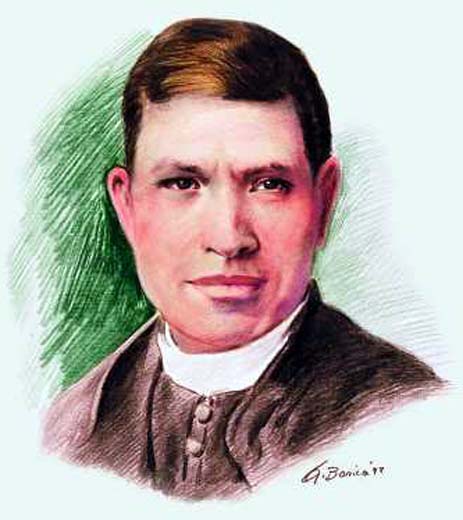
Bl José Pérez González
Bl Juan Antonio de Bengoa Larriñaga
St Laverius St Leonard of Port Maurice OFM (1676-1751) About St Leonard: https://anastpaul.com/2018/11/27/saint-of-the-day-27-november-st-leonard-of-port-maurice-ofm-1676-1751/
St Maximus of Reiz
St Primitivus of Sahagun
St Secundinus of Ireland
St Severinus the Hermit
St Siffred of Carpentras
St Valerian of Aquileia St Virgilius of Salzburg (c 700-784)
—
Martyrs of Antioch – (3 saints): A group of Christians martyred together for their faith. Little information has survived except for their names – Auxilius, Basileus and Saturninus.
Martyrs of Nagasaki – (11 beati): A group of eleven Christians martyred together for their faith during a period of official persecution in Japan. They are:
• Blessed Alexius Nakamura
• Blessed Antonius Kimura
• Blessed Bartholomaeus Seki
• Blessed Ioannes Iwanaga
• Blessed Ioannes Motoyama
• Blessed Leo Nakanishi
• Blessed Matthias Kozasa
• Blessed Matthias Nakano
• Blessed Michaël Takeshita
• Blessed Romanus Motoyama Myotaro
• Blessed Thomas Koteda Kyumi
They were martyred on 27 November 1619 in Nagasaki, Japan and Beatified on 7 May 1867 by Pope Pius IX.
Martyred in the Spanish Civil War:
• Blessed Bartolomé Gelabert Pericás
• Blessed Eduardo Camps Vasallo
• Blessed José Pérez González
• Blessed Juan Antonio de Bengoa Larriñaga
• Blessed Miguel Aguado Camarillo
• Blessed Pedro Armendáriz Zabaleta
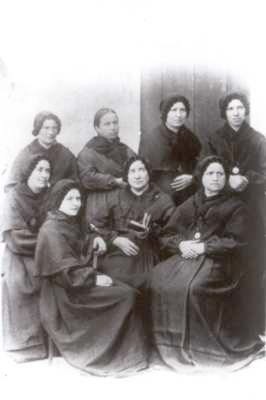
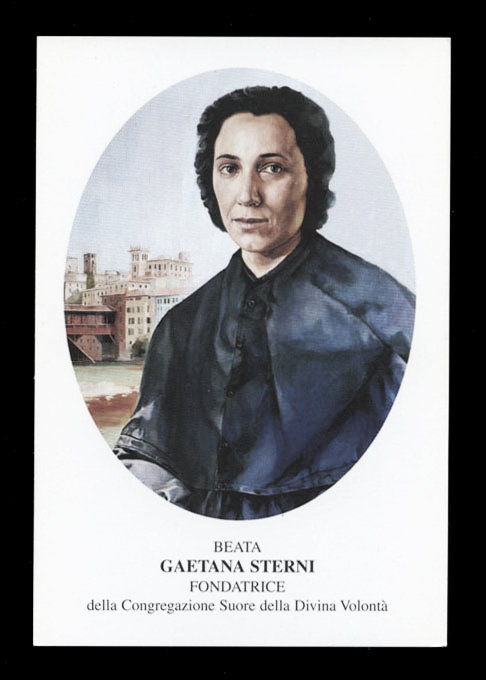
Saint of the Day – 26 November – Blessed Gaetana Sterni (1827-1889) Widow, Religious, Founder of the Sisters of Divine Will, of which Order she is the Patron. Apostle of charity. Born on 26 June 1827 at Cassola, Vicenza, Italy and died on 26 November 1889 of natural causes. Gaetana’s life became marred due to the deaths of close relations including her husband and sole child which prompted her to look towards an apostolate to aid others and to ease others’ sufferings. The order she founded was dedicated to total consecration to Jesus Christ and to an active apostolate of charitable works to the lowliest of all.
Gaetana Sterni lived her whole life in Bassano del Grappa, an ancient and cheerful city in the province of Vicenza (Italy). She arrived with her family, at 8 years of age, from the nearby Cassola, where she was born on the 26th June 1827. Her father Giovanni Battista Sterni, worked as administrator for the country property of the Mora, noble Venetians and lived comfortably in the Mora habitat with his wife Giovanna Chiuppani and their six children. In 1835 he moved with his family to Bassano. However, a series of unfortunate episodes were to change the conditions for the family of Gaetana, drastically. At 18 years of age her elder sister, Margherita, died and shortly after, following a grave illness, her father too died. In the meantime, her brother Francesco, with the aim of becoming an actor left the home and thus, left the family, in a dire financial situation.
These events left their mark on Gaetana, who was forced to grow up before her time, having to share with her mother, the many problems of day to day life. Being blessed with a good intelligence she showed herself to be sensitive and mature but also full of life “ desiring to love and be loved”.
Her religious education was solid and guided by the teachings of her mother, her prayers and her frequenting the church. She soon acquired in her environment, respect and appreciation for her radiant character, full of good sense and for her strong femininity. “Her delicate features and rare beauty” and her fascinating presence, soon attracted a young entrepreneur, Liberale Conte, a widower with three children who asked her to marry him.
After a deep analysis of her feelings and the responsibilities that she would have to assume and overcoming the opposition of her tutor, Gaetana accepted Liberale’s proposal. The young bride, who still hadn’t reached her sixteenth birthday, entered into her new home filling it with her vitality, giving back to her husband joy and serenity and loving his three children as if they were her own. When Gaetana discovered that she was expecting his child, the happiness of the couple was complete.
While she was praying, Gaetana was shaken by a premonition of the imminent death of her husband and felt as though she would “die of a broken heart” at the thought of losing he who was “more precious than life,” however, deep inside, she felt a strength that would keep her from despair and lead her to have faith in God with all her heart. Unfortunately, her premonition came true and Liberale, at the height of youth and health, after a brief illness, died. The young bride now found herself in terrible anguish for the loss of her husband, whom she loved more than herself, for the children who once again found themselves to be orphans and for her unborn child, who would never know it’s own father. She was completely destroyed by the pain but when she started coming back to her senses, she remembered the premonition that she had had and what she had felt. She once again found faith in the Lord, entrusting her life to Him. In Him she found the strength to live, to take care of the three children and to complete her pregnancy.
Unfortunately, even Gaetana’s child died just a few days after it’s birth. Here began years of bitter widowhood. The family of her husband did not appreciate the strong links that bound Gaetana to the orphans and many misunderstandings, suspicions and false rumours arose. Eventually, she was separated from the children and distanced from the house. At nineteen years of age she returned to the home of her mother. In spite of this ordeal and not thinking of herself, she helped the children to accept the difficult separation. Approachable but strong, she defended the rights of the children, forgave freely and obtained the full reconciliation and serenity of the two families. The suffering didn’t make her bitter and, through her natural sensitivity, she grew in her capacity for compassion and solidarity.
She never thought of entering into a religious order and looking into her future, she prayed, that the Lord would help her to understand who was the husband that God had destined to be hers. But it was through her prayers that she began to perceive clearly that God wanted to be “the only husband for her soul” and Gaetana was stunned. She confided to her holy confessor who confirmed that it was an authentic call to God. Consequently, she asked to enter the convent of the Canosians of Bassano and was accepted as a postulate. For five months she lived happily in the community but once again, in her prayers, she had a premonition that prepared her for the death of her mother, which then happened within a few days. Consequently she was forced to leave the convent to assume the responsibility of looking after her younger brothers. For years she faced difficulties, family illness, misfortunes and financial hardships. In spite of everything, she managed to create a way of life that permitted a continued spiritual devotion.
She confronted her confessor and prayed intensely as to know what was God’s will for her. Becoming more humble and prepared, she was ever more attentive to what He asked her in the depths of her heart and also through the happenings and needs of the poor of her city.
Whilst she was still with the Canosians and had the premonition of her mother’s death, Gaetana had also sensed that He was preparing her “to employ there all of herself in the service of the poor and thus fulfil His will.” She held this vocation hidden in her heart for a long time before finding the courage to talk about it with her confessor, because it seemed to her strange and terrible.
When at last she had told him, he seemed to give no weight to the idea. However whenever Gaetana saw a poor person “recovered”, she re-felt that invitation “I want you among my poor”, and said “the idea of the Recovery follows me constantly”. She was 26 years old when she was finally free from all obligations to her family and could at last do as she wished. Upon conclusion of a serious and shared discernment, it was a Jesuit, Fr . Bedin that confirmed to her, saying “yes Gaetana, the Lord wants you in the Recovery.” In 1853, “only to do the will of God”, Gaetana entered into the hospice for beggars, known as the Recovery, which in miserable conditions, cared for 115 guests “the large part victims of unruliness and vice” in whom “disorders and abuses of almost every type”.
She remained there for 36 years until her death and employed in this ministry all of herself with untiring charity. While watching over the beds of the dying and in the most humble service of the ill and the old, she treated all with the abnegation, the delicacy and gentleness of those who in recoveries serve the Lord. She was driven by a great faith in God, from the desire to be His and to please Him in everything. When she was 33 years old and with the consent of her confessor Don Simonetti, she took a vow of total devotion of herself to God, “ready to accept absolutely anything that the Lord might ask of her”.
With unlimited faith she gave herself into the hands of God, “weak instrument which He uses for His own purposes”. She attributed to providence, the birth of the congregation, that came from the simplicity and humility, with the profession of the first two companions in 1865.
First Daughters of the Divine Will
The name “Daughters of the Divine Will” suggested to the heart of Gaetana and the young women that followed her, indicated that which should define them “complete uniformity to the Divine Will through a total abandonment in God and a strong zeal for the well-being of one’s neighbour, ready to sacrifice anything in order to make them well.”
Like her, the first companions, driven by the same spirit, devoted themselves to the will of God, dedicating themselves to serve the poor in the Recovery and those in need, especially helping those who were ill at home and other acts of charity depending on the particular needs that arose. The Bishop of Vicenza, Saint Giovanni Antonio Farina (1803–1888), approved the first rules of the congregation in 1875.
Gaetana died on the 26th of November 1889 lovingly assisted by her daughters and venerated by her fellow citizens. Her mortal remains are venerated in the Mother House. Since the beginning the communities have multiplied and today the congregation is diffused in Europe, America and Africa.
The path to holiness that Gaetana followed is, for it’s essential nature a proposable itinerary for all Christians – to achieve in everything and always, that which pleases the Lord, trusting oneself to Him in enlightened confidence, to change, with only the force of love, all evil into good, in the manner of Jesus. … Vatican.va
Blessed Gaetana was Beatified on 4 November 2001 by St Pope John Paul II, after approval of the first miracle. At her Beatification St John Paul said:
“Blessed Gaetana Sterni, who learned that the will of God is always love, dedicated herself with untiring charity to the excluded and the suffering. She always treated her brothers and sisters with the kindness and love of the one who serves Christ in the poor. She urged her spiritual daughters, the Sisters of the Divine Will, “to be disposed and content to put up with privations, fatigue and any sacrifice to help your neighbour in need in all that the Lord might want of them”. The witness of evangelical charity that Blessed Sterni left us reminds each believer of the need to seek the will of God in confident abandonment to Him and in generous service to one’s brothers and sisters.”
Bl Albert of Haigerloch
St Alypius Stylites
St Amator of Autun
St Basolus of Verzy
St Bellinus of Padua
St Bertger of Herzfeld
St Conrad of Constance
St Ðaminh Nguyen Van Xuyên
Bl Delphine of Glandèves
St Egelwine of Athelney Bl Gaetana Sterni (1827-1889)
Bl Giacomo Alberione
Bl Hugh Taylor
St Humilis of Bisignano
St Ida of Cologne
St James the Hermit St Peter of Alexandria (Died 311) Martyr
Biography:
St Magnance of Ste-Magnance
St Marcellus of Nicomedia
Bl Marmaduke Bowes
St Martin of Arades
St Nicon of Sparta
Bl Pontius of Faucigny
St Sabaudus of Trier
St Siricius, Pope
St Stylianus
St Sylvester Gozzolini
St Tôma Ðinh Viet Du
St Vacz
—
Martyrs of Alexandria – 7+ saints: A group of approximately 650 Christian priests, bishops and laity martyred together in the persecution of Maximian Galerius. We have the names and a few details only seven of them – Ammonius, Didius, Faustus, Hesychius, Pachomius, Phileas and Theodore. The were born in Egypt and were martyred there in c 311 in Alexandria, Egypt.
Martyrs of Capua – 7 saints: A group of seven Christians martyred together. The only details about them to survive are the names – Ammonius, Cassianus, Felicissimus, Nicander, Romana, Saturnin and Serenus. They were martyred in Capua, Campania, Italy, date unknown.
Martyrs of Nicomedia – 6 saints: A group of six orthodox Christians martyred by Arians. Few details have survived except their names – Marcellus, Melisus, Numerius, Peter, Serenusa and Victorinus. Martyred in
349 in Nicomedia, Bithynia, Asia Minor (modern Izmit, Turkey)
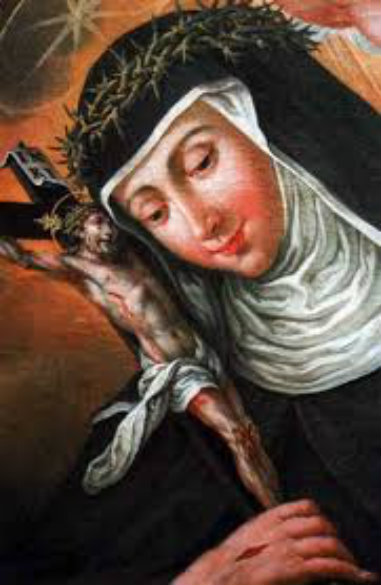
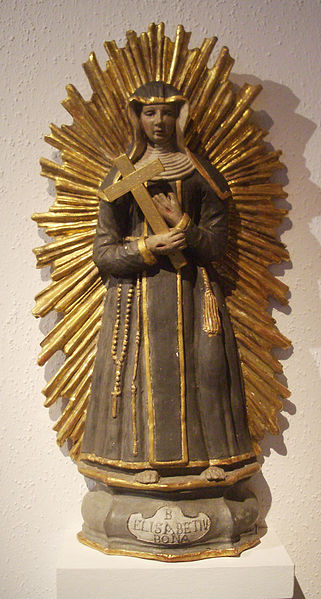
Saint of the Day – 25 November – Blessed Elisabeth Achler TOR (1386-1420) known as ” Blessed Elisabeth the Good” and Elizabeth of Reute, Betha, Elsbeth – Franciscan Tertiary Sister, Mystic, Stigmatist, Apostle of the Holy Eucharist, prayer and charity, gifted with the charism of prophecy – born on 25 November 1386 at Waldsee, Wurttemberg, Swabia, Germany and died on 25 November 1420 at Reute, Germany of natural causes. Patronage – Swabia, Germany.
Elisabeth was born on 25 November 1386 to Hans and Anna Achler in Waldsee in the region of Upper Swabia (a historic and linguistic region in Germany). She was raised in a pious home, hearing the Gospels explained to her by her mother in the form of stories, where she developed a strong devotion to the Passion of Christ.
She became a member of the Third Order of St Francis at the age of fourteen. Seeking to further her spiritual growth, she took as her confessor the provost of the local Canonry of St Peter in Waldsee, Dom Konrad Kügelin (1366-1428). Under his guidance, she and several other Franciscan tertiaries sought to follow a more intense experience of their Franciscan vocation. To this end, they acquired a house in Reute on the outskirts of Waldsee in 1403.
This community was a proto-monastery of the Order, as tertiaries of the mendicant orders had not yet been allowed to profess vows. Elisabeth threw herself into a life of prayer and service, working in the cloister kitchen and in the garden, where she would spend long hours in prayer.
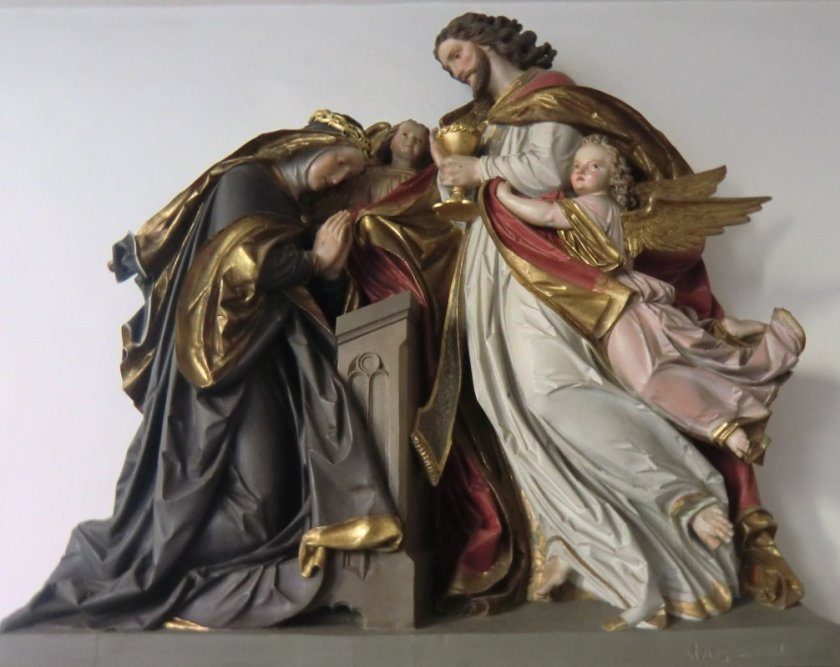
She was known for her hospitality to visitors to the little monastery, especially for her concern for the poor who came to the gate to beg. Her love of the Blessed Sacrament was so great that she lived the last twelve years of her life subsisting solely on the consecrated hosts.
Her head showed the marks of the crown of thorns worn by Christ and her body the marks of Christ’s scourging. Although the Stigmata only occasionally appeared on her hands, she always felt its pain. She was credited with the gift of prophecy foretelling the election of Pope Martin V and the end of the Great Western Schism. She died on her birthday in 1420.
She was buried in the parish church of Reute. A biography of her was written by Kügelin, her confessor and sent to the Bishop of Konstanz. However, popular veneration for Elisabeth occurred only after 1623, when her tomb was opened by the then-provost of Waldsee.
Miracles were attributed to her, which were compiled into a formal document by a contemporary canon, Heinrich Scheffler (d. 1635). Pope Clement XIII officially approved her cultus on 19 June 1766.
Her major shrine is at the Convent of the Franciscan Sisters of Reute, Bad Waldsee, Germany where her feast is celebrated today.
Bl Adalbert of Caramaico
St Alanus of Lavaur
St Audentius of Milan
St Bernold of Ottobeuren
Bl Conrad of Heisterbach
Bl Ekbert of Muensterschwarzach Bl Elisabeth Achler TOR (1386-1420)
St Erasmus of Antioch
Bl Garcia of Arlanza
Bl Guido of Casauria
St Imma of Wurzburg
Bl Jacinto Serrano López
St Jucunda of Reggio Aemilia
Bl Maria Corsini Beltrame Quattrocchi
St Mercurius of Caesarea
St Moses of Rome
Bl Santiago Meseguer Burillo
—
Martyrs of Africa – (13 saints): A group of 13 Christians murdered together for their faith in Africa, date unknown. The only details to have survived are their names – Claudian, Cyprian, Donatus, Felix, Januarius, Julian, Lucian, Marcian, Martialis, Peter, Quirianus, Victor and Vitalis.
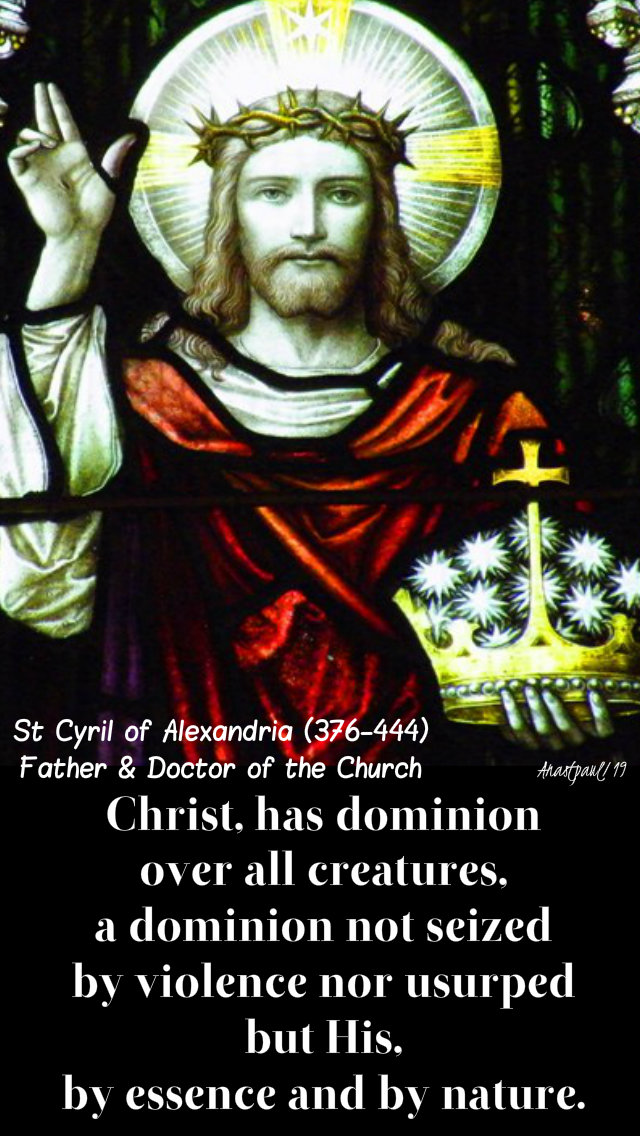
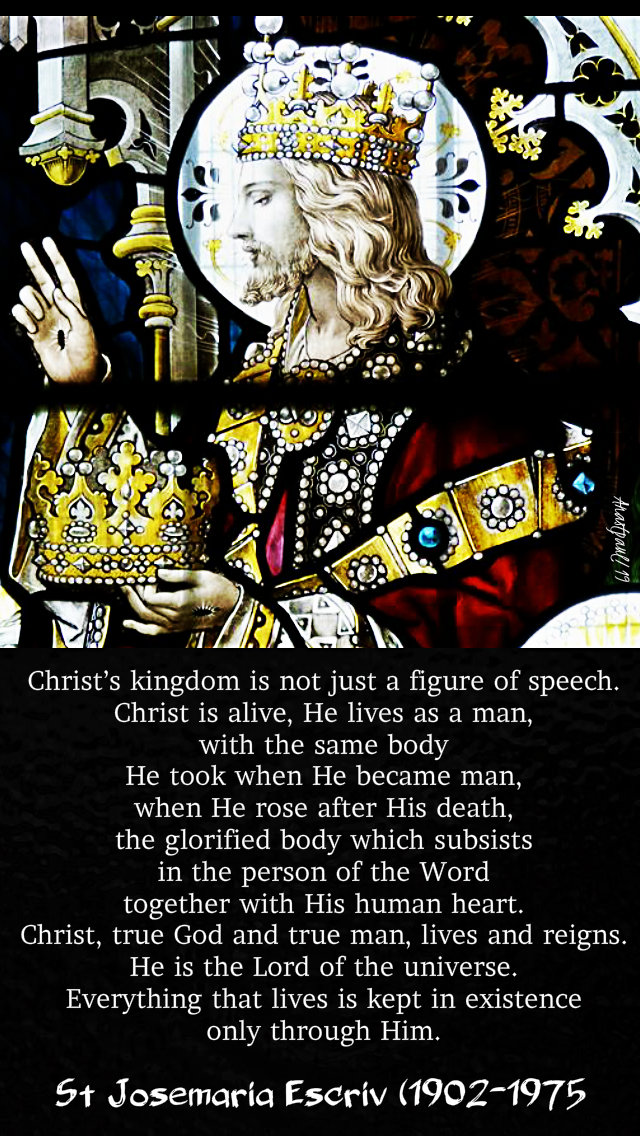
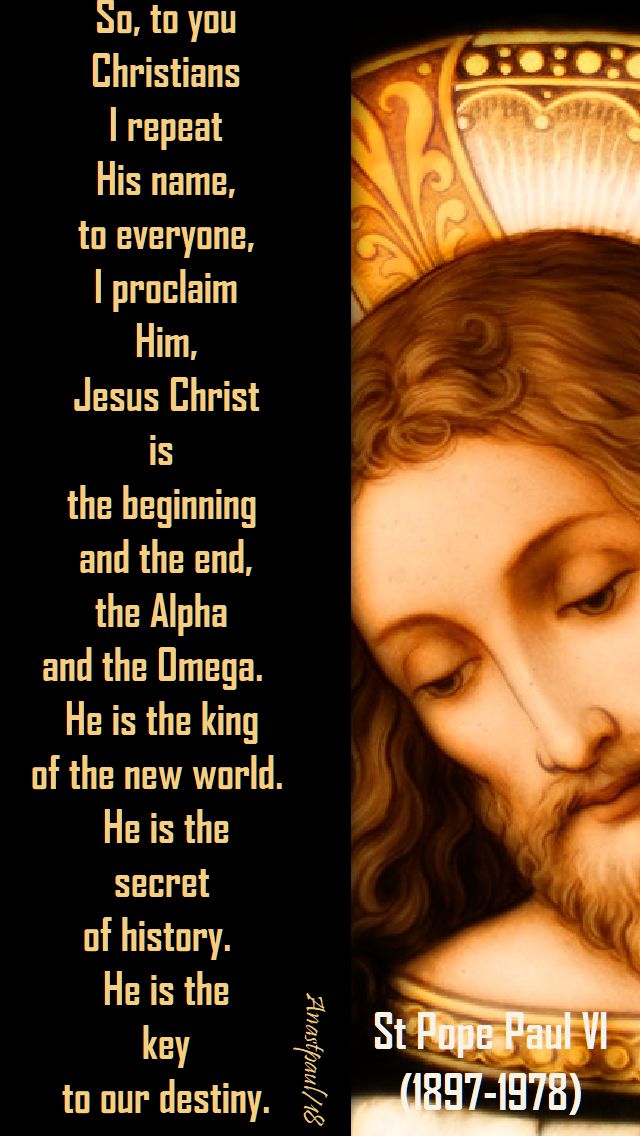
Quote/s of the Day – 24 November – The Solemnity of Christ the King
“Christ, has dominion over all creatures, a dominion not seized by violence nor usurped but His, by essence and by nature.”
St Cyril of Alexandria (376-444)
Father & Doctor of the Church
“Christ’s kingdom is not just a figure of speech. Christ is alive, He lives as a man, with the same body He took when He became man, when He rose after His death, the glorified body which subsists in the person of the Word together with His human heart. Christ, true God and true man, lives and reigns. He is the Lord of the universe. Everything that lives is kept in existence only through Him.”
St Josemaria Escrivá (1902-1975)
“Jesus Christ You have heard Him spoken of, indeed the greater part of you are already His – you are Christians. So, to you Christians I repeat His name, to everyone I proclaim Him – Jesus Christ is the beginning and the end, the Alpha and the Omega. He is the king of the new world. He is the secret of history. He is the key to our destiny.”
St Pope Paul VI (1897-1978)
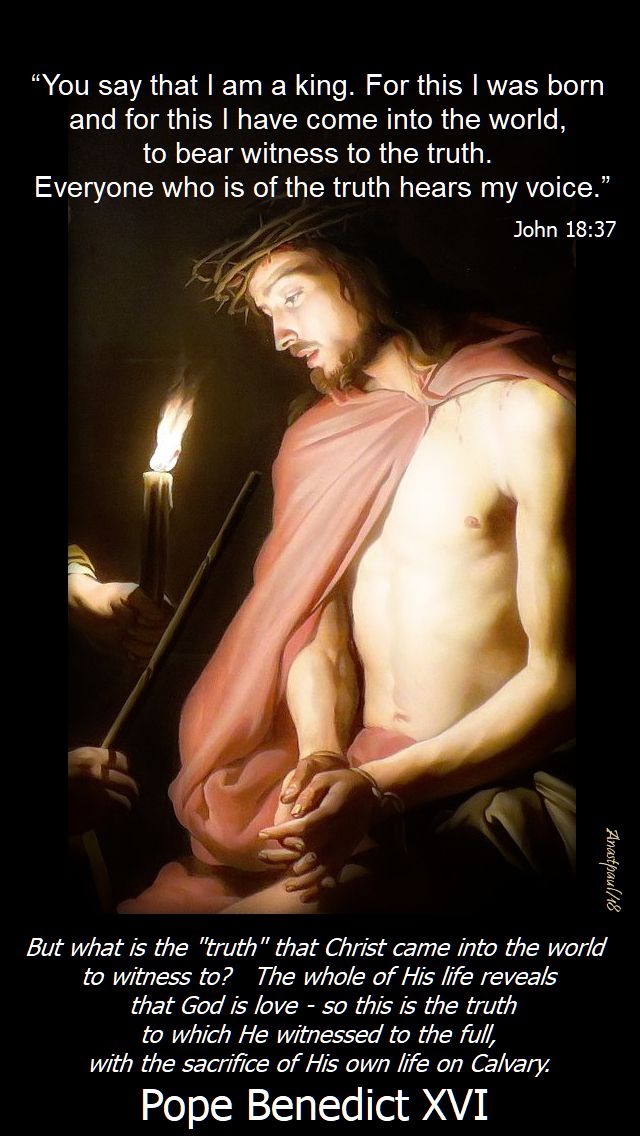
“You say that I am a king. For this I was born and for this I have come into the world, to bear witness to the truth. Everyone who is of the truth hears my voice.”
John 18:37
“But what is the “truth” that Christ came into the world to witness to? The whole of His life reveals that God is love – so this is the truth to which He witnessed to the full, with the sacrifice of His own life on Calvary.”
Pope Benedict XVI
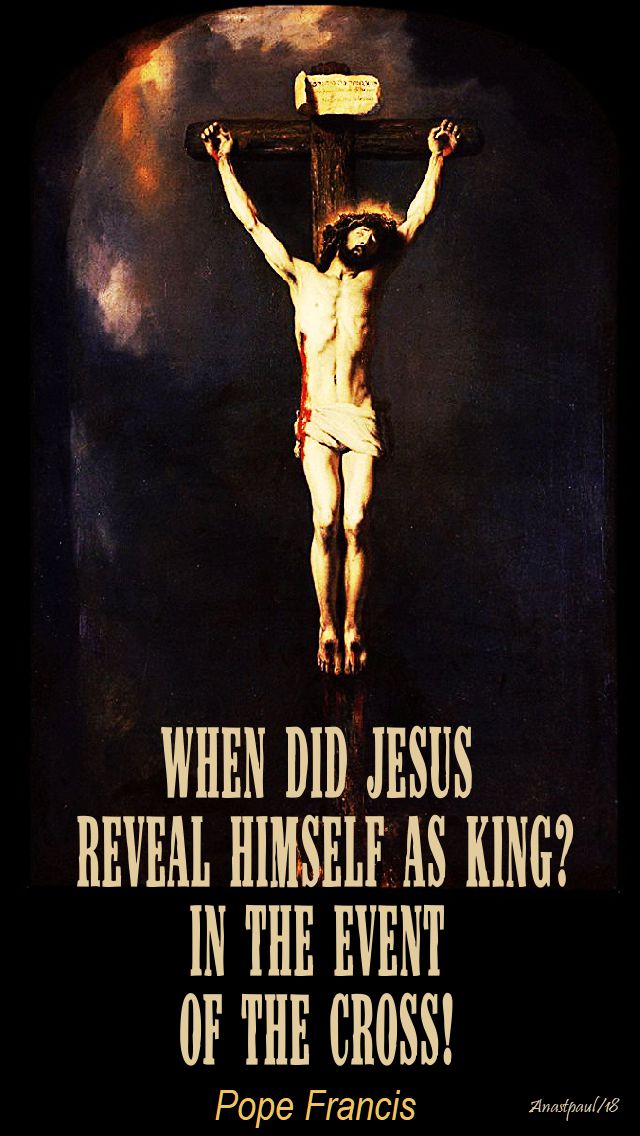
“When did Jesus reveal Himself as king? In the event of the Cross!”
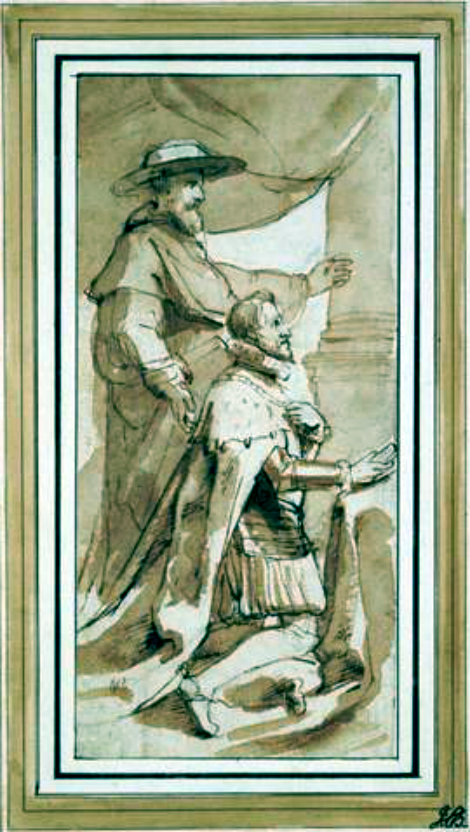
Saint of the Day – 24 November – St Albert of Louvain (1166-1192) Bishop, Cardinal and Martyr. Born in c 1166 in Brabant (in modern Belgium) and died by stabbing on 21 November 1192 on the road outside Rheims, France.
Archduke Albert with His Patron Saint, Albert of Louvain by Peter Paul Rubens (1640)
Albert de Louvain was born in 1166 as the second of two sons to Duke Godfrey III, Count of Leuven and his first wife Margareta van Limburg. He was the brother of Henry I, Duke of Brabant.
Albert was educated at the cathedral school of Saint-Lambert in Liège. Saint Albert of Louvain entered into religious life at the age of 12. However, he left the Canonric at the age of 21 to become a knight of Count Baldwin. In 1187, when news of the fall of Jerusalem reached Liege, Albert resigned his offices, took the cross and had himself knighted in order to become a Crusader. The following year Cardinal Henry of Albano, restored his ecclesiastical status, within the Church and he received the sub-diaconate in 1191. That same year he was elected Bishop of Liège and despite the fact that he had not reached the canonical age of 30, his appointment was widely approved. Gilbert of Mons, chancellor of Count Baldwin V of Hainaut, who attended the election, along with other princes and nobles, described the proceedings as a power struggle between Albert’s brother Henry and Baldwin.
Albert’s appointment was opposed by Baldwin, who had a second group of canons elect his own relative, Albert de Rethel. Albert took the matter to Rome and appealed to Pope Celestine III. In May 1192, Pope Celestine III made Albert a Cardinal and ordained him in Rome as a Deacon on 30 May 1192. He was then Ordained to the Priesthood on 19 September 1192 by Cardinal Guillaume de Champagne. He received episcopal Consecration the next day and celebrated his first Mass on 21 September in the Rheims Cathedral.
Albert met three German knights in 1192 who persuaded him to ride on horseback with them outside of Rheims. Outside of the city they attacked Albert with their swords and struck him on the head which crushed his skull and caused him to fall, where they made sure they killed him prior to making an escape.
The immediate reaction to the murder was an uprising of the princes of Lower Lorraine led by the dukes of Brabant and Limburg, brother and uncle respectively of the slain bishop. They formed a group that eventually came to include the archbishops of Cologne and Mainz and other princes and laid waste the territory of Dietrich of Hochstaden. Faced with the hostility of the people of Leige, Bishop-elect Lothar fled to the imperial court. He was excommunicated by Pope Celestine. The assassins, including one Otto of Barenste, fled to the imperial court, where Henry seems to have taken no particular action against them. Historians are divided as to the part the Emperor may or may not have played in planning the murder of the Bishop Albert.
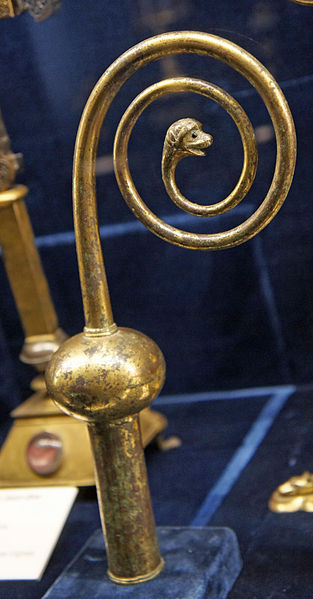
The reputation of the holiness of Albert de Louvain soon spread after his death and was hailed as a Martyr, thus, leading to the opening of his cause for Canonisation. Pope Paul V Canonised him on 9 August 1613 and instituted his feast day as the date of his death. His body reposed at Rheims until 1921, when it was moved to Brussels. Below is an image of his Crozier which is kept at his shrine in Brussels.
St Albert’s life was written around 1194 or 1195 by an anonymous monk of Lobbes, from information supplied by Abbot Werrich, who knew Albert well.
St Cardinal Albert of Louvain (1166-1192) Bishop and Martyr
St Alexander of Corinth
St Balsamus of Cava
St Bieuzy of Brittany
St Chrysogonus
St Colman of Cloyne
Bl Conrad of Frisach
St Crescentian of Rome
St Eanfleda of Whitby
St Felicissimus of Perugia
St Félix Alonso Muñiz
St Firmina of Amelia
St Flora of Cordoba
St Francisco Borrás Román
St Hitto of Saint-Gall
St Kenan of Damleag
St Leopardinus of Vivaris
Bl Maria Anna Sala
St Marinus of Maurienne
St Mary of Cordoba
St Phêrô Võ Ðang Khoa
St Pierre Rose Ursule Dumoulin Borie
St Portianus of Miranda
St Protasius of Milan
St Romanus of Le Mans
St Vinh-son Nguyen The Ðiem
—
Martyred in the Spanish Civil War – Martyred Carmelite Sisters of Valencia – 12 beati:
• Blessed Antonia Gosens Sáez De Ibarra
• Blessed Cándida Cayuso González
• Blessed Clara Ezcurra Urrutia
• Blessed Concepción Rodríguez Fernández
• Blessed Daría Campillo Paniagua
• Blessed Erundina Colino Vega
• Blessed Feliciana de Uribe Orbe
• Blessed Félix Alonso Muñiz
• Blessed Francisco Borrás Román
• Blessed Justa Maiza Goicoechea
• Blessed María Concepción Odriozola Zabalía
• Blessed María Consuelo Cuñado González
• Blessed Niceta Plaja Xifra
• Blessed Paula Isla Alonso
Thought for the Day – 23 November – The Memorial of Blessed Miguel Pro – Priest and Martyr of the Cristero War (1891-1927)
“You have not only my forgiveness but my thanks.”
Often Our Lord gives His saints a premonition that the curtain is soon to close on their earthly pilgrimage.
Back in September, when he was beginning his Mass for a community of nuns, he asked the angelic flock to pray that God would accept his life as a victim for priests and for the welfare of the Mexican Church. One of the nuns present, noted, that during the Mass he was totally transported and bathed in tears the whole time they were chanting. At the end of the Holy Sacrifice, he mentioned to someone in the community, “I know not whether it is mere imagination or has actually occurred but I feel clearly,. that Our Lord has evidently accepted my offering.”
One could almost see his mother smiling down upon him from Heaven and repeating those words she had answered him when he was a little boy, “May God hear you, child. But that is too great a happiness for me.”
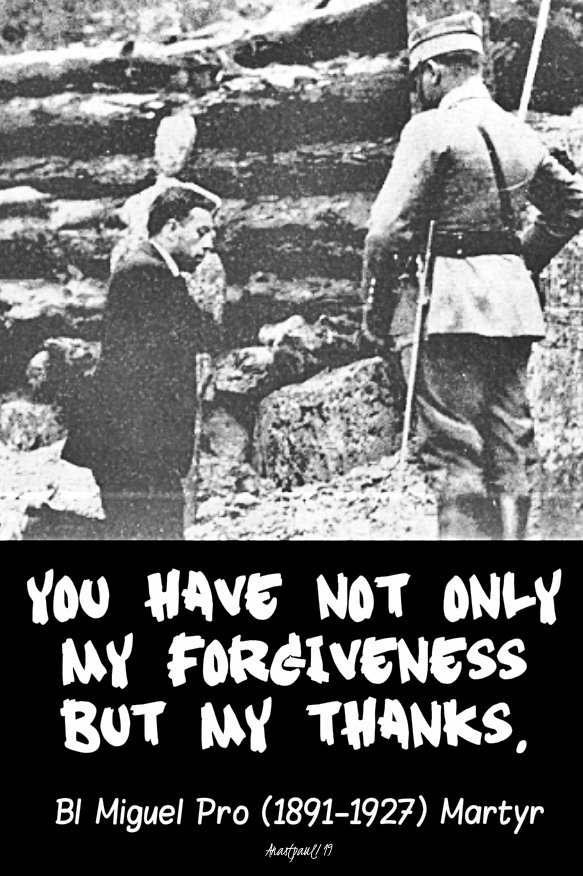
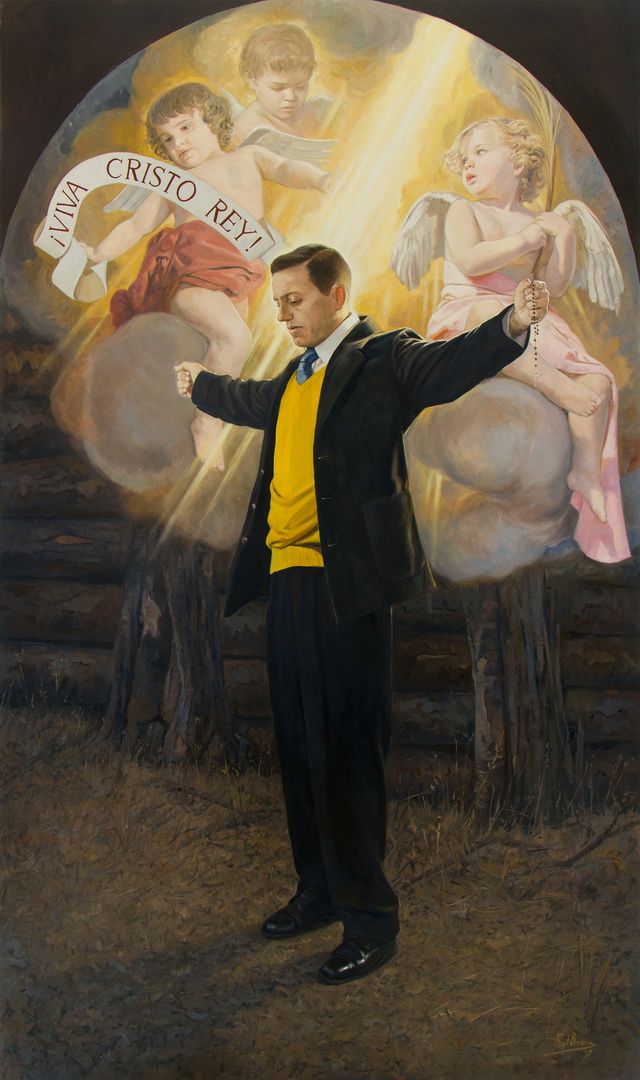
One of the officers who had captured Father Pro led him out of jail to be executed. He begged Father to forgive him. Miguel put his arm around him and said, “You have not only my forgiveness but my thanks.”He also softly told the firing squad, “May God forgive you all.”Then with arms spread as if on a cross, Father Pro shouted, “Viva Cristo Rey – Long live Christ the King!” before a bullet silenced him.
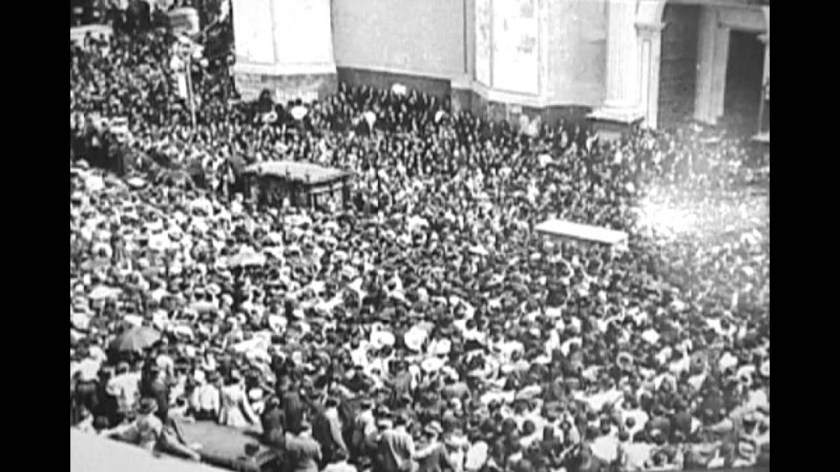
Although the real criminal and one of Miguel’s brothers were also shot, the other brother was pardoned at the last moment. Despite the government’s ban on a public funeral, thousands came to Father Pro’s wake, for the ‘Blood of the Martyrs, is the seedbed of Faith!’
When Fr Miguel Pro was executed in 1927, no one could have predicted that 52 years later the bishop of Rome would visit Mexico, be welcomed by its president and celebrate open-air Masses before thousands of people. St Pope John Paul II made additional trips to Mexico in 1990, 1993, 1999, and 2002. Those who outlawed the Catholic Church in Mexico did not count on the deeply rooted faith of its people and the willingness of many of them, like Miguel Pro, to die as martyrs.
Quote/s of the Day – 23 November – The Memorial of Blessed Miguel Pro – Priest and Martyr of the Cristero War (1891-1927)
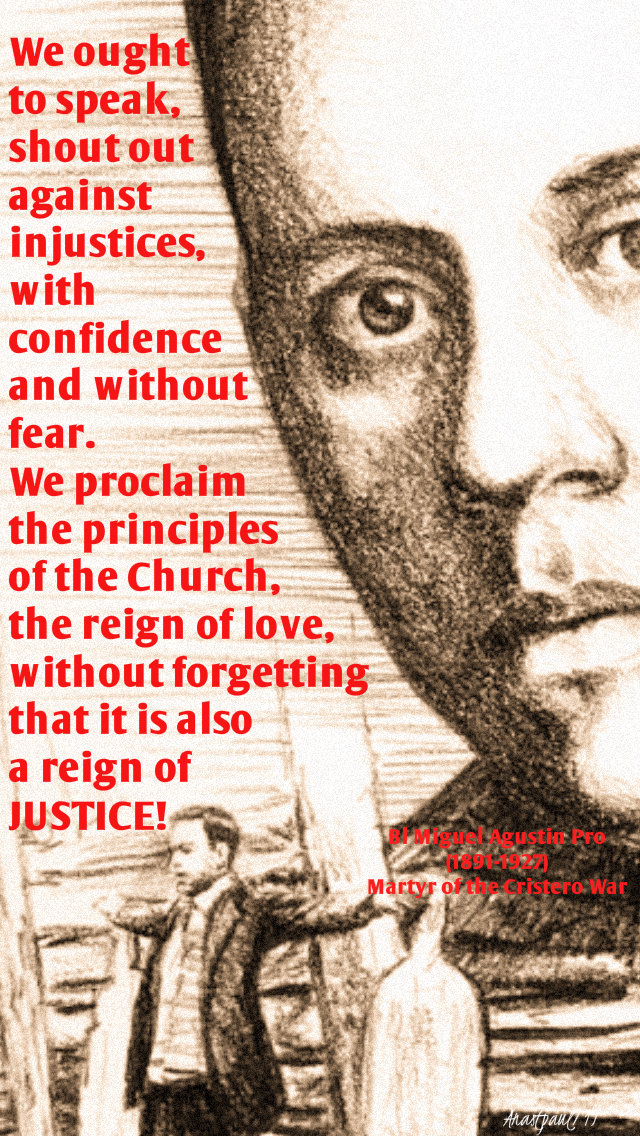
“We ought to speak, shout out against injustices, with confidence and without fear. We proclaim the principles of the Church, the reign of love, without forgetting that it is also a reign of JUSTICE!”
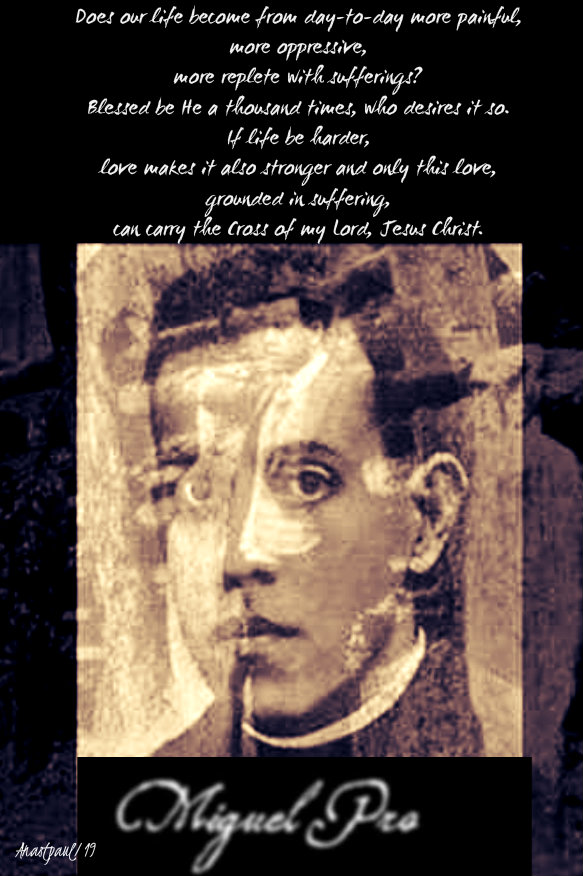
“Does our life become from day-to-day more painful, more oppressive, more replete with sufferings? Blessed be He a thousand times, who desires it so. If life be harder, love makes it also stronger and only this love, grounded in suffering, can carry the Cross of my Lord, Jesus Christ.”
After he had taken his vows in the Society, he recorded the following meditations in his spiritual notebook. The booklet was entitled My Treasure. The words speak for themselves:
“Deceitful are the ephemeral pleasures and joys of this world. Our supreme comfort in this life, is to die to the world that we may live with Jesus crucified. Let others seek gold and other earthly treasures. I already possess the immortal treasure of holy poverty on the Cross of Jesus crucified. The angelic virtue, growing like a pure, fragrant lily in the hidden beauteous garden of the cloister, adorns the forehead with heavenly tints, for it has roots in the Cross of Jesus crucified. A third crown completes my oblation, it is the seal of glory, whereby the obedient, spotless Lamb gained victory. Obedience is the secure science of living with Jesus crucified. With this triple treasure, I can hope to pass beyond the fleeting confines of mortal man, by living poor on this earth and rich in heaven, united with Jesus crucified.”
One Minute Reflection – 23 November – Saturday of the Thirty Third Week in Ordinary Time, Year C, Gospel: Luke 20:27–40 and the Memorial of Blessed Miguel Pro – Martyr (1891-1927)
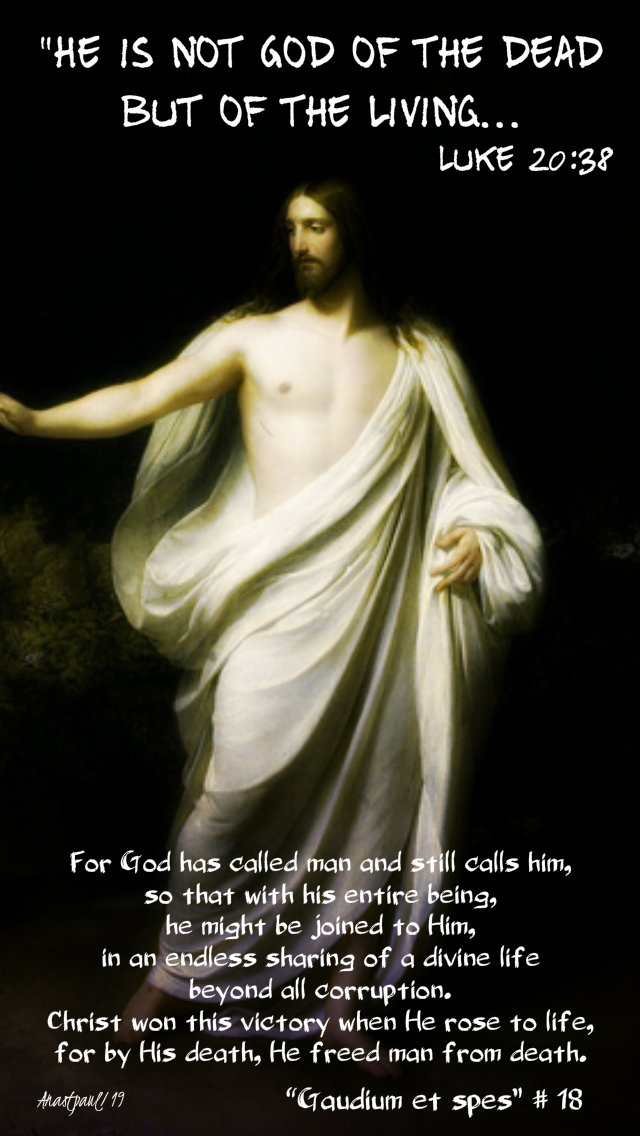
“He is not God of the dead but of the living…” … Luke 20:38
REFLECTION – “It is in the face of death that the riddle a human existence grows most acute. Not only is man tormented by pain and by the advancing deterioration of his body but even more so, by a dread of perpetual extinction. He rightly follows the intuition of his heart when he abhors and repudiates the utter ruin and total disappearance of his own person. He rebels against death because he bears in himself an eternal seed which cannot be reduced to sheer matter. All the endeavours of technology, though useful in the extreme, cannot calm his anxiety; for prolongation of biological life is unable to satisfy that desire for higher life, which is inescapably lodged in his breast.
Although the mystery of death, utterly beggars the imagination, the Church has been taught by divine revelation and firmly teaches, that man has been created by God for a blissful purpose beyond the reach of earthly misery. In addition, that bodily death from which man would have been immune had he not sinned, will be vanquished, according to the Christian faith, when man, who was ruined by his own doing, is restored to wholeness, by an almighty and merciful Saviour. For God has called man and still calls him, so that with his entire being, he might be joined to Him, in an endless sharing of a divine life beyond all corruption. Christ won this victory when He rose to life, for by His death, He freed man from death. Hence to every thoughtful man, a solidly established faith, provides the answer to his anxiety about what the future holds for him. At the same time, faith gives him the power to be united in Christ with his loved ones who have already been snatched away by death, faith arouses the hope, that they have found true life with God.” … Vatican Council II – Constitution on the Church in the modern world “ Gaudium et spes ” # 18
PRAYER – O God, source and origin of all fatherhood, who kept the Martyr, Blessed Miguel Pro, faithful to the Cross of Your Son, even to the shedding of his blood, grant, through his intercession, that, spreading Your love among our brothers and sisters, we may be Your children both in name and in truth and thus come to our resurrection with Jesus Christ, Your Son. Through our Lord Jesus Christ, Who lives and reigns with You in the unity of the Holy Spirit, one God, forever and ever, amen.
Our Morning Offering – 23 November – The Memorial of Blessed Miguel Pro – Martyr (1891-1927)
Heart Of Jesus By Blessed Miguel Pro – Martyr (1891-1927)
I believe, O Lord
but strengthen my faith,
Heart of Jesus, I love Thee
but increase my love.
Heart of Jesus, I trust in Thee,
but give greater vigour
to my confidence.
Heart of Jesus,
I give my heart to Thee,
but so enclose it in Thee
that it may never
be separated from Thee.
Heart of Jesus, I am all Thine,
but take care of my promise
so that I may be able
to put it into practice even unto
the complete sacrifice of my life.
Amen
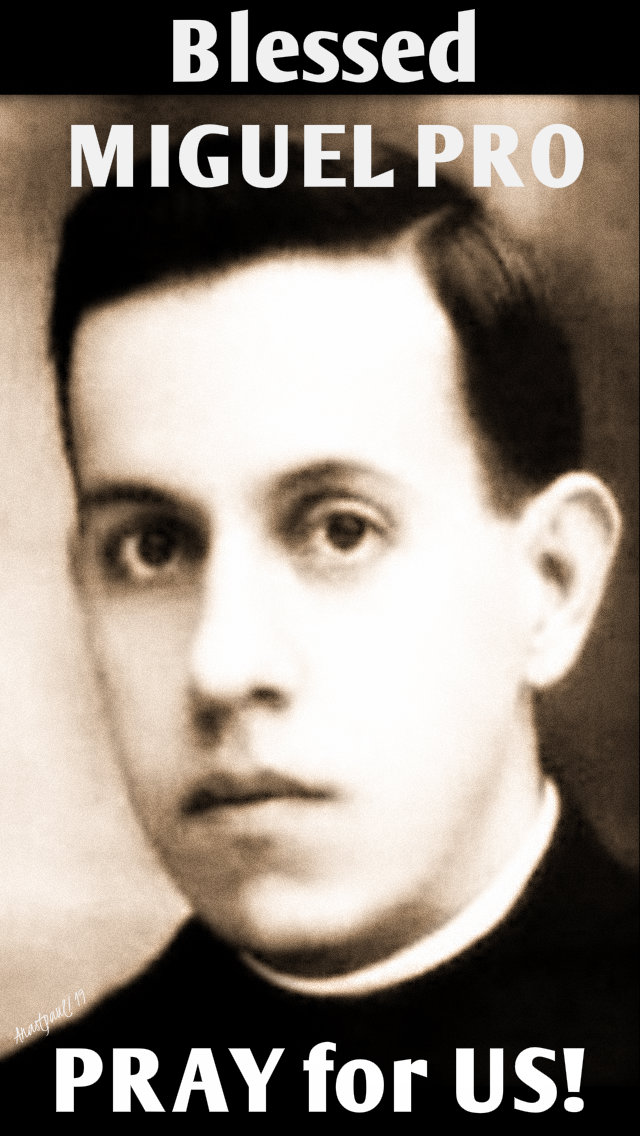
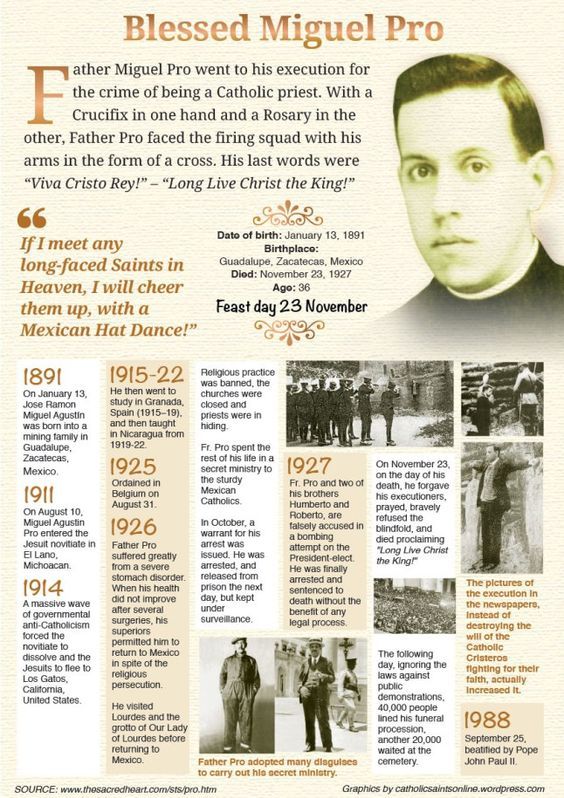
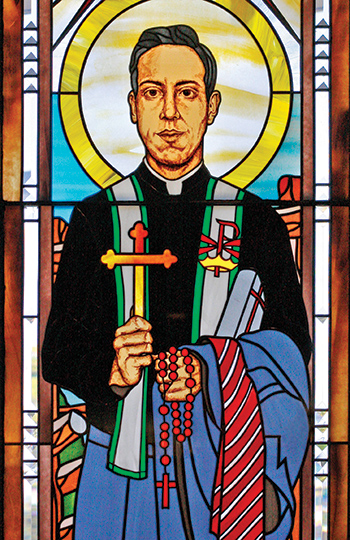
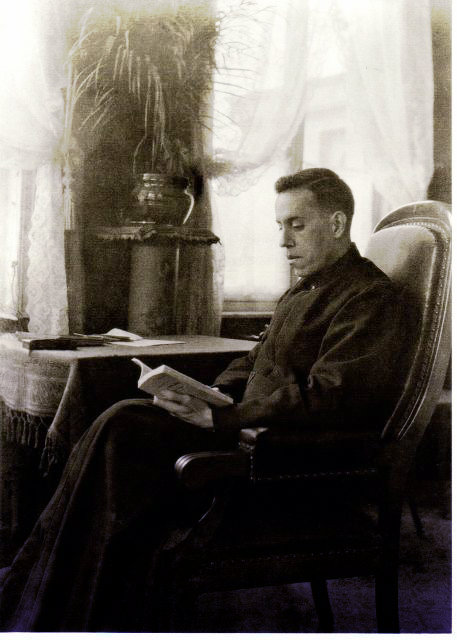
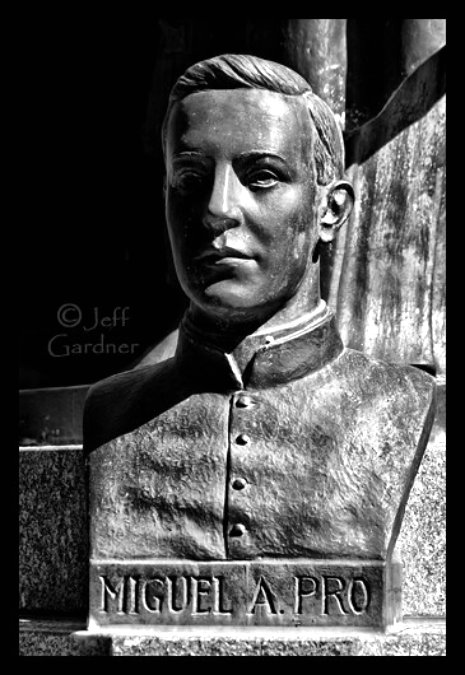
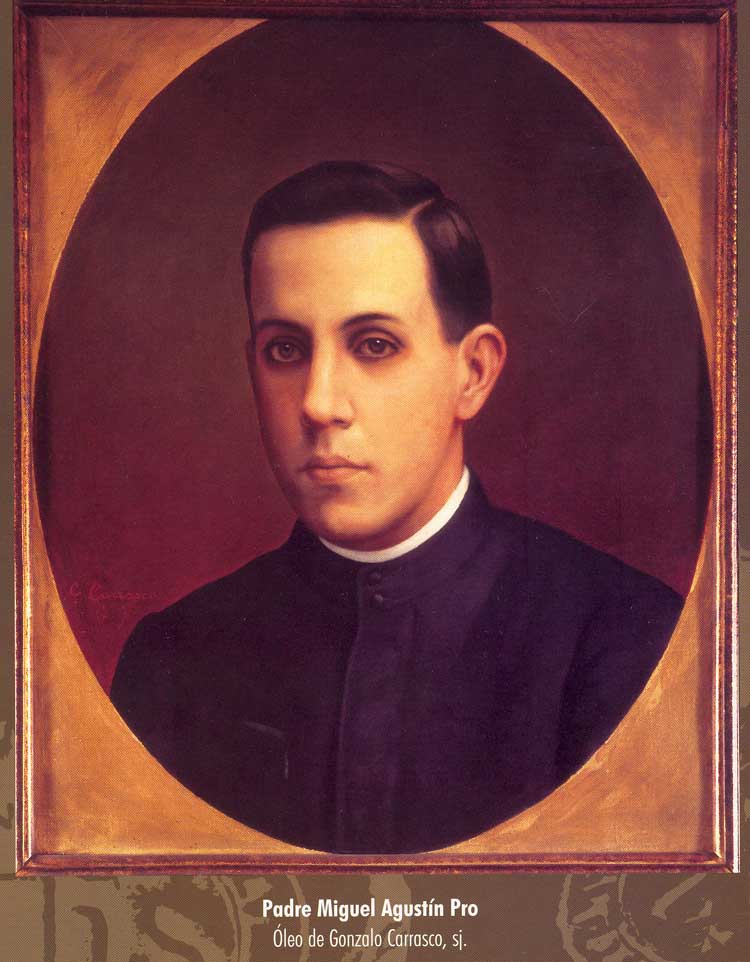
Saint of the Day – 23 November – Blessed Miguel Agustin Pro SJ (1891 – 1927) Priest and Martyr of the Cristero War, Jesuit – known as “Cocol” – born José Ramón Miguel Agustín Pro Juárez on 13 January 1891 in Guadalupe, Zacatecas, Mexico and died by being shot by firing squad on 23 November 1927 in Mexico City, Mexico. He was 36 years old.
Don Miguel and his wife were the happy parents of eleven children. Miguel Jr, was the third born. Four died in infancy. The two eldest, Maria de la Concepcion and Maria de la Luz, became Sisters of the Good Shepherd. Two of the boys, Miguel and his younger brother Humberto, were martyred. The rest of the children, Ana Maria, Edmundo Jose, and Roberto married. Since a young age, he was called “Cocol” as a nickname.
One of his companions, Pulido, said that he “had never seen such an exquisite wit, never coarse, always sparkling.” He was noted for his charity and ability to speak about spiritual subjects without boring his audience. Pulido remarked, that there were two Pros – the playful Pro and the prayerful Pro. He was known for the long periods he spent in the chapel.
Long-time President of Mexico Porfirio Díaz was ousted in 1911 after staging a rigged re-election and a struggle for power – the Mexican Revolution – began.
He entered the Jesuit novitiate at El Llano on 15 August 1911 and studied in Mexico until 1914 when a massive wave of governmental anti-Catholicism forced the novitiate to dissolve and the Jesuits to flee to Los Gatos, California, in the United States. He then went to study in Granada, Spain (1915–19) and from 1919 to 1922 taught in Nicaragua.
For his theological studies Pro was sent to Enghien, Belgium, where the French Jesuits (also in exile) had their faculty of Theology. His health continued to deteriorate. There he was ordained a priest on 31 August 1925. He wrote on that occasion: “How can I explain to you the sweet grace of the Holy Spirit, which invades my poor miner’s soul with such heavenly joys? I could not hold back the tears on the day of my ordination, above all at the moment when I pronounced, together with the bishop, the words of the consecration. After the ceremony the new priests gave their first blessing to their parents. I went to my room, laid out all the photographs of my family on the table and then blessed them from the bottom of my heart.”
His first assignment as a priest was to work with the miners of Charleroi, Belgium. Despite the socialist, communist and anarchist tendencies of the workers, he was able to win them over and preach the Gospel to them.
Three months after ordination, he was forced to undergo several operations for ulcers. He remained cheerful and courageous, explaining that the source of his strength was his prayer.
In summer 1926 – his studies in Europe completed – Pro returned to Mexico. On the way he visited Lourdes where he celebrated Mass and visited the grotto of Our Lady of Lourdes.
He arrived at Veracruz on 8 July 1926. Plutarco Elías Calles was now president of Mexico. Unlike his predecessors, Calles vigorously enforced the anti-Catholic provisions of the 1917 constitution, implementing the so-called Calles Law, which provided specific penalties for priests who criticised the government (five years’ imprisonment) or wore clerical garb in certain situations outside their churches (500 pesos). This law went into effect on 31 July 1926.
By this time, some states, such as Tabasco under the notorious anti-Catholic Tomás Garrido Canabal, had closed all the churches and cleared the entire state of serving priests, killing many of them, forcing a few to marry and the remaining few serving covertly at risk of their lives. On his return, Fr Miguel served a Church which was forced to go “underground.” He celebrated the Eucharist clandestinely and ministered the other sacraments to small groups of Catholics. Details of Pro’s ministry in the underground church come from his many letters, signed with the nickname Cocol. In October 1926, a warrant for his arrest was issued. He was arrested and released from prison the next day but kept under surveillance.
A failed attempt to assassinate Álvaro Obregón, which only wounded him, in November 1927, provided the state with a pretext for arresting Pro again, this time with his brothers Humberto and Roberto. A young engineer who confessed his part in the assassination testified that the Pro brothers were not involved. Miguel and his brothers were taken to the Detective Inspector’s Office in Mexico City.
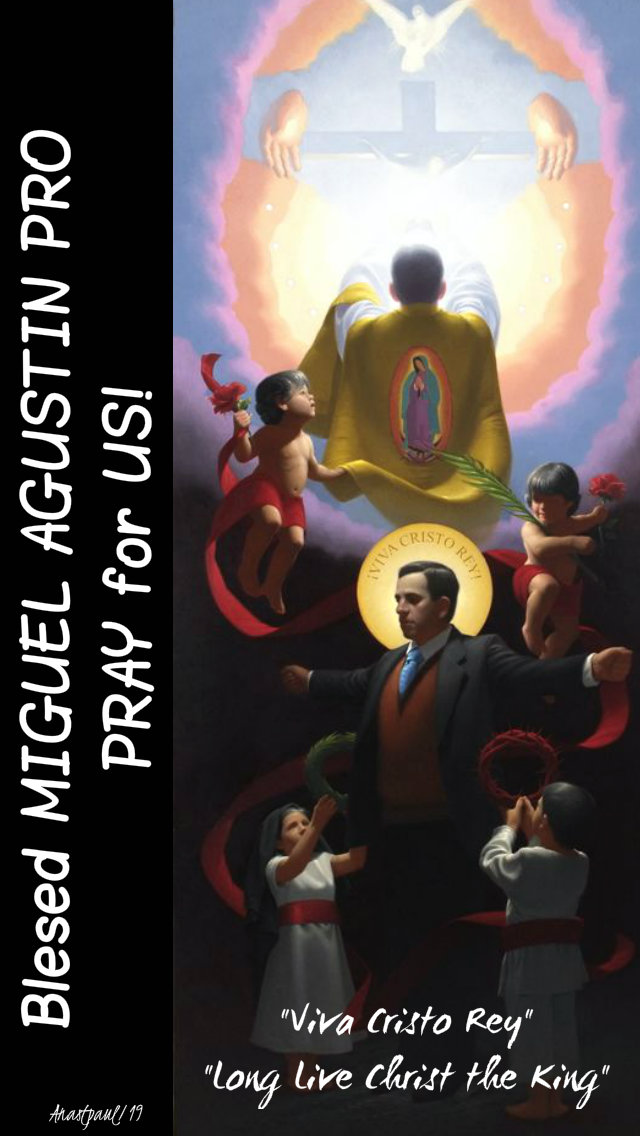
President Calles gave orders to have Pro executed for the assassination attempt. Pro and his brothers were visited by Generals Roberto Cruz and Palomera Lopez around 11 p.m. on 22 November 1927. The next day, as Pro walked from his cell to the courtyard and the firing squad, he blessed the soldiers, knelt and briefly prayed quietly. Declining a blindfold, he faced his executioners with a crucifix in one hand and a rosary in the other and held his arms out in imitation of the crucified Christ and shouted out, “May God have mercy on you! May God bless you! Lord, Thou knowest that I am innocent! With all my heart I forgive my enemies!”Before the firing squad was ordered to shoot, Pro raised his arms in imitation of Christ and shouted the defiant cry of the Cristeros, “Viva Cristo Rey!” – “Long live Christ the King!”.
When the initial shots of the firing squad failed to kill him, a soldier shot him at point-blank range.
This slideshow requires JavaScript.
Calles had the execution meticulously photographed and the newspapers throughout the country carried photos on the front page the following day. Presumably, Calles thought that the sight of the pictures would frighten the Cristero rebels who were fighting against his troops, particularly in the state of Jalisco. However, they had the opposite effect.
Calles is reported to have looked down upon a throng of 40,000 who lined Pro’s funeral procession. Another 20,000 waited at the cemetery where he was buried without a priest present, his father saying the final words. The Cristeros became more animated and fought with renewed enthusiasm, many of them carrying the newspaper photo of Pro before the firing squad.
At Pro’s Beatification in Saint Peter’s Square on 25 September 1988, St Pope John Paul II said:
“Neither suffering nor serious illness, nor the exhausting ministerial activity, frequently carried out in difficult and dangerous circumstances, could stifle the radiating and contagious joy which he brought to his life for Christ and which nothing could take away. Indeed, the deepest root of self-sacrificing surrender for the lowly was his passionate love for Jesus Christ and his ardent desire to be conformed to Him, even unto death.”
This portrait of Blessed Miguel resides in the La Sagrada Familia Basilica in Barcelona, Spain
Bl Miguel Agustin Pro SJ (1891 – 1927) Priest and Martyr (Optional Memorial)
—
St Adalbert of Casauria
St Alexander Nevski
St Amphilochius of Iconium
St Augusta of Alexandria
St Cecilia Yu Sosa
St Clement of Metz
Bl Detlev of Ratzeburg
Bl Enrichetta Alfieri
St Falitrus of Chabris
St Faustina of Alexandria
Bl Felícitas Cendoya Araquistain
St Felicity of Rome
St Gregory of Girgenti
Bl Guy of Casauria
St Jaume Nàjera Gherna
St Loëvan of Brittany
St Lucretia of Mérida
Bl Margaret of Savoy
St Mustiola of Chiusi
St Paternian of Fano
St Paulinus of Whitland
St Rachildis of Saint-Gall
St Severin of Paris
St Sisinius of Cyzicus
St Trudo of Hesbaye
St Wilfetrudis of Nivelless
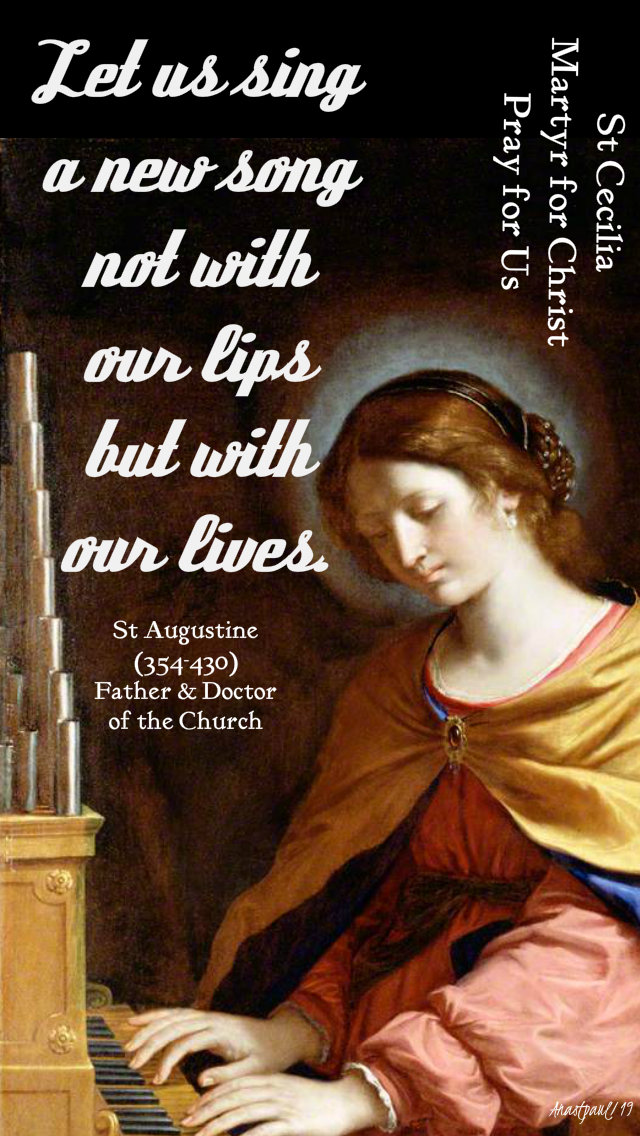
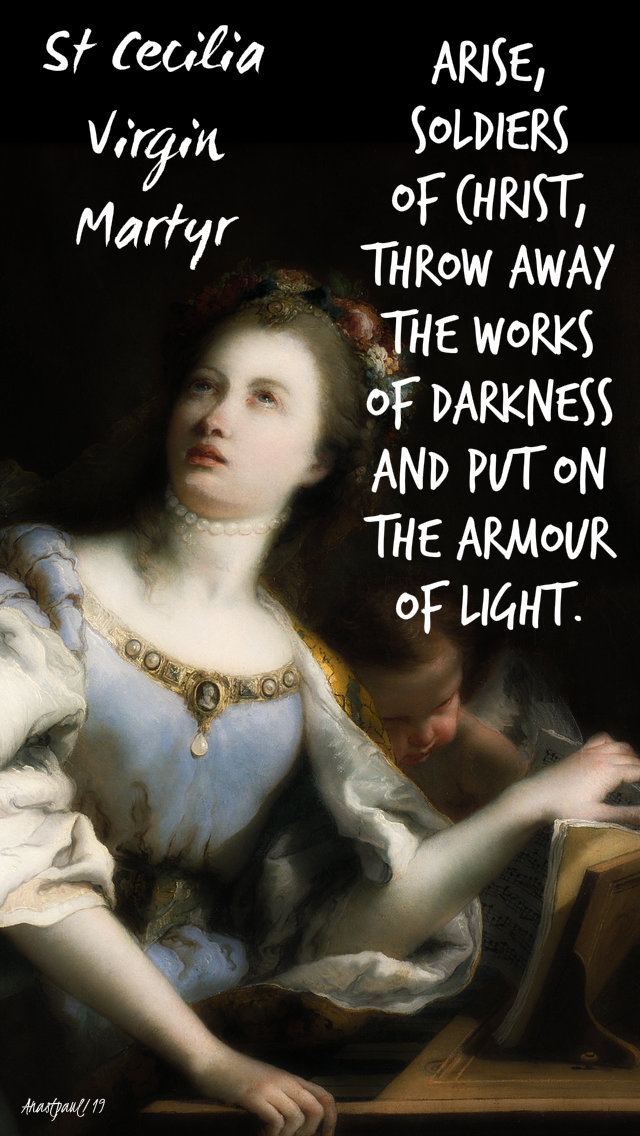
Thought for the Day – 22 November – The Memorial of St Cecilia (died 3rd Century) Virgin Martyr – Patron of Musicians
Sing to God with Songs of Joy
Saint Augustine (354-430)
Bishop and Great Western Father & Doctor of the Church
An excerpt from his Discourse on Psalm 32
Praise the Lord with the lyre, make melody to Him with the harp of ten strings! Sing to Him a new song. Rid yourself of what is old and worn out, for you know a new song. A new man, a new covenant—a new song. This new song does not belong to the old man. Only the new man learns it, the man restored from his fallen condition through the grace of God and now sharing in the new covenant, that is, the kingdom of heaven. To it all our love now aspires and sings a new song. Let us sing a new song not with our lips but with our lives.
Sing to Him a new song, sing to Him with joyful melody. Everyone of us tries to discover how to sing to God. You must sing to Him but you must sing well. He does not want your voice to come harshly to His ears, so sing well, brothers!
If you were asked, “Sing to please this musician,” you would not like to do so without having taken some instruction in music, because you would not like to offend an expert in the art. An untrained listener does not notice the faults a musician would point out to you. Who, then, will offer to sing well for God, the great artist whose discrimination is faultless, whose attention is on the minutest detail, whose ear nothing escapes? When will you be able to offer Him a perfect performance that you will in no way displease such a supremely discerning listener?
See how He Himself provides you with a way of singing. Do not search for words, as if you could find a lyric which would give God pleasure. Sing to Him “with songs of joy.” This is singing well to God, just singing with songs of joy.
But how is this done? You must first understand that words cannot express the things that are sung by the heart. Take the case of people singing while harvesting in the fields or in the vineyards or when any other strenuous work is in progress. Although they begin by giving expression to their happiness in sung words, yet shortly there is a change. As if so happy that words can no longer express what they feel, they discard the restricting syllables. They burst out into a simple sound of joy, of jubilation. Such a cry of joy is a sound signifying that the heart is bringing to birth what it cannot utter in words.
Now, who is more worthy of such a cry of jubilation than God Himself, whom all words fail to describe? If words will not serve and yet you must not remain silent, what else can you do but cry out for joy? Your heart must rejoice beyond words, soaring into an immensity of gladness, unrestrained by syllabic bonds. Sing to Him with jubilation.
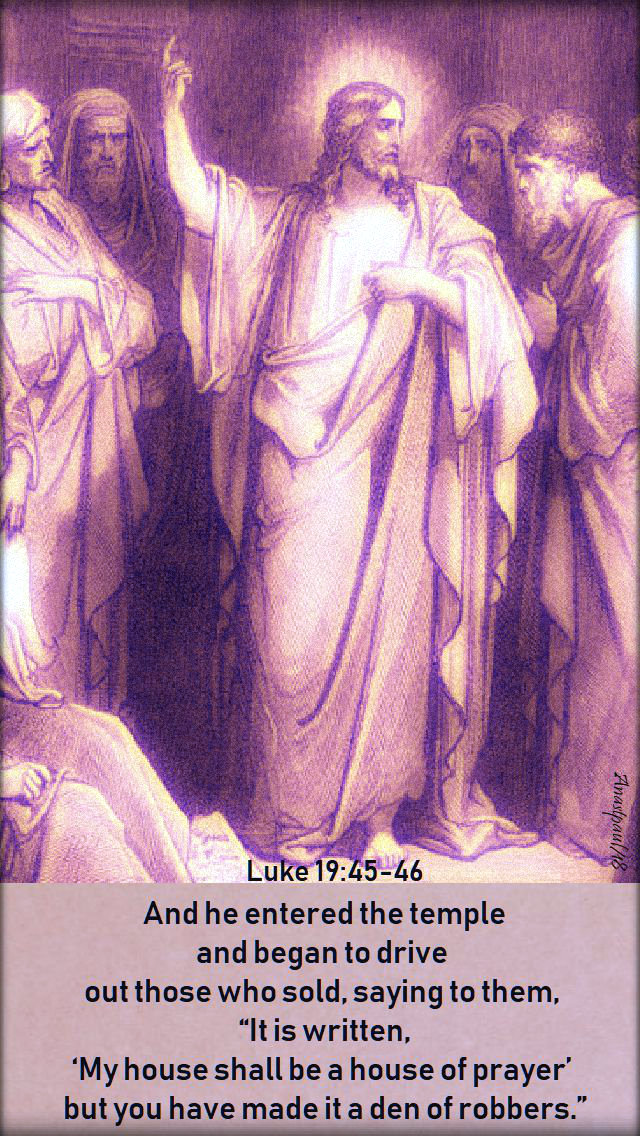
One Minute Reflection – 22 November – Gospel: Luke 19:45–48 – Friday of the Thirty Third week in Ordinary Time, Year C, Gospel: Luke 19:45–48 – and the Memorial of St Pedro Esqueda Ramirez (1887-1927) Priest, Martyr of the Cristero War
And he entered the temple and began to drive out those who sold, saying to them, “It is written, ‘My house shall be a house of prayer’ but you have made it a den of robbers.”…Luke 19:45-46
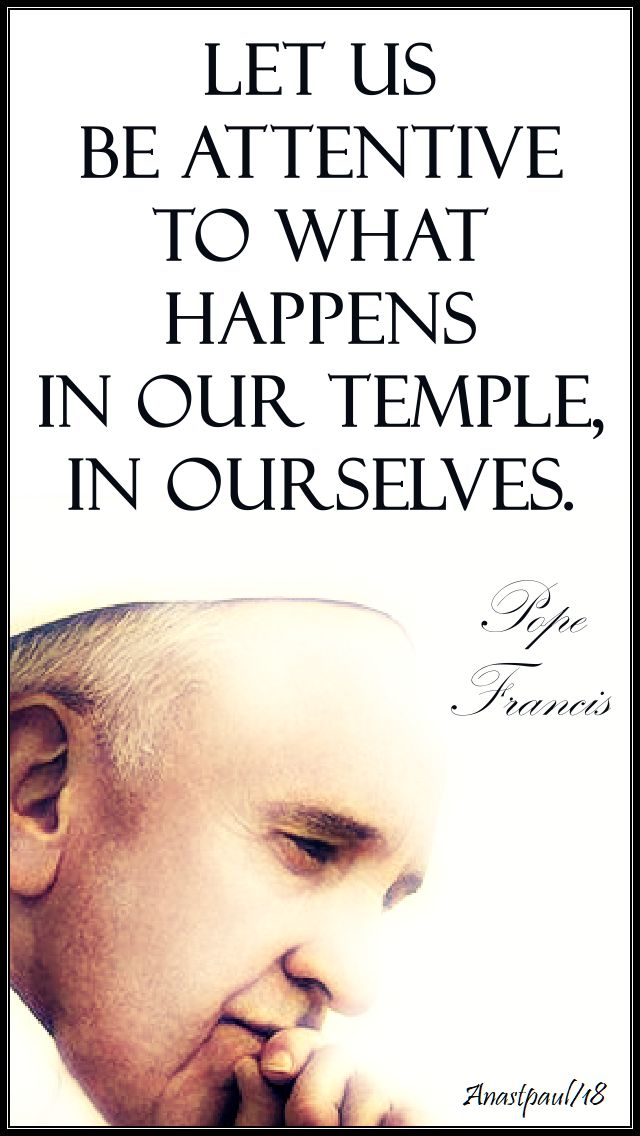
REFLECTION – “Have I learned to watch over myself, that the temple of my heart is only for the Holy Spirit? Purify the temple, the inner temple and watch. Be careful, be careful, what happens in the heart. Who comes in and who goes out, the feelings, the ideas… Do we speak to the Holy Spirit? Do we listen to the Holy Spirit? Watch out. Let us be attentive to what happens in our temple, in (us) ourselves.”…Pope Francis – Santa Marta, 24 November 2017
PRAYER – Lord our God, in Your mercy listen to our prayers! Teach us the peace of Your love. Guide us in the ways of Your Commandments. Let the path laid out by Your Son, be our Light and our Joy. Grant that by the prayers of Your Martyr, St Pedro and all Your Saints, we may receive strength for our journey. Through Jesus our Lord, with the Holy Spirit, God for all eternity, amen.
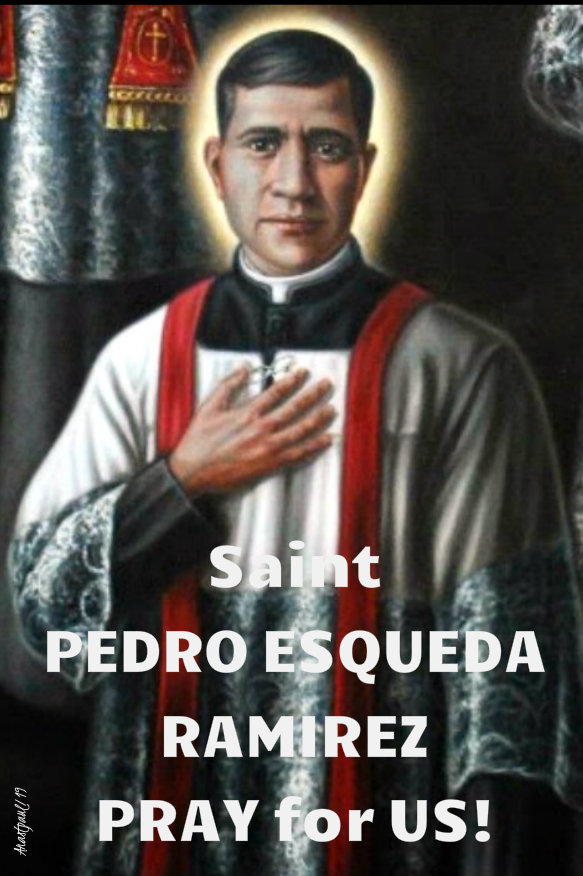
Saint of the Day – 22 November – Saint Pedro Esqueda Ramirez (1887-1927) Priest, Martyr of the Cristero War, Apostle of Eucharistic Adoration, of the Blessed Virgin Mary and of Charity, devoted to the youth and especially their Catechesis – born on 29 April 1887 in San Juan de los Lagos, Jalisco, Diocese of San Juan de los Lagos, Mexico and died by being shot three times on 22 November 1927 in Teocaltitán, Jalisco, Mexico, he was 40 years old. Additional memorial 21 May as one of the Martyrs of the Mexican Revolution
St Pedro was born in San Juan de los Lagos, Jal. (Diocese of San Juan de los Lagos), on 29 April 1887. His parents Margarito Esqueda and Nicanora Ramírez did not realise that they had brought into the world, an authentic, brave and holy Priest, who would witness Christ to the world.
At 4 years of age he began his instruction in a private school. His early association with the parish as a choir and altar boy awakened his vocation to the priesthood. His academic record was impeccable. His childhood was enriched by piety and hopeful joy. He erected altars at which he pretended to be celebrating the Mass, the dream that fed his spirit.
At age 15 he entered the seminary in Guadalajara but in 1914 the Seminary was forcibly seized and closed by the Government. Pedro returned to San Juan de los Lagos where he helped as a Deacon in the parish. He completed his studies at the Seminary in Guadalajara and was ordained a Priest in 1916 and appointed Parish Priest of his native parish, a position he held during the 10+ years of his priestly ministry. The ministry to which he dedicated himself with true passion, was the Catechesis of children. He founded several study centres and a school for the formation of Catechists. He also promoted the Eucharistic Crusade association fed by his love for the Eucharist, devotion that, together with his love for the Blessed Virgin, he extended among the faithful. From the Eucharist he drew his strength and encouragement. He was also spared nothing of the little he had, in his kindness and help to the poor.
In 1926 Government forces began a fierce anti-clerical campaign and issued an order of persecution and the good people of the town tried to convince Pedro to flee to another place. He only agreed to take refuge on a provisional basis in some places always close to the faithful, whom he continued to attend pastorally.
Fr Pedro continued his work but lived in several private houses, in one of which, they opened a hole in the floor where they kept the ornaments and sacred vessels and where at times the priest had to hide.
At the beginning of November 1927 he sought refuge in Jalostotitlán, Jalisco. But he returned to San Juan, led by his love to the parishioners. He didn’t want to leave them without assistance. He stayed at the Sacred Heart hospital . And the hosts of the homes where he was welcomed, seriously begged him to escape. But Peter was not willing to do so and testifying to his great faith, he said: “God brought me here, I trust in God”.
He was arrested on 18 November of that year 1927. In a miserable and dark room he suffered patiently the fierceness of the scourges and other cruelties that caused the fracture of one of his arms. But the most painful torment was to see the sacred objects desecrated before him, the ornaments destroyed and the parish archive ransacked. A cruel and infamous torture for a man of God, an innocent person whose only mission was to love Christ and others. The incessant torture lasted until 22 November. Battered and full of wounds, they forced him to climb a tree by himself. There he was shot mercilessly by a high officer who poured into him his torrent of anger when he saw that he could not stand on the pyre they had arranged to burn him to death by setting fire to the tree in question.
On the way to his particular Calvary, wrapped in a heroic silence, he left his will of fidelity to Catechesis and the Gospel to some children who walked beside him in tears.
He was Beatified on 22 November 1992 and Canonized by St Pope John Paul II on 21 May 2000.
St Amphilochius of Iconium
St Ananias of Arbela
St Apphia
St Benignus of Milan
St Christian of Auxerre
St Dayniolen the Younger
St Mark of Antioch
St Maurus of North Africa St Pedro Esqueda Ramirez (1887-1927) Martyr
St Philemon
St Pragmatius of Autun
St Sabinian the Abbot
Stephen of Antioch
—
Apostles of Bulgaria – 7 saints
Martyrs of Armenia – 8 beati: A group of eight Franciscans martyred in the region of Mujuk-Dersi, Armenia (modern Turkey) by invading Islamic Turks who tortured them, demanded they convert, and murdered them when they did not. They were
• Baldji Oghlou Ohannes
• David Oghlou David
• Dimbalac Oghlou Wartavar
• Geremia Oghlou Boghos
• Khodianin Oghlou Kadir
• Kouradji Oghlou Tzeroum
• Salvatore Lilli
• Toros Oghlou David
They were martyred on 22 November 1895 in Mujuk-Dersi, Armenia (in modern Turkey) and Beatified on 3 October 1982 by St Pope John Paul II.
Martyrs of England, Scotland and Wales – 85 beati: 85 English, Scottish and Welsh Catholics who were martyred during the persecutions by Protestants in the 16th and 17th centuries. They are commemorated together on 22 November.
• Blessed Alexander Blake • Blessed Alexander Crow • Blessed Antony Page • Blessed Arthur Bell • Blessed Charles Meehan • Blessed Christopher Robinson • Blessed Christopher Wharton • Blessed Edmund Duke • Blessed Edmund Sykes • Blessed Edward Bamber • Blessed Edward Burden • Blessed Edward Osbaldeston • Blessed Edward Thwing • Blessed Francis Ingleby • Blessed George Beesley • Blessed George Douglas • Blessed George Errington • Blessed George Haydock • Blessed George Nichols • Blessed Henry Heath • Blessed Henry Webley • Blessed Hugh Taylor • Blessed Humphrey Pritchard • Blessed John Adams • Blessed John Bretton • Blessed John Fingley • Blessed John Hambley • Blessed John Hogg • Blessed John Lowe • Blessed John Norton • Blessed John Sandys • Blessed John Sugar • Blessed John Talbot • Blessed John Thules • Blessed John Woodcock • Blessed Joseph Lambton • Blessed Marmaduke Bowes • Blessed Matthew Flathers • Blessed Montfort Scott • Blessed Nicholas Garlick • Blessed Nicholas Horner • Blessed Nicholas Postgate • Blessed Nicholas Woodfen • Blessed Peter Snow • Blessed Ralph Grimston • Blessed Richard Flower • Blessed Richard Hill • Blessed Richard Holiday • Blessed Richard Sergeant • Blessed Richard Simpson • Blessed Richard Yaxley • Blessed Robert Bickerdike • Blessed Robert Dibdale • Blessed Robert Drury • Blessed Robert Grissold • Blessed Robert Hardesty • Blessed Robert Ludlam • Blessed Robert Middleton • Blessed Robert Nutter • Blessed Robert Sutton • Blessed Robert Sutton • Blessed Robert Thorpe • Blessed Roger Cadwallador • Blessed Roger Filcock • Blessed Roger Wrenno • Blessed Stephen Rowsham • Blessed Thomas Atkinson • Blessed Thomas Belson • Blessed Thomas Bullaker • Blessed Thomas Hunt • Blessed Thomas Palaser • Blessed Thomas Pilcher • Blessed Thomas Pormort • Blessed Thomas Sprott • Blessed Thomas Watkinson • Blessed Thomas Whitaker • Blessed Thurstan Hunt • Blessed William Carter • Blessed William Davies • Blessed William Gibson • Blessed William Knight • Blessed William Lampley • Blessed William Pike • Blessed William Southerne • Blessed William Spenser • Blessed William Thomson •
Beatified on
22 November 1987 by St Pope John Paul II.
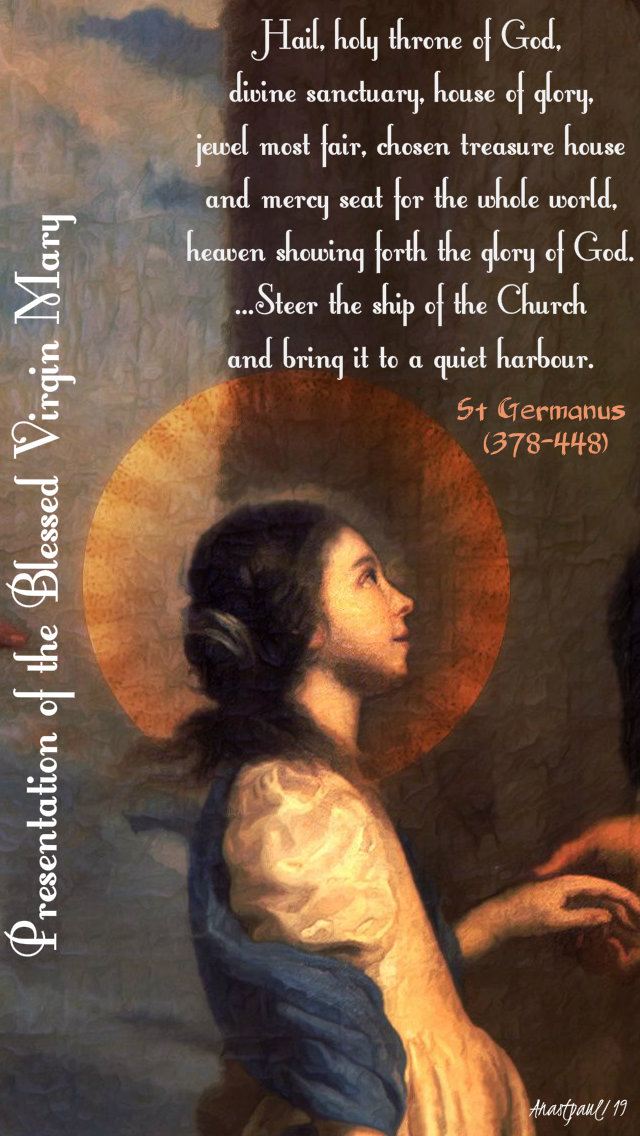
Quote of the Day – 21 November – Thursday of the Thirty Third week in Ordinary Time, Year C and Memorial of the Presentation of the Blessed Virgin Mary
“Hail, holy throne of God, divine sanctuary, house of glory, jewel most fair, chosen treasure house and mercy seat for the whole world, heaven showing forth the glory of God.
Purest Virgin, worthy of all praise, sanctuary dedicated to God and raised above all human condition, virgin soil, unploughed field, flourishing vine, fountain pouring out waters, virgin bearing a child, mother without knowing man, hidden treasure of innocence, ornament of sanctity, by your most acceptable prayers, strong with the authority of motherhood, to our Lord and God, Creator of all, your Son who was born of you without a father, steer the ship of the Church and bring it to a quiet harbour.”
St Germanus (378-448)
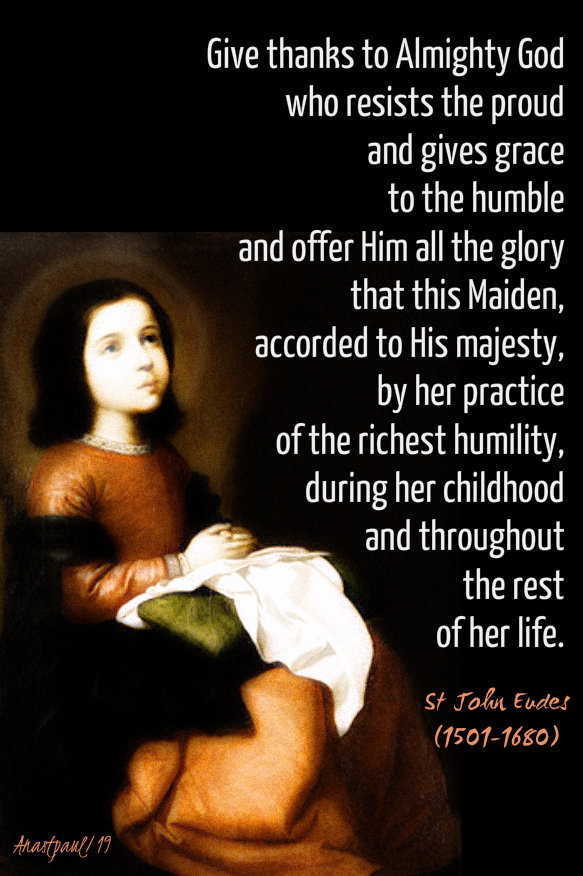
“Give thanks to Almighty God who resists the proud and gives grace to the humble and offer Him all the glory that this Maiden, accorded to His majesty, by her practice of the richest humility, during her childhood and throughout the rest of her life.”
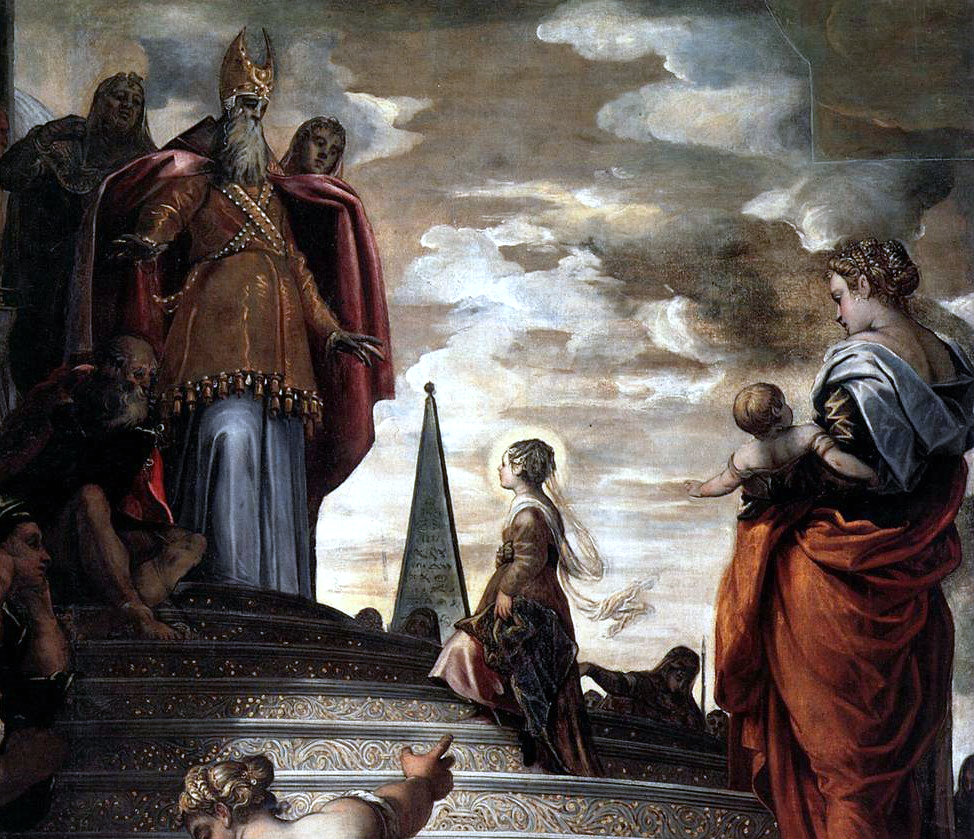
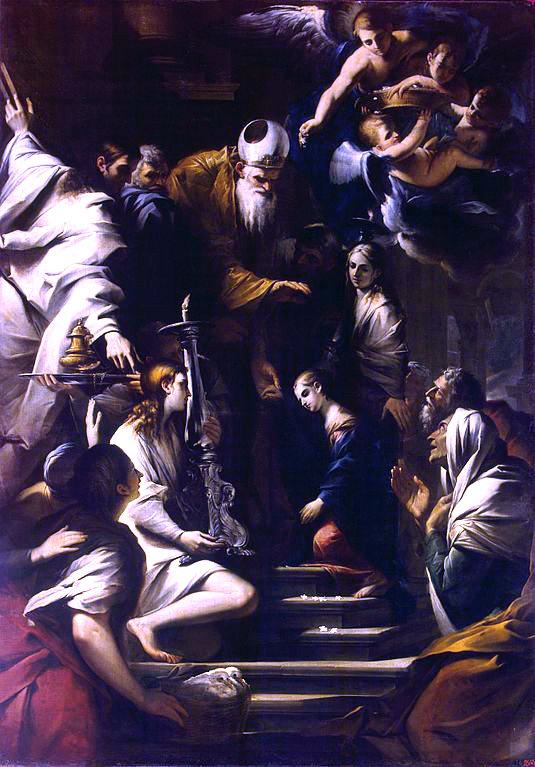
The Presentation of the Blessed Virgin Mary – 21 November
While the Presentation of the Blessed Virgin Mary was not generally celebrated in the West until the 11th century, it appears in most of the earliest calendars of the Eastern Churches. Derived from accounts in apocryphal literature, especially the Protoevangelium of James, the feast seems first to have appeared in Syria, where the Protoevangelium and other apocryphal books, such as the Infancy Gospel of Thomas and the Gospel of Pseudo-Matthew, originated. The Presentation of the Blessed Virgin Mary first rose to prominence, however, in Jerusalem, where it was associated with the dedication of the Basilica of Saint Mary the New.
That basilica was built near the ruins of the Temple in Jerusalem and the Protoevangelium of James and other apocryphal works, told the story of Mary’s presentation at the Temple at the age of three. In gratitude for being granted a child after years of infertility, Mary’s parents, Saints Joachim and Anna, had vowed to dedicate Mary to the service of God at the Temple. When they presented her at the Temple at the age of three, she stayed willingly, showing her dedication to God even at that young age.
Presentation of the Virgin in the Temple, Testa
The Protoevangelium of James, while an extra-biblical document, is the source of many details of Mary’s life that became universally accepted by the Church, including the names of her parents, the story of her birth, her age at her betrothal to Saint Joseph and Saint Joseph’s advanced age and his status as a widower with children by his first wife. It also played a large role among Christians, both Eastern and Western, in recognising Mary as the new Temple, the true Holy of Holies. When Mary left the Temple at the age of 12 after her betrothal to Joseph, she remained pure and chaste and at the Annunciation, God came to dwell in her.
The Feast of the Presentation of the Blessed Virgin Mary first made its way to the West through monasteries in Southern Italy in the ninth century, by the 11th century, it had spread to other locales but was by no means universally celebrated. Under the influence of a French nobleman, Philippe de Mazières, Pope Gregory XI began celebrating the feast during the Avignon papacy.
Pope Sixtus IV first placed the Presentation of the Blessed Virgin Mary on the universal calendar in 1472 but in the Tridentine reform of the calendar in 1568, Pope Pius V removed the feast. It was restored 17 years later by Pope Sixtus V and remains in the Roman calendar today as a memorial.
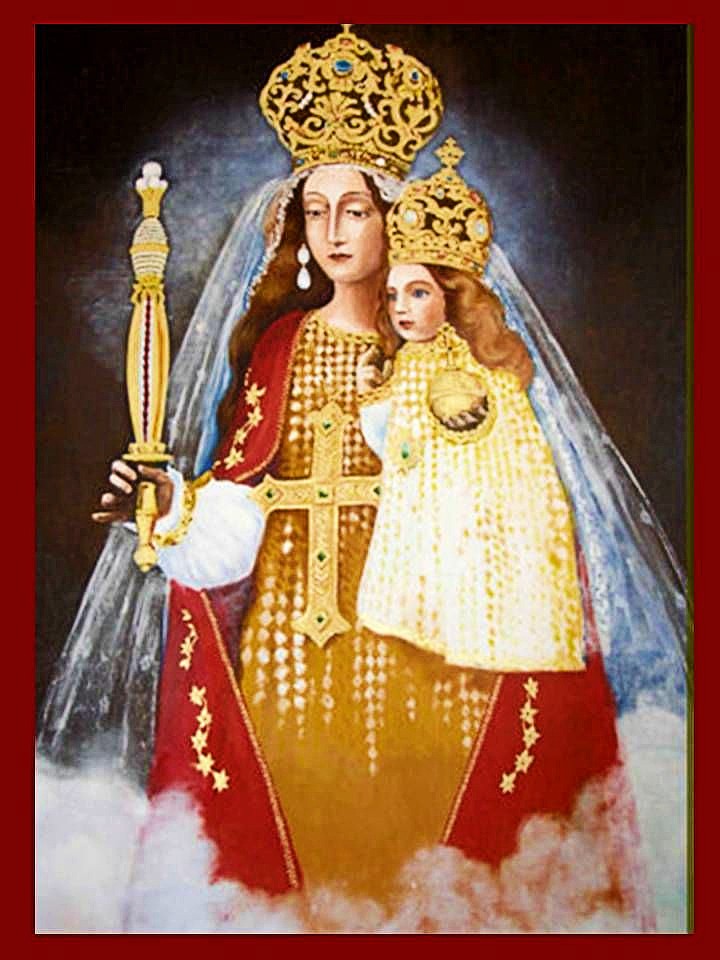
La Pequeñita / Our Lady of Quinche, Ecuador (1586) – 21 November – Patron of Ecuador:
Also known as – • Virgen de Monte del Sol Virgin of the Rock Devotion to the Blessed Virgin Mary in the image of a cedar Statue in Quinche, Ecuador. About two foot tall, it was carved in 1586 by Don Diego de Robles, an artist who created many other images of Mary. He carved it on order from the Lumbici Indians, who were unable to pay for it at delivery. Diego traded the Statue to the Oyacachi Indians in exchange for a large load of cedar for future projects. Legend says that the vision of Our Lady appeared in a cave to some of the Oyacachi, promising to the protect their children; the image Diego brought for trade looked just like the lady in the vision. The Oyacachi asked Diego to stay and help them build a shrine for the statue; he declined and started home. His horse threw him as they crossed a bridge and Diego was miraculously saved after he had prayed for Our Lady’s intervention; he understood that this was a sign, went back to the Indian, and built an altar for the Statue. In 1604 the Statue was moved to the local village of Quinche and a Chapel was built for it. A new Sanctuary was built in 1630 where the Statue stayed until the Church was destroyed in an earthquake in 1869. The Church was re-built and housed the image until moved to another new Church in 1928; in 1985 the Vatican proclaimed the Chapel to be a national Sanctuary of Ecuador. Many miracles, especially cures, have been associated with the image and there is a huge catalogue of songs in several languages that have been written in devotion over the centuries. St Amelberga of Susteren.
St Celsus the Martyr St Clement the Martyr St Demetrius of Ostia St Digain Bl Eoin O’Mulkern St Pope Gelasius I Bl Gelasius O’Cullenan St Heliodorus of Pamphylia St Hilary of Vulturno St Honorius of Ostia Bl Maria Franciszka Siedliska St Maurus of Cesena St Maurus of Porec St Maurus of Verona Bl Nicholas Giustiniani St Rufus of Rome — Martyrs of Asta – 3 saints: Three Christians martyred together for their faith during the persecutions of Diocletian. The only details about them to survive are their names – Eutychius, Honorius and Stephen. They were martyred in c 300 at Asta, Andalusia, Spain.
Thought for the Day – 20 November – Wednesday of the Thirty Third week in Ordinary Time, Year C, Gospel: Luke 19:11–28 and the Memorial of Blessed Maria Fortunata Viti OSB (1827-1922)
The Heart of the Just Man will Rejoice in the Lord
Saint Augustine (354-430) Bishop and Great Western Father and Doctor of the Church
An excerpt from Sermon 21
“The just man will rejoice in the Lord and put his hope in Him, the hearts of all good men will be filled with joy. We must surely have sung these words with our hearts as well as with our voices. Indeed, the tongue of the Christian expresses his deepest feelings when it addresses such words to God. The just man will rejoice, not in the world but in the Lord. Light has dawned for the just, Scripture says in another place and joy for the upright of heart. Were you wondering what reason he has for joy? Here you are told – the just man will rejoice in the Lord. Another text runs – Delight in the Lord and he will give you your heart’s desires.
What are we instructed to do then and what are we enabled to do? To rejoice in the Lord. But who can rejoice in something he does not see? Am I suggesting that we see the Lord then? No, but we have been promised that we shall see Him. Now, as long as we are in the body, we walk by faith, for we are absent from the Lord. We walk by faith and not by sight. When will it be by sight? Beloved, says John, we are now the sons of God, what we shall be has not yet been revealed but we know that when it is revealed we shall be like Him, because we shall see Him as He is. When this prophecy is fulfilled, then it will be by sight.
That will be the great joy, the supreme joy, joy in all its fullness. Then we shall no longer drink the milk of hope but we shall feed on the reality itself. Nevertheless, even now, before that vision comes to us, or before we come to that vision, let us rejoice in the Lord, for it is no small reason for rejoicing to have a hope that will some day be fulfilled.
Therefore, since the hope we now have inspires love, the just man rejoices, Scripture says, in the Lord but because he does not yet see, it immediately goes on to say and hopes in Him.
Yet already we have the first-fruits of the Spirit and have we not also other reasons for rejoicing? For we are drawing near to the one we love and not only are we drawing near—we even have some slight feeling and taste of the banquet we shall one day eagerly eat and drink.
But how can we rejoice in the Lord if He is far from us? Pray God He may not be far. If He is, that is your doing. Love and He will draw near, love and He will dwell within you. The Lord is at hand, have no anxiety. Are you puzzled to know how it is that He will be with you if you love? God is love.
“What do you mean by love?” you will ask me. It is that which enables us to be loving. What do we love? A good that words cannot describe, a good that is forever giving, a good that is the Creator of all good. Delight in Him from whom you have received everything that delights you. But in that I do not include sin, for sin is the one thing that you do not receive from Him. With that one exception, everything you have comes from Him.”
Quote/s of the Day – 20 November – Wednesday of the Thirty Third week in Ordinary Time, Year C, Gospel: Luke 19:11–28 and the Memorial of Blessed Maria Fortunata Viti OSB (1827-1922)
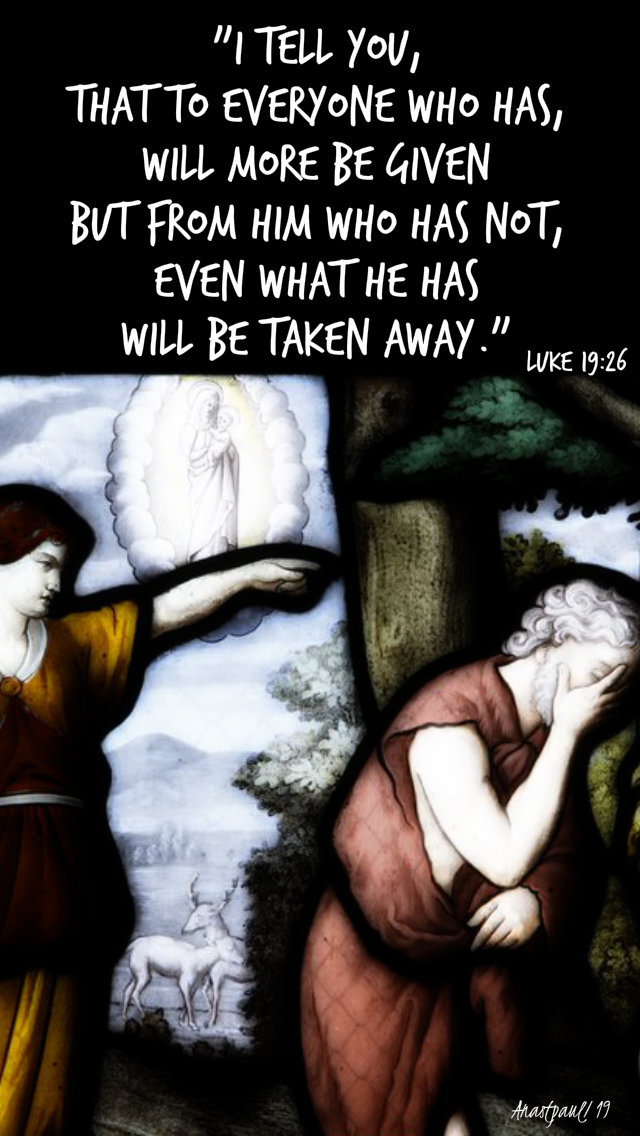
“‘I tell you, that to everyone who has, will more be given but from him who has not, even what he has will be taken away.”
Luke 19:26
“The Love and the Power of God!”
Blessed Maria Fortunata Viti (1827-1922)
“Fear is the wrong attitude – the servant who is afraid of his master and fears his return, hides the coin inthe earth and it does not produce any fruit …. However, the parable places a greater emphasis on the good fruits brought by the disciples, who, happy with the gift they received, did not keep it hidden, with fear and jealousy but made it profitable by sharing it and partaking in it. Yes, what Christ has given us is multiplied in it’s giving!”
One Minute Reflection – 20 November – Wednesday of the Thirty Third week in Ordinary Time, Year C, Gospel: Luke 19:11–28 and the Memorial of Blessed Maria Fortunata Viti OSB (1827-1922)
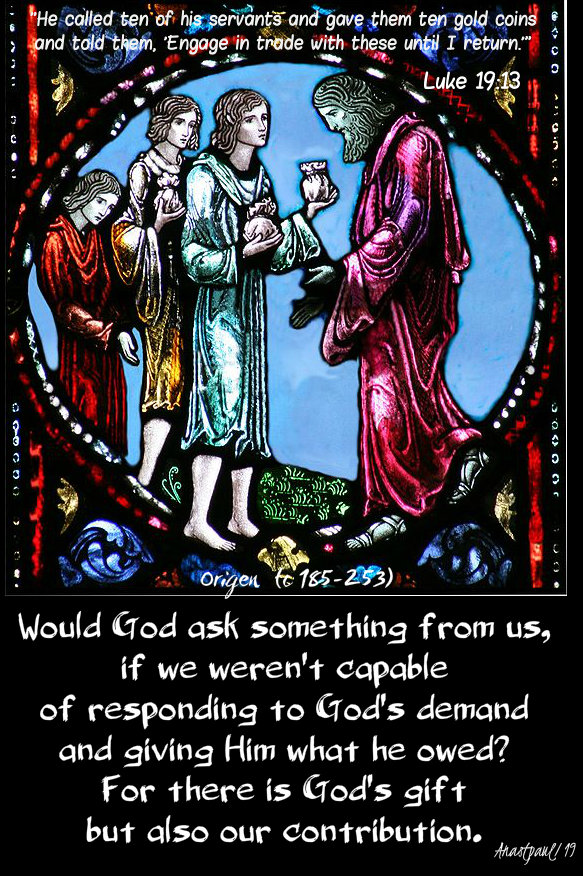
“He called ten of his servants and gave them ten gold coins and told them, ‘Engage in trade with these until I return.'” … Luke 19:13
REFLECTION – “What have we to offer God? Faith and love. That is where we find what God asks of us, as it is written: “And now, Israel, what does the Lord your God ask of you but to fear the Lord your God and follow his ways exactly, to love and serve the Lord your God with all your heart and all your soul” (Dt 10:12). These are the offerings and these the gifts we should make to the Lord. And if we are to offer Him these gifts with all our heart, then first of all, we must get to know Him. We must have drunk of the knowledge of His goodness from the deep waters of His well…
People who deny that salvation lay within the power of the our freedom, should be ashamed on hearing these words! Would God ask something from us if we weren’t capable of responding to God’s demand and giving Him what he owed? For there is God’s gift but also our contribution. For example, it was well within that man’s power that one gold coin should make ten or five more but, that the man should possess that gold coin, with which to produce ten more, in the first place, belonged to God. Once he had given God the ten gold coins he had made, the man received a new sort of gift – not money this time but the power and sovereignty over ten cities.
In the same way, God asked Abraham to make an offering of his son, Isaac, on the mountain He would show him. And Abraham, without hesitation, offered his only son – he laid him on the altar and drew out his knife to slay him. But at once a voice restrained him and a ram was given him to be sacrificed in his son’s place (Gn 22). So you see – what we offer God depends on us but, this offering is asked of us, so that, in making our gift, we might witness to our love for God and faith in Him.” … Origen (c185-253) Priest and Theologian – Homilies on the Book of Numbers, no. 12, #3
PRAYER – Lord God, true Light and Creator of light, grant that faithfully pondering on all that is holy, we may ever live in the splendour of Your presence. Protect us by Your power throughout our days, that even as You enable us to begin, do not let us turn aside to any sin but let our every thought, word and deed, aim at doing what is pleasing in Your sight. Listen, we pray, to the intercession of Blessed Maria Fortunata Viti on our behalf. Through Christ our Lord, with the Holy Spirit, God for all eternity, amen.
Saint of the Day – 20 November – Blessed Maria Fortunata Viti OSB (1827-1922) Benedicitine Religious, Apostle of Eucharistic Adoration and of Prayer, the gift of prophesy and miracles – born on 10 February 1827 in Veroli, Frosinone, Italy as Anna Felicia Viti and died on 20 November 1922 in Veroli, Frosinone, Italy of natural causes. Patronages – against poverty, of the poor, against temptations, loss of parents, against mental illness and the mentally ill.
Anna Felicia Viti was born in Veroli, in Italy’s Province of Frosinone, on 10 February 1827. Her father was Luigi Viti, a landowner who was a gambling addict and a heavy drinker and her mother Anna, died when Maria was fourteen years old. The third eldest of nine children, Maria was burdened with the responsibility of raising the other children. In order to support her family, she worked as a housekeeper. Her father’s alcoholism grew worse and so Maria’s employment constituted the majority of the family’s income. For a while, she was wooed by a young man from Alatri but she decided to enter religious life instead.
Maria joined the Benedictines at the Monastery of San Maria de’Franconi in Veroli on 21 March 1851, at the age of 24. After her religious profession, she took the name Maria Fortunata.
She never went to school and remained illiterate and although she spent more than 70 years in the Convent, she never progressed beyond the office of housekeeper and there she grew in the vital spiritual virtue of humility. During her long life, she knew nothing but assiduous work and constant prayer. She invoked the Lord with such passion and devotion it would edify her fellow Sisters. Admiring the beauties of nature she would be in the habit of often exclaiming: “The Love and the Power of God!” which remained her favourite expression. She dedicated her prayers and sacrifices in particular for the needy, for derelicts and for the redemption of sinners.
Blessed Maria confided to her fellow Sisters, that the devil bothered her both day and night mocking her and hitting her in order to try her patience and humility. Her confessor, Father John Pasqualiti, wrote: “With tears in her eyes, Sister Fortunata confided to me that the devil insulted her with the most vile and crude expressions. Often he threatened and made life difficult for her but she never despaired. These insults became all the more frequent when the Saint was near her death. Many of these disturbances were also heard and witnessed by her fellow Sisters.” – Apparitions of Angels & Demons.
She died a holy death on 20 of November 1922. She was a wonderful example of humility.
After Sister Maria’s death, miracles were reported at her grave site. Also, reports of miracles were attested to during her lifetime, including certain episodes that proved her gift of prophecy. According to one story, she began to cry during Mass, because she had seen that the celebrating priest would leave his calling and she was filled with sorrow for him. She also predicted that another priest would leave the priesthood but that he would repent and come back. In addition, two women who had been healed of meningitis in their childhood attributed their cures to her prayers.
In 1935, her remains were transferred from a mass grave to the Abbey Church and the process of her Canonisation was begun. Sister Maria Fortunata was declared Venerable on 8 April 1964 by St Pope Paul VI and Beatified on 8 October 1967 by the same Pope.
St Agapius of Caesarea
Bl Ambrose of Camaldoli
St Ampelus of Messina
St Anatolius of Nicea
St Apothemius of Angers
St Autbodus of Valcourt
St Basil of Antioch
St Bernerio of Eboli
St Crispin of Ecija
St Dasius of Dorostorum
St Dorus of Benevento
St Edmund of East Anglia
St Eudo of Carméry
St Eustachius of Nicea
St Eval of Cornwall
St Felix of Valois
St Francis Xavier Can Nguyen
St Francisca Desamparados Honorata Lloret Martí
St Gaius of Messina
St Gregory Decapolites
St Hippolytus of Belley
St Humbert of Elmham
St Leo of Nonantula Bl Maria Fortunata Viti OSB (1827-1922)
St Maxentia of Beauvais
St Milagros Ortells Gimeno
St Nerses of Sahgerd and Companions
St Simplicius of Verona
St Sylvester of Châlons-sur-Saône
St Thespesius of Nicea
St Teonesto of Vercelli
—
Martyred Sisters of the Christian Doctrine – 17 beati: A group of 17 religious sisters, members all of the Sisters of the Christian Doctrine, who were martyred in two different incidents in 1936 during the anti-Catholic persecutions of the Spanish Civil War.
They were Beatified on 1 October 1995 by St Pope John Paul II.
Martyrs of Antioch – 3 saints: Group of three Christians executed together for their faith. No details have survived except their names – Basil, Dionysius and Rusticus. They were martyred in Antioch (Antakya, Turkey).
Martyrs of Heraclea – 3 saints: A group of 43 Christians martyred together. The only details about them to survive are three of their names – Agapitus, Bassus and Dionysius. They were martyred in Heraclea, Thrace.
Martyrs of Turin – 3 saints: Three Christian martyrs whose original stories were lost, and somehow came to be associated with the Theban Legion. They are – Adventor, Octavius and Solutor. They were beheaded in 297 in Turin, Italy. Patronage – Turin, Italy.
Martyred in the Spanish Civil War:
Thousands of people were murdered in the anti-Catholic persecutions of the Spanish Civil War from 1934 to 1939.
• Blessed Ascensión Duart Roig
• Blessed Aurea Navarro
• Blessed Catalina Calpe Ibáñez
• Blessed Emilia Martí Lacal
• Blessed Francisca Desamparados Honorata Lloret Martí
• Blessed Gertrudis Rita Florència Surís Brusola
• Blessed Isabel Ferrer Sabrià
• Blessed Josefa Pascual Pallardó
• Blessed Josefa Romero Clariana
• Blessed Josepa Mongoche Homs
• Blessed María Antonia del Sufragio Orts Baldó
• Blessed Maria Dolors Llimona Planas
• Blessed María Isabel López García
• Blessed María Purificación Gómez Vives
• Blessed Milagros Ortells Gimeno
• Blessed Paula de San Antonio
• Blessed Teresa Jiménez Baldoví
• Blessed Teresa Rosat Balasch
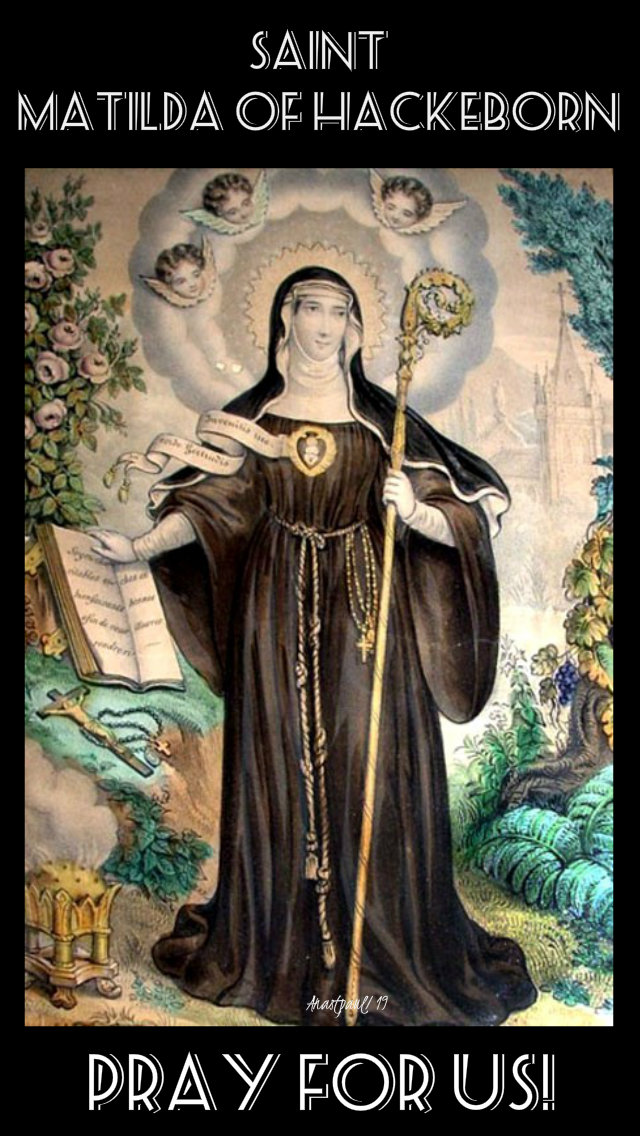
Thought for the Day – 19 November – The Memorial of St Matilda/Mechtilde of Hackeborn (c 1241-1298)
Devotion to the Sacred Heart of Jesus
Matilda and Gertrude of Helfta/the Great, became ardent devotees and promoters of Jesus’ heart after it was the subject of many of their visions. The idea of hearing the heartbeat of God was very important to medieval saints, who nurtured devotion to the Sacred Heart. Women such as Saint Matilda and Saint Gertrude perceived Jesus’ heart as the breast of a mother. Just as a mother gives milk to nourish her child, so Jesus in the Eucharist gives us His life blood.
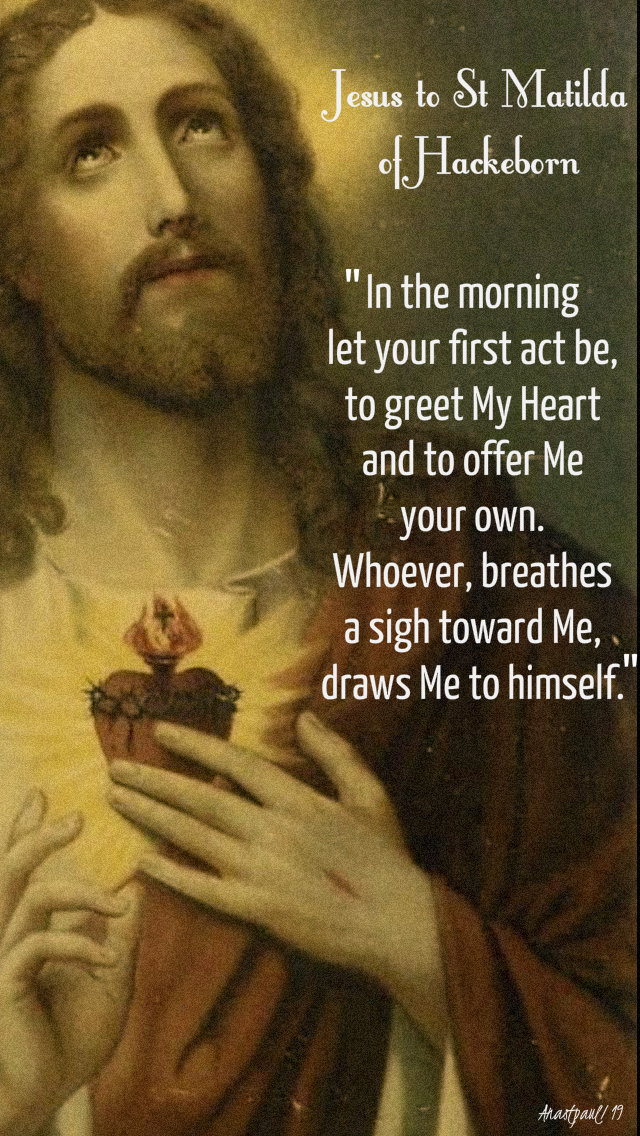
In one vision, Mechtilde reported that Jesus said, “In the morning let your first act be to greet My Heart and to offer Me your own. Whoever, breathes a sigh toward Me, draws Me to himself.”
One of the visions recounted by Mechtilde states that Jesus having appeared to her, commanded her to love Him ardently and to honour His Sacred Heart in the Blessed Sacrament as much as possible. He gave her His Sacred Heart as a pledge of His love, as a place of refuge during her life and as her consolation at the hour of her death. From this time Mechtilde had an extraordinary devotion to the Sacred Heart and she received such great graces from It, that she was accustomed to say, that if she had to write down all the favours and all the blessings which she had received by means of this devotion, a large book would not contain them.
In another, Jesus Himself recommended the Gospel. Opening to her, the wound of His most gentle heart, He said to her: “Consider how great is my love – if you want to know it well, you will not find it expressed more clearly anywhere, than in the Gospel. No-one has ever expressed stronger or more tender feelings than these – As my Father has loved me, so have I loved you (John 15:9)”.
Her accounts of these visions were later compiled in the Liber Specialis Gratiae – The Book of Special Grace.
Quote of the Day – 19 November – Tuesday of the Thirty Third Week of Ordinary Time, Year C, Gospel: Luke 19:1–10 and the Memorial of St Matilda/Mechtilde of Hackeborn (c 1241-1298)
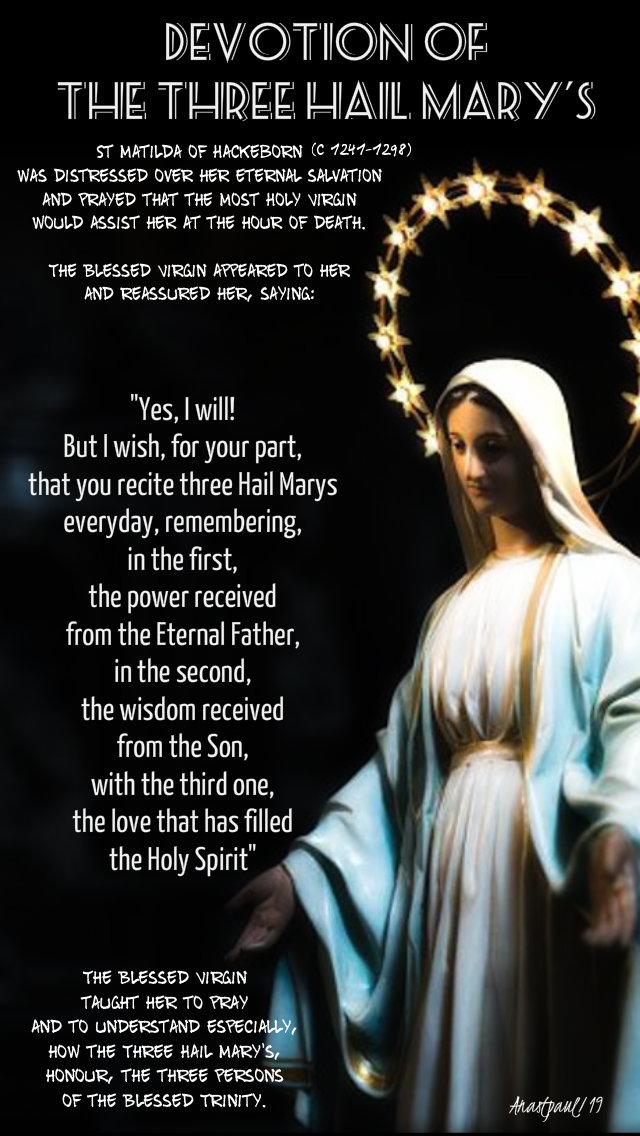
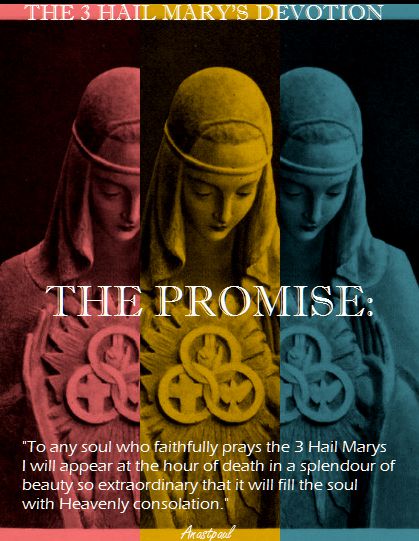
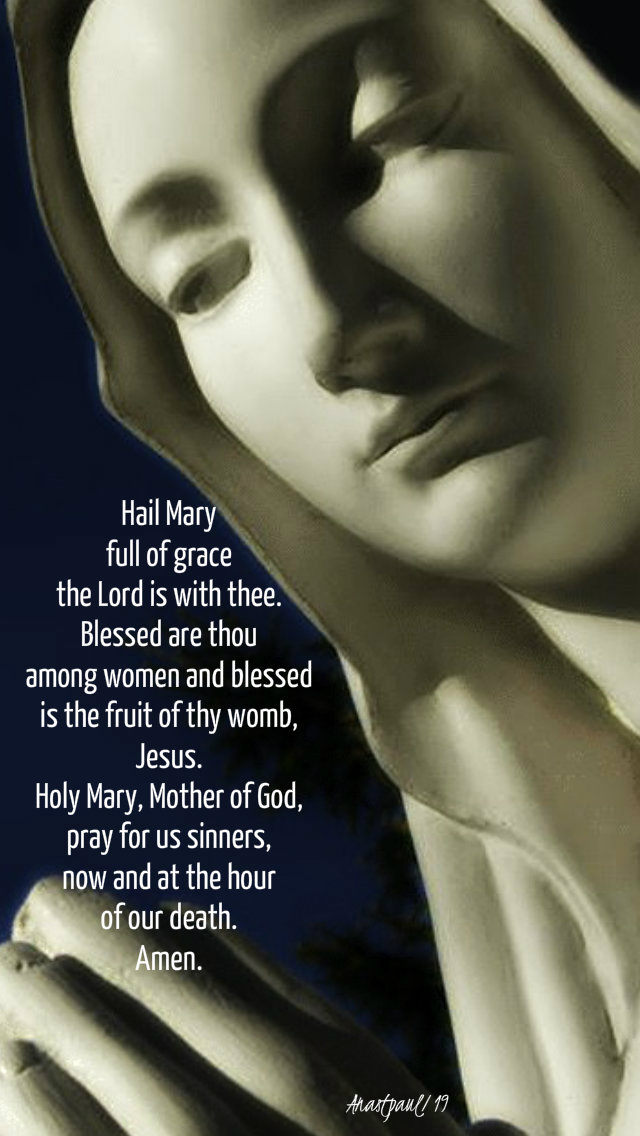
Devotion of the Three Hail Marys
St Matilda of Hackeborn was distressed over her eternal salvation and prayed that the Most Holy Virgin would assist her at the hour of death.
The Blessed Virgin appeared to her and reassured her, saying:
“Yes, I will! But I wish, for your part, that you recite three Hail Marys everyday, remembering, in the first, the power received from the Eternal Father, in the second, the wisdom received from the Son, with the third one, the love that has filled the Holy Spirit”.
The Blessed Virgin taught her to pray and to understand especially, how the Three Hail Mary’s, honour, the three persons of the Bles
One Minute Reflection – – 19 November – Tuesday of the Thirty Third Week of Ordinary Time, Year C, Gospel: Luke 19:1–10 and the Memorial of St Matilda of Hackeborn (c 1241-1298)
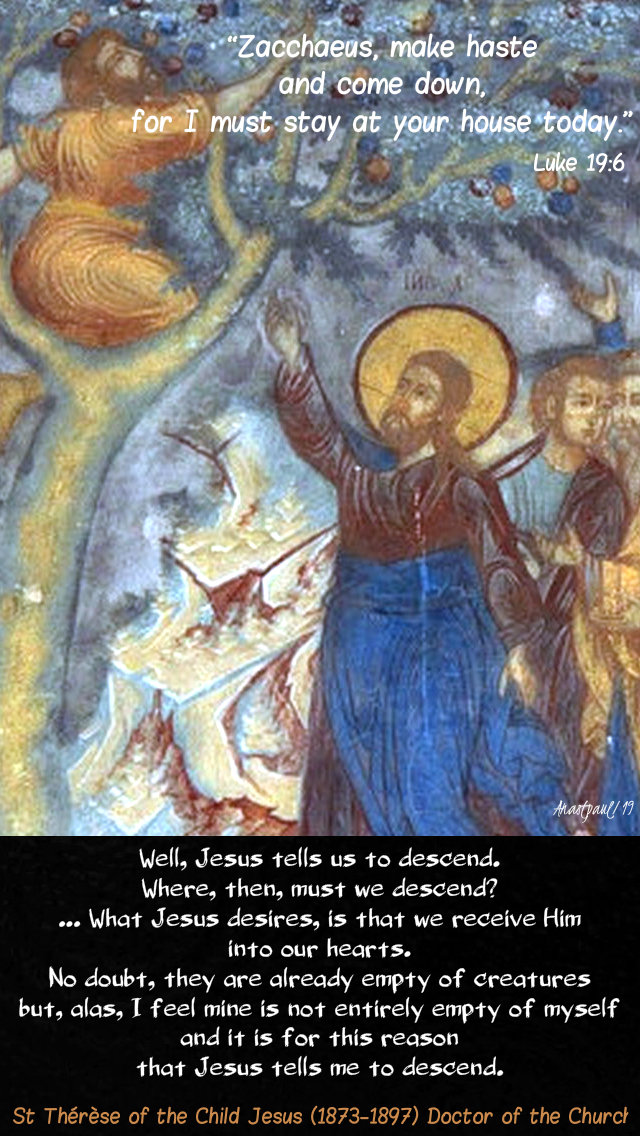
“Zacchaeus, make haste and come down, for I must stay at your house today.” … Luke 19:6
REFLECTION – “Celine, what a mystery is our grandeur in Jesus. This is all that Jesus has shown us in making us climb the symbolic tree about which I was just talking to you. And now, what science is He about to teach us? Has He not taught us all? Let us listen to what He is saying to us: “Make haste to descend, I must lodge today at your house.” Well, Jesus tells us to descend. Where, then, must we descend? Celine you know better than I, however, let me tell you where we must now follow Jesus. In days gone by, the Jews asked our divine Saviour: “Master, where do you live?” And He answered: “The foxes have their lairs, the birds of heaven their nests, but I have no place to rest my head.” This is where we must descend in order that we may serve as an abode for Jesus. To be so poor that we do not have a place to rest our head. This is, dear Celine, what Jesus has done in my soul during my retreat. You understand, there is question here of the interior. (…)
What Jesus desires is that we receive Him into our hearts. No doubt, they are already empty of creatures but, alas, I feel mine is not entirely empty of myself and it is for this reason that Jesus tells me to descend. He, the King of kings, humbled Himself in such a way that His face was hidden and no one recognised Him and I, too, want to hide my face, I want my Beloved alone to see it, that He be the only one to count my tears, that in my heart at least He may rest His dear head and feel that there, He is known and understood!” … St Thérèse of the Child Jesus (1873-1897) Doctor of the Church
PRAYER – Look with favour on our prayer Lord and in Your saving love, may your light so penetrate the hidden places of our hearts, that we may become like You, pure and humble of heart. May no sordid desires darken our minds and may we be renewed and enlightened as we receive Your heavenly grace. Grant that the intercession of St Matilda of Hackeborn lead us to a new way of remorse and repentance as we learn from You, our Saviour. Through Christ, our Lord, with the Holy Spirit, one God forever and ever, amen.















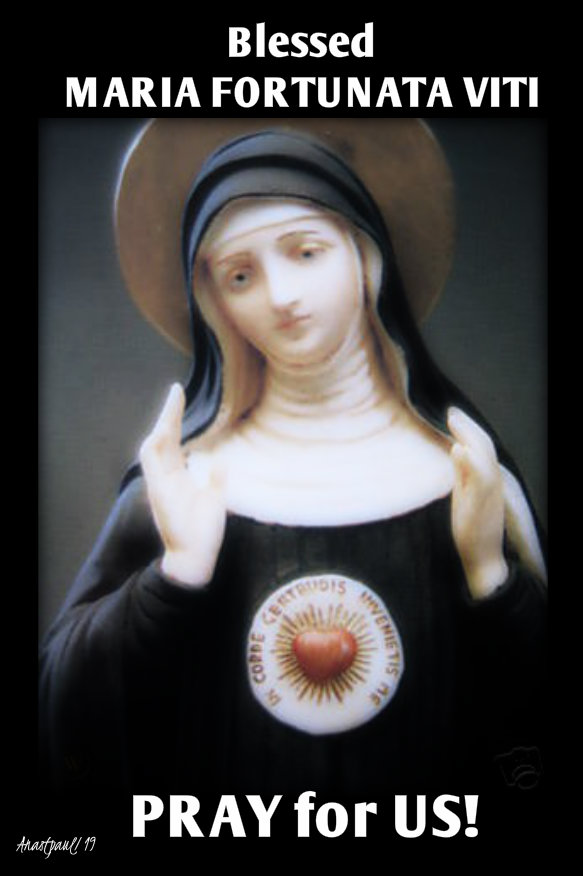
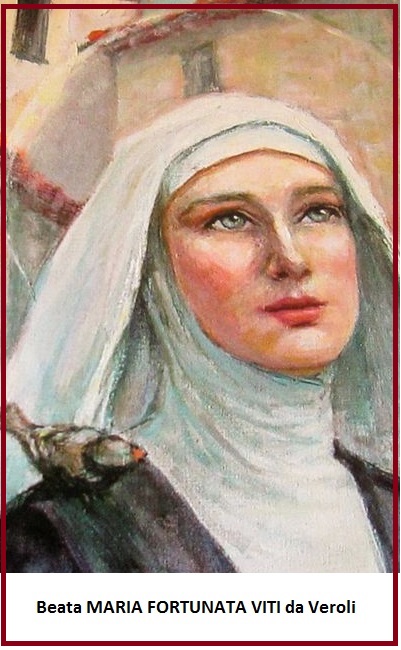
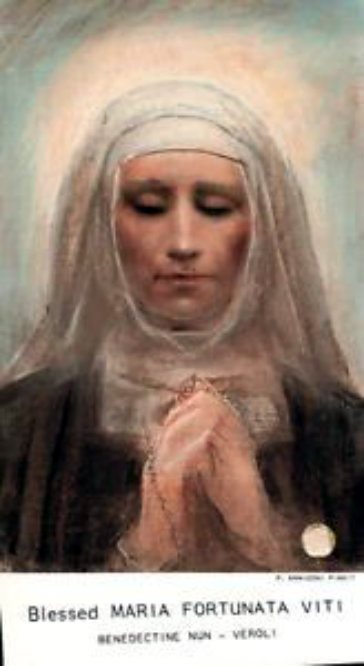
 During her long life, she knew nothing but assiduous work and constant prayer. She invoked the Lord with such passion and devotion it would edify her fellow Sisters. Admiring the beauties of nature she would be in the habit of often exclaiming: “The Love and the Power of God!” which remained her favourite expression. She dedicated her prayers and sacrifices in particular for the needy, for derelicts and for the redemption of sinners.
 AnaStpaul
You must be logged in to post a comment.