All Souls Day (Commemoration): Commemoration of the faithful departed in Purgatory. Abbot Odilo of Cluny instituted it in the monasteries of his congregation in 998, other religious orders took up the observance and it was adopted by various dioceses and gradually by the whole Church. The Office of the Dead must be recited by the clergy on this day and Pope Benedict XV granted to all priests the privilege of saying three Masses of requiem –
• one for the souls in Purgatory
• one for the intention of the Holy Father
• one for the priest’s
If the feast should fall on Sunday it is kept on 3 November.
Patronage: Monselice, Italy
St Ambrose of Agaune
St Ambrose of Agaune
St Amicus of Fonte Avellana
St Amicus of Rambone
St Baya of Scotland
St Domninus of Grenoble
St Erc of Slane
St Eustochium of Tarsus
St George of Vienne
Bl John Bodey
St Jorandus of Kergrist
St Justus of Trieste Bl Pius of St Aloysius CP (1868-1889)
St Marcian of Chalcis
Bl Margaret of Lorraine
St Mateo López y López
St Maura of Scotland
St Theodotus of Laodicea
St Victorinus of Pettau
St Willebald of Bavaria
—
Martyrs of Isfahan – 5+ saints: Acindynus, Pegasius and Anempodistus were Persian priests who were imprisoned, tortured, interrogated and martyred in the persecutions of king Sapor II of Persia; he considered any Christian to be a Roman spy and anti-Persian. The three were brought back to life, miraculously healed, freed from their chains and began preaching Christianity, miraculously healing Sapor II in the process. This defiance enraged Sapor so much that he ordered them executed again; they were thrown into a cauldron of molten lead, but walked out unharmed. This miracle brought one of the torturers, Aphthonius, to convert; he was immediately martyred. Other attempts were made to kill them, and they emerged each time unharmed. Senator Elpidiphorus led a group speaking in favour of the Christians for their courage and faith; he was immediately executed. In the end the original three Christians were burned to death. Martyrs all – Acindynus, Anempodistus, Aphthonius, Elpidephorus and Pegasius.
They were born in Persia and Died:
• c.350 in Isfahan, Persia
• relics transferred to Constantinople and enshrined in a church dedicated to them
• some relics taken to France in 1204 during the 4th Crusade
• relics in France were lost when hidden from anti-Christian forces in the French Revolution
• relics in France re-discovered in 1892 in Grozon.
Martyrs of Sebaste – 10 saints: A group of ten soldiers in the imperial Roman army of Emperor Licinius Licinianus who were executed together for refusing to burn incense as a sacrifice to the emperor. The only details that have survived are five of their names – Agapius, Cartherius, Eudoxius, Styriacus and Tobias. They were burned at the stake in 315 in Sebaste (in modern Turkey).
All Saints Day (Solemnity) – (a Holy Day of Obligation) Instituted to honour all the saints, known and unknown. It owes its origin in the Western Church to the dedication of the Roman Pantheon in honour of the Blessed Virgin Mary and all the martyrs by Pope Saint Boniface IV in 609, the anniversary of which was celebrated at Rome on 13 May. Pope Saint Gregory III consecrated a chapel in the Vatican basilica in honour of All Saints, designating 1 November as their feast. Pope Gregory IV extended its observance to the whole Church. It has a vigil and octave and is a holy day of obligation – the eve is popularly celebrated as Hallowe’en. Patronage – Arzignano, Italy.
St Amabilis of Auvergne
St Austremonius
St Benignus of Dijon
St Cadfan
St Caesarius of Africa
St Caesarius of Damascus
St Ceitho
St Cledwyn of Wales
Bl Clemens Kyuemon
St Cyrenia of Tarsus
St Dacius of Damascus
St Deborah the Prophetess
St Dingad
Bl Dionysius Fugixima
St Floribert of Ghent
St Gal of Clermont
St Genesius of Lyon
St Germanus of Montfort
St Harold the King
St James of Persia
St Jerome Hermosilla
St John of Persia
St Julian of Africa
St Juliana of Tarsus
St Lluís Estruch Vives
St Marcel of Paris
St Mary the Slave
St Mathurin
St Meigan
St Nichole
St Pabiali of Wales
St Pere Josep Almató Ribera Auras
St Peter Absalon
Bl Peter Paul Navarra
Bl Petrus Onizuka Sadayu
St Rachel the Matriarch
St Ruth the Matriarch
St Salaun of Leseven
St Severinus of Tivoli
St Valentin Faustino Berri Ochoa
St Vigor of Bayeux
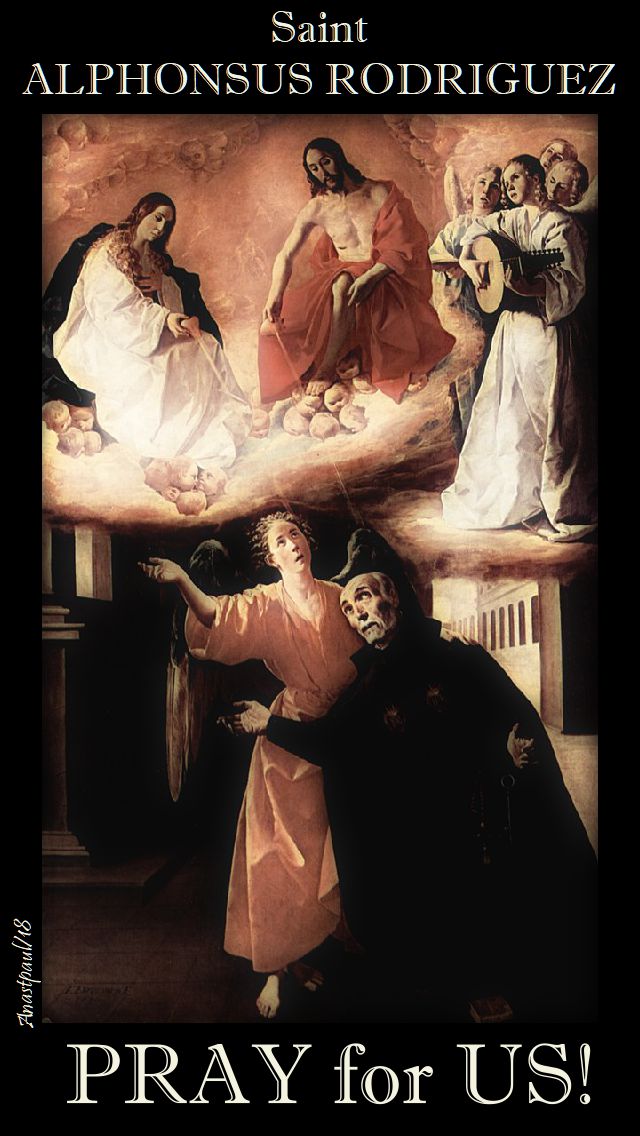
Thought for the Day – 31 October – The Memorial of St Alphonsus Rodriguez SJ (1532-1617)
Tragedy and challenge beset today’s saint early in life but Alphonsus Rodriguez found happiness and contentment, through simple service and prayer.
Born in Spain in 1533, Alphonsus inherited the family textile business at 23. Within the space of three years, his wife, daughter and mother died. Meanwhile, business was poor. Alphonsus stepped back and reassessed his life . He sold the business and, with his young son, moved into his sister’s home. There he learned the discipline of prayer and meditation.
At the death of his son years later, Alphonsus, almost 40 by then, sought to join the Jesuits. He was not helped by his poor education. He applied twice before being admitted. For 45 years he served as doorkeeper at the Jesuits’ college in Majorca. When not at his post, he was almost always at prayer, though he often encountered difficulties and temptations.
His holiness and prayerfulness attracted many to him, including Saint Peter Claver, then a Jesuit seminarian. Alphonsus died in 1617. He is the patron saint of Majorca.
We like to think that God rewards the good, even in this life. But Alphonsus knew business losses, painful bereavement and periods when God seemed very distant. None of his suffering made him withdraw into a shell of self-pity or bitterness. Rather, he reached out to others who lived with pain, including enslaved Africans. Among the many notables at his funeral were the sick and poor people whose lives he had touched. May they find such a friend in us!
Alphonsus’ life as doorkeeper may have been humdrum but centuries later he caught the attention of poet and fellow-Jesuit Gerard Manley Hopkins, who made him the subject of one of his most famous poems.
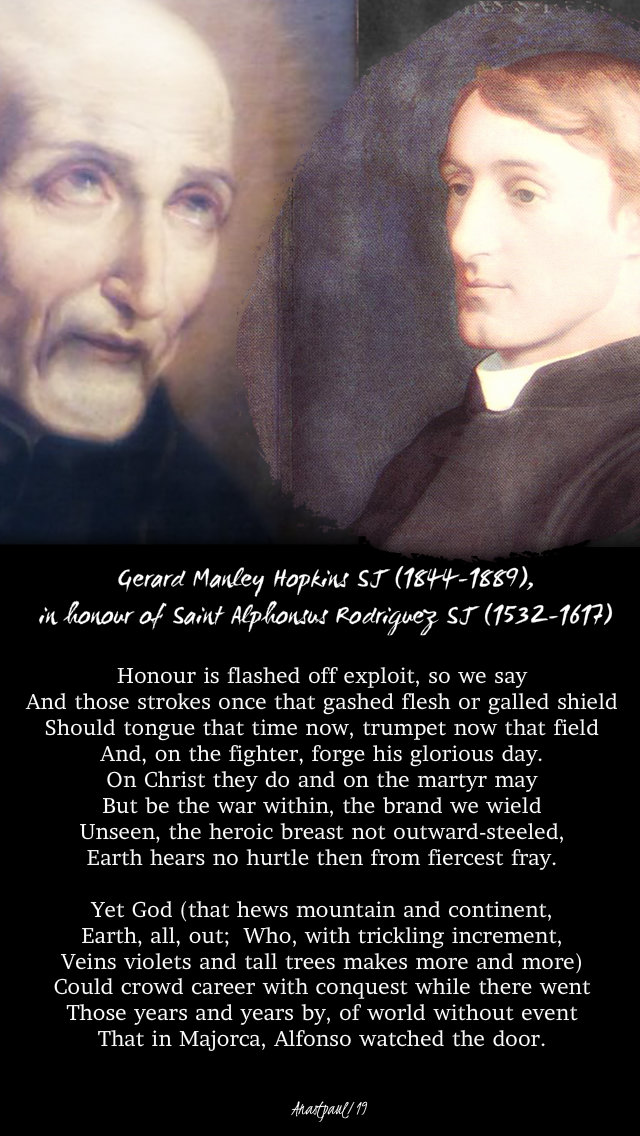
Honour is flashed off exploit, so we say And those strokes once that gashed flesh or galled shield Should tongue that time now, trumpet now that field And, on the fighter, forge his glorious day. On Christ they do and on the martyr may But be the war within, the brand we wield Unseen, the heroic breast not outward-steeled, Earth hears no hurtle then from fiercest fray.
Yet God (that hews mountain and continent, Earth, all, out; Who, with trickling increment, Veins violets and tall trees makes more and more) Could crowd career with conquest while there went Those years and years by, of world without event That in Majorca, Alfonso watched the door.
Gerard Manley Hopkins SJ (1844-1889), in honour of Saint Alphonsus Rodriguez SJ (1532-1617)
Quote/s of the Day – 31 October – The Memorial of St Alphonsus Rodriguez SJ (1532-1617)
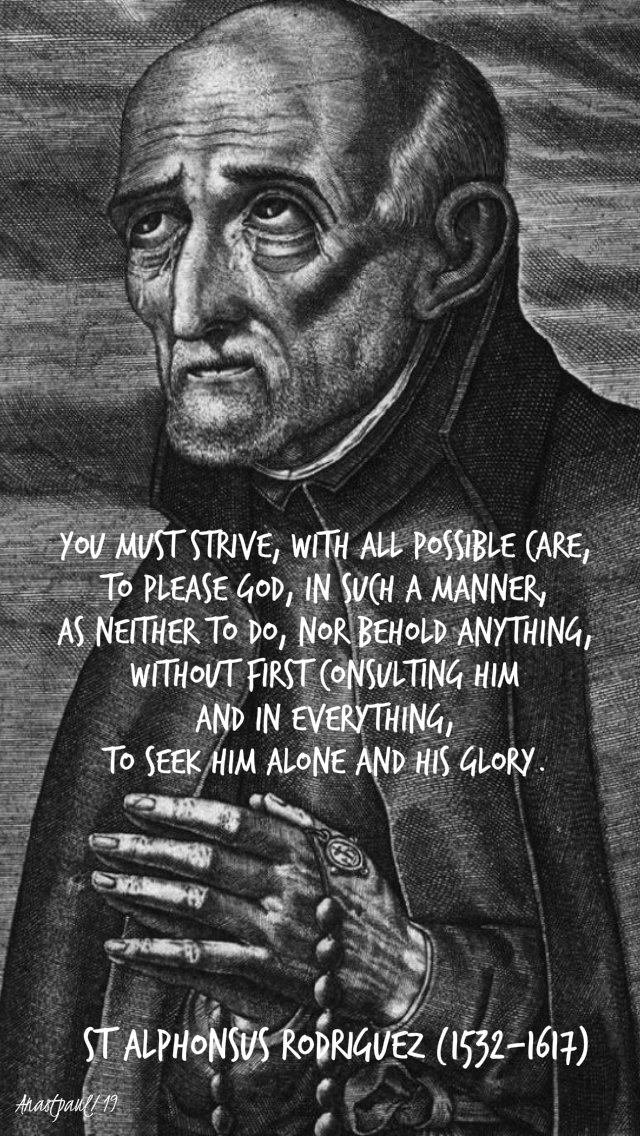
“You must strive, with all possible care, to please God, in such a manner, as neither to do, nor behold anything, without first consulting Him and in everything, to seek Him alone and His glory.”
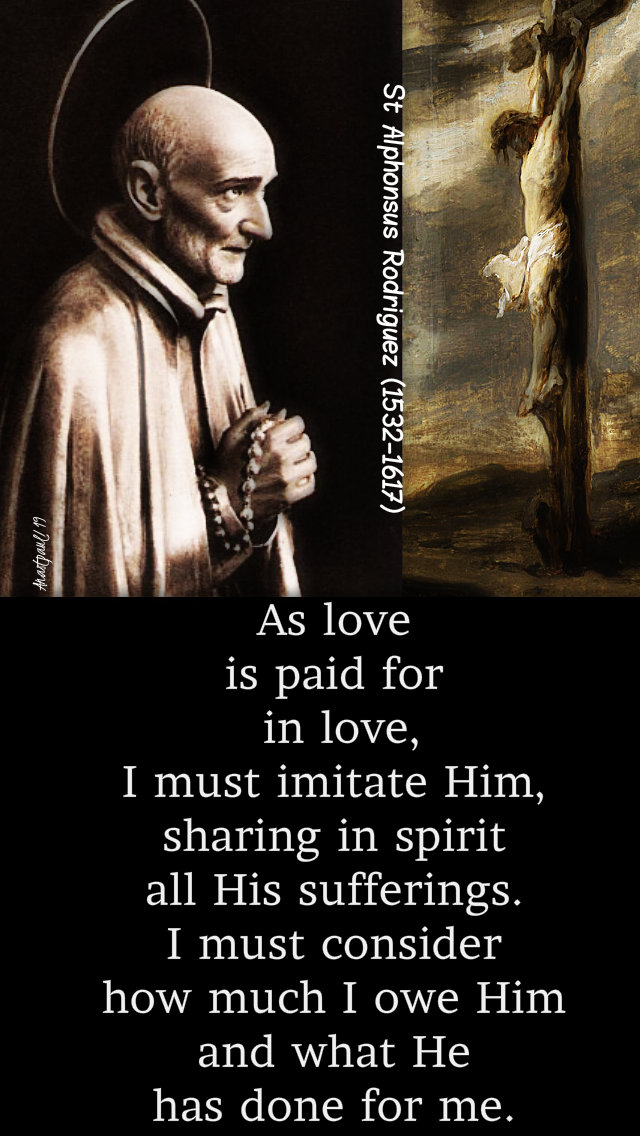
“I put myself in spirit before our crucified Lord, looking at Him full of sorrow, shedding His blood and bearing great bodily hardships for me. As love is paid for in love, I must imitate Him, sharing in spirit all His sufferings. I must consider how much I owe Him and what He has done for me. Putting these sufferings between God and my soul, I must say, ‘What does it matter, my God, that I should endure for Your love, these small hardships? For you, Lord, endured so many great hardships for me.’
Amid the hardship and trial itself, I stimulate my heart with this exercise. Thus, I encourage myself, to endure for love of the Lord, who is before me, until I make what is bitter, sweet. In this way learning from Christ our Lord, I take and convert the sweet into bitter, renouncing myself and all earthly and carnal pleasures, delights and honours of this life, so that my whole heart is centred solely on God.”
One Minute Reflection – 31 October – Thursday of the Thirtieth week in Ordinary Time, Ywear C, Gospel: Luke 13:31–35 and The Memorial of St Wolfgang of Regensburg (c 934 –994)
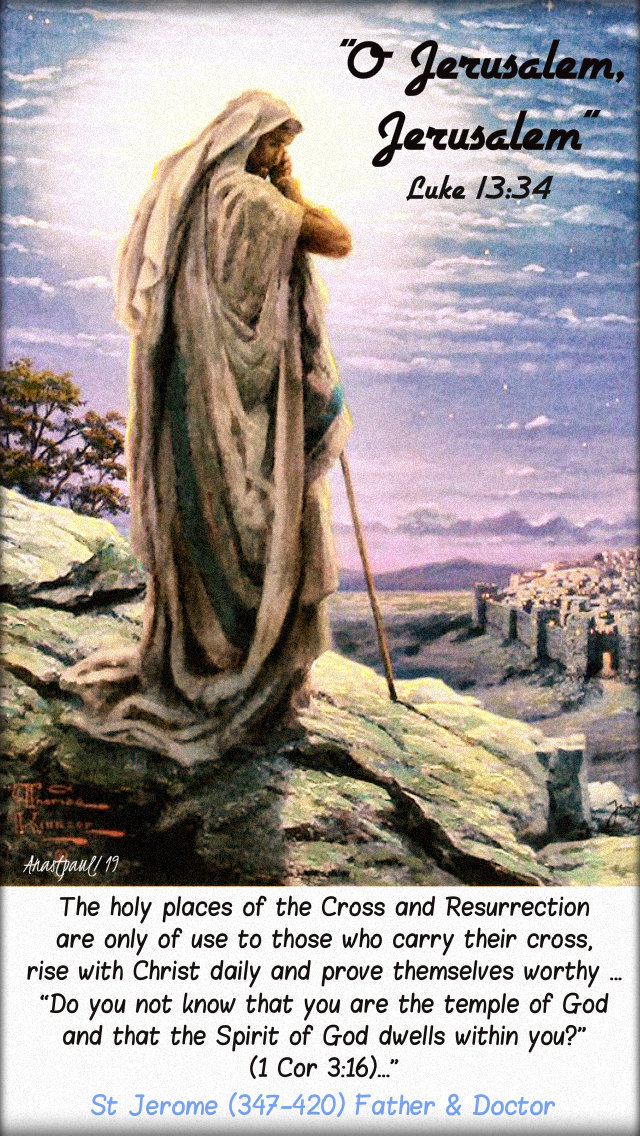
“O Jerusalem, Jerusalem” ... Luke 13:34
REFLECTION – “Believers are valued according to the merits of their faith and not the place they live in. And God’s true worshippers have no need of Jerusalem or Mount Gerizim to worship the Father because “God is spirit” and his worshippers should “worship him in spirit and truth” (Jn 4:21-23). Now, “the Spirit breathes where he will” (Jn 3:8) and “the Lord’s is the earth and its fullness” (Ps 24[23]:1)…
The holy places of the Cross and Resurrection are only of use to those who carry their cross, rise with Christ daily and prove themselves worthy of living in such localities. As for those who say: “The Temple of the Lord, the Temple of the Lord, the Temple of the Lord” (Jer 3:8), let them listen to the apostle’s words: “Do you not know that you are the temple of God and that the Spirit of God dwells within you?” (1 Cor 3:16)…” … St Jerome (347-420) Father & Doctor
PRAYER – Shed Your clear light on our hearts, Lord, so that walking continually in the way of Your commandments, we may never be deceived or misled. Grant that the prayers of St Wolfgang of Regensburg, who always held Your Light up for others to see by, give us strength. Through Jesus Christ, with the Holy Spirit, God forever, amen.
Our Morning Offering – 31 October – The Memorial of St Alphonsus Rodriguez SJ (1532-1617)
This is my Joy, to Follow my Saviour By St Alphonsus Rodriguez SJ (1532-1617)
Jesus, love of my soul,
centre of my heart!
Why am I not more eager to endure pains
and tribulations for love of You,
when You, my God,
have suffered so many for me?
Come, then, every sort of trial in the world,
for this is my delight, to suffer for Jesus.
This is my joy, to follow my Saviour
and to find my consolation
with my Consoler on the Cross.
This is my happiness,
this my pleasure:
to live with Jesus,
to walk with Jesus,
to converse with Jesus,
to suffer with and for Him,
this is my treasure.
Amen
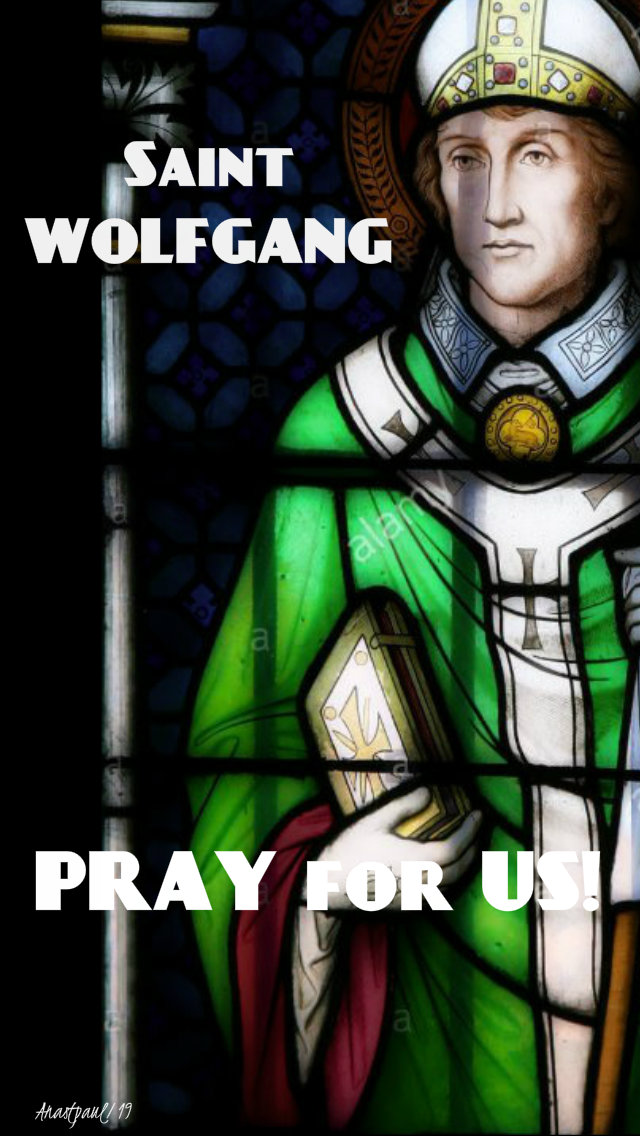
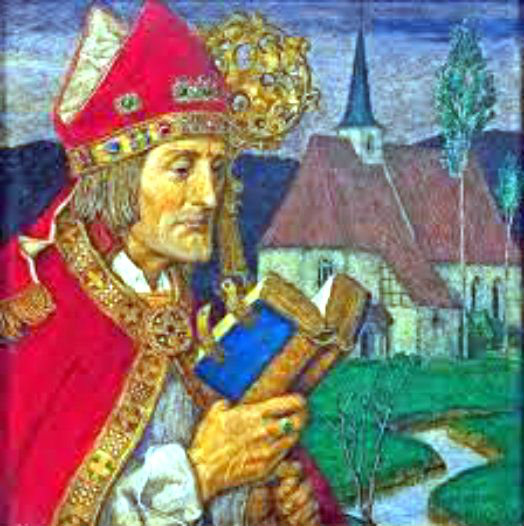
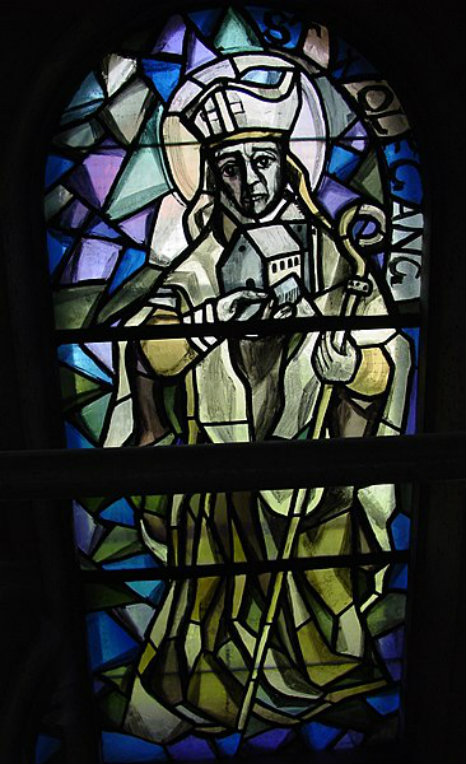
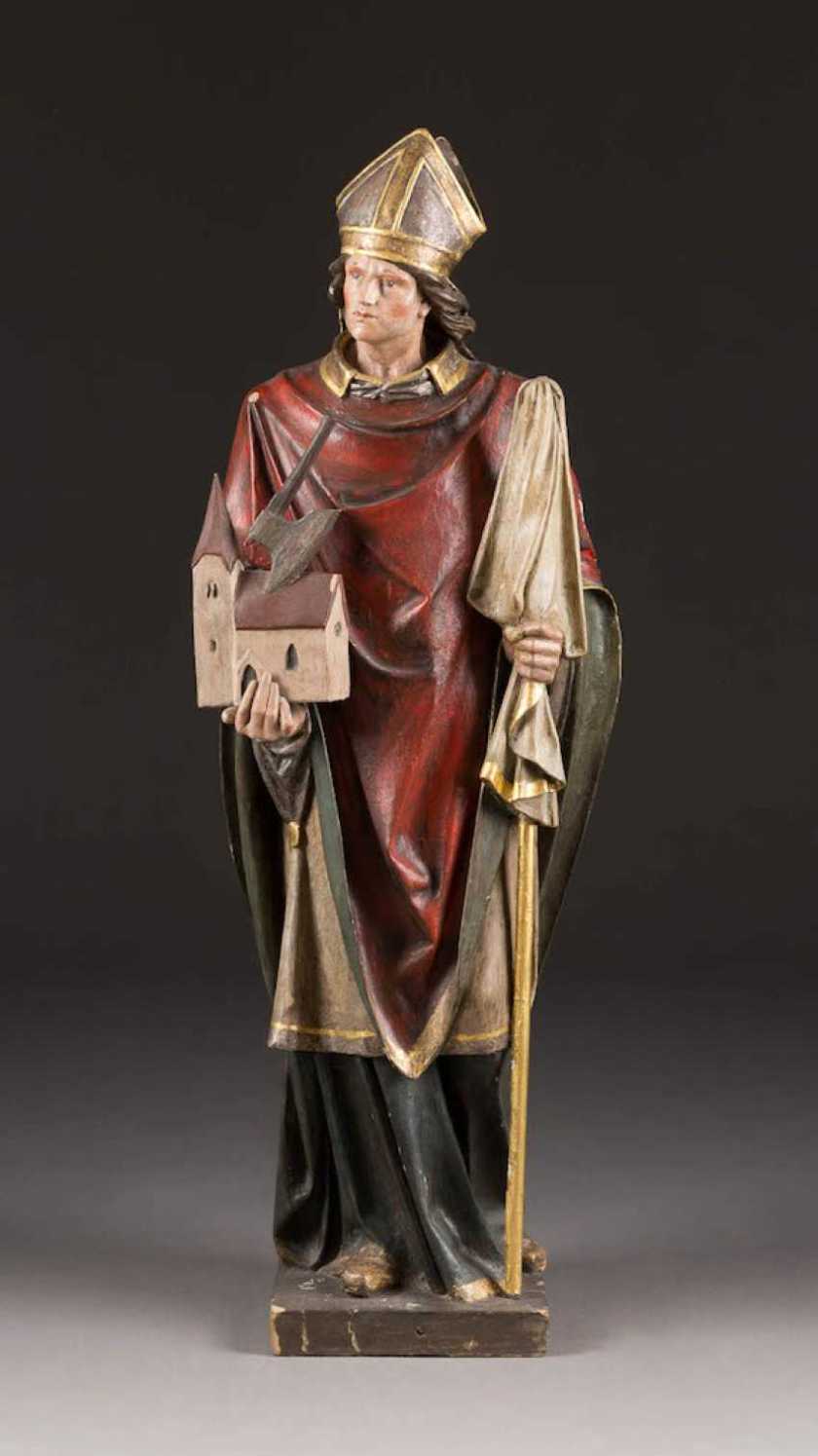
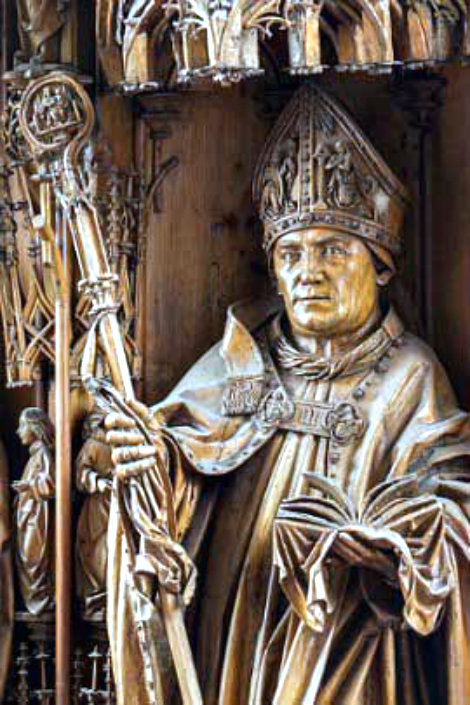
Saint of the Day – 31 October – Saint Wolfgang of Regensburg (c 934 –994) “The Great Almoner,” Bishop, Monk, Missionary, Aschetic, Apostle of Charity, also known as St Wolfgang of Ratisbon – born in c 924 in Swabia, Germany and died on 31 October 994 at Pupping, Linz (modern Austria) of natural causes. Patronages – apoplexy, carpenters and wood carvers, paralysis, Regensburg, Germany, stomach diseases, strokes. He is regarded as one of the three great German saints of the 10th century, the other two being Saint Ulrich and Saint Conrad of Constance.
Wolfgang, was born around 934, of the noble family of the Swabian counts of Pfullingen.
As a young man he was sent to the renowned Benedictine Abbey on the monastic island of Reichenau located on Lake Constance. Here he became a friend of Henry, the brother of the Bishop of Wurzburg. They studied together at the cathedral school there.
Henry became acquainted with Wolfgang’s intellectual prowess and when he was consecrated Archbishop of Trier in 956, Wolfgang assisted him as a reformer of the Church in southeastern Germany.
After the Archbishop’s death in 964, Wolfgang became a Benedictine in the monastery of Einsiedeln. There, he was appointed director of the school of the monastery. The school prospered under his direction and the local bishop – the future St Ulrich – ordained him to the priesthood in 968. In his youth, Wolfgang had envisioned a secluded life of contemplation but things turned out differently, as he was sent east to evangelise the Magyars in 972.
After this mission, the results of which did not correspond to his zeal, he was recommended to Otto II for the ecclesiastical seat of Ratisbon (present-day Regensburg in Bavaria) and though he begged to return to his monastery, was consecrated in 972.
As Bishop, St Wolfgang continued to live his monastic vocation, retaining his distinctive Benedictine habit and dedicating himself to the same ascetic lifestyle. Amid the work of preaching and reform, Wolfgang remained a man of prayer, silence and contemplative solitude. Not surprisingly, the Bishop of Ratisbon made monasticism a focus of his church reforms, reviving religious life in places where it had fallen into disorder. Wolfgang also showed extraordinary care for the poor in his diocese, to such an extent that he was called “the Great Almoner.” On the other hand, he was also involved in affairs of state at a high leve, and tutored the children of the Duke of Bavaria, including the future Holy Roman Emperor St Henry II.
Wolfgang, despite being one of the great bishops and saints of his time, still encountered serious difficulties in his leadership of the Diocese of Ratisbon. On one occasion, a political conflict caused him to withdraw from his diocese to a hermitage for a period of time. Wolfgang is also said to have struggled with the great geographical extent of the diocese, parts of which were eventually entrusted to the Bishop of Prague.
In 994, while travelling in Austria, Wolfgang became sick and died in the village of Pupping. His body, taken back to his diocese by his friends, was solemnly interred in the chapel of St Emmeran. Miracles associated with his tomb, including many cures, led to his Canonisation in 1052 by Pope Leo IX. Several of St Wolfgang’s devotees experienced relief from stomach ailments and he remains a patron saint of such troubles today. His intercession is also sought by victims of strokes and paralysis and by carpenters.
All Hallow’s Eve: Eve of the Feast of All Hallows, that is, All Saints Day. Halloween is a day on which many quaint customs are revived. It is popular in the United States and Scotland and in the US has become the second largest secular holiday of the year.
St Ampliatus
St Antoninus of Milan
St Apelles of Eraclea Sintica
St Arnulf of Novalesa
St Begu of Hackness
Bl Christopher of Romagna
Bl Dominic Collins
St Epimachus of Melusio
St Erth of Cornwall
St Foillan of Fosses
Bl Irene Stefani
St Jesús Miquel Girbau
Bl Leon Nowakowski
St Lucilla of Rome
Bl Maria de Requesens
Bl Modesta Moro Briz
St Narcissus
St Notburga of Cologne
St Quentin
Bl Pilar Isabel Sánchez Suárez
St Stachys of Constantinople
Bl Thomas Bellacci
St Urban St Wolfgang of Regensburg (c 934 –994)
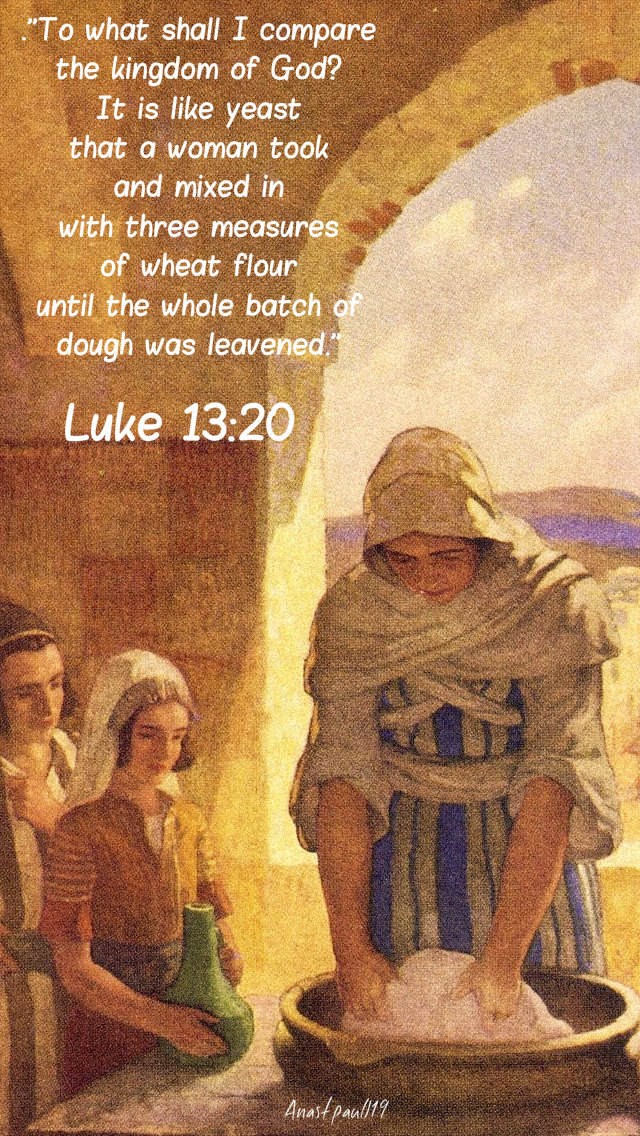
One Minute Reflection – 29 October – Tuesday of the Thirtieth week in Ordinary Time, Year C, Gospel: Luke 13:18-21
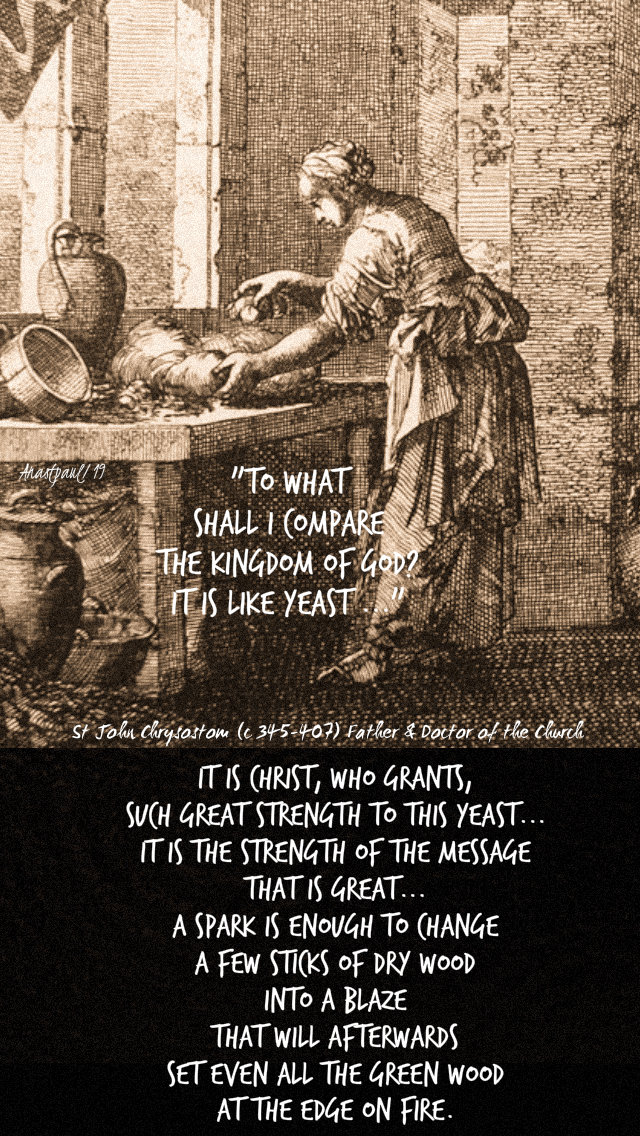
Again he said, “To what shall I compare the kingdom of God? It is like yeast that a woman took and mixed in with three measures of wheat flour until the whole batch of dough was leavened.” … Luke 13:20
REFLECTION – “Our Lord next puts forward the parable of the yeast. “Just as yeast communicates its invisible force to the whole lump of dough, so will the force of the Gospel transform the whole world, by means of the apostles’ ministry… Don’t ask me: ‘What can we twelve, miserable sinners do in face of the whole world?’ This is precisely the vast difference between cause and effect, between a handful of men before a crowd, which will demonstrate the stunning effect of your strength. Isn’t it by mixing the yeast into the dough, by ‘hiding’ it as the Gospel says, that it transforms the whole lump? In the same way, apostles of mine, it is by being mixed into the great mass of peoples that you will impregnate them with your spirit and win victory over your adversaries. Even as it disappears into the mass, yeast does not lose its strength. To the contrary, it changes the whole dough’s nature. In the same way, your preaching will change all peoples. Therefore, be full of confidence”…
It is Christ who grants such great strength to this yeast… So don’t blame Him for the small number of His disciples – it is the strength of the message that is great… A spark is enough to change a few sticks of dry wood into a blaze that will afterwards set even all the green wood at the edge on fire.” … St John Chrysostom (c 345-407) Father & Doctor of the Church
PRAYER – True light of the world, Lord Jesus Christ, as You enlighten all men for their salvation, give us grace, we pray, to herald Your coming by preparing the ways of justice and of peace. Help us Lord, that we may sprout and bear fruit, fitting to grow and be a home of comfort to our neighbour. By the prayers of St Narcissus of Jerusalem, who bore the seed of Your Word to many, may we too be heralds of Your Kingdom. Through Jesus our Lord, Who lives and reigns with the Father and the Holy Spirit, God forever, amen.
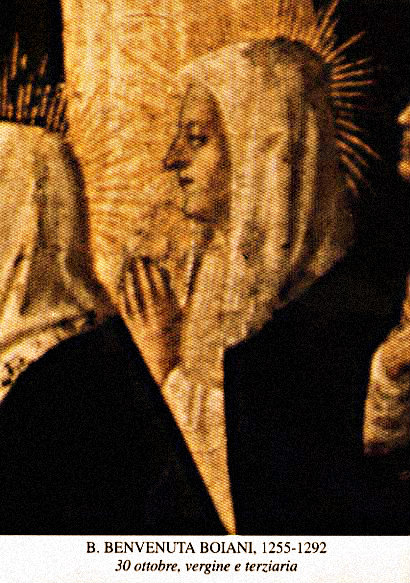
Saint of the Day – 30 October – Blessed Benvenuta Bojani OP (1254-1292) professed member of the Third Order of Saint Dominic, Mystic, Repentant. miracle-worker – born on 4 May 1254 at Cividale del Friuli, Italy and died on 30 October 1292 at Cividale del Friuli, Italy of natural causes, aged 38. Blessed Benevenuta dedicated her life to strict austerities as an act of repentance and devotion to God and was known to have visions of angels and demons.
Benvenuta was the last of seven daughters. Her parents, too, must have been amazing people in comparison with so many in our time. When the silence of the midwife proclaimed that her father had been disappointed once again in his desire for a son, he exclaimed, “She too shall be welcome!” Remembering this she was christened by her parents, Benvenuta which means“welcome”, although they had asked for a son. A vain older sister unsuccessfully tried to teach the pious little Benvenuta to dress in rich clothing and use the deceits of society. Benvenuta hid from such temptations in the church where she developed a tender devotion to the Blessed Virgin. By the age of 12, Benvenuta was wearing hairshirts and a rope girdle. As she grew, the rope became embedded in her flesh. When she realised the rope must be removed, she couldn’t get it off, so she prayed and it fell to her feet. For this reason she is often pictured in art holding a length of rope in her hands.
Having become a Dominican tertiary at an early age, she added the penances practised by the sisters to those she had appropriated for herself. All her disciplines, fasting and lack of sleep soon caused her health to fail and she was confined to bed for five years. Thereafter, she was too weak to walk, so a kind older sibling carried her to church once a week for Compline (Night Prayer) in the Dominican church, her favourite liturgy after the Mass.
After evening prayer on the Vigil of the Feast of Saint Dominic, Dominic and Saint Peter Martyr appeared to Benvenuta. Dominic had a surprise for her. The prior was absent at the Salve procession but at the beginning of Compline she saw Dominic in the prior’s place. He passed from brother to brother giving the kiss of peace, then went to his own altar and disappeared. At the Salve procession, the Blessed Virgin herself came down the aisle, blessing the fathers while holding the Infant Jesus in her arms.
Benvenuta spent her whole life at home in Cividale busy with her domestic duties, praying and working miracles. She was often attacked by the devil, who sometimes left her close to discouragement and exhaustion. When someone protested against the death of a promising young child, Benvenuta commented, “It is much better to be young in paradise than to be old in hell.” The devil often appeared to her in horrifying forms but was banished when Benvenuta called upon the Virgin.
Benvenuta’s companions called her “the sweetest and most spiritual of contemplatives, so lovable in her holiness that her touch and presence inspired gladness and drove away temptations.” This is amazing, in light of the severe penances that she imposed upon herself–and another sign of blessedness that she didn’t judge others by her standards for herself (Benedictines, Dorcy).
She died on 30 October 1292 and was interred in the church of Saint Dominic in her hometown.
Her Beatification received approval from Pope Clement XIV – on 6 February 1763 – after the pontiff confirmed the longstanding local ‘cultus’ to her.
St Arilda
St Asterius of Amasea Bl Benvenuta Bojani OP (1254-1292)
St Egelnoth the Good
St Eutropia of North Africa
St Gerard of Potenza
St Germanus of Capua
St Herbert of Tours
Bl Jean-Michel Langevin
Bl John Slade
St Lucanus of Lagny
St Marcellus the Centurion
St Marcian of Syracuse
St Maximus of Cumae
St Nanterius of Saint-Mihiel
Bl Oleksa Zarytsky (1912-1963) Martyr
Bl Raymond of Cardona
St Saturninus of Cagliari
St Serapion of Antioch
St Talarica of Scotland
Bl Terrence Albert O’Brien
St Theonestus of Philippi
St Zenobia of Aegea
St Zenobius of Aegea
—
Martyrs in Africa: A group of 100 to 200 Christians murdered in the early persecutions, and about whom we know nothing except that they died for their faith.
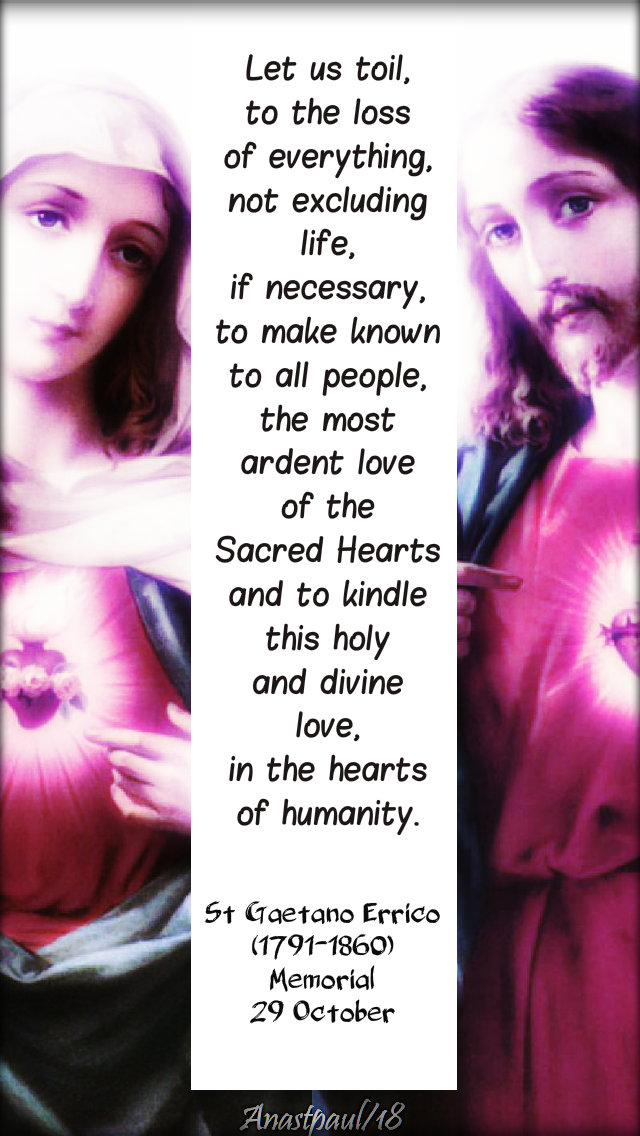
Quote of the Day – 29 October – The Memorial of St Gaetano Errico (1791-1860), Founder of the Missionaries of the Sacred Hearts of Jesus and Mary
“Let us toil, to the loss of everything, not excluding life, if necessary, to make known to all people, the most ardent love of the Sacred Hearts and to kindle this holy and divine love, in the hearts of humanity.” (From the Rule)
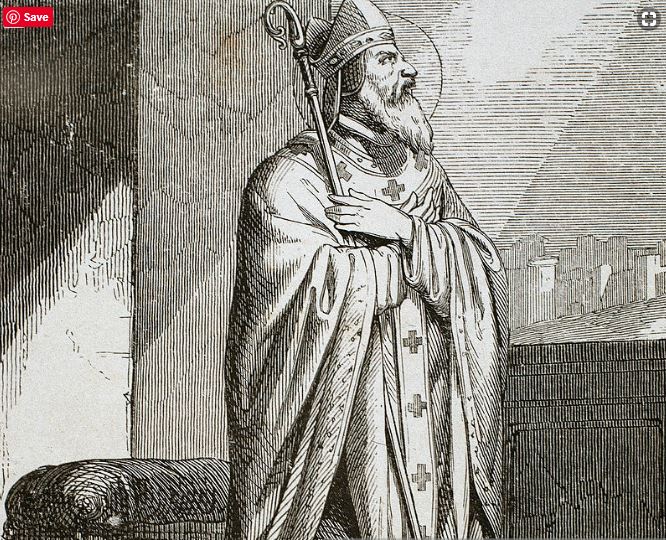
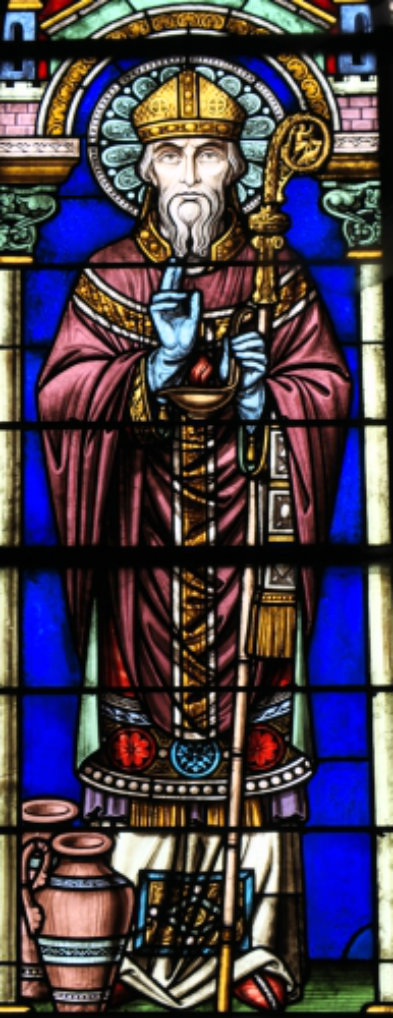
Saint of the Day – 29 October – St Narcissus of Jerusalem (c 99-c 215) Bishop of Jerusalem, miracle-worker – Patronage – of the aged. St Narcissus is usually depicted with large jars relating to the great miracle of the conversion of water into lamp oil.
St Narcissus was born towards the end of the first century and he was nearly 80 years old when he was named as the 30th bishop of Jerusalem.
In 195, he and Theophilus, Bishop of Caesarea in Palestine, presided together over a Council of the Bishops of Palestine held at Caesarea around Easter. There it was decreed, that the feast be kept always on a Sunday and not continually with the Jewish Passover.
The Bishop and historian Eusebius says the following miracle can be attributed to him. One year on Easter-eve the Deacons did not have any oil for the lamps in the church, which was necessary at the solemn divine office on that day. Narcissus ordered those who had care of the lamps to bring him some water from the neighbouring wells. This being done, he pronounced a devout prayer over the water. Then he bade them pour it into the lamps which they did. The water was immediately converted into oil, to the great surprise of all the faithful. Some of this miraculous oil was kept there as a memorial at the time when Eusebius wrote his history.
The veneration of all good men for this holy bishop, however, could not shelter him from the malice of the wicked. Three incorrigible sinners, fearing his severity in the observance of ecclesiastical discipline, accused him of a terrible act. The sinners swore that they were right, adding the following to their testimony – one wished that he might perish by fire, another, that he might be struck with a leprosy and the third, that he might lose his sight, if what they alleged was not the truth. Their accusations were false, however and soon, Divine Retribution called upon them. The first was burnt in his house along with his whole family by an accidental fire in the night, the second was struck with a universal leprosy and the third, terrified by these examples, confessed the conspiracy and slander and by the abundance of tears which he continually shed for his sins, lost his sight before his death.
Narcissus either could not stand the shock of the bold calumny, or perhaps he made it an excuse for leaving Jerusalem in order to spend some time in solitude, which had long been his wish. He spent several years undiscovered in his retreat, where he enjoyed all the happiness and advantage which a close conversation with God can bestow.
The neighbouring Bishops appointed a new Priest for his church until Narcissus returned. Upon his return, the faithful rejoiced and convinced him to once again undertake the administration of the Diocese, which he did.
As he reached extreme old age, he made St Alexander his coadjutor. St Narcissus continued to serve his flock and even other churches, by his assiduous prayers and his earnest exhortations to unity and concord, as St Alexander testifies in his letter to the Arsinoites in Egypt, where he says that Narcissus was at that time about one hundred and sixteen years old when he died of natural causes. The Roman Martyrology honours his memory today, 29 October.
St Abraham Kidunaia
St Abraham of Rostov
St Achahildis of Wendelstein
St Anne of Mount Olympus
St Colman of Kilmacduagh
St Dodone of Wallers-en-Fagne
St Donatus of Corfu
St Ermelinda of Meldaert
St Eusebia of Bergamo
St Felician of Carthage St Gaetano Errico (1791-1860) His Story: https://anastpaul.com/2018/10/29/saint-of-the-day-29-october-st-gaetano-errico-1791-1860/
St Honoratus of Vercelli
St John of Autun
St Kennera
St Mary of Edessa
St Narcissus of Gerona St Narcissus of Jerusalem (c 99-c 215)
St Sigolinus of Stavelot
St Stephen of Cajazzo
St Terence of Metz
St Theodore of Vienne
St Zenobius of Sidon
—
Martyrs of Douai – (160 saints and beati): 160 priests, laymen and religious who studied at the English College in Douai, France, then returned to minister to covert Catholics in England during a period of government persecution of the Church, and were murdered for their work.
Martyrs of Lucania – (4 saints): A group of Christians executed together for their faith. Only their names have survived – Felician, Hyacinth, Lucius and Quintus. Their martyrdom occurred in Lucania, southern Italy.
Martyred in the Spanish Civil War:
• Blessed Arsenio Merino Miguel
• Blessed Benito Paradela Novoa
• Blessed Joaquina Rey Aguirre
• Blessed José Ruiz Bruixola
• Blessed Maurilio Tobar González
• Blessed Ponciano Nieto Asensio
• Blessed Victoria Arregui Guinea
Thought for the Day – 28 October – Feast of Saints Simon and Jude, Apostles and Martyrs, Gospel: Luke 6:12-19
As the Father Sent Me, so I am Sending You
Saint Cyril of Alexandria (376-444)
Bishop, Father & Doctor of the Church
An excerpt from his Commentary on the Gospel of John
Our Lord Jesus Christ has appointed certain men to be guides and teachers of the world and stewards of His divine mysteries. Now He bids them to shine out like lamps and to cast out their light, not only over the land of the Jews but over every country under the sun and over people scattered in all directions and settled in distant lands. That man has spoken truly who said: No one takes honour upon himself, except the one who is called by God, for it was our Lord Jesus Christ who called His own disciples before all others to a most glorious apostolate. These holy men became the pillar and mainstay of the truth and Jesus said that He was sending them just as the Father had sent Him.
By these words, He is making clear, the dignity of the apostolate and the incomparable glory of the power given to them but He is also, it would seem, giving them a hint about the methods they are to adopt, in their apostolic mission. For if Christ thought it necessary to send out His intimate disciples in this fashion, just as the Father had sent Him, then surely, it was necessary, that they, whose mission was to be patterned on that of Jesus, should see exactly why the Father had sent the Son. And so Christ interpreted the character of His mission to us in a variety of ways. Once He said – I have come to call not the righteous but sinners to repentance. And then at another time He said – I have come down from heaven, not to do My own will but the will of Him who sent me. For God sent His Son into the world, not to condemn the world but that the world might be saved through Him.
Accordingly, in affirming that they are sent by Him just as He was sent by the Father, Christ sums up in a few words the approach they themselves should take to their ministry. From what He said, they would gather that it was their vocation to call sinners to repentance, to heal those who were sick, whether in body or spirit, to seek in all their dealing, never to do their own will but the will of Him who sent them and, as far as possible, to save the world by their teaching.
Surely it is in all these respects, that we find His holy disciples striving to excel. To ascertain this is no great labour, a single reading of the Acts of the Apostles or of Saint Paul’s writings is enough.
Quote/s of the Day – 28 October – Feast of Saints Simon and Jude, Apostles and Martyrs, Gospel: Luke 6:12-19
“Simon was worlds apart from Matthew, who, on the contrary, had an activity behind him as a tax collector that was frowned upon as entirely impure. This shows that Jesus called His disciples and collaborators, without exception, from the most varied social and religious backgrounds.
It was people who interested Him, not social classes or labels! And the best thing is that in the group of His followers, despite their differences, they all lived side by side, overcoming imaginable difficulties, indeed, what bound them together, was Jesus Himself, in whom they all found themselves united with one another.
This is clearly a lesson for us who are often inclined to accentuate differences and even contrasts, forgetting, that in Jesus Christ, we are given the strength to get the better of our continual conflicts.
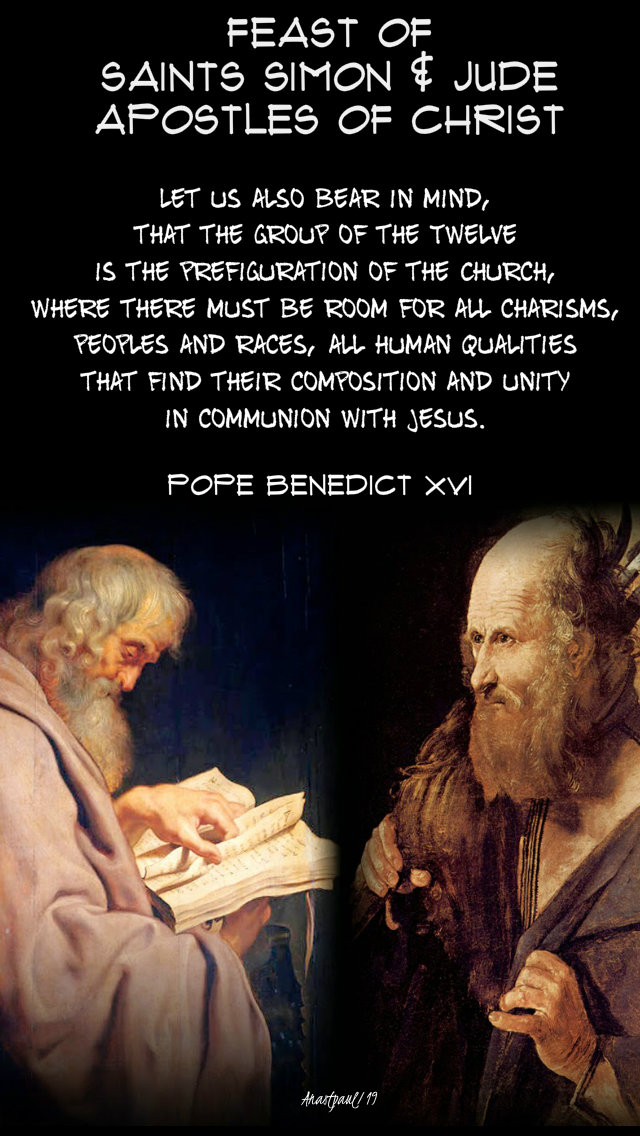
Let us also bear in mind, that the group of the Twelve, is the prefiguration of the Church, where there must be room for all charisms, peoples and races, all human qualities that find their composition and unity in communion with Jesus.”
Pope Benedict XVI
Catechesis on Saints Simon and Jude General Audience Saint Peter’s Square Wednesday, 11 October 2006
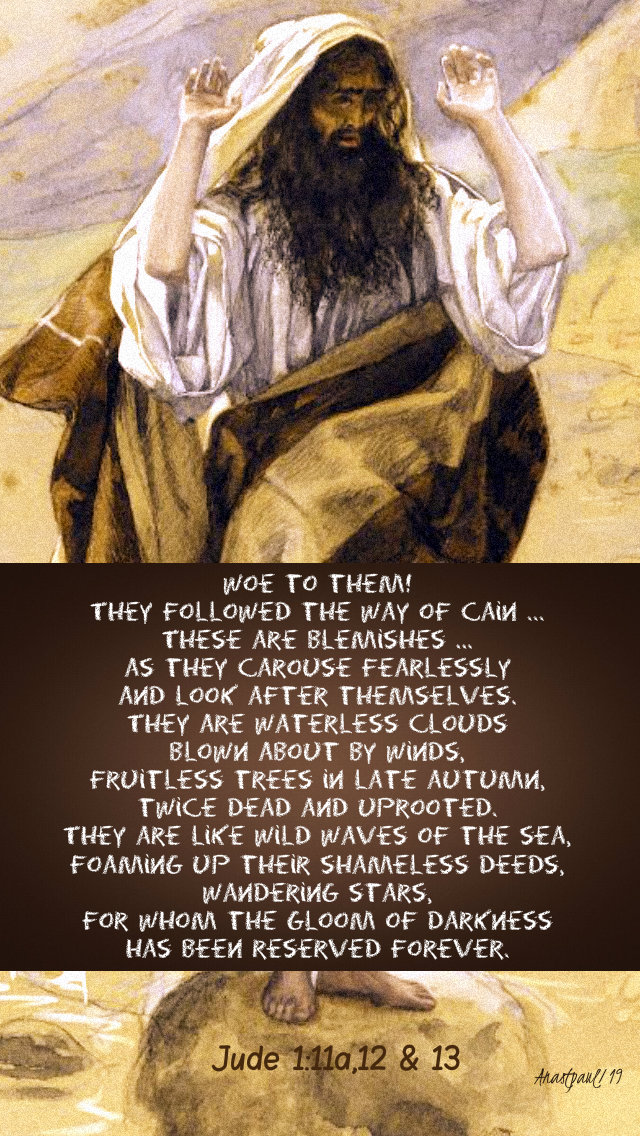
“Woe to them! They followed the way of Cain … These are blemishes … as they carouse fearlessly and look after themselves. They are waterless clouds blown about by winds, fruitless trees in late autumn, twice dead and uprooted. They are like wild waves of the sea, foaming up their shameless deeds, wandering stars, for whom the gloom of darkness has been reserved forever.”
One Minute Reflection – 28 October – Feast of Saints Simon and Jude, Apostles and Martyrs, Gospel: Luke 6:12-19
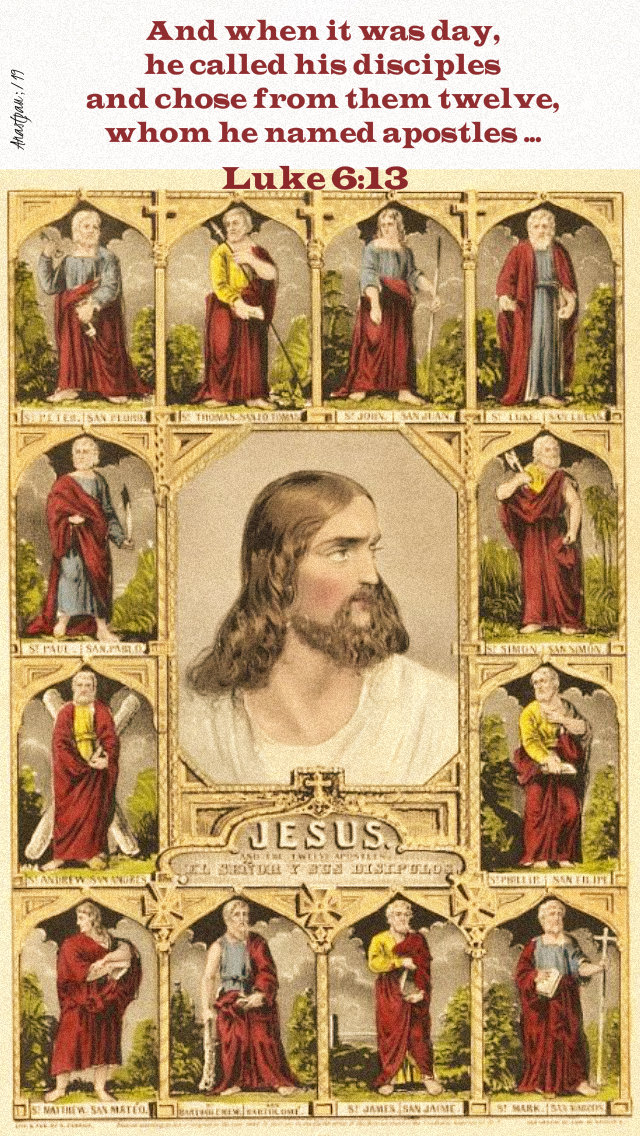
And when it was day, he called his disciples and chose from them twelve, whom he named apostle … Luke 6:13
REFLECTION – “Saint Paul said: “The weakness of God is stronger than all men” (1Cor 1:25). It is clear from this too that the gospel is divine. For whence did it strike twelve unlettered men to attempt such great enterprises, men who were living in marshes, or rivers, in desert places, who had never perhaps gone into a city or the public square? Whence did it strike them to array themselves against the whole world? That they were cowardly and unmanly, he who has written about them shows, inasmuch as he does not even deprecate nor try to gloss over their failings. This, in itself, is a powerful proof of the truth. What then does this man say about them? That after the innumerable miracles they had seen Christ work, when He was taken prisoner some fled, while the one who remained, although he was head over the rest, denied Him.
Here were men who failed to stand up to the Jews when Christ was alive. Yet when He died and was buried, they arrayed themselves against the whole world… Would they not have said to themselves: “What is this? He had not strength to save Himself, will He protect us? He did not defend Himself when He was alive, will He reach out His hand to us, now He is dead? When He was alive He did not conquer a single nation—shall we convince the whole world by speaking His name?”… Hence it is clear that, if they had not seen Him risen and received this mighty proof of His power, they would never have risked such a gamble.” … St John Chrysostom (c.345-407) Priest at Antioch then Bishop of Constantinople, Father & Doctor of the Church – Homily on the 1st letter to the Corinthians 4, 3
PRAYER – Lord God, You taught us to call upon Your name, through the preaching of the Apostles. Open our eyes each day, grant that we may see Jesus Your Son at our side, open our ears that we may hear His voice, open our mouths, that we may beg forgiveness and proclaim the good news, as we follow the way Your Son carved out for us. At the intercession of Sts Simon and Jude, may Your Church continue to grow and to hope in Your love. We make our prayer through Jesus our Lord, with the Holy Spirit, God forever, amen.
Our Morning Offering – 28 October – Feast of Saints Simon and Jude, Apostles and Martyrs
Come, let us worship the Lord, the King of Apostles.
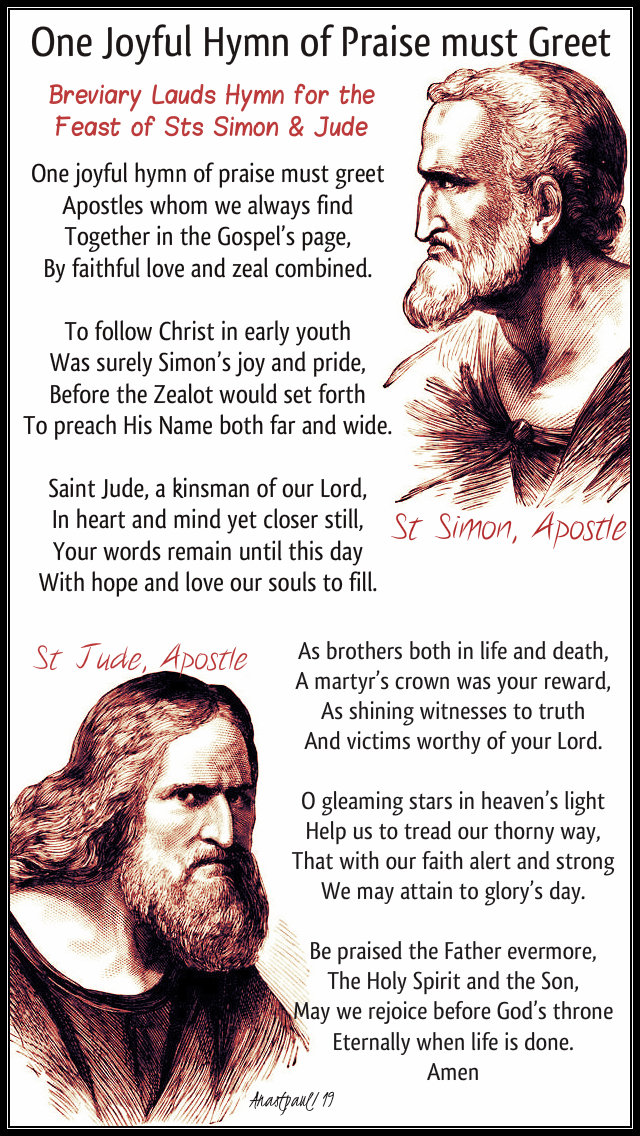
One Joyful Hymn of Praise must Greet Morning Hymn On the Feast of Sts Simon and Jude From the Breviary The Benedictines of Saint Cecilia’s Abbey, Ryde, UK
One joyful hymn of praise must greet
Apostles whom we always find
Together in the Gospel’s page,
By faithful love and zeal combined.
To follow Christ in early youth
Was surely Simon’s joy and pride,
Before the Zealot would set forth
To preach His Name both far and wide.
Saint Jude, a kinsman of our Lord,
In heart and mind yet closer still,
Your words remain until this day
With hope and love our souls to fill.
As brothers both in life and death,
A martyr’s crown was your reward,
As shining witnesses to truth
And victims worthy of your Lord.
O gleaming stars in heaven’s light
Help us to tread our thorny way,
That with our faith alert and strong
We may attain to glory’s day.
Be praised the Father evermore,
The Holy Spirit and the Son,
May we rejoice before God’s throne
Eternally when life is done.
Amen
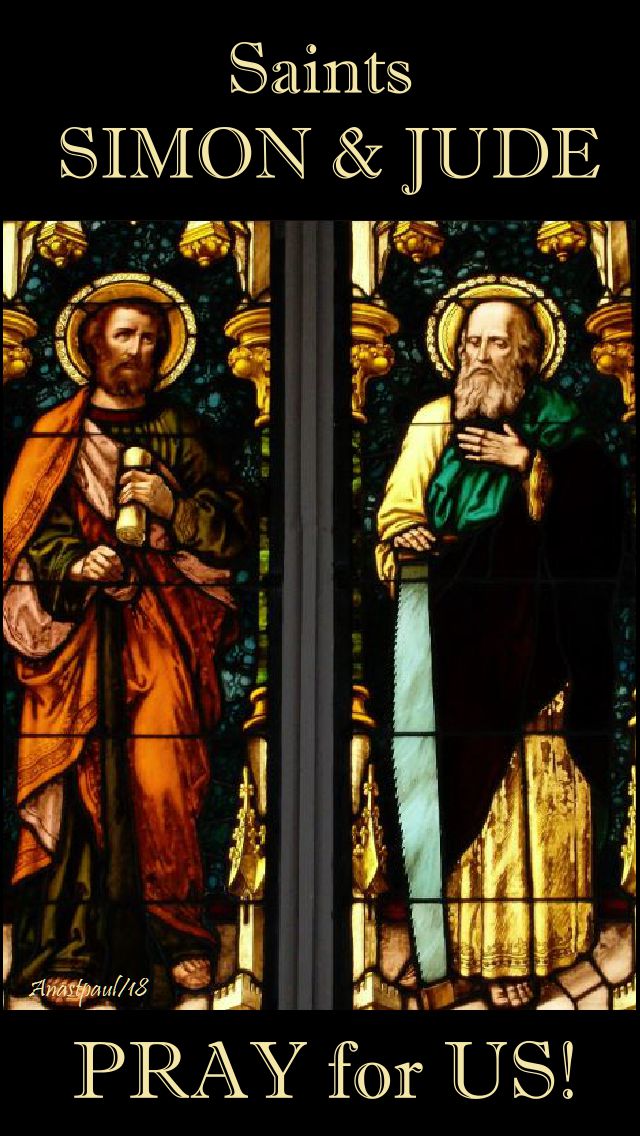
Feast of Saints Simon and Jude, Apostles of Christ – 28 October
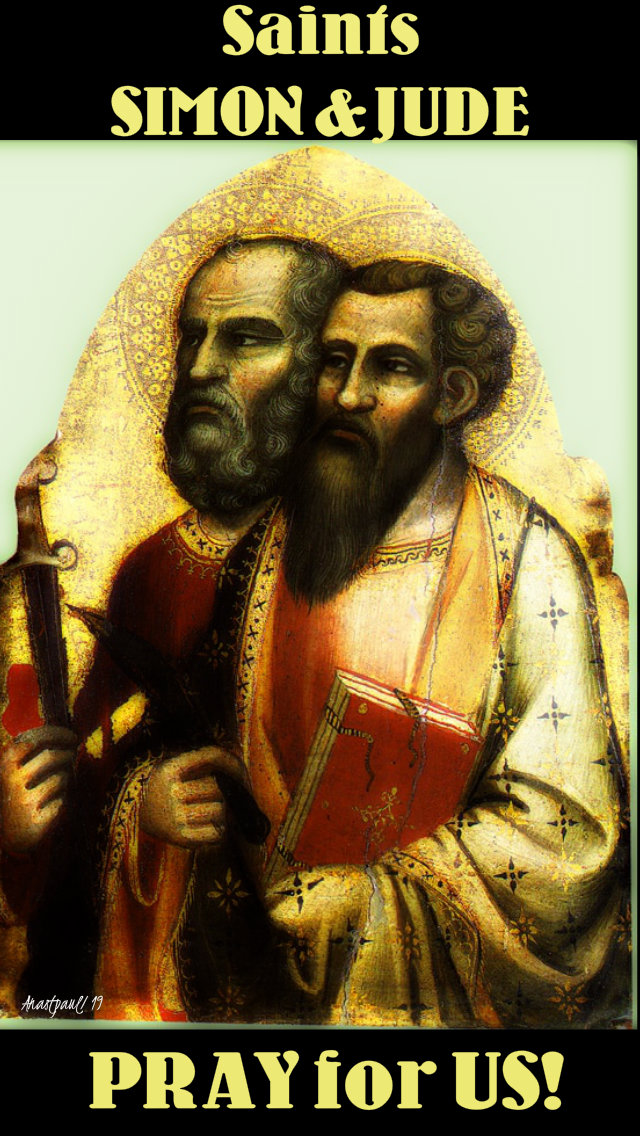
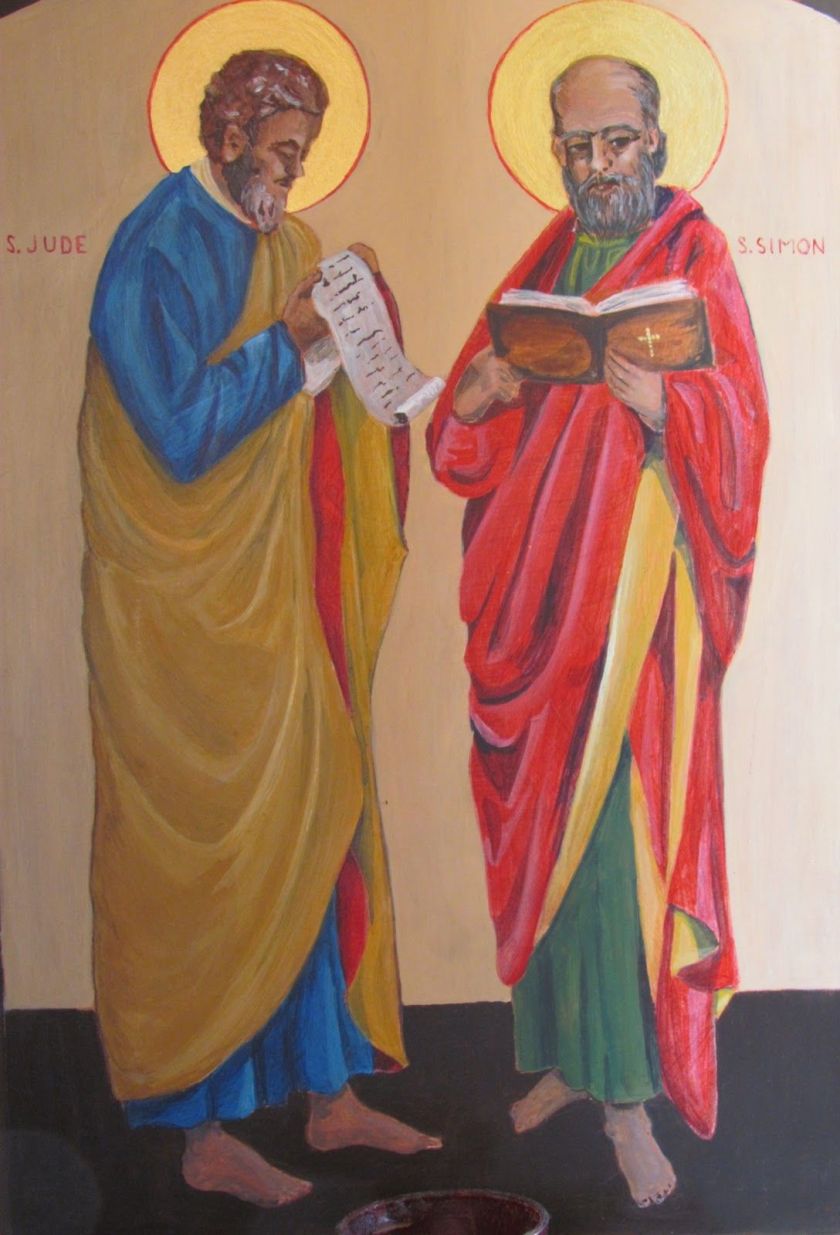
Today the Church celebrates the feast of Sts Simon and Jude whose names occur together in the Canon of the Mass and are also celebrated on the same day. These two Apostles have been linked in name since the early days of Christianity and some believe that this is because they were relatives of Jesus.
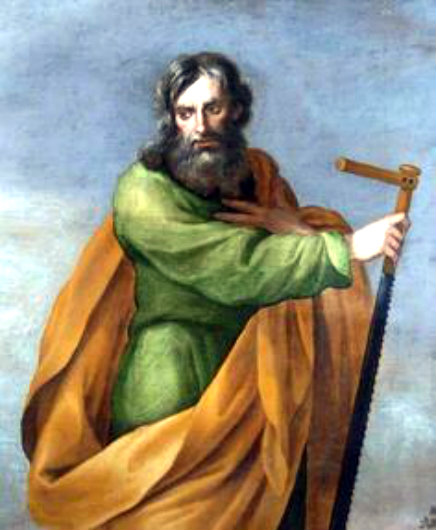
San Simón | Jusepe de Ribera / Image: Saint Jude Thaddeus | Georges de La Tour
St Simon in the Gospels is called “the Zealot” and this may indicate that he belonged to that military group of Jews called the Zealots, the last of whom committed suicide on Masada rather than surrender to the Roman legions. Legend has Simon evangelising the area around Edessa in Syria, where later a great school of theology arose. It is also said, that after preaching in Egypt, he joined St Jude in Mesopotamia and that they both went as missionaries to Persia and were martyred there. Undoubtedly, their names are linked also because of this association.
St Simon
Jude was most certainly a cousin of Jesus and is mentioned in the lists of the “brothers of the Lord.” In Luke he is called Jude and in Matthew and Mark, ‘Thaddeus’ and is considered to be the brother of James, the first Bishop of Jerusalem and the leader of the early Christian community there – this is James the Lesser, not the brother of St John. He is the author of the Epistle of Jude in the New Testament, one of those called the ‘Catholic Epistles.’ It is believed that the early translators of the New Testament from Greek into English, sought to distinguish him from Judas Iscariot and subsequently abbreviated his forename. In iconography, , St Jude is often shown with an image of his cousin, our Lord Jesus and a tongue of fire over his head.
At the Last Supper, it was Jude who asked the Lord Jesus, why He did not manifest Himself to the rest of the world and Jesus answered that he and the Father would visit all those who loved Him, saying – “We will come to him and make our abode with him.”
Jude is the patron of ‘hopeless cases’ and devotion to him, as the advocate of impossible causes, is widespread throughout the Church. So why is St Jude Thaddaeus the patron saint of desperate causes? The traditional reason is rather simple – When one hears the name Judas (Latin and Greek) or even Jude (English), one immediately thinks of Judas Iscariot who betrayed our Lord. Therefore, a person had to be desperate to invoke his name. Being so seldom invoked and reverenced, St Jude is ready and waiting to hear the prayers of those who call upon him. Ironically, he is probably the Apostle who is invoked the most in prayer and the most memorialised in churches, with statues and stained glass windows or other artworks.
It is a beautiful tradition, associated with prayer to St Jude, for his intercession, to leave a copy of the prayer in a Church, or before his Statue, Picture or Shrine, for someone else in great need, to find. The prayer is usually prayed as a Novena.
Prayer to St Jude
Patron of Impossible Causes
Most holy Apostle, St Jude,
faithful servant and friend of Jesus,
the Church honours and invokes you universally,
as the patron of hopeless causes,
of things almost despaired of.
Pray for me, I am so helpless and alone.
Help me, I implore you,
by that particular privilege given to you,
to bring visible and speedy help
where help is almost despaired of.
Come to my assistance in this great need,
that I may receive the consolation
and help of Heaven in all my necessities,
tribulation and sufferings,
particularly ………………… (state request)
and that I may praise God with you
and all the elect forever.
I promise, O blessed St Jude,
to be ever mindful of this great favour,
to always honour you as my special and powerful patron
and to gratefully encourage devotion to you.
Amen
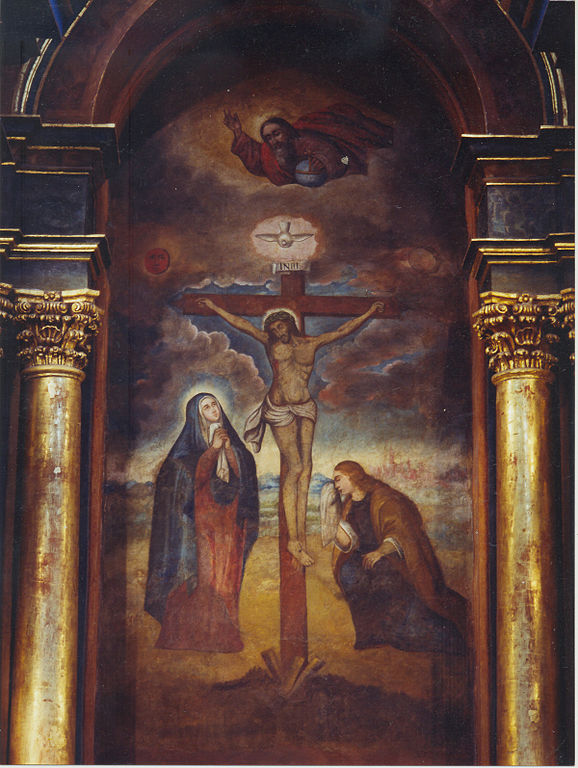
Lord of Miracles/Señor de los Milagros de Nazarenas: A mid-17th-century painting of the Crucifixion that is venerated in Lima, Peru and its celebration involves one of the largest processions in the world.
It was painted by an unnamed African taken to Peru as a slave from what is now Angola. Above the Cross is the Holy Spirit and God the Father. Below and to the right of Jesus, is His mother, the Virgin Mary with her heart pierced by a sword of sorrow. Kneeling and weeping at the foot of the cross is St Mary Magdalene.
The name originated on 13 November 1655 when everything around it was destroyed in an earthquake that left the painting standing and undamaged. Christ is shown enduring the pain of crucifixion.
Every year in October, hundreds of thousands of devotees from all races and economic backgrounds participate in a procession honouring the image through the streets of Lima. Boulevards are decorated in purple on 18,19 and the final Feast 28 October to celebrate the Lord of Miracles.
St Abdias of Babylon
St Abraham of Ephesus
St Alberic of Stavelot
St Anastasia the Elder
St Anglinus of Stavelot
St Cyril of Rome
St Cyrilla of Rome
St Diomedes the Younger
St Dorbhene of Iona
St Eadsin of Canterbury
St Elius of Lyon
St Faro of Meaux
St Ferrutius
St Fidelis of Como
St Genesius of Thiers
Bl Germain of Talloires
St Gioan Dat
St Godwin of Stavelot
St Maria Ascuncion
St Remigius of Lyons
St Rodrigo Aguilar Aleman
St Salvius of Amiens
—
Martyrs of Avila – 3 saints: Two sisters and a brother who, during a period of persecution, fled Talavera de la Reina, Spain, were caught and executed. Martyrs: Christeta, Sabina and Vincent. 303 in Avila, Spain.
Martyred in the Spanish Civil War:
• Blessed Claudio Julían García San Román
• Blessed Maria Asuncion
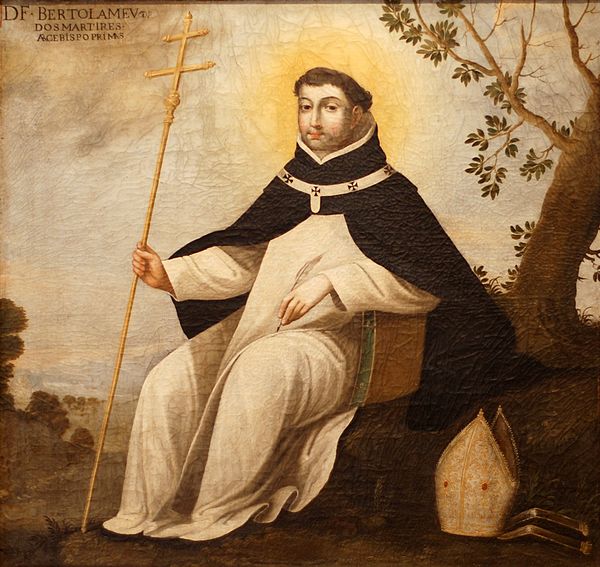
Saint of the Day – 27 October – Blessed Bartholomew OP (c 1200–1271) Bishop, Confessor, Dominican Friar, renowned Preacher, Defender of the Faith, Writer, Theologian, diplomatic peacemaker – also known as Bartholomew of Braganza – born in c 1200 in Vicenza, Italy and died there in 1271.
Bartholomew was born in the city of Vicenza to the noble family of di Braganca. He studied at Padua, receiving there the habit of the recently founded Order from the hands of St Dominic himself, at about the age of twenty. Immediately after his ordination, he was sent to Lombardy to preach against the heretics who were leading others away from the true faith. As a young priest he founded a military order whose purpose was to keep civil peace in towns throughout Italy.
He was so effective in this, that the Holy Father, Pope Gregory IX called him to Rome and appointed him Master of the Sacred Palace (the Papal Theologian), which is an office traditionally held by Dominicans. Because of the differing needs of the Church, the following Pope, Innocent IV, appointed him to become a bishop on the Island of Cyprus. For most men, such an appointment is an honour and a tribute to their holiness and their demonstrated leadership skills. But for Bartholomew, it was a form of exile that had been urged by an antipapal group that was only too happy to see him leave for Cyprus.
Already having become a friend of St Louis the King of France, Bl Bartholomew renewed this friendship as St Louis went through Cyprus on his way to Egypt during the Seventh Crusade (1248). In 1254, he was sent as legate to the courts of England and France and as Henry III of England was, at that time, in his realm in the Aquitaine, Bartholomew travelled there towards the close of that year, then accompanied the English king and queen to Paris. He was, on this occasion, presented by the King of France with a relic of the true Cross and a thorn from Jesus’ Crown of Thorns, worn at His Crucifixion. These he afterwards placed in the beautiful Dominican Church built by him at Vicenza which is known as the Church of the Crown.
Two years later, in order to ensure the presence of so distinguished a prelate at his own court, Pope Alexander IV made him Bishop of Vicenza, his native city. During his tenure of that see, Bartholomew was subject to the hostility of the local ruler Ezzelino III, a Ghibelline who was noted for the brutality of his rule and who was a strong opponent of Papal power. But in Vicenza, he not only continued to preach the truths of the faith and free the local Church from the errors of the Manicheans but he also established such a sense of peace that the people asked him to become their temporal ruler as well. He rightfully declined but this shows the great virtue that he not only had but also, that he instilled in his people.
He was venerated by the people and, according to the Bollandists, has always been honoured with the title of “Blessed”. In recognition of this, he was formally Beatified in 1793. He wrote commentaries on Scripture, was the reputed author of a commentary on the “Hierarchy” of St Dionysius the Areopagite, of two volumes of sermons and some smaller works.
O God, who made Blessed Bartholomew, Your Confessor and Bishop, wonderful in leading the enemies of the faith from the darkness of error to the light of truth and in bringing back multitudes to peace and concord, grant, through his intercession, that Your peace, which passes all understanding, may keep our hearts and minds in Christ Jesus our Lord, who lives and reigns with You forever and ever.
St Abban of Magh-Armuidhe
St Abraham the Poor Bl Bartholomew OP (c 1200–1271)
St Capitolina
St Colman of Senboth-Fola
St Colman of Templeshambo
St Desiderius of Auxerre
St Elesbaan of Ethiopia
St Emilina of Boulancourt
St Erotheides
St Florentius of Trois-Châteaux St Frumentius (Died c 383) Apostle to Ethiopia St Frumentius’ Biography: https://anastpaul.com/2018/10/27/saint-of-the-day-27-october-st-frumentius-died-c-383-apostle-to-ethiopia/
St Gaudiosus of Naples
Bl Goswin of Clairvaux
St Namatius of Clermont
St Odrian of Waterford
Bl Salvador Mollar Ventura
St Thraseas of Eumenia
St Uni
One Minute Reflection – 26 October – Saturday of the Twenty Ninth week in Ordinary Time, Year C, Gospel: Luke 13:1-9 and the Memorial of Blessed Bonaventura of Potenza OFM Conv (1651-1711)
And he said to the vinedresser, ‘Lo, these three years I have come seeking fruit on this fig tree and I find none. Cut it down, why should it use up the ground?’…Luke 13:7
REFLECTION – “The Lord also has something very fitting to say about a fruitless tree, “Look, it is now three years that I have been coming to it. Finding no fruit on it, I will cut it down, to stop it blocking up my field.” The gardener intercedes. This tree is the human race. The Lord visited this tree in the time of the patriarchs, as if for the first year. He visited it in the time of the law and the prophets, as if for the second year. Here we are now, with the gospel the third year has dawned. Now it is as though it should have been cut down but the Merciful One intercedes with the Merciful One. He wanted to show how merciful He was and so He stood up to Himself with a plea for mercy. “Let us leave it,” he says, “this year too. Let us dig a ditch around it.” Manure is a sign of humility. “Let us apply a load of manure, perhaps it may bear fruit.” Since it does bear fruit in one part and in another part does not bear fruit, its Lord will come and divide it. What does that mean, “divide it”? There are good people and bad people now in one company, as though constituting one body.” … St Augustine (354-430) Father & Doctor (Sermon 254)
PRAYER – Come to help us in our weakness, God of mercy, forgive the sins of Your people and as nothing we can do is worthy in Your sight, save us through the intercession of the Mother of our Lord, Jesus Christ. May the prayers of all your saints and we entreat Your servant, Blessed Bonaventura of Potenza to add his prayers on our behalf. We make our prayer through Jesus with the Holy Spirit, God forever, amen.
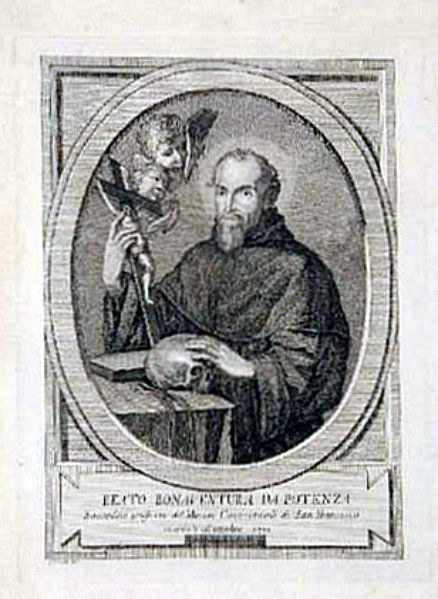
Saint of the Day – 26 October – Blessed Bonaventura of Potenza OFM Conv (1651-1711) Priest and Religious of the Order of Friars Minor Conventual, Miracle-worker, blessed with the gift of prophecy – born on 4 January 1651 of Potenza, Naples, Italy as born Carlo Antonio Gerardo Lavanga and died on 26 October 1711 in Ravello, Italy of gangrene while singing a psalm during a religious ecstasy.
Bonaventura was born of poor but virtuous parents in Potenza in the kingdom of Naples. A pious priest gave the boy instructions in Latin. At the age of 15, Bonaventura received the Franciscan habit among the Conventuals. After his profession, he resumed his studies with great ardour but his zeal for perfection was less ardent.
His superiors sent him to Amalfi, where he lived eight years under the guidance of an eminent director of sauls. This spiritual director trained his pupil above all in humility, self-abnegation and obedience and Bonaventura achieved a high degree of perfection in these virtues.
One day Bonaventure told his master that the key to the sacristy was lost. “Well,” said his master with a smile, “then you will have to look for it in the well, get a rod and fish it out.” Promptly Bonaventura went to the well and with rod and line fished for the key. It was not long before he actually drew it out. God rewarded him in a miraculous manner for his blind obedience.
As a priest he laboured with remarkable success. His words, conduct, prayer and mortification combined to produce blessed results. His simple sermons made a deep impression on all hearts. At times, a single word of hi,s was enough to move the most hardened sinner to contrition.
At various times he was appointed guardian of a convent but his humble pleas were always successful in changing the mind of his superiors. Obedience at length compelled him to accept the position of novice master. In this office he sought to inculcate in his pupils, above all, the practice of humility and obedience.
When an epidemic broke out among the townsfolk, Bonaventura at once sacrificed himself. Fearless of contracting the disease, he hastened from end-to-end of the town, rendering every possible service to the stricken, even the lowliest and administering the sacraments to them. He cured many miraculously, he multiplied their insufficient provisions by his blessing and he foretold future events.
After Bonaventura had been a shining model of virtue among his brethren for 45 years, he felt that his last hour was at hand. While the community gathered about his bed during the administration of the last sacraments, the dying man in touching words begged pardon of his superior and the community for his many faults and infractions of the rule, as he called them.
Deeply moved, the superior handed him the crucifix and amid abundant tears, the servant of God kissed the feet of the Saviour and then died peacefully on 26 October 1711. Pope Pius VI Beatified him in 1775.
Bishop Orazio Soricelli, Archbishop of Amalfi-Cava de ‘Tirreni , called a special jubilee year dedicated to the Blessed Bonaventura da Potenza in his archdiocese. The jubilee year opened on 26 October 2011, the third centenary of the death of the Blessed.
St Adalgott of Einsiedeln
St St Alanus of Quimper
Albinus of Buraburg
St Alfred the Great
St Alorus of Quimper
St Amandus of Strasburg
St Amandus of Worms
St Aneurin
St Aptonius of Angouleme
St Arnold of Queralt
St Bean of Mortlach
St Bernard de Figuerols Bl Bonaventura of Potenza OFM Conv (1651-1711)
St Cedd
Bl Celina Chludzinska
St Cuthbert of Canterbury
Bl Damian dei Fulcheri
St Eadfrid
St Eata of Hexham St Pope Evaristus – (c 44 – c 107) Martyr
Biography: https://anastpaul.com/2018/10/26/saint-of-the-day-26-october-st-pope-evaristus-c-44-c-108/
St Felicissimus of Carthage
St Fulk of Piacenza
St Gaudiosus of Salerno
St Gibitrudis
St Gwinoc
St Humbert
St Lucian
St Marcian
St Quadragesimus of Policastro
St Rogatian of Carthage
St Rusticus of Narbonne
St Sigibald of Metz
—
Martyrs of Nicomedia – 5 saints
One Minute Reflection – 25 October – Friday of the Twenty Ninth week in Ordinary Time, Year C, Gospel: Luke 12:54-59 and the Memorial of Bl Thaddeus McCarthy (c 1455–1492)
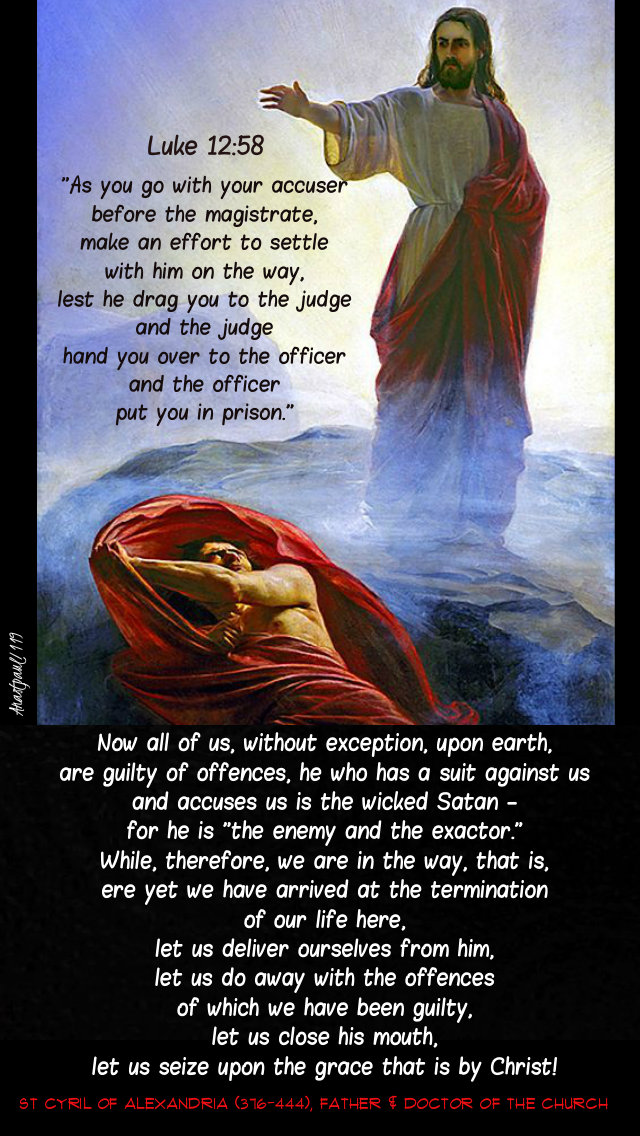
“As you go with your accuser before the magistrate, make an effort to settle with him on the way, lest he drag you to the judge and the judge hand you over to the officer and the officer put you in prison.” … Luke 12:58
REFLECTION – “Now all of us, without exception, upon earth are guilty of offences, he who has a suit against us and accuses us, is the wicked Satan – for he is “the enemy and the exactor.” While, therefore, we are in the way, that is, ere yet we have arrived at the termination of our life here, let us deliver ourselves from him, let us do away with the offences of which we have been guilty, let us close his mouth, let us seize upon the grace that is by Christ, which frees us from all debt and penalty and delivers us from fear and torment, lest, if our impurity be not cleansed away, we be carried before the judge and given over to the exactors, that is, the tormentors, from whose cruelty no man can escape, yea, rather, who will exact vengeance for every fault, whether it be great or small.
Far removed from this danger are those who search for the time of Christ’s corning and are not ignorant of His mystery but well know that the Word, though He be God, has shone forth upon the inhabitants of earth in likeness as one of us, that freeing them from all blame, He may bless with exceeding happiness those who believe in Him and acknowledge Him as God and the Son of God, by Whom and with Whom to God the Father be praise and dominion, with the Holy Spirit, forever and ever, Amen” … St Cyril of Alexandria (376-444), Father & Doctor of the Church – Commentary on Luke (1859) Sermons 89-98.
PRAYER – Lord God, You fill us with Your grace and teach us true faith. Strengthen in our hearts that faith that no trials may quench the fire, that we may seek Your face in every moment and accept AND LIVE all of Your will. Send us Your Spirit to keep the fire blazing. May the humble love and intercession of Mary Mother of our faith, be our succour and may Blessed Thaddeus McCarthy intercede for us on our pilgrim way. Through Jesus Christ, Your Son our Lord, with the Holy Spirit, God forever, amen.
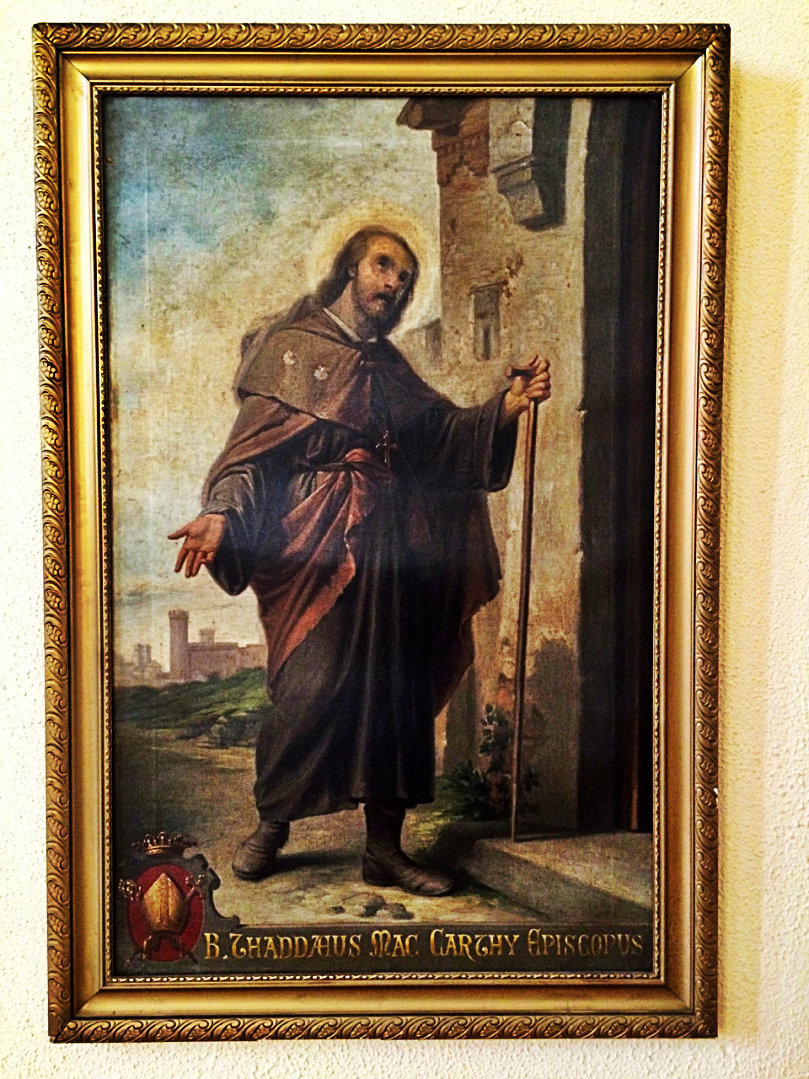
Saint of the Day – 25 October – Blessed Thaddeus McCarthy (c 1455–1492) the “White Martyr of Munster” – Bishop – born Tadhg Mac Cárthaigh in c1455 in County Cork, Ireland and died on 25 October 1492 in a pilgrim’s hostel at Lvrea, Italy of natural causes. He was a Bishop who never ruled his See/s, even though he was appointed to two of them – Bishop of Ross, Ireland in 1482 and Bishop of Cork and Cloyne in 1490. Patronages – exiles, the homeless, those suffering calumny, rejection and persecution, pilgrims.
Bishop Thaddeus McCarthy, the young Irish Prelate whose immemorial cult was confirmed by Pope Leo XIII in 1896, was born in the middle of the fifteenth century. He studied theology first under his uncle, one Canon Thady McCarthy and then in Paris and in Rome. At the age of 27 he was named bishop of Ross by Pope Sixtus IV and consecrated in Rome. Returning to Ireland, he discovered that his see was already in the possession of one Hugh O’Driscoll, also appointed to it by the same Pope Sixtus IV. It would seem that news had reached Rome of the death of Hugh O’Driscoll, either by simple misinformation or by political intrigue. Bishop O’Driscoll assumed that Thaddeus was an imposter and in 1488 obtained his excommunication by Pope Innocent VIII. Thaddeus appealed the excommunication, a Roman commission judged in his favour and in 1490 he was named Bishop of Cork and Cloyne.
A Wandering Bishop
Bishop Thaddeus attempted to take possession of his new see but was prevented from entering his cathedral by supporters of Gerald Fitzgerald who, with the support of local chieftains, had usurped his jurisdiction over the diocese of Cork and Cloyne. Armed men took possession of the cathedral preventing Thaddeus from entering. Everywhere he turned, he suffered the pain of rejection. For two years, he travelled from town to village armed with the papal documents announcing his rightful appointment and absolution from any criminal charge. This persecution as such was the outcome of political pressure. By now, he was alone, having strenuously opposed any form of retaliation by his own McCarthy clan. They, in response, abandoned him. Now, without family support, status and security but with unwavering faith and trust in God, he once again set off for Rome to plead his case to the Pope.
The Pontiff gave him a new document dated 18 July 1492 and ordered the powerful Gerald Earl of Kildare to protect Thaddeus, to support him and to restore him to his rightful place as Bishop of Cork and Cloyne.
Blessed Thaddeus appeals to the Pontiff (detail of the Thaddeus altar, Cobh)
The Pilgrim
Fearing that an attempt would be made on his life, Thaddeus disguised himself as a humble pilgrim and set out on foot from Rome. On the evening of 24 October 1492, an exhausted Thaddeus arrived at a hostel for pilgrims in Ivrea, Italy. He was wearing the hooded habit of a pilgrim with its distinctive sign of the oyster shell. The innkeeper received the poor pilgrim warmly and provided him with a room for the night. At dawn, a strange and wonderful light was seen shining from the room. Upon entering it, the innkeeper found the lifeless body of 37 year old Thaddeus McCarthy, radiant with a heavenly beauty.
Blessed Thaddeus is often depicted wearing the scallop shell – symbol of a pilgrim
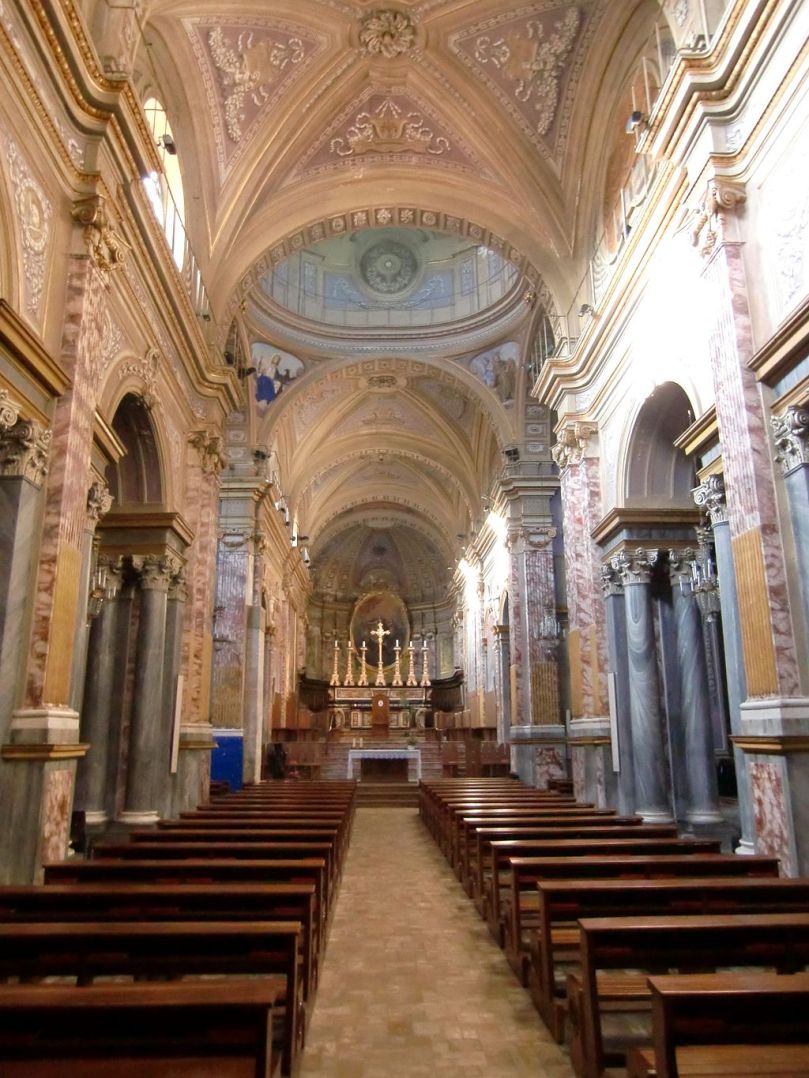
The local bishop was apprised of the phenomenon, he had, in fact, dreamed that very night of an unknown bishop ascending into the glory of heaven. He recognised Thaddeus as the bishop of his dream. Further investigation revealed that Thaddeus’ wallet contained the papal documents recognising him as bishop of Cork and Cloyne, and an episcopal ring. Clothed in episcopal robes, Thaddeus’ body attracted crowds of the local faithful to the cathedral where he lay in state. He was buried in the cathedral of Ivrea, where his tomb became a place of extraordinary graces and miracles.
The death of Thaddeus, St Colmán’s Cathedral, Cobh
A Pontiff Between Ireland and Italy
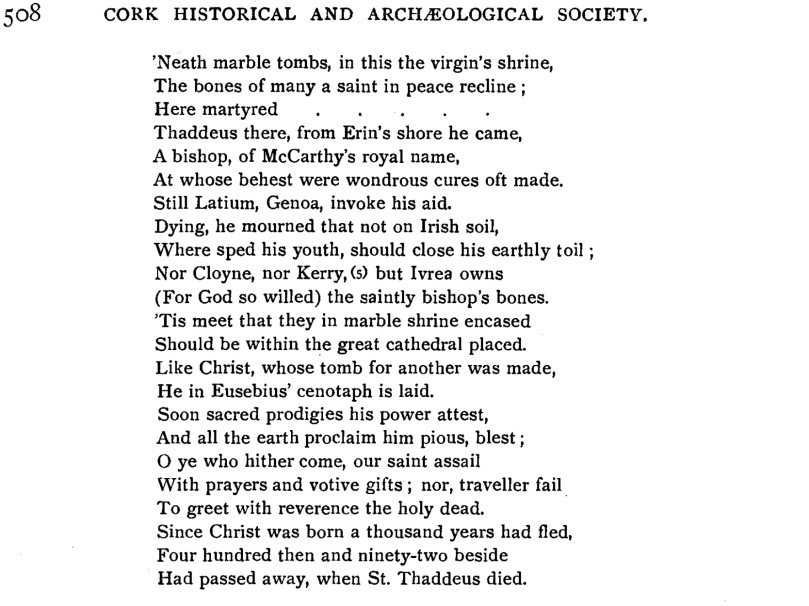
In 1742, 350 years later, when the tomb of Thaddeus McCarthy was opened, his body was found to be incorrupt. Devotion to the Irish bishop developed and in 1847 the clergy and faithful of Ivrea donated a large amount of money for victims of the Great Hunger in Ireland. The contact between Ireland and Ivrea resulted in a movement for the beatification of Bishop Thaddeus. In 1896, Pope Leo XIII confirmed his immemorial cult. Major relics of the Blessed were sent from Ivrea to the church at Cork, Ross and Cloyne. Below are the relic of Thaddeus’s leg bone and a prayer for his Canonisation, both part of the shrine on the North Cathedral, Cork.
Blessed Thaddeus McCarthy is known as The White Martyr of Munster because the mental and physical sufferings that he endured with heroic patience. He is a patron of people in every sort of affliction, especially of those suffering rejection, homelessness, calumny and exile. Here is the liturgical collect for his feast:
O God, who didst adorn Blessed Thaddeus, Thy Confessor and Thy Bishop
with invincible fortitude in bearing adversity, grant, we beseech Thee, that following his example as we make our pilgrim way upon earth, we may prevail mightily over the things that come against us.
One will recognise in the Collect, the allusion to Romans 8:35–39:
Who then shall separate us from the love of Christ? Shall tribulation? or distress? or famine? or nakedness? or danger? or persecution? or the sword? (As it is written: For thy sake we are put to death all the day long. We are accounted as sheep for the slaughter.) But in all these things we overcome, because of him that hath loved us. For I am sure that neither death, nor life, nor angels, nor principalities, nor powers, nor things present, nor things to come, nor might, nor height, nor depth, nor any other creature, shall be able to separate us from the love of God, which is in Christ Jesus our Lord.
Blessed Thaddeus McCarthy never accomplished what he was consecrated to accomplish. in this life but now he has two Diocese after all. He is beloved in Ivrea and in Cobh! He never governed his diocese, ordained new priests, or even confirmed anybody, as best we can tell. But he fulfilled his purpose – he gave his life for God, earning the title “White Martyr of Munster.” Below, the magnificent shrine and relics in the beautiful Cathedral in Ivrea, Italy, where Thaddeus lies and at the bottom, the equally magnificent side-chapel dedicated to his memory in St Colmán’s Cathedral, Cobh, Ireland. And, all over Ireland Shrines and side-chapels are dedicated to the Blessed and beloved Thaddeus.
A window dedicated to Blessed Thaddeus in the Church in Caheragh, near Skibbereen
On 25 October his feast day, let’s ask his intercession for those who are discouraged by lack of results, that they would seek not to be successful but to be faithful. Blessed Thaddeus McCarthy, pray for us!
St Alfons Arimany Ferrer
St Bernard of Calvo
St Canna verch Tewdr Marw
St Chrysanthus St Crispin & St Crispian – (†285 or 286) Martyrs Their Story: https://anastpaul.com/2018/10/25/saints-of-the-day-25-october-sts-crispin-crispinian-%e2%80%a0285-or-286-martyrs/
St Cyrinus of Rome
St Daria
St Dulcardus
Bl Edmund Daniel
St Fronto of Périgueux
St Fructus of Segovia
St Gaudentius of Brescia
St George of Périgueux
St Goeznoveus of Leon
St Guesnoveus
Bl Henry of Segusio
St Hilary of Javols
St Hilary of Mende
St Hildemarca of Fecamp
St Januarius of Sassari
St Lucius of Rome
St Lupus of Bayeux
St Mark of Rome
Bl Maurus of Pécs
St Miniato of Florence
St Peter of Rome
St Protus of Sassari
St Recaredo Centelles Abad
St Tabitha Bl Thaddeus McCarthy (c 1455–1492)
St Theodosius of Rome
—
Martyrs of Constantinople:
Marciano
Martirio
Martyrs of Cruz Cubierta – 5 beati: A mother, Blessed María Teresa Ferragud Roig de Masiá and her four daughters, Blessed María Joaquina Masiá Ferragud, Blessed María Vicenta Masiá Ferragud, Blessed María Felicidad Masiá Ferragud and Blessed Josefa Ramona Masiá Ferragud, all nuns, who were Martyred in the Spanish Civil War, on 25 October 1936 in Cruz Cubierta, Alzira, Valencia, Spain.
They were Beatified on 11 March 2001 by St Pope John Paul II.
Forty Martyrs of England and Wales – 40 saints: Following the dispute between the Pope and King Henry VIII in the 16th century, faith questions in the British Isles became entangled with political questions, with both often being settled by torture and murder of loyal Catholics. In 1970, the Vatican selected 40 martyrs, men and women, lay and religious, to represent the full group of perhaps 300 known to have died for their faith and allegiance to the Church between 1535 and 1679. They each have their own day of memorial, but are remembered as a group on 25 October.
• Alban Roe • Alexander Briant • Ambrose Edward Barlow • Anne Line • Augustine Webster • Cuthbert Mayne • David Lewis • Edmund Arrowsmith • Edmund Campion • Edmund Gennings • Eustace White • Henry Morse • Henry Walpole • John Almond • John Boste • John Houghton • John Jones • John Kemble • John Lloyd • John Pain • John Plesington • John Rigby • John Roberts • John Southworth • John Stone • John Wall • Luke Kirby • Margaret Clitherow • Margaret Ward • Nicholas Owen • Philip Evans • Philip Howard • Polydore Plasden • Ralph Sherwin • Richard Gwyn • Richard Reynolds • Robert Lawrence • Robert Southwell • Secular Clergy • Swithun Wells • Thomas Garnet.
Canonised on 25 October 1970 by St Pope Paul VI
Martyrs of Rome – 67 saints: A group of 46 soldiers and 21 civilians martyred together in the persecutions of Claudius II. 269 in Rome, Italy.
Martyred in the Spanish Civil War:
• Blessed Alfons Arimany Ferrer
• Blessed Recaredo Centelles Abad
Thought for the Day – 24 October – The Memorial of St Anthony Mary Claret (1807-1870)
Jesus foretold that those who are truly His representatives would suffer the same persecution as He did. Besides 14 attempts on his life, Anthony had to undergo such a barrage of the ugliest slander that the very name Claret became a byword for humiliation and misfortune. The powers of evil do not easily give up their prey. No-one needs to go looking for persecution. All we need to do is be sure we suffer because of our genuine faith in Christ, not for our own whims and lack of prudence. St Anthony pulled no punches but preached the Truth, fearless in the love of Christ and His Church, His Bride!
From the beginning Anthony wanted to be a priest. His seminary life was exemplary and he was ordained on 13 June 1835. He resolved never to waste a moment of time and during his 35 years as a priest he wrote 200 books and pamphlets and preached some 25,000 sermons.
On one trip, besides travelling, he preached 205 sermons in 48 days, 12 in one day. To make sure his efforts might be recognised for what they were, he started off by reminding his hearers that the ordinary motives for labour are money, pleasure or honour. But these were not his motives:
“… not money, for I do not want a penny from anybody… Nor do I preach for pleasure, for what pleasure can I possibly take in spending myself all day, in being fatigued from early morning until late at night?… I must be in the confessional most of the morning, the whole of the afternoon and in the evening, instead of resting, I have to preach. This is not just for a day, but… for months and years…
Perhaps I labour for honour… no, not for honour either… A preacher is exposed to many calumnies. If praised by one, he is misunderstood by another, treated as the Jews treated Jesus, Who was calumniated by maligners of His person, of His words and works, before they finally seized, scourged and killed Him by a most painful and shameful means. But like the apostle St Paul, I fear none of these things, since I value my soul more than my body. At any cost, I must discharge the ministry I have received from God Our Lord, which is to preach the Gospel… I have no worldly end in view but… that God may be known, loved and served by all the world… that sins and offences against Him may be hindered as much as possible…
Another thing that spurs me on, to preach ceaselessly, is the thought of the multitude of souls which fall in the depths of hell… Who die in mortal sin, condemned forever and ever… I see how many live habitually in mortal sin, so that never a day passes without increasing the number of their iniquities. They commit sin as easily as they drink a glass of water, just for diversion, or for a laugh. These unfortunate ones run to hell of their own accord, blind as bats… If you were to see a blind man about to fall into a pit or over a precipice, would you not warn him? Behold, I do the same and do it I must, for this is my duty… You may tell me that sinners will insult me, that I should leave them alone… Ah no, I can’t abandon them. They are my dear brothers. If you had a beloved brother who, sick and in the throes of delirium, were to insult you with all the angry words imaginable, would you abandon him? I am certain you wouldn’t. You would have even more compassion for him, do your utmost for his speedy recovery. This is how I feel in regard to sin ners. These poor souls are in a delirium and the more in need of our pity…
You may say the sinner doesn’t think of hell, nor even believe in it. So much the worse for him. Do you by chance think he will escape condemnation because of his unbelief? Truth is independent of belief… I must warn sinners and make them see the precipice which leads to the unquenchable fires of hell, for they will surely go there if they do not amend their ways. Woe to me if I do not preach and warn them, for I would be held responsible for their condemnation… How often I pray, with St Catherine of Siena – ‘O my God, grant me a place by the gates of hell, that I may stop those who enter there saying: Where are you going, unhappy one? Back, go back! Make a good confession. Save your soul. Don’t come here to be lost for all eternity!”
Further he boldly proclaimed – “The sole reason why society is perishing is because it has refused to hear the word of the Church, which is the word of life, the word of God. All plans for salvation will be sterile if the great word of the Catholic Church is not restored in all its fullness.”
His own words, are the best description for St Anthony’s life:
“A Son of the Immaculate Heart of Mary is a man on fire with love, who spreads its flames wherever he goes. He desires mightily and strives by all means possible to set the whole world on fire with God’s love. Nothing daunts him, he delights in privations, welcomes work, embraces sacrifices, smiles at slander and rejoices in suffering. His only concern is how he can best follow Jesus Christ and imitate Him in working, suffering and striving constantly and single-mindedly, for the greater glory of God and the salvation of souls.”
St Anthony Mary Claret, Pray for the world, the Church, for us all, amen!
Quote/s of the Day – 24 October – The Memorial of St Anthony Mary Claret (1807-1870) and St Luigi Guanella (1842-1915)
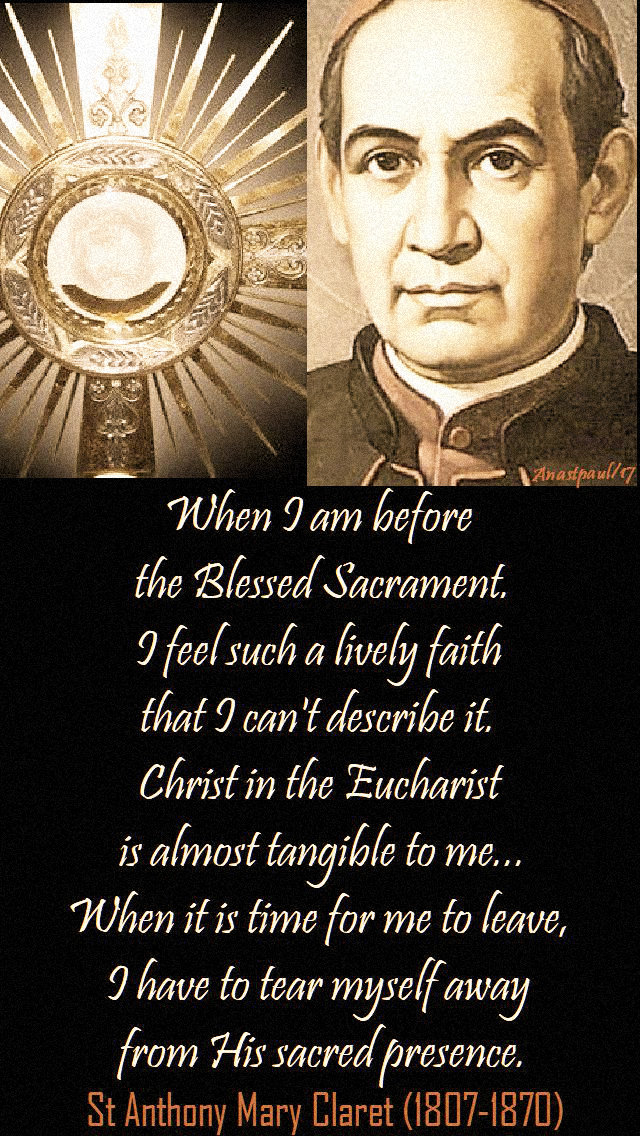
“When I am before the Blessed Sacrament. I feel such a lively faith that I can’t describe it. Christ in the Eucharist is almost tangible to me… When it is time for me to leave, I have to tear myself away from His sacred presence.”
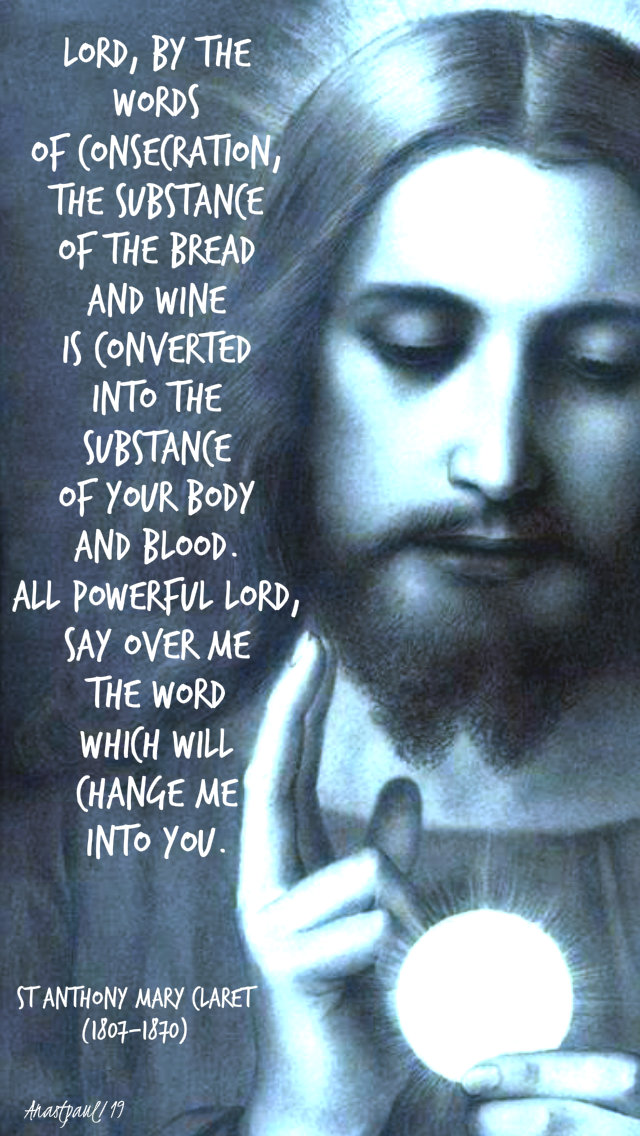
“Lord, by the words of consecration, the substance of the bread and wine is converted into the substance of Your Body and Blood. All powerful Lord, say over me the word which will change me into You.”
















 AnaStpaul
You must be logged in to post a comment.