Posted in JESUIT SJ, SAINT of the DAY

Saint of the Day – 16 March – St Jean de Brébeuf S.J. (1593-1649) Martyr

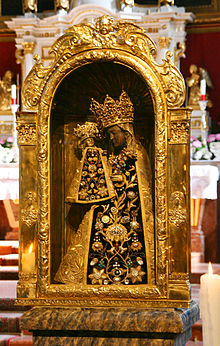
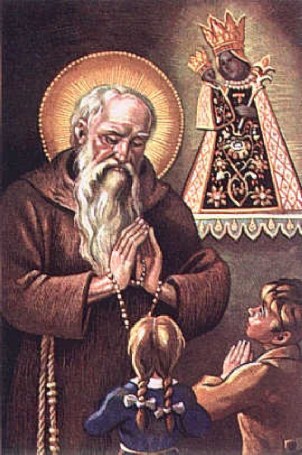
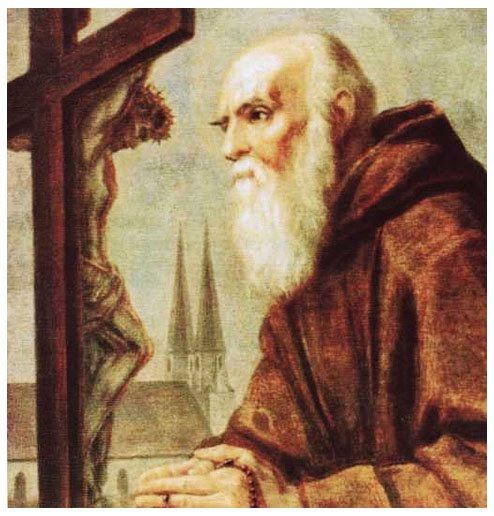
Saint of the Day – 16 March – St Jean de  Brébeuf  S.J. (1593-1649) – Religious Priest, Martyr, Missionary “Apostle to the Hurons” – Patron of Canada.   Additional Memorial – 19 October as one of the Martyrs of North America.   St Jean was born in 1593 at Normandy, France and he was tortured to death in 1649 in Canada.   He was Canonised on 29 June 1930 by Pope Pius XI.

header - st jean de brebeuf

Jean de Brébeuf was born in Normandy, France.   According to Joseph P Donnelly, S.J., one of his biographers, his family was of the “lesser nobility” who worked the land beside the peasants residing there.   As a boy, then, Jean would have “herded sheep, fed the stock and, when old enough, took on heavier chores.”   Little is known of Jean’s early life, though he likely studied at the University of Caen, where he probably met the Jesuits.   He entered the Jesuit novitiate in Rouen in 1621.   For the next few years he taught boys at the Jesuit school in Rouen.   But this would not be the future that God had in store.

In 1624, the Franciscans, who had operated the “missions” to the Huron peoples in New France since 1615, appealed to other French religious orders to send assistance.   Among the first to sail was Jean de Brébeuf , now a tall, robust man of 32.brebeuf

Jean and his companions reached Quebec on 19 June 1625, and immediately began to prepare for his journey to the Huron nation.   Happily, he had a great talent for something that would prove critical in his work.   The great explorer Samuel de Champlain wrote about Brébeuf, “[H]e had such a striking gift for languages that…he grasped in two or three years what others would not learn in twenty.”

That facility would assist him in working with a people with whom he shared little in common, save their common humanity.   To enter into their world Jean resolved to do everything according to their customs, no matter how strenuous, eating their food, sleeping as they did, working as hard as they did.   Here is a powerful echo of the Call of the King, from the Spiritual Exercises, in which one is asked to “labour as Christ labours.”

Jean’s first journey to the Huron homeland, 800 miles from Quebec, was grueling.   Jean tied his shoes around his neck, hiked up his cassock and climbed into the bark canoe. This passage, from Donnelly’s biography, Jean de Brébeuf, first published in 1975, is very descriptive:

“On a journey the Indians spoke little, saving their energy for paddling their average of ten leagues, about thirty miles a day.   Squatted on their haunches, immobile for hours on end, except for the swing of their arms and shoulders wielding the paddle, they generally had no small talk.   Rising at dawn the Hurons heated water into which they dropped a portion of coarsely pounded corn….[After] their scanty meal, the Hurons launched the canoes and began another day of silent travel.   In the evening, when the light began to fail the Indians, making camp for the night, ate their [corn meal] and stretched out on the bare ground to sleep.   The swarms of mosquitoes, deer flies and other insects…seemed not to bother the Indians….Then at dawn the whole painful process began again.”

Once he arrived, the tall Jean was given a name, “Echon,” perhaps a version of first name, or a word meaning in the Huron language, “man who carries the load.”   Here is Brébeuf himself, writing to the Jesuit in Quebec, in the letters now known as the Relations, describing an aspect of his travels:  “Now when these rapids or torrents are reached, it is necessary to land, or carry on the shoulder, through woods, over high and troublesome rocks and all the baggage and canoes themselves.   This is not done without much work…”

st jean de brebeuf

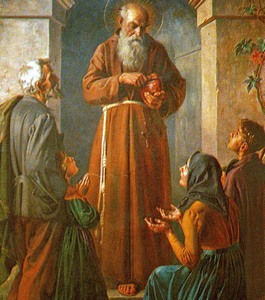
In addition to learning their customs and beliefs, Jean wrote a Huron grammar and translated a catechism in the local language.   Brébeuf would spend three years among these families before being asked to return to Rouen in 1629, after political difficulties made it harder for the French to remain.   Despite the normal prejudices about the native peoples common at the time, Jean had grown to admire and love those with whom he lived.   At times their generosity astonished him:

“We see shining among them some rather noble moral virtues.   You note, in the first place, a great love and union, which they are careful to cultivate….Their hospitality to all sorts of strangers is remarkable;  they present to them, in their feasts the best of what they have prepared and, as I said, I do not know if anything similar, in this regard, is to be found anywhere.”brebeuf and the hurons

When he returned to New France in 1635, he was cheerfully welcomed by his Huron friends.  Immediately he and Antoine Daniel, another Jesuit, began their work in earnest. (They were one of several Jesuits working in the region at the time.)   Near a town called Ihonotiria, near current-day Georgian Bay in Canada, Fathers Brébeuf and Daniel began teaching the people about Christianity.   They were later joined by two other French Jesuits, Charles Garnier and Isaac Jogues.

With the arrival of their new companions, though, a smallpox epidemic broke out among the Jesuits, which spread to the Hurons, who had no immunity whatsoever from the illness.   The missionaries cared for the sick and baptised thousands of Hurons.   But because they had baptised those who were dying, the Hurons concluded that baptism brought death and so many of the Hurons began to turn against the “Blackrobes.” Brébeuf then moved to Sainte-Marie, a centre for the Jesuits in the area.

Then a new danger arose. Rumours (false ones) circulated that Jean was in league with a sworn enemy of the Hurons, the Seneca clan of the Iroquois.   So he prudently moved to another site, Saint Louis.   On 16 March, the Iroquois attacked the village and took the Hurons, who were mainly Christians, along with Jean and another Jesuit, Gabriel Lalement, prisoner.   He knew that the possibility of martyrdom was imminent.

Jean de Brébeuf’s torture was among the cruelest any Jesuit has had to endure. (You might want to avoid this next paragraph if you’re squeamish.)brebeuf_crop

The Iroquois heated hatchets until they were glowing red and, tying them together, strung them across his shoulders, searing his flesh.   They wrapped his torso with bark and set it afire.   They cut off his nose, lips and forced a hot iron down his throat and poured boiling water over his head in a gruesome imitation of baptism.   They scalped him and cut off his flesh while he was alive.   Finally someone buried a hatchet in his jaw.

After 14 years as a missionary, Jean de Brébeuf died on 16 March 1639.   He was 56.   At his death his heart was eaten as a way for the Iroquois, who were stunned by his courage, to share in his bravery.   Eight other Jesuits were martyred around this same time.  Their feast day 19 Oct is referred to as either the Feast of the North American Martyrs or the Feast of St Isaac Jogues and Companions.   Let us not forget this great Companion.

snip - brebeufst jean de brebeuf and comps

Posted in JESUIT SJ, SAINT of the DAY

Memorials of the Saints – 16 March

St Abban of Kill-Abban
St Abraham Kidunaia
St Agapitus of Ravenna
St Aninus of Syria
St Benedicta of Assisi
St Dionysius of Aquileia
St Dentlin of Hainault
Bl Eriberto of Namur
St Eusebia of Hamage
St Felix of Aquileia
St Finian Lobhar
Bl Ferdinand Valdes
St Gregory Makar
St Heribert of Cologne
St Hilary of Aquileia
St Jean de Brebeuf
Bl Joan Torrents Figueras
Bl John Amias
Bl John Sordi of Vicenza
St Julian of Anazarbus
St Largus of Aquileia
St Malcoldia of Asti
St Megingaud of Wurzburg
St Papa of Seleucia
Bl Robert Dalby
St Tatian of Aquileia
Bl Torello of Poppi

Posted in MORNING Prayers, PRACTISING CATHOLIC, QUOTES of the SAINTS, QUOTES on the CHURCH, SAINT of the DAY

Thought for the Day – 15 March – The Memorial of St Clement Mary Hofbauer C.Ss.R.(1751-1820)

Thought for the Day – 15 March – The Memorial of St Clement Mary Hofbauer C.Ss.R.(1751-1820)

Drastic maladies, Clement reasoned, require drastic remedies.   If in Warsaw evil and moral perversity abounded in the extreme, then dosages of Catholicity in the extreme — if indeed there can be such a thing — were needed to correct them.   A powerful antidote invented by Clement Hofbauer was what he called the “Perpetual Mission.” He outlined it in the following manner:

“On all Sundays and holy days there is a sermon at five o’clock in the morning for servants, who . . . cannot attend the divine service at a later hour.   For their convenience Holy Mass is said immediately after the sermon. . . . Every day at six o’clock there is a Mass of Exposition, during which the people chant hymns.   After the Mass an instruction is given in Polish.   During these instructions and sermons Masses are constantly being said, so that those who do not understand Polish or German, or who have not the time to remain for a sermon, may not be deprived of the Holy Sacrifice.   Every day at eight o’clock there is a High Mass with Plain Chant, after which there are two sermons — the first in Polish and the second in German.   Then the school children come to the church and the Solemn High Mass with musical accompaniment is celebrated. . . . In the afternoon at three o’clock the confraternities chant the Office of the Blessed Virgin.   At four o’clock there is a German sermon, followed by Vespers solemnly chanted and followed in turn by a Polish sermon.   Finally there is a visit to the Blessed Sacrament and to the Blessed Virgin publicly made with the faithful . . . . Every day at five o’clock there is a German sermon.   Then follow in order, a Visit to the Blessed Sacrament, a sermon in Polish, the Way of the Cross and congregational singing of hymns in honour of the Passion of Our Lord and of the Blessed Virgin Mary.   Lastly there is an Examination of Conscience for the people, the Acts of Faith, Hope and Charity are made, a short sketch of the life of the saint whose feast is celebrated on the morrow is read and then the Litany of the Blessed Virgin Mary is recited, after which the people are dismissed and the church is closed.”

This was the daily routine at St Benno’s for years!   Besides these were the many other pastoral, charitable and educational labours carried out by the religious community.   And its holy Superior assumed the lion’s share of these tasks.

O St Clement, pray for our world, pray for the Church, pray for us all!st clement mary hofbauer - pray for us - 15 march 2018-no 2

Posted in CONFESSION/PENANCE, MARIAN QUOTES, MORNING Prayers, QUOTES of the SAINTS, QUOTES on CONVERSION, QUOTES on REPENTANCE, SAINT of the DAY

Quote of the Day – 15 March – The Memorial of St Clement Mary Hofbauer C.Ss.R.(1751-1820)

Quote of the Day – 15 March – The Memorial of St Clement Mary Hofbauer C.Ss.R.(1751-1820)

St Clement was unrelenting in pursuing souls cut off from the life of grace, especially those facing imminent death. A nun entered the church one day and found Father Hofbauer kneeling before the altar. Unobserved by the saint, she saw his cheeks wet with tears as he pleaded for the conversion of some sinner outside the fold.

“Lord, give me this soul, for if Thou refuse, I shall go to Thy Mother!”

Posted in CONFESSION/PENANCE, MORNING Prayers, QUOTES of the SAINTS, QUOTES on REPENTANCE, QUOTES/PRAYERS on THE FAMILY, SACRAMENTS, SAINT of the DAY, The WORD

One Minute Reflection – 15 March – The Memorial of St Clement Mary Hofbauer C.Ss.R.(1751-1820)

One Minute Reflection – 15 March – The Memorial of St Clement Mary Hofbauer C.Ss.R.(1751-1820)

What father among you will give his son a snake if he asks for a fish?...Luke 11:11

REFLECTION – There are “cases on record of boys who on their knees begged their parents to go to confession, accompanied them to the church and waited near the confessional until father or mother came out radiating the happiness of a new-found peace” … St Clement Mary Hofbauer

there are cases on record - st clement mary hofbauer - 15 march 2018

PRAYER – All-merciful Father, help me to be ever open to Your love and mercy, running to You in all my needs and in all my fears.   Allow me too, to run to the confessional when I have sinned, to ask for and receive forgiveness and love.   Grant that the prayers of St Clement Mary Hofbauer, may assist us all in living holy lives according to Your Commandments and the laws of the Church. Amenst clement mary hofbauer - pray for us - 15 march 2018-no 3

Posted in DOCTORS of the Church, MORNING Prayers, PRAYERS of the SAINTS, SAINT of the DAY

Our Morning Offering – 15 March – The Memorial of St Clement Mary Hofbauer C.Ss.R.(1751-1820)

Our Morning Offering – 15 March – The Memorial of St Clement Mary Hofbauer C.Ss.R.(1751-1820)

On the Memorial of St Clement, known as the Second Founder of the Redemptorists, we pray a prayer by St Alphonsus Liguori, (1696-1787), Doctor of the Church, the Founder.

The One Thing Necessary
By St Alphonsus Liguori (1696-1787) Doctor of the Church

O my God, help me to remember that time is short, eternity long.
What good is all the greatness of this world at the hour of death?
To love You, my God
and save my soul is the one thing necessary.
Without You, there is no peace of mind or soul.
My God, I need fear only sin and nothing else in this life,
for to lose You, my God, is to lose all.
O my God, help me to remember
that I came into this world with nothing,
and shall take nothing from it when I die.
To gain You, I must leave all.
But in loving You,
I already have all good things,
the infinite riches of Christ and His Church in life,
Mary’s motherly protection and perpetual help,
and the eternal dwelling place Jesus has prepared for me.
Eternal Father, Jesus has promised
that whatever we ask in His Name will be granted us.
In His Name, I pray:
give me a burning faith,
a joyful hope,
a holy love for You.
Grant me perseverance in doing Your will
and never let me be separated from You.
My God and my All,
make me a saint.
Amen.the one thing necessary - st alphonsus liguori - 24 feb 2018

Posted in QUOTES of the SAINTS, SAINT of the DAY

Saint of the Day – 15 March – St Clement Mary Hofbauer C.Ss.R.(1751-1820) “The Apostle of Vienna” 

header 1 - st clement mary hofbauer

Saint of the Day – 15 March – St Clement Mary Hofbauer C.Ss.R.(1751-1820) Hermit, Priest, Religious, Co-Founder of the Redemptorist Order (in Austria),  “The Apostle of Vienna.”   St Clement was born on 26 December 1751 at Tasswitz, Moravia (in the modern Czech Republic) as John Dvorák and he died on 15 March 1820 at Vienna, Austria of natural causes.   He was Canonised on 20 May 1909 by Pope Pius X.   Patronage – Vienna, Austria (named by Pope Saint Pius X in 1914).   

St Clement was born in Tasswitz, Austria, on December 26, 1751 — the eve of the feast of the Apostle who Jesus loved — he was christened John.   But he would become known to the Catholic world by the names he would adopt in religious life, Clement Maria Hofbauer.

He was only six when his Bohemian-born father passed away.   On this tragic occasion, his mother stood him before a crucifix and said:  “Henceforth; He is your father. Take care that you never grieve Him by sin.”   The words etched so deeply upon his heart that he never forgot them — and ever lived by them.

Saint_Clement_Maria_Hofbauer

Often, the boy would gather the household together to recite the Rosary, his favourite devotion, would fast until nightfall on Saturdays, in honour of the Blessed Virgin and would distribute to the poor food and money of which he deprived himself.   Not surprisingly, Hofbauer had yearned from his boyhood to enter the priesthood.   “Priests,” he said, “are the light of the world and the salt of the earth.”   But fulfilment of this, his singular earthly ambition, so long evaded him that it would seem he must have abandoned all hope of realising it.   Instead, he twice withdrew himself from the world to adopt the contemplative life of a hermit.  Yet, circumstances frustrated even these aspirations and at length he settled into the life of a baker.

If our heavenly Father will not reach a stone to one who asks for bread, could He deny the holy yearnings of so pious a soul?   Indeed, he would not leave this saint of predestination a common baker confecting common bread for common food but would call him to confect Bread of Life upon the Altar of God.

Three wealthy sisters who attended Mass at St Stephen’s Cathedral in Vienna, where Hofbauer daily served as an altar boy, were caught in a torrential downpour at the cathedral one Sunday.   When Clement fetched a carriage for them, the ladies urged him to ride with them out of the drenching rain.   Long having observed his pious comportment in the sanctuary, the women inquired why their carriage guest, now thirty years old, had not entered the priesthood.   “That has been my most ardent desire since childhood,” Hofbauer admitted, “but I am obliged to forego it, because I lack the means to carry it out.”   At this the eldest sister announced:  “If that is the only obstacle, we will gladly see that you reach your goal.”   Thanks to the ladies’ generosity, an ecstatic saint was soon enrolled for seminary training at the University of Vienna.

As Clement Hofbauer began his pursuit of Holy Orders, Protestantism was in its third century of open defiance of the Church.   The poison of Freemasonry had been seeping into the body of Europe for more than six decades.   Where Catholicism had survived the ravages of the “Reformation,” many of its faithful were now weakened in spirit by Masonic “free thinking.”   In many if not most portions of the continent, Catholics — including priests and even bishops — had grown tepid and indifferent in their faith.   In this state, the wellsprings of grace seemed to dry up, and pitiful ignorance of even the most fundamental Truths of the Faith became pandemic.   As a consequence, even regions still nominally Catholic were infected with scepticism toward the Apostolic authority of Rome and were easily drawn to the false doctrine of the divine right of kings which had been resurrected by Luther.   Thus, emboldened monarchs intruded into ecclesiastical affairs with increasing brazenness.

Out of pure devotion, Saint Clement had undertaken several pilgrimages to Rome on foot in the years prior to entering the seminary.   Now he made it an annual exercise, to escape the repulsive air of unorthodoxy at the university and the religious repression of the imperial state  and to refresh himself spiritually in the capitol of Christendom.   He was joined on these arduous journeys by a fellow seminarian of kindred spirit, Thaddeus Huebl, ten years the saint’s junior.   By the fall of 1784, conditions in Vienna had become so intolerable that Hofbauer could not bring himself to return to the University.   He decided instead to complete his studies in the Eternal City.   The plan came to him with such suddenness and resoluteness that he implored Huebl to leave a hospital bed to join him.   Because of his stricken condition, Huebl at first rejected the idea.   But the saint would not be put off.   He insisted that Huebl join him, promising that God would take care of his friend’s health.   At this, Huebl consented — and his health was restored so rapidly as to seem miraculous.

It was a common practice for the two pilgrims to sleep in fields, drawing a circle about their earthen beds and invoking their guardian angels to protect them within it.   In the mornings, they would attend Mass at the first church whose bells they heard. Having retired one evening in the neighbourhood of Santa Maria Maggiore, they were awakened in the very early morning by the soft pealing of a bell from the little church of San Giuliano.   Upon their arrival, they realised it was a convent church but of a religious order they did not recognise.   Impressed by the recollection of the Religious in their meditation, Hofbauer asked an altar boy what kind of priests these were.   “They are Redemptorists,” the boy returned, adding, “and some day you, too, will be one of them.”   Convinced that the astonishing oracle was a message from God, Saint Clement and his friend presented themselves to the Superior of the Convent and, with a burst of inspiration which left Huebl’s head spinning, found themselves enrolled as Redemptorists.

Monsignor Alphonsus Maria de Liguori, the Neapolitan Bishop of Agatha and the Founder of the Redemptorists, was not unknown to Clement Hofbauer.   The latter saint in recent years had become an enthusiastic reader of the former’s voluminous spiritual writings — works that would eventually merit Saint Alphonsus canonical recognition as one of the 32 Doctors of the Church.   But the Congregation of the Most Holy Redeemer, founded by Liguori in 1732, was scarcely known outside of Naples and not at all beyond the borders of Italy.    Monsignor Liguori received with great joy the news that the first two non-Italians had entered his order in 1784.   Isolated from them as he was, however, his keen interest in them as the hope of spreading the Congregation into the German kingdoms had to be taken from afar.   Saint Alphonsus and Saint Clement would never meet in this life.

With a sense of urgency to carry on Liguori’s work and to cultivate new vocations in the German kingdoms to the north, the Superior General at San Guiliano shortened Hofbauer’s and Huebl’s novitiate.   In March of 1785, ten days after they took their vows as professed Religious, they received the Sacrament of Holy Orders.   Several months later, they were dispatched back across the Alps to establish the Congregation in the northern lands.

His first mission was to Warsaw, where he was in charge of the German church and he soon enjoyed a certain repute as a confessor and the instigator of good works to remedy the social evils of the day.   Thus he founded an orphanage, a poor school and a secondary school.   In 1808 the invading French cast him into prison, whence, after four weeks, he was able to go to Vienna.   Here he became the inspiration and religious leader of a group of German romantics—von Muller, Schlegel, Werner and others—and exerted tremendous influence not only among the poor but also and despite his rather scanty education, with officials, statesmen and scholars.   In this way he was able to defeat the project for a German national church at the Congress of Vienna and eventually succeeded in arranging for the legal establishment of the Redemptorists north of the Alps, though he did not live to see this occur, since he died in 1820.

As a consequence he is regarded by the Redemptorists as their second founder.   He was a man of great energy and drive, seeing clearly the end in view and always indefatigable in his work for souls, in the confessional especially, and among the poor.

St Clement’s is a story that continues with the Venerable Joseph Passerat who, as the succeeding Vicar General, brought to fulfilment the prophecies of Saint Alphonsus and Saint Clement about the Congregation, leading to an inspiring re flowering of the One True Faith in much of Europe.   It is a story that carries over, a century later, into the reign of Pope Saint Pius X who, after canonising Clement Hofbauer, valiantly defended the Faith against the very same forces of darkness posturing as Enlightenment.

But the Church’s victory has already been foretold.   By Jesus Christ, Who promises the gates of hell shall not prevail against it.   And by the Virgin Mary who, at Fatima, assured us: “In the end, my Immaculate Heart shall triumph.”

Saint Clement Maria Hofbauer, Pray for Us!Hofbauer's tombstone in the Church of Maria am Gestade, Vienna, Austria

Posted in SAINT of the DAY

Memorials of the Saints – 15 March

Bl Anthony of Milan
St Aristobulos of Britannia
Bl Arnold of Siena
Bl Artemide Zatti
St Bodian of Hanvec
St Clement Mary Hofbauer C.Ss.R.(1751-1820)

St Eoghan of Concullen
St Eusebius II
Bl Francis of Fermo
Bl Jan Adalbert Balicki
St Leocritia of Córdoba
St Longinus the Centurian
St Louise de Marillac
Bl Ludovico de la Pena
St Mancius of Evora
St Matrona of Capua
St Matrona of Thessaloniki
St Menignus of Parium
Bl Monaldus of Ancona
St Nicander of Alexandria
St Peter Pasquale
St Pío Conde y Conde
St Sisebuto
St Speciosus
St Vicenta of Coria
Bl Walter of Quesnoy
Bl William Hart
St Pope Zachary

Three Daughters of Eltin:  Listed in several Irish martyrologie, but no details about them have survived.

Posted in DOCTORS of the Church, DOMINICAN OP, LENT, MORNING Prayers, QUOTES of the SAINTS, QUOTES on CONVERSION, QUOTES on REPENTANCE, SAINT of the DAY

One Minute Reflection – – 14 March 2018 – Wednesday of the 4th Week of Lent and the Memorial of St Matilda

One Minute Reflection – – 14 March 2018 – Wednesday of the 4th Week of Lent and the Memorial of St Matilda

Now is the acceptable time!   Now is the time of salvation….2 Corinthians 6:2

REFLECTION – “You no longer have the time that is past.   Nor are you sure of the time that is to come.   Hence, all you do have, is this present point in time – and nothing more!”… St Catherine of Siena (1347-1380) Doctor of the Churchyou no longer have the time - st catherine of siena - 14 march 2018

PRAYER – Timeless loving Lord, teach me to be grateful for every moment that You allot to me.   Grant that I may always understand this ‘blink of an eye’ and live each moment only for You, in You and with You.   Difficult as your times were St Matilda, you maintained your eyes on the Lord alone, pray for us all, that we too may follow your example. Amenst matilda pray for us - 14 march 2018

Posted in SAINT of the DAY

Saint of the Day – 14 March – St Matilda of Ringelheim/Saxony (c 895 – 968)

Saint of the Day – 14 March – St Matilda of Ringelheim/Saxony (c 895 – 968) – Queen, Apostle of Prayer and Charity, Foundress  – Patron of death of children, disappointing children, falsely accused people, large families, people ridiculed for their piety, queens, second marriages, widows.

st mathilda

St Matilda, Queen of Germany and wife of King Henry I was the daughter of Count Dietrich of Westphalia and Reinhild of Denmark.   She was born about 895 and was raised by her grandmother, the Abbess of Eufurt convent.   Matilda married Henry the Fowler, son of Duke Otto of Saxony, in the year 909.   He succeeded his father as Duke in the year 912 and in 919 succeeded King Conrad I to the German throne.

She was widowed in the year 936 and supported her son Henry’s claim to his father’s throne.   When her son Otto (the Great) was elected, she persuaded him to name Henry Duke of Bavaria after he led an unsuccessful revolt.

St Matilda was known for her considerable almsgiving.   She was severely criticised by both Otto and Henry for what they considered her extravagant gifts to charities.   As a result, she resigned her inheritance to her sons and retired to her country home.   She was later recalled to the court through the intercession of Otto’s wife, Edith.   Matilda was welcomed back to the palace and her sons asked for her forgiveness.

In her final years, she devoted herself to the building of many churches, convents and monasteries.   She spent most of the declining years of her life at the convent at Nordhausen she had built.   She died at the monastery at Quedlinburg on March 14 and was buried there with her late husband, Henry.

Church St. Mathildis in Quedlinburg, Germany
The Church and Monastery of St Matilda at Quedlinburg

Last year’s post with more details of St Mathilda’s life – https://anastpaul.wordpress.com/2017/03/14/saint-of-the-day-14-march-st-matilda-of-saxony/

Posted in SAINT of the DAY

Memorials of the Saints – 14 March

St Agno of Zaragoza
St Alexander of Pydna
St Aphrodisius of Africa
Bl Arnold of Padua
St Boniface Curitan
St Diaconus
St Eutychius of Mesopotamia
Bl Eve of Liege
Bl Giacomo Cusmano
St Lazarus of Milan
St Leo of the Agro Verano
St Leobinus of Chartres (died 558)
St Matilda of Ringelheim/Saxony (c 895 – 968)
St Maximilian
Bl Pauline of Thuringia
St Peter of Africa
St Philip of Turin
St Talmach
Bl Thomas Vives

47 Martyrs of Rome – Forty-seven people who were baptised into the faith in Rome, Italy by Saint Peter the Apostle, and were later martyred together during the persecutions of Nero. Martyred c 67 in Rome, Italy.

Martyrs of Valeria – Two monks martyred by Lombards in Valeria, Italy who were never identified. After the monks were dead, their killers could still hear them singing psalms. They were hanged on a tree in Valeria, Italy in the 5th century.

Posted in DOCTORS of the Church, MORNING Prayers, ON the SAINTS, QUOTES of the SAINTS, SAINT of the DAY, The WORD

One Minute Reflection – 13 March – The Memorial of St Leander (c 534-c 600)

One Minute Reflection – 13 March – The Memorial of St Leander (c 534-c 600)

For his sake I have forfeited everything….so that Christ may be my wealth and I may be in him....Philippians 3:8-9philippians 3 8-9

REFLECTION – “This man of suave eloquence and eminent talent shone as brightly by his virtues as by his doctrine. By his faith and zeal the Gothic people have been converted from Arianism to the Catholic faith”…St Isidore of Seville speaking of his brother St Leander, whom we celebrate today.this-man-st-isidore-of-seville-13 march 2017

PRAYER – Help me to discern through prayer and meditation what You truly want of me. Then enable me to offer it to You – and indeed to offer myself and all I have to You.   St Leander, you were and are an example to all of total and complete commitment to the Glory of the Kingdom and the One, True Faith.   Grant Holy Father, that by the prayers of St Leander we may too be filled with zeal and love, amen!st-leander-pray-for-us-2- 13 march 2017

Posted in CATHOLIC-PRAYERS OF THE CHURCH, MORNING Prayers, PRAYERS of the CHURCH, PRAYERS of the SAINTS, SAINT of the DAY

Our Morning Offering – 13 March – the Memorial of St Leander (c 534-c 600)

Our Morning Offering – 13 March – the Memorial of St Leander (c 534-c 600), who as Bishop of Seville, was responsible for including this Creed in the Holy Mass.

The Nicene Creed

I believe in one God,
the Father almighty,
maker of heaven and earth,
of all things visible and invisible.

I believe in one Lord Jesus Christ,
the Only Begotten Son of God,
born of the Father before all ages.
God from God, Light from Light,
true God from true God,
begotten, not made,
consubstantial with the Father;
through Him all things were made.
For us men and for our salvation
He came down from heaven
(we bow here)
and by the Holy Spirit was incarnate of the Virgin Mary,
and became man.

For our sake He was crucified under Pontius Pilate,
He suffered death and was buried,
and rose again on the third day
in accordance with the Scriptures.
He ascended into heaven
and is seated at the right hand of the Father.
He will come again in glory
to judge the living and the dead
and His kingdom will have no end.

I believe in the Holy Spirit, the Lord, the giver of life,
who proceeds from the Father and the Son,
who with the Father and the Son is adored and glorified,
who has spoken through the prophets.

I believe in one, holy, catholic and apostolic Church.
I confess one Baptism for the forgiveness of sins
and I look forward to the resurrection of the dead
and the life of the world to come. Amen.the nicene creed and st leander - 13 march 2018


Posted in CATHOLIC-PRAYERS OF THE CHURCH, PRAYERS of the CHURCH, PRAYERS of the SAINTS, SAINT of the DAY

Saint of the Day – 13 March – St Leander (c 534-c 600)

Saint of the Day – 13 March – St Leander (c 534-c 600) Bishop, Monk, Confessor, apostle of Spain, teacher, writer.   Patron of episcopal attire and liturgical garments.

The next time you recite the Nicene Creed at Mass, think of today’s saint.   For it was Leander of Seville who, as bishop, introduced the practice in the sixth century.   He saw it as a way to help reinforce the faith of his people and as an antidote against the heresy of Arianism, which denied the divinity of Christ.

st leander statue 2

St Leander, a close friend of St Gregory the Great, was born in Carthagena to a family of high nobility.   He was the eldest brother of several saints.   His brother, St Isidore, succeeded him as Bishop of Seville and is a Doctor of the Universal Church.   Another brother, St Fulgentius, became Bishop of Carthagena and his sister, St Florentina, became an Abbess in Carthagena.

When he was still young, Leander retired to a Benedictine monastery where he became a model of learning and piety.   In 579 he was raised to the episcopal see of Seville, where he continued to practice his customary austerities and penances.313leander13

At that time, a part of the territory of Spain was dominated by the Visigoths.   Those barbarians were Arians and had spread their errors in the cities they had conquered. The Iberian Peninsula had been infected by that heresy for 170 years when St Leander was chosen Bishop of Seville.   He began to combat it immediately.   His efforts were successful and the heresy began to lose hold on its followers.   He also played an important role in the conversion of Hermenegild, the eldest son of the Visigoth King.

King Leovigild, however, became angry over his son’s conversion and St Leander’s activity.   He exiled the Saint and condemned his son to death.   Later, he repented, recalled the Saint to Spain and asked him to educate and form his other son and successor, Reccared, who became a Catholic and helped the Saint to convert the rest of his subjects.

313leander10
King Leovigild rejects Arianism and embraces the true faith – St Leander on the left

St Leander played a central role at two councils, the Council of Seville and the Third Council of Toledo, where Visigothic Spain abjured Arianism in all its forms.   He also wrote an influential Rule for his sister with instructions on prayer and renunciation of the world.   He reformed the liturgy in Spain, adding the Nicene Creed to the Mass in order to make an express profession of the Faith against Arianism.   After a long life of fighting heresies and preaching the truth, St Leander died around the year 600.   He was succeeded by his brother, Isidore.   Benson_Saint_Leander

(Last year’s post -https://anastpaul.wordpress.com/2017/03/13/saint-of-the-day-13-march-st-leander-of-seville/)


Posted in SAINT of the DAY

Memorials of the Saints – 13 March

Bl Agnellus of Pisa
St Ansovinus of Camerino
Bl Berengar de Alenys
St Christina of Persia
St Euphrasia
Bl Françoise Tréhet
St Gerald of Mayo
St Grace of Saragossa
St Heldrad of Novalese
Bl Judith of Ringelheim
St Kevoca of Kyle
St Leander of Seville (c 534-c 600)

St Mochoemoc
St Nicephorus of Constantinople
Bl Peter II of La Cava
St Pientius of Poitiers
St Ramirus of Leon
St Sabinus of Egypt
St Sancha of Portugal

Martyrs of Cordoba: Roderick, Salomon,

Martyrs of Nicaea:
Arabia
Horres
Marcus
Nymphora
Theodora
Theusitas
Martyrs of Nicomedia
Eufrasia
Macedonius
Modesta
Patricia
Urpasian

Posted in CATHOLIC DEVOTIONS of the Month, CATHOLIC-PRAYERS OF THE CHURCH, MORNING Prayers, PRAYERS for VARIOUS NEEDS, PRAYERS of the CHURCH, SAINT of the DAY, St JOSEPH, THE HOLY FAMILY - FAMILIAE SANCTAE

Catholic Devotion for the Month: March is the Month of St Joseph!

Devotion for March
St Joseph

The month of March is dedicated to St Joseph.   Joseph was the husband of the Blessed Virgin Mary and the foster-father of Jesus.   Holy Scripture proclaims him as a “just man” and the Church has turned to Joseph for his patronage and protection.   Pope Leo XIII in his encyclical Quamquam Pluries (On the Devotion to St Joseph) in 1889 explains why we place so much trust in this saint:

“Thus in giving Joseph the Blessed Virgin as spouse, God appointed him to be not only her life’s companion, the witness of her maidenhood, the protector of her honor, but also, by virtue of the conjugal tie, a participator in her sublime dignity. And Joseph shines among all mankind by the most august dignity, since by divine will, he was the guardian of the Son of God and reputed as His father among men.

Hence it came about that the Word of God was humbly subject to Joseph, that He obeyed him, and that He rendered to him all those offices that children are bound to render to their parents. From this two-fold dignity flowed the obligation which nature lays upon the head of families, so that Joseph became the guardian, the administrator, and the legal defender of the divine house whose chief he was. And during the whole course of his life he fulfilled those charges and those duties.

…It is, then, natural and worthy that as the Blessed Joseph ministered to all the needs of the family at Nazareth and girt it about with his protection, he should now cover with the cloak of his heavenly patronage and defend the Church of Jesus Christ.”march devotion - st joseph - 1 march 2018

Daily Morning Prayer to St Joseph

Blessed Joseph, husband of Mary
Be with us this day.
You defended the Virgin
loving the Child Jesus as your son,
you rescued Him from danger of death.
Defend the Church, the household of God,
purchased by the blood of Christ.
Guardian of the Holy Family,
be with us in our trials,
may your prayers obtain for us
the grace to flee from error
and wrestle with the powers of corruption,
so that in life we may grow in holiness
and in death rejoice in the Crown of Victory.
Amendaily morning prayer to st joseph - 1 march 2018

Posted in SAINT of the DAY

Memorials of the Saints – 1 March

St Abdalong of Marseilles
St Adrian of Numidia
St Agapios of Vatopedi
St Agnes Cao Guiying
St Albinus of Angers
St Albinus of Vercelli
St Amandus of Boixe
St Antonina of Bithynia
Bl Aurelia of Wirberg
Bl Bonavita of Lugo
St Bono of Cagliari
Bl Christopher of Milan
Bl Claudius Gabriel Faber
St David of Wales (c 542-c 601)
St Domnina of Syria
St Donatus of Carthage
St Eudocia of Heliopolis
St Felix III, Pope
Bl George Biandrate
Bl Giovanna Maria Bonomo
Bl Gonzalo de Ubeda
St Hermes of Numidia
St Jared the Patriarch
St Leo of Rouen
St Leolucas of Corleone
St Lupercus
St Marnock
St Monan
Bl Pietro Ernandez
Bl Roger Lefort
St Rudesind
St Seth the Patriarch
St Simplicius of Bourges
St Siviard
St Swithbert
St Venerius of Eichstätt

Martyrs of Africa – A group of 13 Christians executed together for their faith in Africa. The only details about them to survive are ten names – Abundantius, Adrastus, Agapius, Charisius, Donatilla, Donatus, Fortunus, Leo, Nicephorus and Polocronius. c290

Martyrs of Antwerp – A group of Christians martyred together, buried together and whose relics were transferred and enshrined together. We know nothing else but their names – Benignus, Donatus, Felician, Fidelis, Filemon, Herculanus, Julius, Justus, Maximus, Pelagius, Pius, Primus, Procopius and Silvius. Died in the 2nd Century in Rome. They are buried in the St Callistus Catacombs and their relics were enshirned in the Jesuit Church in Antwerp on 28 February 1600.

Martyrs of the Salarian Way – A group of 260 Christians who, for their faith, were condemned to road work on the Salarian Way in Rome, Italy during the persecutions of Claudius II. When they were no longer needed for work, they were publicly murdered in the amphitheatre. Martyrs. c269 in Rome.

Martyrs Under Alexander – A large but unspecified number of Christians martyred in the persecutions of Emperor Alexander Severus and the praefect Ulpian who saw any non-state religion to be a dangerous treason. c219

Posted in franciscan OFM, LENT, MORNING Prayers, QUOTES on FAITH, QUOTES on LOVE, QUOTES on SANCTITY, QUOTES on SUFFERING, SACRED and IMMACULATE HEARTS, SAINT of the DAY, The PASSION, The WORD

One Minute Reflection – 28 February 2018 – Wednesday of the Second Week of Lent and the Memorial of Blessed Stanislaw Antoni Trojanowski (1908-1942) Martyr

One Minute Reflection – 28 February 2018 – Wednesday of the Second Week of Lent and the Memorial of Blessed Stanislaw Antoni Trojanowski (1908-1942) Martyr

But Jesus answered, “You do not know what you are asking. Are you able to drink the cup that I am to drink?”…Matthew 20:22

REFLECTION – “The task of the heart is self-preservation, holding together what is its own.   The pierced Heart of Jesus has truly… overturned this definition.   This Heart is not concerned with self-preservation but with self-surrender.   It saves the world by opening itself.   The collapse of the opened Heart is the content of the Easter Mystery.   The Heart saves, indeed, but it saves, by giving itself away.”…Pope Benedict XVIthe task of the heart is self-preservation - pope benedict xvi - 28 feb 2018

PRAYER – We give You thanks Holy God and Father, for sending us Your Son to teach us how to love, to teach us that only in giving ourselves may we receive ourselves.   Our hearts are made of stone but You O God, can turn them into flesh and teach us to open our hearts completely to the way of the Cross.   May the Martyr Blessed Stanislaw Trojanowski, offer his prayers for us, as we strive to learn, as he did, this way our Lord taught us.   Through Jesus Christ, Your Son, in the unity of the Holy Spirit, one God forever, amen.bl stanislaw trojanowski pray for us - 28 feb 2018

Posted in SAINT of the DAY, VATICAN Resources

Saint of the Day – 28 February – Blessed Stanislaw Antoni Trojanowski (1908-1942) Martyr

Saint of the Day – 28 February – Blessed Stanislaw Antoni Trojanowski (1908-1942) Martyr  and Religious Brother – also known as:  Tymoteusz, Timoteo Trojanowski, Stanislaw Tymoteusz Trojanowski,   prisoner 25431.   Born on 29 July 1908 in Sadlowo, Mazowieckie, diocese of Plock, Poland – 28 February 1942 in the death camp hospital at Oswiecim (Auschwitz), Malopolskie, Nazi-occupied Poland of pneumonia.   He was Beatified on 13 June 1999 by St Pope John Paul II.

452px-Stanisław_Tymoteusz_Trojanowski

In the Auschwitz death camp near Krakow in Poland, Blessed Timoteusz Trojanowski, a Brother of the Order of Friars Minor Conventual and martyr, who, during the domination of his homeland under a regime hostile to humanity and religion, exhausted by tortures suffered for confessing his Christian faith, brought to fruition his martyrdom.

Stanislaw Antoni was born 29 July 1908 in the village of Sadlowo, in the diocese of Plock, parents and Ignacy Franciszka Zebkiewicz.   The precarious economic situation of the family led him to work from an early age.   This involved poor attendance at primary school.   On 5 March 1930 he entered the convent of Friars Minor Conventual and Niepokalanow (founded by St Maximillian Kolbe) and on 6 January 1931 he was able to begin his novitiate with the name of Tymoteusz.   He made a simple profession of vows on 2 February 1932 and professed his solemn vows on 11 February 1935.   His whole religious life was held in Niepokalanow, working in the shipping department of the magazine “Knights of the Immaculate Conception” in the warehouse and infirmary, where he devoted himself to the sick brethren.

On 3 May 1937, he reported to his superior his wish to go on a mission “anywhere, anytime, provided the will of God.”

He was disciplined and faithful to his vocation, had great confidence on the part of his famous superior, Father Kolbe.

With the outbreak of World War II in 1939, he chose to remain at Niepokalanow.   On 14 October 1941 he was arrested by the Gestapo with six brothers, including a Friar Bonifacy and locked up in prison in Warsaw because they were Catholics.   In prison he was able to devote much time to prayer, bolstering the courage to others.

On 8 January 1942 he was again deported with Bonifacy to the concentration camp of Oswiecim with the number 25431.   He was originally intended for the transport of construction materials, then the excavation and transport of gravel and finally to the collection of rapeseed.   He endured, with great courage, the hunger, cold and hard work.   He never lost heart, always encouraging others to trust in the protection of God.   The cold caused the pneumonia that led to his death in the hospital at the death camp on 28 February 1942.   (From the translated Roman Martyrology)

img-Blessed-Stanislaw-Antoni-Trojanowski

Posted in SAINT of the DAY

Memorials of the Saints – 28 February

St Abercius
Bl Antonia of Florence
St Augustus Chapdelaine
St Caerealis
St Caerealis of Alexandria
St Cyra of Beroea
Bl Daniel Brottier
St Ermine
St Gaius of Alexandria
St Pope Hilary/Hilarius
St Justus the Potter
St Llibio
St Macarius the Potter
St Maidoc
St Marana of Beroea
St Oswald of Worcester
St Proterius of Alexandria
St Pupulus of Alexandria
St Romanus of Condat
St Ruellinus of Treguier
St Rufinus the Potter
St Serapion of Alexandria
St Sillan of Bangor
Bl Stanislaw Antoni Trojanowski  (1908-1942) Martyr
St Theophilus the Potter
Bl Villana de’Botti

Martyrs of Alexandria – A number of clerics and layman who died as martyrs of charity for ministering to the sick during a plague that ravaged Alexandria, Egypt in 261.

Martyrs of Unzen – 16 lay people martyred together in one of the periodic anti-Christian persecutions in imperial Japan – They were martyred on 28 February 1627 in Unzen, Japan and Beatified on 24 November 2008 by Pope Benedict XVI.
• Alexius Sugi Shohachi
• Damianus Ichiyata
• Dionisius Saeki Zenka
• Gaspar Kizaemon
• Gaspar Nagai Sohan
• Ioannes Araki Kanshichi
• Ioannes Heisaku
• Ioannes Kisaki Kyuhachi
• Leo Nakajima Sokan
• Ludovicus Saeki Kizo
• Ludovicus Shinzaburo
• Maria Mine
• Paulus Nakajima
• Paulus Uchibori Sakuemon
• Thomas Kondo Hyoemon
• Thomas Uzumi Shingoro

Posted in DOCTORS of the Church, LENT, MORNING Prayers, QUOTES of the SAINTS, QUOTES on CONVERSION, QUOTES on FAITH, QUOTES on LOVE, QUOTES on MERCY, QUOTES on REPENTANCE, SAINT of the DAY

Thought for the Day – 27 February – The Memorial of St Gregory of Narek (950-1003) – Doctor of the Church and Tuesday of the Second Week of Lent, Year B 2018

Thought for the Day – 27 February – The Memorial of St Gregory of Narek (950-1003) – Doctor of the Church and Tuesday of the Second Week of Lent, Year B 2018

We welcome you, St Gregory of Narek, as our newest Doctor of the Universal Church, with gratitude and joy!
Gregory’s Book of Lamentations was the source of consolation and guidance for generations in times of immense suffering. His monastery survived for a thousand years but was destroyed by the Turks during the genocide.
Armenians lost Narek but they still have the book they call by that name “Narek”, in his honour and many Armenians have traditionally slept with a copy of the work under their pillows.
The words of Gregory, too, are consonant with Pope Francis’ call on all Catholics to reach out to God in our brokenness with humble and contrite hearts.
Perhaps we should allow St Gregory to help us through our Lenten journey this year?
As Gregory wrote in the Lamentations, “Hear the prayers of my embattled heart for mercy, when I cry out to you, ‘Lord,’ in my time of need.”

St Gregory of Narek- Doctor of the Universal Church, pray for us!st-gregory-of-narek-pray-for-us-27 feb 2017.2.st-gregory-of-narek-pray-for-us-27 march 2018.3

All you Holy Martyrs and Saints of Armenia, pray for us!armenian-martyrs-ico-pray-for-us-27 feb 2017

Posted in DOCTORS of the Church, LENT, MORNING Prayers, QUOTES of the SAINTS, QUOTES on CONVERSION, QUOTES on FAITH, QUOTES on LOVE, QUOTES on SIN, SAINT of the DAY, The GOOD SHEPHERD

Quote of the Day – 27 February – The Memorial of St Gregory of Narek (950-1003) – Doctor of the Church

Quote of the Day – 27 February – The Memorial of St Gregory of Narek (950-1003) – Doctor of the Church

“You found me,
a sinner,
lost in darkness
crying like
the psalmist in prayer,
and because of
Your willing care
you were called Shepherd,
for not only
did You care
but You sought,
not only did You find,
O worker of miracles
but with the goodness
of Your love,
a love that
defies description,
You rescued me,
lifting me upon
Your shoulders,
to set me down alongside
Your heavenly army,
the heirs to
Your fatherly legacy. ”

St Gregory of Narek (Book of Lamentations)you found me a sinner - st gregory of narek - 27 feb 2018

Posted in DOCTORS of the Church, LENT, MORNING Prayers, QUOTES of the SAINTS, QUOTES on FAITH, QUOTES on PRAYER, QUOTES on SANCTITY, SAINT of the DAY, The WORD

One Minute Reflection – 27 February – The Memorial of St Gregory of Narek (950-1003) – Doctor of the Church

One Minute Reflection – 27 February – The Memorial of St Gregory of Narek (950-1003) – Doctor of the Church

I tell you that everyone will have to give account on the day of judgement for every empty word they have spoken…“…Matthew 12:36.

REFLECTION – “But so that I do not become tedious and long-winded, let me compress my words, words I say echoing the blessed David in his inspired voice, “I seek you with all my heart.”…St Gregory of Narekbut so that i do not become tedious - st gregory of narek - 27 feb 2018

PRAYER – God of goodness, teach us Your ways.   Do not let us waste a moment in futile and worthless words and deeds but help us to seek and to find You.   Grant that by the prayers of St Gregory, we may follow the steps of Your Son, so that we may be found worthy to stand with him and with all the saints, praising You with our hearts and words, amen.st gregory of narek pray for us - 27 feb 2018

Posted in DOCTORS of the Church, ON the SAINTS, SAINT of the DAY

Saint of Day – 27 February – St Gregory of Narek (950-1003) – Doctor of the Church

Saint of Day – 27 February – St Gregory of Narek (950-1003) – Doctor of the Church – Armenian monk, poet, mystical philosopher, theologian, writer and saint of the Armenian Apostolic Church and Catholic Church, born into a family of writers.   Based in the monastery of Narek (Narekavank), he was “Armenia’s first great poet”and as “the watchful angel in human form”.header - st gregory of narek

Born circa 950 to a family of scholarly churchmen, St Gregory entered Narek Monastery on the south-east shore of Lake Van at a young age.   Shortly before the first millennium of Christianity, Narek Monastery was a thriving centre of learning.   These were the relatively quiet, creative times before the Turkic and Mongol invasions that changed Armenian life forever.   Armenia was experiencing a renaissance in literature, painting, architecture and theology, of which St Gregory was a leading figure.   The Prayer Book is the work of his mature years.  He called it his last testament:  “its letters like my body, its message like my soul.”    His best-known writings include a commentary on the Song of Songs and his “Book of Lamentations,” more commonly known as “Narek.”   St Gregory left this world in 1003 but his voice continues to speak to us for all earthly time.

st gregory of narek portrait

Pope Francis named the tenth century Armenian monk, St Gregory Narek, the 36th Doctor of the Church on 21 Feb 2015.   I love the writing of St Gregory!   He’s a poet to the core and demonstrated amply, like the Hebrew prophets, that beauty is the truest form of divine discourse.  Many of his theological and mystical-ascetical works are written as a colloquy — a dialogue with God — as was St Augustine’s autobiography, the Confessions. Theological colloquy offers such a deep insight into the nature of theological discourse which must always be, in the first instance, a dialogue with the revealing God Himself. God reveals to us not mere data for speculative consideration but Himself for consummating union.

And, true to Pope Francis’ pastoral style, this doctor is chosen from the “margins” of the suffering church. (Incidentally, in 2012 Pope Benedict named a “marginal” medieval woman as Doctor of the Church, the twelfth century Abbess Saint Hildegard of Bingen.  A genius.   Sadly, so little fuss was made subsequently.

The Armenian Apostolic Church (great documentary here), that traces its origins back to the first century, has a rich monastic, liturgical and theological tradition and a rich history of saints and culture.   But Armenian Christians also have a long history of oppression, climaxing in the horrors of the “Armenian Holocaust” genocide of 1915, carried out by the Ottoman Turks who slaughtered more than one million Armenian Christians.

The Armenian Divine Liturgy is magnificent in its poetry, sense of mystery, and theological depth. One of the most cherished hymns of the Liturgy is called Khorhoort Khoreen, “O Mystery Deep.” (Dr Tom Neal)

O Mystery deep, inscrutable, without beginning.   Thou hast decked Thy supernatural realm as a chamber unto the light unapproachable and hast adorned with splendid glory the ranks of Thy fiery spirits.

lovely - st gregory of narek artwork

St Gregory has shown up a couple of times in Magisterial writings.   The Catechism of the Catholic Church, for instance, contains a reference to him:

Medieval piety in the West developed the prayer of the rosary as a popular substitute for the Liturgy of the Hours. In the East, the litany called the Akathistos and the Paraclesis remained closer to the choral office in the Byzantine churches, while the Armenian, Coptic, and Syriac traditions preferred popular hymns and songs to the Mother of God. But in the Ave Maria, the theotokia, the hymns of St Ephrem or St Gregory of Narek, the tradition of prayer is basically the same. (§2678)

St Pope John Paul II also referred to him in his encyclical, Redemptoris Mater:

In his panegyric of the Theotokos, Saint Gregory of Narek, one of the outstanding glories of Armenia, with powerful poetic inspiration ponders the different aspects of the mystery of the Incarnation, and each of them is for him an occasion to sing and extol the extraordinary dignity and magnificent beauty of the Virgin Mary, Mother of the Word made flesh.

st gregory of narek mosaic

With the formation of the Armenian Catholic Church St Gregory received his first liturgical veneration within the Catholic Church.   He has not been officially canonised by the pope.   Some have speculated that the declaration of Gregory as a Doctor of the Church might have served as an equipollent canonization (see more on this below). Others have simply stated that the recognition of the Armenian liturgy and liturgical calendar by the Catholic Church served as a confirmation of the cultus of saints in that rite.   Though it appears that he was placed in the Roman Martyrology, prior to the declaration on 12 April 2015.

St. Gregory’s proclamation as a Doctor of the Church was commemorated by the Vatican City state with a postage stamp issued 2 September 2015.Minifoglio

Equipollent or equivalent canonisation

It should be noted that when Pope Benedict XVI declared St. Hildegard von Bingen as a Doctor of Church he used the process of equipollent or equivalent canonisation, as she also had not been formally canonised.   Even St Albert the Great was canonised in this fashion when he was declared a doctor of the Church in 1931 by Pope Pius XI.   Pope Benedict used this process of canonisation a few other times and Pope Francis has also done so.

‘When there is strong devotion among the faithful toward holy men and women who have not been canonised, the Pope can choose to authorise their veneration as saints without going through that whole process. … This is often done when the saints lived so long ago that fulfilling all the requirements of canonisation would be exceedingly difficult.’

Posted in SAINT of the DAY

Memorials of the Saints – 27 February

St Abundius of Rome
St Alexander of Rome
St Alnoth
St Anne Line
St Antigonus of Rome
St Baldomerus of Saint Just
St Basilios of Constantinople
St Comgan
St Emmanuel of Cremona
St Fortunatus of Rome
St Gabriel of Our Lady of Sorrows/Gabriel Possenti
St Gregory of Narek (950-1003) – Doctor of the Church

St Herefrith of Lindsey
St Honorina
St John of Gorze
Bl Josep Tous Soler
St Luke of Messina
Bl Maria Caridad Brader
Bl Mark Barkworth
St Procopius of Decapolis
Bl Roger Filcock
St Thalilaeus
Bl William Richardson

Martyrs of Alexandria: –
Besas of Alexandria
Cronion Eunus
Julian of Alexandria


Posted in MORNING Prayers, QUOTES of the SAINTS, SAINT of the DAY, The WORD

One Minute Reflection – 26 February – St Paula Montal Fornés of Saint Joseph of Calasanz (1799-1889)

One Minute Reflection – 26 February – St Paula Montal Fornés of Saint Joseph of Calasanz (1799-1889)

…may grace and peace be yours in abundance through knowledge of God and of Jesus our Lord…2 Peter 1:2

REFLECTION – “… (St Paula) as foundress of a religious family, inspired by the slogan of St Joseph Calasanz “Piety and Letters”, she gave herself to advancing women and the family with her ideal: “Save the family, educating the young girls in a holy fear of God”... (She) belongs to the group of founders of religious orders who in the 19th century came forward to meet the many needs that were present and that the Church, inspired by the Gospel and by the Spirit, wanted to respond to for the good of society.  The message of St Paula is still valid today and her educational charism is a source of inspiration in the formation of the generations of the third Christian millennium.”…St Pope John Paul II Canonisation Homily 25 November 2001

PRAYER – Heavenly Father, may Your Holy Saints’ examples inspire us to living contemplation of Christ the King, crucified and risen. May St Paula’s supporting intercession, help us to walk faithfully in the footsteps of the Redeemer, to share one day with her together with Mary and all the saints, His eternal glory in heaven. Amen.st paula montal fornes - pray for us - 26 feb 2018

Posted in SAINT of the DAY, VATICAN Resources

Saint of the Day – 26 February – St Paula Montal Fornés De San José De Calasanz (1799-1889)

Saint of the Day – 26 February – St Paula Montal Fornés De San José De Calasanz (1799-1889) Religious nun and Founder – born on 11 October 1799 at Arenys de Mar, near Barcelona, Spain – 26 February 1889 at Olesa de Montserrat, Barcelona, Spain of natural causes. St Paula’s religious name was Paula of Saint Joseph Calasanz.  She was a Spanish Roman Catholic professed religious and the foundress of the Sisters of the Pious Schools. cause for sainthood opened several decades after her death in the 1950s after being titled as a Servant of God; confirmation of her heroic virtue in 1988 saw her named as Venerable.   St Pope John Paul II Beatified her on 18 April 1993 and Canonised her on 25 November 2001.

st paula montal fornes - 26 feb 2018

The life of Paula Montal Fornés de San José de Calasanz, fruitful and prophetic, almost centennial, unfolded within a broad historical context (1799-1889), a crisis period during the troubled 19th Century in Spain, torn between the postulates of the Old Regime and the new liberal trends, with significant socio-political, cultural and religious repercussions.   Four cities were especially representative of her life, well-rooted in the land and historical surroundings:

In Arenys de Mar (Barcelona), she spent her childhood and youth (1799-1829).   A coastal village, facing the sea, cosmopolitan and industrial, is where she was born into this life, on 11 October 1799 and born into grace that same afternoon.   She was brought up in a modest Christian family atmosphere.   She participated in the spiritual life of her parish.   She stood out because of her love for the Virgin Mary.   From the age of 10, she learned the harshness of working to help her mother, a widow with five children.   She was the eldest.   During that time, through her own experience, she realised that girls, young ladies, women, had scarce possibilities for access to education, to culture… and she felt called by God to assist in rectifying the situation and carrying out that task.

Figueras (Gerona), a border city between Spain and France and a military stronghold famous for its weaponry castle, was where she had set her sights.   Accompanied by her  friend Inés Busquets, in 1829, she moved to the capital of that area to open her first school for girls, with broad educational programs which far surpassed those required for boys.   It was a new school.   Figueras was where her special educational apostolate for girls began.   A new charisma was born in the Church, an Apostolic Work aimed toward the complete human Christian education of girls and young women and toward the advancement of women, to save families and transform society.   Her followers would distinguish themselves by professing a fourth vow of teaching.

Sabadell (Barcelona) signifies the origin of her educational work in the Pious Schools. We know that, at least since 1837, she felt totally identified with the spirit of Saint Joseph of Calasanz, and wanted to live by the Calasanz spirituality and rules.   With that purpose, after founding a second school in her hometown of Arenys de Mar in 1842, where she came into direct contact with the Piarist Fathers of Mataró, she opened a third school in Sabadell in 1846.   The presence of the Piarist Fathers, Fr Jacinto Felíu and Fr Agustín Casanovas in the Sabadell school, was providential.   There, with their help and guidance, she achieved in a short time, the canonical structure of her newly formed Congregation.   On 2 February 1847, she made her profession as a Daughter of Mary Religious of the Pious Schools, along with her first three companions, Inés Busquets, Felicia Clavell and Francisca de Domingo.   At the General Chapter meeting, held in Sabadell on 14 March 1847, she was not elected General Superior, or even Assistant General.

During the period from 1829 to 1859, she was intensely active, personally founding 7 schools:  Figueras (1829), Arenys de Mar (1842), Sabadell (1846), Igualada (1849), Vendrell (1850), Masnou (1852) and Olesa de Montserrat (1959).   She inspired and helped to found 4 others:  Gerona (1853), Blanes (1854), Barcelona (1857) and Sóller (1857).   She was also the formulator of the first 130 Sisters of the Pious Schools of the Congregation.   A very active and prophetic period in her life.

Olesa de Montserrat (Barcelona), 1859.  The last school personally founded by her.   A poor small town, at the foot of the Monastery of Our Lady of Montserrat, to whom she professed great devotion.   It was her favourite School, where she stayed until her death (15 December 1859 to 26 February 1889).   Those were 30 years of grace for the girls and young women of Olesa, who benefited from her rich testimony with the example of her generous and holy life.   “Everyone loved and adored her…”.   And for the Congregation:  a total yes to God;  the living of the virtues that should characterise the Pious Schools’ educator.   And the twilight of a life in God.

The design of Mother Paula Montal’s spirituality is comprised of two facets:  her participation in the Calasanz spirituality and her unique educational charisma, directed toward the complete human Christian education of women.

Upon her death, the Congregation of the Daughters of Mary, Sisters of the Pious Schools, founded by her, was made up of 346 Escolapias (Sisters of the Pious Schools), who carried out the spirit of the Pious Schools teaching, the legacy of their Foundress, in 19 schools extending throughout the Spanish region.

The canonical process for her Beatification began in Barcelona on May 3, 1957.   St Pope John Paul II beatified her in Rome on 18 April 1993.   The miracle of her Canonisation, performed in September of 1993, in Blanquizal, a very marginal and violent area of Medellín (Colombia), for a little 8-year old girl, Natalia García Mora, was approved by St Pope John Paul II on 1 July 2000.

To our society, wounded by so many pressures, where the subjects of education for all, the advancement of women, the family and youth are currently unresolved issues, the new Saint delivers the message of her life and her educational work, a message of love and of service.  Her charisma in the 19th Century was a statement of love and hope, especially for women, who found in her a mother and teacher for the young women and girls.   And today it continues to be as urgent and current an issue as it was back then.

The educational work of Saint Paula Montal Fornés de San José de Calasanz continues today in the Church, particularly through the more than 800 Sisters of the Pious Schools, spread out over 112 communities, who educate some 30,000 students, in 19 nations on four continents, for the development of women, so that the “civilization of love” may become a reality. (vatican.va)

Posted in SAINT of the DAY

Memorials of the Saints – 26 February

Bl Adalbert of Tegernsee
St Agricola of Nevers
St Alexander of Alexandria
St Andrew of Florence
St Dionysius of Augsburg
St Faustinian of Bologna
St Felix
St Fortunatus
St Irene
St Isabelle of France
Bl Ottokar of Tegernsee
St Paula Montal Fornés of Saint Joseph of Calasanz (1799-1889)
Bl Piedad de la Cruz Ortiz
St Porphyrius of Gaza
Bl Robert Drury
St Victor the Hermit

Posted in DOCTORS of the Church, LENT, MORNING Prayers, QUOTES of the SAINTS, QUOTES on SANCTITY, SAINT of the DAY, The WORD

One Minute Reflection – 25 February 2018 – Second Sunday of Lent, Year B and the Memorial of Blessed Maria Adeodata Pisani (1806-1855)

One Minute Reflection – 25 February 2018 – Second Sunday of Lent, Year B and the Memorial of Blessed Maria Adeodata Pisani (1806-1855)

Work with anxious concern to achieve your salvation….Philippians 2:12

REFLECTION – “You have been created for the glory of God
and your own eternal salvation….this is your goal;
this is the centre of your life;
this is the treasure of your heart.
If your reach this goal, you will find happiness.
If you fail to reach it, you will find misery.”….St Robert Bellarmineyou-have-been-created-st-robert-bellarmine-17-sept-2017

PRAYER – Heavenly Father, teach me to do everything for Your honour and glory.
Grant me the grace to work out my salvation with anxious concern each day of my life.   Blessed Maria Adeodata Pisani, you focused your whole life on achieving salvation and helping all those who came in contact with you to do the same, please pray for us, amen.bl maria adeodata pray for us - 25 feb 2018

Posted in SAINT of the DAY, VATICAN Resources

Saint of the Day – 25 February – Blessed Maria Adeodata Pisani OSB (1806-1855)

Saint of the Day – 25 February – Blessed Maria Adeodata Pisani OSB (1806-1855) (29 December 1806 at Naples, Italy– 25 February 1855 from heart problems at the Benedictine monastery at Mdina, Malta ) (also known as Blessed Maria Teresa and Blessed Adeodata) was a Maltese nun, Writer, Apostle of Charity, whom St Pope John Paul II venerated on 24 April 2001 (decree of heroic virtues) and beatified on 9 May 2001.   Blessed Maria Adeodata’s beatification miracle occurred on 24 November 1897 when abbess Giuseppina Damiani from the Monastery of Saint John the Baptist Subiaco, Italy was suddenly healed of a stomach tumour following her request for Maria Pisani’s intervention.   Blessed Maria Adeodata’s Cause was delayed for years due to lack of funds, and political problems between Malta and Italy.

header - bl adeodata

Maria Adeodata Pisani, OSB was born in Naples on the 29 December 1806, the only daughter of Baron Benedetto Pisani Mompalao Cuzkeri and Vincenza Carrano.   She was baptised on the same day in the Parish of St Mark at Pizzofalcone and named Maria Teresa.   Her father had the title of Baron of Frigenuini, one of the oldest and richest barony in Malta, whilst her mother was an Italian.
Unfortunately, her father took to drink and this soon led to marital problems, so much so that whilst Maria Teresa was still a small child her mother left the conjugal house and entrusted the child to her husband’s mother, Elisabeth Mamo Mompalao, who lived in Naples.   The grandmother took good care of Maria Teresa but when she died her grandchild was only 10 years of age.   After her grandmother’s death, she was sent to a famous boarding school in Naples, known as the ‘Istituto di Madama Prota’, where the aristocratic ladies of the area used to get their education. 

Maria Teresa stayed in this college till she was 17 years of age and here she received her religious and social education.   In the meantime, her father continued to create problems and in 1821, due to his involvement in the uprising in Naples, he was sentenced to death.   Since he was a British citizen, his sentence was suspended and he was expelled from Naples and deported to Malta.

In 1825, Maria Teresa and her mother came to live in Malta.   They settled in Rabat where her father was also living his dissolute life but they never lived together with him. Although her mother had been trying to find a suitable man to get her married, Maria Teresa always declined such proposals.   She preferred to lead a quiet life, going out to Church daily and when the occasion presented itself to help the poor she met on the streets.   The people who knew her started to comment about her pious behaviour.   She was never put off by her father’s behaviour and whenever she met him she would ask for his blessing.

On one occasion, she was impressed by a sermon she heard at the ‘Ta’ Giezu’ church in Rabat.   She went to pray in front of the picture of Our Lady of Good Counsel, in the Augustinian’s Church in Rabat, the church where she usually went for her daily mass and evening prayers.   There for the first time she felt the calling to become a nun and dedicate her life to God in prayer.   Her parents immediately opposed her wish to become a nun and her mother forced her to wait for a year before making any final decision.   Maria Teresa waited obediently for a whole year but her resolve did not change.

On the 16 July 1828, she joined the Benedictine Community in St Peter’s Monastery in Mdina.   In choosing this kind of life, she had chosen a life of prayer, work, silence and obedience.   After six months as a postulant, at the beginning of 1829  in a special ceremony of investiture as a novice took place, surrounded by her parents and relatives and she changed her name to Maria Adeodata.   During the one year she was a novice, she impressed not only her companions in the novitiate but also the nun who was in charge of the novices.   This nun confessed that she never found any fault in Adeodata, and that instead of teaching her, she used to learn from her.

On the 4th March 1830, the required Notarial Act of Renouncement was performed, which was the last formal step required to be admitted as a nun.   In this Act, she renounced to her titles and distributed the vast inheritance she had inherited from her paternal grandmother, keeping just enough for herself to be able to help others during her lifetime.

The solemn monastic profession took place on the 8 March 1830, and for the next 25 years she lived as a cloistered nun in St Peter’s monastery.   During this period, not only the nuns in the monastery but many persons outside benefitted from her acts of charity and her saintly life.   She held various official responsibilities within the monastery but the ones she treasured most were that of looking after the chapel, which gave her more time to be near the Blessed Sacrament and that of porter, which kept her close to the poor people who used to come daily to the monastery seeking help.   For four years she was in charge of novices and from 1851 to 1853 she was elected as Abbess.   During the two years’ mandate she had to face difficulties from a few members of the community, since she tried to bring about some changes in community life in order to help the community live more in accordance with the Benedictine rule and monastic way of life. Some nuns were also jealous of her since so many people revered her for her saintly way of life.

She was renowned for her spirit of self-sacrifice and self-denial.   The best she had, whether food or clothes, were always given to those in need, whilst she was happy to live on leftovers and worn out clothes.   During her life in the monastery she also wrote various works, the most famous of which is “The mystical garden of the soul that loves Jesus and Mary”, which collects together personal spiritual reflections written in the form of a diary between 15 August 1835 and 3 May 1843.   She also wrote her reflections about spiritual direction and a good number of prayers some of which were meant to be used in the community.   Although her native language was Italian, she did her best to learn how to speak and write in Maltese and she wrote some prayers in Maltese for common use in the Monastery.   Throughout her life as a nun, she was a shining example to all in her observance of the Rule of St Benedict, obedience to her superiors, her acts of charity, her devotion to the Blessed Sacrament and to the Blessed Virgin and her total commitment to love God.

During the last two years of her life, heart trouble slowly eroded her health which was never all that good.   Yet she continued to force herself to live a normal life within her community, always striving for perfection and leading others through her example.

On the 25 February 1855, at the age of 48, she realised that the end was near.   Against her nurse’s advice, she dragged herself to the Chapel for the early morning conventual mass, and after receiving communion she had to be carried back to her bed, where she died soon afterwards surrounded by her community reciting prayers.

As soon as news of her death reached the people outside the monastery, the same phrase was repeated throughout Malta:  “the Saint has died”.   She had a simple funeral and she was buried in the Monastery’s crypt the following day.

Many people claimed miraculous cures and other graces from God through Adeodata’s intercession.   In 1892, the Canonical Process for her Beatification and Canonisation was initiated.   In 1897, the miracle which was later to be presented to the Congregation for Causes of Beatification and Canonisations for official examination and eventual acceptance took place.   This miracle happened in Subiaco in Italy and it involved a Benedictine Abbess who was so sick that the last rites were administered to her but after prayers through the intercession of Adeodata she got better and the doctors looking after her could not explain such a recovery.

Due to economic reasons, the Canonical Process for Adeodata’s Beatification was stopped in 1913 but in 1989, the Benedictine Community at St Peter’s Monastery presented a petition for the resumption of the Canonical Process for Adeodata’s Beatification and Canonisation.   She was Beatified by St Pope John Paul on 9 May 2001.bl adeodata venerationparish church in maltarelikwa tal-Beata Marija Adeodata Pisani