Posted in JESUIT SJ, SAINT of the DAY

Memorials of the Saints – 15 February

St Agape of Terni
Bl Angelus de Scarpetti
St Berach of Kilbarry
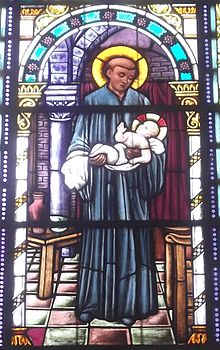
St Claude de la Colombierre S.J. (1641-1682)

St Craton
St Decorosus of Capua
St Dochow
St Druthmar of Corvey
St Eusebius of Asehia
St Farannan of Iona
St Faustinus
St Faustus of Monte Cassino
St Georgia
St Joseph of Antioch
St Jovita
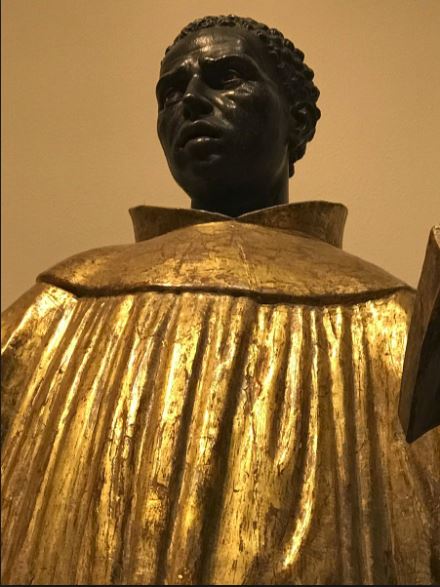
St Onesimus the Slave
St Quinidius of Vaison
St Severus of Abruzzi
St Walfrid

Martyrs of Antioch: 5 saints
A group of Christians murdered together. We know the names of five of them – Agapev, Baralo, Isicio, Joseph and Zosimus.

Martyrs of Passae:
Castulus
Lucius
Magnus
Saturninus

Martyrs of Prague – 14 beati – Franciscan Friars Minor martyred together by a mob led by Lutherans:
Franciscan Friars Minor martyred together by a mob led by Lutherans.
• Antonín of Prague
• Bartolomeo Dalmasoni
• Bedrich Bachstein
• Christoffel Zelt
• Didak Jan
• Emmanuel of Prague
• Gaspare Daverio
• Giovanni Bodeo
• Girolamo degli Arese
• Jakob of Prague
• Jan of Prague
• Juan Martínez
• Klemens of Prague
• Simon of Prague
They were martyred on
• Shrove Tuesday 15 February 1611 at the Church of Our Lady of the Snows in Prague, Czech Republic
• body dumped nearby but given Christian burial on 19 February 1611 in the monastery
• re-interred in the side chapel of the church in 1616
Beatified
13 October 2012 by Pope Benedict XVI

Martyrs of Sweden:
Sigfrid
Sunaman
Unaman
Winaman

Martyred in the Spanish Civil War:
Bl Pere Vallmitjana Abarca

Posted in PAPAL SERMONS, QUOTES of the SAINTS, SAINT of the DAY

Thought for the Day – 14 February – The Memorial of Sts Cyril (827-869) & Methodius (826-885)

Thought for the Day – 14 February – The Memorial of Sts Cyril (827-869) & Methodius (826-885)

Wishing now to sum up concisely the profile of the two Brothers, we should first recall the enthusiasm with which Cyril approached the writings of St Gregory of Nazianzus, learning from him the value of language in the transmission of the Revelation.   St Gregory had expressed the wish that Christ would speak through him:  “I am a servant of the Word, so I put myself at the service of the Word”.   Desirous of imitating Gregory in this service, Cyril asked Christ to deign to speak in Slavonic through him.   He introduced his work of translation with the solemn invocation:  “Listen, O all of you Slav Peoples, listen to the word that comes from God, the word that nourishes souls, the word that leads to the knowledge of God”.   In fact, a few years before the Prince of Moravia had asked the Emperor Michael III to send missionaries to his country, it seems that Cyril and his brother Methodius, surrounded by a group of disciples, were already working on the project of collecting the Christian dogmas in books written in Slavonic.   The need for new graphic characters closer to the language spoken was therefore clearly apparent:  so it was that the Glagolitic alphabet came into being.   Subsequently modified, it was later designated by the name “Cyrillic”, in honour of the man who inspired it.   It was a crucial event for the development of the Slav civilisation in general.   Cyril and Methodius were convinced that the individual peoples could not claim to have received the Revelation fully, unless they had heard it in their own language and read it in the characters proper to their own alphabet.

Methodius had the merit of ensuring that the work begun by his brother was not suddenly interrupted.   While Cyril, the “Philosopher”, was more inclined to contemplation, Methodius on the other hand had a leaning for the active life.   Thanks to this he was able to lay the foundations of the successive affirmation of what we might call the “Cyrillian-Methodian idea”:   it accompanied the Slav peoples in the different periods of their history, encouraging their cultural, national and religious development. This was already recognised by Pope Pius XI in his Apostolic Letter Quod Sanctum Cyrillum, in which he described the two Brothers:  “Sons of the East, with a Byzantine homeland, of Greek origin, for the Roman missions to reap Slav apostolic fruit” (AAS 19 [1927] 93-96).   The historic role they played was later officially proclaimed by St Pope John Paul II who, with his Apostolic Letter Egregiae Virtutis, declared them Co-Patrons of Europe, together with St Benedict (31 December 1980; L’Osservatore Romano English edition, 19 January 1981, p. 3).

Cyril and Methodius are in fact a classic example of what today is meant by the term “inculturation”:  every people must integrate the message revealed into its own culture and express its saving truth in its own language.   This implies a very demanding effort of “translation” because it requires the identification of the appropriate words to present anew, without distortion, the riches of the revealed word.   The two holy Brothers have left us a most important testimony of this, to which the Church also looks today in order to draw from it inspiration and guidelines.   Pope Benedict XVI, Wednesday, 17 June 2009

The work of Saints Cyril and Methodius are a powerful reminder of our role in the celebration of the Liturgy.   God speaks to us—to each of us—in a language that we can understand and based upon that understanding we are called to live the Gospel.   We pray today for more active participation, greater comprehension and the ability to successfully live the Word of God for all to see!

Almighty and everlasting God, who by the power of the Holy Spirit moved your servant Cyril and his brother Methodius to bring the light of the Gospel to a hostile and divided people, overcome all bitterness and strife among us by the love of Christ and make us one united family under the banner of the Prince of Peace, who lives and reigns with You and the Holy Spirit, one God, now and for ever, amen.

Sts Cyril and Methodius, pray for us!sts-cyril-and-methodius-pray-for-us-14 feb 2018-no 2


Posted in SAINT of the DAY

Saints of the Day – 14 February – Sts Cyril (827-869) & Methodius (826-885)

Saints of the Day – 14 February – Sts Cyril (827-869) & Methodius (826-885) Bishops, Confessors, Theologians, Missionaries, Writers, Preachers, Patrons of Europe, Apostles to the Slavs.   Sts Cyril & Methodius were two brothers who were Byzantine Christian theologians and Christian missionaries.   Through their work they influenced the cultural development of all Slavs, for which they received the title “Apostles to the Slavs”.   They are credited with devising the Glagolitic alphabet, the first alphabet used to transcribe Old Church Slavonic.   After their deaths, their pupils continued their missionary work among other Slavs.   In 1880, Pope Leo XIII introduced their feast into the calendar of the Roman Catholic Church.   In 1980, St Pope John Paul II declared them co-patron saints of Europe, together with Benedict of Nursia.Version 2st-cyril-methodius-02header-0214-SaintsCyrilandMethodius-790x480

St Cyril’s Patronages – against storms, ecumenism, Slavic peoples (given in 1863 by Pope Pius IX), unity of the Eastern and Western Churches, Bohemia, Bosnia, Bosnia-Herzegovina, Bulgaria, Carinthia, Austria, Carniola, Circassia, Croatia, Czech Republic, Czechoslovakia, Dacia, Dalmatia, Europe (given in 1980 by St Pope John Paul II), Khazaria, Krain, Krajna, Kranjska, Moravia, Pannonia, Russia, Silesia, Slovenia, Yugoslavia, Ljubljana, Slovenia, archdiocese of, Maribor, Slovenia, archdiocese of, Saints Cyril and Methodius of Toronto, Ontario, diocese of. St Methodius’s Patronages – against storms, ecumenism, Slavic peoples (given in 1863 by Pope Pius IX), unity of the Eastern and Western Churches, Bohemia, Bosnia, Bosnia-Herzegovina, Bulgaria, Carinthia, Austria, Carniola, Circassia, Croatia, Czech Republic, Czechoslovakia, Dacia, Dalmatia, Europe (given in 1980 by St Pope John Paul II), Khazaria, Krain, Krajna, Kranjska, Moravia, Pannonia, Russia, Silesia, Slovenia, Yugoslavia, Ljubljana, Slovenia, archdiocese of, Maribor, Slovenia, archdiocese of, Saints Cyril and Methodius of Toronto, Ontario, diocese of.

Methodius and Cyril (born Constantine) were born into a prominent Christian family in Thessalonica.   As the area in which they were raised was a popular spot for Slavic people to settle in, traditions tells us that the holy brothers grew up familiar with the Slavic language (Slavonic).   While we know their father was a prominent officer in the army, little is known of their young lives.   History has recorded that Methodius, the elder brother, rose to the position of an important civil authority, who likely dealt in law and trade.   His brother, Cyril, was trained as a scholar, professor and philosopher who gained renown in Constantinople.

After some years in public service, Methodius grew tired of worldly affairs and retired, seeking out solace and contemplation in a monastery.   Eventually, Cyril joined him there, refusing a district to govern, preferring quiet devotion to the Lord.   Together they lived in peace until the Byzantine emperor, having received a request for missionaries by the Moravian prince Rastislav, sent the brothers as missionaries to modern-day Ukraine.   Being familiar with the language and well-acquainted with administration and politics, they were the perfect choice for such a mission.   And given Rastislav’s desire for independence from Germany, Eastern missionaries (such as Methodius and Cyril) could help him gain independence over Church affairs.

Cyril and Methodius firmly believed that the Liturgy should be celebrated in the native language of the people, for greater inclusion in the Mass—a tradition which continues today.   At that time, many were committed to only celebrating Mass in Greek or Latin, but these holy brothers dedicated themselves to proving otherwise.   Prior to their departure for Moravia, they created a script for Slavonic (which had not previously existed).   Known as Glagolithic, this written script is considered the precursor to Cyrillic (named after Saint Cyril).  The creation of this script would allow the translation of Scripture and Liturgy into the language of the people.

Upon their arrival, Cyril immediately began translating the Liturgy into Slavonic.   This created anxiety in the German priests, who saw the use of language as the next step to Slavic independence, and they actively worked against the translation.   As neither Cyril nor Methodius was ordained a bishop, they travelled to Rome with their candidates for the priesthood to see the pope.   After an audience, the pope approved the use of the Slavonic language in services, ordaining the local priests and securing the presence of Catholicism in the region.

Sadly, Constantine never returned to Moravia.   He entered the monastery, taking the name Cyril and not long after died.   Methodius was stricken with grief and wished for nothing more than live the remainder of his days in the monastery but honoured a promise made to his brother and returned to finish their missionary work.   Due to the political upheaval in Moravia, he was forbidden to return there.   However, upon his ordination as bishop, he was invited to modern-day Serbia and Croatia, where he assumed the bishopric of Sirmium.   There he continued to say Mass and administer baptisms in the native, Slavonic tongue.

Again, falling victim to the anxiety of the German priests and bishops, Saint Methodius was imprisoned and only released following Moravian independence from German and intervention from the pope.   Again, Methodius traveled to Rome, meeting with the Pope, and explaining how important it was to celebrate the Liturgy in the tongue people understood.   Instead of condemning him, as the German bishops had hoped, the pope gave him permission to use Slavonic in the Mass, in Scripture reading and in the office. He also made him head of the hierarchy in Moravia.

Monument_of_Saints_Cyril_and_Methodius_in_Skopje_03
Memorial Plaque to Sts Cyril & Methodius in Skopje

Saint Methodius, despite constant criticism and backlash, never stopped translating.   It is said that he had translated the Bible and the works of the Church Fathers into Slavonic before his death.

Posted in LENT, SAINT of the DAY

Ash Wednesday 2018 and Memorials of the Saints 14 February 2018

Ash Wednesday 2018:  The first day of the season of Lent, so called from the custom of marking the foreheads of the faithful with blessed ashes. Its date depends upon that of Easter, and this year it’s on 14 February.

St Cyril (Memorial)
St Methodius (Memorial)

St Valentine of Rome (Optional Memorial)

St Abraham of Harran
St Antoninus of Sorrento
St Auxentius of Bithynia
St Conran of Orkney
St Eleuchadius
St Juan García López-Rico
St Nostrianus of Naples
St Theodosius of Vaison
St Valentine of Terni
Bl Vicente Vilar David
St Vitale of Spoleto

20 Mercedarians of Palermo
Martyrs of Alexandria – 16 saints
Martyrs of Rome
Felicula
Vitalis
Zeno

Martyrs of Terni: Three Christians who gave proper burial to Saint Valentine of Terni. Martyred in the persecutions of Aurelius.
273 in Terni, Italy – Apollonius, Ephebus, Proculus.

Martyrs of Alexandria: A group of Christians murdered in various ways for their faith in Alexandria, Egypt. We know the names and a few details about 16 of them – Agatho, Agatone, Ammonio, Ammonius, Antonius, Bassiano, Bassianus, Cirione, Cyrio, Dionysius, Dionysius, Lucio, Moses, Moses, Proto and Tonione.

Posted in DOMINICAN OP, MORNING Prayers, QUOTES of the SAINTS, SAINT of the DAY

Thought for the Day – 13 February – The Memorial of Blessed Jordan of Saxony O.P. (1190-1237)

Thought for the Day – 13 February – The Memorial of Blessed Jordan of Saxony O.P. (1190-1237

“You have no doubt heard that our kind Father, Master Jordan, his two companions and ninety-nine other persons have been taken from this wicked world by shipwreck in a violent storm.   However, dear brothers, do not let your hearts be saddened by this awful calamity;  for God, in His mercy, has already greatly consoled us, who have become orphans through the untimely death of a good Father.   After the storm, the bodies of our three confrères were washed ashore and bright lights in the form of crosses shone over them every night until they were found and buried where they lay by those who escaped from the disaster.   These, together with many others, have borne testimony to the miracle.   Moreover, the inhabitants of the neighbourhood, drawn to the place of the catastrophe by reports of so marvellous an occurrence, testify that they experienced a sweet fragrance all round;   while those who touched the bodies declare that this fragrance did not leave their hands for more than ten days.   Indeed, this same sweet odour pervaded the locality until the fathers at Ptolomais came in a boat and took up the bodies for burial in the conventual church of that city.   There now repose the remains of our late beloved Master General;  and many wonders have in this short time been attributed to his intercession.   Blessed be God in all His works. Amen”

All through his religious life the second head of the Order had been regarded as a very saintly man.   A number of prodigies were said to have been wrought by him.   Others came after his death;  while several very holy persons declared that, in visions, they saw his soul ascend into heaven.   All this, together with the facts recorded in the letter just quoted, occasioned a devotion to the man of God which continued through the course of centuries and caused him to be given the title of Blessed Jordan of Saxony.   After a thorough study of this immemorial veneration by the Sacred Congregation of Rites, Leo XII, who reigned from 1823 to 1829, allowed the Friars Preacher the world over to say mass and recite the divine office in his honour.   Throughout his Order he is held in an esteem second only to that which is accorded to Saint Dominic.
It is not commonly known or understood the highly efficacious intercession available to us all and thus we pray, Blessed Jordan of Saxony, Pray for us!bl-jordanofsaxony-prayforus-- 13 feb 2017 . 2

Posted in DOMINICAN OP, MORNING Prayers, QUOTES of the SAINTS, SAINT of the DAY, The WORD

Quote of the Day – 13 February – The Memorial of Blessed Jordan of Saxony O.P. (1190-1237)

Quote of the Day – 13 February – The Memorial of Blessed Jordan of Saxony O.P. (1190-1237)

“There are two ways of keeping God’s word, namely, one, whereby we store in our memory what we hear and the other, whereby we put into practice, what we have heard (and none will deny that the latter is more commendable, inasmuch, as it is better to sow grain, than to store it in the barn).”

Blessed Jordan of Saxony (1190-1237)there are two ways - bl jordan of saxony - 13 feb 2018

Posted in DOCTORS of the Church, DOMINICAN OP, MORNING Prayers, PRAYERS of the SAINTS, SAINT of the DAY

Our Morning Offering – 13 February – The Memorial of Blessed Jordan of Saxony O.P.

Our Morning Offering – 13 February – The Memorial of Blessed Jordan of Saxony O.P.

O Lord, King of all!
By St Albert the Great O.P. (1200-1280) Doctor of the Church

We pray to You, O Lord,
who are the supreme Truth,
and all truth is from You.
We beseech You, O Lord,
who are the highest Wisdom,
and all the wise depend on You for their wisdom.
You are the supreme Joy,
and all who are happy owe it to You.
You are the Light of minds,
and all receive their understanding from You.
We love, we love You above all.
We seek You, we follow You,
and we are ready to serve You.
We desire to dwell under Your power
for You are the King of all.
Amen.o lord,king of all by st albert the great - 13 feb 2018 - we pray to you o lord

Posted in DOMINICAN OP, QUOTES of the SAINTS, SAINT of the DAY

Saint of the Day – 13 February – Blessed Jordan of Saxony O.P. (1190-1237)

Saint of the Day – 13 February – Blessed Jordan of Saxony O.P. (1190-1237) Religious Priest, Preacher, the Second Master-General of the Domican Order, after St Dominic himself.   He was born in 1190 at Padberg Castle, diocese of Paderborn, Westphalia, old Saxony (in modern Germany), though it is rumoured to have been born in Palestine while his parents were on a pilgrimage, and named after the River Jordan but this is apparently aprochryphal.   He died by drowning in 1237 in a shipwreck off the coast of Syria while on a pilgrimage to the Holy Land.  He is buried in Acre.   Patronages – against drowning, of the Dominican Order, Vocations to the Dominicans.   Attributes – Dominican writing, a pen, a lily.

Header BLESSED-JORDAN

Mothers hid their sons when Master Jordan came to town…

These ten short words sum up in a humorous kind of way, the outstanding legacy of the successor of St Dominic.   It not only gives the impression that this new group of mendicant preachers had a clearly defined and essential role to play, challenging the infectious heresies so prevalent at the time (as was confirmed by Pope Honorius III in 1216 when he formally recognised the Order) but also that people were powerless to resist when confronted with it.   Of Blessed Jordan we are told that that during his tenure as Master General, between 1222 and 1237, over 1000 novices joined the Dominicans, new convents were established and new provinces formed.   Under his rule the Order continued to win many of the best men available, particularly in the Universities where many a Professor was seduced.   With such a charming figure sweeping through the neighbourhood is it any wonder that mothers tried to keep their sons out of reach?

A German of noble descent born in 1190, he had been in the Order a mere two years before his election as Master General in 1222.   By today’s standards, his rapid accession may appear hasty, a point he himself was quick to highlight when he became the first Provincial of Lombardy in 1221.   In the Libellus he writes:

‘In 1221, at the General Chapter in Bologna, they saw fit to make me the first Provincial of Lombardy, although I had only been in the Order one year and had not struck root as deeply as I ought to have done.   I was to be placed over others as their superior, before I had learned to govern my own imperfection.   I was not present at this Chapter myself.’bl jordan of saxony

Despite his anxiety, he must have made quite an impression on his brothers during his short tenure in the Order.   We are told about the type of person he was by those who knew.   It is obvious that he possessed all those qualities the ideal leader should have. Inspired by his brother and friend St Dominic, he was abounding in faith, kind and compassionate, humble, authoritative and yet at the same time understanding.   He had the ability to attract people by his sincerity.   His style of life complemented his style of words;  something that was evidently lacking at the time among the Clergy and Religious. This was vital at a time when ‘reform’ was the buzzword of the day.bl jordan - add

His great love for the poor was well known. There is a story said of him that:

‘Meeting a vagabond upon the road who feigned sickness and poverty, he gave him one of his tunics, which the fellow at once carried straight to a tavern for drink.   The brethren, seeing this done, taunted him with his simplicity:  ‘There now, Master, see how wisely you have bestowed your tunic.’  ‘I did so,’ said he, ‘because I believed him to be in want through sickness and poverty and it seemed at the moment to be a charity to help him;  still, I reckon it better to have parted with my tunic than with charity.’

Our Blessed Jordan may well be still speaking to us today!   Not all those people who present themselves as being needy these days may be genuine.   However, when we stop caring, we stop striving to be like Jesus.   Let us never restrain God’s work in our hearts but allow ourselves to be moved by compassion  . Perhaps it was this genuineness that caused Mothers in the district to be wary of his arrival.


Jordan died in a shipwreck on his return from Palestine, where he had visited the local convents of the Order;  the shipwreck occurred off the coast of Syria in 1237.   It is perhaps fitting that this great servant of the Order of Preachers, who was kept at arm’s length by the Mothers who feared his magnetic appeal on their sons, should nestle snuggly within the loving embrace of the Mother of God as famously depicted in that famous vision of St Dominic.death of blessed jordanmary and the dominican saints

Posted in SAINT of the DAY

Memorials of the Saints – 13 February

St Adolphus of Osnabruk
St Agabus the Prophet
St Aimo of Meda
Bl Beatrix of Ornacieux
St Benignus of Todi
Bl Berengar of Assisi
St Castor of Karden
St Christina of Spoleto
St Dyfnog
St Ermenilda of Ely
Bl Eustochium of Padua
St Fulcran of Lodève
St Fusca of Ravenna
St Gilbert of Meaux
St Gosbert of Osnabruck
St Guimérra of Carcassone
St Huno
Blessed Jordan of Saxony O.P. (1190-1237)
St Julian of Lyon
St Lucinus of Angers
St Marice
St Martinian the Hermit
St Maura of Ravenna
St Modomnoc
St Paulus Lio Hanzuo
St Peter I of Vercelli
St Phaolô Lê Van Loc
St Stephen of Lyons
St Stephen of Rieti

Posted in MORNING Prayers, QUOTES of the SAINTS, QUOTES on CHARITY, SAINT of the DAY, The WORD

One Minute Reflection – 12 February – The Memorial of St Julian the Hospitaller (unknown date of birth and death)

One Minute Reflection – 12 February – The Memorial of St Julian the Hospitaller (unknown date of birth and death)

I was ill and you comforted me…..
As often as you did it for one
of my least brothers, you did it for me…….Matthew 25:26,40matthew-25-36,40-2017

REFLECTION – “Before all things and above all things, care must be taken of the sick. They must be served in every deed as Christ Himself.”…………….St Benedictbefore-all-things-and-above-all-things-stbenedict-12 feb 2017

PRAYER – Jesus, infinite Healer, teach me to visit and comfort the sick.   Help me always to see You in them and not count the cost. St Julian, you were a perfect example of giving your utmost love to the sick, please pray for us, amen!st julian the hospitaller - pray for us - 12 feb 2018

Posted in SAINT of the DAY

Saint of the Day – 12 February – St Benedict of Aniane (747-821) “The Second Benedict”

Saint of the Day – 12 February – St Benedict of Aniane (747-821) Also known as “The Second Benedict” – born Witiza c 747 at Languedoc, France as Witiza – 11 February 821 at Cornelimunster, Aachen, Germany of natural causes, buried on 12 February 821.  St Benedict was a Benedictine monk and monastic reformer, who left a large imprint on the religious practice of the Carolingian Empire. St Benedict of Aniane HEADER

Next to St Benedict himself, St. Benedict of Aniane influenced the shape of Benedictine monasticism in the West more than anyone else.  Allied with Holy Roman emperors Charlemagne and Louis the Pious, he promulgated a strict and idealistic monastic reform that lasted nearly two centuries.   And Benedict’s work influenced later reforms, including the Cluniac Reform movement of the 11th and 12th centuries.

Of noble Visigothic descent, Benedict first served as a cupbearer in the Frankish court. But at age twenty he resolved to live for God alone and became a monk at an abbey near Dijon.   When the monks wanted to make him abbot, he left because he felt that they would not accept the severe pattern of life he had adopted.   So he returned to his own estate on the river Aniane in Languedoc, where he built a small hermitage.   Later he built a monastery from which he exercised influence over many other abbeys in France and Germany that he had reformed.   Eventually Benedict became the overseer of all the monasteries in the Frankish empire.

Louis the Pious compelled Benedict to build a monastery at Inde, Belgium, near the court at Aachen.   Then Louis had Benedict generate a monastic reform throughout the empire. Benedict presided at councils that reinforced discipline.   Benedict aimed to have monks “pass from faith to sight” through prayer, study, meditation and reading.   He believed that as their understanding increased, they would grow into a contemplative love for God.

Benedict of Aniane died in 821.   He never achieved the uniformity he intended because it depended on the unity of an empire that soon disintegrated.   But he did elevate the idealism and observance of western monasticism.   Benedict of Aniane’s impact was more structural than inspirational but as his biographer indicated in the following passage, his spirituality touched his brothers profoundly:

“Benedict had great concern not only to refresh his own people with food of preaching but also to nourish with heavenly bread whomever he happened to encounter.   That they might not lose the salutary food through forgetfulness, he was accustomed to impress upon them to cling tenaciously to it in their hearts. This he did with such words as, “Let it be with chaste body and humble heart, because proud chastity and vain humility are not acceptable to God.”   On some he was in the habit of stressing this, “If most precepts are impossible for you to remember, keep at least this short one, ‘Depart from evil and do good.’” (See Psalm 37:27).

Benedict possessed an unusual gift:  as soon as anyone with disturbed thoughts in his mind approached him, the tumultuous crowd of thoughts dissipated at his wholesome counsel.   Often indeed when bombarded by unsafe thoughts . . . a person would say to himself, “I will go and reveal you to Lord Benedict.”   At that very moment the unsuitable confusion left him.   If anyone was hindered by severe faults, he received soothing consolation when he opened up his heart to Benedict.”st benedict of aniane - lg


Posted in FEASTS and SOLEMNITIES, MARIAN TITLES, MIRACLES, SAINT of the DAY, The BLESSED VIRGIN MARY, Uncategorized

Feast of Madonna del Pilerio and Memorials of the Saints – 12 February

Madonna del Pilerio:   The term Pilerio probably derives from piliero (pillar), or it could be older and derive from the greek puleròs (guardian, guardian of the city gate).   The cult of the Madonna del Pilerio as the patron saint of Cosenza, dates back to the end of the 16th century.   It is said that in the year 1576, while the plague desolated different regions of Italy, a devotee, praying before the icon of the Madonna del Pilerio, noticed a stain similar to the pestiferous bubo (the marks of the plague), present on the face of the Image.   The phenomenon was noted by the people and by the ecclesiastical authorities. The stain was considered a prodigy and a revealing sign of the protection of the Madonna for the City of Cosenza, saved by her from the plague.   Since then the Virgin of Pilerio became the Protectress of the City.
The news of the prodigious sign did not take long to spread and from the neighbouring countries a growing rush of devotees began.   The pilgrimages continued over time and grew in number, so much so that in 1603, the Archbishop Monsignor Giovan Battista Costanzo (1591-1617), to better serve the influx of pilgrims, removed the painting from the place where it was and placed it before on one of the pillars of the central nave of the Duomo, then on the main altar and finally in 1607 in the specially built chapel dedicated to the Virgin and where even today is venerated.   On April 17, 1607, at the unanimous request of the inhabitants of Cosenza, the Archbishop Mgr. Costanzo crowned the Virgin of Pilerio Regina and Patrona della Città.  In 1783 a violent earthquake struck down on Cosenza. On that occasion another sign was found on the face of the image of the Pilerio.


St Alexius of Kiev
St Ammonius of Alexandria
Bl Anthony of Saxony
St Anthony Kauleas
St Benedict of Aniane (747-821)

Bl Benedict Revelli
St Damian of Africa
St Damian of Rome
St Ethelwald of Lindisfarne
St Eulalia of Barcelona
St Gaudentius of Verona
St Goscelinus of Turin
Bl Gregory of Tragurio
Bl Humbeline of Jully
St Jak Bushati
St Julian of Alexandria
St Julian the Hospitaller
Bl Ladislaus of Hungary
Bl Ludan
St Meletius of Antioch
St Modestus of Alexandria
St Modestus of Carthage
St Modestus the Deacon
Bl Nicholas of Hungary
St Sedulius
Bl Thomas of Foligno

Martyrs of Albitina – 46 saints:
During the persecutions of Diocletian, troops were sent to the churches of Abitina, North Africa on a Sunday morning; they rounded up everyone who had arrived for Mass and took them all to Carthage for interrogation by pro-consul Anulinus. The 46 who proclaimed their Christianity were executed. We know some of their names and stories.
• Ampelius
• Cassiano
• Ceciliano
• Cecilia
• Danzio
• Deciano
• Emeritus
• Ercolina
• Eva
• Fausto
• Felice (2 by this name)
• Felix
• Gennara (2 by this name)
• Gennaro
• Giriale
• Hilarion
• Maggiore
• Margherita
• Martino
• Mary
• Massimiano
• Matrona (2 by this name)
• Onorata
• Pelusio
• Pomponia
• Prima
• Quinto
• Regiola
• Restituta
• Rogatian (3 by this name)
• Rogato (2 by this name)
• Saturninus the Elder
• Saturninus the Younger
• Seconda (2 by this name)
• Thelica
• Victoria
• Vincenzo
• Vittoriano
• Vittorino
They were tortured to death in 304 in prison at Albitina, North Africa.

Martyred in England:
Bl George Haydock
Bl James Fenn
Bl John Nutter
Bl John Munden
Bl Thomas Hemeford

Martyred in the Spanish Civil War:
Josep Gassol Montseny

Posted in DOGMA, MARIAN PRAYERS, MARIAN QUOTES, MARIAN TITLES, MORNING Prayers, PAPAL MESSAGES, PAPAL PRAYERS, PRAYERS of the SAINTS, SAINT of the DAY, The BLESSED VIRGIN MARY

Thought for the Day – 11 February – Memorial of Our Lady of Lourdes and the 26th World Day of Prayer for the Sick

Thought for the Day – 11 February – Memorial of Our Lady of Lourdes and the 26th World Day of Prayer for the Sick

On 8 December 1854, Pope Pius IX proclaimed the dogma of the Immaculate Conception in the apostolic constitution Ineffabilis Deus.   A little more than three years later, on 11 February 1858, a young lady appeared to Bernadette Soubirous.   This began a series of visions. During the apparition on 25 March, the lady identified herself with the words:  “I am the Immaculate Conception.”

Bernadette was a sickly child of poor parents.   Their practice of the Catholic faith was scarcely more than lukewarm.   Bernadette could pray the Our Father, the Hail Mary and the Creed.   She also knew the prayer of the Miraculous Medal:  “O Mary conceived without sin.”

During interrogations Bernadette gave an account of what she saw.   It was “something white in the shape of a girl.”   She used the word aquero, a dialect term meaning “this thing.”   It was “a pretty young girl with a rosary over her arm.”   Her white robe was encircled by a blue girdle.   She wore a white veil.   There was a yellow rose on each foot. A rosary was in her hand.   Bernadette was also impressed by the fact that the lady did not use the informal form of address (tu), but the polite form (vous).   The humble virgin appeared to a humble girl and treated her with dignity.

Through that humble girl, Mary revitalised and continues to revitalise the faith of millions of people.   People began to flock to Lourdes from other parts of France and from all over the world.   In 1862 Church authorities confirmed the authenticity of the apparitions and authorised the cult of Our Lady of Lourdes for the diocese.   The Feast of Our Lady of Lourdes became worldwide in 1907.

Lourdes has become a place of pilgrimage and healing but even more of faith.   Church authorities have recognised over 60 miraculous cures, although there have been accounts of many more.   To people of faith this is not surprising.   It is a continuation of Jesus’ healing miracles—now performed at the intercession of his mother.   Some would say that the greater miracles are hidden.   Many who visit Lourdes return home with renewed faith and a readiness to serve God in their needy brothers and sisters.

There still may be people who doubt the apparitions of Lourdes.   Perhaps the best that can be said to them are the words that introduce the film The Song of Bernadette:   “For those who believe in God, no explanation is necessary.   For those who do not believe, no explanation is possible.”

Let us Pray:

Prayer to Our Lady of Lourdes
By St Pope John Paul II (1920-2005)

To Mary, Mother of tender love,
we wish to entrust all those
who are ill in body and soul,
that she may sustain them in hope.
We ask her also to help us to be welcoming
to our sick brothers and sisters.

Hail Mary, poor and humble Woman,
Blessed by the Most High!
Virgin of hope, dawn of a new era,
We join in your song of praise,
to celebrate the Lord’s mercy,
to proclaim the coming of the Kingdom
and the full liberation of humanity.

Hail Mary, lowly handmaid of the Lord,
Glorious Mother of Christ!
Faithful Virgin, holy dwelling-place of the Word,
Teach us to persevere in listening to the Word,
and to be docile to the voice of the Spirit,
attentive to His promptings in the depths of our conscience
and to His manifestations in the events of history.

Hail Mary, Woman of sorrows,
Mother of the living!
Virgin spouse beneath the Cross, the new Eve,
Be our guide along the paths of the world.
Teach us to experience and to spread the love of Christ,
to stand with you before the innumerable crosses
on which your Son is still crucified.

Hail Mary, woman of faith,
First of the disciples!
Virgin Mother of the Church, help us always
to account for the hope that is in us,
with trust in human goodness and the Father’s love.
Teach us to build up the world beginning from within:
in the depths of silence and prayer,
in the joy of fraternal love,
in the unique fruitfulness of the Cross.

Holy Mary, Mother of believers,
Our Lady of Lourdes,
pray for us. Amenprayer to our lady of lourdes by st john paul no 2 - 11 feb 2018our lady of lourdes pray for us no 2 - 11 feb 2018st bernadette pray for us - 11 feb 2018

Our Lady of Lourdes, pray for us!

St Bernadette, pray for us!

Posted in DEVOTIO, DOGMA, MARIAN QUOTES, MARIAN TITLES, MORNING Prayers, QUOTES of the SAINTS, SAINT of the DAY, The BLESSED VIRGIN MARY

Quote of the Day – 11 February – Memorial of Our Lady of Lourdes and the 26th World Day of Prayer for the Sick

Quote of the Day – 11 February – Memorial of Our Lady of Lourdes and the 26th World Day of Prayer for the Sick

“I am the Immaculate Conception.”

Our Lady of Lourdes to St Bernadette
25 March 1858i am the immaculate conception - 11 feb 2018

Posted in MARIAN QUOTES, MARIAN TITLES, MORNING Prayers, PRAYERS of the SAINTS, QUOTES of the SAINTS, QUOTES on CHARITY, QUOTES on LOVE, QUOTES on SUFFERING, SAINT of the DAY, The BLESSED VIRGIN MARY, The WORD

One Minute Reflection – – 11 February – 6th Sunday of Year B, Memorial of Our Lady of Lourdes and the 26th World Day of Prayer for the Sick

One Minute Reflection – – 11 February – 6th Sunday of Year B, Memorial of Our Lady of Lourdes and the 26th World Day of Prayer for the Sick

….if you will, you can make me clean…Mark 1:41.

REFLECTION – “Jesus, who is present in our suffering neighbour, wishes to be present in every act of charity and service of ours, which is expressed also, in every glass of water we give “in his name” (cf Mk 9:41). Jesus wants love, the solidarity of love, to grow from suffering and around suffering. He wants, that is, the sum of that good which is possible in our human world. A good that never passes away. The Pope, who wishes to be a servant of this love, kisses the forehead and kisses the hands of all those who contribute to the presence of this love and to its growth in our world. He knows, in fact and believes that he is kissing the hands and the forehead of Christ himself, who is mystically present in those who suffer and in those who, out of love, serve the suffering.”…St Pope John Paul, Memorial of Our Lady of Lourdes – 1979jesus, who is present in our suffering neighbour - st john paul - 11 feb 2018

PRAYER – Christ of our sufferings,
Christ of our sacrifices,
Christ of our Gethsemane,
Christ of our difficult transformations,
Christ of our faithful service to our neighbour,
Christ of our pilgrimages to Lourdes,
Christ of our community, today, in St Peter’s Basilica,
Christ our Redeemer,
Christ our Brother!
Amen.
Our Lady of Lourdes, Pray for us that we may live this solidarity of love, in You and with You and for You, amen.our lady of lourdes pray for us - 11 feb 2018

Posted in MARIAN TITLES, MIRACLES, SAINT of the DAY, The BLESSED VIRGIN MARY

The Memorial of the Apparitions of Our Lady of Lourdes / Our Lady of the Immaculate Conception – 11 February

Blessed Memorial of the Apparitions of Our Lady of Lourdes/Our Lady of the Immaculate Conception – (11 February and 16 July of 1858) – Patron of the ill and infirm, protection from disease, France, 6 cities and a Diocese.the-immaculate-conception1our lady of lourdes 2

The memorial commemorates the eighteen (18) apparitions of the Blessed Virgin Mary to Saint Bernadette Soubiroux that occurred between 11 February and 16 July of 1858 near the town of Lourdes in the Hautes-Pyrenees region of France.   Though there would be other people with her, only Saint Bernadette could see the Lady.

During the 9th appearance, on 25 February, the Lady told Bernadette to drink from a spring that suddenly appeared in the grotto where the apparitions occurred.   During the 12th appearance, on 1 March, a visitor washed her arm in water from the spring and some nerve damage in it was immediately cured.   There is a tradition of miraculous cures at the grotto, or received by those who drink or are bathed in its waters. Bernadette later said that the water had no special properties but it helped focus the faithful who received the cures through faith and prayer.

During the 13th appearance, on 2 March, the Lady told Bernadette to tell local priests that they should build a chapel at the grotto and have processions to be made to it;  the priests were understandably sceptical but due to the numbers of pilgrims coming to the area, construction of several churches was started within a few years.

During the 16th appearance, on 25 March, the Lady identified herself as “the Immaculate Conception”.

Due to the number of people gathering at the site and making treks to the area, on 8 June 1858, the mayor of Lourdes barricaded the grotto and stationed guards to prevent public access;  visitors were fined for kneeling near the grotto or talking about it and Bernadette saw the last appearance of the Lady from outside the barricade.   The grotto was re-opened to the public in October 1858 by order of Emperor Louis Napoleon III and the pilgrims have not stopped coming since.lady-of-lourdeslourdes in stained glassour lady of lourdes 4

Church Approval:

• on 18 January 1862 Bishop Bertrand-Sévère Mascarou-Laurence, with the authorisation of Pope Pius IX, declared that the faithful are “justified in believing the reality of the apparition”
• national French pilgrimages to the site began in 1873
• the basilica of Notre-Dame de Lourdes was consecrated in 1876
• Blessed Pope Pius IX formally granted a canonical coronation to the statue of Our Lady in the courtyard of the basilica on 3 July 1876
• Church of the Rosary consecrated in 1901
• a special office and Mass were authorised by Pope Leo XIII
• observance of the feast extended to the whole Church by St Pope Pius X in 1907

This slideshow requires JavaScript.

Posted in MARIAN TITLES, SAINT of the DAY, The BLESSED VIRGIN MARY

Memorial of Our Lady of Lourdes, the 26th World Day of Prayer for the Sick and Memorials of the Saints – 11 February

Our Lady of Lourdes (11 February and 16 July of 1858)  – (Optional Memorial)

World Day of the Sick

St Ampelius of Africa
St Ardanus of Tournus
Bl Bartholomew of Olmedo
St Caedmon
St Calocerus of Ravenna
St Castrensis of Capua
St Dativus the Senator
Bl Elizabeth Salviati
St Etchen of Clonfad
St Eutropius of Adrianopolis
St Felix the Senator
St Gobnata
St Pope Gregory II
Bl Gaudencia Benavides Herrero
St Helwisa
St Jonas of Muchon
St Lucius of Adrianople
St Pope Paschal I
St Pedro de Jesús Maldonado-Lucero
St Saturninus of Africa
St Secundus of Puglia
St Severinus of Agaunum
St Soter of Rome
St Theodora the Empress
Bl Tobias Francisco Borrás Román

Guardians of the Holy Scriptures: Also known as –
• Anonymous Martyrs in Africa
• Martyrs of Africa
• Martyrs of Numidia
• Martyrs of the Holy Books
A large number of Christians tortured and murdered in Numidia (part of modern Algeria) during the persecutions of Diocletian, but whose names and individual stories have not survived. They were ordered to surrender their sacred books to be burned. They refused. Martyrs. c 303 in Numidia.

Martyrs of Africa – 5 saints: A group of five Christians who were martyred together; we know nothing else but the names of four of them – Cyriacus, Oecominius, Peleonicus and Zoticus.

.


Posted in MORNING Prayers, ON the SAINTS, QUOTES of the SAINTS, QUOTES on FAITH, QUOTES on LOVE, QUOTES on PERSECUTION, QUOTES on SANCTITY, QUOTES on SUFFERING, QUOTES on the DEVIL/EVIL, SAINT of the DAY

Thought for the Day – 10 February – The Memorial of St José Sánchez del Río “Joselito”(1913-1928)

Thought for the Day – 10 February – The Memorial of St José Sánchez del Río “Joselito”(1913-1928)

Mexican child-saint José Sánchez del Río (Joselito) “is not only a martyr of the Christian faith, but is a martyr of the fundamental rights of the person.”

In an interview with the Register at the Vatican on Saturday, the newly proclaimed saint’s postulator, Father Fidel Gonzáles, stressed this as he spoke about St José Sánchez del Río.   Father Gonzalez stressed how young José’s faith was not for sale and no one, no “offer” — not even his parents’ intervention — would convince him to negate his faith, even if it cost him his life.

The Vatican official also addressed how there are many Christian martyr saints that exist, even if they have not been formally recognised by the Church and reflected on how important it is, in the midst of today’s world, full of ambiguities, relativism and religious persecution, to not abandon our faith, as St Josélito teaches us.

“It’s always a little surprising to hear about saints as young as only 14 years old.  But can a child, someone so young, really be a saint as much as an adult or an elderly person? Of course.   There is a theological sanctity that belongs to every baptised person, even if baptised even a few hours after birth, because it is a grace of the Holy Spirit.   Instead, the moral holiness grows like a tree, which comes and develops from a small seed and then spreads throughout the course of a lifetime.   In the specific case of St José Sánchez del Río, we are facing a martyr of nearly age 15 but he had a clear awareness of the ideas that led him to proclaim his faith with martyrdom.   I can say that he really is an exceptional figure.

Why?

…because he showed a psychological maturity much higher than that of his own age.   We could say that, psychologically, he had the maturity of someone at least 18 or 20 years old, especially as he demonstrated his firm decision to reject the many proposals that they made to free him from prison in exchange for the apostasy of his faith in Christ. But he replied with a phrase, instead, of accepting, one that the witnesses then reported, a phrase that he used speaking to his parents when they tried to free him from captivity: “My faith is not for sale,” which means: “My faith in Christ cannot be sold, even though I know that this involves torture and death.”
“Long live Christ the King” was the cry with which the Mexican Cristeros went down in history.   What did those words mean to them?   It’s a theological expression;  maybe neither St Josélito nor the others, fully realised its meaning, its significance.   For them, it was a way of proclaiming the centrality of Christ in history.   We must point out that St José did not ever stop proclaiming Christ.   They said, “If you shout, ‘Death to Christ the King,’ we will spare your life.”   But instead he continued: “Long live Christ the King. … Long live the Lady of Guadalupe.”   This invocation of Our Lady of Guadalupe was significant, too, as it was the first concrete manifestation of God in the history of Mexico and Latin America.   José stayed faithful to the very, very end, even as they continued stabbing him and eventually shot him with the pistol.”

As a specialist on the concept of sanctity, are you familiar with other martyrs like St. José?
“I have been a consultant for 31 years of the Congregation for the Causes of Saints and I have seen hundreds of cases of martyrdom but never of a martyr so young.   It’s a unique case, where you really see the power of divine grace.   But José Sánchez del Río — this is my thesis — is not only a martyr of the Christian faith but is a martyr of the fundamental rights of the person: the right to freedom of opinion, freedom of religion, the right to practice their religion. … In short, he is a martyr of all the rights that were denied the totalitarian era.   The 20th century is the century of totalitarian regimes, each very different from the others but yet they all agree on setting aside God, getting rid of the foundation of human rights.
St Josélito simply teaches us that the Catholic faith is not for sale, as he said himself [while] dying.   This is especially true in a world like today, full of ambiguities, of relativism, of dominant cultural nihilism.   The Christian faith, instead, has a solid foundation, i.e., the principle that God is the creator of all reality and if we put it aside, then all the rights of the person lose consistency and end up at the mercy of a political power.   

It’s interesting, I repeat, that all ideological totalitarianisms of the 20th century have desecrated the human person, profaning God.”

Correspondent Deborah Castellano Lubov writes from Rome.

St Joselito, Pray for us!st joselito pray for us no 2- 10 feb 2018

Posted in MORNING Prayers, QUOTES of the SAINTS, QUOTES on FAITH, QUOTES on LOVE, QUOTES on PERSECUTION, QUOTES on SANCTITY, QUOTES on SUFFERING, SAINT of the DAY

Quote/s of the Day – 10 February – The Memorial of St José Sánchez del Río “Joselito”(1913-1928)

Quote/s of the Day – 10 February – The Memorial of St José Sánchez del Río “Joselito”(1913-1928)

“Mama, do not let me lose the
opportunity to gain Heaven
so easily and so soon”.mama, do not let - st joselito - 10 feb 2018

“You will be in Heaven before me.
Prepare a place for me.
Tell Christ the King I shall be with Him soon”.you will be - st joselito - 10 feb 2018

“Long live Christ the King!
Long live Our Lady of Guadalupe!”.

Saint “Joselito”(1913-1928)long live christ the king long live our lady of guadalupe - st joselito - 10 feb 2018

Posted in MORNING Prayers, QUOTES of the SAINTS, QUOTES on FAITH, SAINT of the DAY

One Minute Reflection – 10 February – The Memorial of St José Sánchez del Río “Joselito”(1913-1928)

One Minute Reflection – 10 February – The Memorial of St José Sánchez del Río “Joselito”(1913-1928)

What will separate us from the love of Christ?   Will anguish, or distress, or persecution, or famine, or nakedness, or peril, or the sword?   As it is written:  “For your sake we are being slain all the day;  we are looked upon as sheep to be slaughtered.”   No, in all these things we conquer overwhelmingly through him who loved us ...Romans 8:35-37

REFLECTION – “My faith is not for sale.” … St José Sánchez del Río “Joselito”(1913-1928)my faith is not for sale - joselito - 10 feb 2018

PRAYER – Lord, my God, You chose us from the foundations of the world to be Your children.   We pray that our courage may not fail us as we are attacked from all sides, as we struggle home to You.  Grant that through the prayers of young Joselito, we too may fight unto death for Your love and the glory of Your Kingdom.   Through our Lord, Jesus, in the unity of the Holy Spirit, one God forever and ever, amen.st joselito pray for us - 10 feb 2018

Posted in MORNING Prayers, PRAYERS of the SAINTS, SAINT of the DAY

Our Morning Offering – 10 February – The Memorial of St Scholastica (c 480-543), the Twin Sister of St Benedict (480-547)

Our Morning Offering – 10 February – The Memorial of St Scholastica (c 480-543), the Twin Sister of St Benedict (480-547)

Father, in Your Goodness, Grant Me ….
St Benedict

Father, in Your goodness,
grant me
the intellect to comprehend You,
the perception to discern You,
and the reason to appreciate You.
In Your kindness
endow me with
the diligence to look for You,
the wisdom to discover You
and the spirit to apprehend You.
In Your graciousness
bestow on me
a heart to contemplate You,
ears to hear You,
eyes to see You,
and a tongue to speak of You.
In Your mercy confer on me
a conversation pleasing to You,
the patience to wait for You,
and the perseverance to long for You.
Grant me a perfect end,
Your holy presence.
Amen.father, in your goodness, grant me - st benedict - 10 feb 2018 memorial of st scholastica

Posted in QUOTES of the SAINTS, SAINT of the DAY

Saint of the Day – 10 February – St José Sánchez del Río “Joselito” (1913-1928) Boy Martyr

Saint of the Day – 10 February – St José Sánchez del Río “Joselito” (1913-1928) known as “Joselito” – (28 March 1913 – 10 February 1928) Boy Martyr was a Mexican Cristero who was put to death by government officials because he refused to renounce his Catholic faith. His death was seen as a largely political venture on the part of government officials in their attempt to stamp out dissent and crush religious freedom in the area.   Patronages – Persecuted Christians, Catholic Children and Adolescents, Sahuayo, Mexico, his birthplace.   He was declared to be venerated on 22 June 2004 by St Pope John Paul II and was beatified by Pope Benedict XVI – through the Cardinal-Prefect of the Congregation of the Causes of Saints – on 20 November 2005 in Mexico. Pope Francis approved a miracle attributed to him on 21 January 2016, allowing for his canonisation to take place and he was proclaimed to be a saint on 16 October 2016.header - bl joseHeader - The first class relic from Blessed Jose

José Sánchez del Río was born on 28 March 1913 in Sahuayo, Michoacán, Mexico. Wanting to defend the faith and rights of Catholics, he followed in the footsteps of his two older brothers and asked his mother for permission to join the Cristeros. She objected, telling him that he was too young.  “Mama”, he replied, “do not let me lose the opportunity to gain Heaven so easily and so soon”.

At that time, the laws banned religious orders, deprived the Church of property rights and denied priests civil liberties, including the right to trial by jury and the right to vote. As the restrictions on religious liberty increased, Catholics could be fined or imprisoned for teaching Church doctrine, wearing clerical attire, meeting together after their convents were disbanded, promoting religious life or holding religious services in non-church locations.

On 5 February 1928 the young boy was captured during a battle and imprisoned in the church sacristy.   In order to terrorise him, soldiers made him watch the hanging of one of the other captured Cristeros.   But José encouraged the man, saying, “You will be in Heaven before me.   Prepare a place for me.  Tell Christ the King I shall be with Him soon”.

In prison, he prayed the Rosary and sang songs of faith.   He wrote a beautiful letter to his mother telling her that he was resigned to do God’s will.   José’s father attempted to ransom his son but was unable to raise the money in time.Jose-Sanchez-del-Rio

On 10 February 1928 the teenager was brutally tortured and the skin of the soles of his feet was sheered off;   he was then forced to walk on salt, followed by walking through the town to the cemetery.   The young boy screamed with pain but would not give in.tortured feet of bl jose

At times the soldiers stopped him and said, “If you shout, “Death to Christ the King’, we will spare your life”.   But he answered: “Long live Christ the King!   Long live Our Lady of Guadalupe!”.

Once he arrived at the cemetery, José was asked once more if he would deny his faith. The 14 year old shouted out: “Long live Christ the King!”, and was summarily shot. (vatican.va)

This slideshow requires JavaScript.

Posted in SAINT of the DAY

Memorials of the Saints – 10 February

St Scholastica (c482-547) (Memorial)

Bl Alexander of Lugo
Bl Alojzije Stepinac
St Andrew of Bethlehem
St Aponius of Bethlehem
St Austrebertha of Pavilly
St St Baldegundis
St Baptus of Magnesia
Bl Catherine du Verdier de la Sorinière
St Charalampias
Bl Clare Agolanti of Rimini
St Desideratus of Clermont
St Erluph of Werden
Bl Eusebia Palomino Yenes
Bl Hugh of Fosse
Bl José Sánchez del Río

Bl Louise Bessay de la Voûte
Bl Louise Poirier épouse Barré
Bl Marie-Anne Hacher du Bois
Bl Marie-Louise du Verdier de la Sorinière
Bl Mikel Beltoja
Bl Paganus
Bl Paul of Wallachia
Bl Pierre Frémond
St Porfirio
St Prothadius of Besançon
St Salvius of Albelda
St Silvanus of Terracina
St Soteris the Martyr
St Troiano of Saintes
St Trumwin of Whitby
Bl William of Maleval

Martyred Soldiers in Rome: A group of ten Christian soldiers who were martyred together for their faith. We know little more about them but four of their names – Amantius, Hyacinth, Irenaeus and Zoticus. • 120 at Rome, Italy. They were buried on the Via Lavicana outside RomeAmantius, Hyacinth, Irenaeus, Zoticus.

Posted in MARIAN PRAYERS, MARIAN TITLES, MORNING Prayers, NOVENAS, SAINT of the DAY

Novena to Our Lady of Lourdes – DAY EIGHT– 9 February

Novena to Our Lady of Lourdes – DAY EIGHT– 9 February (we Pray the Novena for our own intentions and for the sick, the infirm within our own communities but also for all those throughout the world who suffer, especially those who have no-one to pray for them in preparation for the Wold Day of the Sick on 11 February.)

DAY EIGHT
O Immaculate Mother of God,
from heaven itself you came to appear to the little Bernadette
in the rough Grotto of Lourdes!
And as Bernadette knelt at your feet
and the miraculous spring burst forth
and as multitudes have knelt ever since
before your shrine, O Mother of God,
we kneel before you today to ask that in your mercy
you plead with your Divine Son to grant
the special favour we seek in this novena.
…………………………….. (make your request)
O Brilliant star of purity, Mary Immaculate, Our Lady of Lourdes,
glorious in your assumption,
triumphant in your coronation,
show unto us the mercy of the Mother of God,
Virgin Mary, Queen and Mother,
be our comfort, hope, strength, and consolation. Amen.

Our Lady of Lourdes, pray for us.

Saint Bernadette, pray for us.day eight - our lady of lourdes - 9 feb 2018

Posted in MORNING Prayers, SAINT of the DAY, VATICAN Resources

Thought for the Day – 9 February – The Memorial of Bl Anne Catherine Emmerich (1774-1824)

Thought for the Day – 9 February – The Memorial of Bl Anne Catherine Emmerich (1774-1824)

In a letter to Count Stolberg, Clemens August Droste zu Vischering, the vicar‑general at that time, called Anna Katharina Emmerick a special friend of God.   In the words of Hans Urs von Balthasar we can say, “She brought her friendship with God to bear in solidarity with human beings.”   To bring friendship with God to bear in solidarity with human beings – does this not shed light on an important concern in the life of the church today?

The Christian faith no longer includes everyone.   In our world the Christian community represents people before God.   We must bring our friendship with God to bear, let it be the decisive factor in solidarity with human beings.

Anna Katharina Emmerick is united to us in the community of believers.  This community does not come to an end with death.   We believe in the lasting communion with all whom God has led to perfection.   We are united with them beyond death and they participate in our lives.   We can invoke them and ask for their intercession.   We ask Anna Katharina Emmerick, the newly named Blessed, to bring her friendship with God to bear in solidarity with us and with all human beings. (vatican.va)

Blessed Anne, pray for us!bl anne - pray for us no 2 - 9 feb 2018

Posted in MORNING Prayers, ON the SAINTS, PAPAL SERMONS, QUOTES of the SAINTS, QUOTES on PRAYER, SAINT of the DAY, The HOLY EUCHARIST / The HOLY MASS, The HOLY SOULS

Quote/s of the Day – 9 February – The Memorial of Bl Anne Catherine Emmerich (1774-1824)

Quote/s of the Day – 9 February – The Memorial of Bl Anne Catherine Emmerich (1774-1824)

“The prayer most pleasing to God is that
made for others and particularly for the poor souls.
Pray for them, if you want your prayers to bring high interest.”

Bl Anne Catherine Emmerich (1774-1824)the prayer most pleasing - bl anne c emmerich - 9 feb 2018

“As much as by her patience to endure her physical weaknesses, we are impressed by the strength of character of the new blessed and her firmness in the faith.   She received this strength from the Holy Eucharist.   In this way, her example opened the hearts of poor and rich men, educated and humble people, to complete loving passion toward Jesus Christ.   Still today she communicates to all the salvific message: ‘By his wounds you have been healed’ (see 1 Peter 2:24).”

St Pope John Paul II, homily at the beatification of Blessed Anne, 3 October 2004as much as by her - st john paul - 9 feb 2018

Posted in MORNING Prayers, QUOTES of the SAINTS, QUOTES on FAITH, QUOTES on the CHURCH, SAINT of the DAY, The WORD

One Minute Reflection -9 February – The Memorial of Blessed Anne Catherine Emmerich 1774-1824)

One Minute Reflection -9 February – The Memorial of Blessed Anne Catherine Emmerich (1774-1824)

“And I will give you the keys of the kingdom of heaven. And whatever you shall bind on earth shall be bound, even in heaven. And whatever you shall loose on earth shall be loosed, even in heaven.”...Matthew 16:19matthew 16 19
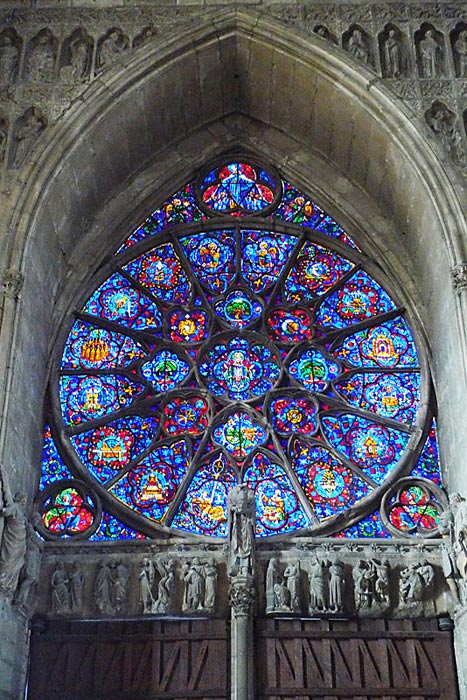
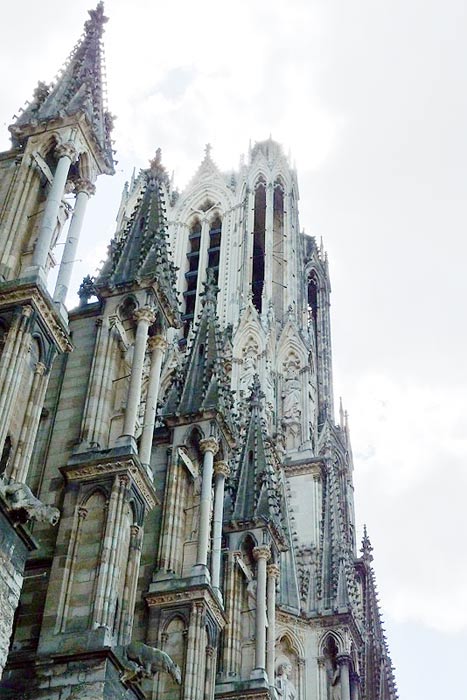
REFLECTION –   “The Church is the only one, the Roman Catholic!   And if there were left upon earth but one Catholic, he would be the one, universal Church, the Catholic Church, the Church of Jesus Christ against which the gates of Hell shall never prevail.”…
Bl Anne Catherine Emmerich (1774-1824)the church is the only one - bl a c emmerich - 9 feb 2018

PRAYER – We come to You, our heavenly Father and beg You, that by the prayers of Your child, Bl Anne Emmerich, we may stand strongly in defense of our faith and the holy Church of Your Son.   Come O Holy Spirit, fill our hearts with courage and love, our minds with the words to defend your beloved Spouse and keep our wills always in uniformity with Yours.   We pray through Jesus our Lord, in unity with You, our Father and the Holy Spirit, one God forever amen.bl anne - pray for us - 9 feb 2018

Posted in MORNING Prayers, SAINT of the DAY, The BLESSED VIRGIN MARY

Our Morning Offering – 9 February – The Memorial of Blessed Anne Catherine Emmerich

Our Morning Offering – 9 February – The Memorial of Blessed Anne Catherine Emmerich (1774-1824)

A Magnificat
Translated from the German by Olga Warnke of the Institute of the Blessed Virgin Mary

My soul glorifies the Lord,
my spirit rejoices in God my Saviour!
For He has blessed me lavishly
and makes me ready to respond.
He shatters my little world
and lets me be poor before Him.
He takes from me all my plans
and gives me more than I can hope for or ask.
He gives me opportunities
and the ability to become free
and to burst through my boundaries.
He gives the strength to be doing,
to build on Him alone,
for He shows Himself
as the ever greater One in my life.
He has made known to me this!
It is in my being servant that it becomes possible.
For God’s kingdom to break through
here and now.
Amen.a magnificat - 9 feb 2018

Posted in INCORRUPTIBLES, SAINT of the DAY, The BLESSED VIRGIN MARY, The PASSION, VATICAN Resources

Saint of the Day – 9 February – Blessed Anna Katharina Emmerick/Anne Catherine Emmerich (1774-1824)

Saint of the Day – 9 February – Blessed Anna Katharina Emmerick/Anne Catherine Emmerich (1774-1824) – Handicapped, Virgin, Religious, Penitent, Marian Visionary, Mystic, Ecstatic, Writer and Stigmatist.   Her body is incorrupt.

1-blessed-anne-catherine-emmerich-william-hart-mcnichols

Anna Katharina Emmerick was born on 8 September 1774 in the farming community of Flamsche near Coesfeld.   She grew up amidst a host of nine brothers and sisters.   She had to help out in the house and with the farm work at an early age.   Her school attendance was brief, which made it all the more remarkable that she was well instructed in religious matters.   Her parents and all those who knew Anna Katherina noticed early on that she felt drawn to prayer and to the religious life in a special way.

Anna Katharina laboured for three years on a large farm in the vicinity.   Then she learned to sew and stayed in Coesfeld for her further training.   She loved to visit the old churches in Coesfeld and to join in the celebration of Mass.   She often walked the path of Coesfeld’s long Way of the Cross alone, praying the stations by herself.   She wanted to enter the convent but since her wish could not be fulfilled at that time, she returned to her parental home.   She worked as a seamstress and, while doing so, visited many homes.

Anna Katherina asked for admission to different convents but she was rejected because she could not bring a significant dowry with her.   The Poor Clares in Münster finally agreed to accept her if she would learn to play the organ.   She received her parents’ permission to be trained in Coesfeld by the organist Söntgen.   But she never got around to learning how to play the organ.   The misery and poverty in the Söntgen household prompted her to work in the house and help out in the family.   She even sacrificed her small savings for their sake.
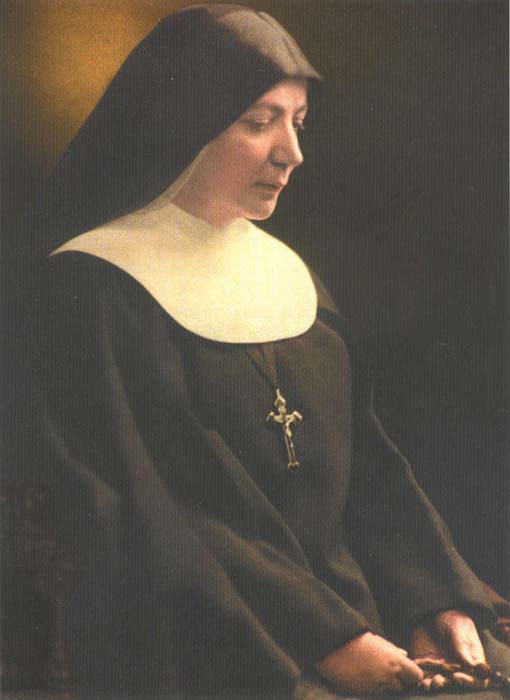
Together with her friend Klara Söntgen Anna Katharina was finally able to enter the convent Agnetenberg in Dülmen in 1802.   The following year she took her religious vows.   She participated enthusiastically in the life of the convent.   She was always willing to take on hard work and loathsome tasks.  Because of her impoverished background she was at first given little respect in the convent.   Some of the sisters took offence at her strict observance of the order’s rule and considered her a hypocrite.   Anna Katharina bore this pain in silence and quiet submission.

From 1802 to 1811 Anna Katharina was ill quite often and had to endure great pain.

As a result of secularisation the convent of Agnetenberg was suppressed in 1811 and Anna Katharina had to leave the convent along with the others.   She was taken in as a housekeeper at the home of Abbé Lambert, a priest who had fled France and lived in Dülmen.   But she soon became ill.   She was unable to leave the house and was confined to bed.   In agreement with Curate Lambert she had her younger sister Gertrud come to take over the housekeeping under her direction.

During this period Anna Katharina received the stigmata.   She had already endured the pain of the stigmata for a long time.  The fact that she bore the wounds of Christ could not remain hidden.   Dr Franz Wesener, a young doctor, went to see her and he was so impressed by her that he became a faithful, selfless and helping friend during the following eleven years.   He kept a diary about his contacts with Anna Katharina Emmerick in which he recorded a wealth of details.

A striking characteristic of the life of Anna Katharina was her love for people.   Wherever she saw need she tried to help.  Even in her sickbed she sewed clothes for poor children and was pleased when she could help them in this way.   Although she could have found her many visitors annoying, she received all of them kindly.   She embraced their concerns in her prayers and gave them encouragement and words of comfort.

Many prominent people who were important in the renewal movement of the church at the beginning of the 19th century sought an opportunity to meet Anna Katharina, among them Clemens August Droste zu Vischering, Bernhard Overberg, Friedrich Leopold von Stolberg, Johann Michael Sailer, Christian and Clemens Brentano, Luise Hensel, Melchior and Apollonia Diepenbrock.   The encounter with Clemens Brentano was particularly significant.   His first visit led him to stay in Dülmen for five years.   He visited Anna Katharina daily to record her visions which he later published.

Anna Katharina grew ever weaker during the summer of 1823.   As always she joined her suffering to the suffering of Jesus and offered it up for the salvation of all.   She died on 9 February 1824.   She was buried in the cemetery in Dülmen.   A large number of people attended the funeral.   Because of a rumour that her corpse had been stolen the grave was reopened twice in the weeks following the burial.   The coffin and the corpse were found to be intact.

Clemens Brentano wrote the following about Anna Katharina Emmerick: “She stands like a cross by the wayside”.   Anna Katharina Emmerick shows us the centre of our Christian faith, the mystery of the cross.

The life of Anna Katharina Emmerick is marked by her profound closeness to Christ.   She loved to pray before the famous Coesfeld Cross and she walked the path of the long Way of the Cross frequently.   So great was her personal participation in the sufferings of our Lord that it is not an exaggeration to say that she lived, suffered and died with Christ. An external sign of this, which is at the same time, however, more than just a sign, are the wounds of Christ which she bore.

220px-Coesfelder_Kreuz_(1)1280px-KlKreuztrCoe9

Anna Katharina Emmerick was a great admirer of Mary.   The feast of the Nativity of Mary was also Anna Katharina’s birthday.   A verse from a prayer to Mary highlights a further aspect of Anna Katharina’s life for us.   The prayer states, “O God, let us serve the work of salvation following the example of the faith and the love of Mary”.   To serve the work of salvation – that is what Anna Katharina wanted to do.

In Colossians the apostle Paul speaks of two ways to serve the gospel, to serve salvation. One consists in the active proclamation in word and deed.   But what if that is no longer possible?   Paul, who obviously finds himself in such a situation, writes: “Now I rejoice in my sufferings for your sake and in my flesh I complete what is lacking in Christ’s afflictions for the sake of his body, that is, the church” (Col 1:24).

Anna Katharina Emmerick served salvation in both ways.   Her words, which have reached innumerable people in many languages from her modest room in Dülmen through the writings of Clemens Brentano, are an outstanding proclamation of the gospel in service to salvation right up to the present day.   At the same time, however, Anna Katharina Emmerick understood her suffering as a service to salvation.   Dr Wesener, her doctor, recounts her petition in his diary:  “I have always requested for myself as a special gift from God that I suffer for those who are on the wrong path due to error or weakness, and that, if possible, I make reparation for them.”   It has been reported that Anna Katharina Emmerick gave many of her visitors religious assistance and consolation.   Her words had this power because she brought her life and suffering into the service of salvation.   In serving the work of salvation through faith and love, Anna Katharina Emmerick can be a model for us all.

Dr Wesener passed on this remark of Anna Katharina Emmerick:  “I have always considered service to my neighbour to be the greatest virtue.   In my earliest childhood I already requested of God that he give me the strength to serve my fellow human beings and to be useful.   And now I know that he has granted my request.”   How could she who was confined to her sickroom and her bed for years serve her highborn?   (vatican.va)

Her Works:  • The Dolorous Passion of Our Lord Jesus Christ
• The Life of Jesus Christ and Biblical Revelations
• The Lowly life and Bitter Passion of Our Lord Jesus Christ and His Blessed Mother

Anna was Beatified on 3 October 2004, by St Pope John Paul II.  However, the Vatican focused on her own personal piety rather than the religious writings associated to her by Clemens Brentano.   Her documents of postulation towards canonisation is handled by the Priestly Fraternity of St Peter.   Father Peter Gumpel who was involved in the analysis of the matter at the Vatican told Catholic News Service: “Since it was impossible to distinguish what derives from Sister Emmerich and what is embroidery or additions, we could not take these writings as a criteria. Therefore, they were simply discarded completely from all the work for the cause”.

In 2003 actor Mel Gibson brought Anne Catherine Emmerich’s vision to prominence as he used her book The Dolorous Passion as a key source for his movie The Passion of the Christ.   Gibson stated that Scripture and “accepted visions” were the only sources he drew on and a careful reading of Emmerich’s book shows the film’s high level of dependence on it.

In 2007 German director Dominik Graf made the movie The Pledge as a dramatisation of the encounters between Anne Catherine and Clemens Brentano, based on a novel by Kai Meyer.the passion 1the passion

House of the Virgin Mary

220px-House_of_the_Virgin_Mary
Neither Brentano nor Emmerich had ever been to Ephesus and indeed the city had not yet been excavated;  but visions contained in The Life of The Blessed Virgin Mary were used during the discovery of the House of the Virgin Mary, the Blessed Virgin’s supposed home before her Assumption, located on a hill near Ephesus, as described in the book Mary’s House.

In 1881, a French priest, the Abbé Julien Gouyet used Emmerich’s book to search for the house in Ephesus and found it based on the descriptions.   He was not taken seriously at first but sister Marie de Mandat-Grancey persisted until two other priests followed the same path and confirmed the finding.

The Holy See has taken no official position on the authenticity of the location yet but in 1896 Pope Leo XIII visited it and in 1951 Pope Pius XII initially declared the house a Holy Place. St Pope John XXIII later made the declaration permanent. Blessed Pope Paul VI in 1967, St Pope John Paul II in 1979 and Pope Benedict XVI in 2006 visited the house and treated it as a shrine.

Posted in SAINT of the DAY

Memorials of the Saints – 9 February

St Alexander of Rome
St Alexander of Soli
St Alto of Altomünster
St Ammon of Membressa
St Ammonius of Soli
Bl Anne Catherine Emmerich (1774-1824)

St Ansbert of Rouen
St Apollonia of Alexandria
St Attracta of Killaraght
St Brachio of Auvergne
St Cuaran the Wise
St Didymus of Membressa
St Donatus the Deacon
St Eingan of Llanengan
St Emilian of Membressa
Bl Erizzo
Bl Francisco Sanchez Marquez
Bl Giacomo Abbondo
Bl Godeschalk of Želiv
St Lassa of Membressa
Bl Marianus Scotus
St Maro
St Miguel Febres Cordero Muñoz (1854-1910)
St Nebridius of Egara
St Nicephorus of Antioch
St Poëmus of Membressa
St Primus the Deacon
St Raynald of Nocera
St Romanus the Wonder Worker
St Ronan of Lismore
St Sabino of Abellinum
St Sabinus of Canosa
St Teilo of Llandaff

Martyrs of Alexandria: An unknown number of Christians who were massacred in church in 4th century Alexandria, Egypt by Arian heretics for adhering to the orthodox faith.

Martyrs of Membressa: A group of 44 Christians martyred together. We know little else about them some names –
• Ammon
• Didymus
• Emilian
• Lassa
• Poemus
They were martyred in Membressa in Africa.