Posted in CHRISTMASTIDE!, FEASTS and SOLEMNITIES, SAINT of the DAY

27 December – Feast of St John the Apostle and Evangelist, the Third Day of the Christmas Octave and Memorials of the Saints

St John the Apostle (Feast) – https://www.youtube.com/watch?v=xfyr98NgRrQ

Bl Adelheidis of Tennenbach
Bl Alejo Pan López
Bl Alfredo Parte-Saiz
Bl Christina Ebner
St Fabiola of Rome
Bl Francesco Spoto
Bl Hesso of Beinwil
St José María Corbin-Ferrer
St Maximus of Alexandria
St Nicarete of Constantinople
Bl Odoardo Focherini
Bl Raymond de Barellis
Bl Roger of Verdun
Bl Sára Schalkház
St Theodore of Apamea
St Theophanes of Nicaea
Bl Walto of Wessobrünn

Posted in CHRISTMASTIDE!, MORNING Prayers, QUOTES - J R R Tolkien and MORE, SAINT of the DAY

Thought for the Day – 26 December – The Memorial of St Stephen the First Martyr and the Second Day in the Octave of Christmas

Thought for the Day – 26 December – The Memorial of St Stephen the First Martyr and the Second Day in the Octave of ChristmasSt. Stephen [Large]

Today the Church remembers the witness of Saint Stephen, the first of the Church’s martyrs. The cruelty of his death is recorded in the Acts of the Apostles, as is the manner in which he died, transforming the violence that took his life into an occasion to give witness to an authority greater than those fallen powers who would rule us by fear and threats.

That the Church remembers Saint Stephen today is no accident.  Strip away the sentimentality that obscures the story of Christ’s Nativity and one realises that Christ came into this world and from the first instant He showed His infant face, He was opposed.   Recall yesterday’s excerpt from the magnificent prologue to the Gospel of John which testifies that Christ came to His own (us) and His own (again, that means us) “knew him not.”   But worse than this- we refused Him.

And many still do.

The Holy Child came ready for this fight and the world was willing to fight Him. However, the world discovered that it was outmatched and the fallen powers of this world turned against those whom the Holy Child loves.   Unable to harm the Body of His human nature any longer, the world strikes at His Body, the Church.

Therefore, when the Church remembers its martyrs, like Saint Stephen, it is not merely out of a concern that the faithful become conversant in the details of Church history. Instead it is to keep us honest- not only about the past but also about the present.   It has never been easy to be a Christian and being a Christian has always been counter-cultural.   If lived authentically, it is lived in defiance against the fallen powers of the world.

This means that like our Saviour we have to be ready.   We have to learn the strategy that He used to defeat the fallen powers of this world and how He claimed victory when it seemed that these fallen powers could not be defeated.   We must learn His strategy- enacted in the witness of Saint Stephen and all the Church’s martyrs, past and present- lest in our opposition to the powers of this world, we become just like them.  (Fr Steve Grunow)

Grant, Lord we pray,
that we may imitate what we worship,
and so learn to love even our enemies,
for we celebrate the heavenly birthday
of Saint Stephen, who knew how to pray for his persecutors.
Through our Lord Jesus Christ your Son,
who lives and reigns with you in the unity of the Holy Spirit,
one God, for ever and ever.
Amen.

St Stephen, pray for us!st stephen - pray for us - 2017

Posted in CHRISTMASTIDE!, MORNING Prayers, PAPAL SERMONS, QUOTES - J R R Tolkien and MORE, QUOTES of the SAINTS, QUOTES on FAITH, QUOTES on LOVE, SAINT of the DAY

Quote/s of the Day – 26 December – The Memorial of St Stephen the First Martyr and the Second Day in the Octave of Christmas

Quote/s of the Day – 26 December – The Memorial of St Stephen the First Martyr and the Second Day in the Octave of Christmas

“The deep bond which links Christ
to His first martyr Stephen, is divine Charity –
the very Love which impelled the Son of God
to empty Himself and make Himself obedient
unto death on a Cross …It is always necessary
to notice this distinctive feature of Christian martyrdom,
it is exclusively an act of love for God and for man,
including persecutors.”

Pope Benedict XVI – 26 December 2007

” …Like his Master, St Stephen died forgiving his persecutors
and thus makes us realise that the entry into the world
of the Son of God gives rise to a new civilisation,
the civilisation of love that does not yield to evil
and violence and pulls down the barriers
between men and women, making them brothers and sisters
in the great family of God’s children.”

Pope Benedict XVI – 26 December 2009the deep bond - pope benedict - 26 dec 2017

Posted in CHRISTMASTIDE!, MORNING Prayers, SAINT of the DAY

One Minute Reflection – 26 December – The Memorial of St Stephen the First Martyr and the Second Day in the Octave of Christmas

One Minute Reflection – 26 December – The Memorial of St Stephen the First Martyr and the Second Day in the Octave of Christmas

“When they hand you over, do not worry about how you are to speak or what you are to say;   for what you to say will be given to you in that hour;   for it not you who speak, but the Spirit of your father speaking through you.” …Matthew 10:19-20

REFLECTION – “Yesterday, we celebrated, the birth in time of our eternal King.   Today, we celebrate the triumphant suffering, of his soldier.   Yesterday our king, clothed in His robe of flesh, left  His place in the virgin’s womb and graciously visited the world.   Today His soldier, leaves the tabernacle of his body and goes triumphantly to heaven.”…from a sermon by Saint Fulgentius of Ruspe (460-533)yesterday we celebrated - st fulgentius - 26 dec 2017

PRAYER – O God, the teacher and ruler of all that minister unto Thee, who did adorn the first beginnings of thy Church both with the ministrations of Thy blessed Deacon Stephen and with the precious blood of his martyrdom:   grant, we beseech Thee, that we, in the hour of our departure, obtaining Thy pardon, may be followers of his example and assisted by his prayers. Amen. – Milanese Sacramentaryst stephen pray for us

Posted in ALTAR BOYS, DEACONS, SACRISTANS, CHRISTMASTIDE!, Of BUILDERS, CONSTRUCTION WORKERS, PATRONAGE - HEADACHES, SAINT of the DAY

Saint of the Day – St Stephen, The First Martyr (c 05-c 34) – 26 December – The Second Day in the Octave of Christmas

Saint of the Day – St Stephen, The First Martyr (c 05-c 34) – 26 December – Deacon, Preacher.   the name “Stephen” – Stéphanos, meaning “wreath, crown” and by extension “reward, honour,” often given as a title rather than as a name.   Patronages – against headaches, of brick layers, casket makers, coffin makers, deacons, altar servers, horses,  masons, stone masons, Metz, France, Diocese of• Owensboro, Kentucky, Archdiocese of Toulouse, France, 92 cities.   Attributes – stones, dalmatic, censer, miniature church, Gospel Book, martyr’s palm frond.

Angelico,_niccolina_18
St Stephen – Fra Angelico
ststephen11

St Stephen was according to the Acts of the Apostles a deacon in the early church at Jerusalem who aroused the enmity of members of various synagogues by his teachings. Accused of blasphemy, at his trial he made a long speech denouncing the Jewish authorities who were sitting in judgement against him and was then stoned to death.   His martyrdom was witnessed by Saul of Tarsus, a Pharisee who would later himself become a follower of Jesus and known as Paul the Apostle.

The only primary source for information about Stephen is the New Testament book of the Acts of the Apostles.   Stephen is mentioned in Acts 6 as one of the Greek-speaking Hellenistic Jews selected to participate as a deacon in the early Church by the eleven – before the twelfth was elected.

447px-Luis_de_Morales_-_St_Stephen
Luis de Morales  (1509–1586)

“Good King Wenceslaus went out, on the Feast of Stephen”.   This is the Feast of St Stephen, the day after Christmas, when we commemorate the first disciple to die for Jesus.

Stephen
Carlo Crivelli

In the Acts of the Apostles, St Luke praises St Stephen as “a man full of faith and the Holy Spirit,” who “did great wonders and signs among the people” during the earliest days of the Church.   Luke’s history of the period also includes the moving scene of Stephen’s death – witnessed by St Paul before his conversion – at the hands of those who refused to accept Jesus as the Jewish Messiah.   Stephen himself was a Jew who most likely came to believe in Jesus during the Lord’s ministry on earth.   He may have been among the 70 disciples whom Christ sent out as missionaries, who preached the coming of God’s kingdom while travelling with almost no possessions.   This spirit of detachment from material things continued in the early Church, in which St Luke says believers “had all things in common” and “would sell their possessions and goods and distribute the proceeds to all, as any had need.”   But such radical charity ran up against the cultural conflict between Jews and Gentiles, when a group of Greek widows felt neglected in their needs as compared to those of a Jewish background.

Stephen’s reputation for holiness led the Apostles to choose him, along with six other men, to assist them in an official and unique way as this dispute arose.   Through the sacramental power given to them by Christ, the Apostles ordained the seven men as deacons and set them to work helping the widows.

img-saint-stephen-the-martyr
Jean Fouquet Etienne Chevalier with St Stephen (detail of Stephen)

As a deacon, Stephen also preached about Christ as the fulfillment of the Old Testament law and prophets.   Unable to refute his message, some members of local synagogues brought him before their religious authorities, charging him with seeking to destroy their traditions.   Stephen responded with a discourse recorded in the seventh chapter of the Acts of the Apostles.   He described Israel’s resistance to God’s grace in the past and accused the present religious authorities of “opposing the Holy Spirit” and rejecting the Messiah.

Before he was put to death, Stephen had a vision of Christ in glory. “Look,” he told the court, “I see the heavens opened and the Son of Man standing at the right hand of God!”  

st-stephen-1
St Stephen – Domenico Ghirlandaio

The council, however, dragged the deacon away and stoned him to death.   “While they were stoning Stephen, he prayed, ‘Lord Jesus, receive my spirit,’ records St. Luke in Acts 7.   “Then he knelt down and cried out in a loud voice, ‘Lord, do not hold this sin against them.’   When he had said this, he fell asleep.”

1012px-Bernardo_Cavallino_-_Martyrdom_of_St_Stephen_-_WGA4602
Bernardo Cavillino
A - stoning
Stoning of Saint Stephen, altarpiece of San Giorgio Maggiore, Venice, by Jacopo & Domenico Tintoretto
Posted in CHRISTMASTIDE!, SAINT of the DAY

Memorials of the Saints – 26 December

St Stephen the ProtoMartyr (Feast)

St Abadiu of Antinoë
Bl Agata Phutta Bi
Bl Agnès Phila
St Amaethlu of Anglesey
St Archelaus of Mesopotamia
Bl Bibiana Khamphai
Bl Cecilia Butsi
Bl Daniel of Villiers
St Dionysius, Pope
St Euthymius of Sardis
St Evaristo of Constantinople
Bl Giovanni Orsini
Bl Jean of Hainaut
Bl Lucie Khambang
St Margaret of Hohenfels
Bl Maria Phon
Bl Marinus of Rome
Bl Paganus of Lecco
Bl Pierre Boffet
St Tathai of Wales
St Theodore the Sacristan
St Vincentia Lopez y Vicuña
St Zeno of Gaza
St Pope Zosimus

Posted in CHRISTMASTIDE!, MORNING Prayers, PAPAL SERMONS, QUOTES - J R R Tolkien and MORE, SAINT of the DAY, The CHRIST CHILD, The WORD

One Minute Reflection – 25 December – The Solemnity of the Nativity of the Lord

One Minute Reflection – 25 December – The Solemnity of the Nativity of the Lord

The Lord has bared his holy arm before the eyes of all the nations;
and all the ends of the earth shall see the salvation of our God…Isaiah 52:10isaiah 52 10

REFLECTION – “Today, the Son of God is born and everything changes.   The Saviour of the world comes to partake of our human nature;  no longer are we alone and forsaken. The Virgin offers us her Son as the beginning of a new life.   The true light has come to illumine our lives so often beset by the darkness of sin.   Today we once more discover who we are!   Tonight we have been shown the way to reach the journey’s end.   Now must we put away all fear and dread, for the light shows us the path to Bethlehem.   We must not be laggards;  we are not permitted to stand idle.   We must set out to see our Saviour lying in a manger.   This is the reason for our joy and gladness:  this Child has been “born to us”;  he was “given to us”, as Isaiah proclaims (cf. 9:5).   The people who for for two thousand years has traversed all the pathways of the world in order to allow every man and woman to share in this joy is now given the mission of making known “the Prince of peace” and becoming His effective servant in the midst of the nations.”…HOMILY OF HIS HOLINESS POPE FRANCIS on the Solemnity of the Nativity of the Lord, 2015today we once more discover who we are!-pope francis christmas 2015

PRAYER – Almighty God, Your incarnate Word fills us with the new light He brought to men.   Let the light of faith in our hearts shine through all the ages, to bring Your light to all nations.   Come, come, let us adore our Holy Babe of Bethlehem, through whom we pray, in unity with the Holy Spirit, one God, forever and ever amen.o come let us adore him - dec 2016

Posted in CHRISTMASTIDE!, FEASTS and SOLEMNITIES, MORNING Prayers, SAINT of the DAY

Our Morning Offering – 25 December – The Solemnity of the Nativity of the Lord

Our Morning Offering – 25 December – The Solemnity of the Nativity of the Lord

Christmas Prayer
By St Pope John XXIII (1881-1963)

O sweet Child of Bethlehem,
grant that we may share with all our hearts
in this profound mystery of Christmas.
Put into the hearts of men and women this peace
for which they sometimes seek so desperately
and which You alone can give to them.
Help them to know one another better,
and to live as brothers and sisters,
children of the same Father.
Reveal to them also,
Your beauty, holiness and purity.
Awaken in their hearts
love and gratitude for Your infinite goodness.
Join them all together in Your love.
And give us Your heavenly peace, amen.christmas prayer of st pope john XXIII - 2017

Posted in CHRISTMASTIDE!, DOCTORS of the Church, MORNING Prayers, SAINT of the DAY

25 December – The Solemnity of the Birth of Our Lord Jesus Christ

25 December – The Solemnity of the Birth of Our Lord Jesus Christ

Today the Church celebrates the Birth of Jesus Christ, the first day in the octave of Christmas.   Throughout Advent the Church longed ardently for the coming of our Saviour.   Today she celebrates His birth with unrestrained joy.   “The Word was made flesh and dwelt among us.”   The Son of God became man to give us a share in that divine life which is eternally His in the Blessed Trinity.   Christmas time begins on 24 December with the first Vespers of the feast and ends on the feast of the Baptism of Christ.   White vestments reappear in our churches as a sign of joy.The Nativity of the Lordthe nativity of the lord.cropped

The Christmas feast is a festival full of joy.   The Eternal Word has become Man and dwells among us.   The longings of the patriarchs and prophets are fulfilled.   With the shepherds we hurry to the manger and adore the Incarnate Son of God, who for us and for our salvation descended upon earth.   The purpose of the Christmas feast is beautifully expressed in the Preface of the Nativity:   “For by the mystery of the Word made flesh the light of Thy glory hath shone anew upon the eyes of our mind;  so that while we acknowledge Him a God seen by men, we may be drawn by Him to the love of things unseen.”

Christmas says to us – alone we can’t profoundly change the world to remedy it.   Alone, we can make the world better or worse but we can’t save it.   Christ came therefore, because left to ourselves; we couldn’t escape the ‘mortal disease’ that has enveloped us from the first moment of conception in our mother’s womb.   This gives us hope, true hope and true Christian optimism:   I can’t do it but He is there!   This is the mystery of grace synthesised in the human figure of God incarnate.

Christmas Eve and Christmas day are moments of contemplation.   We consider, in many dimensions, the mystery of love that was incarnated for us.   First of all, we contemplate the light and joy, without forgetting Jesus and Mary’s sorrows and sufferings and the many difficulties that had surrounded them:  the cold, the uncomfortable place, the dangers….. It would be good to accompany these thoughts by reciting and meditating slowly on the Holy Rosary, preferably in front of a crib.  ‘Blessed grotto of Bethlehem that testified to the wonders!   Who, in this hour would not turn our hearts?   Who would not prefer the opulent palace of the King?’   (Abbot Guéranger, L’Anno Liturgico, Alba 1959 [orig. franc. 1841], I, p122).da vinci

Listen to the way that St Bonaventure, the seraphic doctor, invites us to contemplate this scene in his ‘Meditation on the life of Jesus Christ’:   ‘You have also lingered, bent your knee, adored the Lord God, venerated His Mother and greeted Joseph, the holy old man, with reverence.  Therefore, kiss the feet of the baby Jesus, who lies in the manger, and pray that the Holy Virgin will allow you to hold Him.   Take Him between your arms, hold Him and see His lovable face, kiss it with reverence and rejoice with Him.  You can do this because He has come to bring salvation to sinners and He has humbly conversed with them, finally giving Himself as food’. (cit. in Guéranger, pp 136-137)

Christmas also reminds us of the great mystery of God’s people, of the Church acquired through Christ’s blood, animated by the life giving Spirit, governed by the legitimate shepherds in communion with the successor of Peter.   On this day in which the Word came to earth, assuming human nature, body, and soul, how can we not think about His Mystical Body that is animated by the Holy Spirit?   ‘For this reason, by no weak analogy, [the Church] is compared to the mystery of the incarnate Word.   As the assumed nature inseparably united to Him, serves the divine Word as a living organ of salvation, so, in a similar way, does the visible social structure of the Church serve the Spirit of Christ, who vivifies it, in the building up of the body’ (Vatican II, Lumen Gentium, n.8).Jacob_de_Backer_-_The_Nativity_-_WGA1127

Holy Christmas also reminds us of the mystery of Mary as Mother of God, mother of the Incarnated Word and mother of His mystical body, the Church.   Christmas encourages us to contemplate Jesus together with Mary, reflecting on Jesus with ‘His mother’, as recounted many times in the Gospels.   If our faith must be fully evangelical, it can not neglect a sane and profound devotion to the Mother of God, as she shows us the easiest way to reach Jesus.madonna and child - christmas day post

Happy Birthday Jesus, our Lord and our God!

For a post on the Tradition  Bible Time From the Creation to The Birth of Jesus go here: https://anastpaul.wordpress.com/2016/12/25/25-december-the-solemnity-of-the-birth-of-our-lord-jesus-christ/

Posted in CHRISTMASTIDE!, SAINT of the DAY

The Solemnity of the Nativity of the Lord and Memorials of the Saints – 25 December

Nativity of the Lord (Solemnity)

St Adalsindis of Hamay
St Alburga of Wilton
St Anastasia of Sirmium
Bl Artale
St Basilée of the Via Latina
Bl Bentivoglio de Bonis
Bl Diego de Aro
St Eugenia of Rome
St Fulk of Toulouse
Bl Jacopone da Todi
St Jovin of the Via Latina
Bl Maria Therese von Wüllenweber
Bl Matthew of Albano
Bl Michael Nakashima Saburoemon
Bl Nera
St Peter Nolasco
St Romulus of Berry

Martyrs of Nicomedia: 20,000 Christians martyred by order of Diocletian. They were reported to have all been in the single basilica to celebrate Christmas. While there unquestionably was an endless series of martyrs under Diocletian, it’s likely the ancient sources exaggerated the numbers of this incident. And as the Christmas holy day was not celebrated in the East in 303, they were probably gathered for another feast. They were burned alive in 303 in the basilica of Nicomedia.

Posted in ADVENT, CHRISTMASTIDE!, SAINT of the DAY

The Vigil of the Nativity of the Lord and Memorials of the Saints – 24 December

The Vigil of the Nativity of the Lord and Memorials of the Saints – 24 December

24 December – Vigil of the Nativity of the Lord

St Adam the Patriarch
St Adela of Pfalzel
Bl Alberic of Gladbach
Bl Brocard of Strasbourg
St Bruno of Ottobeuren
St Caran of Scotland
St Delphinus of Bordeaux
St Emiliana of Rome
St Euthymius of Nicomedia
St Eve the Matriarch
Bl Francesco dei Maleficii
St Gregory of Spoleto
St Hanno of Worms
Bl Ignacio Caselles García
St Irmina of Oehren
St Mochua of Timahoe
Bl Pablo Meléndez Gonzalo
St Paola Elisabetta Cerioli
Bl Peter de Solanes
St Trasilla
Bl Venerandus of Clermont

All the Holy Ancestors of Jesus: A commemoration of all the holy ancestors of Jeus Christ.

The New Testament has preserved two different genealogies of Our Lord, in Matthew 1 and Luke 3.
Saint Matthew’s list is divided artificially into three equal parts of 14 names each, with several intentional omissions: from Abraham the father of the chosen people to David the king, to whose family the promise was made (2 Kings 7);  David and the royal line after him to the Babylonian captivity; the descendants of the royal line from the captivity to Joseph, the legal father of Our Lord.

Saint Luke proceeds in reverse order; he starts from Joseph and goes, beyond Abraham, back to Adam the father of the human race, in accord with the character of his Gospel and he merely enumerates the names without grouping them according to a thesis or point, as is the case in Saint Matthew.

Few names are common to both lists: viz., those between Abraham and David, then Salathiel and Zorobabel after the captivity, and Joseph the foster-father of Christ; the others are absent from Matthew’s list, or the persons are different.   To account for these differences several explanations have been advanced but no decisive evidence is extant. Not a few authors hold that Saint Luke gives Mary’s genealogy but this view is more generally considered improbable, so that both lists are taken as giving Joseph’s ancestry. Only it must be supposed that at several points, instead of the actual descent, the one or the other of the lists gives the legal relationship based on adoption in some manner.  Our Lord was considered to belong to the family of David;  this seems to be taken for granted in the New Testament, where we find no difficulty raised against Him on the ground of His descent.   The genealogies show His relationship to the royal family of Juda through Joseph, as it was only through the father, legal or natural, that the rights could be transmitted and Joseph was the legal father of Jesus.   To trace Our Lord’s ancestry through His mother would not have served the purpose of the Evangelists.

Matthew 1:1-17 – The book of the genealogy of Jesus Christ, the son of David, the son of Abraham:
Abraham became the father of Isaac, Isaac the father of Jacob, Jacob the father of Judah and his brothers. Judah became the father of Perez and Zerah, whose mother was Tamar. Perez became the father of Hezron, Hezron the father of Ram, Ram the father of Amminadab. Amminadab became the father of Nahshon, Nahshon the father of Salmon, Salmon the father of Boaz, whose mother was Rahab.   Boaz became the father of Obed, whose mother was Ruth. Obed became the father of Jesse, Jesse the father of David the king. David became the father of Solomon, whose mother had been the wife of Uriah. Solomon became the father of Rehoboam, Rehoboam the father of Abijah, Abijah the father of Asaph. Asaph became the father of Jehoshaphat, Jehoshaphat the father of Joram, Joram the father of Uzziah.   Uzziah became the father of Jotham, Jotham the father of Ahaz, Ahaz the father of Hezekiah.   Hezekiah became the father of Manasseh, Manasseh the father of Amos, Amos the father of Josiah.   Josiah became the father of Jechoniah and his brothers at the time of the Babylonian exile.   After the Babylonian exile, Jechoniah became the father of Shealtiel, Shealtiel the father of Zerubbabel, Zerubbabel the father of Abiud.   Abiud became the father of Eliakim, Eliakim the father of Azor, Azor the father of Zadok. Zadok became the father of Achim, Achim the father of Eliud, Eliud the father of Eleazar. Eleazar became the father of Matthan, Matthan the father of Jacob, Jacob the father of Joseph, the husband of Mary. Of her was born Jesus who is called the Messiah.

Thus the total number of generations from Abraham to David is fourteen generations; from David to the Babylonian exile, fourteen generations; from the Babylonian exile to the Messiah, fourteen generations.

Luke 3:23-38:
When Jesus began his ministry he was about thirty years of age.   He was the son, as was thought, of Joseph, the son of Heli, the son of Matthat, the son of Levi, the son of Melchi, the son of Jannai, the son of Joseph, the son of Mattathias, the son of Amos, the son of Nahum, the son of Esli, the son of Naggai, the son of Maath, the son of Mattathias, the son of Semein, the son of Josech, the son of Joda, the son of Joanan, the son of Rhesa, the son of Zerubbabel, the son of Shealtiel, the son of Neri, the son of Melchi, the son of Addi, the son of Cosam, the son of Elmadam, the son of Er, the son of Joshua, the son of Eliezer, the son of Jorim, the son of Matthat, the son of Levi, the son of Simeon, the son of Judah, the son of Joseph, the son of Jonam, the son of Eliakim, the son of Melea, the son of Menna, the son of Mattatha, the son of Nathan, the son of David, the son of Jesse, the son of Obed, the son of Boaz, the son of Sala, the son of Nahshon, the son of Amminadab, the son of Admin, the son of Arni, the son of Hezron, the son of Perez, the son of Judah, the son of Jacob, the son of Isaac, the son of Abraham, the son of Terah, the son of Nahor, the son of Serug, the son of Reu, the son of Peleg, the son of Eber, the son of Shelah, the son of Cainan, the son of Arphaxad, the son of Shem, the son of Noah, the son of Lamech, the son of Methuselah, the son of Enoch, the son of Jared, the son of Mahalaleel, the son of Cainan, the son of Enos, the son of Seth, the son of Adam, the son of God.

Blessed Mercedarian Brothers – (4 beati): Four Mercedarian friars who worked to free Christians enslaved by Muslims, and to preach Christ along the way to any who would hear.
• Blessed Dionysius Roneo
• Blessed Philip Claro
• Blessed Giulio Pons
• Blessed Peter of Valladolid

Blessed Mercedarian Sisters – (6 beati): Six cloistered Mercedarian nuns at the convent of Vera Cruz in Berriz, Spain. Noted for their devotion to the rules of the Order and for their deep prayer lives.
• Blessed Anna Maria Prieto
• Blessed Anna de Arrano
• Blessed Orsola de Larisgoizia
• Blessed Maguna Mary
• Blessed Margaret
• Blessed Mary of the Assumption Sarria

Martyred Maidens of Antioch – (40 saints): A group of forty virgins martyred in the persecutions of Decius. None of their names have come down to us. They were martyred in 250 in Antioch, Syria.

Martyrs of Tripoli – (6 saints): A group of Christians martyred together, date unknown. The only details that have surived are six of the names – Drusus, Lucian, Metrobius, Paul, Theotimus and Zenobius. They were martyred in Tripoli, Libya.

Posted in ADVENT, MORNING Prayers, SAINT of the DAY, The WORD

Thought for the Day – 23 December – The Memorial of St John of Kanty (1390-1473)

Thought for the Day – 23 December – The Memorial of St John of Kanty (1390-1473)

Sweetness of disposition wins more people than a sharp mind and roughness.
Every human being is worthy of respect, even if his opinions are false and his attitudes wrong.
We may be right in our opinions but we are wrong if we defend those opinions in an unkind and uncharitable way.
Nevertheless, there is one truth, not many – blue is blue and not black – where our kind disposition and words fail to convince another of the truth and we meet violent roughness, we do as we are taught “shake the dust from your feet” (Luke 9:5).
In Christ’s words is a warning:  the act of “shaking off the dust from one’s feet” is an act of “testimony against” those who reject the Gospel.   At the time of Judgment, we will stand before Christ and be judged by the testimony of how we lived our lives.   The testimony of our lives, how we loved or did not love, will either be a testimony in our favour, or a testimony against us.
St John of Kanty, pray for us!st john of kanty - pray for us 2 - 23 DEC 2017

Posted in ADVENT, CHRISTMASTIDE!, DOCTORS of the Church, FATHERS of the Church, MORNING Prayers, QUOTES of the SAINTS, SAINT of the DAY, The HOLY EUCHARIST / The HOLY MASS, The WORD

One Minute Reflection – 23 December – Saturday of the Third Week of Advent and the Memorial of St John of Kanty (1390-1473)

One Minute Reflection – 23 December – Saturday of the Third Week of Advent and the Memorial of St John of Kanty (1390-1473)

On coming into the world, Jesus said …..”For I have come down from heaven, not to do My own will but the will of Him who sent Me” (John 6:38). By one offering He has forever perfected those who are being sanctified.john-6-38. 23 dec image

REFLECTION – “Jesus Christ, the God-Man, was born in a manger and is spiritually reborn on the altar.    He suffered on Calvary and continues to offer Himself on the altar. In His earthly life, He spread His teaching and worked miracles among the crowds.   In the Eucharist, He spans the centuries and communicates Himself to all.”…St John Chrysostom (347-407) Father & Doctor of the Churchjesus christ the god man - st john chrysostom - 23 dec 2017

PRAYER – Heavenly Father, in contemplating the birth of Your Son in time and in the Eucharist, may I ever attain a new birth.   May I through love of You, give my all to my neighbour in true charity.   Help me to learn from St John of Kanty to live in humility, true poverty of spirit and charity and of whom we ask for intercession.    St John of Kanty, pray for us! Amenst john of kanty pray for us - 23 dec 2017

Posted in ADVENT, SAINT of the DAY

Saint of the Day – 23 December – St John of Kanty/Cantius (1390-1473)

Saint of the Day – 23 December – St John of Kanty/Cantius (1390 at Kanty, Silesia, Poland -1473 at Cracow, Poland, of natural causes ) Priest, Theologian, Scholastic Philosopher, Physicist, Teacher, Confessor, Philosopher, Apostle of Charity – Patron of Poland and Lithuania and various Universities.

St-John-Kanty

He was born in Kęty, a small town near Oświęcim, Poland, to Stanisław and Anna Kanty. He attended the Kraków Academy at which he attained bachelor and licentiate.   In 1418 he became a Doctor of Philosophy.   Upon graduation he spent the next three years conducting philosophy classes at the university, while preparing for the priesthood.   Upon his ordination, he became rector at the school of the Canons Regular of the Most Holy Sepulcher in Miechow.    While there, he was offered a professorship of Sacrae Scripturae (Sacred Scripture) back at his alma mater, the Kraków Academy, which would later be named the Jagiellonian University.   He attained a doctorate in theology and eventually became director of the theology department.   He held the professorship until his death in 1473.   John spent many hours copying manuscripts of the Holy Scriptures, theological tracts and other scholarly works.
In physics, he helped develop Jean Buridan’s theory of impetus, which anticipated the work of Galileo and Newton.
During his time in Kraków, John Kanty became well known in the city for his generosity and compassion toward the poor, especially needy students at the university.   He subsisted on what was strictly necessary to sustain his life, giving alms regularly to the poor.

He was a serious man and a good teacher.   He ate no meat, slept on the floor and rested little.   Though John was hard on himself, he was patient and kind to his students, who loved him in return.   Some jealous faculty members, however, had him removed.   John was sent to do parish work but he was not acquainted with such duties.   Although the people liked him for his generous and energetic spirit, John was not successful as a parish priest.

John returned to the university to teach Scripture.   The material he taught was not remembered as much as his holiness.   He was known everywhere for his humility and spontaneous generosity.   He gave everything to people who were poor and kept only the clothes he most needed.   Four times he made a pilgrimage to the Holy Land, carrying his luggage on his back.   When John died at age 83, people had already claimed him as a saint.

SOD-1223-SaintJohnKanty-790x480.jpg

John of Kanty/Cantius was beatified in Rome by Pope Clement X on 28 March 1676.   He was named patron of Poland and Lithuania by Pope Clement XII in the year 1737.  Ninety-one years after his beatification, Blessed John Cantius was canonised on 16 July 1767, by Pope Clement XIII.

The Roman Breviary distinguishes him with three hymns;  he is the only confessor not a bishop who has been given this honour in the Roman Catholic liturgy.

St John Cantius is a popular saint in Poland.   A number of churches and schools founded by Polish diaspora communities throughout North America are named in his honour.   “John Cantius” has been used as a first and middle name—see, for example, John Cantius Garand.   In 1998, a new religious institute was founded, based in Chicago, which took St. John Cantius as their patron saint.   Thus they are the Canons Regular of Saint John Cantius.

Posted in ADVENT, SAINT of the DAY

Memorials of the Saints – 23 December

St John of Kanty/Cantius (1390-1473) (Optional Memorial)

__
St Antonio of Saint Anne
St Besa of Egypt
Bl Bincema
St Dagobert II of Austrasia
Bl Epifanio Gómez Alvaro
St Frithbert of Hexham
Bl Hartmann of Brixen
Bl Herman of Scheda
Bl James Aymerich
St John Cirita
St John Stone
St Joseph Cho Yun-ho
St Mardonius of Rome
St Mazota of Abernethy
St Migdonius of Rome
St Nicolás Factor-Estaña
St Servulus of Rome
St Thorlac Thorhallsson
St Victoria
St Vintila of Orensee

Martyred Dominicans of Santander – (9 beati) – Martyred in the Spanish Civil War:
• Blessed Bernardino Irurzun Otermín
• Blessed Eleuterio Marne Mansilla
• Blessed Eliseo Miguel Lagro
• Blessed Enrique Cañal Gómez
• Blessed Enrique Izquierdo Palacios
• Blessed Epifanio Gómez Alvaro
• Blessed José María García Tabar
• Blessed Manuel Gutiérrez Ceballos
• Blessed Miguel Rodríguez González
• Blessed Pedro Luís y Luís

Martyrs of Crete – (10 saints): A group of ten Christians who died in the persecutions of Decius. They were –
• Agathopus
• Basilides
• Cleomenes
• Eunician
• Euporus
• Evaristus
• Gelasius
• Saturninus
• Theodulus
• Zeticus
They were martyred in 250 on the island of Crete.

Posted in ADVENT, MORNING Prayers, PAPAL SERMONS, SAINT of the DAY

Thought for the Day – – 22 December – The Memorial of St Frances Xavier Cabrini (1850-1917)

Thought for the Day – – 22 December – The Memorial of St Frances Xavier Cabrini (1850-1917)

“Inspired by the grace of god, we join the saints in honouring the holy virgin Frances Xavier Cabrini.
She was a humble woman who became outstanding not because she was famous or rich or powerful but because she lived a virtuous life.
From the tender years of her youth, she kept her innocence as white as a lily and preserved it carefully with the thorns of penitence;  as the years progressed, she was moved by a certain instinct and supernatural zeal to dedicate her whole life to the service and greater glory of God.
She welcomed delinquent youths into safe homes and taught them to live upright and holy lives.
She consoled those who were in prison and recalled to them the hope of eternal life.
She encouraged prisoners to reform themselves and to live honest lives.
She comforted the sick and the infirm in the hospitals and diligently cared for them.
She extended a friendly and helping hand especially to immigrants and offered them necessary shelter and relief, for having left their homeland behind, they were wandering about in a foreign land with no place to turn for help.
Because of their condition, she saw that they were in danger of deserting the practice of Christian virtues and their Catholic faith.
Undoubtedly she accomplished all this through the faith which was always so vibrant and alive in her heart;  through the divine love which burned within her and finally, through constant prayer by which she was so closely united with God from whom she humbly asked and obtained whatever her human weakness could not obtain.
Although her constitution was very frail, her spirit was endowed with such singular strength that, knowing the will of God in her regard, she permitted nothing to impede her from accomplishing what seemed beyond her strength.”

from a homily at the Canonization of Saint Frances Xavier Cabrini by Pope Pius XII

Saint Frances Xavier Cabrini’s life was filled with disappointments… but she was never discouraged.   Despite setbacks, weak health and constant difficulty, the accomplishments of Mother Cabrini are remarkable.   Ever humble, she took no credit, instead directing those who might compliment her work back to the Lord—to Jesus Christ—though which all things were (and are) accomplished.   Throughout her life, Mother Cabrini found her strength in the Lord and used every ounce given to her to serve others.   We look to her today as a model of obedience, hope, service and strength. Mother Cabrini, pray for us!st frances xavier cabrini - pray for us no 2 - 22 dec 2017

Posted in ADVENT, DOCTORS of the Church, FATHERS of the Church, MORNING Prayers, QUOTES of the SAINTS, SAINT of the DAY, The WORD

One Minute Reflection – 22 December – Friday of the Third Week of Advent

One Minute Reflection – 22 December – Friday of the Third Week of Advent

A child is born to us, a son is given us; upon his shoulder dominian rests……Isaiah 9:5isaiah 9 - 5

REFLECTION – “In adoring our Saviour’s birth, it is our origin that we celebrate. Christ’s temporal generation is the source of the Christian people, the birth of His Mystical Body. All of us encounter in this Mystery a new birth in Christ.”…St Pope Leo the Great (400-461) Father & Doctor of the Churchin adoring our saviour's birth - 22 dec 2017

PRAYER – Heavenly Father, in celebrating the birth of Your Son on earth, let me also celebrate my birth in His Mystical Body. Grant that I may thus be brought closer to You in union with Your only Son. St Frances Xavier Cabrini, you who lived in union with our Lord and Saviour, striving always to be a light to all, pray for us! Amenst frances xavier cabrini - pray for us - 22 dec 2017

Posted in ADVENT, MORNING Prayers, PRAYERS of the SAINTS, SAINT of the DAY

Our Morning Offering – 23 December – The Memorial of St Frances Xavier Cabrini (1850-1917)

Our Morning Offering – 23 December – The Memorial of St Frances Xavier Cabrini (1850-1917)

Fortify me O Lord
Prayer of St Frances Xavier Cabrini (1850-1917)

Fortify me with the grace of Your Holy Spirit
and give Your peace to my soul
that I may be free from all needless anxiety,
solicitude and worry.
Help me to desire always that which is pleasing
and acceptable to You so that Your Will may be my will.
Grant that I may rid myself of all unholy desires
and that, for Your love, I may remain obscure
and unknown in this world, to be known only to You.
Do not permit me to attribute to myself the good
that You perform in me and through me
but rather, referring all honour to Your Majesty,
may I glory only in my infirmities,
so that renouncing sincerely all vainglory
which comes from the world,
I may aspire to that true and lasting glory
which comes from You. Amen.fortify me o Lord - st cabrini - 22 dec 2017

Posted in ADVENT, EMMIGRANTS / IMMIGRANTS, Of HOSPITALS, NURSES, NURSING ASSOCIATIONS, PATRONAGE - ORPHANS,ABANDONED CHILDREN, SAINT of the DAY

Saint of the Day – 22 December – St Frances Xavier Cabrini M.S.C. (1850-1917)

Saint of the Day – 22 December – St Frances Xavier Cabrini M.S.C.   RELIGIOUS AND FOUNDRESS – Born Francesca Saverio Cabrini on 15 July 1850 – 22 December 1917), also called Mother Cabrini, was an Italian-American religious sister, who founded the Missionary Sisters of the Sacred Heart of Jesus, that was a major support to the Italian immigrants to the United States. She was the first naturalised citizen of the United States to be canonised on 7 July 1946.   Additional Memorial – 13 November (in the United States).   Patronages – • against malaria • emigrants, immigrants (given on 8 September 1950 by Pope Pius XII) • hospital administrators • orphans.frances xavier cabrini

This saint, the first United States citizen to be canonised, was born in Italy of parents who were farmers.   She was the thirteenth child, born when her mother was fifty-two years old.   The missionary spirit was awakened in her as a little girl when her father read stories of the missions to his children.   She received a good education and at eighteen was awarded the normal school certificate.mothercabrini2a-2-1-web

For a while she helped the pastor teach catechism and visited the sick and the poor.   She also taught school in a nearby town and for six years supervised an orphanage assisted by a group of young women.   The bishop of Lodi heard of this group and asked Frances to establish a missionary institute to work in his diocese.   Frances did so, calling the community the Missionary Sisters of the Sacred Heart.   An academy for girls was opened and new houses quickly sprang up.

One day Bishop Scalabrini, founder of the Missionaries of Emigration, described to Mother Cabrini the wretched economical and spiritual conditions of the many Italian immigrants in the United States and she was deeply moved.   An audience with Pope Leo XIII changed her plans to go to the missions of the East. “Not to the East, but to the West,” the Pope said to her. “Go to the United States.”   Mother Cabrini no longer hesitated.   She landed in New York in 1889, established an orphanage and then set out on a lifework that comprised the alleviation of every human need.   For the children she erected schools, kindergartens, clinics, orphanages and foundling homes and numbers of hospitals for the needy sick.   At her death over five thousand children were receiving care in her charitable institutions and at the same time her community had grown to five hundred members in seventy houses in North and South America, France, Spain and England.

Color_Image_Saint_Francis_Xavier_Cabrini

St Frances, frail and diminutive of stature, showed such energy and enterprise that everyone marvelled.   She crossed the Atlantic twenty-five times to visit the various houses and institutions.   In 1909 she adopted the United States as her country and became a citizen.   After thirty-seven years of unflagging labour and heroic charity she died alone in a chair in Columbus Hospital at Chicago, Illinois, while making dolls for orphans in preparation for a Christmas party.   Cardinal Mundelein of Chicago officiated at her funeral and in 1938 also presided at her beatification by Pius XI.   She was canonised by Pius XII in 1946.   She lies buried under the altar of the chapel of Mother Cabrini High School in New York City.1113frances8

Posted in ADVENT, SAINT of the DAY

Memorials of the Saints – 22 December

St Frances Xavier Cabrini (1850-1917) – Universal optional memorial (except in the USA)

St Abban of New Ross
Bl Adam of Saxony
St Amaswinthus of Málaga
St Athernaise of Fife
St Bertheid of Münster
St Chaeremon of Nilopolis
St Flavian of Acquapendente
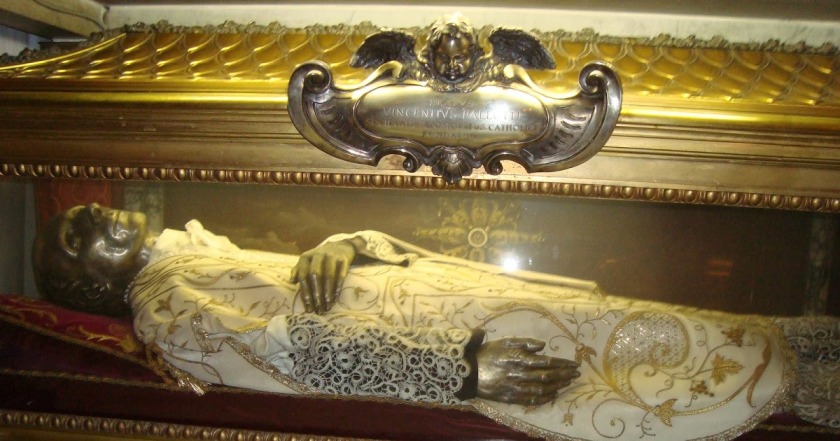
St Honoratus of Toulouse
St Hunger of Utrecht
St Ischirione of Alexandria
Bl Jutta of Diessenberg
Bl Ottone of Toulouse
Bl Thomas Holland
St Zeno of Nicomedia

Martyrs of Ostia – (3 saints): A group of Christians martyred together. The only details about them to survive are three names – Demetrius, Florus and Honoratus. They were martyred at Ostia, Italy.

Martyrs of Rhaitu – (43 saints): 43 monks martyred by Blemmyes, in Raíthu, Egypt, date unknown.

Martyrs of Via Lavicana – (30 saints): A group of 30 Christians martyred together in the persecutions of Diocletian.
c 303 in Rome, Italy and were buried between two bay trees on the Via Lavicana outside Rome.

Posted in ADVENT, DOCTORS of the Church, MORNING Prayers, ON the SAINTS, SAINT of the DAY

Thought for the Day from Pope Benedict– 21 December – The Memorial of St Peter Canisius (1521-1597) Doctor of the Church

Thought for the Day from Pope Benedict – 21 December – The Memorial of St Peter Canisius (1521-1597) Doctor of the Church

Characteristic of St Canisius’ spirituality was his profound personal friendship with Jesus.   For example, on 4 September 1549 he wrote in his journal, speaking with the Lord:  “In the end, as if you were opening to me the heart of the Most Sacred Body, which it seemed to me I saw before me, you commanded me to drink from that source, inviting me, as it were, to draw the waters of my salvation from your founts, O my Saviour”.

Then he saw that the Saviour was giving him a garment with three pieces that were called peace, love and perseverance.   And with this garment, made up of peace, love and perseverance, Canisius carried out his work of renewing Catholicism.   His friendship with Jesus — which was the core of his personality — nourished by love of the Bible, by love of the Blessed Sacrament and by love of the Fathers, this friendship was clearly united with the awareness of being a perpetuator of the Apostles’ mission in the Church. And this reminds us that every genuine evangeliser is always an instrument united with Jesus and with His Church and is fruitful for this very reason.

Friendship with Jesus had been inculcated in St Peter Canisius in the spiritual environment of the Charterhouse of Cologne, in which he had been in close contact with two Carthusian mystics:  Johannes Lansperger, whose name has been Latinised as “Lanspergius” and Nikolaus van Esche, Latinized as “Eschius”.

He subsequently deepened the experience of this friendship, familiaritas stupenda nimis, through contemplation of the mysteries of Jesus’ life, which form a large part of St Ignatius’ Spiritual Exercises.   This is the foundation of his intense devotion to the Heart of the Lord, which culminated in his consecration to the apostolic ministry in the Vatican Basilica.

The Christocentric spirituality of St Peter Canisius is rooted in a profound conviction:  no soul anxious for perfection fails to practice prayer daily, mental prayer, an ordinary means that enables the disciple of Jesus to live in intimacy with the divine Teacher.

For this reason in his writings for the spiritual education of the people, our Saint insists on the importance of the Liturgy with his comments on the Gospels, on Feasts, on the Rite of Holy Mass and on the sacraments;  yet, at the same time, he is careful to show the faithful the need for and beauty of personal daily prayer, which should accompany and permeate participation in the public worship of the Church.

This exhortation and method have kept their value intact, especially after being authoritatively proposed anew by the Second Vatican Council in the Constitution Sacrosanctum Concilium:  Christian life does not develop unless it is nourished by participation in the Liturgy — particularly at Sunday Mass — and by personal daily prayer, by personal contact with God.

Among the thousands of activities and multiple distractions that surround us, we must find moments for recollection before the Lord every day, in order to listen to Him and speak with Him.

At the same time, the example that St Peter Canisius has bequeathed to us, not only in his works but especially with his life, is ever timely and of lasting value.   He teaches clearly that the apostolic ministry is effective and produces fruits of salvation in hearts only if the preacher is a personal witness of Jesus and an instrument at his disposal, bound to Him closely by faith in His Gospel and in His Church, by a morally consistent life and by prayer as ceaseless as love.  And this is true for every Christian who wishes to live his adherence to Christ with commitment and fidelity.    Thank you. (Pope Benedict XVI – GENERAL AUDIENCE, Paul VI Audience Hall, Wednesday, 9 February 2011).

St Peter Canisius, pray for us!

st peter canisius pray for us 2

And last year’s Thought for the Day is also inspiring – https://anastpaul.wordpress.com/2016/12/21/thought-for-the-day-21-december/


Posted in ADVENT, DOCTORS of the Church, JESUIT SJ, MORNING Prayers, QUOTES of the SAINTS, QUOTES on SANCTITY, SAINT of the DAY, Uncategorized

Quote/s of the Day – 21 December – The Memorial of St Peter Canisius (1521-1597) Doctor of the Church

Quote/s of the Day – 21 December – The Memorial of St Peter Canisius (1521-1597) Doctor of the Church

“Such should be the shepherd
in the Church who, like Paul,
becomes all things to all men,
so that the sick may find healing in him;
the sad, joy;
the desperate, hope;
the ignorant, instruction;
those in doubt, advice;
the penitent, forgiveness and comfort
and finally, everyone,
whatever is necessary, for salvation.
And so Christ, when He wished
to appoint the chief teachers
of the world and of the Church,
did not limit Himself to saying to his disciples:
‘You are the light of the world’;
but also added these words:
‘A city seated on a mountain cannot be hid.
Neither do men light a candle
and put it under a measure but upon a candlestick,
that it may shine to all who are in the house.’
Those churchmen err, who imagine,
that it is by brilliant preaching,
rather than by holiness of and all-embracing love,
they fulfil their office.
such should be - st peter canisius - 21 dec 2017

“If you have too much to do, with God’s help, you will find time to do it all.”

St Peter Canisius (1521-1597) Doctor of the Churchif you have too much to do - st peter canisius - 21 dec

“Among the Jesuit saints, it is Peter Canisius
that brought me into the Society of Jesus…
as we go on, you will see, what influence
St Peter has had on this sinner. “

“(St Peter Canisius had) an extraordinary devotion
to the Holy Eucharist – his devotion to the Holy Sacrifice
were such that people would come from great distances
to watch him offer Mass, so devoutly did he celebrate.
He was one of the people that urged frequent Communion
at the Council of Trent and was one of those who got
the Council of Trent to pass a little known decree,
little known because it took almost three hundred years
for that decree to really come to life.
The Council of Trent, mind you, sixteenth century,
encouraged daily Communion – you would never guess it, would you?
Peter Canisius was one of those who, under instructions from Ignatius,
made sure that the Council passed that decree
and he spent hours before the Blessed Sacrament.”

Ven Servant of God Fr John A Hardon S.J. (1914-2000)st peter canisus had an - fr john a hardon - 21 dec 2017

Posted in ADVENT, DOCTORS of the Church, JESUIT SJ, MARIAN QUOTES, MORNING Prayers, QUOTES of the SAINTS, SAINT of the DAY

One Minute Reflection – 21 December – The Memorial of St Peter Canisius (1521-1597) Doctor of the Church

One Minute Reflection – 21 December – The Memorial of St Peter Canisius (1521-1597) Doctor of the Church

God who is mighty,
has done great things for me,
holy is his name…….Luke 1:49Luke 1 - 49

REFLECTION – “While remaining the Mother of our Judge, Mary is a mother to us, full of mercy.   She constitutes our protection.   She keeps us close to Christ and she faithfully takes the matter of our salvation into her charge.”……………….St Peter Canisiuswhile remaining the mother of our judge - st peter canisius - 2016 image

PRAYER – Heavenly Father, You have filled Mary with grace and made her a Co-Meaditrix with Christ Your Son.   Grant that I may have constant recourse to her and attain the salvation she helped win for the world.   St Peter Canisius, you lived a life of total and full dedication to our Father, to His divine Son and his holy and most blessed mother and in complete openness to the inspiration of the Holy Spirit.   Please pray for us that as you were strengthened in sanctity and doctrine for the defence and growth of the Catholic faith, every seeker of truth may have the joy of finding our God and that all Catholics may persevere and grow in love and zeal for the one true faith. amen.canisius-pray-for-us - 2016

Posted in ADVENT, JESUIT SJ, PRAYERS of the SAINTS, SAINT of the DAY

Our Morning Offering – 21 December – The Memorial of St Peter Canisius (1521-1397) Doctor of the Church

Our Morning Offering – 21 December – The Memorial of St Peter Canisius (1521-1597) Doctor of the Church

May I Be United With You, Good Jesus
St Peter Canisius (1521-1597) Doctor of the Church

Let my eyes take their sleep
but may my heart always
keep watch for You.
May Your right hand bless Your servants
who love You.
May I be united with the praise
that flows from You, Lord Jesus,
to all your saints;
united with the gratitude
drawn from Your heart, good Jesus,
that causes Your saints to thank You;
united with Your passion, good Jesus,
by which You took away our guilt;
united with the divine longing
that You had on earth, for our salvation;
united with every prayer
that welled from Your divine heart, good Jesus
and flowed into the hearts of Your saints.
Amenmay I be united with you good jesus - st peter canisius sj


Posted in CATHOLIC PRESS, DOCTORS of the Church, JESUIT SJ, Of Catechists, SAINT of the DAY

Saint of the Day – 21 December – St Peter Canisius SJ (1521-1597) – Confessor, Doctor of the Church

Saint of the Day – 21 December – St Peter Canisius SJ (1521-1597) – Confessor, Priest, Religious, Doctor of the Church, Reformer, Teacher,  Writer, Apostle of Charity –  (Born as Pieter Kanis on 8 May 1521 at Niemguen, Netherlands – 21 December 1597 at Fribourg, Switzerland of natural causes).   Patronages – Catholic Press, Germany, Catechists.   Known as the Hammer of Protestantism and the Second Apostle of Germany.   St Peter  became known for his strong support for the Catholic faith during the Protestant Reformation in Germany, Austria, Bohemia, Moravia and Switzerland.   The restoration of the Catholic Church in Germany after the Protestant Reformation is largely attributed to the work there of the Society of Jesus, which he led.   “Peter Canisius was the first publisher, the first author, the first editor of the Society of Jesus.   By now, Jesuits have followed in his footsteps to the tune of having published in 400 years, thousands of books.   From the time of Canisius, and his name is first in the bibliography of Jesuit writers, from Peter Canisius to the end of the l9th century, that is to 1900, there are about twenty volumes of bibliography, each volume about two inches thick, stands about eighteen inches high, filled just with authors and titles, thousands and thousands and thousands, no other religious institute in the Church publishes as much as members of the Society.   It was all started by Peter Canisius.” (Ven Servan of God Fr John A Hardon S.J.)

canisius - large

St Peter Canisius was born in 1521 in what is now the Netherlands.   His father was the local mayor and his mother died shortly of his birth.  Peter studied at the University of Cologne and earned a Master’s degree in 1540 at the age of 19.   While there, he met St Peter Faber, one of the first Jesuits.   Through him, Canisius became the first Dutchman to join the Society of Jesus in 1543.   St Peter Canisius’ preaching and writings, led him to become one of the most influential Catholics of his time.   He supervised the founding and maintenance of the first German-speaking Jesuit colleges and was known as the Second Apostle of Germany.

If you have too much to do, with God’s help you will find time to do it all – St Peter Canisius

For a half-century he led the Catholic Reformation in Austria, Bavaria and Bohemia.   For that reason he is reckoned an apostle to Germany, second only to St. Boniface.   With stupendous energy he preached and taught in parishes, reformed and founded universities, wrote many books including popular catechisms, restored lapsed Catholics, converted Protestants, preached retreats and found time to care for the sick.   In his last 30 years travelling more than 20,000 miles on foot or horseback, St Peter Canisius spearheaded the renewal of the Catholic faith in southern Germany.Saint_Petrus_Canisius

Peter Canisius revitalised Catholic life and teaching at universities in Ingolstadt and Augsburg.   He founded new ones at Prague and Fribourg.   In all four cities his preaching and catechising won the hearts of Catholics and attracted nominal Protestants to the church.   In Vienna his personal care for plague victims made him a most popular figure.  Thus, when appointed diocesan administrator, he was in a position to revive the city’s long decadent Catholic community.

After 1555, Peter Canisius published his famous Summary of Christian Doctrine and two smaller catechisms.   These books generated the Catholic Reformation as Luther’s catechism had spread Protestantism.   Canisius’s catechisms also helped launch the Catholic press.    The Three Catechisms he compiled between 1555 and 1558.   The first Catechism was addressed to students who could grasp the elementary notions of theology;  the second, to young people of the populace for an initial religious instruction;  the third, to youth with a scholastic formation of middle and high school levels.   He explained Catholic doctrine with questions and answers, concisely, in biblical terms, with great clarity and with no polemical overtones.   “There were at least 200 editions of this Catechism in his lifetime alone, translated into 15 languages!   And hundreds of editions succeeded one another until the 20th century.   So it was that still in my father’s generation people in Germany were calling the Catechism simply “the Canisius”.   He really was the Catechist of Germany for centuries, he formed people’s faith for centuries.” (Pope Benedict XVI).

He was offered the post of Bishop of Vienna in 1554 but declined in to continue his travelling and teachings.

canisius2

In the late 16th century, when open hostility typified relations between Catholics and Protestants, Peter Canisius advised charity and moderation. He opposed theological debates with Protestant leaders and in general, discouraged discussion of Catholic distinctives such as indulgences, purgatory and monastic vows with Protestants.   He believed such efforts only heightened division and embittered relations.   He articulated his views in this letter to his Jesuit superior:

“It is plainly wrong to meet non-Catholics with bitterness or to treat them with discourtesy.   For this is nothing else than the reverse of Christ’s example because it breaks the bruised reed and quenches the smoking flax.   We ought to instruct with meekness those whom heresy has made bitter and suspicious and has estranged from orthodox Catholics, especially from our fellow Jesuits.   Thus, by whole-hearted charity and good will we may win them over to us in the Lord.

Again, it is a mistaken policy to behave in a contentious fashion and to start disputes about matters of belief with argumentative people who are disposed by their very natures to wrangling.   Indeed, the fact of their being so constituted is a reason the more why such people should be attracted and won to the simplicity of the faith as much by example as by argument.”

In 1591, Peter Canisius suffered a stroke that nearly killed him.   But he recovered and devoted himself to writing for six more years until his death in 1597.   His body was interred before the high altar of the Church of Saint Nicholas in Fribourg and his relics were translated to the Church of Saint Michael at the Jesuit College in Fribourg in 1625. He was Canonised 21 May 1925 by Pope Pius XI and was added to the now 36 Doctors of the Church, by Pope Pius XI in 1925.SOD-1221-SaintPeterCanisius-790x480Petrus Canisius / Gemaelde - Petrus Canisius / Painting -

Posted in ADVENT, SAINT of the DAY

Memorials of the Saints – 21 December

St Peter Canisius S.J. (1521-1397) Doctor of the Church (Optional Memorial)


Bl Adrian of Dalmatia
St Anastasius II of Antioch
St Anrê Tran An Dung
Bl Anton Durcovici
St Baudacarius of Bobbio
St Beornwald of Bampton
Bl Bezela of Göda
Bl Daniel of the Annunciation
St Dioscorus
St Festus of Tuscany
St Glycerius of Nicomedia
St James of Valencia
St John of Tuscany
St John Vincent
St Micah the Prophet
St Phêrô Truong Van Thi
St Severinus of Trèves
Bl Sibrand of Marigård
St Themistocles of Lycia

Posted in ADVENT, MORNING Prayers, SAINT of the DAY

Thought for the Day – 20 December – The Memorial of St Dominic de Silos (1000-1073)

Thought for the Day – 20 December – The Memorial of St Dominic de Silos (1000-1073)

St Dominic of Silos came to know God in the solitude of a shepherd boy.    It was this love of solitude that drew him into monastic life where he could be alone with his God.   Most of us are so busy we scarcely have time for Sunday Mass.   We should cultivate a little solitude, too.   It is easy to form habits – is it not?   Especially those that give us pleasure. Our greatest pleasure should be communing with God it too becomes a habit – this one is indispensable!

St Dominic de Silos Pray for us!st dominic de silos pray for us - 20 dec 2017- no 2

Posted in ADVENT, DOCTORS of the Church, MORNING Prayers, QUOTES of the SAINTS, SAINT of the DAY

One Minute Reflection – 20 December – The Memorial of St Dominic de Silos (1000-1073)

One Minute Reflection – 20 December – The Memorial of St Dominic de Silos (1000-1073)

You, O God, are my stronghold, my gracious God!………..Psalm 59:18psalm-59-18

REFLECTION – “In tribulations, turn to God with confidence.   You will obtain strength, light and knowledge.
In joys and successes, turn to God with fear and sincerity.   You will escape all snares and be free of everything false.”..St John of the Crossin tribulations - st john of the cross - 20 dec 2017

PRAYER – Heavenly Father, let me turn to You in good times and in bad. Grant that I may always remain in loving union with You no matter what adversity or goodness should befall me. As St Dominic de Silos lived his life, when he was exiled, he found another way to give You honour and through this adversity You filled his work with miracles. So too may it be in my life. St Dominic de Silos Pray for us! Amenst dominic de silos pray for us - 20 dec 2017

Posted in ADVENT, PATRONAGE - OF DOGS and against DOG BITES and/or RABIES, PATRONAGE - PRISONERS, PATRONAGE-INFERTILITY & SAFE CHILDBIRTH, SAINT of the DAY

Saint of the Day – 20 December – St Dominic de Silos O.S.B. (c1000-1073)

Saint of the Day – 20 December – St Dominic de Silos OSB (c1000-1073) – born in the year 1000 in Cañas (modern Rioja), Navarre, Spain – died on 10 December 1073 in Silos, Spain of natural causes.   He was a Spanish Monk, to whom the Abbey of Santo Domingo de Silos, where he served as the Abbot, is dedicated.   Patronages –  of pregnant women, against rabies, against rabid dogs, against insects, captives, prisoners; shepherds.    The mother of the better-known Saint Dominic de Guzmán, the Blessed Joan of Aza, is said to have prayed at his shrine before she was able to conceive the son she named for him.   That son would grow up to found the Dominican Order.   Dominic’s special patronage thus became connected with pregnancy and until the establishment of the Second Spanish Republic in 1931, his abbatial crozier was used to bless the queens of Spain and was placed by their beds when they were in labour.SOD-1220-SaintDominicofSilos-790x480

Dominic of Silos was born in Navarre, Spain, on the Spanish side of the Pyrenees and was a shepherd boy, looking after his father’s flocks.   He acquired a love of solitude and as a young man became a monk at the monastery of San Millan de la Cogolla.   He eventually became prior of the monastery and came into conflict with the king of Navarre over possessions of the monastery claimed by the king.   The king drove Dominic out of the monastery and Dominic went with other monks to Castille, where the king of Castille appointed Dominic abbot of the monastery of St Sebastian at Silos.

The monastery was in terrible shape, spiritually and materially and Dominic set about to restore the monastery and to reform the lives of the monks.   He preserved the Mozarbic Rite (one of the variants of the Latin Rite) at his monastery and his monastery became one of the centres of the Mozarbic liturgy.   His monastery also preserved the Visigothic script of ancient Spain and was a centre of learning and liturgy in that part of Spain.

Santo Domingo de Silos

Dominic of Silos died on 20 December 1073, about a century before the birth of his namesake, St Dominic of Calaruega.   Before the Spanish Revolution of 1931, it was customary for the abbot of Silos to bring the staff of Dominic of Silos to the Spanish royal palace whenever the queen was in labour and to leave it at her bedside until the birth of her child had taken place.

In recent times, great interest in Dominic of Silos has arisen since the literary treasures of the library of Silos have become known.   The abbey had a profound influence on spirituality and learning in Spain.   Today the monastery is an abbey of the Benedictine Congregation of Solesmes housing a library of ancient and rare manuscripts.

The images show the Monastery and Abbey of Solesmes as well as a Religuary Casket of St Dominic and an image of him taken from the altar piece.

Posted in ADVENT, SAINT of the DAY

Memorials of the Saints – 20 December

St Attala of Strasbourg
St Bajulus of Rome
St Crescentius of Africa
St Dominic of Brescia
St Dominic de Silos (1000-1073) – https://www.youtube.com/watch?v=IBbZHBwsM9w
St Eugene of Arabia
St Gabriel Olivares Roda
St Hoger of Hamburg-Bremen
Bl John de Molina
St Julius of Gelduba
Bl Lorenzo Company
St Liberatus of Rome
St Macarius of Arabia
St Malou of Hautvillers
Bl Michal Piaszczynski
Paul of Latra
Bl Peter de la Cadireta
Bl Peter Massalenus
Philogonius of Antioch
St Thomas of Dover
St Ursicinus of Saint-Ursanne
Bl Vincent Romano
St Pope Zephyrinus