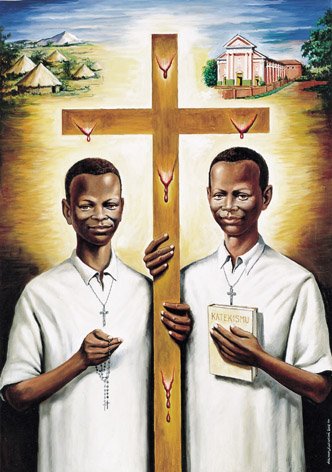
St Lorenzo Ruiz of Manila (Optional Memorial)
St Wenceslaus of Bohemia (Optional Memorial) – https://www.youtube.com/watch?v=raxyo8yRYwE https://www.youtube.com/watch?v=F1EW1MSFfpE – Msgr Charles Pope – My recitation of the old carol
—
Bl Aaron of Auxerre
St Alodius of Auxerre
St Annemond of Lyons
St Bardomianus
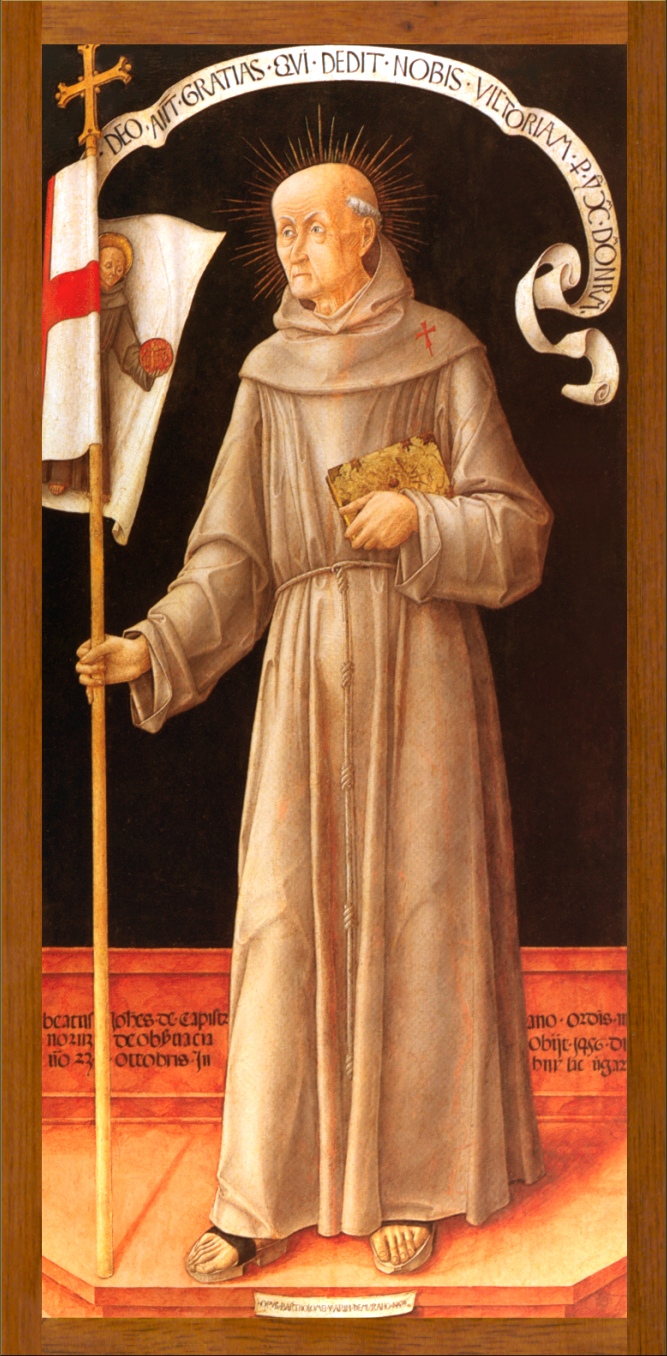
Bl Bernardine of Feltre
St Chariton of Palestine
Bl Christian Franco
St Conval of Strathclyde
St Eucarpus
St Eustochium
St Exuperius of Toulouse
St Faustus of Riez
St John of Dukla
St Laurence of North Africa
St Lioba of Bischofsheim
St Machan
St Martial of North Africa
St Martin of Moyenmoutier
St Paternus of Auch
St Privatus of Rome
St Salonius of Geneva
St Silvinus of Brescia
St Solomon of Genoa
St Stacteus
St Tetta of Wimborne
Bl Thiemo
St Willigod of Moyenmoutier
St Zama of Bologna
—
Augustinian Martyrs of Japan: The first Augustinian missionaries arrived in Japan in 1602 and met with immediate success; many were brought to the faith; many of them became Augustinians; and many of them were martyred in the periodic persecutions of Christians. This memorial commemorates all of them, whether they have a sanctioned Cause for Canonisation or not. They include:
• Blessed Bartolomé Gutiérrez Rodríguez
• Blessed Ferdinand Ayala
• Blessed Francisco Terrero de Ortega Pérez
• Blessed Ioannes Mukuno Chozaburo
• Blessed Laurentius Kaida Hachizo
• Blessed Mancius Yukimoto Ichizaemon
• Blessed Martín Lumbreras Peralta
• Blessed Melchor Sánchez Pérez
• Blessed Michaël Ichinose Sukezaemon
• Blessed Pedro de Zúñiga
• Blessed Petrus Sawaguchi Kuhyoe
• Blessed Thomas Jihyoe of Saint Augustine
• Blessed Thomas Terai Kahyoe
• Blessed Vicente Simões de Carvalho
• Saint Magdalena of Nagasaki
Martyrs of Antioch – 37 saints: A group of 30 soldiers and 7 civilians who were murdered together for their faith. The names that have come down to us are – Alexander, Alphinus, Heliodorus, Mark, Neon, Nicon and Zosumus. c 303 at Antioch, Pisidia (in modern Turkey).
Martyrs of China – 120 saints: A common memorial for the hundreds of the faithful, lay and clergy, who have died for their faith in the last couple of centuries in China. They were Canonised on 1 October 2000 by Pope John Paul II.
Martyred in the Spanish Civil War:
• Blessed Francesc Xavier Ponsa Casallach
• Blessed Josep Casas Juliá
• Blessed Josep Casas Ros
• Blessed Josep Tarrats Comaposada
• Blessed María Fenollosa Alcaina
• Blessed Santiago Mestre Iborra
Thought for the Day – 27 September – The Memorial of St Vincent de Paul (1581-1660)
Most remarkably, Vincent was by temperament a very irascible person—even his friends admitted it. He said that except for the grace of God he would have been “hard and repulsive, rough and cross.” But he became a tender and affectionate man, very sensitive to the needs of others. Pope Leo XIII made him the patron of all charitable societies. Outstanding among these, of course, is the Society of St. Vincent de Paul, founded in 1833 by his admirer Blessed Frédéric Ozanam.
St Vincent found himself deeply shocked by the religious state of the people around him and he found himself thrust into his life’s work.
Sometimes, something just has to be done and there is no-one else to do it. And God will provide the way, He will change that inner being – who perhaps is often “rough and cross” to do His work. All St Vincent did was relinquish himself totally in trust. He handed himself over, hauled up that cross and followed Him who leads.
The gaze of Christ rests upon us and your cross is lying at your feet – have you felt it, have you seen it?
One Minute Reflection – 27 September – The Memorial of St Vincent de Paul (1581-1660)
May the God of hope fill you with all joy and peace in believing, so that you may abound in hope by the power of the holy Spirit…Romans 15:13
REFLECTION – “Free your mind from all that troubles you; God will take care of things. You will be unable to make haste in this (choice) without, so to speak, grieving the heart of God because he sees that you do not honour Him sufficiently with holy trust. Trust in Him, I beg you and you will have the fulfillment of what your heart desires.”….St Vincent de Paul
PRAYER – Father, You endowed St Vincent de Paul with the spirit of an apostle to give himself to the poor and to the training of priests. Give us, good Lord, a share of the same spirit, that we may love what he loved and do as he taught. Fill us with hope and total trust and abandonment to Your Holy Providence. Through our Lord Jesus Christ, in union with the Holy Spirit, one God, forever and ever. St Vincent de Paul, pray for us, amen.
Our Morning Offering – 27 September – The Memorial of St Vincent de Paul (1581-1660)
Lord, Teach me How to Pray St Vincent de Paul
Oh Lord,
You selected the poor
and simple people to be Your Apostles.
Look upon Your poor servant
kneeling before You now.
I recognise that I am simple and poor too.
Dear Lord, please teach me how to pray
as You taught Your disciples
upon their humble request.
If it pleases You in Your goodness
to grant me that grace,
I shall be able to pray well
and much better
than I could ever could hope for
if left to my own efforts.
Lord, I trust that You will bless me
with the fulfillment of this request.
Amen
Saint of the Day – 27 September – St Vincent de Paul CM (1581-1660) Confessor, known as the “Great Apostle of Trumpets” – Priest, Founder, Apostle of Charity, Doctor of Canon Law, Reformer of Society and Priests, founder of Hospital and Orphanages. Born on 24 April 1581 near Ranquine, Gascony near Dax, southwest France – the Town is now known as Saint-Vincent-de-Paul, Landes, France and died on 27 September 1660 at Paris, France of natural causes. His body was found incorrupt when exhumed in 1712 and the incorrupt heart is displayed in a reliquary in the Chapel of the Motherhouse of the Sisters of Charity in Paris. St Vincent was Beatified on 13 August 1729 by Pope Benedict XIII and Canonised on 16 June 1737 by Pope Clement XII. Patronages – lepers; against leprosy, all charitable societies (given on 12 May 1885 by Pope Leo XIII), charitable workers; volunteers, horses, hospital workers, hospitals, lost articles, prisoners, for spiritual help, Madagascar, Brothers of Charity, Richmond, Virginia, diocese of, Saint Vincent de Paul Societies, Sisters of Charity, Vincentian Service Corps. Attributes – 16th century cleric performing some act of charity, cleric carrying an infant, priest surrounded by the Sisters of Charity, cannon ball and sword (referring to prisoners of war he ransomed).
St Vincent was born of poor parents in the village of Pouy in Gascony, France, about 1580. He enjoyed his first schooling under the Franciscan Fathers at Acqs. Such had been his progress in four years that a gentleman chose him as subpreceptor to his children and he was thus enabled to continue his studies without being a burden to his parents.
In 1596, he went to the University of Toulouse for theological studies, and there he was ordained priest in 1600.
In 1605, on a voyage by sea from Marseilles to Narbonne, he fell into the hands of African pirates and was carried as a slave to Tunis. His captivity lasted about two years, until Divine Providence enabled him to effect his escape.
After a brief visit to Rome he returned to France, where he became preceptor in the family of Emmanuel de Gondy, Count of Goigny, and General of the galleys of France. In 1617, he began to preach missions, and in 1625, he lay the foundations of a congregation which afterward became the Congregation of the Mission or Lazarists, so named on account of the Priory of St. Lazarus, which the Fathers began to occupy in 1633.
The deathbed confession of a dying servant opened Vincent de Paul’s eyes to the crying spiritual needs of the peasantry of France. This seems to have been a crucial moment in the life of the man from a small farm in Gascony, France, who had become a priest with little more ambition than to have a comfortable life.
The Countess de Gondi–whose servant he had helped–persuaded her husband to endow and support a group of able and zealous missionaries who would work among poor tenant farmers and country people in general. Vincent was too humble to accept leadership at first but after working for some time in Paris among imprisoned galley slaves, he returned to be the leader of what is now known as the Congregation of the Mission, or the Vincentians. These priests, with vows of poverty, chastity, obedience, and stability, were to devote themselves entirely to the people in smaller towns and villages.
It would be impossible to enumerate all the works of this servant of God. Charity was his predominant virtue. It extended to all classes of persons, from forsaken childhood to old age. The Sisters of Charity also owe the foundation of their congregation to St. Vincent. In the midst of the most distracting occupations his soul was always intimately united with God. Though honoured by the great ones of the world, he remained deeply rooted in humility. The Apostle of Charity, the immortal Vincent de Paul, breathed his last in Paris at the age of eighty in 1660.
St Vincent De Paul is among the Incorruptibles. The Incorruptibles are Catholic Saints who’s bodies show no decay after their death. The Incorruptibles are a consoling sign of Christ’s victory over death, a confirmation of the dogma of the Resurrection of the Body, a sign that the Saints are still with us in the Mystical Body of Christ, as well as a proof of the truth of the Catholic Faith – for only in the Catholic Church do we find this phenomenon.
St Vincent de Paul (Memorial) – https://www.youtube.com/watch?v=zrwez_neJT4
—
St Adheritus
St Adolphus of Cordoba
St Antonio de Torres
St Barrog the Hermit
St Bonfilius of Foligno
St Ceraunus of Paris
St Chiara of the Resurrection
St Delphine
St Deodatus of Sora
St Elzear
St Epicharis
St Fidentius of Todi
St Florentinus the Hermit
St Gaius of Milan
St Hilary the Hermit
St Hiltrude of Liessies
Bl Jean-Baptiste Laborie du Vivier
St John of Cordoba
St Marcellus of Saint Gall
St Terence of Todi
—
Martyrs of Aegea – (3 saints)
Martyred in the Spanish Civil War:
• Blessed Crescencia Valls Espí
• Blessed Herminia Martínez Amigó de Martínez
• Blessed José Fenollosa Alcaina
• Blessed Maria Carme Fradera Ferragutcasas
• Blessed Maria Magdalena Fradera Ferragutcasas
• Blessed Maria Rosa Fradera Ferragutcasas
Quote/s of the Day – 26 September – The Memorial of Blessed Pope Paul VI
“For you deal here above all with human life and human life is sacred; no one may dare make an attempt upon it…. Respect for life, must find here ….in the Assembly, its highest affirmation and its most rational defense. Your task is to ensure that there is enough bread on the tables of mankind and not to encourage an artificial control of births, which would be irrational, in order to diminish the number of guests at the banquet of life.”
“We must see to it that enthusiasm for the future does not give rise to contempt for the past.”
“Never reach out your hand unless you’re willing to extend an arm.”
“Liturgy is like a strong tree whose beauty is derived from the continuous renewal of its leaves but whose strength comes from the old trunk, with solid roots in the ground.”
One Minute Reflection – 26 September – The Memorial of Blessed Pope Paul VI
“But you will receive power when the Holy Spirit has come upon you and you will be my witnesses in Jerusalem and in all Judea and Samaria and to the end of the earth.”…Acts 1:8
REFLECTION – ” But above all, we place our unshakable confidence in the Holy Spirit, the soul of the Church and in theological faith upon which rests the life of the Mystical Body.”….Blessed Pope Paul VI (SOLEMNI HAC LITURGIA – (CREDO OF THE PEOPLE OF GOD) 30 June 1968
PRAYER – Holy God, through our Lord Jesus Christ Your Son in union with the Holy Spirit, with Mary Mother of the Church, St Joseph her spouse, the communion of Saints, we pray, be with us, lead us, guide us, never leave us. Blessed Pope Paul VI, today we pray to you to make our special intention, that you will constantly pray for the beloved Church of Christ, His Mystical Body, for us all, amen.
Our Morning Offering – 26 September – The Memorial of Blessed Pope Paul VI (1897-1978)
Prayer for a Pure Faith Blessed Pope Paul VI
Lord, I believe:
I wish to believe in You.
Lord, let my faith be full
and unreserved,
and let it penetrate my thought,
my way of judging Divine things
and human things.
Lord, let my faith be joyful
and give peace
and gladness to my spirit,
and dispose it for prayer with God
and conversation with men,
so that the inner bliss
of its fortunate possession
may shine forth in sacred
and secular conversation.
Lord, let my faith be humble
and not presume
to be based on the experience
of my thought and of my feeling;
but let it surrender
to the testimony of the Holy Spirit,
and not have any better guarantee
than in docility to Tradition
and to the authority of
the magisterium of the Holy Church.
Amen
Saint of the Day – 26 September – Blessed Pope Paul VI Bishop of Rome, Marian devotee, Pro Life Advocate, Evangelist, Reformer, Canon Lawyer, Promoter of Workers’ rights (born Giovanni Battista Enrico Antonio Maria Montini (26 September 1897 – 6 August 1978) Patronages – Archdiocese of Milan, Paul VI Pontifical Institute, Second Vatican Council, Diocese of Brescia, Concesio, Magenta, Paderno Dugnano.
Born near Brescia in northern Italy, Giovanni Battista Montini was the second of three sons. His father, Giorgio, was a lawyer, editor and eventually a member of the Italian Chamber of Deputies. His mother, Giuditta, was very involved in Catholic Action.
After ordination in 1920, Giovanni did graduate studies in literature, philosophy, and canon law in Rome before he joined the Vatican Secretariat of State in 1924, where he worked for 30 years. He was also chaplain to the Federation of Italian Catholic University Students, where he met and became a very good friend of Aldo Moro, who eventually became prime minister. Moro was kidnapped by the Red Brigade in March 1978 and murdered two months later. A devastated Pope Paul VI presided at his funeral.
In 1954, Fr Montini was named archbishop of Milan, where he sought to win disaffected workers back to the Catholic Church. He called himself the “archbishop of the workers” and visited factories regularly while overseeing the rebuilding of a local Church tremendously disrupted by World War II.
In 1958, Montini was the first of 23 cardinals named by Pope John XXIII, two months after the latter’s election as pope. Cardinal Montini helped in preparing Vatican II and participated enthusiastically in its first sessions. When he was elected pope in June 1963, he immediately decided to continue that Council, which had another three sessions before its conclusion on December 8, 1965. The day before Vatican II concluded, Paul VI and Patriarch Athenagoras revoked the excommunications that their predecessors had made in 1054. The pope worked very hard to ensure that bishops would approve the Council’s 16 documents by overwhelming majorities.
Official protrait – Cardinal Montini
Paul VI had stunned the world by visiting the Holy Land in January 1964 and meeting Athenagoras, the Ecumenical Patriarch of Constantinople in person. The pope made eight more international trips, including one in 1965, to visit New York City and speak on behalf of peace before the United Nations General Assembly. He also visited India, Columbia, Uganda and seven Asian countries during a 10-day tour in 1970.
Also in 1965, he instituted the World Synod of Bishops and the next year decreed that bishops must offer their resignations on reaching age 75. In 1970, he decided that cardinals over 80 would no longer vote in papal conclaves or head the Holy See’s major offices. He had increased the number of cardinals significantly, giving many countries their first cardinal. Eventually establishing diplomatic relations between the Holy See and 40 countries, he also instituted a permanent observer mission at the United Nations in 1964. Paul VI wrote seven encyclicals; his last one in 1968 on human life–Humanae Vitae–prohibited artificial birth control.
Pope Paul VI died at Castel Gandolfo on August 6, 1978, and was buried in St. Peter’s Basilica. He was beatified on October 19, 2014.
Pope Francis and Blessed Pope Paul VI – (The Image below is Pope Francis wearing his favourite stole. It is actually the stole that Blessed Pope Paul VI wore.)
During his recent visit to Bozzolo, Italy, Pope Francis declared his desire to be able to canonise Paul VI.
According to a report today in the blog Il Sismographo, a miracle is being studied by the Congregation for Saints’ Causes, which if recognised, will pave the way for Blessed Pope Paul VI’s canonisation.
The miracle is related to the healing of a child on December 25, 2014, after a complicated pregnancy and a premature birth. The mother went to the Sanctuary of Graces in Brescia and prayed for Blessed Paul VI’s intercession for her tiny daughter’s survival.
“During his recent visit to Bozzolo, Pope Francis repeated his desire to canonise Paul VI,” noted Don Adriano Bianchi, director of the news service of Paul VI’s home diocese, Brescia, in a report on the subject in the journal Brescia oggi, on July 18.
The miracle approved for the beatification of Pope Paul VI (Giovanni Battista Montini) was also related to a difficult pregnancy. A woman was encouraged to abort her child because the baby was disabled. She refused the abortion and entrusted the baby to Paul VI’s intercession, because of his encyclical Humanae Vitae (1968). The infant survived, without any health concerns whatsoever. Paul VI was beatified on October 19, 2014, at the conclusion of the first Synod on the Family.
A pope remembered
Catholics remember Blessed Pope Paul VI for a number of key reasons – he oversaw and closed Vatican II, introduced the new rite of Mass, was the first pope to travel globally, began and fostered full communion with the Orthodox Church – in which the mutual excommunications (1054) were reversed and withdrawn and issued the immensely unpopular and widely rejected encyclical Humanae Vitae.
Many faithful Catholics hold the encyclical as the jewel in the crown of his pontificate, but also a thorn of sorrow – he never wrote another encyclical for the 10 years left of his pontificate, such was the backlash against it, including from within the church by bishops, priests and laity.
But there’s a real gem from Paul VI’s papacy that still, 47 years on, remains largely unknown, but it shouldn’t be.
Paul VI’s Year of Faith
On February 22 1967, Paul VI announced a Year of Faith, on the occasion of the nineteenth centenary of the martyrdom of the apostles Sts Peter and Paul.
Paul VI’s Year of Faith concluded in Saint Peter’s Square on June 30 1968. It was then that the hidden gem, the “solemn utterance” was given by this pope to the Church – his Credo of the People of God. The Credo was published an Apostolic Letter in the form of motu proprio, with the Latin title Solemni hac liturgia.
In the midst of disorientation and confusion in the Church and at a time when society was in the throes of the sexual revolution and the influence of atheistic communism, Blessed Pope Paul VI pronounced his Credo. “Today we are given an opportunity to make a more solemn utterance. “As once at Caesarea Philippi the apostle Peter spoke on behalf of the twelve to make a true confession, beyond human opinions, of Christ as Son of the living God, so today his humble successor, pastor of the Universal Church, raises his voice to give, on behalf of all the People of God, a firm witness to the divine Truth entrusted to the Church to be announced to all nations,” he said in his introduction to the Credo,” he announced.
A catastrophic time for the Church and the World
Paul VI was fully aware of the dire situation the Church and the world found itself in. Perhaps today’s Catholics will sympathise, as they look around at the rampant rates of abortion, rising cohabitation, divorce, the legalising of same-sex marriage and declining practice of the faith.
“We see even Catholics allowing themselves to be seized by a kind of passion for change and novelty,” he said, and lamented the “disturbance and perplexity in many faithful souls” because of harm being done to the deposit of faith.
The Credo he professed is based on the Creed of Nicea, which Catholics around the world recite every Sunday at Mass, “the creed of the immortal tradition of the holy Church of God”as Paul VI called it. Building on the Creed of Nicea, Paul VI’s Credo deliberately sought to be “to a high degree complete and explicit” because at a time of such terrible confusion and heterodoxy, clear teaching was more necessary than ever.
Special emphasis is made around the divinity of Christ, the doctrines on the Blessed Virgin Mary, the nature, structure and authority of the Church and her pastors, original sin, the inspired nature of sacred scripture, the sacrificial nature of the Mass and the doctrine of transubstantiation – in short, all the teachings of the Church at that time being doubted, rejected and “revised,” as exemplified by the Dutch catechism, published in 1966, and with the blessing of the Dutch bishops.
How the Credo came to be
In 2008, leading Italian Vatican reporter, Sandro Magister, wrote an article on the interesting history of how the Credo came about.
The French Thomist philosopher Jacques Maritain had the idea of Pope Paul VI issuing a profession of faith, spurred on by the publication of the Dutch catechism. Magister quotes a letter of Maritain to Cardinal Charles Journet. “The Sovereign Pontiff should draft a complete and detailed profession of faith, in which everything that is really contained in the Symbol of Nicea would be presented explicitly. This will be, in the history of the Church, the profession of faith of Paul VI.” Cardinal Journet photocopied the letter and gave it to the Pope when he next met him. Two days after Paul VI announced the Year of Faith, Maritain wrote, “Is this, perhaps, the preparation for a profession of faith that he himself will proclaim?”
Magister tells us that at the request of Paul VI, Maritain drafted a profession of faith. He finished it on 11 January 1968 and on the 20 January he sent it to Journet. The following day, Journet sent it to Paul VI. With a grateful acknowledgement, and a few amendments, the draft was became the Credo.
The Credo today
Since then, St. Pope John Paul II has given the Church the Catechism of the Catholic Church, publishing in 1992. Pope-Emeritus Benedict XVI made his own contribution in 2005, with his Compendium to the Catechism and Catholics still profess the Creed of Nicea at every Mass. 47 years on this month, let us join and make our own, the words and sentiments of Blessed Pope Paul VI, the next time we’re at Sunday Mass:
This is the Full Credo – http://w2.vatican.va/content/paul-vi/en/motu_proprio/documents/hf_p-vi_motu-proprio_19680630_credo.html
and here are the final two verses:
We believe that the multitude of those gathered around Jesus and Mary in paradise forms the Church of Heaven where in eternal beatitude they see God as He is and where they also, in different degrees, are associated with the holy angels in the divine rule exercised by Christ in glory, interceding for us and helping our weakness by their brotherly care.
We believe in the communion of all the faithful of Christ, those who are pilgrims on earth, the dead who are attaining their purification and the blessed in heaven, all together forming one Church; and we believe that in this communion the merciful love of God and His saints is ever listening to our prayers, as Jesus told us: Ask and you will receive. Thus it is with faith and in hope that we look forward to the resurrection of the dead and the life of the world to come.
Blessed be God Thrice Holy. Amen.
PAUL VI
“To the glory of God most holy and of our Lord Jesus Christ, trusting in the aid of the Blessed Virgin Mary and of the holy apostles Peter and Paul, for the profit and edification of the Church…we now pronounce this profession of faith.”
St Cosmas (Optional Memorial)
St Damian (Optional Memorial)
—
St Amantius of Tiphernum
St Callistratus of Constantinople
St Colman of Elo
St Cyprian of Antioch
St Eusebius of Bologna
St John of Meda
St Justina of Antioch
Bl Louis Tezza
St Marie Victoire Therese Couderc
St Meugant
St Nilus the Younger
Bl Pope Paul VI
St Senator of Albano
St Vigilius of Brescia
—
Martyrs of Korea – 12 saints: Twelve lay people in the apostolic vicariate of Korea who were imprisoned, tortured and martyred together in the persecutions in Korea.
• Saint Agatha Chon Kyong-Hyob
• Saint Carolus Cho Shin-Ch’ol
• Saint Catharina Yi
• Saint Columba Kim Hyo-Im
• Saint Ignatius Kim Che-Jun
• Saint Iulitta Kim
• Saint Lucia Kim
• Saint Magdalena Cho
• Saint Magdalena Ho Kye-Im
• Saint Magdalena Pak Pong-Son
• Saint Perpetua Hong Kum-Ju
• Saint Sebastianus Nam I-Gwan
They were beheaded September 1839 in Seoul Prison, South Korea and Canonised on 6 May 1984 by St Pope John Paul II.
Martyred in the Spanish Civil War:
• Blessed Amalia Abad Casasempere de Maestre
• Blessed Andreu Felíu Bartomeu
• Blessed Antonio Cid Rodríguez
• Blessed Josefa Romero Clariana
• Blessed Manuel Legua Martí
• Blessed María Jord´ Botella
• Blessed Pau Castell´ Barber´
• Blessed Teresa Rosat Balasch
Thought for the Day – 25 September – The Memorial of St Vincent Strambi C.P. (1745-1824)
When receiving Vincent into the Congregation, St. Paul is said to have remarked that God intended him to reach great heights of sanctity. Acting upon this knowledge of the future, he brought him to live with him, trained him himself for the work of the mission and in many ways showed that he regarded him as a jewel that would one day shed
lustre on the Passionist Congregation. With a wisdom that was his ordinary gift he allowed him to see for himself the harvest of souls that was ready for the skillful reaper, and then withdrew him into solitude, where, by prayer and study, he could perfect himself for the great work he had to do.
It was Vincent‟s great privilege to assist St. Paul of the Cross during his last hours on earth and to be present at his deathbed. So great was the impression made upon him of the sanctity of his friend and spiritual father that he thereupon decided to write his life, and in spite of the haste in which it was written, produced what has always been
considered a masterpiece of religious biography. The English translation of this work is perhaps unique in this that it is the life of a saint written by a saint and introduced by one who is likely to be declared a saint, namely, Blessed Dominic Barberi, C.P., Apostle of England.
The Passion was the secret of his success, as it was the secret of St. Paul’s success and that of every Passionist missioner today. As he stood on the mission platform, clothed in the black habit of mourning, with the sign of the Passion on his breast and sandals on his feet, who could resist the appeal of his voice as he pointed to the crucifix and told that
story of the immense love of Christ for mankind?
In the bulky volumes that have been written on the profane history of the eighteenth and nineteenth centuries, we find little or no mention of this hero of sanctity. The scales of value of historians failed to register one who was neither a soldier, nor a savant, nor a scientist. Yet, if the standards of the soul are higher than those of the body; St. Vincent
Strambi accomplished something that weighed down heavily the scales of Divine value—something that merits an eternal remembrance—he lived a life of virtue and self-denial for God’s sake and he saved innumerable souls. (SAINT VINCENT STRAMBI, C.P. 1745-1824 – OSMUND THORPE, C. P.)
And this is our ‘job’ – this is what we are called to do for God’s sake, we are missioners, going out to save souls!
As they were looking on, so we too gaze on His wounds as He hangs. We see His blood as he dies. We see the price offered by the Redeemer, touch the scars of His Resurrection. He bows His head, as if to kiss you. His heart is made bare open, as it were, in love to you. His arms are extended that He may embrace you. His whole body is displayed for your redemption. Ponder how great these things are. Let all this be rightly weighed in your mind: as He was once fixed to the Cross in every part of His body for you, so He may now be fixed in every part of your soul.
St Augustine (354-430) Father & Doctor
There is no evil to be faced, that Christ does not face with us. There is no enemy, that Christ has not already conquered. There is no cross to bear, that Christ has not already borne for us and does not now bear with us. And on the far side of every cross we find the newness of life in the Holy Spirit, that new life, which will reach its fulfillment, in the Resurrection. This is our faith. This is our witness before the world.
One Minute Reflection – 25 September – The Memorial of St Vincent Strambi C.P. (1745-1824)
May Christ dwell in your hearts through faith……Ephesians 3:17
REFLECTION – “Look upon the face of the Crucified, who invites you to follow Him. He will be a Father, Mother–everything to you.”….St Paul of the Cross
PRAYER – Jesus, our Lord and our God, only You are the best Shepherd of Your Church.
Support with grace those who are responsible for the fate of Your fold,
so that following the example of St. Vincent Maria Strambi, they devote all their powers and talents to service to the Church.
In God, our Father we pray through You who live in union with Him and the Holy Spirit, one God, for ages and ages. Amen
Our Morning Offering – 25 September – The Memorial of St Vincent Strambi C.P. (1745-1824)
Prayer Before The Crucifix
Jesus, by this saving sign,
bless this listless soul of mine.
Jesus, by Your feet nailed fast,
mend the missteps of my past.
Jesus, with Your riven hands,
bend my will to love’s demands.
Jesus, in Your Heart laid bare,
warm my inner coldness there.
Jesus, by Your thorn-crowned head,
still my pride till it is dead.
Jesus, by Your muted tongue,
stay my words that hurt someone.
Jesus, by Your tired eyes,
open mine to faith’s surprise.
Jesus, by Your fading breath,
keep me faithful until death.
Yes, Lord, by this saving sign,
save this wayward soul of mine.
Amen
Saint of the Day – 25 September – St Vincent Strambi C.P. (1745-1824) Passionist Religious Priest and Bishop, Apostle of Charity, Preacher, Teacher – Patronage – Diocese of Macerata-Tolentino. Attributes – Passionist habit, Episcopal attire, Crucifix. Beatified on 26 April 1925 at Saint Peter’s Basilica, Kingdom of Italy by Pope Pius XI and Canonised on 11 June 1950 at Saint Peter’s Basilica, Vatican City by Pope Pius XII.
Saint Vincenzo Strambi (1 January 1745 – 1 January 1824) – in religious Vincenzo Maria di San Paolo – was an Italian Roman Catholic prelate who was a professed member from the Passionists and served as the Bishop of Macerata-Tolentino from 1801 until his resignation in 1823. Strambi became a Passionist despite its founder Saint Paul of the Cross refusing him several times due to Strambi’s frail constitution. But he practiced Passionist austerities which continued after his appointment as a bishop that saw him favour his religious habit rather than the usual episcopal garb. He was known for his charitable projects that included the care of the poor and the reduction of diocesan expenditures in order to provide for them; he took special interests in the education and ongoing formation of priests.
Strambi was exiled from his diocese 1808 after he refused to take an oath of allegiance to the First French Empire under Napoleon who had annexed Macerata as part of his empire. He spent that time in Novara and Milan before he managed to return to his see in a triumphant return in 1814. He served as bishop for the remainder of the pontificate of Pope Pius VII before his successor Pope Leo XII accepted Strambi’s resignation and summoned him to Rome as his advisor. But the sudden illness of the pope – which seemed to prove fatal – prompted Strambi to offer his own life to God so that the pope could live. Leo XII rallied to great surprise but Strambi died of a stroke within the week.
Education and priesthood Vincenzo Strambi was born in 1745 in Civitavecchia as the last of four children to Giuseppe Strambi and Eleonora Gori; his three elder siblings all died in childhood. His father served as a pharmacist known for his charitable works and his mother was noted for her piousness and holiness.
He was often a troublesome child who excelled in athletics and became more devout in his adolescence. The Friars Minor oversaw his education and he taught his fellow students the catechism. His desire to become a priest was met with encouragement from his parents and he commenced his ecclesial studies in November 1762. It was at this time that he became quite attracted to the notion of the religious life though his frail health saw him refused admission into the Order of Friars Minor Capuchin and the Vincentians. Strambi was noted for his oratorical gifts and so was sent to Rome for studies in Sacred Eloquence and thereafter continued his theological studies with the Dominicans at Viterbo. While still a student he was appointed prefect of the seminarians and thereafter acting-rector of seminarians at Bagnorea.
Before his ordination to the priesthood he made a retreat at the convent in Vetralla which belonged to the Passionists; it was here that he met the founder Saint Paul of the Cross. Strambi became impressed and enthralled with what he had seen and admired their ardent devotion. This made him ask the founder to be admitted into the order. But he was refused since Paul of the Cross believed that Strambi did not have the stamina for the Passionist life. Strambi left the convent on 18 December 1767 to be ordained.
He was received into the diaconate in Bagnoregio on 14 March 1767. Strambi was ordained to the priesthood on 19 December 1767 and then returned to Rome to further his theological studies. Here he was noted for his studies of the life and works of Saint Thomas Aquinas. He still felt called to the Passionists and made several trips to see Paul of the Cross to beg to be admitted into the order. In September 1768 the founder relented and Strambi commenced his novitiate assuming the name Vincenzo Maria di San Paolo. His parents were not too pleased with this and his father objected to the decision citing his son’s frail health as a sign that Strambi would die due to the rigid penances. He made his profession on 24 September 1769 and continued with a particular emphasis on the Church Fathers and on Sacred Scripture.
Strambi preached missions – a focal point of the Passionist charism – and drew large crowds due to the effectiveness of his preaching. There were even several occasions where he preached before bishops and cardinals. In 1773 he was made a professor of theological studies at the order’s house in Rome – at Santi Giovanni e Paolo – and it was here that he was present at the death of St Paul of the Cross. The founder said to Strambi on his deathbed: “You will do great things! You will do great good!”
Three Passionists – St Vincent Strambi, St Paul of the Cross and Blessed Eugene Bossilkov
It was after this that he occupied several high offices in the order such as the rector of the Roman house and the provincial for the Roman province. In 1784 he was relieved of these duties in order to write a biographical account of Paul of the Cross which was later published in London (the Blessed Dominic Barberi wrote the preface). The Napoleonic invasion in the Papal States and the anti-religious decrees forced Strambi to flee Rome in 1798 though was in vain when French forces – in May 1799 – took him as their prisoner though he managed to return to Rome not long after this.
Episcopate The death of Pope Pius VI saw his friend Cardinal Leonardo Antonelli nominate him for the papal see and he even received five votes in the conclave. The new Pope Pius VII – in mid-1801 – appointed Strambi as the Bishop of Macerata-Tolentino and he became the first bishop to come from the Passionists. This news – before it was made public – surprised and frightened him and he rushed to Rome in an effort to get the appointment cancelled before it was publicised. Even his good friend Cardinal Antonelli counselled him to accept the nomination for the welfare of the Church. Strambi even took his case to the pope who listened and told Strambi the decision to name him a bishop was “a divine inspiration” he was firm on. Cardinal Antonelli presided over his episcopal consecration at Santi Giovanni e Paolo. But he continued to wear his Passionist habit in private despite his higher office. His episcopate was marked with a concern for the poor and he even begged on their behalf on occasion. He took great care in the education of diocesan priests and paid close attention to the teaching standards in the diocesan seminaries. His charitable works included the establishment of orphanages and homes for the aged. He still practiced the frugalities the Passionists advocated and this applied to his living and eating habits: he never did permit more than two dishes for his meals.
Napoleon – in 1809 – issued a decree that annexed Macerata as part of the French Empire. The French ordered that this decree be read in all churches but Strambi refused to do so. He also refused to provide the French with a list of all the men in his diocese who would be suitable for service in the armed forces. The French arrested him in September 1808 for refusing to take the oath of allegiance to the French invaders and was then exiled and cut off from his diocese. He was first sent to Novara but was sent in October 1809 to Milan where he spent the remainder of his exile as a guest of the Barnabites. He returned to his see in 1814 with vast crowds lining the route of his return. Pius VII had returned from his own exile and remarked:
“This holy man overwhelms me”.
The invaders had left much damage in their wake – not just destruction to infrastructure – but a lax sense of morals and values which Strambi worked hard to rebuild. He instituted strict reforms that ended corruption to the point where he received some death threats. Strambi was also the spiritual director of Blessed Anna Maria Taigi – a friend – as well as Saint Gaspare del Bufalo and Saint Vincenzo Pallotti (Vincent Pallotti)
But the French returned to Macerata in 1817, to set up their headquarters aiming to use that location to attack the Austrian forces. The people turned to Bishop Strambi for fear of what the French would do. His response was to gather priests and seminarians in his private chapel to beg for God’s intercession and after one and a half hours he rose and declared that Macerata would be saved through the intercession of the Mother of God. The French were indeed defeated though the local people feared what would happen during their retreat. Strambi met with the leader of the French forces and begged him not to enter the town to which General Murat agreed. Strambi then secured the assurances of the Austrian generals that the French soldiers would not be slaughtered.
He was a close friend of Carlo Odescalchi and was pleased to learn that the pope named him as a cardinal on 10 March 1823. Strambi tried several times to secure his resignation from Pius VII but on one occasion the pope reprimanded him for using ill health as a vain excuse and dismissed him. Strambi tried once again in 1823 in a letter to Cardinal Ercole Consalvi to the pope but the letter arrived in Rome when the pontiff broke his thigh in a fall and died soon after.
Declining health and death In 1823 his health started to decline and Pope Leo XII gave him his permission to retire. He was then appointed the as Leo XII’s personal advisor and took up residence at the Quirinal Palace in Rome. It was during his time in this office that Napoleon’s sister Pauline returned to the faith with Strambi’s guidance. When the pope fell ill he asked God that his life should be taken rather than that of the pope. The pope recovered on 24 December 1823 and Strambi died in 1824 within the week due to a stroke he had suffered on the previous 27 December. His remains were placed at the Quirinal Palace for mourners to see and was then buried in the Santi Giovanni e Paolo church. Mourners who viewed his mortal remains included Cardinal Bartolomeo Alberto Cappellari – future pope – who took Strambi’s right hand in his own and formed it with the greatest of ease into the sign of the cross. His remains were later transferred on 12 November 1957 to the Chiesa di San Filippo in Macerata.
Sainthood The cause for Strambi’s canonisation opened on a diocesan level for the collection of testimonies and documents in relation to his life and his episcopal works. The formal introduction did not come until 25 June 1845 when he was named as a Servant of God. The recognition of his life of heroic virtue led Pope Leo XIII to name him as Venerable on 1 April 1894. Pope Pius XI presided over the beatification rites on 26 April 1925 and signed a decree on 25 November that allowed the cause to continue. Pope Pius XII canonised Strambi in Saint Peter’s Basilica on 11 June 1950.
Our Lady of San Nicolás, Argentina: An ordinary housewife, a mother and grandmother who had no formal education and no knowledge of the Bible or theology claimed that she was visited by the Blessed Mother daily for a period of over 6 years. She reportedly additionally received 68 messages from Jesus Christ. Numerous healings, including the cure of a boy with a brain tumour, have been documented.
—
St Anacharius of Auxerre
St Aurelia of Macerata
St Caian of Tregaian
St Ceolfrid
St Cleopas
St Egelred of Crowland
St Ermenfridus of Luxeuil
St Finbar
St Firminus of Amiens
St Fymbert
St Herculanus the Soldier
Bl Herman the Cripple
Bl Marco Criado
St Mewrog
St Neomisia of Mecerata
St Paphnutius of Alexandria
St Principius of Soissons
St Sergius of Moscow
St Solemnis of Chartres
St Vincent Strambi
—
Holy Bishops of Milan: Commemorates all the holy men who have served as the bishop of the ancient diocese, and sometimes city-state, of Milan, Italy. They include –
• Blessed Alfredo Ildefonso Schuster
• Blessed Andrea Carlo Ferrari
• Pope Pius XI
• Saint Ambrose of Milan
• Saint Ampelius of Milan
• Saint Anathalon of Milan
• Saint Antoninus of Milan
• Saint Auxanus of Milan
• Saint Benedict Crispus of Milan
• Saint Benignus of Milan
• Saint Calimerius of Milan
• Saint Castritian of Milan
• Saint Charles Borromeo
• Saint Datius of Milan
• Saint Dionysius of Milan
• Saint Eugene of Milan
• Saint Eusebius of Milan
• Saint Eustorgius II of Milan
• Saint Eustorgius of Milan
• Saint Gaius of Milan
• Saint Galdinus of Milan
• Saint Geruntius of Milan
• Saint Glycerius of Milan
• Saint Honoratus of Milan
• Saint John Camillus the Good
• Saint Lazarus of Milan
• Saint Magnus of Milan
• Saint Mansuetus of Milan
• Saint Marolus of Milan
• Saint Martinian of Milan
• Saint Mirocles of Milan
• Saint Mona of Milan
• Saint Natalis of Milan
• Saint Protasius of Milan
• Saint Senator of Milan
• Saint Simplician of Milan
• Saint Venerius of Milan
—
Martyrs of Damascus: A Christian family of six who were tortured to death in a persecution by Roman authorities. They were: Eugenia, Maximus, Paul, Rufus, Sabinian and Tatta. They were tortured to death in Damascus, Syria, date unknown.
Martyred in the Spanish Civil War:
• Blessed Jose María Bengoa Aranguren
• Blessed Josep Maria Vidal Segú
• Blessed Juan Agustín Codera Marqués
• Blessed Julio Esteve Flors
• Blessed Pedro Leoz Portillo
• Blessed Rafael Pardo Molina
• Blessed Tomás Gil de La Cal
Thought for the Day – 24 September – The Memorial of Bl Anton Martin Slomsek (1800-1862)
“Teacher and educator, writer and poet, biographer and critic, lover of his mother tongue and fighter for national equality, patriot, speaker and preacher, ecumenical worker and theological teacher of the Slovene people, priest and bishop. Slomsek’s personality is like a mosaic, each stone has its own colour, its own function and size but all together provide the image of a saint, that is a person who is open to the breath of the Holy Spirit, who prophetically understands the signs of the time and responds to them, who understands how to use all natural and supernatural means to realise the kingdom of God on earth.” …… Dr Franc Kramberger, Bishop of Maribor, Slovenia, 1999
“The new blessed also paid great attention to culture. Living in the middle of the last century, he was perfectly aware of the importance for the nation’s future of the intellectual formation of its inhabitants, especially the young. For this reason, he combined pastoral action with commitment to the promotion of culture, which represents a nation’s wealth and is the patrimony of all Culture is the soil from which a people can draw the necessary elements for their growth and development.
Convinced of this, Slomsek worked to open various schools for young people and saw to the publication of books useful for human and spiritual formation. He warned that if young people were corrupted, the fault could often be traced to the lack of adequate formation. Families, schools and the Church, he taught, must join forces in a serious educational programme, each preserving its own area of autonomy, but all taking account of the values they share.
Only with a sound formation can men and women be prepared to build a world that is open to the perennial values of truth and love.”…St John Paul at the Beatification of Bl Anton (Sunday, 19 September 1999)
Quote of the Day – 24 September – The Memorial of Bl Anton Martin Slomsek (1800-1862)
“When I was born, my mother laid me on a bed of straw and I desire no better pallet when I die, asking only to be in the state of grace and worthy of salvation.”
One Minute Reflection – 24 September – The Memorial of Bl Anton Martin Slomsek (1800-1862)
….because they exchanged God’s truth for a lie and have worshipped and served the creature instead of the Creator, who is blessed for ever….Romans 1:25
REFLECTION – “The world has grown old; the human race is adrift.
Well, yes, if we abandon humanity to its natural course, to its fatal direction.
No, if the power from on high that is preserved in the religion of Jesus and in His Church,
is poured out anew on all ranks of the human race and restores them to life.”… Blessed Anton Martin Slomsek (1800-1862)
PRAYER – Holy God, teach me gratitude for Your love, teach me faithfulness no matter what difficulties I face.
Jesus, my Lord, Your Church is my guide and my understanding, help me to always be true to her, my holy mother!
Blessed Anton, pray for the Church and all God’s people, amen.
Saint of the Day – 24 September – Blessed Anton Martin Slomsek (1800-1862) – Bishop, Writer, Poet, Educator, Reformer, Preacher, Founder of schools, a newspaper, Advocate of literacy and the Slovenian culture and language. (26 November 1800 in Ponikva pri Zalcu, Savinjska, Slovenia – 24 September 1862 in Maribor, Podravska, Slovenia of natural causes). Patronages – Students, Educators, Writers, Poets, Wine makers, Diocese of Lavant. Attributes – Episcopal attire.
Bl Anton Martin Slomsek was a Slovene prelate who served as the Bishop of Lavant from 1846 until his death. He served also as an author and poet as well as a staunch advocate of the nation’s culture. He served in various parishes as a simple priest prior to his becoming a bishop in which his patriotic activism increased. He advocated writing and the need for education. He penned textbooks for schools including those that he himself opened and he was a vocal supporter of ecumenism and led efforts to achieve greater dialogue with other faiths with an emphasis on the Eastern Orthodox Church.
He was the eighth child to the peasants Marko Slomšek and Marija née Zorko on 26 November 1800 in Styria in Slovenia. The priest Blaž Slomšek (1708–1740) was his paternal uncle and Janez Slomšek (1831–1909) was his paternal cousin Gregorius’ son.
He underwent his theological and philosophical studies from 1821 (a classmate was the poet France Prešeren) in order to enter the priesthood and he was ordained on 8 September 1824. He first served as a parish chaplain at Bizeljsko and then at Nova Cerkev. From 1829 until 1838 he served as the spiritual director of seminarians at Klagenfurt. In 1844 he relocated and headed the school in Lavant while also serving as the cathedral canon there. He became the parish priest in Celje in March 1846 just prior to his episcopal appointment. In one of his final appointments, Pope Gregory XVI, made Slomšek the new Bishop of Lavant and he received his episcopal consecration a couple of months later in Salzburg, although he did not celebrate his formal installation until September 1859, when he first moved to his new see.
He strove for religious education in schools and for education in Slovene; he began writing numerous books on the matter. Slomšek was considered to be an excellent preacher as well as a tireless and modest cleric. The bishop oversaw the construction of new schools and he himself issued textbooks for students and edited others while also publishing his own sermons and episcopal statements. Today the region is nearly 100% literate, much of it due to Bishop Anton’s good work. He wrote songs and some of which achieved great social standing and some are still sung to the present day. Together with Andrej Einspieler and Anton Janežič he was the co-founder of the Hermagoras Association which is the oldest Slovene publishing house. He founded movements for greater ecumenism efforts.
Pope Pius IX entrusted him with the mission to renew the religious life in Benedictine monasteries and so he made a series of apostolic visits to see these places. He invited the Vincentians to settle in his diocese and in 1846 began the newspaper “Drobtinice” for his diocese. He also founded the Brotherhood of Saints Cyril and Methodius in 1851 for greater ecumenism with the Eastern Orthodox Church. Bl Anton also supported those in the missions and prompted the Spiritual Exercises.
Bl Anton died on 24 September 1862 after having suffered a series of stomach ailments for some time. His remains are interred in the Maribor Cathedral.
His life of heroic virtue was confirmed on 13 May 1996 and this allowed for Pope John Paul II to title him as Venerable. The miracle for his beatification was approved by St Pope John Paul on 3 July 1998 and beatified Slomšek in Maribor while in Slovenia on 19 September 1999.
Our Lady of Mercy/Our Lady of Ransom:
Commemorates the foundation of the Mercedarian Order and the apparition of Our Lady of Ransom. In this appearance she carried two bags of coins for use in ransoming Christians imprisoned by Moors. On 10 August 1218, the Mercedarian Order was legally constituted at Barcelona, Spain by King James of Aragon and was approved by Pope Gregory IX on 17 January 1235. The Mercedarians celebrated their institution on the Sunday nearest to 1 August because it was on 1 August 1218 that the Blessed Virgin showed Saint Peter Nolasco the white habit of the Order. This custom was approved by the Congregation of Rites on 4 April 1615. On 22 February 1696 it was extended to the entire Latin Church and the date changed to 24 September.
Patronages –
• Bahía Blanca, Argentina, archdiocese of
• Barcelona, Spain
• Dominican Republic
Our Lady of Walsingham/Virgin of the Sea: In 1061 Lady Richeldis de Faverches, lady of the manor near the village of Walsingham, Norfolk, England, was taken in spirit to Nazareth. There Our Lady asked her to build a replica, in Norfolk, of the Holy House where she had been born, grew up, and received the Annunciation of Christ’s impending birth. She immediately did, constructing a house 23’6″ by 12’10” according to the plan given her. Its fame slowly spread, and in 1150 a group of Augustinian Canons built a priory beside it. Its fame continued to grow, and for centuries it was a point of pilgrimage for all classes, the recipient of many expensive gifts.
In 1534 Walsingham became one of the first houses to sign the Oath of Supremacy, recognizing Henry VIII as head of the Church in England. Dissenters were executed, and in 1538 the House was stripped of its valuables, its statue of the Virgin taken to London, England to be burned, its buildings used as farm sheds for the next three centuries.
In 1896 Charlotte Boyd purchased the old Slipper Chapel and donated it to Downside Abbey. In 1897 Pope Leo XIII re-founded the ancient shrine of Our Lady of Walsingham, and pilgrimages were permitted to resume. The statue of Our Lady was re-enshrined in 1922, beginning an era of cooperation at the shrine between Catholics and Anglicans. In 1981 construction began on the Chapel of Reconciliation, a cooperative effort between the two confessions, and located near the shrine. The feast of Our Lady of Walsingham was reinstated in 2000. In 2012 the Personal Ordinariate of the Chair of Saint Peter for Anglicans joining the Church was given its patron as the Blessed Virgin Mary under the title Our Lady of Walsingham.
Patronages –
• England
• East Anglia, England, diocese of
• Personal Ordinariate of the Chair of Saint Peter
—
St Anathalon of Milan
St Andochius of Autun
St Anthony Gonzalez
Bl Anton Martin Slomsek – https://www.youtube.com/watch?v=rY5fi5lh0vQ
St Chuniald
Bl Colomba Matylda Gabriel
St Coprio
St Erinhard
St Felix of Autun
St Gerard Sagredo
St Geremarus
St Gislar
St Isarnus of Toulouse
St Lupus of Lyons
St Pacificus of Severino
St Paphnutius of Egypt
Bl Robert Hardesty
St Rusticus of Clermont
St. Rupert of Salzburg
St Terence of Persaro
St Thyrsus of Autun
St Ysarn of Saint Victor
Bl William Spenser
—
Martyrs of Chalcedon – (49 saints): Forty-nine Christian choir singers of the church in Chalcedon in Asia Minor who were martyred together in their persecutions of Diocletian in 304.
Martyred in the Spanish Civil War:
• Blessed Antonio Pancorbo López
• Blessed Esteban García y García
• Blessed José María Ferrándiz Hernández
• Blessed Juan Francisco Joya Corralero
• Blessed Luis de Erdoiza Zamalloa
• Blessed Manuel Gómez Contioso
• Blessed Melchor Rodríguez Villastrigo
• Blessed Pascual Ferrer Botella
• Blessed Rafael Rodríguez Mesa
• Blessed Santiago Arriaga Arrien
Quote/s of the Day – The Memorial of St Padre Pio (1887-1968)
“Do not be daunted by the cross. The surest test of love consists in suffering for the loved one and if God suffered so much for love, the pain we suffer for Him becomes as lovable as love itself.”
“The greater your sufferings, the greater God’s love for you.”
“Do not fear! Jesus is more powerful than all hell.”
“In all the free time you have, once you have finished your duties of state, you should kneel down and pray the Rosary. Pray the Rosary before the Blessed Sacrament or before a crucifix.”
“Do you not see the Madonna always beside the tabernacle?”
“When you gossip about a person it means that you have removed the person from your heart. But be aware, when you remove a man from your heart, Jesus also goes away from your heart with that man.”
One Minute Reflection – 23 September – – The Memorial of St Padre Pio (1887-1968)
You need endurance to do the will of God and receive what he has promised….Hebrews 10:36
REFLECTION – “The life of a Christian is nothing but a perpetual struggle against self:
there is no flowering of the soul to the beauty of its perfection, except at the price of pain.”………St Pio of Pietrelcina (1887-1968)
PRAYER – “And you, Blessed Padre Pio, look down from heaven upon us assembled in this square and upon all gathered in prayer before the Basilica of Saint John Lateran and in San Giovanni Rotondo. Intercede for all those who, in every part of the world, are spiritually united with this event and raise their prayers to you. Come to the help of everyone; give peace and consolation to every heart. Amen!” – from the homily of Pope John Paul II at the beatification of Padre Pio
Our Morning Offering – 23 September – The Memorial of St Padre Pio (1887-1968)
Stay With Me, O Lord St Padre Pio
Stay with me, Lord, for You are my life
and without You I am without fervour.
Stay with me, Lord, for You are my light
and without You I am in darkness.
Stay with me, Lord, so that I hear Your voice and follow You.
Stay with me, Lord, for I desire to love You very much
and alway be in Your company.
Stay with me, Lord, if You wish me to be faithful to You.
Stay with me, Lord, as poor as my soul is,
I want it to be a place of consolation for You, a nest of Love.
Stay with me, Jesus, for it is getting late
and the day is coming to a close
and life passes, death, judgment and eternity approach.
It is necessary to renew my strength, so that I will not stop
along the way and for that, I need You.
It is getting late and death approaches, I fear the darkness,
the temptations, the dryness, the cross, the sorrows.
O how I need You, my Jesus, in this night of exile!
Stay with me tonight, Jesus, in life with all its dangers, I need You.
Let me recognise You as Your disciples did,
at the breaking of the bread,
so that the Eucharistic Communion be the Light
which disperses the darkness,
the force which sustains me,
the unique joy of my heart.
Stay with me, Lord, because at the hour of my death,
I want to remain united to You,
if not by Communion, at least by grace and love.
Stay with me, Lord, for it is You alone I look for,
Your Love, Your Grace, Your Will,
Your Heart, Your Spirit, because I love You
and ask no other reward but to love You more and more.
With a firm love, I will love You with all my heart while on earth
and continue to love You perfectly during all eternity.
Amen
Saint of the Day – 23 September – St Pio of Pietrelcina O.F.M.Cap. – Priest,Franciscan Capuchin Friar, Stigmatist, Mystic, Confessor. Born Francesco Forgione, he was given the name of Pius (Italian: Pio) when he joined the Order of Friars Minor Capuchin. (25 May 1887 at Pietrelcina, Benevento, Italy – 23 September 1968 in San Giovanni Rotondo, Foggia, Italy of natural causes). Beatified 2 May 1999 and Canonised on 16 June 2002 by Pope John Paul II at Rome, Italy. Patronages – Civil defense volunteers, Adolescents, Pietrelcina, Stress relief, Italy and Malta. Attributes – Stigmata, Capuchin habit. His Incorrupt Relics lie at home in San Giovanni Rotondo.
Francesco was born to Mamma Peppa and Grazio Forgione in the little town called Pietrelcina, in Southern Italy, during the month of flowers, 25 May 1887. He was fifth of eight children. His Mamma Peppa confided he was different from other boys: “he was never impolite or misbehaved”. He had celestial visions and diabolical oppressions from the age of five years and he saw and spoke with Jesus and Our Lady and with his Guardian Angel but unfortunately this heavenly life was interwoven with hell and with the devil.
In 1903, discipline and ill health had been woven together to crown the youth of Pio. Doctors diagnosed him as consumptive and were sure he would die. Strong in spirit Pio received the Capuchin Franciscan garb initialling religious life and therefore; Novitiate twith its intense study, prayer, austerity, penance and finally vows of Poverty, Chastity and Obedience.
In 1909, St Pio is back at home at Pietrelcina because of his illness, at his mother’s side. Now another intense chapter of extraordinary life opens with mystical afflictions an invisible stigmata and terrible battles with devils that wanted to destroy him began. Yet, “It all happened here”, he said, his whole future was prepared here. On August 10, 1910, he was ordained a Priest in the Cathedral of Benevento.
In 1916 in the church of San Giovanni Rotondo, soon to become his Jerusalem, with the mystical and historical calvary of Gargano, where he was soon recognised as the “saintly friar” by the locals. Here he became a “victim of love”, by the reparation for sin, of the many crowds who flocked to him, to venerate his bleeding wounds of his hands and feet. This very important event occurred in Father Pio’s life on 20 September 1918, while he was praying in front of a Crucifix located in the choir in the little old church, when a strange personage like an angel, gave him the stigmata. Those stigmata have been remained opened and bleeding for fifty years. This was one of the reasons for which doctors, scientists, journalists and common people have gone to San Giovanni Rotondo for years, in order to meet the “Saintly friar “.
In a letter dated 22 October 1918, Padre Pio told his experience of crucifixion: “… What I can tell you about my crucifixion? My God! What a confusion and what humiliation I feel when I try to show somebody else what you have done in me your unworthy creature! It was the morning of the 20th. (September) and I was in choir, after the celebration of the Holy Mass, when a rest, similar to a sweet sleep surprised me. All the inside and external senses, as well as the same faculties of the soul were in an indescribable quiet. There was a deep silence around me and inside me; a peace overcame me and then it all happened in a flash I felt abandonment with the complete loss of all senses. While all this was taking place, I saw before me a mysterious appearance, similar to the one I had seen on 5 August, differing only because His hands, feet and side were dripping blood. The sight of Him frightened me: what I felt at that moment is indescribable. I thought I would die and would have died if the Lord hadn’t intervened and strengthened my heart, which was about to burst out of my chest! The appearance disappeared and I became aware that my hands, feet and side were pierced and were dripping with blood. You can imagine the torment that I experienced then and that I am almost experiencing every day. The wound of the heart bleeds profusely, particularly from the evening of Thursday until Saturday. My God, I die of pain, torment and confusion that I feel in the intimate depths of the soul. I am afraid I’ll bleed to death! I hope that God listens to my moans and withdraws this humiliation from me… “
He usually woke up in the early morning (we could say at night) in order to get himself ready for the Holy Mass. In fact, every morning, at 4 a.m. there were always hundreds and sometimes even a thousand people waiting for the door of the church to open. After the Mass he used to spend most time of his day in prayer and confessions. After fifty years of stigmata he died 23 September 1968, thus he closed his mission of the Heart’s desire, with the real cross and the real crucifixion of his body.
From every part of the world, the believers went to this stigmatised priest, to get his powerful intercession from God. Fifty years lived in the prayer, in the humility, in the suffering and in the sacrifice, he lived his love, the Cross of Christ. Padre Pio had two initiatives in two directions: the vertical one toward God, with the constitution of the “Groups of prayer”, the horizontal one toward his suffering community, with the construction of a modern hospital: “House for the Relief of the Suffering.”
In September 1968, thousands of devotees and Padre Pio’s spiritual children were assembled in conference at St Giovanni Rotondo to commemorate together the 50 anniversary of the stigmata and to celebrate the fourth international conference of the Prayer Groups. Nobody would have imagined that at 2:30 a.m., 23 September, 1968 we the earthly life of Father Pio of Pietrelcina would end.
Focusing too much on Padre Pio’s marvels and mystical phenomena gives the false impression that he led an abnormal life, more angelic than human. While he opened our eyes to heavenly realities, he kept his feet firmly planted on the earth, enduring and enjoying ordinary things, as other human beings did. Today we mainly imagine him as a wonder-working stigmatic with miracles flowing from his wounded hands. But the people who knew him, while they appreciated his marvels, loved him more for his earthiness, his compassion, his gentleness, his humour and his common sense. For instance, when he was asked his opinion of a thief who had stolen valuable gems from a church’s painting of the Virgin, he responded, “What do you want me to say? That poor young man was probably hungry and went to Our Lady to say: ‘Of what use are these jewels to you?’ And probably Our Lady gave them to him. Silly him to get caught with the goods in his pocket.”
Padre Pio embraced his own great suffering as his personal share in the suffering of Christ. But he could not endure the suffering of others. Hundreds came to Our Lady of Grace hoping for a healing and he knew that only some of them would receive a miraculous cure. His compassion for the many who would not be healed led him to work for the establishment of a world-class hospital at San Giovanni Rotondo that would serve the poor. From the outset he planned to name it “House for the Relief of Suffering.”
Padre Pio worked against all odds to achieve his goal of creating a medical center. He faced obstacles that would have deflated the enthusiasm of lesser men. How does a monk vowed to poverty build a hospital without any money in an impoverished town situated on an inaccessible mountain? Padre Pio did it by faith and with a small army of friends. His associates helped him raise money, design and construct the buildings and assemble a top-shelf medical staff. When the House for the Relief of Suffering opened in 1956, many observers believed it could not survive because of its location on a desolate mountain. However, Padre Pio believed otherwise. When he inaugurated the first building, he said, “Now House for the Relief of Suffering is a small seed,but it will become a mighty oak, a hospital that is a small city and a center for clinical studies of international importance.” That prophecy has come true. Today the hospital is a thriving centre whose expanding complex resembles a little city.
Padre Pio’s practical compassion and entrepreneurial genius defy those who might be tempted to dismiss him as a medieval weirdo. Instead he stands for all as a modern icon of God’s inexhaustible love for human beings and his determination to rescue us at all costs.
St Padre Pio/ Pius of Pietrelcina (Memorial) – https://www.youtube.com/watch?v=XaQ8_N0O5jk
—
St Alfonso Burgos
St Adamnan of Iona
Bl Antonio of Tlaxcala
Bl Bernardina Maria Jablonska
St Cissa of Northumbria
St Constantius of Ancona
Bl Cristobal of Tlaxcala
Bl Emilie Tavernier Gamelin
Bl Francisco de Paula Victor
Bl Guy of Durnes
Bl Helen Duglioli
Bl Juan of Tlaxcala
St Pope Linus
St Peter Acontanto
St Polyxena
St Thecla of Iconium
Bl William Way
St Xantippa
—
Martyrs of Syracuse – (4 saints): Group of Christians deported from Syracuse, Sicily by invading Saracens and sent to North Africa where they were tortured and executed for their faith. Martyrs. The names that have survived are Andrew, Antony, John and Peter. c900
Martyred in the Spanish Civil War:
• Blessed Crispulo Moyano Linares
• Blessed María Josefa del Río Messa
• Blessed Norberto Cembranos de la Verdura
• Blessed Purificación Ximénez y Ximénez
• Blessed Sofía Ximénez y Ximénez del Río
• Blessed Vicente Ballester Far
Thought for the Day – 22 September – The Memorial of St Thomas of Villanova (1488-1555)
As Bishop but choosing to live in absolute simplicity, St Thomas became a dynamo of activity in his archdiocese.
The see was immensely wealthy and he used the wealth for the benefit of the poor and his many charities.
Each day several hundred poor came to his door and each one was fed and given alms.
He took destitute orphans under his care and set up dowries for poor girls.
He paid his servants to find abandoned infants and took care of them.
When a nearby town was plundered by bandits, he sent money to rebuild and ransom the captives.
He tried to resign several times, to retire to a life of prayer but his requests were refused.
In August 1855, he had a heart attack and prepared for the end.
He ordered that all he owned be given to the poor and that after he died his bed be given to the local prison.
Whilst he was dying, Mass was offered in his presence and he died peacefully at the Altar of his Lord.
He was known as “the model of bishops”, “the almsgiver” and “the father of the poor.”
What overwhelming generosity our saints present! St Thomas of Villanova earned even derisive laughs with his determined shabbiness and his willingness to let the poor who flocked to his door take advantage of him. He embarrassed his peers but Jesus was enormously pleased with him.
Their trust in Divine Providence is so great that they give away anything and everything, never counting the cost.
They know in total trust, that they will be provided for.
This is our “mark” – this generosity to the poor, this utter self-giving and mercy. This total trust in Divine Providence. We are often tempted to tend our image in others’ eyes without paying sufficient attention to how we look to Christ. St Thomas still urges us to rethink our priorities.
We will be known by our fruits!
Quote/s of the Day – 22 September – The Memorial of St Thomas of Villanova
“What great profit you gain from God when you are generous! You give a coin and receive a kingdom; you give bread from wheat and receive the Bread of Life; you give a transitory good and receive an everlasting one. You will receive it back, a hundred times more than you offered.”
“I am, notwithstanding, inexcusable, if I do not love You; for You grant Your love to all who desire or ask it. I cannot see without light: yet if I shut my eyes in the midst of the noon-day light, the fault is in me, not in the sun.”
One Minute Reflection – 22 September – The Memorial of St Thomas of Villanova
“Be angry but do not sin; do not let the sun go down on your anger and give no opportunity to the devil.”…Ephesians 4:26-27
REFLECTION – “Dismiss all anger and look into yourself a little.
Remember that he of whom you are speaking is your brother
and as he is, in the way of salvation,
God can make him a saint, in spite of his present weakness.”….St Thomas of Villnova (1488-1555)
PRAYER – Heavenly Father, grant us the grace to withold our anger, to always put a guard on our tongues and to speak with charity. St Thomas of Villanova, you preached temperance in all things and lived a life of charity in word and deed, please pray for us, amen.
You must be logged in to post a comment.