St Luke the Evangelist (Feast)
—
St Acutius of Pozzuoli
St Asclepiades of Antioch
St Brothen
Bl Burchard I of Halberstadt
St Cadwaladr of Brittany
Bl Domenico of Perpignano
St Eutychius of Pozzuoli
St Gwen
St Gwen of Tagarth
St Gwendoline
St Isaac Jogues
St Julian the Hermit
St Justus of Beauvais
Bl Margherita Tornielli
St Monon of Nassogne
St Proculus of Pozzuoli
Bl Theobald of Narbonna
St Tryphonia of Rome
—
Martyrs of Africa – 9 saints: A group of Christians martryed together in Africa. The only details that have survived are the names – Beresus, Dasius, Faustinus, Leucius, Lucius, Martialis, Victoricus, Victrix and Viktor. They were martyred in c.300 in Africa.
Martyred in the Spanish Civil War:
• Blessed Alfredo Almunia López-Teruel
• Blessed Francisco Roselló Hernández
• Blessed Isidro Juan Martínez
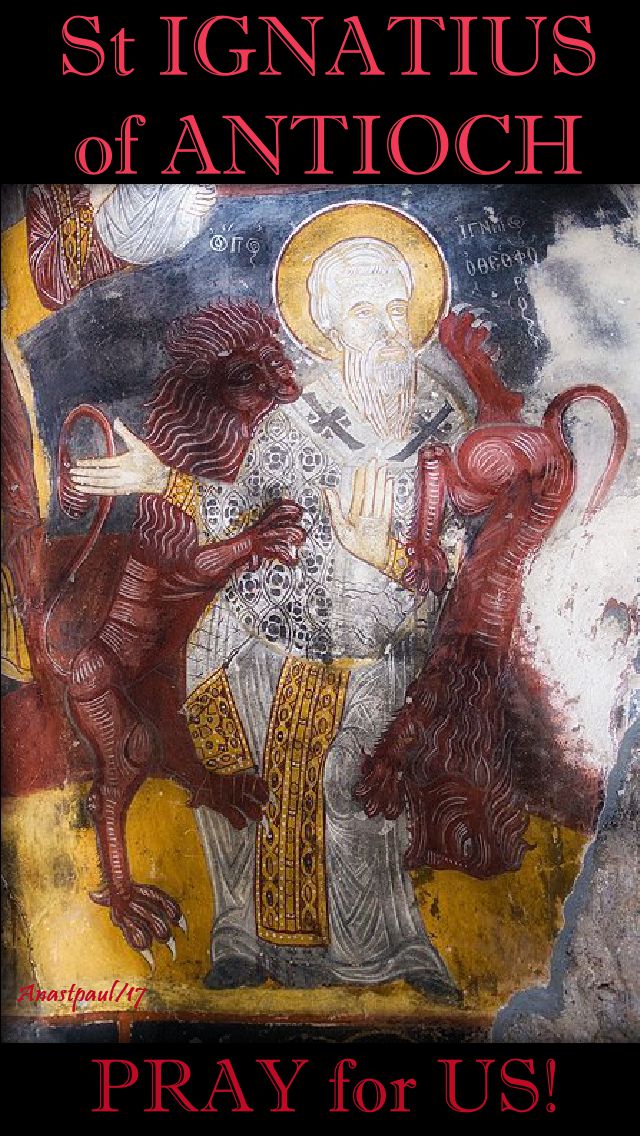
Thought of the Day- 17 October – The Memorial of St Ignatius of Antioch (c35-c108) Father of the Church
Ignatius’s great concern was for the unity and order of the Church.
Even greater was his willingness to suffer martyrdom rather than deny his Lord Jesus Christ.
He did not draw attention to his own suffering but to the love of God which strengthened him.
He knew the price of commitment and would not deny Christ, even to save his own life.
“Ask for me this only in your prayers, that strength may be given me of the Lord that I may not be called but proved to be a Christian. Then shall I be seen to be faithful when the world no longer sees me. For nothing that appeareth is eternal. For the things which are perceived are temporal but the things which are not seen are eternal. I write to the Churches and charge you all that willingly I die for Christ, if you prevent me not. I ask of you that your love for me be not untimely; allow me to be devoured of wild beasts, through whom I may attain unto God. I am the grain of God ground between the teeth of wild beasts, that I may be found to be the pure bread of Christ. Then indeed shall I be the true disciple of Christ when the world shall no longer behold my body. Beseech Christ on my behalf that through these means I may be found a perfect sacrifice. Not as Peter and Paul do I command you. They were apostles, I am the least of them; they were free but I am a slave even unto this day but, if you wish, I shall be the freedman of Jesus Christ and in Him I shall rise again and be free. Amen.”- from a letter to the Romans from Saint Ignatius of Antioch
Keep St Ignatius before your eyes always and ask him to Pray for us all, to Pray for his beloved Holy Mother, the Church!
Quote/s of the Day – 17 October – The Memorial of St Ignatius of Antioch (c 35-c 107) Father of the Church
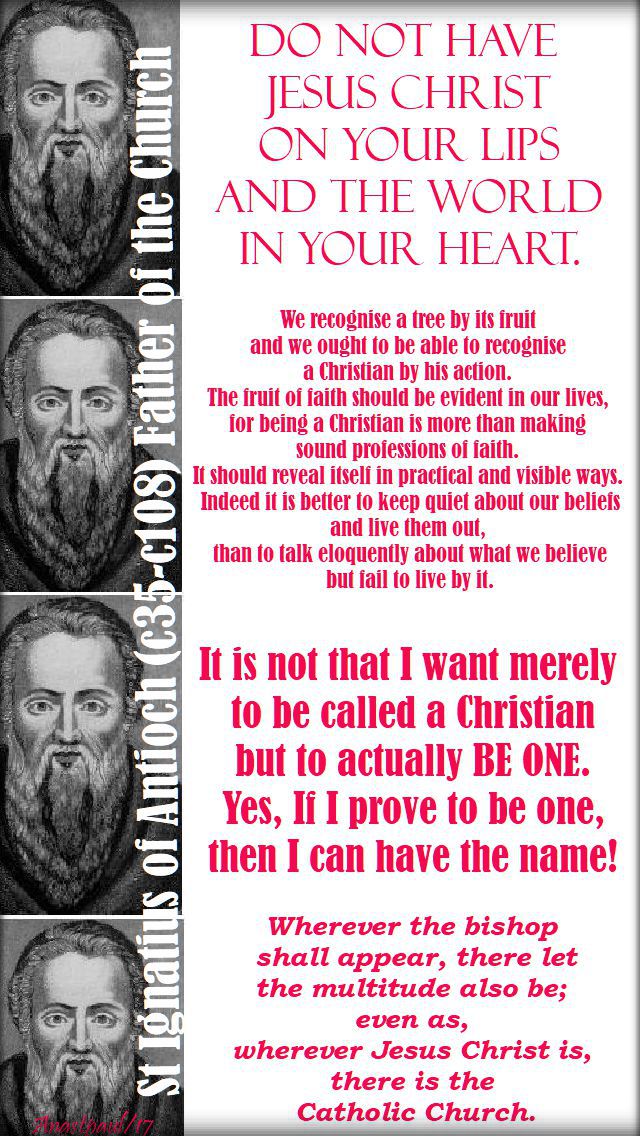
“Do not have Jesus Christ on your lips and the world in your heart.”
“We recognise a tree by its fruit and we ought to be able to recognise a Christian by his action. The fruit of faith should be evident in our lives, for being a Christian is more than making sound professions of faith. It should reveal itself in practical and visible ways. Indeed it is better to keep quiet about our beliefs and live them out, than to talk eloquently about what we believe but fail to live by it.”
“It is not that I want merely to be called a Christian but to actually BE ONE. Yes, If I prove to be one, then I can have the name!”
“Wherever the bishop shall appear,
there let the multitude also be;
even as, wherever Jesus Christ is,
there is the Catholic Church.”
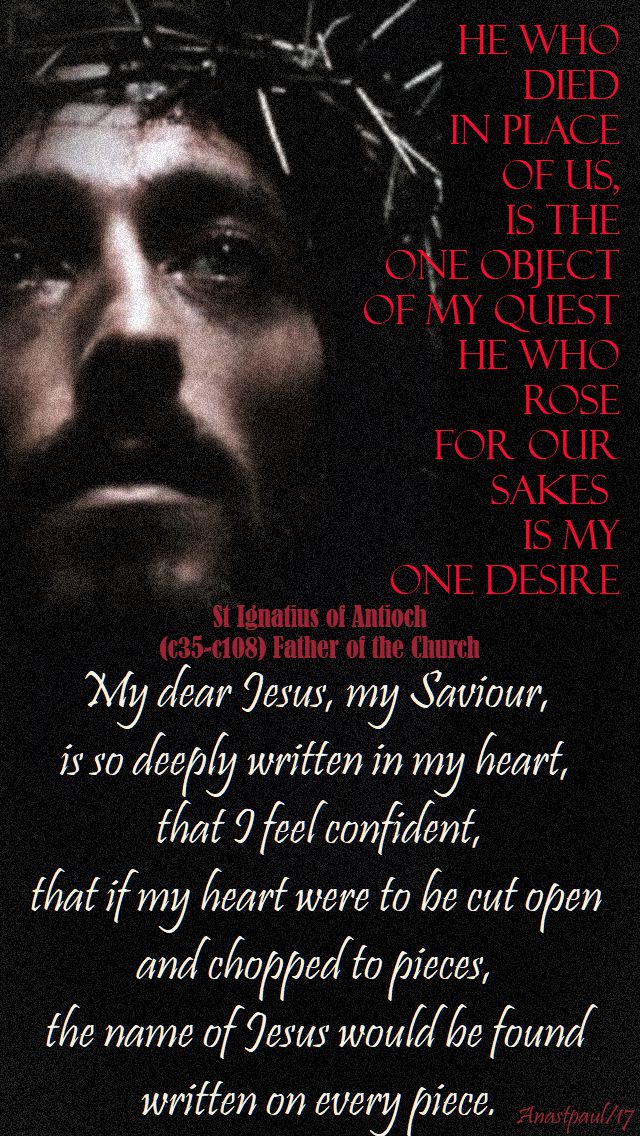
“He who died in place of us, is the one object of my quest. He who rose for our sakes is my one desire.”
“My dear Jesus, my Saviour, is so deeply written in my heart, that I feel confident, that if my heart were to be cut open and chopped to pieces, the name of Jesus would be found written on every piece.”
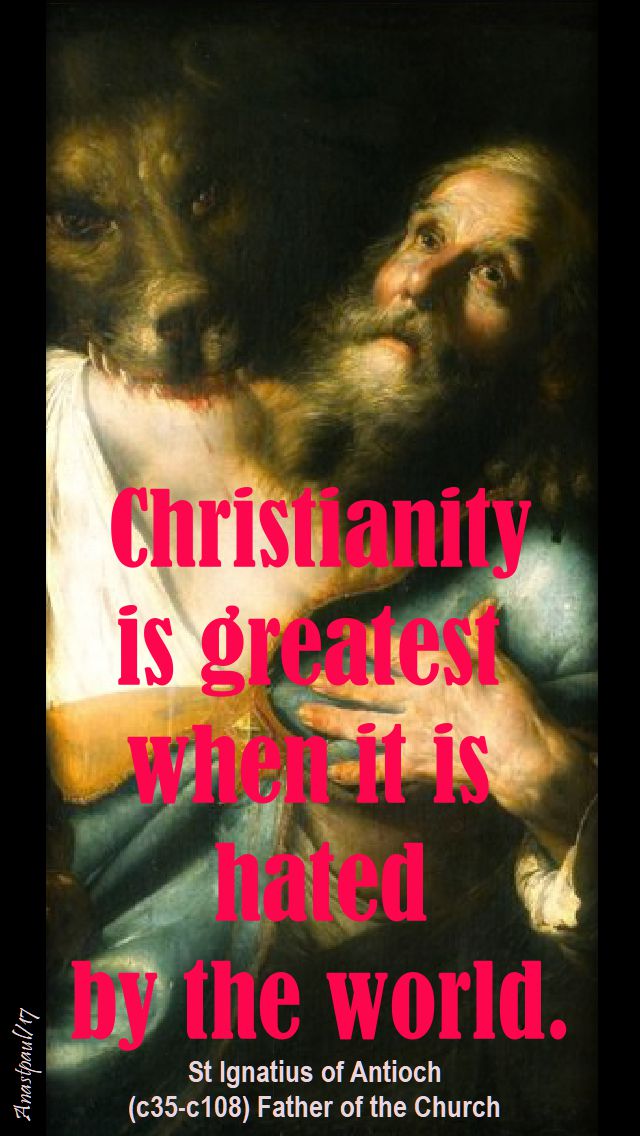
“Christianity is greatest when it is hated by the world.”
St Ignatius of Antioch (c35-c108) Father of the Church
One Minute Reflection – 17 October – The Memorial of St Ignatius of Antioch (c35-c108) Father of the Church
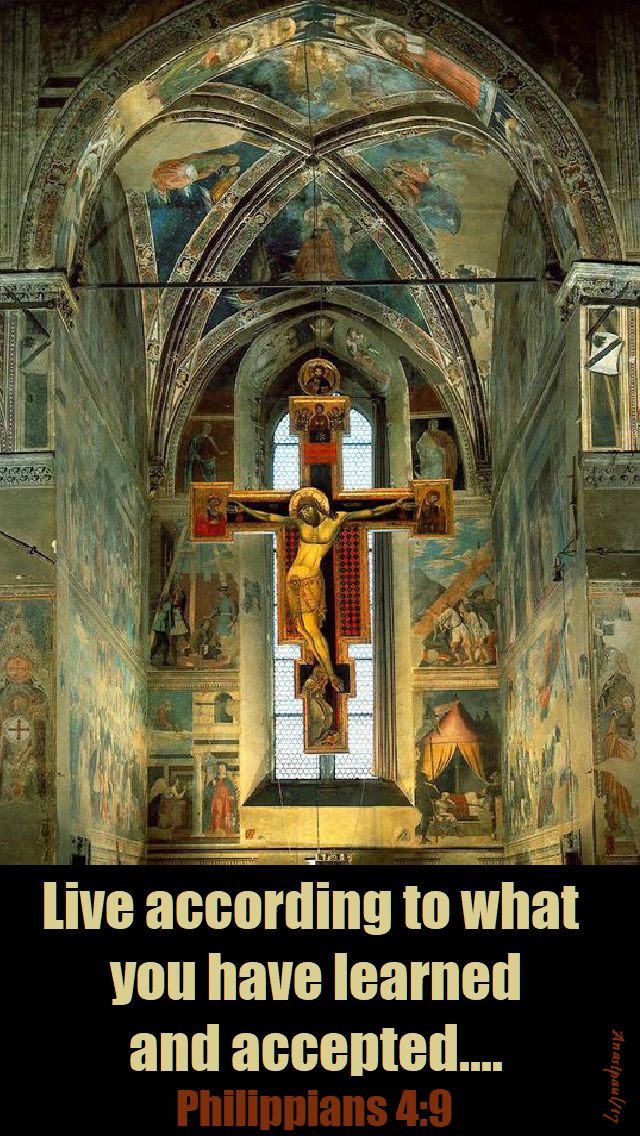
Live according to what you have learned and accepted…. Philippians 4:9
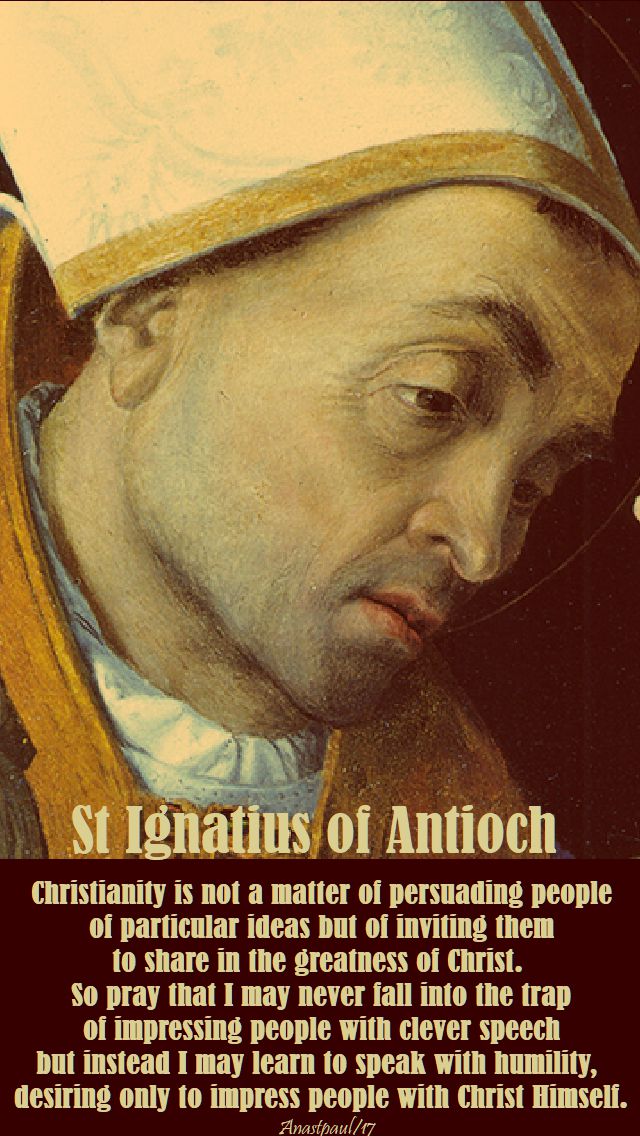
REFLECTION – “Christianity is not a matter of persuading people of particular ideas but of inviting them to share in the greatness of Christ. So pray that I may never fall into the trap of impressing people with clever speech but instead I may learn to speak with humility, desiring only to impress people with Christ Himself.”…St Ignatius of Antioch
PRAYER – Heavenly Father, grant that I may believe what I have learned, never presuming to know better than the teachings of Holy Mother Church and that I may put into practice what I believe. Let my commitment be like unto the Martyr, St Ignatius of Antioch, who went with joy to his horrific death, for the faith in Christ, Your Son, one God with You and the Holy Spirit. St Ignatius, pray for us, amen.
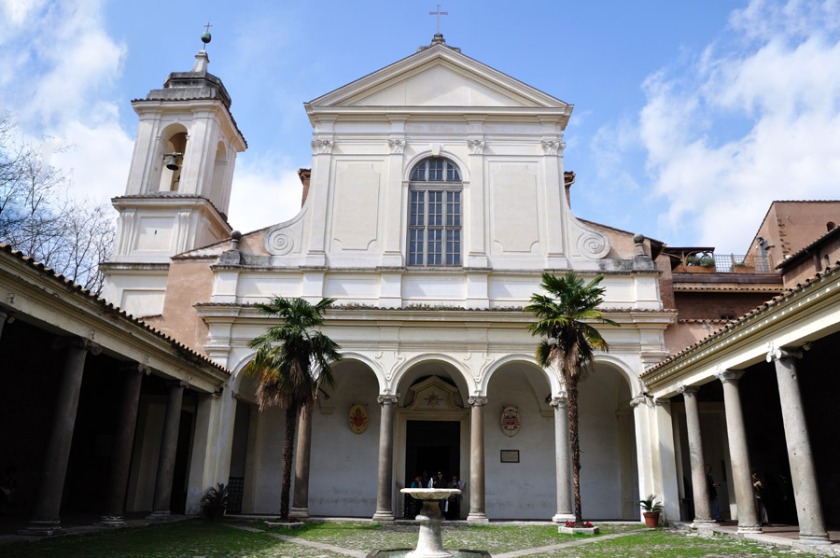
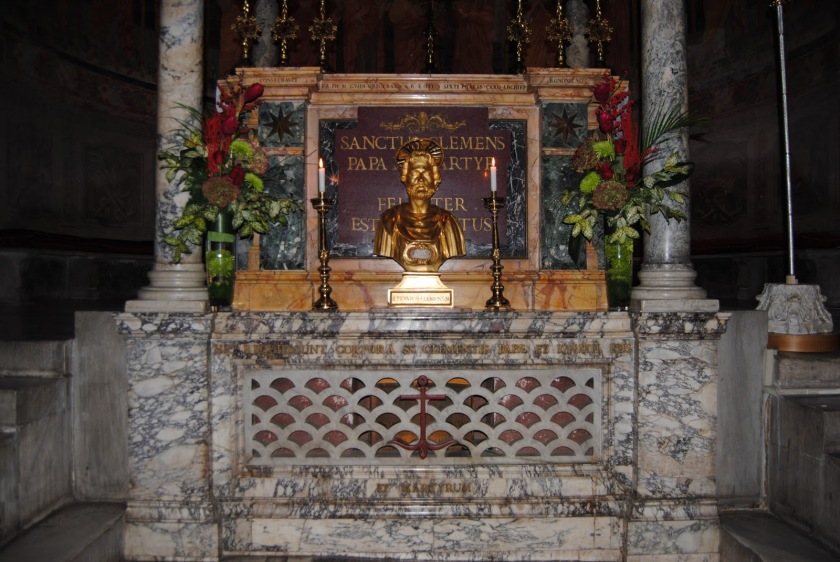
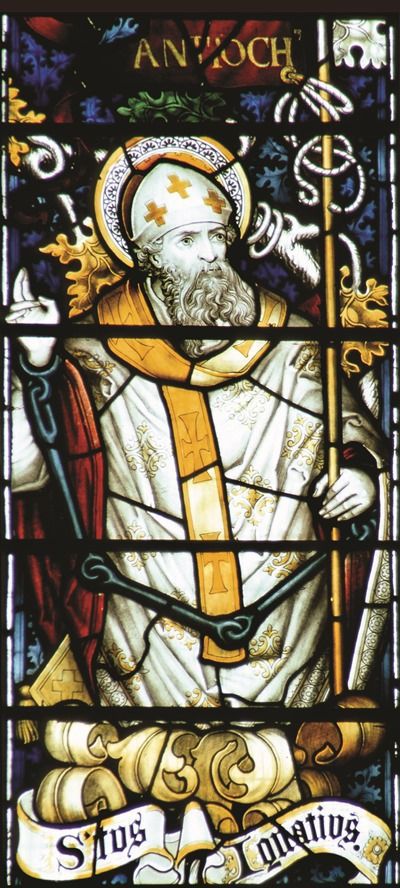
Saint of the Day – 17 October – St Ignatius of Antioch (c 35 – c 108) Bishop, Martyr, Apostolic Father of the Church – Bishop of Antioch, Theologian, Teacher, Writer. He was Martyred by being thrown to wild animals c 108 at Rome, Italy. His Relics are at Saint Peter’s Basilica, Rome with his major Shrine being at the Basilica of San Clemente in Rome. Patronages -• against throat diseases• the Church in eastern Mediterranean• the Church in North Africa. Canonised pre-congregation by John The Apostle (mentioned in later writings of the Church.) En route to Rome, where he met his Martyrdom, Ignatius wrote a series of letters. (Read them here: https://www.catholicculture.org/culture/library/view.cfm?id=3836).
This correspondence now forms a central part of the later collection known as the Apostolic Fathers. His letters also serve as an example of early Christian theology. Important topics they address include ecclesiology, the sacraments and the role of bishops. In speaking of the authority of the church, he was the first to use the phrase “catholic church” in writing. He wrote in this regard: See that you all follow the bishop, even as Jesus Christ does the Father, and the presbytery as you would the apostles; and reverence the deacons, as being the institution of God. Let no man do anything connected with the Church without the bishop. Let that be deemed a proper Eucharist, which is administered either by the bishop, or by one to whom he has entrusted it. Wherever the bishop shall appear, there let the multitude of the people also be; even as wherever Jesus Christ is, there is the Catholic Church. —Letter to the Smyrnaeans, Ch 8
His sentiments before his approaching martyrdom are summed in his word in the Communion antiphon, “I am the wheat of Christ, ground by the teeth of beasts to become pure bread.”
The sixth letter was to Polycarp, bishop of Smyrna, who was later martyred for the faith. The final letter begs the Christians in Rome not to try to stop his martyrdom. “The only thing I ask of you is to allow me to offer the libation of my blood to God. I am the wheat of the Lord; may I be ground by the teeth of the beasts to become the immaculate bread of Christ.”
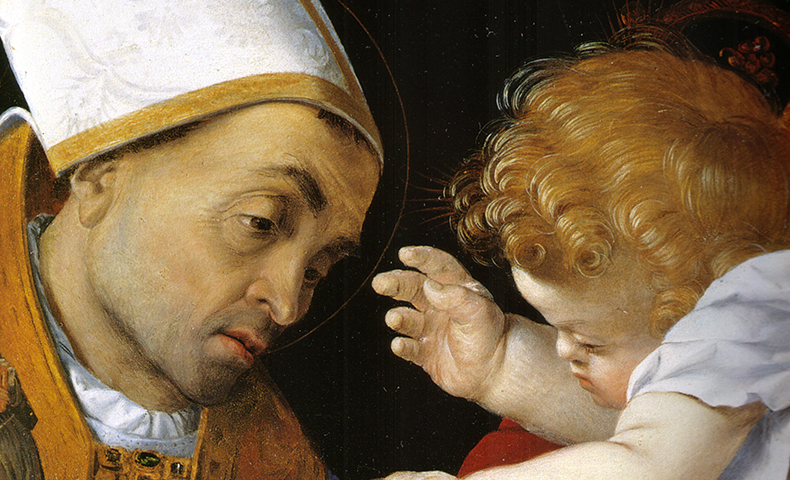
Detail | Saint Ignatius with Madonna and Child | Lorenzo Lotto
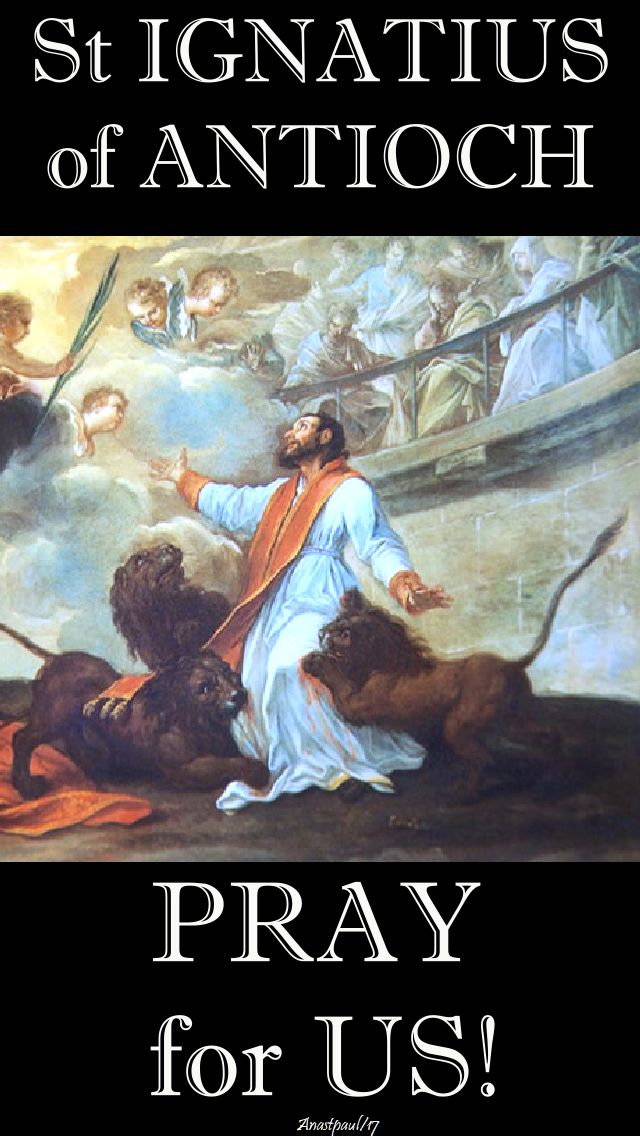
Ignatius bravely met the lions in the Circus Maximus.
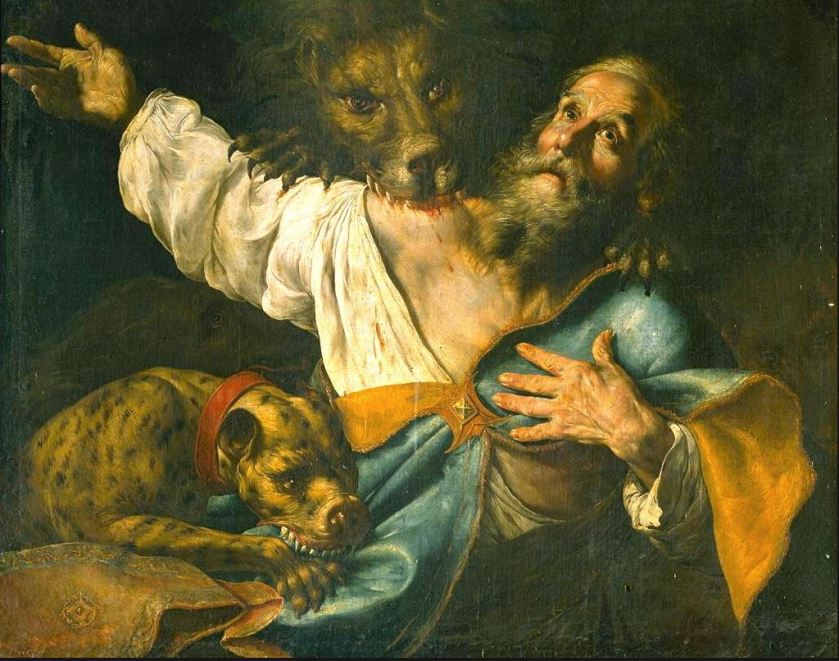
In the Martyrology we read: “At Rome, the holy bishop and martyr Ignatius. He was the second successor to the apostle Peter in the see of Antioch. In the persecution of Trajan he was condemned to the wild beasts and sent in chains to Rome. There, by the emperor’s order, he was subjected to most cruel tortures in the presence of the Senate and then thrown to the lions. Torn to pieces by their teeth, he became a victim for Christ.”
The bishop and martyr Ignatius occupies a foremost place among the heroes of Christian antiquity. His final journey from Antioch to Rome was like a nuptial procession and a Way of the Cross.For the letters he wrote along the way resemble seven stations of the Cross; they may also be called seven nuptial hymns overflowing with the saint’s intense love for Christ Jesus and his longing to be united with Him. These letters are seven most precious jewels in the heirloom bequeathed to us by the Church of sub-apostolic times.
The year of St Ignatius’ death is unknown but scholars place it at c 108; perhaps it occurred during the victory festivities in which the Emperor Trajan sacrificed the lives of 10,000 gladiators and 11,000 wild beasts for the amusement of the bloodthirsty populace. The scene of his glorious triumph and martyrdom was most likely the Circus Maximus; that mammoth structure, glittering with gold and marble, had then been just completed.
“From Syria to Rome I must do battle with beasts on land and sea. For day and night I am chained to ten leopards, that is, the soldiers who guard me and grow more ferocious the better they are treated. Their mistreatment is good instruction for me, yet am I still far from justified. Oh, that I may meet the wild beasts now kept in readiness for me. I shall implore them to give me death promptly and to hasten my departure. I shall invite them to devour me so that they will not leave my body unharmed as already has happened to other witnesses. If they refuse to pounce upon me, I shall impel them to eat me. My little children, forgive me these words. Surely I know what is good for me. From things visible I no longer desire anything; I want to find Jesus. Fire and cross, wild beasts, broken bones, lacerated members, a body wholly crushed, and Satan’s every torment, let them all overwhelm me, if only I reach Christ.”
The saint, now condemned to fight the wild beasts, burned with desire for martyrdom. On hearing the roar of the lions he cried out: “I am a kernel of wheat for Christ. I must be ground by the teeth of beasts to be found bread (of Christ) wholly pure”.
St Ignatius is also the first Father of the Church who wrote about Mary. He defended the veracity of the humanity of Christ against the docetists by affirming that Jesus pertained to the line of David because he was born of Mary. Jesus was conceived by Mary – He came from her – and this conception was virginal and pertains to the most hidden mysteries in the silence of God.
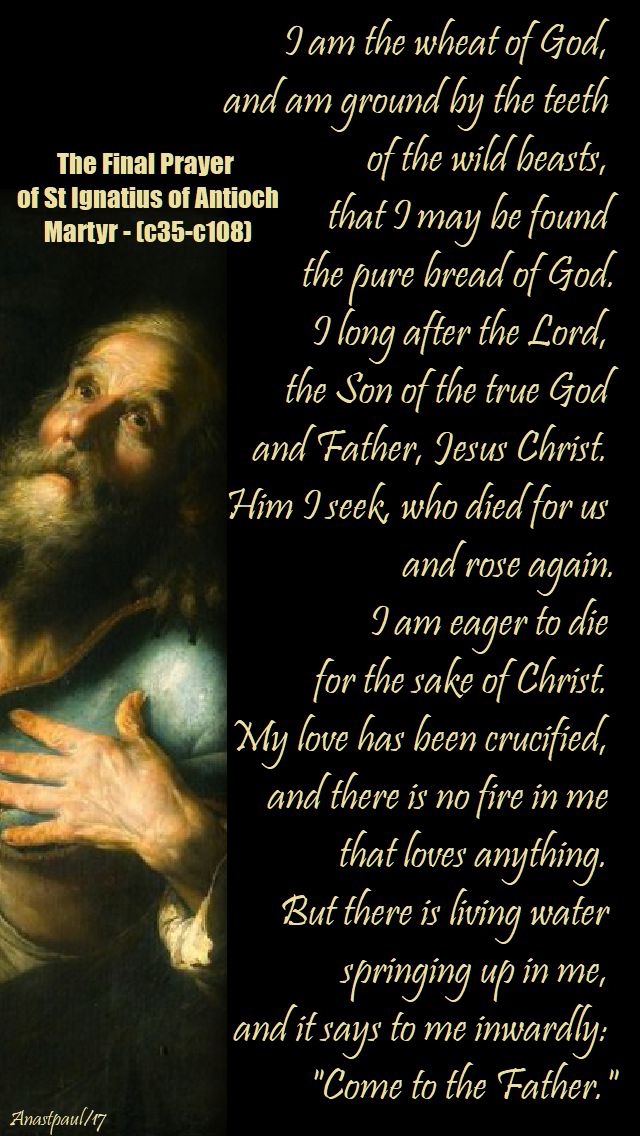
The Final Prayer of St Ignatius of Antioch
I am the wheat of God,
and am ground by the teeth of the wild beasts,
that I may be found the pure bread of God.
I long after the Lord,
the Son of the true God and Father, Jesus Christ.
Him I seek, who died for us and rose again.
I am eager to die for the sake of Christ.
My love has been crucified,
and there is no fire in me that loves anything.
But there is living water springing up in me,
and it says to me inwardly:
“Come to the Father.”
St Ignatius of Antioch (Memorial) – https://www.youtube.com/watch?v=vKNS1qq2QIc
—
St Anstrudis of Laon
Bl Balthassar of Chiavari
Bl Battista de Bonafede
St Berarius I of Le Mans
St Catervus
St Colman of Kilroot
Bl Contardo Ferrini
St Ethelbert of Eastry
St Ethelred of Eastry
St Florentius of Orange
St Francois Isidore Gagelin
Bl Gilbert the Theologian
St Heron of Antioch
Bl Jacques Burin
St John the Short/Dwarf
St Louthiern
St Mamelta of Persia
St Nothelm of Canterbury
St Richard Gwyn
St Rudolph of Gubbio
St Rufus of Rome
St Serafino of Montegranaro
St Solina of Chartres
St Zosimus of Rome
—
Martyrs of Nicomedia – 3 saints: A group of Christians martyred in the persecutions of Diocletian. The only details about them that have survived are their names – Alexander, Marianus and Victor. 303 in Nicomedia (in modern Turkey).
Martyrs of Valenciennes -5 beati: A group of Ursuline nuns martyred in the persecutions of the French Revolution.
• Hyacinthe-Augustine-Gabrielle Bourla
• Jeanne-Reine Prin
• Louise-Joseph Vanot
• Marie-Geneviève-Joseph Ducrez
• Marie-Madeleine-Joseph Déjardins
Martyrs of Volitani: A group of martyrs who were praised by Saint Augustine of Hippo. In Volitani, proconsular Africa (in modern Tunisia).
Martyred in the Spanish Civil War:
• BlessedFidel Fuidio Rodriguez
• BlessedJosé Sánchez Medina
• BlessedPerfecto Carrascosa Santos
• BlessedTársila Córdoba Belda de Girona
Thought for the Day – 16 October – The Memorial of St Margaret Mary Alacoque (1647-1690)
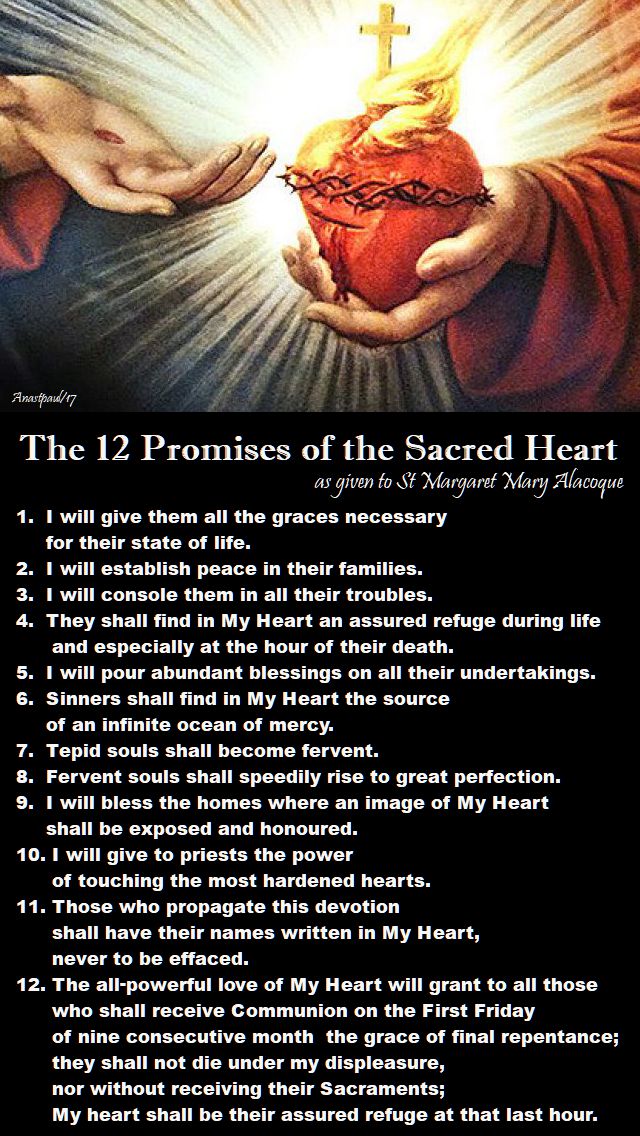
The Twelve Promises of Jesus to Saint Margaret Mary
or those Devoted to His Sacred Heart:
1. I will give them all the graces necessary for their state of life.
2. I will establish peace in their families.
3. I will console them in all their troubles.
4. They shall find in My Heart an assured refuge during life
and especially at the hour of their death.
5. I will pour abundant blessings on all their undertakings.
6. Sinners shall find in My Heart the source of an infinite ocean of mercy.
7. Tepid souls shall become fervent.
8. Fervent souls shall speedily rise to great perfection.
9. I will bless the homes where an image of My Heart
shall be exposed and honoured.
10. I will give to priests the power of touching the most hardened hearts.
11. Those who propagate this devotion shall have their names
written in My Heart, never to be effaced.
12. The all-powerful love of My Heart will grant to all those
who shall receive Communion on the First Friday of nine consecutive months
the grace of final repentance;
they shall not die under my displeasure, nor without receiving their Sacraments;
My heart shall be their assured refuge at that last hour.
From Saint Margaret Mary Alacoque’s Vision of Jesus
Our scientific-materialistic age cannot “prove” private revelations. Theologians, if pressed, admit that we do not have to believe in them. But it is impossible to deny the message Margaret Mary heralded: that God loves us with a passionate love. Her insistence on reparation and prayer and the reminder of final judgment should be sufficient to ward off superstition and superficiality in devotion to the Sacred Heart while preserving its deep Christian meaning.
Quote/s of the Day – 16 October – The Memorials of St Margaret Mary Alacoque (1647-1690) and St Gerard Majella (1725-1755)
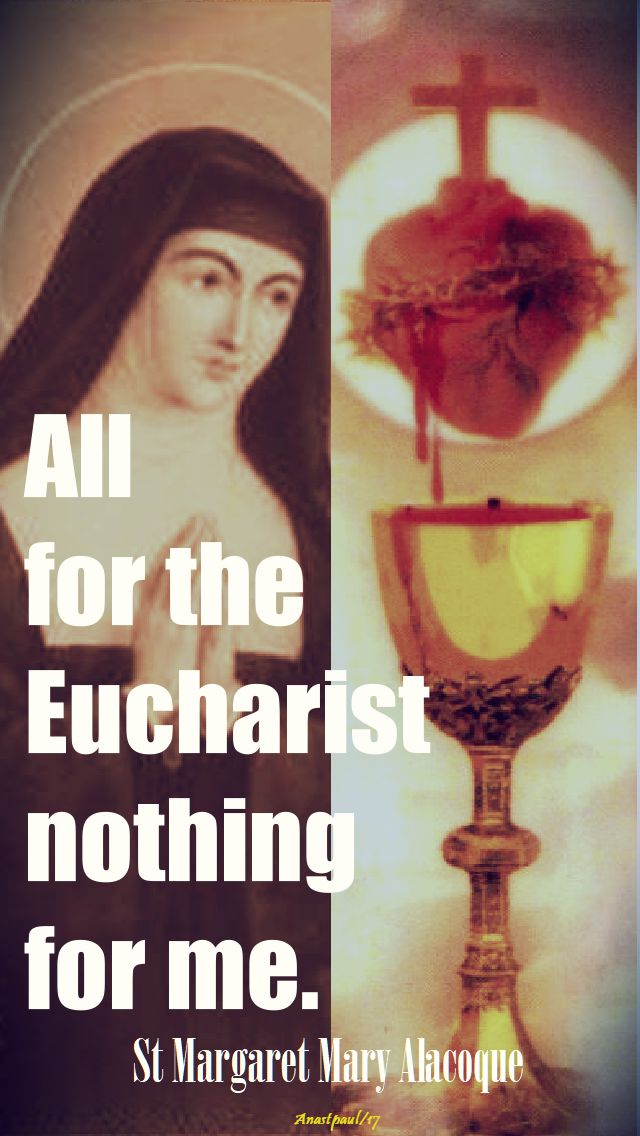
“All for the Eucharist nothing for me.”
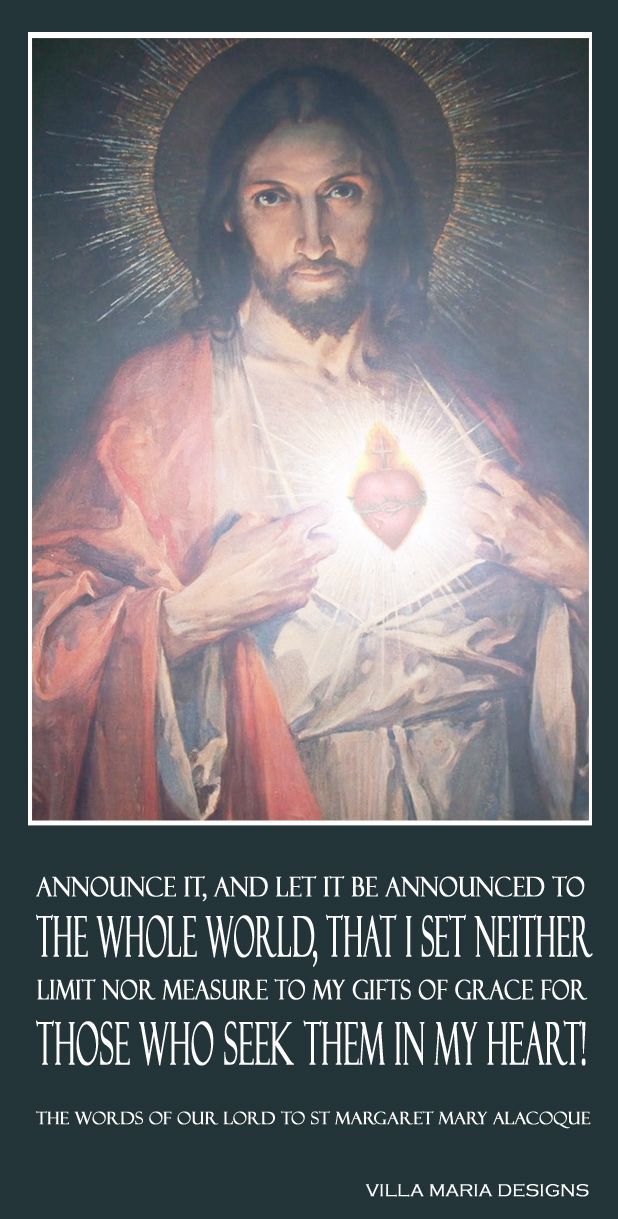
“Announce it and let it be announced to the whole world, that I set neither limit nor measure to my gifts of grace, for those who seek them in my Heart.” Revelations of Our Lord to St Margaret Mary Alacoque
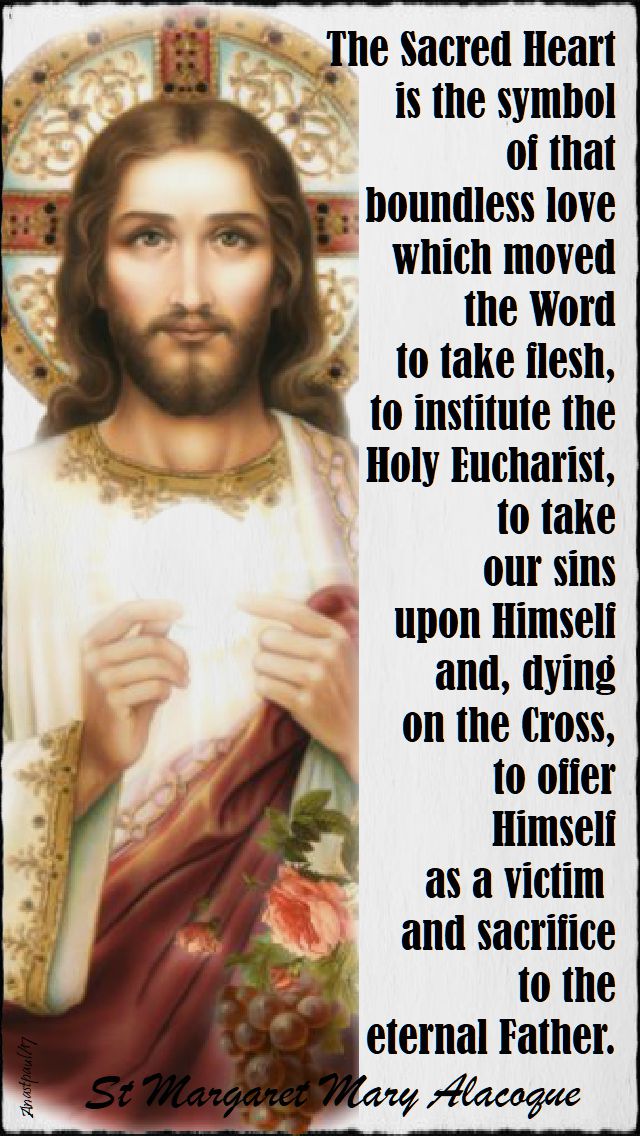
“The Sacred Heart is the symbol of that boundless love which moved the Word to take flesh, to institute the Holy Eucharist, to take our sins upon Himself and, dying on the Cross, to offer Himself as a victim and sacrifice to the eternal Father.”
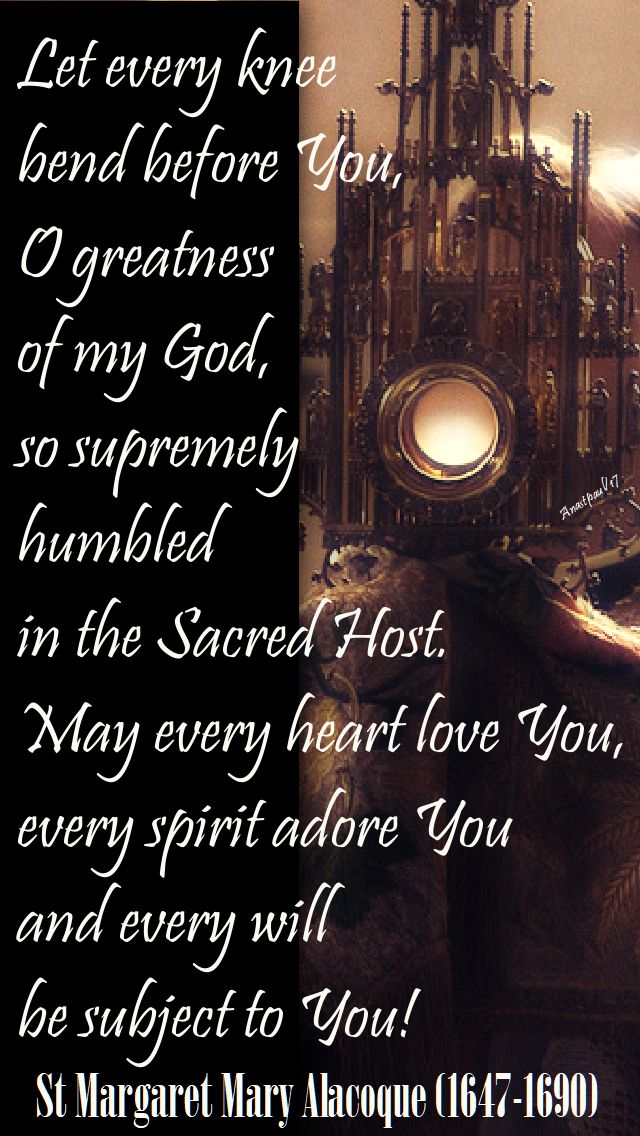
“Let every knee bend before You, O greatness of my God, so supremely humbled in the Sacred Host. May every heart love You, every spirit adore You and every will be subject to You!
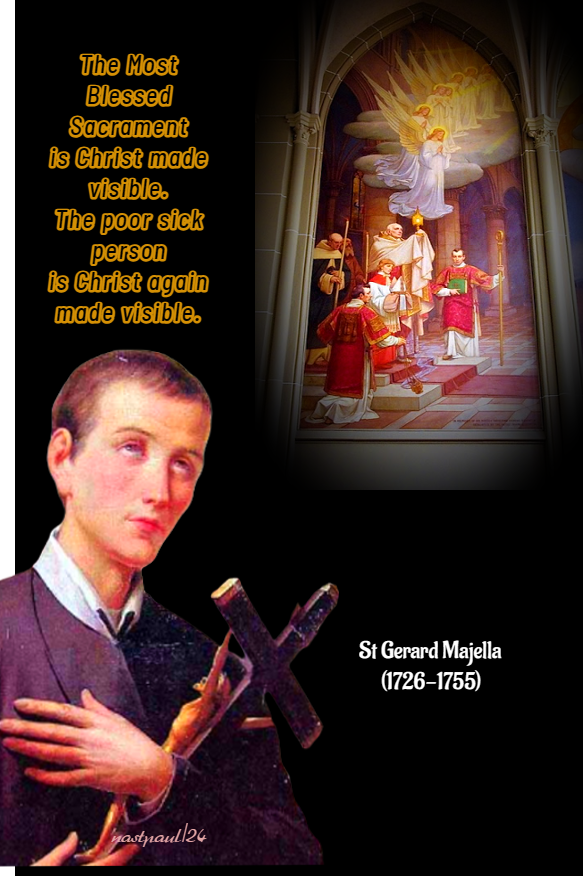
“The Most Blessed Sacrament is Christ made visible. The poor sick person is Christ again made visible.”
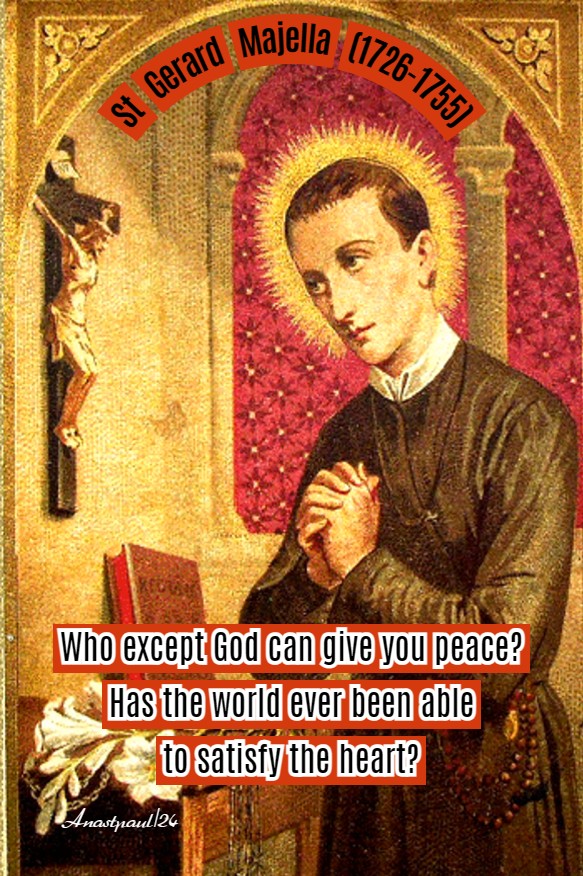
“Who except God can give you peace? Has the world ever been able to satisfy the heart?”
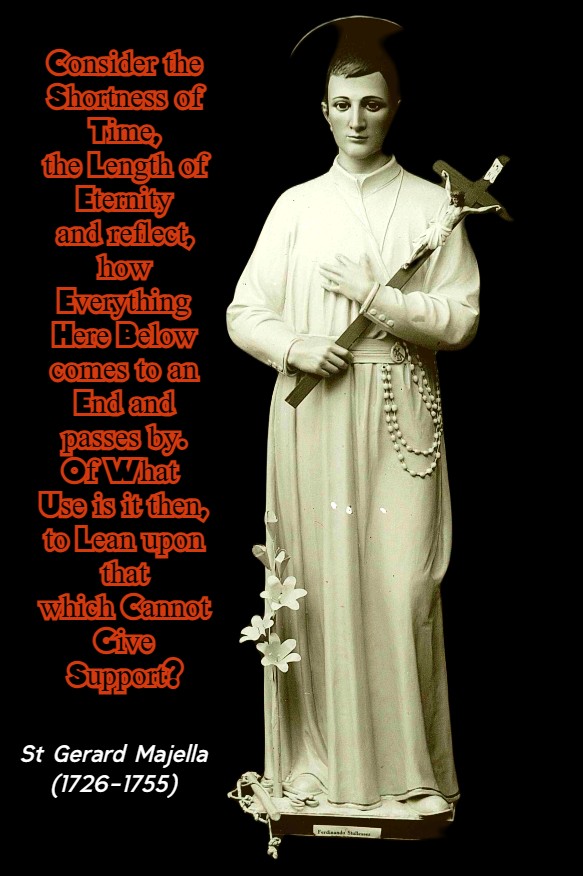
“Consider the shortness of time, the length of eternity and reflect how everything here below comes to an end and passes by. Of what use is it to lean upon that, which cannot give support? “
One Minute Reflection – 16 October – The Memorial of St Margaret Mary Alacoque (1647-1690)
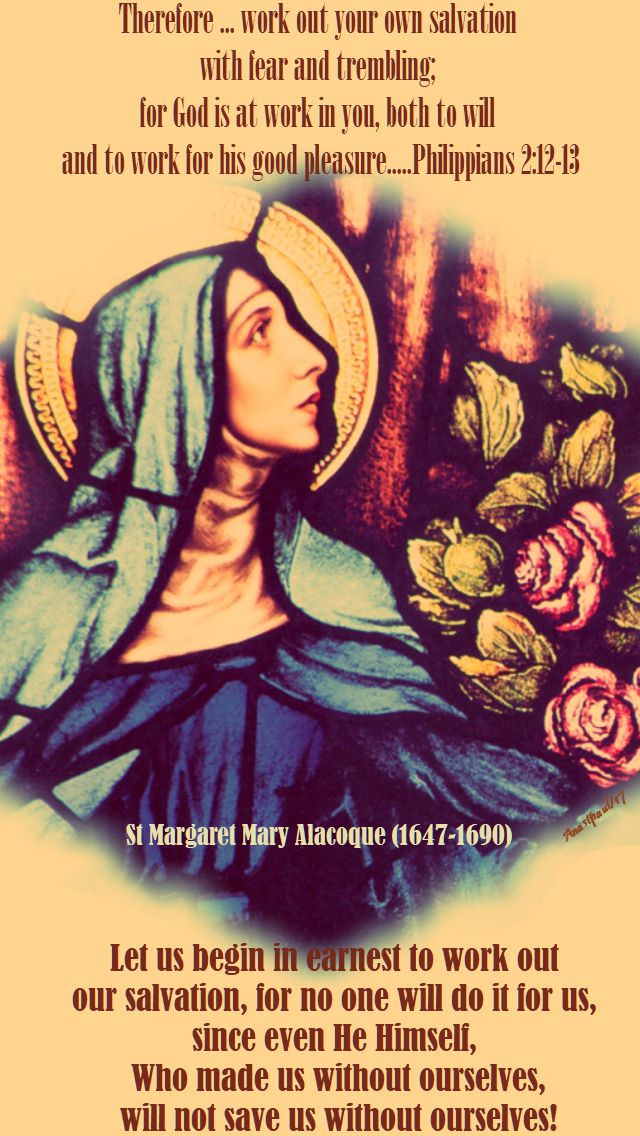
Therefore, my beloved, as you have always obeyed, so now, not only as in my presence but much more in my absence, work out your own salvation with fear and trembling; for God is at work in you, both to will and to work for his good pleasure.….Philippians 2:12-13
REFLECTION – “Let us begin in earnest to work out our salvation, for no one will do it for us, since even He Himself, Who made us without ourselves, will not save us without ourselves!”…..St Margaret Mary Alacoque
PRAYER – Lord Jesus Christ, You wondrously revealed all of the deep treasures of Your Heart to St Margaret Mary. May her merits and example win us the grace to love You above all things and in all things so that we may make our abode in Your own Sacred Heart. St Margaret Mary, pray for us that we may live in the Sacred Heart of Christ our Lord. Through You, Lord Jesus, who live and reign forever, in union with God our Father and the Holy Spirit, one God, amen.
Our Morning Offering – 16 October – The Memorial of St Margaret Mary Alacoque (1647-1690)
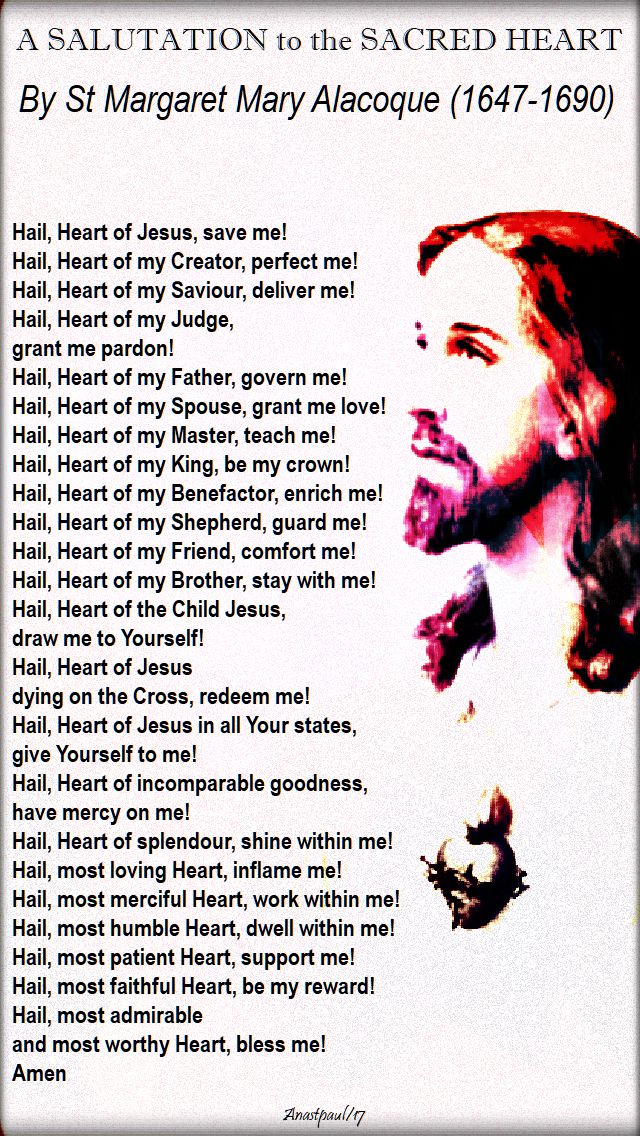
A Salutation TO THE SACRED HEART By St Margaret Mary Alacoque (1647-1690)
Hail, Heart of Jesus, save me!
Hail, Heart of my Creator, perfect me!
Hail, Heart of my Saviour, deliver me!
Hail, Heart of my Judge, grant me pardon!
Hail, Heart of my Father, govern me!
Hail, Heart of my Spouse, grant me love!
Hail, Heart of my Master, teach me!
Hail, Heart of my King, be my crown!
Hail, Heart of my Benefactor, enrich me!
Hail, Heart of my Shepherd, guard me!
Hail, Heart of my Friend, comfort me!
Hail, Heart of my Brother, stay with me!
Hail, Heart of the Child Jesus, draw me to Yourself!
Hail, Heart of Jesus dying on the Cross, redeem me!
Hail, Heart of Jesus in all Your states, give Yourself to me!
Hail, Heart of incomparable goodness, have mercy on me!
Hail, Heart of splendour, shine within me!
Hail, most loving Heart, inflame me!
Hail, most merciful Heart, work within me!
Hail, most humble Heart, dwell within me!
Hail, most patient Heart, support me!
Hail, most faithful Heart, be my reward!
Hail, most admirable and most worthy Heart, bless me! Amen
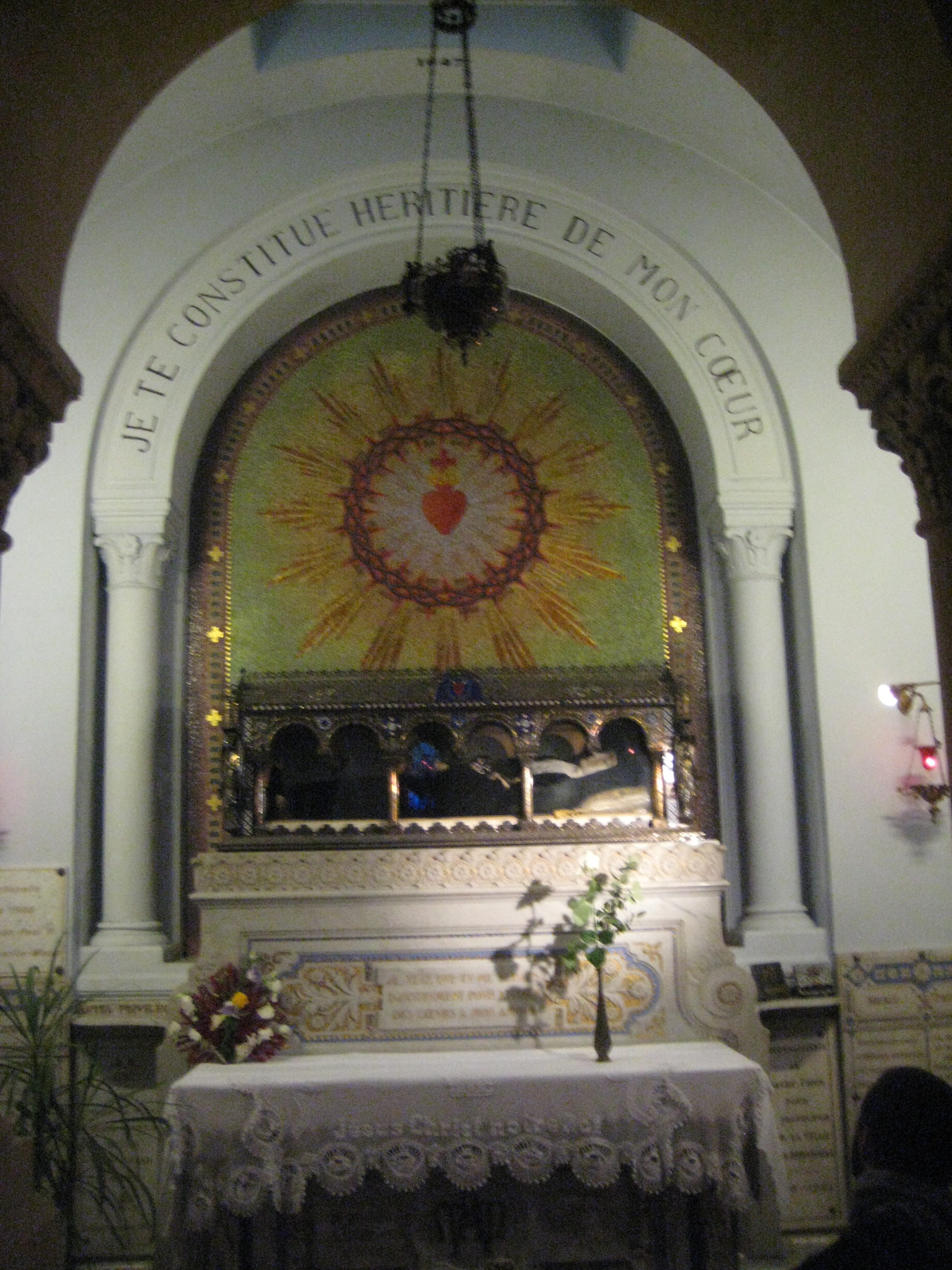
Saint of the Day – 16 October – St Margaret Mary Alacoque (1647-1690) V.H.M. Virgin, Nun, Mystic, Saint and Apostle of the Sacred Heart. Born Marguerite-Marie Alacoque on 22 July 1647 at L’Hautecourt, Burgundy, France – 17 October 1690 of natural causes. Patronages – against polio, against the death of parents, devotees of the Sacred Heart, polio patients. She was Beatified on 18 September 1864 by Pope Blessed Pius IX and Canonised on 13 May 1920 by Pope Benedict XV. When her tomb was canonically opened in July 1830, two instantaneous cures were recorded to have taken place. Her incorrupt body rests above the side altar in the Chapel of the Apparitions, located at the Visitation Monastery in Paray-le-Monial and many striking blessings have been claimed by pilgrims attracted there from all parts of the world.
She was born in 1647 AD at Janots, a small town of Burgundy, the fifth of seven children, of Claude and Philiberte Alacoque. Her father was a prosperous notary; the family owned a country house and farmland and had some aristocratic connections. Margaret’s godmother was a neighbour, the Countess of Corcheval. As a small child Margaret spent a great deal of time with her but these visits were brought to a sudden end by the death of the countess. The father died of pneumonia when Margaret was about eight and this was another severe shock to her. Claude had loved his family dearly but had been short-sighted and extravagant and his death put them in hard straits. However, Margaret was sent to school with the Urbanist Sisters at Charolles. She loved the peace and order of the convent life and the nuns were so impressed by her devotion that she was allowed to make her First Communion at the age of nine (normally around the age of 12 at that time). A rheumatic affliction kept her bedridden for four years. During that time she was brought home, where some of her father’s relatives had moved in and taken over the direction of the farm and household. She and her mother were treated almost as servants. This painful situation grew more acute after Margaret’s recovery, for the relatives tried to regulate all her comings and goings. Not allowed to attend church as often as she pleased, the young girl was sometimes seen weeping and praying in a corner of the garden. It grieved her deeply that she could not ease things for her mother. Her eldest brother’s coming of age saved the day, for the property now reverted to him and the family again had undisputed possession of their home.
Philiberte had expressed a hope that Margaret would marry; the girl considered this but at the age of twenty, inspired by a vision, she put aside all such thoughts and resolved to enter a convent. While awaiting admission, she tried to help and teach certain neglected children of the village. At twenty-two she made her profession at the convent of the Visitation at Paray-le-Monial. The nuns of the Order of the Visitation, founded in the early years of the seventeenth century by St. Francis de Sales, were famed for their humility and selflessness. As a novice Margaret excelled in these virtues. When she made her profession, the name of Mary was added and she was called Margaret Mary. She began a course of mortifications and penances which were to continue, with more or less intensity, as long as she lived. We are told that she was assigned to the infirmary and was not very skillful at her tasks.
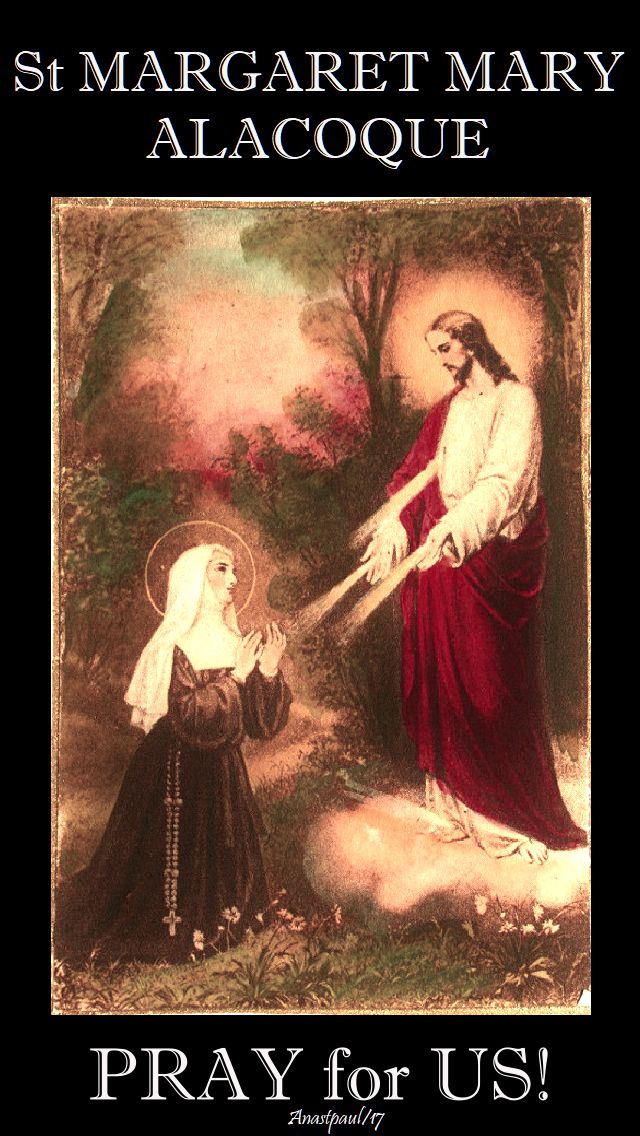
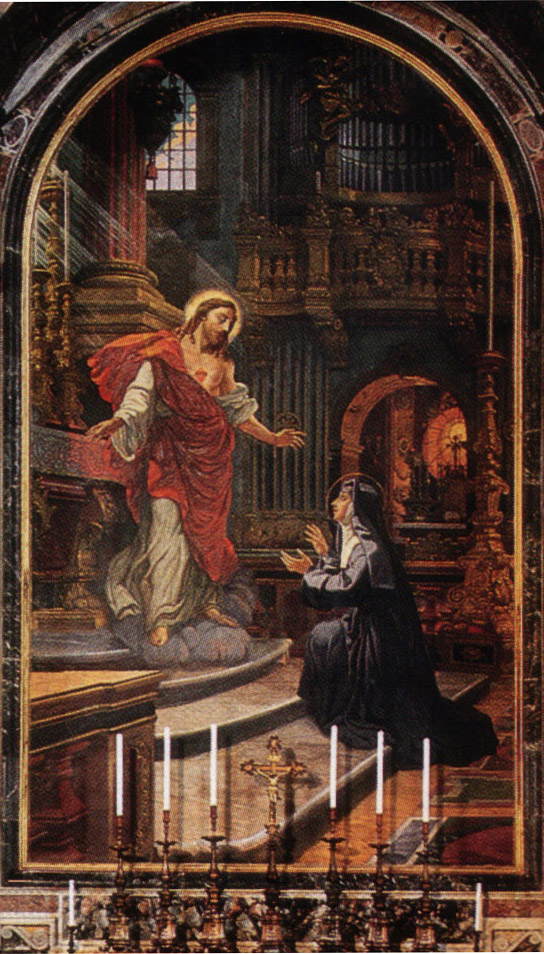
Some years passed quietly in the convent and then Margaret Mary began to have experiences which seemed to be of supernatural origin. The first of these occurred on 27 December 1673, when she was kneeling at the grille in the chapel. She felt suffused by the Divine Presence and heard the Lord inviting her to take the place which St John had occupied at the Last Supper. The Lord told her that the love of His heart must spread and manifest itself to men and He would reveal its graces through her. This was the beginning of a series of revelations covering a period of eighteen months. When Margaret Mary went to the Superior, Mother de Saumaise, with an account of these mystical experiences, claiming that she, an humble nun, had been chosen as the transmitter of a new devotion to the Sacred Heart, she was reprimanded for her presumption. Seriously overwrought, Margaret Mary suffered a collapse and became very ill. The Mother Superior reflected that she might have erred in scorning the nun’s story and vowed that if her life were spared, she would take it as a sign that the visions and messages were truly from God. When Margaret Mary recovered, the Superior invited some theologians who happened to be in the town—they included a Jesuit and a Benedictine—to hear the story. These priests listened and judged the young nun to be a victim of delusions. Their examination had been a sheer torture to Margaret Mary. Later a Jesuit, Father Claude de la Columbiere, talked to her and was completely convinced of the genuineness of the revelations. He was to write of the nun and to inaugurate this devotion in England.
For many years, Margaret Mary suffered from despair, from self-inflicted punishments and also from the slights and contempt of those around her. In 1681, Father Claude returned to the convent and died there the following year. Margaret Mary was appointed assistant and novice-mistress by a new Mother Superior who was more sympathetic towards her. In 1683, opposition in the community ended after an account of Margaret Mary’s visions was read aloud in the refectory from the writings left by Father Claude, who had taken it upon himself to make known to the world the nun’s remarkable experiences. Mother Melin was elected Superior and named Margaret Mary her assistant. That she was finally vindicated was to her a matter of indifference. She later became Novice Mistress, saw the convent observe the feast of the Sacred Heart privately beginning in 1686 and two years later, a chapel was built at the Paray-le-Monial to honour the Sacred Heart; soon observation of the feast of the Sacred Heart spread to other Visitation convents. When she was forty-three, while serving a second term as assistant superior, Margaret Mary fell ill. Sinking rapidly, she received the Last Sacraments, saying, “I need nothing but God, and to lose myself in the heart of Jesus.” Margaret Mary died at the Paray-le-Monial on October 17, 1690. Margaret Mary was canonised a saint in 1920. She, St John Eudes, and St Claude La Colombiere are called the “Saints of the Sacred Heart”; the devotion was officially recognised and approved by Pope Clement XIII in 1765, seventy-five years after her death.
In seventeenth-century France, the faith of the people had been badly shaken; there had been rebellion against the Church and neglect of its teachings; the rise of Protestantism and the spread of the heresy of Jansenism both had a part in the weakening of the structure built up through the ages. But as every threat brings its response, so now there rose up fresh, strong forces to counter these trends. Three famous religious, who are today venerated as saints, were particularly effective: Saint John Eudes and StClaude de la Columbiere were French Jesuit priests and writers; Saint Margaret Mary Alacoque was a simple nun of the order of the Visitation. Their special work was to popularise the devotion to the Sacred Heart of Jesus. Although the devotion to the Sacred Heart of Jesus was practiced before this time, it now gained a strong new impetus through the work of Father John Eudes and the writings of Father Claude. “The Sacred Heart is the symbol of that boundless love which moved the Wordto take flesh, to institute the Holy Eucharist, to take our sins upon Himself and, dying on the Cross, to offer Himself as a victim and sacrifice to the eternal Father.”
The devotion to the Sacred Heart first became popular in France, then spread to Poland and other countries. The first petition to the Holy See for the institution of the feast was from Queen Mary, consort of James II of England. The month of June is appointed for this devotion and since 1929 the feast has been one of the highest rank and is celebrated on the Friday after the Solemnity of the Body and Blood of Christ.
St Hedwig of Andechs (Optional Memorial)
St Margaret Mary Alacoque (Optional Memorial) – https://www.youtube.com/watch?v=ZsyHW9zvqiY
—
St Amandus of Limoges
St Ambrose of Cahors
Bl Anicet Koplinski
Bl Augustine Thevarparampil
St Balderic
St Baldwin
St Bertrand of Comminges
St Bolonia
St Conogon of Quimper
St Dulcidius of Agen
St Eliphius of Toul
St Eremberta of Wierre
St Florentinus of Trier
St Gall
St Gerard Majella
Bl Gerald of Fossanuova
Bl Jesús Villaverde Andrés
Bl Józef Jankowski
St Junian
St Lull
St Magnobodus of Angers
St Marguerite d’Youville
St Martinian of Mauretania
St Mummolinus
St Saturian of Mauretania
St Silvanus of Ahun
St Victor of Cologne
St Vitalis of Noirmoutier
—
Martyrs in Africa – 220 saints: A group of 220 Christians martyrs about whom we know nothing but that they died for their faith.
Martyrs of North Africa – 365 saints: A group of 365 Christians who were martyred together in the persecutions of the Vandal king Genseric. The only details that have survived are the names of two of the martyrs – Nereus and Saturninus. 450 in North Africa.
Thought for the Day – – 15 October – The Memorial of St Teresa of Jesus/Avila (1515-1582) Doctor of the Church
Since her encounter with Jesus, St Teresa lived “another life”; she become a tireless communicator of the Gospel (cf. Life, 23, 1). Eager to serve the Church and in the face of serious problems of her time, she did not limit herself to being a spectator of the reality around her. In her position as a woman and with her health difficulties, she decided, she said, “to do what little depended on me … that is to follow the evangelical counsels as perfectly as possible and to ensure that these few nuns who are here do the same” (The Way, 1, 2). Thus began the Teresian reform, in which she asked her sisters not to lose time negotiating with God “interests of little importance,” while “the world is in flames” (ibid., 1, 5). This missionary and ecclesial dimension has always marked the Carmelites and Discalced Carmelites.
As she did then, even today the saint opens new horizons for us, she calls us to a great undertaking, to see the world with the eyes of Christ, to seek what He seeks and to love what He loves. (Pope Francis in a letter to to Carmelite Father Xavier Cannistrà)
Ours is a time of turmoil, a time of reform, and a time of liberation. Modern women have in Teresa a challenging example. Promoters of renewal, promoters of prayer, all have in Teresa a woman to reckon with, one whom they can admire and imitate.
Quotes of the Day – 15 October – The Memorial of St Teresa of Jesus/Avila (1515-1582) Doctor of the Church
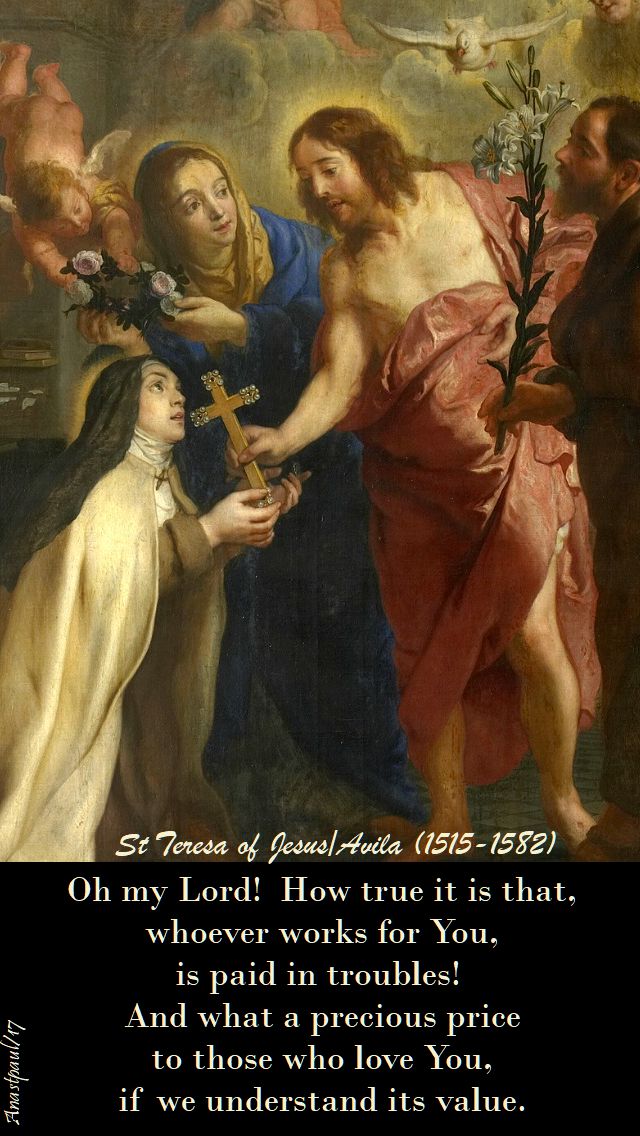
“Oh my Lord! How true it is that, whoever works for You, is paid in troubles! And what a precious price to those who love You, if we understand its value.”
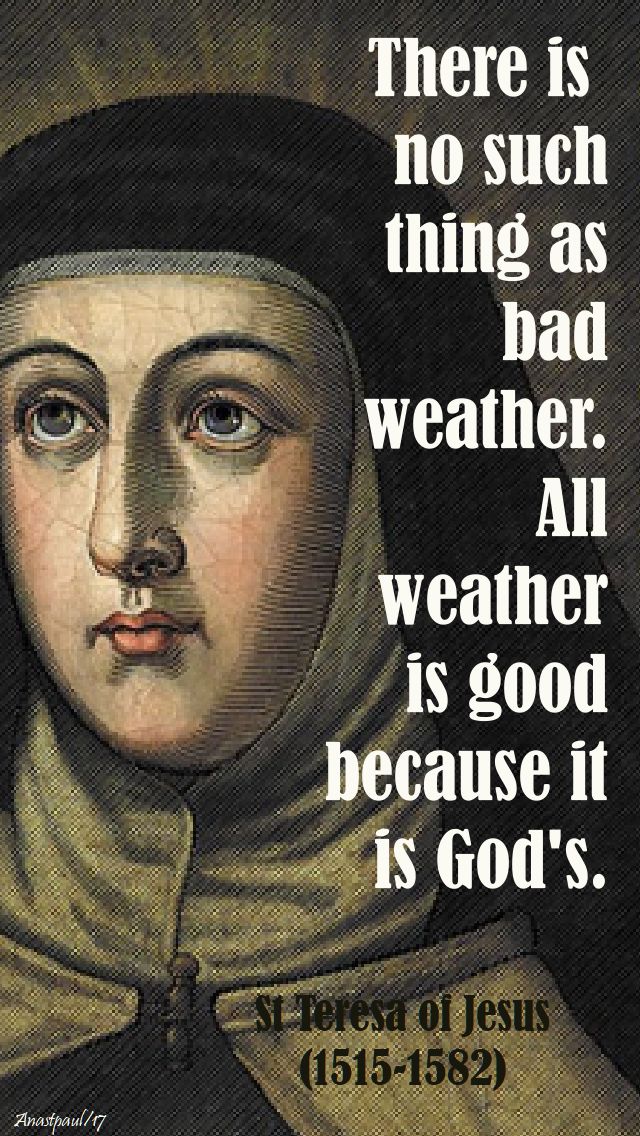
“There is no such thing as bad weather. All weather is good because it is God’s.”
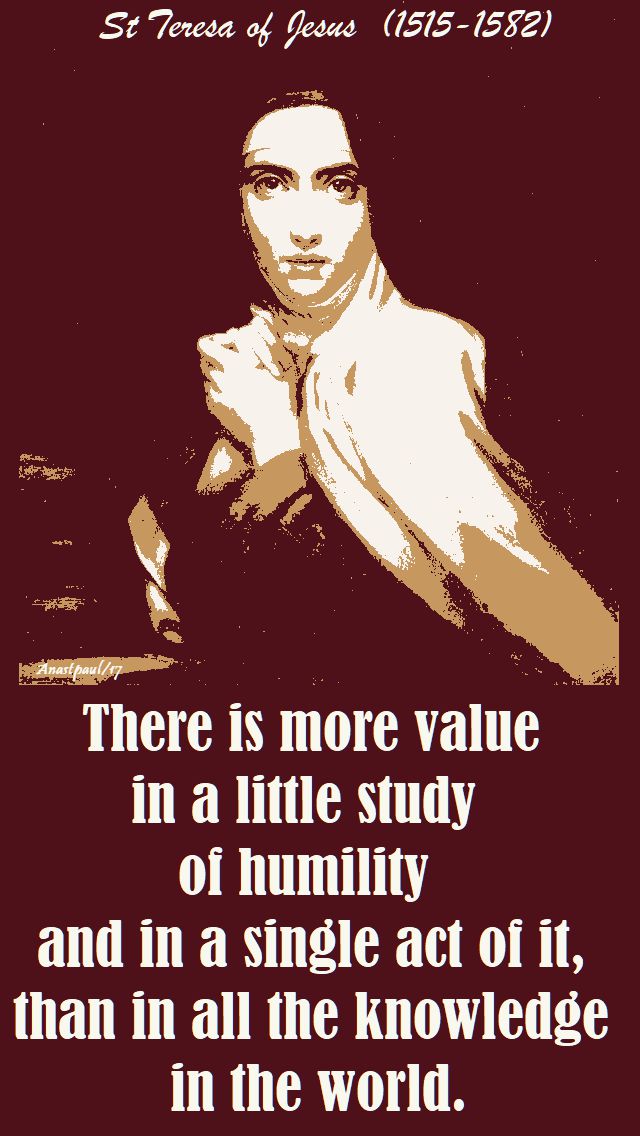
“There is more value in a little study of humility and in a single act of it, than in all the knowledge in the world.”
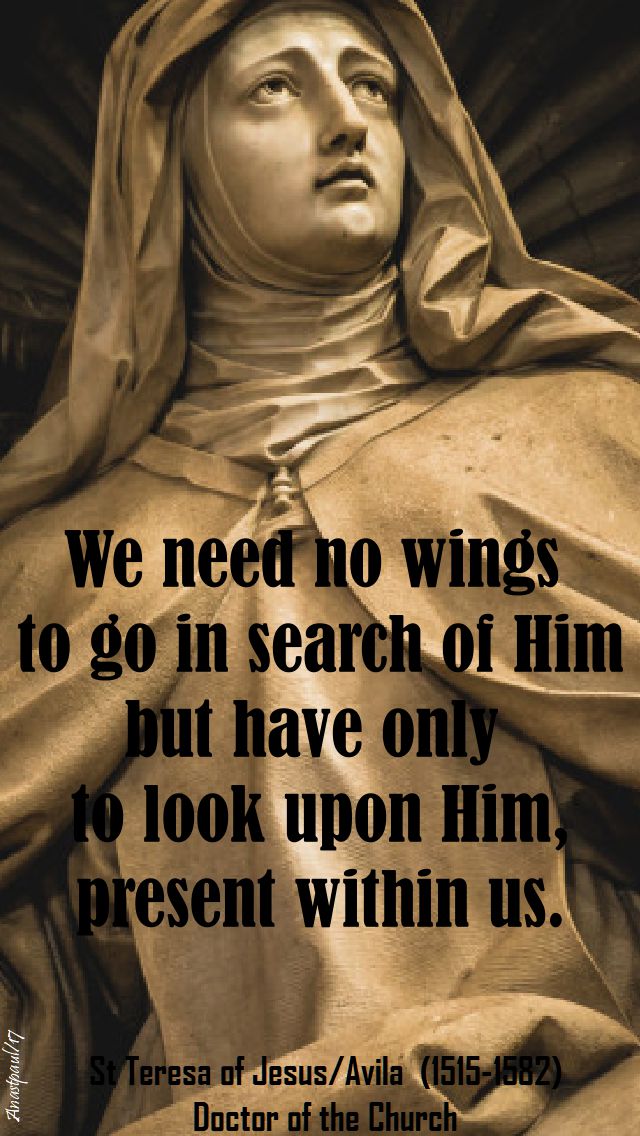
“We need no wings to go in search of Him but have only to look upon Him, present within us.”
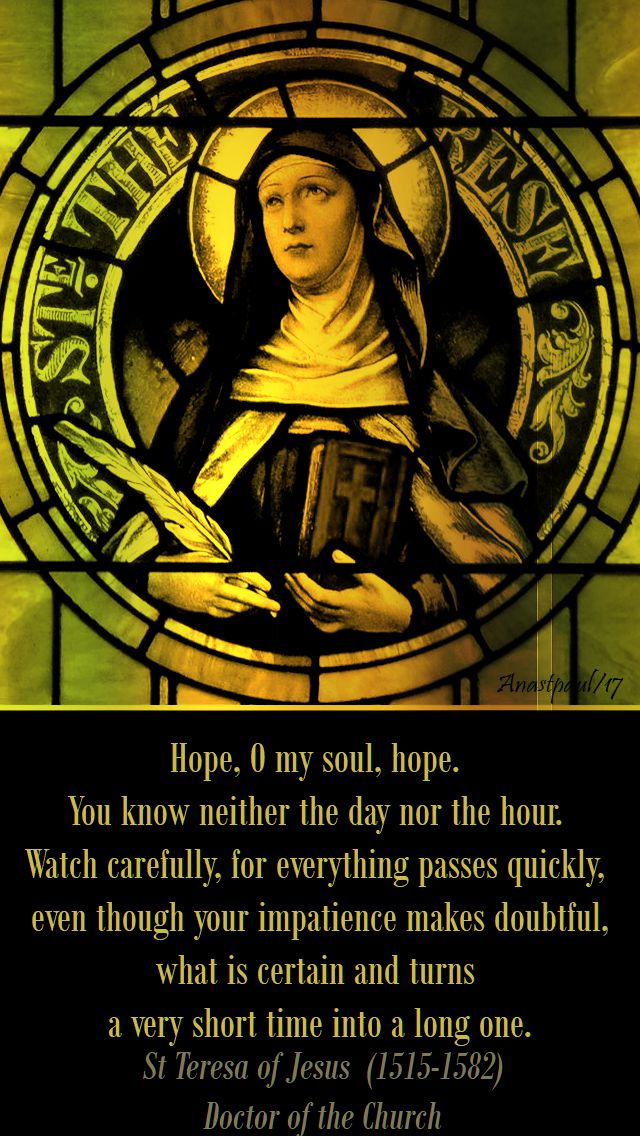
“Hope, O my soul, hope. You know neither the day nor the hour. Watch carefully, for everything passes quickly, even though your impatience makes doubtful, what is certain and turns a very short time into a long one.”
Our Morning Offering – 15 October – The Memorial of St Teresa of Jesus (1515-1582)
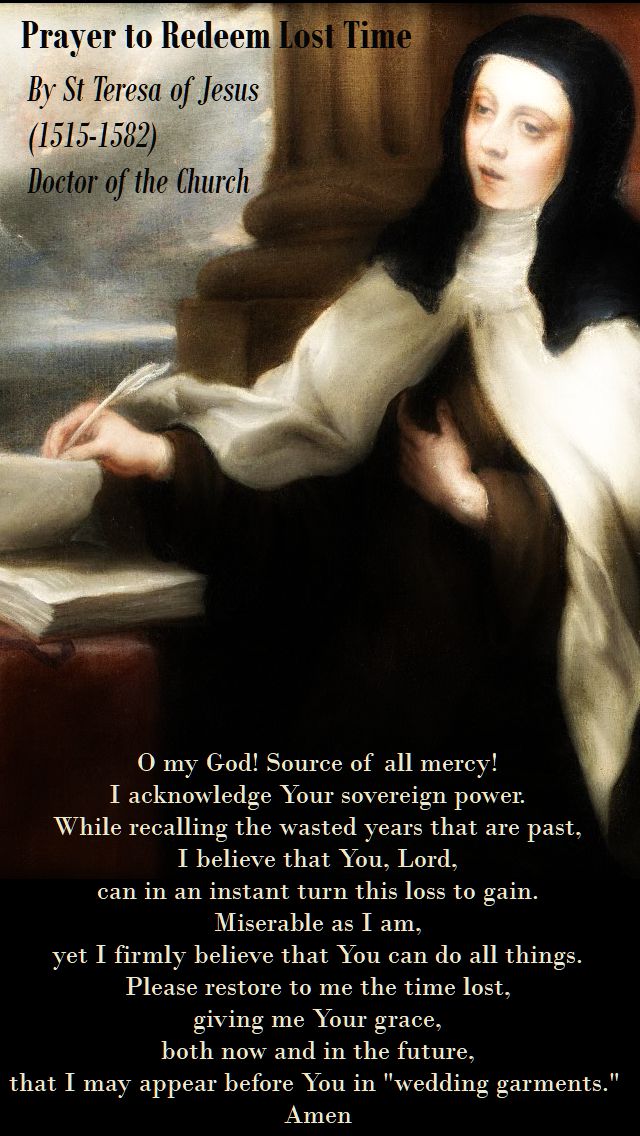
To Redeem Lost Time By St Teresa of Jesus (1515-1582) Doctor of the Church
O my God! Source of all mercy!
I acknowledge Your sovereign power.
While recalling the wasted years that are past,
I believe that You, Lord,
can in an instant turn this loss to gain.
Miserable as I am,
yet I firmly believe that You can do all things.
Please restore to me the time lost,
giving me Your grace,
both now and in the future,
that I may appear before You in “wedding garments.”
Amen
One Minute Reflection – 15 October – The Memorial of St Teresa of Jesus/Avila (1515-1582) Doctor of the Church
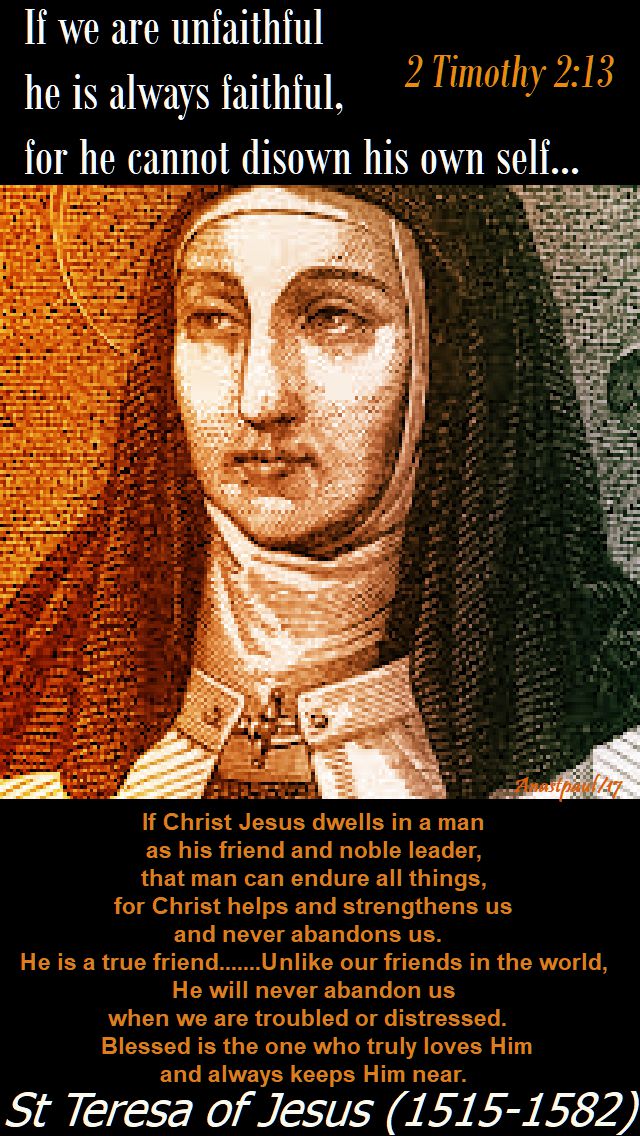
If we have died with him we shall also live with him; if we persevere we shall also reign with him. But if we deny him he will deny us. If we are unfaithful he is always faithful, for he cannot disown his own self..…2 Timothy 2:11-13
REFLECTION – “If Christ Jesus dwells in a man as his friend and noble leader, that man can endure all things, for Christ helps and strengthens us and never abandons us. He is a true friend. And I clearly see that is we expect to please Him and receive an abundance of His graces, God desires that these graces must come to us from the hands of Christ, through His most sacred humanity, in which God takes delight. All blessings come to us through our Lord. He will teach us, for in beholding His life we find that He is the best example. What more do we desire from such a good friend at our side? Unlike our friends in the world, He will never abandon us when we are troubled or distressed. Blessed is the one who truly loves Him and always keeps Him near. Whenever we think of Christ we should recall the love that led Him to bestow on us so many graces and favours and also the great love God showed in giving us in Christ a pledge of His love; for love calls for love in return. Let us strive to keep this always before our eyes and to rouse ourselves to love Him. For if at some time the Lord should grant us the grace of impressing His love on our hearts, all will become easy for us and we shall accomplish great things quickly and without effort.” – Saint Teresa of Jesus
PRAYER – Almighty God, our Father, You sent St Teresa of Jesus to be a witness in the Church to the way of perfection. Sustain us by her spiritual doctrine and kindle in us, the longing for true holiness. Through Christ, our Lord, in union with the Holy Spirit. St Teresa pray for us, amen
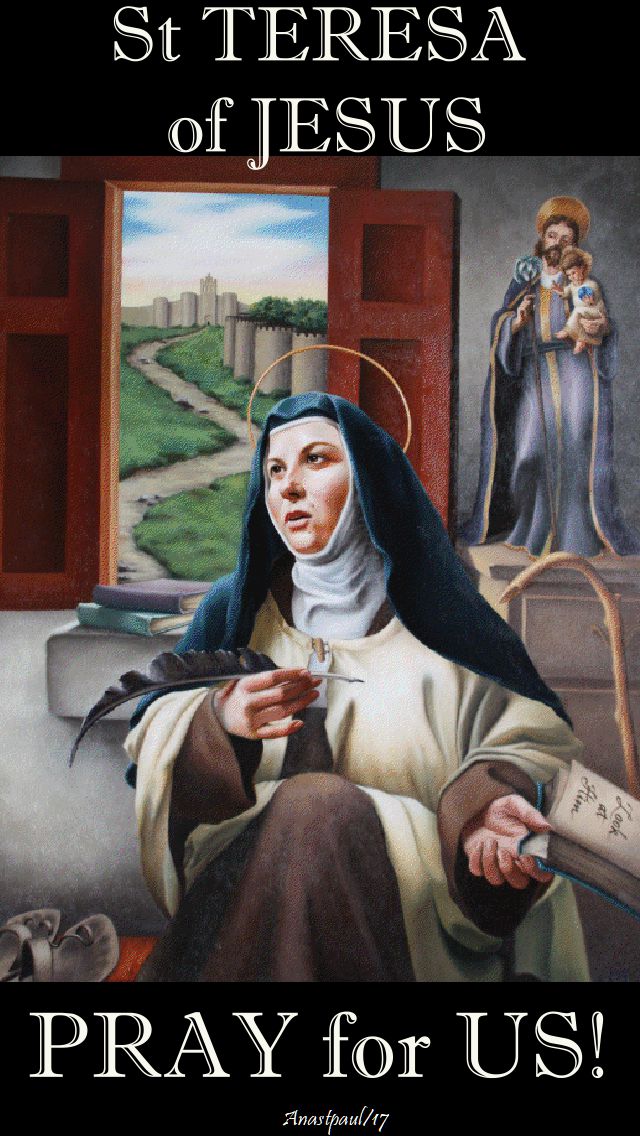
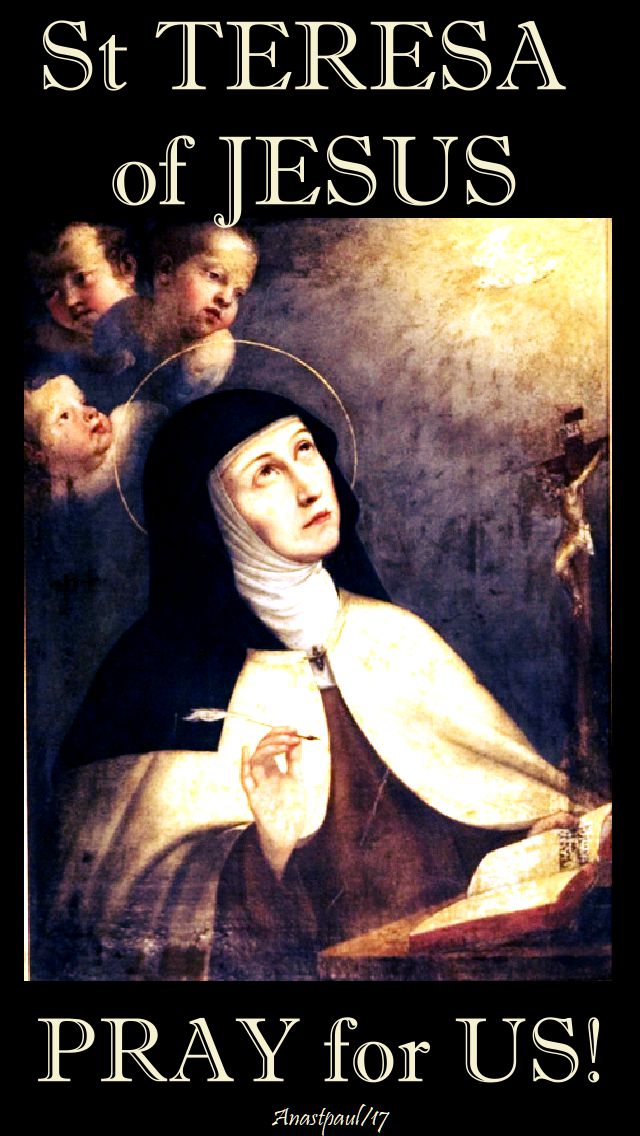
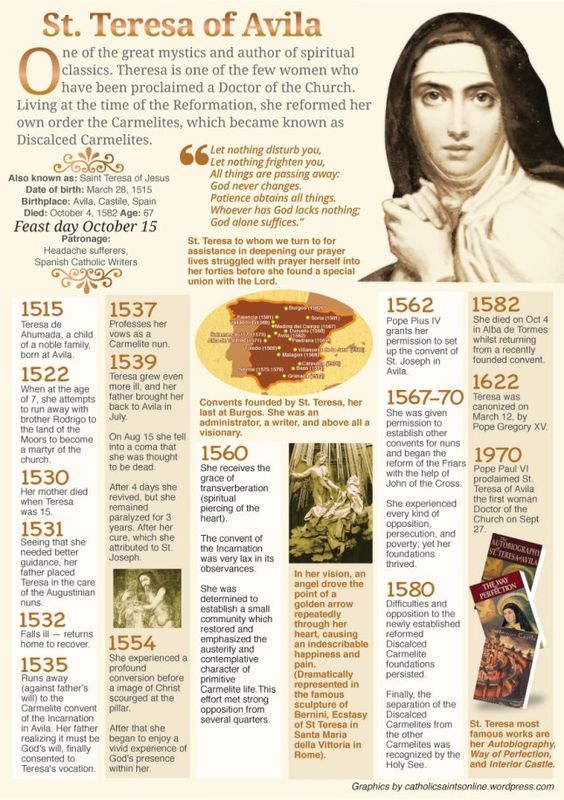
Saint of the Day – 15 October – St Teresa of Jesus/of Avila (1515-1582) Virgin, Mystic, Ecstatic, Reformer, Apostle of Prayer, Writer, Doctor of the Church. Born as Teresa Sanchez Cepeda Davila y Ahumada at Avila, Old Castile, on 28 March 1515 – died at Alba de Tormes, 4 October 1582 of natural causes in the arms of her secretary and close friend Blessed Anne of Saint Bartholomew. Her relics are preserved at Alba – her heart shows signs of Transverberation (piercing of the heart), and is displayed, too. Her Body is incorrupt. Patronages: • sick people; against bodily ills or sickness • against headaches • against the death of parents • lace makers or lace workers • people in need of grace • people in religious orders • people ridiculed for their piety • World Youth Day 2011 • Amos, Canada, diocese of • Avellaneda-Lanús, Argentina, diocese of • Berzano di Tortona, Italy • Pozega, Croatia • Spain. Attributes – Habit of the Discalced Carmelites, Book and Quill, arrow-pierced heart. St Teresa was Beatified on 24 April 1614 by Pope Paul V and Canonised on 12 March 1622, only forty years after her death, by Pope Gregory XV. Tradition associate Saint Teresa with the Infant Jesus of Prague with claims of former ownership and devotion. On 27 September 1970 St Teresa, was named a Doctor of the Church by Pope Paul VI. Her books, which include her autobiography (The Life of Teresa of Jesus) and her seminal work El Castillo Interior (trans.: The Interior Castle), are an integral part of Spanish Renaissance literature as well as Christian mysticism and Christian meditation practices. She also wrote Camino de Perfección (trans.: The Way of Perfection).
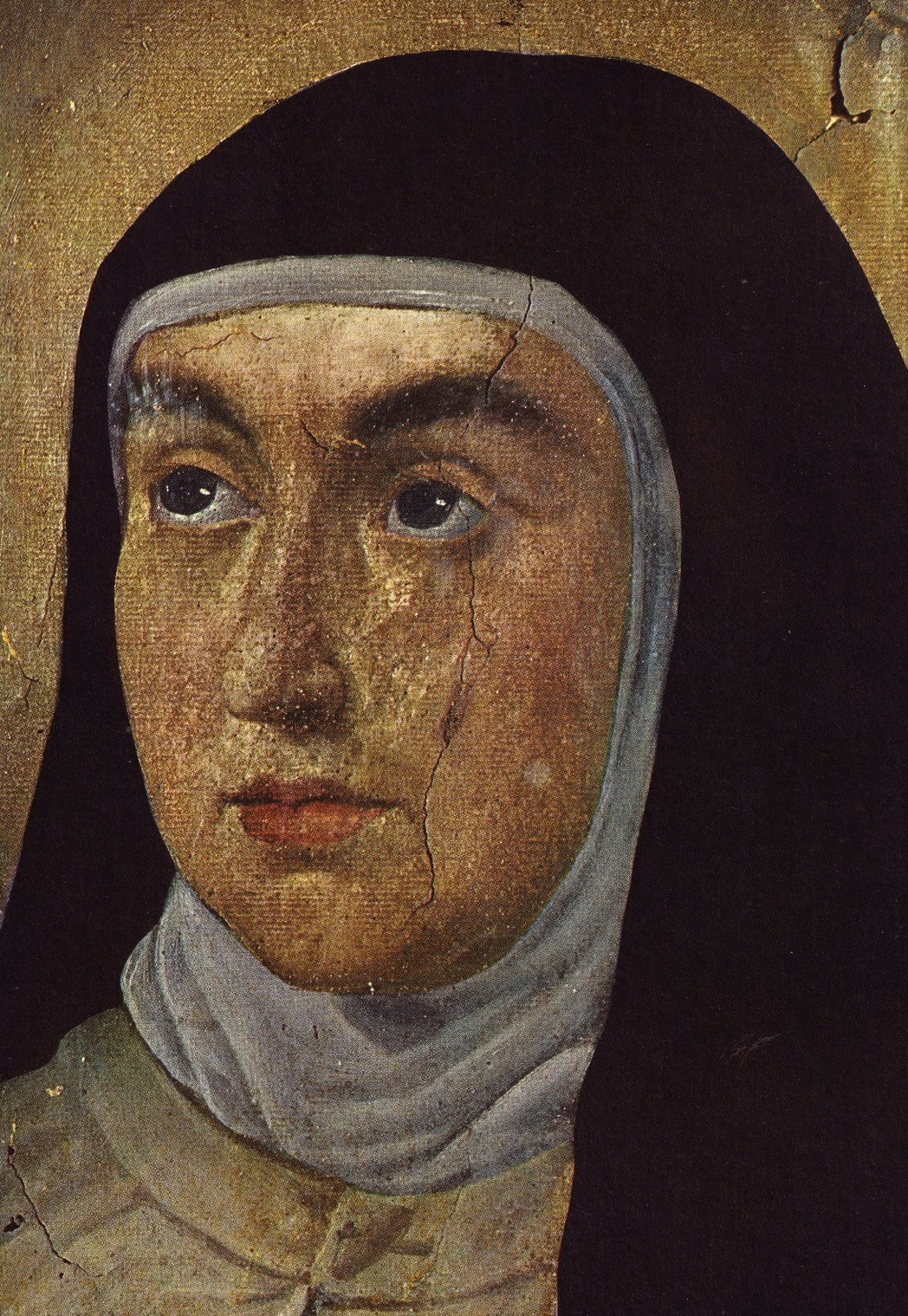
Original Portrait by Frei Jual de la Miseria in 1576
The third child of Don Alonso Sanchez de Cepeda by his second wife, Doña Beatriz Davila y Ahumada, who died when the Teresa was in her fourteenth year, Teresa was brought up by her saintly father, a lover of serious books and a tender and pious mother. After her death and the marriage of her eldest sister, Teresa was sent for her to the Augustinian nuns at Avila but owing to illness she left at the end of eighteen months and for some years remained with her father and occasionally with other relatives, notably an uncle who made her acquainted with the Letters of St Jerome, which determined her to adopt the religious life, not so much through any attraction towards it, as through a desire of choosing the safest course. Unable to obtain her father’s consent she left his house unknown to him to enter the Carmelite Convent of the Incarnation at Avila, which then counted 140 nuns. The wrench from her family caused her a pain which she ever afterwards compared to that of death. However, her father at once yielded and Teresa took the habit.
Teresa lived in an age of exploration as well as political, social and religious upheaval. It was the 16th century, a time of turmoil and reform. She was born before the Protestant Reformation and died almost 20 years after the closing of the Council of Trent.
The gift of God to Teresa in and through which she became holy and left her mark on the Church and the world is threefold: she was a woman; she was a contemplative; she was an active reformer.
As a woman, Teresa stood on her own two feet, even in the man’s world of her time. She was “her own woman,” entering the Carmelites despite strong opposition from her father. She is a person wrapped not so much in silence as in mystery. Beautiful, talented, outgoing, adaptable, affectionate, courageous, enthusiastic, she was totally human. Like Jesus, she was a mystery of paradoxes: wise, yet practical; intelligent, yet much in tune with her experience; a mystic, yet an energetic reformer; a holy woman, a womanly woman.
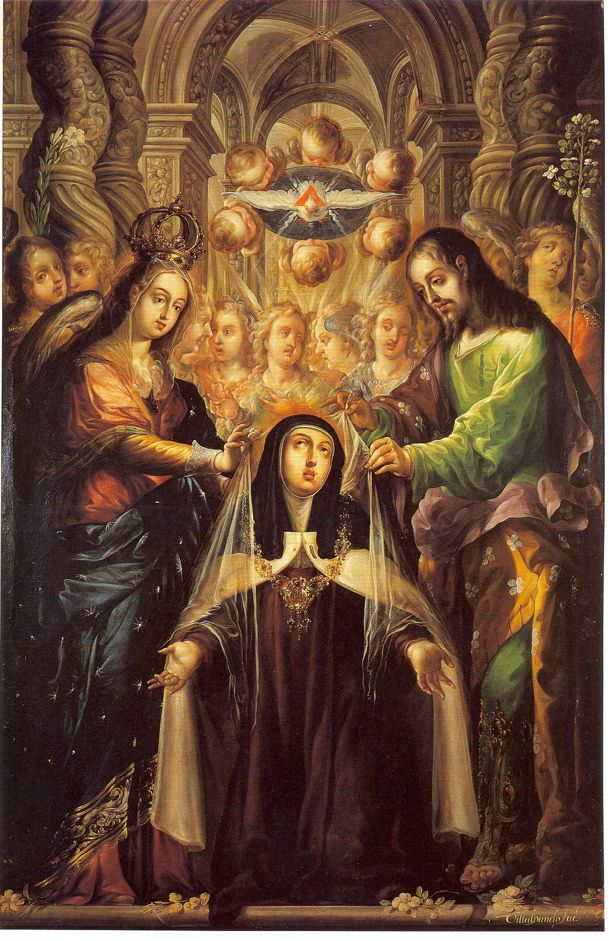
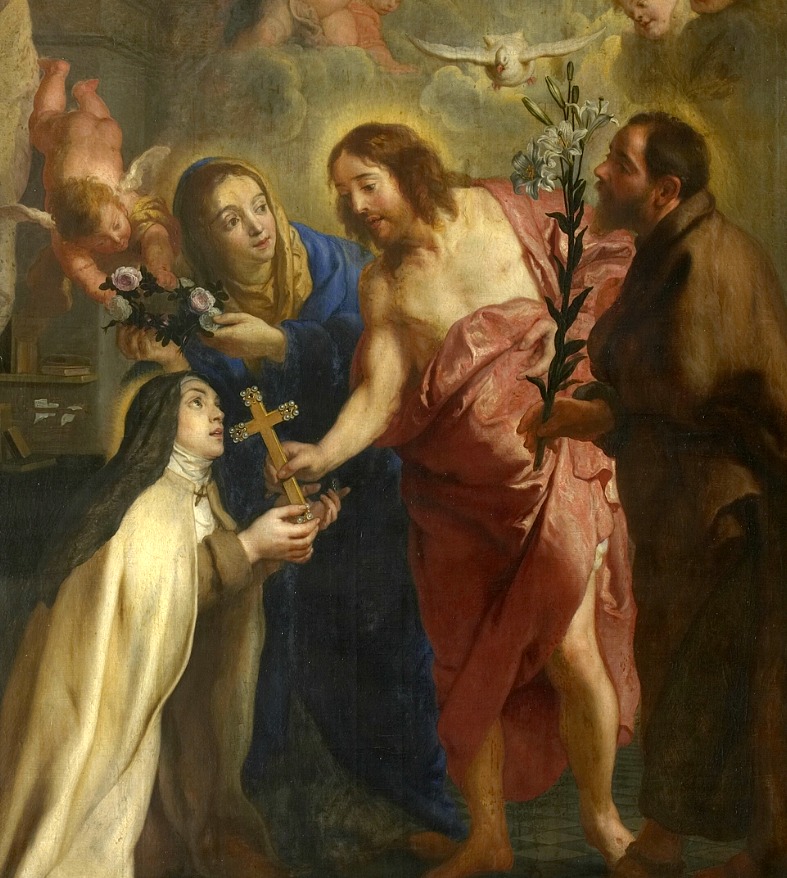
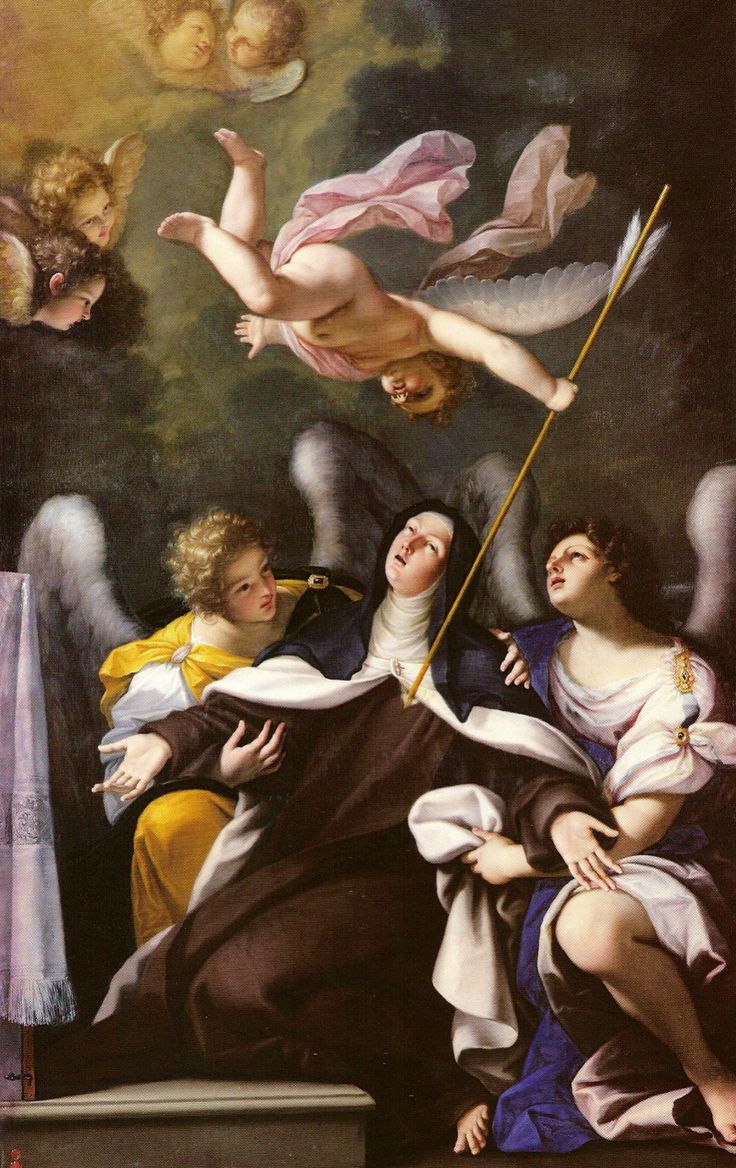
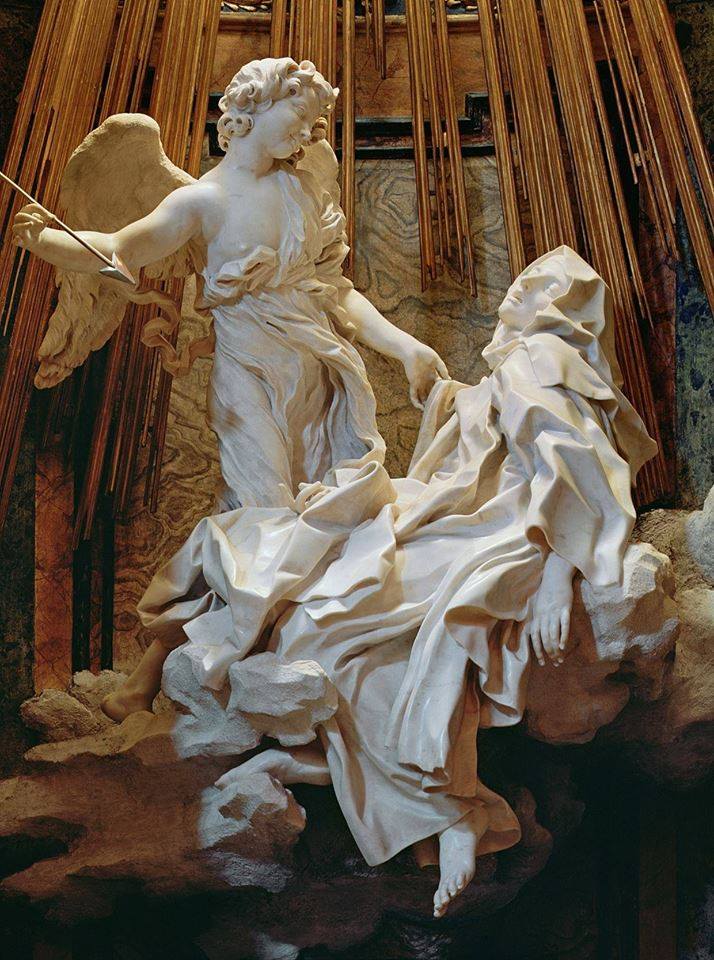
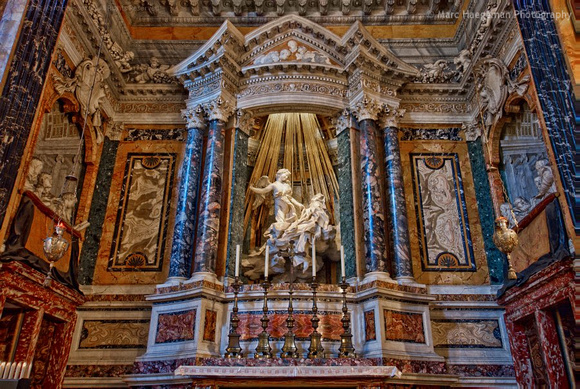
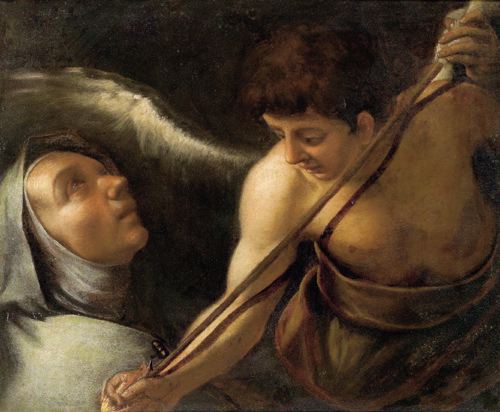
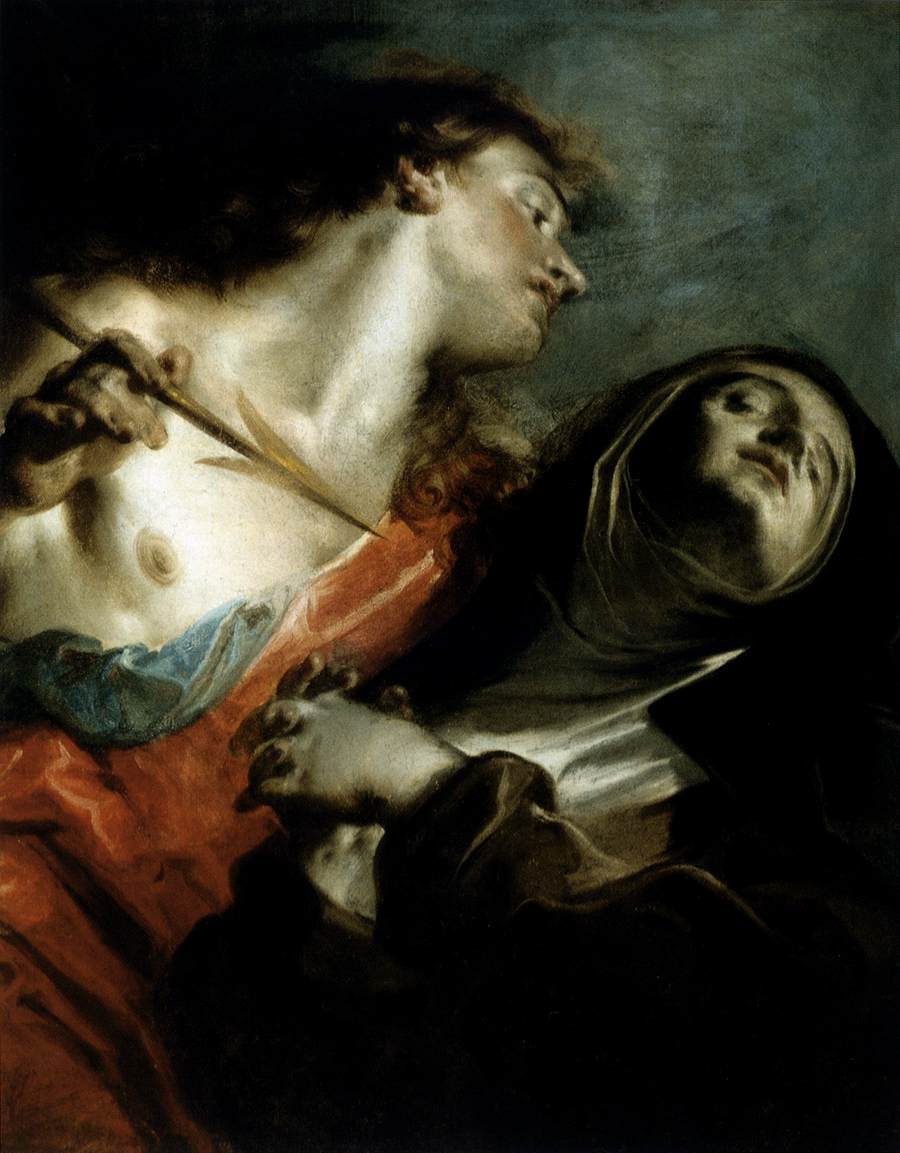
On St Peter’s Day in 1559, Teresa became firmly convinced that Jesus Christ presented Himself to her in bodily form, though invisible. These visions lasted almost uninterrupted for more than two years. In another vision, a seraph drove the fiery point of a golden lance repeatedly through her heart, causing an ineffable spiritual-bodily pain.
I saw in his hand a long spear of gold and at the point there seemed to be a little fire. He appeared to me to be thrusting it at times into my heart and to pierce my very entrails; when he drew it out, he seemed to draw them out also and to leave me all on fire with a great love of God. The pain was so great, that it made me moan; and yet so surpassing was the sweetness of this excessive pain, that I could not wish to be rid of it…
This vision was the inspiration for one of Bernini’s most famous works, the Ecstasy of Saint Teresa at Santa Maria della Vittoria in Rome.
The memory of this episode served as an inspiration throughout the rest of her life and motivated her lifelong imitation of the life and suffering of Jesus, epitomised in the motto usually associated with her: Lord, either let me suffer or let me die.
Teresa was a woman “for God,” a woman of prayer, discipline and compassion. Her heart belonged to God. Her ongoing conversion was an arduous lifelong struggle, involving ongoing purification and suffering. She was misunderstood, misjudged and opposed in her efforts at reform. Yet she struggled on, courageous and faithful; she struggled with her own mediocrity, her illness, her opposition. And in the midst of all this she clung to God in life and in prayer. Her writings on prayer and contemplation are drawn from her experience: powerful, practical and graceful. She was a woman of prayer; a woman for God.
Teresa was a woman “for others.” Though a contemplative, she spent much of her time and energy seeking to reform herself and the Carmelites, to lead them back to the full observance of the primitive Rule. She founded over a half-dozen new monasteries. She traveled, wrote, fought—always to renew, to reform. In her self, in her prayer, in her life, in her efforts to reform, in all the people she touched, she was a woman for others, a woman who inspired and gave life.
Her final illness overtook her on one of her journeys from Burgos to Alba de Tormes. She died in 1582, just as Catholic nations were making the switch from the Julian to the Gregorian calendar, which required the removal of 5–14 October from the calendar. She died either before midnight of 4 October or early in the morning of 15 October which is celebrated as her feast day. Her last words were: “My Lord, it is time to move on. Well then, may your will be done. O my Lord and my Spouse, the hour that I have longed for has come. It is time to meet one another.”
Her writings, especially the Way of Perfection and The Interior Castle, have helped generations of believers. She and St Catherine of Siena were the first women so honoured as Doctors of the Church.
Interesting fact – her Spiritual Director was St Francis Borgia whose Feast Day we celebrated on 10 October.
St Teresa of Avila (1515-1582) (Memorial) – https://www.youtube.com/watch?v=LHL608TwOWo
—
St Antiochus of Lyon
St Aurelia of Strasbourg
St Callistus of Huesca
St Cannatus of Marseilles
Bl Cipriano Alguacil Torredenaida
St aEuthymius the Younger
St Fortunatus of Rome
Bl Josefa Martínez Pérez
St Leonard of Vandoeuvre
St Magdalena of Nagasaki
Bl Narcis Basté y Basté
St Odilo
Bl Pere Verdaguer Saurina
Bl Ramón Esteban Bou Pascual
St Sabinus of Catania
St Severus of Trier
St Thecla of Kitzengen
St Willa of Nonnberg
—
Martyrs of Cologne: A group of 360 Christian soldiers martyred together in the persecutions of Diocletian and Maximian. They were martyred in 303 outside the city walls of Cologne, Germany.
Martyred in the Spanish Civil War:
• Blessed Cipriano Alguacil Torredenaida
• Blessed Josefa Martínez Pérez
• Blessed Narcis Basté y Basté
• Blessed Pere Verdaguer Saurina
• Blessed Ramón Esteban Bou Pascual
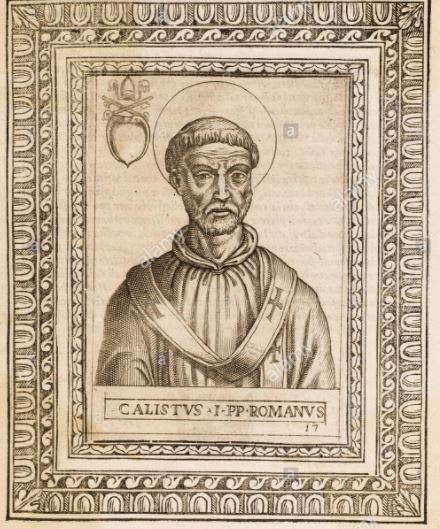
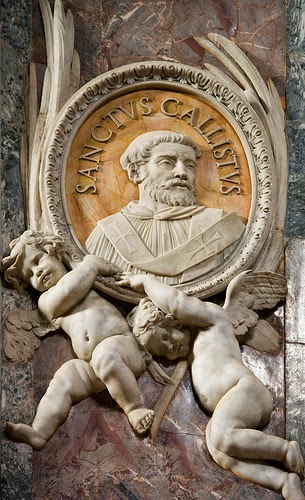
Thought for the Day – 14 October – The Memorial of St Pope Callistus I
The life of this man is another reminder that the course of Church history, like that of true love, never did run smooth. The Church had to–and still must–go through the agonizing struggle to state the mysteries of the faith in language that, at the very least, sets up definite barriers to error. On the disciplinary side, the Church had to preserve the mercy of Christ against rigorism, while still upholding the gospel ideal of radical conversion and self-discipline. Every pope—indeed every Christian—must walk the difficult path between “reasonable” indulgence and “reasonable” rigorism. (Fr Don Miller OFM)
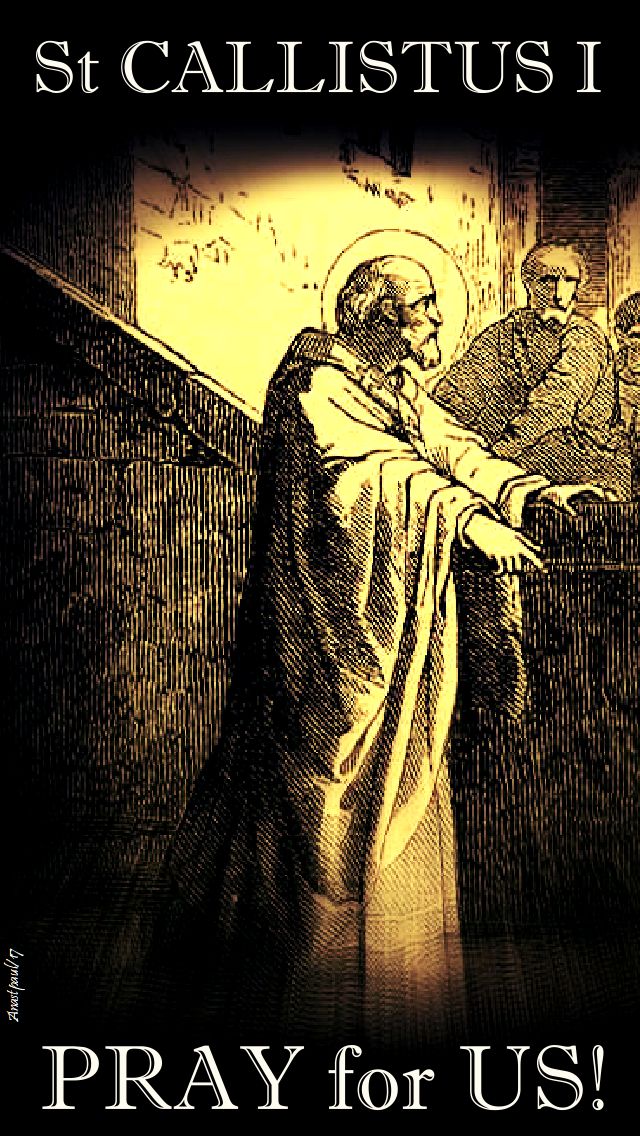
Saint of the Day – St Pope Callistus I (Died c 223) – 14 October Pope and Martyr Also known as Callixtus I/Calixtus I. Papal Ascension – c 218 – martyred c 223. Legend says he was killed by being thrown down a well with a millstone around his neckbut there is no solid evidence. Patronage – cemetery workers.
The most reliable information about this saint comes from his enemy Saint Hippolytus, an early antipope, later a martyr for the Church. A negative principle is used: if some worse things had happened, Hippolytus would surely have mentioned them.
Callistus was a slave in the imperial Roman household. Put in charge of the bank by his master, he lost the money deposited, fled and was caught. After serving time for a while, he was released to make some attempt to recover the money. Apparently he carried his zeal too far, being arrested for brawling in a Jewish synagogue. This time he was condemned to work in the mines of Sardinia. Through the influence of the emperor’s mistress he was released and went to live at Anzio.
After winning his freedom, Callistus was made superintendent of the public Christian burial ground in Rome–still called the cemetery of Saint Callistus–probably the first land owned by the Church. The pope ordained him a deacon and made him his friend and adviser.
Callistus was elected pope by a majority vote of the clergy and laity of Rome and thereafter was bitterly attacked by the losing candidate, Saint Hippolytus, who let himself be set up as the first antipope in the history of the Church. The schism lasted about 18 years.
Hippolytus is venerated as a saint. He was banished during the persecution of 235 and was reconciled to the Church. He died from his sufferings in Sardinia. He attacked Callistus on two fronts—doctrine and discipline. Hippolytus seems to have exaggerated the distinction between Father and Son–almost making two gods–possibly because theological language had not yet been refined. He also accused Callistus of being too lenient, for reasons we may find surprising: 1) Callistus admitted to Holy Communion those who had already done public penance for murder, adultery and fornication; 2) he held marriages between free women and slaves to be valid—contrary to Roman law; 3) he authorised the ordination of men who had been married two or three times; 4) he held that mortal sin was not a sufficient reason to depose a bishop; 5) he held to a policy of leniency toward those who had temporarily denied their faith during persecution.
Pope Saint Callistus I is held to have initiated a practice in the Church known as Ember (meaning four times per year) Days, to bring down blessings on each season of the year. Within the liturgical year, the Church designated a group of three days which were set aside for fast and abstinence. This observation occurred four times during the course of the liturgical year. The practice, which was observed for centuries, has since faded.
Callistus was martyred during a local disturbance in Trastevere, Rome and is the first pope–except for Peter–to be commemorated as a martyr in the earliest martyrology of the Church.
St Pope Callistus I (Optional Memorial)
—
Bl Ana María Aranda Riera
St Angadrisma of Beauvais
St Bernard of Arce
St Celeste of Metz
St Dominic Loricatus
St Donatian of Rheims
St Fortunatus of Todi
St Franciszek Roslaniec
St Gaudentius of Rimini
St Gundisalvus of Lagos
Bl Jacques Laigneau de Langellerie
St Lupulo of Capua
St Lupus of Caesarea
St Manacca
St Manehildis
St Modesto of Capua
Bl Richard Creagh
Bl Roman Lysko
St Rusticus of Trier
St Saturninus of Caesarea
St Stanislaw Mysakowski
St Venanzio of Luni
—
Martyrs of Caesarea – (4 saints): Three brothers and a sister martyred together in the persecutions of Diocletian – Carponius, Evaristus, Fortunata and Priscian. In 303 in Caesarea, Cappadocia (in modern Turkey) – their relics enshrined in Naples, Italy.
Martyred in the Spanish Civil War:
• Blessed Ana María Aranda Riera
• Blessed Jacques Laigneau de Langellerie
One Minute Reflection – 13 October – The Memorial of St Gerald of Aurillac
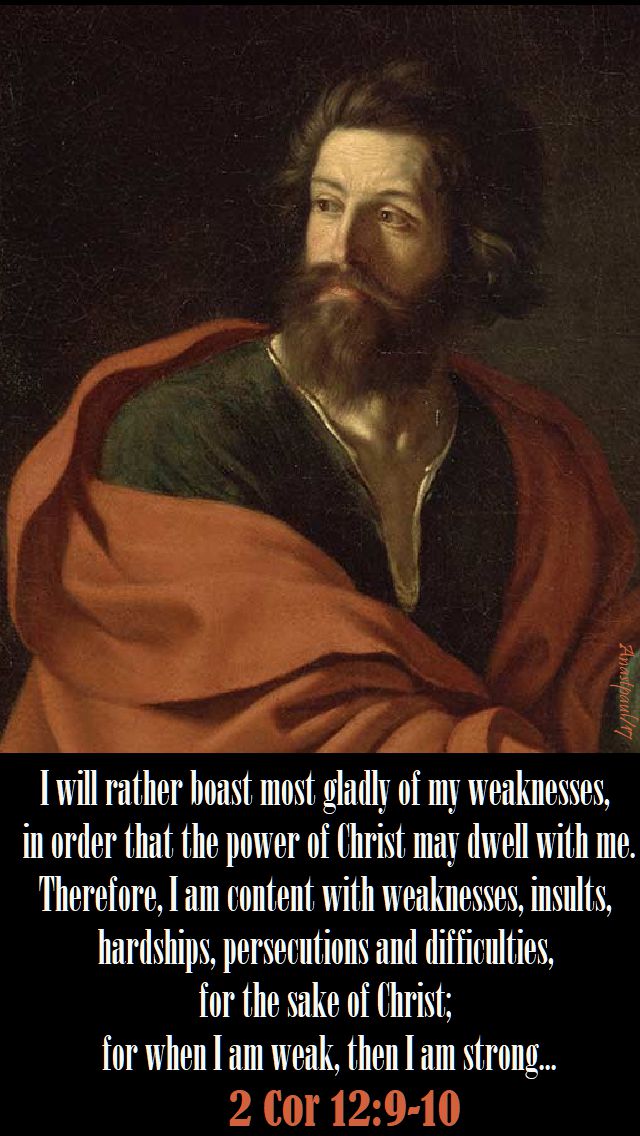
I will rather boast most gladly of my weaknesses, in order that the power of Christ may dwell with me. Therefore, I am content with weaknesses, insults, hardships, persecutions and difficulties, for the sake of Christ; for when I am weak, then I am strong….2 Cor 12:9-10
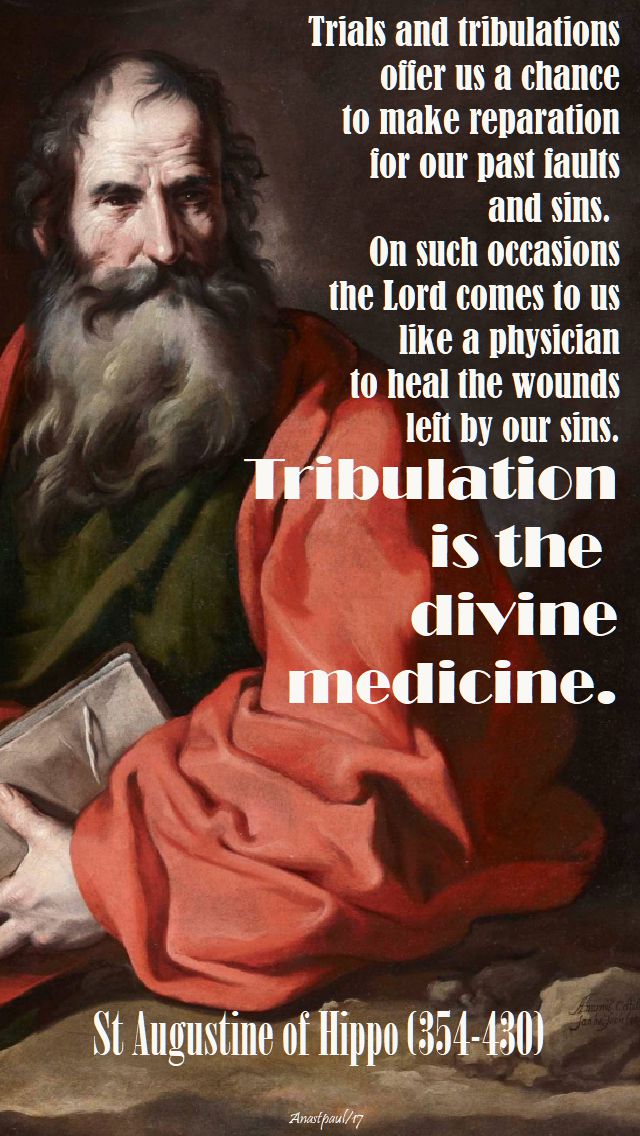
REFLECTION – “Trials and tribulations offer us a chance to make reparation for our past faults and sins.
On such occasions the Lord comes to us like a physician to heal the wounds left by our sins. Tribulation is the divine medicine.”…St Augustine of Hippo (354-430)
PRAYER – Almighty Father, let Your light so penetrate our minds, that walking by Your commandments, we may always follow You, our leader and our Guide in the path of Him who suffered and died for our love. St Gerald of Aurillac, you consecrated yourself and gave up your riches to the poor to follow the way of the Lord, please pray for us. Through Jesus Christ, our Lord in union with the Holy Spirit, one God forever and ever. Amen
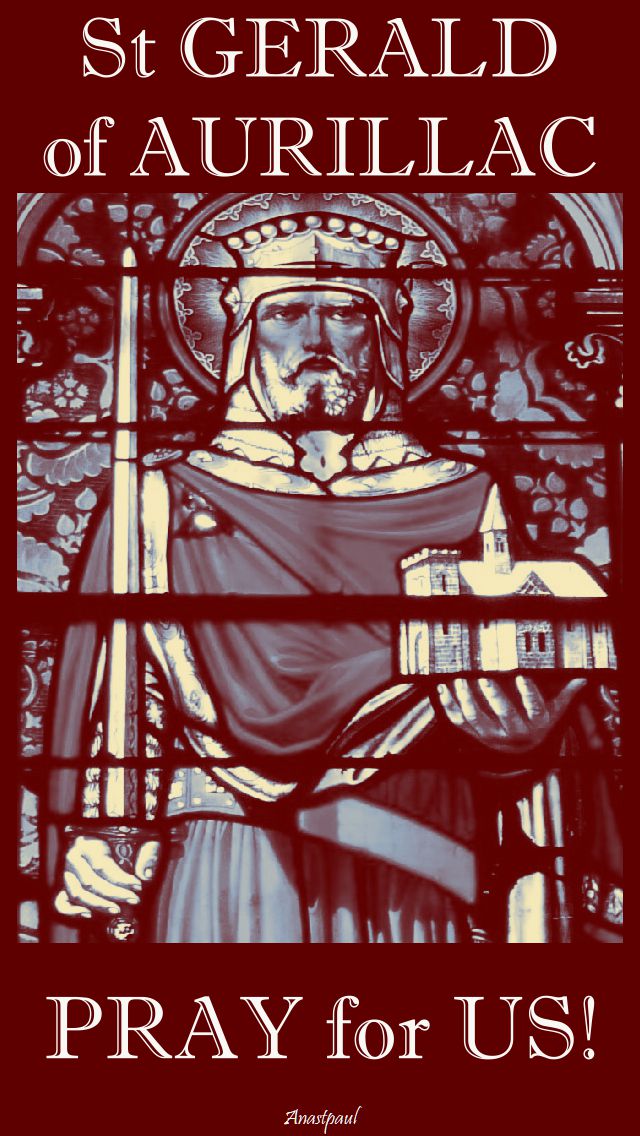
Saint of the Day – 13 October – St Gerald of Aurillac (855-909) Consecrated Celibate Noble Layman (855 in Aurillac, France – 909 at Cenezac, France). He was buried in his abbey in Aurillac, France. Patronages – bachelors, counts, disabled, handicapped of physically challenged people, Aurillac, France, Upper Auvergne, France.
Gerald was born into the Gallo-Roman nobility, counting Cesarius of Arles among his forebears, though the title “Count of Aurillac” was not held by his father, to whose estates he succeeded and was assumed by him in later life. The details of his life known today come primarily from The Life of St Gerald of Aurillac (c. 930–931) written by St Odo of Cluny (images below) – you can download St Odo’s Life of St Gerald here http://www.strobertbellarmine.net/books/Sitwell–OdoofCluny.pdf
According to Odo, Gerald suffered an illness as a child, sufficient in duration to advance his reading and may have been disfigured by acne. In later life he was to suffer blindness. He seriously considered joining a religious order but was persuaded against it by his friend Geusbert, Bishop of Rodez, on the grounds that with his social position he could do more good by remaining in the world as a layman. Nevertheless, secretly tonsured under his habitual cap, he consecrated his life in service to God, gave away his possessions, took a personal vow of chastity and prayed the breviary each day.
He founded a church and abbey on his estate of Aurillac, where he was buried after dying at Cenezac, on a 13 Friday October, probably in 909. The validation of his local cult by Odo of Cluny served to establish his wider veneration. Saint Gerald, considered by his Church and his followers as a great example of a celibate Christian aristocrat, is the patron saint of counts and bachelors. Because of his poor health and blindness, more emphasized in his developing cult than in Odo’s Life, he is also the patron saint of the disabled, handicappedand physically challenged.
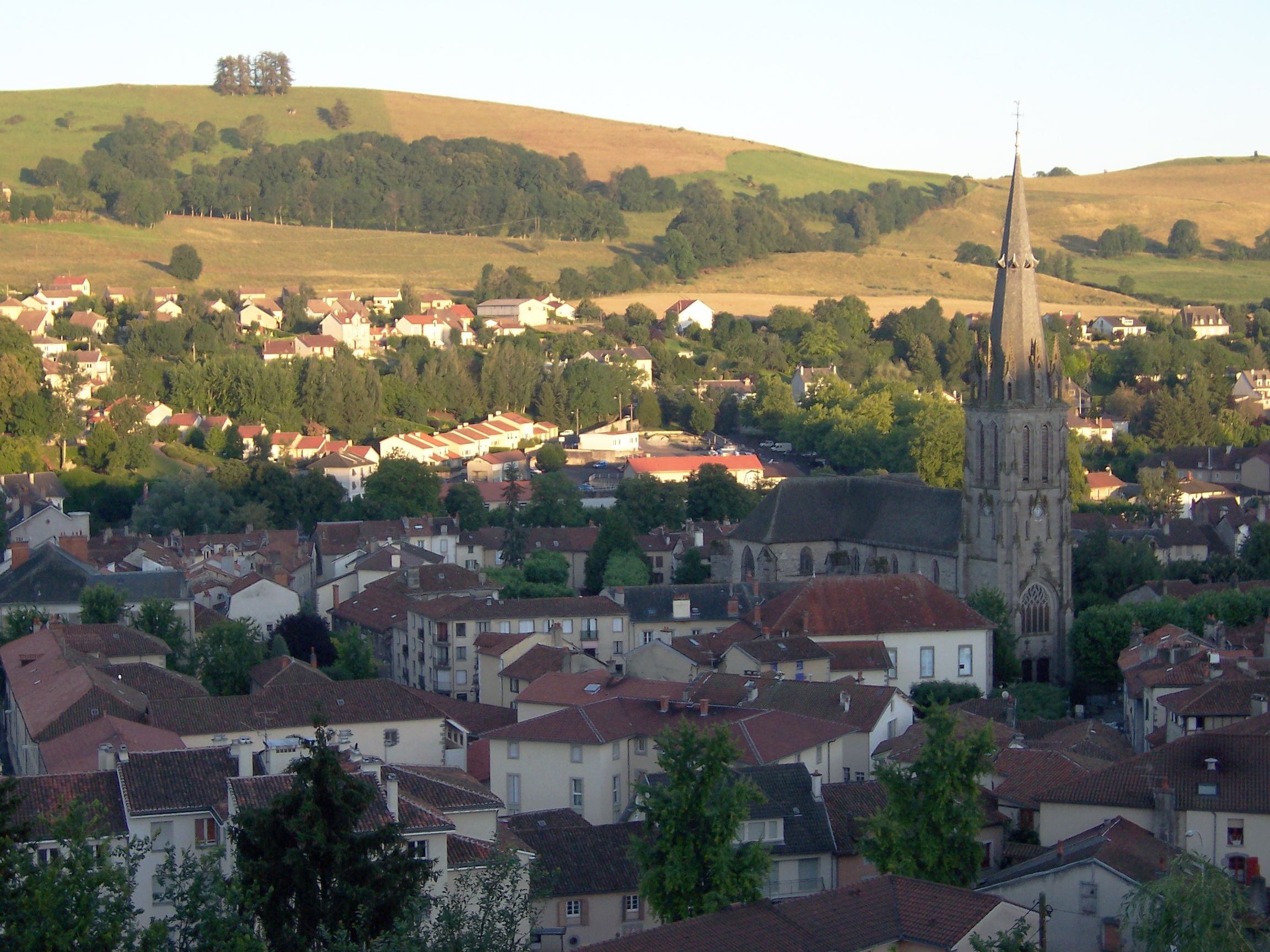
St Church and district of St Gerald of Aurillac, France
Our Lady of Fatima: The Sixth Apparition & the Miracle of the Sun
—
Bl Alexandrina Maria da Costa
St Benedict of Cupra
St Berthoald of Cambrai
St Carpus of Troas
St Chelidonia
St Comgan the Monk
St Florence of Thessalonica
St Fyncana
St Fyndoca
Bl Gebrand of Klaarkamp
St Gerald of Aurillac (855-909)
St Leobono of Salagnac
Bl Magdalen Panattieri
St Maurice of Carnoet
St Regimbald of Speyer
St Romulus of Genoa
St Simbert of Augsburg
St Theophilus of Antioch
St Venantius
—
Three Crowns of Cordoba – (3 saints): Three Christian men martyred in the persecutions of Diocletian – Faustus, Januarius and Martial.
They were burned to death in 304 in Cordoba, Spain.
Martyred in the Spanish Civil War:
• Blessed Àngel Presta Batllé
• Blessed ángel Ramos Velázquez
• Blessed Antonio Ayet Canós
• Blessed Ruperto García Arce
• Blessed Salustiano González Crespo
• Blessed Tomás Pallarés Ibáñez
• BlessedFrancesc Mitjá i Mitjá
• BlessedHerminio Motos Torrecillas
• BlessedJoan Puig Serra
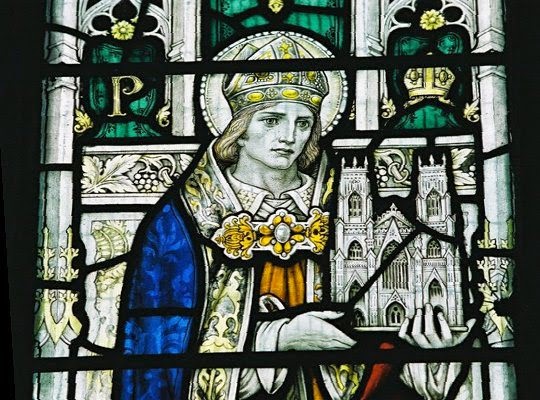
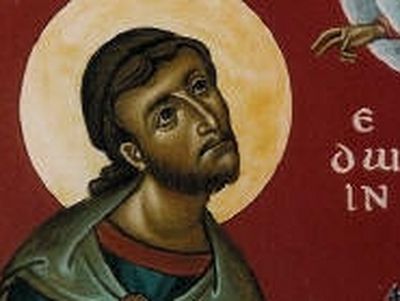
Saint of the Day – 12 October – St Edwin of Northumbria (586-616) King and Martyr. Name Meaning: • valuable friend (teutonic) • wealthy friend (old english). (Born 586 at Deira, South Northumbria, England – 633 in battle with pagan Welsh and Mercians at Hatfield Chase, England, he is considered a Martyr.) His relics are at Whitby in North Yorkshire and his head is in Saint Peter’s Church, York, North Yorkshire. Patronages – • converts, • hoboes, tramps, homeless peopl, • kings, • large families.
Edwin, born in 586, was a prince of the Royal family of Deira in England. His father, King Aelle, was deposed and Edwin was forced to flee and was raised in exile.
Once, Edwin, a pagan, met a stranger who predicted the restoration of his kingdom if he would promise to do whatever would be taught him regarding his own salvation. Edwin promised and the stranger, laying his hand upon his head, bade him remember that sign. Shortly after that incident, due to diverse political and military circumstances Edwin recovered the Kingdom of Deira and afterward became King of all Northumbria, one of the seven parts into which England was divided at that time.
MINOLTA DIGITAL CAMERA
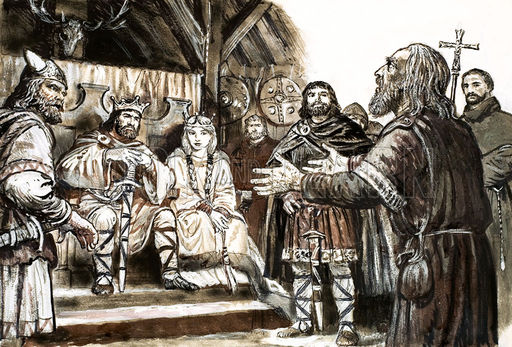
When his first wife died, he married the Catholic Princess Ethelburga, daughter of the King of Kent. He agreed that she should be allowed to practice her religion and promised to study the truths of the Catholic Faith. He also welcomed to his court St Paulinus, Archbishop of York and chaplain of the Queen, who began to exercise influence over him. An attempt on Edwin’s life was made but he was saved by a minister who took the dagger blow directed against him. The same night his wife gave birth to a daughter, Enflaed. That child became the first Catholic baptised in his kingdom.
Touched by these two things, Edwin promised to convert if he would win the war against the King of the West Saxons. He conquered this King on the battlefield and stopped worshiping idols and began to take instruction from St Paulinus. To encourage him, Pope Boniface V sent a letter and gifts but Edwin remained pagan. St Paulinus continued to teach him, but the King did not convert.
One day, the Archbishop approached the King, laid his hand on his head and asked him if he remembered that sign. Edwin recalled the stranger from time past; quite moved he repented of his former life, converted and was baptised on Easter 627. He became an exemplary Catholic and an apostle of his people. He also helped the Catholic Faith to be spread in other Kingdoms of the English Heptarchy.
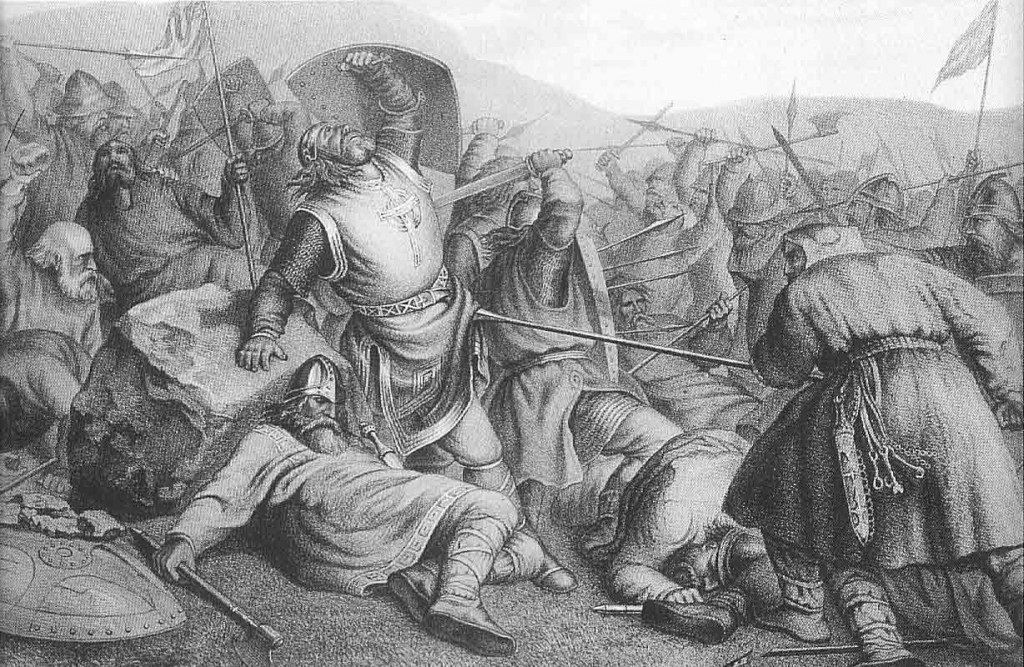
Penda, a powerful pagan King of Mercia, in alliance with the Welsh Prince Cadwallon invaded Northumbria. At the battle of Hatfield Chase, on October 12, 633, they defeated and killed St Edwin, which was their intention. Edwin is considered a Martyr for the Faith.
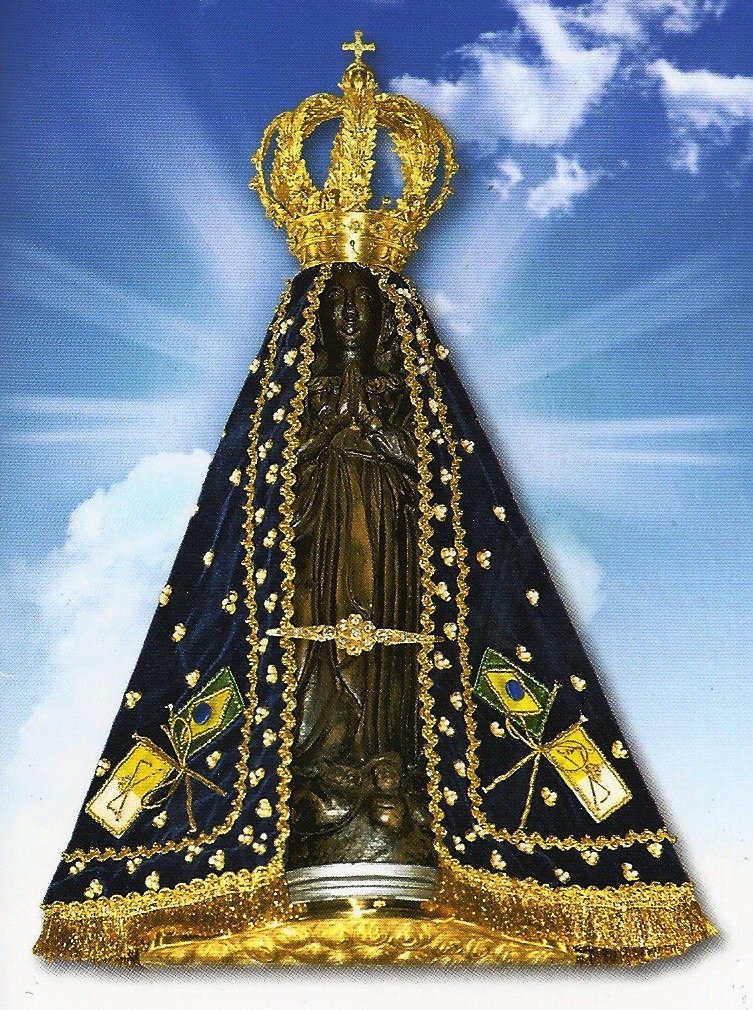
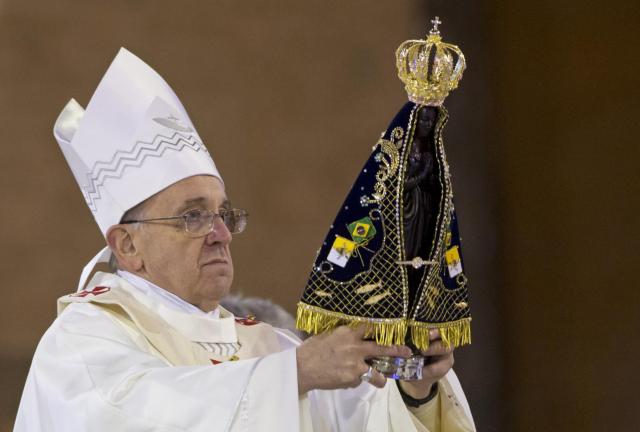
Our Lady Aparecida: Also known as – Our Lady Who Appeared
In October 1717, Dom Pedro de Almedida, Count of Assumar passed through the area of Guarantinqueta, a small city in the Paraiba river valley. The people there decided to hold a feast in his honour and though it was not fishing season, the men went to the waters to fish for the feast. Three of the fishermen, Domingos Garcia, Joco Alves and Felipe Pedroso, prayed to the Immaculate Conception and asked God’s help. However, after several hours they were ready to give up. Joco cast his net once more near the Port of Itaguagu but instead of fish, he hauled in the body of a statue. The three cast their net again, and brought up the statue’s head. After cleaning the statue they found that it was Our Lady of the Immaculate Conception. Naming their find Our Lady Aparecida, they wrapped it in cloth and continued to fish; now their nets were full.
While we do not know why the statue was at the bottom of the river, we do know who made it. Frei Agostino de Jesus, a carioca monk from Sao Paulo known for his sculpture. The image was less than three feet tall, was made around 1650 and must have been underwater for years. It is a dark brown colour, is covered by a stiff robe of richly embroidered thick cloth and wears an imperial crown which was added in 1904. Only her face and hands can be seen. Pope Pius XII proclaimed her principal patroness of Brazil in 1930. The statue was vandalised by being broken into several pieces just prior to a visit by St Pope John Paul II but a group of dedicated artists and artisans carefully pieced it together again.
Patronages: • Aparecida, Brazil, diocese of • Brazil • World Youth Day 2013
Our Lady of the Pillar: Tradition says that in the early day of the Church, Saint James the Greater was spreading the Gospel in Spain but making very little progress. He was dejected and questioning his mission. About 44, the Virgin Mary, who was still living in Jerusalem at the time, bi-located and appeared to him in a vision to boost his morale. In it, she was atop a column or pillar, which was being carried by angels. That pillar is believed to be the same one venerated in Zaragoza, Spain today. Miraculous healings reported at the scene.
PatronageS: • Imus, Philippines, diocese of • Tagbilaran, Philippines • Zamboanga, Philippines, archdiocese of • Zamboanga City, Philippines • Zaragoza, Spain.
—
St Amelius of Mortara
St Amicus of Mortara
St Cyprian
St Domnina of Anazarbus
St Edisto
St Edistius of Ravenna
St Edwin of Northumbria
St Evagrius the Martyr
St Felix
St Felix IV, Pope
St Fiace
St Herlindis
St Juan Osiense
St Maximilian of Celeia
St Meinards
St Monas of Milan
St Pantalus of Basle
St Priscian the Martyr
St Relindis
Bl Roman Sitko
St Salvinus of Verona
Bl Thomas Bullaker
—
Martyred in the Spanish Civil War:
• Blessed Bartolomé Caparrós García
• Blessed Eufrasio of the Child Jesus
• Blessed José González Huguet
• Blessed Pedro Salcedo Puchades
• Blessed Rafael Lluch Garín
On the Memorial of St John XXIII – 11 October – let us Pray:
The Official Prayer for the
Intercession of St John XXIII
Dear Pope John, your simplicity and meekness carried the scent of God and sparked in people’s hearts the desire for goodness. You spoke often of the beauty of the family gathered around the table to share bread and faith: pray for us that once again true families would live in our homes. With outstretched hands you sowed hope and you taught us to listen for God’s footsteps as He prepares a new humanity: help us have a healthy optimism of defeating evil with good. You loved the world with its light and darkness and you believed that peace is possible: help us be instruments of peace at home and in our communities. With paternal gentleness you gave all children a caress: you moved the world and reminded us that hands have been given to us not for striking but for embracing and drying tears. Pray for us so that we do not limit ourselves to cursing the darkness but that we bring the light, bringing Jesus everywhere and always praying to Mary. Amen
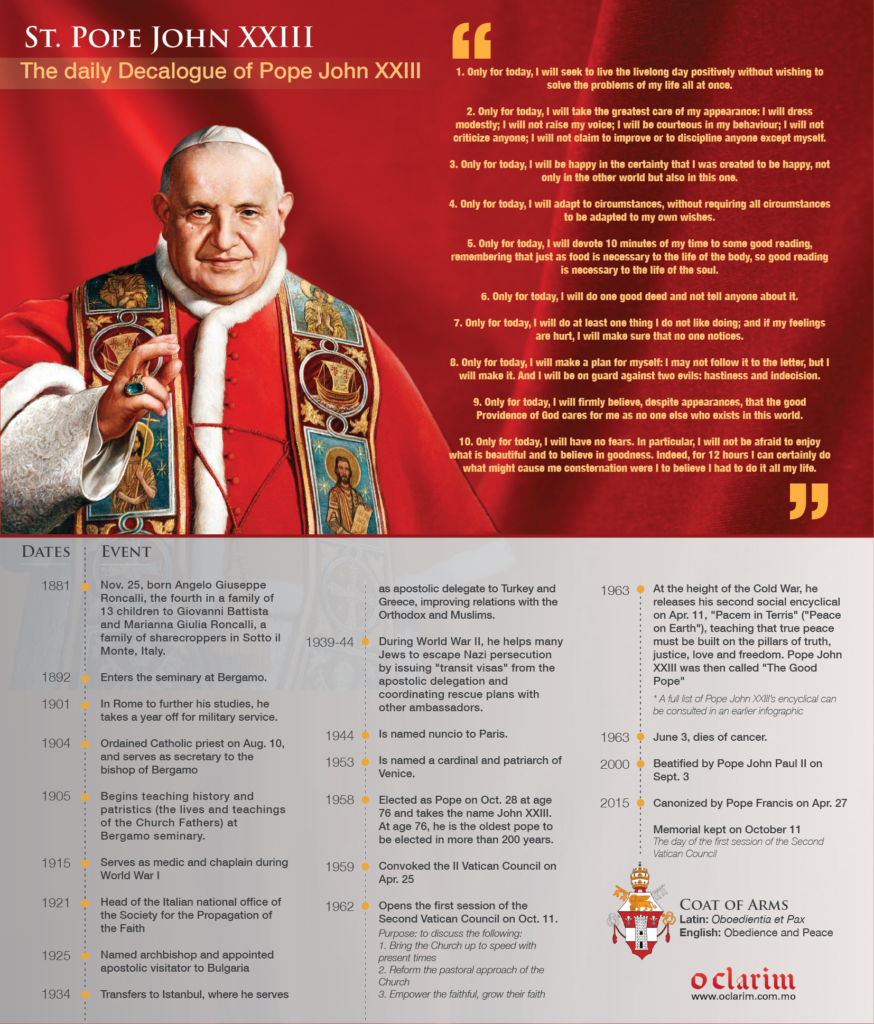
Thought for the Day – 11 October – The Memorial of St John XXIII (1881-1963) “The Daily Decalogue of St Pope John XXIII”
Pope John XXIII’s message is still extraordinarily timely today. His life, his Discourses and his actions bring us to the heart of the faith and the heart of Christian commitment.
As we know, one of Pope John’s most important decisions was to convoke the Second Vatican Ecumenical Council, which was inaugurated on 11 October 1962 here in St Peter’s Basilica.
I was present (indeed, by a fortunate circumstance, it was I who organsed the distribution of the first Council Documents “sub peculiari secreto” to the Council Fathers!) and I remember how the day unfolded to its extraordinary conclusion in St Peter’s Square by moonlight.
We could recall a wealth of Pope John’s teachings and episodes concerning him but today I intend to focus on several thoughts which might be useful in our personal life and spiritual renewal.
The Church, in his view, has a motherly face: her task is to keep “her arms open to receive everyone”. She is a “home for one and all” that “desires to belong to everyone, and in particular she is the Church of the poor, like the village fountain”, with no distinctions of race or religion.
The Church’s holiness and human wisdom are expressed very clearly in what is called “The daily decalogue of Pope John XXIII”:
1) Only for today, I will seek to live the livelong day positively without wishing to solve the problems of my life all at once.
2) Only for today, I will take the greatest care of my appearance: I will dress modestly; I will not raise my voice; I will be courteous in my behaviour; I will not criticize anyone; I will not claim to improve or to discipline anyone except myself.
3) Only for today, I will be happy in the certainty that I was created to be happy, not only in the other world but also in this one.
4) Only for today, I will adapt to circumstances, without requiring all circumstances to be adapted to my own wishes.
5) Only for today, I will devote 10 minutes of my time to some good reading, remembering that just as food is necessary to the life of the body, so good reading is necessary to the life of the soul.
6) Only for today, I will do one good deed and not tell anyone about it.
7) Only for today, I will do at least one thing I do not like doing; and if my feelings are hurt, I will make sure that no one notices.
8) Only for today, I will make a plan for myself: I may not follow it to the letter but I will make it. And I will be on guard against two evils: hastiness and indecision.
9) Only for today, I will firmly believe, despite appearances, that the good Providence of God cares for me as no one else who exists in this world.
10) Only for today, I will have no fears. In particular, I will not be afraid to enjoy what is beautiful and to believe in goodness. Indeed, for 12 hours I can certainly do what might cause me consternation were I to believe I had to do it all my life.
To conclude: here is an all-embracing resolution: “I want to be kind, today and always, to everyone”.In this way, we can put Pope John’s hope for every Christian into practice: “Every believer in this world must be a spark of light, a core of love, life-giving leaven in the mass: and the more he is so, the more he will live, in his innermost depths, in communion with God”. (EUCHARISTIC CONCELEBRATION COMMEMORATING POPE JOHN XXIII ON HIS MEMORIAL – HOMILY OF CARD. TARCISIO BERTONE at the Altar of St Jerome, Vatican Basilica – Wednesday, 11 October 2006)
Quote/s of the Day – 11 October – The Memorial of St John XXIII (1881-1963)
“It is easier for a father to have children than for children to have a real father.”
“Every time I hear anyone speak of the Sacred Heart of Jesus or of the Blessed Sacrament I feel an indescribable joy. It is as if a wave of precious memories, sweet affections and joyful hopes swept over my poor person, making me tremble with happiness and filling my soul with tenderness. These are loving appeals from Jesus who wants me wholeheartedly there, at the source of all goodness, His Sacred Heart, throbbing mysteriously behind the Eucharistic veils… I love to repeat today ‘Sweet Heart of my Jesus, make me love You more and more.'”
Holy Mother Church is a home for one and all. She desires to belong to everyone and in particular she is the Church of the poor, like the village fountain”.




















You must be logged in to post a comment.