Sts Adleida and Lupo of Bergamo Married Martyrs Bl Arnaldo of Liniberio St Culmatius of Arezzo St Deodatus of Jointures St Deodatus of Nevers St Gaudentius of Arezzo
St Hildegrin of Châlons-sur-Marne Bishop St Hildemarca of Fecamp (Died c682) Abbess Blessed Humphrey Middlemore O.Cart. (Died 1535) Priest, Martyr St Innocent of Le Mans St Lambert of Saragossa Layman Martyr St Lupo of Bergamo St Modeste Andlauer St Nazario of Koper Bl Odo of Cambrai St Rémi Isoré Bl Sebastian Newdigate Bl Thomas Woodhouse Bl William Exmew St Zosimus of Umbria
Quote/s of the Day – 18 June – “The Harp of the Holy Ghost!” Father & Doctor of the Church, Confessor
“The Cross gives Light to the whole universe; it casts out darkness and gathers nations together in charity, into One Church, One Faith, One Baptism…”
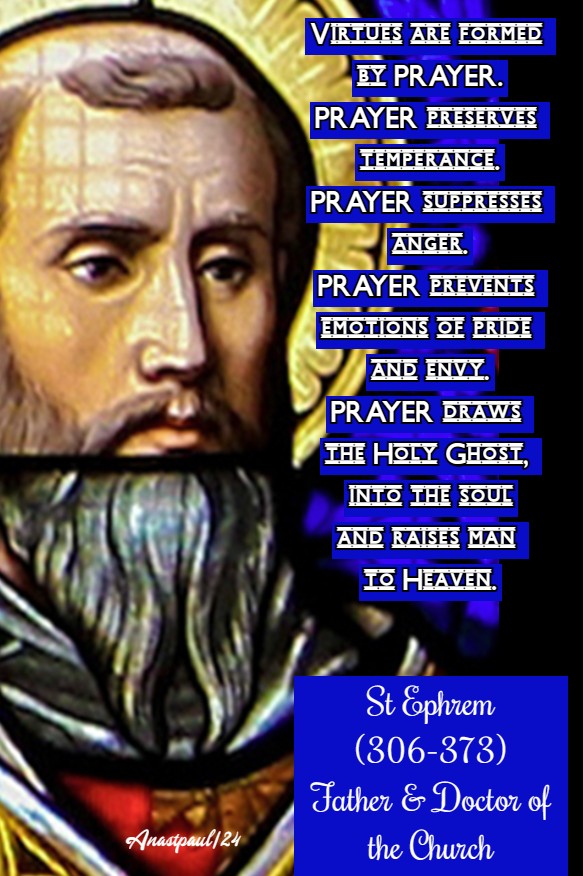
“Virtues are formed by PRAYER. PRAYER preserves temperance. PRAYER suppresses anger. PRAYER prevents emotions of pride and envy. PRAYER draws the Holy Ghost, into the soul and raises man to Heaven.”
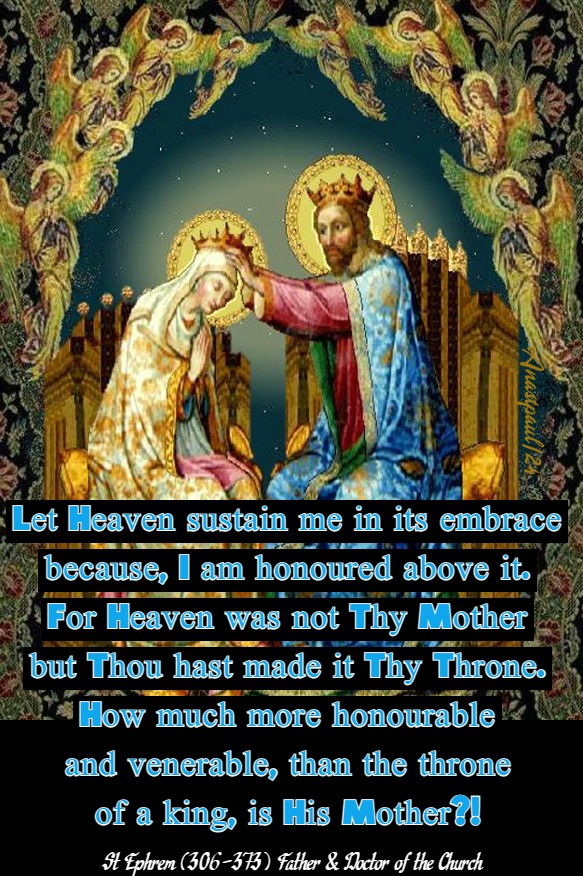
“Let Heaven sustain me in its embrace because, I am honoured above it. For Heaven was not Thy Mother but Thou hast made it Thy Throne. How much more honourable and venerable, than the throne of a king, is His Mother?!”
“Thou alone and Thy Mother, are in all things fair, there is no flaw in Thee and no stain in Thy Mother.”
“Some people, who were opposed to the Holy Ghost, said: “These people have had too much new wine; they are drunk.” Indeed, you speak truly! However, it is not as you think it is. It is not wine from the vineyard they have drunk. It is a new wine that flows from Heaven – a wine newly pressed on Golgotha. The Apostles caused it to be drunk and thus , they inebriated all creation. This is wine that was pressed on the Cross!”
Saint of the Day – 18 June – Saint Abraham of Clermont (Died c479) Abbot and Founder of the Monastery of St Cyriacus in Clermont-Ferrand, Hermit, Miracle-worker. Born in 5th Century Syria and died in c479 of natural causes in his Monastery in France. Patronage – against fever. Also known as – Abraham the Abbot.
Ancient Monks with an old Abbot
Abraham was born in Syria, along the Euphrates River and was of Persian origins. He later left for Egypt, to visit some of the hermits and Monks there, seeking knowledge of monastic life and rules. However, on the way to Egypt, he was kidnapped and held prisoner for five years.
Finally. he managed to escape and ardously travelled to Gaul (France). He settled in Clermont in the Auvergne region as a Hermit. His reputation for holiness spread rapidly and he attracted so many disciples that he needed to build a Monastery to house them, near the Basilica of Saint Cyricus not far from St Illidius Church in Clermont.
He died around 479. St Apollinaris Sedonius, the Bishop of Clermont wrote an Epitaph on the grave of St Abraham from which we have been granted confirmation of some facts concerning our Saint’s life.
St Alena of Dilbeek St Amandus of Bordeaux St Arcontius of Brioude St Athenogenes of Pontus St Calogero of Sicily St Calogerus of Fragalata St Calogerus the Anchorite St Colman mac Mici St Cyriacus of Malaga St Demetrius of Fragalata St Edith of Aylesbury
St Elpidius of Brioude St Equizio of Telese St Erasmo St Etherius of Nicomedia Bl Euphemia of Altenmünster St Fortunatus the Philosopher St Gerland of Caltagirone St Gregory of Fragalata
St Osanna of Northumberland St Osmanna of Jouarre St Paula of Malaga Bl Peter Sanchez
Hermits of Karden: A father (Felicio) and his two sons (Simplicio and Potentino) who became pilgrim to various European holy places and then hermits at Karden (modern Treis-Karden, Germany). (Born in Aquitaine (in modern France. ) Their relics transferred to places in the Eifel region of western Germany at some point prior to 930. They were canonised on 12 August 1908 by Pope Pius X (cultus confirmation).
Martyrs of Ravenna – 4 Saints: A group of four Christians Martyred together. We have no details but their names – Crispin, Cruciatus, Emilius and Felix. They were martyred in Ravenna, Italy, date unknown.
Martyrs of Rome – 3 Saints: Three Christians Martyred together . We have no details but their names – Cyriacus, Paul and Thomas. In Rome, Italy, date unknown.
Martyrs of Tripoli – 3 Saints: Three imperial Roman soldiers, at last two of them recent converts, who were imprisoned, tortured and executed for their faith. Martyrs – Hypatius, Leontius and Theodulus. They were Greek born and they died c135 at Tripoli, Phoenicia (in modern Lebanon).
Saint of the Day – 17 June – Saint Fulk (Died 900) Archbishop of Rheims in 883, Chancellor of Frankish Kingdom, protector and defender of the Church’s rights and assets for which position he was murdered on 17 June 900. Some sources name him a Martyr for the Church of Christ. Also known as – Foulques the Venerable, Coots the Venerable … Folco…Foulque…Fulco…Foulques of Reims… Fulko…Fulque…Fulquerio…Venerável…
Fulk was born into a noble Frankish family with close ties to the Carolingian dynasty. His brother, Anscarius I, became the first Marquis of Ivrea, giving rise to the Anscarici dynasty.
Fulk undertook an Ecclesiastical career from a young age, becoming a Palace Cleric at the Court of Charles II the Bald. In 877 his dedication and ability led to his appointment as the Abbot of the Benedictine Abbey of St Bertinus.
On 7 March 883, Fulk reached the pinnacle of his Ecclesiastical career with his appointment as the Archbishop of Rheims, one of the most prestigious Episcopal Sees of the West Frankish Kingdom. During his tenure, he fervently devoted himself to the restoration of the Diocesan Cathedral, the symbol of his spiritual authority.
In 898, Fulk assumed the role of the Chancellor of the Kingdom, taking a leading role in the political sphere. He became noticeable for his tenacious defence of Ecclesiastical assets from the expansionist aims of the nobles, countering secular interference in the properties of the Church.
Fulk’s strenuous defence of the rights of the Church led him to clash with Baldwin II, the powerful Count of Flanders. According to the chronicler Floardus, the King granted Fulk the Abbey of St Vaast in Arras, previously controlled by Baldwin. This act fuelled tensions between the two, leaders culminating in the assassination of Fulk on 17 June 900 at the hands of men in the service of the Flemish Count.
St Briavel of Gloucestershire St David of Bourges St Dignamerita of Brescia St Diogenes of Rome St Emily de Vialar St Fulk of Rheims (Died 900) Bishop St Gundulphus of Bourges
St Himerius of Amelia St Hypatius of Chalcedon St Molling of Wexford St Montanus of Gaeta St Nectan of Hartland Bl Paul Burali d’Arezzo Bl Peter Gambacorta Bl Philippe Papon St Prior St Rambold of Ratisbon
Martyrs of Apollonia – 7 Saints: A group of Christians who fled to a cave near Apollonia, Macedonia to escape persecution for his faith, but were caught and executed. The names we know are – Basil, Ermia, Felix, Innocent, Isaurus, Jeremias and Peregrinus. They were beheaded at Apollonia, Macedonia.
Martyrs of Aquileia – 4 Saints: Four Christian Martyrs memorialised together. No details about them have survived, not even if they died together – Ciria, Maria, Musca and Valerian. c.100 in Aquileia, Italy.
Martyrs of Chalcedon – 3 Saints: Three well-educated Christian men who were sent as ambassadors from King Baltan of Persia to the court of emperor Julian the Apostate to negotiate peace between the two states, and an end of Julian’s persecutions of Christians. Instead of negotiating, Julian imprisoned them, ordered them to make a sacrifice to pagan idols and when they refused, had them executed. Their names were Manuel, Sabel and Ismael. They were beheaded in 362 in Chalcedon (part of modern Istanbul, Turkey) and their bodies burned and no relics survive.
Martyrs of Fez – 4 Beati: A group of Mercedarians sent to Fez, Morocco to ransom Christians imprisoned and enslaved by Muslims. For being openly Christian they were imprisoned, tortured, mutilated and executed. Martyrs – Egidio, John, Louis and Paul. They were martyred in Fez, Morocco.
Martyrs of Rome – 262 Saints: A group of 262 Christians Martyred in the persecutions of Diocletian. In c303 in Rome, Italy. They were buried on the old Via Salaria in Rome.
Martyrs of Venafro – 3 Saints: Three Christian lay people, two of them imperial Roman soldiers, who were converts to Christianity and were Martyred together in the persecutions of Maximian and Diocletian – Daria, Marcian and Nicander. They were beheaded c.303 in Venafro, Italy. By 313 a basilica had been built over their graves which were re-discovered in 1930. They are patrons of Venafro, Italy.
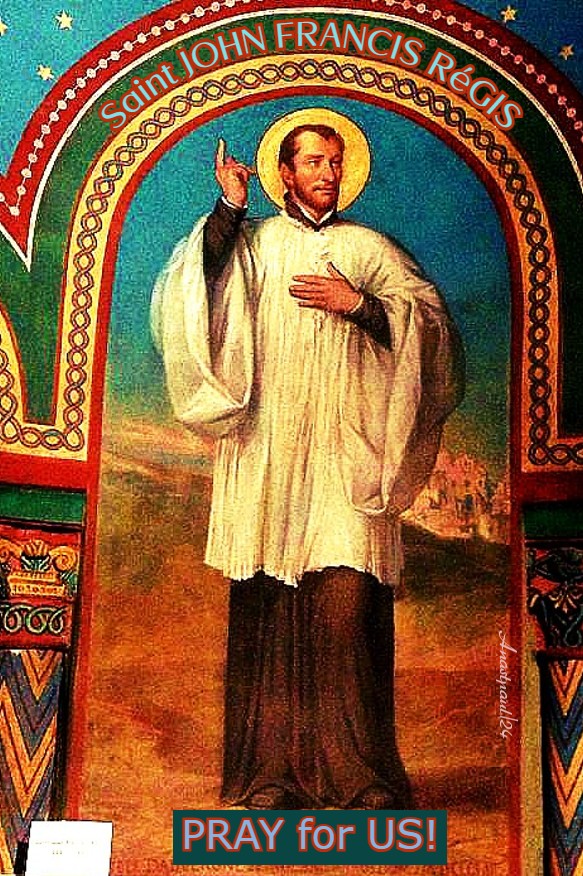
Quote/s of the Day – 16 June – St John Francis Régis SJ (1597-1640) Priest, Confessor, Missionary –The Fourth Sunday after Pentecost – Romans 8:18-23; Luke 5:1-11 – Scripture search here: https://www.drbo.org/
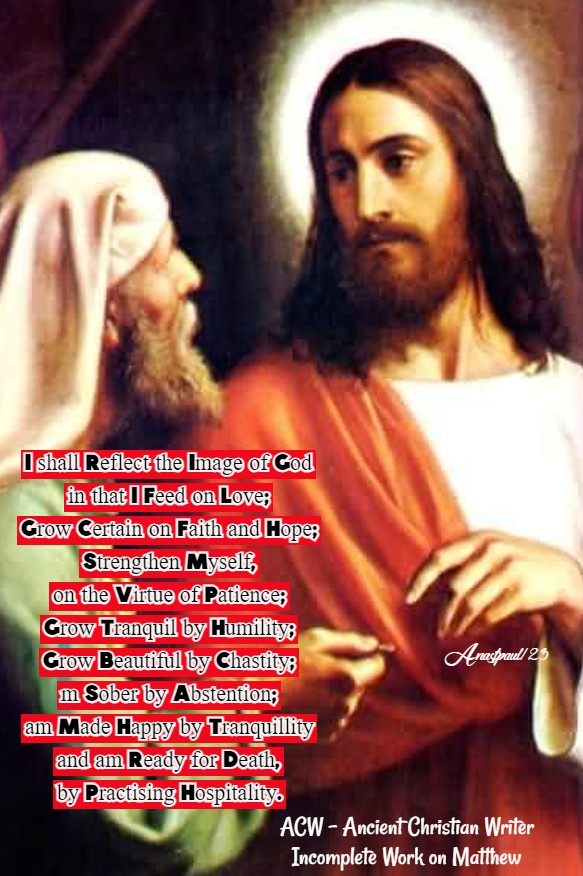
“I shall reflect the image of God in that I feed on love; grow certain on faith and hope; strengthen myself, on the virtue of patience; grow tranquil by humility; grow beautiful by chastity; am sober by abstention; am made happy by tranquillity and am ready for death, by practising hospitality.”
ACW – Ancient Christian Writer Incomplete Work on Matthew (Homily 40)
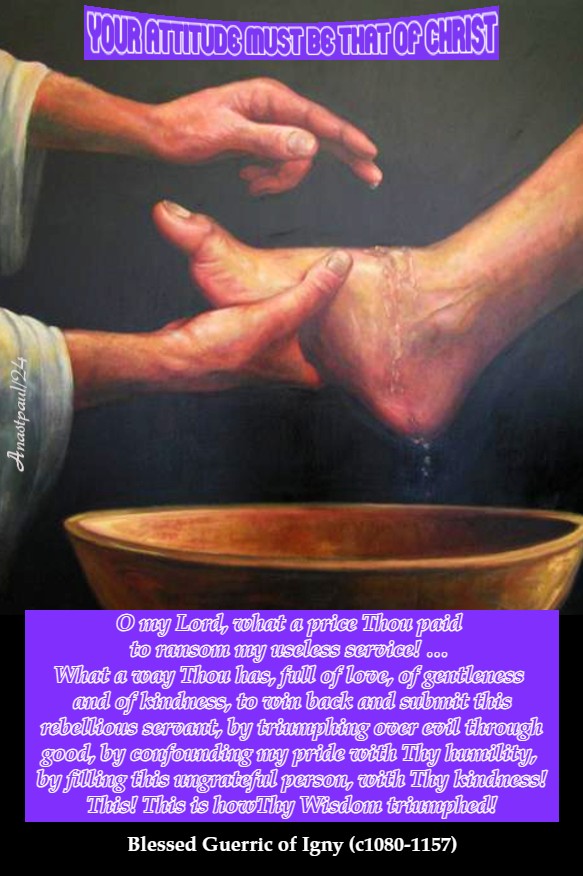
“O my Lord, what a price Thou paid to ransom my useless service! … What a way Thou has, full of love, of gentleness and of kindness, to win back and submit this rebellious servant, by triumphing over evil through good, by confounding my pride with Thy humility, by filling this ungrateful person, with Thy kindness! This! This is howThy Wisdom triumphed!”
Blessed Guerric of Igny (c1080-1157) Cistercian Abbot
“Fear not, henceforth you shall catch men.” Luke 5:10
“At Thy Word I will lower the nets.” It is at the command of divine grace and supernatural inspiration that the nets of preaching are to be spread out. Otherwise, the preacher wastes his time in lowering the lines of his words. People’s faith is won, not by carefully composed speeches but the grace of a divine vocation… O fruitful humility! When those who so far have not caught a thing, put their trust in Christ’s Word, they catch a great number of fish…”
St Anthony of Padua (1195-1231) Doctor of the Church
“Humility and charity are the two master chords – one, the lowest; the other, the highest; all the others are dependent on them. Therefore, it is necessary, above all. to maintain ourselves in these two virtues, for observe well, that the preservation of the whole edifice depends on the foundation and the roof!”
One Minute Reflection – 16 June – “The Month of the Sacred Heart of Jesus” – St John Francis Régis SJ (1597-1640) Priest, Confessor, Missionary –The Fourth Sunday after Pentecost – Romans 8:18-23; Luke 5:1-11 – Scripture search here: https://www.drbo.org/
“ And Jesus saith to Simon: Fear not, from henceforth thou shalt catch men. – Luke 5:10
REFLECTION – “On that night of light [ Christmas, at fourteen years of age] began the third period of my life, the most beautiful and the most filled with graces from Heaven … I could say to Him like His Apostles: “Master, I fished all night and caught nothing.” More merciful to me than He was to His disciples, Jesus took the net Himself, cast it, and drew it in filled with fish. He made me a fisher of souls. I experienced a great desire to work for the conversion of sinners. The cry of Jesus on the Cross sounded continually in my heart: “I thirst!” These words ignited within me an unknown and very living fire. I wanted to give my Beloved to drink and I felt myself consumed with a thirst for souls …
To awaken my zeal, God showed me my desires were pleasing to Him. I heard talk of a great criminal just condemned to death for some horrible crimes; everything pointed to the fact that he would die impenitent. I wanted, at all cost,s to prevent him from falling into hell… I felt, in the depths of my heart, certain that our desires would be granted but to obtain courage to pray for sinners I told God I was sure He would pardon the poor, unfortunate Pranzini; that I’d believe this, even if he went to his death without any signs of repentance or without having gone to Confession. I was absolutely confident in the mercy of Jesus. But, I was begging Him for a “sign” of repentance, only for my own simple consolation. My prayer was answered to the letter! …
After this unique grace, my desire to save souls grows each day and I seemed to hear Jesus say that which He said to the Samaritan woman: “Give me to drink!” It was a true interchange of love – to souls, I was giving the Blood of Jesus – to Jesus, I was giving these same souls, refreshed by the Divine Dew. I slaked His Thirst and the more I gave Him to drink, the more the thirst of my poor, little soul increased and it was this ardent thirst, He was giving me as the most delightful drink of His Love.” – St Thérèse of the Child Jesus (1873-1897) Carmelite (Autobiographical Manuscript).
PRAYER – Grant, we beseech Thee, O Lord God, unto all Thy servant, that they may remain continually in the enjoyment of soundness, both of mind and body and by the glorious intercession of the Blessed Mary, always a Virgin, Thy Saints, remembering Thy Confessor John Francis Regis, may be delivered from present sadness, and enter into the joy of thine eternal. Through the same Jesus Christ, Thy Son our Lord, Who lives and reigns with Thee, in the unity of the Holy Ghost, God, world without end. Amen (Collect).
MAY the Heart of JESUS in the most Blessed Sacrament be praised, adored and loved with grateful affection, at every moment, in all the Tabernacles of the world, even to the end of time. – Indulgence 100 Days, Once a Day. Raccolta 161 Blessed Pius IX, 29 February 1868.
Saint of the Day – 16 June – Saint Aurelian of Arles (c523-c551) Bishop of Arles from 546, Founder of Monasteries. His predecessors were St Auxanius (the Bishop from 542/3–546) and St Caesarius of Arles (Died 533). His father, Sacerdos, (Died552) was an Archbishop of Lyon. His cousin, Nicetius (Died 573) succeeded his father as the Archbishop of Lyons. He died on 16 June c551 in Lyons, aged just 28 years old and is buried in the Church of Saint-Nizier. The text of his Epitaph is preserved. Also known as – Aurelianus, Aurelian the Sinner (his own name for himself), Aureliano.
The Roman Martyrology reads: “At Lyons, the blessed Aurelian, Bishop of Arles.”
Aurelian was elected as the Bishop of Arles in 546, when he was only 23 years old. At the request of King Childebert, he was appointed as the Vicar of the Apostolic See in Gaul, by Pope Vigilius and invested with the Pallium.
He founded the Monastery of St Peter, in Arles to which he gave a Rule inspired by that of St Caesarius. He also founded a Convent dedicated to the Blessed Virgin Mother in collaboration with King Childebert I and his wife Ultrogotha. Saint Peter’s Monastery may count among the first Monasteries (co-)founded by a Merovingian King.
He wrote a Rule for Monks for his first foundation which is primarily based on St Caesarius of Arles’ Rule for Monks but also uses parts of St Caesarius’ Rule for Virgins. It is the only early medieval Monastic Rule for Monks which requires total enclosure. Later Aurelian produced a female version of his Rule for his second foundation. His Rule for Nuns is somewhat shorter but shows few signs of an adjustment. Both Rules are preserved.
In 549, Aurelian participated in the 5th Council of Orléans which was presided by his father. as the Archbishop of Lyons, in which the condemnation of Nestorius and Eutyches was renewed.
He received a letter, dated 29 April 550, from PopeVigilius in response to one of his own, in which he complained about the Papal attitude regarding the ‘three chapters.’ The Pontiff justified himself by saying that he did not intend to admit any proposition against what was established by the Councils of Nicaea, Chalcedon and Ephesus and asked him to intervene with Childebert so that he could obtain, from the Arian Totila and the Goths the respect of the Church of Rome.
Aurelian died in Lyons, probably on 16 June. 551 and was buried in the Basilica of Nizier.. Mentioned by sTS Florus and Adonis, the name of Aurelian also appears in the Roman Martyrology, which commemorates his Feast on 16 June.
St Nizier Basilica In Lyons where St Aurelian is buried
Father’s Day + 2024 Wishing all Dads a Blessed and Happy Father’s Day!
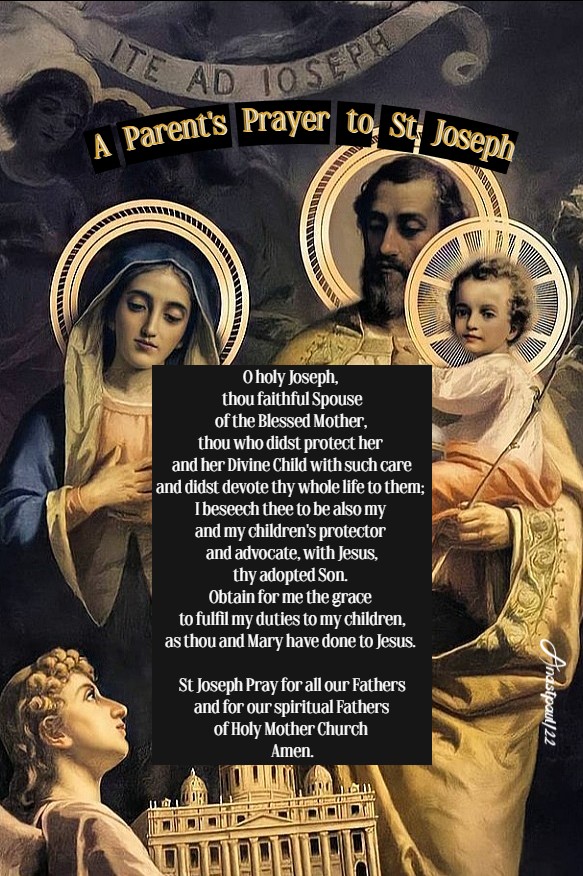
A Parent’s Prayer to St Joseph
O holy Joseph, thou faithful Spouse of the Blessed Mother, thou who didst protect her and her Divine Child with such care and didst devote thy whole life to them; I beseech thee to be also my and my children’s protector and advocate, with Jesus, thy adopted Son. Obtain for me the grace to fulfil my duties to my children, as thou and Mary have done to Jesus.
St Joseph Pray for all our Fathers and for our spiritual Fathers of Holy Mother Church Amen.
St Berthaldus St Ceccardus of Luni St Cettin of Oran St Colman McRhoi St Crescentius of Antioch St Cunigunde of Rapperswil St Curig of Wales St Cyriacus of Iconium (c 301-c 304) Child Martyr
Blessed Donizetti Tavares de Lima (1882-1961) Priest, Apostle of the poor, the elderly and the sick, miracle-worker, known to bilocate. A prophecy related to Vatican II: “No, no, Archbishop! We won’t see this disgrace (prophesying that they both would die soon) but it will come! This was not just a dream, nor a nightmare! The darkness will fall over this world! I beg you: don’t let them destroy the Altars!” An amazing life: https://anastpaul.com/2020/06/16/saint-of-the-day-16-june-blessed-donizetti-tavares-de-lima-1882-1961/
St Elidan St Felix of San Felice St Ferreolus of Besançon St Ferrutio of Besançon Bl Gaspare Burgherre St Graecina of Volterra St Ismael of Wales St Julitta of Iconium St Justina of Mainz
St Maurus of San Felice St Palerio of Telese St Similian of Nantes Bishop and Confessor Bl Thomas Redyng St Tycho of Amathus
Martyrs of Africa: A group of 5 Christians Martyred together. We know nothing else but the names – Cyriacus, Diogenes, Marcia, Mica, Valeria. They were martyred in an unknown location in Africa, date unknown.
Our Morning Offering – 15 June – “The Month of the Sacred Heart of Jesus” – Our Lady’s Saturday
Memorare to Our Lady of the Sacred Heart of Jesus By the Missionaries of the Sacred Heart (MSC) Patronag: Of Difficult and Impossible Causes.
Remember, Our Lady of the Sacred Heart, what ineffable power thy Divine Son hath given thee over His own adorable Heart. Full of trust in thy merits, we come before thee and beg thy protection. O heavenly Treasurer of the Heart of Jesus that Heart which is the inexhaustible source of all graces which thou mayest open to us at thy good pleasure, in order that, from it may flow forth upon mankind the riches of love and mercy, light and salvation which are contained therein; grant unto us, we beseech thee, the favours which we seek. We can never, never be refused by thee and since thou art our Mother, O our Lady of the Sacred Heart, graciously hear our prayers and grant our request. Amen
Our Lady of the Sacred Heart is a title which originated with the Missionaries of the Sacred Heart, founded by Fr J Chevalier (1824-1907) at Issoudun/France. This religious Congregation was founded to revive and regenerate the Christian faith, thanks to a special devotion to the Sacred Heart and to Our Lady. Their spirituality is based on a strong faith in the love of God the Father which revealed itself in the Heart of Jesus. This Christocentric orientation is linked with a lively devotion to Mary under the title of Our Lady of the Sacred Heart. It is said in the Rule of Life of the Missionaries of the Sacred Heart, “Since Mary was so intimately related to the Mystery of her Son’s Heart, we pray to her as did Fr Chevalier and we invoke her under the title of Our Lady of the Most Sacred Heart of Jesus. She knew of the inexhaustible riches of Christ; she was totally filled with His Love. She leads us to Him and directs us to His Heart which is the Source of Love …” ( #18)
Saint of the Day – 15 June – Saint Constantine of Beauvais (Died c706) Bishop, the 17th Bishop of Beauvais in France. He died in c706 of natural causes probably in Jumiègeswhere he was buried.
Located in the 17th place in the chronology of the Diocese of Beauvais, between Bishops Clement and Radingus, Saint Constantine takes on a role of primary importance in the religious history of the region. Despite his position, information about him is fragmentary and often contradictory.
Ancient French Bishop found in an Antique shop is probably NOT our Saint but could also, just as well, be him.
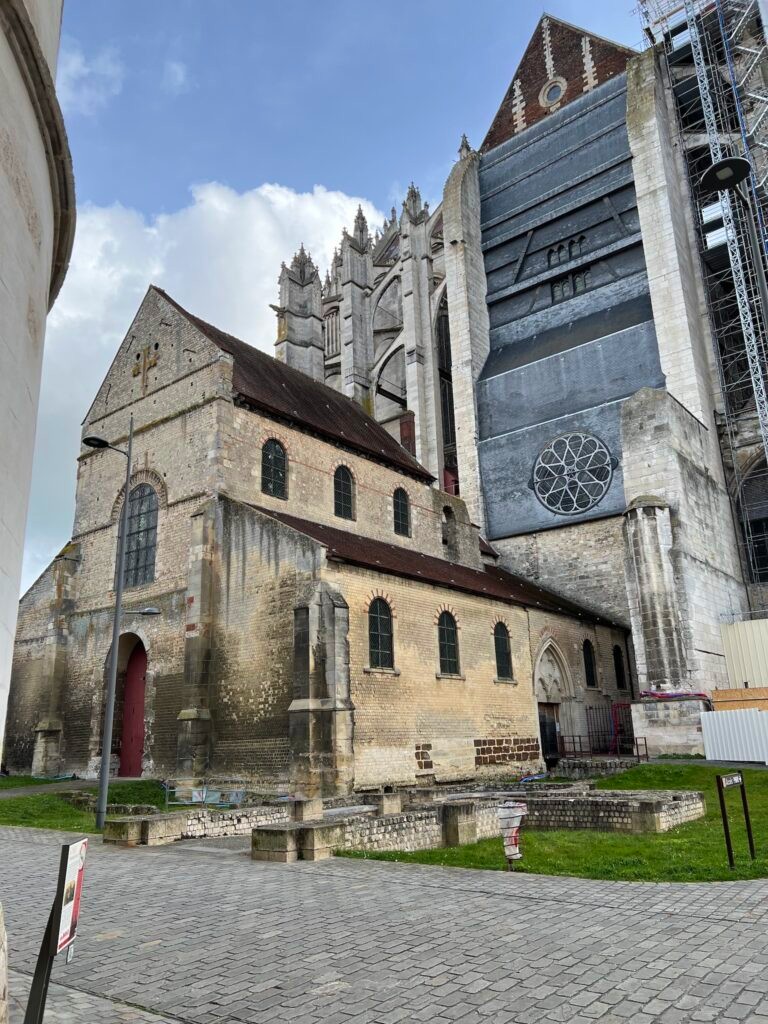
Tradition attributes the foundation of the Diocese of Beauvais, located in the French region of Oise, to the evangelising work of Saint Lucian, a Roman Priest Martyred in the 3rd Century. However, in 632, the first historically documented Bishop is Maurinus (or Marinius), who signed an act of foundation of the Monastery of Solignac. The name of Constantine also appears in these documents but his figure remains shrouded in obscurity.
The 1st Cathedral of Beauvais, the 10th Century Basse-Oeuvre, a rare Carolingian structure and as you can see, it was successfully incorporated into the new Cathedral
The little information which has come down to us, tells of a Monk from Jumièges, who, having ascended to the role of the Bishop of Beauvais, led the Diocese in an unspecified period between 692 and 706. After his death which presumably occurred in Jumièges, where he was buried, his memory was honoured with the Liturgical Feast set for 15 June.
The New Cathedral
Despite the lack of precise details about his life and Episcopate, Saint Constantine of Beauvais remains a significant figure in the religious landscape of medieval France. His story, although fragmentary, testifies to the spread of Christianity in Gaul and the importance of the Episcopal role in the consolidation of Christian communities.
St Vitus (c 290-c 303) – Martyr, One of the Fourteen Holy Helpers. Died aged 12-13 years of age. Patronages – against animal attacks, against dog bites, against epilepsy; epileptics, against lightning, against over-sleeping, against rheumatic chorea or Saint Vitus Dance, against snake bites, against storms, against wild beasts, of actors, comedians, dancers, dogs, Bohemia, Czech Republic, Serbia, 17 cities. His very short life: https://anastpaul.com/2017/06/15/saint-of-the-day-15-june-st-vitus/
St Abraham of Saint-Cyriacus St Achaicus of Corinth St Barbara Cui Lianshi St Benildis of Córdoba
St Bernard of Montjoux/Menthon CRSA (c 1020-1081) “Apostle of the Alps” Priest, Founder of a patrol that cleared robbers from the mountains and he established hospices for travellers and pilgrims. The large dogs, trained to search for lost victims in the mountains, are named for him. Patronages – Alpinists, Alps (proclaimed by Pope Pius XI on 20 August 1923), Campiglia Cervo, Italy, mountain climbers (proclaimed by Pope Pius XI on 20 August 1923), mountaineers, skiers, travellers in the mountains (proclaimed by Pope Pius XI on 20 August 1923). Biography: https://anastpaul.com/2018/06/15/saint-of-the-day-15-june-st-bernard-of-menthon-c-r-s-a-c-1020-1081-apostle-of-the-alps/
St Constantine of Beauvais (Died c706) Bishop St Domitian of Lobbes St Edburgh of Winchester St Eigil St Eutropia of Palmyra St Fortunatus of Corinth
St Hadelinus of Lobbes St Hesychius of Durostorum St Hilarion of Espalion
St Isfrid of Ratzeburg O.Praem (c 1115-1204) Bishop of Ratzeburg, Confessor, Spiritual advisor, Missionary, Mediator and Peacemaker, a renowned Administrator and gentle corrector of his flock, whom he protected against political abuses, Defender of the Pope and the Holy See. Istfrid also built and restored Churches and Monasteries and established many new Parishes. A Holy and Untiring Shepherd: https://anastpaul.com/2022/06/15/saint-of-the-day-15-june-saint-isfrid-of-ratzeburg-o-praem-c-1115-1204/
Bl Juan Rodriguez St Julius of Durostorum St Landelin of Crespin St Leonides of Palmyra St Libya of Palmyra St Lotharius of Séez St Melan of Viviers St Orsisius Bl Pedro da Teruel Bl Peter Snow St Pierre de Cervis
St Tatian of Cilicia Bl Thomas Scryven St Trillo of Wales St Vaughen of Ireland
St Vouga of Lesneven
Martyr of Lucania – 11 Saints: Eleven Christians Martyred together. We known nothing else about them but the names – Anteon, Candidus, Cantianilla, Cantianus, Chrysogonus, Jocundus, Nivitus, Protus, Quintianus, Silvius, Theodolus in Lucania (modern Basilicata), Italy, date unknown.
Saint of the Day – 14 June – Saint Fortunatus of Naples (4th Century) Bishop Confessor, a fierce Defender of the Faith against Arianism. He is the first historically-attested Bishop of Naples, as one of the recipients of a letter written by those who took part in the Arian Council of Philippopolis in the 340s -he was a fierce opponent of Arianism. His term as the Bishop is held to be 347 to 359. Also known as – Fortunato. Additional Memorial – 8 November, the day when it celebrates the memory of all the “Bishop Saints of the Church of Naples.”
St Fortunatus top row right
The date of Fortunatus Episcopate is not totally precise, but is believed to have been towards the middle of the 4th Century, at the time that the Arian heresy was raging.
The heresy arose from the heretic Arius of Alexandria (280-336), who stated that the Word, Incarnated in Jesus Christ, is not of the same substance as the Father but represents the first of His creatures.
The heresy unleashed, a sometimes violent struggle, between the two positions existing in the Church. The Bishop of Naples, Fortunato did everything to preserve his Diocese from the Arian heresy, despite the attempt of the favourable eastern Bishops, who, having fled from the Council of Sardica (now Sofia in Bulgaria), wanted to draw him to their side.
It is known that he had a cemetery Basilica built which took his name, in the Sanità valley, not far from the Catacombs of St Gaudiosus and, which took on primary importance. In this Basilica Fortunato waslater buried and the mortal remains of the Bishops of Naples were also interred there. St Maximus,ae 10th Bishop of Naples, who was a victim of the Arian struggle, had died in exile in the East and which fact, his successor, St Severius, had reported to Naples.
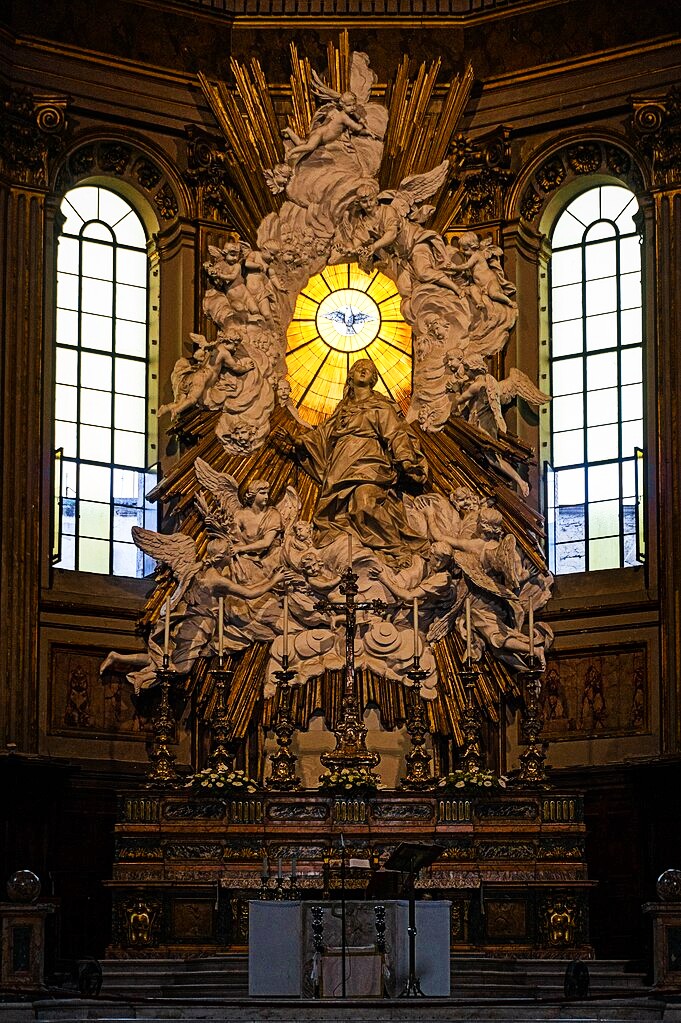
Naples Cathedral High Altar
Under the Episcopate of Bishop John the Scribe (Died 849), the Relics of St Fortunatus and St Maxomus were moved to the ancient Cathedral of Naples.
And from that same period is the famous “Marble Calendar ” of Naples, sculpted in the 9th Century and still preserved in the rooms of the current Cathedral which bears the name of our Saint Fortunatus on 14 June and which, on the same date, is then reported in other Neapolitan Calendars and in the Roman Martyrology.
Even today, many Neapolitans bear his name, this testifies to the long and incessant cult enjoyed over the centuries by the holy Bishop Fortunatus, about whom, unfortunately, only little information has been passed to us.
St Anastasius of Córdoba St Burchard of Meissen St Caomhán of Inisheer St Castora Gabrielli St Cearan the Devout Bl Constance de Castro St Cyprien St Cyriacus of Zeganea St Davnet St Digna of Córdoba St Dogmael of Wales St Elgar of Bardsey
St Etherius of Vienne St Felix of Córdoba St Fortunatus of Naples (4th Century) Bishop Confessor St Gerold of Evreux Bl Hartwig of Salzburg St Joseph the Hymnographer
St Nennus of Arran Bl Peter de Bustamante St Protus of Aquileia St Quintian St Richard of Saint Vannes
St Rufinus of Soissons * (Died 4th Century) Layman, Martyr. AND St Valerius of Soissons * (Died 4th Century) Layman, Martyr The Roman Martyrology reads: “At Soissons in Belgic Gaul, today in France, the Holy Martyrs – Saints Valerius and Rufinus, who after enduring many torments, were condemned to be beheaded by the Governor, Rictiovarus, in the persecution of Diocletian.” Their Lives and Deaths: https://anastpaul.com/2023/06/14/saints-of-the-day-14-june-st-valerius-and-st-rufinus-of-soissons-died-4th-century-laymen-martyrs/
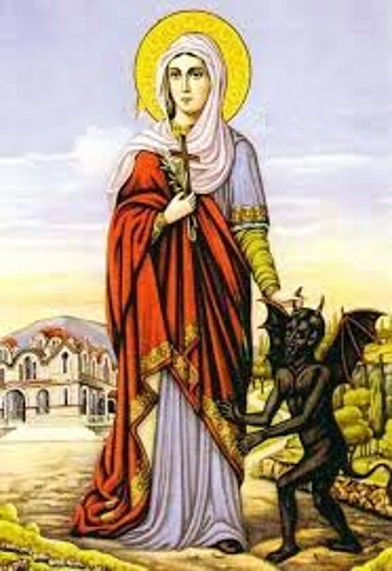
Saint of the Day – 13 June – Saint Aquilina of Syria (281–293) Virgin Child Martyr. Born in 281 in Byblos, Phoenicia (in modern Lebanon) and died by torture in 293 in Byblos during the reign of Diocletian. Also known as – Aquilina of Byblos, Aquilina of Biblus, Aquilina of Lebanon..
The Roman Martyrology reads today: “At Byblos, in Palestine, St Aquilina, Virgin and Martyr, at the age of 12 years, under the Emperor Diocletian and the Judge Volusian. For the confession of the Faith, she was buffeted, scourged, pierced with red-hot bodkins and, being struck with the sword, consecrated her virginity by Martyrdom.”
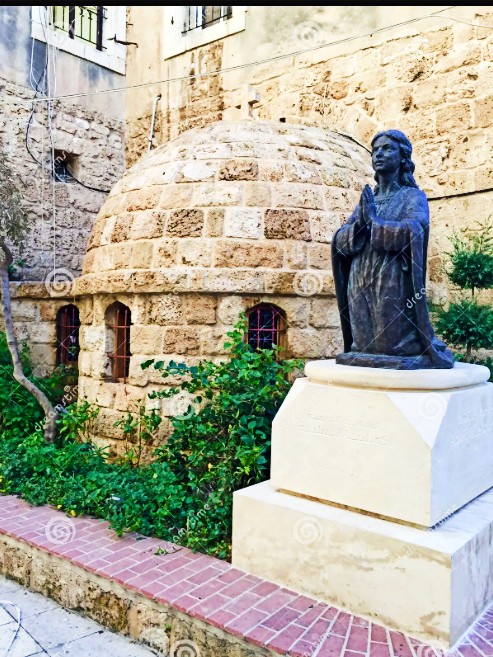
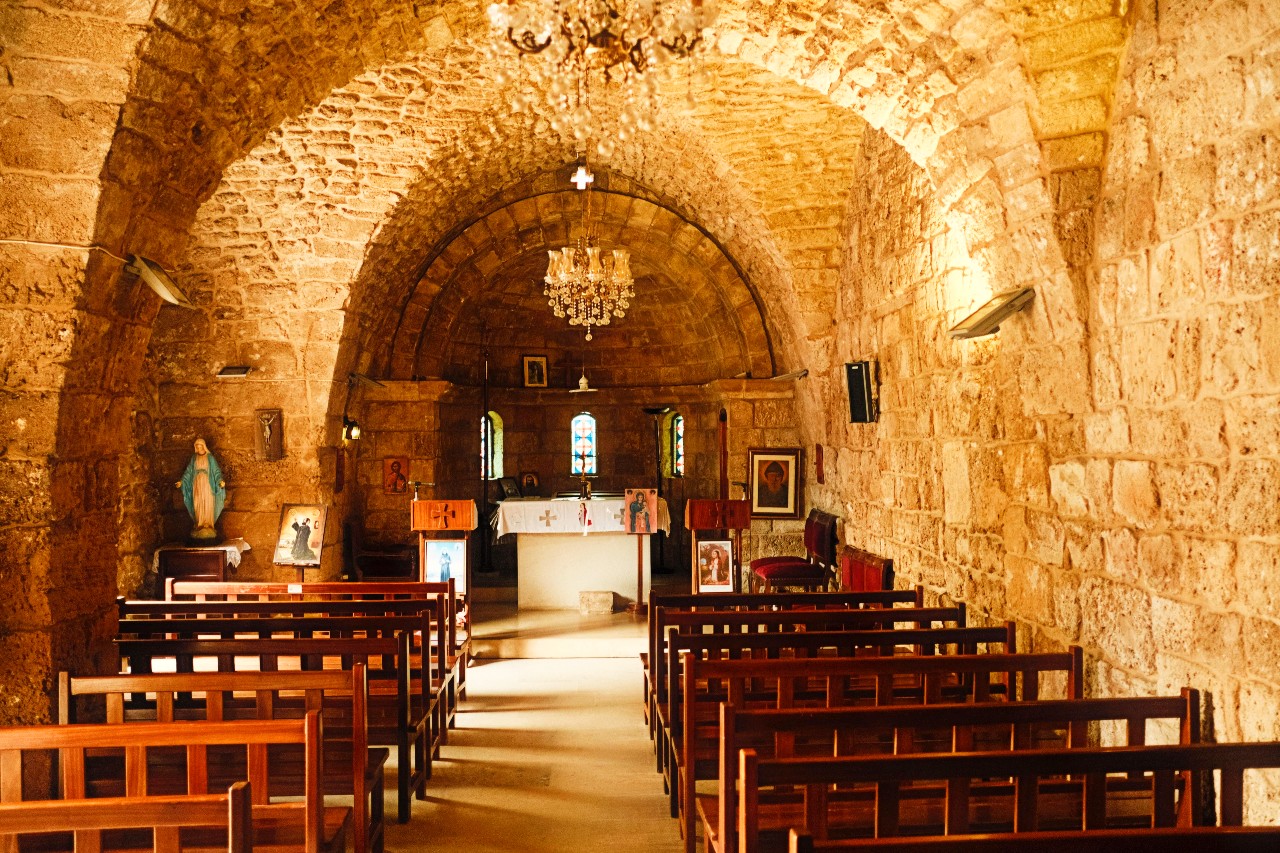
Statue of St Aquilina outside the Church dedicated to her in Lebanon
Between 63 and 330 Byblo in modern Lebanon was under Roman rule and, although Christianity existed there from the time of the Apostles, Christians were a minority among the majority pagans. During their rule, the Romans not only strengthened the worship of idols but some of their governors actively persecuted the Christians. When Aquilina was condemned to death in 293, Volusian was the Magistrate of Byblos.
Aquilina, a native of the Phoenician (now Lebanon) City of Byblos, suffered under Emperor Diocletian in the 3rd Century. Her father’s name was Eutolmius. She was raised in Christian piety by her parents. She received her catechism from Evthalios, the Bishop of Byblos.
When she was only twelve years old, she persuaded a pagan friend to convert to Christ through her example and teachings. One of the servants of Governor Volusian accused her of teaching others to reject paganism. She was taken before the Governor where she firmly confessed her belief in Christ and said that she would not renounce Him. Volusian tried to influence her through persuasion and flattery but, seeing her confidence, he ordered her to be tortured.
She was struck upon the face, then stripped and flogged. Heated metal rods were then drilled through her ears and Aquilina fell down as if dead. The torturers thought that she had actually died and gave orders that her body be thrown outside the City to be eaten by dogs. However, later that night, an Angel appeared to Aquilina, roused her and said, “Arise and be healed. Go and denounce Volusian, so that he and his plans may come to nothing.”
Aquilina regained consciousness and went before Volasian, who sentenced her to be decapitated in the morning, saying that she was a sorceress who refused his imperial decrees. Before the executioner could carry out the sentence, the Martyr gave up her spirit. The Christians buried her body outside the City where her Tomb became a site for pilgrimage and cures.
Later her holy Relics were transported to Constantinople where a great Basilica was built in her honour near the Forum of Constantine in the Philoxene quarter. This Basilica was later destroyed in a fire.
St Fandilas of Penamelaria St Felicula of Rome St Fortunatus of North Africa
Blessed Gerard of Clairvaux (Died 1138) – was the elder brother of Saint Bernard of Clairvaux. He was a Soldier. When he was wounded in combat at the siege of Grancy, Gerard resolved to become a Monk. He became a Benedictine Cistercian Monk at Citeaux. He worked with Saint Bernard at Clairvaux and became his closest confidant. He died in 1138 of natural causes.
St Lucian of North Africa St Mac Nissi of Clonmacno St Maximus of Cravagliana St Nicolas Bùi Ðuc The St Peregrinus of Amiterno St Rambert St Salmodio Bl Servatius Scharff St Thecla
St Amphion of Nicomedia Bl Antonio de Pietra St Arsenius of Konev St Christian O’Morgair of Clogher St Chrodobald of Marchiennes St Cominus Bl Conrad of Maleville St Cunera St Cuniald St Cyrinus of Antwerp St Eskil St Galen of Armenia St Gerebald of Châlons-sur-Seine St Geslar
St Pope Leo III (c 750-816) Bishop of Rome and Ruler of the Papal States from 26 December 795 to his death. Defender of the City ad peoples of Rome and of the Church. Peacemaker and restorer of Churches and Monasteries, Patron of the Arts and Apostle of the poor. Know as “Charlemagne’s Pope” His Life: https://anastpaul.com/2021/06/12/saint-of-the-day-12-june-st-pope-leo-iii-c-750-816/
St Odulf of Utrecht (Died c865) Priest, Monk, Prior St Olympius of Aenos St Onuphrius of Egypt Bl Pelagia Leonti of Milazzo St Peter of Mount Athos St Placid of Val d’Ocre St Ternan of Culross St Valerius of Armenia
Martyrs of Bologna: Three Christians who were Martyred at different times and places, but whose relics have been collected and enshrined together – Celsus, Dionysius, and Marcellinus. Their relics were enshrined in churches in Bologna and Rome in Italy.
St Basilides and Companions / Martyrs of Rome: Four members of the Imperial Roman nobility. They were all soldiers, one or more may have been officers, and all were Martyred in the persecutions of Diocletian – Basilides, Cyrinus, Nabor and Nazarius. They were martyred in 304 outside Rome, Italy and buried along the Aurelian Way.
Three Holy Exiles: Three Christian men who became Benedictine Monks at the Saint James Abbey in Regensburg, Germany, then Hermits at Griestatten and whose lives and piety are celebrated together. – Marinus, Vimius and Zimius.
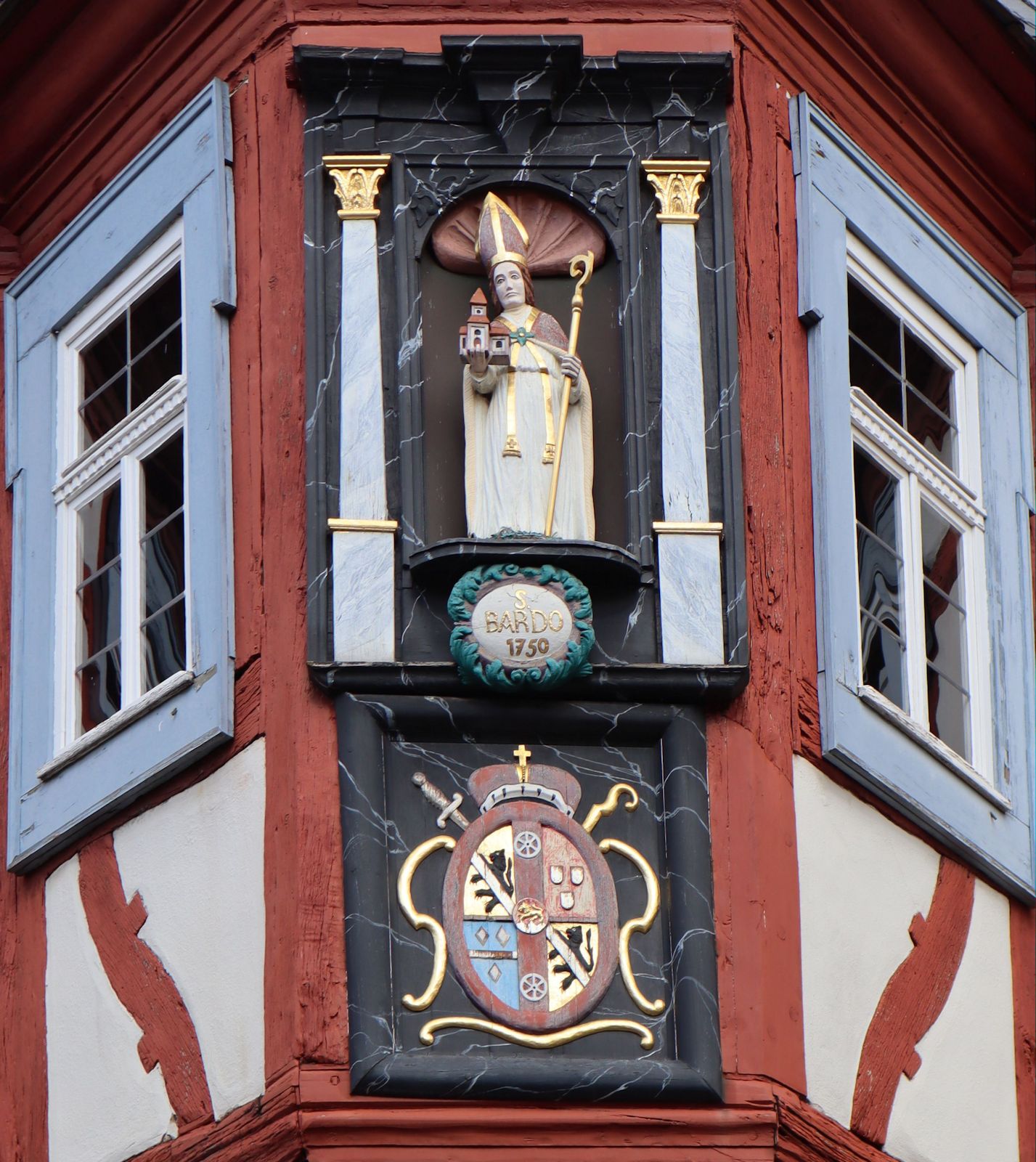
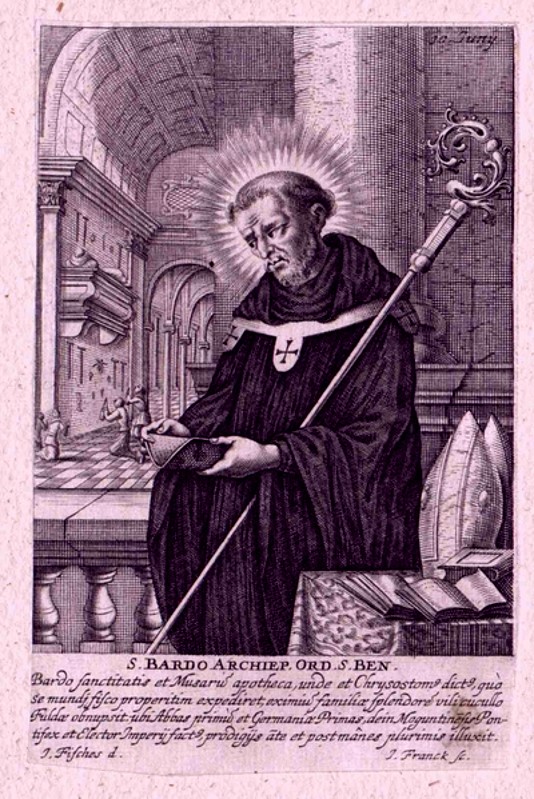
Saint of the Day – 11June – Saint Bardo of Mainz (c981-c1053) Archbishop of Mainz from 1031 until 1051, the Abbot of Werden from 1030 until 1031 and the Abbot of Hersfeld in 1031. Ascetic, renowned for his piety and devotion, for his care and love of the poor, renowned Preacher, called “The Chrysostom” of his time. Born in c981 in Oppershofen, Germany and died on 10 or 11 June in 1051 or 1053 (records vary) in Oberdorla near Mühlhausen in Thuringia, of natural causes. Patronage – of Oppershofen. Also known as – “The Chrysostom” of his time and area, Bardo of Magonza, Bardon, Bardone. Additional Memorial – 15 June (Cathedral of Mainz, Germany) and 10 June (depending on the date chosen for his death. Name means: battle axe and/or wolf [which our Saint was neither] (Old High German).
Statue at the town hall in St Bardo’s birthplace Oppershofen of which Town he is the Patron Saint
Bardo was the son of a noble family, related to Empress Gisela, the wife of Emperor Conrad II. He became a Benedictine Monk in the Monastery – on the site of the present Cathedral – in Fulda. There, in around 1018, Bardo was appointed as the Head of the Cathedral school and Provost of the new provostship at St Andreas in Fulda.
In 1029, Bardo was appointed as the Abbot in Werden – today the district of Essen-Werden and in 1031, as the Abbot also in Hersfeld – today’s Bad Hersfeld. From 1031 Bardo became the Archbishop of Mainz. Then, in 1036, Bardo Consecrated the new Cathedral dedicated to St Martin of Tours, the construction of which Bardo had been involved.
Statue of St Bardo in the Crypt of the Fulda Cathedral
Bardo lived so ascetically that Pope Leo IX admonished him to pay more attention to his health. His piety and charity became famous, especially towards the travelling people.
Bardo was also praised as a preacher and was called “The Chrysostom” of his time . Under Bardo, Mainz Cathedral was completed. he Consecrated it in 1036 in the presence of Emperor Conrad and Bardo founded the Cathedral and St John’s Foundation in Mainz, as well as the Monastery of St James. In 1041/42 he went to war against Bohemia with Emperor Henry III .
Bardo died during a journey and was buried in his new Cathedral in Mainz . His Tomb in the Cathedral in Mainz became a place of pilgrimage where numerous miracles occurred and still do.
The Cathedral built and Consecrated by St Bardo in Mainz
St Herebald of Bretagne Bl Hugh of Marchiennes Bl Jean de Bracq
Bl Kasper of Grimbergen St Maximus of Naples
St Parisius ECMC (c1160-1267) Priest and Monk of the Camaldolese Hermits of Mount Corona, Spiritual Director, Reformer, Miracle-worker during his life and after his death. A very long life of humble and loving service, for the glory of God!: The Roman Martyrology reads: “In Treviso, Saint Parisio, Priest of the Camaldolese Order, who for seventy-seven years took care of the spiritual direction of the Nuns with healthy advice, dying at the age of one hundred and eight.” https://anastpaul.com/2022/06/11/saint-of-the-day-11-june-st-parisius-ecmc-c-1160-1267-a-very-long-life-of-humble-and-loving-service-for-the-glory-of-god/
St Rembert of Hamburg (c830-888) Archbishop of Hamburg-Bremen, Missionary, Miracle-worker, Founder of Churches and Monasteries, Disciple of St Ansgar (801-865) “The Apostle of the North.” The Roman Martyrology reads : “In Bremen in Saxony, in today’s Germany, Saint Rembert, Bishop of Hamburg and Bremen, who, a faithful disciple of Saint Ansgar and his successor, extended his ministry to the regions of Denmark and Sweden and, at the time of the invasions of the Normans, he took care of the ransom of the Christian prisoners.” A True Shepherd: https://anastpaul.com/2023/06/11/saint-of-the-day-11-june-st-rembert-of-hamburg-c830-888-archbishop/
St Riagail of Bangor Bl Stephen Bandelli OP St Tochumra of Kilmore St Tochumra of Tuam
Martyrs of Tavira – 7 Beati: Members of the Knights of Santiago de Castilla. During the re-conquest of the Iberian peninsula from the Muslims by Christian forces, in a period of truce between the armies, the group was allowed to leave the Portuguese camp to hunt. Near Tavira, Portugal, he and his companions were ambushed and killed by a Muslim force. Making a reprisal attack, the Portuguese army took the city of Tavira. The murdered knights were considered to be martyrs as they died in an action defending the faith. They were – Blessed Alvarus Garcia, Blessed Beltrão de Caia, Blessed Damião Vaz, Blessed Estêvão Vasques, Blessed Garcia Roiz, Blessed Mendus Valle, Blessed Pedro Rodrigues’ They were Martyred in 1242 outside Tavira, Faro, Portugal. Their relics are enshrined under the altar of Saint Barnabas in the Church of Our Lady, Queen of the Angels (modern Santa Maria do Castelo) in Tavria, Portugal.
Mercedarian Martyrs of Damietta: Three Mercedarian Lay Knights who worked to ransom Christians enslaved by Muslims. During the 7th Crusade, a plague swept through the Christian army and these knights volunteered to work with the sick. During this work they were captured by Muslims and ordered to convert to Islam; they refused. They were tortured, taken to Damietta, Egypt where they were murdered for their faith. They were thrown from a tower in the mid-13th century in Damietta, Egypt.
Saint of the Day – 10 June – Saint Maurinus of Cologne (9th Century) Abbot, Martyr. Died in the 9th Century in Cologne. Also known as – Maurino.
The Roman Martyrology reads today: “At Cologne, St Maurinus, Abbot and Martyr.”
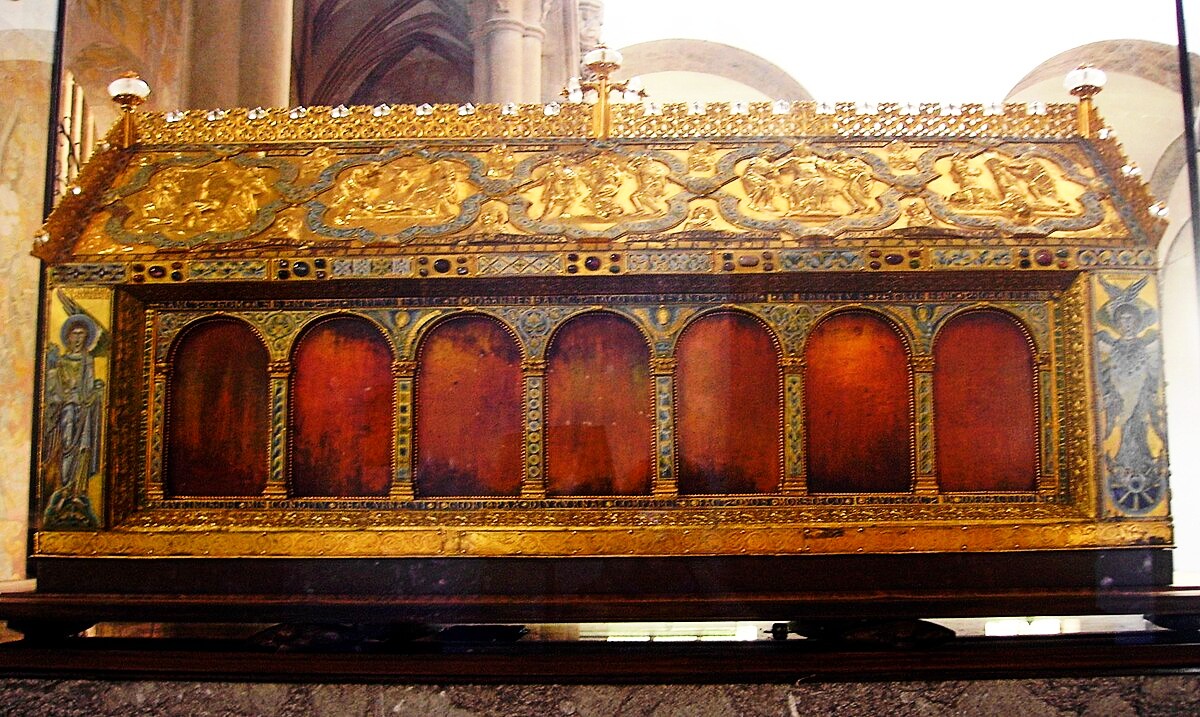
St Maurinus Shrine in Cologne
On 13 October 966, during the reconstruction of the Church of St Pantaleone in Cologne, at the time of Archbishop Folcmarus, successor of St Brunone, the Relics of our Saint were found with an epitaph indicating the his identity.
This epitaph recalled that he was an Abbot and that he was killed in the atrium of the same Church of St Pantaleone. The epitaph does not indicate a date but only the month of June.
For this reason, it is not possible to specify the era in which he lived, especially since there is no mention of him in any document prior to the discovery in 966. Even the title of Abbot is not sufficient to indicate a Monastery but he could have been Abbot of a Collegiate Chapter founded in the same Church. as they existed at that time. Nor is there any further explanation as to his Martyrdom, why and how.
His Relics are kept in a Romanesque casket, a true masterpiece of goldsmith’s craft, dated around 1180. In 1922, it was brought back to the Church of St Pantaleone, from the Chapel of St Maria alla Schnurgasse. Since the 12th Century the Feast of St Maurinud is celebrated throughout the Diocese of Cologne on 10 June and in the Universal Church.
St Margaret of Scotland (1045-1093) Queen consort of Scotland, Wife and Mother, Apostle of the poor, Reformer. Saint Margaret’s name signifies “pearl” “a fitting name,” says Bishop Turgot, her Confessor and her first Biographer, “for one such as she.” Her soul was like a precious pearl. A life spent amidst the luxury of a Royal Court never dimmed its lustre, or stole it away from Him who had bought it with His Blood. Pope Innocent IV Canonised St Margaret in 1250 in recognition of her personal holiness, fidelity to the Roman Catholic Church, work for Ecclesiastical reform and charity. In 1693 Pope Innocent XII moved her feast day to 10 June but it was changed after Vatican II to 16 November. Illustrious St Margaret: https://anastpaul.com/2018/11/16/saint-of-the-day-16-november-st-margaret-of-scotland-1045-1093-queen/ AND: https://anastpaul.com/2022/06/10/saint-of-the-day-10-june-st-margaret-of-scotland-1045-1093/
Bl Amata of San Sisto St Amantius of Tivoli St Asterius of Petra St Bardo of Mainz
St Caerealis of Tivoli St Censurius of Auxerre (Died 486) Bishop St Crispulus of Rome
Blessed Diana d’Andalo OP (1201-1236) Virgin, Nun of the Order of Preachers Beatified on 8 August 1888 by Pope Leo XII. The Roman Martyrology states: “In Bologna, blessed Diana d’Andalò, Virgin, who, having overcome all the impediments posed by her family, took a vow of cloistered life in the hands of Saint Dominic himself, entering the Monastery of Saint Agnes, which she founded.” Her Holy Life: https://anastpaul.com/2023/06/10/saint-of-the-day-10june-blessed-diana-dandalo-op-1201-1236-virgin/
Bl Elisabeth Hernden Bl Elizabeth Guillen St Evermund of Fontenay St Faustina of Cyzicus Bl Gerlac of Obermarchtal St Getulius of Tivoli
St Landericus of Novalese St Landericus of Paris St Maurinus of Cologne (9th Century) Abbot, Martyr St Primitivus of Tivoli St Restitutus of Rome Bl Thomas Green St Timothy of Prusa Bl Walter Pierson St Zachary of Nicomedia
Martyrs of North Africa – 17 Saints: A group of seventeen Christians Martyred together in North Africa; the only surviving details are two of their names – Aresius and Rogatius. Both the precise location in North Africa and the date are unknown.
Martyrs of the Aurelian Way – 23 Saints: A group of 23 Martyrs who died together in the persecutions of Aurelian. The only details that survive are three of their names – Basilides, Mandal and Tripos. c.270-275 on the Aurelian Way, Rome, Italy.
Saint of the Day – 9 June – Saint Maximian of Syracuse (Died 594) Bishop, Monk at St Gregory the Great’s Monastery in Rome and a close friend and collaborator with St Gregory in many instances and on many projects. Born in Sicily and died in 594 of natural causes at Syracuse, Sicily. Also known as – Massimiano.
The Roman Martyrology states: “In Syracuse, Saint Maximian, Bishop, of whom Saint Pope Gregory the Great often makes mention.”
Master of Portillo The Mass of Saint Gregory the Great (possibly the Bishop is our St Maximian)
Originally from Sicily (John the Deacon calls him Siculus), he became a Monk in Rome and after the death of Valenzione he was the second Abbot of the Monastery of St Andrew, Coelian Hill,, built before 583, by the noble Gregory (I believe it was built from St Gregory’s own ancestral home).
When St Gregory was sent by Pope Pelagius II as Papal Delegate to Constantinople to the Emperor Tiberius, Maximian joined him with some of his Monks. St Maximian seems to have prolonged St Gregory’s stay so much that the Pontiff wrote to Gregory to urge his return to Rome, as he was necessary to his Monastery and to the Apostolic See for an important matter. Upon returning, the following year, 585, after eight days of adventurous navigation in the Adriatic, the ship was shipwrecked in Crotone and Maximian, who had shown trust in God, was saved with all his companions.
When Gregory ascended to the Pontificate on 3 September 590, he chose some of his Monks, among them Maximian, to lead a monastic life in his palace which, according to John the Deacon, became “an ascetery of perfect virtue, a school of Ecclesiastical discipline, a Council of very wise government, so venerated in Rome and throughout the Church that anyone who did not have their papers in order, did not even dare appear, deeming it more appropriate to remain absent.”
In December 591, Maximian was already the Bishop of Syracuse. The Pope granted him the use of the Pallium and renewed the privileges of the ancient Bishopric; he also entrusted his representation over the entire Sicilian Church.
Vicar of the Pope and responding to his hopes, Maximian exercised a general supervision over Ecclesiastical discipline and affairs; he resolved the causes of lesser importance, referring the most difficult ones or those which he did not believe he could judge for himself, to the Pope.
Saint Gregory who, in entrusting him with these very broad powers, had minutely established the directives of Ecclesiastical politics in Sicily, addressed several letters to him and, in the end, showed himself pleased with what Maximian had done in just under three years in the vast territory of the Sicilian Island.
Even if the titles of “venerable, bishop of venerable memory” and “most holy” which often occur in the Epistolary of Saint Gregory, can obviously only be attributed a meaning of honour and respect, nevertheless the esteem which the Pope had for Maximian is evident from the expressions written in November 594 upon his death.
To the Deacon Cyprian, his rector in Sicily, the Pontiff wrote, expressing his great sorrow: “It is not Maximian who must mourn, having already flown to that eternal prize he so desired but these unhappy people of Syracuse ”. He let the Syracusans know that they “should keep in mind that another Maximian was not easy to find.”
An interesting aspect of Maximian’s activity was his collaboration with the St Gregory on the Memoirs relating to the Saints of Italy. Saint Gregory mentions it repeatedly; indeed, in 594, he would have liked to see him again, to know more distinctly, some edifying facts learned from St Maximian in the past, in order to insert them into the Dialogues. Our Saint Maximian, who was no longer able to travel to Rome, briefly and in writing, reported to Saint Gregory what he knew about Saint Nonnosus (c500-560) and some other Saints. Sadly for St Gregory, St Maximian was about to leave this earth and travel home.
St Felicianus and St Primus * (Died c304) Brothers, Confessors, Lay Martyrs. The Roman Martyrology reads today: “At Rome, on Mount Caelius, the birthday of the holy Martyrs, Primus and Felician, under the Emperor Diocletian and Maximian. These glorious Martyrs lived long in the service of the Lord and endured sometimes together, sometimes separately, various cruel torments. They were finally beheaded by Promotus, Governor of Nomentum and thus happily ended their combat.” Their Lives and Death: https://anastpaul.com/2023/06/09/saints-of-the-day-9-june-saints-primus-and-felicianus-died-c304-martyrs-confessors/
St Alexander of Prusa St Arnulf of Velseca
St Baithen of Iona (c 536-c 599) Abbot, the first successor of St Columba of Iona. An Irish Monk, especially selected by St Columba, as one of the band of Missionaries who set sail for Scotland in 563. St Baithen of Iona is generally known as Baithen Mor, to distinguish him from eight other Saints of the same name — the affix mor meaning “the Great.” This holy man was closely related to the great St Columba. His Illustrious Life: https://anastpaul.com/2022/06/09/saint-of-the-day-9-june-st-baithen-of-iona-c-536-c-599/
St Comus of Scotland St Cumian of Bobbio St Cyrus Bl Diana d’Andalo OP St Diomedes of Tarsus St Julian of Mesopotamia St Luciano Verdejo Acuña St Maximian of Syracuse (Died 594) Bishop St Pelagia of Antioch St Primus * St Richard of Andria Bl Robert Salt Bl Sylvester Ventura St Valerius of Milan St Vincent of Agen
Martyrs of Arbil – 5 Saints: Five Nuns who were Martyred together in the persecutions of Tamsabur for refusing to renounce Christianity for sun-worship – Amai, Mariamne, Martha, Mary and Tecla. They were beheaded on 31 May 347 at Arbil, Assyria (in modern Kurdistan, Iraq).
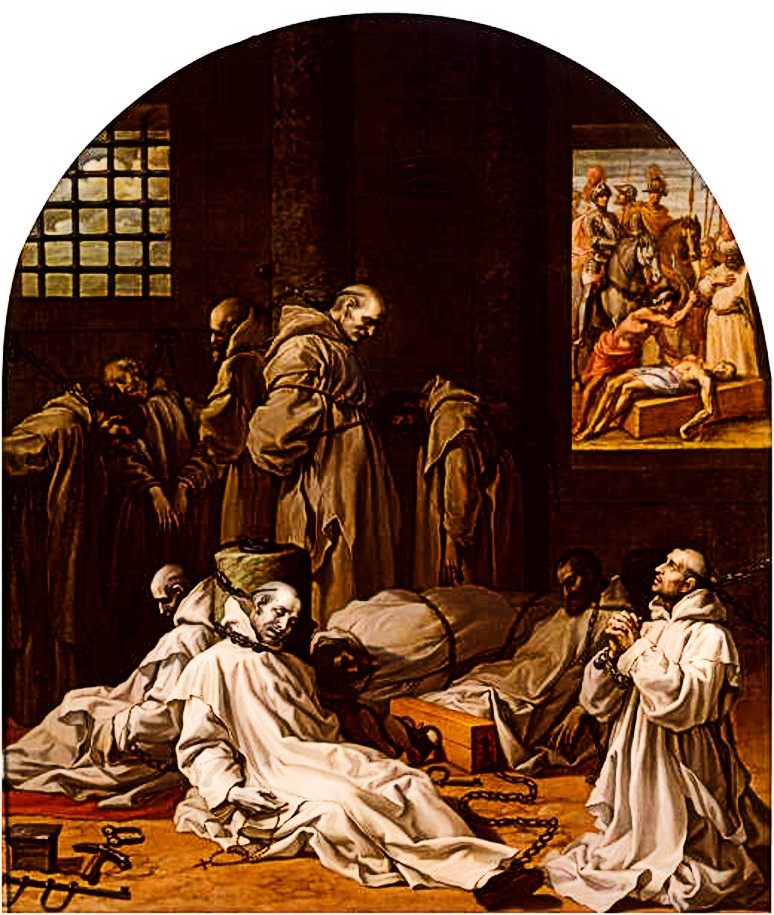
Saint of the Day – 8 June – Blessed John Davy O.Cart. (c1490-1535) Deacon of the Carthusian Order, Martyr, Born in York in c1490 and died by being chained to a wall in the Tower prison, London and starved, until his death on 8 June 1535. Also known as – John Davies. Additional Memorial – 4 May as one of the Carthusian Martyrs of London. Blessed John was Beatified on 20 December 1886 by Pope Leo XIII.
Vicente Carducho c 1626 – The Martyrdom of the Carthusians Friars
The figure of Blessed John Davy is located in the stormy landscape of 16th Century England. A Carthusian Deacon, John faced the persecutions of Henry VIII with stoic firmness, remaining faithful to the Church and the Roman Pontiff until his last breath. His story, steeped in heroism and sacrifice, makes him a shining example for all those who find themselves facing similar trials. You might think we are not facing such trials today but think again, they are mounting and growing in intensity, all over the world, by dedicated persecution.
Information on John Davy’s birth and youth is fragmentary. He is presumed to have been born in York, England, around 1490. Attracted to the contemplative life and strict discipline of the Charterhouse, he joined the Carthusian community of London in 1514. There, he distinguished himself by his piety, his zeal and his profound knowledge of tSacred Scripture and heology.
The reign of Henry VIII marked a period of profound and diabolical upheaval for the Catholic Church in England. The Sovereign, animated by political and personal aims, separated from the Holy See and proclaimed the Church of England as the sole state religion. Catholics, who did not bend to his will were persecuted ferociously. John Davy, as a Carthusian Deacon and fervent supporter of the Catholic Church, could not remain indifferent to this dramatic scenario. Together with his Brothers, he firmly opposed royal supremacy and the new doctrine imposed by the Sovereign. Their intransigence exposed them to harsh reprisals.
In 1534, Davy was arrested and imprisoned in the Tower of London. Subjected to cruel torture and a regime of extreme deprivation, he was firm to the end, never breaking under extreme torments. His will and his Faith remained fixed on Christ and His Church, Blessed John never renounced his Faith. His unwavering resistance and unswerving loyalty to the Church, further irritated his captors. On 8 June 1535, after months of torment, John Davy died in prison, exhausted by hunger and mistreatment. His death was a silent but eloquent Martyrdom, a tangible testimony of his unshakable Faith and his unshakable attachment to the his Lord and His Catholic Church.
Vicente Carducho c 1626 – The Martyrdom of the Carthusians Friars
John Davy’s reputation for sanctity quickly spread among English Catholics, who venerated him as a Martyr of the Faith. In 1888, Pope Leo XIII Beatified him, confirming his status as a heroic example for the faithful.
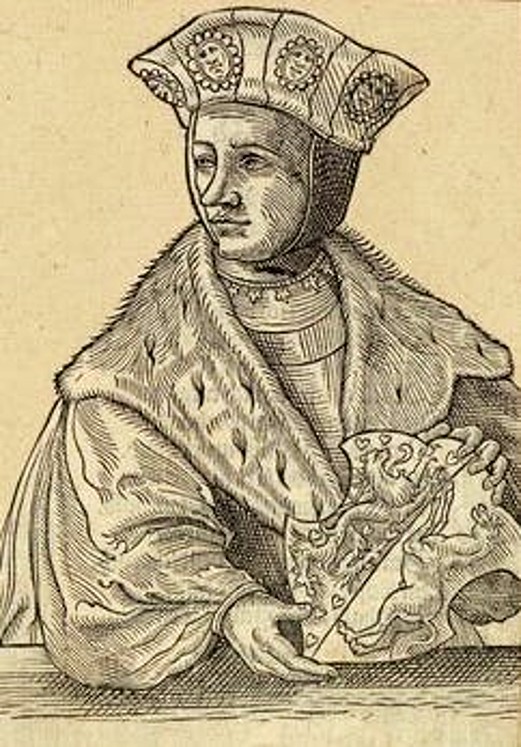
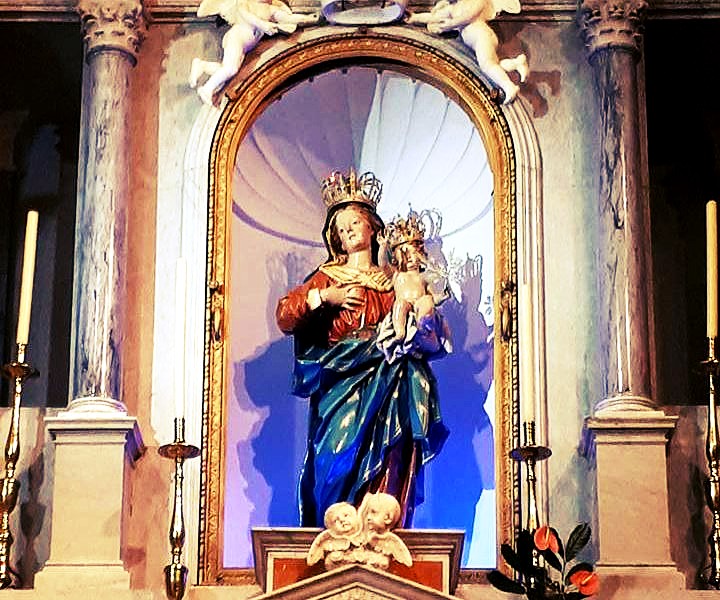
The Queenship of the Blessed Virgin Mary – Queen of Heaven and Earth, Holy Queen: Pope Pius XII established this Feast in 1954 with a Feast Day of 31 May. However, this year, 31 May fell within the Corpus Christi Octave and, therefore, the Feast has been transferred until today, a week later. In his 1954 Encyclical Ad Caeli Reginam – To the Queen of Heaven, Pope Pius XII points out that Mary deserves the title because she is Mother of God because she is closely associated as the New Eve with Jesus’ redemptive work, because of her preeminent perfection and because, of her intercessory power HERE: https://anastpaul.com/2022/05/31/the-queenship-of-mary-and-memorials-of-the-saints-31-may/
Blessed Armand of Zierikzee OFM (Died c1524) Friar of the Order of the Friars Minor, renowned Scriptural Scholar. St Bron of Cassel Bishop, Spiritual student of Saint Patrick. St Calliope St Clodulf of Metz Bl Engelbert of Schäftlarn St Eustadiola of Moyen-Moutier St Fortunatus of Fano Bishop
St Gildard of Rouen (c 456-c 545 Bishop of Rouen, Confessor * Twin Brother of St Medard below. The Roman Martyrology states of St Medard and his twin brother, St Gildard, today: “At Soissons, in France, the birthday of St Gildard, Bishop of Rouen, whose life and precios death are illustrated by glorios miracles – at Rouen, St Gildard, Bishop, twin brother of St Medard,who was born with his brother on the same day, Consecrated Bishops at the same time and being taken away from this life, also on the same day, they entered Heaven together!” About St Gildard: https://anastpaul.com/2022/06/08/saint-of-the-day-8-june-st-gildard-of-rouen-c-456-c-545/
Bl Giorgio Porta Bl Giselbert of Cappenberg St Heraclius of Sens Blessed John Davy O.Cart. (c1490-1535) Deacon of the Carthusian Order, Martyr Bl essedJohn Rainuzzi Bl Maddallena of the Conception
St Medard (c 456-545) Bishop and Confessor * Twin Brother of St Gildard above. About this iluustrious Saint: https://anastpaul.com/2020/06/08/saint-of-the-day-8-june-saint-medard-c-456-545-bishop/ The Roman Martyrology states of St Medard and his twin brother, St Gildard, today: “At Soissons, in France, the birthday of St Medard, Bishop of Novon, whose life and precios death are illustrated by glorious miracles – at Rouen, St Gildard, Bishop, twin brother of St Medard,who was born with his brother on the same day, Consecrated Bishops at the same time and being taken away from this life, also on the same day, they entered Heaven together!”
St Melania the Elder St Muirchu St Pacificus of Cerano Bl Peter de Amer Bl Robert of Frassinoro St Sallustian St Syra of Troyes St Victorinus of Camerino
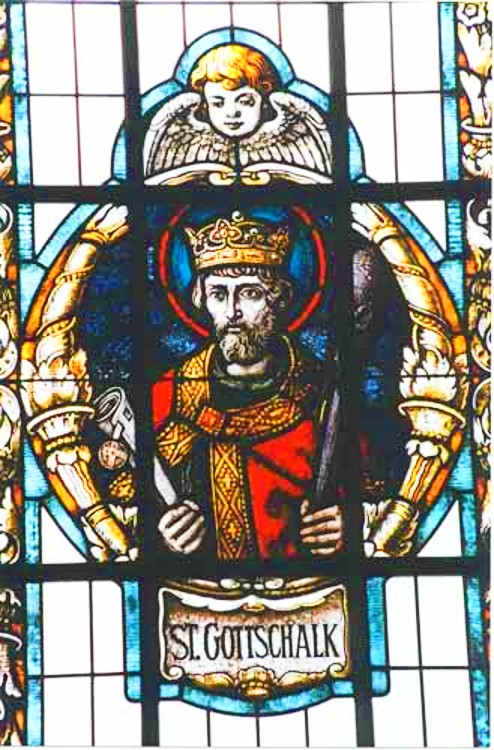
Saint of the Day – 7 June – Saint Gottschalk and his Companions (Died 1066) Lay Missionary Martyr, Prince of the Wends (Wends is a historical name for Slavs who inhabited present-day northeast Germany). Died by being murdered at the Altar with 29 fellow missionaries on 7 June 1066 in Lenzen, Pomerania, by pagan assassins. Patronages – of linguists, lost vocations, princes, translators. Also known as – Godescalcus, Godeschalc, Gotteschalk, Gotteschalc.
Son of Duke Udo, who still governed the Obodrites and the Vagris, in the early years of Emperor Conrad II, Gottschalk was educated in the Christian religion from birth, first in his family, then in the Monastery of St Michael in Liineburg. Upon the death of his father, murdered at the hands of a Saxon, who wanted to take revenge on the tyranny and cruelty of Udo, described by the chronicler Adam of Bremen, Godescalco, sacrificing his Faith to revenge, renounced Christianity and, at the head of his people, he joined other pagan Princes to go against the Saxons.
He fought against them for a long time, bringing destruction and death to their land, until, succumbing to remorse for so much pain and ruin he had caused, he surrendered to the Duke of Saxony, Bernard II, who, after holding him prisoner for some time, sent him to Denmark.
Having placed himself there in the service of King Cnut II the Great, he went with him to fight in England (c1030), where he behaved bravely, also being admired for his excellent qualities, so as to win all the esteem and consideration of the King , whose great-grand-daughter, Syritha, Gottschalk later married.
After the death of Cnut in 1035 and his son, Harold Hanfoot in 1040, Gottschalk returned to his native land and, raising an army with his people, undertook the conquest of the other Slavic populations who soon subjected them all to his dominion. At the same time, Gottschalk made himself recognised as their Lord also by a large section of the Saxon community.
By 1043, with this conquests, Gottschalk managed to form a vast and well-organised Kingdom . There was then, no ruler among the Slavs more powerful than himself, as the aforementioned Adam of Bremen wrote.
Returning again to his lapsed Faith, since the time of his first residence in Denmark, Gottschalk greatly favoured the evangelisation of the people, having many Churches built in his dominions and Ordaining Priests, always working tirelessly for the conversion of his still idolatrous subjects. To then preserve the fervour of the Christian Faith among them, he founded the Bishoprics of Oldenburg, Mecklenburg and Ratzenburg, established numerous Monasteries in various other Cities and sent armies of Missionaries to the most distant regions of his vast state., among whom John the Scot stood out for his apostolic zeal, who alone baptised thousands of pagans!
Gottschalk himself often travelled with these Missionaries, sometimes even acting as an interpreter during their preaching. Such ardent zeal in favour of the spread of the Christian Faith could not obtain a better reward than the crown of Martyrdom, hich Gottschalk, the pious King, in fact wore on 7 June 1066, when he fell victim to a violent pagan reaction and was killed out of hatred for the Catholic Faith in Lenzen on the Elbe, while he was attending Mass. With him the Priest Ebbo (or Eppone) suffered the same glorious fate, who was even murdered on the Altar, and many other Ecclesiastics and lay faithful.
Immediately venerated as a Saint, Gottschalk had a strong public cult in many Churches in northern Europe. His Feast is celebrated on 7 June, the commemorative day of his Martyrdom.
St Gottschalk and Companions (Died 1066) Lay Missionary Martyr St Justus of Condat St Landulf of Yariglia St Lycarion of Egypt
Venerable Matt Talbot (1856 – 1925) (born Matthew Talbot) – Layman, Ascetic, Mystic – known as the “Saint in Overalls” and “the Workers’ Saint” disciple of Eucharistic Adoration and the Blessed Virgin – Patron of Struggling and Recovering Addicts and Alcoholics and many addiction treatment programs, retreats and centres throughout the world bear his name. On 6 November 1931, Edward Joseph Byrne, Archbishop of Dublin, opened a sworn inquiry into the alleged claims of holiness of the former dock worker. He was declared Venerable in 1975. The Matt Talbot Story: https://anastpaul.com/2017/06/07/saint-of-the-day-7-june-venerable-matt-talbot-ofs/
St Meriadoc I of Vannes St Meriadoc II of Vannes St Odo of Massay St Potamiaena of Alexandria the Younger St Quirinus of Cluny Martyr. No other information has survived.
St Robert of Newminster O.Cist. (c 1100–1159) English Priest, Abbot, Apostle of the poor, Miracle-worker. He was one of the Monks who founded Fountains Abbey in North Yorkshire, England, another at Newminster, Northumbria and 3 other Monasteries Robert ruled and directed the Monks at Newminster for 21 years. St Robert’s Life: https://anastpaul.com/2021/06/07/saint-of-the-day-7-june-saint-robert-newminster-o-cist-c-1100-1159/
St Sergius of Cluny St Vulflagius of Abbeville
Martyrs of Africa – 7 Saints: A group of seven Christians who were Martyred together. No details about them have survived except the names – Donata, Evasius, Guirillus, Januaria, Privata, Spisinna, Victurus. The precise location in Africa and date are unknown.
Martyred in Córdoba, Spain: Habentius of Córdoba Jeremiah of Córdoba Peter of Córdoba Sabinian of Córdoba Wallabonsus of Córdoba Wistremundus of Córdoba
Saint of the Day – 6 June – Saint Gilbert of Neufontaines O.Praem. (c1076-1152) Abbot, a French Knight and Military Leader, Crusader in the 2nd Crusade , Founder of Neufontaines Monastery and Hospital for the poor ( which he populated with Canons from the Premonstratensian Abbey of Notre-Dame de Dilo), Apostle of the sick especially of ill children, Miracle-worker. Born in c1076 and died on 6 June 1152 at Neufontaines of natural causes. Patronages – of Neuffons and of Auvergne. Also known as – Gilbert of Auvergne, Gilbert of Neuffers. Additional Memorial – 26 October (in Neufontaines and Aubeterre, France).
The Knight Gilbert belonged to the high nobility of Auvergne. Following the advice of Ornifius, the Norbertine Abbot of Dilo, he participated in the Second Crusade (1147-1149) which was preached by St Bernard at Vezelay and led by the French King, Louis VII. This Crusade ended in military disaster.
Having survived this dangerous endeavour, Gilbert decided, together with his wife, Petronilla and his daughter, Ponzia, to dedicate himself to God and enter the monastic life. He distributed a portion of his considerable wealth to the poor and also founded a Convent which his wife and daughter entered. At first, Gilbert himself lived as a Hermit. After completing his novitiate in the Norbertine Abbey of Dilo, in around 1150, he founded the Abbey of Neuffontaines and became its first Abbot. Following the example of St Norbert, he also built a hospital attached to the Abbey which soon became famous because of the many miracles which occurred there.
Penitent and filled with compassion, he cared for a great number of sick and sinful people, whom he wished to cure both spiritually and physically. Children with severe illnesses were brought to him from all over , his compassion so overwhelmed him that he was able to heal with his tears. He laid his hands upon them and gave them back to their parents cured This gave rise to the later custom of parents bringing their sick children to Neuffontaines, clothed in white, seeking the intercession of St Gilbert for cures and miracles..
Gilbert died on 6 June 1152, consumed by penance and hard toil. He had expressed his desire to be buried in the cemetery of the poor who died at the Abbey. But because of the many miracles which God worked through his intercession, his earthly remains were eventually transferred to the Abbey Church of Neuffontaines and, after being lost for a time, were later rediscovered in the Abbey in October 1645. In 1791, the Relics were transferred, for greater safety, to St Didier and, nevertheless, were lost during the tumult and desecration of the French Revolution. St. Gilbert’s Feast Day (26 October) falls on the anniversary of his translation of the 17th Century. Pope Benedict XIII confirmed the veneration of St Gilbert on 22 January and 8 March 1728.
O God, who called Thy Abbot St Gilbert away from the riches of the world that he might enter into the way of poverty, grant, we beseech Thee, that entering into the way of humility, we may strive to serve our brothers. We ask this through our Lord Jesus Christ, Thy Son, Who lives and reigns with Thee in the unity of the Holy Ghost, One God forever and ever. Amen.


































 AnaStpaul
You must be logged in to post a comment.