Posted in SAINT of the DAY

Saint of the Day – 17 April – St Landericus (c637-c720) Bishop, Abbot

Saint of the Day – 17 April – St Landericus (c637-c720) Bishop, Abbot Born in c637 at Hainaut, Belgium and died on 17 Apr c720 (aged 82–83) at in Soignies, France of natural causes. Patron Saint of the House of Habsburg. Also known as – Landericus of Meaux (Metz), Landericus of Soignies, Landry, Landricus, Landrich, Landerico.

Landericus was the eldest son of St Vincent Madelgarus (c610-c677) and St Waldetrude of Mons (c612-c688) and was likely born around the year 637. https://anastpaul.com/2023/04/09/saint-of-the-day-9-april-saint-waltrude-of-mons-c612-686-widow/

That he was a Bishop in the Seventh Century is generally agreed upon but exactly where and when is unclear. Some accounts show him as Bishop of Metz, while others say he was Bishop of Meaux, both in France.

Either way, it is said he resigned his Episcopal responsibilities so as to become a Benedictine DMonk at the Monastery of Hautmont, in France and later at Soignies, in Belgium, both of which were founded by his father.

He succeeded his father as Abbot of Soignies when the elder died around the year 677. Abbot Landericus also died at Soignies somewhere between the years 700 and 730, depending on which account of his life is used and his relics are held at the Collegiale S. Vincent, the Church named for his father.

His feast day is 17 April. Locally, that is in France and Belgium, he is known as St Landry, while most compilations of Saints use the Latin name St Landericus.

In the truly unique and renowned Church known as the Hofkirche in Innsbruck resides a large Statue of our Saint. This is most interesting and leads us to believe that he must have been a much more illustrious figure than we can find information regarding his life. and there is also the fact that he is the Patron Saint of the Royal House of Habsburg. This beautiful Church was built to house the tomb of Emperor Maximilian I who died in 1519. The Church is also known as “Schwarzmanderkirche“ (literally “Black Men Church”) famous for its namesake “Black Men” – 28 over-life-sized Renaissance bronze Statues of important historical figures and Saints which flank the marble Tomb of Emperor Maximilian I. See below.

Posted in MARIAN TITLES, SAINT of the DAY

Nossa Senhora da Arrábida / Our Lady of Arrábida, Portugal (16th Century), St Pope Anicetus (Died 168) and Memorials of the Saints – 17 April

Monday in the Second Week of Easter

Nossa Senhora da Arrábida / Our Lady of Arrábida, Portugal (16th Century) – 17 April:
HERE:
https://anastpaul.com/2021/04/17/nossa-senhora-da-arrabida-our-lady-of-arrabida-portugal-16th-century-and-memorials-of-the-saints-17-april/

St Pope Anicetus (Died 168) 12th Bishop of Rome and Martyr Papacy 157-168.
This wonderful Pope
His Life and Death:

https://anastpaul.com/2021/04/17/saint-of-the-day-17-april-saint-pope-anicetus-i-died-168-martyr/

Bl essed Andrés Hibernón Real OFM (1534-1602) Religious Friar, Apostle of the Holy Eucharist, the Blessed Virgin and the Holy Rosary, Apostle of the poor. He predicted the date of his death four years before the fact, which was 18 April 1602 in Gandia, Valencia, Spain of natural causes immediately after having prayed a rosary. He was Beatified on 22 May 1791 by Pope Pius VI. His body is incorrupt.
Biography:

https://anastpaul.wordpress.com/2018/04/17/saint-of-the-day-17-april-blessed-andres-hibernon-real-o-f-m-1534-1602/

St Agia of Hainault
St Anthia of Illyria
St Athanasia of Aegina
St Bitheus
St Calocerus of Brescia
St Cogitosus
St Corebus

St Donan of Eigg (Died 617) Priest and Martyr, Monk, Missionary
His Life and Death:

https://anastpaul.com/2020/04/17/saint-of-the-day-17-april-saint-donan-of-eigg-died-617-priest-and-martyr/

St Eleuterius of Illyria
St Elpidius of Melitene
St Eusebius of Fano
St Galdinus of Milan
St Gebuinus of Lyons
St Genocus
St Hermogenes of Melitene
Bl Idesbald of Dunes
Blessed James of Cerqueto
Bl James Oldo
Bl Joseph Moreau
St Landericus (c637-c730) Bishop, Abbot
St Laserian of Leighlin
Bl Louis Leroy
Bl Luca Passi
St Pantagathus of Vienne
St Perfecto of Córdoba
St Pusicio

St Robert de Turlande/Chaise-Dieu OSB (c 1000-1067) Priest, professed religious of the Order of St Benedict, Monk, Abbot, Apostle of Charity, Marian devotee. He was of noble stock, was related to Saint Gerald of Aurillac (c855–c909) and was a descendant of St Caesarius of Arles (470-543). He is best known for the establishment of the Benedictine Convent of La Chaise-Dieu (‘Home of God’) and for his total commitment to the poor. He became a spiritual inspiration for Pope Clement VI (1291–1352) – whose own origin,s in the religious life were based at that Convent – and it was Pope Clement who confirmed the Canonisation of the Benedictine Abbot on 19 September 1351 in Avignon.
His Life:

https://anastpaul.com/2019/04/17/saint-of-the-day-17-april-st-robert-de-chaise-dieu-osb-c-1000-1067/

Bl Roman Archutowski
Bl Savina Petrilli

St Stephen Harding O.Cist. (1050-1104) Abbot and Co-Founder of the Cistercian Order
About St Stephen:

https://anastpaul.wordpress.com/2017/04/17/saint-of-the-day-17-april-st-stephen-harding/

St Ursmar of Lobbes
St Wigbert of Augsburg

Posted in SAINT of the DAY

Saint of the Day – 16 April – Blessed Arcangelo Canetoli CRSSB (1460-1513) Priest

Saint of the Day – 16 April – Blessed Arcangelo Canetoli CRSSB (1460-1513) Priest.and Canon of the Canons Regular of the Congregation of the Most Holy Saviour at Bologna, Mystic gifted with the charism of prophecy and of many visions of the Blessed Virgin, Born in 1460 in Bologna, Italy and died on 16 April 1513 (aged 53) in Gubbio, Italy of natural causes. His body is incorrupt. Arcangelo was Beatified on 2 October 1748 by Pope Benedict XIV.

Blessed Arcangelo Canetoli between St Nicholas and St Leonard painted by GB Piazzetta and Domenico Maggiotto for the Church of San Salvatore, Venice.

Arcangelo Canetoli, born in Bologna in 1460, suffered the bitter vicissitudes of the rivalry between the Canetoli and the Bentivoglio families. When still a young child, he providentially survived the extermination of the entire family.
As a young man he entered the Canons Regular of Santa Maria di Reno, known as “Renani.” Due to his extreme humility and love of solitude he refused, for a long time, any Ecclesiastical dignity and only out of obedience, did he accept Priestly Ordination.
From 1498 he lived in the convent of Sant’Ambrogio di Gubbio, loved and venerated by the humble and the powerful, including the Acquisti of Arezzo and the Medici of Florence.
He consistently refused the appointment as Archbishop of the Medici City proposed to him by Pope Leo X. He died on 16 April 1513 and his incorrupt body is still venerated in his Monastery in Gubbio.

Arcangelo was born to one of the noblest families of Bologna – the Canetoli. The entire family was massacred being held esponsible for the death of member of an opposing family member. Only Arcangelo, still a child, managed to save himself thanks to fortuitous circumstances.

On 29 September 1484 he took the Habit of the Congregation of the Canons Regular of Santa Maria di Reno, called “Renani”, in the Convent of the Santissimo Salvatore in Venice. Here he was entrustd with the task of welcoming pilgrims and in some of them he sometimes happened to recognise the murderers of his family members! However, he always knew how to heroically dominate his desire for revenge.

Extremely humble and a lover of solitude, for a long time he refused, any Ecclesiastical dignity and finally, in 1498, accepted Priestly Ordination only out of a sense of obedience to his Superioirs. Shortly after his Ordination he was sent, by his own request, to the Hermitage of St Ambrose, a mountainside Monastery in Gubbio. Here he would remain for the remainder of his life, although he operated as the Provincial Vicar of his Order for 4 years, still retaining his base at Gubbio.

The St Ambrose Monastery in Gubbio

Arcamgelo predicted that Cardinal Giovanni de’ Medici would be elected as pope sometime soon and when this Cardinal became Pope Leo X in 1513, the Leo’s brother Giuliano de’ Medici summoned Canetoli to Florence in an attempt to persuade him to become the new Archbishop of Florence. But again Arangelo refused and returned to his Convent.

Blessed Arcangelo refusing the Honour of becoming the Archbishop of Florence painted by Giuseppe Reposati.

Arcangelo died in 1513 after a period of illness and high temperatures. He was interred in his Monastery of St Anbrose at Gubbio, where his incorrupt body remains enshrined for the veneration of pilgrims.

Posted in MARIAN TITLES, SAINT of the DAY

LOW SUNDAY, Nostra Signora delle Vittorie / Our Lady of Victories, Vienna (1683) and Memorials of the Saints – 16 April

LOW SUNDAY

Nostra Signora delle Vittorie / Our Lady of Victories in the Church of St Mark, Vienna (1683) – 16 April:
HERE:

https://anastpaul.com/2021/04/16/nostra-signora-delle-vittorie-our-lady-of-victories-in-the-church-of-st-mark-vienna-1683-and-memorials-of-the-saints-16-april/

Blessed Arcangelo Canetoli (1460-1513) Priest. Beatified on 2 October 1748 by Pope Benedict XIV.

St Benedict Joseph Labre – Known as the Beggar of Perpetual Adoration (1748-1783) Laqy Penitent and Pilgrim – he “abandoned his country, his parents and whatever is flattering in the world, to lead a new sort of life, a life most painful, most penitential, not in a wilderness, nor in a cloister but in the midst of the world, devoutly visiting as a pilgrim the famous places of Christian devotion.” Canonised by Pope Leo XIII on 8 December 1881.
Dearest St Benedict Joseph:

https://anastpaul.wordpress.com/2017/04/16/saint-of-the-day-16-april-st-benedict-joseph-labre/

St Drogo (1105–1186) Lay Penitent Pilgram, Apostle of prayer and the Holy Eucharist, Anchorite.
His life:

https://anastpaul.com/2019/04/16/saint-of-the-day-16-april-saint-drogo-1105-1186/

St Elias

St Fructuosus of Braga (Died 665) Archbishop of Braga, Spain, Hermit, Confessor, Monk, Abbot, a great Founder of Monasteries.
His Life:

https://anastpaul.com/2020/04/16/saint-of-the-day-16-april-saint-fructuosus-of-braga-died-665/

St Herveus of Tours

Blessed Joachim Piccolomini of Siena OSM (1258–1305) Tertiary Servite Lay Friar, Apostle of charity of the sick, devotee of the Sorrows of the Blessed Virgin.
Blessed Joachim’s Life:

https://anastpaul.com/2021/04/16/saint-of-the-day-16-april-blessed-joachim-piccolomini-of-siena-osm-1258-1305/

St Lambert of Saragossa

St Magnus of Orkney (c 1075-1115) Layman Martyr, Magnus was the Earl .of Orkney in Scotland and related to the Royal House of Norway, which exercised sovereignty over the Orkney Islands at that time. The story of St Magnus’ life and Martyrdom are well attested.
His Life and Death:

https://anastpaul.com/2022/04/16/saint-of-the-day-16-april-saint-magnus-of-orkney-c-1075-1115/

St Turibius of Astorga
St Vaise
St William Gnoffi

Martyrs of Corinth – 9 Saints: A group of nine Christians who were tortured and Martyred together in the persecutions of Decius. We know little more than three of their names – Callistus, Charisius and Leonide. They were thrown into the sea at Corinth, Greece c250.

Martyrs of Saragossa: Group of eighteen Martyrs murdered in 304 in Saragossa, Spain in the persecutions of Diocletian and the prefect Dacean. We know little more than the names – Apodemus, Caecilian, Caius, Crementius, Engratia, Eventius, Felix, Fronto, Gaius, Julia, Lambert, Lupercus, Martial, Optatus, Primitivus, Publius, Quintilian, Saturnius (4 men of this name), Succesus and Urban. Their graves re-discovered in 1389 in the crypt under the Church of San Encrazia in Saragossa.

Posted in SAINT of the DAY

Saint of the Day – 15 April – St Paternus of Avranches (c482-565) Bishop

Saint of the Day – 15 April – St Paternus of Avranches (c482-565) Bishop, Abbot, Monk, Hermit, Miracle-worker, Founder of Monasteries, local Missionary to the pagans. Born c482 at Poitiers and died c565 of natural causes. Also known as – Foix, Padarn, Pair, Patier.

Paternus was born at Poitiers, of illustrious Christian parents, about the year 482. His father, Patranus, with the consent of his wife, went to Ireland to end his days as a hermit in holy solitude.

Paternus, fired by his father’s example, embraced monastic life in the Abbey of Marnes, France. After some time, desiring to attain the perfection of Christian virtue by a life of penance in solitude, he retired with a companion Monk of the Abbey, Saint Scubilion. In the forests of the Diocese of Coutances near the sea, they embraced an austere anchorite’s life resembling that of Angels more than of men.

In 512, an Abbot of that region who knew of him recommended Paternus to the Bishop of Coutances, who Ordained him a Deacon and then a Priest. He and Saint Scubilion then evangelised the western coasts and established several Monasteries, of which he was the Abbot general. Many miracles honoured his apostolate among the pagan populations.

In his mature years, he was consecrated bishop of Avranches while his former companion, Saint Scubilion, had become Abbot of a Monastery founded by the two missionaries.

When Saint Paternus fell ill he felt his end was near and he sent to his dear friend to come and assist him in his last illness. But the same fate had befallen Scubilion, who, for his part had sent a messenger to Paternus! The two hermit-missionaries, each of whom had become the spiritual father of many, departed this life on the same day, 15 or 16 April 565, the thirteenth year of the Episcopate of Saint Paternus. They were afterwards buried on the same day in the Church of the Monastery of Scicy, a region they had evangelised together.

Statue of St Paternus at the Church dedicated to him in Avranches
Posted in MARIAN TITLES, SAINT of the DAY

Easter Saturday, .Our Lady of Kieff (1010) and Memorials of the Saints – 15 April

Easter Saturday

Our Lady of Kieff (1010) – 15 April:
HERE:

https://anastpaul.com/2021/04/15/our-lady-of-kieff-1010-and-memorials-of-the-saints-15-april/

St Abbo II of Metz

St Abbondio of Como (Died c 564) The Fourth Bishop of Como, Italy, Confessor, Theologian, Papal Legate.
Biography:

https://anastpaul.com/2021/04/15/saint-of-the-day-15-april-saint-abbondio-of-como-died-c-564/

St Acuta

Saint Anastasia of Rome (Died c 68) Martyr, Spiritual Student of St Peter the Apostle AND:
St Basilissa of Rome (Died c 68) Martyr, Spiritual Student of St Peter the Apostle. put to death during the reign of Nero. They were among the first converts to Christianity in the 1st century after Christ.
The Roman Martyrology states today: “At Rome, the Saints Basilissa and Anastasia. Of noble families, they were disciples of the Apostles and, as they persevered courageously in the profession of their faith, in the time of the Emperor Nero, they had their tongues and feet cut off, were put to the sword and thus obtained the Crown of Martyrdom.
Their Life and Death:

https://anastpaul.com/2022/04/15/saint-s-of-the-day-15-april-saints-anastasia-and-st-basilissa-died-c-68-martyrs/

St Crescens of Myra
St Eutyches of Rome
St Eutychius of Ferentino

St Hunna (of Strasbourg) (died 679) Known as the Holy Washerwoman,
The life of St Hunna:

https://anastpaul.wordpress.com/2018/04/15/saint-of-the-day-15-april-st-hunna-died-679/

Bl Laurentinus Sossius
St Maro of Rome
St Maximus of Persia
St Mundus
St Nidger of Augsburg
St Olympiades of Persia
St Ortario of Landelles
St Paternus of Avranches (c482-c565) Bishop

St Paternus/Padarn of Wales (c482-c 568) Bishop, Monk, Hermit, renowned Preacher – he built a Monastery of Llanbadarn Fawr in Wales.
About St Paternus:

https://anastpaul.com/2020/04/15/saint-of-the-day-15-april-st-paternus-of-wales-c-482-c-568/

St Pausilopo of Thrace

St Ruadhan of Lorrha (Died 584) Irish Priest, Monk, Abbot. He was known for his prophesies
About St Ruadhan:

https://anastpaul.com/2019/04/15/saint-of-the-day-15-april-st-ruadan-died-584/

St Sylvester of Réome
St Theodore of Thrace
St Victorinus of Rome
St Waltmann of Cambrai

Mercedarian Martyrs of Africa: A group of Mercedarian Monks sailing to Africa as on a mission to redeem capture Christians. Captured by Moors, they were tortured and executed for their faith. Martyrs. 1393.

Posted in SAINT of the DAY

Saint of the Day – 14 April – St Abundius the Sacristan (Died c564) Confessor, Sacristan

Saint of the Day – 14 April – St Abundius the Sacristan (Died c564) Confessor, Sacristan of St Peter’s Basilica in Rome, Layman. Pope St Gregory I the Great wrote of his life, which was filled with many graces. Died in .564 of natural causes. Also known as – Abonde. Patronage – of Sacristans.

The Roman Martyrology reads today: “At Rome, St Abundius, resdident Sacristan of the Church of St Peter.

Abundius’ holy life was reportedly an inspiration to all who knew him and several miracles were attributed to him, during his life. For one, he is reported as having miraculously cured a gout sufferer by his prayers.

Another wonderful miracle wrought by the intercession of Abundius is told by Saint Gregory the Great in his Dialogues (Book III, Chapter 25). St Gregory reports that there was a young woman who was suffering from palsy and had been praying to Saint Peter to be cured. The Saint appeared to her in a vision and told her to go to Abundius to be cured. The woman did not know Abundius but sought him out at the Basilica and engaged in the following conversation with him:

The maid … suddenly met with him whom she sought for and asking for him of himself, he told her that he was Abundius. Then quoth she: ‘Our shepherd and Patron, blessed St Peter the Apostle, hath sent me that you should help me of this my disease.’
‘If you be sent by him,’ quoth Abundius, ‘then rise up’ and taking her by the hand, he forthwith lifted her up upon her feet and from that very hour, all the sinews and parts of her body became so strong that no sign of her former malady remained.”

In the same work, St Gregory also makes note of another saintly Sacristan of Saint Peter’s, Theodore, who lived before Abundius.

St Abundius is remembered at St Peter’s today where his holy Relics are enshrined.

St Abundius and St John the Baptist
Posted in MARIAN TITLES, SAINT of the DAY

Easter Friday, Santa Maria de Camarino / Our Lady of Guam (1825) and Memorials of the Saints – 14 April

Easter Friday

Santa Maria de Camarino / Our Lady of Guam, Mariana Islands (1825), Patron of Guam – 14 April:
HERE:

https://anastpaul.com/2021/04/14/santa-maria-de-camarino-our-lady-of-guam-mariana-islands-1825-and-memorials-of-the-saints-14-april/

St Abundius the Sacristan (Died c564) Layman
St Ardalion the Actor

St Benezet the Bridge Builder (c 1163-1184) Shepherd, Mystic, miracle-worker, Founder of the Fratres Pontifices – the Bridge-Building Brotherhood. His body is incorrupt.
Wonderful St Benezet:

https://anastpaul.com/2020/04/14/saint-of-the-day-14-april-st-benezet-the-bridge-builder-c-1163-1184/

St Bernard of Tiron (1046-1117) Monk, Abbot, Founder of the the Tiron Abbey and the Tironensian Order. St Bernard had a deep devotion to the Passion of Christ, teaching and instruction his disciples in the love of the Holy Cross.
The Roman Martyrology reads: “In the Monastery of Tiron near Chartres in France, Saint Bernard, Abbot, who on several occasions gave himself up to a hermit life in the woods and on the Island of Chausey but also dedicated himself to instructing and guiding the disciples, who in great numbers, flocked to him.
St Bernard’s Life:

https://anastpaul.com/2022/04/14/saint-of-the-day-14-april-st-bernard-of-tiron-c-1046-1117/

St Domnina of Terni
St Fronto of Nitria
Bl Hadewych

St John of Montemarano OSB (Died 1095) the First Bishop of Montenarano, Italy in 1074, Benedictine Monk, Miracle-worker. He was Canonised in 1906 by Pope Pius X.
His Life:

https://anastpaul.com/2021/04/14/saint-of-the-day-14-april-saint-john-of-montemarano-osb-died-1095/

St Lambert of Lyon

St Lydwina of Schiedam (1380-1433) Virgin, Mystic, Ascetic, Apostle of the Holy Eucharist and of Penance and Prayer,
Lovely St Lydwina:

https://anastpaul.com/2019/04/14/saint-of-the-day-14

St Maximus of Rome

St Peter Gonzalez OP (1190 – 1246) Castilian Priest and Friar of the Order of Preachers, Confessor. He was Canonised on 13 December 1741 by Pope Benedict XIV.
About St Peter:

https://anastpaul.wordpress.com/2017/04/14/saint-of-the-day-14-april-blessed-peter-gonzalez-o-p/

St Tassach of Raholp
St Thomaides of Alexandria
St Tiburtius of Rome
St Valerian of Trastevere

Posted in "Follow Me", CHRIST the WORD and WISDOM, CHRIST, the WAY,TRUTH,LIFE, DOCTORS of the Church, EASTER, FATHERS of the Church, I BELIEVE!, ONE Minute REFLECTION, PRACTISING CATHOLIC, QUOTES on FAITH, SAINT of the DAY, The FAITHFUL on PILGRIMAGE, The WORD

One Minute Reflection – 13 April – ‘ … we lose our way when we do not look at Christ …’

One Minute Reflection – 13 April – Easter Thursday – The Memorial of St Hermenegild (Died 585) Martyr, Confessor – Acts 8:26-40, John 20:
11-18 – Scripture search here: https://www.drbo.org/

But Mary stood at the sepulchre without, weeping.” – John 20:11

REFLECTION – “Why are you weeping?” You yourself are the cause of your tears, you are the one who makes yourself cry … You cry because you do not believe in Christ: believe and you will see Him. Christ is there; He never misses those who look for Him. “Why are you weeping?” Tears do not serve you any good; you need to have faith, a living faith and worthy of God. Do not think about mortal things and you will stop crying … Why should you be weeping for what makes others rejoice?

Whom are you looking for?” Can you not see that Christ is the Strength of God that Christ is the Wisdom of God that Christ is Holiness, Christ is Chastity, Christ is Purity, Christ was born of a Virgin, Christ comes from the Father and is with the Father and is always in the Father – born and, therefore, not created, not rejected but always loved, True God from True God? “They have taken away my Lord and I do not know where they laid Him” You are mistaken woman, you think that Christ has been taken away from the tomb by others and you do not believe that He has risen by His Own Power. But no-one can take away the Power of God, no-one takes away the Wisdom of God, no-one can take away His venerable Chastity. Christ is not taken away from the tomb of the just man, nor from the intimacy of the Virgin, nor from the secrecy of her faithful soul and even if there were someone who wanted to take Him away, they could not take Him away.

So the Lord tells her: “Mary, look at Me.” As long as she does not believe, she is called “woman” when she begins to turn towards Him, she is called “Mary.” She receives the same name as the one who gave birth to Christ; for it is the soul that spiritually gives birth to Christ. “Look at Me,” He says. Whoever looks at Christ, amends their life – we lose our way when we do not look at Christ. Therefore, as she turns around, she sees Him and says: “Rabbouni, which means Teacher.” The one who looks, turns around; the one who turns around, is better able to lay hold; the one who sees, progresses. This is why she calls “Teacher” the One she thought was dead, she found the One she thought was lost!” —St Ambrose (340-397) Bishop of Milan, Father and Doctor of the Church (Treatise on Virginity 17-21).

PRAYER – OGod, Who didst teach Thy blessed Martyr Hermenegild to choose a heavenly, rather than an earthly crown, grant, we beseech Thee, that we, like him, may so pass through temporal things that we finally miss not those which are eternal. Through esus Christ, Thy Son our Lord, Who lives and reigns with Thee, in the unity of the Holy Ghost, God, world without end. Amen (Collect).

Posted in SAINT of the DAY

Saint of the Day – 13 April – St Hermenegild (Died 585) Martyr, Confessor

Saint of the Day – 13 April – St Hermenegild (Died 585) Martyr, Confessor, King. Born in Toletum, Vmodern Spain and died on 13 April 585 by beheading. Also known as Hermengild, Ermengild, Ermengildo.

The Roman Martyrology reads: “At Seville in Spain, St Hermenegild, son of Leovigild, Arian King of the Visigoths, who was incarcerated for the confession of the Catholic Faith. By order of his wicked father, he was beheaded because he had refused to receive communion from an Arian Bishop, on the Paschal Solemnity and thus exchanging an earthly for a heavenly Kingdom, he entered the abode of the blessed, both as a King and as a Martyr.

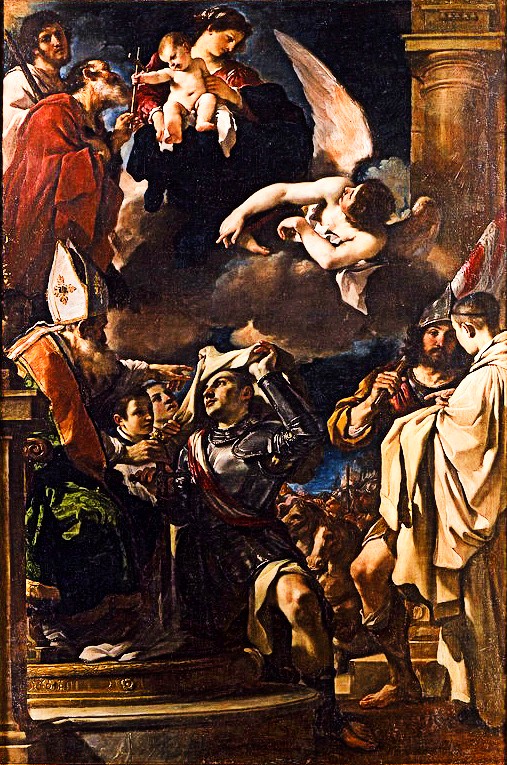
Leogild, King of the Visigoths, had two sons, Hermenegild and Recared, who reigned jointly with him. All three were Arians but Hermenegild married a. zealous Catholic, the daughter of Sigebert, King of France and by her holy example he was converted to theTrue Faith.

The Baptism of St Hermenegild attr to Guercino 17th Century

His father, on hearing the news, denounced him as a traitor and marched to seize his person. Hermenegild tried to rally the Catholics of Spain in his defence but they were too weak to make any stand and, after a two year fruitless struggle, he surrendered on the assurance of a free pardon.

When safely in the royal camp, his father the King had him loaded with fetters and cast into a foul dungeon at Seville. Tortures and bribes were in turn employed to shake his faith but Hermenegild wrote to his father that he held the Crown as nothing and preferred to lose sceptre and life. rather than betray the Truth of God.

At length, on Easter night, an Arian Bishop entered his cell and promised him his father’s pardon if he would but receive Communion at his hands. Hermenegild indignantly rejected the offer and knelt with joy for his death-stroke.

The same night a light streaming from his cell told the Christians who were watching near by that the Martyr had won his crown and was keeping his Easter with the Saviour and His Saints in glory.

El Triunfo de San Hermenegildo by Francisco Herrera the Younger (1654)

Leovigild on his death-bed, although still an Arian, bade Recared seek out St Leander, whom he had himself cruelly persecuted and, following Hermenegild’s example, be was received by St Leander into the Church. Recared did so too and on his father’s death, laboured so earnestly for the extirpation of Arianism that he brought over the whole nation of the Visigoths to the One True Church.

Nor is it to be wondered,” says St Gregory, “that he came thus to be a preacher of the True Faith, seeing that he was brother of a Martyr, whose merits did help him to bring so many into the lap of God’s Church.

Posted in MARIAN TITLES, SAINT of the DAY

Easter Thursday, Santa Maria dei Voti / Our Lady of Mantua, Italy (1640) and Memorials of the Saints – 13 April

Easter Thursday

Santa Maria dei Voti / Our Lady of Mantua, Italy (1640) – 13 April:
HERE:

https://anastpaul.com/2021/04/13/santa-maria-dei-voti-our-lady-of-mantua-1640-and-memorials-of-the-saints-13-april/

St Pope Martin I (598-655) Martyr, The 74th Bishop of Rome.
Biography:

https://anastpaul.wordpress.com/2017/04/13/saint-of-the-day-13-april-st-pope-martin-i/

St Agathonica of Pergamus
St Agathodorus of Pergamus

Blessed Albertinus of Fonte Avellana OSB (Died 1294) Monk, Prior General, talented Administrator and Peacemaker, not only in his Monastery but also in the greater world outside it.
About Blessed Albertinus:

https://anastpaul.com/2022/04/13/saint-of-the-day-13-april-blessed-albertinus-of-fonte-avellana-osb-died-1294/

St Caradoc of Wales (Died 1124) Priest, Monk, Hermit, Miracle-worker, Musician.
About St Caradoc:

https://anastpaul.com/2021/04/13/saint-of-the-day-13-april-saint-caradoc-of-wales-died-1124/

St Carpus of Pergamus
Bl Edward Catherick
Bl Francis Dickenson
St Guinoc

St Hermengild (Died 585) Martyr, Confessor, King

St Ida of Boulogne
Bl Ida of Louvain
Bl James of Certaldo
Bl John Lockwood

Blessed Margaret of Castello OP (1287-1320) Italian professed member from the Third Order of the Order of Preachers of St Dominic. Margaret was disabled and became known for her deep faith and holiness. Her body is incorrupt. Beatified on 19 October 1609 by Pope Paul V (concession of indult for Mass and Office).
About Blessed Margaret:

https://anastpaul.wordpress.com/2018/04/13/saint-of-the-day-13-april-blessed-margaret-of-castello-o-p-1287-1320/

St Martius of Auvergne
Bl Miles Gerard
St Papylus of Pergamus
St Proculus of Terni
St Ursus of Ravenna

Martyrs of Dorostorum – 3 Saints: A lector and two students Martyred together in the persecutions of Diocletian – Dadas, Maximus and Quinctillianus. Beheaded c303 in Dorostorum, Lower Mysia (modern Sillistria, Bulgaria.

Posted in SAINT of the DAY

Saint of the Day – 12 April – Saint Pope Julius I (Died 337)

Saint of the Day – 12 April – Saint Pope Julius I (Died 337) Bishop of Rome from 6 February 337 until his death on 12 April 352. He fought against the Arian Heresy and it is traditionally believed that he is the Pope who set 25 December as the date of the Birth of Jesus. Born at Rome, Italy and died on 12 April 352 of natural causes. Also known as – Jules I.

The Roman Martyrology reads: “At Rome, the birthday of Pope St Julius, who combated vigorously for the Catholic Faith against the Arians. After a life of brilliant deeds and great sanctity, he rested in peace.

Julius was the son of a Roman named Rusticus. He was elected Pope to succeed Pope St Mark on 6 February 337.

Julius was soon involved in the Arian controversy when Eusebius of Nicomedia opposed the return of Athanasius to the See of Alexandria in 338. Eusebius and his followers elected George, whereupon the Arians elected Pistus.

On his second banishment from Alexandria, St Athanasius came to Rome, and was recognised as the rightful Bishop by the Synod presided over by Julius in c340. In a letter to the Eusebian Bishops, Julius declared that Athanasius was the rightful Bishop of Alexandria and reinstated him. The matter was not finally settled until the Council of Sardica (Sofia), summoned by Emperors Constans and Constantius in 342 or 343, declared Julius’ action correct and that any deposed Bishop had the right of appeal to the Pope in Rome.

The Fathers of the Council of Sardica sent Pope Julius I the letter Quod semper credidimus, whose beginning we transcribe:

The Bishops gathered in the City of Sardica, to our most beloved Brother Julius, Bishop of Rome.

We have always believed and professed that which we have now experienced and heard. What the Blessed Paul, Doctor of Nations, said about himself is true; to wit that since Christ the Lord dwelt in him, there can be no doubt that the Spirit spoke through his breath and resounded in his mouth.

You also, beloved Brother, although separated from us in body, have been present with us, united in spirit and will. The reason for your absence was both honourable and compelling so that the schismatic wolves might not steal, nor treacherously waylay, any of the flock with their snares, or the heretical dogs, rabid with fury, disturb it with their mad barking, or, indeed that serpent spew forth the venom of his diabolical blasphemies. This certainly seems to be the best and most fitting course – that the Priests of the Lord, from each and every Province report everything to their Head that is, to the See of the Apostle Peter.

Julius also built several Basilicas and Churches in Rome before his death on 12 April 337.

Posted in MARIAN TITLES, SAINT of the DAY

Easter Wednesday, Nuestra Senora de la Caridad / Our Lady of Charity, Cobre, Cuba and Memorials of the Saints – 12 April

Easter Wednesday

Nuestra Senora de la Caridad / Our Lady of Charity, Cobre, Cuba OR Our Lady of Cobre – 12 Apri;:
HERE:

https://anastpaul.com/2021/04/12/our-lady-of-charity-cobre-cuba-and-memorials-of-the-saints-12-april/

St Acutina
St Ailell of Cologne

St Alferius Pappacarbone of La Cava (930–1050) Priest, Founder and Abbot of Arsicia (La Trinità della Cava) which follows the Benedictine Rule, nobleman, Diplomat to Prince Waimar III of Salerno, Cluniac reformer, cave Hermit, Mystic and Ecstatic, Miracle-worker.
The Roman Martyrology states: “In the Monastery of Cava de ‘Tirreni in Campania, Saint Alferius, Founder and first Abbot, who, after having been adviser to Guaimario, Duke of Salerno, who became a disciple of Saint Odilone in Cluny, learned in an excellent way, the discipline of monastic life.
Biography:

https://anastpaul.com/2021/04/12/saint-of-the-day-12-april-saint-alferius-of-la-cava-930-1050/

Blessed Andrew of Montereale OSA (c1479-1764) Priest and Friar of the Order oif the Hermits of St Augustine, renowned Scholar, Preacher, Teacher, Reformer. Confessor and Spiritual Director to the Royal Court of France, Miracle-worker. His life was devoted to teaching, preaching and leading the Augustinians from several positions of leadership. He was hailed, even during his lifetime, as a pious Miracle worker.

Blessed Angelo Carletti di Chivasso OFM (1411-1495) Religious Priest of the Friars’ Minor, Theologian, Teacher, Writer.
Blessed Angelo’s Biography:

https://anastpaul.wordpress.com/2017/04/12/saint-of-the-day-12-apil-blessed-angelo-carletti-di-chivasso/

St Artemón of Caesarea
St Basil of Parion
St Constantine of Gap
St Damian of Pavia
St Erkemboden of Thérouanne
St Florentin of Arles
St Pope Julius I (Died 337) Bishop of Rome from 6 February 337 until his death on 12 April 352.
St Lorenzo of Belem
St Peter of Montepiano

St Sabas the Lector

St Tetricus of Auxerre
St Victor of Braga
St Vissia of Fermo
St Wigbert

St Zeno of Verona (c 300 – 371) Bishop of Verona, Monk, Confessor, Reformer, believed to be a Martyr the persecutions of Constantius II and Julian the Apostate.
About St Zeno:

https://anastpaul.wordpress.com/2018/04/12/saint-of-the-day-12-april-st-zeno-of-verona-c-300-371/

Posted in Against EPIDEMICS, Against STORMS, EARTHQUAKES, THUNDER & LIGHTENING, FIRES, DROUGHT / NATURAL DISASTERS, For RAIN OR Against RAIN, SAINT of the DAY

Saint of the Day – 11 April – Saint Godeberta (c640-c700) Abbess

Saint of the Day – 11 April – Saint Godeberta (c640-c700) Abbess, Miracle-worker. Born in c640 near Amiens, France and died in c700 at Noyon, France of natural causes. Patronages – against plague/epidemics, for drought relief )fpr rain) , of Noyon, France. Also known as – Godeberta of Noyon, Godebertha, Godberta. Godeberta means “fervour.” Additional Memorials – 11 June, the Fifth Sunday after Easter.

Godeberta was born about the year 640, at Boves, a few leagues from Amiens, in France;. She was very carefully educated, her parents being of noble rank and attched to the Court of King Clovis II. When the question of her marriage was being discussed in the presence of the King, the saintly Bishop of Noyon, St Eligius, as if by inspiration, presented Godeberta with a golden ring and expressed the hope that she might devote her life to the service of God. Godeberta, moved by the Holy Spirit and feeling her heart suddenly filled with Divine love, turned away from the bright prospects before her and refused the advantageous offers which had been made by her noble suitors. She declared her willingness to be the spouse of Christ and asked the holy prelate to allow her to assume the veil.

The Legend of Saint Eligius and Saint Godeberta, by Petrus Christus.


In a short time all opposition to her wishes disappeared and she entered on her new life under the guidance of St Eligius. The King of the Franks was so impressed by her conduct and her zeal that he made her a present of the small palace which he had at Noyon, together with a little Chapel dedicated to St George. Godeberta’s example inspired a number of young women to follow in the same path and she founded in her new home, a Convent, of which she became the Abbess

Here she passed the remainder of her life in prayer and solitude, save when the call of charity or religion, brought her forth among the people, many of whom were still sunk in the vices of paganism. She was remarkable ,in particular, for the constant penances and fasts, to which she subjected herself. She had a wonderful faith in the efficacy of that ancient practice of the early Christians–the Sign of the Cross and, it is recorded, that on one occasion, in 676, during the Episcopacy of St Mommelinus, when the town was threatened with total destruction by fire, she made the Sign of the Cross over the flames,and the conflagration was forthwith extinguished.

The exact year of her death is unknown but it is said to have occurred on 11 June, on which day her feast is marked in the Proprium of Beauvais. In Noyon, however, by virtue of an indult, dated 2 April, 1857, it is kept on the fifth Sunday after Easter, the feast of 11 April appears to stem from the belief that this was the date of the translation of her Relics. The body of the Saint was interred in the Church of St George, which was afterwards called by her name.

In 1168 Godeberta’s body was solemnly translated from the ruined Church where it had rested for over 450 years, by Bishop Baudoin to the Cathedral of Noyon. Providentially her relics have escaped the ravages of time and fire and the malice of the irreligious. At the period of the Revolution a pious townsman secretly buried them near the Cathedral. When the storm had passed they were recovered from their hiding place and their authenticity, being canonically established, they were replaced in the Church.

A bell is still preserved which tradition avers, to have been the one actually used by Godeberta in her Convent. It is certainly very ancient and there seems no good reason, in particular from an archaeological point of view, for doubting the trustworthiness of the legend. In the treasury of the Cathedral, likewise may be seen a gold ring, said to have been that presented by St Eligius to the Saint. Mention is made in a record of the year 1167 of this Relic having been then in the possession of the Church of Noyon.

Unfortunately the most ancient documents we have giving details of Godeberta’s life do not, in all probability, date beyond the Eleventh Century, as the oldest “Vita” which, in truth, is rather a panegyric for her feast than a biography, is believed to have been composed by Radbodus, who became Bishop of Noyon in 1067. In those days, too, the aim of such writers was the edification rather than the instruction of the faithful, so we find in this life, the usual wonders related in such pious works of that period with but few historic facts. It is certain, however, that St. Godeberta was looked upon as a protector in the time of plagues and catastrophes and we have every reason to hold that this practice was justified by the results that followed her solemn invocation.

In 1866 a violent outbreak of typhoid fever occurred in Noyon, decimating the Town. On 23 May in that year, one of the leading citizens, whose child had just been stricken down, approached the cure of the Church and recalling the favours that had been granted in ages past to the clients of the Saint, earnestly asked that the Shrine containing her Relics should be exposed and a Novena of intercession begun. This was done the following day,and forthwith, the scourge ceased; it was officially certified that not another case of typhoid occurred. In thanksgiving a solemn procession took place under the guidance of the Bishop, Mgr Gignoux, a few weeks later, the Relics of St Godeberta being carried triumphantly through the town. A beautiful statue of the saint, the cathedral of Noyon, which was blessed by the Bishop on 25 February, 1867, perpetuated the memory of this wonderful event.

The wonderful St Eligius here:
https://anastpaul.com/2021/12/01/saint-of-the-day-1-december-good-st-eligius-st-eligius-of-noyon-c-588-660/

The Relics of St Godeberta
Posted in MARIAN TITLES, SAINT of the DAY

EASTER TUESDAY, Notre-Dame de Fourviere / Our Lady of Fourviere, France and Memorials of the Saints – 11 April

EASTER TUESDAY

Notre-Dame de Fourviere / Our Lady of Fourviere, France – 11 April:
HERE:

https://anastpaul.com/2021/04/11/low-sunday-2021-our-lady-of-fourviere-and-memorials-of-the-saints-11-april/

St Agericus of Tours
St Aid of Achard-Finglas

St Antipas of Pergamum (Died c 92) Bishop of Pergamon, Greece (in modern Turkey) and Martyr, spiritual student of Saint John the Apostle and Evangelist.
His Life and Death:

https://anastpaul.com/2021/04/11/saint-of-the-day-11-april-st-antipas-of-pergamum-died-c-92-spiritual-student-of-saint-john-the-apostle-and-evangelist/

St Barsanuphius the Hermit (Died c 563) Hermit, Spiritual guide gifted with the charism of Prophecy, Miracle-worker and a great correspondent whose letters are still with us after 1500 years!
About St Barsanuphius:

https://anastpaul.com/2020/04/11/saint-of-the-day-11-april-saint-barsanuphius-the-hermit/

St Domnio of Salona
Bl Elena Guerra
St Eustorgius of Nicomedia
Bl George Gervase
St Godeberta (c640-c700) Abbess

St Guthlac of Crowland (674–715) Monk, Hermit, Ascetic. St Guthlac was from Lincolnshire in England. He is particularly venerated in the Fens of eastern England where many Churches are dedicated to him. His sister is venerated as Saint Pega, an anchoress. His body was incorrupt until its destruction in the 16th century by the dissolution of the Monasteries by Henry VIII.
Biography:

https://anastpaul.com/2019/04/11/saint-of-the-day-11-april-st-guthlac-674-715/

St Hildebrand of Saint-Gilles
St Isaac of Monteluco
Bl James of Africa
Bl John of Cupramontana
Bl Lanunio
St Machai
St Maedhog of Clonmore
Bl Mechthild of Lappion
Bl Paul of Africa
St Philip of Gortyna
St Raynerius Inclusus
St Sancha of Portugal
St Stephen of Saint-Gilles

Posted in SAINT of the DAY

Saint of the Day – 10 April – St Bademus (Died 376) Confessor, Abbot and Martyr

Saint of the Day – 10 April – St Bademus (Died 376) Confessor, Abbot and Martyr, Founder of a Monastery. Bademus died on 10 April 376 by being stabbed countless times and finally beheaded by a wavering and frightened executioner. Also known as – Bademo, Vadim.

Bademus was a rich and noble citizen of Bethlapeta in Persia, who sold his possessions to follow Christ, then gave the greater part of the proceeds to the poor. He reserved just enough to found a Monastery near that City, to which he retired with several others and then governed it with great sanctity. He conducted his religious in the paths of perfection with sweetness, prudence and charity.

To crown his virtue, God permitted him, with seven of his Monks, to be apprehended by the followers of King Sapor in the thirty-sixth year of that King’s persecution. He lay for four months in a dungeon, loaded with chains and during this lingering martyrdom, received everyday, a cruel flagellation. But he triumphed over his torments by the patience and joy with which he suffered them for Christ.
At the same time, a Prince named Nersan, who was a Christian, was cast into prison and his goods confiscated because he refused to adore the sun. At first he seemed resolute but, at the sight of tortures,his constancy failed him and he promised to conform if he could be delivered. The King, to test whether his change was sincere, ordered Bademus to be brought where Nersan was kept in the royal palace and sent word to Nersan that if he would slay the Abbot, he would be restored to his liberty and former dignities. The apostate accepted the condition; a sword was put into his hand and he advanced to plunge it into the breast of the Abbot. But being seized with a sudden terror, he stopped short and remained for some time unable to lift up his arm to strike – he had neither courage to repent, nor heart to accomplish his crime.

Finally, he hardened himself and continued with a trembling hand to aim at the Martyr’s sides. Fear, shame, remorse and respect made his strokes forceless and unsteady and so great was the number of his victim’s wounds that the bystanders were in admiration at his invincible patience. Saint Bademus reproached his executioner, saying, “What will you do on the day when you will have to render an account of your actions and hear the sentence of your condemnation? I offer myself willingly to die for the glory of my Lord Jesus Christ but I would prefer to die by another hand, than yours!” The pagans themselves were horrified at the cruelty of the King, the long Martyrdom and the perfidious acts of the apostate.

Saint Bademus suffered on the 10th of April in the year 376. His body was cast out of the City but secretly carried away and interred by the Christians. A short time afterwards Nersan fell into public disgrace and perished by the sword – other accounts say that he committed suicide. . The disciples of the Saint were released from their chains four years later, at the death of King Sapor.

Posted in MARIAN TITLES, SAINT of the DAY

Easter Monday, Nuestra Señora de la Naval / Our Lady of Naval, Manila (1646) and Memorials of the Saints – 10 April

Easter Monday

Nuestra Señora de la Naval / Our Lady of Naval, Manila (1646) – 10 April:
HERE:

https://anastpaul.com/2021/04/10/easter-saturday-nuestra-senora-de-la-naval-our-lady-of-naval-manila-1646-and-memorials-of-the-saints-10-april/

Blessed Antony Neyrot OP (1425-1460) Martyr, Priest of the Order of Preachers, Priest, an Apostate who reconverted, Penitent.
Biography:

https://anastpaul.wordpress.com/2018/04/10/saint-of-the-day-10-april-blessed-antony-neyrot-o-p-1425-1460-martyr/

Bl Antonio Vallesio
St Apollonius of Alexandria
Bl Archangelus Piacentini
St Bademus (Died 376) Abbot and Martyr

St Bede the Younger
St Beocca of Chertsey
Bl Eberwin of Helfenstein
St Ethor of Chertsey
St Ezekiel the Prophet

St Fulbert of Chartres (c 960-1029) Bishop, Writer, Poet, Reformer, Marian devotee, Preacher, Teacher, Advisor.
About St Fulbert:

https://anastpaul.wordpress.com/2017/04/10/saint-of-the-day-10-april-st-fulbert-of-chartres/

St Gajan
St Hedda of Peterborough

St Macarius of Ghent (Died 1012) Archbishop of Constantinople, Pilgrim and Hermit (without a cell), Apostle of the sick and the needy, Miracle-worker.
Biography:

https://anastpaul.com/2021/04/10/saint-of-the-day-10-april-saint-macarius-of-ghent-died-1012-bishop/

St Malchus of Waterford
Bl Marco Mattia

Blessed Marcus Fantuzzi OFM (c 1405-1479) Priest and Friar of the Friars Minor, renowned Preacher, Superior, then Vicar General of the Observant Friars Minor. He was Beatified on 5 March 1868 by Pope Pius IX.
His Life:

https://anastpaul.com/2022/04/10/saint-of-the-day-10-april-blessed-marcus-fantuzzi-ofm-c-1405-1479/

St Miguel de Sanctis O.SS.T (1591-1625) Priest of the Order of the Most Holy Trinity and of the Captives also known as the Trinitarian Order or the Trinitarians, Mystic, Penitent, Ecstatic, Apostle of prayer, mortification, of the poor and the sick, he had a special devotion to the Blessed Sacrament and would fall into ecstatic prayer during the Consecration at Holy Mass, so much so, that he became known as “El Extático”, “The Ecstatic.” Pope Pius IX Canonised Miguel on 8 June 1862.
About St Miguel:

https://anastpaul.com/2020/04/10/saint-of-the-day-10-april-st-miguel-de-sanctis-o-ss-t-1591-1625/

St Palladius of Auxerre
St Paternus the Scot

Martyrs of Carthage – 50 Saints: A group of 50 Christians who were imprisoned in a pen of snakes and scorpions and then Martyred, all during the persecutions of Decius. Only six of their names have come down to us – Africanus, Alessandro, Massimo, Pompeius, Terence and Teodoro. Beheaded in 250 at Carthage.

Martyrs of Georgia: Approximately 6,000 Christian Monks and lay people Martyred in Georgia in 1616 for their faith by a Muslim army led by Shah Abbas I of Persia.

Martyrs of Ostia: A group of criminals who were brought to the faith by Pope Saint Alexander I while he was in prison with them. Drowned by being taken off shore from Ostia, Italy, in a boat which was then scuttled, c 115.

Posted in SAINT of the DAY

Saint of the Day – 9 April – Saint Waltrude of Mons (c612-686) Widow

Saint of the Day – 9 April – Saint Waltrude of Mons (c612-686) Married, Mother, Widow, later a Nun. Born at Cousolre in northern France in c612 as Waldetrude and died on 9 April 686 of natural causes. Patronages – of Hainault, Belgium and of Mons, Belgium. Also known as – Waldetrude, Valdetrudis, Vaudru, Vautrude, Waldeltrude, Waldetrude, Waldetrudis, Waltrudis, Waudru.

The Roman Martyrology reads: “At Mons, in Hainault, blessed Waltrude, renowned for holiness of life and miracles.

Waltrude was the daughter to the Princess St Bertille, elder sister to St Aldegondes and wife to Madelgaire, Count of Hainault and one of the principal Lords of King Dagobert’s Court. After bearing him two sons and two daughters, she induced him to embrace the monastic state at Haumont, taking the name of Vincent. He is honoured in Flanders among the Saints on the 20 September and called St.Vincent of Soignies.

For two years longer, she remained in the world, devoting herself entirely to exercises of piety, under the direction of the holy Abbot Saint Guislain. Being by that time disengaged from the encumbrances of the world,in 656, she received the Religious Veil at the hands of St.Aubert, Bishop of Cambray and lived in a little cell, adjoining to which was a Chapel in a solitary place called Castriloc, now Mons. Many other ladies resorting to her, she formed a Religious Community, which became a rich royal chapter of canonesses.

The Canonesses’ habit

From her reputation and from this community arose the City of Mons, now the Capital of Hainault. While her sister Aldegondes governed her great Monastery at Maubeuge, Waltrude sanctified herself in her little cell by holy poverty, meekness, patience, continual fasting and prayer. She suffered much from the slanders of men and from severe interior trials and temptations but God, after some years, recompensed her fidelity with a holy peace and great spiritual consolations.

On the 9 April, 686, she went to receive the crown promised by God to those who serve Him. Her Relics are esteemed the most precious treasure of the great Church which bears her name in Mons. She is titular Patroness of Mons and all of the district of Hainault.

By the life of St Waltrude, we should learn to despise the unjust censures of the world. It persecutes, by its calumnies, those by whose lives, its false maxims are condemned. But, it can only hurt a counterfeit virtue, as the fire consumes only the dross but renders true gold brighter and more pure. Solid virtue is not only tried by humiliations but, gains the greatest advantage and improvement, by making a good use of them.

The Shrine of Saint Waltrude is kept in the Saint Waltrude Collegiate Church in Mons. Each year, as part of the Ducasse de Mons Festival, the Shrine, which is within a gilded cart, is drawn by horses through the City streets.

Both her parents – Walbert and Bertille and her sister (Aldegund) were Canonised. Her four children were also declared Saints, (Landericus, Dentelin, Aldetrude, and Madelberte) and so was her husband, Madelgaire.

St Waltrude and her holy family of Saints
Posted in MARIAN TITLES, SAINT of the DAY

EASTER SUNDAY – ALLELUIA! ALLELUIA! Notre-Dames de Myans, Savoie / Our Lady of Myans, Savoy, France (1249) and Memorials of the Saints – 9 April

EASTER SUNDAY – ALLELUIA! ALLELUIA!

Notre-Dames de Myans / Our Lady of Myans, Savoy, France (1249) – 9 April:
HERE:

https://anastpaul.com/2021/04/09/easter-friday-our-lady-of-myans-savoy-france-1249-and-memorials-of-the-saints/

St Acacius of Amida
St Aedesius of Alexandria

Blessed Antony of Pavoni OP (1326-1374) Priest and Martyr, Inquisitor-General in Lombardy, Prior. Beatified on 4 December 1856 by Pope Pius IX. Patronage – of lost articles.
His Life nd Death:

https://anastpaul.com/2017/04/09/saint-of-the-day-9-april-blessed-antony-of-pavoni/

St Brogan
St Casilda of Toledo
St Concessus the Martyr
St Demetrius the Martyr
St Dotto
St Eupsychius of Cappadocia
St Gaucherius
St Hedda the Abbot
St Heliodorus of Mesopotamia
St Hilary the Martyr

St Hugh of Rouen OSB (Died 730) Bishop of Rouen, Paris and Bayeux, Monk, Abbot of of Jumièges and Fontenelle Abbey, while, simultaneously governing his Diocese.
Biography:

https://anastpaul.com/2022/04/09/saint-of-the-day-9-april-saint-hugh-of-rouen-osb-died-730/

Bl James of Padua
Blessed John of Vespignano

St Liborius of Le Mans (early 4th century – 397) Bishop, Confessor, Reformer, Evangeliser and Shepherd of souls, Builder of Churches and Monasteries.
St Liborius’ story:

https://anastpaul.wordpress.com/2018/04/09/saint-of-the-day-9-april-st-liborius-of-le-mans-early-4th-century-397/

St Madrun of Wales
St Marcellus of Die
Bl Marguerite Rutan
St Maximus of Alexandria
Bl Pierre Camino
St Prochorus

Blessed Thomas of Tolentino OFM (c 1255–1321) Martyr, Friar of the Friars Minor, Missionary.
Blessed Thomas’ Life and Death:

https://anastpaul.com/2019/04/09/saint-of-the-day-9-april-blessed-thomas-of-tolentino-ofm-c-1255-1321-martyr/

Blessed Ubaldo Adimari OSM (c 1245-1315) Priest and Servite Friar, Soldier, Politician, Penitent, miracle-worker, spiritul student and later assistant of St Philip Benezi (1233-1285) (one of the Seven Holy Founders of the Order of the Servants of Mary – the Servites). He was Beatified on 3 April 1821 by Pope Pius VII.
Biography:

https://anastpaul.com/2021/04/09/saint-of-the-day-9-april-blessed-ubaldo-adimari-osm-c-1245-1315/

St Waltrude of Mons (c612-686) Married Mother, later a Nun

Martyrs of Croyland – 9 Saints: A group of Benedictine Monks Martyred by pagan Danes – Agamund, Askega, Egdred, Elfgete, Grimkeld, Sabinus, Swethin, Theodore and Ulric. Croyland Abbey, England.

Martyrs of Masyla: Massylitan Martyrs Group of Christians Martyred in Masyla in northwest Africa.

Martyrs of Pannonia: Seven Virgin-Martyrs in Sirmium, Pannonia (modern Sremska Mitrovica, Serbia).

Martyrs of Thorney Abbey – 3+ Saints: A group of Hermits, hermitesses and monks who lived in or around Thorney Abbey who were Martyred together during raids by pagan Danes. We know little more than the names of three – Tancred, Torthred and Tova. 869 by raiders at Thorney Abbey, Cambridgeshire, England.

Posted in SAINT of the DAY

Saint of the Day – 8 April – Saint Dionysius of Corinth (Died in the 2nd Century) Bishop Confessor

Saint of the Day – 8 April – Saint Dionysius of Corinth (Died in the 2nd Century) Bishop of Corinth, Greec, Confessor, died in about 170.

The Roman Martyrology reads: “At Corinth, the Bishop, St Denis, who instructed not only the people of his own City and Province by the learning and unction with which he preached the word of God but, also the Bishops of other Cities and Provinces, by the letters which he wrote to them. His veneration for the Roman Pontiff was such that he used to read their epistles publicly in the Church on Sundays. He lived in the time of Marcus Antoninus Verus and Lucius Aurelius Commodus.

Unknown Saint Bishop

We have little personal information of Dionysius, bar that which we discover from his letters, which were known to the Historia Eusebius.. We gather a date for his Episcopate – around 170 – by the fact that he wrote to Pope Soter (c168 to 176). Eusebius of Caesarea, in his Chronicle, placed Dionysius’ period of activity in the eleventh year of Marcus Aurelius (171), while Bacchylus was Bishop of Corinth at the time of the Paschal controversy (about 190–8).

Eusebius knew a collection of seven of the Catholic Letters to the Churches of Dionysius, together with a letter to him from Pinytus, Bishop of Knossos and a private letter of spiritual advice to a lady named Chrysophora. Most of his letters to Bishops in his region contain instruction on dealing with heretics and warning of various unorthodox views which could lead to heresy. He also praised where such was due but generally most of his letters were of instruction or warnings to persist in the One Truth.

But the most important letter is the seventh one, addressed to the Romans and the only one from which extracts have been preserved. Pope Soter had sent alms and a letter to the Corinthians and in response, Dionysius wrote:

For this has been your custom from the beginning, to do good to all the brethren in many ways and to send alms to many Churches in different cities, now relieving the poverty of those who asked aid, now assisting the brethren in the mines by the alms you send,
Romans keeping up the traditional custom of Romans, which your blessed Bishop, Soter, has not only maintained,but has even increased, by affording to the brethren, the abundance which he has supplied, and by comforting with blessed words the brethren who came to him, as a father to his children.

Again:

You also by this instruction have mingled together the Romans and Corinthians, who are the planting of Peter and Paul. For they both came to our Corinth and planted us and taught alike and alike, going to Italy and teaching there, were Martyred at the same time.

Again:

Today we have kept the Holy Lord’s day, on which we have read your letter, which we shall ever possess to read and to be admonished, even as the former one, written to us through Clement.

Posted in HOLY SATURDAY, MARIAN TITLES, SAINT of the DAY

HOLY SATURDAY, Madonna di Valverde di Rezzato / Our Lady of the Green Valley of Valverde, Sicily (1040 and Memorials of the Saints – 8 April

HOLY SATURDAY – FAST & ABSTINENCE until NOON
https://anastpaul.com/2020/04/11/11-april-easter-vigil-in-the-holy-night-sabbatum-sanctum-he-has-ripped-open-a-hole-in-history-that-can-never-be-filled-in-again/
AND:
https://anastpaul.com/2021/04/03/sabbatum-sanctum-holy-saturday-watching-the-easter-vigil-of-the-holy-night/

Madonna di Valverde di Rezzato / Our Lady of the Green Valley of Valverde, Sicily (1040) – 8 April and 1 October:
HERE:
https://anastpaul.com/2021/04/08/easter-thursday-our-lady-of-valverde-our-lady-of-the-green-valley-sicily-1040-and-memorials-of-the-saints-8-april/

St Agabus the Prophet
St Amantius of Como
St Asynkritos of Marathon
St Beata of Ribnitz

Blessed Clement of Osimo OSA (1235-1291) Priest of the Oder of Hemits of St Augustine, Reformer, miracle-worker. He was Beatified
in 1761 by Pope Clement XIII .
His Lifestory:
https://anastpaul.com/2019/04/08/saint-of-the-day-blessed-clement-of-osimo-osa-1235-1291/

St Concessa

St Dionysius of Alexandria “The Great” (c 190-265) Archbishop of Alexandria, Confessor, outstanding Administrator, Writer, Theologian.
Biography:
https://anastpaul.com/2021/04/08/saint-of-the-day-8-april-saint-dionysius-of-alexandria-the-great-c-190-265/

St Dionysius of Corinth (Died in the 2nd Century) Bishop Confessor
Bl Domingo Iturrate Zubero
Bl Gonzalo Mercador
St Herodion of Patras

Blessed Julian of Saint Augustine (OFM c 1550-1606) Lay Brother of the Friars Minor, Hermit, Ascetic. He was Beatified in 1825 by Pope Leo XII .
Biography:

https://anastpaul.com/2022/04/08/saint-of-the-day-8-april-blessed-julian-of-saint-augustine-ofm-c-1550-1606-l/

Bl Libania of Busan
St Martin of Pegli
St Phlegon of Hyrcania
St Redemptus of Ferentini

Martyrs of Africa – 3 Saints: A group of African Martyrs whose name appears on ancient lists but about whom nothing is known but their names – Januarius, Macaria and Maxima.

Martyrs of Antioch – 4 Saints: A group of Christians Martyred together for their faith. We know little more than their names – Diogene, Macario, Massimo and Timothy. They died in Antioch, Syria.

Posted in ALTAR BOYS, DEACONS, SACRISTANS, GOLDSMITHS, SILVERSMITHS, GILDERS, MINERS, JEWELLERS, CLOCK/WATCH-MAKERS, METAL CRAFTSMEN, PATRONAGE-INFERTILITY & SAFE CHILDBIRTH, PREGNANCY, SAINT of the DAY

Saint of the Day – 7 April – Saint Hermann Joseph O.Praem (c1150-1241) Priest, “The Boy who Played with Angels” 

Saint of the Day – 7 April – Saint Hermann Joseph O.Praem (c1150-1241) Priest, Friar of the Order of of Canons Regular of Prémontré (the Norbertines or White Canons), Mystic, a prolific writer on spiritual subjects and the Sacred Scriptures, known as “The Boy who Played with Angels.” From childhood, Hermann had an intense devotion to Our Bless Mother Mary, who herself, assisted him in many ways and throughout his life. This beautiful painting below by Sir Antony van Dyck, shows Mother Mary receiving an apple from Hermann, to give to Baby Jesus. Born im c1150 as Hermann von Steinfeld in Cologne, Germany and died on 7 April 1241 in Hoven, Germany of natural causes. Additional Memorials – 24 May (translation of relics) and 21 May (Diocese of Cologne) and the the Sixth Sunday after Easter at Steinfeld in Cologne. In 1958 Hermann’s status as a Saint of the Church was formally recognised by Pope Pius XII. Patronages – watch and clockmakers, children and young students, Altar boys, Acolytes, Sextons and Sacristans, expectant mothers and safe childbirth. Also known as St Hermann Josef.

Hermann was born in Cologne, the son of Count Lothair of Meer and his wife Blessed Hildegund O.Praem (c1130-1185). His sister was Blessed Hadewych of Meer, also a Norbertine Nun. Although of the nobility, the family was not overly wealthy.

According to the biography by Razo Bonvisinus, a contemporary and Prior of Steinfeld Abbey, at the age of seven, Hermann attended school and very early was known for devotion to the Blessed Virgin. At every available moment he could be found at the Church of St Maria im Kapitol, where he would kneel rapt in prayer to Mary. Bonvisinus says that the boy once presented an apple, saved from his own lunch, to a statue of Jesus Who accepted it. On another occasion, when on a cold day he made his appearance with bare feet, Mary procured him the means of obtaining shoes.

At the age of twelve, he entered the Abbey of the Premonstratensian at Steinfeld. As he was too young to be accepted into the Order, he was sent to study, probably in the Netherlands. Upon his return, he made his vows and was given the Habit and later, the additional name “Joseph.”

As a Novice, he was initially entrusted with the service of the Refectory and later, of the Sacristy. After his Ordination, Hermann was sometimes sent out to perform pastoral duties and was also in frequent demand for the making and repairing of clock – a talent and skill which he enjoyed as a recreation. Hermann became noted for the devotion with which he celebrated the Holy Sacrifice of the Mass. Indeed, he fell into an ecstasy of prayer so often at Mass that his Masses went on “forever.”
As a Monk, Father Hermann retained all the blameless innocence of spirit which had characterised him as a child. He was much loved for his readiness to assist anyone in need and anyone who asked. But while he had practical skills (he was an able mechanic and clock-maker), he was essentially a contemplative.

His confreres jokingly called him “Joseph” for his attention to the Madonna and Child. Typically, he declared himself unworthy to be called after the father of the Holy Family. But Our Lady took a fancy to the name and in a vision, put upon his finger a wedding ring to confirm that he was her spiritual spouse. On the basis of this vision, Hermann added “Joseph” to his other name.

The Mystical Marriage of St Hermann Joseph by Jean-Guillaume Carlier

He was also active in pastoral care outside the Monastery, especially in the female monasteries in the region, as both his mother (after her widowhood) and his sister had become Norbertine Nuns.

Hermann was characterised by his child-like devotion to Mary. Late in his life, he had, under his charge, the spiritual welfare of the Cistercian Nuns at Hoven whom he served as Chaplain. There he died and was buried in their cloister.

Countless miracles were reported at his tomb – the blind were cured, physical ailments were cured and even demons fled those who were possessed and were brought to Herman’s tomb. Hermann Joseph received visits from expectant women who asked his intercession for a safe delivery. The patronage of expectant mothers has been handed down since the 17th century in the use of “touch relics”, such as brooches and clasps, which were left on the Reliquary or tomb and retrieved later and then fastened to their clothing, in the hope of a happy and safe childbirth, through the intercession of the Saint. We presume that Hermann’s prayers, both during life and after, had proved efficacious in these matters.

His body was later transferred back to Steinfeld Monastery, where his marble tomb and large picture may be seen to the present day. By custom apples are left at his tomb – in the image below the large picture (as posted above by Sir Antony van Dyck) as well as an apple, can be seen. Portions of his Relics are at Cologne and at Antwerp. His grave in Steinfeld is a pilgrimage destination – in the Middle Ages, especially by mothers, in modern times, by children and students. The Hermann Joseph Festival is held at Steinfeld on the Sixth Sunday after Easter, every year.

Posted in DEVOTIO, MARIAN TITLES, SAINT of the DAY

GOOD FRIDAY – FAST and ABSTINENCE, Tre Ore (The Three Hours Devotion), Santa Maria El Puig / Our Lady of Puig, Valencia, Spain and Memorials of the Saints – 7 April

GOOD FRIDAY – FAST and ABSTINENCE

Tre Ore (The Three Hours Devotion)
The Three Hours’ Agony on Good Friday from Noon until 3 o’clock to commemorate the three hours of Christ’s Hanging at the Cross.
It includes sermons on the Seven Last Words from the Cross and usually occurs between Noon and 3PM, the latter being the time when Jesus Died on the Cross and the time the Liturgy of the Lord’s Passion begins.
In 1815, Pope Pius VII decreed a plenary indulgence to those who practice this devotion on Good Friday.

It is a fine tradition to keep silent
from Noon to 3:00 PM today.

Santa Maria El Puig / Our Lady of Puig, Valencia, Spain, Patron of Valencia and the Spanish Army – 7 April:
HERE:

https://anastpaul.com/2021/04/07/easter-wednesday-our-lady-of-puig-valencia-spain-and-memorials-of-the-saints-7-april/

St Albert of Tournai
Bl Alexander Rawlins
St Brenach of Carn-Engyle
St Calliopus of Pompeiopolis
Bl Cristoforo Amerio
St Cyriaca of Nicomedia
St Donatus of North Africa

Blessed Edward Oldcorne SJ (1561-1607) Priest Martyr. Edward Oldcorne was Beatified on 15 December 1929 by Pope Pius XI.
His Life and Death:

https://anastpaul.com/2021/04/07/saint-of-the-day-7-april-blessed-edward-oldcorne-sj-1561-1607-priest-martyr/

St Epiphanius the Martyr
St Finian of Kinnitty
St George the Younger
St Gibardus of Luxeuil
St Goran
St Guainerth
St Hegesippus of Jerusalem

St Henry Walpole SJ (1558–1595) Martyr, Priest of the Society of Jesus, Martyr, Confessor, Poet, Lawyer.
His Life and Death:

https://anastpaul.com/2022/04/07/saint-of-the-day-7-april-saint-henry-walpole-sj-1558-1595-martyr/

Saint Hermann Joseph O.Praem (c1150-1241) Priest, Friar of the Order of of Canons Regular of Prémontré (the Norbertines or White Canons), Mystic

Blessed Maria Assunta Pallotta (1878-1905) Italian professed Religious who served as a member of the Franciscan Missionaries of Mary, Missionary to China. Patronages – Missionaries, against typhus. Blessed Maria Assunta was Beatified on 7 November 1954 by Pope Pius XII.
Her body is incorrupt.
About Bl Maria Assunta:

https://anastpaul.com/2019/04/07/saint-of-the-day-7-april-blessed-maria-assunta-pallotta-1878-1905/

St Peleusius of Alexandria
Bl Ralph Ashley
St Rufinus the Martyr
St Saturninus of Verona
Bl Ursuline of Parma

Martyrs of Pentapolis – 4 Saints: A Bishop, Deacon and two Lectors at Pentapolis, Lybia who for their faith were tortured, had their tongues cut out, and were left for dead. They survived and each died years later of natural causes; however, because they were willing to die and because there were attempts to kill them, they are considered martyrs. We know little else except their names – Ammonius, Irenaeus, Serapion and Theodore c 310 at Pentapolis, Lybia.

Martyrs of Sinope – 200 Saints: 200 Christian soldiers Martyred together for their faith. We don’t even have their names. They were martyred in Sinope, Pontus, Asia Minor (in modern Turkey).

Posted in SAINT of the DAY

Saint of the Day – 6 April – St William of Eskilsoe (1125-1203) Priest, Abbot

Saint of the Day – 6 April – St William of Eskilsoe (1125-1203) Priest, Abbot, Reformer – be it by his fervour, mortification, charity to the poor and uprightness of life. Born IN 1125 at Paris, France and died ion Easter Sunday, 6 April 1203 in Denmark of natural causes. Also known as – William of Aebelhold, William of Aebelholt, William of Ebelholt, William of Eskhill, William of Eskyll, William of Ise Fjord, William of Paris, William of the Paraclete, Wilhelm, Willem, Villem. St William was Canonised on 21 January 1224 by Pope Honorius III.

William was born of an illustrious family in Paris, about the year 1125 and received his education in the Abbey of St Germain-des-Prez, under his uncle Hugh, the Abbot. By the regularity of his conduct,and the sanctity of his manners, he was the admiration of the whole community. Having finished his studies, he was Ordained Deacon, then Priest and installed as a Canon in the Church of St Genevieve au-Mont. His assiduity in prayer, love of retirement and mortification,and exemplary life, seemed a troublesome censure of the slothful and worldly life of his colleagues and what ought to have gained him their esteem and affection, served to provoke their envy and malice against him.

Having in vain endeavoured to prevail on this reformer of their Chapter, as they called him, to resign his Canonry, in order to remove him, they presented him to the curacy of Epinay, a Church five leagues from Paris, depending on their chapter.

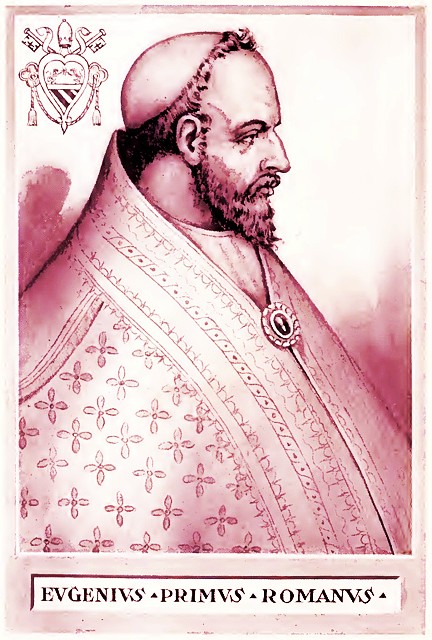
But not long after, Pope Eugenius III coming to Paris, in 1147 and being informed of the irregular conduct of these Canons, he commissioned the celebrated Sugar, Abbot of St Denys and Prime Minister to King Louis the Young, to expel them and introduce in their place, regular Canons from the Abbey of St Victor which was happily carried into execution, Eudo of St Victor’s being made the first Abbot. William with joy embraced this institution and was, by his fervour and devotion, a pattern of the most perfect Priest and Monk. He was in a short time chosen Sub-Prior.

The perfect spirit of religion and regularity which he established in that community, was an illustrious proof of the incredible influence which the example of a prudent Superior has over docile religious minds. His zeal for regular discipline, he tempered with so much sweetness and modesty in his injunctions, that made all to love the precept itself and, to practice with cheerfulness, whatever was prescribed them.
The reputation of his wisdom and sanctity reached the ears of Absalon, Bishop of Roschild, in Denmark, who, being one of the most holy prelates of his age, earnestly sought to allure him into his Diocese. In 1161, he sent the provost of his Church, who seems to have been the learned historian Saxo the Grammarian, to Paris on this errand. A prospect of labours and dangers for the glory of God was a powerful motive with the Saint and, in 1165, he cheerfully undertook the voyage, taking with him 3 Monks.

The Bishop appointed him Abbot of Eskilsoe, a Monastery of Regular Canons which he had reformed. But when Abbot William arrived there were only six religious left at Eskilsoe, two of whom were dismissed when they refused to submit to the new rule. Here William sanctified himself by a life of prayer and austere mortification but had much to suffer from the persecutions of powerful men, from the extreme poverty of his house in a severe climate and, above all, from a long succession of interior trials but the most perfect victory over himself, was the fruit of his constancy, patience and meekness. On prayer was his chief dependence and it proved his constant support. And by his life of holiness, he soon filled the Monastery with new Monks who were drawn by the sanctity of their Abbot.

During the thirty years of his Abbacy, he had the comfort of seeing many walk with fervour in his steps. He never omitted wearing his hair-shirt, lay on straw and fasted every day. Penetrated with a deep sense of the greatness and sanctity of our Mysteries, he never approached the Altar without watering it with his tears, making himself a victim to God in the spirit of adoration and sacrifice, together with and through, the merits of the Holy Victim offered thereon: the dispositions in which every Christian ought to assist at it.

William died on 6 April, 1203, which that year was Easter Sunday. Numerous miracles were reported at his grave and in 1218 the Archbishop of Lund, Anders Sunesen, requested that Pope Honorius III appoint a local commission to investigate the claims of William’s sanctity. William was Canonised only 21 years after his death by Pope Honorius III in 1224. In 1238 St William’s Relics were translated to the new Church built at his Abbey of Eskilsoe. In time some of his Relics were shared in various Cathedrals and Churches across Denmark.

Posted in MARIAN TITLES, SAINT of the DAY

Maundy Thursday, Notre-Dame de la Conception / Our Lady of the Conception, Flanders (1553) and Memorials of the Saints – 6 April

Maundy Thursday – FAST

Notre-Dame de la Conception / Our Lady of the Conception, Flanders (1553) – 6 April:
HERE:

https://anastpaul.com/2021/04/06/easter-tuesday-our-lady-of-the-conception-flanders-1553-and-memorials-of-the-saints-6-april/

Saint Juliana of Cornillon (c 1192-1258) Nun, Mystic “Apostle of the Blessed Sacrament,” she contributed to the institution of one of the most important solemn Liturgies of the year, namely the Solemnity of Corpus Christi.
Her Life:

https://anastpaul.com/2021/04/06/saint-of-the-day-6-april-saint-juliana-of-cornillon-c-1192-1258-apostle-of-the-blessed-sacrament/

A Hundred and Twenty Martyrs of Hadiab, or Hadiabena, in Persia. These one hundred and twenty Martyrs suffered at Seleucia, in the year of Christ 345.
Their Story:

https://anastpaul.com/2022/04/06/saints-of-the-day-6-april-a-hundred-and-twenty-martyrs-of-hadiab-died-345/

St Agrarius the Martyr
St Amand of Grisalba
St Berthanc of Kirkwall
St Brychan of Brycheiniog
Bl Catherine of Pallanza
St Diogenes of Philippi
St Elstan of Abingdon
St Galla of Rome
St Gennard
St Irenaeus of Sirmium
St Marcellinus the Martyr

Blessed Notker Balbulus OSB (c 840-912) Benedictine monk. Priest. Poet. Musician. Teacher. Writer. Historian. Hagiographer; wrote a martyrology, a collection of legends and a metrical biography of Saint Gall. He was Beatified in
1512 by Pope Julius II.
Biography:

https://anastpaul.wordpress.com/2017/04/06/saint-of-the-day-6-april-blessed-notker-balbulus/

St Philaret of Calabria
St Platonides of Ashkelon
St Prudentius of Troyes
St Pope Sixtus I
St Timothy of Philippi
St Ulched
St Urban of Peñalba
St William of Eskilsoe (1125-1203) Priest, Abbpt
St Winebald

Martyrs of Sirmium : 7 Saints – A group of fourth century Martyrs at Sirmium, Pannonia (modern Sremska Mitrovica, Serbia). We know little more than seven of their names – Florentius, Geminianus, Moderata, Romana, Rufina, Saturus and Secundus.

Posted in SAINT of the DAY

Saint of the Day – 5 April – Saint Gerald of Sauve-Majeure OSB (c1025-1095) Priest, Abbot

Saint of the Day – 5 April – Saint Gerald of Sauve-Majeure OSB (c1025-1095) Priest, Abbot, Reformer, Founder of the great Monastery of Sauve-Majeure, also known as Grande-Sauve. Born at Corbie, Picardy, France and died 1095 of natural causes. Also known as – Gerald of Corbie, Gerard, Geraud. St Gerald was Canonised in 1197 by Pope Celestine III.

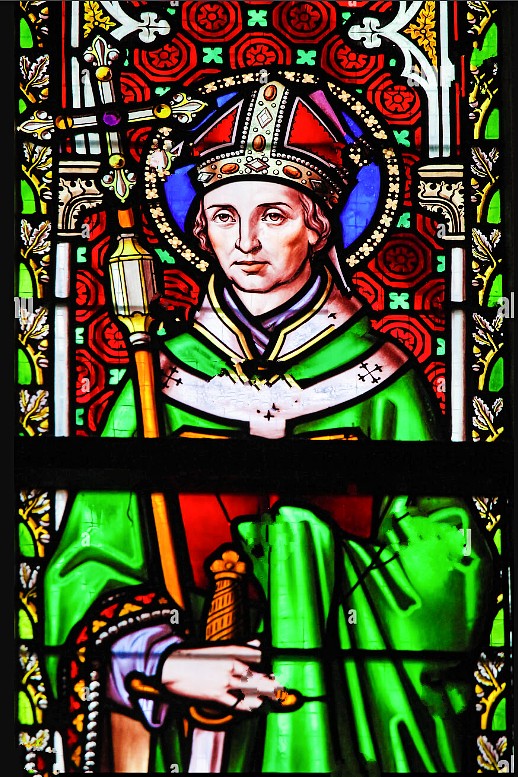
Stained glass of St Gerald at the Parish Church at Sauve-Majeure

Gerald was born in Corbie, Picardy and was entrusted, by his parents, to the Abbey of Corbie for his studies under the Abbot Richard where he later became a Monk and where he was appointed as the Cellarer.

Gerald suffered greatly from violent headaches and optical problems with which the doctors were unable to assist. These severed afflictions prevented him from carrying out his devotions. as he wished.

In an effort to cure this affliction, he accompanied Abbé de Corbie Foulques to Rome where they were both Ordained Priests by Pope Leo IX . From there they went onto Monte Gargano and then to Monte Cassino, seeking the intercession of St Benedict and St Michael.

After returning to Corbie and suffering a great mental crises due to the pain, Gerald was suddenly cured by the intercession of St Adelard of Corbie (c751–827) the Abbot of Corbie in the 9th Century, of whom Gerald later wrote a Hagiography. St Adelard here: https://anastpaul.com/2021/01/02/saint-of-the-day-2-january-saint-adelard-of-corbie-c-751-827/

After his cure, Gerald made a pilgrimage to the Holy Land in thanks giving for the miraculous cure. He stayed until 1974 when he returned to Corbie. He was then elected as the Abbot of St Vincent’s Abbey, Laon but the Monks did not accept his authority or the imposition of reforms in the form of proper discipline. After some years, Gerald resigned from Laon in order to become the Abbot of St Medard’s Abbey, Soissons but wasfaced with opposition and was driven out by an usurper.

He then sought instead to found a new Benedictine Monastery. Duke William VIII of Aquitaine gave him a huge tract of forest in the Gironde near Bordeaux, where Gerald founded the Abbey of Grande-Sauve, of which he was also the first Abbot. Here, at this Monastery, Gerald developed a powerful community steeped in the advancement of the Benedictine Rule and a disciplined mode of life, with significant influence from the customs of Cluny.

Here, Gerald initiated the practice of celebrating Mass and the Office for the Dead for 30 days after the death of a community member. His constant advice to his Monks for as long as he lived was – that they should shun all idle conversation and discussion.

Near the end of his life, he wrote the Vita and Miracles of St Adelard . He died at the Abbey of -Majeure in 1095.

A Note on St Gerald’s great work of Founding the Monastery of Sauve-Majeure:

“Sauve-Majeure Abbey is a former Benedictine Monastery near the present village of La Sauve in the department of the Gironde, in a region once heavily forested. Although now in ruins, the remains of the Abbey are still of great interest in terms of Romanesque architecture, especially because of the many sculpted capitals still surviving.

In 1998 the Abbey ruins were included as part of the UNESCO world heritage site of the pilgrimage route to St James of Compostela.

On the spot known as Hauteville, halfway between the Garonne and the Dordogne, St Gerald of Sauve-Majeure founded the Abbey of Grande-Sauve in 1079, of which he was also the first Abbot. Its name refers to the Silva Major, the great forest that then occupied the whole region known as the Vignoble de l’Entre-Deux-Mers (“vineyard between two seas”) which was a gift to St Gerald from Duke William VIII of Aquitaine.

With the support of the Duke, the Pope and a large number of generous benefactors and protectors, including the Kings of England and France, its Patrons, the Abbey prospered and grew rapidly. It is sited on the route to Santiago de Compostela and served as a local point of departure for pilgrims.

During the French Revolution the Abbey’s assets were confiscated and dispersed. The surviving buildings were used from 1793 as a prison. The Church roofcollapsed in 1809 and for the next forty years, the remains were used as a quarry for the village of La Sauve.

In 1837 the Archbishop bought up the site and had a Jesuit college built there, which was later converted into a teachers’ training college. But in 1910 the school was destroyed in a fire and the site was again abandoned. Between 1914 and 1918 the remaining buildings were used as a small military hospital.

In 1960 the site was acquired by the French government and the ruins made stable. The site is now open to the public under the management of the Centre des Monuments Historiques.”

Posted in DOMINICAN OP, MARIAN TITLES, SAINT of the DAY

“Spy” Wednesday in Holy Week, Santuario Madonna della Divina Provvidenza / Our Lady of Divine Providence, Italy (1521), St Vincent Ferrer and Memorials of the Saints – 5 April

Spy” Wednesday in Holy Week – FAST

Santuario Madonna della Divina Provvidenza / Our Lady of Divine Providence, Cussanio, Italy (1521) – 5 April:
HERE:

https://anastpaul.com/2021/04/05/easter-monday-our-lady-of-divine-providence-cussanio-italy-1521-and-memorials-of-the-saints-5-april/

St Vincent Ferrer OP (1350-1419) Confessor, called the “Angel of the Apocalypse/The Last Judgement” and the “Mouthpiece of God.”- Dominican Priest, Missionary, Master of Sacred Theology, Philosopher, Teacher, Preacher, Logician, Apostle of Charity.
Biography of St Vincent:

https://anastpaul.wordpress.com/2018/04/05/saint-of-the-day-5-april-st-vincent-ferrer-o-p-1350-1419/

St Albert of Montecorvino
Bl Antonius Fuster
St Becan
Bl Blasius of Auvergne

St Catherine of Palma OSA (1533–1574) Nun of the Order of the Canonesses of St Augustine, Mystic, gifted with the charism of prophecy, visions and ecstasy. She was Canonised on 22 June 1930 by Pope Pius XI. Her body is incorrupt.
About St Catherine:

https://anastpaul.com/2021/04/05/saint-of-the-day-5-april-saint-catherine-of-palma-osa-1533-1574/

St Claudius of Mesopotamia

St Derferl Gadarn (c 566-660) Welsh Prince, Solodier, Monk, Abbot, Missionary, Local legend holds, that he was a warrior of King Arthur.
His Life:

https://anastpaul.com/2022/04/05/saint-of-the-day-5-april-saint-derferl-gadarn-c-566-660/

St Gerald of Sauve-Majeure (c1025-1095) Abbot
St Irene of Thessalonica
St Maria Crescentia Hoss
St Pausilippus
Bl Peter Cerdan
St Theodore the Martyr

Martyrs of Lesbos: 5 Saints: Five young Christian women Martyred together for their faith. We don’t even know their names. island of Lesbos, Greece.

Martyrs of North-West Africa: Large group of Christians murdered while celebrating Easter Mass during the persecutions of Genseric, the Arian king of the Vandals. They were Martyred in 459 at Arbal (in modern Algeria).

Martyrs of Seleucia: 120 Saints :One-hundred and eleven (111) men and nine (9) women who, because they were Christians, were dragged to Seleucia and Martyred for refusing to worship the sun or fire or other pagan idols during the persecutions of King Shapur II. They were burned alive in 344 in Seleucia, Persia.

Posted in SAINT of the DAY

Saint of the Day – 4 April – St Zosimus of Palestine (c 460-c 560) Priest, Hermit

Saint of the Day – 4 April – St Zosimus of Palestine (c 460-c 560) Priest, Monk, Hermit. As already reported in the legendary life of St Mary of Egypt, St Zosimus, a Monk and Hermit, is the one who discovers St Mary in the desert and gave her Holy Communion shortly before her death. When she died, he buried her and related her lifestory (as she had related it to him) to his fellow Monks, who in turn finally recorded it in writing.

The Roman Martyrology reports: “In Palestine, the Anchorite, St Zosimus, who buried the remains of St Mary of Egypt.”

Zosimas was born in the second half of the fifth century, during the reign of Emperor Theodosius II. He became a Monk in a Monastery in Palestine at a very young age. At the age of fifty-three, he moved to a very strict Monastery located in the wilderness close to the Jordan River, where he spent the remainder of his life. He is best known for his encounter with Mary of Egypt, as we read below from her Vita:

“Approximately one year before her death, she recounted her life to Saint Zosimas of Palestine (c 460-c 560), who encountered her in the desert. When he unexpectedly met her in the desert, she was completely naked and almost unrecognisable as human. She asked St Zosimas to give her his mantle to cover her nakedness and then she narrated her life’s story to him.

She then asked him to meet her at the banks of the Jordan, on Holy Thursday of the following year and bring her Holy Communion. When he fulfilled her wish, she crossed the river to get to him by walking on the surface of the water and received Holy Communion, asking him to meet her again in the desert the following Lent.

The next year, St Zosimas travelled to the same spot where he first met her, some twenty days’ journey from his Monastery and found her lying there dead. According to an inscription written in the sand next to her head, she had died on the very night he had given her the Blessed Sacrament and had been somehow miraculously transported to the place he found her. Her body was preserved incorrupt.

He buried her body with the assistance of a passing lion. On returning to the Monastery, he related her life story to the brethren and it was preserved among them, as oral tradition, until it was written down by St Sophronius.”

St Mary’s life:
https://anastpaul.com/2021/04/01/saint-of-the-day-1-april-saint-mary-of-egypt-c-344-c-421/

Posted in DOCTORS of the Church, FATHERS of the Church, franciscan OFM, MARIAN TITLES, SAINT of the DAY

Tuesday in Holy Week, Notre-Dame de Grace, Honfleur/ Our Lady of Grace, France, St Isidore of Seville and Memorials of the Saints – 4 April

Tuesday in Holy Week – FAST

Notre-Dame de Grace, Honfleur, Normandie / Our Lady of Grace, Normandy, France – 4 April:
HERE:
https://anastpaul.com/2021/04/04/easter-sunday-2021-the-resurrection-of-the-lord-solemnity-of-solemnities-our-lady-of-grace-normandy-and-memorials-of-the-saints/

St Isidore of Seville (c 560-636) Bishop, Confessor, Father & Doctor of the Church, Writer, Teacher, Reformer and Evangelist. Sometimes called – “The Last Scholar of the Ancient World.”
St Isidore’s life:

https://anastpaul.wordpress.com/2017/04/04/saint-of-the-day-4-april-st-isidore-of-seville-father-and-doctor-of-the-church/

Bl Abraham of Strelna
St Agathopus of Thessalonica
St Aleth of Dijon

St Benedict of Palermo OFM (1526-1589) Friar Minor of the Observance, Confessor.
Celebrated yesterday 3 April and today on some calendars.
About St Benedict:

https://anastpaul.wordpress.com/2018/04/04/saint-of-the-day-4-april-st-benedict-of-sicily-o-f-m-1526-1589/

St Gwerir of Liskeard
St Henry of Gheest
St Hildebert of Ghent
St Peter of Poitiers (c 1130-1215) Bishop

St Plato (c 734-813) Monk, Confessor, Defender of sacred images and of the Sacraments of Marriage and Holy Orders.
St Plato’s Lifestory:

https://anastpaul.com/2021/04/04/saint-of-the-day-4-april-saint-plato-c-734-813/

St Theodulus of Thessalonica
St Theonas of Egypt
St Tigernach of Clogher
St Zosimus of Palestine (Died c560) Priest, Monk, Hermit

Martyred in Cairo
François de la Terre de Labour
Nicolas of Montecorpino

Martyrs of Thessalonica – 14 Saints: Fourteen Christians who were Martyred together, date unknown. No other information, except the names of 12 of them, has survived – Ingenuus, Julianus, Julius, Matutinus, Orbanus, Palatinus, Paulus, Publius, Quinilianus, Saturninus, Successus, Victor and two whose names have not come down to us.
Agathopus the Deacon, Theodulus the Lector.

Posted in DYING / LAST WORDS, Our MORNING Offering, PRAYERS of the SAINTS, SAINT of the DAY

Our Morning Offering – 3 April – Lord Jesus Christ, Have Mercy Upon Me

Our Morning Offering – 3 April – Monday in Passion Week and the Memorial of St Richard of Chichester (1197-1253)

Lord Jesus Christ,
Have Mercy Upon Me.
The Dying Prayer of
St Richard of Chichester (1197-1253)

Lord Jesus Christ,
I thank Thee
for all the blessings Thou hast given me
and for all the sufferings and shame,
Thou didst endure for me,
on which account,
that pitiable cry of sorrow was Thine:
Behold and see, if there was any sorrow
like unto My sorrow!

Thou knowest Lord,
how willing I should be, to bear insult
and pain, and death for Thee,
therefore, have mercy upon me,
for to Thee do I commend my spirit.
Amen

St Richard recited this prayer on his deathbed, surrounded by the Clergy of his Diocese. The words were transcribed, in Latin, by his Confessor and friend, Fr Ralph Bocking (who ultimately also became his Biographer), a Dominican Friar and were eventually published in the Acta Sanctorum, an encyclopedic text in 68 folio volumes of documents examining the lives of Saints. The British Library copy contains Fr Bocking’s transcription of the prayer:

Gratias tibi ago,
Domine Jesu Christe,
de omnibus beneficiis
quae mihi praestitisti;
pro poenis et opprobrious,
quae pro me pertulisti;
propter quae planctus ille lamentabilis
vere tibi competebat.
Non est dolor similis sicut dolor meus.

However, the first English translation is as above an not the version below, or the one more commonly known as “Day by Day” which words were never in the original and were added and used in the extremely sacrilegious and blasphemous “Godspell” – even though the common version with the rhyming “Triplet” (i.e. clearly, dearly, nearly) – is the one found commonly in Hymn and Prayer Books.
Bearing in mind that this was “The Dying Prayer ” of St Richard, it is obviously highly unlikely that he would have requested the grace of daily sanctity, “day by day!”

Thanks be to Thee,
my Lord Jesus Christ
For all the benefits
Thou hast given me,
For all the pains and insults
Thou hast borne for me.
O most merciful Redeemer,
Friend and Brother,
May I know Thee more clearly,
Love Thee more dearly,
Follow Thee more nearly.
Amen