St Benedict of the Bridge St Cronan of Roscrea St Cyril of Turov Bl Gerard of Bourgogne Bl Hanna Helena Chrzanowska OSB (1902-1973) Bl Józef Cebula Blessed Luchesius TOSF (c1180 – 1260) Layman – The first Franciscan Tertiary
Quote/s of the Day – 27 April – The Memorial of St Peter Canisius SJ (1521-1597) Doctor of the Church
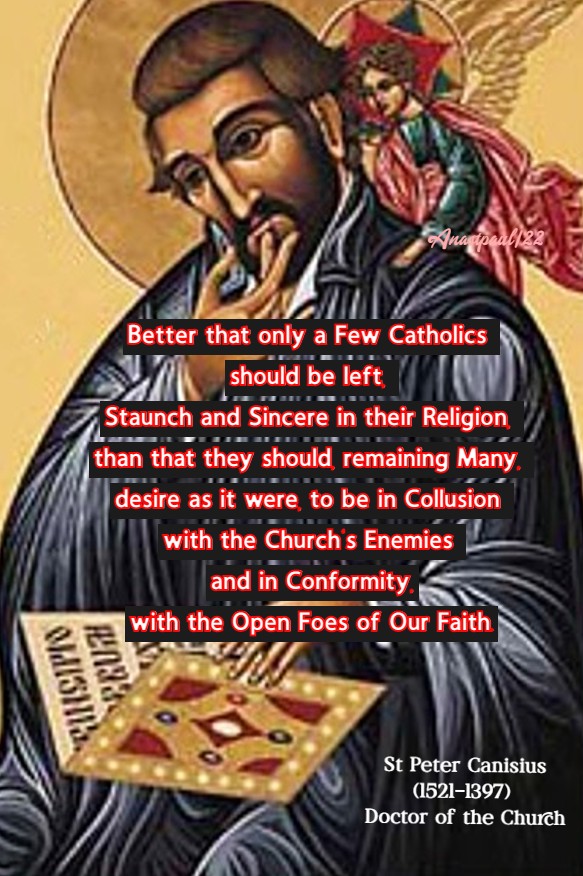
“Better that only a few Catholics should be left, staunch and sincere in their religion, than that they should, remaining many, desire as it were, to be in collusion with the Church’s enemies and in conformity with the open foes of our faith.”
Prayer of a Catechist to Jesus, Lover of Children
O Jesus, Friend of children, Who from Thy most tender years did grow visibly in wisdom and in grace before God and men. Who at the age of twelve, was seated in the Temple, in the midst of the doctors, listening to them attentively, humbly asking them questions and exciting their admiration by the prudence and wisdom of Thy discourse. Who didst receive, so willingly, the children, blessing them and saying to Thy disciples: Let them come to Me, for of such is the Kingdom of Heaven. Inspire me as Thou did inspire the blessed Peter Canisius, model and guide of the perfect Catechist, with a profound respect and a holy affection for childhood, a taste and a marked devotion for instructing them in Christian doctrine, a special aptitude, in making them understand its mysteries and love its beauties. I ask this of Thee, through the intercession of the Blessed Virgin Mary and Saint Peter Canisius. Amen.
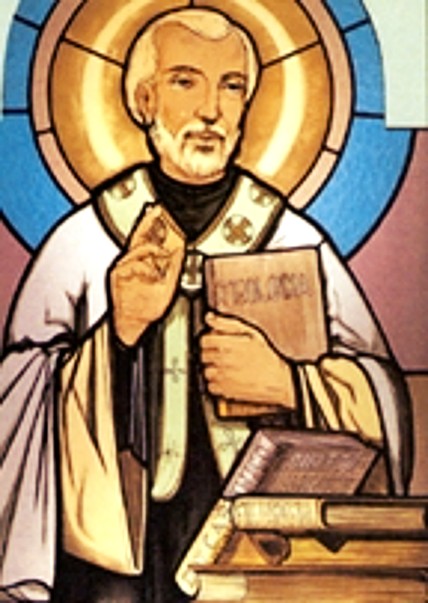
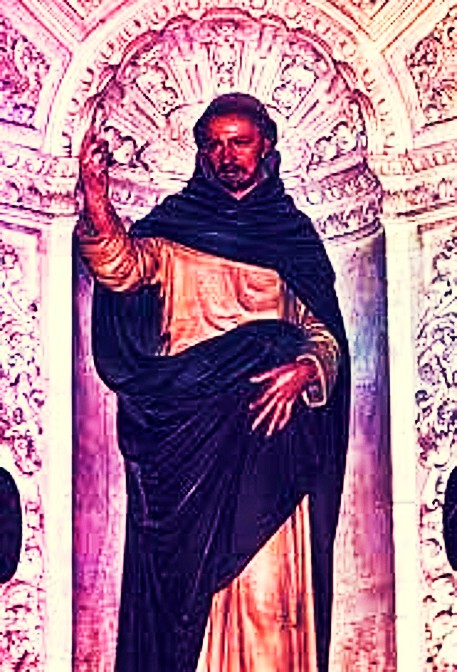
St Peter Canisius (1521-1397) Doctor of the Church
One Minute Reflection – 27 April – The Memorial of St Peter Canisius SJ (1521-1397) Confessor, Doctor of the Church and St Peter Armengol OdeM (c 1238-1304) – 2 Timothy 4:1-8, Matthew 5:13-19
“Therefore, whoever breaks one of the least of these commandments and teaches others to do so, will be called least in the Kingdom of Heaven. But whoever obeys and teaches these commandments, will be called greatest in the Kingdom of Heaven.” – Matthew 5:19
REFLECTION – “For what reason then does He call some of these commandments “least,” although they are so magnificent and lofty? Jesus spoke this way because He was about to introduce His own teaching, as a new law . As He humbles Himself and speaks of Himself with great modesty, so He refers to His own teaching in the same manner. In this way, Jesus teaches us to practice humility in everything. And besides, since some suspected His teaching to be a new departure, He temporarily taught it in a more reserved way.
But when you hear “least in the Kingdom of Heaven,” you are to think of nothing but hell and punishment. For it was His practice to speak, not only of the joy the Kingdom brings but also, of the time of the resurrection and the fearful event of the Second Coming.
Think of one who calls a brother a fool. That one, transgresses only one commandment, maybe even the slightest one and falls into hell. Compare that one with another, who breaks all the commandments and instigates others to break them too. Do both have the same relationship to the Kingdom? This is not the argument Jesus is making. Rather, He means, that one who transgresses only one of the commands will, on the final day, be the least—that is, cast out—and last and will fall into hell!” – St John Chrysostom (347-407) Archbishop of Constantinople, Father and Doctor of the Church (The Gospel of Saint Matthew, Homily 16).
PRAYER – God, Who didst give strength and learning to blessed Peter Thy Confessor for the defence of the Catholic faith, mercifully grant, that by his example and teaching, the erring may be saved and the faithful remain constant in the confession of truth. Through Jesus Christ, Thy Son our Lord, Who lives and reigns with Thee, in the unity of the Holy Ghost, God, world without end. Amen (Collect).
Saint of the Day – 27 April – Saint Peter Armengol OdeM (c 1238-1304) “The Martyr who Wasn’t,” Spanish Priest of the Mercedarian Friars, Penitent, Mystic, Born as Pedro Armengol Rocafort in c 1238 at Tarragona, Urgell region, eastern Spanish Pyrenees and died on 27 April 1304 at Tarragona, Urgell region, eastern Spanish Pyrenees of natural causes. Patronages – Persecuted Catholics, Conversion of the youth. Also known as – “The Martyr who Wasn’t,” “The Unconquerable Martyr of Jesus Christ,” “The Gangster Saint,” Pere Ermengol, Pedro Armengaudius, Peter Ermengol, Pietro Armengaudio. Beatified on 28 March 1686, by Pope Innocent XI and Canonised on 8 April 1687, by the same Pope. His body was incorrupt until it was destroyed during the horrors of the Spanish Civil War.
The Roman Martyrology states of him today: “At Tarragona, the blessed Peter Armengaudius, of the Order of Blessed Mary of Merry for the Redemption of Captives, who endured many tribulations in Africa in ransoming the faithful and finally closed his career peacefully, in the Convent of St Mary of the Meadows.”
From Gangster to Convert Pedro Armengol Rocafort was born in Tarragona in c 1238 to the nobleman Arnau Armengol Rocafort, descendants of the Counts of Urgel, whose ancestors were directly linked to the Counts of Barcelona and the Monarchs of Aragon and Castile.
Despite the great care taken by his parents regarding his education, young Peter gave himself over to a life of total dissipation, vice and caprice. “Abyssus abyssum invocat” (Deep calleth on deep), say the Scriptures. Thus Peter joined a gang of criminals who, pursued by Justice, led the life of bandits in the mountains. Soon, young Armengol became the leader of that gang.
Penance for His Misdeeds Filled with shame, the repentant youth retired to a Mercedarian Monastery in Barcelona. With an ardent desire to repair the injuries done to God, he became a Monk in that religious order founded by Saint Peter Nolasco to ransom Catholics captured by the Mohammedans. He requested the habit with such insistence and gave such conclusive proofs of his vocation, that he was received into the Mercedarian Order by the Venerable William de Bas, the French-born successor of the holy Founder.
The disorderly passions were now conquered by Peter Armengol in religious life. He understood how to subdue them with such promptitude, through penance, mortification of the senses and continual prayer, that even before he reached the end of his novitiate, he had managed to subject them to the dominion of his will and reason.
During the eight years of his profession, he was entrusted with the important task of dealing directly with the ransom of captives. He carried out this function in the Provinces of Spain, which were still in the power of the Saracens. Nonetheless, his greatest desire was to go to Africa and become a captive himself, for the ransom of Christians.
On an expedition to that continent, he arrived in Bugia in the company of Friar William Florentino. There, they ransomed 119 captives without any incident. However, before departing, Friar Armengol learned of a prison where18 children were incarcerated, who, impelled by the threats of punishments, remained in danger of denying the Faith. The religious happily offered himself as hostage for the ransom of the innocent captives.
His release was promised in exchange for a stipulated sum. But, if the payment did not arrive within the set time, he would suffer harsh punishments. Divine Providence had disposed that this man of God would thus give proof of his special confidence in the omnipotent mediation of the Blessed Virgin, to whom he was deeply devoted.
Flaming Torch of Confidence In captivity, Friar Armengol worked prodigies of charity among the infidels, converting many by the efficacy of his preaching. The time prescribed for the delivery of the money came and passed without the payment being made. The infidels threw him in prison and even denied the food necessary for his sustenance but Our Lord, by means of His angels, miraculously provided for his survival.
Tired of tormenting him, the Moors conspired to take his life. They accused him of blaspheming Mohammed and of being a spy sent by the Christian kings, thus raising the ire of the Saracen Judge who condemned Friar Peter to death by hanging. When everything seemed lost, Friar Armengol prayed to Our Lady and confided in her.
The unjust execution was carried out and Peter’s body was left hanging from the gallows. The Moors wanted his corpse to feed birds of prey. Thus, the holy man’s body remained suspended. Six days had elapsed when Friar William arrived with the ransom money. Learning what had happened, he went with great sorrow, in the company of some captives, to see the lamentable sight. Reaching the site of the execution, he noticed that the body did not emit a bad odour but rather exhaled a heavenly fragrance. To their astonishment, Friar Armengol spoke, telling them that the Blessed Mother saved his life. Astounded by the stupendous miracle, some pagans converted to the Catholic religion on the spot.
Learning of the portentous miracle, Barcelona impatiently awaited the return of the unconquerable Martyr of Jesus Christ. In the City, they received him with great joy, escorting him from the port to his Monastery, giving thanks to Our Lord for His marvels. The religious wanted to hear from Friar Peter’s mouth what had happened but despite their earnest pleas, he would not speak. Finally, the Superior ordered him to tell all that had occurred. Obedient, the man of God spoke:
“The Virgin Mary, Mother of God and our own Mother, asked her Most Holy Son, to conserve my life. Having obtained this favour, this same sovereign Queen, sustained me with her most holy hands, so that the weight of my body, would not hang upon the rope by which I was suspended!”
For the rest of his life, Friar Armengol had a twisted neck and a pale complexion, authentic signs of what had taken place. He retired to the Monastery of Our Lady de los Prados, where he practised heroic virtue and spent his days in familiar conversation with the Queen of Angels, whom he loved so dearly with filial devotion.
Recalling the miracle of his hanging, he frequently told the religious of the Monastery of this marvel:
“Believe me, my dear brothers, that I do not believe myself to have lived, except for those few but most happy days when, hanging from the gallows, I was held to be dead.”
He rendered his soul to God on 27 April 1304. Our Lord deigned to give proofs of the glorification of His servant with seven miracles, the cures of three men and four women, even before his death. On 28 March 1686 Pope Innocent the XI approved the public cult to the Saint and formalised his Canonisation tbghhe following year at St Peter’s in Rome. On 14 October 1688, Pope Benedict XIV inscribed Saint Peter Armengol in the Roman Martyrology.
The Tomb of the Saint Today the remains of Saint Armengol can be found in Guardia dels Prats. The small village still preserves much of its medieval character: tortuous, narrow stone-studded streets, buildings that recall old palaces or noble residences and a charming Romanesque–style Church.
The body of Saint Peter Armengol was preserved incorrupt until 1936. During the Spanish Civil War, however, communist marauders invaded and sacked the Church, carrying off his venerable body to the public square where they burned it. Some children gathered up what they could of these ashes and took the precious remains to their homes, where their mothers kept them with great care.
Later, after the communists were vanquished, the precious relics were returned to the Church, where they are kept in a reliquary over the main Altar – largely forgotten by “progressive” Catholics – in silent testimony of the sanctity of the Catholic Church. However, there remain some true faithful who, each year, pocess with a statue of this wonderful to honour his memory.
In our times of profound moral crisis, let us ask Saint Armengol to obtain for us before the throne of God, graces of unbending fidelity, unwavering hope and heroic confidence in the powerful intercession of Our Lady.
Source: Cf. Abbe Rohrbacher, Histoire Universelle de l’Eglise Catholique, vol. 20, Gaume Freres Libraires, Paris, 1845, pp. 40-43.
St Pollio of Cybalae St Simeon of Jerusalem St Stephen of Tarsus St Tertullian of Bologna St Theophilus of Brescia St Winewald of Beverley
St Zita of Lucca (1212-1272) Virgin, Laywoman, Apostle of the Poor. – Her reputation was such that Dante in the Inferno referred to the City of Luccam, her birthplace and home, as “Santa Zita.” P atronages – housewives, butlers, housemaid, domestic servants (proclaimed by Pope Pius XII), housemaid, lost keys, maids, manservants, people ridiculed for their piety, rape victims, servants, servers, single laywomen, waiters, Lucca, Italy. Her body is incorrupt. Biography:. https://anastpaul.wordpress.com/2017/04/27/saint-of-the-day-27-april-st-zita-of-lucca/
Martyrs of Nicomedia: A group of Christians murdered together for their faith. In most cases all we have are their names – Dioscurus, Evanthia, Felicia, Felix, Germana, Germelina, Johannes, Julius, Laetissima, Nikeforus, Papias, Serapion and Victorinus. They died at Nicomedia, Bithynia, Asia Minor (modern Izmit, Turkey).
Saint of the Day – 16 April – Saint Magnus of Orkney (c 1075-1115) Layman Martyr, Earl of Orkney, Born in c1075 in the Orkney Islands, Scotland and died by being struck in the head with an axe, in 1115 at Egilsay Island, Scotland. Patronage – Orkney Islands. Also known as – Magnus Erlendsson of Orkney, Magnus Erlendsson, Magnus the Martyr, Mans… Additional Memorial – 13 December (translation of relics). The image below is a reconstruction of the face of St Magnus by the BBC.
Magnus was the Earl of Orkney in Scotland and related to the Royal House of Norway, which exercised sovereignty over the Orkney Islands at that time. The story of St Magnus’ life and Martyrdom are well attested. Three legends tell his story, the most famous being the Orkneyinga saga. His life is also recounted in two Latin accounts. Magnus was born around 1075. He was the son of Erlend Thorfinnson, Earl of Orkney. Erlend held the earldom of Orkney under the Norse crown but was practically independent. Magnus’ father and uncle had been among the Norse invaders of England under Harald Hadrada in 1066. In 1098 King Magnus III of Norway came and deposed St. Magnus’ father, taking personal possession of the Orkneys and installing his illegitimate son as ruler. Magnus entered the service of King Magnus III and served as his personal Chamberlain.
Reconstruction of St Magnus’ Face by the BBC
St. Magnus had a disposition for piety and gentleness. The warriors of King Magnus’ retinue mistook this for weakness and harassed him. At this time, many Norse were still pagans or only Christians in a very nominal sense. He was present in 1098 for the Battle of Angelsey Sound in Wales but refused to take part in what essentially was a Viking raid, preferring instead to stay on the ship and sing Psalms. This disgraced him with the King’s retinue and he was obliged to take refuge in Scotland.
Magnus returned to Orkney in 1105 to dispute an inheritance issue with his cousin, Haakon. The dispute could not be resolved and Magnus appealed to the new King, Eystein I of Norway. In 1114, King Eystein made Magnus and Haakon, his cousin, joint Earls of Orkney, an arrangement which was obviously doomed to failure. The two sides almost came to blows but it was agreed that the Earls would meet on the Island of Egilsay on Easter to work out their differences. Each Earl was to bring only two ships. Magnus, being good natured, virtuous and honest,arrived with the requisite two ships. Haakon, however, treacherously brought eight ships full of armed followers.
Magnus took refuge in the Island Church overnight, praying to God and preparing his soul for whatever lay before him. In the morning he was dragged out of the Church by the chieftains loyal to Haakon. Magnus offered to go into exile or imprisonment but the chieftains demanded that one of the Earls must die. However, Haakon could find none of his chiefs willing to strike the fatal blow, as it was clear Magnus was innocent of any wrongdoing, his only crime consisting in being born with a title to the Earldom which Haakon coveted in his lust for power.
In the end, Haakon made his cook deliver the lethal blow. Before death, Magnus prayed for his captors and implored God’s to forgive them. He was killed with a single blow to the head from an axe, tn Easter Monday, 1117.
Magnus was hastily buried in the field where he was executed. According to legend, the rocky area around his grave miraculously became a green field. Magnus’ mother Thora, was later given permission to have Magnus interred at Christchurch in Birsay on Orkney’s mainland. A Church was later constructed on the spot where he was killed on Egilsay.
Tale of Magnus’ sanctity soon spread as well as tales of miracles at his tomb. William the Old, Bishop of Orkney in the 12th century, spoke condescendingly about miracles attributed to Magnus and was subsequently struck blind until receiving his sight again after praying at St Magnus’ tomb. Not long after, Bishop William authorized the cult of Magnus on the island at constructed the church of St Magnus near the site of the murder. A Cathedral dedicated to St Magnus was constructed shortly thereafter, which became the final repository of his relics. A renovation of the Cathedral in 1919 uncovered a box with the skull of St Magnus within.
Since his death, St. Magnus has been venerated as a Martyr but his status as a martyr has been questioned. Magnus’ Canonisation was done locally, prior to the institution of canonical procedures by Pope Alexander III. It is difficult to see in what sense St. Magnus was a Martyr. The occasion of the hostility of Haakon, was not the practice of the faith or the defence thereof but, in a dispute over the rightful possession of the Earldom of Orkney. Magnus certainly was pious and saintly, even praying for his persecutors before his execution but it is difficult to see how his death itself was a Martyrdom, in the proper sense. We should keep in mind, that while the Church has adopted the Episcopal Canonisation of Magnus, his title of “martyr” is more an exercise of popular piety than a strict theological title.
The feast day of St. Magnus is also interesting. In the Orkney’s his feast day is celebrated today, 16 April, the date of his death. It is known as Mansemass and attended with considerable public festivities. But has become more of a popular commemoration than a liturgical one; it is often not celebrated liturgically because it frequently coincides with Easter, Holy Week, or the Easter Octave. In Denmark, where devotion to St Magnus was very strong, there was an alternate feast day of 19 August. How this date got fixed was due to a confusion between St Magnus of Orkney and Magnus of Milan. It happened that there was another and earlier St Magnus – an Italian Martyr from Milan – who had long occupied 19 August in the Calendar of Saints. So, for no better reason than the coincidence of their names, our saintly Earl took over his Italian counterpart’s spot on the Danish Calendar.
‘So Magnus Erlendson, when he came up from the shore that Easter Monday, towards noon, to the stone in the centre of the island, saw against the sun eleven men and a boy and a man with an axe in his hand who was weeping … Then in the light of the new day, 16 April 1117, there was a blinding flash of metal in the sun’. – George Mackay Brown
St Benedict Joseph Labre – Known as the Beggar of Perpetual Adoration (1748-1783) Laqy Penitent and Pilgrim – he “abandoned his country, his parents and whatever is flattering in the world, to lead a new sort of life, a life most painful, most penitential, not in a wilderness, nor in a cloister but in the midst of the world, devoutly visiting as a pilgrim the famous places of Christian devotion.” Canonised by Pope Leo XIII on 8 December 1881. Dearest St Benedict Joseph: https://anastpaul.wordpress.com/2017/04/16/saint-of-the-day-16-april-st-benedict-joseph-labre/
St Lambert of Saragossa St Lambert of Saragossa St Magnus of Orkney (c 1075-1115) Layman Martyr
St Turibius of Astorga St Vaise St William Gnoffi
Martyrs of Avrillé – 26 Beati: – A group of lay people who were executed together for their faith during the anti-Christian persecutions of the French Revolution. They were martyred on 16 April 1794 at Avrillé, Maine-et-Loire, France. • Blessed Anne Maugrain, • Blessed François Micheneau veuve Gillot, • Blessed François Suhard veuve Ménard, • Blessed Jean Ménard, • Blessed Jeanne Gourdon veuve Moreau, • Blessed Jeanne Leduc épouse Paquier • Blessed Jeanne Onillon veuve Onillon, • Blessed Jeanne Thomas veuve Delaunay, • Blessed Madeleine Cady épouse Desvignes, • Blessed Madeleine Sallé épouse Havard • Blessed Marguerite Robin, • Blessed Marie Forestier • Blessed Marie Gingueneau veuve Coiffard, • Blessed Marie Lardeux, • Blessed Marie Piou épouse Supiot, • Blessed Marie Rechard, • Blessed Marie Roger veuve Chartier, • Blessed Marie-Genevieve Poulain de la Forestrie, • Blessed Marthe Poulain de la Forestrie, • Blessed Perrine Bourigault, • Blessed Perrine Laurent • Blessed Perrine Pottier épouse Turpault, • Blessed Pierre Delépine, • Blessed Renée Bourgeais veuve Juret, • Blessed Renée Rigault épouse Papin, • Blessed Renée Sechet veuve Davy. 16 April 1794 at Avrillé, Maine-et-Loire, France – Beatified: 19 February 1984 by Pope John Paul II at Rome, Italy
Martyrs of Corinth – 9 Saints: A group of nine Christians who were tortured and Martyred together in the persecutions of Decius. We know little more than three of their names – Callistus, Charisius and Leonide. They were thrown into the sea at Corinth, Greece c250.
Martyrs of Saragossa: Group of eighteen Martyrs murdered in 304 in Saragossa, Spain in the persecutions of Diocletian and the prefect Dacean. We know little more than the names – Apodemus, Caecilian, Caius, Crementius, Engratia, Eventius, Felix, Fronto, Gaius, Julia, Lambert, Lupercus, Martial, Optatus, Primitivus, Publius, Quintilian, Saturnius (4 men of this name), Succesus and Urban. Their graves re-discovered in 1389 in the crypt under the church of San Encrazia in Saragossa.
Saint/s of the Day – 15 April – Saints Anastasia (Died c 68) Martyr, AND St Basilissa of Rome (Died c 68) Martyr. Spiritual Students of St Peter the ApostleMartyrs of Rome, put to death during the reign of Nero. They were among the first converts to Christianity in the 1st century after Christ.
Martyrs, St Julian, Basilissa and Anastasia
The Roman Martyrology states today: “At Rome, the Saints Basilissa and Anastasia. Of noble families, they were disciples of the Apostles and, as they persevered courageously in the profession of their faith, in the time of the Emperor Nero, they had their tongues and feet cut off, were put to the sword and thus obtained the Crown of Martyrdom.”
Basilissa and Anastasia were described as “Roman matrons of high rank and great wealth.” They were disciples of and were probably Baptised by the Apostles Peter and Paul.
St Anastasia
Sts Peter and Paul’s were Martyrdom in Rome on the same day in c 67. The location of the two tombs eventually became St Peter’s Basilica and the Basilica of St Paul Outside the Walls. The burials of the two great Apostles might have exposed Basilissa and Anastasia to persecution and they were arrested for collecting the relics of and burying the bodies of other Martyred Christians.
They refused to apostatise their Christian faith and were beheaded with swords by order of Nero in c 68, after being tortured, including having their tongues torn out, their skins scraped with hooks, being burned with fire and their breasts and feet cut off.
Their relics are at Santa Maria della Pace Church in Rome.
Tre Ore (The Three Hours Devotion) The Three Hours’ Agony on Good Friday from Noon until 3 o’clock to commemorate the three hours of Christ’s Hanging at the Cross. It includes sermons on the Seven Last Words from the Cross and usually occurs between Noon and 3PM, the latter being the time when Jesus Died on the Cross and the time the Liturgy of the Lord’s Passion begins. In 1815, Pope Pius VII decreed a plenary indulgence to those who practice this devotion on Good Friday.
It is a fine tradition to keep silent from Noon to 3:00 PM today.
Saint Anastasia of Rome (Died c 68) Martyr, Spiritual Student of St Peter the Apostle AND: St Basilissa of Rome (Died c 68) Martyr, Spiritual Student of St Peter the Apostle
St Sylvester of Réome St Theodore of Thrace St Victorinus of Rome St Waltmann of Cambrai
Mercedarian Martyrs of Africa: A group of Mercedarian Monks sailing to Africa as on a mission to redeem capture Christians. Captured by Moors, they were tortured and executed for their faith. Martyrs. 1393.
Martyred in Rome Anastasia Basilissa Eutyches Maro Victorinus
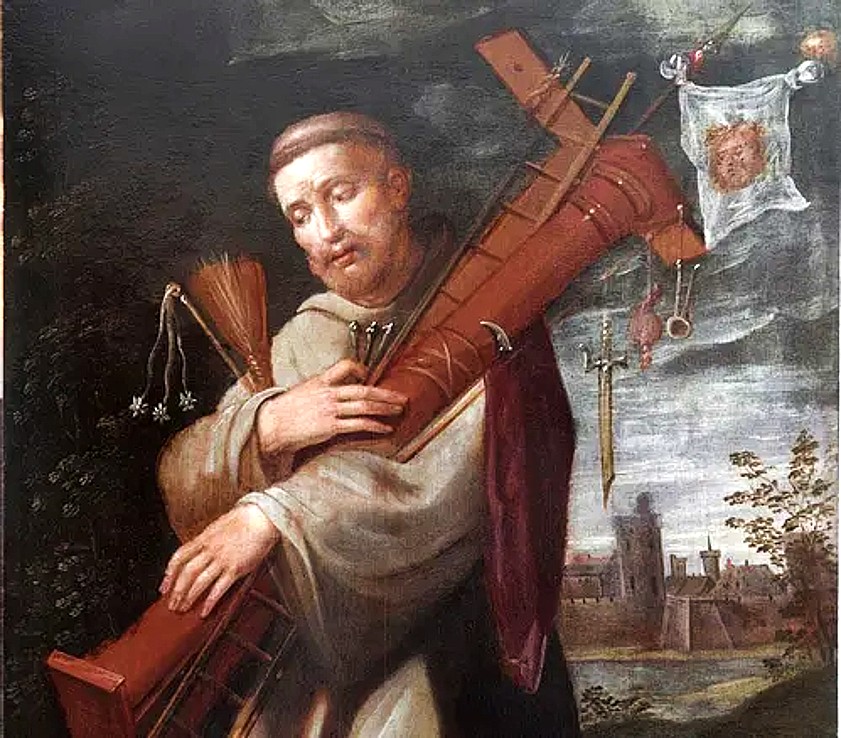
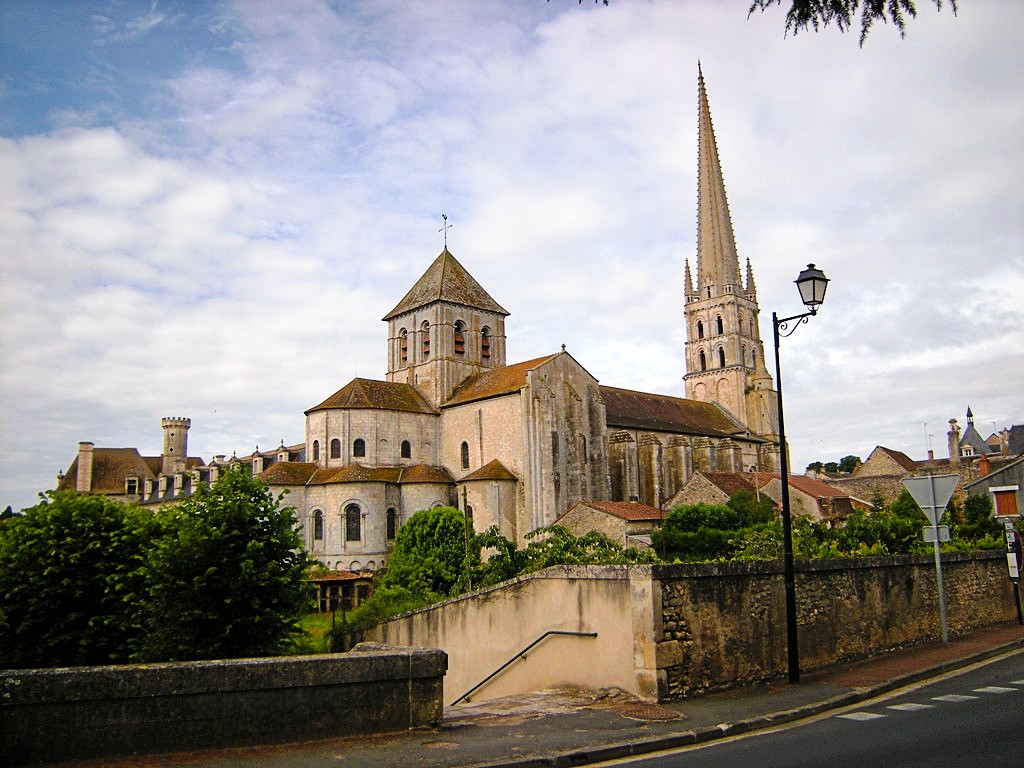
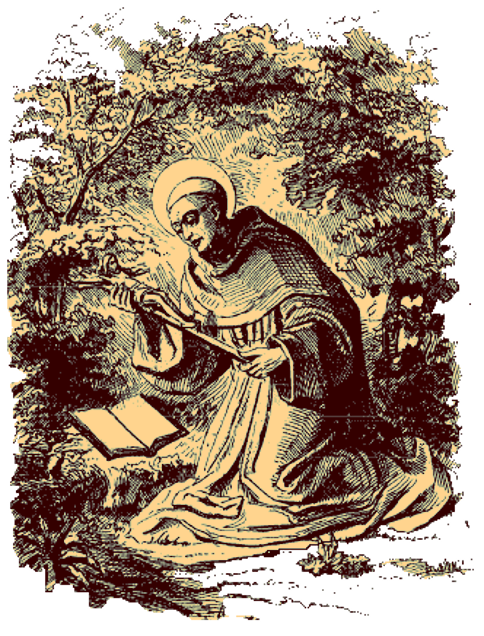
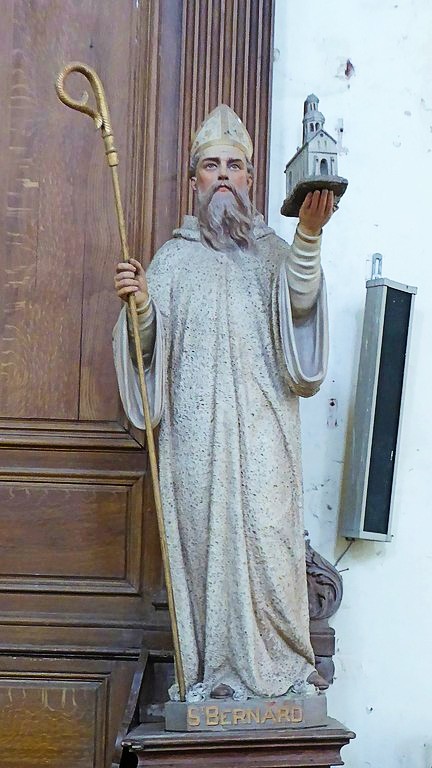
Saint of the Day – 14 April – St Bernard of Tiron (c 1046-1117) French Monk, Hermit, Abbot, Founder of the the Tiron Abbey and the Tironensian Order. St Bernard had a deep devotion to the Passion of Christ, teaching and instruction his disciples in the love of the Holy Cross. Also known as – Bernard of Ponthieu, Bernard of Abbeville, Bernhard…
The Roman Martyrology reads: “In the Monastery of Tiron near Chartres in France, Saint Bernard, Abbot, who on several occasions gave himself up to a hermit life in the woods and on the Island of Chausey but also dedicated himself to instructing and guiding the disciples, who in great numbers, flocked to him.”
Saint Bernard of Tiron is represented as a Monk. He carries the instruments of the Passion, among which we can see: the column of the flagellation, the spear of Longinus, the Cross, the veil of Saint Veronica, the nails, the sword of Saint Peter, the lantern of the guards, the whip , the scale.
Bernard was born near Abbeville in 1046. Having already made good studies and knowing the Sacred Scriptures, in particular, Bernard, at the age of around 19, was accepted at the Monastery of Saint-Cyprien, near Poitiers. He remained there for ten years, before being transferred to Saint-Savin-sur-Gartempe to fill the position of Prior. When the Abbot was convicted of simony in 1082, Bernard assumed the responsibilities of superior. For fear of being elected Abbot, Bernard escaped secretly, becoming a Hermit in the Craon forest, on the borders of Brittany and the Maine, in a place called Tiron.
Being discovered after three years by the Monks of St Savin, who still wished to have him as their Abbot, Bernardo again disappeared and went to live in perennial contemplation on the Island of Chausey. Only after three more years, having learned that the Monks of St Savin had elected another as Abbot, did Bernard return to Tiron. He did not stay there for long, however, for, he gained many followers to his hermit way of life, including St Adelelmus of Flanders. The community grew into a centre for hermits, with many building cells around his. Bernard fame grew eventually gaining the attention of the Saint Cypriene Monastery. (Bernard’s first Monastery) . Abbot Renault then called for Bernard to return to the Monastery bringing with him his new followers. Bernard returned and resumed the habit as well as being appointed Renault’s successor. Bernard accepted the office of Prior of that Monastery and then, on the death of Rinaldo, that of Abbot.
He took part in the Council of Poitiers in 1100 and obtained from Rome, permission of independence from Cluny, for his Monastery of St Cypriene. He returned to the Island of Chausey, which he again had to leave because he was disturbed by the pirates and then accepted the land of Brunelles, given to him by a benefactor, in the forest of Tiron, founding a new Monastery there (1109). However, since a quarrel arose with the Monks of Nogent, of the Cluniac Congregation, who demanded a tithe, instead of agreeing to this demand, he abandoned the Monastery and went to found another at the mouth of the Tiron (1113/14).
Abbey of the Holy Trinity of Tiron
With the aid of donations from the kings and nobles of France, England and Scotland, Bernard established the Abbey of the Holy Trinity of Tiron in 1114. From here Bernard founded the Tironensian Order, based on a strict observance of the Rule of Saint Benedict and an emphasis on manual labour. This Abbey was so succesful, that the Monks there soon reached the number of five hundred! The Tironensian Order, spread to Germany, England, Scotland and elsewhere. The Order ceased to exist in the 17th Century.
The life of a Tironensian – The Passion of Christ, Sacred Scriptures and working the land.
Bernard remained there until his death on 14 April 1117. His cult, previously limited to Tiron, extended to the whole of his Congregation. Pope Pius IX authorised the Diocese of Chartres and Amiens to celebrate the Feast on 14 April, a Feastwhich is also found in toitiers, Séez, Lavai and Bourges.
Saint of the Day – 13 April – Blessed Albertinus of Fonte Avellana OSB (Died 1294) Monk. Prior General, talented Administrator and Peacemaker, not only in his Monastery but also in the greater world outside it. Born in the mid 13th-Century in Montone, Italy and died on 13 April 1294 of natural causes. Also known as – Albertinus of Montone, Albertino.
Albertinus was born between 1216 and 1220 in the Castle of Montone. The historical context of the time was characterised by a cruel conflict which ended with the victory of the Guelfi and subjected Montone to the rule of Perugia. We do not know when Albertinus became a Benedictine Monk nor which his first hermitage was.
Albertinus was nominated Prior at the Monastery of Fonte Avellana (meaning the Venerable Hermitage of the Holy Cross) in Serra Sant’Abbondio (Marche) when his congregation merged with the Camaldolese in 1270. At that time, the Abbey was going through a serious crisis, despite the fact, that it was also in a phase of great power and expansion. Albertinus, a virtuous young man, was called to solve the problems and restore peace.
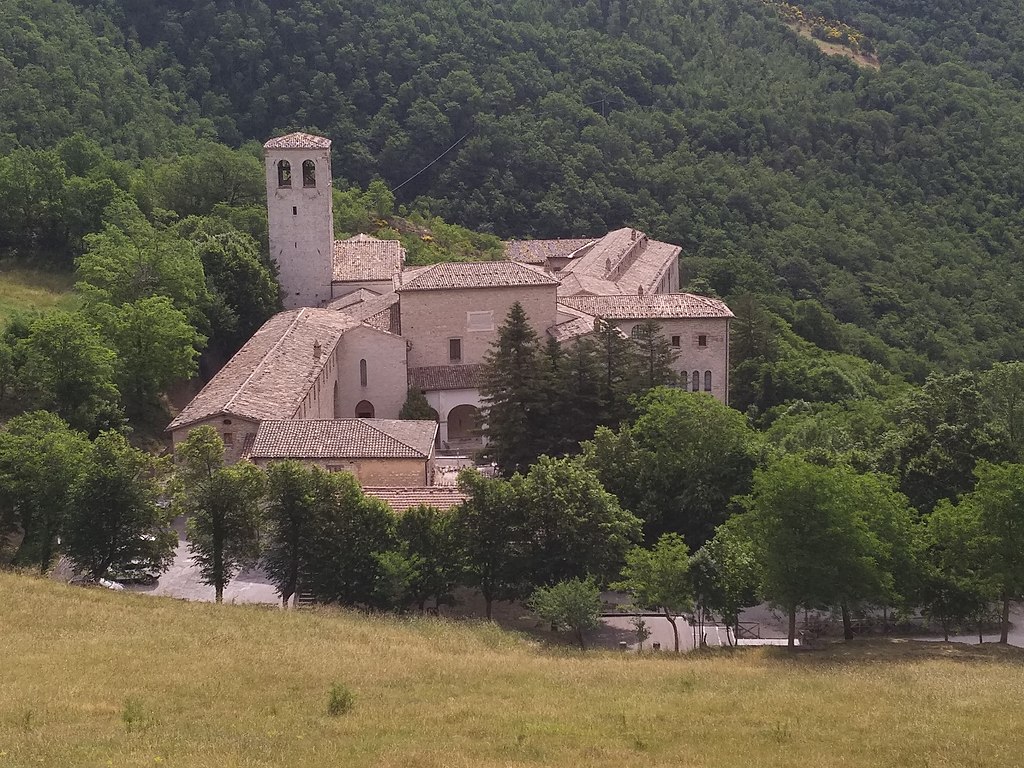
Fonte Avellana
The Prior is responsible for the running of the Monastery and for maintaining the Rule, the traditions and institutions, in the absence of the Abbot. Due to his moderation and sanctity, Albertinus succeeded in returning peace to Fonte Avellana.
Albertinus left a collection of “papers” composed of four hundred original documents, elaborated during his thirty-year Priorship. These “papers” indirectly inform us about Prior-general’s innovative ideas and principles which inspired his work.
Throughout Albertinus’ term in office, the lack of recourse to ordinary justice and the search for the settlement of disputes, was a constant in Fonte Avellana. Albertinus always managed to remove the differences and replace them with agreement.s To ensure better economic conditions, for a more dignified existence. Albertinus faced difficult situations, especially conflicts with the neighbouring towns. He understood that establishing good relations with the people counted much more than formal laws and through a spirit of peace and reconciliation, Albertinus was able to establish good relations with the municipalities, which were the new emerging power.
Albertinus died on 13April 1294 and was buried in the Church of Fonte Avellana, where he still rests today. Pope Pius VI Beatified Albertinus.
Spy Wednesday in Holy Week +2022 According to the Calendar of Church, Spy Wednesday marks the last full day of Lent and Holy Week. The Sacred Triduum begins on the evening of the following day, Maundy Thursday.
St Carpus of Pergamus Bl Edward Catherick Bl Francis Dickenson St Guinoc St Hermengild St Ida of Boulogne Bl Ida of Louvain Bl Isabel Calduch Rovira Bl James of Certaldo Bl John Lockwood
Martyrs of Dorostorum – 3 Saints: A lector and two students Martyred together in the persecutions of Diocletian – Dadas, Maximus and Quinctillianus. Beheaded c303 in Dorostorum, Lower Mysia (modern Sillistria, Bulgaria.
Saint of the Day – 12 April – Blessed Andrew of Montereale OSA (c 1403-1479) Priest of the Hermits of St Augustine, renowned Scholar, Preacher, Teacher, Reformer. Confessor and Spiritual Director to the Royal Court of France, Miracle-worker. His life was devoted to teaching, preaching and leading the Augustinians from several positions of leadership. He was hailed, even during his lifetime, as a pious Miracle worker. Born in c 1403 in Mascioni, Campotosto, Italy as Antonio Artesi and died on 18 April 1479 at the Augustinian Monastery of Montereale, Italy of natural causes. Additional Memorial – 18 April (The Augustinians). Patronage – Montereale, Italy.
The Roman Martyrology reads: “In Montereale in Abruzzo, Blessed Andrea, Priest of the Order of the Hermits of St Augustine, who devoted himself to preaching in Italy and France.”
The birthplace of Blessed Andrew is certain – Mascioni, on the shores of Lake Campotosto into a modest household; no less certain is the place of his death: the Augustinian Monastery in Montereale, a short distance from Mascioni, to which the Blessed retired, a few years before his death. His earthly sojourn ended on 18 April 1479.
The sad events of the Avignon Schism had negative effects on the Church and the Augustinian Order, well beyond 1417, the year in which Martin V was elected to the Supreme Pontificate. The quest for unity in the Order, which had been split by the schism and the path of reform, were the most urgent concerns of the General Chapters and the Priors General of the time. Those same events were inevitably echoed in the first part of Blessed Andrew’s life. According to tradition, he had, from childhood, worked as a shepherd. A meeting with Augustinian Father Augustine of Terni, Prior of the Monastery in Montereale, decided Andrew’s entrance into that same Monastery and the beginning of his Novitiate. He was Ordained a Priest at the age of twenty-five and then, in light of his bent for studies, was destined for teaching. To that end he acquired the various academic Degrees of Bachelor, Reader and Master of Theology while attending the general house of studies of the Order in Rimini and in Siena; he appears as Director of studies in the latter place, in 1459.
During these same years, enjoying, as he did, the trust of his superiors and fellow religious, he held Offices in Government. He was Vicar General and visitor of some Monasteries; he was elected Prior Provincial of the Province of the Valley of Spoleto and in that capacity, took part in the General Chapters of Avignon in 1455 and Pamiers (France) in 1465.
In 1459, for reasons we do not know, he resigned from the Priorate and his position as Director of studies in Siena and in 1461, by order of the Prior General, Father William Becchi, a Florentine, he was sent away from the Monastery of Norcia, along with the local Prior, Father Jerome of Cittaducale. This was “at the request of various religious of the Province, in order to avoid scandal and begin the reform of that Monastery.”
In 1468, when William Becchi was still the Prior General, he appointed Blessed Andrew as his Vicar for visiting the Monastery of Amatrice. In 1471, Andrew was again elected Prior Provincial of the Province of the Valley of Spoleto.
Thus far we have the cold facts of his “external” life as a religious. Other sources help us to know more about his interior life.
A few months after the Blessed’s death, his contemporary, Ambrose of Cori, who had been Provincial of the Roman Province and was now Prior General of the Order (1476-1482) listed 36 Blesseds of the Order, in the Chronicle of the Order, which he published in 1481. At the time when Blessed Andrew had been expelled from the Monastery of Norcia, Ambrose was Director of studies in Perugia and, therefore, knew Andrew personally. In the 36th place in his list he put Blessed Andrew of Montereale, “who lived in our time and is made glorious by many signs and miracles. He was very learned in Canon Law, Philosophy and Theology and showed the greatest example of holiness in preaching, helping the poor and enduring abuse and in every kind of patience.”
In a few words Ambrose exalts Blessed Andrew well above even fervent religious, tells us of his reputation for miracles and of his teaching and calls him Blessed, thereby, in all likelihood, expressing the sentiments of the people. In the epitaph engraved beneath the image of the Blessed on the wall of the Choir in the Church of Saint Augustine in Montereale—an epitaph that is now gone but was cited by Riccitelli in 1581 and went back to the end of the fourteenth or the beginning of the fifteenth century—people could read the following:
Here lies the body of Blessed Andrew of the Order of Hermits of Saint Augustine, who worked countless great miracles. Due to his holiness of life, the austerity of his ways and his Catholic teaching, due also to his honeyed preaching and great miracles, he was famous throughout Italy and France.
He is dear to God and humanity and is an honour to the Order, an adornment of his native land and of great advantage to his neighbour. He was and is, a great benefit to the world, having preached the Word of God for fifty years.
His works have not come down to us. At that time an inventory of goods had to be made by Masters of Theology. A copy of the one which the Blessed compiled on the day of his death has survived and therein, is a list of the books he had loaned to brother Friars. Among these was the Decretals, a Gloss on the subject and a “little book,” a term suggesting a work of his own. The other objects listed give a glimpse of the simplicity of his life, for among them are “a little brass jar, four table forks, a little bell and some other little things.”
Augustinians and the Rule
Among the many writers who have spoken of him, mention may be made of Blessed Alonso de Orozco, who, in his Chronicle of the Glorious Saint Augustine, Father and Doctor of the Church (1551), lists Andrew among the blessed and describes him as “a very gifted man and a great preacher; very patient and charitable; – he performed many miracles.”
Although Andrew had the reputation of being a saint, it was only in the years 1756-1757, during the Pontificate of Benedict XIV, that the cause of his Beatification was taken up by the Diocese of Rieti, of which Montereale was a part. During the process, witnesses bore unanimous testimony to Andrew’s commitment to the struggle against schism and heresy, his exercise of the preaching office over several decades, his journeys to France and the role he played at the Court of the King of France, where he was the Queen’s Confessor and Spiritual Director. They also attested that his name was Antonio Artesi. Blessed Andrew was Beatified on 18 February 1764 by Pope Clement XIII (By the Augustinian Friends).
Saint of the Day – 11 April – Blessed George Gervase OSB (1571–1608) Priest and Martyr, Confessor, Missionary. Born at Boscham, Suffolk, England and died on 11 April, 1608.by being hung, drawn and quartered at Tyburn, London, England. Additional Memorial- 29 October as one of the Martyrs of Douai.
His mother’s name was Shelly and both his father’s and mother’s families had been long established in the County of Suffolk. Losing both parents when he was twelve years old, he was kidnapped by pirates (probably a lieutenant of Drake, who was then buccaneering on the Spanish Main) and carried off to the West Indies with two of his brothers., remaining in captivity for over twelve years.
He lost his religion during that period but, when at last he was able to return to England and found that his brother, Henry had become a voluntary exile in Flanders, in order to be able to practice his faith, George followed him there and was soon reconciled with the Church.
He entered the English College at Douai in 1595 and was Ordained Priest in 1603. He at once went to the English mission. He laboured very successfully for over two years but was arrested in June 1606 and banished with several other clergy. He then made a pilgrimage to Rome and there, endeavoured to enter the Society of Jesus but, not being admitted for some unknown reason, he returned to Douai, where he received the Benedictine habit as a Novice.
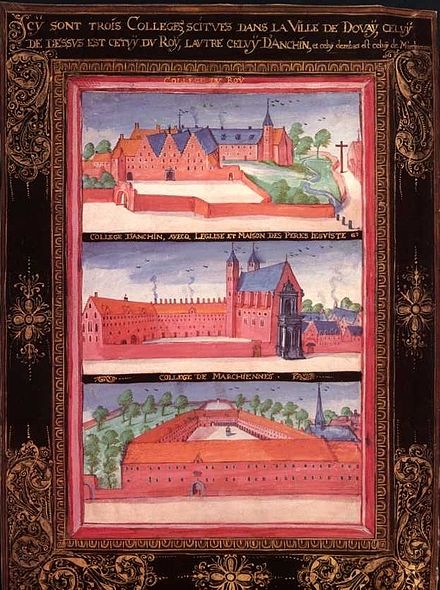
Douai Colleges
His brother Henry, had obtained for him, a comfortable position near Lille, being anxious to preserve him from the persecution then raging in England. But George was determined to preach the Gospel and labour for the conversion of his native land and succeeded in returning to England. He was soon arrested again and incarcerated.
Martys of Douai
Refusing to take the new oath of allegiance to the reigning Monarch, he was tried, convicted of the offence of merely being a Catholic Priest, under the statute 27 of Elizabeth I and was hanged, drawn and quartered at Tyburn.
A short time before his death, George was clothed in the Benedictine Habit by Father Augustine Bradshaw.
St Benedict Medal
George was Beatified on 15 December 1929 by Pope Pius XI.
Monday of Holy Week +2022 As the most Sacred week of the Liturgical year, the Church does not celebrate the Feast Days of the Saints during Holy Week. However, for chronalogical accuracy, I continue to post the list and the Saint of the Day.
St Hildebrand of Saint-Gilles St Isaac of Monteluco Bl James of Africa Bl John of Cupramontana Bl Lanunio St Machai St Maedhog of Clonmore Bl Mechthild of Lappion Bl Paul of Africa St Philip of Gortyna St Raynerius Inclusus St Stephen of Saint-Gilles Bl Symforian Ducki
Saint of the Day – 10 April – Blessed Marcus Fantuzzi OFM (c 1405-1479) Priest and Friar of the Friars Minor, renowned Preacher, Superior, then Vicar General of the Observant Friars Minor. Born in c 1405 at Bologna, Italy as Pace or Pasotto and died on 10 April 1479 at Piacenza, Italy of natural causes. Also known as – Marcus Fantucci, Mark Fantucci, Marcus of Bologna, Pace, Pasotto. Additional Memorial – 19 April on some local calendars.
The Roman Martyrology reads: “In Piacenza, Blessed Marcus Fantuzzi of Bologna, Priest of the Order of Minors, distinguished for his piety, prudence and preaching.”
Among the beautiful Palaces in Bologna, which, to this day, gives evidence of the glory enjoyed by this City in the Middle Ages, one of the most beautiful is the Palace of the Fantuzzi. Marcus was born there, in the year c 1405, the only son of this wealthy patrician family.
When Blessed Marcus had completed his studies in philosophy as well as in civil and ecclesiastical law, at the University of his native City and the question of choosing a state of life arose, this generous young man, for whom the glory of his world was too insignificant, went to the door of the poor Franciscan Convent and asked to be admitted there.
Marcus received the habit on the Feast of his holy Patron, St Mark. He was then twenty-six years old. Blessed James Primadizzi was charged to initiate him in the religious life and St Bernardine of Siena was his teacher in theology. Under such direction, Marcus made rapid progress in perfection and, within a few years, had developed into so perfect a religious, that he was appointed Guardian of the Convent of Fonte Colombo, that venerable abode where our Divine Saviour dictated the holy Rule to St Francis.
Marcus was ever zealous for the faithful observance of the holy Rule. After he had given proof of his sterling qualities as Superior in several other Convents, he was elected Provincial and in the year 1452, Vicar General of the Observant Friars Minor. Later again, he had to discharge the duties of this office for two terms announcing the word of God to the people but above all, he was solicitous to maintain the faithful observance of the Rule of his Convents.
When the King of Bosnia, who had lately been converted to the Faith by the Friars Minor, imposed upon his subjects a special tax for the support of the Convents, Marcus begged him to leave his people full liberty in the matter, so that the benefactors might not lose their merits and the spirit of poverty of his brethren might not suffer injury. On the other hand, this wise director did not wish to impose any precepts over and above those already laid down in the Rule. Hence, when a suggestion was made, at one of the Chapters, that perpetual abstinence should be imposed on all the religious, Father Marcus would not permit its adoption, saying:
“Our perfection consists in the observance of our Rule. It can do no good to add thereto anything more perfect,, since in such cases, the more perfect is enemy to that which is good.”
More edifying than his zeal and wisdom in the administration of his office, was the humility he displayed when he completed his third period of administration. He prostrated himself before his brethren and, with tears, accused himself of the many faults which he believed he had committed, in the administration of his office.
Because of his wisdom and zeal for the interests of the Church, Popes Nicholas V, Callistus III, Pius II and Paul II held him in high regard. The last named Pope wished even to raise him to the Cardinalate but Father Marcus, however, withdrew from Rome and found a way to evade this honour. It was not without the permission of God, that for a time, Marcus received little consideration in the order but the holy Friar bore all without a word of complaint.
Full of zeal for the honour of God and the salvation of souls, Blessed Marcus preached everywhere with the fervour of an Apostle. In his seventy-fourth year he still preached the Lenten sermons at Piacenza. It was then that he was attacked by a fever that brought him close to death’s door. He asked to see the Guardian of the Convent of the Friars Minor, which was located in the suburbs of the City and said to him:
“Father, although I am a great sinner and not worthy to die in your Convent, still I beg you to grant me the privilege that I may be taken to it.”
There, after devoutly receiving the Viaticum, Blessed Marcus Fantuzzi died the death of the just in Holy Week, of the year 1479. His mortal remains are kept in the Church of Santa Maria di Campagna. The cult, paid to him, which had already been widespread for four centuries, was confirmed by Pope Pius IX in 1868.
Bl Antonio Vallesio St Apollonius of Alexandria Bl Archangelus Piacentini St Bademus St Bede the Younger St Beocca of Chertsey Bl Boniface Zukowski Bl Eberwin of Helfenstein St Ethor of Chertsey St Ezekiel the Prophet
St Malchus of Waterford Bl Marco Mattia Blessed Marcus Fantuzzi OFM (c 1405-1479) Priest
St Miguel de Sanctis O.SS.T (1591-1625) Priest of the Order of the Most Holy Trinity and of the Captives also known as the Trinitarian Order or the Trinitarians, Mystic, Penitent, Ecstatic, Apostle of prayer, mortification, of the poor and the sick, he had a special devotion to the Blessed Sacrament and would fall into ecstatic prayer during the Consecration at Holy Mass, so much so, that he became known as “El Extático”, “The Ecstatic.” Pope Pius IX Canonised Miguel on 8 June 1862. About St Miguel: https://anastpaul.com/2020/04/10/saint-of-the-day-10-april-st-miguel-de-sanctis-o-ss-t-1591-1625/
St Palladius of Auxerre St Paternus the Scot
Martyrs of Carthage – 50 Saints: A group of 50 Christians who were imprisoned in a pen of snakes and scorpions and then Martyred, all during the persecutions of Decius. Only six of their names have come down to us – Africanus, Alessandro, Massimo, Pompeius, Terence and Teodoro. Beheaded in 250 at Carthage.
Martyrs of Georgia: Approximately 6,000 Christian Monks and lay people Martyred in Georgia in 1616 for their faith by a Muslim army led by Shah Abbas I of Persia.
Martyrs of Ostia: A group of criminals who were brought to the faith by Pope Saint Alexander I while he was in prison with them. Drowned by being taken off shore from Ostia, Italy, in a boat which was then scuttled, c 115.
Saint of the Day – 9 April – Saint Hugh of Rouen OSB (Died 730) Bishop of Rouen, Paris and Bayeux, Monk, Abbot of of Jumièges and Fontenelle Abbey, while, simultaneously governing his Diocese. Died on 9 April 730 at Jumieges Abbey, France of natural causes. Also known as – Hugh of Champagne, Hugues..
Hugh was born of a noble family. His father was Duke Drago of Burgundy. His uncle was Charles Martel, Mayor of the Palace. The Mayor of the Palace, at that point in history, was more powerful even than the King of the Franks. And Martel’s son, Pepin III, served as both Mayor of the Palace and as the first Monarch of the Carolingian Dynasty, reigning from 751 to 768. Pepin’s son was Emperor Charlemagne (reigned 768-814).
While he was a still a layman, Hugh was appointed the Abbot of Jumièges Abbey. In 718, he embraced the call to monastic life and entered Jumièges as a Monk.
In 722, the important French City of Rouen had lost their Bishop and Hugh was called upon to take up the role. Hugh left his Monastery and succeeded in managing, not only the role of Archdiocese of Rouen but at the same time, Fontenelle Abbey. Two years, later, Hugh took on two more Diocese — Paris and Bayeux!
Hugh’s pastoral energies must have been nearly inexhaustible!
Finally, as he neared death, Hugh retired to his home Monastery of Jumièges. Hugh died on 9 April,730. His earthly remains were laid to rest at Notre Dame in Paris. Two centuries later, his relics were smuggled away to Belgium to save them from being destroyed by Norman invaders.
St Hugh of Rouen, Abbot and Bishop, who gave of himself tirelessly to care for Christ’s flock—pray for us!
St Brogan St Casilda of Toledo St Concessus the Martyr St Demetrius the Martyr St Dotto St Eupsychius of Cappadocia St Gaucherius St Hedda the Abbot St Heliodorus of Mesopotamia St Hilary the Martyr St Hugh of Rouen OSB (Died 730) Bishop, Monk Bl James of Padua Blessed John of Vespignano
Martyrs of Croyland – 9 Saints: A group of Benedictine Monks Martyred by pagan Danes – Agamund, Askega, Egdred, Elfgete, Grimkeld, Sabinus, Swethin, Theodore and Ulric. Croyland Abbey, England.
Martyrs of Masyla: Massylitan Martyrs Group of Christians Martyred in Masyla in northwest Africa.
Martyrs of Pannonia: Seven Virgin-Martyrs in Sirmium, Pannonia (modern Sremska Mitrovica, Serbia).
Martyrs of Thorney Abbey – 3+ Saints: A group of Hermits, hermitesses and monks who lived in or around Thorney Abbey who were Martyred together during raids by pagan Danes. We know little more than the names of three – Tancred, Torthred and Tova. 869 by raiders at Thorney Abbey, Cambridgeshire, England.
Saint of the Day – 8 April – Blessed Julian of Saint Augustine OFM (c 1550-1606) Lay Brother of the Friars Minor, Hermit, Ascetic, Born in c 1550 as Julián Martinet Gutiérrez at Medinaceli, Diocese of Segovia, Castile, Spain and died on 8 April 1606 at Saint Didacus Friary, Alcalá de Henares, Spain of natural causes. Also known as – Julian Martinet, Fray Julián de Alcalá.
Julian’s father was a French nobleman who, in order to escape from the violent pressure exerted on him by the Calvinists, seeking to make him apostatise from the Catholic Faith, fled to Spain, leaving all his wealth behind. There Julian was born and reared amid unpretentious circumstances but in a very Christian manner. The boy was devoted to piety, his greatest pleasure being to serve the Priests at the Altar.
As a young man, Julian accompanied for some time, a Missionary of the Franciscan Order on his apostolic journeys. This Friar arranged for his admission with the Friars Minor as a lay brother in the Convent of Maria of Salzeda. Julian began his convent life with ardent zeal, he practised such extraordinary acts of mortification that he was considered eccentric and God almighty permitted, as a means of trial, that he was dismissed from the Convent This trial Julian bore with admirable fortitude.
Blessed Julian of Saint Augustine withdrew to a neighbouring mountain, where he built a hut in order to live as a Hermit. Once a day he came to the gate of the Convent from which he had been dismissed, to receive food with the other poor. While waiting for the food to be dispensed, he would instruct the others in the Catechism, and when a poor person one day came clad ina dirty and torn garment, he took off his own garment and gave it to that him
On account of such virtues, the dismissed novice was again received into the Convent, where, after successfully enduring the time of probation, he pronounced his vows. In the zeal that always consumed him, he was impressed with the value of obedience. to such a degree, that he sometimes said that he would rather die than not obey. He constantly wore iron girdles and fasted so strenuously that the physicians declared it was a miracle that he could live and work. While on his rounds to gather alms, he edified everyone by his modest and humble demeanour.
Full of zeal for God and the salvation of souls, he brought many a sinner back to the Church by his exhortations and corrected much that was wrong among the people, who greatly esteemed him. In a special way, he denounced frivolous entertainment. He often exhorted the young people to keep away from such dangerous amusements and many followed his warning. The fires that had been built in the open for the night dances, he stamped out with his bare feet.
A true son of St Francis, he loved holy poverty and practised it so rigorously that he did not even wish to have his own cell. The nights he passed in prayer in the Church, or he rested a bit in some corner of the Friary. During his fervent prayers he was often favoured with visions. In spite of this, he always remained so humble, that he considered himself the greatest sinner and accepted all acts of contempt as deserved treatment.
Blessed Julian of Saint Augustine closed his holy life in the Convent of Alcala on the 8th of April, 1606. At once the people began publicly to venerate him and Philip III, King of Spain at that time, urged his Beatification. The proceedings were, however, often interrupted until the jubilee year of 1825, when Pope Leo XII inscribed him solemnly among the Blessed.
Friday of Passion Week, the Fifth Week in Lent +2022
Our Lady of the Seven Sorrows THE FEAST DAY OF THE SEVEN DOLORS IS TRADITIONALLY THE FRIDAY OF PASSION WEEK, WHICH IS THE FRIDAY BEFORE GOOD FRIDAY, OR ON 15 SEPTEMBER.
St Dionysius of Corinth Bl Domingo Iturrate Zubero Bl Gonzalo Mercador St Herodion of Patras Blessed Julian of Saint Augustine (OFM c 1550-1606) Lay Brother
Bl Libania of Busano St Phlegon of Hyrcania St Redemptus of Ferentini
Martyrs of Africa – 3 Saints: A group of African Martyrs whose name appears on ancient lists but about whom nothing is known but their names – Januarius, Macaria and Maxima.
Martyrs of Antioch – 4 Saints: A group of Christians Martyred together for their faith. We know little more than their names – Diogene, Macario, Massimo and Timothy. They died in Antioch, Syria.
Martyrs of Seoul – 5 Saints: A group laymen who were Martyred together in the apostolic vicariate of Korea. • Augustinus Jeong Yak-jong • Franciscus Xaverius Hong Gyo-man • Ioannes Choe Chang-hyeon • Lucas Hong Nak-min • Thomas Choe Pil-gong They died on 8 April 1801 at the Small West Gate, Seoul, South Korea
Saint of the Day – 7 April – Saint Henry Walpole SJ (1558–1595) Priest of the Society of Jesus, Martyr, Confessor, Poet, Lawyer. Born at Docking, Norfolk, in 1558 and died on 7 April 1595, aged 37, at York for refusing to take the Oath of Supremacy, by being hung, drawn and quatered.
Twenty-three-year-old Henry Walpole had attended the debates which St Edmund Campion held with the Anglican hierarchy and was among the bystanders at the execution of Fr Edmund Campion, when drops of the latter’s blood sprinkled his clothes. This moved Henry so deeply, his heart and soul were rent in suffering with St Edmund and he felt convinced that God was calling him to follow in St Edmund’s footsteps.
Henry was born at Docking, near Sandringham, Norfolk, the eldest son of Christopher Walpole, by Margery, heiress of Richard Beckham of Narford. He studied at the Norwich grammar school and later at Peterhouse, Cambridge, before moving to study law at Gray’s Inn, London.
But he was so inspired by Fr Campion’s Martyrdom, that he decided to give up law to become a Priest. At this time, Henry wrote a little book of poetry, honouring St Edmund Campion which was secretly printed and circulated in London. The authorities sought to discover the parties involved. The Printer, Henry’s friend, named Valenger, was fined and suffered the loss of his ears but did not betray Walpole, who was, nonetheless, under suspicion. Walpole fled London for his father’s home in Norfolk and from there, escaped to France.
He entered the English College at Rheims, in France in July, 1582 before going to the English College in Rome and entered the Society of Jesus on 4 February 1584. He completed his studies at Scots College at Pont-a-Mousson, France and was Ordained in Paris on 17 December 1588. He took up his first assignment as Chaplain to the English Catholic refugees serving in the Spanish army in the Low Countries.
Henry was imprisoned for a year in 1589 after he was captured by the Calvinists and then worked at the English Seminary in Valladolid, Spain. In 1593, he travelled to see King Philip II of Spain to obtain permission to found St Omers, now Stonyhurst College in Lancashire, England and thus leave his duties in Spain.
As England’s southern ports were closed because of plague, Fr Walpole, together with his youngest brother, Thomas and an English soldier secured passage on a French vessel going to Scotland and then travelled to Yorkshire where the group separated. While resting at an inn that night, Fr Walpole was unexpectedly arrested on suspicion of being a Priest, being betrayed by a Scottish prisoner who who was paid for denouncing Henry. Fr Walpole’s capture was sorely felt by the Jesuits in England for they had hoped he could continue St Robert Southwell’s work after the latter had been imprisoned.
During his first interrogation Henry only admitted that he was a Jesuit Priest and that he had come to convert the English. He was transferred to York Castle and for three months, he was permitted to leave prison to discuss theology with Protestant visitors before he was transferred to the Salt Tower in the infamous Tower of London into the hands of the notorious Priest-Torturer Richard Topcliffe , who was hoping to extract information from him. regarding hiding Priests and Recusant Catholics.
Fr Walpole remained faithful and did not reveal anything despite being tortured brutally on the rack and was suspended by his wrists for hours over a period of one year to prevent premature death.
In the spring of 1595 he was sent back to York for trial, where he was joined by Blessed Alexander Rawlins, who was also awaiting trial. Both were tried on 3 April on the charge of being Catholic Priests. Henry, as a former lawyer, argued that the law only applied to Priests who had not given themselves up to officials within three days of arrival. He, himself, had been arrested less than a day after landing in England, therefore, he argued that he had not violated the law. The judges demanded that he take the Oath of Supremacy, acknowledging the Queen Elizabeth’s complete authority in religion. He refused to do so and was convicted of high treason. Both he and bL Rawlins were found guilty and condemned and on 7 April 1595 they were hanged, drawn and quartered. bL Rawlins died first; Walpole was allowed to hang until he was dead.
Henry was Beatified on 15 December 1929 by Pope Pius XI and Canonised in 1970, as one of the Forty Martyrs of England and Wales, who are celebrated collectively on 4 May.
While incarcerated in the Salt Tower, Fr Henry Walpole carved his name in the plaster along with those of Saints Peter, Paul, Jerome,
Today, the gruesome Tower of London, is a UNESCO World Heritage Site and a tourist destination. However, its name for most, especially for Catholics, denotes imprisonment, horrific torture and the most crueldeaths. That was not its initial purpose. It was built to show the wealth and power of William the Conquerer. In actuality, few met their deaths within its walls but it did serve as a prison and a very dark torture chamber for many. Among those imprisoned and tortured in the Tower was our Saint today, St Henry Walpole.
The gruesome Tower of London
On the second floor of the Salt Tower’s walls, are many carvings done by these Martyred men. In fact, St Henry carved his name in the wall as seen above. But another carving by one of our Martyrs, is extremely moving. This carving is an outline of a foot with a wound — a Foot of Jesus Christ pierced by iron nails to suspend Him on the Cross for our salvation. This image was common among these Priests. It was a source of courage and consolation as they awaited their own deaths in imitation of their Lord, their Saviour and their God. This image is regarded as a type of relic and those who visit sense its sorrowful holiness and pray before it in veneration.
Drawing on a wall of the Salt Tower, representing the Wound in Christ’s Foot
St Albert of Tournai Bl Alexander Rawlins St Brenach of Carn-Engyle St Calliopus of Pompeiopolis Bl Cristoforo Amerio St Cyriaca of Nicomedia St Donatus of North Africa
St Epiphanius the Martyr St Finian of Kinnitty St George the Younger St Gibardus of Luxeuil St Goran St Guainerth St Hegesippus of Jerusalem St Henry Walpole SJ (1558–1595) Priest Martyr
St Peleusius of Alexandria St Peter Nguyen Van Luu Bl Ralph Ashley St Rufinus the Martyr St Saturninus of Verona Bl Ursuline of Parma
Martyrs of Pentapolis – 4 Saints: A Bishop, Deacon and two Lectors at Pentapolis, Lybia who for their faith were tortured, had their tongues cut out, and were left for dead. They survived and each died years later of natural causes; however, because they were willing to die and because there were attempts to kill them, they are considered martyrs. We know little else except their names – Ammonius, Irenaeus, Serapion and Theodore c 310 at Pentapolis, Lybia.
Martyrs of Sinope – 200 Saints: 200 Christian soldiers Martyred together for their faith. We don’t even have their names. They were martyred in Sinope, Pontus, Asia Minor (in modern Turkey).
Saints of the Day – 6 April – A Hundred and Twenty Martyrs of Hadiab (Died 345) (or Hadiabena) in Persia. These one hundred and twenty Martyrs suffered at Seleucia, in the year of Christ 345.
MASTER of the Lyversberg Passion Lyversberg Passion (detail)
From their genuine Acts in Syriac:
“In the fifth year of our persecution, say the Acts, Sapor being at Seleucia, caused to be apprehended, in the neighbouring places, one hundred and twenty Christians, of which nine were Virgins, consecrated to God; the others were Priests, Deacons, or of the inferior Clergy.
They lay six months in filthy stinking dungeons, till the end of winter: during all which space Jazdundocta, a very rich virtuous lady of Arbela, the Capital City of Hadiab supported them by her charities, not admitting of a partner in that good work. During this interval, they were often tortured but always courageously answered the president that they would never adore the sun, a mere creature for God and begged He would finish speedily their triumph by death, which would free them from dangers and insults.
Jazdundocta, hearing from the Court one day, that they were to suffer the next morning, flew to the prison, gave to everyone of them, a fine white long robe, as to chosen spouses of the Heavenly Bridegroom; prepared for them a sumptuous supper, served and waited on them herself at table, gave them wholesome exhortations and read the Holy Scriptures to them. They were surprised at her behaviour but could not prevail on her to tell them the reason. The next morning, she returned to the prison and told them she had been informed ,that that was the happy morning in which they were to receive their crown and be joined to the blessed spirits. She earnestly recommended herself to their prayers for the pardon of her sins and that she might meet them at the last day and live eternally with them.
Soon after, the King’s order for their immediate execution was brought to the prison. As they went out of it Jazdundocta met them at the door, fell at their feet, took hold of their hands and kissed them. The guards hastened them on, with great precipitation, to the place of execution;,where the Judge who presided at their tortures ,asked them again if any of them would adore the sun and receive a pardon. They answered ,that their countenance must show him they met death with joy and regarded this world with contempt and being perfectly assured of receiving an immortal crown in the Kingdom of Heaven. He then dictated the sentence of death, whereupon, their heads were struck off.
Jazdundocta, in the dusk of the evening, brought out of the City two undertakers, or embalmers for each body, caused them to wrap the bodies in fine linen,and carry them in coffins, for fear of the Magians, to a place at a considerable distance from the Town, where she buried them in deep graves, with monuments, five and five in a grave. They were of the Province called Hadiab, which contained the greatest part of the ancient Assyria and was in a manner, peopled by Christians.
Helena, Queen of the Hadiabenians, seems to have embraced Christianity in the second Century. Her son Izates and his successors, promoted the Faith, so that Sozomen say, the Country was almost entirely Christian.
These one hundred and twenty Martyrs suffered at Seleucia, in the year of Christ 345, of King Sapor the thirty-sixth, and the sixth of his great persecution, on the 6th day of the moon of April, which was the 21st of that month. They are mentioned in the Roman Martyrology on the 6th.” – From Lives of the Saints by Father Alben Butler.
A Hundred and Twenty Martyrs of Hadiab, or Hadiabena, in Persia
St Agrarius the Martyr St Amand of Grisalba St Berthanc of Kirkwall St Brychan of Brycheiniog Bl Catherine of Pallanza St Diogenes of Philippi St Elstan of Abingdon St Galla of Rome St Gennard St Irenaeus of Sirmium Bl Jan Franciszek Czartoryski St Marcellinus the Martyr
St Phaolô Lê Bao Tinh St Philaret of Calabria Bl Pierina Morosini St Platonides of Ashkelon St Prudentius of Troyes St Pope Sixtus I St Timothy of Philippi St Ulched St Urban of Peñalba St William of Eskilsoe St Winebald
Martyrs of Sirmium : 7 Saints – A group of fourth century Martyrs at Sirmium, Pannonia (modern Sremska Mitrovica, Serbia). We know little more than seven of their names – Florentius, Geminianus, Moderata, Romana, Rufina, Saturus and Secundus.
Martyred in the Spanish Civil War: Bl Enric Gispert Domenech Bl Josep Gomis Martorell
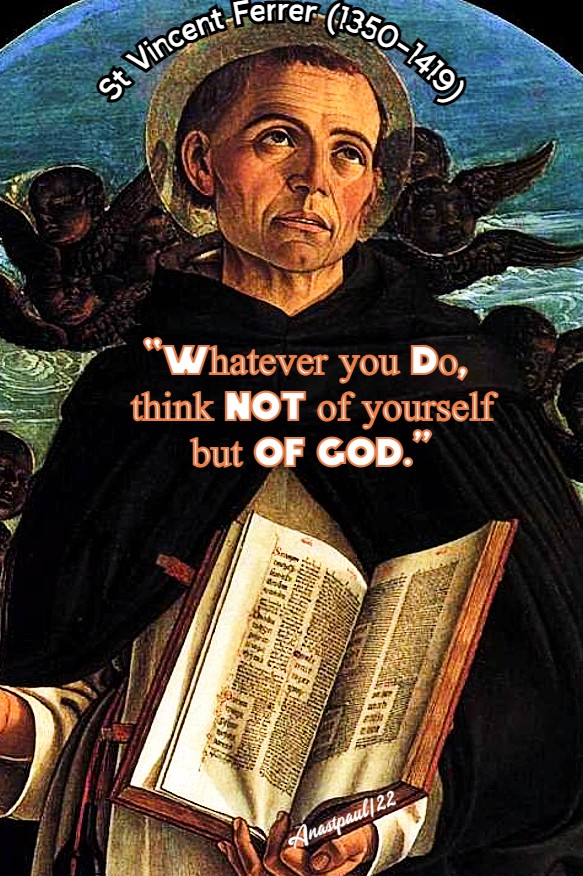
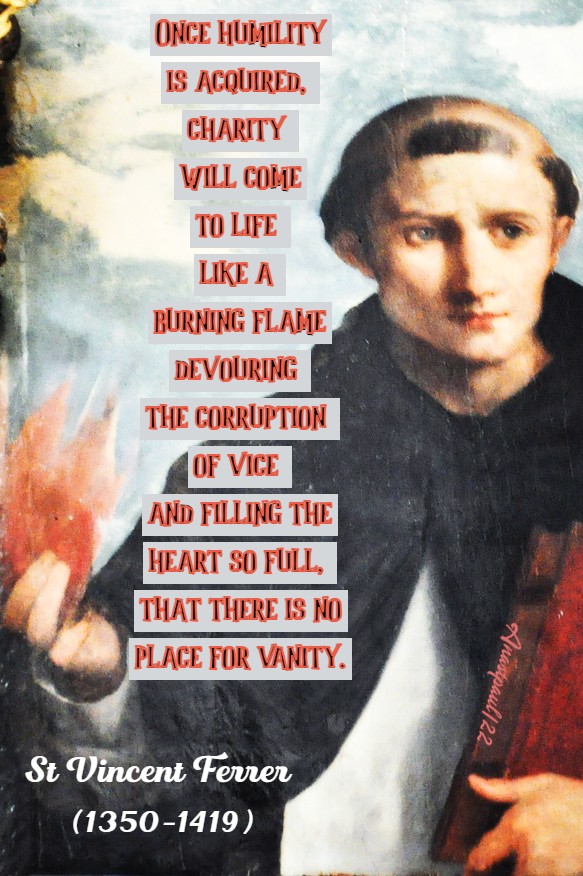
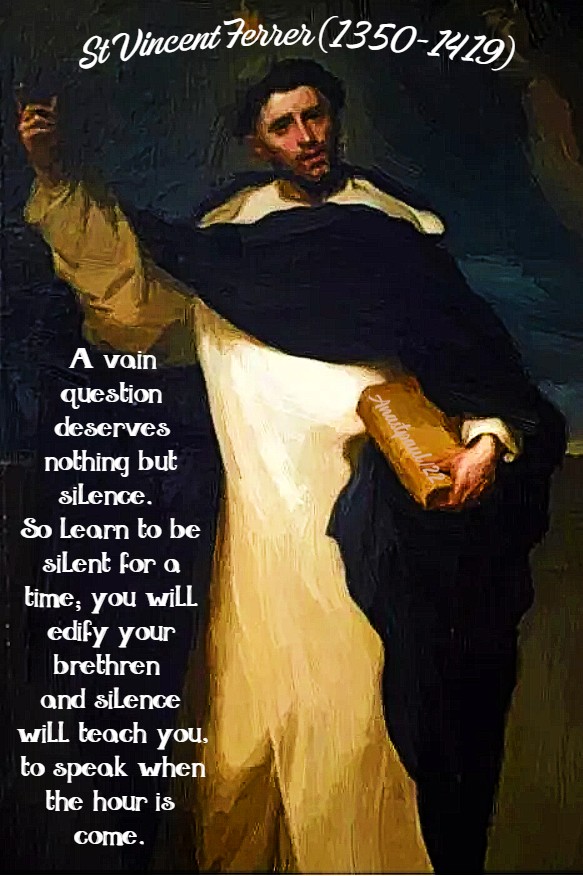
Quote/s of the Day – 5 April – Tuesday in Passion Week – and the Memorial of St Vincent Ferrer OP (1350-1419)
“Whatever you do, think NOT of yourself but OF God.”
“Once humility is acquired, charity will come to life like a burning flame devouring the corruption of vice and filling the heart so full, that there is no place for vanity.”…
“A vain question deserves nothing but silence. So learn to be silent for a time; you will edify your brethren and silence will teach you, to speak when the hour is come.”
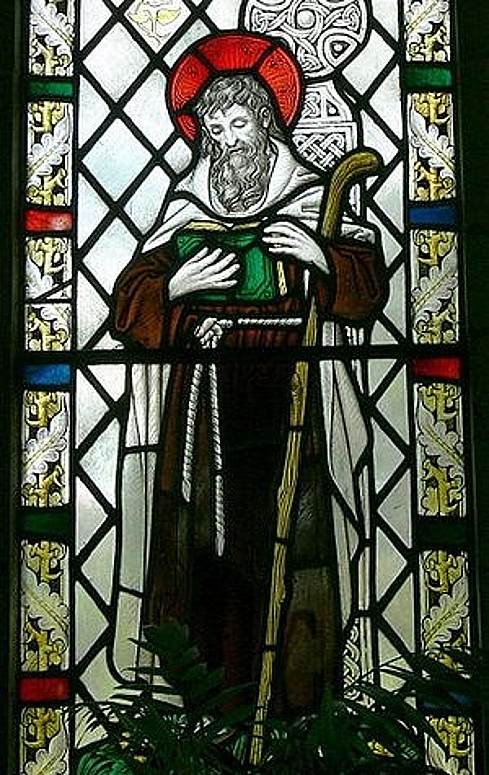
Saint of the Day – 5 April – Saint Derferl Gadarn (c 566-660) Welsh Prince, Solodier, Monk, Abbot, Missionary, Local legend holds, that he was a warrior of King Arthur. Born c 566 in Wales died 6 April 660 at Ynys Enlli, Bardsey, Wales of natural causes. Also known as – Cadarn, “Dervel the Mighty,” Gdarn, Terbillius, Turville.
Derferl was born a Prince, the son of King Hywel Mawr; grandson of Hoel I Mawr the Great. brother of Saint Tudwal and the brother of Saint Arthfael.
Derferl is said to have been a noted warrior in medieval Welsh poetry. Tudur Penllyn wrote:
“Derferl in war, he would work his spear wondrously, steel covering is the garment, brave is the appearance.”
Derferl the soldier, whose skill was celebrated the bards of his day, fought in the Battle of Camlan in 537. After the mighty Battle, Derferl is unanimously held in Welsh tradition, to have been visited by grace and received a conversion experience as mighty as his arms of war had been.
He entered the religious life, initially as a wandering Hermit and then he entered the Monastery at Llantwit in Wales. Later he became the Abbot of Ynys Enlli, Bardsey Island, succeeding his cousin St Cadfan. Derferl evangelised the surrounding areas as a Missionary. The Monastery at Llandderfel in Gwynedd, which is named after him is also said to have been founded and established by Derferl.
He died on 6 April 660 at Ynys Enlli, Bardsey, Wales of natural causes. His relics were interred at Llanderfel, Merionethshire, Wales but were destroyed by order of Oliver Cromwell, by order of Henry VIII.
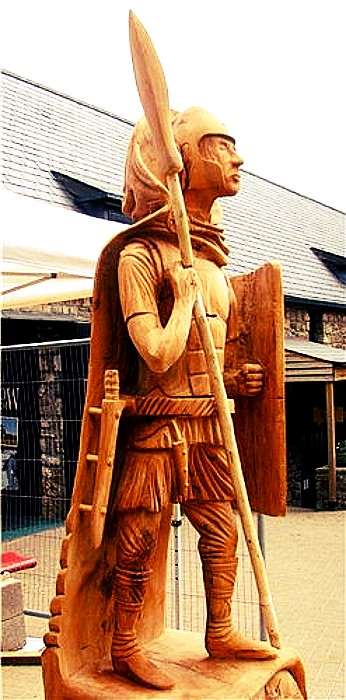
For centuries Derfel was venerated at the Churches of Llanfihangel Llantarnam, which claimed one of his relics and Llandderfel, which featured a wooden Statue. He was an object of pilgrimage at these sites. Derferl was depicted as a warrior in full armour riding a horse rather than as a Monk. The Llandderfel Statue was removed and dismantled by order of Thomas Cromwell during the English Reformation and used to burn a Catholic Priest, and Martyr, Blessed John Forest, at Smithfield in London. This was held to be a fulfilment of a prophecy that the image would burn down a forest. Part of the Statue survives to the present day at Llandderfel.
St Pausilippus Bl Peter Cerdan St Theodore the Martyr
Martyrs of Lesbos: 5 Saints: Five young Christian women Martyred together for their faith. We don’t even know their names. island of Lesbos, Greece.
Martyrs of North-West Africa: Large group of Christians murdered while celebrating Easter Mass during the persecutions of Genseric, the Arian king of the Vandals. They were Martyred in 459 at Arbal (in modern Algeria).
Martyrs of Seleucia: 120 Saints :One-hundred and eleven (111) men and nine (9) women who, because they were Christians, were dragged to Seleucia and Martyred for refusing to worship the sun or fire or other pagan idols during the persecutions of King Shapur II. They were burned alive in 344 in Seleucia, Persia.

























You must be logged in to post a comment.