One Minute Reflection – 18 January – Feast of the Chair of the Apostle, St Peter at Rome – 1 Peter 1:1-7, Matthew 16:13-19 – Scripture search here: https://www.drbo.org/
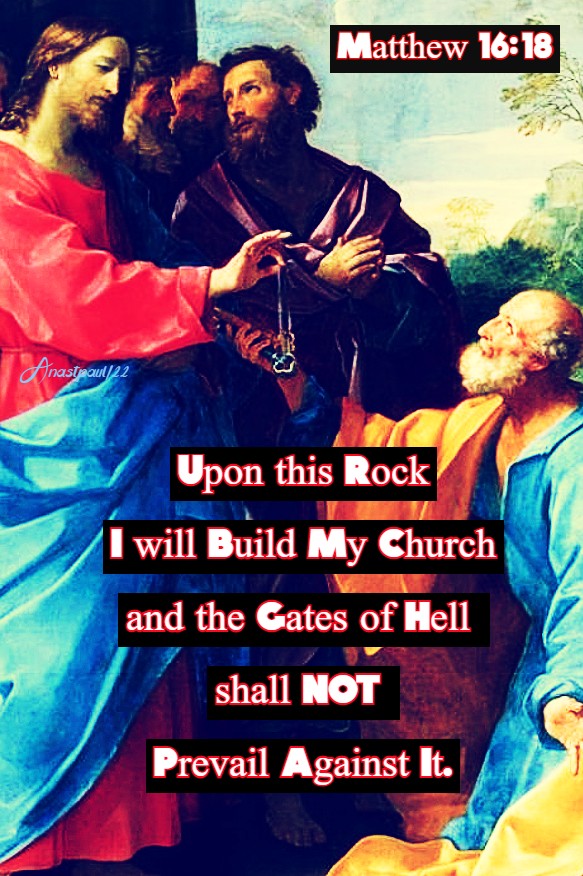
“Upon this rock I will build my church” … Matthew 16:18
REFLECTION – “Nothing escaped the Wisdom and Power of Christ, the elements of nature lay at His service, spirits obeyed Him, Angels served Him. … And yet, out of all the world, Peter alone was chosen to stand at the head, for the calling of all the peoples and the oversight of all the Apostles and Fathers of the Church. Thus, even though there are many Priests and shepherds among the People of God, Peter governed them all in person, while Christ also governs them in the capacity of Head. …
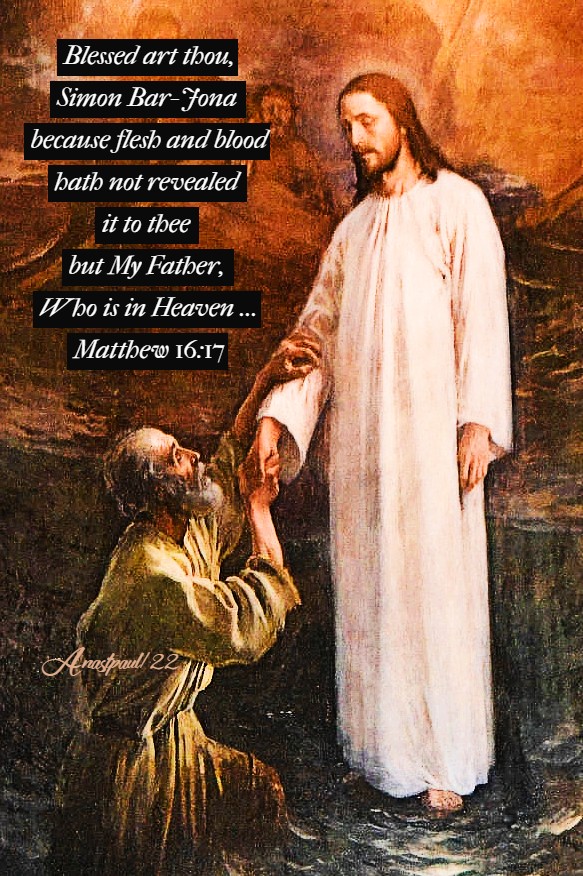
The Lord asks all the Apostles what people think of Him and they all say the same thing, so long as they are making known the doubts deriving from human ignorance. But when the Lord demands to know, what the disciples themselves think, the first to confess the Lord is he, who is the first in dignity of the Apostles. As he had said: “You are the Christ, the Son of the Living God,” Jesus answers him: “Blessed are you, Simon son of Jonah. For flesh and blood has not revealed this to you, but my heavenly Father.” That is to say, blessed are you because My Father taught this to you. Earthly opinion has not led you astray but it is heavenly inspiration that has instructed you. It is not flesh and blood that enabled you to discover Me but He, Whose only Son I Am.
“And so I say to you,” that is to say- just as my Father has manifested My Divinity to you, so I Am making known your superiority to you. “You are Peter” namely, I am the unshakeable Rock, the Cornerstone who makes two peoples one (Eph 2:14), the foundation other than which, no-one can lay any other (1 Cor 3:11). But you also, you are rock, since you are impregnable by My Strength and, what I have by virtue of My Power, you have in common with Me, by the fact,, that you participate in it. “On this rock I will build My Church” … On the firmness of this foundation, He says, will I build an everlasting temple and My Church, whose summit is to reach to Heaven, will be raised on the strength of that faith.” … Saint Pope Leo the Great (400-461) Father and Doctor of the Church ( 4th sermon for the Anniversary of his Consecration).
PRAYER – O God, Who together with the keys of the Kingdom of Heaven didst bestow on thy blessed Apostle Peter the pontifical power of binding and loosing, grant that by the aid of his intercession, we may be released from the bonds of our sins. ThroughJesus Christ, Thy Son our Lord, Who lives and reigns with Thee, in the unity of the Holy Ghost, God, world without end. Amen (Collect).
One Minute Reflection – 3 January – “The Month of the Most Holy Name of Jesus” – Octave Day of St John, Apostle – Ecclesiasticus 15:1-6, John 21:19-24 –Scripture search here: https://www.drbo.org/
“This is that disciple who bears witness concerning these things and who has written these things and we know that his witness is true.” – John 21:24
REFLECTION – “In proportion to the grace that caused Jesus to love him and enabled him to rest on Jesus’ Breast at the Supper (Jn 13:23), John abundantly received [the Spirit’s gifts] of understanding and wisdom (Is 11:2) – understanding with which to comprehend Scripture, wisdom with which to compose his own books with wonderful skill. As a matter of fact, he did not receive this gift right from the time when he rested on our Lord’s Breast, even if he was subsequently able to draw from that Heart “in which are hidden all the treasures of wisdom and knowledge” (Col 2:3). When he says, that when he went into the tomb “he saw and he believed,” he acknowledges that “they did not yet understand the Scripture that Jesus had to rise from the dead” (Jn 20:9). Like all the other Apostles, John received its fullness, when the Holy Spirit came [at Pentecost] and when grace had been given to each of them “according to the measure of Christ’s gift” (Eph 4:7). …
The Lord Jesus loved this disciple more than all the others … and opened the secrets of Heaven to him … to make of him the author of that profound Mystery which man can say nothing about, of himself: the Mystery of the Word, God’s Utterance, the Word made flesh. This is the fruit of that love. Yet even though He loved him, it was not to him that Jesus said: “You are Peter, and on this rock I shall build my Church” (Mt 16:18) … While He loved all His disciples and especially Peter, with a love in mind and soul, our Lord loved John with the love of His Heart …. In the order of Apostleship, Simon Peter received the first place and the “keys of the Kingdom of heaven” (Mt 16:19) but John, won another inheritance, the spirit of understanding, “a wealth of joy and gladness” (Sir 15:6).” – Rupert of Deutz (c 1075- c 1130) Benedictine Monk, Theologian and Writer (The Works of the Holy Spirit, IV, 10 SC 165)
PRAYER – O Lord, graciously shed light upon Thy Church, so that, enlightened by the teachings of blessed John, Thy Apostle and Evangelist, she may gain Thy everlasting rewards.Through Jesus Christ, Thy Son our Lord, Who lives and reigns with Thee, in the unity of the Holy Ghost, God, world without end. Amen (Collect).
Our Morning Offering – 3 January – Octave Day of St John, Apostle
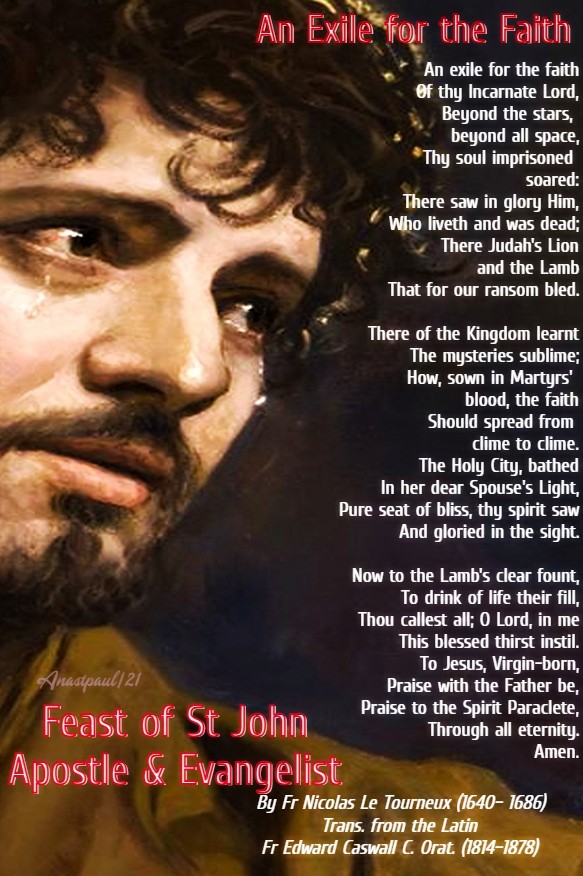
An Exile for the Faith By Father Nicolas Le Tourneux (1640– 1686) Trans. by Fr Edward Caswall C. Orat. (1814–1878)
An exile for the faith Of thy Incarnate Lord, Beyond the stars, beyond all space, Thy soul imprisoned soared, There saw in glory Him, Who liveth and was dead; There Judah’s Lion and the Lamb That for our ransom bled.
There of the Kingdom learnt The mysteries sublime; How, sown in Martyrs’ blood, the faith Should spread from clime to clime. The Holy City, bathed In her dear Spouse’s Light, Pure seat of bliss, thy spirit saw And gloried in the sight.
Now to the Lamb’s clear fount, To drink of life their fill, Thou callest all; O Lord, in me This blessed thirst instil. To Jesus, Virgin-born, Praise with the Father be, Praise to the Spirit Paraclete, Through all eternity. Amen.
St Anysia of Thessalonica St Anysius of Thessalonica
St Egwin of Worcester OSB (Died 717) Bishop of Worcester, England, Benedictine Monk, Reformer and Penitent, miracle-worker. Egwin was devout and lived for God from his youth. His biographers say, that king, clergy and the faithful, all united in demanding Egwin’s elevation to Bishop. About St Egwin: https://anastpaul.com/2020/12/30/saint-of-the-day-30-december-saint-egwin-of-worcester-osb-died-717/
St Elias of Conques St Eugene of Milan St Geremarus
St Hermes of Moesia St Jucundus of Aosta St Liberius of Ravenna
Blessed Margherita Colonna (c 1255-1284) Virgin, Nun, Mystic, Apostle of the poor. Beatified on 17 September 1847 by Pope Pius IX. The Roman Martyrology states: “At Palestrina in Lazio, Blessed Margherita Colonna, Virgin, who preferred poverty for Christ to the riches and pleasures of the world, which she served by professing the Rule of St Clare.” Her Life: https://anastpaul.com/2021/12/30/saint-of-the-day-30-december-blessed-margherita-colonna-c-1255-1284/
St Perpetuus of Tours Bl Raoul of Vaucelles St Rainerius of Aquila (Died c 1077) Bishop Bl Richard of Wedinghausen St Ruggero of Canne St Sebastian of Esztergom
Martyrs of Alexandria – 5 Saints: A group of Christians Martyred in the unrest caused by Monophysite heretics. We know the names for five of them – Appian, Donatus, Honorius, Mansuetus and Severus. They were martyred in c 483 at Alexandria, Egypt.
Martyrs of Oia – 6 Saints: A group of Christians Martyred together, date unknown. The only details to have survived are the names – Cletus, Florentius, Papinianus, Paul, Serenusa and Stephen. They were martyred in Oia, Greece.
Martyrs of Spoleto – 4 Saints: A group of Christians Martyred in the persecutions of DioSletian – Exuperantius, Marcellus, Sabinus and Venustian. They were martyred in 303 in Spoleto, Italy.
Thought for the Day – 27 December – Meditations with Antonio Cardinal Bacci (1881-1971)
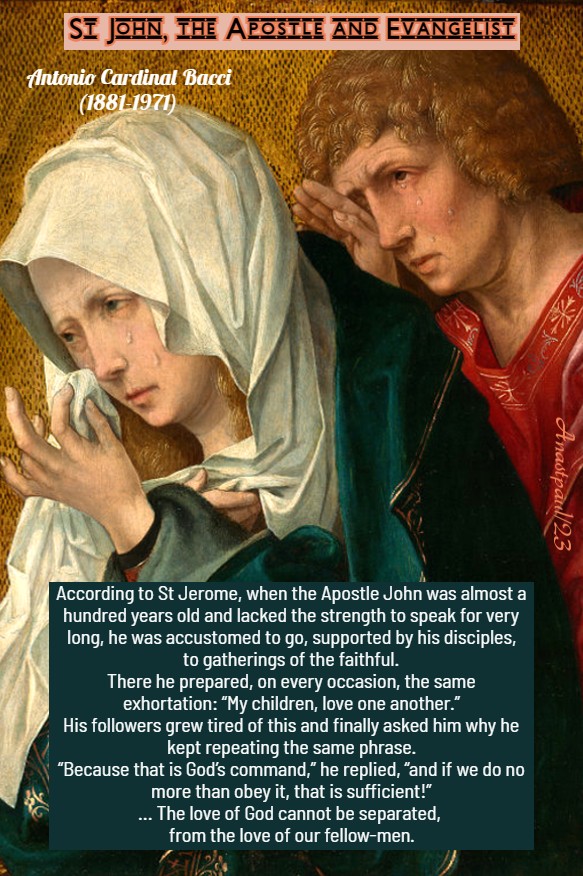
St John, the Apostle and Evangelist
“Both in his Gospel and in his letters, St John continually emphasises the virtue of charity. He stresses the need for love of God and love of our neighbour, “God is love,” he says, “and he who abides in love abides in God and God in him” (1 Jn 4:16). According to St Jerome, when the Apostle John was almost a hundred years old and lacked the strength to speak for very long, he was accustomed to go, supported by his disciples, to gatherings of the faithful. There he prepared, on every occasion, the same exhortation: “My children, love one another.” His followers grew tired of this and finally asked him why he kept repeating the same phrase. “Because that is God’s command,” je replied, “and if we do no more than obey it, that is sufficient!”
Let us meditate on his words and let us remember that our love for God is futile, unless it is accompanied by a practical love for our neighbour. The love of God cannot be separated, from the love of our fellow-men.”
Our Prayers to the Saints – 27 December – St John the Apostle and Evangelist, the Beloved
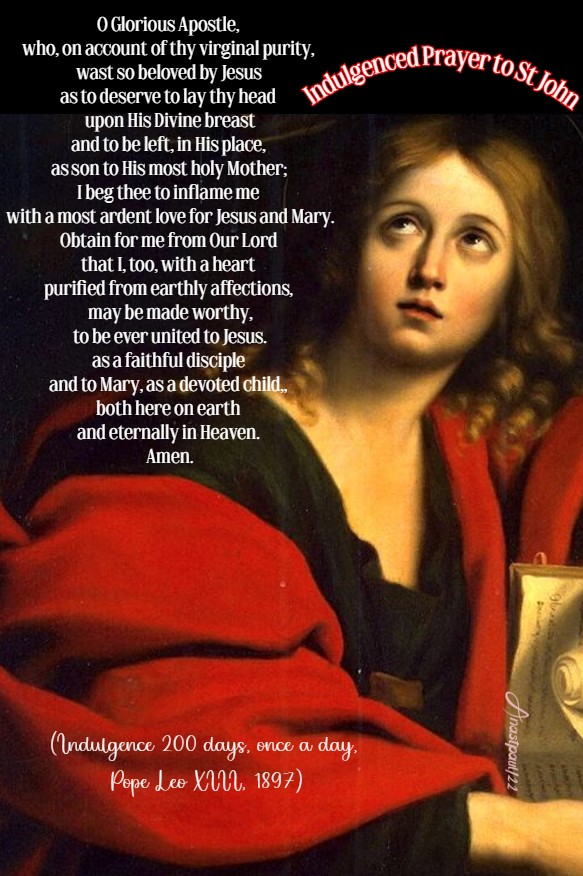
Indulgenced Prayer to St John (Indulgence 200 days, once a day, Pope Leo XIII, 1897)
O Glorious Apostle, who, on account of thy virginal purity, wast so beloved by Jesus as to deserve to lay thy head upon His Divine breast and to be left, in His place, as son to His most holy Mother; I beg thee to inflame me with a most ardent love for Jesus and Mary. Obtain for me from Our Lord that I, too, with a heart purified from earthly affections, may be made worthy, to be ever united to Jesus. as a faithful disciple and to Mary, as a devoted child,, both here on earth and eternally in Heaven. Amen.
One Minute Reflection – 27 December – “The Month of the Divine Infant and the Immaculate Conception” – St John the Apostle and Evangelist, the Beloved – Ecclesiasticus 15:1-6, John 21:19-24 – Scripture search here: https://www.drbo.org/
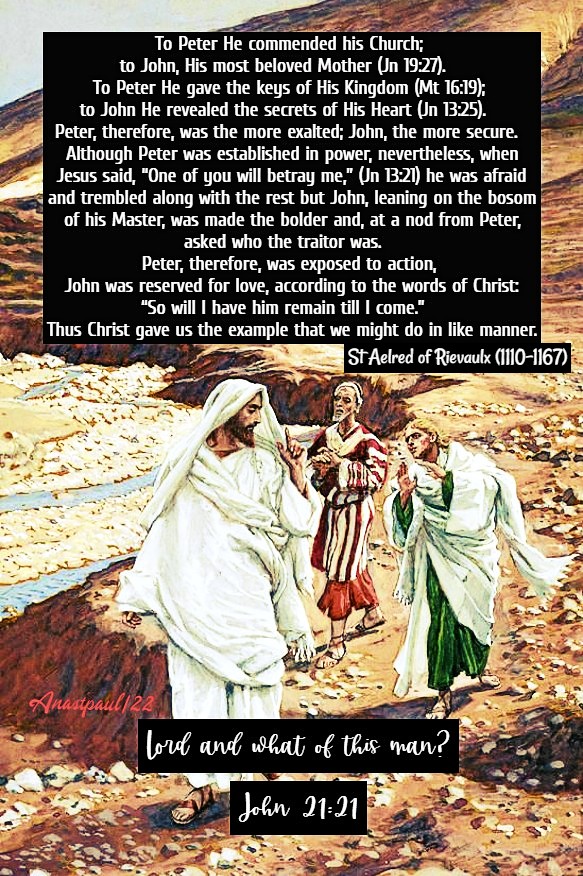
“Peter saw following them, the disciple whom Jesus loved, the one who, at the supper, had leaned back upon His breast … Peter, therefore, seeing him, said to Jesus, Lord and what of this man?” – John 21:20-21
REFLECTION – “There are some persons who think they are not loved because they cannot be promoted and who allege that they are despised, if they are not entrusted with responsibilities and offices. We know that as a result of this type of thinking, no small discord has sprung up, among those who were considered friends, so that estrangement followed upon indignation and railings upon estrangement …
Let no-one say that he is held in contempt, for the reason that he is not promoted, since the Lord Jesus preferred Peter to John in this respect; nor did He, on that account, lessen His affection for John because He had given Peter the leadership. To Peter He commended his Church; to John, His most beloved Mother (Jn 19:27). To Peter He gave the keys of His Kingdom (Mt 16:19); to John He revealed the secrets of His Heart (Jn 13:25). Peter, therefore, was the more exalted; John, the more secure. Although Peter was established in power, nevertheless, when Jesus said, “One of you will betray me,” (Jn 13:21) he was afraid and trembled along with the rest but John, leaning on the bosom of his Master, was made the bolder and, at a nod from Peter, asked who the traitor was. Peter, therefore, was exposed to action, John was reserved for love, according to the words of Christ: “So will I have him remain until I come.” Thus Christ gave us the example that we might do in like manner.” – St Aelred of Rievaulx (1110-1167) Cistercian Monk (Spiritual Friendship, III, 115, 117).
PRAYER – O Lord, graciously shed light upon Thy Church, so that, enlightened by the teachings of blessed John, ThyApostle and Evangelist, she may gain YThy everlasting rewards.Through Jesus Christ, Thy Son our Lord, Who lives and reigns with Thee, in the unity of the Holy Ghost, God, world without end. Amen (Collect).
Our Morning Offering – 27 December – St John the Apostle and Evangelist, the Beloved – “The Month of the Divine Infant and the Immaculate Conception”
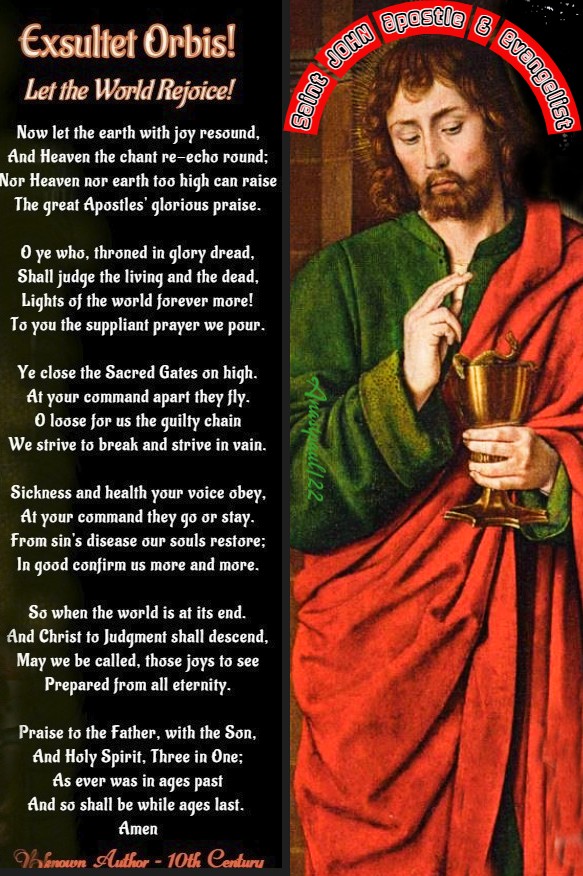
Exsultet Orbis! Let the World Rejoice! Unknown Author
Now let the earth with joy resound, And Heaven the chant re-echo round; Nor Heaven nor earth too high can raise The great Apostles’ glorious praise.
O ye who, throned in glory dread, Shall judge the living and the dead, Lights of the world forever more! To you the suppliant prayer we pour.
Ye close the Sacred Gates on high. At your command apart they fly. O loose for us the guilty chain We strive to break and strive in vain.
Sickness and health your voice obey, At your command they go or stay. From sin’s disease our souls restore; In good confirm us more and more.
So when the world is at its end. And Christ to Judgment shall descend, May we be called, those joys to see Prepared from all eternity.
Praise to the Father, with the Son, And Holy Spirit, Three in One; As ever was in ages past And so shall be while ages last. Amen
(Roman Breviary for the Common of Apostles) An Office Hymn that was traditionally prescribed for Vespers and Lauds on the Feasts of Apostles and Evangelists outside Easter time. The Hymn is found as early as the tenth century in a hymnal of Moissac Abbey.
One Minute Reflection – 21 December – Feast of St Thomas, Apostle of Christ, Martyr – Ephesians 2:19-22, John 20:24-29 – Scripture search here: https://www.drbo.org/
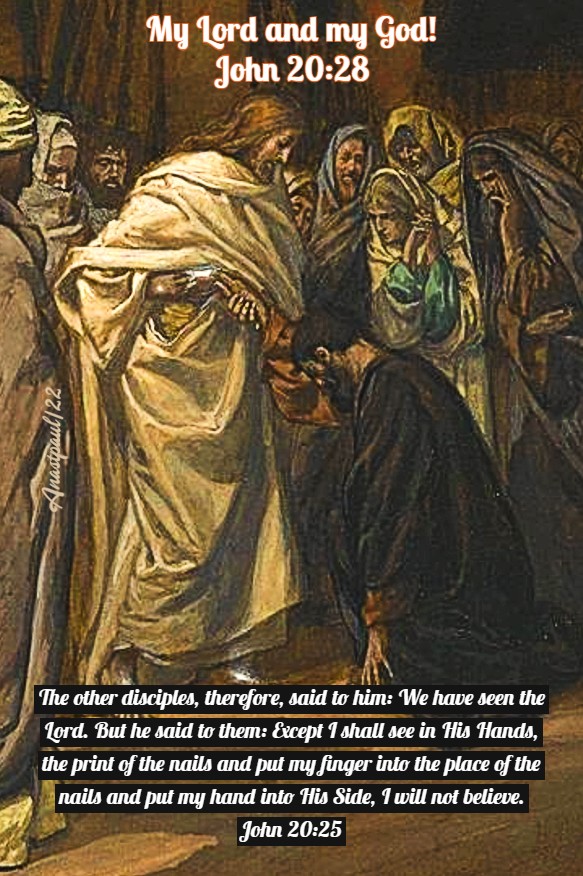
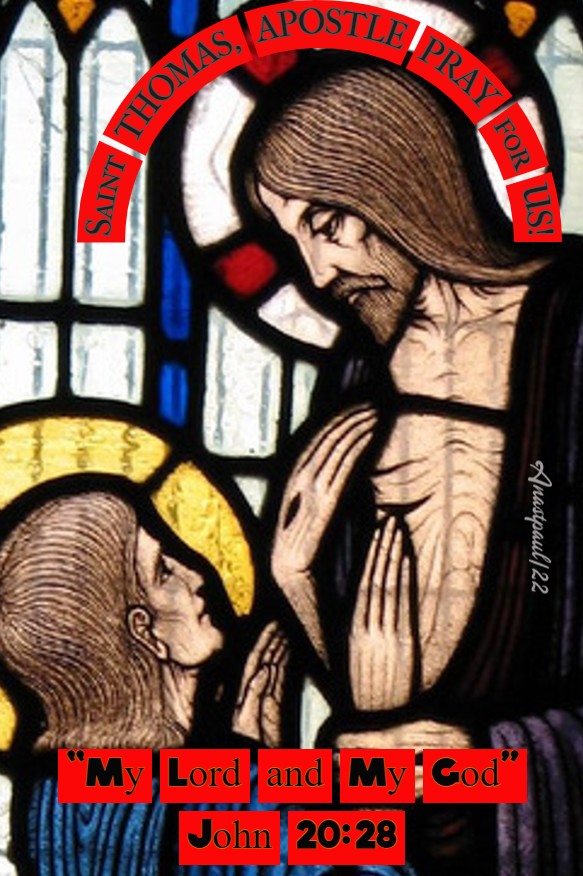
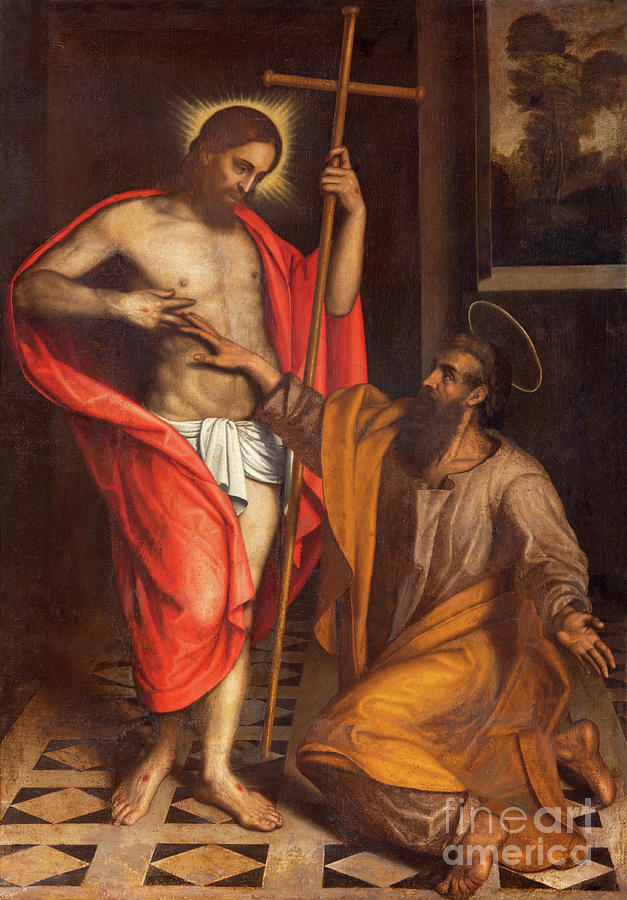
“The other disciples, therefore, said to him: We have seen the Lord. But he said to them: Except I shall see in His Hands, the print of the nails and put my finger into the place of the nails and put my hand into His Side, I will not believe.” – John 20:25
REFLECTION – “What, dearest brethren do you notice in this passage? Do you think that it happened by chance that this chosen disciple was absent at that time and afterwards coming, heard the news and hearing, doubted that doubting, he touched and touching, he believed? This did not happen by chance but by Divine dispensation. For the Divine clemency brought it about, in a wonderful way that the doubting disciple, while touching the wounds in his Master’s flesh, should thereby heal the wounds of our unbelief. The unbelief of Thomas is more to our faith, than the faith of the believing disciples. While he is brought back to faith by touching, our minds are set free from doubt and established in the faith.
So the Lord indeed, after His Resurrection permitted His disciple to doubt but He did not leave him in unbelief; just as before His birth, He wished Mary to have a spouse, who, however, never attained to the married state. The disciple who doubted and touched his Risen Lord, thus became, a witness to the truth of the Resurrection, just as the spouse of His Mother was the guardian of her inviolate Virginity. Thomas touched and cried out: My Lord and my God. Jesus said to him – Because you have seen me, you have believed. But since the Apostle Paul says – Now faith is the substance of things to be hoped for, the evidence of things which appear not; it is certainly clear that faith is the evidence, of those things which cannot appear. The things which appear are the object, not of faith but of knowledge.
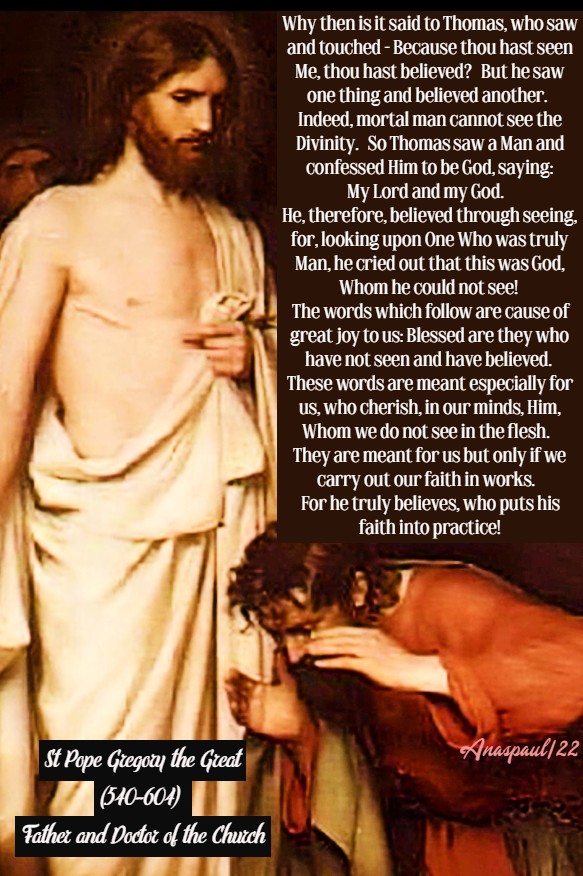
Why then is it said to Thomas, who saw and touched – Because thou hast seen Me, thou hast believed? But he saw one thing and believed another. Indeed, mortal man cannot see the Divinity. So Thomas saw a Man and confessed Him to be God, saying: My Lord and my God. He, therefore, believed through seeing, for, looking upon One Who was truly Man, he cried out that this was God, Whom he could not see! The words which follow are cause of great joy to us: Blessed are they who have not seen and have believed. These words are meant especially for us, who cherish, in our minds, Him, Whom we do not see in the flesh. They are meant for us but only if we carry out our faith in works. For he truly believes, who puts his faith into practice!” – St Gregory the Great (540-604) Pope. Father and one of the original four Doctors of the Latin Church (Sermon on the Feast of St Thomas).
PRAYER – O Lord, grant us, we beseech Thee, to glory in the Feast-day of blessed Thomas, Thy Apostle, that we maybe helped continually by his patronage and imitate his faith with a devotion like his. .Through Jesus Christ, Thy Son our Lord, Who lives and reigns with Thee, in the unity of the Holy Ghost, God, world without end. Amen (Collect).
Our Morning Offering – 21 December – St Thomas Apostle
Exsultet Orbis! Let the World Rejoice! Unknown Author
Now let the earth with joy resound, And Heaven the chant re-echo round; Nor Heaven nor earth too high can raise The great Apostles’ glorious praise.
O ye who, throned in glory dread, Shall judge the living and the dead, Lights of the world forever more! To you the suppliant prayer we pour.
Ye close the Sacred Gates on high. At your command apart they fly. O loose for us the guilty chain We strive to break and strive in vain.
Sickness and health your voice obey, At your command they go or stay. From sin’s disease our souls restore; In good confirm us more and more.
So when the world is at its end. And Christ to Judgment shall descend, May we be called, those joys to see Prepared from all eternity.
Praise to the Father, with the Son, And Holy Spirit, Three in One; As ever was in ages past And so shall be while ages last. Amen
(Roman Breviary for the Common of Apostles) An Office Hymn that was traditionally prescribed for Vespers and Lauds on the Feasts of Apostles and Evangelists outside Easter time. The Hymn is found as early as the tenth century in a hymnal of Moissac Abbey.
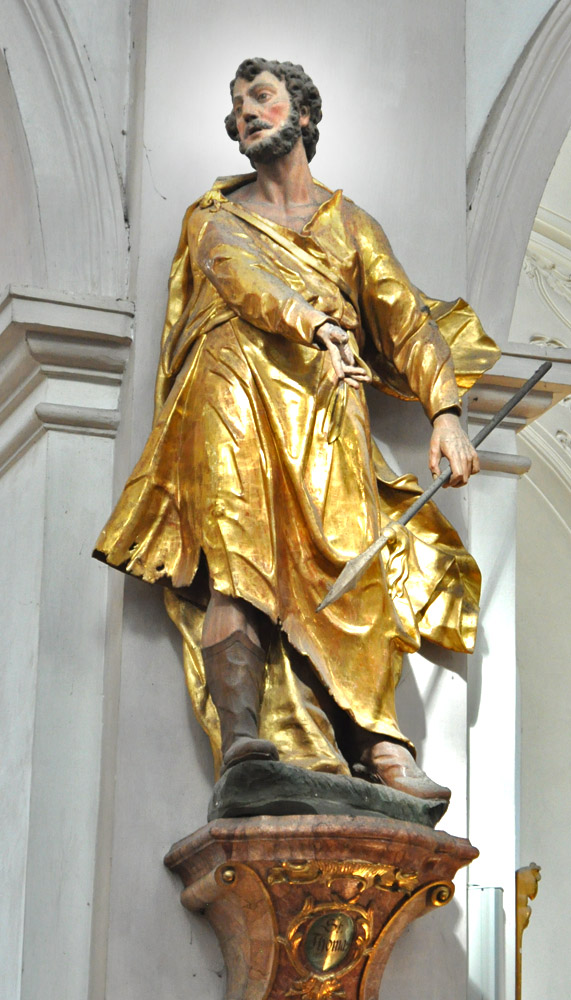
Saint of the Day – 21 December – Feast of St Thomas, Apostle of Christ, Martyr. His Patronages are:• people in doubt; against doubt• architects• blind people and against blindness• builders• construction workers• geometricians• stone masons and stone cutters• surveyors• theologians• Ceylon• East Indies• India• Indonesia• Malaysia • Pakistan• Singapore• Sri Lanka• Diocese of Bathery, India• Castelfranco di Sopra, Italy• Certaldo, Italy• Ortona, Italy.
St Thomas, Apostle From the Liturgical Year, 1870
This is the last Feast the Church keeps before the great one of the Nativity of her Lord and Spouse. She interrupts the Greater Ferias, in order to pay her tribute of honour to Thomas, the Apostle of Christ, whose glorious Martyrdom has consecrated this twenty first day of December and has procured, for the Christian people, a powerful patron that will introduce them to the Divine Babe of Bethlehem.
To none of the Apostles could this day have been so fittingly assigned, as to St Thomas. It was St Thomas whom we needed; St. Thomas, whose festal patronage would aid us to believe and hope, in that God, Whom we see not and Who comes to us in silence and humility, in order to try our Faith.
St Thomas was once guilty of doubting, when he ought to have believed and only learned the necessity of Faith by the sad experience of incredulity. He comes then most appropriately to defend us, by the power of his example and prayers, against the temptations which proud human reason might excite within us.
Let us pray to him with confidence. In that Heaven of Light and Vision, where his repentance and love have placed him, he will intercede for us,and gain for us that docility of mind and heart, which will enable us to see and recognise Him, Who is the Expected of Nations and Who, though the King of the world, will give no other signs of His Majesty, than the swaddling-clothes and tears of a Babe.
One Minute Reflection – 17 December – “The Month of the Divine Infant and the Immaculate Conception” – Saturday of Ember Week in Advent – Isaias 19:20-22, Luke 3:1-6 – Scripture search here: https://www.drbo.org/
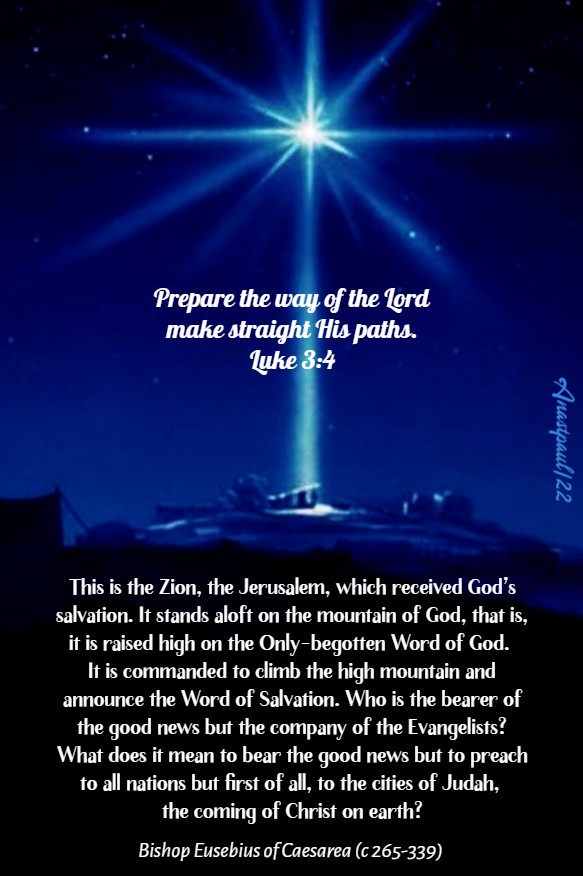
“As it was written in the book of the sayings of Isaias the prophet: ‘A voice of one crying in the wilderness: Prepare the way of the Lord make straight His paths.’” – Luke 3:4
REFLECTION – “The voice of one crying in the wilderness: ‘Prepare the way of the Lord, make straight the paths of our God.’ The prophecy makes clear that it is to be fulfilled, not in Jerusalem but in the wilderness, it is there that the glory of the Lord is to appear and God’s salvation is to be made known to all mankind.
It was in the wilderness that God’s saving presence was proclaimed by John the Baptist and there that God’s salvation was seen. The words of this prophecy were fulfilled when Christ and His glory were made manifest to all after His Baptism, the heavens opened and the Holy Spirit, in the form of a dove, rested upon Him and the Father’s Voice was heard, bearing witness to the Son: ‘This is My beloved Son, listen to Him.‘
The prophecy meant that God was to come to a deserted place, inaccessible from the beginning. None of the pagans had any knowledge of God, since His holy servants and prophets, were kept from approaching them. The Voice commands that a way be prepared for the Word of God – the rough and trackless ground is to be made level, so that our God may find a highway when He comes. Prepare the way of the Lord – the way is the preaching of the Gospel, the new message of consolation, ready to bring to all mankind, the knowledge of God’s saving power.
Climb on a high mountain, bearer of good news to Zion. Lift up your voice in strength, bearer of good news to Jerusalem. These words harmonise very well with the meaning of what has gone before. They refer, opportunely, to the Evangelists and proclaim the coming of God to men, after speaking of the voice crying in the wilderness. Mention of the Evangelists suitably follows the prophecy of John the Baptist.
What does Zion mean if not the City previously called Jerusalem? This is the mountain referred to in that passage from Scripture: Here is mount Zion, where Thou dwelt. The Apostle says: You have come to mount Zion. Does not this refer to the company of the Apostles, chosen from the former people of the circumcision?
This is the Zion, the Jerusalem, which received God’s salvation. It stands aloft on the mountain of God, that is, it is raised high on the Only-begotten Word of God. It is commanded to climb the high mountain and announce the Word of Salvation. Who is the bearer of the good news but the company of the Evangelists? What does it mean to bear the good news but to preach to all nations but first of all, to the cities of Judah, the coming of Christ on earth?” – Eusebius of Caesarea (c 265-339) Bishop, Theologian, Historian, Father (An excerpt from his Commentary on Isaias).
PRAYER – Grant, we beseech Thee, almighty God, that we, who are heavy-laden under the yoke of sin, maybe delivered from the bondage of old, by the long-awaited new birth of Thy Only-begotten Son. Who livest and reignest with God the Father, in the unity of the Holy Ghost, God, world without end. Rejoice! ejoice! Emmanuel, Shall come to thee, O Israel. Amen (Collect)
Quote/s of the Day – 2 December – The Memorial of St Chromatius of Aquileia (Died c 407) Bishop of Aquileia, Theologian, Exegete, Writer and friend of Saints Ambrose and Jerome, defender of Saint John Chrysostom.
Let us pray to the Lord with all our heart and with all our faith, let us pray to Him to deliver us from all enemy incursions, from all fear of adversaries. … The Lord will fight to defend you and you will be silent. It is He who fights, it is He who wins the victory…. And so that He may condescend to do so, we must pray as much as possible. He Himself said, in fact, through the mouth of the prophet – Call on Me on the day of tribulation; I will set you free and you will give Me glory.
“However, in the allegorical or mystical sense, this woman prefigured the Church, which offered the full and entire devotion of it’s faith to Christ … There are twelve ounces to a pound and this is the amount of perfume the Church possesses, having received the teaching of the twelve Apostles, as if it were a precious perfume. Indeed, what more precious is there, than the Apostles’ teaching, which contains both faith in Christ and the glory of the Kingdom of Heaven? ”
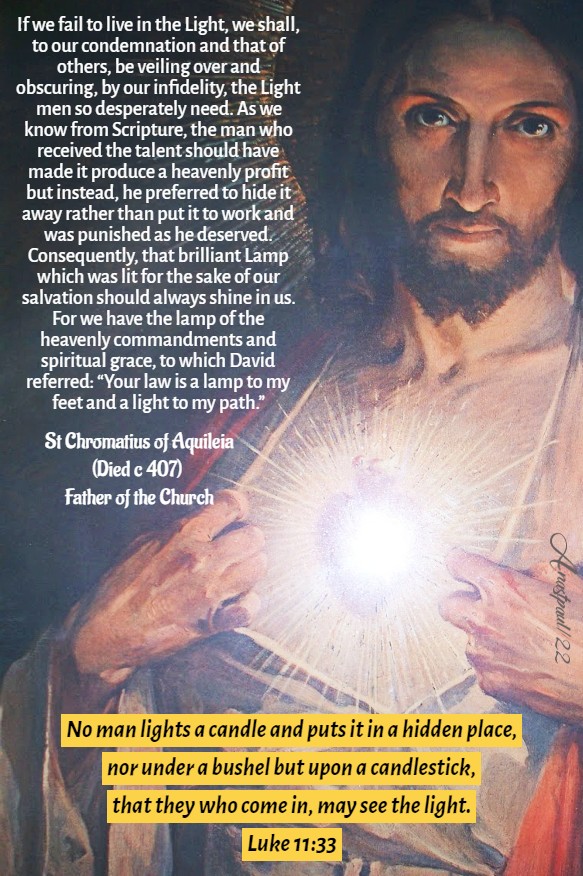
“No man lights a candle and puts it in a hidden place, nor under a bushel but upon a candlestick, that they who come in, may see the light.”
Luke 11:33
“If we fail to live in the Light, we shall, to our condemnation and that of others, be veiling over and obscuring, by our infidelity, the Light men so desperately need. As we know from Scripture, the man who received the talent should have made it produce a heavenly profit but instead, he preferred to hide it away rather than put it to work and was punished as he deserved. Consequently, that brilliant Lamp which was lit for the sake of our salvation should always shine in us. For we have the lamp of the heavenly commandments and spiritual grace, to which David referred: Your law is a lamp to my feet and a light to my path.”
St Chromatius of Aquileia (Died c 407) Father of the Church
One Minute Reflection – 30 November – Feast of St Andrew Apostle – Romans 10:10-18, Matthew 4:18-22 – Scripture search here: https://www.drbo.org/
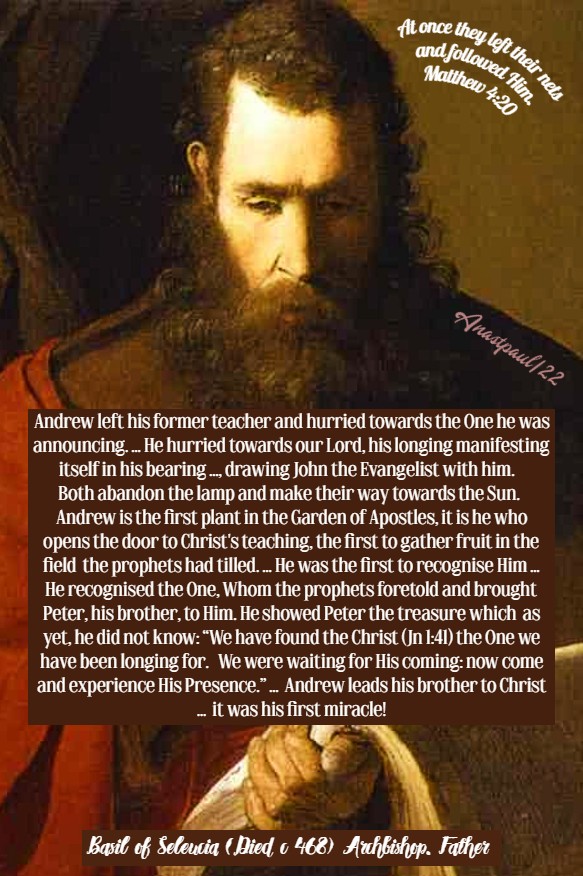
“At once they left their nets and followed Him.” – Matthew 4:20
REFLECTION – “Andrew was the first of the Apostles to acknowledge the Lord as his teacher. … He abandoned John the Baptist’s teaching to attend the school of Christ. … He sought the true Light in the shining of the lamp (Jn 5:35). Beneath its dampened glow he prepared himself for Christ’s splendour. … Teacher though he was, John the Baptist became servant and herald of the Christ Who stood before him: “Behold,” he said, “the Lamb of God who takes away the sin of the world” (Jn 1:29). Behold Him Who delivers us from death; behold Him Who destroys sin. As for me, I was sent, not as the bridegroom but as the one who accompanies Him (Jn 3:29). I came as servant, not as lord.”
Struck by these words, Andrew left his former teacher and hurried towards the One he was announcing. … He hurried towards our Lord, his longing manifesting itself in his bearing … drawing John the Evangelist with him. Both abandon the lamp and make their way towards the Sun. Andrew is the first plant in the Garden of Apostles, it is he who opens the door to Christ’s teaching, the first to gather fruit in the field the prophets had tilled. … He was the first to recognise Him, of Whom Moses said: “A prophet like me, will the Lord your God raise up for you; to him you shall listen” (Dt 18:15). … He recognised the One, Whom the prophets foretold and brought Peter, his brother, to Him. He showed Peter the treasure which as yet, he did not know: “We have found the Christ (Jn 1:41) the One we have been longing for. We were waiting for His coming: now come and experience His Presence.” … Andrew leads his brother to Christ … – it was his first miracle!” – Basil of Seleucia (Died c 468) Archbishop (,).
PRAYER – We humbly pray Thy majesty, O Lord, that, as blessed Andrew was a preacher and ruler in Thy Church, so he may always intercede for us with Thee. Through Jesus Christ, Thy Son our Lord, Who lives and reigns with Thee, in the unity of the Holy Ghost, God, world without end. Amen (Collect).
Our Morning Offering – 30 November – Feast of St Andrew Apostle and Martyr
Exsultet Orbis! Let the World Rejoice! Unknown Author
Now let the earth with joy resound, And Heaven the chant re-echo round; Nor Heaven nor earth too high can raise The great Apostles’ glorious praise.
O ye who, throned in glory dread, Shall judge the living and the dead, Lights of the world forever more! To you the suppliant prayer we pour.
Ye close the Sacred Gates on high. At your command apart they fly. O loose for us the guilty chain We strive to break and strive in vain.
Sickness and health your voice obey, At your command they go or stay. From sin’s disease our souls restore; In good confirm us more and more.
So when the world is at its end. And Christ to Judgment shall descend, May we be called, those joys to see Prepared from all eternity.
Praise to the Father, with the Son, And Holy Spirit, Three in One; As ever was in ages past And so shall be while ages last. Amen
(Roman Breviary for the Common of Apostles) An Office Hymn that was traditionally prescribed for Vespers and Lauds on the Feasts of Apostles and Evangelists outside Easter time. The Hymn is found as early as the tenth century in a hymnal of Moissac Abbey.
St Abraham of Persia St Anders of Slagelse Bl Andrew of Antioch Bl Arnold of Gemblours St Castulus of Rome St Constantius of Rome St Crider of Cornwall Blessed Cuthbert Mayne (1544-1577) Priest Martyr St Domninus of Antioch St Euprepis of Rome Bl Everard of Stahleck
Bl Joscius Roseus St Justina of Constantinople St Mahanes the Persian St Maura of Constantinople St Merola of Antioch St Mirocles of Milan St Sapor St Simeon of Persia St Trojan St Tudwal of Tréguier Bl William de Paulo Zosimus the Wonder Worker
Martyrs of Saxony – 6 Saints: Missionaries who worked with Saint Willehad of Bremen. Martyrs. – Attroban, Benjamin, Emmingen, Folkard, Gerwald and Grisold. They were martyred on 30 November 782 at River Weser, Lawer Saxony, Germany.
One Minute Reflection – 24 November – St John of the Cross OCD (1542-1591) Confessor, Doctor of the Church – 2 Timothy 4:1-8, Matthew 5:13-19 – Scripture search here: https://www.drbo.org/
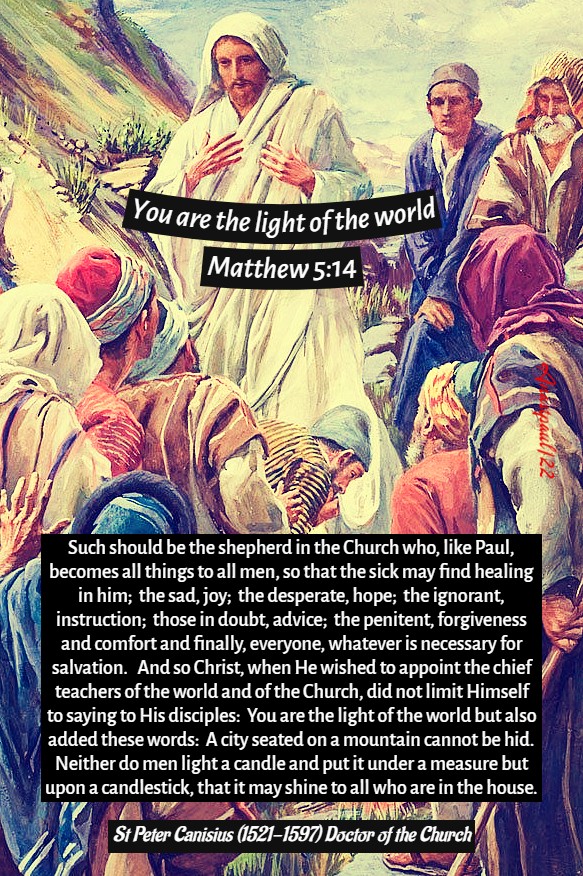
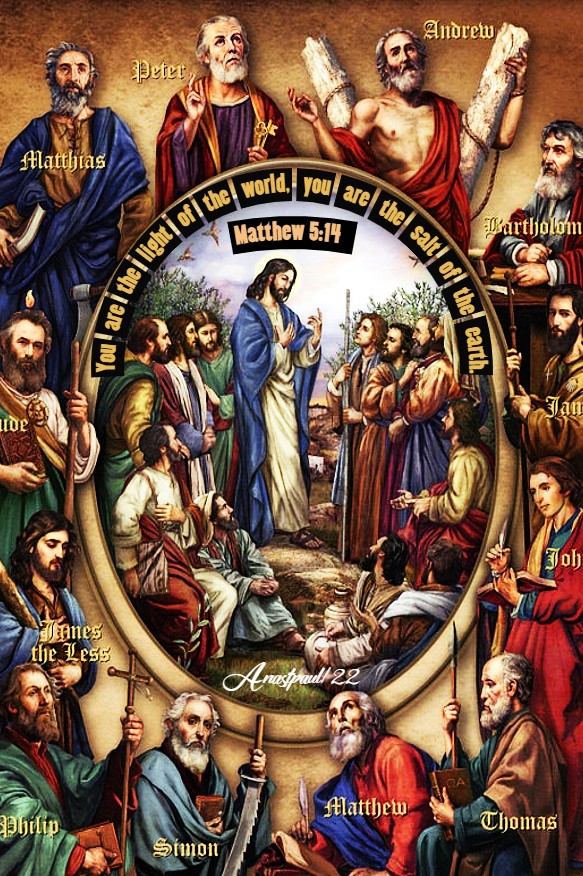
“You are the light of the world.” – Matthew 5:14
REFLECTION – “I shall always love and reverence the Apostles sent by Christ and their successors, in sowing the seed of the Gospel, those zealous and tireless co-operators in propagating the Word, who may justly say of themselves: Let a man so account of us as the ministers of Christ and the dispensers of the mysteries of God. For Christ, like a most watchful and most faithful householder, wished that the Gospel lamp should be lighted by such ministers and delegates, with fire sent down from Heaven and once lighted, should not be put under a measure but set upon a candlestick, so that it may spread its brightness far and wide and put to flight, all darkness and error, rife among both Jews and Gentiles.
Now it is not enough for the Gospel teacher to be a brilliant speaker in the eyes of the people; he must also be as a voice crying in the desert and endeavour, by his eloquence, to help many to lead good lives, lest, if he omit his duty of speaking, he be called the dumb dog that is not able to bark, spoken of by the prophet. Yes, he should also burn, in such a way, that, equipped with good works and love, he may adorn his evangelical office and follow the leadership of Paul. He indeed was not satisfied with bidding the Bishop of the Ephesians: This command and teach: conduct thyself in work as a good soldier of Christ Jesus but he unflaggingly preached the Gospel to friend and foe alike and, said with a good conscience to the Bishops gathered at Ephesus: You know how I have kept back nothing that was for your good but have declared it to you and taught you in public and from house to house, urging Jews and Gentiles to turn to God in repentance and to believe in our Lord Jesus Christ.
Such should be the shepherd in the Church who, like Paul, becomes all things to all men, so that the sick may find healing in him; the sad, joy; the desperate, hope; the ignorant, instruction; those in doubt, advice; the penitent, forgiveness and comfort and finally, everyone, whatever is necessary for salvation. And so Christ, when He wished to appoint the chief teachers of the world and of the Church, did not limit Himself to saying to His disciples: You are the light of the world but also added these words: A city seated on a mountain cannot be hid. Neither do men light a candle and put it under a measure but upon a candlestick, that it may shine to all who are in the house. Those churchmen err, who imagine that it is by brilliant preaching, rather than by holiness of and all-embracing love, they fulfil their office.” – St Peter Canisius SJ (1521-1597) Doctor of the Church
PRAYER – O God, Who made blessed John, Thy Confessor and Teacher, an extraordinary lover of perfect self-denial and the Cross, grant that, by continually striving to imitate him, we may reach everlasting glory. Through Jesus Christ, Thy Son our Lord, Who lives and reigns with Thee, in the unity of the Holy Ghost, God, world without end. Amen (Collect).
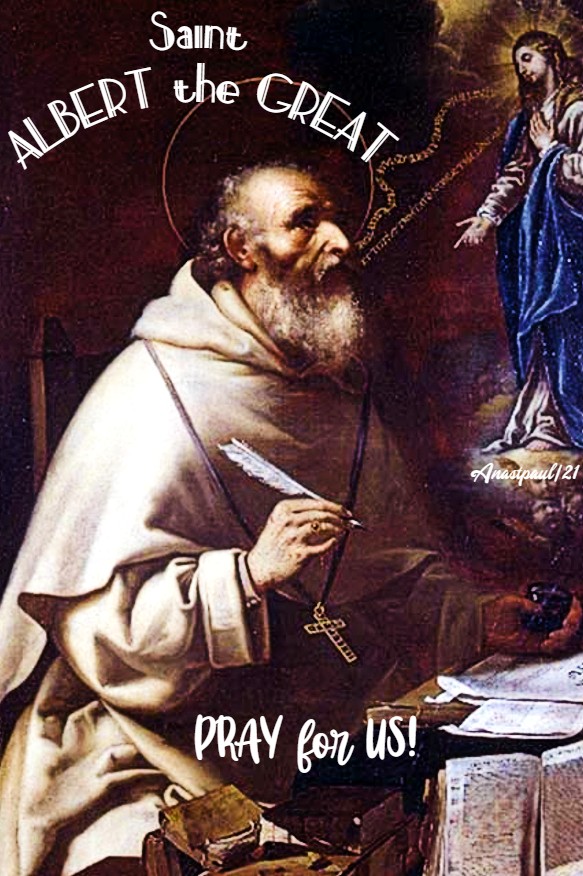
One Minute Reflection – 15 November – St Albert the Great OP (1200-1280) Bishop, Confessor, Doctor of the Church – 2 Timothy 4:1-8, Matthew 5:13-19 – Scripture search here: https://www.drbo.org/
“You are the light of the world.” – Matthew 5:14
REFLECTION – “I shall always love and reverence the Apostles sent by Christ and their successors, in sowing the seed of the Gospel, those zealous and tireless co-operators in propagating the Word, who may justly say of themselves: Let a man so account of us as the ministers of Christ and the dispensers of the mysteries of God. For Christ, like a most watchful and most faithful householder, wished that the Gospel lamp should be lighted by such ministers and delegates, with fire sent down from Heaven and once lighted, should not be put under a measure but set upon a candlestick, so that it may spread its brightness far and wide and put to flight, all darkness and error, rife among both Jews and Gentiles.
Now it is not enough for the Gospel teacher to be a brilliant speaker in the eyes of the people; he must also be as a voice crying in the desert and endeavour, by his eloquence, to help many to lead good lives, lest, if he omit his duty of speaking, he be called the dumb dog that is not able to bark, spoken of by the prophet. Yes, he should also burn, in such a way, that, equipped with good works and love, he may adorn his evangelical office and follow the leadership of Paul. He indeed was not satisfied with bidding the Bishop of the Ephesians: This command and teach: conduct thyself in work as a good soldier of Christ Jesus but he unflaggingly preached the Gospel to friend and foe alike and, said with a good conscience to the Bishops gathered at Ephesus: You know how I have kept back nothing that was for your good but have declared it to you and taught you in public and from house to house, urging Jews and Gentiles to turn to God in repentance and to believe in our Lord Jesus Christ.
Such should be the shepherd in the Church who, like Paul, becomes all things to all men, so that the sick may find healing in him; the sad, joy; the desperate, hope; the ignorant, instruction; those in doubt, advice; the penitent, forgiveness and comfort and finally, everyone, whatever is necessary for salvation. And so Christ, when He wished to appoint the chief teachers of the world and of the Church, did not limit Himself to saying to His disciples: You are the light of the world but also added these words: A city seated on a mountain cannot be hid. Neither do men light a candle and put it under a measure but upon a candlestick, that it may shine to all who are in the house. Those churchmen err, who imagine that it is by brilliant preaching, rather than by holiness of and all-embracing love, they fulfil their office.” – St Peter Canisius SJ (1521-1597) Doctor of the Church (Sermon excerpt).
PRAYER – O God, Who made blessed Albert, ThyBishop and Doctor, eminent in the submission of human wisdom to divine faith, grant us, we beseech Thee, so to follow the path of his teaching that we may enjoy perfect light in Heaven.Through Jesus Christ, Thy Son our Lord, Who lives and reigns with Thee, in the unity of the Holy Ghost, God, world without end. Amen (Collect).
Quote of the Day – 28 October – Feast of Saints Simon and Jude, Apostles
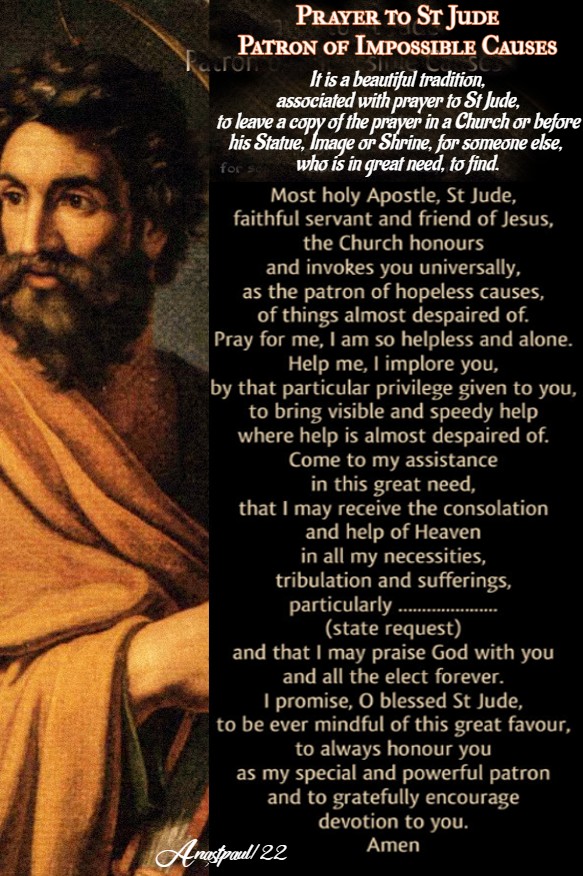
“The Patron Saint of the Impossible:” This practice is thought to stem from the belief that few Christians invoked St Jude in prayer, due to their misplaced fear of praying to Christ’s betrayer, Judas Iscariot, the two names being so similar. Being so seldom invoked and reverenced, St Jude was and is, ready and waiting to hear the prayers of those who call upon him. Ironically, he is probably the Apostle who is the most frequently invoked in prayer and the most memorialised in Churches, with Statues and stained glass windows or other artworks. The ignored St Jude, thus became more eager to assist anyone who sought his intercession and aid, to the point of interceding in the most dire of circumstances. And so, the Title, “The Saint of Impossible Causes, for the Hopeless and the Desperate,” remains, to our benefit with the glorious Saint Jude. St Bernard and St Bridget too, both had visions from God, asking each to accept St Jude as “The Patron Saint of the Impossible.” Today, more than ever before, the merits of the beloved Saint Jude Thaddeus is being revived in people’s minds and hearts. In return, he is proving himself to be more than an ordinary advocate, taking special delight in coming to the aid of persons in desperate need.
Prayer to St Jude Patron of Impossible Causes
It is a beautiful tradition, associated with prayer to St Jude, to leave a copy of the prayer in a Church or before his Statue, Image or Shrine, for someone else, who is in great need, to find.
Most holy Apostle, St Jude, faithful servant and friend of Jesus, the Church honours and invokes you universally, as the patron of hopeless causes, of things almost despaired of. Pray for me, I am so helpless and alone. Help me, I implore you, by that particular privilege given to you, to bring visible and speedy help where help is almost despaired of. Come to my assistance in this great need, that I may receive the consolation and help of Heaven in all my necessities, tribulation and sufferings, particularly ………………… (state request) and that I may praise God with you and all the elect forever. I promise, O blessed St Jude, to be ever mindful of this great favour, to always honour you as my special and powerful patron and to gratefully encourage devotion to you. Amen
One Minute Reflection – 28 October – Feast of Saints Simon and Jude, Apostles – Ephesians 4:7-13, John 15:17-25 – Scripture search here: https://www.drbo.org/
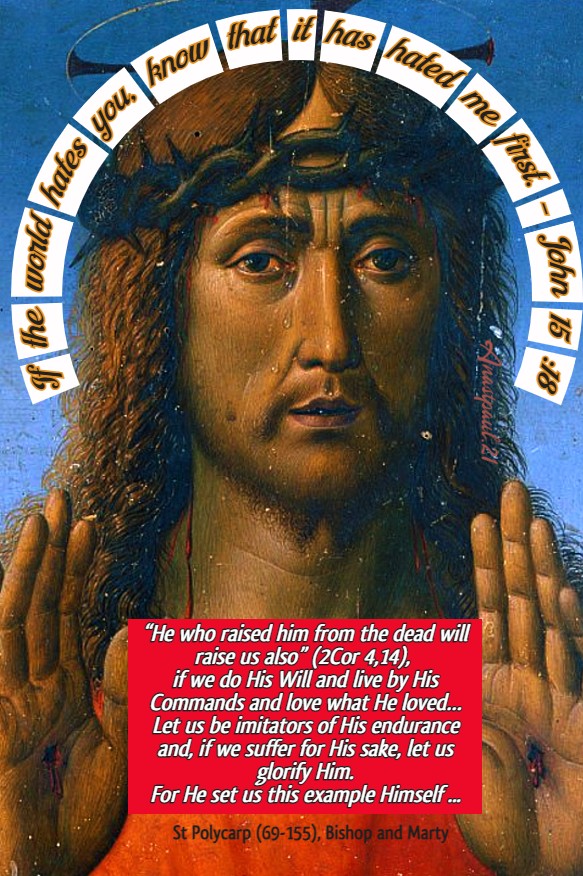
“If the world hates you, know that it has hated me first.”- John 15:18
REFLECTION –“I rejoice with you greatly in our Lord Jesus Christ, that you welcomed the copies of true love [Ignatius of Antioch and his companions]…who were encumbered with saintly chains, which are the diadems of those, truly chosen by God and our Lord. And I rejoice because the deep root of your faith, which has been renowned from early times, still lasts and bears fruit to our Lord Jesus Christ, Who for our sins, endured even facing death and Whom “God raised, releasing Him from the throes of death” (Acts 2,24). “Though you have not seen Him, you believe with unutterable, triumphant joy” (1Pt 1,8)…“He who raised Him from the dead will raise us also” (2Cor 4,14), if we do His Will and live by His Commands and love what He loved… Let us be imitators of His endurance and, if we suffer for His sake, let us glorify Him. For He set us this example Himself and this is what we have believed.
So I beg you all, to obey the message of uprightness and to exhibit all endurance, such as you saw with your own eyes, not only in the blessed Ignatius and Zosimus and Rufus but also, in others of your number and in Paul himself and the rest of the Apostles, being assured, that all these “have not run in vain” (Gal 2,2) but in faith and uprightness and, that they are in the place that they have deserved with the Lord, with and for Whom they suffered. For they did not “love the present world” (2Tm 4,10) but Christ, Who died for us and was raised up by God for our sakes.”- St Polycarp (69-155) Apostolic Father, Bishop and Martyr – Letter to the Philippians, 1-2, 8-9
PRAYER – O God, Who has given us a way of coming to know Thy Name through Thy blessed Apostles Simon and Jude, grant us to honour their everlasting glory, by becoming more holy and to become more holy by honouring it. ThroughJesus Christ, Thy Son our Lord, Who lives and reigns with Thee, in the unity of the Holy Ghost, God, world without end. Amen (Collect).
Our Morning Offering – 28 October – Feast of Saints Simon and Jude, Apostles
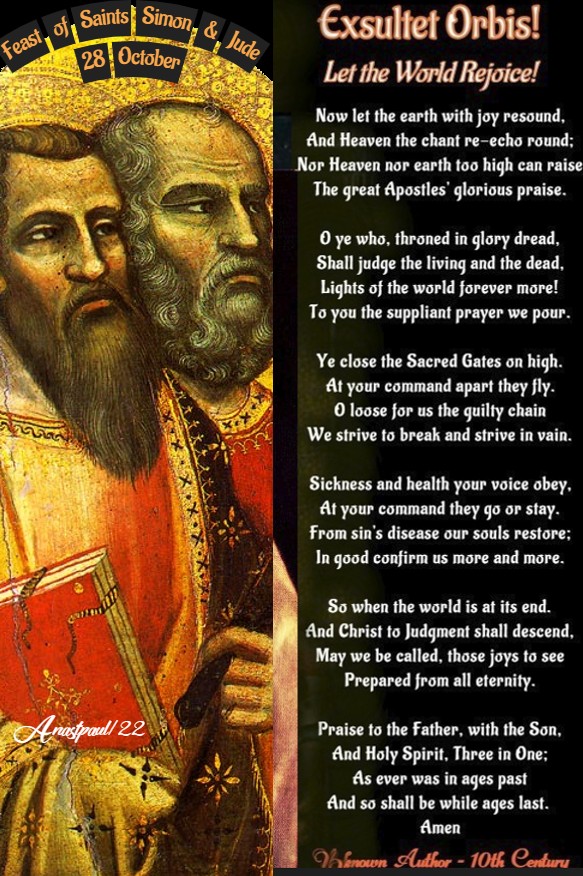
Exsultet Orbis! Let the World Rejoice! Unknown Author
Now let the earth with joy resound, And Heaven the chant re-echo round; Nor Heaven nor earth too high can raise The great Apostles’ glorious praise.
O ye who, throned in glory dread, Shall judge the living and the dead, Lights of the world forever more! To you the suppliant prayer we pour.
Ye close the Sacred Gates on high. At your command apart they fly. O loose for us the guilty chain We strive to break and strive in vain.
Sickness and health your voice obey, At your command they go or stay. From sin’s disease our souls restore; In good confirm us more and more.
So when the world is at its end. And Christ to Judgment shall descend, May we be called, those joys to see Prepared from all eternity.
Praise to the Father, with the Son, And Holy Spirit, Three in One; As ever was in ages past And so shall be while ages last. Amen
(Roman Breviary for the Common of Apostles) An Office Hymn that was traditionally prescribed for Vespers and Lauds on the Feasts of Apostles and Evangelists outside Easter time. The Hymn is found as early as the tenth century in a hymnal of Moissac Abbey.
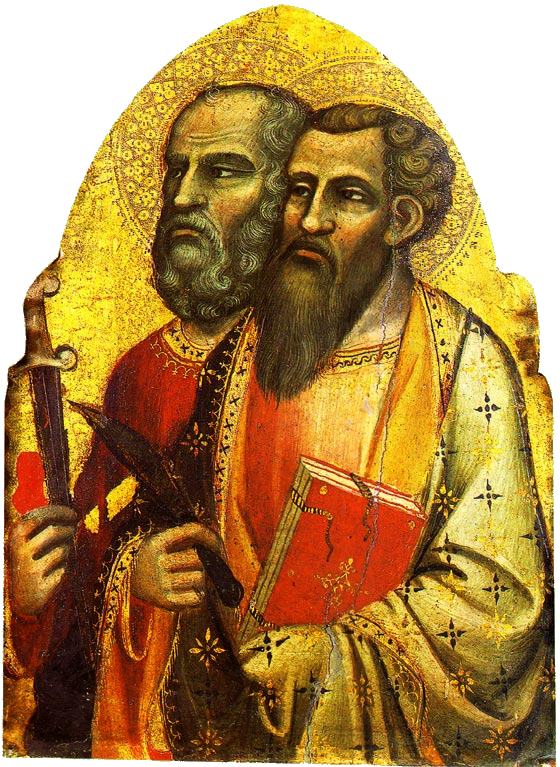
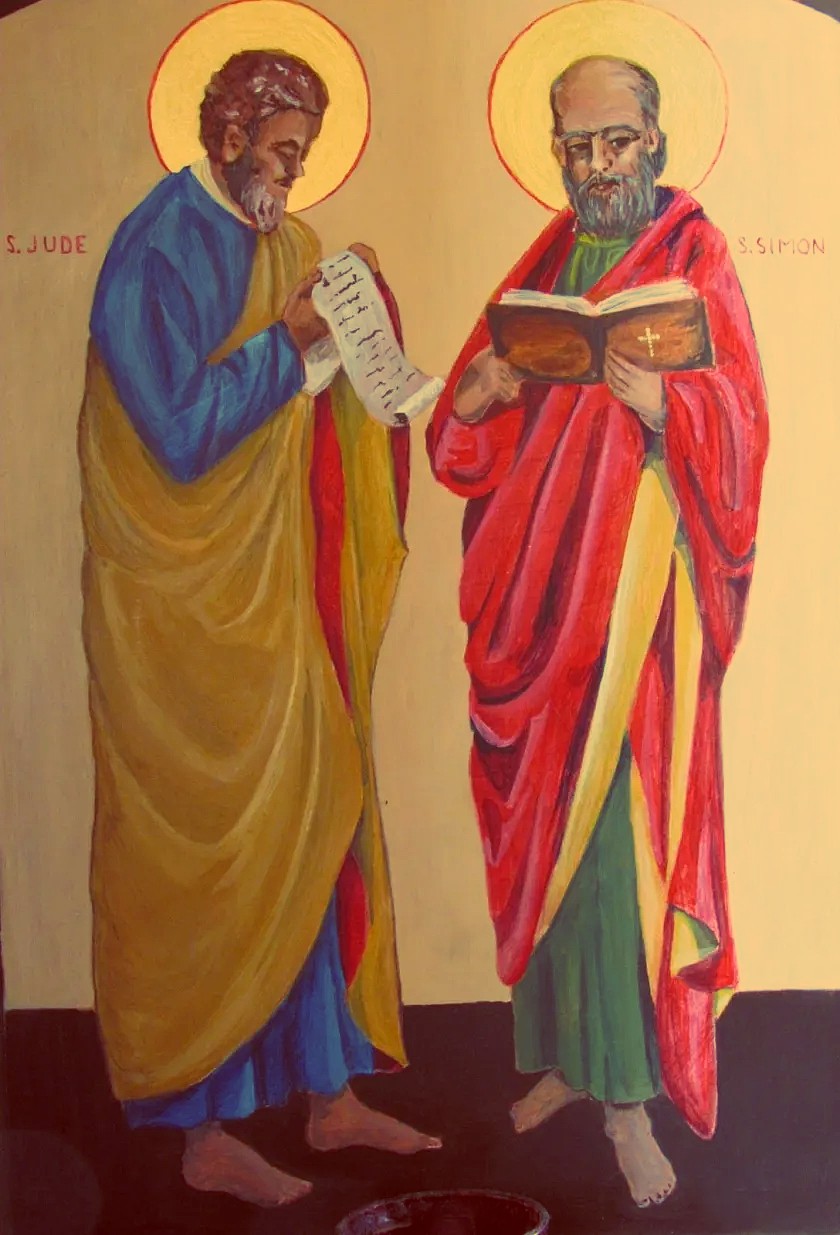
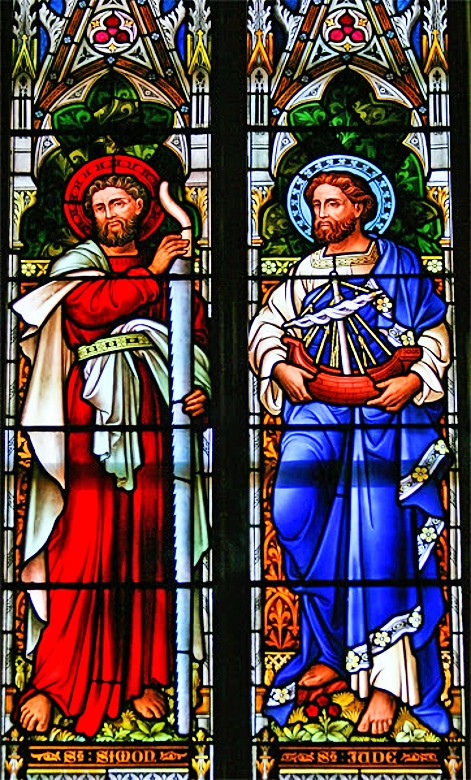
Saints of the Day – 28 October – Feast of Saints Simon and Jude, Apostles of Christ
The Holy Apostles Simon and Jude (Excerpt) By Father Francis Xavier Weninger SJ (1805-1888)
St Simon, whose festival the Church commemorates to-day, was surnamed the Cananaean or Canaanite because he was born at Cana, a town in Galilee. In this town, Jesus wrought His first miracle, by changing water into wine, as is known from the Gospel. St Nicephorus (c 758-828) Bishop of Constantinople and some others, are of the opinion that Simon was the bridegroom whose wedding our Lord and His holy Mother honoured with their presence but that he afterwards left his bride with her consent and followed Christ.
St Jude, the brother of Simon, is called Thaddseus to distinguish him from the other Jude or Judas’ who betrayed and sold the Lord. According to St Nicephorus, Mary Cleophas was their mother and James the Lesser, their brother. Other writers say that Simon and Jude were not brothers. The Gospel tells us that both Simon and Jude were chosen by Christ as Apostles but when, or under what circumstances, this took place, is not recorded, nor have any particulars of their words and actions been left us. There is, however, not the slightest doubt that they, as all the others, constantly followed the Saviour and, although they forsook Him when He was taken prisoner, they had, after His Resurrection the grace to see Him frequently, to be present at His Ascension and to receive the Holy Ghost on Pentecost.
When later, the Apostles separated to preach the Gospel, St Simon went to Egypt and St Jude to Mesopotamia. Both, however,, were also in other lands, to preach the word of Christ and after thus spending 30 years in apostolic labours, they met again, by Divine dispensation, in Persia. On their arrival in this land, they found the Persian army in the field, for the King had declared war against India and was in the act of marching against it. Baradach, the General in Chief, had offered many sacrifices to the gods, desiring to know the issue of the war but no answer was given, which had always been given before, as the Evil spirits spoke through the idols. Hence Baradach, amazed at such unusual silence, sent to another idol which was kept in a place far from the camp and desired to know the reason of it. Satan, answering through it, said that the presence of two Apostles of the Lord Jesus Christ was the cause of the silence of the gods, as the power of these two Apostles was so great that not one of the gods, until now so greatly honoured, dared to appear before them.
Baradach, having received this answer, had the two Apostles brought before him. He met them with great manifestations of respect and listened to them, while they spoke to him of the nothingness of the gods which he worshipped. As he was desirous to know the issue of the war, they made use of the occasion to show him how false were the words of the idols and hence, how groundless was the notion, of their divinity. They bade him propose his questions to the idols, through the magicians as usual and told him that they would give his gods permission to speak. The magicians were ordered to ask the gods and returned with the answer, that the result would be a long, bloody and disastrous war. The Apostles having heard this, said to Baradach: “Now, great Prince, recognise the falsity and the deceit, as well of your magicians, as of your gods. A deputation of the Indians will arrive tomorrow, at this hour, in your camp, to request peace of you on whatever conditions you may choose to prescribe.” Baradach, surprised at these words, awaited with great impatience the following day. At the very hour the Apostles had foretold, the Indian embassy came humbly begging for peace, which was forthwith concluded.
This event was reported to the King, who resided at Babylon. He called the Apostles into his presence, listened with great attention to their words and after having been sufficiently instructed in Christianity, was Baptised by his holy teachers. The example of the King was followed by the whole Court and a great part of the City.
After this, the holy men went through the other towns and villages of the kingdom, everywhere preaching the mysteries and truths of the Christian Faith. Many thousands became converts, only the magicians and fortune-tellers remained in their blindness and seeing, with deep resentment, that they were everywhere despised and derided, they sought means to kill the holy Apostles. To this end, they excited the inhabitants of a town, which was far distant from the residence of the King, against the Saints, who had no sooner arrived there, than thay were seized and dragged, the one before an idol of the sun, the other before that of the moon and were commanded to offer incense. The holy men refused to comply with so wicked a demand, saying that they sacrificed only to the true God, after which they began to preach the Gospel. But the furious Pagans refused to listen to them and in their rage, cut St Simon asunder with a saw and beheaded St Jude. In this manner these two holy Apostles ended their lives and earned the glorious Crown of Martyrdom.
An interesting note: In the life of St Bernard we find that this Saint had a particular devotion to St Jude. He received, with extraordinary joy and veneration, the Relics of this holy Apostle which were sent to him and, on his death-bed, he requested that they should be laid on his breast and be buried with him.
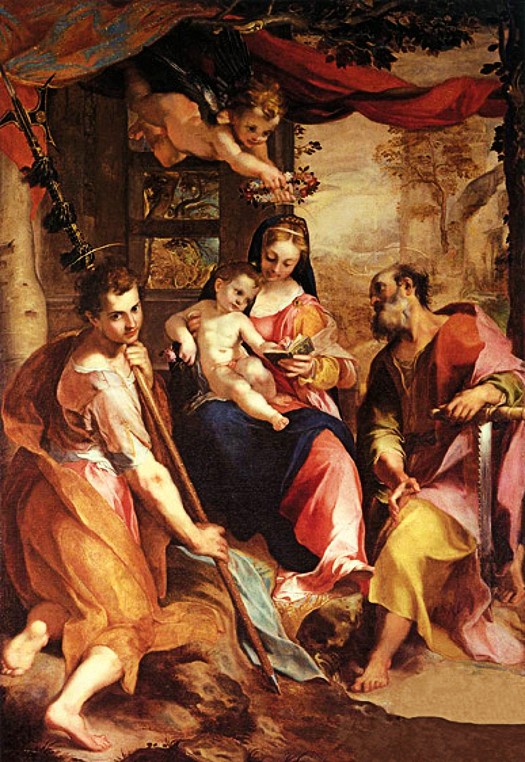
Sts Simon and Jude with the Virgin Mother and Baby Jesus
One Minute Reflection – 26 October – “The Month of the Most Holy Rosary and of the Angels” – 1 Peter 5:1-4; 5:10-11, Matthew 16:13-19 – Scripture search here: https://www.drbo.org/
“Upon this rock I will build my church” – Matthew 16:18
REFLECTION – “Although the earth and all who dwell in it quake, I have set firm its pillars” (Ps 74[75],40). All the Apostles are pillars of the earth but, at their head, the two whose Feast we are celebrating. They are the two pillars who support the Church with their teaching, their prayer and the example of their steadfastness. The Lord Himself strengthened these pillars. For at first they were weak, completely incapable of supporting either themselves or others. And in this the Lord’s great design appears: it they had always been strong, people could have thought their strength came from themselves. That is why the Lord wanted to show what they were capable of, before strengthening them, so that all might know, that their strength came from God… Peter was thrown to the ground by the voice of a mere servant… and the other pillar was very weak too: “I was once a blasphemer and persecutor and an arrogant man” (1Tm 1,13)…
Hence we ought to praise these Saints with all our heart: our Fathers who bore such trials for the Lord’s sake and who persevered, with such determination. It is nothing to persevere in joy, happiness and peace. But this is what is great – to be stoned, scourged, struck for Christ (2 Cor 11,25) and in all this, to persevere with Christ. With Paul it is a great thing to be cursed and to bless, to be persecuted and to endure, to be slandered and to console, to be like the world’s rubbish and to draw glory from it (1 Cor 4,12-13)…And what shall we say of Peter? Even if he had undergone nothing for Christ, it would be sufficient to celebrate him today in that he was crucified for Him… He well knew where He Whom he loved, He Whom he longed for was… his cross has been his road to Heaven.” – St Aelred of Rielvaux (1110-1167) Cistercian Monk (Sermon 18, for the feast of S (ints Peter and Paul ; PL 195, 298).
PRAYER – Grant, we beseech Thee, O Lord God, unto all Thy servants, that they may remain continually in the enjoyment of soundness, both of mind and body and by the glorious intercession of the Blessed Mary, always a Virgin, may be delivered from present sadness and enter into the joy of Thine eternal gladness. Through Jesus Christ, Thy Son our Lord, Who lives and reigns with Thee, in the unity of the Holy Ghost, God, world without end. Amen (Collect).
Quote/s of the Day – 18 October – The Feast of St Luke, the Evangelist – 2 Corinthians 8:16-24, Luke 10:1-9 – Scripture search here: https://www.drbo.org/
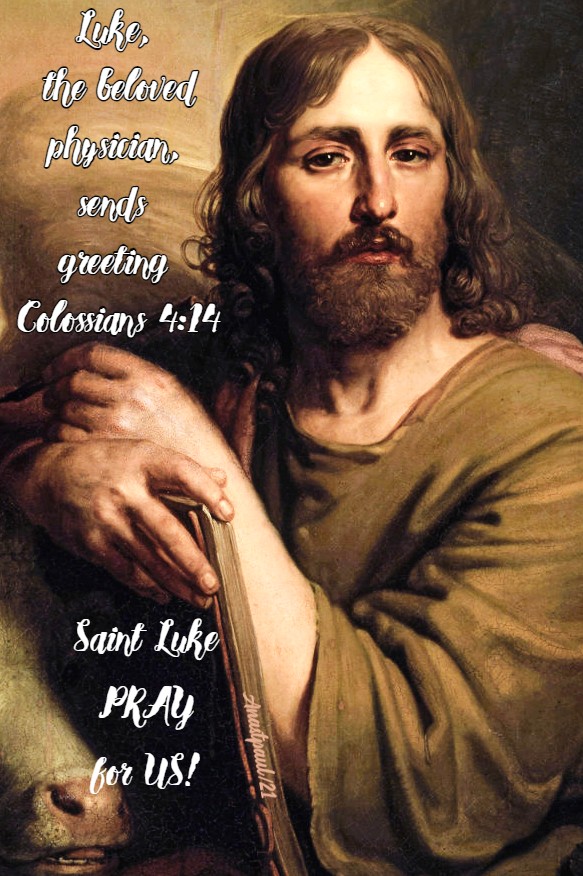
“Luke, the beloved physician, sends greetings … ”
Colossians 4:14
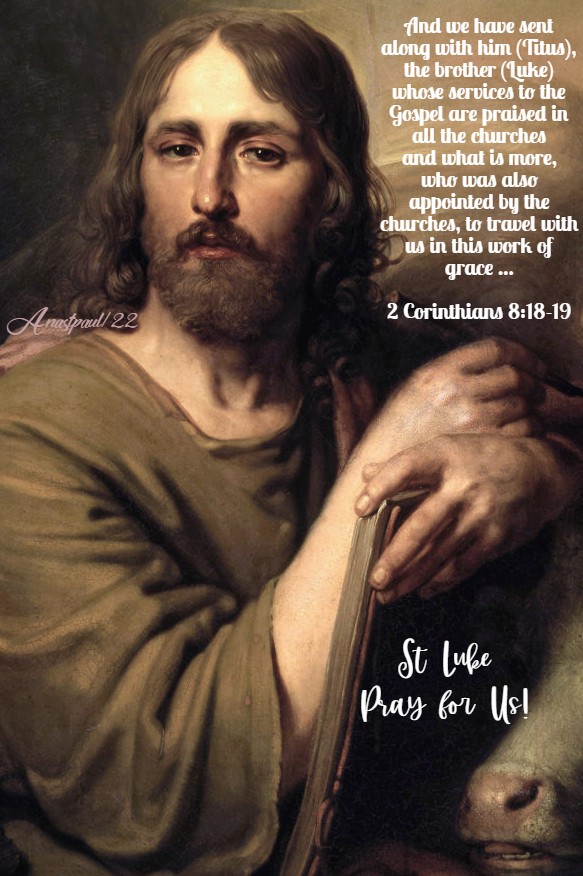
“And we have sent along with him (Titus), the brother (Luke) whose services to the Gospel are praised in all the churches and what is more, who was also appointed by the churches, to travel with us in this work of grace …”
2 Corinthians 8:18-19
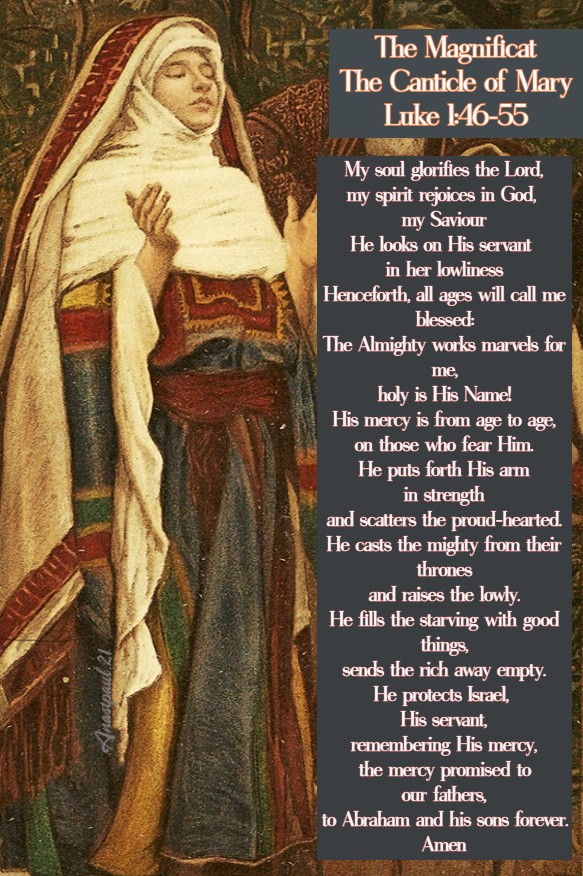
The Magnificat The Canticle of Mary Luke 1:46-55
My soul glorifies the Lord, my spirit rejoices in God, my Saviour He looks on His servant in her lowliness Henceforth all ages will call me blessed: The Almighty works marvels for me, holy is his Name! His mercy is from age to age, on those who fear Him. He puts forth His arm in strength and scatters the proud-hearted. He casts the mighty from their thrones and raises the lowly. He fills the starving with good things, sends the rich away empty. He protects Israel, His servant, remembering His mercy, the mercy promised to our fathers, to Abraham and his sons forever.
One Minute Reflection – 18 October – The Feast of St Luke, the Evangelist – 2 Corinthians 8:16-24, Luke 10:1-9 – Scripture search here: https://www.drbo.org/
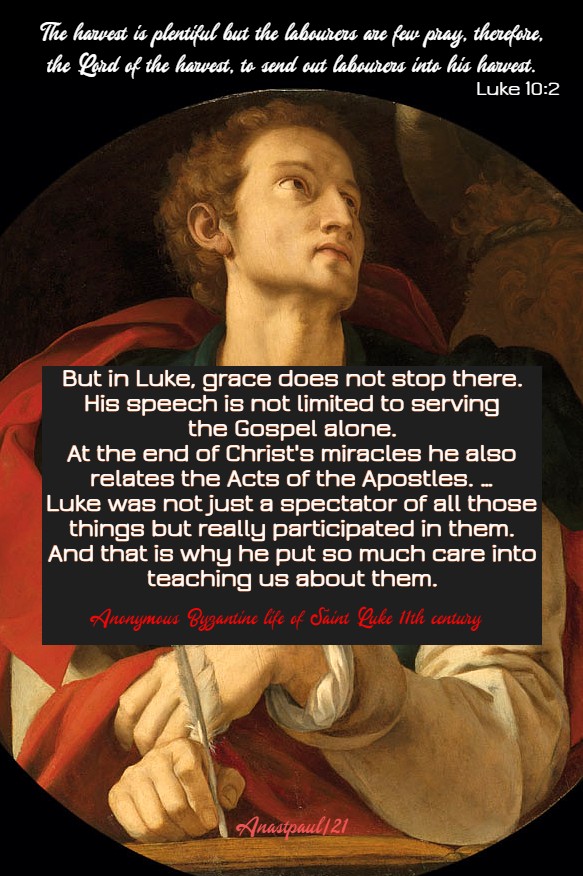
“And he said to them, “The harvest is plentiful but the labourers are few, pray therefore, the Lord of the harvest, to send out labourers into his harvest.” – Luke 10:2
REFLECTION – “When, after abandoning the darkness of error to bind himself to God’s love, Paul was joined to the number of the disciples, Luke went with him everywhere and became his travelling companion (Acts 16:10 f.). … He got on with him so well, was so close to him and shared all his graces, so nearly, that Paul, in writing to the faithful, called Luke his “beloved” (Col 4:14). From Jerusalem and the country round about, as far as Dalmatia, (Rom 15:19) he preached the Gospel with him. From Judea to Rome he shared the same chains with him, the same work, the same difficulties, the same shipwrecks. He desired to receive the same prize with him since he had shared the same labours.
Having acquired the gift of preaching along with Paul and won over and led so many peoples to the love of God, Luke truly seemed like the Saviour’s loving and beloved disciple, in addition to being the Evangelist who wrote His Sacred history. For formerly he had followed the Lord (cf. Lk 10:1), gathered together the testimonies of His first servants (Lk 1:1) and received inspiration from on high. It was this Evangelist who related the mystery of Gabriel, the messenger sent to the Virgin to announce joy to the whole world. It was he who told in full, the birth of Christ, showing us the newborn child lying in a manger and describing shepherds and Angels shouting for joy. … He reports the parabolic teachings in greater number than the other Evangelists. And just as he makes known to us the descent of the Word of God to earth, so too, he describes his Ascension to Heaven and return to the Father’s throne (24:51). …
But in Luke, grace does not stop there. His speech is not limited to serving the Gospel alone. At the end of Christ’s miracles he also relates the Acts of the Apostles. … Luke was not just a spectator of all those things but really participated in them. And that is why he put so much care into teaching us about them.” – Anonymous Byzantine life of Saint Luke – 11th century (Saint Luke, Evangelist and companion of Paul – 6-7; PG 115, 1134-1135).
PRAYER – O Lord, we beseech Thee, that Luke, Thy holy Evangelist, who for the honour of Thy Name bore continuously in his body the suffering of the Cross, may intercede on our behalf. Through the same Jesus Christ, Thy Son our Lord, Who lives and reigns with Thee, in the unity of the Holy Ghost, God, world without end. Amen (Collect).
Our Morning Offering – 18 October – The Feast of St Luke, the Evangelist
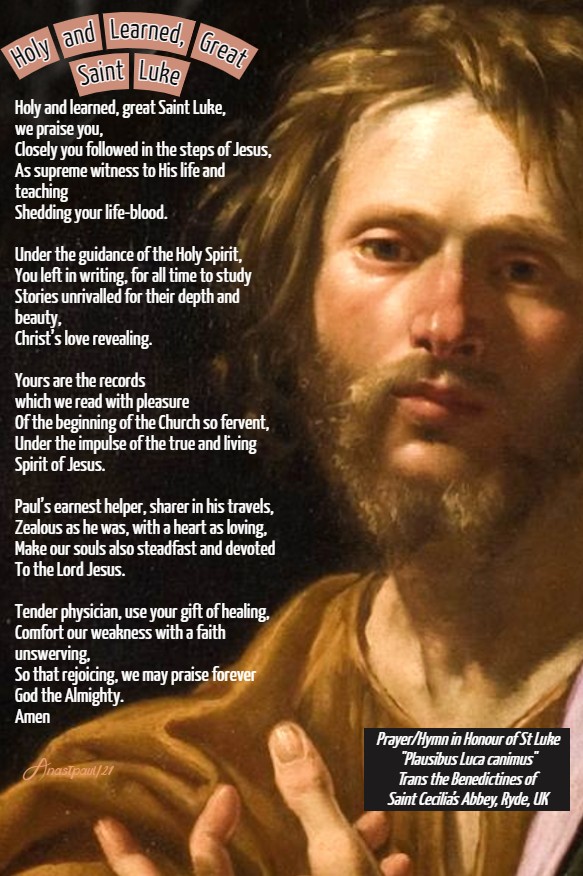
Holy and Learned, Great Saint Luke Prayer/Hymn in Honour of St Luke “Plausibus Luca canimus” Trans the Benedictines of Saint Cecilia’s Abbey, Ryde, UK
Holy and learned, great Saint Luke, we praise you, Closely you followed in the steps of Jesus, As supreme witness to His life and teaching Shedding your life-blood.
Under the guidance of the Holy Spirit, You left in writing, for all time to study Stories unrivalled for their depth and beauty, Christ’s love revealing.
Yours are the records which we read with pleasure Of the beginning of the Church so fervent, Under the impulse of the true and living Spirit of Jesus.
Paul’s earnest helper, sharer in his travels, Zealous as he was, with a heart as loving, Make our souls also steadfast and devoted To the Lord Jesus.
Tender physician, use your gift of healing, Comfort our weakness with a faith unswerving, So that rejoicing, we may praise forever God the Almighty. Amen
Saint of the Day – 18 October – The Feast of St Luke the Evangelist, Physician, Disciple of St Paul, Evangelist, Author of the Gospel according to Luke and the Acts of the Apostles and traditionally believed to be an Artist.
St Luke, Evangelist By Father Francis Xavier Weninger (1860-1946)
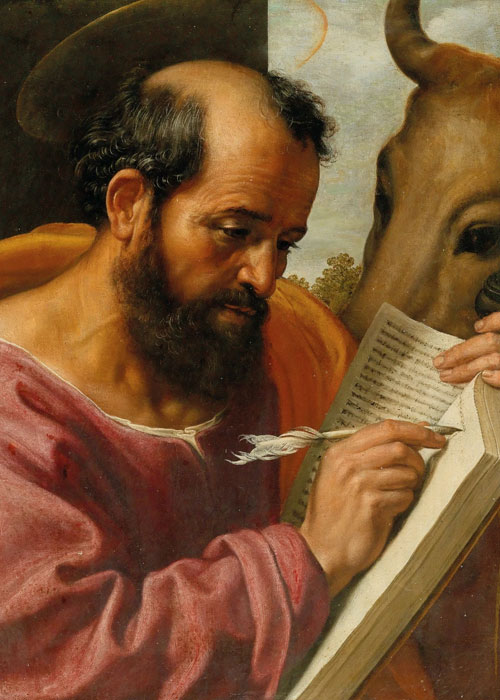
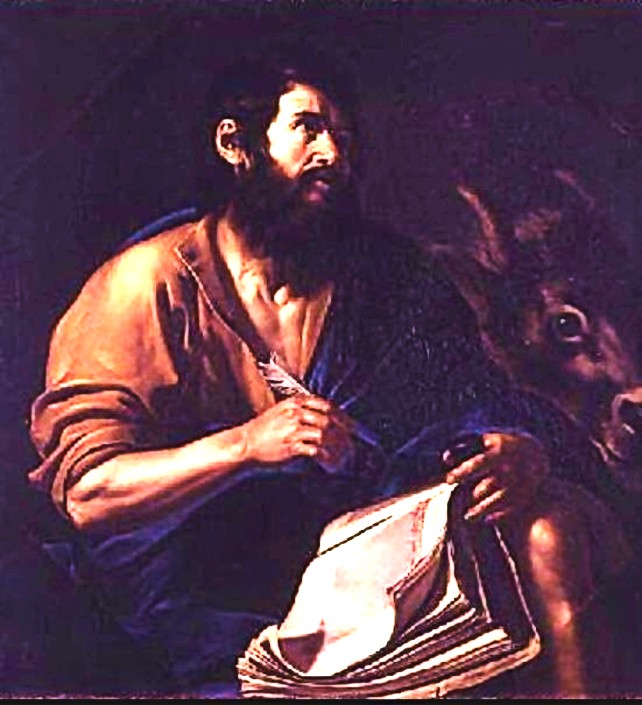
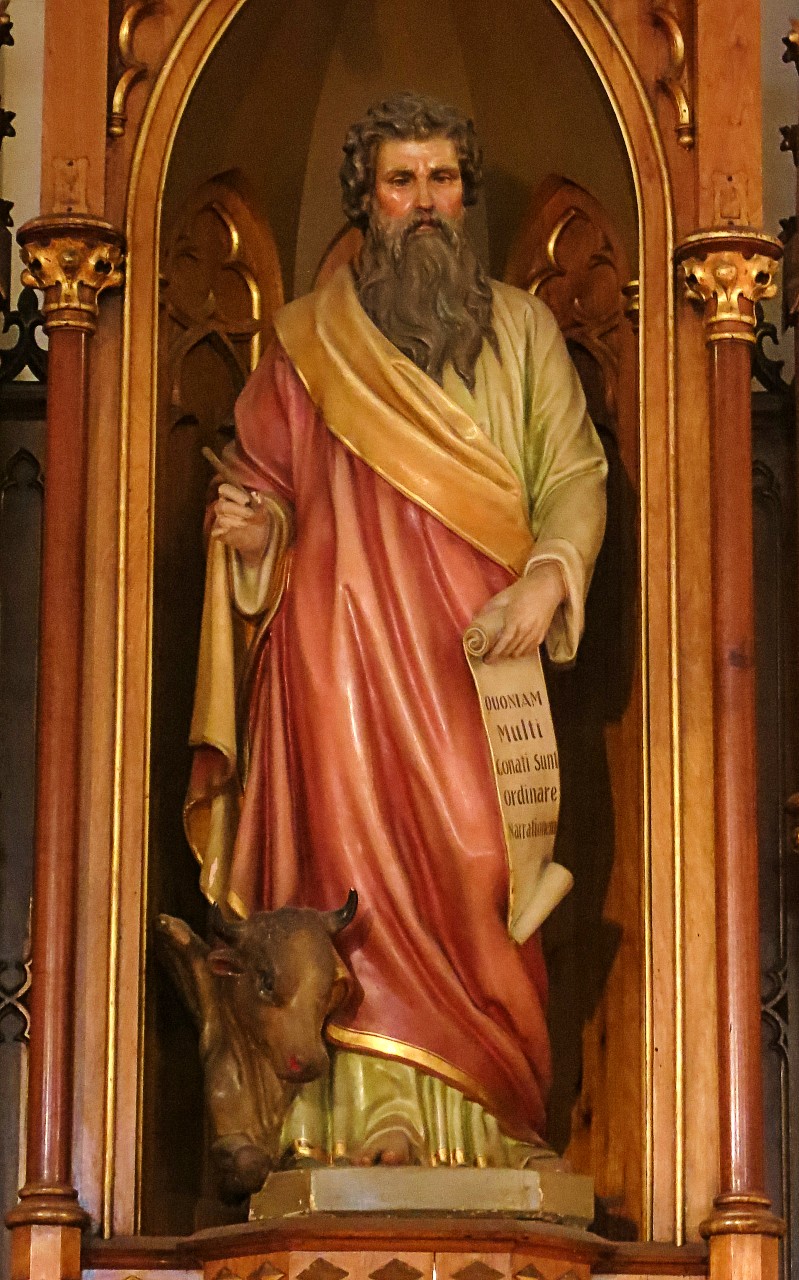
Among the holy men whom the Almighty chose to write the Gospel, or the history of the life and death, the teachings and miracles of Our Lord and Saviour, Jesus Christ, was St Luke, the third of those who are called Evangelists. He is represented with an ox near him, according to the mysterious revelation made to the Prophet Ezekiel because he begins his Gospel with the revelation of what happened to Zachary in the Temple, where oxen, sheep and other animals, were offered, according to the Old Covenant, in sacrifice to the Almighty.
St Luke is said to have been born at Antioch, in Syria and his occupation, in his youth, was the study of the liberal arts, especially rhetoric, physics, sculpture and painting. It is believed that St Paul himself instructed him in the Christian faith, hence, St.Jerome calls him a spiritual son of that holy Apostle. It is quite certain that he accompanied St Paul in the many and laborious travels which the holy Apostle undertook, to convert the infidels. Hence he had a part in all the labours, dangers, hardships and persecutions which the Apostle endured. This, however, caused him, to be most warmly beloved and highly esteemed, by St Paul, who mentions him in several of his epistles and among other praises, calls him an Apostle.
At the desire of St Paul, Luke wrote the Gospel in Greek, as the Apostle was at that time preaching to the Greeks and also, because this language was very much disseminated. St Luke relates, in his Gospel, much that is but slightly mentioned by the other Evangelists, for instance, the Mystery of the Annunciation and the Incarnation of Christ, from whichM the holy Fathers conclude that he must have been on very friendly terms, not only with the Apostles but also with the Divine Mother, as she could give him the best information concerning these Mysteries. Another reason is, that St Luke lived in chastity and earnestly endeavoured, to guard and preserve this virtue.
The commentators of Holy Writ have also observed that St Luke, more than the other Evangelists, gives sinners the hope of Divine Mercy and encourages them, to repentance, as is seen in the parable of the Prodigal Son, so lovingly received by his father, as also, in that of the Good Shepherd, Who, with great solicitude, sought the lost sheep, and brought it back to the fold. Again, in the history of the sinner, who so mercifully receives pardon in the Samaritan, Who cares so kindly for the wounded traveller but above all, in the wonderful conversion of the thief crucified with Christ, to whom, when he had humbly and penitentially begged to be remembered, our kind Saviour promised Paradise. St Anselm gives the reason for this, in the following words: “Luke was at first a Physician of the body, hence, it is that he speaks more than the other Evangelists, of the Merc of our Saviour, who heals and frees men from diseases of the soul.“”
Besides the Gospel, St Luke also wrote a book on the labours of the Apostles,, which is called the Acts of the Apostles. In it, he first relates the Ascension of Christ and the coming of the Holy Ghost and after this, what and where the Apostles preached, the miracles they wrought and the sufferings they endured for Christ’s sake.
He further describes the life of the first Christians and the Martyrdom of St Stephen and St James. He then relates the conversion of St Paul, the labours and sufferings of this holy Apostle, which no-one could know better than St Luke, who was his constant companion. During the two years of St Paul’s imprisonment at Caesarea, Luke aided him in every manner. Hhe also accompanied him to Rome, when St Paul had appealed to the Emperor. At Rome, where the holy Apostle was again imprisoned for two years, St Luke did not leave him and allowed, no persecution to separate him from his beloved master. When St Paul was set at liberty, St Luke accompanied him as before, wherever the unwearied Apostle preached the Gospel. St Epiphanius relates, that, after the death of the two Apostles, Peter and Paul, St Luke preached the Gospel of Christ in Italy, France, Dalmatia and Macedonia, with apostolic zeal. The Greeks assure us that he did the same in Egypt, Thebais and Libya and, that he had great success, in converting the infidels.
It is easy to conceive, what hardships, dangers and persecutions, the holy Evangelist must have suffered, in these many wearisome travels and in consequence of his zealous preaching. Yet he was never discontented, never desponding but always cheerful because he always thought of Him, for Whom he laboured and suffered and of the recompense that was awaiting him. St Jerome writes that the Saint continued his apostolic labours until he had reached his 84th year. St Gregory of Nazianzen, St Paulinus and St Gaudentius maintain that he ended his life by Martyrdom. Nicephorus writes that the heathens hung him to an olive-tree and that thus he died a Martyr.
It is certain that his life, full of cares and hardships, was a continued Martyrdom, the severity of which he increased by severe fasting and other penances. Hence, the Church says of him, in the prayer which she offers up today at Holy Mass, that he bore the mortification of the cross ceaselessly in his body, for the love and honour of Christ. He ended his glorious labours and sufferings at Patras in Achaia. His holy relics, with those of St Andrew, were brought to Constantinople at the time of Constantine the Great. Long afterwards, they were removed to Pavia;but the head had, some time before, been taken by Gregory the Great to Rome and placed in St Peter’s Basilica.
Nanni di Banco, St Luke, 1408-15, marble, Museo dell’Opera del Duomo, Florence
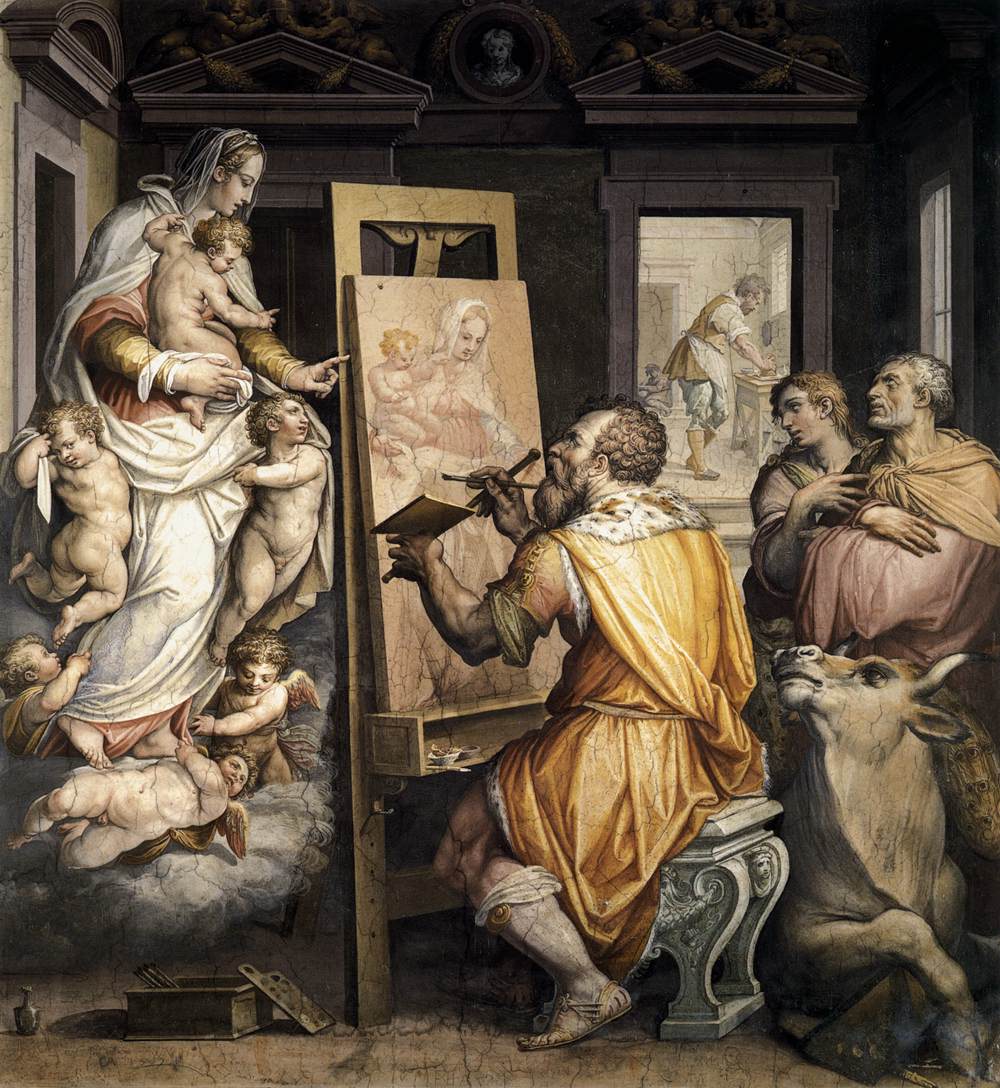
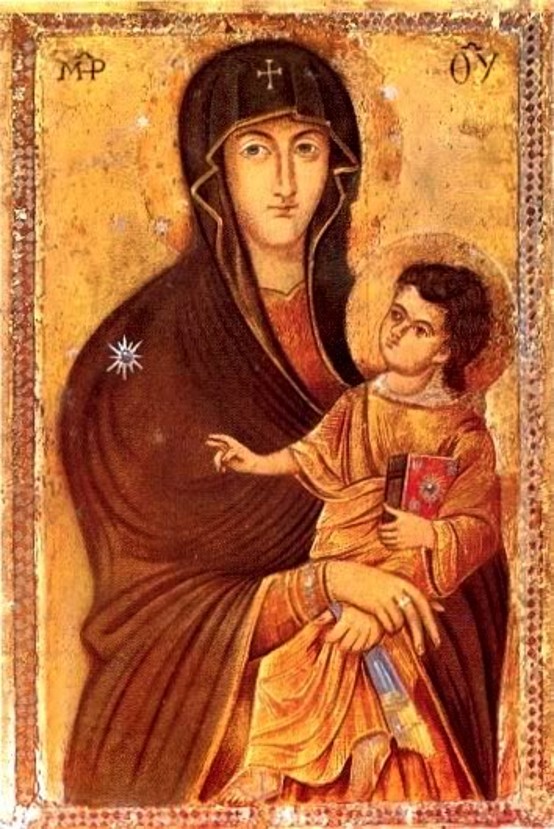
There is a tradition that St Luke painted several likenesses of Christ and the Blessed Virgin and left them to the Christians to comfort them. To this day, several pictures of the Blessed Virgin are shown, which are believed to be his works. One of these is at Rome, in the Church of St Mary Major and another is at Loretto, both of these are venerated by the whole Christian world.
Giorgio Vasari, St Luke Painting the Virgin, after 1565, fresco, Santissima Annunziata, Florence
The Salus Popli Roman by St Luke in St Mary Major Basilica, Rome
St Asclepiades of Antioch St Athenodorus St Brothen Bl Burchard I St Cadwaladr of Brittany Bl Domenico of Perpignano St Eutychius of Pozzuoli St Gwen St Gwen of Tagarth St Gwendoline
Bl Margherita Tornielli St Monon of Nassogne St Proculus of Pozzuoli Bl Theobald of Narbonna St Tryphonia of Rome
Martyrs of Africa – 9 Saints: A group of Christians Martryed together in Africa. The only details that have survived are the names – Beresus, Dasius, Faustinus, Leucius, Lucius, Martialis, Victoricus, Victrix and Viktor. They were martyred in c.300 in Africa.
One Minute Reflection – 10 October – St Francis Borgia SJ (1510-1572) Confessor, Priest of the Society of Jesus, – Ecclesiasticus 45:1-6, Matthew 19:27-29 – Scripture search here: https://www.drbo.org/
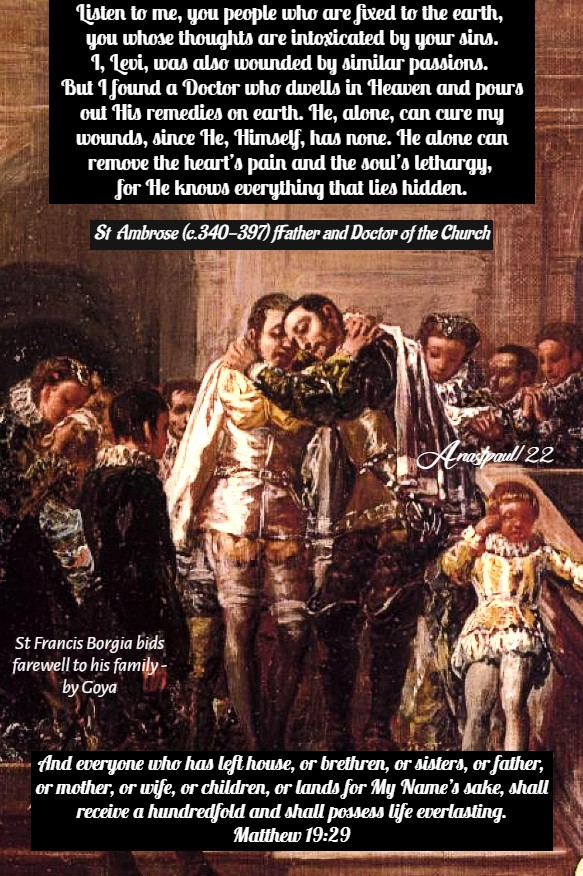
“And everyone who has left house, or brethren, or sisters, or father, or mother, or wife, or children, or lands for My Name’s sake, shall receive a hundredfold and shall possess life everlasting.” – Matthew 19:29
REFLECTION – “The Apostle Paul said: “Take off the old self with its practices and put on the new self” (Col 3,9-10)… This was the work Christ accomplished when He called Levi; He refashioned him into a new man. Similarly, it is as a new person that the former publican prepares a banquet for Christ, since Christ takes pleasure in him and he ,himself merits, to have a share in happiness, with Christ… He followed Him now, happy, lighthearted and overflowing with joy.
“I have the aspect of a publican no more,” he said, “I do not carry around the old Levi, any longer, I put off Levi when I put on Christ. I flee from my earlier life, my Lord Jesus, Thou alone, Who heals my wounds, I desire to follow. Who shall separate me from the love of God within Thee? tribulation? anguish? hunger? (Rom 8,35). I am bound to Thee by faith as by nails, I am held fast by the worthy bonds of love. All Thy commandments will be like a cautery which I will apply firmly to my wound – the remedy stings but it takes away the ulcerous infection. Lord Jesus, with Thy powerful sword, cut away the corruption of my sins, come quickly, lance my hidden and varied passions. Purge away all infection in the new bath.
Listen to me, you people who are fixed to the earth, you whose thoughts are intoxicated by your sins. I, Levi, was also wounded by similar passions. But I found a Doctor Who dwells in Heaven and pours out His remedies on earth. He, alone, can cure my wounds, since He, Himself, has none. He alone can remove the heart’s pain and the soul’s lethargy, for He knows everything that lies hidden.” – St Ambrose (c.340-397) Bishop of Milan and Father and Doctor of the Church (Commentary on Saint Luke’s Gospel, 5, 23.27).
PRAYER – O Lord Jesus Christ, model of true humility and its reward, we beseech Thee, that as Thou made blessed Francis one of Thy glorious imitators, by his contempt for earthly honours, grant us to follow his example and to share in his glory. Through the same Jesus Christ, Thy Son our Lord, Who lives and reigns with Thee, in the unity of the Holy Ghost, God, world without end. Amen (Collect).




























You must be logged in to post a comment.