Saint of the Day – 20 January – Saint Féchín of Fore (Died 665) Abbot, Priest, Founder of several Irish Monasteries, Féchín name is particularly connected with that of Fobhar (Fore or Foure) in Westmeath which was his first Monastic foundation and an important one for its renowned Manuscripts. Born in Connacht, Ireland and died in 665 ofthe Plague in Ireland. Also known as – Feichin, Vigean, Mo-Ecca.
Saint Féchín statue at Fore Abbey
Born of Irish Royal stock, he was the son of Coelcharna, descendant of Eochad Fionn, brother to the famous King Conn of the Hundred Battles and his mother, Lassair, was of the Royal blood of Munster. When fit to be sent to school he was placed under St Nathy of Achonry (Died 610) Bishop of Achonry/
Having finished his studies, he was Ordained Priest and retired to a solitary place at Fore in Westmeath, there to live as a Hermit. But he was followed by many disciples and Fore became a Monastery. Here he eventually governed over 300 Monks. He is said to have so pitied the Monks engaged in grinding their corn, that he, brought water from a marsh to the Monastery, by cutting a tunnel through the rock and then established a water mill. Of this miracle, the Monk, Scholar and Historian,, Gerald of Wales (Giraldus Cambrensis) relates the following :-
“There is a mill at Foure, in Meathwhich St Fechin made most miraculously with his own hands, in the side of a certain rock. No women are allowed to enter, either this mill or the Church of the Saint and the mill is held, inasmuch reverence, by the natives as any of the Churches dedicated to the Saint.”
Féchín’s influence, being himself Royal, was very great with the Kings and Princes of his age. The Saint finding a poor leper, full of sores one day, took him to the Queen and bade her minister to him, as if to Christ. She bravely overcame her repugnance and tended him with gentle care as if of three hundred Monks.
He also established a religious house on the Island of Immagh, near the coast of Galway. The inhabitants were then pagans but Féchín, with his Monks, evangelised and converted them.
The Monastery dedicated to the Virgin Mary which he founded in Cong is renowned because of the Cross of Cong, one of the great treasures of Ireland which had been hidden in an old oaken chest in the village and now resides in the National Museum in Dublin. Both the Church and Monastery at Cong were rebuilt in 1120 for the Augustinians by Turlough O’Connor, who gave them the bejewelled processional Cross he had made to enshrine a particle of the True Cross. Cong Abbey also served as the refuge for the last high king of Ireland, Roderick O’Connor. The Monastery was suppressed by King Henry VIII.
The Cross of Cong
St Féchín’s numerous monastic foundations include those at Ballysadare (his birthplace?), Imaid Island, Omey and Ard Oilean, from which came the oldest Manuscript recording the details of his life. All of these Monasteriest are now in ruins. His memory, however, is also perpetuated at Ecclefechan and Saint Vigean’s (the name under which he is invoked in the Dunkeld Litany), near Arbroath in Scotland, where a fair was held on his Feast day. There are also pilgrimages undertaken to explore St Féchín’s foundations and the holy mill.
St Pope Fabian (c200 – c 250) Martyr, Confessor, Peacemaker, Administrator and Reformer, Apostle of Charity. Bishop of Rome from 10 January 236 until his death in 250, succeeding Anterus. He is famous for the miraculous nature of his election, in which a dove is said to have descended on his head to mark him as the Holy Spirit’s unexpected choice. He was succeeded by Cornelius. Biography: https://anastpaul.com/2019/01/20/saint-of-the-day-20-january-st-pope-fabian-c-200-c-250-martyr/
Thought for the Day – 19 January – The Spiritual Combat (1589) – Dom Lorenzo Scupoli OSM (c1530-1610)
“None shall be crowned who has not fought well.” 2 Tim 2: 5
The Third Weapon of the Spiritual Combat
X: … Of the Exercise of the Will and the End to which all our Actions, whether Interior or Exterior, Should Tend (Part One)
“Besides this necessary exercise of the Understanding, you must so regulate your Will that it may not be left to follow its own desires but, may, in all things, be conformed to the Divine pleasure. And remember that, it is not enough only to strive after those things which are most pleasing to God but you must so will them and so do them, as moved thereto. by Him and with a view to please Him alone.
In this exercise of the Will, even more than in that of the Understanding, we shall meet with strong opposition from nature which seeks itself and its own ease and pleasure in all things but especially, in such as are holy and spiritual. It delights itself in these, feeding greedily upon them as upon wholesome food. As soon, therefore, as they are presented to us we look wistfully upon them and desire them, not because such is the will of God, nor with the sole view to please Him but, for the sake of the satisfaction and benefit to be derived from willing those things which God wills.
This delusion is the more subtle from the very excellence of the thing desired. Hence, even in the desire after God Himself, we are exposed to the delusions of self-love which often leads us to look more to our own interests and to the benefits we expect from God, than to His will which is, that we should love and desire and obey Him for His own glory alone.”
Quote/s of the Day – 19 January – “The Month of the Most Holy Name of Jesus and of the Holy Family” – St Marius and Family of Persia, (Died c 270) Martyrs – Hebrews 10:32-38, Matthew 24:3-13 – Scripture search here: https://www.drbo.org/
“Tell us when shall these things be? and what shall be the sign of Thy Coming and of the consummation of the world? ”
Matthew 24:3
“Watch, therefore because you know not the day, nor the hour.” Matthew 25:13
“ In the hours of the night, think always on Christ and hope for His coming at every moment. … Christ enters at the open door. He will not fail to do so, for He has promised to enter. Embrace Him, Whom you have sought. Approach Him and be illumined. Hold Him and ask Him not to go away quickly. Beg Him not to depart. For “His Word runs swiftly” (Ps 147:15) and will not be held by the slothful or negligent soul. Let your soul run to His call and follow closely, the sound of His heavenly Voice, for His passing is swift. …”
St Ambrose (340-397) Father and Doctor of the Church
“… In fact, according to the merit and fervour of each one, there is a frequent and familiar advent of the Lord that, in this intermediary period, between His First and Last Coming, models us on one and prepares us to the other. The Lord comes to us now, so that His First Coming to us, may not be in vain and that the Last One, may not be that of wrath. Through His Present Coming, in fact, He works at reforming our pride, in the image of the humility of His first advent, to then remodel our humble body, in the image of the glorified body He will show us, when He will return. This is why we should desire and fervently ask this personal coming – which gives us the grace of this first advent and promises us the glory of the last. …”
Bl Guerric of Igny (c1080-1157) Cistercian Abbot
(2nd sermon for Advent, 2-4)
Grant Me, My God By St Thomas Aquinas (1225-1274) Angelic Doctor, Common Doctor
Make my heart watchful, O God, so that no vain thoughts may distract it from Thee. Make it noble, so that it may never be seduced by any base affection. Make it steadfast, so that troubles may not dismay it. Make it free, so that it may not yield to the onslaughts of passion. Grant me, my God, the intelligence, to understand Thee, the love, to seek Thee, the wisdom, to find Thee, words, to please Thee, the perseverance, to wait faithfully for Thee and, the hope of embracing Thee, at last. Grant that I, a repentant sinner, may bear Thy chastisements with resignation. Poor pilgrim which I am, may I draw on the treasury of Thine grace and may I one day, be eternally happy with Thee in Heavnely glory! Amen.
One Minute Reflection – 19 January – “The Month of the Most Holy Name of Jesus and of the Holy Family”– St Marius and Family of Persia, (Died c270) Martyrs – Hebrews 10:32-38, Matthew 24:3-13 – Scripture search here: https://www.drbo.org/
“For yet a very little while and He, Who is to come, will come …” – Hebrews 10:37
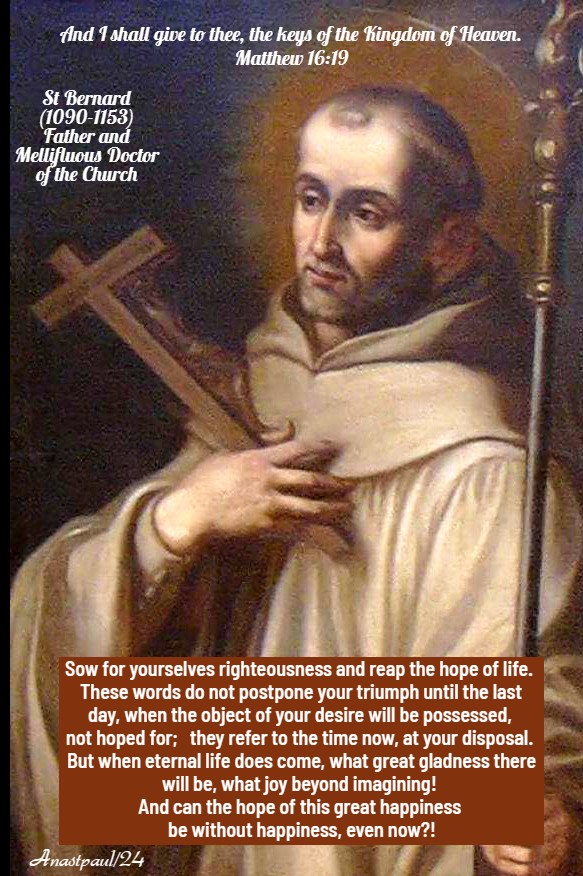
REFLECTION – “ It is only right, my brothers, to celebrate our Lord’s coming with all possible devotion, so greatly does His comfort gladden us… and His love burn within us. But do not just think about His first coming, when He came “to seek and save the lost” (Lk 19:10); think, too, of that other coming when He will come to take us with Him. I should like to see you constantly occupied in meditating on these two comings… “resting among the sheepfolds” (Ps 67:14), for they are the two arms of the Bridegroom, in which the Bride of the Song of Songs took her rest: “His left arm is under my head and His right arm embraces me” (2:6)…
But, there is a third coming between the two, to which I have just referred and those who know of it, can rest in it, for their greater happiness. The other two are visible but this one is not. In the first, “ the Lord has appeared on earth and has spoken to us” (Bar 3:38)… in the last, “all mankind shall see the salvation of God” (Lk 3:6; Is 40:5)… But the one that comes between them is secret – it is that in which the elect alone see the Saviour within themselves and their souls find salvation.
In His first coming, Christ came in our flesh and in our weakness; in His coming in the midst of time, He comes in Spirit and power; in His final coming, He will come in His glory and majesty. But it is by the strength of the virtues that we attain to glory, as it is written: “The Lord, the King of armies, He is the King of glory” (Ps 23:10) and, in the same book: “That I may see Thy power and Thy glory” (Ps 62:3). And so, the second coming is like a road leading from the first to the last. In the first, Christ has been our Redemption; in the last, He will appear as our Life; in His coming between, He is our Rest and our Consolation!” – St Bernard (1091-1153) Cistercian Monk, The Last Father and Mellifluous Doctor of the Church (Sermons 4 and 5 for Advent).
PRAYER – O Lord, hear Thy people as they humbly pray, in union with the patronal intercession of Thy Saints that Thou wouldst grant us to enjoy peace, during our life on earth and to find help for life eternal. Through Jesus Christ, Thy Son our Lord, Who lives and reigns with Thee, in the unity of the Holy Ghost, God, world without end. Amen (Collect).
Our Morning Offering – 19 January – “The Month of the Most Holy Name of Jesus and of the Holy Family” –
Act of Reparation By St Alphonsus Maria de Liguori (1696-1787) Most Zealous Doctor of the Church Indulgence of 3 Years – Once a Day
O Jesus, my Saviour and Redeemer, Son of the living God, behold we kneel before Thee and offer Thee our reparation; we would make amends, for all the blasphemies uttered against Thy Holy Name, for all the injuries done to Thee in the Blessed Sacrament, for all the irreverence shown toward Thine Immaculate Virgin Mother, for all the calumnies and slanders, spoken against Thy Spouse, the Holy Catholic and Roman Church. O Jesus, Who hast said: “If you ask the Father anything in My Name, He will give it you,” we pray and beseech Thee, for all our brethren who are in danger of sin; sheld them from every temptation to fall away from the true faith; save those who are even now standing on the brink of the abyss; to all of them, give light and knowledge of the truth, courage and strength, for the conflict with evil, perseverance in faith and active charity! For this do we pray, most merciful Jesus, in Thy Name, unto God the Father, with Whom Thou livest and reignest in the unity of the Holy Ghost, world without end. Amen.
Saint of the Day – 19 January – Saint Lomer of Corbion (Died 593) Abbot of the Monastery he founded at Corbion near Chartres, friend of animals, Miracle-worker. Born in Neuville-la-Mare, Diocese of Chartres, France and died in January 593 of natural causes. Also known as – Laumer, Laudomarus, Launomar, Launomaro.
Statue of St Lomer at the Church of Notre-Dame at Perche
In his childhood and adolescence, Lomer kept his father’s sheep, in which employment he mortified his body by regular fasts and spent his time in studies and prayer.
He was initially trained for the Priesthood by a holy Priest named Chirmirius, was Ordained and then served in Chartres and the surrounds, where he was made both Canon and Bursar of the Cathedral Chapter.
After many years, Lomer withdrew to live a eremitic life in the forests of La Perche where, some brigands, who had come to rob him, left edified and spread the fame of his sanctity. . His reputation for great holiness and miracles, including the gift of prophecy, resulted in a number of disciples attaching themselves to his hermitage in the forest.
In c570 Lomer founded a Monastery at Corbion to house his many disciples, six leagues from Chartres. He died more than a hundred years old, in January. 593 (the actualy day, however, uncertain).
His body was buried in the Church of St-Martin-du-Val and Subsequently, IN 595, moved to Corbion. During the Norman invasions, his Relics were protect in Blois, where, in 924, the Monastery of St-Laumer was built, to which that of Corbion was joined. These two houses were destroyed in 1567 by the Huguenots and the Relics were lost. However, in 912, St Lomer’s skull was transferred to Moissat, where in 1284, St Simon of Bourges, carried out a new translation.
The Saint’s Feast has celebrated isince the 17th Century in the Diocese of Chartres and then, in that of Chartres and Séez. His name was inscribed in the French and Benedictine Martyrologies on 19 January. The iconography of the Saint depicts him as a teaching Abbot, as he appears in the 13th Century Statue im the South portal of Chartres Cathedral, in the guise of an Abbot, with a book in his right hand.
In the early 20th Century, an event in the life of St. Lomer – an incident involving the theft of the Saint’s favourite cow – was published in The Book of Saints and Friendly Beasts, a collection of brief tales for children, Lomer’s Vita states that the Abbot was so holy that “savage wild beasts obeyed when he commanded.”
Sts Marius and Family of Perisa – Martha, Audifax, Abacjum (Died c270 – Martyrs, Husband, Wife and 2 Sons – in the time of Emperor Claudius. The Roman Martyrology today states: “At Rome, on the Cornelian road, the holy Martyrs, Marius and his wife Martha, with their sons, Audifax and Abachum, noble Persians, who came to Rome, through devotion, in the time of the Emperor Claudius. After they had been beaten with rods, tortured on the rack and with fire, lacerated with iron hooks and had endured the cutting off their hands, Martha was put to death in the place called Nympha. The others, were beheaded and cast into the flames.” Including: St Abachum of Persia + (St Marius and Family of Persia – Martyrs) St Audifax of Persia + (St Marius and Family of Persia – Martyrs) St Martha of Persia + (St Marius and Family of Persia – Martyrs) Their Lives and Deaths: https://anastpaul.com/2023/01/19/saints-of-the-day-19-january-st-marius-and-family-martha-audifax-abacjum-died-c-270-martyrs/
St Canute (1040-1086) Martyr, King of Denmark, known as Canutus the Holy – Canutus was an ambitious King who sought to strengthen the Danish monarchy, devotedly supported the Roman Catholic Church and had designs on the English throne. Slain by rebels in 1086, he was the first Danish King to be Canonised. He was recognised as Patron Saint of Denmark in 1101. Biography: https://anastpaul.com/2019/01/19/saint-of-the-day-19-january-st-canutus-1040-1086/
Bl Andrew of Peschiera St Arsenius of Corfu
St Bassian of Lodi (c320–c409) Archbishop, Penitent, Miracle-worker. St Bassian was a close of friend of St Ambrose and St Felix of Como. About St Bassian: https://anastpaul.com/2020/01/19/saint-of-day-19-january-st-bassian-of-lodi-c-320-c-413/ Bl Beatrix of Lens St Branwallader of Jersey St Catellus of Castellammare St Contentius Bl Elisabetta Berti St Faustina of Como St Fillan St Firminus of Gabales St Germanicus of Smyrna St Godone of Novalesa St John of Ravenna St Joseph Sebastian Pelczar St Liberata of Como St Lomer of Corbion (Died 593) Abbot St Messalina iof Foligno St Ponziano of Spoleto St Remigius of Rouen
St Wulstan (c1008–1095) Bishop of Worcester , England, from 1062 to 1095, Monk, Prior, a man of extreme holiness and penitence who was admired by all, he was a he was a man of iron will, immense charm and unworldly humility and piety and suffered no luxury, preferring always the poor to himself. A Life to Imitate: https://anastpaul.com/2021/01/19/saint-of-the-day-19-january-saint-wulfstan-c-1008-1095/
Martyrs of Numidia – 9 Saints: A group of Christians Martryred together for their faith. The only details to survive are nine of their names – Catus, Germana, Gerontius, Januarius, Julius, Paul, Pia, Saturninus and Successus. 2nd century Numidia in North Africa.
Martyrs of Carthage – 39 Christians Martyred together in Carthage, date unknown. We have no information about them except 9 of the names – Catus, Germana, Gerontius, Januarius, Julius, Paul, Pia, Saturninus and Successus. Died IN Carthage, North Africa (modern Tunis, Tunisia).
Thought for the Day – 18 January – The Spiritual Combat (1589) – Dom Lorenzo Scupoli OSM (c1530-1610)
“None shall be crowned who has not fought well.” 2 Tim 2: 5
The Third Weapon of the Spiritual Combat
IX: … Of another Danger from which the Understanding must be Guarded, that it may Exercise a True Judgement (Part Two)
“By following these instructions you will avoid many dangers; for when the wily serpent sees the will of those, who are aiming at the spiritual life, to be strong and resolute, he attacks their Understanding, that so he may master both the one and the other. He often, therefore, infuses lofty and curious speculations into their minds, especially if they be of an acute and intellectual order and easily inflated with pride and he does this, in order that they may busy themselves in the enjoyment and discussion of such subjects, wherein, as they falsely persuade themselves, they enjoy God and, meanwhile neglect to purify their hearts and to apply themselves to self-knowledge and true mortification. So, falling into the snare of pride, they make an idol of their own understanding!
Hence, being already accustomed to have recourse, in all circumstances, to their own judgement, they come gradually and imperceptibly to believe that they have no need of advice or control from others. This is a most perilous case and very difficult to cure, the pride of the understanding being more dangerous than that of the will; for when the pride of the will is once perceived by the understanding, it may, in course of time, be easily remedied by submission to those to whom it owes obedience. But how, or by whom, can he be cured, who obstinately believes his own opinion and judgement, to be worth more than that of others? How shall he submit to other men’s judgement, which he accounts to be far inferior to his own!
The Understanding is the eye of the soul, by which the wound of the proud Will, should be discovered and cleansed; if that eye, then, itself be weak and blind and swollen with pride, by whom shall it be healed? And if the light become darkness and the rule faulty, what will become of the rest?
Therefore, resist this dangerous pride betimes, before it penetrate into the marrow of your bones. Blunt the acuteness of your intellect, willingly submit your own opinion to that of others, become a fool for the love of God and you shall be wiser than Solomon!”
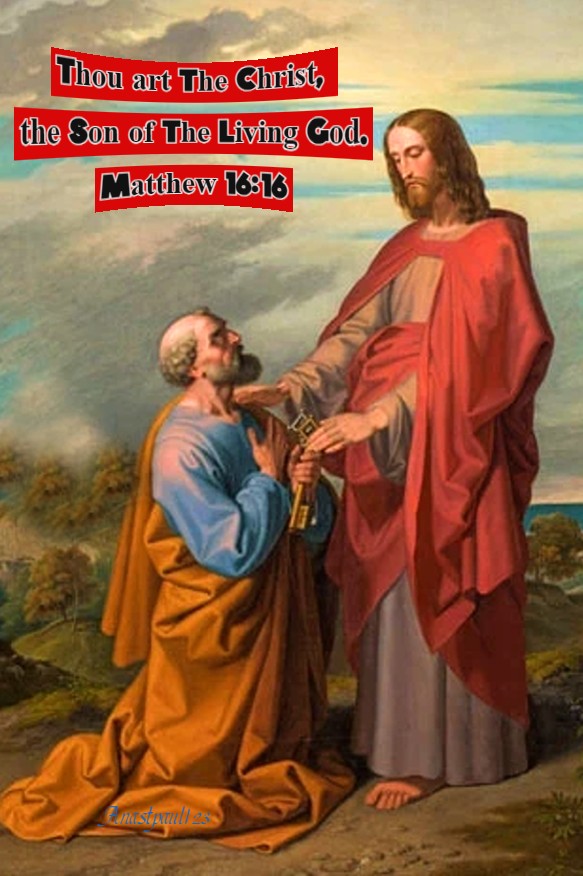
Quote/s of the Day – 18 January – Feast of the Chair of the Apostle, St Peter at Rome – 1 Peter 1:1-7, Matthew 16:13-19 – Scripture search here: https://www.drbo.org/
“Thou art the Christ, the Son of the living God.”
Matthew 16:16
“Upon this rock I will build My Church”
Matthew 16:18
“I decided to consult the Chair of Peter, where that faith is found exalted by the lips of an Apostle; I now come to ask for nourishment for my soul there, where once I received the garment of Christ. I follow no leader save Christ, so I enter into communion with Your beatitude, that is, with the Chair of Peter, for this, I know, is the rock upon which the Church is built.” (cf Le lettere I, 15, 1-2)
St Jerome (343-420) Father & Doctor od rhw Church
“He gave way to sin so that, remembering his own failure and the kindness of the Lord, he might testify to others, a grace of philanthropy in accord with the divine design conceived by God. The fall had been permitted to the one who was going to see himself entrusted with the Church, the Pillar of the Church, the Harbour of the Faith; the fall had been permitted to Peter, the Doctor of the Universe, in order that, the forgiveness received, might remain the foundation of love for others.”
St John Chrysostom (347-407) Father and Doctor of the Church
“Nothing escaped the Wisdom and Power of Christ, the elements of nature lay at His service, spirits obeyed Him, Angels served Him. … And yet, out of all the world, Peter alone was chosen to stand at the head, for the calling of all the peoples and the oversight of all the Apostles and Fathers of the Church.”
St Pope Leo the Great (400-461) Father and Doctor of the Church
One Minute Reflection – 18 January – Feast of the Chair of the Apostle, St Peter at Rome – 1 Peter 1:1-7, Matthew 16:13-19 – Scripture search here: https://www.drbo.org/
“And I say to thee: That thou art Peter and upon this rock, I will build My Church and the gates of hell shall not prevail against it.” – Matthew 16:18
REFLECTION – “When the twelve holy Apostles had received from the Holy Ghost the power to speak all languages, they divided the regions of the earth amongst themselves, as fields for their Gospel labours. Then was Peter, the Prince of the Apostles, sent to the Capital City of the Roman Empire that he might make the Light to shine, from the head, to the whole body of the civilised nations. At that time, what nation was there which had no representative in Rome? What nations would be ignorant of what Rome had learned?
Here were to be refuted the theories of philosophers, here dissolved the vanities of earthly wisdom, here overthrown the worship of devils, here destroyed the impiety of every sacrilege; here, where superstitious zeal had collected all the error and vanity of the world. Therefore, to this City, O most blessed Peter, thou dost not fear to come and, while thy companion in glory, the Apostle Paul, is still occupied with the government of other Churches, thou dost enter this forest of savage beasts, this deep and turbulent ocean, with more boldness than when thou didst walk upon the water!
Thou hadst already taught those, of the circumcision who had been converted, thou hadst founded the Church of Antioch, the first that bore the noble name of Christian; thou hadst published the law of the Gospel throughout Pontus, Galatia, Cappadocia, Asia and Bithynia and, thou didst not fear for the difficulty of thy work, nor turn back because of thine old age but didst boldly set up the trophy of the Cross of Christ, upon those Roman walls, where the Providence of God had appointed the throne of thine honour and the glorious scene of thy passion.” – St Leo the Great (400-461) Pope, Father and Doctor of the Church (Sermon on the Feast of St Peter’s Chair at Rome).
PRAYER – O God, Who together with the keys of the Kingdom of Heaven didst bestow on thy blessed Apostle Peter the pontifical power of binding and loosing, grant that by the aid of his intercession, we may be released from the bonds of our sins. Through Jesus Christ, Thy Son our Lord, Who lives and reigns with Thee, in the unity of the Holy Ghost, God, world without end. Amen (Collect).
Our Morning Offering – 18 January – Feast of the Chair of St Peter at Rome
O Prince of the Apostolic Senate! Hymn to the Prince of the Apostles By St Peter Damian (1007-1072) Cardinal Bishop of Ostia Doctor of the Church
O Prince of the Apostolic Senate! Herald of our Lord! First Shepherd of the Faithful! watch over the Flock intrusted to thee.
Lead us through verdant pastures, feeding us with the nourishment of the Word and lead us, thus fed, into the heavenly fold, whither thou hast already gone.
To thee, Peter, have been delivered the Keys of heaven’s gate and all things, both in Heaven and on earth, acknowledge thy authority.
Tis thou that choosest the City where is to be established the Rock of the True Faith, the foundation of the building, on which the Catholic Church stands immoveable.
Thy shadow, as thou passest by, heals the sick and Tabitha, who made garments for the poor, was raised to life at thy bidding.
Bound with two chains, thou wast set free by an Angel’s power; he bids thee put on thy garments and thy sandals and lo! the prison door is opened.
To the Father unbegotten and to the Only-Begotten Son and to the co-equal Spirit of them both, be praise and kingly highest power. Amen.
Saint of the Day – 18 January – Saint Volusian of Tours (Died 496) Bishop of Tours from 488 until his death. Died on 18 January 496, whilst in exile, of natural causes. Patronage – of Foix, France. Also known as – Volusian of Foix, Volusianus… Volusien…
The Roman Martyrology reads: “At Tours in France, St Volusian, Bishop, who was made captive by the Goths and in exile, gave up his soul to God.”
Volusian had been born into a family of senatorial rank, very wealthy, a relative of the Bishop who preceded him, St Perpetuus and he lived in the days when Clovis was the King of the Franks,
Volusian was the Bishop of Tours, in France, the see made famous by St Martin two Centuries earlier. He lived at a time before clerical celibacy and was married to a woman unfortunately notorious for her violent temper which was a great trial to the Bishop. His time was too, a fearful one, when the barbarian invasions had begun and the fear of these barbaric Goths was extreme.
In writing to a friend of his, a certain Bishop Ruricius, of nearby Limoges Diocese, Volusian expressed his fear of the Goths who were beginning to terrorise his Diocese. Ruricius humorously replied: “timere hostem non debet extraneum qui consuevit sustinere domesticum” — that is, “anyone who already has a terrible enemy at home, he has nothing to fear from external ones.”
As the Goths began to overrun Volusian’s Diocese, Volusian was driven from his See and sent into exile into Spain. St Gregory of Tours, who succeeded Volusian a Century later, as the Bishop of Tours, describes the turmoil of the times and it is from his writings that we have received the little knowledge we have of St Volusian. But we are unsure of where he died. It is simply known that he was driven from his See, went into exile and died after ruling as Bishop for seven years.
This Statue of St Volusian resides at the Abbey Church at Foix
Feast of the Chair of the Apostle, St Peter at Rome: This Feast was instituted to commemorate the establishment of the Holy See at Rome. In 1960, Pope John XXIII removed from the General Roman Calendar, the 18 January Feast of the Chair of Peter at Rome. Two Liturgical Feasts were celebrated in Rome, in Honour of Chairs of Saint Peter, one of which was kept in the Baptismal Chapel of St Peter’s Basilica, the other at the Catacomb of Priscilla. The dates of these celebrations are 18 January and 22 February. The two Feasts were included in the Tridentine Calendar with the rank of Double which, in 1604, Pope Clement VIII raised to the rank of Greater Double. Those traditional Catholics. who do not accept the changes made by Pope John XXIII, continue to celebrate both Feast days: “Saint Peter’s Chair at Rome” on 18 January and the “Chair of Saint Peter at Antioch” on 22 February. https://anastpaul.com/2017/02/22/feast-of-the-chair-of-st-peter-22-february/
Blessed Beatrix d’Este the Younger (c 1230-1262) French Benedictine Nun, Founded a Convent. Beatified in 1774 by Pope Clement XIV. Her memorial date was decreed by Pope Pius VI for today. The Roman Martyrology states: “In Ferrara, Blessed Beatrice d’Este, Nun, who, on the death of her future husband, having renounced the kingdom of this world, consecrated herself to God in a Monastery founded by herself under the rule of Saint Benedict.” Her Life: https://anastpaul.com/2023/01/18/saint-of-the-day-18-january-blessed-beatrix-deste-the-younger-c-1230-1262/
St Catus
Blessed Cristina Ciccarelli OSA (1481–1543) Religious of the Order of Saint Augustine, Mystic, Stigmatist, Apostle of the poor, Reformer, she had a had a particular devotion to the Eucharist and to the Passion and Death of Christ, she was granted the gift of Prophecy, visions and levitation. Beatified in 1841 by Pope Gregory XVI . About Bl Cristina: https://anastpaul.com/2020/01/18/saint-of-the-day-18-january-blessed-cristina-ciccarelli-osa-1481-1543/
St Day/Dye St Deicola of Lure Bl Fazzio of Verona St Leobardus of Tours St Moseus of Astas St Ulfrid of Sverige St Volusian of Tours (Died 496) Bishop
Thought for the Day – 17 January – The Spiritual Combat (1589) – Dom Lorenzo Scupoli OSM (c1530-1610)
“None shall be crowned who has not fought well.” 2 Tim 2: 5
The Third Weapon of the Spiritual Combat
IX: … Of another Danger from which the Understanding must be Guarded, that it may Exercise a True Judgement (Part One)
“The second thing from which the Understanding must be guarded is curiosity; for by filling it with hurtful, vain and impertinent thoughts, we incapacitate and disable it from apprehending that, which most nearly affects our true mortification and perfection.
To this end, you must be as one dead to all needless investigation of even lawful earthly things. Always restrain your intellect as much as possible and love to keep it low. Let the news and the changes of the world, whether great or small, be to you as though, they were not and, should they intrude themselves, reject and drive them from you.
Be sober and humble even in the desire to understand heavenly things, wishing to know nothing but Christ Crucified, His Life, His Death and what He requires of thee. Cast all other things far from you and so shall you be very pleasing unto God. For He loves and delights in those, who desire and seek of Him such things alone, as serve to the love of His Divine Goodness and the fulfilment of His will. All other petitions and inquiries belong to self-love, pride and the snares of the devil!”
Quote/s of the Day – 17 January – St Anthony Abbot (251-356)
“The illusions of this world soon vanish, especially if a man arms himself with the Sign of the Cross. The devils tremble at the Sign of the Cross of our Lord, by which He triumphed over and disarmed them.”
“If we make every effort to avoid death of the body, still more should it be our endeavour, to avoid death of the soul! There is no obstacle for a man who wishes to be saved, other than negligence and laziness of soul.”
“ Whatis slander? It is every sort of wicked word we would dare not speak in front of the person whom we are complaining about.”
One Minute Reflection – 17 January – “The Month of the Most Holy Name of Jesus and of the Holy Family” – St Anthony Abbot (251-356) – Ecclesiasticus 45:1-6; Luke 12:35-40 – Scripture search here: https://www.drbo.org/
“You also must be prepared, for at an hour you do not expect, the Son of Man will come.” – Luke 12:40
REFLECTION – “These words mean – you are to be awake and vigilant because you do not know the hour when the Lord will come from the wedding … Because, as soon as some feeling of pride, self-satisfaction or self-will enters a man, the Enemy is there, cutting the precious bag, of all his good works from him. Oh, children! How many people like these, will you see, who have done great works … and thus gained great renown … but, presumption has stripped them of all … They will be placed after the poor and simple fellows, whom no-one values because of their outward appearance and work. Because they humbly take a lowly place, these latter, will be set above the others … So keep watch with vigilant soul and you will see the pure Truth with open eyes …
“Let your loins be girt about and your lamps alight.” Here there are three points to notice. First – the loins are to be girded like someone firmly bound with a rope, so as to be led, against his will … Second – you are to carry lighted lamps in your hands which is to say, works of love. Your hands should never stop doing the true, ardent work of charity … Third – you should wait for the Lord when He returns from the wedding … “The Lord will set them over all His goods; He will gird Himself and will serve them.” This wedding from which the Lord comes, takes place in the most interior part of the soul, in its depths, where the noble image is found. O what intimate contact the soul has with God and God with it, in this depth and what a marvellous work God does there! What rejoicing and joy He finds there! It surpasses all feeling and thought and yet, man knows nothing and feels nothing of it.” – Fr Johannes Tauler OP (c1300-1361) Dominican Priest and Friar, renowned Preacher and Theologian (Sermon 77 for the Feast of a Confessor).
PRAYER – May the intercession of the Blessed Abbot Anthony, commend us, we beseech Thee, O Lord, so that what we do not deserve by any merits of our own, we may obtain by his patronage. Through tJesus Christ, Thy Son our Lord, Who lives and reigns with Thee, in the unity of the Holy Ghost, God, world without end. Amen (Collect).
Our Morning Offering – 17 January – “The Month of the Most Holy Name of Jesus and of the Holy Family”
O My God, I Thank Thee An Act of Abandonment to the Divine Will By St Francis de Sales (1567-1622) Doctor Caritas
O my God, I thank Thee and I praise Thee for accomplishing Thy Holy and all-lovable Will without any regard for mine. With my whole heart, in spite of my heart, do I receive this cross I feared so much! It is the cross of Thy choice, the cross of Thy Love. I venerate it; nor for anything in the world would I wish it had not come, since Thou hast willed it. I keep it with gratitude and with joy, as I do everything which comes from Thy Hand and I shall strive to carry it without letting it drag, with all the respect and all the affection which Thy works deserve. Amen.
Saint of the Day – 17 January – St Anthony Abbot (251-356) Hermit, Founder of Monasteries, Abbot and Spiritual Guide, Mystic and Miracle-Worker, beloved of all animals. Born in 251 at Heracleus, Egyptand died on 17 January 356 at Mount Colzim of natural causes. Also known as – Anthony of Egypt, Anthony of the Desert, Anthony the Anchorite, Anthony the Hermit, Antonio Abate, Father of All Monks, Father of Western Monasticism. His Patronages are numerous – against eczema, skin diseases and rashes, pestilence, Saint Anthony’s Fire, of firefighters, of wild animals, amputees, anchorites, basket weavers and makers, bell ringers, brushmakers, domestic animals, butchers, cemetery and funeral workers and gravediggers, epileptics, farmers, hermits, monks, pigs, livestock, Hospitallers, of 29 Cities in Europe.
The Roman Martyrology says: “In Thebais, St Anthony, Abbot and Spiritual Guide of many Monks. He was most celebrated for his life and miracles, of which St Athanasius has written a detailed account. His holy body was found by divine revelation, during the reign of the Emperor Justinian and brought to Alexandria, where it was buring in the Church of St John the Baptist.”
St Anthony unknown artist Italian School
St Anthony’s Vocation Anthony was born in 251 to a wealthy family of farmers in the village of Coma, now Qumans, in Egypt. Around the age of 18-20, he was left an orphan with a rich estate to manage and with a younger sister to educate. Attracted by the evangelical teaching “If you wish to be perfect, go, sell what you have, give to the poor and you will have treasure in heaven, then come, follow me” and by the example of some Anchorites who lived nearby in prayer, poverty and chastity, Anthony’s heart was drawn to choose this path. He, therefore, sold his goods, entrusted his sister to a community of virgins and dedicated himself to an ascetic life in front of his house and then outside the town.
Seeking a penitential and isolated life, he prayed to God for enlightenment. Not far away he saw a Hermit, like himself, who sat and worked, weaving a rope, then stopped, stood up and prayed; immediately after, he went back to working and praying again. This Anchorite was an Angel of God showing Anthony the path of work and prayer which, two Centuries later, would form the basis of the Benedictine Rule “Ora et labora” and Western Monasticism. Part of Anthony’s work was used to obtain food and part was distributed to the poor. St Athanasius asserts that he prayed continually and was so attentive to reading the Scriptures that he trained them verbatim in his memory oand he no longer needed scrolls.
From the Sienese Altarpiece (1425-50) depiciting the Life of St Anthony – this image shows him as a little boy on the right and as a young adult on the left, after hearing the Gospel of the rich young man
St Anthony’s Temptations While still very young, after a few years of his solitary life, very difficult trials began for him. Impure thoughts tormented him, doubts assailed him about the advisability of such a solitary life. The instinct of the flesh and the attachment to material goods which he had tried to suppress, returned in overbearing and uncontrollable force. He, therefore, asked for help from other Hermits, who told him not to be afraid but to move forward with confidence because God was with him. They also advised him to get rid of all ties and material possessions and retreat to a more solitary place. Thus, barely covered by a rough cloth, Anthony took refuge in an ancient tomb dug into the rock of a hill, aurrounding the village of Coma. A friend brought him some bread every now and then; for the rest, he had to make do with wild berries and herbs growing around him. In this place, the first temptations were replaced by terrifying visions and noises. Furthermore, he went through a period of terrible spiritual darkness. All this Anthonye overcame by patiently persevering in faith, carrying out the will of God, day by day, as his teachers had taught him. When Christ finally revealed Himself to him as the Hermit, he asked: “Where were Thou? Why did Thou not appear from the beginning, to put an end to my sufferings?”. He heard Him reply: “Anthony, I was here with thee and witnessed thy fight”…
St Anthony’s Temptations
On the Mountains of Pispir Discovered by his fellow citizens, who, like all Christians of those times, flocked to the Hermits to receive spiritual advice, prayer and consolation but, at the same time, disturbed their solitude and meditation, forced Anthony to move further away. In the Pispir mountains there was an abandoned fortress, infested with snakes but with a spring source and in 285 Anthony moved there and remained there for 20 years. Twice a year, bread was dropped to him from above. In this new solitude he followed the example of Jesus, Who, guided by the Spirit, retreated into the desert “to be tempted by the devil,”
St Athanasius tells of the many times when St Anthony struggled against devils, not only by resisting temptations but also suffering bodily harm which they were permitted to inflict upon him. On one such occasion, “a multitude of demons … so cut him with stripes that he lay on the ground speechless from the excessive pain.” He was discovered unconscious by the local villagers, who thought him dead and brought him to their Church, here depicted in the background. (Life of Anthony 8 and 9)
The First Communities of disciples Then came the time when many people who wanted to dedicate themselves to the solitary eremitcal life arrived at the fort. Anthony went out and began to console the afflicted, obtaining cures from the Lord, freeing the possessed and instructing the new disciples. Two groups of Monks were formed who gave rise to two Monasteries, one east of the Nile and the other on the left bank of the river. Each Monk had his own solitary cave but obeyed a brother more experienced in spiritual life. Anthony gave everyone his advice on the path towards perfection of the spirit and union with God, thus operating as their Abbot from his cave.
In the Thebaid Once again, to escape the many curious people who went to the fortress, Anthony decided to retreat to a more isolated place. He, therefore ,went to the Thebaid desert, in Upper Egypt, where he began to cultivate a small garden to support himself and those disciples and visitors, who followed him. He lived in the Thebaid region until the end of his very long life. He was able to bury the body of the Hermit Saint Paul the Hermit, with the help of a lion — for this reason he is considered the Patron Saint of wild animals, of cemeteries, gravediggers and funeral workers. In his last years he welcomed two Monks who looked after him in his extreme old age. He died at the age of 106, on 17 January 356 and was buried in a secret place.
St Anthony meets St Paul the Hermit
The Spiritual Inheritance His presence had also attracted many people to the Thebaid eager for a more spiritual life. Many chose to follow his style, thus Monasteries arose among those mountains. The desert was populated by Monks, the first of that multitude of consecrated men, who in the East and the West, continued the path he had begun, expanding it and adapting it to the needs of the times. His disciples handed down his wisdom to the Church, collected in 120 sayings and 20 letters. In Letter 8, Saint Anthony wrote: “Ask with a sincere heart for that great Spirit of fire which I myself have received and it will be given to you.”
The Last Rites and Death of St Anthony
Protection against Shingles (Herpes Zoster) In 561 his tomb was discovered and the Relics began a long journey through time and space, from Alexandria to Constantinople, until arriving in France, in the 11th Century, in Motte-Saint-Didier, where a Church was built in his honour. Crowds of sick people flocked to venerate his Relics in this Church, especially those suffering from skin eruptions, caused by the poisoning of a fungus present in rye, used to make bread (or so it was thought). The disease, now scientifically known as herpes zoster, was known since ancient times as ‘ignis sacer’ (sacred fire) due to the burning sensation it caused. Also for this reason, our Saint is invoked against skin diseases in general. To house all the sick people who arrived, a hospital was built and a brotherhood of religious people was founded, the ancient hospital order of the ‘Antoniani.’ Hence the Patronage of Hospitallers. The village took the name of Saint-Antoine de Viennois.
The Tau Staff is visible in St Anthony’s hand
The Pig, the Fire, the “Tau” The Pope granted the Antonians the privilege of raising pigs for their own use and at the expense of the community, so the piglets could move freely between courtyards and streets; no-one touched them, if they wore an identification bell. Their fat was used to treat ergotism, which was called “sickness. Antonio” and then “fire of St Anthony.” For this reason, in popular religiosity, the pig began to be associated with the great Egyptian Hermit, later considered the Patron Saint of pigs and by extension, of all domestic and stable animals. In his iconography, in addition to the pig with the bell, there also appears the T-shaped Hermits’ staff, the “tau” the last letter of the Hebrew alphabet and, therefore, an allusion to the last things and destiny. A popular legend which connects his iconographic attributes, narrates that Saint Anthony went to hell to contend with the devil for the souls of the dead. While his little pig, sneaking in, created havoc among the demons, he lit his tau-shaped stick with infernal fire and took it out together with the recovered little pig — he gave fire to humanity, lighting a pile of wood.
Popular devotion On the day of his liturgical memory, the stables are blessed and the domestic animals are brought to be blessed. In some countries of Celtic origin, Saint Anthony took on the functions of the divinity of rebirth and light, Lug, the guarantor of new life, to whom wild boars and pigs were consecrated. Therefore, in various works of art, there is a boar at his feet. Patron of all those involved in processing pigs, alive or slaughtered, he is also the Patron of those who work with fire, such as firefighters because he cured that metaphorical fire which was Herpes Zoster. Even today, on 17 January, especially in agricultural villages and farmhouses, it is customary to light the so-called “St Anthony’s bonfire which had a purifying and fertilising function, like all the fires which marked the transition from winter to the imminent spring. The ashes, then collected in the home braziers of the past, were used to heat the house and, using a special bell made with wooden slats, to dry damp clothes. Venerated throughout the Centuries, his name is among the most widespread in Catholicism. Saint Anthony of Padua himself, precisely to indicate his desire for greater perfection, chose to change the name received at his Baptism to that of our Saint today.
The Life of St Anthony by St Athanasius: https://www.youtube.com/watch? v=XiKDl_lOb74&list=PL5_ax08Z6UX9h2VWw84sk4zcAQUliDUo7
St Achillas of Sketis St Amoes of Sketis St Anthony of Rome Bl Euphemia Domitilla
BlessedGamelbert of Michaelsbuch (c720-c802) Priest, Monk, Hermit. “Such was his kindness of heart, that he used to buy the little birds caught by the peasants, in order to set them free. He never allowed his servants to work in the fields or woods, if bad weather threatened. He valued, above everything, peace and concord and kept the peace among his parishioners, as far as he possibly could.” – from “The Little Bollandists” by Monsignor Paul Guérin, 1882 Biography: https://anastpaul.com/2022/01/17/saint-of-the-day-17-january-blessed-gamelbert-of-michaelsbuch-c-720-c-802/
Martyrs of Langres – Triplet Brothers with their Grandmother: At Langres, in the time of Marcus Aurelius, the Saints Eleusippus, Meleusippus, Speusippus, born at one birth, who were crowned with Martyrdom, together with their grandmother, Leonilla,
Thought for the Day – 16 January – The Spiritual Combat (1589) – Dom Lorenzo Scupoli OSM (c1530-1610)
“None shall be crowned who has not fought well.” 2 Tim 2: 5
The Third Weapon of the Spiritual Combat
VIII: … Of the Hindrances to a Right Judgement and of the Method to be Adopted, in order to Understand them Properly
“The cause of our not rightly judging all these things and many others, is, that we conceive a love or hatred of them at first sight. Our understanding (reason or intellect) is thus darkened, so that it cannot judge of them correctly. Lest you fall into this delusion, take all possible care to keep your will pure and free from inordinate affection for anything whatsoever! When any object, then, is presented to you, view it with your understanding and consider it maturely, before you are moved by hatred to reject it, if it be a thing contrary to your inclinations, or by love to desire it, if it be pleasing to them. For thus the understanding, being unclouded by passion, will be free and clear and able to perceive the truth and to judge the evil which lurks behind delusive pleasure and the good which is veiled under the appearance of evil.
But if the will be first inclined to love or hate anything, the understanding will be unable to exercise a right judgement upon it. For the affection which has thus intruded itself so obscures the understanding, that it views the object as other than it is and, by thus representing it to the will, influences that faculty, in contradiction to every law and rule of reason, to love or hate it inordinately. The understanding is gradually darkened more and more and, in this deepening obscurity, the object appears more and more hateful or lovely to the will.
Hence, if this most important rule be not observed, these two faculties, the understanding and the will, noble and excellent as they are, will soon sink, in a miserable descent from darkness into thicker darkness and from error, into deeper error.
Guard yourself most vigilantly, then, from all inordinate affection for anything, whatever, until you have first tested it by the light of the understanding and chiefly, by that of grace and prayer and by the judgement of your spiritual father. And this is to be observed most carefully with regard to such outward works as are good and holy because, the danger is greatest here, of delusion and indiscretion. Hence you may here receive serious injury from some circumstance of time, or place, or degree, or regarding obedience — as has been proved by many, who have incurred great danger in the performance of commendable and holy exercises.”
Quote/s of the Day – 16 January – “The Month of the Most Holy Name of Jesus and of the Holy Family” – 1 Peter 5:1-4, 10-11; Matthew 16:13-19 – Scripture search here: https://www.drbo.org/
“Thou art the Christ, the Son of the living God.”
Matthew 16:16
Blessed are they who have not seen and have believed.”
John 20:29
“See that you not be deceived, for many will come in my name, saying, ‘I am he’ and ‘The time has come.’ Do not follow them!” Luke 21:8
“[Christ speaks:] I became useless to those who knew Me not, because I shall hide Myself, from those who possessed Me not. And I will be with those who love Me. … I arose and am with them and will speak by their mouths. For they have rejected those who persecute them and I threw over them, the yoke of My love. … Then I heard their voice and placed their faith in My Heart. And I placed My Name upon their forehead (Rv 14,1) because they are free and they are Mine!”
Odes of Solomon (Hebrew Christian text from the beginning of the 2nd century) N° 42)
“Grace is given, not to those who speak [their faith] but to those, who live their faith!”
St Gregory of Nazianzen (330-390) Father and Doctor of the Church
One Minute Reflection – 16 January – “The Month of the Most Holy Name of Jesus and of the Holy Family” – Saint Pope Marcellus I (Died 309) – 1 Peter 5:1-4, 10-11; Matthew 16:13-19 – Scripture search here: https://www.drbo.org/
“Upon this rock I will build My Church” – Matthew 16:18
REFLECTION – “Brothers, when it comes to fulfilling my duties as Bishop, I discover that I am weak and slack, weighed down by the weakness of my own condition, while at the same time, I want to act generously and courageously. However, I draw my strength from the untiring intercession of the almighty and eternal Priest, Who, like us but equal to the Father, lowered His divinity to the level of man and raised humankind to the level of God. The decisions He made, give me a just and holy joy. For, when He delegated many shepherds to care for His flock, He did not abandon watching over His beloved sheep. Thanks to that fundamental and eternal assistance, I in turn, have received the protection and support of the Apostle Peter, who also does not abandon his function. This solid foundation, on which the whole of the Church is built, never grows tired of carrying the whole weight, of the building which rests on it.
The firmness of faith, for which the first of the Apostles was praised, never fails. Just as everything which Peter professed in Christ remains, so that which Christ established in Peter, remains… The order willed by God’s Truth remains. Saint Peter perseveres in the solidity which he received; he has not abandoned the governance of the Church which was placed in his hands. That, my brothers, is what that profession of faith, inspired by God the Father, obtained in the heart of the Apostle. He received the solidity of a rock which no assault can shake. In the entire Church, Peter says everyday: “Thou art the Messiah, the Son of the living God.” – St Leo the Great (400-461) Pope, Father and Doctor of the Church (Sermon on the anniversary of his Consecration as Bishop).
PRAYER – O Lord, we beseech Thee, graciously hear the prayers of Thy people, that we may be helped by the merits of blessed Marcellus, Thy Pope and Martyr, whose sufferings we celebrate. Through the same Jesus Christ, Thy Son our Lord, Who lives and reigns with Thee, in the unity of the Holy Ghost, God, world without end. Amen (Collect).
Our Morning Offering – 16 January – “The Month of the Most Holy Name of Jesus and of the Holy Family”
My Most Sweet Lord Morning Offering Of St Alphonsus Liguori (1696-1787) Most Zealous Doctor
My most sweet Lord, I offer and consecrate to Thee. this morning all that I am and have – my senses, my thoughts, my affections, my desires, my pleasures, my inclinations, my liberty. In a word, I place my whole body and soul in Thy Hands. Amen.
Saint of the Day – 16 January – Saint Honoratus of Arles (c350-c429) Bishop and Confessor, Monk and Abbot, Miracle-worker, Founder of the renowned Monaster at Lérins. on the Iles-de-Lérins, the Lérins Islands, outside present-day Cannes. Born in c350 in northern Gaul (modern France) and died in January 429 of natural causes, Patronages – against and for rain, against drought. Also known as – Honorat, Honore, Honoratus of Lérins.
The Roman Martyrology reads today: “At Arles, St Honoratus, Bishop and Confessor, whose life was renowned for learning and miracles.”
This Statue of St Honoratus resides in Barcelona – Basílica de la Mercè
Honoratus and his brother, also a Saint, Venantius were of a noble pagan family of Roman heritage, their father being a Roman Consul to Gaul in the north of modern France. Honoratus was born around the year 350 probably in Lorraine or possibly in Trier in present-day Germany.
After receiving an outstanding education in the liberal arts both Honoratus and his brother became Christians and in 368, under the instruction and guidance of St Caprasius (died around 430), a holy Hermit of Lérins, the two brothers embarked, from Marseilles, on a pilgrimage to the Holy Land and the Desert Monks in Egypt and Syria, speciafically aimed at studying monasticism.
The sudden death of Venantius and illness of Honoratus in Greece, prevented further travels. St Caprasius and our Saint, returned home through Italy stopping at Rome. On their return to Gaul, Honoratus went on into Provence. There in around 405, encouraged by St Leontius the Bishop of Fréjus (Died c488), he was Ordained a Priest and took up his abode on the wild Lérins Island today named after him — the Île Saint-Honorat, with the intention of living there in solitude.
Numerous disciples soon gathered around Honoratus, including St Lupus of Troyes, St Eucherius of Lyon and St Hilary of Arles (who was our Saints’ nephew[?]). Thus was founded the Monastery of Lérins which has enjoyed so great a celebrity status and which was, during the 5th and 6th Centuries, a nursery for illustrious Bishops and remarkable Ecclesiastical writers. His Rule of Life was chiefly borrowed from that of St Pachomius. It is believed too that the glorious St Patrick trained there for his missionary work in Ireland. The famous Monastery of Lerinum (Lérins) which stands there to this day, the oldest existing Monastery in Europe, is today inhabited by Cistercians. Many visitors also found their way to Lérins, among them Saint John Cassian . He called the foundation at Lérins “en ingens fratrum coenobium — a great community of brothers.”
Honoratus’ reputation for sanctity was such that in 426, after the assassination of Patroclus, Archbishop of Arles, he was summoned from his solitude to succeed to the government of the Diocese which the Arian and Manichaean beliefs had greatly disturbed. He appears to have succeeded in re-establishing order and orthodoxy, while still continuing to direct, from afar, the Monks of Lérins.
He died in the arms of Hilary, his disciple and nephew, who was to succeed him in the See of Arles. Almost immediately after his death in around 430, Hilary wrote the “Sermo de Vita Sancti Honorati” probably in 430.
In 1391, Honoratus’ Relics were transferred to Lérins and his Tomb now stands empty under the High Altar in the Church named after him in Arles. His Relics have, since 1788, been in the Church of Notre-Dame in Grasse in the south of France, north-west of Cannes. There he was later honoured as “St Transitus” (Latin transitus = the moved) – possibly moved for safety during the Revolution.
Honoratus’ various writings have not been preserved, nor has the Rule which he gave to the solitaries of Lérins. St John Cassian, dedicated several of his “Conferences” to our Saint Honoratus.
St Henry of Coquet St Honoratus of Arles (c350-c429) Bishop and Confessor St Honoratus of Fondi Abbot Bl James of Luino St James of Tarentaise Bl Joan of Bagno di Romagna Bl Konrad II of Mondsee St Leobazio St Liberata of Pavia St Melas of Rhinocolura St Otto of Morocco St Peter of Morocco St Priscilla of Rome St Sigeberht of East Anglia
Thought for the Day – 15 January – The Spiritual Combat (1589) – Dom Lorenzo Scupoli OSM (c1530-1610)
“None shall be crowned who has not fought well.” 2 Tim 2: 5
The Third Weapon of the Spiritual Combat
VII: … Of Spiritual Exercises (and the first of the Exercise of the Understanding (Reason) — which must be kept guarded against ignorance and curiosity).
“If in this warfare, we are provided with no weapons except self-distrust and trust in God, needful as both these are, we shall not only fail to gain the victory over ourselves but, shall fall into many evils. To these, therefore, we must add the use of Spiritual Exercises, the Third Weapon named above. And these relate chiefly to the Understanding (Reason) and the Will.
As regards the Understanding, we must guard against two things which are apt to obscure it. One is ignorance which darkens it and impedes it in acquiring the knowledge of truth, the proper object of the understanding. Therefore, it must be made clear and bright, by exercise that so it may be able to see and discern plainly, all that is needful to purify the soul from disorderly passions and to adorn it with saintly virtues.
This light may be obtained in two ways: The first and most important is prayer, imploring the Holy Ghost to pour it into our hearts. This He will not fail to do, if we, in truth seek God alone and the fullment of His holy will and, if in all things, we submit our judgement to that of our spiritual father. The other is, to exercise ourselves continually in a true and deep consideration of all things, to discover whether they be good or evil, according to the teaching of the Holy Ghost and not, according to their outward appearance, as they impress the senses or are judged of by the world.
This consideration, if rightly exercised, will teach us to regard, as falsehood and vanity, all which the blind and corrupt world, in so many various ways, loves, desires and seeks after. It will show us plainly that the honours and pleasures of earth are but vanity and vexation of spirit; that injury and infamy inflicted on us by the world, bring true glory and tribulations, contentment; that to pardon our enemies and to do them good, is true magnanimity and an act, which likens us most nearly to God; that to despise the world is better than to rule it; that voluntary obedience, for the love of God to the meanest of His creatures, is greater and nobler, than to command mighty princes and, that the mortication and subjugation of our most trying appetite, is more glorious than the reduction of strong cities, the defeat of mighty armies, the working of miracles, or the raising of the dead!”
Quote/s of the Day – 15 January – The Feast of St Macarius of Egypt (c300-390) Priest, Abbot, Hermit, Desert Father of the Church, Spiritual student of Saint Anthony Abbot, Ascetic, Miracle-worker , known as “The Glowing Lantern.”
“Just as the blessings of God are unutterably great, so their acquisition, requires much hardship and toil, undertaken with hope and faith.”
“When you hear that Christ, going down to hell, freed the souls who were prisoners there, do not think that these things are far removed from what is being done now. Believe me, the heart is a tomb!”
“If you rebuke someone and do it with anger, you have allowed a passion to control you. You have not saved anyone and have destroyed yourself!”
One Minute Reflection – 15 January – St Paul the Hermit (c227-c342) The First Hermit – in the Thebaid region of Egypt, is regarded as the first Christian hermit, who lived alone in the desert from his sixteenth to the one hundred and thirteenth year of his life. – Philippians 3:7-12; Matthew 11:25-30 – Scripture search here: https://www.drbo.org/
“…Thou hast hid these things from the wise and prudent,and revealed them to little ones.”– Matthew 11:25
REFLECTION – “The fact ,that the All-Powerful God has been able to humble Himself even to the humility of the human condition, constitutes a greater proof than the impact and supernatural character of miracles. Indeed, when divine power effects something of great sublimity, this is, after a fashion, in conformity with and appropriate to, God’s nature … On the other hand, that God descended even to our lowliness is, in a certain way, the expression of an overwhelming power which is not in the least restrained, by what is contrary to its nature …
Neither the expanse of the heavens, the brightness of the stars, the governing of the universe, nor the harmony of created things, reveal the splendid power of God, as much as His indulgence, which leads Him to lower Himself to the weakness of our nature … God’s goodness, wisdom, justice and power are revealed in His plans on our behalf:goodness in His will to “save that which was lost” (Lk 19:10);wisdom and justice in His manner of saving us;power in the fact that Christ became “in the likeness of men” (Phil 2:7-8) and made Himself conformable to the humility of our nature.” – St Gregory of Nyssa (c.335-395) Bishop, Father of the Church (Catechetical Discourse 23-26 ; SC 453).
PRAYER – O God, Who each year give us the joyful feast of blessed Paul, Thy Confessor, mercifully grant that we may imitate the deeds of him, whose anniversary we celebrate. Through Jesus Christ, Thy Son our Lord, Who lives and reigns with Thee, in the unity of the Holy Ghost, God, world without end. Amen (Collect).
Our Morning Offering – 15 January – “The Month of the Most Holy Name of Jesus and of the Holy Family” – The Feast of St Macarius of Egypt (c300-390) Priest, Abbot, Hermit, Desert Father of the Church, Spiritual student of Saint Anthony Abbot, Ascetic, Miracle-worker , known as “The Glowing Lantern.”
Prayer for Mercyand Forgiveness By St Macarius of Egypt (c300-390)
Lord, be merciful now that my life is approaching its end and the evening awaits me. There is not enough time for me to cleanse myself of my sins, for they are so many. Heal me while I am still on earth and I shall be truly healthy. In Thy mercy, move me to repent, so that I shall not be ashamed, when I meet Thee in Heaven. Amen
You must be logged in to post a comment.