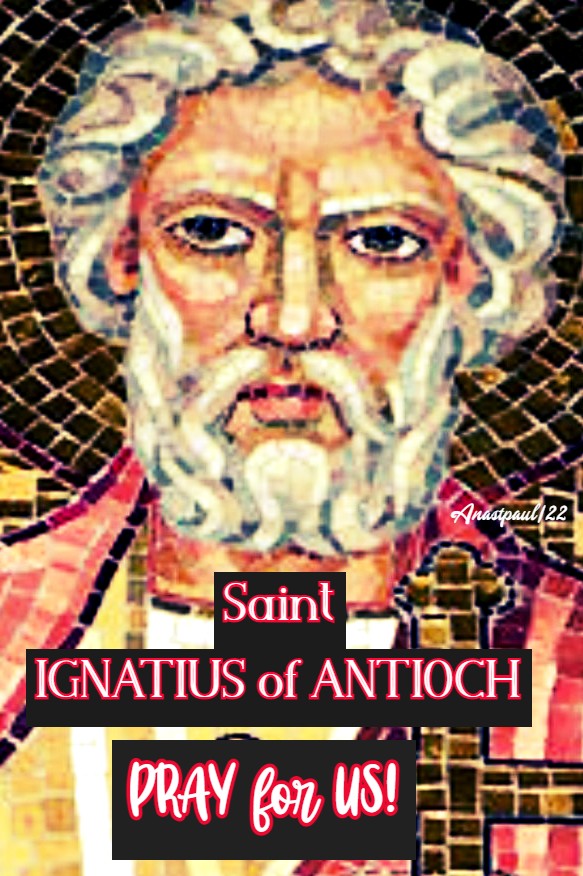
One Minute Reflection – 1 February – “Month of the Most Blessed Trinity” – St Ignatius of Antioch (c 35 – 107) Bishop and Martyr – Romans 8:35-39, John 12:24-26
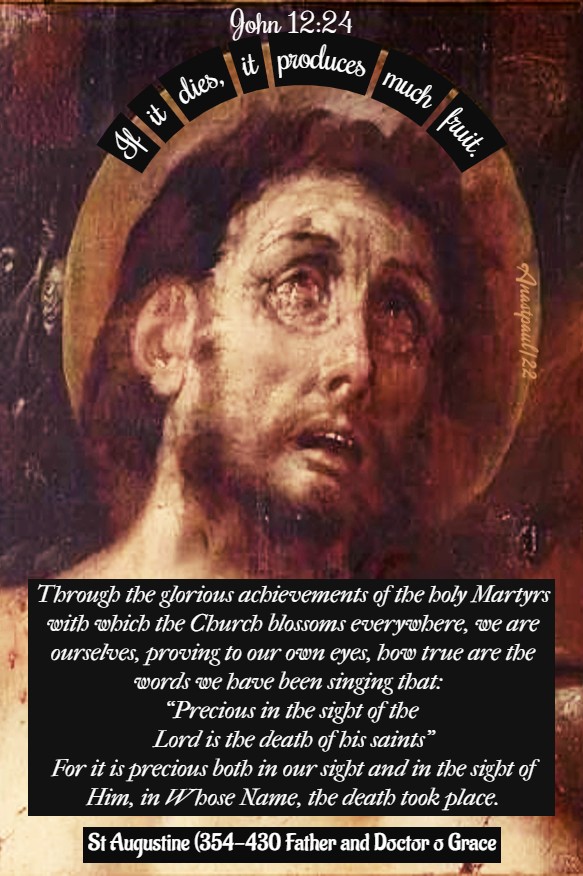
“If it dies, it produces much fruit” – John 12:24
REFLECTION – “Through the glorious achievements of the holy Martyrs with which the Church blossoms everywhere, we are ourselves, proving to our own eyes, how true are the words we have been singing that: “Precious in the sight of the Lord is the death of his saints” (Ps 116[115]:15). For it is precious both in our sight and in the sight of Him, in Whose Name, the death took place.
But the price of those deaths is the death of One Man. How many deaths did that One Man purchase by His death, for, if He had not died, the grain of wheat would not be multiplied? You heard His words when He drew near His passion, that is, when He was drawing near to our Redemption: “Unless a grain of wheat falls into the earth and dies, it remains alone but if it dies, it bears much fruit.” On the Cross He carried out a vast transaction; there the purse of our price was unfastened and, when His side was opened by the lance of the soldier, there streamed the price for the Redemption of the whole earth (cf. Jn 19:34).
Now the faithful ones and Martyrs have been purchased but the faithfulness of the Martyrs, has been proved – their blood is the proof … “As Christ laid down his life for us, so we ought to lay down our lives for the brethren” (1Jn 3:16). In another place it is stated: “At a grand table you have sat; now carefully consider what has been put before you, since it is your duty to prepare for such things” (cf. Prv 23:1). That table is great where the Lord of the table is Himself the Meal. No-one feeds guests with Himself as food but this is exactly what the Lord Christ does, He, Himself is the host who invites; He, Himself is the food and the drink. Therefore, the Martyrs have recognised what they were eating and drinking, so as to be able to repay such gifts. But whence can they make such return, unless He Who first paid the cost, supplies the source from which restitution may be made? That is the reason for the Psalm, where we sing what is written: “Precious in the sight of the Lord is the death of his saints.” ... St Augustine (354-430) Bishop of Hippo, Father and Doctor – (Sermon 329, for the Feast of the Martyrs, 1-2 ; PL 38, 1454).
PRAYER – Be mindful of our weakness, O almighty God and since the burden of our deeds is grievous to us, grant that the glorious intercession of blessed Ignatius Thy Martyr and Bishop, may protect us. Through Jesus Christ, Thy Son our Lord, Who lives and reigns with Thee, in the unity of the Holy Ghost, God, world without end. Amen (Collect).
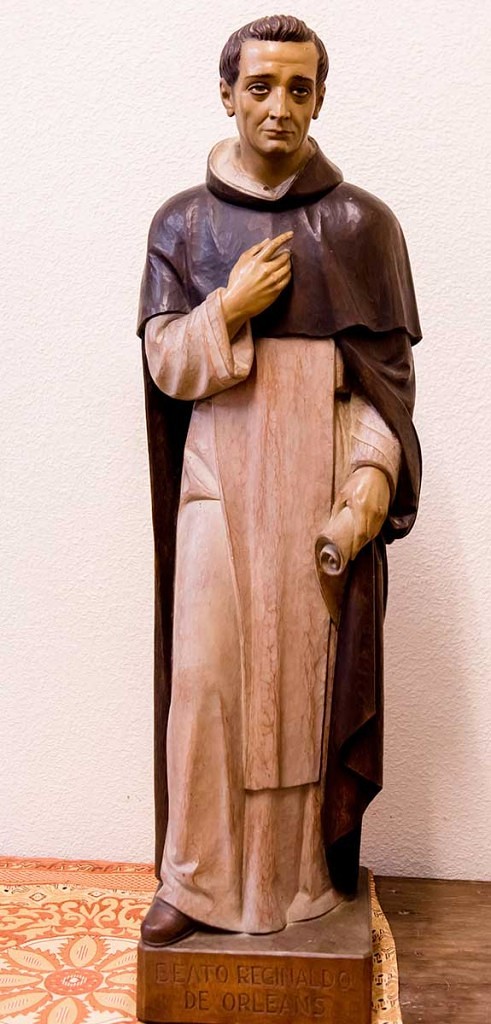
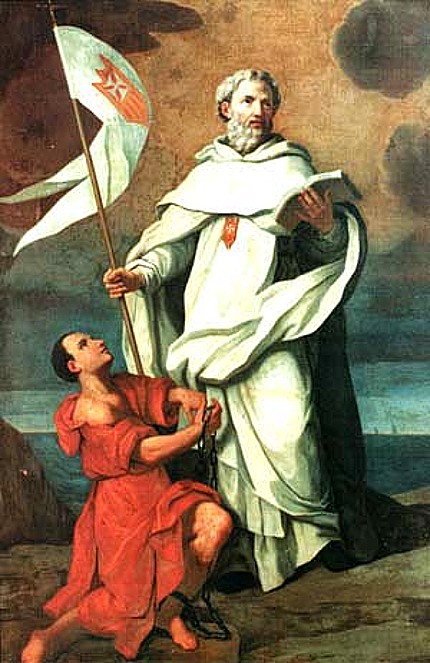
Saint of the Day – 1 February – Blessed Reginald of Orléans OP (c 1180 – 1220) Priest and Friar of the Order of Preachers, Canon Lawyer, renowned Preacher, Born in c 1180 in Orléans, France and died in early February 1220 in Paris, France of natural causes. Also known as – Réginald de Saint-Gilles, Reginaldo… Additional Memorial – 12 February (Dominicans).
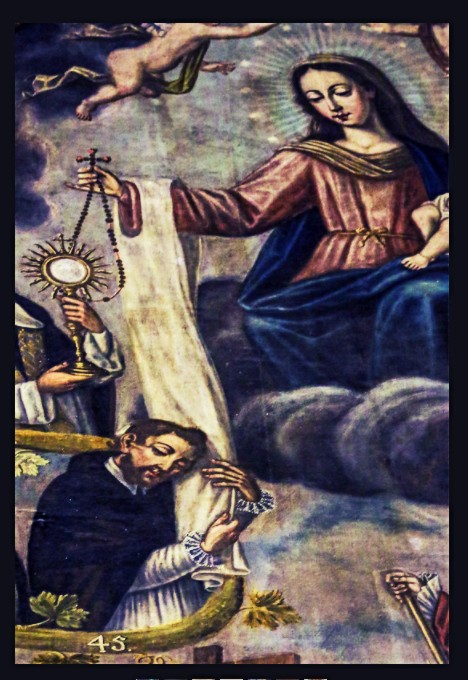
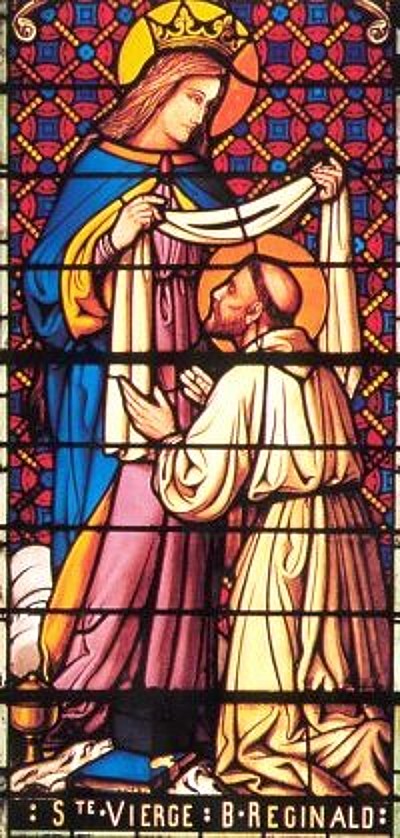
The Miraculous cure of Blessed Reginald by the Blessed Virgin Mary
Reginald of Orleans was known, even during his lifetime, for his brilliance, his prayer, his austerity and his kindness toward others, especially the poor. Originally a powerful Preacher and esteemed Canonist associated with the University of Paris, Reginald encountered St Dominic in Rome. Reginald was captivated by the apostolic way of life championed by Dominic and decided to join the newly-founded Order. Blessed Reginald is one of the great early Dominicans who were acquainted with Dominic himself and seemed to be given a share of the Founder’s spirit.
Blessed Reginald’s life story can be divided into two parts: one before he met St Dominic,and the other, after he had met the Founder. He was born in Orleans, France in c 1180 and having been Ordained a Priest, he had become a Doctor of Canon Law and a well-known figure in the Church in Paris. Many must have looked at him and thought that he had everything he wanted. But, in reality, he was feeling dissatisfied with his life: as was commonplace in the Church in those times he had a very comfortable and well-off lifestyle, yet he knew that his calling from Jesus Christ was to something greater than mere comfort and prestige. And so he was in a dilemma.
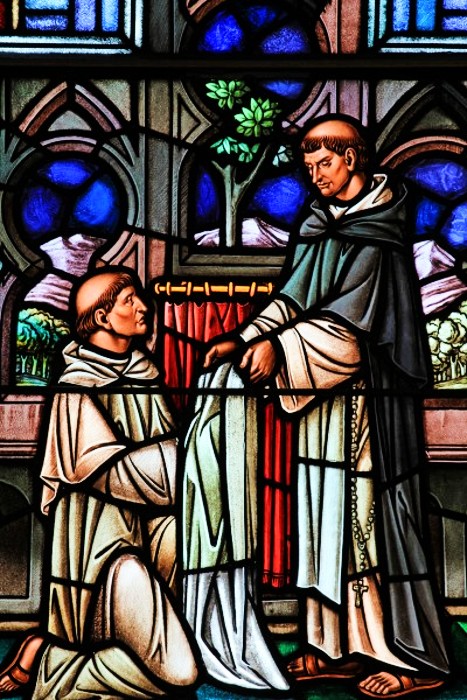
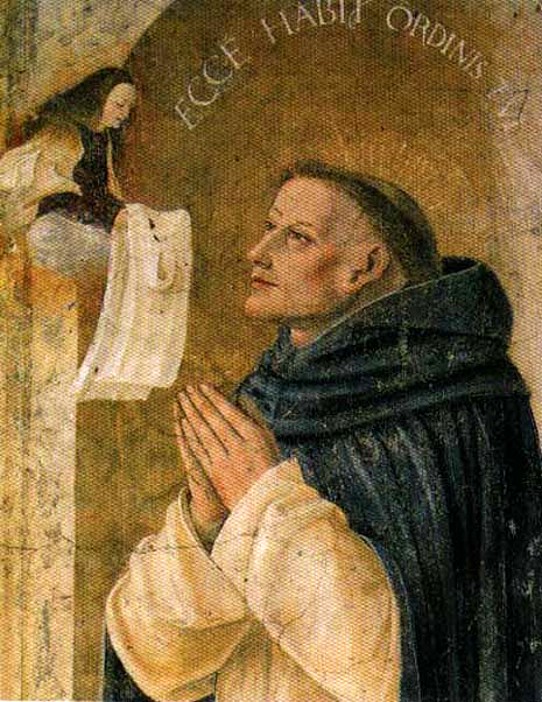
Blessed Reginald receives the Habit from the hands of St Dominic
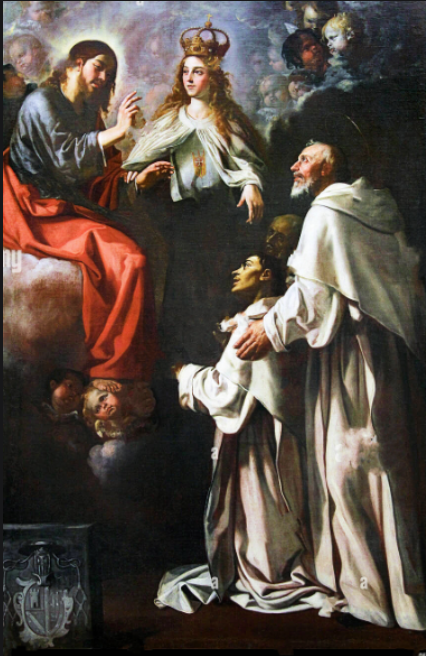
In the year 1218 Reginald was in Rome, when he fell seriously ill. As it happened, Dominic was also in Rome and a mutual acquaintance told him about the condition of Reginald, so that he went to visit him. The biographers tell us, that there was immediately, a perfect understanding between the two men – Reginald saw, that the new Dominican Friars were living the sort of ideal he had been longing for and there and then, he made his religious profession into the Order of Preachers. There was a great sign given to mark this moment of decision: as Reginald lay sick, his life in danger, he was favoured with a vision of the Blessed Virgin Mary who anointed him with oil and held out to him the Dominican habit. Blessed Reginald found himself completely cured and began with great energy to live the Dominican life.
It was quickly apparent to everyone, that he was a changed man. In the City of Bologna where he was assigned and became the Prior of the Dominican Convent there, he became known to the whole City, as a great Preacher of the Gospel, preaching with overflowing faith and conviction. An early biographer wrote, that his preaching ‘like a burning torch, inflamed the hearts of all his hearers.Very few people were so stony-hearted that they could resist the effects of this fire.’.
And, if it is a mark of a true apostle, that he will gather followers to his side, then Reginald, more than passed the test: he attracted a great number in Bologna to join him in the Order of Preachers. Many of them were like him, educated university men and like him, they found the Gospel way of life they had been looking for.
Blessed Reginald was not to enjoy a long life as a Dominican. Early in 1220 he again became ill and this time he died peacefully. . But his place in the history of the Dominican family was assured by the memories of those who had known him in Bologna and had seen a saintly apostle on fire with the love of God and of souls. His meeting with St Dominic gave the final meaning to his life – the beautiful calling, which is given to all those who follow the Lord, to preach the Gospel of Jesus in word and in deed.
“I have no fears for the struggle, nay, I rather look forward to it with impatience, for ever since the Mother of God anointed me with her virginal hands in Rome, I have never ceased to put my whole trust in her and now joyfully await the hour of my deliverance, that I may hasten to see her once more. However, that I may not seem to make little of the Church’s anointing, I profess myself willing to receive it and I humbly ask for it at your hands.”– the final words of Blessed Reginald.
St Cecilius of Granada St Cinnia of Ulster St Clarus of Seligenstadt Bl Conor O’Devany St Crewenna St Darlaugdach of Kildare St Henry Morse St Ioannes Yi Mun-u St Jarlath Bl John of the Grating St Kinnia
Bl Patrick O’Lougham St Paul of Trois-Châteaux St Paulus Hong Yong-ju St Raymond of Fitero Blessed Reginald of Orléans OP (c 1180 – 1220) Priest and Friar of the Order of Preachers St Sabinus St Severus of Avranches St Severus of Ravenna St Sigebert III of Austrasia St Tryphon of Lampsacus St Ursus of Aosta St Veridiana
Martyrs of Avrillé – 47 Beati: Forty-seven Christians executed together for their faith in the anti-Catholic persecution of the French Revolution. • Anne-François de Villeneuve• Anne Hamard• Catherine Cottenceau• Charlotte Davy• François Bellanger• François Bonneau• François Michau• François Pagis epouse Railleau• Gabrielle Androuin• Jacquine Monnier• Jeanne Bourigault • Jeanne Fouchard épouse Chalonneau• Jeanne Gruget veuve Doly• Jeanne-Marie Sailland d’Epinatz• Louise-Aimée Dean de Luigné• Louise-Olympe Rallier de la Tertinière veuve Déan de Luigné• Madeleine Blond• Madeleine Perrotin veuve Rousseau• Madeleine Sailland d’Epinatz• Marguerite Rivière epouse Huau• Marie Anne Pichery épouse Delahaye• Marie-Anne Vaillot• Marie Cassin épouse Moreau• Marie Fausseuse épouse Banchereau• Marie Gallard épouse Quesson• Marie Gasnier épouse Mercier• Marie Grillard• Marie-Jeanne Chauvigné épouse Rorteau• Marie Lenée épouse Lepage de Varancé• Marie Leroy• Marie Leroy épouse Brevet• Marie Roualt épouse Bouju• Odilia Baumgarten• Perrine Androuin• Perrine Besson• Perrine-Charlotte Phelippeaux épouse Sailland d’Epinatz• Perrine Grille• Perrine Ledoyen• Perrine Sailland d’Epinatz• Renée Cailleau épouse Girault• Renée Grillard• Renée Martin épouse Martin• Renée Valin• Rose Quenion• Simone Chauvigné veuve Charbonneau • Suzanne Androuin• Victoire Bauduceau epouse Réveillère. They were martyred on 1 February 1794 in Avrillé, Maine-et-Loire, France and Beatified on 19 February 1984 by St Pope John Paul II at Rome, Italy.
Martyrs of Korea: Thousands of people were murdered in the anti-Catholic persecutions in Korea. Today we celebrate and honour: • Saint Barbara Ch’oe Yong-i • Saint Ioannes Yi Mun-u • Saint Paulus Hong Yong-ju
Thought for the Day – 31 January – Meditations with Antonio Cardinal Bacci (1881-1971)
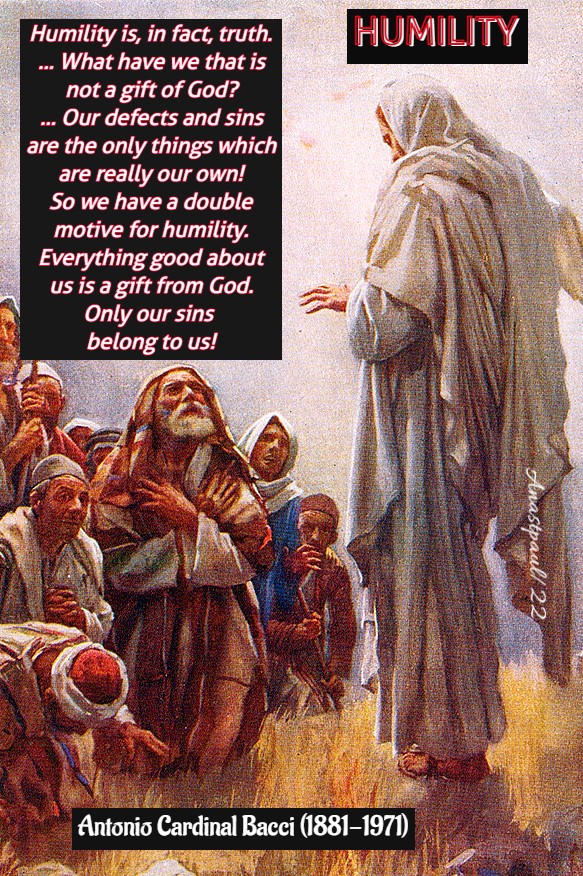
Humility
“Humility is, in fact, truth. Many think that it is a menial fiction, or a pious congregation and that only a few can really achieve it.
In other words, we must disregard ourselves. We must be content to be unknown and unesteemed. This might seem to be contrary to, or at least, superior to human nature but it is based on the simple naked truth. What have we that is not a gift of God? All that we have in the natural and supernatural order, we have received from God: “What hast thou that thou hast not received? And if thou hast receive it, why dost thou boast as if thou hast not received it?” (1 Cor 4:7).
Our defects and sins are the only things which are really our own! So we have a double motive for humility. Everything good about us is a gift from God. Only our sins belong to us!”
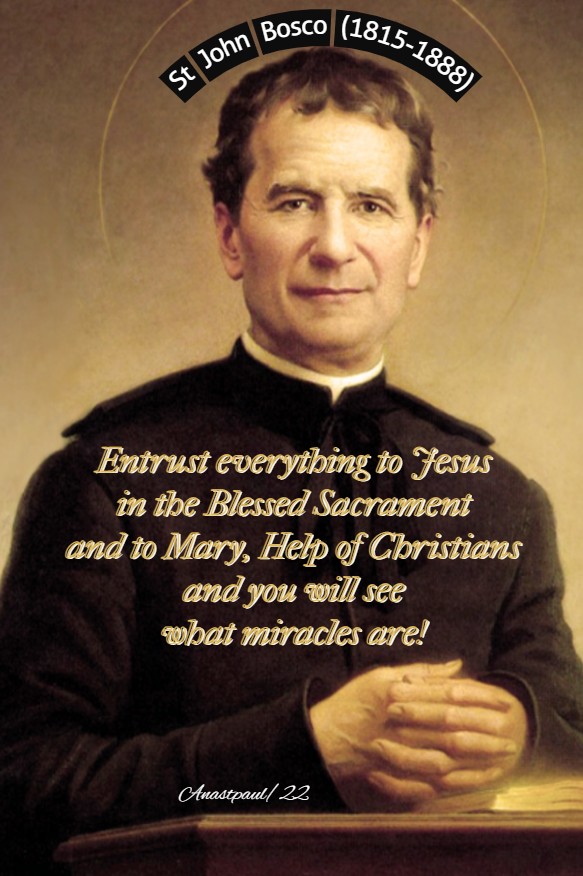
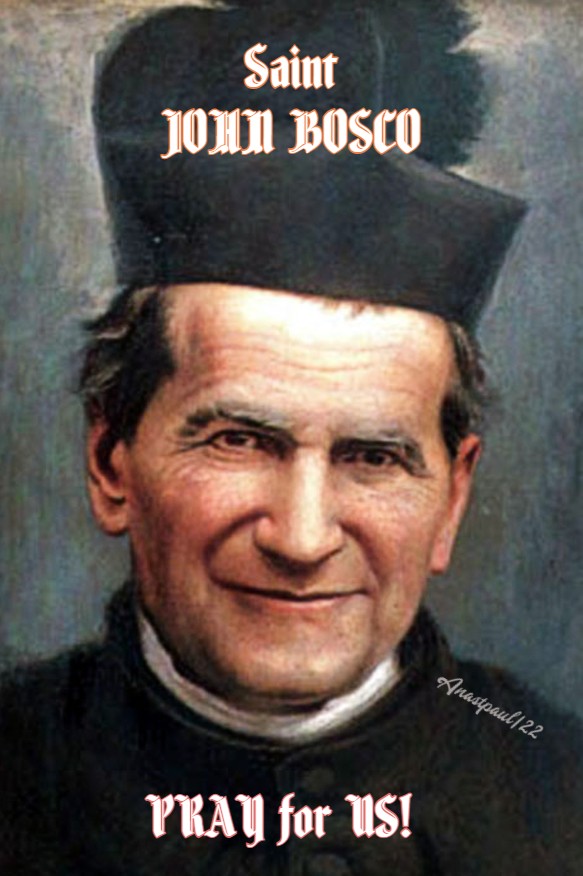
Quote/s of the Day – 31 January – The Memorial of St John Bosco (1815-1888)
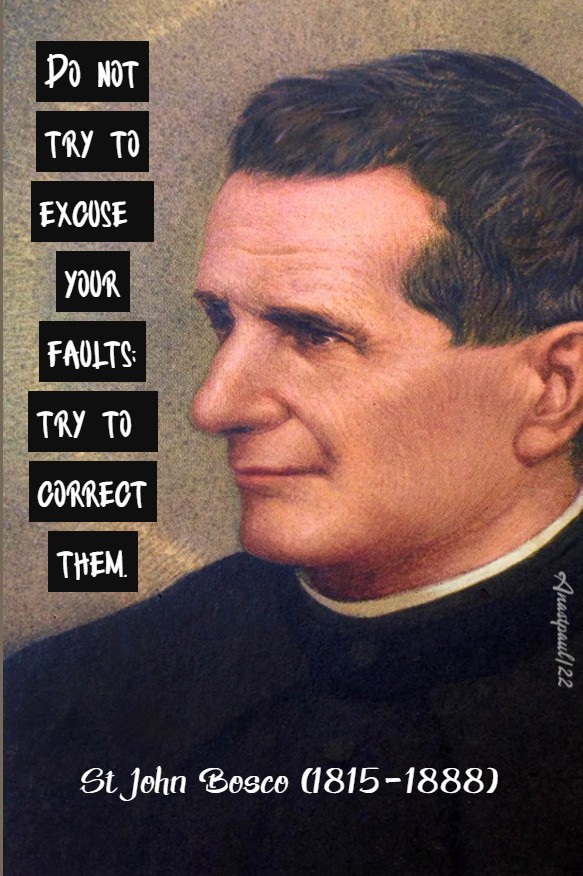
“Do not try to excuse your faults; try to correct them.”
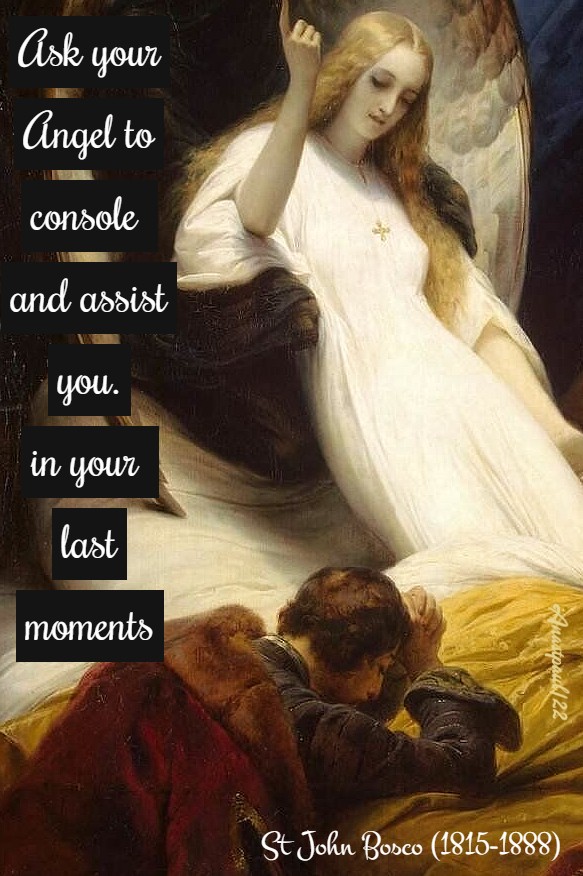
“Ask your Angel to console and assist you in your last moments.”
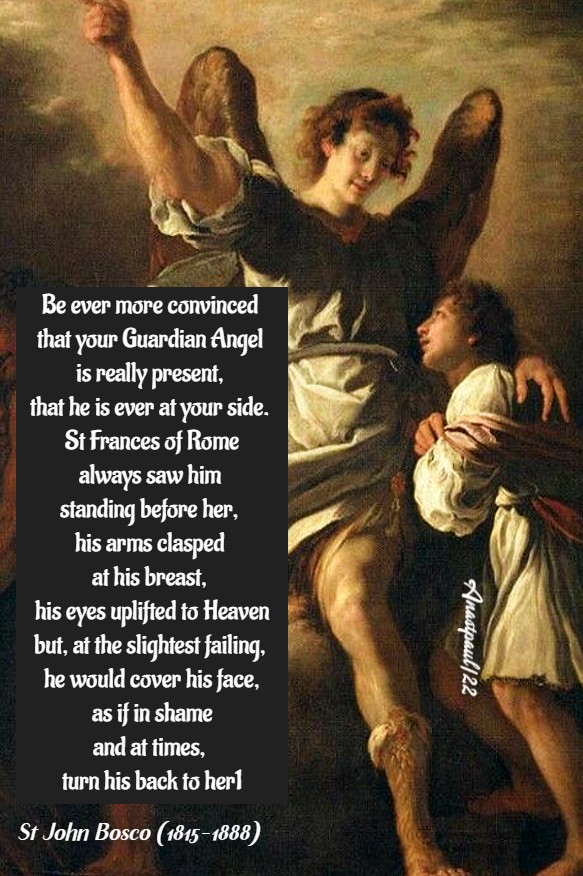
“Be ever more convinced that your Guardian Angel is really present, that he is ever at your side. St Frances of Rome always saw him standing before her, his arms clasped at his breast, his eyes uplifted to Heaven but, at the slightest failing, he would cover his face, as if in shame and at times, turn his back to her!”
“Entrust everything to Jesus in the Blessed Sacrament and to Mary, Help of Christians and you will see what miracles are!”
One Minute Reflection – 31 January – St John Bosco, Confessor (1815-1888 – Philippians 4:4-9, Matthew 18:1-5
“Amen, I say to you, unless you turn and become like little children, you will not enter the kingdom of heaven.”… Matthew 18:3
REFLECTION – “We must seek for reasons for individual sayings and actions of the Lord. After the coin was found, after the tribute paid, what do the Apostles’ sudden questions mean? Why precisely “at that time” did the disciples come to Jesus saying, “Who is the greatest in the kingdom of heaven?” Because they had seen that the same tax had been paid for both Peter and the Lord. From the equal price they inferred, that Peter may have been set over all the other Apostles, since Peter had been compared with the Lord in the paying of the tax. So they ask, who is greater in the Kingdom of Heaven. Jesus, seeing their thoughts and understanding the causes of their error, wants to heal their desire for glory, with a struggle for humility.”
He called a child to Him, to ask its age or to show the image of innocence. Or perhaps He actually set a child in their midst — He Himself, Who had not come to be served but to serve — to show them an example of humility.
Whoever humbles himself like this child, he is the greatest in the Kingdom of Heaven. Just as this child, whose example I show you, does not persist in anger, does not long remember injury suffered, is not enamoured inordinately by the sight of a beautiful woman, does not think one thing and say another, so you too, unless you have similar innocence and purity of mind, will not be able to enter the Kingdom of Heaven! Or, it might be taken in another way: “Whosoever, therefore, humiliates himself like this child, is greater in the kingdom of heaven,” so as to imply that anyone, who imitates Me and humiliates himself following My example, so that he abases himself as much as I abased Myself in accepting the form of a servant, will enter the Kingdom of Heaven.” – St Jerome (343-420) Translator of Sacred Scripture into Latin (The Vulgate) One of the original four Doctors of the Latin Church, Father (Commentary on Matthew 3).
PRAYER – O God, Who in Your Confessor, blessed John, raised up a father and teacher of youth and willed that through him, with the help of the Virgin Mary, new religious families should bloom in the Church, grant, we beseech You, that, inflamed by the same fire of love, we may seek to win souls and to serve You alone. Through Jesus Christ, Thy Son our Lord, Who lives and reigns with Thee, in the unity of the Holy Ghost, God, world without end. Amen (Collect)
Our Morning Offering – 31 January – “Month of the Most Holy Name of Jesus”
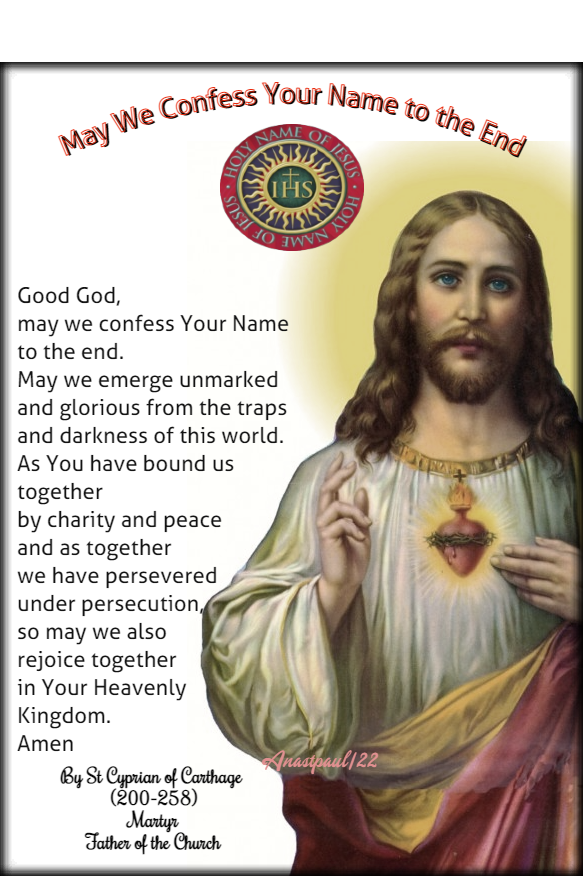
May We Confess Your Name to the End By St Cyprian of Carthage (200-258) Bishop and Martyr Father of the Church
Good God, may we confess Your Name to the end. May we emerge unmarked and glorious from the traps and darkness of this world. As You have bound us together by charity and peace and as together we have persevered under persecution, so may we also rejoice together in Your heavenly kingdom. Amen
Saint of the Day – 31 January – Saint Aedan of Ferns (c 550-632) the First Bishop of the Diocese of Ferns, Ireland, Founded 30 Churches and several Monasteries, miracle-worker. Born in c 550 as Aedat Inisbrefny, Templeport, County Cavan, Ireland and died on 31 January 632 at Ferns, Ireland of natural causes. Patronages – Ferns, Ireland, Diocese of, Wexford, Ireland. Also known as – Aeddan Foeddog, Mo-Aedh-og (= my dear Aedh), Aedh-og, Aidan, Aidus, Edan, Hugh, Maedoc, Maidoc, Maodhóg, Moedhog, Mogue.
The father of the boy who was to become the first Bishop of the Diocese of Ferns, was named Sétna (modern Irish Séanna); he was married to Eithne who was descended from the King of Connacht. The couple were childless for some time and prayed earnestly for a son. For this intention they were generous in almsgiving and also frequented a Monastery at Drumlane in the present County of Cavan.
Their prayers were answered and Eithne gave birth to a boy. The place of his birth was a small island called Inis Bréachmhaí (Breaghwy) in a lake in the present parish of Templeport in County Cavan. The year of his birth has not been accurately determined but it was some time in the middle of the sixth century.
Irish legend says that the “Bell of St Mogue” was given to the infant on his birth by Saint Caillín. When a boat could not be found to take the infant Aedan across the lake to where Caillín waited to Baptise him, Aedan was floated to shore on a slab of stone. The font at St Mogue’s in Bawnboy is said to be made from part of the stone.
We are told that, while still a small boy, he was surrendered by his father as a hostage to the Ard-Rí, Ainmire, the High King of Ireland. Ainmire was so impressed with Aedan that he told him he could stay or go. Aedan said he would go but only if the other hostages were also released, whereupon Ainmire let them all return home
He studied at the great school of Saint Finnian at Clonard Abbey. While at Clonard, Aedan made friends with St Molaise, who would later found the Monastery of Devenish Island on the River Erne.
As he grew to manhood, his fame for sanctity spread and many young men approached him, desiring to embrace the religious life under his direction. Through a spirit of humility and wishing to avoid distinction, Aedan left his native district and eventually crossed to Wales where he placed himself under the direction of St David, David, Bishop of Menevia. Welsh legends, meanwhile, simply place his upbringing with David and go into great detail concerning attempts on his life by David’s steward. Along with Saint Cadoc, he was said to have exterminated an army of Saxons or Irishmen by rolling stones upon their camp in a narrow valley. He was listed in the Welsh triads as one of David’s three most faithful disciples.
Aedan returned to Ireland in 570, landing on the coast of Wexford with hives of honey bees, which he had been told were scarce on the island. He landed as some locals were plundering another group of strangers and his quick response so impressed the local chieftain, who granted him lands for religious communities. He then settled at Brentrocht in Leinster. Aedan is said to have fasted for seven years, during this period he ate only barley bread with water
Aedan built his first Church and established his first Monastery at Ferns in 598 and it is accepted that he was Consecrated Bishop that same year, so he was both Abbot of the Monastery and Bishop. He founded thirty Churches and many Monastic settlements in the area; becoming. in time, the Head Bishop of the area. Besides his first establishment at Fern, he is especially associated with Templeshanbo. As well as in the Diocese which he founded, he is also venerated in the Diocese of Kilmore, particularly at Droim Leathan and at his birthplace,Templeport and at Rossinver, County Leitrim.
Aedan was renowned for his generosity and kindness – on one occasion, seeing them exhausted by their journey, he permitted beef to be given to a visiting delegation of British Bishops during Lent and permitted them to excuse themselves with the claim that the slaughtered cow was merely “milk and vegetables in condensed form” whereas the whey and biscuits, the other Monks consumed, had so many weevils as to occasion “conscientious scruples.” On another, he was pushed into a lake to see whether he would lose his temper; upon his meekly restoring himself, his tormenter confessed their purpose to him.
Aedan died on 31 January 632 on Lough Melvin’s shore in County Leitrim. His relics are claimed by St Edan’s in Ferns. His stone tomb is inside the Cathedral, although his remains are in the original Cathedral crypt below. The Breac Maodhóg (his Shrine) dates from the 9th century and is an example of an early medieval reliquary. It was often used as a sacred object upon which to swear binding oaths. It was acquired by the National Museum of Ireland in the 1890s.
Aedan’s life was replete with miracles. During his sojourn in Wales, he broke a jug while fetching ale for his fellow Monks; making the sign of the cross over the shards, however, it was repaired and he continued on his errand. A yoke given to him by David’s steward purposefully too small to fit the necks of his oxen ,miraculously accommodated them and permitted him to bring the necessary materials for the needs of the Monsastery.
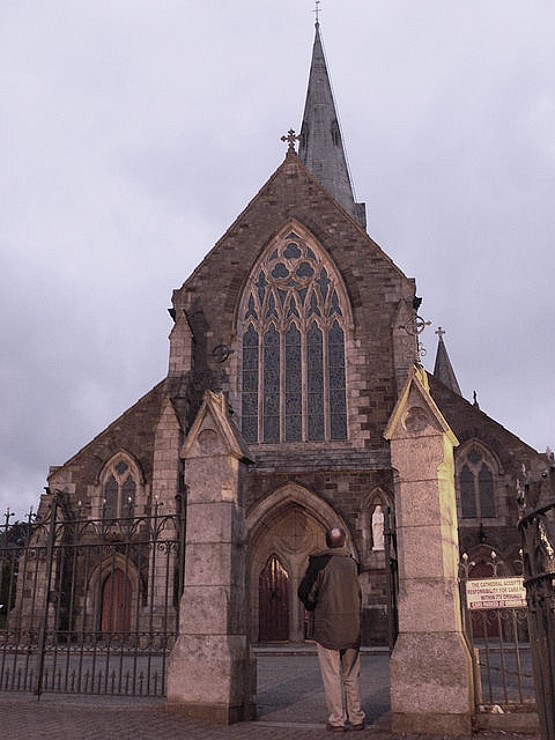
St Aedan’s Cathedral in Ferns
After his return to Ireland, a local begged him for some meal as he was grinding flour and, after receiving some, disguised himself as a blind man to come back and beg for more. Annoyed, the Saint recognising him, cursed him that the generations of his descendants would never lack for a blind member. Another time, wolves devoured a calf at one of his Monasteries; its mother being inconsolable, Aedan blessed the head of his cook and told him to offer it to the heifer, which licked him and thenceforth “loved him like a calf.” When asked by St Fintan to heal the Monks suffering under an epidemic, Aedan was said to have indulged him: first by curing the Monks and then by permitting the sickness to resume when Saint Fintan changed his mind, considering the sickness to be good for their souls. Miraculous blessings from Aidan were credited with various military victories.
In the year 2000 the Anniversary of 1400 years of the Diocese of Ferns was celebrated the 1400, delayed by a couple of years because of the desire not to clash with the Insurrection of 1798 commemorations.
St Abraham of Abela Bl Adamnan of Coldingham St Aedan of Ferns (c 550-632) Bishop St Aiden St Athanasius of Modon St Bobinus of Troyes St Eusebius of Saint Gall
St Geminian of Modena Bl John Angelus St Julius of Novara Bl Louise degli Albertoni Bl Luigi Talamoni St Madoes St Marcella Bl Maria Cristina di Savoia St Martin Manuel St Nicetas of Novgorod St Tryphaena of Cyzicus St Tysul St Ulphia of Amiens St Waldo of Evreux St Wilgils
Martyrs of Corinth – 14 Saints: A group of Christians tortured and martyred together in Corinth, Greece in the persecutions of Decius. We know nothing about them except some names – Anectus, Claudius, Codratus, Crescens, Cyprian, Diodorus, Dionysius, Nicephorus, Papias, Paul, Serapion, Theodora, Victor and Victorinus.
Martyrs of Canope: Athanasia Cyrus the Physician Eudoxia John the Physician Theoctista Theodotia
Martyred in Alexandria, Egypt: Cyriacus Metranus Saturninus Tarskius Thyrsus Victor Zoticus
Martyred in the Spanish Civil War: José Acosta Alemán Juan José Martínez Romero Pedro José Rodríguez Cabrera
Martyrs of Korea: Thousands of people were murdered in the anti-Catholic persecutions in Korea. • Saint Agatha Kwon Chin-i • Saint Agatha Yi Kyong-I • Saint Augustinus Park Chong-Won • Saint Magdalena Son So-Byok • Saint Maria Yi In-Dok • Saint Petrus Hong Pyong-Ju
Thought for the Day – 30 January – Meditations with Antonio Cardinal Bacci (1881-1971)
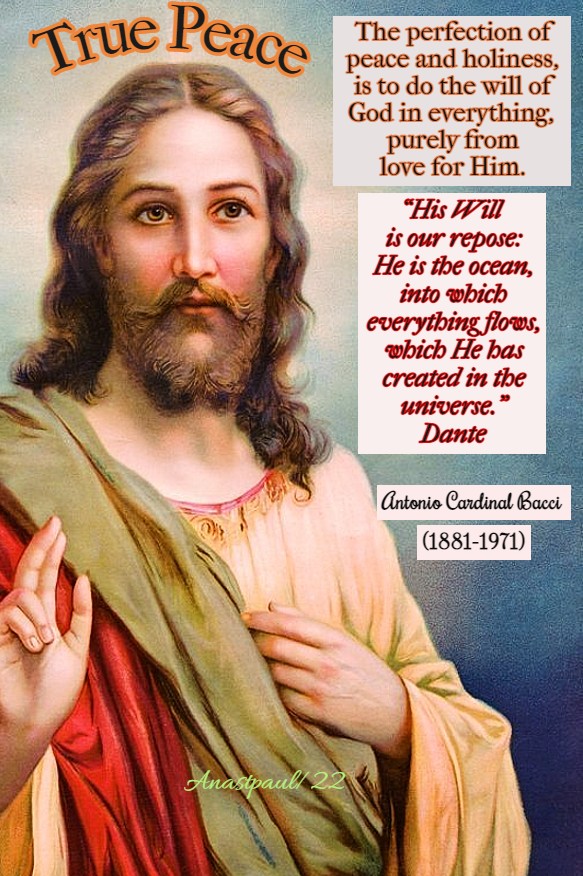
True Peace
“When He came into the world, Jesus proclaimed peace. The Angels hovering over His humble manger, sang songs of glory to God on high and of peace to men of goodwill on earth. During His earthly pilgrimage, He often spoke of peace. When He forgave sinners their faults, He said to each of them, “Go in peace” and “sin no more” (Lk 7:50; 8:48; Jn 8:11). When He was leaving this earth, He bequeathed His peace to His Apostles, as if it were a sacred heirloom: “Peace I leave with you, My peace, I give to you, not as the world gives do I give to you” (Jn 14:27). We can see, from these words, that the peace of Jesus, is not the same as worldly peace.
The Church, in its liturgy, implores from God, that peace which the world cannot give. When the world speaks of peace, it means, normally, the external public peace which flows from respect for the law and for the established regime. This is peace, there is no doubt about that. It is necessary and is a gift from God. But, it is not enough. We need the inner peace of soul of which we have already spoken, for it is the only true and solid foundation for external peace. Without this peace of soul, external peace is uncertain and fleeting.
We have said, that true peace is based on three things: Right order, harmony and liberty. But, in order to obtain full and perfect peace, still one more thing is necessary – complete and loving abandonment to the will of God. The beginning of real peace and holiness, lies in doing the will of God in every detail. The perfection of peace and holiness, is to do the will of God in everything, purely from love for Him.
Dante expresses this profound idea when he decries the peace of the blessed in Heaven, now unshakeable in their joyful compliance with the divine will.”
“E la sua volontate e nostra pace: Ella E quel mare, al qual tutto si move cio ch’ella crea E che natura face.”
“His Will is our repose: He is the ocean, into which everything flows, which He has created in the universe.”
Quote/s of the Day – 30 January – Fourth Sunday after the Epiphany – Romans 13:8-10, Matthew 8:23-27
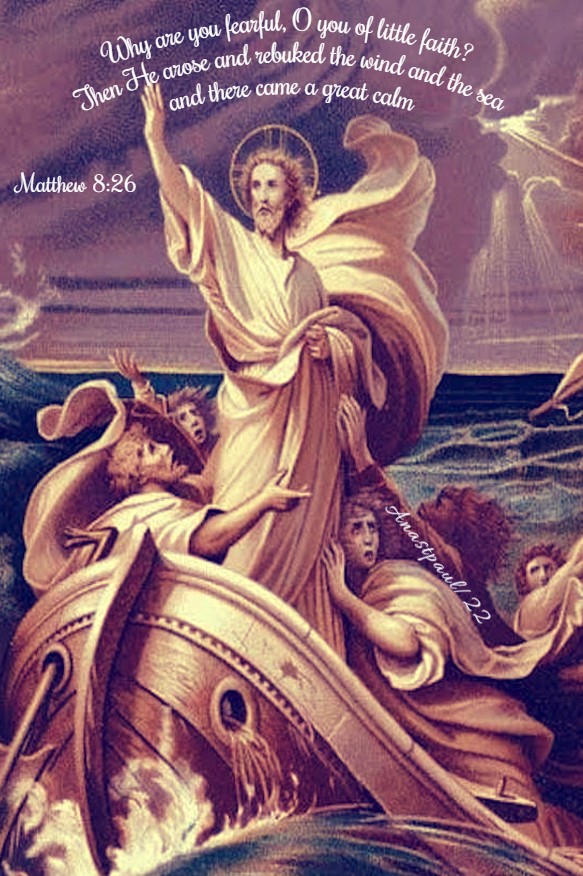
“Why are you fearful, O you of little faith? Then He arose and rebuked the wind and the sea and there came a great calm.”
Matthew 8:26
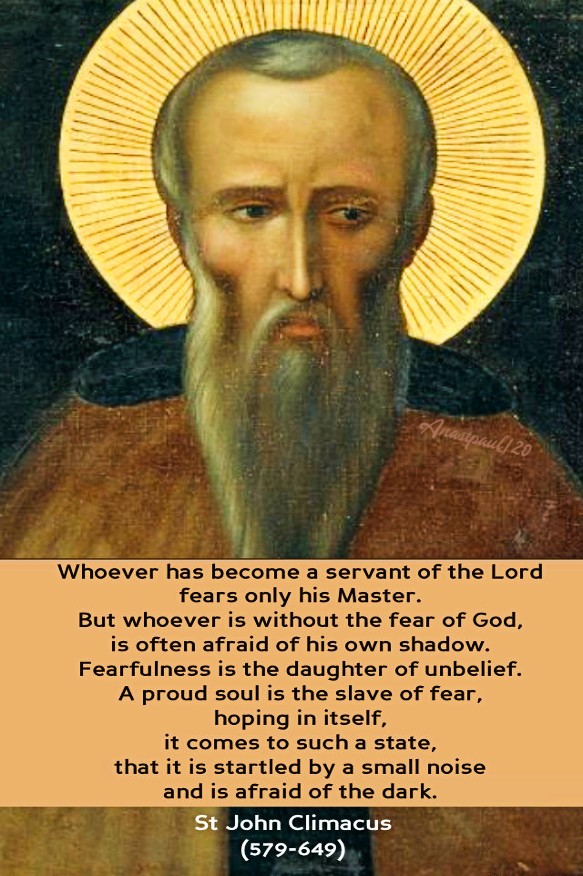
“Whoever has become a servant of the Lord, fears only his Master. But whoever is without the fear of God, is often afraid of his own shadow. Fearfulness is the daughter of unbelief. A proud soul is the slave of fear, hoping in itself, it comes to such a state, that it is startled by a small noise and is afraid of the dark.”
St John Climacus (579-649) Father of the Church
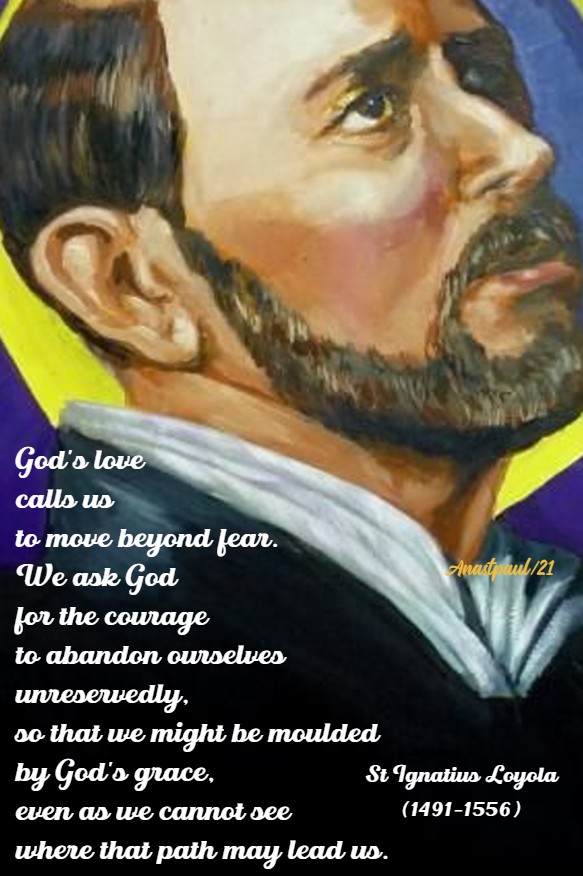
“God’s love calls us to move beyond fear. We ask God for the courage to abandon ourselves unreservedly, so that we might be moulded by God’s grace, even as we cannot see where that path may lead us.”
St Ignatius Loyola (1491-1556)
“Do not look forward to the changes and chances of this life in fear – rather look to them with full hope that, as they arise, God, whose you are, will deliver you out of them. He is your keeper. He has kept you hitherto. Do you but hold fast to His dear hand and He will lead you safely through all things and, when you cannot stand, He will bear you in His arms. Do not look forward to what may happen tomorrow. Our Father will either shield you from suffering, or He will give you strength to bear it.”
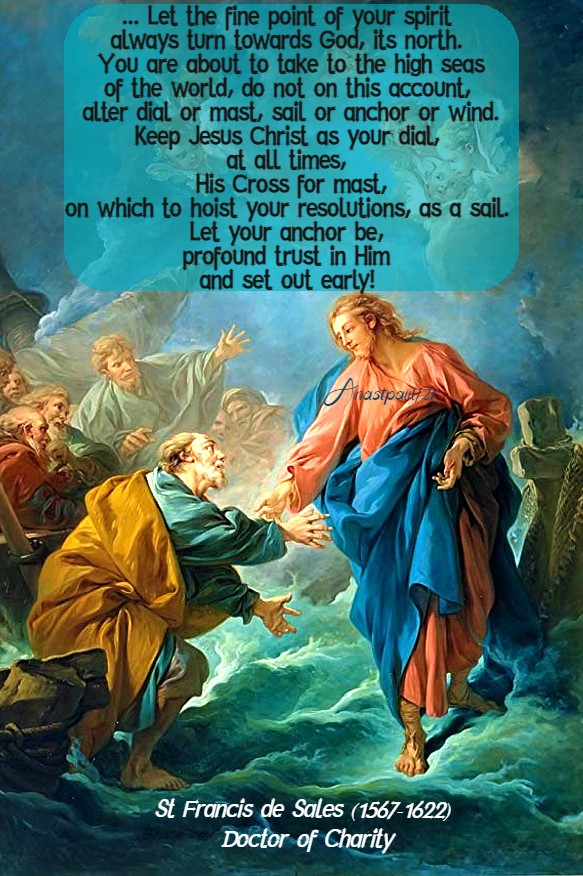
“ … Let the fine point of your spirit always turn towards God, its north. Your are about to take to the high seas of the world, do not, on this account, alter dial or mast, sail or anchor or wind. Keep Jesus Christ as your dial, at all times, His Cross for mast, on which to hoist your resolutions, as a sail. Let your anchor be, profound trust in Him and set out early!”
St Francis de Sales (1567-1622) Doctor of the Church
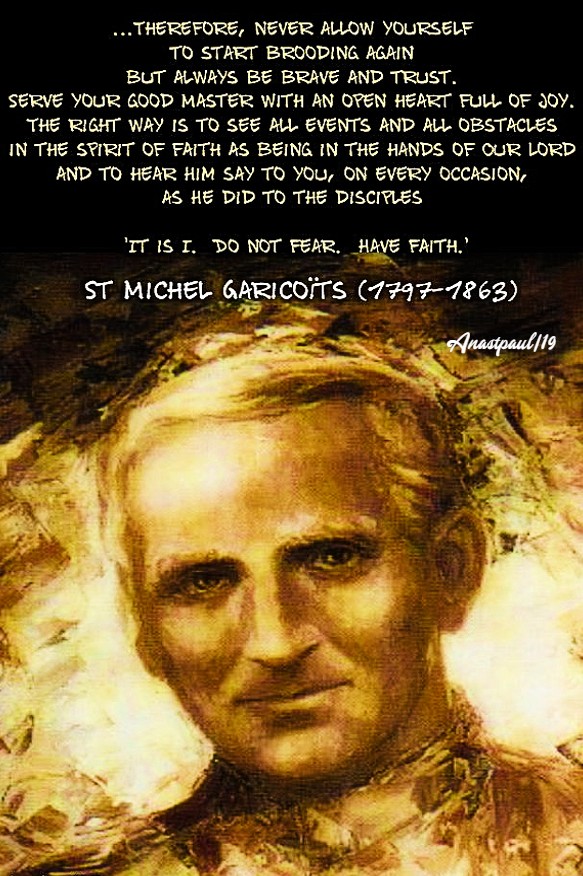
“…Therefore, never allow yourself to start brooding again but always be brave and trust. Serve your good Master with an open heart full of joy. The right way is to see all events and all obstacles in the spirit of faith as being in the hands of Our Lord and to hear Him say to you, on every occasion, as He did to the disciples, ‘It is I. Do not fear. Have faith.’”
One Minute Reflection – 30 January – Fourth Sunday after the Epiphany – Romans 13:8-10, Matthew 8:23-27
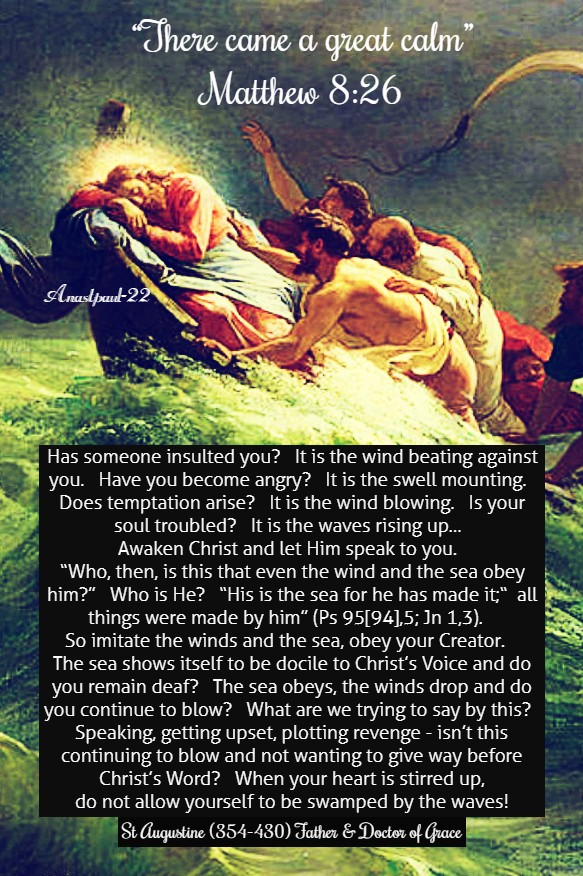
“There came a great calm” – Matthew 8:26
REFLECTION – “Christ’s sleep is the symbol of a mystery. The ship’s passengers represent souls traversing the life of this world, on the wood of the cross. In addition, the ship is the symbol of the Church. Indeed, truly… the heart of each member of the faithful, is a ship sailing across the sea: – it cannot sink, provided the spirit engages in good thoughts.
Has someone insulted you? It is the wind beating against you. Have you become angry? It is the swell mounting. Does temptation arise? It is the wind blowing. Is your soul troubled? It is the waves rising up… Awaken Christ and let Him speak to you.“Who, then, is this that even the wind and the sea obey him?” Who is He? “His is the sea for he has made it;“ all things were made by him” (Ps 95[94],5; Jn 1,3). So imitate the winds and the sea, obey your Creator. The sea shows itself to be docile to Christ’s Voice and do you remain deaf? The sea obeys, the winds drop and do you continue to blow? What are we trying to say by this? Speaking, getting upset, plotting revenge – isn’t this continuing to blow and not wanting to give way before Christ’s Word? When your heart is stirred up do not allow yourself to be swamped by the waves!
If, nevertheless, the wind blows us over – for we are only human – and if it stirs up the bad feelings in our hearts, let us not despair. Let us awaken Christ, so as to continue our journey on a peaceful sea.” – St Augustine (354-430), Bishop of Hippo, Great Western Father and Doctor of Grace of the Church (Sermon 63).
PRAYER – O God, You Who know that our human frailty cannot stand fast against the great dangers that beset us, grant us health of mind and body, that with your help we may overcome what we suffer on account of our sins. Through Jesus Christ, Thy Son our Lord, Who lives and reigns with Thee, in the unity of the Holy Ghost, God, world without end. Amen. (Collect).
Our Morning Offering – 30 January – Fourth Sunday after the Epiphany
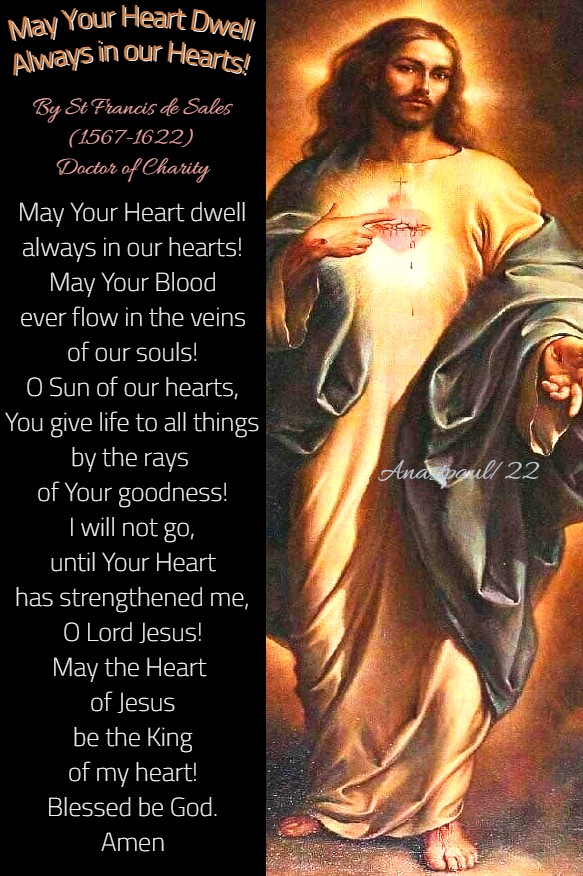
May Your Heart Dwell Always in our Hearts! By St Francis de Sales (1567-1622) Doctor of Charity
May Your Heart dwell always in our hearts! May Your Blood ever flow in the veins of our souls! O Sun of our hearts, You give life to all things by the rays of Your goodness! I will not go, until Your Heart has strengthened me, O Lord Jesus! May the Heart of Jesus be the King of my heart! Blessed be God. Amen
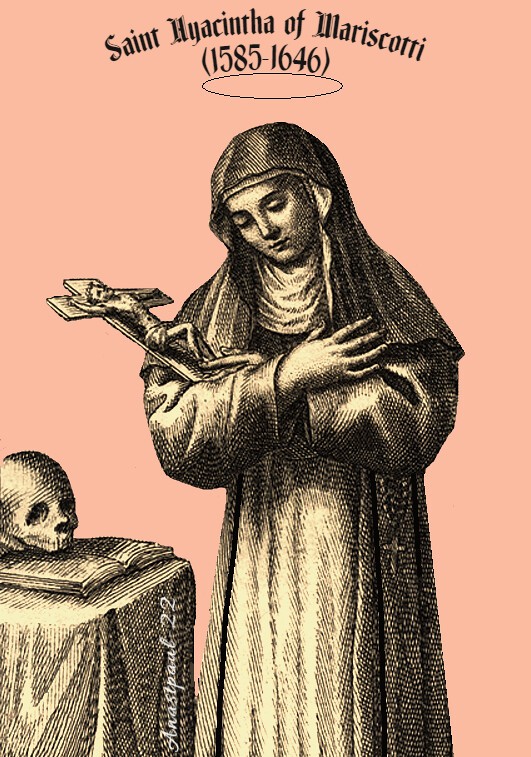
Saint of the Day – 30 January – Saint Hyacintha of Mariscotti TOR (1585-1646) Virgin, Sister of the Tertiary or Third Order Regular of St Francis (also TOSF), Penitent, Apostle of the poor, the sick, the elderly. She established apostolates to aid the latter as well as another devoted to the Adoration of the Holy Eucharist. Born in 1585 near Viterbo, Italy and died on 30 January 1640, aged 54, at Viterbo, Italy of natural causes. Also known as – Giacinta Marescotti, Clarice Marescotti.
The Roman Martyrology reads today: “In Viterbo, Saint Giacinta Marescotti, Virgin of the regular Third Order of Saint Francis, who, after fifteen years spent among vain pleasures, embraced a very hard life and established a brotherhoods for the assistance of the elderly and for the Adoration of the Holy Eucharist.”
Hyacintha was born of a noble family, her parents being Count Marcantonio Marescotti and Countess Ottavia Orsini, whose father had built the noted Gardens of Bomarzo. They had their new baby daughter Baptised as Clarice. At an early ages she and her sisters, Ginevra and Ortensia, were sent to the Monastery of St Bernardine to be educated by the community of Sisters of the Franciscan Third Order Regular. When their studies were completed, her older sister, Ginevra, chose to enter the Monastic community as a nun, becoming known as Sister Immacolata.
In her early youth, Clarice had been noted for her piety but, as she grew older, she became frivolous. At the age of 20 Clarice set her heart upon marriage with the Marchese Capizucchi, but was passed over by him in favour of her younger sister, Ortensia. Disappointed, she entered the Monastery in Viterbo where she had been educated, receiving the name Hyacintha. She admitted later, that she did this only to hide her chagrin and not to give up the luxuries of the world. She kept a private stock of extra food, wore a habit of the finest material and received and paid visits at will.
For ten years, Hyacintha kept up this life, contrary to the spirit of her vows but at the same time, she retained a strong religious faith and was regular in her following of the daily routine of the Monastery life, with a tender devotion to the Virgin Mary. At that point, due to a severe illness, the Priest who served as the Confessor to the Monastery went to her cell to bring her Holy Communion. Shocked by the display of luxuries he saw there, he admonished her to a closer observance of the way of life to which she had committed herself.
Hyacintha experienced a profound inner transformation, after her serious illness and some deaths in the family. Twenty-four extraordinary and very hard years began for Sister Hyacintha in total poverty. And of continuous penances, with harshness that are difficult to understand today.
She gave away her costly garments, wore an old tunic, went barefoot, frequently fasted on bread and water and chastised her body by vigils. During the outbreak of a plague in the City, she became noted for her devotion in nursing the sick.
Hyacintha went on to establish two apostolates whose members were called Oblates of Mary or “Sacconi.” One of these, similar to the Society of St. Vincent de Paul, gathered alms for the convalescent, for the poor who were ashamed to beg and for the care of prisoners; the other procured homes for the aged.
By the time of her death, Hyacintha’s reputation for holiness was so great, that, at her wake, her religious habit had to be replaced three times. This was due to pieces of it being snipped off by the people to keep as a relic.
Hyacintha was Beatified by Pope Benedict XIII in 1726 and Canonised on 14 May 1807 by Pope Pius VII. Today her remains are preserved for veneration in the Church of her Monastery, which now bears her name.
St Felix IV, Pope Bl Francis Taylor Bl Haberilla Saint Hyacintha of Mariscotti TOR (1585-1646) Virgin, Sister of the Tertiary or Third Order Regular of St Francis (also TOSF). St Hippolytus of Antioch Bl Margaret Ball Bl Maria Bolognesi St Martina of Rome St Matthias of Jerusalem St Mutien Marie Wiaux St Paul Ho Hyob St Philippian of Africa St Savina of Milan
Thought for the Day – 29 January – Meditations with Antonio Cardinal Bacci (1881-1971)
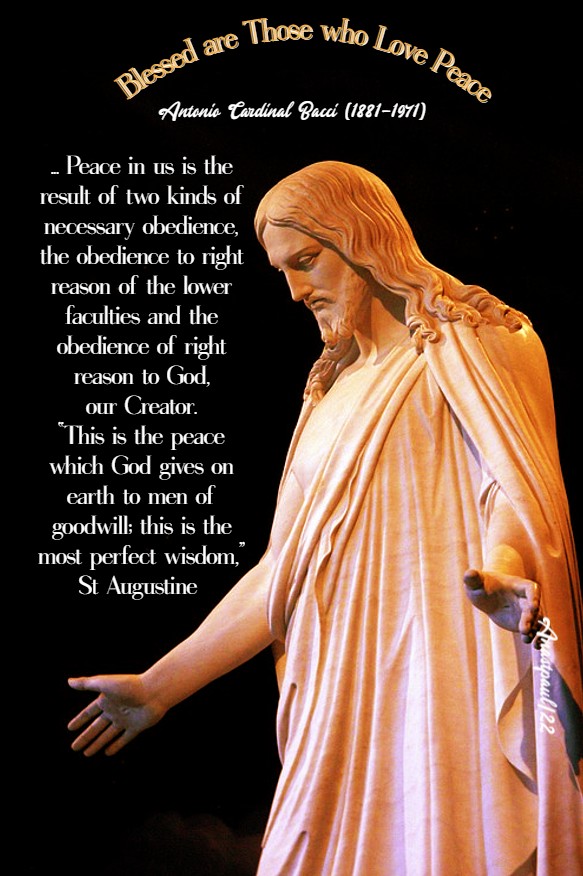
Blessed are Those who Love Peace
“How can one achieve this calmness of approach and manner of behaviour? We can consult St Augustine again (Cf De Serm Domini, lib 1, Cap 2). It is particularly necessary, that the faculties and movements of our lower nature should be under control and subjects to right reason. It is reason which should govern us. It should guide us constantly and exercise complete control over all those parts of our nature which are common to men and animals. It is disastrous if the desires of the flesh rebel against the spirit and worse still, if they gain the upper hand. Then there can be no more peace of heart. There is no longer that reflection of the divine harmony which the grace of God has bestowed on us. There is only slavery, the slavery which takes away liberty and peace. It is very necessary, therefore, that “that part of man which is the highest and most perfect, should rule without opposition, the remaining parts, which are common to mean and animals but in its turn, this supreme faculty that is the intellect or reason, should be subject to God Almighty” (Ibid).
It is clear from these words, that peace in us is the result of two kinds of necessary obedience, the obedience to right reason of the lower faculties and the obedience of right reason to God, our Creator.
“This is the peace which God gives on earth to men of goodwill; this is the most perfect wisdom,” St Augustine (Ibid).”
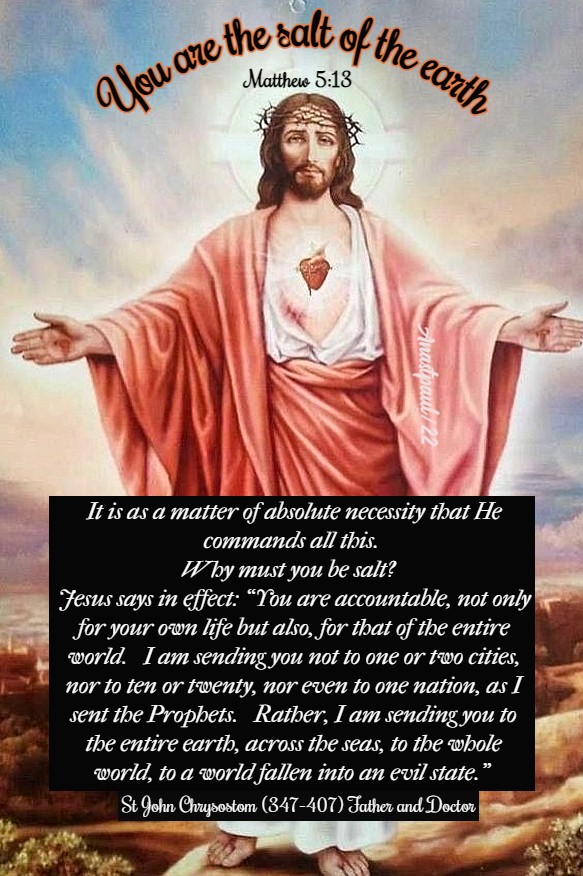
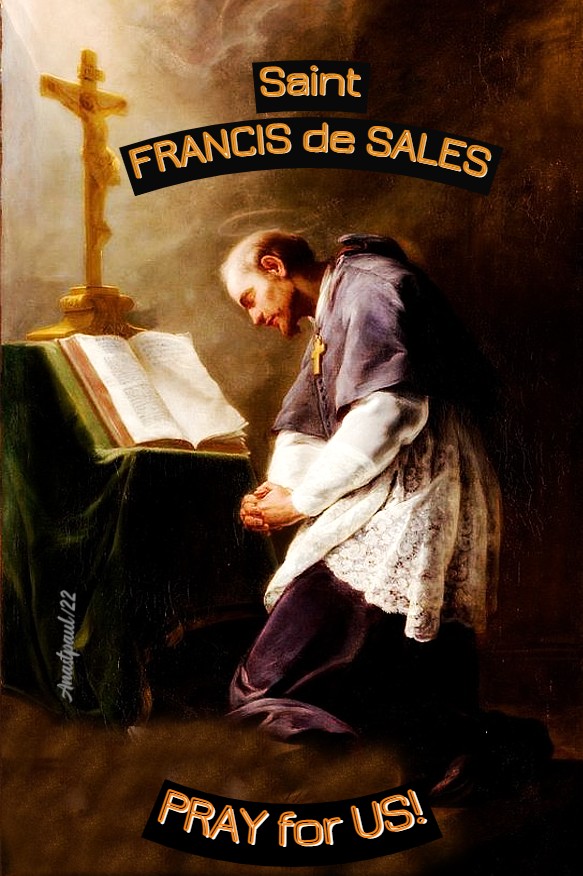
One Minute Reflection – 29 January – St Francis de Sales (1567-1622) Bishop, Confessor and Doctor – 2 Timothy 4:1-8, Matt hew 5:13-19
“You are the salt of the earth. But if salt loses its taste, with what can it be seasoned? It is no longer good for anything but to be thrown out and trampled underfoot.” – Matthew 5:13
REFLECTION – “It is as a matter of absolute necessity that He commands all this. Why must you be salt? Jesus says in effect: “You are accountable, not only for your own life but also, for that of the entire world. I am sending you not to one or two cities, nor to ten or twenty, nor even to one nation, as I sent the Prophets. Rather, I am sending you to the entire earth, across the seas, to the whole world, to a world fallen into an evil state.” For by saying, “You are the salt of the earth,” Jesus signifies, that all human nature itself has “lost its taste,” having become rotten through sin. For this reason, you see, He requires from His disciples, those character traits that are most necessary and useful for the benefit of all.” – St John Chrysostom (347-407) Archbishop of Constantinople, Father and Doctor (The Gospel of Matthew: Homily,15).
PRAYER – O God, Who for the salvation of souls willed that blessed Francis, Your Confessor and Bishop, should become all things to all men, mercifully grant that we, inspired by the sweetness of Your love, guided by his teachings and aided by his merits, may attain the joys of everlasting life. Through Jesus Christ, Thy Son our Lord, Who lives and reigns with Thee, in the unity of the Holy Ghost, God, world without end. Amen (Collect).
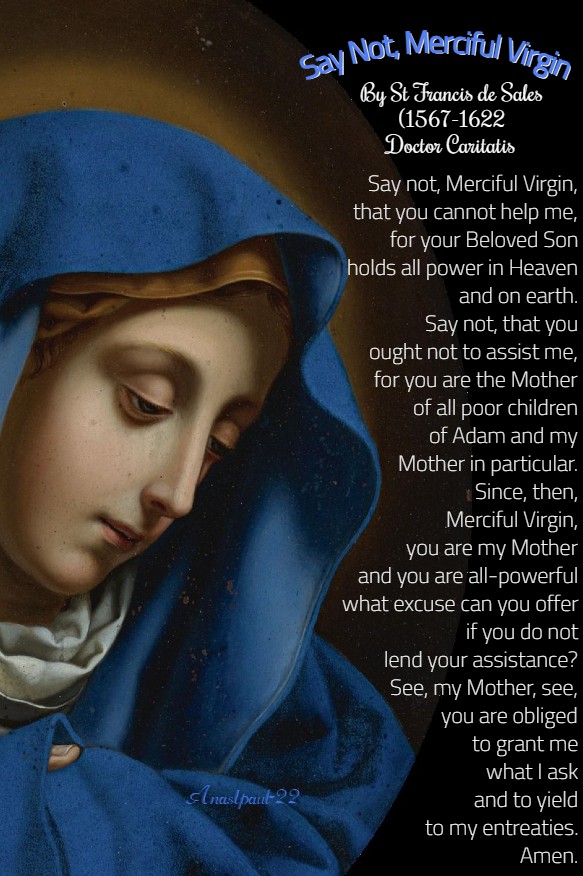
Our Morning Offering – 29 January – St Francis de Sales (1567-1622) Bishop, Confessor and Doctor and Mary’s Day and Mary’s Day
Say Not, Merciful Virgin By St Francis de Sales (1567-1622 Doctor Caritatis
Say not, Merciful Virgin, that you cannot help me, for your Beloved Son holds all power in Heaven and on earth. Say not, that you ought not to assist me, for you are the Mother of all poor children of Adam and my Mother in particular. Since, then, Merciful Virgin, you are my Mother and you are all-powerful, what excuse can you offer if you do not lend your assistance? See, my Mother, see, you are obliged to grant me what I ask and to yield to my entreaties. Amen.
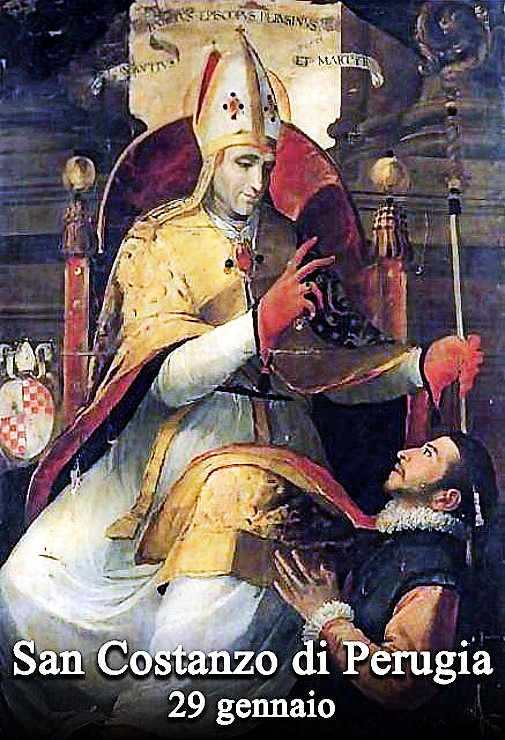
Saint of the Day – 29 January – Saint Constantius of Perugia (Died c 170) Martyr, the First Bishop of Perugia. Died by being beheaded in c 170. Patronages – Perugia-Città della Pieve, Italy, Archdiocese of and the City of Perugia, Italy. Also known as – Costanzo of Perugia, Costantius, Constance.
The Roman Martyrology reads today: “In Perugia, St. Costanzo, Bishop and Martyr, who, together with his Companions, under the Emperor Marcus Aurélio, received the Crown of Martyrdom for the defense of the faith.”
Constantius lived in the second century. He was a young Christian who immediately distinguished himself in the Perugian Church, for his zeal and generosity towards the poor combined with great severity towards himself.
He was, therefore, elected Bishop at the very young age, of just thirty years old. However, he was already prudent, wise in the apostolate, mature in charity, steadfast in authority and he proved to be a providential Bishop, especially in the difficult years of Marcus Aurelius’ persecution.
In fact, it was not long before the Emperor arrested and tried him with the accusation of having embraced Faith in the Lord and if he was found guilty, that is, if he confirmed his faith by refusing to sacrifice, he would be sentenced to capital punishment.
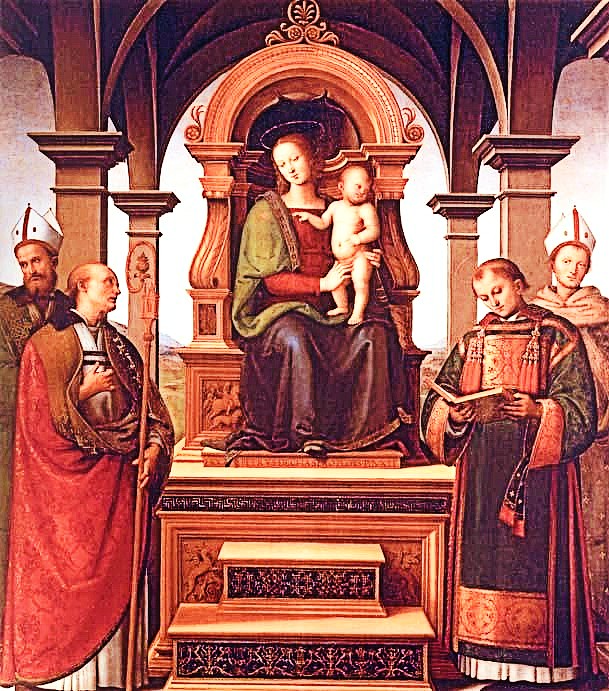
Virgin Mary and Child, with Saints Louis of Toulouse, Lawrence, Herculanus of Perugia and Constantius of Perugia. (right) by Pietro Perugino, 1497.
It is not known who denounced the active and beneficial Bishop of Perugia. Probably, as in many other cases, someone hoped to get their hands on the riches of the Church, destined for the poor. Perhaps, for this very reason, that is, to extract advantageous information from him, Bishop Costantius was tortured for a long time and cruelly, together with several other fellow believers.
He was locked up in the calidarium of the Roman Baths, where respectable and refined citizens took a steam bath. This time, however, the calidarium was heated to the temperature of an oven but Costantius came out unscathed from the mortal bath.
He had the grace to convert his guardians and was able to escape for the first time. Armed again, he was sentenced to walk on hot coals. But neither this nor other tortures had power over him. Miraculously freed and arrested a third time, he was beheaded with the sword, around the year 170.
St Abundantia the Martyr St Aphraates St Aquilinus of Milan St Barbea of Edessa St Blath of Kildare Bl Boleslawa Maria Lament St Caesarius of Angoulême Bl Charles of Sayn St Constantius of Perugia (Died c 170) Martyr Bishop
Thought for the Day – 28 January – Meditations with Antonio Cardinal Bacci (1881-1971)
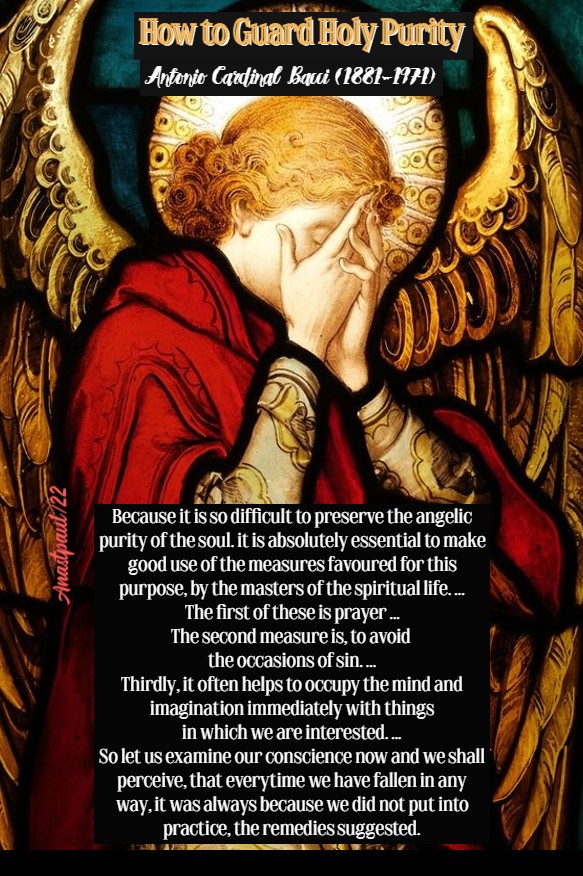
How to Guard Holy Purity
“Because it is so difficult to preserve the angelic purity of the soul. it is absolutely essential to make good use of the measures favoured for this purpose, by the masters of the spiritual life. The first of these is prayer – the spirit of prayer will keep us close to God. If our minds and hearts are united to God in the performance of every action, we will never allow ourselves to be separated from Him by impurity. This spirit of prayer must be based on humility and the consciousness of our continual need of God and, must be kept alive, by love for Him.
The second measure is, to avoid the occasions of sin. “Sensuality is best conquered by flight.” St Thomas Aquinas advises us (Summa Theologiae I-II, q 35). “He who loves danger will perish in it” (Ecclus 3:25). Battles like this, said St Francis de Sales, are won by the soldiers who retreat. As soon as an impure thought or image intrudes itself, drive it away as if a serpent were attacking you. It is fatal to allow the thought or image to gain ground, for at this stage, victory becomes extremely difficult!
Thirdly, it often helps to occupy the mind and imagination immediately with things in which we are interested. The greatest danger of all in these moments of temptation is idleness.
So let us examine our conscience now and we shall perceive, that everytime we have fallen in any way, it was always because we did not put into practice, the remedies suggested.”
Quotes of the Day – 28 January – Memorial of St Peter Nolasco (c 1182–c 1256) Confessor – 1 Cor. 4:9-14, Luke 12:32-34
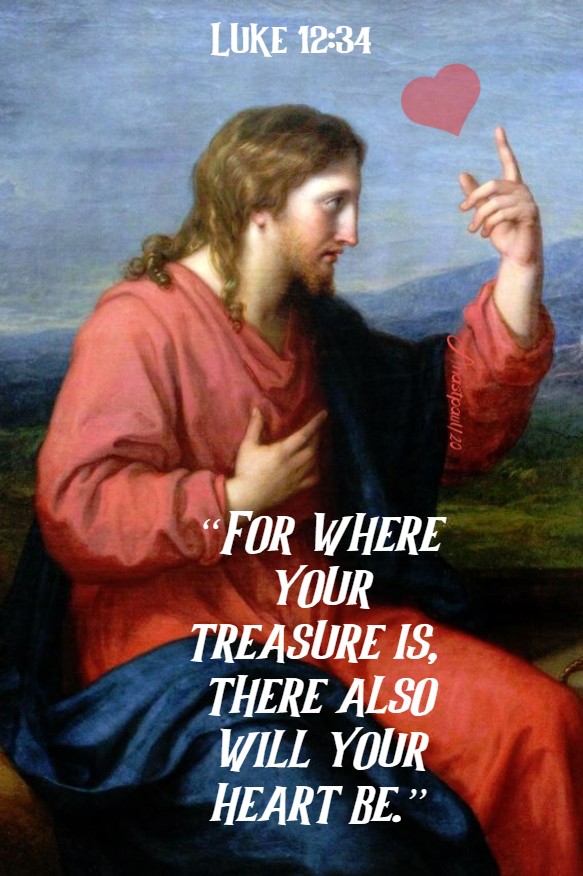
“For where your treasure is, there also will your heart be.”
Luke 12:34
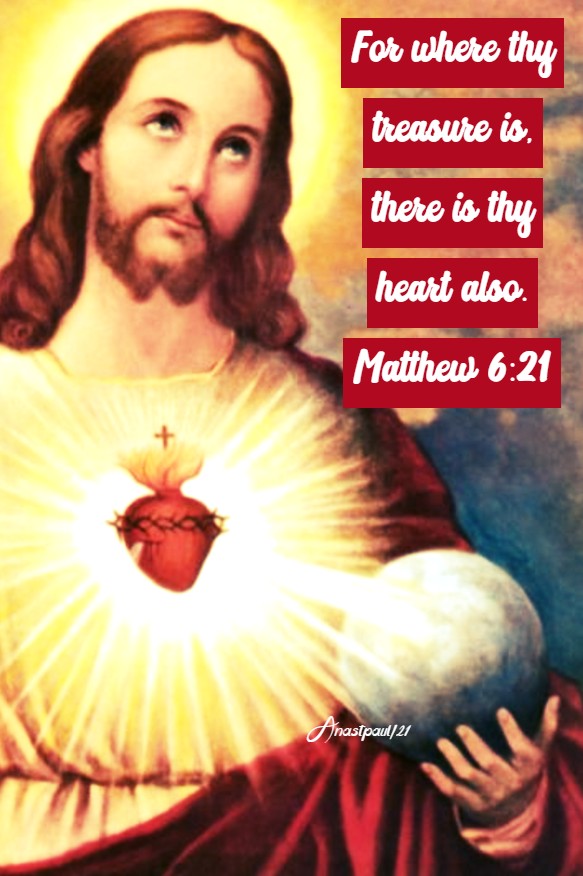
“ For where thy treasure is, there is thy heart also.”
Matthew 6:21
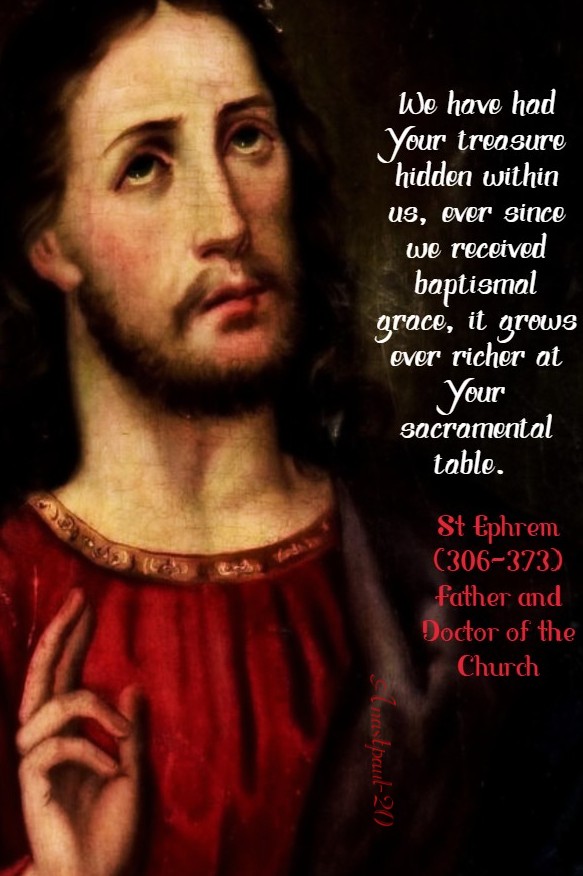
“We have had Your treasure hidden within us, ever since we received baptismal grace, it grows ever richer at Your sacramental table.”
St Ephrem (306-373) Father and Doctor of the Church
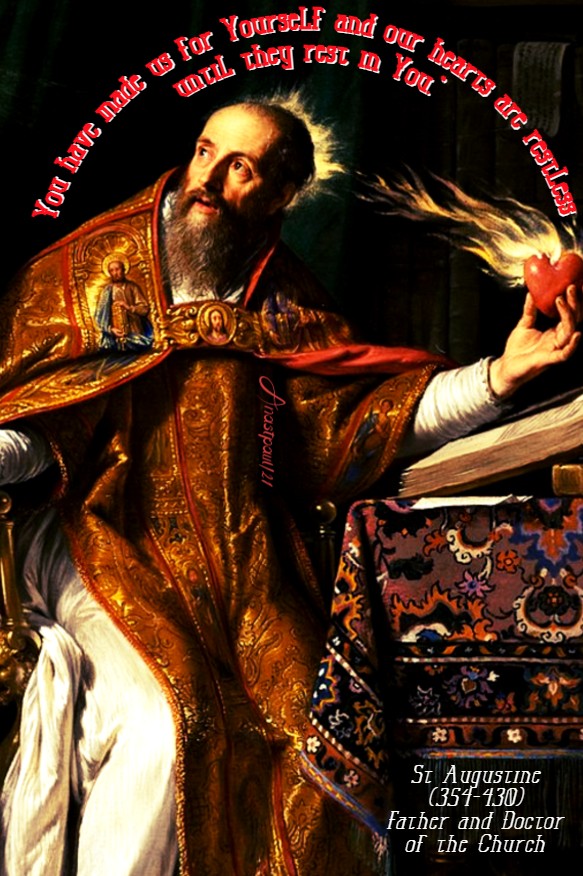
“You have made us for Yourself and our hearts are restless until they rest in You.”
St Augustine (354-430) Father and Doctor of the Church
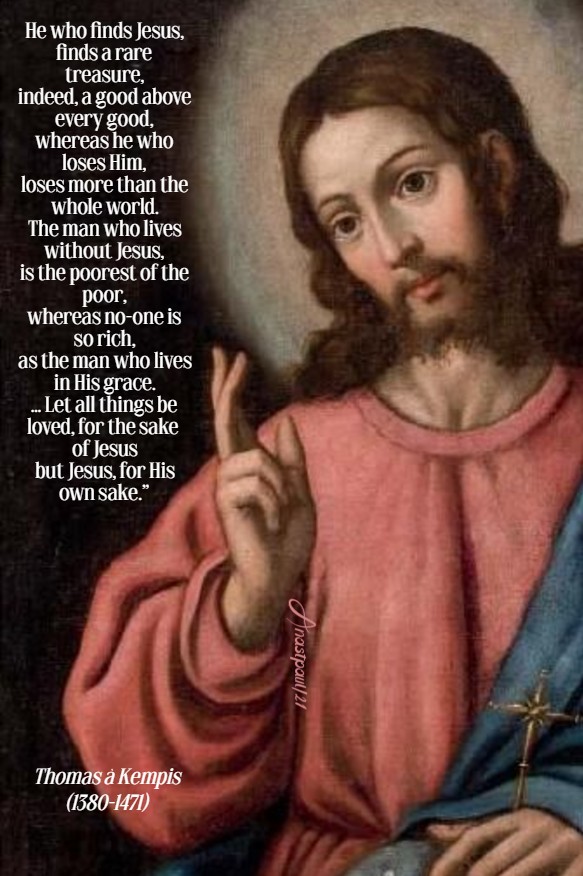
“ He who finds Jesus, finds a rare treasure, indeed, a good above every good, whereas he who loses Him, loses more than the whole world. The man who lives without Jesus, is the poorest of the poor, whereas no-one is so rich, as the man who lives in His grace. … Let all things be loved, for the sake of Jesus but Jesus, for His own sake.”
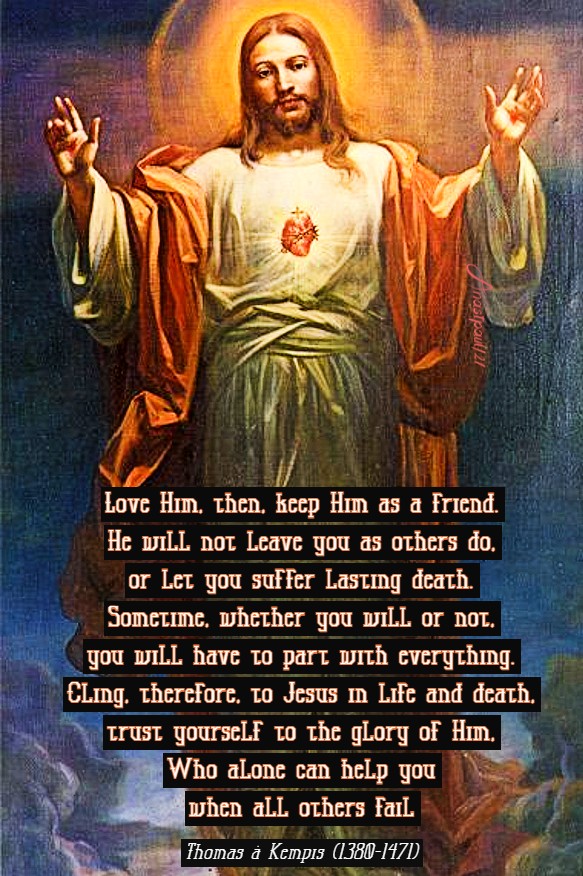
“Love Him, then, keep Him as a friend. He will not leave you as others do, or let you suffer lasting death. Sometime, whether you will or not, you will have to part with everything. Cling, therefore, to Jesus in life and death, trust yourself to the glory of Him, Who alone can help you when all others fail.“
Thomas à Kempis (1380-1471)
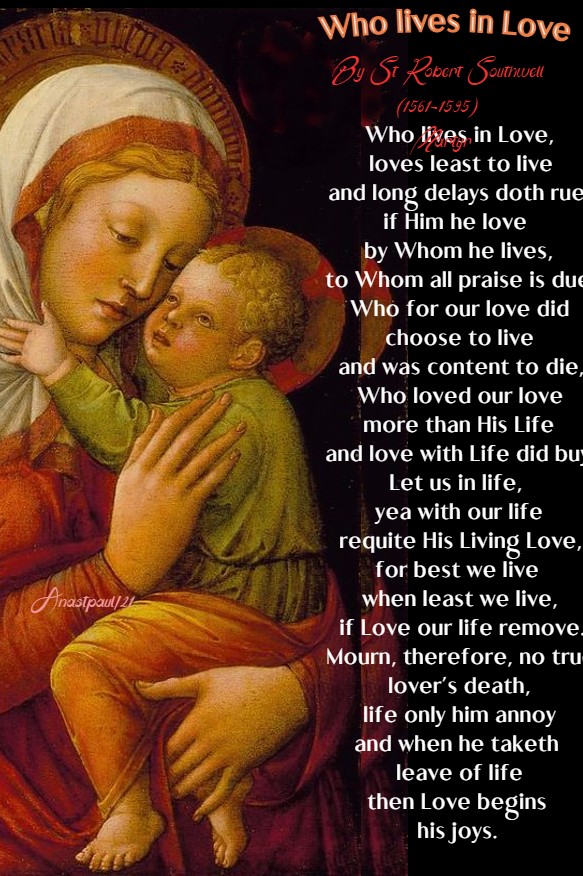
Who lives in Love By St Robert Southwell SJ (1561-1595) Martyr
Who lives in Love, loves least to live and long delays doth rue, if Him he love by Whom he lives, to Whom all praise is due, Who for our love did choose to live and was content to die, Who loved our love more than His life and love with Life did buy. Let us in life, yea with our life requite His Living Love, for best we live when least we live, if Love our life remove. Mourn, therefore, no true lover’s death, life only him annoy and when he taketh leave of life then Love begins his joys.
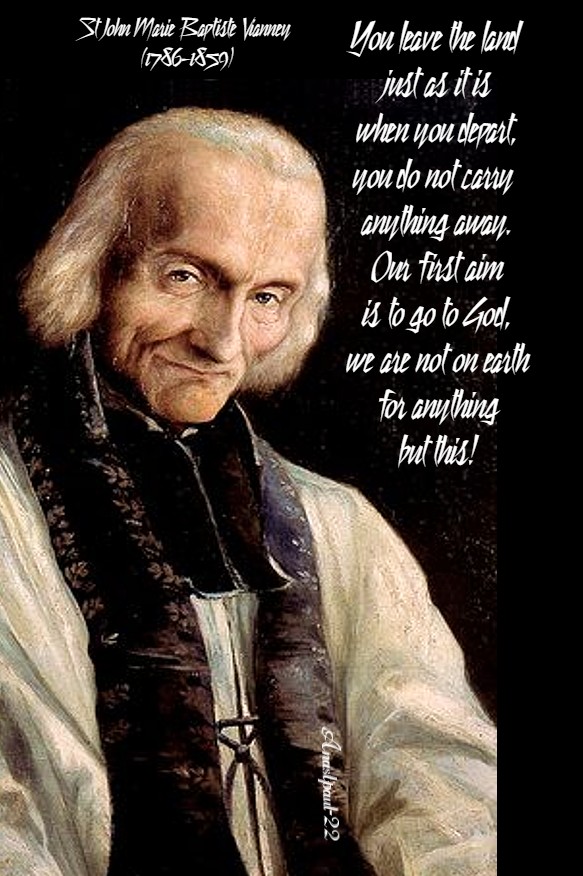
“You leave the land just as it is when you depart, you do not carry anything away. Our first aim is to go to God, we are not on earth for anything but this!”
St John Marie Baptiste Vianney (1786-1859)
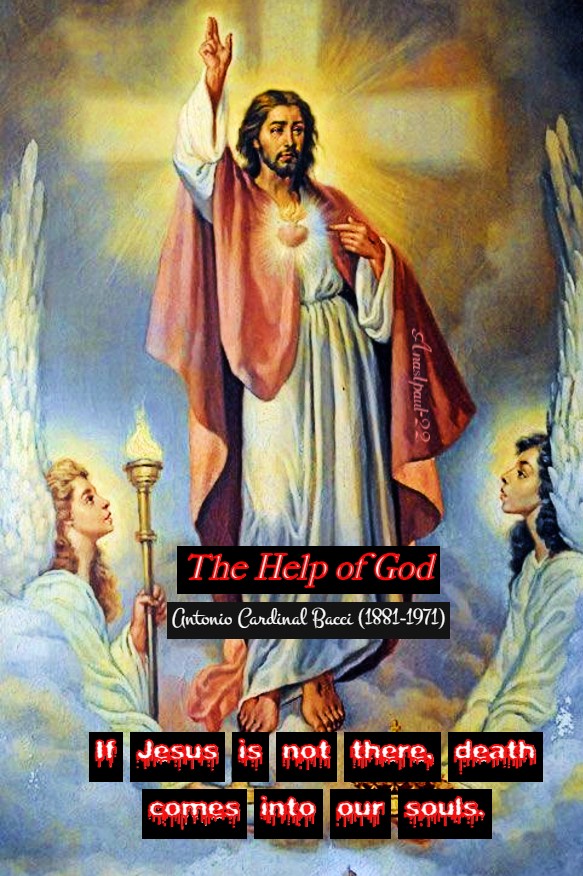
“If Jesus is not there, death comes into our souls.”
One Minute Reflection – 28 January – Memorial of St Peter Nolasco (c 1182–c 1256) Confessor – 1 Cor. 4:9-14, Luke 12:32-34
“For where your treasure is, there also will your heart be.” – Luke 12:34
REFLECTION – “All this is what that treasure brings about. Either through almsgiving, it raises the heart of a man into Heaven, or through greed it buries it in the earth. That is why He said, “For where your treasure is, there your heart will be also.” O man, send your treasure on, send it ahead into Heaven, or else your God-given soul will be buried in the earth! Gold comes from the depth of the earth — the soul, from the highest Heaven. Clearly it is better ,to carry the gold to where the soul resides, than to bury the soul, in the mine of the gold. That is why God orders those who will serve in His Army here below, to fight as men stripped of concern for riches and unencumbered by anything. To these He has granted the privilege of reigning in Heaven.” – St Peter Chrysologus (c 400-450) Bishop of Ravenna, “Doctor of Homilies” Father and Doctor of the Church (Sermon 22)
PRAYER – O God, You Who, as an example of Your love, divinely taught St Peter to enrich Your Church with new offspring, a family of Religious devoted to the ransom of the faithful, grant by his intercession, that we may be released from the slavery of sin and rejoice in lasting freedom in heaven. Through Jesus Christ, Thy Son our Lord, Who lives and reigns with Thee, in the unity of the Holy Ghost, God, world without end. Amen.
Our Morning Offering – 28 January – Memorial of St Peter Nolasco (c 1182–c 1256) Confessor
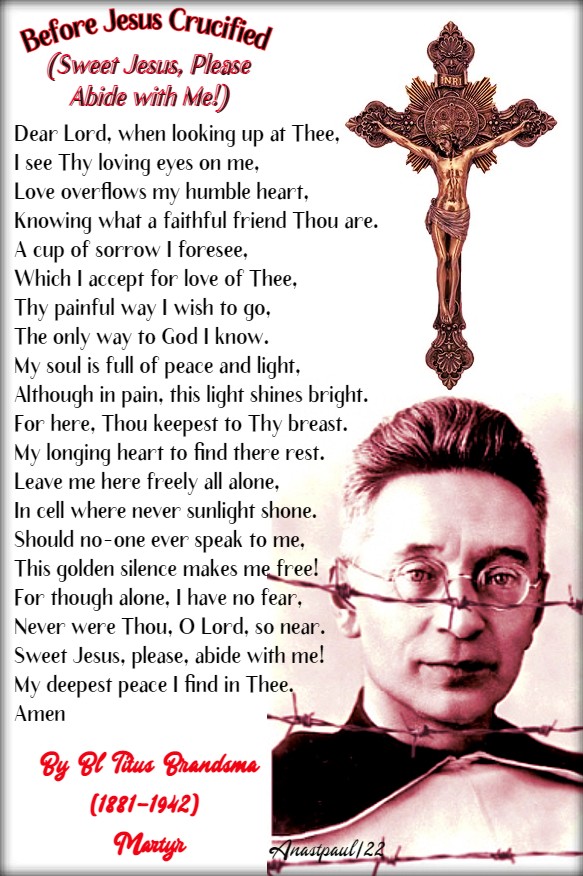
Before Jesus Crucified (Sweet Jesus, Please Abide with Me!) By Blessed Titus Brandsma (1881-1942) Martyr
Dear Lord, when looking up at Thee, I see Thy loving eyes on me, Love overflows my humble heart, Knowing what a faithful friend Thou are. A cup of sorrow I foresee, Which I accept for love of Thee, Thy painful way I wish to go, The only way to God I know. My soul is full of peace and light, Although in pain, this light shines bright. For here, Thou keepest to Thy breast. My longing heart to find there rest. Leave me here freely all alone, In cell where never sunlight shone. Should no-one ever speak to me, This golden silence makes me free! For though alone, I have no fear, Never were Thou, O Lord, so near. Sweet Jesus, please, abide with me! My deepest peace I find in Thee. Amen
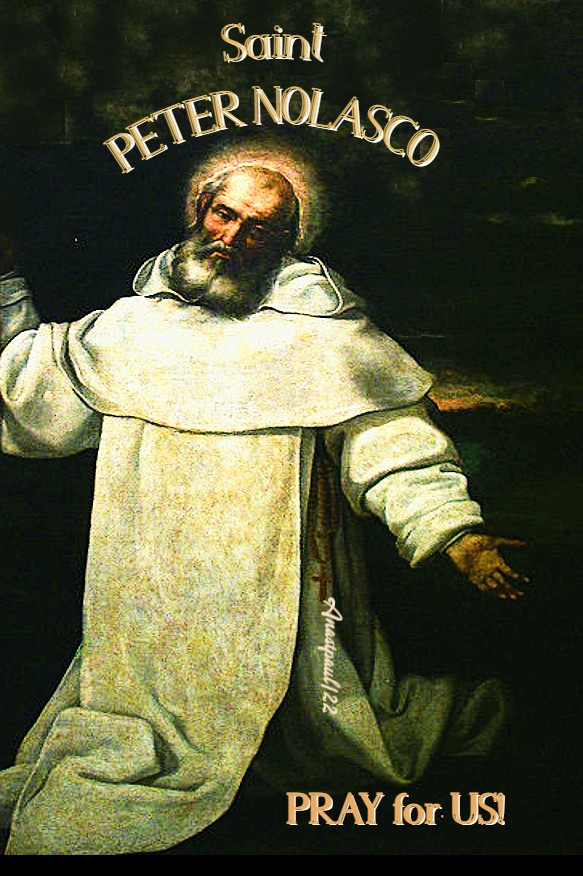
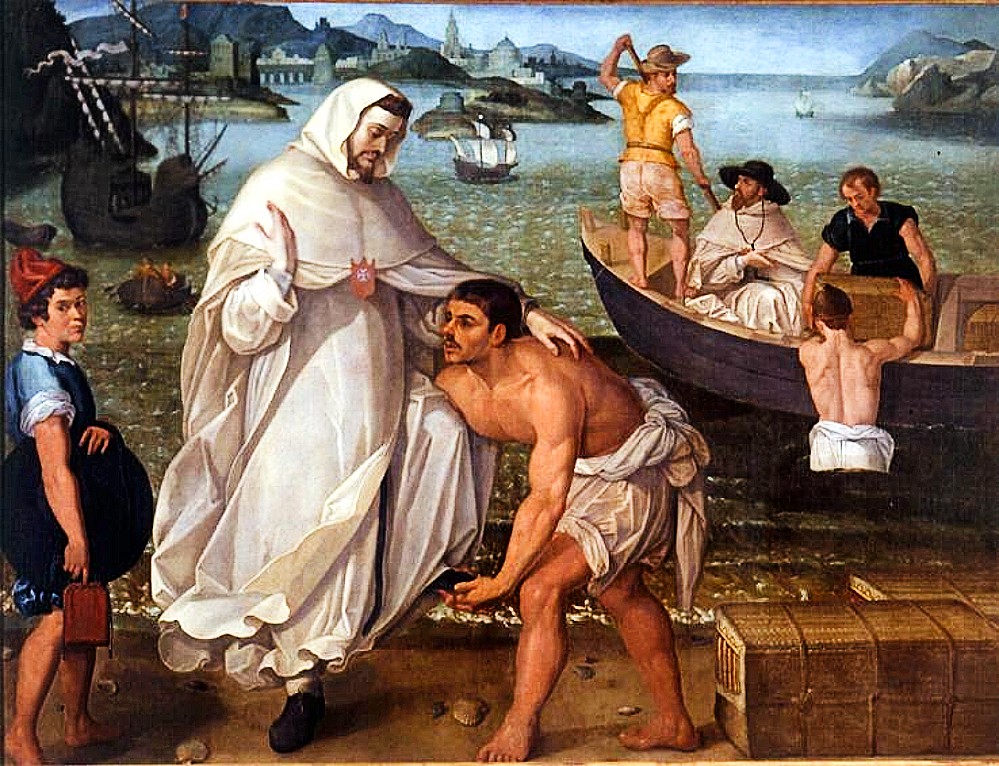
Saint of the Day – 28 January – Saint Peter Nolasco OdeM (c 1182–c 1256) Confessor, Founder of the Congregation of the Royal and Military Order of Our Lady of Mercy of the Redemption of the Captives (The Mercedarians), Tutor to the young king, James I of Aragon. Born in c 1182 at Mas-des-Saintes-Puelles, near Castelnaudary, Languedoc, France as Pierre Nolasque and died on 25 December 1258 of natural causes. It is uncertain if the year was 1256, 57,58 or it might have been 1259). Also known as – Peter Nolascus, Pedro, Pietro Nolasque. Additional Memorials – 25 December (the date of his death), 6 May (Mercedarians), formerly 31 January (prior to 1969) but moved to 28 January due to the Feast of St John Bosco on 31 January.
Peter Nolasco was born about the year 1182 at Mas-Saintes-Puelles near Carcassonne in France. When he was a teenager he went to Barcelona to escape the heresy then rampant in southern France. He joined an army fighting the Moors in the Iberian Peninsula, which still held much of Spain in the early thirteenth century and in sudden raids from the sea, they carried off thousands of Christians, holding them as slaves in Granada and in their citadels along the African coast. He was later appointed Tutor to the young King, James I of Aragon.
After making a pilgrimage to Our Lady of Montserrat at the Santa Maria de Montserrat Monastery on the Montserrat Mountain in Catalonia, Spain, he began to practice various works of charity. Nolasco became concerned with the plight of Christians captured in Moorish raids, he consecrated the fortune he had inherited to the redemption of the captives. He was greatly saddened by the thought of their suffering and desired to sell his own person to deliver his brethren and take their chains upon himself. God made it known to him how agreeable that desire was to Him.
Because of these large sums of money he expended, Peter became penniless. He was without resources and powerless, when the Blessed Virgin appeared to him and said to him: “Find for me other men like yourself, an army of brave, generous, unselfish men and send them into the lands where the children of the Faith are suffering.” Peter went at once to Saint Raymond of Pennafort, his Confessor, who had had a similar revelation and used his influence with King James I of Aragon and with Berengarius, Archbishop of Barcelona, to obtain approbation and support for the new community.
On 10 August 1218, Peter and two companions were received as the first members of the Congregation of men who became the Royal and Military Order of Our Lady of Mercy of the Redemption of the Captives (the Mercedarians). They were approved by Pope Gregory IX in 1230, and were also known as the Order of Our Lady of Ransom, dedicated to the recovery of Christian captives. To the three traditional vows of religion, its members joined a fourth, that of delivering their own persons to the overlords, if necessary, to ransom Christians.
The Order spread rapidly. Peter and his comrades travelled throughout Christian Spain, recruiting new members and collecting funds to purchase the captives. Then they began negotiations with the slave-owners. They penetrated Andalusia, crossed the sea to Tunisia and Morocco and brought home cargo after cargo of Christians.
Peter governed his Order for thirty years, within which time he opened the prison doors for thousands of captives, whom his own incessant labours, joined with those of his disciples, rescued from a miserable fate and, in all probability, from eternal death. Although Peter, as General of the Order, was occupied with its organisation and administration, he made two trips to Africa, where, besides liberating captives, he converted many Moors.
Peter Nolasco built the Church of St Mary del Puche. For four Saturdays, seven strange lights were seen at night over a certain spot and looked like seven stars. They were observed to drop from Heaven seven times and disappear in the earth in the same place. Peter Nolasco felt certain that this strange phenomenon announced some auspicious occasion, so he commanded men to dig about the spot. They had not gone far into the earth, when they came upon a clock of prodigious size, bearing a beautiful image of the Virgin Mary. Nolasco took it up in his arms as a valuable gift from Heaven and built an Shrine on the spot where it was buried. This Shrine became very celebrated for the number of miracles performed there.
St Peter Nolasco – Capilla de Santa Teresa – La Catedral – Córdoba, Spain
Before his death, Peter called his children to his bedside and exhorted them to perseverance in their love for captives. His words to them were those of the Psalmist: “I will praise Thee, O Lord, who hast sent redemption to Thy people!”
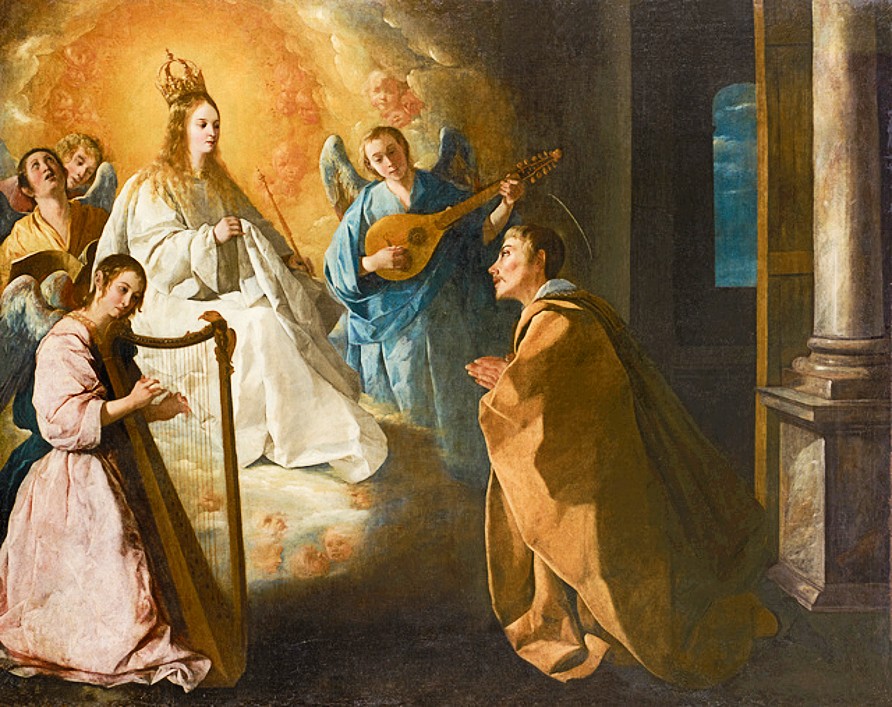
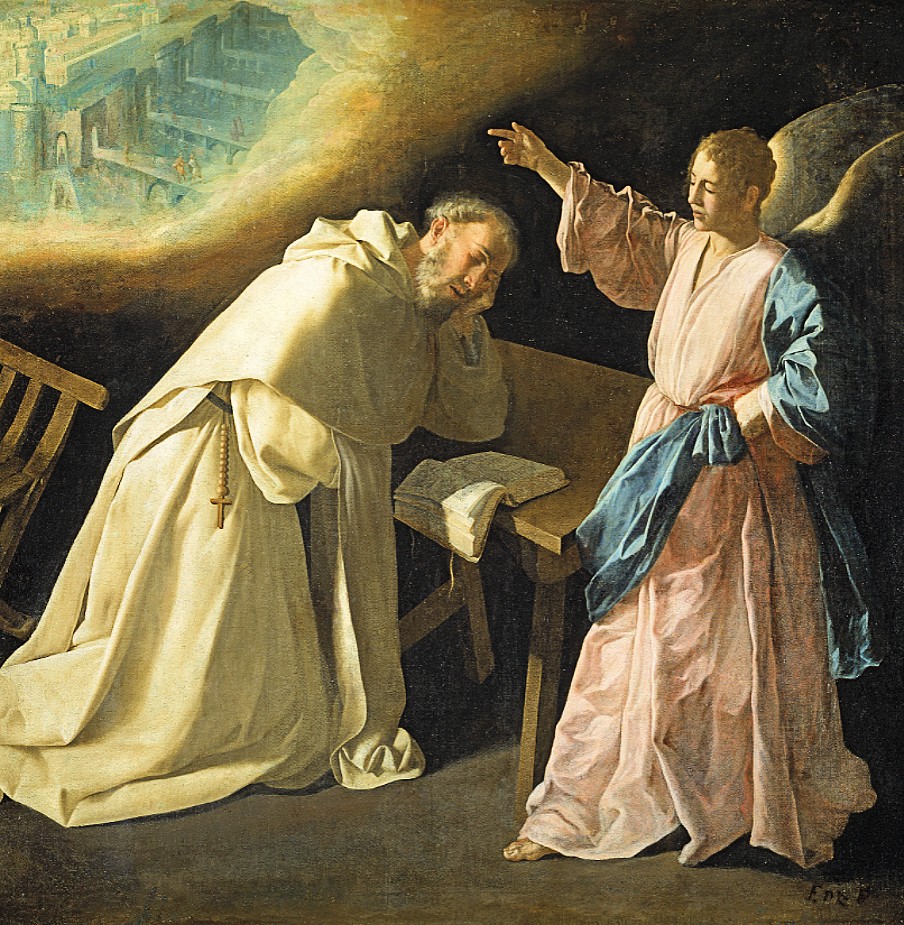
He had long and ardently cherished the desire of visiting the tomb of his patron, the Prince of the Apostles, whose name he bore and was saddened at not finding an opportunity to execute this deep devotion. But now, this holy Apostle appeared to him and addressed him: “Not all of our pious desires can be fulfilled. God is, however, satisfied with the intention. I know your longing to visit me at Rome but such is not the good pleasure of the Lord. Yet because you cannot visit me, I have now come to see you and to assure you of my assistance, until your last breath.”
Francisco de Zurbarán – The Apparition of Apostle StPeter to StPeter of Nolasco
Peter Nolasco obtained a similar favour from his Guardian Angel and other Saints, who visibly appeared to him, no doubt to reward his special devotion to them. But Mary, the Queen of all Saints, gave him special proofs of her love and esteem. He was granted the joy of seeing her several times and was filled with such sweet happiness and consolation at her promise always to protect him, that he cried out ecstatically at his last hour: “O how sweet it is to die under the protection of Mary.” He died after a long illness on Christmas night of c 1256.
Peter became Saint Peter when he was Canonised by Pope Urban VIII in 1628. His Order continues its religious services, now devoted to preaching and hospital service.
The Second Feast of St Agnes: 28 January is traditionally the day of the “Second Feast of St Agnes,” although this very ancient observance was reduced to a commemoration in 1931 and abolished in the post-Conciliar reform (1969). It is still kept in some Churches dedicated to St Agnes, most prominent among them, the Basilica built over the site of her burial, less than a mile and a half from the gates of Rome. In liturgical books, the formal name of the feast is “Sanctae Agnetis secundo,” which literally means “the feast of St Agnes for the second time.” This title is found on the calendar of the Tridentine Missal and Breviary, as also seven centuries earlier in the Gregorian Sacramentary. The single Matins lesson in the Breviary of St Pius V tells us, that after her death, Agnes appeared first to her parents to console them and then to the Emperor Constantine’s daughter Constantia, who suffered from an incurable sore, while she was praying at her grave, exhorting Constantia to trust in Christ and receive Baptism. Having done this and been healed, Constantia later built a Basilica in the Saint’s honour.
The church of S Agnes Outside-the-Walls on the via Nomentana
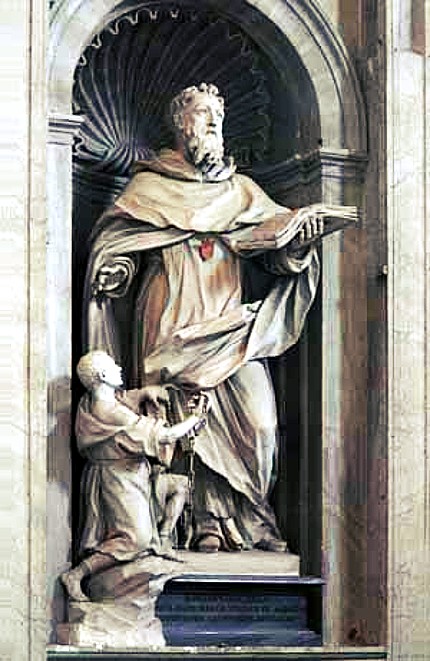
St Peter Nolasco OdeM (c 1182–c 1256) Founder of the Congregation of the Royal and Military Order of Our Lady of Mercy of the Redemption of the Captives (Mercadarians).
St Aemilian of Trebi St Agatha Lin Bl Amadeus of Lausanne St Antimus of Brantôme St Archebran Bl Bartolomé Aiutamicristo St Brigid of Picardy St Callinicus St Cannera of Inis Cathaig Bl Charlemagne (a decree of Canonisation was issued by the anti-pope Paschal III but this was never ratified by valid authority.) St Constantly St Flavian of Civita Vecchia St Glastian of Kinglassie Bl James the Almsgiver St James the Hermit St Jerome Lu St John of Reomay
St Julian of Cuenca St Lawrence Wang St Leucius of Apollonia Bl María Luisa Montesinos Orduña St Maura of Picardy Bl Mosè Tovini Bl Odo of Beauvais Bl Olympia Bida St Palladius of Antioch St Paulinus of Aquileia Bl Peter Won Si-jang St Richard of Vaucelles St Thyrsus of Apollonia
Martyrs of Alexandria: A group of 4th-century parishioners in Alexandria, Egypt. During the celebration of Mass one day an Arian officer named Syrianus led a troop of soldiers into their church and proceded to murder all the orthodox Christians in the place. 356 in Alexandria, Egypt.
Thought for the Day – 27 January – Meditations with Antonio Cardinal Bacci (1881-1971)
Blessed are the Clean of Heart
“There is a purity of heart and chastity, which is an obligation for everybody, even for those who are married or preparing for marriage.
Everybody is obliged to avoid any act of impurity, insofar as it is opposed to his own particular state, to the natural law and to the Divine law. Do not think that this degree of chastity is any easier than the first. Sometimes, the obligations it imposes, are even more difficult than those of absolute virginity.
There is only one remedy for impurity. It is the practice of virtue, to the point of sacrifice. Only a man who is ready, with the help of God, to make any sacrifice can preserve purity of heart. It is a difficult struggle but only those who win, can see God. Our Lord has said: “Blessed are the clean of heart, for they shall see God” (Mt 5:8). Only the clean of heart will be able to see and enjoy Him forever in Heaven and, by means of His grace, will be able to see Him, in a less perfect manner, on earth. St Thomas Aquinas says, that mental blindness is the main effect of impurity (Summa Theologiae II-II q 55, a 6). This is because, anyone who gives himself up to impurity, loses all spiritual enlightenment and easily loses his faith, as well! He no longer sees God and he does not believe anymore because his heart is steeped in the mire of impurity. “The sensual man does not perceive the things that are of the Spirit of God, for it is foolishness to him and he cannot understand …” (1 Cor 2:14). He is like the blind mole which creates its own dark little underground world and cannot see the sky anymore.”
Quote/s of the Day – 27 January – The Memorial of St John Chrysostom (347-407) Father and Doctor of the Church, Bishop, Confessor.
“The waters have risen and severe storms are upon us but we do not fear drowning, for we stand firmly upon a rock. Let the sea rage, it cannot break the rock.” Let the waves rise, they cannot sink the Boat of Jesus.”
“Let the world be in upheaval. I hold to His Promise and read His Message, that is my protecting wall and garrison. What Message? “Know that I am with you always, until the end of the world!”
“Prayer is the place of refuge for every worry, a foundation for cheerfulness, a source of constant happiness, a protection against sadness.”
“If you cannot find Christ in the beggar at the Church door, you will not find Him in the Chalice.”
“When you are weary of praying and do not receive, consider how often you have heard a poor man calling and have not listened to him.”
St John Chrysostom (347-407) Father and Doctor of the Church






















 AnaStpaul
You must be logged in to post a comment.