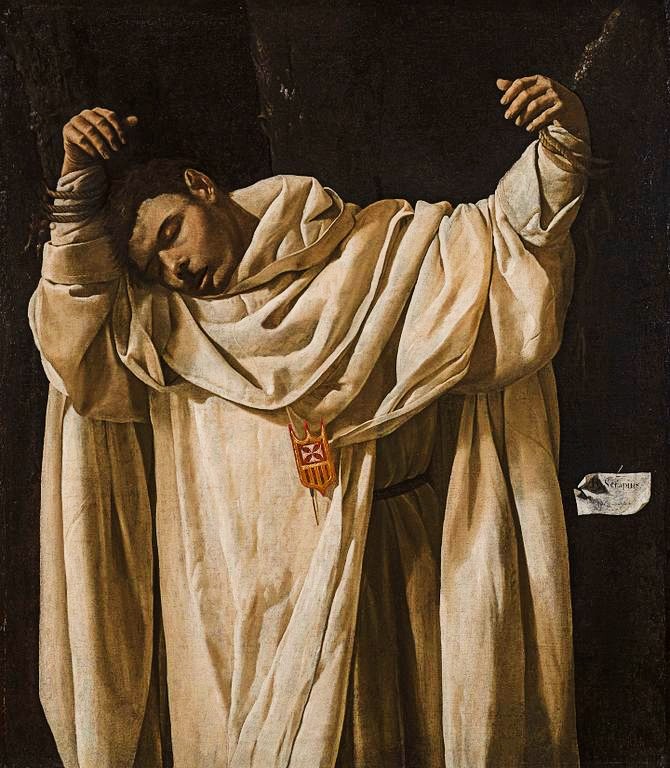
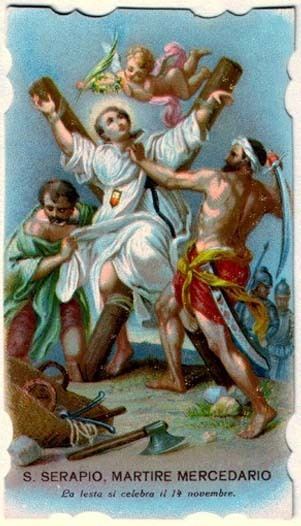
Saint of the Day – 14 November – Saint Serapion of Algiers OdeM (c 1179–1240) Mercedarian Priest and Martyr, Soldier and Crusader, Born in c 1179 as Serapion Scott in the British Isles and died by being crucified, stabbed and dismembered alive in Algeria in 1240. He was the first of his Order to merit the Palm of Martyrdom. Patronages – against arthritis, of the Diocese of Azul, Argentina. Also known as – Serapion of the Bristish Isles, Serapio, Serapius.
The Roman Martyrology states today: “At Algiers in Africa, the blessed Serapion, of the Order of Our Blessed Lady of Ransom, for the Redemption of the faithful in captivity and the preaching of the Christian Faith. He was the first of his Order to deserve the Palm of Martyrdom by being crucified and cut to pieces.”
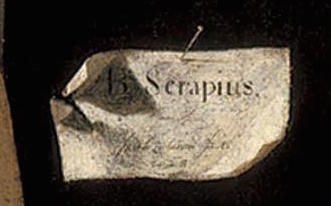
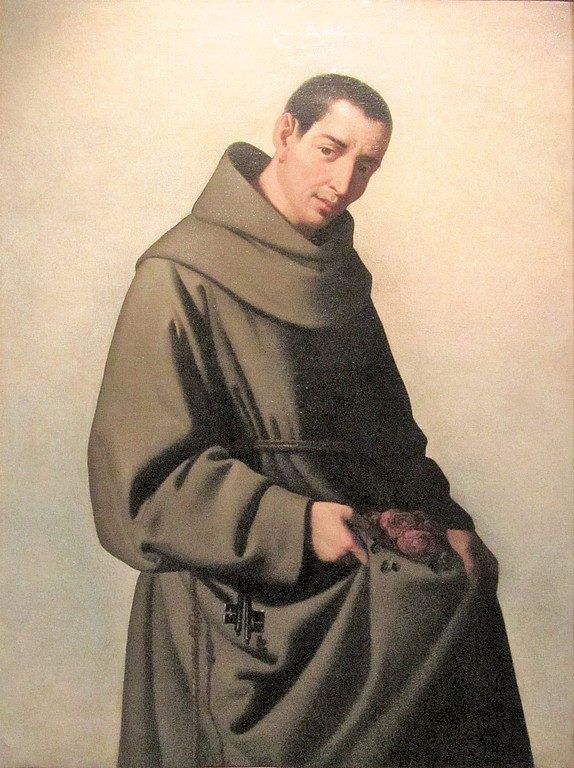
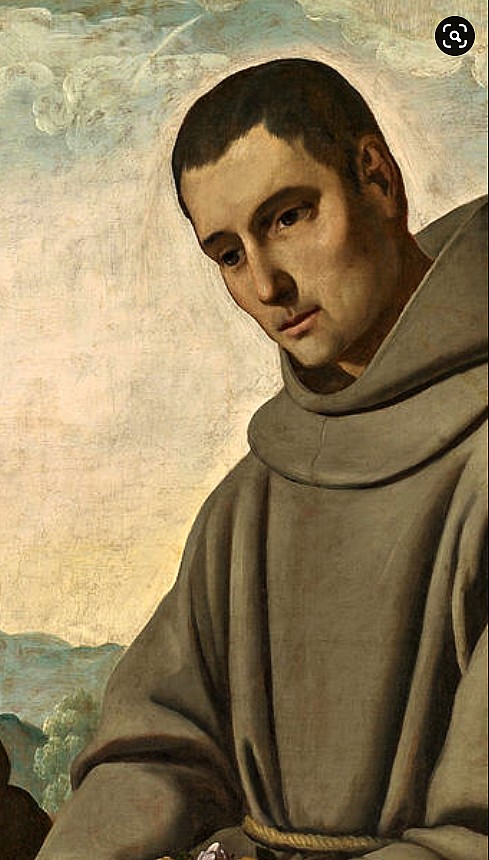
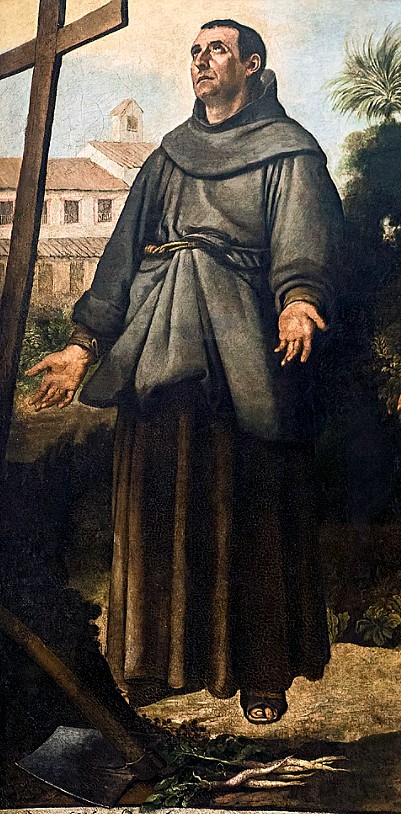
The renowned painting of The Martyrdom of Saint Serapion by Francisco de Zurbarán.The Ma
Serapion was a noble, born at the turn of the year 1178 in the British Isles and was a relative of the Scottish Monarch. And even though the exact dates of his childhood and youth are unknown, later on, he is seen at the side of King Richard the Lionhearted on the Third Crusade, fighting for the Faith and for the liberation of the land where Jesus lived. Even then, he was busy caring for the captives who were being liberated in Palestine.
He too suffered in prison at the hands of the Duke of Austria, until he was set free by the latter’s son, Leopold VII, whom he went on to accompany in the battles against the Saracens in Spain, at the Battle of Las Navas de Tolosa in 1212. After the victory, he retired to Burgos, leaving that City to accompany Leonore of Castile in 1221, who was headed to Aragon to marry King James I.
In the following year, he became acquainted with Saint Peter Nolasco in Daroca and entered the Order of Mercy.
Impelled by charity for the captives, he carried out several redemptions. In 1229, on one of the redemption missions, he was accompanied by Saint Raymond Nonnatus in 1229 and ransomed more than 150 captives. During the redemption mission in 1240, which he carried out with his companion Fr Berenguer de Bañares in Algiers, he was taken hostage. Saint Peter Nolasco wrote to Fr Guillermo de Bas, asking him to collect–without delay–the necessary goods with which to come to the aid of the redeemer. Since they did not have the price of ransom in time, St Serapion was crucified on a cross like Saint Andrew, suffering a cruel Martyrdom, as reflected in the Mercedarian iconography. He is said to have pronounced the following words while hanging on the cross:
“O sweet and precious wood, the perfect image of the Wood on which my beloved Jesus died, through you, I hope to ascend to eternal happiness!”
Because of his cruel martyrdom on the cross, he is the Patron Saint of those who suffer bone and joint paints. The blessing of oil in his honour is an ancient tradition of the Order that is included in the current Ritual.
Saint Serapion appears in the ancient Mercedarian liturgy, specifically in the 1560 Breviary of Master General Miguel Puig, with a proper antiphon and prayer.
His process of Beatification was started in 1717 in Barcelona and Genoa, conducted by Manuel Ribera and José Rimón as procurators. On 14 July 1728, a decree was issued confirming his immemorial cult. he was Canonised on 14 April 1728 by Pope Benedict XIII and on 24 August 1743, he was included in the Roman Martyrology.
The Twenty Fifth Sunday after Pentecost Thirty Third Sunday in Ordinary Time
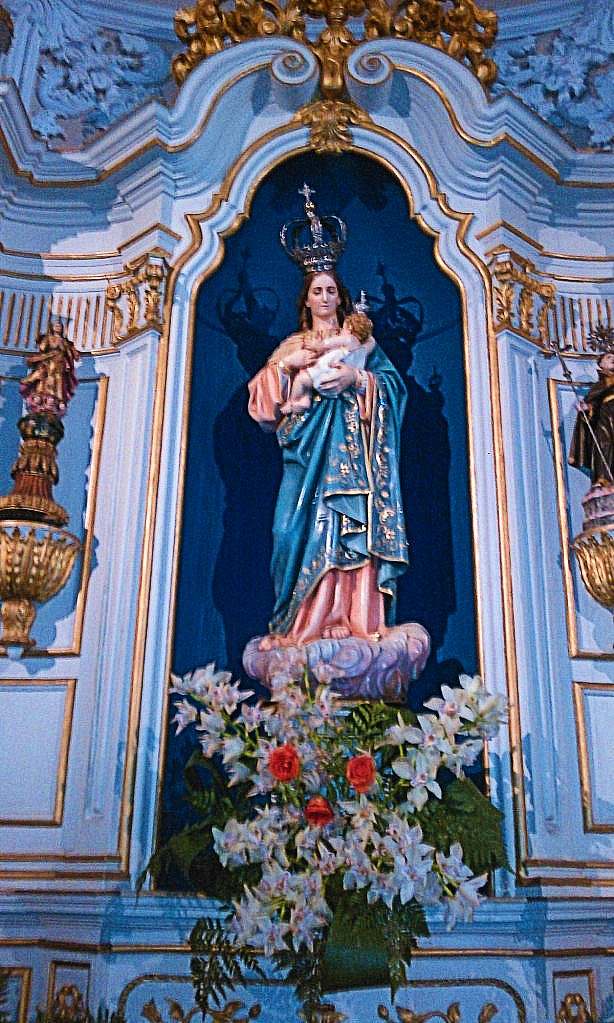
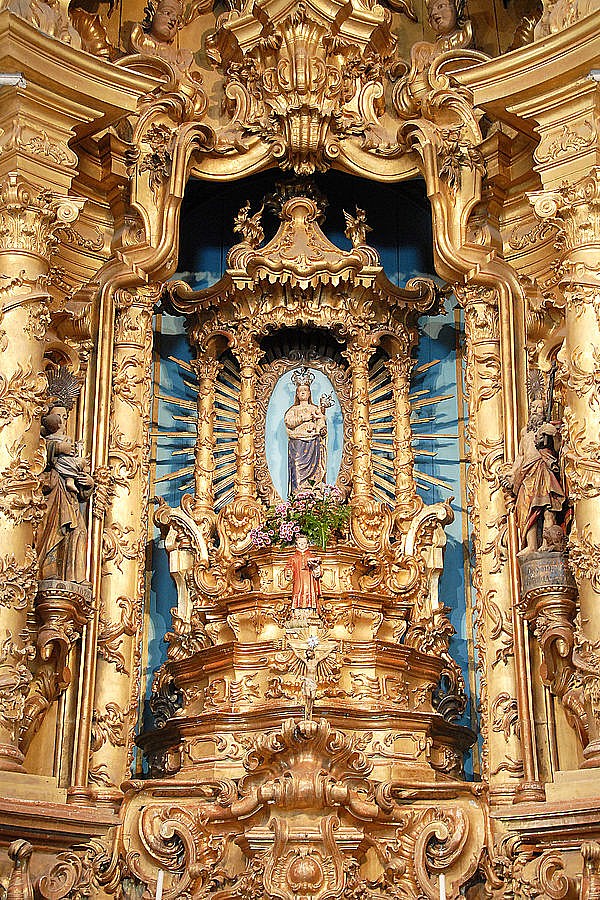
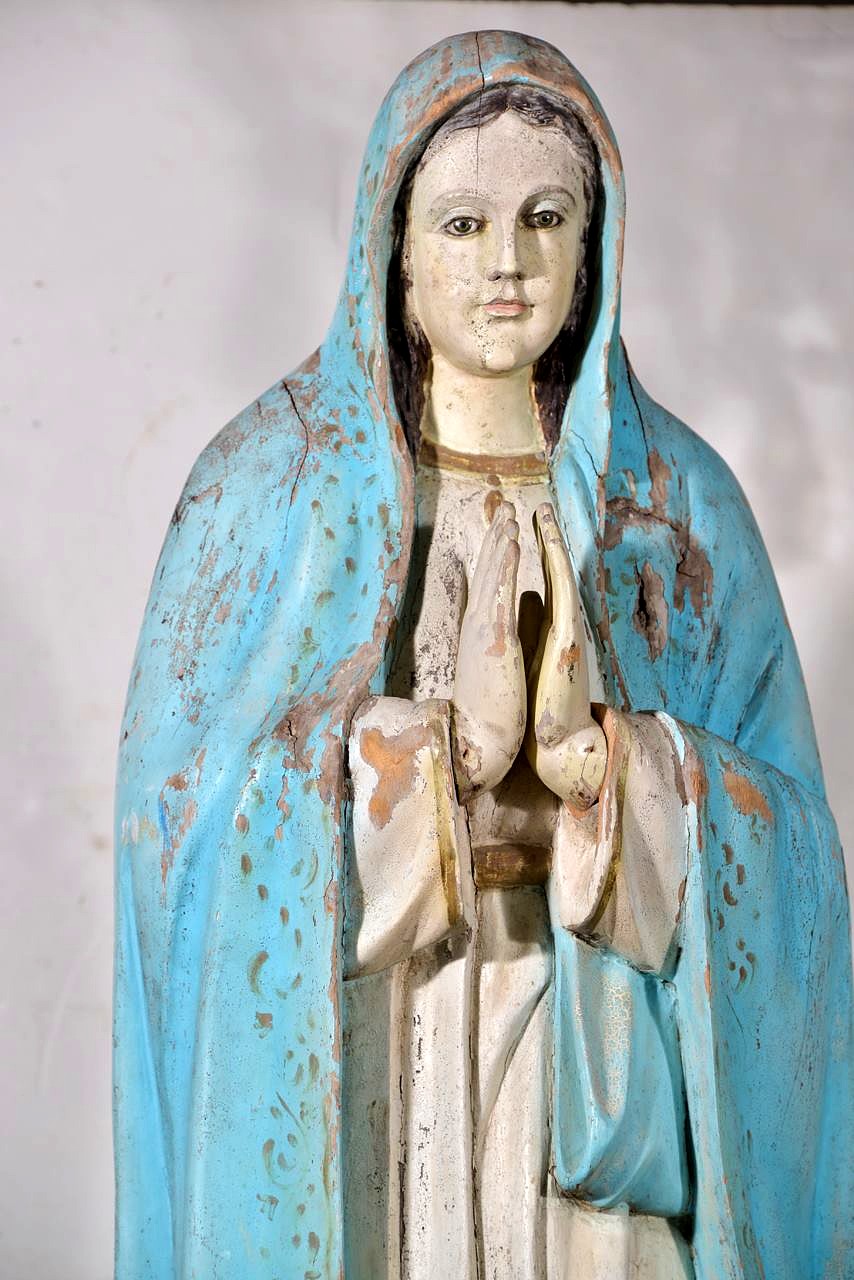
Nossa Senhora dos Remédios / Our Lady of Remedies, (Lamego, Portugal) 6th Century) Also known as – Nossa Senhora da Gruta / Our Lady of the Grotto – 14 November:
The Abbot Orsini wrote: “Our Lady of the Grotto, in the Diocese of Lamego, in Portugal. This Chapel was cut in the rock, in the same place where an image of the Blessed Virgin had been found.”
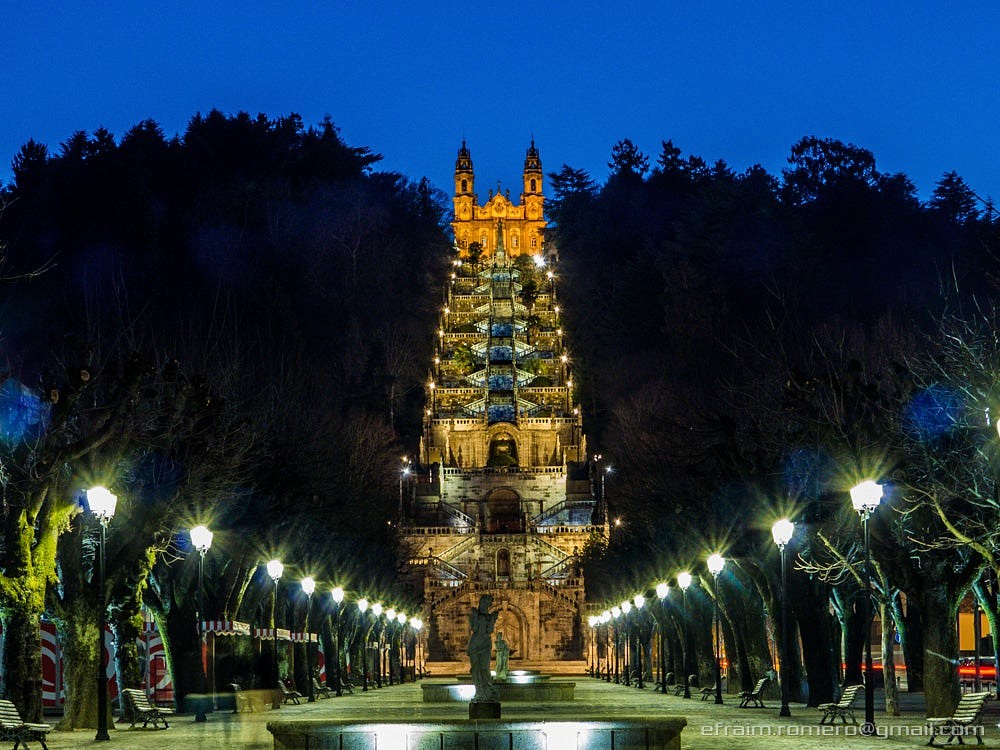
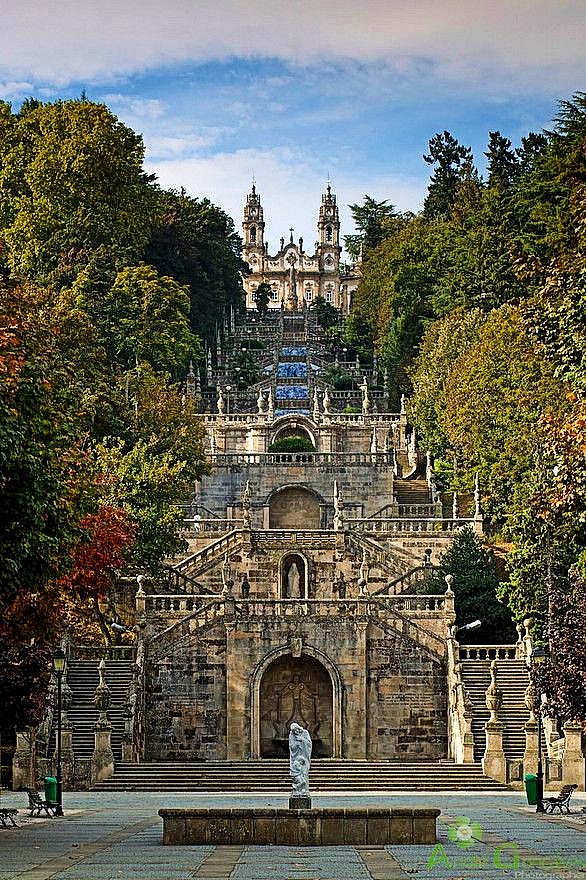
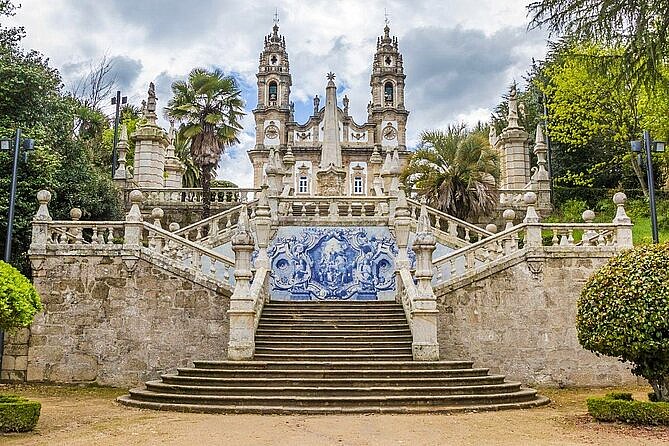
Lamego is both a Municipality and a City in northern Portugal, the City having a total of less than 9,000 inhabitants. The City is an ancient one, as the Roman’s came to settle the area in about the year 500 BC. The people became Catholic when Ricardo I, the Visigothic King, converted to Christianity late in the 6th century. The Sanctuary of Nossa Senhora dos Remedios, or Our Lady of Remedies, is in the location of Our Lady of the Grotto. It is in the Town of Lamego, district of Viseu, Portugal and is located atop the hill of Saint Stephen. This site begins as an old hermitage that was dedicated to Saint Stephen (Santo Estevao) constructed in 1361, so Catholic devotion here goes well back into the Middle Ages. By the 16th century, the old hermitage was at risk of collapsing and so was demolished, to make way for the construction of a new hermitage in the same spot. The Bishop of Lamego placed an image of the Virgin and Child there and thus over time, Marian devotion eclipsed devotion to Saint Stephen. Miraculous cures, especially of diseases, brought more pilgrims and the name for the image as Our Lady of Remedies. The Marian Shrine that can be seen there today, however, was built during the 18th through the 20th centuries, from 1750 to 1905 when it was completed. 8 September the Feast of the Nativity of the Blessed Virgin, is the date when there are feasts in honor of Our Lady of Remedies. The celebration in September includes fireworks, musicals, sporting events and recreational activities that take place in amid the trees in a grove of a nearby park. There is a parade known as the Procession of the Triumph, who’s participants are richly dressed, that is the highpoint of the celebration. Inside the Church there is an Altar above which the image of Nossa Senhora dos Remedios rests. It is carved in wood and is surrounded by stained glass windows having images of Our Lady of the Immaculate Conception, the Sacred Heart of Jesus and the Annunciation. Two side Altars are dedicated to the parents of the Blessed Virgin, Joachim and Saint Anna.
There is also a famous Baroque staircase, having 686 steps, that leads to the Sanctuary. There are several levels, decorated with sculptures of kings and eight fountains. There is also a “Court of the Kings” where eighteen Kings of Israel, all belonging to the family tree of the Blessed Virgin and Mother of God, can be seen.
St Adeltrude of Aurillac St Alberic of Utrecht St Antigius of Langres St Dubricius of Wales St Etienne-Théodore Cuenot St Hypatius of Gangra Bl Jean of Tufara
Bl Maria Louise Merkert Bl Maria Teresa of Jesus St Modanic St Ruf of Avignon St Serapion of Alexandria St Serapion of Algiers OdeM (c 1179–1240) Priest Martyr St Siard St Venerando the Centurian St Venerandus of Troyes — Holy Fathers of Merida
Martyrs of Emesa: Group of Christian women tortured and executed for their faith in the persecutions of the Arab chieftain Mady. They died in Emesa (modern Homs, Syria).
Martyrs of Heraclea – (3 saints): Group of Christians murdered together for their faith. The only details we have are three of their names – Clementinus, Philomenus and Theodotus. They were martyred in Heraclea, Thrace.
Martyrs of the Jaffa Gate: • Blessed Déodat of Rodez • Blessed Nikola Tavelic • Blessed Pierre of Narbonne • Blessed Stefano of Cuneo
Thought for the Day – 13 November – Meditations with Antonio Cardinal Bacci (1881-1971)
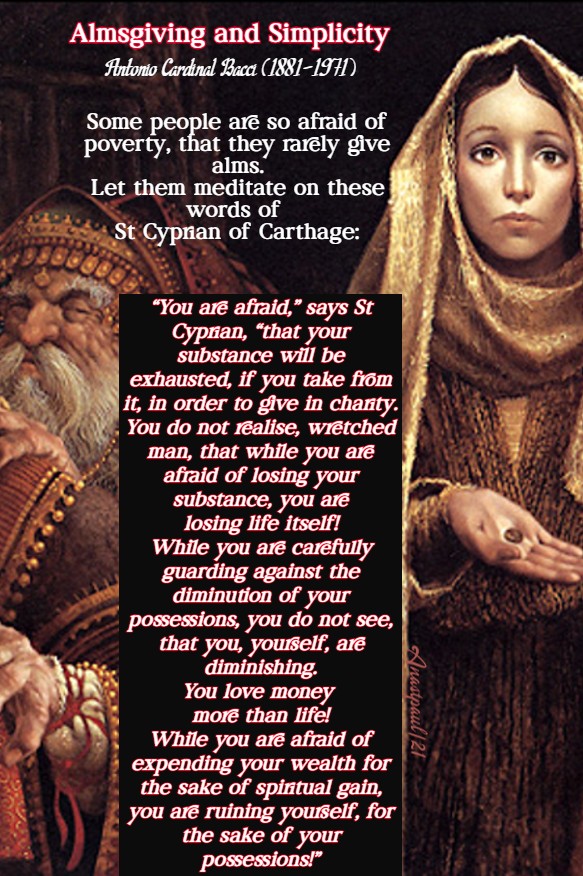
Almsgiving and Simplicity
“Some people are so afraid of poverty, that they rarely give alms. Let them meditate on these words of St Cyprian of Carthage: “You are afraid that if you begin to engage in too many charitable enterprises, your substance will be dissipated and you will be reduced to poverty. Have confidence and do not be afraid” (De Opere at elemosynis, 9-10),
That fortune, will never be exhausted, he assures us, from which the possessor draws frequently, in order to relieve Christ’s poor or to perform an act of religion. He does not assure us of this on his own authority, he says but bases his promises on the evidence of Sacred Scripture.
Speaking through the medium of Solomon, the Holy Spirit says: “He who gives to the poor, suffers no want but he who ignores them, gets many a curse” (Prov 28:27). In other words, the avaricious and self-centred man, is more likely to be reduced to poverty, than the kind and bountiful man.
St Paul says much the same under the influence of diving inspiration. “He who provides the sower with seed, will both give you bread to eat and will multiply your seed and will increase the growth of the fruits of your justice, that being enriched in all things, you may contribute with simplicity of purpose” (2 Cor 9-10). “The administration of this service,” he adds, “not only supplies the wants of the saints but, overflows also, in much gratitude to the Lord” (Ibid 9-12). The poor thank God for the alms which we give them and our prosperity increases as a result.
In the Gospel, Our Lord reproaches men for their niggardliness and lack of confidence. “Do not be anxious, saying, ‘What shall we eat?’ or ‘What shall we drink?’ or ‘What are we to put on?’ (for after all these things, the Gentiles seek), for your Father knows that you need all these things. But seek first the Kingdom of God and his justice and all these things shall be given you besides” (Mt 6:31). The man who aims at doing justice, therefore, will not go in want. When the Day of Judgement comes, moreover, he has Our Lord’s promise, that he will be given a share in the Kingdom, for the sake of which, he performed his charitable actions.
“You are afraid,” says St Cyprian, “that your substance will be exhausted, if you take from it, in order to give in charity. You do not realise, wretched man, that while you are afraid of losing your substance, you are losing life itself! While you are carefully guarding against the diminution of your possessions, you do not see, that you, yourself, are diminishing. You love money more than life! While you are afraid of expending your wealth for the sake of spiritual gain, you are ruining yourself, for the sake of your possessions!”
Quote/s of the Day – 13 November – The Memorial of All Saints of the Augustinian Order and the Anniversary of the Birth of St Augustine (354-430)
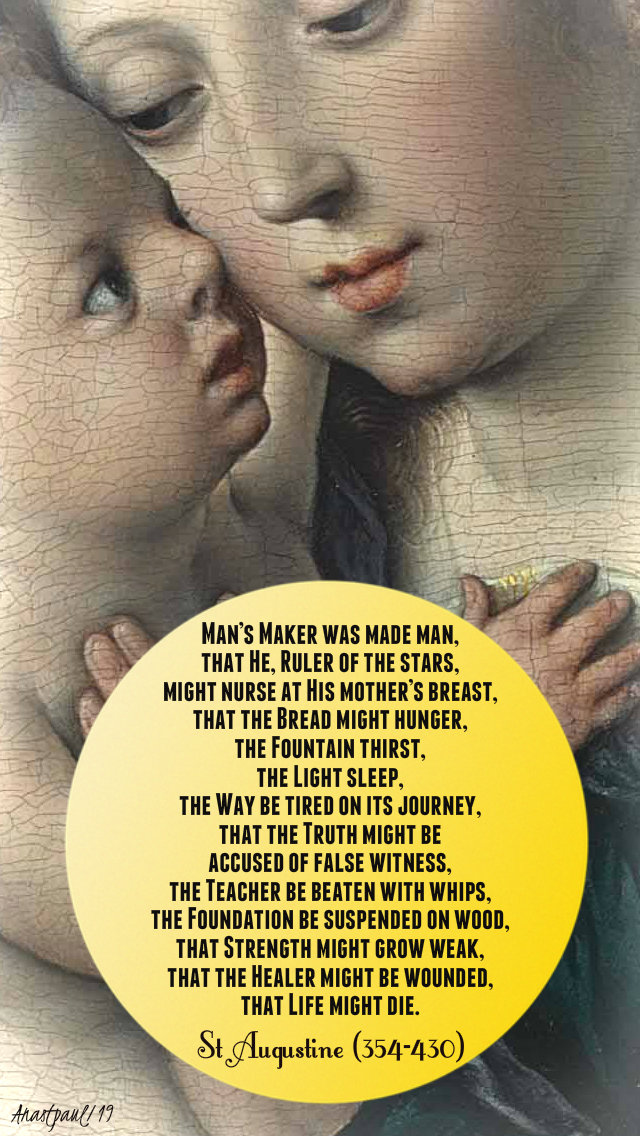
“Man’s Maker was made man, that He, Ruler of the stars, might nurse at His mother’s breast, that the Bread might hunger, the Fountain thirst, the Light sleep, the Way be tired on its journey, that the Truth might be accused of false witness, the Teacher be beaten with whips, the Foundation be suspended on wood, that Strength might grow weak, that the Healer might be wounded, that Life might die.”
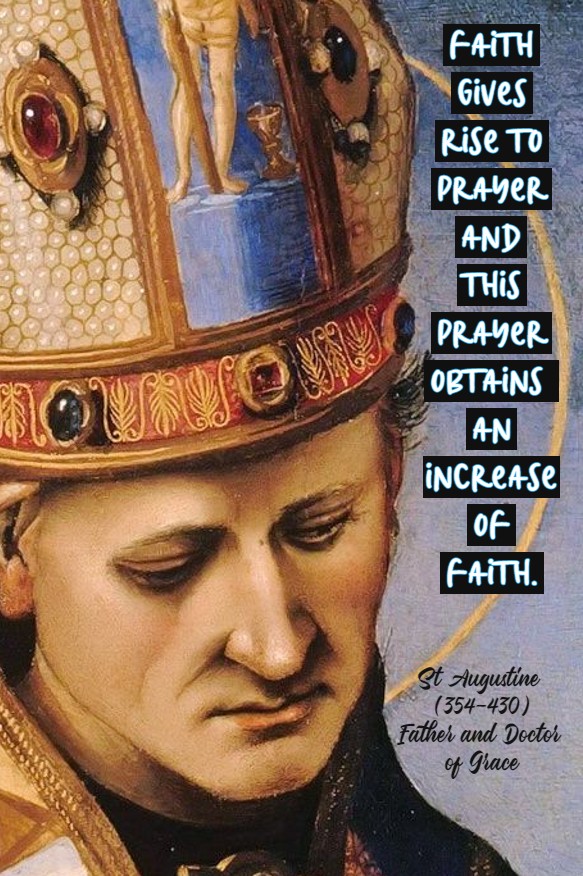
“Faith gives rise to prayer and this prayer obtains an increase of faith.”
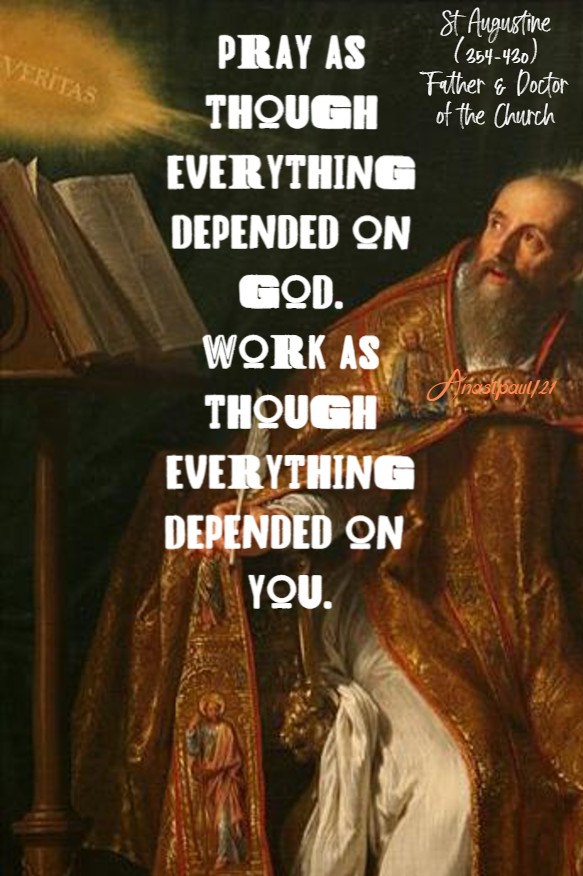
“Pray as though everything depended on God. Work as though everything depended on you.”
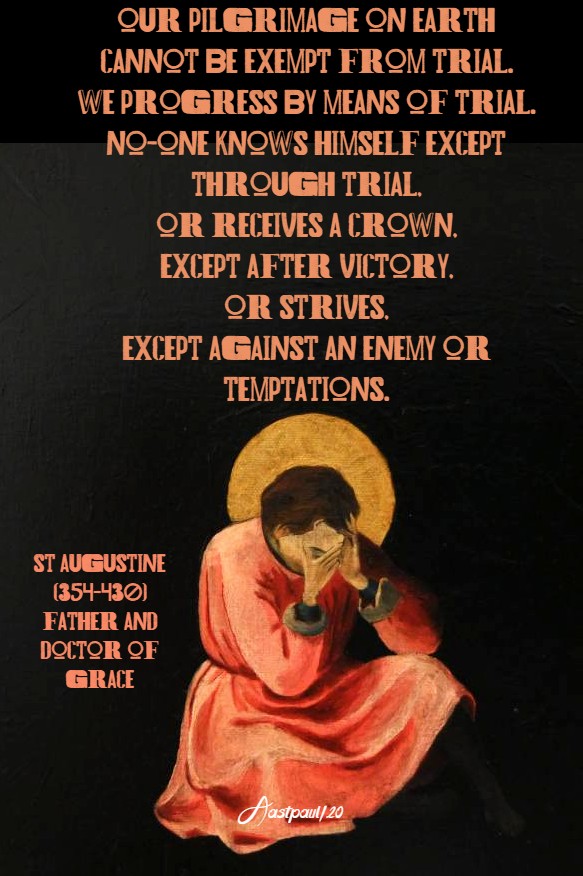
“Our pilgrimage on earth cannot be exempt from trial. We progress by means of trial. No-one knows himself except through trial, or receives a crown, except after victory, or strives, except against an enemy or temptations.”
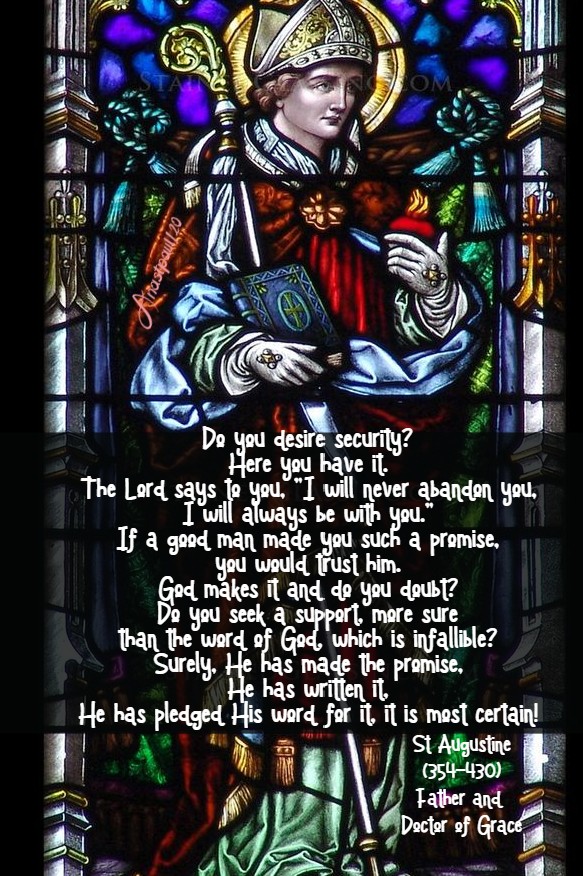
“Do you desire security? Here you have it. The Lord says to you, “I will never abandon you, I will always be with you.” If a good man made you such a promise, you would trust him. God makes it and do you doubt? Do you seek a support, more sure than the Word of God, which is infallible? Surely, He has made the promise, He has written it, He has pledged His Word for it, it is most certain!”
“If you believe what you like in the Gospels and reject what you don’t like, it is not the Gospel you believe but yourself.”
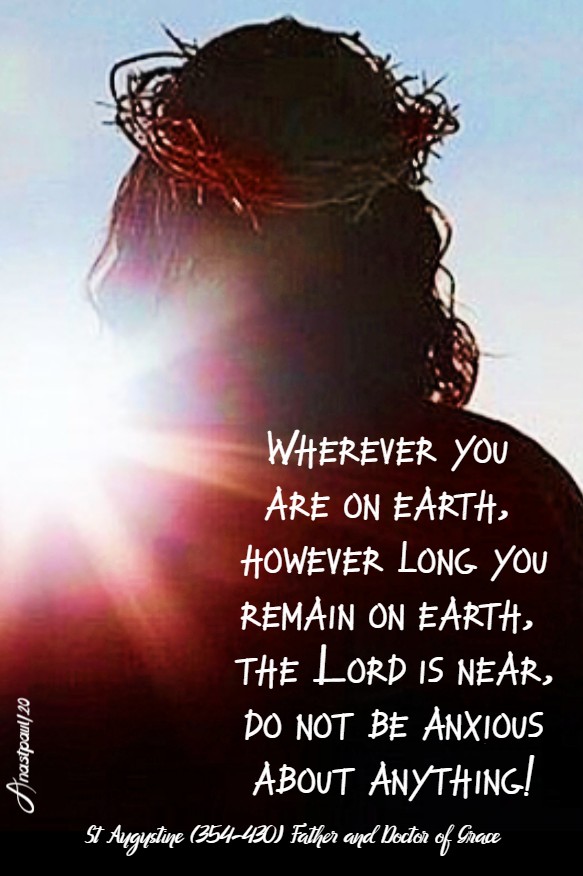
“Wherever you are on earth, however long you remain on earth, the Lord is near, do not be anxious about anything!”
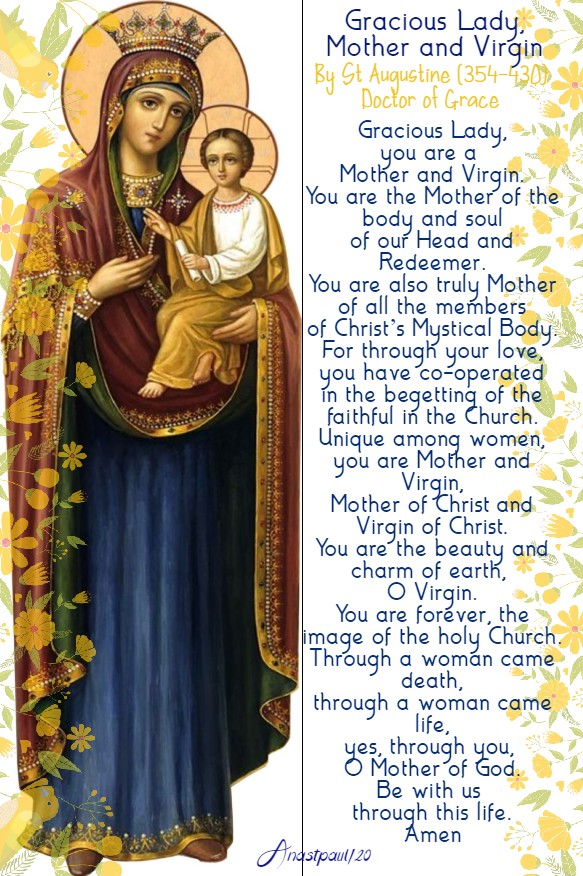
Gracious Lady, Mother and Virgin By St Augustine (354-430) Doctor of Grace
Gracious Lady, you are a Mother and Virgin. You are the Mother of the body and soul of our Head and Redeemer. You are also truly Mother of all the members of Christ’s Mystical Body. For through your love, you have co-operated in the begetting of the faithful in the Church. Unique among women, you are Mother and Virgin, Mother of Christ and Virgin of Christ. You are the beauty and charm of earth, O Virgin. You are forever, the image of the holy Church. Through a woman came death, through a woman came life, yes, through you, O Mother of God. Be with us through this life. Amen
One Minute Reflection – 13 November – Readings: Wisdom 18: 14-16; 19: 6-9; Psalm 105: 2-3, 36-37, 42-43; Luke 18: 1-8 – The Memorial of St Didacus (de Alcalá de Henares) OFM (c 1400-1463
“Will not God then secure the rights of his chosen ones, who call out to him day and night? Will he be slow to answer them? I tell you, he will see to it, that justice is done for them speedily. But when the Son of Man comes, will he find faith on earth?” – Luke 8:7-8
REFLECTION – “What an extraordinary thing it is, the efficiency of prayer! Like a Queen, it has access at all times to the Royal presence and can receive, whatever it asks for. And it is a mistake to imagine that your prayer will not be answered, unless you have something out of a book, some splendid formula of words, specially devised to meet this emergency. If that were true, I am afraid I should be in a terribly bad position. You see, I recite the Divine Office, with a great sense of unworthiness but ,apart from that, I cannot face the strain of hunting about in books for these splendid prayers – it makes my head spin. There are such a lot of them, each more splendid than the last – how am I to recite them all, or to choose between them? I just do what children have to do before they have learned to read – I tell God what I want quite simply, without any splendid turns of phrase and somehow, He always manages to understand me.
For me, prayer means launching out of the heart towards God; it means lifting up one’s eyes, quite simply, to heaven, a cry of grateful love, from the crest of joy, or the trough of despair; it is a vast, supernatural force, which opens out my heart and binds me close to Jesus.” – St Thérèse of the Child Jesus and the Holy Face (1873-1897), Carmelite, Doctor of the Church (Ms C, 25 r° – trans Ronald Knox)
PRAYER – Holy Father, grant us a strong Faith! Poor Your graces into our hearts that we may believe with all our hearts, minds and souls and that in believing, we may constantly raise our entire being to You in prayer and supplication, in prayer and adoration, in prayer and love. May the intercession of St Didacus, a man of deep prayer from his youth, strengthen our perseverance. Through Jesus Christ, our Lord in the unity of the Holy Spirit, God forever and ever, amen.
Our Morning Offering – 13 November – Mary’s Saturday and the Anniversary of the Birth of St Augustine in 354
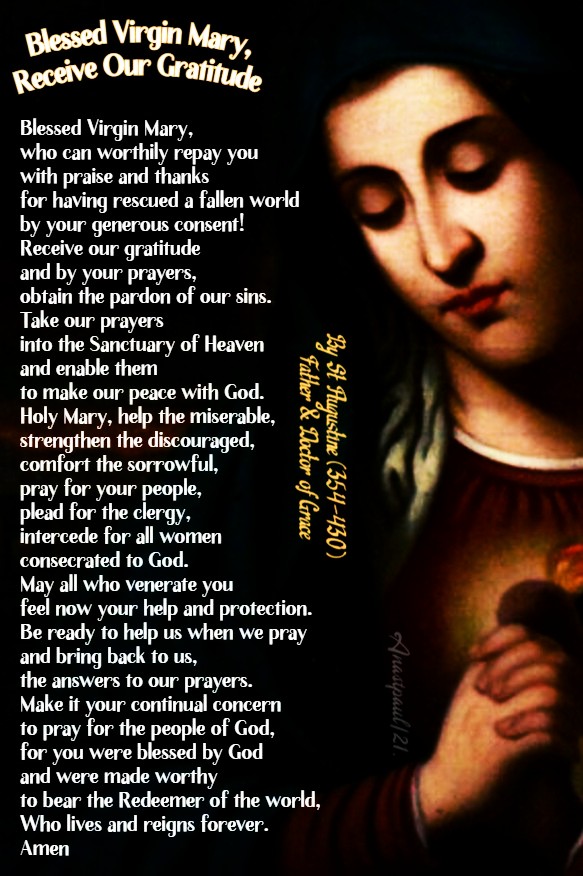
Blessed Virgin Mary, Receive Our Gratitude By St Augustine (354-430) Father & Doctor of Grace
Blessed Virgin Mary, who can worthily repay you with praise and thanks for having rescued a fallen world by your generous consent! Receive our gratitude and by your prayers, obtain the pardon of our sins. Take our prayers into the Sanctuary of Heaven and enable them to make our peace with God. Holy Mary, help the miserable, strengthen the discouraged, comfort the sorrowful, pray for your people, plead for the clergy, intercede for all women consecrated to God. May all who venerate you feel now your help and protection. Be ready to help us when we pray and bring back to us, the answers to our prayers. Make it your continual concern to pray for the people of God, for you were blessed by God and were made worthy to bear the Redeemer of the world, Who lives and reigns forever. Amen
Saint of the Day – 13 November – Saint Didacus (de Alcalá de Henares) OFM (c 1400-1463) Lay Brother of the Order of Friars Minor, Hermit, Mystic, Confessor, Born in c 1400 at Seville, Spain and died on 12 November 1463 at Alcala, Castile, Spain of natural causes. Also known as – St Didacus of St Nicholas, Diego, Diaz, Didacus de Alcalá de Henares, Didacus of Alcala. Patronages – Franciscan laity, Franciscan lay brothers, Diocese of San Diego, California.
The Roman Martyrology states of him today: “At Alcala in Spain, St Didacus, Confessor of the Order of Minorites, who was renowned for his humility. Incribed on the catalogue of the Saints by Pope Sixtus V, with a Feast Day of 13 November.“
Didacus was born about 1400 at San Nicolas in Andalusia, of poor and God-fearing parents. He entered the Third Order of St Francis when he had scarcely reached young manhood and under the direction of a devout Tertiary Priest, he served God for a long time as a Hermit. Consumed with the desire for still greater perfection, he later entered the Franciscan Convent at Arizafa in Castile and was there admitted to solemn vows as a lay brother.
His rapid progress in virtue made him a model to all his companions. His soul was continually occupied with God in prayer and meditation. From this source, he gathered such supernatural insight concerning God and the Mysteries of Faith, that learned theologians listened with astonishment to the inspiring conversations of this uneducated lay brother. Since Brother Didacus manifested great zeal for souls and willingness for sacrifice, his superiors sent him with other brethren to the Canary Islands, which at that time, were still inhabited by wild infidels. Didacus was eager for martyrdom and in this spirit, bore with dauntless patience, the many hardships that came his way. Both by word and example, he helped in converting many infidels.
In 1445, he was appointed Guardian of the chief Friary on the islands at Fortaventura. Recalled to Spain, he went to Rome in 1450 at the command of the Observant Vicar General, St John Capistrano, to attend the great Jubilee and the Canonisation ceremonies of St Bernardine of Siena. On this occasion, an epidemic broke out among the many Friars assembled in the large Convent of Aracoeli. Didacus attended the sick with great charity and trust in God. And God did not fail him. Despite the lack of supplies in the City at the time, Didacus always had ample provisions for his patients. He miraculously restored many of them to health by merely making the Sign of the Cross over them.
Leaving Rome, he returned to Spain, where, as in the former days, he was a source of great edification to the Friars of every Convent in which he lived.
When he felt that the end of his life was drawing near, he asked for an old and worn-out habit, so that he might die in it as a true son of the poor St Francis. He died on 12 November 1463, at the Franciscan Monastery in Alcalá, pressing a Crucifix to his heart and repeating the words of the Good Friday chant: “Dulce lignum, dulce ferrum, dulce pondus sustinet” – Precious the wood, precious the nails, precious the weight they bear.
Months passed before it was possible to bury Brother Didacus, so great was the number of people who came to venerate his remains. Not only did his body remain incorrupt but it diffused a pleasant odour. After it was laid to rest in the Franciscan Church at Alcalá de Henares, astounding miracles continued to occur at his tomb. Pope Sixtus V, himself a Franciscan, Canonised Brother Didacus in 1588.
The Church pays to Didacus today, the very same honours as we have seen her pay to Bernardine and John Capistrano. What is this but asserting, that before God, heroic acts of hidden virtue, are not inferior to the noble deeds that dazzle the world, if, proceeding from the same ardent love, they produce in the soul, the same increase of divine charity.
Notre-Dame de Nanteuil / Our Lady of Nanteuil, (Montrichard, Nanteuil-en-Vallee , France) 1st Century – 13 November :
This Shrine dates from late in the 1st Century, making it one of the oldest Shrines in France. According to tradition, some of the first Christians in the area discovered the Statue residing on the branch of an oak tree. They happily took it and placed it on a nearby wall near a fountain and went to summon the neighbours to show them what they had found. On returning, they found that the Statue was not where they had left it. Since this was an isolated spot, they wondered who might have taken it. Later, the Statue was found once again where they had first seen it, on the branch of the oak tree. Since Our Lady did not seem to want to be moved, the first Chapel was, accordingly, built around the tree, with the branches containing the Statue, being on the upper floor. A Parish Church, later built next door, shows late 12th century architecture but the Shrine was already very old at this time. The Church and the priory of Nanteuil belonged to the Abbey from the first years of the twelfth century. Construction took place, attributed to Philippe-Auguste, who wanted to show his gratitude to the Blessed Virgin for a double benefit – the first was for when his prayer had been answered and his thirsting army had been drenched by rain to quench that thirst; the second was for their victory over the King of England and their taking of Montrichard. In fact, the second column that supports the arch on the right side, depicts the face of the monarch, along with the faces of other leaders of his army. The devotion of Kings and Lords for the Virgin of Nanteuil was shared by the people, and from everywhere they came on pilgrimage, especially the Monday of Pentecost, which gave birth to a famous fair which was established before the fourteenth century and continues to this day. The religious upheavals of the 16th Century left Our Lady of Nanteuil undisturbed but before the French Revolution, a change came over the Statue. The smiling face became sad and many pilgrims testified to seeing tears on the cheeks. The Revolution indeed brought sorrow to the Shrine. One of the pilgrims threw a rope around the neck of the Statue and pulled it to the ground, breaking all but the head. A woman who carelessly tossed the head aside and looked for better loot was punished by almost instant death. Another woman took up the mutilated head and hid it until the destruction was over and a new body could be made to go with it. One of the many miracles recorded of Our Lady of Nanteuil, is the cure of a little boy who was completely crippled. His mother carried him on her back for three pilgrimages and the third time, to the Shrine of Our Lady of Nanteuil, he returned home entirely cured. The Shrine was especially famous for the cures of sick children, and was a favourite of King Louis XI. This Shrine had a privileged Altar that was highly indulgenced. It was a favourite of the Venerable Olier and of that saintly pilgrim, Saint Benedict Joseph Labre. Unfortunately, we have no clear images of the restored Statue.
All Saints of the Augustinian Order: On 13 November – St Augustine’s Birthday, we celebrate the Feast of All Saints of the Augustinian Order. On this day we call to mind the many unsung brothers and sisters of the Augustinian family who have “fought the good fight” and celebrate now, in Heaven. Let us pray for one another that we too may one day join in the “unceasing chorus of praise” with all our Augustinian brethren in Heaven.
All Saints of the Benedictine & Cistercian Orders: Those interested in the Benedictine family may be interested to know that today, within the Benedictine liturgical tradition, is traditionally celebrated the Feast of All Saints of the Benedictine Order – In Festo Omnium Sanctorum Ordinis S.P.N. Benedicti. The Cistercians — who also follow the Rule of St Benedict — likewise observe this day for All Saints of their Order. (On a related note, the Benedictines also traditionally observe 14 November as All Souls of their Order.
Saint Benedict and Saint Bernard (1542), by Diogo de Contreiras. Saint Bernard is depicted in the white cowl of the Cistercians.
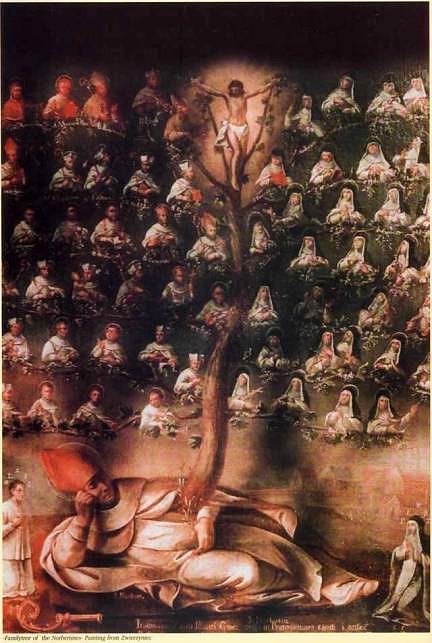
All Saints of the Premonstratensian Order or the “Norbertines.” The Order of Canons Regular of Prémontré, also known as the Premonstratensians, the Norbertines and, in Britain and Ireland, as the White Canons , are a Roman Catholic religious order of canons regular founded in Prémontré near Laon in 1120 by Saint Norbert, who later became Archbishop of Magdeburg. Premonstratensians are designated by O.Praem. following their name. St Norbert was a friend of Saint Bernard of Clairvaux and so was largely influenced by the Cistercian ideals as to both the manner of life and the government of his order. Aside from St Norbert there are at present fifteen saints of the Order who have been Canonised or have had their immemorial cults confirmed by the Holy See. St Norbert (c 1080-1134) “Defender of the Eucharist” and “Apostle of the Eucharist” – Bishop, Confessor, Founder. St Norbert here: https://anastpaul.com/2017/06/06/saint-of-the-day-6-june-st-norbert/
St Amandus of Rennes St Amanzio St Beatrix of Bohemia St Brice of Tours St Caillin St Chillien of Aubigny Bl Christopher Eustace St Columba of Cornwall St Dalmatius of Rodez Bl David Sutton St Devinicus St Didacus de Alcalá de Henares) OFM (c 1400-1463) Lay Brother of the Order of Friars Minor, Confessor.
St Eugenius of Toledo St Florido of Città di Castello St Gredifael St Himerius St Homobonus of Cremona Bl John Sutton Bl Juan Gonga Martínez St Juan Ortega Uribe
St Leoniano of Vienne Bl María Cinta Asunción Giner Gomis Bl Maurice Eustace St Maxellendis St Mitrius St Pope Nicholas I St Paterniano St Quintian of Rodez Bl Robert Fitzgerald Bl Robert Montserrat Beliart Bl Robert Scurlock
Bl Thomas Eustace Bl Warmondus of Ivrea Bl William Wogan
Martyrs of Caesarea – 5 saints: A group of Christians murdered for their faith in the persecutions of Diocletian, Galerius Maximian and Firmilian. – Antoninus, Ennatha, Germanus, Nicephorus and Zebinas. 297 at Caesarea, Palestine.
Martyrs of Ravenna – 3 saints: A group of Christians murdered together in the persecutions of Diocletian. The only information about them that has survived are three names – Solutor, Valentine and Victor. c 305 in Ravenna, Italy.
Martyrs of Salamanca – 5 saints: The first group of Christians exiled, tortured and executed for their adherence to the Nicene Creed during the persecutions of the Arian heretic Genseric. – Arcadius, Eutychianus, Paschasius, Paulillus and Probus. Born in Spain and Martyred in 437. Their relics are at Medina del Campo, Spain.
Thought for the Day – 12 November – Meditations with Antonio Cardinal Bacci (1881-1971)
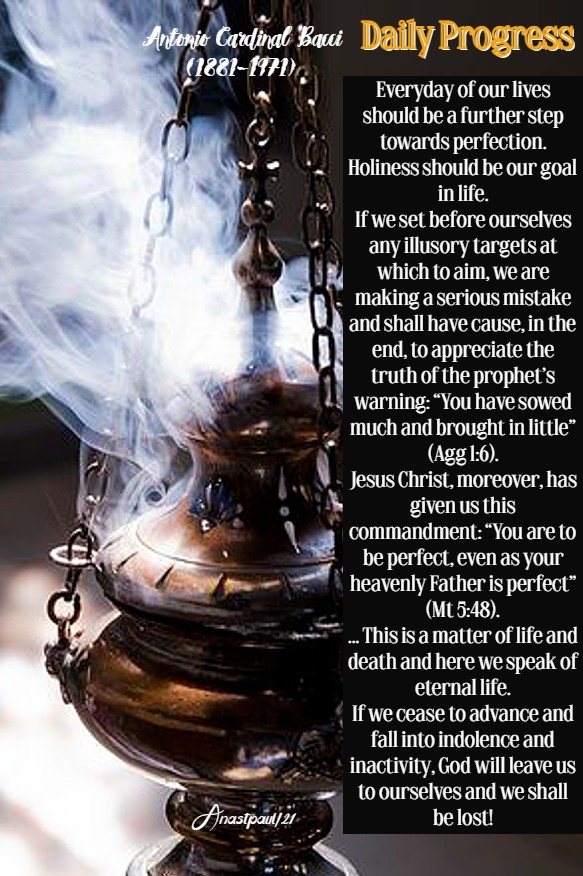
Daily Progress
“Everyday of our lives should be a further step towards perfection. Holiness should be our goal in life. If we set before ourselves any illusory targets at which to aim, we are making a serious mistake and shall have cause, in the end, to appreciate the truth of the prophet’s warning: “You have sowed much and brought in little” (Agg 1:6). Jesus Christ, moreover, has given us this commandment: “You are to be perfect, even as your heavenly Father is perfect” (Mt 5:48).
The ideal is high, certainly and, it is impossible for human resources but Jesus assures us, that nothing is impossible with God (Cf Lk 18:27). We can do nothing without God’s help but, with His grace, we can do everything. “I can do all things in him who strengthens me” (Phil 4:13).
Naturally, we cannot hope to accomplish everything in one day. We should desire to reach the highest possible level of perfection and not to be discouraged by the many difficulties which we are sure to encounter on the way. But, it would be presumptuous to expect to achieve perfection in a single moment.
The road to sanctity is long and arduous. It is essential to stride this path resolutely and with complete confidence in God. We should go forward with enthusiasm, not depending on our own poor resources but, on divine grace.
This is a matter of life and death and here we speak of eternal life. If we cease to advance and fall into indolence and inactivity, God will leave us to ourselves and we shall be lost! A man who is not advancing in the spiritual life must lose ground sooner or later because, he is not obeying the command of Jesus Christ.”
Quote/s of the Day – 12 November – Readings: Wisdom 13: 1-9; Psalm 19: 2-5; Luke 17: 26-37
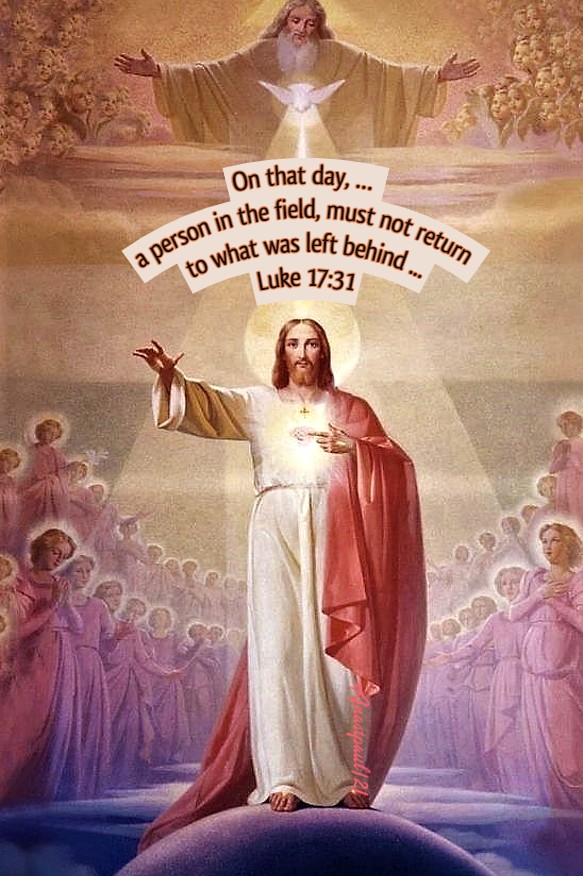
“On that day, … a person in the field, must not return to what was left behind.”
Luke 17:31
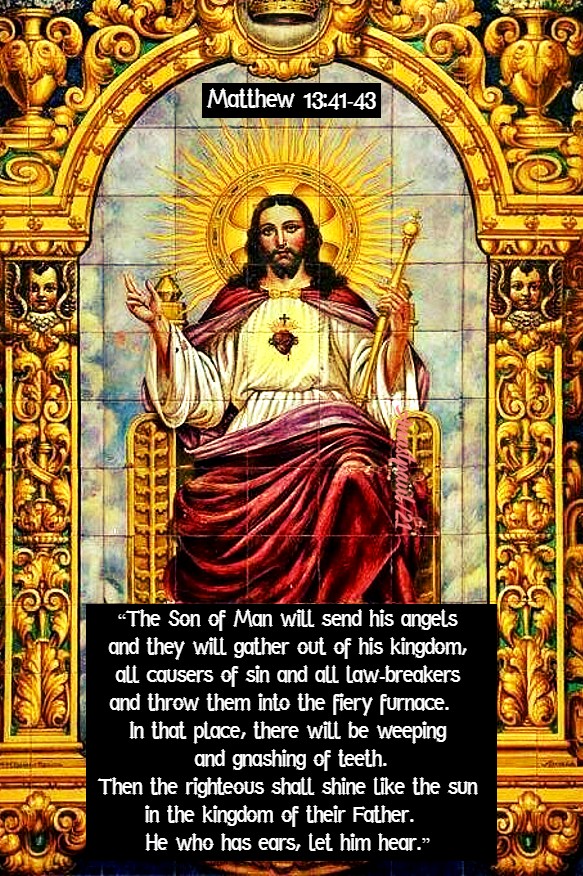
“The Son of Man will send his angels and they will gather out of his kingdom, all causers of sin and all law-breakers and throw them into the fiery furnace. In that place, there will be weeping and gnashing of teeth. Then the righteous shall shine like the sun in the kingdom of their Father. He who has ears, let him hear.”
Matthew 13:41-43
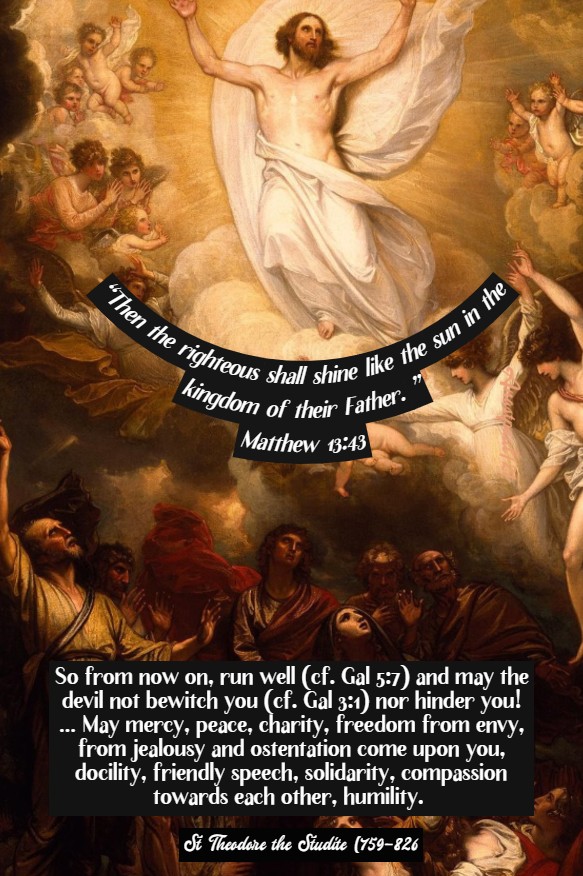
“Then the righteous shall shine like the sun in the kingdom of their Father.”
Matthew 13:43
“So from now on, run well (cf. Gal 5:7) and may the devil not bewitch you (cf. Gal 3:1) nor hinder you! … May mercy, peace, charity, freedom from envy, from jealousy and ostentation come upon you, docility, friendly speech, solidarity, compassion towards each other, humility.”
St Theodore the Studite (759-826)
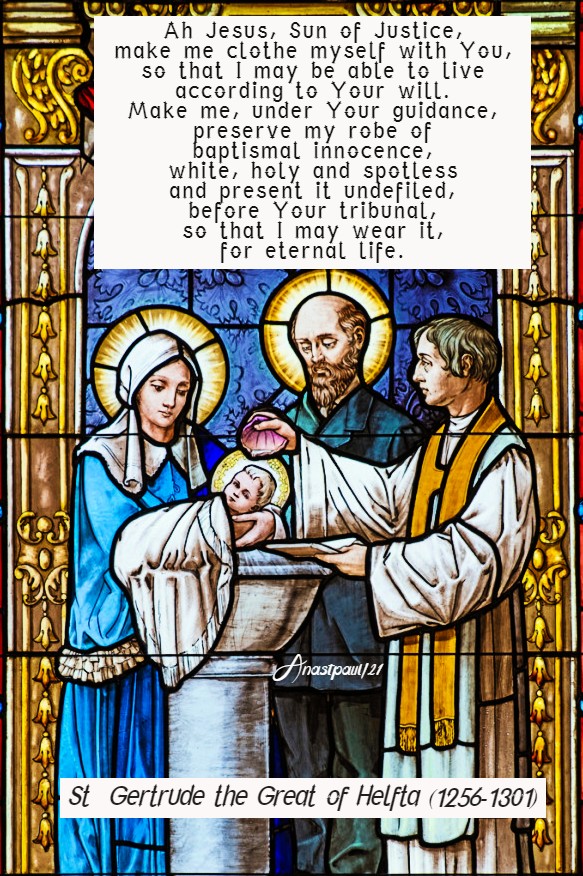
“Ah Jesus, Sun of Justice, make me clothe myself with You, so that I may be able to live according to Your will. Make me, under Your guidance, preserve my robe of baptismal innocence, white, holy and spotless and present it undefiled, before Your tribunal, so that I may wear it, for eternal life.”
St Gertrude the Great of Helfta (1256-1301)
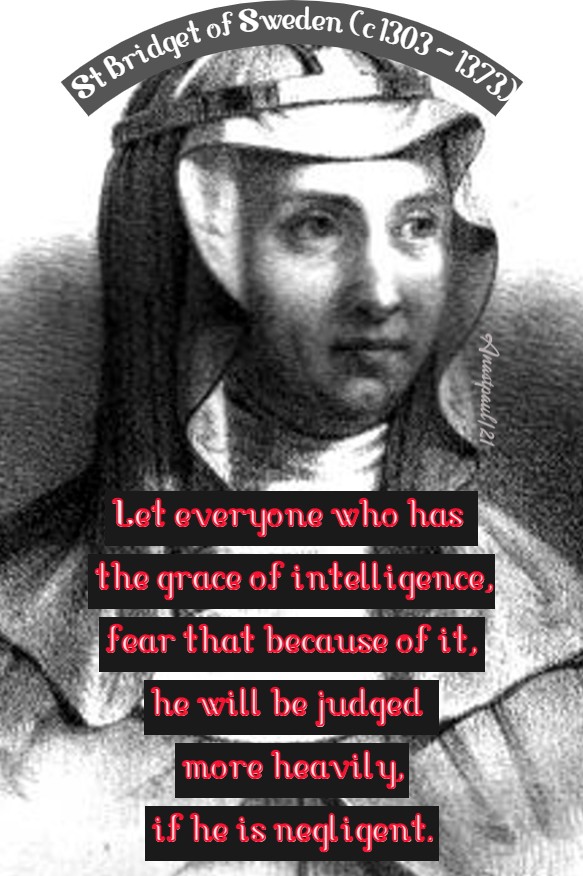
“Let everyone who has the grace of intelligence, fear that because of it, he will be judged more heavily, if he is negligent.”
St Bridget of Sweden (c 1303 – 1373)
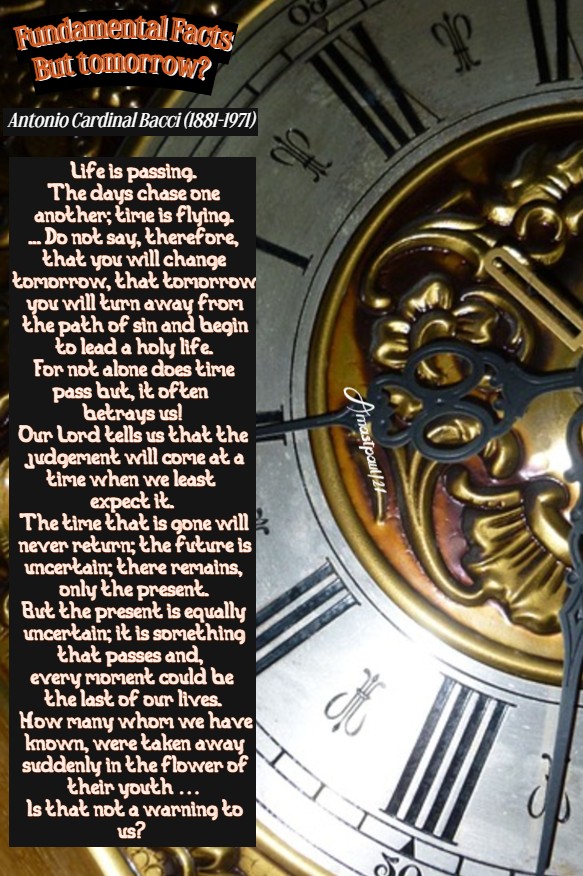
“Life is passing. The days chase one another; time is flying. Do not say, therefore, that you will change tomorrow, that tomorrow you will turn away from the path of sin and begin to lead a holy life. For not alone does time pass but, it often betrays us! Our Lord tells us that the judgement will come at a time when we least expect it. The time that is gone will never return; the future is uncertain; there remains, only the present. But the present is equally uncertain; it is something that passes and, every moment could be the last of our lives. How many whom we have known, were taken away suddenly in the flower of their youth … Is that not a warning to us?”
One Minute Reflection – 12 November – “Month of the Holy Souls in Purgatory” – Readings: Wisdom 13: 1-9; Psalm 19: 2-5; Luke 17: 26-37
“On that day, … a person in the field, must not return to what was left behind.” – Luke 17:31
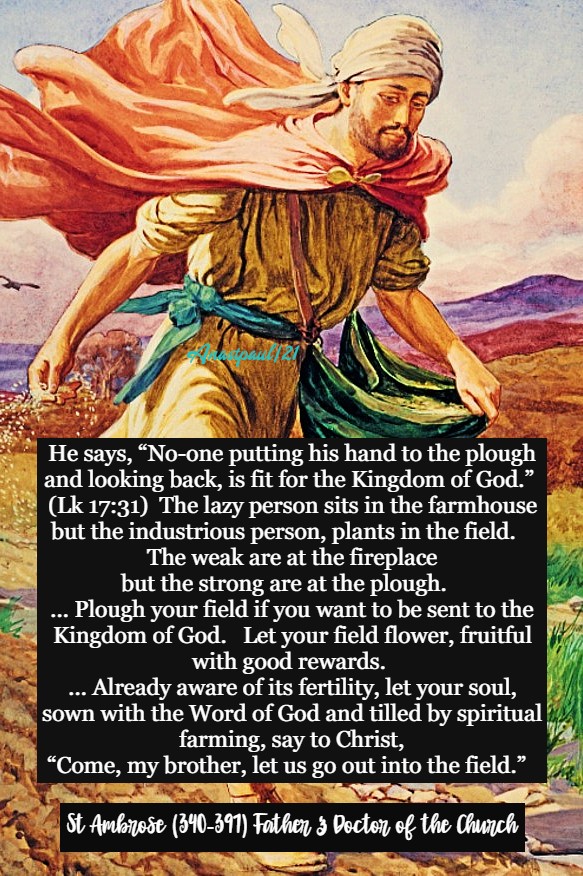
REFLECTION – “He that will be in the field, do not let him turn back.” How may I understand what is the field unless Jesus Himself teaches me? He says, “No-one putting his hand to the plough and looking back, is fit for the Kingdom of God.” The lazy person sits in the farmhouse but the industrious person, plants in the field. The weak are at the fireplace but the strong are at the plough. The smell of a field is good because the smell of Jacob is the smell of a full field. A field is full of flowers. It is full of different fruits. Plough your field if you want to be sent to the Kingdom of God. Let your field flower, fruitful with good rewards. Let there be a fruitful vine on the sides of your house and young olive plants around your table. Already aware of its fertility, let your soul, sown with the Word of God and tilled by spiritual farming, say to Christ, “Come, my brother, let us go out into the field.” Let Him reply, “I have come into my garden, my sister, my bride. I have gathered my vintage of myrrh.” What is better than the vintage of faith, by which the fruit of the resurrection is stored and the spring of eternal rejoicing is watered?” – St Ambrose (340-397) Bishop of Milan and one of the original four Fathers and Doctors of the Latin Church (Exposition on the Gospel of Luke, 8)
PRAYER – Lord God, grant to us that the power of Your protecting hand may keep us unshaken in the face of our ancient enemy and all his hidden snares. Lighten our way so that, through the prayers of intercession of the Angels and Saints, we may experience the joy of Your presence in our hearts, courage in times of suffering and the wisdom to obey Your instructions. Through Jesus Christ, our Lord, with the Holy Spirit, one God for all eternity, amen.
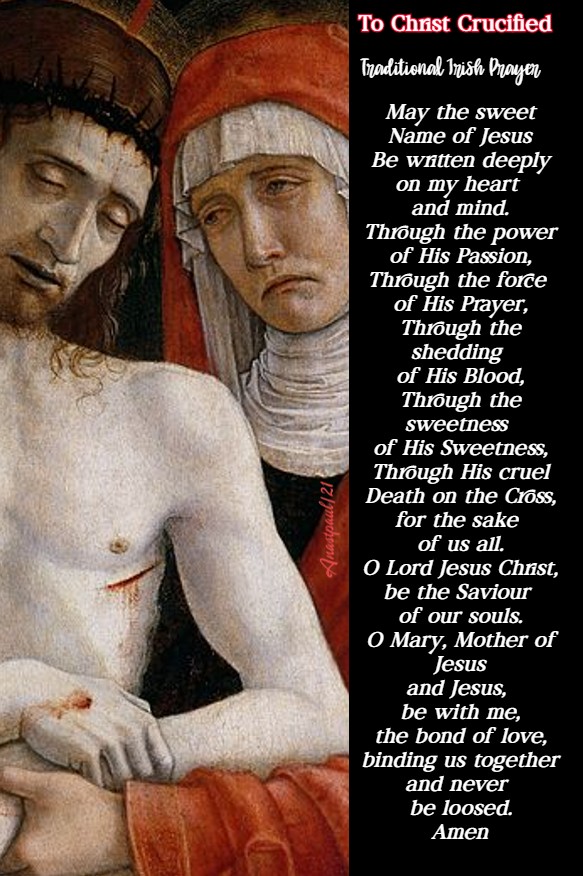
Our Morning Offering – 12 November -Friday, the day of the Passion of our Lord Jesus Christ
To Christ Crucified Traditional Irish Prayer Trans. Brendan Devlin
May the sweet Name of Jesus Be written deeply on my heart and mind. Through the power of His Passion, Through the force of His Prayer, Through the shedding of His Blood, Through the sweetness of His Sweetness, Through His cruel Death on the Cross, for the sake of us all. O Lord Jesus Christ, be the Saviour of our souls. O Mary, Mother of Jesus and Jesus, be with me, the bond of love, binding us together and never be loosed. Amen
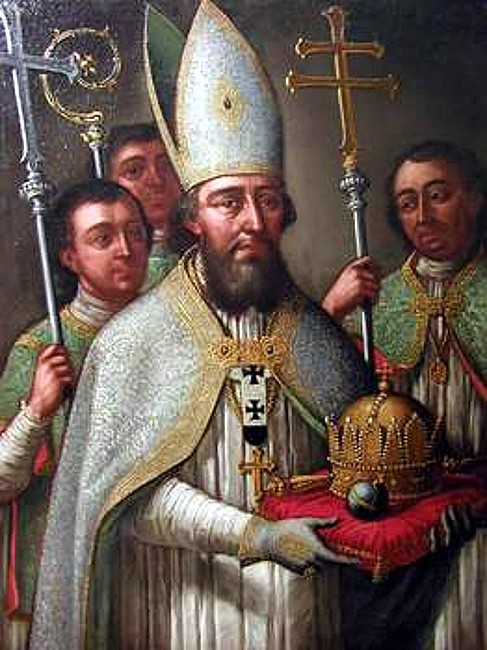
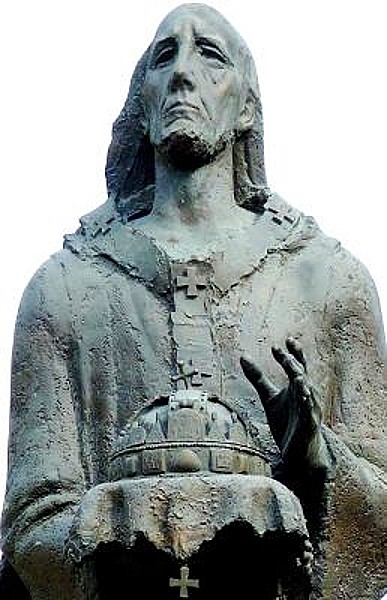
Saint of the Day – 12 November – Saint Astricus of Esztergom (Died c 1035) Archbishop of Esztergom, the first Archbishop of the Hungarian Church, Confessor, Monk, Abbot, Missionary, Born in Bohemia as Radla and died in c 1035 of natural causes. Patronage – Hungary. Also known as – Astricus of Ungarn, Anastasius XIX, Astericus Anastasius, Astrik of Pannonhalma, Ascrick, Astericus, Astrik-Anastaz, Radla.
Radla was a Czech or Croat from Bohemia, who was a Monk in Hungary. He probably received the habit at Brevnov, taking the name of Anastasius, of which Astricus is the equivalent. Astricus accompanied Saint Adalbert in the latter’s missionary work to the Bohemians and became the first Abbot of Břevnov Monastery. When Adalbert failed to consolidate his position in Bohemia and left Prague, Astricus went to the Kingdom of Hungary to help the missionaries among the Magyars.
He first served the wife of Duke Géza. In 997 Astricus became the first Abbot of the Benedictine Abbey of St Martin’s, the first ecclesiastical institution in Hungary, founded by Duke Géza. He then served Géza’s son, who was the great Saint Stephen I of Hungary and became the first Archbishop of the Hungarian Church.
Astricus served as Stephen’s Ambassador to Pope Sylvester II and negotiated the recognition of the new Kingdom of Hungary The Pope recognised Stephen as King of the Hungarians. Soon after Astricus’ return bringing the Crown with hin, Stephen was crowned by him, with the royal crown sent by Pope Sylvester, granted no doubt at the instance of the Emperor Otto III, in 1001. Astricus fulfilled the role of the Advisor to St Stephen on matters of spirit and of state until Stephen‘s death. He outlived the King and Saint by two years and spent those last days as a prayerful Monk.
The Assumption Cathedral of Kalocsa was extensively restored between 1907 and 1912. Under the Sanctuary, a red marble archiepiscopal tomb was excavated in 1910 in the place of the original 11th-century Cathedral. In addition to the intact skeleton, a gilded silver-headed crosier, a silver chalice, paten, golden rings, crosses, pallium with three jeweled gold pins and textile remnants were found. After many investigations these relics were confirmed as belonging to our Saint Astricus.
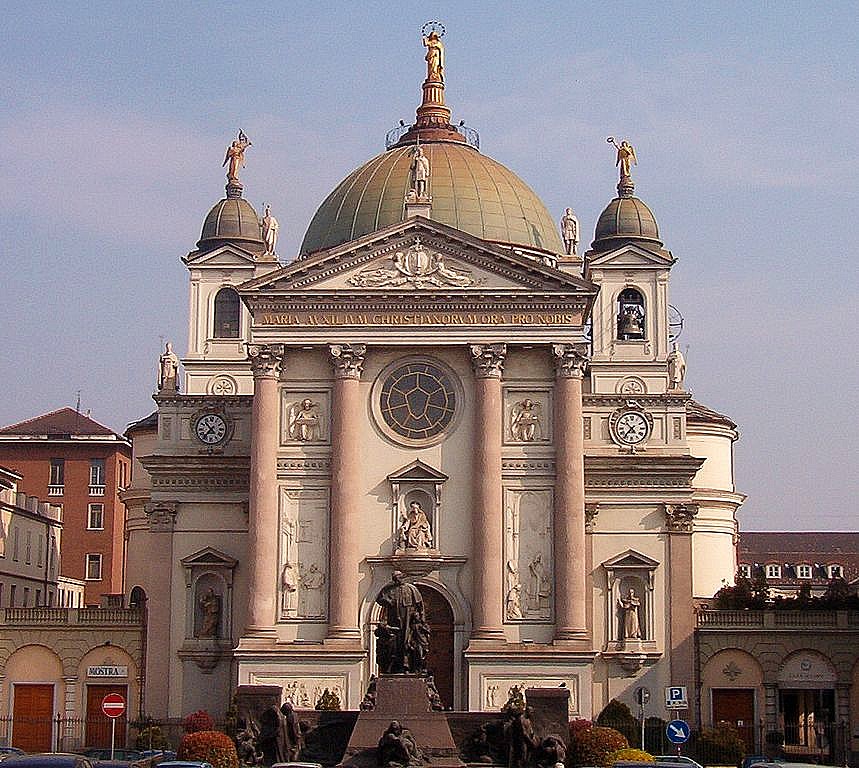
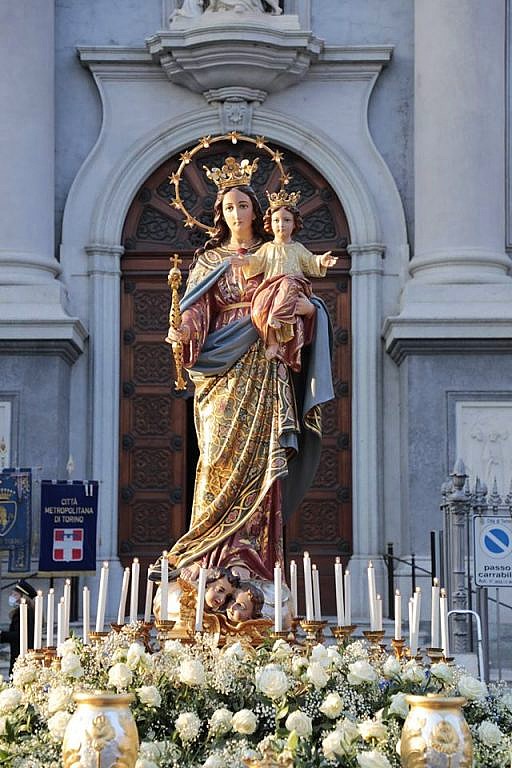
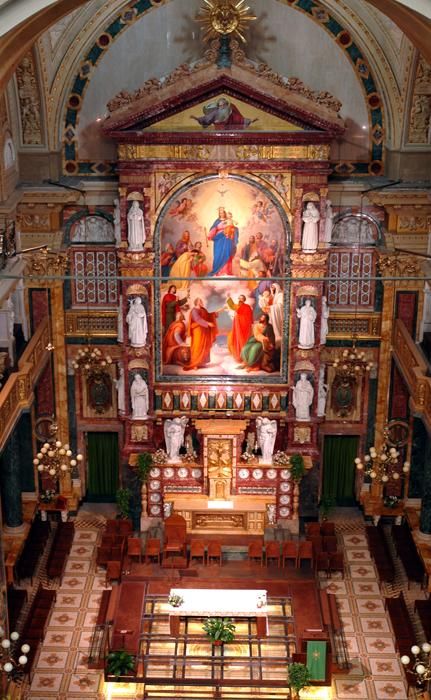
Maria Ausiliatrice a Valdocco / Our Lady of the Tower Secret, Turin, Italy (1863) – 12 November:
Our Lady of the Tower, at Fribourg, built on the lands of the heretics, on the very spot where an image of Our Lady had been found.
Don John Bosco, the amiable saint of the nineteenth century built a major Shrine to Our Lady Help of Christians, tying it in with the past and with the future. The Church was begun in 1863 with the sum of 8 cents. Don Bosco never revealed all that Our Lady had told him, in the several visions that preceded this but he did reveal that she asked him to build a great Shrine and that it would be a source of grace to all who came there to pray. He simply got permission, hunted up an architect who was willing, in the coldly realistic nineteenth century, to begin a Church on 8 cents and said, when the work was finished, that he had been paid every cent owing to him but, that he had been confronted in the beginning, by a man who many people said was completely mad. The architect must have had real faith, even to listen to Don Bosco. Like everything else accomplished by the great Saint of Turin, the building was beset with difficulties. No-one could understand why he insisted on naming it for Our Lady; even his own fellow priests. The money to pay for the project did not come in by the thousands, or even by the hundreds but by the penny. Every stone in the building, every bit of decorations, was a gift of love, and sacrifice from some grateful person who had benefitted from Our Lady’s help. The completed building is a testimonial of miracles and a Shrine of beauty, fit to stand with the world’s finest.
The curious thing about Don Bosco’s Shrine to Our Lady, and the one that should cause us thought, is the story of the right-hand tower. There is a large central dome, and on each side of it, a smaller one. On top of left-hand one is an angel holding a banner. The right-hand dome is built in the same way but its decoration is an angel offering a crown to Our Lady. One who saw the original sketches of the Church, drawn out in Don Bosco’s own hand, saw on the right-hand tower, a date 19.., indicating that at some time, in this warring century, there would be a victory over evil to correspond with Lepanto. Our Lady often tells her secrets to the saints and apparently Don Bosco knew the name and the place and thought it better not to reveal what he knew. Our Lady of the Tower Secret would take care of it in time and the left-hand angel bearing a banner labelled LEPANTO would have a counterpart, if mankind proves worthy. Don Bosco’s Church with Our Lady of the Tower was raised to the rank of a Basilica by Pope Pius X, Saint Pope Pius X.
St Arsatius St Astricus of Esztergom (Died c 1035) Bishop St Aurelius St Cadwallader St Cummian Fada St Cunibert of Cologne St Emilian Cucullatus St Evodius of Le Puy St Hesychius of Vienne Bl John Cini della Pace Bl José Medes Ferrís
St Namphasius St Nilus the Elder St Paternus of Sens St Publius St Renatus of Angers St Rufus of Avignon Bl Ursula Medes Ferris St Ymar of Reculver — Five Polish Brothers – martyrs: They weren’t Polish and they weren’t related but were instead five Italian Benedictine monks who worked with Saint Adalbert of Prague as missionaries to the Slavs and were martyred together. They were – Benedict, Christinus, Isaac, John and Matthew. Born in Italy. They were martyred in 1005 at the Benedictine monastery near Gnesen, Poland and Canonised by Pope Julius II.
Thought for the Day – 11 November – Meditations with Antonio Cardinal Bacci (1881-1971)
Sensitiveness
“A single severe glance from our employer or superior, is enough to make us anxious. If it is accompanied by a word of rebuke, we are thoroughly upset. Why should this be so? It is because we are lacking in the fundamental virtue of humility. We want to keep up appearances and to be held in high regard. If we are frustrated in this ambition, we suffer inwardly.
All this is quite natural but, on this natural foundation, we must build the virtue of humility and the desire to serve God alone. If we possess this virtue, we shall continue to be sensitive to insults and humiliations but our suffering will be sanctified and will be meritorious in the sight of God.
We are all pleased when we are praised by others and are hurt when we are criticised because our natural inclinations are never destroyed. Our sensitivity, however, can be moderated and brought under the control of right reason, whose guide should be the rule of virtue. It is worth reflecting on what The Imitation of Christ has to say in this regard.
“Whenever a man desires anything inordinately, straight away, he is disquieted within himself. The proud and the covetous are never at rest; the poor and the humble in spirit, pass their life in abundance of peace. The man who is not yet perfectly dead to self, is soon tempted and overcome in little and paltry things. He that is weak in spirit and in a certain manner, as yet carnal and inclined to things of sense, cannot, without difficulty, sever himself wholly from earthly desires. And, therefore, he is often sad when he does withdraw himself and besides, he is easily moved to anger if anyone thwart him And, if he has pursued his inclination, forthwith he is burdened with remorse of conscience, for having gone after his passion, which helped him not at all, to the peace he looked for. It is by resisting the passions, therefore and not by serving them, that true peace of heart is to be found. Peace, therefore, is not in the heart of the carnal man, nor in the man who is devoted to outward things but, in the fervent and spiritual man” (Bk 1 Ch 6).
“Continual peace dwells with the humble but in the heart of the proud, is frequent envy and indignation” (Ibid Ch 7, V3).
Quote/s of the Day – 15 November – Readings: Wisdom 7: 22b – 8: 1; Psalm 119: 89-91, 130, 135, 175; Luke 17: 20-25
“For behold, the kingdom of God is among you.”
Luke 17:21
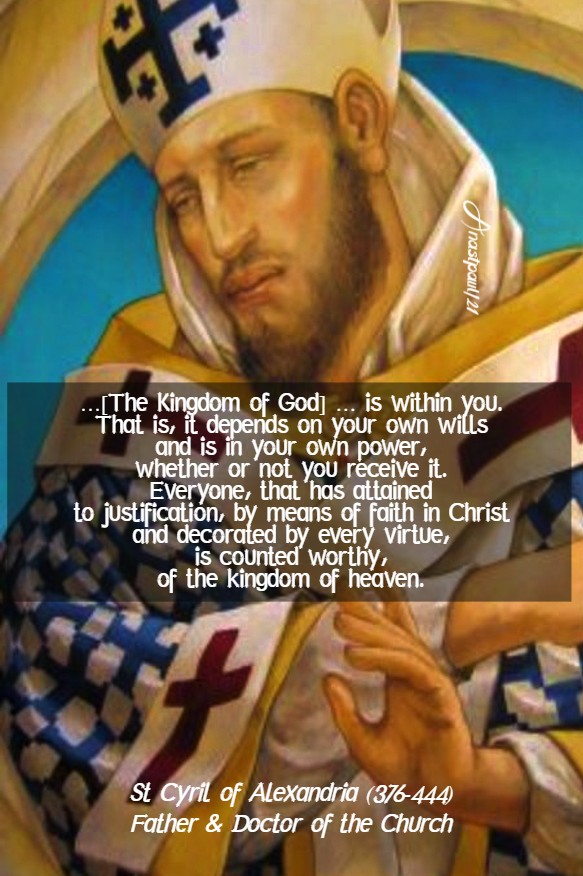
“…[The Kingdom of God] … is within you. That is, it depends on your own wills and is in your own power, whether or not you receive it. Everyone, that has attained to justification, by means of faith in Christ and decorated by every virtue, is counted worthy, of the kingdom of heaven.”
St Cyril of Alexandria (376-444) Father and Doctor of the Church
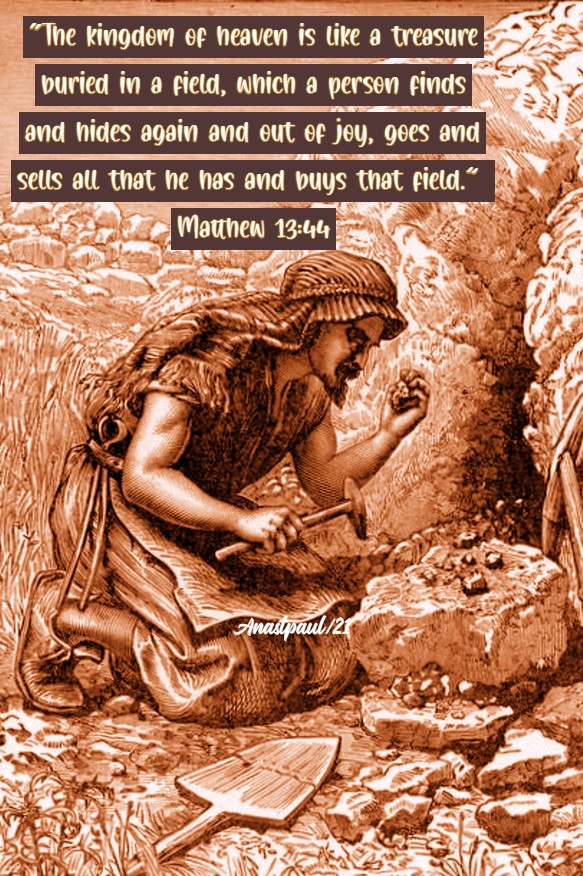
“The kingdom of heaven is like a treasure buried in a field, which a person finds and hides again and out of joy, goes and sells all that he has and buys that field.”
Matthew 13:44
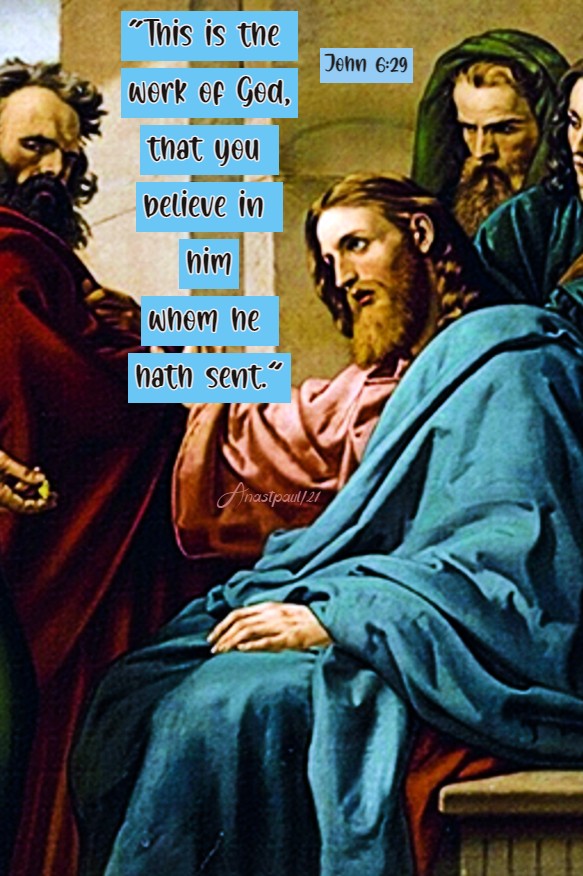
“This is the work of God, that you believe in him whom he hath sent.”
John 6:29
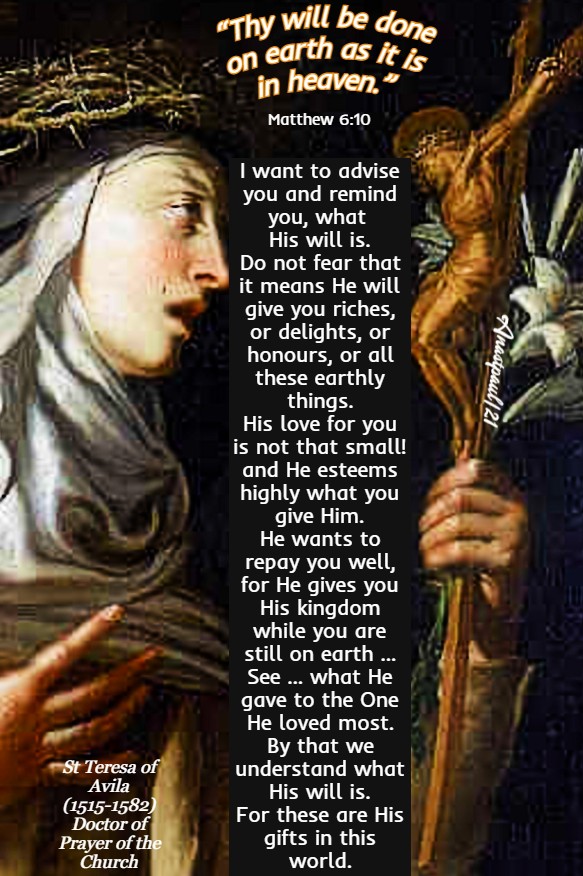
“I want to advise you and remind you, what His will is. Do not fear that it means He will give you riches, or delights, or honours, or all these earthly things. His love for you is not that small! and He esteems highly what you give Him. He wants to repay you well, for He gives you His kingdom while you are still on earth … See … what He gave to the One He loved most. By that we understand what His will is. For these are His gifts in this world.”
St Teresa of Avila (1515-1582) Doctor of Prayer of the Church
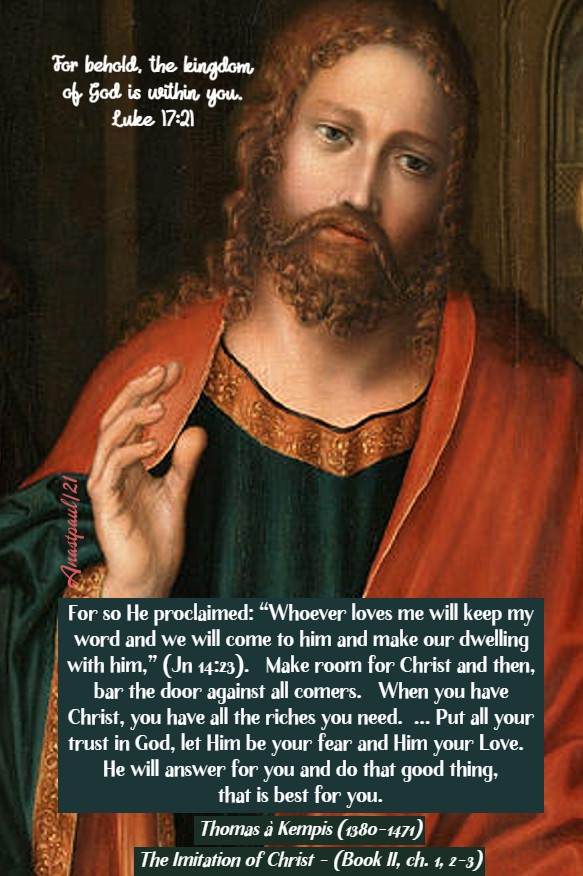
One Minute Reflection – 15 November – Readings: Wisdom 7: 22b – 8: 1; Psalm 119: 89-91, 130, 135, 175; Luke 17: 20-25 – The Memorial of St Martin of Tours (c 316-397) and St Bartholomew of Rossano (c 970-c 1065)
“For behold, the kingdom of God is within you.” – Luke 17:21
REFLECTION – “The Kingdom of God is within you,” says the Lord …. Get up, faithful soul, prepare your heart for this Bridegroom, that He may deign to come and dwell within you. For so He proclaimed: “Whoever loves me will keep my word and we will come to him and make our dwelling with him,” (Jn 14:23). Make room for Christ and then, bar the door against all comers. When you have Christ, you have all the riches you need. He will be your Purveyor and your faithful Manager in all things; you will have no need to hope in men. For men are quick to change and speedily die but Christ “remains forever” (Jn 12:34), standing firm to the very end.
Not much reliance should be placed upon man, be he never so beloved or so useful; for he goes to pieces and he dies. And not much sadness should be felt if he sometimes turns against you – with you to-day, against you to-morrow and fickle as the breeze, to return to you again. Put all your trust in God, let Him be your fear and Him your Love. He will answer for you and do that good thing that is best for you.
“Here we have no lasting city” (Heb 13:14), wherever you are, you are “a stranger and an alien” (Heb 11:13); you will never, at anytime have peace until you are intimately one with Christ.” – Thomas à Kempis CRSA (1380-1471) – The Imitation of Christ – (Book II, ch. 1, 2-3)– Trans Robert Dudley
PRAYER – Our Father, hallowed be Your name, Your kingdom come, Your will be done! Grant us Lord, a true knowledge of our salvation, so that freed from fear and from the power of our foes, we may serve You faithfully, all the days of our lives and thus attain eternal joy with You. May the prayers of St Martin of Tours and St Bartholomew of Rossano, on our behalf, be a succour to us all. Through our Lord Jesus Christ with the Holy Spirit, one God for all eternity, amen.
Our Morning Offering – 11 November – Monday of the Thirty Second Week in Ordinary Time, Year C
In the Name of the Father, Son and Holy Spirit By St Hilary of Poitiers (315-368) Father & Doctor of the Church
Father, keep us from vain strife of words. Grant to us constant profession of the Truth! Preserve us in a true and undefiled faith so that we may hold fast to that which we professed when we were Baptised in the Name of the Father, Son and Holy Spirit, that we may have You for our Father, that we may abide in Your Son and in the fellowship of the Holy Spirit. Through Jesus Christ, Our Lord. Amen
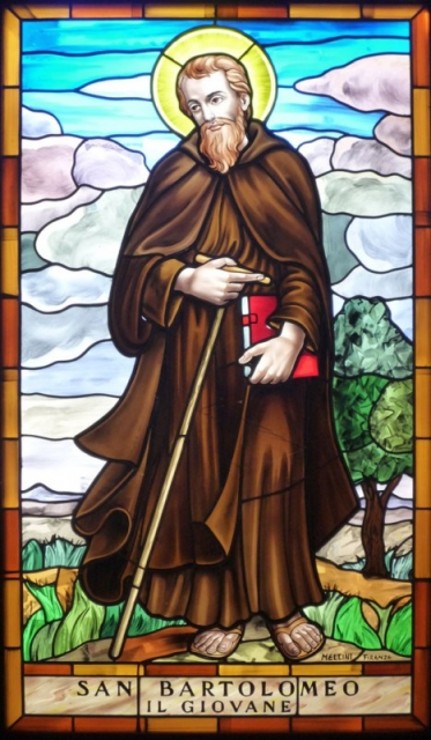
Saint of the Day – 11 November – Saint Bartholomew of Rossano (c 970-c 1065) Basilian Monk, Abbot, Confessor, Spiritual disciple and friend of St Nilus (910-1005), Hymnist an highly skilled Calligrapher of sacred manuscripts – the art of calligraphy he had learned from his blessed guide and teacher, He is known as the “Second Founder,” of the Monastery of Grottaferrata founded by St Nilus. A copyist of many codices, Bartholomew is also considered the greatest hymnographer of the 11th century. Born in c 970 in Rossano, Calabria, Italy and died on 11 November c1065 at Grottaferrata Abbey, Frascati, Italy of natural causes. Also known as – Bartholomew of Grottaferrata, Bartholomew the Younger, Bartolomeo il Giovane.
The Roman Martyrology states: “In the Monastery of Crypta-Ferrata, near Frascati, the holy Abbot Bartholomew, companion of the blessed Saint Nilus, whose life he wrote.”
Bartholomew was the son of a noble Greek immigrant family originally from Constantinople. He was Baptised with the name of Basilio and showed much interest in religious life from an early age. At the age of seven he was entrusted to the Monks of the Monastery of San Giovanni Calibita, where he received such a profound education, that he surpassed his contemporaries
After five years he went to Vallelucio, near Monte Cassion, where he became the disciple of St Nilus of Rossano and a Monk at the Monastery at Grottaferrata in Fracati, which St Nilus had founded. The Monks celebrated the Greek Catholic Rite and kept the Basilian Rule. St Nilu’s life here: https://anastpaul.com/2020/09/26/saint-of-the-day-26-september-saint-nilus-the-younger-910-1005/
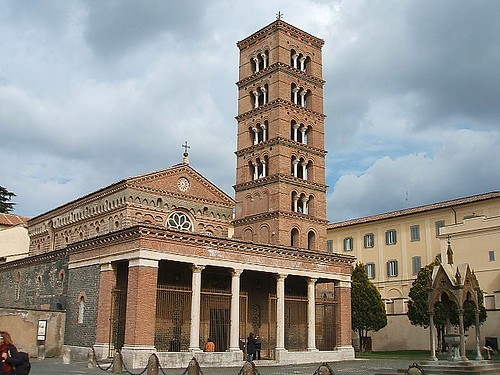
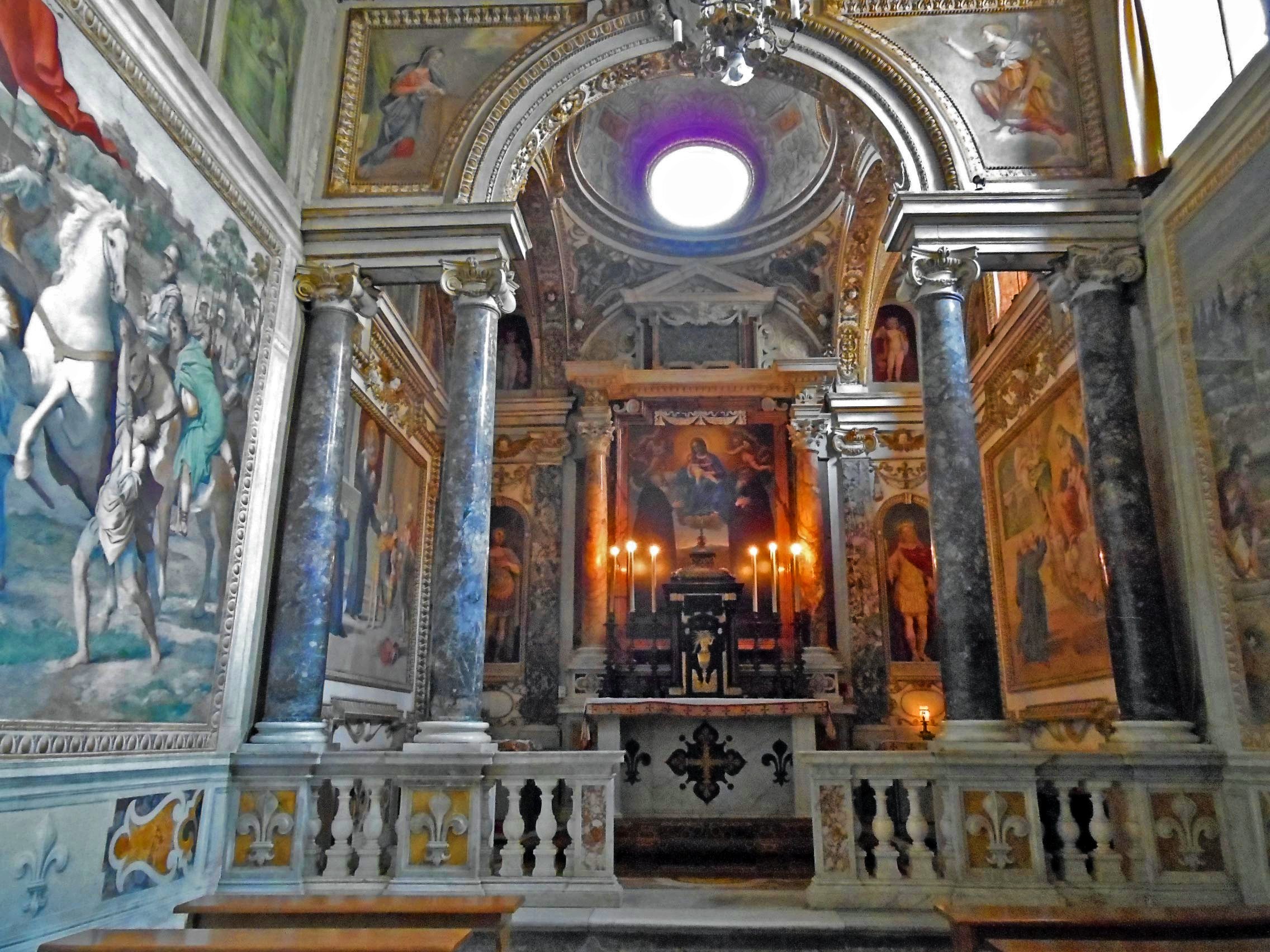
The Monastery of Grottaferrata
When St Nilus died in 1005, Bartholomew continued his works and became his fourth successor as Abbot – a position he held for forty years. During those 40 years, Bartholomew completed the construction of the Monastery and other ancillary works, which St Nilus had begun. This work turned the Monastery into a centre of education and manuscript copying and was so extensive, that he is often listed as the ” Second Founder.” Under his guidance and administration, the Monastery established a firm basis, surviving many troubles and political interference and thus, this foundation has allowed it to continue to this day.
He also took part in the Roman Synods of 1036 and 1044. He showed excellent diplomatic skills, managing to appease the differences between Duke Adenolfo and the Prince of Salerno. He was a close friend of the Pontiffs Benedict VIII and Benedict IX, managing to persuade the latter to abdicate, who then retired to the Monastery of Grottaferrata.
Bartholomew was described as having a very sympathetic and kind nature. He was unable to see anyone suffer in any manner, without striving to assist and extend comfort.
In the biography of the Saint, a miracle is narrated that underlines his love for the poor, which happened a few years after his death. The protagonist of this event is a Monk named Franco, who at the end of his life and unable to speak, was miraculously healed. He told his brothers that he was now ready for burial and that in his sleep, he had seen two doves, one white and one black, approach him and guiding him into a field full of light, where Bartholomew was standing surrounded by a multitude of poor people. Bartholomew gave them all bread, then entered a beautiful building in which there was a woman of indescribable beauty, that is, the Virgin Mary. Here Bartholomew, addressing the Monk Franco advising him to remind the remaining Monks of Grottaferrata, to be merciful towards the poor.
Bartholomew died around 1065, he was buried next to St Nilus in the Chapel named after the two of them in the Monastery. heir remains remained in Grottaferrata until 1300, after this date all traces of their relics disappeared.
The interior of the Grottaferrata Abbey
Pope Pius XII on the Ninth Centenary of the Saint’s death, in a message to the Abbot of Grottaferrata, defined St Bartholomew “luminary of the Church and ornament of the Apostolic See.”
Nossa Senhora do Português / Our Lady of the Portuguese, Diu, India (1546) – 11 November:
The Abbot Orsini wrote: “On this day, about the year 1546, the Portuguese gained a great victory over the infidels, who had been before the castle of Die, in the East Indies, for the space of seven months and who would have carried it by storm, if Our Lady had not appeared upon the walls – which caused so great terror in the enemy’s camp, that the siege was at once raised.”
The Portuguese began building the stronghold of Diu, their symbol of Portuguese influence and authority in the region, protecting their lucrative trade with India, on 20 November 1535 and finished the work a short time later, on 29 February of the following year. The fort was circular in shape, having walls 6 metres high and 3.50 metres thick, made of solid stone and lime. There was a deep ditch immediately before these stout walls and the fort had three triangular shaped bastions. Manned with a garrison of three hundred and fifty men, it was further supported by a fleet of eleven ships. Manuel De Souza was named the fort’s first Captain. It was not long before the Portuguese came under siege, as a powerful Ottoman fleet made up of 72 ships laid siege to the stronghold in September of 1538. The Turks arrived with an army of at least 20,000 men, far more than the 400 or so Portuguese who made up the entire garrison. There were many pitched battles after an intense bombardment and as time wore on the Portuguese suffered from an acute shortage of men and ammunition and a lack of adequate nutrition, bringing scurvy and great suffering to the remaining defenders. The defenders were at their last extreme and the fort had less than 40 men left alive when the siege suddenly ended. Modern history records that, “for unknown reasons” the savage Turks gave up the siege and sailed away for no reason. It was obvious to the battle hardened Turkish troops, that the defence was about to collapse and that victory was at hand, so there must have been a reason that they fled. The Portuguese defenders could have said that the victory was the result of their gallantry defending the fort and to the grim determination with which they held the bastions against every manner of assault. Instead, however, the Portuguese recalled that Our Lady appeared on the battlements herself, as had recently happened at the Siege of Rhodes and that it was their fear of her ,that the Turks ran for their lives. In 1546 there was a second assault on Diu that began on the eve of Easter and this time the Portuguese thwarted the efforts of the Turks to capture the fort in a pitched battle recorded as one of the greatest ever fought by the Portuguese troops in India. The siege had continued uninterrupted from 20 April 1546 until 7 November, when a Portuguese fleet finally arrived on the scene under Viceroy Juan de Castro. The Portuguese success in Diu confirmed Portuguese dominion and their hold over the region. Contemporary accounts, of course, do not mention the miraculous intervention of the Blessed Virgin Mary during the siege, even though it was recorded that she appeared on the ramparts holding a lance in her hand to defend the fort from the enemy, for the ‘City of Men’ cannot accept the glories of God!
Bl Alicia Maria jadwiga Kotowska St Bartholomew of Rossano (c 970-c 1065) Abbot Confessor St Bertuin of Malonne St Cynfran of Wales St Isidre Costa Hons Bl Josaphat Chichkov Bl Kamen Vitchev
St Marina of Omura St Menas Kallikelados St Mennas of Santomenna St Mercurius the Soldier Bl Pavel Dzjidzjov St Rhediw St Theodore the Studite St Turibius of Palencia St Veranus of Lyon St Veranus of Vence Blessed Vincent Eugene Bossilkoff — Martyrs of Torredembarra: Members of the Brothers of the Christian Schools, Discalced Carmelites, and Carmelite Tertiaries of Education who were martyred together in the Spanish Civil War. • Blessed Bonaventura Toldrà Rodon • Blessed Damián Rodríguez Pablo • Blessed Felipe Arce Fernández • Blessed Frederíc Vila Bartolì • Blessed Isidre Tarsá Giribets • Blessed Joan Roca Vilardell • Blessed José Alberich Lluch • Blessed Josep Boschdemont Mitjavila • Blessed Josep Maria Bru Ralduá • Blessed Julio Alameda Camarero • Blessed Lluís Domingo Oliva • Blessed Mariano Navarro Blasco • Blessed Miquel Saludes Ciuret • Blessed Pedro de Eriz Eguiluz They were martured on 11 November 1936 in Torredembarra, Tarragona, Spain, Beatification celebrated in Tarragona, Spain.
Thought for the Day – 10 November – Meditations with Antonio Cardinal Bacci (1881-1971)
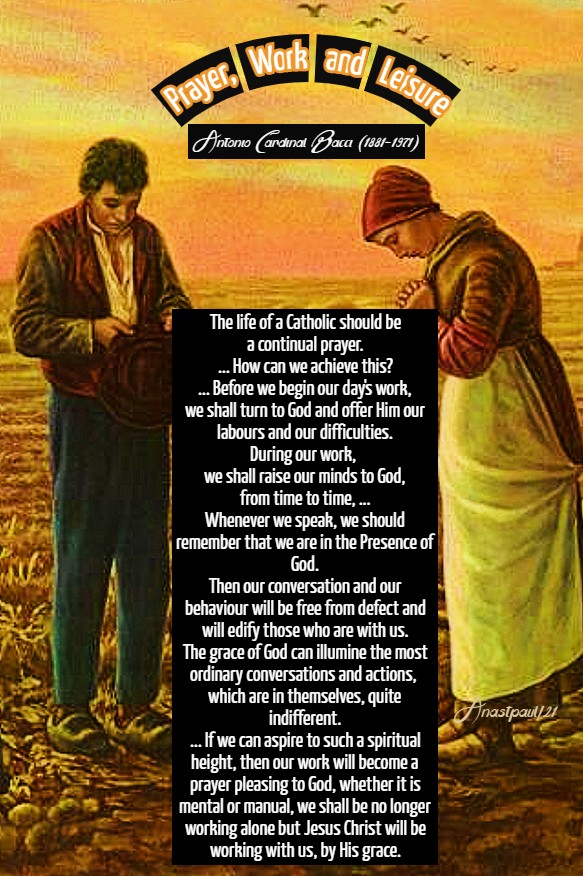
Prayer, Work and Leisure
“The pattern of our lives should be a combination of prayer, work and leisure. There should be no room, however, fpr idleness.
Prayer: Prayer is most essential. The life of a Catholic should be a continual prayer. As Jesus commanded, we “must always pray and not lose heart” (Lk 18:1).
How can we achieve this? St Paul has told us, “Whatever you do in word or in work,” he says, “do all in the name of the Lord Jesus, giving thanks to God the Father, through him” (Col 3:17). If we follow his instructions, our lives will really be a prayer. Before we begin our day’s work, we shall turn to God and offer Him our labours and our difficulties. During our work, we shall raise our minds to God, from time to time, as Jesus, Mary and Joseph must have done, in the home and in the workshop at Nazareth. Whenever we speak, we should remember that we are in the Presence of God. Then our conversation and our behaviour will be free from defect and will edify those who are with us. The grace of God can illumine the most ordinary conversations and actions, which are in themselves, quite indifferent. It is enough to live in a spiritual atmosphere of our own and on this earth.
If we can aspire to such a spiritual height, then our work will become a prayer pleasing to God, whether it is mental or manual, we shall be no longer working alone but Jesus Christ will be working with us, by His grace. This is the way the Saints worked and this is how their lives were a prayer.”
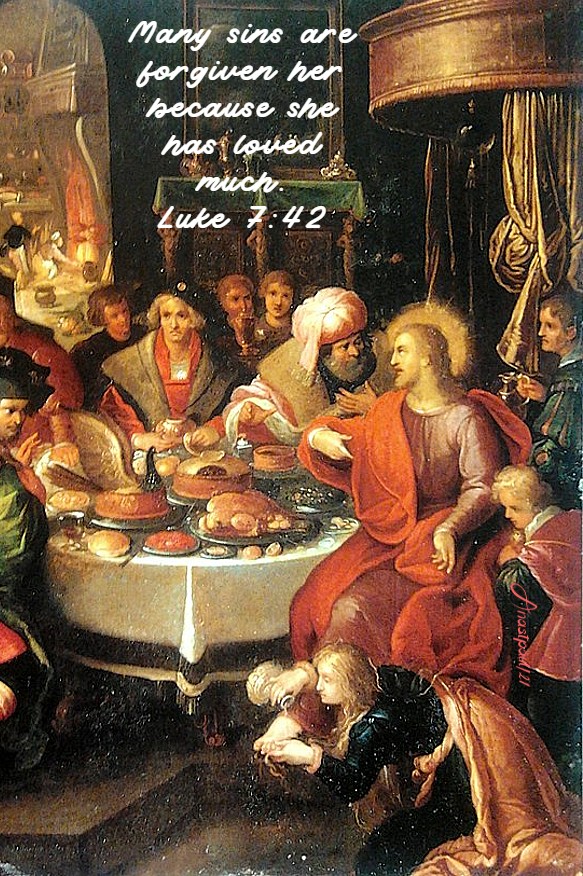
“Many sins are forgiven her because she has loved much.”
Luke 7:42
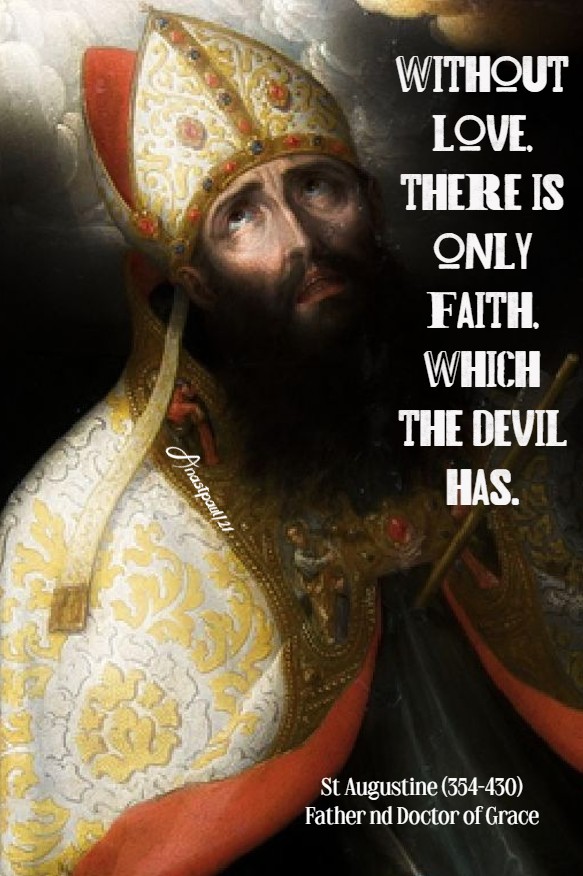
“Without love, there is only faith, which the devil has.”
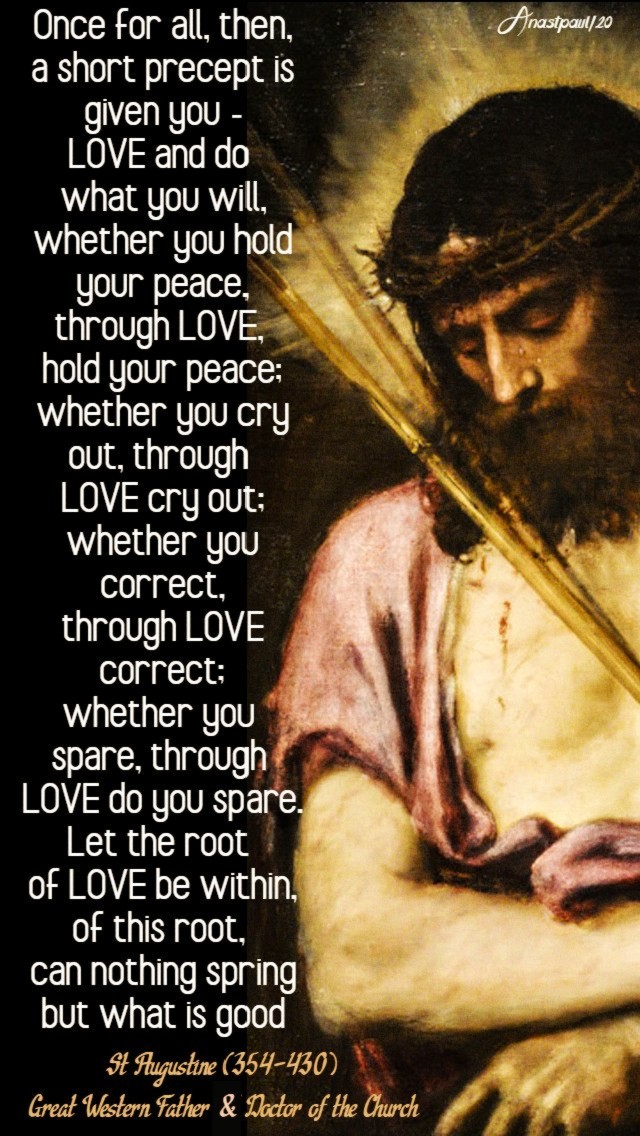
“Once for all, then, a short precept is given you – Love and do what you will, whether you hold your peace, through love, hold your peace; whether you cry out, through love cry out; whether you correct, through love correct; whether you spare, through love do you spare. Let the root of love be within, of this root, can nothing spring but what is good.”
St Augustine (354-430) Father nd Doctor of Grace
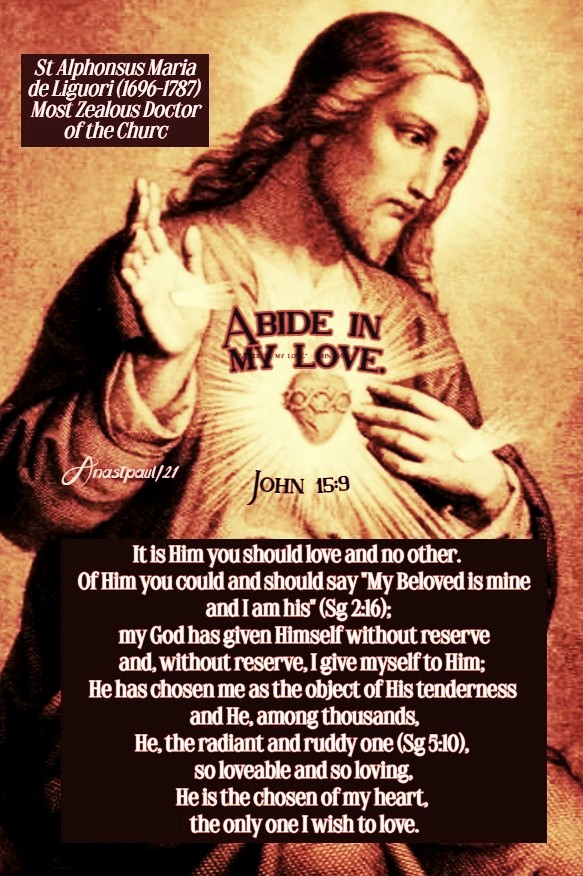
“… It is Him you should love and no other. Of Him you could and should say “My Beloved is mine and I am his” (Sg 2:16); my God has given Himself without reserve and, without reserve, I give myself to Him; He has chosen me as the object of His tenderness and He, among thousands, He, the radiant and ruddy one (Sg 5:10), so loveable and so loving, He is the chosen of my heart, the only one I wish to love.”
St Alphonsus Maria de Liguori (1696-1787) Most Zealous Doctor
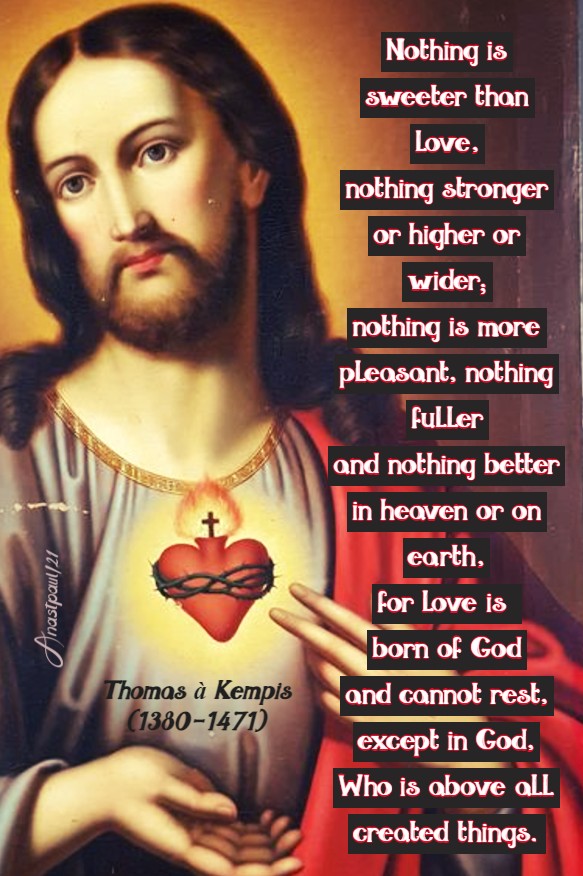
“Nothing is sweeter than love, nothing stronger or higher or wider; nothing is more pleasant, nothing fuller and nothing better in heaven or on earth, for love is born of God and cannot rest except in God, Who is above all created things.”
Thomas à Kempis (1380-1471)
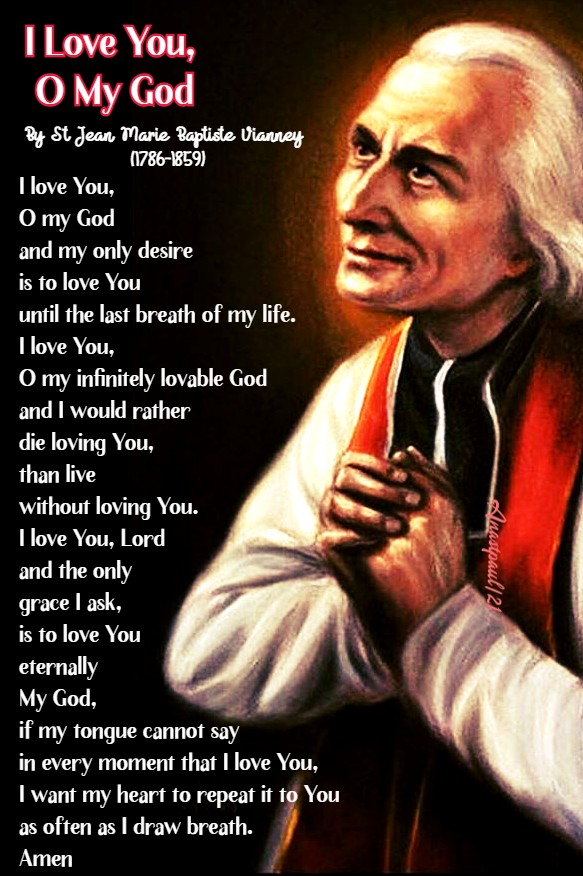
I Love You, O My God By St Jean Marie Baptiste Vianney (1786-1859)
I love You, O my God and my only desire is to love You until the last breath of my life. I love You, O my infinitely lovable God and I would rather die loving You, than live without loving You. I love You, Lord and the only grace I ask, is to love You eternally My God, if my tongue cannot say in every moment that I love You, I want my heart to repeat it to You as often as I draw breath. Amen
One Minute Reflection – 10 November – Readings: Wisdom 6: 1-11; Psalm 82: 3-4, 6-7; Luke 17: 11-19
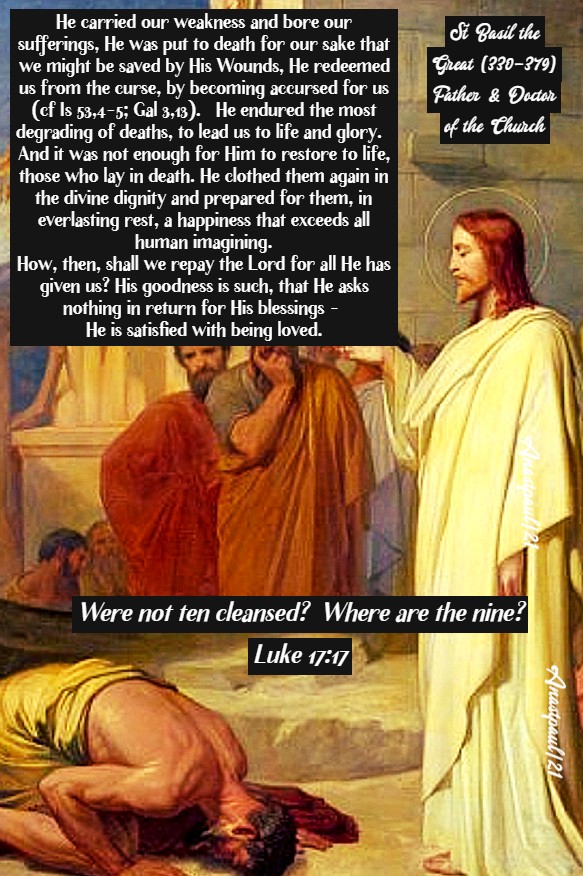
“Were not ten cleansed? Where are the nine?” – Luke 17:17
REFLECTION – “After having offended our Benefactor by our indifference to His signs of goodwill, we have, nevertheless, not been forsaken by the Lord’s goodness nor cut off from His love but we have been rescued from death and restored to life by our Lord Jesus Christ. And the way in which we have been saved, is even more worthy of wonder. “Though he was in the form of God, he did not regard equality with God something to be grasped but emptied himself, taking the form of a slave” (Phil 2,6-7).
He carried our weakness and bore our sufferings, He was put to death for our sake that we might be saved by His Wounds, He redeemed us from the curse, by becoming accursed for us (cf Is 53,4-5; Gal 3,13). He endured the most degrading of deaths, to lead us to life and glory. And it was not enough for Him to restore to life, those who lay in death. He clothed them again in the divine dignity and prepared for them, in everlasting rest, a happiness that exceeds all human imagining.
How, then, shall we repay the Lord for all He has given us? His goodness is such, that He asks nothing in return for His blessings – He is satisfied with being loved.” – St Basil (330-379) Monk, Bishop of Caesarea in Cappadocia, Father and Doctor of the Church (Great monastic Rules, # 2)
PRAYER – You Lord, Holy Father, never forget Your solemn covenant and grant us new life each day. We though in our hearts of stone do forget and cease to thank and bless You. Make our hearts turn in gratitude, for all we are and have is by Your grace and we are as nothing without You. May our minds, hearts and souls sing with love and thanks to You, Lord our God. Grant us new hearts by the prayers of Your Saint Leo the Great and all the saints in heaven, who always lived with grateful hearts, praising You always. We ask this this through Jesus Christ with the Holy Spirit, one God forever, amen.
May I Love You More Dearly St Richard of Chichester (1197-1253)
Thanks be to You, my Lord Jesus Christ For all the benefits You have given me, For all the pains and insults You have borne for me. O most merciful Redeemer, Friend and Brother, May I know You more clearly, Love You more dearly, Follow You more nearly. Amen
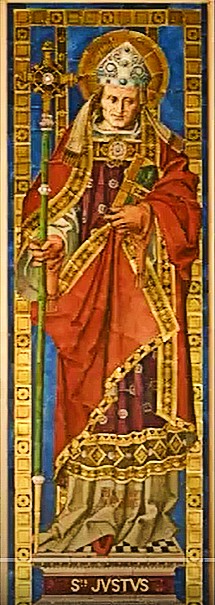
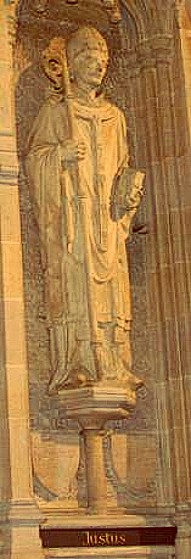
Saint of the Day – 10 November – Saint Justus of Canterbury (Died 627) the Fourth Archbishop of Canterbury, also Bishop of Rochester, Missionary sent by St Gregory the Great to join St Augustine of Canterbury in the conversion of England.
The Roman Martyrology states: “In England, St Justus, Bishop, who was sent by Pope Gregory with St Augustine, St Mellitus and others, to preach the Gospel in that country. There he went to his repose in the Lord, celebrated for sanctity,“
For the particulars of his life we are almost entirely dependent on Venerable Bede’s “Historia Ecclesiastica.“
Justus was one of the second band of Missionaries sent by St Gregory the Great, the company which arrived in 601 to reinforce St Augustine and which conveyed the relics, books, sacred vessels and other gifts sent by the Pope.
It is not certain whether he was a secular Priest or a Monk. St Bede is silent on the point and only later monastic writers from Canterbury ,claim him as one of their own Order.
In 604 he was Consecrated by St Augustine as first Bishop of Rochester, on which occasion, King Ethelbert bestowed on the new See, by charter, a territory called Priestfield and other lands. Ethelbert also built Justus a Cathedral Church in Rochester; the foundations of a nave and chancel partly underneath the present-day Rochester Cathedral may date from that time.
After the death of Augustine, Justus joined with the new Archbishop, St Laurence and with St Mellitus of London, in addressing letters to the recalcitrant Irish Bishops urging the native Church to adopt the Roman method of calculating the date of Easter but without effect. In 614, Justus attended the Council of Paris, held by the Frankish King, Chlothar II, together with Peter, the Abbot of Sts Peter and Paul Monastery in Canterbury,
During the heathen reaction which followed the death of Ethelbert, Justus was expelled from his See and took refuge in Gaul for a year, after which he was recalled by Eadbald who had been converted by St Laurence.
On the death of St Mellitus (24 April, 624) who had succeeded St Laurence as the Archbishop, Justus was elected to the vacant primacy. The letter which Pope Boniface addressed to him when sending him the Pallium is preserved by Venerable St Bede. He was already an old man and little is recorded of his Archiepiscopate except that he Consecrated Romanus as Bishop of Rochester and St Paulinus as Bishop for the North.
His anniversary was kept at Canterbury on 10 November but there is uncertainty as to the year of his death, although 627, the commonly received date, would appear to be correct, especially as it fits in with the period of three years usually assigned by the chroniclers to his Archiepiscopate.
He was buried with his predecessors at St Augustine’s Abbey, Canterbury and is commemorated in the English supplement to the Missal and Breviary on 10 November. In the 1090s, his remains were translated, to a Shrine beside the high Altar of St Augustine’s Abbey in Canterbury. At about the same time, a Life was written by the Monk Goscelin of Saint-Bertin, as well as a poem by another Monk and writer, Reginald of Canterbury.
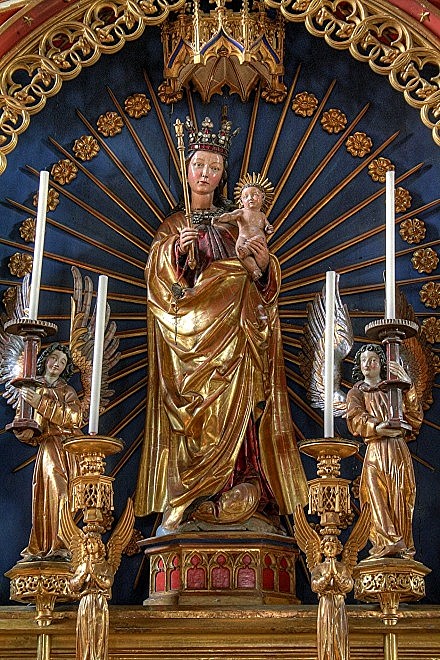
Muttergottes von der Augenwende / Our Lady of the Turning Eyes, Rottweil, Germany (1643) – 10 November:
In 1643 the City of Rottweil was under siege by French troops during the Thirty Years’ War. As cited in the original Dominican document, 300 citizens of the Town ceaselessly prayed the Rosary at a Statue of the Madonna and Child at the Dominican church. On 10 November 1643 witnesses saw the Statue turn pale and raise its eyes toward heaven then back to the City. Some claimed to have heard it speak. Both Catholics and non-Catholics witnessed the event. Fifteen days later, the Statue’s face turned reddish and the eyes moved again while shedding tears. At the same time, the French and Saxe-Weimar troops were defeated by Bavarian troops in the Battle of Tuttlingen. The victory was attributed to the intercession of Mary. The Statue remained in the Church until 1802 following the secularisation of Germany, when the Monastery was dissolved and the Church was seized by the Kingdom of Württemberg. At this time the Statue was transferred to the City’s main Church, the Holy Cross Münster. A solemn procession was held to relocate the Statue on 29 December of that year. The Dominican Church later became the Town’s Protestant church, the Predigerkirche.
St Anianus the Deacon St Baudolino St Demetrius of Antioch St Elaeth the King St Eustosius of Antioch St Grellen St Guerembaldus St Hadelin of Sees Bl Joaquín Piña Piazuelo St John of Ratzenburg St Joseph the Martyr St Justus of Canterbury (Died 627) Archbishop
St Leo of Melun St Monitor of Orleans St Narses of Subagord St Nonnus of Heliopolis St Orestes of Cappadocia St Probus of Ravenna St Theoctiste of Lesbos St Tryphaena of Iconium St Tryphosa of Iconium — Martyred Sisters Adorers – 23 beati: 23 nuns, all members of the Sisters Adorers, Handmaids of Charity and of the Blessed Sacrament who were martyred together in the Spanish Civil War. • Blessed Aurea González • Blessed Belarmina Pérez Martínez • Blessed Cecilia Iglesias del Campo • Blessed Concepción Vázquez Areas • Blessed Dionisia Rodríguez De Anta • Blessed Emilia Echevarría Fernández • Blessed Felipa Gutierrez Garay • Blessed Francisca Pérez de Labeaga García • Blessed Josepa Boix Rieras • Blessed Lucía González García • Blessed Luisa Pérez Adriá • Blessed Magdalena Pérez • Blessed Manuela Arriola Uranda • Blessed María Dolores Hernández San Torcuato • Blessed María Dolores Monzón Rosales • Blessed María García Ferreiro • Blessed Maria Mercè Tuñi Ustech • Blessed María Zenona Aranzábal de Barrutia • Blessed Prima de Ipiña Malzárraga • Blessed Purificación Martínez Vera • Blessed Rosa López Brochier • Blessed Sinforosa Díaz Fernández • Blessed Teresa Vives Missé They were martyred on 10 November 1936 in Madrid, Spain.
Martyrs of Agde – 3 saints: A group of Christians who were tortured and martyred together in the persecutions of Diocletian. The only about them to survive are the names – Florentia, Modestus and Tiberius. Martyred c 303 in Agde, France.
Thought for the Day – 9 November – Meditations with Antonio Cardinal Bacci (1881-1971)
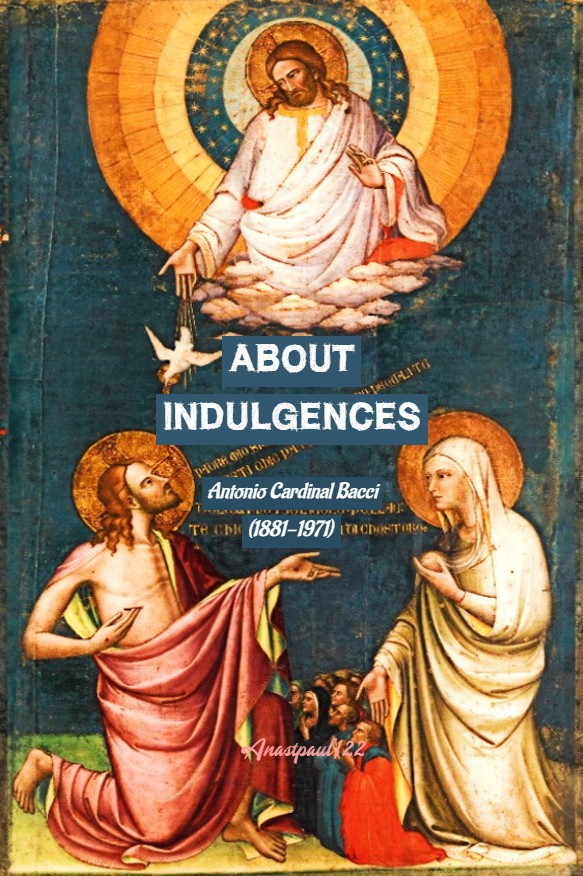
INDULGENCES
“Indulgences are among the means by which we can help to satisfy the Divine Justice for our own offences and for those of the faithful depared.
Unfortunately, very few Christians understand the true nature of indulgences. As a result, they neglect to fulfil the conditions necessary to gain them.
Canon Law defines an indulgence as “the remission in the sight of God of the temporal punishment due to sins already forgiven, which, the proper ecclesiastical authority concedes from the treasury of the Church, for the living, by way of absolution and for the dead, by way of suffrage” (Canon 911). The main requirement is to be in the state of grace, which sinners can attain by means of the Sacrament of Penance, or by an Act of PERFECT CONTRITION. If properly made, Confession takes away sin and eternal punishment but, not temporal punishment. This may be cancelled by means of penance, prayer and good works. In the early days of the Church, the penitential system was most severe (I wish it were so again!) According to the degree of gravity, different sins drew penances of days, weeks or months of fasting on bread and water. As times changed, the Church reduced these penalties and granted indulgences instead.
What we may ask, is the theological basis for these indulgences? It is the spiritual treasury which is at the disposal of the Church, made up of the infinite merits of our Redeemer and added to, by the merits of the Blessed Virgin and the Saints. These merits are communicated to us by the Church by reason of the consoling Dogma of the Communion of Saints, according to which, the Church Militant, Suffering and Triumphant, constitutes one Mystical Body of which Jesus Christ is the Head.
The Church has power to dispose of this immense treasure by reason of the injunction given to her by her Founder, when He said to St Peter: “Whatever thou shalt bind on earth shall be bound in heaven and whatever thou shalt loose on earth shall be loosed in heaven” (Mt 16:19). There are no reservations – the injunction applies, not only to sin but, also to its punishment. It is clear that indulgences are not merely a dispensation from the penitential discipline in the eyes of the Church, as certain heretics held and still hold but also, in the sight of God. Indulgences reflect, both the mercy and the justice of God. They reflect His justice because complete satisfaction is rendered by the merits of Jesus Christ. They reflect His mercy because these merits are applied to us poor sinners and also, by way of suffrage, to the souls of our departed friends.”
Quote/s of the Day – 9 November – Feast Dedication of The Archbasilica of the Most Holy Saviour in the Lateran – Gospel: John 2:13-22
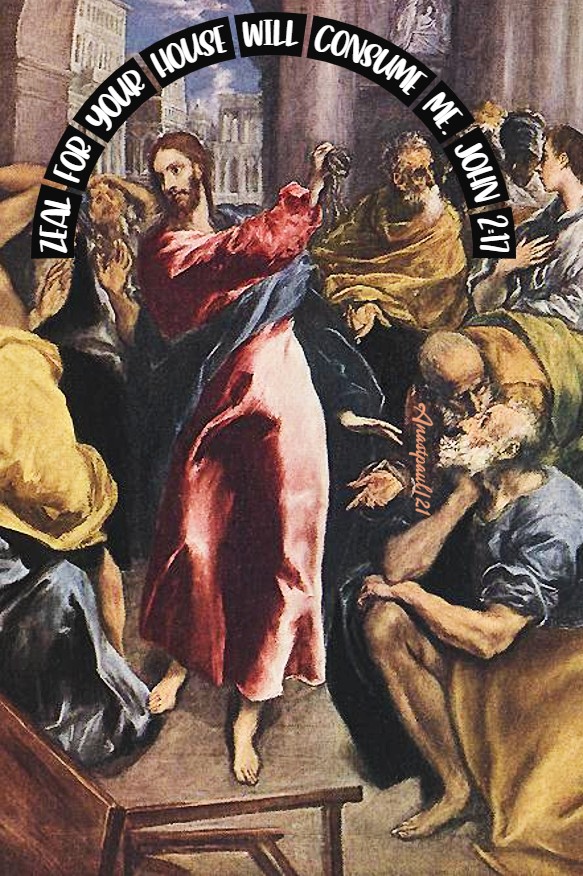
“Zeal for your house will consume me.”
John 2:17
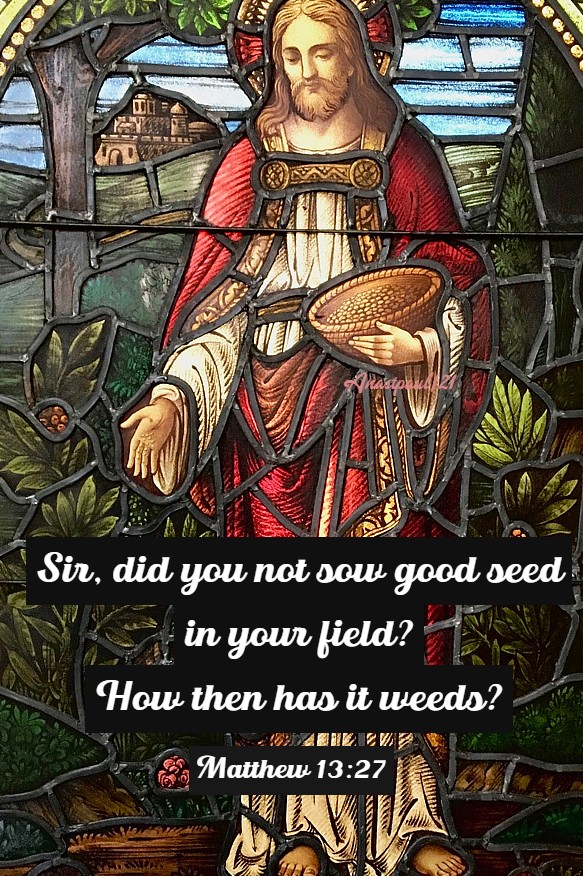
“Sir, did you not sow good seed in your field? How then has it weeds?”
Matthew 13:27
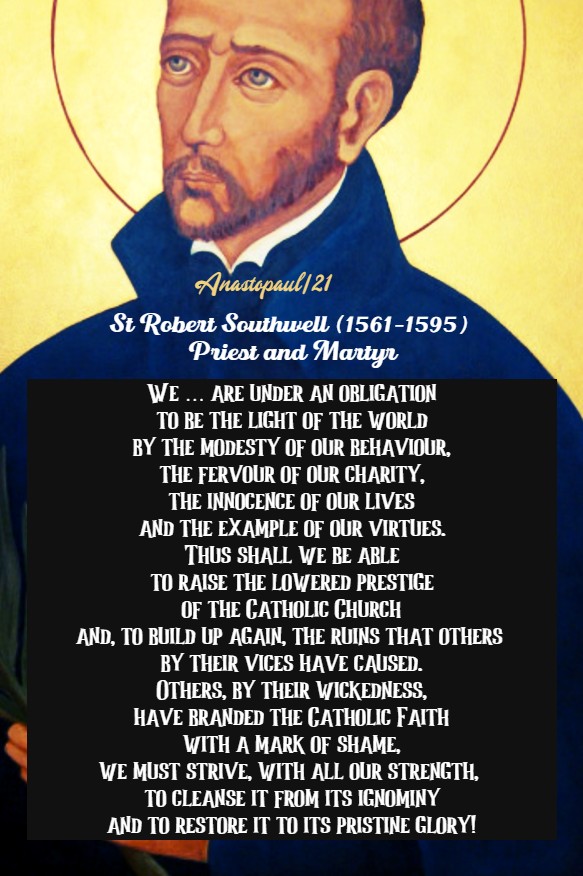
“We … are under an obligation to be the light of the world by the modesty of our behaviour, the fervour of our charity, the innocence of our lives and the example of our virtues. Thus shall we be able to raise the lowered prestige of the Catholic Church and, to build up again, the ruins that others by their vices have caused. Others, by their wickedness, have branded the Catholic Faith with a mark of shame, we must strive, with all our strength, to cleanse it from its ignominy and to restore it to its pristine glory!”
St Robert Southwell SJ (1561-1595) Priest and Martyr
“…The great movement of apostasy being organised in every country for the establishment of a One-World Church which shall have neither dogmas, nor hierarchy, neither discipline for the mind, nor curb for the passions and which, under the pretext of freedom and human dignity, would bring back to the world (if such a Church could overcome) the reign of legalised cunning and force and the oppression of the weak and of all those who toil and suffer. […] Indeed, the true friends of the people are neither revolutionaries, nor innovators – they are traditionalists.”
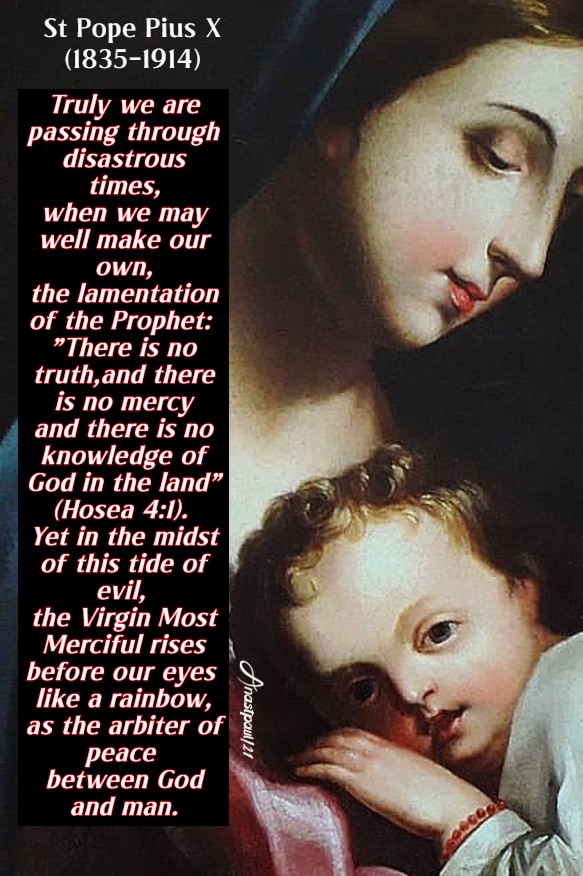
“Truly we are passing through disastrous times, when we may well make our own, the lamentation of the Prophet: “There is no truth,and there is no mercy and there is no knowledge of God in the land” (Hosea 4:1). Yet in the midst of this tide of evil, the Virgin Most Merciful rises before our eyes like a rainbow, as the arbiter of peace between God and man.”
One Minute Reflection – 9 November – “Month of the Holy Souls in Purgatory” –Feast Dedication of The Archbasilica of the Most Holy Saviour in the Lateran and the Memorial of Blessed Gabriel Ferretti OFM (1385-1456) – Gospel: John 2:13-22
“He made a whip out of cords and drove them all out of the temple area… ” – John 2:15
REFLECTION – “The Apostle Paul says: “The Temple of God, which you are, is holy” (1 Cor 3:17), that is to say – all you who believe in Christ, believing even to loving. … All who thus believe are the living stones of which God’s temple is built (1 Pt 2:5), they are like the imperishable wood of which the Ark was built that the flood could not overwhelm (Gn 6:14). This temple – the people of God, human persons themselves – is the place where God answers those who pray. People who pray to God outside this temple cannot have their prayers, for the peace of the Jerusalem above answered, even though they are answered regarding particular material things that God grants, even to pagans. … But it is an altogether different thing to have one’s prayers answered in the matter of eternal life. This is only granted to those who pray inside God’s temple.
For someone who prays within God’s Temple prays within the peace of the Church, in the unity of Christ’s Body, since the Body of Christ is built up of the multitude of believers spread over all the world. … And someone who prays in the peace of the Church, prays “in spirit and in truth” (Jn 4:23) of which the former Temple was only a symbol.
In fact, it was for our instruction that our Lord cast out of the temple those men who were only seeking their own interest and who only went there to buy and sell. If that first temple had to undergo this purification, then it is clear, that the Body of Christ too, the true Temple, also contains buyers and sellers among those who pray there, that is to say, people only seeking “their own interests and not those of Jesus Christ” (Phil 2,21). … But the time will come when the Lord will cast out all those sinners.” – St Augustine (354-430) Bishop of Hippo, North Africa, Father and Doctor of Grace of the Church (Sermon on Psalm 130, # 1-2)
PRAYER – Almighty God, as we recall with joy, the Dedication of this house of Yours on each recurring anniversary, listen to Your people’s prayer and grant that our worship here may be a sincere and holy service, honouring Your Name and bringing us the fullness of redemption. Through Jesus Christ, our Lord, in union with the Holy Spirit, one God for all eternity, amen.
Our Morning Offering – 9 November – Feast Dedication of The Archbasilica of the Most Holy Saviour in the Lateran
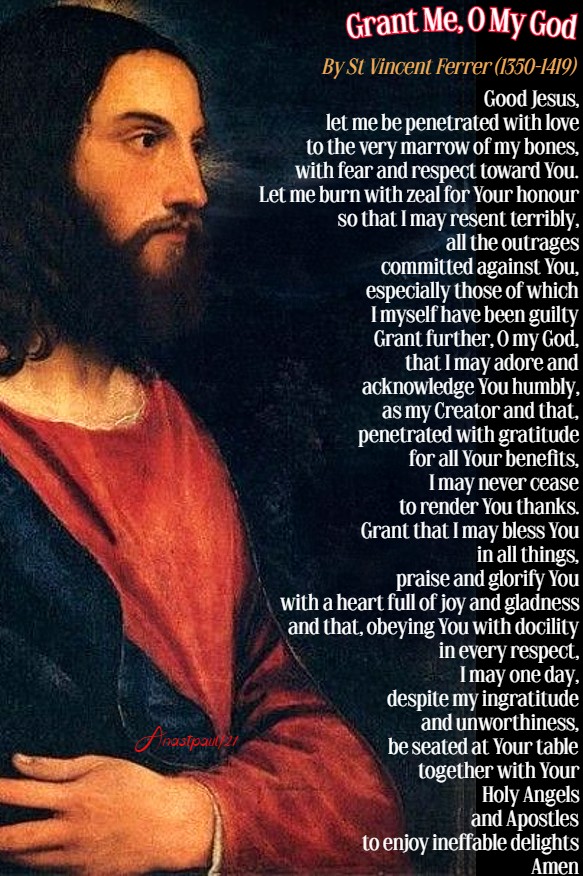
Grant me, O my God By St Vincent Ferrer OP (1350-1419)
Good Jesus, let me be penetrated with love to the very marrow of my bones, with fear and respect toward You. Let me burn with zeal for Your honour, so that I may resent terribly, all the outrages committed against You, especially those of which I myself have been guilty. Grant further, O my God, that I may adore and acknowledge You humbly, as my Creator and that, penetrated with gratitude for all Your benefits, I may never cease to render You thanks. Grant that I may bless You in all things, praise and glorify You with a heart full of joy and gladness and that, obeying You with docility in every respect, I may one day, despite my ingratitude and unworthiness, be seated at Your table together with Your Holy Angels and Apostles to enjoy ineffable delights. Amen




























You must be logged in to post a comment.