Our Morning Offering – 4 November – The Memorial of Saint Charles Borromeo (1538-1584)
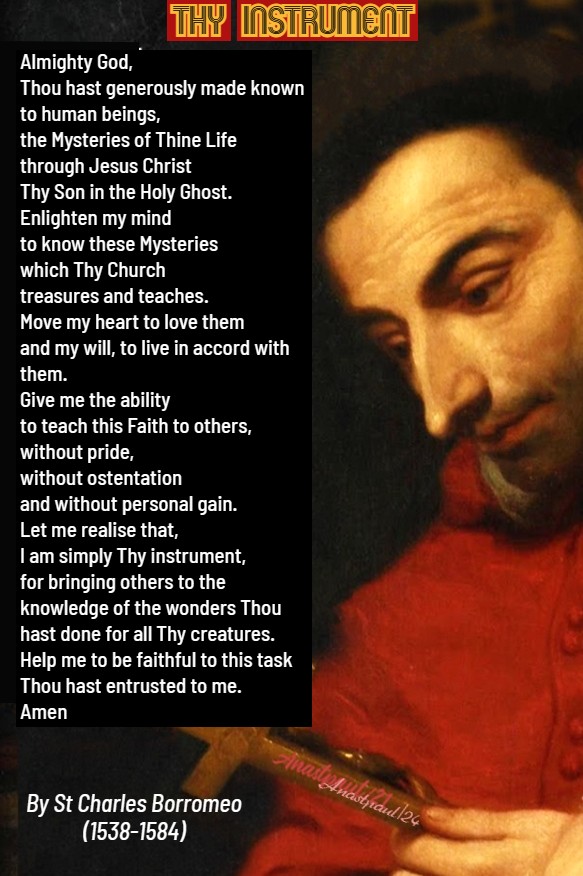
Thy Instrument By St Charles Borromeo (1538-1584)
Almighty God, Thou hast generously made known to human beings, the Mysteries of Thine Life through Jesus Christ Thy Son in the Holy Ghost. Enlighten my mind to know these Mysteries which Thy Church treasures and teaches. Move my heart to love them and my will, to live in accord with them. Give me the ability to teach this Faith to others, without pride, without ostentation and without personal gain. Let me realise that, I am simply Thy instrument, for bringing others to the knowledge of the wonders Thou hast done for all Thy creatures. Help me to be faithful to this task Thou hast entrusted to me. Amen
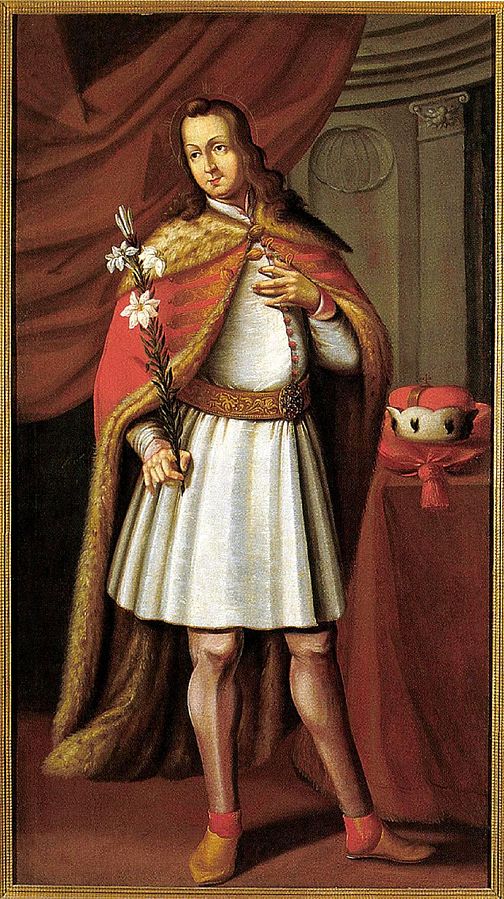
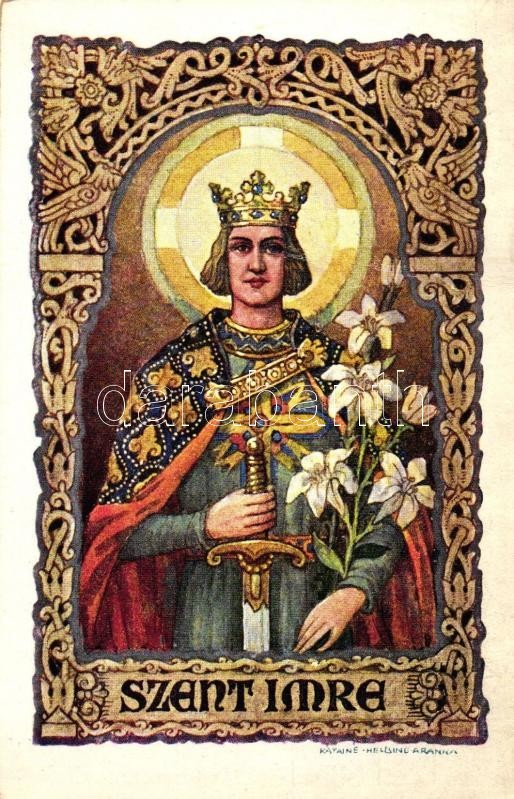
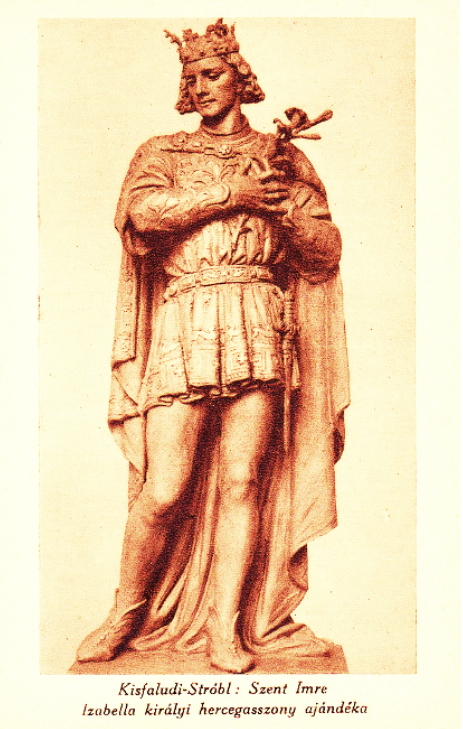
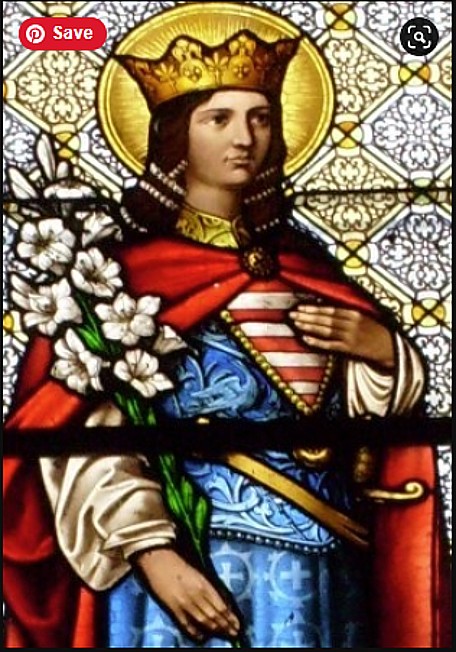
Saint of the Day – 4 November – Saint Emeric of Hungary (c 1007-1031) Confessor, Prince and Heir to the Hungarian Throne, Son of St Stephen, the first King of Hungary, Married but lived in continence with his wife, having vowed his virginity to God. Born in c 1007 in Veszprém, Hungary and died by being killed by a boar while hunting on 2 September 1031 in Hungary, aged 24. Patronages – Youth, Hungarian Americans. Also known as – Emerick, Emmerich, Emmericus, Henricus, Henry. Additional Memorial – 5 November the date of his Canonisation.
Emeric is believed to have been the second son of Saint Stephen I. Named after his maternal Uncle St Henry II, the Holy Roman Emperor, he was the only one of Stephen’s sons who reached adulthood.
Emeric married a Byzantine Princess but according to a biography written between 1109 and 1116, he lived during marriage in perfect chastity, collaborating with his father King Stephen in the conversion of his subjects.
The succession plans of Emeric’s father could never be fulfilled, for on 2 September 1031, at age 24, Emeric was killed by a boar while hunting. It is believed that this happened in Hegyközszentimre (presently Sântimreu, Romania). He was buried in the Székesfehérvár Basilica. Several wondrous healings and conversions happened at his grave. On 5 November 1083 King Ladislaus I translated Emeric’s relics in a large ceremony. Emeric was Canonised for his pious life and purity, along with his father and Bishop Gerard by Pope Gregory VII.
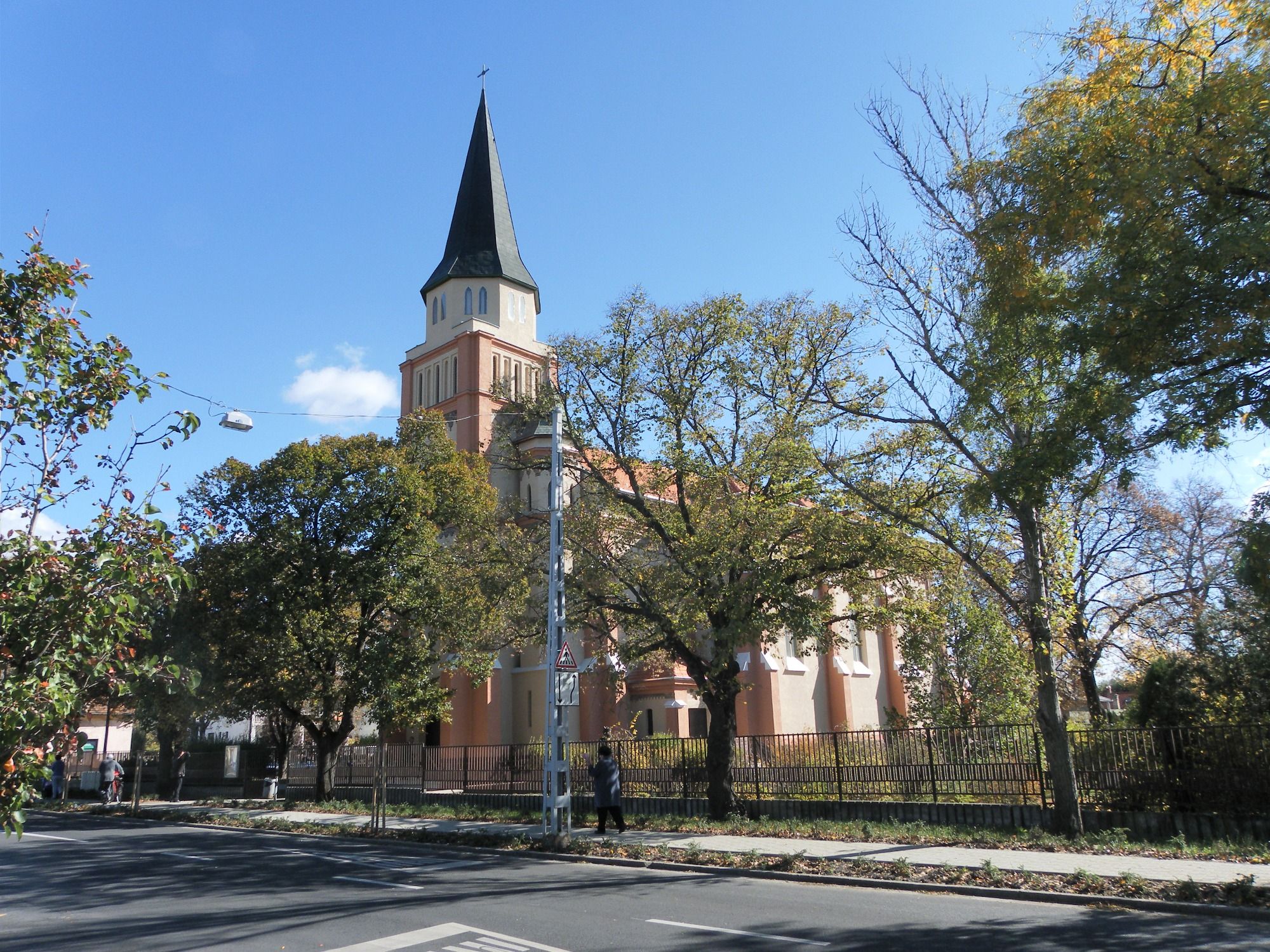
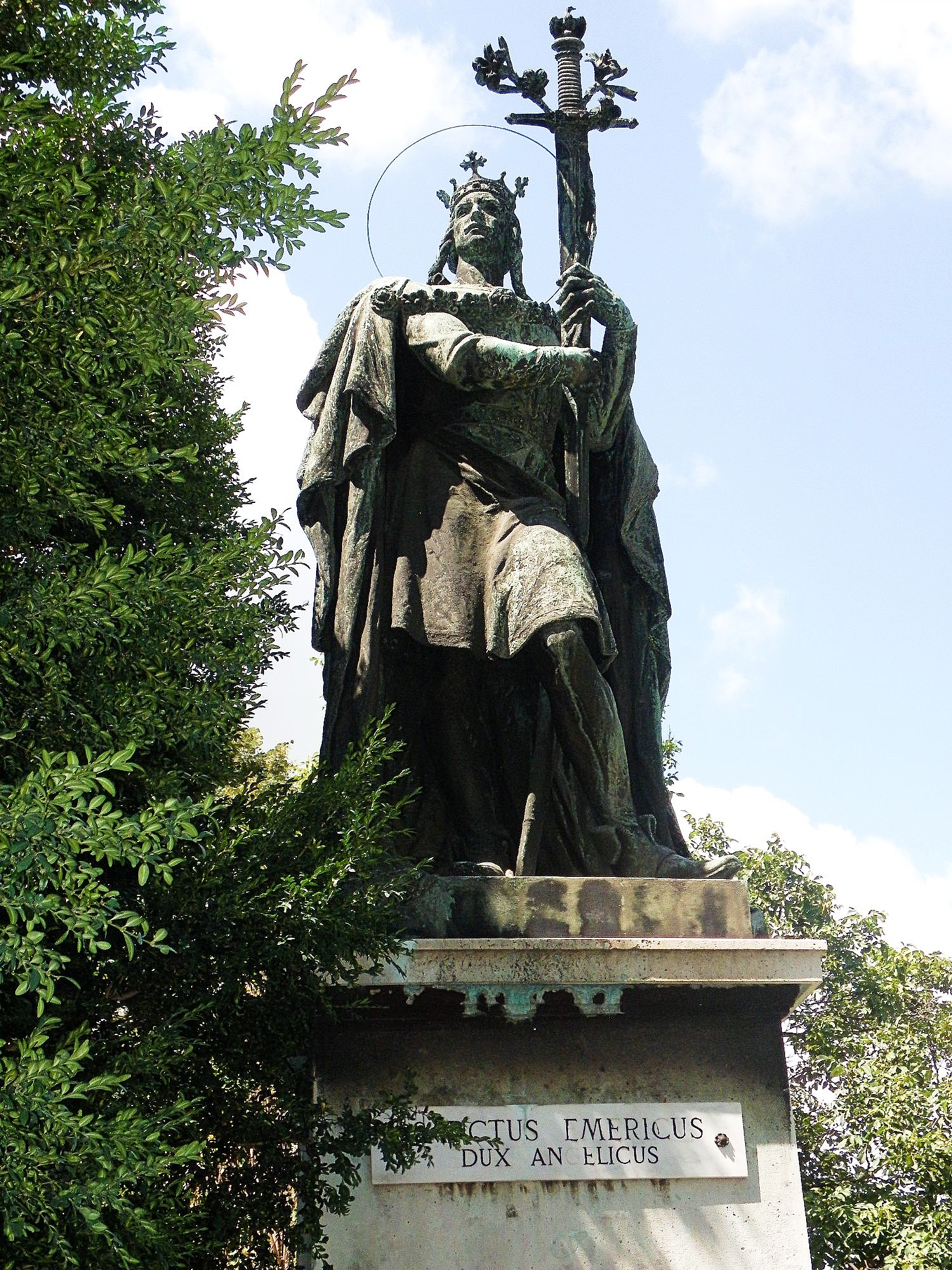
On the 900th Anniversary of the death of Prince Emeric, a National Memorial Year was organised in 1930–1931 and the village of Pestszentimre was named after him. The Church in the district also bears the name of the Saint-Prince and the first public Statue of the district depicts Saint Emeric. The Saint Emeric Memorial Year proclaimed for 1930–1931 moved the whole country and the settlements around Pest, which are now parts of Budapest. The two-year event series was such an important event that Pestszentimre, which belongs to the 18th District today, took the name of our first King’s, St. Stephen’s, son. The settlement had previously been called Soroksárpéteri.
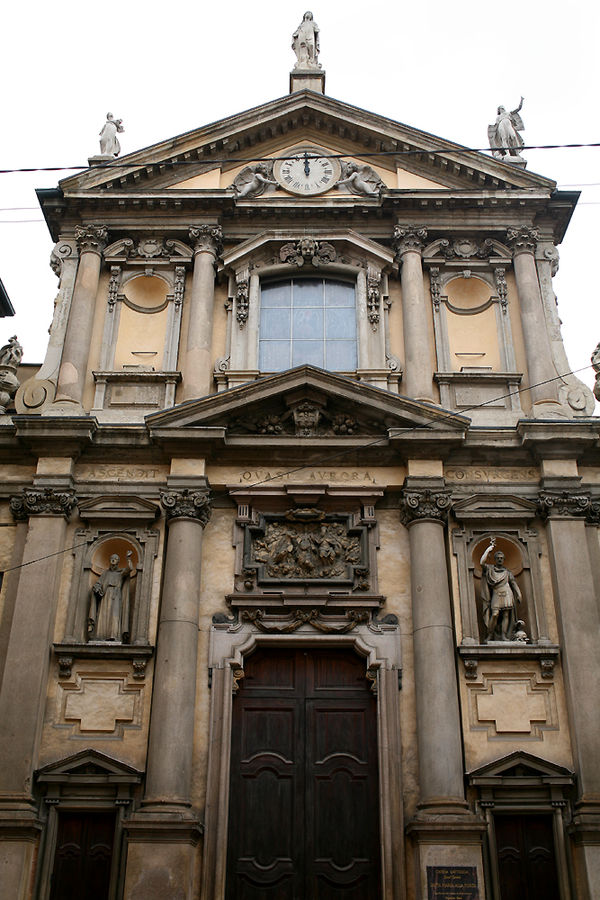
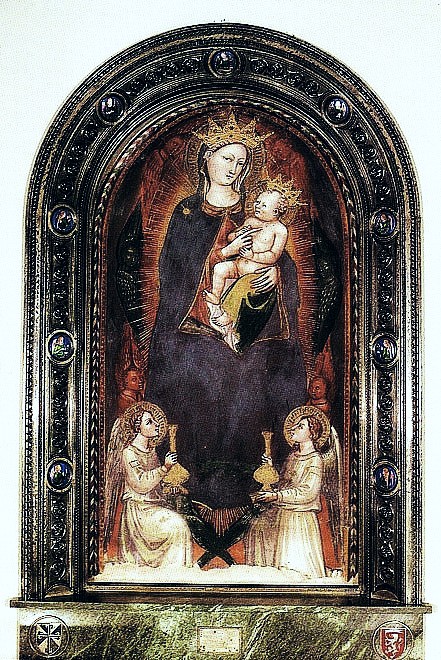
Santa Maria alla Porta Luigi / Our Lady of Port Louis, Milan, Italy – 4 November:
The ancient City of Milan, Italy, has had three completely different systems of walls defending the City throughout the ages. The oldest walls were Roman, built in the Republican and Imperial eras. The second wall was built in the 12th century, shortly after the City was razed by Frederick Barbarossa. The third, and final wall system was built in the 16th century by the Spanish rulers of Milan. Even though in most places there is little left of the walls, the gates, or “ports” contributed to the layout of the City as the streets passed through the gates from a central hub. The Roman gates were Porta Romana, Porta Ticinese, Porta Vercellina and so on, with each wall having gates with a variety of names. None of them, however, has had the name of Porta Luigi There is no Church in Milan to St. Louis and I can find no reference to this feast of Mary, that was once famous enough to have a date on the calendar. (https://www.roman-catholic-saints.com/our-lady-of-port-louis.html).
I (Ana) have found a Church called “Santa Maria alla Porta” (Holy Mary at the Gate), see below, which dates from very early times, certainly before the 12th Century. Although a Church already stood in the same Milanese location since before the year 1105, the present Church was erected in 1652 under Spanish rule.
St Agricola of Bologna St Amandus of Avignon St Amandus of Rodez St Birstan St Clarus the Hermit St Clether St Emeric of Hungary (c 1007-1031) Confessor, Prince and heir to the Hungarian Throne, Son of St Stephen, King of Hungary
Bl Frances d’Amboise St Gerard de Bazonches St Gregory of Burtscheid Bl Helen Enselmini Bl Henry of Zweifalten St Hermas of Myra Bl Joan Antoni Burró Mas St Joannicus of Mount Olympus St John Zedazneli St Modesta of Trier St Nicander of Lycia St Patrobas St Perpète St Philologus St Pierius St Proculus of Autun Bl Teresa Manganiello St Vitalis of Bologna
Thought for the Day – 3 November – Meditations with Antonio Cardinal Bacci (1881-1971)
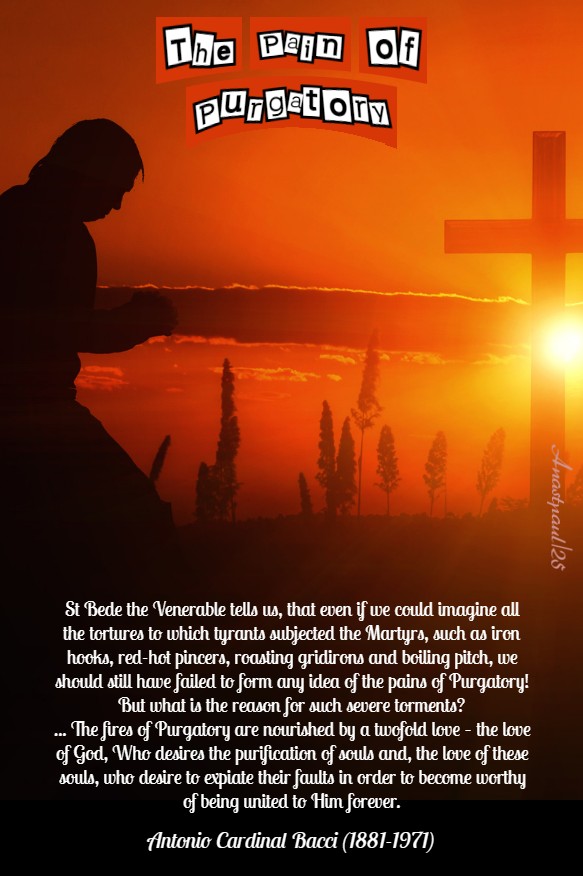
The Pain of Purgatory
“The Tradition of the Fathers and the ordinary teaching of the Church, describe the pains of Purgatory in such a fashion, that they should prompt us to avoid even the smallest sin, not only because it is an offence against the most amiable God but also because, it will be severely punished by Him. This teaching, moreover, should move us to pity for the poor suffering souls, who are enduring such torments.
St Cyril of Jerusalem states, that the sum total of the sufferings of this world, is nothing in comparison to the sufferings of Purgatory. He adds, moreover, that the pain of Purgatory is equal to the severity of the torments of Hell; the only difference is that the latter are everlasting, whereas the former, will have an end. St Athanasius assures us that the least pang of suffering in Purgatory, is sharper than all the torments which it is possible to undergo on earth. Moreover he adds, in comparison with the fire which afflicts the suffering souls, earthly fire is hardly even real! St Bede the Venerable tells us, that even if we could imagine all the tortures to which tyrants subjected the Martyrs, such as iron hooks, red-hot pincers, roasting gridirons and boiling pitch, we should still have failed to form any idea of the pains of Purgatory!
But what is the reason for such severe torments? It is that God loves these souls and desires that they be purified of sins, as soon as possible and be made worthy of infinite happiness.
The fires of Purgatory are nourished by a twofold love – the love of God, Who desires the purification of souls and, the love of these souls, who desire to expiate their faults in order to become worthy of being united to Him forever.”
Quote/s of the Day – 3 November – Readings: Romans 13: 8-10; Psalm 112: 1b-2, 4-5, 9; Luke 14: 25-33
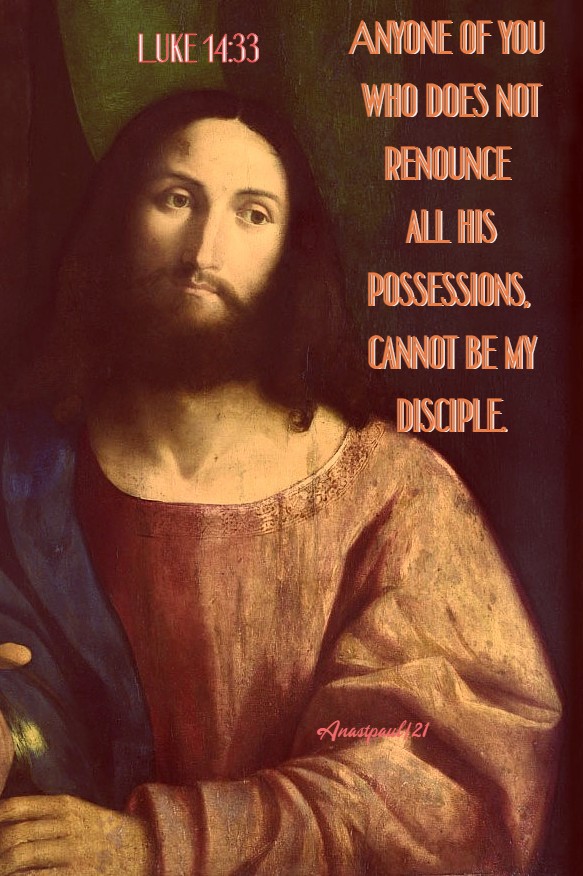
“… Anyone of you who does not renounce all his possessions, cannot be my disciple.”
Luke 14:33
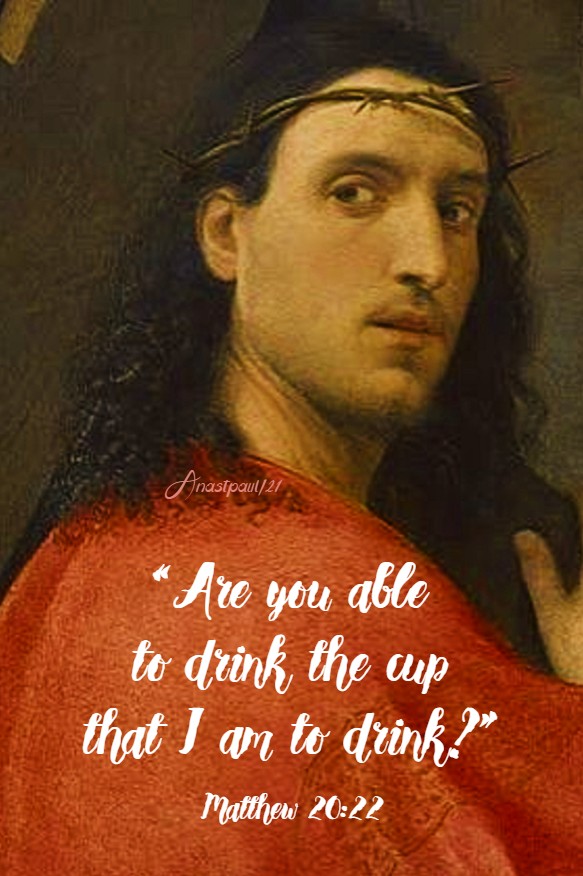
“Are you able to drink the cup that I am to drink?”
Matthew 20:22
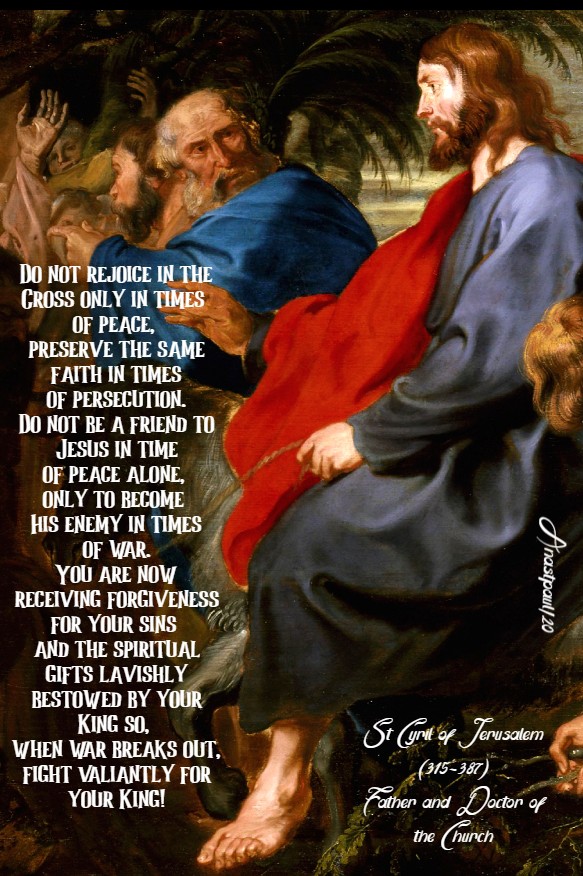
“Do not rejoice in the Cross only in times of peace, preserve the same faith in times of persecution. Do not be a friend to Jesus in times of peace alone, only to become His enemy in times of war. You are now receiving forgiveness for your sins and the spiritual gifts lavishly bestowed by your King so, when war breaks out, fight valiantly for your King.”
St Cyril of Jerusalem (315-387) Father and Doctor of the Church
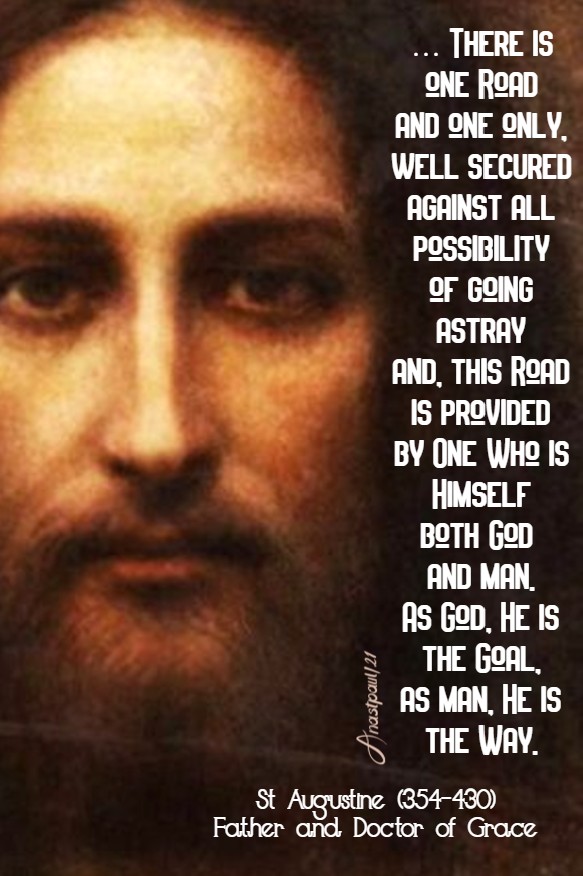
“… There is one Road and one only, well secured against all possibility of going astray and, this Road is provided by One Who is Himself both God and man. As God, He is the Goal, as man, He is the Way.”
St Augustine (354-430) Bishop of Hippo Father and Doctor of Grace
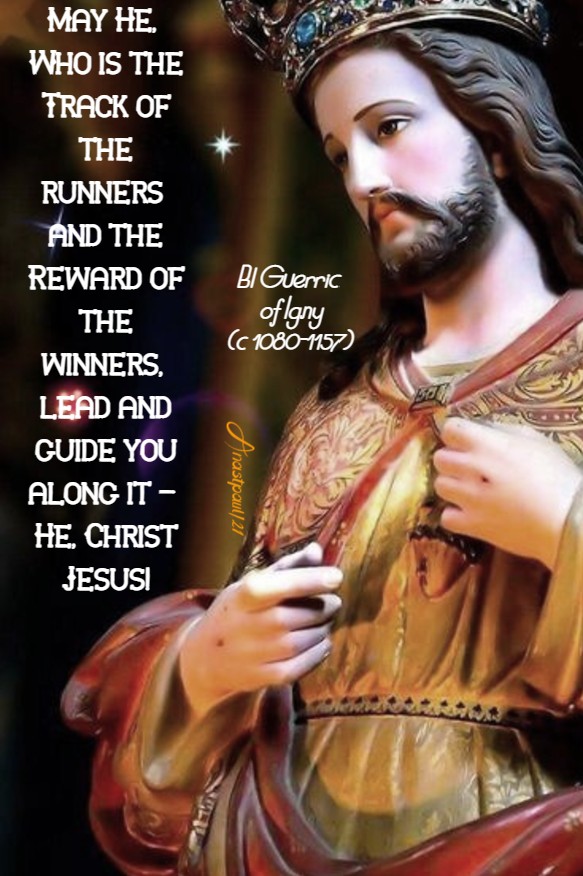
“May He, Who is the Track of the runners and the Reward of the winners, lead and guide you along it – He, Christ Jesus!”
Bl Guerric of Igny O.Cist (c 1080-1157)
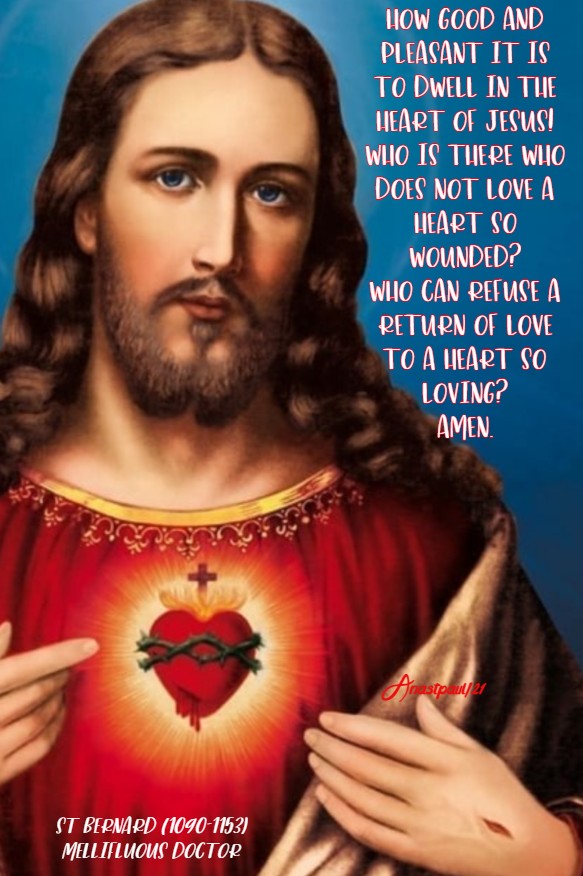
“How good and pleasant it is to dwell in the Heart of Jesus! Who is there who does not love a heart so wounded? Who can refuse a return of love to a Heart so loving? Amen.”
St Bernard (1090-1153) Mellifluous Doctor
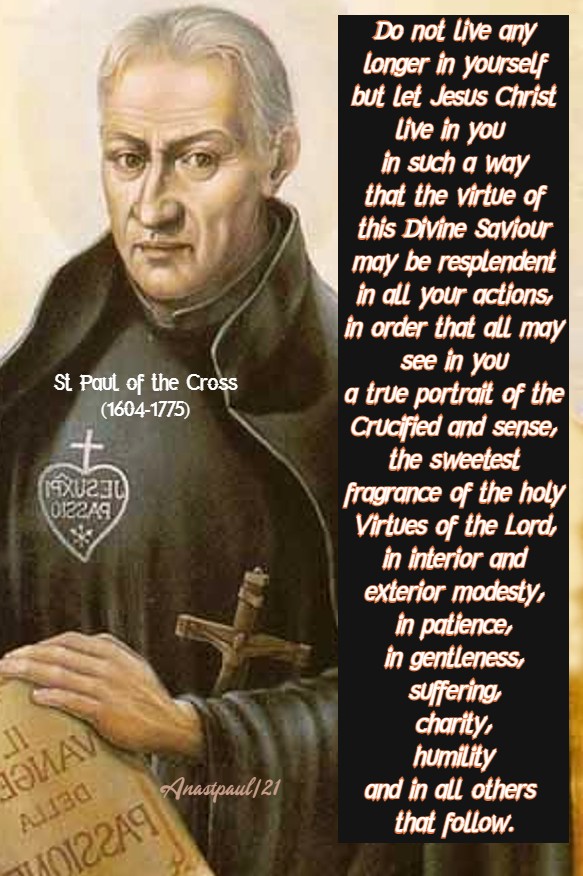
“Do not live any longer in yourself but let Jesus Christ live in you in such a way that the virtue of this Divine Saviour may be resplendent in all your actions, in order that all may see in you a true portrait of the Crucified and sense, the sweetest fragrance of the holy virtues of the Lord, in interior and exterior modesty, in patience, in gentleness, suffering, charity, humility and in all others that follow.”
One Minute Reflection – 3 November – Readings: Romans 13: 8-10; Psalm 112: 1b-2, 4-5, 9; Luke 14: 25-33
“… Anyone of you, who does not renounce all his possessions, cannot be my disciple.” – Luke 14:33
REFLECTION – “The tradition and the authority of Holy Scripture show us three renunciations … The first is that by which, as far as the body is concerned, we make light of all the wealth and goods of this world. By the second, we reject the fashions and vices and former affections of soul and flesh. By the third, we detach our soul from all present and visible things and contemplate only things to come and set our heart on what is invisible. We have to do all these three at once as the Lord charged Abraham to do, when he said to him “Go out from your country and your kinsfolk and your father’s house.”(Gn 12:1).
First he said “from your country,” that is, from the goods of this world and earthly riches; secondly, “from your kinsfolk,” that is, from this former life and habits and sins, which cling to us from our very birth and are joined to us, as it were, by ties of affinity and kinship; thirdly, “from your father’s house,” that is, from all the recollection of this world, which the sight of the eyes can afford. …
Let us contemplate, as the Apostle says, “not what is seen but what is unseen – for what is seen is transitory but what is unseen is eternal” (2 Co 4:18) … “Our citizenship is in heaven,” … (Ph 3:20) … We shall go forth from the house of our former parent, who was our father from our very birth, according to the old man, when we were “by nature children of wrath, like the rest” (Eph 2:3) and we shall fix our whole mind and concentration on heavenly things … Then our soul will ascend towards unseen things by constant meditation on divine things and spiritual contemplation.” – St John Cassian (c 360-435) Monk, Founder of Monasteries, Father of the Church (Conference 3, 6-7)
PRAYER – Holy God and Father, You sent Your Son to show us the way to our eternal home. Teach us always to understand that by relinquishing the things of this world and focusing our efforts only on following the Light He shines on our path, we may attain the eternal victory. May the prayers of Your our Blessed Mother, the Virgin Mary, assist us in carrying our cross after Hi m. Through Christ our Lord, with the Holy Spirit, God forever, amen.
Our Morning Offering – 3 November – “Month of the Holy Souls in Purgatory”
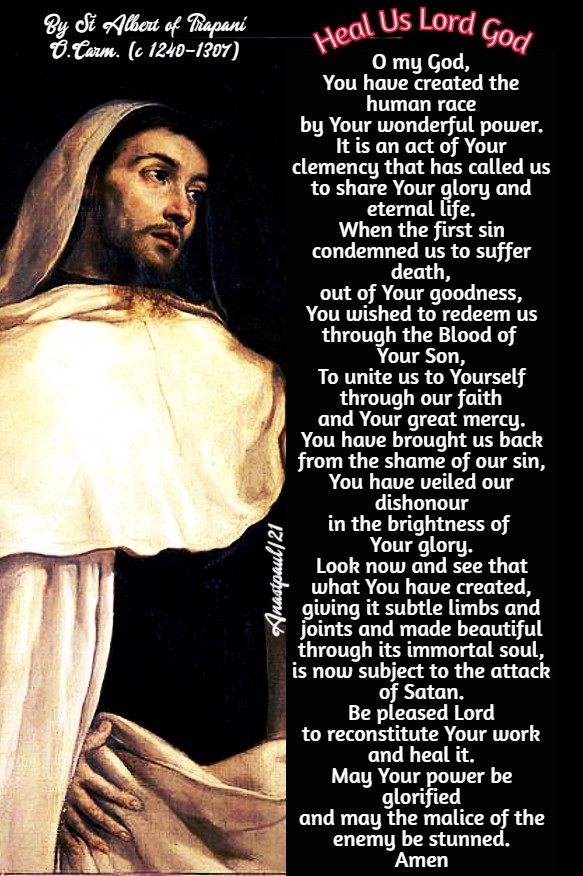
Heal Us Lord God By St Albert of Trapani O.Carm. (c 1240-1307)
O my God, You have created the human race by Your wonderful power. It is an act of Your clemency that has called us to share Your glory and eternal life. When the first sin condemned us to suffer death, out of Your goodness, You wished to redeem us through the Blood of Your Son, To unite us to Yourself through our faith and Your great mercy. You have brought us back from the shame of our sin, You have veiled our dishonour in the brightness of Your glory. Look now and see that what You have created, giving it subtle limbs and joints and made beautiful through its immortal soul, is now subject to the attack of Satan. Be pleased Lord to reconstitute Your work and heal it. May Your power be glorified and may the malice of the enemy be stunned. Amen
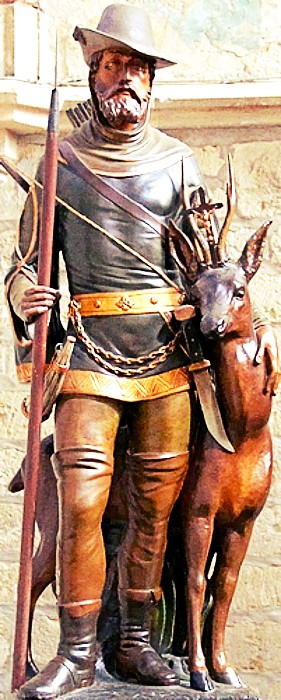
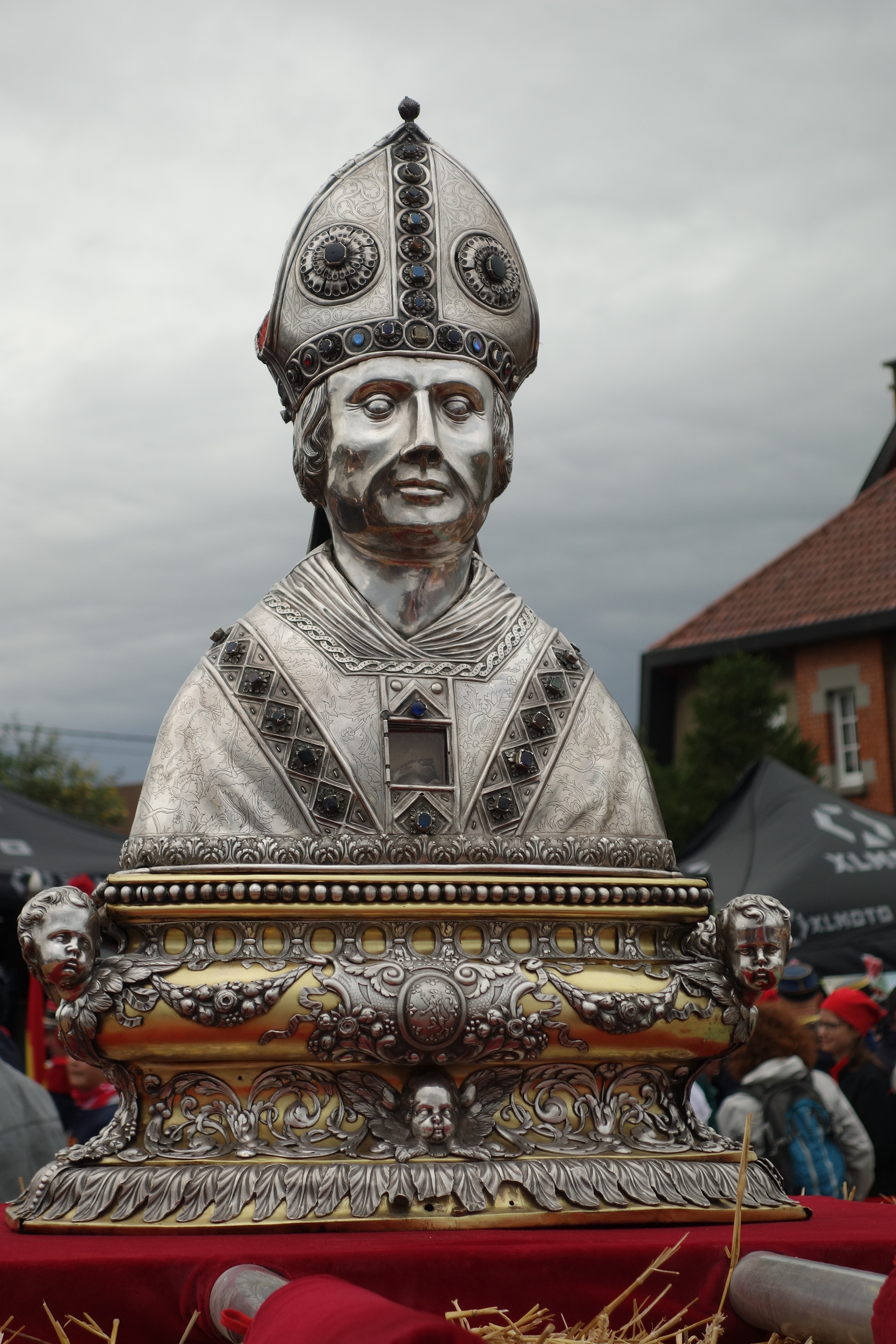
Saint of the Day – 3 November – Saint Hubert of Liege (c 656-727) the first Bishop of Maastricht, the “Apostle of the Ardennes,” spiritual student of Saint Lambert of Maastricht (c 635-c 700), excellent Preacher and devoted to the needs of the poor, widower and father to St Floribert of Liege. Born in c 656 at Maastricht, Netherlands and died on 30 May 727 at Fura (modern Tervueren), Brabant, Belgium of natural causes. Patronages – against dog bite, against hydrophobia, against mad dogs, against rabie. of archers, dogs, forest workers, furriers, hunters, huntsmen, hunting, Liege, Belgium, machinists, mathematician, metal workers, opticians, precision instrument makers, the Town of Saint-Hubert, Belgium, smelters, trappers . Also known as – Apostle of the Ardennes, Hubert the Hunter, Hubertus… Additional Memorial – 30 May (translation of relics).
Hubert likely was born in Toulouse about the year 656, the eldest son of Bertrand, Duke of Aquitaine. As a youth, Hubert was sent to the Court of Theuderic III at Paris, where his charm and agreeable manner ,led to his investment with the dignity of “Count of the Palace.” Hubert was a hunting enthusiast and spent a great deal of time in learning the skills of the sport.
About 682, Hubert married Floribanne, daughter of Dagobert, Count of Leuven. Their son, Floribert of Liège later would become Bishop of Liège and a Saint, in the footsteps of his father. Hubert soon followed his noble peers to the Austrasian Court and was warmly welcomed by Pepin of Herstal, Mayor of the Palace, who entitled him, almost immediately, Grand Master of the household.
Hubert’s wife had died giving birth to their son Floribert and his grief prompted him to retreat from the Court. He withdrew into the forests of the Ardennes and gave himself up entirely to hunting.
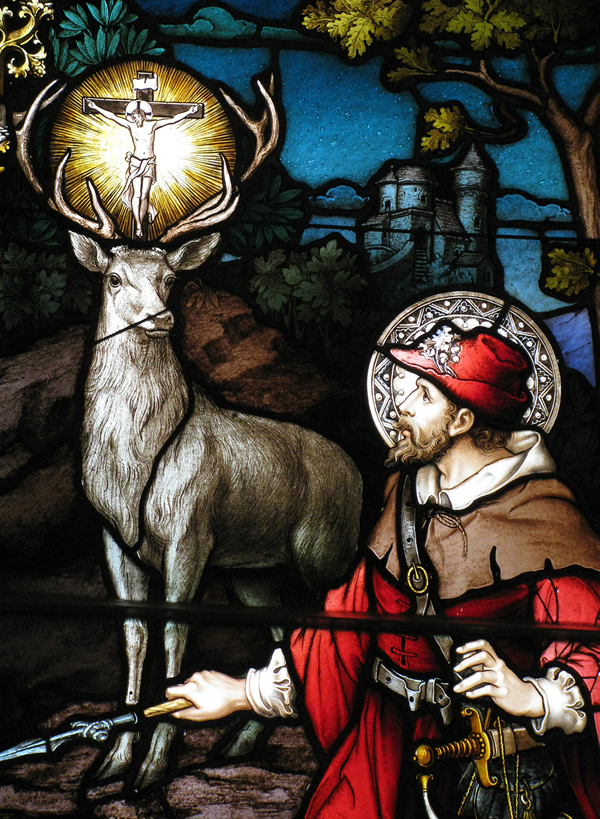
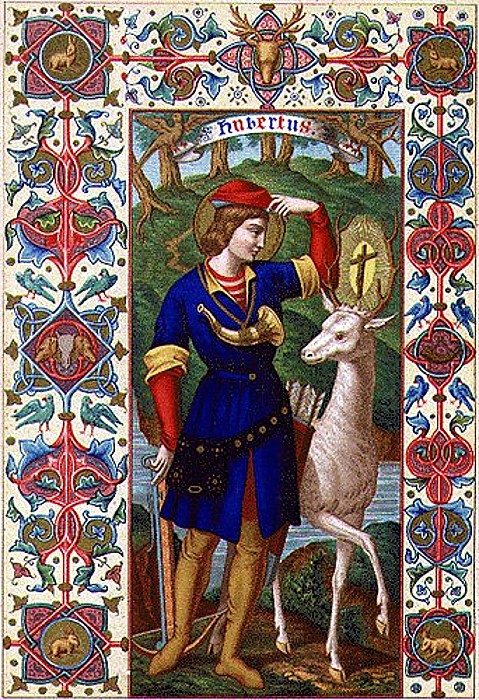
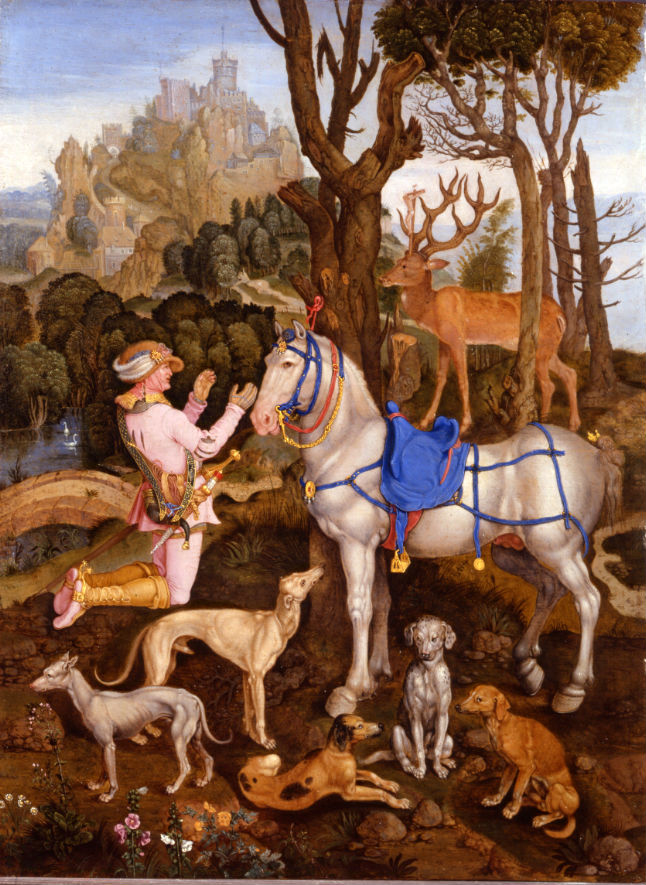
On a Good Friday morning, while the faithful were in Church, Hubert was hunting in the forest. As he pursued a magnificent stag or hart, the animal turned and Hubert was astounded to see a Crucifix floating between its antlers. He heard a Voice saying: “Hubert unless thou turnest to the Lord and leadest a holy life, thou shalt quickly go down into Hell.” Hubert dismounted and prostrated himself and after asking “Lord, what wouldst Thou have me do?” he wasitold, “Go and seek Lambert and he will instruct you.“
Hubert set out immediately for Maastricht, to meet Lambert, a Bishop who received him kindly and became his spiritual director. Hubert renounced all his very considerable honours and gave up his birthright to the Aquitaine to his younger brother, Odo, whom he made guardian of his infant son, Floribert. Having distributed all his personal wealth among the poor, he studied for the Priesthood, was Ordained and soon after, became one of St Lambert’s assistants in the administration of his Diocese. By the advice of St Lambert, Hubert made a pilgrimage to Rome in 708 but during his absence, Lambert was assassinated by the followers of Pepin. According to the hagiographies of Hubert, this act was simultaneously revealed to the Pope in a vision, together with an injunction to appoint Hubert Bishop of Maastricht.
Saint Hubert being Consecrated Bishop by Pope Sergius I
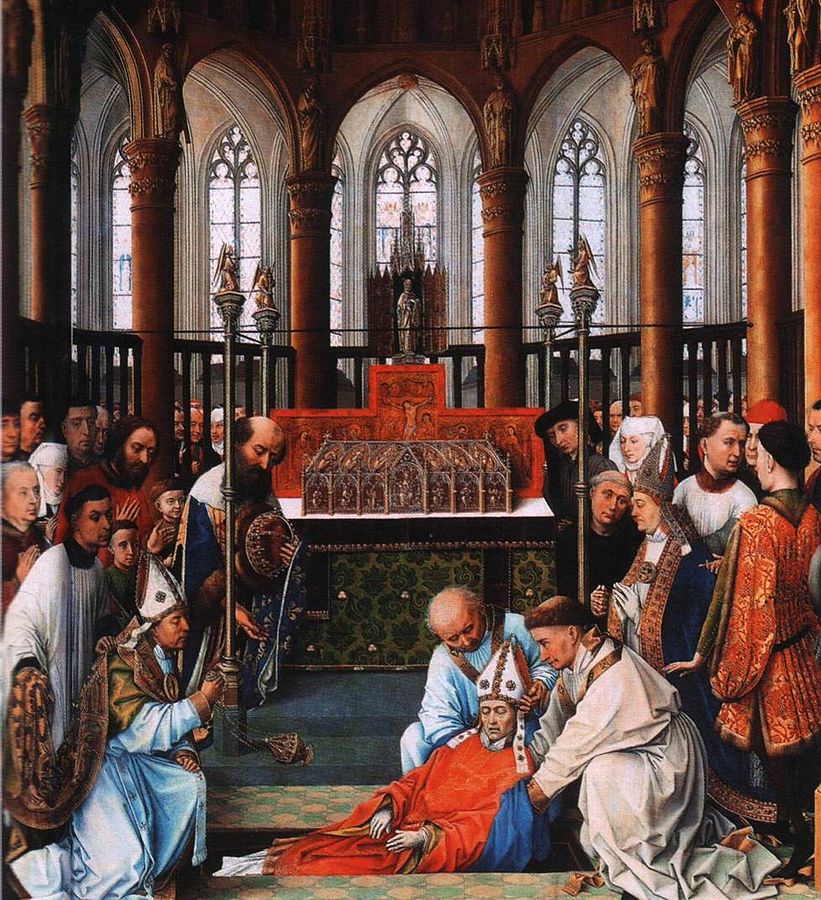
Hubert distributed his episcopal revenues among the poor, was diligent in fasting and prayer and became well known for his eloquence in the pulpit. In 720, in obedience to a vision, Hubert translated St Lambert’s remains from Maastricht to Liège with great pomp and ceremony, with several neighbouring Bishops assisting. A Basilica to enshrine the elics was built upon the site of Lambert’s Martyrdom and was Consecrated as a Cathedral the following year, the See being removed from Maastricht to Liège, then only a small village. This laid the foundation of the future greatness of Liège, of which Lambert is honoured as Patron and Hubert as Founder and first Bishop.
Th removal of St Lambert to the Cathedral of Lieges by Rogier van der Weyden
Hubert actively evangelised among pagans in the extensive Ardennes forests and in Toxandria, a district stretching from near Tongeren to the confluence of the rivers Waal and the Rhine.
Hubert died peacefully in a place called Fura, located 30 miles from Liège on 30 May 727 or 728. Initially he was buried in the collegiate St.Peter’s Church, Liège but his relics were exhumed in 825 and translated to the Benedictine Abbey of Amdain, the present-day Saint-Hubert, Belgium in the Ardennes. The Abbey became a holy destination for pilgrims, until Hubert’s coffin disappeared during the Reformation.
Hubert was widely venerated in the Middle Ages and partly because of his noble birth, several military orders were named after him – the Bavarian, the Bohemian International Order of St. Hubert and that of the Archbishop-Elector of Cologne.
Hubert, along with St Quirinus of Neuss, St Cornelius and St Anthony, was venerated as one of the Four Holy Marshals (Vier Marschälle Gottes) in the Rhineland. The St Hubertus Order, a chivalric order, was founded in 1444 .
Following Lamberts’ assassination, Hubert becomes Bishop of Maastricht, then of Liége but he was known as the Apostle of the Ardennes throughout his life, venturing much into the Forest and gaining the trust and the faith, of its people. Hubert became an important reference and intercessor, whenever matters of the Ardennes Forest and any other forest, are being discussed or considered in need of assistance.
The true meaning of the Jägermeister logo takes after the story of Saint Hubert’s vision. The Rrademark story of the Company is below, along with the logo:
“Only a legendary stag’s head would suffice, one with a Cross between its antlers. The stag that appeared to a wild hunter and converted him to Christianity. The same hunter who would later become the Patron Saint of all hunters – Saint Hubert. This stag remains today, as it always has been, the Jägermeister trademark. A symbol of the preservation of our quality and tradition.”
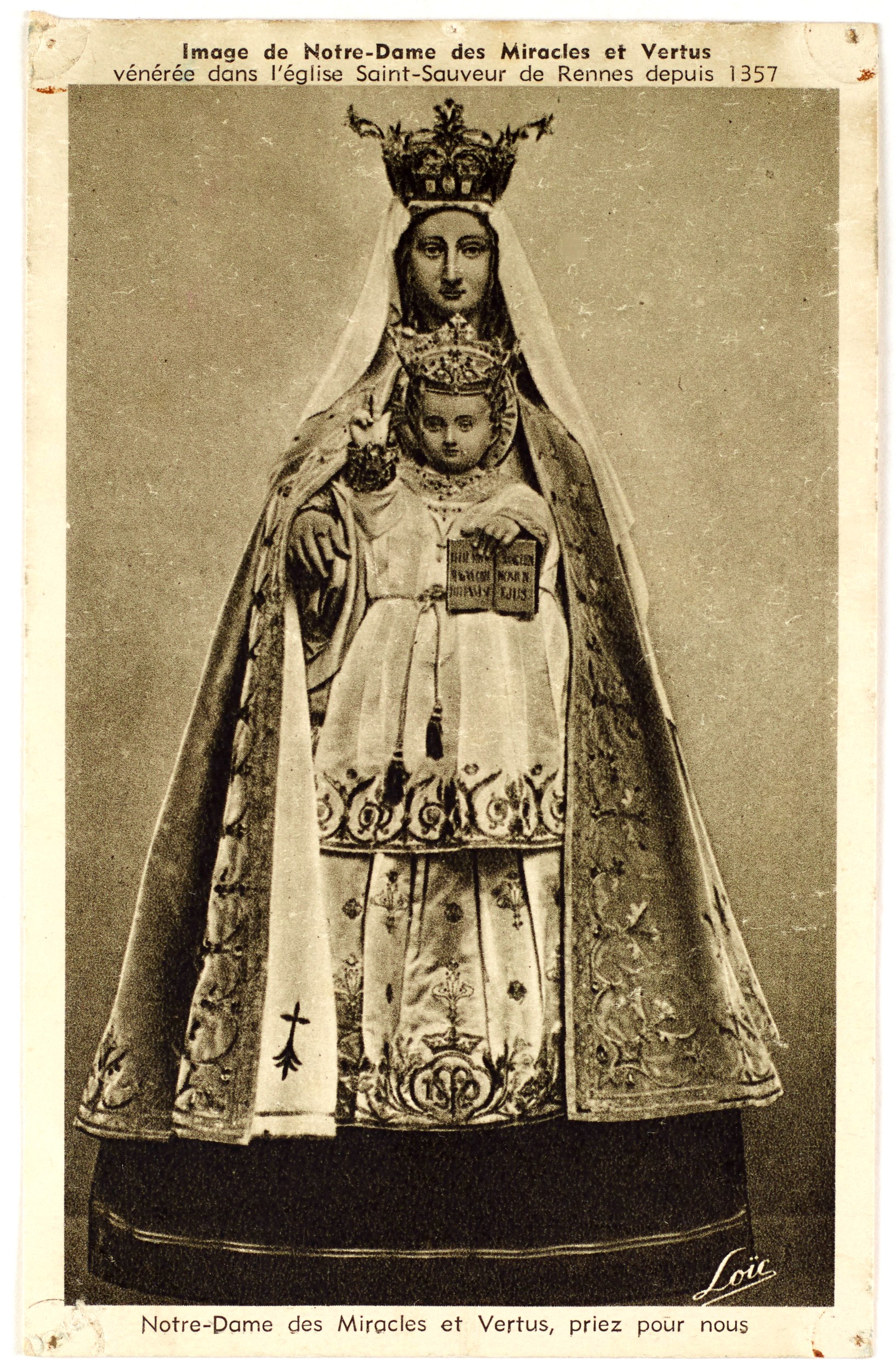
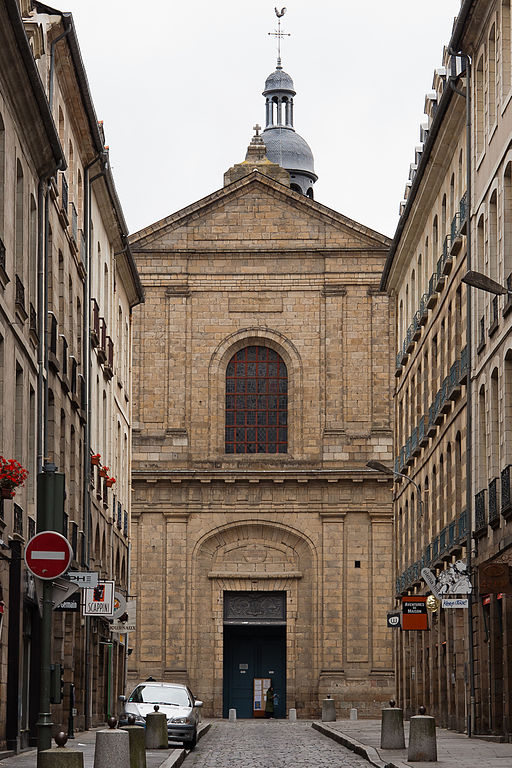
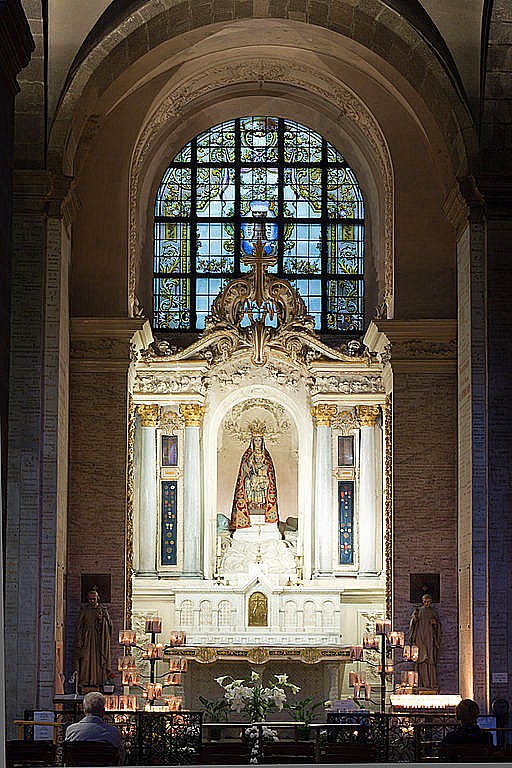
Notre-Dame des Miracles et Vertus / Our Lady of Miracles and Virtues, Rennes, France (14th Century) – 3 November:
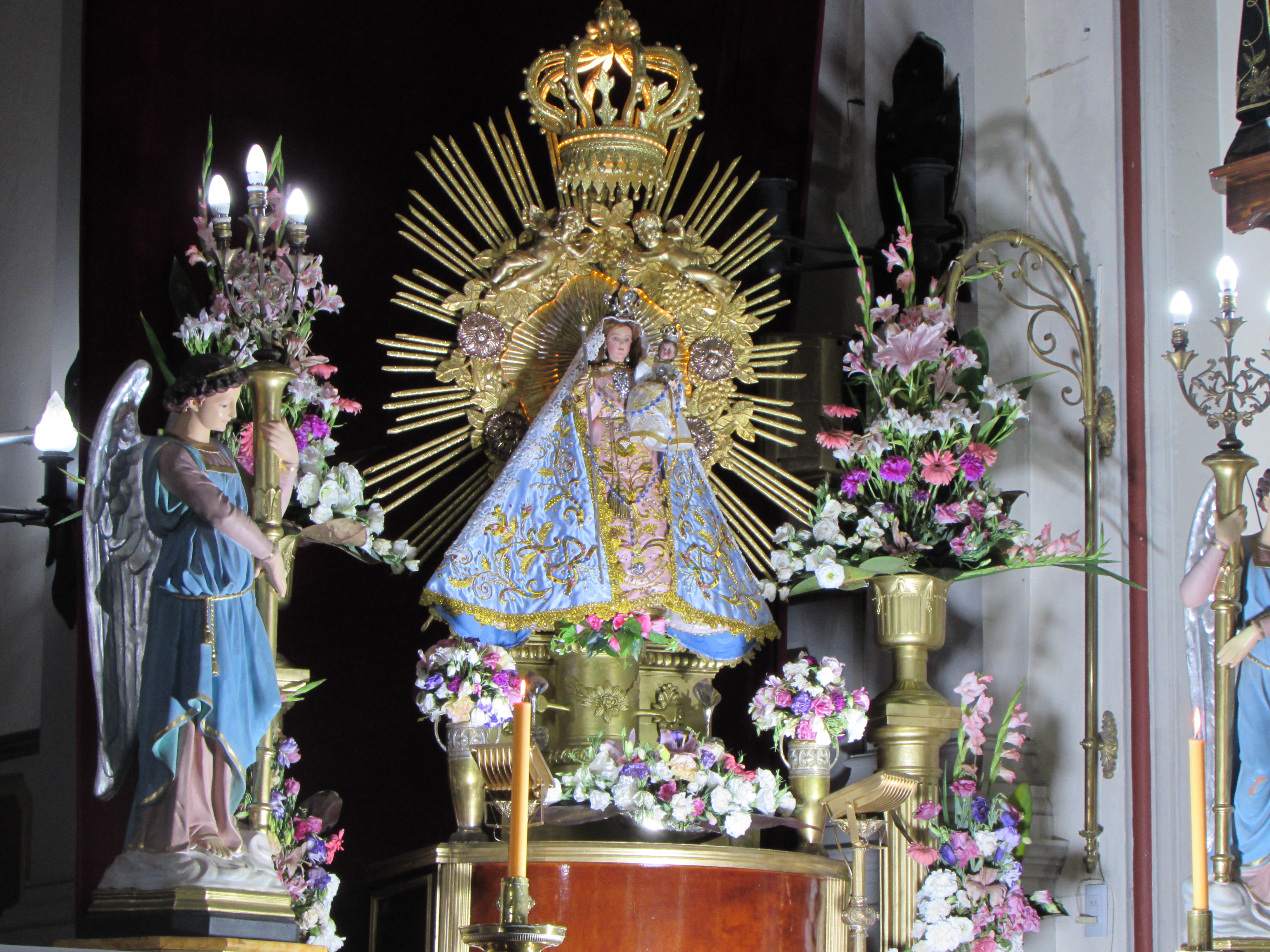
The Statue of Our Lady of Miracles and Virtues, often simply called Our Lady of Miracles, is a depiction of Virgin and Child. Installed in 1876, it replaces the original Statue venerated since the fourteenth century and destroyed during the French Revolution. The original Statue was first mentioned in the fourteenth century , as part of a miracle that would have occurred during a siege of the City. It is created in 1445 and her hands were restored in 1522.
The English, having made a mine to ignite the Town, it is said that the candles in the Chapel were found miraculously alight; t he bells rung of themselves and the image of the Blessed Virgin was seen to stretch out its arms towards the middle of the Chapel where the mine had been concealed, which by that means, was discovered. The people rushed to the spot and so the plot was uncovred and the entire Town saved through the intervention of Our Lady of Rennes. Great was the rejoicing and deep the gratitude of the people. Known today as the Basilica of Saint Sauveur in Rennes, it is located in the heart of historic Rennes, which was once the capital of Brittany. It is situated at the termination of Saint-Sauveur Street on which its façade faces. As the original Gothic Church partially collapsed in the year 1682, the Classical style Church that can currently be seen, was constructed beginning in 1703 and Consecrated in August of 1719.
In the year 1793, during the French Revolution, the Church was made into a Temple of Reason and the miraculous Statue of Our Lady was destroyed. It was not until 1802, after the end of the Terror, that the Church was opened again to worship. The Church was made into a minor Basilica in 1916 by Pope Benedict XV. In 1634, the miracle of Our Lady’s intervention against the English invaders, was officially recognised by the Bishop of Rennes, Pierre Cornulier. There are many more miracles attributed to Our Lady, including the miraculous cure of Magdalene Morice in the year 1761. She had gangrene in her right foot which was instantly healed on Easter Sunday. The Statue of Our Lady of Miracles and Virtues currently displayed at the Basilica was placed there in February of 1876. In 1684 a boy of eleven left home for the City of Rennes in the hopes of enrolling at the Jesuit College of Thomas a Becket. The young Louis-Marie was an intelligent boy who was taken under the guidance of the Jesuit Priest, and it was at Rennes that he began to consider a possible vocation to the Priesthood. It was here, at the Shrine of Our Lady at Rennes, that Saint Louis-Marie de Montfort made the final decision to become a Priest.
St Acepsimas St Acheric of Vosges Bl Alphais of Cudot Bl Berardo dei Marsi Bl Berchtold of Engelberg St Caesarius St Cecilio Manrique Arnáiz St Clydog St Cristiolus St Domnus of Vienne St Elerius St Englatius St Florus of Lodeve St Francisco Colom González St Gaudiosus of Tarazona St Germanus St Guenhael St Hermengaudius of Urgell St Hilary of Viterbo St Hubert of Liege (c 656-727) Bishop, the “Apostle of the Ardennes” Bl Ida of Toggenburg St José Llorach Bretó St José Ruiz de la Torre St Libertine of Agrigento Bl Lorenzo Moreno Nicolás
St Papulus St Pierre-François Néron St Pirmin St Quartus St Rumwold of Buckingham St Sylvia of Rome St Theophilus St Valentine of Viterbo St Valentinian St Vitalis St William of Vosges St Winifred of Wales St Wulganus
Innumerable Martyrs of Saragossa: A large group of Christians martyred in Zaragoza, Spain by Dacian during the persecutions of Diocletian. Dacian ordered all Christians of the city into exile under pain of death; when they were assembled to leave, Dacian ordered imperial soldiers to massacre the lot of them. They were martyred in 304.
Martyred in the Spanish Civil War: • Blessed Cecilio Manrique Arnáiz • Blessed Francisco Colom González • Blessed José Llorach Bretó • Blessed José Ruiz de la Torre
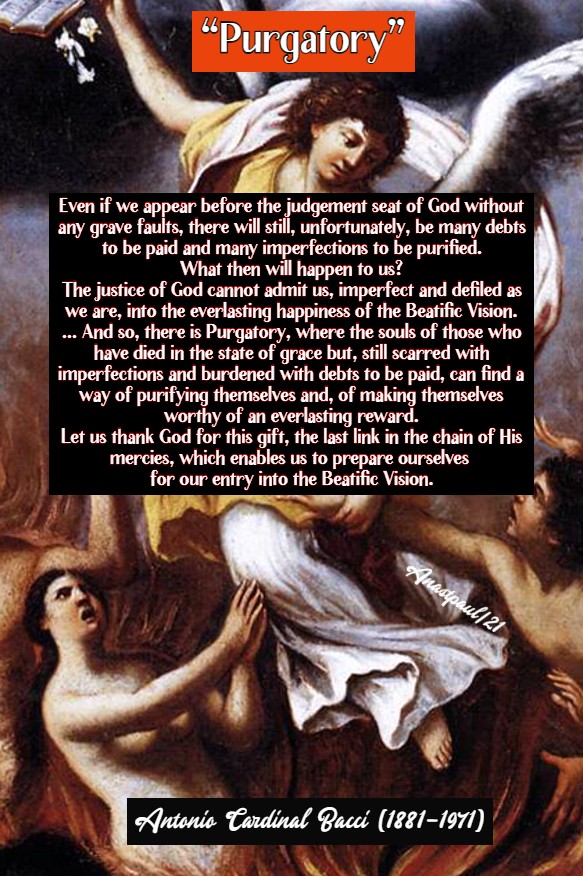
Thought for the Day – 2 November – Meditations with Antonio Cardinal Bacci (1881-1971)
“Purgatory”
“Purgatory is the masterpiece of God’s justice and mercy. St John tells us in the Apocalypse, that nothing defiled can enter into the Heavenly Jerusalem (Apoc 21:27).
There are very few, however, who are privileged to arrive at the supreme moment of death, still wearing their Baptismal robe of innocence. Even the just man falls very often as the Holy Spirit warns us (Prov 24:16). We all possess many failings and have been guilty of many sins, either mortal or venial. It is true, that we can obtain forgiveness by penance and by receiving the Sacraments but, there still remains the temporal punishment due to our sins. Neither the small penances imposed by the confessor, nor our own tiny acts of voluntary mortification, are sufficient to satisfy our debt. We cannot be certain, moreover, that we shall be able, at the hour of our death, to cleanse ourselves of all our sins, by means of one good Confession. Even if we appear before the judgement seat of God without any grave faults, there will still, unfortunately, be many debts to be paid and many imperfections to be purified.
What then will happen to us? The justice of God cannot admit us, imperfect and defiled as we are, into the everlasting happiness of the Beatific Vision. Will He reject us, therefore, even as He rejects those who die in mortal sin and are condemned to eternal punishment? This is unthinkable, for the mercy of God is as infinite as His justice. And so, there is Purgatory, where the souls of those who have died in the state of grace but, still scarred with imperfections and burdened with debts to be paid, can find a way of purifying themselves and, of making themselves worthy of an everlasting reward.
Let us thank God for this gift, the last link in the chain of His mercies, which enables us to prepare ourselves for our entry into the Beatific Vision.”
Quote/s of the Day – 2 November – All Souls Day – Readings: Wisdom 3: 1-9; Romans 5: 5-11 or Romans 6: 3-9; Gospel: John 6: 37-40
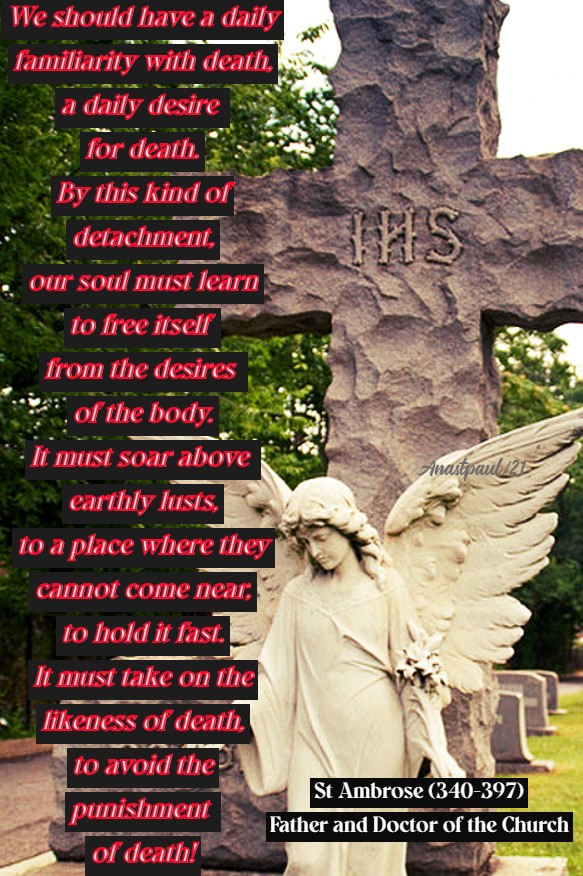
“We should have a daily familiarity with death, a daily desire for death. By this kind of detachment, our soul must learn to free itself from the desires of the body. It must soar above earthly lusts, to a place where they cannot come near, to hold it fast. It must take on the likeness of death, to avoid the punishment of death!”
“Death is then no cause for mourning, for it is the cause of mankind’s salvation. Death is not something to be avoided, for the Son of God did not think it beneath His dignity, nor did He seek to escape it.”
St Ambrose (340-397) Father and Doctor of the Church
“We should consider how much good our Lord did us, by His first coming and how much more He will do for us, by His second. This thought will help us, to have a great love for that first coming of His and a great longing for His return.”
St Aelred of Rievaulx (1110-1167)
“Keep a clear eye toward life’s end. Do not forget your purpose and destiny as God’s creature. What you are in His sight, is what you are and nothing more. Remember that when you leave this earth, you can take nothing that you have received… but only what you have given – a full heart enriched by honest service, love, sacrifice and courage.”
St Francis of Assisi (c 1181-1226)
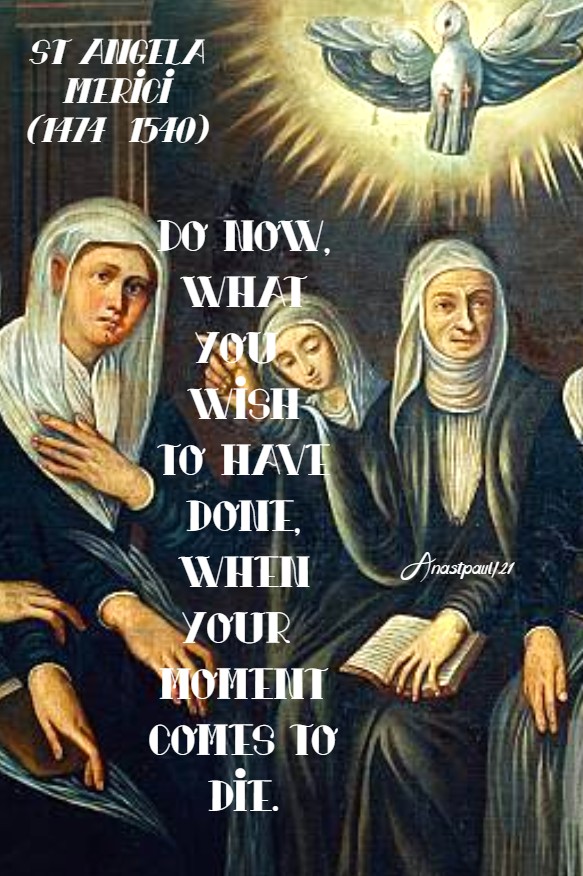
“Do now, what you wish to have done, when your moment comes to die.”
St Angela Merici (1474-1540)
Sabbatum Sanctum By St John Henry Newman (1801-1890)
I look at You, my Lord Jesus and think of Your most holy Body and I keep it before me, as a pledge of my own resurrection. Though I die, as die I certainly shall, nevertheless, I shall not forever die, for I shall rise again. O You, who are the Truth, I know and believe with my whole heart, that this very flesh of mine will rise again. I know, base and odious as it is at present, that it will one day, if I be worthy, be raised incorruptible and altogether beautiful and glorious. This I know, this by Your grace, I will ever keep before me. Amen
One Minute Reflection – 2 November – Commemoration of All the Faithful Departed – All Souls Day – Readings: Wisdom 3: 1-9; Romans 5: 5-11 or Romans 6: 3-9; Gospel: John 6: 37-40
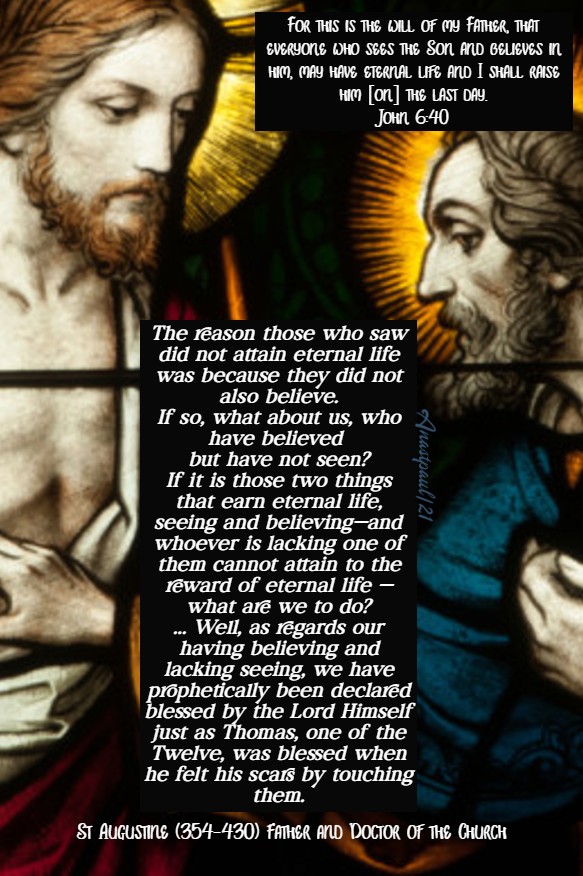
“For this is the will of my Father, that everyone who sees the Son and believes in him, may have eternal life and I shall raise him [on] the last day.” – John 6:40
REFLECTION – “He has said two things: “This is the work of God that you should believe in the One whom He has sent,” while here He added, “whoever sees and believes.” The Jews saw but did not believe; they had the one condition, lacked the other. How could they attain to eternal life without the other? The reason those who saw did not attain eternal life was because they did not also believe. If so, what about us, who have believed but have not seen? If it is those two things that earn eternal life, seeing and believing—and whoever is lacking one of them cannot attain to the reward of eternal life — what are we to do? The Jews [who saw Him] lacked the one; we ,the other. They had seeing but lacked believing. We have believing but lack seeing. Well, as regards our having believing and lacking seeing, we have prophetically been declared blessed by the Lord Himself just as Thomas, one of the Twelve, was blessed when he felt his scars by touching them.” – St Augustine (354-430) Great Western Father and Doctor of the Church (Sermon 14)
PRAYER – Merciful Father, hear our prayers and console us. As we renew our faith in Your Son, Whom You raised from the dead, strengthen our hope that all our departed brothers and sisters will share in His Resurrection, Who lives and reigns with You in the unity of the Holy Spirit, God forever and ever, amen.
Our Morning Offering – 2 November – Commemoration of All the Faithful Departed (All Souls)
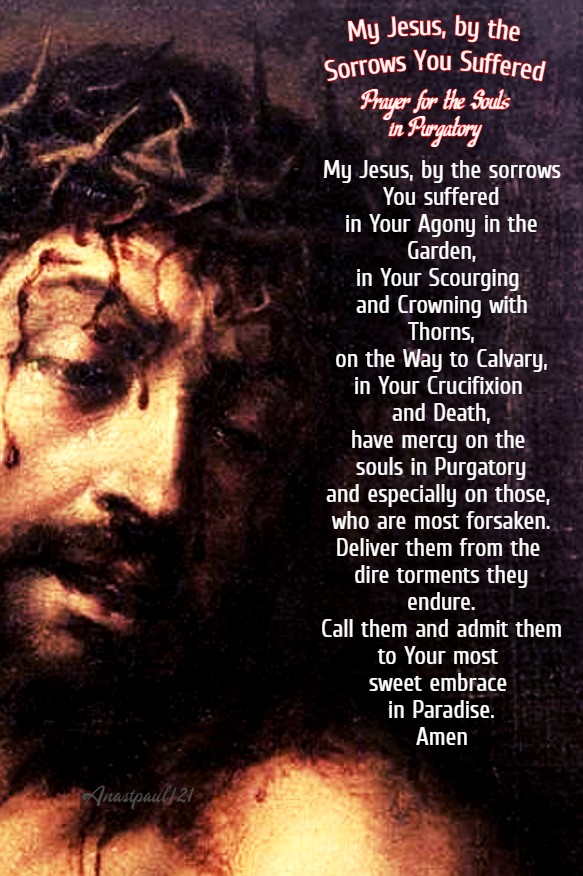
My Jesus, by the Sorrows You Suffered Prayer for the Souls in Purgatory
My Jesus, by the sorrows You suffered in Your Agony in the Garden, in Your Scourging and Crowning with Thorns, on the Way to Calvary, in Your Crucifixion and Death, have mercy on the souls in Purgatory and especially on those, who are most forsaken. Deliver them from the dire torments they endure. Call them and admit them to Your most sweet embrace in Paradise. Amen
Saint of the Day – 2 November – St Victorinus of Pettau (Died c 304) Bishop Martyr, learned Exegetists on both the Old and the New Testament, ecclesiastical writer, theologian. Born in the 3rd Century in Greece and died in 303 or 304 (records vary), he suffered Martyrdom probably in 303, under Diocletian. Also known as – Victorinus Petravionensis, Victorinus von Pettau, Victorinus Pictaviensis, Victorinus of Patawii, Victorinus of Petta, Victorinus of Ptuj. Victorin… Additional Memorial – 12 November on some calendars.
Born probably in Byzantine Greece or in Poetovio with rather mixed population, due to its military character, Victorinus spoke Greek better than Latin, which explains why, in St Jerome’s opinion, his works written in the latter tongue were more remarkable for their content than for their style. Bishop of the City of Pettau, he was the first theologian to use Latin for his exegesis.
His works are mainly exegetical. Victorinus composed commentaries on various books of Sacred Scripture, such as Genesis, Exodus, Leviticus, Isaiah, Ezekiel, Habakkuk, Ecclesiastes, the Canticle of Canticles, St Matthew and the Apocalypse, besides treatises against the heresies of his time. All that has survived is his Commentary on Apocalypse and the short tract On the construction of the world (De fabrica mundi). Some believe he is also the author of two poems, “De Jesu Christo” and “De Pascha,” although this is contested.
Like many of his contemporaries he shared the errors of the Millenarians and for this reason his works were ranked with the apocrypha by Pope Gelasius. Nevertheless, by contrast, St Jerome gives him an honourable place in his catalogue of ecclesiastical writers. St Jerome cites the opinion of Victorinus in some of his works but considered him to have been affected by the opinions of the Chiliasts or Millenarians (they believed that Christ would return to the earth to rule for a thousand years..)
According to Saint Jerome, Victorinus died a Martyr in 304.
The Commemoration of All the Faithful Departed – All Souls Day (Commemoration): Commemoration of the faithful departed in Purgatory. Abbot Odilo of Cluny instituted it in the Monasteries of his congregation in 998, other religious orders took up the observance and it was adopted by various Diocese and gradually by the whole Church. The Office of the Dead must be recited by the clergy on this day and Pope Benedict XV granted to all Priests, the privilege of saying three Masses of requiem – • one for the souls in Purgatory • one for the intention of the Holy Father • one for the Priest’s intentions If the feast should fall on Sunday it is kept on 3 November. Patronage: Monselice, Italy
Notre-Dame D’Emminont / Our Lady of Emminont. Abbeville, France (12th Century) – 2 November:
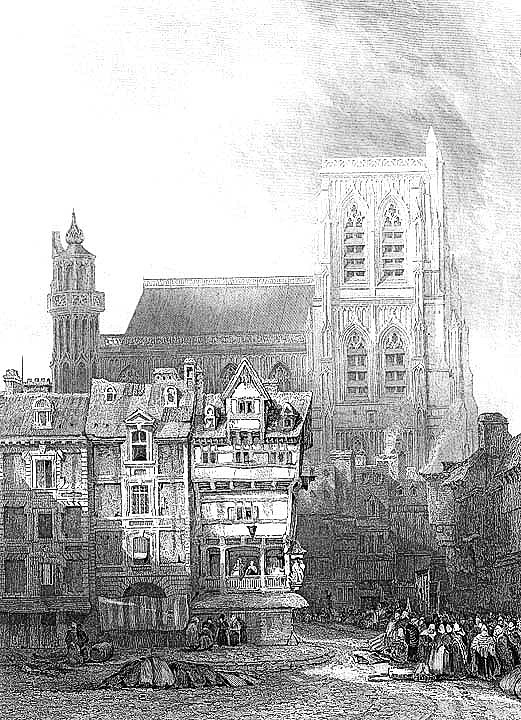
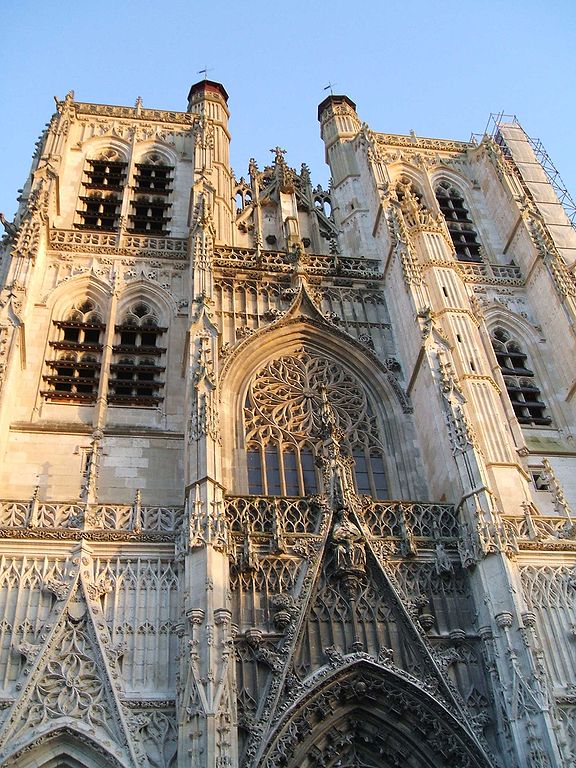
The Shrine to Our Lady of Emminont, or Notre-Dame D’Emminont, is near Abbeville in France. It is much visited by pilgrims devoted to the Mother of God who at their prayers and petitions, still performs many miracles and favours for her people.
The relics of Saint Wulfram (also spelled Wulfran or Vulfran) of Sens, who died in 656, were brought to the Shrine in the year 1058. Until that time, the Church had been known as the Collegiate Church of Our Lady in Abbeville but after the relics of Saint Wulfram were interred there, the Church was rededicated in Saint Wulfram’s honour. The Church retains that name to this day.
Franciscan Friars, well-versed in wood carving, cared for the Shrine. They were consulted in 1510 concerning work on the Cathedral of Amiens. In richness of detail, Abbeville surpasses many other Cathedrals. The nave was built between the years 1488 to 1539 and the small choir between 1661 and 1663. The construction was paid for by the King of France, and Count of Ponthieu and the faithful of Abbeville. The Church is much smaller than it was originally intended to be, as the initial blueprint for the Church was never completed. The nave is quite short, has only two bays and the choir is extremely small. Still, the façade is a superb masterpiece of the flamboyant Gothic style. During the French Revolution the Church of Saint Wulfram was profaned and given the name of a “Temple of Reason” by the unreasoning revolutionaries who sought to destroy the immutable God by demolishing priceless monuments and artifacts and even, the glory of their own history. The Town of Abbeville was heavily bombed by the German’s during World War II, so that much of what is seen there today is of fairly modern origin. The Church was also damaged, but efforts were made to restore it to its former grandeur. The list of favours granted by Our Lady of Emminont, is indeed very long. It includes miraculous cures, astounding spiritual and temporal favours and streams of graces and blessings.
St Ambrose of Agaune St Ambrose of Agaune St Amicus of Fonte Avellana St Amicus of Rambone St Baya of Scotland St Domninus of Grenoble St Erc of Slane St Eustochium of Tarsus St George of Vienne Bl John Bodey St Jorandus of Kergrist St Justus of Trieste
St Marcian of Chalcis Bl Margaret of Lorraine St Mateo López y López St Maura of Scotland St Theodotus of Laodicea St Victorinus of Pettau (Died c 304) Bishop Martyr
St Willebald of Bavaria — Martyrs of Isfahan – 5+ saints: Acindynus, Pegasius and Anempodistus were Persian priests who were imprisoned, tortured, interrogated and martyred in the persecutions of king Sapor II of Persia; he considered any Christian to be a Roman spy and anti-Persian. The three were brought back to life, miraculously healed, freed from their chains and began preaching Christianity, miraculously healing Sapor II in the process. This defiance enraged Sapor so much that he ordered them executed again; they were thrown into a cauldron of molten lead but walked out unharmed. This miracle brought one of the torturers, Aphthonius, to convert; he was immediately martyred. Other attempts were made to kill them, and they emerged each time unharmed. Senator Elpidiphorus led a group speaking in favour of the Christians for their courage and faith; he was immediately executed. In the end the original three Christians were burned to death. Martyrs all – Acindynus, Anempodistus, Aphthonius, Elpidephorus and Pegasius. They were born in Persia and Died: • c.350 in Isfahan, Persia • relics transferred to Constantinople and enshrined in a church dedicated to them • some relics taken to France in 1204 during the 4th Crusade • relics in France were lost when hidden from anti-Christian forces in the French Revolution • relics in France re-discovered in 1892 in Grozon.
Martyrs of Sebaste – 10 saints: A group of ten soldiers in the imperial Roman army of Emperor Licinius Licinianus who were executed together for refusing to burn incense as a sacrifice to the emperor. The only details that have survived are five of their names – Agapius, Cartherius, Eudoxius, Styriacus and Tobias. They were burned at the stake in 315 in Sebaste (in modern Turkey).
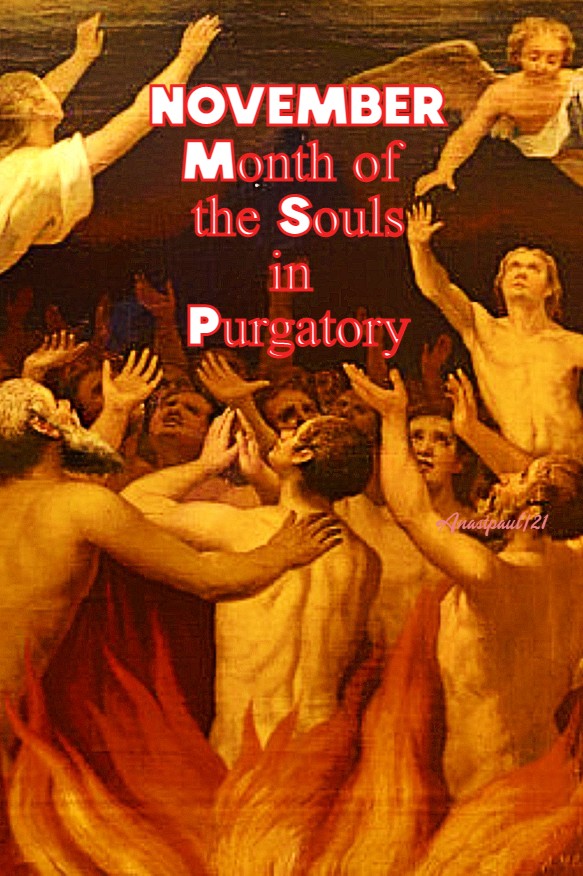
Devotion for the Month of November – The Holy Souls in Purgatory
“Twelve Months Sanctified by Prayer” By Father Antoine Ricard (1834 – 1895)
“It has been said and with reason, that “amongst all Catholic devotions, one of the most solid, most fruitful and the most conformed to that spirit of charity which constitutes the soul and principle of Christian morality, is, without doubt, devotion to the souls in Purgatory.”
And now, let us see what really is the end of this beautiful devotion. Is it not to deliver from expiatory flames, souls who find in our suffrages, a compensation for the slowness of their painful expiation? But the real and immediate object of devotion to the souls in Purgatory, leads to various consequences, which multiply its fruits. For to deliver a soul from Purgatory, is it not to procure the glory of God, since it allows that soul to praise Him in heaven for all eternity? And to deliver a soul from Purgatory, is it not to exercise one of the best works of charity a Christian could practice, since it procures for that soul, the greatest of all benefits, heavenly bliss?
To deliver a soul from Purgatory, is to create for ourselves in heaven, a most powerful friend, whose gratitude will never fail us.
Finally, to work for the deliverance of the souls in Purgatory, is to compel ourselves, so to say, to the frequent remembrance and serious consideration of our last end and consequently, to obtain a pledge and infallible means of salvation, according to the word of the Holy Ghost: “Remember thy last end and thou shalt never sin.” (Page 13 – 14)
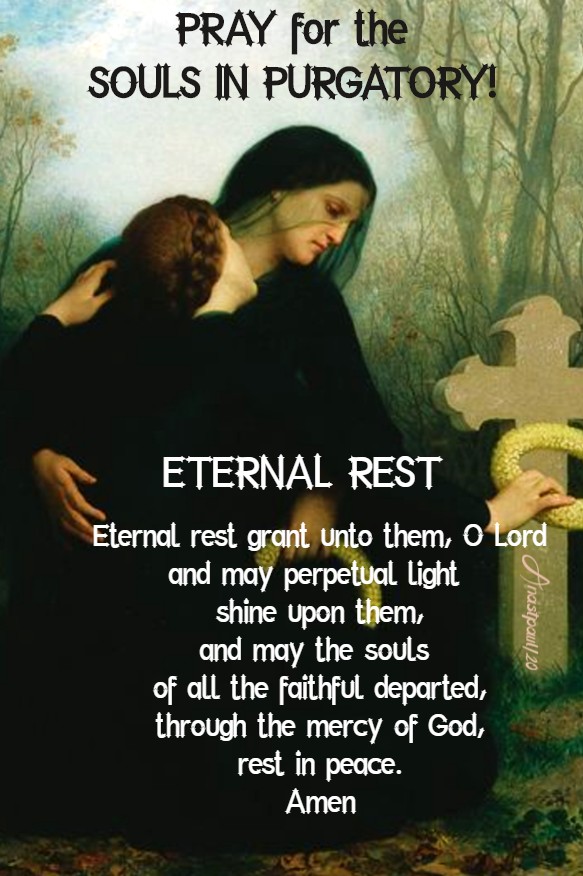
ETERNAL REST
Eternal rest grant unto them, O Lord and may perpetual light shine upon them and may the souls of all the faithful departed, through the mercy of God, rest in peace. Amen
Thought for the Day – 1 November – Meditations with Antonio Cardinal Bacci (1881-1971)
The Feast of All Saints
“God addressed the same command to all of us. “You shalt make and keep yourselves holy because I am holy” (Lev 11:44); 1 Peter 1:16). “You are to be perfect, even as your heavenly Father is perfect” (Mt 5:44).
We are all obliged to strive to become holy, to work hard towards this end and to ask for the grace to sustain us in our efforts. We should not say that sanctity is impossible for us because, everything is possible with God’s help, Let us imagine that we are in Heaven and can behold the innumerable choirs of the Blessed enjoying the unlimited and unending happiness of God’s company. Nevertheless, they were once people, like ourselves, with the same passions, failings and temptations. They fought valiantly, with the same passions, failings and temptations. They fought valiantly, supported by the grace of God; they conquered and were awarded the palm of victory. Now they enjoy everlasting happiness.
Let us remember the words of St Augustine: “If others, why not I?” If they succeeded in becoming holy, why cannot I do likewise?”
Quote/s of the Day – 1 November – The Solemnity of All the Saints
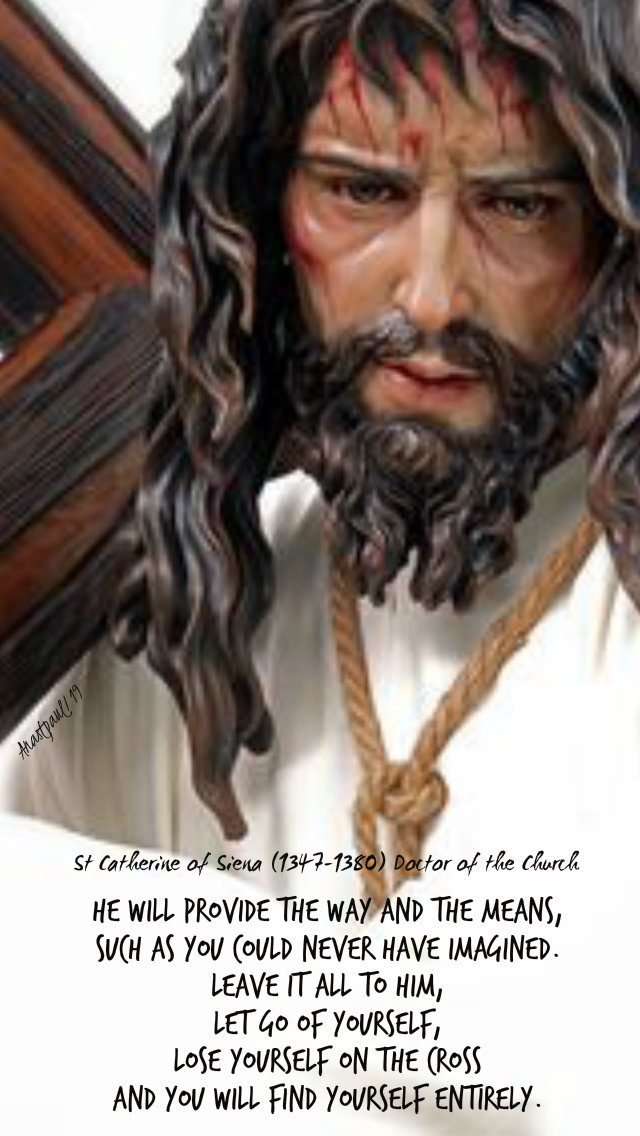
“He will provide the way and the means, such as you could never have imagined. Leave it all to Him, let go of yourself, lose yourself on the Cross and you will find yourself entirely.”
St Catherine of Siena (1347-1380) Doctor of the Church
“Teach Us Good Lord” By St Ignatius Loyola (1491-1556)
Teach us, good Lord, to serve You as You deserve; to give and not to count the cost, to fight and not to heed the wounds, to toil and not to seek for rest, to labour and not to ask for reward, except that of knowing that we are doing Your will. Amen
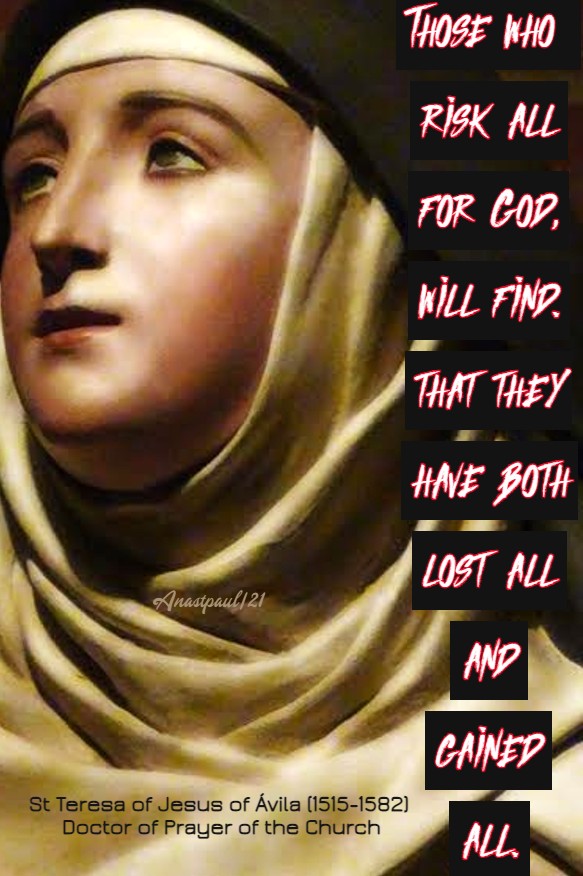
“Those who risk all for God, will find. that they have both lost all and gained all.”
St Teresa of Jesus of Ávila (1515-1582) Doctor of Prayer of the Church
“The Lord delights in every little step you take.”
St Francis de Sales (1567-1622) Doctor of Charity of the Church
“There is no more evident sign that anyone is a saint and of the number of the elect, than to see him leading a good life and, at the same time, a prey to desolation, suffering and trials.”
St Aloysius de Gonzaga (1568-1591)
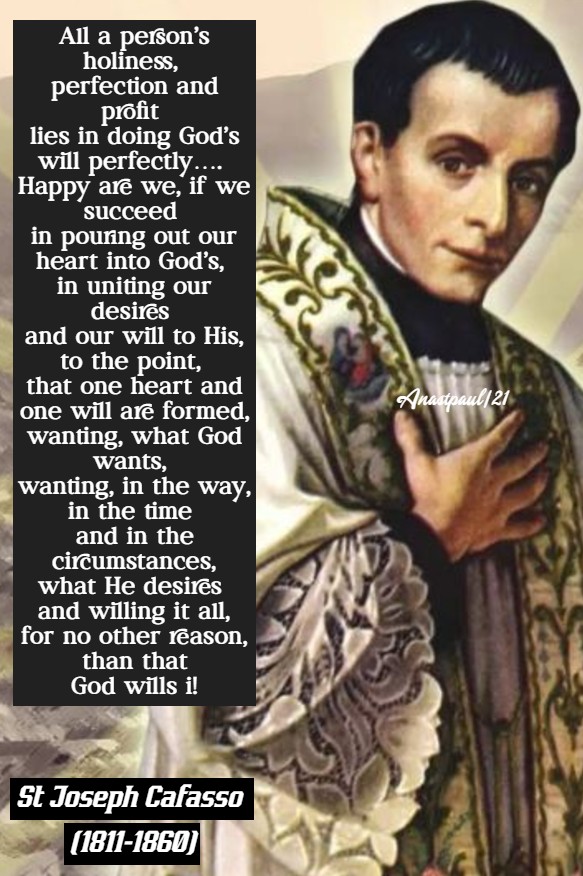
“All a person’s holiness, perfection and profit lies in doing God’s will perfectly…. Happy are we, if we succeed in pouring out our heart into God’s, in uniting our desires and our will to His, to the point, that one heart and one will are formed, wanting, what God wants, wanting, in the way, in the time and in the circumstances, what He desires and willing it all, for no other reason, than that God wills it.”
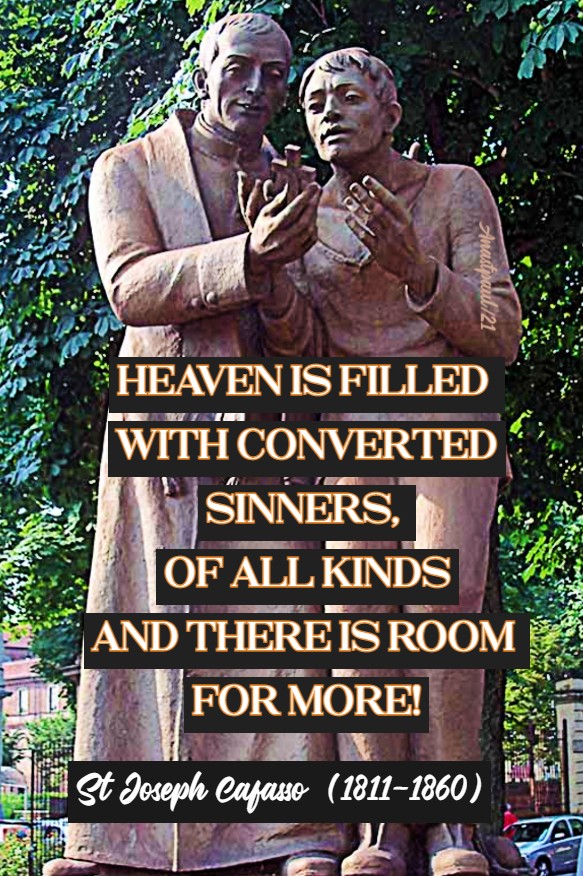
“Heaven is filled with converted sinners , of all kinds and there is room for more!”
St Joseph Cafasso (1811-1860)
“You cannot be half a saint. You must be a whole saint or no saint at all.”
St Thérèse of the Child Jesus and the Holy Face of Lisieux (1873-1897) Doctor of the Church
One Minute Reflection – 1 November – The Solemnity of All Saints, Readings: Apocalypse 7:2-4, 9-14, Psalms 24:1-6, 1 John 3:1-3, Matthew 5:1-12
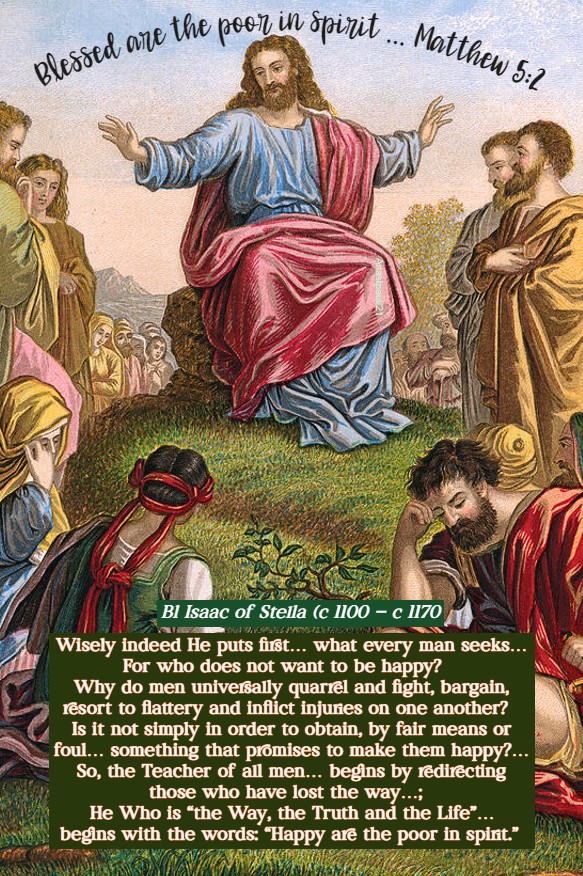
“Blessed are the poor in spirit” – Matthew 5:2
REFLECTION – “And when he had sat down, he opened his mouth.” (Mk 6,31). May it be granted me to sit with Jesus, to sit at His feet on the mountainside and partake of His instruction! When He is in the crowd, He is standing and walking, occupied and wearied, and so hard-pressed, that neither He, nor His disciples are, as it were, allowed to eat bread, “the bread of life and understanding” (Jn 6,35) and to drink “the water of wisdom” (Sir 15,3). For this water can only be drunk in a time of leisure and it is drawn by those who have little to do. For “the well is deep”(Sir 38,24) …
Opening His mouth Jesus speaks to the heart of Jerusalem, talking to her in solitude or on the mountain and this is what He says: “Happy are the poor in spirit.” ( Jn 4,11). He Who is Happiness, speaks of happiness, He Who became poor, of poverty, Bread speaks of repletion, Mercy of mercifulness, He Who is the Purity of hearts, speaks of purification of heart, the truly Peaceful of peace-making, the Son by nature, speaks of sonship…
“Blessed are the poor in spirit.” Wisely indeed He puts first… what every man seeks… For who does not want to be happy? Why do men universally quarrel and fight, bargain, resort to flattery and inflict injuries on one another? Is it not simply in order to obtain, by fair means or foul… something that promises to make them happy?… So, the Teacher of all men… begins by redirecting those who have lost the way…; He Who is “the Way, the Truth and the Life”… (Jn 14,16; 6,32;4,6) begins with the words: “Happy are the poor in spirit.” – Blessed Isaac of Stella O.Cist. (c 1100 – c 1170) Cistercian Monk, Abbot, Theologian, Philosopher (Sermon 1, for the Feast of All Saints ; SC 130).
PRAYER – Father, All-Powerful and ever-living God, today we rejoice in the holy men and women of every time and place. May their prayers bring us your forgiveness and love. Blessed Virgin, Mother of God, our trusted guide and loving mother and all you holy Saints of the Church Triumphant, pray for us! We make our prayer through Christ our Lord, in union with the Holy Spirit, God forever, amen.
Our Morning Offering – 1 November – The Solemnity of All Saints
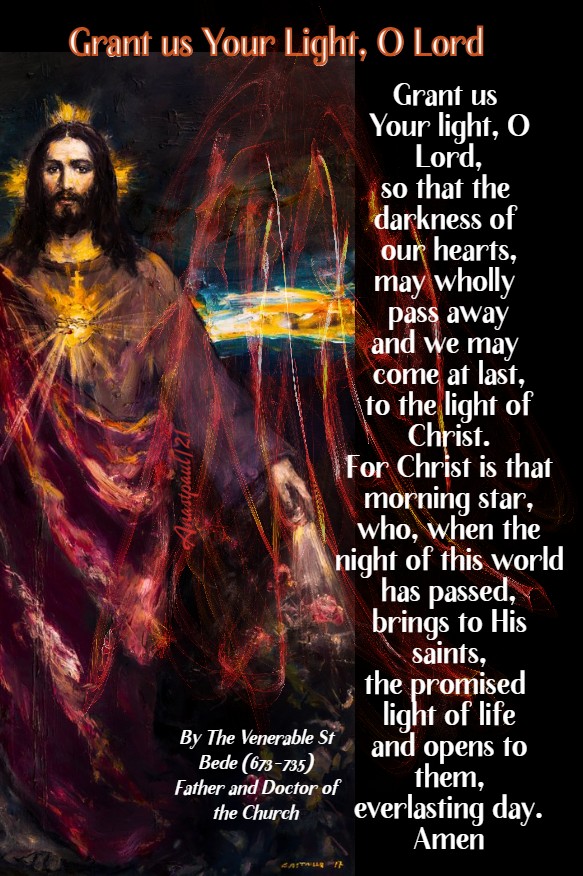
Grant us Your Light, O Lord By The Venerable St Bede (673-735) Father and Doctor of the Church
Grant us Your light, O Lord, so that the darkness of our hearts, may wholly pass away and we may come at last, to the Light of Christ. For Christ is that morning star, who, when the night of this world has passed, brings to His saints, the promised light of life and opens to them, everlasting day. Amen
Saint of the Day – 1 November – Blessed Ranieri Rasini OFM (c 1250-1304) Lay Friar of the Order of Friars Minor, Porter and beggar. He assisted all who came to Frairy in whatever way possible. The poor were his special friends, sharing what little was available with them. Born in c 1250 in Sansepolcro, Umbria, Italy and died on 1 November 1304 in Sansepolcro, Umbria of natural causes. Patronage – women in labour. Also known as – Ranieri of Aretino, Ranieri of Arezzo, Ranieri of Borgo, Ranieri of Sansepolcro, Raniero, Ranie.
Ranieri spent his life in the fulfillment of the humble duties of porter and beggar, thus entering, truly poor among the poor, in contact with the humble and simple people and with all those in need, who found some food at the door of the Convent.
Sister Death caught him in the cellar, where he was performing his service for the table of the brother Friars.
Ranieri was immediately venerated as a saint by the people of the City. Thus, a few days after his death, the City governors, which had taken steps to have the body embalmed and to collect the testimonies of the miracles attributed to the blessed, had a monumental Altar erected in honour of Ranieri. On the Altar, still existing in the Church of St Francis, we read: “In the year of the Lord 1304, on the Feast of All Saints, the saint Ranieri migrated to the Lord. In that year ,the City had this Altar made for the honour of God and for the magnificence of this saint. Amen” (original in Latin).
Among the miracles attributed to Ranieri after his death there is also the resurrection of two children, for which the Blessed is now invoked by women in labour.
The devotion paid to Blessed Ranieri was recognised by Pope Pius VII in 1802. The celebrations in honour of Blessed Ranieri occurs on 31 October due to his feast day occuring on the solemnity of All Saints. The body of the blessed is kept in the crypt of the Church of St Frances in Sansepolcro.
All Saints Day (Solemnity) – (a Holy Day of Obligation) Instituted to honour all the saints, known and unknown. It owes its origin in the Western Church to the dedication of the Roman Pantheon in honour of the Blessed Virgin Mary and all the Martyrs by Pope Saint Boniface IV in 609, the anniversary of which was celebrated at Rome on 13 May. Pope Saint Gregory III Consecrated a Chapel in the Vatican Basilica in honour of All Saints, designating 1 November as their feast. Pope Gregory IV extended its observance to the whole Church. It has a Vigil and Octave and is a Holy Day of Obligation – the eve is popularly celebrated as Hallowe’en. Patronage – Arzignano, Italy.
Virgen de la Palma / Our Lady of the Palm, Algeciras, Spain (1755) – 1 November:
The Church of Our Lady of the Palm preceded by many years, the miracle which made it famous. The miracle for which it is best remembered, took place during an earthquake and a tidal wave on the 1November, 1755. There had been an extremely strong earthquake on that day that was reported to have been felt throughout all of Europe. Algeciras is a seaport of Spain exposed to the Atlantic Ocean in the Province of Cadiz and was directly in the path of the tidal wave, said to be more than 90 feet high. The recently reported tsunamis in Asia pales in comparison to that wave. Lisbon, with 275,000 inhabitants, lost 90,000 people and had 85% of its buildings destroyed by the wave. The water penetrated as much as 8 kilometers inland, mainly striking Portugal, Spain, and Africa. The townspeople of Algeciras were in terror and were on the point of abandoning the Town when two unidentified men – thought later to be the Patron Saints of the City – closed the water gates and urged the people to go to the Capuchin Church of Our Lady of the Palm. Here a Mass was in progress. The Priest calmly finished the Mass, seized a banner with a picture of Our Lady on it and went out into the street where the wall of water was already advancing upon them. He planted the banner in the street almost in the shadow of the great wave and called out in a loud voice, “Thus far, my Mother.” The water advanced as far as the banner and then miraculously stopped its forward progression, even though, up until that point, it had destroyed everything in its path. Then, as the Priest walked boldly forward toward the wall of water with the banner in his upraised hand, that gigantic wave receded from him and turned away from the face of Mary to return placidly to the ocean. An anniversary procession was established, along with a confraternity of Our Lady of the Palm. With the exception of 1837, when there was a Civil War, the procession is held annually. The Rosary is recited along the route of the tidal wave and prayers of thanksgiving said. Many years after the first miracle, another storm caused the people to remember Our Lady of the Palm. Ships were wrecked in the harbour and the ocean was violently disturbed. The people demanded a procession of Our Lady of the Palm and when the procession was finished, the storm abated. Hail Glorious and Blessed Mother, where is our faith today!
St Amabilis of Auvergne St Austremonius St Benignus of Dijon St Cadfan St Caesarius of Africa St Caesarius of Damascus St Ceitho St Cledwyn of Wales Bl Clemens Kyuemon St Cyrenia of Tarsus St Dacius of Damascus St Deborah the Prophetess St Dingad Bl Dionysius Fugixima St Floribert of Ghent St Gal of Clermont St Genesius of Lyon St Germanus of Montfort St Harold the King St James of Persia St Jerome Hermosilla St John of Persia St Julian of Africa St Juliana of Tarsus St Lluís Estruch Vives St Marcel of Paris St Mary the Slave St Mathurin St Meigan St Nichole St Pabiali of Wales St Pere Josep Almató Ribera Auras St Peter Absalon Bl Peter Paul Navarra Bl Petrus Onizuka Sadayu St Rachel the Matriarch Blessed Ranieri Rasini OFM (c 1250-1304 Lay Friar of the Order of Friars Minor St Ruth the Matriarch St Salaun of Leseven St Severinus of Tivoli St Valentin Faustino Berri Ochoa St Vigor of Bayeux
Thought for the Day – 31 October – Meditations with Antonio Cardinal Bacci (1881-1971)
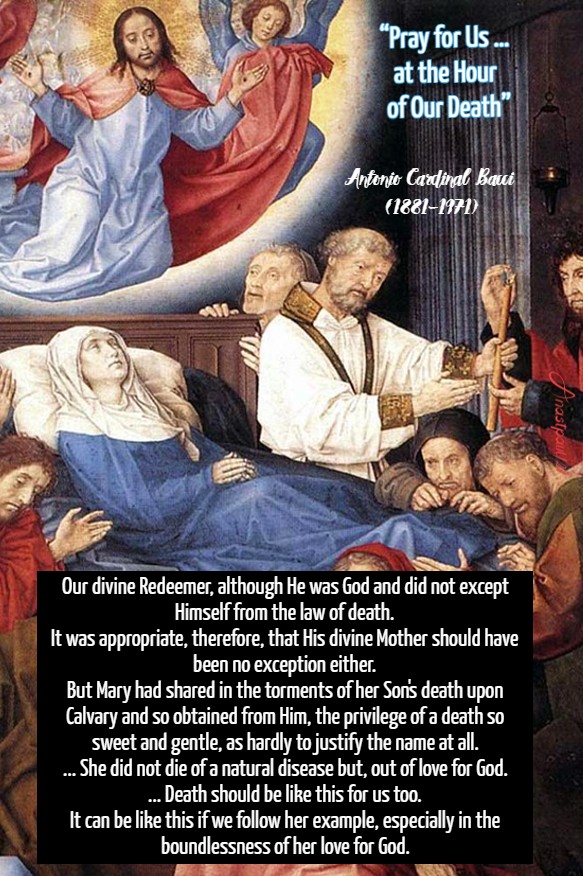
“Month of the Holy Rosary” “Pray for Us … at the Hour of Our Death”
“Our divine Redeemer, although He was God and did not except Himself from the law of death. It was appropriate, therefore, that His divine Mother should have been no exception either. But Mary had shared in the torments of her Son’s death upon Calvary and so obtained from Him, the privilege of a death so sweet and gentle, as hardly to justify the name at all. Her soul was separated from her body as if in an ecstasy of love and was united even more indissolubly with God. She did not die of a natural disease but, out of love for God. She had always loved God with all the ardour of the noblest of creatures and her life ended in a final outpouring of love. It was the climax of a continuous ascent towards God.
Death should be like this for us too. It can be like this if we follow her example, especially in the boundlessness of her love for God.
O Mary, my tender Mother, be at my side throughout my life but especially at the hour of death. Shelter me beneath your maternal mantle and never let me be far apart from you. Grant that I may have a calm and peaceful death like yours, a death made easy by a great love for Jesus and for you, as well as by the reception of the Holy Sacraments and by your special blessing, amen.”
Quote/s of the Day– 31 October – The last day of the “Month of the Holy Rosary”
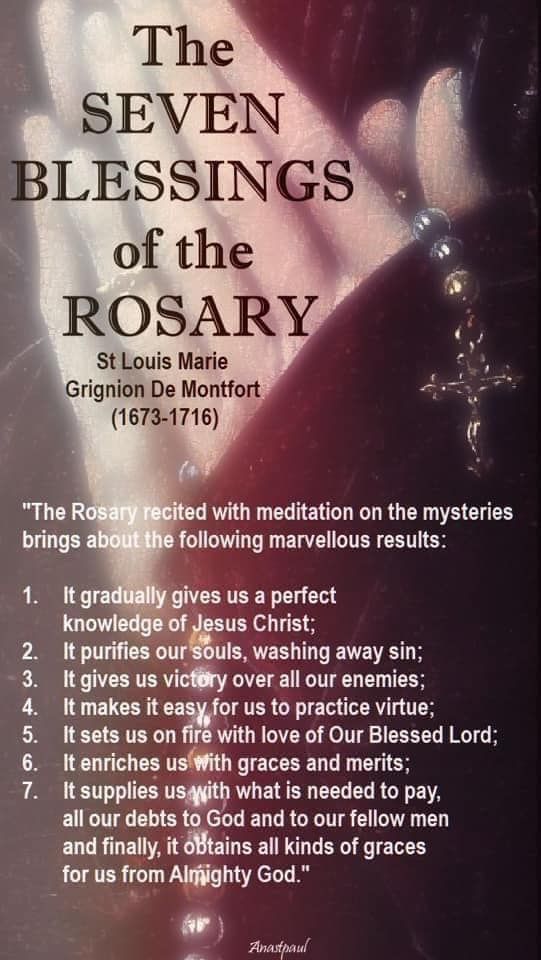
THE SEVEN BLESSINGS OF THE HOLY ROSARY
“The Rosary, recited with meditation on the mysteries, brings about the following marvellous results:
It gradually gives us a perfect knowledge of Jesus Christ;
It purifies our souls, washing away sin;
It gives us victory over all our enemies;
It makes it easy for us to practice virtue;
It sets us on fire with love of Our Blessed Lord;
It enriches us with graces and merits;
It supplies us with what is needed to pay, all our debts to God and to our fellow men and finally, it obtains all kinds of graces for us from Almighty God.”
St Louis Marie Grignion De Montfort (1673-1716)
“The Rosary is the most excellent form of prayer and the most efficacious means of attaining eternal life. It is the remedy for all our evils, the root of all our blessings. There is no more excellent way of praying.”
Pope Leo XIII (1810-1903)
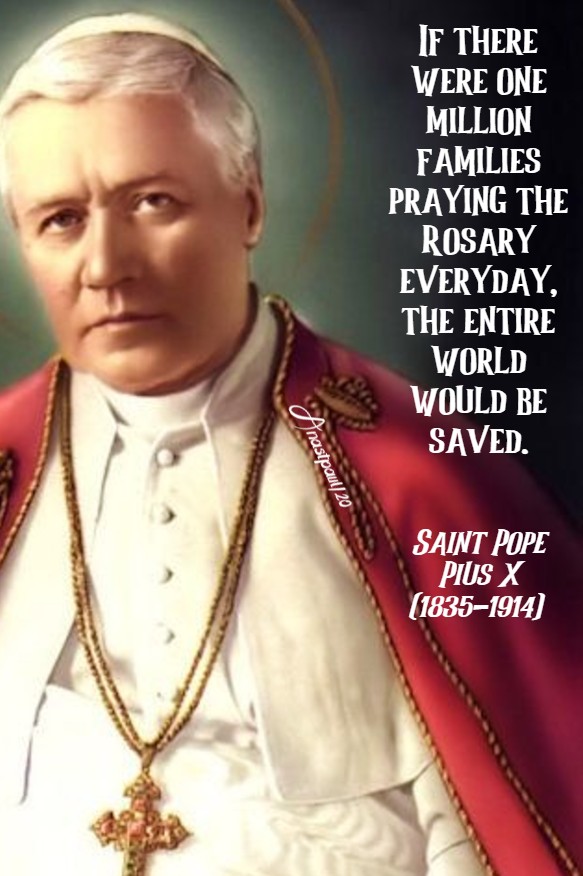
“If there were one million families praying the Rosary everyday, the entire world would be saved.”
St Pope Pius X (1835-1914)
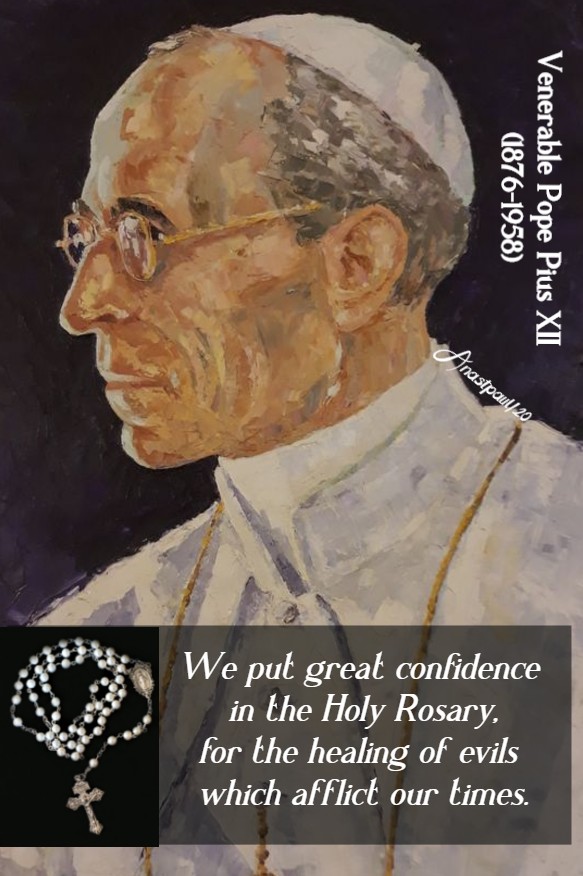
“We put great confidence in the Holy Rosary, for the healing of evils which afflict our times.”
One Minute Reflection – 31 October – The last day of the “Month of the Holy Rosary” – Readings: Deuteronomy 6: 2-6; Psalm 18: 2-4, 47, 51; Hebrews 7: 23-28; Mark 12: 28b-34
“Therefore, he is always able to save those who approach God through him, since he lives forever to make intercession for them…” – Hebrews 7:25
REFLECTION – “Petition does not imply here, as it does in popular parlance, a desire for legal satisfaction; there is something humiliating in the idea. No, it means interceding for us in His role of mediator, in the way that the Spirit too is spoken of, as “making petition” on our behalf. “For there is one God and there is one mediator between God and men, the man Christ Jesus.” Even at this moment, He is, as human, interceding for my salvation, until He makes me divine by the power of His incarnate Humanity. “As human,” I say, because He still has with Him the Body He assumed, though He is no longer “regarded as human,” meaning, the bodily experiences, which, sin aside, are ours and His. This is the “Advocate” we have in Jesus — not a slave who falls prostrate before the Father on our behalf. Get rid of what is really a slavish suspicion, unworthy of the Spirit. It is not in God to make the demand, nor in the Son to submit to it; the thought is unjust to God. No, it is by what He suffered as Man, that He persuades us, as Word and Encourager, to endure. That, for me, is the meaning of His “Advocacy.” – St Gregory Nazianzen (330-390) Archbishop of Constantinople, Father & Doctor of the Chuirch (Theological Oration 4 (On the Son), 30)
PRAYER – Lord God, You gave the peoples of the world as the inheritance of Your only Son; You crowned Him as King of Zion, Your holy city and gave Him Your Church to be His Bride. As He proclaims the law of Your eternal kingdom, may we serve Him faithfully and so share His royal power forever. We make our prayer, through Him and with Him and in Him, our King and our Redeemer, with the Holy Spirit, God forever, amen.
Our Morning Offering – 31 October – Christ the King
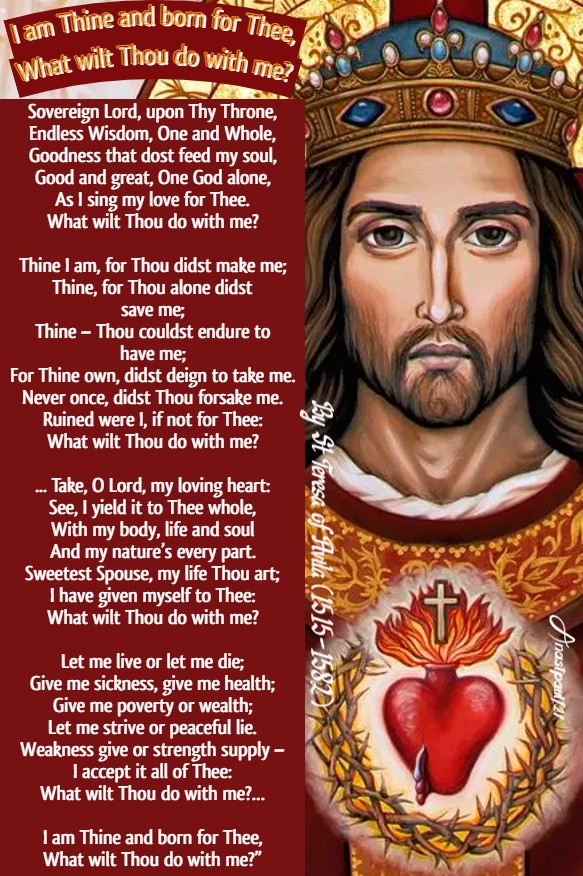
I am Thine and born for Thee, What wilt Thou do with me? By St Teresa of Avila (1515-1582) Doctor of Prayer of the Church
Sovereign Lord, upon Thy Throne, Endless Wisdom, One and Whole, Goodness that dost feed my soul, Good and great, One God alone, As I sing my love for Thee. What wilt Thou do with me?
Thine I am, for Thou didst make me; Thine, for Thou alone didst save me; Thine – Thou couldst endure to have me; For Thine own, didst deign to take me. Never once, didst Thou forsake me. Ruined were I, if not for Thee: What wilt Thou do with me?
What, O good and loving Lord, What wilt Thou have this creature do? This Thy slave, a sinner too, Waiting till she hears Thy word? With Thy will in close accord, Sweetest Love, I come to Thee: What wilt Thou do with me?
Take, O Lord, my loving heart: See, I yield it to Thee whole, With my body, life and soul And my nature’s every part. Sweetest Spouse, my life Thou art; I have given myself to Thee: What wilt Thou do with me?
Let me live or let me die; Give me sickness, give me health; Give me poverty or wealth; Let me strive or peaceful lie. Weakness give or strength supply – I accept it all of Thee: What wilt Thou do with me?…
I am Thine and born for Thee, What wilt Thou do with me?
Poem – I am Yours, for You I was born – “Vuestra Soy, para Vos nací ” (trans. E Allison Peers)
Saint of the Day – 31 October – St Foillan of Fosses (Died 655) Bishop, Martyr, Missionary, Abbot. Born in the 7th Century in Ireland and died by murder on 31 October 655 in the forest near Nivelles, Belgium, Patronages – children’s nurses, dentists, Fosses, Belgium, surgeons, truss makers, Diocese of Mechelen and Tournai., Belgium. Also known as – Faelan, Faillan, Faolan, Feuillien, Foalan, Foelan. Additional Memorial – 5 November in the Diocese of Mechelen and Tournai.
Foillan was one of the numerous Irish missionaries who, in the course of the seventh century, evangelised in Europe, bringing the liturgy and sacred vessels, founding prosperous Monasteries and sharing considerably in the propagation of the Faith in these countries. Foillan played a significant part in Frankish ecclesiastical history, as shown by his share in the direction of Nivelles and by the foundation of the Monastery of Fosses-la-Ville.
Foillan was born in Ireland early in the seventh century and was the brother of Saints Ultan and Fursey, the latter a famous Missionary who preached the Faith to the Irish, the Anglo-Saxons and the Franks. Foillan, probably in company with Ultan, went with his brother Fursey, when the latter, fleeing from his country then devastated by foreign invaders, retired to a lonely islands. Fursey soon went among the Anglo Saxons and built a Monastery at Burgh Castle (Cnoberesburg) in Suffolk, between 634 and 650.
Seized again with the desire for solitude, Fursey left the Monastery in the care of Foillan, who remained at the head of the community and had the happiness of once more seeing his brother Fursey, who, having since gone to the kingdom of the Franks, came to visit him about 650. Soon a disastrous war broke out between Penda, the Mercian Chief and Ana, King of the Eastern Anglo-Saxons. Ana, having been put to flight, the Monastery of Cnoberesburg fell into the hand of the enemies. It was pillaged,and its Abbot, Foillan, barely escaped death. He hastened to ransom the captive Monks, recovered the relics, put the holy books and objects of veneration on board ship and departed for the country of the Franks, where his brother Fursey was buried. He and his companions, were well received at Péronne by Erconwald, Mayor of the Palace. But soon, for some unknown reason, Foillan and his companions left Péronne and went to Nivelles, a Monastery founded by St Ita and St Gertrude, wife and daughter of Duke Pepin I.
Foillan, like so many other Irishmen who went to the Continent in the seventh century, was invested with episcopal dignity, having doubtless been a monastic Bishop at Cnoberesburg. He was, therefore ,of great assistance in the organisation of worship and the holy books and relics, which he brought, were great; treasures for St Ita and St Gertrude. As the Monastery of Nivelles was under Irish discipline, the companions of Foillan were well received and lived, side by side, with the holy women, occupying themselves with the details of worship under the general direction of the Abbess. Through the liberality of Ita, Foillan was enabled to build a Monastery at Fosses, not far from Nivelles, in the Province of Namur.
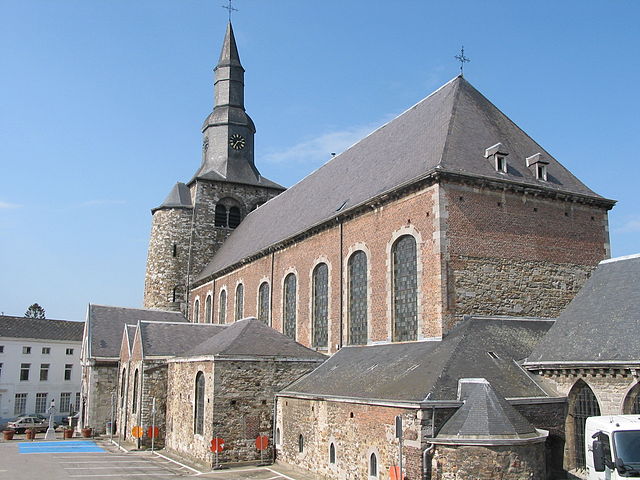
The Church at Fosses
After the death of Ita in 652, Foillan came one day to Nivelles and sang Mass, on the eve of the feast of St Quentin. The ceremony being finished, he resumed his journey, doubtless undertaken in the interests of his Monastery. In the forest of Senege the Saint and his companions fell into a trap set by bandits who inhabited that solitary place. They were slain, stripped, and their bodies concealed. But they were recovered by St Gertrude and when she had taken some relics of the Saint, his body was borne to the Monastery of Fosses, where it was buried in 655.
It is not surprising, after his death and because of his work in the area, that St Foillan should be honoured and venerated both at Nivelles and Fosses and, to find at Le Roeulx (Belgium) a Monastery bearing his name. As late as the twelfth century the veneration in which he was held, inspired Philippe Le Harvengt, Abbot of Bonne-Espérance, to compose a lengthy biography of the Saint. He is the Patron of Fosses, near Charieroi. In the Diocese of Namur his feast is celebrated on 31 October, in the Dioceses of Mechlin and Tournai on 5 November.
Vigil of All Saints Day or All Hallow’s Eve: Eve of the Feast of All Hallows, that is, All Saints Day. Halloween is a day on which many quaint customs are revived. It is popular in the United States and Scotland and in the US has become the second largest secular holiday of the year.
Nuestra Señora del Rosario de Río Blanco y Paypaya de Jujuy / Our Lady of the Rosary of Rio Blanco (of the White River) and Paypaya, Argentina , 17th Century – 31 October:
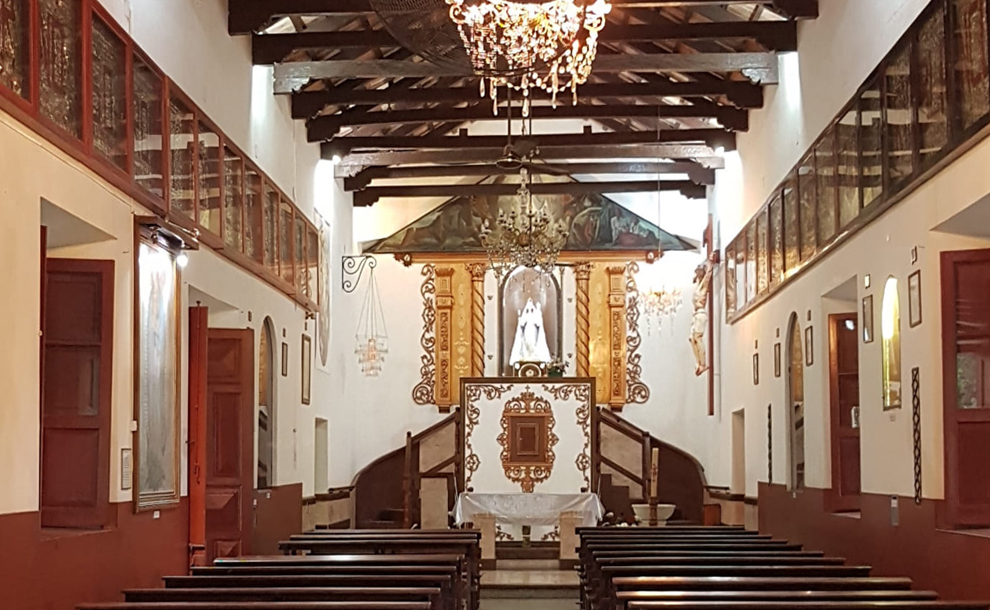
In the Province of Jujuy, Our Lady of the Rosary is the main Patron, who was added the title of “Paypaya and White River.” Local tradition tells that the Virgin defended the City from attacks by the Indians. The most beautiful devotion is the procession which takes place on 31 October, the day on which the image is removed from its precious altar next to the nave of the Cathedral of Jujuy and is taken to the Sanctuary of the White River…The people displaying their deep religious faith, expressed in their great devotion to the Virgin “Our Lady of the Rosary of White River and Paypaya,” the history refers to the colonial era of the mid-seventeenth century. Entering through the side entrance of the court, located next to the Cathedral of San Salvador de Jujuy, in the centre of the long nave, is the Chapel of Our Lady of the Rosary of White River and Paypaya, a clothed image 60 cm. height. There is another Statue is in the Chapel of the City of Rio Blanco.
St Ampliatus St Antoninus of Milan St Apelles of Eraclea Sintica St Arnulf of Novalesa St Begu of Hackness Bl Christopher of Romagna Bl Dominic Collins St Epimachus of Melusio St Erth of Cornwall St Foillan of Fosses (Died 655) Bishop Martyr, Missionary, Abbot Bl Irene Stefani St Jesús Miquel Girbau Bl Leon Nowakowski St Lucilla of Rome Bl Maria de Requesens Bl Modesta Moro Briz St Narcissus St Notburga of Cologne St Quentin Bl Pilar Isabel Sánchez Suárez St Stachys of Constantinople
Thought for the Day – 30 October– Meditations with Antonio Cardinal Bacci (1881-1971)
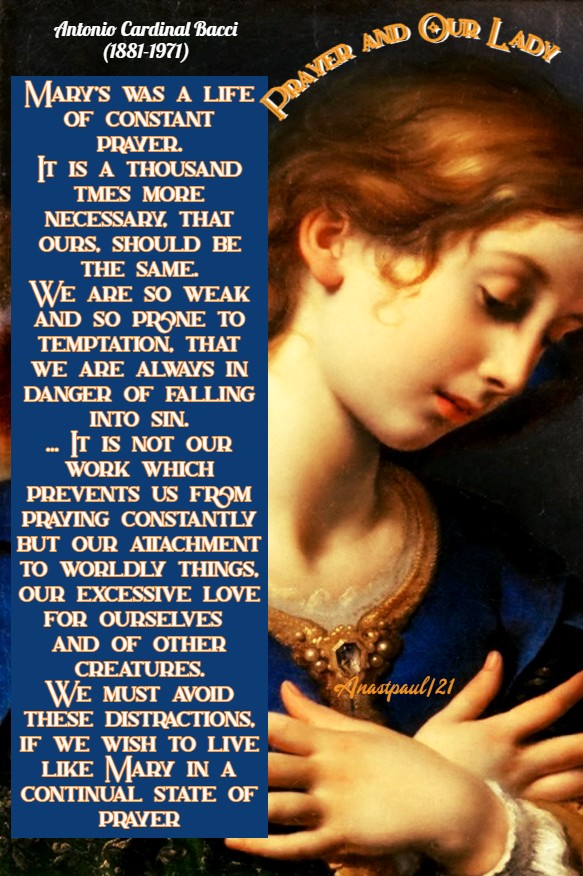
Prayer and Our Lady
“Mary’s was a life of constant prayer. It is a thousand tmes more necessary, that ours, should be the same. We are so weak and so prone to temptation, that we are always in danger of falling into sin. “Without me, you can do nothing,” (Jn 15:5) Jesus tells us. “I am the vine, you are the branches. If anyone does not abide in me, he shall be cast outside as the branch and wither.” (Ibid). “Ask and it shall be given to you; seek and you shall find; knock and it shall be opened to you ” (Mt 7:7). In short, Jesus asks us to pray. He wants us to pray because He wants to give us His graces.
We cannot object that it is impossible for us to pray all the time because we have to work and fulfil other obligations. The work, which has first claim on us, is the service of God, which is prayer. Secondly, we can pray in tbe course of our daily work and of our different occupations, by offering to God, everything which we do. No matter what we are doing, we can raise our minds to God in an act of love and so remain always, close to Him.
It is not our work which prevents us from praying constantly but our attachment to worldly things, our excessive love for ourselves and of other creatures. We must avoid these distractions, if we wish to live like Mary in a continual state of prayer. ”
Quote/s of the Day – 30 October – “Month of the Holy Rosary” and Mary’s Day – Readings: Romans 11: 1-2a, 11-12, 25-29; Psalm 94: 12-15, 17-18; Luke 14: 1, 7-11
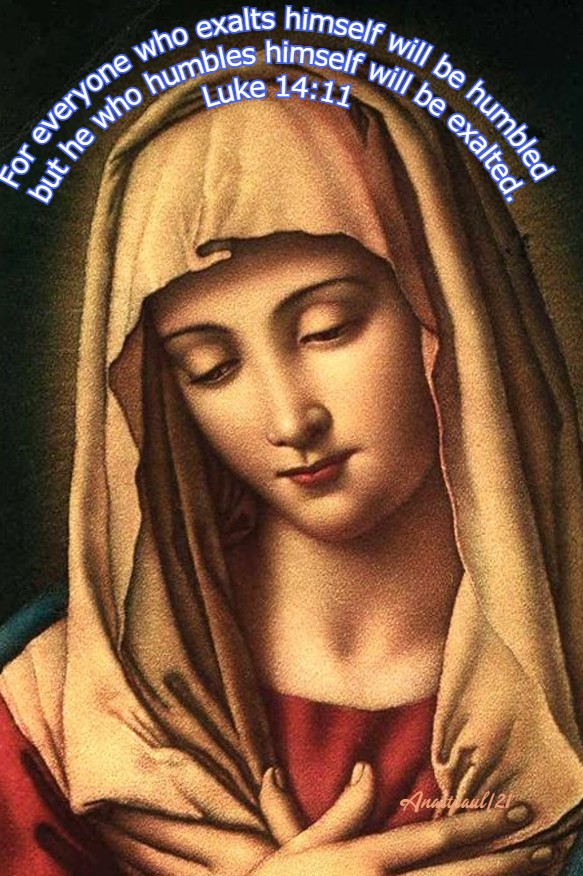
“For everyone who exalts himself will be humbled but he who humbles himself will be exalted. ”
Luke 14:11
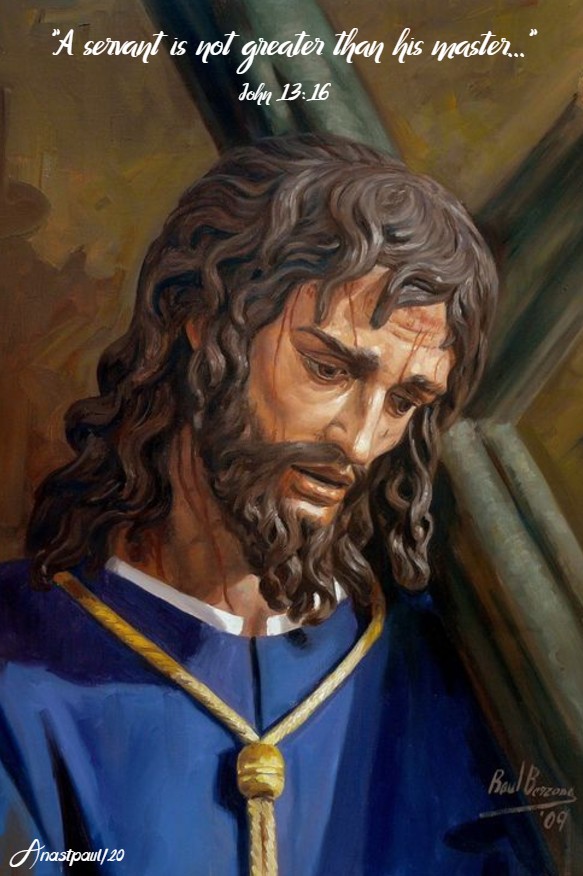
“The servant is not greater than his Master”
John 13:16
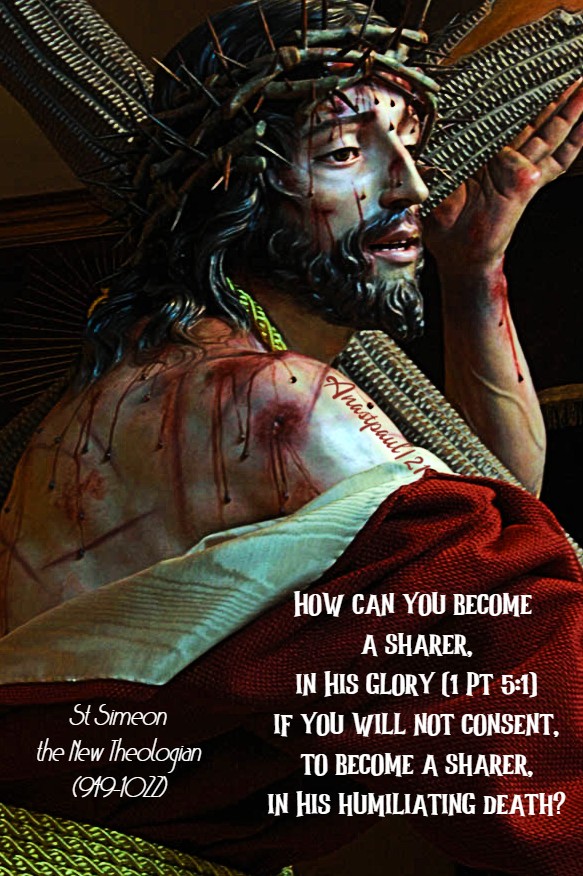
“How can you become a sharer, in His glory (1 Pt 5:1) if you will not consent, to become a sharer, in His humiliating death?”
St Simeon the New Theologian (949-1022)
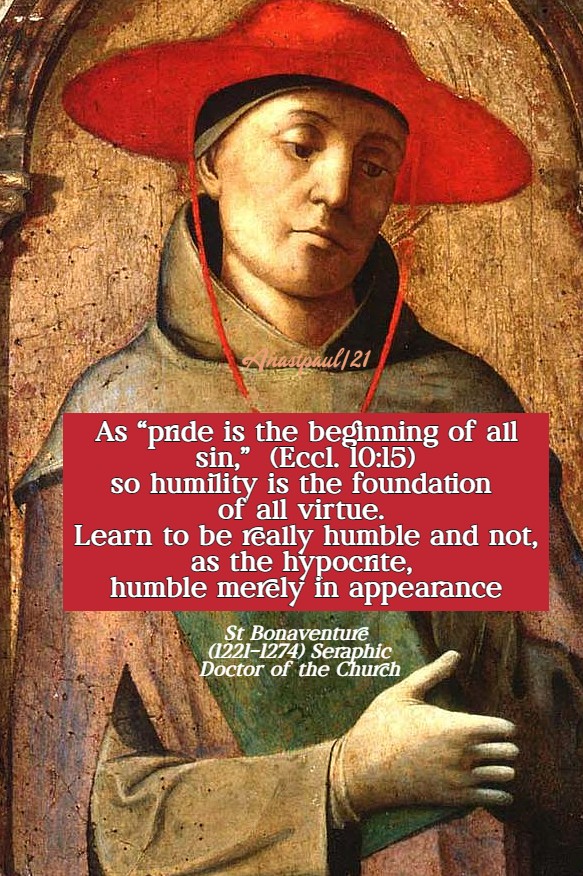
“As “pride is the beginning of all sin,” (Eccl. 10:15) so humility is the foundation of all virtue. Learn to be really humble and not, as the hypocrite, humble merely in appearance.”
St Bonaventure OFM (1221-1274) Seraphic Doctor of the Church
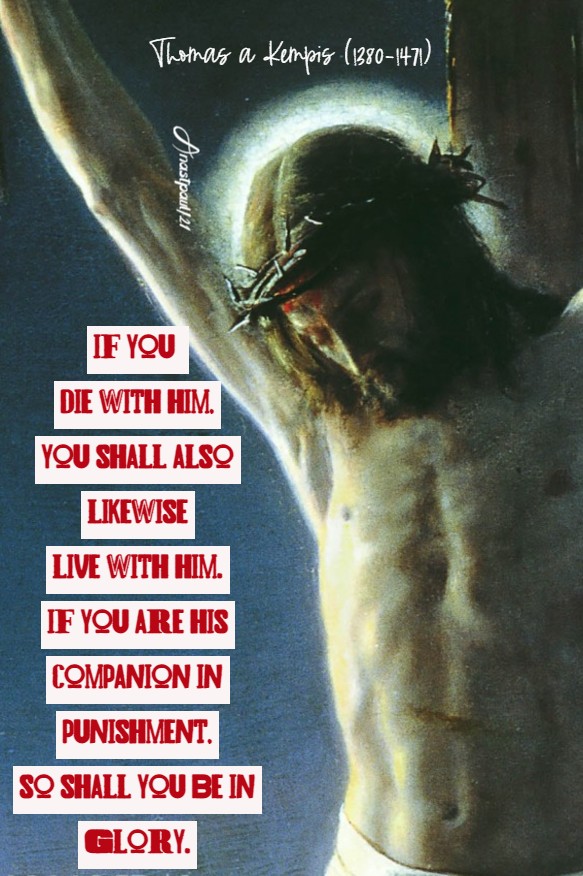
“ … If you die with Him, you shall also likewise live with Him. If you are His companion in punishment, so shall you be in glory.”
Thomas à Kempis (1380-1471)
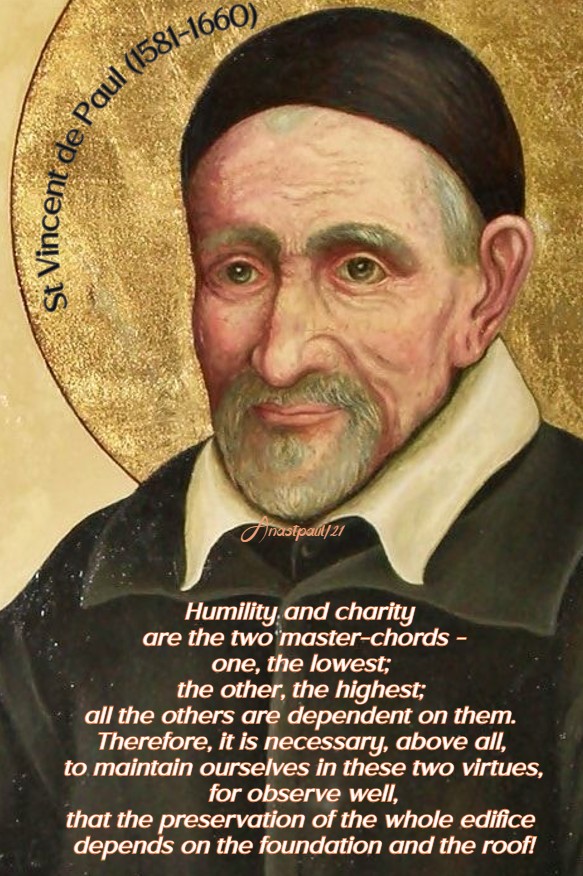
“Humility and charity are the two master chords – one, the lowest; the other, the highest; all the others are dependent on them. Therefore, it is necessary, above all. to maintain ourselves in these two virtues, for observe well, that the preservation of the whole edifice depends on the foundation and the roof!”
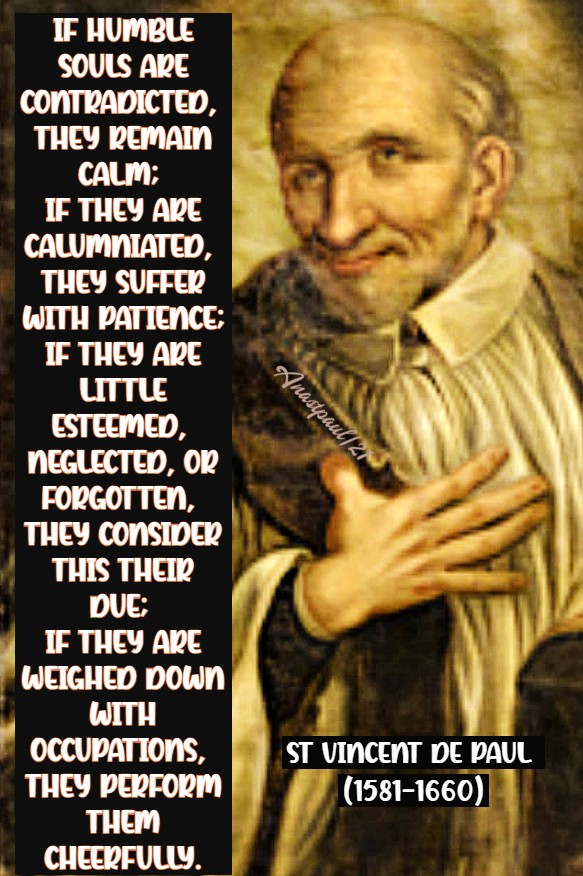
“If humble souls are contradicted, they remain calm; if they are calumniated, they suffer with patience; if they are little esteemed, neglected, or forgotten, they consider this their due; if they are weighed down with occupations, they perform them cheerfully. ”
St Vincent de Paul (1581-1660)
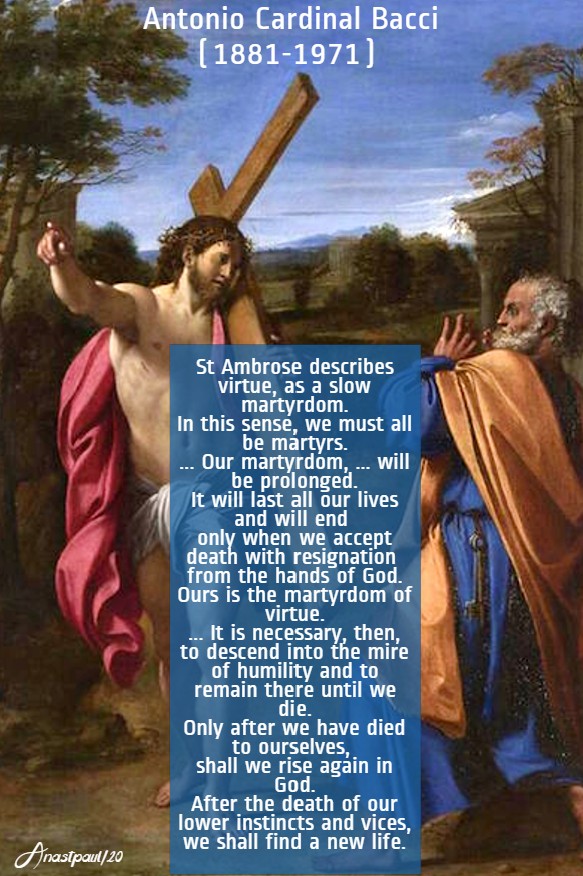
“St Ambrose describes virtue, as a slow martyrdom. In this sense, we must all be martyrs. … Our martyrdom, … will be prolonged. It will last all our lives and will end only when we accept death with resignation from the hands of God. Ours is the martyrdom of virtue. … It is necessary, then, to descend into the mire of humility and to remain there until we die. Only after we have died to ourselves, shall we rise again in God. After the death of our lower instincts and vices, we shall find a new life.”





























You must be logged in to post a comment.