Thought for the Day – 17 May – Meditations with Antonio Cardinal Bacci (1881-1971)
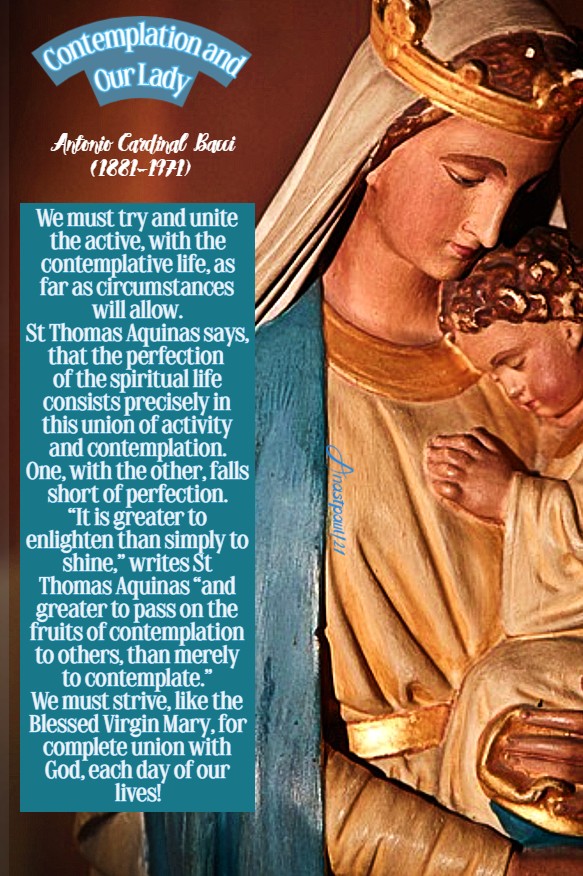
Contemplation and Our Lady
“We must try and unite the active, with the contemplative life, as far as circumstances will allow. St Thomas Aquinas says, that the perfection of the spiritual life consists precisely in this union of activity and contemplation. One, with the other, falls short of perfection. “It is greater to enlighten than simply to shine,” writes St Thomas Aquinas “and greater to pass on the fruits of contemplation to others, than merely to contemplate.” (Summa Theologiae, II-II, q 6, a 3).
Contemplation on its own, can degenerate into useless day dreaming. It is necessary that it should produce a genuine interior transformation, as a result of which, the subject, under the guidance of the Holy Sprit, becomes, in his speech and his conduct, a man of God. Now, the man of God is not satisfied with enjoying spiritual consolations but, is moved by his zeal for the glory of God, to try and extend His Kingdom, by every possible means. It is in this way, that contemplation becomes apostolic action.
We must remember, on the other hand, that neither is action on its own, sufficient. It can become barren when it is not nourished by the interior life of grace, which is the source of prayer and contemplation. It cannot be held, that this last, is the exclusive gift of a few privilege souls. Anyone can have it, as long as he allows himself to be penetrated by the love of God and as long as he succeeds, in securing moments of recollection and silence, at intervals during life. In these moments, he will grow closer to God and will enjoy a foretaste of the happiness of heaven. We must strive, like the Blessed Virgin Mary, for complete union with God, each day of our lives!”
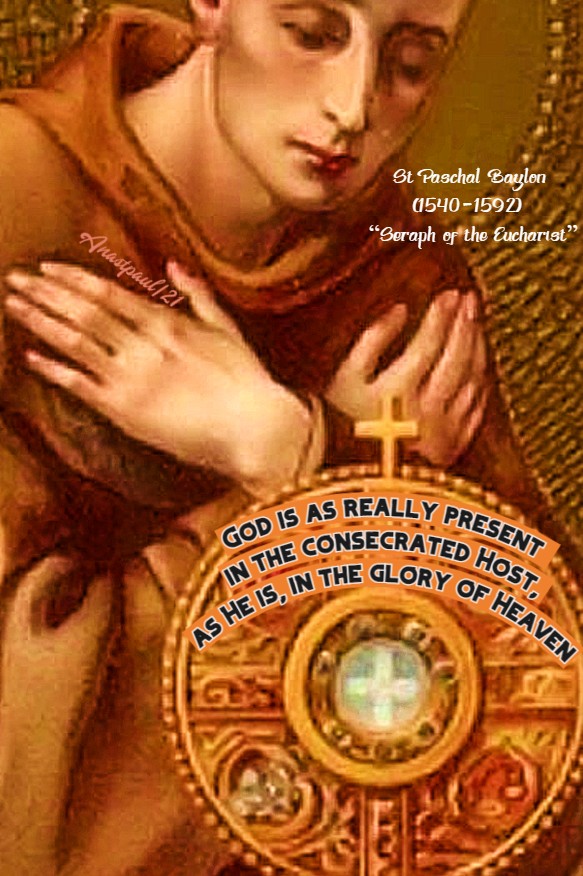
Quote/s of the Day – 17 May – The Memorial of St Paschal Baylon OFM (1540-1592) “Seraph of the Eucharist,” “Saint of the Blessed Sacrament,” “Servant of the Blessed Sacrament.”
“God is as really present in the consecrated Host, as He is, in the glory of Heaven.”
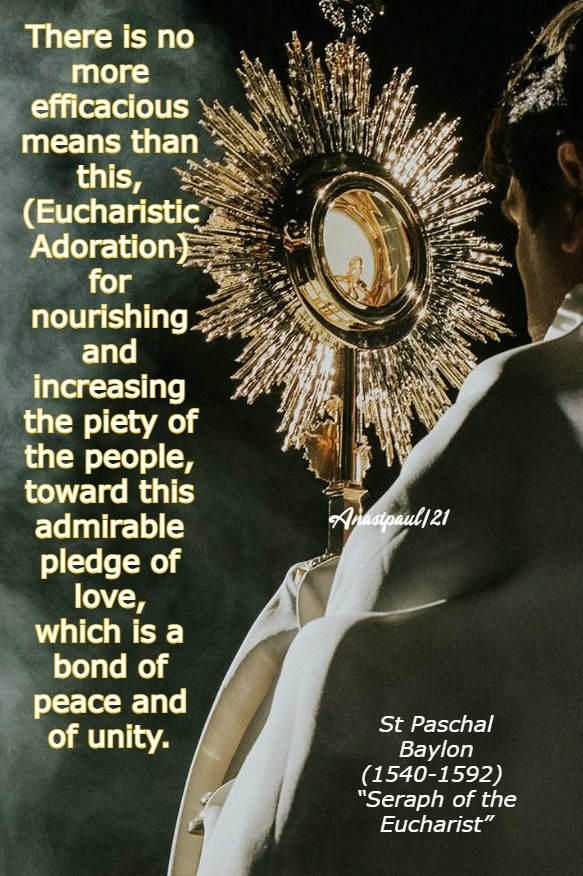
“There is no more efficacious means than this, (Eucharistic Adoration) for nourishing and increasing the piety of the people, toward this admirable pledge of love, which is a bond of peace and of unity.”
One Minute Reflection – 17 May – “Mary’s Month” – Monday of the Seventh week of Easter, Readings: Acts 19:1-8, Psalm 68:2-7, John 16:29-33 and the Memorial of St Paschal Baylon OFM (1540-1592)
“In the world you will have tribulation. But take heart, I have conquered the world.” ... John 16:33
REFLECTION – “Let nothing intervene to hinder the progress of any who travel alongside each other, in this evangelical life but let us walk with agile step though the road be rough and hard, let us show a brave and manly spirit, overcome obstacles, pass along from pathway to pathway, from hill to hill, until we climb onto the mountain of the Lord and make a home for ourselves in the holy place of His impassibility.
Now, companions assist each other on the way; so then, my brothers, as the Apostle says: “Bear one another’s burdens” (Gal 6:2) and make up for whatever is lacking to others (cf. 2 Cor 8:14 ; Phil 2:30). To the negligence that perhaps holds sway today, noble courage will succeed tomorrow, now one is in gloom and then suddenly one rises to the surface and discovers joy again, at one moment our passions rise up but soon God comes to help us, they are broken and calm returns. For you will only be seen like this yesterday and the day before but, dear friend, you will not always remain the same but the grace of God will draw near you, the Lord will fight for you and perhaps, like the great Antony, you will say: “Where were you just now?” and he will answer: “I wanted to see your combat.”
For now, let us persevere, children, dear children, let us be patient for a little, brothers, dear brothers.… Who will be crowned without having fought? Who will go to rest if he is not tired (cf. 2 Tim 2:5-6)? Who will gather the fruits of life without having planted virtues in his soul? Cultivate them, prepare the earth with the greatest care, take trouble over it, sweat over it, children, God’s workers, imitators of the angels, competitors with incorporeal beings, lights for those who are in the world (cf. Phil 2:15)!” … St Theodore the Studite (759-826) Monk – Catechesis 28
PRAYER – Lord God, let the grace of the Holy Spirit come upon us, so that we may hold fast to Your Will with fidelity and love and show it forth by a holy life. May the Mother of our Lord and our Mother and St Paschal Baylon, Servant of the Blessed Sacrament, pray that we may live in the light of our Saviour. Through Jesus Christ our Lord, in the unity of the Holy Spirit, and the glory of God the Father forever and ever, amen.
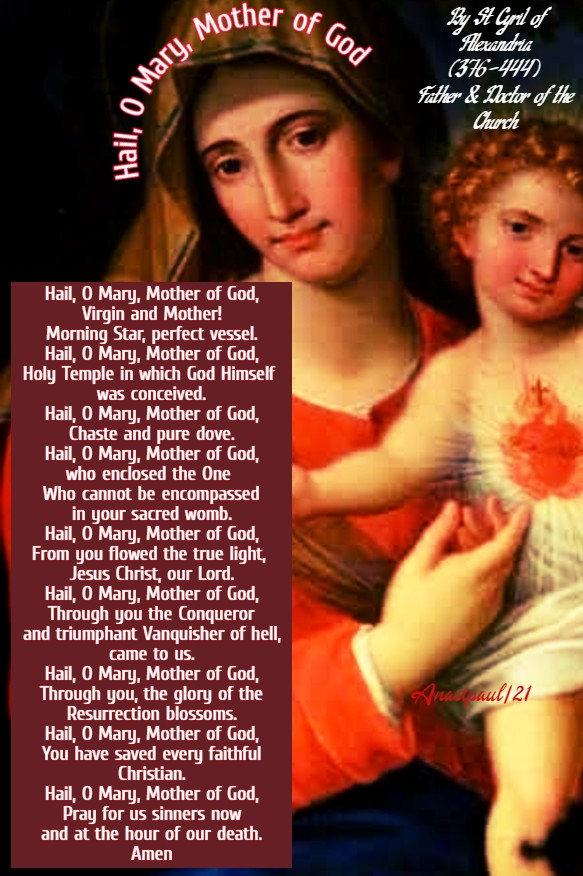
Hail, O Mary, Mother of God By St Cyril of Alexandria (376-444) Father & Doctor of the Church
Hail, O Mary, Mother of God, Virgin and Mother! Morning Star, perfect vessel. Hail, O Mary, Mother of God, Holy Temple in which God Himself was conceived. Hail, O Mary, Mother of God, Chaste and pure dove. Hail, O Mary, Mother of God, who enclosed the One Who cannot be encompassed in your sacred womb. Hail, O Mary, Mother of God, From you flowed the true light, Jesus Christ, our Lord. Hail, O Mary, Mother of God, Through you the Conqueror and triumphant Vanquisher of hell, came to us. Hail, O Mary, Mother of God, Through you, the glory of the Resurrection blossoms. Hail, O Mary, Mother of God, You have saved every faithful Christian. Hail, O Mary, Mother of God, Pray for us sinners now and at the hour of our death. Amen
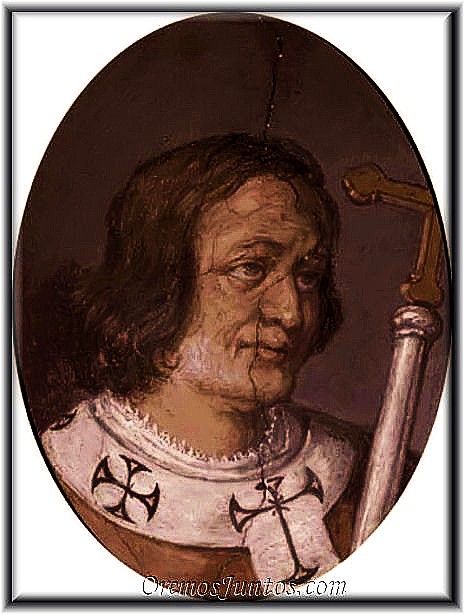
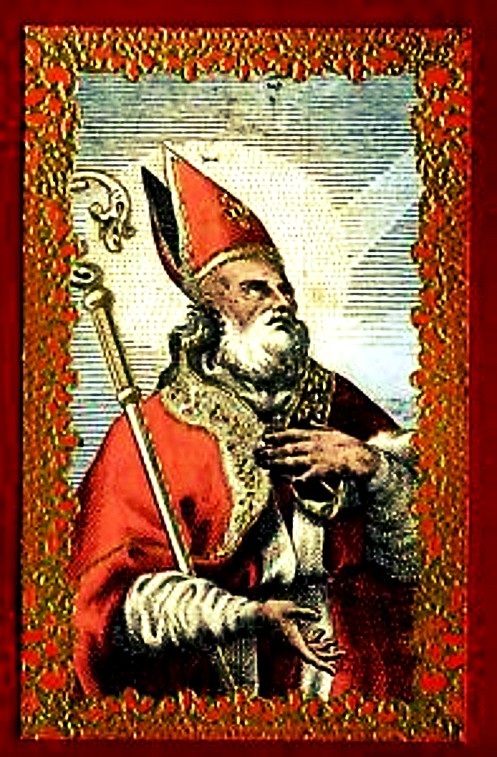
Saint of the Day – 17 May – Saint Emiliano I of Vercelli (Died 506) Bishop of Vercelli, Italy in the sixth century, Monk and Hermit, Confessor, Defender of the Faith, apostle of the needy, Social Reformer, spiritual director. Born in the 5th century, possibly in the Piedmont region of Italy and died on 11 September in Cercelli, Italy., the date of his entry into life is also celebrated as his feast in some places. Patronages – Cigliano and Villanova Monferrato.
Indeed, he might have preferred to hide in a hermitage and live in solitude and contemplation to better taste the flavour of the Lord but God’s call wanted him to actively serve his neighbour and he knew how to carry it out with commitment and fervour. Among other measures of practical life, he also had an aqueduct built. He asked of himself the maximum efforts in all things and did not spare himself in any way. Of others, he demanded what they could give, in the name of the Lord.
The Roman Martyrology states of him today: “In Vercelli, translation of St Emilian, Bishop.”
Emiliano, the Eleventh Bishop of the great Diocese of Vercelli, was born around the middle of the fifth century. Some sources mistakenly say he was of Spanish origin but he was probably Piedmontese.
He worked in difficult times, as a worthy successor of St Eusebius (who died in 371). After the fall of the Western Roman Empire (476), the barbarian populations occupied the Italian territory. Theodoric, King of the Ostrogoths, defeated Odoacer (493) and the Burgundians, with the capture of Ravenna, they conquered Italy. The occupied populations were continually tested by the ravages of wars. Vercelli, an important Roman municipality, was almost abandoned and depopulated. The most important authority, even from a civil standpoint, was the Bishop. Theodoric tried to establish a peaceful co-existence with the reduction of taxes and the liberation of many slaves. Although he was Arian, he did his utmost to improve relations between the Church of Rome and that of Constantinople. A few decades earlier, in the Council of Chalcedon (451), Christ’s dual nature, human and divine, had been recognised, not without great difficulty. Such were also the teachings of St Eusebio and S.tMassimo of Turin, fully shared by St Emiliano.
Our saint was from the important Eusebian Monastery which, as St Ambrose wrote, gathered around the Bishop, both contemplative religious and aspirants to the Priesthood. According to tradition, Emiliano was a Hermit for forty years near Sostegno, where then a Monastery of regular clerics was built. Even today there is an ancient Sanctuary dedicated to him.
He was elected Bishop between 493 and 497, maintaining a certain aptitude for contemplation. An authentic Shepherd, he was concerned, both with souls (let us think of him, often gathered with his community around the tomb of St Eusebius) and with the living conditions of his faithful.
For this purpose he asked Theodoric, to build a bridge and reduce taxes. Emiliano strongly defended the centrality of Papal power. He went to Rome for a Council called by St Symmachus (early 6th century), whose appointment and the first years of his Pontificate were marked by violent struggles to cancel his election. Pope Symmachus also escaped an attack. Peace returned in 505, thanks also to the intervention of Theodoric, with the adoption of the first rules to avoid external interference in the Papal elections.
Emiliano was an excellent spiritual director. He gave the veil and was confessor of the four sisters Licinia, Leonzia, Ampelia and Flavia who lived in the proto-monastery founded by Eusebia, sister of St Eusebius.
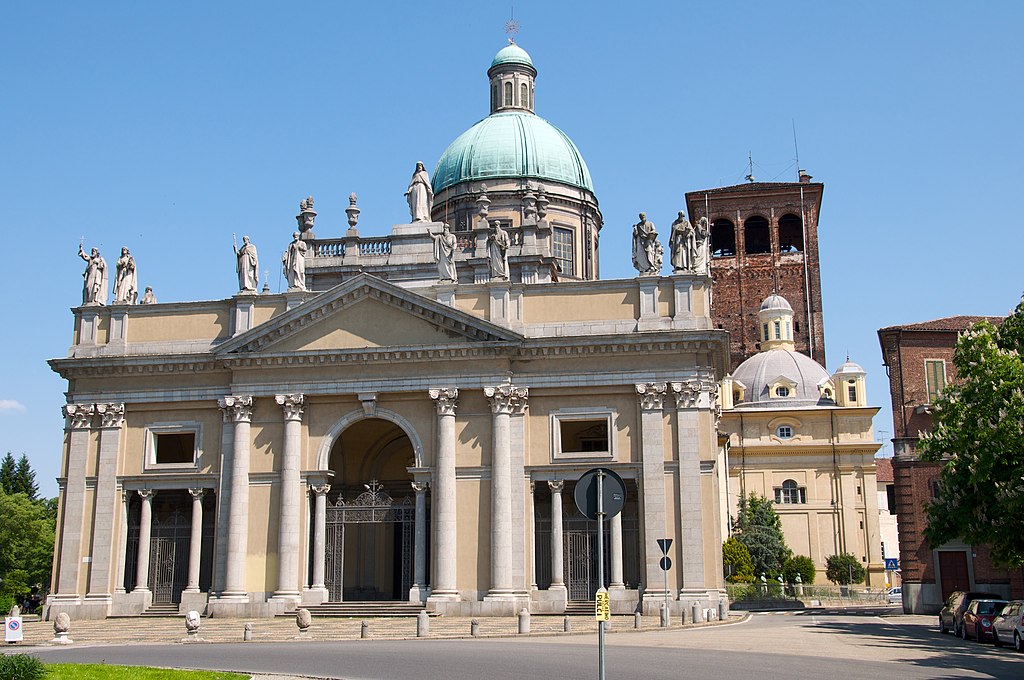
He died on 11 September, around 506 and was buried in the Cathedral. His cult remained alive and Altars were raised in his honour. On 17 May 1181, Bishop Alberto transferred St Emiliano’s relics to the main Altar. Rediscovered in 1565, seven years later it was placed in the Chapel of the Vergine dello Schiaffo, which was then dedicated to him.
Vercelli Cathedral
Two Parishes, Cigliano and Villanova Monferrato are dedicated to him.. He is not to be confused with Emilian II, a successor to the See of Vercelli, wo centuries later, who was his great devotee.
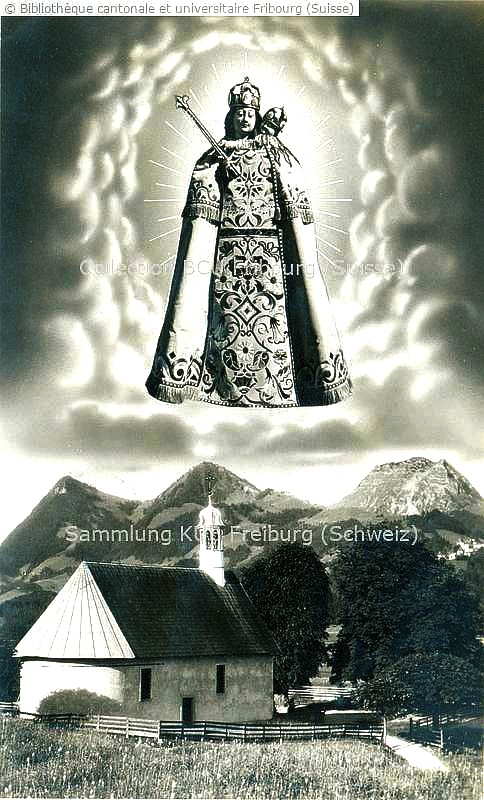
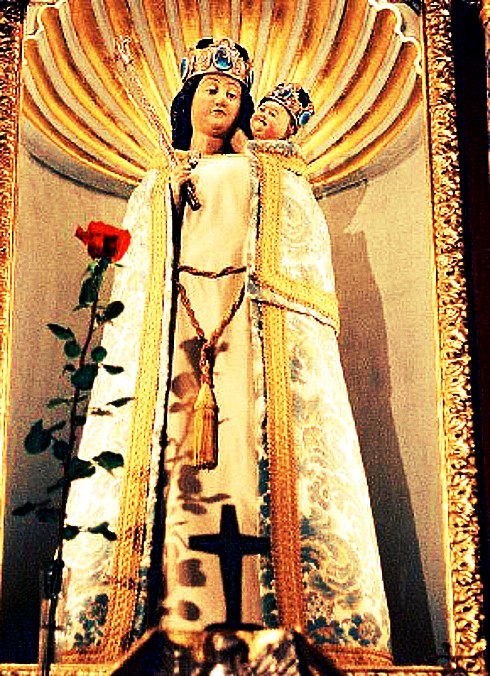
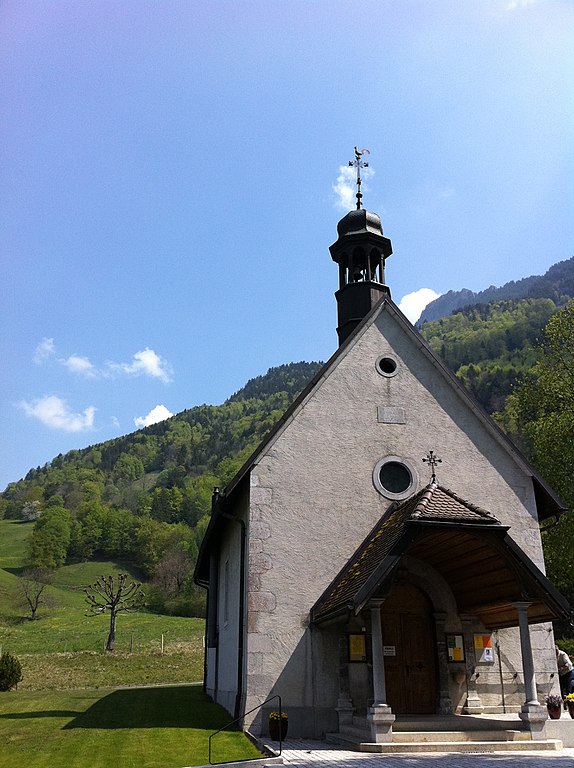
Notre-Dame des Marches, Broc, Gruyère, Fribourg, Switzerland / Our Lady of the Steps (1884)- 17 May:
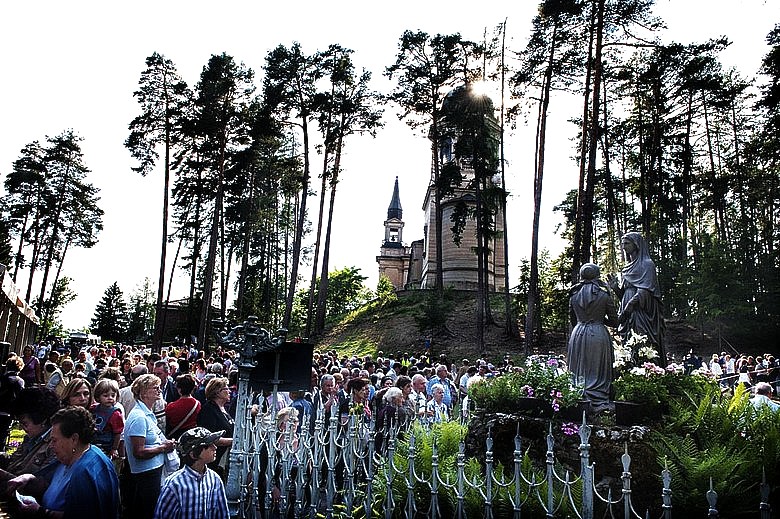
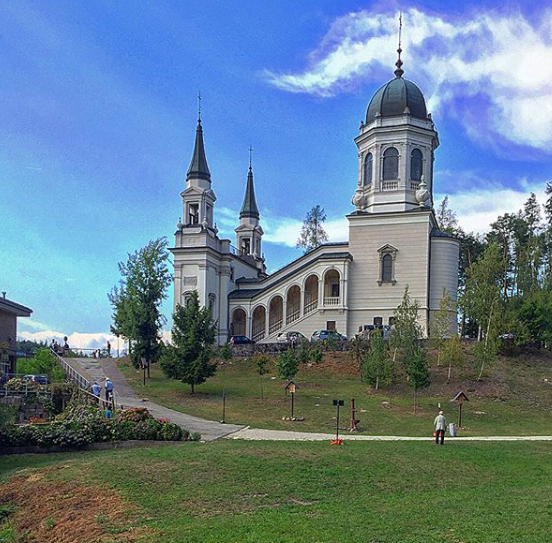
Nestled at the foot of Gruyères Hill, the Chapel overlooks the terraced deposits of the Saane River known as Les Marches, the Steps. The 28″ statue of Our Lady of the Steps, usually vested, is a standing Virgin and Child in the late Gothic style of the 1400s. Documentary evidence of a Chapel here dates to 1572.
The present building goes back to 1705, the work of three brothers, all Priests, from a family of cheese merchants. Dom Nicolas Ruffieux, prothonotary of Broc, decided to build “the most beautiful Chapel in the country.” His brother Jean-Jacques, Priest of neighboring Gruyères, took on the project with a third brother’s help. In 1721, the Commune of Broc added the enclosure and the linden trees that still shade the courtyard. On 17 May 1884, a miracle occurred at Notre-Dame des Marches, the first of several in the 1880s, which turned the rural Chapel into a place of pilgrimage. Stricken with a spinal malady, Léonide Andrey, 22, had been unable to walk for six years. She was carried to Mass at the Chapel and walked home easily. By the 1930s, the Sanctuary was known as the “Little Lourdes of Fribourg.” Two main pilgrimages were established: one in September, initially termed the “anti-alcoholic pilgrimage” and one on a Wednesday in spring, the Pilgrimage of the Sick.
St Heraclius of Noviodunum Bl Ivan Ziatyk St Madron of Cornwall St Maildulf of Malmesbury St Maw
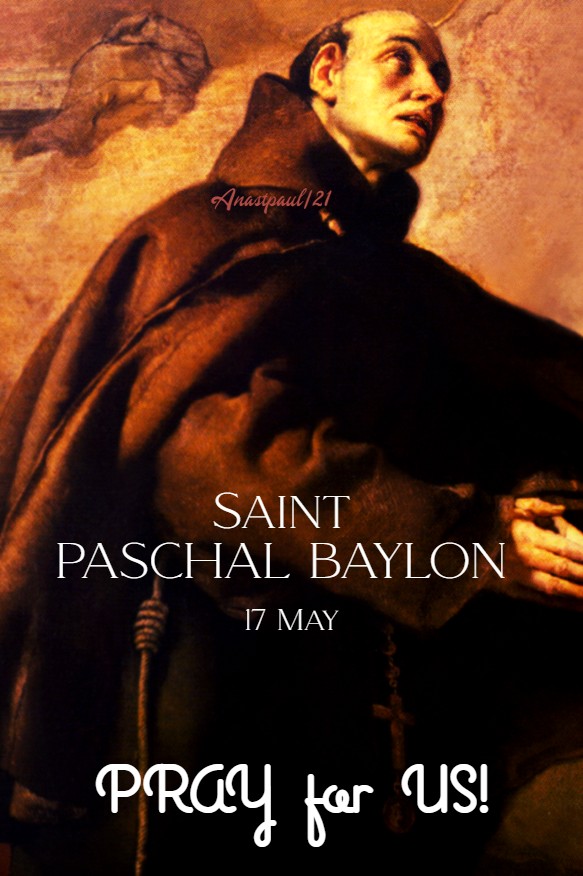
St Paschal Baylon OFM (1540-1592) “Seraph of the Eucharist,” “Saint of the Blessed Sacrament,” “Servant of the Blessed Sacrament.” Franciscan Lay Brother, Mystic…….. A man remarkable for innocence of life and the spirit of penance. Pope Leo XIII declared him the heavenly patron of Eucharistic Congresses and Societies and Apostolates, formed in honour of the Most Blessed Sacrament. About this beautiful Saint: https://anastpaul.wordpress.com/2018/05/17/saint-of-the-day-17-may-st-paschal-baylon-o-f-m-1540-1592-the-seraph-of-the-eucharist/
St Paul of Noviodunum St Peter Lieou St Rasso of Grafrath St Restituta of Carthage St Silaus of Lucca St Solochanus of Chalcedon St Thethmar St Victor Roma — Martyrs of Alexandria – 3 saints: Three Christians martyred together; no details about them have survived except their names: Adrio, Basilla and Victor. 4th century Alexandria, Egypt.
Martyrs of Nyon: A group of Christians martyred together in the persecutions of Diocletian. We know little more than three of their names: Aquilinus, Heradius and Paul. 303 at Noyon, Switzerland.
Thought for the Day – 16 May – Meditations with Antonio Cardinal Bacci (1881-1971)
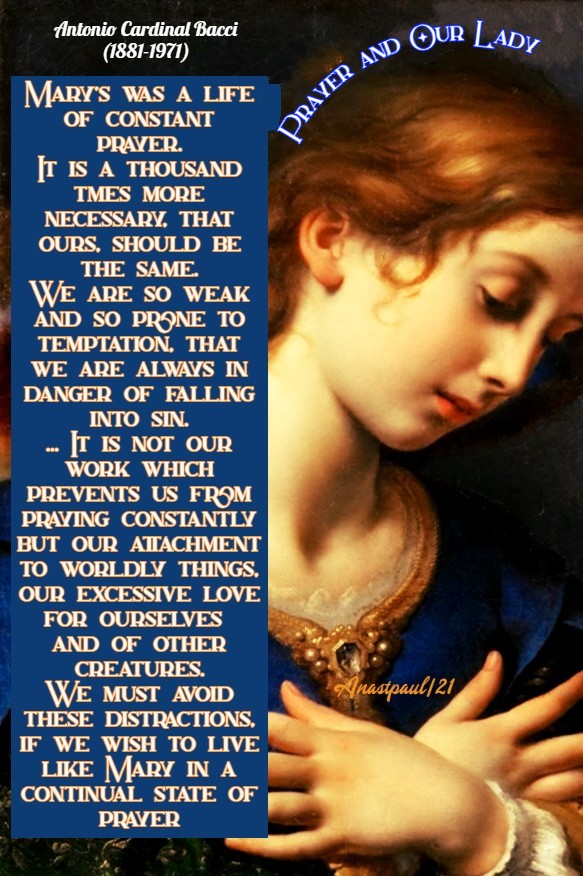
Prayer and Our Lady
“Mary’s was a life of constant prayer. It is a thousand tmes more necessary, that ours, should be the same. We are so weak and so prone to temptation, that we are always in danger of falling into sin. “Without me, you can do nothing,” (Jn 15:5) Jesus tells us. “I am the vine, you are the branches. If anyone does not abide in me, he shall be cast outside as the branch and wither.” (Ibid). “Ask and it shall be given to you; seek and you shall find; knock and it shall be opened to you ” (Mt 7:7). In short, Jesus asks us to pray. He wants us to pray because He wants to give us His graces.
We cannot object that it is impossible for us to pray all the time because we have to work and fulfil other obligations. The work, which has first claim on us, is the service of God, which is prayer. Secondly, we can pray in tbe course of our daily work and of our different occupations, by offering to God, everything which we do. No matter what we are doing, we can raise our minds to God in an act of love and so remain always, close to Him.
It is not our work which prevents us from praying constantly but our attachment to worldly things, our excessive love for ourselves and of other creatures. We must avoid these distractions, if we wish to live like Mary in a continual state of prayer. ”
Quote/s of the Day – 16 May – “Mary’s Month” – Sunday within the Octave of the Ascension or The Seventh Sunday of Easter, Readings: Acts 1:11, Psalm 47: 2-3, 6-7, 8-9 (6), Second Ephesians 4: 1-1, John 17:1-11
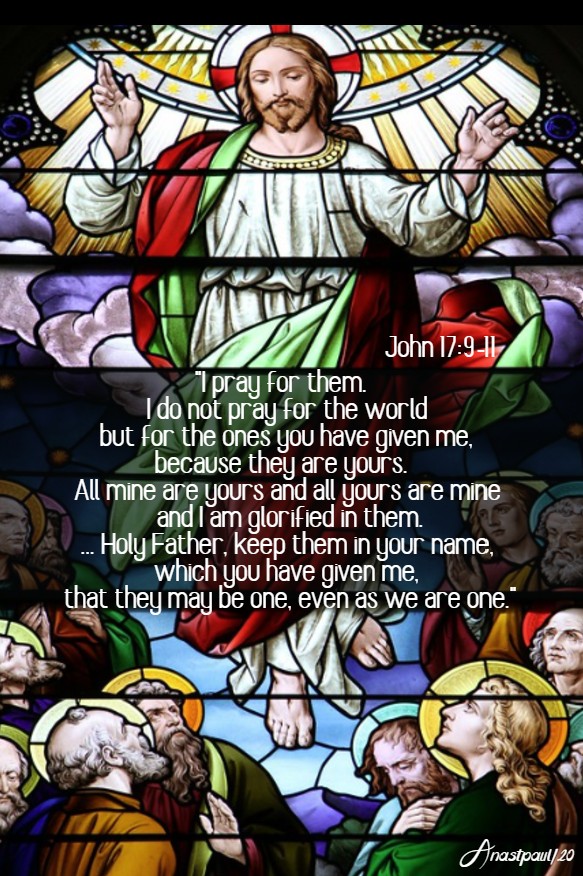
“I pray for them. I do not pray for the world but for the ones you have given me, because they are yours. All mine are yours and all yours are mine and I am glorified in them. … Holy Father, keep them in your name, which you have given me, that they may be one, even as we are one.”
John 17:9-11
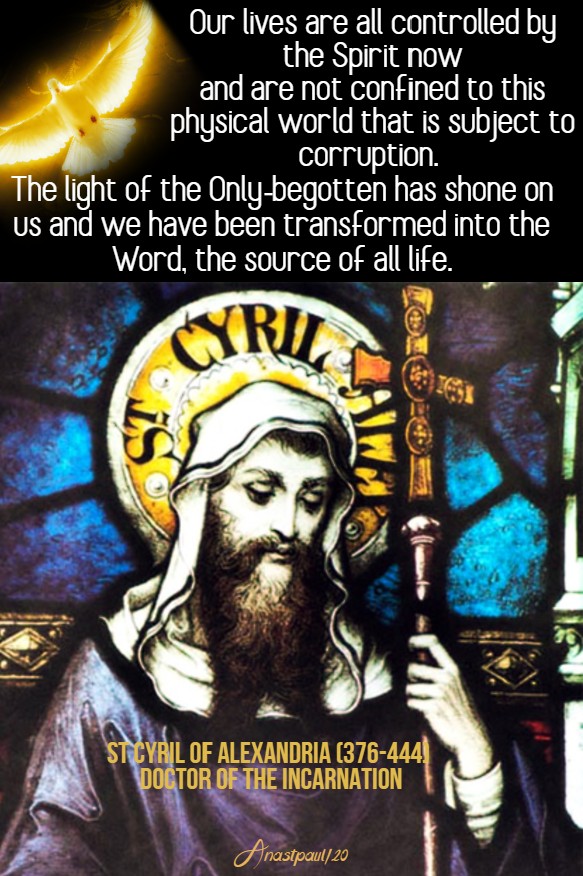
“Our lives are all controlled by the Spirit now and are not confined to this physical world that is subject to corruption. The light of the Only-begotten has shone on us and we have been transformed into the Word, the source of all life.”
St Cyril of Alexandria (376-444) Father and Doctor of the Incarnation
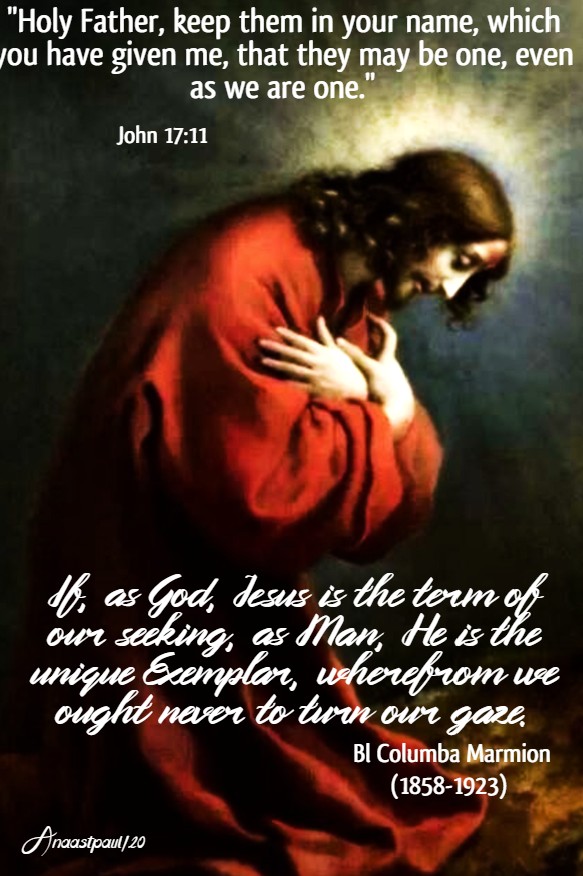
“If, as God, Jesus is the term of our seeking, as Man, He is the unique Exemplar, wherefrom we ought never to turn our gaze.”
One Minute Reflection – 16 May – “Mary’s Month” – Sunday within the Octave of the Ascension or The Seventh Sunday of Easter, Readings: Acts 1:11, Psalm 47: 2-3, 6-7, 8-9 (6), Second Ephesians 4: 1-1, John 17:1-11
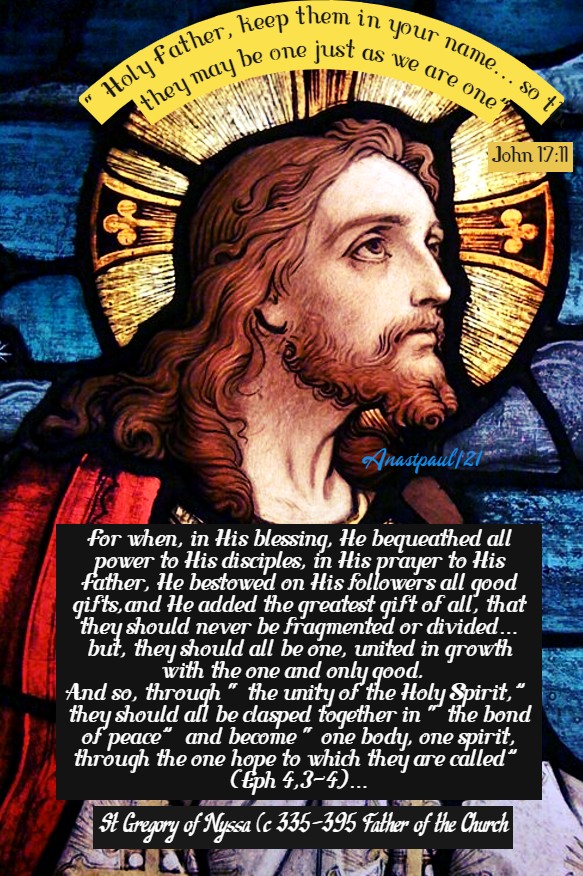
“Holy Father, keep them in your name… so that they may be one just as we are one” – John 17:11
REFLECTION – “The Beloved in the Song of Songs says: “My dove, my perfect one, is only one. She is the only child of her mother…” (6,9). The same point is made even more clearly by the Lord’s own words in the Gospel. For when, in His blessing, He bequeathed all power to His disciples, in His prayer to His Father, He bestowed on His followers all good gifts,and He added the greatest gift of all, that they should never be fragmented or divided… but, they should all be one, united in growth with the one and only good. And so, through “the unity of the Holy Spirit,” they should all be clasped together in “the bond of peace” and become “one body, one spirit, through the one hope to which they are called” (Eph 4,3-4)…
“That they may all be one, even as you, Father, are in me and I in you, that they also may be one.” The bond of this unity is glory and that the Holy Spirit is called “glory” no sensible person will deny, if he considers the Lord’s words: “The glory which you have given me, I have given them” (Jn 17,22). He truly gave such glory to His disciples, for He said to them: “Receive the Holy Spirit” (Jn 20,22). When He clothed Himself in human nature, Christ received this glory, which He had from all ages, “before the world began” (Jn 17,5) and, when His human nature was thus glorified by the Holy Spirit, the glory of the Spirit could be handed on to Christ’s kin, beginning with the disciples. This is the meaning of Christ’s words: “Father, the glory which you have given me I have given to them, that they may be one as we are one.” – St Gregory of Nyssa (c 335-395), Bishop, Brother of St Basil the Great – Sermon on the Song of Songs, no 15
PRAYER – Since it is from You, God our Father, that redemption comes to us, Your adopted children, look with favour on the family You love, grant us to seek You and to to find You in Your Son, Our Lord Jesus Christ.,, May our whole being become a copy of Your Son’s obedience and thus follow Him to You in our eternal heritage. We entreat Our Lady, Queen of Heaven to offer her prayers to You, to strengthen us in our temptations and trials. Through Christ, Our Lord, with the Holy Spirit, God for all eternity, amen.
Our Morning Offering – 15 May – “Mary’s Month” – Wednesday of the Fourth week of Easter, C
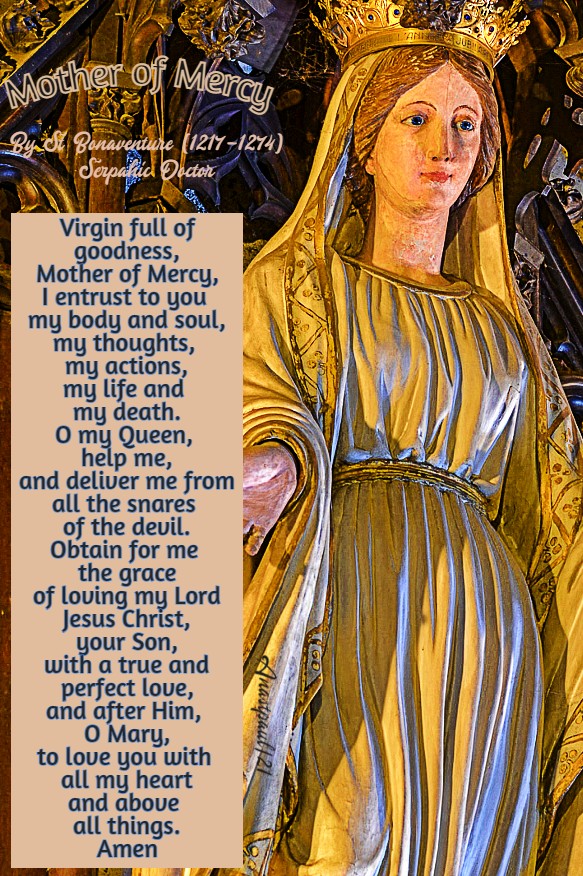
Mother of Mercy By St Bonaventure (1217-1274) Serpahic Doctor
Virgin full of goodness, Mother of Mercy, I entrust to you my body and soul, my thoughts, my actions, my life and my death. O my Queen, help me, and deliver me from all the snares of the devil. Obtain for me the grace of loving my Lord Jesus Christ, your Son, with a true and perfect love, and after him, O Mary, to love you with all my heart and above all things. Amen
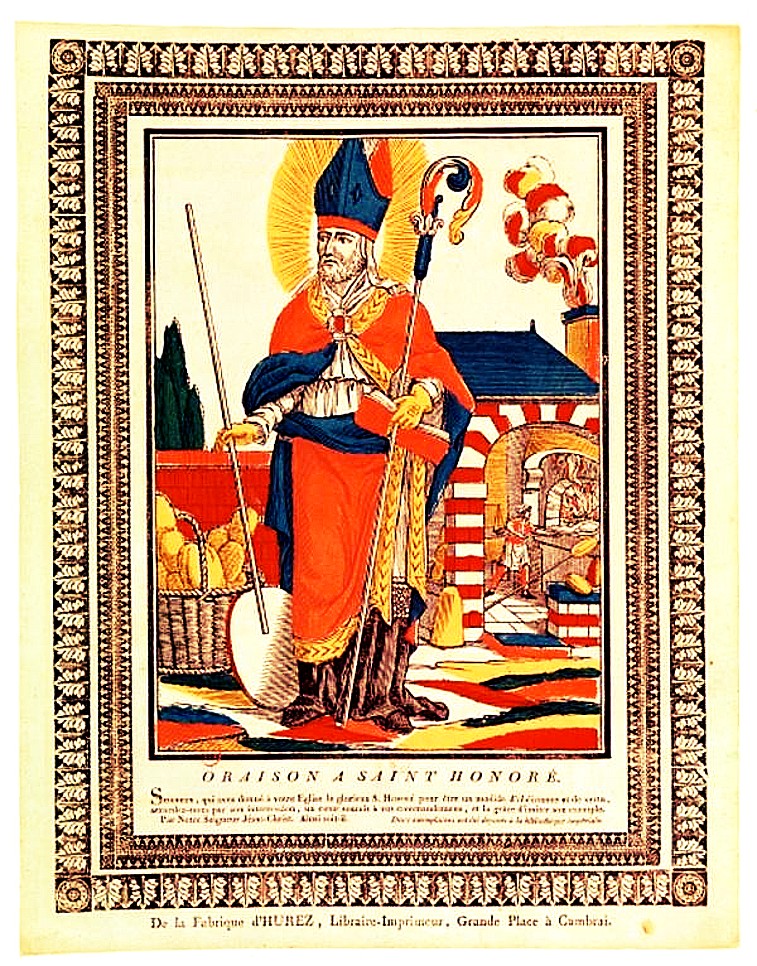
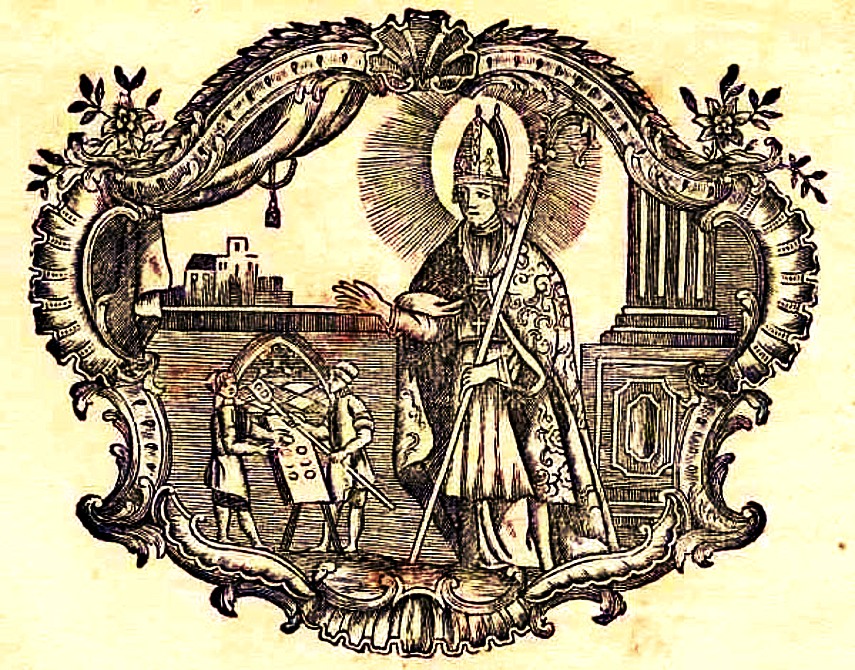
Saint of the Day – 16 May – Saint Honorius of Amiens (Died 653) The Seventh Bishop of Amiens., Miracle-worker. Borin in Port-le-Grand, France and died on 30 September 653 at Porthieu, Amiens of natural causes. Hs Feast Day relates to the date of exumation of his body in 1060. St Honorius served as Bishop of Amiens until his death of natural causes in 653. Also known as – Honoratus, Honoré, Honortus,. Patronages – bakers, confectioners, bakers of altar bread, candle-makers, florists, flour merchants, corn chandlers, oil refiners, and pastry chefs. Honorius is a Latin name (Honoratus) that means “person who is honoured for their merits.“
The Roman Martyrology states of him today: “In Amiens, of Neustria, France, Saint Honoratus, Bishop.“
Honorius was born into a nobile family he was educated by Saint Beatus of Amiens, his predeccesor in the See of Amiens. A pious child, as an adult he became the reluctant Bishop of Amiens. His reluctance was the result of Honorius considering himself unworthy of the position and responsibility. Legend says that a ray of divine light and holy oil appeared upon his head at the time of his selection.
He was not the only one who had difficulty accepting he was selected as Bishop. When th news of his election reached his hometown, his nursemaid, who was baking bread for the family, refused to believe that Honoratus had been elevated to such a position. She remarked that she would believe the news only if the peel she had been using to bake bread put down roots and turned itself into a tree. When the peel was placed into the ground, it was transformed into a mulberry tree that gave flowers and fruit. This miraculous tree was still being shown in the sixteenth century. This miracle is the cause of most of his patroages.
During his episcopate he was honoured with other extraordinary events, such as the discovery of the bodies of Saints Fuscio, Victorico and Genten, Martyrs, which had remained hidden from the faithful. for more than three hundred years. They also say of Saint Honoratus, that his Bishopric was signified by a series of wonders that demonstrated his sanctity, being, especially graced by the Lord.
Many miracles occurred during his lifetime and after his death. Centuries after his death, to help the needs of the people in times of terrible drought, Bishop Guy, son of the Count of Amiens, ordered a general procession, in which the urn with the body of the Saint was carried around the walls of the City. Thus by the prayers raised to St Honorius for his intercession at the throne of God, at last, the rain so desired and needed, fell in abundance. Over the centuries countless miracles are attributed to him, the paralysed walked, the deaf heard, the blind saw and the prisoners regained freedom.
His devotion was widespread in France following reports of numerous miracles when his body was exhumed in 1060.
In 1202, a baker named Renold Theriens donated to the City of Paris some land to build a Chapel in honour of St Honoriust. The Chapel became one of the richest in Paris and gave its name to Rue du Faubourg Saint-Honoré. In 1400, the bakers of Paris established their guild in the Church of Saint Honorius celebrating his feast on 16 May and spreading his cult. This devotion was so great that in 1659, Louis XIV specified that each baker “must observe the Feast of San Honorius, attend the divine service on 16 May and pay a retribution every Sunday to support the community’s expenses.”
He is also the patron of a Carthusian establishment at Abbeville, which was founded in 1306.
He is the namesake of the St Honoré Cake and their are many Villages, Towns, Churches, pastry shops and streets named for St Honorius.
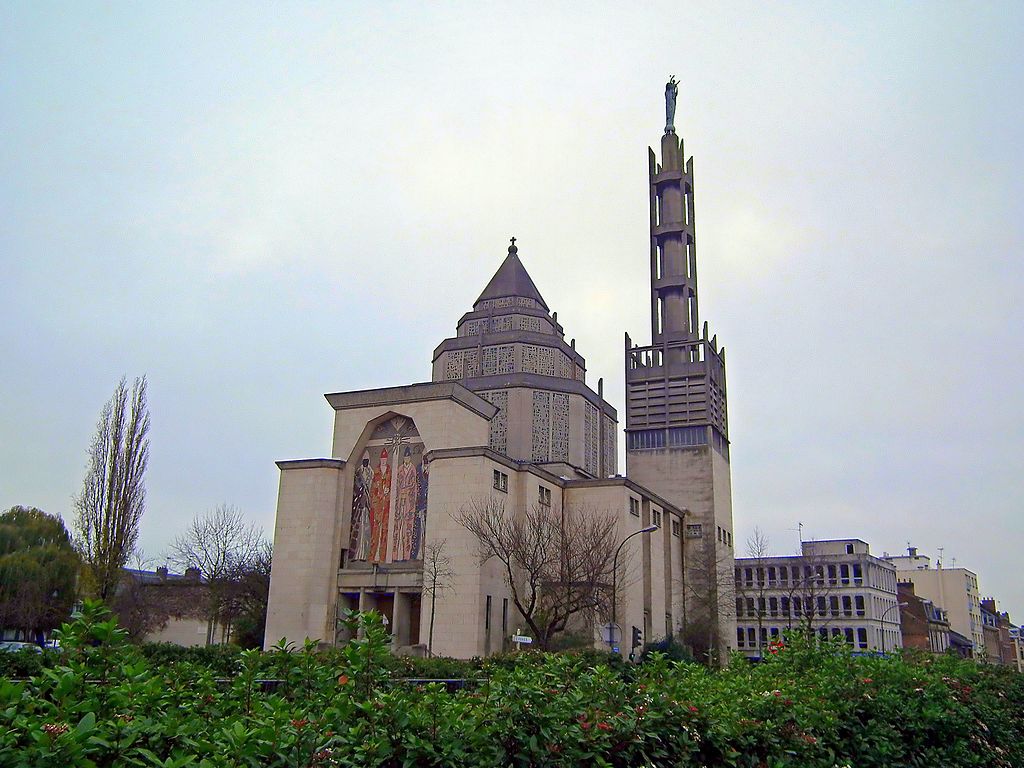
Church of St Honorius in Paris
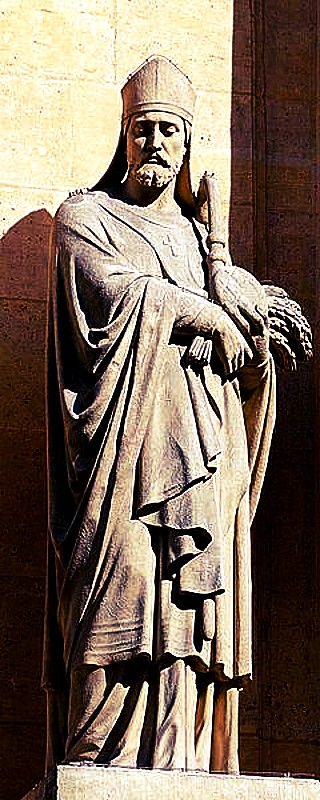
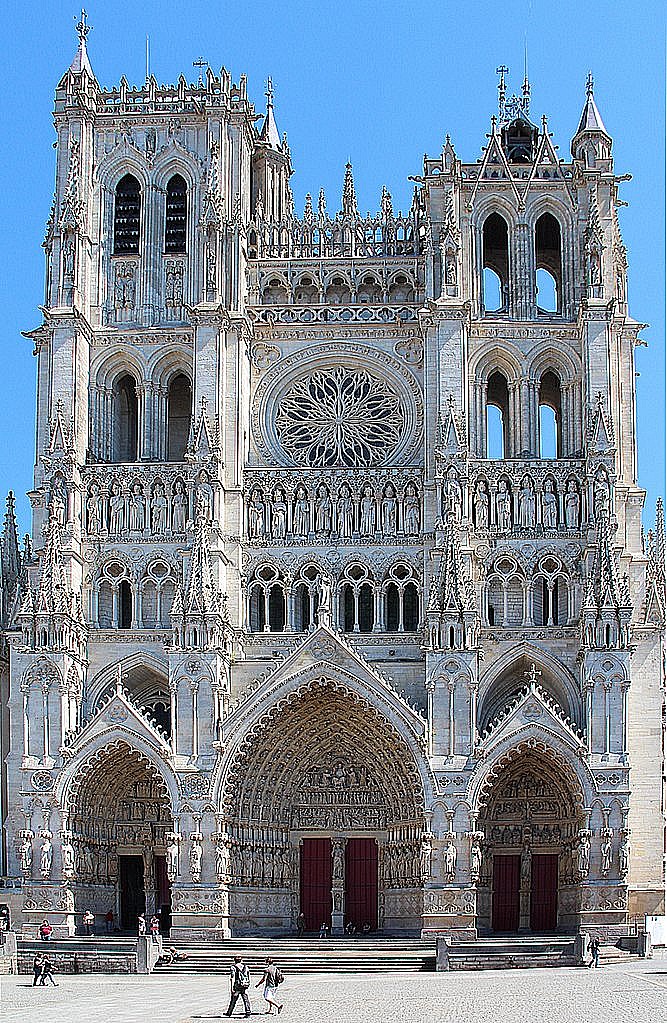
A statue of Honorius stands in the portal of Amiens Cathedral, see below.
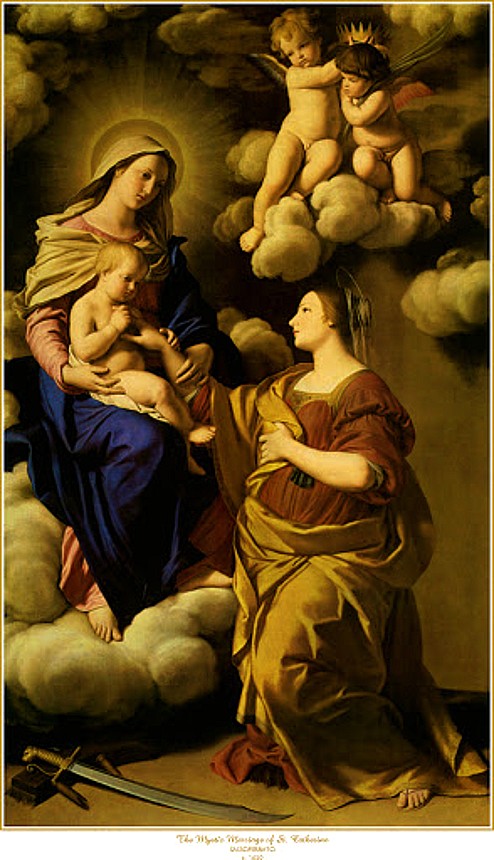
Apparition of Our Lady to Saint Catherine of Alexandria (4th Century) – 16 May:
The Abbot Orsini wrote: “Apparition of Our Lady to Saint Catherine of Alexandria, whose body was discovered on the 13th of this month, on Mount Sinai, in consequence of a revelation which the Queen of heaven gave of it.”
Saint Catherine of Alexandria, also known as Saint Catherine of the Wheel, is a Saint, Virgin, and Martyr. She was the beautiful daughter of King Costus and Queen Sabinella of Alexandria, who at a young age decided to remain a virgin until and unless, she should meet someone who exceeded her in status and political position, as well as beauty, intelligence and wealth. She decided upon Christ, who reigns over us all, for “His beauty is more radiant than the shining of the sun, His wisdom governs all creation and His riches are spread throughout all the world.” While yet a teenager, Saint Catherine received a vision of the Blessed Virgin Mary and Her Divine Son Jesus Christ. In this vision, the Mother of God gave Catherine to her Son in a mystical marriage. Mystical marriage is in some senses, very similar to a marriage ceremony, as Christ presents the chosen soul with a ring that is often invisible to others and often there are Saints and Angels present. There have been well over 70 documented mystical marriages of Saints and ,although the action is mysterious and not well understood, it appears, that Christ gives special attention to these Saints. Saint Teresa explained, that it was the highest state a soul could achieve in this life, and represents a transforming and constant union with the Blessed Trinity.
Saint Catherine was Martyred by the Roman Emperor Maxentius when she refused his proposal of marriage. Again, according to tradition, her body was taken by Angels to Mount Sinai where a Church and Monastery were built in her honour. Saint Catherine’s relics were rediscovered about the year 800. Her hair was still growing and there was a continuous stream of oil coming from her body that was found to have miraculous properties. King Saint Edward was said to have collected some of that oil and taken it back to his kingdom.
Saint Catherine, along with Saint Margaret, were the two Saints who spoke to encourage Saint Joan of Arc in her mission.
St Abdas of Cascar Bl Adam of Adami Bl Adam of San Sabine
St Carantac St Carantoc St Diocletian of Osimo St Felix of Uzalis St Fidolus of Aumont St Fiorenzo of Osimo St Fort of Bordeaux St Francoveus St Gennadius of Uzalis St Germerius of Toulouse St Hilary of Pavia St Honorius of Amiens (Died 653) Bishop Bl Louis of Mercy
St Ubaldus Baldassini St Victorian of Isauria Bl Valdimir Ghika — Martyrs of Saint Sabas: A group of monks, whose names have not come down to us, who were massacred by Moors at the monastery of Saint Sabas in Palestine.
Thought for the Day – 15 May – Meditations with Antonio Cardinal Bacci (1881-1971)
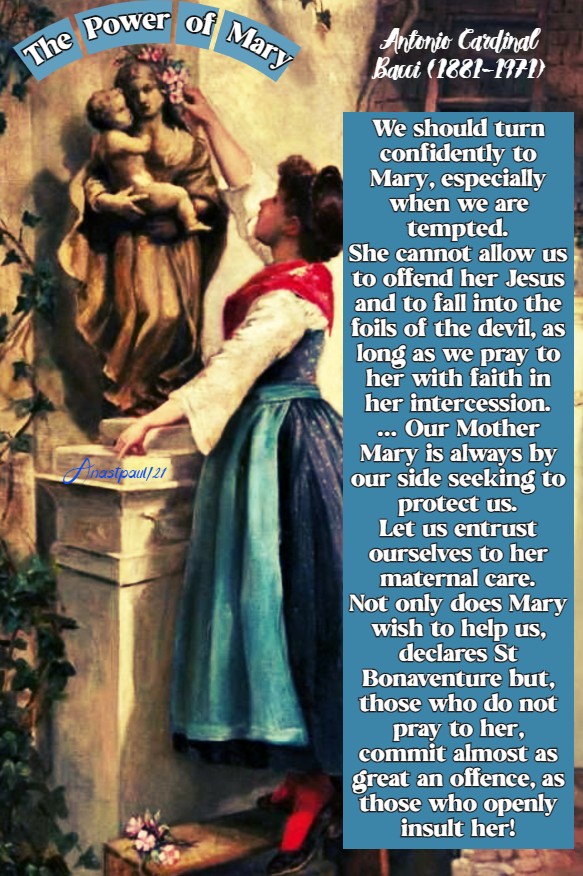
The Power of Mary
“We should turn confidently to Mary, especially when we are tempted. She cannot allow us to offend her Jesus and to fall into the foils of the devil, as long as we pray to her with faith in her intercession. “The devil, as a roaring lion,” says St Peter, “goes about seeking someone to devour” (1 Peter 5:8). But, our Mother Mary is always by our side seeking to protect us. Let us entrust ourselves to her maternal care. Not only does Mary wish to help us, declares St Bonaventure but, those who do not pray to her, commit almost as great an offence, as those who openly insult her (In Spec Virg)!
Quote/s of the Day – 15 May – “Mary’s Month” – Readings: Acts 18: 23-28, Psalms 47: 2-3, 8-9, 10, John 16: 23-28
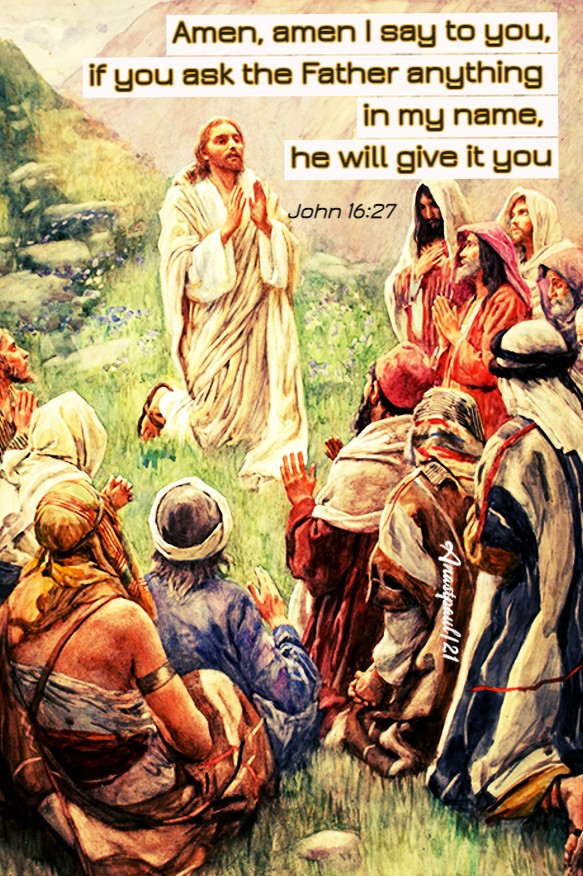
“Amen, amen I say to you, if you ask the Father anything in my name, he will give it you.”
John 16:27
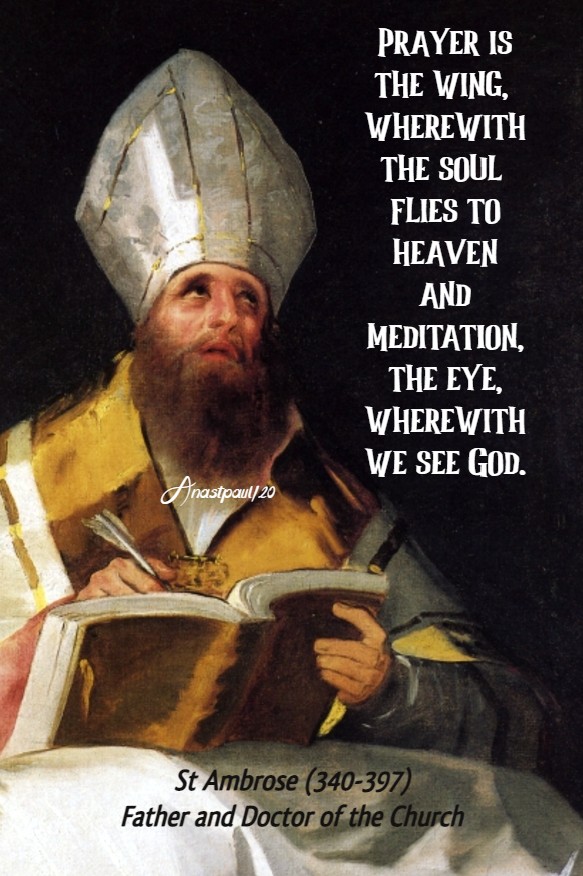
“Prayer is the wing, wherewith the soul flies to heaven and meditation, the eye, wherewith we see God.”
St Ambrose (340-397) Father and Doctor of the Church
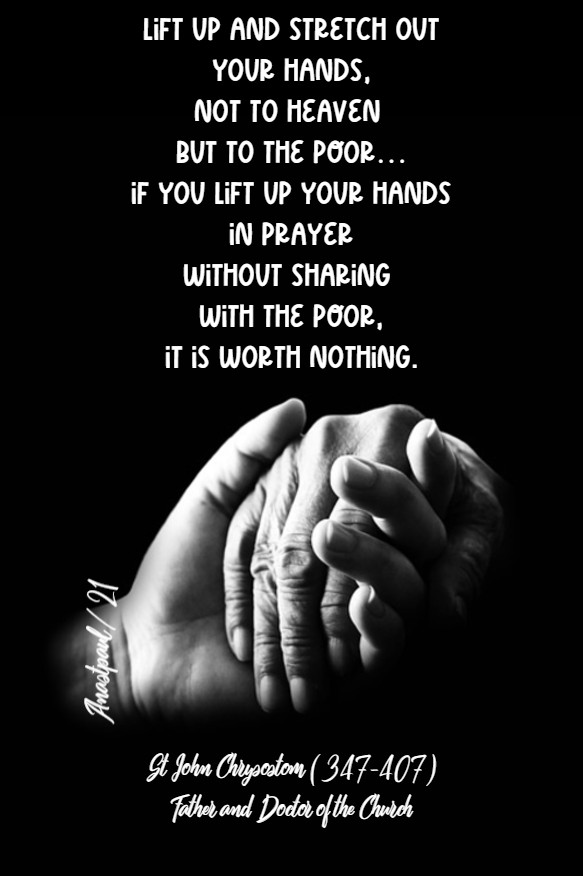
“Lift up and stretch out your hands, not to heaven but to the poor… if you lift up your hands in prayer without sharing with the poor, it is worth nothing.”
St John Chrysostom (347-407) Father and Doctor of the Church
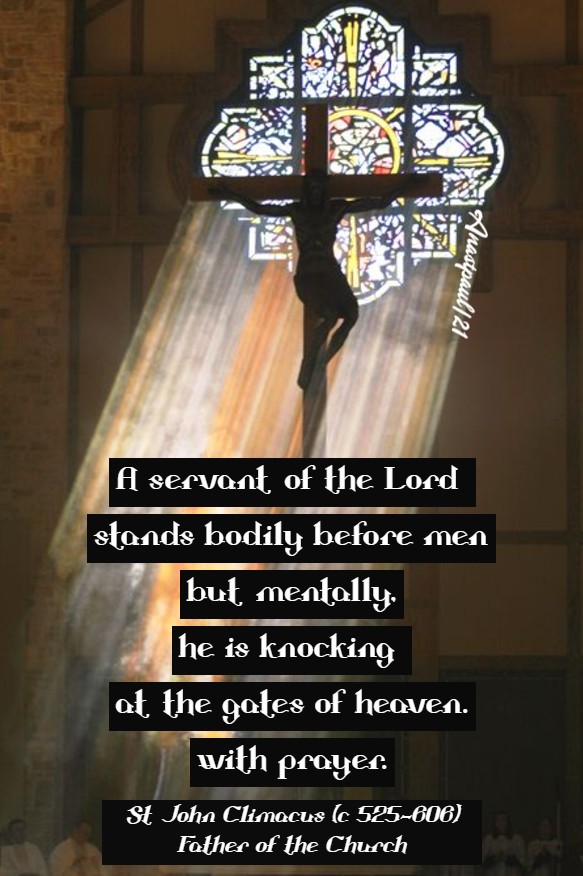
“A servant of the Lord stands bodily before men but mentally, he is knocking at the gates of heaven. with prayer.”
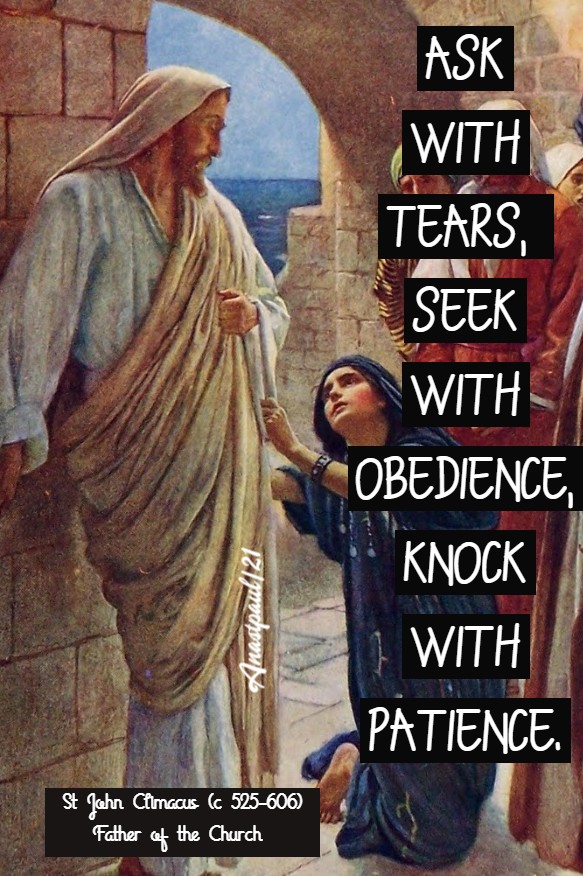
“Ask with tears, seek with obedience, knock with patience.”
St John Climacus (c 525-606) Father of the Church
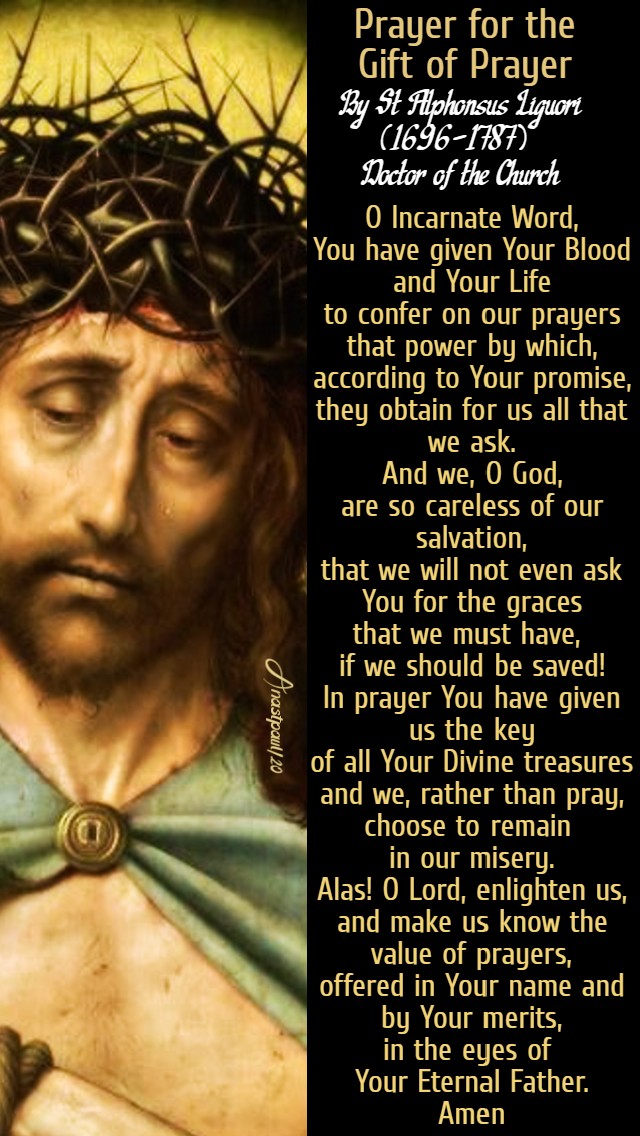
Prayer for the Gift of Prayer By St Alphonsus Liguori (1696-1787) Most Zealous Doctor
O Incarnate Word, You have given Your Blood and Your Life to confer on our prayers that power by which, according to Your promise, they obtain for us all that we ask. And we, O God, are so careless of our salvation, that we will not even ask You for the graces that we must have, if we should be saved! In prayer You have given us the key of all Your Divine treasures; and we, rather than pray, choose to remain in our misery. Alas! O Lord, enlighten us, and make us know the value of prayers, offered in Your name and by Your merits, in the eyes of Your Eternal Father. Amen
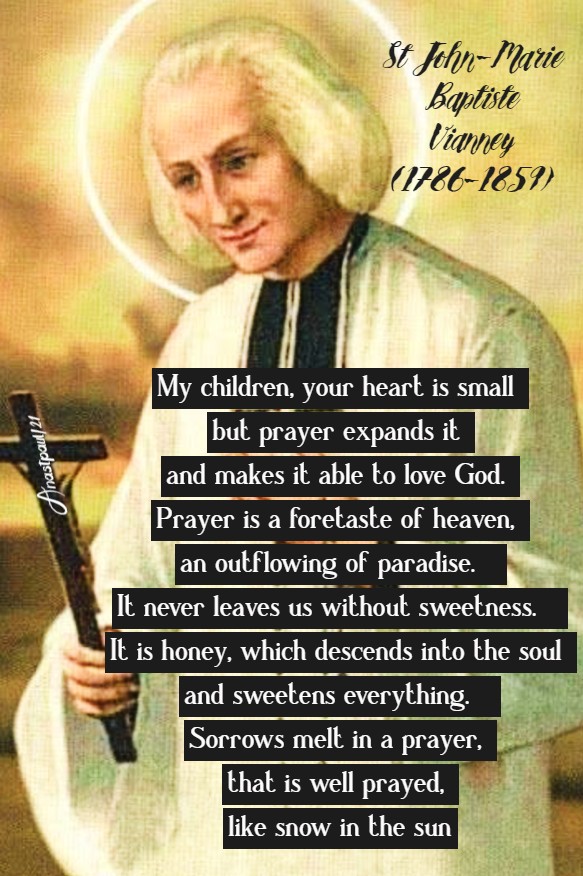
“My children, your heart is small but prayer expands it and makes it able to love God. Prayer is a foretaste of heaven, an outflowing of paradise. It never leaves us without sweetness. It is honey, which descends into the soul and sweetens everything. Sorrows melt in a prayer, that is well prayed, like snow in the sun.”
Our Morning Offering – 15 May – ‘Mary’ Month’ – Saturday within the Octave of th Ascension
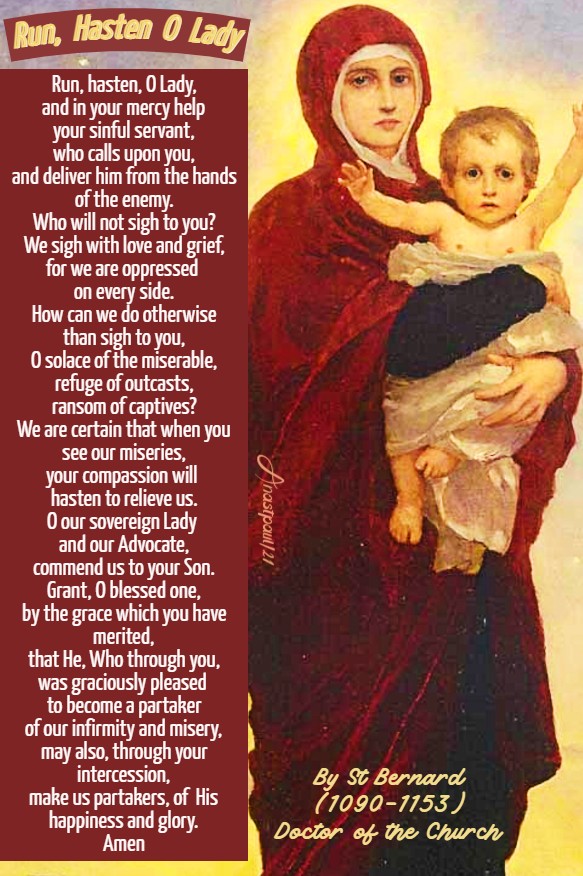
Run, Hasten O Lady By St Bernard (1090-1153) Doctor of the Church
Run, hasten, O Lady, and in your mercy help your sinful servant, who calls upon you, and deliver him from the hands of the enemy. Who will not sigh to you? We sigh with love and grief, for we are oppressed on every side. How can we do otherwise than sigh to you, O solace of the miserable, refuge of outcasts, ransom of captives? We are certain that when you see our miseries, your compassion will hasten to relieve us. O our sovereign Lady and our Advocate, commend us to your Son. Grant, O blessed one, by the grace which you have merited, that He, Who through you, was graciously pleased to become a partaker of our infirmity and misery, may also, through your intercession, make us partakers, of His happiness and glory. Amen
One Minute Reflection – 15 May – “Mary’s Month” – Readings: Acts 18: 23-28, Psalms 47: 2-3, 8-9, 10, John 16: 23-28
“In that day, you will ask in My Name” – John 16:26
REFLECTION – “At the end of our prayers we say: “Through Jesus Christ Thy Son, our Lord” and not “Through the Holy Spirit.” This practice of the Universal Church is not without reason. At its root lies the Mystery according to which, Jesus Christ is the Mediator between God and humanity (1 Tim 2:5), a Priest forever, according to the order of Melchizedek, He who, with His own Blood, entered into the Holy of Holies, not that which was only a copy but, into Heaven itself, where He is at the Right Hand of God and intercedes for us (Heb 6:20; 9:24).
It was in His consideration of Christ’s Priesthood, that the Apostle said: “Through Him let us continually offer God a sacrifice of praise, that is, the fruit of lips which confess His Name” (Heb 13:15). It is through Him that we offer the sacrifice of praise and prayer because it is His death that reconciled us while we were still enemies (Rom 5:10). He willed to offer Himself in sacrifice for our sakes and, since then, it is through Him, that our offerings can be acceptable in God’s sight. This is why Saint Peter warns us in these words: “Like living stones, let yourselves be built into a spiritual house to be a holy priesthood to offer spiritual sacrifices acceptable to God, through Jesus Christ” (1 Pt 2:5). This is the reason why we say to God the Father: “Through Jesus Christ Thy Son, our Lord.” – Saint Fulgentius of Ruspe (467-532) – Bishop in North Africa (Letter 14,36).
PRAYER – Since it is from You, God our Father, that redemption comes to us, Your adopted children, look with favour on the family You love, hear our prayer as we unite our voices in the name of Your Son, our Lord and Redeemer. May our faith, love and joy in Christ bring us all alike to our eternal heritage and may the prayer of His blessed Mother and ours lead us safely home. We make our prayer through Christ our Lord, in the unity of the Holy Spirit, God with You, loving Father, forever, amen.
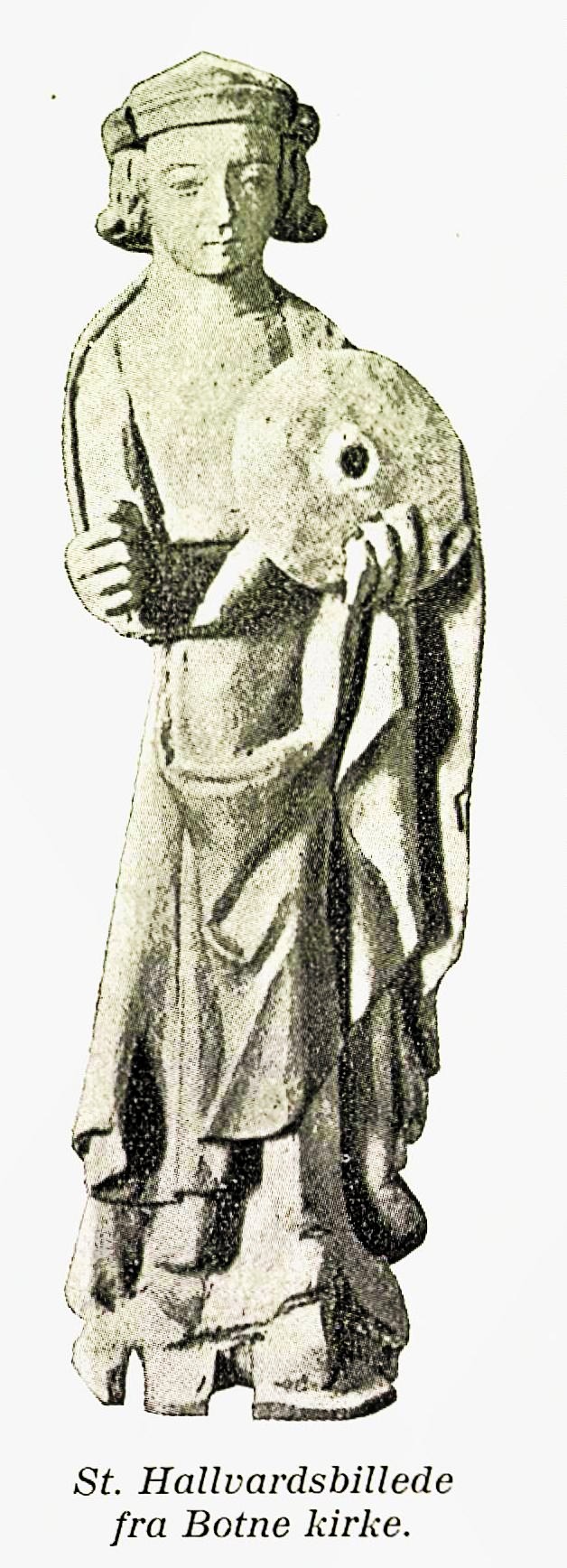
Saint of the Day – 15 May – Saint Hallvard of Oslo (c 1020-1043) Martyr in defence of innocence. Born in c 1020 and died by being shot with an arrow at Drammen, Norway. Patronages – Oslo, Innocence.
Saint Hallvard was born of noble parents. He grew up on his father’s farm, well-liked by everyone. He loved Christianity, was obedient to his parents, loving his neighbour, chaste and in every way honest and just.
Hallvard became a merchant. An introductory story to the legend tells that he was once on Gotland on a trade trip. “Then one of the inhabitants of the land, a rich man named Borvid, came to the strangers and asked who they were. He stood looking at Hallvard for a while and then said, ‘Who is this young man?’ They explained his name and lineage. When he heard this, he said: ‘You have an unusual face and are different to the others. I know for a fact that a great One, will shine upon you.” After this prophecy, he invited the Saint and his companions to a banquet, bought all of Hallvard’s goods and paid more than the Saint asked for.
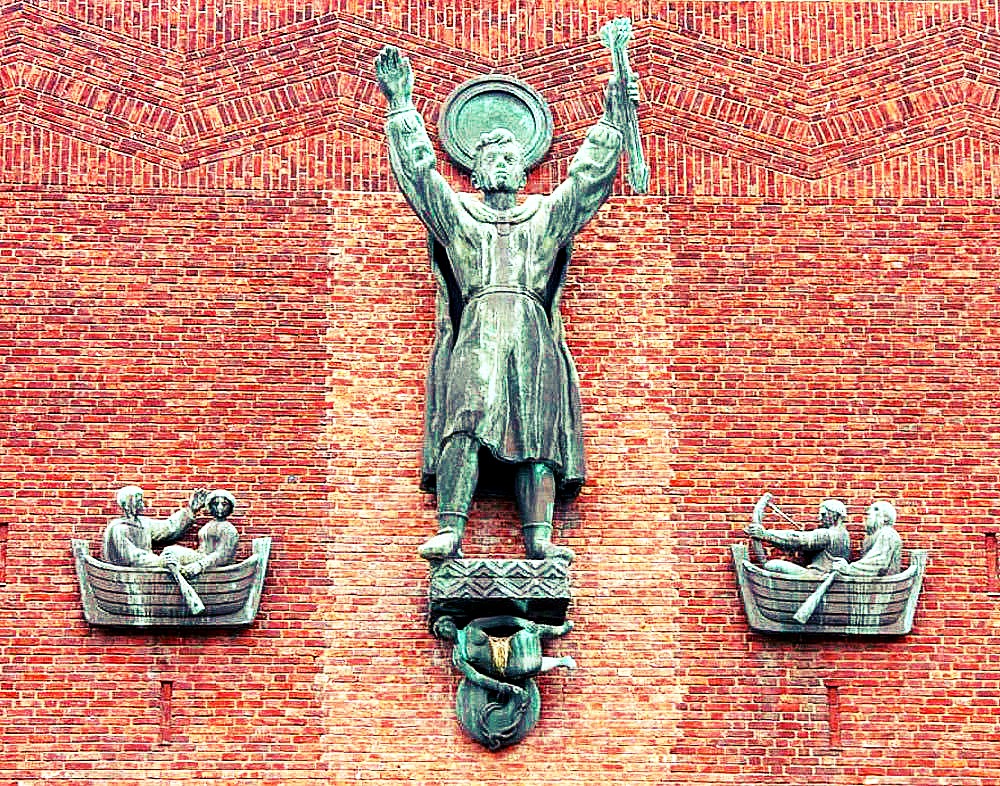
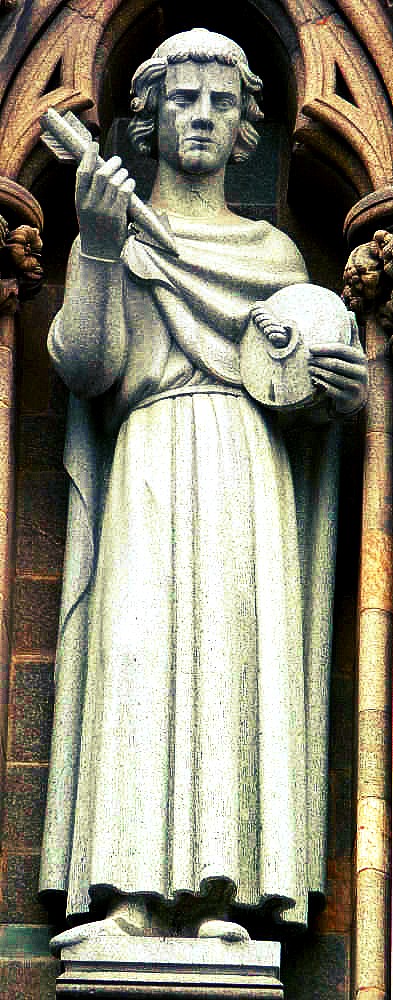
Saint Hallvard is depicted in the Seal of the City of Oslo, holding the millstone and arrows used to kill him, with the woman he defended at his feet
The legend continues: “Shortly afterwards, in the spring, Saint Hallvard left home to trade in the neighbourhood. He came to a lake called Drafn, there he found a small boat and went on board. But suddenly a pregnant woman appeared, she tremblingly asked to join him on board. When asked who she was and where she was going, she gave her name and said that when she wanted to cross the sea and saw a boat that was going to set out, she came running as fast as she could because she feared for her life. He said she could sit in the stern and then he rowed away. But suddenly he saw three men running down to the beach. They jumped on board another boat and came after Hallvard and his passenger.
The saint said to the woman, ‘Do you know them?’ She replied, ‘Yes, I know them.’ He said: ‘I see that they are after you. Tell me what you did! ‘ She replied. ‘It’s true that they are persecuting me but I have not done what they accuse me of. They accuse me of theft. ‘ He said, ‘Can you cleanse yourself of the charge by carrying iron burdens?’ She said, ‘Yes, I can,and I’m willing to do it as long as they spare me.
But the men, who were close to catching them again, said: ‘Why do you, Hallvard, an honourable young man protect such a bad woman? Surrender her so she can die. She deserves it. ‘ Hallvard said to them, ‘What has she done?’ They replied, ‘She broke into our brother’s house and stole his belongings.’ He asked them, ‘And how did she get into the house?’ They said, ‘She pulled the ring that held the lock out of the doorpost.’ He said: ‘No woman can do that, only a very strong man! Has anyone seen her do this? Or have you found stolen goods in her house? And if it is not certain that she has stolen, then why should she die? Wouldn’t it be more appropriate to let her clear herself of the accusation if she can? And if she can not, then she will either be judged according to the law, or I will pay her ransom. For you should not kill a pregnant woman and the child she is carrying. Do not do anything hasty now! ‘
Instead, they screamed, furiously. One of them grabbed his bow and tightened it and the arrow, which was fired with full force, drilled into the Martyr’s chest. After he was murdered, they also killed the woman and buried her on the beach. And to the Saint’s neck they bound a stone and lowered him into the deep. But by the grace of God and by the merits of the Martyr, long after his body was found, with the stone, floating on the sea. “ He was buried in the Saint Hallvard Cathedral, Oslo.
The Hallvard legend formed the basis for a local cult of Hallvard in the Middle Ages. His feast day is widely celebrated especially in Eastern Norway, especially in Viken. His connection to Oslo was strengthened by the fact that his image became part of the City’s Coat pf Arms, see below, as early as the 14th century and he has often been referred to as “Oslo’s Patron Saint.”
Oslo’s Coat of Arms depicting St Halvard and the inocent woman
Oslo Municipality has made Hallvard’s Day 15 May, the City’s official holiday and the municipality’s highest award, the St Hallvard Medal, was named after him in 1950.
St Hallvard Church and Monastery on Enerhaugen was Consecrated as a Franciscan Monastery and Parish Church for the eastern Parish of the Oslo Catholic Diocese.
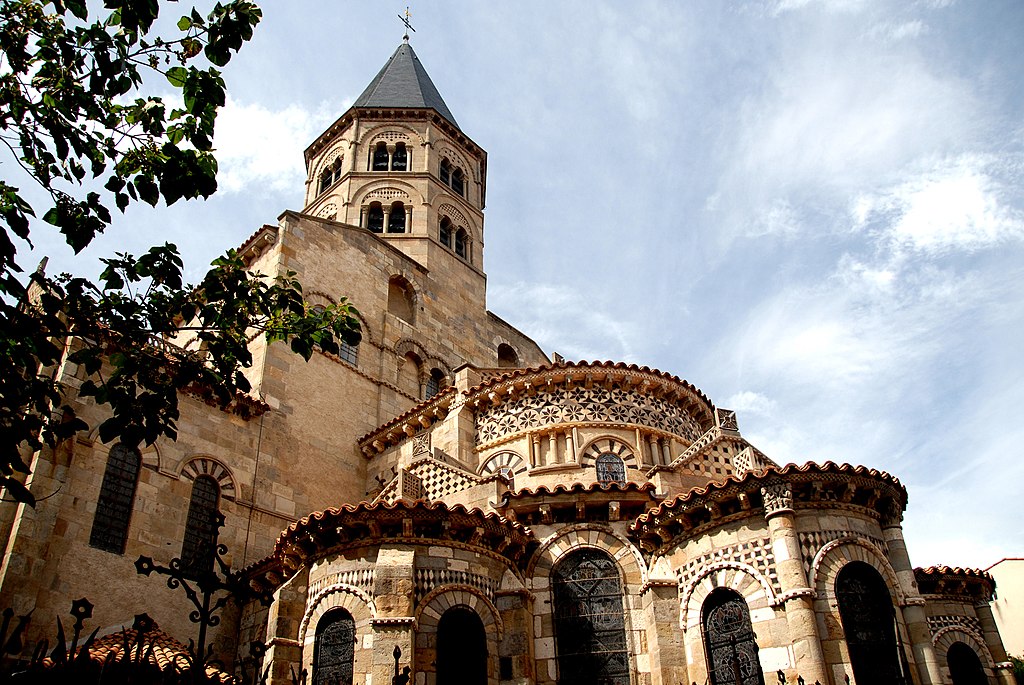
Notre-Dame-du-Port, Clermont-Ferrand, Puy de Dôme, Auvergne / Our Lady of the Port, (1614) – 15 May:
Clermont-Ferrand is located on a plain in the volcanic region of central France. Unlike most hub cities, it is not on a body of water. And yet ,for a thousand years, Clermont’s eastern district has been known as the Port.
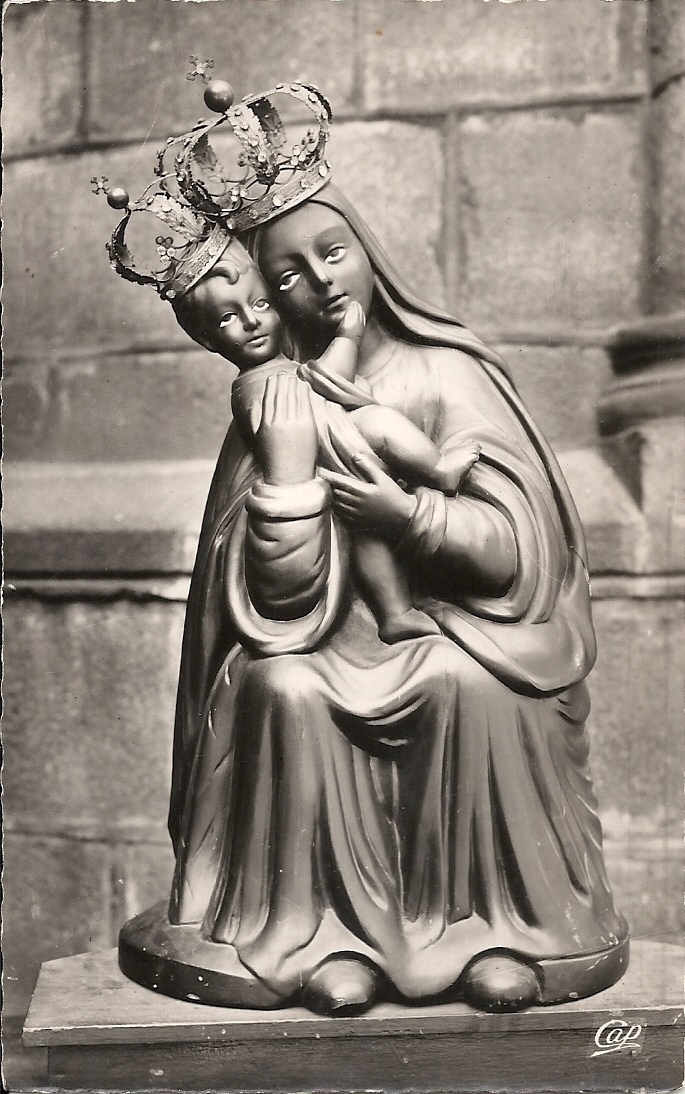
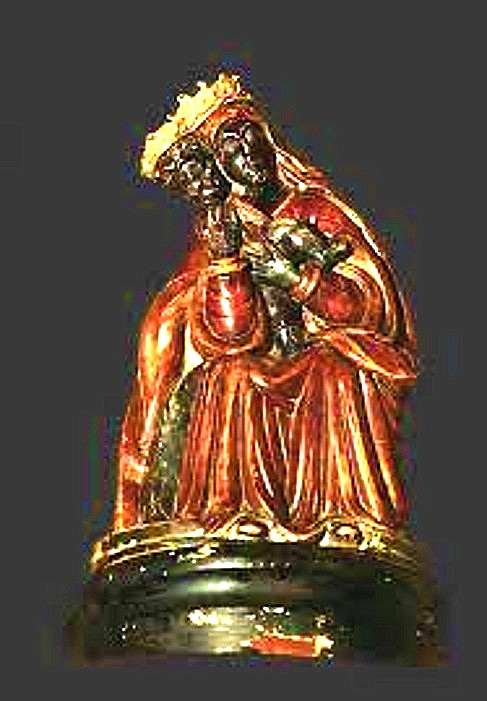
In the crypt of its Romanesque Church of Our Lady of the Port, dating to the early 1100s, is an unusual Black Virgin, a polychromed walnut Statue just under a foot high. This long-revered image is a copy made around 1800 of a Statue from the 1200s, which was held to be a copy of an even earlier image–possibly going back to the Shrine’s foundation by St Avit in the 500s, or possibly a copy of a Byzantine icon brought by returning Crusaders. Mary cradles the child against her cheek, such as the Notre-Dame de Grâce, given in 1450 to Cambrai Cathedral in northern France. n 1614, snow and bitter cold enveloped the area without stopping from Martinmas (11 November) to Easter. By May, there were still no buds and no grass and famine loomed. The leaders and Priests conferred. They asked the Chapter to bring out the image of Our Lady of the Port from the collegiate Church.
The four-hour procession took place on the morning of Ascension Day, May 15, 1614. Some 8,000 people followed the holy image and relics of Saints around the City walls, chanting litanies. The next day, the weather grew milder and in the following days, truly beautiful. To the joy of all, the harvests were excellent that summer and even more abundant the next year.
The new Bishop, Joachim d’Estaing, on 5 May 1616, ordered an inquiry among the town notables, after which he issued an ordinance declaring that the Feast of Notre-Dame du Port would take place on 15 May in the Parish and be observed as a day of rest in the future.
The Statue was crowned in 1875 and on 15 May 1881, Pope Leo XII declared the Church a Minor Basilica. The procession of the first Sunday after 15 May remains joyously well attended.
Bercthun of Beverley Bertha of Bingen St Caecilius of Granada St Caesarea of Otranto St Cassius of Clermont Bl Clemente of Bressanone St Colman Mc O’Laoighse St Ctesiphon of Verga Blessed Diego of Valdieri
St Gerebernus St Hallvard of Oslo (c 1020-1043) Martyr St Hesychius of Gibraltar St Hilary of Galeata St Indaletius of Urci St Isaias St Isidore of Chios Bl Joan Montpeó Masip St Maximus of Clermont St Nicholas the Mystic St Rupert of Bingen St Secundus of Avila St Simplicius of Sardinia St Sophia of Rome St Victorinus of Clermont St Waldalenus of Beze
Thought for the Day – 14 May – Meditations with Antonio Cardinal Bacci (1881-1971)
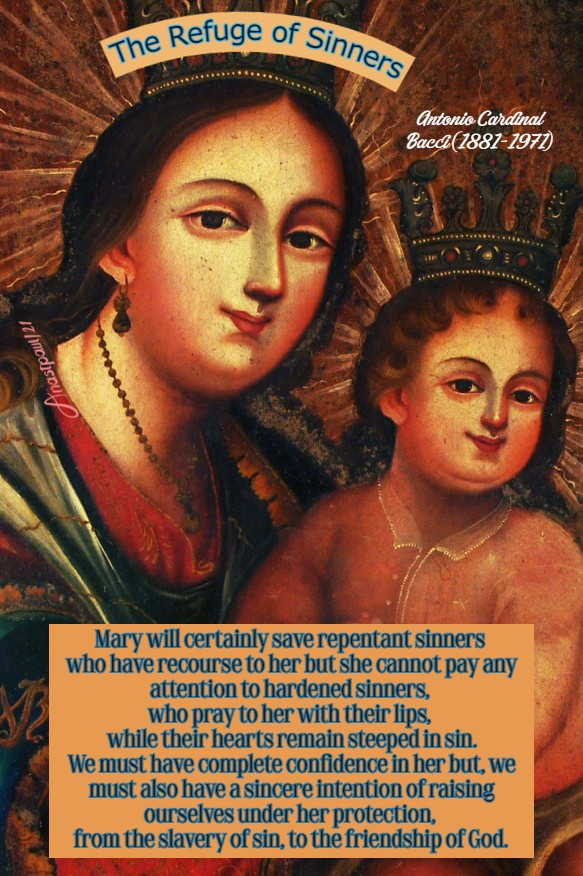
The Refuge of Sinners
“Mary is called, the Star of Sea because, as St Thomas Aquinas says, “even as sailors are guided into port, by means of a star, so Christians are guided towards Heaven, by means of Mary, .” (Opuse, 7). This absolute guarantee of the protection of our heavenly Mother, should increase our trust in her and lead us to turn towards her in every difficulty and temptation. It should not, however, result in an unhealthy attitude of spiritual inactivity, a passive dependence on Mary’s favours, without any co-operation on our part. Such behaviour would be the height of filial ingratitude. Mary will certainly save repentant sinners who have recourse to her but she cannot pay any attention to hardened sinners, who pray to her with their lips, while their hearts remain steeped in sin. We must have complete confidence in her but, we must also have a sincere intention of raising ourselves under her protection, from the slavery of sin, to the friendship of God.
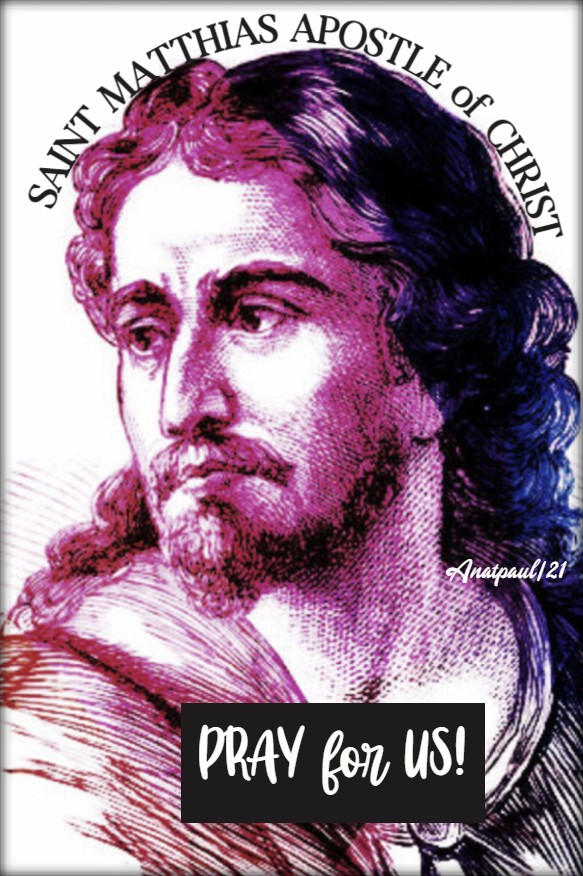
Quote/s of the Day – 14 May – “Mary’s Month” – Feast of St Matthias Apostle, Readings: Acts 1:15-17, 20-26, Psalm 113:1-8, John 15:9-17
“The lot fell upon Matthias, and he was numbered with the eleven apostles.”
Acts 1:26
“He needed to be a witness not of the times before or after that event and not of the signs and wonders but only of the Resurrection itself. For the rest happened by general admission, openly but the Resurrection took place secretly and was known to these men only.”
St John Chrysosthom (347-407) Father & Doctor of the Church
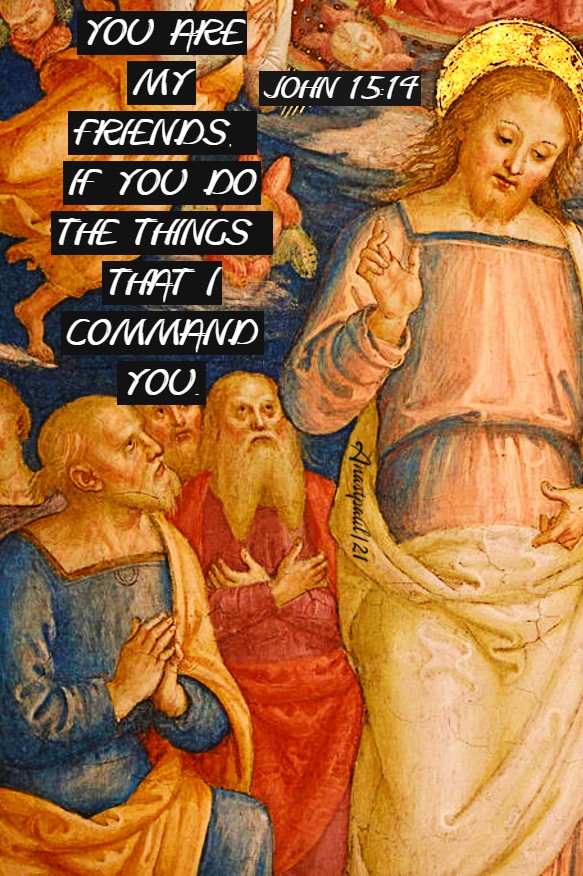
“You are my friends, if you do the things that I command you.”
John 15:14
“I have chosen you and have appointed you, that you should go and should bring forth fruit and your fruit should remain, says the Lord.”
One Minute Reflection – 14 May – “Mary’s Month” – Feast of St Matthias Apostle, Readings: Acts 1:15-17, 20-26, Psalm 113:1-8, John 15:9-17
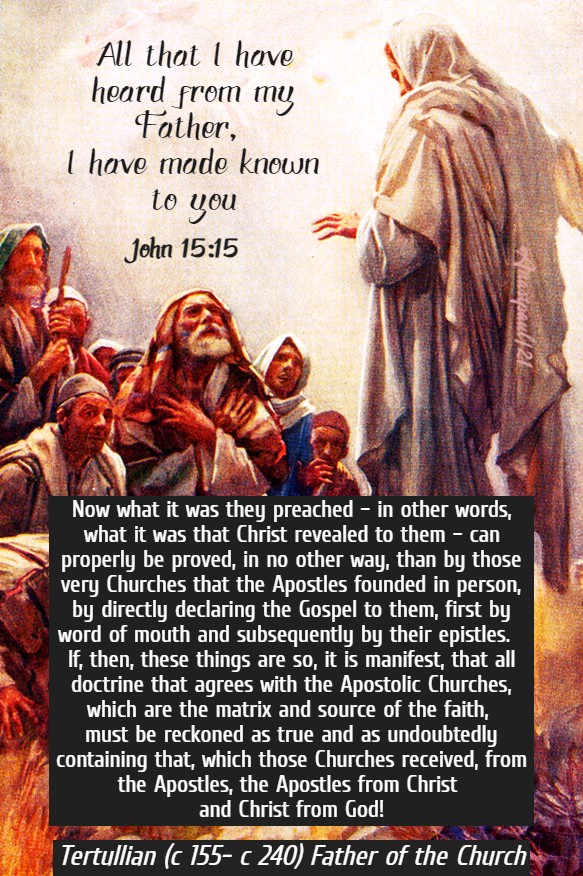
“…All that I have heard from my Father, I have made known to you.” … John 15:15
REFLECTION – “Among His disciples Christ chose twelve chief ones whom He destined to be the teachers of the nations. Accordingly, after one of these had been struck off, He commanded the eleven others, on His departure to the Father, to “go and teach all nations” who were to be “baptised into the Father, the Son and the Holy Spirit” (Mt 28,19).
So the Apostles – whom this designation indicates as ‘the sent’ – on the authority of a prophecy which occurs in a psalm of David, immediately chose Matthias by lot in place of Judas. They obtained the promised power of the Holy Spirit for the gift of miracles and tongues and, after first bearing witness to faith in Jesus Christ, throughout Judaea and founding Churches there, they next went out into the world and preached the same teaching of faith to the nations. …
Now what it was they preached – in other words, what it was that Christ revealed to them – can properly be proved, in no other way, than by those very Churches that the Apostles founded in person, by directly declaring the Gospel to them, first by word of mouth and subsequently by their epistles. If, then, these things are so, it is manifest, that all doctrine that agrees with the Apostolic Churches, which are the matrix and source of the faith, must be reckoned as true and as undoubtedly containing that, which those Churches received, from the Apostles, the Apostles from Christ and Christ from God.” … Tertullian, full name Quintus Septimius Florens Tertullianus (c 155- c 240) Father of the Church
PRAYER – Lord God, You chose St Matthias to complete the number of the twelve. By his prayer, include us among Your chosen ones, since we rejoice to see that the lot marked out for us, is in Your Love. May the Mother of Jesus, the Apostles and our Mother, ever intercede for us all. Through Jesus the Christ, our Lord, with the Holy Spirit, God now and forever, amen.
Our Morning Offering – 14 May – “Mary’s Month” – Feast of St Matthias Apostle
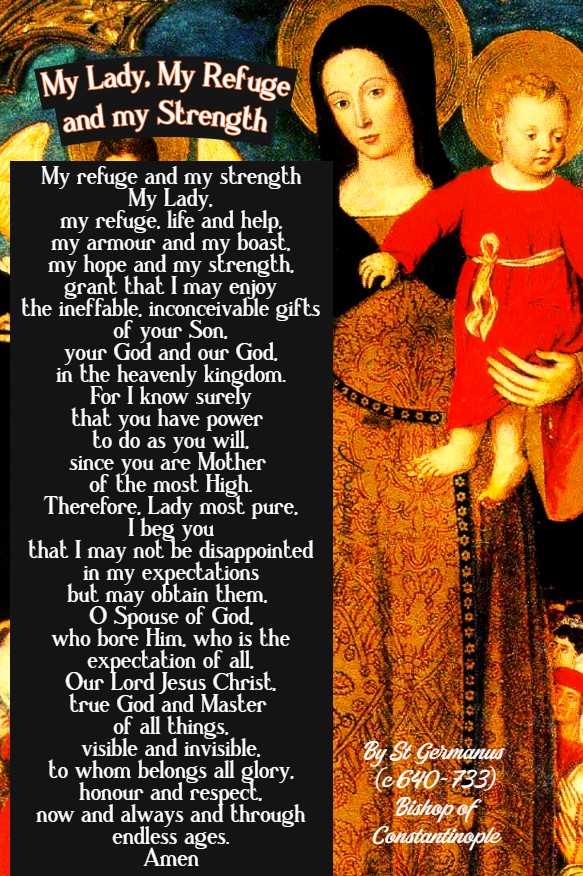
My Lady, My Refuge and my Strength By St Germanus (c 640- 733) Bishop of Constantinople Defender of the Faith Defender of Sacred Images
My refuge and my strength My Lady, my refuge, life and help, my armour and my boast, my hope and my strength, grant that I may enjoy the ineffable, inconceivable gifts of your Son, your God and our God, in the heavenly kingdom. For I know surely that you have power to do as you will, since you are Mother of the most High. Therefore, Lady most pure, I beg you that I may not be disappointed in my expectations but may obtain them, O Spouse of God, who bore Him, who is the expectation of all, Our Lord Jesus Christ, true God and Master of all things, visible and invisible, to whom belongs all glory, honour and respect, now and always and through endless ages. Amen
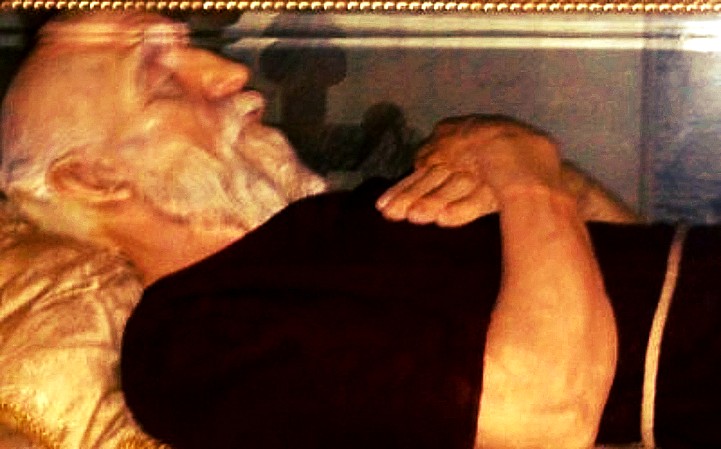
Saint of the Day – 14 May – Saint Ampelio (Died c 428) Hermit, miracle-worker. Born in the 4th century in Upper Egypt and died on 5 October c 428 in Bordighera, Italy of natural causes. His Feast day refers to the translation of his body to the Church of Saint Stephen in Genoa, Italy on 14 May 1258. Patronages – blacksmiths, Bordighera, Italy. His body is incorrupt and is the only image we have of him.
Nothing is known about the early life of Saint Ampelio. We know that he was a blacksmith who left his work to become a Recluse in Egypt. His faith was tested in the form of a woman (devil) but Ampelio heated an iron bar until it glowed and chased the demon away.
Ampelio emigrated to Italy, where he planted the first date palms, having brought the seeds from Egypt, lived in a cave, was known as a miracle worker and served as a model for prayer for the Christian life.
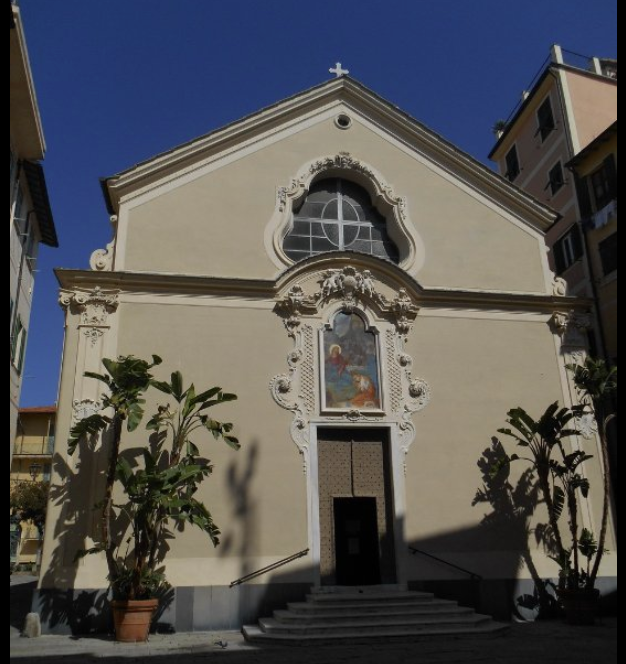
He died on 5 October 428 in Bordighera, Italy of natural causes. His body was moved to the Convent of Saint Stephen in Genoa, Italy on 14 May 1258. On 16 August 1047, his body was brought back to Bordighera. He was taken in procession through the crowd to the Church of Magdalene, where he now lies. The Patron celebrations take place on 14th May, in memory of the transfer of the body from Sanremo to Genoa in 1258.
The Church of St Mary Magdalene
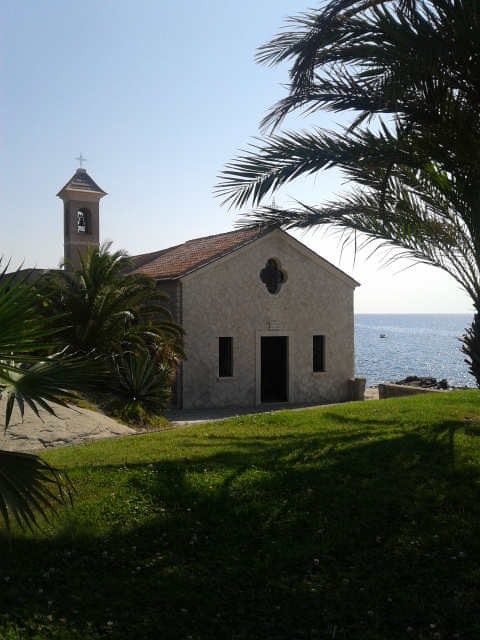
There is a little Church dedicated to St Ampelio in Bordighera in Liguria, Italy. The crypt, with two apses and small, inclined loop-holes, holds a squared-off block of stone from La Turbie (the rock which dominates the Principality of Monaco). This stone was the poor and very uncomfortable “bed of the saint,” where Ampelio died the 5th October 428.
Madonna di Pinè, Montagnaga, Trento, Italy / Our Lady of Pinè, Montagnaga (1729) – Commemorated 14 May:
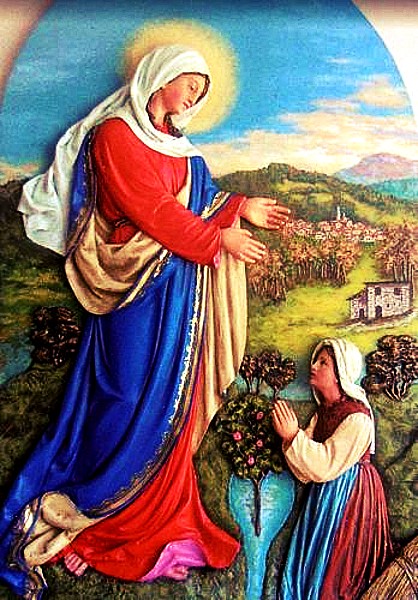
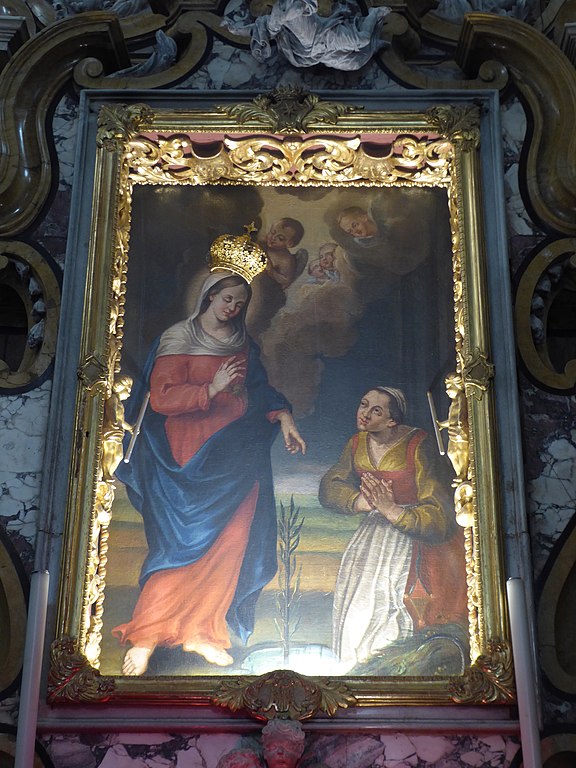
Domenica Targa of Guardia, thirty years old, was busy supervising the cattle grazing,which suddenly, with no apparent visible reason, started running in all directions as if she were crazy. The shepherdess then began to cry out: “Mary, Jesus, help me.” As soon as she uttered these words, the Virgin Mary appeared before her with a white veil on her head and thus addressed her: “You called Jesus and Mary for help and they will help you … Do you promised once again to visit Our Lady of Caravaggio? But do not go to Caravaggio! Go rather to the Feast of the Ascension of Christ in the Chapel of St Anne in Montagnaga. There you will find a portrait of the Blessed Virgin by Caravaggio. Kneel down and address your prayers with a sincere heart to Jesus and Mary, then you will see miraculous things. “
On Sunday Domenica went to the Chapel of St Anne in Montagnaga, while praying fervently, she again had an apparition of Mary. The robe of the Blessed Virgin radiated a golden light. She was crowned with a diadem and rays of clear light shone all around her, as did the Child Jesus, who was in her arms. He was dressed all in gold. In the right hand of the Madonna held a crown. She said: “I am Mary, the Mother of the Lord. Please tell this apparition to the local priest. Do not be afraid! Nothing bad will happen to you. I will be with you. In my name you must announce, that every year on this day,a feast must be celebrated.“
Only a few believed the story and especially the Priest showed himself very skeptical.
The Virgin appeared again the next on Sunday and said: “I chose this place as the throne of my Mercy. Those who care to pray here with living faith will not return home empty-handed. Take care that a Church be built for large numbers of my devotees.”
In 1730, an ecclesiastical investigation was ordered which resulted in a positive outcome and approval was granted to the apparitions. A Sanctuary was built and Consecrated in 1750. to which large crowds have flocked on pilgrimage and continue to do so to this day. Today, 14 May, special Masses and processions are held.
Domenica Targa led a life of deep Christian devotion and died in 1764.
St Ampelio (Died c 428) St Boniface of Ferentino St Boniface of Tarsus St Corona the Martyr St Costanzo of Capri St Costanzo of Vercelli Bl Diego of Narbonne St Dyfan St Engelmer St Erembert of Toulouse St Felice of Aquileia St Fortunatus of Aquileia St Gal of Clermont-Ferrand
St Pons of Pradleves St Pontius of Cimiez St Tuto of Regensburg St Victor the Martyr — Martyrs of Seoul – 5 Beata: A group of lay people martyred together in the apostolic vicariate of Korea. • Petrus Choe Pil-je • Lucia Yun Un-hye • Candida Jeong Bok-hye • Thaddeus Jeong In-hyeok • Carolus Jeong Cheol-sang 14 May 1801 at the Small West Gate, Seoul, South Korea – Beatified: 15 August 2014 by Pope Francis
Thought for the Day – 13 May – “Mary’s Month” – Meditations with Antonio Cardinal Bacci (1881-1971)
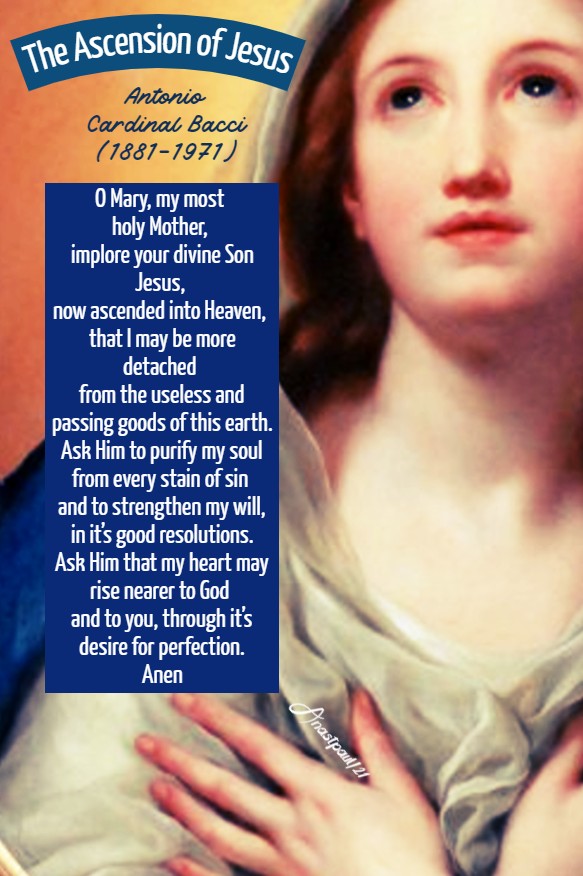
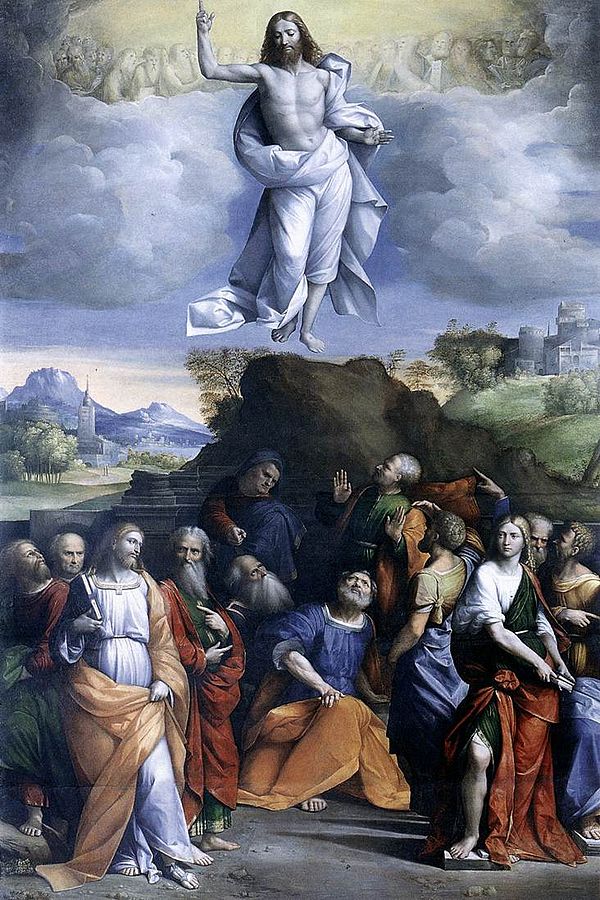
The Ascension of Jesus
“When we meditate on the Ascension, we should humbly ask God, to give us the grace, to strip ourselves of our sins and defects. Then we shall be able to fly towards Him with love and hope in this life and, when our soul has been set free from the body which imprisons it on earth, we shall be able to set out on our last joyful flight into His presence. These are the reflections which should be in our minds around the feast of the Ascension. These are the desires which we should foster and the resolutions which we should form. Let us ask Our Lord, to bless them.
O Mary, my most holy Mother, implore your divine Son Jesus, now ascended into Heaven, that I may be more detached from the useless and passing goods of this earth. Ask Him to purify my soul from every stain of sin and to strengthen my will, in it’s good resolutions. Ask Him that my heart may rise nearer to God and to you, through it’s desire for perfection. Amen.”
One Minute Reflection – 13 May – “Mary’s Month” – Thursday of the Sixth Week of Easter, Readings: Acts 18: 1-8, Psalms 98: 1, 2-3, 3-4, John 16: 16-20 and the Memorial of Blessed Imelda Lambertini (1322-1333) Child Mystic, “Adorer of the Blessed Sacrament”
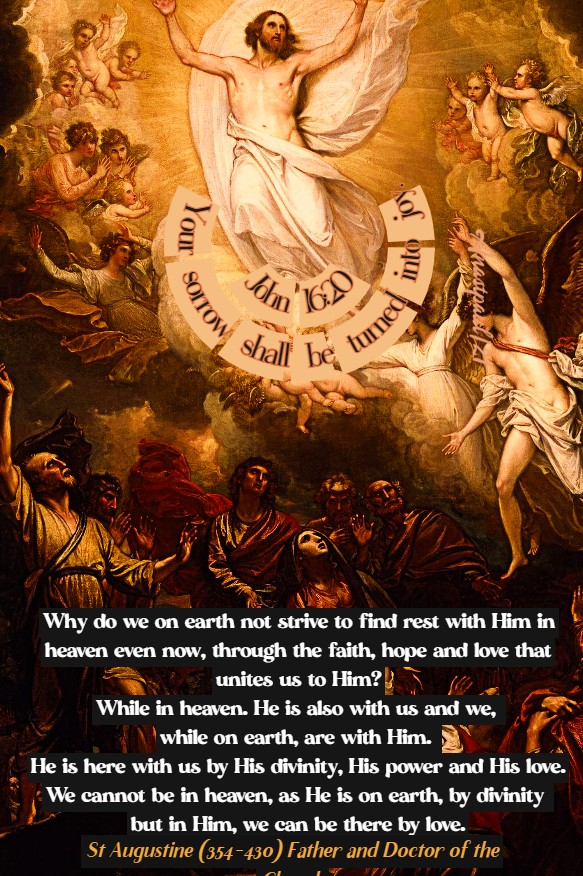
“Your sorrow shall be turned into joy.” … John 16:20… John 16:16
REFLECTION – Today, our Lord Jesus Christ ascended into heaven, let our hearts ascend with Him. Listen to the words of the Apostle – If you have risen with Christ, set your hearts on the things that are above where Christ is, seated at the right hand of God; seek the things that are above, not the things that are on earth. For just as He remained with us even after His ascension, so we too, are already in heaven with Him, even though what is promised us has not yet been fulfilled in our bodies.
Christ is now exalted above the heavens but He still suffers on earth all the pain that we, the members of His body have to bear. He showed this when He cried out from above – Saul, Saul, why do you persecute Me? and when He said: I was hungry and you gave me food.
Why do we on earth not strive to find rest with Him in heaven even now, through the faith, hope and love that unites us to Him? While in heaven. He is also with us and we, while on earth, are with Him. He is here with us by His divinity, His power and His love. We cannot be in heaven, as He is on earth, by divinity but in Him, we can be there by love.
He did not leave heaven when He came down to us, nor did He withdraw from us when He went up again into heaven. The fact that He was in heaven even while He was on earth, is borne out by His own statement – No-one has ever ascended into heaven except the one who descended from heaven, the Son of Man, who is in heaven. … Thus, no-one but Christ descended and no one but Christ ascended; not because there is no distinction between the head and the body but because the body, as a unity cannot be separated from the head” – St Augustine (354-430) Bishop and Great Western Father and Doctor of the Church – An excerpt from his Sermon on the Lord’s Ascension
PRAYER – Almighty God, fill us with a holy joy, teach us how to thank You with reverence and love for the joy of the ascension of Christ Your on. You have raised us up with Him, where He the head has preceded us in glory, there we, the body, are called in hope. Grant, too we beg, that by Mary’s prayer and the prayer of Your loving child Blessed Imelda Lambertini, we may give You faithful service and spread abroad the glory of Your nameThrough Christ our Lord, i the unity of the Holy Spirit and the glory of the Father, God forever, amen.
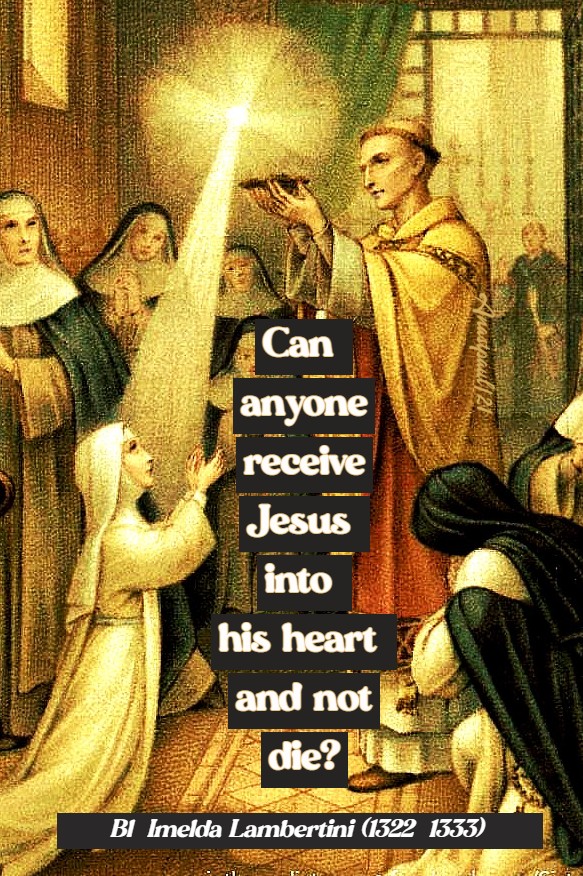
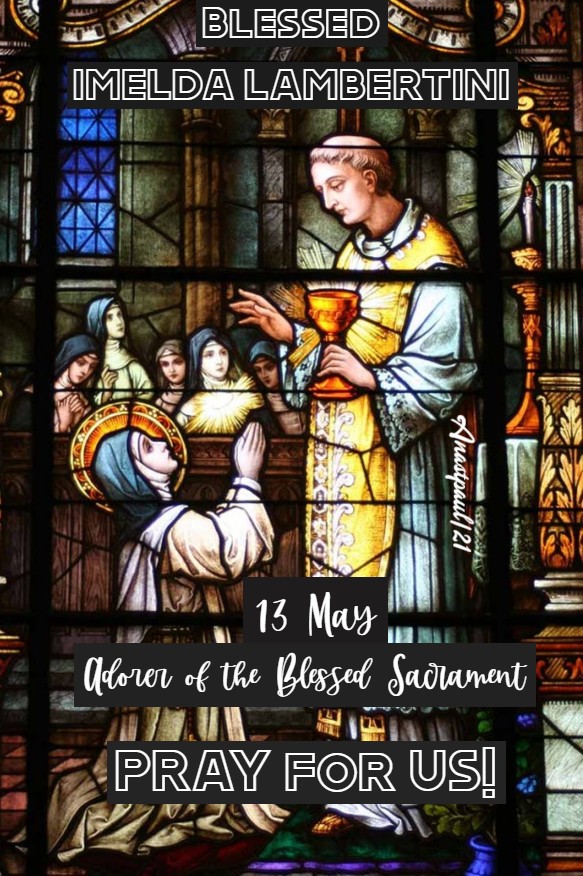
Saint of the Day – 13 May – Blessed Imelda Lambertini (1322-1333) Child Mystic, Virgin. Born in 1322 AS Imelda Dpmenica Lambertini at Bologna, Italy and died on the Feast of the Ascension, 12 May 1333 Bologna, Italy. Patronage – First Communicants (named by Pope Saint Pius X).
Imelda Lambertini was born of a noble family in Bologna, Italy in 1322. Her parents raised her to love her Catholic faith and through their influence she developed a love for prayer, especially for the Mass. Often she would attend Mass and Compline (Night Prayer of the Divine Office) at a nearby Dominican Church. Her mother also taught Imelda to cook and sew for the poor and cultivated in her child an eagerness to perform the corporal works of mercy. Even so, her mother and father, both of whom were getting on in years, were surprised when Imelda asked permission at the tender age of nine to go to live with the Dominican nuns at a neighbouring Monastery. As difficult a decision as this was, her parents evidently sensed the depth of their child’s desire and entrusted her spiritual formation to the Dominicans at Val di Pietra.
At this distance of centuries and culture it is not easy to determine precisely what little Imelda’s status was at the Convent. It seems she was well loved by the Sisters, who allowed her to wear the Dominican habit, to pray with them and to follow their way of life, to the extent that a little girl would be able to do, while still remaining a child. Imelda, we are told, longed (and intensely, it seems) to be allowed to receive Holy Communion with the nuns but in that day, such a thing would have been unheard of for a child her age. Her pleading was again and again gently refused, with the explanation that she would need to wait until she was older and more prepared.
For a time Imelda had to be content with this answer, meanwhile learning to chant Office from hearing the nuns in choir and developing her own interior prayer life in simple childlike ways. The saints, whose stories she had learned from her parents and from the nuns, became her “secret companions” and probably had a hand, in nurturing the longing she felt, to receive Jesus intimately in the Sacrament of the Eucharist. In her private conversations with Jesus, with whom she was developing a deep friendship, we can imagine that she often made known her desire to be allowed to receive Communion. There is no evidence that He put up any opposition to the proposal—but neither did the Sisters relent. And so, Imelda continued, with the intensity of a child, to get to know Jesus more deeply and to desire Him all the more.
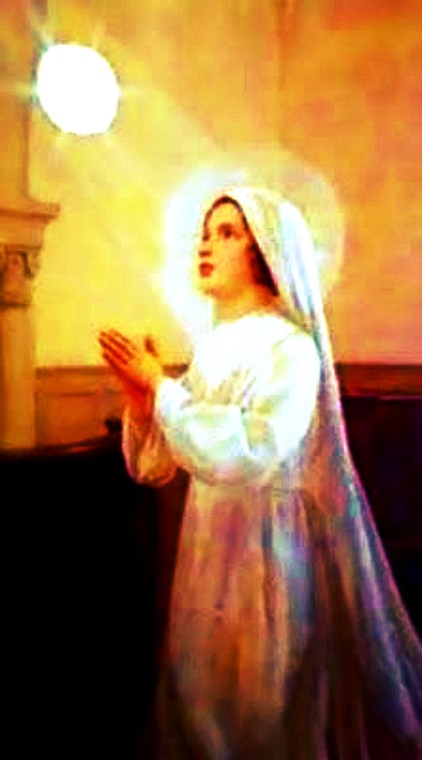
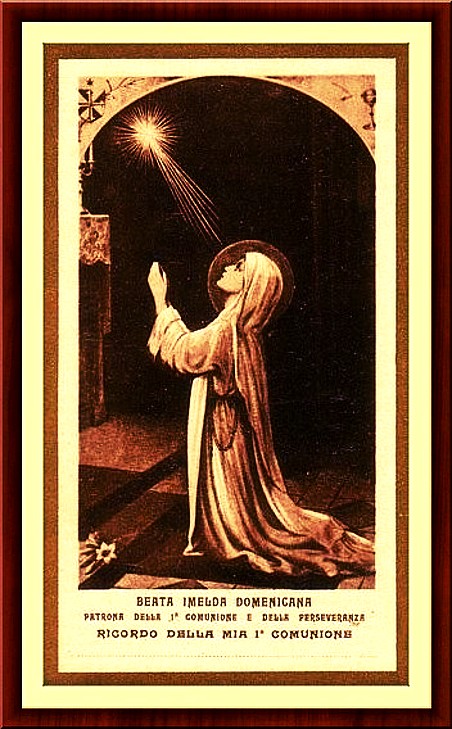
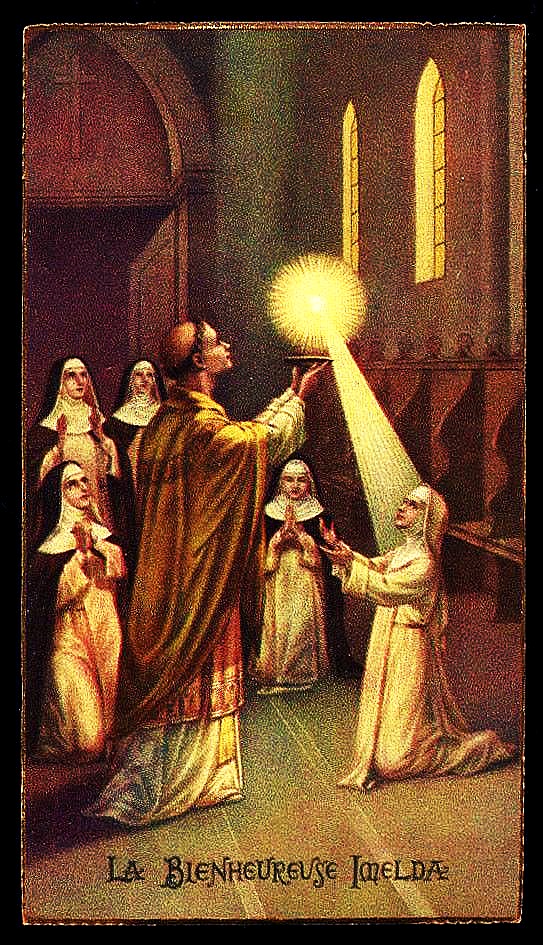
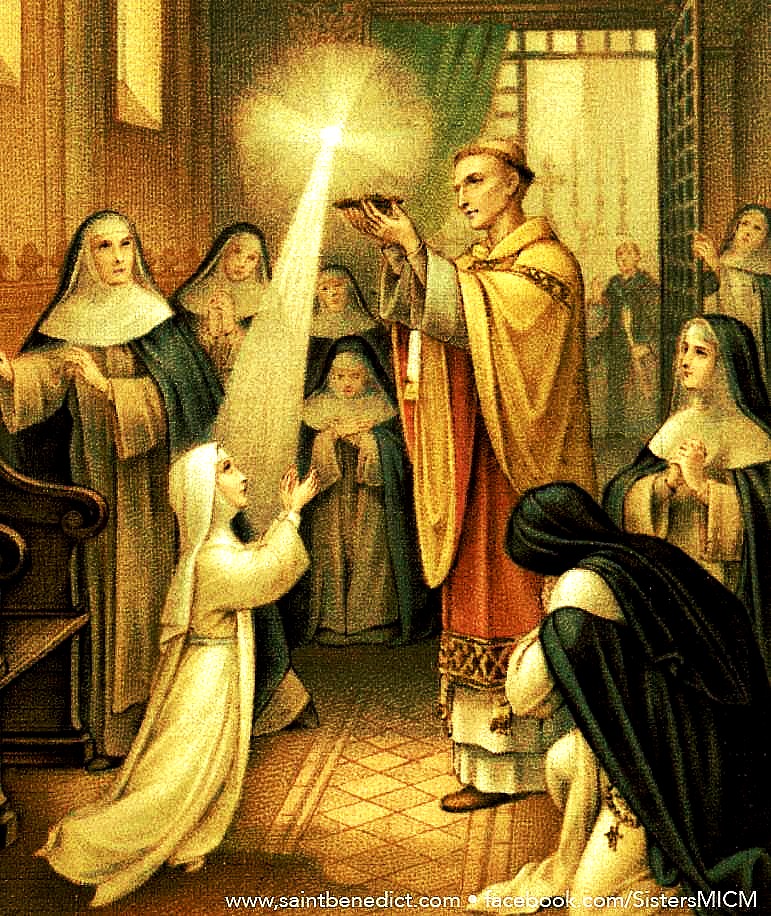
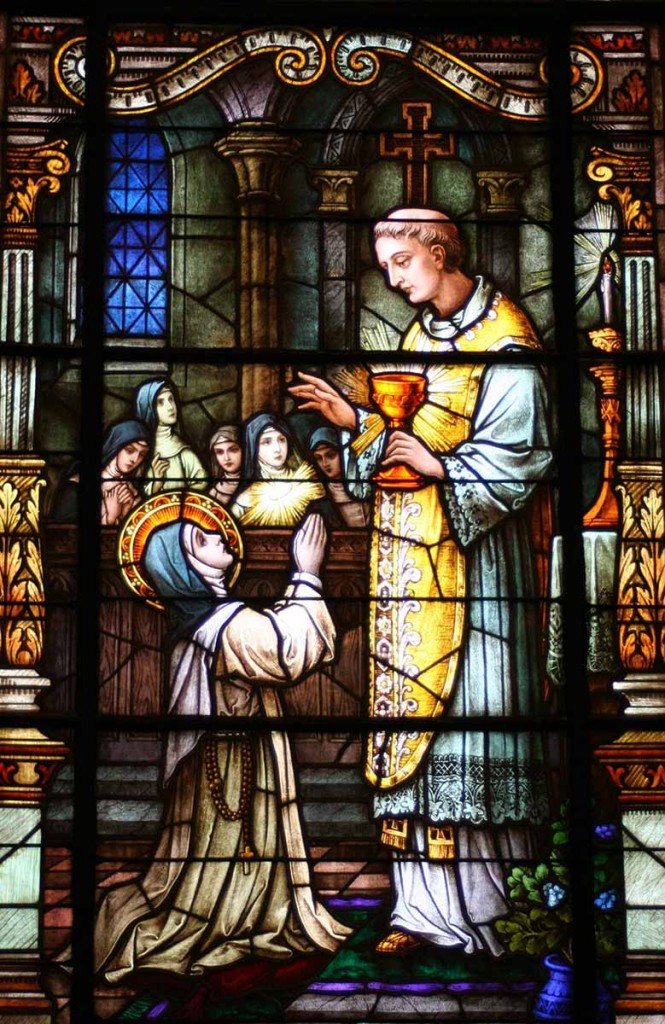
As spring approached, the sisters, who perhaps thought that they had succeeded in diverting Imelda’s “childish fancy” to go to Communion with the grown-ups, were a bit startled when she asked again, shortly before the Feast of the Ascension, to receive her First Holy Communion. (“Asked,” in fact, is not the word. She begged them insistently, it seems.) When the Chaplain was consulted, he agreed with the Sisters and responded with no hesitation that Imelda was much too young. On the Vigil of the Ascension Imelda was in her place in the Chapel, quietly praying as the Sisters received Communion. Then Jesus did a little “insisting” of His own. After Mass, as one of the nuns was clearing the Altar, she heard a noise and looked up to the choir to see Imelda, a glowing light shining above her head, with the Sacred Host suspended in the light.
The Chaplain was called at once and he understood that Jesus Himself was making his desire known. “Let the little children come to Me and do not stop them.” The Priest gave Imelda her First Holy Communion.
We can well imagine that the nuns were amazed and thrilled both at the great blessing to their little one and to their Convent. The Prioress allowed Imelda to remain for some time in thanksgiving and then sent for her to come and have her breakfast. Imelda was still kneeling as they had left her, a smile on her face. Yet when called for, Imelda’s body was still. She had died of pure joy. Her thanksgiving had been well completed and she had nothing left to desire.
Imelda’s story is so well entrenched in the collective memory of her Dominican Brothers and sisters, that it has remained firmly in the Order’s history. She continues to offer the witness of a child with mature desires,and a faith unspoiled in its intensity.
Imelda understood instinctively what many of us have forgotten – that it is the single-hearted who are blessed and that unless we become like children we cannot enter the Kingdom of Heaven.
Lord Jesus Christ, You received into heaven Blessed Imelda, who loved You in the Eucharistic banquet. By her prayers, may we learn to approach Your holy table with that same fervent love and so fulfill our longing to be with You, Who live and reign with the Holy Spirit, one God, forever and ever. Amen
General Calendar of the Order of Preachers
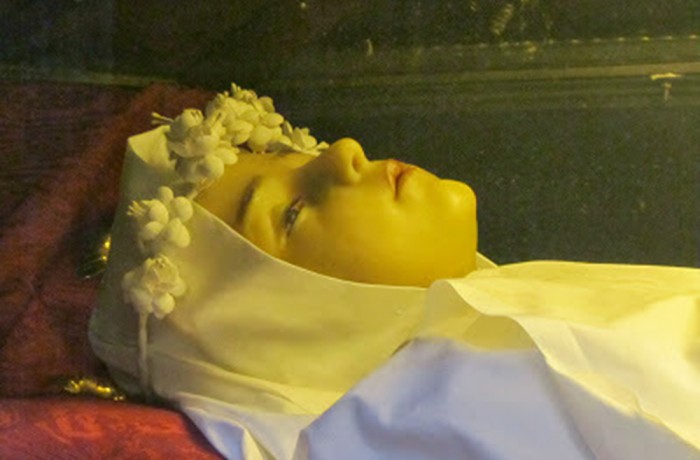
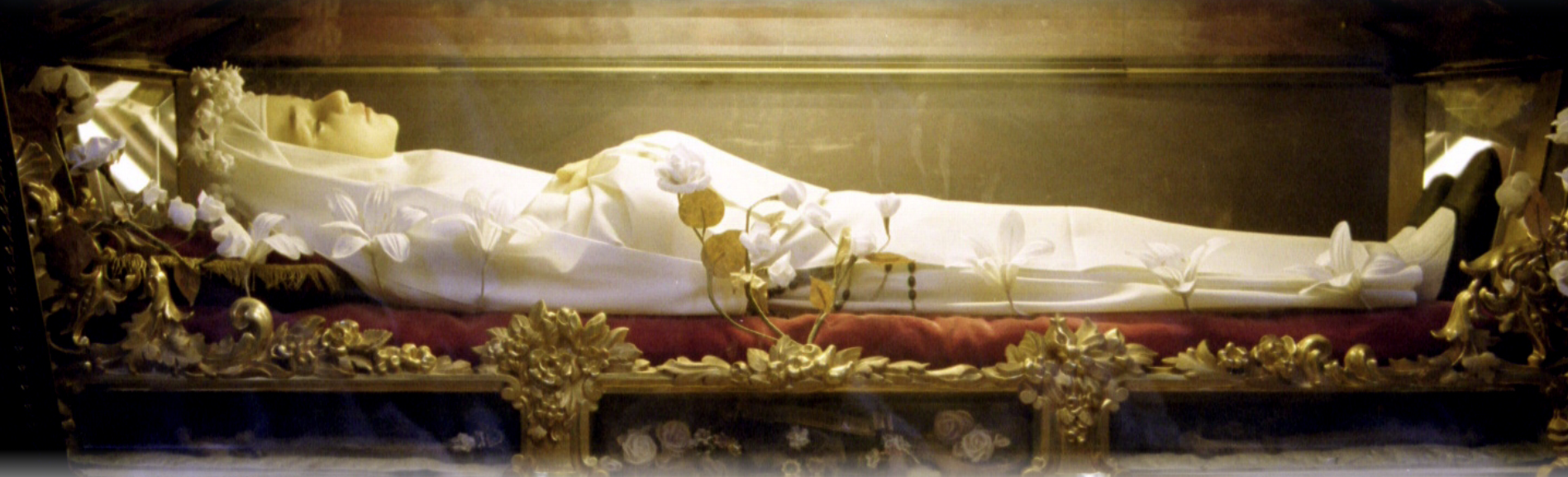
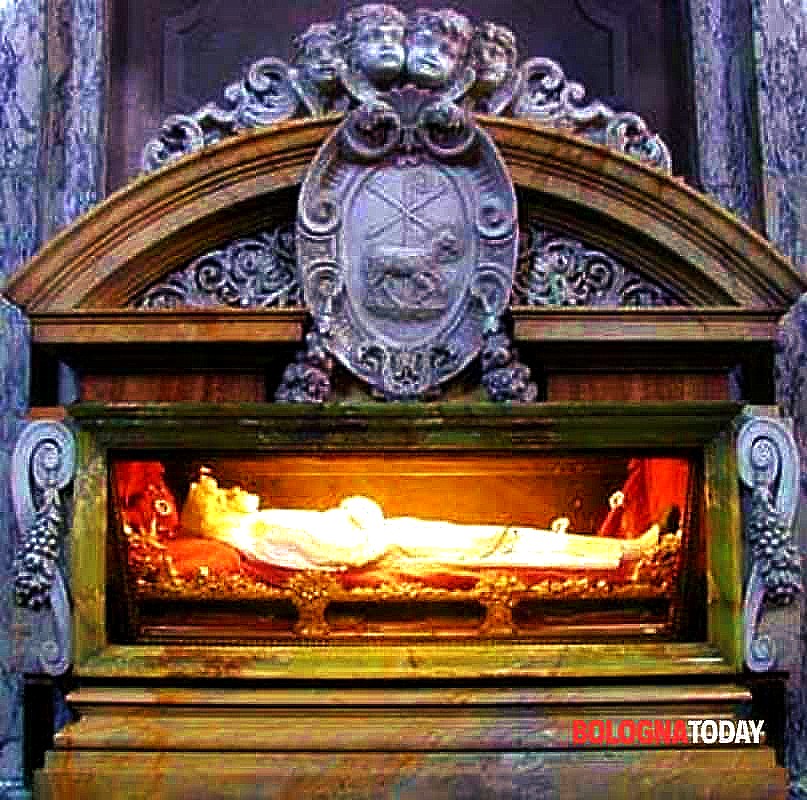
Her remains are kept in Bologna at the Church of San Sigismondo, beneath the wax effigy of her likeness. Blessed Imelda was Beatified on 20 December 1826 by Pope Leo XIII.
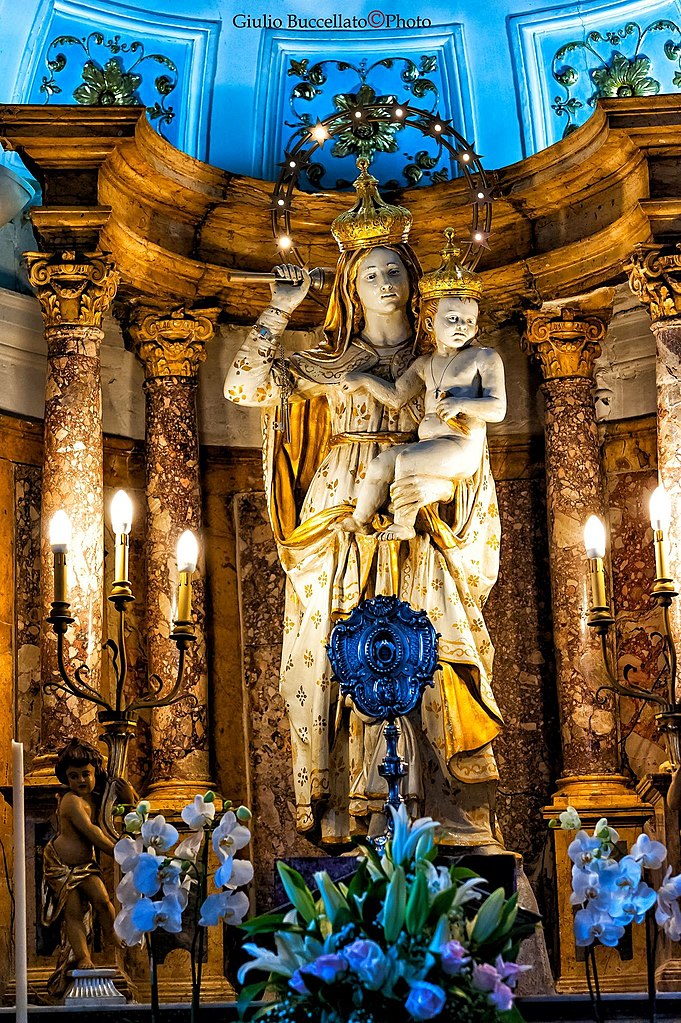
Madonna del Soccorso / Our Lady of Succour of Sicily (14th Century):
Madonna del Soccorso kept in the Mother Church of Castellammare del Golfo .
Devotion to the Blessed Virgin Mary under this title began in Palermo, Sicily in the 14th century and has since spread throughout the Augustinians. It began when Father Nicola Bruno, who suffered from severe and long-term pains in his side, prayed to Our Lady for a cure while meditating on a painting of Mary in which she used a stick or club to chase away the dragon and protect the Infant Jesus, the artist was making reference to passages in Genesis and Revelations that referred to the eternal enmity between The Woman and the serpent. That night, Father Nicola received a vision of Mary and was cured. The painting received the title “Our Lady of Succour” and the devotion began. Since 1804 the celebration has had its own liturgy.
Our Lady’s Altar
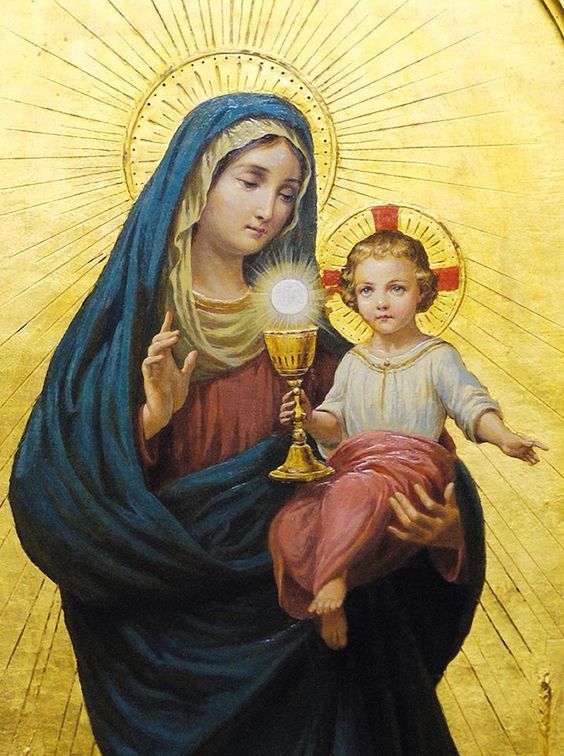
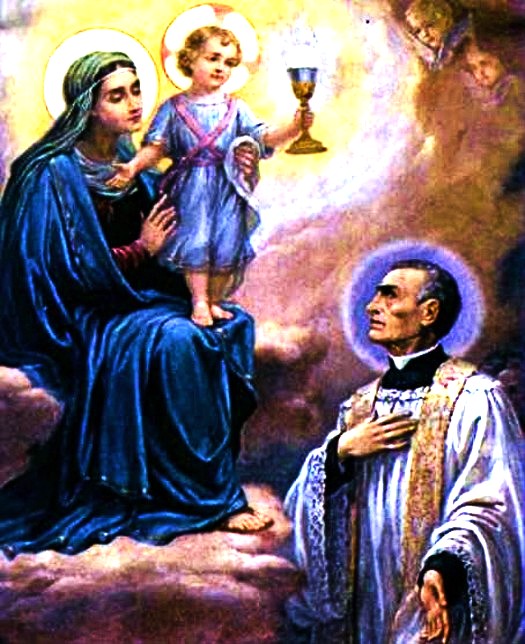
Our Lady of the Most Blessed Sacrament: St Peter Julian Eymard (1811-1868) and Our Lady of the Blessed Sacrament:
The title of Our Lady of the Blessed Sacrament was first given to Mary by St Peter Julian Eymard in May 1868, while speaking to his novices. A few years later he described what her statue should look like: “The Blessed Virgin holds the Infant in her arms and He holds a chalice in one hand and a Host in the other.”
He exhorted them to invoke Mary: “Our Lady of the Blessed Sacrament, pray for us who have recourse to thee!”
St Anno of Verona St Argentea of Cordoba St Euthymius the Illuminator Bl Fortis Gabrielli Bl Gerard of Villamagna Bl Gemma of Goriano St Glyceria of Trajanopolis Blessed Imelda Lambertini (1322-1333) Child Mystic St John the Silent
St Lucius of Constantinople St Mael of Bardsey Bl Magdalen Albrizzi St Merewenna of Rumsey St Mucius of Byzantium St Natalis of Milan St Onesimus of Soissons St Servatus of Tongres St Valerian of Auxerre — Martyrs of Alexandria: A group of Catholic Christians martyred in the church of Theonas, Alexandria, Egypt by order of the Arian Emperor Valens. Their names have not come down to us. 372 in Alexandria, Egypt.


















 AnaStpaul
You must be logged in to post a comment.