Our Lady of the Expectation – This Feast originated in Spain. When the feast of the Annunciation (25 March) was transferred to 18 December because of the regulation forbidding feasts in Lent, it remained on this date after the Annunciation was again celebrated on its original date. It impressed on the faithful, the sentiments of the Blessed Virgin as the time of her delivery approached.
St Malachi the Prophet St Mawnan of Cornwall Bl Miguel San Román Fernández St Phaolô Nguyen Van My St Phêrô Truong Van Ðuong St Phêrô Vu Van Truat Bl Philip of Ratzeburg St Rufus of Philippi St Samthann of Clonbroney St Theotimus of Laodicea St Winebald OSB (c 701-761) Priest, Abbot St Zosimus of Philippi
Martyrs of Northwest Africa – 42 saints: Mercedarian Redeemers – 6 beati – These are a group of Mercedarian friars who worked together, under the leadership of Saint Peter de Amer, to ransom (e.g., redeem) prisoners and minister to them after.
Thought for the Day – 17 December – Meditations with Antonio Cardinal Bacci (1881-1971)
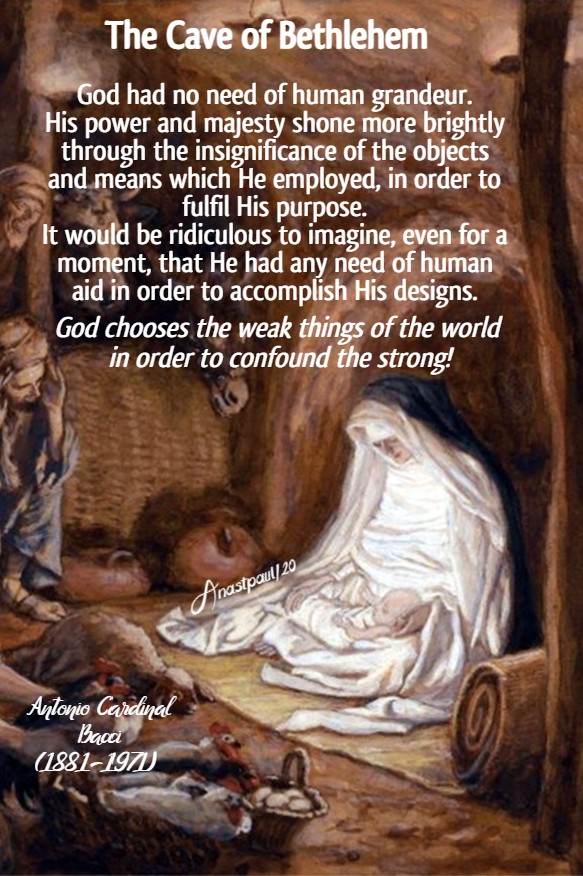
The Cave of Bethlehem
“Why, asked Bossuet, should the Eternal Word of God, infinitely and everlastingly happy, have deigned to assume in time, the fallen state of humanity? Why should He have chosen, as the scene of His miraculous life of love, this insignificant world, a planet almost imperceptible among the myriads of gigantic heavenly bodies? It was for the very same reason, Bossuet replied, that propmpted Him, once He had become man, to choose as His birthplace, the tiny and unknown village of Nazareth in Galilee rather than Rome, the centre of power, or Athens, the centre of learning, or Jerusalem, the capital of the State of Israel. Our world is the Nazareth of creation, one of the smallest planets in the firmament.
God did not even choose, moreover, to be born in the poor but comparatively comfortable house at Nazareth. He preferred to be born in the strange town of Bethlehem. It was the cradle of His ancestral line but it gave Him no welcome and compelled Him to be born in a cold and squalid barn on the straw of a manger. God had no need of human grandeur. His power and majesty shone more brightly through the insignificance of the objects and means which He employed in order to fulfil His purpose. It would be ridiculous to imagine, even for a moment, that He had any need of human aid in order to accomplish His designs. God chooses the weak things of the world in order to confound the strong!” (Missale Romanum, Miss. Virg et Mart).
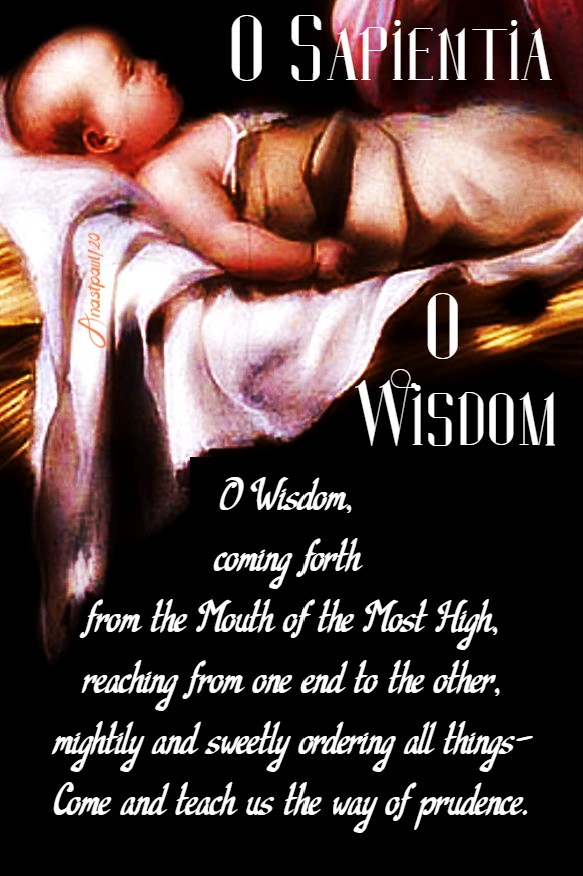
O Sapientia, quae ex ore Altissimi prodiisti, attingens a fine usque ad finem, fortiter suaviterque disponens omnia- veni ad docendum nos viam prudentiae.
O Wisdom, coming forth from the Mouth of the Most High, reaching from one end to the other, mightily and sweetly ordering all things- Come and teach us the way of prudence.
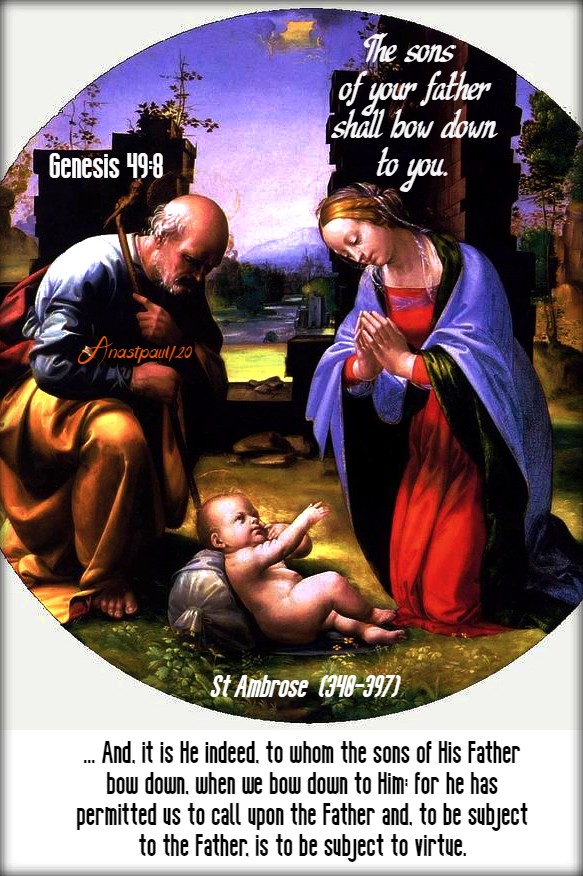
“You, Judah, shall your brothers praise your hand on the neck of your enemies; the sons of your father shall bow down to you.” – Genesis 49:8
REFLECTION – “This text appears to be directed to the Patriarch Judah, indeed but more so that later Judah is meant, the true Confessor who was born of that tribe and who alone is praised by His brothers; of them He says, “I will declare your name to my brothers.” He is the Lord by nature but a brother by grace; His hands, which He stretched out to an unbelieving people, are on the back of His enemies. For with those same hands and by that same passion, Christ protected His own, subjugated hostile powers and made subject to Himself, all people who were without faith and devotion. Of these the Father says to His Son, “And you will rule in the midst of your enemies.” It was their own wickedness that made them enemies, not Christ’s will. In this there is a great gift of the Lord. Previously, spiritual wickedness generally used to make our neck bend to the yoke of captivity. Thus even David wrote that he felt, in some way, the hands of those who triumphed over him, for he said, “Upon my back sinners have wrought.” But now spiritual wickedness is subject to the triumph of Christ and to His hands, as it were; that is, wickedness undergoes the affliction of captivity, being subject forever in deeds and in works. And, it is He indeed, to whom the sons of His Father bow down, when we bow down to Him; for he has permitted us to call upon the Father and, to be subject to the Father, is to be subject to virtue.” – St Ambrose (340-397) One of the original four Doctors of the Latin Church – (The Patriarchs, 4)
PRAYER – Collect: O God, Creator and Redeemer of human nature, Who willed that Your Word should take flesh in an ever-virgin womb, look with favour on our prayers, that Your only Begotten Son, having taken to Himself our humanity, may be pleased to grant us a share in his divinity. Who lives and reigns with You in the unity of the Holy Spirit, one God, for ever and ever. Amen
Rejoice! Rejoice! Emmanuel Shall come to thee, O Israel
Our Morning Offering – 17 December – O Wisdom/O Sapientia
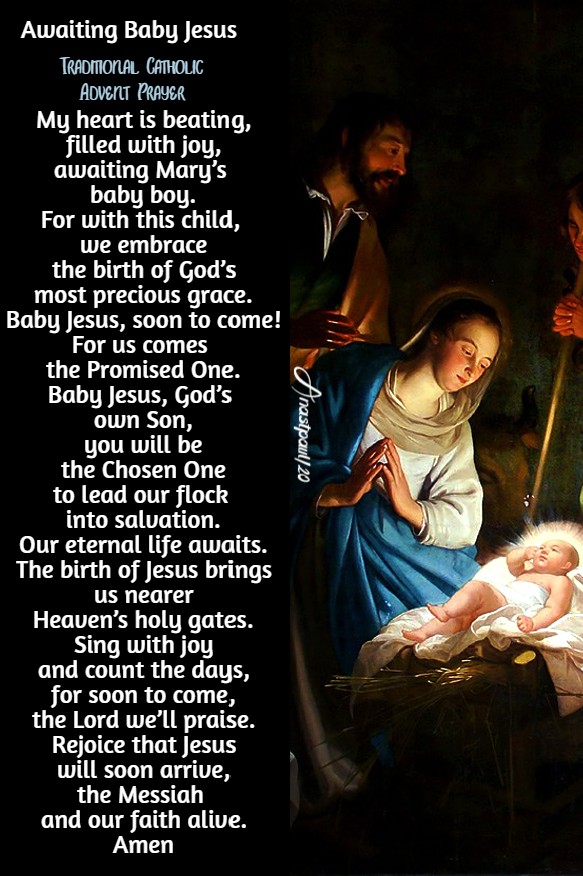
Awaiting Baby Jesus Traditional Catholic Advent Prayer
My heart is beating, filled with joy, awaiting Mary’s baby boy. For with this child, we embrace the birth of God’s most precious grace. Baby Jesus, soon to come! For us comes the Promised One. Baby Jesus, God’s own Son, you will be the Chosen One to lead our flock into salvation. Our eternal life awaits. The birth of Jesus brings us nearer Heaven’s holy gates. Sing with joy and count the days, for soon to come, the Lord we’ll praise. Rejoice that Jesus will soon arrive, the Messiah and our faith alive. Amen
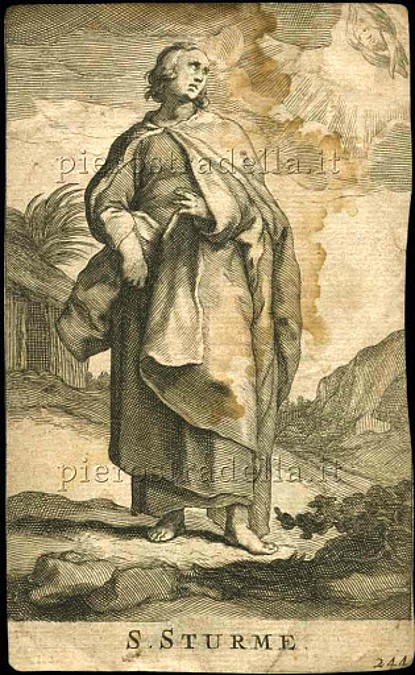
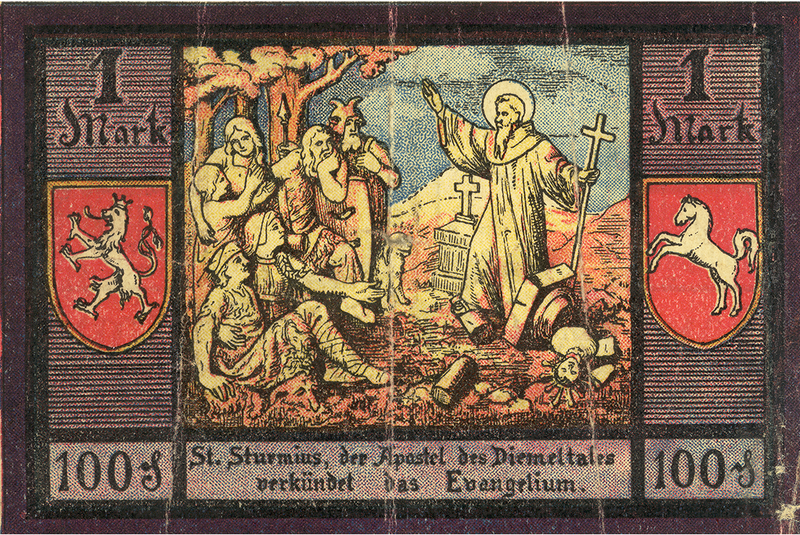
Saint of the Day – 17 December – Saint Sturmi of Fulda (c 705-779) Priest, Monk and Abbot, Missionary, disciple of Saint Boniface and Founder and first Abbot of the Benedictine Monastery and Abbey of Fulda. Sturmi’s tenure as Abbot lasted from 747 until 779. Also known as Apostle of the Saxons, Apostle of Germany, Sturm, Sturmius.
St Sturmi (kneeling) with St Boniface
Sturmi was born c 705 in Lorch, Austria and was most likely related to the Agilolfing Dukes of Bavaria. He met Saint Boniface when the latter was carrying out the church reorganisation in Bavaria and Austria (founding the Bishoprics of Salzburg, Regensburg and Würzburg). He joined Boniface and was educated in the Benedictine monastery of Fritzlar by Abbot Saint Wigbert. He was then active as a Missionary in northern Hesse, where in 736 he established a monastic settlement in Haerulfisfeld (Hersfeld).
Sturmi was Ordained in 740 as Priest in Fritzlar. In 744 he was instructed by St Boniface in 744 to establish a Monastery in the region of Eichloha, which had been granted to Boniface by the Frankish Mayor of the Palace Carloman. He established the Monastery in the ruins of a 6th-century Merovingian royal camp, destroyed 50 years earlier by the Saxons, at a ford on the Fulda River.
Following studies at St Benedict’s Monastery in Monte Cassino in 747–748, Sturmi was named first Abbot of the Fulda Monastery by St Boniface. In 751, St Boniface and his disciple and successor Lullus, obtained an exemption for Fulda, having it placed directly under the Papal See and making it independent of interference by Bishops or worldly princes.
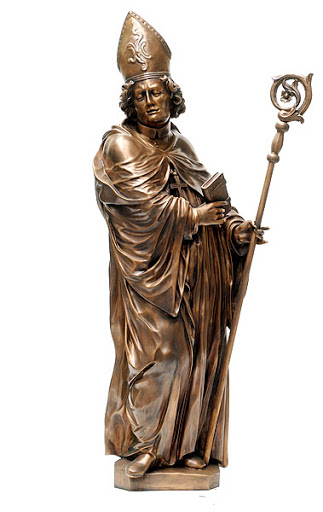
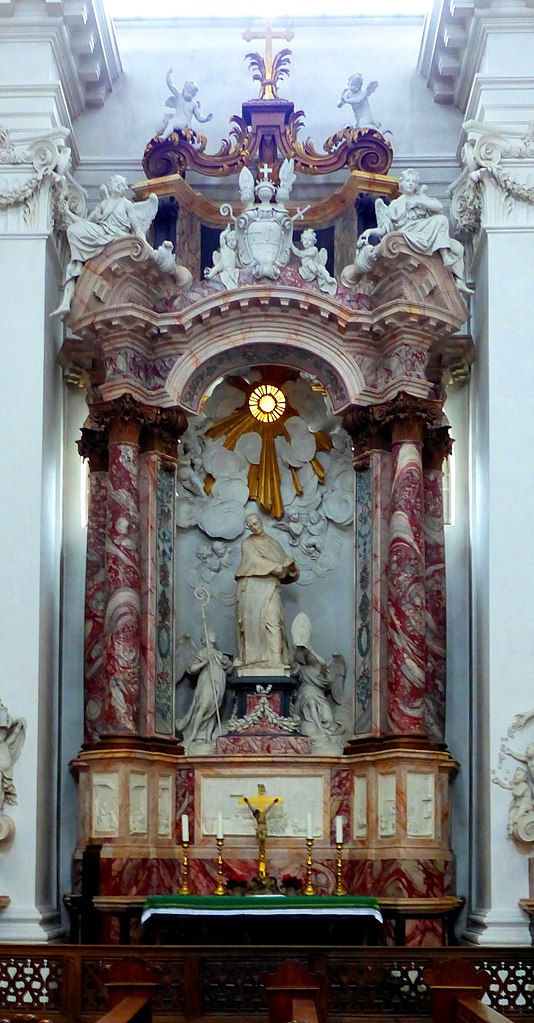
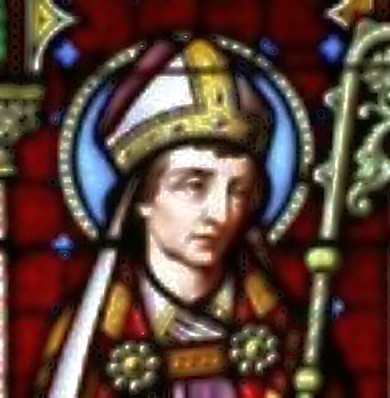
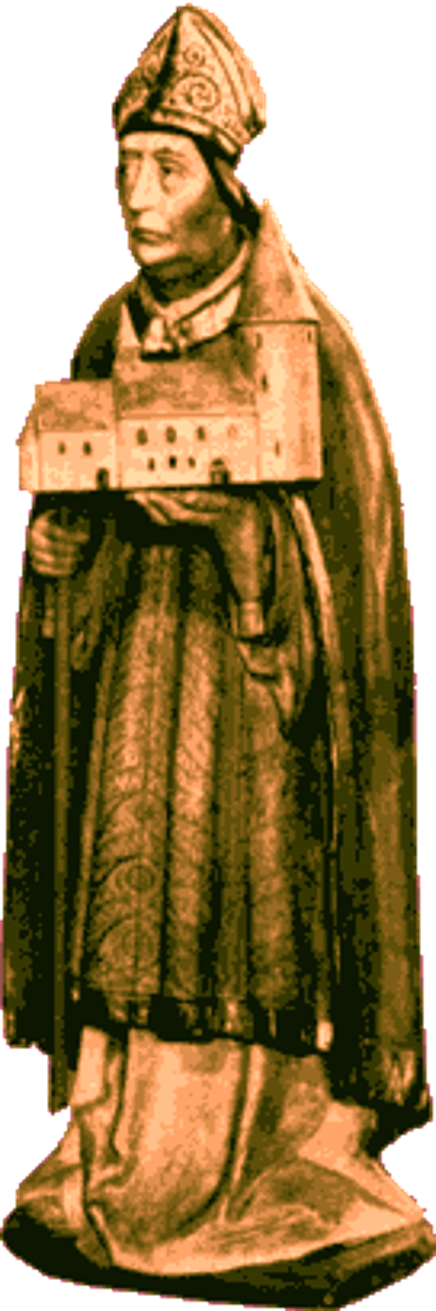
This is St Sturmi, I don’t know why he wears a Bishop’s Mitre
After the death of St Boniface, this exemption led to serious conflicts between Lullus, then Archbishop of Mainz and Abbot Sturmi. Nevertheless, Sturmi prevailed over the Bishops of Mainz and Utrecht in having Boniface, buried in Fulda after his Martyrdom in 754. This made Fulda a major place of pilgrimage for many peoples, including Anglo-Saxons and brought much prestige and a stream of gifts and donations to Fulda.
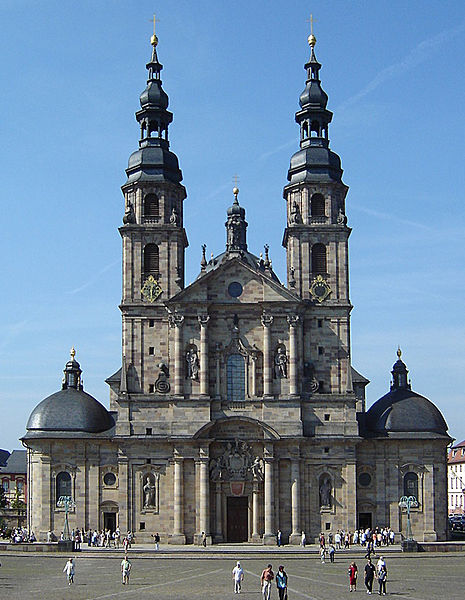
Building on this success, Sturmi was able to fend off efforts by the Bishops of Mainz and Würzburg to invalidate the Abbey’s exemption. He was sent into exile from 763 to 765 at Jumièges (Normandy) but was rehabilitated in 765 by Pippin the Younger. In 774, the Abbey of Fulda received Royal protection from Charlemagne. In the same year, Fulda was assigned missionary territories in heathen Saxony. Sturmi later established the Abbey of St Boniface at Hamelin. In 779, he accompanied Charlemagne into Saxony but fell ill and died soon after returning to Fulda on 17 December 779, where he was buried in the Cathedral.
Fulda Abbey Cathedral
Sturmi was recognised as a Saint prior to the East–West Schism in 1054, hence the Orthodox Church continues to honour him. He was formally Canonised in 1139 by Pope Innocent II. His life was recorded in the Vita Sturmi by the fourth Abbot of Fulda, Eigil of Fulda (died 822[1]), a relative of his, who had been a Monk in Fulda for over 20 years under Abbot Sturmi.
Martyrs of Eleutheropolis – (60+ Martyrs-Beati): Approximately 60 Christian soldiers in the imperial Roman army of emperor Heraclius; they were murdered as a group for their faith by invading Saracen Muslims. We know the names of two of them – Calaoicus and Florian. 638 in Eleutheropolis (Beit Jibrin), Palestine.
On Rogation and Ember Days, the Church is accustomed to entreat the Lord for the various needs of humanity, especially for the fruits of the earth and for human labour and to give thanks to Him publicly. Four times a year, approximately three months apart, near the beginning of each season of the solar cycle (winter, spring, summer and autumn), the Church sets aside three days (a total of twelve days in a year) to ask for blessings upon mankind and to pray in gratitude for the blessings of nature, particularly those used by the Church in her Liturgy, such as olives, grape, and wheat. This is also a time set apart to thank God for the Sacraments and pray for Priests, particularly those who were being ordained. These days are marked with prayer, fasting and abstinence and stress spiritual renewal.
The word “Ember” actually comes from the Latin phrase, Quatuor Tempora, meaning four times.
This is an ancient tradition of the Church. St Pope Leo the Great, in the 5th century, mentioned the Ember Day Fasts, pointing to these fasts as stemming from Old Testament and Apostolic tradition.
Ember Days are still a vital part of the Church’s tradition.
The traditional dates for the Ember days are the Wednesday, Friday and Saturday:
After St. Lucy’s feast day, 13 December After the First Sunday of Lent After Pentecost (this would be during the traditional octave of Pentecost) After the Feast of the Exaltation of the Holy Cross, 14 September
These times are spent fasting and partially abstaining in penance and prayer, with the intentions of thanking God for the gifts He gives us in nature and beseeching Him for the discipline to use them in moderation. The fasts, known as “Jejunia quatuor temporum,” or “the fast of the four seasons,” are rooted in Old Testament practices of fasting four times a year:
Zacharias 8:19: Thus saith the Lord of hosts: The fast of the fourth month and the fast of the fifth and the fast of the seventh and the fast of the tenth shall be to the house of Juda, joy and gladness, and great solemnities: only love ye truth and peace.
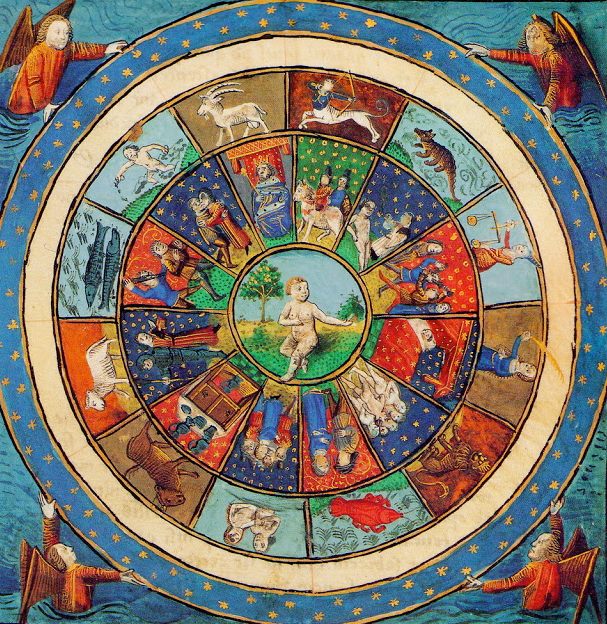
This painting is called “Seasons” and is by St Hildegard von Bingen OSB (1098-1179) – Doctor of the Church
Why Wednesday, Friday and Saturday?
Because Ember Days are of ancient tradition, there are Station Churches attached to the Ember Days, each with a different focus on each day of ember week.
All four Ember Wednesdays were celebrated in the station church St Mary Major. Wednesday was traditionally devoted to our Lady and in imitation of her it was a day of reflection and spiritual orientation. All four Ember Fridays take place in the stational church of the Basilica of the Apostles. Father Pius Parsch says: “Ember Friday is the liturgy’s ‘Yom Kippur.’” Friday recalls Christ’s passion and death and emphasises conversion and penance. All the Ember Saturdays take place in the stational church of St Peter in the Vatican. Saturday is a preview of Easter and it marks the renewal of our baptismal covenant.
A new house often comes with many challenges and trials. I have missed you all in the last 3 days as we struggled with along with no internet, again! Fr Jacques (https://jacques172.com/) had wished that in this new home we might be freed from such problems but, sadly this was not to be. As well as no internet, we also were in total darkness for 2+ days! But no trial is without value, our beloved Lord had His good reasons.
Thought for the Day – 16 December – Meditations with Antonio Cardinal Bacci (1881-1971)
The Lamb of God
“Jesus had only one consolation in the midst of His terrible sufferings. His mother, Mary was beside the Cross along with His beloved Apostle and the holy women who had always followed Him. Mary loved her Son with a love greater than that of any mother, which is the greatest love possible on earth. She loved Jesus with the heart of a Mother and of a Virgin – He was her only treasure. Moreover, she loved Him, not only as her Son but, also as her God. Precisely because she loved Him as her God, her love was in perfect harmony with the divine will.
She understood the mystery which led Jesus to accept death on the Cross – the mystery of the Redemption. “He was offered because it was his own will” (Isa 53:7). He was offered on our behalf, as a voluntary victim to His heavenly Father.”
Quote/s of the Day – 16 December – Wednesday of the Third week of Advent
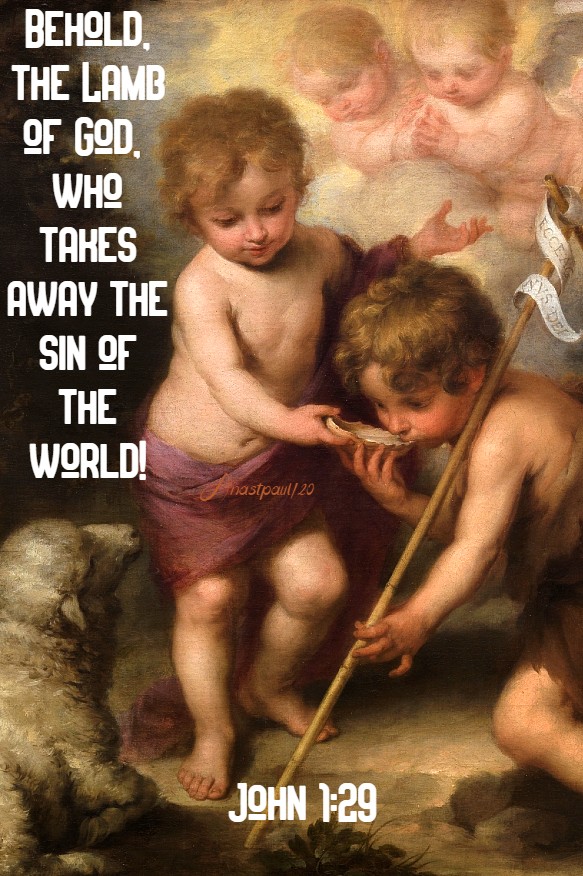
The Lamb of God
“Behold, the Lamb of God, who takes away the sin of the world!”
John 1:29
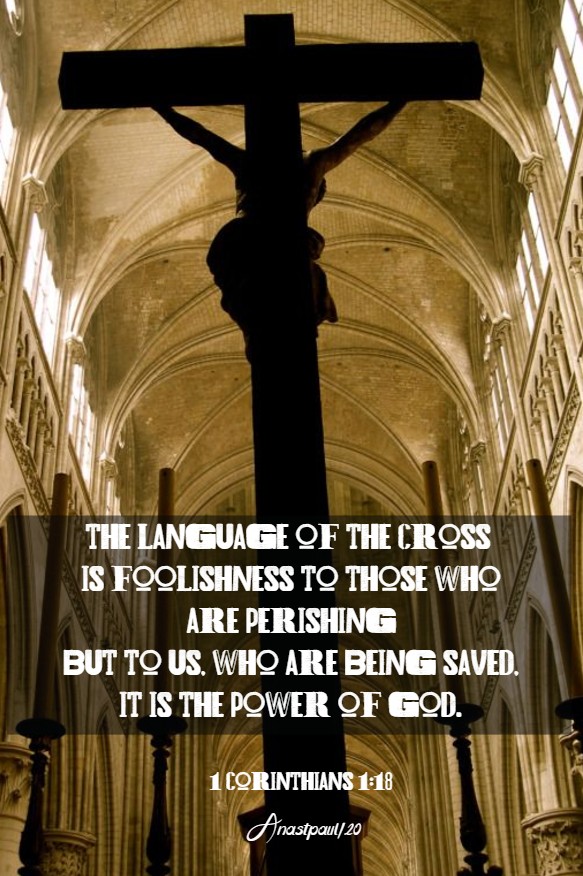
“The language of the cross is foolishness to those who are perishing but to us, who are being saved, it is the power of God”
1 Corinthians 1:18
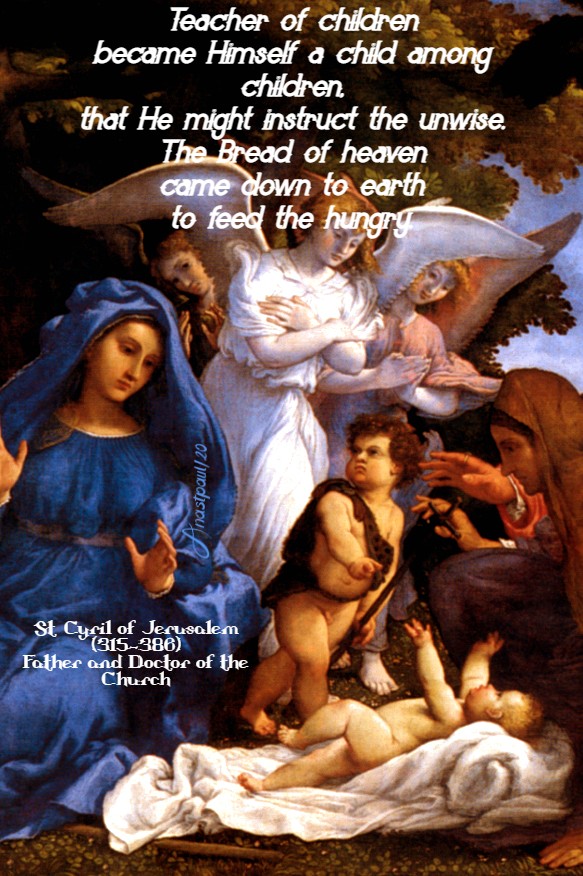
“Teacher of children became Himself a child among children, that He might instruct the unwise. The Bread of heaven came down to earth to feed the hungry.”
St Cyril of Jerusalem (315-386) Father and Doctor of the Church
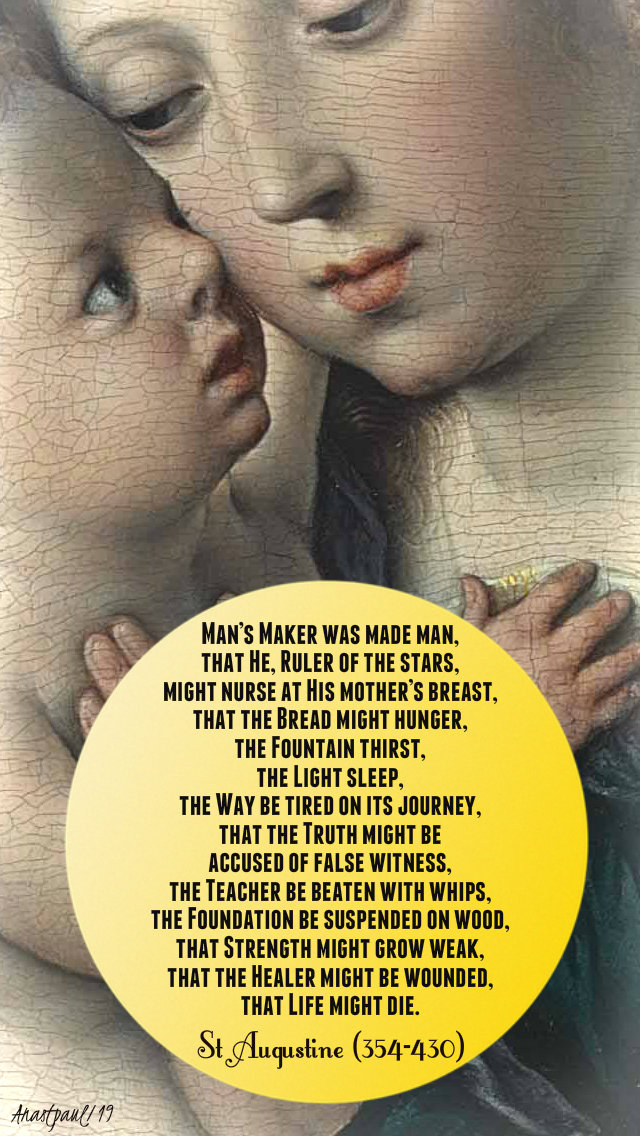
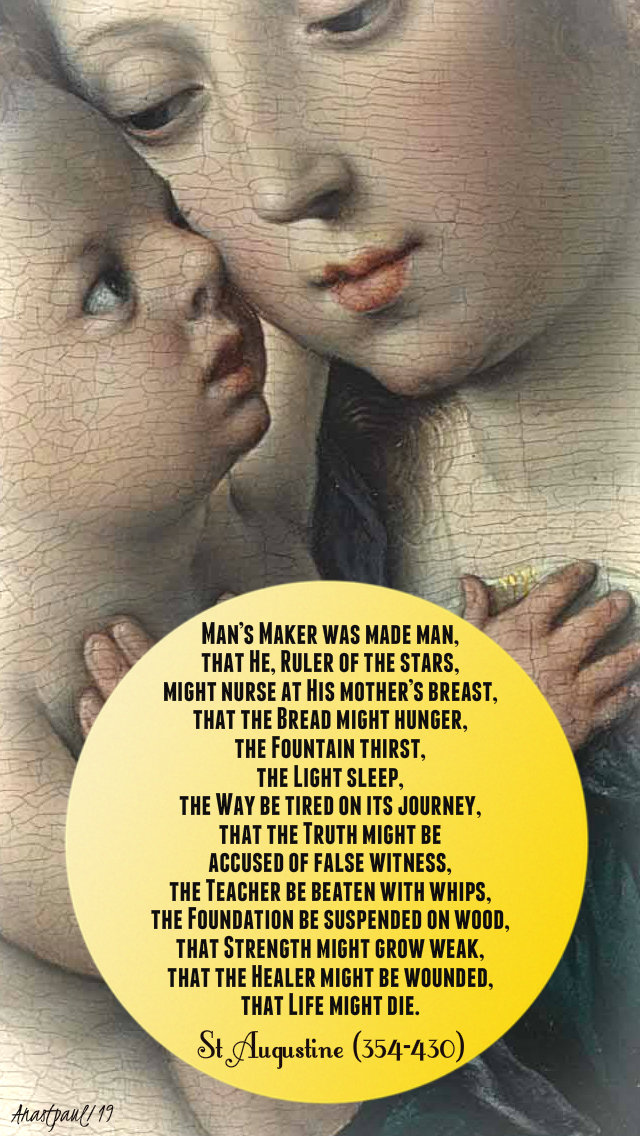
“Man’s Maker was made man, that He, Ruler of the stars, might nurse at His mother’s breast, that the Bread might hunger, the Fountain thirst, the Light sleep, the Way be tired on its journey, that the Truth might be accused of false witness, the Teacher be beaten with whips, the Foundation be suspended on wood, that Strength might grow weak, that the Healer might be wounded, that Life might die.”
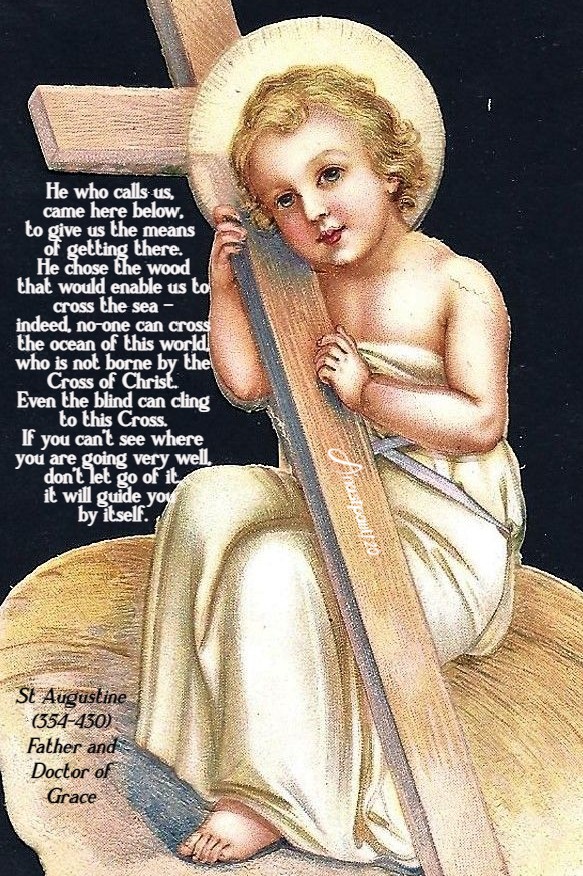
“He who calls us, came here below, to give us the means of getting there. He chose the wood that would enable us to cross the sea – indeed, no-one can cross the ocean of this world, who is not borne by the Cross of Christ. Even the blind can cling to this Cross. If you can’t see where you are going very well, don’t let go of it, it will guide you by itself.”
St Augustine (354-430) Father and Doctor of Grace
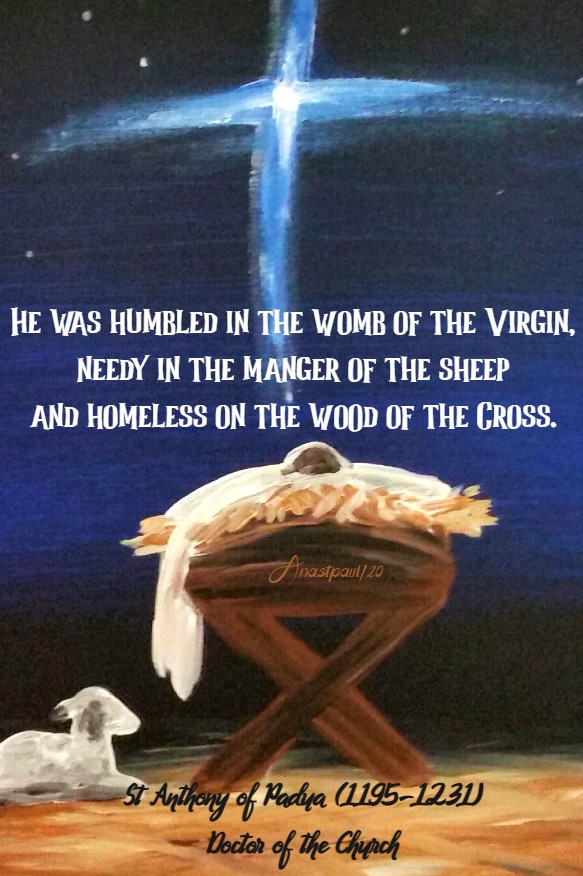
“He was humbled in the womb of the Virgin, needy in the manger of the sheep and homeless on the wood of the Cross.”
St Anthony of Padua (1195-1231) Doctor of the Church
Advent Reflection – 16 December – Wednesday of the Third week of Advent, Readings: Isaiah 45:6-8, 18, 21-25, Psalms 85:9 and 10, 11-12, 13-14, Luke 7:18-23
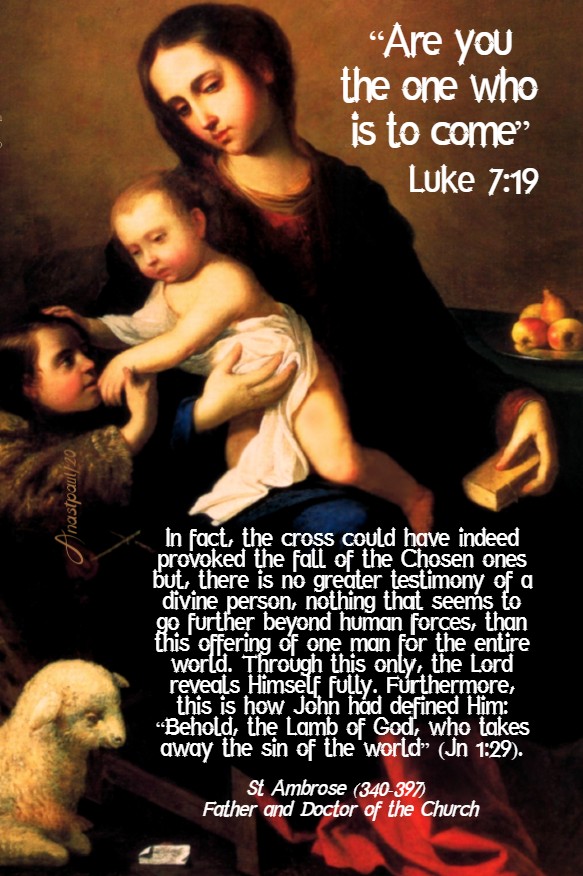
“Are you the one who is to come” … Luke 7:19
REFLECTION – “The Lord, knowing that without the Gospel nobody’s faith may be complete – for the Sacred Scripture begins from the Old Testament but is brought to fulfilment by the New – does not answer questions about Himself, with words but, by acts. “Go, he says and tell John what you have seen and heard – the blind regain their sight, the lame walk, lepers are cleansed, the deaf hear, the dead are raised, the poor have the good news proclaimed to them.” This testimony is complete because, it is of Him they had prophesied: “The Lord sets prisoners free; the Lord gives sight to the blind. The Lord raises up those who are bowed down … The Lord shall reign forever, through all generations!” (Ps 145[146]:7f). These are the signs of a power that is not human but divine … And yet these are only the least examples of the testimony given by Christ. What makes the fullness of faith is the Lord’s cross, His death, His burial. This is why, after giving the answer we have quoted, He also says: “And blessed is the one who takes no offence at me.” In fact, the cross could have indeed provoked the fall of the Chosen ones but, there is no greater testimony of a divine person, nothing that seems to go further beyond human forces, than this offering of one man for the entire world. Through this only, the Lord reveals Himself fully. Furthermore, this is how John had defined Him: “Behold, the Lamb of God, who takes away the sin of the world” (Jn 1:29). – St Ambrose (340-397) Bishop of Milan and Father and Doctor of the Church – Commentary on the Gospel of Luke, 5, 99-102
PRAYER – Almighty God, let the splendour of Your glory dawn in our hearts. May the coming of Your only Son dispel all darkness and reveal that we are children of light. By the care and love of Your Mother and ours, may we be ever strong as we carry our own crosses after You. Through Jesus Christ our Lord, in union with the Holy Spirit, one God forever and ever, amen.
Our Morning Offering – 16 December – Wednesday of the Third week of Advent
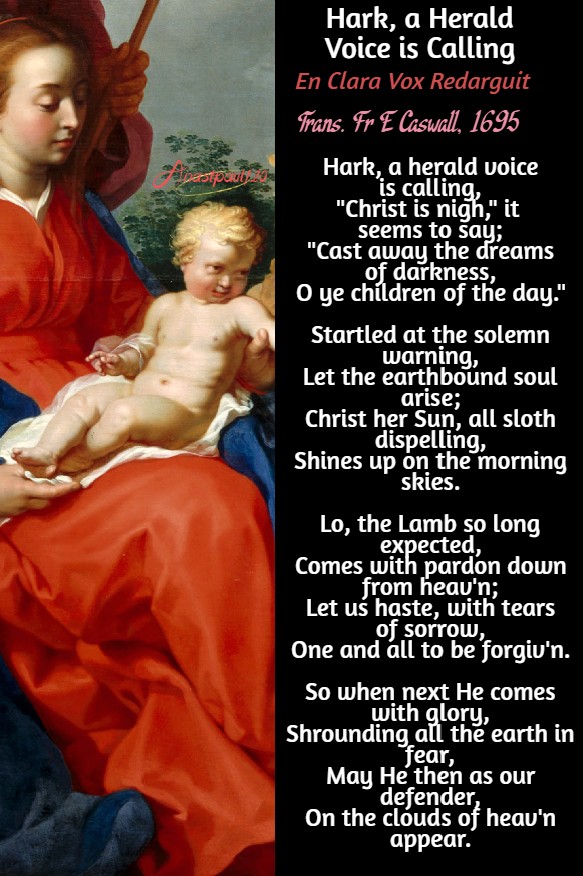
Hark, a Herald Voice is Calling En Clara Vox Redarguit Trans. Fr E Caswall, 1695
Hark, a herald voice is calling, “Christ is nigh,” it seems to say; “Cast away the dreams of darkness, O ye children of the day.”
Startled at the solemn warning, Let the earthbound soul arise; Christ her Sun, all sloth dispelling, Shines up on the morning skies.
Lo, the Lamb so long expected, Comes with pardon down from heav’n; Let us haste, with tears of sorrow, One and all to be forgiv’n.
So when next He comes with glory, Shrounding all the earth in fear, May He then as our defender, On the clouds of heav’n appear.
Translated from En Clara Vox Redarguit, which is a 5th or 6th century hymn whose author is unknown. It was revised in the 1632 Roman Breviary and the English translation found above, is by Fr E Caswall, 1695.
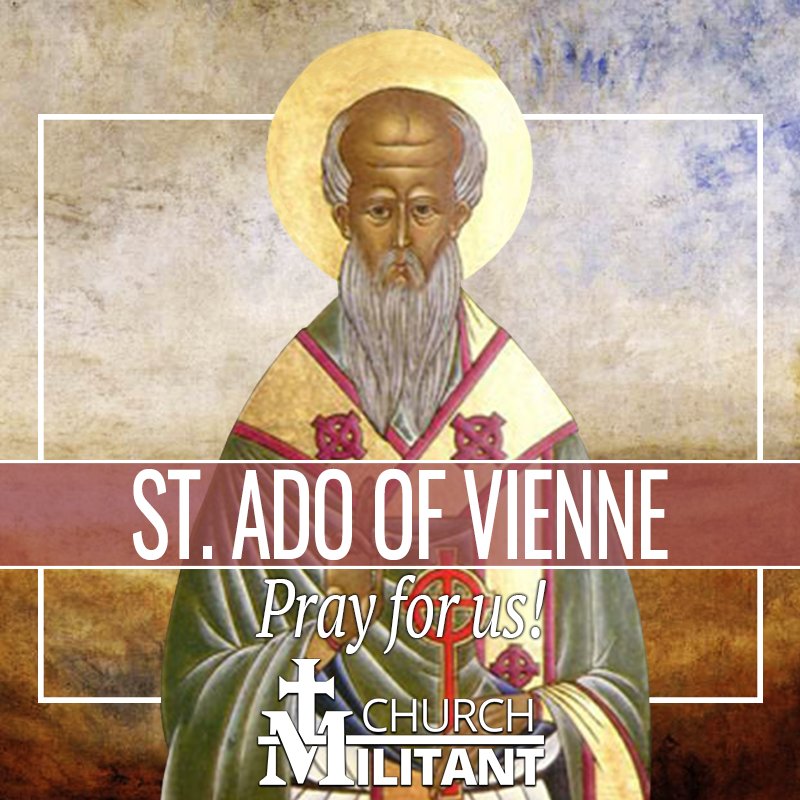
Saint of the Day – 16 December – Saint Ado of Vienne (Died 875) Archbishop of Vienne from 850 until his death, Writer, Reformer – Born in Sens, France and died in 875 in Vienne, France of natural causes. Also known as Adon, Adonis. Several of his letters are extant and reveal their writer as an energetic man of wide sympathies and considerable influence.
Ado was born into a noble family and was sent as a child for his education, first to Sigulfe, Abbot of Ferrières and then to Marcward, Abbot of Prüm near Trier. He had as one of his masters, the Benedictine Abbot Lupus Servatus, one of the most celebrated humanists of those times. By his brilliant talents and assiduous application, Ado gained the esteem of his masters and schoolmates, while his ready obedience, deep humility and sincere piety foreshadowed his future holiness.
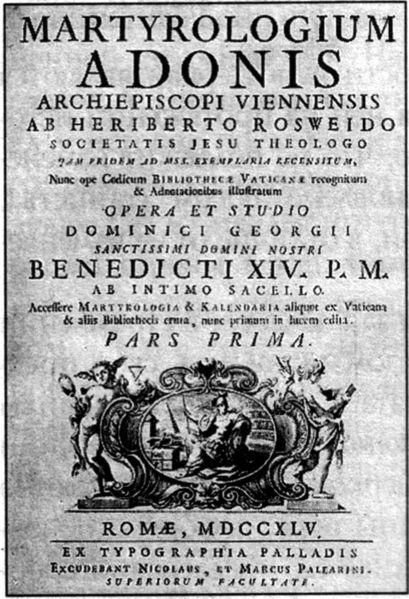
Though urged on all sides to enter upon a career in the world, to which his nobility of birth and great intellectual abilities entitled him, he consecrated himself entirely to God by taking the Benedictine habit at Ferrières. When Markward, a Monk of Ferrières, became Abbot of Prüm near Trier, he applied for Ado to teach the sacred sciences there. His request was granted. Soon, however, certain envious Monks of Prüm conceived an implacable hatred against Ado, due to his great intellect, humility and holiness and, upon the death of Markward, turned him out of their Monastery. With the permission of his Abbot, Ado now made a pilgrimage to Rome, where he remained five years. He then went to Ravenna, where he discovered an old Roman Martyrology which served as the basis for his own renowned Martyrology published in 858, which is generally known as the Martyrology of Ado. At Lyons he was received with open arms by the Archbishop, St Remigius, who, with the consent of the Abbot of Ferrières, appointed him pastor of the Church of St Roman near Vienne.
In 860 he became Archbishop of Vienne and a year later received the pallium from Pope Nicholas I. By word and exampl,e he began reforming the laxity of his priests and he gave them strict orders to instruct the laity in the necessary doctrines of Christianity. His own life was a model of humility and austerity. Ado participated in the Council of Tousy, near Toul in Lorraine, on 22 October 860 and held a council at Vienne in 870.
When Lothaire II, King of Lorraine, had unjustly dismissed his wife Theutberga and the papal legates at the Synod of Metz had been bribed to sanction the King’s marriage to his concubine Waldrada, Ado hastened to Rome and reported the crime to the Pope, who, thereupon, annulled the acts of the synod.
Besides the Martyrology mentioned above, Ado wrote a chronicle from the beginning of the world to 874, Chronicon de VI ætatibus mundi and the lives of St Desiderius, St Bernard – a previous Bishop of Vienne and St Theuderius.
Ado’s name is in the Roman Martyrology and at Vienne, his feast is celebrated on 16 December, the day of his death. His body was buried in the Church of the Apostles in Vienne, now called St Peter’s Church, the usual place of burial of the archbishops of Vienne.
Martyrs of Ravenna – (4 saints): A group of Christians martyred together. Four names and no other information has survived – Agricola, Concordius, Navalis and Valentine. c 305 at Ravenna, Italy.
Thought for the Day – 12 December – Meditations with Antonio Cardinal Bacci (1881-1971)
The Theological Virtues of Our Lady
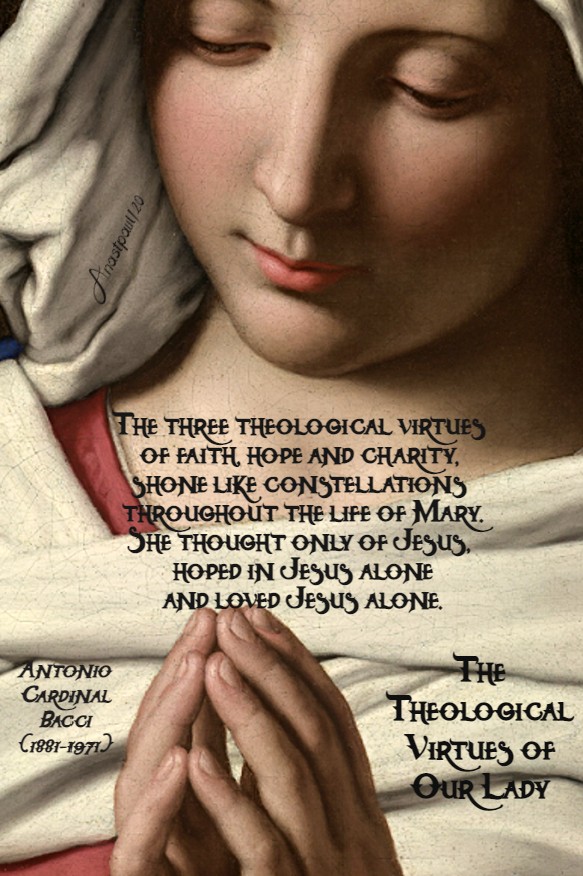
“The three theological virtues of faith, hope and charity, shone like constellations throughout the life of Mary. “Blessed is she who has believed” (Lk 1:45), St Elizabeth said of her. Mary’s life was one long act of faith and of love. She lived continuously in the presence of God, being united to Him by lively sentiments of faith, hope and charity. Her spirit of constant prayer was the result of her intense practice of these theological virtues. When the Archangel Gabriel came down from Heaven, to bring her the tidings of her divine motherhood, he found her absorbed in prayer. When St Elizabeth praised and called her the Mother of her Lord, Mary, from the depths of her faith, attributed everything to God and glorified Him in her Magnificat. When the baby Jesus was born in the cave of Bethlehem, she adored Him with faith, hope and love, as her God and future Saviour. When she realised that Herod was searching for her Son to put Him to death, she placed her confidence in Him. She fled with Him into Egypt and brought Him back later, to their land, always with the same faith, hope and love. Her faith and hope were not weakened by the loss of Jesus in Jerusalem, only her mother’s love was disturbed, on this occasion. When it seemed in that hidden life of Nazareth, that Jesus was leading a life of pointless silence, her faith and hope in Him, did not fade, while her love grew greater from day to day. In the triumphs and sorrows of His public life, she continued to practice, to an extraordinary degree, these three virtues – on the road to Calvary, at the foot of the Cross, at the removal of Our Lord’s body from the Cross, at the tomb, at the glorious Resurrection, Ascension and Pentecost. At last, when she was alone in this world without Jesus, these three virtues seemed to burn more brightly in her soul. She thought only of Jesus, hoped in Jesus alone and loved Jesus alone. Then Jesus rewarded the lively faith, expectant hope and flaming charity of His Mother, for on her assumption into Heaven, these three virtues shared in her triumph and coronation.”
Quote/s of the Day – 12 December – “Month of the Immaculate Conception” – Feast of Our Lady of Guadalupe, Readings: Zechariah 2:14-17, Judith 13:18, 19, Luke 1:26-38.
“And if any man will not receive His birth from a virgin, how shall he receive His resurrection from the dead? For it is nothing wonderful and astonishing and extraordinary, if one who was not born, rose from the dead – nay indeed, we cannot speak of a resurrection of him who came unto being without birth. For one who is unborn and immortal and has not undergone birth, will also not undergo death. For He, who took not the beginning of man, how could He receive His end?”
St Irenaeus (130-202) Martyr, Theologian, Father
“What shall we say, brethren? Is she not our mother? Certainly, brethren, she is in truth our mother. Through her we are born, not to the world but to God.”
“Scripture says, ‘Praise the Lord in his saints’. If the Lord is to be praised in those saints through whom He performs mighty works and miracles, how much more should He be praised in HER, in whom He fashioned Himself, He who is wonderful beyond all wonder.”
St Aelred of Rievaulx (1110-1167) From his sermons – Sermon 20
Advent Reflection – 12 December – Feast of Our Lady of Guadalupe, Readings: Zechariah 2:14-17, Judith 13:18, 19, Luke 1:26-38.
Then the angel said to her, “Do not be afraid, Mary, for you have found favour with God. Behold, you will conceive in your womb and bear a son and you shall name him Jesus.” – Luke 1:30-31
REFLECTION – “Most blessed are you among women and blessed is the fruit of your womb ” For all ages will call you blessed, as you said (Lk 1:48). The daughters of Jerusalem, that is to say, the Church, saw you and proclaimed your happiness … For you are the royal throne near which the angels stood contemplating their Master and Creator, who was seated on it (Dan 7:9). You have become the spiritual Eden, more sacred and more divine than the former one. The earthly Adam lived in the former; in you, lives the Lord who came from heaven (1 Cor 15:47). Noah’s ark was a prefiguration of you; it saved the seed of the second creation, for you gave birth to Christ, the world’s salvation, who submerged sin and pacified the floods.
It was you whom the burning bush described ahead of time, whom the tablets depicted, on which God wrote (Ex 31:18), which the ark of the covenant told about; it is you whom the golden urn, the candelabra … and Aaron’s staff that blossomed (Num 17:23) clearly prefigured. … I almost left out Jacob’s ladder. Just as Jacob saw heaven united with the earth by means of the two ends of the ladder and the angels descending and ascending on it and as the one who is really the strong and invincible one engaged in a symbolic struggle with him, thus you yourself became the mediator and ladder by which God came down to us and took upon Himself the weakness of our substance, embracing it and closely uniting it to Himself.” – St John Damascene (675-749) Monk, Theologian, Father and Doctor of the Church – 1st Sermon on the Dormition
PRAYER – Lord Jesus Christ my Lord, help me to become a devoted client of Your holy Mother Mary. Through Your grace, may I receive the spiritual strength she has promised to all her clients. May I, in simplicity, like St Juan Diego, become her vessel to share Your Light, throughout my world. Our Lady of Guadalupe Pray for us! Jesus Christ, our Lord, one God with the Father and the Holy Spirit, now and for all ages, amen.
Our Morning Offering – 12 December – “Month of the Immaculate Conception” – Feast of Our Lady of Guadalupe, Readings: Zechariah 2:14-17, Judith 13:18, 19, Luke 1:26-38.
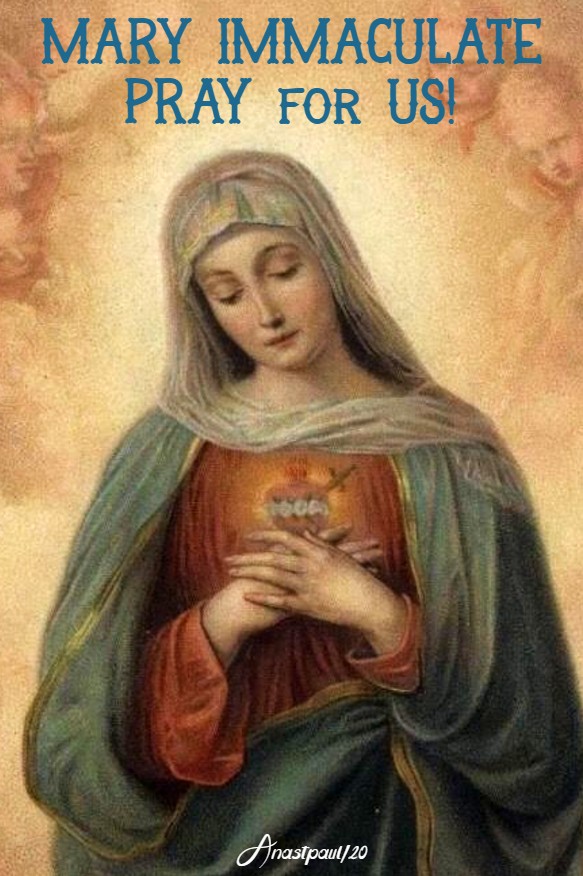
Mary Immaculate! By St John Damascene (675-749) Father and Doctor of the Church
Today, the root of Jesse has produced its shoot, she will bring forth a Divine flower for the world. Today, the Creator of all things, God the Word, composes a new book: a book issuing from the heart of His Father and written by the Holy Spirit, who is the tongue to God.
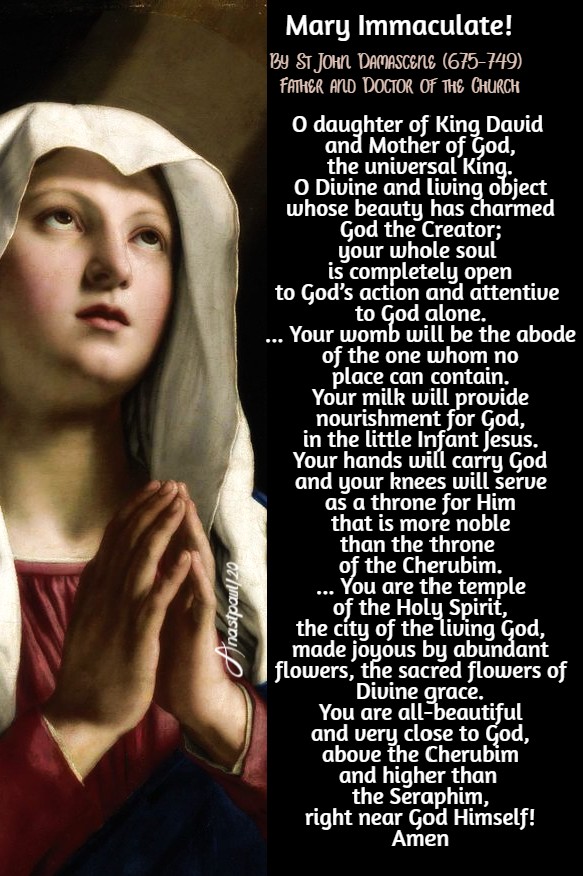
O daughter of King David and Mother of God, the universal King. O Divine and living object whose beauty has charmed God the Creator; your whole soul is completely open to God’s action and attentive to God alone.
All your desires are centred only on what merits to be sought and is worthy of love. You harbour anger only for sin and its author. You will have a life superior to nature, but not for your own sake. For it has not been created for you but has been entirely consecrated to God, who has introduced you into the world to help bring about our salvation in fulfillment of His plan, the Incarnation of His Son and the Divinisation of the human race.
Your heart will find nourishment in the words of God, like the tree planted near the living waters of the Spirit, like the tree of life that has yielded its fruit in due time, the incarnate God who is the life of all things.
Your ears will be ever attentive to the Divine words and the sounds of the harp of the Spirit, through whom the Word has come to take on our flesh. Your nostrils will inhale the fragrance of the Bridegroom, the Divine fragrance with which He scented His humanity.
Your lips will savour the words of God and will rejoice in their Divine sweetness. Your most pure heart, free from all stain, will ever see the God of all purity and will experience ardent desire for Him.
Your womb will be the abode of the one whom no place can contain. Your milk will provide nourishment for God, in the little Infant Jesus. Your hands will carry God and your knees will serve as a throne for Him that is more noble than the throne of the Cherubim.
Your feet, led by the light of the Divine Law, will follow Him along an undeviating course and guide you to the possession of the Beloved.
You are the temple of the Holy Spirit, the city of the living God, made joyous by abundant flowers, the sacred flowers of Divine grace. You are all-beautiful and very close to God, above the Cherubim and higher than the Seraphim, right near God Himself!
Image Excerpt
O daughter of King David and Mother of God, the universal King. O Divine and living object whose beauty has charmed God the Creator; your whole soul is completely open to God’s action and attentive to God alone. … Your womb will be the abode of the one whom no place can contain. Your milk will provide nourishment for God, in the little Infant Jesus. Your hands will carry God and your knees will serve as a throne for Him that is more noble than the throne of the Cherubim. … You are the temple of the Holy Spirit, the city of the living God, made joyous by abundant flowers, the sacred flowers of Divine grace. You are all-beautiful and very close to God, above the Cherubim and higher than the Seraphim, right near God Himself! Amen
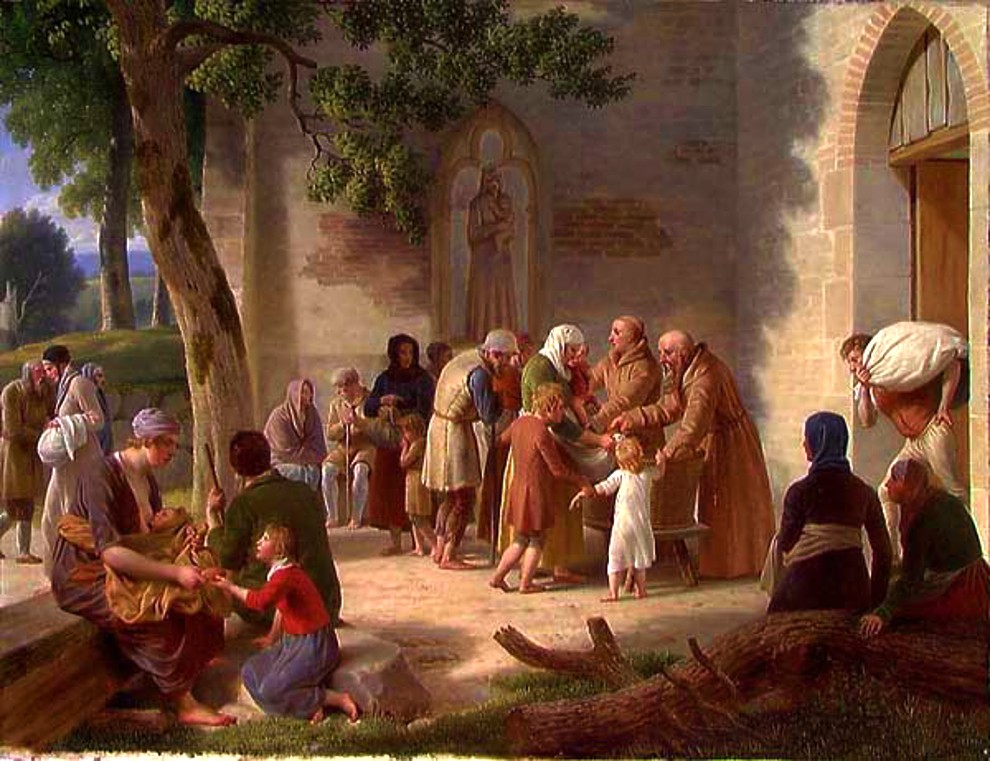
Saint of the Day – 12 December – Saint Vicelinus of Oldenburg (1086-1154) Bishop, Missionary, “the Apostle of Holstei,” zealous Preacher and as Bishop, he concentrated on education of his Priests and the spiritual growth of his Diocese as well as the needs of the poor, founder of numerous monasteries. Born in 1086 in the castle at Hemelin on the Weser, Lower Saxony, Germany and died on 12 December 1154 at Neumunster, Lorraine, France of natural causes. Also known as – Apostle of Obodriten, of the Wends, Vicelinus, Vincelin, Vizelin, Wissel, Witzel, Wizelin.
St Vicelinus distributes food to the needy. Oil painting by Christoffer Wilhelm Eckersberg, 1812
Vicelinus was born in Hemelin around 1086. He was orphaned at an early age and thereafter, raised by his uncle Ludolf, a Priest in a neighbouring village. He left to join the Cathedral school at Paderborn, where he soon surpassed his companions and assisted in the management of the Cathedral school.
Vicelinus was called to Bremen to act as teacher and principal of the school and was offered a canonry by Archbishop Frederick of the Archbishopric of Hamburg-Bremen. In 1122 he may have gone to Laon to complete his studies under St Abelard. In 1126, Vicelinus decided to travel to Madgeburg, in order to see St Norbert, who at that time was the Archbishop. He hoped that St Norbert would ordain him a Priest and he could begin missionary work among the Slavs. For one reason or another this plan failed and so Vicelinus returned to Bremen, where Bishop Albero Ordained him. Hamburg-Bremen’s Archbishop Adalbero sent him among the Polabian Slavs and in the fall of 1126 Henry, Prince of the Obotrites, gave him a Church in Liubice, near the site of the later Lübeck. At the death of Henry (22 March 1127) Vicelinus returned to Bremen and was appointed Parish Priest at Wippenthorp. This gave him an opportunity to work among the Wagrians and neighbouring Obotrites.
Vicelinus’s preaching gathered crowds of eager listeners and many Priests aided him in founding a new monastery in 1127 known as Neumünster. The monastery followed the Rule of St Augustine and was liberally endowed by the Archbishop. Wars among the tribes in 1137 caused the missionaries to abandon their labours for two years. Vicelinus sent two Priests to Liubice but with little success. In 1134 he founded a second monastery at Segeberg.
Some years later Vicelinus established a monastery at Hogersdorf. Archbishop Hartwig I made him Bishop of Starigard (or today’s Oldenburg) in 1149. There he did much for the spiritual and temporal welfare of his Diocese. In 1152 he was struck by paralysis and lingered amid much suffering for two years before dying in Neumünster.
In 1330 the Augustine canon-law college moved to Bordesholm and St Vicelinus relics were transferred there too in 1332 and his body was buried before the main altar.
Bl Ludwik Bartosik Bl Martin Sanz St Simon Phan Ðac Hòa St Spyridon of Cyprus St Synesius St Vicelinus of Oldenburg (1086-1154) Bishop
Martyrs of Alexandria – (6 saints): A group of six Christians martyred for their faith during the persecutions of Decius. We know little more than five of their names – Alexander, Ammonaria, Dionysia, Epimachus and Mercuria. They were burned to death c 250 in Alexandria, Egypt.
Martyrs of Trier – (4 saints): A group of six Christians martyred for their faith during the persecutions of Decius. We know little more than five of their names – Alexander, Ammonaria, Dionysia, Epimachus and Mercuria. They were burned to death c 250 in Alexandria, Egypt.
Thought for the Day – 11 December – Meditations with Antonio Cardinal Bacci (1881-1971)
Christ’s Work in Us
“It is not enough that Jesus live in us ; He must increase and act in us continually. The Spiritual life is like natural life. It cannot stop, for to halt would mean death! If Jesus is our life, He should live in us with ever-increasing intensity. Life is like a stairway, we are either going up or coming down.
If we continue to climb energetically towards Jesus, we shall be coming nearer to Christian perfection. If, on the other hand, we halt, the supernatural life of Jesus in us, will begin to weaken. Tepedity will replace fervour and sin will succeed tepidity. It is difficult to remain unchanged because, life involves movement. ‘Jesus Christ,” writes St Augustine, “was born a baby but, He did not remain one. He grew to boyhood, to adolescence and then, to maturity.”
It is necessary for us to grow also. More precisely, it is necessary that Jesus grow continuously in us through faith, charity and good works. “Court the good,” admonishes St Paul, “from a good motive always … until Christ is formed in you” (Gal 4:18-19).
It is not enough that Christ be born in us, it is necessary that He increase to the fullness of perfection (Cf Eph 4:13-16). “Jesus increases daily,” writes Origen, “in the soul of the holy and just man, which mirror His grace, His wisdom and His sanctity. In the soul of the unfortunate sinner, however, Christ decreases and dies.”
Quote/s of the Day – 11 December – Friday of the Second week of Advent
“May We Love Only You”
“Stay with us, for it is nearly evening and the day is almost over.”
Luke 24:29
“You hide your heart from man – hide it from God if you can. … Where will you go? Where will you flee? Do you want to hear some advice? If you want to flee from Him – flee to Him. Flee to Him by Confessing, not from Him, by hiding, for you cannot hide but you can Confess. Tell Him. “You are my refuge” (Ps 32[31]:7) and let there be nursed in yo, the love that alone leads to life.”
St Augustine (354-430) Father and Doctor of Grace
May We Love Only You By St Columban (543-615)
Loving Saviour, be pleased to show Yourself to us who knock, so that in knowing You, we may love only You, love You alone, desire You alone, contemplate only You, day and night and always think of You. Inspire in us the depth of love that is fitting for You to receive as God. So may Your love pervade our whole being, possess us completely and fill all our senses, that we may know no other love but love for You, Who are everlasting. May our love be so great, that the many waters of sky, land and sea cannot extinguish it in us – many waters could not extinguish love. May this saying be fulfilled in us also, at least in part, by Your gift, Jesus Christ, our Lord, to whom be glory forever and ever. Amen
“How good and pleasant it is to dwell in the Heart of Jesus! Who is there who does not love a heart so wounded? Who can refuse a return of love to a Heart so loving? Amen.”
St Bernard (1090-1153) Mellifluous Doctor
“Who could ever soften this heart of mine but YOU alone O Lord!”
St Francis Borgia (1510-1572)
“Christ first of all, Christ in the centre of the heart, in the centre of history and of the cosmos. Humanity needs Christ intensely because, He is our “measure.” There is no realm, that cannot be touched by His strength; there is no evil, that cannot find remedy in Him, there is no problem, that cannot be solved in Him. Either Christ or nothing!”
St John Leonardi (1541-1609)
“During the night we must wait for the light.”
St Francis de Sales (1567-1622) Doctor of Charity
“Only God fills the soul and fills it wholly. Let scientists go on asking – Where is God? He is where those clever ones, arrogant in their knowledge, cannot reach.”
Advent Reflection – 11 December – Friday of the Second week of Advent, Readings: Isaiah 48:17-19, Psalms 1:1-2, 3, 4 and 6, Matthew 11:16-19
Let us adore the Lord, the king who is to come.
“For John came, neither eating nor drinking and they said, ‘He is possessed by a demon.’ The Son of Man came eating and drinking and they said, ‘Look, he is a glutton and a drunkard, a friend of tax collectors and sinners.’ But wisdom is vindicated by her works.” … Matthew 11:18-19
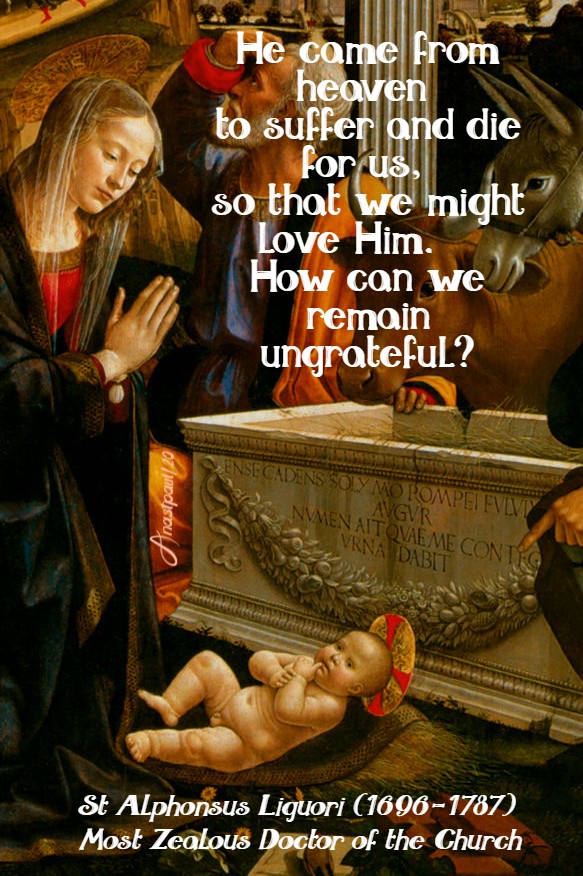
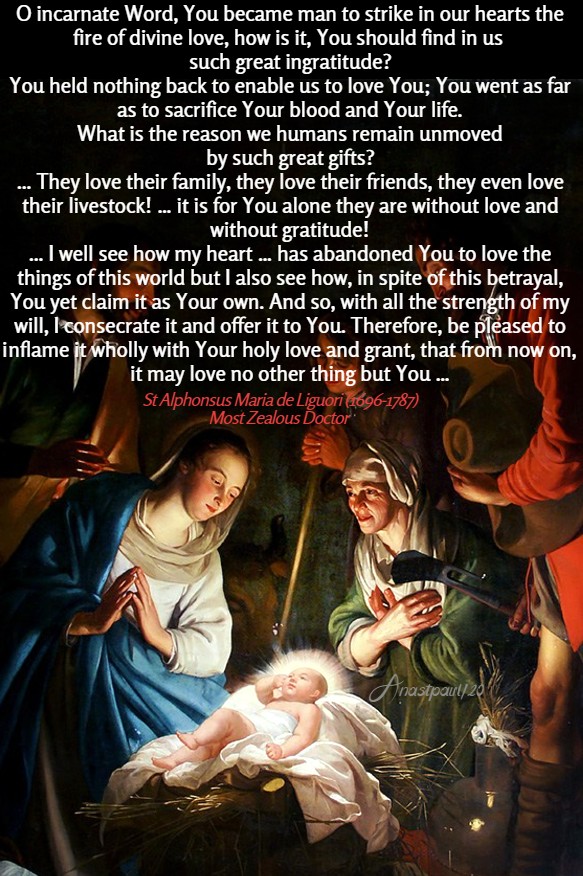
REFLECTION – “O Fire ever burning,” let us say together with Saint Augustine – “inflame our souls.” O incarnate Word, You became man to strike in our hearts the fire of divine love, how is it You should find in us such great ingratitude? You held nothing back to enable us to love You; You went as far as to sacrifice Your blood and Your life. What is the reason we humans remain unmoved by such great gifts? Is it because we know nothing about them? Not at all. People understand and believe, it is for love of them, You came down from heaven to put on human flesh and take on the burden of their woes. They know it is for love of them, You willed to lead a life of constant suffering and undergo a shameful death. How explain, after all this, their living in such absolute forgetfulness of Your unequalled kindness? They love their family, they love their friends, they even love their livestock! … it is for You alone they are without love and without gratitude! But what am I saying? In accusing others of ungratefulness, I condemn myself since my conduct in Your regard is even worse than theirs. Nevertheless, Your mercy gives me courage. I know how long it has borne with me, to forgive me and set me on fire with Your love, if only I am willing to repent and love You.
Oh yes, my God, I want to repent … I want to love You with all my heart. I well see how my heart … has abandoned You to love the things of this world but I also see how, in spite of this betrayal, You yet claim it as Your own. And so, with all the strength of my will, I consecrate it and offer it to You. Therefore, be pleased to inflame it wholly with Your holy love and grant, that from now on, it may love no other thing but You … O my Jesus, I love You, I love You, my sovereign Good! I love You, sole Love of my soul.
O Mary, my mother, you are the “mother of noble loving” (Sir 24:24 Vg.), grant me the grace of loving my God. It is from you that I hope to gain it.” – St Alphonsus Maria de Liguori (1696-1787) – Bishop and Most Zealous Doctor of the Church – 1st Sermon for the Octave of Christmas
PRAYER – Lord, watch over Your people, who come to You in confidence. Strengthen the hearts of those who hope in You. Give courage to those who falter because of their failures. In this holy season of Advent, lead them closer to You in hope, by the power of Your Holy Spirit. May Mary Immaculate, our Mother and Advocate be our eternal succour. Through Christ, our Lord, in the unity of the Holy Spirit, God for all eternity, amen.
Our Morning Offering – 11 December – Friday of the Second week of Advent
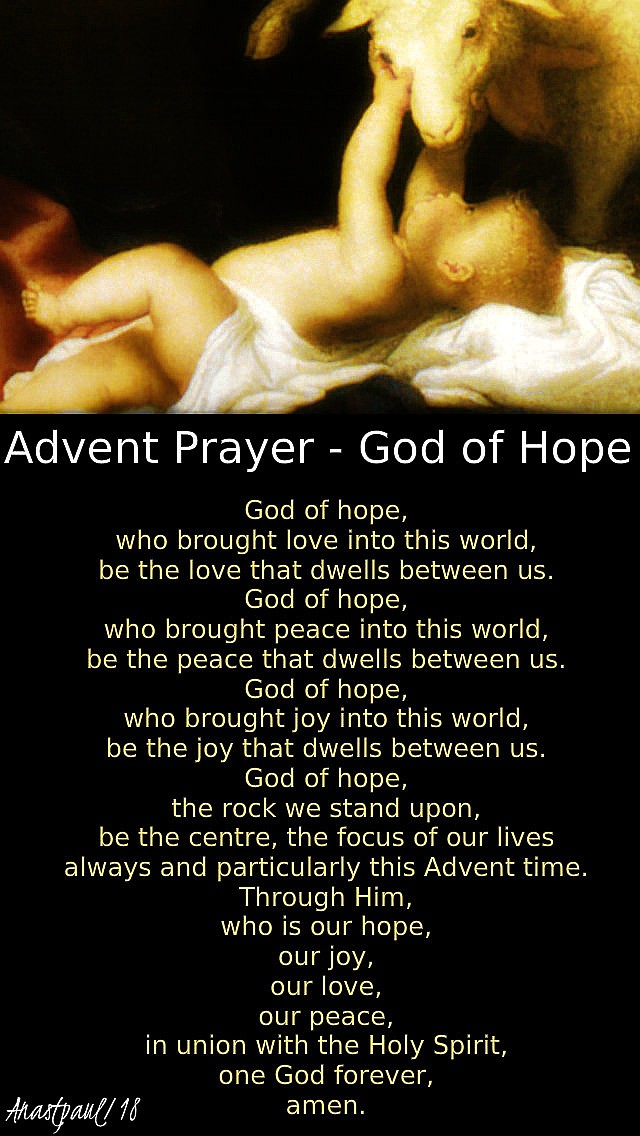
Advent Prayer – God of Hope
God of hope, who brought love into this world, be the love that dwells between us. God of hope, who brought peace into this world, be the peace that dwells between us. God of hope, who brought joy into this world, be the joy that dwells between us. God of hope, the rock we stand upon, be the centre, the focus of our lives always and particularly this Advent time. Through Him, who is our hope, our joy, our love, our peace, in union with the Holy Spirit, one God forever, amen.
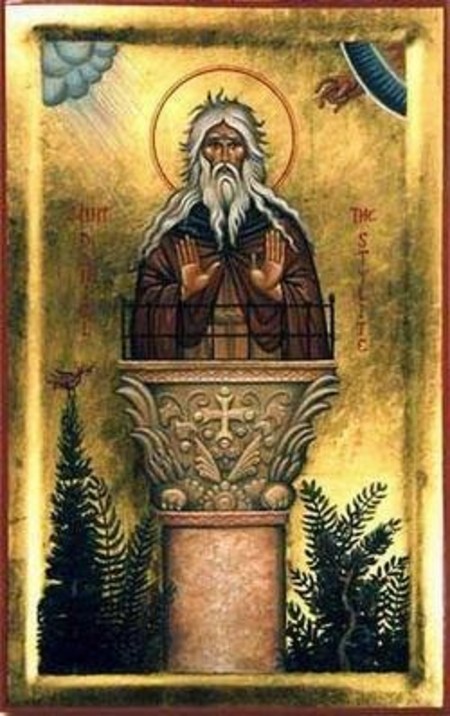
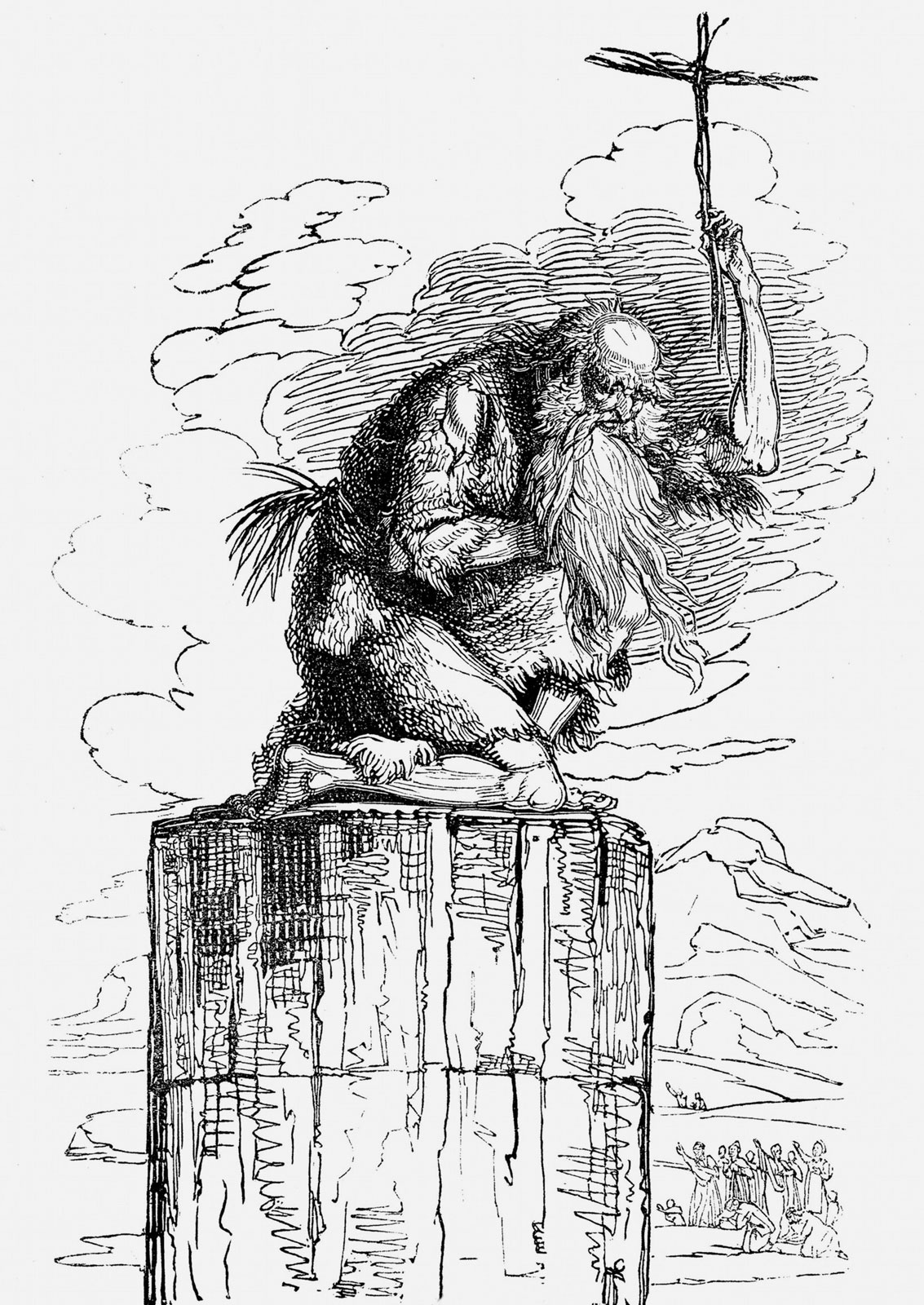
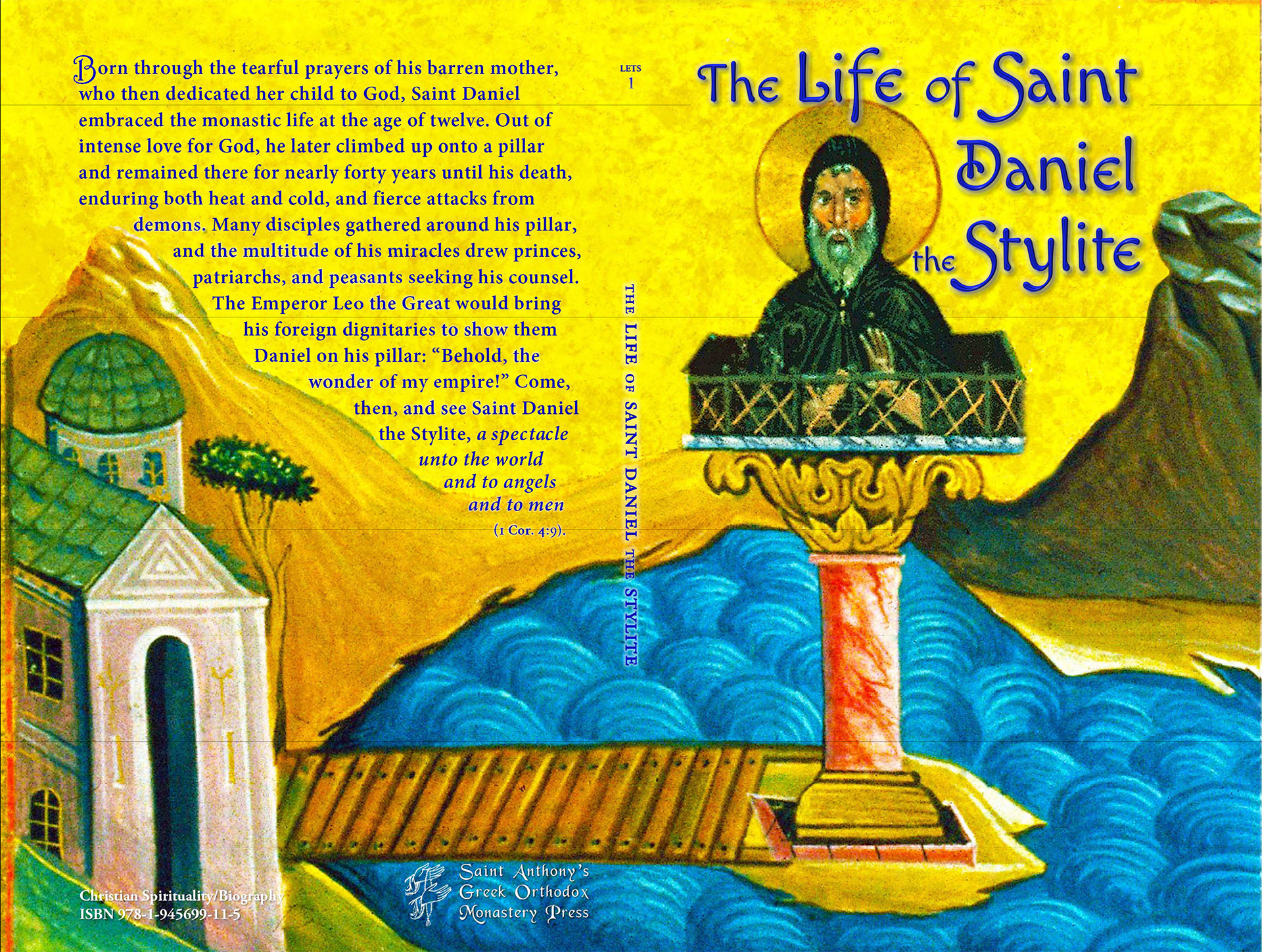
Saint of the Day – 11 December – Saint Daniel the Stylite of Constantinople (c 409–493) Priest, Monk, Abbot, Hermit, miracle-worker – born in c 409 at Maratha, Syria and died in 493 near Constantinople of natural causes.
Daniel was born in Maratha, Syria in 409 and became a monk in nearby Samosata on the Upper Euphrates. He learned of St Simeon Stylite, who lived on a pillar at Antioch and twice went to see him twice.
At the age of forty-two, Daniel decided that he too wanted to become a stylite (from the Greek word “stylos”, meaning pillar) and live on a pillar at a spot near Constantinople.
Emperor Leo I, built a series of pillars with a platform on top for him and Daniel was ordained there by St Gennadius. The saint quickly became an attraction for the people. He celebrated the Eucharist on his pillar, preached sermons, dispensed spiritual advice and cured the sick who were brought up to him. He also gave prudent counsel to Emperors Leo and Zeno and the Patriarch of Constantinople.
All the while, Daniel lived his particular type of pillar spirituality. He came down from his perch only once in thirty-three years – to turn Emperor Baliscus away from backing the heresy of Monophysitism.
Daniel died in 493 and after St Simeon, became the best-known and venerated Stylite.
The life of St Daniel the Stylite is an apt reminder that there are many ways to live the spiritual life. All of us have our own way to be close to God everyday. Our task is to find that way and follow it to the very end.
Bl Martín Lumbreras Peralta Bl Martino de Melgar Bl Melchor Sánchez PérezPens Bl Pilar Villalonga Villalba Bl Severin Ott Martyrs of Saint Aux-Bois – (3 saints): Two Christian missionaries and one of their local defenders who faith in the persecutions of governor Rictiovarus – Fuscian, Gentian and Victoricus. They were beheaded in 287 in Saint Aux-Bois, Gaul (in modern France).
Martyrs of Rome – (3 saints): Three Christians murdered in the persecutions of Diocletian for giving aid to Christian prisoners – Pontian, Practextatus and Trason. They were imperial Roman citizens. They were martyred in c 303 in Rome, Italy.
Thought for the Day – 10 December – Meditations with Antonio Cardinal Bacci (1881-1971)
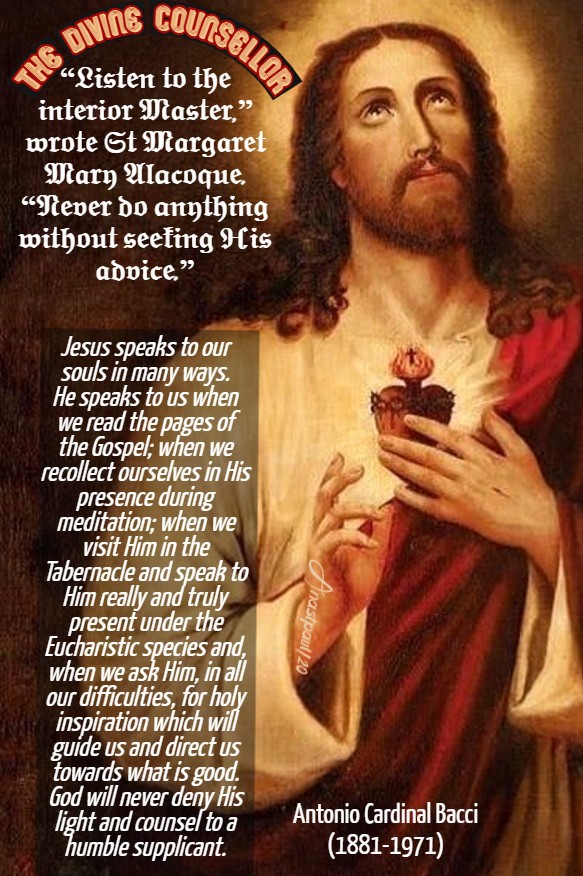
The Divine Counsellor
“It is often difficult and unpleasant to take advice from someone whom we dislike but, when we really like somebody, his advice is always acceptable and we are inclined to take it to heart. Counsel is the light of the soul, which points out to us which path to follow. Often we are surrounded by darkness, we do not know which way to turn, for uncertainty and discouragement have paralysed our will. Now Jesus, as St John tells us, is the light which enlightens every man who comes into this world – He is full of grace and truth (Jn 1:9-14). If we love Jesus, we shall always receive from Him the light and counsel which we need – His enlightenment is clear and His counsel satisfies fully the needs of our hearts.
How can we have this light and this counsel? Jesus speaks to our souls in many ways. He speaks to us when we read the pages of the Gospel; when we recollect ourselves in His presence during meditation; when we visit Him in the Tabernacle and speak to Him really and truly present under the Eucharistic species and, when we ask Him, in all our difficulties, for holy inspiration which will guide us and direct us towards what is good. God will never deny His light and counsel to a humble supplicant.
Nobody can speak to our souls with greater efficacy than Jesus Christ. “Listen to the interior Master,” wrote St Margaret Mary Alacoque. “Never do anything without seeking His advice.”
Quote/s of the Day – 10 December – Thursday of the Second week of Advent
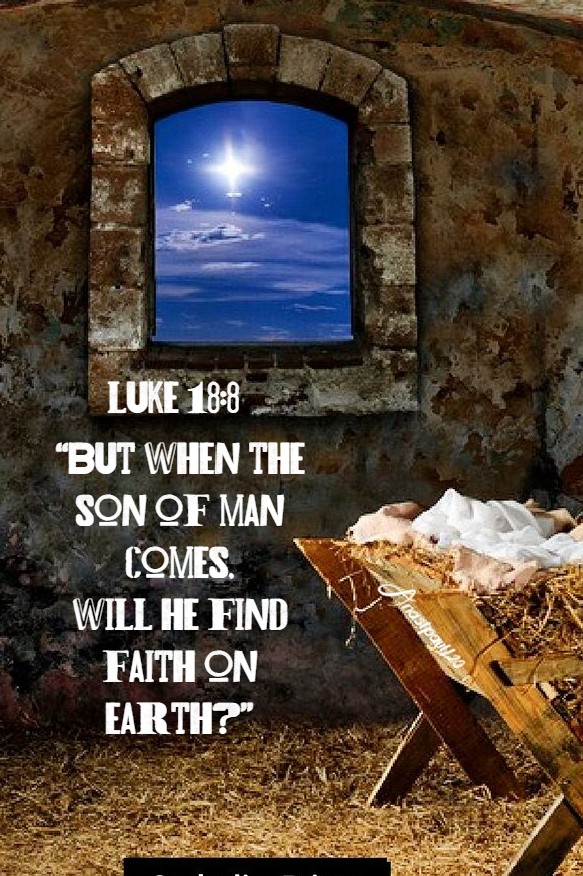
“But when the Son of Man comes, will he find faith on earth?”
Luke 18:8
“Man’s Maker was made man, that He, Ruler of the stars, might nurse at His mother’s breast, that the Bread might hunger, the Fountain thirst, the Light sleep, the Way be tired on its journey, that the Truth might be accused of false witness, the Teacher be beaten with whips, the Foundation be suspended on wood, that Strength might grow weak, that the Healer might be wounded, that Life might die.”
St Augustine (354-430) Father & Doctor of the Church
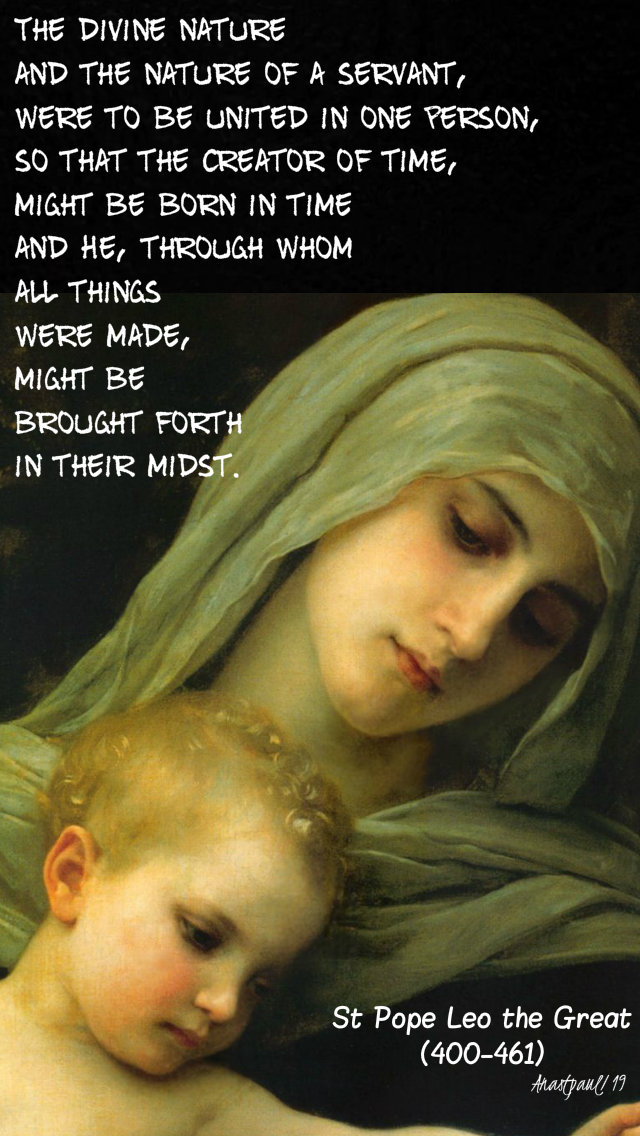
“The divine nature and the nature of a servant, were to be united in one person, so that the Creator of time, might be born in time and He, through whom all things were made, might be brought forth in their midst.”
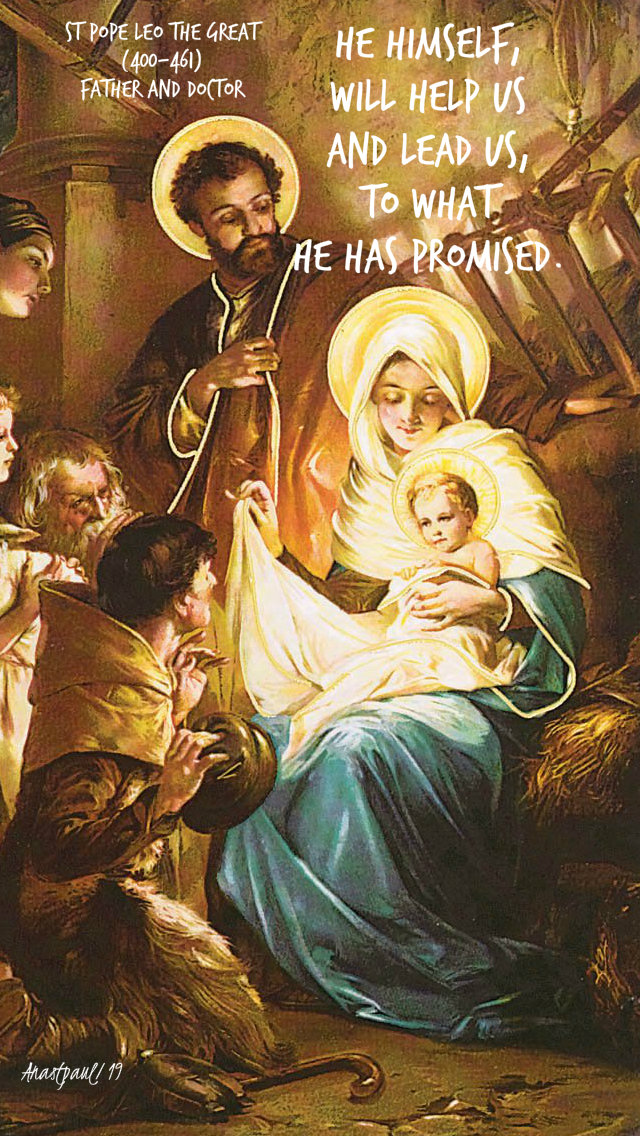
“He Himself will help us and lead us to what He has promised.”
St Pope Leo the Great (400-461) Father and Doctor of the Church
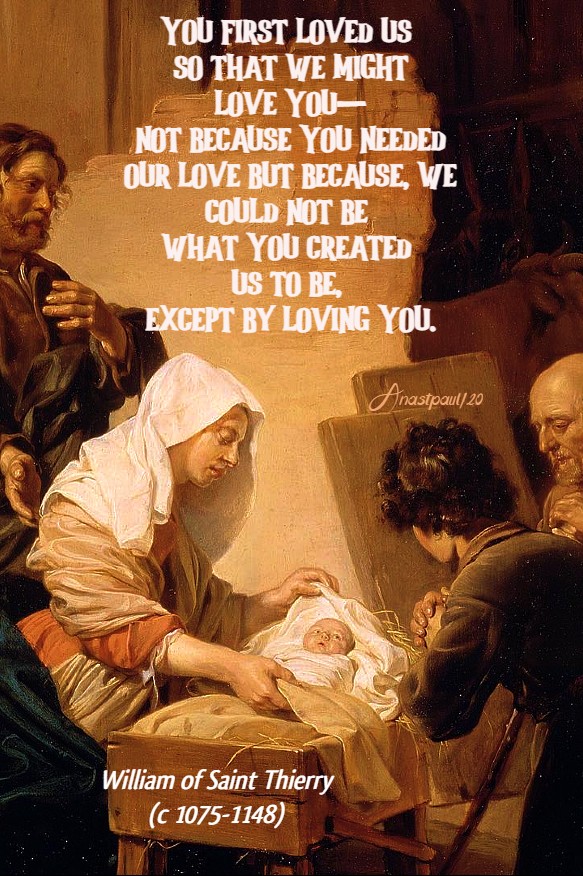
“You first loved us so that we might love You— not because You needed our love but because, we could not be what You created us to be, except by loving You.”
William of Saint Thierry (c 1075-1148) was a twelfth century French Benedictine Abbot of Saint-Thierry, theologian and mystic who became a Cistercian monk and writer.
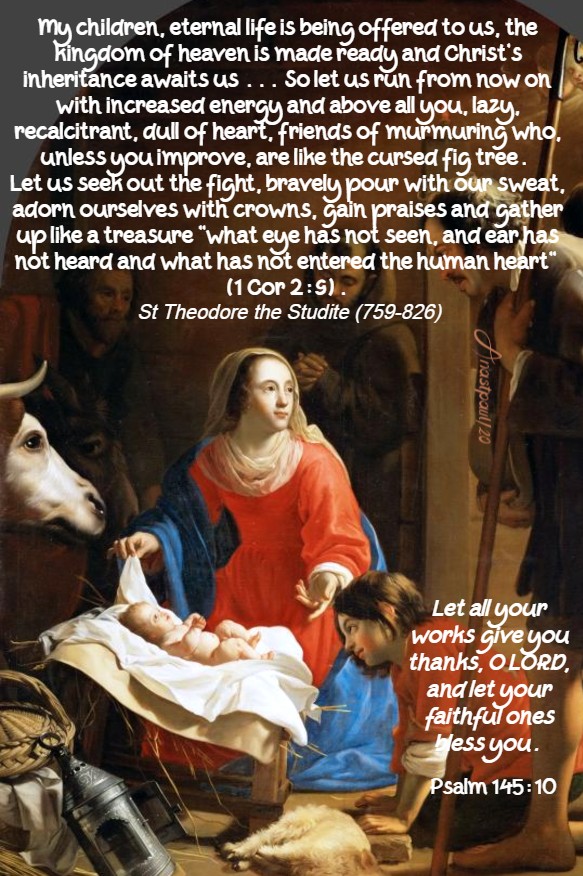
Let all your works give you thanks, O LORD, and let your faithful ones bless you. Let them discourse of the glory of your Kingdom and speak of your might. – Psalm 145:10-11
REFLECTION – “My children, eternal life is being offered to us, the kingdom of heaven is made ready and Christ’s inheritance awaits us – the enjoyment of innumerable and unimaginable blessings, the happiness of a great joy and of immortality, glory and honour without measure and all the other blessings in such great number, that human language is not sufficient to make known its grace and mercy (cf. Wsd. 3:9)! So let us run from now on with increased energy and above all you, lazy, recalcitrant, dull of heart, friends of murmuring who, unless you improve, are like the cursed fig tree. We surround it with manure (cf. Lk 13:8) and it takes no root at all, we water you with words and not a bit of growth results! “Even now the ax lies at the root of the trees” (Lk 3:9) and I will silence the rest. Let us seek out the fight, bravely pour with our sweat, adorn ourselves with crowns, gain praises and gather up like a treasure “what eye has not seen, and ear has not heard and what has not entered the human heart” (1 Cor 2:9).
Let us rule our lives by that of our fathers, that which goes back to the origin, let us follow in the footsteps of their virtues, love their upright deeds, make of our way of life an image of their own. (…) Yes, let us work together with them! Let us act with them! Let us follow in their footsteps! Yes! Let us, too, fulfil what is right and holy! In this way we will share in their glory, we will be crowned and, together with them, exult in the kingdom of heaven, in Christ Jesus our Lord, to whom belongs the glory and the power, with the Father and the Holy Spirit, now and for ever. Amen.” – St Theodore the Studite (759-826) Catechesis 72 (from the Great Cathecheses)
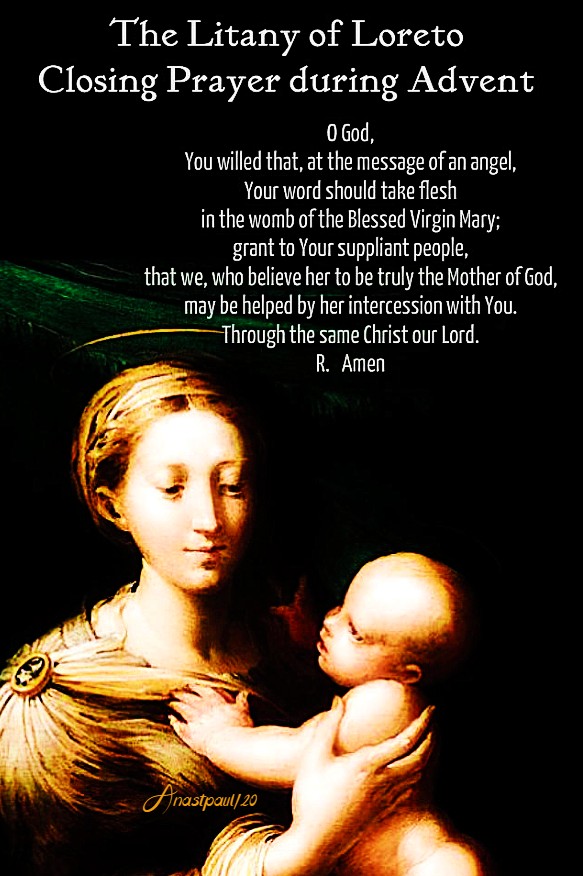
PRAYER – O God, You willed that, at the message of an angel, Your word should take flesh in the womb of the Blessed Virgin Mary; grant to Your suppliant people, that we, who believe her to be truly the Mother of God, may be helped by her intercession with You. Through the same Christ our Lord.












You must be logged in to post a comment.