One Minute Reflection – 29 July – Seventeenth Sunday in Ordinary Time – Today’s Gospel: John 6:1–15
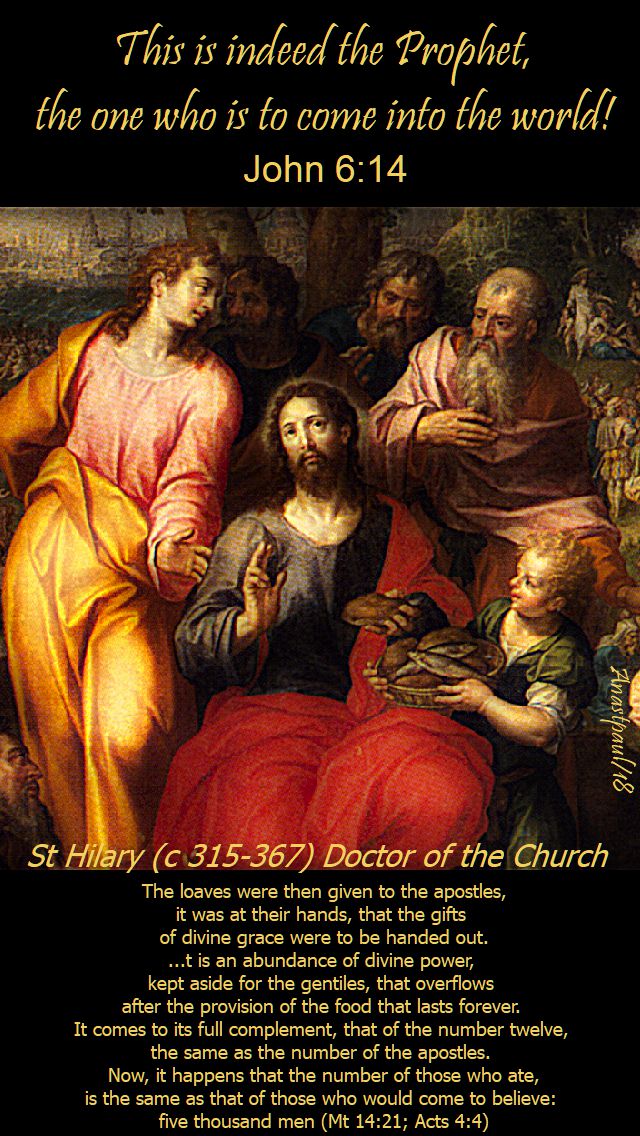
“This is indeed the Prophet, the one who is to come into the world!”…John 6:14
REFLECTION – “The disciples say that they have only five loaves and two fish. The five loaves signified that they were still subject to the five books of the Law and the two fish that they were fed by the teachings of the prophets and John the Baptist… This was what the apostles had to offer to begin with since this was the point they were at and it was from this point, that the preaching of the Gospel began…
Our Lord took the loaves and the fish. He raised his eyes to heaven, said the blessing and broke them. He gave thanks to the Father because the Good News was being changed into food after centuries of the Law and the prophets… The loaves were then given to the apostles, it was at their hands, that the gifts of divine grace were to be handed out. Then the people were fed with the five loaves and two fish and, when those who were invited were satisfied, the leftovers of bread and fish were so plentiful that twelve baskets were filled with them. What this means is that the crowd was filled with God’s word coming from the teaching of the Law and the prophets. But it is an abundance of divine power, kept aside for the gentiles, that overflows after the provision of the food that lasts forever. It comes to its full complement, that of the number twelve, the same as the number of the apostles. Now, it happens that the number of those who ate is the same as that of those who would come to believe: five thousand men (Mt 14:21; Acts 4:4).”…St Hilary (c 315-367) Bishop of Poitiers, Doctor of the Church
PRAYER – Lord God, protector of those who hope in You, without whom nothing is strong, nothing holy, support us always with Your love. Help us to offer our own ‘loaves and fishes’ our own talents and possessions, to feed all who need our care. May the prayers of St Martha grant us Your grace to serve Christ faithfully in our brethren and guide us so to use the good things of this world, that even now, we may hold fast to what endures forever, through Jesus Christ, our Lord. Amen
Our Morning Offering – 28 July – Seventeenth Sunday in Ordinary Time, Year B (and still in the Month of Precious Blood)
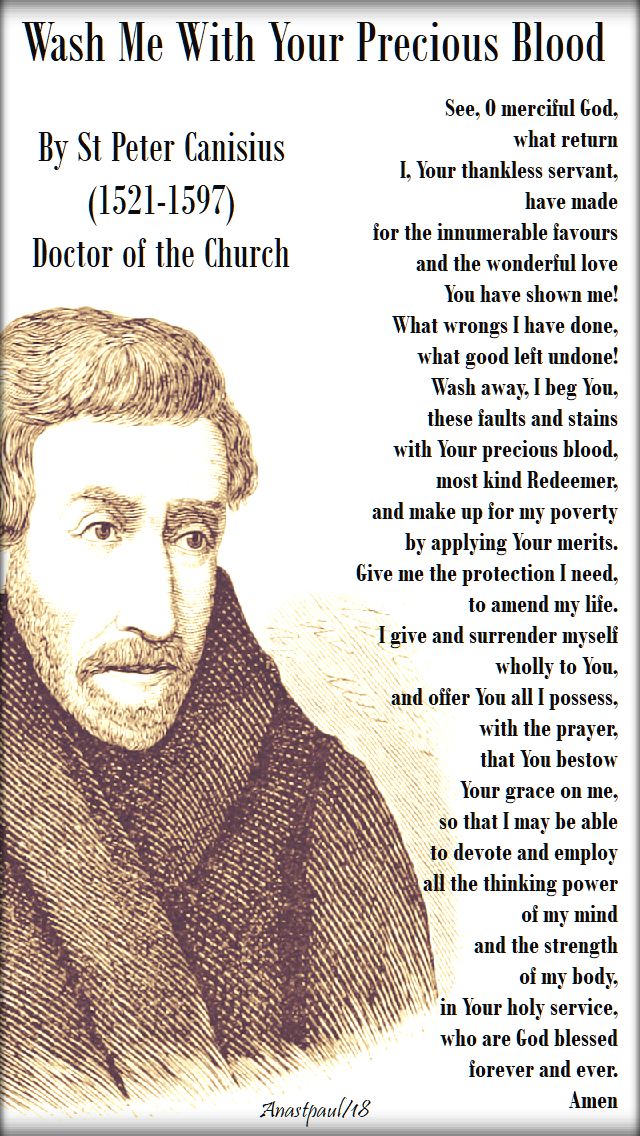
Wash Me With Your Precious Blood By St Peter Canisius (1521-1597) Doctor of the Church
See, O merciful God,
what return
I, Your thankless servant,
have made for the innumerable favours
and the wonderful love
You have shown me!
What wrongs I have done,
what good left undone!
Wash away, I beg You,
these faults and stains
with Your precious blood,
most kind Redeemer,
and make up for my poverty
by applying Your merits.
Give me the protection I need,
to amend my life.
I give and surrender myself wholly to You,
and offer You all I possess,
with the prayer,
that You bestow Your grace on me,
so that I may be able to devote and employ
all the thinking power of my mind
and the strength of my body,
in Your holy service,
who are God blessed
forever and ever.
Amen
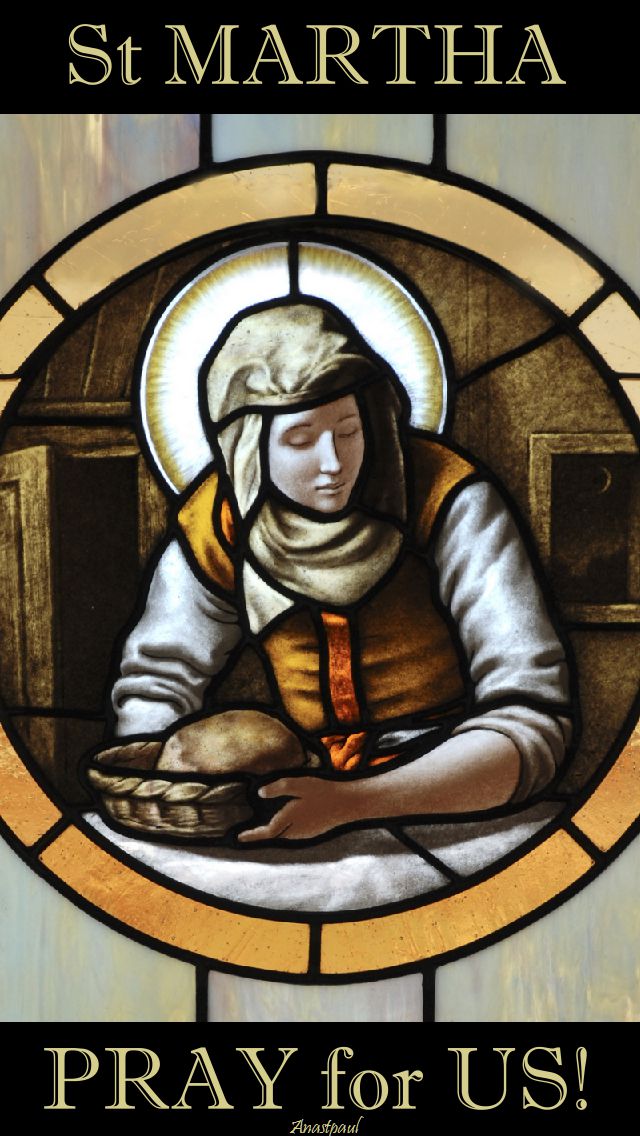
Saint of the Day – 29 July – St Martha Virgin (1st century) – Sister of Saint Lazarus and Saint Mary of Bethany. Friend of Jesus and hostess to him in her house.
St John tells us that “Jesus loved Martha and Mary and Lazarus” and yet but few glimpses are vouchsafed us of them. First, the sisters are set before us with a word. Martha received Jesus into her house and was busy in outward, loving, lavish service, while Mary sat in silence at the feet she had bathed with her tears. Then, their brother is ill, and they send to Jesus, “Lord, he whom Thou lovest is sick.” And in His own time the Lord came and they go out to meet Him and then follows that scene of unutterable tenderness and of sublimity unsurpassed: the silent waiting of Mary, Martha strong in faith but realising so vividly, with her practical turn of mind, the fact of death and hesitating: “Canst Thou show Thy wonders in the grave?” And then once again, on the eve of His Passion, we see Jesus at Bethany. Martha, true to her character, is serving; Mary, as at first, pours the precious ointment, in adoration and love, on His divine head.
According the tradition we find the tomb of St Martha, at Tarascon, in Provence. When the storm of persecution came, the family of Bethany, with a few companions, were put into a boat, without oars or sail and borne to the coast of France. St Mary’s tomb is at S. Baume; St Lazarus is venerated as the founder of the Church of Marseilles; and the memory of the virtues and labours of St Martha is still fragrant at Avignon and Tarascon.
Reflection: -When Martha received Jesus into her house, she was naturally busy in preparations for such a Guest. Mary sat at His feet, intent alone on listening to His gracious words. Her sister thought that the time required other service than this and asked our Lord to bid Mary help in serving. Once again Jesus spoke in defence of Mary. “Martha, Martha,” He said, “thou art lovingly anxious about many things, be not over-eager, do thy chosen work with recollectedness. Judge not Mary. Hers is the good part, the one only thing really necessary. Thine will be taken away, that something better be given thee.” The life of action ceases when the body is laid down but the life of contemplation endures and is perfected in heaven.
St Martha (Memorial) – Sister of Saint Lazarus and Saint Mary of Bethany. Friend of Jesus, and hostess to him in her house. May have been part of an early mission to France.
More on St Marth here: https://anastpaul.wordpress.com/2017/07/29/saint-of-the-day-29-july-st-martha/
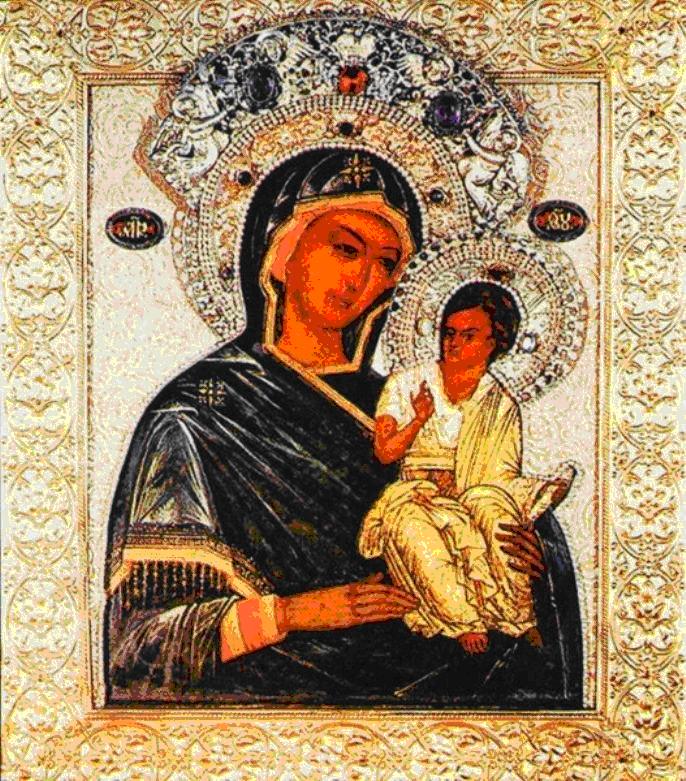
Chirsk-Pskov Icon of the Mother of God:
The Chirsk (Pskov) Icon of the Mother of God was initially in the Chirsk village church of the Pskov diocese. In a time of a deadly pestilence, tears flowed from the eyes of the Chirsk Icon of the Mother of God. This was reported to authorities in the city of Pskov. Priests and devout men carried the wonder-working icon to Pskov. A procession was held to honour the icon, which was placed in the cathedral church of the Holy Trinity.
On the reverse of the icon are depicted the Holy Apostle and Evangelist Luke and St Theodosius of the Kiev Caves.
—
St Antony
St Beatrix of Rome
Bl Beatrix of Valfleury
St Callinicus of Paphlagonia
Bl Charles-Antoine-Nicolas Ancel
St Faustinus of Rome
St Faustinus of Spello
St Felix of Rome
St John Baptist Luo Tingyin
St John the Soldier
Bl José Calasanz Marqués
St Joseph Zhang
St Kilian of Inishcaltra
St Lek Sirdani
Bl Luis Bertran
St Lupus of Troyes
Bl Mancius of the Cross
St Martha Wang
St Olaf II
St Olaus of Sweden
St Paulus Chen Changpin
Bl Petrus of Saint Mary
St Pjetër Çuni
St Prosper of Orleans
St Rufo of Rome
St Seraphina
St Serapia of Syria
St Simplicius of Rome
St Sulian
Bl Pope Urban II
St William of Saint Brieuc
—
Four Anonymous Martyrs
Martyrs of Calanda – 8 beati: A group of Dominican priests and friars who were martyred over the course of a day in the same town by the same group of anti-Christian forces in the Spanish Civil War.
• Antonio Manuel López Couceiro
• Felicísimo Díez González
• Gumersindo Soto Barros
• Lamberto María de Navascués de Juan
• Lucio Martínez Mancebo
• Matías Manuel Albert Ginés
• Saturio Rey Robles
• Tirso Manrique Melero
They were martyred on 29 July 1936 in Calanda, Teruel, Spain and Beatified on 11 March 2001 by St Pope John Paul II.
Martyrs of Lleida – 12 beati: Carmelites of the Ancient Observance novices, friars and priests who were all martyred together in the Spanish Civil War.
• Àngel Prat Hostench
• Eliseo Maneus Besalduch
• Gabriel Escoto Ruiz
• Ginés Garre Egea
• Joan Maria Puigmitjà Rubió
• Joan Prat Colldecarrera
• Josep Solé Rovira
• Lluis Fontdecava Quiroga
• Manuel Serrano Buj
• Miquel Soler Sala
• Pere Dorca Coromina
• Pere Ferrer Marín
They were martyred on 29 July 1936 in Clot dels Aubens, Cervera, Lleida, Spain and Beatified on 28 October 2007 by Pope Benedict XVI.
Martyred in the Spanish Civil War: Thousands of people were murdered in the anti-Catholic persecutions of the Spanish Civil War from 1934 to 1939.
Bl Bartolomé Rodríguez Soria
Joseph-Louis Marcou Pecalvel
Bl Juan Bautista Egozcuezábal Aldaz
Martyrs of Rome – 23 saints
Eugene
Flora the Martyr
Lucilla
Theodore
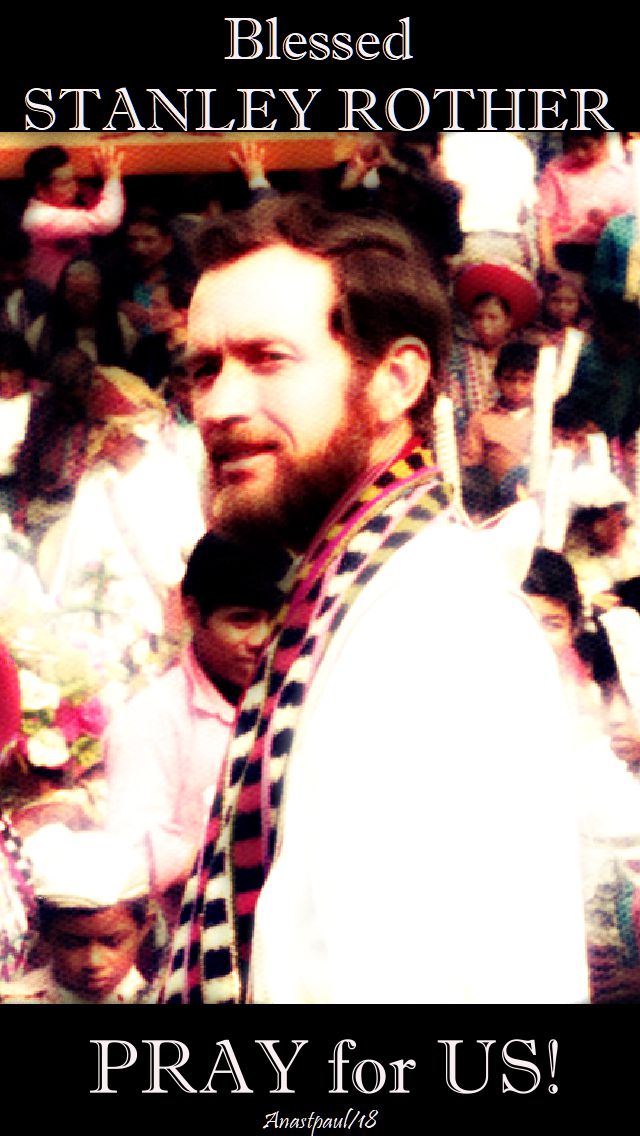
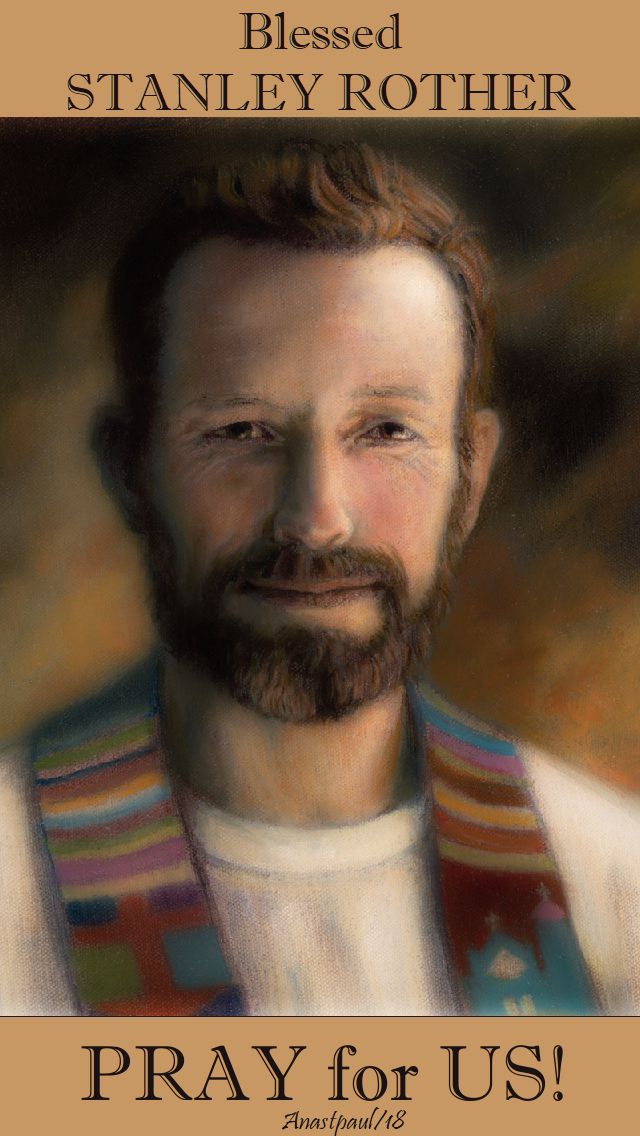
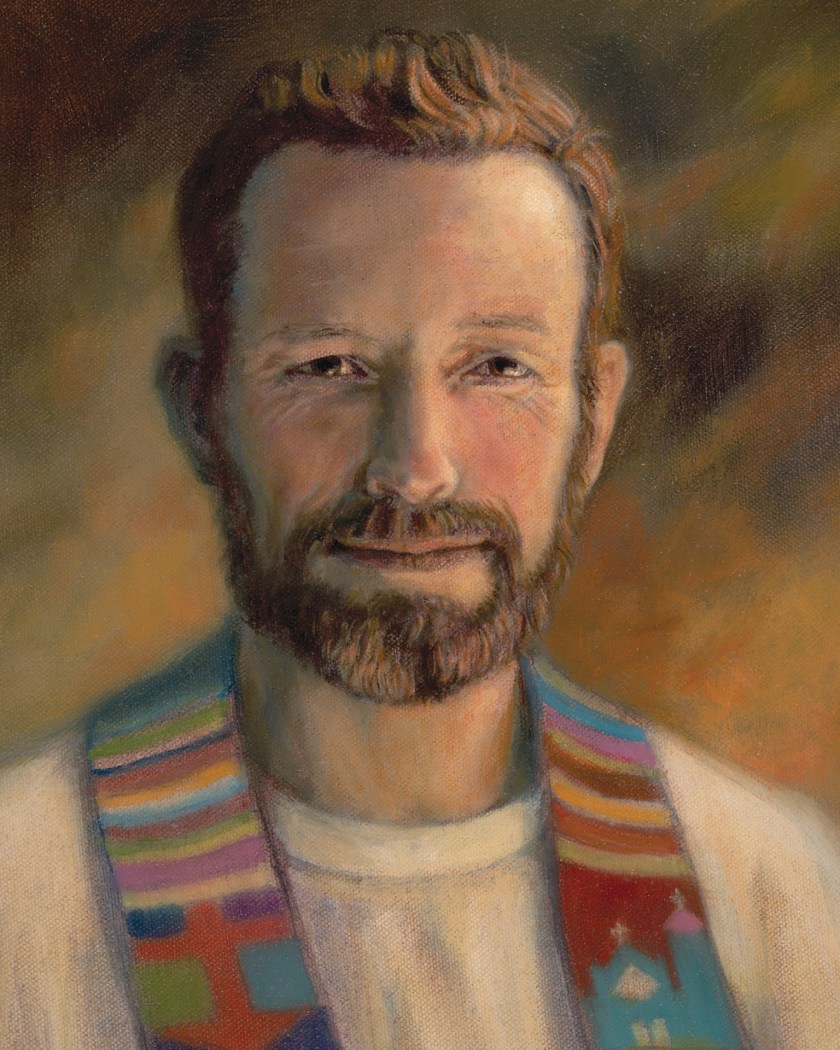
Thought for the Day – 28 July 2018 – The First Memorial of Blessed Stanley Francis Rother (1935-1981) Martyr “The Shepherd Who Didn’t Run”
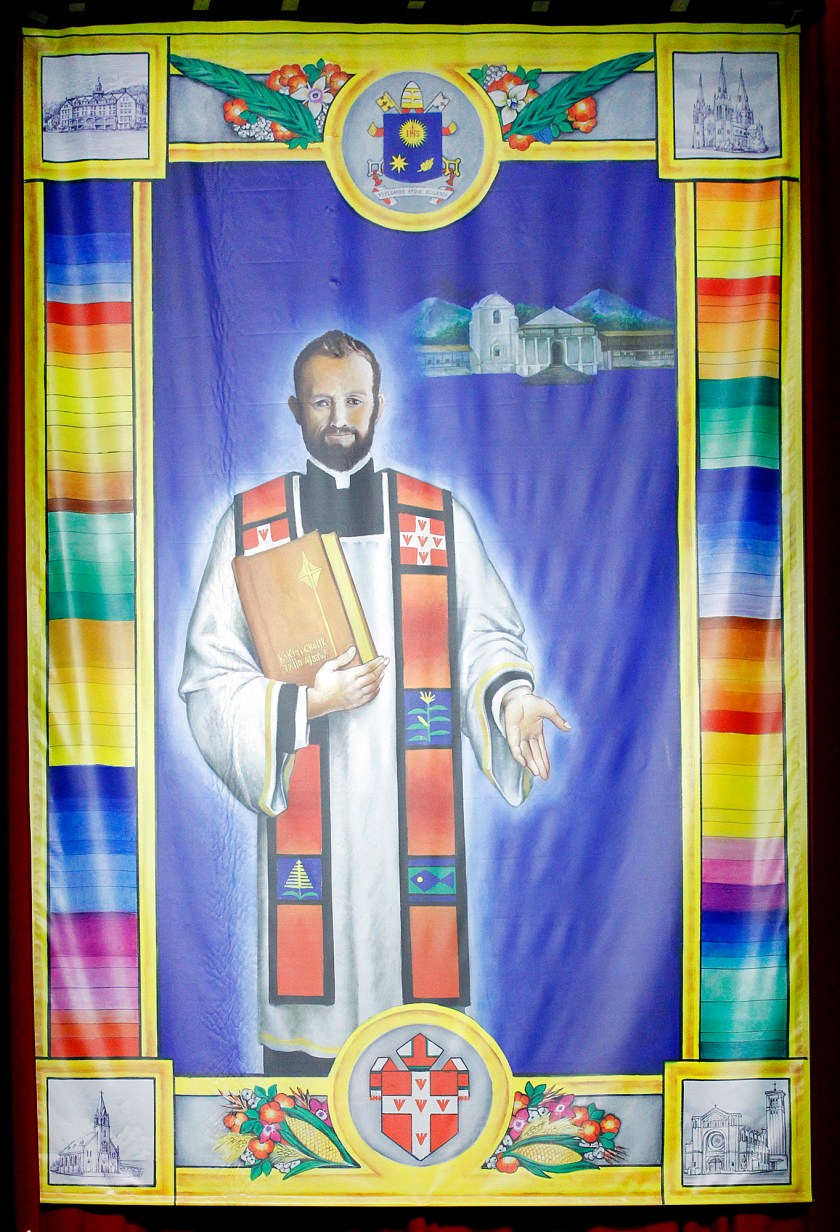
In Guatemala, Blessed Stanley spent his life in the service of his flock and, over time, he became one of them. He helped his people cultivate farms for crops, advised them in all manner of life’s problems and even pulled teeth for them when necessary. But he was more than a social worker; he was their father — the one who preached to them the Word of God in their native tongue, catechised them and their children and distributed the sacraments through which they grew ever closer to God.
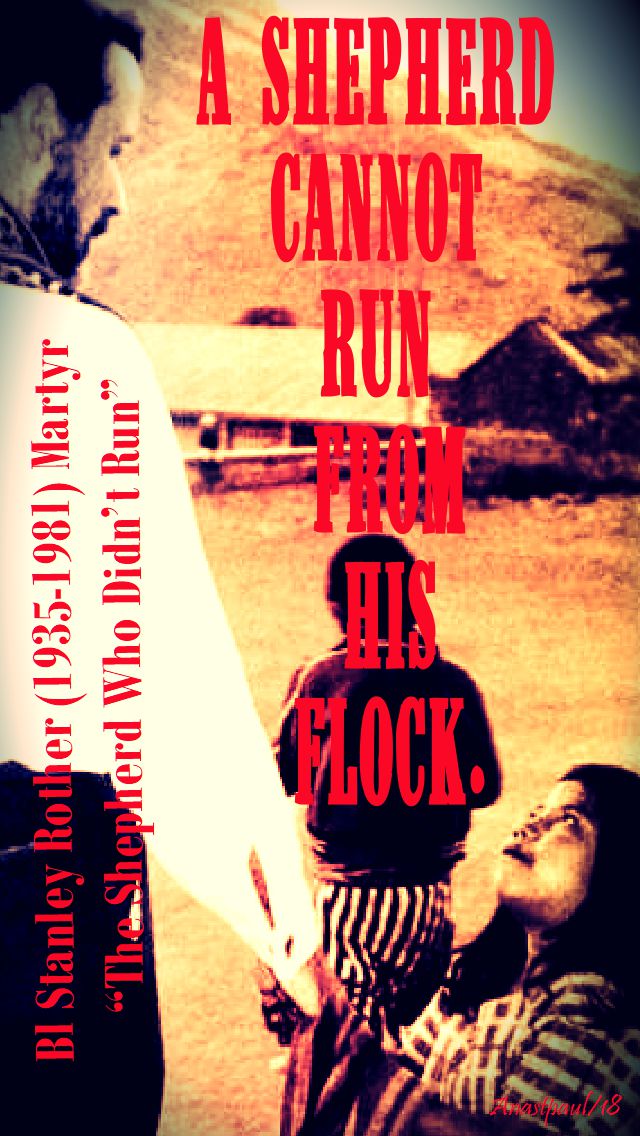
The backdrop to his work and ministry in Guatemala is the political turmoil that wreaked havoc on the country in the 1970s and ’80s. Eventually, Rother became a victim of the guerrilla fighting and was killed for defending the rights and dignity of his people. His death was no less noble than his life had been. Though he had been warned multiple times that he was a target and despite having been home months before his death, Rother willingly chose to return to Guatemala to defend and remain close to his people. He wrote to this effect just months before his death, saying, “the shepherd cannot run at the first sign of danger. Pray for us that we might be a sign of the love of Christ for our people, that our presence among them will fortify them to endure these sufferings in preparation for the Kingdom.” (excerpt OSV)
This loving shepherd brings to mind the words of Pope Francis way back on 28 March 2013, just 2 weeks after his election to the Papacy, that our priests must be “shepherds living with the smell of the sheep.” And so, we too, must be extending ourselves to our neighbour!
Prayer for the Canonisation of Blessed Stanley Rother
O God, fount of all holiness,
make us each walk worthily in our vocation,
through the intercession of Your saints,
on whom You bestowed
a great variety of graces on earth.
Having graced Your Church
with the life of
your priest and martyr,
Blessed Stanley Rother,
grant that by his intercession
this humble flock may reach
where the brave Shepherd has gone.
Grant that Your Church may proclaim
him a saint living in Your presence
and interceding for us all.
Through Christ our Lord.
Amen
Below is a plan and facade view of the huge Cathedral Shrine, planned to honour Blessed Stanley in Oklahoma. – http://stanleyrother.org/shrine/
One Minute Reflection – 28 July – Saturday of the Sixteenth week in Ordinary Time, Year B – Today’s Gospel: 13:24-30 and The First Memorial of Blessed Stanley Francis Rother (1935-1981) Martyr
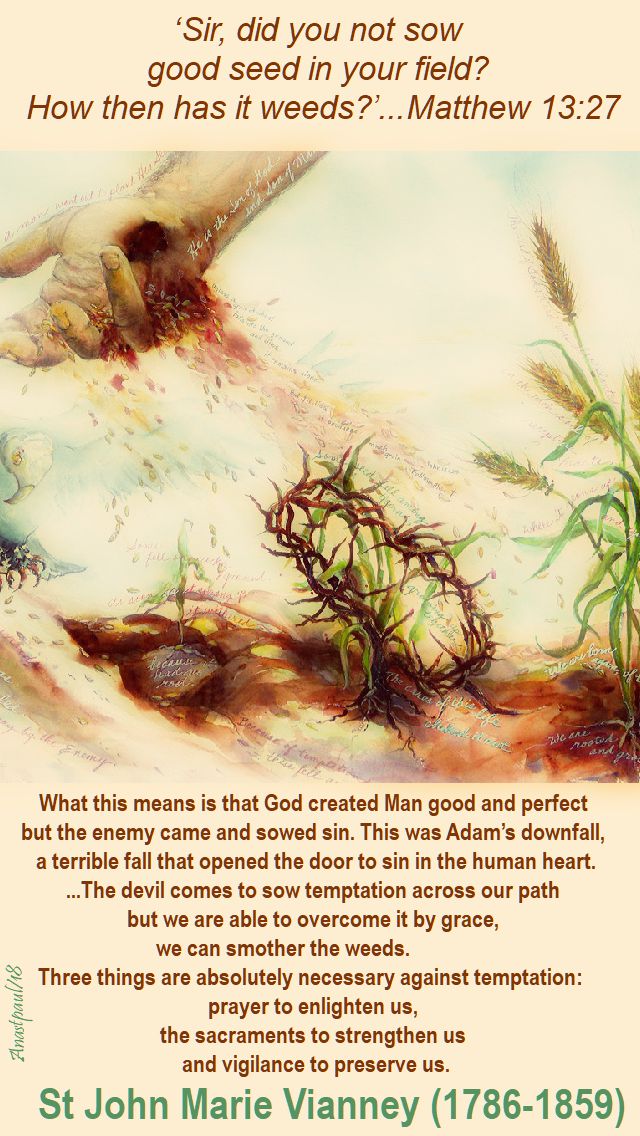
‘Sir, did you not sow good seed in your field? How then has it weeds?’…Matthew 13:27
REFLECTION – “In today’s gospel, my friends, we see that when the owner of the field had sowed his seed in good soil, the enemy came while he was sleeping and sowed weeds in it. What this means is that God created Man good and perfect but the enemy came and sowed sin. This was Adam’s downfall, a terrible fall that opened the door to sin in the human heart.
Are you saying that we must pull out the weeds? “But no,” the Lord replies, “for fear that in pulling up the weeds you pull up the good seed as well. Wait until harvest.” This is how the human heart must remain until the end, a mixture of good and bad, vice and virtue, light and darkness, good seed and weeds. God did not wish to destroy this mix and refashion a nature in us where there would be nothing but good seed. He wants us to fight, to strive to prevent the weeds from taking over. The devil comes to sow temptation across our path but we are able to overcome it by grace, we can smother the weeds. Three things are absolutely necessary against temptation: prayer to enlighten us, the sacraments to strengthen us and vigilance to preserve us. Happy are souls that are tempted! It is when the devil discerns that a soul is tending towards union with God that he redoubles his rage.”…St John Marie Vianney (1786-1859)
PRAYER – All-powerful and ever-living God, splendour of true light and never-ending day, chase away the night of sin and fill our minds with the glory of Your coming. Take away our heart of stone and give us a heart of flesh, help us in our battle with sin and the devil. By our prayers, Your holy sacraments and the strength of the Holy Spirit, may we be ever vigilant of the evil one. Blessed Stanley Rother, although evil surrounded you, you kept your eyes on the Lord, knowing He was always with you. Hear the prayers of Blessed Stanley on our behalf dear Lord. We make our prayer through Christ, our Lord with the Holy Spirit, one God forever, amen.
Our Morning Offering – 28 July – Saturday of the Sixteenth week in Ordinary Time, Year B
Lord, I am Yours By St Francis de Sales (1567-1622) Doctor of the Church
Lord, I am Yours,
and I must belong to no one but You.
My soul is Yours,
and must live only by You.
My will is Yours,
and must love only for You.
I must love You as my first cause,
since I am from You.
I must love You as my end and rest,
since I am for You.
I must love You more than my own being,
since my being subsists by You.
I must love You more than myself,
since I am all Yours and all in You.
Amen
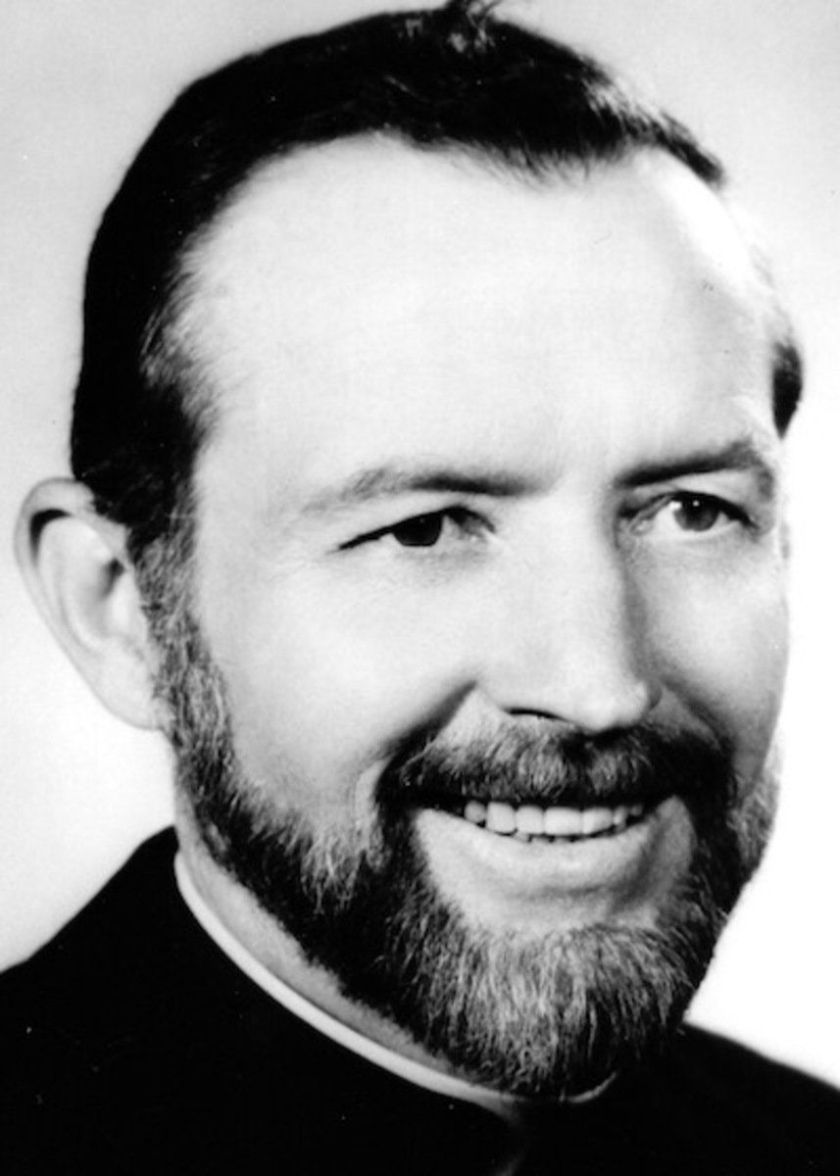
Today, 28 July 2018 , is the First Feast Day of Blessed Stanley Francis Rother (1935-1981) Martyr, Priest, Missionary. Blessed Stanley was born on 27 March 1935 in Okarche, Oklahoma. He was martyred by gunshot at approximately 2am on 28 July 1981 in his rectory in Santiago Atitlán, Sololá, Guatemala.
Stanley Francis Rother was one of 4 children of Franz Rother (8 August 1911 – 2 July 2000) and Gertrude Smith (23 May 1913 – 24 October 1987), who had a farm close to that town in Oklahoma; sister Betty Mae, who became Sister Marita and two brothers, Tom & Jim. Stanley was strong and adept at farm tasks. Then after completing his high school studies at the Holy Trinity school he declared his calling to the priesthood to his parents. His parents were pleased with their son’s decision though his father asked him: “Why didn’t you take Latin instead of working so hard as a Future Farmer of America?” To prepare for this, he was sent to the Saint John Seminary and then to Assumption Seminary in San Antonio in Texas. His talents gained working on the farm left him with other duties at the seminary and his studies suffered and he struggled with Latin. He served as a sacristan, groundskeeper, bookbinder, plumber and gardener. After almost six years the seminary staff advised him to withdraw.
After consultation with his local bishop Bishop Victor Reed he then attended Mount Saint Mary’s Seminary in Emmitsburg in Maryland from which he graduated in 1963. Bishop Reed ordained him to the priesthood on 25 May 1963. Rother then served as an associate pastor in various parishes around Oklahoma and in 1968 – at his own request – he was assigned to the mission of the archdiocese to the Tz’utujil people located in Santiago Atitlán in the rural highlands of southwest Guatemala.
So that he could be in closer touch with his congregation, he set out to work to learn Spanish and the Tz’utujil language which was an unwritten and indigenous language that the missionary Ramón Carlín once recorded. He served in Santiago Atitlán from 1968 until his death. Rother lived with a native family for a while to get a better grasp of practical conversation and worked with the locals to show them how to read and write. He supported a radio station located on the mission property which transmitted daily lessons in both language and mathematics. In 1973 he noted with pride in a letter: “I am now preaching in Tz’utuhil.” During that time, in addition to his pastoral duties he translated the New Testament into Tz’utujil and began the regular celebration of the Mass in Tz’utujil. In the late 1960s Rother founded in Panabaj a small hospital, dubbed as the “Hospitalito”, Father Carlín served as a collaborator in this project.
By 1975, Rother had become the de facto leader of the Oklahoma-sponsored mission effort in Guatemala as other religious and lay supporters rotated out of the program. He was a highly recognisable figure in the community, owing to his light complexion as well as his habit of smoking tobacco in a pipe. Since there was not a Tz’utujil name equivalent to “Stanley,” the people of Father Rother’s mission affectionately called him “Padre Apla’s,” translated as “Father Francis,” in reference to his middle name.
Rother put his farming skills to good use in Guatemala, on one occasion operating a bulldozer from 7:00 am to 4:30 pm to clear land on local farms, stopping just for Mass. His door was open to all people. There was one old man who appeared each day for lunch and others came for advice on personal or financial affairs. Some even turned up to have their teeth extracted. On one occasion he accompanied a boy to Guatemala City to be treated for lip cancer, from which the boy was eventually cured.
Within the last year of his life Rother saw the radio station smashed and its director murdered. His catechists and parishioners would disappear and later be found dead, with their bodies showing signs of having been beaten and tortured. In December 1980 he had addressed a letter to the faithful in Oklahoma and wrote about the violent situation: “This is one of the reasons I have for staying in the face of physical harm. The shepherd cannot run at the first sign of danger.”
At the beginning of 1981 he was warned that his name was on a death list (he was number eight on the list) and that he should leave Guatemala at once to remain alive. One parishioner warned him in January: “Father, you’re in extreme danger. You must get out immediately.” Rother was reluctant but he nonetheless returned to Oklahoma in January, though he later asked the archbishop for permission to return: “My people need me. I can’t stay away from them any longer.” Another reason for returning was that he wanted to celebrate Easter with them. His brother Tom said to him, upon hearing that Stanley wanted to return to Guatemala: “Why do you want to go back? They’re waiting on you and they’re gonna kill you.” Rother said: “Well, a shepherd cannot run from his flock.” “Pray for us that we may be a sign of the love of Christ for His people,” said Fr Stanley, “that our presence among them will fortify them to endure these sufferings in preparation for the coming of the Kingdom.” Rother went back to Santiago Atitlán in April and knew that he was being watched.
On the morning of 28 July just after midnight, gunmen broke into the rectory of his church and shot him twice in the head after a brief struggle. The killers forced the teenager Francisco Bocel (who was in the church at the time) to lead them to the bedroom of the “red-bearded Oklahoma-born missionary.” The men threatened to kill Bocel if he did not show them Rother and so Bocel led them downstairs and knocked on a door near the staircase saying: “Father. They are looking for you.” Rother opened the door and a struggle ensued as Bocel ran upstairs hearing Rother yell: “Kill me here!” One shot pierced his jaw and the fatal shot struck the left temple; there were bruises on both hands. His father Franz – upon hearing the news of his son’s death – rang his eldest daughter Marita in Kansas and told her: “They got him.” She hung up the phone and wept.
Father Rother was one of 10 priests murdered in Guatemala that year. His remains were flown back to Oklahoma and were buried in his hometown on 3 August 1981, in Holy Trinity Cemetery. At the request of his former Tz’utujil parishioners, his heart was removed and buried under the altar of the church where he had served.
Three men were arrested on charges of murder within weeks of Rother’s murder, another man and a women were sought for questioning at that stage as well. The three men arrested admitted to having entered the church in a robbery attempt and also admitted to having shot Rother dead when the priest attempted to stop them. Despite the confessions, many people familiar with the circumstances of the murder considered the three accused persons as innocent and the prosecutions to be a cover-up of paramilitary involvement in the murder. Convictions for all three men were later overturned by a Guatemalan appellate court, under pressure from U.S. authorities. No other suspects have been prosecuted for the murder.
On 1 December 2016 his Beatification received approval from Pope Francis after the Pope confirmed that Rother had been killed “in odium fidei” (in hatred of the faith). On 13 March, 2017 the date for his Beatification was announcedand was Beatified on 23 September 2017 at the Cox Convention Centre, with Cardinal Angelo Amato presiding over the Beatification – as the Prefect of the Congregation of the Causes of the Saints on the Holy Father’s behalf at a Mass attended by approximately 20,000 people.
St Acacius of Miletus
St Alphonsa of the Immaculae Conception/India FCC (1910-1946)
St Arduinus of Trepino
St Botwid of Sudermannland
St Camelian of Troyes
St Celsus of Rome
Bl Christodoulos
Bl Davíd Carlos-Marañon
St Eustathius of Galatia
St Irene of Cappadocia
Bl John Soreth
St José Caselles-Moncho
Bl José Melchór García-Sampedro Suárez
Bl Josep Castell-Camps
St Longinus of Satala
St Lucidius of Aquara
St Lyutius
Bl Manuel Segura-López
St Nazarius of Rome
St Pedro Poveda Castroverde
St Peregrinus
St Samson of York
Bl Stanley Francis Rother (1935-1981) Martyr
He is the first US-born Priest and Martyr to be Beatified (on 23 September 2017) and the second person to be Beatified on US soil following the 2014 Beatification of New Jersey-born nun, Blessed Miriam Teresa Demjanovich S.C. (1901-1927).
His First Feast Day today, 28 July 2018
St Pope Victor I
—
Martyrs of Laodicea – 8 saints
Martyrs of Thebaid: A large but unspecified number of Christians who were imprisoned, tortured and murdered together in the persecutions of Decius and Valerian. 3rd century Thebes, Egypt.
Martyred in the Spanish Civil War – Thousands of people were murdered in the anti-Catholic persecutions of the Spanish Civil War from 1934 to 1939.
Martyrs of Fernán Caballero – 14 beati: Fourteen Claretian clerics who were martyred together in the Spanish Civil War. – 28 July 1936 in Fernán Caballero, Ciudad Real, Spain. They were Beatified on 13 October 2013 by Pope Francis.
Bl Antolín Astorga Díez
Bl Enrique Serra Chorro
Bl Gregorio Charlez Ribera
Bl Joan Ayats Plantalech
Bl Joan Bover Teixidor
Bl Joan Costa Canal
Bl José Aurelio Calleja de Hierro
Bl José Gutiérrez Arranz
Bl Josep Camí y Camí
Bl Josep Martí Coll
Bl Lluis Casanovas Vila
Bl Lorenzo Arribas Palacio
Bl Manuel Collellmir Sentíes
Bl Miguel Léibar Garay
Bl Narcís Felíu Costa
Bl Pedro Alonso Fernández
Bl Pelagi Ayats Vergés
Bl Pere Vilar Espona
Bl Primitivo Sandín Miñambres
Bl Ramon Gros Ballbé
Bl Vicente Toledano Valenciano
Thought for the Day – 27 July – Friday of the Sixteenth week in Ordinary Time, Year B – Today’s Gospel: Matthew 13:18–23
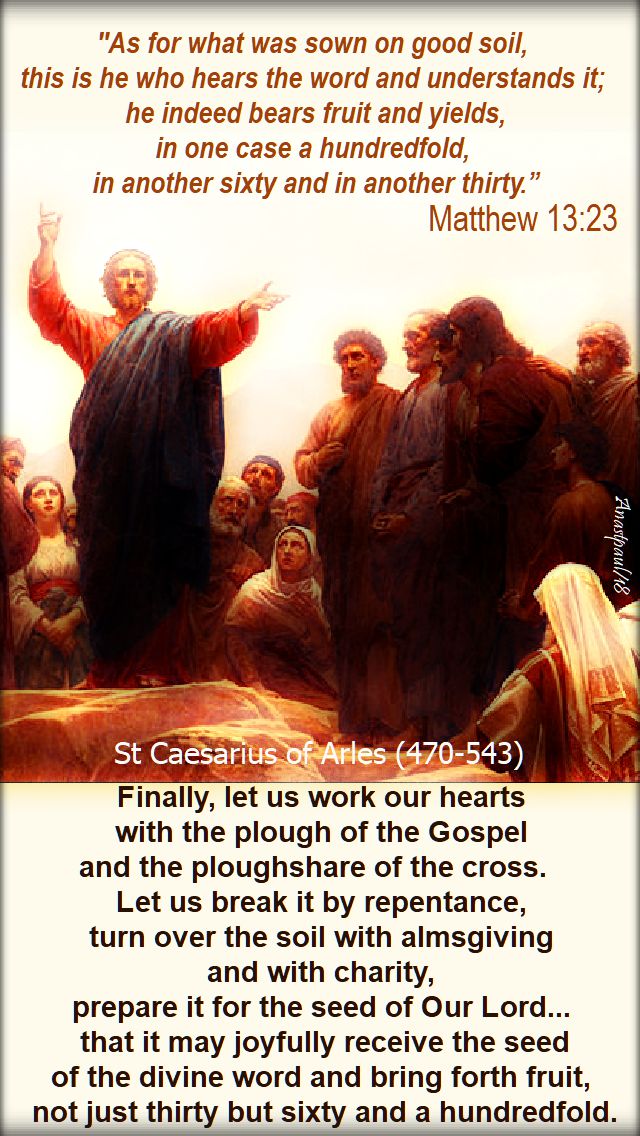
“As for what was sown on good soil, this is he who hears the word and understands it; he indeed bears fruit and yields, in one case a hundredfold, in another sixty and in another thirty.”…Matthew 13:23
“Dear brothers and sisters, Jesus invites us today to look inside ourselves: to give thanks for our good soil and to tend the soil that is not yet good.
Let us ask ourselves if our heart is open to welcome the seed of the Word of God with faith.
Let us ask ourselves if our rocks of laziness are still numerous and large; let us identify our thorns of vice and call them by name.
Let us find the courage to reclaim the soil, to effect a conversion of our heart, bringing to the Lord in Confession and in prayer, our rocks and our thorns.” …Pope Francis (Angelus, 16 July 2017)
Quote of the Day – 27 July – Friday of the Sixteenth week in Ordinary Time, Year B – Today’s Gospel: Matthew 13:18–23
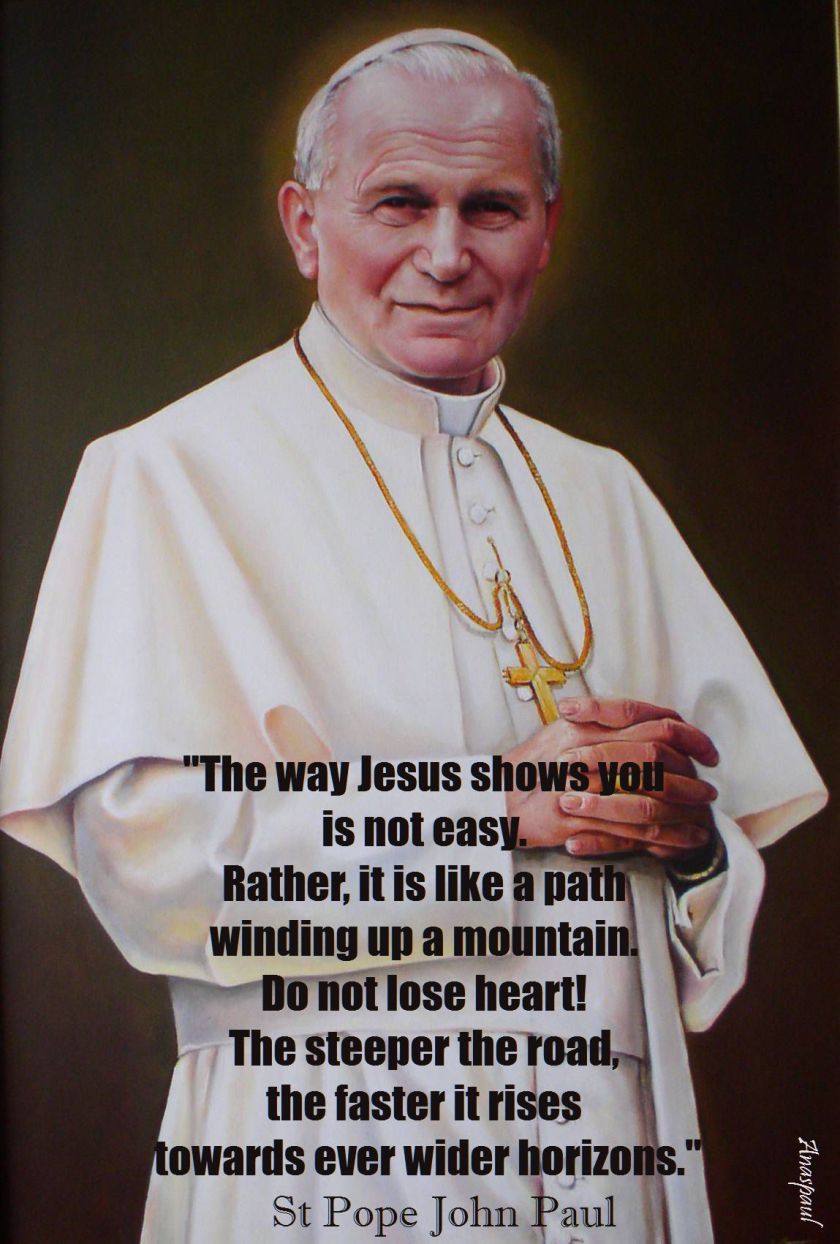
“The way Jesus shows you is not easy. Rather, it is like a path winding up a mountain. Do not lose heart! The steeper the road, the faster it rises towards ever wider horizons.”
One Minute Reflection – 27 July – Friday of the Sixteenth week in Ordinary Time, Year B – Today’s Gospel: Matthew 13:18–23
“As for what was sown on good soil, this is he who hears the word and understands it; he indeed bears fruit, and yields, in one case a hundredfold, in another sixty, and in another thirty.”...Matthew 13:23
REFLECTION – “Indeed, you all know how land is cultivated. First of all you pull out the weeds and throw away the stones, then you work the ground itself. You do it again a second time, a third time and finally… you sow. Oh, let it be like this in our souls! First of all let us uproot the weeds, that is to say our evil thoughts; then take out the stones, in other words all our malice and obstinacy. Finally, let us work our hearts with the plough of the Gospel and the ploughshare of the cross. Let us break it by repentance, turn over the soil with almsgiving and with charity, prepare it for the seed of Our Lord… that it may joyfully receive the seed of the divine word and bring forth fruit, not just thirty but sixty and a hundredfold.”...St Caesarius of Arles (470-543) Monk & Bishop (Sermons to the people, no.6 passim ; SC 175)
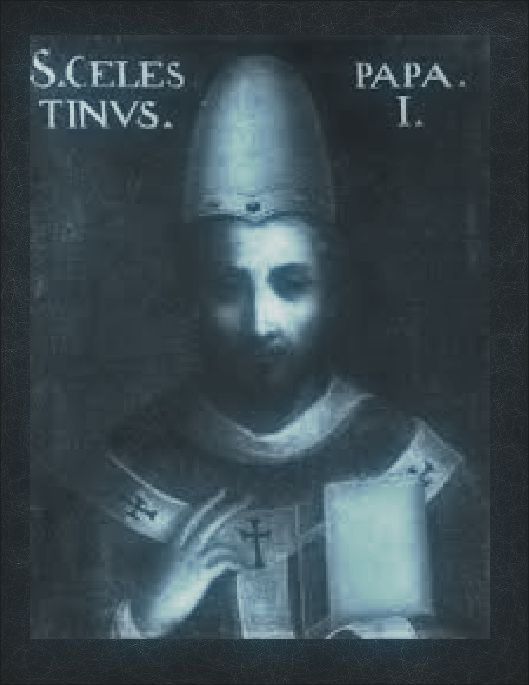
PRAYER – A pure heart create for me O God, put a steadfast spirit within me! (Ps 50[51]) Lord God, bestow a full measure of Your grace to us. Keep us within in the path of Your commandments, help us to work on the earth of our souls, rooting out the weeds and casting forth the stones of malice. Grant that by the prayers of St Pope Celestine, who faced so many stones of heresy, we may succeed in attaining sanctity. Through Christ, our Lord, in union with the Holy Spirit, one God, forever, amen.
Our Morning Offering – 27 July – Friday of the Sixteenth week in Ordinary Time, Year B
Above All That is Not You Thomas à Kempis (1380-1471)
O most loving Jesus,
give me this special grace to rest in You
above all created things,
above all health and beauty,
above all glory and honour,
above all dignity and power,
above all knowledge and prudence,
above all riches and talents,
above all joy and gladness,
above all fame and praise,
above all sweetness and consolation,
above all hope and promise,
above all merit and desire,
above all gifts and rewards
that You may give or send –
except Yourself –
above all joy or happiness
that the human mind and heart
can grasp or feel,
above all Angels and Archangels,
above all the heavenly hosts as well,
above all things visible and invisible
and above all that is not You,
my God.
Amen
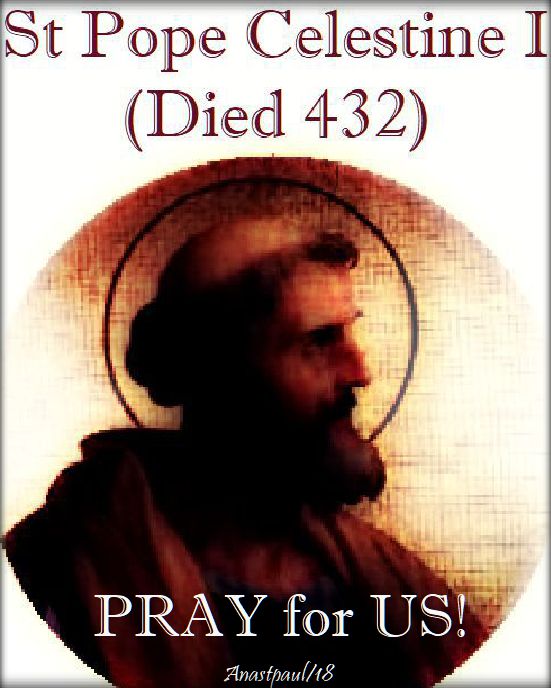
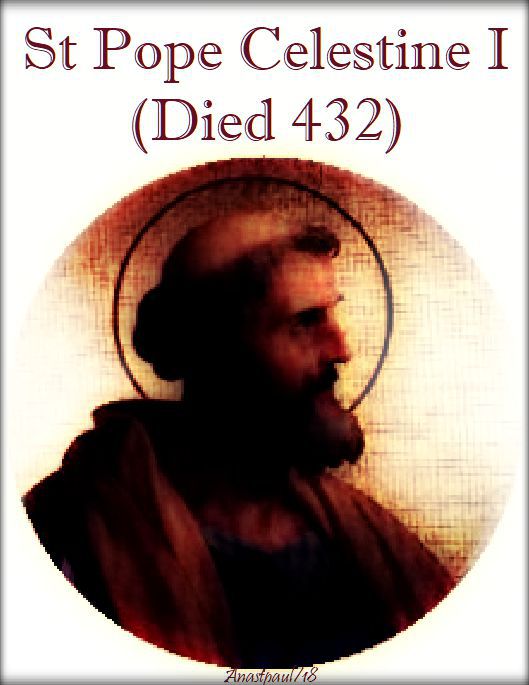
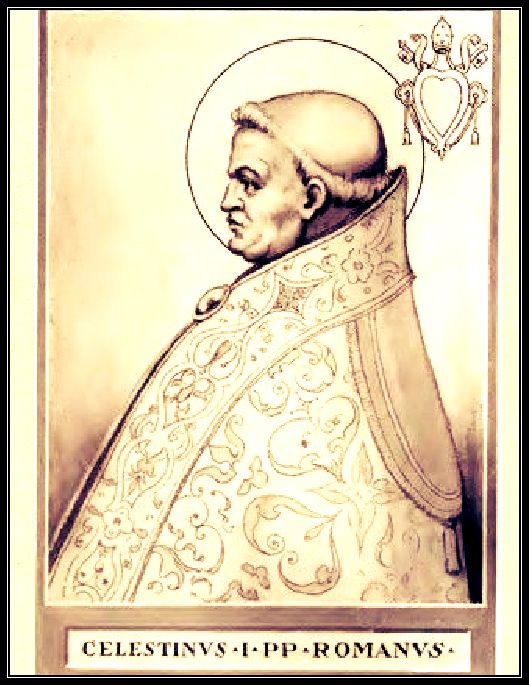
Saint of the Day – St Pope Celestine I (died 432), called “the Heresy Fighter.” Much is unknown about Celestine, including his birthday. But his reign as Pope – from 422 to his death in 432 – is credited with many achievements.
Celestine I was a Roman from the region of Campania. Nothing is known of his early history except that his father’s name was Priscus. According to John Gilmary Shea, Celestine was a relative of the emperor Valentinian. He appears to have spent some time in Milan, living with the city’s bishop, St Ambrose (340-397). St Augustine (354-430) (a protégé of Ambrose) seems to have been good friends with Celestine. Certainly, Celestine sided with St Augustine against the Donatists and Semipelagians.
The first known record of him is in a document of Pope Innocent I from the year 416, where he is spoken of as “Celestine the Deacon”.
Various portions of the liturgy are attributed to him but without any certainty on the subject. In 430, he held a synod in Rome, at which the teachings of Nestorius were condemned. The following year, he sent delegates to the First Council of Ephesus, which addressed the same issue. Four letters written by him on that occasion, all dated 15 March 431, together with a few others, to the African bishops, to those of Illyria, of Thessalonica and of Narbonne, are extant in re-translations from the Greek; the Latin originals having been lost.
St Celestine actively condemned the Pelagians and was zealous for Roman orthodoxy. To this end he was involved in the initiative of the Gallic bishops to send Germanus of Auxerre and Lupus of Troyes travelling to Britain in 429 to confront bishops reportedly holding Pelagian views.
He sent Palladius to Ireland to serve as a bishop in 431. Bishop Patricius (Saint Patrick) continued this missionary work. Pope Celestine strongly opposed the Novatians in Rome; as Socrates Scholasticus writes, “this Celestinus took away the churches from the Novatians at Rome also and obliged Rusticula their bishop to hold his meetings secretly in private houses.” He was zealous in refusing to tolerate the smallest innovation on the constitutions of his predecessors. As St Vincent of Lerins reported in 434:
Holy Pope Celestine also expresses himself in like manner and to the same effect. For in the Epistle which he wrote to the priests of Gaul, charging them with connivance with error, in that by their silence they failed in their duty to the ancient faith, and allowed profane novelties to spring up, he says: “We are deservedly to blame if we encourage error by silence. Therefore rebuke these people. Restrain their liberty of preaching.”
In a letter to certain bishops of Gaul, dated 428, St Celestine rebukes the adoption of special clerical garb by the clergy. He wrote: “We [the bishops and clergy] should be distinguished from the common people [plebe] by our learning, not by our clothes; by our conduct, not by our dress; by cleanness of mind, not by the care we spend upon our person”.
The 5th century was something of a boom time for heresy. Celestine also had to confront Manicheans, Novatians and, above all, Nestorians. He commissioned St Cyril of Alexandria to look into Nestorianism, which taught that Christ had two persons and denied that Mary was the Mother of God. Having determined that this was heretical, the Pope deposed Nestorius, restoring faithful Catholics whom Nestorius had excommunicated.
St Celestine died on 26 July 432. He was buried in the cemetery of St Priscilla in the Via Salaria but his body, subsequently moved, now lies in the Basilica di Santa Prassede.
In art, Saint Celestine is portrayed as a Pope with a dove, dragon, and flame.
St Aetherius of Auxerre
St Anthusa of Constantinople
St Arethas
St Aurelius of Cordoba
Bl Berthold of Garsten
St Pope Celestine I (Died 432)
St Ecclesius of Ravenna
Bl Felipe Hernández Martínez
St Felix of Cordoba
St Galactorio of Lescar
St George of Cordoba
St Hermippus
St Hermocrates
St Hermolaus
Bl Jaime Ortiz Alzueta
Bl Joaquín Vilanova Camallonga
Bl José María Ruiz Cano
St Juliana of Mataró
St Lillian of Cordoba
Bl Lucy Bufalari
St Luican
Bl Maria Grazia Tarallo
Bl Maria Klemensa Staszewska
Bl Mary Magdelene Martinengo
St Maurus of Bisceglia
Bl Modesto Vegas y Vegas
St Natalia of Cordoba
Bl Nevolone of Tavenisa
St Pantaleimon
St Pantaleon (Died c 305) Martyr
Bl Rudolf Aquaviva S.J.
Bl Robert Sutton
St Semproniana of Mataró
St Sergius of Bisceglia
Bl William Davies
Bl Zacarías Abadía Buesa
Martyrs of Nicomedia – 3 saints: Three Christians martyred together. The only other information to survive are their names – Felix, Jucunda and Julia. Nicomedia, Asia Minor.
Seven Sleepers of Ephesus: A group of seven young Christian men who hid in a cave in hopes of avoiding the persecution of Decius in the year 250. Found and arrested, they were ordered by the pro-consul in Ephesus to renounce their faith; they refused and were sentenced to die. Legend says that they were walled up in their hiding cave, guarded by the dog Al Rakim; when the cave wall was breached in 479 – they all woke up!
It is likely that the youths were tortured to death in various ways and buried in the cave. The resurrection story confusion came from the phrase “went to sleep in the Lord” which was used to describe the death of Christians and 479 is when their relics were discovered. Their names were Constantinus, Dionysius, Joannes, Malchus, Martinianus, Maximianus and Serapion. They were martyred in 250 in Ephesus (in modern Turkey); tradition says that they were walled up in a cave to suffocate but other records indicate that they were tortured to death in various ways. Their relics discovered in 479 and translated to Marseilles, France and enshrined in a large stone coffin.
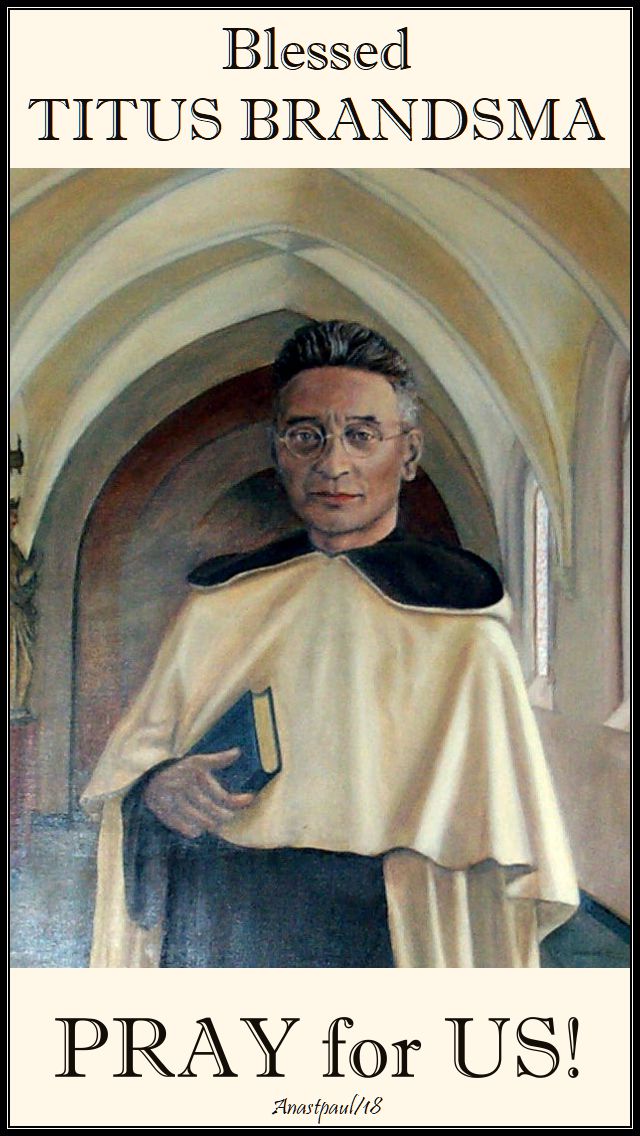
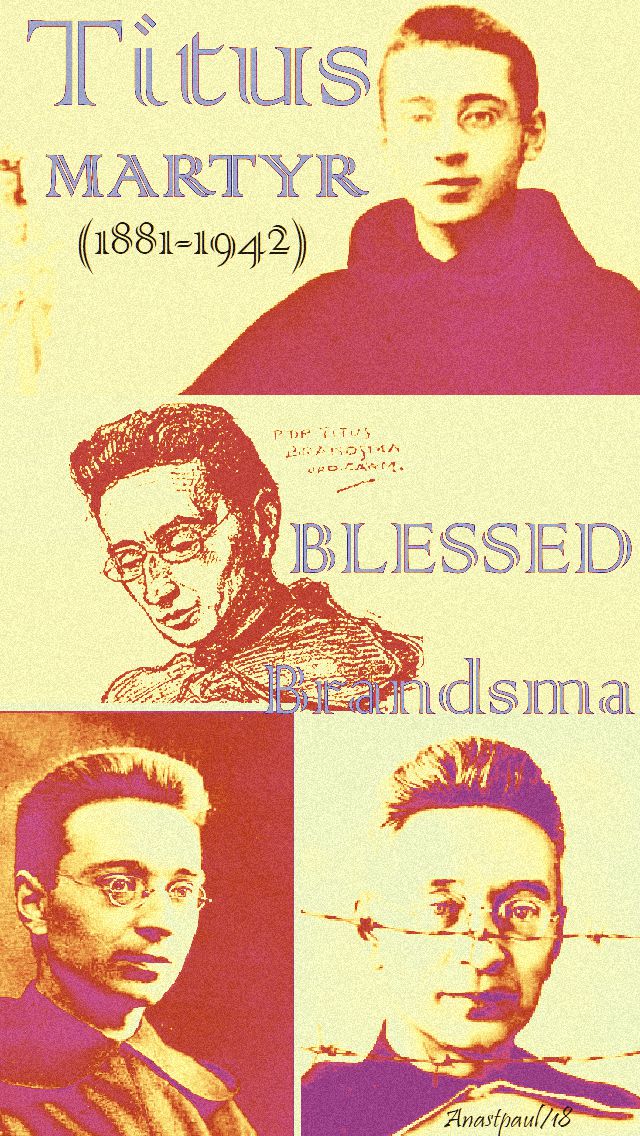
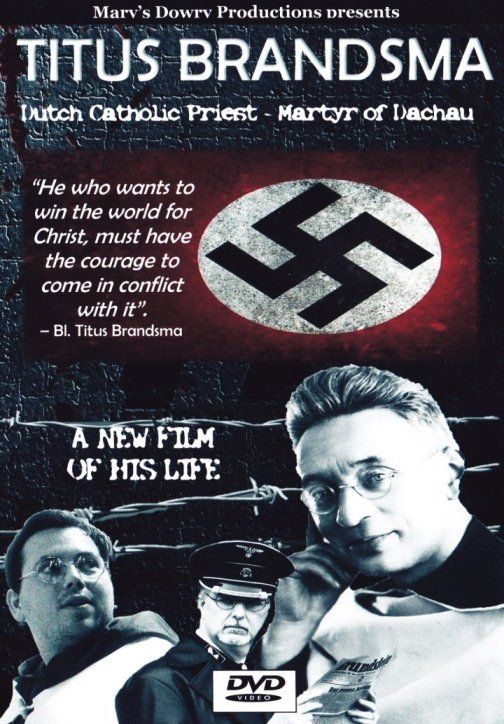
Thought for the Day – 26 July – The Memorial of Blessed Titus Brandsma O.C.D. (1881-1942) Martyr of the Faith
Titus’ teachings on peace and forgiveness were probably put to the most radical test during his seven months as a prisoner of the Nazis. He was subjected, not only to loss of freedom and appalling prison conditions but to brutal mistreatment by his captors, including medical experimentation. Two particular incidents stand out as concrete examples of his response to these extreme conditions of suffering.
Once, another Dutch prisoner challenged him about his admonition that the prisoners should pray for their Nazi captors. How could they be expected to do that, the other Dutchman asked, when they were being mishandled and terrorised by the guards? With typical humour and realism, Titus replied, “You don’t have to pray for them the whole day! The good Lord will be happy with one prayer”.
Always lovingly cognisant of the gap between the human ideal and the reality of human limitations, Titus counselled a practical, achievable goal.
Secondly, the nurse, who administered the fatal injection in the “hospital” at Dachau, testified at his beatification process that he had given her his rosary at the end and said “What an unfortunate girl you are. I shall pray for you”. His response, the nurse said, was instrumental in bringing her back to the practice of her faith (she was a Catholic).
Question for contemplation: Who are the persons in my life that I see as equivalent to Titus’ Nazi captors and how can I find realistic ways to be more accepting of them as human beings?
Blessed Titus Brandsma, Pray for us!
On 13 December 2017 an event took place in the United States of America that may take the cause of Carmelite martyr Blessed Titus Brandsma a step closer to canonisation.
The Bishop of Palm Beach Diocese in Florida, Bishop Gerald Barbarito and other officials signed, witnessed and sealed, the papers relating to an investigation of a medically unexplained healing attributed to God through the intercession of Blessed Titus.
The recipient of this grace is Father Michael Driscoll, a Carmelite friar working in Palm Beach Diocese. In 2004 he was diagnosed with a severe stage of metastatic melanoma cancer that was attacking his neck area behind the ear and spreading to other parts of his body. Some areas of the cancer were in the critical fourth and fifth stages. A sincere devotee of Blessed Titus, Father Michael prayed to God for healing through the intercession of the Carmelite martyr and his prayers were joined by fellow Carmelites, parishioners, friends and family. Undergoing more than 30 treatments including surgery, Father Michael said with determination, “I am okay because Titus is going to take care of me.”
On 13 December the diocese held the Official Closing Session of its investigation into the alleged miraculous healing. After a period of prayer, the papers were signed, witnessed, sealed and then sent to the Vatican’s Congregation for the Causes of Saints. If the case is deemed to be a credible miracle and Pope Francis approves, the canonisation of Titus Brandsma will be declared. (http://www.carmelite.org/news/hopeful-step-canonisation-blessed-titus-brandsma – with pics)
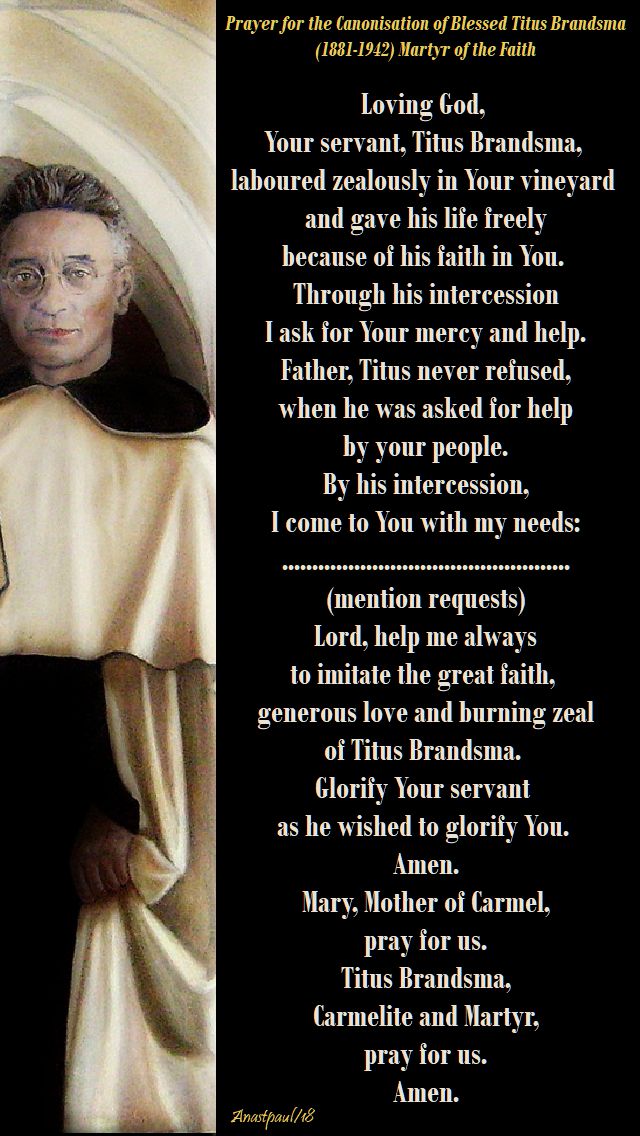
Prayer for the Canonisation of Blessed Titus Brandsma
Loving God, Your servant, Titus Brandsma, laboured zealously in Your vineyard and gave his life freely because of his faith in You. Through his intercession I ask for Your mercy and help. Father, Titus never refused, when he was asked for help by Your people. By his intercession, I come to You with my needs: ………………………………………… (mention requests) Lord, help me always to imitate the great faith, generous love and burning zeal of Titus Brandsma. Glorify Your servant as he wished to glorify You. Amen. Mary, Mother of Carmel, pray for us. Titus Brandsma, Carmelite and Martyr, pray for us. Amen.
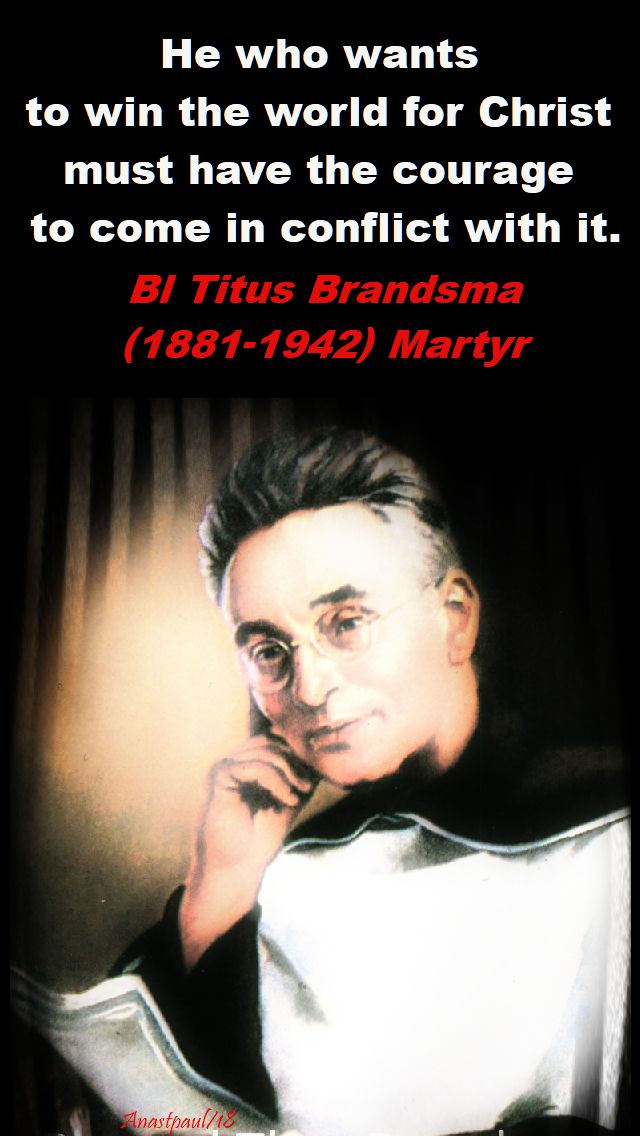
Quote/s of the Day – 26 July – The Memorial of Blessed Titus Brandsma O.C.D. (1881-1942) Martyr of the Faith
“He who wants to win the world for Christ must have the courage, to come in conflict with it.”
I am awestruck by Blessed Titus, who despite his ghastly sufferings, exclaimed:
“I see God in the work of His hands and the marks of His love in every visible thing.”
“Not my will but yours be done!” (what Blessed Titus would shout during torture and medical experiments)
++++++++++++++++++++
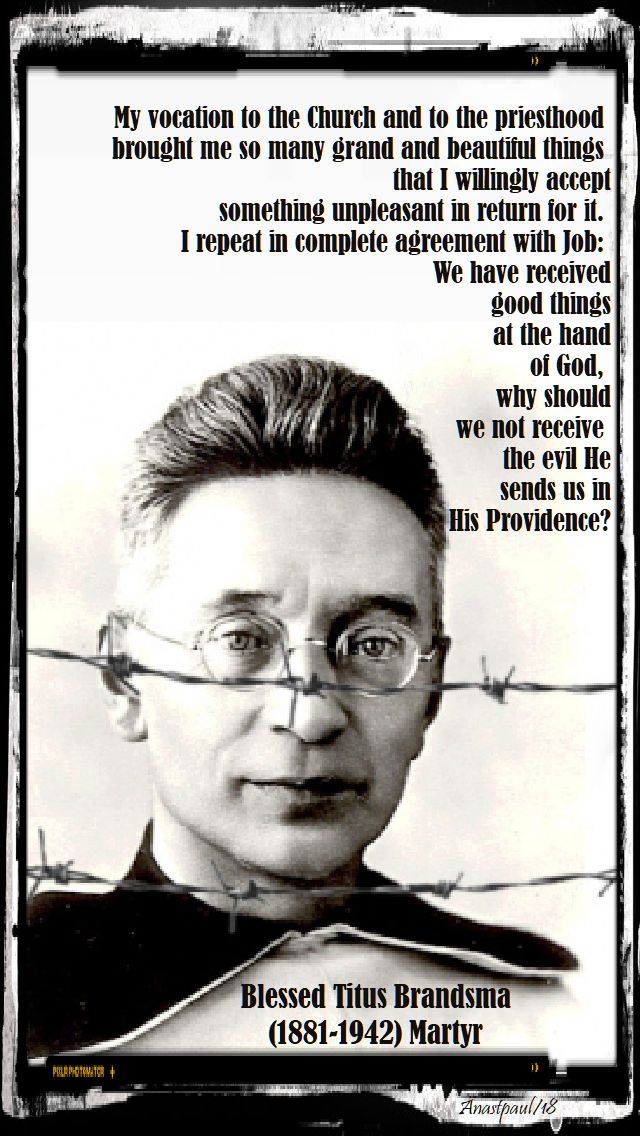
“My vocation to the Church and to the priesthood brought me so many grand and beautiful things that I willingly accept something unpleasant in return for it. I repeat in complete agreement with Job: We have received good things at the hand of God, why should we not receive the evil He sends us in His Providence?”
One Minute Reflection – 26 July – The Memorial of Sts Joachim and Anne, Parents of the Blessed Virgina nd Grandparents of Jesus
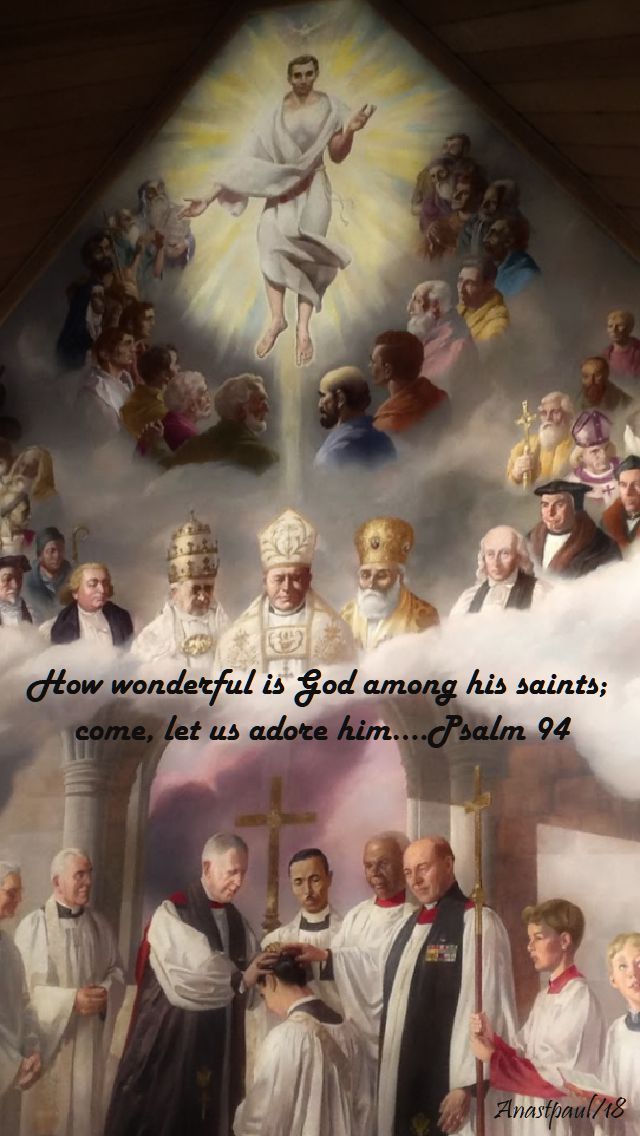
How wonderful is God among his saints; come, let us adore him…..Psalm 94
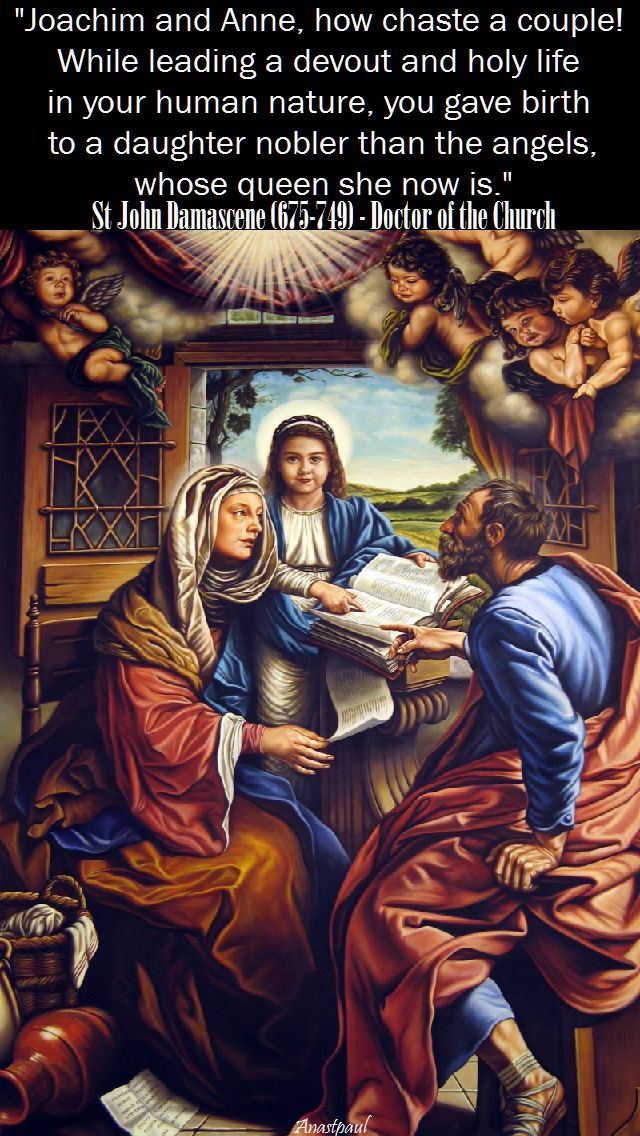
REFLECTION – “Joachim and Anne, how blessed a couple! All creation is indebted to you. For at your hands the Creator was offered a gift excelling all other gifts: a chaste mother, who alone was worthy of Him. Joachim and Anne, how blessed and spotless a couple! You will be known by the fruit you have borne, as the Lord says: “By their fruits you will know them.” The conduct of your life pleased God and was worthy of your daughter. For by the chaste and holy life you led together, you have fashioned a jewel of virginity: she who remained a virgin before, during and after giving birth . She alone for all time would maintain her virginity in mind and soul as well as in body. Joachim and Anne, how chaste a couple! While leading a devout and holy life in your human nature, you gave birth to a daughter nobler than the angels, whose queen she now is.” – from a sermon by Saint John Damascene (675-749) – Doctor of the Church
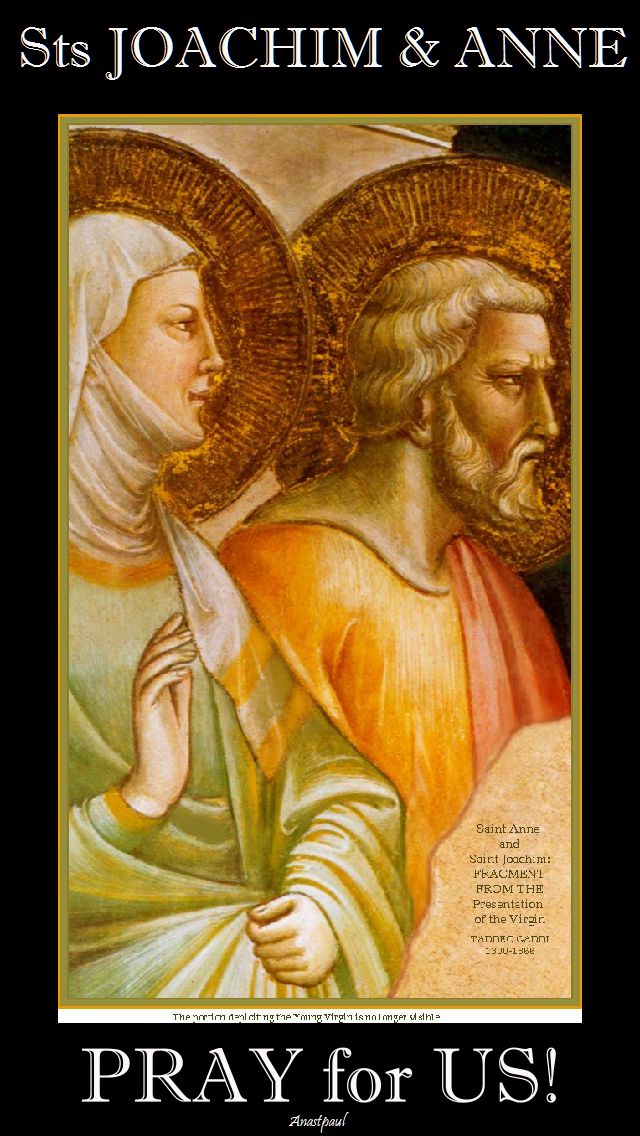
PRAYER – O Lord, God of our Fathers, who bestowed on Saints Joachim and Anne this grace, that of them should be born the Mother of your incarnate Son, grant, through the prayers of both, that we may attain the salvation you have promised to your people. Through our Lord Jesus Christ, your Son, who lives and reigns with you in the unity of the Holy Spirit, one God, for ever and ever. Sts Joachim and Anne, pray for us! Amen
Our Morning Offering – 26 July – The Memorial of Blessed Titus Brandsma O.C.D. (1881-1942) Martyr of the Faith
Prayer Before Jesus Crucified By Blessed Titus Brandsma (1881-1942) Martyr
Dear Lord, when looking up at Thee,
I see Thy loving eyes on me,
Love overflows my humble heart,
Knowing what a faithful friend Thy art.
A cup of sorrow I foresee,
Which I accept for love of Thee,
Thy painful way I wish to go,
The only way to God I know.
My soul is full of peace and light,
Although in pain, this light shines bright.
For here Thou keep to Thou breast.
My longing heart to find there rest.
Leave me here freely all alone,
In cell where never sunlight shone.
Should no one ever speak to me,
This golden silence makes me free!
For though alone, I have no fear,
Never wert Thou, O Lord, so near.
Sweet Jesus, please, abide with me!
My deepest peace I find in Thee.
Amen
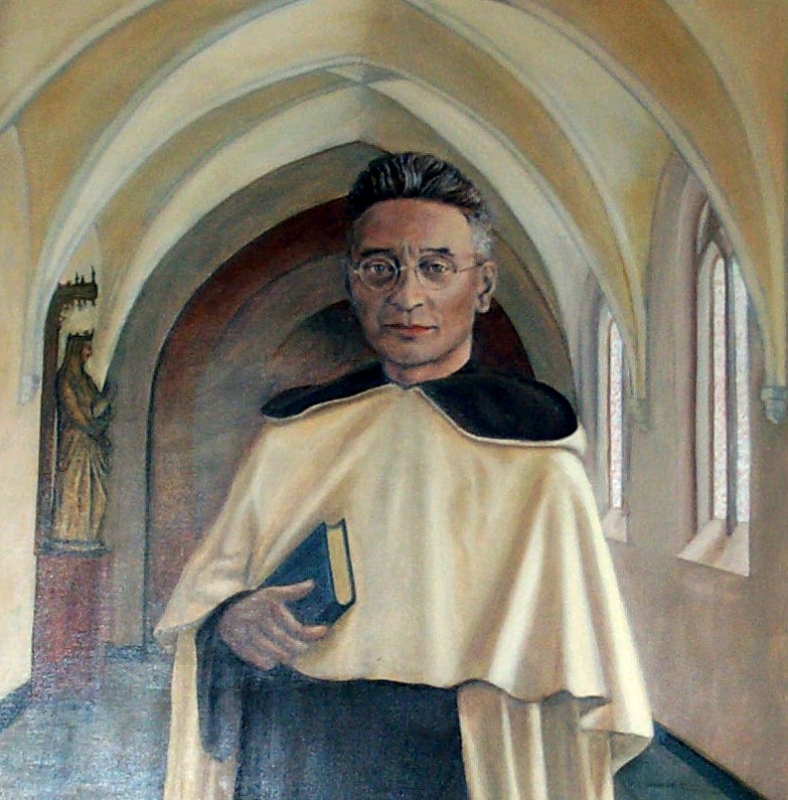
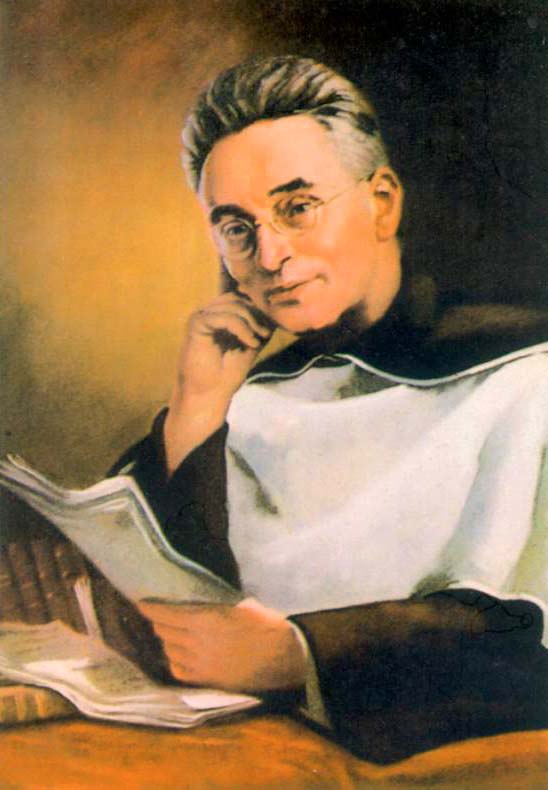
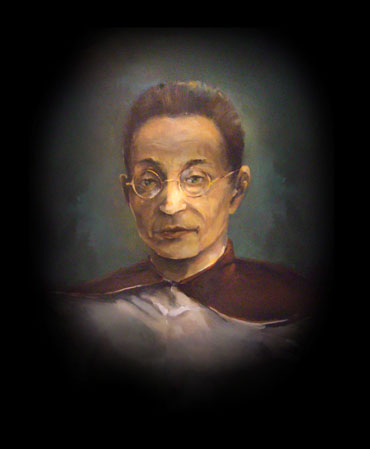
Saint of the Day – 26 July – Blessed Titus Brandsma O.C.D. (1881-1942) Martyr of the Faith – Carmelite Religious Priest, Mystic, Philosopher, Lecturer, Writer, Editor, Preacher, Linguist, Social Activist – born Anno Sjoerd Brandsma on 23 February 1881 at Oegeklooster, Friesland, Netherlands and was martyred on 26 July 1942 by lethal injection in the concentration camp at Dachau, Bavaria, Germany. His executioner was a nurse who had been raised Catholic but left the Church. His body was cremated and no relics remain.
Bl Titus’ parents, who ran a small dairy farm, were devout and committed Catholics, a minority in a predominantly-Calvinist region. With the exception of one daughter, all of their children entered religious orders. As a young boy, Brandsma did his secondary studies in the town of Megen, at a Franciscan-run minor seminary for boys considering a priestly or religious vocation, commonly known as a “Seminary Minor.” He entered the novitiate of the Carmelite friars in Boxmeer on 17 September 1898, where he took the religious name Titus (in honour of his father) by which he is now known. He professed his first vows in October 1899 and was Ordained a priest in 190. Brandsma was knowledgeable in Carmelite mysticism and was awarded a doctorate of philosophy at Rome in 1909. He then taught in various schools in the Netherlands. From 1916 on, he initiated and led a project to translate the works of St Teresa of Ávila into Dutch.
One of the founders of the Catholic University of Nijmegen (now Radboud University), Brandsma became a professor of philosophy and the history of mysticism at the school in 1923. He later served as Rector Magnificus. He was noted for his constant availability to everyone, rather than for his scholarly work as a professor. Brandsma also worked as a journalist and was the ecclesiastical adviser to Catholic journalists by 1935. That same year he did a lecture tour of the United States, speaking at various institutions of his Order.
After the invasion of the Netherlands by the Third Reich in May 1940, it was Brandsma’s fight against the spread of Nazi ideology and for educational and press freedom that brought him to the attention of the Nazis. In January 1942 he undertook to deliver by hand a letter from the Conference of Dutch Bishops to the editors of Catholic newspapers in which the bishops ordered them not to print official Nazi documents, as was required under a new law by the German occupiers. He had visited 14 editors before being arrested on the 19th of that month at the Boxmeer monastery.
After being held prisoner in Scheveningen, Amersfoort and Cleves, Brandsma was transferred to the Dachau concentration camp, arriving there on 19 June. His health quickly gave way and he was transferred to the camp hospital. He died on 26 July 1942, from a lethal injection administered by a nurse of the Allgemeine SS, as part of their program of medical experimentation on the prisoners.
In 1921 Brandsma worked to resolve a controversy concerning Belgian artist Albert Servaes’ depiction of the Stations of the Cross. From this came his series of meditations on each of the 14 stations, though he never finished the 14th Station as he wrote them whilst in Dachau and was executed before completing them.
He was beatified in November 1985 by Pope John Paul II. His feast day is observed within the universal Church today and within the Carmelite Order on 27 July.
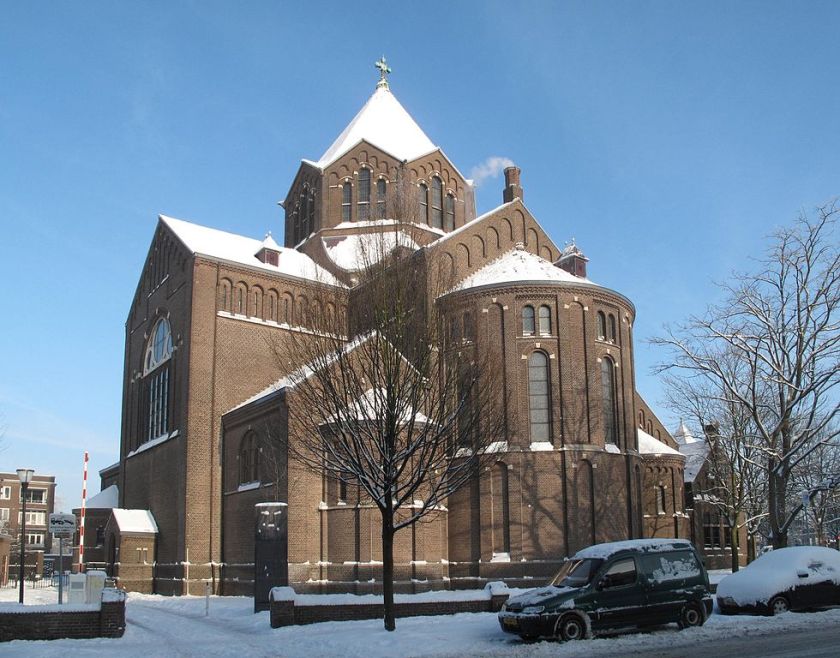
In 2005 Brandsma was chosen by the inhabitants of Nijmegen as the greatest citizen to have lived there. A memorial church now stands in the city dedicated to him.
Brandsma’s studies on mysticism was the basis for the establishment in 1968 of the Titus Brandsma Institute in Nijmegen, dedicated to the study of spirituality. It is a collaboration between the Dutch Carmelite friars and Radboud University Nijmegen. Brandsma was honoured by the city of Dachau with a street adjoining the former camp.
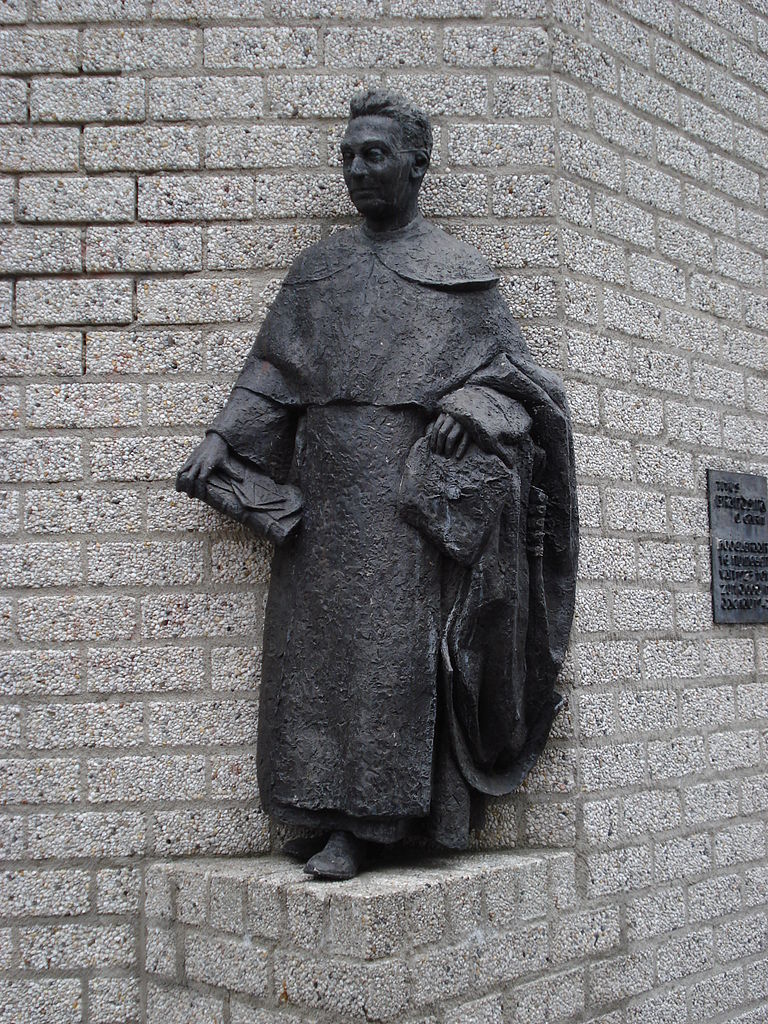
Statue of Titus Brandsma on the grounds of Radboud University, Nijmegen
Bl Andrew the Catechist
St Austindus of Auch
St Bartholomea Capitanio
St Benigno of Malcestine
Bl Camilla Gentili
St Charus of Malcestine
Bl Edward Thwing
Bl Élisabeth-Thérèse de Consolin
St Erastus
Bl Évangéliste of Verona
St Exuperia the Martyr
Bl George Swallowell
St Gérontios
Bl Giuseppina Maria de Micheli
St Gothalm
St Hyacinth
Bl Jacques Netsetov
Bl John Ingram
St Joris
Bl Marcel-Gaucher Labiche de Reignefort
Bl Marie-Claire du Bac
Bl Marie-Madeleine Justamond
Bl Marie-Marguerite Bonnet
St Olympius the Tribune
St Parasceva of Rome
St Pastor of Rome
Bl Pérégrin of Verona
Bl Pierre-Joseph le Groing de la Romagère
Bl Robert Nutter
St Simeon of Padolirone
St Symphronius the Slave
St Theodulus the Martyr
St Titus Brandsma O.C.D. (1881-1942) Martyr of the Faith
St Valens of Verona
Bl William Ward
—
Martyred in the Spanish Civil War:
Bl Aleix Miquel Rossell
Bl Amancio Marín Mínguez
Bl Antoni Jaume Secases
Bl Josep Maria Jordá i Jordá
Bl Josep Masquef Ferré
Bl Manuel Martín Sierra
Bl Miquel Vilatimó Costa
Bl Pau Roselló Borgueres
Bl Santiago Altolaguirre y Altolaguirre
Bl Vicente Pinilla Ibáñez
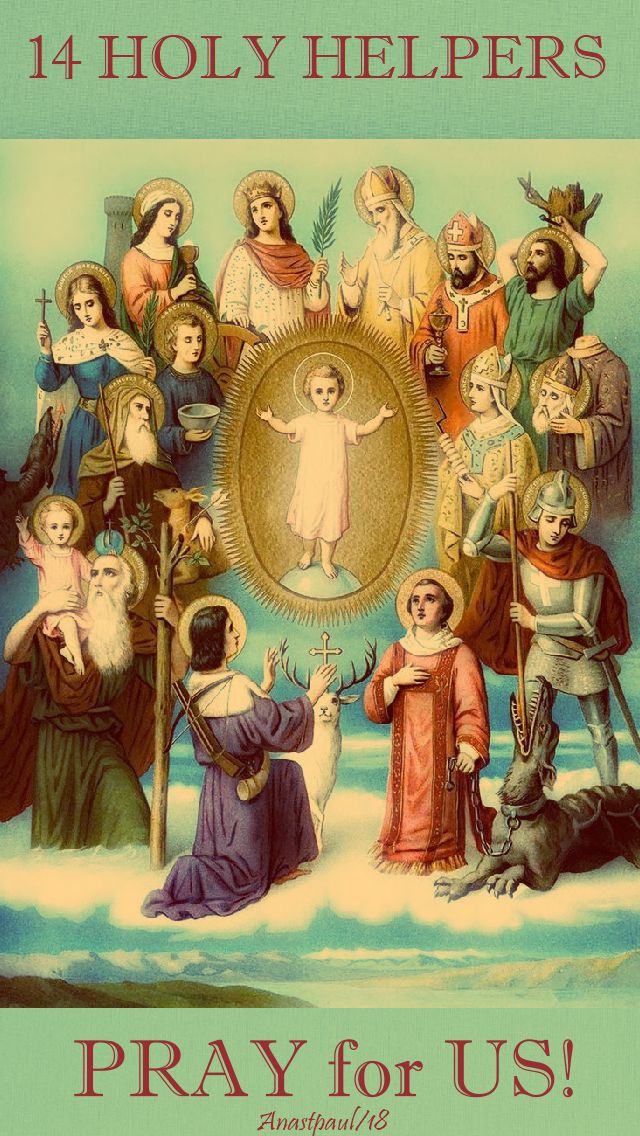
Thought for the Day – 25 July – The Memorial of St Christopher (died c 251) One of the Fourteen Holy Helpers
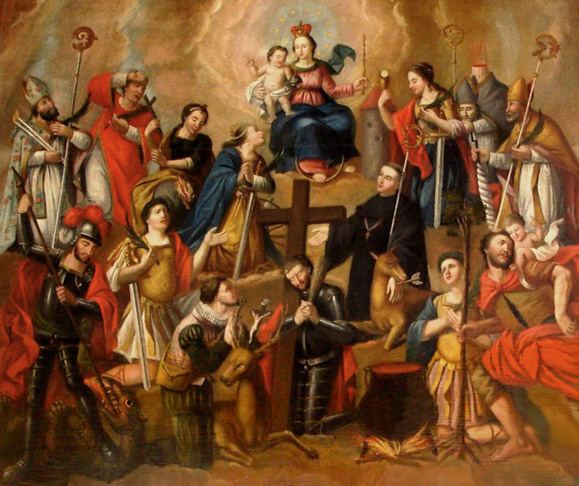
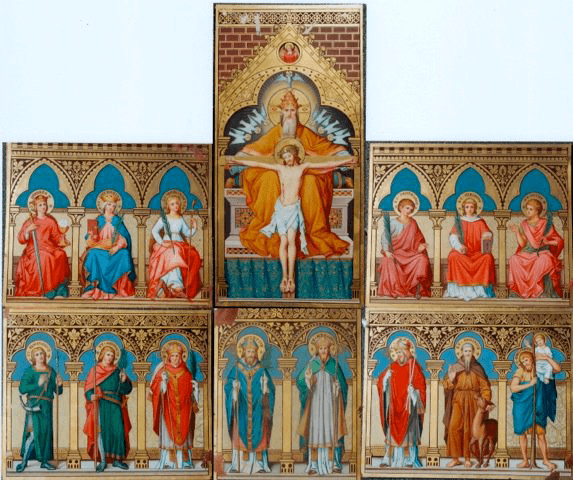
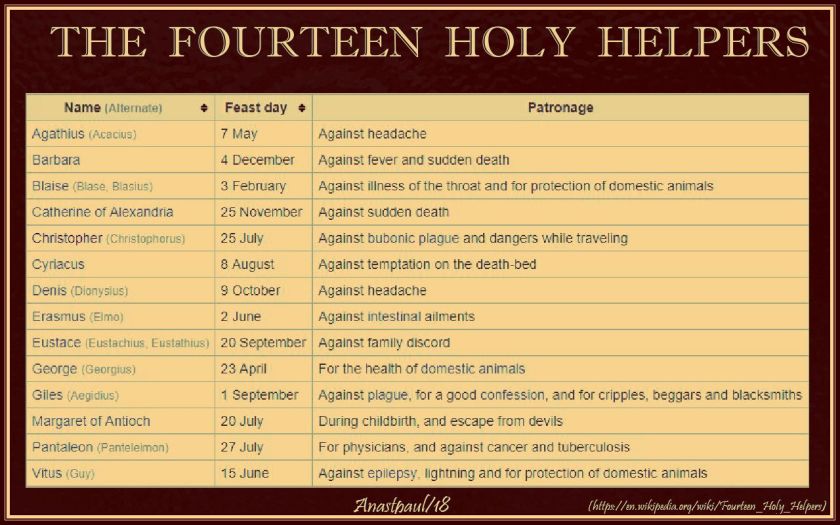
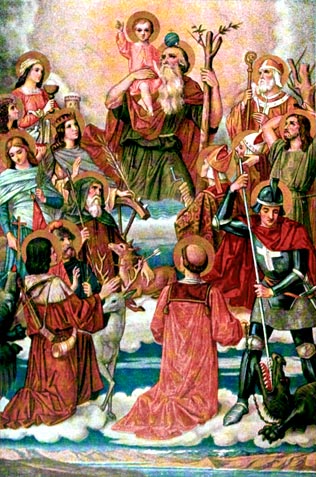
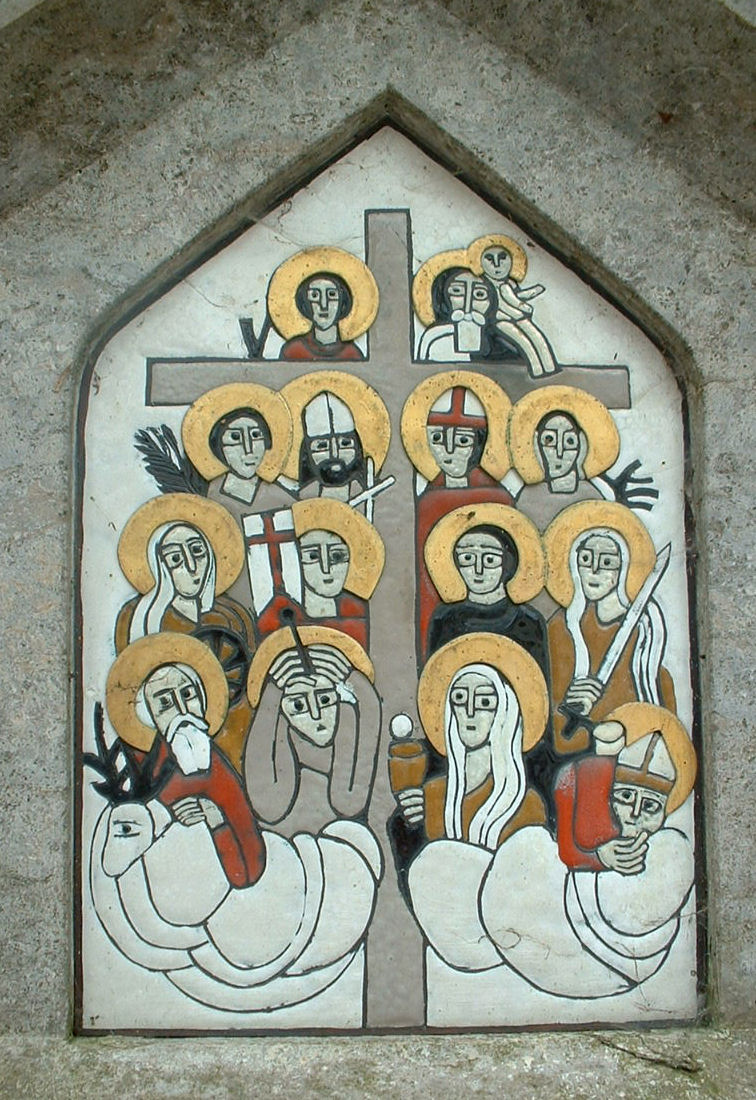
The Fourteen “Auxiliary Saints” or “Holy Helpers” are a group of saints invoked because they have been efficacious in assisting in trials and sufferings. Each saint has a separate feast or memorial day and the group was collectively venerated on 8 August until the 1969 reform of the Roman calendar, when the feast was dropped. These saints were often represented together. Popular devotion to these saints often began in some monastery that held their relics. All of the saints except Giles were martyrs. Devotion to some of the saints, such as St George, St Margaret, St Christopher, St Barbara and St Catherine became so widespread that customs and festivals still are popular today.
The Fourteen Holy Helpers are invoked as a group mainly because of the Black Plague which devastated Europe from 1346 to 1349. Among its symptoms were the black tongue, a parched throat, violent headache, fever and boils on the abdomen. The victims were attacked without warning, robbing them of their reason and killed within a few hours; many died without the last Sacraments. No one was immune and the disease wreaked havoc in villages and family circles. The epidemic appeared incurable. The pious turned to Heaven, begging the intervention of the saints, praying to be spared or cured. Each of these fourteen saints had been efficacious in interceding in some aspect for the stricken during the Black Plague. The dates are the traditional feast days; not all the saints are on the Universal Roman Calendar.
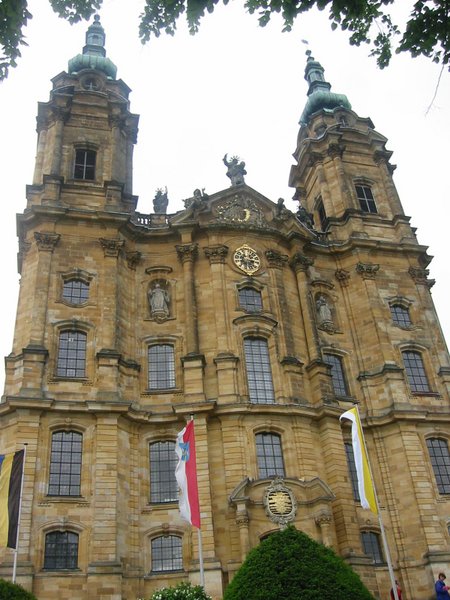
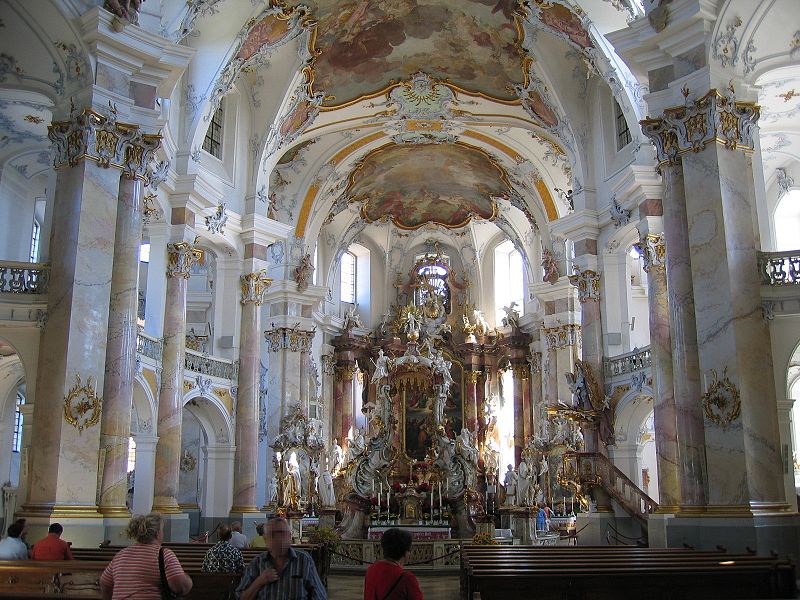
The Basilica of the Fourteen Holy Helpers (also Basilika Vierzehnheiligen) is a church located near the town of Bad Staffelstein near Bamberg, in Bavaria, southern Germany. The late Baroque-Rococo basilica, designed by Balthasar Neumann, was constructed between 1743 and 1772.
The altar depicts statues of the Fourteen Holy Helpers.
The Legend of Building the Basilica
On 24 September 1445, Hermann Leicht, the young shepherd of a nearby Franciscan monastery, saw a crying child in a field that belonged to the nearby Cistercian monastery of Langheim . As he bent down to pick up the child, it abruptly disappeared. A short time later, the child reappeared in the same spot. This time, two candles were burning next to it. In June 1446, the Leicht saw the child a third time. This time, the child bore a red cross on its chest and was accompanied by thirteen other children. The child said: “We are the fourteen helpers and wish to erect a chapel here, where we can rest. If you will be our servant, we will be yours!” Shortly after, Leicht saw two burning candles descending to this spot. It is alleged that miraculous healings soon began, through the intervention of the fourteen saints.
The Cistercian brothers to whom the land belonged erected a chapel, which immediately attracted pilgrims. An altar was consecrated as early as 1448. Pilgrimages to the Vierzehnheiligen continue to the present day between May and October.
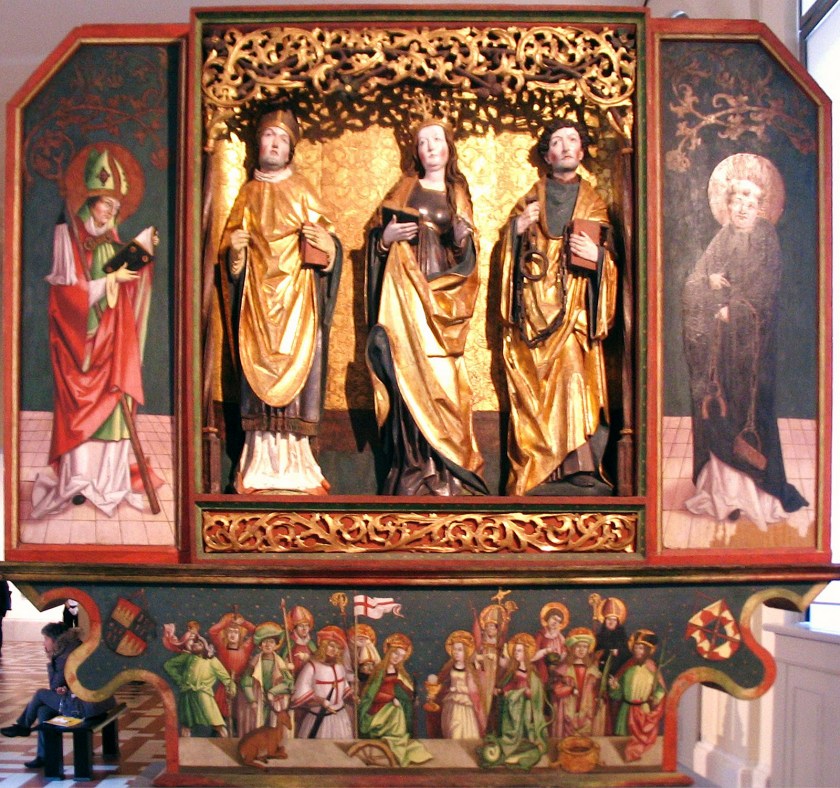
One of the most famous group depictions of the “Fourteen Saints” is a 1503 altarpiece by Matthias Grünewald for the monastery in Lichtenfels in Upper Franconia, unfortunately, I cannot find a complete image of this, below are Panels one and two.
The “fourteen angels” of the lost children’s prayer in the Composer, Engelbert Humperdinck’s (1854-1921) fairy opera, ‘Hansel and Gretel’, are the Fourteen Holy Helpers. The English words are familiar and very beautiful:
When at night I go to sleep, Fourteen angels watch do keep, Two my head are guarding, Two my feet are guiding; Two upon my right hand, Two upon my left hand. Two who warmly cover Two who o’er me hover, Two to whom ’tis given To guide my steps to heaven.
I will pray daily, to the Fourteen Holy Helpers, to Pray for us all, for the world is indeed suffering from a ‘Plague’ of a new kind!
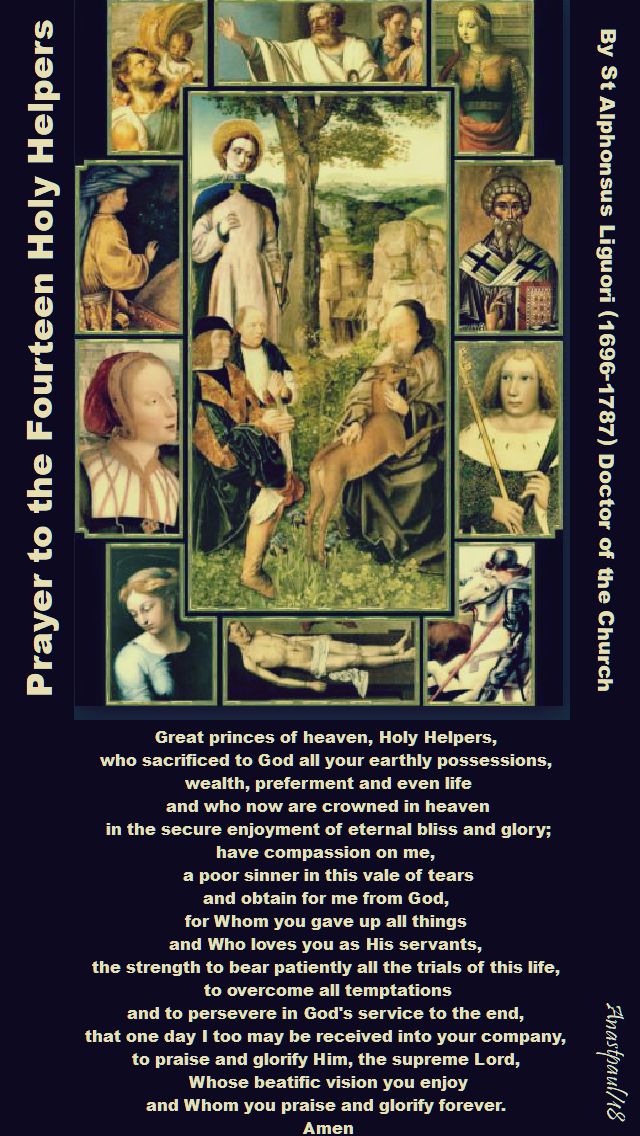
Prayer to the Fourteen Holy Helpers By St Alphonsus Liguori (1696-1787) Doctor of the Church
Great princes of heaven, Holy Helpers,
who sacrificed to God all your earthly possessions,
wealth, preferment and even life
and who now are crowned in heaven
in the secure enjoyment of eternal bliss and glory;
have compassion on me,
a poor sinner in this vale of tears
and obtain for me from God,
for Whom you gave up all things
and Who loves you as His servants,
the strength to bear patiently all the trials of this life,
to overcome all temptations
and to persevere in God’s service to the end,
that one day I too may be received into your company,
to praise and glorify Him, the supreme Lord,
Whose beatific vision you enjoy
and Whom you praise and glorify forever.
Amen
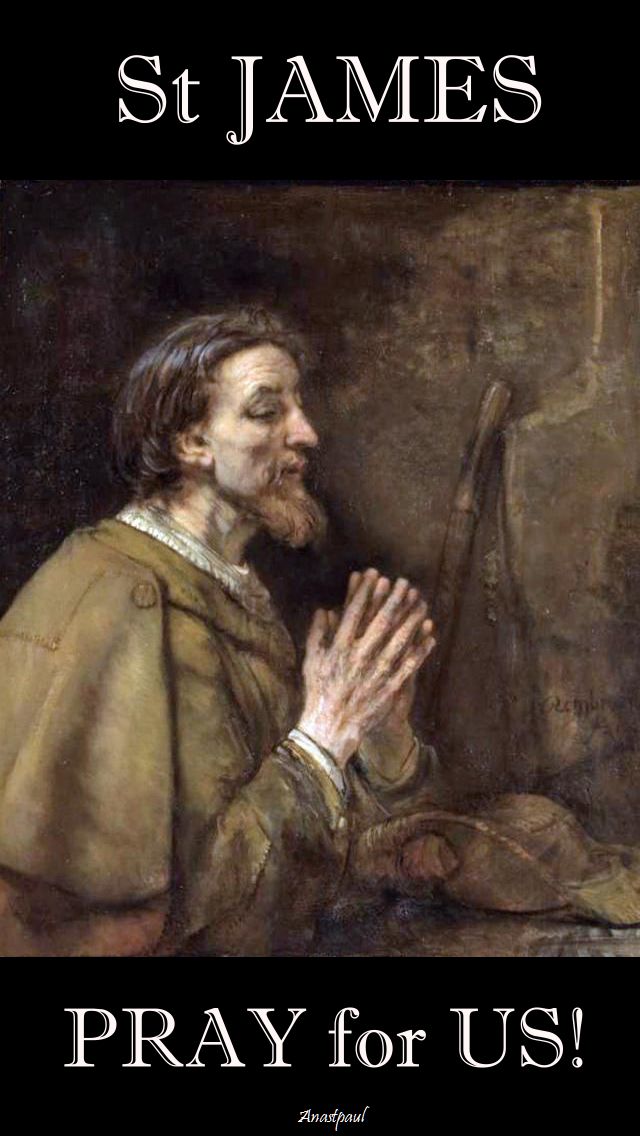
Quote of the day -25 July – Feast of St James, Apostle of Christ
Since the ninth century Spain has claimed the honour of possessing St James relics, though it must be said that actual proof is far less in evidence than the devotion of the faithful. The pilgrimage to St James/Santiago of Compostela in the Middle Ages attracted immense crowds,after the pilgrimage to Rome or the Holy Land, it was the most famous and the most frequented pilgrimage in Christendom. The pilgrim paths to Compostela form a network over Europe; they are dotted with pilgrims’ hospices and chapels. Santiago de Compostela, is the third largest shrine in all of Christendom.
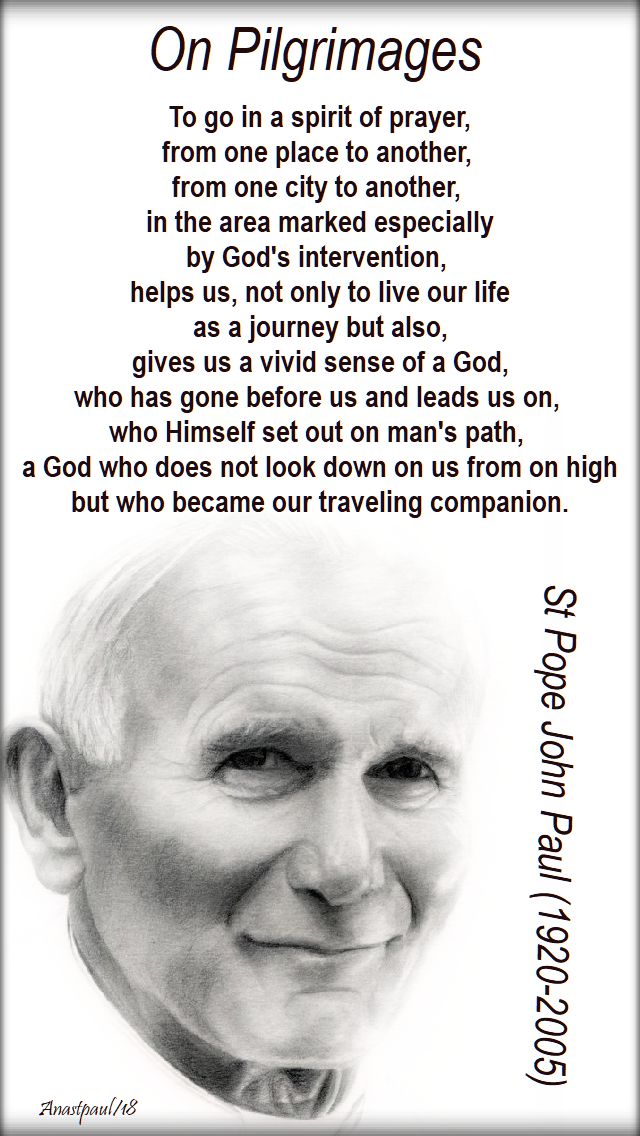
“To go in a spirit of prayer from one place to another, from one city to another, in the area marked especially by God’s intervention, helps us not only to live our life as a journey but also gives us a vivid sense of a God, who has gone before us and leads us on, who Himself set out on man’s path, a God who does not look down on us from on high but who became our travelling companion.”
One Minute Reflection – 25 July – The Memorial of St James the Greater, Apostle of Christ – Today’s Gospel: Matthew 20:20–28
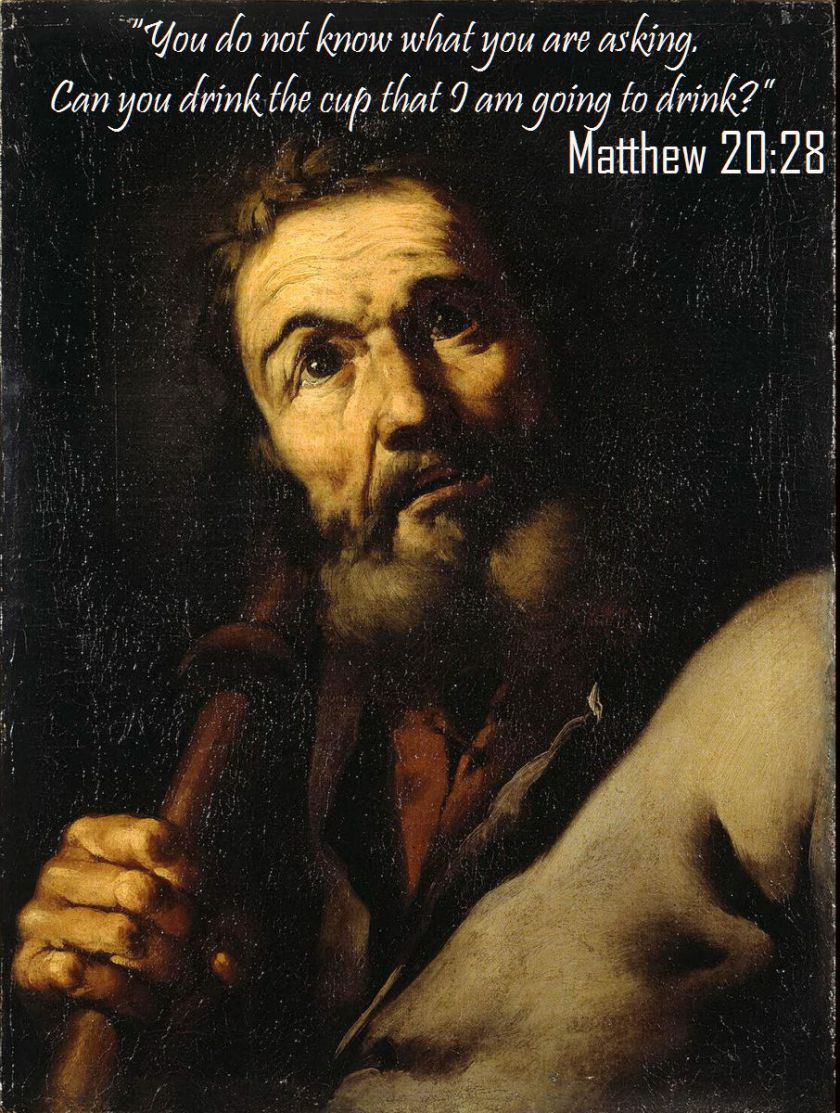
Jesus said in reply, “You do not know what you are asking. Can you drink the cup that I am going to drink?” They said to him, “We can.”……Matthew 20:28
REFLECTION – “Through their mother’s mediation, the sons of Zebedee press Christ as follows in the presence of their fellow apostles: “Command that we may sit, one at your right side and one at your left” (cf. Mk 10:35f.)… Christ hastens to free them from their illusions, telling them they must be prepared to suffer insults, persecutions, even death. “You do not know what you are asking. Are you able to drink the cup that I shall drink?” Let no one be surprised to see the apostles displaying such imperfect dispositions. Wait until the mystery of the cross has been fulfilled and the strength of the Holy Spirit given to them. If you want to see the strength of their souls, take a look at them later on and you will see them to be above all human weakness. Christ does not conceal their pettiness so you will be able to see what they become later on by the power of the grace that will transform them…”… St John Chrysostom (c 345-407) Father & Doctor of the Church
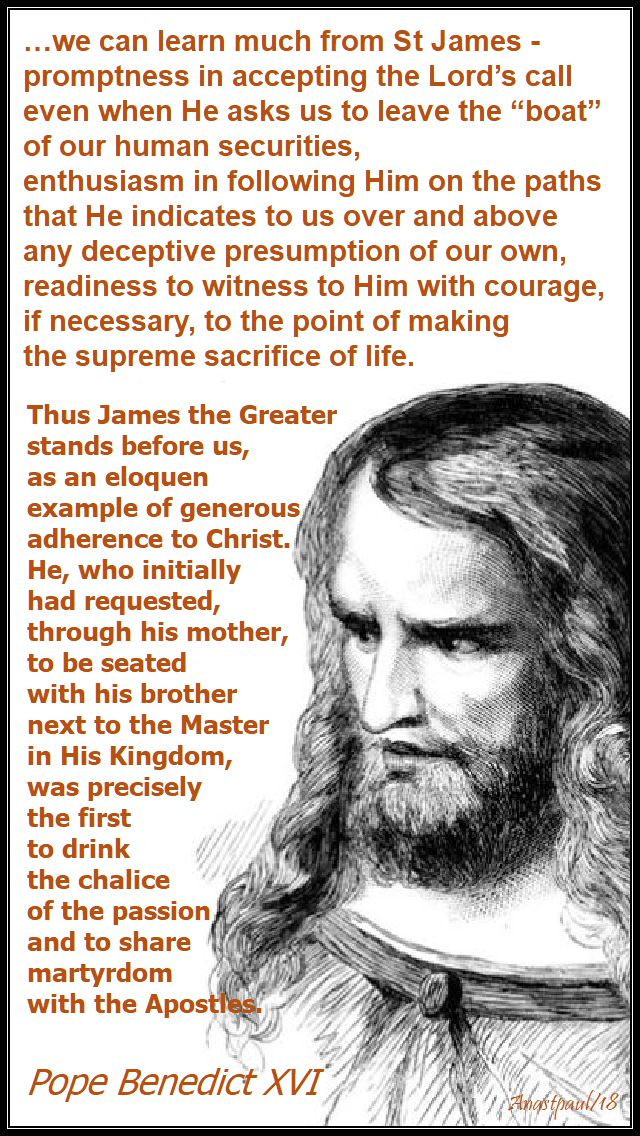
“…we can learn much from St James: promptness in accepting the Lord’s call even when He asks us to leave the “boat” of our human securities, enthusiasm in following Him on the paths that He indicates to us over and above any deceptive presumption of our own, readiness to witness to Him with courage, if necessary to the point of making the supreme sacrifice of life. Thus James the Greater stands before us, as an eloquent example of generous adherence to Christ. He, who initially had requested, through his mother, to be seated with his brother next to the Master in His Kingdom, was precisely the first to drink the chalice of the passion and to share martyrdom with the Apostles.”…Pope Benedict XVI – General Audience, 21 June 2006
PRAYER – Lord our God, You accepted the sacrifice of St James, the first of Your Apostles to give his life for Your sake. May Your Church find strength in his martyrdom and support in his constant prayer. Through our Lord Jesus Christ, your Son, who lives and reigns with you in the unity of the Holy Spirit, one God, for ever and ever. St James the Greater, Apostle of Christ, Pray for us! Amen
Our Morning Offering – 25 July – The Memorial of St Christopher (died c 251)
The Christopher Prayer
Father, grant that we may be,
bearers of Christ Jesus, Your Son.
Allow us to fill with Your light
the world around us.
Strengthen us by Your Holy Spirit
to carry out our mission
of living and following
the path of Jesus, our Lord.
Help us to understand,
that by Your grace
our gifts are Your blessings,
to be shared with others.
Fill us with Your Spirit of love
to give glory to You
in loving all
and preaching by our love.
Nourish in us the desire
to go forth
as the bearers of Your Son
fearless and gentle,
loving and merciful.
Make us true Christ bearers,
that in seeing us
only He is visible.
Amen
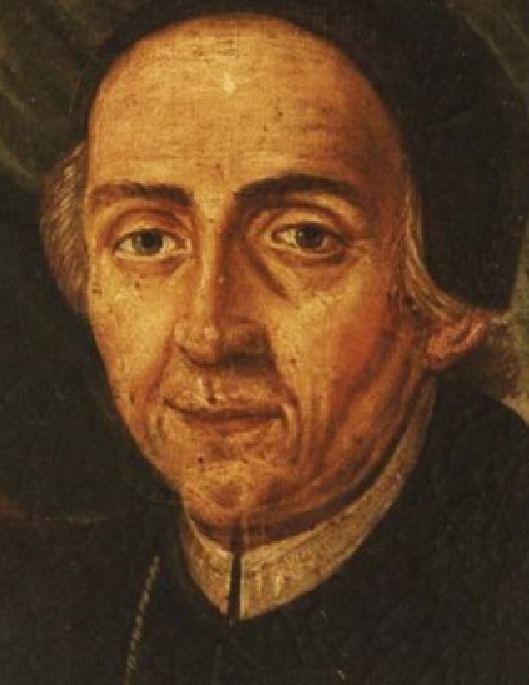
Saint of the Day – 25 July – Blessed Antonio Lucci O.F.M.Conv. (1682-1752) Bishop of Bovino, Franciscan Friar, Theologian, Professor, Writer, Apostle of Charity and Marian devotee – he was born as Angelo Nicola Lucci on 2 August 1681 in Agnone, Isernia, kingdom of Sicily (in modern Italy) as Angelo Nicola Lucci and died on 25 July 1752 in Bovino, Foggia, Italy of natural causes.
Blessed Angelo Nicola Lucci was born on 2 August 1682 to the cobbler and coppersmith Francesco Lucci and Angela Paolantonio. He attended the local school that the Order of Friars Minor Conventual managed and later joined them in 1698. Lucci made his solemn profession in 1698 in the religious name of “Antonio”. He completed his studies for the priesthood in Assisi where he was ordained in 1705. He studied rhetoric and philosophical studies before completing higher theological studies and then further studies led to a doctorate in theology. He was appointed as a professor in Agnone as well as at the Franciscan school in Ravello (from 1709 to 1712) and at the Franciscan school of San Lorenzo in Naples (from 1713 to 1718). He also served as Chaplain of the convent in Naples.
Lucci was elected as the Minister Provincial in 1718 and held that post until 1719; in 1719 he was appointed as a professor at St Bonaventure College in Rome and remained there until his appointment to the episcopate. In 1725 he received instructions from Pope Benedict XIII to write against Jansenism. It was rumoured that Pope Benedict XIII would appoint him as a cardinal but the Holy Fatber instead had decided to name him as the Bishop of Bovino in 1729 and explained of the appointment: “I have chosen as Bishop of Bovino an eminent theologian and a great saint”. Pope Benedict XIII himself, conferred episcopal consecration upon Lucci in Saint Peter’s Basilica.
He served his diocese the remaining 23 years of his life. Known for his charity to the poor (he gave away most of his personal income) and the creation of schools and catechism classes for the young and the poor, theological and training in public speaking for priests, all of whom had been much neglected in a tiny diocese beset with political problems. He travelled through the diocese, re-equipped and repaired churches, enforced discipline on his clergy who had fallen into worldly ways, raised the standards and revitalised the liturgy and parish life throughout his see and even visited hermits to ensure that their lives were in line with Church teachings. His reforms were opposed by local lords and princes who had fostered and who benefited from the lax and worldly ways of the priests and people, who wanted to control appointments of clergy and offices and who tried to treat Church property as their own. Bishop Antonio fought them at every step, always defending the poor and outcast and the rights of the Church and ignoring their demands for the appointment of friends and followers to positions that he filled with more qualified candidates. He restored the cathedral, which had fallen into disrepair and supported a resumption of devotions.
Somewhere along the way he managed to write Manual of Theology which was used as a standard textbook for many years and in 1740 a book about the saints and beati from the first 200 years of the Franciscan Conventuals.
Lucci studied with and was a close friend of Saint Francis Fasani (1681-1742) who – after Lucci’s death – testified on 29 November 1742 at the diocesan hearings regarding the holiness of Lucci’s life. He and Fasani were both ordained as priests together and were great and lifelong friends. aint Alphonsus Maria de’ Liguori (1696-1787) wrote of Lucci and heaped great praise upon him.
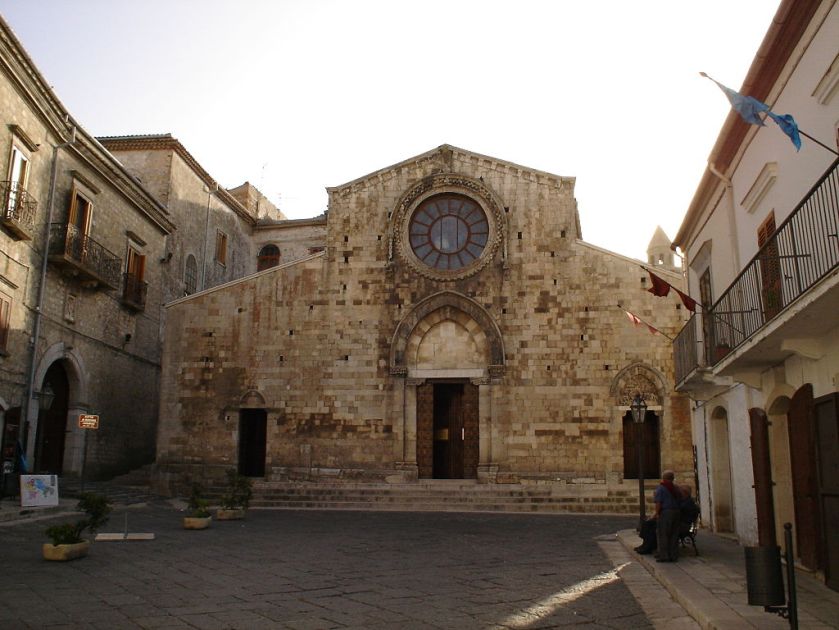
Lucci died in the morning of 25 July 1752 due to a high fever and his remains were interred in the Bovino Cathedral, which is dedicated to the Assumption of the Virgin Mary. It was formerly the episcopal seat of the Diocese of Bovino but since 1986 a co-cathedral in the Archdiocese of Foggia-Bovino and was granted the status of a minor basilica in 1970.
Bovino Minor Basilica
His Beatification cause commenced under Pope Clement XIII on 5 December 1764 and Lucci became titled as a Servant of God while Pope Pius IX confirmed that Lucci had lived a model life of heroic virtue and so named him as Venerable on 13 June 1847. The informative process for the miracle needed for beatification spanned from 1779 until 1780 and received validation in Rome on 10 September 1782 before a medical board met and approved this miracle two centuries later on 3 February 1988. Theologians approved the miracle on 7 July 1988 as did the Congregation for the Causes of Saints on 8 November 1988. St Pope John Paul II approved this miracle on 28 November 1988 and beatified Blessed Antonio Lucci on 18 June 1989 in Saint Peter’s Square. The current postulator for this cause is Fra Angelo Paleri.
St James the Greater (Feast) – Son of Zebedee and Salome, brother of Saint John the Apostle. He is called “the Greater” simply because he became an Apostle before Saint James the Lesser.
All about him here: https://anastpaul.wordpress.com/2017/07/25/saint-of-the-day-25-july-feast-of-st-james-the-greater-apostle-of-christ/
Bl Alexius Worstius
Bl Antonio Lucci O.F.M.Conv. (1682-1752) Bishop of Bovino
Bl Antonio of Olmedo
St Bantu of Trier
St Beatus of Trier
St Christopher
St Cugat del Valles
Bl Darío Acosta Zurita
St Ebrulfus
St Euphrasia
St Fagildo of Santiago
St Felix of Furcona
St Florentius of Furcona
St Glodesind of Metz
St Magnericus of Trier
Bl Michel-Louis Brulard
Bl Mieczyslawa Kowalska
St Mordeyren
St Nissen of Wexford
St Olympiad of Constantinople
St Paul of Palestine
Bl Pietro Corradini of Mogliano
St Theodemir of Cordoba
—
Martyrs of Caesarea – 3 saints: Three Christians martyred together in the pesecutions of emperor Maximilian and governor Firmilian – Paul, Tea and Valentina. 309 in Caesarea, Palestine.
Martyrs of Cuncolim – 20 saints: On 15 July 1583 the group met at the church of Orlim, and hiked to Cuncolim to erect a cross and choose land for a new church. Local anti-Christian pagans, seeing the unarmed Christians, gathered their weapons and marched on them. One of the parishioners, a Portuguese emigre named Gonçalo Rodrigues, carried a firearm, but Father Alphonsus Pacheco stopped him from using it. The pagans then fell upon them, and killed them all without mercy. They were –
• Alphonsus Pacheco
• Alphonsus the altar boy
• Anthony Francis
• Dominic of Cuncolim
• Francis Aranha
• Francis Rodrigues
• Gonçalo Rodrigues
• Paul da Costa
• Peter Berno
• Rudolph Acquaviva
• ten other native Christian converts whose names have not come down to us
They were martyred on Monday 25 July 1583 at the village of Cuncolim, district of Salcete, territory of Goa, India. Beatified on 30 April 1893 by Pope Leo XIII.
Martyrs of Furci:
Martyrs of Motril – 5 beati: Four priests and a brother, all members of the Augustinian Recollects, who were martyred together in the Spanish Civil War:
• Deogracias Palacios del Río
• José Rada Royo
• José Ricardo Díez Rodríguez
• Julián Benigno Moreno y Moreno
• León Inchausti Minteguía
They were shot on 25 July 1936 in Motril, Granada, Spain and Beatified on 7 March 1999 by Pope John Paul II.
Martyrs of Toledo – 4 beati: Four brothers and a priest, all members of the Hospitallers of Saint John of God, and all martyred together in the Spanish Civil War.
• Carlos Rubio álvarez
• Eloy Francisco Felipe Delgado Pastor
• Jerónimo Ochoa Urdangarín
• Primo Martínez De San Vicente Castillo
25 July 1936 in Talavera de la Reina, Toledo, Spain. They were Beatified on 25 October 1992 by Pope John Paul II.
Martyrs of Urda – 3 beati: Three members of the Passionists who were martyred together in the Spanish Civil War.
• Benito Solana Ruiz
• Felix Ugalde Irurzun
• Pedro Largo Redondo
They were shot on 25 July 1936 in Urdá, Toledo, Spain and Beatified on 1 October 1989 by Pope John Paul II.
Martyred in the Spanish Civil War:
Antonio Varona Ortega
Bl Dionisio Pamplona-Polo
Enric Morante Chic
Higinio Roldán Iriberri
Jaume Balcells Grau
Jesús Eduard Massanet Flaquer
Jesús Juan Otero
José López Tascón
José Luis Palacio Muñiz
Josep Bardolet Compte
Josep Más Pujolrás
Juan Crespo Calleja
Bl Miquel Peiro Victori
Ricard Farré Masip
Santos López Martinez
Vicente Fernández Castrillo
Thought for the Day – 24 July – The Memorial of St Charbel Makhluf
Joseph Makhluf was born in 1828 at Beqa-Kafra, Lebanon. His peasant family lived a strong faith, were attentive to the Divine Liturgy and had a great devotion to the Mother of God.
At the age of 23, Charbel (the name he chose when entering Novitiate) left his closely knit family to enter the Lebanese-Maronite Monastery called Notre-Dame de Mayfouk. Following studies and profession at St Cyprian de Kfifane Monastery, he was ordained in 1859.
For the next seven years, Charbel lived in the mountainous community of Anaya. After that he spent the next twenty-three years in complete solitude at Sts Peter and Paul Hermitage near Anaya. He died there on Christmas Eve, 1898.
Charbel had a reputation for his austerity, penances, obedience and chastity. At times, Charbel was gifted with levitations during prayer and he had great devotion to the Most Blessed Sacrament.
In all things, Charbel maintained perfect serenity. He was beatified in 1965 by Blessed Pope Paul VI and canonised by him in 1977.
The spirit of Charbel still lives in many people. His miracles include numerous healings of the body and of the spirit. Thomas Merton, the American Hermit, wrote in his journal: “Charbel lived as a hermit in Lebanon—he was a Maronite. He died. Everyone forgot about him. Fifty years later, his body was discovered incorrupt and in short time he worked over 600 miracles. He is my new companion. My road has taken a new turning. It seems to me that I have been asleep for 9 years—and before that I was dead.”
At the closing of the Second Vatican Council, on 5 December 1965 when St Charbel was beatified by Pope Paul VI, he said:
“…a hermit of the Lebanese mountain is inscribed in the number of the blessed…a new eminent member of monastic sanctity is enriching, by his example and his intercession, the entire Christian people… May he make us understand, in a world largely fascinated by wealth and comfort, the paramount value of poverty, penance, and asceticism, to liberate the soul in its ascent to God…”
St Charbel Makhluf, Pray for us!
The Chaplet of St Charbel here: https://anastpaul.wordpress.com/2017/07/24/the-chaplet-of-st-charbel-makhluf/
And listen to this special song too:
and the lyrics here: https://anastpaul.wordpress.com/2017/07/24/thought-for-the-day-24-july-the-memorial-of-st-charbel-of-makhluf/
Quote of the Day – 24 July – Tuesday of the Sixteenth week in Ordinary Time, Year B – Today’s Gospel: Matthew 12:46-50
“For whoever does the will of my Father in heaven, is my brother and sister and mother.”…Matthew 12:50
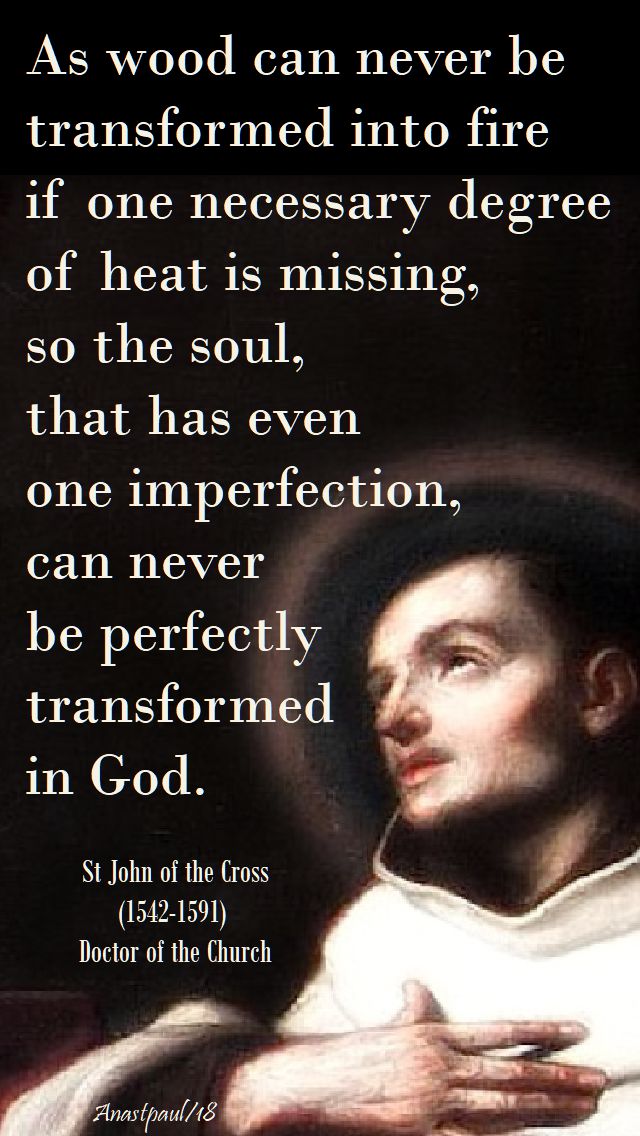
It is a matter of real sorrow when God has given us strength to break stronger fetters, those of vanity and sin, that we neglect our own progress and the attainment of such great blessings, because we will not detach ourselves from trifles. Not only do we not advance, we fall back. For it is well known, that on the spiritual road, not to go on overcoming self, is to go backwards and not to increase our gain, is to lose. As wood can never be transformed into fire, if one necessary degree of heat is missing, so the soul, that has even one imperfection, can never be perfectly transformed in God.
St John of the Cross (1542-1591) Doctor of the Church

















 AnaStpaul
You must be logged in to post a comment.