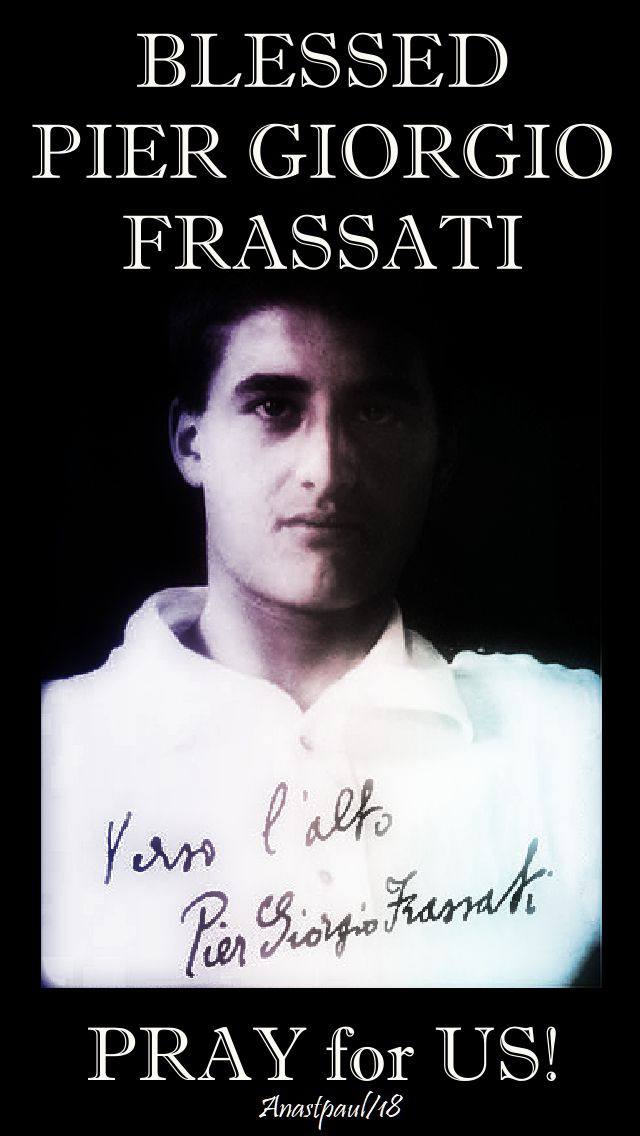
Thought for the Day – 4 July – The Memorial of Blessed Pier Giorgio Frassati T.O.S.D. (1901-1925) “Man of the Eight Beatitudes”
Once after visiting a badly disfigured leper he explained to a friend his rationale for his selfless giving:
“How rich we are to be in good health. The deformation of that young man will disappear in a few years when he enters Paradise. But we have the duty of putting our health at the service of those who haven’t it. To act otherwise would be to betray the gift of God. No human being should ever be left abandoned. But the best of all charities is that consecrated to the sick. That is an exceptional work: few have the courage to face its difficulties and dangers, to take on themselves the sufferings of others, in addition to their own needs and their own precautions and cares.”
Pier Giorgio was famous in Turin but his family regarded him as a problem . His father, Alfredo Frassati, editor of the daily La Stampa, seems to have resented his largesse. And his mother was inconvenienced by his frequent absences and his lateness to meals. Only after his death did they come to appreciate their son.
A virulent form of poliomyelitis attacked Pier Giorgio in July 1925 and he died within a week. He was twenty-four years old.
Once a friend observed that when Pier Giorgio finished praying in church, he waved a little farewell towards the tabernacle. I like to imagine the scene when this jovial saint said hello to Christ in heaven. My thought is this, on the Memorial of his beautiful saint, Bl Pier Giorgio, that the greatest gift and the only glory of my life is being a Catholic and striving each day, to grow in those greatest of all commandments, to love God above all and to love my neighbour as myself. St Edmund Campion (1540-1581), put it so well, “to be a Catholic is my greatest glory.”
Blessed Pier Giorgio Frassati, pray for us!
LET US PRAY:
PRAYER FOR THE CANONISATION OF BLESSED PIER GIORGIO FRASSATI
O merciful God,
Who through the perils of the world
deigned to preserve by Your grace
Your servant the blessed Pier Giorgio Frassati
pure of heart and ardent of charity,
listen, we ask You, to our prayers, and
if it is in Your designs that he be glorified by the Church,
show us Your will,
granting us the graces we ask of You,
through his intercession,
by the merits of Jesus Christ, Our Lord,
in union with the Holy Spirit,
one God forever and ever.
Amen
Quote/s of he Day – 4 July – The Memorial of Blessed Pier Giorgio Frassati T.O.S.D. (1901-1925) “Man of the Eight Beatitudes”
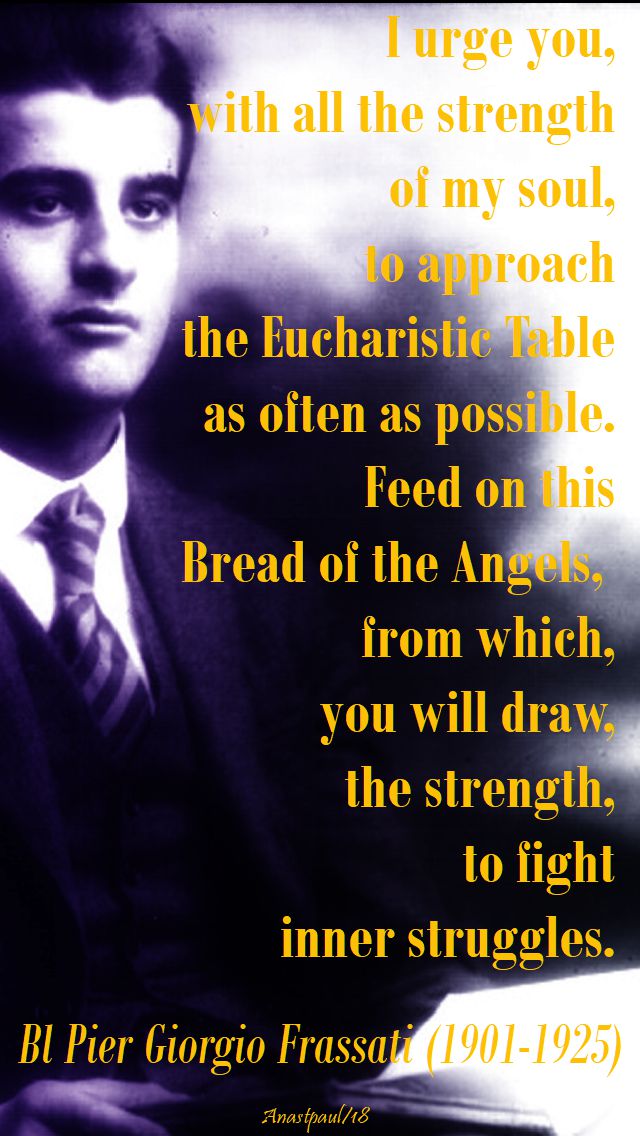
“I urge you, with all the strength of my soul, to approach the Eucharistic Table as often as possible. Feed on this Bread of the Angels, from which you will draw, the strength, to fight inner struggles.”
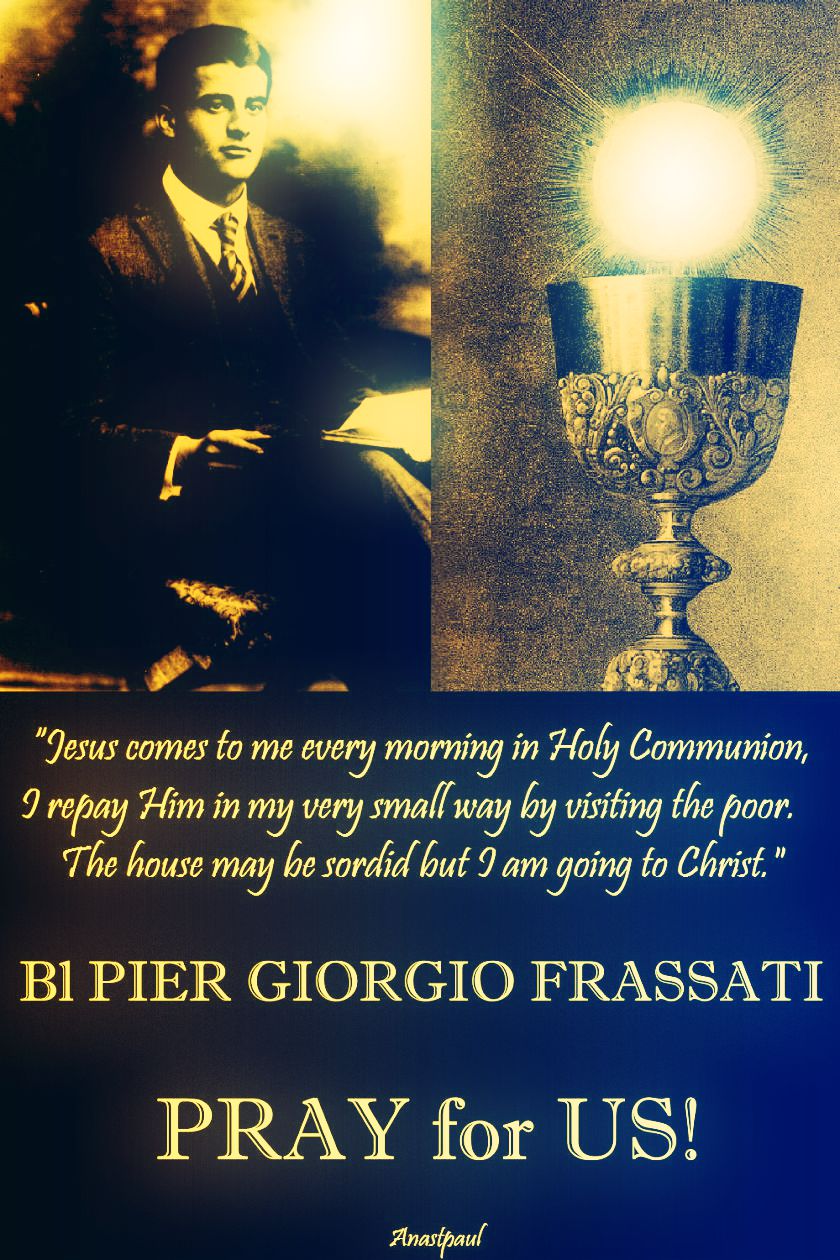
“Jesus comes to me every morning in Holy Communion, I repay Him, in my very small way, by visiting the poor. The house may be sordid but I am going to Christ.”
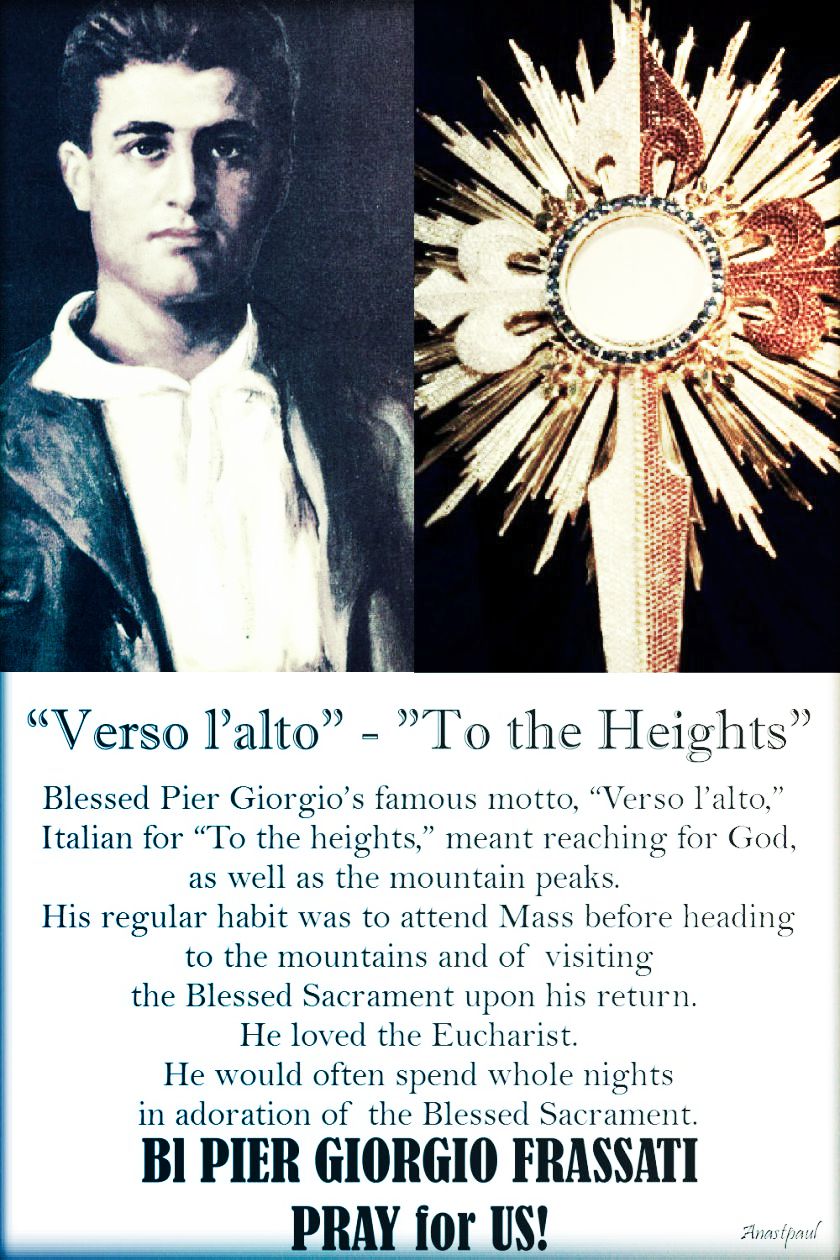
“Verso l’alto,”
“To the Heights”
Blessed Pier Giorgio’s famous motto, “Verso l’alto,” Italian for “To the heights,” meant reaching for God as well as the mountain peaks. His regular habit was to attend Mass before heading to the mountains and of visiting the Blessed Sacrament upon his return. He loved the Eucharist. He would often spend whole nights in adoration of the Blessed Sacrament.
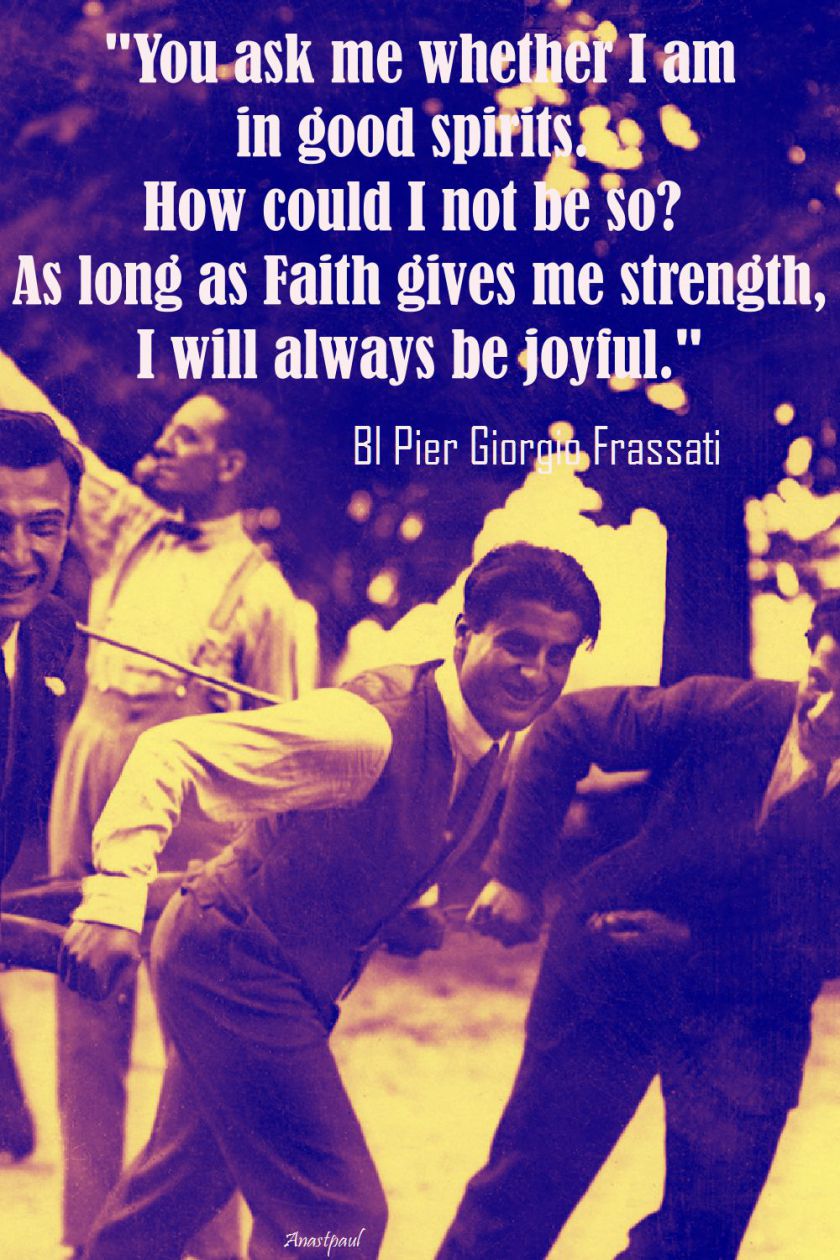
“You ask me whether I am in good spirits. How could I not be so? As long as Faith gives me strength, I will always be joyful. Sadness ought to be banished from Catholic souls… the purpose for which we have been created shows us the path; even if strewn with many thorns, it is not a sad path. It is joyful even in the face of sorrow.”
One Minute Reflection – 4 July – The Memorial of Blessed Pier Giorgio Frassati T.O.S.D. (1901-1925) “Man of the Eight Beatitudes”
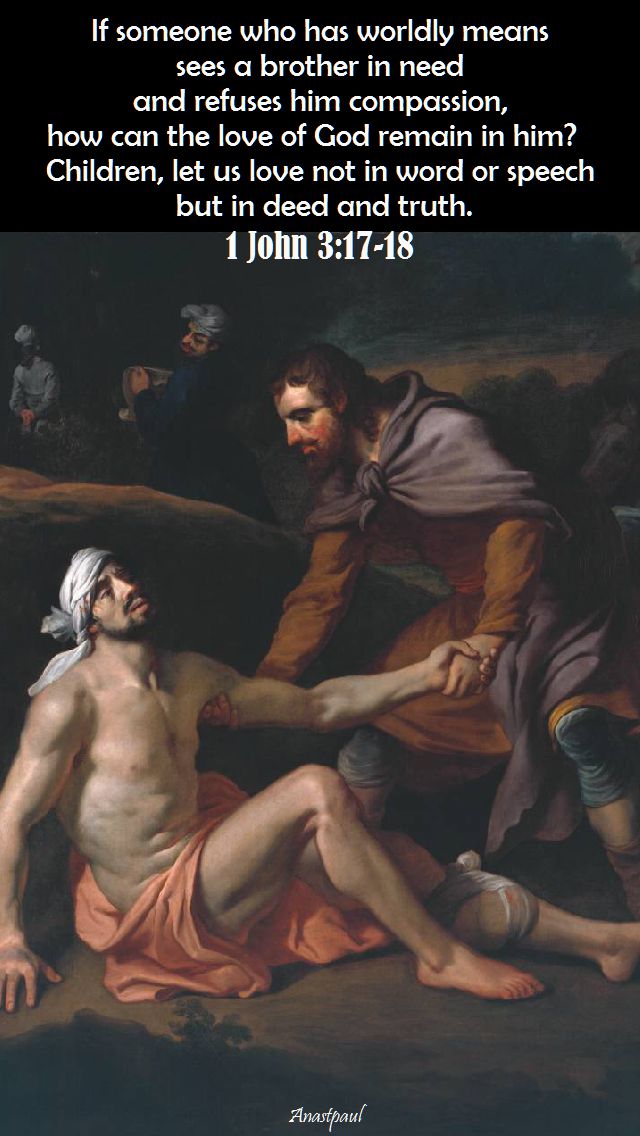
If someone who has worldly means sees a brother in need and refuses him compassion, how can the love of God remain in him? Children, let us love not in word or speech but in deed and truth…..1 John 3:17-18
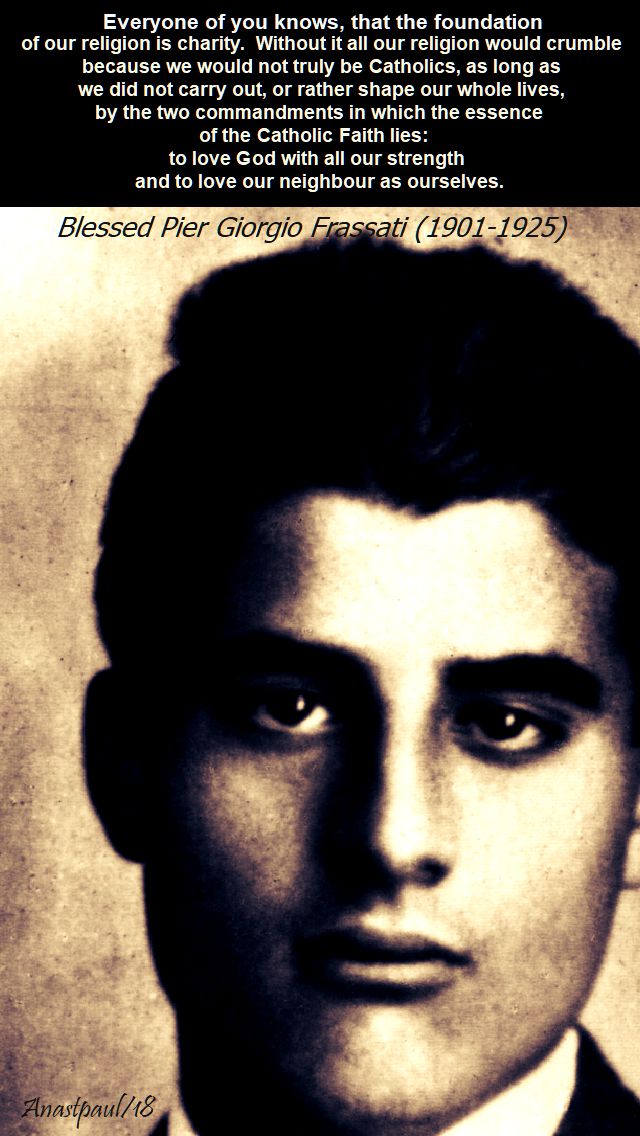
REFLECTION – “Everyone of you knows, that the foundation of our religion is charity. Without it all our religion would crumble because we would not truly be Catholics, as long as we did not carry out, or rather shape our whole lives, by the two commandments in which the essence of the Catholic Faith lies: to love God with all our strength and to love our neighbour as ourselves.”…….Bl Pier Giorgio Frassati
PRAYER – Loving Father, teach me to see the face of Your Divine Son in all those I meet especially those in need. Help me to realise that love is the most powerful force in the world. Saint Elizabeth of Portugal and Blessed Pier Georgio are an inspiration to us all, teaching us by their actions, that it is only in living love in charity that we can be true Catholics. Saint Elizabeth of Portugal and Blessed Pier Georgio pray for us, amen.
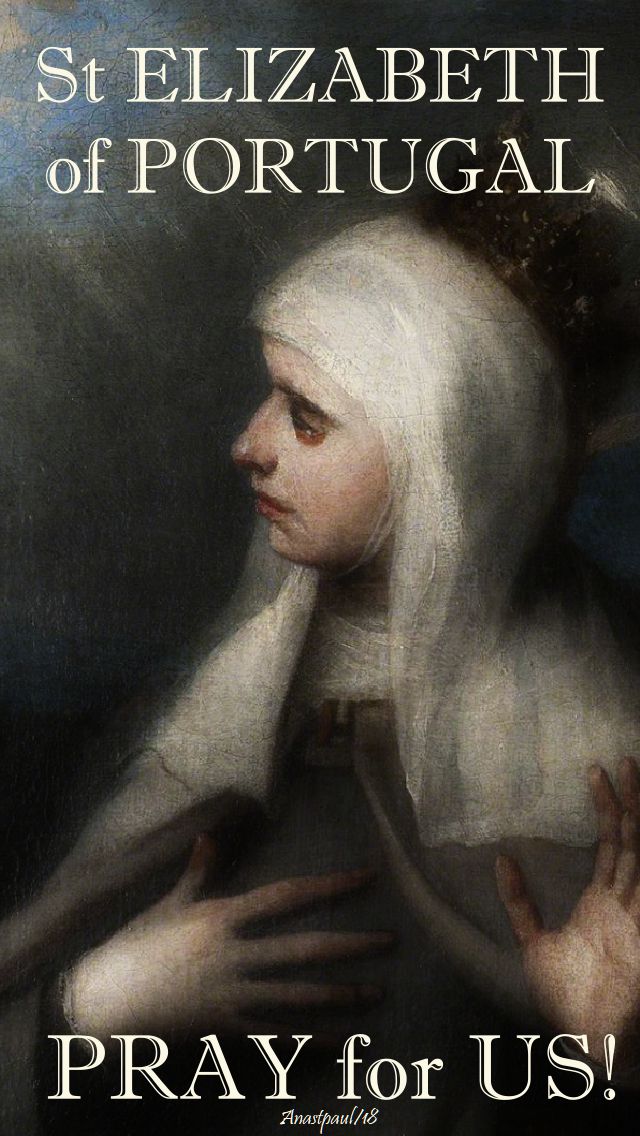
Saint of the Day – 4 July – St Elizabeth of Portugal T.O.S.F. (1271-1336) Queen Consort, Franciscan Tertiary, Apostle of Charity and Peace, political negotiator and mediator – also known as Elizabeth of Aragon, Elisabet in Catalan, Isabel in Aragonese, Portuguese and Spanish and The Peacemaker, born in 1271 at Aragon, Spain and died on 4 July 1336 at Estremoz, Portugal of a fever. Patronages – Coimbra, Diocese of San Cristóbal de La Laguna, Cathedral of La Laguna.
Elizabeth means “Promise of God”
Saint Elizabeth was the daughter of King Peter III of this kingdom and niece of King James the Conqueror, great-niece of Emperor Frederick II of Germany. They gave her the name Elizabeth after her aunt, Saint Elizabeth of Hungary.
Her formation was formidable and from the time she was very young she had a notable piety. She was taught that, in order to be truly good, she ought to include mortification of her likes and whims along with her prayer. She was careful to order her life toward the love of God and neighbour, disciplining her habits of life. She did not eat between meals.
She was married at the age of 12 to King Dionysius of Portugal. This was a great cross for Elizabeth because he was a man of little morals, being violent an unfaithful. But she endured heroically this trial. She prayed and offered many sacrifices for him. She always treated him with goodness. They had two sons: Alfonso, the future king of Portugal and Constance, future king of Castille. Saint Elizabeth even educated the natural sons of her husband with other women. The king, for his part, admired her and permitted her to live an authentic Christian life, to a certain degree. She would rise very early in the morning and read six psalms, attend Holy Mass and dedicated herself to manage the duties of the palace. In her free time she met with other women to make clothing for the poor. She dedicated the afternoons to visiting the elderly and ill.
She made possible the construction of hostels, a hospital for the poor, a free school, a home for women repenting from a sinful life and a hospice for abandoned children. She also constructed convents and did other good works for the people. She would lend her beautiful dresses and even one of her crowns for the weddings of poor young women.
Saint Elizabeth would frequently distribute coins from the Royal Treasury to the poor so that they could buy their daily bread. On one occasion, King Dionysius, suspicious of her actions, began to spy on her. When the queen began to distribute money among the poor, the king saw and, infuriated, went to reclaim it. But the Lord intervened, in such a way that, when the king ordered that she showed him what she was giving to the poor, the coins turned to roses.
The Peacemaker:
The son of Elizabeth, Alfonso, had a violent character like his father. He was filled with anger at the preference his father showed to his natural children. On two occasions he promoted a civil war against his father. Elizabeth strived for reconciliation between father and son. On one occasion she went on pilgrimage to Santarem, a Eucharistic miracle and, dressed as a penitent, implored the Lord for peace.
Then she went to present herself on the field of battle and, when the armies of her spouse and son were about to engage in battle, the queen kneeled between them and, on her knees, asked her husband and son to be reconciled.
Some of her letters have been preserved, which reflect gospel values and audacity of our Saint. To her husband:“Like an infuriated wolf that is going to kill your Little son, I will fight so that the arms to the King are not unleashed against our own son. But at the same time, I will first make sure that the arms of the army of my son are destroyed, before they are fired against the followers of his father.”
To her son: “By the Blessed Virgin Mary, I ask that you make peace with your father. See, the soldiers are burning houses, destroying crops and breaking everything in pieces. Not with weapons, my son, we cannot fix the problem with weapons, but rather with dialogue, continuing negotiations to fix these conflicts. I will make the troops of the king go away and that the demands of the son be attended to but please remember, that you have a most serious duty to your father as his son and as a subject to his king.”
She obtained peace on more than one occasion, and her husband died repentant, without a doubt due to prayers of his wife.
Because Saint Elizabeth had such a great love for the Eucharist, she dedicated herself to study the lives of the Saints who were most notable in their love for the Eucharist and especially Saint Clare. After becoming a widow, Saint Elizabeth divested herself of all her riches. She went on a pilgrimage to Santiago de Compostela, where she surrendered her crown to the Archbishop in order to receive the habit as a Claretian tertiary. The Archbishop was so moved by this act of the Saint that he gave her his pastoral cross to help her on her return to Portugal. She lived her last years in the convent, dedicated to Eucharistic adoration.
When a war broke out between her son and her son-in-law, the King of Castille, Saint Elizabeth, despite her old age, undertook a long journey by dangerous roads and obtained peace. Nevertheless, the trip cost her life. Feeling herself close to death, she asked to be taken to a Claretian convent that she herself had founded. There she died invoking Our Lady on 4 July 1336.
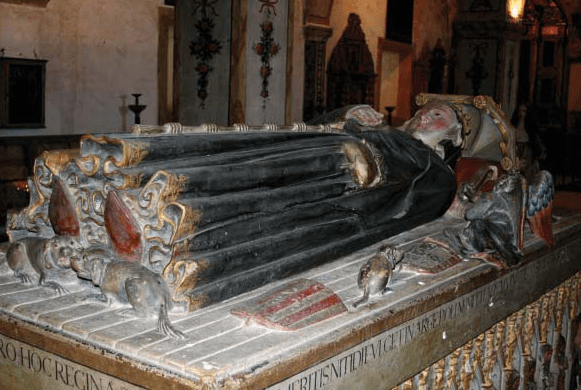
God blessed her tomb with miracles. Her body can be venerated in the Claretian convent in Coimbra. She was Canonised on 25 May 1625 by Pope Urban VIII.
Saint Elizabeth of Portugal, pray for peace in our world!
St Elizabeth on the Colonnade at St Peter’s, Rome St Elizabeth on the 50 Escudos Note, prior to the Euro
St Elizabeth of Portugal T.O.S.F. (1271-1336) (Optional Memorial)
Bl Agatha Yun Jeom-Hye
St Albert Quadrelli
St Andrew of Crete
St Anthony Daniel
St Aurelian of Lyons
St Bertha of Blangy
St Carileffo of Anille
Bl Catherine Jarrige
St Cesidio Giacomantonio
Bl Damiano Grassi of Rivoli
St Donatus of Libya
St Edward Fulthrop
St Elias of Jerusalem
St Finbar of Wexford
St Fiorenzo of Cahors
St Flavian of Antioch
St Giocondiano
Bl Giovanni of Vespignano
St Haggai the Prophet
Bl Hatto of Ottobeuren
Bl Henry Abbot
St Henry of Albano
St Hosea the Prophet
St Innocent of Sirmium
Bl John Carey
Bl John Cornelius
Bl Jozef Kowalski
St Jucundian
St Laurian of Seville
St Lauriano of Vistin
Bl Maria Crocifissa Curcio
St Namphanion the Archmartyr
Bl Natalia of Toulouse
St Odo the Good
Bl Odolric of Lyon
Bl Patrick Salmon
Bl Pedro Romero Espejo
Bl Pier Giorgio Frassati (1901-1925) Incorrupt – https://anastpaul.wordpress.com/2017/07/04/saint-of-the-day-4-july-blessed-pier-georgio-frassati-t-o-s-d-the-man-of-the-eight-beatitudes/
St Sebastia of Sirmium
St Theodore of Cyrene
St Theodotus of Libya
Bl Thomas Bosgrave
Bl Thomas Warcop
Bl Ulric of Augsburg
St Ulric of Ratzeburg
St Valentine of Langres
St Valentine of Paris
Bl William Andleby
Bl William of Hirsau
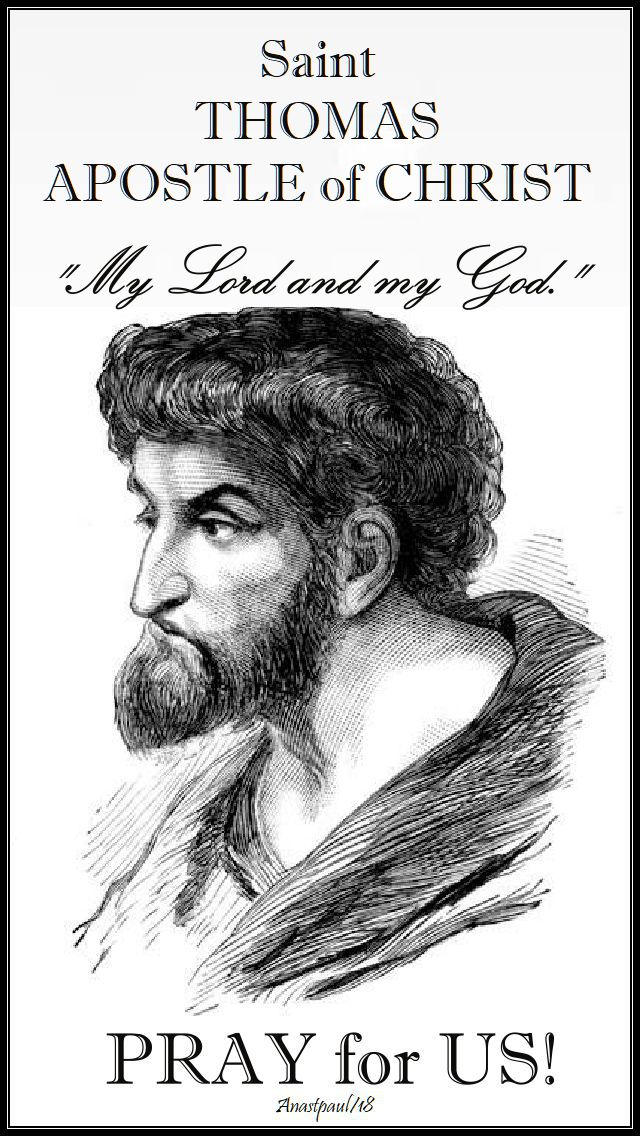
Thought for the Day – 3 July – Feast of St Thomas Apostle
The weakness of Thomas’s faith
is a source of our Lord’s great blessing for the Church
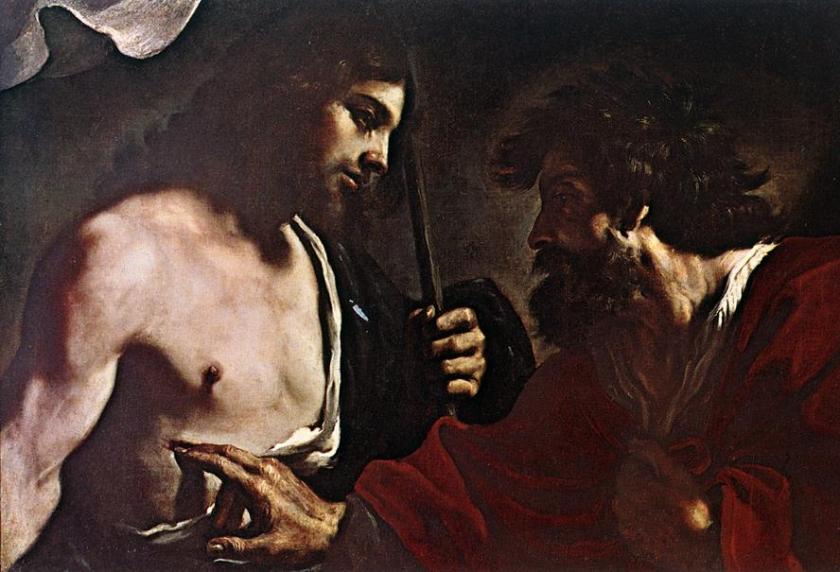
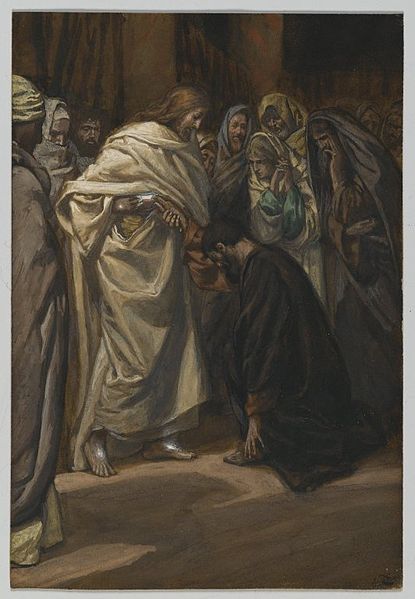
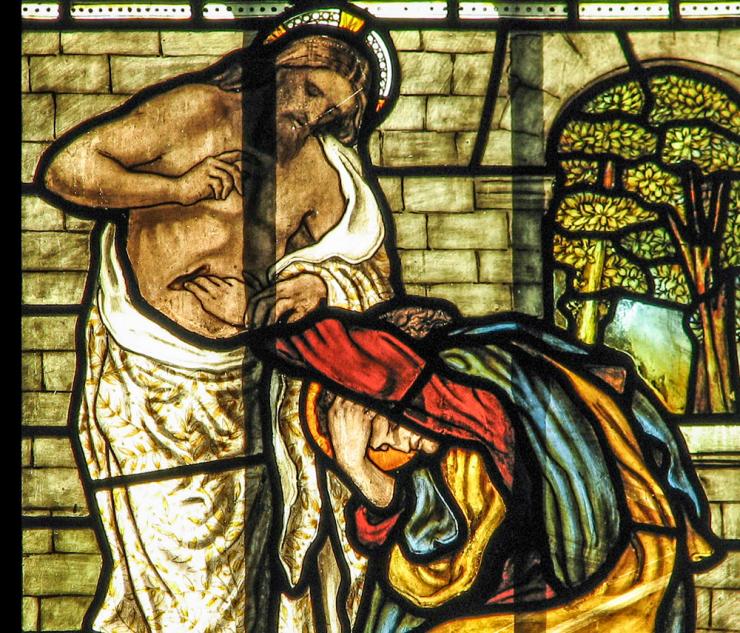
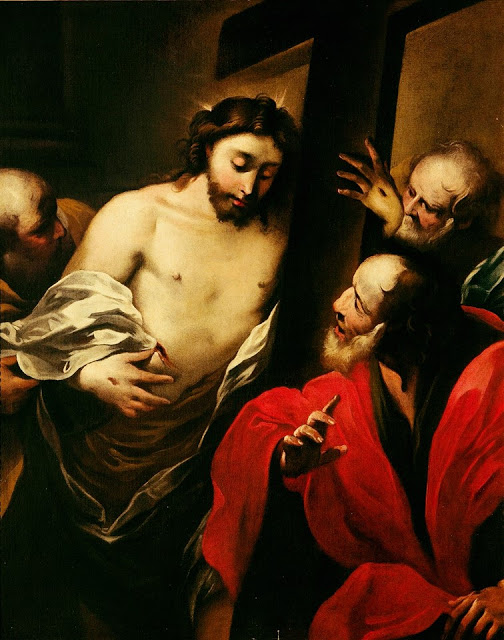
We must not suppose that St Thomas differed greatly from the other apostles. They all, more or less, mistrusted Christ’s promises when they saw Him led away to be crucified. When He was buried, their hopes were buried with Him and when the news was brought them, that He was risen again, they all disbelieved it. On His appearing to them, He “upbraided them with their unbelief and hardness of heart.” (Mark 16:14)… Thomas was convinced latest, because He saw Christ latest. On the other hand, it is certain that, though he disbelieved the good news of Christ’s resurrection at first, he was no cold-hearted follower of his Lord, as appears from his conduct on a previous occasion, when he expressed a desire to share danger and to suffer with Him…: “Let us also go, that we may die with him.” (Jn 11:16)… It was at the instance of Thomas that they hazarded their lives with their Lord.
St Thomas then loved his Master, as became an apostle and was devoted to His service; but when he saw him crucified, his faith failed for a season with that of the rest… and more than the rest. His standing out alone, not against one witness only but against his ten fellow disciples, besides Mary Magdalene and the other women is evidence of this… He seems to have required some sensible insight into the unseen state, some infallible sign from heaven, a ladder of angels like Jacob’s (Gn 28:12), which would remove anxiety by showing him the end of the journey at the time he set out. Some such secret craving after certainty beset him. And a like desire arose within him on the news of Christ’s resurrection.
While our Saviour allowed Thomas his wish and satisfied his senses that He was really alive, He accompanied the permission with a rebuke: “Because thou hast seen me, thou hast believed: blessed are they that have not seen and yet have believed.”… All His disciples minister to Him even in their weaknesses, that so He may convert them into instruction and comfort for His Church….Blessed John Henry Newman (1801-1890)PPS II, Sermon 2. “Faith without Sight”
“My Lord and my God!”
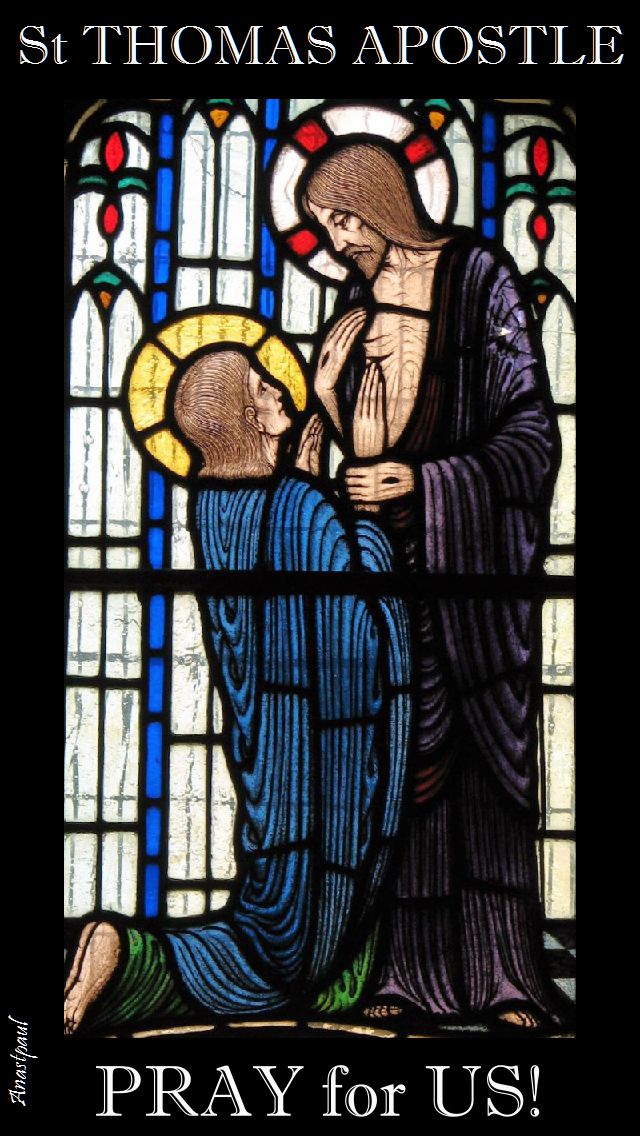
St Thomas, Pray for us that we too may so love our Lord and our God and “follow Him” to the end of time!
Quote of the Day – 3 July – Feast of St Thomas Apostle
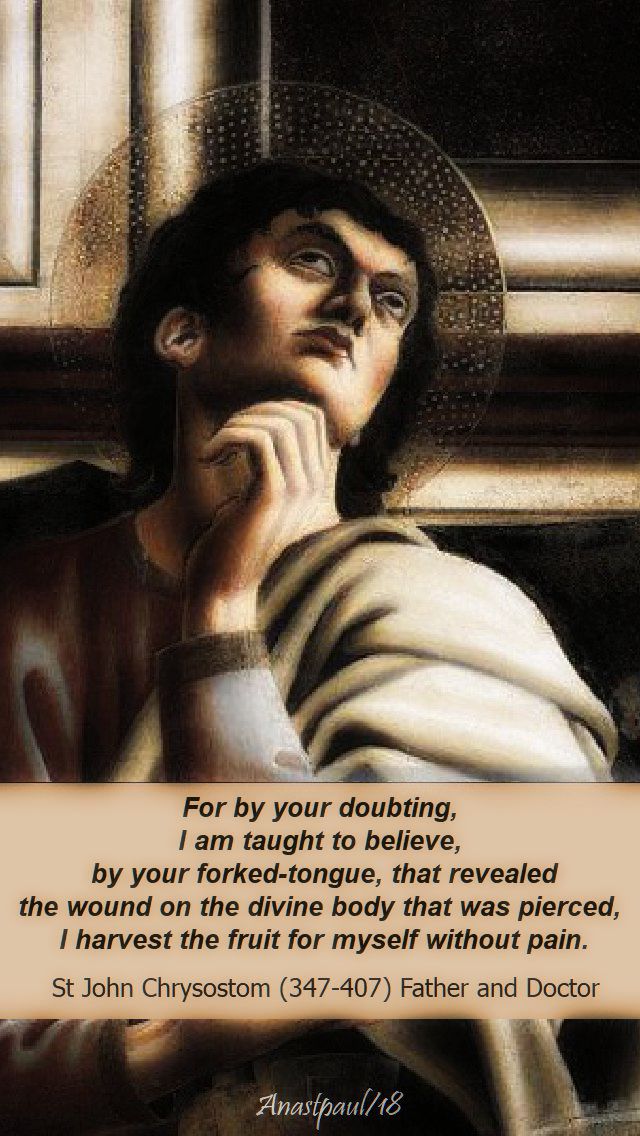
“For by your doubting, I am taught to believe, by your forked-tongue, that revealed the wound on the divine body that was pierced, I harvest the fruit for myself without pain.”
One Minute Reflection – 3 July – Feast of St Thomas Apostle – Today’s Gospel: John 20:24-29.
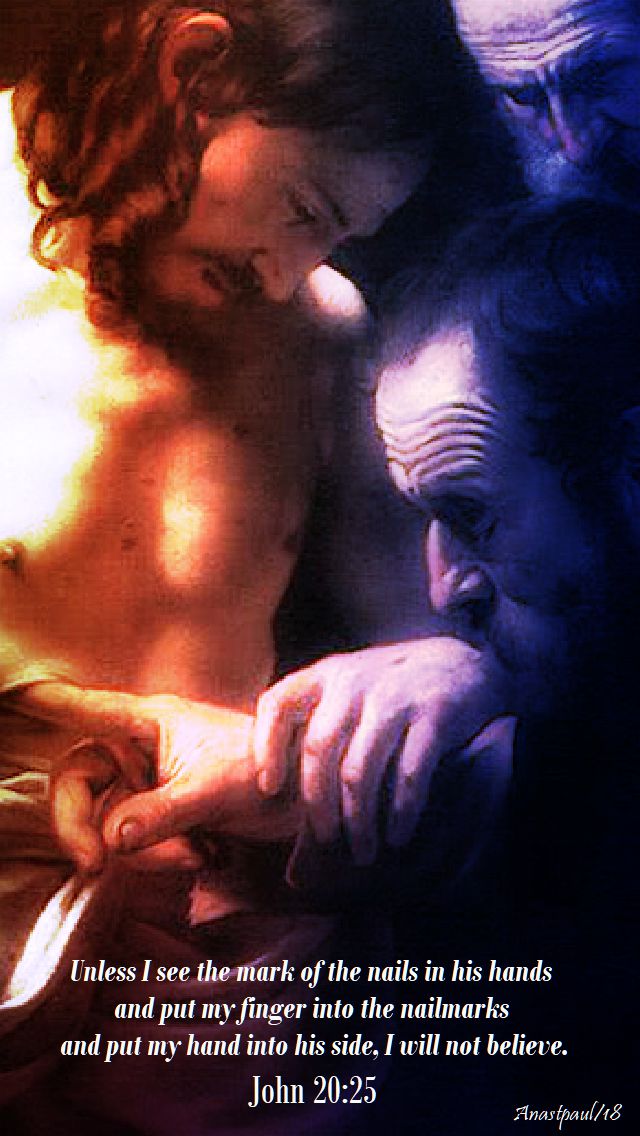
Thomas, called Didymus, one of the Twelve, was not with them when Jesus came. So the other disciples said to him, “We have seen the Lord.” But he said to them, “Unless I see the mark of the nails in his hands and put my finger into the nailmarks and put my hand into his side, I will not believe.”...John 20:24-25
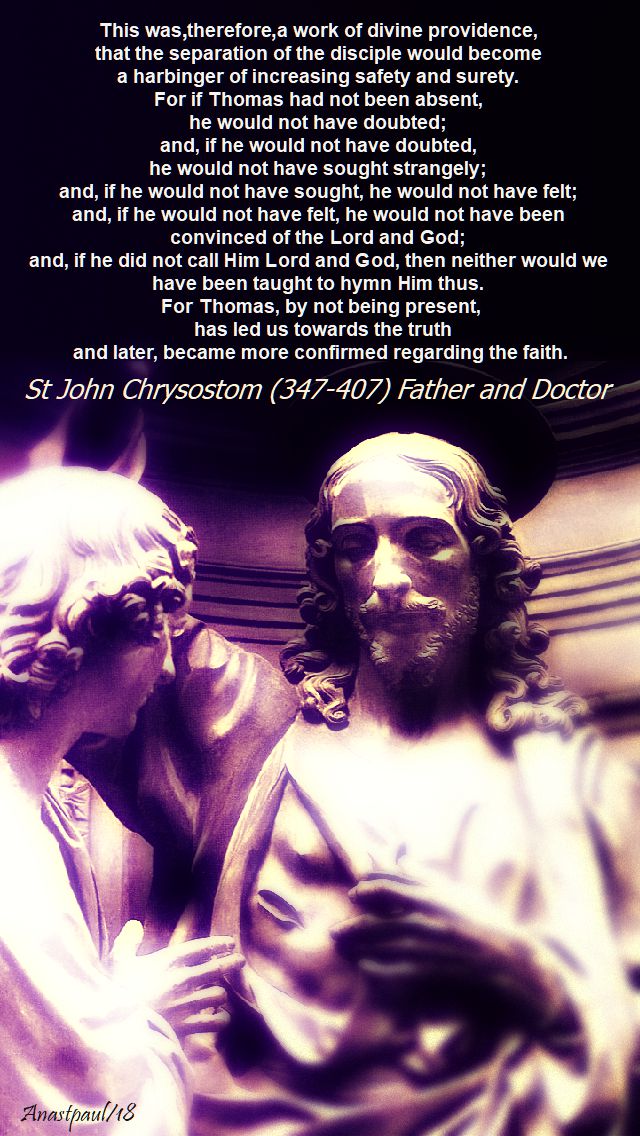
REFLECTION – “This was, therefore, a work of divine providence, that the separation of the disciple, would become a harbinger of increasing safety and surety. For if Thomas had not been absent, he would not have doubted; and, if he would not have doubted, he would not have sought strangely; and, if he would not have sought, he would not have felt; and, if he would not have felt, he would not have been convinced of the Lord and God; and, if he did not call Him Lord and God, then neither would we have been taught to hymn Him thus. For Thomas, by not being present, has led us towards the truth and later, became more confirmed regarding the faith.”… St John Chrysostom (347-407) Father and Doctor
PRAYER – Father, let our celebration on the feast of Saint Thomas the Apostle, be the source of his unfailing help and protection. Fill us with Your life-giving grace through our faith in Your Son, Jesus the Christ, whom Thomas acknowledged to be his Lord and his God. We make our prayer, through our Lord Jesus in union with the Holy Spirit, one God with You, forever and ever, amen.
Saint of the Day – 3 JULY _ Feast of St Thomas, Apostle of Christ
Thomas the twin By Pope Benedict XVI – General Audience, 27 September 2006
Dear Brothers and Sisters,
Continuing our encounters with the Twelve Apostles chosen directly by Jesus, today we will focus our attention on Thomas. Ever present in the four lists compiled by the New Testament, in the first three Gospels he is placed next to Matthew (cf. Mt 10: 3; Mk 3: 18; Lk 6: 15), whereas in Acts, he is found after Philip (cf. Acts 1: 13).
His name derives from a Hebrew root, ta’am, which means “paired, twin”. In fact, John’s Gospel several times calls him “Dydimus” (cf. Jn 11: 16; 20: 24; 21: 2), a Greek nickname for, precisely, “twin”. The reason for this nickname is unclear.
It is above all the Fourth Gospel that gives us information that outlines some important traits of his personality. The first concerns his exhortation to the other Apostles when Jesus, at a critical moment in His life, decided to go to Bethany to raise Lazarus, thus coming dangerously close to Jerusalem (Mk 10: 32).
On that occasion Thomas said to his fellow disciples: “Let us also go, that we may die with him” (Jn 11: 16). His determination to follow his Master is truly exemplary and offers us a valuable lesson: it reveals his total readiness to stand by Jesus, to the point of identifying his own destiny with that of Jesus and of desiring to share with Him the supreme trial of death.
In fact, the most important thing is never to distance oneself from Jesus. Moreover, when the Gospels use the verb “to follow”, it means that where He goes, his disciple must also go.
Thus, Christian life is defined as a life with Jesus Christ, a life to spend together with Him. St Paul writes something similar when he assures the Christians of Corinth: “You are in our hearts, to die together and to live together” (II Cor 7: 3). What takes place between the Apostle and his Christians must obviously apply first of all to the relationship between Christians and Jesus himself: dying together, living together, being in his Heart as He is in ours.
A second intervention by Thomas is recorded at the Last Supper. On that occasion, predicting his own imminent departure, Jesus announced that He was going to prepare a place for His disciples so that they could be where He is found and He explains to them: “Where [I] am going you know the way” (Jn 14: 4). It is then that Thomas intervenes, saying: “Lord, we do not know where you are going; how can we know the way?” (Jn 14: 5).
In fact, with this remark he places himself at a rather low level of understanding but his words provide Jesus with the opportunity to pronounce His famous definition: “I am the Way and the Truth and the Life” (Jn 14: 6). Thus, it is primarily to Thomas that He makes this revelation but it is valid for all of us and for every age. Every time we hear or read these words, we can stand beside Thomas in spirit and imagine that the Lord is also speaking to us, just as He spoke to him. At the same time, his question also confers upon us the right, so to speak, to ask Jesus for explanations. We often do not understand Him. Let us be brave enough to say: “I do not understand you, Lord, listen to me, help me to understand”. In such a way, with this frankness which is the true way of praying, of speaking to Jesus, we express our meagre capacity to understand and at the same time place ourselves in the trusting attitude of someone who expects light and strength from the One able to provide them.
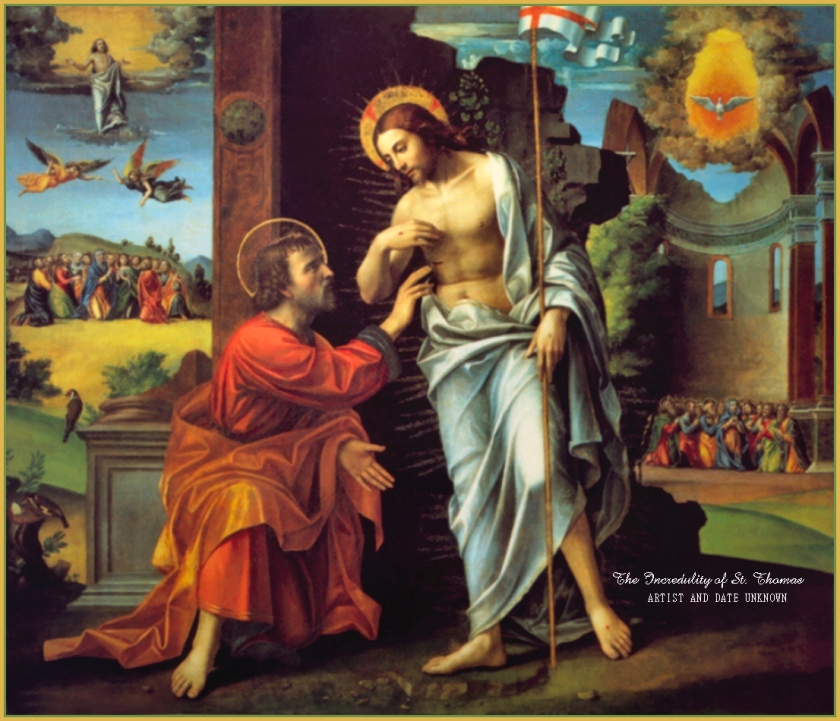
Then, the proverbial scene of the doubting Thomas that occurred eight days after Easter is very well known. At first he did not believe that Jesus had appeared in his absence and said: “Unless I see in his hands the print of the nails, and place my finger in the mark of the nails, and place my hand in his side, I will not believe” (Jn 20: 25).
Basically, from these words emerges the conviction that Jesus can now be recognised by His wounds rather than by His face. Thomas holds that the signs that confirm Jesus’ identity are now above all His wounds, in which He reveals to us how much He loved us. In this the Apostle is not mistaken.
As we know, Jesus reappeared among his disciples eight days later and this time Thomas was present. Jesus summons him: “Put your finger here, and see my hands; and put out your hand, and place it in my side; do not be faithless, but believing” (Jn 20: 27). Thomas reacts with the most splendid profession of faith in the whole of the New Testament: “My Lord and my God!” (Jn 20: 28). St Augustine comments on this: Thomas “saw and touched the man and acknowledged the God whom he neither saw nor touched but by the means of what he saw and touched, he now put far away from him every doubt and believed the other” (In ev. Jo. 121, 5).
The Evangelist continues with Jesus’ last words to Thomas: “Have you believed because you have seen me? Blessed are those who have not seen and yet believe” (Jn 20: 29). This sentence can also be put into the present: “Blessed are those who do not see and yet believe”.
In any case, here Jesus spells out a fundamental principle for Christians who will come after Thomas, hence, for all of us.
It is interesting to note that another Thomas, the great Medieval theologian of Aquinas, juxtaposed this formula of blessedness with the apparently opposite one recorded by Luke: “Blessed are the eyes which see what you see!” (Lk 10: 23). However, Aquinas comments: “Those who believe without seeing are more meritorious than those who, seeing, believe” (In Johann. XX lectio VI 2566).
In fact, the Letter to the Hebrews, recalling the whole series of the ancient biblical Patriarchs who believed in God without seeing the fulfilment of His promises, defines faith as “the assurance of things hoped for, the conviction of things not seen” (Heb 11: 1).
The Apostle Thomas’ case is important to us for at least three reasons: first, because it comforts us in our insecurity; second, because it shows us that every doubt can lead to an outcome brighter than any uncertainty and, lastly, because, the words that Jesus addressed to him remind us of the true meaning of mature faith and encourage us to persevere, despite the difficulty, along our journey of adhesion to Him.
A final point concerning Thomas is preserved for us in the Fourth Gospel, which presents him as a witness of the Risen One in the subsequent event of the miraculous catch in the Sea of Tiberias (cf. Jn 21: 2ff.).
On that occasion, Thomas is even mentioned immediately after Simon Peter: an evident sign of the considerable importance that he enjoyed in the context of the early Christian communities.
Indeed, the Acts and the Gospel of Thomas, both apocryphal works but in any case important for the study of Christian origins, were written in his name.
Lastly, let us remember that an ancient tradition claims that Thomas first evangelised Syria and Persia (mentioned by Origen, according to Eusebius of Caesarea, Ecclesiastical History 3, 1) then went on to Western India (cf. Acts of Thomas 1-2 and 17ff.), from where also he finally reached Southern India.
Let us end our reflection in this missionary perspective, expressing the hope that Thomas’ example will never fail to strengthen our faith in Jesus Christ, Our Lord and Our God. Amen…Pope Benedict, vatican.va
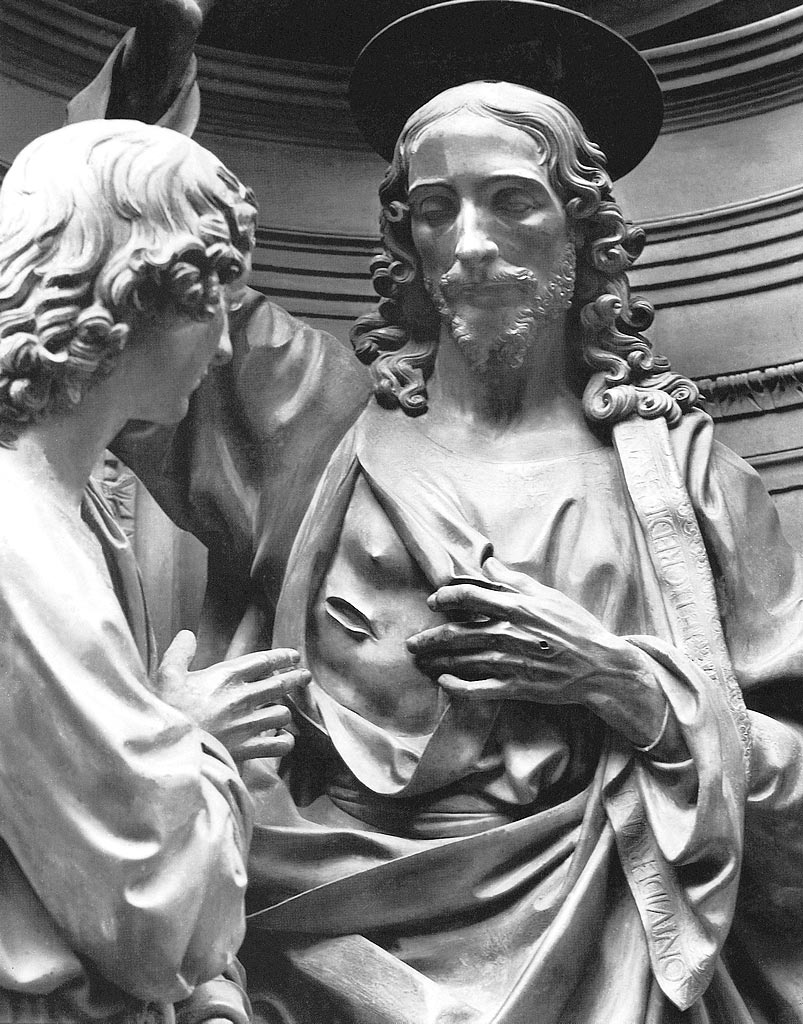
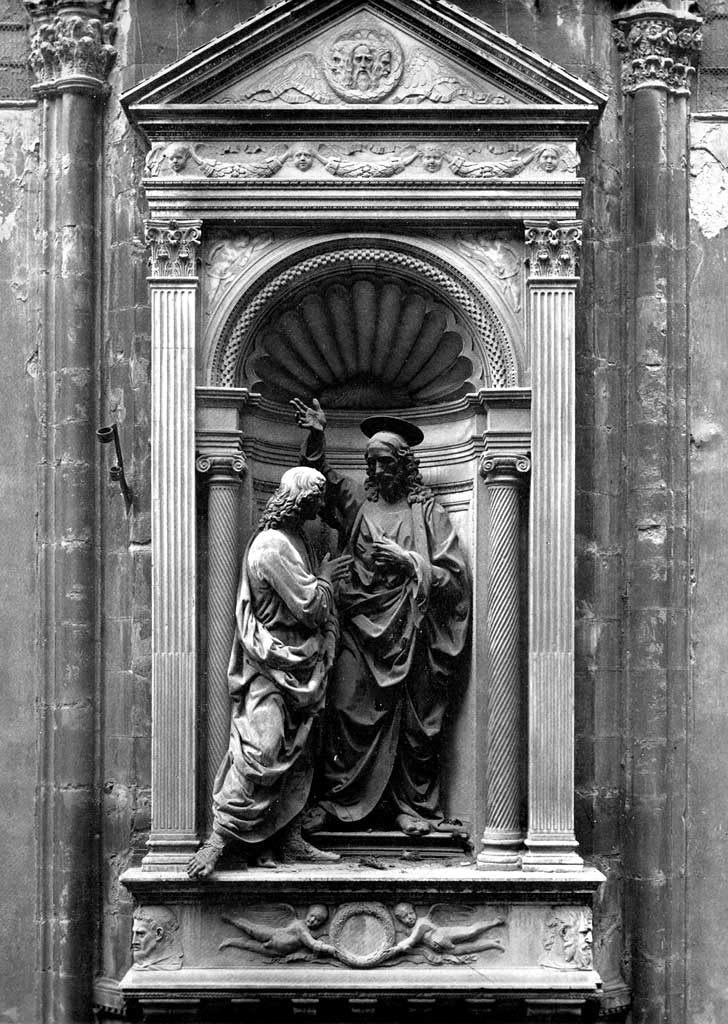
Christ and St Thomas – San Michele, Florence by Andrea del Verrocchio 1465-1483
There is a large population of native Christians who call themselves ‘the Christians of St Thomas’. They have an ancient oral tradition that he landed at Cranganoreon, the west coast and established seven churches in Malabar though his landing on the west coast is disputed today, the rest is not. He then passed eastward to the Coromandel Coast, where he was Martyred, by spearing, on the ‘Big Hill’, eight miles from Madras and was buried at Mylapore, now a suburb of that city. There are several medieval references to the tomb of St Thomas in India, some of which name Mylapore and in 1522 the Portuguese discovered the tomb there, with certain small relics now preserved in the cathedral of St Thomas at Mylapore. But the bulk of his relics were certainly at Edessa in the fourth century, as the Acta Thomae relate. They were later translated from Edessa to the island of Khios in the Aegean and from thence to Ortona in the Abruzzi, where they are still venerated.
When St Francis Xavier came to India, the signs of blood were still to be seen on the cross where the murderous deed of the martyrdom of St Thomas was committed and more than once drops of blood appeared on this cross during the celebration of Mass, when crowds of people were present. St Xavier, shortly after his arrival in India, went to the tomb of St Thomas, and passed many days and nights there in prayer. He begged God fervently to bestow upon him the Spirit and zeal of this holy Apostle, that he might be able to restore the Christian faith which St Thomas had preached there but which had gradually been entirely exterminated. Before undertaking any important work, he went, if possible, to the tomb of St Thomas and when this was impossible, he invoked the holy Apostle’s intercessio, and endeavoured to follow his example in all things.
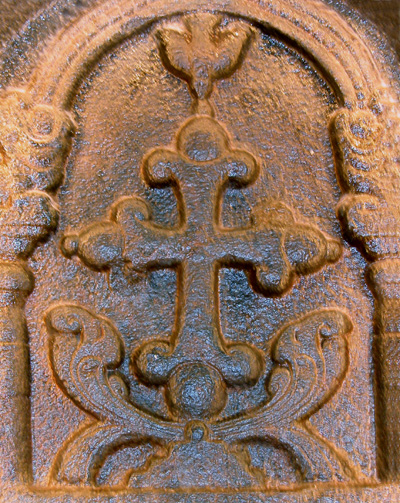
The Bleeding Cross
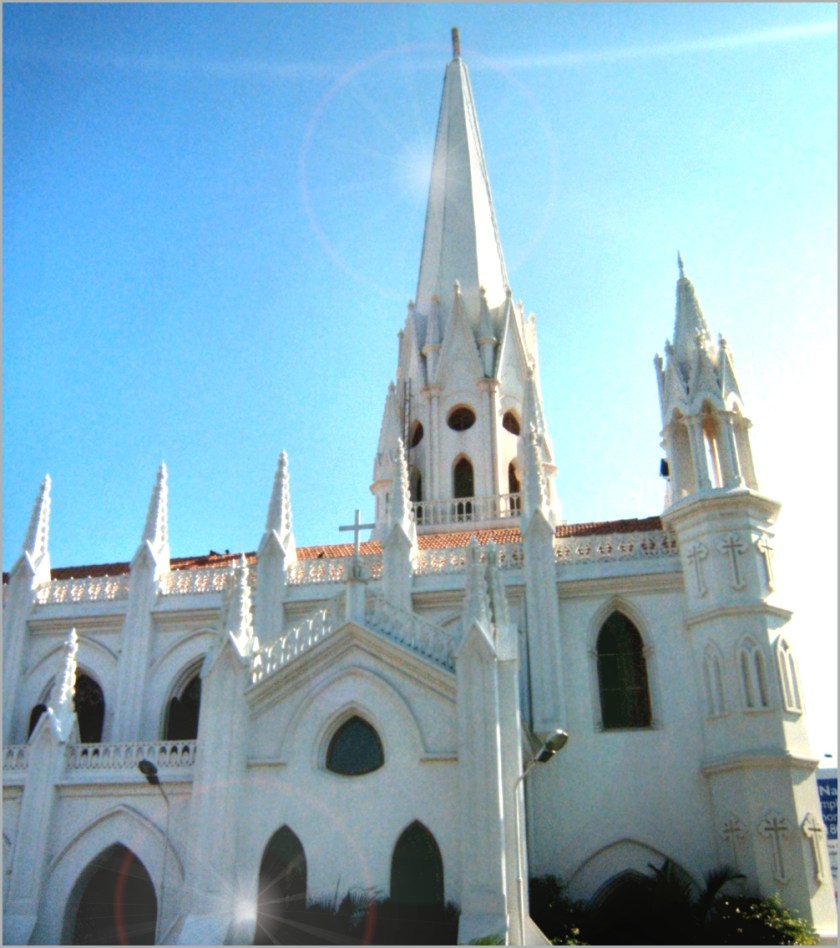
Saint Thomas was declared the “Apostle of India” by Pope Paul VI in 1972. Below is the St Thomas Cathedral in Madras, India.
More info with patronages etc and many pics here: https://anastpaul.wordpress.com/2017/07/03/saint-of-the-day-3-july-st-thomas-the-apostle-of-christ/
St Anatolius of Alexandria
St Anatolius of Constantinople
Bl Andreas Ebersbach
Bl Barbara Jeong Sun-mae
St Bladus
St Byblig
St Cillene
St Dathus of Ravenna
St Eusebius of Laodicea
St Firminus
St Firmus
Bl Gelduin
St Germanus of Man
St Giuse Nguyen Ðình Uyen
St Gunthiern
St Guthagon
St Heliodorus of Altinum
St Hyacinth of Caesarea
St Ioannes Baptista Zhao Mingxi
St Irenaeus of Chiusi
St Pope Leo II
St Maelmuire O’Gorman
St Mark of Mesia
St Mennone the Centurian
St Mucian of Mesia
St Paul of Mesia
St Petrus Zhao Mingzhen
St Philiphê Phan Van Minh
St Raymond of Toulouse
—
Martyrs of Alexandria – 13 saints: Thirteen Christian companions marytred together. No details about them have survived but the names – Apricus, Cyrion (2 of), Eulogius, Hemerion, Julian, Julius, Justus, Menelaus, Orestes, Porfyrios and Tryphon (2 of). They martyred in Alexandria, Egypt, date unknown.
Martyrs of Constantinople – 24 saints: A group of 24 Christians martyred in the persecutions of Arian emperor Valens. We know little more than their names – Acacios, Amedinos, Ammonius, Ammus, Cerealis, Cionia, Cionius, Cyrianus, Demetrius, Eulogius (2), Euphemia, Heliodoros, Heraclios, Horestes, Jocundus, Julian, Martyrios, Menelaeus, Sestratus, Strategos, Thomas, Timotheos and Tryphon. They were martyred in c367 in Constantintinople.
Theodotus and Companions – 6 saints: Six Christians who were imprisoned, tortured and martyred together in the persecutions of Trajan. Saint Hyacinth ministered to them in prison. We know nothing else about them but their names – Asclepiodotus, Diomedes, Eulampius, Golinduchus, Theodota and Theodotus. They were beheaded in c110, location
Thought for the Day – 2 July – Monday of the Thirteenth Week, Year B – Today’s Gospel: Matthew 8:18-22
“The poverty that makes rich.”
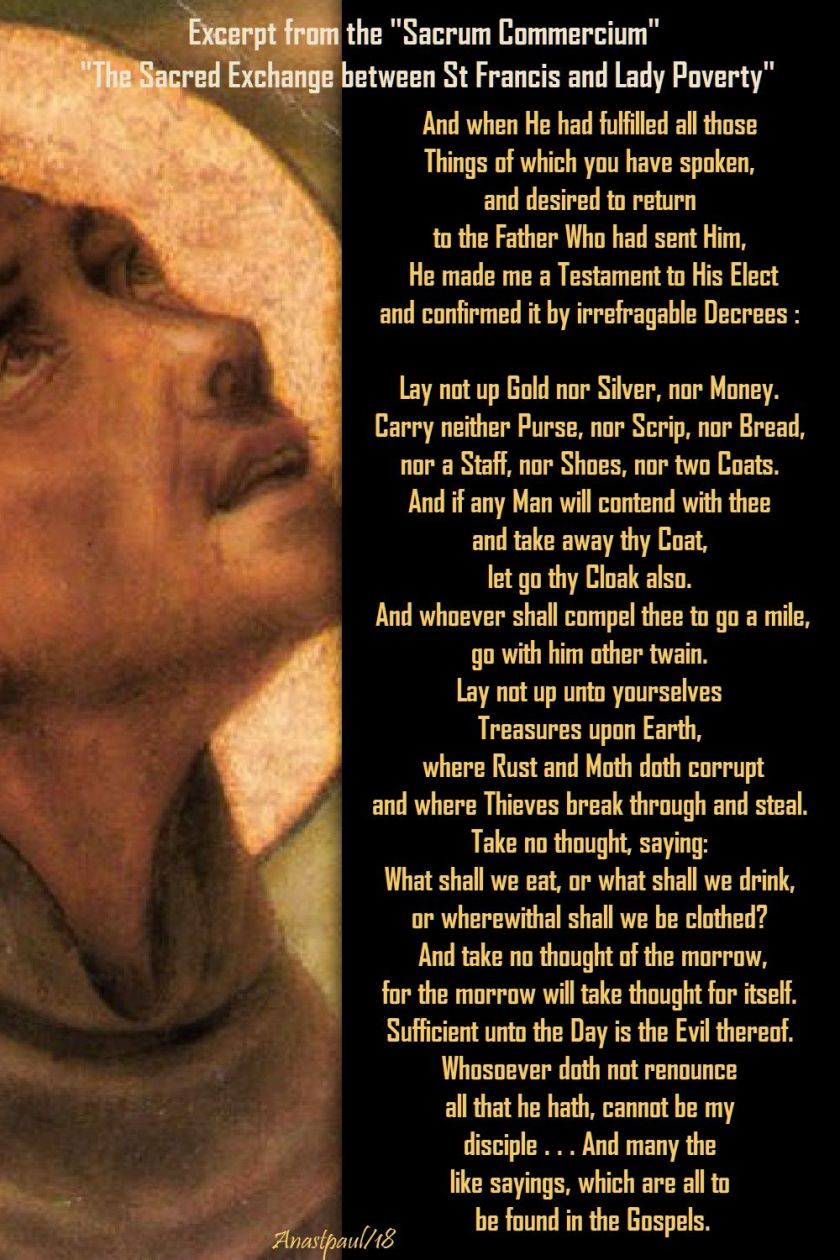
Excerpt from the “Sacrum Commercium” – “The Sacred Exchange between St Francis and Lady Poverty”
“And when He had fulfilled all those
Things of which you have spoken,
and desired to return to the Father Who had sent Him,
He made me a Testament to His Elect
and confirmed it by irrefragable Decrees :
Lay not up Gold nor Silver, nor Money.
Carry neither Purse, nor Scrip, nor Bread, nor a Staff, nor Shoes, nor two Coats.
And if any Man will contend with thee and take away thy Coat,
let go thy Cloak also. And whoever shall compel thee to go a mile,
go with him other twain.
Lay not up unto yourselves Treasures upon Earth,
where Rust and Moth doth corrupt
and where Thieves break through and steal.
Take no thought, saying:
What shall we eat, or what shall we drink,
or wherewithal shall we be clothed?
And take no thought of the morrow,
for the morrow will take thought for itself.
Sufficient unto the Day is the Evil thereof.
Whosoever doth not renounce
all that he hath, cannot be my
disciple . . . And many the
like sayings, which are all to
be found in the Gospels.”
The Sacred Exchange between Saint Francis and Lady Poverty, is one of the richest texts of the early Franciscan movement, “the single most brilliant example of the simple but lapidary allegory which was to become a major mode of spiritual writing in the later Middle Ages.” An allegory offering insights into Francis’s vision of poverty, the Sacred Exchange weaves a luxuriant tapestry of images held together by the strong threads of a biblical theology. For all of its richness, however, no text of these first hundred and fifty years is more mysterious. Like the weaver of an undated tapestry, the author of the Sacred Exchange is content to hide obscurely making sure that the ends and threads are in their proper place that the beauty and exactness of his work may be seen. Although there are many names suggested, the author of the Sacred Exchange still remains unknown. The same holds true for the date of its composition though it is believed by solid historical explorations, to date from late 13th century.
The allegory is an exhortation written to encourage Francis’s followers to live in the authentic way of the saint’s biblical vision of poverty. The central figure of the work is Lady Poverty, the personification of biblical Wisdom and, at times, of the Church. The Passage above is one of the most profound, as each word is taken from scripture and bound together into a poem of immense richness.
This is a lesson we now need to embrace, as difficult as it would seem in the world in which we live, the world led only by riches. For this is a true desire for sanctity, with Christ alone as our riches!
One Minute Reflection – 2 July – Monday of the Thirteenth Week, Year B – Today’s Gospel: Matthew 8:18-22 and the Memorial of Blessed Peter of Luxembourg (1369-1387)
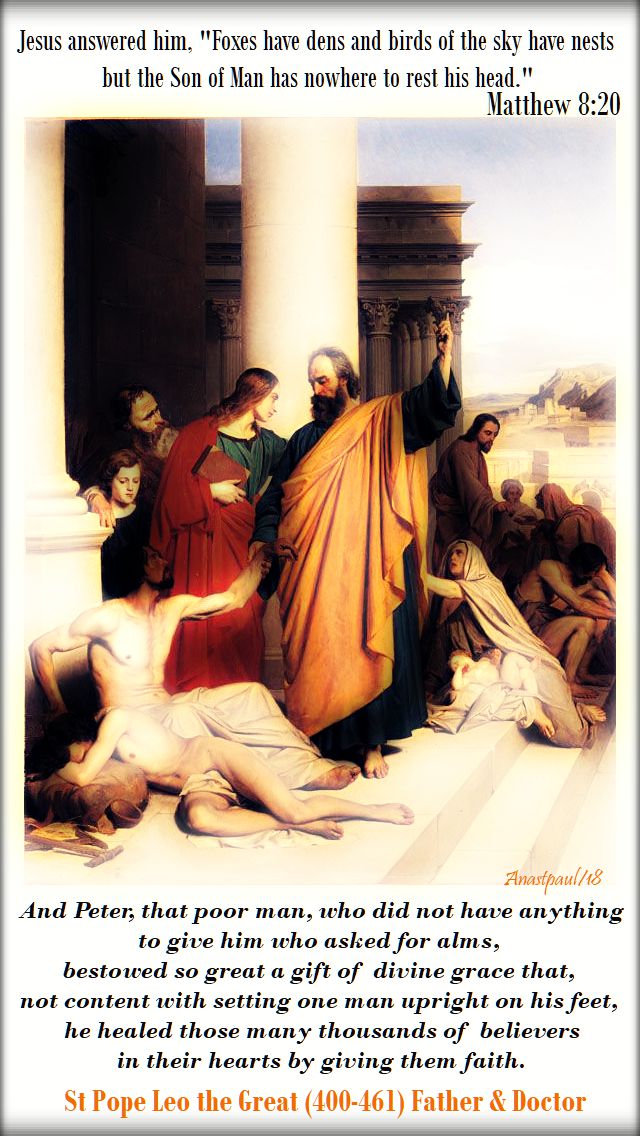
Jesus answered him, “Foxes have dens and birds of the sky have nests, but the Son of Man has nowhere to rest his head.”…Matthew 8:20
REFLECTION – “Hence the blessed apostle Peter, when he was going up to the temple and was asked for alms by a lame man, said, “I have neither silver nor gold but what I do have I give you: in the name of Jesus Christ the Nazarene, rise and walk” (Acts 3:6)… And Peter, that poor man, who did not have anything to give him who asked for alms, bestowed so great a gift of divine grace that, not content with setting one man upright on his feet, he healed those many thousands of believers in their hearts by giving them faith.”…St Pope Leo the Great (400-461) Father & Doctor
PRAYER – Lord God, be the beginning and the end of all that we are and do and say. Prompt our actions with Your grace, may Your light be our only way, may Your commands be our only need and complete all, with Your all-powerful help. Blessed Peter of Luxembourg, who was the rich young man made poor, pray for us! We make our prayer through Christ our Lord in the unity of the Holy Spirit, one God with You, forever and ever, amen.
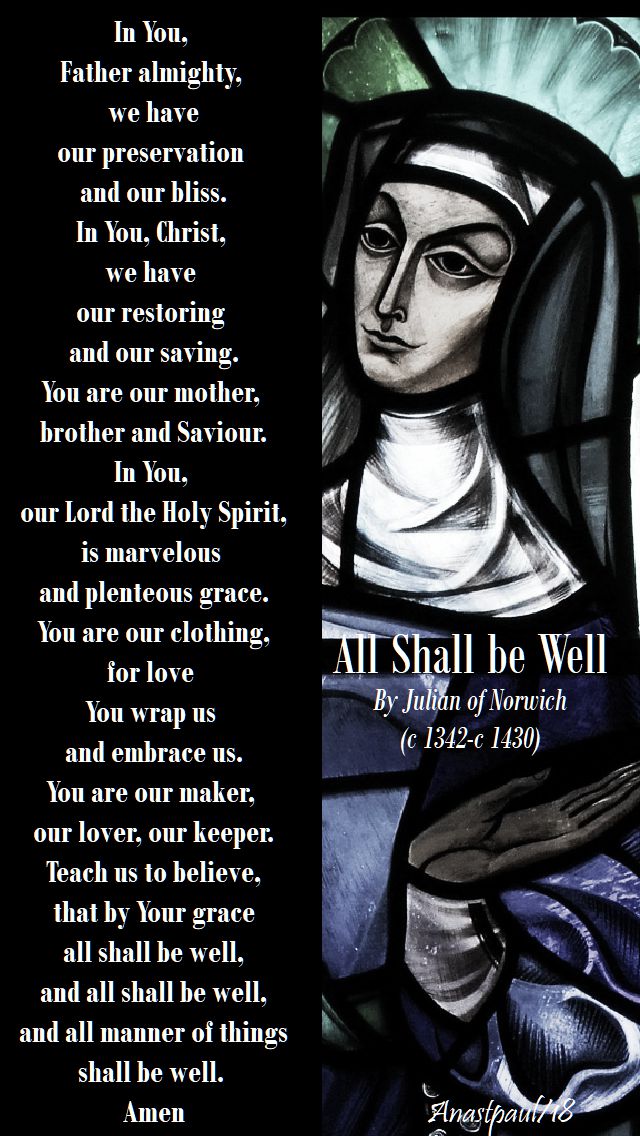
All Shall be Well By Julian of Norwich (c 1342-c 1430)
In You, Father almighty, we have
our preservation and our bliss.
In You, Christ,
we have our restoring and our saving.
You are our mother, brother and Saviour.
In You, our Lord the Holy Spirit,
is marvelous and plenteous grace.
You are our clothing,
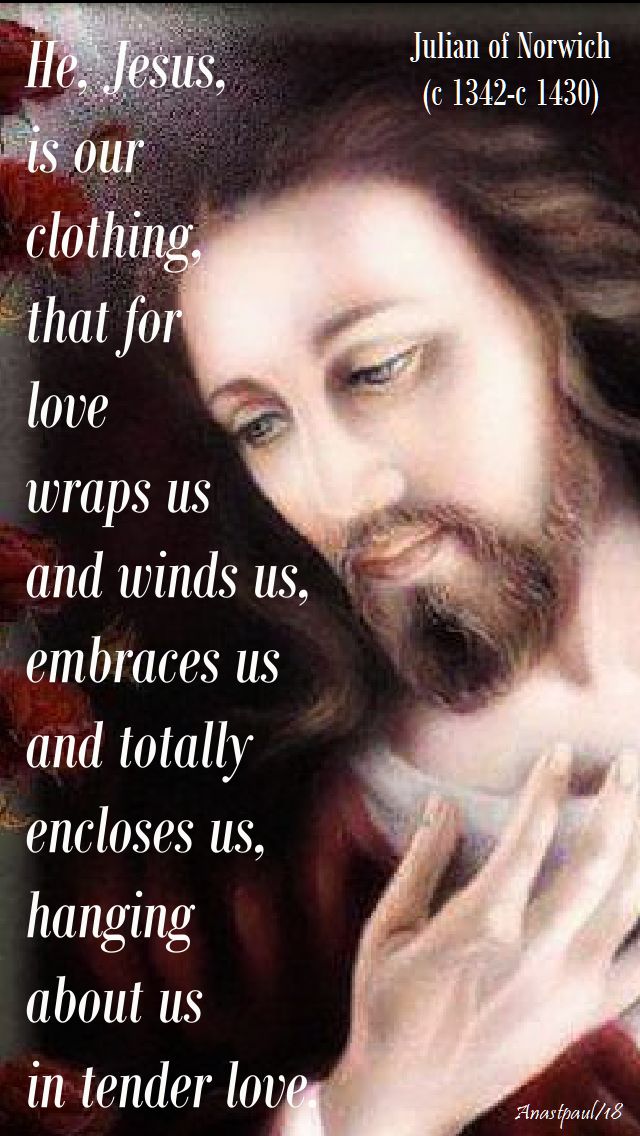
for love You wrap us and embrace us.
You are our maker, our lover, our keeper.
Teach us to believe,
that by Your grace
all shall be well,
and all shall be well,
and all manner of things
shall be well.
Amen
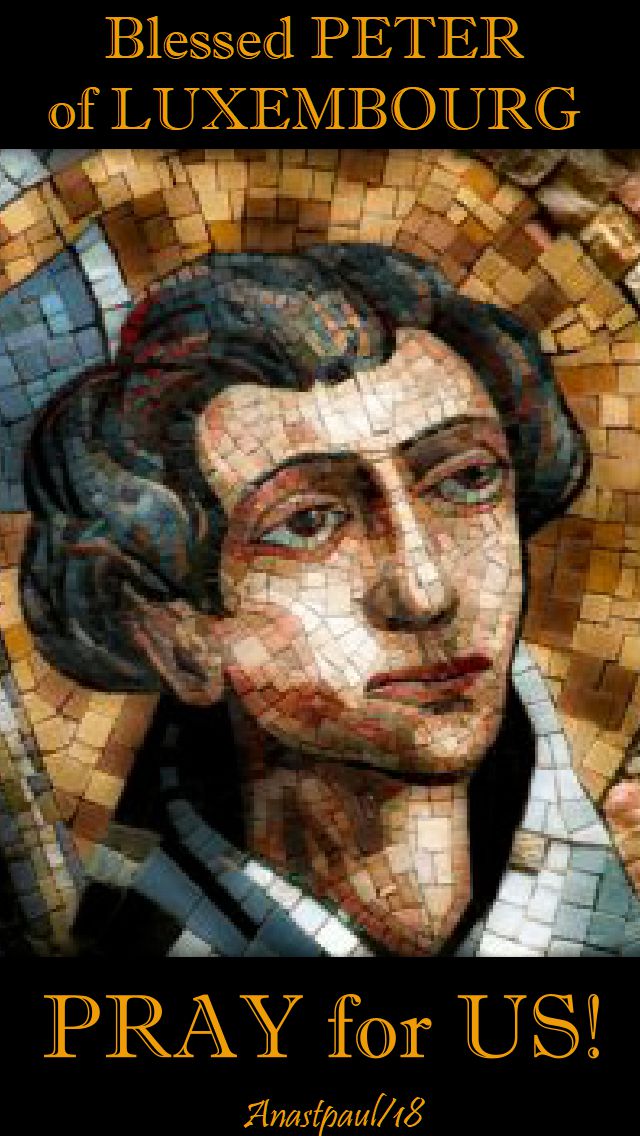
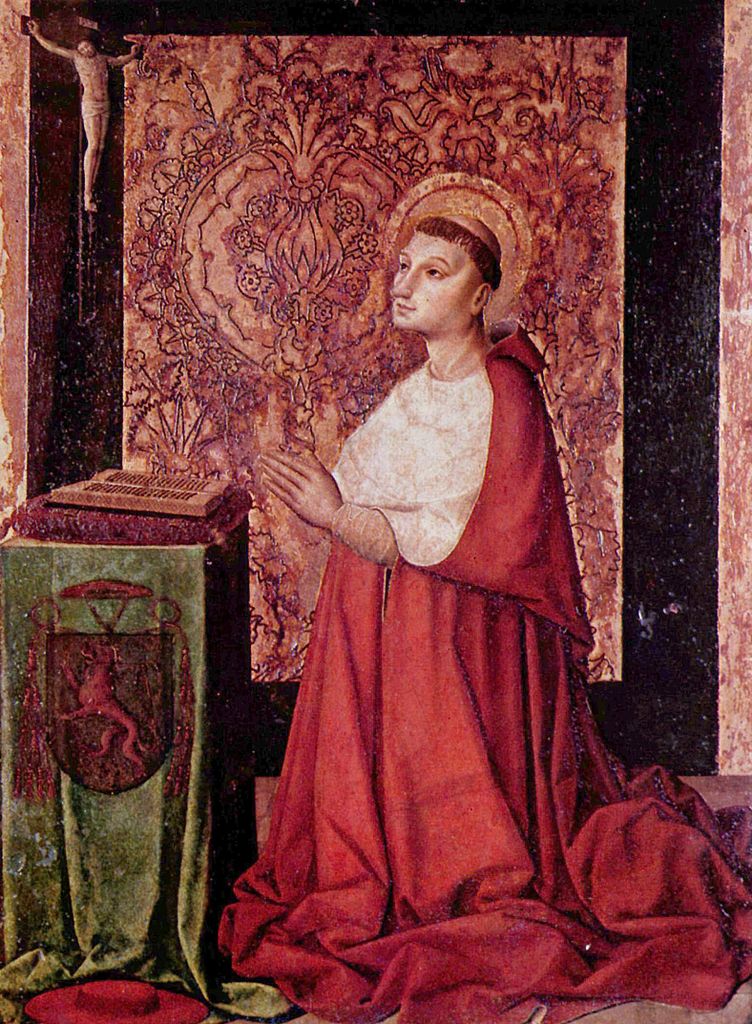
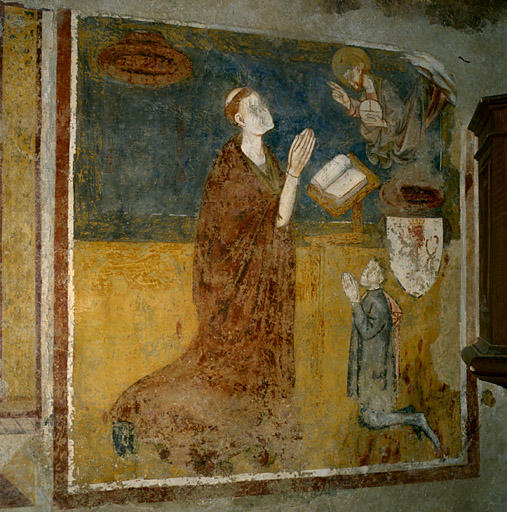
Saint of the Day – 2 July – Blessed Peter of Luxembourg (1369-1387) – Bishop and Cardinal – born in 1369 in Lorraine, France and died in 1387 at the Carthusian monastery, Villeneuve, France of a fever. Patron of Avignon, France.
Blessed Peter of Luxemburg, descended both by his father and mother from the noblest families in Europe, was born in Lorraine in the year 1369. When still a schoolboy twelve years of age, he went to London as a hostage for his brother, who had been taken prisoner. The English were so won by Peter’s holy example that they released him at the end of the year, taking his word the ransom would be paid. King Richard II of England invited him to remain at his court but Peter returned to Paris, determined to have no master but Christ.
Because of his prudence and sanctity, at the early age of fifteen he was appointed bishop of Metz. He made his public entry into his see barefoot and riding on a donkey. He governed his diocese with all the zeal and prudence of maturity and divided his revenues in three parts — for the Church, the poor and lastly, his household. His charities often left him personally destitute; only twenty pence would remain to him when he died.
Created Cardinal of Saint George, his austerities in the midst of court life were so severe that he was ordered to moderate them. Peter replied, I shall always be an unprofitable servant but I can at least obey. Ten months after this last promotion he fell ill with a fever; he lingered for some time in a sinking condition, his holiness increasing as he drew near his end. Blessed Peter, it was believed, never stained his soul by mortal sin, yet as he grew in grace his holy contempt for self became more and more intense. When he had received the last sacraments, he forced his attendants each in turn to scourge him for his faults and then lay silent until he died. The year was 1387 and the Cardinal-Saint was only 18 years old.
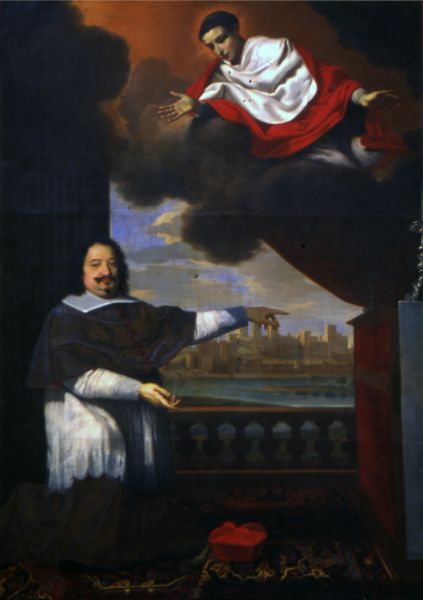
God was pleased to glorify His servant after his death. Among other miracles attributed to him the following one is related. On 5 July 1432, a child about twelve years old was killed when he fell from a high tower in the palace of Avignon, upon a sharp rock. The father, distraught with grief, picked up the scattered pieces of the skull and brains and carried them in a sack, with the mutilated body of his son, to Blessed Peter’s shrine. There, with many tears, he besought the Saint’s intercession. After a time the child returned to life and he was set upon the altar for all to see. In honour of this miracle, the city of Avignon chose Blessed Peter as its patron Saint. The image below shows Bl Peter as the Patron of Avignon.
Bl Benedict Metzler
St Bernadine Realino (1530-1616)
Bl Giovanni da Fabriano Becchetti
St Jacques Fermin
Bl Jarich of Mariengaarde
St Jéroche
St Lidanus of Sezze
St Martinian of Rome
St Monegundis
St Oudoceus
Bl Peter of Luxembourg (1369-1387)
Bl Pietro Becchetti da Fabriano
St Processus of Rome
St Swithun
—
Martyred Soldiers of Rome – 3 saints: Three soldiers who were converted at the martyrdom of Saint Paul the Apostle. Then they were martyred, as well. We known nothing else about them but their names – Acestes, Longinus and Megistus. Martyred c68 in Rome, Italy
Martyrs in Carthage by Hunneric – 7 saints: A group of seven Christians tortured and murdered in the persecutions of the Arian Vandal king Hunneric for remaining loyal to the teachings of orthodox Christianity. They were some of the many who died for the faith during a period of active Arian heresy. – Boniface, Liberatus, Maximus, Rogatus, Rusticus, Septimus and Servus.
Martyrs of Campania – 10 saints: A group of ten Christians marytred together in the persecutions of Diocletian. The only details about them to have survived are their names – Ariston, Crescention, Eutychian, Felicissimus, Felix, Justus, Marcia, Symphorosa, Urban and Vitalis. Martyred in 284 in Campania, Italy.
Martyrs of Seoul – 8 saints: Additional Memorial – 20 September as part of the Martyrs of Korea.
A group of eight Christians who were martyred together as part of the lengthy persecutions in Korea.
• Agatha Han Sin-ae
• Antonius Yi Hyeon
• Bibiana Mun Yeong-in
• Columba Gang Wan-suk
• Ignatius Choe In-cheol
• Iuliana Gim Yeon-i
• Matthaeus Gim Hyeon-u
• Susanna Gang Gyeong-bok
They were martyred on 2 July 1801 at the Small West Gate, Seoul, South Korea. Beatified on 15 August 2014 by Pope Francis.
Thought for the Day – 1 July – The Thirteenth Sunday in Ordinary Time, Year B – Today’s Gospel Mark 5:21-43.
The woman healed and the girl raised, have some things in common:
they are female;
they are both called daughter;
and they are linked by the number twelve.
The number is a sign of the restoration of the twelve tribes of Israel at the end of time, a sign of the Messiah and the eschaton – the last things, the final event in the Divine plan.
Israel is also known as the daughter or even, the bride of God (Hos 2:19-21).
In these miracles today, Jesus shows that He has come to bring daughter Israel to health and full life. The healings that connect these daughters of Israel are signs of the spiritual wholeness and the destruction of death that the Messiah brings. And since we know that “God does not delight in the death of the living” (Wis 1:13), we know that new life for the restored people of Israel, was a sign of the offer extended to the whole world. Wherever death comes to destroy, faith in Christ’s power is sufficient, even unto death.
The divine power leaves Jesus in order to flow into us on the Cross and in the Eucharist.
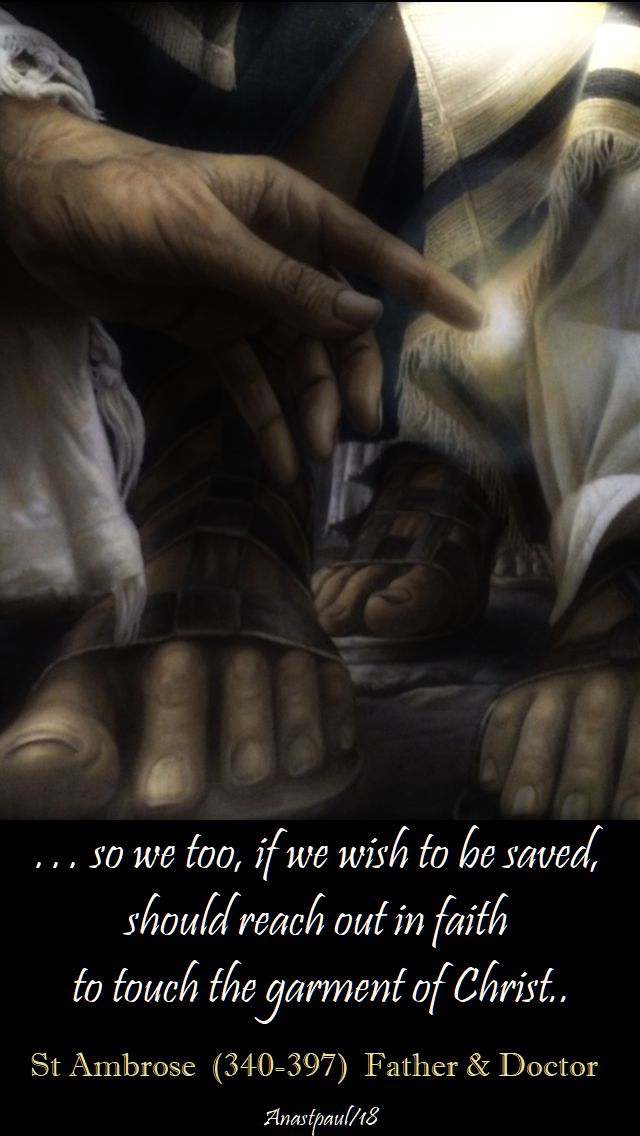
“She touched the hem of His garment, she approached Him in a spirit of faith, she believed and she realised that she was cured… so we too, if we wish to be saved, should reach out in faith to touch the garment of Christ” ...St Ambrose (340-397 Father & Doctor), Expositio Evangelii sec. Lucam, VI, 56. 58.
Sunday Reflection – 1 July – By St Alphonsus Liguori (1696-1787)
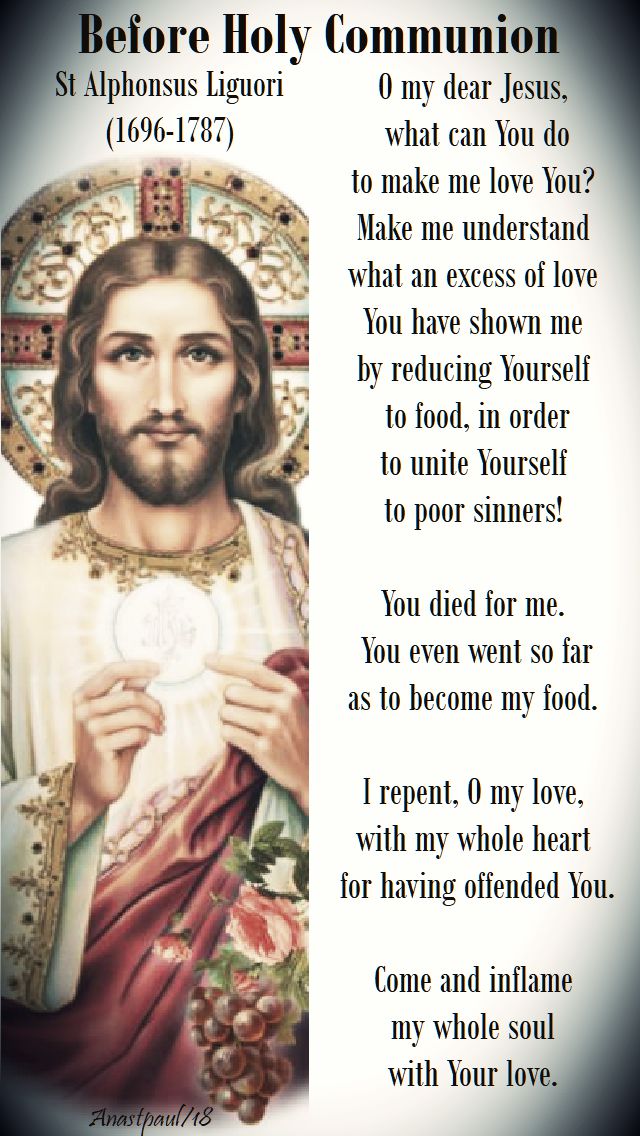
O my dear Jesus, what can You do to make me love You?
Make me understand, what an excess of love You have shown me, by reducing Yourself to food,
in order to unite Yourself to poor sinners!
You, my dear Redeemer, have so much affection for me,
that You have not refused to give Yourself, again and again, entirely to me in Holy Communion.
And yet, I have had the courage to drive You away from my soul on so many occasions!
You do not despise a humble and contrite heart.
You became human for my sake.
You died for me.
You even went so far as to become my food.
What more can there remain for You to do in order to gain my love?
Oh, that I could die with grief, every time that I remember, that I have despised Your grace.
I repent, O my love, with my whole heart for having offended You.
I love You, O infinite goodness! I love You, O infinite love!
I desire nothing but to love You and I fear nothing but to live without Your love.
My beloved Jesus, do not refuse to come to me.
Come, because I would rather die a thousand times than drive You away again.
I will do all that I can to please You.
Come and inflame my whole soul with Your love.
Grant that I may forget everything, to think only of You,
and to desire You alone,
my sovereign and my only good.
One Minute Reflection – 1 July – The Thirteenth Sunday in Ordinary Time, Year B – Today’s Gospel Mark 5:21-43
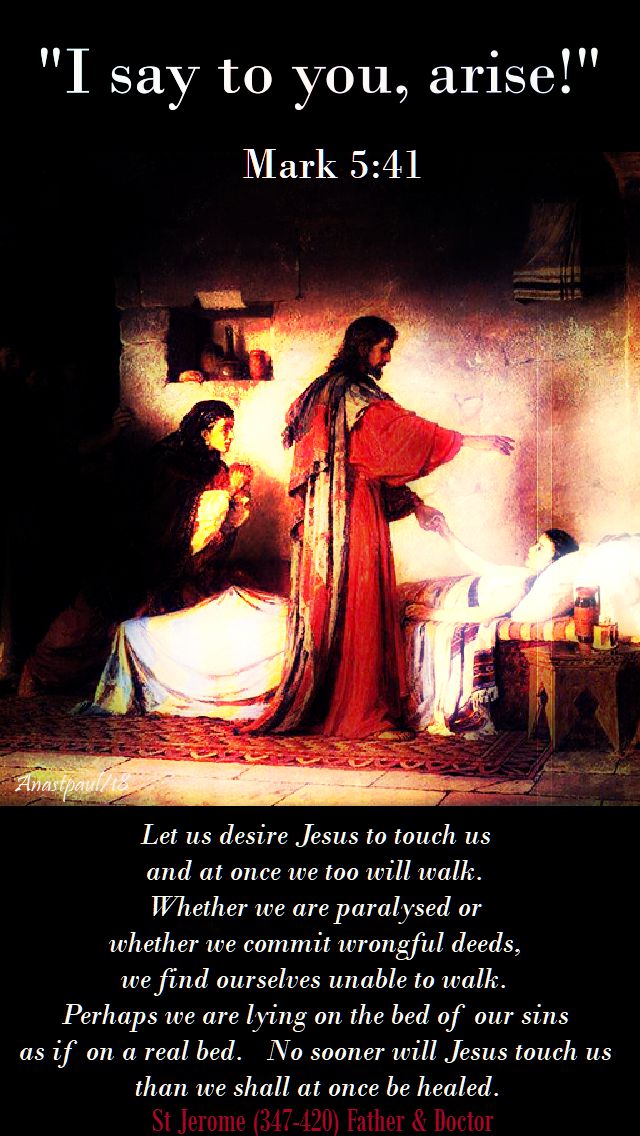
“I say to you, arise!”...Mark 5:41
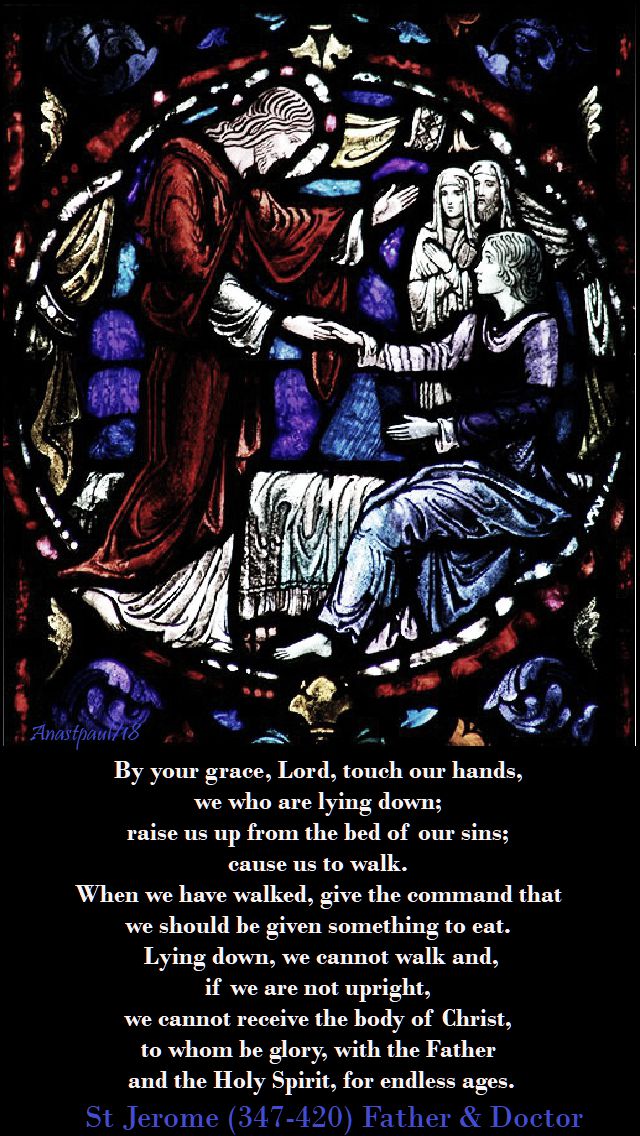
REFLECTION – “Then He entered the room where the child was and, taking the child by the hand, said to her: ‘Talitha koum’. The girl arose immediately and walked around.’ Let us desire Jesus to touch us and at once we too will walk. Whether we are paralysed or whether we commit wrongful deeds, we find ourselves unable to walk. Perhaps we are lying on the bed of our sins as if on a real bed. No sooner will Jesus touch us than we shall at once be healed.”…St Jerome (347-420) Father & Doctor
PRAYER – “By Your grace, Lord, touch our hands, we who are lying down; raise us up from the bed of our sins; cause us to walk. When we have walked, give the command that we should be given something to eat. Lying down, we cannot walk and, if we are not upright, we cannot receive the body of Christ, to whom be glory, with the Father and the Holy Spirit, for endless ages. Amen”…St Jerome (347-420) Father & Doctor
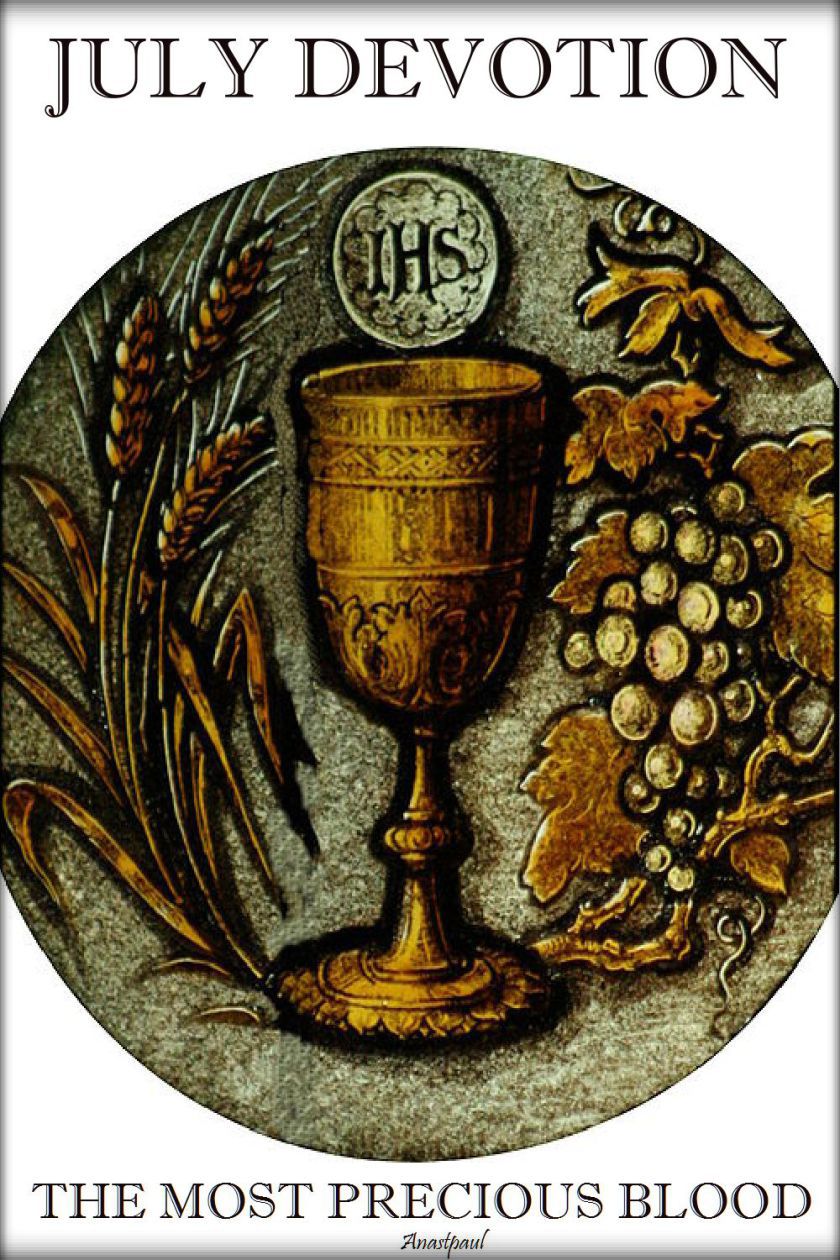
Our Morning Offering – 1 July – Month of the Most Precious Blood
Constant Prayer to the Precious Blood of Jesus By St Catherine of Siena (1347-1380) Doctor of the Church
Precious Blood,
ocean of divine mercy,
Flow upon us!
Precious Blood,
most pure offering,
Procure us every grace!
Precious Blood,
hope and refuge of sinners,
Atone for us!
Precious Blood,
delight of holy souls,
Draw us!
Amen.
July is the month dedicated to the Precious Blood of Jesus. Among devotions to the humanity of Christ (e.g., The Holy Name, The Holy Face, Sacred Heart), the Precious Blood of Jesus has the most biblical precedent since it is mentioned so frequently in the New Testament (over 75 times).
Saint Peter, our first Pope, specifically refers to the blood of Christ as “the precious blood of Christ, as of a lamb unspotted and undefiled” (1 Peter 1:19).
In fact, it might even be said that the entire Old Testament is a lesson in “blood sacrifice” as an anticipation of Christ’s obedient and merciful sacrifice on the wood of the life-giving cross.
St Paul could rightfully be called the “Theologian of the Precious Blood.”
The Apostle even tell us to place our “faith in His blood”: “… whom God set forth as an expiation, through faith, by his blood, to prove his righteousness because of the forgiveness of sins previously committed,” (Romans 3:25).
This reveals that the Precious Blood of Jesus is not an abstraction, but a true devotion to the Divine Person of Christ.
In Ephesians, the Apostle teaches us that our redemption was purchased “through His blood” (Eph 1:7) and in Hebrews, he teaches that the entire New Covenant is rooted in the Precious Blood of Jesus:
“….he entered once for all into the sanctuary, not with the blood of goats and calves but with his own blood, thus obtaining eternal redemption. For if the blood of goats and bulls and the sprinkling of a heifer’s ashes can sanctify those who are defiled so that their flesh is cleansed, how much more will the blood of Christ, who through the eternal spirit offered himself unblemished to God, to cleanse our consciences from dead works to worship the living God.” (Hebrews 9:12–15)
Saint John the Apostle stresses the love of God and the Precious Blood when he writes: “To him who loves us and has freed us from our sins by his blood,” (Rev 1:5). Elsewhere, Saint John explains that the Blood of Jesus continues to be applied to us: “But if we walk in the light as he is in the light, then we have fellowship with one another and the blood of his Son Jesus cleanses us from all sin.” (1 Jn 1:7).
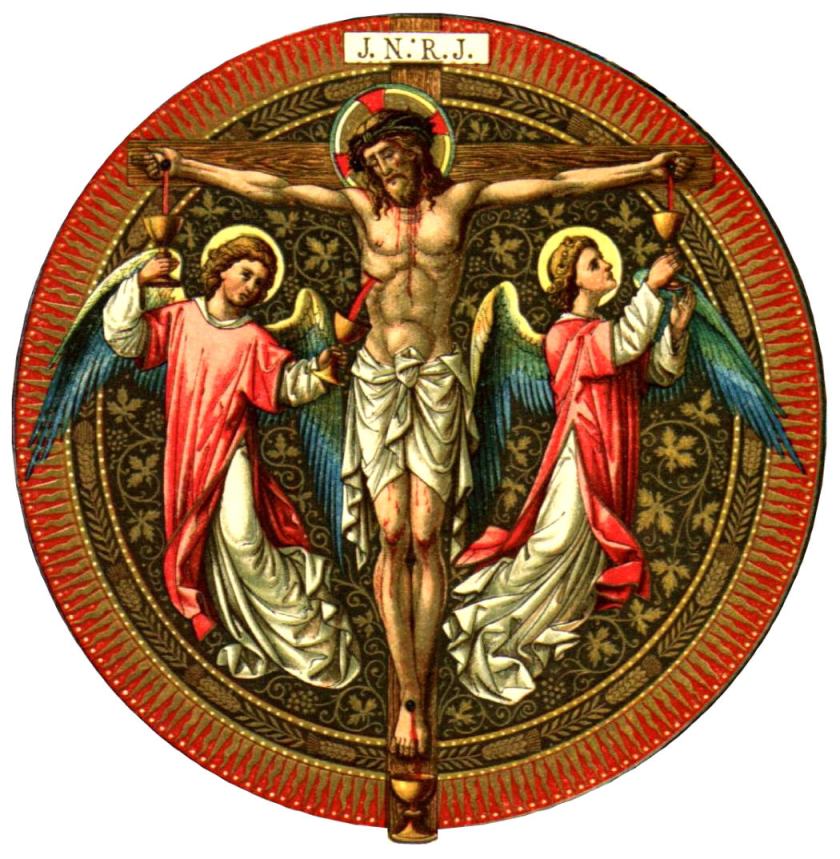
St John Chrysostom calls the Precious Blood “the saviour of souls”, St Thomas Aquinas, “the key to heaven’s treasures”, St Ambrose, “pure gold of ineffable worth”, St Mary Magdalene de Pazzi, “a magnet of souls and pledge of eternal life”. The sins of mankind, in their number, in their offence to the Supreme Being, in the effects on transgressors, are immense, yet, the Precious Blood of Jesus is not frightened by numbers, it has in Itself the power to appease an angered God and to heal wounded creatures.
The Precious Blood is a cleansing bath. Unlike all other blood, which stains, the Blood of Jesus washes clean and white. According to the words of St John, in the Apocalypse, the Angels wonder and the question is asked: “These that are clothed in white robes, who are they?” The Lord answers: “These are they that have washed their robes and have made them white in the Blood of the Lamb.” For no other reason did the Precious Blood flow but to regain for the souls of men the beautiful dress of innocence and, once regained, to preserve it throughout life and into eternity.
The Blood of the Saviour is a well of consolation for troubled hearts. Can anyone, confidingly, look at the Sacred Blood trickling down from the Cross without taking courage to carry on, in spite of the difficulties which are the common lot of all? One glance at the Cross must be able to drive away fear. And, another, must be able to instil trust in Him who did not rest until the last drop, mingled with water, flowed out of an opened Heart. He, who was willing to do so much for men, must be willing to overlook and forget the frailties which they deeply regret; He must be willing to come to their assistance when harassed, to defend them when tempted, to comfort them when afflicted. The Blood of Jesus must be for Christians what the north-star is to sailors.
Would that men on earth honoured the Precious Blood in the manner in which they who are in heaven give honour and praise and thanksgiving! They proclaim that It purchased the glory which they enjoy. Without It, they would have remained slaves of Satan and outcasts from the eternal mansions of God. Let us profess that we owe to the Sacred Blood of Jesus all that we have in this life and that to It we shall owe all that we shall enjoy in a better and eternal life! The New and Everlasting Covenant must be mediated through the Blood of One who is absolutely perfect, sinless and obedient to God the Father – our Lord Jesus Christ.
Daily Offering to the Father
Eternal Father,
I offer You
the Most Precious Blood
of Your divine Son, Jesus,
for sinners everywhere,
sinners in my home, in my family
and in the universal Church.
I offer It too, in supplication,
for the holy souls in purgatory
and for the needs of holy mother Church.
Amen
The Most Precious Blood of Our Lord, Jesus Christ: The feast was removed from the General Roman Calendar in 1969, “because the Most Precious Blood of Christ the Redeemer is already venerated in the solemnities of the Passion, of Corpus Christi, of the Sacred Heart of Jesus and in the feast of the Exaltation of the Holy Cross.” However, as this is the Month of the Most Precious Blood, this day, Sunday is most worthy of celebrating this Feast Day, this year (2018).
St Junipero Serra (1713-1784) (Optional Memorial, USA)
St Aaron of Caerleon
St Aaron the Patriarch
Bl Antonio Rosmini-Serbati
St Arnulf of Mainz
Bl Assunta Marchetti
St Atilano Cruz Alvarado
St Calais of Anisole
St Carilephus
St Castus of Sinuessa
St Cewydd
St Concordius of Toledo
St Cuimmein of Nendrum
St Domitian of Lerins
Bl Elisabeth de Vans
St Eparchius of Perigord
St Eutychius of Umbria
St Esther the Queen
St Gall of Clermont
Bl George Beesley
St Golvinus of Leon
St Gwenyth of Cornwall
St Huailu Zhang
Bl Jan Nepomucen Chrzan
Bl Jean-Baptiste Duverneuil
St Julius of Caerleon
St Justino Orona Madrigal
St Juthware
St Leonorious of Brittany
St Leontius of Autun
Bl Luis Obdulio Navarro
St Martin of Vienne
Bl Montford Scott
Bl Nazju Falzon
St Nicasius of Jerusalem
St Oliver Plunkett (1629-1681) Martyr
Bl Pierre-Yrieix Labrouhe de Laborderie
St Secundinus of Sinuessa
St Servan of Culross
St Theobald of Vicenza
St Theodoric of Mont d’Or
Bl Thomas Maxfield
Bl Tullio Maruzzo
St Veep
—
Martyrs of Rome – 6 saints: Six Christians who were martyred together. No details have survived except their names – Esicius, Antonius, Processus, Marina, Serenus and Victor. They were martyred in Rome, Italy, date unknown.
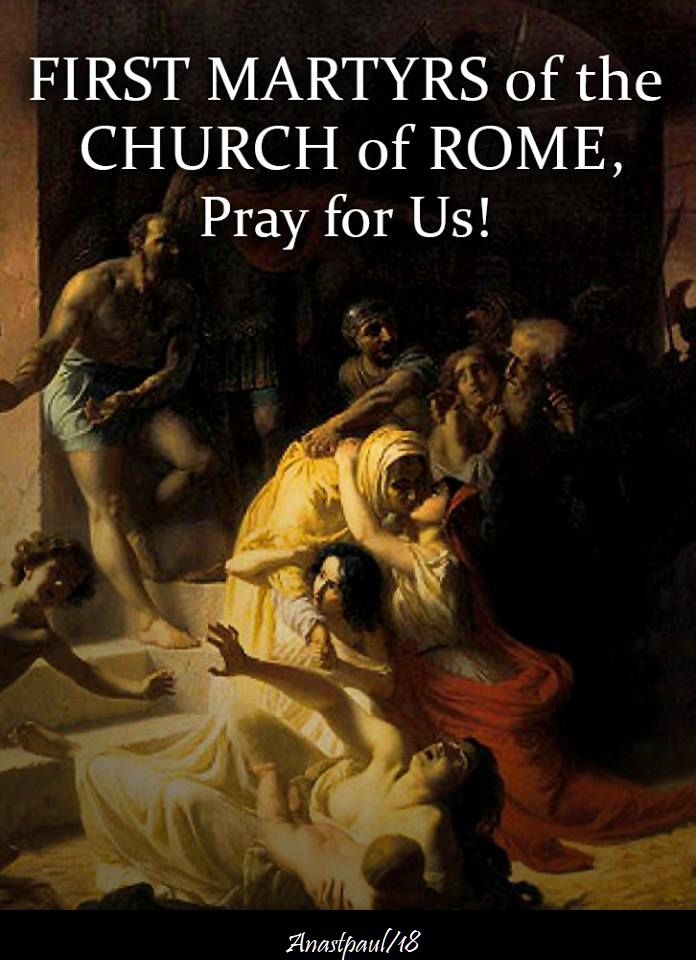
Thought for the Day – 30 June – The Memorial of The First Holy Martyrs of the Church of Rome
Nero became the emperor of Rome in 54. About 10 years later, he began to persecute the Christians. When a terrible fire broke out in the city, Nero accused the Christians of causing it. He increased his efforts to destroy them. Nero had Christians covered with pitch and set on fire to light the way for his night drive through the park. He had some Christians sewn into animal skins and left in the woods so that he and his guests could go hunting for them. In the two centuries after Nero, thousands of Christians were put to death. All these unnamed martyrs are honoured on this day, after the feast of Saints Peter and Paul, both of course Martyrs for their love of Christ.
Wherever the Good News of Jesus was preached, it met the same opposition as Jesus did, and many of those who began to follow Him shared His suffering and death. But no human force could stop the power of the Spirit unleashed upon the world. The blood of martyrs has always been, and will always be, the seed of Christians. Do we stand up or crumble in the face of persecution? I truly wonder how any of us would fair if faced with torture and death for the sake of Christ.
First Holy Martyrs of the Church of Rome, Pray for us!
Quote/s of the Day – 30 June – The Memorial of Blessed Raymond Lull T.O.S.F. (c 1232 – c1315) Martyr
“The Beloved created and the Lover destroyed. The Beloved judged and the Lover wept. Then the Beloved redeemed him and the Lover again had glory. The Beloved finished His work and the Lover remained forever, in his Beloved’s companionship.”
“Death has no terrors for a sincere servant of Christ, who is labouring to bring souls to a knowledge of the truth.”
One Minute Reflection – 30 June – Saturday of the Twelth Week in Ordinary Time, Year B – Today’s Gospel Matthew 8:5-17 – The Memorial of The First Holy Martyrs of the Church of Rome & Blessed Raymond Lull T.O.S.F. (c 1232 – c1315) Martyr
“I say to you, many will come, from the east and the west and will recline with Abraham, Isaac and Jacob, at the banquet in the kingdom of heaven.”…Matthew 8:11
REFLECTION – “And the saints who preceded us are also waiting for us, slow and lazy as we are. Their joy is not perfect so long as there is reason to weep over our sins. The apostle testifies to this for me when he says: “Without us, they were not to be made perfect.” (Heb 11:40) So see: Abraham is waiting. Isaac, Jacob and all the prophets are waiting for us to possess perfect beatitude with us… If you are holy, you will have joy when you leave this life but that joy will only be complete when not one of the members of the Body we are all to form together is missing anymore. You will also wait for others in the same way as you were awaited. Now if you who are only one member cannot have perfect joy if another member is absent, how much more our Lord and Saviour, who is both the author and the head of the entire Body… Then we will have come to the maturity of which the apostle Paul said: “The life I live now is not my own; Christ is living in me.” (Gal 2:20) Then our pontiff will drink the new wine in the new heaven, on the new earth, in the new human person, with the new human persons, with those who sing the new song.”…Origen (c185-253)
PRAYER – Grant us Lord, a true knowledge of salvation, so that freed from fear and from the power of our foes, we may serve You faithfully, all the days of our life and attain the light and joy of our heavenly home. By the blood of the Martyrs and the glory of the Communion of Saints, strengthen us with their faith and endurance. We make our prayer through Christ our Lord, in unity with You and the Holy Spirit, one God, amen.
Our Morning Offering – 30 June – The Memorial of The First Holy Martyrs of the Church of Rome & Blessed Raymond Lull T.O.S.F. (c 1232 – c1315) Martyr
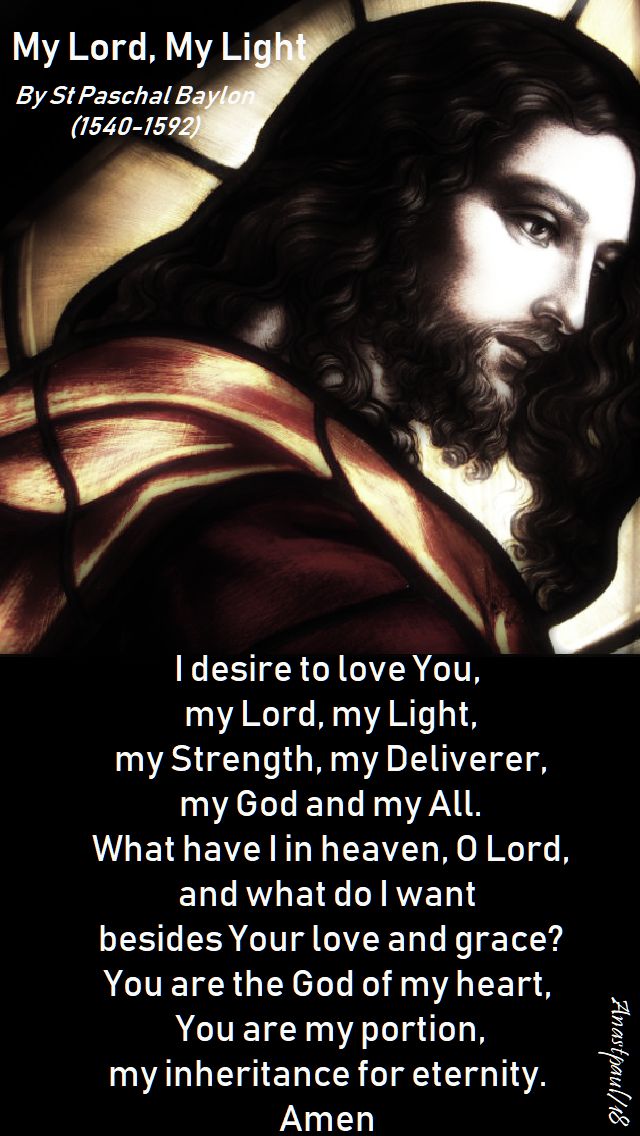
My Lord, My Light St Paschal Baylon O.F.M. (1540-1592)
I desire to love You,
my Lord, my Light,
my Strength, my Deliverer,
my God and my All.
What have I in heaven, O Lord,
and what do I want
besides Your love and grace?
You are the God of my heart,
You are my portion,
my inheritance for eternity.
Amen
Saint of the Day – 30 June – Blessed Raymond Lull T.O.S.F. (c 1232 – c1315) Martyr – born in c1234 at Palma, Majorca, Spain and died – • some writers indicate that he died in Bougie, Algeria in 1325 • but he may have died of natural causes during the return ocean voyage from Tunis. Also known as – Doctor Illuminatus, Ramon Llull. Raymond was a Philosopher, Logician, Writer, Poet, Pioneer in computation theory, Franciscan tertiary. Within the Franciscan Order he is honoured as a martyr. He was beatified in 1847 by Pope Pius IX.
Raymond was born into the noble Lull family at Palma, on the island of Mallorca. At an early age, he was selected as a page at the royal court, and over the first 30 years of his life served the royal family in a variety of positions, eventually becoming the marshal and high steward to King James.
Raymond lived a life of luxury and worldly pursuits. He was married and produced two children with his wife, although also had numerous affairs and engaged in dissolute activities. One day, while writing a letter to one of the women he was seeing, Raymond was stricken with a vision of Christ, crucified on the cross. Five additional visions followed and he was brought to the faith, converting and dedicating himself to the Gospel. Soon thereafter, following a moving sermon by a local bishop who spoke about the contempt of the world and the love of Christ, Raymond answered the call of the Lord to forsake all things and to win for Christ the infidels on the northern coast of Africa.
Raymond wasted little time. He resigned his royal offices and dedicated himself to the education and care of missionaries. He founded a college for the Order of the Friars Minor and devoted himself to the mastery of and instruction of others in, the languages of Northern Africa. He became a member of the Third Order of Saint Francis and embarked on a nine year mission of solitude and contemplation on a remote mountain, spending his days in prayer and study, hoping to prepare himself for inspire mission work. During that time, he was graced with heavenly inspiration and extraordinary knowledge and was subsequently able to answer deeply complex philosophical and theological questions.
Following his time in solitude, Raymond travelled extensively—to Rome, Avingon, Montpellier, Paris and throughout Europe—spreading the Gospel, founding seminaries, and establishing schools for missionaries. At the age of 79, he journey on mission to Africa, as had been his calling. While preaching the faith in a public square at Bougie, he was set upon by radical Muslims in the community, who stoned him nearly to death. Rescued by Greek sailors, he died shortly thereafter, en route to his home island of Mallorca. He was buried in the Franciscan church at Palma and numerous miracles were reported at his tomb.
Blessed Raymond Lull wrote over 300 works in Latin, Arabi, and Catalan during his life, on a multitude of topics including theology, logic, philosophy, poetry, fiction, alchemy, and natural sciences. While his works were mostly academic in nature, he also strove to make difficult concepts accessible to all, illustrating points through fiction.
It can be documented that Llull was buried at the Church of Saint Francis in Mallorca by March 1316.
Raymond worked most of his life to help spread the gospel. Indifference on the part of some Christian leaders and opposition in North Africa did not turn him from his goal. Three hundred years later Raymond’s work began to have an influence in the Americas.













 AnaStpaul
You must be logged in to post a comment.