Posted in INCORRUPTIBLES, SAINT of the DAY

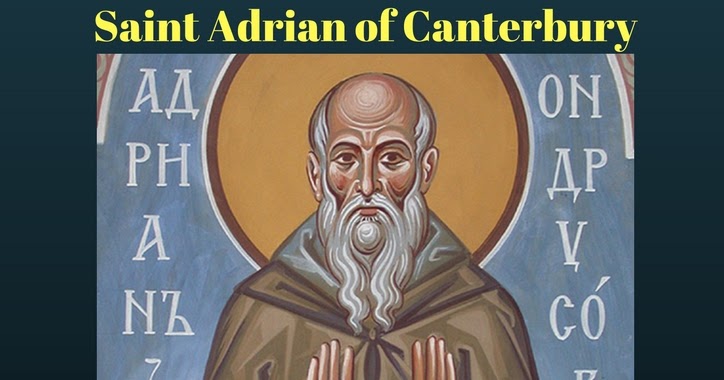
Saint of the Day – 9 January – St Adrian of Canterbury (c635-710)

Saint of the Day – 9 January – St Adrian of Canterbury (c635-710).  St Adrian was born in c635 in Libya Cyrenaica, North Africa as Hadrian and he died on 9 January 710 of natural causes at Canterbury, England and was buried there.   His Tomb became a site of miracles and his body was found Incorrupt in 1091.   He was a Monk, Abbot, a brilliant Scholastic and Theologian, Teacher, Administrator and Adviser.    A  record of the teaching of Theodore and Adrian is preserved in the Leiden Glossary.1saint adrian

St Adrian became a Monk and eventually the Abbot of Nerida, not far from Naples in Italy.   In the early years of the See of Canterbury after St Augustine of Canterbury, the Archbishops were chosen from the companions who had come with him from Rome.   Two Englishmen then succeeded but as both fell victim to the Plague in 664 and 665, the Pope of the time, Vitalian (657-672) wished to appoint Adrian.   He refused with many tears and lamentations, accepted by the Pope only if Adrian himself would find the perfect candidate in his own place.  Adrian suggested the nomination of a Greek Monk Theodore of Tarsus.   Vitalian accepted this suggestion, provided Adrian accompany Theodore as his adviser and first assistant.   Which he did.

On arrival in Canterbury Theodore appointed Adrian as the Abbot of the Monastery of Saints Peter and Paul (later St Augustine’s).   An excellent Administrator as well as a Greek and Latin scholar, Adrian insured that the Monastery grew into a centre of Theological learning drawing students from all over England and even Ireland.   Adrian helped his Archbishop in the pastoral governance of the English Church.   Bede says of this time: “Never had there been such happy times as these, since the English settled in Britain.”

Adrian worked at Canterbury for nearly forty years, far outliving Theodore.   He was buried in the Church of the Monastery.   His body was still Incorrupt when renovations made the translation of Canterbury Saints necessary.   His Tomb became famous for many miracles.

Posted in FEASTS and SOLEMNITIES, SAINT of the DAY

Feast of the Black Nazarene & Memorials of the Saints – 9 January

The Black Nazarene:   The Black Nazarene is a blackened, life-sized wooden icon of Jesus Christ carrying a cross.   It was constructed in Mexico in the early 17th century by an Aztec carpenter. Spanish Augustinian Recollect friar missionaries to Manila, Philippines originally brought the icon to Manila in 1606.   The transport ship caught fire, burning the icon but the locals kept the charred statue.   Miracles, especially healings, have been reported in its presence.   The church in which it stood burned down around it in 1791 and 1929, was destroyed by earthquakes in 1645 and 1863 and was damaged during bombing in 1945.   It used to be carried through the streets every January and Christians would rub cloths on it to make healing relics but centuries of this treatment have left the statue in bad shape and since 1998 a replica is paraded at the feast day celebrations.   In 1650, Pope Innocent X issued a papal bull which canonically established the Cofradia de Jesús Nazareno to encourage devotion.   In the 19th century Pope Pius VII granted indulgences to those who piously pray before the image.   Patronage: Quiapo, Philippines.


St Adrian of Canterbury – https://www.youtube.com/watch?v=JPnrrfvsMZ8
Bl Alix le Clerc
St Agatha Yi
Bl Antony Fatati
St Brithwald of Canterbury
St Eustratius of Olympus
Bl Franciscus Yi Bo-Hyeon
St Honorius of Buzancais
Bl Józef Pawlowski
Bl Kazimierz Grelewski
St Marcellinus of Ancona
St Marciana
Bl Martinus In Eon-min
St Maurontius
St Nearchus
St Paschasia of Dijon
St Peter of Sebaste
St Philip Berruyer
St Polyeucte
St Teresa Kim
St Waningus of Fécamp

Martyrs of Africa – 21 saints: A group of 21 Christians murdered together for their faith in the persecutions of Decius. The only details to survive are 14 of their names – Artaxes, Epictetus, Felicitas, Felix, Fortunatus, Jucundus, Pictus, Quietus, Quinctus, Rusticus, Secundus, Sillus, Vincent and Vitalis. They were martyred in c 250.

Martyrs of Antioch – 6 saints: A group of Christians martyred together during the persecutions of Diocletian – Anastasius, Anthony, Basilissa, Celsus, Julian and Marcionilla.

Posted in CHRISTMASTIDE!, FEASTS and SOLEMNITIES, MORNING Prayers, SACRAMENTS, SAINT of the DAY

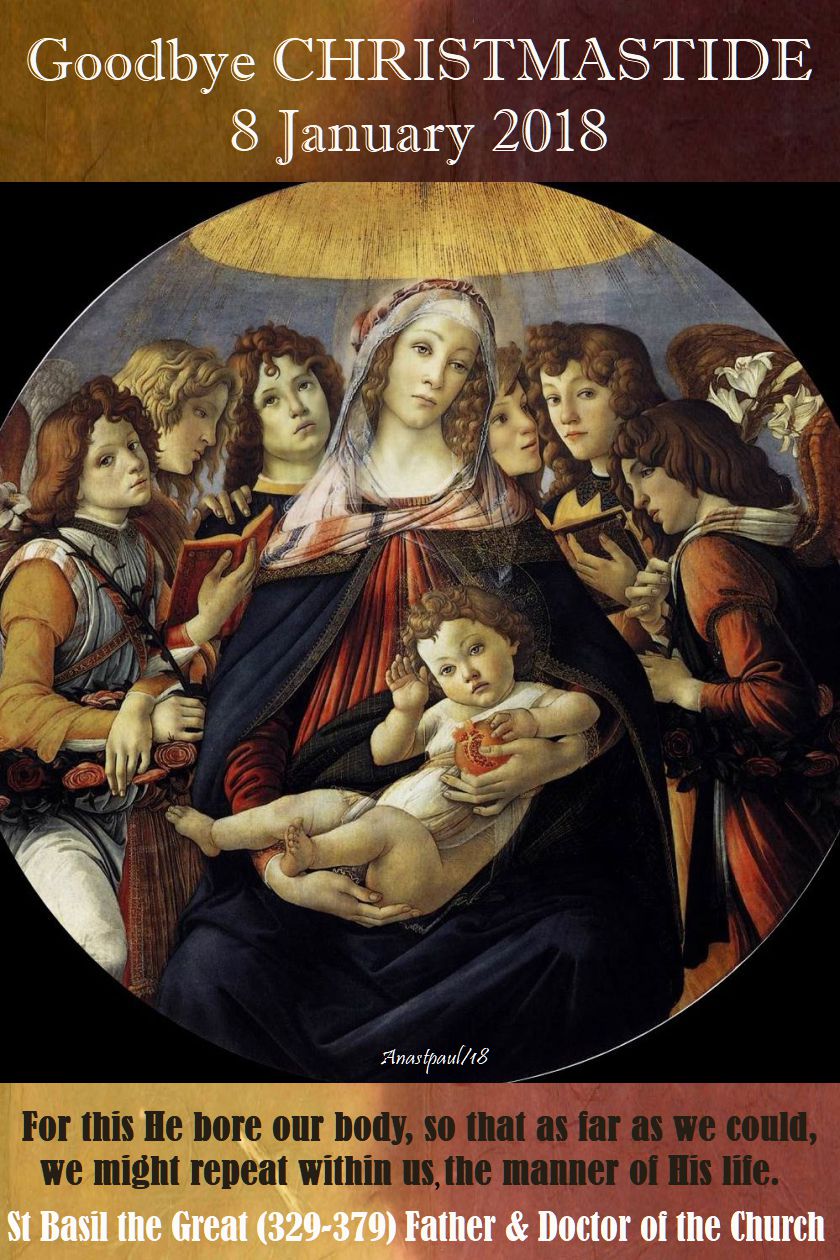
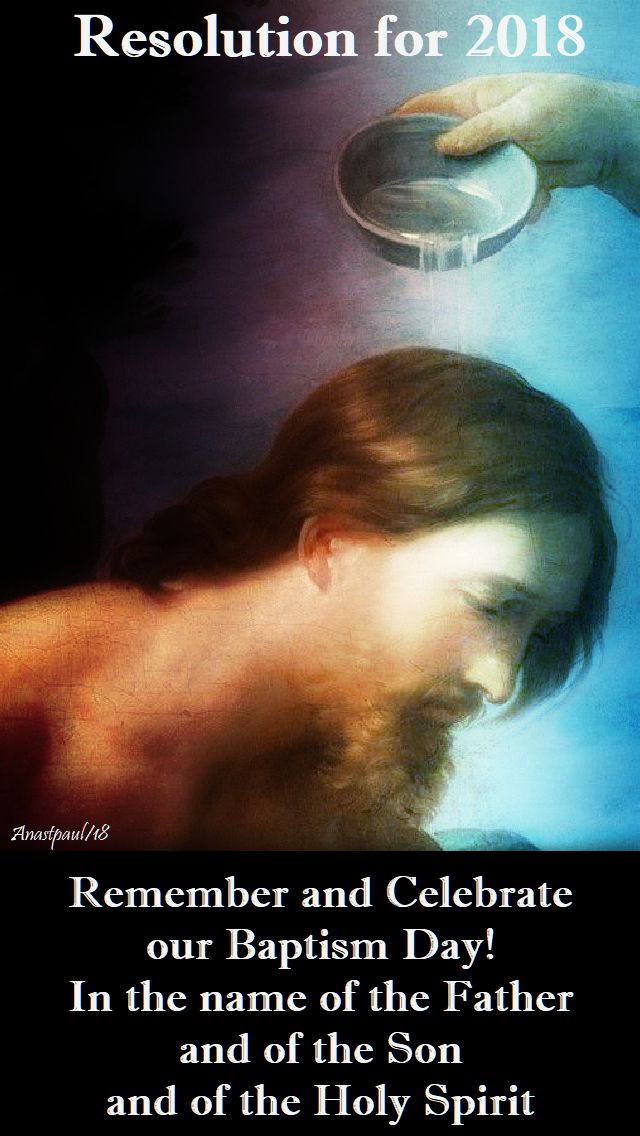
Thought for the Day – 8 January 2018 – Christmastide ends with the Feast of the Baptism of the Lord – Remembering and Celebrating our Baptisms – Adding a new date to our Calendars!

Thought for the Day – 8 January 2018 – Christmastide ends with the Feast of the Baptism of the Lord – Remembering and Celebrating our Baptisms – Adding a new date to our Calendars!goodbye christmastide 8 jan 2018- for this he bore our body - st basil the great

Today’s feast of the Baptism of the Lord ends the Christmas season and invites us to think of our Baptism.   Jesus willed to receive the baptism preached and administered by John the Baptist in the river Jordan.   It was a baptism of penance:  all those who approached it expressed the desire to be purified from sin and, with God’s help, committed themselves to begin a new life.

We understand then the great humility of Jesus, He who had not sinned, put himself in the queue with the penitents, mixing among them, to be baptised in the waters of the river.   What humility Jesus has!   And, by doing so, He manifested what we celebrated at Christmas:  Jesus’ willingness to immerse Himself in the river of humanity, to take upon himself the failures and weaknesses of men, to share their desire of liberation and to overcome all that distances one from God and renders brothers strangers.   As at Bethlehem, along the banks of the Jordan God keeps His promise to take charge of the human being’s fate and Jesus is the tangible and definitive sign of it.   He took charge of all of us, He takes charge of all of us, in life, in the days.

The feast of Jesus’ Baptism invites every Christian to remember his own Baptism.   I can’t ask you the question if you remember the day of your Baptism, because the majority of you were babies, like me…. However, I can ask you another question?   Do you know the date on which you were baptised? …And if you don’t know the date or have forgotten it, when you go home ask your mother, your grandmother, your uncle, your aunt, your grandfather, your godfather, your godmother – what was date?
And we must always have that date in our memory, because it’s a date of celebration, it’s the date of our initial sanctification;  it’s the date in which the Father gave us the Holy Spirit who pushes us to walk, it’s the date of the great forgiveness.
Don’t forget: what’s the date of my Baptism?

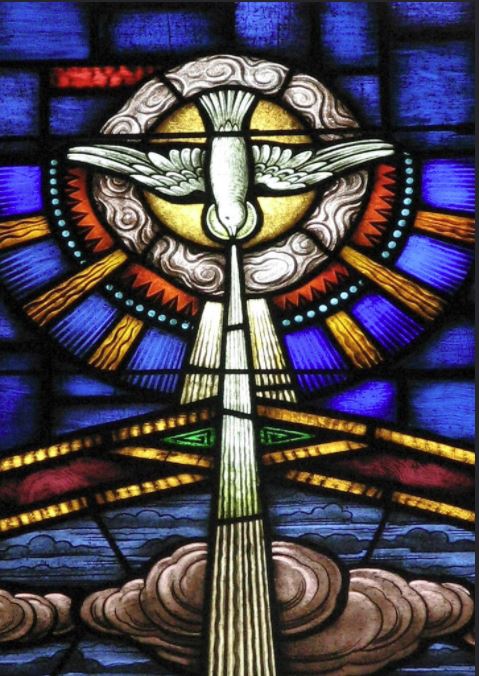
the holy spirit

We invoke the maternal protection of Mary Most Holy so that all Christians can understand increasingly the gift of Baptism and commit themselves to live it with coherence, witnessing the love of the Father and of the Son and of the Holy Spirit. – Pope Francis, Angelus Address, 7 January 2018

So let us do exactly this, this is a date in need of remembrance and celebration, this date of our new birth – I am certainly going to do this for all my family.

In the name of the Father and of the Son and of the Holy Spirit, Amen.

Jesus’ solidarity with us
“Jesus shows His solidarity with us, with our efforts to convert and to be rid of our selfishnesss, to break away from our sins in order to tell us that if we accept Him in our life He can uplift us and lead us to the heights of God the Father.   And Jesus’ solidarity is not, as it were, a mere exercise of mind and will.   Jesus truly immersed himself in our human condition, lived it to the end, in all things save sin and was able to understand our weakness and frailty.   For this reason He was moved to compassion, He chose to “suffer with” men and women, to become a penitent with us.   This is God’s work which Jesus wanted to carry out:  the divine mission to heal those who are wounded and give medicine to the sick, to take upon himself the sin of the world.” ….. From Homily of Pope Benedict XVI on feast of the Baptism of the Lord 2013remember and celebrate our baptism day - 8 jan 2018

Posted in CHRISTMASTIDE!, DOCTORS of the Church, FATHERS of the Church, FEASTS and SOLEMNITIES, MORNING Prayers, QUOTES of the SAINTS, SAINT of the DAY

Quote/s of the Day – 8 January – The Feast of the Baptism of the Lord

Quote/s of the Day – 8 January – The Feast of the Baptism of the Lord

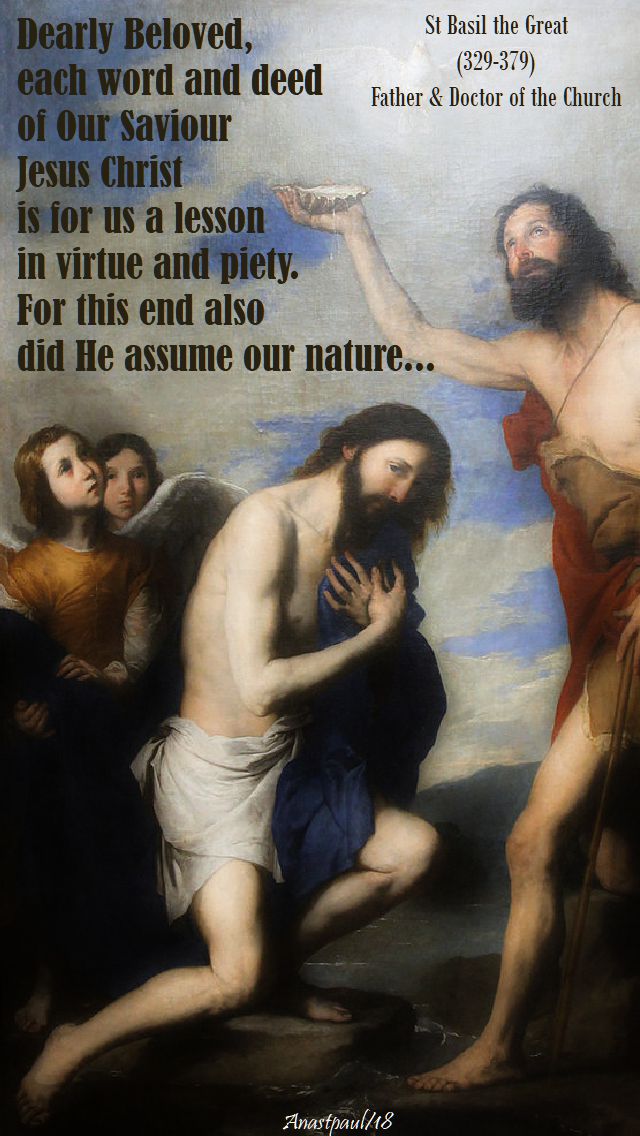
“Dearly Beloved, each word and deed of Our Saviour Jesus Christ
is for us a lesson in virtue and piety.
For this end also did He assumed our nature,
so that every man and every woman,
contemplating as in a picture the practice of all virtue and piety,
might strive with all their hearts to imitate His example.
For this He bore our body, so that as far as we could,
we might repeat within us, the manner of His life.
And so, therefore, when you hear mention of some word or deed of His,
take care not to receive it simply as something that incidentally happened
but raise your mind upwards towards the sublimity of what He is teaching
and strive to see what has been mystically handed down to us”

St Basil the Great (329-379) Father & Doctor of the Churchdearly beloved - st basil the great - 8 jan 2018

“Today let us do honour to Christ’s baptism
and celebrate this feast in holiness.
Be cleansed entirely and continue to be cleansed.
Nothing gives such pleasure to God as the conversion and salvation of men,
for whom His every word and every revelation exist.
He wants you to become a living force for all mankind, lights shining in the world.
You are to be radiant lights as you stand beside Christ, the great light,
bathed in the glory of Him who is the light of heaven.
You are to enjoy more and more, the pure and dazzling light of the Trinity,
as now you have received – though not in its fullness – a ray of its splendour,
proceeding from the one God, in Christ Jesus our Lord,
to whom be glory and power for ever and ever. Amen”

St Gregory of Nazianzen (330-390)
Father & Doctor of the Church – from a sermon on the Feast of the Baptism of the Lordtoday let us do honour - st gregory of nazianzen - 8 jan 2018

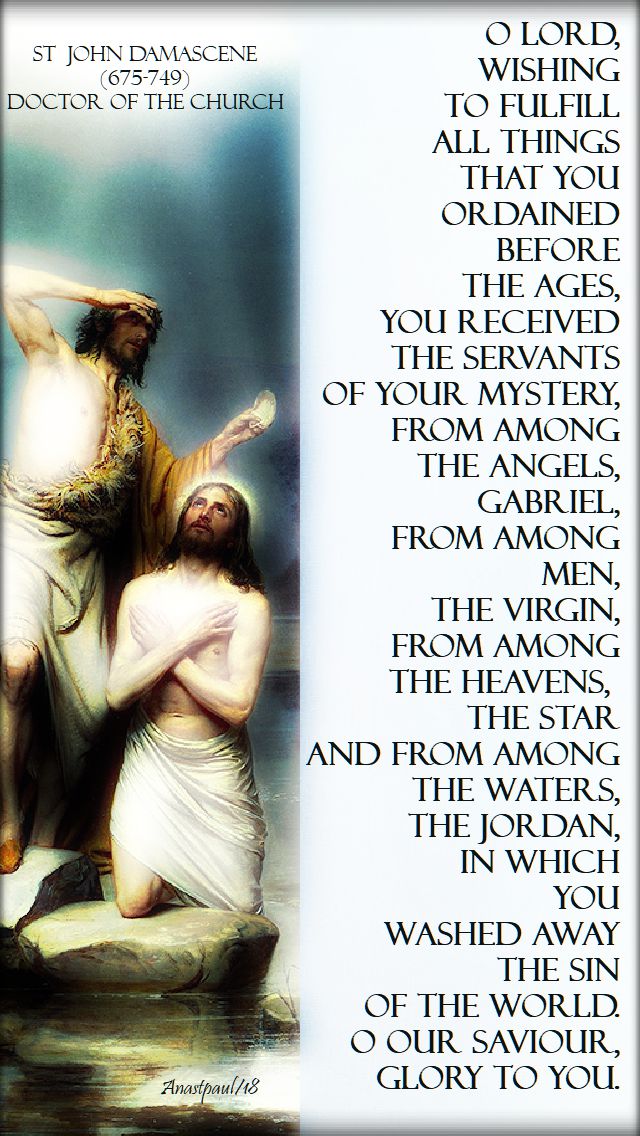
“O Lord, wishing to fulfill all things
that You ordained before the ages,
You received the servants of Your mystery,
from among the Angels, Gabriel,
from among Men, the Virgin,
from among the Heavens, the Star
and from among the Waters, the Jordan,
in which You washed away the sin of the world,
O our Saviour, glory to You.”

St John Damascene (675-749) Doctor of the Churcho lord wishing to fulfil all things - st john damascene - 7 jan 2018

Posted in CHRISTMASTIDE!, FEASTS and SOLEMNITIES, MORNING Prayers, SAINT of the DAY, The WORD

One Minute Reflection – 8 January – Feast of the Baptism of the Lord

One Minute Reflection – 8 January – Feast of the Baptism of the Lord

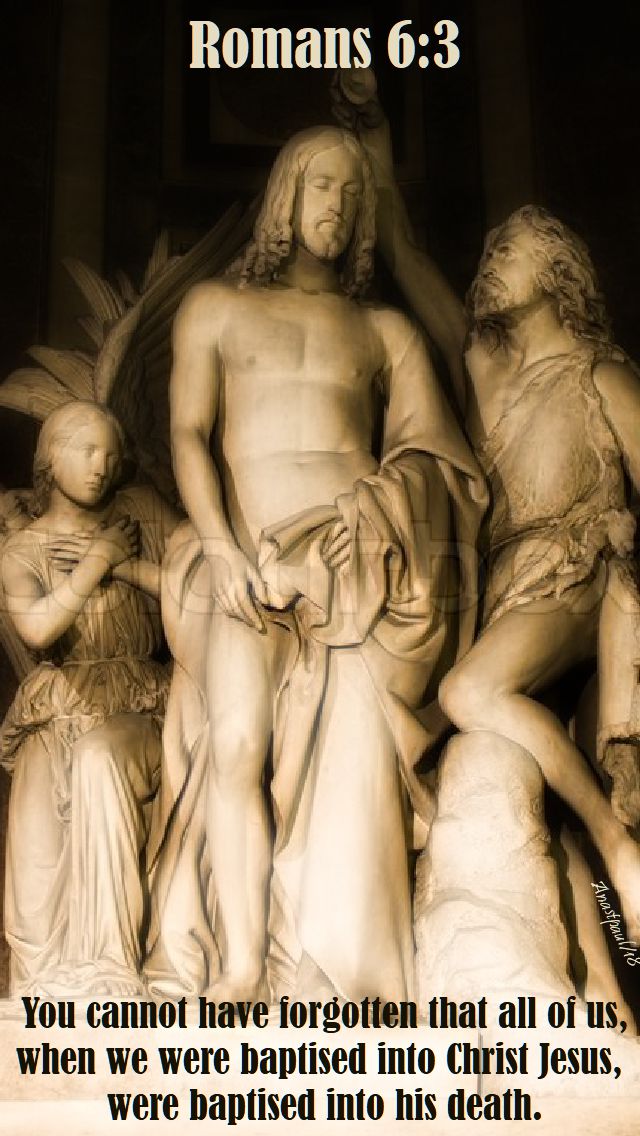
You cannot have forgotten that all of us, when we were baptised into Christ Jesus, were baptised into his death.   So by our baptism into his death we were buried with him, so that as Christ was raised from the dead by the Father’s glorious power, we too should begin living a new life…Romans 6:3-4romans 6 3 - 8 jan 2018

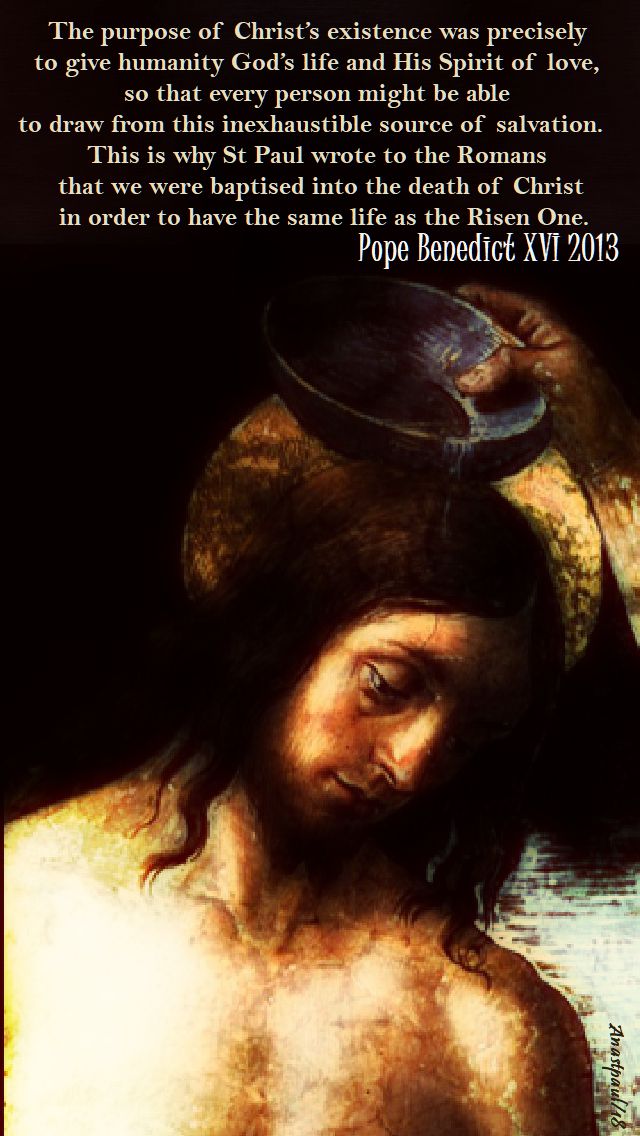
REFLECTION – “The purpose of Christ’s existence was precisely to give humanity God’s life and His Spirit of love, so that every person might be able to draw from this inexhaustible source of salvation.   This is why St Paul wrote to the Romans that we were baptised into the death of Christ in order to have His same life as the Risen One.” …Pope Benedict XVI Homily on the Feast of the Baptism of the Lord 2013the purpose of christs existence was precisely...- pope benedict 2013 - 8 jan 2018

PRAYER – Heavenly Father, I pray to live each day in Your shadow, protected by Your mercy, living out my Baptismal Vows and following Your Son on my journey home to You. Mary, Help of Christians, pray for us, that we may faithfully live as true Christians each moment of our lives, amen.luke-3-22.- 9 jan 2016

Posted in BREVIARY Prayers, CHRISTMASTIDE!, FEASTS and SOLEMNITIES, HYMNS, MORNING Prayers, SAINT of the DAY

Our Morning Offering – 8 January – The Baptism of the Lord

Our Morning Offering – 8 January – The Baptism of the Lord

God in flesh made manifest
By Christopher Wordsworth (1807-1885)
(nephew of the great lake-poet, William Wordsworth)

Songs of thankfulness and praise,
Jesus, Lord, to You we raise,
manifested by the star
to the sages from afar;
branch of royal David’s stem,
in Your birth at Bethlehem.

Manifest at Jordan’s stream,
Prophet, Priest and King supreme;
and at Cana, wedding guest,
in Your Godhead manifest,
You revealed Your power divine,
changing water into wine.

Manifest in making whole
weakened body, fainting soul;
manifest in valiant fight,
quelling all the devil’s might;
manifest in gracious will,
ever bringing good from ill.
Anthems be to Thee addressed.
God in man made manifest.god in flesh made manifest - c wordsworth - 8 jan 2018

Posted in FEASTS and SOLEMNITIES, SAINT of the DAY

The Feast of the Baptism of the Lord – 8 January 2018

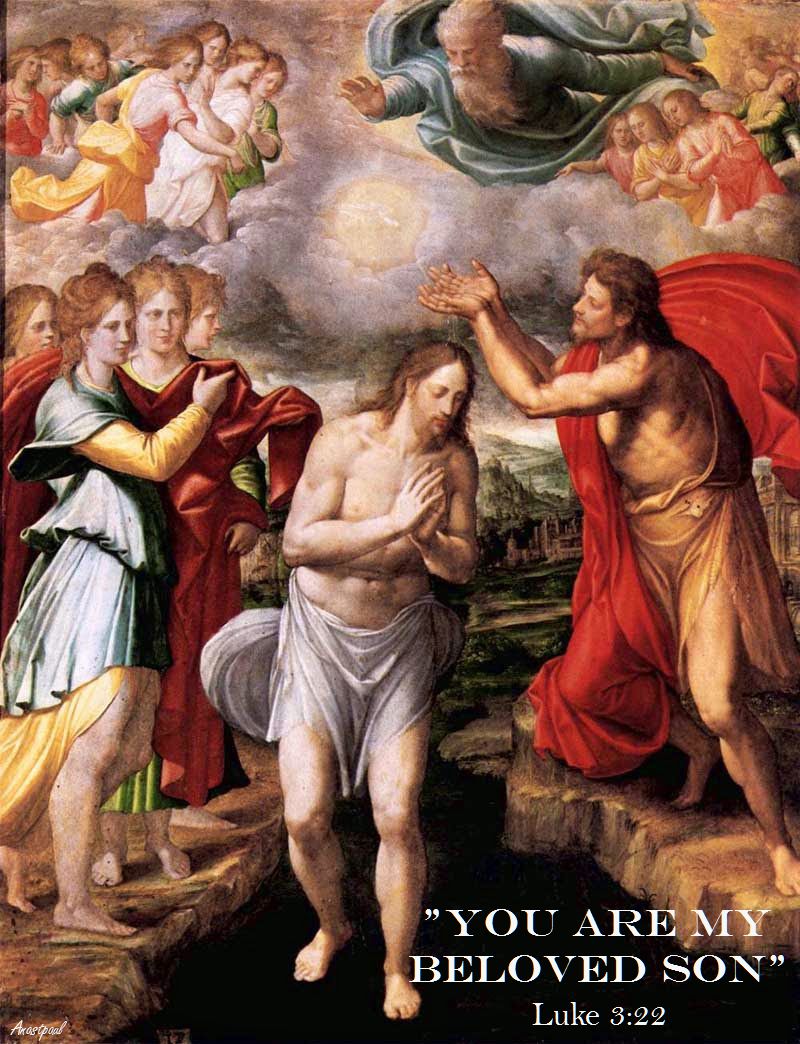
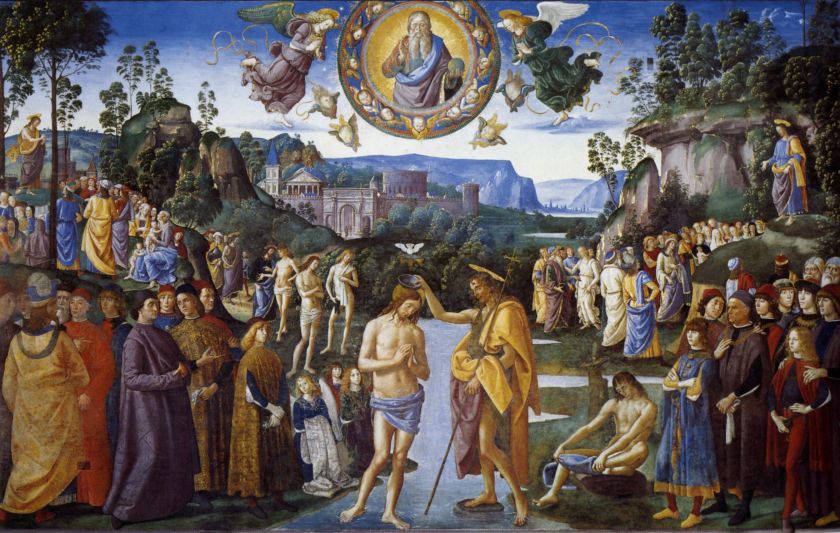
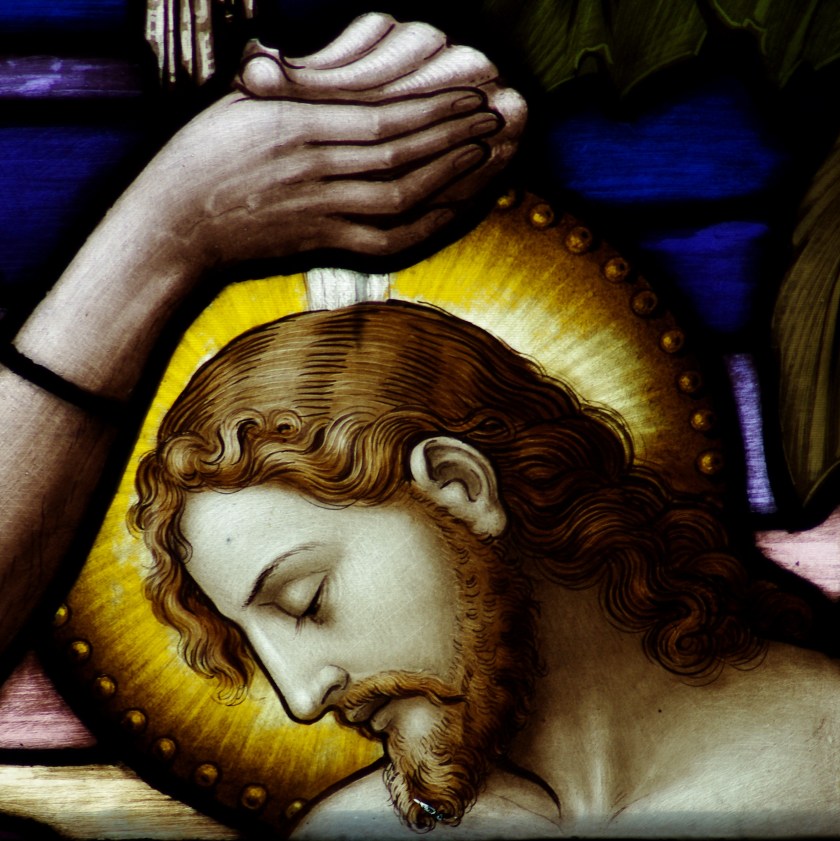
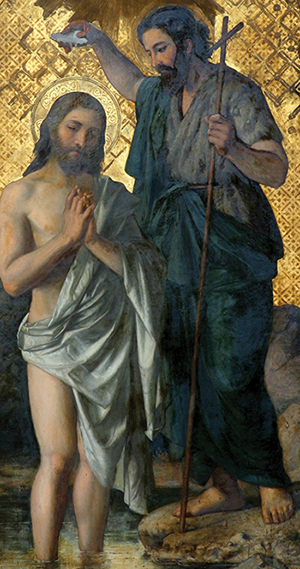
The Feast of the Baptism of the Lord – 8 January 2018HEADER - PIETRO PERUGINOSaint_Leo_Catholic_Church_(Columbus,_Ohio)_-_stained_glass,_loft,_Baptism_of_the_Lord,_detail

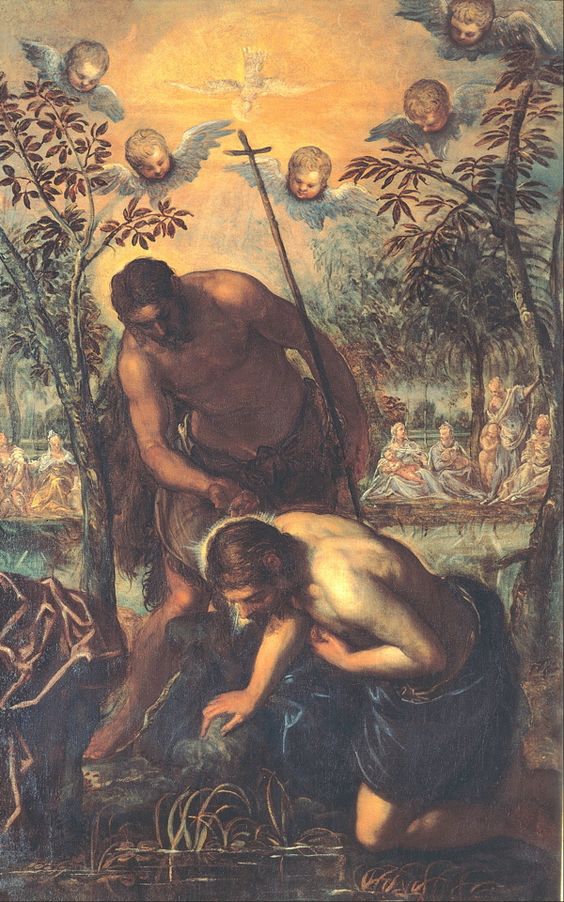
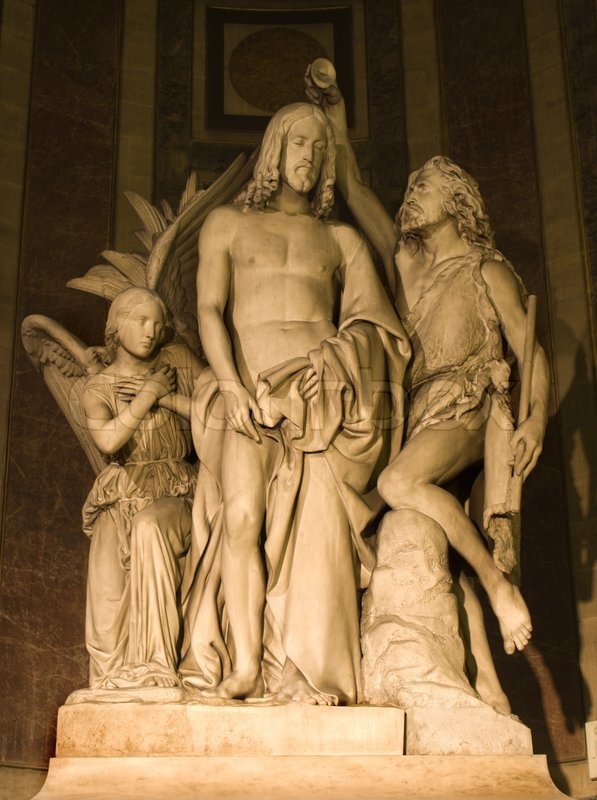
At first glance, the Baptism of the Lord might seem an odd feast.   Since the Catholic Church teaches that the Sacrament of Baptism is necessary for the remission of sins, particularly Original Sin, why was Christ baptised?   Why did Jesus, the Son of God, choose to be baptised?   Surely He was without sin.   The answer is that as well as being true God He was also true man as we say in the Creed.   Jesus was as truly human as any human being.   It was to identify Himself totally with sinful mankind that He chose to be baptised by St John.   In doing so He made the water in which He was baptised holy and towards the end of His ministry He would tell His disciples to “Go, therefore, make disciples of all nation, baptise them in the name of the Father and of the Son and of the Holy Spirit and teach them to observe the commands I gave you.” (Matthew 28: 19-20).   The words of Jesus still form the heart of the Sacrament of Baptism.   After all, He was born without Original Sin and He lived His entire life without sinning.   Therefore, He had no need of the sacrament, as we do.

21352baptism

CHRIST’S BAPTISM FORESHADOWS OUR OWN​​
In submitting Himself humbly to the baptism of St John the Baptist, however, Christ provided the example for the rest of us.   If even He should be baptised, though He had no need of it, how much more should the rest of us be thankful for this sacrament, which frees us from the darkness of sin and incorporates us into the Church, the life of Christ on earth!   His Baptism, therefore, was necessary–not for Him, but for us.
Many of the Fathers of the Church, as well as the medieval Scholastics, saw Christ’s Baptism as the institution of the sacrament.   His Flesh blessed the water and the descent of the Holy Spirit (in the form of a dove) and the voice of God the Father announcing that this was His Son, in Whom He was well pleased, marked the beginning of Christ’s public ministry.

HISTORY OF THE FEAST OF THE BAPTISM OF THE LORD
The Baptism of the Lord has historically been associated with the celebration of Epiphany.   Even today, the Eastern Christian feast of Theophany, celebrated on 6 January as a counterpart to the Western feast of Epiphany, focuses primarily on the Baptism of the Lord as the revelation of God to man.
After the Nativity of Christ (Christmas) was separated out from Epiphany, the Church in the West continued the process and dedicated a celebration to each of the major epiphanies (revelations) or theophanies (the revelation of God to man) –  the Birth of Christ at Christmas, which revealed Christ to Israel, the revelation of Christ to the Gentiles, in the visit of the Wise Men at Epiphany, the Baptism of the Lord, which revealed the Trinity and the miracle at the wedding at Cana, which revealed Christ’s transformation of the world.
Thus, the Baptism of the Lord began to be celebrated on the octave (eighth day) of Epiphany, with the miracle at Cana celebrated on the Sunday after that.   In the current liturgical calendar, the Baptism of the Lord is celebrated on the Sunday or Monday, after 6 January and, a week later, on the Second Sunday of Ordinary Time, we hear the Gospel of the Wedding at Cana.the baptism of the lordbaptism of the lord - beautiful3599928-baptism-of-christ-statue-from-madeleine-church-in-paris

Posted in CHRISTMASTIDE!, FEASTS and SOLEMNITIES, SAINT of the DAY

Feast of the Baptism of the Lord and Memorials of the Saints – 8 January 2018

Baptism of the Lord (Feast) – https://www.youtube.com/watch?v=G0ktDObo0Og

St Abo of Tblisi
St Albert of Cashel
St Apollinaris the Apologist
St Athelm of Canterbury
St Atticus of Constantinople
St Carterius of Caesarea
Bl Edward Waterson
St Ergnad of Ulster
St Erhard of Regensburg
St Eugenian of Autun
Bl Eurosia Fabris
St Garibaldus of Regensburg
St Gudule of Brussels
St Helladius
St Julian of Beauvais
St Lawrence Giustiniani
St Lucian of Beauvais
St Maximian of Beauvais
St Maximus of Pavia
Bl Nathalan of Aberdeen
St Patiens of Metz
St Pega of Peakirk
St Severinus of Noricum
St Theophilus the Martyr
St Thorfinn
St Wulsin of Sherborne

Martyrs of Greece – 9 saints:   A group of Christians honored in Greece as martyrs, but we have no details about their lives or deaths. – Euctus, Felix, Januarius, Lucius, Palladius, Piscus, Rusticus, Secundus and Timotheus

Martyrs of Terni – 4 saints:   A group of Christian soldiers in the imperial Roman army. Executed during the persecutions of emperor Claudius.   Martyrs. – Carbonanus, Claudius, Planus and Tibudianus.   They were martyred in 270 in Terni, Italy.

Posted in CHRISTMASTIDE!, FEASTS and SOLEMNITIES, MORNING Prayers, POETRY, QUOTES - J R R Tolkien and MORE, SAINT of the DAY, THE EPIPHANY of the LORD

The Solemnity of Epiphany – 7 January 2018 – T S Eliot’s “The Journey of the Magi”

The Solemnity of Epiphany – 7 January 2018 – T S Eliot’s “The Journey of the Magi”

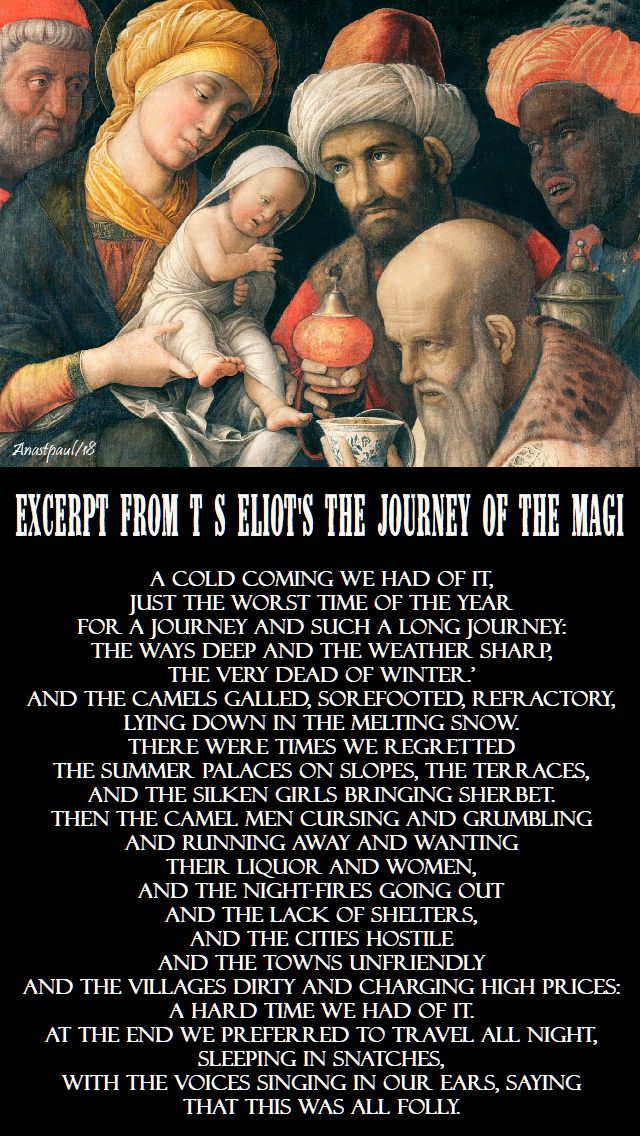
The Journey of the Magi

A cold coming we had of it,
Just the worst time of the year
For a journey and such a long journey:
The ways deep and the weather sharp,
The very dead of winter.’
And the camels galled, sorefooted, refractory,
Lying down in the melting snow.
There were times we regretted
The summer palaces on slopes, the terraces,
And the silken girls bringing sherbet.
Then the camel men cursing and grumbling
and running away and wanting their liquor and women,
And the night-fires going out and the lack of shelters,
And the cities hostile and the towns unfriendly
And the villages dirty and charging high prices:
A hard time we had of it.
At the end we preferred to travel all night,
Sleeping in snatches,
With the voices singing in our ears, saying
That this was all folly.
Then at dawn we came down to a temperate valley,
Wet, below the snow line, smelling of vegetation;
With a running stream and a water-mill beating the darkness,
And three trees on the low sky,
And an old white horse galloped away in the meadow.
Then we came to a tavern with vine-leaves over the lintel,
Six hands at an open door dicing for pieces of silver,
And feet kicking the empty wine-skins.
But there was no information and so we continued
And arriving at evening, not a moment too soon
Finding the place; it was (you might say) satisfactory.

All this was a long time ago, I remember,
And I would do it again, but set down
This set down
This:  were we led all that way for
Birth or Death?   There was a Birth, certainly
We had evidence and no doubt. I had seen birth and death,
But had thought they were different;  this Birth was
Hard and bitter agony for us, like Death, our death.
We returned to our places, these Kingdoms,
But no longer at ease here, in the old dispensation,
With an alien people clutching their gods.
I should be glad of another death.

t s eliot
excerpt from t s eliot's journey of the magi
Posted in CHRISTMASTIDE!, MORNING Prayers, PRACTISING CATHOLIC, QUOTES of the SAINTS, SUNDAY REFLECTIONS, The CHRIST CHILD

Sunday Reflection – 7 January 2018 – The Feast of Epiphany

Sunday Reflection – 7 January 2018 – The Feast of Epiphany

Each Sunday towards the end of Mass, we come to the altar rail, receive Holy Communion, return to our seats and sit or kneel quietly for a while in contemplation.   But in these quiet moments after we have received Communion, what prayers do we offer up?  Perhaps we don’t pray at all but in those quiet moments our thoughts turn to other things, like Sunday lunch or a planned visit to visit the grandchildren after Mass.

I recently came across this wonderful article, written by a priest.  He writes:

“A few years ago it became evident to me that my prayers after distributing Holy Communion to my congregation were wholly inadequate.   As I sat on my seat on the altar I was finding it extremely difficult to express into words, what this moment meant to me.   Looking through my book collection I read all the prayers I could get my hands on but none seemed to be what I was looking for, so I gave up in frustration.   However, each day I would pray to Mary our Blessed Mother asking her to teach me how to express my innermost feelings to the Lord.   Sometime later I was preaching a retreat to a group of nuns when one of the elderly nuns came to visit me and said she felt she had a problem concerning her prayers after receiving Holy Communion.   Feeling I had at last found a kindred spirit, I asked her what she usually prayed and she replied, ‘I don’t pray anything, I just sit in silence and allow Him to love me and to teach me to love Him.’   At that moment I realised that Mary had indeed answered my prayers.

“I just sit in silence and allow Him to love me and to teach me to love Him.”

What a simple, but moving description of what this moment means to us all.

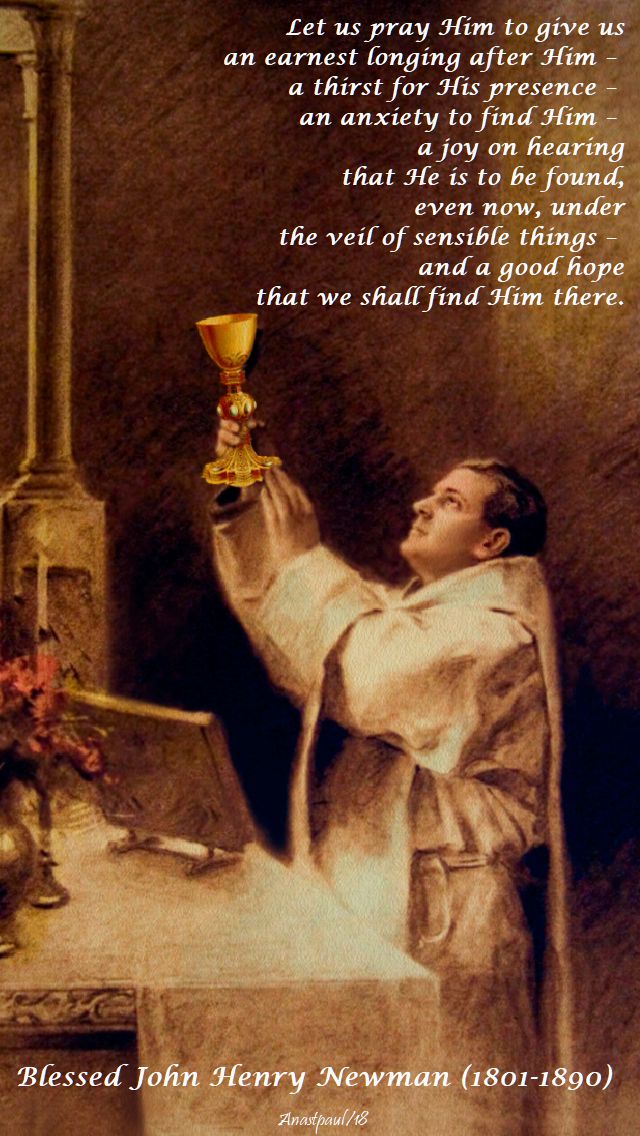
“Above all, let us pray Him to draw us to Him and to give us faith.   When we feel that His mysteries are too severe for us and occasion us to doubt, let us earnestly wait on Him for the gift of humility and love.    Those who love and who are humble will apprehend them, carnal minds do not seek the and proud minds are offended at them but while love desires them, humility sustains them.

Let us pray Him to give us an earnest longing after Him – a thirst for His presence – an anxiety to find Him – a joy on hearing that He is to be found, even now, under the veil of sensible things – and a good hope that we shall find Him there.

Blessed indeed are they who have not seen and yet have believed.   They have their reward in believing, they enjoy the contemplation of a mysterious blessing, which does not even enter into the thoughts of other men and while they are more blessed than others, in the gift vouchsafed to them, they have the additional privilege of knowing that they are vouchsafed it.”….Blessed John Henry Newman  (1801-1890) – Parochial & Plain Sermons, Vol. VI, no. 11let us pray him to give us - bl john henry newman - 7 jan 2018

Posted in CHRISTMASTIDE!, FEASTS and SOLEMNITIES, MORNING Prayers, PAPAL SERMONS, SAINT of the DAY, The CHRIST CHILD

Thought for the Day – 7 January – The Solemnity of the Epiphany of Our Lord Jesus Christ Excerpt from Pope Francis Homily for Epiphany 2017

Thought for the Day – 7 January – The Solemnity of the Epiphany of Our Lord Jesus Christ

Excerpt from Pope Francis Homily for Epiphany 2017

The Magi thus personify all those who believe, those who long for God, who yearn for their home, their heavenly homeland.   They reflect the image of all those who in their lives have not let their hearts be anaesthetised.
A holy longing for God wells up in the heart of believers because they know that the Gospel is not an event of the past but of the present.   A holy longing for God helps us keep alert in the face of every attempt to reduce and impoverish our life.   A holy longing for God is the memory of faith, which rebels before all prophets of doom.   That longing keeps hope alive in the community of believers, which from week to week continues to plead: “Come, Lord Jesus”.
We want to worship.   Those men came from the East to worship and they came to do so in the place befitting a king:  a palace.   This is significant.   Their quest led them there, for it was fitting that a king should be born in a palace, amid a court and all his subjects. For that is a sign of power, success, a life of achievement.   One might well expect a king to be venerated, feared and adulated.   True, but not necessarily loved.   For those are worldly categories, the paltry idols to which we pay homage:   he cult of power, outward appearances and superiority.   Idols that promise only sorrow, enslavement, fear.

It was there, in that place, that those men, come from afar, would embark upon their longest journey.   There they set out boldly on a more arduous and complicated journey. They had to discover that what they sought was not in a palace but elsewhere, both existentially and geographically.   There, in the palace, they did not see the star guiding them to discover a God who wants to be loved.   For only under the banner of freedom, not tyranny, is it possible to realise that the gaze of this unknown but desired king does not abase, enslave, or imprison us.   To realise that the gaze of God lifts up, forgives and heals.   To realise that God wanted to be born where we least expected, or perhaps desired, in a place where we so often refuse him.   To realise that in God’s eyes there is always room for those who are wounded, weary, mistreated, abandoned.   That His strength and His power are called MERCY.   For some of us, how far Jerusalem is from Bethlehem!for only under the banner of freedom - pope francis 2017 - 7 jan 2018

Herod is unable to worship because he could not or would not change his own way of looking at things.   He did not want to stop worshipping himself, believing that everything revolved around him.   He was unable to worship, because his aim was to make others worship him.   Nor could the priests worship, because although they had great knowledge, and knew the prophecies, they were not ready to make the journey or to change their ways.

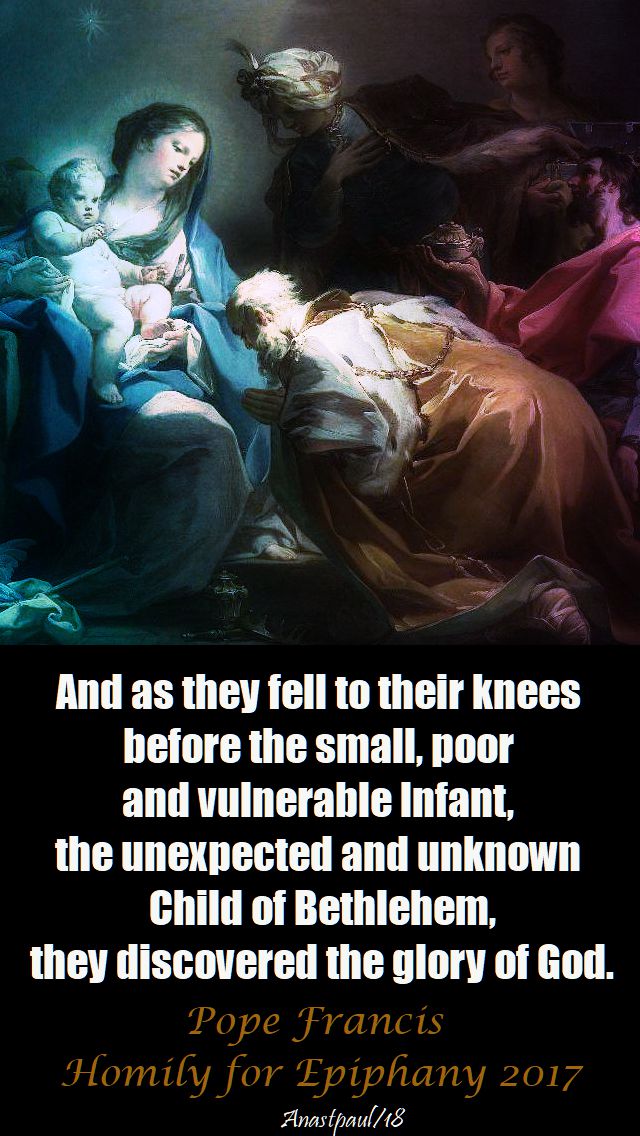
The Magi experienced longing, they were tired of the usual fare.   They were all too familiar with, and weary of, the Herods of their own day.   But there, in Bethlehem, was a promise of newness, of gratuitousness.   There something new was taking place.   The Magi were able to worship because they had the courage to set out.   And as they fell to their knees before the small, poor and vulnerable Infant, the unexpected and unknown Child of Bethlehem, they discovered the glory of God.and as they fell - pope francis - epiphany 2017 - 7 jan 2018

Posted in CHRISTMASTIDE!, DOCTORS of the Church, FATHERS of the Church, FEASTS and SOLEMNITIES, MORNING Prayers, QUOTES of the SAINTS, The BLESSED VIRGIN MARY, The CHRIST CHILD

Quote/s of the Day – 7 January – The Solemnity of the Epiphany of Our Lord Jesus Christ

Quote/s of the Day – 7 January – The Solemnity of the Epiphany of Our Lord Jesus Christ

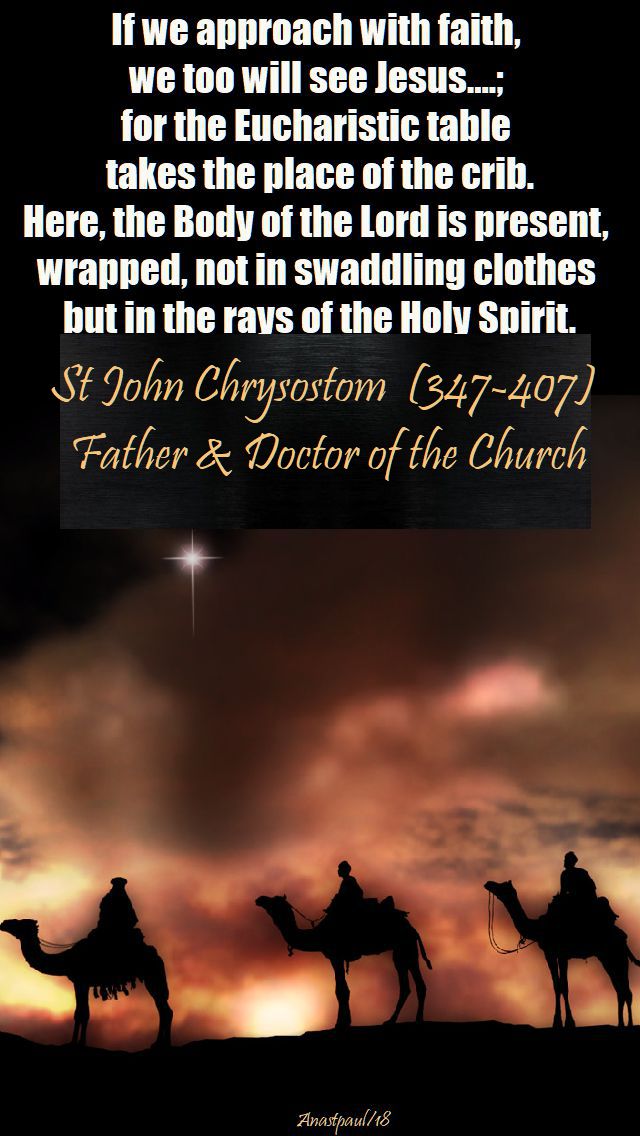
“If we approach with faith,
we too will see Jesus….;
for the Eucharistic table
takes the place of the crib.
Here the Body of the Lord is present,
wrapped not in swaddling clothes
but in the rays of the Holy Spirit.”

St John Chrysostom (347-407) Father & Doctor of the Churchif we approach with faith - st john chrysostom - 7 jan 2018

“Truth, by which the world is held together,
has sprung from the earth,
in order to be carried in a woman’s arms.”

St Augustine (354-430) Father & Doctor of the Churchtruth, by which the world - st augustine - 7 jan 2018

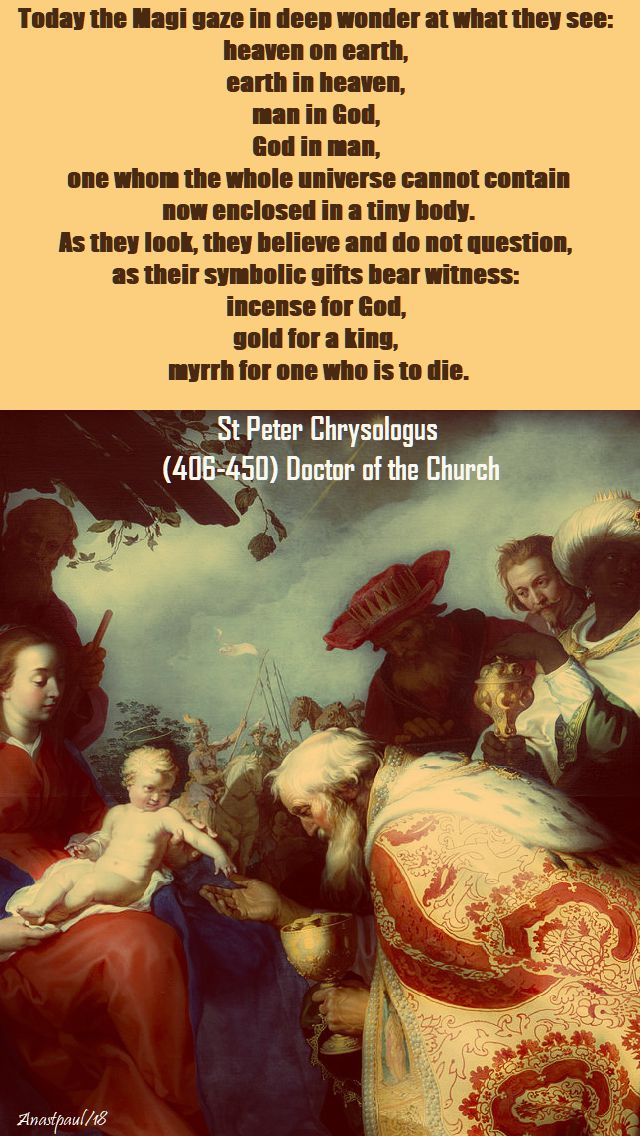
“Today the Magi gaze in deep wonder at what they see:
heaven on earth,
earth in heaven,
man in God,
God in man,
one whom the whole universe cannot contain
now enclosed in a tiny body.
As they look, they believe and do not question,
as their symbolic gifts bear witness:
incense for God,
gold for a king,
myrrh for one who is to die.”

St Peter Chrysologus (406-450) Doctor of the Churchtoday the magi gaze in deep wonder - st peter chrysologus - 7 jan 2018

“What are you doing, O Magi?
Do you adore a little Babe, in a wretched hovel,
wrapped in miserable rags?
Can this Child be truly God? …
Are you become foolish, O Wise Men …
Yes, these Wise Men have become fools
that they may be wise!”

St Bernard of Clairvaux (1090-1153) Doctor of the Churchwhat are you doing o magi - st bernard - 7 jan 2018

“It is no magic formula He brings
because He knows that the salvation
He offers must pass through human hearts.
What does He first do?
He laughs and cries and sleeps defenceless,
as a baby, though He is God incarnate.
And He does this,
so that we may fall in love with Him,
so that we may learn to take Him in our arms….”it is no magic formula he brings - st josemaria - 7 jan 2018

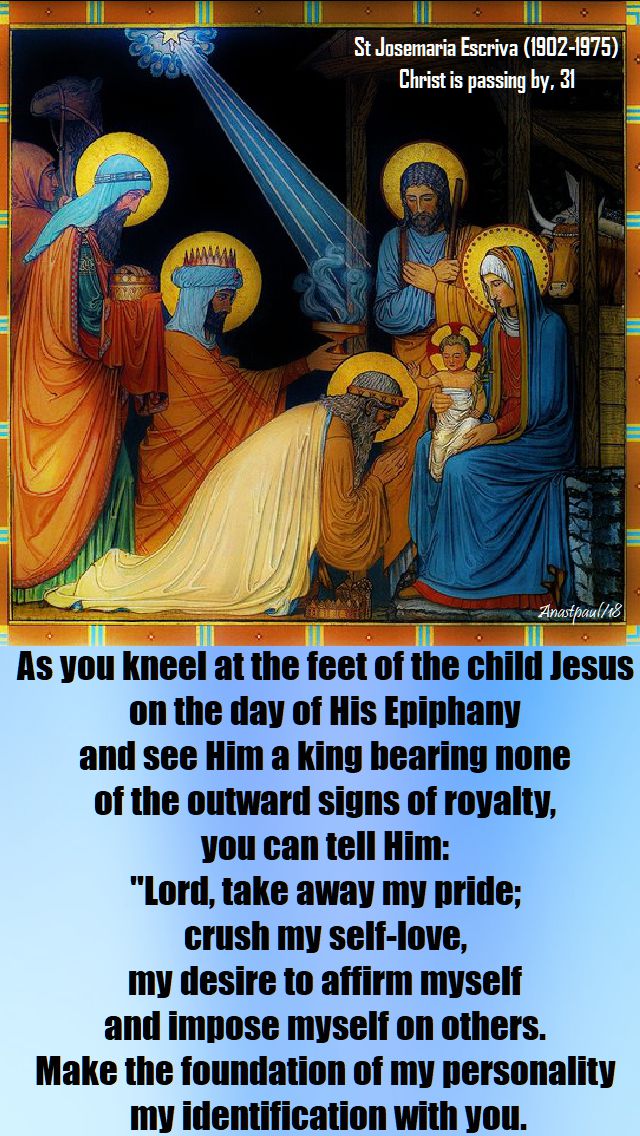
“As you kneel at the feet of the child Jesus
on the day of His Epiphany
and see Him a king bearing none
of the outward signs of royalty,
you can tell Him:
“Lord, take away my pride;
crush my self-love,
my desire to affirm myself
and impose myself on others.
Make the foundation of my personality
my identification with you.”

St Josemaria Escriva (1902-1975)
Christ is passing by, 31as you kneel at the feet of the child jesus - st josemaria - 7 jan 2018

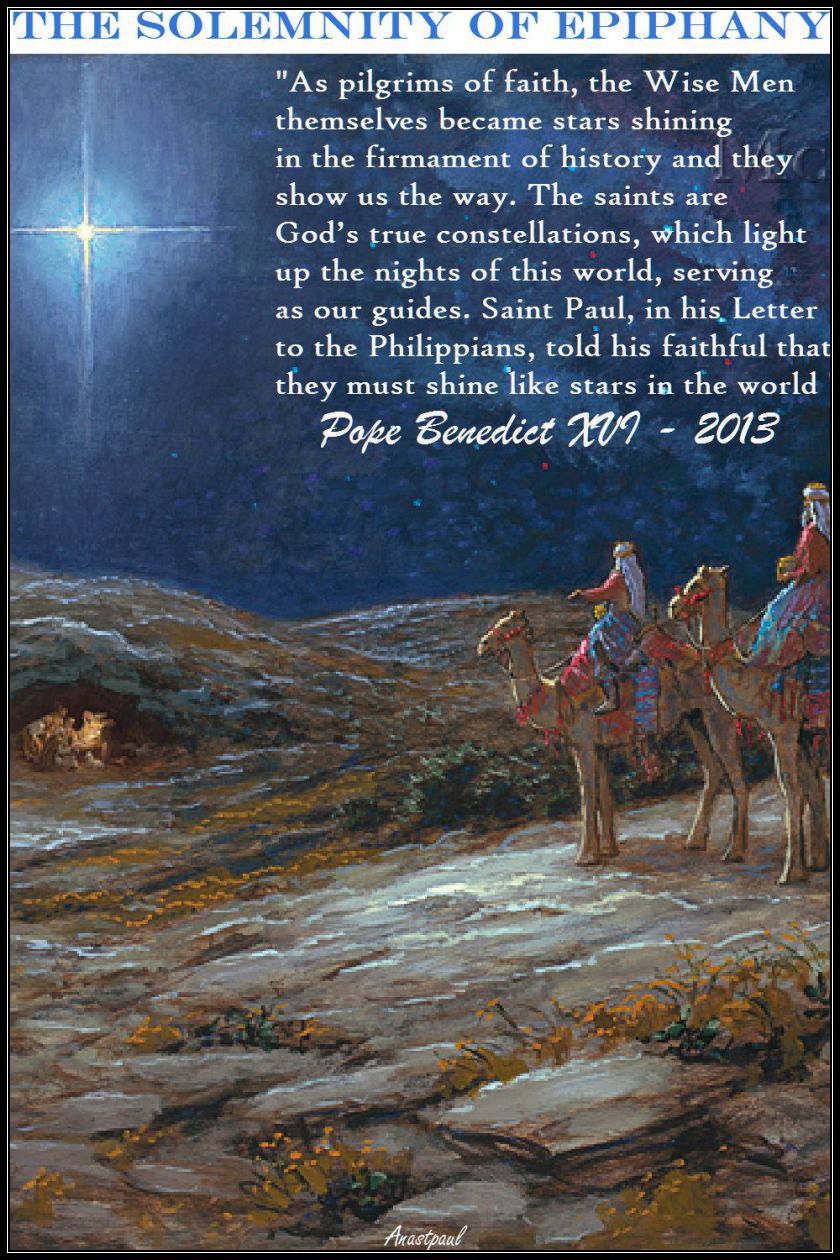
“As pilgrims of faith, the Wise Men themselves
became stars shining in the firmament of history
and they show us the way.
The saints are God’s true constellations,
which light up the nights of this world,
serving as our guides.
Saint Paul, in his Letter to the Philippians,
told his faithful that they must shine like stars in the world.”

Extract from the Homily of His Holiness Benedict XVI
Vatican Basilica, Sunday, 6 January 2013benedict-on-epiphany.7 jan 2018

Posted in DOCTORS of the Church, FATHERS of the Church, FEASTS and SOLEMNITIES, MORNING Prayers, QUOTES of the SAINTS, SAINT of the DAY, The WORD

One Minute Reflection – 7 January – The Solemnity of the Epiphany of Our Lord Jesus Christ

One Minute Reflection – 7 January – The Solemnity of the Epiphany of Our Lord Jesus Christ

..and on entering the house they saw the child with Mary his mother. They prostrated themselves and did him homage... Matthew 2:11matthew-2-11

REFLECTION – “For by gold the power of a king is signified, by frankincense the honour of God, by myrrh the burial of the body and accordingly they offer Him, gold as King, frankincense as God, myrrh as Man.”…St John Chrysostom (347-407) Father & Doctor of the Churchfor by gold - st john chrysostom - 7 jan 2018

PRAYER – Lord, God, teach us to see the living presence of Your Divine Son in the Eucharist.   Make our faith so vivid that we will gladly come to encounter Jesus in every Mass.   May we follow in faith and trust, Your bright Light, which shines forever on our paths.   Holy Christ Child, intercede for us, amen.epiphany-feast - 8 jan 2018

Posted in CATHOLIC-PRAYERS OF THE CHURCH, FEASTS and SOLEMNITIES, MORNING Prayers, PRAYERS of the CHURCH, SAINT of the DAY

Our Morning Offering – 7 January – The Solemnity of the Epiphany of Our Lord Jesus Christ

Our Morning Offering – 7 January – The Solemnity of the Epiphany of Our Lord Jesus Christ

Traditional Epiphany Prayer

Lord Jesus
may Your light shine on our way,
as once it guided the steps of the Magi:
that we too may be led into Your presence
and worship You,
the Child of Mary,
Mother of God,
the Word of the Father,
the King of nations,
the Saviour of mankind;
in union with Your heavenly Father
and the Holy Spirit,
You are One God
forever and ever, amen.epiphany prayer - 7 jan 2018


Posted in CATHOLIC-PRAYERS OF THE CHURCH, FEASTS and SOLEMNITIES, MORNING Prayers, PRACTISING CATHOLIC, SAINT of the DAY

Blessing of a Home at Epiphany – 7 January – The Solemnity of the Epiphany of Our Lord Jesus Christ

Blessing of a Home at Epiphany – 7 January – The Solemnity of the Epiphany of Our Lord Jesus Christ

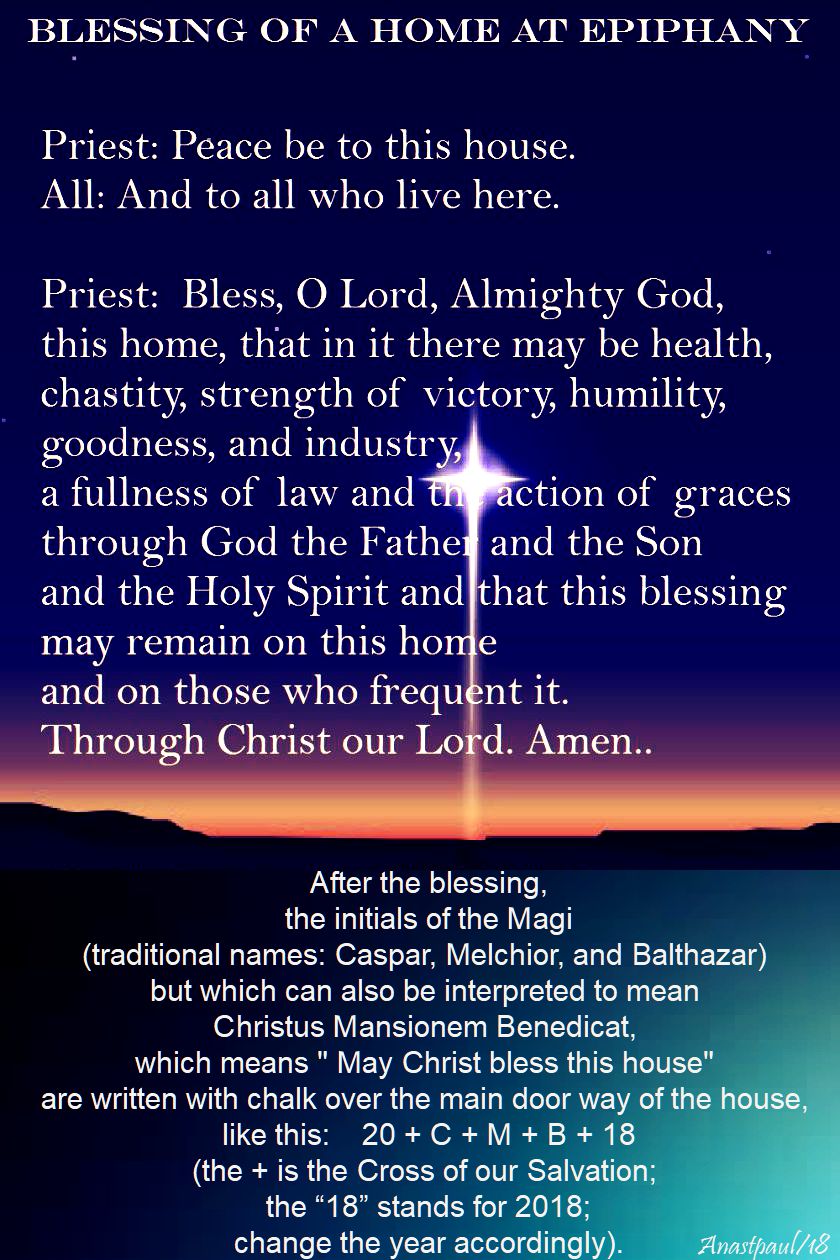
Priest:  Peace be to this house.
All:  And to all who live here.

Priest:  Bless, O Lord, Almighty God,
this home, that in it there may be health,
chastity, strength of victory, humility,
goodness, and industry,
a fullness of law and the action of graces
through God the Father and the Son
and the Holy Spirit and that this blessing
may remain on this home
and on those who frequent it.
Through Christ our Lord. Amen..

After the blessing,
the initials of the Magi
(traditional names: Caspar, Melchior and Balthazar) but which can also be interpreted to mean Christus Mansionem Benedicat, which means ” May Christ bless this house
are written with chalk over the main door way of the house, like this:
20 + C + M + B + 18
(the + is the Cross of our Salvation; the “18” stands for 2018;
change the year accordingly).house-blessing-7 jan 2018

Posted in FEASTS and SOLEMNITIES, MORNING Prayers, PRACTISING CATHOLIC, SAINT of the DAY

The Solemnity of the Epiphany of Our Lord Jesus Christ – 7 January: God reveals Himself to us

The Epiphany of Our Lord Jesus Christ
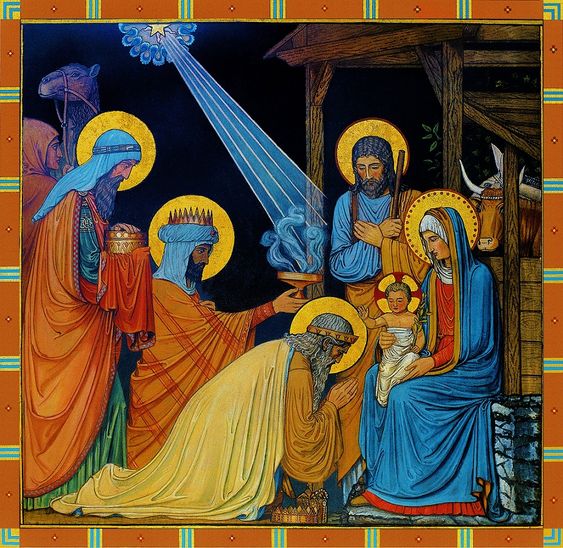
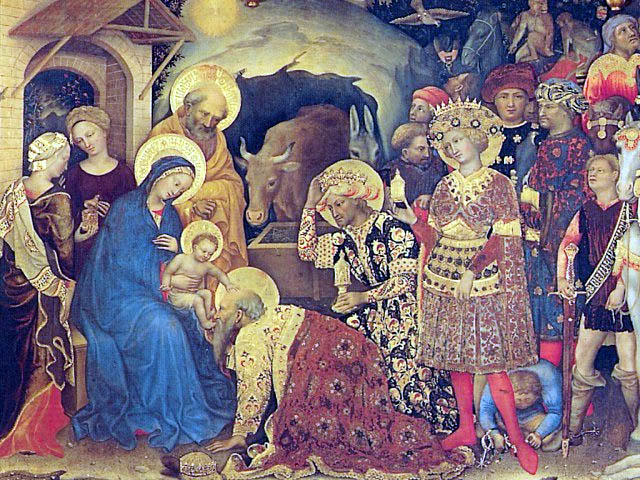
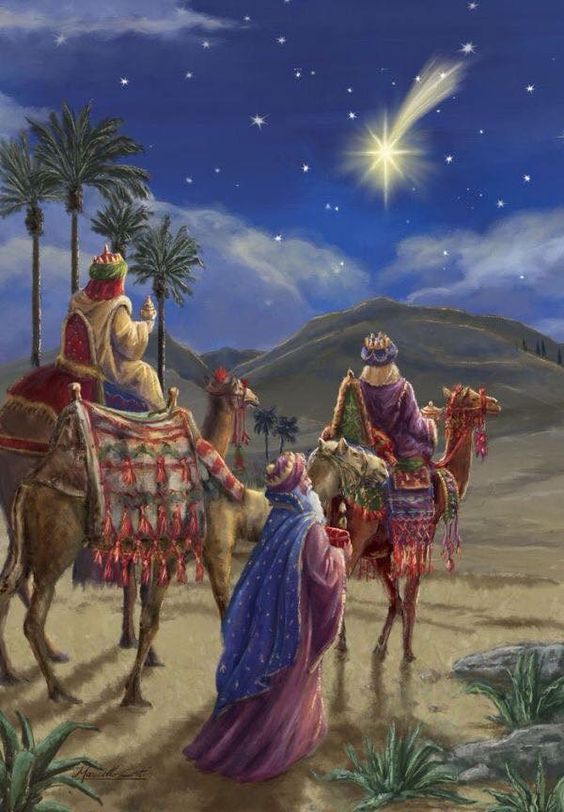
God reveals Himself to us04_Adoration_of_the_Magi_by Botticelli.jpg-800x500640px-Adoration_of_the_Magi_Tapestry_detailsolemnity of epiphany

The Feast of the Epiphany of Our Lord Jesus Christ is one of the oldest Christian feasts, though, throughout the centuries, it has celebrated a variety of things.   Epiphany comes from a Greek verb meaning “to reveal” and all of the various events celebrated by the Feast of the Epiphany are revelations of Christ to man.
Like many of the most ancient Christian feasts, Epiphany was first celebrated in the East, where it has been held from the beginning almost universally on 6 January.   Today, among Eastern Catholics, the feast is known as Theophany—the revelation of God to man.
Epiphany originally celebrated four different events, in the following order of importance- the Baptism of the Lord, Christ’s first miracle, the changing of water into wine at the wedding in Cana, the Nativity of Christ and the visitation of the Wise Men or Magi.   Each of these is a revelation of God to man – at Christ’s Baptism, the Holy Spirit descends and the voice of God the Father is heard, declaring that Jesus is His Son,  at the wedding in Cana, the miracle reveals Christ’s divinity,  at the Nativity, the angels bear witness to Christ and the shepherds, representing the people of Israel, bow down before Him and at the visitation of the Magi, Christ’s divinity is revealed to the Gentiles—the other nations of the earth.
Eventually, the celebration of the Nativity was separated out, in the West, into Christmas and shortly thereafter, Western Christians adopted the Eastern feast of the Epiphany, still celebrating the Baptism, the first miracle and the visit from the Wise Men.   Thus, Epiphany came to mark the end of Christmastide—the Twelve Days of Christmas (celebrated in the song), which began with the revelation of Christ to Israel in His Birth and ended with the revelation of Christ to the Gentiles at Epiphany.
Over the centuries, the various celebrations were further separated in the West and now the Baptism of the Lord is celebrated on the Sunday after today and the wedding at Cana is commemorated on the Sunday after the Baptism of the Lord.

EPIPHANY CUSTOMS:
Giving of Gifts:  In many parts of Europe, the celebration of Epiphany is at least as important as the celebration of Christmas. While in England and her historical colonies, the custom has long been to give gifts on Christmas Day itself, in Italy and other Mediterranean countries, Christians exchange gifts on Epiphany—the day on which the Wise Men brought their gifts to the Christ Child.

Blessing of our Homes:  the blessing of homes, on whose lintels are inscribed the Cross of salvation, together with the indication of the year and the initials of the three wise men (C+M+B), which stands for Caspar, Melchior and Balthassar (the traditional names of the 3 Magi) but which can also be interpreted to mean Christus Mansionem Benedicat, which means ” May Christ bless this house” written in blessed chalk.   We put 20 + C + M + B + 18, using the initials of the Magi and the year, so that our coming and going would be in search of the Truth.   We are called to remember, each time we enter and leave our homes, that we are in search of Christ, that our mission is to find Him and follow Him.
In the absence of a priest the family gathers around the crib with lighted candles and prays:
Leader: “Peace be to this house and to all who dwell here, in the name of the Lord.
All: Thanks be to God.
Reader: When Jesus was born in Bethlehem of Judea,
in the days of King Herod,
behold, magi from the east arrived in Jerusalem, saying,
“Where is the newborn king of the Jews?
We saw his star at its rising
and have come to do him homage.”
After their audience with the king they set out.
And behold, the star that they had seen at its rising preceded them,
until it came and stopped over the place where the child was.
They were overjoyed at seeing the star,
and on entering the house
they saw the child with Mary his mother.
They prostrated themselves and did him homage.
Then they opened their treasures
and offered him gifts of gold, frankincense, and myrrh.
And having been warned in a dream not to return to Herod,
they departed for their country by another way.
The word of the Lord.
ALL: Thanks be to God
All: Lord God of heaven and earth, You revealed Your only begotten Son to every nation by the guidance of a star.
Bless this house and all who live here and all who visit.
May we be blessed with health, kindness of heart, gentleness and the keeping of your law.
Fill us with the light of Christ, that our love for each other may go out to all.
Grant that we may always remain true to our mission of seeking and preaching
the most Holy Name of Jesus, our Lord.
We ask this through Christ our Lord. Amen.Three Kingsepiphany trad imageepiphany 2.EPIPHANY

Posted in FEASTS and SOLEMNITIES, SAINT of the DAY

7 January 2018 – Celebration of the Solemnity of Epiphany and Memorials of the Saints

Epiphany (Celebrated generally on the Sunday after 6 January) – Epiphany celebrates the visit of the three kings or wise men to the Christ Child, signifying the extension of salvation to the Gentiles.   The date of Epiphany, one of the oldest Christian feasts, is 6 January the 12th day after Christmas.   However, in most countries, the celebration of Epiphany is transferred to the Sunday that falls between January 2 and January 8 (inclusive).   Greece, Ireland, Italy and Poland continue to observe Epiphany on 6 January as do some dioceses in Germany.

AND just in case you wish to know and be ready:
When Is the Feast of the Epiphany in Future Years?

Here is the date of Epiphany and the date it will be observed in most countries, next year and in future years:
Epiphany 2018: Saturday, January 6, 2018 (transferred to Sunday, January 7, in the United States and most other countries)
Epiphany 2019: Sunday, January 6, 2019
Epiphany 2020: Monday, January 6, 2020 (generally transferred to Sunday, January 5)
Epiphany 2021: Wednesday, January 6, 2021 (generally transferred to Sunday January 2)
Epiphany 2022: Thursday, January 6, 2022 (generally transferred to Sunday January 2)
Epiphany 2023: Friday, January 6, 2023 (generally transferred to sUNDAY January 9)
Epiphany 2024: Saturday, January 6, 2024 (generally transferred to Sunday January 7)
Epiphany 2025: Monday, January 6, 2025 (generally transferred to Sunday January 5)
Epiphany 2026: Tuesday, January 6, 2026 (generally transferred to Sunday January 4)
Epiphany 2027: Wednesday, January 6, 2027 (generally transferred to Sunday, January 3)
Epiphany 2028: Thursday, January 6, 2028 (generally transferred to Sunday, January 2)
Epiphany 2029: Saturday, January 6, 2029 (generally transferred to Sunday, January 7)
Epiphany 2030: Sunday, January 6, 2030

Because Epiphany is one of the most important Christian feasts, it is a Holy Day of Obligation in most countries.

St Raymond of Penyafort/St Raymond of Peñafort (Optional Memorial)

St Aldric of Le Mans
Bl Ambrose Fernandez
St Anastasius of Sens
St Brannock of Braunton
St Candida of Greece
St Canute Lavard
St Cedd
St Clerus of Antioch
St Crispin I of Pavia
St Cronan Beg
St Emilian of Saujon
St Felix of Heraclea
Bl Franciscus Bae Gwan-gyeom
St Januarius of Heraclea
St Julian of Cagliari
St Kentigerna
St Lucian of Antioch
Bl Marie-Thérèse Haze
St Pallada of Greece
St Polyeuctus of Melitene
St Reinhold of Cologne
St Spolicostus of Greece
St Theodore of Egypt
St Tillo of Solignac
St Valentine of Passau
St Virginia of Ste-Verge
Bl Wittikund of Westphalia

Posted in franciscan OFM, MORNING Prayers, QUOTES on CHARITY, QUOTES on LOVE, QUOTES on SANCTITY, SAINT of the DAY

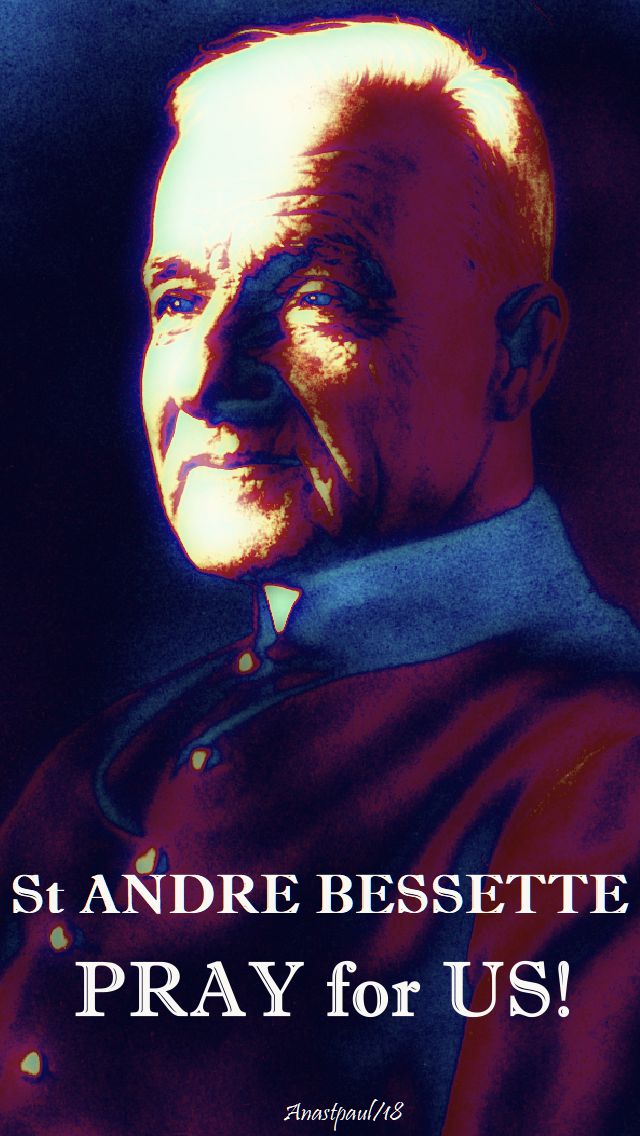
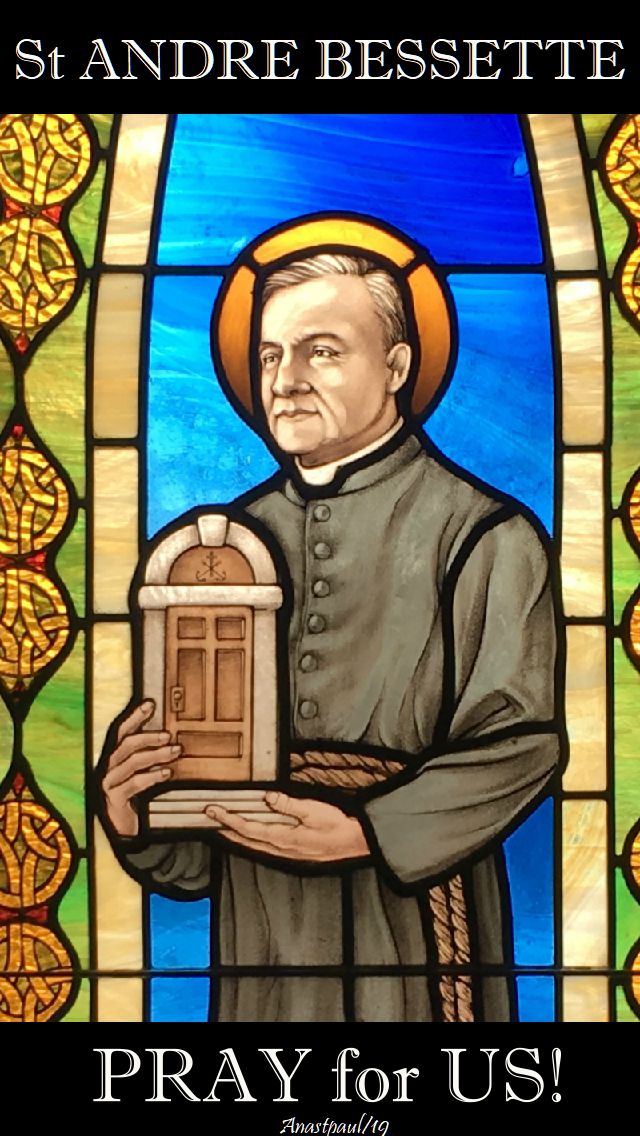
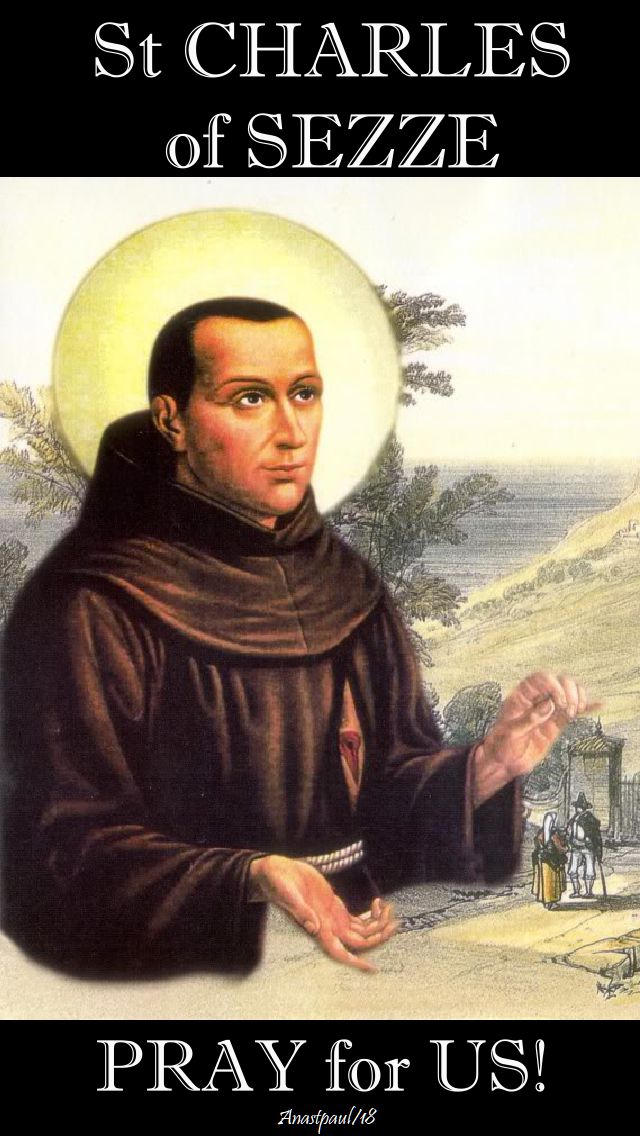
Thought for the Day – 6 January – The Memorial of Sts André Bessette C.S.C. (1845-1937) and St Charles of Sezze O.F.M. (1613-1670)

Thought for the Day – 6 January – The Memorial of Sts André Bessette C.S.C. (1845-1937) and St Charles of Sezze O.F.M. (1613-1670)

Both the Saints whose Memorials we celebrate today, lived their lives as simple porters, gardeners and the like.   But they both lived their lives in total charity and love of God.    And they are both saints.   They fulfilled their tasks with love and utter commitment to God their Father.   And through their faithfulness to these little things, God rewarded them with great things.

Since God through the Holy Spirit is the giver of charity and since true charity is beyond the capacity of human nature left to its own devices, God can give it without reference to natural gifts like intelligence.   And this seems true in the case of the uncharitable:  there are plenty of examples of intelligent people who lack charity—the “evil genius” is a standard literary character for a reason.   (Br. Bonaventure Chapman, OP)  But today also offers us a positive example of two men graced with charity which is love and is not love both question and answer and the new commandment given us.   What more is needed by the grace of God?

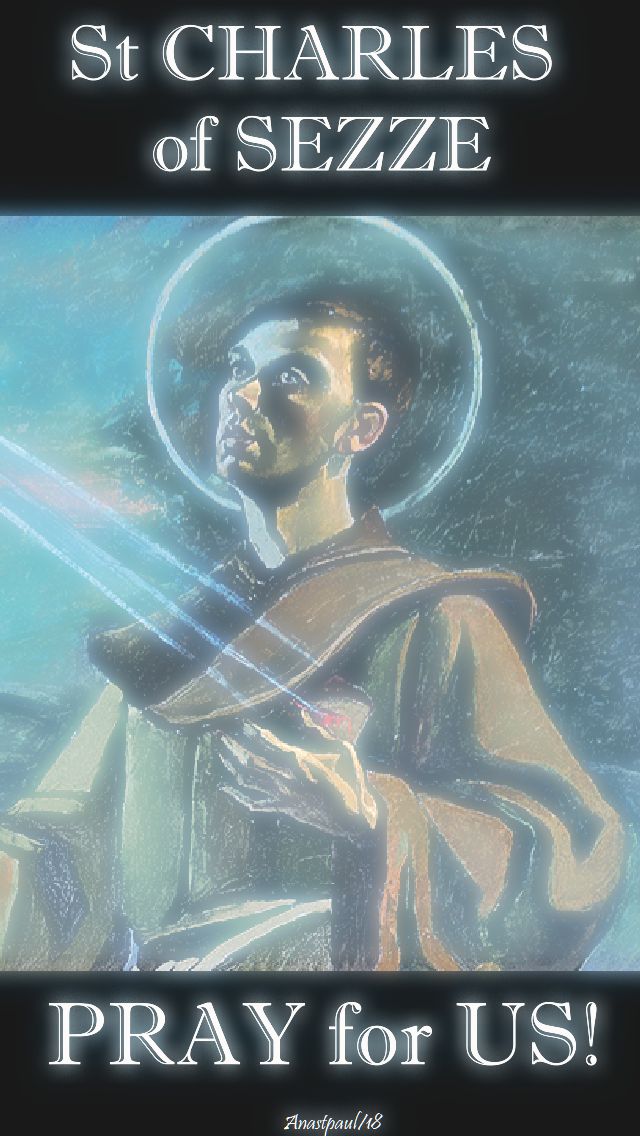
St André Bessette and St Charles of Sezze, Pray for us!st andre bessette pray for us -6 jan 2018st charles of sezze pray for us - 6 jan 2018

Posted in MORNING Prayers, QUOTES of the SAINTS, SAINT of the DAY

Quote/s of the Day – 6 January – The Memorial of Sts André Bessette C.S.C. (1845-1937)

Quote/s of the Day – 6 January – The Memorial of Sts André Bessette C.S.C. (1845-1937)

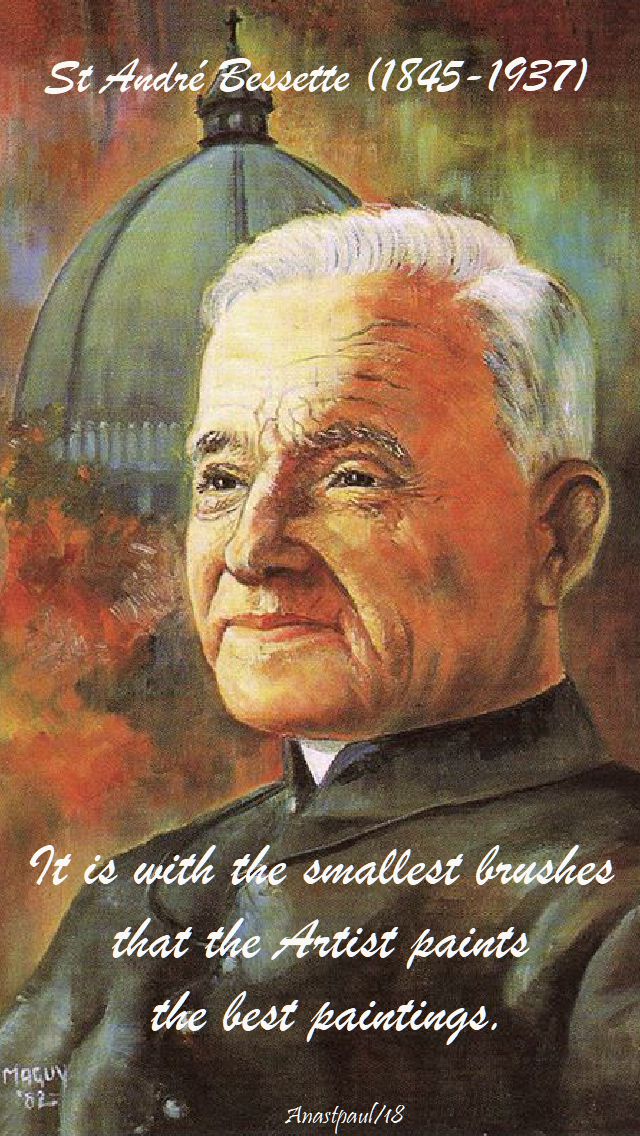
“It is with the smallest brushes
that the Artist paints
the best paintings.”it is with the smallest brushes - st andre bessette - 6 jan 2018

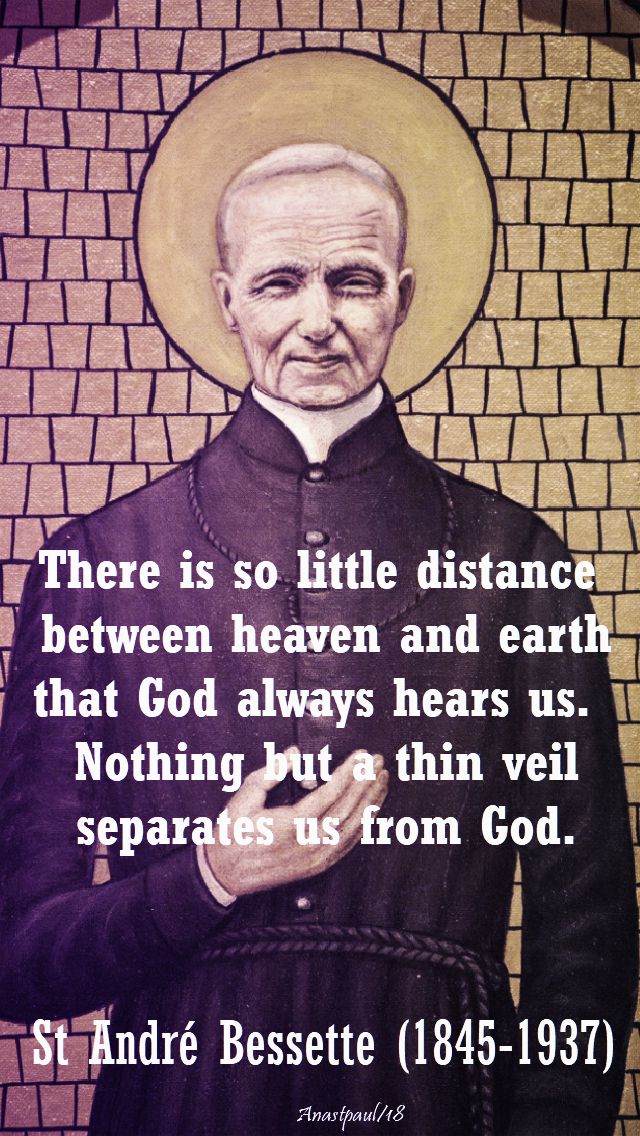
“There is so little distance
between heaven and earth
that God always hears us.
Nothing but a thin veil
separates us from God.”there is so little distance - st andre bessette - 6 jan 2018

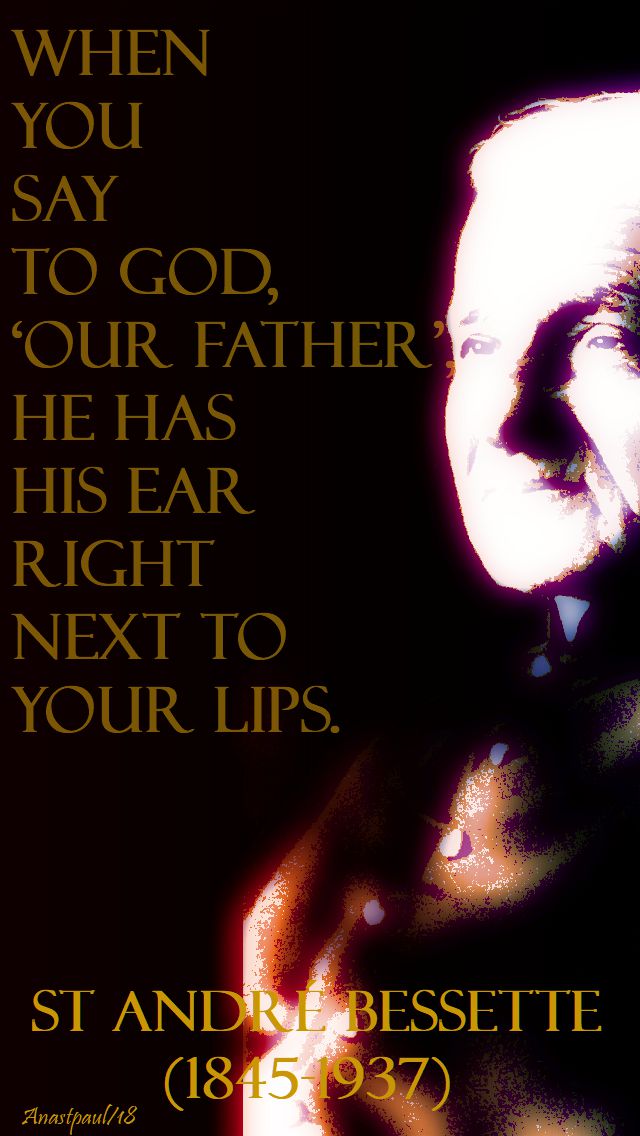
“When you say to God, ‘our Father’,
He has His ear right next to your lips.”

St André Bessette (1845-1937)when you say to god - st andre bessette - 6 jan 2018

Posted in MORNING Prayers, QUOTES of the SAINTS, QUOTES on PRAYER, SAINT of the DAY, The WORD

One Minute Reflection – 6 January – The Memorial of Sts André Bessette C.S.C. (1845-1937) and St Charles of Sezze O.F.M. (1613-1670)

One Minute Reflection – 6 January – The Memorial of Sts André Bessette C.S.C. (1845-1937) and St Charles of Sezze O.F.M. (1613-1670)

When Joseph awoke, he did as the angel of the Lord had commanded him and took his wife into his home…..Matthew 1:24matthew 1 - 24 - 2018

REFLECTION – “When you invoke St Joseph, you don’t have to say much.
Say, “if you were in my place, St Joseph, what would you do? Well, pray for this on my behalf.”……..St André Bessettewhen you invoke st jospeh - st andre bessette - 6 jan 2018

PRAYER – Heavenly Father, You constantly provide us with examples of holy life. St André Bessette and St Charles of Sezze were both wonderful examples of service, as was St André’s  hero, the Foster Father of Your Divine Son, St Joseph.   May they be intercessors and examples to me, to give to You my all.   St André Bessette, St Charles of Sezze and St Joseph. Pray for us, amen!st andre bessette pray for us -6 jan 2018-no. 2

ST CHARLES OF sezze pray for us no 2 - 6 jan 2018st joseph pray for us - 6 jan 2018

Posted in CATHOLIC DEVOTIONS of the Month, MORNING Prayers, PRAYERS of the SAINTS, The HOLY NAME

Our Morning Offering – 6 January – Month of the Most Holy Name

Our Morning Offering – 6 January – Month of the Most Holy Name

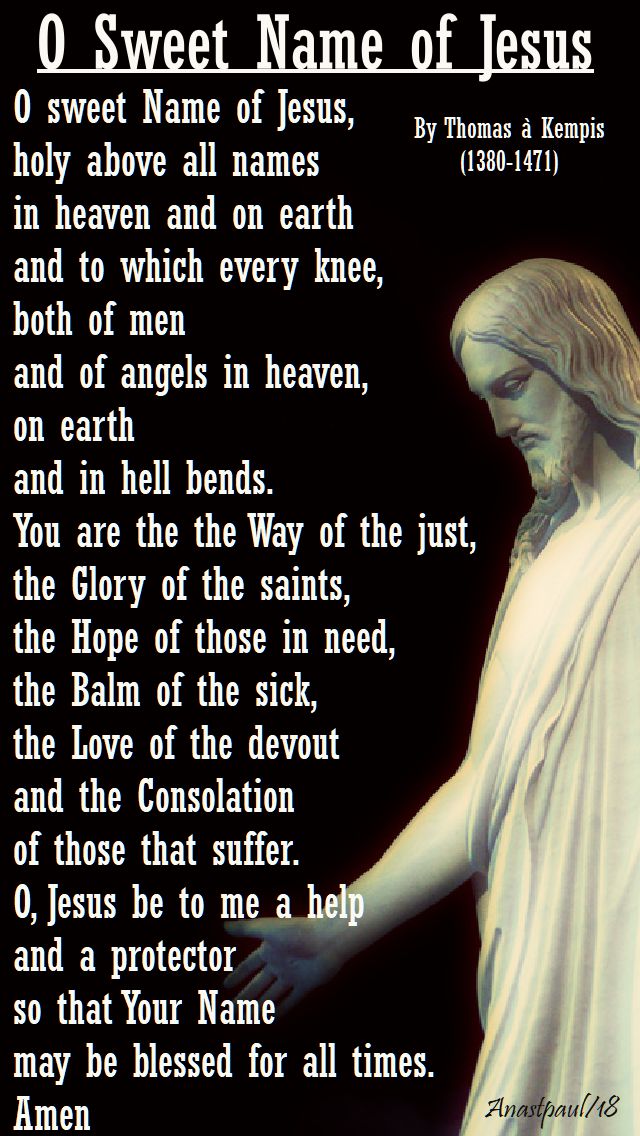
O Sweet Name of Jesus
By Thomas à Kempis (1380-1471)

O sweet Name of Jesus,
holy above all names
in heaven and on earth
and to which every knee,
both of men
and of angels in heaven,
on earth and in hell bends.
You are the the Way of the just,
the Glory of the saints,
the Hope of those in need,
the Balm of the sick,
the Love of the devout
and the Consolation
of those that suffer.
O, Jesus be to me a help
and a protector
so that Your Name
may be blessed for all times.
Amen

Thomas à Kempis (1380-1471) CRSA …(Manualis Parvulorum XIII)

o sweet name of jesus - thomas a kempis - 6 jan 2018

Posted in franciscan OFM, INCORRUPTIBLES, SAINT of the DAY

Saint of the Day – 6 January – St Charles of Sezze OFM (1613-1670)

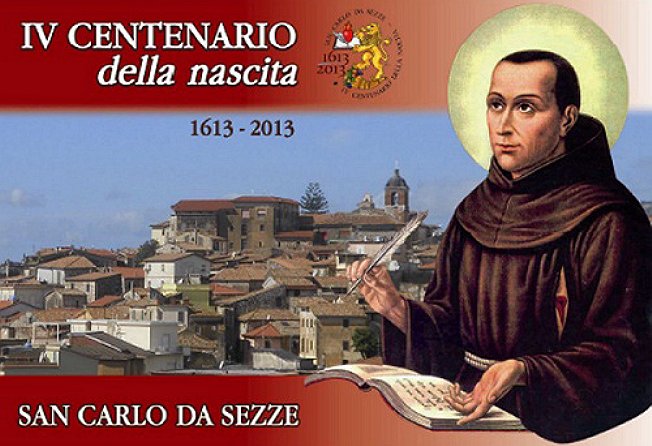
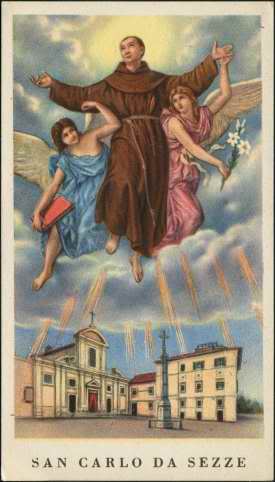
Saint of the Day – 6 January – St Charles of Sezze OFM (1613-1670) Stigmatist, Religious Friar, Mystic, Writer, Advisor.   St Charles was born on 19 October 1613 at Sezze, Roman Campagna, Italy as  Giancarlo Marchioni – 6 January 1670 at San Francesco a Ripa, Rome, Italy of natural causes.   His body is entombed at the Church of Saint Francis in Rome.   He became a religious despite the opposition of his parents who wanted him to become a Priest and he led an austere life doing menial tasks such as acting as a porter and gardener;   he was also a noted writer.   St Charles was held in high esteem across the Lazio region with noble families like the Colonna and Orsini praising him and seeking his counsel as did popes such as Innocent X and Clement IX.   His Beatification was celebrated in 1882 while Pope Pius XII approved his Canonisation in 1958 but the pope died before he could canonise the friar so his successor Pope John XXIII did so on 12 April 1959.   His body is incorrupt.118charles7charles of sezze centenary

Giancarlo Marchioni was born in Sezze on 19 October 1613 to the poor farmers Ruggero Marchioni and Antonia Maccione.   His baptism was celebrated on 22 October 1613.  His mother – when he was a toddler – liked to dress him in a dark tunic with a cord and hood in honour of friars Saint Francis of Assisi and Saint Anthony of Padua and she kept this ‘habit’ even after he outgrew it.

His maternal grandmother Valenza Pilorci instilled devout practices and other religious values within him in his childhood.   He worked on the farm as a shepherd to help his parents with the exhaustive workload and liked to plough in the fields because he liked the oxen.   He made a private vow to remain chaste in 1630 and in 1633 fell ill to the point of near death that he pledged to join the Order of Friars Minor if he were to be healed of his ailment.   His parents encouraged his call to become a priest but was a poor student and could not read or write much so there was no hope he would excel in advanced studies.

He felt a desire to serve in the missions in India and later became inspired from the lives of Saints Pascal Baylon and Salvador of Horta – who were both professed religious. Marchioni was admitted into the order at the San Francesco convent in 1635 at Nazzano; he received the habit of the order on 18 May 1635.   He later recounted that he did so out of a desire to live a poor life and to beg alms “for the love of Christ”.   He again set his heart on the missions but poor health halted this dream.

He lived the life of a religious and never requested ordination to the priesthood despite the protests of his parents to do so.   He made his solemn profession into the order on 19 May 1636 into the hands of Father Angelo Maria and his religious name was “Cosmas” at first but his mother’s insistence saw it changed to “Carlo”.   He worked at a range of jobs in various friaries:  he cooked and served as a porter and also worked as both a sacristan and gardener;  he also went out into the streets as a beggar.   He was not qualified in all of them as he became notorious for setting the kitchen of one house on fire.   From 1640 to 1642 he was stationed at the convent of Saint John the Baptist at Piglio and at San Francesco at Castel Gandolfo.   In October 1648 he attended Mass at the church of San Giuseppe a Capo le Case and a beam of light emanated from an elevated Host that pierced his side and left a visible open wound at his side.

118charles6

Though he was not a priest he was instructed to write the account of his life after his confessor requested it of him.   The result was “The Grandeurs of the Mercies of God” which was well-read;  he went on to write several other books.   Though he kept himself under the guidance of a spiritual director he himself – though not a priest – was often sought for spiritual advice and even Pope Innocent X and Alexander VII sought him out for advice.   In 1656 he tended to victims of cholera at Carpineto.   On 22 August 1664 he was at San Pietro in Montorio when he fell ill with malarial fever and so was taken to San Francesco a Ripa to recuperate;  he recovered on 30 August after bed rest was prescribed to him.   On 28 July 1665 he had a vision of Pope Saint Victor I and Saint Teresa of Ávila.

Pope Clement IX summoned him to his deathbed for comfort and a blessing not long before the two men died.   In the first week of December 1669 the pope summoned him but the friar was ill so was taken to the pope on a chair.   He greeted the pope: “Holy Father, how are you?” and the pope responded:  “As well as God wants me to be”.   Present in the room was Cardinal Giacomo Rospigliosi and the friar asked him to bless the pope with a special relic he carried but the pope wanted the frail friar to bless him and so he did.   Clement IX asked when the two would meet again and the friar told him it would be on the feast of the Epiphany to which those present thought the pope would get well and the two would meet in a month.   But the pope died on 9 December and people questioned how the friar was wrong though after the friar died on the Epiphany itself it was realised the pope would greet him as a friend in Heaven thus the two met again.

On 31 December 1669 he was forced to his bed due to pleurisy.    On 6 January 1670 he died in the convent attached to San Francesco a Ripa in Rome;  he was buried in that church.

The confirmation of his life of heroic virtue allowed for Pope Clement XIV to title the late Franciscan friar as Venerable on 14 June 1772 while the ratification of two miracles attributed to his intercession on 1 October 1881 allowed for Pope Leo XIII to preside over the beatification celebration on 22 January 1882 in Saint Peter’s Basilica. Pope Pius XII confirmed two additional miracles on 7 January 1958 but died before he could canonise the friar; Pope John XXIII canonised him on 12 April 1959 as a saint.

Published works
Birth of Holy Mary’s Novena
Christmas Novena
Holy Settenario
Invalid Path of the Soul
Jesus Christ’s Talk about Life
The Grandeurs of the Mercies of God
The Three Ways

Posted in FEASTS and SOLEMNITIES, SAINT of the DAY

6 January – Feast of the Epiphany and Memorials of the Saints

Feast of the Epiphany – Almost universally celebrated on Sunday 7 January this year.
St André Bessette (Optional Memorial)

St Andrew Corsini
St Antoninus
St Basillisa of Antinoë
St Demetrius of Philadelphia
St Diman Dubh of Connor
St Edeyrn
St Eigrad
St Erminold of Prüfening
St Felix of Nantes
Bl Frederick of Saint-Vanne
Bl Gertrud of Traunkirchen
Bl Gertrude van Oosten
St Guarinus of Sion
St Guy of Auxerre
St Honorius
St Hywyn of Aberdaron
St John de Ribera
St Julian of Antinoë
St Julius
Bl Luc of Roucy
Bl Macarius the Scot
St Macra of Rheims
St Merinus
St Nilammon of Geris
St St Petran of Landévennec
Peter of Canterbury
Bl Peter Thomas
St Pia of Quedlinburg
St Pompejanus
St Rafaela Porras y Ayllón
Bl Raymond de Blanes
Bl Rita Amada de Jesus
St Schotin
St Wiltrudis of Bergen

Martyrs in Africa: Unknown number of Christian men and women who were martyred in the persecutions of Septimus Severus. They were burned to death c 210.

Martyrs of Sirmium – 8 saints: A group of Christians martyred together for their faith. The only surviving details are the names of eight of them – Anastasius VIII, Florianus, Florus, Jucundus, Peter, Ratites, Tatia and Tilis. 4th century at Syrmium, Pannonia (modern Sremska Mitrovica, Vojvodina, Serbia).

Martyrs of Ukraine – 25 beati
Seven Holy Deacons
Twelve Apostles of Ireland

Posted in EUCHARISTIC Adoration, MORNING Prayers, PRAYERS of the SAINTS, QUOTES of the SAINTS, SAINT of the DAY, The HOLY EUCHARIST / The HOLY MASS

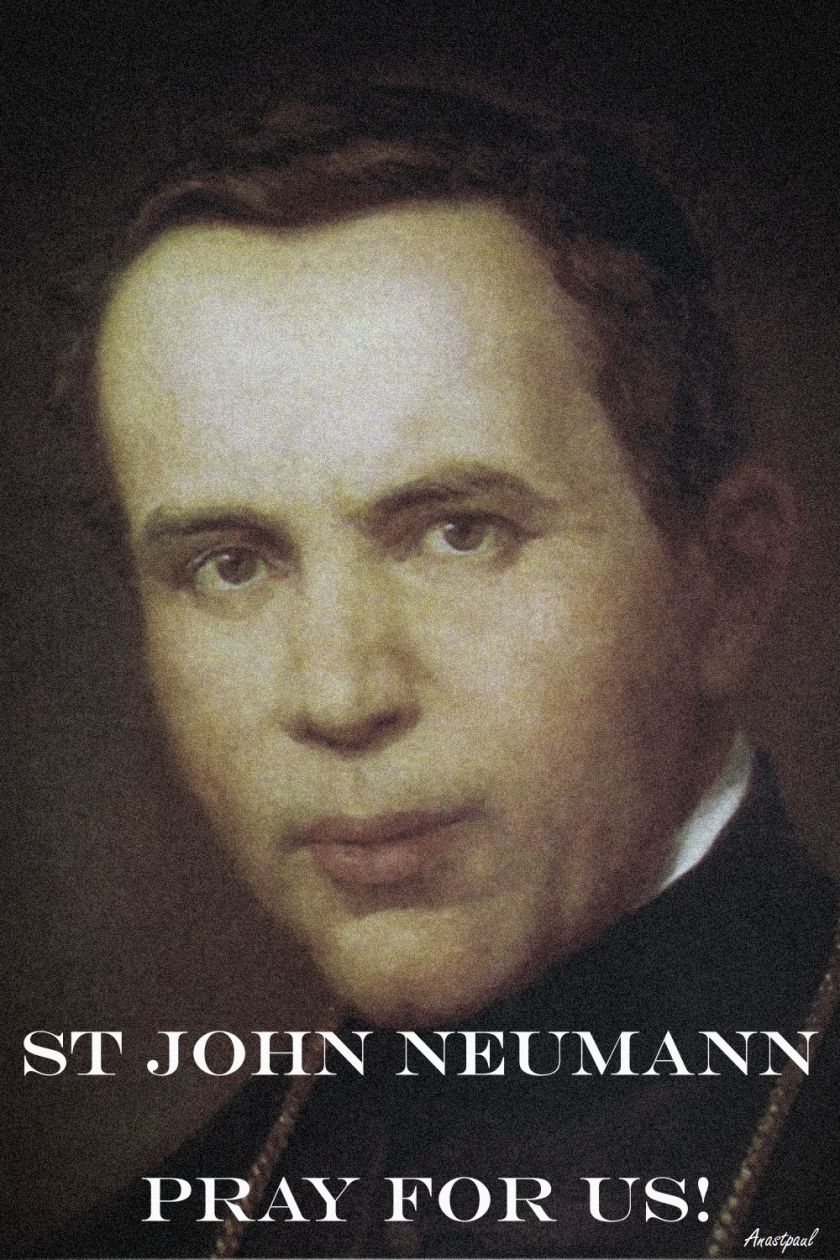
Thought for the Day – 5 January – The Memorial of St John Neumann (1811-1860) – An Adorer of the Blessed Sacrament

Thought for the Day – 5 January – The Memorial of St John Neumann (1811-1860) – An Adorer of the Blessed Sacrament

St John Nepomucene Neumann (1811–1860), Bishop of Philadelphia from 1852–1860, was graced with an intense devotion to Our Lord in the Sacrament of the Most Holy Eucharist.   His personal experience as a boy in Bohemia (modern Czech Republic), then as a priest in the United States and finally as a Redemptorist — a spiritual son of the incomparable Saint Alphonsus Liguori (1696-1787) (Founder of the Redemptorists and Doctor of the Church) — impelled him to promote prolonged prayer before the Blessed Sacrament exposed in the monstrance.   No sooner had he become bishop of Philadelphia than he sought to introduce the Quarant’ Ore, or Forty Hours Devotion, already practised for three hundred years in Europe.

The good priests of Philadelphia were, for the most part, opposed to the introduction of the Forty Hours Devotion, fearing that, given the prevailing climate of violent anti-Catholicism nurtured by the Know Nothing Movement, it might exacerbate hostilities against the Church and even expose the Most Holy Sacrament to profanation.

Bishop Neumann had very nearly renounced his project when, overcome by exhaustion late one night, he fell asleep while writing at his desk.   A burning candle ignited the papers lying before him.   He awoke to smoke rising from the incinerated papers.   One document alone remained unscathed;  it was the letter he had written to propose the Forty Hours Devotion.   Bishop Neumann fell to his knees to give thanks for having been preserved from harm and, as he did so, he experienced a kind of locution.   God spoke to him inwardly saying,  “As the flames are burning here without consuming or injuring this writing, so shall I pour out My grace in the Blessed Sacrament without prejudice to My honour.   Therefore, do not fear profanation and do not hesitate any longer to carry out your designs for My glory.”

Convinced by this sign, Bishop Neumann overrode the objections of his clergy and initiated the celebration of the Forty Hours at the First Diocesan Synod of Philadelphia in April 1853.   The Church chosen for the first Forty Hours was that of Saint Philip Neri.   It was the latter saint who had, in fact, introduced the Quarant’ Ore to the city of Rome. Bishop Neumann astonished — and edified — his clergy and faithful by spending the greater part of the three days on his knees before the Blessed Sacrament in Saint Philip Neri Church.   There was no anti-Catholic backlash.   Great crowds of the faithful came, by day and by night, to adore Our Lord exposed to their gaze in the Sacrament of the Altar.

Bishop Neumann carried out his original inspiration by organising the Forty Hours Devotion in the entire diocese of Philadelphia in such a way that each parish would celebrate it in turn during the course of the year.   He edited a booklet to facilitate the worthy celebration of the Quarant’ Ore and secured indulgences for the faithful who would participate in the devotion.   So successful was the Forty Hours in the diocese of Philadelphia that it spread from there to other dioceses of the United States.   In 1866 at the Plenary Council of Baltimore the Forty Hours Devotion was ratified for the whole country.

One of the conclusions of the 2005 Vatican Synod on the Eucharist was the recommendation that the Forty Hours Devotion be reinvigorated and reintroduced everywhere in the Church.   This, of course, is fully consonant with the repeated exhortations to Eucharistic adoration of St Pope John Paul II and Pope Benedict XVI.

Saints John and Alphonsus
Saint John Neumann left, among his personal writings, a prayer that, by its language and tenderness, is reminiscent of the outpourings of his spiritual father, Saint Alphonse Liguori, in the presence of the Blessed Sacrament. It reveals something of the soul of Bishop Neumann:

How much do I love You,
O my Jesus!
I wish to love You with my whole heart,
yet I do not love You enough.
I have but one desire,
that of being near You,
in the Blessed Sacrament.
Thou art the sweet Bridegroom of my soul.
My Jesus, my love, my all,
gladly would I endure
hunger, thirst, heat and cold
to remain always with You
in the Blessed Sacrament.
Amenhow much do I love You O my Jesus - st john neumann - prayer to jesus in the holy eucharist - 5 jan 2018- NO 2
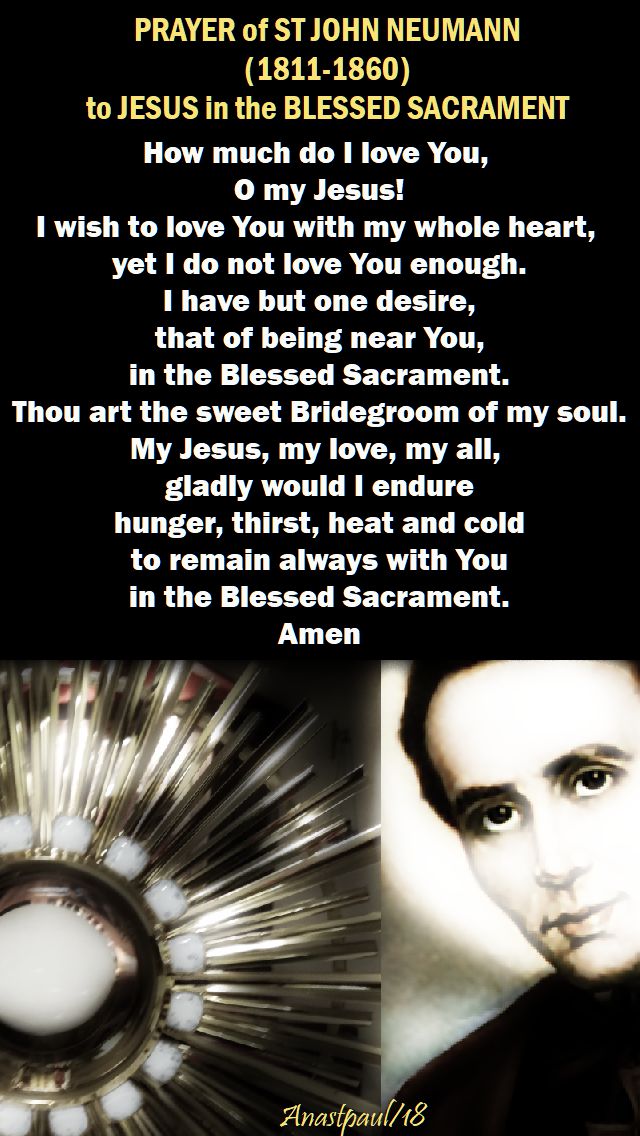
ST JOHN NEUMANN, PRAY FOR THE GROWTH OF EUCHARISTIC ADORATION, PRAY FOR HOLY MOTHER CHURCH, PRAY FOR US ALL!st john neumann - pray for us - 5 jan 2018

Posted in MORNING Prayers, QUOTES of the SAINTS, SAINT of the DAY

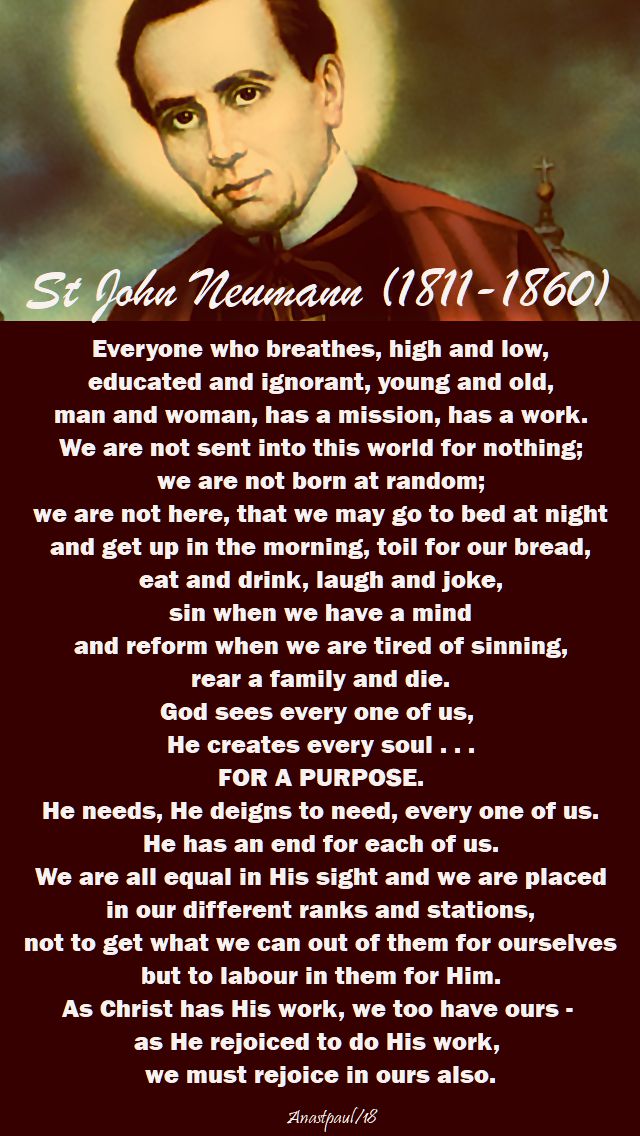
Quote of the Day – 5 January – The Memorial of St John Neumann (1811-1860)

Quote of the Day – 5 January – The Memorial of St John Neumann (1811-1860)

“Everyone who breathes, high and low,
educated and ignorant, young and old,
man and woman, has a mission, has a work.
We are not sent into this world for nothing;
we are not born at random;
we are not here, that we may go to bed at night
and get up in the morning, toil for our bread,
eat and drink, laugh and joke,
sin when we have a mind
and reform when we are tired of sinning,
rear a family and die.
God sees every one of us,
He creates every soul . . .
FOR A PURPOSE.
He needs, He deigns to need, every one of us.
He has an end for each of us.
We are all equal in His sight and we are placed
in our different ranks and stations,
not to get what we can out of them for ourselves
but to labour in them for Him.
As Christ has His work, we too have ours –
as He rejoiced to do His work,
we must rejoice in ours also.”

St John Neumann (1811-1860)everyone who breathes - st john neumann - 5 jan 2018

Posted in MORNING Prayers, QUOTES of the SAINTS, QUOTES on LOVE, SAINT of the DAY, The WORD

One Minute Reflection – 5 January – The Memorial of St John Neumann (1811-1860)

One Minute Reflection – 5 January – The Memorial of St John Neumann (1811-1860)

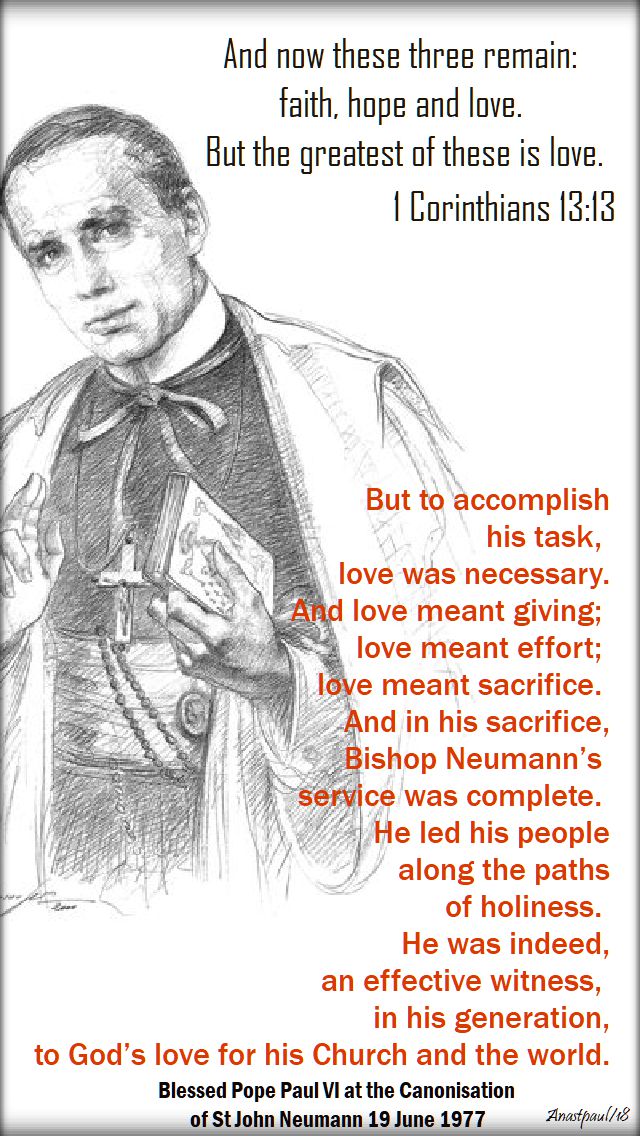
And now these three remain:  faith, hope and love.   But the greatest of these is love….1 Corinthians 13:13

REFLECTION – “But to accomplish his task, love was necessary.   And love meant giving; love meant effort;  love meant sacrifice.   And in his sacrifice, Bishop Neumann’s service was complete.   He led his people along the paths of holiness.   He was indeed an effective witness, in his generation, to God’s love for His Church and the world.”…Blessed Pope Paul VI at the Canonisation of St John Neumann 19 June 1977but to accomplish - bl pope paul VI on st john neumann - 5 jan 2018

PRAYER – Holy Father, You brought St John Neumann to the new world to show Your ways and lead all to You.   By Your grace, may we all learn to live such zealous and loving lives!   Grant Lord that St John Neumann, by the living power of his example and by the intercession of his prayers, may assist us and intercede to help us, today and forever.  We make our prayer through our Lord Jesus Christ, in union with the Holy Spirit, one God forever, amen.st john neumann pray for us - 2017-5 jan

Posted in MORNING Prayers, PRAYERS of the SAINTS, SAINT of the DAY

Our Morning Offering – 5 January – The Memorial of St John Neumann (1811-1860)

Our Morning Offering – 5 January – The Memorial of St John Neumann (1811-1860)

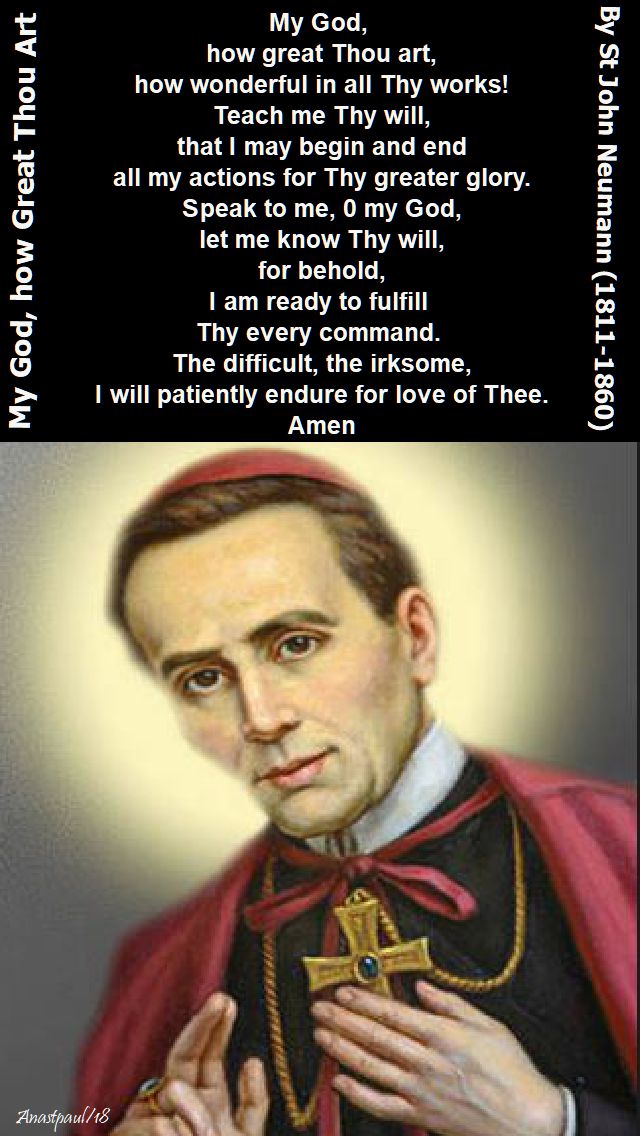
My God, how Great Thou Art
By St John Neumann (1811-1860)

My God,
how great Thou art,
how wonderful in all Thy works!
Teach me Thy will,
that I may begin and end
all my actions for Thy greater glory.
Speak to me, 0 my God,
let me know Thy will,
for behold,
I am ready to fulfill
Thy every command.
The difficult, the irksome,
I will patiently endure for love of Thee.
Amenmy god how great thou art - 5 jan 2018

Posted in INCORRUPTIBLES, QUOTES of the SAINTS, SAINT of the DAY

Saint of the Day – 5 January – St John Nepomucene Neumann CSsR (1811-1860)

Saint of the Day – 5 January – St John Nepomucene Neumann CSsR (1811-1860) Bishop, Religious, Founder, Preacher, Writer, Founder of Schools and builder of Churches.  St John was born on 28 March 1811 at Prachititz, Bohemia (Czech Republic) – 5 January 1860 of a stroke at 13th and Vine Streets, Bishop of Philadephia, Pennsylvania, USA.   His body is incorrupt.   St John Neumann is the first United States Bishop (and to date the only male citizen) to be Canonised.   While Bishop of Philadelphia, Neumann founded the first Catholic Diocesan school system in the United States as well as building 50 Churches and starting on a Cathedral, before his death.   https://www.youtube.com/watch?v=V9OcOcnZ0CI

TFT_StJNeumann1

John was the third of six children to a German Father and Czech mother.   He showed great talent in school and by the time he was 24, he had mastered six languages.   It was his desire to become a priest, so in 1831, he entered the diocesan seminary in Budweis, and continued his studies at the Charles Ferdinand University in Prague.

Prachatice Medieval Town, st john neumann
St John Neumann’s home town in the Czech Republic, Prachititz,

He was looking forward to being ordained in 1835 when the bishop decided there would be no more ordinations as there were more than enough priests in Bohemia.   John wrote to bishops all over Europe but the story was denied on each request.   Nevertheless, John was not discouraged from his vocation and continued to search for a diocese that would take him.   He had learned English by working in a factory with English-speaking workers so he wrote to the bishops in America.   Finally, he emigrated to the United States, where the bishop of New York ordained him in 1836.

He spent 4 years ministering to German immigrants and Native Americans in the Buffalo-Rochester area.   He was one of 36 priests that were attending to more than 200,000 Catholics and his parish in western New York was vast, stretching from Lake Ontario to Pennsylvania.   His church was very meagre, not even having a floor and he spent much of his time travelling from town to town through rugged wilderness to visit his flock.   His work was very solitary and he felt drawn to a community.   He was accepted into the Redemptorist Congregation in 1840 and began his novitiate in Pittsburgh.   Two years later, he took his vows.   By this time, he spoke eight languages. His religious superiors in Europe were impressed with his holiness and hard work, so the appointed him vicar of all the Redemptorists in America.   He was devoted to the education of African-American children and became an American citizen.st john newmann statue

John was surprised by his appointment as bishop of Philadelphia in 1852.   His new responsibilities were heavy, as the diocese of Philadelphia was geographically very large and there were many languages spoken among the immigrants under his care.   One of his major accomplishments was to organise the first diocesan Catholic school system.   He worked tirelessly, founding a Congregation of religious sisters to teach in the diocesan schools and during his tenure as bishop, the population of his diocese doubled. He increased the number of Catholic schools in his diocese from two to over 200.

Neumann lived very simply and frugally.   On one visit to Germany, he came back to the house he was staying in soaked by rain.   His hosts suggested he change his shoes but John replied, “The only way I could change my shoes is by putting the left one on the right foot and the right one on the left foot. This is the only pair I own.”   When he was given a new set of vestments as a gift, he would frequently give them to the most recently ordained priest in the diocese.

He was also a humble man, once being picked up by a parish priest from a rural area and riding to town on the back of a manure cart.   John jokingly exclaimed, “Have you ever seen such an entourage for a bishop!”   He was disheartened by constant conflict with religiously and racially prejudiced people in his diocese.   There was a strong anti-Catholic movement which had a strong presence in the area and there were even anti-Catholic riots and arson of religious buildings.   Neumann wrote to Rome asking to be replaced as bishop but Pope Pius IX insisted that he continue.   In 1854, he travelled to Rome and was present at St. Peter’s Basilica on December 8, along with 53 cardinals, 139 other bishops and thousands of priests and laypersons, when Pope Pius IX solemnly defined, the dogma of the Immaculate Conception of the Blessed Virgin Mary.

His strenuous work load caught up with him and at the age of 48, he collapsed on the street and died on 5 January 1860.   He was declared venerable by Pope Benedict XV in 1921 and beatified by Pope Paul VI during the Second Vatican Council on 13 October 1963.   Pope Paul VI also canonised him on 19 June 1977.   His incorrupt body currently lays in a glass sarcophagus for public veneration in Saint Peter’s Church in Philadelphia.

Shrine_of_St._John_Neumann
By Dgf32 at the English language Wikipedia, CC BY-SA 3.0, https://commons.wikimedia.org/w/index.php?curid=3691157
Posted in SAINT of the DAY

5 January – Memorials of the Saints

St John Nepomucene Neumann (Memorial)

Bl Alacrinus of Casamari
St Apollinaris Syncletica
St Cera of Kilkeary
St Charles of Mount Argus
Bl Convoyon of Redon
St Deogratias of Carthage
St Dorotheus the Younger
Bl François Peltier
St Gaudentius of Gnesen
St Genoveva Torres Morales
St Gerlac of Valkenburg
Bl Jacques Ledoyen
Bl Joan Grau Bullich
St Kiara
St Lomer of Corbion
Bl Marcelina Darowska
Bl Maria Repetto
Bl Paula of Tuscany
Nl Pierre Tessier
Bl Pietro Bonilli
St Simeon Stylites
St Syncletica
St Talida of Antinoë

Martyrs of Africa – 14 saints: A group of Christians martyred together in Africa, date unknown, exact location unknown. We know nothing more than their names – Acutus, Anastasia, Candidus, Coelifloria, Felix, Honorius, Januaria, Jucundus, Lucianus, Marcus, Petrus, Secundus, Severus and Telesphorus.

Martyrs of Sais: A group of Christians martyred for their faith, but about whom no details have survived. They were martyred by drowning near Sais, Egypt.

Martyrs of Upper Egypt: There were many martyrs who suffered in the persecutions of Diocletian in the Thebaid region. Though we know these atrocities occurred, to the point that witnesses claim the torturers and executioners were exhausted by the work, we do not know the names of the saints and we honour them as a group. Many were beheaded and or burned alive in 303 in Upper Egypt.

Posted in MORNING Prayers, ON the SAINTS, PAPAL SERMONS, QUOTES of the SAINTS, QUOTES on SANCTITY, SAINT of the DAY

Thought for the Day – 4 January – The Memorial of St Elizabeth Ann Seton (1774-1821) – “What is a Saint?”

Thought for the Day – 4 January – The Memorial of St Elizabeth Ann Seton (1774-1821)  “What is a Saint?”

Excerpt from HOMILY OF THE HOLY FATHER BLESSED PAUL VI – 14 September 1975, on the Canonisation of St Elizabeth Ann Setonst e a seton- pray for us no 2 - 4 jan 2018

Elizabeth Ann Seton is a Saint!   We rejoice and we are deeply moved that our apostolic ministry authorises us to make this solemn declaration before all of you here present, before the holy Catholic Church, before our other Christian brethren in the world, before the entire American people and before all humanity. Elizabeth Ann Bayley Seton is a Saint!

She is the first daughter of the United States of America to be glorified with this incomparable attribute!    But what do we mean when we say:   «She is a Saint»?   We all have some idea of the meaning of this highest title;  but it is still difficult for us to make an exact analysis of it.   Being a Saint means being perfect, with a perfection that attains the highest level that a human being can reach.   A Saint is a human creature fully conformed to the will of God.   A Saint is a person in whom all sin-the principle of death-is cancelled out and replaced by the living splendour of divine grace.   The analysis of the concept of sanctity brings us to recognise in a soul the mingling of two elements that are entirely different but which come together to produce a single effect:  SANCTITY.   One of these elements is the human and moral element, raised to the degree of heroism:  heroic virtues are always required by the Church for the recognition of a person’s sanctity.   The second element is the mystical element, which express the measure and form of divine action in the person chosen by God to realise in herself-always in an original way-the image of Christ (Cfr. Rom. 8, 29).

The Church has made this study of the life, that is, the interior and exterior history, of Elizabeth Ann Seton.   And the Church has exulted with admiration and jo, and has today heard her own charism of truth poured out in the exclamation that we send up to God and announce to the world:  she is a Saint!

May the dynamism and authenticity of her life be an example in our day-and for generations to come-of what women can and must accomplish, in the fulfilment of their role, for the good of humanity.

St Elizabeth Ann Seton – Pray for us that we may all travel safely this path of sanctity and join you in Heaven in the halls of Sanctity!st e a seton- pray for us no 3 - 4 jan 2018