Posted in EUCHARISTIC Adoration, MORNING Prayers, QUOTES of the SAINTS, QUOTES on FAITH, QUOTES on HUMILITY, QUOTES on LOVE, QUOTES on PRAYER, QUOTES on SANCTITY, QUOTES on SUFFERING, SAINT of the DAY, The HOLY EUCHARIST / The HOLY MASS

Quote/s of the Day – 4 January – The Memorial of St Elizabeth Ann Seton (1774-1821)

Quote/s of the Day – 4 January – The Memorial of St Elizabeth Ann Seton (1774-1821)

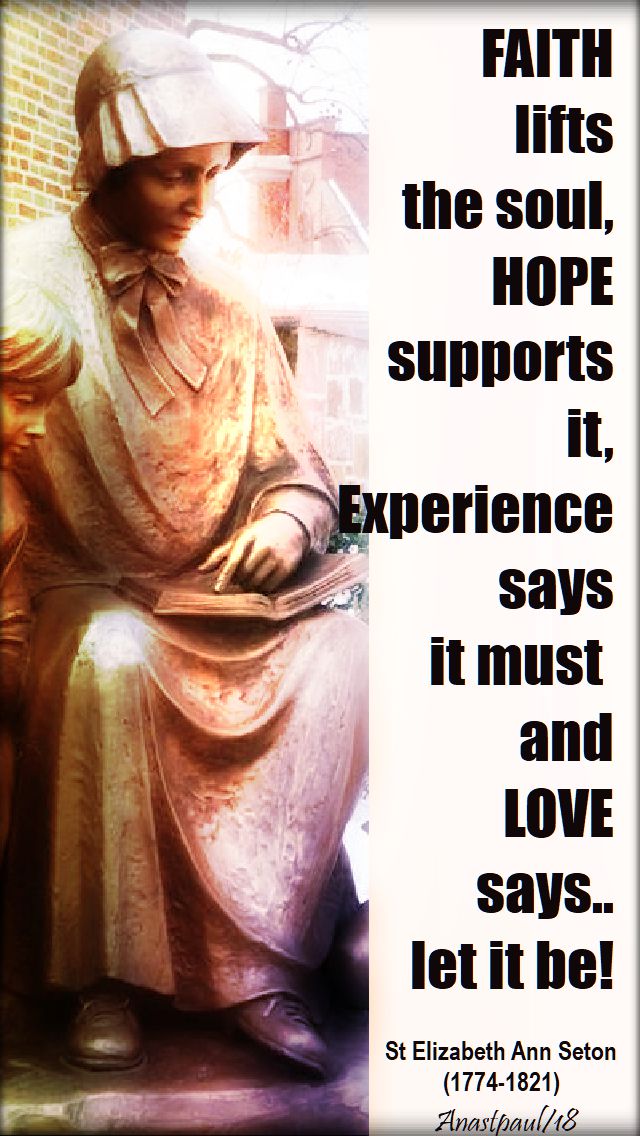
“Faith lifts the soul,
Hope supports it,
Experience says it must
and Love says…let it be!”faith lifts the soul - st e a seton - 4 jan 2018

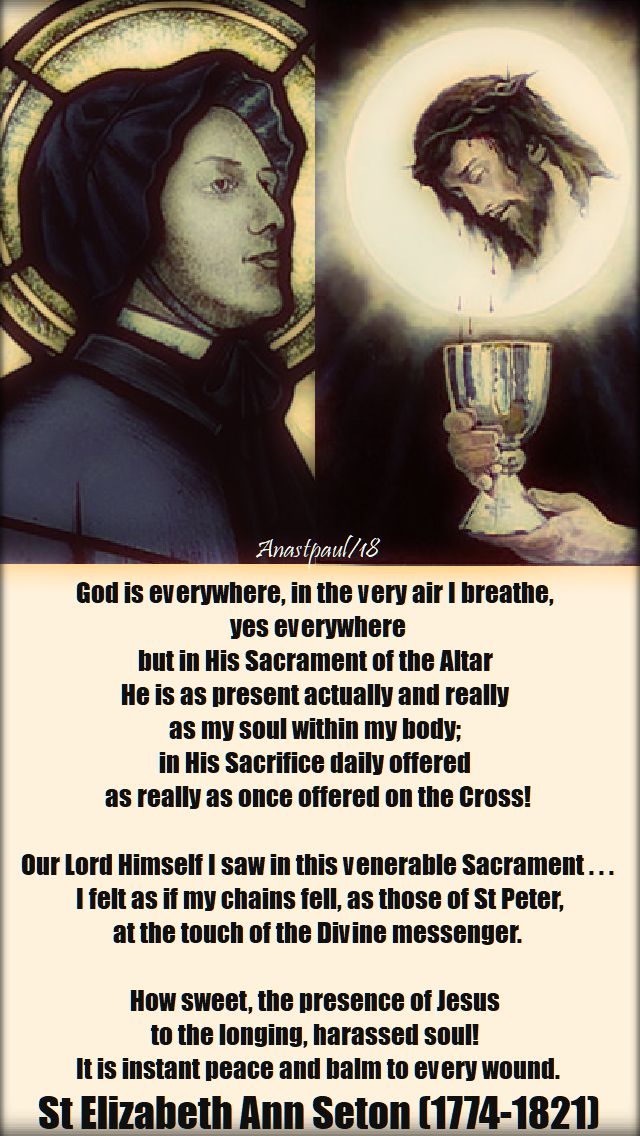
“God is everywhere, in the very air I breathe,
yes everywhere
but in His Sacrament of the Altar
He is as present actually and really
as my soul within my body;
in His Sacrifice daily offered
as really as once offered on the Cross!”

“Our Lord Himself I saw in this venerable Sacrament . . .
I felt as if my chains fell, as those of St Peter,
at the touch of the Divine messenger.”

“How sweet, the presence of Jesus
to the longing, harassed soul!
It is instant peace and balm to every wound.”god is everywhere - st e a seton - 4 jan 2018

“We must pray without ceasing,
in every occurrence and employment
of our lives – that prayer which is rather
a habit of lifting up the heart to God
as in a constant communication with Him.”we must pray - seton - 4 jan 2018

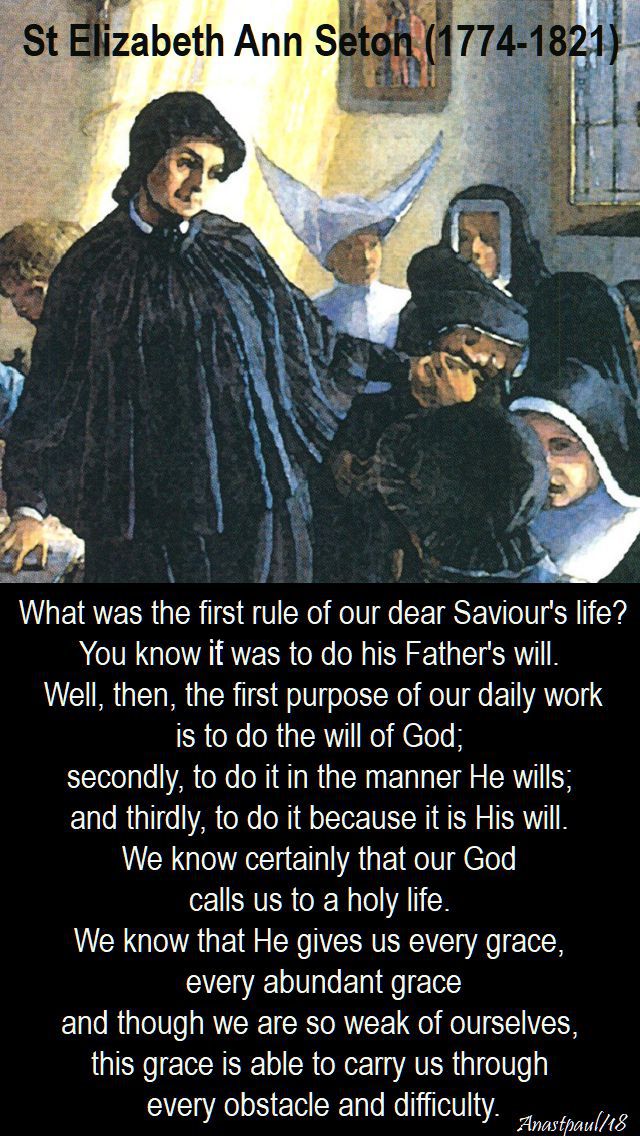
“What was the first rule of our dear Saviour’s life?
You know it was to do his Father’s will.
Well, then, the first purpose of our daily work
is to do the will of God;
secondly, to do it in the manner He wills;
and thirdly, to do it because it is His will.
We know certainly that our God
calls us to a holy life.
We know that He gives us every grace,
every abundant grace
and though we are so weak of ourselves,
this grace is able to carry us through
every obstacle and difficulty.”what was the first rule - st e a seton - 4 jan 2018

“Afflictions are the steps to heaven.”

“Can you expect to go to heaven for nothing?
Did not our Saviour track the whole way to it
with His tears and blood?
And yet you stop at every little pain?”

“The gate of heaven is very low;
only the humble can enter it.”

St Elizabeth Ann Seton (1774-1821)AFFLICTIONS ARE THE STEPS TO HEAVEN - ST SETON 4 JAN 2018

Posted in MORNING Prayers, QUOTES of the SAINTS, SAINT of the DAY, The WORD

One Minute Reflection – 4 January – The Memorial of St Elizabeth Ann Seton (1774-1821)

One Minute Reflection – 4 January – The Memorial of St Elizabeth Ann Seton (1774-1821)

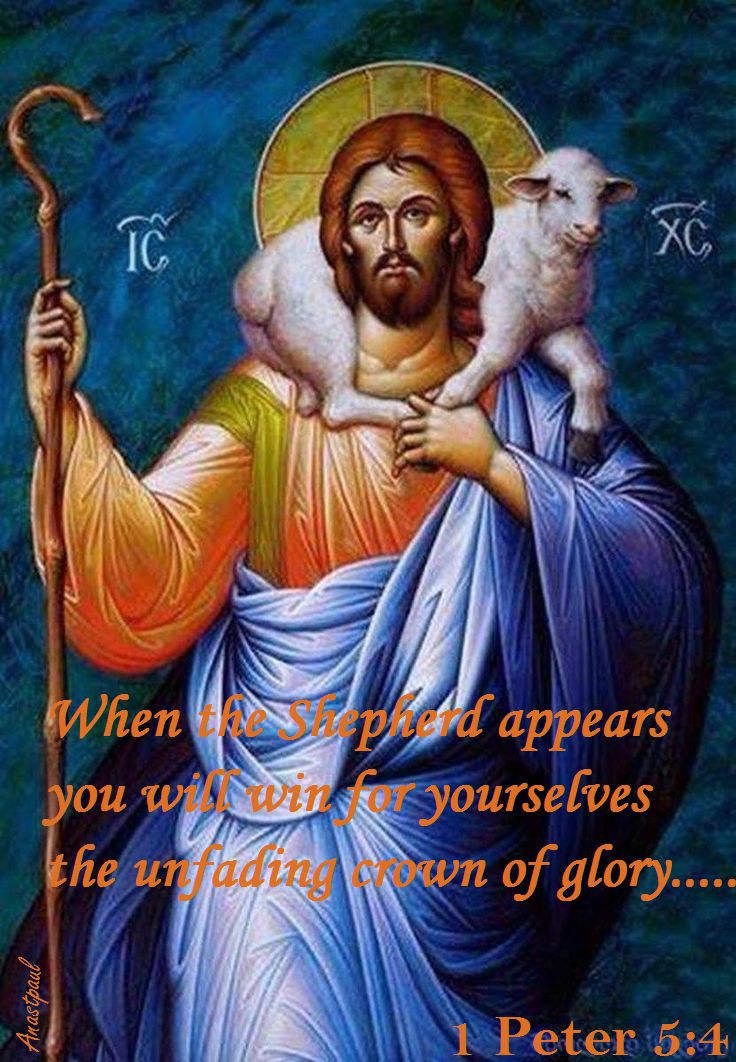
When the Shepherd appears
you will win for yourselves
the unfading crown of glory………1 Peter 5:41-peter-5-4

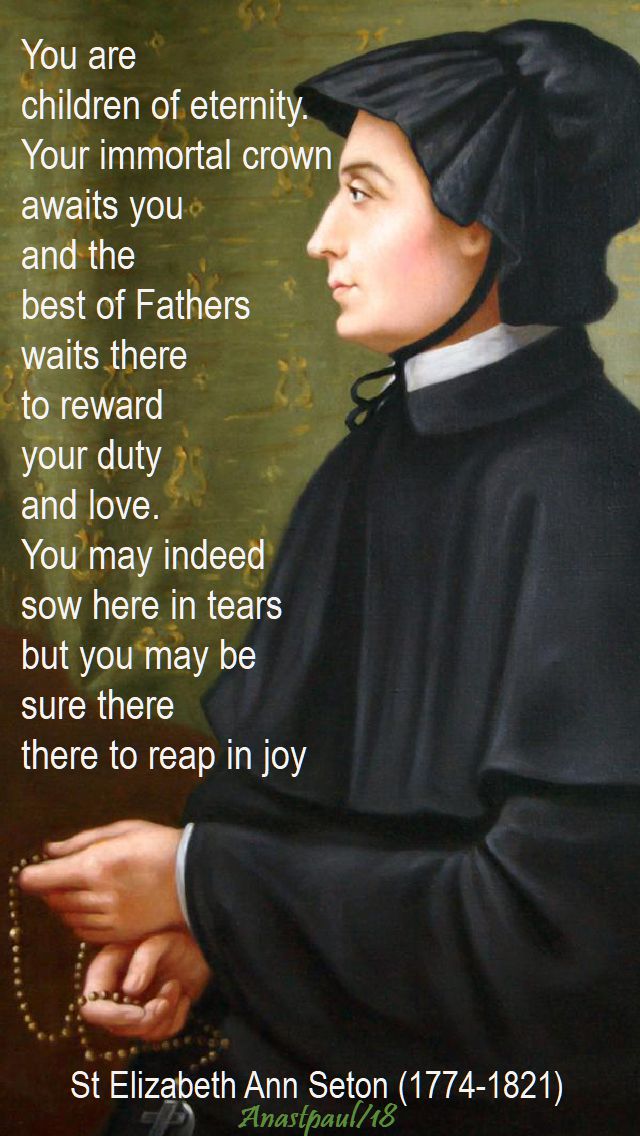
REFLECTION – “You are children of eternity.  Your immortal crown awaits you and the best of Fathers waits there to reward your duty and love.   You may indeed sow here in tears but you may be sure there to reap in joy.”…St Elizabeth Ann Seton (1774-1821)you are children of eternity - st e a seton - 4 jan 2018

PRAYER – Heavenly Father, thank You for making me a child of eternity.   Help me to live each day in such a way that I may deserve to be a child of Yours forever.   Grant that by the prayers of St Elizabeth Ann Seton, we may strive always to keep our eyes fixed on our eternal home and never waiver from Your commandments. Amen.st e a seton - pray for us - 4 jan 2018

Posted in MORNING Prayers, PRAYERS of the SAINTS, SAINT of the DAY

Our Morning Offering – 4 January – The Memorial of St Elizabeth Ann Seton (1774-1821)

Our Morning Offering – 4 January – The Memorial of St Elizabeth Ann Seton (1774-1821)

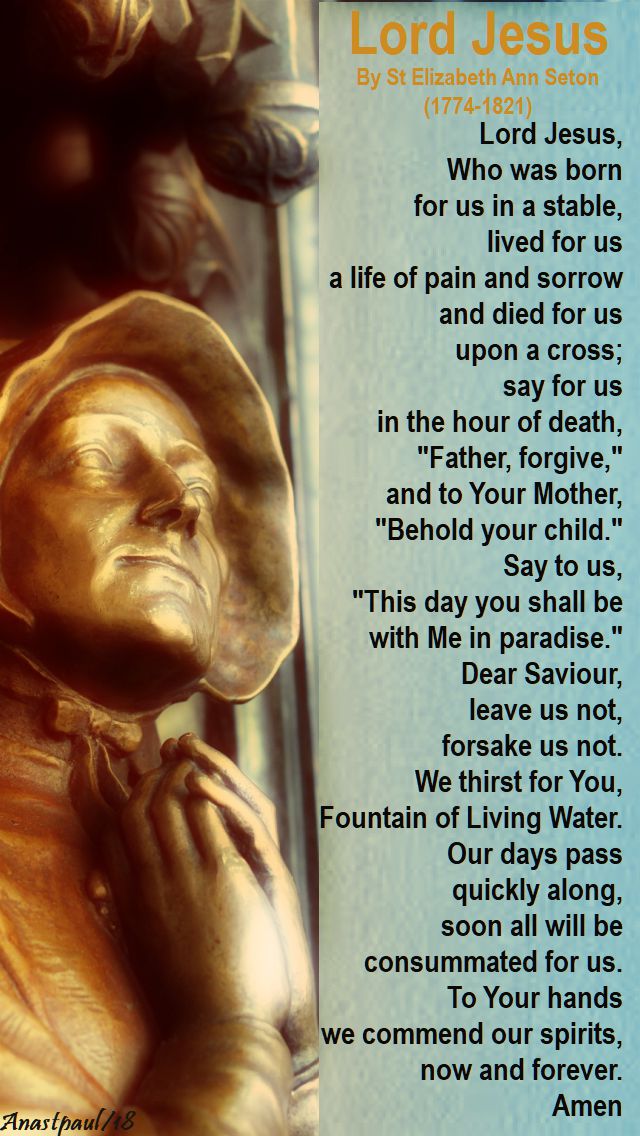
Lord Jesus
By St Elizabeth Ann Seton (1774-1821)

Lord Jesus,
Who was born for us in a stable,
lived for us a life of pain and sorrow
and died for us upon a cross;
say for us in the hour of death,
“Father, forgive,”
and to Your Mother,
“Behold your child.”
Say to us,
“This day you shall be with Me in paradise.”
Dear Saviour, leave us not, forsake us not.
We thirst for You, Fountain of Living Water.
Our days pass quickly along,
soon all will be consummated for us.
To Your hands we commend our spirits,
now and forever.
Amenlord jesus - st e a seton - 4 jan 2018

Posted in Of a Holy DEATH & AGAINST A SUDDEN DEATH, of the DYING, FINAL PERSEVERANCE, DEATH of CHILDREN, DEATH of PARENTS, PATRONAGE - IN-LAW PROBLEMS, SAINT of the DAY, WIDOWS and WIDOWERS

Saint of the Day – 4 January – St Elizabeth Ann Seton (1774-1821)

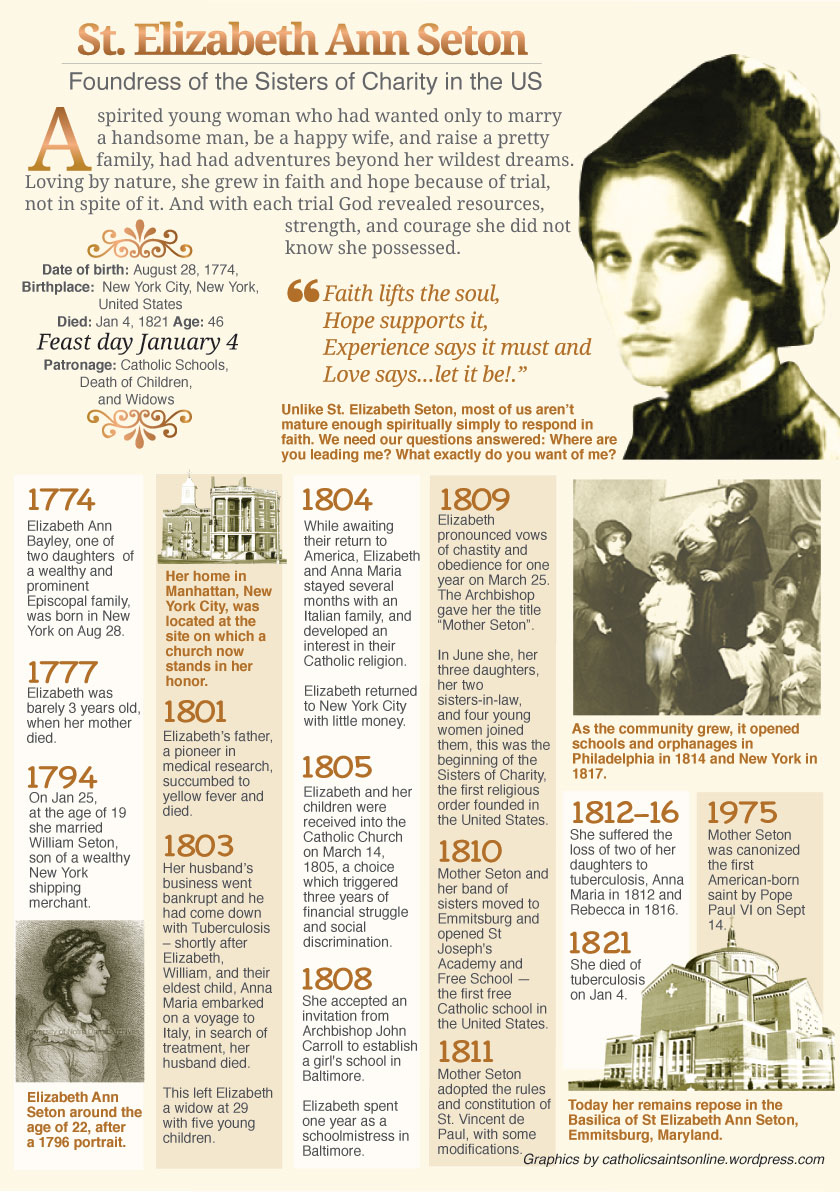
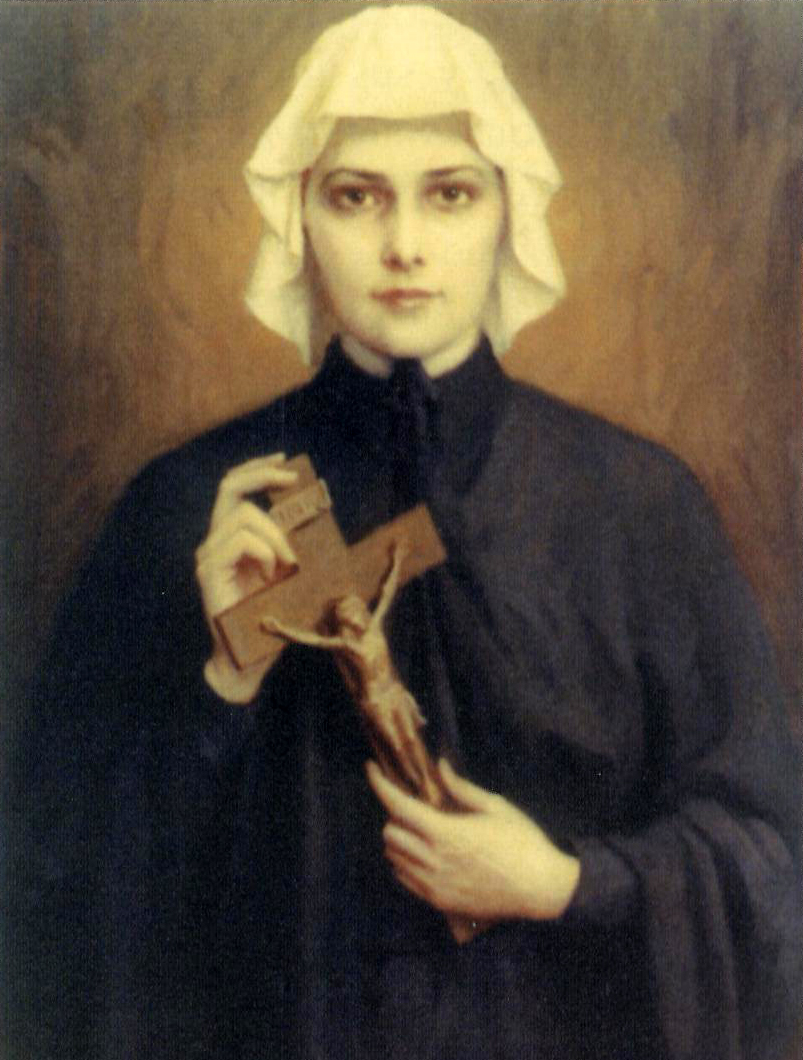
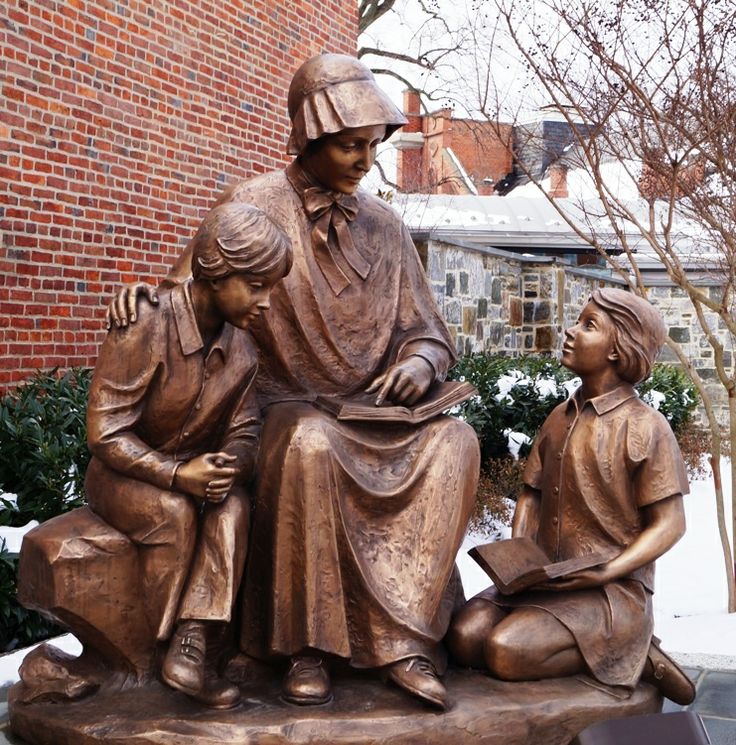
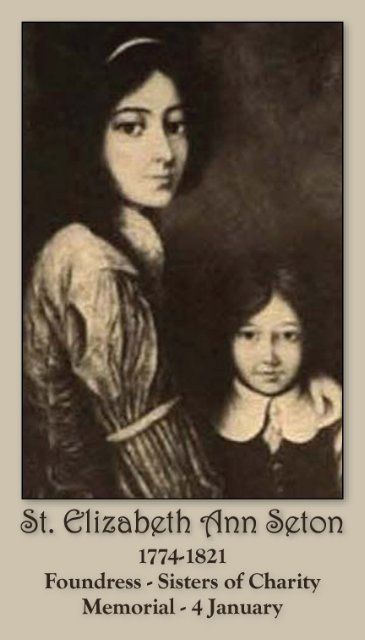
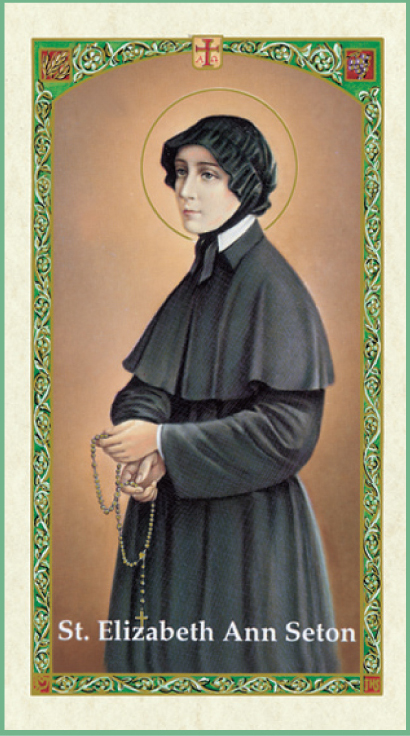
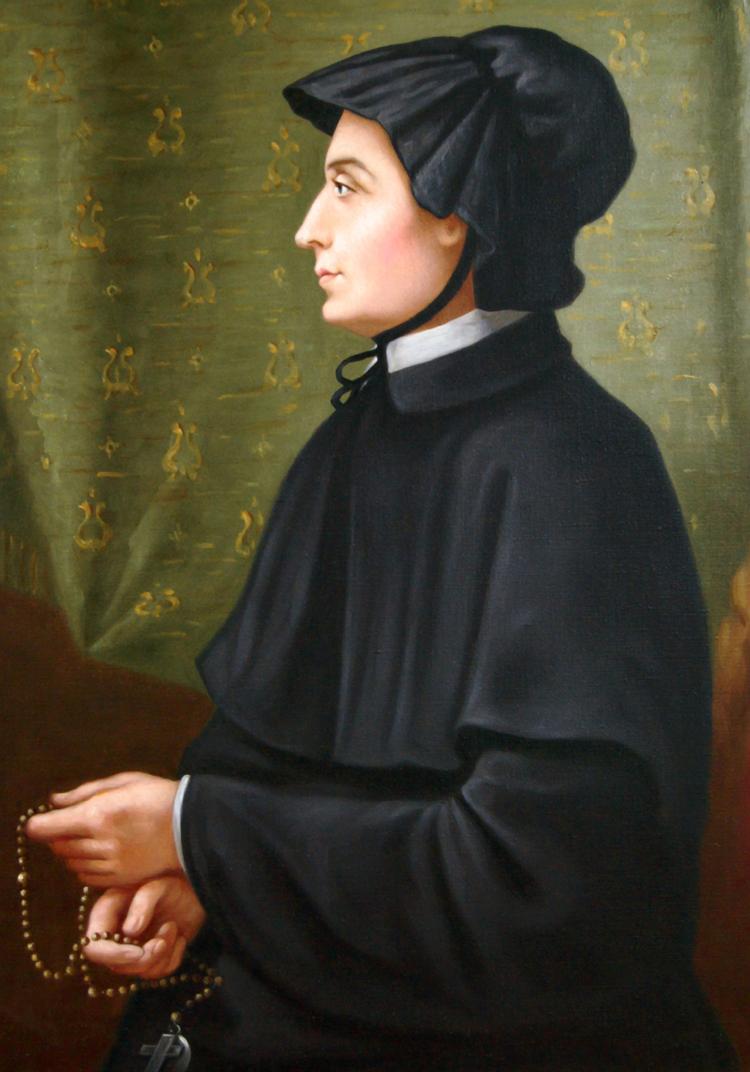
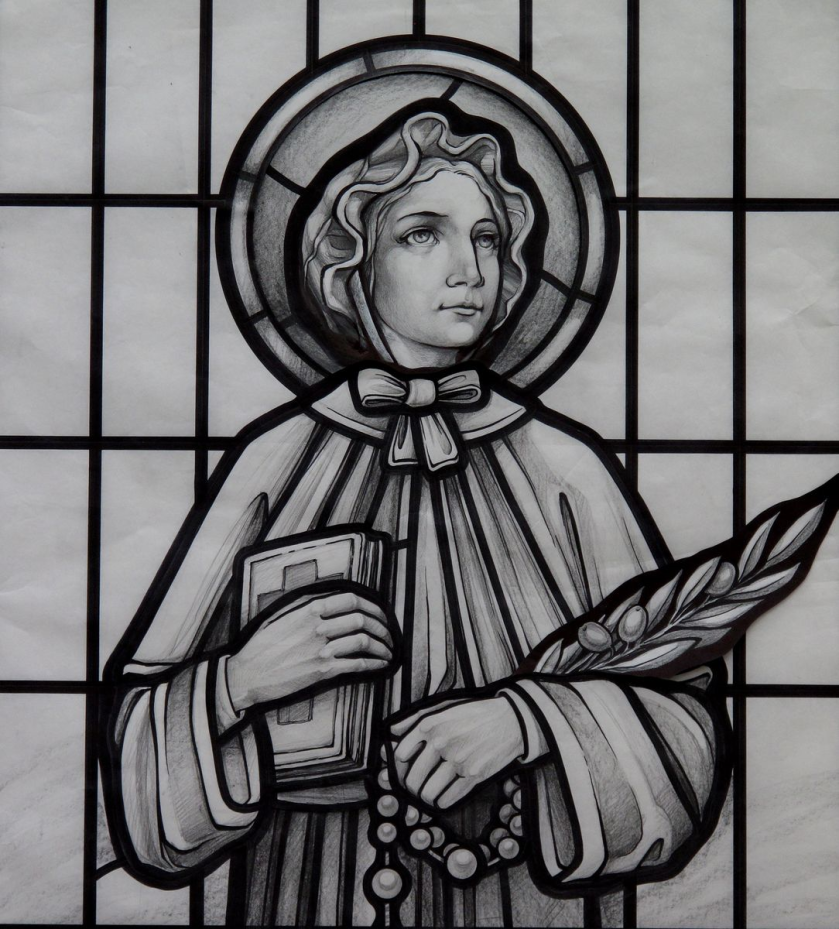
Saint of the Day – 4 January – St Elizabeth Ann Seton (1774-1821) (also known as Mother Seton) Widow and Mother, Religious, Foundress, Teacher, first native-born citizen of the United States to be Canonised on 14 September 1975 by Pope Paul VI.   She was born on 28 August 1774 in New York City, New York, USA as Elizabeth Ann Bayley – 4 January 1821 in Emmitsburg, Maryland of natural causes.  Patronages – • against in-law problems• against the death of children• against the death of parents• Apostleship of the Sea (two of her sons worked on the sea)• opposition of Church authorities• people ridiculed for their piety• Shreveport, Louisiana, Diocese of• widows.   She established the first Catholic girls’ school in the nation in Emmitsburg, Maryland, where she also founded the first American congregation of religious sisters, the Sisters of Charity.

st-elizabeth-ann-setonSeton 1

Mother Seton is one of the keystones of the American Catholic Church.   She founded the first American religious community for women, the Sisters of Charity.   She opened the first American parish school and established the first American Catholic orphanage.   All this she did in the span of 46 years while raising her five children.

Elizabeth Ann Bayley Seton is a true daughter of the American Revolution, born August 28, 1774, just two years before the Declaration of Independence.   By birth and marriage, she was linked to the first families of New York and enjoyed the fruits of high society. Reared a staunch Episcopalian, she learned the value of prayer, Scripture and a nightly examination of conscience.   Her father, Dr Richard Bayley, did not have much use for churches but was a great humanitarian, teaching his daughter to love and serve others.st E A SETON 2

The early deaths of her mother in 1777 and her baby sister in 1778 gave Elizabeth a feel for eternity and the temporariness of the pilgrim life on earth  . Far from being brooding and sullen, she faced each new “holocaust,” as she put it, with hopeful cheerfulness.   At 19, Elizabeth was the belle of New York and married a handsome, wealthy businessman, William Magee Seton.   They had five children before his business failed and he died of tuberculosis.   At 30, Elizabeth was widowed, penniless, with five small children to support.

While in Italy with her dying husband, Elizabeth witnessed Catholicity in action through family friends.   Three basic points led her to become a Catholic:  belief in the Real Presence, devotion to the Blessed Mother and conviction that the Catholic Church led back to the apostles and to Christ.   Many of her family and friends rejected her when she became a Catholic in March 1805.

To support her children, she opened a school in Baltimore.   From the beginning, her group followed the lines of a religious community, which was officially founded in 1809.f607fe8df5569d4f21ff7e7d13d22852--elizabeth-ann-seton-patron-saints (1)4c81c022a8d462572b891dd436c9aea9--elizabeth-ann-seton-catholic-saints

The thousand or more letters of Mother Seton reveal the development of her spiritual life from ordinary goodness to heroic sanctity.   She suffered great trials of sickness, misunderstanding, the death of loved ones (her husband and two young daughters) and the heartache of a wayward son.   She died 4 January 1821 and became the first American-born citizen to be beatified (1963) and then canonised (1975).   She is buried in Emmitsburg, Maryland.

HC9_2010_Eng1:Layout 2setonst e a seton - largeSt E A SETON

Posted in SAINT of the DAY

4 January – Memorials of the Saints

St Elizabeth Ann Seton (Memorial, United States)


St Aedh Dubh
St Aggaeus the Martyr
St Angela of Foligno
St Celsus of Trier
Bl Chiara de Ugarte
St Chroman
St Dafrosa of Acquapendente
St Ferreolus of Uzès
St Gaius of Moesia
St Gregory of Langres
St Hermes of Moesia
St Libentius of Hamburg
Bl Louis de Halles
Bl Manuel Gonzalez Garcia
St Mavilus of Adrumetum
St Neophytos
St Neopista of Rome
St St St Oringa of the Cross
Bl Palumbus of Subiaco
St Pharaildis of Ghent
St Rigobert of Rheims
Bl Roger of Ellant
St Stephen du Bourg
St Theoctistus
Bl Thomas Plumtree

Martyrs of Africa – 7 saints: A group of Christians martyred together in the persecutions of the Arian Vandal king Hunneric. Saint Bede wrote about them. – Aquilinus, Eugene, Geminus, Marcian, Quintus, Theodotus and Tryphon. In 484 in North Africa.

Martyrs of Rome – 3 saints: Three Christians martyred together in the persecutions of Julian the Apostate for refusing to renounce Christianity as ordered. – Benedicta, Priscillianus and Priscus. In 362 in Rome, Italy.

Posted in CATHOLIC DEVOTIONS of the Month, franciscan OFM, MORNING Prayers, QUOTES of the SAINTS, The HOLY NAME, The WORD

May you be Blessed today on the Memorial of the Most Holy Name of Jesus 3 January 2018

May you be Blessed today on the Memorial of the Most Holy Name of Jesus
3 January 2018

The name of Jesus is the glory of preachers

From a sermon by Saint Bernardine of Siena, priest (Sermo 49, De glorioso Nomine Iesu Christi, cap 2: Opera omnia, 4. 505-506) – Prepared by the Spiritual Theology Department of the Pontifical University of the Holy Cross

“The name of Jesus is the glory of preachers because the shining splendour of that name causes His word to be proclaimed and heard.   And how do you think such an immense, sudden and dazzling light of faith came into the world, if not because Jesus was preached?   Was it not through the brilliance and sweet savour of this name that God called us into  His marvelous light?   When we have been enlightened and in that same light behold the light of heaven, rightly may the apostle Paul say to us:  Once you were darkness, but now you are light in the Lord; walk as children of light.

So this name must be proclaimed, that it may shine out and never be suppressed.   But it must not be preached by someone with sullied mind or unclean lipsbut stored up and poured out from a chosen vessel.   That is why our Lord said of Saint Paul:  He is a chosen instrument of mine, the vessel of my choice, to carry my name before the Gentiles and kings and the sons of Israel.   In this chosen vessel there was to be a drink more pleasing than earth ever knew, offered to all mankind for a price they could pay, so that they would be drawn to taste of it.   Poured into other chosen vessels, it would grow and radiate splendour.   For our Lord said:  He is to Carry my name.

When a fire is lit to clear a field, it burns off all the dry and useless weeds and thorns. When the sun rises and darkness is dispelled, robbers, night-prowlers and burglars hide away.   So when Paul’s voice was raised to preach the Gospel to the nations, like a great clap of thunder in the sky, his preaching was a blazing fire carrying all before it.   It was the sun rising in full glory.   Infidelity was consumed by it, false beliefs fled away and the truth appeared like a great candle lighting the whole world with its brilliant flame.

By word of mouth, by letters, by miracles and by the example of his own life, Saint Paul bore the name of Jesus wherever he went.   He praised the name of Jesus at all times but never more than when bearing witness to his faith.   Moreover, the Apostle did indeed carry this name before the Gentiles and kings and the sons of Israel as a light to enlighten all nations.   And this was his cry wherever he journeyed:  The night is passing away, the day is at hand.  Let us then cast off the works of darkness and put on the armour of light;  let us conduct ourselves honourably as in the day.   Paul himself showed forth the burning and shining light set upon a candlestick, everywhere proclaiming Jesus, and Him crucified.

And so the Church, the bride of Christ strengthened by his testimony, rejoices with the psalmist, singing:  0 God, from my youth you have taught me, and I still proclaim your wondrous deeds.   The psalmist exhorts her to do this, as he says, Sing to the Lord and bless his name, proclaim his salvation day after day.   And this salvation is Jesus, her saviour.” (Psalm 96:2)psalm 96 2

Prayer

Father,
you gave St Bernardine a special love
for the holy name of Jesus.
By the help of his prayers,
may we always be alive with the spirit of Your love.
We ask this through our Lord Jesus Christ, Your Son,
who lives and reigns with You and the Holy Spirit,
one God, for ever and ever.

Posted in JESUIT SJ, MORNING Prayers, QUOTES - J R R Tolkien and MORE, QUOTES on FAITH, SAINT of the DAY

Thought for the Day – 3 January – – The Feast of the Most Holy Name of Jesus & The celebration of the Titular Feast of the Society of Jesus

Thought for the Day – 3 January – – The Feast of the Most Holy Name of Jesus & The celebration of the Titular Feast of the Society of Jesus titular-feast-jesuit -3 Jan 2018-NO 2

The Mass for the Feast of the Most Holy Name of Jesus, the titular feast day for the Society of Jesus, was offered today by Pope Francis in the Church of Jesus/Gesu Church in Rome, the Home of the Jesuits.   Today the Church reminds us “to let the centre of … [our] heart be occupied by Christ.”

“This is the restlessness that Peter Favre [Faber] had, man of great desires, another Daniel.   Favre was a “modest, sensible man of profound interior life and gifted with the gift of close relations of friendship with persons of all sorts” (Benedict XVI, Address to Jesuits, April 22, 2006).   However, he was also a restless, uncertain and never satisfied spirit.   Under the guidance of Saint Ignatius he learned to unite his restless but also gentle — I would say exquisite – sensibility with the capacity to take decisions.
He was a man of great desires;  he took charge of his desires, he acknowledged them.   In fact for Favre, it was precisely when difficult things were proposed that his true spirit was manifested which moved him to action (cf. Memoriale, 301).

Authentic faith always implies a profound desire to change the world.   Here is the question we should ask ourselves:   do we also have great visions and dash?   Are we also daring?   Does our dream fly high?   Does zeal devour us (cf. Psalm 69:10)?   Or are we mediocre and content with our laboratory apostolic programs?

Let us remember always:  the strength of the Church does not lie in herself and in her organisational capacity but is hidden in the profound waters of God.   And these waters agitate our desires and desires enlarge the heart.   It is what Saint Augustine says:  pray to desire and desire to enlarge the heart.   In fact it was in his desires that Favre could discern God’s voice.   Without desires one goes nowhere and it is because of this that we must offer our desires to the Lord.   Stated in the Constitutions is that “one’s neighbour is helped, with desires presented to God our Lord” (Constitutions, 638). Pope Francis 3 January 2014authentic faith - pope francis

Jesus said to him, “I am the way and the truth and the life.   No one comes to the Father except through me.”…..John 14:6

LORD JESUS CHRIST, SON OF GOD, HAVE MERCY ON ME A SINNERthe jesus prayer - 3 jan 2018

Posted in CATHOLIC DEVOTIONS of the Month, DOCTORS of the Church, MORNING Prayers, QUOTES of the SAINTS, SAINT of the DAY, The HOLY NAME

Quote/s of the Day – 3 January – The Most Holy Name of Jesus

Quote/s of the Day – 3 January – The Most Holy Name of Jesus

“Are you troubled?
Think but of Jesus – speak but the name of Jesus,
the clouds disperse
and peace descends anew from heaven.
Have you fallen into sin? So that you fear death?
..invoke the name of Jesus
and you will soon feel life returning.
No obduracy of the soul, no weakness,
no coldness of heart can resist this holy name –
there is no heart which will not soften
and open in tears at this holy name.”

St Bernard of Clairvaux – (1090-1153) – Doctor of the Churchare-you-troubled-st-bernard- for the holy name - august 2017

“The Name of Jesus is the glory of preachers
because the shining splendour of that Name
causes His word to be proclaimed and heard.
And how do you think such an immense,
sudden and dazzling light of faith came into the world,
if not because Jesus was preached?
Was it not through the brilliance
and sweet savour of this Name
that God called us into His marvelous light?”

St Bernardine of Siena (1380-1444)the name of jesus - st bernardine of siena - 3 jan 2018

Posted in JESUIT SJ, MORNING Prayers, SAINT of the DAY, The HOLY NAME, The WORD

One Minute Reflection – 3 January – The Feast of the Most Holy Name of Jesus & The celebration of the Titular Feast of the Society of Jesus

One Minute Reflection – 3 January – The Feast of the Most Holy Name of Jesus & The celebration of the Titular Feast of the Society of Jesus

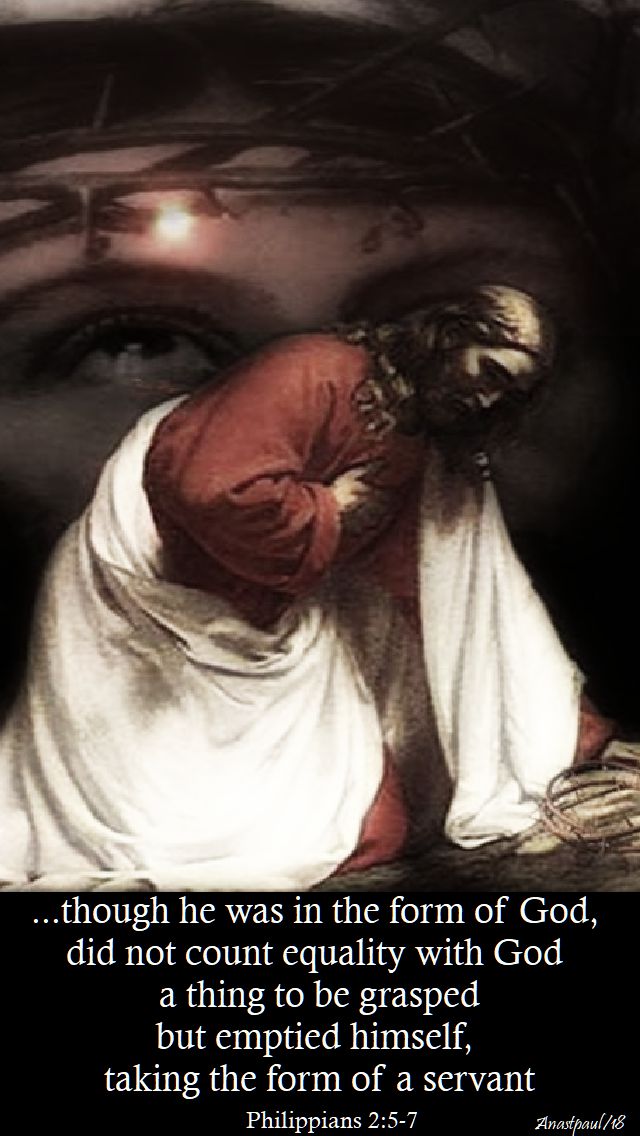
“Have this mind among yourselves, which was in Christ Jesus, who, though he was in the form of God, did not count equality with God a thing to be grasped but emptied himself, taking the form of a servant”…Philippians 2:5-7phil 2 5-7

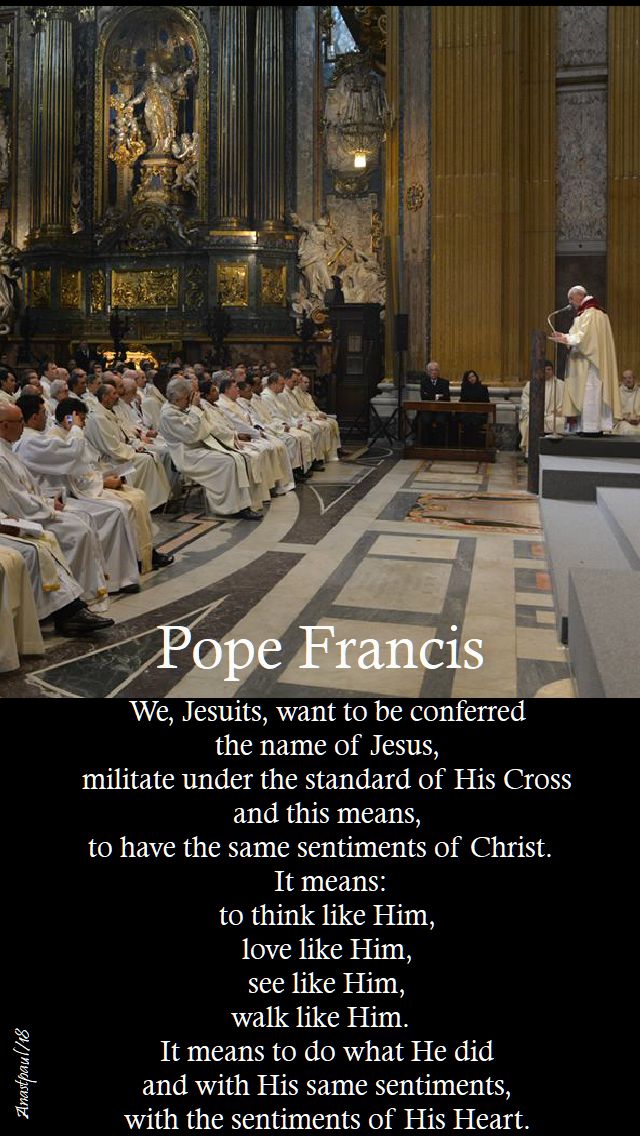
REFLECTION – “We, Jesuits, want to be conferred the name of Jesus, militate under the standard of His Cross and this means, to have the same sentiments of Christ.   It means to think like Him, love like Him, see like Him, walk like Him. It means to do what He did and with His same sentiments, with the sentiments of His Heart. The heart of Christ is the heart of a God who, out of love, “emptied” Himself.   Every one of us Jesuits who follow Jesus should be willing to empty himself.   We are called to this abasement, to be of the “emptied.”   To be men that do not live centred on themselves because the centre of the Society is Christ and His Church.”…Pope Francis (3 January 2014)we jesuits want to be - pope francis on 3 jan 2014 - my image 3 jan 2018

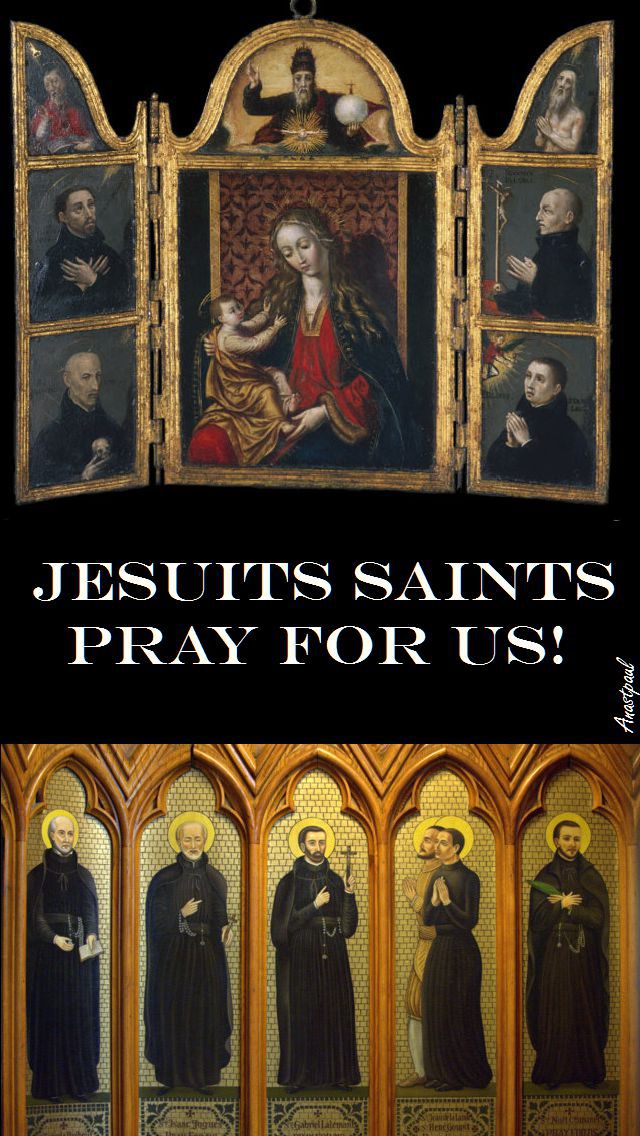
PRAYER – We pray, to the eternal Lord of the universe, through the help of Your glorious Mother, we may live to empty ourselves for the sake of the glory of Your Kingdom and our own eternal happiness with You.   Mary, Mother of God, help us to be messengers of your Son.   Through Jesus Christ our Lord, with the Holy Spirit, in union with God our Father, one God forever and ever.   All you holy Jesuit Saints in heaven, pray for us! Amen.jesuits-saints-pray-for-us- 3 jan 2016

Posted in CATHOLIC DEVOTIONS of the Month, MORNING Prayers, SAINT of the DAY, The HOLY NAME

Our Morning Offering – 3 January – The Feast of the Most Holy Name of Jesus

Our Morning Offering – 3 January – The Feast of the Most Holy Name of Jesus

Jesus, the very thought of Thee
From The Roman Breviary

Jesus, the very thought of Thee
With sweetness fills the breast!
Yet sweeter far Thy face to see
And in Thy presence rest.
No voice can sing,
no heart can frame,
Nor can the memory find,
A sweeter sound than Jesus’ name,
The Saviour of mankind.
O hope of every contrite heart!
0 joy of all the meek!
To those who fall, how kind Thou art!
How good to those who seek!
But what to those who find?
Ah! this nor tongue nor pen can show
The love of Jesus, what it is,
None but His loved ones know.
Jesus! our only hope be Thou,
As Thou our prize shalt be;
In Thee be all our glory now,
And through eternity.
Amenjesus the very thought of thee - roman breviary - 3 jan

Posted in CHRISTMASTIDE!, MORNING Prayers, SAINT of the DAY, The HOLY NAME

3 January – Feast of the Most Holy Name of Jesus

3 January – Feast of the Most Holy Name of Jesus

Today the Church celebrates the optional memorial of the Most Holy Name of Jesus.   The Church reveals to us the wonders of the Incarnate Word by singing the glories of His name.   The name of Jesus means Saviour;  it had been shown in a dream to Joseph together with its meaning and to Our Lady at the annunciation by the Archangel Gabriel.

feast-of-the-holy-name-of-jesus-in-nomine-jesu-omne-genu-flectatur-coelestium-terrestrium-et-infernorum-philippians-2-10033c481cc136ea3897c694b37ca1bc23--names-of-jesus-jesus-is

Devotion to the Holy Name is deeply rooted in the Sacred Scriptures, especially in the Acts of the Apostles.   It was promoted in a special manner by St Bernard, St Bernardine of Siena, St John Capistrano and by the Franciscan Order.   It was extended to the whole Church in 1727 during the pontificate of Innocent XIII.   The month of January has traditionally been dedicated to the Holy Name of Jesus.header - ihs

This feast marks no progress in the development of the Church year.   It merely embellishes the occasion just observed when the Child received the Name Jesus as had been foretold by the angel.   The feast is meant to impress on us Christians the dignity of the Holy Name.   It is a relatively new feast, stemming out of devotional piety. Nevertheless, it is not difficult to find in it some liturgical or ancient Christian dogma. What did a name signify originally?   The name should express the nature of a thing. Thus Adam in paradise gave the animals names in accordance with their being.   Among the Jews God’s name expressed His essence, Yahweh, i.e., I (alone) am who am (and cause all else to be).   The Jews had the highest respect for the name of God, a reverence that finds continuation in the Our Father:  “Hallowed be Thy Name.”

Persons who played prominent roles in the history of salvation often received their names from God Himself.   Adam — man of the earth;   Eve — mother of all the living; Abraham — father of many nations;   Peter — the rock.   The Saviour’s precursor was given the name God assigned him.   According to divine precedent, then, the name of the Redeemer should not be accidental, of human choosing but given by God Himself.   For His name should express His mission.   We read in Sacred Scripture how the angel Gabriel revealed that name to Mary:  “You shall call His name Jesus.”   And to St Joseph the angel not merely revealed the name but explained its meaning:   “You shall call His name Jesus, for He shall save His people from their sins.”   The Messiah should not only be the saviour, but should be called Saviour.   With Jesus, therefore, the name actually tells the purpose of His existence.   This is why we must esteem His name as sacred. Whenever we pronounce it, we ought to bow our heads;  for the very name reminds us of the greatest favor we have ever received, salvation.BOW YOUR HEAD!

Excerpted from The Church’s Year of Grace, Pius Parsch

Posted in JESUIT SJ, SAINT of the DAY, The HOLY NAME

3 January – Feast of the Holy Name, The Titular Feast of the Society of Jesus and Memorials of the Saints

Feast of the Most Holy Name of Jesus (Optional Memorial) – moved to 3 January

The Titular Feast of the Society of Jesus


St Pope Antherus
Bl Arnold Wala
St Athanasius of Cilicia
St Bertilia of Mareuil
St Bertille of Thuringia
St Blitmund of Bobbio
St Constant of Gap
St Cyrinus of Cyzicus
St Daniel Himmerod the Younger
Bl Daniel of Padua
St Eustadius
St Finlugh
St Fintan of Doon
St Florentius of Vienne
St Florentius of Vienne the Martyr
St Genevieve
Bl Gerard Cagnoli
St Gordius of Cappadocia
St Imbenia
St Kuriakose Elias Chavara
St Lucian of Lentini
St Melorius
St Peter of Palestine
St Primus of Cyzicus
St Salvator of Belluno
St Theogenes of Cyzicus
St Theonas
St Theopemptus of Nicomedia
St Wenog
Bl Bl William Vives
St Zosimus of Cilicia

Martyrs of Africa – 12 saints: A group of Christians martyred together in Africa, date unknown, exact location unknown. We know nothing more than their names – Acuta, Candidus, Constantius, Eugenia, Firmus, Hilarinus, Lucida, Martial, Poenica, Possessor, Rogatianus and Statutianus.

Martyrs of Tomi – 7 saints: A group of Christians martyred together, date unknown. We know nothing more than their names – Claudon, Diogenius, Eugene, Eugentus, Pinna, Rhodes and Rhodo. They were martyred at Tomi, Exinius Pontus, Moesia (modern Constanta, Romania).


Posted in DOCTORS of the Church, FATHERS of the Church, MORNING Prayers, QUOTES of the SAINTS, QUOTES on FRIENDSHIP, SAINT of the DAY

Thought for the Day – 2 January – The Memorial of St Basil the Great (329-379) and St Gregory of Nazianzen (330-390) Fathers & Doctors of the Church – On Friendship “We seemed to be two bodies with a single spirit.”

Thought for the Day – 2 January – The Memorial of St Basil the Great (329-379) and St Gregory of Nazianzen (330-390) Fathers & Doctors of the Church – On Friendship “We seemed to be two bodies with a single spirit.”

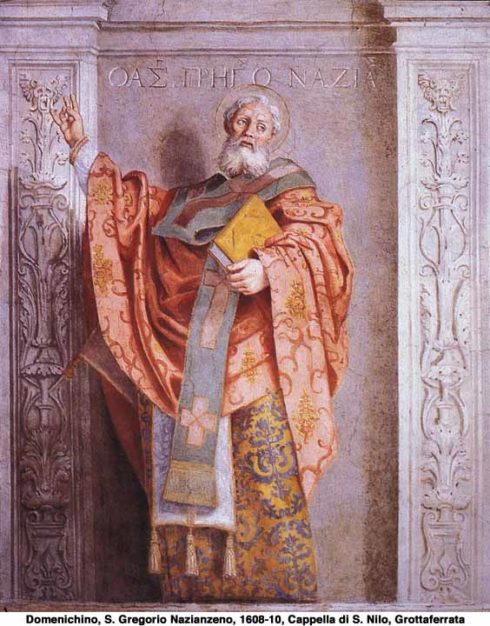
St Gregory of Nazianzen
On 2 January the Roman Catholic Church honours the memory of two friends from an area of what is now Turkey that was called Cappadocia.   These men began their friendship while away at school and later became bishops who were the backbone of Catholic Orthodoxy during a period of doctrinal struggle and confusion.   Gregory presided over the 2nd ecumenical council, held at Constantinople, whose great achievement was the completion of the Nicene-Constantinopolitan Creed that the Catholic Church recites each Sunday and the definition of the divinity of the Holy Spirit. These Cappadocian Fathers, both Fathers and Doctors of the Church, proved to be some of the most influential Christian teachers of all time, honoured by both East and West, Eastern Orthodox and Roman Catholic.   Gregory here shares some memories of their friendship.

“Basil and I were both in Athens.   We had come, like streams of a river, from the same source in our native land, had separated from each other in pursuit of learning and were now united again as if by plan, for God so arranged it.

I was not alone at that time in my regard for my friend, the great Basil.   I knew his irreproachable conduct and the maturity and wisdom of his conversation.   I sought to persuade others, to whom he was less well known, to have the same regard for him. Many fell immediately under his spell, for they had already heard of him by reputation and hearsay.

What was the outcome?   Almost alone of those who had come to Athens to study he was exempted from the customary ceremonies of initiation for he was held in higher honour than his status as a first-year student seemed to warrant.

Such was the prelude to our friendship, the kindling of that flame that was to bind us together.   In this way we began to feel affection for each other.   When, in the course of time, we acknowledged our friendship and recognised that our ambition was a life of true wisdom, we became everything to each other:   we shared the same lodging, the same table, the same desires the same goal.   Our love for each other grew daily warmer and deeper.

The same hope inspired us – the pursuit of learning.   This is an ambition especially subject to envy.   Yet between us there was no envy.   On the contrary, we made capital out of our rivalry.   Our rivalry consisted, not in seeking the first place for oneself but in yielding it to the other, for we each looked on the other’s success as his own.

We seemed to be two bodies with a single spirit.   Though we cannot believe those who claim that everything is contained in everything, yet you must believe that in our case each of us was in the other and with the other.

Our single object and ambition was virtue and a life of hope in the blessings that are to come;  we wanted to withdraw from this world before we departed from it.   With this end in view we ordered our lives and all our actions.   We followed the guidance of God’s law and spurred each other on to virtue.   If it is not too boastful to say, we found in each other a standard and rule for discerning right from wrong.

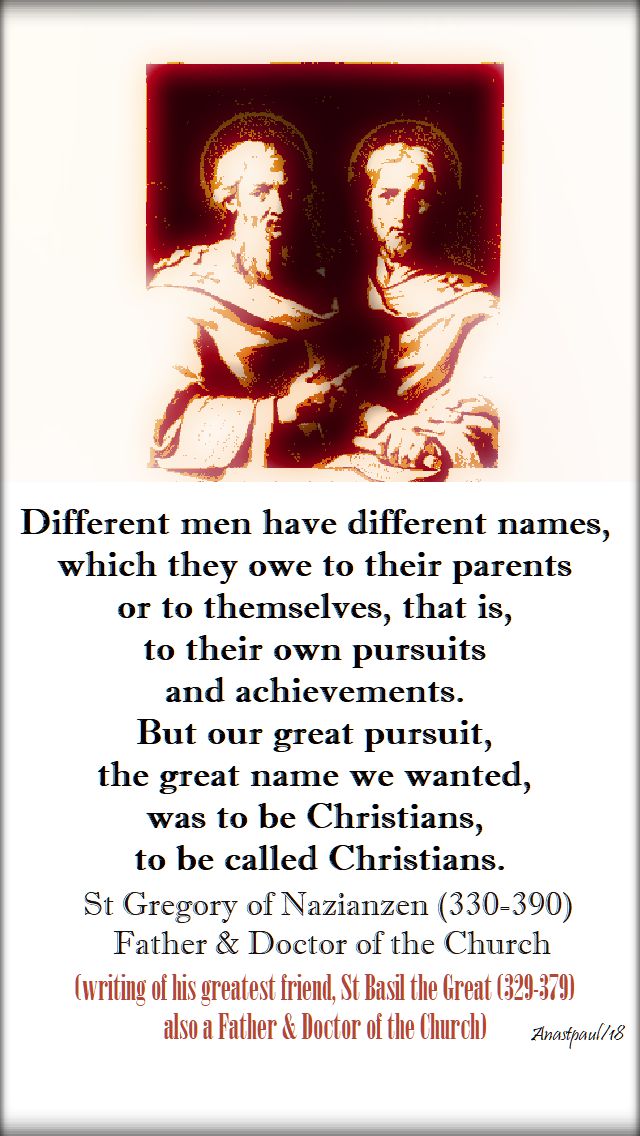
Different men have different names, which they owe to their parents or to themselves, that is, to their own pursuits and achievements.   But our great pursuit, the great name we wanted, was to be Christians, to be called Christians.”

Learning of these two great Doctors of the Church, St Basil the Great and St Gregory of Nazianzen and their lifelong friendship, their collaboration, most especially against the battle against Arianism, cannot help but call to our minds a similar and immensely brilliant collaboration and personal friendship, which yielded endless fruit for the life of the Church.

Sts Basil and Gregory Pray for us!   St John Paul, Pray for us!   Beloved Papa Benedict continue to keep us all in your prayers.   Pray that our friendships may be as Godly as yours was!st basil and st gregory - pray for us - 2 jan 2018

Posted in DEVOTIO, DOCTORS of the Church, FATHERS of the Church, MARIAN QUOTES, MORNING Prayers, QUOTES of the SAINTS, QUOTES on ABORTION, QUOTES on CHARITY, SAINT of the DAY

Quote/s of the Day – 2 January – The Memorial of St Basil the Great (329-379) and St Gregory of Nazianzen (330-390) Fathers & Doctors of the Church

Quote/s of the Day – 2 January – The Memorial of St Basil the Great (329-379) and St Gregory of Nazianzen (330-390) Fathers & Doctors of the Church


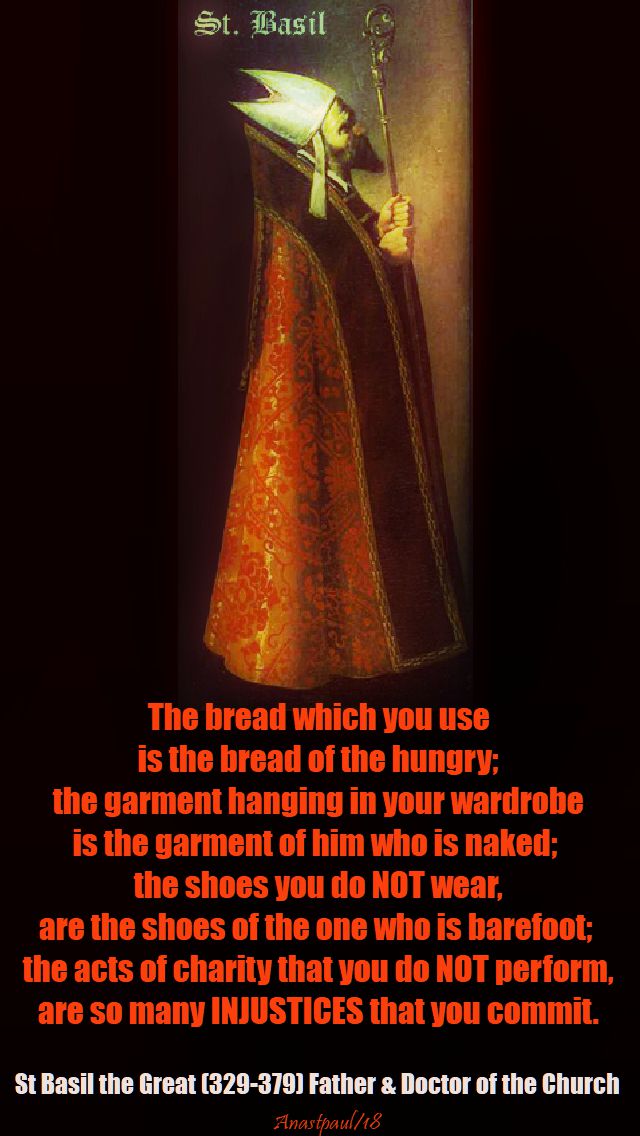
“The bread which you use
is the bread of the hungry;
the garment hanging in your wardrobe
is the garment of him who is naked;
the shoes you do NOT wear,
are the shoes of the one who is barefoot;
the acts of charity that you do NOT perform,
are so many INJUSTICES that you commit.”the bread whioch you use - st basil the great - 2 jan 2018

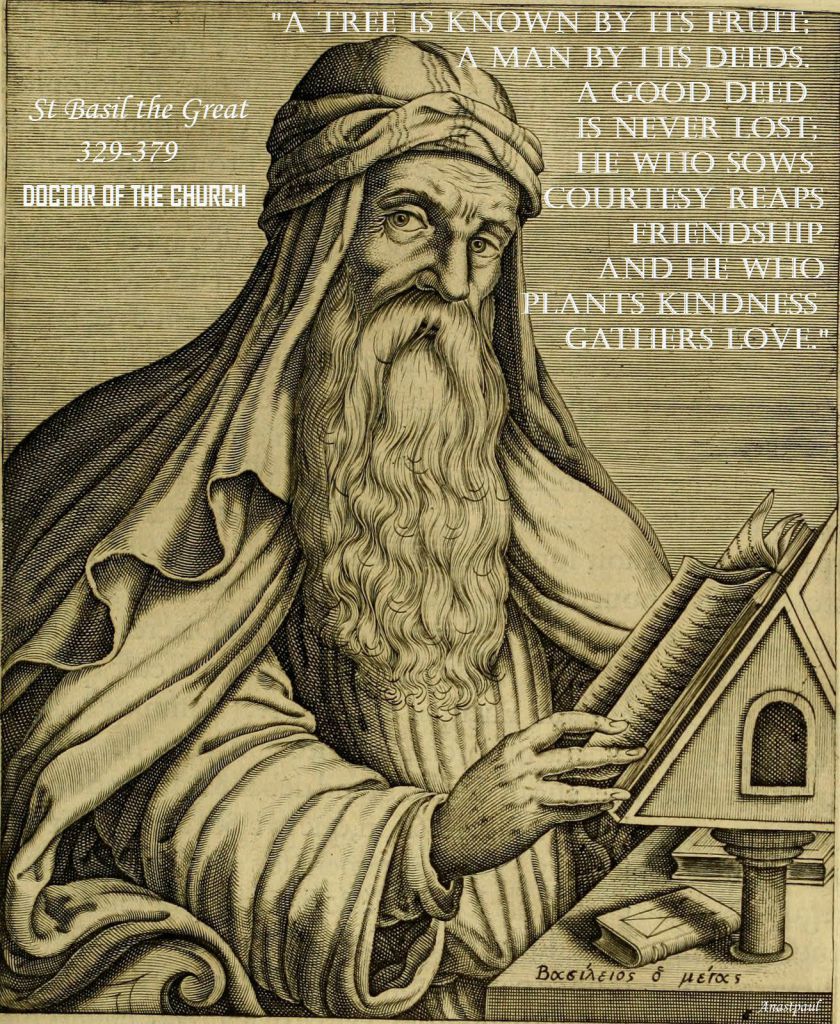
“A tree is known by its fruit;
a man by his deeds.
A good deed is never lost;
he who sows courtesy reaps friendship
and he who plants kindness gathers love.”

St Basil the Great (329-379) Father & Doctor of the Churcha-tree-is-known. - st basil the great - 2016

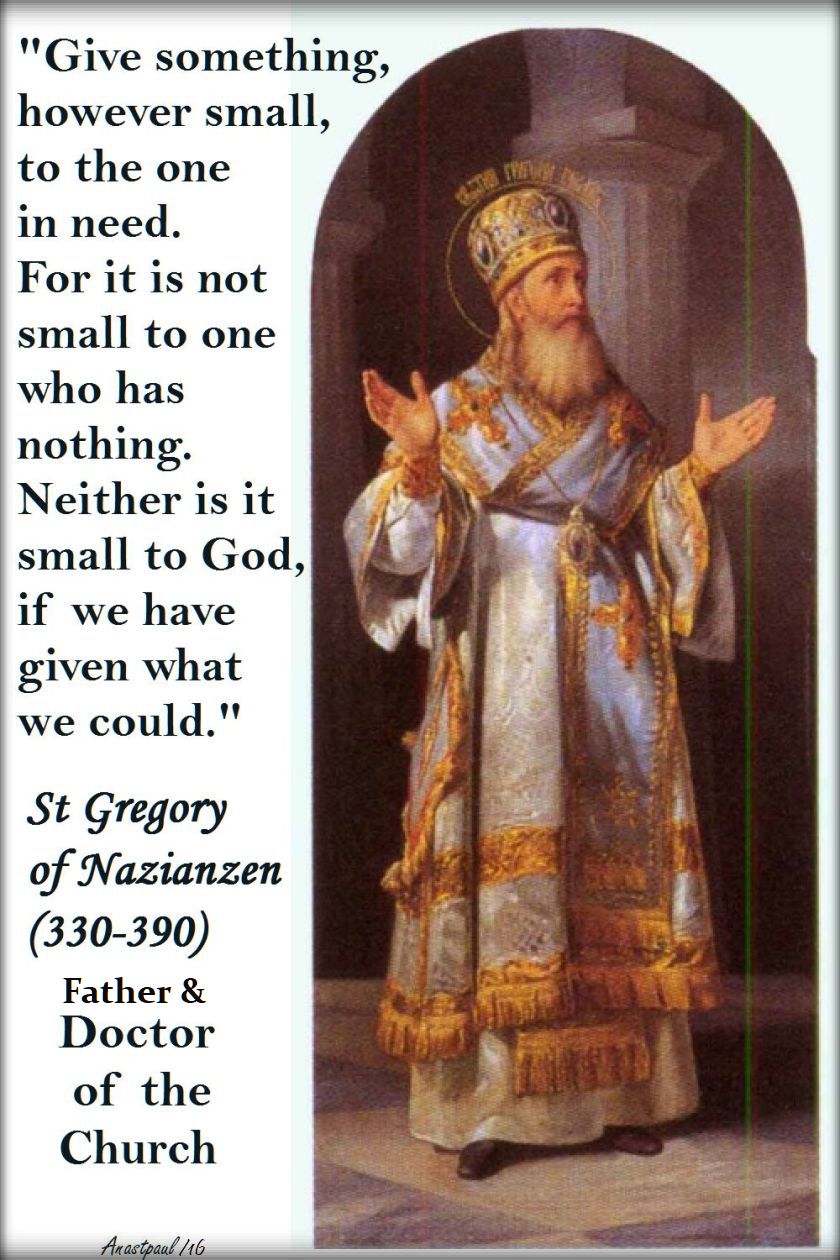
“Give something, however small,
to the one in need.
For it is not small to one who has nothing.
Neither is it small to God,
if we have given what we could.”give-something however small - st gregory of nazianzen - 2016

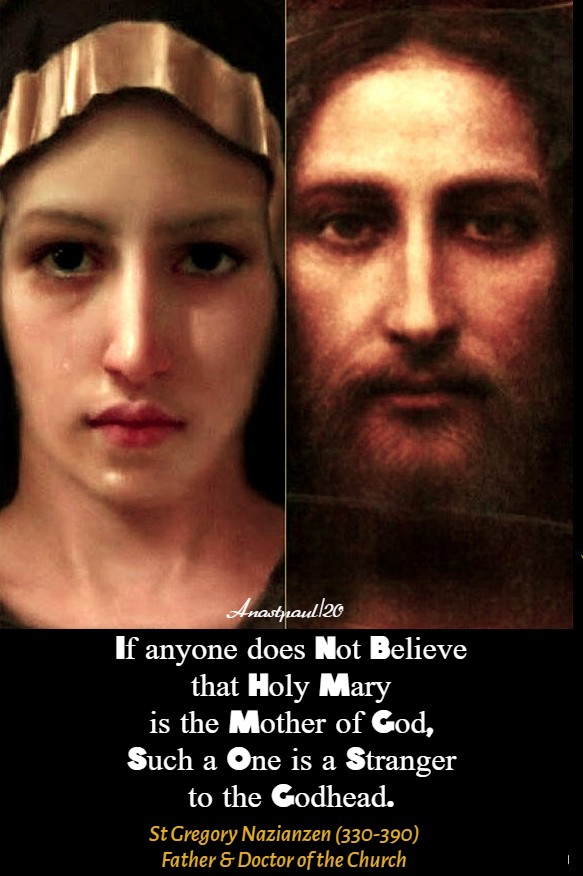
“If anyone does not believe that Holy Mary
is the Mother of God,
such a one is a stranger
to the Godhead.”

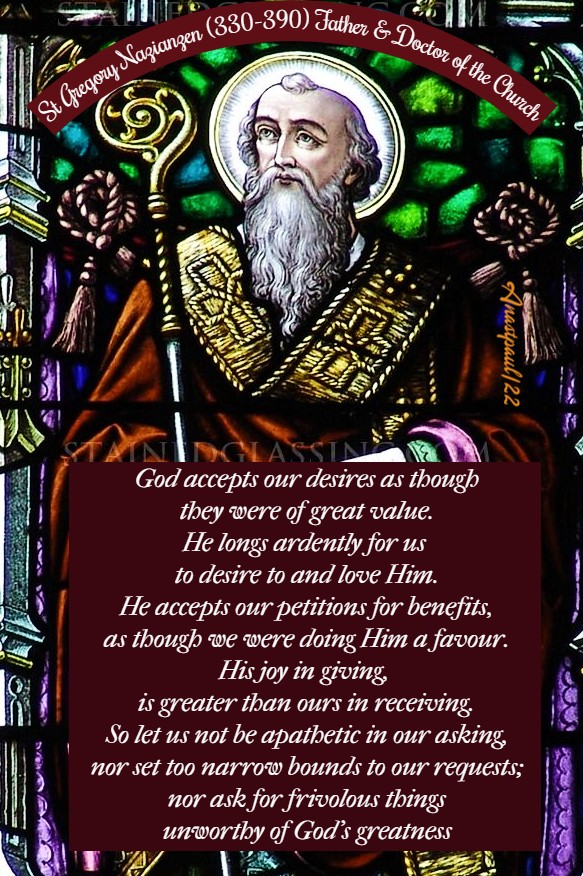
God accepts our desires as though
they were of great value.
He longs ardently for us
to desire to and love Him.
He accepts our petitions for benefits,
as though we were doing Him a favour.
His joy in giving,
is greater than ours in receiving.
So let us not be apathetic in our asking,
nor set too narrow bounds to our requests;
nor ask for frivolous things
unworthy of God’s greatness.

St Gregory Nazianzen (330-390)
Father & Doctor of the Church

Posted in DOCTORS of the Church, FATHERS of the Church, MORNING Prayers, QUOTES of the SAINTS, The WORD

One Minute Reflection – 2 January – The Memorial of St Basil the Great (329-379) and St Gregory of Nazianzen (330-390) Fathers & Doctors of the Church

One Minute Reflection – 2 January – The Memorial of St Basil the Great (329-379) and St Gregory of Nazianzen (330-390) Fathers & Doctors of the Church

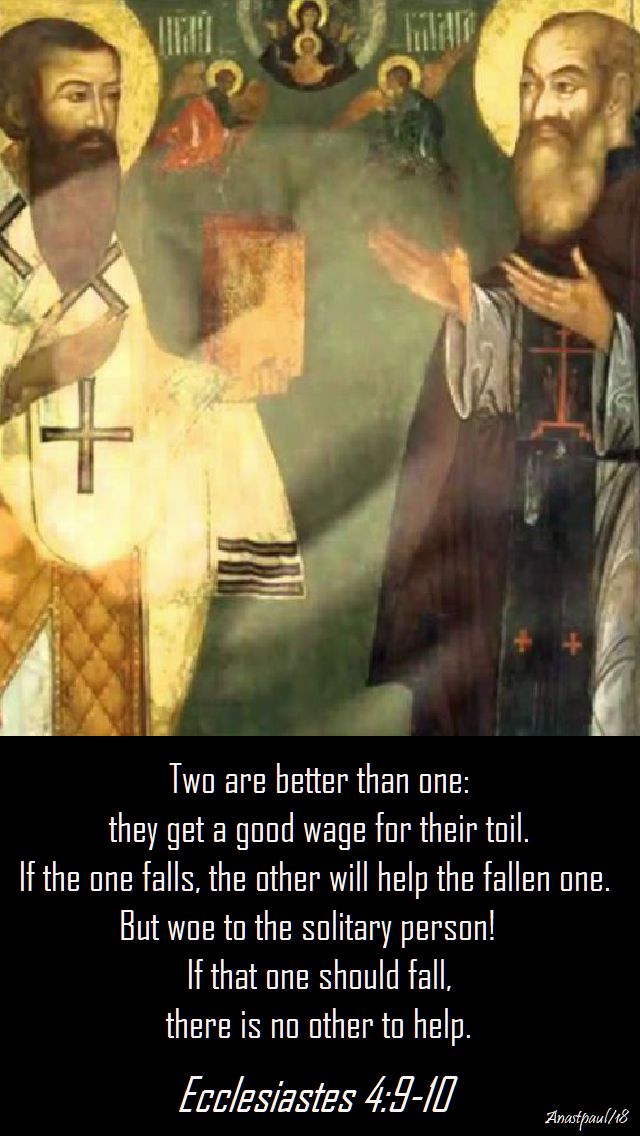
Two are better than one: they get a good wage for their toil.
If the one falls, the other will help the fallen one.
But woe to the solitary person!
If that one should fall, there is no other to help…Ecclesiastes 4:9-10ecc 4 - 9-10

REFLECTION – “Different men have different names, which they owe to their parents or to themselves, that is, to their own pursuits and achievements. But our great pursuit, the great name we wanted, was to be Christians, to be called Christians.”…St Gregory of Nazianzen (330-390) (from his writings on his friendship with St Basil).different men - st gregory of nazianzen - 2 jan 2018

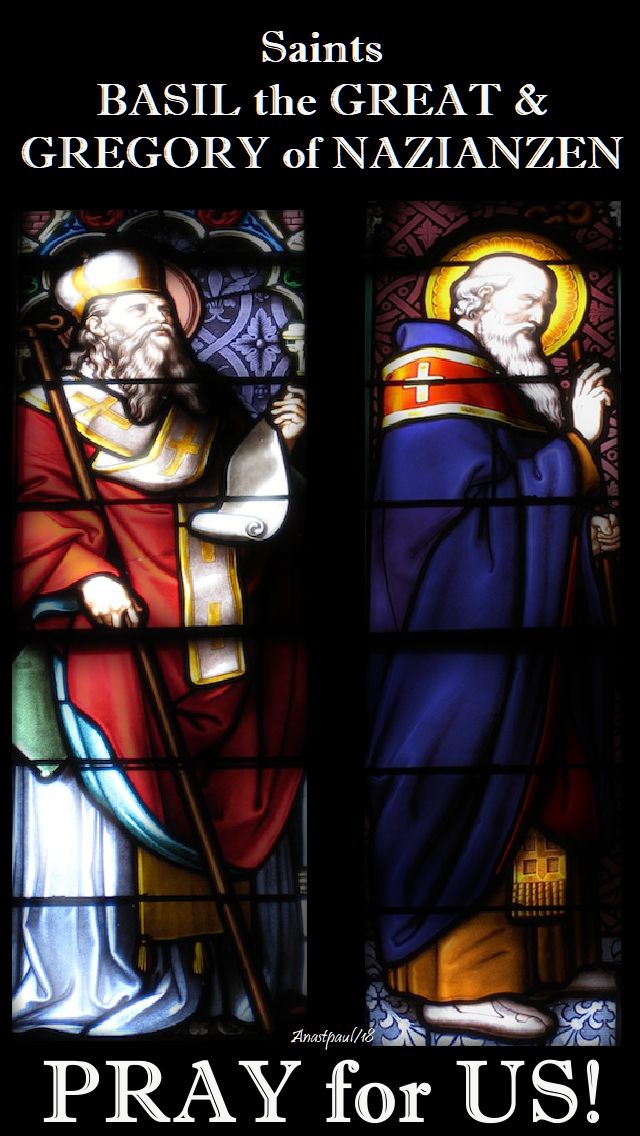
PRAYER – God our Father, You enriched Your Church and gave examples for us to follow in the life and teachings of Sts Basil and Gregory. Grant that, learning Your truth with humility, we may practise it in faith and love. Sts Basil and Gregory, pray for our beloved Church, pray for all Catholic Christians, amen.sts basil and gregory - pray for us - 2 jan 2018

Posted in DOCTORS of the Church, FATHERS of the Church, PRAYERS of the SAINTS, SAINT of the DAY

Our Morning Offering – 2 January – The Memorial of St Basil the Great (329-379) and St Gregory of Nazianzen (330-390)

Our Morning Offering – 2 January – The Memorial of St Basil the Great (329-379) and St Gregory of Nazianzen (330-390)

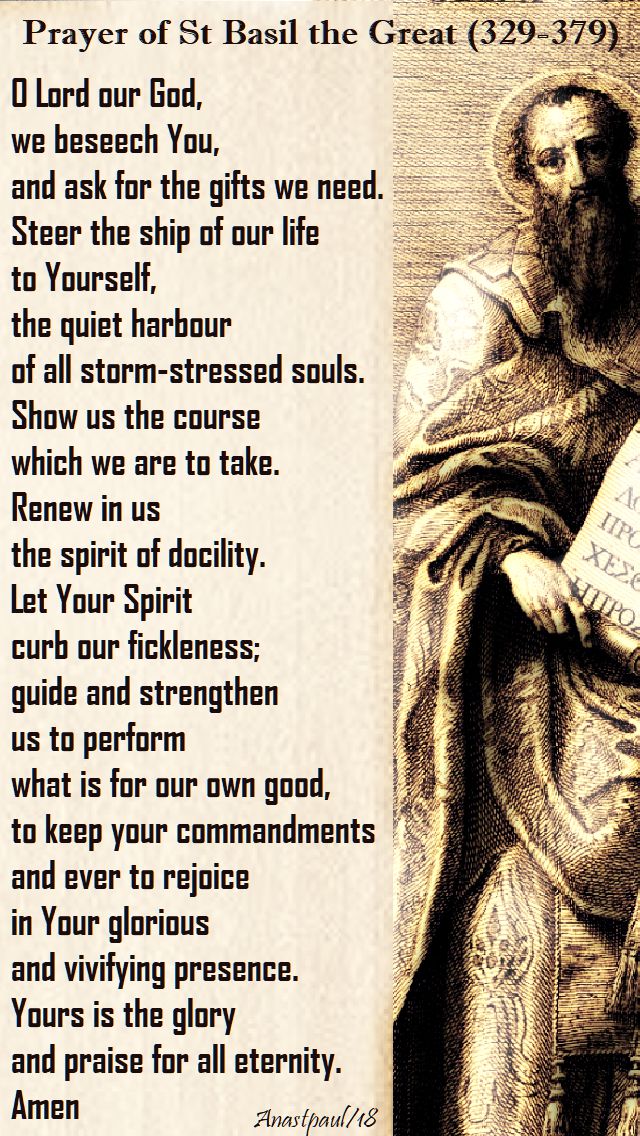
Prayer of St Basil the Great (329-379)

O Lord our God,
we beseech You,
and ask for the gifts we need.
Steer the ship of our life to Yourself,
the quiet harbour of all storm-stressed souls.
Show us the course which we are to take.
Renew in us the spirit of docility.
Let Your Spirit curb our fickleness;
guide and strengthen us to perform
what is for our own good,
to keep your commandments
and ever to rejoice in Your glorious
and vivifying presence.
Yours is the glory and praise for all eternity.
Amenprayer of st basil the great - 2 jan 2018

Posted in DOCTORS of the Church, FATHERS of the Church, QUOTES of the SAINTS, SAINT of the DAY

Saint/s of the Day – 2 January – St Basil the Great (329-379) and St Gregory of Nazianzen (330-390) Fathers and Doctors of the Church

Saint/s of the Day – 2 January – St Basil the Great (329-379) and St Gregory of Nazianzen (330-390) Fathers and Doctors of the Church – two bodies one spirit!

Great-Eastern-Fathers-e1480804176965
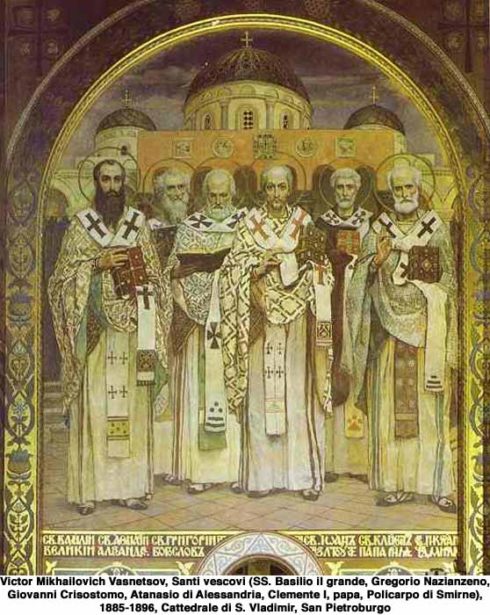
L to R: St. Basil, St. Gregory of Nazianzus, St. John Chrysostom, Painting (Icon) by Viktor Vasnetsov

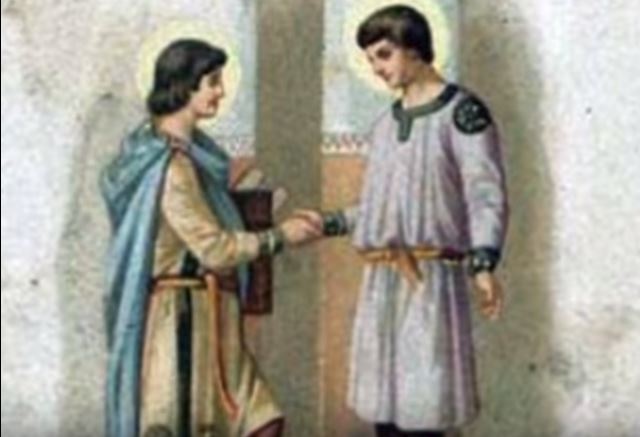
st gregory and st basil my snip

St Basil was born in 329 at Caesarea, Asia Minor (modern Turkey) and he died on 1 January 379 at Caesarea, Asia Minor (modern Turkey) of natural causes.   He is known as the Father of Eastern Monasticism, was a Monk, Bishop, Confessor, Theologian, Reformer, Apostle of Charity, Lawyer, Teacher, Writer and Doctor of the Church.   Patronages – Russia, Cappadocia, Hospital administrators, Reformers, Monks, Education, Exorcism, Liturgists.

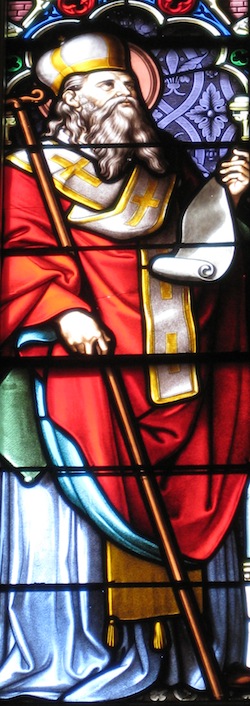
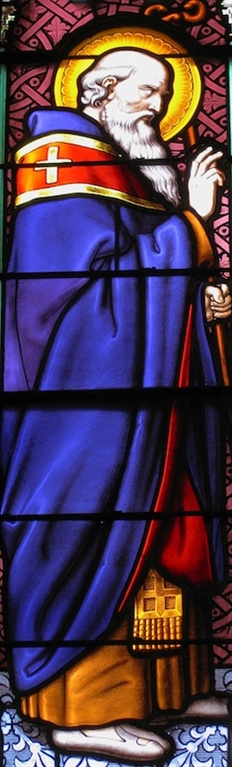
basil_the_great__basilica_window_

St Gregory was born in 330 at Arianzus, Cappadocia, Asia Minor and he died on 25 January 390 of natural causes.  He is known as “The Theologian” was a Monk, Bishop, Confessor, Theologian (because of his outstanding teaching and eloquence), Orator, Rhetorician, Philosopher, Writer, Poet, Reformer and Doctor of the Church.   Patronages – • for harvests• poets.gregory_nazianzen__basilica_window_

St Basil the Great, was born of a noble Christian family at Caesarea in Cappadocia in 330.  His was a pious family – his mother, father and four of his nine siblings were canonised, including Saint Gregory of Nyssa.    He was the Grandson of Saint Macrina the Elder.   As a youth Basil was noted for organising famine relief and for working in the kitchens himself, quite unusual for a young noble.   He studied in Constantinople and Athens with his friend Saint Gregory Nazianus.   He then ran a school of oratory and law in Caesarea. Basil was so successful, so sought after as a speaker, that he was tempted by pride.   His life changed radically after he encountered Eustathius of Sebaste, a charismatic bishop and ascetic.   Abandoning his legal and teaching career, Basil devoted his life to God.   A letter described his spiritual awakening:
“I had wasted much time on follies and spent nearly all of my youth in vain labors, and devotion to the teachings of a wisdom that God had made foolish.   Suddenly, I awoke as out of a deep sleep.   I beheld the wonderful light of the Gospel truth and I recognised the nothingness of the wisdom of the princes of this world.”St. Basil the Great

He sold all that he had, gave away the money and became a priest and monk together with his best friend St Gregory of Nazianzen.

He founded monasteries and drew up rules for monks living in the desert;  he is considered as key to the founding of eastern monasticism as Saint Benedict of Nursia was to the west.   He became the Bishop and Archbishop of Caesarea.   Conducted Mass and preached to the crowds twice each day.   He fought Arianism and assisted St Gregory at the council of Constantinople, which completed the Nicene Creed.   He is considered a Father of the Church and is one of the original four Doctors of the Eastern Church.

St Gregory of Nazianzen was the best friend of St Basil the Great.   After studying together in Athens, they returned to their native Cappadocia (now Eastern Turkey) to serve the Lord.   It was during the time of the Arian heresy which contested the full divinity of Christ and orthodox bishops were sorely needed who could teach the true doctrine of the Church with clarity and depth.   Gregory, who admirably met these requirements, was made the bishop of the small town of Nazianzen but later was elevated to the highest ecclesiastical see after Rome, becoming the Patriarch of Constantinople.   As such, he presided over the First Ecumenical Council of Constantinople in 381 which completed the creed that we commonly call the Nicene Creed, recited in Sunday worship by Catholics and Orthodox Christians.

St Gregory’s teaching was so profound and accurate that he is one of the few teachers in the history of the Church known as “the theologian.”St.-Gregory-of-Nazianzus-e1480804203636

Basil and Gregory were defining figures as the early Church which sought to figure out just how to describe Jesus as fully human and fully divine.   They helped the Church articulate this mystery and refute persistent strains of thought that would emphasise one aspect of Jesus’ nature over another.   Both were largely responsible for safeguarding the faith that has guided the Church for thousands of years.   Their doctrinal contributions are codified in the Nicene Creed we recite at Mass.

Both Basil and Gregory were declared doctors of the Church, a title given to 36 saints who are known for elucidating the faith by their words or example.   Their relics rest in the reliquary chapel in the Basilica, and their images are captured in stained glass windows there.

Sts. Basil the Great and Gregory Nazianzen, friends and scholars who defended the faith, pray for us!

Posted in SAINT of the DAY

2 January – Memorials of the Saints

St Basil the Great (Memorial)  (329-379) Doctor of the Church
St Gregory of Nazianzen (330-390) Doctor of the Church (Memorial) – https://www.youtube.com/watch?v=lwe8voh3H_4

St Adelard of Corbie
Bl Airaldus of Maurienne
St Asclepius of Limoges
St Aspasius of Auch
St Blidulf of Bobbio
St Gaspare Bufalo
Bl Guillaume Répin
St Hortulana of Assisi
St Isidore of Antioch
St Isidore of Nitria
St Laurent Bâtard
St Macarius the Younger
St Maximus of Vienne
Bl Odino of Rot
St Paracodius of Vienne
St Seraphim of Sarov
St Seiriol
Bl Stephana de Quinzanis
St Telesphorus, Pope
St Theodota
St Theopistus
St Vincentian of Tulle

Many Martyrs Who Suffered in Rome: There were many martyrs who suffered in the persecutions of Diocletian for refusing to surrender the holy books. Though we know these atrocities occured, we do not know the names of the saints and we honour them as a group. c 303 in Rome, Italy.

Martyrs of Antioch – 5 saints: A group of Christian soldiers martyred together for their faith. We know the names of five – Albanus, Macarius, Possessor, Starus and Stratonicus. They were born in Greece and were martyred in Antioch (modern Antakya, Turkey).

Many Martyrs of Britain: The Christians of Britain appear to have escaped unharmed in the earlier persecutions which afflicted the Church but the cruel edicts of Diocletian were enforced in every corner of the empire and the faithful inhabitants of this land, whether native Britons or Roman colonists, were called upon to furnish their full number of holy Martyrs and Confessors. The names of few are on record but the British historian, Saint Gildas, after relating the martyrdom of Saint Alban, tells us that many others were seized, some put to the most unheard-of tortures and others immediately executed, while not a few hid themselves in forests and deserts and the caves of the earth, where they endured a prolonged death until God called them to their reward. The same writer attributes it to the subsequent invasion of the English, then a pagan people, that the recollection of the places, sanctified by these martyrdoms, has been lost and so little honour paid to their memory . It may be added that, according to one tradition, a thousand of these Christians were overtaken in their flight near Lichfield and cruelly massacred and that the name of Lichfield, or Field of the Dead, is derived from them.

Martyrs of Ethiopia – 3 saints: A group of Christians martyred together for their faith. We know the names of three – Auriga, Claudia and Rutile.

Martyrs of Jerusalem – 2 saints: A group of Christians martyred together for their faith. We know the names of two – Stephen and Vitalis.

Martyrs of Lichfield: Many Christians suffered at Lichfield (aka Lyke-field, meaning field of dead bodies), England in the persecutions of Diocletian. Though we know these atrocities occured, we do not know the names of the saints, and we honour them as a group. Their martyrdom occurred in 304 at Lichfield, England.

Martyrs of Piacenza: A group of Christians who died together for their faith in the persecutions of Diocletian. No details about them have survived. They were martyred on the site of church of Madonna di Campagna, Piacenza, Italy.

Martyrs of Puy – 4 saints: Missionaries, sent by Saint Fronto of Périgueux to the area of Puy, France. Tortured and martyred by local pagans. We know the names – Frontasius, Severinus, Severian and Silanus. They were beheaded in Puy (modern Puy-en-Velay), France and buried together in the church of Notre Dame, Puy-en-Velay by Saint Fronto, their bodies laid out to form a cross.

Martyrs of Syrmium – 7 saints: Group of Christians martyred together, date unknown. We know the names of seven – Acutus, Artaxus, Eugenda, Maximianus, Timothy, Tobias and Vitus – but very little else. This occurred in the 3rd or 4th century at Syrmium, Pannonia (modern Sremska Mitrovica, Serbia).

Martyrs of Tomi – 3 saints: Three brothers, all Christians, all soldiers in the imperial Roman army, and all three martyred in the persecutions of emperor Licinius Licinianus. We know their names – Argeus, Marcellinus and Narcissus – but little else.
They were martyred in 320 at Tomi, Exinius Pontus, Moesia (modern Constanta, Romania).

Posted in CHRISTMASTIDE!, MORNING Prayers, NOTES to Followers, The WORD

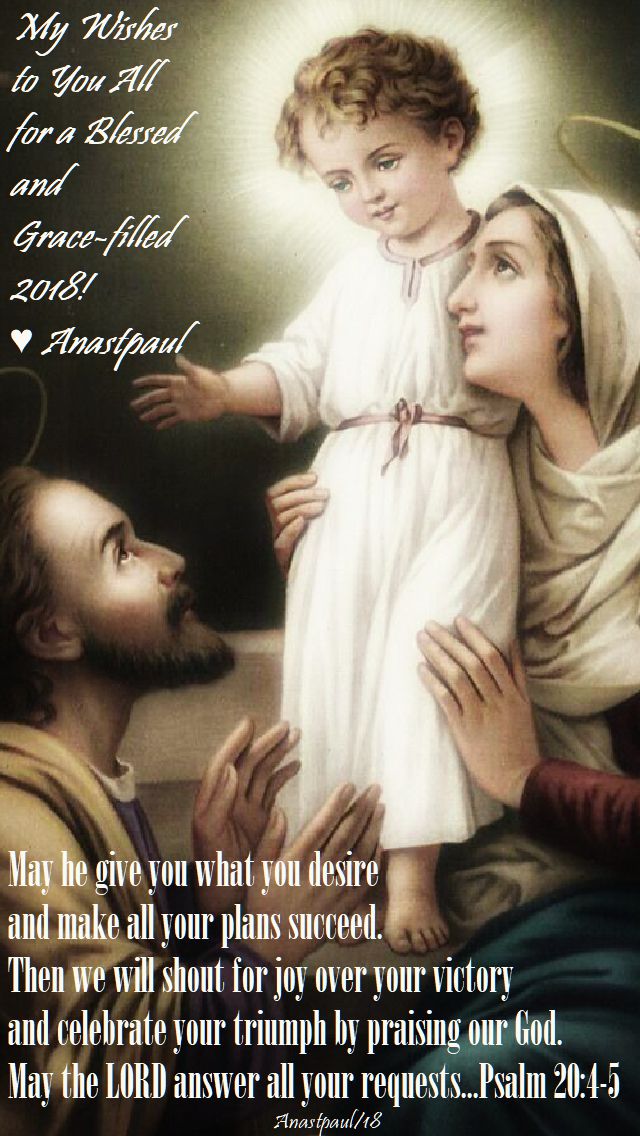
Wishes for a Happy and Holy 2018!

My Wishes to You All
for a Blessed and Grace-filled 2018

May he give you what you desire
and make all your plans succeed.
Then we will shout for joy over your victory
and celebrate your triumph by praising our God.
May the LORD answer all your requests...Psalm 20:4-5

new year wishes 1 jan 2018

Posted in CATHOLIC Quotes, CHRISTMASTIDE!, DOCTORS of the Church, FEASTS and SOLEMNITIES, MARIAN PRAYERS, MARIAN QUOTES, MARIAN TITLES, MORNING Prayers, PRAYERS of the SAINTS, SAINT of the DAY, The BLESSED VIRGIN MARY

Thought for the Day – 1 January 2018 – The Solemnity of Mary, Mother of God and the Octave Day of the Nativity of Our Lord

Thought for the Day – 1 January 2018 – The Solemnity of Mary, Mother of God and the Octave Day of the Nativity of Our Lord

Reflect on this.
Jesus, Who is God, is the only natural-born son who chose His mother.
He had a plan for her life and she accepted it with her fiat, her yes given to the Archangel Gabriel at the Annunciation.
For that we are eternally grateful and indebted to Mary, who was given to us to be our mother by her Son from the Cross.

And if anyone ever suggests to you that you love Mary too much, answer,
“Oh no, I could not possibly love Mary too much
because I could never love her as much as she is loved by her son!”

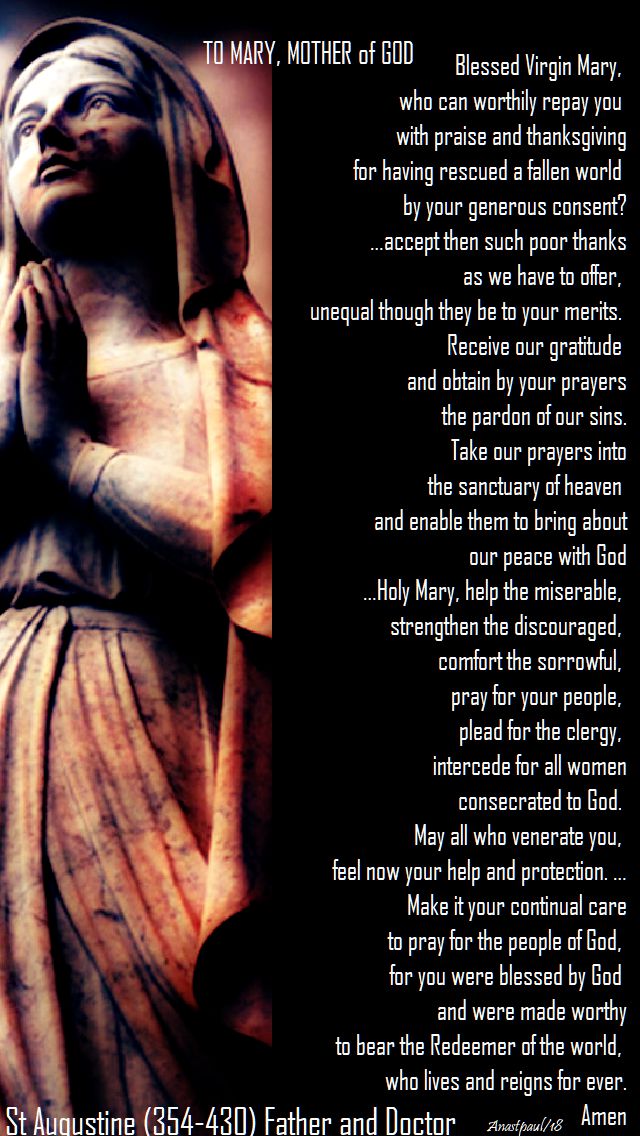
Blessed Virgin Mary,
who can worthily repay you
with praise and thanksgiving
for having rescued a fallen world
by your generous consent?
…accept then such poor thanks as we have to offer,
unequal though they be to your merits.
Receive our gratitude
and obtain by your prayers the pardon of our sins.
Take our prayers into the sanctuary of heaven
and enable them to bring about our peace with God
…Holy Mary, help the miserable,
strengthen the discouraged,
comfort the sorrowful,
pray for your people,
plead for the clergy,
intercede for all women consecrated to God.
May all who venerate you,
feel now your help and protection. …
Make it your continual care to pray for the people of God,
for you were blessed by God
and were made worthy to bear the Redeemer of the world,
who lives and reigns for ever. Amen

St Augustine (354-430) Father and Doctorto mary mother of god - st augustine - 1 jan 2018

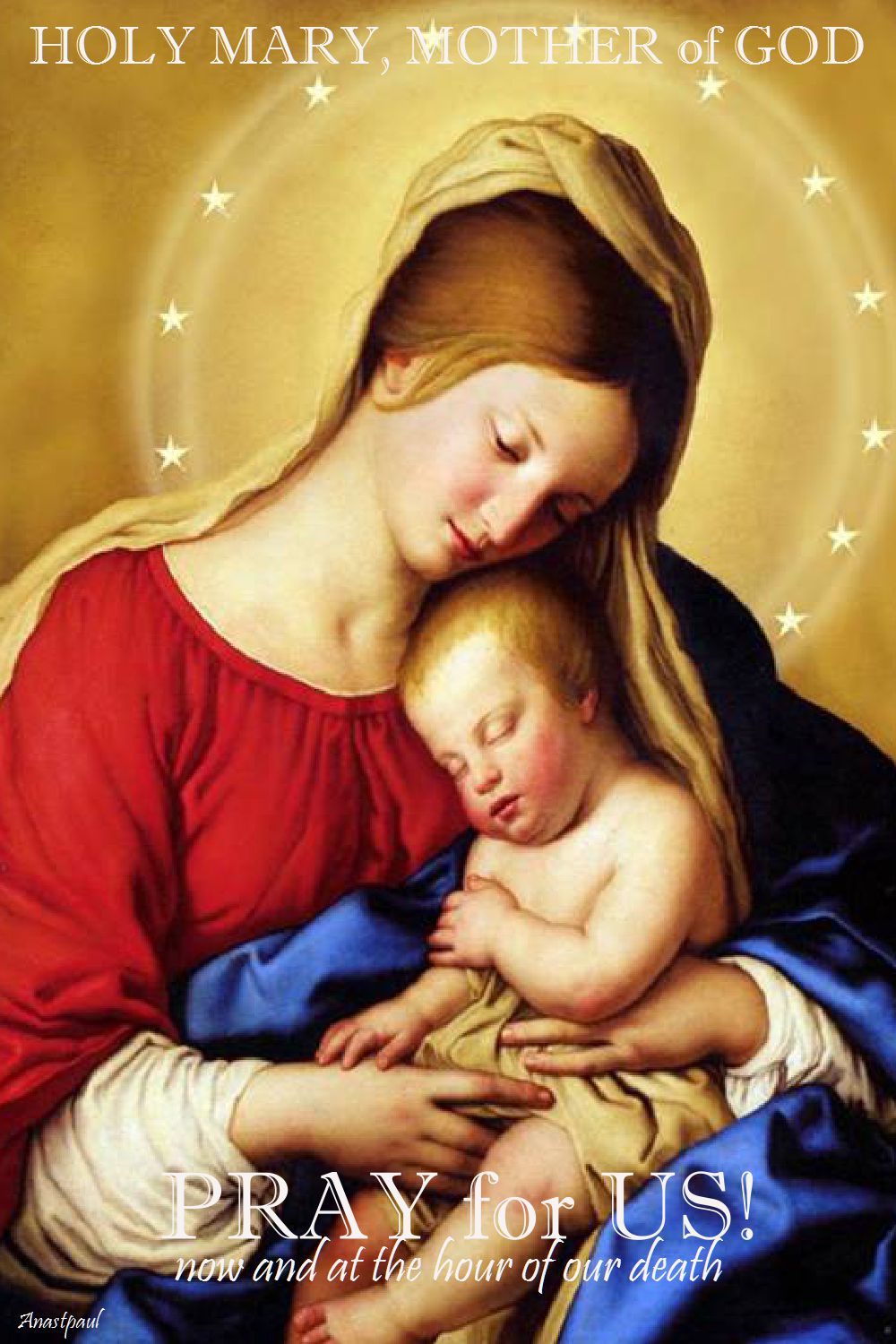
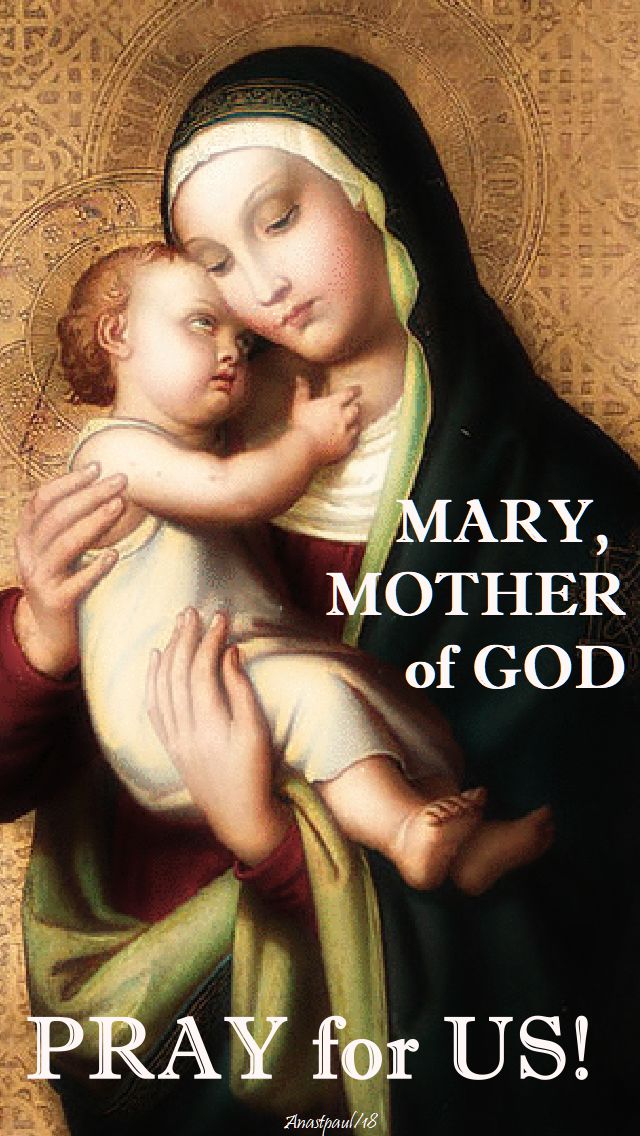
Mary, Mother of God, pray for us!HOLY MARY MOTHER OF GOD - PRAY FOR US

Posted in CHRISTMASTIDE!, DOCTORS of the Church, DOGMA, FATHERS of the Church, FEASTS and SOLEMNITIES, MARIAN QUOTES, MARIAN TITLES, MORNING Prayers, QUOTES of the SAINTS, SAINT of the DAY, The BLESSED VIRGIN MARY

Quote/s of the Day – 1 January 2018 – The Solemnity of Mary, Mother of God and the Octave Day of the Nativity of Our Lord

Quote/s of the Day – 1 January 2018 – The Solemnity of Mary, Mother of God and the Octave Day of the Nativity of Our Lord

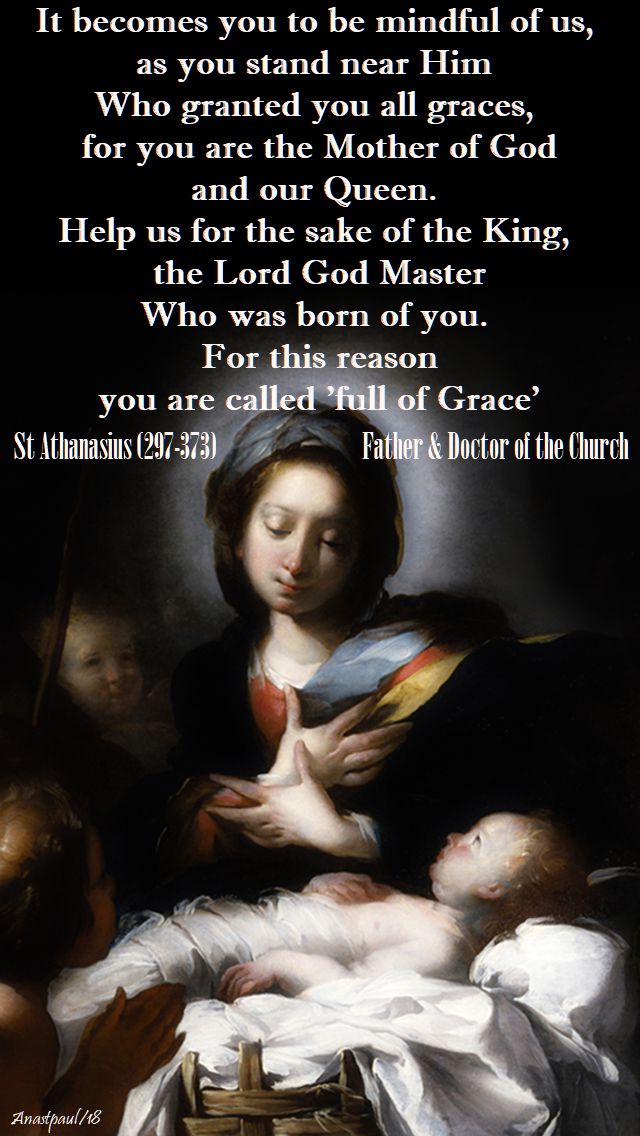
“It becomes you to be mindful of us,
as you stand near Him
Who granted you all graces,
for you are the Mother of God and our Queen.
Help us for the sake of the King,
the Lord God Master Who was born of you.
For this reason you are called ‘full of Grace’…”

St Athanasius (297-373) Father & Doctor of the Churchit becomes you to be mindful - st athanasius - 1 jan 2018

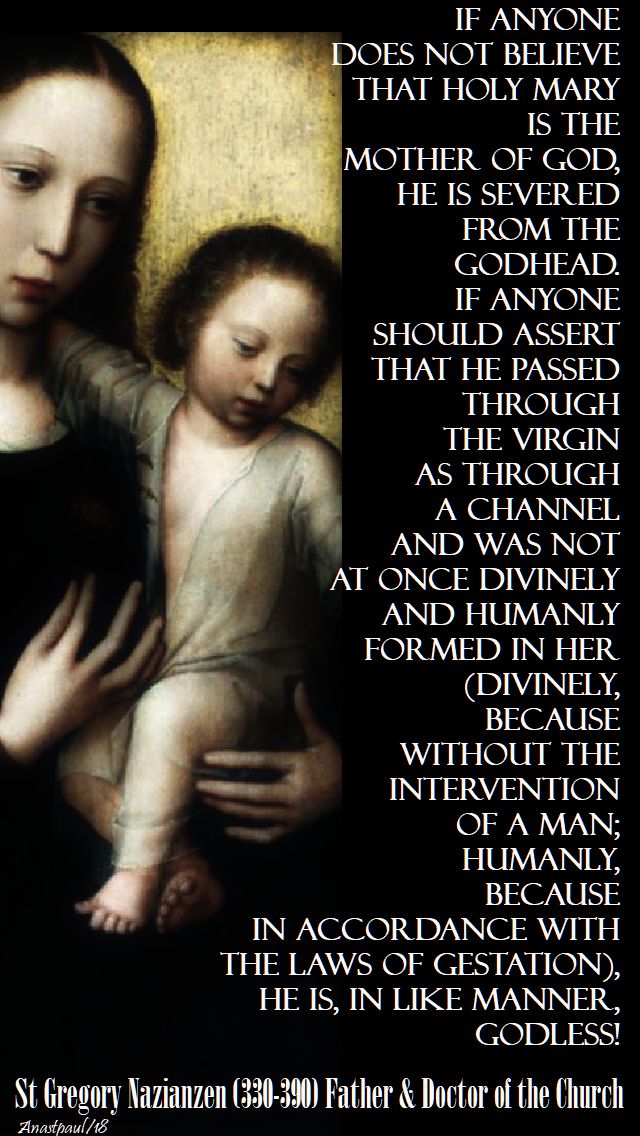
“If anyone does not believe that Holy Mary
is the Mother of God,
he is severed from the Godhead.
If anyone should assert that He passed through the Virgin
as through a channel
and was not at once divinely and humanly formed in her
(divinely, because without the intervention of a man;
humanly, because in accordance with the laws of gestation),
he is in like manner godless.”

St Gregory Nazianzen (330-390) Father & Doctor of the Churchif anyone does not believe - 1 jan 2018

“What the Catholic faith believes about Mary
is based on what it believes about Christ
and what it teaches about Mary,
illumines in turn, its faith in Christ”

CCC No 487ccc no 487 - 1 jan 2018

Posted in CHRISTMASTIDE!, FEASTS and SOLEMNITIES, MARIAN PRAYERS, MARIAN QUOTES, MARIAN TITLES, MORNING Prayers, QUOTES of the SAINTS, SAINT of the DAY, The BLESSED VIRGIN MARY, The WORD

One Minute Reflection – 1 January 2018 – The Solemnity of Mary, Mother of God, the Octave Day of the Nativity of Our Lord and the first day of the Month of the Most Holy Name of Jesus

One Minute Reflection – 1 January 2018 – The Solemnity of Mary, Mother of God, the Octave Day of the Nativity of Our Lord and the first day of the Month of the Most Holy Name of Jesus

But Mary kept all these things, pondering them in her heart.…Luke 2:19

REFLECTIONS – “Today’s liturgy celebrates the solemnity of the Mother of God.
Mary is the one who was chosen to be Mother of the Redeemer, sharing intimately in his mission.
In the light of Christmas, the mystery of her divine motherhood is illumined.
Mary, Mother of Jesus who was born in the Bethlehem cave,
is also the Mother of every man and woman who comes into the world.
How is it possible not to commend to her the year that is beginning,
to implore a time of serenity and peace for all humanity?
On the day when this new year begins under the blessed gaze of the Mother of God,
let us invoke the gift of peace for each one and all.”…St Pope John Paul – 1997mary is the one who was chosen - st john paul - 1 jan 2018

PRAYER – God, our Father, since You gave mankind a saviour through blessed Mary, virgin and mother, grant that we may feel the power of her intercession when she pleads for us with Jesus Christ, Your Son, the author of life, who lives and reigns with You and the Holy Spirit, God forever and ever, amen.mary mother of god pray for us - 1 jan 2018

Posted in CATHOLIC DEVOTIONS of the Month, DEVOTIO, MORNING Prayers, PAPAL PRAYERS, PRACTISING CATHOLIC, PRAYERS of the CHURCH

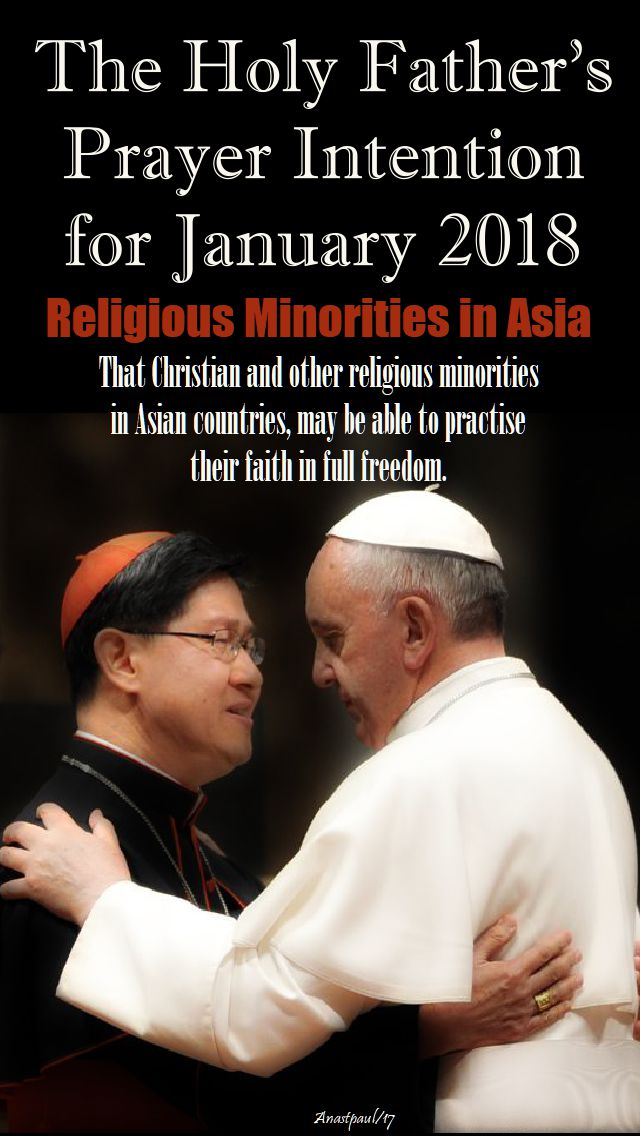
The Holy Father’s Prayer Intention for January 2018

The Holy Father’s Prayer Intention
for January 2018

Religious Minorities in Asia

That Christian and other religious minorities
in Asian countries, may be able to practise
their faith in full freedom.

the holy father's prayer intention january 2018

Posted in CATHOLIC DEVOTIONS of the Month, CATHOLIC-PRAYERS OF THE CHURCH, CHRISTMASTIDE!, MORNING Prayers, PRAYERS of the CHURCH, SAINT of the DAY, The HOLY NAME

Monthly Catholic Devotions: JANUARY is the Month of THE MOST HOLY NAME OF JESUS

1 January – Catholic Devotion of the Month – The Most Holy Name of Jesus

In Philippians 2, St Paul tells us that “At the name of Jesus every knee should bow, of things in heaven and things in earth, and things under the earth and every tongue should confess that Jesus Christ is Lord.”   From the earliest days of Christianity, Christians have known the great power of Jesus’ Holy Name.   As the once-popular hymn commanded:

All hail the pow’r of Jesus’ Name!
Let angels prostrate fall;
Bring forth the royal diadem,
And crown Him Lord of all.

Small wonder, then, that the Church sets aside the first month of the year in honour of the Holy Name of Jesus. hrough this devotion, the Church reminds us of the power of Christ’s Name and encourages us to pray in His Name.  In our society, of course, we hear His Name uttered quite often but all too frequently, it is used in a curse or blasphemy.  In the past, Christians would often make the Sign of the Cross when they heard Christ’s Name uttered in such a manner and that’s a practice that would be worthwhile to revive.   

What has happened to the tradition of honouring the Holy Name of Jesus?

By way of concretising respect for the name of Jesus in a formal way the Second Council of Lyons in 1274 decreed that “at the name of Jesus every knee should bow; whenever that glorious name is recalled, especially during the sacred mysteries of the Mass, everyone should bow the knees of his heart, which he can do even by a bow of his head”.
As regards what is to be done in Mass today, the General Instruction of the Roman Missal says: “A bow of the head is made when the three Divine Persons are named together and at the names of Jesus, of the Blessed Virgin Mary and of the saint in whose honour Mass is being celebrated” (GIRM 275).
The importance of honouring the holy name of Jesus is seen too in the feast of that name, which has been celebrated, at least at the local level, since the end of the 15th century.   The feast was inserted into the universal calendar by Pope Innocent XIII in 1721 and is now celebrated on 3 January.

Given the widespread misuse of the names of God and Jesus today in ordinary life, as well as on television, in films and in other forms of entertainment, it is especially important to do all we can to restore respect for the name of God.
Bowing our head when we pronounce or hear the name of Jesus is a good way to do this.
Also important is to make an internal act of reparation whenever we hear the name of God or Jesus blasphemed.
It should hurt us that the object of our love is mistreated in this way.
It may very well be that the custom of bowing the head at the name of Jesus will pass out of general use, as have other laudable customs in recent times but that does not prevent us personally from continuing to live it and passing on to our children this ancient custom.

LET US EACH ONE BRING IT BACK for the very Angels in Heaven bow at the name of Jesus. And even the demons in Hell.BOW YOUR HEAD!

1 january 2018 - the most holy name

Another good practice that we could take to heart during this Month of the Holy Name of Jesus is the recitation of the Jesus Prayer. his prayer is as popular among Eastern Christians, both Catholic and Orthodox, as the rosary is among Roman Catholics but it’s not as well known in the West.   This month, why not take a few minutes to memorise the Jesus Prayer and pray it during those moments of the day when you are between activities, or travelling, or simply taking a rest?   Keeping Christ’s Name always on our lips is a good way to ensure that we draw ever nearer to Him.

THE JESUS PRAYER
O Lord Jesus Christ, Son of God, have mercy on me, a sinnerthe jesus prayer - 1 jan 2018

Posted in CHRISTMASTIDE!, MORNING Prayers, PAPAL MESSAGES, PAPAL SERMONS, SAINT of the DAY

1 January 2018 – The 51st World Day of Prayer for Peace

1 January 2018 – The 51st World Day of Prayer for Peace

The World Day of Prayer for Peace was first observed on 1 January 1968, proclaimed by Pope Paul VI. It was inspired by the encyclical Pacem in Terris by Pope John XXIII and with reference to Paul’s encyclical Populorum Progressio.

Our Holy Fathers, have used this day to make magisterial declarations relevant to the social doctrine of the Church on such topics as the United Nations, human rights, women’s rights, labour unions, economic development, the right to life, international diplomacy, peace in the Holy Land, globalisation, migrants, refugees and terrorism.the 51st world day of peace - 1 jan 2018
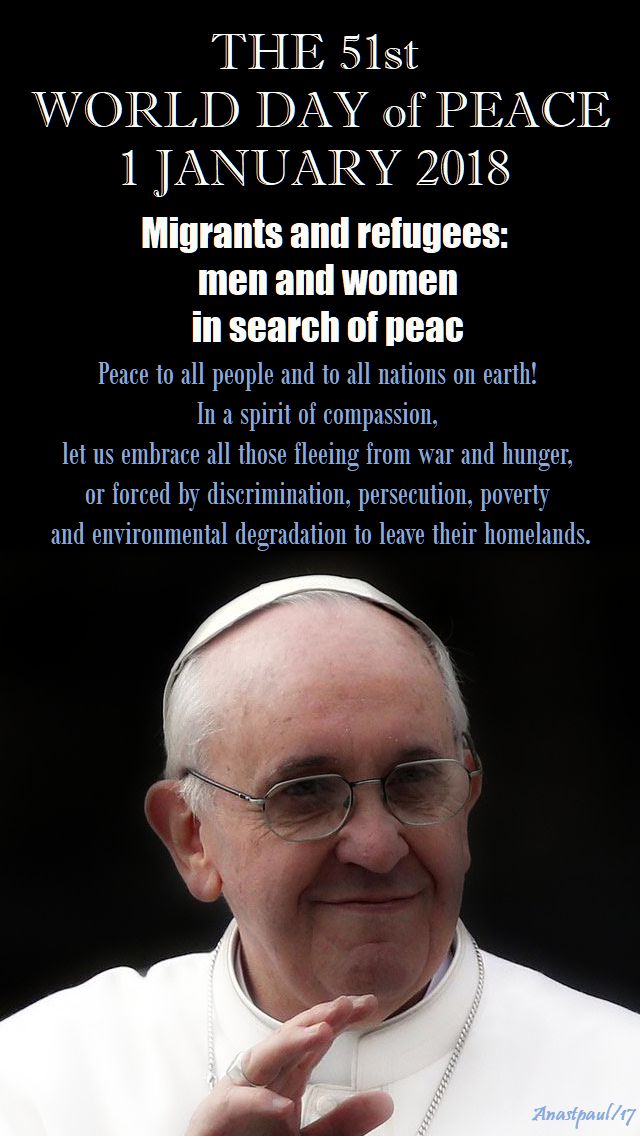
MESSAGE OF HIS HOLINESS POPE
FRANCIS
FOR THE CELEBRATION OF THE 
51st WORLD DAY OF PEACE

1 JANUARY 2018

Migrants and refugees: men and women in search of peace

1. Heartfelt good wishes for peace

Peace to all people and to all nations on earth! Peace, which the angels proclaimed to the shepherds on Christmas night,[1]  is a profound aspiration for everyone, for each individual and all peoples, and especially for those who most keenly suffer its absence.   Among these whom I constantly keep in my thoughts and prayers, I would once again mention the over 250 million migrants worldwide, of whom 22.5 million are refugees. Pope Benedict XVI, my beloved predecessor, spoke of them as “men and women, children, young and elderly people, who are searching for somewhere to live in peace.”  [2]  In order to find that peace, they are willing to risk their lives on a journey that is often long and perilous, to endure hardships and suffering, and to encounter fences and walls built to keep them far from their goal.

In a spirit of compassion, let us embrace all those fleeing from war and hunger, or forced by discrimination, persecution, poverty and environmental degradation to leave their homelands.

We know that it is not enough to open our hearts to the suffering of others.   Much more remains to be done before our brothers and sisters can once again live peacefully in a safe home.   Welcoming others requires concrete commitment, a network of assistance and goodwill, vigilant and sympathetic attention, the responsible management of new and complex situations that at times compound numerous existing problems, to say nothing of resources, which are always limited.   By practising the virtue of prudence, government leaders should take practical measures to welcome, promote, protect, integrate and, “within the limits allowed by a correct understanding of the common good, to permit [them] to become part of a new society.”[3]   Leaders have a clear responsibility towards their own communities, whose legitimate rights and harmonious development they must ensure, lest they become like the rash builder who miscalculated and failed to complete the tower he had begun to construct.[4]

2. Why so many refugees and migrants?

As he looked to the Great Jubilee marking the passage of two thousand years since the proclamation of peace by the angels in Bethlehem, Saint John Paul II pointed to the increased numbers of displaced persons as one of the consequences of the “endless and horrifying sequence of wars, conflicts, genocides and ethnic cleansings”[5] that had characterised the twentieth century.   To this date, the new century has registered no real breakthrough: armed conflicts and other forms of organised violence continue to trigger the movement of peoples within national borders and beyond.

Yet people migrate for other reasons as well, principally because they “desire a better life, and not infrequently try to leave behind the ‘hopelessness’ of an unpromising future.”[6]   They set out to join their families or to seek professional or educational opportunities, for those who cannot enjoy these rights do not live in peace.   Furthermore, as I noted in the Encyclical Laudato Si’, there has been “a tragic rise in the number of migrants seeking to flee from the growing poverty caused by environmental degradation”.[7]

Most people migrate through regular channels.   Some, however, take different routes, mainly out of desperation, when their own countries offer neither safety nor opportunity and every legal pathway appears impractical, blocked or too slow.

Many destination countries have seen the spread of rhetoric decrying the risks posed to national security or the high cost of welcoming new arrivals, and thus demeaning the human dignity due to all as sons and daughters of God.   Those who, for what may be political reasons, foment fear of migrants instead of building peace are sowing violence, racial discrimination and xenophobia, which are matters of great concern for all those concerned for the safety of every human being.[8]

All indicators available to the international community suggest that global migration will continue for the future. Some consider this a threat. For my part, I ask you to view it with confidence as an opportunity to build peace.

3. With a contemplative gaze

The wisdom of faith fosters a contemplative gaze that recognizes that all of us “belong to one family, migrants and the local populations that welcome them, and all have the same right to enjoy the goods of the earth, whose destination is universal, as the social doctrine of the Church teaches. It is here that solidarity and sharing are founded.”[9]   These words evoke the biblical image of the new Jerusalem.   The book of the prophet Isaiah (chapter 60) and that of Revelation (chapter 21) describe the city with its gates always open to people of every nation, who marvel at it and fill it with riches. Peace is the sovereign that guides it and justice the principle that governs coexistence within it.

We must also turn this contemplative gaze to the cities where we live, “a gaze of faith which sees God dwelling in their houses, in their streets and squares, […] fostering solidarity, fraternity, and the desire for goodness, truth and justice”[10] – in other words, fulfilling the promise of peace.

When we turn that gaze to migrants and refugees, we discover that they do not arrive empty-handed.   They bring their courage, skills, energy and aspirations, as well as the treasures of their own cultures; and in this way, they enrich the lives of the nations that receive them.   We also come to see the creativity, tenacity and spirit of sacrifice of the countless individuals, families and communities around the world who open their doors and hearts to migrants and refugees, even where resources are scarce.

A contemplative gaze should also guide the discernment of those responsible for the public good, and encourage them to pursue policies of welcome, “within the limits allowed by a correct understanding of the common good”[11] – bearing in mind, that is, the needs of all members of the human family and the welfare of each.

Those who see things in this way will be able to recognize the seeds of peace that are already sprouting and nurture their growth.   Our cities, often divided and polarized by conflicts regarding the presence of migrants and refugees, will thus turn into workshops of peace.

4. Four mileposts for action

Offering asylum seekers, refugees, migrants and victims of human trafficking an opportunity to find the peace they seek requires a strategy combining four actions: welcoming, protecting, promoting and integrating.[12]

“Welcoming” calls for expanding legal pathways for entry and no longer pushing migrants and displaced people towards countries where they face persecution and violence.   It also demands balancing our concerns about national security with concern for fundamental human rights. Scripture reminds us: “Do not forget to show hospitality to strangers, for by so doing some people have shown hospitality to angels without knowing it.”[13]

“Protecting” has to do with our duty to recognize and defend the inviolable dignity of those who flee real dangers in search of asylum and security, and to prevent their being exploited.   I think in particular of women and children who find themselves in situations that expose them to risks and abuses that can even amount to enslavement. God does not discriminate:  “The Lord watches over the foreigner and sustains the orphan and the widow.”[14]

“Promoting” entails supporting the integral human development of migrants and refugees. Among many possible means of doing so, I would stress the importance of ensuring access to all levels of education for children and young people.   This will enable them not only to cultivate and realise their potential but also better equip them to encounter others and to foster a spirit of dialogue rather than rejection or confrontation.   The Bible teaches that God “loves the foreigner residing among you, giving them food and clothing.   And you are to love those who are foreigners, for you yourselves were foreigners in Egypt.”[15]

“Integrating”, lastly, means allowing refugees and migrants to participate fully in the life of the society that welcomes them, as part of a process of mutual enrichment and fruitful cooperation in service of the integral human development of the local community.   Saint Paul expresses it in these words:  “You are no longer foreigners and strangers, but fellow citizens with God’s people.”[16]

5. A proposal for two international compacts

It is my heartfelt hope this spirit will guide the process that in the course of 2018 will lead the United Nations to draft and approve two Global Compacts, one for safe, orderly and regular migration and the other for refugees.   As shared agreements at a global level, these compacts will provide a framework for policy proposals and practical measures.   For this reason, they need to be inspired by compassion, foresight and courage, so as to take advantage of every opportunity to advance the peace-building process.   Only in this way can the realism required of international politics avoid surrendering to cynicism and to the globalisation of indifference.

Dialogue and coordination are a necessity and a specific duty for the international community.   Beyond national borders, higher numbers of refugees may be welcomed – or better welcomed – also by less wealthy countries, if international cooperation guarantees them the necessary funding.

The Migrants and Refugees Section of the Dicastery for Promoting Integral Human Development has published a set of twenty action points that provide concrete leads for implementing these four verbs in public policy and in the attitudes and activities of Christian communities.[17]   The aim of this and other contributions is to express the interest of the Catholic Church in the process leading to the adoption of the two U.N. Global Compacts.    This interest is the sign of a more general pastoral concern that goes back to the very origins of the Church and has continued in her many works up to the present time.

6. For our common home

Let us draw inspiration from the words of Saint John Paul II:  “If the ‘dream’ of a peaceful world is shared by all, if the refugees’ and migrants’ contribution is properly evaluated, then humanity can become more and more a universal family and our earth a true ‘common home’.”[18]   Throughout history, many have believed in this “dream”, and their achievements are a testament to the fact that it is no mere utopia.

Among these, we remember Saint Frances Xavier Cabrini in this year that marks the hundredth anniversary of her death. On this thirteenth day of November, many ecclesial communities celebrate her memory.   This remarkable woman, who devoted her life to the service of migrants and became their patron saint, taught us to welcome, protect, promote and integrate our brothers and sisters.   Through her intercession, may the Lord enable all of us to experience that “a harvest of righteousness is sown in peace by those who make peace.”[19]

From the Vatican, 13 November 2017

Posted in CHRISTMASTIDE!, FEASTS and SOLEMNITIES, MARIAN PRAYERS, MARIAN TITLES, MORNING Prayers, PRAYERS of the SAINTS, SAINT of the DAY, The BLESSED VIRGIN MARY

Our Morning Offering – 31 December – The Solemnity of Mary, Mother of God and the Octave Day of the Nativity of Our Lord

Our Morning Offering – 31 December – The Solemnity of Mary, Mother of God and the Octave Day of the Nativity of Our Lord

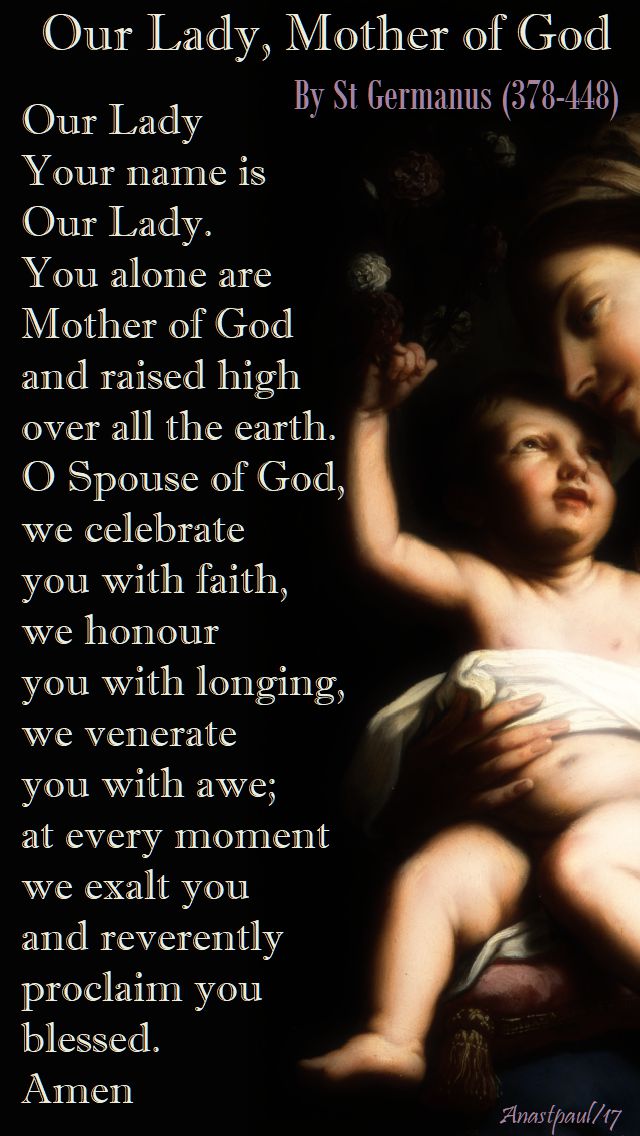
Our Lady, Mother of God
By St Germanus (378-448)

Our Lady
Your name is
Our Lady.
You alone are
Mother of God
and raised high
over all the earth.
O Spouse of God,
we celebrate you
with faith,
we honour you
with longing,
we venerate you
with awe;
at every moment
we exalt you
and reverently proclaim
you blessed.
Amenour lady, mother of god - 1 jan 2018

Posted in CHRISTMASTIDE!, FEASTS and SOLEMNITIES, MARIAN TITLES, PAPAL MESSAGES, PAPAL SERMONS, SAINT of the DAY

1 January 2018 – The Solemnity of Mary, the Mother of God

1 January 2018 – The Solemnity of Mary, the Mother of God

Start the New Year With Jesus’ Mother—and Our Own

In the early centuries of the Church, once Christmas began to be celebrated as its own feast on 25 December (having originally been celebrated with the Feast of the Epiphany, on 6 January, the Octave (eighth day) of Christmas, 1 January took on a special meaning. In the East, and throughout much of the West, it became common to celebrate a feast of Mary, the Mother of God, on this day. This feast was never established in the universal calendar of the Church, however, and a separate feast, celebrating the Circumcision of Our Lord Jesus Christ (which would have taken place a week after His birth), eventually took hold of 1 January. With the revision of the liturgical calendar the Feast of the Circumcision was set aside, and the ancient practice of dedicating 1 January to the Mother of God was revived—this time, as a universal feast.
One of the earliest titles given by Christians to the Blessed Virgin was Theotokos—”God-bearer.” We celebrate her as the Mother of God, because, in bearing Christ, she bore the fullness of the Godhead within her. As we begin another year, we draw inspiration from the selfless love of the Theotokos, who never hesitated to do the will of God. And we trust in her prayers to God for us, that we might, as the years pass, become more like her. O Mary, Mother of God, pray for us!Mary2017_1100x754

HOMILY OF HIS HOLINESS POPE FRANCIS

Vatican Basilica
Sunday, 1st January 2017

“Mary treasured all these things and pondered them in her heart! (Lk 2:19).   In these words, Luke describes the attitude with which Mary took in all that they had experienced in those days.   Far from trying to understand or master the situation, Mary is the woman who can treasure, that is to say, protect and guard in her heart, the passage of God in the life of his people.   Deep within, she had learned to listen to the heartbeat of her Son, and that in turn taught her, throughout her life, to discover God’s heartbeat in history.   She learned how to be a mother and in that learning process she gave Jesus the beautiful experience of knowing what it is to be a Son.   In Mary, the eternal Word not only became flesh, but also learned to recognise the maternal tenderness of God.   With Mary, the God-Child learned to listen to the yearnings, the troubles, the joys and the hopes of the people of the promise.   With Mary, he discovered himself a Son of God’s faithful people.octave-day.mary mother of god - 2016jpg

In the Gospels, Mary appears as a woman of few words, with no great speeches or deeds but with an attentive gaze capable of guarding the life and mission of her Son and for this reason, of everything that he loves.   She was able to watch over the beginnings of the first Christian community and in this way she learned to be the mother of a multitude.   She drew near to the most diverse situations in order to sow hope.   She accompanied the crosses borne in the silence of her children’s hearts.   How many devotions, shrines and chapels in the most far-off places, how many pictures in our homes, remind us of this great truth.   Mary gave us a mother’s warmth, the warmth that shelters us amid troubles, the maternal warmth that keeps anything or anyone from extinguishing in the heart of the Church the revolution of tenderness inaugurated by her Son.   Where there is a mother, there is tenderness.   By her motherhood, Mary shows us that humility and tenderness are not virtues of the weak but of the strong. She teaches us that we do not have to mistreat others in order to feel important (cf. Evangelii Gaudium, 288).    God’s holy people has always acknowledged and hailed her as the Holy Mother of God.

To celebrate Mary as Mother of God and our mother at the beginning of the new year means recalling a certainty that will accompany our days:   we are a people with a Mother;   we are not orphans.

Mothers are the strongest antidote to our individualistic and egotistic tendencies, to our lack of openness and our indifference.   A society without mothers would not only be a cold society, but a society that has lost its heart, lost the “feel of home”.   A society without mothers would be a merciless society, one that has room only for calculation and speculation.   Because mothers, even at the worst times, are capable of testifying to tenderness, unconditional self-sacrifice and the strength of hope.   I have learned much from those mothers whose children are in prison, or lying in hospital beds, or in bondage to drugs, yet, come cold or heat, rain or draught, never stop fighting for what is best for them.   Or those mothers who in refugee camps, or even the midst of war, unfailingly embrace and support their children’s sufferings.   Mothers who literally give their lives so that none of their children will perish.   Where there is a mother, there is unity, there is belonging, belonging as children.

To begin the year by recalling God’s goodness in the maternal face of Mary, in the maternal face of the Church, in the faces of our own mothers, protects us from the corrosive disease of being “spiritual orphans”.   It is the sense of being orphaned that the soul experiences when it feels motherless and lacking the tenderness of God, when the sense of belonging to a family, a people, a land, to our God, grows dim.   This sense of being orphaned lodges in a narcissistic heart capable of looking only to itself and its own interests.   It grows when what we forget that life is a gift we have received – and owe to others – a gift we are called to share in this common home.

It was such a self-centred orphanhood that led Cain to ask:  “Am I my brother’s keeper?” (Gen 4:9).   It was as if to say:  he doesn’t belong to me;  I do not recognise him.   This attitude of spiritual orphanhood is a cancer that silently eats away at and debases the soul.   We become all the more debased, inasmuch as nobody belongs to us and we belong to no one.   I debase the earth because it does not belong to me;  I debase others because they do not belong to me;  I debase God because I do not belong to him and in the end we debase our very selves, since we forget who we are and the divine “family name” we bear.   The loss of the ties that bind us, so typical of our fragmented and divided culture, increases this sense of orphanhood and, as a result, of great emptiness and loneliness.   The lack of physical (and not virtual) contact is cauterising our hearts (cf. Laudato Si’, 49) and making us lose the capacity for tenderness and wonder, for pity and compassion.   Spiritual orphanhood makes us forget what it means to be children, grandchildren, parents, grandparents, friends and believers.   It makes us forget the importance of playing, of singing, of a smile, of rest, of gratitude.

Celebrating the feast of the Holy Mother of God makes us smile once more as we realise that we are a people, that we belong, that only within a community, within a family, can we as persons find the “climate”, the “warmth” that enables us to grow in humanity and not merely as objects meant to “consume and be consumed”.   To celebrate the feast of the Holy Mother of God reminds us that we are not interchangeable items of merchandise or information processors.   We are children, we are family, we are God’s People.

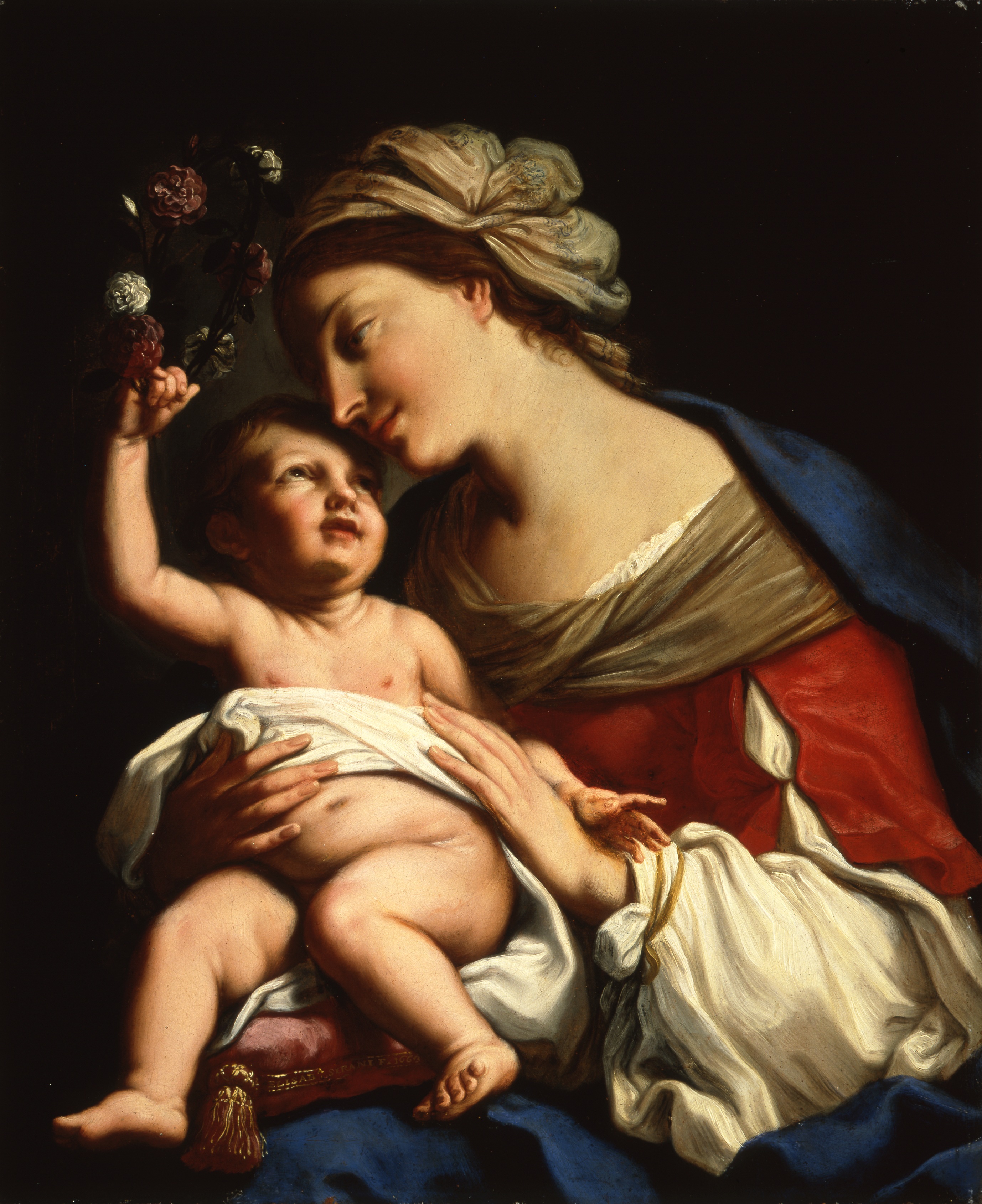
Celebrating the Holy Mother of God leads us to create and care for common places that can give us a sense of belonging, of being rooted, of feeling at home in our cities, in communities that unite and support us (cf. Laudato Si’, 151).2.2.2.x-collection-detail-sirani_virgin_and_childMother-of-GodVirgin and Child (Luis De Morales)

Jesus, at the moment of his ultimate self-sacrifice, on the cross, sought to keep nothing for himself, and in handing over his life, he also handed over to us his Mother.   He told Mary:   Here is your son; here are your children.   We too want to receive her into our homes, our families, our communities and nations.   We want to meet her maternal gaze. The gaze that frees us from being orphans; the gaze that reminds us that we are brothers and sisters, that I belong to you, that you belong to me, that we are of the same flesh.   The gaze that teaches us that we have to learn how to care for life in the same way and with the same tenderness that she did:  by sowing hope, by sowing a sense of belonging and of fraternity.

Celebrating the Holy Mother of God reminds us that we have a Mother.   We are not orphans.   We have a Mother.   Together let us all confess this truth.   I invite you to acclaim it three times, standing [all stand], like the faithful of Ephesus:  Holy Mother of God, Holy Mother of God, Holy Mother of God.BallymoteChurchoftheImmaculateConceptionNorthAisleMadonnaandChild20100923

Posted in CHRISTMASTIDE!, FEASTS and SOLEMNITIES, MARIAN TITLES, SAINT of the DAY

1 January 2018 – Solemnity of Mary, Mother of God, Octave Day of the Nativity of the Lord, 51st World Day of Peace and Memorials of the Saints

Mary, Mother of God (Solemnity) – https://www.youtube.com/watch?v=lCePGwykjag

Circumcision of the Lord (Feast):   Though He was not bound by law, Christ wanted to fulfill the law and to show His descent in the flesh from Abraham and so was circumcised on the eighth day of his life (Luke 2:21) and received the name expressive of His office, Jesus, (Saviour).   He was, as Saint Paul says, “made under the law”, that is, He submitted to the Mosaic Dispensation, “that he might redeem them who were under the law: that we might receive the adoption of sons” (Galatians 4:4-5).   “The Christ, in order to fulfil all justice, was required to endure this humiliation and bear in His body the stigma of the sins which He had taken upon Himself.”   The circumcision took place, not in the Temple, though painters sometimes so represent it but in some private house, where the Holy Family had found a rather late hospitality.   The public ceremony in the synagogue, which is now the usage, was introduced later.
As Christmas was celebrated on 25 December, celebration of Circumcision fell on the first of January.   In the ages of paganism, however, the solemnisation of the feast was almost impossible due to orgies connected with the Saturnalian festivities being celebrated at the same time.   Even in our own day the secular features of the opening of the New Year interfere with the religious observance of the Circumcision and tend to make a mere holiday of that which should have the sacred character of a Holy Day.   Saint Augustine of Hippo points out the difference between the pagan and Christian manners of celebrating the day:   pagan feasting and excesses were to be expiated by Christian fasting and prayer.   The Feast was kept at an early date in the Gallican Rite, as is clearly indicated in a Council of Tours in 567, in which he Mass of the Circumcision is prescribed.   The feast celebrated at Rome in the seventh century was not the Circumcision as such, but the octave of Christmas.   The Gelasian Sacramentary gives the title “In Octabas Domini”, and prohibits the faithful from idolatry and the profanities of the season.   The earliest Byzantine calendars (eighth and ninth centuries) give for the first of January both the Circumcision and the anniversary of Saint Basil.   The Feast of the Circumcision was observed in Spain before the death of Saint Isidore in 636.   It seems, therefore, that the octave was more prominent in the early centuries and the Circumcision later.   As paganism passed away the religious festivities of the Circumcision became more conspicuous and solemn, yet, even in the tenth century, Atto, Bishop of Vercelli, rebuked those who profaned the holy season by pagan dances, songs, and the lighting of lamps.

Octave Day of the Nativity of the Lord

World Day of Peace:    Feast day dedicated to peace.   It first observed on 1 January 1968, proclaimed by Pope Paul VI.   It was inspired by the encyclical Pacem in Terris by Pope John XXIII and with reference to Paul’s encyclical Populorum Progressio.    Our Holy Fathers have used this day to make magisterial declarations relevant to the social doctrine of the Church on such topics as the United Nations, human rights, women’s rights, labour unions, economic development, the right to life, international diplomacy, peace in the Holy Land, globalisation, migrants, refugees and terrorism.

Titular Feast of the Society of Jesus – But now celebrated on 3 January, the Feast of the Holy Name of Jesus

Bl Adalbero of Liege
St Baglan of Wales
St Basil of Aix
Bl Bonannus of Roio
St Brogan
St Buonfiglio Monaldi
Bl Catherine de Solaguti
St Clarus of Vallis Regia
St Clarus of Vienne
St Colman mac Rónán
St Colman Muillin of Derrykeighan
St Concordius of Arles
St Connat
St Cuan
St Demet of Plozévet
St Elvan
St Eugendus of Condat
St Euphrosyne of Alexandria
St Fanchea of Rossory
St Felix of Bourges
St Frodobert of Troyes
St Fulgentius of Ruspe
St Gisela of Rosstreppe
St Gregory Nazianzen the Elder
Bl Hugolinus of Gualdo Cattaneo
Bl Jean-Baptiste Lego
Bl Jean of Saint-Just-en-Chaussée
St Joseph Mary Tomasi
St Justin of Chieti
Bl Lojze Grozde
St Maelrhys
St Magnus the Martyr
Bl Marian Konopinski
St Mydwyn
St Odilo of Cluny
St Odilo of Stavelot
St Peter of Atroa
St Peter of Temissis
Bl René Lego
St Sciath of Ardskeagh
St Severino Gallo
St Telemachus
St Thaumastus of Mainz
St Theodotus
St Tyfrydog
Bl Valentin Paquay
St Vincent Strambi
St William of Dijon
St Zedislava Berka
St Zygmunt Gorazdowski

Breton Missionaries to Britain
Martyred Soldiers of Rome: Thirty soldiers martyred in Rome as a group during the persecutions of Diocletian. We don’t even known their names. They were martyred c 304 at Rome, Italy.

Martyrs of Africa – 8 saints: Eight Christians martyred together in Africa, date unknown. The only details we have are four of their names – Argyrus, Felix, Narcissus and Victor.

Martyred in the Spanish Civil War:
• Blessed Andrés Gómez Sáez

Posted in CHRISTMASTIDE!, DOCTORS of the Church, MORNING Prayers, SAINT of the DAY, THE HOLY FAMILY - FAMILIAE SANCTAE

Thought for the Day – 31 December – Feast of the Holy Family and the Seventh Day of the Octave

Thought for the Day – 31 December – Feast of the Holy Family and the Seventh Day of the Octave

Sermon of Saint Bernard for the Feast of the Holy Family
(1090-1153) – Doctor of the ChurchVision of St. Bernard_Munich, AP_1493.Perugino, Virgin Appearing to St. Bernard Italian, 1493holy-family41with st bernard

In Mary we praise that which places her above all others, that is, fruitfulness of offspring together with virginity.   For never has it been known in this world that anyone was at the same time mother and virgin.   And see of Whom she is mother.   Where does your astonishment at this so wondrous dignity lead you?   Is it not to this, that you may gaze in wonder yet never sufficiently revere?   Is she not in your veneration, nay, in the esteem of Truth itself, raised above choirs of angels?   Does not Mary address the Lord and God of all the angels as Son, saying: Son, why hast thou done so to us?

Who among the angels may thus presume?   It is enough for them and for them their greatest honour, that while they are spirits by nature they have become and are called angels, as David testifies:  Who makest thy angels spirits. [Ps. 103: 4] Mary, knowing herself mother, with confidence calls that Majesty Son Whom the angels in reverence serve.   Nor does God disdain to be called that which He disdained not to be.   For the Evangelist adds a little later:   He was subject to them.

Who was subject to whom?   A God to men.   God, I repeat, to Whom the angels are subject:   Whom principalities and powers obey:   was subject to Mary and not alone to Mary but to Joseph also, because of Mary.   Admire and revere both the one and the other and choose which you admire the more, the most sweet condescension of the Son, or the sublime dignity of the Mother.   For either am I at a loss for words, for both are wondrous.   For that God should obey a woman is humility without compare and that a woman should have rule over God dignity without equal.   In praise of virgins is it joyfully proclaimed, that they follow the lamb withersoever he goeth. [Apoc. 14: 4]   Of what praise shall you esteem her worthy who also goeth before Him?

Learn, O Man, to obey.   Learn, O Earth, to be subject.   Learn, O Dust, to submit.   The Evangelist in speaking of thy Maker says:   He was subject to them, that is, without doubt, to Mary and to Joseph.   Be you ashamed, vain ashes that you are.   God humbles Himself, and do you exalt yourself?   God becomes subject to men and will you, eager to lord it over men, place yourself above your Maker?   O would that God might deign to make me, thinking such thoughts at times in my own mind, such answer as He made, reproving him, to His apostle:  Go behind Me, Satan: because thou savourest not the things that are of God. [Mark 8: 33]

For as often as I desire to be foremost among men, so often do I seek to take precedence of God and so do I not truly savour the things that are of God.   For of Him was it said and he was subject to them. If you disdain, O Man, to follow the example of a Man, at least it will not lower thee to imitate thy Maker.   If perhaps you cannot follow Him wheresoever He goeth, at least follow in that wherein He has come down to you.

If you are unable to follow Him on the sublime way of virginity, then follow God by that most sure way of humility, from whose straitness should some even from among the virgins go aside, then must I say what is true, that neither do they follow the Lamb withersoever he goeth .  He that is humble, even though he be stained, he follows the Lamb so too does the proud virgin but neither of the two whithersoever He goeth: because the one cannot ascend to the purity of the Lamb that is without stain, nor will the other deign to come down to the meekness of the Lamb, Who stood silent, not merely before the shearer but before the one that put Him to death.   Yet the sinner who makes after Him in humility, has chosen a wholesomer part than the one that is proud in his virtue, since the humble repentance of the one washes away uncleanness but the pride of the other contaminates his own virtue.

Truly blessed was Mary who possessed both humility and virginity.   And truly wondrous the virginity whose fruitfulness stained not but adorned her and truly singular the humility, which this fruitful virginity has not troubled but rather exalted and wholly incomparable the fruitfulness which goes hand in hand with her humility and her virginity.   Which of these things is not wondrous?   Which is not beyond all comparison? Which that is not wholly singular?   It would be strange if you did not hesitate to decide which you regard as most worthy of praise: whether the wonder of fruitfulness of offspring in virginity, or of virginal integrity in a mother, sublimity of Offspring, or humility joined to such dignity, unless it be that we place both together above each one singly and it is truly beyond any doubt more excellent and more joyful to have beheld these perfections united in her, than to see but one part of them.

And can we wonder that God, of Whom it is written that He is wonderful in his saints,[Ps. 67: 36] shows Himself in His own Mother yet more wondrous still.   Venerate then, Ye spouses, this integrity of flesh in our corruptible flesh.   Revere likewise, Ye virgins, fruitfulness in virginity.   Let all men imitate the humility of God’s Mother.   Honour, Ye angels, the Mother of your King, you who adore the Offspring of our Virgin, Who is your King and our King, the Healer of our race, the Restorer of our fatherland.  Who among you is so sublime, yet among us was so lowly, to Whose Majesty as well from you as from us. let there be adoration and reverence, to whose Perfection be there honour and glory and empire for ever and ever. Amen

Mary and Joseph be our teachers and our guides, pray for us and for all the families of the world.holy family pray for us no 2 - 31 dec 2017
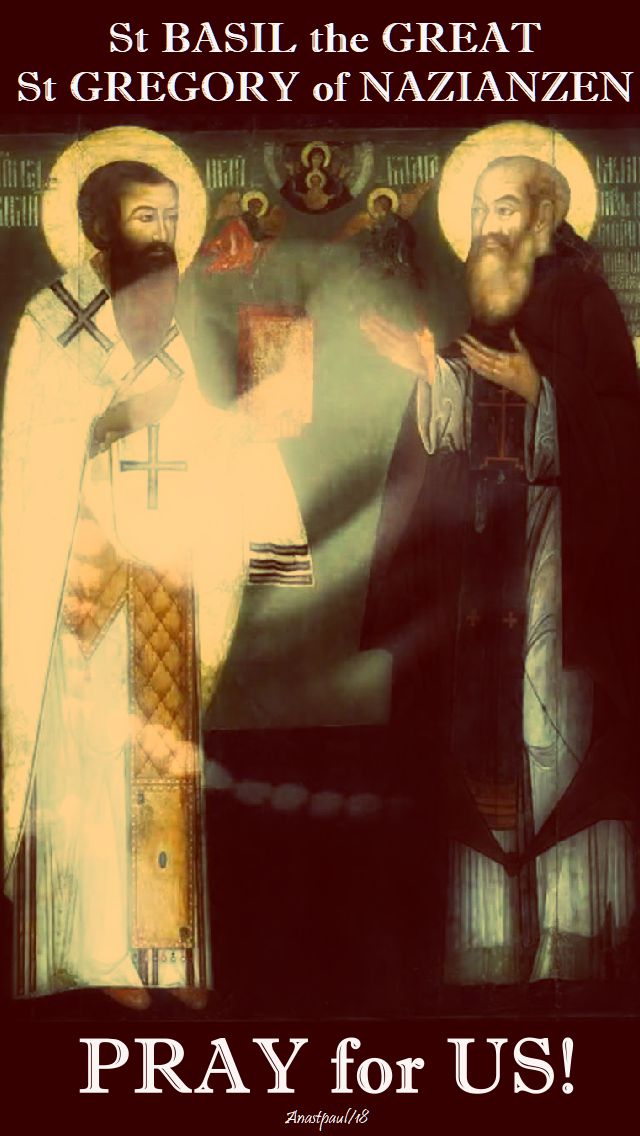
Posted in DEVOTIO, EUCHARISTIC Adoration, MORNING Prayers, QUOTES - J R R Tolkien and MORE, SUNDAY REFLECTIONS, The HOLY EUCHARIST / The HOLY MASS

Sunday Reflection – 31 December – Feast of the Holy Family and the Seventh Day of the Octave

Sunday Reflection – 31 December – Feast of the Holy Family and the Seventh Day of the Octave

While they were eating, He took some bread, and after a blessing He broke it, and gave it to them, and said, “Take it; this is My body.”   And when He had taken a cup and given thanks, He gave it to them and they all drank from it.   And He said to them, “This is My blood of the covenant, which is poured out for many..…Mark 14:22-24

The only ritual that Christ asks us to repeat, over and over again, is the Eucharist.
In it we remember Him as broken,
poured out,
empty,
heartbroken,
frightened,
humiliated,
vulnerable,
in anguish.
To celebrate this ritual properly, we need to have in our hearts what Christ has in His at the first Eucharist.
What was He feeling then?

Joy and thanksgiving.   Yes.   LOVE for those at the table with Him.   Surely.  But beyond this, His heart felt anguish, deep longing and fear at the prospect of the pain that was now a certainty before intimacy and community could be achieved.

It would perhaps do all of us good, occasionally when we leave the Eucharist, instead of going to a lively meal with the folks, to go off as Jesus did after the first Eucharist, to a lonely place to have an agony in the garden and to sweat some blood as we ask for strength to drink from the real chalice – the chalice of vulnerability.

Occasionally, when St Augustine handed the Eucharist to a communicant, instead of saying, “the Body of Christ”, he would say, “Receive what you are.”

Augustine had perceived, for whatever reason, that the words of consecration, “this is my body, this is my blood”, are intended more to change the people present, than to change bread and wine.
(Fr R Rolheiser – Light for the World)

Lord Jesus Christ we pray…thank You for abiding with us.
May we always reverence the Holy Eucharist, as Your Real Presence amongst us. Amenthe only ritual - the eucharist - rolheiser - 31 dec 2017