Posted in NOVENAS, PRAYERS of the CHURCH, PRAYERS of the SAINTS

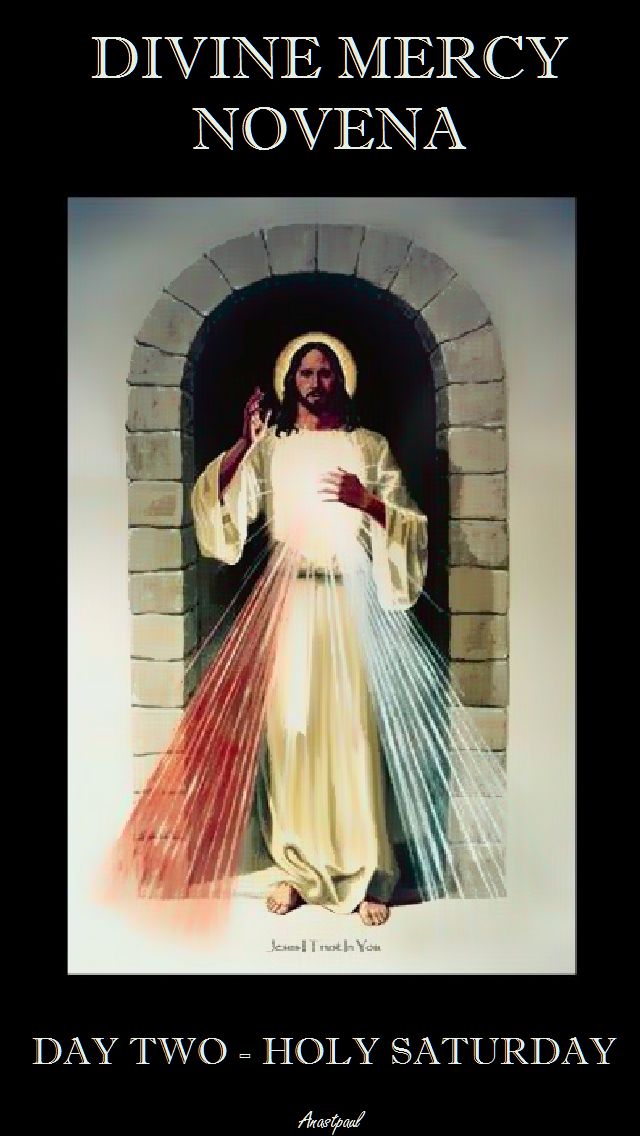
Divine Mercy Novena – Day Two – Holy Saturday

Divine Mercy Novena

Jesus asked that the Feast of the Divine Mercy be preceded by a Novena to the Divine Mercy which would begin on Good Friday.    He gave St. Faustina an intention to pray for on each day of the Novena, saving for the last day the most difficult intention of all, the lukewarm and indifferent of whom He said:
“These souls cause Me more suffering than any others; it was from such souls that My soul felt the most revulsion in the Garden of Olives.    It was on their account that I said: ‘My Father, if it is possible, let this cup pass Me by.’    The last hope of salvation for them is to flee to My Mercy.”
During the Solemn Novena leading to Divine Mercy Sunday,
the Chaplet of Divine Mercy should be offered each day for the
day’s intentions.

DVMERCYNOVEA-DAY TWO

DAY TWO:  HOLY SATURDAY

“Today bring to Me the Souls of Priests and Religious, and immerse them in My unfathomable mercy. It was they who gave me strength to endure My bitter Passion. Through them as through channels My mercy flows out upon mankind.”

Most Merciful Jesus, from whom comes all that is good, increase Your grace in men and women consecrated to Your service,* that they may perform worthy works of mercy; and that all who see them may glorify the Father of Mercy who is in heaven.

Eternal Father, turn Your merciful gaze upon the company of chosen ones in Your vineyard — upon the souls of priests and religious; and endow them with the strength of Your blessing.    For the love of the Heart of Your Son in which they are enfolded, impart to them Your power and light, that they may be able to guide others in the way of salvation and with one voice sing praise to Your boundless mercy for ages without end. Amen.

* In the original text, Saint Faustina uses the pronoun “us” since she was offering this prayer as a consecrated religious sister. The wording adapted here is intended to make the prayer suitable for universal use.

PRAY THE CHAPLET here: https://anastpaul.wordpress.com/2017/04/15/divine-mercy-novena-day-one-good-friday/


Posted in NOVENAS, PRAYERS of the CHURCH, PRAYERS of the SAINTS

Divine Mercy Novena – Day One – Good Friday

Divine Mercy Novena

Jesus asked that the Feast of the Divine Mercy be preceded by a Novena to the Divine Mercy which would begin on Good Friday.    He gave St. Faustina an intention to pray for on each day of the Novena, saving for the last day the most difficult intention of all, the lukewarm and indifferent of whom He said:
“These souls cause Me more suffering than any others; it was from such souls that My soul felt the most revulsion in the Garden of Olives.    It was on their account that I said: ‘My Father, if it is possible, let this cup pass Me by.’    The last hope of salvation for them is to flee to My Mercy.”
During the Solemn Novena leading to Divine Mercy Sunday,
the Chaplet of Divine Mercy should be offered each day for the
day’s intentions.

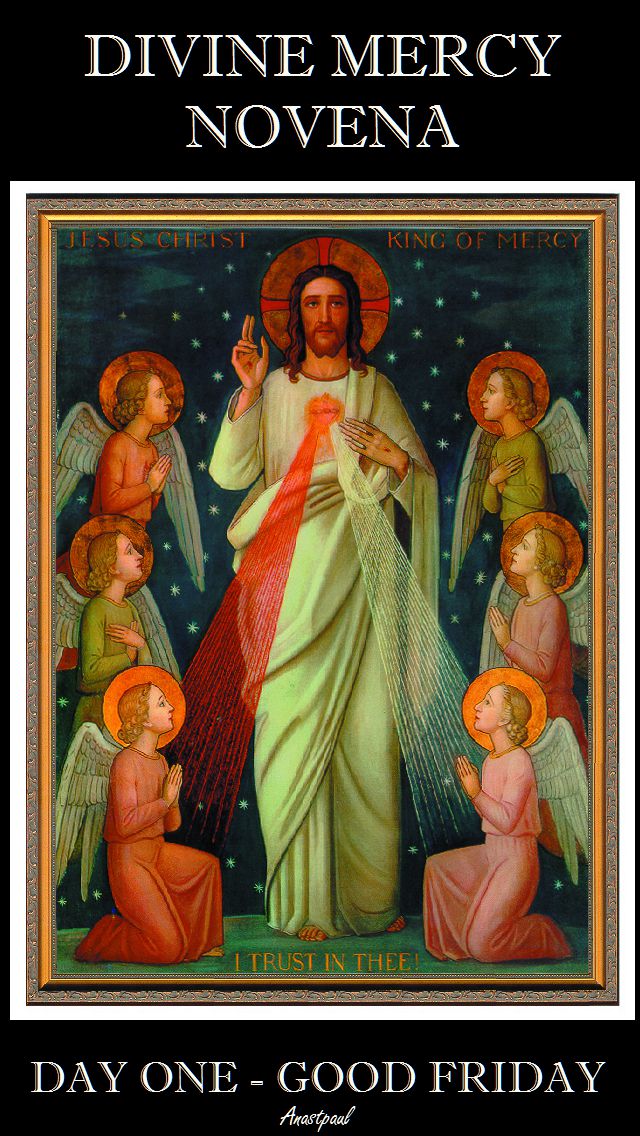
DIVINE MECY NOVENA - DAY ONE GOOD FRIDAY

DAY ONE:  GOOD FRIDAY

“Today bring to Me all mankind, especially all sinners,

and immerse them in the ocean of My mercy. In this way you will console Me in the bitter grief into which the loss of souls plunges Me.”

Most Merciful Jesus, whose very nature it is to have compassion on us and to forgive us, do not look upon our sins but upon our trust which we place in Your infinite goodness. Receive us all into the abode of Your Most Compassionate Heart, and never let us escape from It. We beg this of You by Your love which unites You to the Father and the Holy Spirit.

Eternal Father, turn Your merciful gaze upon all mankind and especially upon poor sinners, all enfolded in the Most Compassionate Heart of Jesus. For the sake of His sorrowful Passion show us Your mercy, that we may praise the omnipotence of Your mercy for ever and ever. Amen

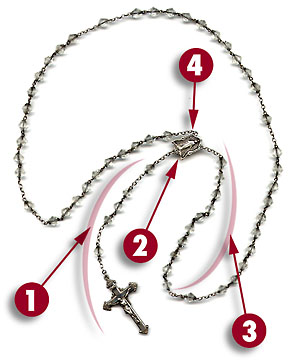
THE CHAPLET

chapmap.jpg

1. Begin with the Sign of the Cross, 1 Our Father, 1 Hail Mary and The Apostles Creed.
2. Then on the Our Father Beads say the following:
Eternal Father, I offer You the Body and Blood, Soul and Divinity of Your dearly beloved Son, Our Lord Jesus Christ, in atonement for our sins and those of the whole world.

3. On the 10 Hail Mary Beads say the following:
For the sake of His sorrowful Passion, have mercy on us and on the whole world.

(Repeat step 2 and 3 for all five decades).

4. Conclude with (three times):
Holy God, Holy Mighty One, Holy Immortal One, have mercy on us and on the whole world.


Posted in MORNING Prayers, SAINT of the DAY

Thought for the Day – 15 April

Thought for the Day – 15 April

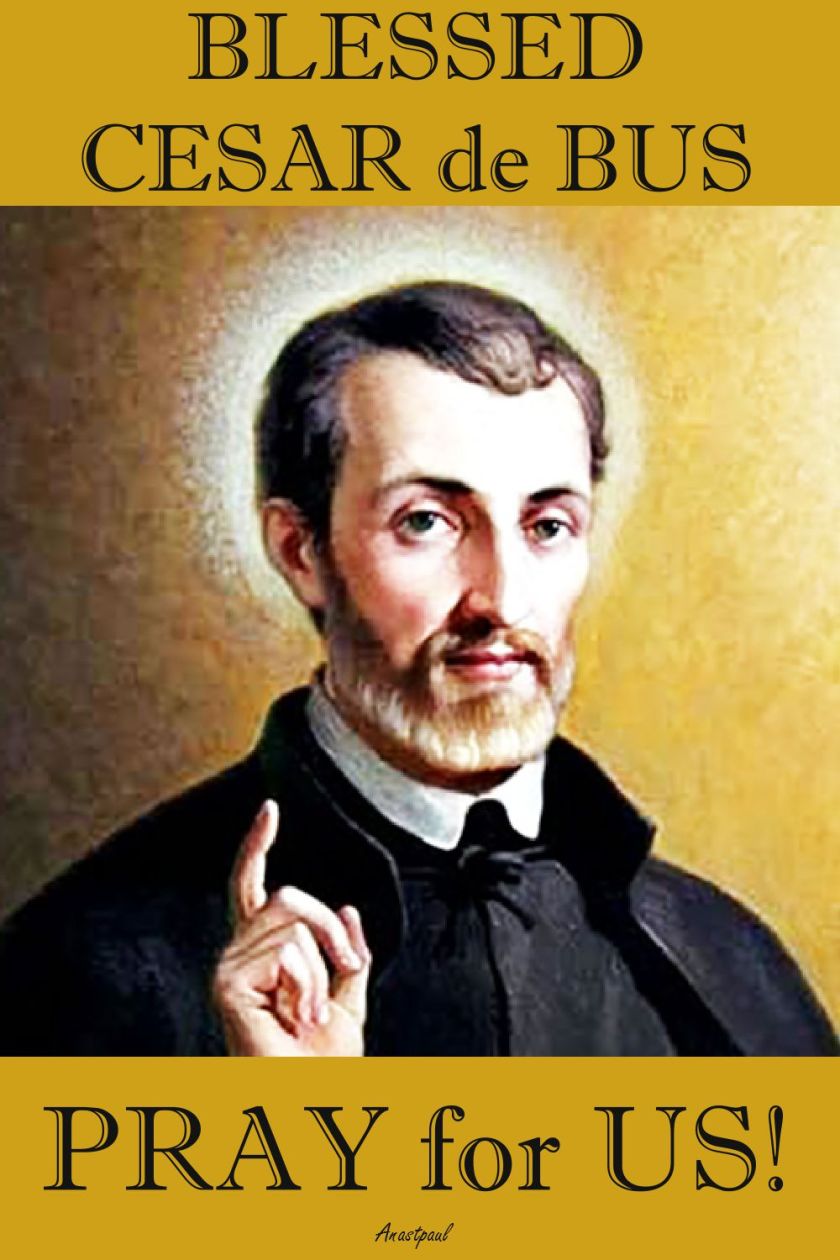
The life of Blessed Cesar de Bus is one of initial indecision, aimless pursuit of worldly pleasure and return to the grace of the Lord.    Cesar’s life reminds us that we are all called at different times in our lives to serve—even if we feel unworthy or unable, the Lord sees within us the spark of faith and hope and we are called to nurture that spark into a flame of Love – just be awake and aware, do not resist the inspiration of the Holy Spirit!    As we look toward Christ’s Easter triumph over death, we turn inside ourselves, finding our own call to serve others in love.

Blessed Cesar de Bus pray for us!

BL CESAR DE BUS PRAY FOR US

Posted in DOCTORS of the Church, HOLY WEEK, MORNING Prayers, QUOTES of the SAINTS, Uncategorized

Quote of the Day – 15 April – Holy Saturday

Quote of the Day – 15 April – Holy Saturday

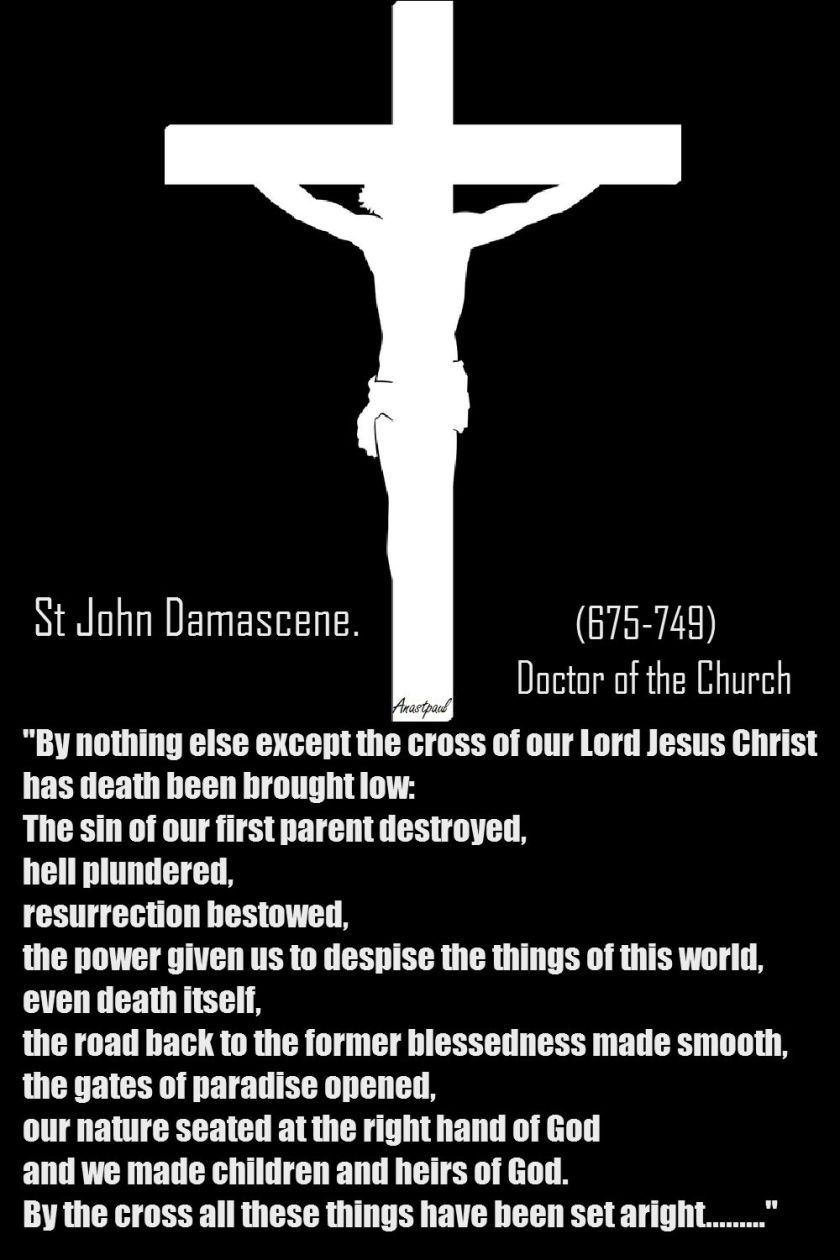
“By nothing else except the Cross of our Lord Jesus Christ has death been brought low: The sin of our first parent destroyed, hell plundered, resurrection bestowed, the power given us to despise the things of this world, even death itself, the road back to the former blessedness made smooth, the gates of paradise opened, our nature seated at the right hand of God and we made children and heirs of God. By the cross all these things have been set aright…It is a seal that the destroyer may not strike us, a raising up of those who lie fallen, a support for those who stand, a staff for the infirm, a crook for the shepherded, a guide for the wandering,a perfecting of the advanced, salvation for soul and body, a deflector of all evils, a cause of all goods, a destruction of sin, a plant of resurrection, and a tree of eternal life!”

St. John Damascene

THE CROSS OF CHRIST-ST JOHN DAMASCENE

Posted in CATECHESIS, HOLY WEEK, MORNING Prayers, PURGATORY

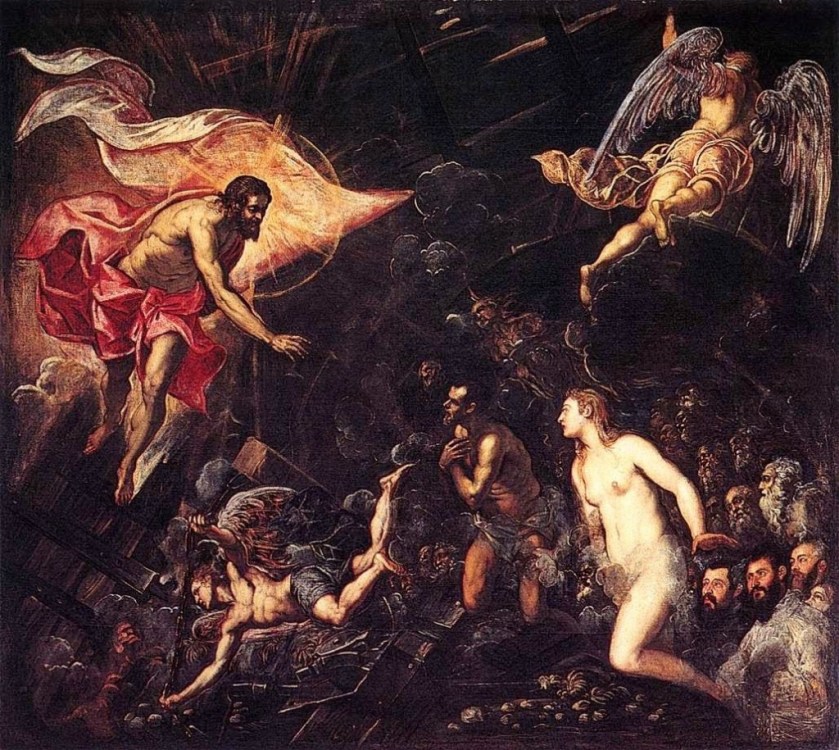
Holy Saturday – 15 April – The Lord’s descent into hell

Holy Saturday – 15 April – The Lord’s descent into hell

Posted in HOLY WEEK, MORNING Prayers

Our Morning Offering – 15 April

Our Morning Offering – 15 April

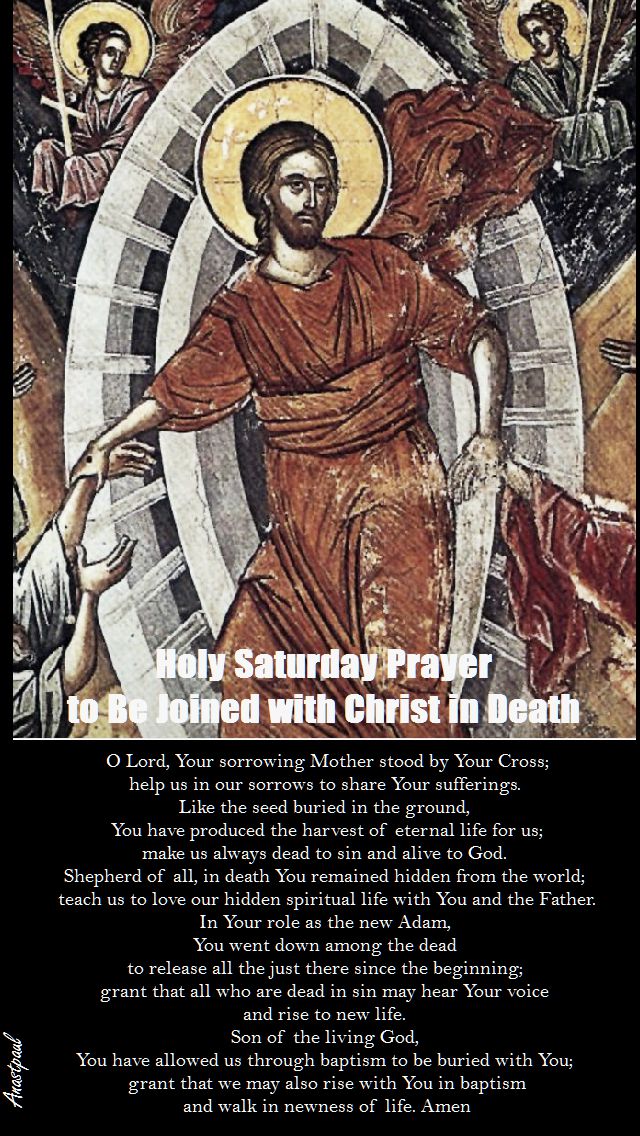
Holy Saturday Prayer
to Be Joined with Christ in Death

O Lord, Your sorrowing Mother stood by Your Cross;
help us in our sorrows to share Your sufferings.
Like the seed buried in the ground,
You have produced the harvest of eternal life for us;
make us always dead to sin and alive to God.
Shepherd of all, in death You remained hidden from the world;
teach us to love our hidden spiritual life with You and the Father.
In Your role as the new Adam,
You went down among the dead
to release all the just there since the beginning;
grant that all who are dead in sin may hear Your voice
and rise to new life.
Son of the living God,
You have allowed us through baptism to be buried with You;
grant that we may also rise with You in baptism
and walk in newness of life. Amen

HOLY SAT PRAYER

Posted in QUOTES of the SAINTS, SAINT of the DAY

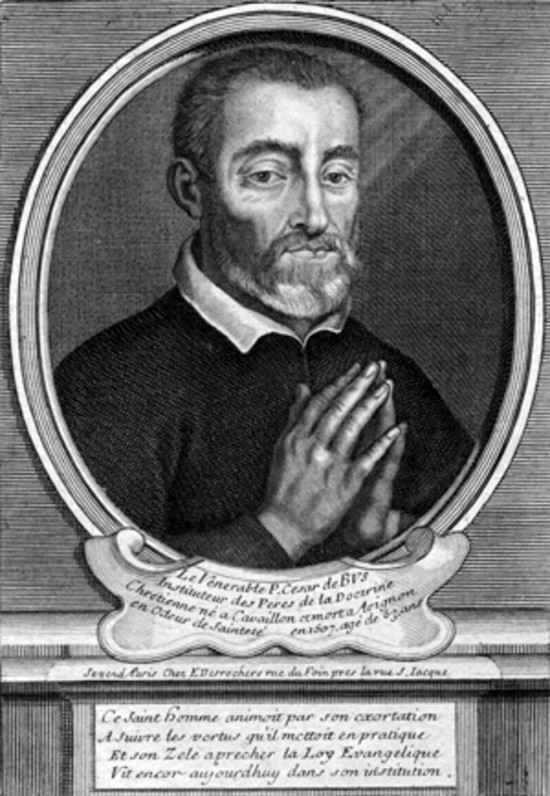
Saint of the Day – 15 April – Bl Cesar de Bus

Saint of the Day – 15 April – Bl Cesar de Bus (1544-1607) Priest, teacher, Founder of two religious congregations: the Secular Priests of the Christian Doctrine and the Daughters of the Christian Doctrine – Patron of Catechists.

Cesar was born at Cavaillon, France and little is known about his early life, with the exception that he was middle child – the seventh of thirteen children and raised as a pious child.lived both piously and virtuously.    At eighteen years old, he joined the French army,and took part in the king’s war against the Huguenots.      Back in his home town of Cavaillon, he took over the position of his late brother as canon of Salon, a position he wanted for its income and connections instead of its spiritual significance. One night while on his way to a masked ball, he passed a shrine where a small light was burning before an image of the Virgin Mary.   He was suddenly overwhelmed by the memory that a friend, Antoinette Reveillade, had prayed fervently for his salvation.   He realised that there was no way he could live a life offending God and then expect to be accepted in the end.   There, on the road, he had a complete conversion.   He returned to his studies, resumed his pious lifestyle and was soon ordained to the priesthood at the age of 38.bl De_Bus_César_(1544-1607)


Upon ordination, Cesar immediately distinguished himself by his works of charity, serving all in need.    He was profoundly affected reading a biography of Saint Charles Borromeo and tried to take him as a model in all things, especially his devotion to catechesis.   He worked as a catechist in Aix-in-Provence, France, an area in turmoil following the Religious Wars.   Saint Francis de Sales called him “a star of the first magnitude in the firmament of Catechesis.”    He founded the Ursulines of Province and the Fathers of Christian Doctrine (Doctrinarians).   The Fathers were destroyed during the French Revolution but an Italian branch, the Doctrinarian Fathers continues today with houses in Italy, France and Brazil.   He further demonstrated great effectiveness and zeal in preaching.    He focused primarily on those who would receive the Word of God from no one else—those living in horrible conditions, living out of city in the countryside and those marginalised by society.    He further focused on catechesis of the family, instructing the parents alongside the children, something which had previously not been done.    The congregation was approved by Pope Clement VIII. A few years later, Cesar founded a companion congregation, the Daughters of the Christian Doctrine.

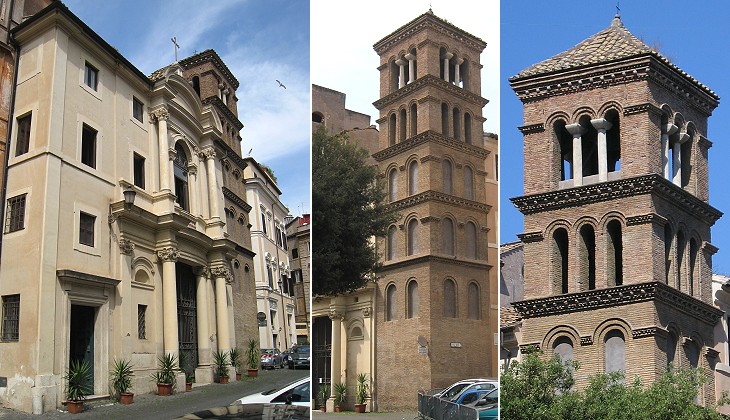
Blessed Cesar wrote five volumes on the Catechism, portions of which continue in use today.    His Instructions for the Family on the Four Parts of the Roman Catechism, was published 60 years after his death.    He died on Easter Sunday, 15 April 1607 in Avignon, Vaucluse, France of natural causes and his remains are interred in the church of Saint Mary in Monticelli in Rome, Italy.    Blessed Pope Paul VI at his Beatification:  “He learned in this way to seek and love sacrifice, for sacrifice configures one with Christ, Suffering and Victory.   To offer himself as a libation, to leave everything in God’s hand at the cost of the greatest renunciations, this seemed to have been the leitmotif, the perpetual aim of his efforts.   And when, at the end of his life, suffering and afflicted with blindness for 14 years, he was at last able to prepare for the supreme gift, he realised how useful asceticism has been to master the old Adam.   He was ready to meet the Lord.   His joy was perfect.”

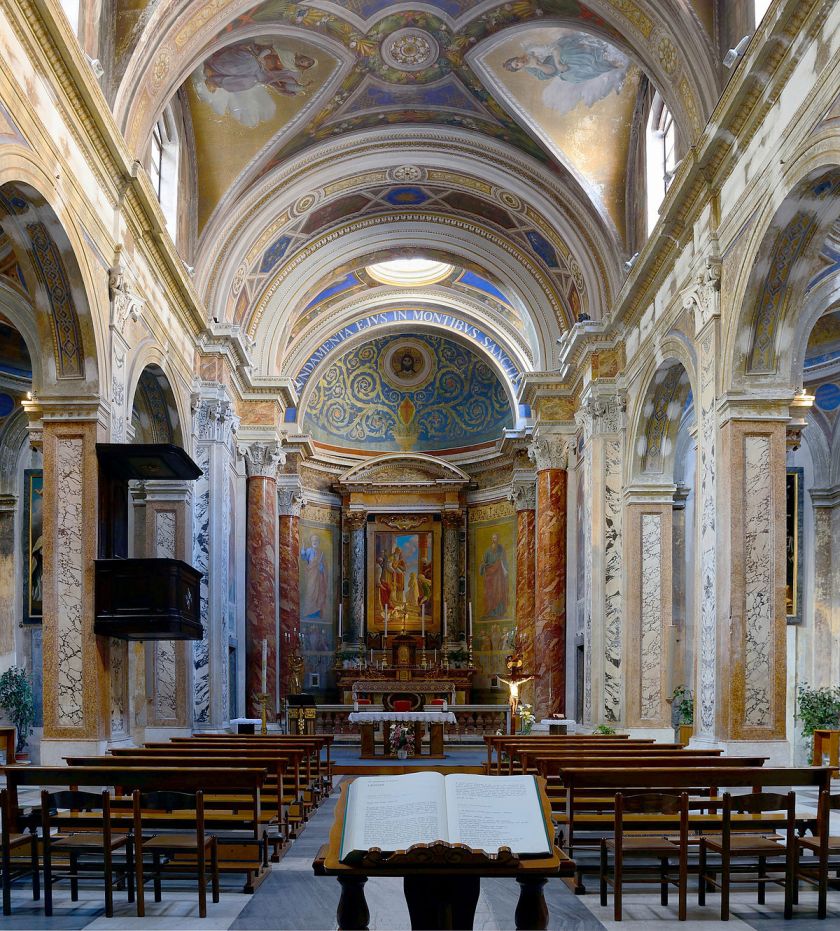
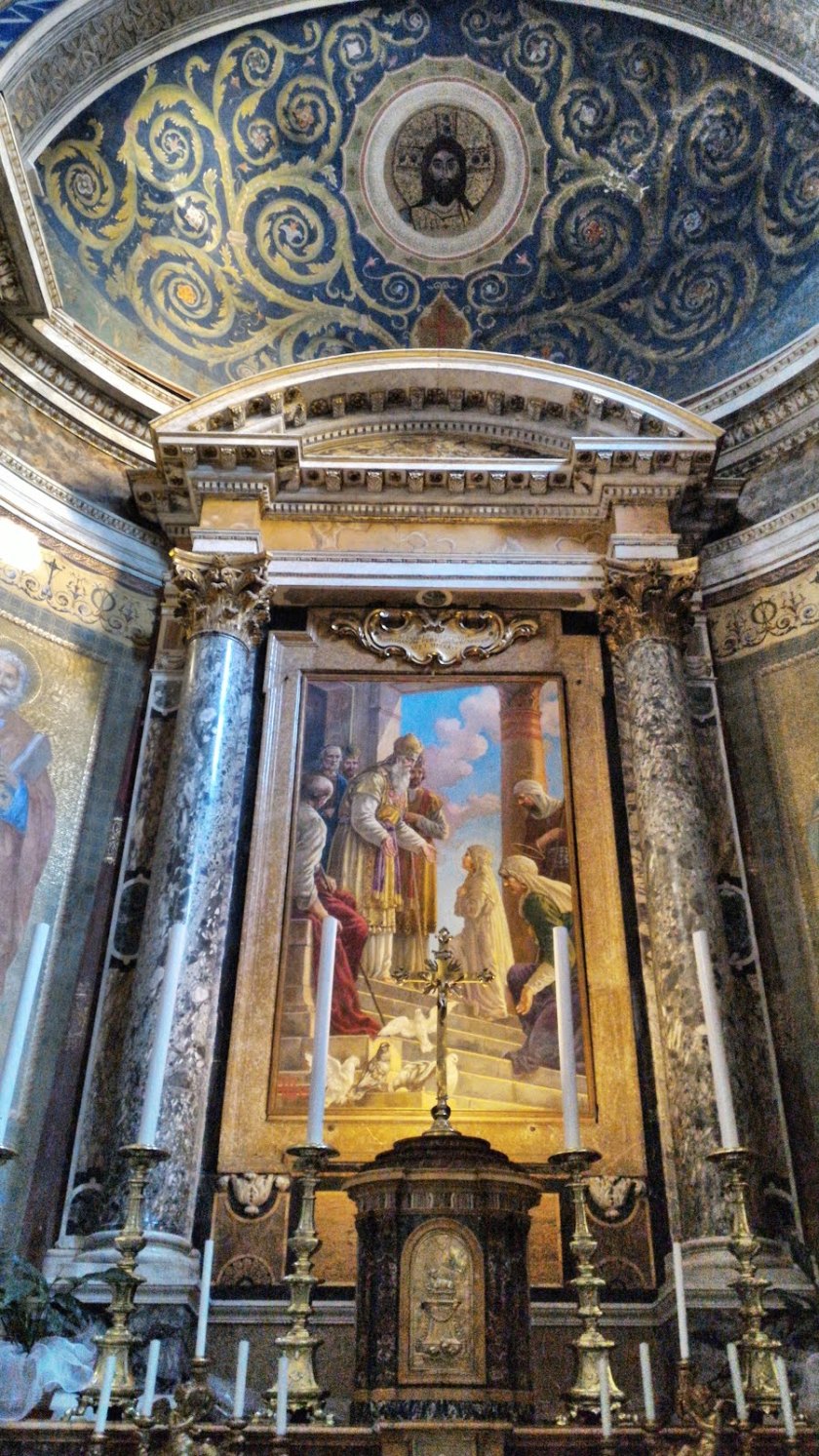
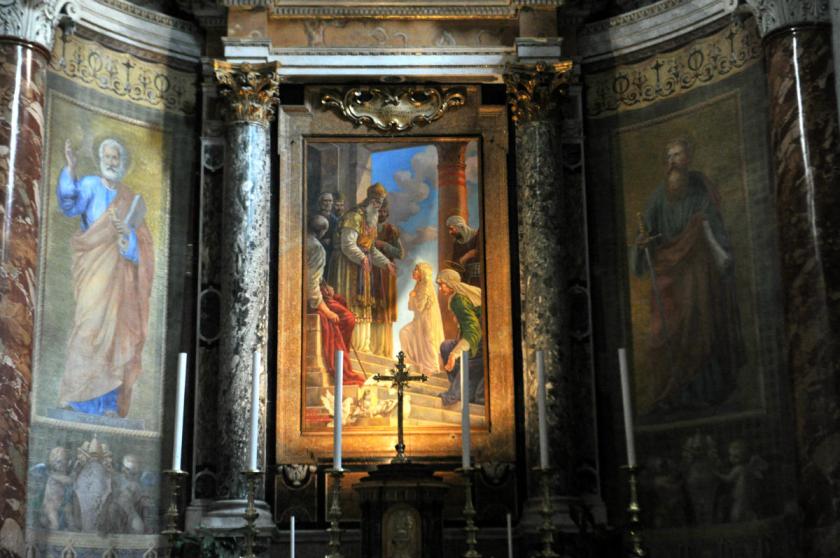
Vasi112fSanta_Maria_in_Monticelli_(Rome)_-_interiorSanta Maria in Monticelli altarSanta_Maria_in_Monticelli_interno_d0

He was Beatified on 27 April 1975 by Blessed Pope Paul VI who said at the ceremony:

“The work of Cesar de Bus continues to generate, after three centuries, our admiration. Here’s someone who got it right.    He recognised the needs of his time and he responded with equal generosity and efficiency.    Attracted by his vision and influence, other enthusiastic men were gradually gathered around him, learning how to approach the catechism and taking a lead from him.    Quickly they formed a religious family who, despite the vicissitudes of history, still flourishes today in various countries.    Now located in Cavaillon, France, the Fathers of Christian Doctrine know this day our special concern for them, our esteem and they receive our wishes and encouragement!    We are pleased to honour them now in the person of their founder.

And we wish the pastors and those responsible for catechetical use, who have followed Blessed Cesar’s example and writings, guiding their thinking and their work.    Blessed Caesar de Bus, you who left us the admirable example of a life given to God, who burned with a desire to communicate God’s life with your brothers, now intercede for us with the Lord, for the same Fire consumes us and the same charity urges us.   And you, dear brothers and sons, we entrust you to him and we bless you from my heart.”

Posted in SAINT of the DAY

Saints – 15 April

Holy Saturday (2017)

St Abbo II of Metz
St Abbondio
St Acuta
St Anastasia of Rome
St Basilissa of Rome
Bl Cesar de Bus
St Crescens of Myra
St Eutyches of Rome
St Eutychius of Ferentino
St Huna of Slättåkra
St Hunna of Alsace
Bl Laurentinus Sossius
St Lidwina
St Maro of Rome
St Maximus of Persia
St Mundus
St Nidger of Augsburg
St Olympiades of Persia
St Ortario of Landelles
St Paternus of Vannes
St Paternus of Wales
St Pausilopo of Thrace
St Ruadhan of Lorrha
St Sylvester of Réome
St Theodore of Thrace
St Victorinus of Rome
St Waltmann of Cambrai

Mercedarian Martyrs of Africa: A group of Mercedarian monks sailing to Africa as on a mission to redeem capture Christians. Captured by Moors, they were tortured and executed for their faith. Martyrs. 1393

Posted in HOLY WEEK, MORNING Prayers, Uncategorized

Good Friday – 14 April 2017 – A Day of Deep Mourning and Fasting and Abstinence

Good Friday – 14 April 2017 – A Day of Deep Mourning and Fasting and Abstinence

Today the whole Church deeply mourns the death of our Saviour.   This is traditionally a day of sadness, spent in fasting and prayer.   The title for this day varies in different parts of the world: “Holy Friday” for Latin nations, Slavs and Hungarians call it “Great Friday,” in Germany it is “Friday of Mourning” and in Norway, it is “Long Friday.”   Some view the term “Good Friday” (used in English and Dutch) as a corruption of the term “God’s Friday.” This is another obligatory day of fasting and abstinence.   In Ireland, they practice the “black fast,” which is to consume nothing but black tea and water.

GOOD FRIDAY

Liturgy
According to the Church’s ancient tradition, the sacraments are not celebrated on Good Friday nor Holy Saturday. “Celebration of the Lord’s Passion,” traditionally known as the “Mass of the Presanctified,” (although it is not a mass) is usually celebrated around three o’clock in the afternoon, or later, depending on the needs of the parish.

The altar is completely bare, with no cloths, candles nor cross.   The service is divided into three parts: Liturgy of the Word, Veneration of the Cross and Holy Communion. The priest and deacons wear red or black vestments.   The liturgy starts with the priests and deacons going to the altar in silence and prostrating themselves for a few moments in silent prayer, then an introductory prayer is prayed.

In part one, the Liturgy of the Word, we hear the most famous of the Suffering Servant passages from Isaiah (52:13-53:12), a pre-figurement of Christ on Good Friday. Psalm 30 is the Responsorial Psalm “Father, I put my life in your hands.” The Second Reading, or Epistle, is from the letter to the Hebrews, 4:14-16; 5:7-9. The Gospel Reading is the Passion of St. John.

The General Intercessions conclude the Liturgy of the Word.   The ten intercessions cover these areas:

For the Church
For the Pope
For the clergy and laity of the Church
For those preparing for baptism
For the unity of Christians
For the Jewish people
For those who do not believe in Christ
For those who do not believe in God
For all in public office
For those in special need

Part two is the Veneration of the Cross.   A cross, either veiled or unveiled, is processed through the Church and then venerated by the congregation.   We joyfully venerate and kiss the wooden cross “on which hung the Saviour of the world.”   During this time the “Reproaches” are usually sung or recited.

Part three, Holy Communion, concludes the Celebration of the Lord’s Passion.   The altar is covered with a cloth and the ciboriums containing the Blessed Sacrament are brought to the altar from the place of reposition.    The Our Father and the Ecce Agnus Dei (“This is the Lamb of God”) are recited.    The congregation receives Holy Communion, there is a “Prayer After Communion,” and then a “Prayer Over the People,” and everyone departs in silence.

Posted in HOLY WEEK, MORNING Prayers, Uncategorized

Good Friday – April 14 2017 – Pope Francis’ Via Crucis Prayer: ‘O Cross of Christ’

Good Friday – April 14 2017 – Pope Francis’ Via Crucis Prayer: ‘O Cross of Christ’ – Vatican translation of the prayer composed and recited by Pope Francis at the Via Crucis at the Colosseum, 2014
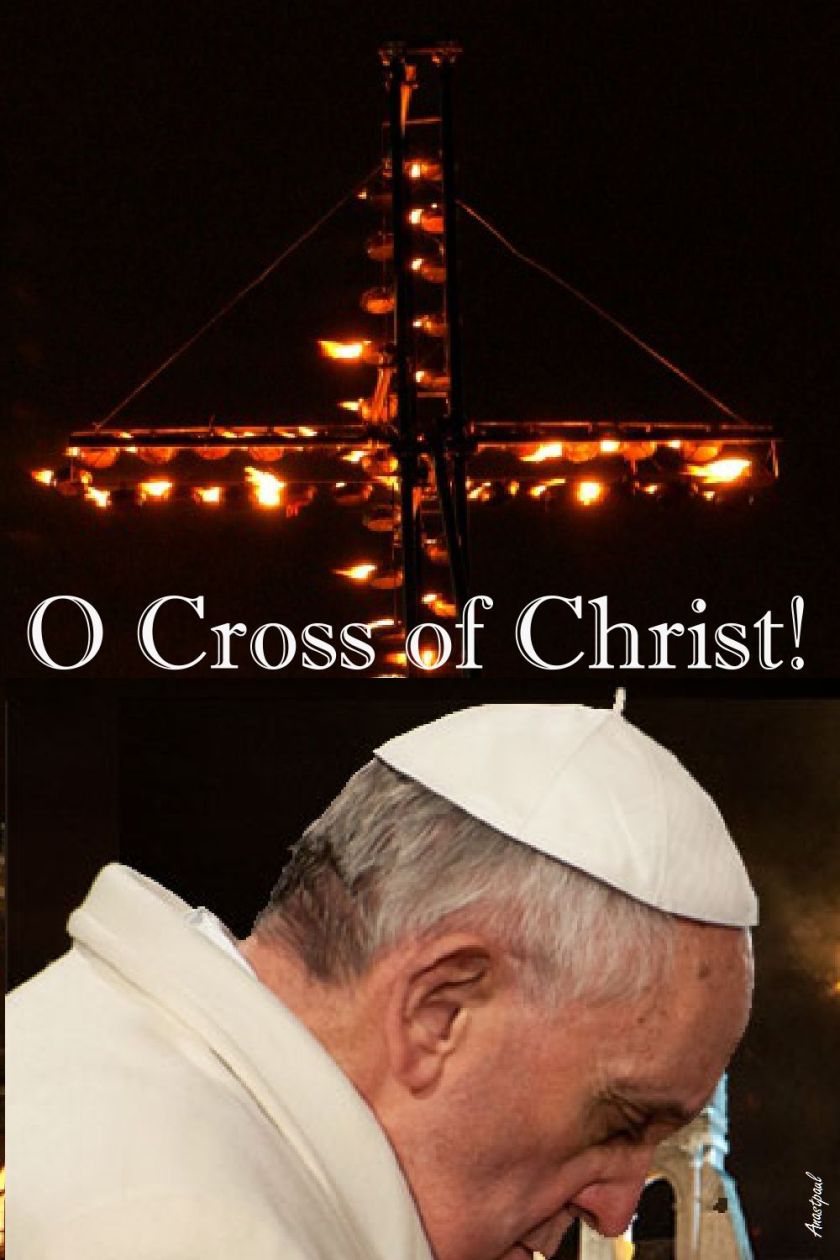
O CROSS OF CHRIST

O Cross of Christ!

O Cross of Christ, symbol of divine love and of human injustice, icon of the supreme sacrifice for love and of boundless selfishness even unto madness, instrument of death and the way of resurrection, sign of obedience and emblem of betrayal, the gallows of persecution and the banner of victory.

O Cross of Christ, today too we see you raised up in our sisters and brothers killed, burned alive, throats slit and decapitated by barbarous blades amid cowardly silence.

O Cross of Christ, today too we see you in the faces of children, of women and people, worn out and fearful, who flee from war and violence and who often only find death and many Pilates who wash their hands.

O Cross of Christ, today too we see you in those filled with knowledge and not with the spirit, scholars of death and not of life, who instead of teaching mercy and life, threaten with punishment and death, and who condemn the just.

O Cross of Christ, today too we see you in unfaithful ministers who, instead of stripping themselves of their own vain ambitions, divest even the innocent of their dignity.

O Cross of Christ, today too we see you in the hardened hearts of those who easily judge others, with hearts ready to condemn even to the point of stoning, without ever recognizing their own sins and faults.

O Cross of Christ, today too we see you in expressions of fundamentalism and in terrorist acts committed by followers of some religions which profane the name of God and which use the holy name to justify their unprecedented violence.

O Cross of Christ, today too we see you in those who wish to remove you from public places and exclude you from public life, in the name of a pagan laicism or that equality you yourself taught us.

O Cross of Christ, today too we see you in the powerful and in arms dealers who feed the cauldron of war with the innocent blood of our brothers and sisters.

O Cross of Christ, today too we see you in traitors who, for thirty pieces of silver, would consign anyone to death.

O Cross of Christ, today too we see you in thieves and corrupt officials who, instead of safeguarding the common good and morals, sell themselves in the despicable market-place of immorality.

O Cross of Christ, today too we see you in the foolish who build warehouses to store up treasures that perish, leaving Lazarus to die of hunger at their doorsteps.

O Cross of Christ, today too we see you in the destroyers of our “common home”, who by their selfishness ruin the future of coming generations.

O Cross of Christ, today too we see you in the elderly who have been abandoned by their families, in the disabled and in children starving and cast-off by our egotistical and hypocritical society.

O Cross of Christ, today too we see you in the Mediterranean and Aegean Seas which have become insatiable cemeteries, reflections of our indifferent and anesthetized conscience.

O Cross of Christ, image of love without end and way of the Resurrection, today too we see you in noble and upright persons who do good without seeking praise or admiration from others.

O Cross of Christ, today too we see you in ministers who are faithful and humble, who illuminate the darkness of our lives like candles that burn freely in order to brighten the lives of the least among us.

O Cross of Christ, today too we see you in the faces of consecrated women and men – good Samaritans – who have left everything to bind up, in evangelical silence, the wounds of poverty and injustice.

O Cross of Christ, today too we see you in the merciful who have found in mercy the greatest expression of justice and faith.

O Cross of Christ, today too we see you in simple men and women who live their faith joyfully day in and day out, in filial observance of your commandments.

O Cross of Christ, today too we see you in the contrite, who in the depths of the misery of their sins, are able to cry out: Lord, remember me in your kingdom!

O Cross of Christ, today too we see you in the blessed and the saints who know how to cross the dark night of faith without ever losing trust in you and without claiming to understand your mysterious silence.

O Cross of Christ, today too we see you in families that live their vocation of married life in fidelity and fruitfulness.

O Cross of Christ, today too we see you in volunteers who generously assist those in need and the downtrodden.

O Cross of Christ, today too we see you in those persecuted for their faith who, amid their suffering, continue to offer an authentic witness to Jesus and the Gospel.

O Cross of Christ, today too we see you in those who dream, those with the heart of a child, who work to make the world a better place, ever more human and just.

In you, Holy Cross, we see God who loves even to the end, and we see the hatred of those who want to dominate, that hatred which blinds the minds and hearts of those who prefer darkness to light.

O Cross of Christ, Arc of Noah that saved humanity from the flood of sin, save us from evil and from the Evil One. O Throne of David and seal of the divine and eternal Covenant, awaken us from the seduction of vanity! O cry of love, inspire in us a desire for God, for goodness and for light.

O Cross of Christ, teach us that the rising of the sun is more powerful than the darkness of night. O Cross of Christ, teach us that the apparent victory of evil vanishes before the empty tomb and before the certainty of the Resurrection and the love of God which nothing can defeat, obscure or weaken. Amen!

 

Posted in DOCTORS of the Church, FATHERS of the Church, HOLY WEEK, MORNING Prayers, QUOTES of the SAINTS

Quote/s of the Day – 14 April – Good Friday

Quote/s of the Day – 14 April – Good Friday

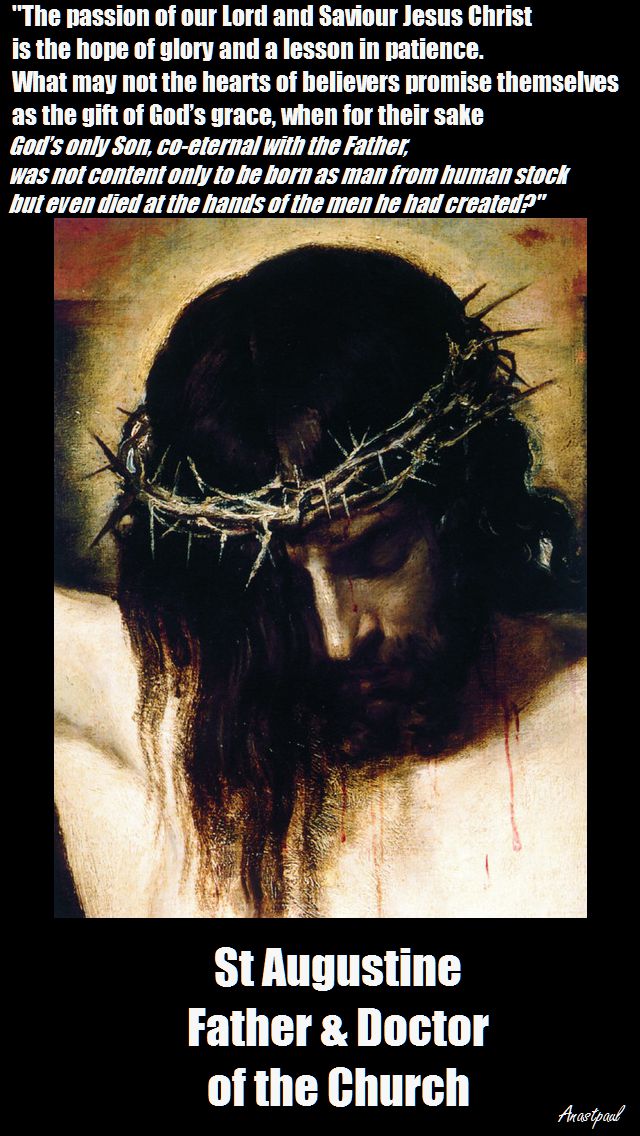
“The passion of our Lord and Saviour Jesus Christ is the hope of glory and a lesson in patience.    What may not the hearts of believers promise themselves as the gift of God’s grace, when for their sake God’s only Son, co-eternal with the Father, was not content only to be born as man from human stock but even died at the hands of the men he had created?”

– St. Augustine

THE PASSION-ST AUGUSTINE

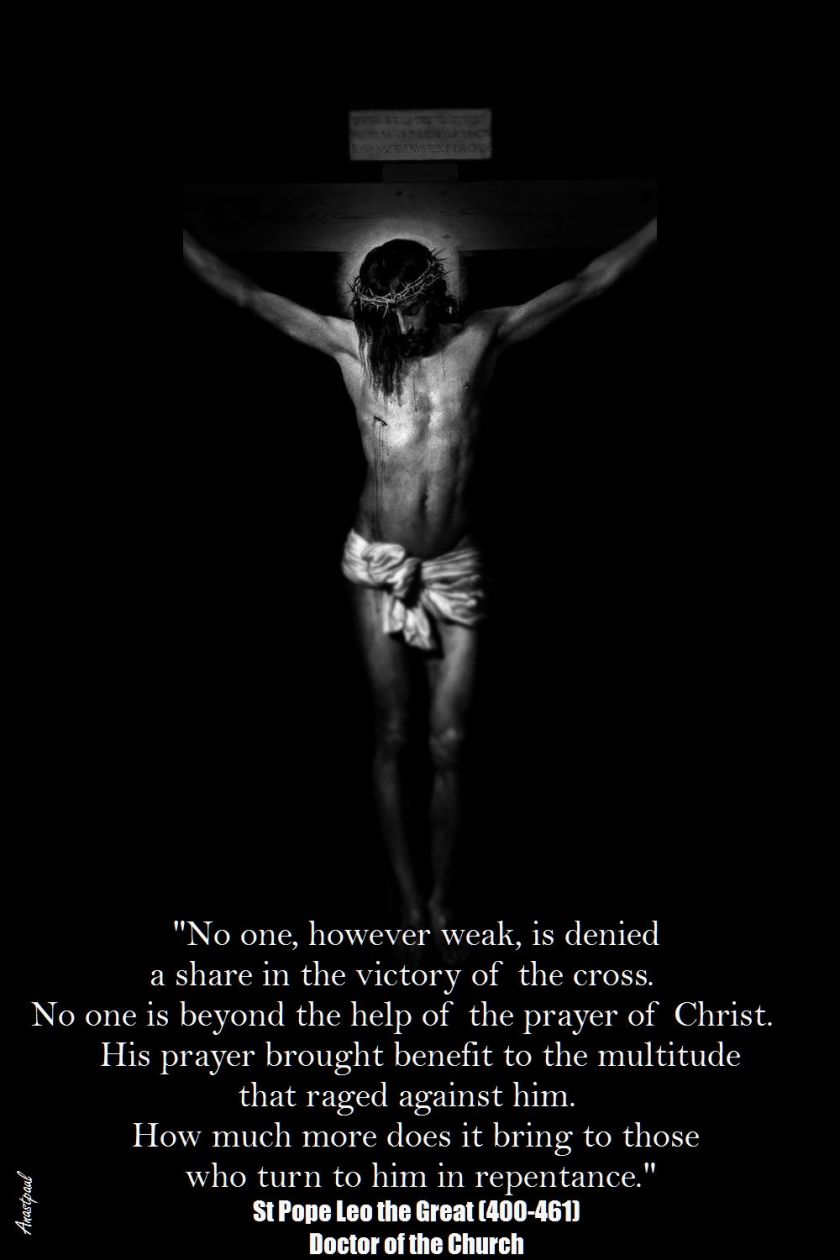
“No one, however weak, is denied a share in the victory of the cross.    No one is beyond the help of the prayer of Christ.    His prayer brought benefit to the multitude that raged against him.   How much more does it bring to those who turn to him in repentance.”

St. Leo the Great

ST LEO THE GREA

Posted in HOLY WEEK, MORNING Prayers

One Minute Reflection – 14 April – Good Friday

One Minute Reflection – 14 April – Good Friday

Father, into your hands I commend my spirit…………….Luke 23:46

REFLECTION – A Few Drops of Blood Renew the Whole World!
Many indeed are the wondrous happenings of that time: God hanging from a cross, the sun made dark and again flaming out;  for it was fitting that creation should mourn with its creator.   The temple veil rent, blood and water flowing from His side:  the one as from a man, the other as from what was above man;  the earth shaken, the rocks shattered because of the rock;  the dead risen to bear witness to the final and universal resurrection of the dead.
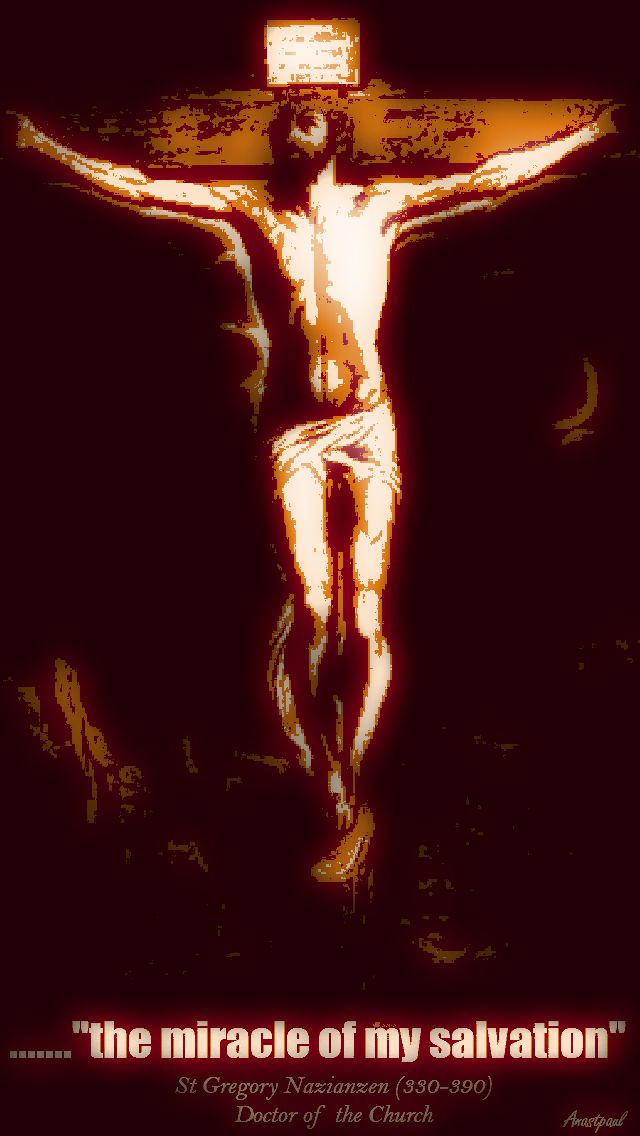
The happenings at the sepulchre and after the sepulchre, who can fittingly recount them?   Yet no one of them can be compared to the miracle of my salvation.   A few drops of blood renew the whole world and do for all men what the rennet does for the milk: joining us and binding us together………..St Gregory Nazianzen – Doctor of the Church

PRAYER – O God, who by the Passion of Christ your Son, our Lord, abolished the death inherited from ancient sin by every succeeding generation, grant that just as, being conformed to him, we have borne by the law of nature the image of the man on earth, so by the sanctification of grace we may bear the image of the Man of heaven. Through Christ our Lord. Amen

b9dff93e30f7d856b7687601d4e3e511

THE MIRACLE OF MY SALVAION-ST GREGORY NAZIANZEN

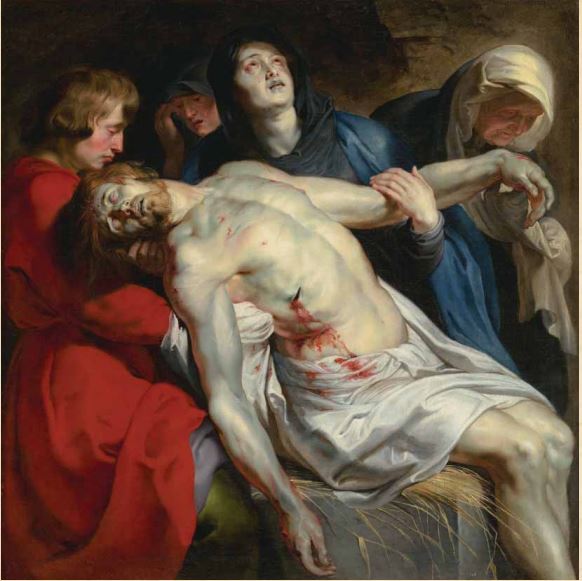
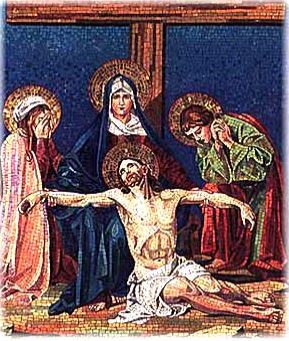
PIETA

Posted in HOLY WEEK, MORNING Prayers, PRAYERS of the SAINTS

Our Morning Offering – 14 April – Good Friday

Our Morning Offering – 14 April – Good Friday

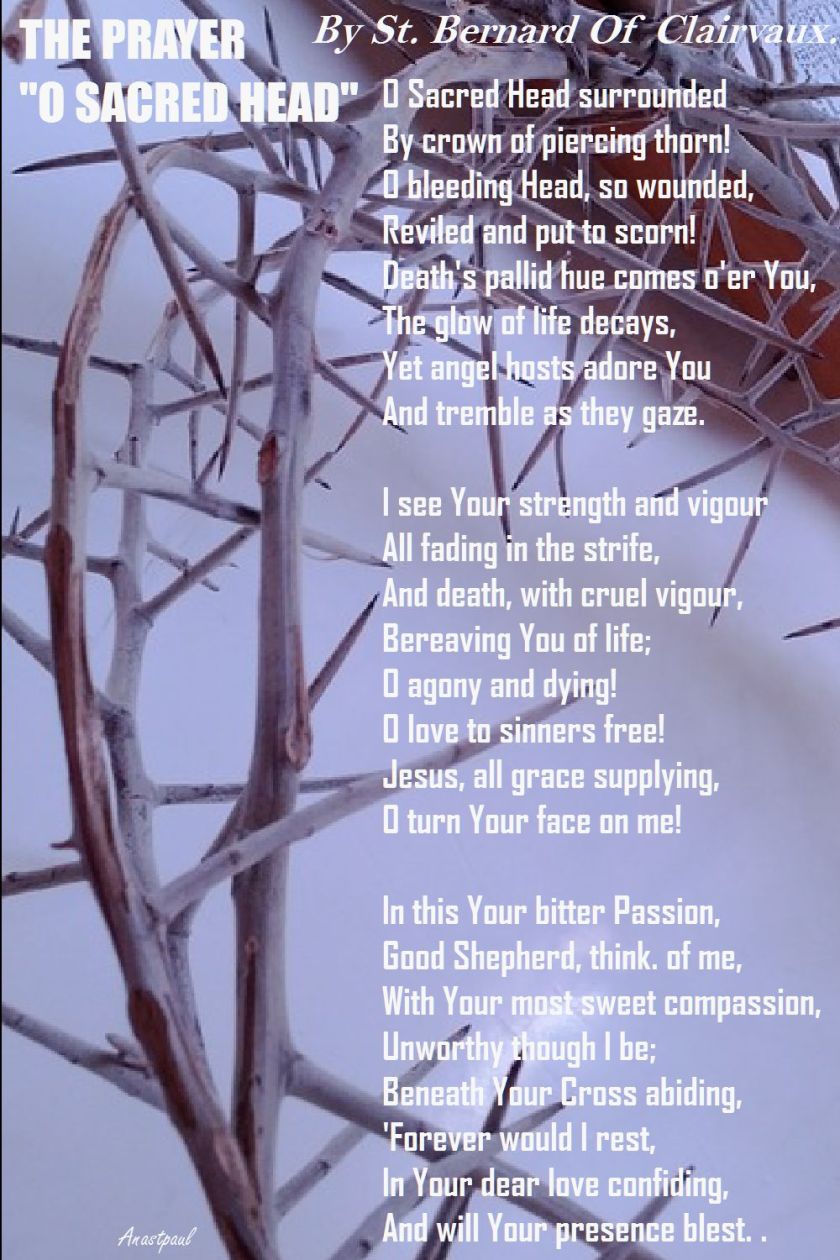
THE PRAYER
“O SACRED HEAD”
By St. Bernard Of Clairvaux

O Sacred Head surrounded
By crown of piercing thorn!
O bleeding Head, so wounded,
Reviled and put to scorn!
Death’s pallid hue comes o’er You,
The glow of life decays,
Yet angel hosts adore You
And tremble as they gaze.

I see Your strength and vigour
All fading in the strife,
And death, with cruel vigour,
Bereaving You of life;
O agony and dying!
O love to sinners free!
Jesus, all grace supplying,
O turn Your face on me!

In this Your bitter Passion,
Good Shepherd, think. of me,
With Your most sweet compassion,
Unworthy though I be;
Beneath Your Cross abiding,
‘Forever would I rest,
In Your dear love confiding,
And will Your presence blest.

O SACRED HEAD-BY ST BERNARD

Posted in Of FISHERMEN, FISHMONGERS, SAILORS, MARINERS, NAVIGATORS, SAINT of the DAY

Saint of the Day – 14 April – Blessed Peter Gonzalez OP (1190 – 1246)

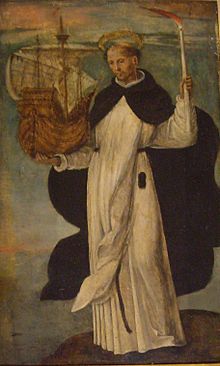
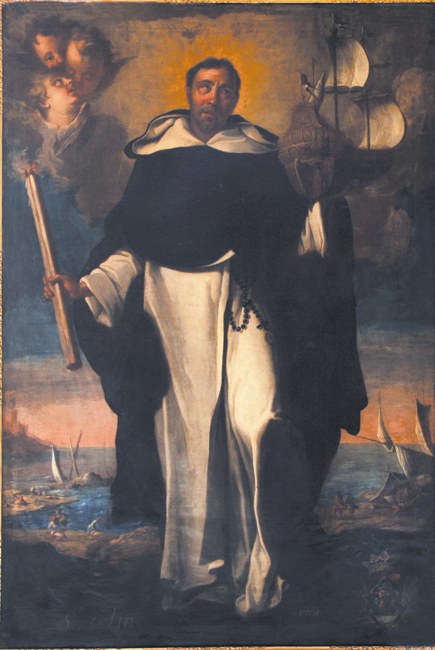
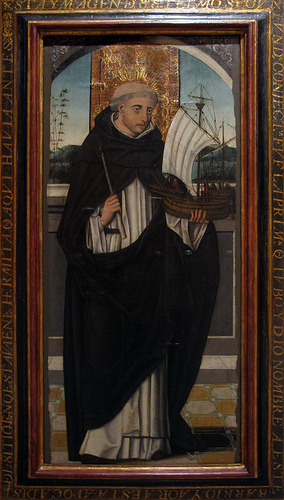
Saint of the Day – 14 April – Blessed Peter Gonzalez OP. (1190 – 1246) also known as -Pedro González Telmo, Saint Telmo, or Saint Elmo, was a Castilian Priest, and Friar of the Order of Preachers, born in 1190 in Frómista, Palencia, Kingdom of Castile and Leon.    Confessor, Preacher – Patron of  mariners, sailors, fisherman, Tui, Spain, Tui-Vigo, Spain, diocese of, Attributes – Dominican holding a blue candle or a candle with a blue flame; Dominican lying on his cloak which is spread over hot coals; Dominican holding fire in his bare hands; Dominican catching fish with his bare hands; Dominican beside the ocean, often holding or otherwise protecting a ship.   Image below – 16th-century painting of the Blessed Peter González, by Alejo Fernández, in the Alcázar of Seville

220px-San_Telmo_representacion_con_cirio_y_barco

Saint Paul had a conversion experience on the road to Damascus.   Many years later, the same proved true for Peter Gonzalez, who triumphantly rode his horse into the Spanish city of Astorga in the 13thcentury to take up an important post at the cathedral.   The animal stumbled and fell, leaving Peter in the mud and onlookers amused.

Humbled, Peter re-evaluated his motivations–his bishop-uncle had secured the cathedral post for him– and started down a new path.   He became a Dominican priest and proved to be a most effective preacher.   He spent much of his time as court chaplain and attempted to exert positive influence on the behaviour of members of the court.   After King Ferdinand III and his troops defeated the Moors at Cordoba, Peter was successful in restraining the soldiers from pillaging and persuaded the king to treat the defeated Moors with compassion.

After retiring from the court, Peter devoted the remainder of his life to preaching in northwest Spain.   Having developed a special mission to Spanish and Portuguese seamen, he is considered their patron.

guerra10

6264700478_7371714712

Peter Gonzalez died in 1246 and was beatified in 1741.

Although his cultus was confirmed in 1741 by Pope Benedict XIV and despite his common epithet of “saint,” Peter was never formally Canonised. Peter González was Beatified in 1254 by Pope Innocent IV.

The diminutive “Elmo” (or “Telmo”) belongs properly to the Martyr-Bishop Saint Erasmus (died c. 303), one of the Fourteen Holy Helpers, of whose name “Elmo” is a contraction. However, as Erasmus is the patron saint of sailors generally and Peter González of Spanish and Portuguese sailors specifically, they have both been popularly invoked as “Saint Elmo.

Posted in SAINT of the DAY

Saints and Solemnities – 14 April

Good Friday (2017)

St Abundius the Sacristan
St Antony of Vilna
St Ardalion the Actor
St Benezet the Bridge Builder
St Bernhard of Tiron
St Domnina of Terni
St Eustace of Vilna
St Fronto of Nitria
Bl Hadewych
St John of Monte Marano
St John of Vilna
St Lambert of Lyon
St Lydwina of Schiedam
St Maximus of Rome
St Peter Gonzalez
St Tassach of Raholp
St Thomaides of Alexandria
St Tiburtius of Rome
St Valerian of Trastevere

Martyrs of Antioch

Posted in HOLY WEEK, MORNING Prayers, PRAYERS for PRIESTS

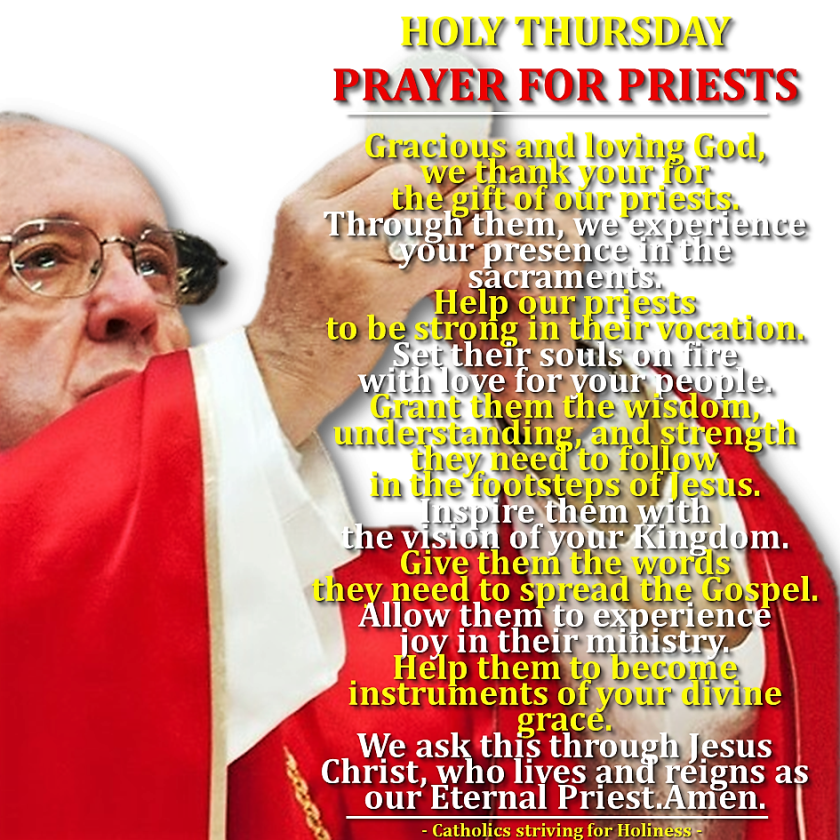
HOLY THURSDAY: PRAYER FOR PRIESTS

Posted in HOLY WEEK, MORNING Prayers

Holy Thursday/Maundy Thursday/The Last Supper of the Lord – 13 April 2017

Holy Thursday/Maundy Thursday/The Last Supper of the Lord – 13 April 2017

Today is Holy Thursday, also known as Maundy Thursday or the Last Supper. It’s here, at the Last Supper, that we see: (1) the institution of the Eucharist (2) the institution of the sacramental priesthood and (3) references to Baptism and Confession. Sacramentally, then, it’s important and very beautiful.

I. The Eucharist

The Eucharist is straight-forward (Mt. 26:26-29; Mk. 14:22-25; Lk. 22:19-20; 1 Cor. 11:23-25).  It’s also of obvious importance to the early Church: it’s one of relatively few events recorded (nearly verbatim) by St. Paul and the Synoptic Gospels.  As Catholics, we believe that when Jesus said, “This is My Body,” and “This is My Blood of the Covenant,” that He meant “This is My Body,” and “This is My Blood of the Covenant,” and not some other thing, like “this is a symbol.”  Suffice it to say that this language is prefigured in the Old Covenant (Exodus 24:8), and wasn’t symbolic then (as Hebrews 9:18-20 notes).

II. Holy Orders
But let’s talk a bit about Holy Orders.   It’s not coincidental that the priesthood and Eucharist are established simultaneously.    The Eucharistic Sacrifice, after all, requires priests:  a priest, is one who offers sacrifice.    But Christ does something interesting with this notion of priesthood in the washing of the feet (John 13:3-17).   This appears to be a deliberate echo of the washing of the hands and feet done by the sacrificial priests of the Old Covenant (Exodus 30:19-21).    This washing was to symbolise the priest’s unworthiness to approach the Lord, so it’s fitting that the washing of feet occurs at the same time that the Apostles are entrusted with the Eucharist (which they’re not worthy to approach).    But notice what’s different: the Old Covenant focused on self-purification.  The New Covenant is focused on sanctifying others.    This is in keeping with the model of clerical governance that Christ imparts to St. Peter and the Apostles at this Last Supper (Luke 22:24-34).
III. Baptism and Confession
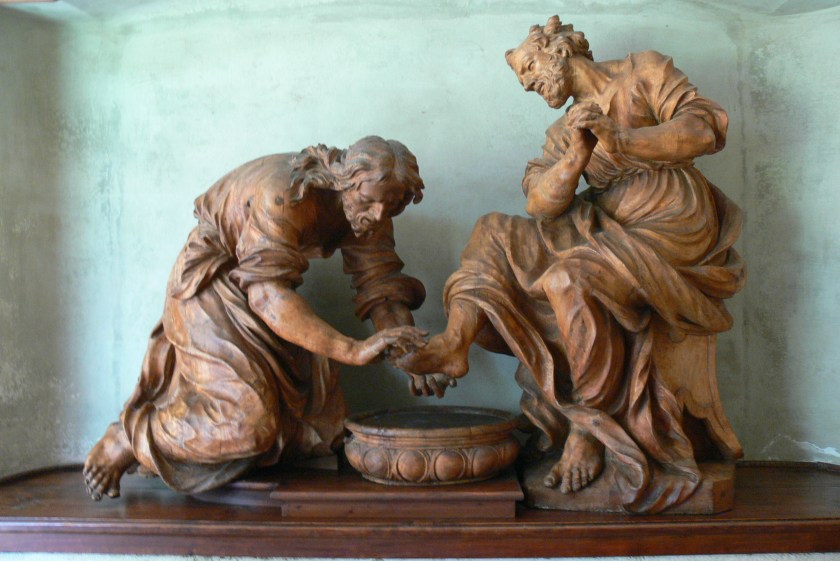
Christ Washing the Feet of Peter (11th c.)

And the washing of the feet doesn’t just represent the priesthood.  It also represents Sacramental Confession.  In John 13:6-10, Jesus and Peter have this dialogue:

He came to Simon Peter; and Peter said to him, “Lord, do you wash my feet?” Jesus answered him, “What I am doing you do not know now, but afterward you will understand.” Peter said to him, “You shall never wash my feet.” Jesus answered him, “If I do not wash you, you have no part in me.” Simon Peter said to him, “Lord, not my feet only but also my hands and my head!”Jesus said to him, “He who has bathed does not need to wash, except for his feet, but he is clean all over; and you are clean, but not every one of you.
Obviously, this isn’t about “the removal of dirt from the body” (1 Peter 3:21), but the forgiveness of sins. That’s why Jesus says that Judas isn’t clean, at the end (Jn. 13:10-11).  Well, given that, what’s the bath that Jesus is talking about? It’s Baptism, “the washing of regeneration and renewal in the Holy Spirit” (Titus 3:5).
If that’s right, what is Jesus saying that the washing of feet represents?  Sacramental confession (CCC 14841486).  It is in this way that we are restored to our Baptismal purity.  And here’s something fascinating: just as Christ doesn’t permit the Disciples to purify themselves, but instructs them to purify one another, the same is true for the priesthood He established, and sacramental confession.
IV. The Priestly Commission
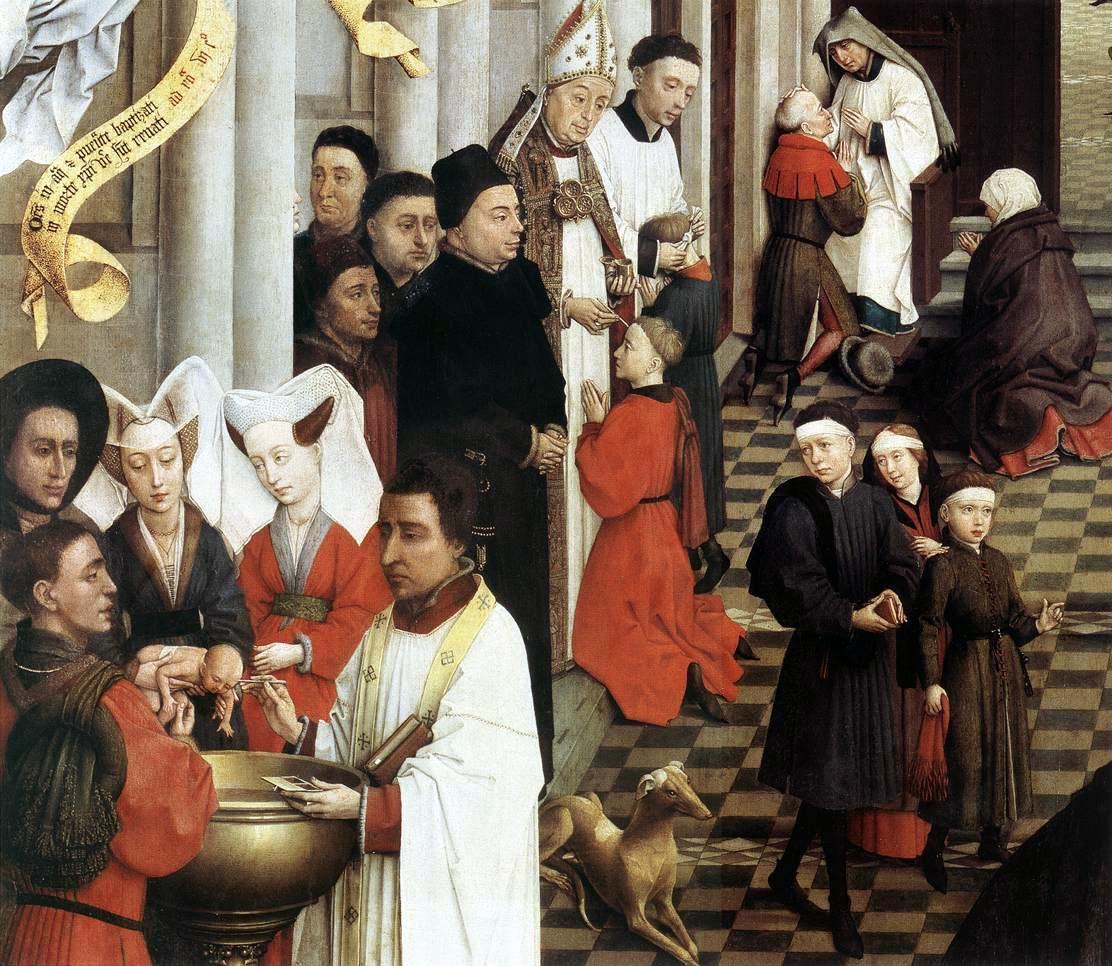
Rogier van der Weyden, Seven Sacraments Altarpiece(detail, right wing) (1450)

Having established all of this, consider Christ’s dual commission.  Immediately after instituting the Eucharist, He orders the Apostles: “do this in remembrance of me” (Lk. 22:19; 1 Cor. 11:24).    That doesn’t mean “treat this as a symbol,” by the way.    Once again, the Old Testament provides important context.    The Old Covenant contained what’s called the memorial sacrifice or memorial offering (see, e.g., Leviticus 2:9).  The sacrifice wasn’t a mere symbol: the memorial offering of grain actually was grain. And the memorial offering of our prayers (Acts 10:4) aren’t symbols of prayers, but actual prayers.    Likewise, the memorial offering of Christ’s Body and Blood actually is Christ’s Body and Blood.   But each of these memorial offerings also recalls something: in this case, we’re offering up Christ’s Body and Blood, while recalling His Death on Calvary.

So “do this in remembrance of me,” properly understood, is sacrificial language.   The first Eucharist is offered by Christ, who is both the High Priest (Hebrews 9:11), and the willing Sacrificial Victim (1 Corinthians 5:7).   Jesus makes this clear Himself in John 10:17-18: He is in control over everything, including Calvary. But what’s shocking is that He tells the Apostles to carry on His priestly role. To continue to offer the memorial offering of His Body and Blood.

Only slightly less shocking is the second commission, which comes at the end of the washing of the feet (John 13:12-17),

When he had washed their feet, and taken his garments, and resumed his place, he said to them, “Do you know what I have done to you? You call me Teacher and Lord; and you are right, for so I am.  If I then, your Lord and Teacher, have washed your feet, you also ought to wash one another’s feet.  For I have given you an example, that you also should do as I have done to you. Truly, truly, I say to you, a servant is not greater than his master; nor is he who is sent greater than he who sent him. If you know these things, blessed are you if you do them.

Rogier van der Weyden, Seven Sacraments Altarpiece(detail, left wing) (1450)

That’s the mandate (mandatum) that gives Maundy Thursday its name.    Now, this doesn’t sound shocking at first, because it sounds like Jesus is just saying, “be humble.”  And surely, that’s part of it.  But remember what we established earlier:  that the washing of feet is about the sacrificial priesthood and about the forgiveness of sins.  Jesus makes that last part really clear in John 13:6-11.    He’s not calling Judas smelly.   He’s saying Judas is still trapped in sin.  So in that context, Jesus Christ is calling the Apostles not only to be humble, but to (a) forgive sins, and (b) pass on the gift of the priesthood.    He’ll later empower the Apostles to carry out this command to forgive sins by imparting the Holy Spirit upon them (John 20:21-23).    But too often, Christians read the washing of feet as simply a nice gesture, when Christ makes it clear that it’s so much more.

So tonight should be a true celebration of the Sacraments that Christ left us and the beautiful manner in which they are, in God’s Providence, intertwined.   Baptism, to wash us free from our sins.  The Eucharist, the food of life, partaking in the Body and Blood of Jesus Christ.  Confession, to restore us to our Baptismal purity and prepare us for the Eucharist.  And Holy Orders, to carry on His priestly ministry, and to ensure that we should always have the Eucharist and Confession.  by


Posted in HOLY WEEK, MORNING Prayers

Maundy Thursday of Holy Week – 13 April 2017

Maundy Thursday of Holy Week – 13 April 2017

O God, who have called us to participate
in this most sacred Supper,
in which Your Only Begotten Son,
when about to hand Himself over to death,
entrusted to the Church a sacrifice new for all eternity,
the banquet of His love,
grant, we pray,
that we may draw from so great a mystery,
the fullness of charity and of life.
Through our Lord Jesus Christ, Your Son,
who lives and reigns with You in the unity of the Holy Spirit,
one God, for ever and ever.

MAUNDY THURSDAY 13 APRIL

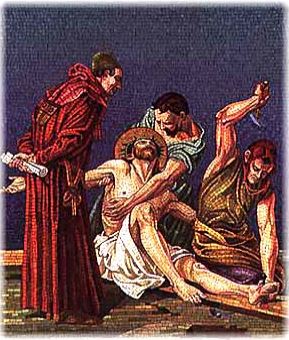
The Thirteenth Station:
Jesus is Taken Down From the Cross

st 13

My Jesus, it was with deep grief that Mary finally took You into her arms and saw all the wounds sin had inflicted upon You.    Mary Magdalene looked upon Your dead Body with horror.    Nicodemus, the man so full of human respect, who came to You by night, suddenly received the courage to help Joseph take you down from the Cross.    You are once more surrounded by only a few followers.    When loneliness and failure cross my path, let me think of this lonely moment and this total failure – failure in the eyes of men. How wrong they were – how mistaken their concept of success!    The greatest act of love was given in desolation and the most successful mission accomplished and finished when all seemed lost.    Is this not true in my life, dear Jesus?    I judge my failures harshly.    I demand perfection instead of holiness.    My idea of success is for all to end well – according to my liking.
Give to all men the grace to see that doing Your Will is more important than success.    If failure is permitted for my greater good then teach me how to use it to my advantage.    Let me say as You once said, that to do the Will of the Father is my food.    Let not the standards of this world take possession of me or destroy the good You have set for me – to be Holy and to accomplish the Father’s Will with great love.    Let me accept praise or blame, success or failure with equal serenity.
Amen

The Fourteenth Station:
Jesus is Laid in the Sepulcher

ST14

My Jesus, You were laid to rest in a stranger’s tomb.    You were born with nothing of this world’s goods and You died detached from everything.    When You came into the world, men slept and angels sang and now as You leave it, Creation is silent and only a few weep.    Both events were clothed in obscurity.    The majority of men live in such a way. Most of us live and die knowing and known by only a few.    Were You trying to tell us, dear Jesus, how very important our lives are just because we are accomplishing the Father’s Will?    Will we ever learn the lesson of humility that makes us content with who we are, where we are and what we are?
Will our Faith ever be strong enough to see power in weakness and good in the sufferings of our lives?    Will our Hope be trusting enough to rely on Your Providence even when we have nowhere to lay our head?    Will our Love ever be strong enough not to take scandal in the cross?

My Jesus, hide my soul in Your heart as You lie in the Sepulcher alone.    Let my heart be as a fire to keep you warm.    Let my desire to know and love You be like a torch to light up the darkness.    Let my soul sing softly a hymn of repentant love as the hours pass and Your Resurrection is at hand.    Let me rejoice, dear Jesus, with all the Angels in a hymn of praise and thanksgiving for so great a love- so great a God- so great a day!
Amen

Stations of the Cross by Mother Angelica

Posted in SAINT of the DAY

Thought for the Day – 13 April

Thought for the Day – 13 April

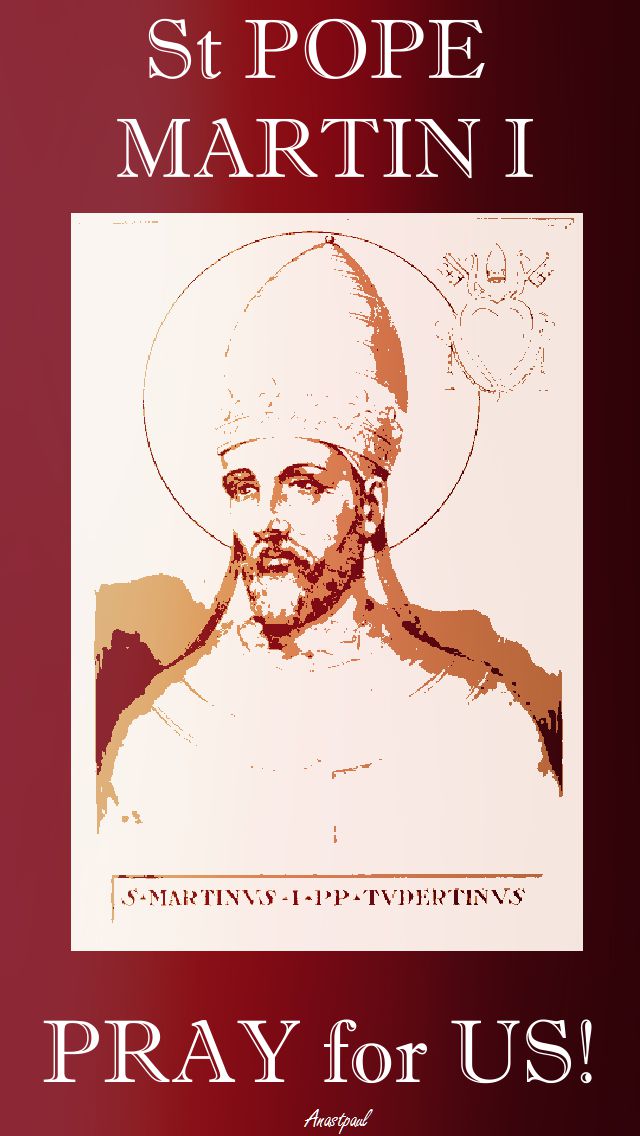
Jesus taught that His followers would “suffer persecution for the sake of justice” and that is often the lot of the followers of Christ.   If we follow our Christian convictions and live them, we will often be opposed and criticised.   That is part of the price of following our Lord Jesus Christ, look what happened to Him!   The real significance of the word martyr comes not from the dying but from the witnessing, which the word means in its derivation.    People who are willing to give up everything, their most precious possessions, their very lives, put a supreme value on the cause or belief for which they sacrifice.    Martyrdom, dying for the faith, is an incidental extreme to which some have had to go to manifest their belief in Christ.    A living faith, a life that exemplifies Christ’s teaching throughout and that in spite of difficulties, is required of all Christians. St Pope Martin I refused to cut corners as a way of easing his lot, to make some accommodations with the civil rulers and he died a martyr.

St Pope Martin I pray for us!

ST POPE MARTIN i PRAY FOR USST POPE MARTIN i - APRIL 13

Posted in HOLY WEEK

Holy Thursday – 13 April 2017

Holy Thursday – 13 April 2017

The washing of the feet: ultimate act of love and service

The washing of the feet is a very particular moment in the ceremony.   It happens after the readings, after a homily and before the celebration of the Eucharist.   It is a moment when 12 people gathered in the Church come together near the altar and the chief celebrant washes each foot: “water is poured over, the foot is dried and sometimes the foot is kissed” he says.

It is done in silence, the congregation is singing but no prayers are said:  it is the gesture that counts.   My feet are my way to God, I walk the path to God, my feet are that part of my anatomy which enables me to move… they are the way to love.   We are all pilgrims on the way…

Stift_Heiligenkreuz_-_Kreuzgang_Fu-C3-9Fwaschung

Twelve very different pairs of feet that sat around the table on that eventful evening of Jesus’ last Supper:

–    The feet that never walked – the feet of people who have never had the opportunity of experiencing the walk in any other way than “being walked by someone else”…

–    The feet that never wore shoes; that are so poor that they haven’t got shoes…

–    The feet that are always shackled; the feet that have been put in prison…

–    The feet of those who are so talented; who use those feet in a magical way…

–    The feet that give pain as we get older…

–    The feet crushed in accidents; feet that are lost through no fault of our own…

–    The feet that spend hours training to run a marathon for charity…

–    The feet that are blown off by landmines…

–    The feet of those who have walked and have never found; the ones who doubt…

–    The feet that have always taken the wrong turnings…

–    The feet of strangers who have come to this Church…

–    The feet that long to walk to Heaven…

Benedictine Abbot Timothy Wright


Posted in FATHERS of the Church, HOLY WEEK, MORNING Prayers

Our Morning Offering – 13 April

Our Morning Offering – 13 April

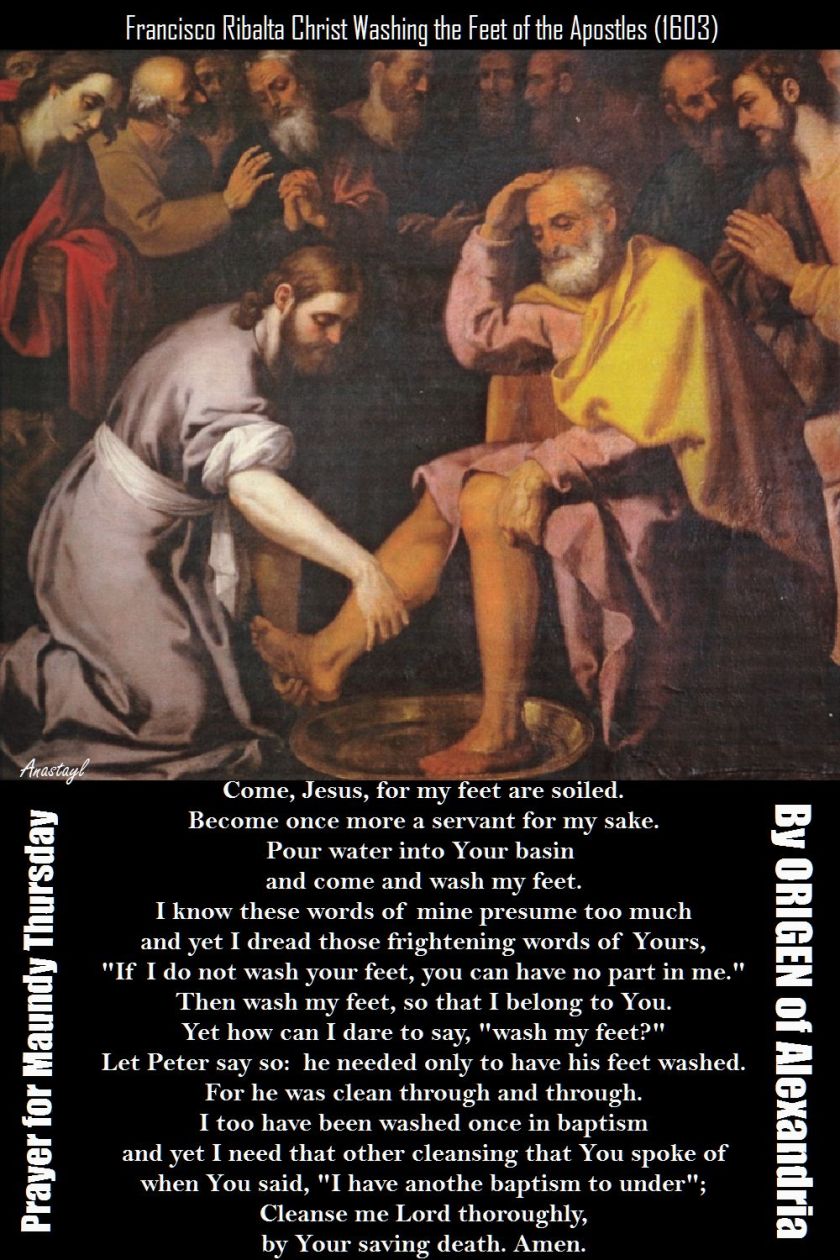
Come, Jesus, for my feet are soiled.
Become once more a servant for my sake.
Pour water into Your basin
and come and wash my feet.
I know these words of mine presume too much
and yet I dread those frightening words of Yours,
“If I do not wash your feet, you can have no part in me.”
Then wash my feet, so that I belong to You.
Yet how can I dare to say, “wash my feet?”
Let Peter say so: he needed only to have his feet washed.
For he was clean through and through.
I too have been washed once in baptism
and yet I need that other cleansing that You spoke of
when You said, “I have anothe baptism to under”;
Cleanse me Lord thoroughly,
by Your saving death. Amen

By Origen of Alexandria

Come Jesus for my feet are soiled by ORIGEN

Posted in SAINT of the DAY

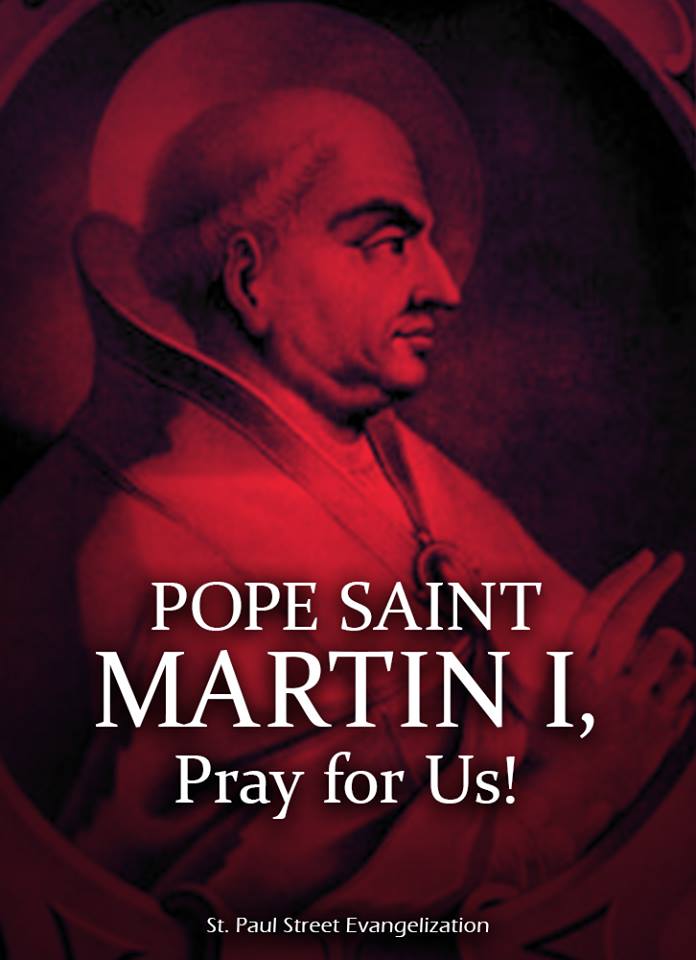
Saint of the Day – 13 April – St Pope Martin I

Saint of the Day – 13 April – St Pope Martin I (598-655) Martyr – Attributes  Pope holding money,  Pope with geese around him (possible confusion by artist with Martin of Tours),  Pope in a prison cell.

S. Martin was a Priest of Rome who had a reputation for being well-educated and holy. He became the 74th Pope in July, 649.   When people were arguing over the truths about Jesus, Pope Martin called a meeting of Bishops.    This meeting was the Council of the Lateran.   It explained clearly what we believe about certain truths.   However, some Christians were not pleased about it.   Pope Martin knew the Council’s explanations were true.    It was his duty as pope to teach people the truth.

Some powerful men did not appreciate Pope Martin’s activities.    One such person was Emperor Constans II of Constantinople.    He sent his soldiers to Rome to capture Martin and bring him to Constantinople.    The soldiers kidnapped the pope.   They took him from the Lateran Cathedral and onto a ship. Pope    Martin became ill but they continued their journey.    In October, 653, he was put in jail in Constantinople for three months.   He was given only a little food and water each day.   Pope Martin was put on trial, publicly humiliated and condemned to death.    But then he was sent back to the same prison for three more months.    Patriarch Paul of Constantinople pleaded for the pope’s life.   So instead of death, the pope was sentenced to be exiled.   Pope Martin was put on a ship that took him across the Black Sea.    In April, 654, it landed on the Russian peninsula called the Crimea.

Pope Martin was shocked at the neglect he suffered from those who were in charge of his captivity.   He wrote his own account of those sad days.   The pope said that he felt very bad to be forgotten by his relatives and members of the Church in Rome.   He realised their neglect was driven by fear.

The pope’s exile lasted two years.    He died around 655.   Because of his terrible sufferings, he was proclaimed a martyr.    He is the last of the popes so far to be considered a martyr.

Posted in SAINT of the DAY

Saints, memorials, celebrations – 13 April

Holy Thursday (2017)
St Pope Martin I (Optional Memorial)

Agathonica of Pergamus
Agathodorus of Pergamus
Caradoc of Wales
Carpus of Pergamus
Bl Edward Catherick
Bl Francis Dickenson
Guinoc
Hermengild
Ida of Boulogne
Bl Ida of Louvain
Bl Isabel Calduch Rovira
Bl James of Certaldo
Bl John Lockwood
Bl Margaret of Castello
Martius of Auvergne
Bl Miles Gerard
Papylus of Pergamus
Proculus of Terni
Bl Rolando Rivi
Sabas Reyes Salazar
Bl Scubilion Rousseau
Ursus of Ravenna

Martyrs of Dorostorum – 3 saints: A lector and two students martyred together in the persecutions of Diocletian – Dadas, Maximus and Quinctillianus. Beheaded c.303 in Dorostorum, Lower Mysia (modern Sillistria, Bulgaria

Posted in HOLY WEEK, MORNING Prayers, PRAYERS of the CHURCH

Holy Week – Wednesday 12 April – The Last Day of Lent

Holy Week – Wednesday 12 April  – The Last Day of Lent

He freed us from the power of the enemy.
This is the last day of Lent.

It is “Spy Wednesday,” remembering the day Judas asked,

“What are you willing to give me if I hand him over to you?”

We read the third song of the Servant who suffers.
And we sense the acceptance, the surrender and the peace of Jesus.

I can imagine the treachery and tranquility of this day,

as I go through the real life drama of my day.

I can begin to feel the joy of the liberation being offered me.

If I haven’t done so already,
this can be a wonderful day to pray through the Stations of the Cross.

The Son of Man came not to be served,
but to serve
and to give his life
as a ransom for many.

Communion Antiphon  Matthew 20:28

12 APRIL STATIONS 11 & 12

The Eleventh Station:
Jesus is Nailed to the Cross

ST 11

It is hard to imagine a God being nailed to a cross by His own creatures.   It is even more difficult for my mind to understand a love that permitted such a thing to happen!   As those men drove heavy nails into Your hands and feet, dear Jesus, did You offer the pain as reparation for some particular human weakness and sin?   Was the nail in Your right hand for those who spend their lives in dissipation and boredom?
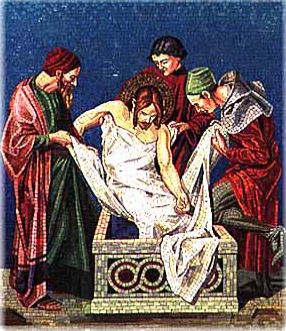
Was the nail in Your left hand in reparation for all consecrated souls who live lukewarm lives?   Were You stretching out Your arms to show us how much You love us?   As the feet that walked the hot, dusty roads were nailed fast, did they cramp up in a deadly grip of pain to make reparation for all those who so nimbly run the broad road of sin and self-indulgence?

It seems, dear Jesus, Your love has held You bound hand and foot as Your heart pleads for a return of love.   You seem to shout from the top of the hill “I love you – come to me – see, I am held fast – I cannot hurt you – only you can hurt Me.”   How very hard is the heart that can see such love and turn away.   Is it not true I too have turned away when I did not accept the Father’s Will with love?   Teach me to keep my arms ever open to love, to forgive and to render service – willing to be hurt rather than hurt, satisfied to love and not be loved in return.
Amen

The Twelfth Station:
Jesus Dies on the Cross

st 12

God is dead!   No wonder the earth quaked, the sun hid itself, the dead rose and Mary stood by in horror.   Your human body gave up it’s soul in death but Your Divinity, dear Jesus, continued to manifest its power.   All creation rebelled as the Word made Flesh departed from this world.   Man alone was too proud to see and too stubborn to acknowledge truth.
Redemption was accomplished!   Man would never have an excuse to forget how much You loved him.   The thief on Your right saw something he could not explain – he saw a man on a tree and knew He was God.  His need made him see his own guilt and Your innocence.   The Promise of eternal life made the remaining hours of his torture. endurable.

A common thief responded to Your love with deep Faith, Hope, and Love.   He saw more than his eyes envisioned – he felt a Presence he could not explain and would not argue with.   He was in need and accepted the way God designed to help him.

Forgive our pride, dear Jesus as we spend hours speculating, days arguing and often a lifetime in rejecting Your death, which is a sublime mystery.   Have pity on those whose intelligence leads them to pride because they never feel the need to reach out to the Man of Sorrows for consolation.
Amen

Stations of the Cross by Mother Angelica

Posted in MORNING Prayers, SAINT of the DAY

Thought for the Day – 12 April

Thought for the Day – 12 April

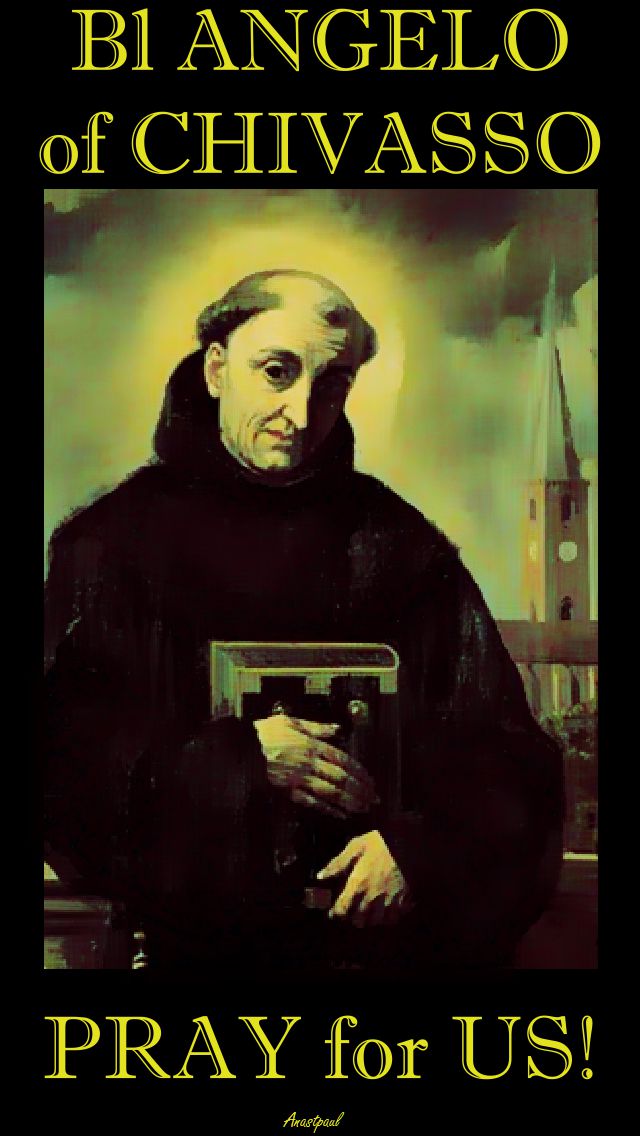
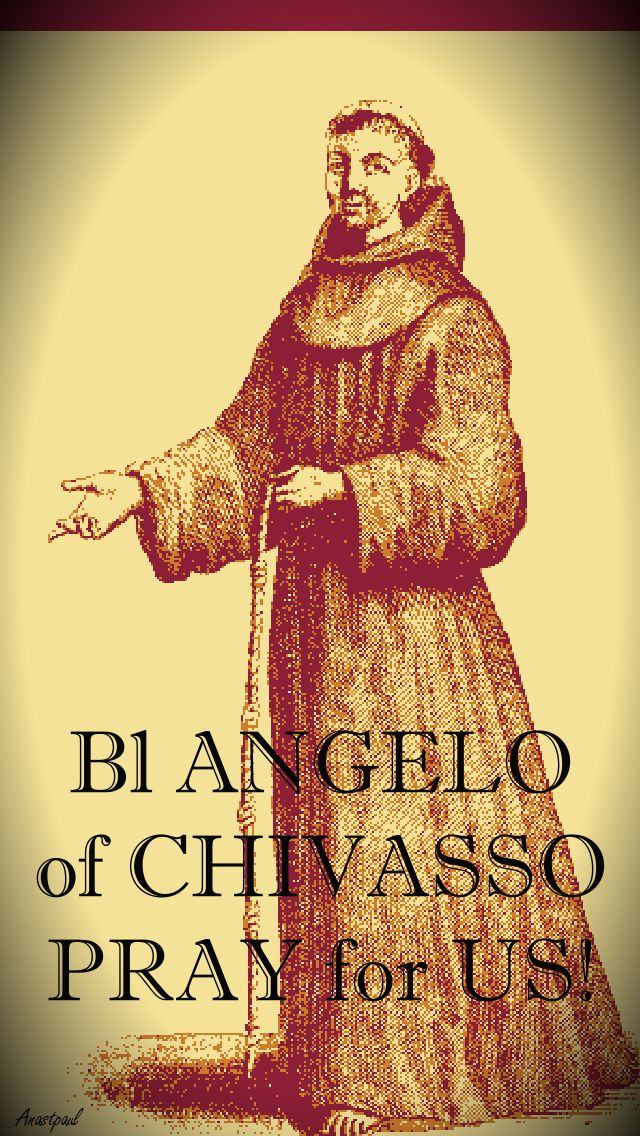
Talented people like Blessed Angelo of Chivasso see the stupidity of most personal ambition that seeks to lord it over others;  rather, talents and gifts should be for the service of others, for enriching and benefiting their lives.   How often do we put others down in order to make ourselves look better than they?   We must recognise that this attitude is the exact opposite of the words of the Beatitudes, the words of Christ and if we seek such a path, we have a great deal of work to do!

Bl Angelo of Chivasso, pray for us!

BL ANGELO PRAY FOR US.jpg 2

Posted in HOLY WEEK, LENT, MORNING Prayers, QUOTES of the SAINTS

Quote of the Day – 12 April

Quote of the Day – 12 April

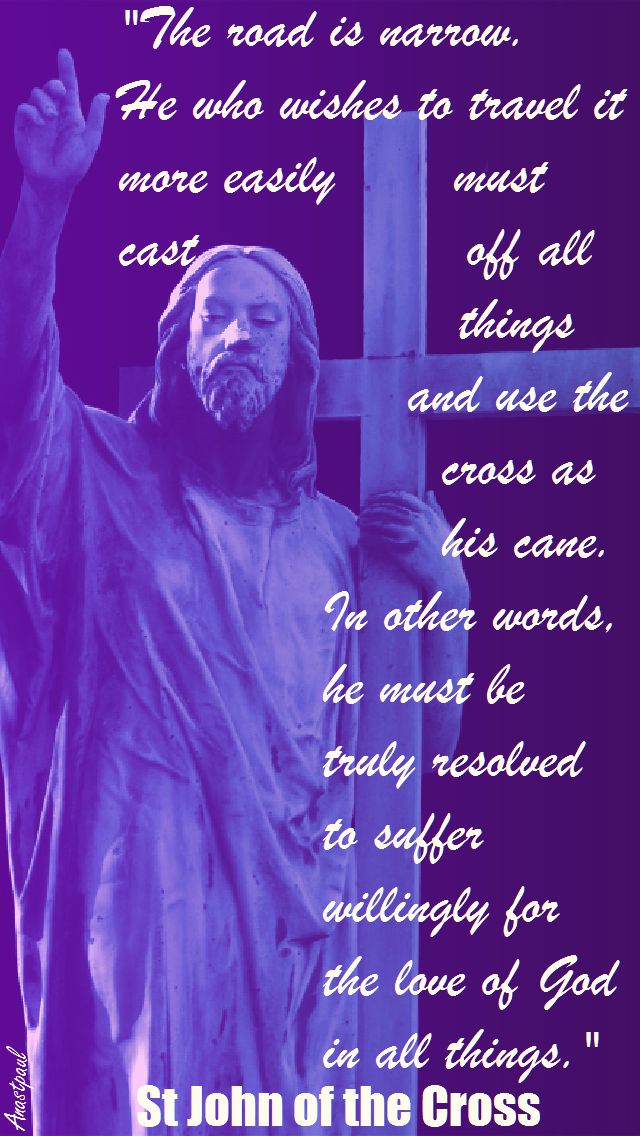
“The road is narrow. He who wishes to travel it more easily must cast off all things and use the cross as his cane. In other words, he must be truly resolved to suffer willingly for the love of God in all things.”

St. John of the Cross

THE RD IS NARROW-ST JOHN OF THE CROSS

Posted in MORNING Prayers, QUOTES of the SAINTS, SAINT of the DAY, The WORD

One Minute Reflection – 12 April

One Minute Reflection – 12 April

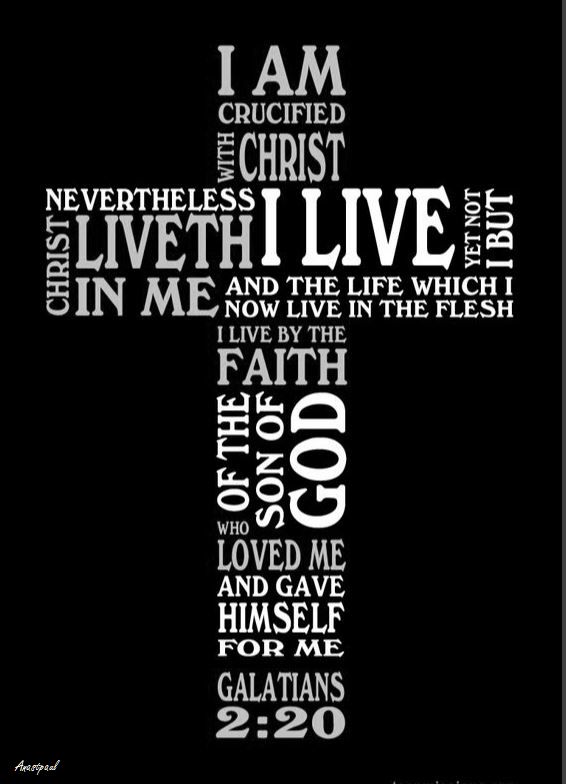
……………..yet I live, no longer I but Christ lives in me;   insofar as I now live in the flesh, I live by faith in the Son of God who has loved me and given himself up for me………….Gal 2:20

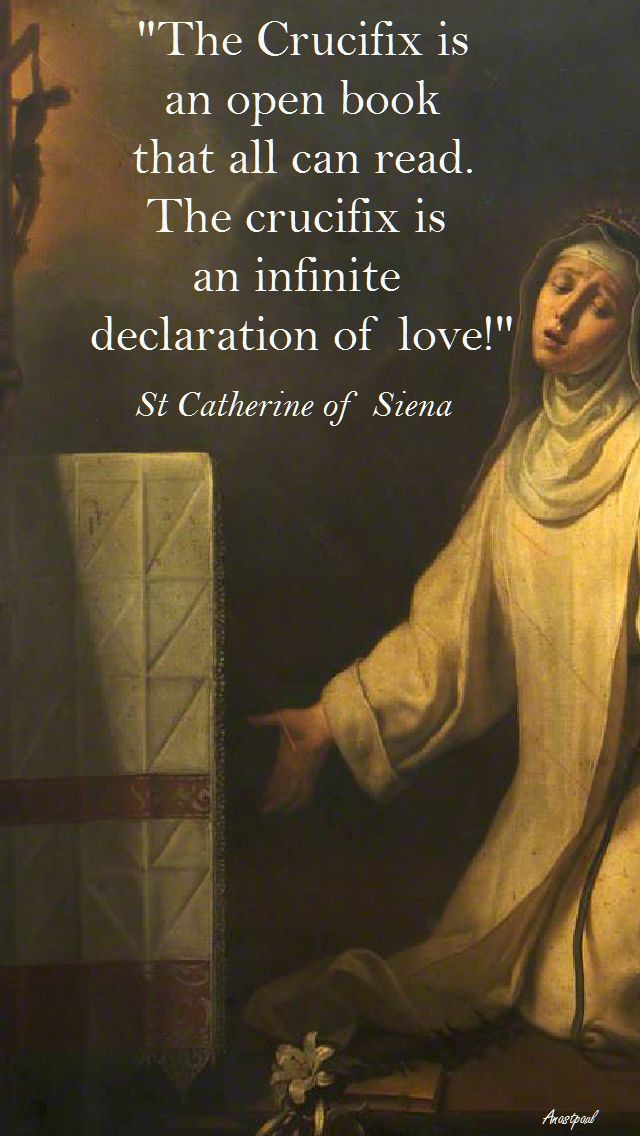
REFLECTION – “The Crucifix is an open book that all can read.
The crucifix is an infinite declaration of love!”……………St Catherine of Siena

PRAYER – Lord Jesus Christ, inspire me to read the Crucifix as all the teaching I need. Grant that I may return glory, gratitude and love to You for Your great love for me. Grant too that I may use all the talents given me, as Blessed Angelo of Chivasso did, for the glory of Your Kingdom and the love of all my neighbours. Bl Angelo, pray for us. Amen

my version gal 2 20 snipTHE CRUCIFIX-STCATHERINE OF SIENABL ANGELO PRAY FOR US

Posted in HOLY WEEK, MORNING Prayers, PRAYERS of the SAINTS

Our Morning Offering – 12 April

Our Morning Offering – 12 April

PRAYER OF ST EPHREM OF SYRIA
(In Honour Of Christ’s Passion)

I give You glory, O Christ,
because You, the Only-begotten,
the Lord of all,
underwent the death of the Cross
to free my sinful soul from the bonds of sin.
What shall I give to You, O Lord,
in return for all this kindness?
Glory to You, O Lord, for Your love,
for Your mercy, for Your patience.
Glory to You,
for forgiving us all our sins,
for coming to save our souls,
for Your incarnation in the Virgin’s womb.
Glory to You, for Your bonds,
for receiving the cut of the lash,
for accepting mockery.
Glory to You, for Your crucifixion,
for Your burial, for Your resurrection.
Glory to You, for being taken up heaven.
Glory to You who sit
at the Father’s right hand and will return in glory.
Glory to You for willing that the sinner
be saved through Your great mercy and compassion.

PRAYER OF ST EPHREM OF SYRIA

Posted in SAINT of the DAY

Saint of the Day – 12 Apil – Blessed Angelo Carletti di Chivasso

Saint of the Day – 12 Apil – Blessed Angelo of Chivasso (1411-1495) OFM Religious Priest, Theologian, Teacher, Writer.

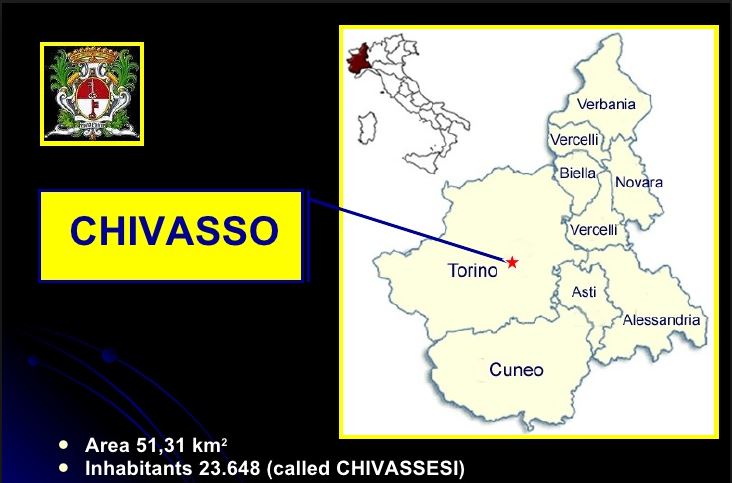
Antonio Carletti was born in 1411 to a noble family of Chivasso, Italy, near Turin.    He attended the University of Bologna, where he received the degree of Doctor of Civil and Canon Law and served as a magistrate in the Court of Chiavasso.    He was appointed to the Senate by the Marquis of Monferrato Gian Giacomo.    It was probably at the age of thirty that he entered the Order of Friars Minor at Santa Maria del Monte in Genoa, taking the name Angelo.   There he met Francesco della Rovere, who was later to become Pope Sixtus IV.

CHIVASSO

In 1467 he accompanied Fra Pietro da Napoli, who had been charged by the Vicar General to reorder the Franciscan province of Austria.

In 1472 he was chosen to fill the office of Vicar-General of that branch of the Order then known as the Cismontane Observance, founded by Bernadine of Siena.    He held that office again in 1478, in 1485 and in 1490.    He founded the monasteries of Saluzzo, Mondovì and Pinerolo and preached in Mantua, Genoa, Cuneo, Susa, Monferrato and Turin at the court of Charles I, Duke of Savoy.    He also served as a spiritual counselor for Catherine of Genoa and Blessed Paola Gambara.

In 1480 the Ottoman Empire under Mehmed II took possession of Otranto and threatened to overrun and lay waste the area.    Angelo was appointed Apostolic Nuncio by Pope Sixtus IV and commissioned to preach a crusade against the invaders.    While the residents of Otranto held out under siege, Mehmed II died and the Turkish forces retired from the Italian peninsula.

Again, in 1491, he was appointed Apostolic Nuncio and Commissary by Innocent VIII, conjointly with the Bishop of Mauriana, and reached a peaceful agreement between Catholics and Waldensians.

In theology he is considered a major adherent of Scotism.    His works are given by Wadding in the latter’s “Scriptores Ordinis Minorum”.    The most noted of these is the “Summa de Casibus Conscientiae”, called after him the “Summa Angelica”.      The first edition of di Chivasso’s “Summa Angelica” appeared in the year 1486 and from that year to the year 1520 it went through 31 editions, 25 of which are preserved in the Royal Library at Munich.

The “Summa” is divided into 659 articles arranged in alphabetical order and forming what would now be called a dictionary of moral theology.    The most important of these articles is the one entitled “Interrogationes in Confessione”.    It serves, in a way, as a dictionary of moral theology and was found very useful for confessors.   Judging the character of the work of Bl. Angelo as a theologian from this, his most important contribution to moral theology, one is impressed with the gravity and fairness that characterized his opinions throughout.    The “Summa” is a valuable guide in matters of conscience and approaches closely, in the treatment of the various articles, to casuistic theology as this science is now understood, hence the title of the work, “Summa de Casibus Conscientiae”.

Martin Luther considered it a symbol of Catholic orthodoxy and had it publicly burned in the public square outside Wittenberg’s Elster Gate on December 10, 1520 together with the Bull of Excommunication Exsurge Domine, the Code of Canon Law and the Summa Theologica of St. Thomas.

Angelo Carletti di Chivasso died on April 11, 1495 at the convent of St. Anthony at Cuneo.   On April 14, 1753, Pope Benedict XIII beatified Angelo Carletti,[6] giving official approval to the cult that had for long been paid to Angelo, especially by the people of Chivasso and Coni.    The latter chose him as their special patron.    His feast is kept on 12 April.    He is celebrated in his native Chivasso, with an traditional country fair and prayer.


Posted in SAINT of the DAY

Saints – 12 April

St Acutina
St Alferius of La Cava
Bl Andrew of Montereale
Bl Angelo Carletti di Chivasso
St Artemón of Caesarea
St Basil of Parion
St Constantine of Gap
St Damian of Pavia
St David Uribe Velasco
St Erkemboden of Thérouanne
St Florentin of Arles
St Pope Julius I
St Lorenzo of Belem
St Peter of Montepiano
St Sabas the Lector
St Teresa of the Andes
St Tetricus of Auxerre
St Victor of Braga
St Vissia of Fermo
St Wigbert
St Zeno of Verona