Posted in SAINT of the DAY

Saint of the Day – 18 February – Blessed FRA ANGELICO

Saint of the Day – 18 February – Blessed FRA ANGELICO O.P. (1395-1455 aged 59) – Patron of Artists.

Fra Angelico was an Early Italian Renaissance painter described by Vasari in his Lives of the Artists as having “a rare and perfect talent”.

He was known to contemporaries as Fra Giovanni da Fiesole (Brother John of Fiesole) and Fra Giovanni Angelico (Angelic Brother John). In modern Italian he is called il Beato Angelico (Blessed Angelic One); the common English name Fra Angelico means the “Angelic friar”.

In 1982 Pope John Paul II proclaimed his beatification in recognition of the holiness of his life, thereby making the title of “Blessed” official. Fiesole is sometimes misinterpreted as being part of his formal name, but it was merely the name of the town where he took his vows as a Dominican friar and was used by contemporaries to separate him from others who were also known as Fra Giovanni. He is listed in the Roman Martyrology as Beatus Ioannes Faesulanus, cognomento Angelicus—”Blessed Giovanni of Fiesole, surnamed ‘the Angelic’ “.

Fra Angelico is probably better known as an artist than as a holy man. He was already called “Beato” while he was still alive. Pope John Paul II gave this a new reality when he beatified him in 1982. Patrick Duffy tells his story.

Early life
Born Guido di Pietro at Vicchio, 25 kms north-east of Florence, also the birth place of Giotto, in his childhood he was known as Guido da Vicchio or Guido di Pietro.   He may have been already a painter before he and his brother Benedetto joined the Dominicans at Fiesole.

At Fiesole 1418-35
After his novitiate at Cortona he went to live at the Dominican convent at Fiesole.   As a young friar, he worked at illuminating missals and manuscripts.   He became known to his companions as Fra Giovanni da Fiesole but later more popularly – even within his own lifetime in Italy – he was called Il Beato Angelico.

San Marco, Florence (1436-45)
In 1436 Fra Angelico was one of a number of the monks from Fiesole who moved into the newly-built monastery of San Marco in Florence.   This not only put him in the centre of artistic activity but also engaged the patronage of the wealthy and powerful Cosimo de’ Medici, who often came there himself when he wanted to retreat from the world.

According to his biographer Giorgio Vasari (1511-74), it was at Cosimo’s urging that Fra Angelico undertook the task of decorating the monastery, including the magnificent Chapter House fresco, the often-reproduced Annunciation, the Maesta with Saints Cosmas and Damian, Saint Mark and Saint John, Saint Lawrence and three Dominicans, Saint Dominic, Saint Thomas Aquinas and Saint Peter Martyr.

The Vatican and Orvieto, 1445–1449
bl Sacrament and fra angIn 1445 Pope Eugenius IV (1431-47), who knew the artist’s work in Florence, summoned Angelico to Rome to paint the frescoes of the Chapel of the Holy Sacrament at St Peter’s but this was destroyed a century later when Pope Paul III (Alessandro Farnese 1534-49) wanted to make room for the great staircase of the Vatican Palace.   Vasari says that at this time Eugenius offered Fra Angelico the archbishopric of Florence, but that he refused it, recommending another friar for the position.

In 1447 when the papal court moved to the comparative cool of Orvieto Fra Angelico worked with his pupil, Benozzo Gozzoli, on the vault of the chapel of the Madonna of St Brizio in the cathedral.

In 1449 back at the Vatican, he designed the famous fresco scenes from the lives of St. Laurence and St. Stephen for the walls of the Chapel of Nicholas V.   From 1449 until 1452, Fra Angelico was back at San Marco in Florence, where he was prior for three years.
fra_angelico_042_adjusted

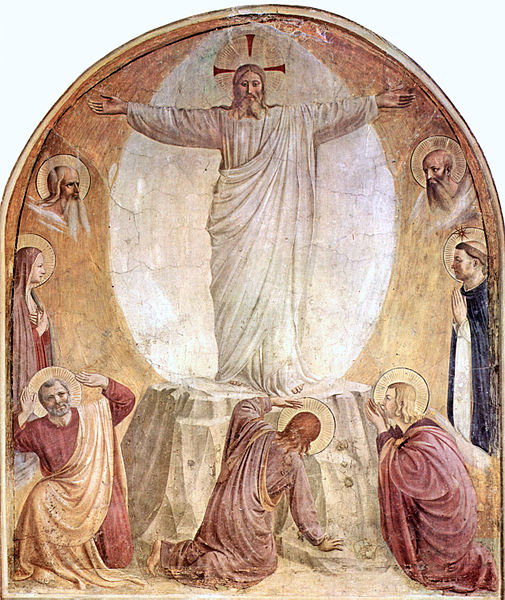
The Transfiguration shows the directness, simplicity and restrained palette typical of these frescoes. Located in a monk’s cell at the Convent San’ Marco, its apparent purpose is to encourage private devotion.

Death and influence
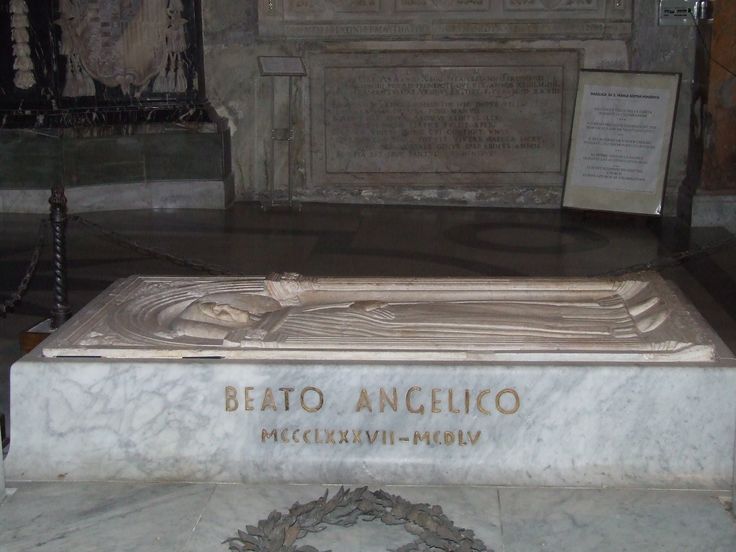
In 1455 Fra Angelico died while staying at a Dominican Convent in Rome, perhaps working on Pope Nicholas’ Chapel. His tomb can be seen in the Church of Santa Maria sopra Minerva in the centre of Rome. And this is his epitaph:

When singing my praise, do not say I was another Apelles.
But say that, in the name of Christ, I gave all I had to the poor.
Part of my work remains on earth and part is in heaven.
The city that bore me, Giovanni, is the flower of Tuscany.
1d1b6d846d2960cd805dae1db24848c5

Posted in SAINT of the DAY

Saints 18 February

St Angilbert of Centula
St Colman of Lindisfarne
St Constance of Vercelli
St Esuperia of Vercelli
St Ethelina
Bl Fra Angelico
St Gertrude Caterina Comensoli
St Helladius of Toledo
St Ioannes Chen Xianheng
St Ioannes Zhang Tianshen
St Jean-François-Régis Clet
St Jean-Pierre Néel
Bl Jerzy Kaszyra
Bl John Pibush – one of the Martyrs of Douai
St Leo of Patera
St Martinus Wu Xuesheng
Bl Matthew Malaventino
St Paregorius of Patara
St Sadoth of Seleucia
St Simeon
St Tarasius of Constantinople
St Theotonius
Bl William Harrington

Martyrs in North Africa – 7 saints
Martyrs of Rome – 5 saints

Posted in PURGATORY

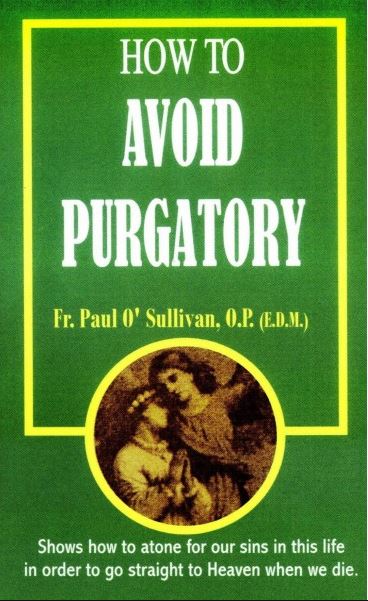
HOW TO AVOID PURGATORY By Fr. Paul O’Sullivan O.P.

HOW TO AVOID PURGATORY By Fr. Paul O’Sullivan O.P.

For those who have not read this little book and to refresh myself, I will be posting the entire book in daily doses.  Let us begin with the Foreword.   (To read later find in the Purgatory Category).

FOREWORD

Our Lord came on earth expressly to give us a perfect Redemption.   He gave
us a Law of Love, a Religion in every way to suit our human hearts,
destined to make us holy and happy.   His Commandments, counsels and promises
all breathe peace, joy, mercy and love.
The idea that nearly all of us shall, notwithstanding, have to pass a
period more or less long in the excruciating fires of Purgatory after death
seems to be at variance with this all-merciful and all-loving plan of our
Divine Lord.

It is true that we are weak and fall many times and that God’s justice is
rigorous and exacting but it is equally certain that God’s mercy and love
are above all His works.

It is no less certain that Our Lord has given us abundant grace and
strength to save us from sin and many (and most efficacious) means of
satisfying for any sins that we may have committed.   This last fact seems to
be almost entirely overlooked, or imperfectly understood by the majority of
Catholics.

Of course, those who go on deliberately sinning and who make no effort to
correct their faults and refuse to use the many wonderful means God offers
them for satisfying for sin, condemn themselves to Purgatory.

The object of this little book is to show how we can avoid Purgatory by
using the means God has so generously offered us, and, secondly, to show
that the use of these means is within the reach of every ordinary
Christian.

The careful perusal of these pages will be a source of much benefit and
consolation to all who read them.

The author offers them to the loving Heart of Jesus and asks Him to bless
them.

how-to-avoid-purgatory-by-fr-paul-sullivan


Posted in MORNING Prayers, SAINT of the DAY

Thought for the Day – 17 February

Thought for the Day – 17 February

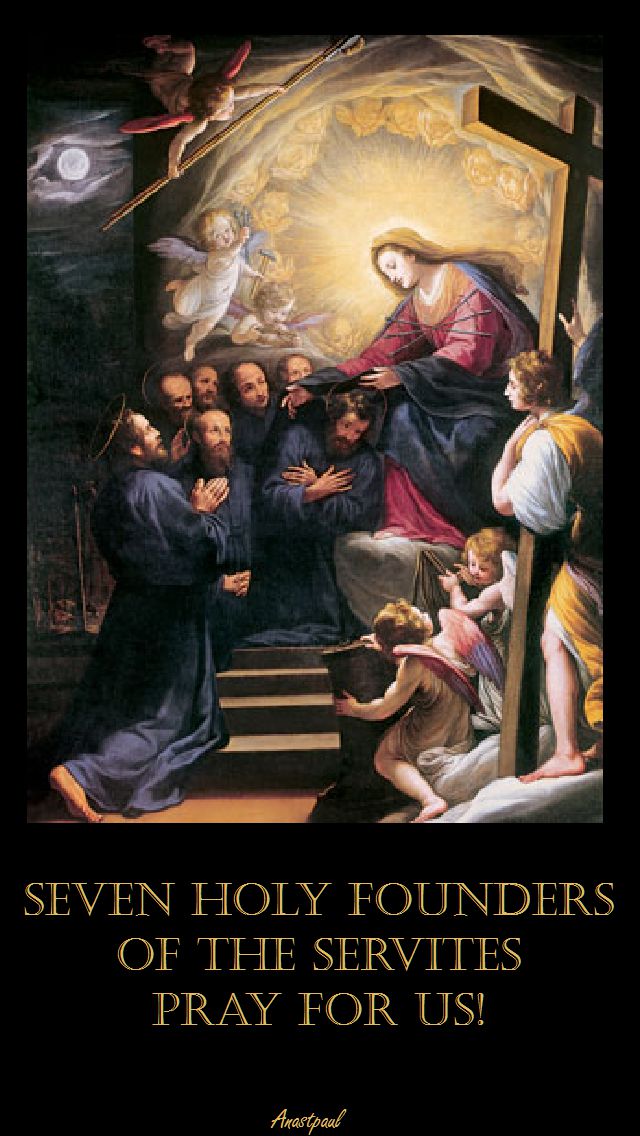
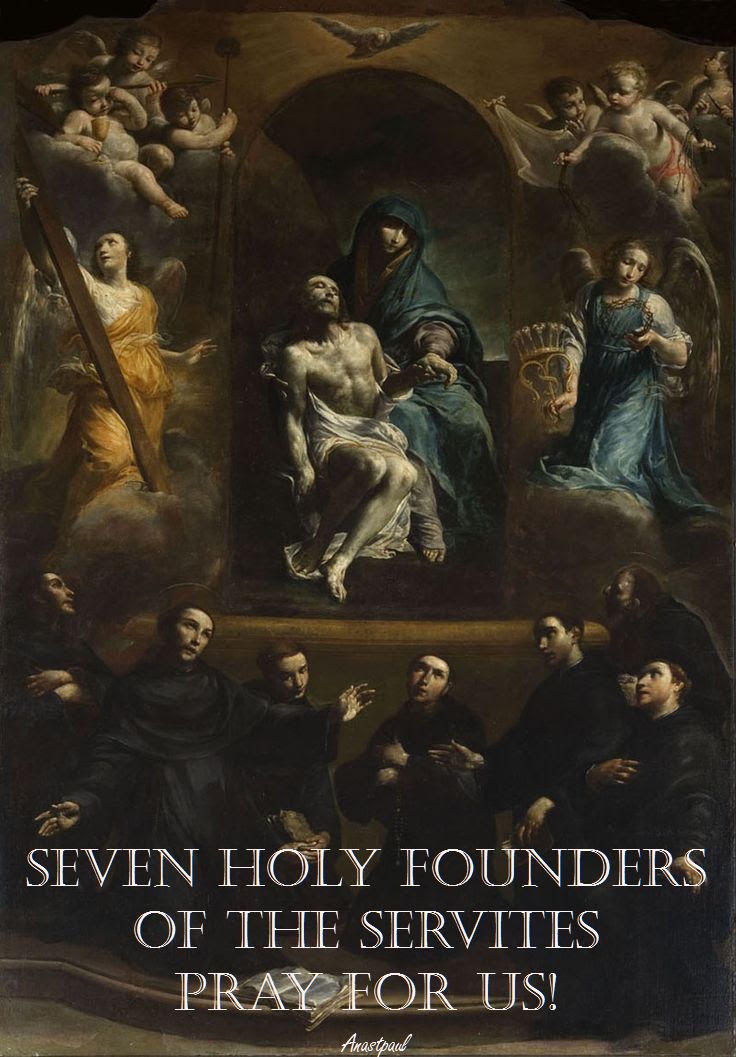
Since criminals and people with evil purposes often band together for their common interests, good people often have to do the same.   Faced with the immorality and blood feuds of thirteenth century Florence, the Seven Holy Founders banded together for their own spiritual good and succeeded in founding a whole new religious order.   Good companions are on of the most powerful helps toward a holy life,  for all of us are faced in a new and urgent way with the challenge to make our lives decisively centred in Christ.   In this new day, we often find those ‘good companions’ online, let us too band together and live a holy life amidst the dangers around us!

Seven Holy Founders, Pray for us!

seven-holy-founders-pray-for-us-2


Posted in MORNING Prayers, QUOTES of the SAINTS, SAINT of the DAY, The BLESSED VIRGIN MARY

Quote/s of the Day – 17 February

Quote/s of the Day – 17 February

“Mary means enlightener, because She brought forth the Light of the world. In the Syriac tongue, Mary signifies Lady.”
~~~~~ St Isidore of Seville

“Let me say something concerning this name also, which is interpreted to mean Star of the sea, and admirably suits the Virgin Mother.”
~~~~~ St Bernard

“Mary means Star of the sea, for as mariners are guided to port by the ocean star, so Christians attain to glory through Mary’s maternal intercession.”
~~~~~St Thomas Aquinas

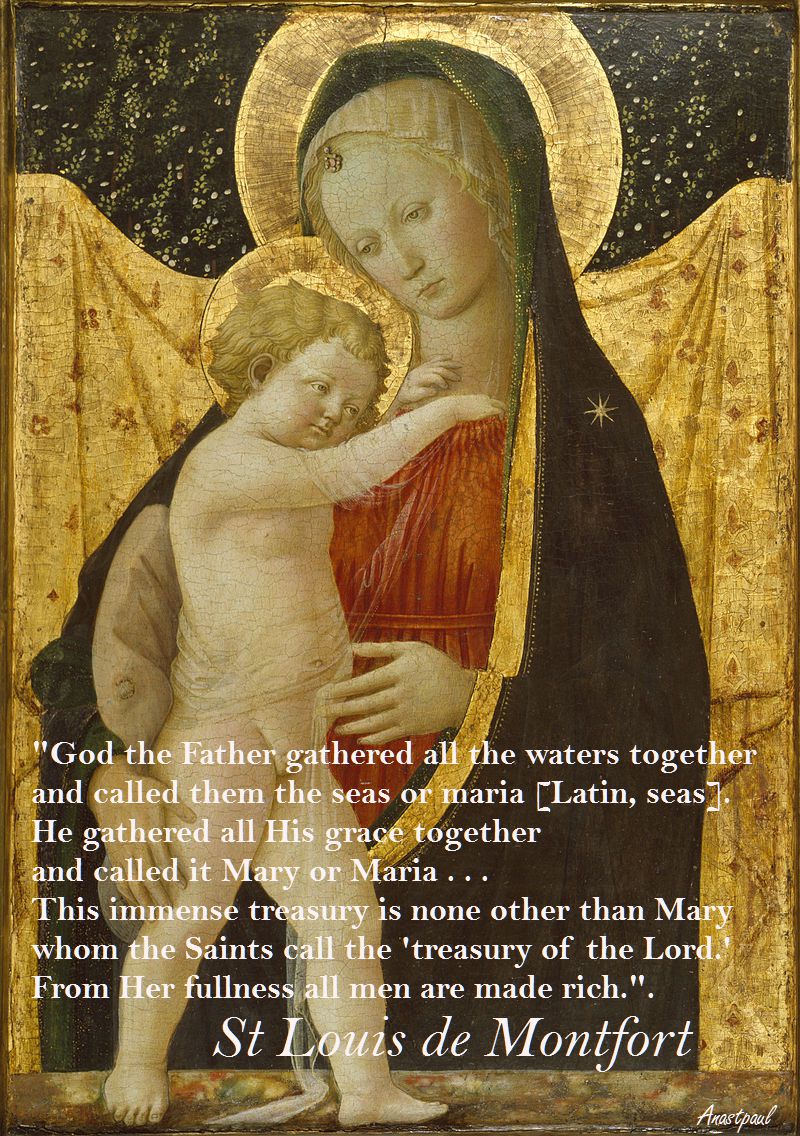
“God the Father gathered all the waters together
and called them the seas or maria [Latin, seas].
He gathered all His grace together
and called it Mary or Maria . . .
This immense treasury is none other than Mary
whom the Saints call the ‘treasury of the Lord.’
From Her fullness all men are made rich.”
~~~~~ St Louis de Montfort

“This most holy, sweet and worthy name was ’eminently fitted to so holy, sweet and worthy a virgin. For Mary means a bitter sea, star of the sea, the illuminated or illuminatrix. Mary is interpreted Lady. Mary is a bitter sea to the demons; to men She is the Star of the sea; to the Angels She is illuminatrix, and to all creatures She is Lady .”
~~~~~St Bonaventure

“When you find yourself tossed by the raging storms on this great sea of life, far from land, keep your eyes fixed on this Star to avoid disaster. When the winds of temptation or the rocks of tribulation threaten, look up to the Star, call upon Mary!”
~~~~~ St Bernard

god-the-father-gathered-all-the-waters-stlouis-de-montfort

Posted in MORNING Prayers, QUOTES of the SAINTS, SAINT of the DAY, The BLESSED VIRGIN MARY, The WORD

One Minute Reflection – 17 February

One Minute Reflection – 17 February

O children, listen to me; instruction and wisdom do not reject!…………Proverbs 8:32-33

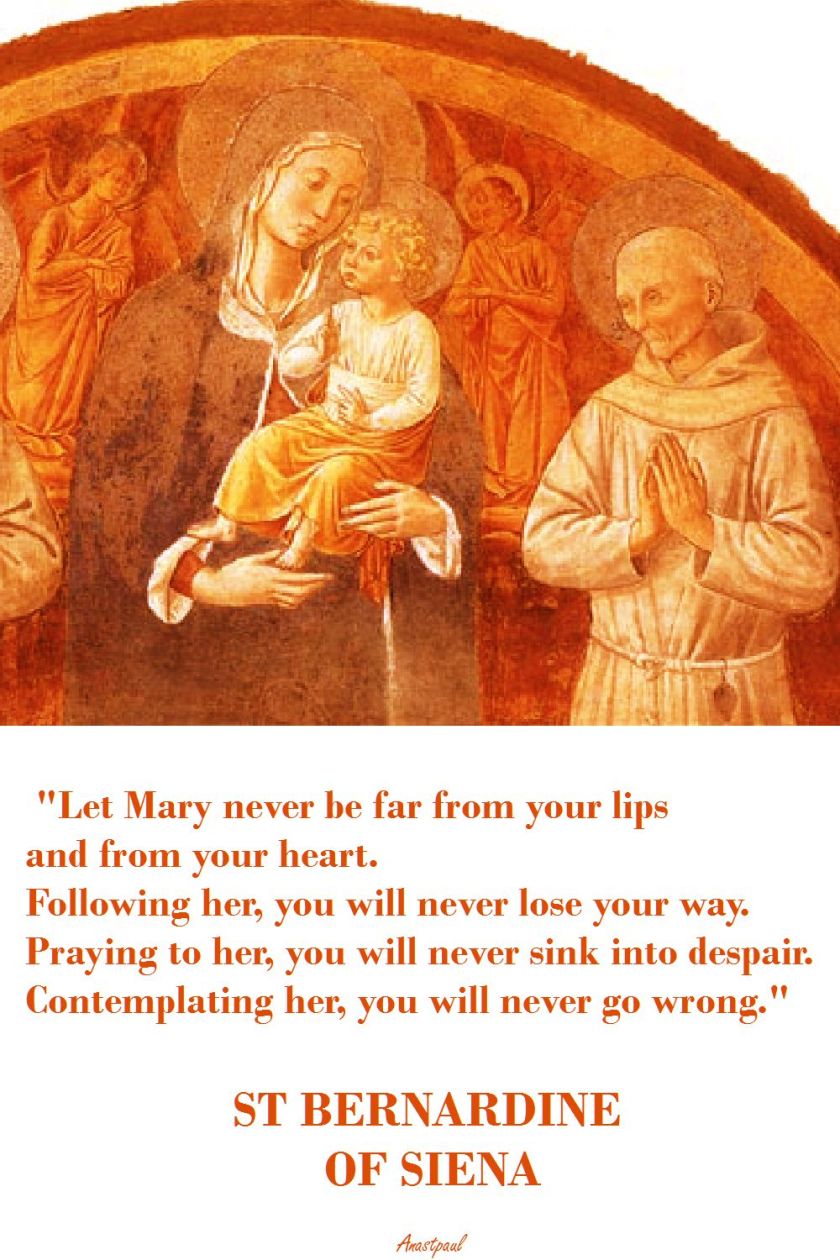
REFLECTION – “Let Mary never be far from your lips
and from your heart.
Following her, you will never lose your way.
Praying to her, you will never sink into despair.
Contemplating her, you will never go wrong.”
……St Bernardine of Siena

PRAYER – Heavenly Father, grant me the grace to have Mary as my constant intercessor. Allow me to reach out to her as my mother, to lead me to her Son, for she is Your beloved Daughter, who carried Your Son to us in order that we might see our way and be able to reach our home in heaven. Holy Founders of the Servites, pray for us all that we may be blessed by the intercession and protection of Mary our Mother and please pray for us all, amen.

proverbs-8-32-33let-mary-never-be-far-from-your-lips-st-bernardieneseven-holy-founders-pray-for-us


Posted in MORNING Prayers, PRAYERS of the SAINTS, SAINT of the DAY, The BLESSED VIRGIN MARY

Our Morning Offering – 17 February

Our Morning Offering – 17 February

From the Servite Vigil of our Lady I

Loving Mother,
woman of prayer,
we turn to you and pray:
support our prayers
for ourselves,
for all your Servants,
for our friends and families,
for those who share the Christian faith
and for every person on earth
that all may know peace and salvation.

Ask the Father that we may truly know Christ,
be filled with the gifts of the Spirit,
protected in all adversity
and freed from every evil.
Help us to build God’s kingdom:
a kingdom of everlasting praise,
a kingdom of justice and peace
that will endure forever and ever.
R. Amen.

servite-prayer-to-mary

Posted in SAINT of the DAY

Saint of the Day – 17 February -Seven Founders of Servants of Mary “the Servites”

Seven Founders of Servants of Mary – OSM – Founded 15 August 1233 – Mendicant Order
• Sts Alexis Falconieri – Founder and Mystic (1200-1310) Patron of city of Orvieto (Italy)
• St Bartholomew degli Amidei
• St Benedict dell’Antella
• St Buonfiglio Monaldi
• St Gherardino Sostegni
• St Hugh dei Lippi-Uguccioni
• St John Buonagiunta Monetti


The Servite Order is one of the five original Catholic mendicant orders.   Its objects are the sanctification of its members, preaching the Gospel and the propagation of devotion to the Mother of God, with special reference to her sorrows.    The members of the Order use O.S.M. (Ordo Servorum Beatae Mariae Virginis) as their post-nominal letters.    The male members are known as Servite Friars or Servants of Mary.   The Order of Servants of Mary (The Servites) is a religious family that embraces a membership of friars (priests and brothers), contemplative nuns, a congregation of active sisters and lay groups.

iglesia-pietralba1

This is the story of seven young men, caught up in the blood feuds of medieval Florence, who set out into the wilderness to live a holy life.   They were from prominent families in Florence:  two were married, two were widowers and they all belonged to a religious fraternity called the Laudesi.   The chaplain of Laudesi was a priests, James Poggibonsi, who later joined them in their wilderness retreat.

After settling their personal affairs and making provision fo the families of those who were married, they began to live a life of prayer and penance, some going to Carfaggio, just outside the city and the others retiring to Mount Senario, deeper in the wilderness.   At the suggestion of the Dominican Preacher, St Peter Martyr, they decided to found a community.   Taking the rule of St Augustine and a version of the Dominican habit from St Pter, they took the name Servants of Mary, the name of a confraternity founded by St Peter Martyr.   The bishop of Florence approved the community and they were taken under the protection of the Holy See in 1249.

They are known as the Seven Holy Founders of the Servite Order, their individual names are above and they were canonised as a group by Pope Leo XIII in 1888.

In 1253, St Philip Benezi entered the Order and during his term of office as Superior General, the order spread throughout Italy and other parts of Europe.   At the suggestion of the bishop of Florence, they modified their strict onastic form of life and took on the character of mendicant friars.   They now have houses on every continent, including missions in Africa and South America.

Posted in SAINT of the DAY

Saints – 17 February

Seven Founders of Servants of Mary (Optional Memorial)
• Sts Alexis Falconieri
• St Bartholomew degli Amidei
• St Benedict dell’Antella
• St Buonfiglio Monaldi
• St Gherardino Sostegni
• St Hugh dei Lippi-Uguccioni
• St John Buonagiunta Monetti

St Alexis Falconieri – SEVEN HOLY FOUNDERS
St Antoni Leszczewicz
St Bartholomew degli Amidei – SEVEN HOLY FOUNDERS
St Benedict dell’Antella – SEVEN HOLY FOUNDERS
St Benedict of Cagliari
St Buonfiglio Monaldi – SEVEN HOLY FOUNDERS
St Bonosus of Trier
Bl Constabilis of Cava
St Donatus the Martyr
Bl Elisabetta Sanna
St Evermod of Ratzeburg
St Faustinus the Martyr
St Finan of Iona
St Fintan of Clonenagh
St Flavian of Constantinople
St Fortchern of Trim
St Gherardino Sostegni – SEVEN HOLY FOUNDERS
St Guevrock
St Habet-Deus
St Hugh dei Lippi-Uguccioni – SEVEN HOLY FOUNDERS
St John Buonagiunta Monetti – SEVEN HOLY FOUNDERS
St Julian of Caesarea
St Loman of Trim
Bl Luke Belludi
St Lupiano
Bl Martí Tarrés Puigpelat
St Mesrop the Teacher
St Petrus Yu Chong-nyul
St Polychronius of Babylon
St Romulus the Martyr
St Secundian the Martyr
St Silvinus of Auchy
St Theodulus of Caesarea
Bl William Richardson

all-saints

Posted in MORNING Prayers, SAINT of the DAY

Thought for the Day – 16 February

Thought for the Day – 16 February

St Gilbert of Sempringham could have lived a life of ease from the income of his benefices but he chose to give all to the poor and to dedicate his life to teaching.  Accidentally (though of course, it was God’s plan all along), he stumbled upon his life’s work and brought many to God.   We never know how God is going to use us and by our devotion and fidelity, we have to remain open to whatever task He sets before us.   “I come Lord, to do Your Will.” 

St Gilbert Pray for us!

st-gilbert-pray-for-us-2

Posted in EUCHARISTIC Adoration, MORNING Prayers, QUOTES of the SAINTS

Quote of the Day – 16 February

Quote of the Day – 16 February

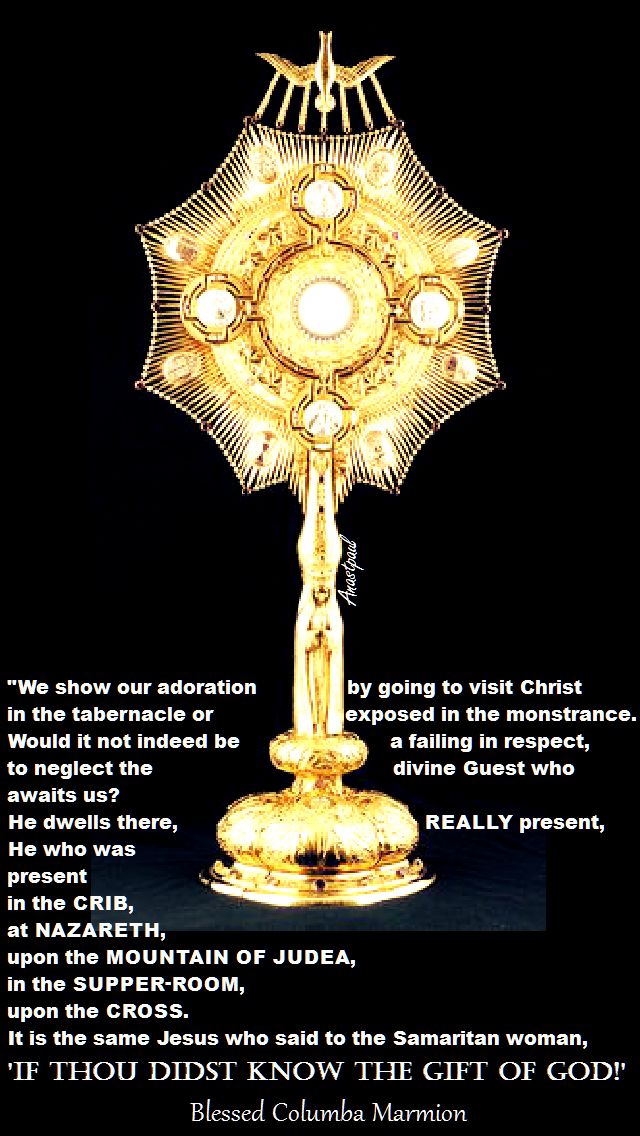
“We show our adoration by going to visit Christ
in the tabernacle or exposed in the monstrance.
Would it not indeed be a failing in respect
to neglect the divine Guest who awaits us?
He dwells there, really present,
He who was present in the crib,
at Nazareth,
upon the mountains of Judea,
in the supper-room,
upon the Cross.
It is the same Jesus who said to the Samaritan woman,
‘If thou didst know the gift of God!’

~~~~~ Blessed Columba Marmion

we-show-adoration-bl-columba-marmion

Posted in MORNING Prayers, QUOTES of the SAINTS

One Minute Reflection – 16 February

One Minute Reflection – 16 February

(Jesus) said to Peter,
“Put out into deep waters
and lower your nets for a catch.”……………….Luke 5:4

REFLECTION – “The bark of Peter laughs at the winds and the waves.
She has the Saints as her passengers, the Cross as her mast, the Gospel teachings as her sails, the Angels as her rowers and God as her pilot.”  ……………..St John Chrysostom

PRAYER – Heavenly Father, teach me to trust Your Church as the Bark of Salvation in this world. Grant that I may work and pry to remain afloat with her amid the storms of Life. St Gilbert, you experienced great storms and upheavals in every facit of your life but your eyes remained fixed on the pilot, you embraced the Cross and persevered with the saints until you too became one. St Gilbert of Sempringham, please pray for us, that will follow our friends in heaven too, amen!

jesus-said-to-peter-luke-5-4the-bark-of-peter-st-john-chrysostomst-gilbert-pray-for-us

Posted in JESUIT SJ, MORNING Prayers, PRAYERS of the SAINTS

Our Morning Offering – 16 February

Our Morning Offering – 16 February

A Prayer to Seek the Consolation of the Cross
by Saint Alphonsus Rodriguez S.J.

Jesus, love of my soul, centre of my heart!
Why am I not more eager to endure pains
and tribulations for love of You,
when You, my God, have suffered so many for me?
Come, then, every sort of trial in the world,
for this is my delight, to suffer for Jesus.
This is my joy, to follow my Saviour
and to find my consolation
with my Consoler on the Cross.
This is my happiness,
this my pleasure:
to live with Jesus,
to walk with Jesus,
to converse with Jesus,
to suffer with and for Him,
this is my treasure, amen.

prayer-st-alphonsus-rodriguez-sj-jesuslofeofmysoulcentreofmyheart

Posted in SAINT of the DAY

Saint of the Day – 16 February -St Gilbert of Sempringham

Saint of the Day – 16 February -St Gilbert of Sempringham  CRSA (c. 1083 – 4 February 1190) – Priest and religious Founder.

St Gilbert was the only Englishman to found a conventual order, mainly because the Abbot of Cîteaux declined his request to assist him in organising a group of women who wanted to live as nuns, living with lay brothers and sisters, in 1148. In the end he founded a double monastery of canons regular and nuns.

Saint Gilbert’s life was quite different than what was expected of him by his parents and society.   Born to a Norman knight and a Saxon peasant, he grew up in a time where the memories of the Norman invasion of England were still well preserved.   He, like many of mixed heritage at the time, suffered ostracism and disdain from his peers.   Compounding his difficulties, Gilbert was apparently born with some form of disability, likely believed to be curvature of the spine.   So odd was his appearance as a youth, the servants of the house even refused to eat at the same table as him.   However, his mother, a woman of great faith, cared for him without hesitation, having been greeted by a vision prior to his birth, alerting her to the special gifts he would bring to the world.

Given his physical limitations and the fact that he was not a particularly good student, Gilbert was sent to France to study, rather then join the army as was expected of the son of a knight.   Surprisingly, he excelled at his studies abroad, returning to the area having earned the title of “Master” and embarking on a mission to educate the children of the area—both male and female, which was relatively unheard of at the time.   As the news of his education and piety spread, he was granted the rectories at Sempringham, which would have allowed him to live a comfortable life.   However, he instead dedicated his life and his inheritence to serving the poor, while studying and residing with the nearby Bishop of Lincoln.

Despite his holiness and commitment to the Lord, Saint Gilbert did not take his vows and enter the priesthood until his fortieth year, citing his belief that he was unworthy of the position.   Similarly, offered the archdeaconship of the largest diocese in Europe at the time, he declined, humbly preferring to stay in Sempringham.   It was there that he established a convent for women, attached to the church at Sempringham.   He later established monsteries for lay sisters, ministering priests, and lay brothers.   Eventually he had a chain of 26 convents, monasteries and missions.   The community would come to be known as the Gilbertine Order, approved by Pope Eugenius III, with Saint Gilbert as it’s Master.   He travelled from location to location, supervising the Order, as local bishops were not permitted to oversee the community members.   He established the Gilbertine Rule—a vow he himself did not take until he was near death, as he professed his belief it would be arrogant to do so, as he had written it.   The rule put love of God first and foremost, but also included service to the community and the poor, humility, modesty, and acts of penance and self-denial.

The Gilbertine communities became known for their discipline, fasting and self-denial, and service to the poor.   Over the years a special custom was created in the houses of the order called “the plate of the Lord Jesus.”   The best portions of dinner were put on a special plate and shared with the poor, reflecting Saint Gilbert’s lifelong concern for less fortunate people. He himself ate little, mainly roots and slept little—taking short rests in a chair.   He would instead spend the night in prayer.   At one point in his life, he suffered imprisonment on the false accusation of aiding the exiled Saint Thomas a Becket.   While he had not sent aid, he refused to make an oath stating as such, as he did not want to appear uncharitable toward the exiled bishop.   Rather, he endured prison until his name was cleared. Despite the harshness of his daily penance, Saint Gilbert lived a long life, past age 100.   His death was marked with “bright lights, sweet odors and incorrupt clothings.” Numerous miracles and cures have been reported at his tomb.

Gilbert was canonised in 1202 by Pope Innocent III. His liturgical feast day is on 4 February, commemorating his death.   According to the order of Hubert Walter, the bishops of England celebrated his feast, and his name was added to the wall of the church of the Four Crowned Martyrs.   His Order did not outlast the Reformation, however, and despite being influenced by Continental models, it did not maintain a foothold in Europe.

Posted in SAINT of the DAY

Saints and Memorials – 16 February

Saint Paul Shipwrecked

St Aganus of Airola
Bl Bernard Scammacca
St Faustinus of Brescia
St Gilbert of Sempringham
St Honestus of Nimes
St John III of Constantinople
Bl Joseph Allamano
St Julian of Egypt
St Juliana of Campania
St Juliana of Nicomedia
St Nicola Paglia
St Onesimus of Ephesus
Bl Philippa Mareria

Martyrs of Cilicia – 12 saints

Posted in JESUIT SJ, MORNING Prayers, PRAYERS of the SAINTS, QUOTES of the SAINTS, SAINT of the DAY

Thought for the Day – 15 February

Thought for the Day – 15 February

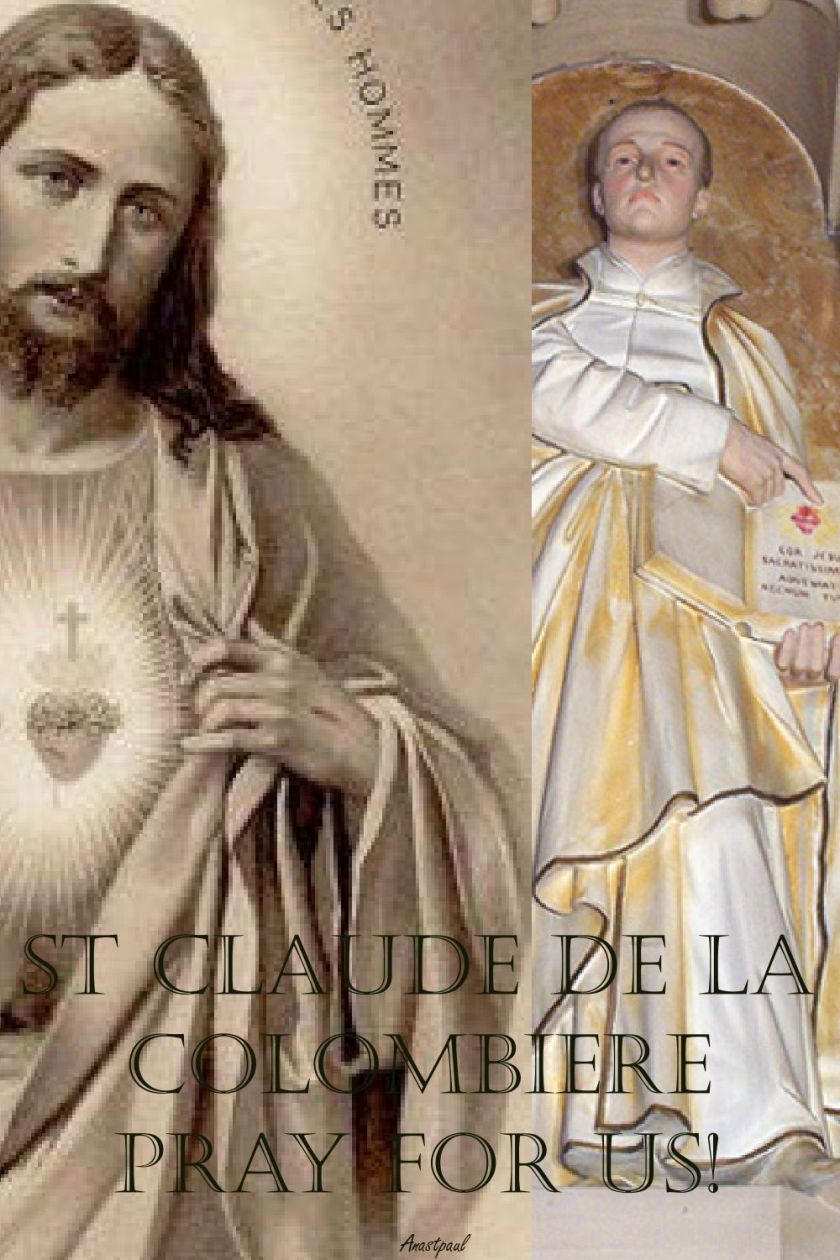
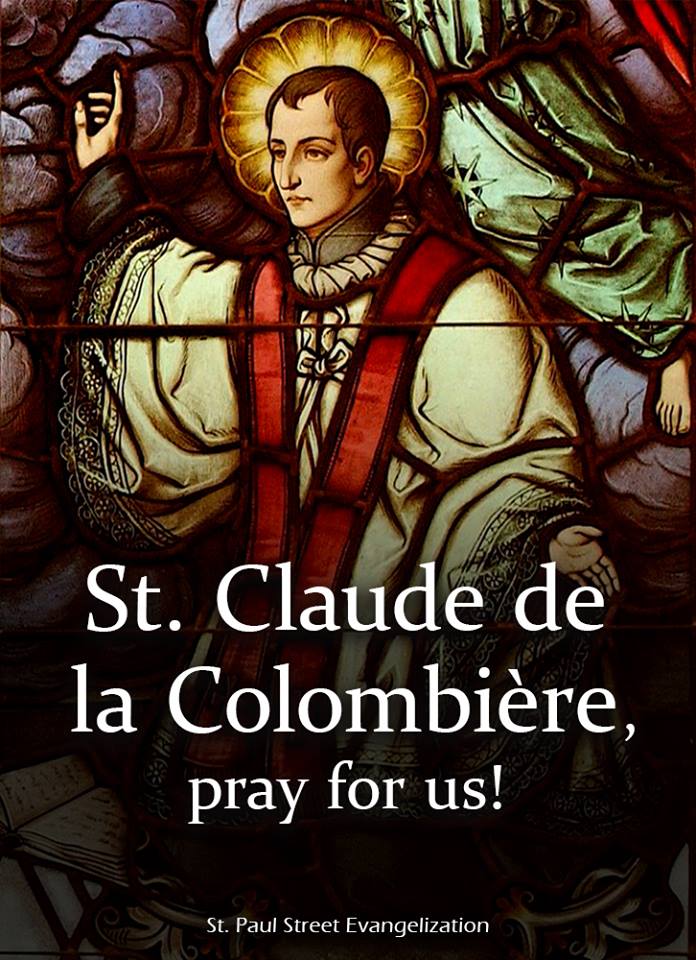
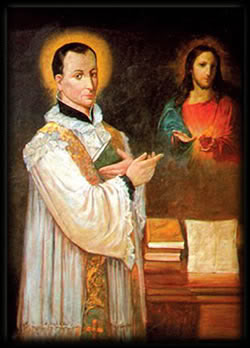
St Claude was an amazingly gifted man and he recognised that his gifts should be put at the service of others.   He spent himself in the service of Christ and was chosen to direct someone with an important mission to the whole Church of Christ.   He is recognised for his important decisions, decisions that may be helpful to contemplate as we enter the Lenten season:  1) to sacrifice his earthly desires to serve the Lord;   2) to honour his call to the vows of the Jesuits;   3) to recognise the truth in the Sacred Heart of Jesus and propagate the devotion;   4) to go where the Lord would have him, suffering without complaint;   and 5) to continue unafraid and undeterred in preaching the Good News.   Saint Claude la Colombière never lost sight of the Lord, never gave up hope, never let his confidence be shaken in the total love and mercy of God.   How often can we say the same of ourselves?

At his Canonisation, St John Paul said “A true companion of Saint Ignatius, Claude learned to master his strong sensitivity.   He humbly maintained a sense of “his wretchedness” so as to rely only on his hope in God and his trust in grace.   He resolutely took the way of holiness.   He adhered with all his being to the Constitutions and Rules of the Society, rejecting all tepidness. Fidelity and obedience were expressed, before God, by the “desire … for trust, love, resignation and perfect sacrifice”

Aspiration to Jesus, my Friend by St Claude 

Jesus! You are my true Friend, my only Friend. You take a part in all my misfortunes, You take them on Yourself; You know how to change them into blessings.

You listen to me with the greatest kindness when I relate my troubles to You, and You have always balm to pour on my wounds. I find You everywhere. You never go away! If I have to change my dwelling, I find You there wherever I go. You are never weary of listening to me. You are never tired of doing me good. I am certain of being beloved by You if I love You; my goods are nothing to You, and by bestowing Yours on me You never grow poor; however miserable I may be, no one more noble or holier can come between You and me and deprive me of Your friendship; and Death, which tears us away from all other friends, will unite me forever to You. All the humiliations attached to old age, or to the loss of honor, will never detach You from me; on the contrary, I shall never enjoy You more fully, and You will never be closer to me than when everything seems to conspire against me, to overwhelm me, and to cast me down.

You bear with all my faults with extreme patience, and even my want of fidelity and my ingratitude do not wound You to such a degree as to make You unwilling to receive me back when I return to You, or to come to me when I call on You. O Jesus! grant that I may die praising You, that I may die for the love of You.  
Amen.

St Claude Pray for us!

st-claude-pray-for-us-2st-claude-de-la-colombiere-feb-15


Posted in JESUIT SJ, MORNING Prayers, QUOTES of the SAINTS, SACRED and IMMACULATE HEARTS, SAINT of the DAY

Quote/s of the Day – 15 February

Quote/s of the Day – 15 February

“God is in the midst of us, or rather, we are in the midst of Him; wherever we are, He sees us and touches us: at prayer, at work, at table, at recreation.”

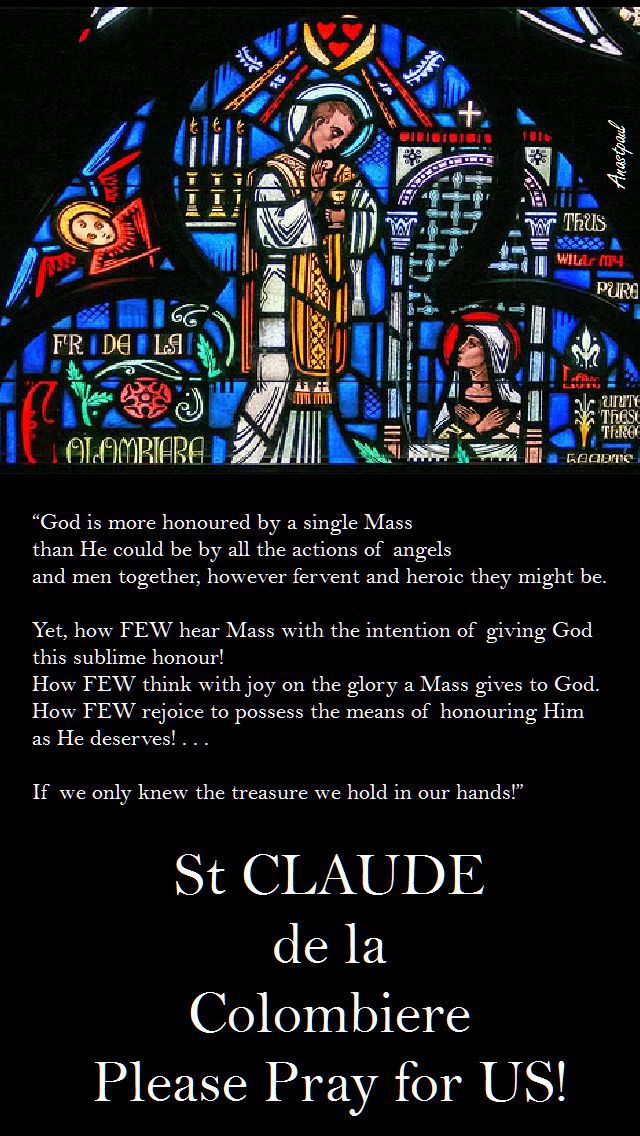
“God is more honoured by a single Mass
than He could be by all the actions of angels
and men together, however fervent and heroic they might be.
Yet, how FEW hear Mass with the intention of giving God
this sublime honour!
How FEW think with joy on the glory a Mass gives to God.
How FEW rejoice to possess the means of honouring Him
as He deserves! . . .
If we only knew the treasure we hold in our hands!”

~~~ St Claude de la Colombiere.

god-is-in-the-midst-of-us-st-claude

god-is-more-honoured-by-a-single-mass-st-claude

St Claude has been a dear friend of mine since I discovered his writings quite some years ago. . I count on his intercession. I turn to him when I feel my heart is tired and a little cold and distressed.   This Saint of Hearts is a most willing guide leading us to the warmest Heart of Christ full of Mercy and Love.

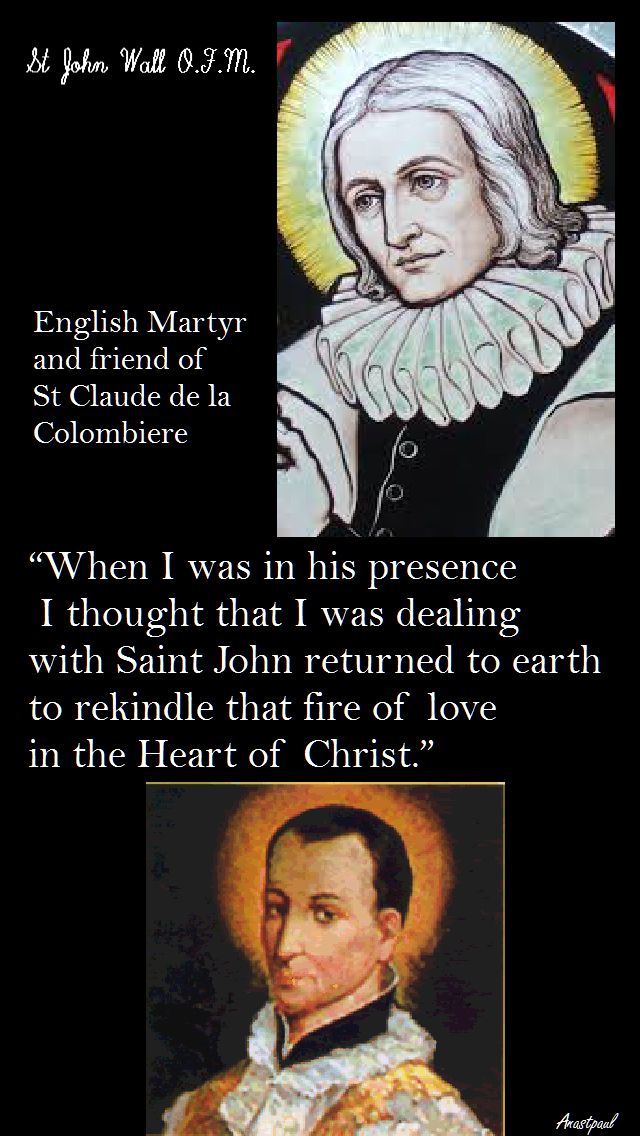
The Franciscan Saint John Wall O.F.M. (Joachim of Saint Anne), who was martyred for the crime of being a Catholic priest near Redhill, Corcester, England on August 22nd, 1679, knew Saint Claude.   After having spent a night in spiritual conversation with him, the soon–to–be martyr said, “When I was in his presence I thought that I was dealing with Saint John returned to earth to rekindle that fire of love in the Heart of Christ.”

st-john-wall-on-st-claude

Posted in JESUIT SJ, MORNING Prayers, QUOTES of the SAINTS, SACRED and IMMACULATE HEARTS, SAINT of the DAY, The WORD

One Minute Reflection – 15 February

One Minute Reflection – 15 February

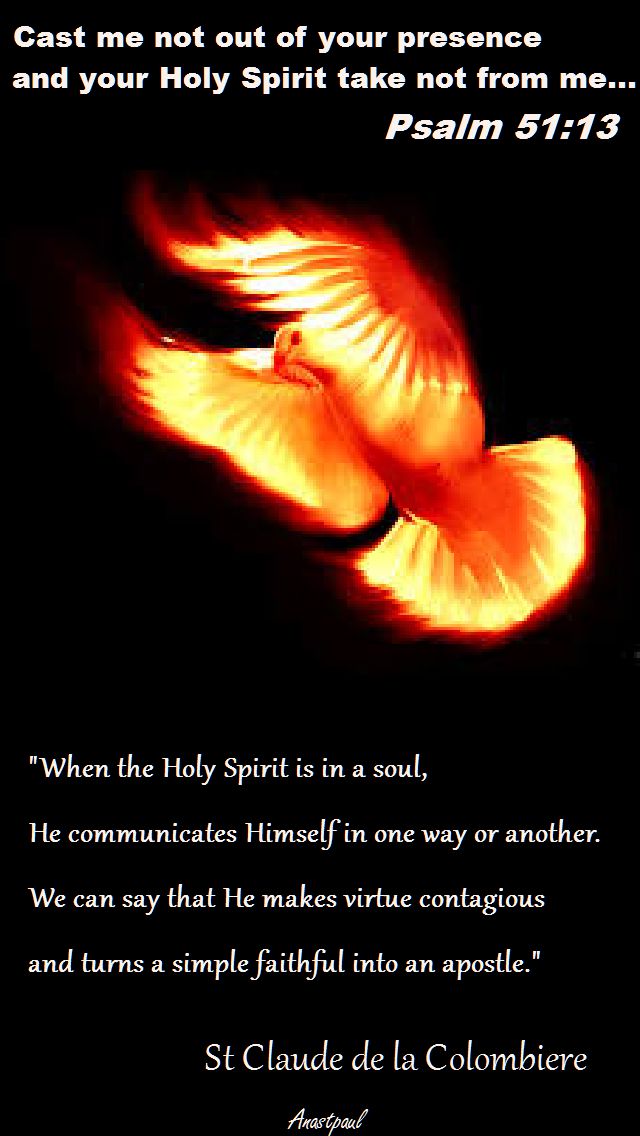
Cast me not out of your presence
and your Holy Spirit take not from me……….Psalm 51:13

REFLECTION – “When the Holy Spirit is in a soul, He communicates Himself in one way or another.    We can say that He makes virtue contagious and turns a simple faithful into an apostle.”………St Claude de la Colombiere

PRAYER – Heavenly Father, grant that Your Holy Spirit may inspire me to be a true follower of Your Son, Jesus the Christ. May He dwell in me always and keep me ever on the path of holiness. Holy God, may He turn me too into an apostle like St Claude! St Claude de la Colombiere, please pray for us all, amen!

when-the-holy-spirit-is-in-a-soul-st-claudest-claude-pray-for-us

Posted in JESUIT SJ, MORNING Prayers, PRAYERS of the SAINTS, SACRED and IMMACULATE HEARTS, SAINT of the DAY

Our Morning Offering – 15 February

Our Morning Offering – 15 February

Lord, be the Centre of Our Hearts
by St Claude La Colombiere

O God, what will You do to conquer
the fearful hardness of our hearts?
Lord, You must give us new hearts,
tender hearts, sensitive hearts, to replace hearts
that are made of marble and of bronze.
You must give us Your own Heart, Jesus.
Come, lovable Heart of Jesus.
Place Your Heart deep in the centre of our hearts
and enkindle in each heart a flame of love
as strong, as great, as the sum of all the reasons
that I have for loving You, my God.
O holy Heart of Jesus, dwell hidden in my heart,
so that I may live only in You and only for You,
so that, in the end, I may live with You eternally in heaven, amen.

lord-be-the-centre-of-our-hearts-by-st-claude-de-la-colombiere

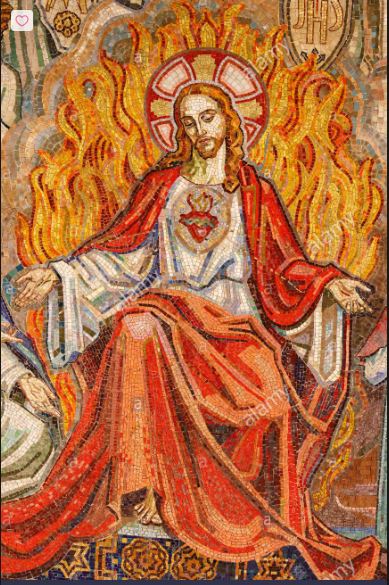
The Mosaic in the Shrine Chapal of St Claude at Paray-de-Monial, France (detail) see full image on previous post

mosaic-st-claude-shrine-and-chapel-paray-le-monial

Posted in JESUIT SJ, SACRED and IMMACULATE HEARTS, SAINT of the DAY

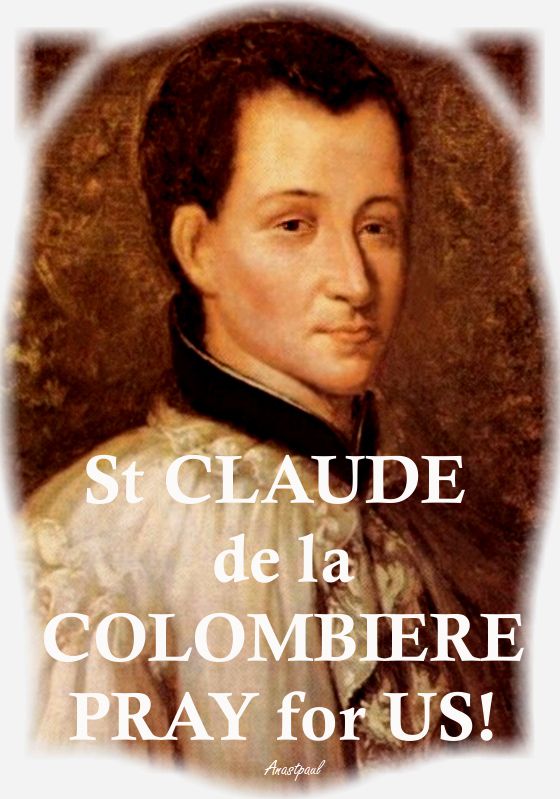
Saint of the Day – 15 February – St Claude de la Colombiere S.J.

Saint of the Day – 15 February – St Claude de la Colombiere S.J.  (1641-1682) – Religious, priest, confessor, missionary, writer, spiritual director “Disciple of the Sacred Heart” – Patron of toy-makers, turners and devotion to the Sacred Heart of Jesus

All our life is sown with tiny thorns that produce in our hearts a thousand involuntary movements of hatred, envy, fear, impatience, a thousand little fleeting disappointments, a thousand slight worries, a thousand disturbances that momentarily alter our peace of soul. For example, a word escapes that should not have been spoken. Or someone utters another that offends us. A child inconveniences you. A bore stops you. You don’t like the weather. Your work is not going according to plan. A piece of furniture is broken. A dress is torn. I know that these are not occasions for practicing very heroic virtue. But they would definitely be enough to acquire it if we really wished to.
—Claude la Colombiére

St. Claude la Colombiére was one of the most effective preachers of the 17th century. Against this heretical view that humans could not obey God without the intervention of overpowering grace, he celebrated our freedom to choose submission.   Calmly accepting even the tiniest vexations, as he argued above, could be chances to surrender to God.

At 17, Claude said, he overcame a temporary revulsion against religious life and joined the Jesuits at Avignon.    His earliest assignments included teaching boys grammar and tutoring the sons of J. B. Colbert, finance minister to King Louis XIV.   When he turned 33, Claude made his profession as a Jesuit.   Reflecting on the significance of Christ’s 33rd year, he decided he must die more completely to himself.   Thus he made a promise to follow exactly the Jesuit rule and to obey his superiors without question. “It seems right, dear Lord,” he wrote, “that I should live in you and for you alone, at the age when you died for all and for me in particular.”

The next year he was made head of the Jesuit college at Paray-le-Monial, where he met St. Margaret Mary Alacoque.   As her spiritual director, (and she received confirmation in her heart that he was the one the Lord had sent her) he assured her of the authenticity of her revelations about the Sacred Heart.   His writings provided a sound theological basis for the devotion and his preaching helped spread it.

Upon meeting her, Saint Claude immediately recognized her humble sanctity and acknowledged the truth of her claims.   She told him of her communications with the Lord, which he encouraged her to write down in detail.   Convinced through prayer and meditation that it was the will of God for others to hear of these communications, he later compiled these visions into a book and devoted himself to spreading the message of God’s love.

“The love of Our Lord’s Heart was in no way diminished by the treason of Judas, the flight of the apostles, and the persecution of his enemies. Jesus was only grieved at the harm they did themselves;  His sufferings helped to assuage His grief because He saw in tham a remedy for the sins committed by His enemies.   The Sacred Heart was full of most tender love; there was no bitterness in it; no cruelty and injustice that He received moved it to feelings other than those of compassion and affection.”

15claude5

In 1676, because of his reputation for holiness and oratory, Claude was sent to London as preacher to Mary Beatrice d’Este, duchess of York.   He became well-known not only for his finely-tuned sermons but also for encouraging persecuted Catholics, restoring lapsed Catholics and converting Protestants.   Saint Claude continued his good work in England until 1678 when he, along with many priests and religious, were accused of involvement in a “Papist Plot” to assassinate and wrest power from King Charles II.   Saint Claude was thrown into prison, where he languished in horrible conditions, until the intervention of the Duchess of York and King Louis XIV.   He was released and returned to France but his imprisonment had taken a serious toll on his health.   He rapidly deteriorated and died on the first Sunday of Lent in 1682. He is considered a “dry martyr,” having long-suffered for the Lord.

When the news reached the Visitation monastery on the following morning, Saint Margaret Mary immediately urged her community:  “Pray for him and get everyone else to pray for him.”   However, at sometime around eleven that morning, she stopped praying, smiling and declared: “Stop worrying about him. Invoke him; have no fear, he is more powerful than ever to help you.”   The prioress of the order, Mother M. Greyfie, gently inquired as to why she had felt the urge to stop praying.   Generally, Margaret Mary would ask for prayers or mortifications when someone died.   Saint Margaret Mary replied with an expression of great joy: “Father La Colombière has no further need of them. He is now in a position to pray for us, so well placed is he in heaven by the goodness and mercy of the Sacred Heart of Our Lord.”

Devotion of the Sacred Heart of Jesus only grew. Saint Margaret Mary continued to seek the intercession of Saint Claude for the next eight years, until she died, praying,   “O Blessed Father Claude la Colombiere, I take you for my intercessor before the Sacred Heart of Jesus Christ.    Obtain for me from His goodness the grace not to resist the designs He has on my soul and to make me a more perfect imitator of the virtues of His Divine Heart.”


Posted in SAINT of the DAY

Saints for 15 February

St Agape of Terni
Bl Angelus de Scarpetti
St Berach of Kilbarry
St Claude de la Colombierre
St Craton
St Decorosus of Capua
St Dochow
St Druthmar of Corvey
St Eusebius of Asehia
St Farannan of Iona
St Faustinus
St Faustus of Monte Cassino
St Georgia
St Joseph of Antioch
St Jovita
St Onesimus the Slave
St Quinidius of Vaison
St Severus of Abruzzi
St Walfrid

Martyrs of Antioch – 5 saint
A group of Christians murdered together. We know the names of five of them – Agapev, Baralo, Isicio, Joseph and Zosimus.

Martyrs of Passae
Castulus
Lucius
Magnus
Saturninus

Martyrs of Prague – 14 beati – Franciscan Friars Minor martyred together by a mob led by Lutherans.

Martyrs of Sweden
Sigfrid
Sunaman
Unaman
Winaman

Martyred in the Spanish Civil War
Bl Pere Vallmitjana Abarca

Posted in JESUIT SJ, NOVENAS

Novena to St Claude de la Colombiere -DAY NINE – 15 February

St Claude de la Colombiere S.J. (1641-1682 Memorial 15 February) was the spiritual director of St. Margaret Mary Alacoque and helped immensely to bring the devotion to the Sacred Heart of Jesus to the world.   He is known as the faithful servant and perfect friend to the Sacred Heart.   Please join us in saying this Novena, not only for our own needs but that through the power of the Sacred Heart of Jesus, the whole world and it’s many ills, may benefit.

DAY NINE

O Lord Jesus Christ,
You promised to bestow abundant blessings
on all the undertakings of those who honour your Sacred Heart.
Hear our humble, confident and incessant prayers
and grant us the grace we ask of Your infinite mercy in this novena.
We ask it through the intercession of St Claude La Colombiere,
whom You have honoured with the title ‘faithful servant and perfect friend’
and who had such filial, unbounded and unwearied confidence in You.
O St Claude, most ardent apostle of the Divine Heart of Jesus,
deign to intercede for me with this divine heart,
that I may obtain the grace I ask for in this novena.
(make your request)
Divine Lord,
You deigned to make St Claude the faithful servant and wonderful lover of your Sacred Heart.
Grant us, through his intercession,
the grace to imitate the virtues of this divine heart
and be inflamed by its love.
We ask You this,
You who lives and reigns with God the Father
and the Holy Spirit forever and ever.
Our Father…Hail Mary…Glory be…
Pray for us, St Claude, that we may be made worthy of the promises of Christ, amen.

day-nine-novena-st-claude

Posted in The BLESSED VIRGIN MARY

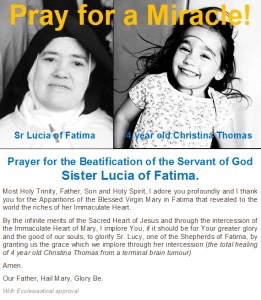
Sr. Lucia Fatima Miracle needed for 4 year old girl – Please Pray!

Let us pray!

Catholicism Pure & Simple's avatarCatholicism Pure & Simple

Catholics have been asked to republish this article from Listening in the Desert on our blogs. We are happy to oblige.

image

This year is the 100th anniversary of the Fatima apparitions. And today, February 13th is the anniversary of the death of the Carmelite nun, Sr. Lucia of Fatima.

It seems fitting that today should be the day we begin praying for her intercession for a a sweet 4 year old girl named Christina Thomas. Last week, Christina was diagnosed with an inoperable brain tumor. The doctors have said there is nothing they can do.

4 year old Christina Thomas 4 year old Christina Thomas

We need a miracle. Christina’s father, Kenny, is a secular Carmelite, like myself, and we both have a great devotion to Fatima. We have informed Kenny’s Bishop that we will ONLY be asking for the intercession of Sr. Lucia, as this is very important in the beatification process.

Please join…

View original post 186 more words

Posted in NOVENAS

NOVENA to St Claude de la Colombiere – DAY EIGHT – 14 February

APOLOGIES – I messed up somehow with my dates!   Consequently there are 2 days missing from this Novena 6 and 7.   Next year I promise to do better St Claude, please forgive me.

St Claude de la Colombiere S.J. (1641-1682 Memorial 15 February) was the spiritual director of St. Margaret Mary Alacoque and helped immensely to bring the devotion to the Sacred Heart of Jesus to the world.   He is known as the faithful servant and perfect friend to the Sacred Heart.   Please join us in saying this Novena, not only for our own needs but that through the power of the Sacred Heart of Jesus, the whole world and it’s many ills, may benefit.

DAY EIGHT

O Lord Jesus Christ,
You promised to bestow abundant blessings
on all the undertakings of those who honour your Sacred Heart.
Hear our humble, confident and incessant prayers
and grant us the grace we ask of Your infinite mercy in this novena.
We ask it through the intercession of St Claude La Colombiere,
whom You have honoured with the title ‘faithful servant and perfect friend’
and who had such filial, unbounded and unwearied confidence in You.
O St Claude, most ardent apostle of the Divine Heart of Jesus,
deign to intercede for me with this divine heart,
that I may obtain the grace I ask for in this novena.
(make your request)
Divine Lord,
You deigned to make St Claude the faithful servant and wonderful lover of your Sacred Heart.
Grant us, through his intercession,
the grace to imitate the virtues of this divine heart
and be inflamed by its love.
We ask You this,
You who lives and reigns with God the Father
and the Holy Spirit forever and ever.
Our Father…Hail Mary…Glory be…
Pray for us, St Claude, that we may be made worthy of the promises of Christ, amen.

day-eight-novena-stclaude

Posted in MORNING Prayers, SAINT of the DAY

Thought for the Day -14 February

Thought for the Day -14 February

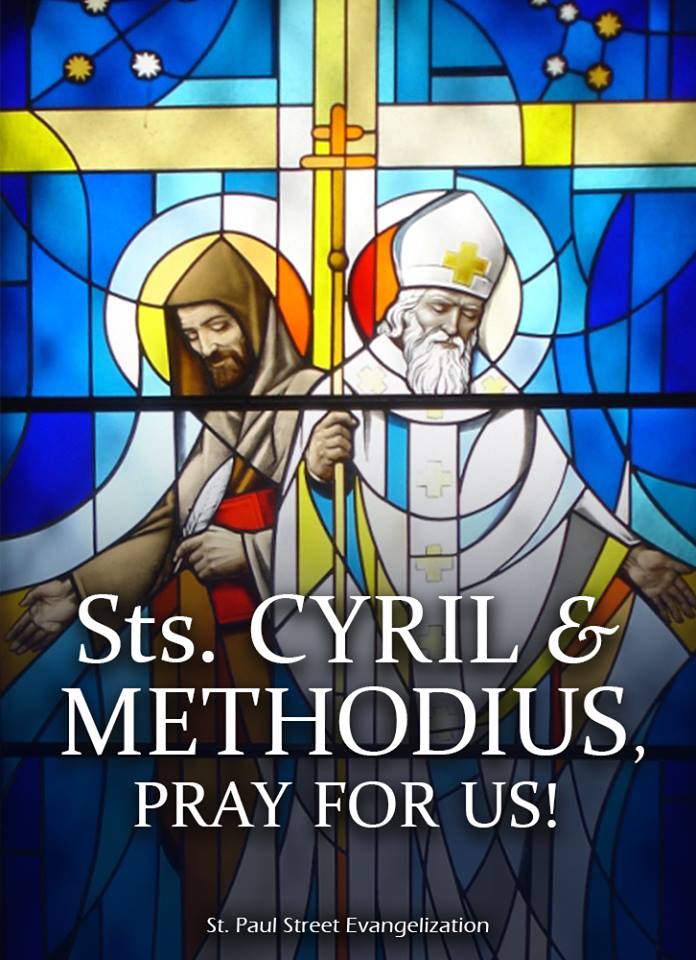
Sts Cyril and Methodius were thrust into a totally unexpected task, requiring astonishing energy, flexibility and presenting immense challenges.   They evangelised a whole people and brought them the treasures of the Christian faith.   Faith is prepared for the unexpected and adapts itself to new and changing circumstances.   Holiness means reacting to human life with God’s love:  human life as it is, crisscrossed with the political and the cultural, the beautiful and the ugly, the selfish and the saintly.    For Cyril and Methodius much of their daily cross had to do with the language of the liturgy.    They are not saints because they got the liturgy into Slavonic but because they did so with the courage and humility of Christ.

St Cyril and St Methodius, Pray for us!


sts-cyril-methodius-feb-14

sts-cyril-and-methodius-pray-for-us-2

Posted in MORNING Prayers, QUOTES of the SAINTS, SAINT of the DAY

Quote of the Day – 14 February

Quote of the Day – 14 February

“From your Valentine.”

~~~ St Valentine

from-your-valentine-jesus


Posted in MORNING Prayers, QUOTES of the SAINTS, SAINT of the DAY, The WORD

One Minute Reflection – 14 February

One Minute Reflection – 14 February

On that day you will know that I am in my Father and you are in me and I in you……….John 14:20

REFLECTION – “Jesus Christ must live in us and we must live only in Him.
His life must be our life and our life must be a continuation and expression of His life.”………….St John Eudes

PRAYER – Lord Jesus, make me realise that You are living in me and I am in You.   Enable me to readiate You in my outward life by being consciously generous, loving, humble, kind.   By being consciously united to You in every thought, word and deed.   I pray that Your purpose may be mine too, do the Father’s Will.   That the Saints who walk before me, Sts Cyril and Methodius, St Valentine, may pray for us all, amen!

john-14-20quote-st-john-eudes-jesus-christ-must-live-in-ussts-cyril-and-methodius-pray-for-usst-valentine-pray-for-us

Posted in MORNING Prayers

Our Morning Offering – 14 February

Our Morning Offering – 14 February

Keep me, O God, from pettiness;
let me be large in thought,
in word,
in deed.
Let me be done with fault-finding and self-seeking.
May I put away all pretense
and meet everyone face to face
without self-pity and without prejudice.
May I never be hasty in judgment and always generous.
Let me take time for all things.
Make me grow calm, serene and gentle.
Teach me to put into action my better impulses,
straightforward and unafraid.
Grant that I may realise it is the little things of life
that create differences
and that in the big things of life we are one.
And, O Lord God, let me not forget to be kind!
Through kindness itself, Your Son, Jesus Christ, amen.


prayer-for-generosity-gentleness-kindness

Posted in SAINT of the DAY

Blessed Memorial of St Valentine – 14 February

Blessed Memorial of St Valentine – 14 February (176-273) Bishop and Martyr – Patron of affianced couples, against epilepsy, against fainting, against plague, apiarists, bee keepers, betrothed couples, Bussolengo, Italy, engaged couples, greeting card manufacturers, greetings, happy marriages, love, lovers, travellers, young people.

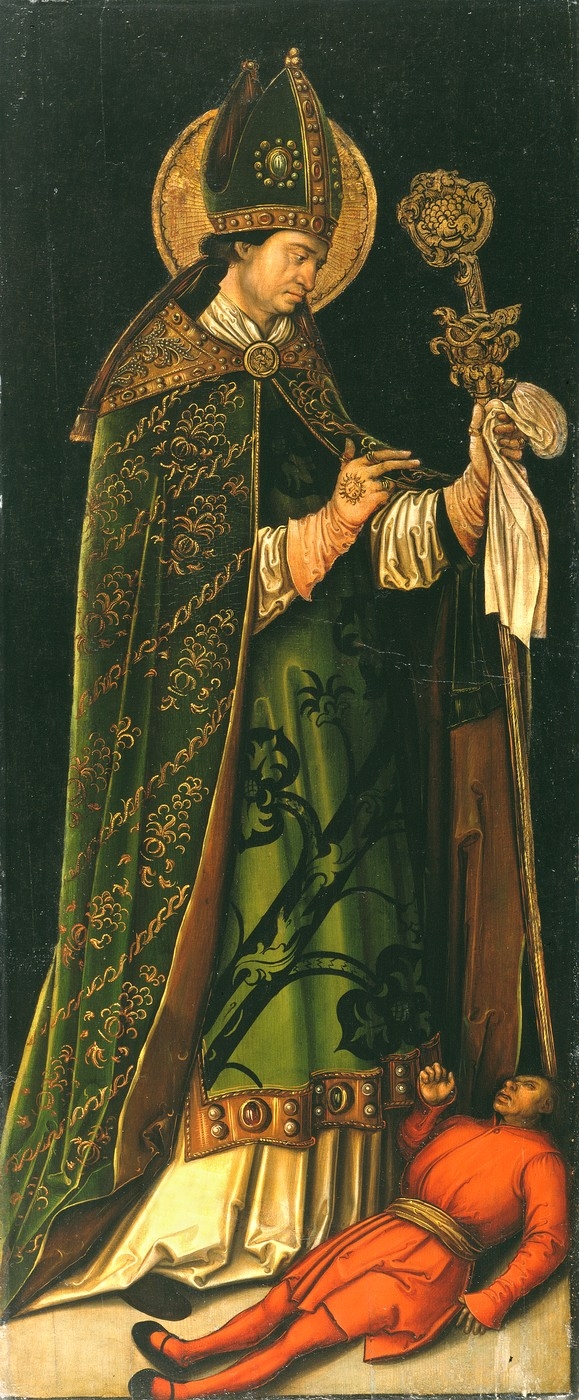
Header - Leonhard_Beck_-_Heiliger_Valentin_(Veste_Coburg)

Saint Valentine is a widely recognized third-century Roman saint commemorated on 14 February and since the High Middle Ages is associated with a tradition of courtly love.

All that is reliably known of the saint commemorated today, is his name and that he was martyred and buried at a cemetery on the Via Flaminia close to the Ponte Milvio to the north of Rome.

Because so little is reliably known of him, in 1969 the Catholic Church removed his name from the General Roman Calendar, leaving his liturgical celebration to local calendars. The Church continues to recognise him as a Saint, listing him as such in the Roman Martyrology and authorising liturgical veneration of him on 14 February.   Saint Valentine’s Church in Rome, built in 1960 for the needs of the Olympic Village, continues as a modern, well-visited parish church.

painting-of-st-valentine-santa-maria-degli-angeli-church-rome

Father Frank O’Gara of Whitefriars Street Church in Dublin, Ireland, tells the story of the man behind the holiday—St Valentine.

“He was a Roman Priest at a time when there was an emperor called Claudias who persecuted the church at that particular time,” Father O’Gara explains. ”   He also had an edict that prohibited the marriage of young people.   This was based on the hypothesis that unmarried soldiers fought better than married soldiers because married soldiers might be afraid of what might happen to them or their wives or families if they died.

I think we must bear in mind that it was a very permissive society in which Valentine lived,” says Father O’Gara.   “Polygamy would have been much more popular than just one woman and one man living together.    And yet some of them seemed to be attracted to Christian faith. But obviously the church thought that marriage was very sacred between one man and one woman for their life and that it was to be encouraged.    And so it immediately presented the problem to the Christian church of what to do about this.

The idea of encouraging them to marry within the Christian church was what Valentine was about.    And he secretly married them because of the edict.”

Valentine was eventually caught, imprisoned and tortured for performing marriage ceremonies against command of Emperor Claudius the second.    There are legends surrounding Valentine’s actions while in prison.

One of the men who was to judge him in line with the Roman law at the time was a man called Asterius, whose daughter was blind.    He was supposed to have prayed with and healed the young girl with such astonishing effect that Asterius himself became Christian as a result.

In the year 269 AD, Valentine was sentenced to a three part execution of a beating, stoning, and finally decapitation all because of his stand for Christian marriage.    The story goes that the last words he wrote were in a note to Asterius’ daughter.    He inspired today’s romantic missives by signing it, “from your Valentine.”

What Valentine means to me as a priest, explains Father O’Gara, “is that there comes a time where you have to lay your life upon the line for what you believe.     And with the power of the Holy Spirit we can do that —even to the point of death.”

Valentine’s martyrdom has not gone unnoticed by the general public.    In fact, Whitefriars Street Church is one of three churches that claim to house the remains of Valentine. Today, many people make the pilgrimage to the church to honour the courage and memory of this Christian saint.

Posted in SAINT of the DAY

Saint/s of the Day – 14 February – Cyril and Methodius

Saint/s of the Day – 14 February – Cyril and Methodius – (826 or 827 and 815-869 and 885) Bishops and Confessors; Equals to the Apostles; Patrons of Europe; Apostles to the Slavs. CYRIL – PATRON of unity between Eastern and Western Churches, ecumenism, against storms, Slavic peoples (given in 1863 by Pope Pius IX, Slavic countries, various Diocese.

Two brothers who were Byzantine Christian theologians and Christian missionaries. Through their work they influenced the cultural development of all Slavs, for which they received the title “Apostles to the Slavs”.    They are credited with devising the Glagolitic alphabet, the first alphabet used to transcribe Old Church Slavonic.    After their deaths, their pupils continued their missionary work among other Slavs.    Both brothers are venerated in the Orthodox Church as saints with the title of “equal-to-apostles”.    In 1880, Pope Leo XIII introduced their feast into the calendar of the Roman Catholic Church. In 1980, Pope John Paul II declared them co-patron saints of Europe, together with Benedict of Nursia.

cyril_and_methodius-jan-matejko

Because their father was an officer in a part of Greece inhabited by many Slavs, these two Greek brothers ultimately became missionaries, teachers, and patrons of the Slavic peoples.   After a brilliant course of studies, Cyril (called Constantine until he became a monk shortly before his death) refused the governorship of a district such as his brother had accepted among the Slavic-speaking population.    Cyril withdrew to a monastery where his brother Methodius had become a monk after some years in a governmental post.

A decisive change in their lives occurred when the Duke of Moravia asked the Eastern Emperor Michael for political independence from German rule and ecclesiastical autonomy (having their own clergy and liturgy).    Cyril and Methodius undertook the missionary task.   Cyril’s first work was to invent an alphabet, still used in some Eastern liturgies.    His followers probably formed the Cyrillic alphabet.    Together they translated the Gospels, the psalter, Paul’s letters and the liturgical books into Slavonic and composed a Slavonic liturgy, highly irregular then.   That and their free use of the vernacular in preaching led to opposition from the German clergy.    The bishop refused to consecrate Slavic bishops and priests, and Cyril was forced to appeal to Rome.    On the visit to Rome, he and Methodius had the joy of seeing their new liturgy approved by Pope Adrian II.   Cyril, long an invalid, died in Rome 50 days after taking the monastic habit.

Methodius continued mission work for 16 more years.   He was papal legate for all the Slavic peoples, consecrated a bishop and then given an ancient see (now in the Czech Republic).    When much of their former territory was removed from their jurisdiction, the Bavarian bishops retaliated with a violent storm of accusation against Methodius.    As a result, Emperor Louis the German exiled Methodius for three years.    Pope John VIII secured his release.   Because the Frankish clergy, still smarting, continued their accusations, Methodius had to go to Rome to defend himself against charges of heresy and uphold his use of the Slavonic liturgy. He was again vindicated.

Legend has it that in a feverish period of activity, Methodius translated the whole Bible into Slavonic in eight months.    He died on Tuesday of Holy Week, surrounded by his disciples, in his cathedral church.

Opposition continued after his death and the work of the brothers in Moravia was brought to an end and their disciples scattered.    But the expulsions had the beneficial effect of spreading the spiritual, liturgical and cultural work of the brothers to Bulgaria, Bohemia and southern Poland.    Patrons of Moravia and specially venerated by Catholic Czechs, Slovaks, Croatians, Orthodox Serbians and Bulgarians, Cyril and Methodius are eminently fitted to guard the long-desired unity of East and West.