
September 27: Our Lady of Happy Assembly, Le Laus, France (1664)
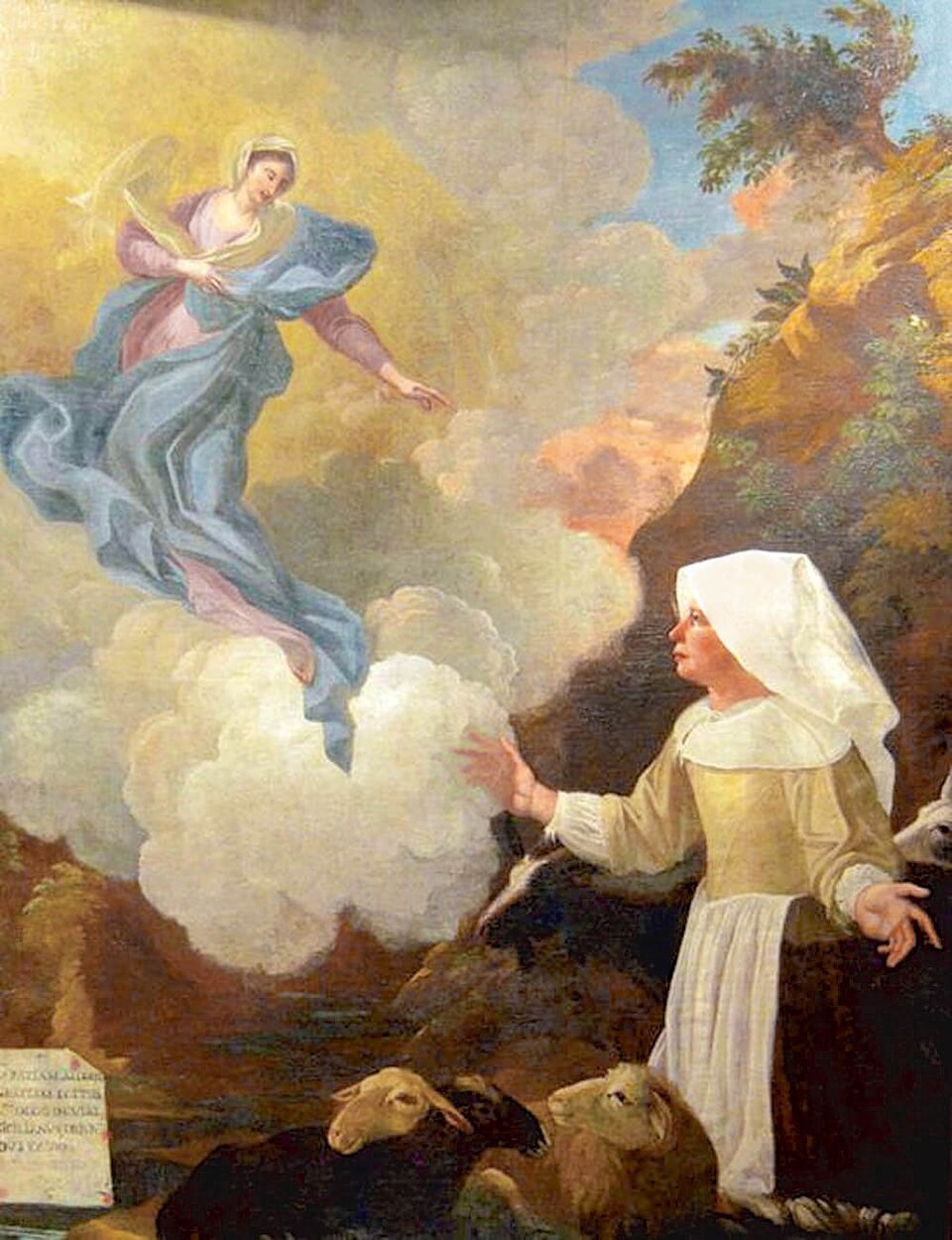
Le Laus is a little village in southeastern France, 60 miles to the southeast of Grenoble. The story of Mary’s shrine there centers around a young woman named Benoite Rencurel, who was born on September 29, 1647 of humble parents in the little village of Saint Etienne, not far from Le Laus. Her father died when she was seven and after his death her mother found life rather difficult. So, when Benoite was 12, she went to work on a neighboring farm, tending the farmer’s sheep. Each day while the flock grazed she spent a few minutes praying to the Blessed Virgin at a little wayside chapel.
One day, in 1664, Benoite led her little flock into a small valley near Saint Etienne and there toward the end of the afternoon, a Lady and Child appeared to her, standing on top of a rock, a large rock, known locally as Les Flours. The Lady did not speak to Benoite, but smiled in a very friendly way and after a few minutes Lady and Child vanished. However, similar apparitions continued almost daily for two months. Of course, rumors of what was occurring gradually spread around the neighboring countryside.
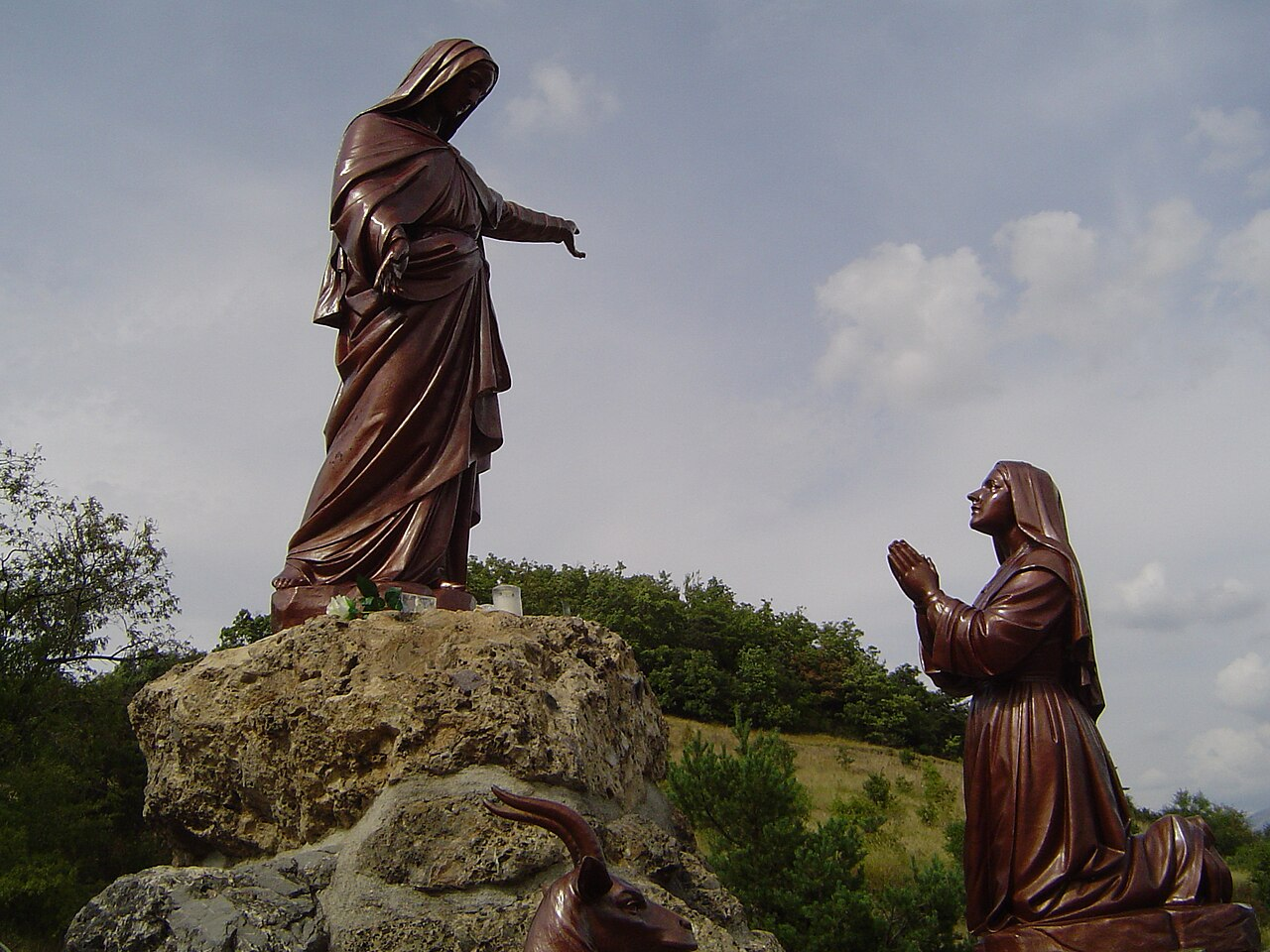
Finally, M. Grimaud, a district magistrate, questioned Benoite at length and suggested that if the lady appeared again, Benoite should ask her who she was. The girl agreed; on the very next day the Lady appeared, she asked her to please say who she was – was she the Mother of God? The Lady answered:
“Yes, I am Mary, the Mother of Jesus. My Son wishes to be especially honored in this valley, but not on this spot.”
With these words she vanished. Benoite did not see her again for a few days. On September 29, while tending her flock at another pasture, Pindreau, a very brilliant light suddenly appeared on top of some rocks. In the center of the light stood the Blessed Virgin. She told Benoite to go to Le Laus, where she would find a little chapel, filled with a delicious perfume, and there she would also see her. Benoite soon found herself at the little chapel of Our Lady of Good Meeting or Happy Assembly (Notre-Dame de Bon Recontre) and going in, she saw the Blessed Virgin over the high altar, on which stood her image. And the Virgin said to Benoite,
“On this spot I wish a church built – a privileged sanctuary, wherein many sinners will repent. Means will not be wanting, despite the poverty of the country people around.”
The news of this event soon spread; crowds came to the little chapel, which was too small to contain them. So, in 1665, Msgr. Lambert, Vicar General of the Archdiocese, gave permission for a church to be built over the little chapel.
Since there was very little money available with which to hire workmen, the villagers and peasants for miles around carried the stones and built the walls for Our Lady of Happy Assembly – aided by the many pilgrims who came to worship and remained a while to help in the building of the church.
In 1692, during an invasion by the Duke of Savoy the church was partly destroyed, but the statue of Our Lady of Happy Assembly was not damaged. The church was soon repaired and restored. In 1716 a new statue of the Virgin was carved and enshrined behind the main altar of the church. It is said that Benoite wished the new statue to be named Our Lady of Happy Assembly of Laus. The original statue was transferred to a chapel behind the main altar. In 1885 Pope Pius IX gave official recognition to the title of Our Lady of Laus of Happy Assembly, when he ordered the new statue to be solemnly crowned. Benoite Rencurel died on December 28, 1718, and was buried in a vault in front of the altar in the church at Le Laus.
For 54 years, the Virgin Mary continued to appear to Benoîte throughout her life. Benoîte became a Dominican Tertiary and was called “Sister Benoîte”. She was given by Mary the mission to welcome the pilgrims. Benoîte was also given the gift of reading souls, to help the pilgrims make good confessions to the priests, by making them know their sins, remember the forgotten ones, and confess them and repent. There have been many testimonies saying that a heavenly perfume would fill the church every time Mary would appear to Benoîte. In addition to Marian apparitions, Benoîte also had apparitions of angels, several saints, and mystical experiences such as visions of Paradise.
Between 1669 and 1684, she was also granted the vision of the crucified Christ on the cross of Avançon five times. On a Friday in July of 1673, according to Benoîte, Jesus on the cross told her: “My daughter, I show myself in this state so that you can participate in my Passion.” United with Him, she lived a “mystical crucifixion” every Friday for several years and bore stigmata.
French philosopher and theologian Jean Guitton said, “The Shrine of Laus is one of the most hidden and also most powerful treasures in the history of Europe.”
St Vincent de Paul CM (1581-1660) (Memorial) Known as the “Great Apostle of Trumpets” – Priest, Founder, Apostle of Charity, Doctor of Canon Law, Reformer of Society and Priests, Founder of Hospital and Orphanages. Born on 24 April 1581 near Ranquine, Gascony near Dax, southwest France – the Town is now known as Saint-Vincent-de-Paul, Landes, France. His body is incorrupt.
St Adheritus
St Adolphus of Cordoba
St Antonio de Torres
St Barrog the Hermit
St Bonfilius of Foligno OSB (1040-1125) Bishop, Abbot.
St Ceraunus of Paris
St Chiara of the Resurrection
St Deodatus of Sora
Saint Delphina of Glandenes
St Elzear of Sabran TOSF (1285-1323) Layman, Member of the Third Order of St Francis
St Epicharis
St Fidentius of Todi
St Florentinus the Hermit
St Gaius of Milan
St Hilary the Hermit
St Hiltrude of Liessies
Bl Jean-Baptiste Laborie du Vivier
St John of Cordoba
Blessed Lorenzo of Ripafratta OP (c 1373-1456) Dominican Priest and Friar, Penitent, Vicar General, Teacher, Reformer, brilliant Preacher and Spiritual director – known as “the Ark of Science.”
St Marcellus of Saint Gall
St Terence of Todi
—
Martyrs of Aegea – (3 saints)
Martyred in the Spanish Civil War:
• Blessed Crescencia Valls Espí
• Blessed Herminia Martínez Amigó de Martínez
• Blessed José Fenollosa Alcaina
• Blessed Maria Carme Fradera Ferragutcasas
• Blessed Maria Magdalena Fradera Ferragutcasas
• Blessed Maria Rosa Fradera Ferragutcasas


You must be logged in to post a comment.