Posted in CONFESSION/PENANCE, DOCTORS of the Church, MORNING Prayers, QUOTES of the SAINTS, The WORD

One Minute Reflection – 25 October

One Minute Reflection – 25 October

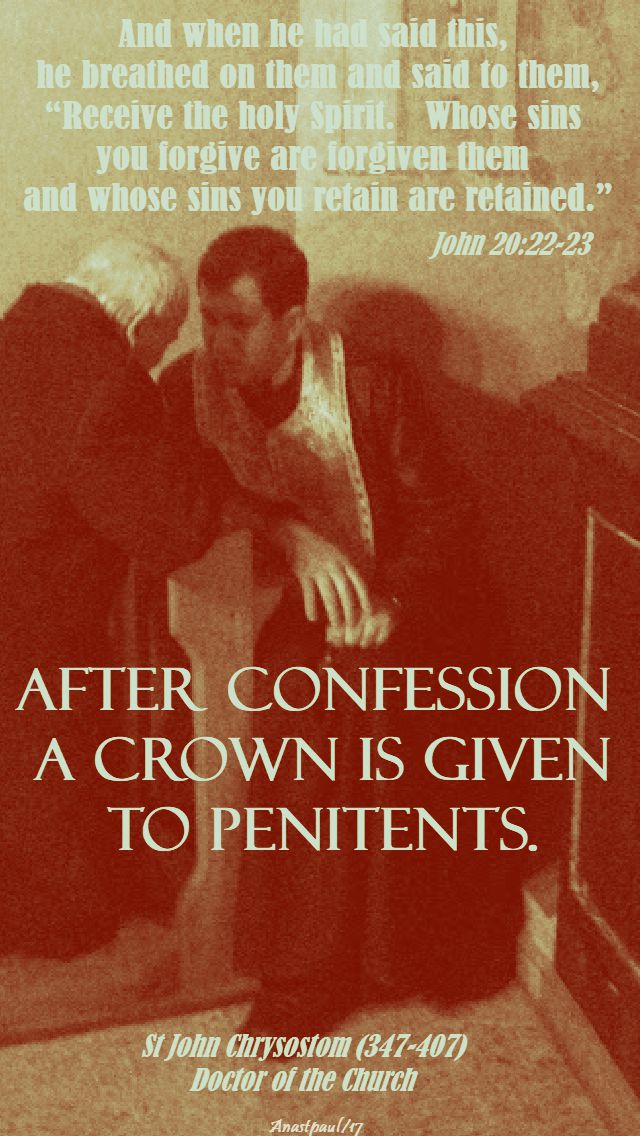
And when he had said this, he breathed on them and said to them, “Receive the holy Spirit.   Whose sins you forgive are forgiven them and whose sins you retain are retained.”…John 20:22-23

REFLECTION – “After confession a crown is given to penitents.”… St John Chrysostom (347-407) Doctor of the Churchafter confession - st john chrysostom - 25 oct 2017

PRAYER – Lord God, hear my prayer, forgive my sins, teach me true repentance, help me to renew my life and live only in Your love.
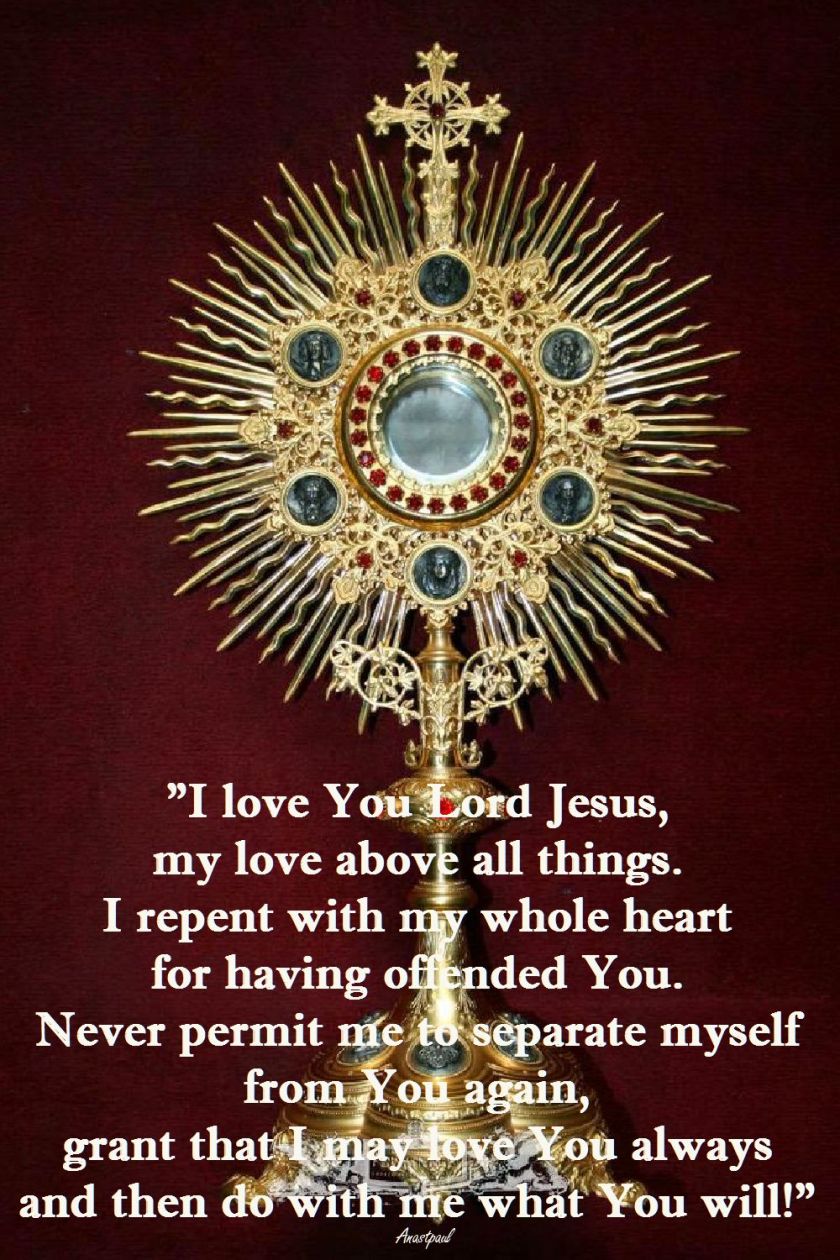
I wish now and every day, sorrow for my sins and the willingness to make reparation for them. Show me how, dear Lord, teach me Your ways. For my sins crucified my Lord, on my God, forgive me! Lord Jesus, I love You, grant that I may never separate myself from You again! AmenI LOVE YOU LORD JESUS

Posted in DOCTORS of the Church, FATHERS of the Church, MORNING Prayers, QUOTES of the SAINTS, SAINT of the DAY

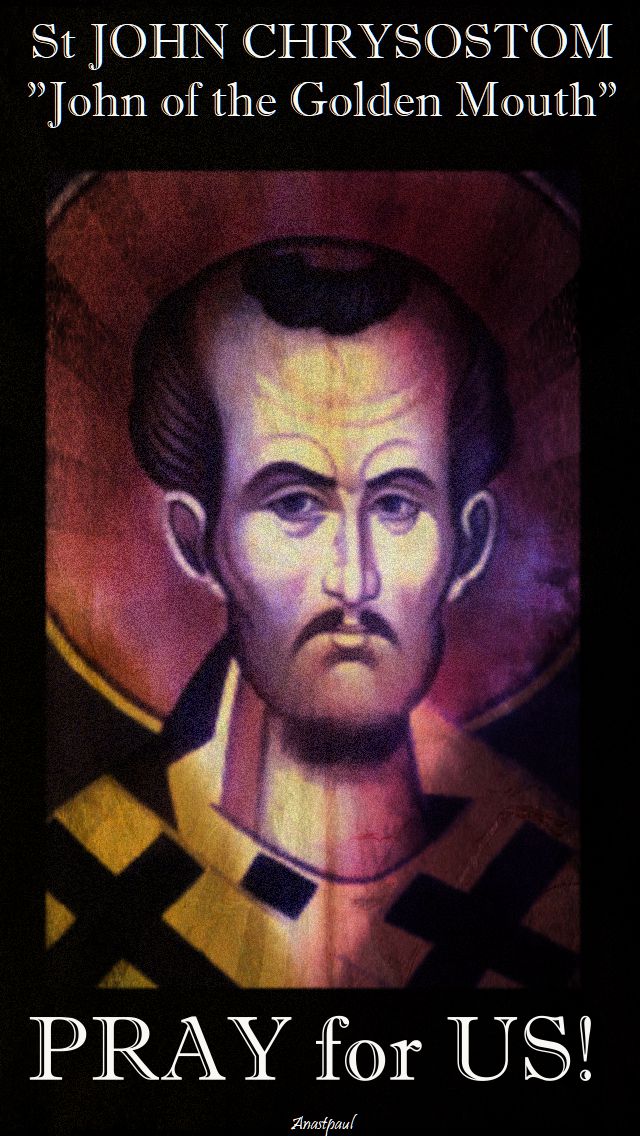
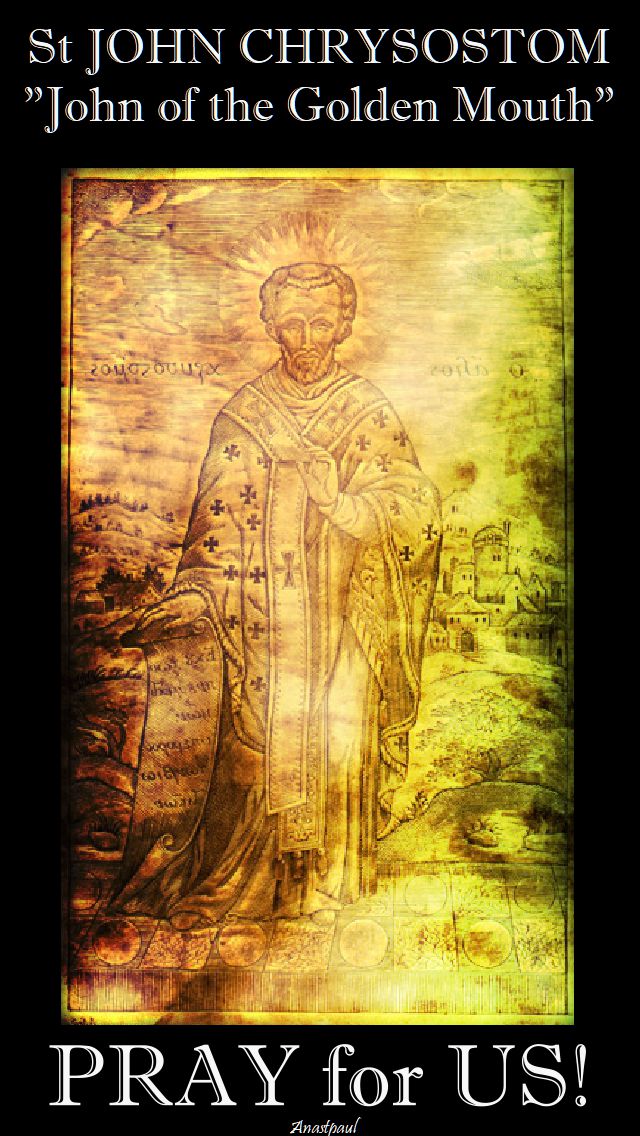
Thought for the Day – 13 September – 13 September – St John Chrysostom (347-407) Doctor – “John of the Golden Mouth”

Thought for the Day – 13 September – 13 September – St John Chrysostom (347-407) Doctor – “John of the Golden Mouth”

What I find interesting is that some people in the Church think Pope Francis is a liberal who is over concerned with social justice issues.   Some of these same people would then hold Chrysostom in high regard, especially being a Doctor of the Church.   Both of these sons of the Church share much in common.

Chrysostom had just as much concern about the relationship of the bishops and priests to the laity as Pope Francis does.   Each showing concern over the laity being treated with respect and dignity, Chrysostom asked,  “How should the church be governed?   Should the patriarchs act like emperors, issuing decrees…Should bishops see themselves as local governors, demanding unquestioning submission of the people?”   Pope Francis has told priests they must be “shepherds living with the smell of the sheep.”   Chrysostom reminded those in authority that they are not rulers but preachers and pastors.  He also stressed that “each individual is answerable not to a priest, bishop, or patriarch but to God.”

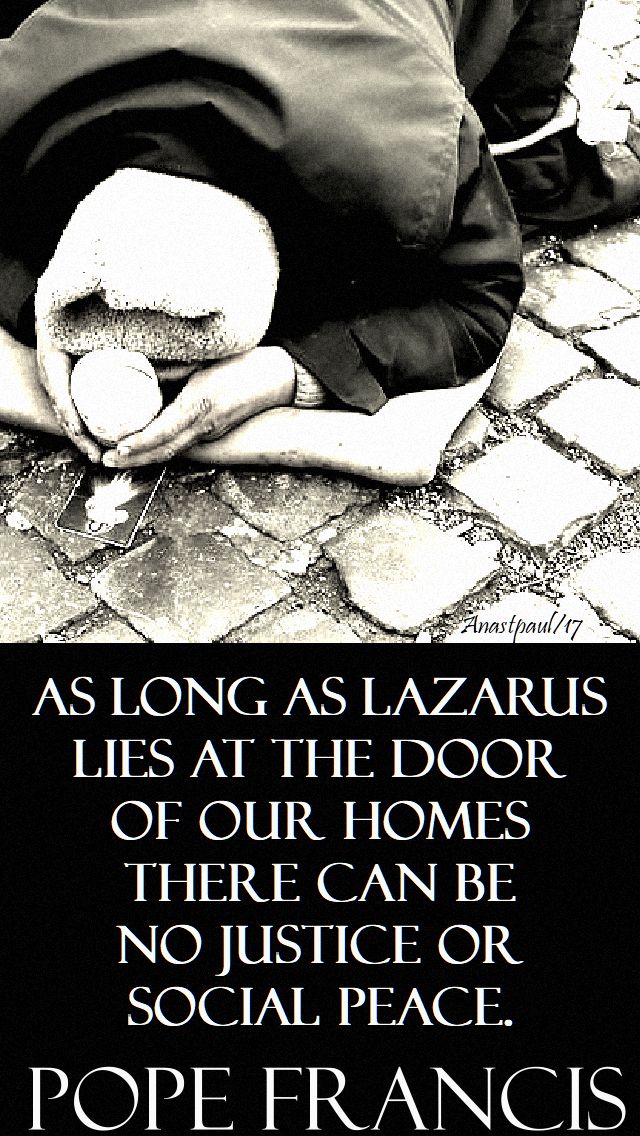
Pope Francis has caused quite a stir regarding some of his statements about finances; frankly Chrysostom would not disagree with him.  Actually, I have found Chrysostom to be even more frank then Pope Francis.   He does not mince words when saying, “Lift up and stretch out your hands, not to heaven, but to the poor…if you lift up your hands in prayer without sharing with the poor, it is worth nothing.”   And Pope Francis twice quoted Chrysostom in Evangelii Gaudium, he said, “Ethics — a non-ideological ethics — would make it possible to bring about balance and a more humane social order. With this in mind, I encourage financial experts and political leaders to ponder the words of one of the sages of antiquity: ‘Not to share one’s wealth with the poor is to steal from them and to take away their livelihood.  It is not our own goods which we hold, but theirs.’”   The second quote expressed that we need look at money in a different way, basically through the eyes of Christ.

Both men have a great concern for the poor.   Chrysostom even said if we wish to honour Christ’s body we must first clothe and feed him in our brother. Then, with what we have left, adorn the altar with gold chalices.   He believed “feeding the hungry is a greater work than raising the dead.”   Pope Francis has urged us to not waste food, that throwing it away is like stealing from the poor.   He has also warned us to not, “become starched Christians, those over-educated Christians who speak of theological matters as they calmly sip their tea. No!”   Like Chrysostom, Pope Francis wants us to go out and “care for the flesh of Christ” to seek Him out in the poor.

With great pastoral care they each speak about everyday sins we all need to combat. They do not hesitate to speak out against the pharisaical behavior of keeping rules and laws while not loving our neighbour.   Chrysostom asks us, “For what does it profit if we abstain from fish and fowl and yet bite and devour our brothers and sisters?” Pope Francis tells us we are murdering Christians when we speak badly of them with others.   Reminding us, “There is no such thing as innocent slander.”

I am sure most of us occasionally have moments of “elder brother syndrome.” (Luke 11:32)   We can benefit from a reminder from both men that the Church is a hospital where anyone seeking God can come to be healed.   Chrysostom said the Church is “not a courtroom, for souls. She does not condemn on behalf of sins but grants remission of sins.”

Pope Francis sees the Church as a field hospital after battle.   Saying it is “useless to ask a seriously injured person if he has high cholesterol and about the level of his blood sugars! You have to heal his wounds. Then we can talk about everything else.”   Of course, we are all wounded sinners needing the medicine of the sacraments.   Chrysostom reminds us to not be ashamed when we repent but to have a change of heart and seek God’s love and mercy.   Mercy is a favourite topic of Pope Francis, “there is no limit to the divine mercy, which is offered to everyone…The Lord is always ready to roll away the tombstone of our sins, which separate us from Him, the light of the living.”

These are a few examples showing the similarities between both men.   I believe this shows how Chrysostom’s words are relevant for us today and that there’s nothing novel about Pope Francis’s approach.   Both men challenge us, make us uncomfortable and do not seek to please men with their words but lead them to truth.   The fact that they have so many similar things to say is ultimately a testament of the timelessness of the gospel message itself.   And proof that God is with us and working through his shepherds.”

St John Chrysostom, Pray for the Church, Pray for Pope Francis, Pray for us all!st john chrysostom pray for us.2

(JESSICA ARCHULETA)

Posted in DOCTORS of the Church, EUCHARISTIC Adoration, FATHERS of the Church, MORNING Prayers, QUOTES of the SAINTS, SAINT of the DAY, The HOLY EUCHARIST / The HOLY MASS

Quote/s of the Day- 13 September – The Memorial of St John Chrysostom (347-407) Doctor – “John of the Golden Mouth”

Quote/s of the Day – 13 September –  St John Chrysostom (347-407) Doctor – “John of the Golden Mouth”

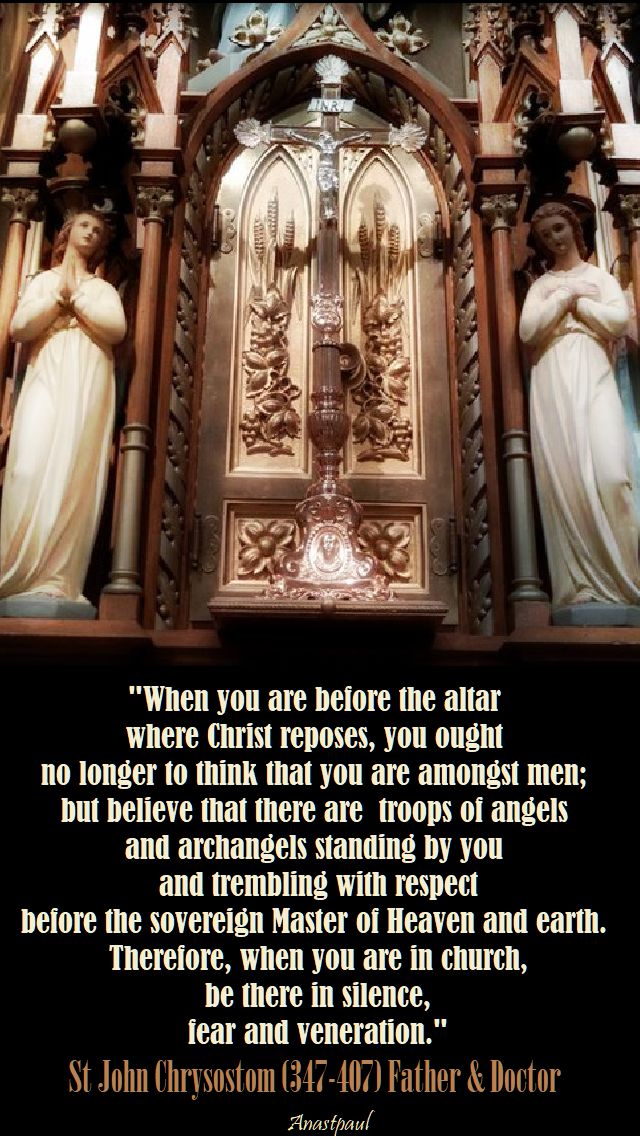
“When you are before the altar where Christ reposes,
you ought no longer to think that you are amongst men;
but believe that there are troops of angels
and archangels standing by you and trembling with respect
before the sovereign Master of Heaven and earth.
Therefore, when you are in church, be there in silence,
fear and veneration.”when you are before the altar - st john chrysostom

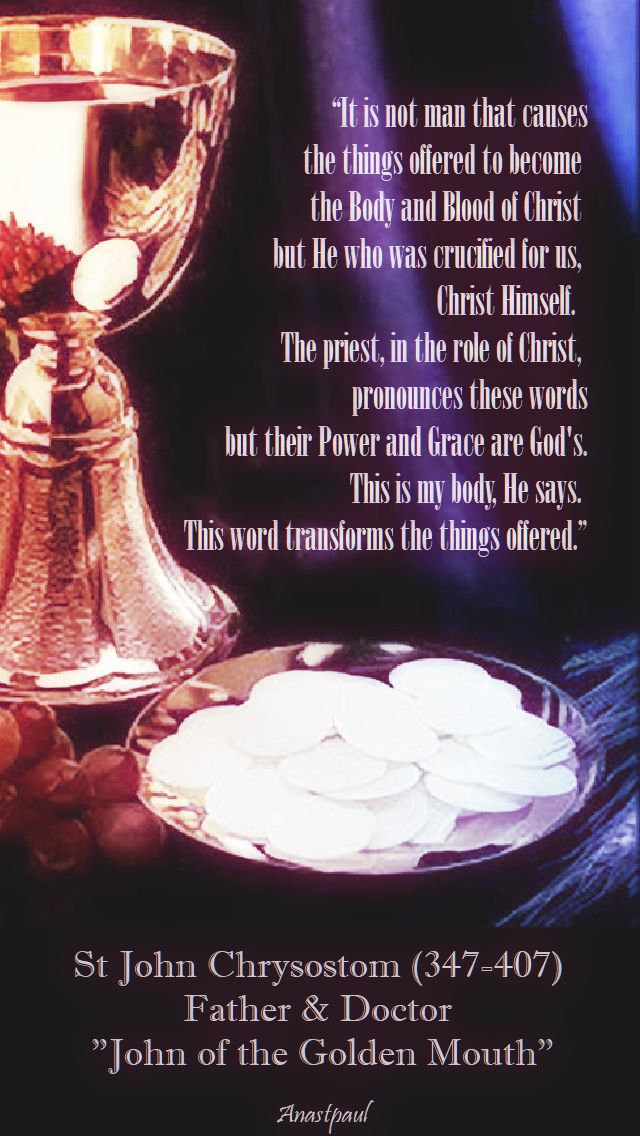
“It is not man that causes the things offered to become
the Body and Blood of Christ but He who was crucified for us,
Christ Himself. The priest, in the role of Christ,
pronounces these words, but their Power and Grace are God’s.
This is my body, He says. This word transforms the things offered.”it is not man that causes - st john chrysostom

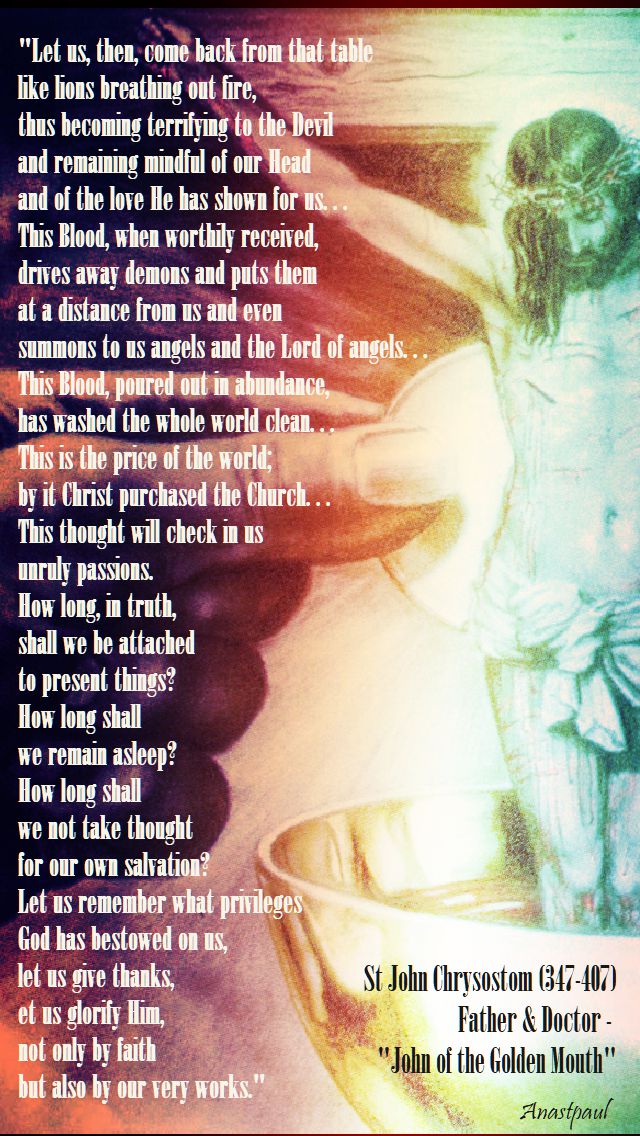
“Let us, then, come back from that table like lions breathing out fire,
thus becoming terrifying to the Devil and remaining mindful of our Head
and of the love He has shown for us. . .
This Blood, when worthily received, drives away demons and puts them
at a distance from us, and even summons to us angels and the Lord of angels. . .
This Blood, poured out in abundance, has washed the whole world clean. . .
This is the price of the world;  by it Christ purchased the Church. . .
This thought will check in us unruly passions.
How long, in truth, shall we be attached to present things?
How long shall we remain asleep?
How long shall we not take thought for our own salvation?
Let us remember what privileges God has bestowed on us,
let us give thanks,
let us glorify Him,
not only by faith but also by our very works.”let us then come from that table - st john chrysostom

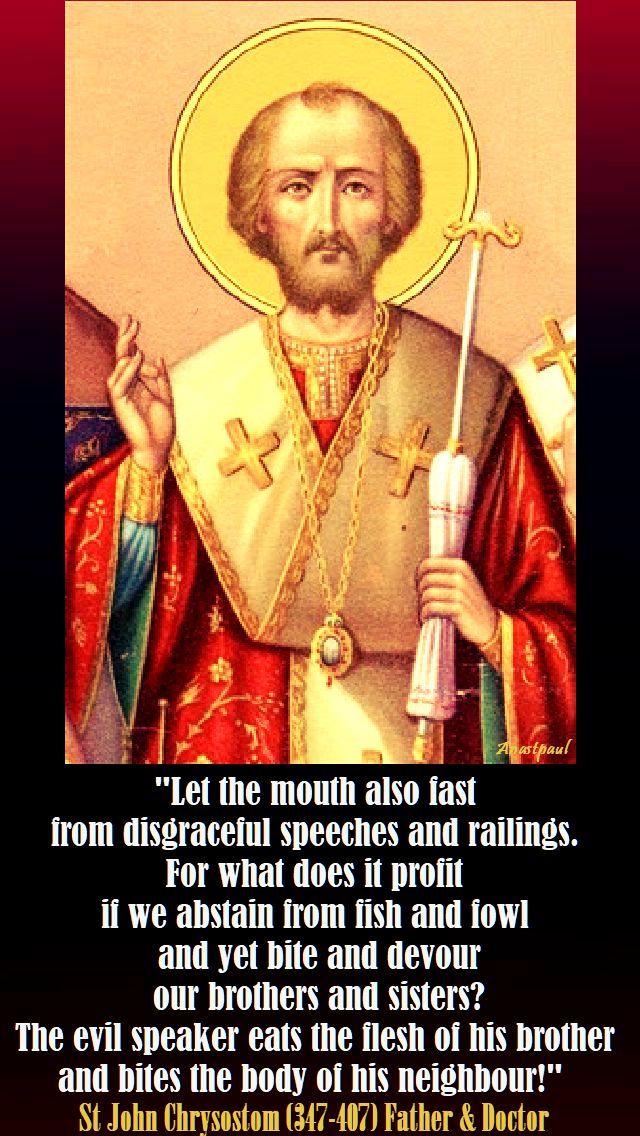
“Let the mouth also fast from disgraceful speeches and railings.
For what does it profit if we abstain from fish and fowl
and yet bite and devour our brothers and sisters?
The evil speaker eats the flesh of his brother
and bites the body of his neighbour!”

St John Chrysostom (347-407) Father & Doctor – “John of the Golden Mouth”let the mouth also fast from disgraceful-st john chrysostom

Posted in DOCTORS of the Church, FATHERS of the Church, MORNING Prayers, QUOTES of the SAINTS, SAINT of the DAY, The WORD

One Minute Reflection – 13 September – St John Chrysostom (347-407) Doctor – “John of the Golden Mouth”

One Minute Reflection – 13 September – St John Chrysostom (347-407) Doctor – “John of the Golden Mouth”

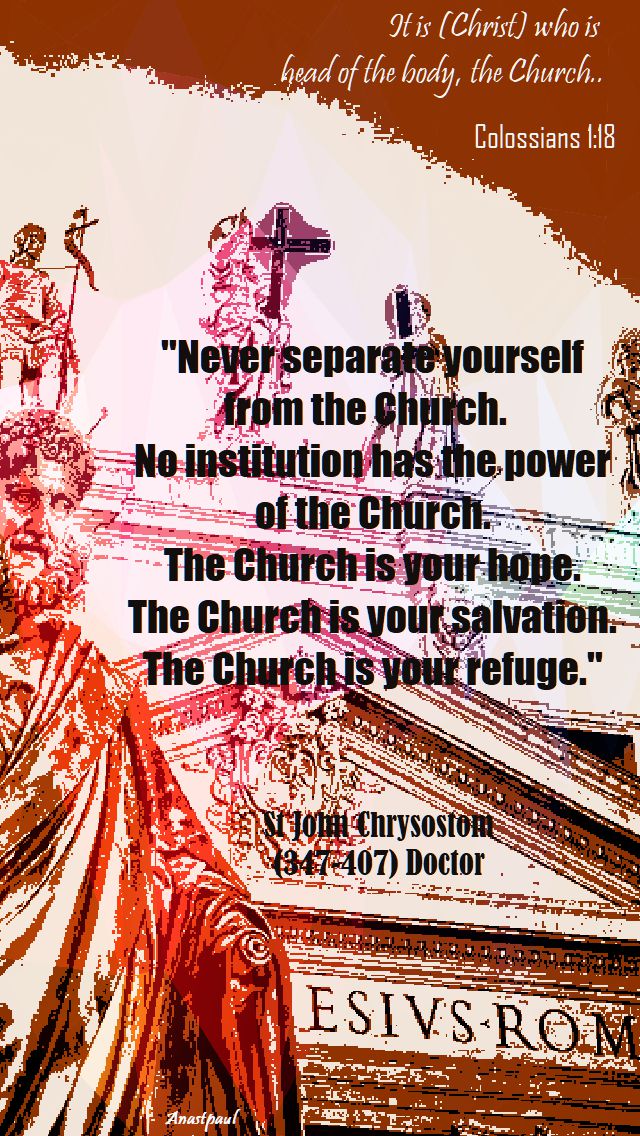
It is (Christ) who is head of the body, the Church….Colossians 1:18

REFLECTION – “Never separate yourself from the Church.
No institution has the power of the Church.
The Church is your hope.
The Church is your salvation.
The Church is your refuge.”..St John Chrysostomnever separate yourself from the church - st john chrysostom

PRAYER – Lord God, strength of those who hope in You, by Your will, St John Chrysostom became renowned in the Church for his astounding eloquence and his forbearance in persecution. Grant that we may be enriched by his teaching and encouraged by the example of his unconquerable fortitude. St John of the Golden Mouth, pray for us, amen.st john chrysostom pray for us

Posted in DOCTORS of the Church, FATHERS of the Church, MORNING Prayers, PRAYERS of the SAINTS, SAINT of the DAY

Our Morning Offering – 13 September – The Memorial of St John Chrysostum (347-407) Father and Doctor of the Church

Our Morning Offering – 13 September (347-407) Father and Doctor of the Church

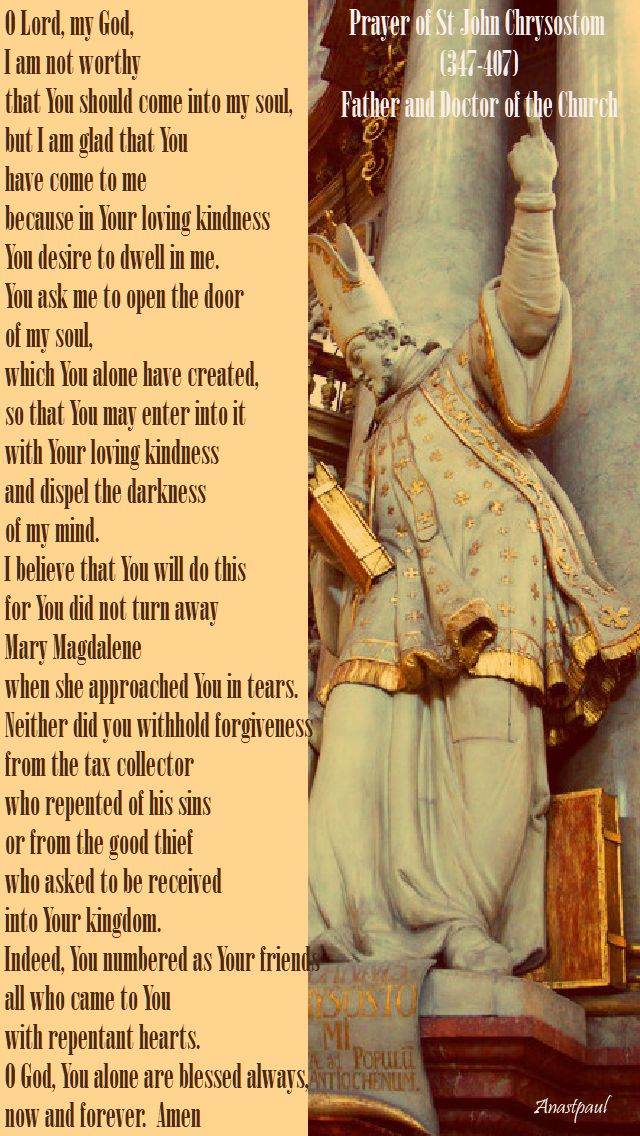
Prayer of St John Chrysostom

O Lord, my God,
I am not worthy
that You should come into my soul,
but I am glad that You have come to me
because in Your loving kindness
You desire to dwell in me.
You ask me to open the door of my soul,
which You alone have created,
so that You may enter into it
with Your loving kindness
and dispel the darkness of my mind.
I believe that You will do this
for You did not turn away Mary Magdalene
when she approached You in tears.
Neither did you withhold forgiveness
from the tax collector
who repented of his sins
or from the good thief
who asked to be received into Your kingdom.
Indeed, You numbered as Your friends
all who came to You with repentant hearts.
O God, You alone are blessed always,
now and forever. Amenprayer of st john chrysostom

Posted in All THEOLOGIANS, Moral Theologians, CONFESSORS, DOCTORS of the Church, EPILEPSY, FATHERS of the Church, PATRONAGE - WRITERS, PRINTERS, PUBLISHERS, EDITORS, etc, PREACHERS, QUOTES of the SAINTS, SAINT of the DAY

Saint of the Day – 13 September – St John Chrysostom (347-407) Father and Doctor of the Church “Golden Mouthed”

Saint of the Day – 13 September – St John Chrysostom (347-407) Father and Doctor of the Church – “Golden Mouthed” – (c 347 at Antioch, Asia Minor – 407 of natural causes) Bishop, Confessor, Father and Doctor, Preacher, Orator, Writer, Theologian,  Name Meaning – • God is gracious; gift of God (John), • golden-mouthed (Chrysostom). Patronages – • epileptics; against epilepsy• Constantinople; Istanbul, Turkey• lecturers, preachers, speakers, orators (proclaimed on 8 July 1908 by St Pope Pius X). St John Chrysostom was the Archbishop of Constantinople and is an important Early Church Father. He is known for his preaching and public speaking, his denunciation of abuse of authority by both ecclesiastical and political leaders, the Divine Liturgy of Saint John Chrysostom and his ascetic sensibilities.  Chrysostom was among the most prolific authors in the early Christian Church, exceeded only by St Augustine in the quantity of his surviving writings.

st john chrysostom 2

John was born in Antioch in 349 to Greek parents from Syria.   John’s father died soon after his birth and he was raised by his mother.   He was baptised in 368 or 373 and tonsured as a reader.   As a result of his mother’s influential connections in the city, John began his education under the pagan teacher Libanius.   From Libanius, John acquired the skills for a career in rhetoric, as well as a love of the Greek language and literature.  As he grew older, however, John became more deeply committed to Christianity and went on to study theology under Diodore of Tarsus, founder of the re-constituted School of Antioch.

John lived in extreme asceticism and became a hermit in about 375;  he spent the next two years continually standing, scarcely sleeping and committing the Bible to memory. As a consequence of these practices, his stomach and kidneys were permanently damaged and poor health forced him to return to Antioch.

Diaconate and service in Antioch:
John was ordained as a deacon in 381 by Saint Meletius of Antioch who was not then in communion with Alexandria and Rome.   After the death of Meletius, John separated himself from the followers of Meletius, without joining Paulinus, the rival of Meletius for the bishopric of Antioch. But after the death of Paulinus he was ordained a presbyter (priest) in 386 by Evagrius, the successor of Paulinus.

In Antioch, over the course of twelve years (386–397), John gained popularity because of the eloquence of his public speaking at the Golden Church, Antioch’s cathedral, especially his insightful expositions of Bible passages and moral teaching.  The most valuable of his works from this period are his Homilies on various books of the Bible.   He emphasised charitable giving and was concerned with the spiritual and temporal needs of the poor.   He spoke against abuse of wealth and personal property:

“Do you wish to honour the body of Christ? Do not ignore him when he is naked. Do not pay him homage in the temple clad in silk, only then to neglect him outside where he is cold and ill-clad. He who said: “This is my body” is the same who said: “You saw me hungry and you gave me no food”, and “Whatever you did to the least of my brothers you did also to me”… What good is it if the Eucharistic table is overloaded with golden chalices when your brother is dying of hunger? Start by satisfying his hunger and then with what is left you may adorn the altar as well.”

His straightforward understanding of the Scriptures – in contrast to the Alexandrian tendency towards allegorical interpretation – meant that the themes of his talks were practical, explaining the Bible’s application to everyday life.   Such straightforward preaching helped Chrysostom to garner popular support.   He founded a series of hospitals in Constantinople to care for the poor.

Archbishop of Constantinople:
In the autumn of 397, John was appointed Archbishop of Constantinople, after having been nominated without his knowledge.   He had to leave Antioch in secret due to fears that the departure of such a popular figure would cause civil unrest.   During his time as Archbishop he adamantly refused to host lavish social gatherings, which made him popular with the common people but unpopular with wealthy citizens and the clergy.   His reforms of the clergy were also unpopular.   He told visiting regional preachers to return to the churches they were meant to be serving—without any payout.

His time in Constantinople was more tumultuous than his time in Antioch.   Theophilus, the Patriarch of Alexandria, wanted to bring Constantinople under his sway and opposed John’s appointment to Constantinople.   Theophilus had disciplined four Egyptian monks (known as “the Tall Brothers”) over their support of Origen’s teachings.   They fled to John and were welcomed by him.   Theophilus therefore accused John of being too partial to the teaching of Origen.   He made another enemy in Aelia Eudoxia, wife of Emperor Arcadius, who assumed that John’s denunciations of extravagance in feminine dress were aimed at herself.   Eudoxia, Theophilus and other of his enemies held a synod in 403 (the Synod of the Oak) to charge John, in which his connection to Origen was used against him.   It resulted in his deposition and banishment.   He was called back by Arcadius almost immediately, as the people became “tumultuous” over his departure, even threatening to burn the royal palace.   There was an earthquake the night of his arrest, which Eudoxia took for a sign of God’s anger, prompting her to ask Arcadius for John’s reinstatement.

Peace was short-lived. A silver statue of Eudoxia was erected in the Augustaion, near his cathedral.   John denounced the dedication ceremonies as pagan and spoke against the Empress in harsh terms:  “Again Herodias raves; again she is troubled; she dances again; and again desires to receive John’s head in a charger”, an allusion to the events surrounding the death of John the Baptist.   Once again he was banished, this time to the Caucasus in Abkhazia.

Exile and death:
Faced with exile, John Chrysostom wrote an appeal for help to three churchmen:  Pope Innocent I, Venerius the Bishop of Milan and the third to Chromatius, the Bishop of Aquileia.   In 1872, church historian William Stephens wrote:

“The Patriarch of the Eastern Rome appeals to the great bishops of the West, as the champions of an ecclesiastical discipline which he confesses himself unable to enforce, or to see any prospect of establishing.   No jealousy is entertained of the Patriarch of the Old Rome by the Patriarch of the New Rome.  The interference of Innocent is courted, a certain primacy is accorded him but at the same time he is not addressed as a supreme arbitrator;  assistance and sympathy are solicited from him as from an elder brother, and two other prelates of Italy are joint recipients with him of the appeal.”

Pope Innocent I protested John’s banishment from Constantinople to the town of Cucusus in Cappadocia, but to no avail.  Innocent sent a delegation to intercede on behalf of John in 405.   It was led by Gaudentius of Brescia; Gaudentius and his companions, two bishops, encountered many difficulties and never reached their goal of entering Constantinople.

John wrote letters which still held great influence in Constantinople.   As a result of this, he was further exiled from Cucusus (where he stayed from 404 to 407) to Pitiunt (Pityus) (in modern Abkhazia) where his tomb is a shrine for pilgrims.   He never reached this destination, as he died at Comana Pontica on 14 September 407 during the journey.   His last words are said to have been “Glory be to God for all things”.

Veneration and canonisation:
John came to be venerated as a saint soon after his death.  Almost immediately after, an anonymous supporter of John (known as pseudo-Martyrius) wrote a funeral oration to reclaim John as a symbol of Christian orthodoxy.   But three decades later, some of his adherents in Constantinople remained in schism.   Saint Proclus, Patriarch of Constantinople (434–446), hoping to bring about the reconciliation of the Johannites, preached a homily praising his predecessor in the Church of Hagia Sophia.   He said, “O John, your life was filled with sorrow but your death was glorious.   Your grave is blessed and reward is great, by the grace and mercy of our Lord Jesus Christ O graced one, having conquered the bounds of time and place!   Love has conquered space, unforgetting memory has annihilated the limits and place does not hinder the miracles of the saint.”

Posted in FEASTS and SOLEMNITIES, MORNING Prayers, QUOTES of the SAINTS, SAINT of the DAY, The WORD

One Minute Reflection – 14 May

One Minute Reflection – 14 May

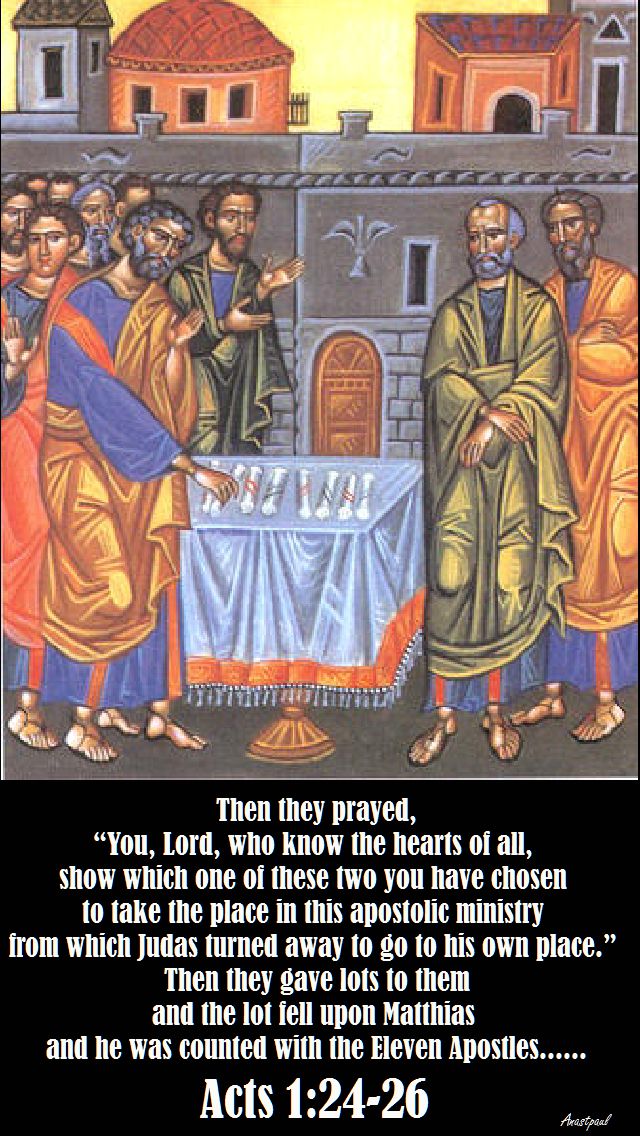
Then they prayed, “You, Lord, who know the hearts of all, show which one of these two you have chosen to take the place in this apostolic ministry from which Judas turned away to go to his own place.” Then they gave lots to them and the lot fell upon Matthias, and he was counted with the Eleven Apostles……. Acts 1:24-26

acts 1-24-26

REFLECTION – “”In those days, Peter stood up in the midst of the disciples and said…” As the fiery spirit to whom the flock was entrusted by Christ and as the leader in the band of the apostles, Peter always took the initiative in speaking: “My brothers, we must choose from among our number.” He left the decision to the whole body, at once augmenting the honour of those elected and avoiding any suspicion of partiality.
Did not Peter then have the right to make the choice himself? Certainly he had the right but he did not want to give the appearance of showing special favour to anyone. “And they nominated two,” we read, “Joseph, who was called Barsabbas and surnamed Justus, and Matthias.” He himself did not nominate them; all present did. But it was he who brought the issue forward, pointing out that it was not his own idea but had been suggested to him by a scriptural prophecy.
And they all prayed together, saying: “You, Lord, know the hearts of men; make your choice known to us. You, not we.” Appropriately they said that he knew the hearts of men, because the choice was to be made by him, not by others.
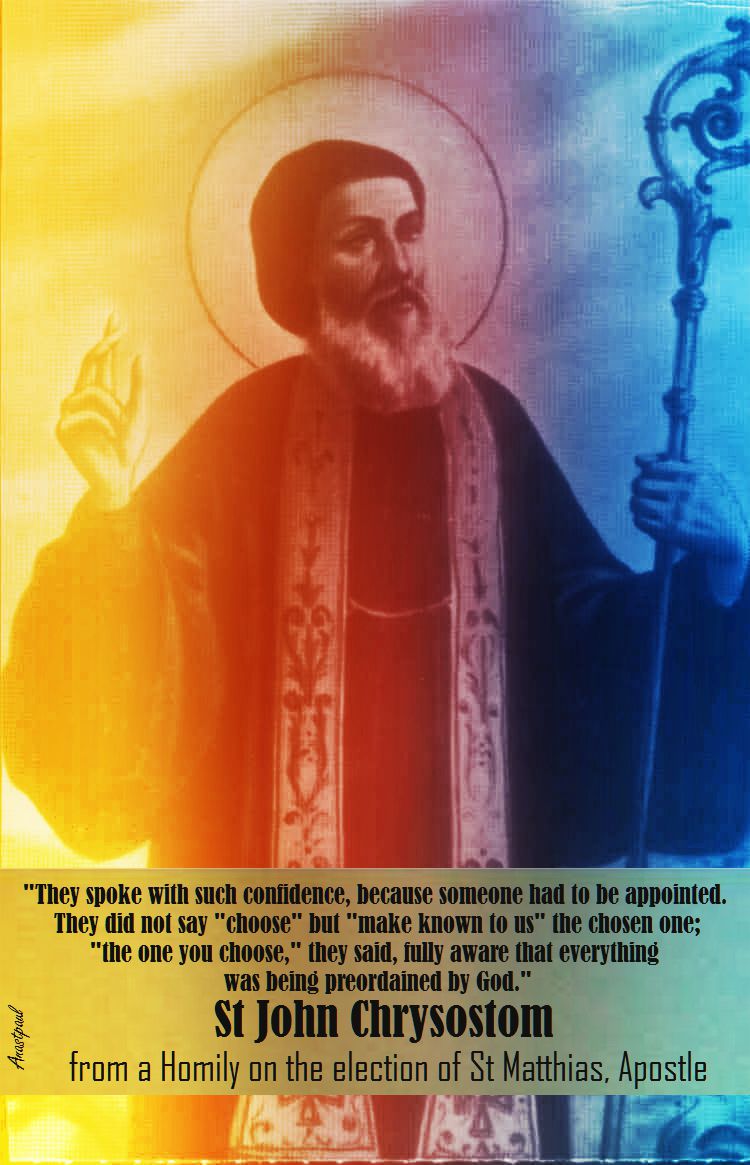
They spoke with such confidence, because someone had to be appointed. They did not say “choose” but “make known to us” the chosen one; “the one you choose,” they said, fully aware that everything was being preordained by God.”…………… from a homily on the Acts of the Apostles by Saint John Chrysostom

ST JOHN CHRYSOSTUM.- on the election of ST MATTHIAS

PRAYER – Almighty God, who into the place of the traitor Judas chose thy faithful servant Matthias to be of the number of the twelve Apostles; grant that Thy Church, being always preserved from false Apostles, may be ordered and guided by faithful and true pastors; through Jesus Christ our Lord. Amen. – collect from the feast of Saint Matthias – St Matthias Pray for us!

ST MATTHIAS PRAY FOR US

Posted in MORNING Prayers, QUOTES of the SAINTS

One Minute Reflection – 16 February

One Minute Reflection – 16 February

(Jesus) said to Peter,
“Put out into deep waters
and lower your nets for a catch.”……………….Luke 5:4

REFLECTION – “The bark of Peter laughs at the winds and the waves.
She has the Saints as her passengers, the Cross as her mast, the Gospel teachings as her sails, the Angels as her rowers and God as her pilot.”  ……………..St John Chrysostom

PRAYER – Heavenly Father, teach me to trust Your Church as the Bark of Salvation in this world. Grant that I may work and pry to remain afloat with her amid the storms of Life. St Gilbert, you experienced great storms and upheavals in every facit of your life but your eyes remained fixed on the pilot, you embraced the Cross and persevered with the saints until you too became one. St Gilbert of Sempringham, please pray for us, that will follow our friends in heaven too, amen!

jesus-said-to-peter-luke-5-4the-bark-of-peter-st-john-chrysostomst-gilbert-pray-for-us