One Minute Reflection – 14 March – “The Month of the St Joseph” – Tuesday of the Third Week in Lent – 4 Kings 4:1-7, Matthew 18:15-22 – Scripture search here: https://www.drbo.org/
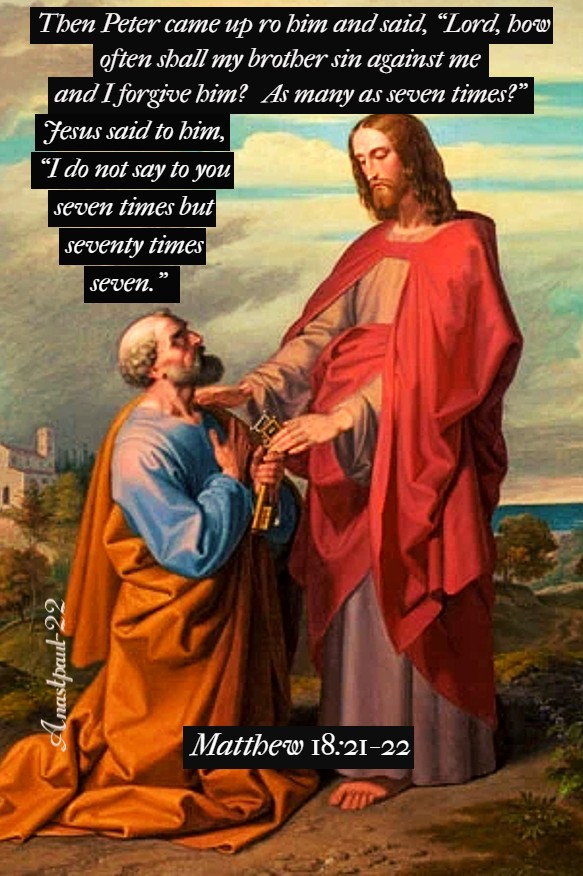
“Then Peter came up to Him and said, “Lord, how often shall my brother sin against me and I forgive him? As many as seven times?” Jesus said to him, “I do not say to you seven times but seventy times seven.” – Matthew 18:21-22
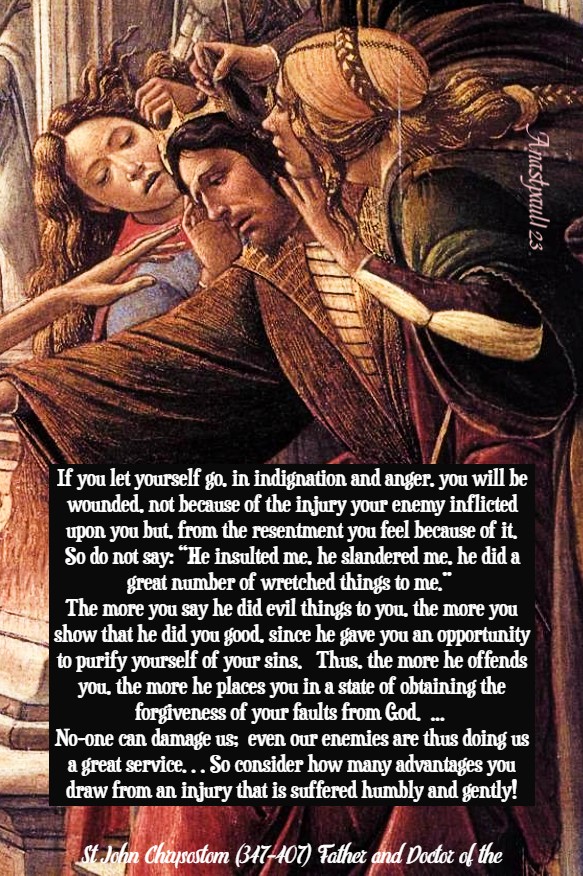
REFLECTION – “Christ is asking two thing of us – to condemn our sins, to forgive those of the others; to do the first because of the second, which then will be easier, for the person who thinks of his sins will be less severe towards his companion in destitution. And to forgive not only with our mouth but “from the bottom of our heart,” so as not to turn against ourselves, the blade, with which we believe we can pierce the others. What evil can your enemy do to you which would be comparable to that, which you do to yourself? … If you let yourself go, in indignation and anger, you will be wounded, not because of the injury your enemy inflicted upon you but, from the resentment you feel because of it.
So do not say: “He insulted me, he slandered me, he did a great number of wretched things to me.” The more you say he did evil things to you, the more you show that he did you good, since he gave you an opportunity to purify yourself of your sins. Thus, the more he offends you, the more he places you in a state of obtaining the forgiveness of your faults from God. For if we want, no-one can damage us; even our enemies are thus doing us a great service… So consider how many advantages you draw from an injury that is suffered humbly and gently!” – St John Chrysostom (347-407) Bishop of Constantinople, Fasther and Doctor of the Church (Homilies on Saint Matthew no 61).
This image is called CALUMNY by Botticelli
PRAYER – Almighty and eternal God, Who has dominion over both the living and the dead and has mercy upon all whom Thou foreknow will be Thine by faith and good works; we humbly beseech Thee that all for whom we have resolved to make supplication, whether the present world still holds them in the flesh, or the world to come holds them out of the body, may, through the intercession of the blessed Virgin and all Thy Saints, obtain of Thy goodness and clemency, pardon for all their sins.Through Jesus Christ, Thy Son our Lord, Who lives and reigns with Thee, in the unity of the Holy Ghost, God, world without end. Amen (Collect).
Quote/s of the Day – 13 March – Monday of the Third Week in Lent
“Are we going to neglect our own salvation? Let us show great compassion towards the poor so as to be made worthy of possessing good things to come for all eternity!”
St John Chrysostom (347-407) Father and Doctor of the Church
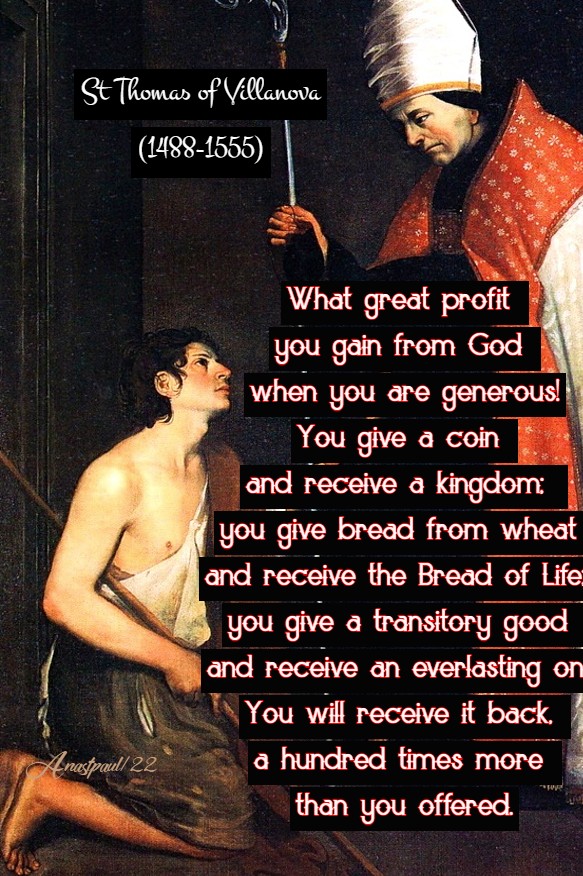
“What great profit you gain from God when you are generous! You give a coin and receive a Kingdom; you give bread from wheat and receive the Bread of Life; you give a transitory good and receive an everlasting one. You will receive it back, a hundred times more than you offered.”
“If you want God to hear your prayers, hear the voice of the poor. If you wish God to anticipate your wants, provide for those of the need, without waiting for them to ask you. Especially, anticipate the needs of those, who are ashamed to beg. To make them ask for alms, is to make them buy it!”
One Minute Reflection – 7 March – Tuesday of the Second Week in Lent – The Memorial of St Thomas Aquinas OP (1225-1274) Confessor, Doctor – Wisdom 7:7-14, Matthew 5:13-19 – Scripture search here: https://www.drbo.org/
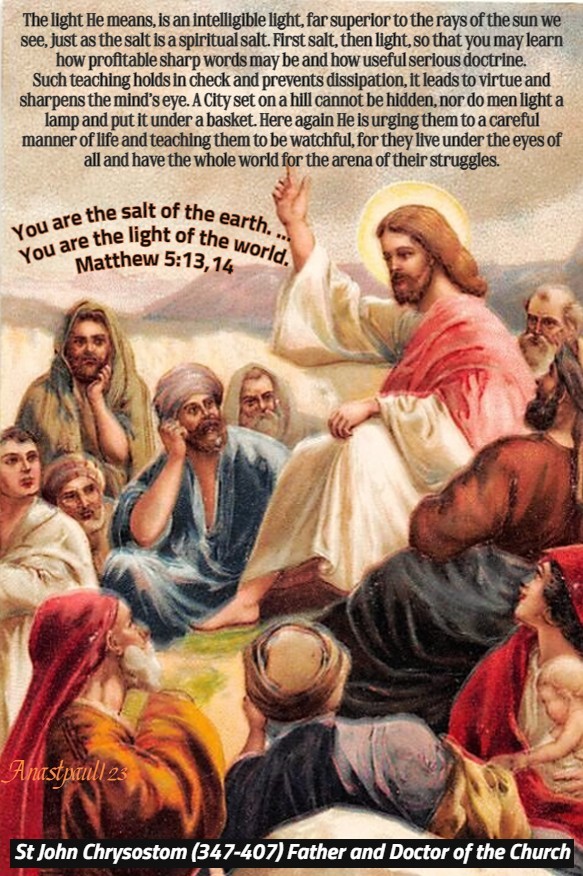
“You are the salt of the earth. … You are the light of the world.” – Matthew 5:13,14
REFLECTION – “You are the salt of the earth. It is not for your own sake, He says but for the world’s sake that the word is entrusted to you. I am not sending you into two cities only or ten or twenty, not to a single nation, as I sent the prophets of old but across land and sea, to the whole world. And that world is in a miserable state. For when He says: You are the salt of the earth, He is indicating that all mankind had lost its savour and had been corrupted by sin. Therefore, He requires of these men, those virtues which are especially useful and even necessary, if they are to bear the burdens of many. For the man who is kindly, modest, merciful and just, will not keep his good works to himself but, will see to it that these admirable fountains, send out their streams for the good of others. Again, the man who is clean of heart, a peacemaker and ardent for truth, will order his life, so as to contribute to the common good.
Do not think, He says, that you are destined for easy struggles or unimportant tasks. You are the salt of the earth. What do these words imply? Did the disciples restore what had already turned rotten? Not at all. Salt cannot help what is already corrupted. That is not what they did. But what had first been renewed and freed from corruption and then, turned over to them, they salted and preserved in the newness the Lord had bestowed. It took the power of Christ to free men from the corruption caused by sin; it was the task of the Apostles through strenuous labour, to keep that corruption from returning.
Have you noticed how, bit by bit, Christ shows them to be superior to the prophets? He says they are to be teachers, not simply for Palestine but for the whole world. Do not be surprised then, He says, that I address you apart from the others and involve you in such a dangerous enterprise. Consider the numerous and extensive Cities, peoples and nations I will be sending you to govern. For this reason, I would have you make others prudent, as well as being prudent yourselves. For unless you can do that, you will not be able to sustain even yourselves.
If others lose their savour, then your ministry will help them regain it. But if you yourselves suffer that loss, you will drag others down with you. Therefore, the greater the undertakings put into your hands, the more zealous you must be. For this reason, He says: ‘But if the salt becomes tasteless, how can its flavour be restored? It is good for nothing now but to be thrown out and trampled by men’s feet.‘
When they hear the words – when they curse you and persecute you and accuse you of every evil, they maybe afraid to come forward. Therefore, He says; “Unless you are prepared for that sort of thing, it is in vain that I have chosen you. Curses shall necessarily be your lot but they shall not harm you and will simply be a testimony to your constancy. If, through fear, however, you fail to show the forcefulness your mission demands, your lot will be much worse, for all will speak evil of you and despise you. That is what being trampled by men’s feet means.”
Then He passes on to a more exalted comparison -you are the light of the world. Once again, “of the world.” not of one nation or twenty Cities,but of the whole world. The light He means, is an intelligible light, far superior to the rays of the sun we see, just as the salt is a spiritual salt. First salt, then light, so that you may learn how profitable sharp words may be and how useful serious doctrine. Such teaching holds in check and prevents dissipation, it leads to virtue and sharpens the mind’s eye. A City set on a hill cannot be hidden, nor do men light a lamp and put it under a basket. Here again He is urging them to a careful manner of life and teaching them to be watchful, for they live under the eyes of all and have the whole world for the arena of their struggles.” – St John Chrysostom (347-407) Archbishop of Constantinople, Father and Doctor of the Church (An excerpt from his Homily on Matthew).
PRAYER – O God, Who enlightened Thy Church with the wondrous learning of blessed Thomas, Thy Confessor and enriched her through his holy life, grant us, we beseech Thee, both to understand what he taught and by following his example, to do what he did. Through tJesus Christ, Thy Son our Lord, Who lives and reigns with Thee, in the unity of the Holy Ghost, God, world without end. Amen (Collect).
One Minute Reflection – 2 March – “The Month of the St Josephs” –Thursday of the First Week in Lent – Ezechiel 18:1-9, Matthew 15:21-28 – Scripture search here: https://www.drbo.org/
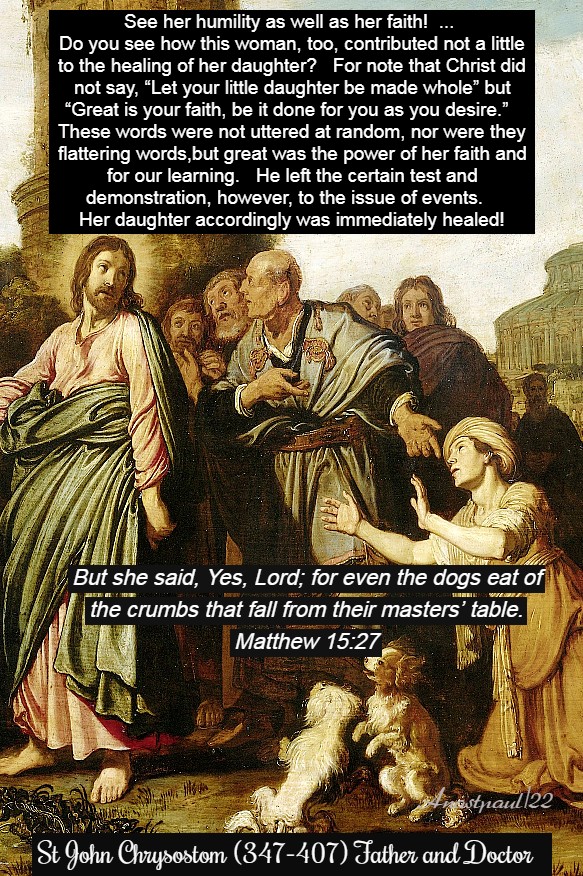
“But she said, Yes, Lord; for even the dogs eat of the crumbs that fall from their masters’ table.” – Matthew 15:27
REFLECTION – “See her humility as well as her faith! For He had called the Jews “children” but she was not satisfied with this. She even called them “masters,” so far was she from grieving at the praises of others. She said, “Yes, Lord, yet even the dogs eat the crumbs that fall from their masters’ table.” Behold the woman’s wisdom! She did not venture so much as to say a word against anyone else. She was not stung to see others praised, nor was she indignant to be reproached. Behold her constancy! When He answered, “It is not fair to take the children’s bread and throw it to the dogs,” she said, “Yes, Lord.” He called them “children” but she called them “masters.” He used the name of a dog but she described the action of the dog. Do you see this woman’s humility?
Then compare her humility with the proud language of the Jews: “We are Abraham’s seed and were never in bondage to any man.” “We are born of God.” But not so this woman. Rather, she calls herself a dog and them masters. So for this reason, she became a child. For what does Christ then say? “O woman, great is your faith.”
So we might surmise that this is the reason He put her off, in order that He might proclaim aloud this saying and that He might crown the woman: “Be it done for you as you desire.” This means “Your faith, indeed, is able to effect even greater things than these. Nevertheless, be it unto you even as you wish.” This Voice was at one with the Voice that said, “Let the heaven be,” and it was. “And her daughter was made whole from that very hour.”
Do you see how this woman, too, contributed not a little to the healing of her daughter? For note that Christ did not say, “Let your little daughter be made whole” but “Great is your faith, be it done for you as you desire.” These words were not uttered at random, nor were they flattering words,but great was the power of her faith and for our learning. He left the certain test and demonstration, however, to the issue of events. Her daughter accordingly was immediately healed.” – St John Chrysostom (347-407) Archbishop of Constantinople, Father and Doctor (The Gospel of Matthew – Homily 52).
PRAYER – From all perils of soul and body defend us, O Lord, we beseech Thee and by the intercession of blessed and gloriosus ever Virgin Mary, Mother of God, of blessed Joseph, of Thy blessed apostles Peter and Paul and all the Saints, graciously grant us safety and peace that all adversities and errors, being overcome, Thy Church may serve Thee in security and freedom. Through Jesus Christ, Thy Son our Lord, Who lives and reigns with Thee, in the unity of the Holy Ghost, God, world without end. Amen (Collect).
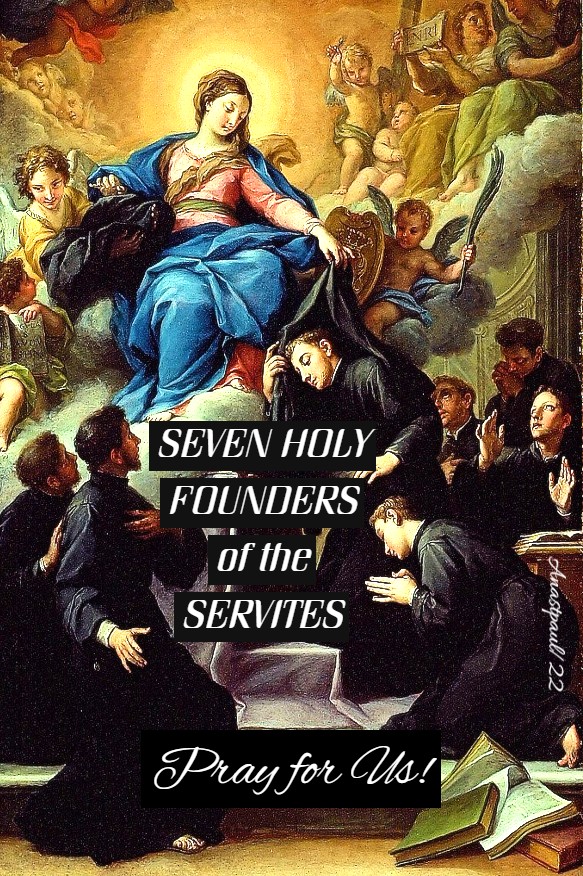
One Minute Reflection – 12 February – The Seven Holy Founders of the Servite Order (1233) – Sexagesima Sunday – 2 Corinthians 11:19-33; 12:1-9, Luke 8:4-15 – Scripture search here: https://www.drbo.org/Because it is Sexagesima Sunday I popped in to post the Reflection and the explanation of Sexagesima, posted at the end below, for those who might have forgotten.And while I was here, our dear Cardinal Bacci gave me a nudge too 🤗
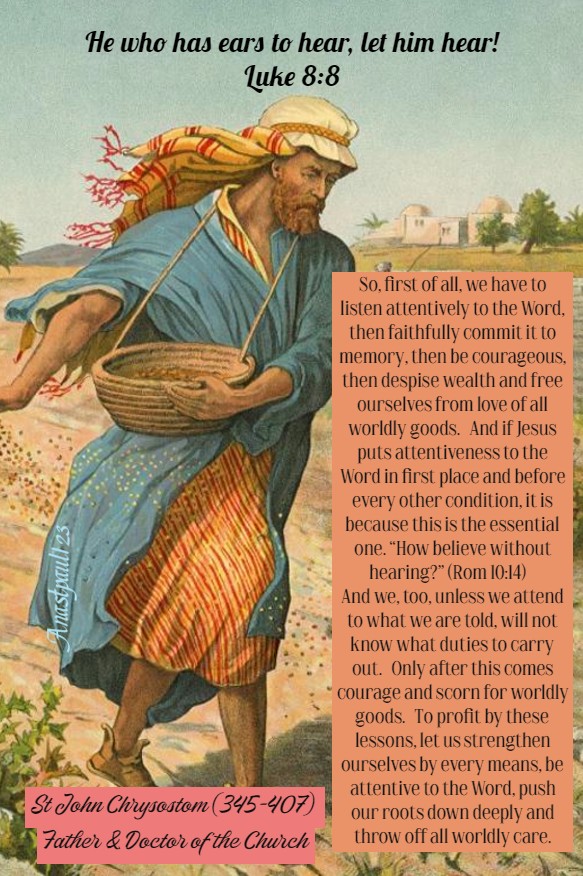
“He who has ears to hear, let him hear!” – Luke 8:8
REFLECTION – “If the seed dries up, this is not due to the heat. Jesus did not say that it had dried up because of the heat but “for lack of roots.” If the Word is choked, it is not due to the thorns but to those who allowed them to spring up, unhindered. With a little bit of willpower, you could stop them from growing, you could put your riches to good use. That is why our Saviour does not talk about “the world” but about “the cares of the world,” not of “riches” but of “the lure of riches.” So do not let us blame the things themselves but the perversion of our consciences .…
You see, it is not the gardener, it is not the seed but it is the earth where it falls which provides the answer – namely, the dispositions of our hearts. And here, too, God’s goodness towards us is very great, in that, far from demanding an identical measure of virtue, He welcomes the firstcomers, does not turn away those who come second and makes room for the third…
So, first of all, we have to listen attentively to the Word, then faithfully commit it to memory, then be courageous, then despise wealth and free ourselves from love of all worldly goods. And if Jesus puts attentiveness to the Word in first place and before every other condition, it is because this is the essential one. “How believe without hearing?” (Rom 10:14) And we, too, unless we attend to what we are told, will not know what duties to carry out. Only after this comes courage and scorn for worldly goods. To profit by these lessons, let us strengthen ourselves by every means, be attentive to the Word, push our roots down deeply and throw off all worldly care.” – St John Chrysostom (345-407) Bishop of Constantinople, Father and Doctor of the Church (Sermon 44 on St Matthew’s Gospel).
PRAYER – O Lord Jesus Christ, Who, to keep alive the memory of Thy most holy Mother’s sorrows, through the Seven Holy Fathers enriched Thy Church with a new family of her Servants, graciously grant that we, maybe so united with them in their sorrows, as also to share their joys. Through the same Jesus Christ, Thy Son our Lord, Who lives and reigns with Thee, in the unity of the Holy Ghost, God, world without end. Amen (Collect).
Sexagesima Sunday: (Latin – Sexagesima, sixtieth) is the eighth Sunday before Easter and the second before Lent. The Ordo Romanus, St Alcuin and others, count the Sexagesima from this day to Wednesday after Easter. The name was already known to the Fourth Council of Orléans in 541. To the Latins it is also known as “Exsurge” from the beginning of the Introit. The station was at Saint Paul’s Outside the Walls of Rome and hence, the oratio calls upon the Doctor of the Gentiles. The Epistle is from Paul, 2 Corinthians 11 and 12, describing his suffering and labours for the Church. The Gospel (Luke 8) relates the falling of the seed on good and on bad ground, while the Lessons of the first Nocturn continue the history of man’s iniquity and speak of Noah and of the Deluge.
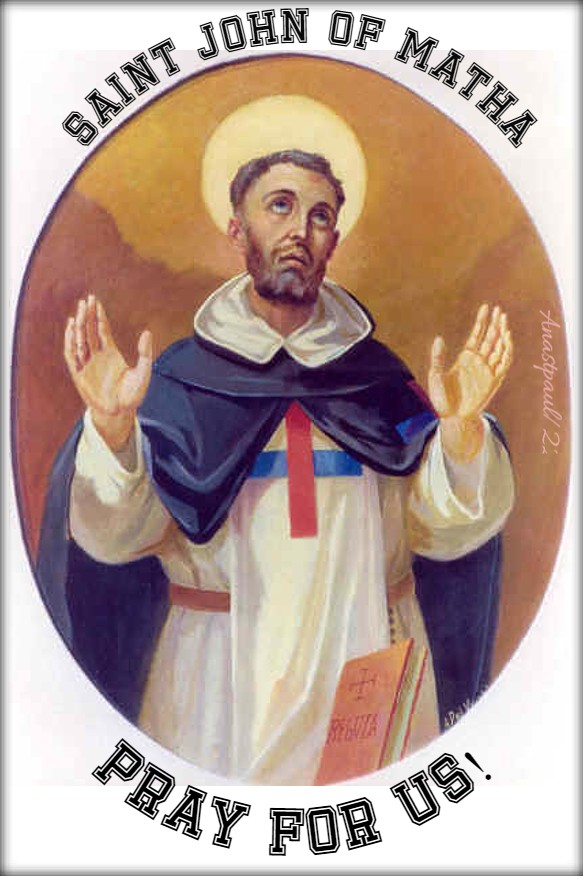
One Minute Reflection – 8 February – St John of Matha (1160-1213) – Confessor, Priest, Founder – Sirach 31:8-11, Luke 12:35-40 – Scripture search here: https://www.drbo.org/
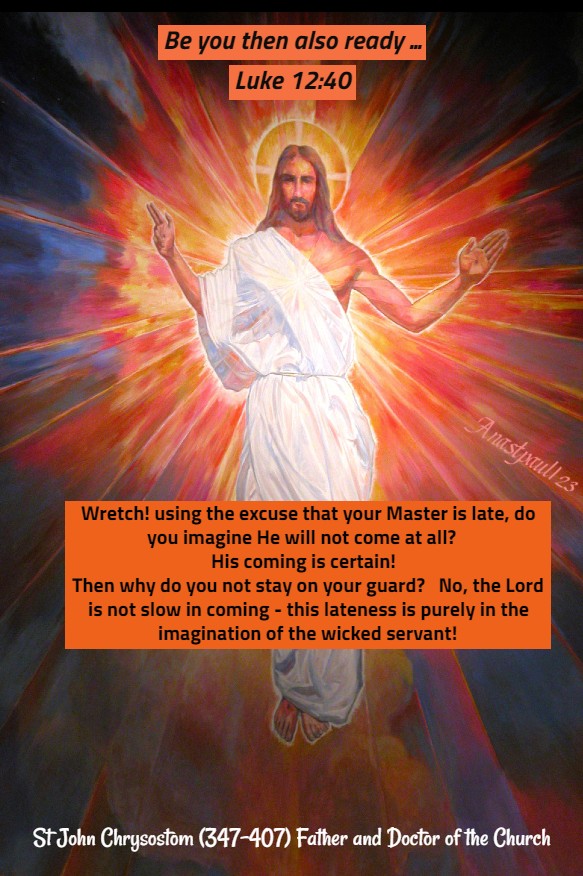
“Be you then also ready …” – Luke 12:40
REFLECTION – “At an hour you do not expect, the Son of Man will come.” Jesus says this to them so that the disciples would stay awake and always be ready. If He tells them, He will come when they are not expecting Him, this is because He wants to make them practice virtue zealously, without relaxing. It is as though He were saying to them: “If people knew when they were going to die, they would be completely ready for the day”… But the end of our life is a secret, hidden from us all…
This is why the Lord expects two qualities of His steward – that he should be faithful, lest he attribute to himself anything that belongs to his Master and that he should be wise, so that he might suitably administer everything put in his charge. So we too ought to have these two qualities if we are to be ready at the Master’s coming… Because this is what happens due to our not knowing the day we shall meet Him – we say to ourselves: “My Master is delayed in coming.” The faithful and wise steward has no such thoughts. Wretch! using the excuse that your Master is late, do you imagine He will not come at all? His coming is certain! Then why do you not stay on your guard? No, the Lord is not slow in coming – this lateness is purely in the imagination of the wicked servant!” – St John Chrysostom (347-407) Bishop of Constantinople, Father and Doctor of the Church (Sermon 77 on St Matthew).
PRAYER – O God, Who graciously and by Divine means founded, through blessed John, the Order of the Most Holy Trinity to ransom captives from the hands of the Saracens, grant, we beseech Thee that through Thy help and the merits of his prayers, we may be freed body and soul from captivity. Through Jesus Christ, Thy Son our Lord, Who lives and reigns with Thee, in the unity of the Holy Ghost, God, world without end. Amen (Collect).
Quote/s of the Day – 4 February – St Andrew Corsini O.Carm (1302-1373) Bishop, Confessor – Sirach 44:16-27; 45:3-20, Matthew 25:14-23 – Scripture search here: https://www.drbo.org/
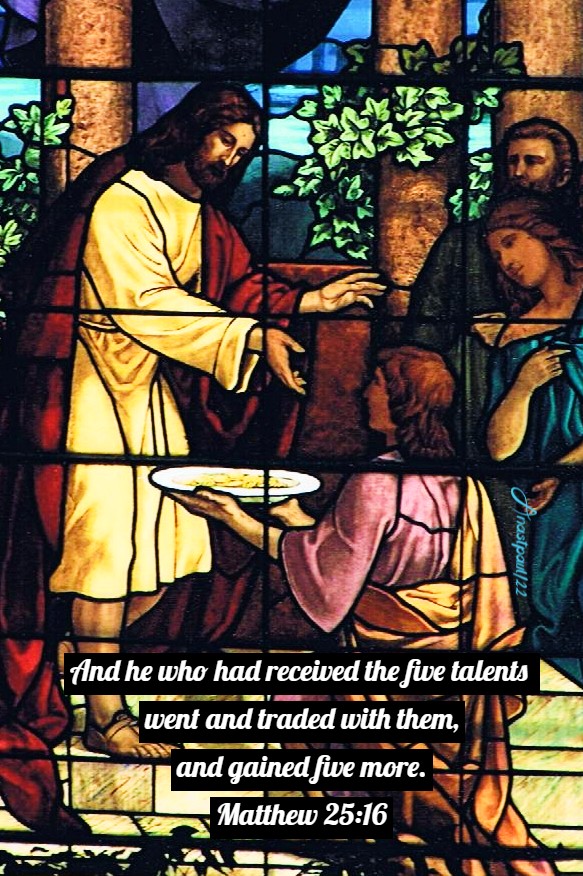
“And he who had received the five talents went and traded with them, and gained five more.
Matthew 25:16
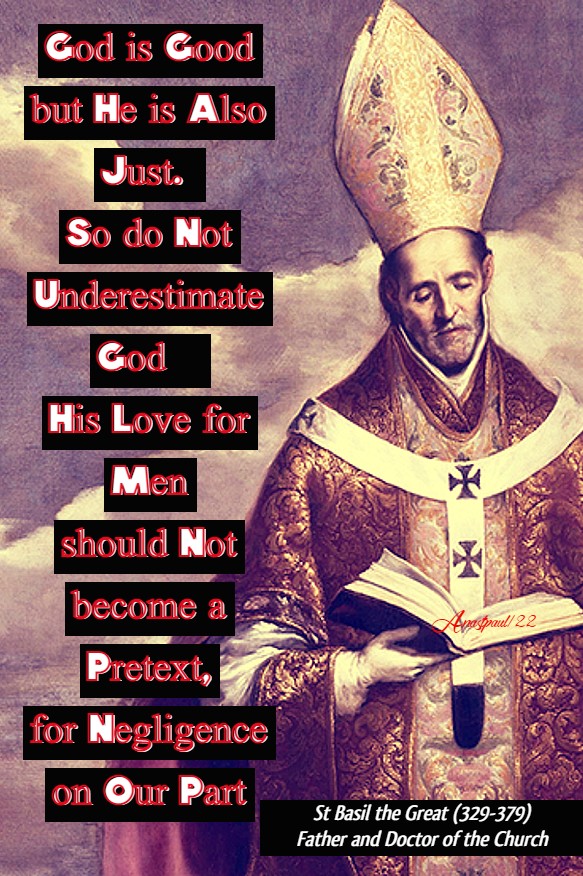
“God is Good but He is also Just… So do not underestimate God – His love for men should not become a pretext, for negligence on our part.”
St Basil the Great (329-379) Father and Doctor of the Church
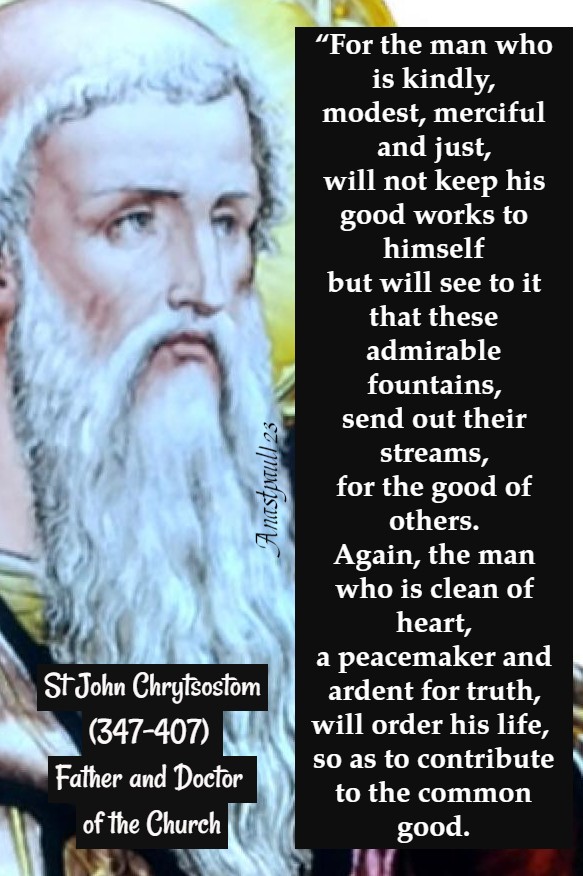
“For the man who is kindly, modest, merciful and just, will not keep his good works to himself but will see to it that these admirable fountains, send out their streams, for the good of others. Again, the man who is clean of heart, a peacemaker and ardent for truth, will order his life, so as to contribute to the common good.”
St John Chrysostom (347-407) Father and Doctor of the Church
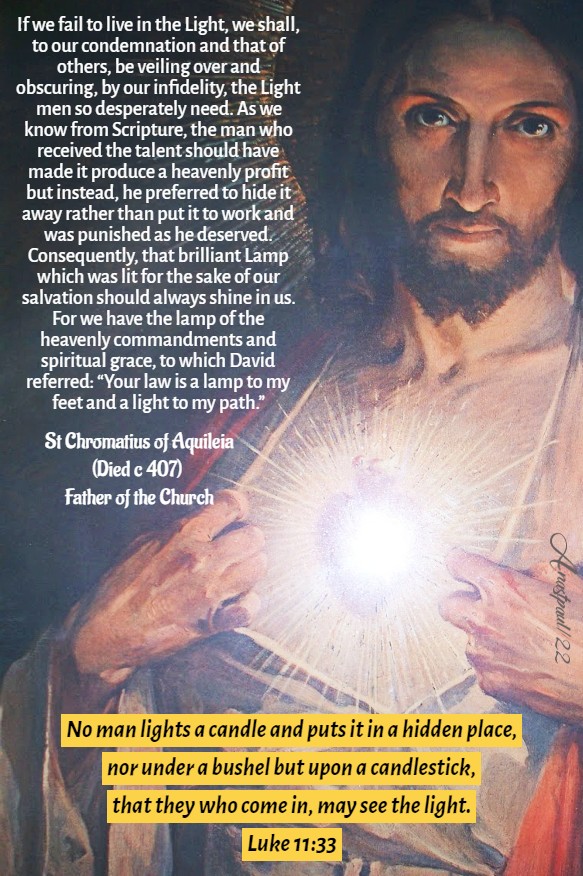
“If we fail to live in the Light, we shall, to our condemnation and that of others, be veiling over and obscuring, by our infidelity, the Light men so desperately need. As we know from Scripture, the man who received the talent should have made it produce a heavenly profit but instead, he preferred to hide it away rather than put it to work and was punished as he deserved. Consequently, that brilliant Lamp which was lit for the sake of our salvation should always shine in us. For we have the lamp of the heavenly commandments and spiritual grace, to which David referred: Your law is a lamp to my feet and a light to my path.”
St Chromatius of Aquileia (Died c 407) Bishop of Aquileia,
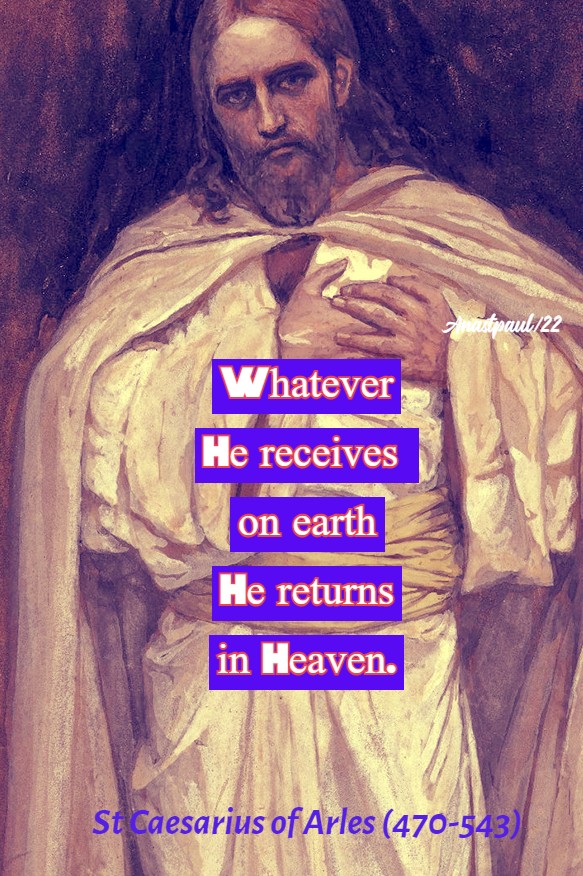
“Whatever He receives on earth, He returns in Heaven.”
St Caesarius of Arles (470-543)
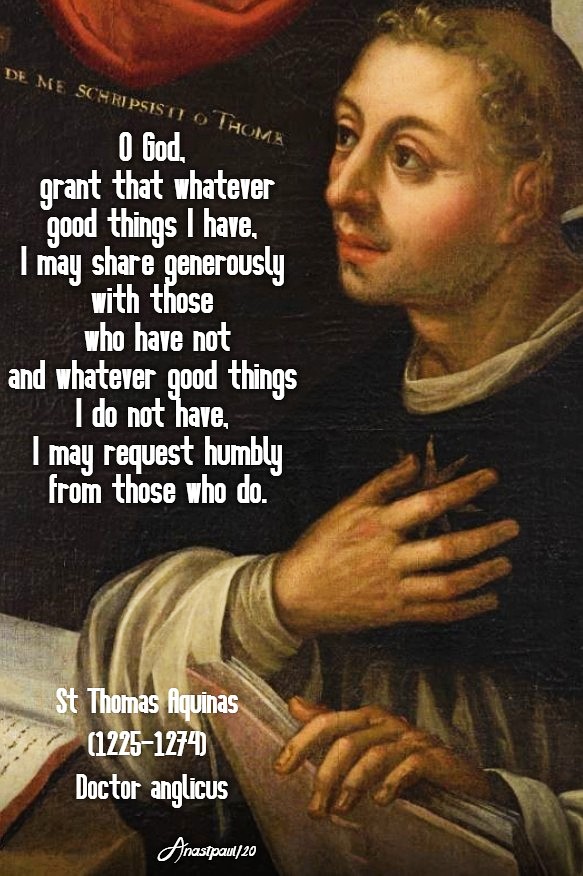
“O God, grant that whatever good things I have, I may share generously with those who have not and whatever good things, I do not have, I may request humbly, from those who do.”
St Thomas Aquinas (1225-1274) Doctor Angelicus
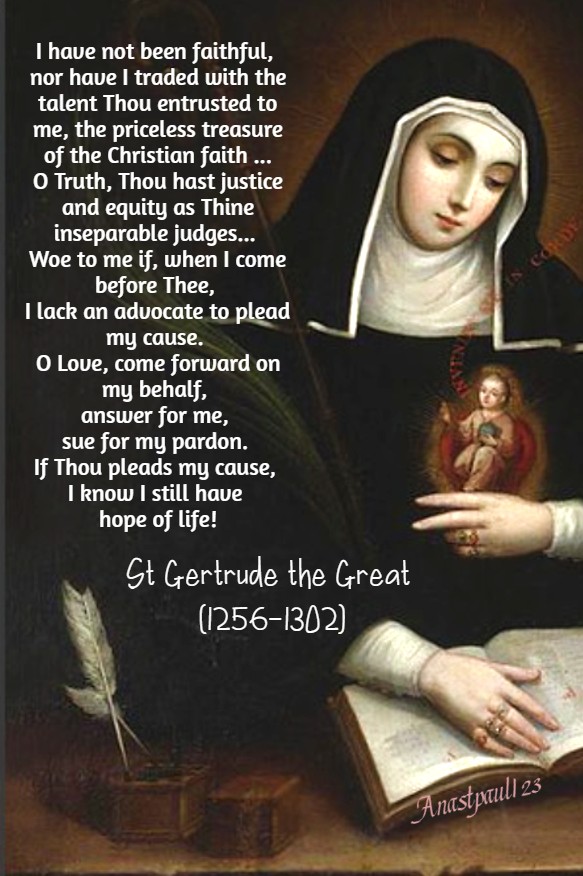
“I have not been faithful, nor have I traded with the talent Thou entrusted to me, the priceless treasure of the Christian faith … O Truth, Thou hast justice and equity as Thine inseparable judges… Woe to me if, when I come before Thee, I lack an advocate to plead my cause. O Love, come forward on my behalf, answer for me, sue for my pardon. If Thou pleads my cause, I know I still have hope of life!”
Quote/s of the Day – 27 January – St John Chrysostom (347-407) Bishop, Confessor, Father and Doctor of the Church “Golden Mouthed.” – 2 Timothy 4:1-8, Matthew 5:13-19 – Scripture search here: https://www.drbo.org/
“If we approach with faith, we too will see Jesus… for the Eucharistic table takes the place of the crib. Here, the Body of the Lord is present, wrapped, not in swaddling clothes but in the rays of the Holy Spirit.”
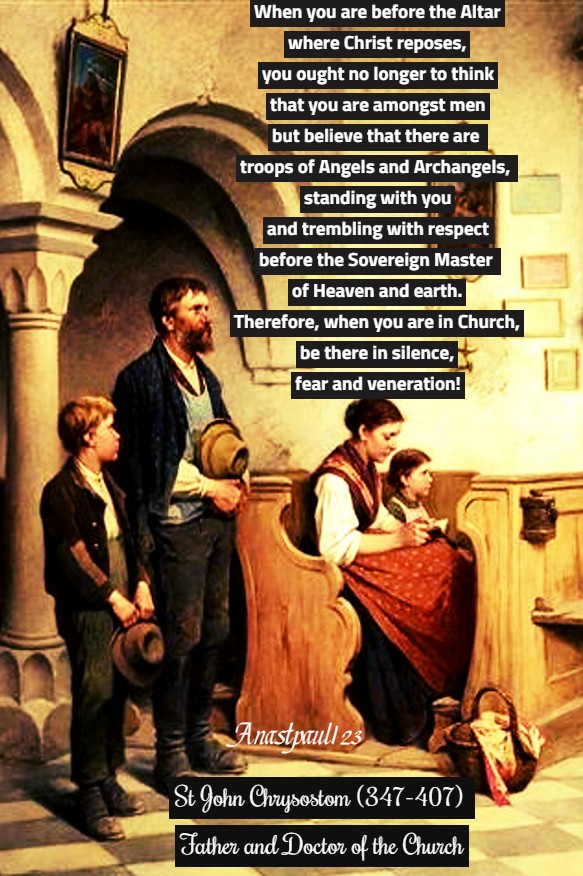
“When you are before the Altar where Christ reposes, you ought no longer to think that you are amongst men but believe that there are troops of Angels and Archangels, standing with you and trembling with respect before the Sovereign Master of Heaven and earth. Therefore, when you are in Church, be there in silence, fear and veneration!”
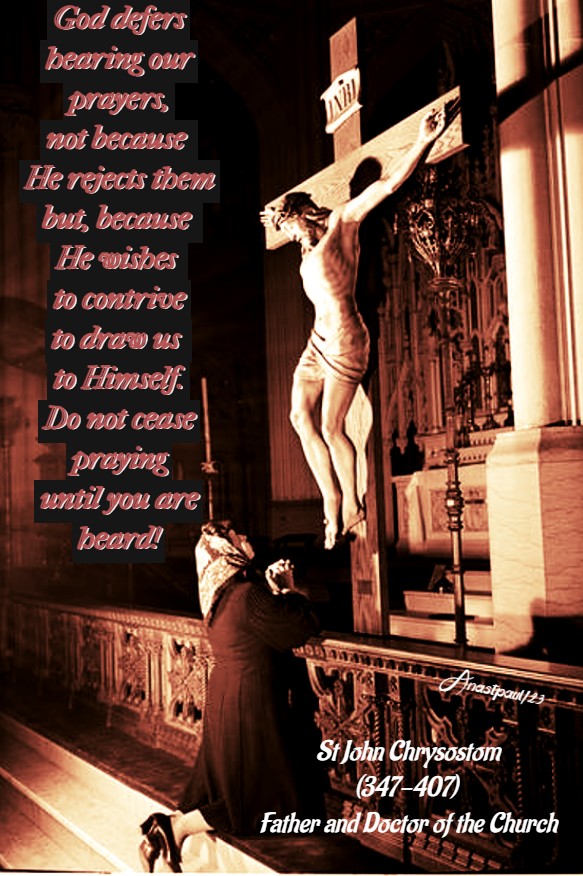
“God defers hearing our prayers, not because He rejects them but, because He wishes to contrive to draw us to Himself. Do not cease praying until you are heard!”
“He errs who believes that he can overcome his sensual propensities and preserve chastity, by his own efforts. God’s mercy must extinguish nature’s ardour. Have recourse to the intercession of the Immaculate Virgin and rest assured, you will obtain this mercy.”
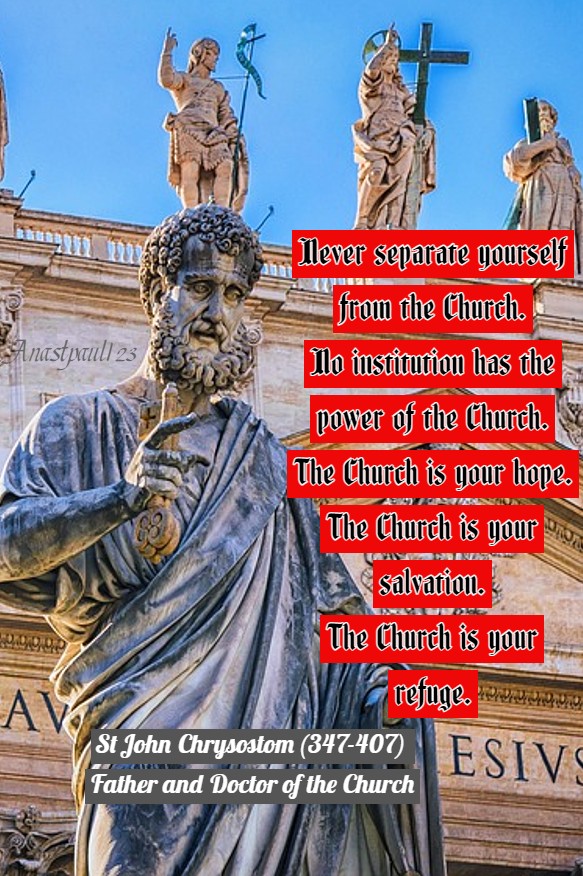
“Never separate yourself from the Church. No institution has the power of the Church. The Church is your hope. The Church is your salvation. The Church is your refuge.”
One Minute Reflection – 27 January – St John Chrysostom (347-407) Bishop, Confessor, Father and Doctor of the Church “Golden Mouthed.” – 2 Timothy 4:1-8, Matthew 5:13-19 – Scripture search here: https://www.drbo.org/
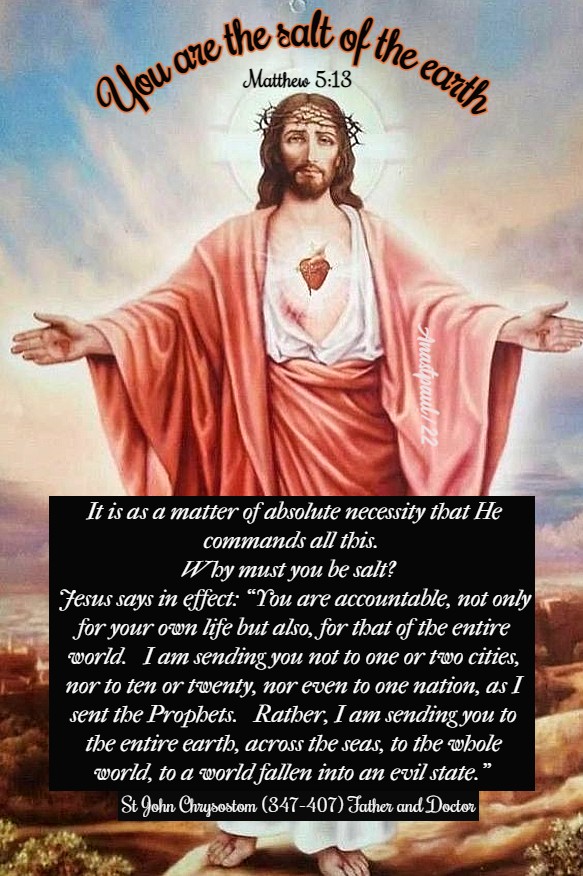
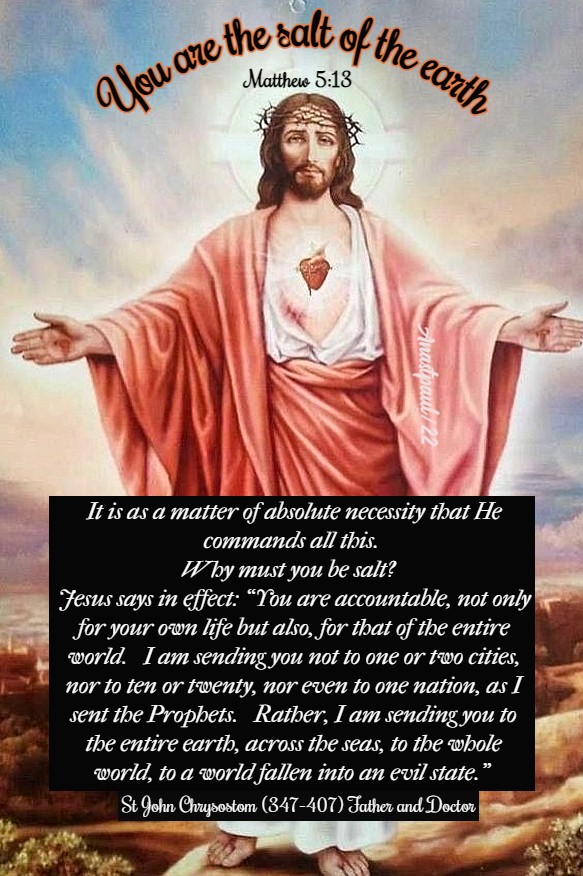
“You are the salt of the earth. But if salt loses its taste, with what can it be seasoned? It is no longer good for anything but to be thrown out and trampled underfoot.” – Matthew 5:13
REFLECTION – “It is as a matter of absolute necessity that He commands all this. Why must you be salt? Jesus says in effect: “You are accountable, not only for your own life but also, for that of the entire world. I am sending you not to one or two cities, nor to ten or twenty, nor even to one nation, as I sent the Prophets. Rather, I am sending you to the entire earth, across the seas, to the whole world, to a world fallen into an evil state.” For by saying, “You are the salt of the earth,” Jesus signifies, that all human nature itself has “lost its taste,” having become rotten through sin. For this reason, you see, He requires from His disciples, those character traits that are most necessary and useful for the benefit of all.” – St John Chrysostom (347-407) Archbishop of Constantinople, Father and Doctor (The Gospel of Matthew: Homily,15).
PRAYER – May heavenly grace, we beseech Thee, O Lord, prosper Thy Church, which Thou mercifully enlightened by the blessed virtues and teachings of glorious and blessed John Chrysostom, Thy Confessor and Bishop. Through Jesus Christ, Thy Son our Lord, Who lives and reigns with Thee, in the unity of the Holy Ghost, God, world without end. Amen (Collect).
Our Morning Offering – 27 January – St John Chrysostom (347-407) Bishop, Confessor, Father and Doctor of the Church “Golden Mouthed”
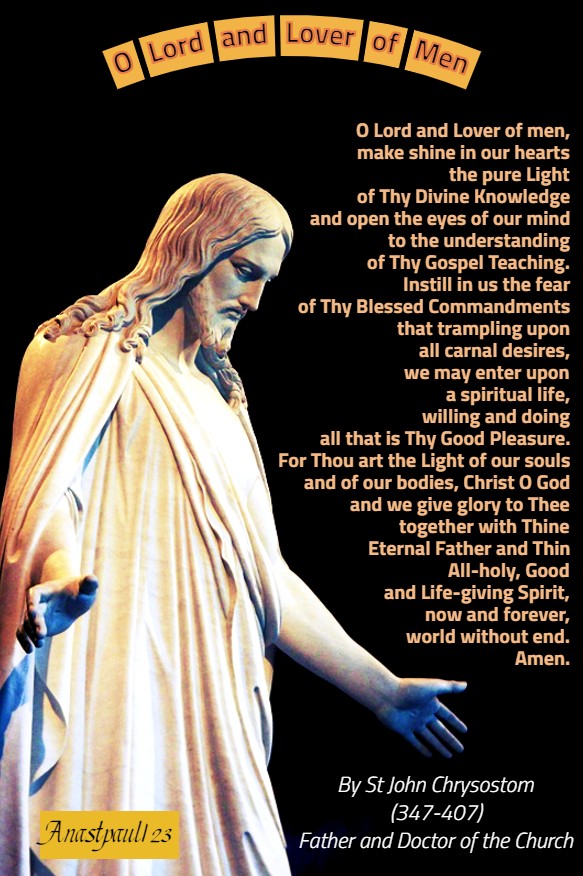
O Lord and Lover of Men By St John Chrysostom (347-407) Father and Doctor of the Church
O Lord and Lover of men, make shine in our hearts the pure Light of Thy Divine Knowledge and open the eyes of our mind to the understanding of Thy Gospel teaching. Instill in us the fear of Thy Blessed Commandments that trampling upon all carnal desires, we may enter upon a spiritual life, willing and doing all that is Thy Good Pleasure. For Thou art the Light of our souls and of our bodies, Christ O God and we give glory to Thee together with Thine Eternal Father and Thine All-holy, Good and Life-giving Spirit, now and forever, world without end. Amen.
Saint of the Day – 27 January – St John Chrysostom (347-407) Bishop, Confessor, Father and Doctor of the Church “Golden Mouthed.”
The Church, in the Lessons of today’s Office, thus speaks the praises of our Saint.
John, surnamed Chrysostom on account of his golden eloquence, was born at Antioch. Having gone through the study of the law and the profane sciences, he applied himself, with extraordinary application and success, to the study of the Sacred Scriptures. Having been admitted to Holy Orders and made a Priest of the Church at Antioch, he was appointed Bishop of Constantinople, after the death of Nectarius, by the express wish of the Emperor Arcadius. No sooner had he entered upon the pastoral charge, than he began to inveigh against the licentious lives led by the rich. Thus, his courageous preaching procured him many enemies. He likewise gave great offence to the Empress Eudoxia because he had reproved her, for having appropriated to herself, the money belonging to a widow, name, Callitropa and for having taken possession of some land which was the property of another widow.
At the instigation, therefore, of Eudoxia, several Bishops met together at Chalcedon. Chrysostom was cited to appear, which he refused to do because it was not a Council, either lawfully or publicly convened. Whereupon, he was sent into exile. He had not been gone long, before the people rose in sedition on account of the Saint’s banishment and he was recalled, to the immense joy of the whole City.
But, his continuing to inveigh against the scandals which existed, and his forbidding the games, held before the silver statue of Eudoxia which was set up in the space opposite Sancta Sophia, were urged by certain Bishops, enemies of the Saint, as motives for a second banishment.
The widows and the poor of the City bewailed his departure as that of a father. It is incredible how much Chrysostom had to suffer in this exile and how many he converted to the Christian Faith by his sufferings!
At the very time that Pope Innocent the First, in a Council held at Rome, was issuing a Decree, ordering that Chrysostom should be set at liberty – he was being treated by the soldiers, who were taking him into exile, with unheard of harshness and cruelty. Whilst passing through Armenia, the holy Martyr Basiliscus, in whose Church he had offered up a prayer, thus spoke to him during the night: “Brother John! we shall be united together tomorrow.“ Whereupon, on the following morning, Chrysostom received the Sacrament of the Eucharist and, signing himself with the Sign of the Cross, he breathed forth his soul to his God, on the eighteenth of the Calends of October (14 September).
A fearful hail-storm happened at Constantinople after the Saint’s death and, four days after, the Empress died. Theodosius, the Son of Arcadius, had the Saint’s body brought to Constantinople, with all due honour, where, amidst a large concourse of people, it was buried on the sixth of the Calends of February (27 January). Theodosius, whilst devoutly venerating the Saint’s Relics, interceded for his parents that they might be forgiven. The body was, at a later period, translated to Rome and placed in the Vatican Basilica.
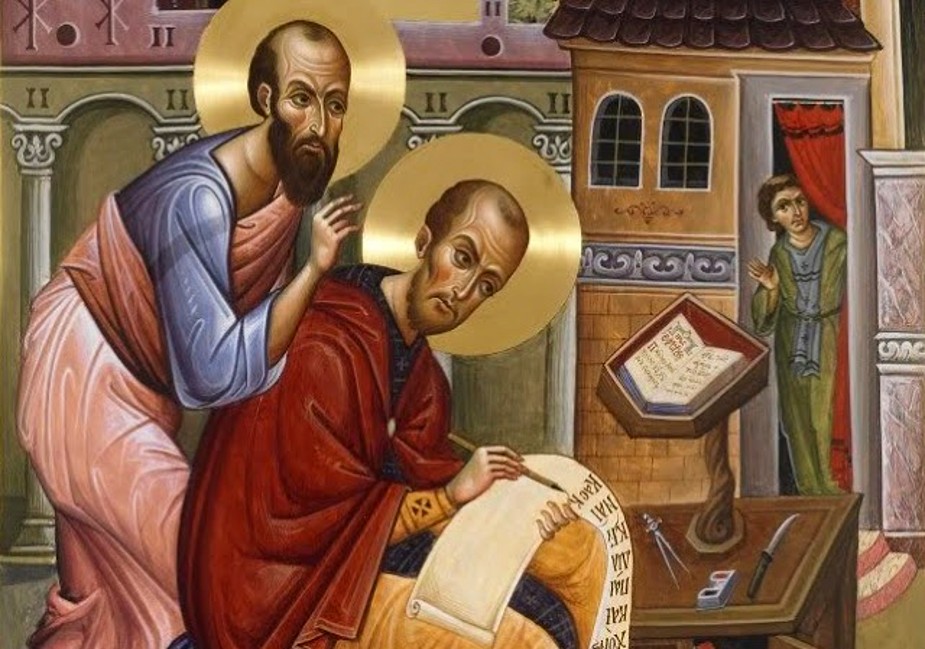
All men agree in admiring the unction and eloquence of his sermons, which are very numerous, as indeed of all his other writings. He is also admirable in his interpretation of the Sacred Scriptures which he explains in their genuine sense. It has always been thought that he was aided, in his writings and sermons, by St Paul the Apostle, to whom he entertained an extraordinary devotion.
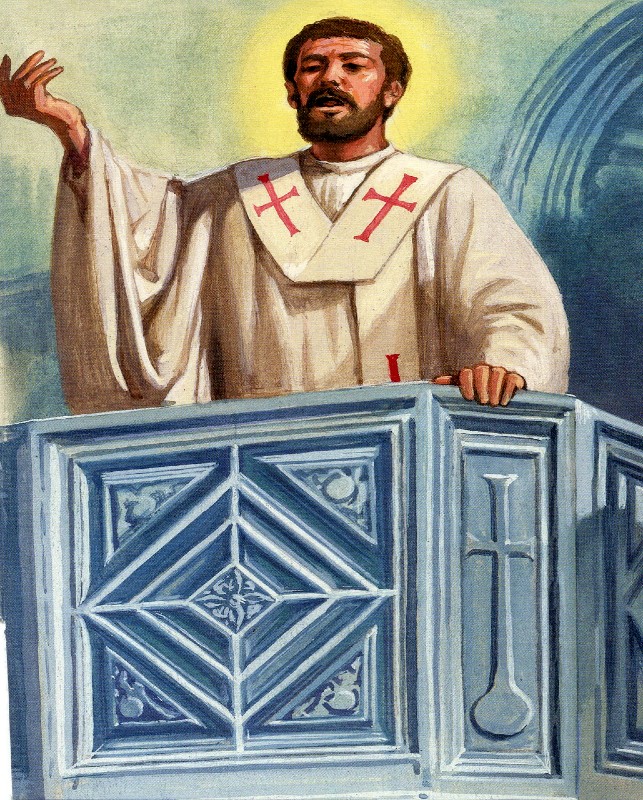
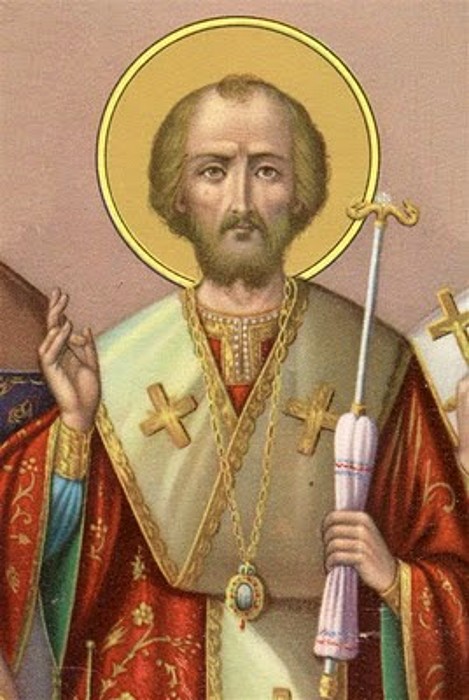
St John Chrysostom (347-407) Bishop, Confessor, Father and Doctor of the Church – “Golden Mouthed,” Preacher, Orator, Writer, Theologian, Confessor. Name Meaning – God is gracious; gift of God (John), golden-mouthed (Chrysostom). Biography: https://anastpaul.com/2017/09/13/saint-of-the-day-13-september-st-john-chrysostom-347-407-father-and-doctor-of-the-church-golden-mouthed/ (His Feast Day is today (changed in 1969 to 13 September). The Roman Martyrology states of him today: “At Constantinople, St John, Bishop, who was surnamed Chrysostom on account of his golden flow of eloquence. He greatly promoted the interests of the Christian religion by his preaching and exemplary life and, after many toils, closed his life in banishment. His sacred body was brought to Constantinople on this day in the reign of Theodosius the younger and afterwards taken to Rome and placed in the Basilica of the Prince of the Apostles. This illustrious Preacher of the Word of God, Pope Pius X declared and appointed as the Heavenly Patron of Sacred Orators.”
St Domitian of Melitene St Emerius of Bañoles St Gilduin Bl Gonzalo Diaz di Amarante St Henry de Osso y Cervello Bl John of Warneton St Julian of Le Mans St Julian of Sora St Lupus of Châlons
St Marius of Bodon Bl Michael Pini St Natalis of Ulster St Theodoric of Orléans St Pope Vitalian
Martyrs of North Africa – 30 Saints: A group of 30 Christians Martyred together by Arian Vandals. The only details to have survived are four of their names – Datius, Julian, Reatrus and Vincent. c 500 in North Africa.
Quote/s of the Day – 7 January – Within the Octave of Epiphany
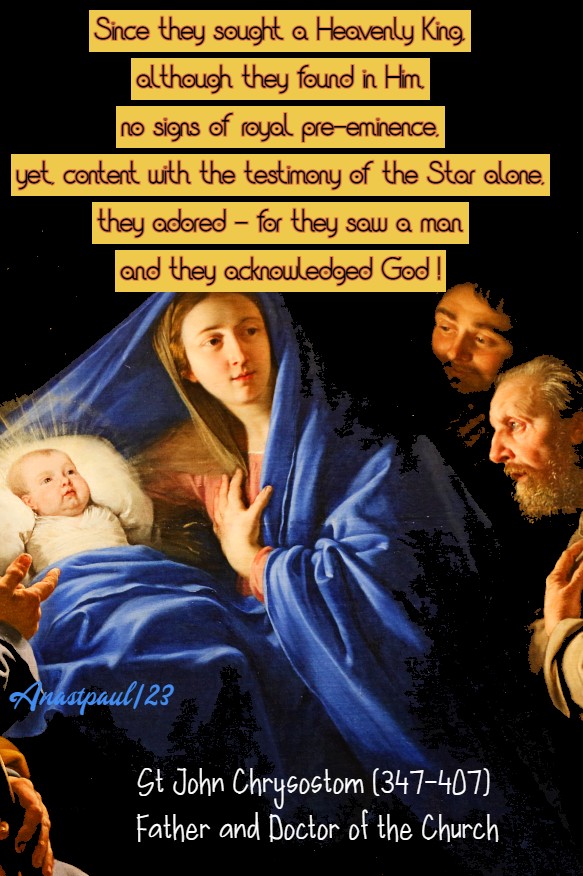
“If the Magi had come in search of an earthly King, they would have been disconcerted at finding that they had taken the trouble to come such a long way for nothing. Consequently, they would have neither adored, nor offered gifts. But since they sought a Heavenly King, although they found in Him, no signs of royal pre-eminence, yet, content with the testimony of the Star alone, they adored – for they saw a man and they acknowledged God!”
St John Chrysostom (347-407) Father and Doctor of the Church
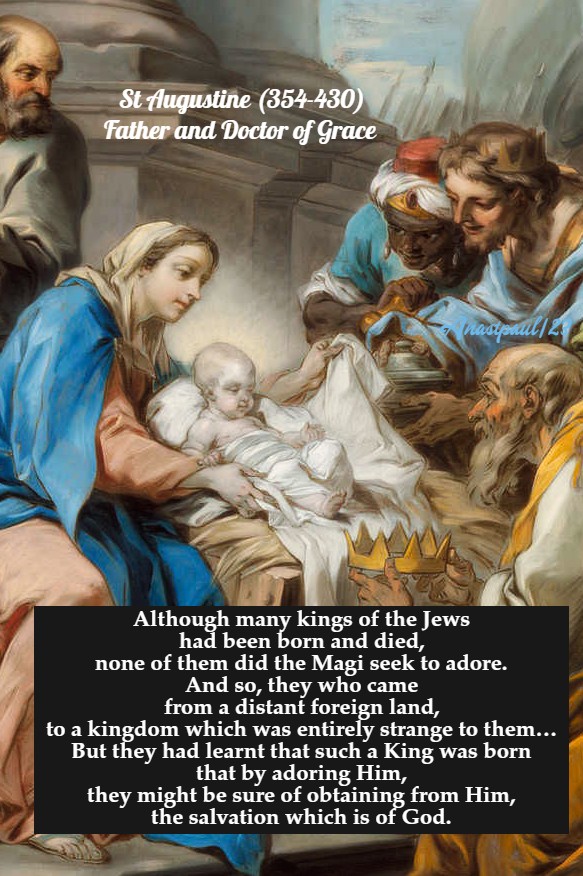
“Although many kings of the Jews had been born and died, none of them did the Magi seek to adore. And so, they who came from a distant foreign land, to a kingdom which was entirely strange to them… But they had learnt that such a King was born that by adoring Him, they might be sure of obtaining from Him, the salvation which is of God.”
St Augustine (354-430) Father and Doctor of Grace
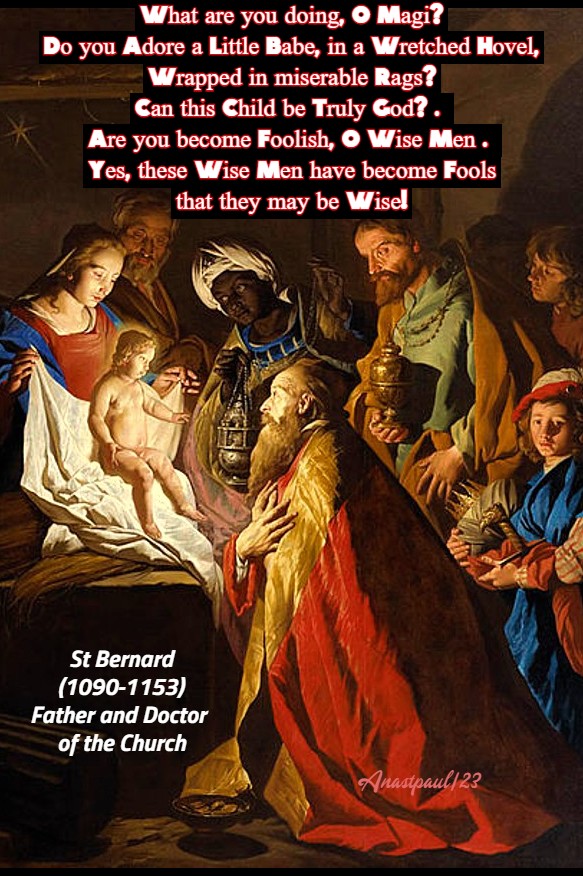
“What are you doing, O Magi? Do you adore a little Babe, in a wretched hovel, wrapped in miserable rags? Can this Child be truly God? … Are you become foolish, O Wise Men … Yes, these Wise Men have become fools that they may be wise!”
St Bernard (1090-1153) Father and Doctor of the Church
One Minute Reflection – 7 December – “The Month of the Divine Infant and the Immaculate Conception” – St Ambrose (340-397) – Confessor, Bishop, Father and Doctor of the Church – 2 Timothy 4:1-8, Matthew 5:13-19 – Scripture search here: https://www.drbo.org/
“You are the salt of the earth. But if salt loses its taste, with what can it be seasoned? It is no longer good for anything but to be thrown out and trampled underfoot.” – Matthew 5:13
REFLECTION – “It is as a matter of absolute necessity that He commands all this. Why must you be salt? Jesus says in effect: “You are accountable, not only for your own life but also, for that of the entire world. I am sending you not to one or two cities, nor to ten or twenty, nor even to one nation, as I sent the Prophets. Rather, I am sending you to the entire earth, across the seas, to the whole world, to a world fallen into an evil state.” For by saying, “You are the salt of the earth,” Jesus signifies, that all human nature itself has “lost its taste,” having become rotten through sin. For this reason, you see, He requires from His disciples, those character traits that are most necessary and useful for the benefit of all.” – St John Chrysostom (347-407) Archbishop of Constantinople, Father and Doctor (The Gospel of Matthew: Homily,15).
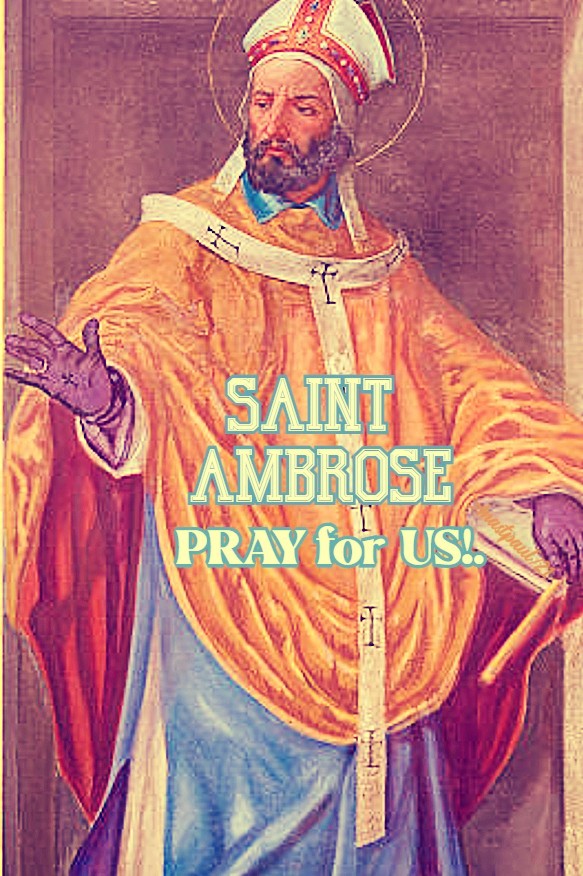
PRAYER – O God, Thou Who have given blessed Ambrose to Thy people as a help for eternal salvation, grant, we beseech Thee that we may be worthy to have him as our intercessor in Heaven, whom we have had as a teacher of life, on earth. ThroughJesus Christ, Thy Son our Lord, Who lives and reigns with Thee, in the unity of the Holy Ghost, God, world without end. Amen (Collect).
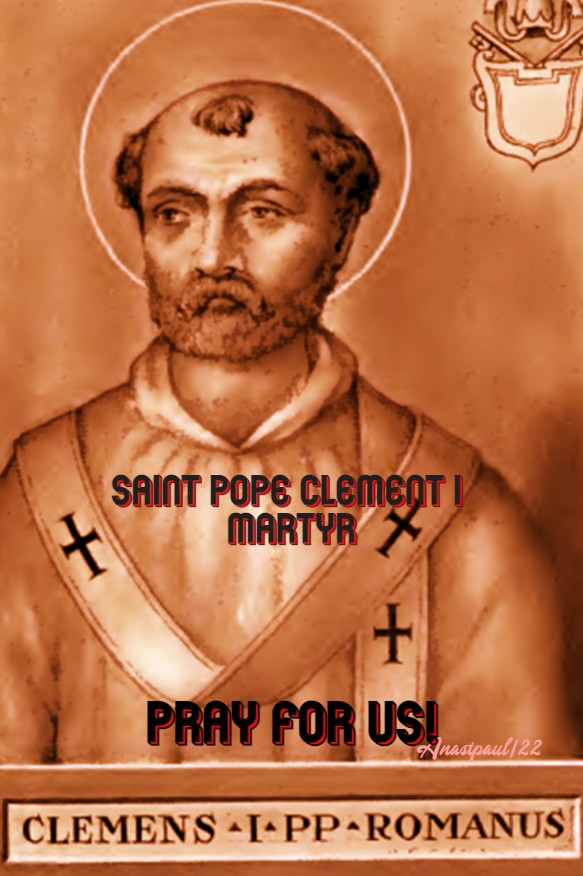
One Minute Reflection – 23 November – St Clement I (c 88–c 101) Pope Martyr – Philippians 3:17-21; 4:1-3, Matthew 16:13-19 – Scripture search here: https://www.drbo.org/
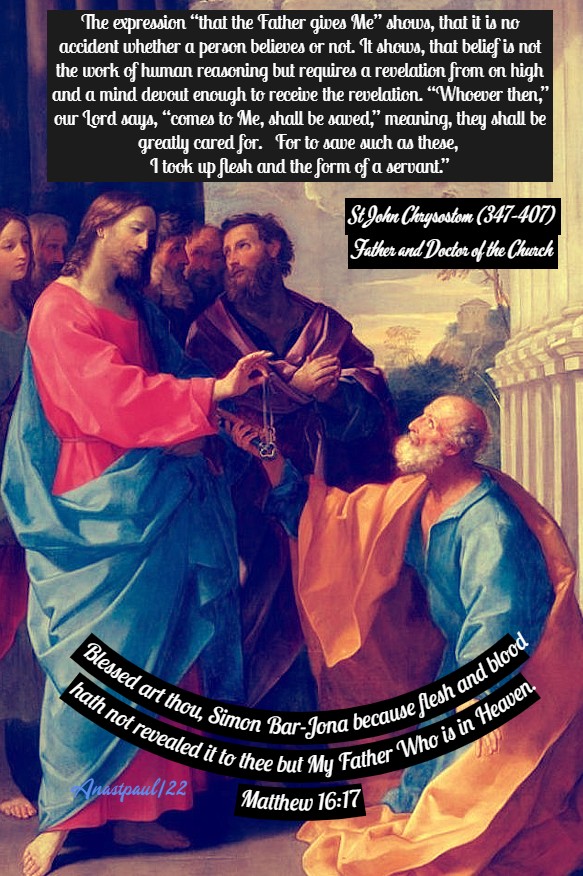
“Blessed art thou, Simon Bar-Jona because flesh and blood hath not revealed it to thee but My Father Who is in Heaven.” – Matthew 16:17
REFLECTION – “Faith in Me, He intimates here, is no ordinary thing or one that comes from human reason but [it] needs a revelation from above. And this He establishes throughout His discourses, showing, that this faith requires a noble sort of soul and one drawn on by God. The expression “that the Father gives Me” shows, that it is no accident whether a person believes or not. It shows, that belief is not the work of human reasoning but requires a revelation from on high and a mind devout enough to receive the revelation. “Whoever then,” our Lord says, “comes to Me, shall be saved,” meaning, they shall be greatly cared for. For to save such as these, I took up flesh and the form of a servant.” – St John Chrysostom (347-407) Archbishop of Constantinople, Father and Doctor of the Church (Homilies on the Gospel of John 45)”
PRAYER – Look forgivingly on Thy flock, Eternal Shepherd and keep it in Thy constant protection, by the intercession of blessed Clement Thy Martyr and Sovereign Pontiff, whom Thou didst constitute Shepherd of the whole Church. Through Jesus Christ, Thy Son our Lord, Who lives and reigns with Thee, in the unity of the Holy Ghost, God, world without end. Amen (Collect).
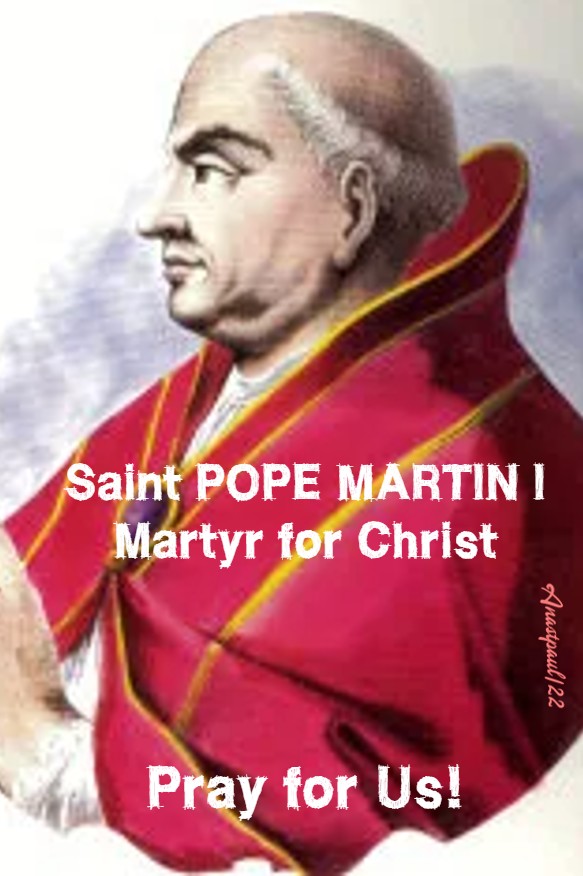
One Minute Reflection – 12 November – St Martin I, Pope (598-655) Martyr – 1 Peter 5:1-4; 5:10-11, Matthew 16:13-19 – Scripture search here: https://www.drbo.org/
“Blessed art thou, Simon Bar-Jona because flesh and blood hath not revealed it to thee but My Father Who is in Heaven.” – Matthew 16:17
REFLECTION – “Faith in Me, He intimates here, is no ordinary thing or one that comes from human reason but [it] needs a revelation from above. And this He establishes throughout His discourses, showing, that this faith requires a noble sort of soul and one drawn on by God. The expression “that the Father gives Me” shows, that it is no accident whether a person believes or not. It shows, that belief is not the work of human reasoning but requires a revelation from on high and a mind devout enough to receive the revelation. “Whoever then,” our Lord says, “comes to Me, shall be saved,” meaning, they shall be greatly cared for. For to save such as these, I took up flesh and the form of a servant.” – St John Chrysostom (347-407) Archbishop of Constantinople, Father and Doctor of the Church (Homilies on the Gospel of John 45)”
PRAYER – Look forgivingly on Thy flock, Eternal Shepherd and keep it in Thy constant protection, by the intercession of blessed Martin Thy Martyr and Sovereign Pontiff, whom thou didst constitute Shepherd of the whole Church. Through Jesus Christ, Thy Son our Lord, Who lives and reigns with Thee, in the unity of the Holy Ghost, God, world without end. Amen (Collect).
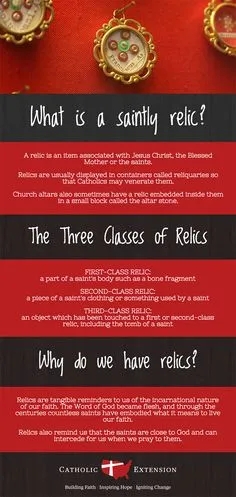
Feast of the Holy Relics – 5 November – From the Liturgical Year, 1901.
Relics of the Passion conserved in the Roman Basilica of Santa Croce in Jerusalem
Had we Angels’ eyes, we should see the earth as a vast field sown with seed for the Resurrection. The death of Abel opened the first furrow and ever since, the sowing has gone on unceasingly, the wide world over. This land of labour and of suffering, what treasures it already holds laid up in its bosom! And what a harvest for Heaven, when the Sun of Justice, suddenly darting forth His rays, shall cause to spring up, as suddenly from the soil, the elect ears ripe for glory! No wonder that the Church herself blesses and superintends, the laying of the precious grain in the earth.
But the Church is not content to be always sowing. Sometimes, as though impatient of delay, she raises from the ground the chosen seed she had sown therein. Her infallible discernment preserves her from error and, disengaging from the soil the immortal germ, she forestalls the glory of the future. She encloses the treasure in gold or precious stuffs, carries it in triumph, invites the multitudes to come and reverence it; or, she raises new temples to the name of the blessed one and assigns him the highest honour of reposing under the Altar, whereon she offers to God, the tremendous Sacrifice.
Religuary of St Anthony of Padua
“Let your charity understand,” explains St Augustine (Aug. Sermo cccxviii, de Stephano Mart. V): “it is not to Stephen we raise an Altar in this place but of Stephen’s relics, we make an Altar to God. God loves these Altars and, if you ask the reason – Precious in the sight of the Lord is the death of His saints (Ps. cxv, 15).” In obedience to God “the invisible soul has quitted its visible dwelling. But God preserves this dwelling; He is glorified by the honour we pay to this lifeless flesh and, clothing it with the might of His Divinity, He gives it the power of working miracles” (Aug. Sermo cclxxv, de Vincentio Mart. II). Hence the origin of pilgrimages to the Shrines of the Saints.
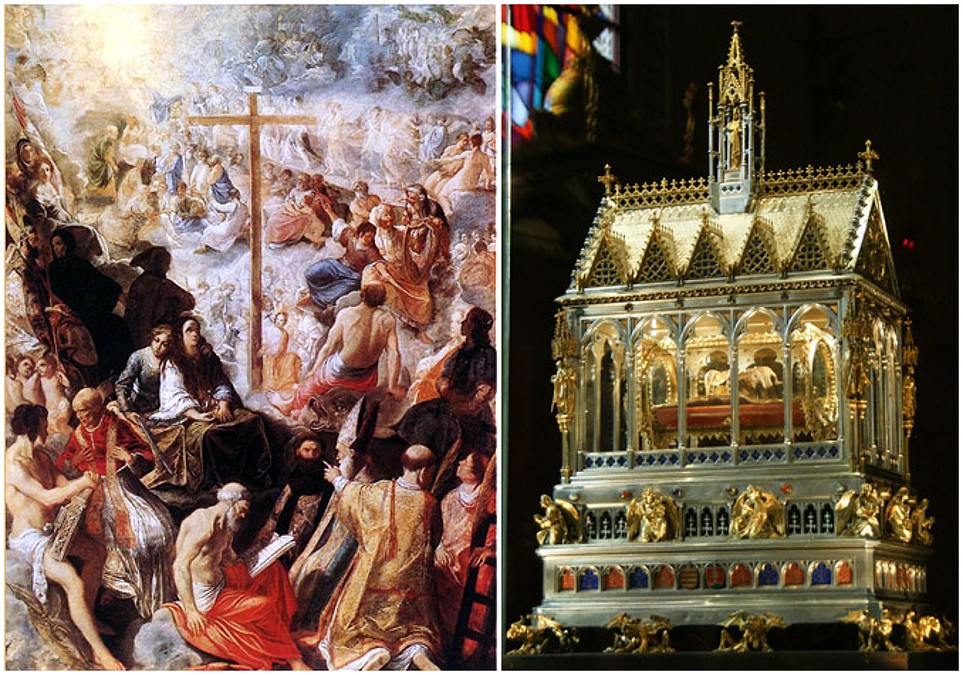
Left–Adoration of the Holy Cross by the Saints in Heaven; Right– Reliquary of St Stephen
“Christian people,” says St Gregory of Nyssa, “wherefore are you assembled here? A tomb has no attractions, nay, the sight of its contents inspires horror! Yet, see what eagerness to approach this sepulchre! So great an object of desire is it, that a little of the dust from around it is esteemed a gift of great price. As to beholding the remains it conceals, that is a rare favour and an enviable one, as those can testify who enjoy the privilege: they embrace the holy body as though it were yet alive, they press their lips and their eyes upon it, shedding tears of love and devotion. What emperor ever received such honour ”(Greg. Nyssa de Theodoro Mart)?”
“Emperors!” rejoins St John Chrysostom; “as the porters at their gates, such have they become with regard to poor fishers. The son of the great Constantine deemed he could not pay a higher honour to his father, than to procure him a place of sepulture in the porch of the fisherman of Galilee” (Chrys. in Epist. II. ad Cor. Hom. xxvi). And again, concluding his commentary on St Paul’s admirable Epistle to the Romans, the golden-mouthed Doctor exclaims: “And now, who will grant me to prostrate myself at Paul’s sepulchre, to contemplate the ashes of that body which, suffering for us, filled up what was wanting of the sufferings of Christ? The dust of that mouth, which spoke boldly before kings, and, showing what Paul was, revealed the Lord of Paul? The dust of that heart, truly the heart of the world, more lofty than the heavens, more vast than the universe, as much, the heart of Christ as of Paul and wherein might be read, the book of grace, graven by the Holy Spirit? Oh! that I might see the remains of the hands, which wrote those Epistles; of the eyes, which were struck with blindness and recovered their sight for our salvation; of the feet which traversed the whole earth! Yes. I would fain contemplate the tomb where repose these instruments of justice and of light, these members of Christ, this temple of the Holy Ghost. O venerable body, which, together with that of Peter, protects Rome more securely, than all ramparts” (Chrys. in Epist. ad Rom. Hom. xxxii)
Chains of St Peter
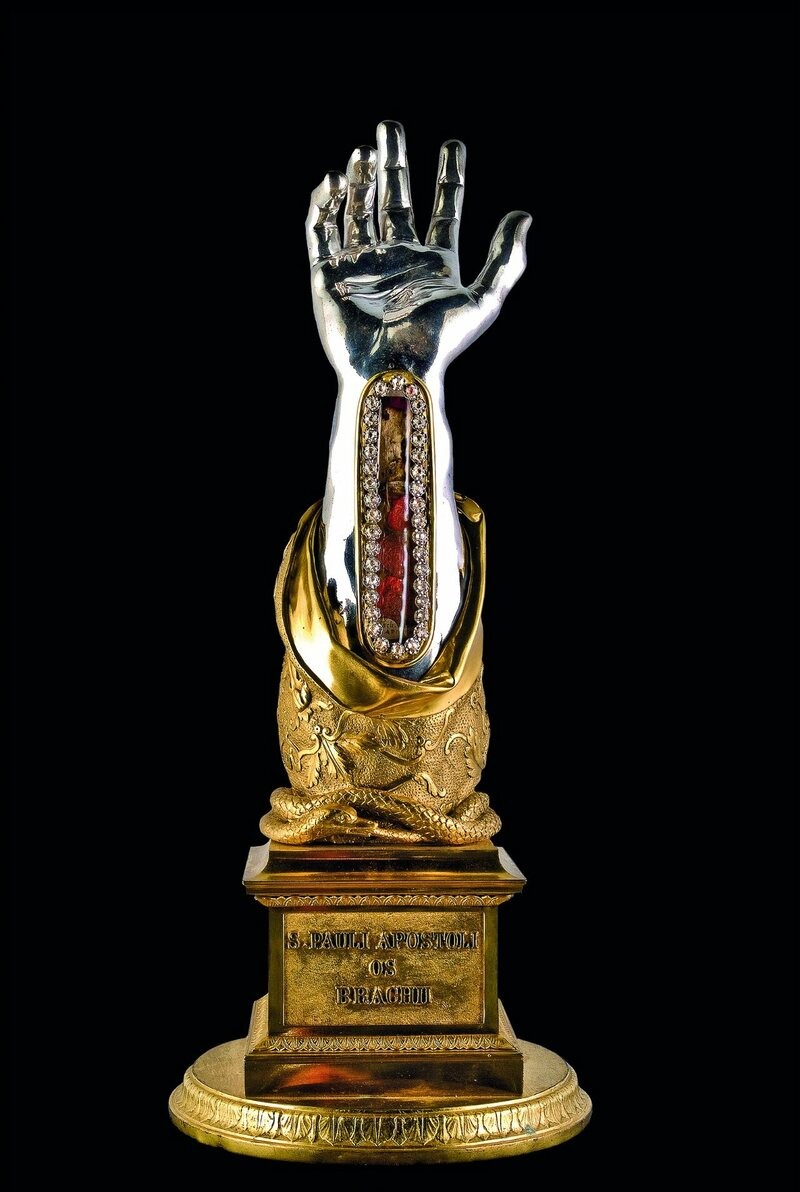
The wrist bone of St Paul held in Goza, Malta
In spite of such teachings as these, the heretics of the sixteenth Century profaned the tombs of the Saints, under pretext of bringing us back to the doctrine of our forefathers. In contradiction to these strange reformers, the Council of Trent expressed the unanimous testimony of Tradition, in the following definition, which sets forth the theological reasons of the honour paid by the Church, to the relics of Saints:,
“Veneration ought to be shown, by the faithful, to the bodies of the Martyrs and other Saints, who live with Jesus Christ. For they were His living members and the temples of the Holy Ghost; He will raise them up again to eternal life and glory and through them, God grants many blessings to mankind. Therefore, those who say that the relics of the Saints are not worthy of veneration, that it is useless for the faithful to honour them, that it is vain to visit the memorials or monuments of the Saints, in order to obtain their aid, are absolutely to be condemned and, as they have already been long ago condemned, (Conc. Nic. II. cap. vii), the Church now condemns them once more” (Conc. Tird. Sess. xxv. De invocatione, veneratione et reliquiis Sanctorum).
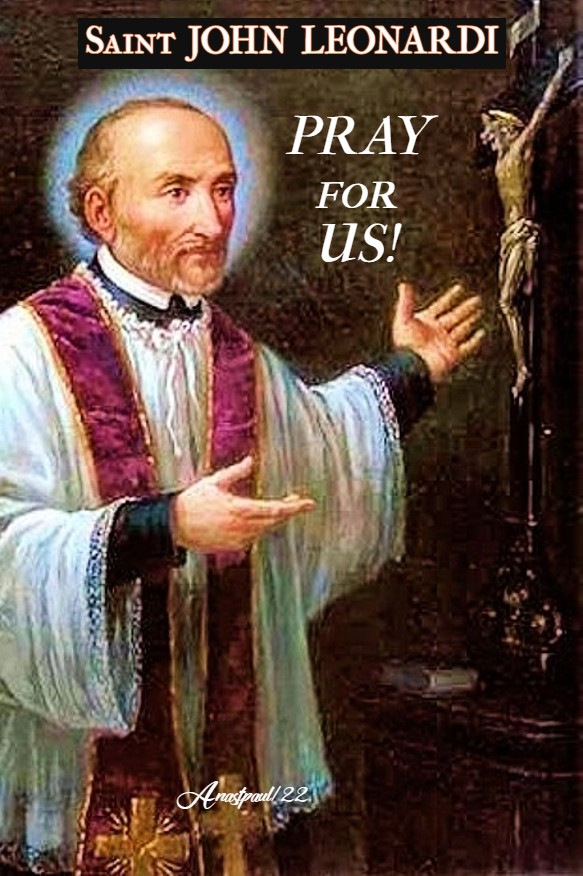
One Minute Reflection – 9 October – St John Leonardi (1541-1609) Confessor, Priest, Founder – 1 Corinthians 1:4-8, Matthew9:1-8 – Scripture search here: https://www.drbo.org/
“Which is easier to say: Thy sins are forgiven thee, or to say: Arise, and walk?” – Matthew 9:5
REFLECTION – “And people there brought to him a paralytic.” Saint Matthew merely says that this paralytic was carried to Jesus. Other Evangelists describe, how he was let down through an opening in the roof and placed before the Lord, without expressing any particular request, leaving it to Him to assess the needs …
“When Jesus saw their faith,” the Gospel says, that is to say, the faith of those who had brought the man to Him. Consider how sometimes Christ pays no attention to the faith of the sick person – perhaps because, the latter is incapable of it, being unconscious or possessed with an evil spirit. However, in this case, this paralytic had great trust in Jesus, otherwise, would he have allowed them to let him down in front of Him? Christ responds to this trust with an extraordinary miracle. With the power of God, He forgives this man’s sins. Thus He showed, that He is equal to the Father, a truth He had already shown, when He said to the leper: “I will do it – be made clean” (Mt 8:3) … and when, with a word, He stilled the tempestuous sea (Mt 8:26), or when, as God, He had cast out the demons who recognised in Him their ruler and their judge (Mt 8:32). So here, He shows His adversaries, to their great astonishment, that He is equal to the Father
And once more, the Saviour shows here, how He turns away from anything spectacular or a source of vainglory. On all sides the crowd is pressing Him, yet, He is in no hurry to work a visible miracle by healing the external paralysis of this man …. He begins with an invisible miracle – by healing the man’s soul. This kind of healing, is far more beneficial for him and, outwardly speaking, less glorious for Christ.” – St John Chrysostom (345-407) Priest at Antioch then Bishop of Constantinople, Father and Doctor of the Church – homilies on Saint Matthew’s Gospel, no. 29, 1.
PRAYER – O God, Who in a wondrous way graciously urged blessed John, Thy Confessor, to propagate Thy faith among the pagans and through him brought together a new religious family in Thy Church for the education of the faithful, grant Thy servants, so to profit by his teaching that we may reach everlasting rewards. Through Jesus Christ, Thy Son our Lord, Who lives and reigns with Thee, in the unity of the Holy Ghost, God, world without end. Amen (Collect).
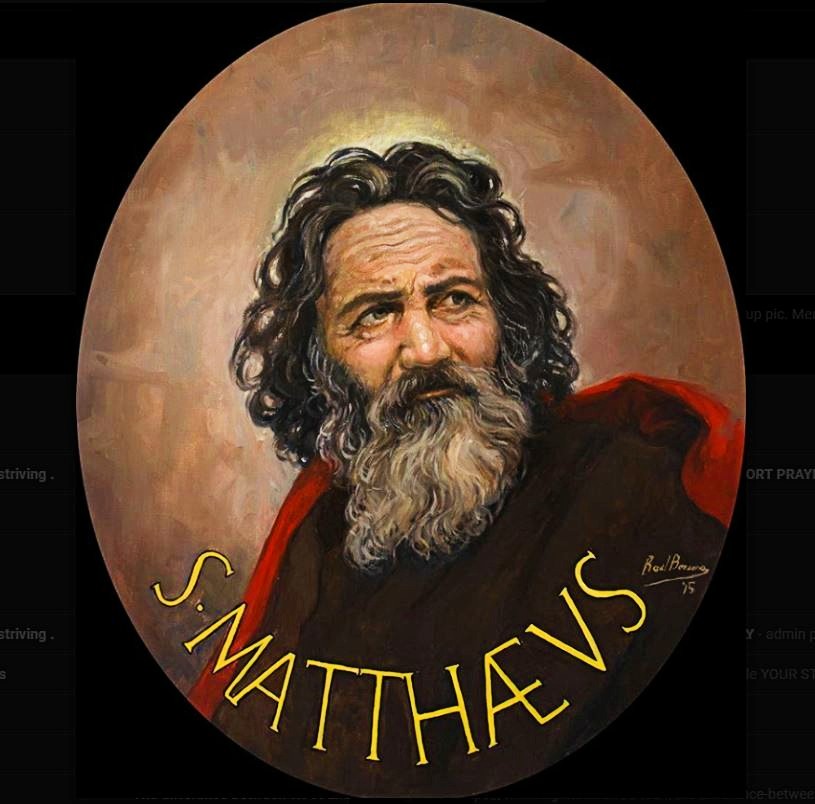
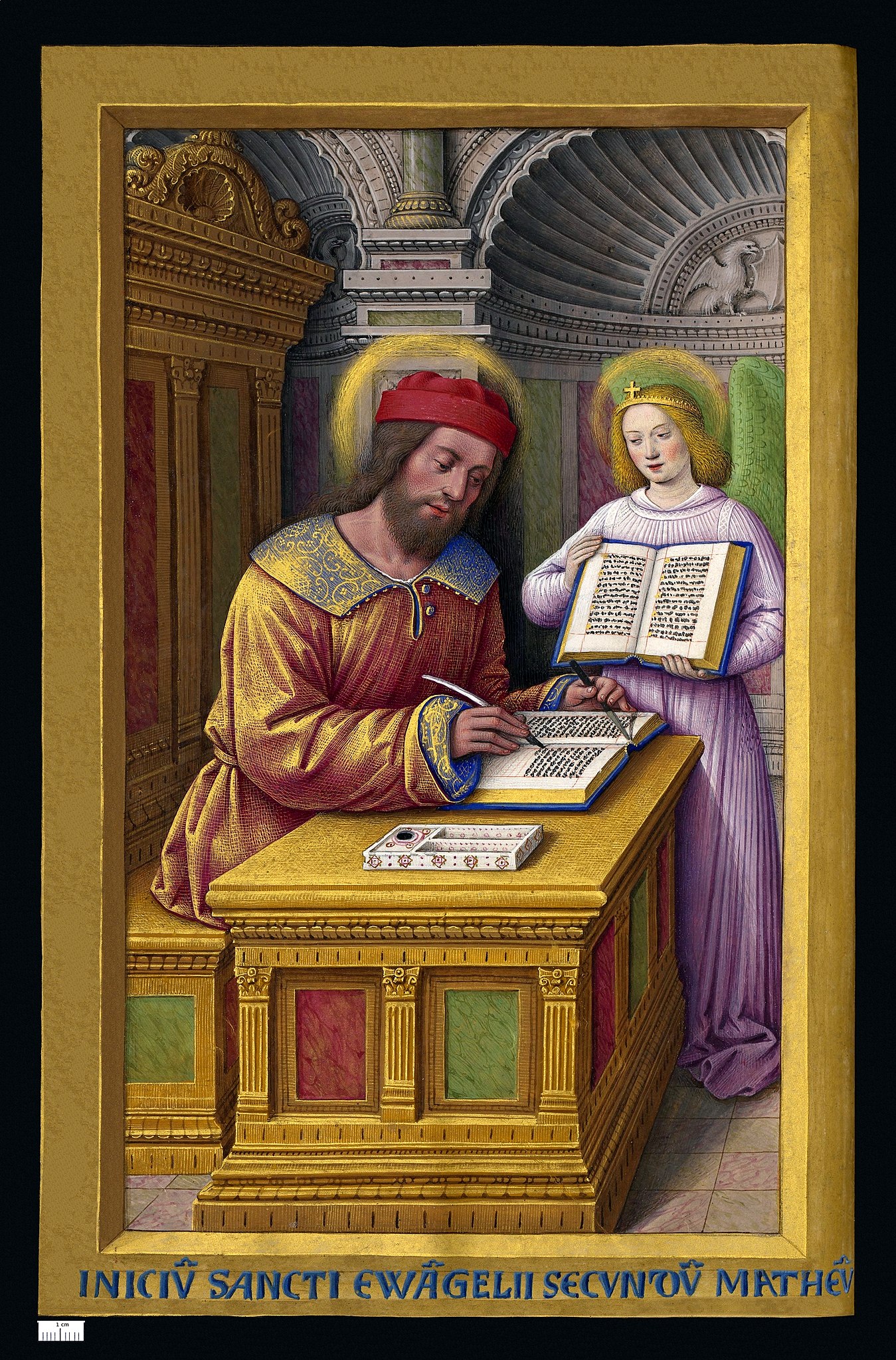
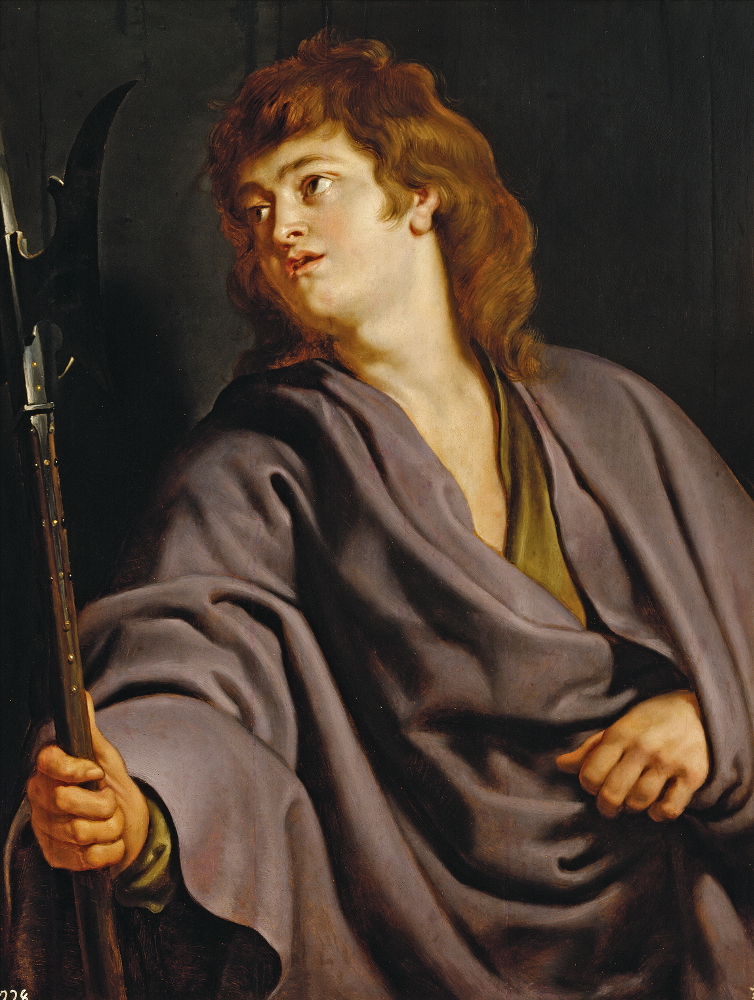
Saint of the Day – 21 September – The Feast of St Matthew, Apostle and Evangelist, Martyr. Patronages – accountant, bookkeepers, bankers, customs officers, financial officers, money managers, guards, security forces, security guards, stock brokers, tax collectors, Diocese of Trier, Germany, Archdiocese of Washington, 5 cities.
St Matthew, Apostle and Evangelist By Fr Leonard Goffiné O.Praem (1648-1719) (Excerpt from The Church’s Year)
Matthew, before his conversion called Levi, was a Galilean, a son of Alpheus (Mark 2:14) consequently a brother of St James the Less, another of the Apostles. (Mark 3:18). Matthew was a collector of the toll which the Jews were obliged to pay to the Roman Emperors and was called from his custom-house by our Lord to be an Apostle.
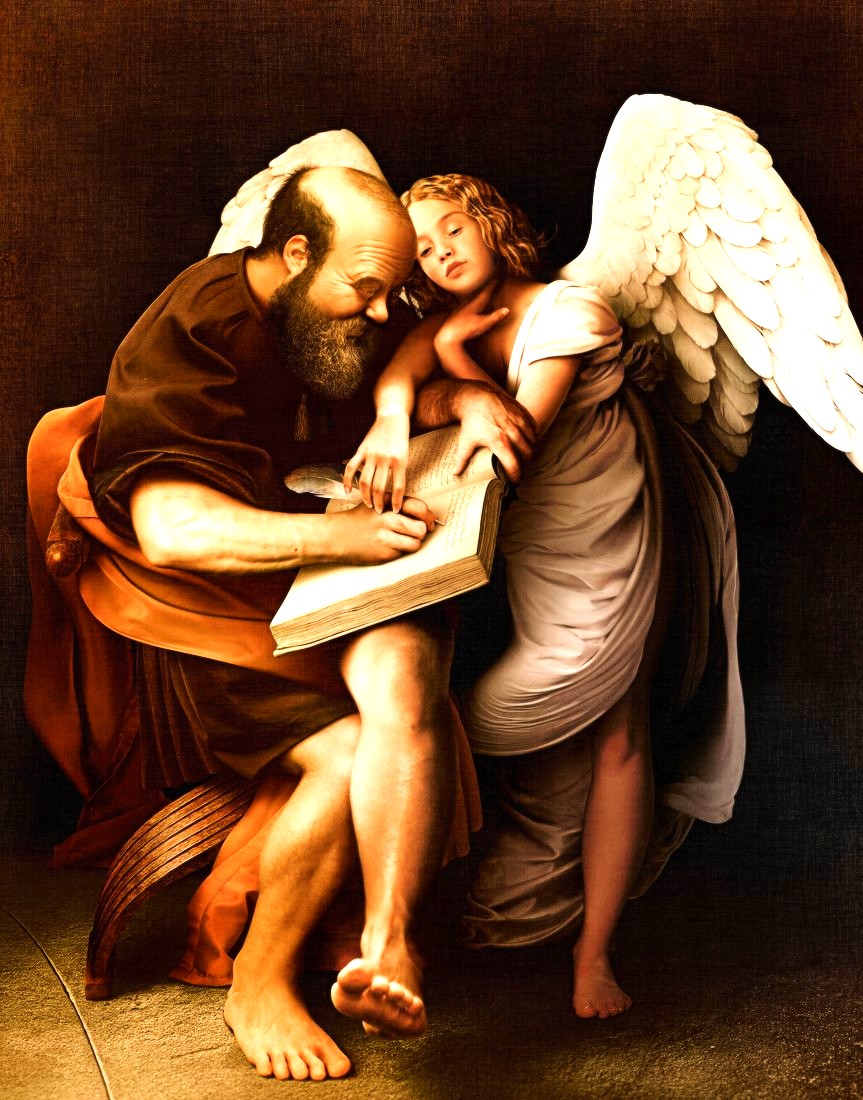
In his Gospel, which he wrote later, he calls himself from humility always by his early designation, Matthew the Publican. He followed Jesus faithfully and after the descent of the Holy Ghost remained, as the historical writers Eusebius and Epiphanus inform us, in Judea and its neighbourhood, until just before the destruction of Jerusalem, when the Apostles dispersed and went into foreign lands to preach the doctrine of Christ. When obliged to separate from the recent converts in Jerusalem, Matthew wrote his Gospel to leave with them in place of his presence among them and was the first to write concerning our Lord’s life upon earth.
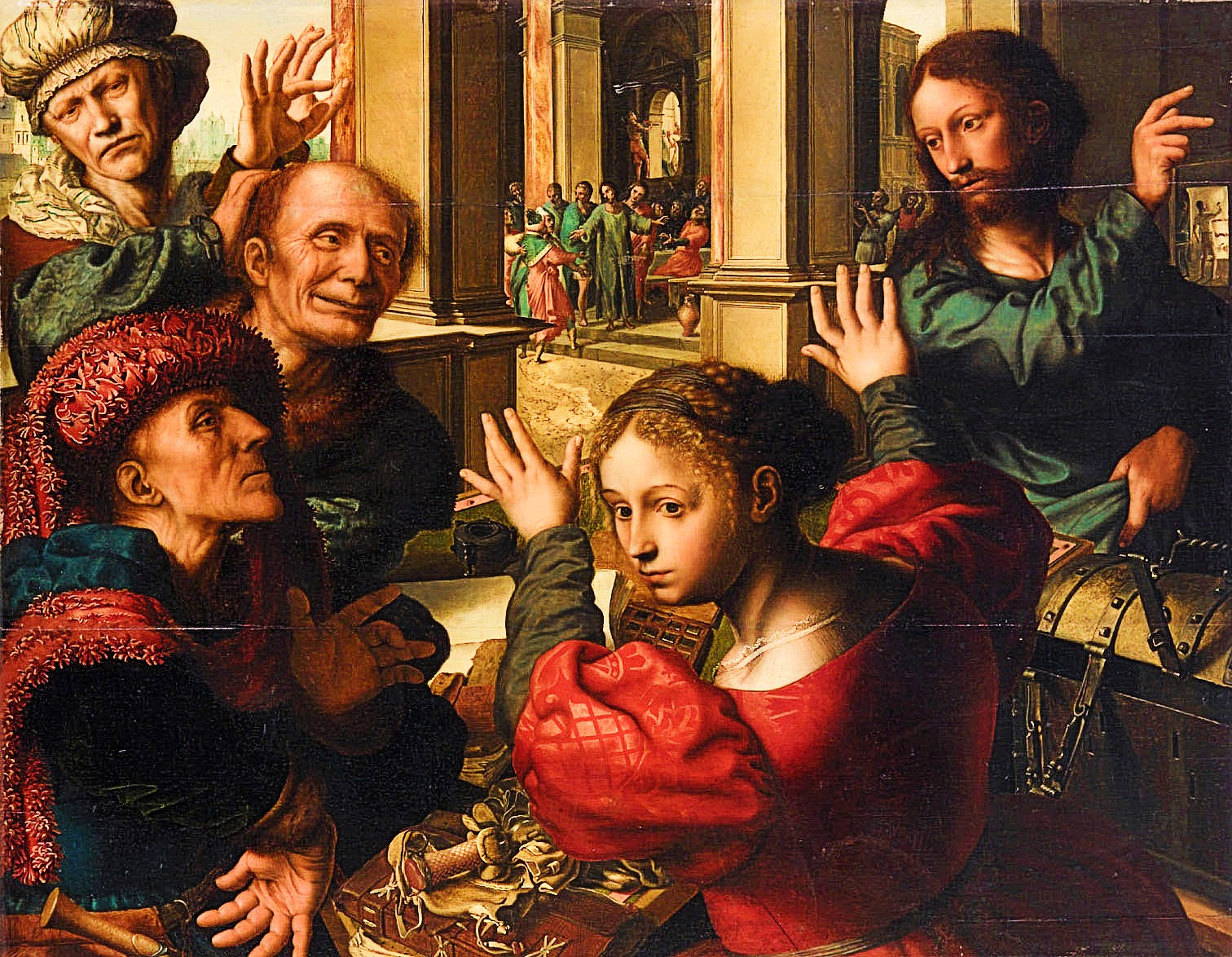
The Calling of Matthew – van Hemessen
He led a rigorous life, prayed much, never touched meat and lived on herbs, roots and wild fruits. He was at last stabbed by the Ethiopian King Hirtakus, as the generality of writers inform us, while standing at the Altar and offering the Sacrifice of Mass because the Saint had refused consent to the King’s marriage with the virgin Eugenia, who was dedicated to God. His sacred remains were, in the tenth Century, brought to Salerno, Naples, where they are still highly venerated.
Matthew was the first to write a Gospel. How proper it is, that he, who after many sins, becomes converted, should be the first to announce the Infinite Mercy of the Redeemer, Who came into this world, not to call the just but sinners.
“Christ, the Saviour, looked with His mild eyes at St Matthew in his custom-house and called him. Matthew obeyed, instantly arose and followed Christ, becoming thus, from a publican, an Apostle of the Lord, a great Saint. How comforting an example of Divine Mercy, even towards the greatest sinner! How wholesome a lesson! The same kind, merciful Saviour, Who gazed so mildly upon Matthew and called him, turns His loving eyes on you also, even if you live in mortal sin. He calls you to repentance – He calls you to follow Him. Obey Him as St. Matthew did, without putting it off. Let neither the greatness, nor the number of your sins detain you. Your Saviour is ready to forgive them, to receive you into His favour and to make you a Saint. “If you are a publican or a sinner,” says St Chrysostom, “you may still become an Evangelist. If you are a blasphemer, you may still become an Apostle.” This means that you may obtain pardon and gain salvation, as St Matthew and St Paul did, the former of whom was a publican, a sinner;and the other, according to his own testimony, a blasphemer. St Augustine says the same in the following words: “Perhaps some may think that the sin they have committed, is so great that it cannot obtain pardon from God. Oh! may such thoughts be far from us. Why, O man, regard only the number of thy sins and not the Omnipotence of the Heavenly Physician? As God is merciful because He is gracious and, as He can be merciful because He is Omnipotent, he who believes that God will not or cannot forforgive him, closes the door of the Divine Mercy on himself, by denying that God is gracious or Omnipotent. Hence, let no-one doubt the Mercy of God, even if he has committed a hundred, nay a thousand crimes. But this belief should incite him, to reconcile himself immediately with the Almighty.” – Fr Francis Xavier Weninger SJ (1805-1888)
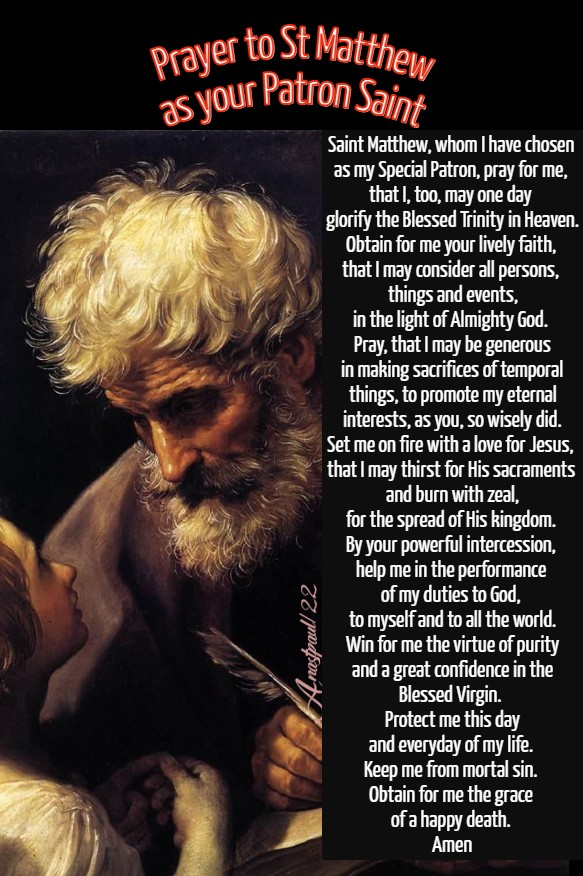
Prayer to St Matthew as your Patron Saint
Saint Matthew, whom I have chosen as my Special Patron, pray for me, that I, too, may one day glorify the Blessed Trinity in Heaven. Obtain for me your lively faith, that I may consider all persons, things and events, in the light of Almighty God. Pray, that I may be generous in making sacrifices of temporal things, to promote my eternal interests, as you, so wisely did. Set me on fire with a love for Jesus, that I may thirst for His sacraments and burn with zeal, for the spread of His kingdom. By your powerful intercession, help me in the performance of my duties to God, to myself and to all the world. Win for me the virtue of purity and a great confidence in the Blessed Virgin. Protect me this day and everyday of my life. Keep me from mortal sin. Obtain for me the grace of a happy death. Amen
Quote/s of the Day – 29 August – The Beheading of Saint John the Baptist
“Amen I say to you, there hath not risen among them that are born of women, a greater than John the Baptist.”
Matthew 11:11
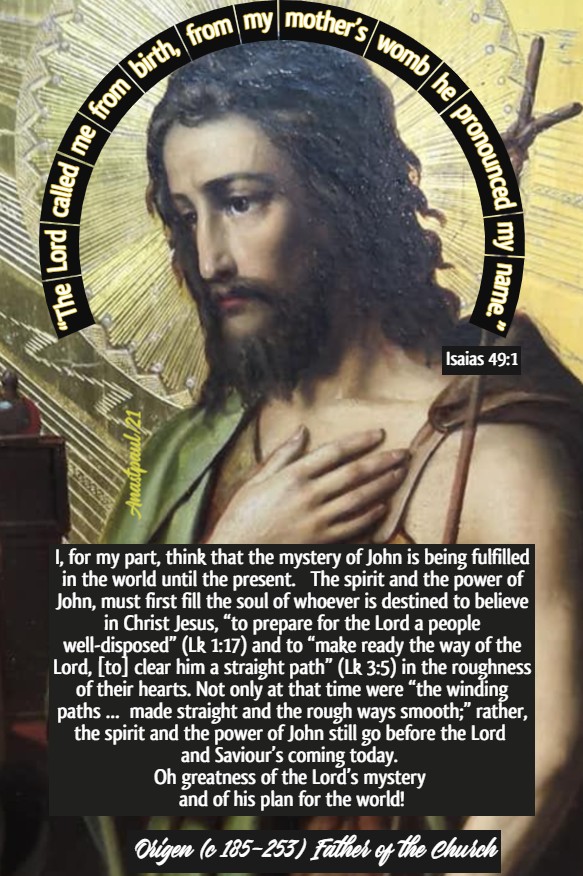
“The Lord called me from birth, from my mother’s womb He pronounced my name.”
Isaias 49:1
“I, for my part, think that the mystery of John is being fulfilled in the world until the present. The spirit and the power of John, must first fill the soul of whoever is destined to believe in Christ Jesus, “to prepare for the Lord a people well-disposed” (Lk 1:17) and to “make ready the way of the Lord, [to] clear Him a straight path” (Lk 3:5) in the roughness of their hearts. Not only at that time were “the winding paths … made straight and the rough ways smooth;” rather, the spirit and the power of John still go before the Lord and Saviour’s coming today. Oh greatness of the Lord’s Mystery and of His plan for the world! ”
Origen Adamantius (c 185-253) Priest, Theologian, Exegist, Writer, Apologist, Father
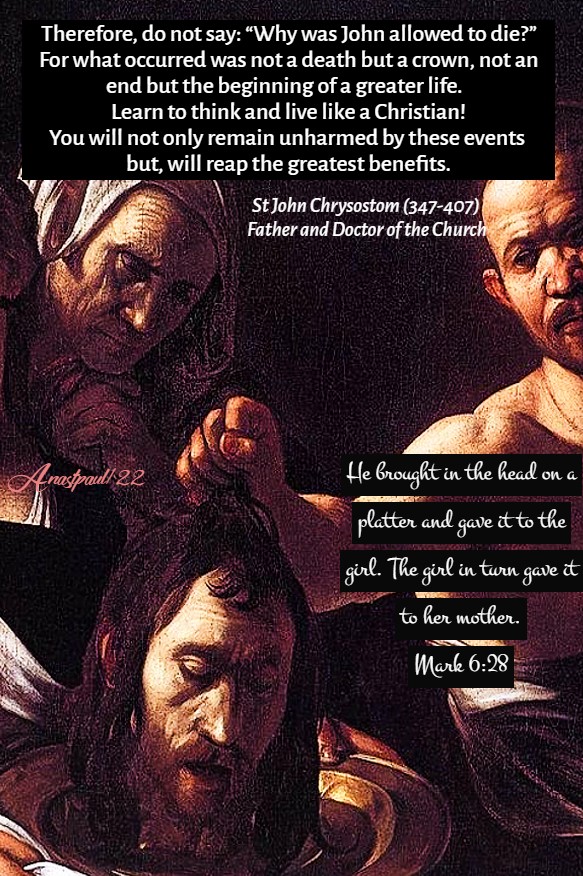
“Why was John allowed to die?” For what occurred was not a death but a crown, not an end but the beginning of a greater life. Learn to think and live like a Christian. You will not only remain unharmed by these events but will reap the greatest benefits.”
St John Chrysostom (347-407) Father & Doctor of the Church
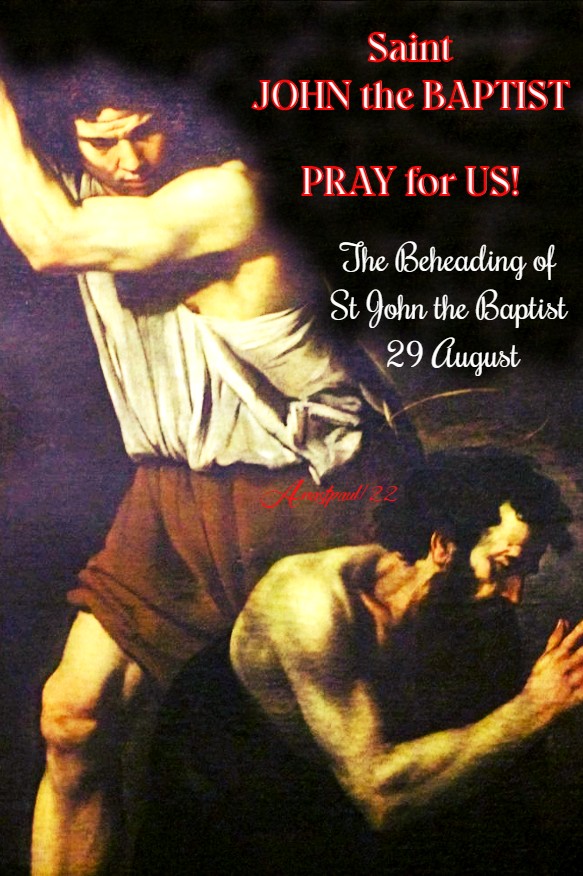
One Minute Reflection –29 August – The Beheading of Saint John the Baptist – Jeremias 1:17-19, Mark 6:17-29
“He brought in the head on a platter and gave it to the girl. The girl in turn gave it to her mother.” – Mark 6:28
REFLECTION – “In what way, then, was this just man harmed by this demise, this violent death, these chains, this imprisonment? Who are those he did not set back on their feet — provided they had a penitent disposition — because of what he spoke because of what he suffered,because of what he still proclaims in our own day — the same message he preached, while he was living. Therefore, do not say: “Why was John allowed to die?” For what occurred was not a death, but a crown, not an end, but the beginning of a greater life. Learn to think and live like a Christian. You will not only remain unharmed by these events, but will reap the greatest benefits.” St John Chrysostom (347-407) Archbishop of Constantinople, Father and Doctor of the Church (On the Providence of God 22).
PRAYER – May the great festival of St John the Baptist, ThyPrecursor and Martyr, we beseech Thee, O Lord, assure for us the results of Thy saving help. Who lives and reign with God the Father, in the unity of the Holy Spirit, God, world without end. Amen (Collect).
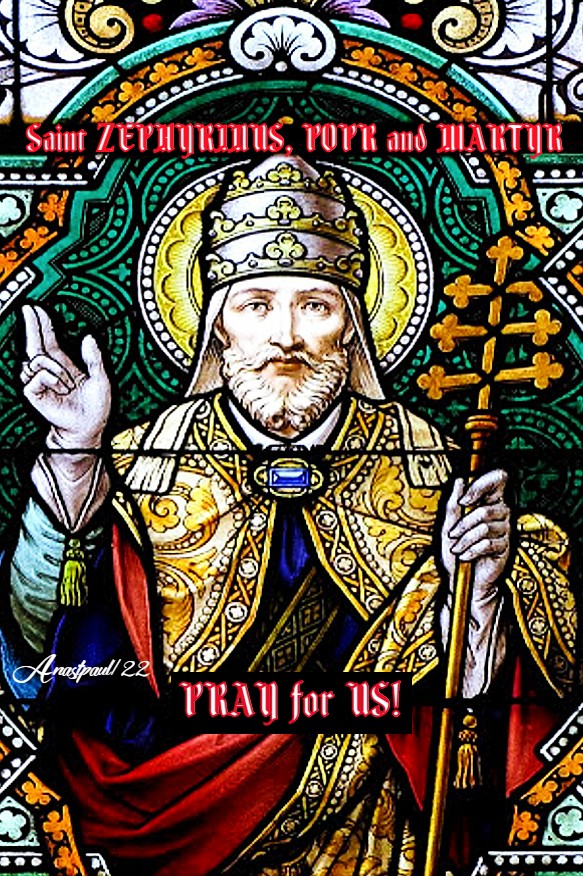
One Minute Reflection – 26 August – St Zephyrinus (Died 217) Martyr and Pope – 1 Pet 5:1-4; 5:10-11, Matthew 16:13-19
“Blessed art thou, Simon Bar-Jona because flesh and blood hath not revealed it to thee but My Father Who is in Heaven.” – Matthew 16:17
REFLECTION – “Faith in Me, He intimates here, is no ordinary thing or one that comes from human reason but [it] needs a revelation from above. And this He establishes throughout His discourses, showing, that this faith requires a noble sort of soul and one drawn on by God. The expression “that the Father gives Me” shows, that it is no accident whether a person believes or not. It shows, that belief is not the work of human reasoning but requires a revelation from on high and a mind devout enough to receive the revelation. “Whoever then,” our Lord says, “comes to Me, shall be saved,” meaning, they shall be greatly cared for. For to save such as these, I took up flesh and the form of a servant.” – St John Chrysostom (347-407) Archbishop of Constantinople, Father and Doctor of the Church (Homilies on the Gospel of John 45)”
PRAYER – Look forgivingly on Thy flock, Eternal Shepherd, and keep it in thy constant protection, by the intercession of blessed Zephyrinus Thy Martyr and Sovereign Pontiff, whom Thou didst constitute Shepherd of the whole Church.Through Jesus Christ, Thy Son our Lord, Who lives and reigns with Thee, in the unity of the Holy Ghost, God, world without end. Amen (Collect).
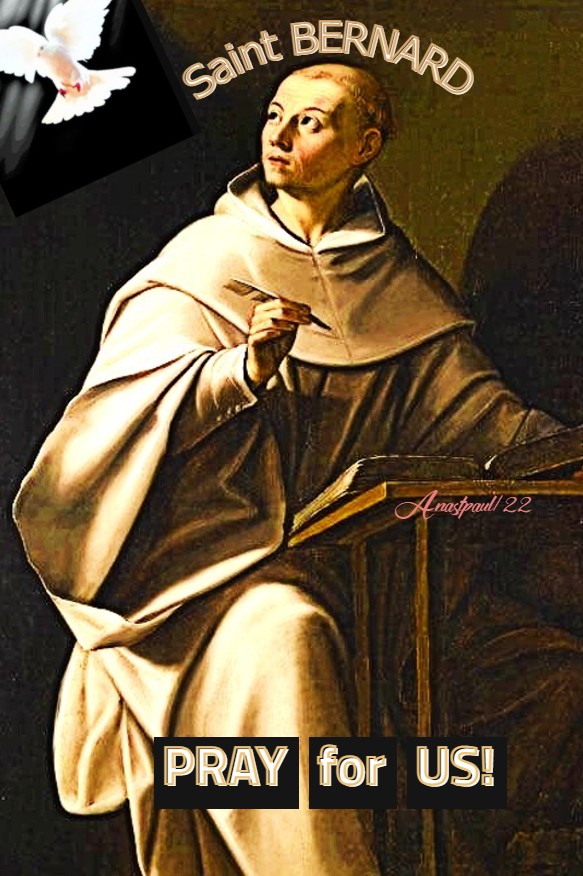
One Minute Reflection – 20August – “The Month of the Immaculate Heart of Mary” and the Memorial of St Bernard (1090-1153) Confessor – Ecclesiasticus 39:6-14, Matthew 5:13-19
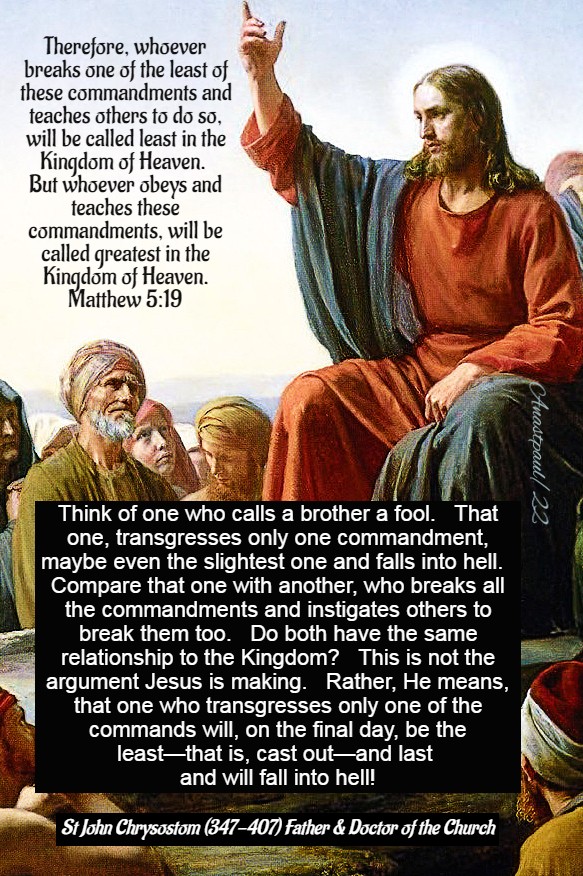
“Therefore, whoever breaks one of the least of these commandments and teaches others to do so, will be called least in the Kingdom of Heaven. But whoever obeys and teaches these commandments, will be called greatest in the Kingdom of Heaven.” – Matthew 5:19
REFLECTION – “For what reason then does He call some of these commandments “least,” although they are so magnificent and lofty? Jesus spoke this way because He was about to introduce His own teaching, as a new law . As He humbles Himself and speaks of Himself with great modesty, so He refers to His own teaching in the same manner. In this way, Jesus teaches us to practice humility in everything. And besides, since some suspected His teaching to be a new departure, He temporarily taught it in a more reserved way.
But when you hear “least in the Kingdom of Heaven,” you are to think of nothing but hell and punishment. For it was His practice to speak, not only of the joy the Kingdom brings but also, of the time of the resurrection and the fearful event of the Second Coming.
Think of one who calls a brother a fool. That one, transgresses only one commandment, maybe even the slightest one and falls into hell. Compare that one with another, who breaks all the commandments and instigates others to break them too. Do both have the same relationship to the Kingdom? This is not the argument Jesus is making. Rather, He means, that one who transgresses only one of the commands will, on the final day, be the least—that is, cast out—and last and will fall into hell!” – St John Chrysostom (347-407) Archbishop of Constantinople, Father and Doctor of the Church (The Gospel of Saint Matthew, Homily 16).
PRAYER – O God, Who gave to Thy people, blessed Bernard, as a minister of salvation, grant, we beseech Thee, that we, who cherished him on earth as a teacher of life, may be found worthy to have him as an intercessor in Heaven.Through Jesus Christ, Thy Son our Lord, Who lives and reigns with Thee, in the unity of the Holy Ghost, God, world without end. Amen (Collect).
Our Morning Offering – 11 August – “The Month of the Immaculate Heart of Mary”
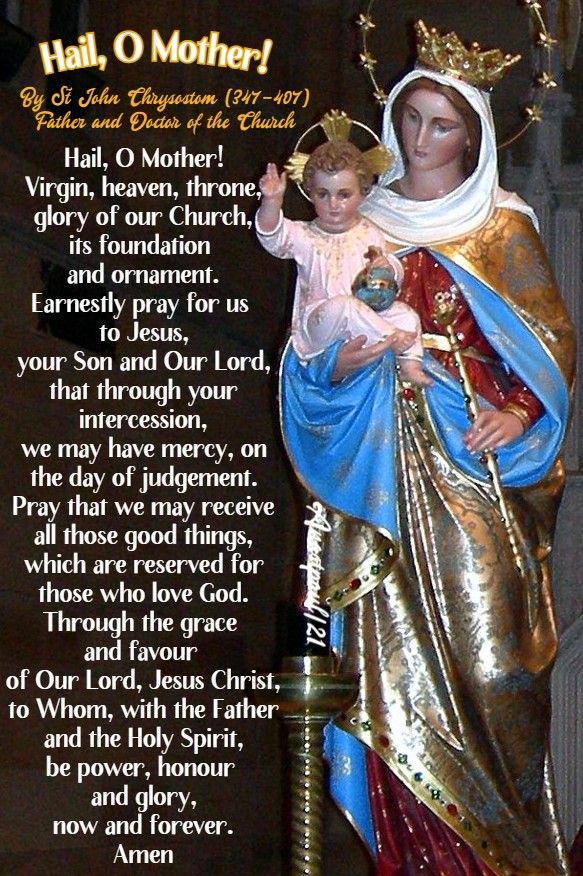
Hail, O Mother! By St John Chrysostom (347-407) Father and Doctor of the Church
Hail, O Mother! Virgin, heaven, throne, glory of our Church, it’s foundation and ornament. Earnestly pray for us to Jesus, your Son and Our Lord, that through your intercession, we may have mercy on the day of judgement. Pray that we may receive, all those good things which are reserved for those who love God. Through the grace and favour of Our Lord, Jesus Christ, to Whom, with the Father and the Holy Spirit, be power, honour and glory, now and forever. Amen
One Minute Reflection – 8 August – “The Month of the Immaculate Heart of Mary” – The Memorial of the Holy Martyrs Saints Cyriacus, Largus and Smaragdus – 1 Thessalonians 2:13-16, Mark 16:15-18
“He who believes and is baptised, shall be saved ...” – Mark 16:16
REFLECTION – “When He says, “All that the Father gives Me shall come to Me,” He touches on their unbelief, showing, that whoever does not believe in Him transgresses the Will of the Father. He covertly shows, that unbelievers are not only at variance with Him but also, with the Father. For if this is [the Son’s] Will and if this is the reason He came, that is, that He might save the entire world, then those who do not believe transgress His Will.
When, therefore, He says, the Father guides someone, there is nothing that hinders that person from coming to [Jesus]. And Paul says, that [the Son] delivers them up to the Father. Now, just as the Father, when He gives, does not take from Himself, so neither does the Son take from Himself when He gives up. The Son is said to give up to the Father because we are brought to the Father by Him. And at the same time, we read that it was the Father “by whom you were called to the fellowship of His Son,” that is, by the Will of the Father.
Faith in Me, He intimates here, is no ordinary thing or one that comes from human reason but [it] needs a revelation from above. And this He establishes throughout His discourses, showing, that this faith requires a noble sort of soul and one drawn on by God. The expression “that the Father gives Me” shows, that it is no accident whether a person believes or not. It shows, that belief is not the work of human reasoning but requires a revelation from on high and a mind devout enough to receive the revelation. “Whoever then,” our Lord says, “comes to Me, shall be saved,” meaning they shall be greatly cared for. For to save such as these, I took up flesh and the form of a servant.” – St John Chrysostom (347-407) Archbishop of Constantinople, Father and Doctor of the Church (Homilies on the Gospel of John 45)
PRAYER – O God, Who gladden us with the annual festival of Thy holy Martyrs, Cyriacus, Largus and Smaragdus, mercifully grant, that we, who celebrate the anniversary of their death, may also strive to equal the courage of their Martyrdom. Through Jesus Christ, Thy Son our Lord, Who lives and reigns with Thee, in the unity of the Holy Ghost, God, world without end. Amen (Collect).
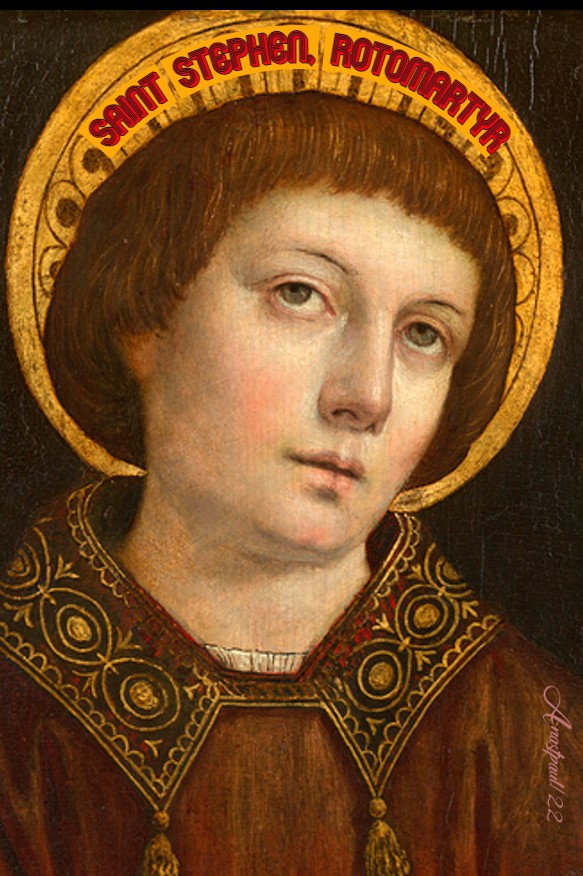
One Minute Reflection – 3 August – “The Month of the Immaculate Heart of Mary” – The Finding of the Relics of St Stephen, Protomartyr – Acts 6:8-10; 7:54-60. Matthew 23:34-39
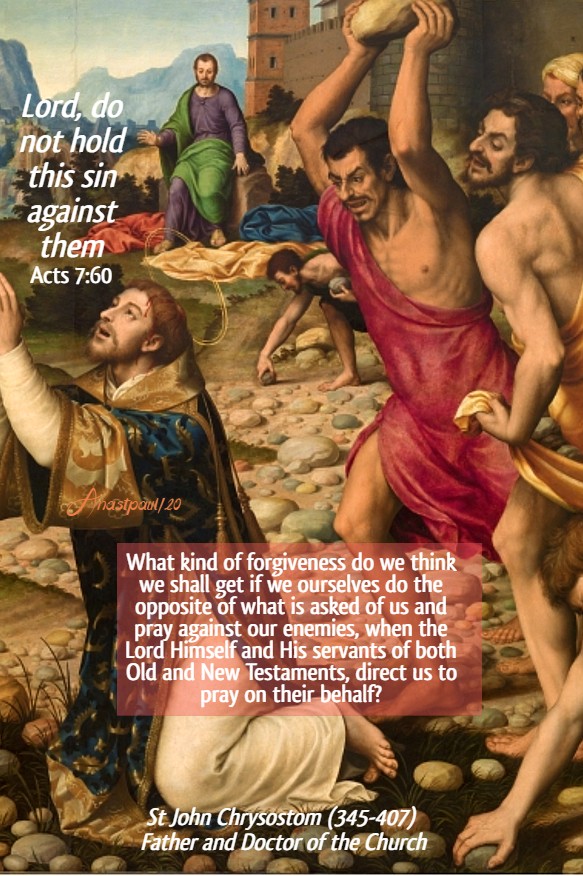
“Lord, do not hold this sin against them” – Acts 7:60
REFLECTION – “Let us imitate our Lord and pray for our enemies … He was Crucified and yet, at the same time, prayed to His Father for the sake of those who were crucifying Him. But how could I possibly imitate our Lord, one might ask? If you want to, you can. If you weren’t able to do it how could He have said: “Learn from me for I am meek and humble of heart”? (Mt 11:29) …
If you have difficulty in imitating our Lord, at least imitate him who is also His servant, His Deacon – I would speak of Stephen. Just as Christ, in the midst of those crucifying Him, without considering the Cross, without considering His own predicament, pleaded with the Father, on behalf of His tormentors (Lk 23:34), so His servant, surrounded by those who were stoning him, attacked by all, crushed beneath a hail of stones and, without taking any account of the suffering they were causing him, said: “Lord, do not hold this sin against them” (Acts 7:60). Do you see how the Son spoke and how His servant prayed? The former said: “Father, forgive them for they know not what they do,” and the latter said: “Lord, do not hold this sin against them.” Moreover, to make us realise the fervour with which he was praying, he did not just pray, as he stood beneath the blows of the stones but, he spoke on his knees with sincerity and compassion …
Christ said: “Father, forgive them for they know not what they do.” Stephen cried out: “Lord, do not hold this sin against them.” Paul, in his turn, said: “I offer up this sacrifice for my brethren, my kin according to race” (cf. Rm 9:3). Moses said: “If you would only forgive their sin! And if you will not, then strike me out of the book that you have written!” (Ex 32:32). David said: “May your hand fall on me and my kindred,” (2 Sam 24:17). … What kind of forgiveness do we think we shall get if we ourselves do the opposite of what is asked of us and pray against our enemies, when the Lord Himself and His servants, of both Old and New Testaments, direct us to pray on their behalf?” – St John Chrysostom (345-407) Father and Doctor of the Church – Sermon for Good Friday “The Cross and the bandit”
PRAYER – Grant us, we beseech Thee, O Lord, to imitate what we celebrate, so that we may learn to love, even our enemies; because we keep the anniversary of the invention of Him, Who knew how to plead even for His persecutors with our Lord, Jesus Christ, Thy Son, Who with |Thee. lives and reigns with Thee, in the unity of the Holy Ghost, God, world without end. Amen (Collect).
Quote/s of the Day – 31 July – The Memorial of St Ignatius Loyola (1491-1556) Confessor
The Dying Words of today’s Saint of the Day, Blessed Everard Hanse (Died 1581) Priest Martyr at the hands of of Queen Elizabeth I in the English persecutions, led me to contemplate and collate some of these scattered around Breathin Catholic. I will collect them as I go on searches everywhere in the Catholic world, adding to them here from time to time, when appropriate. 🙏🧡
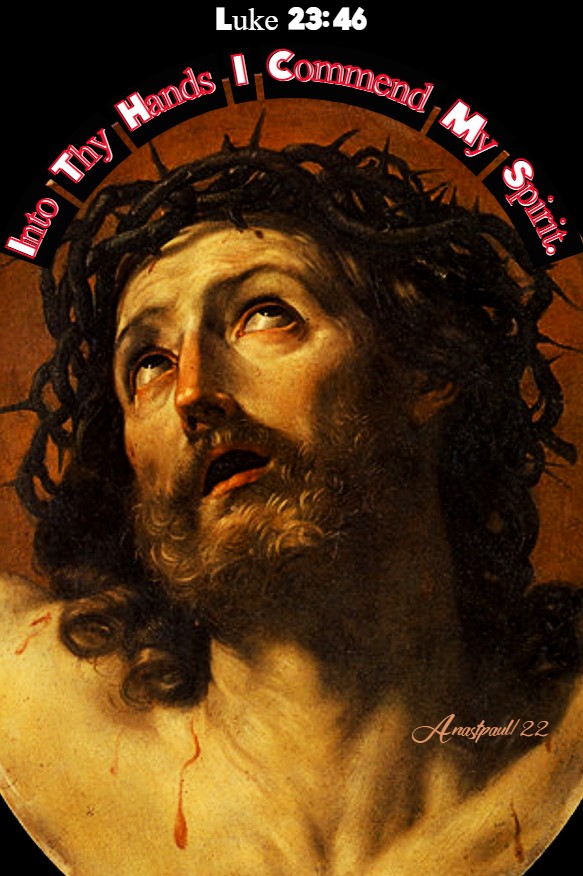
“Into Thy hands I commend My spirit.”
Luke 23:46
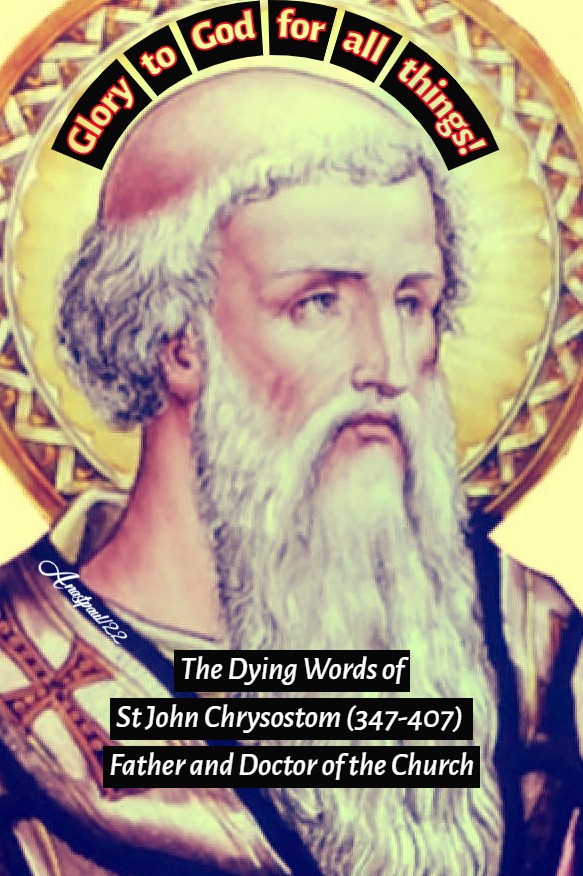
“Glory to God for all things!”
St John Chrysostom (347-407) Father and Doctor of the Church
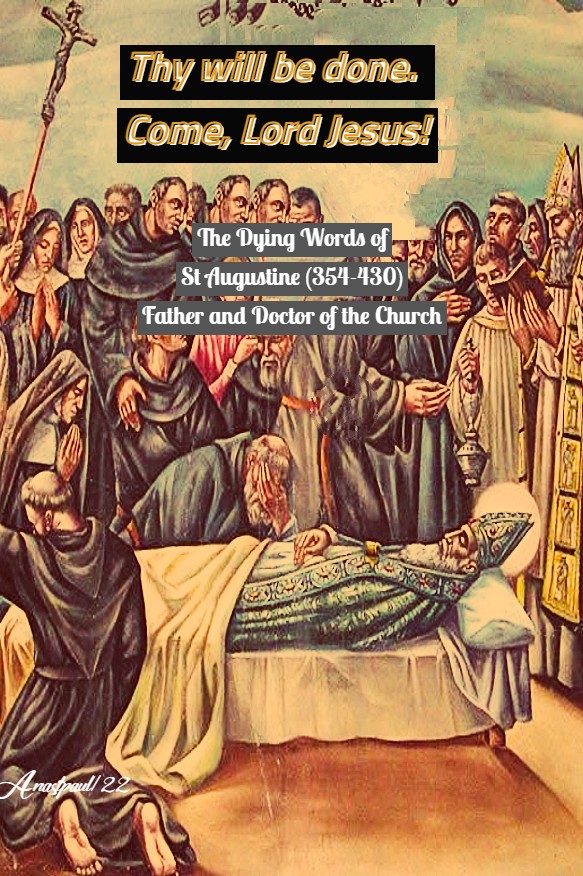
“Thy will be done. Come, Lord Jesus!”
St Augustine (354-430) Father and Doctor of the Church
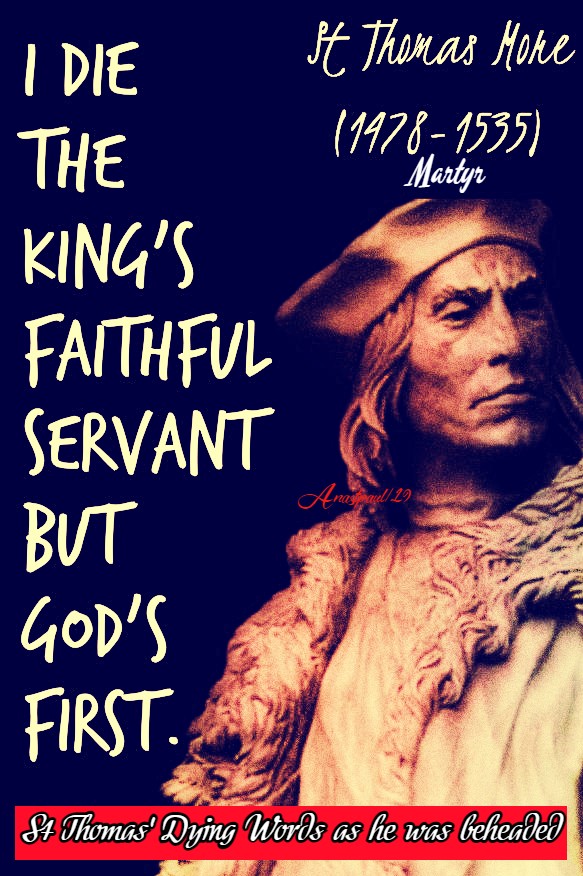
“I die the King’s faithful servant but God’s first.”
St Thomas More (1478-1535) Martyr
“O, my God!”
St Ignatius Loyola (1491-1556)
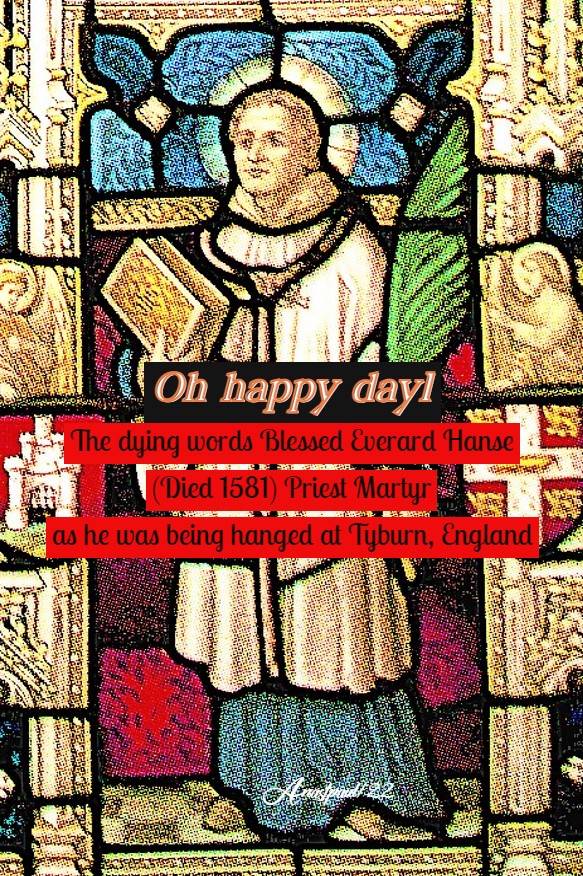
“Oh happy day!”
The dying words of today’s Saint of the Day as he was being hanged at Tyburn, England Blessed Everard Hanse (Died 1581) Priest Martyr
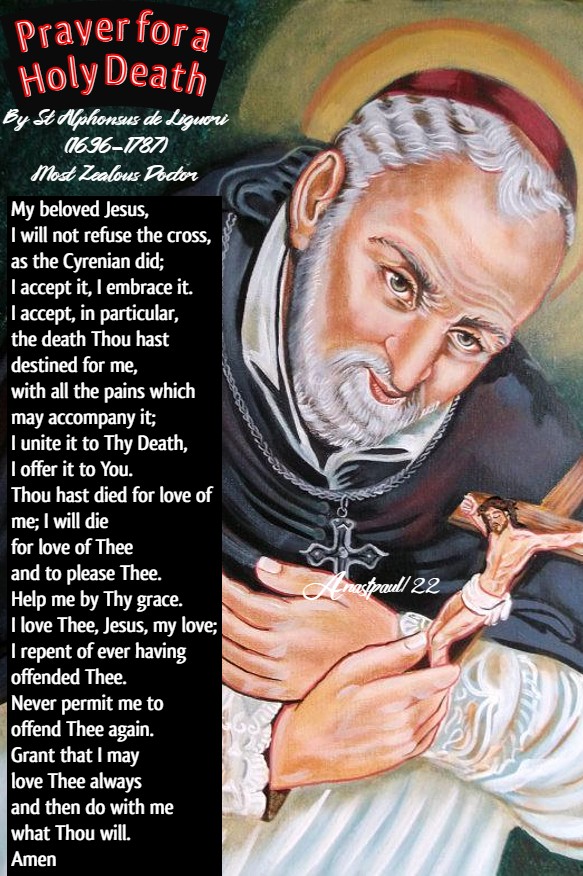
Prayer for a Holy Death By St Alphonsus de Liguori Most Zealous Doctor
“My beloved Jesus, I will not refuse the cross, as the Cyrenian did; I accept it, I embrace it. I accept, in particular, the death Thou hast destined for me, with all the pains which may accompany it; I unite it to Thy Death, I offer it to You. Thou hast died for love of me; I will die for love of Thee and to please Thee. Help me by Thy grace. I love Thee, Jesus, my love; I repent of ever having offended Thee. Never permit me to offend Thee again. Grant that I may love Thee always and then do with me what Thou will.Amen”
Quote/s of the Day – 26 July – St Anne, Mother of the Blessed Virgin Mary, Grandmother of Jesus.
St Anne, through her constant prayer, received, the Mother of God and then, became the Grandmother of God!
“God accepts our desires as though they were of great value. He longs ardently for us to desire to and love Him. He accepts our petitions for benefits, as though we were doing Him a favour. His joy in giving, is greater than ours in receiving. So let us not be apathetic in our asking, nor set too narrow bounds to our requests; nor ask for frivolous things unworthy of God’s greatness.”
St Gregory Nazianzen (330-390) Father & Doctor of the Church
“Prayer is the place of refuge for every worry, a foundation for cheerfulness, a source of constant happiness, a protection against sadness.”
“When you are weary of praying and do not receive, consider how often you have heard a poor man calling and have not listened to him.”
St John Chrysostom (347-407) Father and Doctor of the Church
“Fasting is the soul of prayer, mercy is the lifeblood of fasting. Let no-one try to separate them, they cannot be separated. If you have only one of them, or not all together, you have nothing! So if you pray, fast; if you fast, show mercy; if you want your petition to be heard, hear the petition of others. If you do not close your ear to others, you open God’s ear to yourself.”
St Peter Chrysologus (c 400-450) Father & Doctor of the Church
“Realise above all, that you are in God’s presence and stand there with the attitude of one, who stands before the Emperor.”
St Romuald (c 951-1027)
“The spirit of prayer is the spirit of the love of God and this should inspire all our vocal prayers. Flowery petitions are no use if our minds and hearts are turned away from God. God wants our hearts. Let us pray often but let our prayers be sincere acts of the love of God, coming from the heart.”
One Minute Reflection – 25 July – “The Month of the Precious Blood” – Saint James the Greater, Apostle and Martyr – 1 Corinthians 4:9-15, Matthew 20:20-23
“You know not what you ask. Can you drink the Chalice that I shall drink?” – Matthew 20:22
REFLECTION – “Through their mother’s mediation, the sons of Zebedee press Christ as follows in the presence of their fellow apostles: “Command that we may sit, one at your right side and one at your left” (cf. Mk 10:35f.)… Christ hastens to free them from their illusions, telling them they must be prepared to suffer insults, persecutions, even death. “You do not know what you are asking. Are you able to drink the chalice that I shall drink?”
Let no-one be surprised to see the Apostles displaying such imperfect dispositions. Wait until the Mystery of the Cross has been fulfilled and the strength of the Holy Spirit given to them. If you want to see the strength of their souls, take a look at them later and you will see them to be above all human weakness. Christ does not conceal their pettiness, so that you will be able to see what they become later by the power of the grace which will transform them! …”… St John Chrysostom (c 345-407) Father & Doctor of the Church.
PRAYER – Protect Thy people and make them holy, O Lord, so that, guarded by the help of Thy Apostle James, they may please Thee by their conduct and serve Thee with peace of mind. Through esus Christ, Thy Son our Lord, Who lives and reigns with Thee, in the unity of the Holy Ghost, God, world without end. Amen (Collect).
One Minute Reflection – 24 July – “The Month of the Precious Blood” – St Christina of Bolsena (3rd Century) Virgin Martyr – Romans 6:19-23, Matthew 7:15-21
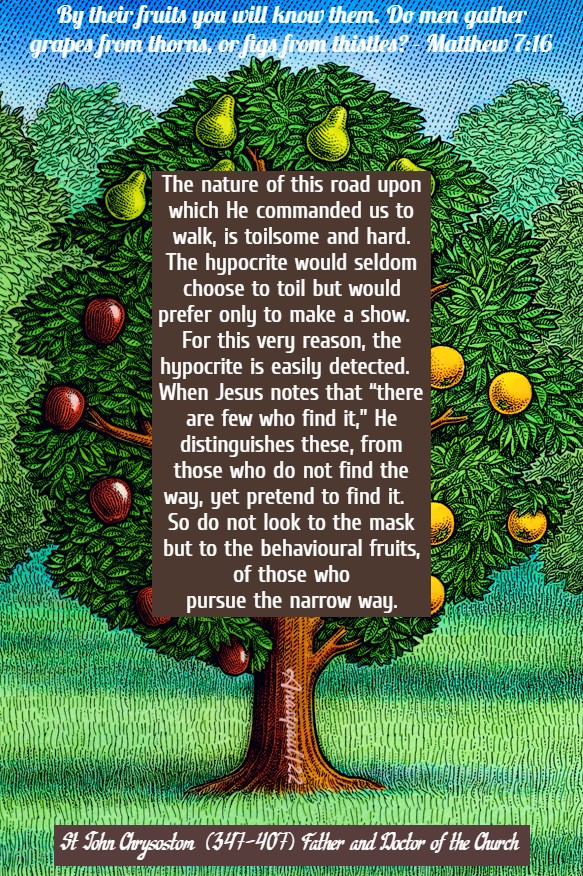
“By their fruits you will know them. Do men gather grapes from thorns, or figs from thistles?”- Matthew 7:16
REFLECTION – ““It does not seem to me that “false prophets” here refers to the heretics but rather to persons who live morally corrupt lives, while wearing a mask of virtue. They are usually called ‘frauds’ by most people. For this reason, Jesus continued by saying, “By their fruits you will know them.” For it is possible to find some virtuous persons, living among heretics. But among the corrupted of whom I speak, it is in not possible. “So what difference does it make,” Jesus says in effect, “if even among these false prophets some do put on a hypocritical show of virtue? Certainly, they will soon be detected.”
The nature of this road upon which He commanded us to walk, is toilsome and hard. The hypocrite would seldom choose to toil but would prefer only to make a show. For this very reason, the hypocrite is easily detected. When Jesus notes that “there are few who find it,” He distinguishes these, from those who do not find the way, yet pretend to find it. So do not look to the mask but to the behavioural fruits, of those who pursue the narrow way.” – St John Chrysostom (347-407) Archbishop of Constantinople, Father and Doctor of the Church (The Gospel of Matthew Homily 23).
PRAYER – O God, Who among the other miracles of Thy power have bestowed the victory of martyrdom even upon the weaker sex, graciously grant that we, who commemorate the anniversary of the death of blessed Christina, Your Virgin and Martyr, may come to Thee by the path of her example.Through Jesus Christ, Thy Son our Lord, Who lives and reigns with Thee, in the unity of the Holy Ghost, God, world without end. Amen (Collect).
























You must be logged in to post a comment.