Posted in CATHOLIC DEVOTIONS of the Month, SAINT of the DAY, The BLESSED VIRGIN MARY

Saint of the Day – 24 May – The Feast of Mary Help of Christians

Saint of the Day – 24 May – The Feast of Mary Help of Christians – Patronages:   Australia (proclaimed on 17 July 1916 by Pope Benedict XV),  New Zealand, Andorran security forces, Australian military chaplains, New York, diocese of Townsville, Australia.

olhc1-2.jpg

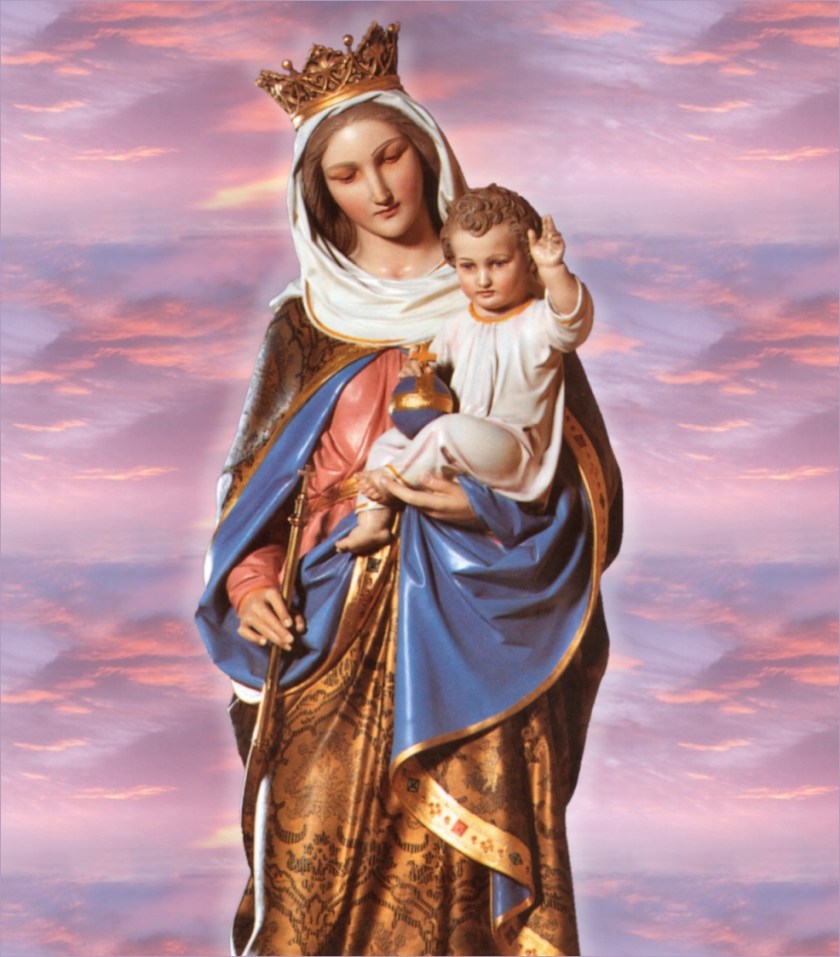
Mary Help of Christians (Latin: Sancta Maria Auxilium Christianorum; Spanish: Nuestra Señora María Auxiliadora; Filipino: Maria, Mapag-ampon sa mga Kristiyano), is a Roman Catholic Marian devotion with a feast day celebrated on May 24.   Saint John Chrysostom was the first person to use this Marian title in year 345 as a devotion to the Virgin Mary. Don Bosco also propagated Marian devotion under this title.   Pope Leo XIII granted a Canonical coronation towards the Marian image bearing the same title on 17 May 1903, now presently enshrined within the Basilica of Mary Help of Christians.   Pope Benedict XVI during his Regina Caeli papal address on 24 May 2009 invoked this Marian patronage, under the venerated title of Our Mother of Sheshan, calling for Chinese Catholics to renew their fidelity to the Pope as the sole successor of Saint Peter.   Below is the image of Mary Help of Christians enshrined in her Turin basilica, where Pope Leo XIII granted a Canonical coronation on 17 May 1903 and the Basilica of Our Lady Help of Christians, Turin, founded by St. John Bosco


As Mother of God’s children, Mary has responded by helping Christians throughout the ages. She has done this by coming to the aid of individuals, families, towns, kingdoms and nations.

In 1214 she gave the Rosary to Saint Dominic as a weapon to combat the Albigesian heresy which was devastating Southern France. It is very clear to Christians and it is also the Will of God that we have and will continue to have the Help of Mary through the recitation of the Holy Rosary.

In the year 1531 Our Lady appeared in Mexico to an indian named Juan Diego. He was a humble peasant aged 51. As a result of the apparitions, over 10 million indians were converted to Catholicism, the sacrificial killings of babies stopped, and Our Lady left an image which is a reflection of herself imprinted miraculously on the tilma of Juan Diego.

In 1571 the whole of Christendom was saved by Mary Help of Christians when faithful Catholics throughout Europe prayed the Rosary. The great battle of Lepanto occurred on October 7th 1571. For this reason this date has been chosen as the feast of the Holy Rosary. In 1573 Pope Pius V instituted the feast in thanksgiving for the decisive victory of Christianity over Islamism.

Near the end of the 17th century, Emperor Leopold I of Austria took refuge in the Shrine of Mary Help of Christians at Pasau, when 200,000 Ottoman Turks besieged the capital city of Vienna. Pope Innocent XI united Christendom against the ominous attack of Mohammedanism. A great victory occurred thanks to Mary Help of Christians. On September 8th, Feast of Our Lady’s Birthday, plans were drawn for the battle. On September 12, Feast of the Holy Name of Mary, Vienna was finally freed through the intercession of Mary Help of Christians. All Europe had joined with the Emperor crying out “Mary, Help!” and praying the Holy rosary.

In 1809, Napoleon’s men entered the Vatican, arrested Pius VII and brought him in chains to Grenoble, and eventually Fontainbleau. His imprisonment lasted five years. The Pope smuggled out orders from prison for the whole of Christendom to pray to Our Lady Help of Christians, and thus the whole of Europe once again became a spiritual battle ground, not of arms against ruthless arms but of Rosaries against ruthless military might. Soon Napoleon was off the throne and the Pope freed from prison.

After proving her maternal help, throughout the centuries, Our Lady has continued to appear in hundreds of places throughout the world mainly during the 20th century, Lourdes and Fatima being the most famous apparitions. She has brought help from Heaven, and has warned her children to do prayer and penance as a formula for peace. She has stressed that her children must pray the Holy Rosary daily.


Posted in SAINT of the DAY, The BLESSED VIRGIN MARY

Saints – 24 May

Our Lady, Help of Christians
Our Lady of China
Our Lady of Quercioli

St Afra of Brescia
Bl Benedict of Cassino
St David of Scotland
Bl Diego Alonso
St Donatian of Nantes
St Gennadius of Astroga
St Hubert of Bretigny
Bl Isidore Ngei Ko Lat
St Joanna the Myrrhbearer
Bl John del Prado
Bl John of Montfort
Bl Juan of Huete
Bl Louis-Zéphirin Moreau
St Manahen
St Marciana of Galatia
Bl Mario Vergara
St Meletius the Soldier
Bl Nicetas of Pereslav
St Palladia
St Patrick of Bayeux
Bl Philip of Piacenza
St Rogatian of Nantes
St Sérvulo of Trieste
St Simeon Stylites the Younger
St Susanna
Bl Thomas Vasière
St Vincent of Lérins
St Vincent of Porto Romano

Martyrs of Istria: A group of early martyrs in the Istria peninsula. We know little more than some names – Diocles, Felix, Servilius, Silvanus and Zoëllus.

Martyrs of Plovdiv: 38 Christians martyred together in the persecutions of Diocletian and Maximian. We don’t even known their names. They were beheaded in Plovdiv, Bulgaria.

Martyrs of the Small West Gate: Additional Memorial – 20 September as part of the Martyrs of Korea. A group of lay catechists and catechumens who were imprisoned and executed together for the crime of being Christian.
• Saint Agatha Kim A-Gi
• Saint Agatha Yi So-Sa
• Saint Anna Pak A-Gi
• Saint Augustine Yi Kwang-Hon
• Saint Barbara Han A-Gi
• Saint Damianus Nam Myong-Hyok
• Saint Lucia Pak Hui-Sun
• Saint Magdalena Kim Ob-I
• Saint Petrus Kwon Tug-In
They were beheaded on 24 May 1839 at the Small West Gate, Seoul, South Korea and were Canonised on 6 May 1984 by Pope John Paul II.

Posted in NOVENAS

Announcing a Novena to the Uganda Martyrs also known as St Charles Lwanga and Companions – beginning 25 May

Announcing a Novena to the Ugandan Martyrs also known as St Charles Lwanga and Companions – beginning 25 May

The Uganda Martyrs are a group of 23 Anglican and 22 Catholic converts to Christianity in the historical kingdom of Buganda, now part of Uganda, who were executed between 31 January 1885 and 27 January 1887.

They were killed on orders of Mwanga II, the Kabaka (King) of Buganda.   The deaths took place at a time when there was a three-way religious struggle for political influence at the Buganda royal court.   The episode also occurred against the backdrop of the “Scramble for Africa” – the invasion, occupation, division, colonisation and annexation of African territory by European powers.   The Catholic Church beatified the martyrs of its faith in 1920 and canonised them in 1964.

announcing-a-novena-uganda-martyrs-23 may 2017

Posted in MORNING Prayers, SAINT of the DAY, Uncategorized

Thought for the Day – 23 May

Thought for the Day – 23 May

St John Baptist de Rossi not only gave his life totally to the care of all the needy – whatever their need might be!
Sick, homeless, poor and needy – by day he devoted himself to the sick and poor in Rome’s hospitals, by night he ministered to those on the street and in shelters.   But he didn’t stop there – he alleviated their bodily sorrows firstly and then he cared for their souls and he exhorted fellow priests to follow his example and to care for all – both body and soul.
Many of us shrink from going to the hospitals from fear of infection or from the sights and smells that await us there.
Courage! We are not in the world to follow our own will and pleasure but to imitate the Lord.

St John Baptist de Rossi, pray for us!

st john baptist de rossi - pray for us


Posted in DOCTORS of the Church, MORNING Prayers, QUOTES of the SAINTS

Quote of the Day – 23 May

Quote of the Day – 23 May

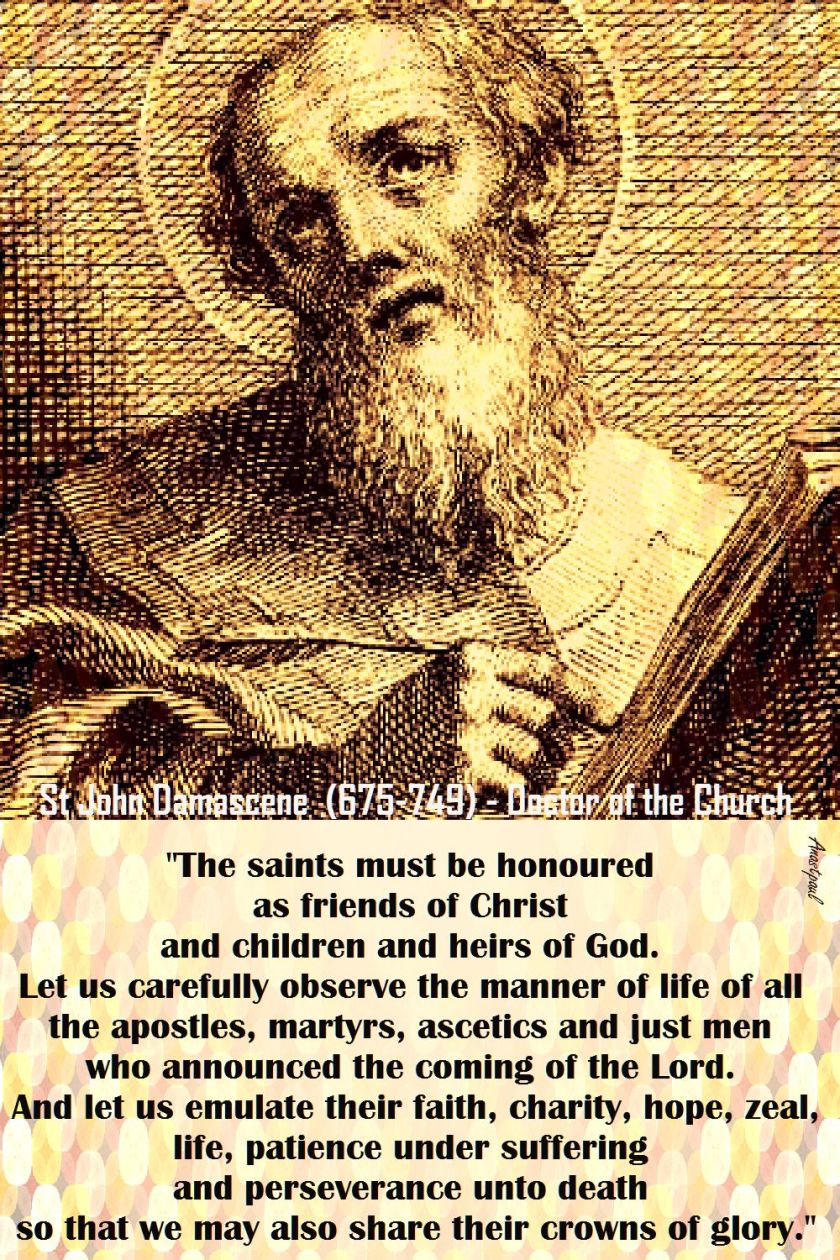
“The saints must be honoured as friends of Christ
and children and heirs of God.
Let us carefully observe the manner of life of all
the apostles, martyrs, ascetics and just men
who announced the coming of the Lord.
And let us emulate their faith, charity, hope, zeal,
life, patience under suffering and perseverance unto death
so that we may also share their crowns of glory.”

St John Damascene (675-749) – Doctor of the Church

the saints must be honoured-st john damascene doctor of the church (675-749)

Posted in MORNING Prayers, QUOTES of the SAINTS, SAINT of the DAY, The WORD

One Minute Reflection – 23 May

One Minute Reflection – 23 May

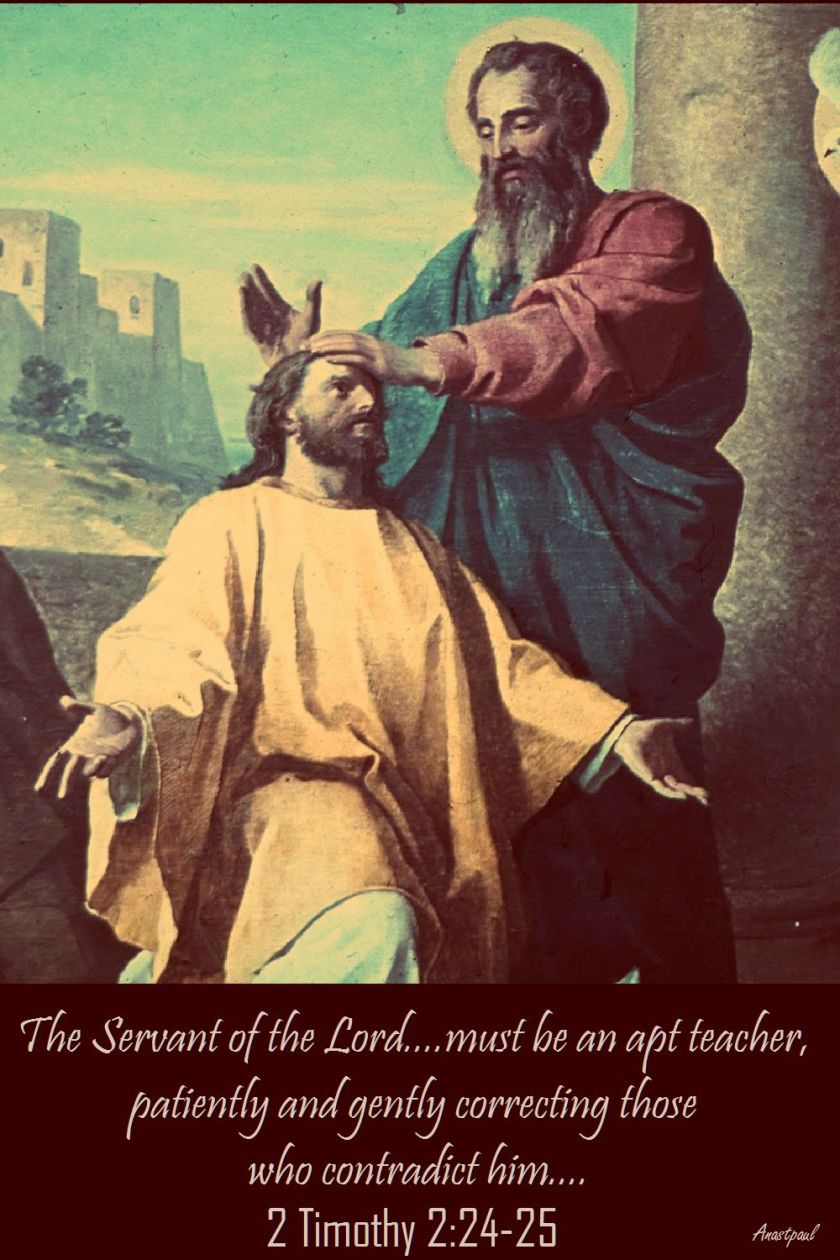
The Servant of the Lord….must be an apt teacher, patiently and gently correcting those who contradict him…..2 Tm 2:24-25

2 TIMOTHY 2 24-25

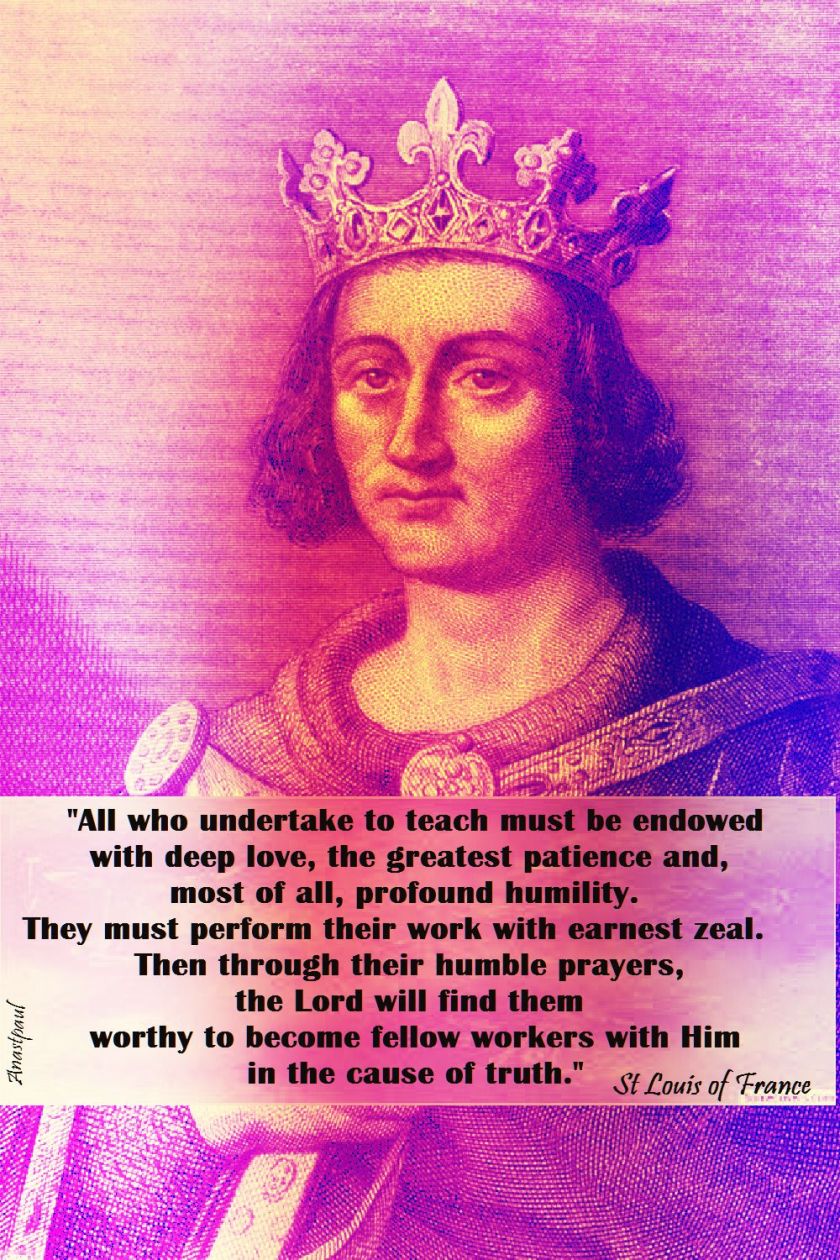
REFLECTION – “All who undertake to teach must be endowed with deep love, the greatest patience and, most of all, profound humility.   They must perform their work with earnest zeal.   Then through their humble prayers, the Lord will find them worthy to become fellow workers with Him in the cause of truth.”………….St Louis

all who undertake to teach-st louis of france

PRAYER – Dear Lord, help me to teach others about You by my example as well as my words.   Grant that I may spread Your love and Your truth and Your light wherever I go. St John Baptist de Rossi, you always showed the way by your example, your love for the poor and helpless and by your teachings to seminarians, priests and all the people, please pray for us, amen,

st john baptist de rossi - pray for us.jpg 2

Posted in CATHOLIC DEVOTIONS of the Month, DOCTORS of the Church, MORNING Prayers, PRAYERS of the SAINTS, The BLESSED VIRGIN MARY

Our Morning Offering – 23 May

Our Morning Offering – 23 May

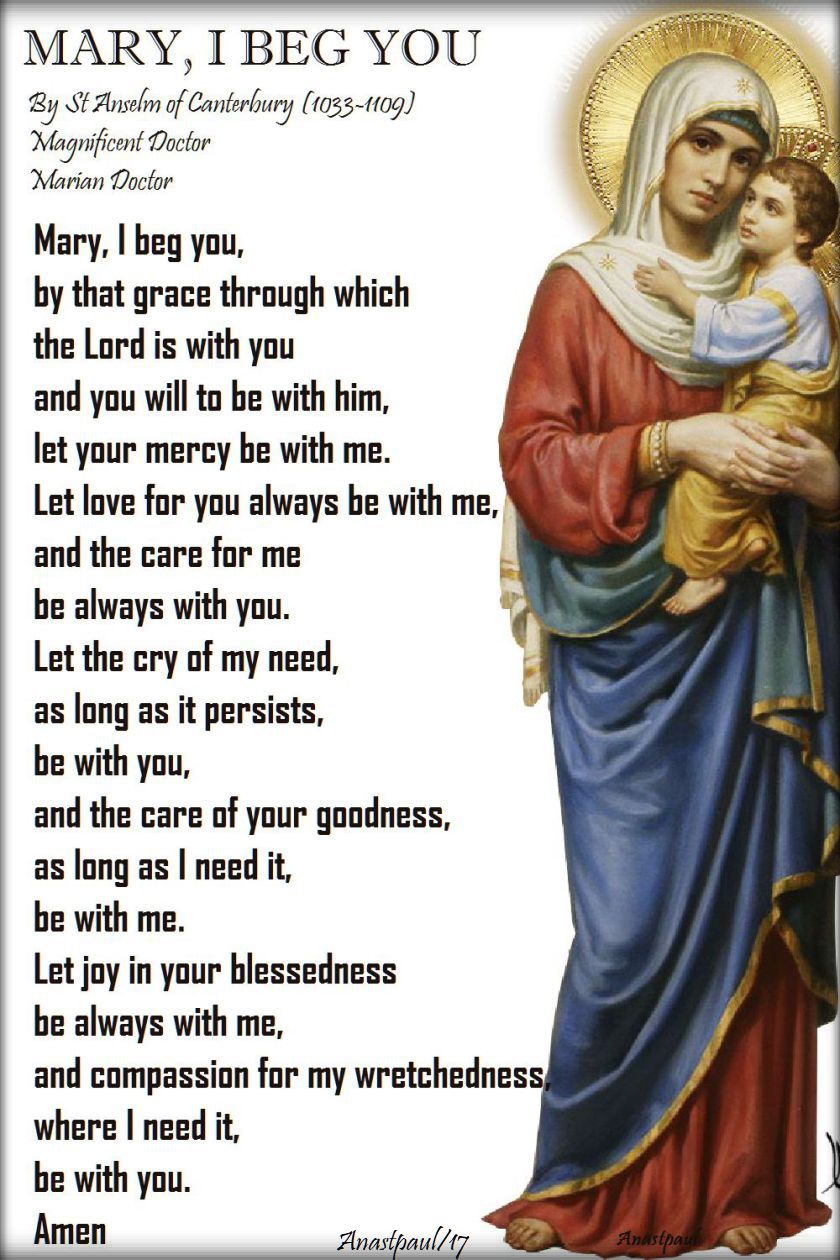
MARY, I BEG YOU
By St Anselm of Canterbury (1033-1109)
Magnificent Doctor
Marian Doctor

Mary, I beg you,
by that grace through which
the Lord is with you
and you will to be with him,
let your mercy be with me.
Let love for you always be with me,
and the care for me be always with you.
Let the cry of my need,
as long as it persists,
be with you,
and the care of your goodness,
as long as I need it,
be with me.
Let joy in your blessedness
be always with me,
and compassion for my wretchedness,
where I need it,
be with you.
Amenmary-i-beg-you-st-anselm-23 may 2017

Posted in SAINT of the DAY

Saint of the Day – 23 May – St John Baptist de Rossi

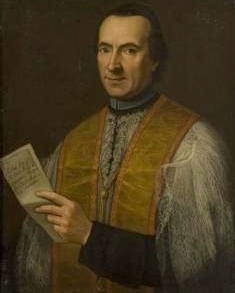
Saint of the Day – 23 May – St John Baptist de Rossi born Giovanni Battista de’ Rossi (22 February 1698 at Voltaggio, diocese of Genoa, Italy –  23 May 1764 at Trinita dei Pellegrini, Italy of multiple strokes) Priest, Preacher and Teacher and apostle of Charity.

St John Baptist was born at the beginning of 1698 in Voltaggio as the last of four children to Carlo de’ Rossi and Francesca Anfosi who were poor but pious.   His initial education was under the care of the two priests Scipio Gaetano and Giuseppe Repetto who noted his potential and brilliance and held him as their favorite student.   In 1708 he met a noble couple (Giovanni Scorza and Maria Battina Cambiasi) from Genoa after a Mass who took him in as a page after noting his potential – after his father approved – and he went to school there until 1711.  His father’s sudden death in 1710 saw his mother plead with him to return home but Rossi was firm in his resolve to continue with his studies; his sole brother (older than him) died not long after their father.   Rossi met two Capuchin friars at the Scorza residence one evening (he had begged to meet them) who thought well of him and offered to help him continue his studies.   He had known the friars – or of them – for an uncle was one of them as he mentioned to them.  ] At the suggestion of his cousin Lorenzo de’ Rossi – the canon of Santa Maria in Cosmedin – he travelled to Rome in 1711 in order to commence his studies at the Collegium Romanum under the guidance of the Jesuits (he first had to receive his mother’s permission).   Rossi also studied at the Dominican College of Saint Thomas (underwent his philosophical and theological studies under them).   It was around this time that he joined the “Ristretto of the Twelve Apostles”.   On one occasion he attended Mass but fainted and was found to have had suffered an epileptic seizure;  this would be something he would have to grapple with for the remainder of his life and it meant he would not be able to attend classes sometimes due to the tiredness and the pain.

His desire to become a priest was strong but was hampered due to his suffering of epileptic fits which would exclude one from the priesthood in normal circumstances. Nonetheless he was granted a special dispensation on 3 March 1721 and was ordained to the priesthood soon after on 8 March.   He worked in Rome on behalf of homeless women who wandered the streets while being careful to the needs of the sick while helping to found a hospice for homeless women near Saint Galla’s.   He also aided prisoners and workers and became an ultra-popular confessor.  Rossi became known as a second Saint Philip Neri and he was known for a strong and special devotion to Saint Aloysius Gonzaga.

st john baptist de rossi.jpg 3

On a superficial level St. John Baptist de Rossi’s life was uneventful.   A simple priest, for forty years he worked in the capacity of an assistant priest in Rome.   On a spiritual level, however, he touched thousands of needy people—the sick, the homeless, prostitutes, transient cattle drivers who came to market in Rome, and other rough sorts.   By day he devoted himself to the sick poor in Rome’s hospitals.   By night he ministered to street people at a refuge.

Caregivers can look to John Baptist as a model.   Before he would speak to a dying person about salvation, he did all he could to relieve their suffering.   No service for the sick, no matter how repugnant, repulsed him.   And his selflessness won people’s hearts.   Here is an excerpt from one of his sermons to his fellow priests:

“Ignorance is the leprosy of the soul. How many such lepers exist in the church here in Rome, where many people don’t even know what’s necessary for their salvation? It must be our business to try to cure this disease.   The souls of our neighbours are in our hands and yet how many are lost through our fault?   The sick die without being properly prepared because we have not given time or care enough to each particular case.   Yet with a little more patience, a little more perseverance, a little more love, we could have led these poor souls to heaven.”

Once, for example, a young man dying of syphilis rebuffed de Rossi’s attention until the priest emptied his bedpan.   Touched by John Baptist’s humble care, the fellow finally listened to him and made a good confession before he died.   Other priests and penitents were amazed by John Baptist’s persuasiveness in the confessional.   With a few gentle words he turned people’s lives.   Once a young man came to him who was sexually entangled with a woman who kept coming to his house under the pretense of washing and mending his clothes.   A brief conversation with John Baptist broke the youth’s addiction.   As a sign of his cure, the next day he brought the priest a pile of his clothes he had taken from the woman.

John Baptist exhorted others to follow his example in caring for souls and assisted his fellow priests and seminarians by his words and his life, in a homily to them he said:

“The poor come to church tired and distracted by their daily troubles.   If you preach a long sermon they can’t follow you. Give them one idea that they can take home, not half a dozen, or one will drive out the other and they will remember none.”

John Baptist de Rossi, himself worn out by his unselfish service, suffered strokes in 1763 and died a year later.

The cause for canonisation began under Pope Pius VI on 27 June 1781 but suffered brief though significant setbacks due to the French Revolution and the ensuring Napoleonic Wars and Revolutions of 1848.   Rossi was beatified after Pope Pius IX attributed two miracles to his intercession on 7 March 1859 and presided over the celebration in Saint Peter’s Basilica on 13 May 1860.   On 8 December 1881 the acknowledgement of two more miracles in 1881 enabled Pope Leo XIII to canonise him as a saint of the Roman Catholic Church.   His relics initially at Saints Trinita church but were translated to Saint John Baptist Rossi parish church in Rome, Italy in 1965.

st john baptist de rossi

Posted in SAINT of the DAY

Saints – 3 May

Saints – 3 May

St Basileus of Braga
St Desiderius of Langres
St Epitacius of Tuy
St Euphebius of Naples
St Euphrosyne of Polotsk
St Eutychius of Valcastoria
St Florentius of Valcastoria
St Goban Gobhnena
St Guibertus of Gorze
Bl Ivo of Chartres
St Jane Antide Thouret
St John Baptist Rossi
Bl Józef Kurzawa
Bl Leontius of Rostov
St Michael of Synnada
St Onorato of Subiaco
St Spes of Campi
St Syagrius of Nice
St William of Rochester
Bl Wincenty Matuszewski

Martyrs of Béziers: 20 Mercedarian friars murdered by Huguenots for being Catholic. Martyrs. 1562 at the Mercedarian convent at Béziers, France

Martyrs of Cappadocia: A group of Christians tortured and martyred in the persecutions of Diocletian and Galerius. Their names and the details of their lives have not come down to us. They were crushed to death in c.303 in Cappadocia (in modern Turkey)

Martyrs of Carthage: When a civil revolt erupted in Carthage in 259 during a period of persecution by Valerian, the procurator Solon blamed it on the Christians, and began a persecution of them. We know the names and a few details about 8 of these martyrs – Donatian, Flavian, Julian, Lucius, Montanus, Primolus, Rhenus and Victorius. They were beheaded in 259 at Carthage (modern Tunis, Tunisia)

Martyrs of Mesopotamia: A group of Christians martyred in Mesopotamia in persecutions by imperial Roman authorities. Their names and the details of their lives have not come down to us. They were suffocated over a slow fire in Mesopotamia

Martyrs of North Africa: A group of 19 Christians martyred together in the persecutions of the Arian Vandal King Hunneric for refusing to deny the Trinity. We know little more than a few of their names – Dionysius, Julian, Lucius, Paul and Quintian. c.430

Posted in MORNING Prayers, SAINT of the DAY

Thought for the Day – 22 May

Thought for the Day – 22 May

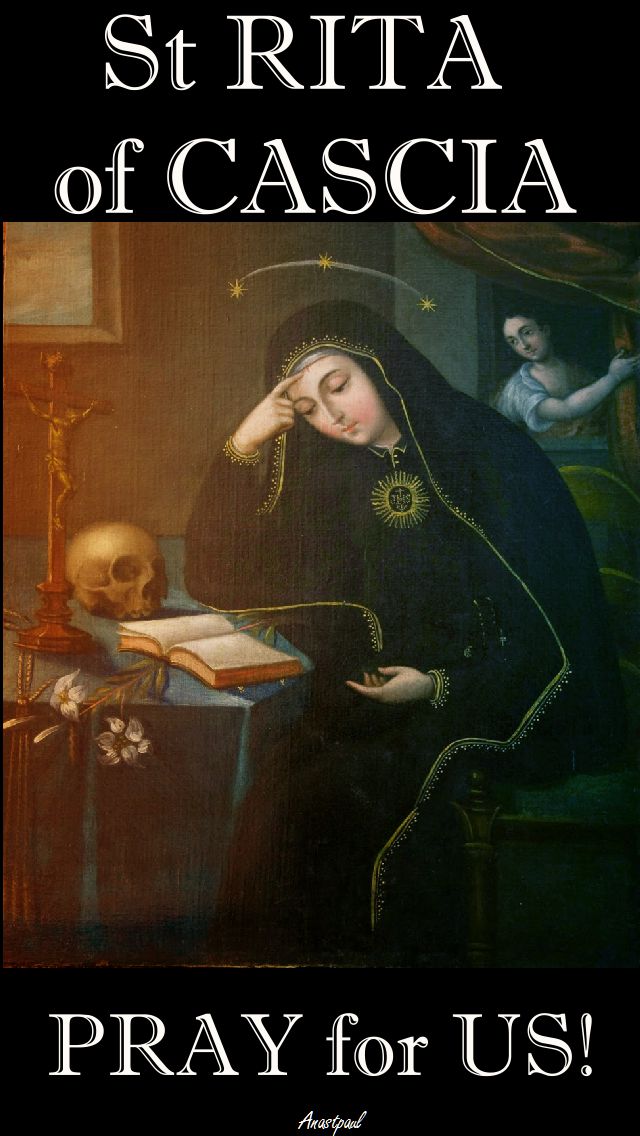
At every stage of her life, Rita seems to have bravely endured unendurable circumstances:  frustration because her parents overrode her wish to become a nun; married an abuser;  refused three times by the Augustinians; afflicted with the pain and embarrassment of the stigmata.   None of these things, however, prevented her from serving God and her sisters.   We can pray for her intercession in our desperate need, but we should also imitate her love in action.

St Rita of Cascia – pray for us!

PRAYER TO ST RITA

st rita pray for us.jpg 2

ST RITA OF CASCIA - MAY 22

Posted in DOCTORS of the Church, FATHERS of the Church, MORNING Prayers

Quote of the Day – 22 May

Quote of the Day – 22 May

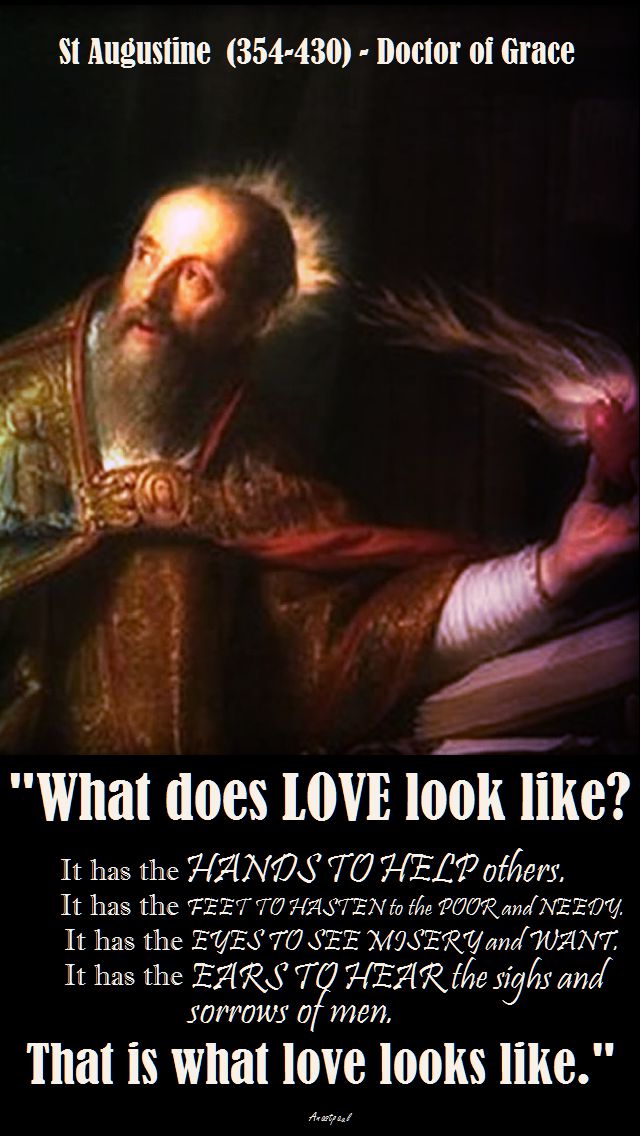
“What does love look like? It has the hands to help others. It has the feet to hasten to the poor and needy. It has eyes to see misery and want. It has the ears to hear the sighs and sorrows of men. That is what love looks like.”

St Augustine  (354-430) – Doctor of Grace

WHAT DOES LOVE LOOK LIKE - ST AUGUSTINE NO 2

Posted in DOCTORS of the Church, FATHERS of the Church, MORNING Prayers, QUOTES of the SAINTS, SAINT of the DAY, The WORD

One Minute Reflection – 22 May

One Minute Reflection – 22 May

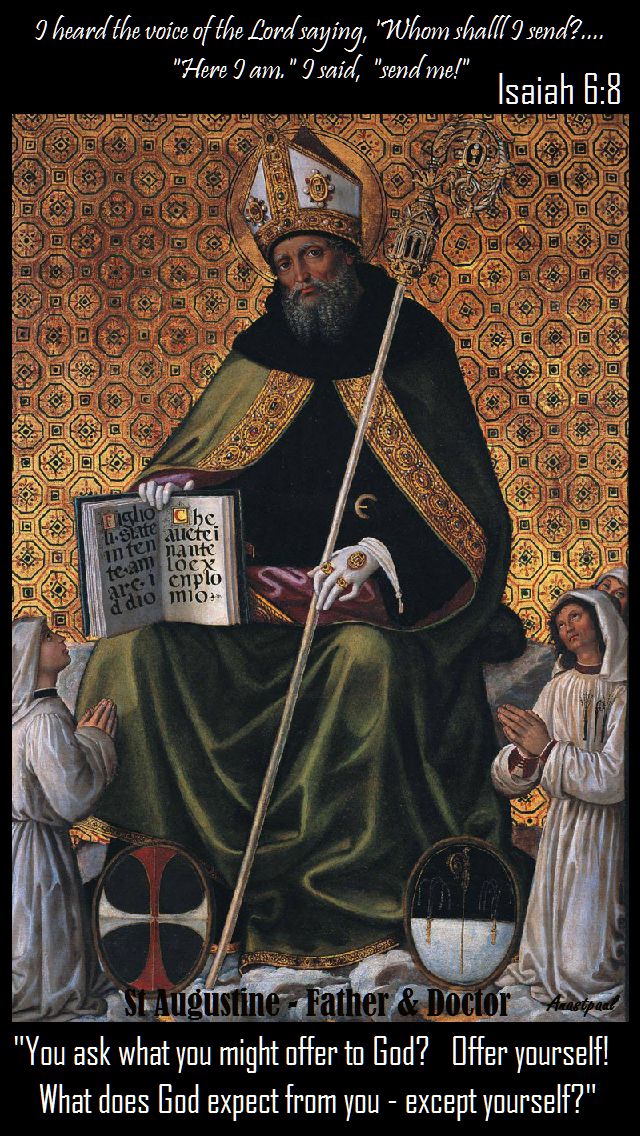
I heard the voice of the Lord saying, ‘Whom shalll I send?….”Here I am.” I said, “send me!”……………Isaiah 6:8

REFLECTION – “You ask what you might offer to God?
Offer yourself!
What does God expect from you – except yourself?”

you ask what you might offer to god - st augustine

PRAYER – Help me to discern through prayer and meditation what You truly want of me.
The enable me to offer it to You and indeed, to offer myself and all I have and all I am, to You.
St Rita of Cascia, you prayed so earnestly to give yourself totally to the Lord and suffer for Him, please pray for us, amen.

st rita pray for us

Posted in CATHOLIC DEVOTIONS of the Month, DOCTORS of the Church, franciscan OFM, MORNING Prayers, The BLESSED VIRGIN MARY

Our Morning Offering – 22 May

Our Morning Offering – 22 May

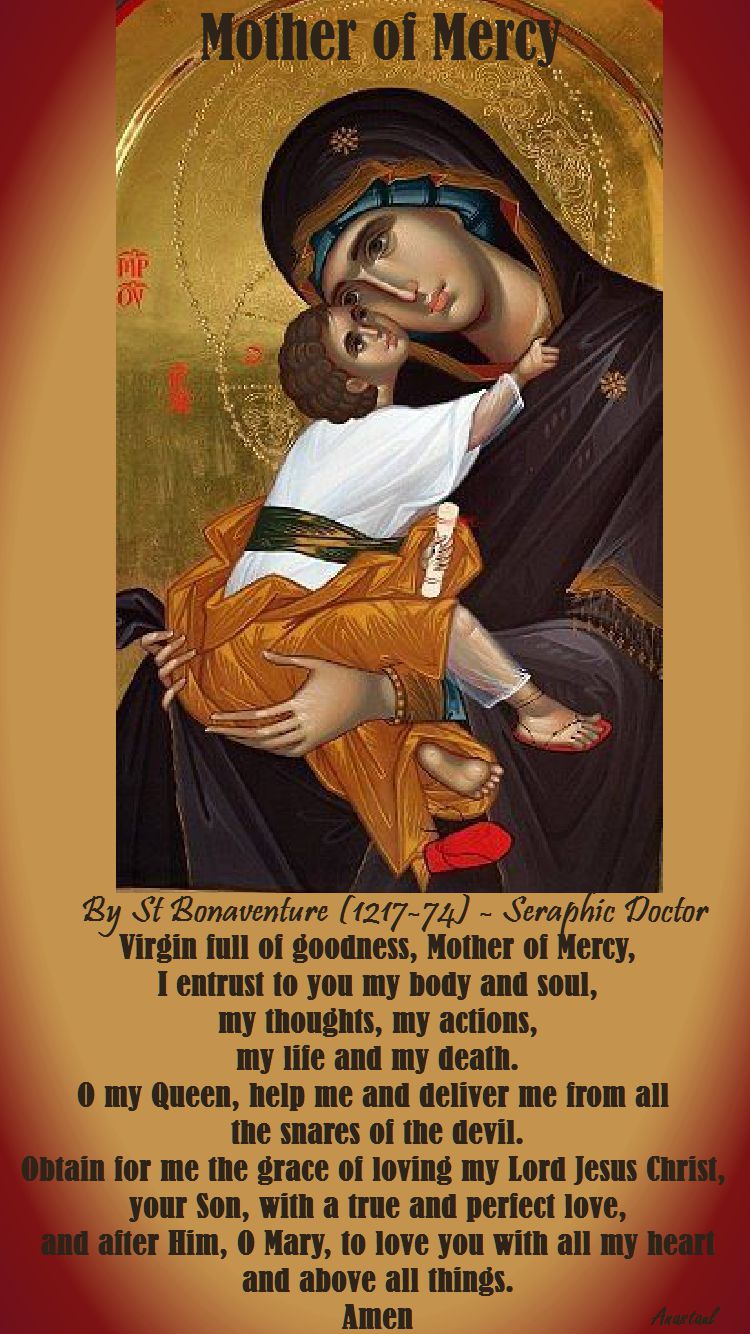
Mother of Mercy
By St Bonaventure (1217-74)
Seraphic Doctor

Virgin full of goodness,
Mother of Mercy,
I entrust to you my body and soul,
my thoughts, my actions,
my life and my death.
O my Queen, help me,
and deliver me from all
the snares of the devil.
Obtain for me the grace
of loving my Lord Jesus Christ,
your Son, with a true and perfect love,
and after Him, O Mary,
to love you with all my heart
and above all things.
Amen

virgin full of goodness-st bonaventure

Posted in INCORRUPTIBLES, MYSTICS, Of the SICK, the INFIRM, All ILLNESS, PATRONAGE - IMPOSSIBLE CAUSES, PATRONAGE - SPOUSAL ABUSE / DIFFICULT MARRIAGES / VICTIMS OF ABUSE, PATRONAGE-INFERTILITY & SAFE CHILDBIRTH, SAINT of the DAY, WIDOWS and WIDOWERS

Saint of the Day – 22 May – St Rita of Cascia – Patron of Impossible Causes, Abused Wives and Widows

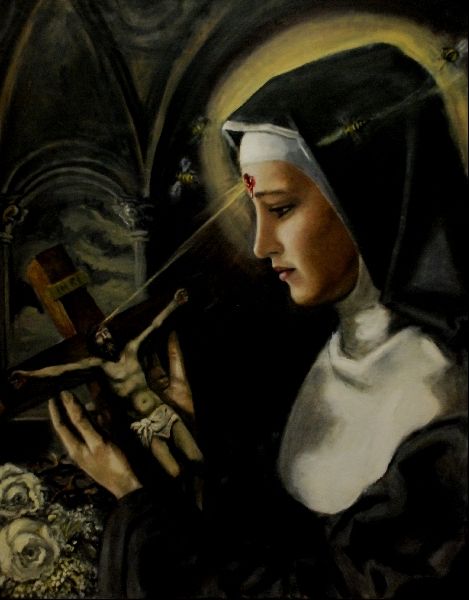
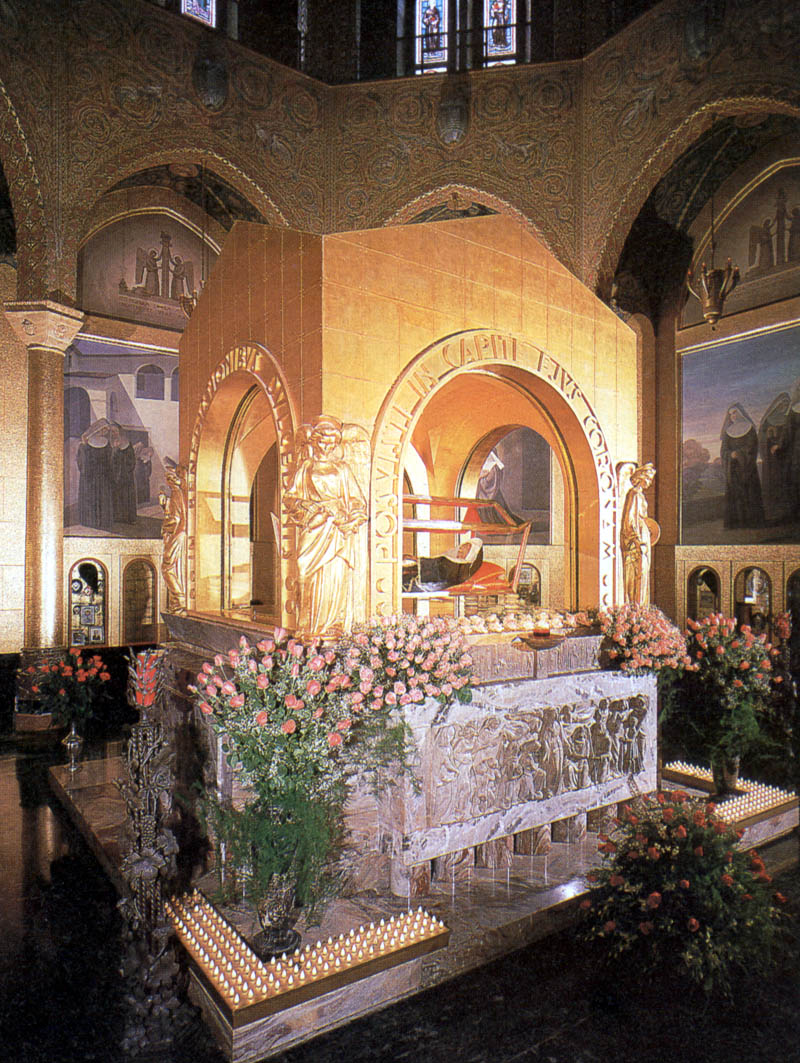
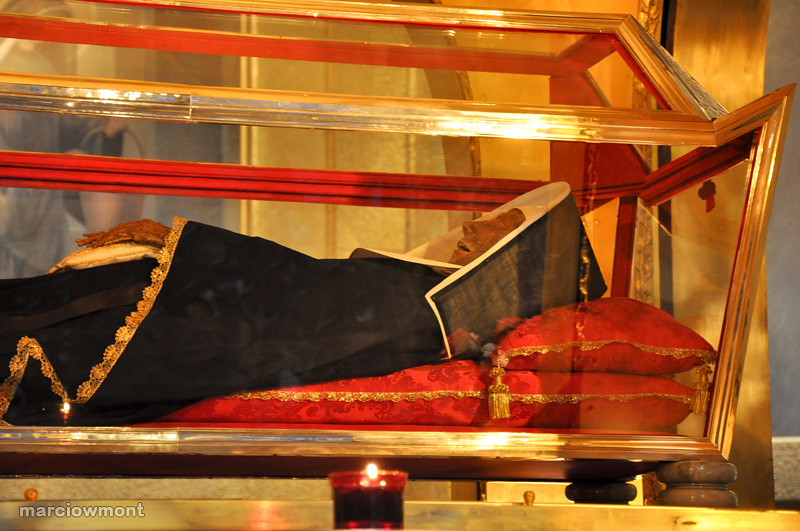
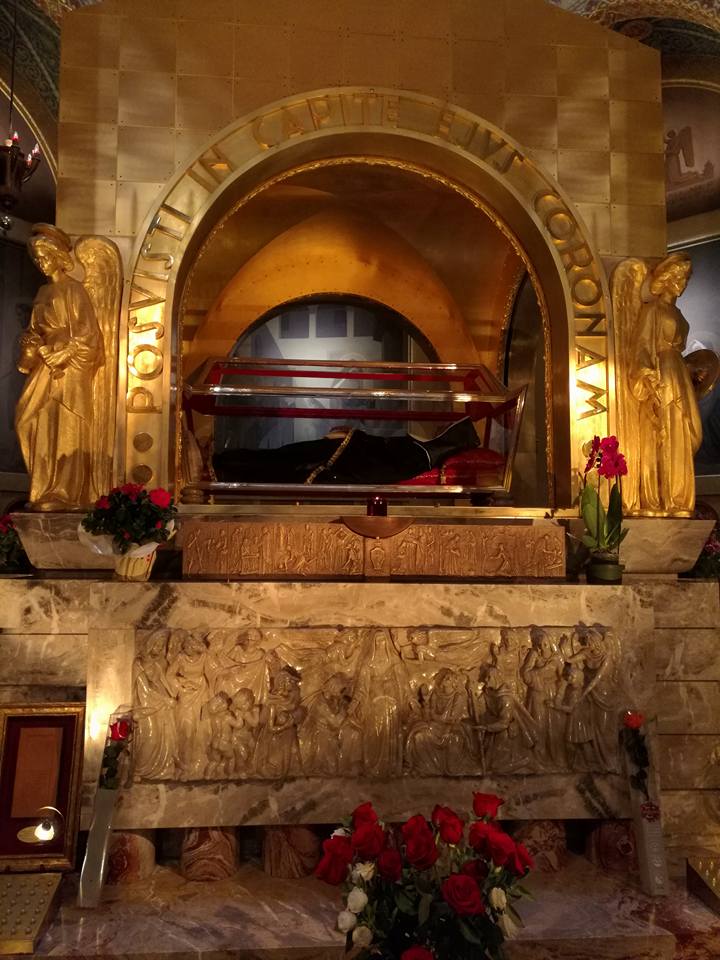
Saint of the Day – 22 May – St Rita of Cascia – (born Margherita Lotti) IN  1386 at Roccaparena, Umbria, Italy and died on  22 May 1457 at the Augustinian Convent at Cascia, Italy of tuberculosis)- Mother, Widow, Stigmatist, Consecrated Religious, Mystic, – Patron of Lost and impossible causes, sickness, wounds, marital problems, abuse, mothers,  against infertility or sterility, infertile people, against loneliness, against sickness or bodily ill, sick people, wounds, wounded people, desperate people, forgotten people,  difficult marriages, parenthood, Cascia, Italy, Dalayap, Philippines, Igbaras, Iloilo, Philippines.   Attributes –  nun holding a crown of thorns, holding roses, holding roses and figs, with a wound on her forehead.  Her Body is Incorrupt and lies in the Basilica of Cascia.   Pope Leo XIII canonised Rita on 24 May 1900.

RITA 5

Blessed by God,
you were a light in darkness
through your steadfast courage
when you had to suffer such agony
upon your cross. You turned aside from this vale of tears
to seek wholeness for your hidden wounds
in the great passion of Christ. . . .
You were not content with less than perfect healing,
and so endured the thorn for fifteen years
before you entered into the joy
of your Lord.st rita of cascia incorrupt body

This poem was engraved on the casket of St Rita of Cascia and is one of the few contemporary sources that tell us about her.   St Rita received her “hidden wounds” in an unfortunate marriage.   She was born in 1381 in the city of Roccaporena (near Spoleto, Umbria, Italy) where various sites connected with her are the focus of pilgrimages.   Her parents, Antonio and Amata Ferri Lotti, were known to be noble, charitable persons, who gained the epithet Conciliatore di Cristo “Peacemakers of Christ.”   She was married at age twelve to a nobleman named Paolo Mancini.   Her parents arranged her marriage, a common practice at the time, despite her repeated requests to be allowed to enter a convent of religious sisters.   Her husband, Paolo Mancini, was known to be a rich, quick-tempered, immoral man, who had many enemies in the region of Cascia.   Rita had her first child at the age of twelve.  For eighteen years she endured the abuses and infidelities of a violent husband.   She also suffered the unruly behaviour of two sons who were strongly influenced by their father.   She was delivered from these miserable circumstances in a horrific way –  one day her husband was brought home dead, brutally slashed by his enemies.   Her rambunctious sons planned to get revenge but died before they could obtain it.

Rita was then free to pursue her lifelong dream of becoming a nun.   She applied to enter the Augustinian convent at Cascia of Italy, in 1407.   But her suffering was not over.   Even though orders customarily received widows, the Augustinians three times refused Rita because she had been married.   Only after six years did they acquiesce and install her as a nun.

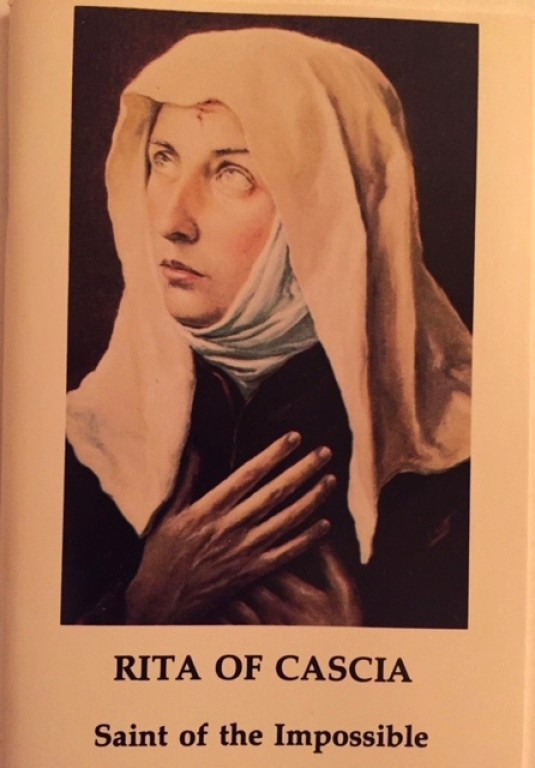
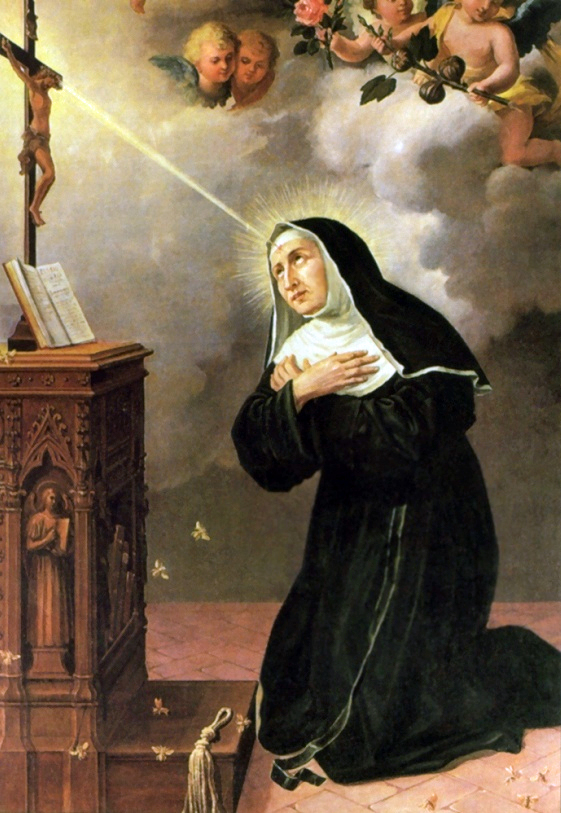
The poem said Rita “sought wholeness” in the passion of Christ.   In her meditations she preoccupied her imagination with his agony.   On Good Friday, 1441, she prostrated herself before a Crucifix and begged Christ for some small share of his suffering.   As though punctured by a crown of thorns, a single wound opened on Rita’s forehead.   For fifteen years it caused her daily pain and embarrassed her, as its putrid odour frequently offended her sisters.   In 1450, when she was preparing to visit Rome for the jubilee year, the wound temporarily healed.   But it reappeared when she returned to Cascia and remained until her death.st rita of cascia saint of the mpossible

Rita died of tuberculosis on 22 May 1457.   Three days later, Domenico Angeli, a notary of Cascia, recorded eleven miracles that occurred upon the saint’s death.   He left us this brief profile of her religious life:

“A very honourable nun, Lady Rita, having spent forty years as a nun in the cloister of the Church of Saint Mary Magdalene of Cascia by living with charity in the service of God, followed the destiny of every human being.   God, in whose service she persevered for the aforementioned time—desiring to show all the faithful a model of life, so that as she had lived serving God with love by fasting and prayer, they too, all faithful Christians, would live also—worked many wonderful miracles and through the merits of Saint Rita, especially on 25 May 1457.”

The Miracle of the Rose

It is said that near the end of her life Rita was bedridden at the convent.   While visiting her, a cousin asked if she desired anything from her old home.   Rita responded by asking for a rose from the garden.   It was January and her cousin did not expect to find one due to the season.   However, when her relative went to the house, a single blooming rose was found in the garden and her cousin brought it back to Rita at the convent.   St Rita is often depicted holding roses or with roses nearby.   On her feast day churches and shrines of St Rita provide roses to the congregation that are blessed by the priest during Mass.S.Rita_da_Cascia

The Miracle of the Bees

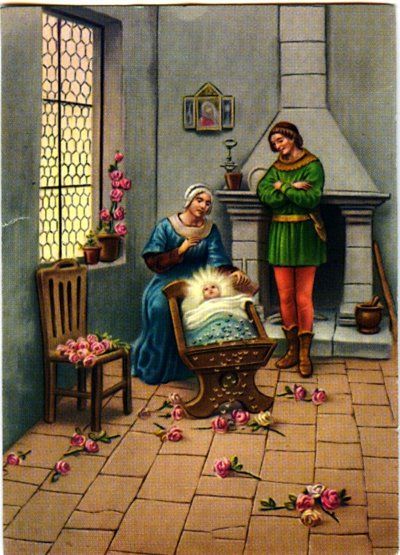
In the Parish Church of Laarne, near Ghent, Belgium, there is a statue of St Rita in which several bees are featured.   This depiction originates from the story of her Baptism as an infant.   On the day after her Baptism, her family noticed a swarm of white bees flying around her as she slept in her crib.   However, the bees peacefully entered and exited her mouth without causing her any harm or injury.   Instead of being alarmed for her safety, her family was mystified by this sight.   According to Butler, this was taken to indicate that the career of the child was to be marked by industry, virtue and devotion.miracles-bees-of-saint-rita-of-cascia

Legacy

A large sanctuary of St Rita was built in the early 20th century in Cascia. The sanctuary and the house where she was born are among the most active pilgrimage sites of Umbria.st rita of cascia incorrupt body 2

st rita shrine

French singer Mireille Mathieu adopted St Rita as her patron saint on the advice of her paternal grandmother.   In her autobiography, Mathieu describes buying a candle for St Rita using her last franc.   Though Mathieu claims that her prayers did not always come true, she testifies that they inspired her to become a strong and determined woman.

Posted in SAINT of the DAY

Saints – 22 May

St Rita of Cascia (Optional Memorial)

St Aigulf of Bourges
St Atto of Pistoia
St Aureliano of Pavia
St Ausonius of Angoulême
St Baoithin of Ennisboyne
St Basiliscus of Pontus
St Bobo of Provence
St Boethian of Pierrepont
St Castus the Martyr
St Conall of Inniscoel
Bl Diego de Baja
Bl Dionisio Senmartin
St Emilius the Martyr
St Faustinus the Martyr
St Francisco Salinas Sánchez
St Fulgencio of Otricoli
Bl Fulk of Castrofurli
Bl Giacomo Soler
Bl Giusto Samper
St Helen of Auxerre
St Humility of Faenza
Bl John Baptist Machado
St John Forest
St John of Parma
St José Quintas Durán
St Julia of Corsica
St Lupo of Limoges
St Marcian of Ravenna
St Margaret of Hulme
Bl Maria Rita Lopes Pontes de Souza Brito
Bl Pedro of the Assumption
St Quiteria
St Romanus of Subiaco
St Timothy the Martyr
St Venustus the Martyr

Franciscan Martyrs of Japan

Posted in MORNING Prayers, QUOTES of the SAINTS, SAINT of the DAY

Thought for the Day – 21 May

Thought for the Day – 21 May

“I have a sensitive and excessive heart”
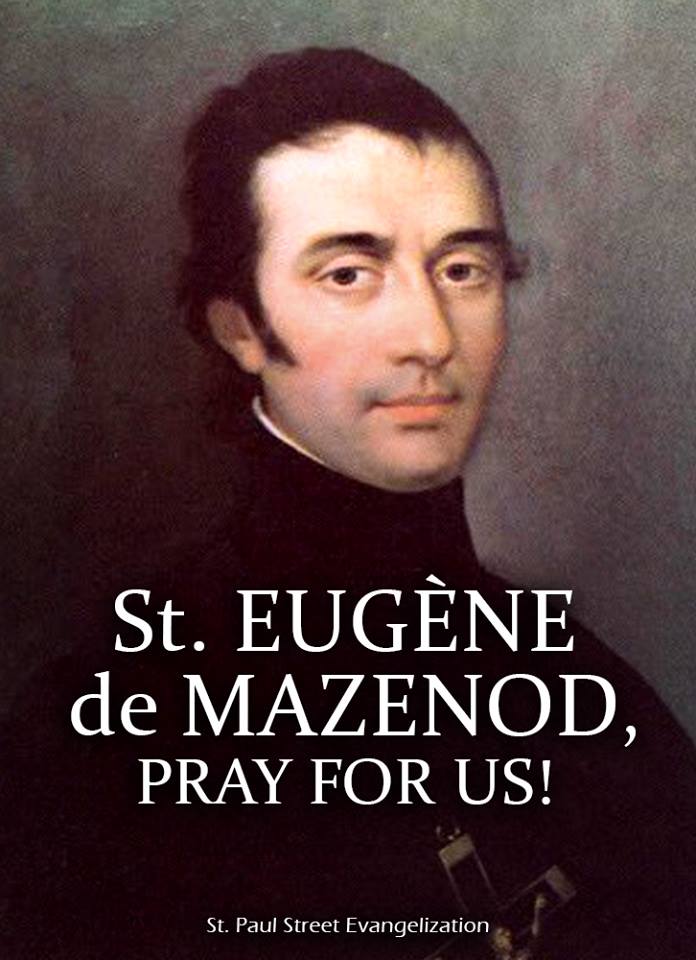
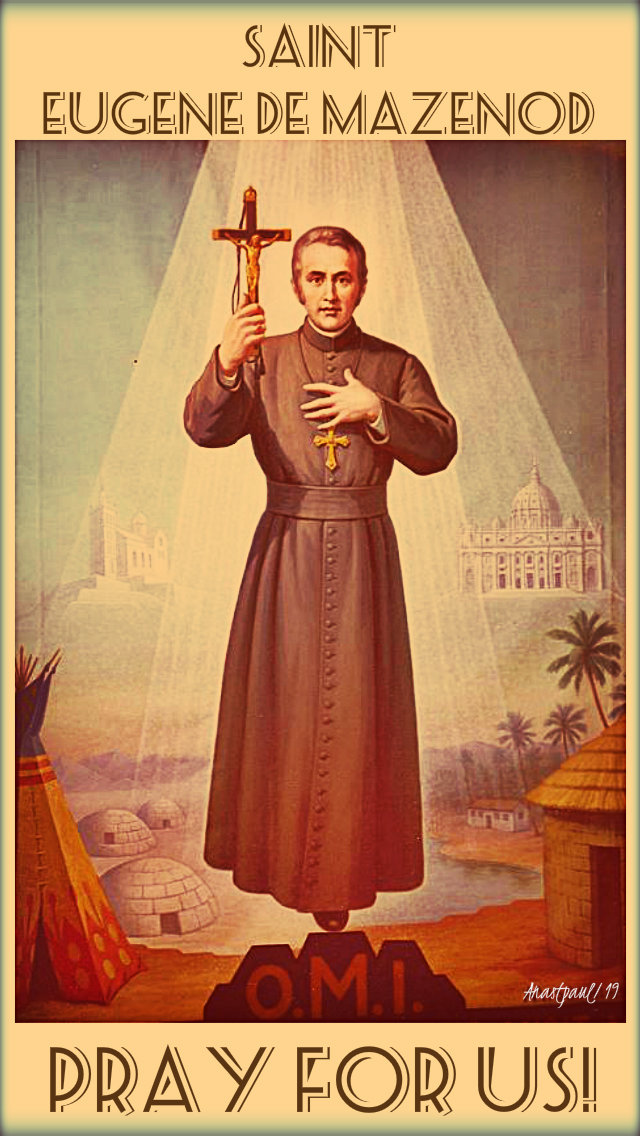
In the personal view that he presented to his spiritual director, on entering the major seminary in 1808, this characteristic was a very good reflection of his personality.   Eugene was a “man of heart”.   He loved passionately, as he himself admitted.   He loved his family. “I am an idolater of my family… I would allow myself to be beaten with an axe for certain of its individuals… I would give my life for them without hesitation” he once wrote.  This tendency of love for his family was equally manifested in behalf of the children of his religious family, the Oblates of Mary Immaculate.   His most ardent desire was to see them love one another as brothers.   This intent was so profound within him that he inscribed it in his spiritual testament.   On his deathbed, May 21, 1861, to a few Oblates by his side awaiting a parting instruction from their venerated father, Bishop de Mazenod repeated three times, as if to be well understood: “Charity, charity, charity”.

This great capacity for love allowed St Eugene to open that loving heart to the grace of God which bore rich fruit in his life.   That required a certain amount of flexibility as well as courage to face the problems every growing group encounters.   We look to saints like Eugene not to borrow their love, courage and zeal but, with God’s grace, to discover our own, always seeking first God’s kingdom (see Matthew 6:33).   And a thought that fills us with hope, our passionate love, may just be the impetus and grace of God which forces us to rush headlong into His work and to convert that love into charity too!

St Eugene Pray for us!

st eugene pray for us 2

ST EUGENE DE MAZENOD - MAY 21

Posted in MORNING Prayers, QUOTES of the SAINTS, SAINT of the DAY

Quote/s of the Day – 21 May

Quote/s of the Day – 21 May

“I had looked for happiness outside of God
but outside of Him I had found only affliction
and disappointment.”

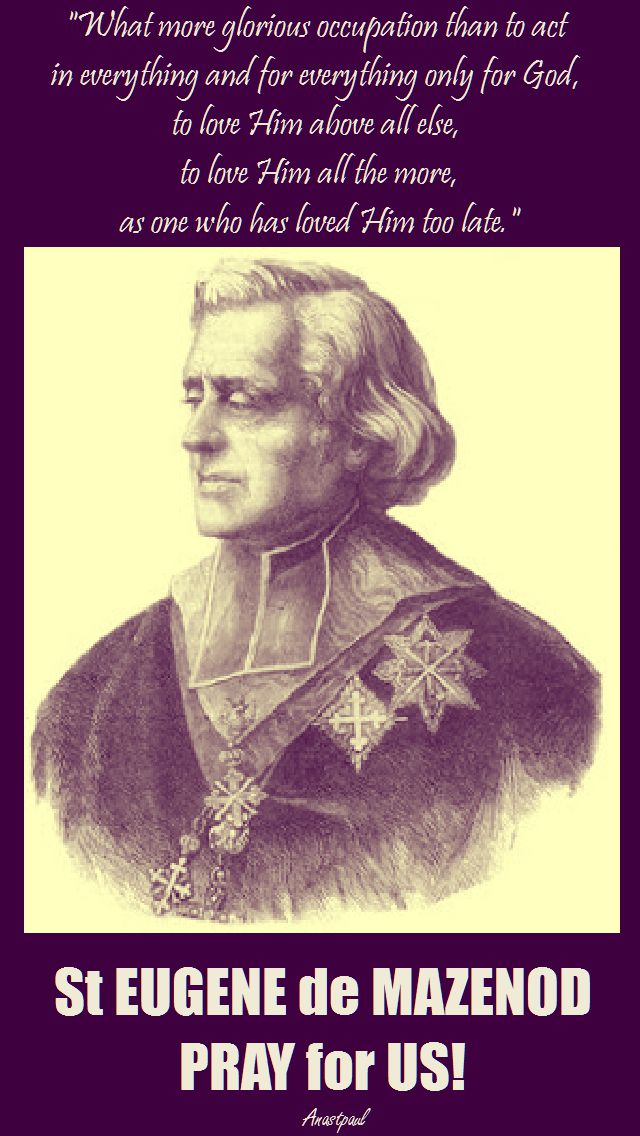
“What more glorious occupation than to act
in everything and for everything only for God,
to love Him above all else,
to love Him all the more,
as one who has loved Him too late.”

what more glorious occupation-st eugene de mazenod

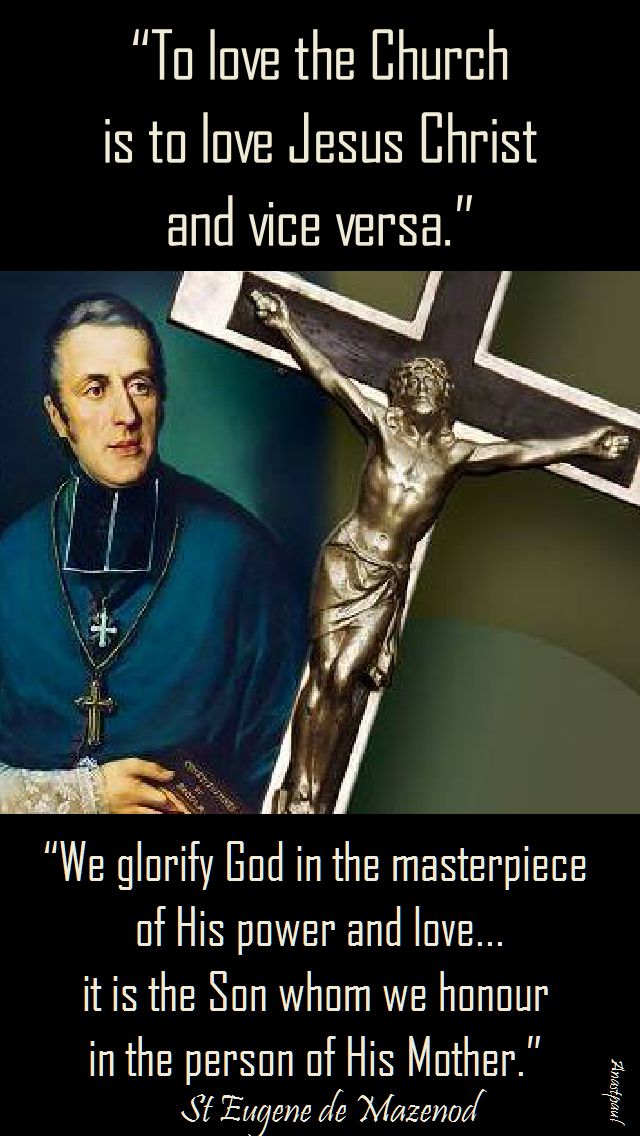
“To love the Church
is to love Jesus Christ
and vice versa.”

“We glorify God in the masterpiece
of His power and love…
it is the Son whom we honour
in the person of His Mother.”

St Eugene de Mazenod – Saint of the Day

to love the church-st eugene de mazenod

Posted in MORNING Prayers, QUOTES of the SAINTS, SAINT of the DAY, The WORD

One Minute Reflection – 21 May – May the Lord make you overflow with love

One Minute Reflection – 21 May – The Memorial of St Eugene de Mazenod (1782-1861)

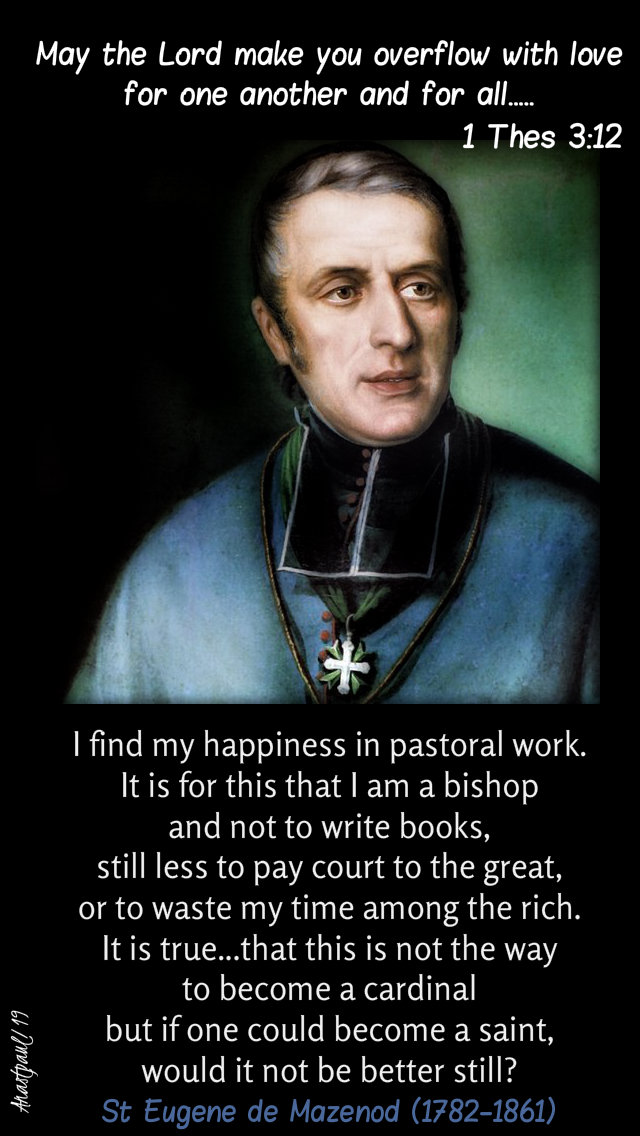
May the Lord make you overflow with love for one another and for all………….1 Thes 3:12

REFLECTION – “I find my happiness in pastoral work.   It is for this that I am a bishop and not to write books, still less to pay court to the great, or to waste my time among the rich.   It is true…that this is not the way to become a cardinal but if one could become a saint, would it not be better still?”…St Eugene de Mazenod (1782-1861)1 thes 3 12 - may the lord make you overflow - i find my happiness in pastoral work - st eugene de mazenod 21 may 2019


PRAYER – Loving Father, grant me the grace to strive after perfect love. Help me to bring forth frequents acts of love so that I may grow in this greatest of virtues. St Eugene you overflowed with love, they said your heart was as big as the world, please pray for us all, amen.st eugene de mazenod pray for us 21 may 2019


Posted in MORNING Prayers, PRAYERS of the SAINTS, The BLESSED VIRGIN MARY

Our Morning Offering – 21 May

Our Morning Offering – 21 May

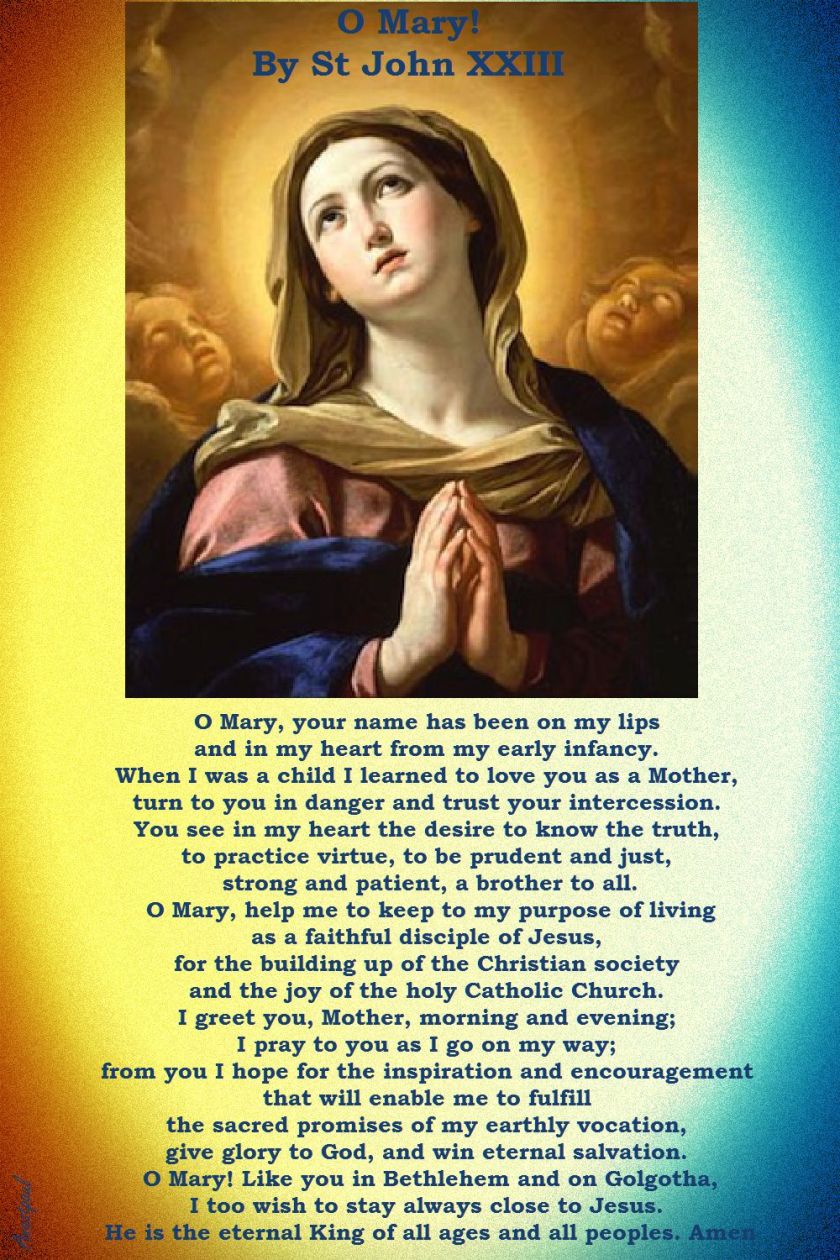
O Mary!
By St John XXIII

O Mary, your name has been on my lips
and in my heart from my early infancy.
When I was a child I learned to love you as a Mother,
turn to you in danger and trust your intercession.
You see in my heart the desire to know the truth,
to practice virtue, to be prudent and just, strong and patient, a brother to all.
O Mary, help me to keep to my purpose of living as a faithful disciple of Jesus,
for the building up of the Christian society and the joy of the holy Catholic Church.
I greet you, Mother, morning and evening;
I pray to you as I go on my way;
from you I hope for the inspiration and encouragement
that will enable me to fulfill the sacred promises of my earthly vocation,
give glory to God, and win eternal salvation.
O Mary! Like you in Bethlehem and on Golgotha,
I too wish to stay always close to Jesus.
He is the eternal King of all ages and all peoples.
Amen

o mary - st john XXIII

Posted in SAINT of the DAY

Saint of the Day – 21 May – St Eugene de Mazenod O.M.I.

Saint of the Day – 21 May – St Eugene de Mazenod O.M.I. (1 August 1782 at Aix-en-Provence, southern France as Charles Joseph Eugene de Mazenod – • 21 May 1861 at Marseille, France of cancer)  • on 12 December 1936, his body was exhumed and found to be intact;  • part of his heart is venerated at Blessed Sacrament Chapel at the Oblate-owned Lourdes Grotto of the Southwest in San Antonio, Texas, USA.  Bishop, Founder of the Congregation of Missionaries Oblates of Mary Immaculate, Missionary, Writer, Preacher, Evangeliser.  Known as a “second Paul”.

CHARLES JOSEPH EUGENE DE MAZENOD came into a world that was destined to change very quickly.   Born in Aix-en-Provence in the south of France on August 1, 1782, he seemed assured of position and wealth from his family, who were of the minor nobility. However, the turmoil of the French Revolution changed all that forever.   When Eugene was just eight years old his family fled France, leaving their possessions behind, and started a long and increasingly difficult eleven year exile.

The Years in Italy

The Mazenod family, political refugees, trailed through a succession of cities in Italy.    His father, who had been President of the Court of Accounts, Aids and Finances in Aix, was forced to try his hand at trade to support his family.   He proved to be a poor businessman and as the years went on the family came close to destitution.   Eugene studied briefly at the College of Nobles in Turin but a move to Venice meant the end to formal schooling.    A sympathetic priest, Don Bartolo Zinelli, living nearby, undertook to educate the young French emigre.    Don Bartolo gave the adolescent Eugene a fundamental education but with a lasting sense of God and a regimen of piety which was to stay with him always, despite the ups and downs of his life.    A further move to Naples, because of financial problems, led to a time of boredom and helplessness.    The family moved again, this time to Palermo where, thanks to the kindness of the Duke and Duchess of Cannizzaro, Eugene had his first taste of noble living and found it very much to his liking.    He took to himself the title of “Count” de Mazenod, did all the courtly things, and dreamed of a bright future.


Return to France: the Priesthood

In 1802, at the age of 20, Eugene was able to return to his homeland – and all his dreams and illusions were quickly shattered.    He was just plain “Citizen” de Mazenod, France was a changed world, his parents had separated, his mother was fighting to get back the family possessions.    She was also intent on marrying off Eugene to the richest possible heiress.    He sank into depression, seeing little real future for himself.    But his natural qualities of concern for others, together with the faith fostered in Venice began to assert themselves.    He was deeply affected by the disastrous situation of the French Church, which had been ridiculed, attacked and decimated by the Revolution.    A calling to the priesthood began to manifest itself and Eugene answered that call.    Despite opposition from his mother, he entered the seminary of St. Sulpice in Paris and on December 21, 1811, he was ordained a priest in Amiens.


Apostolic endeavours: Oblates of Mary Immaculate

Returning to Aix-en-Provence, he did not take up a normal parish appointment but started to exercise his priesthood in the care of the truly spiritually needy-prisoners, youth, servants, country villagers.   Often in the face of opposition from the local clergy, Eugene pursued his course.   Soon he sought out other equally zealous priests who were prepared to step outside the old, even outmoded, structures.   Eugene and his men preached in Provencal, the language of the common people, not in “educated” French. From village to village they went, instructing at the level of the people, spending amazingly long hours in the confessional.   In between these parish missions the group joined in an intense community life of prayer, study and fellowship. T  hey called themselves “Missionaries of Provence”.   However, so that there would be an assured continuity in the work, Eugene took the bold step of going directly to the Pope and asking that his group be recognised officially as a Religious Congregation of pontifical right.   His faith and his persistence paid off-and on February 17d, 1826, Pope Leo XII approved the new Congregation, the “Oblates of Mary Immaculate”.   Eugene was elected Superior General and continued to inspire and guide his men for 35 years, until his death. Together with their growing apostolic endeavours-preaching, youth work, care of shrines, prison chaplaincy, confessors, direction of seminaries, parishes – Eugene insisted on deep spiritual formation and a close community life.   He was a man who loved Christ with passion and was always ready to take on any apostolate if he saw it answering the needs of the Church.   The “glory of God, the good of the Church and the sanctification of souls” were impelling forces for him.

Bishop o f Marseilles

The Diocese of Marseilles had been suppressed after the 1802 Concordat and when it was re-established, Eugene’s aged uncle, Canon Fortune de Mazenod, was named Bishop.   He appointed Eugene Vicar General immediately and most of the difficult work of re-building the Diocese fell to him.   Within a few years, in 1832, Eugene himself was named auxiliary bishop.   His Episcopal ordination took place in Rome, in defiance of the pretensions of the French Government that it had the right to sanction all such appointments.   This caused a bitter diplomatic battle and Eugene was caught in the middle, with accusations, misunderstandings, threats and recriminations swirling around him.   It was an especially devastating time for him, further complicated by the growing pains of his religious family.   Though battered, Eugene steered ahead resolutely, and finally the impasse was broken.   Five years later, he was appointed to the See of Marseilles as its Bishop, when Bishop Fortune retired.

A heart as big as the world

Whilst he had founded the Oblates of Mary Immaculate primarily to serve the spiritually needy and deprived of the French countryside, Eugene’s zeal for the Kingdom of God and his devotion to the Church moved the Oblates to the advancing edge of the apostolate. His men ventured into Switzerland, England, Ireland.   Because of his zeal, Eugene had been dubbed “a second Paul,” and bishops from the missions came to him asking for Oblates for their expanding mission fields.   Eugene responded willingly despite small initial numbers and sent his men out to Canada, to the United States, to Ceylon (Sri Lanka), to South Africa, to Basutoland (Lesotho).   As missionaries in his mould, they fanned out preaching, baptising, caring.   They frequently opened up previously uncharted lands, established and manned many new dioceses and in a multitude of ways they “left nothing undared that the Kingdom of Christ might be advanced.”   In the years that followed, the Oblate mission thrust continued, so that today the impulse of Eugene de Mazenod is alive in his men in 68 different countries.

Pastor of his Diocese

During all this ferment of missionary activity, Eugene was an outstanding pastor of the Church of Marseilles-ensuring the best seminary training for his priests, establishing new parishes, building the city’s cathedral and the spectacular Shrine of Notre Dame de la Garde above the city, encouraging his priests to lives of holiness, introducing many Religious Congregations to work in the diocese, leading his fellow Bishops in support of the rights of the Pope. He grew into a towering figure in the French Church.   In 1856, Napoleon III appointed him a Senator and at his death he was the senior bishop of France.

Legacy of a Saint

May 21, 1861, saw Eugene de Mazenod returning to his God, at the age of 79, after a life crowded with achievements, many of them born in suffering.   For his religious family and for his diocese, he was a founding and life-giving source:  for God and for the Church, he was a faithful and generous son.   As he lay dying he left his Oblates a final testament, “Among yourselves-charity, charity, charity: in the world-zeal for souls.” The Church in declaring him a saint on December 3, 1995, crowns these two pivots of his living-love and zeal.   His life and his deeds remain for all a window unto God Himself. And that is the greatest gift that Eugene de Mazenod, Oblate of Mary Immaculate, can offer us.

Posted in SAINT of the DAY

Saints – 21 May

Martyrs of the Mexican Revolution (Optional Memorial): The 1917 Mexican constitution was pointedly anti-clerical and anti-Church, and its adoption instituted years of violent religious persecution including expulsion of foreign priests, closing of parochial schools, and the murders of several priests and lay leaders who work to minister to the faithful and support religious freedom. 25 of them who died at different times and places but all as a result of this persecution were celebrated together. They each have separate memorials, but are also remembered as a group.

• Saint Agustin Caloca Cortes
• Saint Atilano Cruz Alvarado
• Saint Cristobal Magallanes Jara
• Saint David Galván-Bermúdez
• Saint David Roldán-Lara
• Saint David Uribe-Velasco
• Saint Jenaro Sánchez DelGadillo
• Saint Jesús Méndez-Montoya
• Saint Jose Isabel Flores Varela
• Saint José María Robles Hurtado
• Saint Julio álvarez Mendoza
• Saint Justino Orona Madrigal
• Saint Luis Batiz Sainz
• Saint Manuel Moralez
• Saint Margarito Flores-García
• Saint Mateo Correa-Magallanes
• Saint Miguel de la Mora
• Saint Pedro de Jesús Maldonado-Lucero
• Saint Pedro Esqueda Ramírez
• Saint Rodrigo Aguilar Alemán
• Saint Roman Adame Rosales
• Saint Sabas Reyes Salazar
• Saint Salvador Lara Puente
• Saint Toribio Romo González
• Saint Tranquilino Ubiarco Robles

Canonized: 21 May 2000 by Pope John Paul II

St Adalric of Bèze
Bl Adilio Daronch
St Ageranus of Bèze
St Ansuinus of Bèze
St Antiochus of Caesarea Philippi
St Bairfhion of Killbarron
St Berard of Bèze
St Collen of Denbighshire
St Donatus of Caesarea
St Eugene de Mazenod
St Eutychius of Mauretania
Bl Franz Jägerstätter
St Genesius of Bèze
St Godric of Finchale
Bl Hemming of Åbo
St Hospitius of Cap-Saint-Hospice
Bl Hyacinth-Marie Cormier
St Isberga of Aire
Bl Jean Mopinot
Bl Lucio del Rio
St Mancio of Évora
Bl Manuel Gómez González
St Nicostratus of Caesarea Philippi
Bl Pietro Parenzo
St Polieuctus of Caesarea
St Polius of Mauretania
St Restituta of Corsica
St Rodron of Bèze
St Secundinus of Cordova
St Secundus of Alexandria
St Serapion the Sindonite
St Sifrard of Bèze
Bl Silao
St Synesius
St Theobald of Vienne
St Theopompus
St Timothy of Mauretania
St Valens of Auxerre
St Vales
St Victorius of Caesarea

Martyrs of Egypt: Profile

Large number of bishops, priests, deacons and lay people banished when the Arian heretics seized the diocese of Alexandria, Egypt in 357 and drove out Saint Athanasius and other orthodox Christians. Many were old, many infirm, and many, many died of abuse and privations while on the road and in the wilderness. Very few survived to return to their homes in 361 when Julian the Apostate recalled all Christians; and then many of those later died in the persecutions of Julian.

Martyrs of Pentecost in Alexandria: An unspecified number of Christian clerics and lay people who, on Pentecost in 338, were rounded up by order of the Arian bishop and emperor Constantius, and were either killed or exiled for refusing to accept Arian teachings. 339 in Alexandria, Egypt

Posted in CONSECRATION Prayers, DEVOTIO, franciscan OFM, MORNING Prayers, SAINT of the DAY, Uncategorized

Thought for the Day – 20 May

Thought for the Day – 20 May

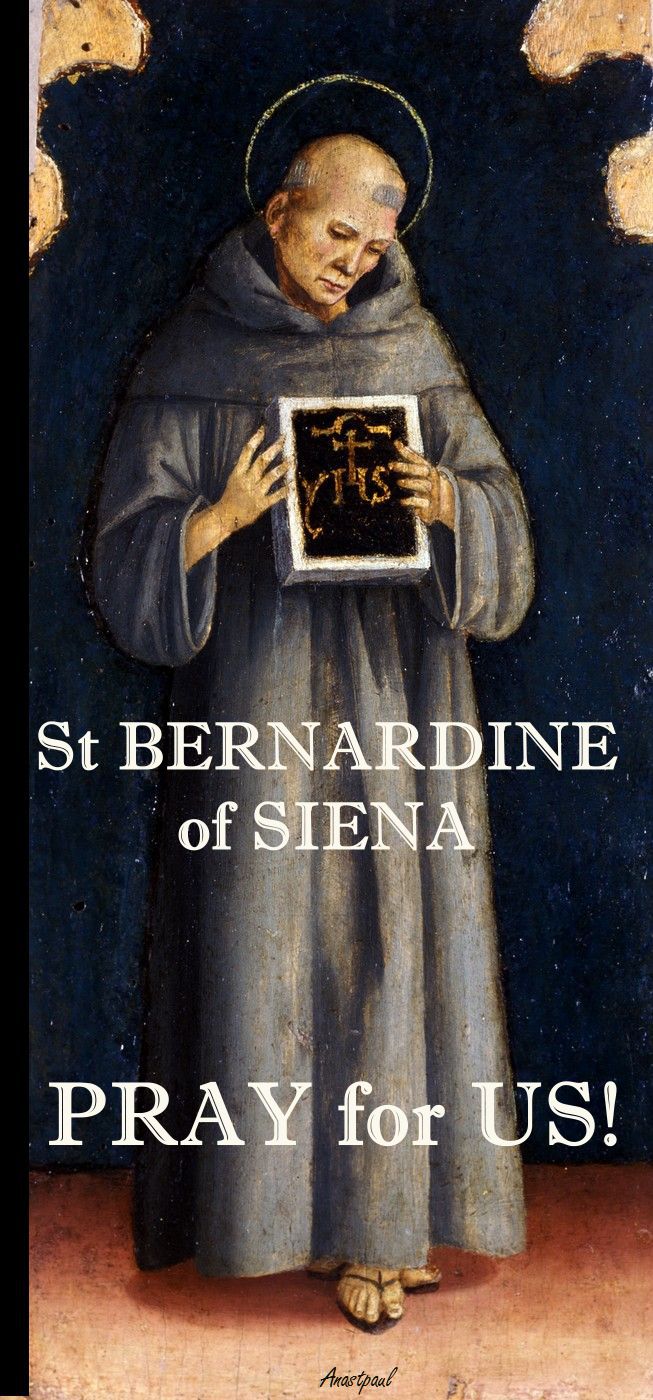
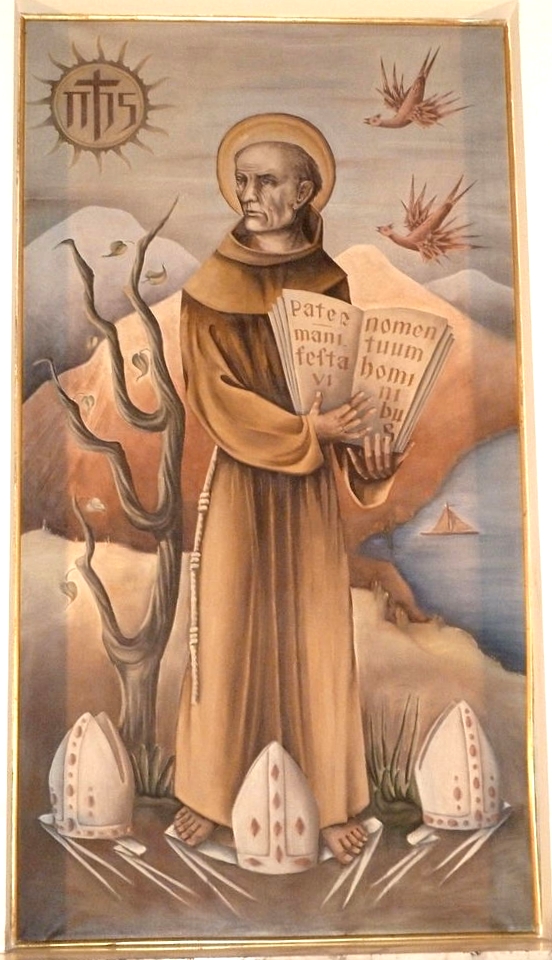
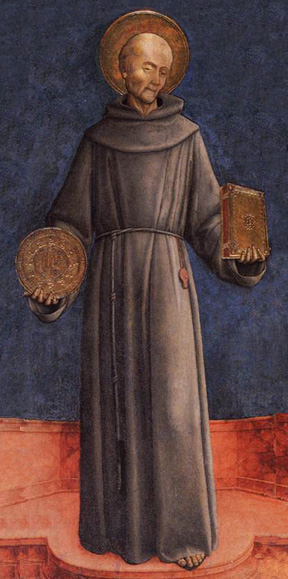
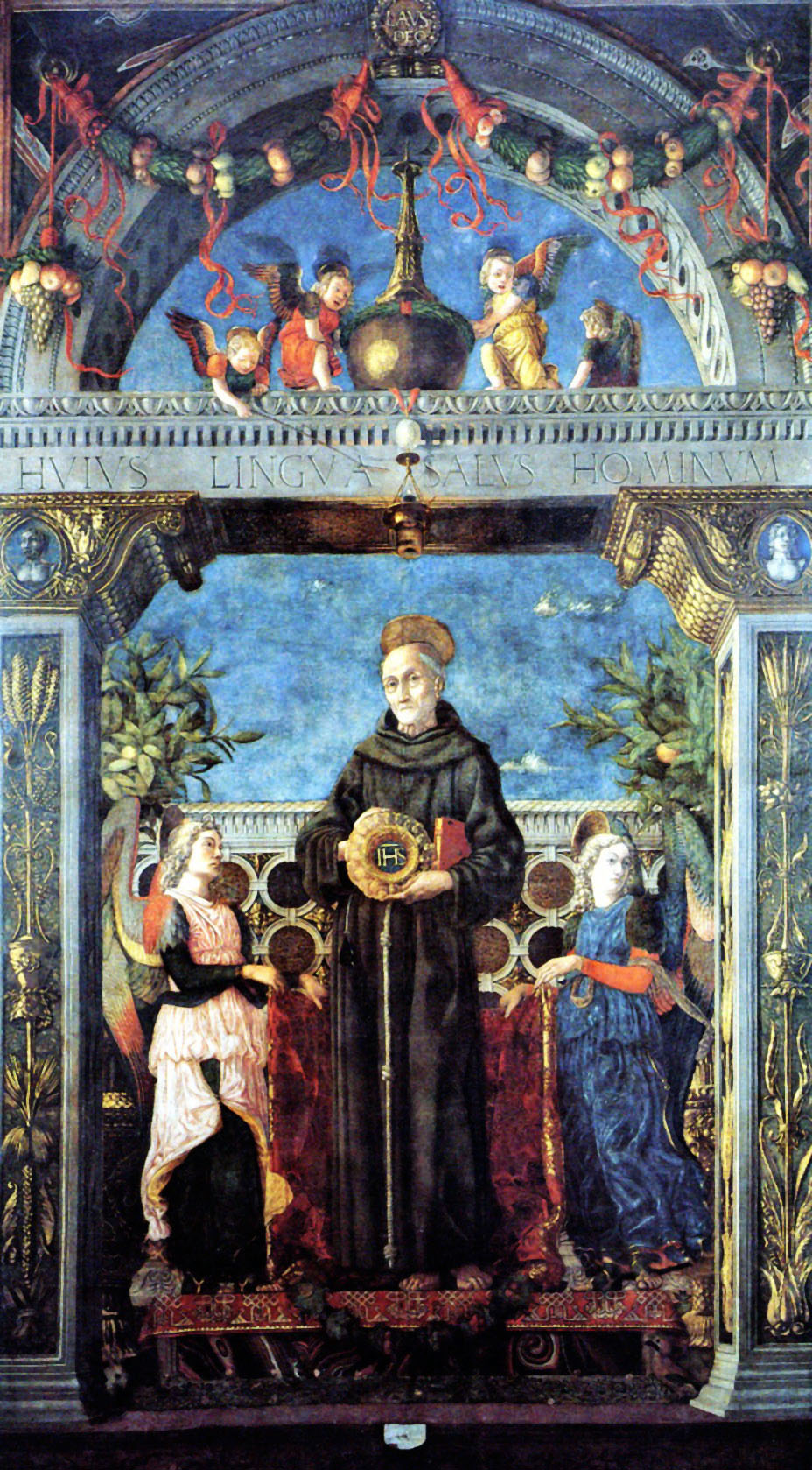
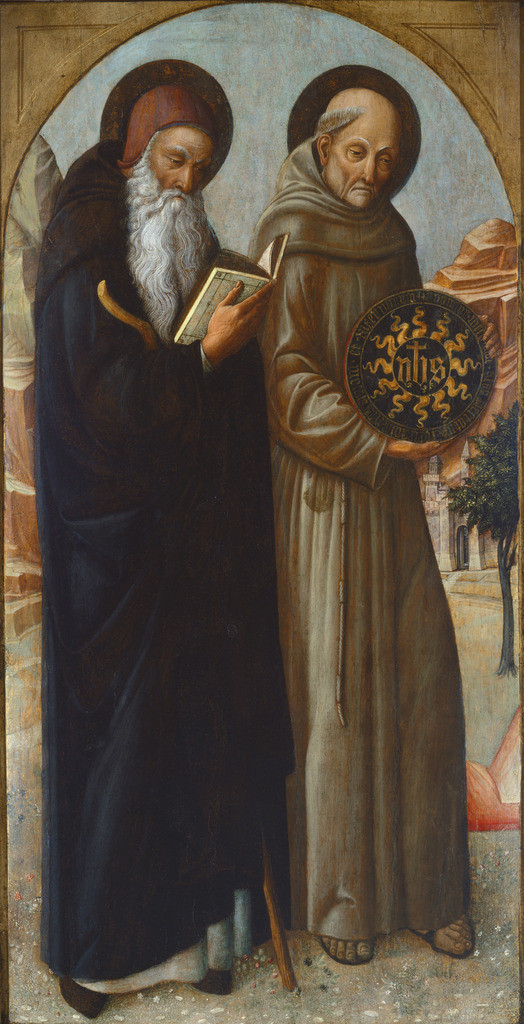
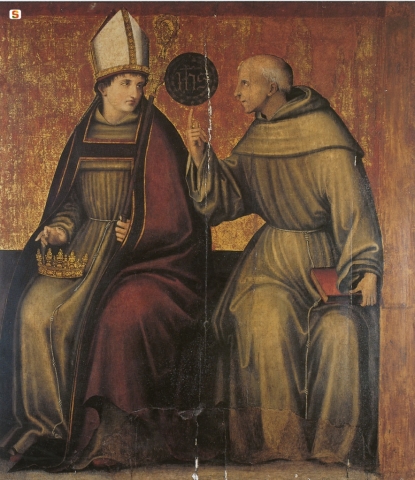
In St Bernardine’s day, cursing was almost part of the common speech and he combated it by promoting devotion to the Holy Name of Jesus.
He even had cards printed inscribed with the Holy Name and they were more popular than playing cards..
He knew that you do not root out an evil merely preaching against it, instead you must put something good in its place.
That is a piece of wisdom it would do us well to follow.   Perhaps our attempts should be garnered universally to root out the sacrilegious habit of great portions of the world, which use the name of God and of Jesus in vain, so often with every sentence, so much so, that in public it is now an accepted practice!

St Bernardine of Siena, please pray for us!

st bernardine of siena-pray for us.jpg 2

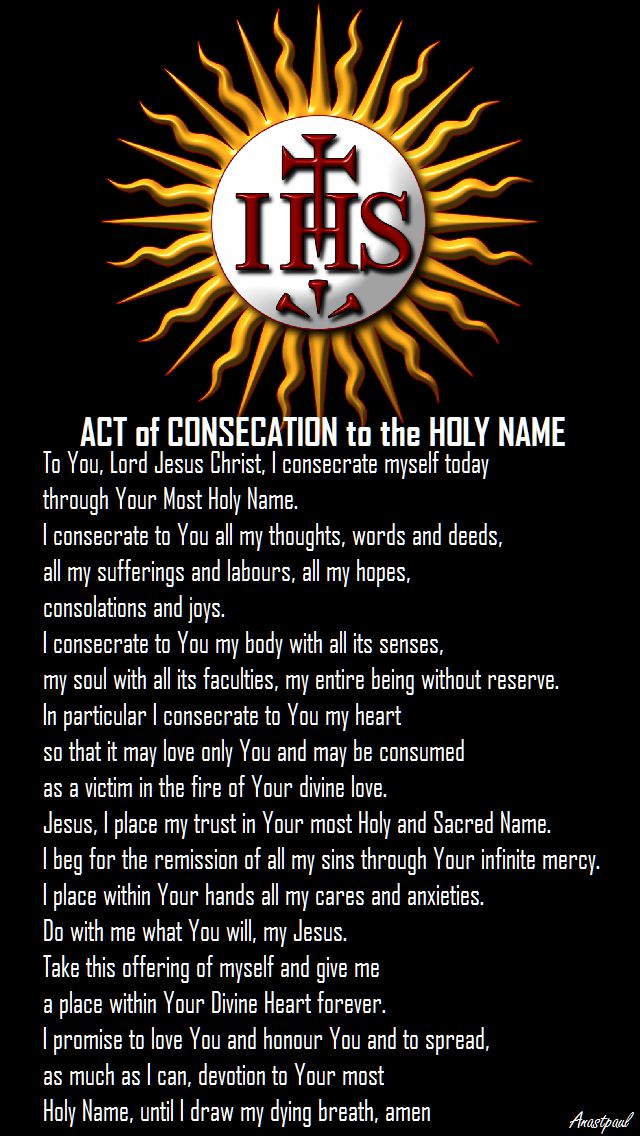
CONSECRATION HOLY NAMEf1bc989243ef8f0d43b071bc162c831f

Posted in DEVOTIO, franciscan OFM, MORNING Prayers, QUOTES of the SAINTS, SAINT of the DAY

Quote of the Day – 20 May

Quote of the Day – 20 May

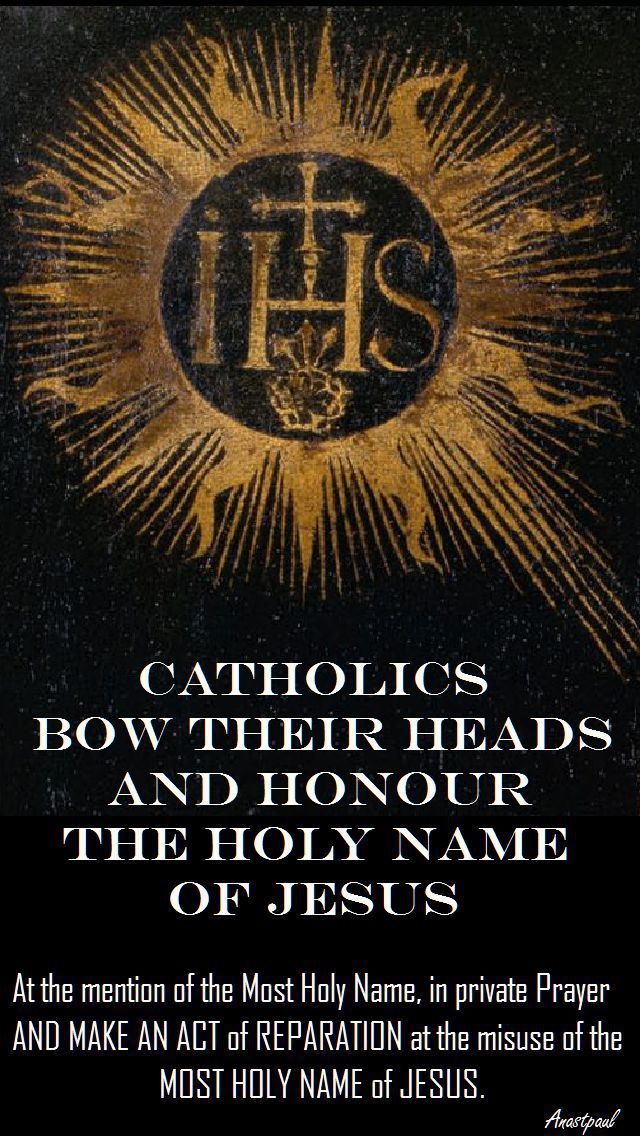
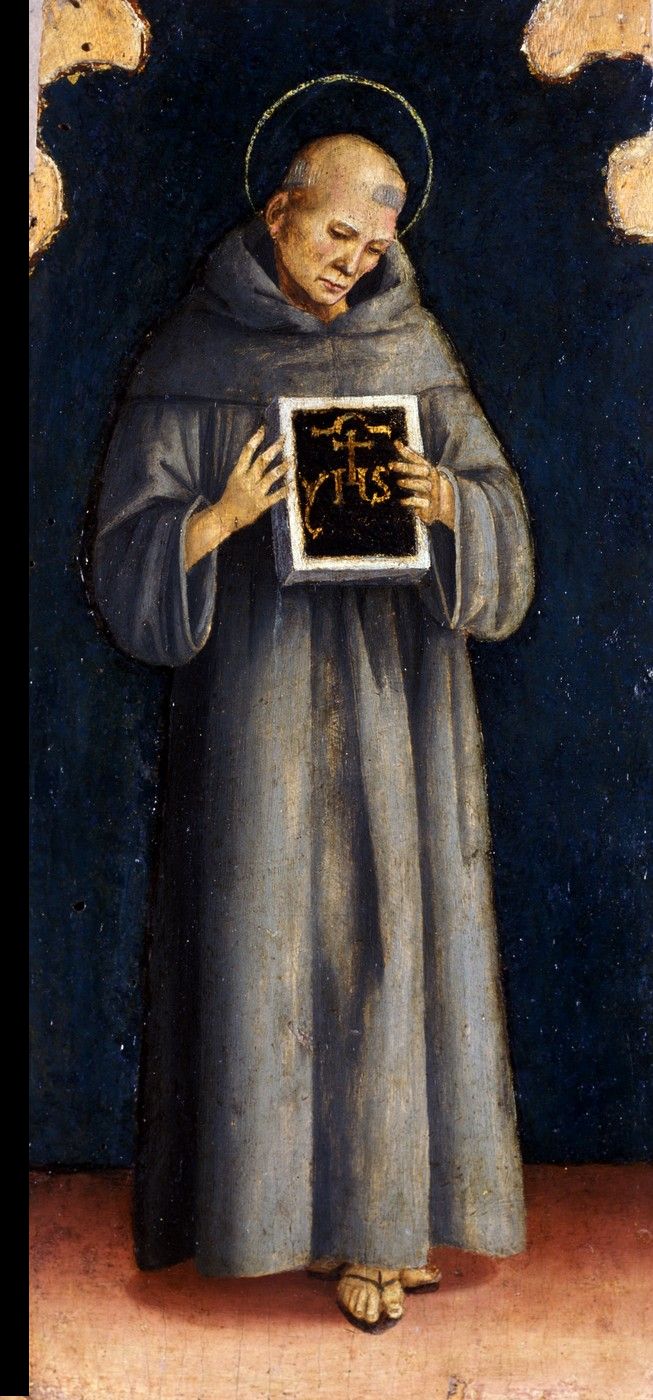
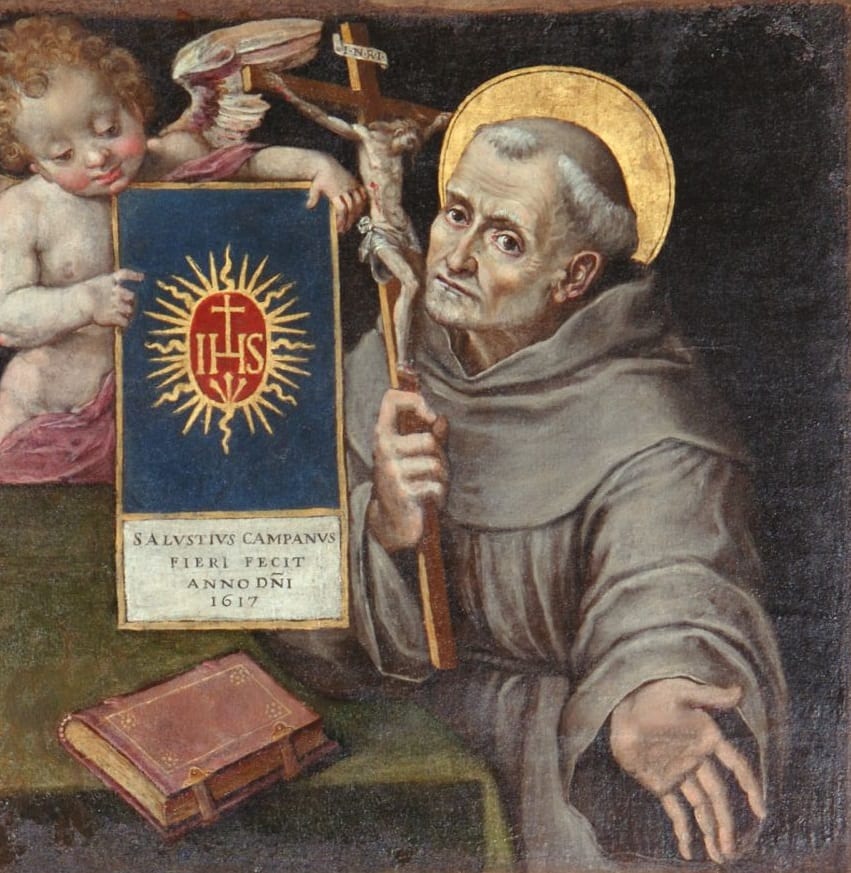
Especially known for his devotion to the Holy Name of Jesus, Bernardine devised a symbol—IHS, the first three letters of the name of Jesus in Greek–in Gothic letters on a blazing sun.   This was to displace the superstitious symbols of the day, as well as the insignia of factions:  for example, Guelphs and Ghibellines.   The devotion spread and the symbol began to appear in churches, homes and public buildings.

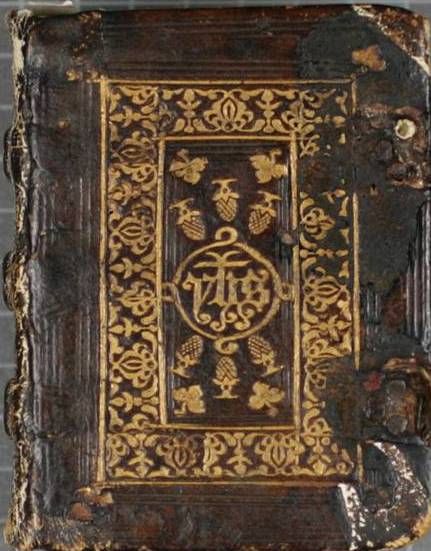
breviary_tuscany
The provenance of this item indicates that the prayer book belonged to Franciscan communities in Tuscany during the lifetime of Saint Bernardine of Siena.

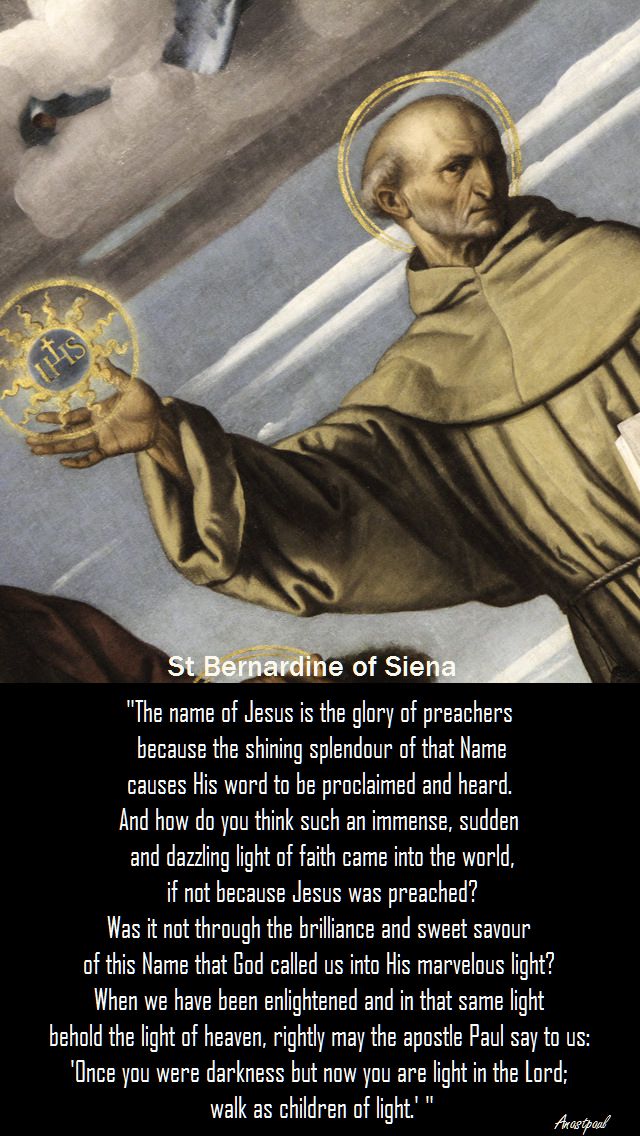
“The name of Jesus is the glory of preachers
because the shining splendour of that Name
causes His word to be proclaimed and heard.
And how do you think such an immense, sudden
and dazzling light of faith came into the world,
if not because Jesus was preached?
Was it not through the brilliance and sweet savour
of this Name that God called us into His marvelous light?
When we have been enlightened and in that same light
behold the light of heaven, rightly may the apostle Paul say to us:
‘Once you were darkness but now you are light in the Lord;
walk as children of light.’ “

the name of jesus - st bernardine of siena

Posted in franciscan OFM, MORNING Prayers, QUOTES of the SAINTS, SAINT of the DAY, The BLESSED VIRGIN MARY, The WORD

ONE MINUTE REFLECTION – 20 May

ONE MINUTE REFLECTION – 20 May

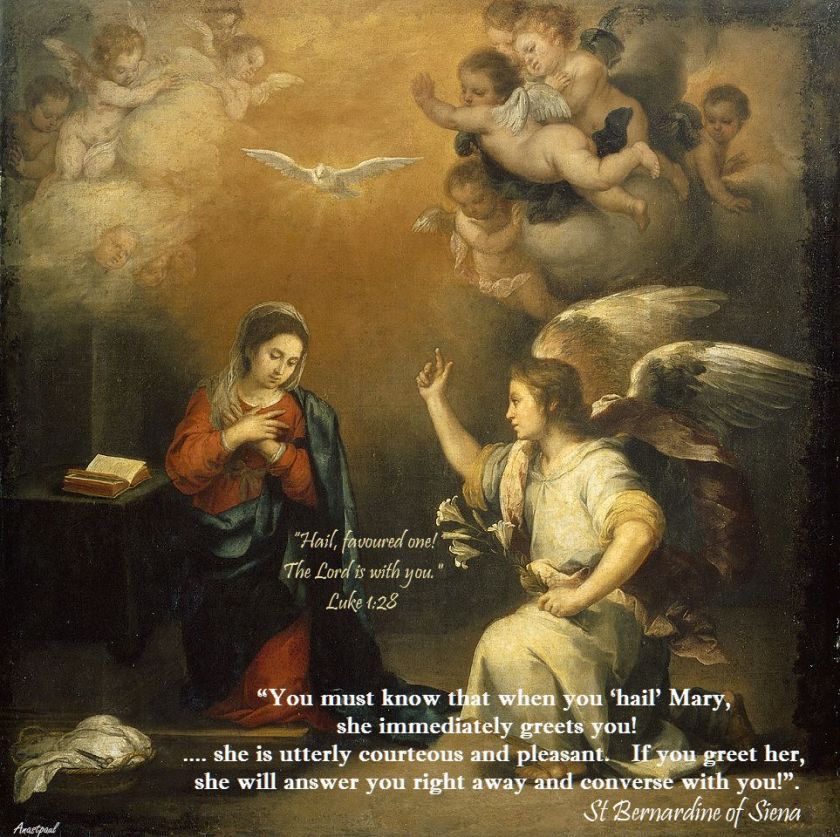
And coming to her, he said, “Hail, favoured one! The Lord is with you.”………..Luke 1:28

REFLECTION -“You must know that when you ‘hail’ Mary, she immediately greets you! Don’t think that she is one of those rude women of whom there are so many — on the contrary, she is utterly courteous and pleasant. If you greet her, she will answer you right away and converse with you!”……..St Bernardine of Siena

you must know that when you hail mary- st bernadine

PRAYER – Lord God, You sent your angel to Mary and Your divine Son became man when she gave her consent to the angel’s announcement.  Help me to give a perpetual consent to all that You will for me and a perpetual refusal to all that only I, in my pride, wish. Help me to see and understand and pray unceasingly to discern Your will.   Holy Mary, Mother of God and our Mother, help us all.   St Bernardine of Siena, please pray for us, amen.

st bernardine of siena-pray for us

Posted in DOCTORS of the Church, MORNING Prayers, PRAYERS of the SAINTS, The BLESSED VIRGIN MARY

Our Morning Offering – 20 May

Our Morning Offering – 20 May

I Call Upon You, Mother of God
By St Bonaventure (1217-1274) – Seraphic Doctor

I shall call upon you, Mother of God
and you will hear me;
your praises will gladden my heart.
I have called to you in trouble
and you have heard me at your throne in heaven.
Take up my cause, Mother,
for I have departed from my innocence;
but because I have hoped in you,
I shall not lose my soul.
To you, Mother, have I pleaded,
after having wandered from God
and I was saved by the power of your intercession.
In you, Mother, I place all my hope
because of your most loving compassion.
Into your hands I entrust my soul and body,
my whole life and the hour of my death.
Intercede for us, Mother of God and Mediatrix,
who have brought salvation to mankind. Amen

i call upon you mother of god, st bonaventure

Posted in ADVERTISING, PUBLIC RELATIONS, COMMUNICATIONS, franciscan OFM, PATRONAGE - LUNG and RESPIRATORY illness, QUOTES of the SAINTS, SAINT of the DAY

Saint of the Day – 20 May – St Bernardine of Siena OFM (1380-1444) “Apostle of the Most Holy Name of Jesus,”

Saint of the Day – 20 May – St Bernardine of Siena OFM (1380 at Massa di Carrara, Italy to 1444 at Aquila, Italy of natural causes) “Apostle of the Most Holy Name of Jesus,” Priest, Missionary, Preacher, known as the “Apostle of Italy,” the “Star of Tuscany,” and the “Second Paul.”  Saint Bernadine is one of the most renowned Franciscan preachers and reformers, a prolific writer who graced the Church with countless sermons and writings and is largely responsible for increasing the popular devotion to the Holy Name of Jesus.    St Bernadine is also remembered for his ardent devotion to Our Blessed Mother and the Holy Family. His numerous Patronages include – against chest and lung problems, respiratory illnesses, of Advertising and Communications and Public Relations workers, against gambling and gambling addictions, of Italy, Diocese of San Bernardino, California, of the Diocese of Capri, Italy, of the Italian Cities of Altavilla Irpina, Aquila, Camaiore, Carpi, Castelspina, Alessandria, Montecchio, Trevignano Romano
Venice.

saint-bernardine-of-siena-1450

Saint Bernadine was the greatest preacher of his time, journeying across Italy, bringing peace to areas ridden with strife, attacking the paganism he found rampant.   When he preached, he would attract large crowds of nearly 30,000 listeners, converting many on the spot.   Above all, he followed St. Francis’s admonition to preach about “vice and virtue, punishment and glory.”   Saint Antoninus described him as “a new star in the midst of the murky darkness of the earth; to shine with the brightness of Divine gifts; to beam far and wide the bright rays of his glorious life and teachings; to lead in the fear of God, by the holiness of his example, a people whose blindness had removed it from the straight path of the heavenly Homeland.”

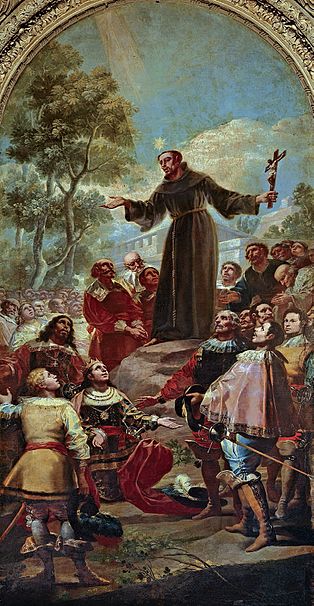
San_Bernardino_de_Siena_(Goya)

He was born on the Feast of the Nativity of Mary in Siena, Italy.  StBernadine entered the world in nobility, the son of a governor.   At age six, he lost both his parents and thus orphaned, was raised by a pious aunt who attended to both his physical and spiritual needs.   Bernadine excelled at school, demonstrating both intelligence and diligence, holiness and piety, and was well-liked and popular.   At age 17, he entered a Marian confraternity at the La Scala hospital, beginning a secluded religious life devoted to prayer and meditation.   At that time, the plague raged throughout Europe and Bernadine left seclusion to aid the sick, placing himself at great risk and assuming administration of the hospital.   While he never contracted the plague, he fell ill from exhaustion and was confined to bed for several months.   While he never fully recovered, his voice—hoarse and weak from his sickness- was fully restored through his devotion to Our blessed Mother, allowing him to develop profound preaching skills. Following his own sickness, his aunt fell ill and he nursed her until her death, never leaving her side.   Upon her death, Saint Bernadine turned to fasting and prayer, spending his days seeking the will of the Lord in his life.

One day while he was kneeling at the foot of his crucifix, praying for guidance, Bernadine heard the voice of Jesus say to him:   “My son Bernardine, you see Me hanging on the Cross, in a state of total denudation.   If you love Me and want to walk in My footsteps, fasten yourself also to the cross, divested of everything.” Following this divine message, Bernadine joined the Franciscan Order, distinguishing himself through obedience, which he considered the virtue of highest import.

Bernadine was assigned to preaching, having a natural gift given by the Holy Spirit. Over the next decade of his life, he traveled throughout Italy, preaching in major cities, a natural successor to Saint Vincent Ferrer.   The Adorable Name of Jesus was the usual theme of his sermons, stemming from his aunt’s instruction as a child.   Wherever he traveled, he carried a tablet on which the Holy Name of Jesus (IHS) was written, adopting it as his standard and his “sole weapon.”   He firmly held only in this Name could man be saved, as Saint Peter had instructed the elders in the Synagogue.

One of Bernadine’s listeners in Siena was to become Pope Pius II.   In his notes, the Pope tells of one of Bernardine’s addresses:   “One day, as he was preaching in the square in Siena, a thick cloud formed and threatened rain. Everyone wanted to run off.  ‘Friends, remain in peace,’ exclaimed the orator.   He knelt down and prayed, ordering the cloud, by virtue of the Name of Jesus, to go away.   Scarcely had he spoken when the cloud scattered without a drop of rain, and the weather turned as fair as it had been before.”

Bernardine was a preacher of inspired eloquence.   He has been called the Doctor of the Heart of Mary due to his writings on Mary’s heart.   He wrote, “from her heart, as from a furnace of Divine Love, the Blessed Virgin spoke the words of the most ardent love.”   He was also a distinguished master in the science of all things sacred, as is proved by the writings he has left us.

Bernadine’s watchword, like Saint Francis, was peace. He preached peace wherever he went, balancing the social climate of the day with the teachings of the Church. Mass reconciliations were reported as he celebrated Mass, given his encouragement of the kiss of peace between attendees.

Numerous miraculous occurrences were reported in his presence.   One day, preaching in praise of the Blessed Virgin, he applied to Her the verse of the Apocalypse: “A great sign appeared in heaven, a Woman clothed with the sun…”   At once a brilliant star appeared over his head.   On other occasions, Bernadine was understood by all present when he spoke in Italian—even by those who didn’t speak Italian! He obtained miraculous conversions and reformed the greater part of Italy by his burning words and by the power of the Holy Name of Jesus.

Bernardine was appointed Vicar General of his Order in 1438, an office he held for five years.   After five years, he began preaching again until, worn out from his missionary labors, he died on the Eve of the Ascension.   At his death, his brothers surrounded him, chanting, “Father, I have manifested Thy Name to men.” Saint Bernadine was buried at Aquila in the Abruzzi.   The miracles reported at his tomb encouraged Pope Nicholas V to canonise him only six years later.

Posted in SAINT of the DAY

Saints – 20 May

St Bernadine of Siena (Optional Memorial)

St Abercius
Bl Albert of Bologna
St Alexander of Edessa
St Althryda
St Anastasius of Brescia
St Aquila of Egypt
St Arcangelo Tadini
Bl Arnaldo Serra and Companions
St Asterius of Edessa
St Austregisilus of Bourges
St Basilla of Rome
St Baudelius of Nîmes
St Codrato
Bl Columba of Rieti
St Ethelbert of East Anglia
BlGuy de Gherardesca
St Helena
St Hilary of Toulouse
St José Pérez Fernández
St Lucifer of Caglieri
St Marcello
Bl Maria Angelica Perez
St Plautilla of Rome
St Protasius Chong Kuk-bo
St Rafaél García Torres
St Talaleo of Egea
St Thalalaeus of Edessa
St Theodore of Pavia
St Tomás Valera González

Posted in DOCTORS of the Church, MORNING Prayers, The BLESSED VIRGIN MARY

The Saint Who Influenced Pope St. John Paul II’s Profound Devotion to Mary

The Saint Who Influenced Pope St. John Paul II’s Profound Devotion to Mary

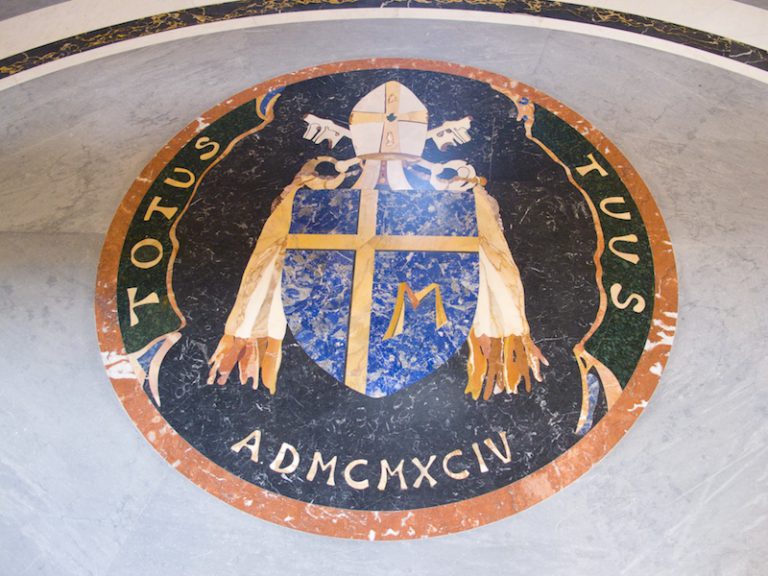
Pope St. John Paul II was well known for having a deep and abiding love for the Blessed Virgin Mary. His devotion to her was evident in all that he did: his teaching, his prayer life, even his papal motto and coat of arms were dedicated to the Blessed Mother.

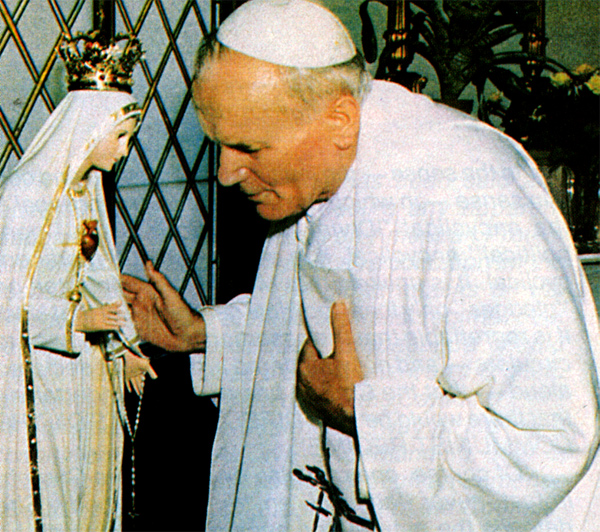
When he was nearly fatally shot during his papacy he credited the intercession of the Virgin Mary, specifically Our Lady of Fatima, with the miraculous save of his life.

cr16pg08
Pope St. John Paul II with an Our Lady of Fatima statue after the assasination attempt on his life

But how did he develop this life-long devotion to Mary?

In his book, Gift and Mystery, Blessed Pope John Paul II credits his home parish and the nearby Carmelites for their early influence on him. He also had a very devout father who regularly took him on pilgrimages to local Marian shrines.

However, as he matured in his faith as a young adult, he singles out one overwhelming influence which changed his life. He gleaned his profound devotion to Mary largely through the writings of one man: St. Louis de Montfort.

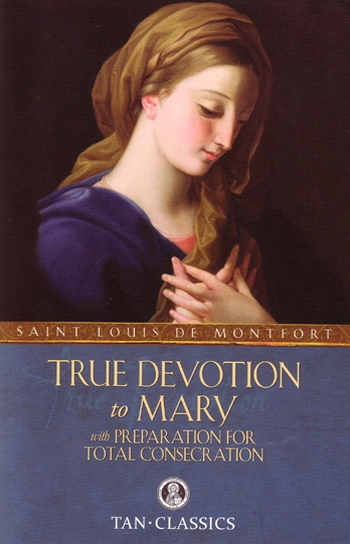
The book that changed Karol Wojtyla’s life was True Devotion to Mary. The Pope relates that,

“At one point I began to question my devotion to Mary, believing that, if it became too great, it might end up compromising the supremacy of the worship owed to Christ.  At that time, I was greatly helped by a book by Saint Louis Marie Grignion de Montfort…

There I found the answers to my questions, Yes, Mary does bring us closer to Christ; she does lead us to him, provided that we live her mystery in Christ… The author was an outstanding theologian.  His Mariological thought is rooted in the mystery of the Trinity and in the truth of the Incarnation of the Word of God”.

Pope John Paul II thought so highly of the writing of St. Louis De Montfort that he spoke about the saint on many occasions. In addition, on December 8, 2003, he wrote a special letter on the occasion of the 160th Anniversary of De Montfort’s publication. In this letter he wrote: “I myself, in the years of my youth, found reading this book a great help.”

1003301

True Devotion to Mary had such a lasting influence on him that when he was elected Supreme Pontiff in 1978, he chose his papal motto, Totus Tuus, from words written by St. Louis De Montfort, as he describes below:

“As is well known, (in) my episcopal coat of arms … the motto Totus tuus is inspired by the teaching of St. Louis Marie Grignion de Montfort.  These two words express total belonging to Jesus through Mary: “Tuus totus ego sum, et omnia mea tua sunt.” (“I am all Yours, and all that I have is Yours.”) . . . “This Saint’s teaching has had a profound influence on the Marian devotion of many of the faithful and on my own life.”

163-768x576

There is no better way to advance quickly in holiness, no better way to please God, and no better way to guarantee one’s present sanctity and eternal salvation than with a true devotion to Mary.   Pope John Paul II learned this and demonstrated this truth in his life, proven now that he has been raised to the altars and numbered with the saints in heaven.

Posted in CONTEMPLATIVE Prayer, MORNING Prayers

Catholic Meditation and Contemplative Prayer: What’s the Difference?

Catholic Meditation and Contemplative Prayer: What’s the Difference?

To answer this question, let’s look at the Catechism of the Catholic Church. In the glossary, we find the following definitions (I’ve highlighted several words and phrases in each definition to help us parse out the difference):

First, for meditation:

MEDITATION: An exercise and a form of prayer in which we try to understand God’s revelation of the truths of faith and the purpose of the Christian life, and how it should be lived, in order to adhere and respond to what the Lord is asking.

And now, for contemplation:

CONTEMPLATION: A form of wordless prayer in which mind and heart focus on God’s greatness and goodness in affective, loving adoration; to look on Jesus and the mysteries of his life with faith and love.

So immediately we can see that Catholic meditation is a cognitive exercise — prayer seeking understanding; whereas contemplative prayer sets aside that kind of mental effort, seeking instead a wordless, loving adoration of Christ and his mysteries.

Put another way:  in meditation we think; in contemplation we rest our thoughts and simply love (and respond to love).

To unpack this a bit further, we can look into the body of the Catechism itself, for further insight into both meditation and contemplation.    In sections 2705-8 of the Catechism we find further insight into a Catholic understanding of meditation.    In the interest of brevity I’m only going to post a few key phrases but look it up in the Catechism and read the entire section:

Meditation is above all a quest.  The mind seeks to understand the why and how of the Christian life, in order to adhere and respond to what the Lord is asking… To meditate on what we read helps us to make it our own by confronting it with ourselves… To the extent that we are humble and faithful, we discover in meditation the movements that stir the heart and we are able to discern them… Meditation engages thought, imagination, emotion, and desire… This form of prayerful reflection is of great value but Christian prayer should go further: to the knowledge of the love of the Lord Jesus, to union with him.

Immediately following this (sections 2709-19) is the Catechism’s discussion of contemplative prayer.   Once again, here are just a few key phrases:

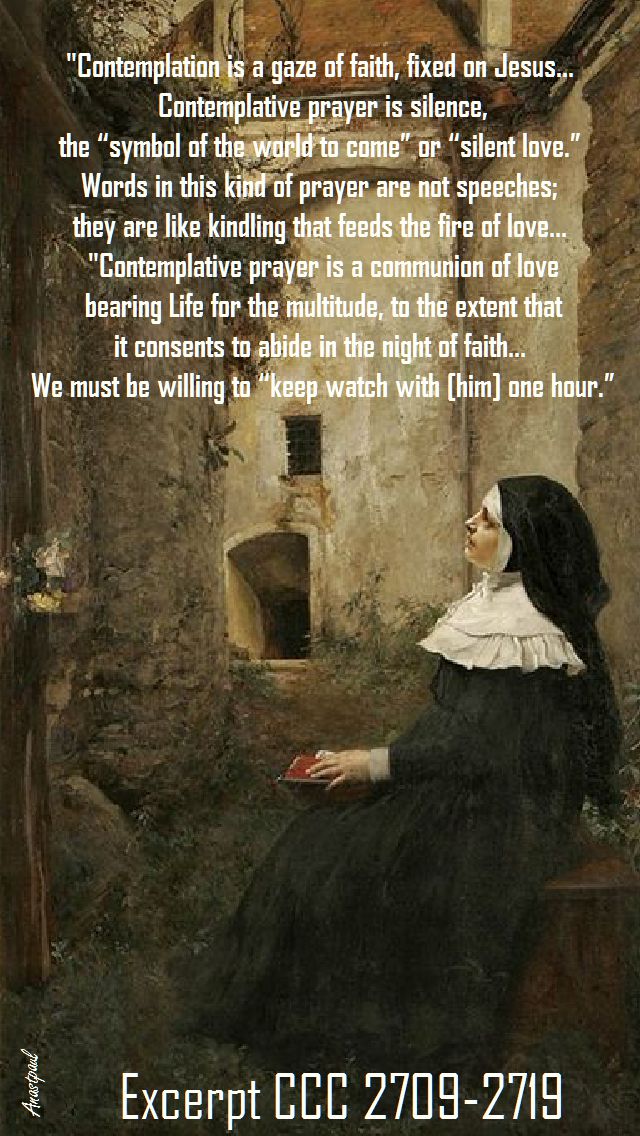
ccc2709-2719


Contemplative prayer seeks him “whom my soul loves.” … We seek him, because to desire him is always the beginning of love… In this inner prayer we can still meditate, but our attention is fixed on the Lord himself…. One cannot always meditate but one can always enter into inner prayer, independently of the conditions of health, work, or emotional state.   The heart is the place of this quest and encounter, in poverty and in faith… Entering into contemplative prayer is like entering into the Eucharistic liturgy:   we “gather up” the heart, recollect our whole being under the prompting of the Holy Spirit, abide in the dwelling place of the Lord which we are, awaken our faith in order to enter into the presence of him who awaits us… Contemplative prayer is the poor and humble surrender to the loving will of the Father in ever deeper union with his beloved Son… It is a gift, a grace; it can be accepted only in humility and poverty. Contemplative prayer is a covenant relationship established by God within our hearts. Contemplative prayer is a communion in which the Holy Trinity conforms man, the image of God, “to his likeness.”
Contemplation is a gaze of faith, fixed on Jesus… Contemplative prayer is silence, the “symbol of the world to come” or “silent love.” Words in this kind of prayer are not speeches; they are like kindling that feeds the fire of love… Contemplative prayer is a communion of love bearing Life for the multitude, to the extent that it consents to abide in the night of faith… We must be willing to “keep watch with [him] one hour.”

The Catechism refuses to draw a hard and fast distinction between meditation and contemplation:  “in [contemplation] we can still meditate.”   Head and heart are both intimate parts of one being.   We may seek in contemplation to love and behold God in silence but thoughts will still dance in our minds.   But as “The Cloud of Unknowing” so helpfully teaches us, when meditative thoughts emerge during contemplative prayer, seek to be non-attached.   Let them arise and let them fall. Keep our focus “fixed on the Lord himself” — in contemplation our intent is to love God, not to think about God;   to know God rather than merely know about God.

Nevertheless, because meditation is an effortful prayer, there are times when we are simply too tired, or too angry, anxious, or whatever, to meditate.   Yet contemplative prayer, emphasising rest and silence, is always available to us.    Perhaps most important of all is the recognition that meditation is not the highest form of prayer: contemplation is.   Yet true contemplation is always a gift, a grace.   It’s not something we achieve, it’s something we receive.

To summarise:

  • Meditation is a quest;   contemplation involves rest.
  • Meditation is mental, cognitive, discursive;   contemplation is silent, heart-centered, beholding
  • Meditation is important, contemplation even more so.
Posted in MORNING Prayers, SAINT of the DAY

Thought for the Day – 19 May

Thought for the Day – 19 May

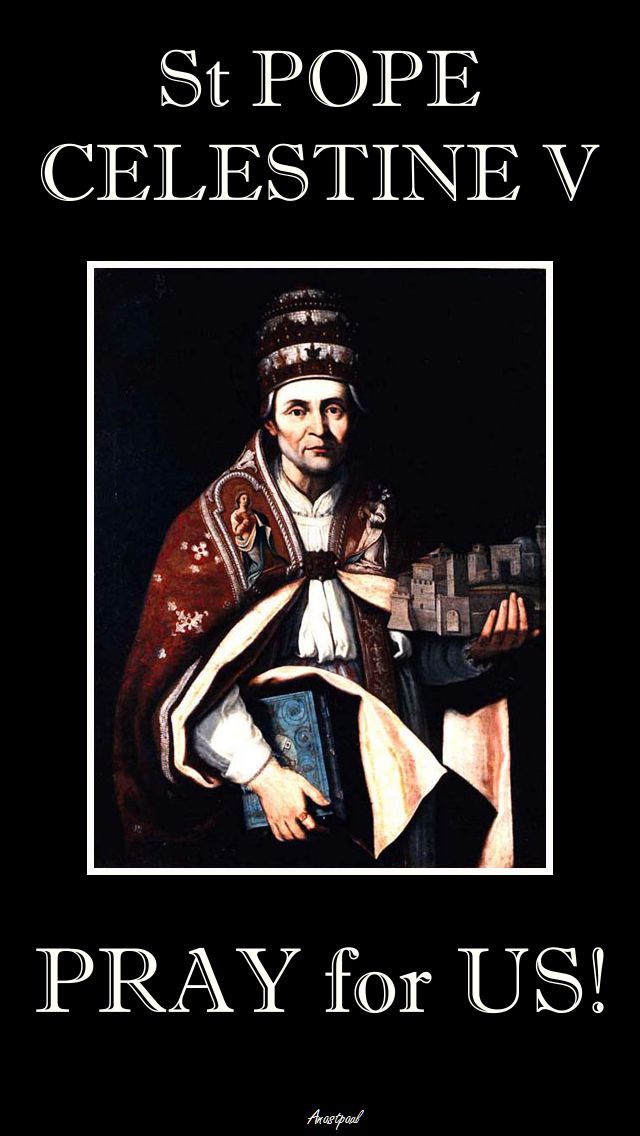
St Celestine V tasted bitterly his own failure but this did not prevent him from being a saint.   When he realised that he was in the wrong place, he quickly did something about it, whatever the consequences.   To admit failure, particularly in a place of importance and public scrutiny, takes a rare kind of courage and that kind of courage is the stuff that saints are made of.  Say no more!

St Pope Celestine V, please pray for us, that we may have the courage to admit our failures.

ST CELESTINE V-PRAY FOR USST POPE CELESTINE V - MAY 19 ST PAULS