Posted in SAINT of the DAY

10 May – The Memorial of St Damian de Veuster de Molokai

10 May – The Memorial of St Damian de Veuster de Molokai SS.CC. Congregation of the Sacred Hearts of Jesus and Mary – Martyr of Molokai – (1840-1889) Religious Priest, Missionary – known as “Martyr of Molokai”, “Martyr of Charity”, “Apostle to the Lepers” – Patron of lepers.

St Joseph de Veuster was born in Belgium on January 3, 1840.    While at college, he decided God was calling him to be a priest.   He joined the same community his brother had joined and took the name Damien. Damien’s brother had dreamed of being a missionary overseas.   But he became ill and was unable to go.   Damien offered to go in his place.   He traveled to Hawaii and was ordained in Honolulu.

For nine years, Damien served the people in different villages around Hawaii.    While working, he heard about a settlement of lepers on the island of Molokai.    He was told that life on the island was terrible for the lepers.   They were very poor and there was not one doctor or priest on the island.   Father Damien thought he was needed there.   He went to Molokai to work with the lepers.

Those who could walk came to meet Father Damien’s boat.   They wanted to see this priest who had come to work with them.    They were sure he wouldn’t stay long when he saw what life there was like.    Lepers often have unpleasant sores and even lose fingers and toes.    Because there were no laws or police on the island, many who were not very ill lived wild lives.

Father Damien got busy right away.    He cleaned up huts, nursed those who were very sick and tried new medicines.    Those able to help were put to work building better houses.   Father Damien preached and offered Mass but he also built roads, water systems, orphanages and churches.    He even started a choir and a band.    He made the lepers feel that they were people with dignity.    They learned to better respect themselves and one another.

Father Damien always began his homily with “My dear lepers.”    One Sunday he stood before his congregation and began his homily by saying “My fellow lepers.”   At first, it was very quiet.    Then people began to sob.    Their beloved Father Damien had gotten the disease.    Even though he was ill, Father Damien carried on his work.    Eventually, a group of Franciscan sisters from New York, under the leadership of St  Marianne Cope, came to help. Father Damien died when he was 49 years old.

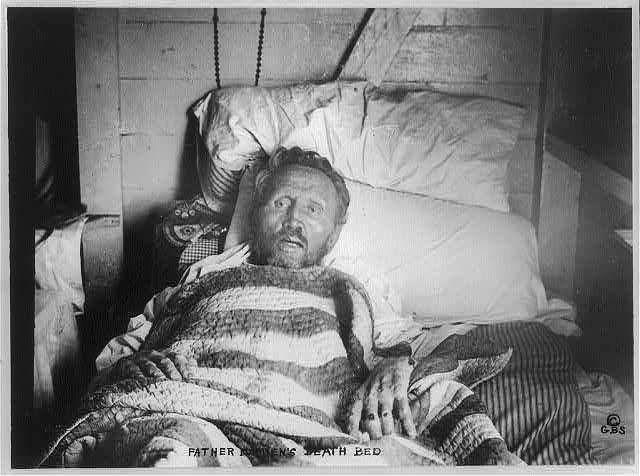
Father-Damien-on-his-death-bed-BIOG-FILE-Damien-Father-18401-889___-painting-artwork-print
St Damien on his deathbed
Father_Damien_on_his_funeral_bier_with_Mother_Marianne_Cope_by_his_side
St. Marianne Cope standing beside Father Damien’s funeral bier (image reversed)
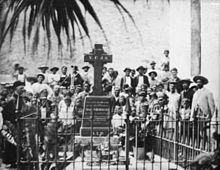
220px-Fatherdamiengrave
The leprosy patients of Molokaʻi gathered around Father Damien’s grave in mourning
Posted in DOCTORS of the Church, MORNING Prayers, QUOTES of the SAINTS, SAINT of the DAY

Quote/s of the Day – 10 May

Quote/s of the Day – 10 May

“A single ‘Blessed be God!’ when things go wrong, is of more value than a thousand acts of thanksgiving, when things are to our liking.”

A SINGLE BLESSED BE GOD - ST JOHN OF AVILA

“Turn yourself round like a piece of clay
and say to the Lord:
I am clay, and you, Lord, the potter.
Make of me what you will.”

turn yourself round-stjohnofavila

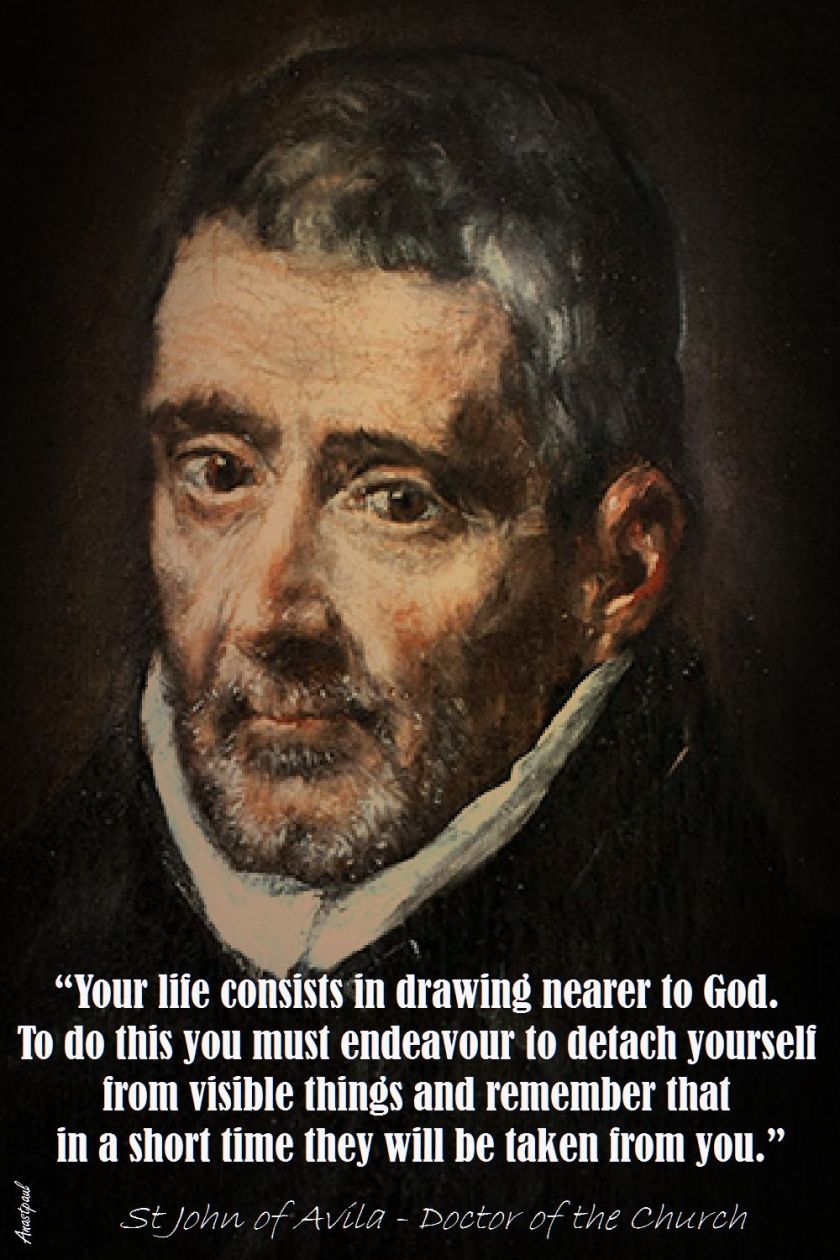
“Your life consists in drawing nearer to God.
To do this you must endeavour to detach yourself
from visible things and remember that
in a short time they will be taken from you.”

St John of Avila – Doctor of the Church

YOUR LIFE CONSISTS - ST JOHN OF AVILA

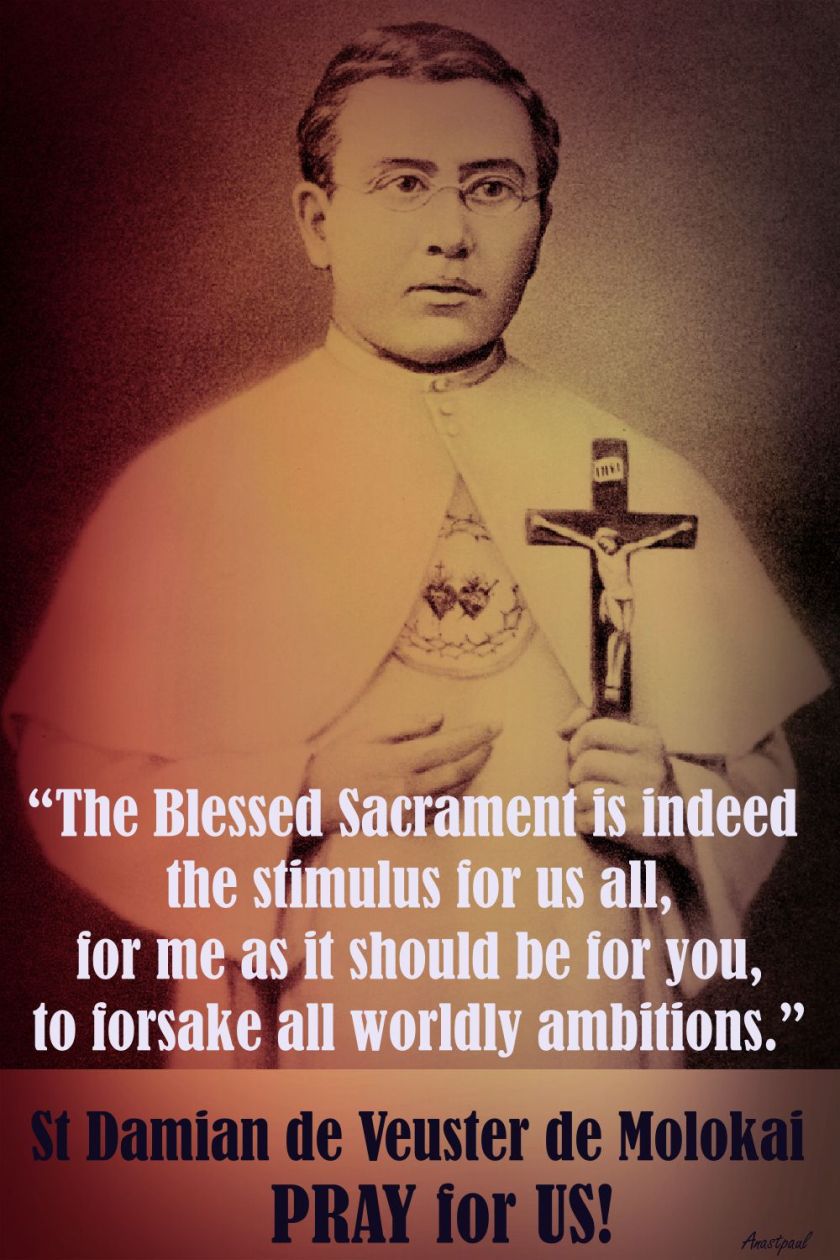
“The Blessed Sacrament is indeed
the stimulus for us all,
for me as it should be for you,
to forsake all worldly ambitions.”

St Damian de Veuster – St Damian of Molokai

THE BLESSED SACRAMENT - ST DAMIAN DE MOLOKAI

Posted in DOCTORS of the Church, MORNING Prayers, PRACTISING CATHOLIC, PRAYERS of the SAINTS, QUOTES of the SAINTS, SAINT of the DAY, The PASSION

Thought for the Day – 10 May – the Memorial of St John of Avila (1499-1569) Doctor of the Church

Thought for the Day – 10 May – the Memorial of St John of Avila (1499-1569) Doctor of the Church

St Teresa of Ávila, herself a Doctor of the Church, praised John of Ávila for his mastery of elements of the spiritual life.    While he remains a little known and quoted figure, one saint celebrated among many, Master Ávila stands before us today as a witness to the need for continual reform, a commitment to reflection and renewal within the Church and for each one of us as followers of Jesus.

He understood that it is only through a spirit-filled engagement with the Word of God and a steadfast commitment to the pursuit of virtue that individual Christians would be able to fulfil the demands of the Gospel.    In one of his sermons for Pentecost, John of Ávila asked his hearers,  “What effect did the coming of the Holy Ghost have on the Church?   What did the Holy Ghost accomplish in the hearts of those believers to whom He came?   He gave them life, gave them gifts of infinite value, strengthened them and brought them near perfection.”    St John of Ávila, in his life, his teachings and in his legacy, reveals that the Holy Spirit remains at work in the Church and, in this lesser known saint (sadly one who needs to be studied by all) of more than four centuries ago we discover a man, a saint, whose heart burned so purely with the fire of this same Spirit that he remains a light for us today.    (BROTHER HENDERSON, O.S.B., is a Benedictine monk of Saint Meinrad Archabbey.)

And to help us along the way, that is the only way, the way of the Cross of Christ, perhaps this practical bit of advice left us by St John of Avila, will be of assistance in our spiritual growth.   St John of Avila, please pray for us for we all wish to join you as Saint in heaven!

This Doctor and Teacher of our Faith, St John of Avila divides the week into stages of the Passion of Christ:

• Monday think of our Lord’s agony in the garden and what passed in the house of Annas and Caiphas

• Tuesday, of the accusations, the removal from judge to judge, and the flagellation

• Wednesday, of the crowning with thorns and the mockery

• Thursday, of the washing of the feet, and the Blessed Eucharist

• Friday, of the sentence, the carrying of the cross, the crucifixion and death

• Saturday, of the piercing of the side, the taking down from the cross, the burial, and the grief of the Blessed Virgin

• Sunday, of the resurrection and the state of future glory.

st JOHN OF AVILA PRAY FOR US.jpg no 2

Posted in DOCTORS of the Church, QUOTES of the SAINTS, SAINT of the DAY, The WORD

One Minute Reflection – 10 May

One Minute Reflection – 10 May

Then he said to all, “If anyone wishes to come after me, he must deny himself and take up his cross daily and follow me.
For whoever wishes to save his life will lose it but whoever loses his life for my sake will save it.” ………Luke 9:23-25

LUKE 9-23,25

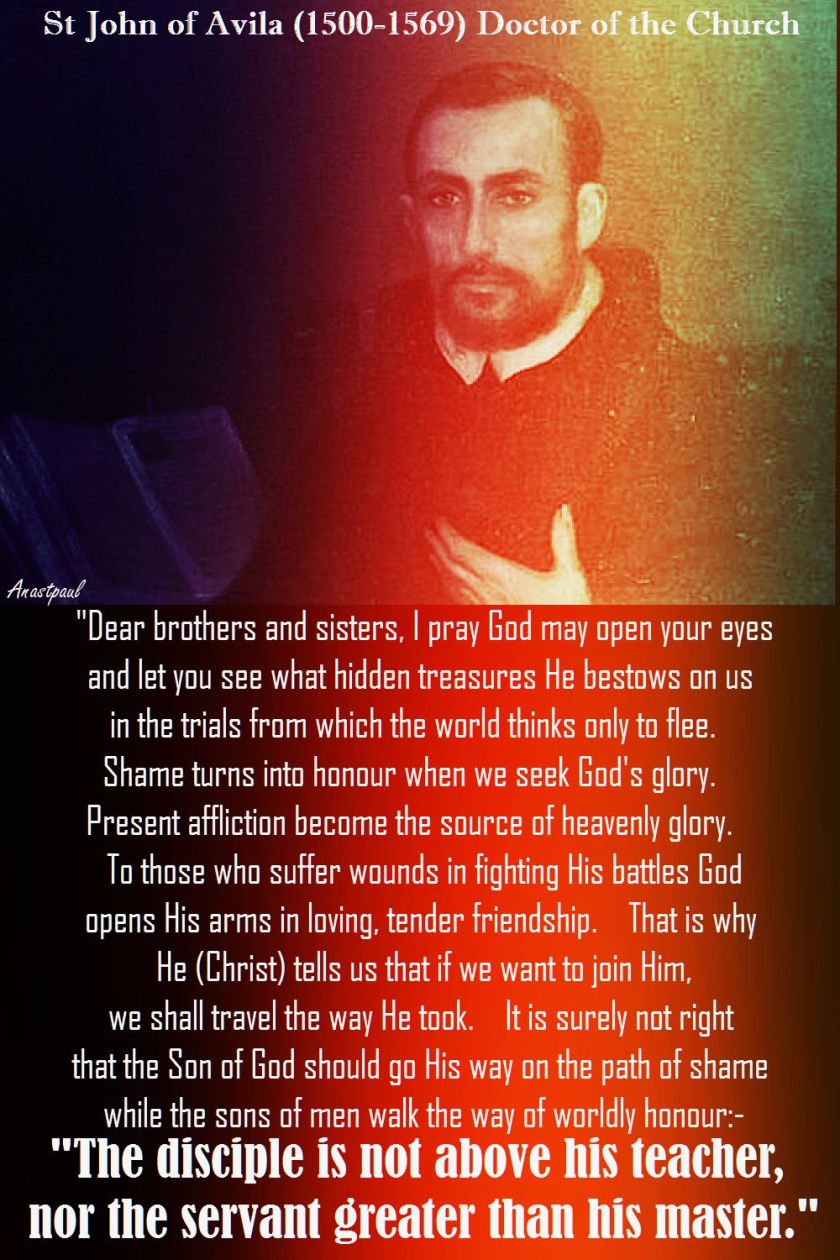
REFLECTION – “Dear brothers and sisters, I pray God may open your eyes and let you see what hidden treasures He bestows on us in the trials from which the world thinks only to flee. Shame turns into honour when we seek God’s glory. Present affliction become the source of heavenly glory. To those who suffer wounds in fighting His battles God opens His arms in loving, tender friendship. That is why He (Christ) tells us that if we want to join Him, we shall travel the way He took. It is surely not right that the Son of God should go His way on the path of shame while the sons of men walk the way of worldly honour: “The disciple is not above his teacher, nor the servant greater than his master.” – from a letter by Saint John of Avila

THE DISCIPLE-ST JOHN OF AVILA

PRAYER – Holy God, teach me to accept my cross and to follow Your Son’s way wihout fear or weakess. Grant me he couage to accept the trails I face for the glory of Your Kingdom. Let me learn and understand that in the persecution You allow, You show me Your love! St John of Avila pray for the whole Church, pray for us all, amen.

st JOHN OF AVILA PRAY FOR US

Posted in CATHOLIC DEVOTIONS of the Month, DOCTORS of the Church, MORNING Prayers, PRAYERS of the SAINTS, The BLESSED VIRGIN MARY

Our Morning Offering – 10 May

Our Morning Offering – 10 May

MARY, our MOTHER
SAINT BERNARD (1090-1153)

Mary, our Mother,
the whole world reveres you
as the holiest shrine of the living God,
for in you the salvation of the world dawned.
The Son of God was pleased
to take human form from you.
You have broken down the wall of hatred,
the barrier between heaven and earth
which was set us by the
disobedience of Adam and Eve.
In you heaven met earth
when divinity and humanity
were joined in one person – the God-Man.
Mother of God,
we sing your praises,
but we must praise you even more.
Our speech is too feeble to honour you as we ought,
for no tongue is eloquent enough
to express your excellence.
Mary, most powerful,
most holy, and worthy of all love.
Your name brings new life,
and the thought of you inspires love
in the hearts of those devoted to you. Amen

MARY OUR MOTHR BY ST BERNARD OF CLAIRVAUX

Posted in DOCTORS of the Church, SAINT of the DAY

Saint of the Day – 10 May – St John of Avila

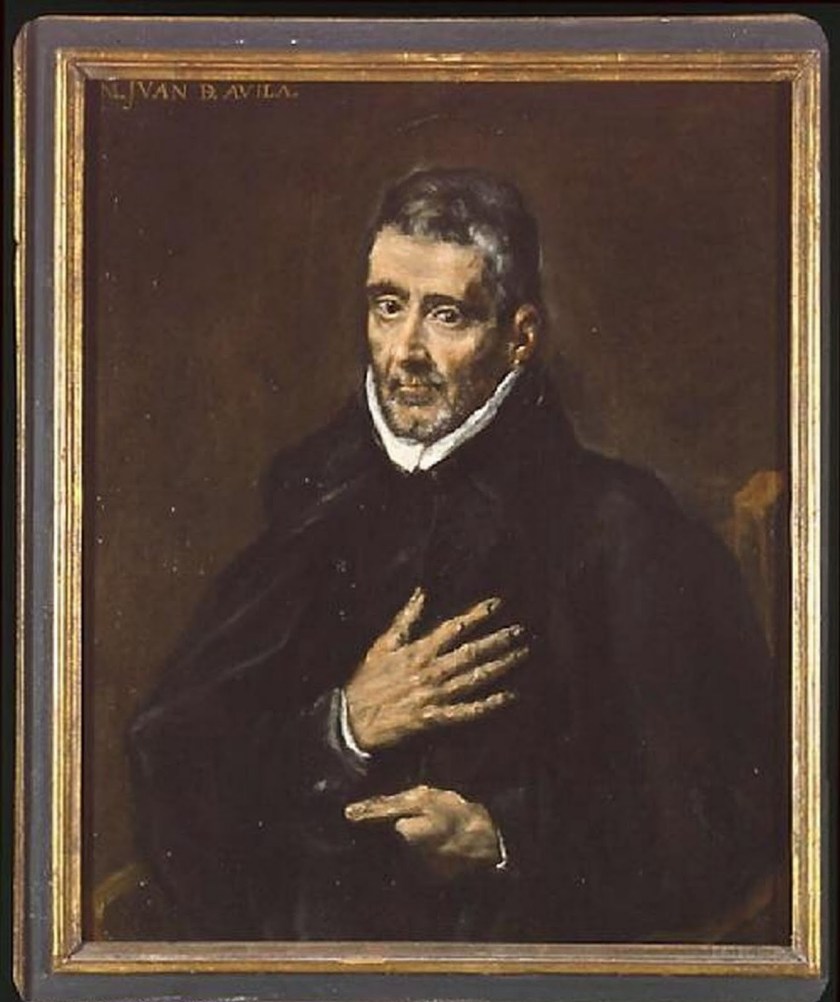
Saint of the Day – 10 May – St John of Avila (1499-1569) – Priest, Doctor of the Church, known as the Apostle of Andalusia, Mystic, Author, Preacher, Scholastic teacher, Founder of Schools and Universities – Patron of  Andalusia, Spain, Spain, Spanish secular clergy, World Youth Day 2011.   His Relics are  interred in the Jesuit church at Montilla, Spain.

JOHN OF AVILA 1
A portrait by El Greco (1580)

St John was born in Almodóvar del Campo, in the Province of Ciudad Real, to Alfonso de Ávila, of Jewish converso descent and Catalina Xixón (or Gijón), a wealthy and pious couple.    At the age of fourteen, in 1513, he was sent to the University of Salamanca to study law;   he withdrew in 1517, however, without receiving a degree.

Returning home, Ávila spent the next three years in the practice of austere piety.    His sanctity impressed a Franciscan friar journeying through Almodóvar, on whose advice he resumed his studies.   Thereafter, he undertook the study of philosophy and theology, in which he was fortunate to have as his teacher the noted Dominican friar Domingo de Soto.    It appears that Ávila earned his bachelor’s degree during his years at Alcalá and then left without completing requirements for the licentiate degree.

Both his parents died while Ávila was still a student, and after his ordination in spring 1526, he celebrated his first Mass in the church where they were buried.     He then sold the family property and gave the proceeds to the poor.    He saw in the severing of natural ties a vocation to foreign missionary work and prepared to go to Mexico.    He, therefore, traveled to Seville to await departure for the Indies in January 1527 with the Dominican friar, Julián Garcés, appointed the first Bishop of Tlaxcala.    While waiting in Seville, his unusually great devotion in celebrating Mass and his skills in catechesis and preaching, attracted the attention of Hernando de Contreras, a local priest, who mentioned him to the Archbishop of Seville and Inquisitor General, Alonso Manrique de Lara.    The archbishop saw in the young cleric a powerful instrument to stir up the faith in Andalusia, and after considerable persuasion Juan was induced to abandon his journey to America.

800px-Cueva_en_la_casa_natal_en_Almodóvar_del_Campo
The basement of the family home of John of Ávila in Almodóvar del Campo, Ciudad Real, Spain

John seems to have lived in the initial years after 1526 in a small house in Seville with another priest, probably Contreras and disciples gathered around him, in a loosely structured fraternal life.    It was at the request of the younger sister of one of these disciples, Sancha Carrillo, that he began in 1527 to write the Audi, filia (Listen, Daughter), a work he continued expanding and editing until his death.

Apostle of Andalusia
John’s first sermon was preached on 22 July 1529 and immediately established his reputation.    During his nine years of missionary work in Andalusia, crowds packed the churches at all his sermons.    However, his strong pleas for reform and his denunciation of the behaviour of the aristocracy meant that he was denounced to the office of the Inquisition in Seville in 1531 and put in prison in the summer of 1532.    He was charged with exaggerating the dangers of wealth and with closing the gates of heaven to the rich. The charges were refuted and he was declared innocent and released in July 1533.

Around the end of 1534 or the beginning of 1535, John of Ávila was incardinated into the Diocese of Córdoba, from which he received a small benefice.    This city became his base for directing his disciples and moving around Andalusia, preaching and establishing schools and colleges in various neighbouring cities such as Granada, Baeza, Montilla and Zafra.    It is thought that during this time Ávila received the title of Master of Sacred Theology, probably in Granada around 1538.

Of special importance was the University of Baeza, established in 1538 by a papal bull of Pope Paul III.    Ávila served as its first rector and it became a model for seminaries and for the schools of the Jesuits.

Ávila stayed in Granada from 1538-9, where it appears some kind of community was taking shape.   Likewise, during the years 1546 to 1555, John lived with about 20 disciples in Córdoba, making it seem that he intended to begin some kind of formal foundation of apostolic priests.    However, the foundation and fast expansion of the Jesuits meant that these ideas never came to fruition;   from early 1551, when Ávila began to experience poor health, he began actively encouraging his disciples who so desired to join the Jesuits (around 30 in total seem to have joined).

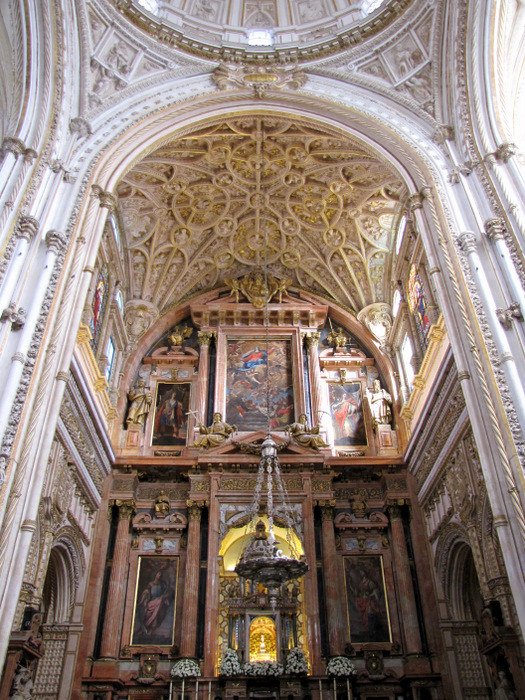
From early 1551 Ávila was in constant ill-health.   He spent the last years of his life in semi-retirement in the town of Montilla, in the Province of Córdoba.    He died there on 10 May 1569 and in accordance with his wishes was buried in that city, in the Jesuit Church of the Incarnation, which now serves as the sanctuary to his memory.

CORDOBA294191-great-mosque-cathedral-of-cordoba-cordoba-spainfeb-23-032Mosque–Cathedral.of.Córdoba.original.1435

St John of Ávila was declared Venerable by Pope Clement XIII on 8 February 1759 and beatified by Pope Leo XIII on 15 November 1893.    On 31 May 1970 he was canonized by Pope Paul VI.

Pope Benedict XVI named him a Doctor of the Church on 7 October 2012, the Feast of the Holy Rosary.   The proclamation of the two new Doctors of the Church was made by Pope Benedict before tens of thousands of people in St. Peter’s Square.   During his homily, Pope Benedict said that John of Ávila was a “profound expert on the sacred Scriptures, he was gifted with an ardent missionary spirit. He knew how to penetrate in a uniquely profound way the mysteries of the redemption worked by Christ for humanity. A man of God, he united constant prayer to apostolic action. He dedicated himself to preaching and to the more frequent practice of the sacraments, concentrating his commitment on improving the formation of candidates for the priesthood, of religious and of lay people, with a view to a fruitful reform of the Church”.

Posted in SAINT of the DAY

Saints – 10 May

St John of Avila – Doctor of the Church

St Joseph de Veuster – St Damian of Molokai (Optional Memorial)

St Alphius of Lentini
Bl Amalarius of Metz
Bl Antonio of Norcia
St Aurelian of Limoges
Bl Beatrix d’Este the Elder
St Blanda of Rome
St Calepodius of Rome
St Catald of Taranto
St Comgall of Bangor
St Cyrinus of Lentini
St Dioscorides of Smyrna
St Epimachus of Rome
St Felix of Rome
Bl Giusto Santgelp
St Gordian the Judge
Bl Ivan Merz
St Job the Patriarch
St Palmatius of Rome
St Philadelphus of Lentini
St Quartus of Capua
St Quintus of Capua
St Simplicius of Rome
St Solange of Bourges
St Thecla
Bl William of Pontnoise

Posted in MORNING Prayers

The 54th World Day of Prayer for Vocations – Vocations Sunday – 7 May 2017

The 54th World Day of Prayer for Vocations – Vocations Sunday – 7 May 2017

vocations sunday 7 may

MESSAGE OF HIS HOLINESS POPE FRANCIS
FOR THE 54th WORLD DAY OF PRAYER FOR VOCATIONS

Led by the Spirit for Mission

Dear Brothers and Sisters,

In the last few years, we have considered two aspects of the Christian vocation: the summons to “go out from ourselves” to hear the Lord’s voice, and the importance of the ecclesial community as the privileged place where God’s call is born, nourished and expressed.

Now, on this 54th World Day of Prayer for Vocations, I would like to reflect on the missionary dimension of our Christian calling. Those who drawn by God’s voice and determined to follow Jesus soon discover within themselves an irrepressible desire to bring the Good News to their brothers and sisters through proclamation and the service of charity. All Christians are called to be missionaries of the Gospel! As disciples, we do not receive the gift of God’s love for our personal consolation, nor are we called to promote ourselves, or a business concern. We are simply men and women touched and transformed by the joy of God’s love, who cannot keep this experience just to ourselves. For “the Gospel joy which enlivens the community of disciples is a missionary joy (Evangelii Gaudium, 21).

Commitment to mission is not something added on to the Christian life as a kind of decoration, but is instead an essential element of faith itself. A relationship with the Lord entails being sent out into the world as prophets of his word and witnesses of his love.

Even if at times we are conscious of our weaknesses and tempted to discouragement, we need to turn with God with confidence. We must overcome a sense of our own inadequacy and not yield to pessimism, which merely turns us into passive spectators of a dreary and monotonous life. There is no room for fear! God himself comes to cleanse our “unclean lips” and equip us for the mission: “Your guilt has departed and your sin is blotted out. Then I heard the voice of the Lord saying, ‘Whom shall I send and who will go for us?’ And I said, ‘Here am I, send me’” (Is 6:6-8).

In the depths of their heart, all missionary disciples hear this divine voice bidding them to “go about”, as Jesus did, “doing good and healing all” (cf. Acts 10:38). I have mentioned that, by virtue of baptism, every Christian is a “Christopher”, a bearer of Christ, to his brothers and sisters (cf. Catechesis, 30 January 2016). This is particularly the case with those called to a life of special consecration and with priests, who have generously responded, “Here I am, Lord, send me!” With renewed missionary enthusiasm, priests are called to go forth from the sacred precincts of the temple and to let God’s tender love overflow for the sake of humanity (cf. Homily at the Chrism Mass, 24 March 2016). The Church needs such priests: serenely confident because they have discovered the true treasure, anxious to go out and joyfully to make it known to all (cf. Mt 13:44).

Certainly many questions arise when we speak of the Christian mission. What does it mean to be a missionary of the Gospel? Who gives us the strength and courage to preach? What is the evangelical basis and inspiration of mission? We can respond to these questions by meditating on three scenes from the Gospels: the inauguration of Jesus’ mission in the synagogue at Nazareth (cf. Lk 4:16-30); the journey that, after his resurrection, he makes in the company of the disciples of Emmaus (cf. Lk 24:13-35) and, finally, the parable of the sower and the seed (cf. Mt 4:26-27).

Jesus is anointed by the Spirit and sent. To be a missionary disciple means to share actively in the mission of Christ. Jesus himself described that mission in the synagogue of Nazareth in these words: “The Spirit of the Lord is upon me, because he has anointed to bring good news to the poor. He has sent me to proclaim release to the captives and recovery of sight to the blind, to let the oppressed go free, and to proclaim the year of the Lord’s favour” (Lk 4:18-19). This is also our mission: to be anointed by the Spirit, and to go out to our brothers and sisters in order to proclaim the word and to be for them a means of salvation.

Jesus is at our side every step of the way. The questions lurking in human hearts and the real challenges of life can make us feel bewildered, inadequate and hopeless. The Christian mission might appear to be mere utopian illusion or at least something beyond our reach. Yet if we contemplate the risen Jesus walking alongside the disciples of Emmaus (cf. Lk 24:13-15), we can be filled with new confidence. In that Gospel scene, we have a true “liturgy of the street”, preceding that of the word and the breaking of the bread. We see that, at every step of the way, Jesus is at our side! The two disciples, overwhelmed by the scandal of the cross, return home on the path of defeat. Their hearts are broken, their hopes dashed and their dreams shattered. The joy of the Gospel has yielded to sadness. What does Jesus do? He does not judge them, but walks with them. Instead of raising a wall, he opens a breach. Gradually he transforms their discouragement. He makes their hearts burn within them, and he opens their eyes by proclaiming the word and breaking the bread. In the same way, a Christian does not bear the burden of mission alone, but realizes, even amid weariness and misunderstanding, that “Jesus walks with him, speaks to him, breathes with him, works with him. He senses Jesus alive with him in the midst of the missionary enterprise” (Evangelii Gaudium, 266).

Jesus makes the seed grow. Finally, it is important to let the Gospel teach us the way of proclamation. At times, even with the best intentions, we can indulge in a certain hunger for power, proselytism or intolerant fanaticism. Yet the Gospel tells us to reject the idolatry of power and success, undue concern for structures, and a kind of anxiety that has more to do with the spirit of conquest than that of service. The seed of the Kingdom, however tiny, unseen and at times insignificant, silently continues to grow, thanks to God’s tireless activity. “The kingdom of God is as if a man should scatter seed on the ground, and should sleep or rise night and day, and the seed should sprout and grow, he knows not how” (Mk 4:26-27). This is our first reason for confidence: God surpasses all our expectations and constantly surprises us by his generosity. He makes our efforts bear fruit beyond all human calculation.

With this confidence born of the Gospel, we become open to the silent working of the Spirit, which is the basis of mission. There can be no promotion of vocations or Christian mission apart from constant contemplative prayer. The Christian life needs to be nourished by attentive listening to God’s word and, above all, by the cultivation of a personal relationship with the Lord in Eucharistic adoration, the privileged “place” for our encounter with God.

I wish heartily to encourage this kind of profound friendship with the Lord, above all for the sake of imploring from on high new vocations to the priesthood and the consecrated life. The People of God need to be guided by pastors whose lives are spent in service to the Gospel. I ask parish communities, associations and the many prayer groups present in the Church, not to yield to discouragement but to continue praying that the Lord will send workers to his harvest. May he give us priests enamoured of the Gospel, close to all their brothers and sisters, living signs of God’s merciful love.

Dear brothers and sisters, today too, we can regain fervour in preaching the Gospel and we can encourage young people in particular to take up the path of Christian discipleship. Despite a widespread sense that the faith is listless or reduced to mere “duties to discharge”, our young people desire to discover the perennial attraction of Jesus, to be challenged by his words and actions, and to cherish the ideal that he holds out of a life that is fully human, happy to spend itself in love.

Mary Most Holy, the Mother of our Saviour, had the courage to embrace this ideal, placing her youth and her enthusiasm in God’s hands. Through her intercession, may we be granted that same openness of heart, that same readiness to respond, “Here I am”, to the Lord’s call, and that same joy in setting out (cf. Lk 1:39), like her, to proclaim him to the whole world.

From the Vatican, Franciscus

Posted in CATHOLIC DEVOTIONS of the Month, DOCTORS of the Church, FATHERS of the Church, MORNING Prayers, PRAYERS of the SAINTS, The BLESSED VIRGIN MARY

Our Morning Offering – 5 May

Our Morning Offering – 5 May

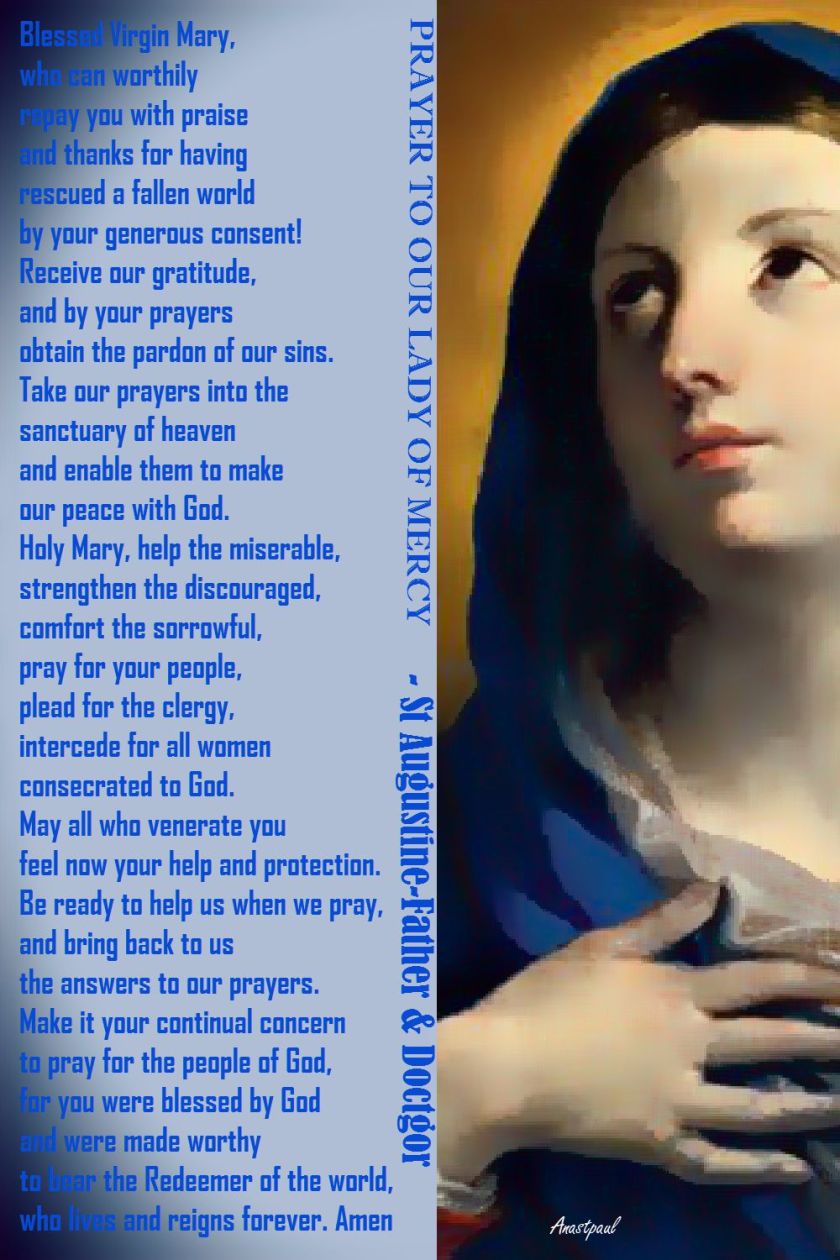
PRAYER TO OUR LADY OF MERCY
By St. Augustine

Blessed Virgin Mary,
who can worthily repay you with praise
and thanks for having rescued a fallen world
by your generous consent!
Receive our gratitude,
and by your prayers obtain the pardon of our sins.
Take our prayers into the sanctuary of heaven
and enable them to make our peace with God.
Holy Mary, help the miserable,
strengthen the discouraged,
comfort the sorrowful,
pray for your people,
plead for the clergy,
intercede for all women consecrated to God.
May all who venerate you
feel now your help and protection.
Be ready to help us when we pray,
and bring back to us the answers to our prayers.
Make it your continual concern
to pray for the people of God,
for you were blessed by God
and were made worthy to bear the Redeemer of the world,
who lives and reigns forever.
Amen

PRAYER TO OUR LADY OF MERCY-ST AUGUSTINE

Posted in CATHOLIC DEVOTIONS of the Month, MORNING Prayers, PRAYERS of the SAINTS, The BLESSED VIRGIN MARY

Our Morning Offering – 4 May

Our Morning Offering – 4 May

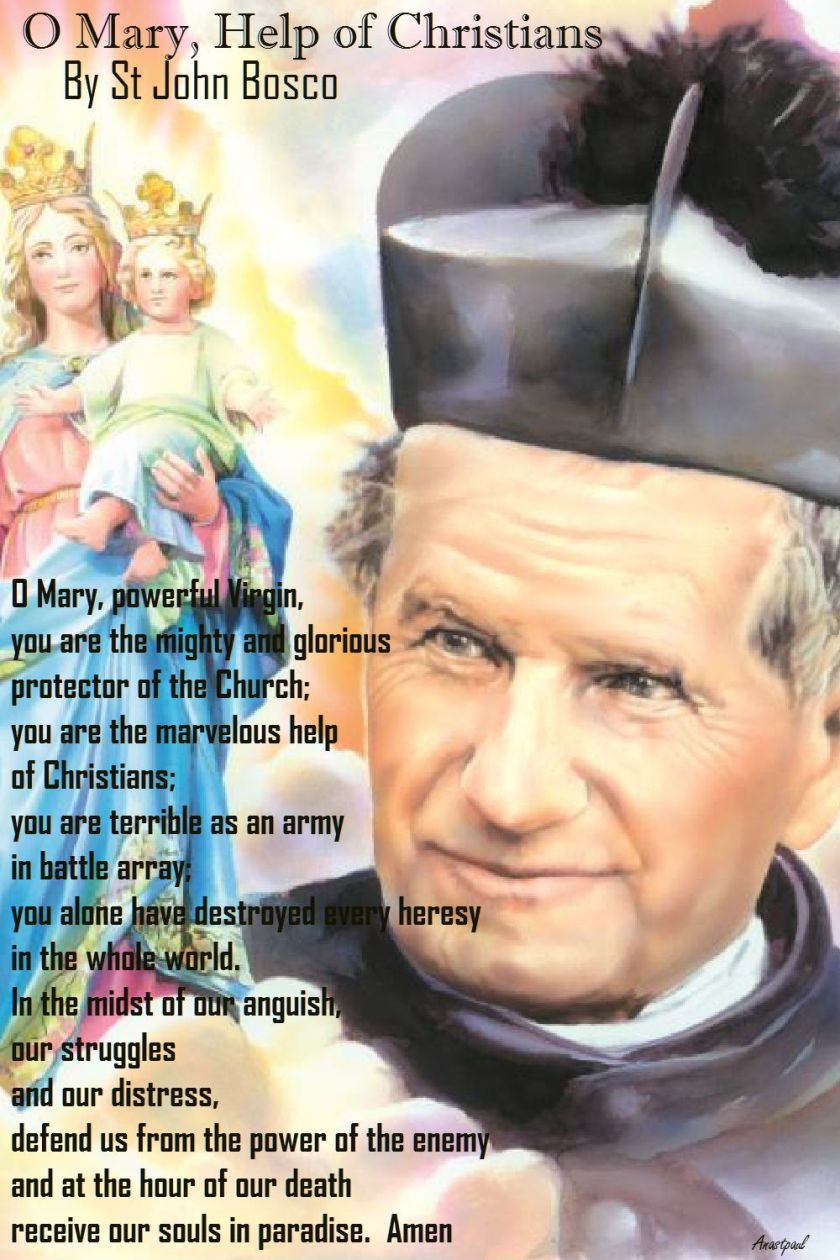
O Mary, Help of Christians
By St John Bosco

O Mary, powerful Virgin,
you are the mighty and glorious
protector of the Church;
you are the marvelous help of Christians;
you are terrible as an army in battle array;
you alone have destroyed every heresy
in the whole world.
In the midst of our anguish,
our struggles
and our distress,
defend us from the power of the enemy
and at the hour of our death
receive our souls in paradise. Amen

O MARY HELP OF CHRISTIANS - ST JOHN BOSCO

Posted in MORNING Prayers, NOTES to Followers

“Gone Fishing”…….

Dear All

I will be out of town for about a week – expected back on Wednesday 10 May or Thursday 11th – see you soon.   A few forward posts might pop through if I find the time,

I’ll miss you all and be praying for you!

gone fishing

Posted in FEASTS and SOLEMNITIES, MORNING Prayers, SAINT of the DAY, The APOSTLES & EVANGELISTS

Thought for the Day – 3 May

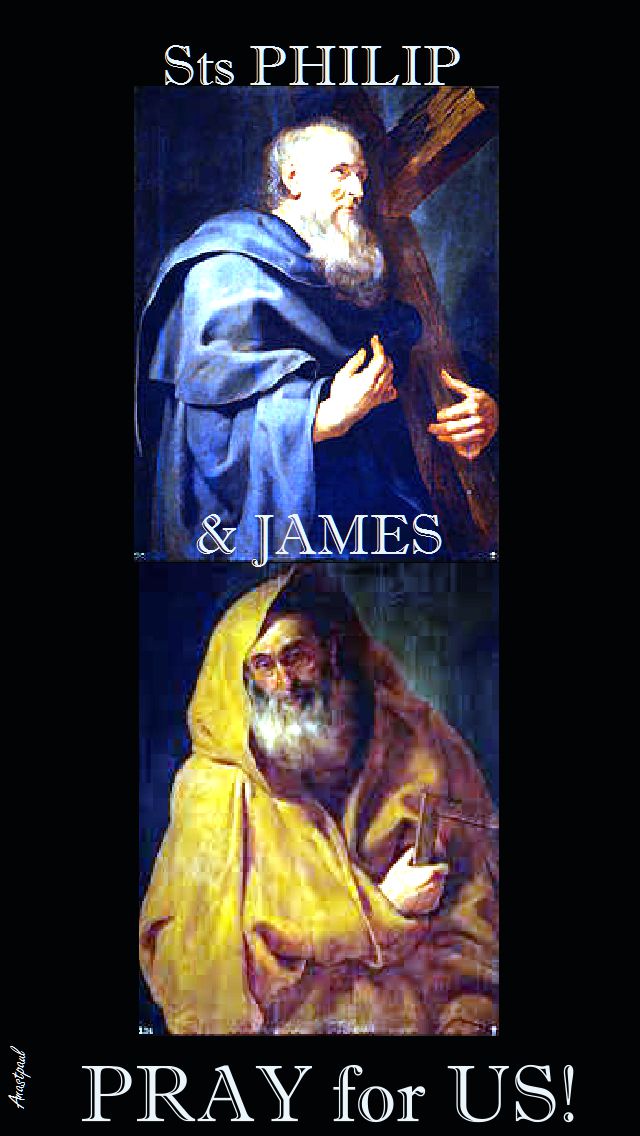
Sts Philip and James left all to follow Jesus, to become His heralds to the whole world.   They faced only difficulties, opposition and – finally – death by violence.   We cannot avoid the difficulties that come with professing our faith and we are all called to be apostles.   Let us pray for the courage to face our task with the same courage with which the Apostles faced theirs.   As in the case of the other apostles, we see in James and Philip human men who became foundation stones of the Church and we are reminded again that holiness and its consequent apostolate are entirely the gift of God, not a matter of human achieving.    All power is God’s power, even the power of human freedom to accept his gifts. “You will be clothed with power from on high,” Jesus told Philip and the others.   Their first commission had been to expel unclean spirits, heal diseases, announce the kingdom.    They learned, gradually, that these externals were sacraments of an even greater miracle inside their persons—the divine power to love like God.

Sts Philip and James, Pray for us!

STS PHILIP AND JAMES PRAY FOR US 2

Posted in DOCTORS of the Church, MORNING Prayers, QUOTES of the SAINTS

Quote of the Day – 3 May

Quote of the Day – 3 May

“To love is to be transformed into what we love.
To love God is therefore to be transformed into God!”

St John of the Cross


ST JOHN OF THE CROSS MY PIC

Posted in FEASTS and SOLEMNITIES, MORNING Prayers, QUOTES of the SAINTS, SAINT of the DAY, The APOSTLES & EVANGELISTS

One Minute Reflection – 3 May

One Minute Reflection – 3 May

What was from the beginning, what we have heard,
what we have seen with our eyes, what we looked upon
and touched with our hands concerns the Word of life
for the life was made visible;  we have seen it and testify to it……….1 John 1:1-2

REFLECTION – “Two of the favoured witnesses of our beloved Jesus’ Resurrection come before us today.    Sts. Philip and James are here, bearing testimony to us that their Master is truly risen from the dead, that they have seen Him, that they have touched Him, that they have conversed with Him during these forty days.   And, that we may have no doubt as to the truth of their testimony, they hold in their hands the instruments of the martyrdom they underwent for asserting that Jesus, after having suffered death, came to life again and rose from the grave.”………………..Abbot/Dom Prosper Guéranger

TWO OF THE FAVOURED - Dom Prosper Guéranger

PRAYER – O God, who gladden us each year with the feast day of the Apostles Philip and James, grant us, through their prayers, a share in the Passion and Resurrection of your Only Begotten Son, so that we may merit to behold You for eternity. Through our Lord Jesus Christ, your Son, who lives and reigns with You in the unity of the Holy Spirit, one God, for ever and ever.

STS PHILIP AND JAMES PRAY FOR US

Posted in CATHOLIC DEVOTIONS of the Month, MORNING Prayers, PRAYERS of the SAINTS, The BLESSED VIRGIN MARY

Our Morning Offering – 3 May

Our Morning Offering – 3 May

Most Holy Mary
By St John of the Cross

Most holy Mary,
Virgin of virgins,
shrine of the most Holy Trinity,
joy of the angels,
sure refuge of sinners,
take pity on our sorrows,
mercifully accept our sighs
and appease the wrath
of your most holy Son. Amen

MOST HOLY MARY BY ST JOHN OF THE CROSS


Posted in FEASTS and SOLEMNITIES, SAINT of the DAY, The APOSTLES & EVANGELISTS

Blessed Feast Day of Sts Philip and James, Apostles of Jesus Christ

Blessed Feast Day of Sts Philip and James, Apostles of Jesus Christ

ST PHILIPphilip-670

The Apostle Philip was one of Christ’s first disciples, called soon after his Master’s baptism in the Jordan.    The fourth Gospel gives the following detail:  “The next day Jesus was about to leave for Galilee and He found Philip.    And Jesus said to him:  Follow Me. Now Philip was from Bethsaida, the town of Andrew and Peter.    Philip found Nathanael, and said to him:   We have found Him of whom Moses in the Law and the Prophets wrote, Jesus the Son of Joseph of Nazareth.    And Nathanael said to him:  Can anything good come out of Nazareth?    Philip said to him: Come and see” (John 1:43ff). — The Church’s Year of Grace, Pius Parsch

Patronages:  Hatters; Luxembourg; pastry chefs; Uruguay, 37 cities.   Attributes:  basket; basket and Tau cross or letter Tau; two or three loaves and a cross; patriarchal cross and spear; knotted cross; broken idols; inverted cross; tall column; dragon; carpenter’s square and cross; long staff and spear; tall cross and book.

On Wednesday, 27 July 2011, the Turkish news agency Anadolu reported that archaeologists had unearthed a tomb that the project leader claims to be the Tomb of Saint Philip during excavations in Hierapolis close to the Turkish city Denizli.   The Italian archaeologist, Professor Francesco D’Andria stated that scientists had discovered the tomb within a newly revealed church.    He stated that the design of the Tomb and writings on its walls, definitively prove it belonged to the martyred Apostle of Jesus.

ST JAMES THE LESSER

Also known as:  Jacobus Minor, James the Just, James the Less, James the Younger, James, son of Alphaeus.   James, Son of Alphaeus:  We know nothing of this man except his name and, of course, the fact that Jesus chose him to be one of the 12 pillars of the New Israel, His Church.   He is not the James of Acts, son of Clopas, “brother” of Jesus and later bishop of Jerusalem and the traditional author of the Letter of James.   James, son of Alphaeus, is also known as James the Lesser to avoid confusing him with James the son of Zebedee, also an apostle and known as James the Greater.
Patronage:   dying people, apothecaries, druggists, pharmacists, fullers, hatmakers, hatters, milliners, Uruguay, 8 cities in Italy.   Attributes:   fuller’s club, man holding a book, square rule

Today’s Mass tells us that the example of the Apostles is the most certain and direct path to heaven.    They suffered and were persecuted but they placed their confidence in God and now they rejoice in heaven.   We too must have confidence in God and not be troubled in our adversities.    In our Father’s house there are many mansions and if we follow the way indicated by Him, Christ will come at the end of our life and take us to Himself.

Posted in FEASTS and SOLEMNITIES, SAINT of the DAY

Saints’ Memorials and Feasts – 3 May

St James the Lesser (Feast)
St Philip the Apostle (Feast)

St Adalsindis of Bèze
Bl Adam of Cantalupo in Sabina
St Ahmed the Calligrapher
St Aldwine of Peartney
St Pope Alexander I
St Alexander of Constantinople
Bl Alexander of Foigny
St Alexander of Rome
Bl Alexander Vincioli
St Ansfrid of Utrecht
St Antonina of Constantinople
St Diodorus the Deacon
Bl Edoardo Giuseppe Rosaz
St Ethelwin of Lindsey
St Eventius of Rome
St Fumac
St Gabriel Gowdel
St Juvenal of Narni
Bl Maria Leonia Paradis
St Maura of Antinoe
St Peter of Argos
St Philip of Zell
Bl Ramon Oromí Sullà
St Rhodopianus the Deacon
St Scannal of Cell-Coleraine
Bl Sostenaeus
St Stanislas Kazimierczyk
St Theodolus of Rome
St Timothy of Antinoe
Bl Tommaso Acerbis
Bl Uguccio
Bl Zechariah

Posted in CATHOLIC-PRAYERS OF THE CHURCH, DOCTORS of the Church, FATHERS of the Church, MORNING Prayers, PRAYERS of the SAINTS, SAINT of the DAY

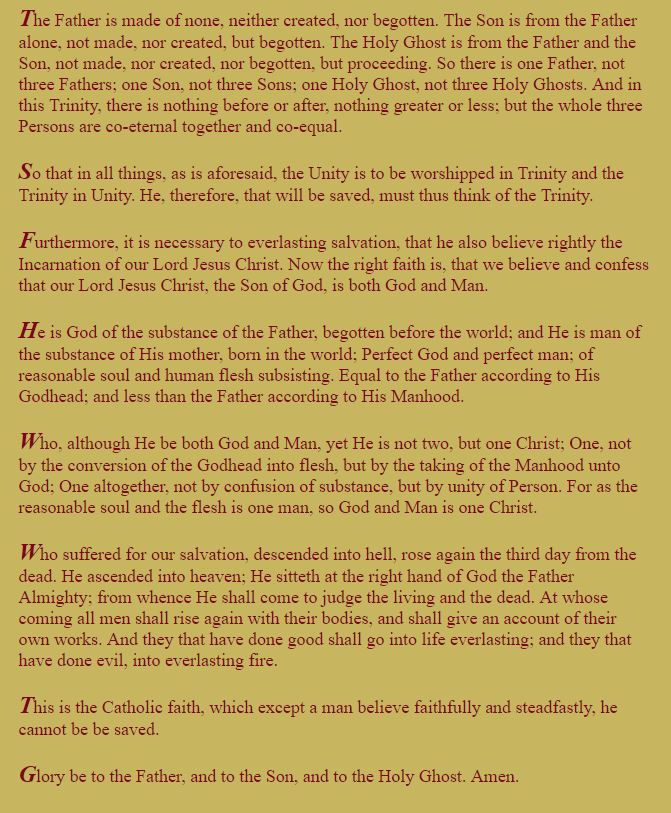
The Athanasian Creed

The Athanasian Creed, also known as Pseudo-Athanasian Creed or Quicunque Vult (also Quicumque Vult), is a Christian statement of belief focused on Trinitarian doctrine and Christology.    The Latin name of the creed, Quicunque vult, is taken from the opening words, “Whosoever wishes”.    The creed has been used by Christian churches since the sixth century.    It is the first creed in which the equality of the three persons of the Trinity is explicitly stated.    It differs from the Nicene-Constantinopolitan and Apostles’ Creeds in the inclusion of anathemas, or condemnations of those who disagree with the creed (like the original Nicene Creed).

Widely accepted among Western Christians, including the Roman Catholic Church and some Anglican churches, Lutheran churches (it is considered part of Lutheran confessions in the Book of Concord) and ancient, liturgical churches generally, the Athanasian Creed has been used in public worship less and less frequently.

It was designed to distinguish Nicene Christianity from the heresy of Arianism. Liturgically, this Creed was recited at the Sunday Office of Prime in the Western Church; it is not in common use in the Eastern Church.    The creed has never gained acceptance in liturgy among Eastern Christians since it was considered as one of many unorthodox fabrications that contained the Filioque clause.    Today, the Athanasian Creed is rarely used even in the Western Church.    When used, one common practice is to use it once a year on Trinity Sunday.

onetwo

Posted in DOCTORS of the Church, FATHERS of the Church, MORNING Prayers, SAINT of the DAY

Thought for the Day – 2 May

Thought for the Day – 2 May

At certain periods in Church history, it is one man who saves the Church for orthodoxy, one human instrument that Goduses to further His work.   Athanasius suffered many trials while he was bishop of Alexandria.    He was given the grace to remain strong against what probably seemed at times to be insurmountable opposition.    Athanasius lived his office as bishop completely.    He defended the true faith for his flock, regardless of the cost to himself.    In today’s world we are experiencing this same call to remain true to our faith, no matter what.   We should all realise how important we are to the good of others and that, without us, certain people would never hear of God or come to a knowledge of Jesus Christ.   Upon our orthodoxy and fidelity may well depend the growth in faith of many others – what a thought!   Therefore, we need to learn and know the truth as St Athanasius said “You will not see anyone who is really striving after his advancement who is not given to spiritual reading. And as to him who neglects it, the fact will soon be observed by his progress.”

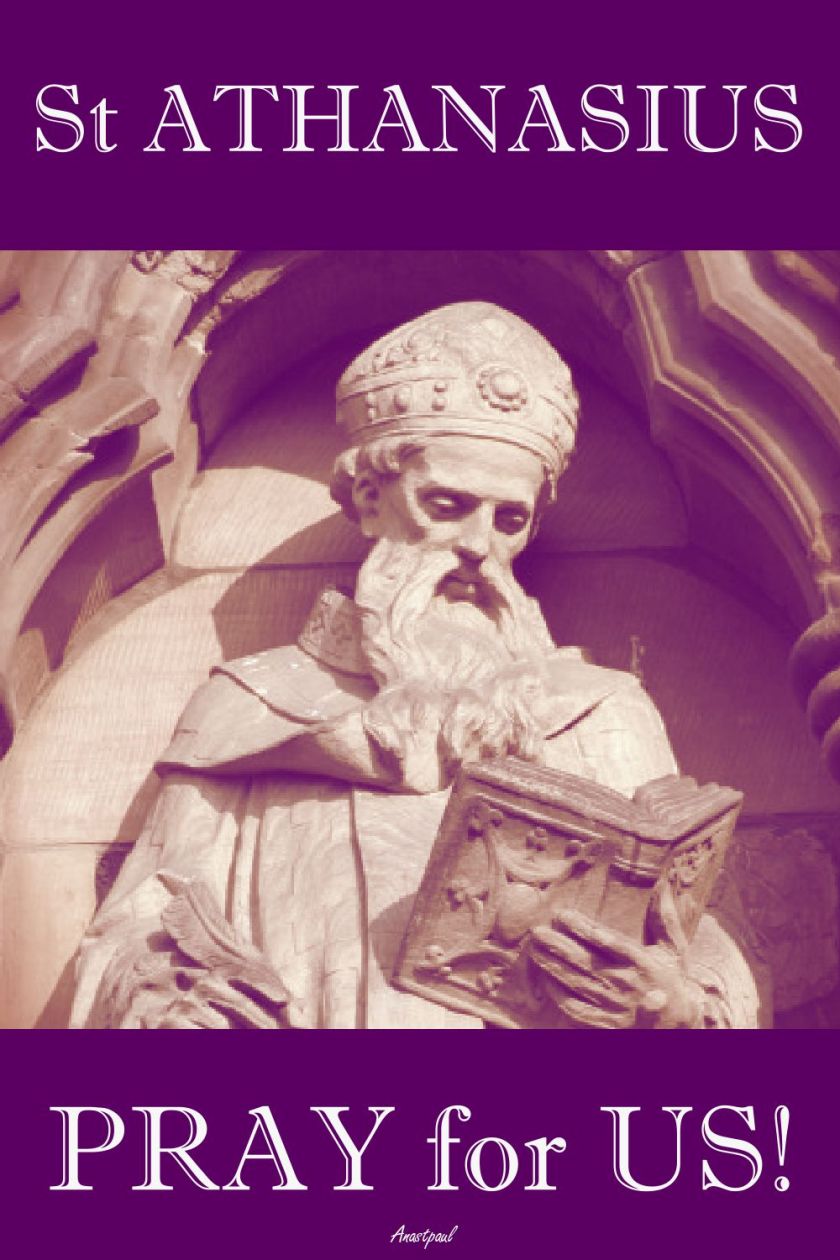
St Athanasius, pray for us!

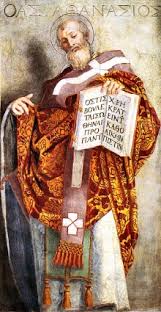
ST ATHANASIUS PRAY FOR US 2.jpg

Posted in DOCTORS of the Church, FATHERS of the Church, MORNING Prayers, QUOTES of the SAINTS, SAINT of the DAY

Quote/s of the Day – 2 May

Quote/s of the Day – 2 May

“The Word who became all things for us, is close to us, our Lord Jesus Christ who promises to remain with us always.    He cries out, saying:  See, I am with you all the days of this age.    He is himself the shepherd, the high priest, the way and the door and has become all things at once for us.”

THE WORD HAS BECOME-ST ATHANASIUS

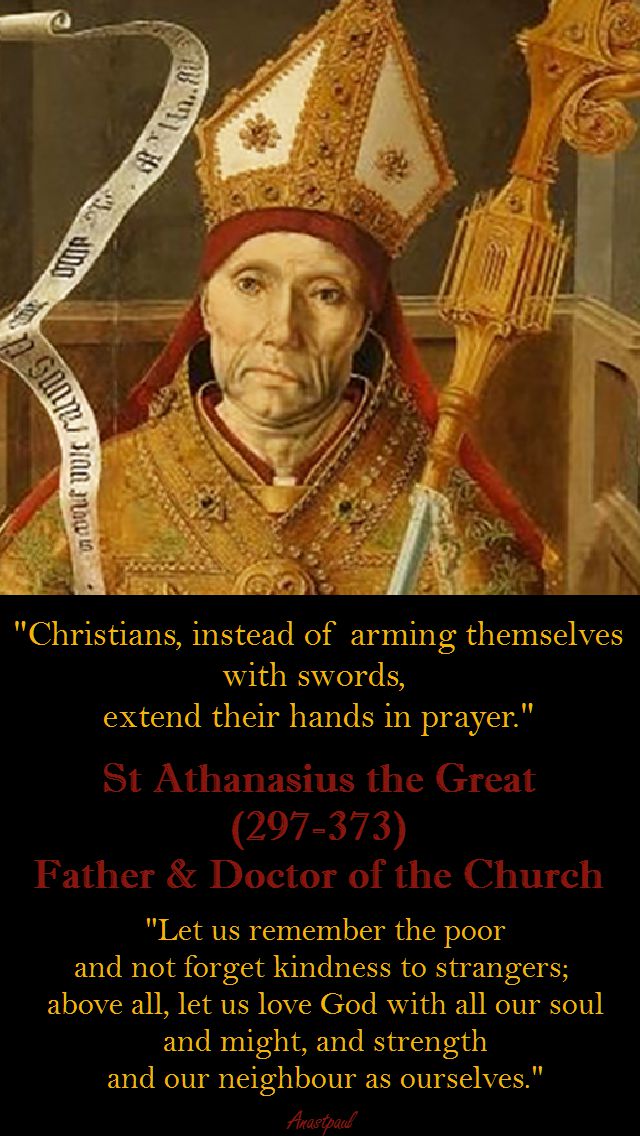
“Christians, instead of arming themselves with swords, extend their hands in prayer.”

“Let us remember the poor and not forget kindness to strangers;  above all, let us love God with all our soul and might and strength and our neighbour as ourselves.”

CHRISTIANS, INSTEAD OF - St Athanasius

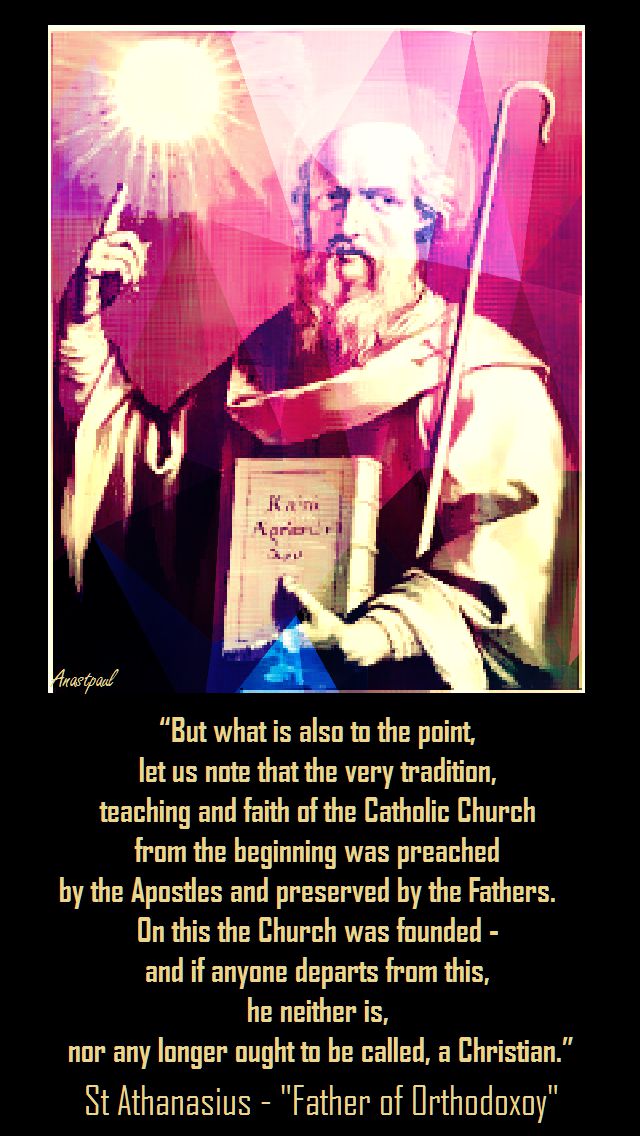
“But what is also to the point, let us note that the very tradition, teaching and faith of the Catholic Church from the beginning was preached by the Apostles and preserved by the Fathers.    On this the Church was founded – and if anyone departs from this, he neither is, nor any longer ought to be called, a Christian.”

BUR WHAT IS ALSO TO THE POINT-ST ATHANASIUS

St Athanasius  (297-373) Father & Doctor of the Church


Posted in DOCTORS of the Church, FATHERS of the Church, MORNING Prayers, QUOTES of the SAINTS, The WORD

One Minute Reflection – 2 May

One Minute Reflection – 2 May

Christ….will give a new form to this lowly body of ours and remake it according to the pattern of his glorified body…………Phil 3:21

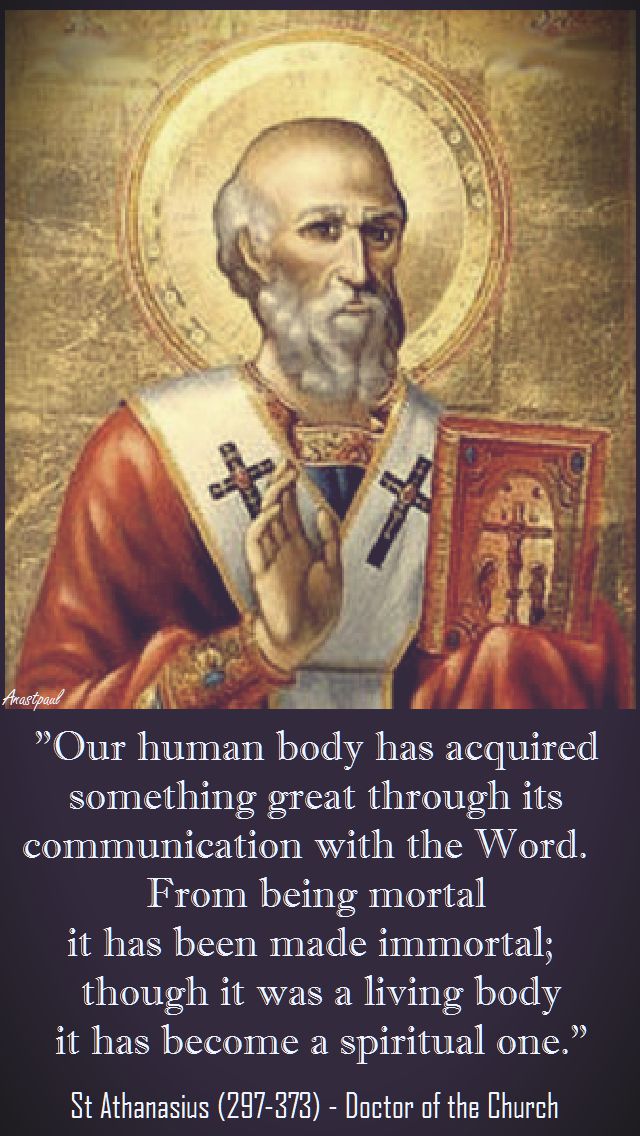
REFLECTION – Our human body has acquired something great through its communication with the Word.    From being mortal it has been made immortal; though it was a living body it has become a spiritual one…………St Athanasius (297-373) Father and Doctor of the Church

PRAYER – Heavenly Father, help me to respect my body and not subject it to sin.   Let me keep it ready to receive the fullness of the new form given by Your Son, in heaven.    St Athanasius, you taught the world the truth of Christ, please pray for us, amen.

PHILIPPIANS 3-21OUR HUMAN BODY-ST ATHANASIUSst athanasius pray for us

Posted in DOCTORS of the Church, FATHERS of the Church, MORNING Prayers, SAINT of the DAY, The BLESSED VIRGIN MARY

Our Morning Offering – 2 May

Our Morning Offering – 2 May

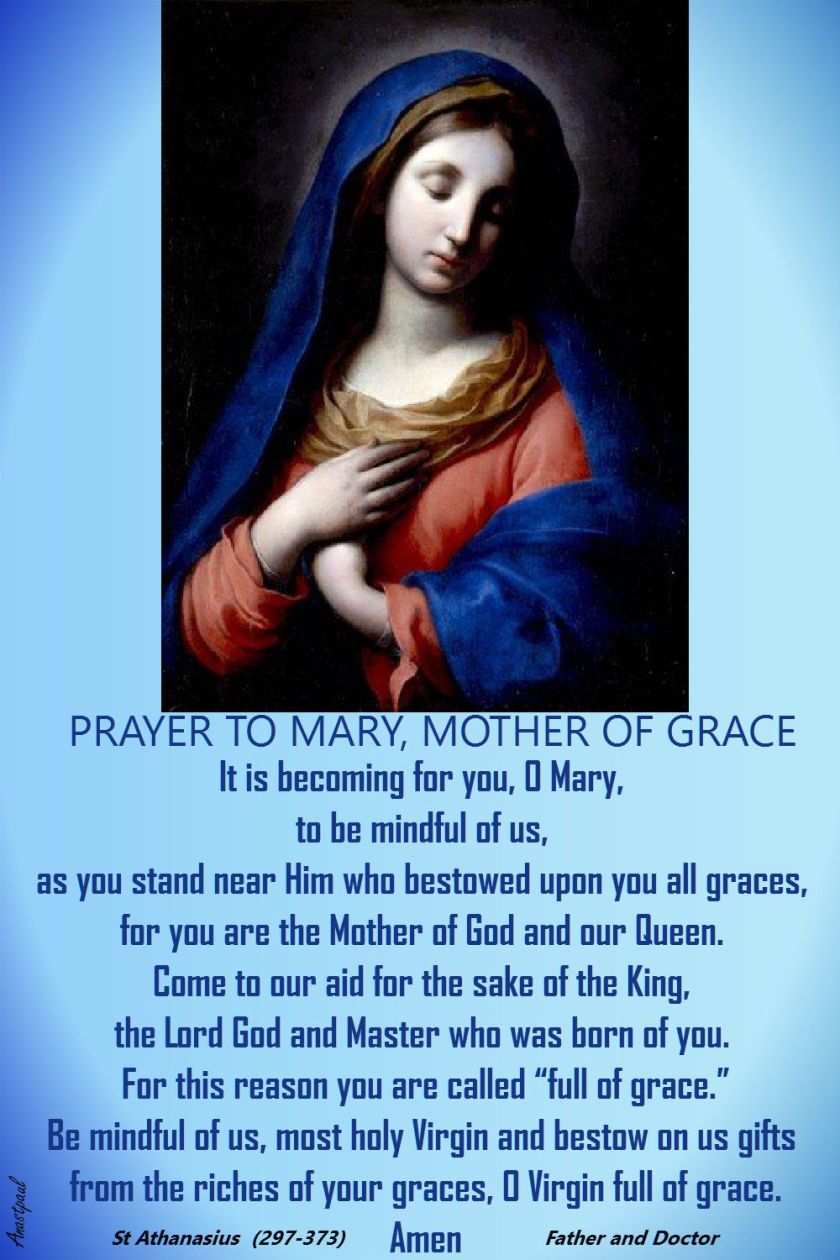
PRAYER TO MARY, MOTHER OF GRACE
By St Athanasius (297-373)

It is becoming for you, O Mary,
to be mindful of us,
as you stand near Him who bestowed upon you all graces,
for you are the Mother of God and our Queen.
Come to our aid for the sake of the King,
the Lord God and Master who was born of you.
For this reason you are called “full of grace.”
Be mindful of us, most holy Virgin and bestow on us gifts
from the riches of your graces, O Virgin full of grace.
Amen

PRAYER TO MARY MOTHER OF GRACE-ST ATHANASIUS

Posted in DOCTORS of the Church, FATHERS of the Church, SAINT of the DAY

Saint of the Day – 2 May – St Athanasius

Saint of the Day – 2 May – St Athanasius (c295-373) – Father and Doctor of the Church Bishop, Confessor, known as “Father of Orthodoxy” and Athanasius of Alexandria, Athanasius of Egypt, Athanasius the Great, Champion of Christ’s Divinity, Champion of Orthodoxy, Greek Doctor of the Church, Holy Hierarch, Pillar of the Church – Attributes:  Bishop arguing with a pagan; bishop holding an open book; bishop standing over a defeated heretic.

Athanasius was born of Christian parents in Alexandria, Egypt, about 295. As a young man, he spent four years in prayer and solitude in the desert.    There he met Anthony the hermit, who influenced him.    After he left the desert, Athanasius became a priest and was appointed secretary to Alexander, bishop of Alexandria.

Meanwhile, Arius had begun preaching that Jesus was not truly God.    At a church council at Nicaea in 325, Arius and his ideas were condemned and the bishops composed the Nicene Creed.

Conflict with Arius and Arianism as well as successive Roman emperors shaped Athanasius’ career.    In 325, at the age of 27, Athanasius began his leading role against the Arians as a deacon and assistant to Bishop Alexander of Alexandria during the First Council of Nicaea.    Roman emperor Constantine the Great had convened the council in May–August 325 to address the Arian position that the Son of God, Jesus of Nazareth, is of a distinct substance from the Father.    Three years after that council, Athanasius succeeded his mentor as archbishop of Alexandria.    In addition to the conflict with the Arians (including powerful and influential Arian churchmen led by Eusebius of Nicomedia), he struggled against the Emperors Constantine, Constantius II, Julian the Apostate and Valens.    He was known as “Athanasius Contra Mundum” (Latin for Athanasius Against the World).

ST ATHANASIUS 4

Nonetheless, within a few years after his death, Gregory of Nazianzus called him the “Pillar of the Church”.    His writings were well regarded by all Church fathers who followed, in both the West and the East, who noted their rich devotion to the Word-become-man, great pastoral concern and profound interest in monasticism.    Athanasius is counted as one of the four great Eastern Doctors of the Church in the Roman Catholic Church – he is labeled as the “Father of Orthodoxy”.

Bl. John Henry Newman described him as a “principal instrument, after the Apostles, by which the sacred truths of Christianity have been conveyed and secured to the world”. [Letters..]

Historian Cornelius Clifford says: “His career almost personifies a crisis in the history of Christianity;  and he may be said rather to have shaped the events in which he took part than to have been shaped by them.” 

The greater majority of Church leaders and the emperors fell into support for Arianism, so much so that Jerome, 340–420, wrote of the period:  “The whole world groaned and was amazed to find itself Arian”.    He, Athanasius, even suffered an unjust excommunication from Pope Liberius (325–366) who was exiled and leant towards the Arians, until he was allowed back to the See of Rome. Athanasius stood virtually alone against the world.


Posted in SAINT of the DAY

Saints – 2 May

St Athanasius of Alexandria (Memorial)

St Alpin de Châlons
Bl Bernard of Seville
St Bertinus the Younger
Bl Boleslas Strzelecki
Bl Conrad of Seldenbüren
St Cyriacus of Pamphylia
St Eugenius of Africa
St Exsuperius of Pamphylia
St Felix of Seville
St Fiorenzo of Algeria
St Gennys of Cornwall
St Germanus of Normandy
St Gluvias
St Guistano of Sardinia
St José María Rubio y Peralta
St Joseph Luu
Bl Juan de Verdegallo
St Longinus of Africa
St Neachtain of Cill-Uinche
St Theodulus of Pamphylia
St Ultan of Péronne
St Vindemialis of Africa
St Waldebert of Luxeuil
St Wiborada of Saint Gall
Bl William Tirry
St Zoe of Pamphylia

Martyrs of Alexandria – 4 saints: A group of Christians marytred together in the persecutions of Diocletian. We know little more than their names – Celestine, Germanus, Neopolus and Saturninus. 304 in Alexandria, Egypt

Posted in MORNING Prayers, PRAYERS of the CHURCH, PRAYERS of the SAINTS, QUOTES of the SAINTS, SAINT of the DAY

1 May – The Memorial of St Joseph the Worker

1 May – The Memorial of St Joseph the Worker

Let us Pray:

Prayer to St Joseph the Worker
By St Pope John XXIII

Saint Joseph, guardian of Jesus and chaste husband of Mary,
you passed your life in loving fulfillment of duty.
You supported the holy family of Nazareth with the work of your hands.
Kindly protect those who trustingly come to you.
You know their aspirations, their hardships, their hopes.
They look to you because they know you will understand and protect them.
You too knew trial, labour and weariness.
But amid the worries of material life,
your soul was full of deep peace and sang out in true joy
through intimacy with God’s Son entrusted to you and with Mary,
His tender Mother.
Assure those you protect that they do not labour alone.
Teach them to find Jesus near them
and to watch over Him faithfully as you have done. Amen

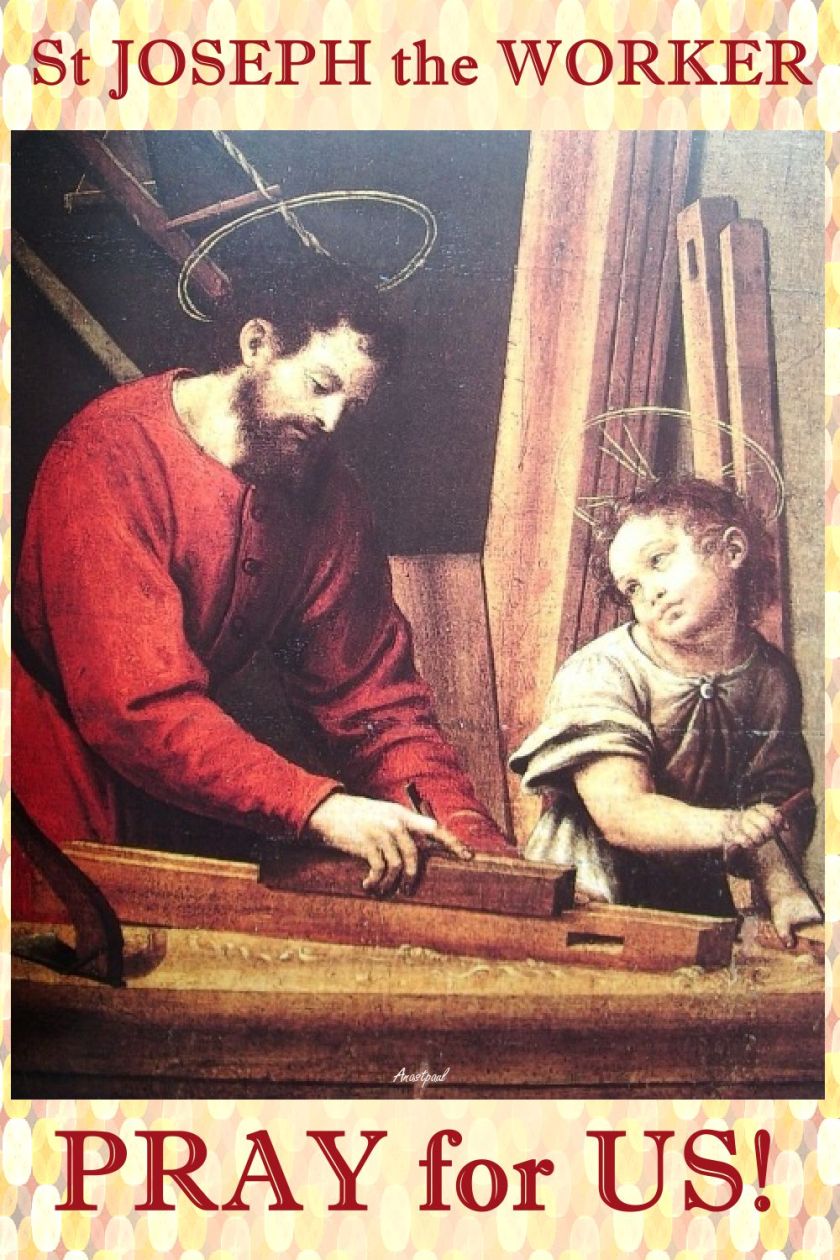
PRAYER TO ST JOSEPH THE WORKER BY ST POPE JOHN XXIIIstjosephtheworker-pray for us 2


Posted in CATECHESIS, MORNING Prayers, QUOTES of the SAINTS, SAINT of the DAY

Thought for the Day – 1 May

Thought for the Day – 1 May

The Foreshadowing of Saint Joseph

As the Church of Christ is prefigured in the rites and ceremonies of the Old Law, so the chief personages who centre round Our Lord in the redemption of the world are foreshadowed in the Old Testament.    We trace the outlines of Our Lady’s graces in Esther, Jahel, Bethsabee, Judith.    So, too, Saint Joseph’s place in the new dispensation is anticipated in the place of the patriarch Joseph at the court of Pharao.    Thus it is that God in His love for His chosen ones paves the way for them centuries before.    From the beginning He has prepared their work, and the throne they are to earn in heaven by their labors and sufferings for Him.

In the life of the patriarch Joseph there was throughout a correspondence to the life of the foster-father of Jesus Christ.    The troubles and persecutions of his early life; his long time of servitude and obscurity; his wondrous purity, his time of patient expectation; his glorious exaltation; his omnipotence with the king; his power to save all who came to him – all these were repeated, or rather were fulfilled, in Saint Joseph.    Reflect on each of these, and consider how Saint Joseph is a model to us.

We read of the patriarch, Joseph, that the king of Egypt made him lord of his house.    So God made Saint Joseph lord of that earthly tabernacle of flesh in which He dwelt on earth.    Joseph ruled Our Lord in His sacred humanity.    He made him lord, too, of another house in which He sojourned, of the sacred house that Wisdom built for Himself in the form of His holy Mother.    If Saint Joseph was thus lord of Jesus and Mary, what may we not expect from Him?   In our lives on the ‘narrow road’, on our way home, in our difficulties, in our labour and our toil!?

To capture the devotion to Saint Joseph within the Catholic liturgy, in 1870, Pope Pius IX declared Saint Joseph the patron of the universal Church. In 1955, Pope Pius XII added the feast of Saint Joseph the Worker.    This silent saint, who was given the noble task of caring and watching over the Virgin Mary and Jesus, now cares for and watches over the Church and models for all the dignity of human work.

“What emanates from the figure of Saint Joseph is faith.    Joseph of Nazareth is a “just man” because he totally “lives by faith.”     He is holy because his faith is truly heroic. Sacred Scripture says little of him.    It does not record even one word spoken by Joseph, the carpenter of Nazareth.    And yet, even without words, he shows the depth of his faith, his greatness.    Saint Joseph is a man of great spirit.    He is great in faith, not because he speaks his own words but above all because he listens to the words of the Living God.    He listens in silence.    And his heart ceaselessly perseveres in the readiness to accept the Truth contained in the word of the Living God.    We see how the word of the Living God penetrates deeply into the soul of that man, that just man.    And we, do we know how to listen to the word of God?    Do we know how to absorb it into the depths of our human personalities? Do we open our conscience in the presence of this word?”

– Pope John Paul II from Daily Meditations

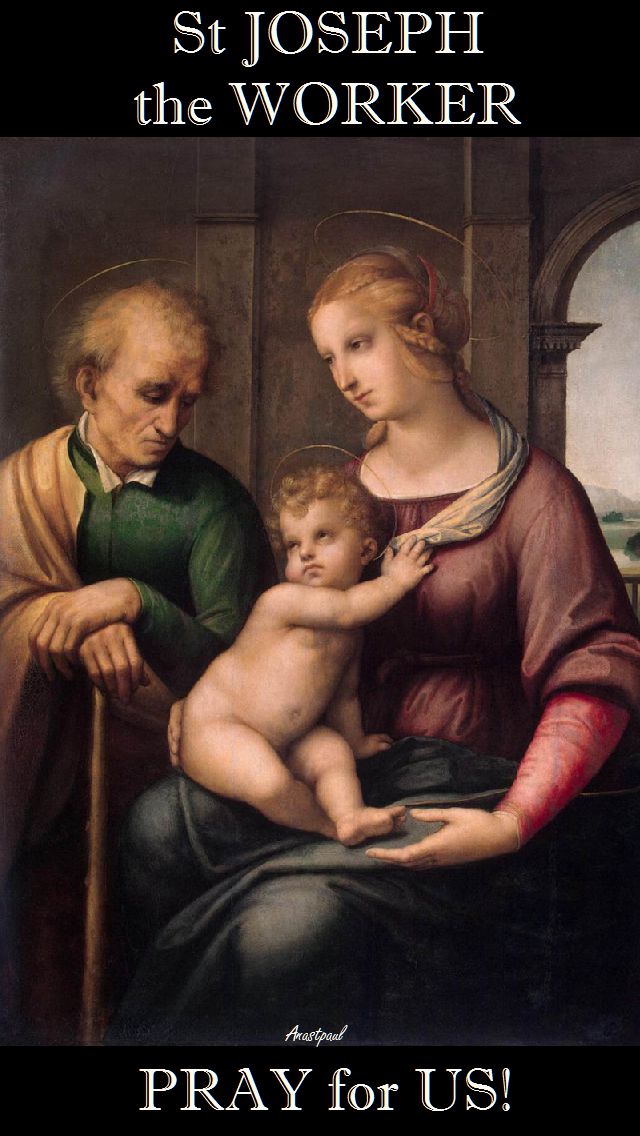
St Joseph the Worker, Pray for us!ST JOSEPHTHEWORKER - PRAY FOR US

Posted in CATHOLIC DEVOTIONS of the Month, MORNING Prayers, QUOTES of the SAINTS, SAINT of the DAY

Quote of the Day – 1 May

Quote of the Day – 1 May

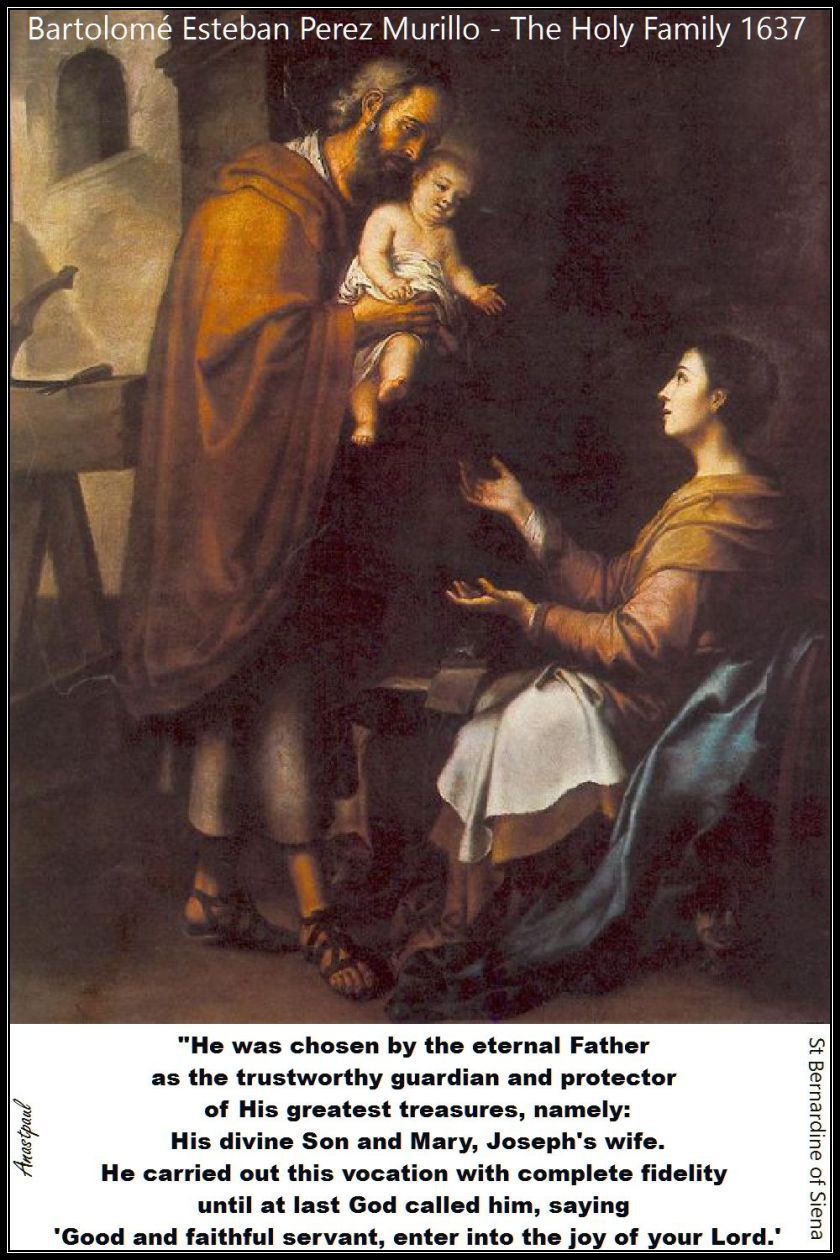
“He was chosen by the eternal Father as the trustworthy guardian and protector
of His greatest treasures, namely:  His divine Son and Mary, Joseph’s wife.
He carried out this vocation with complete fidelity until at last God called him, saying
‘Good and faithful servant, enter into the joy of your Lord.’

– from a sermon by Saint Bernardine of Siena
Bartolomé Esteban Perez Murillo The Holy Family 1637

he-was-chosen-by-the-eternal-father-st-bernardine

Posted in CATHOLIC DEVOTIONS of the Month, MORNING Prayers, QUOTES of the SAINTS, The BLESSED VIRGIN MARY, The WORD

One Minute Reflection – 1 May

One Minute Reflection – 1 May

You shall set apart three cities…(where) a homicide may take
refuge …. to save his life when (he) unwittingly kills his neighbour………….Deuteronomy 19:2-4

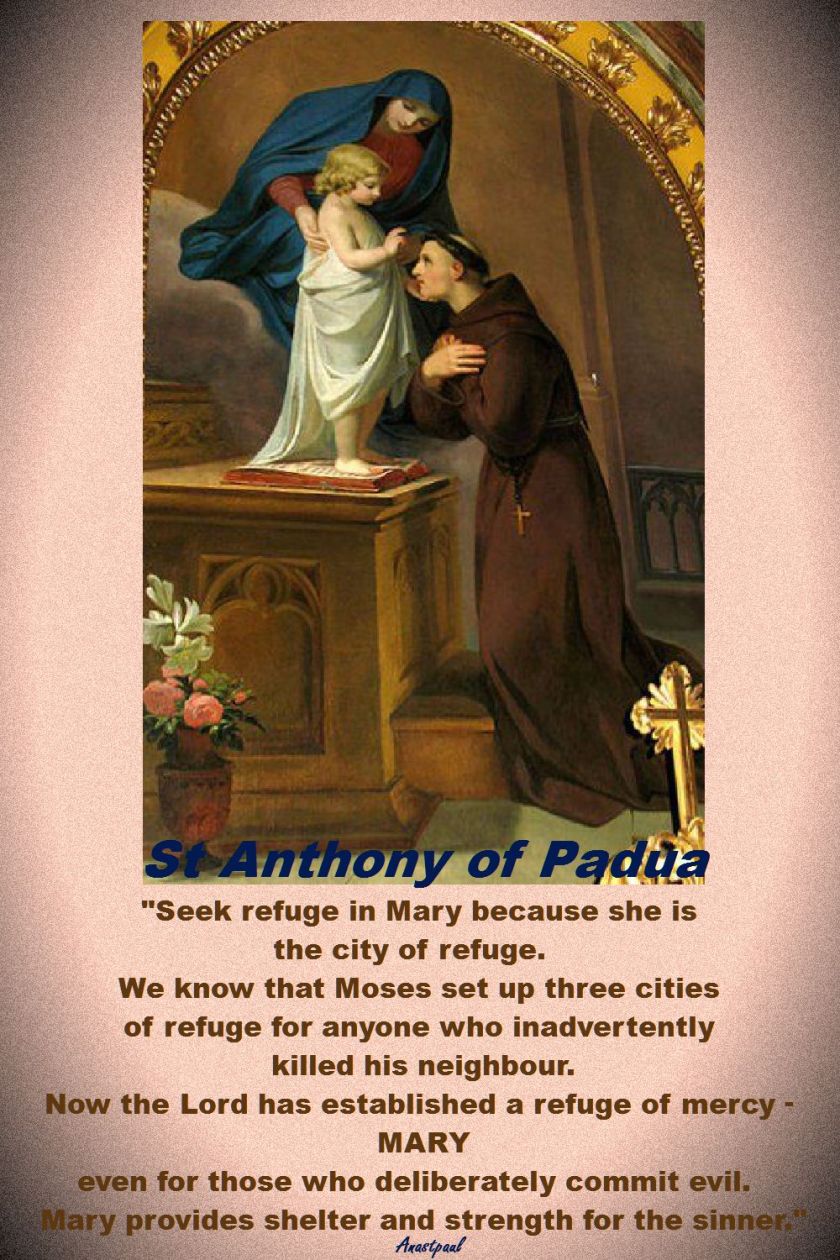
REFLECTION – “Seek refuge in Mary because she is the city of refuge. We know that Moses set up three cities of refuge for anyone who inadvertently killed his neighbour.
Now the Lord has established a refuge of mercy – Mary – even for those who deliberately commit evil. Mary provides shelter and strength for the sinner.”……St Anthony of Padua

seek refuge in mary - st anthony of padua

PRAYER – Lord Jesus, move me to take refuge in Your holy Mother if I am so unfortunate as to lose Your grace. Help me to flee to my city of refuge, for she will lead me to You. Mary, Mother of God, pray for us! Amen

MARY PRAY FOR US

Posted in MORNING Prayers

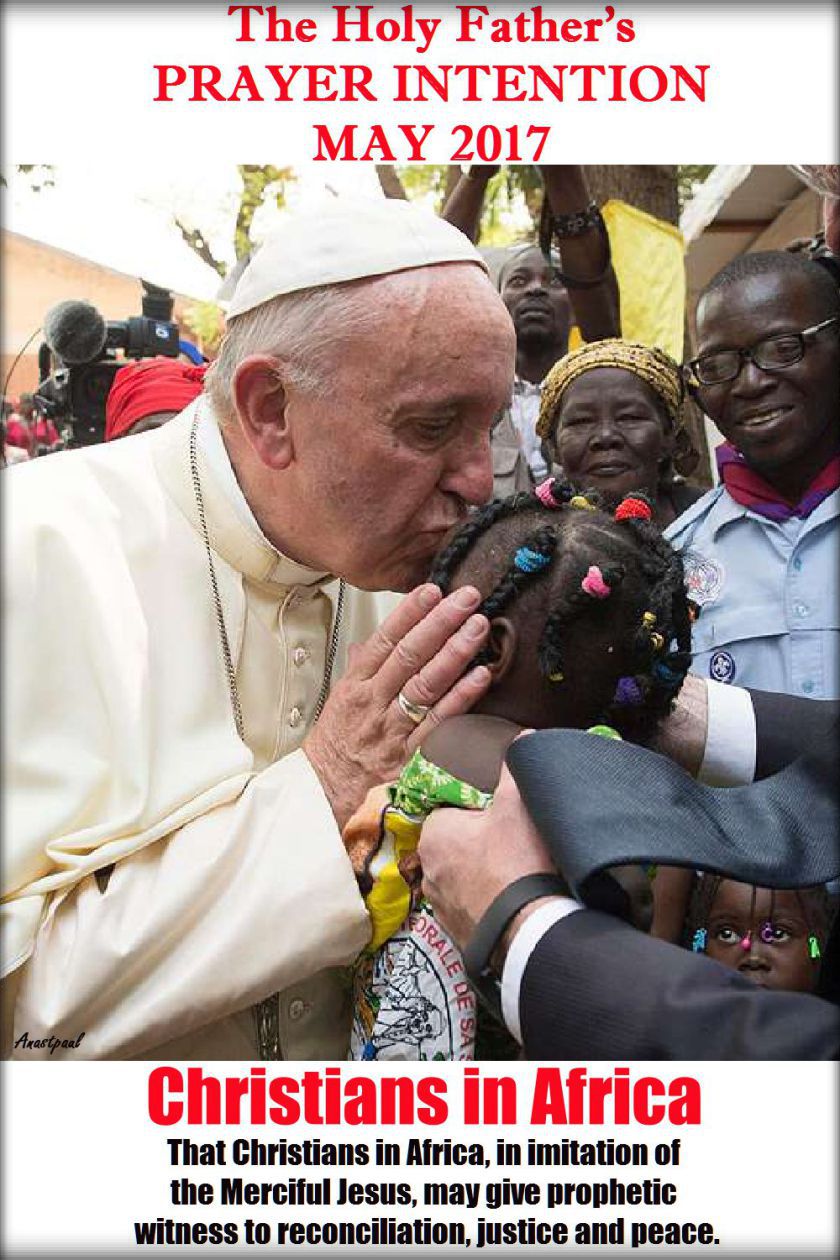
The Holy Father’s PRAYER INTENTION for May 2017

The Holy Father’s PRAYER INTENTION for May 2017

Christians in Africa

That Christians in Africa, in imitation of the Merciful Jesus,
may give prophetic witness to reconciliation, justice and peace.

holy-father-prayer-intentions-may-2017

Posted in CATHOLIC DEVOTIONS of the Month, MORNING Prayers, The BLESSED VIRGIN MARY

May the Month of Mary

May the Month of Mary

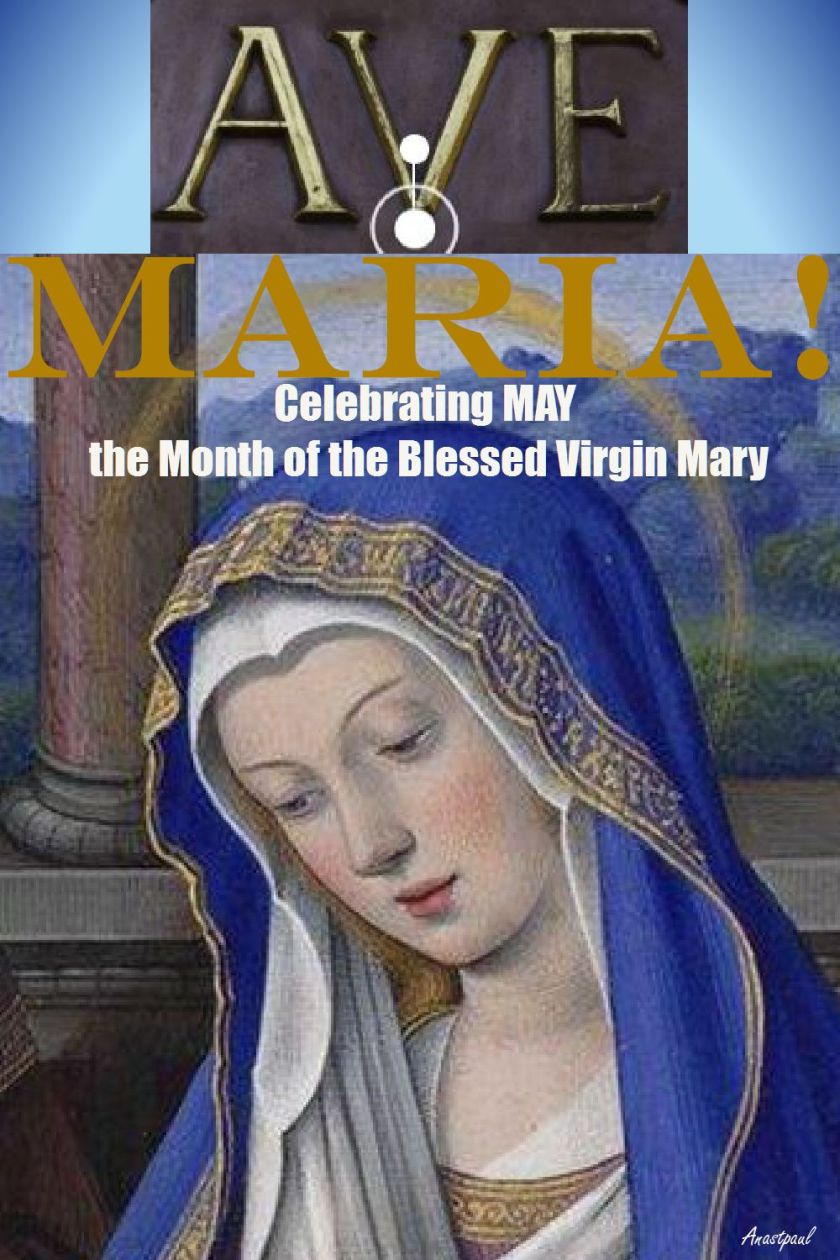
MAY THE MONTH OF THE BLESSED VIRGIN MARY

The month of May is the “month which the piety of the faithful has especially dedicated to Our Blessed Lady” and it is the occasion for a “moving tribute of faith and love which Catholics in every part of the world pay to the Queen of Heaven.       During this month Christians, both in church and in the privacy of the home, offer up to Mary from their hearts an especially fervent and loving homage of prayer and veneration. In this month, too, the benefits of God’s mercy come down to us from her throne in greater abundance” (Paul VI: Encyclical on the Month of May, no. 1).

This Christian custom of dedicating the month of May to the Blessed Virgin arose at the end of the 13th century. In this way, the Church was able to Christianize the secular feasts which were wont to take place at that time. In the 16th century, books appeared and fostered this devotion.

The practice became especially popular among the members of the Jesuit Order — by 1700 it took hold among their students at the Roman College and a bit later it was publicly practiced in the Gesu Church in Rome. From there it spread to the whole Church.

The practice was granted a partial indulgence by Pius VII in 1815 and a plenary indulgence by Pius IX in 1859. With the complete revision of indulgences in 1966 and the decreased emphasis on specific indulgences, it no longer carries an indulgence; however it certainly falls within the category of the First General Grant of Indulgences. (A partial indulgence is granted to the faithful who, in the performance of their duties and in bearing the trials of life, raise their mind with humble confidence to God, adding — even if only mentally — some pious invocation.

Excerpted from Enchiridion of Indulgences.

The Month of Mary and the Popes

The pious practice of honoring Mary during the month of May has been especially recommended by the Popes. Pius XII made frequent reference to it and in his great Encyclical on the Sacred Liturgy (Mediator Dei) characterized it as one of “other exercises of piety which although not strictly belonging to the Sacred Liturgy, are nevertheless of special import and dignity, and may be considered in a certain way to be an addition to the liturgical cult: they have been approved and praised over and over again by the Apostolic See and by the Bishops” (no. 182).

Paul VI wrote a short encyclical in 1965 using the Month of Mary devotion as a means of obtaining prayers for peace.    He urged the faithful to make use of this practice which is “gladdening and consoling” and by which the Blessed Virgin Mary is honored and the Christian people are enriched with spiritual gifts” (no. 2).

In May of 2002 Pope John Paul II said, “Today we begin the month dedicated to Our Lady a favourite of popular devotion.   In accord with a long-standing tradition of devotion, parishes and families continue to make the month of May a ‘Marian’ month, celebrating it with many devout liturgical, catechetical and pastoral initiatives!”

Devotion to Mary

“The Blessed Virgin Mary is the Mother of the Church and therefore the example, as well as the guide and inspiration, of everyone who, in and through the Church, seeks to be the servant of God and man and the obedient agent of the promptings of the Holy Spirit.

The Holy Spirit, as Pope Leo XIII reminded us, is the soul of the Church: All the activity and service of the members of the Church, beginning with the supreme participation of the Blessed Mother in the work of the Church, is vivified by the Holy Spirit as the body, in all its activities, is vivified by its soul.    The Holy Spirit is the Paraclete, Advocate and Comforter which Christ Himself sent to be our consolation in the sorrowful mysteries of life, our source of moderation in the joyful mysteries of life, our added principle of exaltation in the glorious mysteries of life.

So He was for the Blessed Mother; so also He is for the least of us;   so also He is for the rest of the Church, even for those who are its unconscious but conscientious members.

Wherever there is faith there is the example of Mary, because she lived by faith as the Scriptures remind us….

If, then, piety is the virtue which binds us to the sources of all life, to God, to our parents, to the Church, to Christ, certainly Christian piety binds us, in grateful love, to Mary — or our acceptance of Christ and of the mystery of our kinship with Him is imperfect, partial, and unfulfilled.”

— Cardinal John Wright

hqdefault