Posted in MARIAN QUOTES, MARIAN TITLES, MORNING Prayers, QUOTES of the SAINTS, SAINT of the DAY, The BLESSED VIRGIN MARY

Thought for the Day – 12 September – Feast of the Most Holy Name of Mary

Thought for the Day – 12 September – Feast of the Most Holy Name of Mary

“The Virgin Mother is constantly present
on this journey of faith of the People of God toward the Light….
All her earthly life was a “pilgrimage of faith”.
For like us, she walked in the shadows and hoped for things unseen.
She knew the contradictions of our earthly life.
She was promised that her Son would be given David’s throne
but, at His birth, there was no room even at the inn.
Mary still believed.
The angel said her child would be called the Son of God
but, she would see Him slandered, betrayed, condemned and left to die as a thief on the Cross.

Even yet, Mary “trusted that the Lord’s words to her would be fulfilled (Luke 1:45)
and that “nothing is impossible wiuth God.” (Luke 1:37)

This woman of faith, Mary of Nazareth, the Mother of God,
has been given to us as a model in our pilgrimage of faith.
From Mary, we learn to surrender to God’s Will in all things.

I entrust you all to Mary, most holy, our Mother in heaven,
the Star of the Sea of our life..pray to her every day..!
Give your hand to Mary most holy, so that she may lead
you to receive Jesus.”
St John Paul (Ingenamenti, 6 October 1979)

Blessed Virgin Mary, Star of the Sea, Holy One, our Queen our Mother, Pray for us!

blessed virgin holy mother pray for us.2

Posted in DOCTORS of the Church, MARIAN QUOTES, MARIAN TITLES, MORNING Prayers, QUOTES of the SAINTS, SAINT of the DAY, The BLESSED VIRGIN MARY

Quote/s of the Day – 12 September – Blessed Feast of the Holy Name of Mary!

Quote/s of the Day – 12 September – Blessed Feast of the Holy Name of Mary!

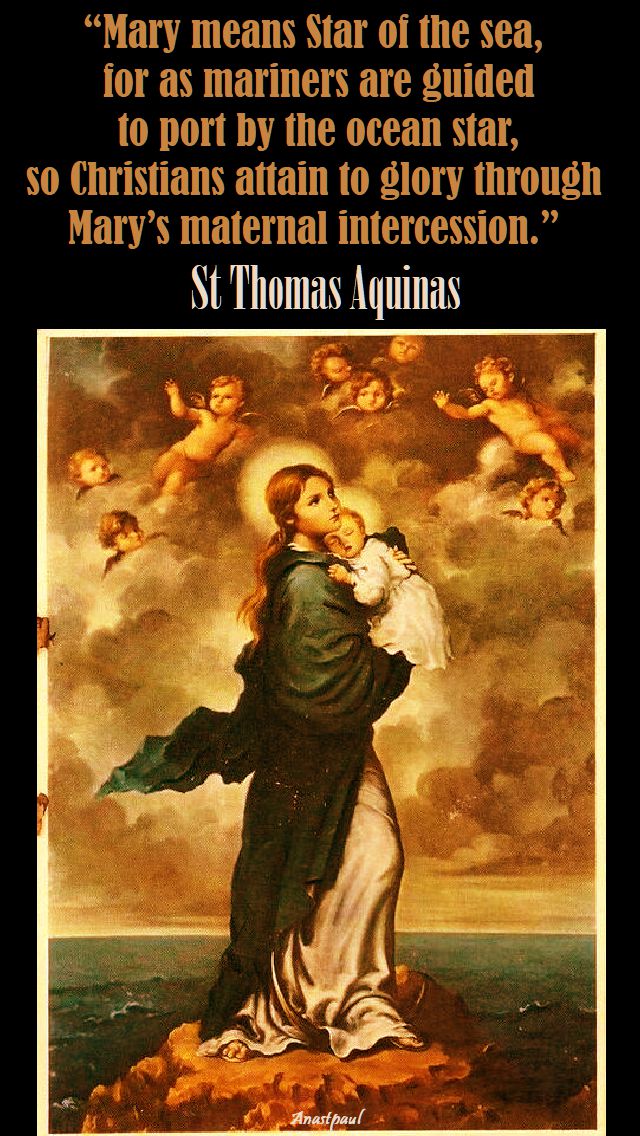
“Mary means Star of the sea, for as mariners are guided to port by the ocean star, so Christians attain to glory through Mary’s maternal intercession.”

St Thomas Aquinasmary means star of the sea - st thomas aquinas

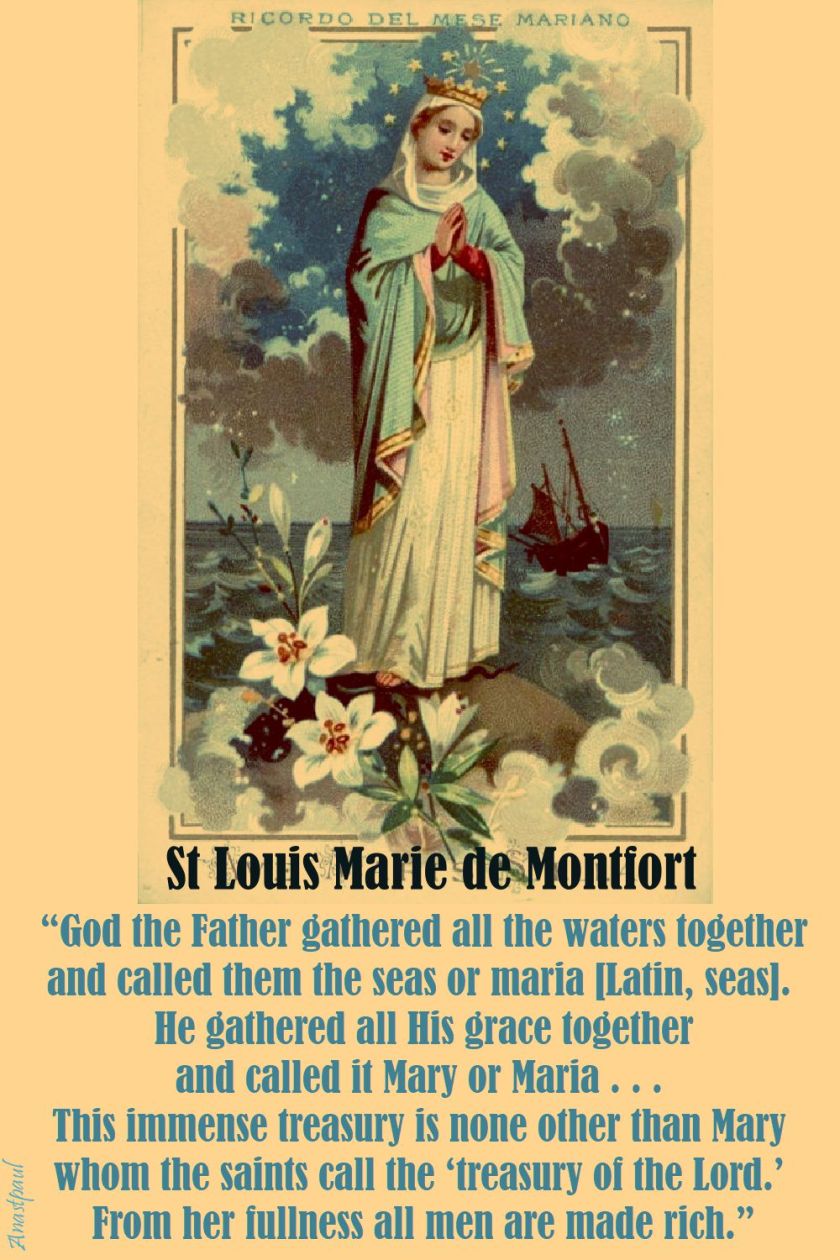
“God the Father gathered all the waters together and called them the seas or maria [Latin, seas]. He gathered all His grace together and called it Mary or Maria . . . This immense treasury is none other than Mary whom the saints call the ‘treasury of the Lord.’ From her fullness all men are made rich.”

St Louis de Montfort

god the father gathered - st louis de montfort

“Look to the star of the sea, call upon Mary … in danger, in distress, in doubt, think of Mary, call upon Mary. May her name never be far from your lips, or far from your heart … If you follow her, you will not stray; if you pray to her, you will not despair; if you turn your thoughts to her, you will not err. If she holds you, you will not fall; if she protects you, you need not fear; if she is your guide, you will not tire; if she is gracious to you, you will surely reach your destination.”

St Bernardlook to the star of the sea - st bernard

Posted in DOCTORS of the Church, franciscan OFM, MORNING Prayers, QUOTES of the SAINTS, The BLESSED VIRGIN MARY, The WORD

One Minute Reflection – 12 September – The Feast of the Most Holy Name of Mary

One Minute Reflection – 12 September – The Feast of the Most Holy Name of Mary

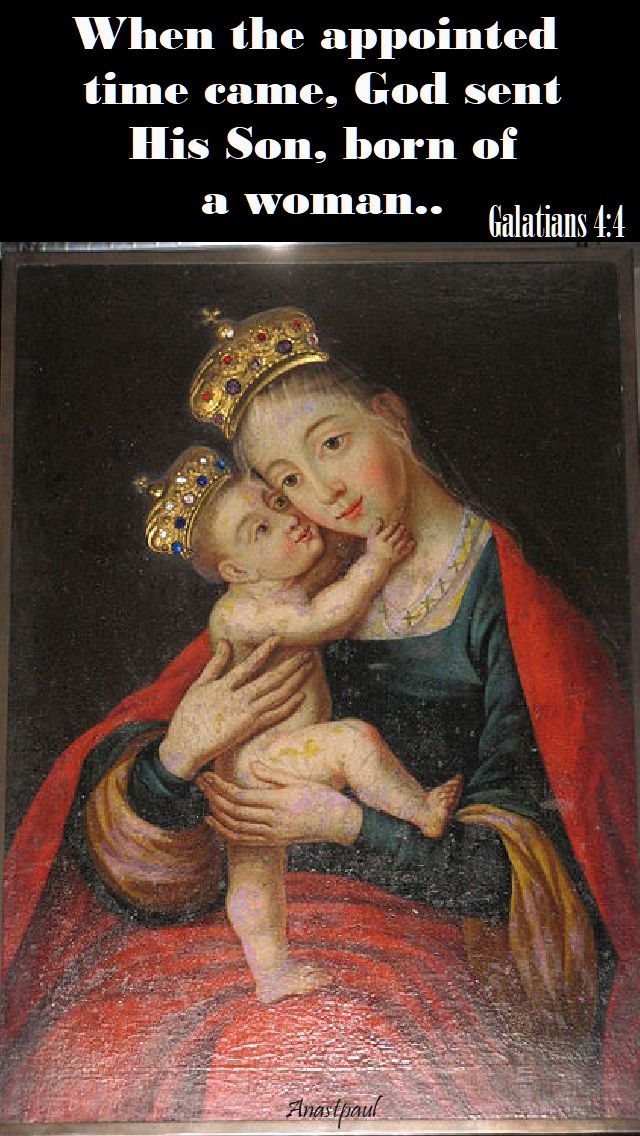
When the appointed time came, God sent His Son, born of a woman.….Galatians 4:4galatians 4 4

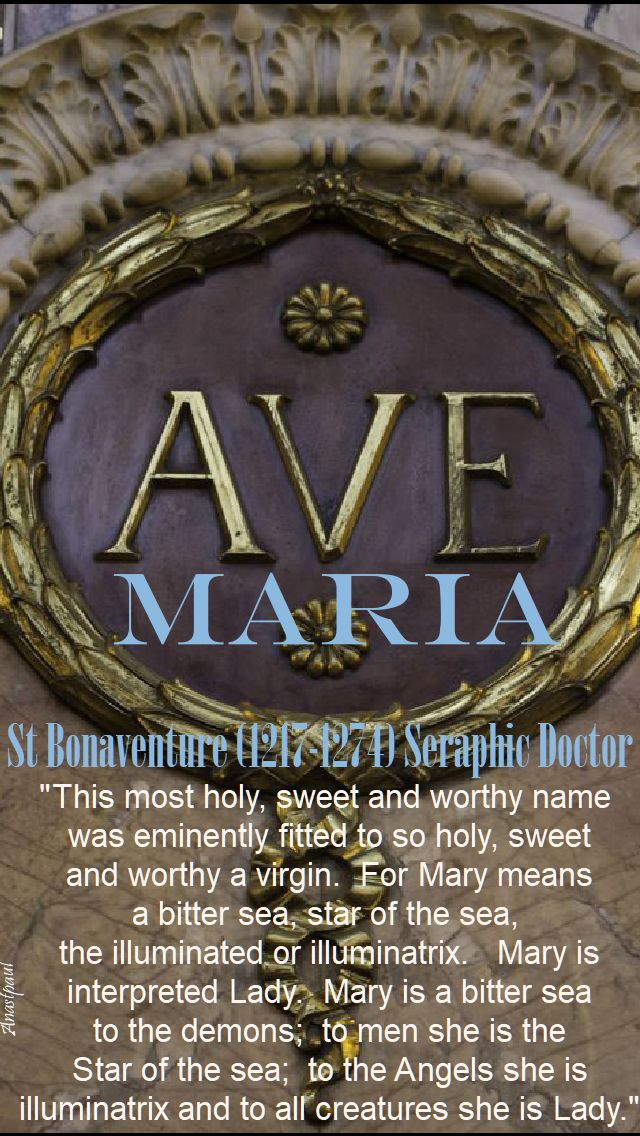
REFLECTION – “This most holy, sweet and worthy name was eminently fitted to so holy, sweet and worthy a virgin.   For Mary means a bitter sea, star of the sea, the illuminated or illuminatrix.   Mary is interpreted Lady.   Mary is a bitter sea to the demons;  to men she is the Star of the sea;  to the Angels she is illuminatrix and to all creatures she is Lady.” … St Bonaventure (1217-1274) Seraphic Doctorthis most holy sweet and worthy name - st bonaventure.2

PRAYER – Heavenly Father, assist us at all times to obtain a spirit of worthy penance, for our sins and that of all the world.   To the invocation of Your Divine Son, Jesus, we call on the intercession of His holy Mother to aid us on our pilgrimage.   With great affection and confidence, we honour the Holy Hearts and invoke the Holy Names of Jesus and Mary, to be our constant source of pure assistance and succour.   Blessed Virgin, Most Holy Mother, pray for us. Amenblessed virgin holy mother pray for us

Posted in DOMINICAN OP, MARIAN PRAYERS, MARIAN TITLES, MORNING Prayers, PRAYERS of the SAINTS, The BLESSED VIRGIN MARY

Our Morning Offering – 12 September – Feast of the Most Holy Name of Mary

Our Morning Offering – 12 September – Feast of the Most Holy Name of Mary

(Hail Mary, the Angelic Salutation)

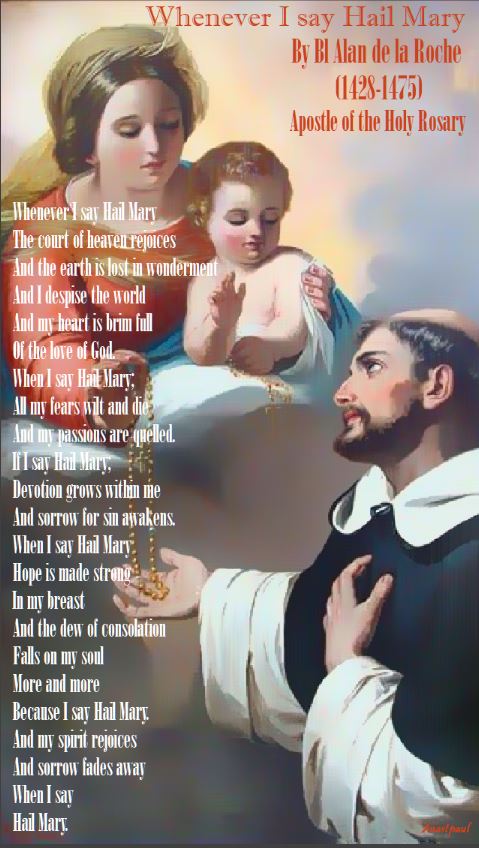
Whenever I say Hail Mary
By Bl Alan de la Roche (1428-1475)

Whenever I say Hail Mary
The court of heaven rejoices
And the earth is lost in wonderment
And I despise the world
And my heart is brim full
Of the love of God.
When I say Hail Mary;
All my fears wilt and die
And my passions are quelled.
If I say Hail Mary;
Devotion grows within me
And sorrow for sin awakens.
When I say Hail Mary
Hope is made strong
In my breast
And the dew of consolation
Falls on my soul
More and more
Because I say Hail Mary.
And my spirit rejoices
And sorrow fades away
When I say
Hail Mary.


whenever i say hail mary - blessed alan de la roche

Posted in MARIAN PRAYERS, MARIAN QUOTES, MARIAN TITLES, MORNING Prayers, SAINT of the DAY, The BLESSED VIRGIN MARY, Uncategorized

Blessed Memorial of the Most Holy Name of Mary – 12 September

Blessed Memorial of the Most Holy Name of Mary – 12 September

name-of-Mary

On this day dedicated to the Holy Name of Mary let us repeat that wonderful prayer of Saint Bernard, responding to Pope Benedict XVI’s invitation to “invite everyone to become a trusting child before Mary, even as the Son of God did.  Saint Bernard says and we say with him:  ‘Look to the star of the sea, call upon Mary … in danger, in distress, in doubt, think of Mary, call upon Mary. May her name never be far from your lips, or far from your heart … If you follow her, you will not stray; if you pray to her, you will not despair;  if you turn your thoughts to her, you will not err. If she holds you, you will not fall;  if she protects you, you need not fear;  if she is your guide, you will not tire; if she is gracious to you, you will surely reach your destination”’  (Pope Benedict XVI, address at Heiligenkreuz Abbey, September 9, 2007).

Most Holy Name of Mary:
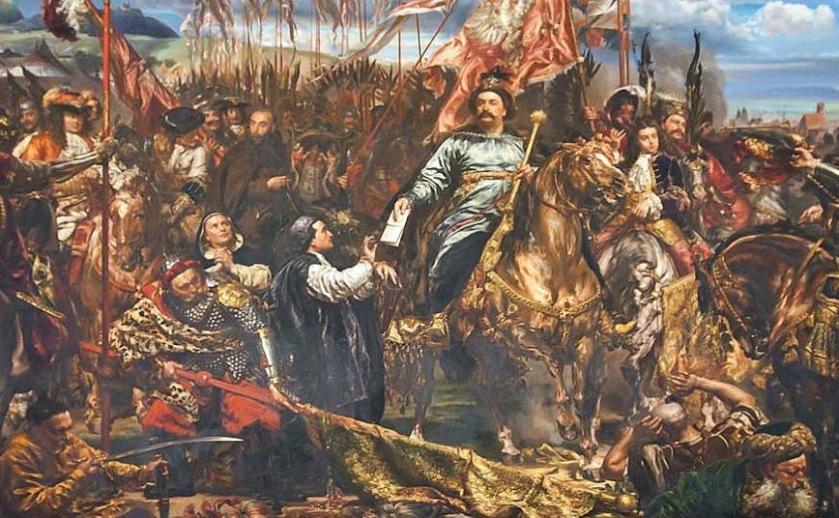
In accordance with Jewish custom our Lady’s parents named her eight days after her birth and were inspired to call her Mary.   The feast of the Holy Name of Mary therefore follows that of her Birthday, as the Feast of the Holy Name of Jesus follows Christmas. The feast originated in Spain and was approved by the Holy See in 1513; Innocent XI extended its observance to the whole Church in 1683 in thanksgiving to our Lady for the victory on September 12, 1683 by John Sobieski, king of Poland, over the Turks, who were besieging Vienna and threatening the West.   This day was commemorated in Vienna by creating a new kind of pastry and shaping it in the form of the Turkish half-moon.   It was eaten along with coffee which was part of the booty from the Turks (this is the origin of the of the croissant).

King_John_III_Sobieski_Sobieski_sending_Message_of_Victory_to_the_Pope,_after_the_Battle_of_Vienna_111-1
Under Mary’s Holy Name: Victory in Vienna – King Sobieski sending a message to Pope Innocent XI

The ancient Onomastica Sacra have preserved the meanings ascribed to Mary’s name by the early Christian writers and perpetuated by the Greek Fathers. “Bitter Sea,” “Myrrh of the Sea,” “The Light Giver,” “The Enlightened One,” “Lady,” “Seal of the Lord” and “Mother of the Lord” are the principal interpretations.   These etymologies suppose that the Hebrew form of the name is Maryãm, not Miryãm.   From the time of St Jerome until the 16th century, preferred interpretations of Mary’s name in the West were “Lady,” “Bitter Sea,” “The Light Giver,” and especially “Star of the Sea.”   tella Maris was by far the favoured interpretation.   The revival of Hebraic studies, which accompanied the Renaissance, led to a more critical appraisal of the meanings assigned to Our Lady’s name.   Miryãm has all the appearance of a genuine Hebrew name and no solid reason has been discovered to warrant rejecting the Semitic origin of the word.   The Hebrew name of Mary, Miryãm, (in Latin Domina) means lady or sovereign;   this Mary is in virtue of her Son’s sovereign authority as Lord of the World.   We call Mary our Lady as we call Jesus our Lord and when we pronounce her name we affirm her power, implore her aid and place ourselves under her protection.holy name of mary.1

“Therefore a certain Star has risen for us today:  Our Lady, Saint Mary.   Her name means Star of the sea;  no doubt the Star of this sea which is the world.   Therefore, we ought to lift up our eyes to this Star that has appeared on earth today in order that she may lead us, in order that she may enlighten us, in order that she may show us these steps so that we shall know them, in order that she may help us so that we may be able to ascend.   And therefore it is a beautiful thing that Mary is placed in this stairway of which we are speaking, there where we must begin to climb.   As the Evangelist says, Jacob begot Joseph, the husband of Mary, so immediately at the very moment of our conversion she appears to us and receives us into her care and enlightens us in her light and accompanies us along this laborious path.” –  St Aelred (110-1167).mary7158c63159cf5693d3029cb3f0be6650--blessed-virgin-mary-hail-mary

Posted in The BLESSED VIRGIN MARY

Feast of the Most Holy Name of Mary and Memorials of the Saints – 12 September

Most Holy Name of Mary (Optional Memorial):   Feast of the entire Latin Church.   It was first observed at Cuenca, Spain in 1513, then extended to the universal Church and assigned to its present place and rank by Pope Innocent XI in 1683 in thanksgiving to God and the Blessed Virgin for the liberation of Vienna, France and the signal victory over the Turks on 12 September 1683.   It is the titular feast of the Society of Mary (Marianists) and of the Congregation of the Oblates of Mary Immaculate.

holy name of mary

St Ailbe
Bl Apolinar Franco
St Autonomous
St Curonotus
St Dominic Magoshichi
St Eanswida
St Francis of Saint Bonaventure
St Franciscus Ch’oe Kyong-Hwan
St Guy of Anderlecht
St Juventius of Pavia
St Mancius of Saint Thomas
St Paul of Saint Clare
Bl Pierre-Sulpice-Christophe Faverge
St Sacerdos of Lyon
St Silvinus of Verona
St Tomás de Zumárraga Lazcano

Martyrs of Alexandria – 6 saints: A group of Christians martyred in the persecutions of Diocletian. We know little more than their names – Hieronides, Leontius, Sarapion, Seleusius, Straton and Valerian. They were drowned c 300 at Alexandria, Egypt.

Martyrs of Phrygia – 3 saints: Three Christians who were martyred for destroying pagan idols. We know little more than their names – Macedonius, Tatian and Theodolus. They were burned to death in 362 in Phrygia (modern Turkey).

Martyred in the Spanish Civil War:
• Blessed Fortunato Arias Sánchez
• Blessed Francisco Maqueda López
• Blessed Jaume Puigferrer Mora
• Blessed Josep Plana Rebugent
• Blessed Julián Delgado Díez

Posted in MORNING Prayers, NOVENAS

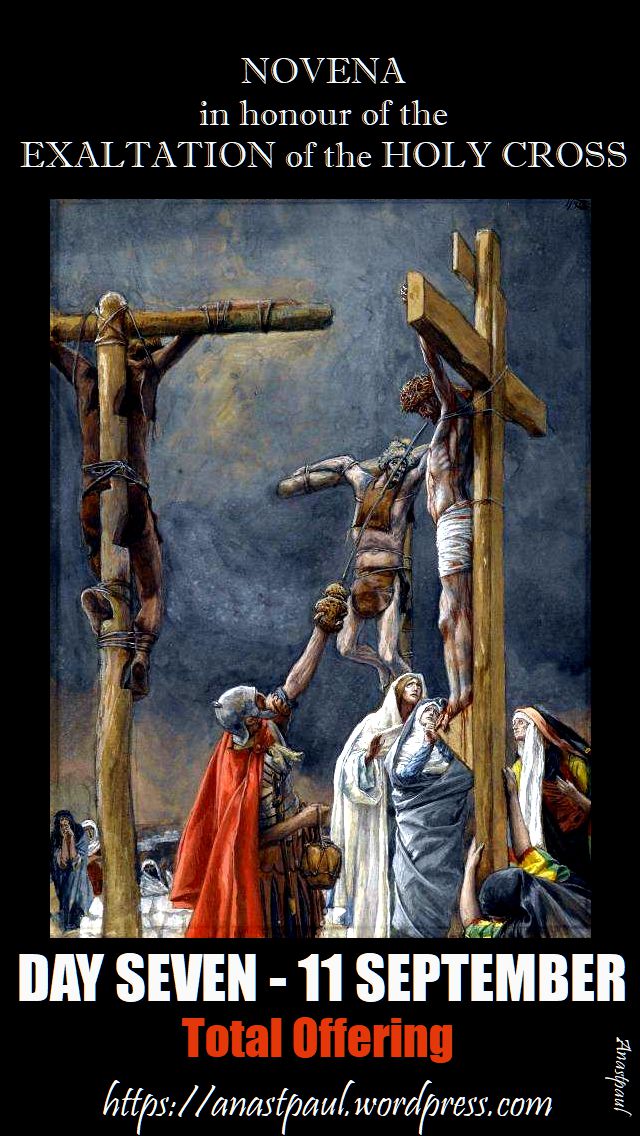
DAY SEVEN – NOVENA in honour of the EXALTATION of the HOLY CROSS – 11 September

DAY SEVEN – NOVENA in honour of the EXALTATION of the HOLY CROSS – 11 September

Total Offering

Jesus our Lord, You refused to drink the vinegar offered by the soldiers.
We know that this offering was to alleviate Your sufferings
because this drink lessens the pain, acting as anesthesia.
You refused as You wanted to feel the pain throughout the time
You hung on the cross.   You did not want to lessen Your sacrifice.
Help us, O Lord, to bear the pains of everyday life.
Let us savour our sufferings so that we may be able to live Your Holy Cross.
Inspire us not to run away but to accept and experience
all our sufferings and pain as proof of our love for You
and as reparation for our sins and the sins of the whole world.
Help us live our pain, help us to live Your Holy Cross. Amen

DAILY PRAYER:

Dear Lord Jesus
Who because of Your burning love for us willed to be crucified
and to shed Your Most Precious Blood for the redemption
and salvation of our souls,
to bear the sins of all the history of humanity,
from Adam to the end of time.
look down upon us and grant the petition we ask
…………….( mention your intention)
We trust completely in Your Mercy.
Cleanse us from sin by Your Grace,
sanctify our work,
give us and all those who are dear to us,
our daily bread, lighten the burden of our sufferings,
bless our families,
and grant to the nations, so sorely afflicted,
Your Peace, which is the only true peace,
so that by obeying Your Commandments
we may come at last to the glory of Heaven.

O Cross, you are the glorious sign of victory.
Through your power may we share
in the triumph of Christ Jesus. Amen
Glory Be. (3x)day seven - novena holy cross - total offering 11 sept

Posted in MORNING Prayers, SAINT of the DAY

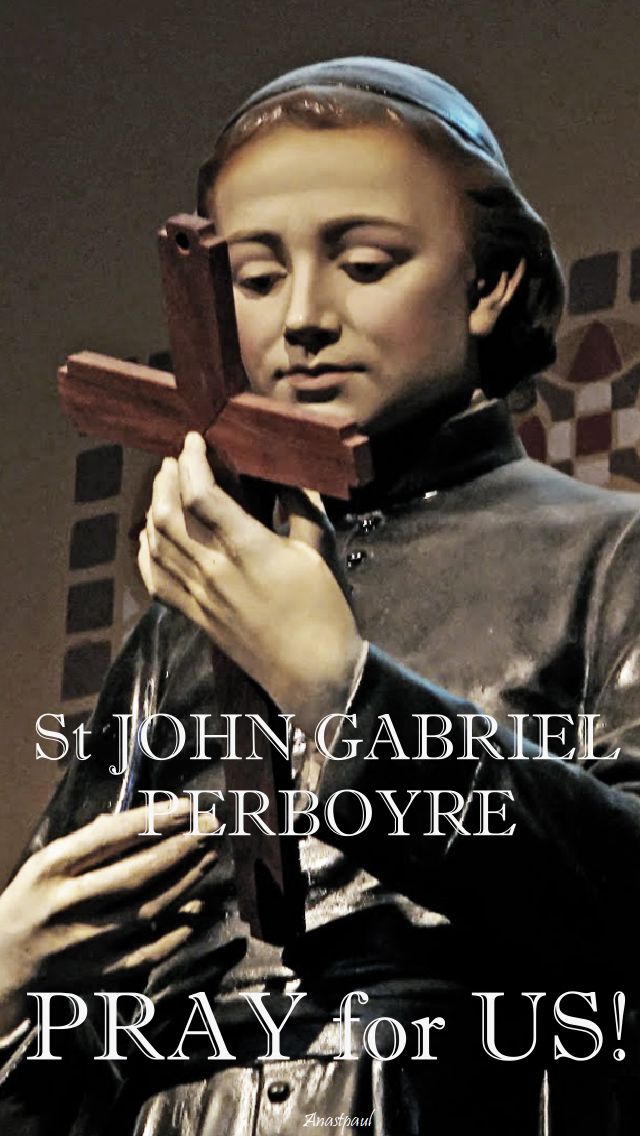
Thought for the Day – 11 September – The Memorial of St John Gabriel Perboyre (1802-1840) Martyr for Christ

Thought for the Day – 11 September – The Memorial of St John Gabriel Perboyre (1802-1840) Martyr for Christ

Nothing happens by chance.  Neither life, nor death, nor vocation.   JOHN GABRIEL PERBOYRE was born in Montgesty, near Cahors, in southern France, on 6 January 1802 into a family which gave three missionaries of St Vincent and two Daughters of Charity to the Church.  Such an environment exuded faith, simple and healthy values and the sense of life as gift.

The one who “calls by name” seemed to ignore him as a teenager.   The call came to his younger brother Louis for entrance into the seminary.   John Gabriel was asked to accompany his younger brother for a time, while waiting for him to get adjusted to the surroundings.   John Gabriel’s presence at the seminary, then, happened by chance and he should have left quickly.   But chance revealed to the astonished eyes of the young man unexpected horizons:   that in the seminary he had found his path.

So many saints seem to have lived centuries ago.   Jean-Gabriel is far more recent and we can identify better with his life and circumstances.   His life and death speak to us of living the faith in our own times and places.   It is said we mock Christ again by the timidity of our witness but John Gabriel had one passion:  “Christ and the proclamation of his Gospel.   That loyalty to this passion that he possessed, has been equated with the lowly and the condemned but the Church can now solemnly proclaim his glory in the choir of the saints in heaven.” … St Pope John Paul II, Homily of Canonisation, 2 June 1996, Vatican City, Rome

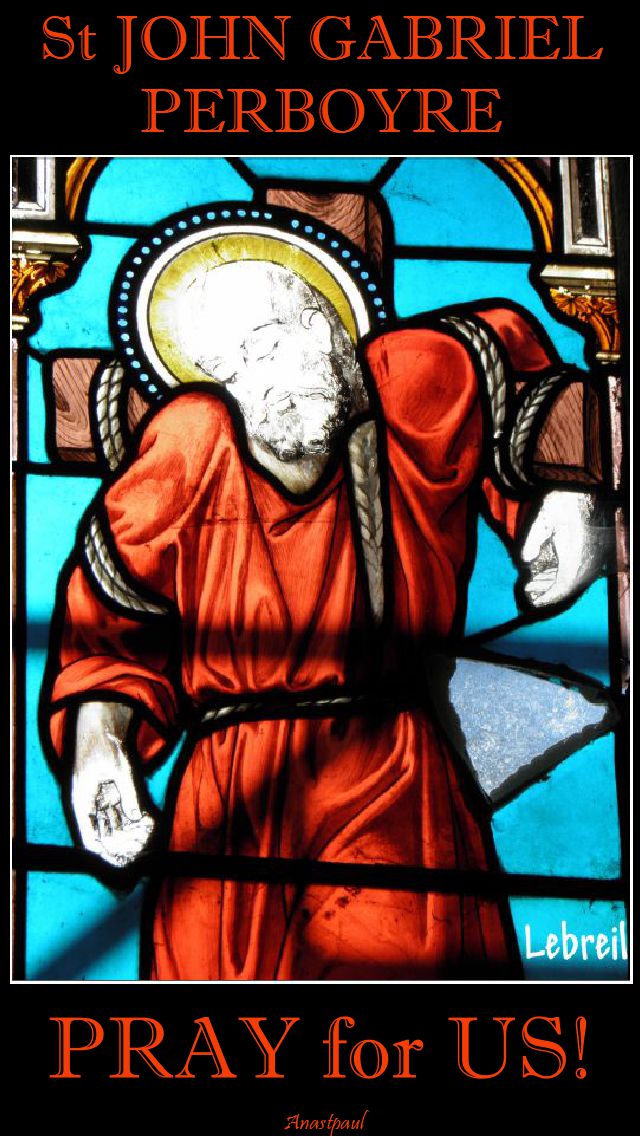
St John Gabriel Perboyre, pray for us!st john gabriel perboyre - pray for us

Posted in CATHOLIC Quotes, MORNING Prayers, QUOTES of the SAINTS, SAINT of the DAY

Quote/s of the Day – 11 September – The Memorial of St John Gabriel Perboyre (1802-1840)

Quote/s of the Day – 11 September –  The Memorial of St John Gabriel Perboyre (1802-1840)

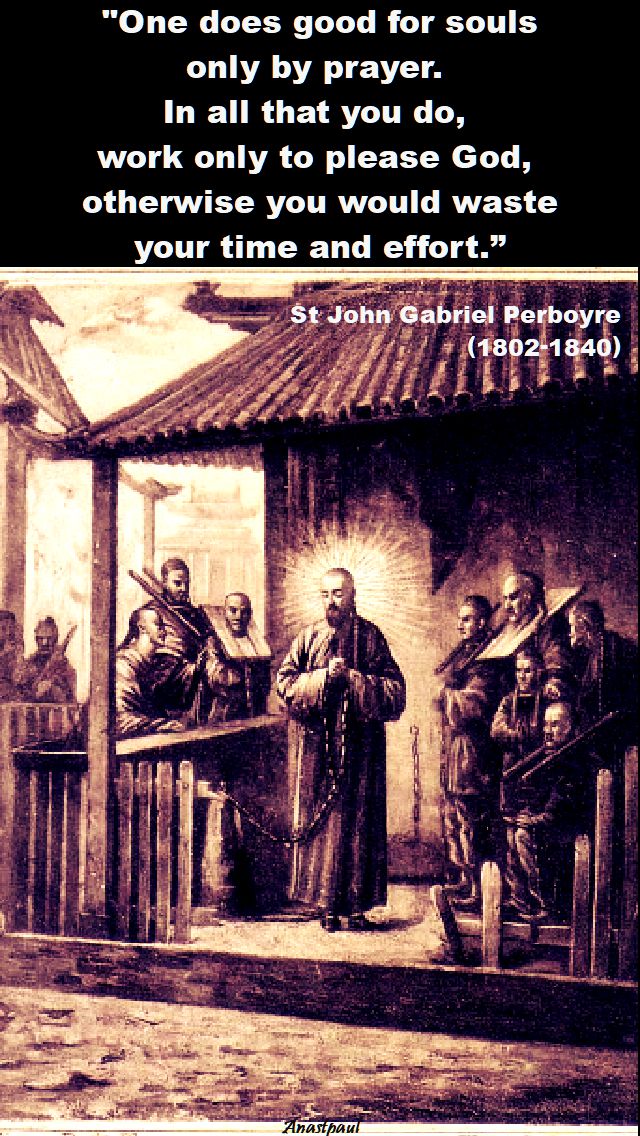
“One does good for souls only by prayer.
In all that you do, work only to please God,
otherwise you would waste your time and effort.”

one does good for souls - st john gabriel perboyre

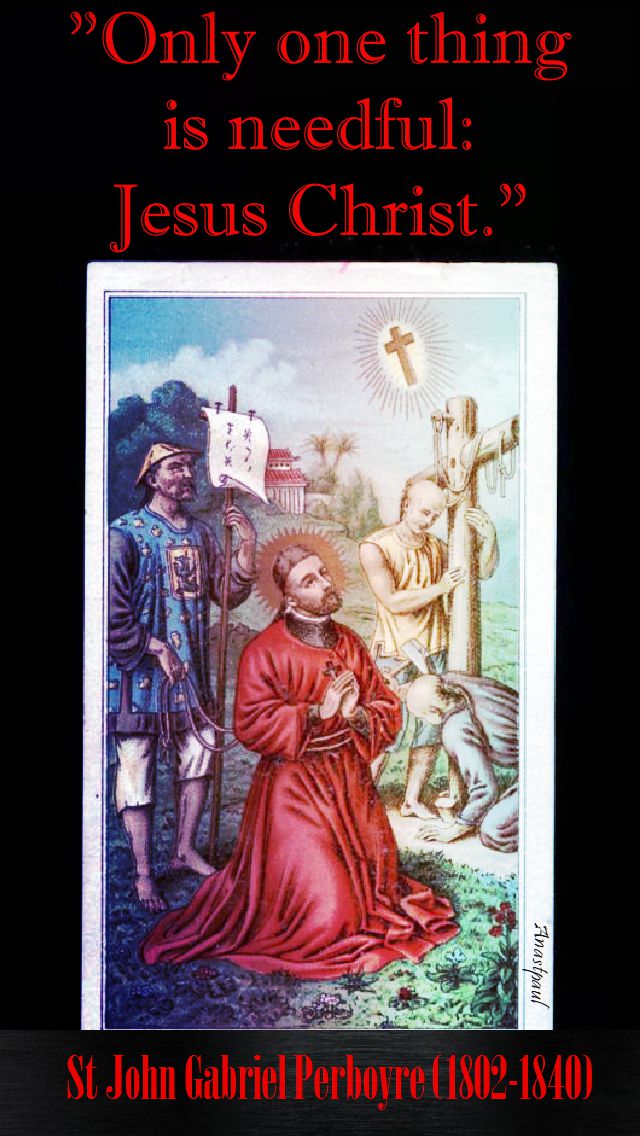
“Only one thing is needful:  Jesus Christ.”

only one thing is needful - st john gabrile perboyre

St John Gabriel Perboyre (1802-1840)

Posted in MORNING Prayers, QUOTES of the SAINTS, SAINT of the DAY, The WORD

One Minute Reflection – 11 September – The Memorial of St John Gabriel Perboyre (1802-1840) Martyr for Christ

One Minute Reflection – 11 September – The Memorial of St John Gabriel Perboyre (1802-1840) Martyr for Christ

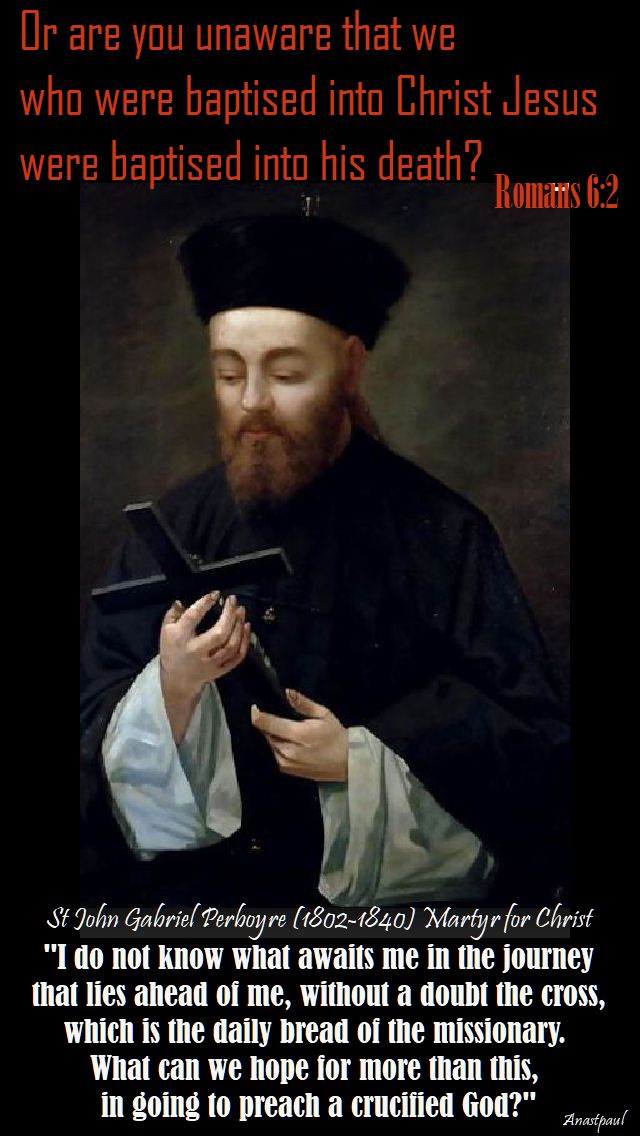
Or are you unaware that we who were baptised into Christ Jesus were baptised into his death?…..Romans 6:3

REFLECTION – “I do not know what awaits me in the journey that lies ahead of me,
without a doubt the cross, which is the daily bread of the missionary.
What can we hope for more than this, in going to preach a crucified God?” (Letter No. 70)…St John Gabriel Perboyrei do not know what awaits me - st john gabriel perboyre.2

PRAYER – Lord Jesus, let me love You above all things and ever remain united to You and with Your Holy Cross.   I pray that I will be given the grace of courage and strength, to carry my cross in imitation of You.   St John Gabriel Perboyre, you suffered a passion and death in close imitation of our Lord and Saviour, please pray for us that our timidity might not overpower us, amen.st john gabriel perboyre - pray for us.2


Posted in MORNING Prayers, PRAYERS of the SAINTS, SAINT of the DAY

Our Morning Offering – 11 September – The Memorial of St John Gabriel Perboyre (1802-1840) Martyr for Christ

Our Morning Offering – 11 September – The Memorial of St John Gabriel Perboyre (1802-1840)

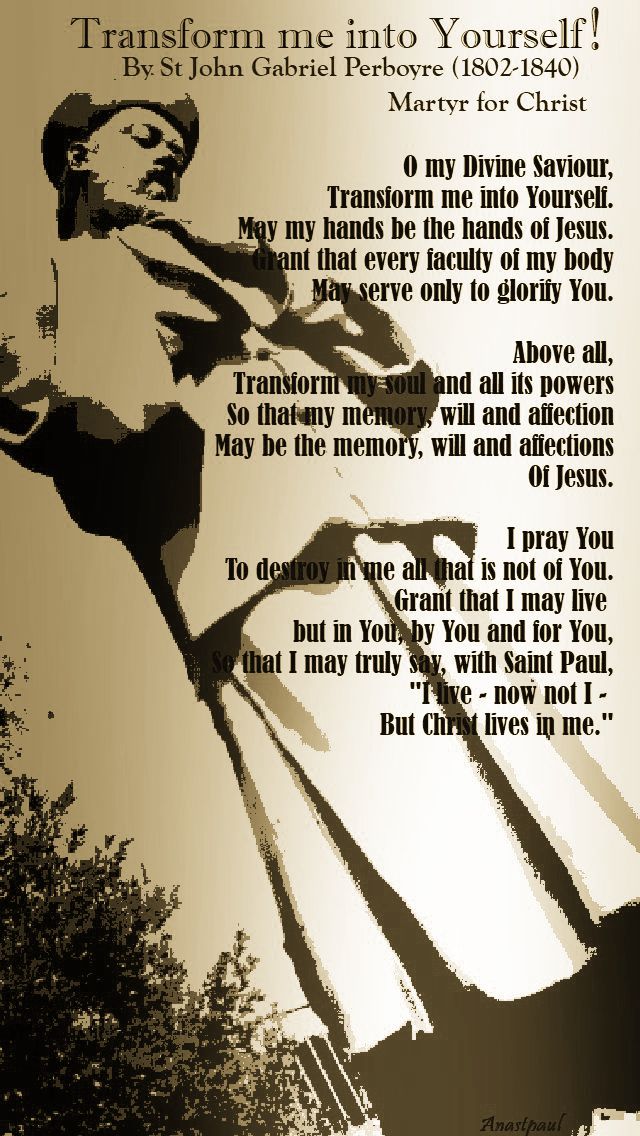
Transform me into Yourself
By St John Gabriel Perboyre (1802-1840)

O my Divine Saviour,
Transform me into Yourself.
May my hands be the hands of Jesus.
Grant that every faculty of my body
May serve only to glorify You.

Above all,
Transform my soul and all its powers
So that my memory, will and affection
May be the memory, will and affections
Of Jesus.

I pray You
To destroy in me all that is not of You.
Grant that I may live
but in You, by You and for You,
So that I may truly say, with Saint Paul,
“I live – now not I – But Christ lives in me.”transform-me-into-yourself-by-st-john-gabriel-perboyre-1802-1840-11 sept 2017-2

Posted in SAINT of the DAY

Saint of the Day – 11 September – St John Gabriel Perboyre C.M. (1802-1840) Priest, Martyr of the Congregation of the Mission

Saint of the Day – 11 September – St John Gabriel Perboyre C.M. (1802-1840) – Martyr, Priest, Missionary, Teacher (6 January 1802 at Le Puech, near Mongesty, Cahors diocese, southern France – lashed to a cross on a hill named the “red mountain”, then strangled with a rope on 11 September 1840 at Ou-Tchang-Fou, China).   He was Beatified on 10 November 1889 by Pope Leo XIII and Canonised on 2 June 1996 by St Pope John Paul II.  His Major Shrine is at the Vincentian Motherhouse, Rue du Bac, Paris, France.
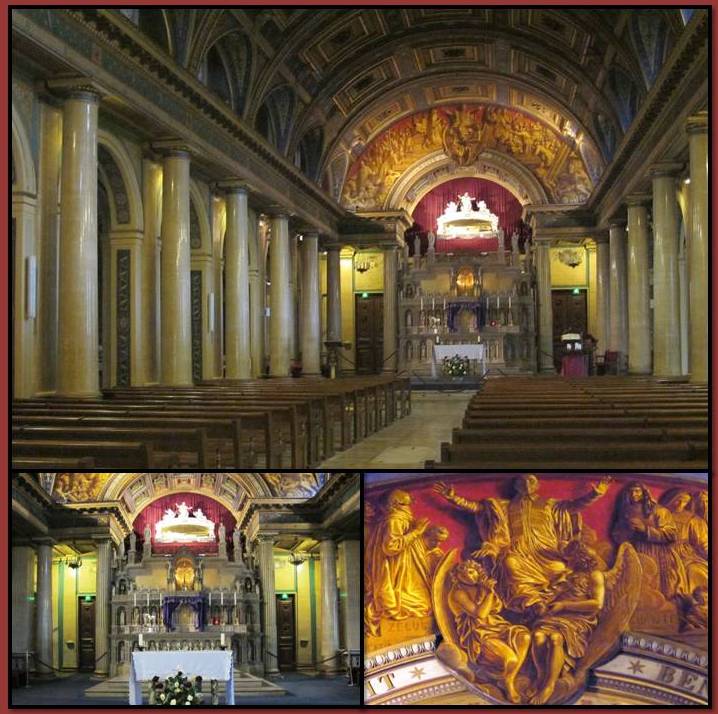
CHAPEL OF ST VINCENT DE PAUL.1

The formation years:
The Church of France had at that time just emerged from the throes of the French Revolution with the red-colored garments of martyrdom for some and with the pain of the apostasy of many.  The panorama at the beginning of the 1800’s was desolate: buildings destroyed, convents sacked, people without pastors.   Thus, it was no accident that the ideal of the priesthood appeared to the young man not as a feeble arrangement for life but as the destiny of heroes.

His parents, surprised, accepted the choice of their son and accompanied him with their encouragement.   Not by chance, his paternal uncle Jacques was a missionary of St.Vincent.   This explains why in 1818 the missionary ideal matured in the young John Gabriel.   At that time, the missions meant principally China.   But China was a faraway mirage.   To leave meant never to find again the home milieu, taste its flavours, enjoy its affections.   It was natural for him to choose the Congregation of the Mission founded by St Vincent de Paul in 1625 for the evangelisation of the poor, the formation of the clergy but above all to push those very missionaries toward holiness.   The mission is not propaganda.   The Church has always demanded that the proclaimers of the Word be spiritual persons, mortified, full of God and charity.   In order to illuminate the darkness in people, a lamp is not sufficient if there is no oil.

John Gabriel did not think in half-measures.   If he was a martyr it is because he was a saint.
From 1818 to 1835 he was a missionary in his own country.   First, in his formation period, he was a model novice and student.   After his priestly ordination (1826), he was charged with the formation of seminarians.
19960602_jean-gabriel_perboyre

The missionary attraction:
A new factor, certainly not haphazard, modified John Gabriel’s life.   The protagonist was once again his brother Louis.   He also had entered the Congregation of the Mission and had asked to be sent to China where the sons of St Vincent had had a new martyr in the person of Blessed Francis Regis Clet (18 February 1820).   During the voyage, however, the young Louis, only 24 years of age, was called to the mission in heaven.   All that the young man had hoped for and done would have been useless if John Gabriel had not made the request to replace his brother in the breach.

John Gabriel reached China in August of 1835.   At that time the Occident knew almost nothing about the Celestial Empire and the ignorance was reciprocal.   The two worlds felt a mutual attraction but dialogue was difficult.   In the countries of Europe one did not speak of a Chinese civilization, but only of superstitions, of “ridiculous” ceremonies and customs.   The judgments were thus prejudices.   China’s appreciation of Europe and Christianity was not any better.   There was a dark gap between the two civilizations. Someone had to cross it in order to take on himself the evil of many and to consume it with the fires of charity.

After getting acclimated in Macau, John Gabriel began the long trip in a Chinese junk, on foot and on horseback, which brought him after eight months to Nanyang in Henan, where the obligation to learn the language imposed itself.   After five months, he was able to express himself, though with some trouble, in good Chinese and at once threw himself into the ministry, visiting the small Christian communities.   Then he was transferred to Hubei, which is part of the region of lakes formed by the Yangtze kiang (blue river).   Even though he maintained an intense apostolate, he suffered much in body and spirit.   In a letter he wrote: “No, I am no more of a wonder man here in China than I was in France … ask of Him first of all for my conversion and my sanctification and then the grace that I do not spoil His work too much…” (Letter 94).  For one who looks at things from the outside, it was inconceivable that such a missionary should find himself in a dark night of the soul.  But the Holy Spirit was preparing him in the emptiness of humility and the silence of God for the supreme testimony.

In chains for Christ:
Unexpectedly in 1839 two events, apparently unrelated, clouded the horizon.   The first was the renewed outbreak of persecution which flowed from the decree of the Manchurian emperor, Quinlong (1736-1795), which had proscribed the Christian religion in 1794.

The second was the outbreak of the Chinese-British War, better known as the “Opium War” (1839-1842).   The closure of the Chinese frontier and the pretense of the Chinese government to require an act of dependence from the foreign ambassadors had created an explosive situation.   The spark came from the confiscation of loads of opium stowed in the port of Canton;  this action harmed the merchants, most of whom were English. The British flotilla intervened and the war began.

The missionaries, obviously interested only in the first event dealing with the persecution of Christians, were always on their guard.   As often happens, too many alarms diminished the vigilance.   And that is what happened on 15 September 1839 at Cha-yuen-ken, where Perboyre lived.   On that day he was with two other European missionaries, his confrere, Baldus, and a Franciscan, Rizzolati and a Chinese missionary, Fr Wang.   They were informed of the approach of a column of about one hundred soldiers.   The missionaries underestimated the information.   Perhaps the soldiers were going elsewhere.   Instead of being wary, the missionaries continued enjoying a fraternal conversation.   When there was no longer any doubt about the direction of the soldiers, it was late.  Baldus and Rizzolati decided to flee far away. Perboyre hid himself in the surroundings because the nearby mountains were rich with bamboo forests and hidden caves.   As Fr Baldus has attested for us, however, the soldiers used threats to force a catechumen to reveal the place where the missionary was hiding.   The catechumen was a weak person, but not a Judas.   Thus began the sad Calvary of John Gabriel.  The prisoner had no rights, he was not protected by laws but was at the mercy of the jailers and judges.   Given that he was arrested it was presumed that he was guilty and if guilty, he would be punished.

A series of trials began. The first was held at Kou-Ching-Hien.   The replies of the martyr were heroic:
– Are you a Christian priest?
– Yes, I am a priest and I preach this religion.
– Do you wish to renounce your faith?
– No, I will never renounce the faith of Christ.

They asked him to reveal his companions in the faith and the reasons for which he had transgressed the laws of China.   They wanted, in short, to make the victim the culprit. But a witness to Christ is not an informer.   Therefore, he remained silent.

The prisoner was then transferred to Siang-Yang.   The cross examinations were made close together.   He was held for a number of hours kneeling on rusty iron chains, was hung by his thumbs and hair from a rafter (the hangtze torture), was beaten several times with bamboo canes.   Greater than the physical violence, however, remained the wound of the fact that the values in which he believed were put to ridicule: the hope in eternal life, the sacraments, the faith.

The third trial was held in Wuchang.   He was brought before four different tribunals and subjected to 20 interrogations.   To the questioning were united tortures and the most cruel mockery.  They prosecuted the missionary and abused the man.   They obliged Christians to abjure and one of them even to spit on and strike the missionary who had brought him to the faith.  For not trampling on the crucifix, John Gabriel received 110 strokes of pantse.

Among the various accusations, the most terrible was the accusation that he had had immoral relations with a Chinese girl, Anna Kao, who had made a vow of virginity.   The martyr defended himself.   She was neither his lover nor his servant.   The woman is respected not scorned in Christianity, was the sense of John Gabriel’s reply.   But he remained upset because they made innocents suffer for him.

During one interrogation he was obliged to put on Mass vestments.  They wanted to accuse him of using the privilege of the priesthood for private interests.   But the missionary, clothed in the priestly garments, impressed the bystanders and two Christians drew near to him to ask for absolution.
The cruelest judge was the Viceroy.   The missionary was by this time a shadow.   The rage of this unscrupulous magistrate was vented on a ghost of a man.   Blinded by his omnipotence the Viceroy wanted confessions, admissions and accusations against others. But if the body was weak, the soul was reinforced.   His hope by now rested in his meeting God, which he felt nearer each day.

When John Gabriel told him for the last time:  “I would sooner die than deny my faith!,” the judge pronounced his sentence.   John Gabriel Perboyre was to die by strangulation.

With Christ priest and victim:
Then began a period of waiting for the imperial confirmation.   Perhaps John Gabriel could hope in the clemency of the sovereign.   But the war with the English erased any possible gesture of good-will.   Thus, on 11 September 1840, an imperial envoy arrived at full speed, bearing the decree confirming the condemnation.

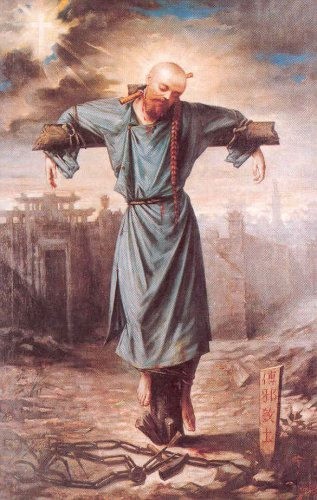
With seven criminals the missionary was led up a height called the “Red Mountain.”   As the criminals were killed first, Perboyre reflected in prayer, to the wonderment of the bystanders.   When his turn came, the executioners stripped him of the purple tunic and tied him to a post in the form of a cross.   They passed a rope around his neck and strangled him.   It was the sixth hour.   Like Jesus, John Gabriel became like a grain of wheat.   He died, or better was born into heaven, in order to make fall on the earth the dew of God’s blessing.

Many circumstances surrounding his last year of life (the betrayal, the arrest, the death on a cross, its day and hour), are similar to the Passion of Christ.   In reality, all his life was that of a witness and a faithful disciple of Christ.   St. Ignatius of Antioch wrote: “I look for him who died for us; I yearn for him who rose for us. Behold, the moment is near in which I will be brought forth!   Have compassion on me, brothers!   Do not prevent me from being born to life!”

John Gabriel “was born to life” on 11 September 1840 because he always had sought “him who died for us.”   His body was brought back to France but his heart remained in his adopted homeland, the land of China.   There he gave his witness to the sons and daughters of St. Vincent who also wait to be born to heaven after a life spent for the gospel and for the poor.

After the then-obligatory waiting period of 50 years after death for seeking a person’s canonization had expired, a cause for him was introduced to the Holy See.   In the meantime, his remains were returned from China to France, where they were entombed for veneration in the chapel of the Vincentian Motherhouse in Paris (see images above).

Posted in SAINT of the DAY, The BLESSED VIRGIN MARY

Our Lady of Coromoto – Patron of Venezuela and Memorials of the Saints – 11 September

Our Lady of Coromoto/Venezuela: Apparition – 8 September 1652 at Guanare, Portuguesa, Venezuela.
Approval – 1950 by Pope Pius XII.
Commemorates the apparition of the Blessed Virgin Mary to Coromoto, leader of the indigenous people in the forests near Guanare, Venezuela. Our Lady told the chief and his wife to go to the Catholic missionaries in the city, learn the faith, and receive Baptism; Coromoto shot an arrow at her, she vanished and left behind a piece of paper with her portrait. The entire tribe, except for Coromoto himself, converted to Christianity; he was afraid of losing his standing in the tribe. Tradition says that he fled from the Baptism ceremony into the forest where he was bitten by a poisonous snake; this could be allegorical.
Patronage: Venezuela (chosen by the bishops of Venezuela on 1 May 1942; approved by Pope Pius XII on 7 October 1944)

Our Lady of Coromoto

St Adelphus of Remiremont
St Almirus
Bl Baldassarre Velasquez
Bl Charles Spinola
St Deiniol of Bangor
St Didymus of Laodicea
St Diodorus of Laodicea
Bl Dominic Dillon
St Emilian of Vercelli
St Essuperanzio of Zurich
St Felix of Zurich
Bl Francesco Giovanni Bonifacio
Bl Franciscus Takeya
Bl François Mayaudon
Bl Gaspar Koteda
St Gusmeo of Gravedona sul Lario
St Hyacinth of Rome
St John Gabriel Perboyre/Jean Gabriel Perboyre
Bl John Bathe
St Leudinus of Toul
St Matthew of Gravedona sul Lario
St Paphnutius of Thebes
St Patiens of Lyon
Bl Peter Taaffe
Bl Petrus Kawano
St Protus of Rome
St Regula of Zurich
Bl Richard Overton
St Sperandea
St Theodora the Penitent
Bl Thomas Bathe

Martyred in the Spanish Civil War:
• Blessed José María Segura Panadés
• Blessed José Piquer Arnáu
• Blessed Josep Pla Arasa
• Blessed Lorenzo Villanueva Larrayoz

Posted in MORNING Prayers, QUOTES on SUFFERING

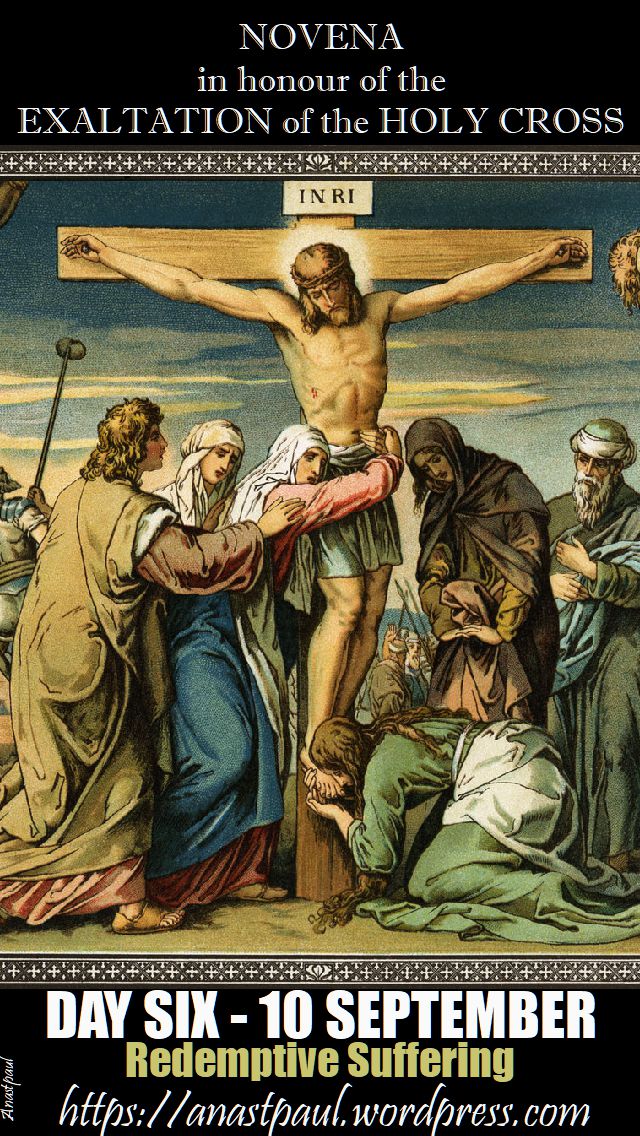
DAY SIX – NOVENA in honour of the EXALTATION of the HOLY CROSS – 10 September

DAY SIX – NOVENA in honour of the EXALTATION of the HOLY CROSS – 10 September

Redemptive Suffering

Jesus, Your mother and other women surrounded You
while you were dying on the cross.
Your mother nonetheless accepted this agony,
believing that this was part of the divine plan,
that God had the power to draw good
from this terrible experience of failure.
Your mother’s faith in You inspires us.
We pray for her intercession as we face
situations of failure and suffering.
We know that You are always with us
and so we pray for the grace to face
with courage, our trials and hardships,
and offer our sufferings
in union with Yours.
Please strengthen our faith as we live through
the difficulties and uncertainties of this life. Amen

DAILY PRAYER:

Dear Lord Jesus
Who because of Your burning love for us willed to be crucified
and to shed Your Most Precious Blood for the redemption
and salvation of our souls,
to bear the sins of all the history of humanity,
from Adam to the end of time.
look down upon us and grant the petition we ask
…………….( mention your intention)
We trust completely in Your Mercy.
Cleanse us from sin by Your Grace,
sanctify our work,
give us and all those who are dear to us,
our daily bread, lighten the burden of our sufferings,
bless our families,
and grant to the nations, so sorely afflicted,
Your Peace, which is the only true peace,
so that by obeying Your Commandments
we may come at last to the glory of Heaven.

O Cross, you are the glorious sign of victory.
Through your power may we share
in the triumph of Christ Jesus. Amen
Glory Be. (3x)day six - novena holy cross - redemptive suffering - 10 sept

Posted in MORNING Prayers, SAINT of the DAY, Uncategorized

Thought for the Day – 10 September – The Memorial of St Nicholas of Tolentino

Thought for the Day – 10 September – The Memorial of St Nicholas of Tolentino

Those hardened in their crimes, made fun of him but Nicholas would not be intimidated, even though soldiers would unsheath their swords and fence whilst he was speaking.
He was kindness itself, going into the slums of Tolentino, visiting the sick and bed-ridden, settling feuds, caring for children, chatting with criminals and begging them not to be cruel to others.
Gradually, this kindness achieved results and even hardened criminals were converted by St Nicholas’ gentleness.
His remarkable powers of persuasion and his charismatic personality, achieved amazing results in those who had been written off.
Gentleness and kindness accomplishes conversion!
St Nicholas pray that we too may be granted the grace of gentle and kindly hearts.st nicholas of tolentino pray for us.2

Posted in EUCHARISTIC Adoration, MORNING Prayers, QUOTES of the SAINTS

Quote of the Day – 10 September

Quote of the Day – 10 September

“We need to find God
and He cannot be found
in noise and restlessness.
God is the friend of silence.
See how nature –
trees, flowers, grass- grows in silence;
see the stars, the moon and the sun,
how they move in silence…
We need silence to be able to touch souls.”

St Mother Teresawe need to find god - st mother teresa

Posted in DOCTORS of the Church, MORNING Prayers, QUOTES of the SAINTS, SAINT of the DAY, The WORD

One Minute Reflection – 10 September

One Minute Reflection – 10 September

Come by yourselves to an out-of-the-way place and rest a little.….Mark 6:30mark 6 30

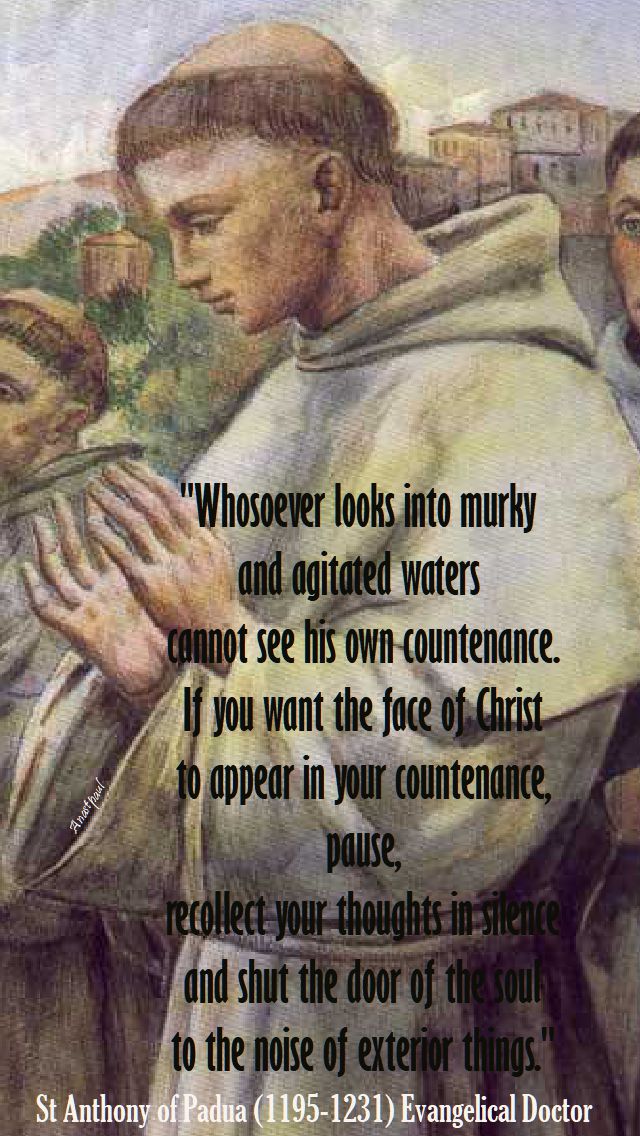
REFLECTION – “Whosoever looks into murky and agitated waters cannot see his own countenance.
If you want the face of Christ to appear in your countenance, pause, recollect your thoughts in silence
and shut the door of the soul to the noise of exterior things.”….St Anthony of Padua (1195-1231) Evangelical Doctorwhosoever looks into murky water - st anthony of padua

PRAYER – Lord Jesus Christ, teach me to pause often during my active life and recollect myself.
Let me put away the problems of life and commune with You in prayer and meditation.
St Nicholas of Tolentino, amidst his busy life of charity to all, constantly resumed silence in You
and thus, in his mystical union with You, reflected Your Face. St Nicholas, pray for us, amen.st nicholas of tolentino pray for us

Posted in Of a Holy DEATH & AGAINST A SUDDEN DEATH, of the DYING, FINAL PERSEVERANCE, DEATH of CHILDREN, DEATH of PARENTS, Of ANIMALS / ANIMAL WELFARE, Of the Holy Souls in PURGATORY, PATRONAGE - NEWBORN BABIES, YOUNG CHILDREN l, SAILORS, MARINERS, NAVIGATORS, SAINT of the DAY

Saint of the Day – 10 September – St Nicholas of Tolentino OSA (1245-1305)- Patron of The Holy Souls

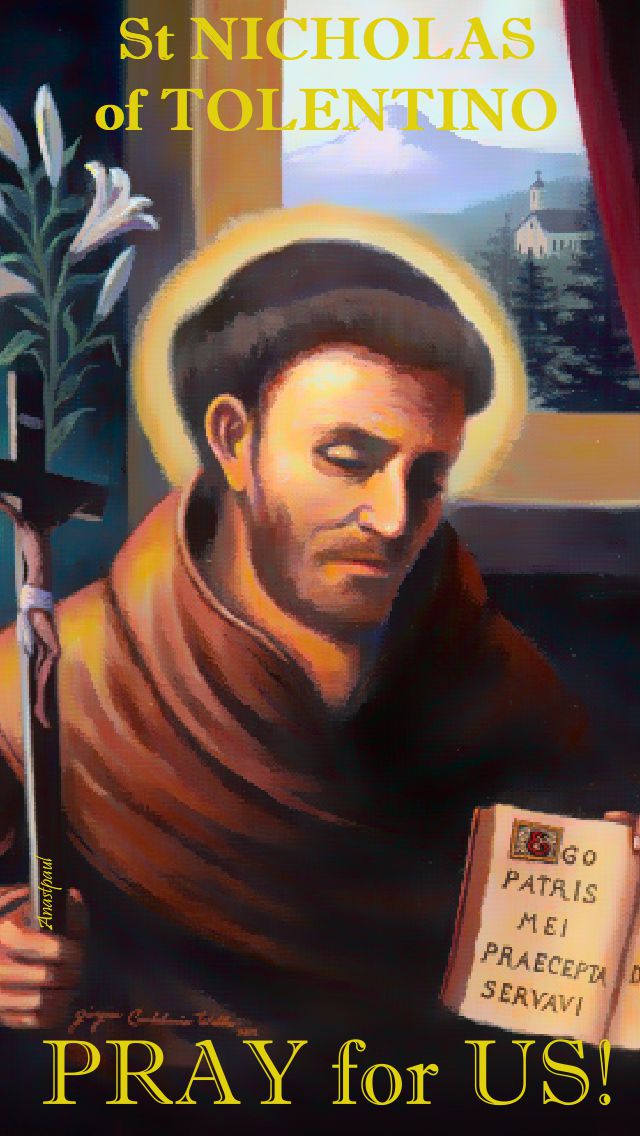
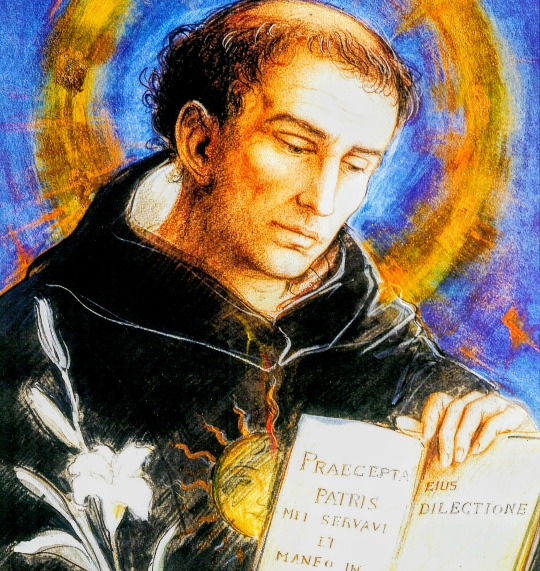
Saint of the Day – 10 September – St Nicholas of Tolentino OSA (1245-1305)- known as The Patron of Holy Souls, Priest, Augustinian Friar Monk, Confessor, Mystic, Preacher.   Born in 1245 at Sant’Angelo, March of Ancona, Diocese of Fermo, Italy and died on  10 September 1305 at Tolentino, Italy following a long illness.   His Relics were re-discovered at Tolentino in 1926.   In previous times his Relics were known to exude blood when the Church was in danger.   He was Canonised on 5 June (Pentecost) 1446 by Pope Eugene IV – over 300 miracles were recognised by the Congregation.   Patronages – animals, babies (reported to have raised more than 100 children from the dead), sailors,  dying people, sick animals, the Holy Souls in Purgatory, 4 Cities, 3 Diocese.   Attributes – Augustinian holding a bird on a plate in the right hand and a crucifix on the other hand;   holding a basket of bread, giving bread to a sick person;   holding a lily or a crucifix garlanded with lilies; with a star above him or on his breast.

St.-Nicholas-of-Tolentino

St Nicholas was born in 1245 in Sant’Angelo.   He was named after St Nicholas of Myra, at whose Shrine his parents prayed to have a child.   Nicholas became a Monk at 18 and seven years later, he was Ordained a Priest.   He gained a reputation as a Preacher and a Confessor.   In c 1274, he was sent to Tolentino, near his birthplace where he lived the rest of his lif.   Nicholas was primarily a shepherd to his flock.   He ministered to the poor and the criminal.   He is said to have cured the sick with bread over which he had prayed to Mary, the mother of God.   He gained a reputation as a wonder-worker.

On account of his kind and gentle manner his superiors entrusted him with the daily feeding of the poor at the monastery gates but at times he was so free with the friary’s provisions that the procurator begged the superior to check his generosity.  Once, when weak after a long fast, he received a vision of the Blessed Virgin Mary and Saint Augustine who told him to eat some bread marked with cross and dipped in water.   Upon doing so he was immediately stronger.   He started distributing these rolls to the ailing, while praying to Mary, often curing the sufferers;  this is the origin of the Augustinian custom of blessing and distributing Saint Nicholas Bread.   When working wonders or healing people, he always asked those he helped to “Say nothing of this”, explaining that he was just God’s instrument.

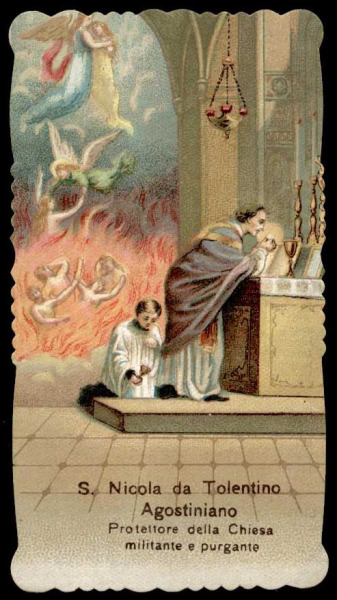
During his life, Nicholas is said to have received visions, including images of Purgatory, which friends ascribed to his lengthy fasts.  Prayer for the souls in purgatory was the outstanding characteristic of his spirituality.   Because of this Nicholas was proclaimed patron of the souls in Purgatory in 1884 by Leo XIII.  Towards the end of his life he became ill, suffering greatly, but still continued the mortifications that had been part of his holy life.   Nicholas died on 10 September 1305.St.-Nicholas-of-Tolentino-Purgatory-2.jpg

Miracles:
There are many tales and legends which relate to Nicholas.   One says the devil once beat him with a stick, which was then displayed for years in his church.   In another, Nicholas, a vegetarian, was served a roasted fowl, for which he made the sign of the cross and it flew out a window.   Nine passengers on a ship going down at sea once asked Nicholas’ aid and he appeared in the sky, wearing the black Augustinian habit, radiating golden light, holding a lily in his left hand, and with his right hand, he quelled the storm.   An apparition of the saint, it is said, once saved the burning palace of the Doge of Venice by throwing a piece of blessed bread on the flames.  He was also reported to have resurrected over one hundred dead children, including several who had drowned together.

According to the Peruvian chronicler Antonio de la Calancha, it was St. Nicholas of Tolentino who made possible a permanent Spanish settlement in the rigorous, high-altitude climate of Potosí, Bolivia.   e reported that all children born to Spanish colonists there died in childbirth or soon thereafter, until a father dedicated his unborn child to St Nicholas of Tolentino (whose own parents, after all, had required saintly intervention to have a child).   The colonist’s son, born on Christmas Eve, 1598, survived to healthy adulthood and many later parents followed the example of naming their sons Nicolás.st nicholas of tolentino
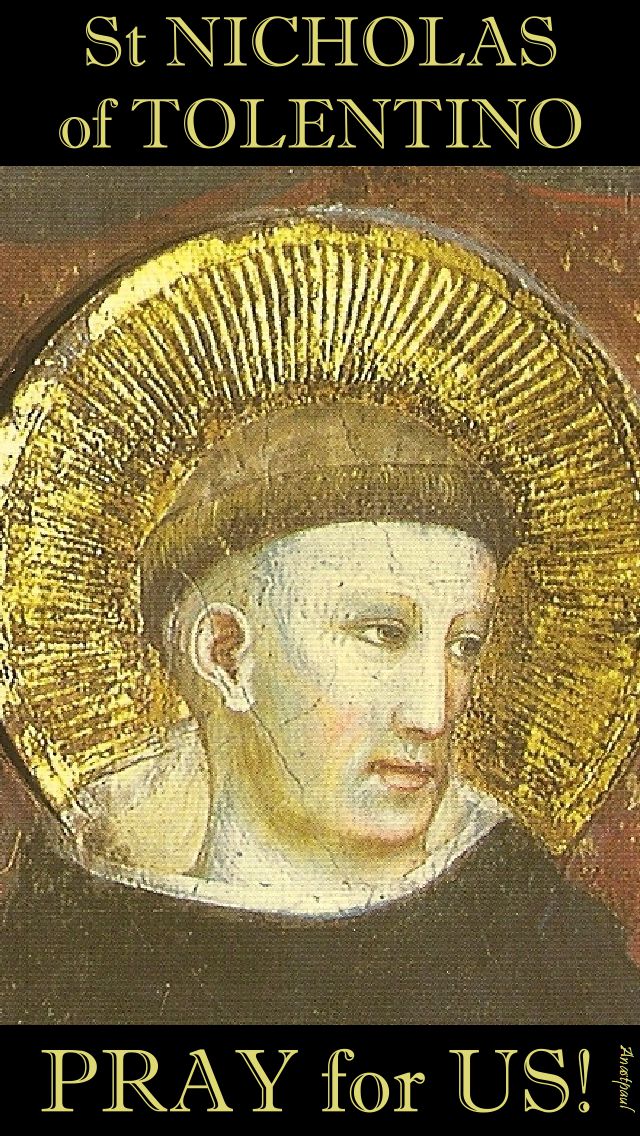
Veneration:
Nicholas was Canonised by Pope Eugene IV (also an Augustinian) in 1446.   He was the first Augustinian to be Canonised.   At his Canonisation, Nicholas was credited with three hundred miracles, including three resurrections.
The remains of St Nicholas are preserved at the Shrine of Saint Nicholas in the Basilica di San Nicola da Tolentino in the city of Tolentino, province of Macerata in Marche, Italy.

He is particularly invoked as an advocate for the souls in Purgatory, especially during Lent and the month of November.  In many Augustinian churches, there are weekly devotions to St Nicholas on behalf of the suffering souls.  November 2, All Souls’ Day, holds special significance for the devotees of St. Nicholas of Tolentino.

Posted in EUCHARISTIC Adoration, MORNING Prayers, PRAYERS of the SAINTS, The HOLY EUCHARIST / The HOLY MASS

Our Morning Offering – 10 September

Our Morning Offering – 10 September

Give me, good Lord a full faith
By St Thomas More

Give me, good Lord,
a full faith and a fervent charity,
a love of You, good Lord,
incomparable above the love of myself;
and that I love nothing to Your displeasure
but everything in an order to You.
Take from me, good Lord,
this lukewarm fashion,
or rather key-cold manner of meditation
and this dullness in praying to You.
And give me warmth, delight and life
in thinking about You.
And give me Your grace
to long for Your holy sacraments
and specially to rejoice
in the presence of Your blessed Body,
sweet Saviour Christ,
in the holy Sacrament of the altar,
and duly to thank You
for Your gracious coming.
Amengive me good lord a full faith by st thomas more

Posted in SAINT of the DAY, The BLESSED VIRGIN MARY

Feast of Our Lady of Life and Memorials of the Saints – 10 September

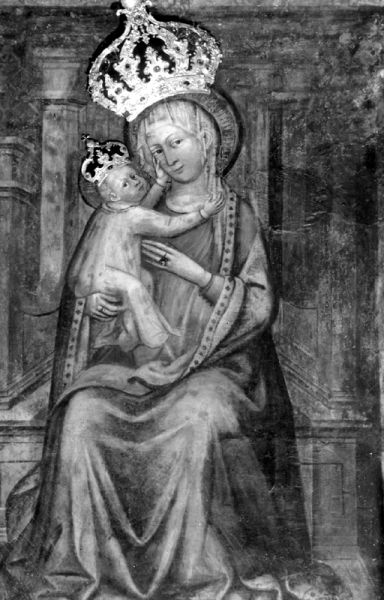
Beata Vergine Maria della Vita/Our Lady of Life: Celebration of the Blessed Virgin Mary as patroness of the Our Lady of Life Hospital in Bologna, Italy, and as depicted in a painting in a sanctuary dedicated to her c 1375 in the hospital.
Patronage – hospitals in the diocese of Bologna, ItalyMadonna-della-vita

St Agapius of Novara
St Alexius Sanbashi Saburo
St Ambrose Edward Barlow
St Autbert of Avranches
St Barypsabas
St Candida the Younger
St Clement of Sardis
St Finnian of Moville
St Frithestan
Bl Jacques Gagnot
St Nicholas of Tolentino
Bl Ogerius
St Peter Martinez
St Pulcheria
St Salvius of Albi
St Sosthenes of Chalcedon
St Theodard of Maastricht
St Victor of Chalcedon

Martyrs of Bithynia – 3 sister saints: Three young Christian sisters martyred in the persecutions of emperor Maximian and governor Fronto: Menodora, Metrodora, Nymphodora. They were martyred in 306 in Bithynia, Asia Minor (in modern Turkey).

Martyrs of Japan – 205 beati: A unified feast to memorialise 205 missionaries and native Japanese known to have been murdered for their faith between 1617 and 1637.

Martyrs of Sigum – 8 saints: A group of Nicomedian martyrs, condemned for their faith to be worked to death in the marble quarries of Sigum. There were priests, bishops and laity in the group but only a few names have come down to us: Dativus, Felix, Jader, Litteus, Lucius, Nemesian, Polyanus, Victor. They were worked to death c 257 in Sigum.

Martyred in the Spanish Civil War:
• Blessed Félix España Ortiz
• Blessed Leoncio Arce Urrutia
• Blessed Tomàs Cubells Miguel

Posted in MORNING Prayers, NOVENAS

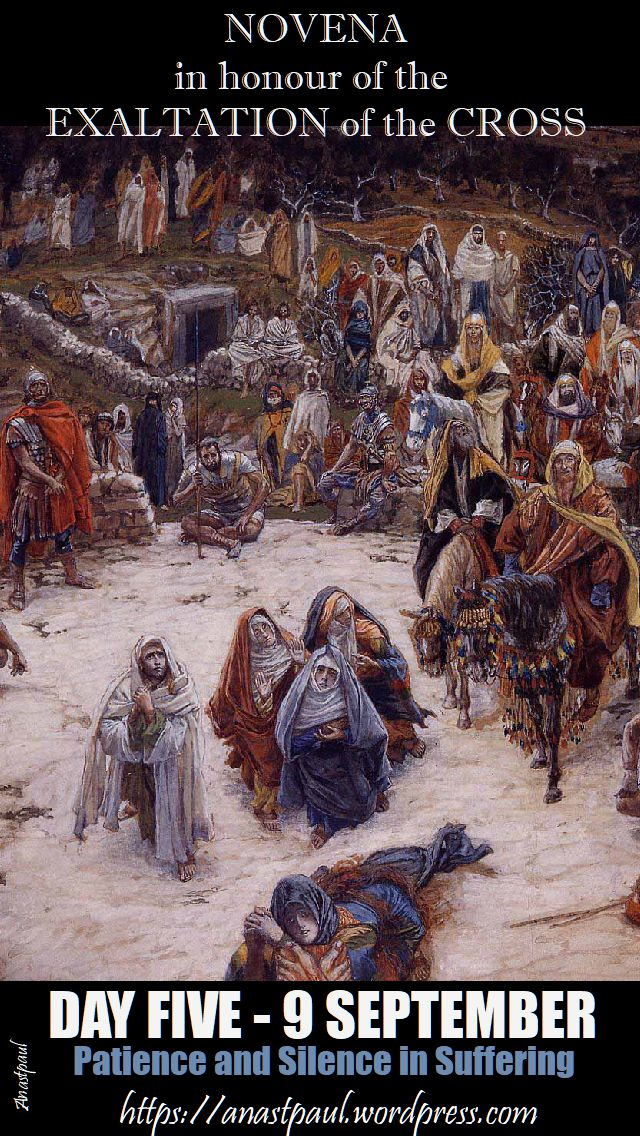
DAY FIVE – NOVENA in honour of the EXALTATION of the HOLY CROSS – 9 September

DAY FIVE – NOVENA in honour of the EXALTATION of the HOLY CROSS – 9 September

Patience and Silence in Suffering

Jesus, You hung on the cross of three hours
and Your executioners insulted You,
saying that You cannot save Yourself and others.
You could have used Your powers
but preferred to keep silent
and bear the insults of Your enemies.

Teach us the virtue of patience as we bear the insults
and harsh words of people who don’t like us.
Inspire us to respond with silence
and give us the grace that we may be able to pray for them.
In this way, through our patience,
we help You redeem our troubled world. Amen

DAILY PRAYER:

Dear Lord Jesus
Who because of Your burning love for us willed to be crucified
and to shed Your Most Precious Blood for the redemption
and salvation of our souls,
to bear the sins of all the history of humanity,
from Adam to the end of time.
look down upon us and grant the petition we ask
…………….( mention your intention)
We trust completely in Your Mercy.
Cleanse us from sin by Your Grace,
sanctify our work,
give us and all those who are dear to us,
our daily bread, lighten the burden of our sufferings,
bless our families,
and grant to the nations, so sorely afflicted,
Your Peace, which is the only true peace,
so that by obeying Your Commandments
we may come at last to the glory of Heaven.

O Cross, you are the glorious sign of victory.
Through your power may we share
in the triumph of Christ Jesus. Amen
Glory Be. (3x)day five - 9 sept - patience and silence in suffering

Posted in JESUIT SJ, MISSIONS, MISSIONARIES, SAILORS, MARINERS, NAVIGATORS, SAINT of the DAY

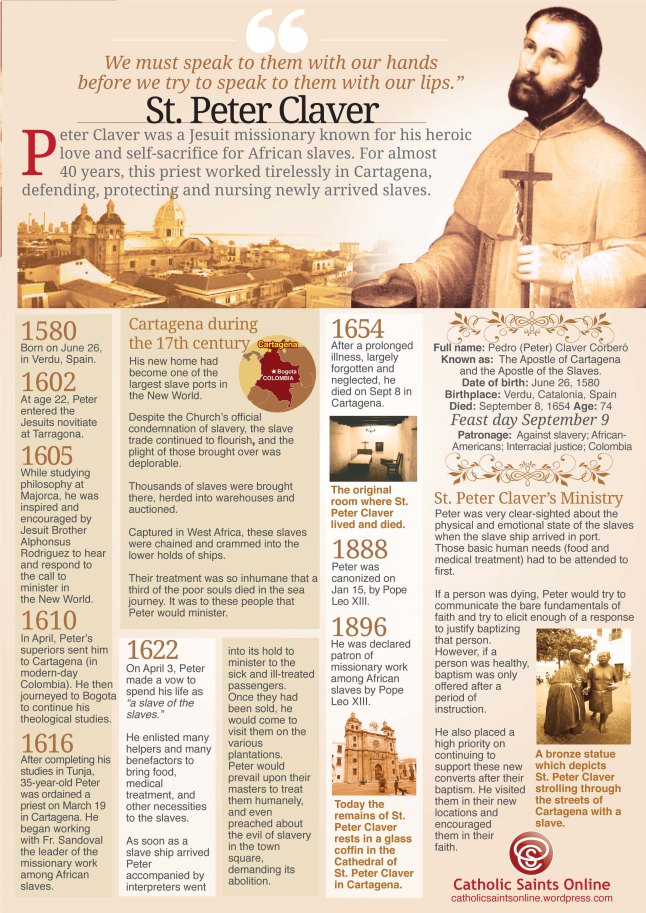
Saint of the Day – 9 September – St Peter Claver SJ (1581-1654) Confessor

Saint of the Day – 9 September – St Peter Claver  SJ (1581-1654) Confessor- Priest, Religious, Missionary.     Also known as • Apostle of Cartagena • Slave of the Blacks • Slave of the Slaves.   Born at 1581 at Verdu, Catalonia, Spain and died on 8 September 1654 at Cartegena, Colombia of natural causes.    During the 40 years of his apostolic work in Colombia, it is estimated he personally Baptised around 300,000 people.      The Congress of the Republic of Colombia declared September 9 as the Human Rights national Day in his honour.   Patronages – African missions (proclaimed in 1896 by Pope Leo XIII),  African-Americans, slaves, against slavery, black missions, black people, Human Rights, foreign missions, inter-racial justice, race relations, seafarers, Missionary Sisters of Saint Peter Claver, Colombia, Accra, Ghana, archdiocese of Lake Charles, Louisiana, Diocese of•Shreveport, Louisiana, Diocese of Witbank, South Africa, Apostleship of the Sea.

St Doninic Final

Claver was born in 1580 into a devoutly Catholic and prosperous farming family in the Catalan village of Verdú, Urgell, located in the Province of Lleida, about 54 miles (87 km) from Barcelona.   He was born 70 years after King Ferdinand of Spain set the colonial slavery culture into motion by authorising the purchase of 250 African slaves in Lisbon for his territories in New Spain, an event which was to shape Claver’s life.

As a student at the University of Barcelona, Claver was noted for his intelligence and piety.   After two years of study there, Claver wrote these words in the notebook he kept throughout his life:  “I must dedicate myself to the service of God until death, on the understanding that I am like a slave.”

After he had completed his studies, at the age of 20 years, Peter entered the Society of Jesus in Tarragona .   When he had completed the Novitiate, he was sent to study Philosophy at Palma, Mallorca.   While there, he came to know the porter of the college, St. Alphonsus Rodriguez, a Lay Brother known for his holiness and gift of prophecy.   St Alphonsus informed Peter  that he had been told by God that Peter was to spend his life in service in the Colonies of New Spain and he frequently urged the young student to accept that calling.

Peter volunteered for the Spanish Colonies and was sent to the Kingdom of  New Granada, where he arrived in the port City of Cartagena in 1610.   Required to wait six years to be Ordained as a Priest, while he completed his Theological studies, he lived in Jesuit houses at Tunja and Bogotá.  During those preparatory years, he was deeply disturbed by the harsh treatment and living conditions of the black slaves who had been brought from Africa.   By this time, the slave trade had already been established for a Century, in the Americas.   Local natives were considered not physically suited to work in the gold and silver mines and this created a demand for blacks from Angola and Congo.   These were bought in West Africa for four crowns a head, or bartered for goods and sold in America for an average of two hundred crowns apiece.  Others were captured at random, especially able-bodied males deemed suitable for labour.

Cartagena was a slave-trading hub. 10,000 slaves poured into the port annually, crossing the Atlantic from West Africa under such foul and inhuman conditions that an estimated one-third died in transit.   Although the slave trade was condemned by Pope Paul III and Urban VIII had issued a Papal Decree prohibiting slavery, (later called “supreme villainy” by Pope Pius IX), it was a lucrative business and continued to flourish.

Peter’s predecessor in his eventual lifelong mission, Father Alonso de Sandoval, SJ, was his mentor and inspiration.   Sandoval devoted himself to serving the slaves for 40 years before Claver arrived, to continue his work.   Sandoval attempted to learn about their customs and languages;  he was so successful that, when he returned to Seville, he wrote a book in 1627 about the nature, customs, rites and beliefs of the Africans.   Sandoval found Claver an apt pupil.   When he was solemnly professed in 1622, Claver signed his final profession document in Latin as:  Petrus Claver, aethiopum semper servus (Peter Claver, servant of the Ethiopians [i.e. Africans] forever).

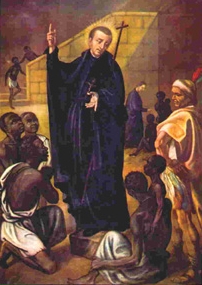
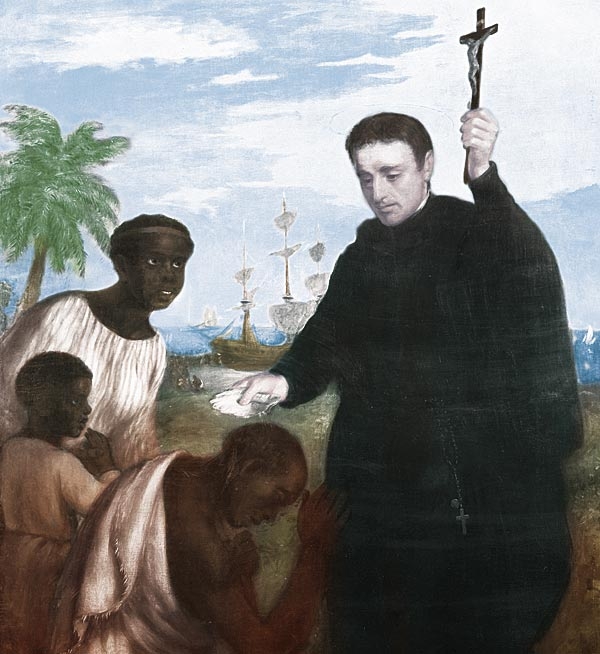
The Church of St. Peter Claver in Cartagena, Colombia, where Claver lived and ministered.   Whereas Sandoval had visited the slaves where they worked, Claver preferred to head for the wharf as soon as a slave ship entered the port.   Boarding the ship, he entered the filthy and diseased holds to treat and minister to their badly treated, terrified human cargo, who had survived a voyage of several months under horrible conditions.   It was difficult to move around on the ships because the slave traffickers filled them to capacity.   The slaves were often told they were being taken to a land where they would be eaten.   Claver wore a cloak, which he would lend to anyone in need.   A legend arose that whoever wore the cloak received lifetime health and was cured of all disease.  After the slaves were herded from the ship and penned in nearby yards to be scrutinised by crowds of buyers, Claver joined them with medicine, food, bread, brandy, lemons and tobacco  With the help of interpreters and pictures which he carried with him, he gave basic instructions.

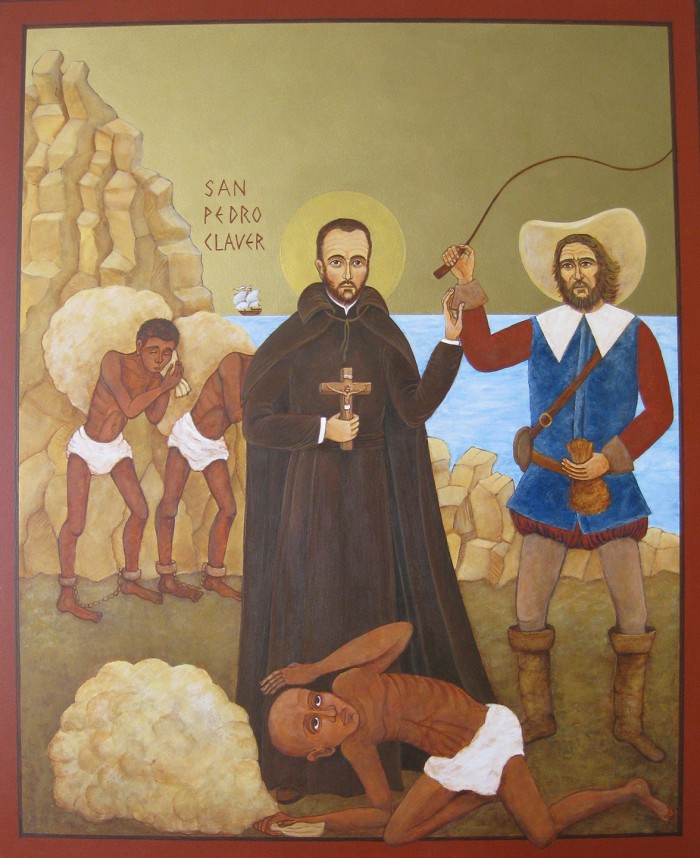
Claver saw the slaves as fellow Christians, encouraging others to do so as well.   During the season when slavers were not accustomed to arrive, he traversed the country, visiting plantation after plantation, to give spiritual consolation to the slaves.   During his 40 years of ministry it is estimated that he personally catechised and baptised 300,000 slaves.   He would then follow up on them to ensure that as Christians they received their Christian and civil rights.  His mission extended beyond caring for slaves, however.   He preached in the city square, to sailors and traders and conducted country missions, returning every spring to visit those he had baptised, ensuring that they were treated humanely.   During these missions, whenever possible he avoided the hospitality of planters and overseers; instead, he would lodge in the slave quarters.

Claver’s work on behalf of slaves did not prevent him from ministering to the souls of well-to-do members of society, traders and visitors to Cartagena (including Muslims and English Protestants) and condemned criminals, many of whom he spiritually prepared for death; he was also a frequent visitor at the city’s hospitals.   Through years of unremitting toil and the force of his own unique personality, the slaves’ situation slowly improved.   n time he became a moral force, the Apostle of Cartagena.

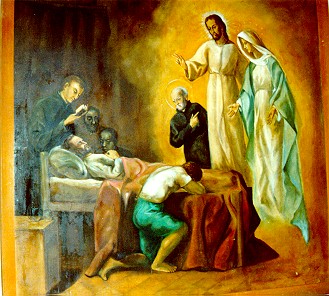
In the last years of his life Peter was too ill to leave his room.   He lingered for four years, largely forgotten and neglected, physically abused and starved by an ex-slave who had been hired by the Superior of the house to care for him.   He never complained about his treatment, accepting it as a just punishment for his sins.   He died on 8 September 1654.

St Peter Claver sees Jesus Christ and the Virgin before death

When the people of the City heard of his death, many forced their way into his room to pay their last respects.  Such was his reputation for holiness that they stripped away anything to serve as a relic of the saint.  The city magistrates, who had previously considered him a nuisance for his persistent advocacy on behalf of the slaves, ordered a public funeral and he was buried with pomp and ceremony.   The extent of Claver’s ministry, which was prodigious even before considering the astronomical number of people he baptised, came to be realised only after his death.

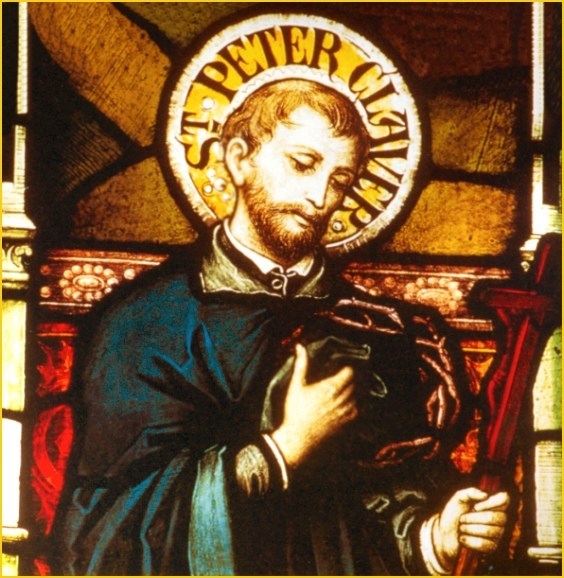
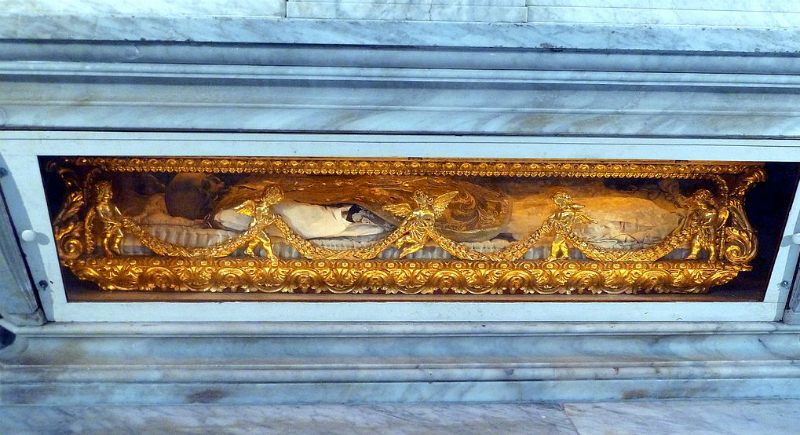
He was Canonised in 1888 by Pope Leo XIII, along with the holy Jesuit porter, Alphonsus Rodriguez.   In 1896 Pope Leo also declared Claver the Patron of missionary work among all African peoples.   His body is preserved and venerated in the Church of the Jesuit residence, now renamed in his honour.Saint_Peter_Claver_stained_glass

Legacy:  “No life, except the life of Christ, has moved me so deeply ,as that of Peter Claver”.   St Pope Leo XIII, on the occasion of his Canonisation.

Many Organisations, Missions, Parishes, Religious Congregations, Schools and Hospitals bear the name of St. Peter Claver and also claim to continue the Mission of Claver as the following:

The Knights of Peter Claver Inc is the largest African-American Catholic fraternal organisation in the United States.   In 2006, a unit was established in San Andres, Colombia.   The Order was founded in Mobile, Alabama and is presently headquartered in New Orleans.
Claver’s mission continues today in the work of the Apostleship of the Sea (AoS) and his inspiration remains among port chaplains and those who visit ships in the name of the Church, through the AoS.
The Missionary Sisters of St. Peter Claver are a religious congregation of women dedicated to serving the spiritual and social needs of the poor around the world, particularly in Africa.   They were founded in Austria by the Blessed Mary Theresa Ledóchowska in 1894.

Among the many schools dedicated to St. Peter Claver are those in Decatur, Georgia and Pimville, South Africa.   The oldest African American school in the Diocese of St. Petersburg and the oldest African American school still functioning in the State of Florida, is the St Peter Claver Catholic School.

peters-bones
St Peter Claver’s under the altar at the Church of St Peter Claver in Cartagena
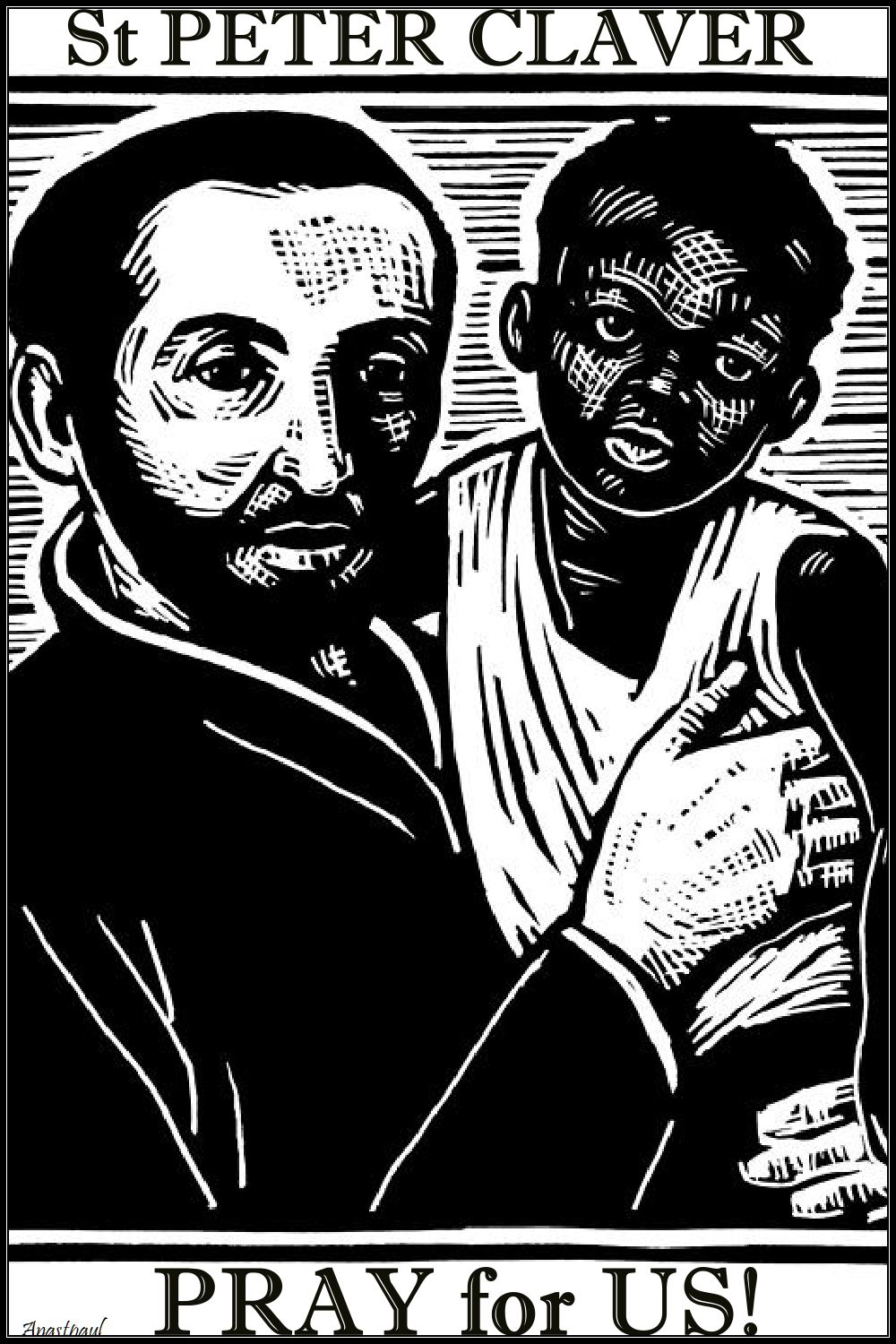
peter-claver-700x858
Posted in JESUIT SJ, MORNING Prayers, PRAYERS of the SAINTS

Thought for the Day – 9 September – The Memorial of St Peter Claver “A Stunning Hero”

Thought for the Day – 9 September – The Memorial of St Peter Claver “A Stunning Hero”

Fr Claver’s apostolate extended beyond his care for slaves. He became a moral force, indeed, the “Apostle of Cartagena”.   He preached in the city square, gave missions to sailors and traders as well as country missions, during which he avoided, when possible, the hospitality of the planters and owners and lodged in the slave quarters instead.

After four years of sickness, which forced the saint to remain inactive and largely neglected, St Peter Claver died on September 8, 1654. The city magistrates, who had previously frowned at his solicitude for the black outcasts, ordered that he should be buried at public expense and with great pomp.

Peter Claver was canonised in 1888 and Pope Leo XIII declared him the worldwide patron of missionary work among black slaves.

The Holy Spirit’s might and power are manifested in the striking decisions and bold actions of Peter Claver.   A decision to leave one’s homeland never to return reveals a gigantic act of will difficult for us to imagine.   Peter’s determination to serve forever the most abused, rejected and lowly of all people is stunningly heroic.  When we measure our lives against such a man’s, we become aware of our own barely used potential and of our need to open ourselves more to the jolting power of Jesus’ Spirit. (Fr Don Miller OFM)

God our Heavenly Father, You have given us life through the Death and Resurrection of Your Beloved Son, Jesus Christ.

Jesus our saving Lord, You came into a world
darkened by man’s sin and gave it light through your teachings,

Holy Spirit, the Breath of God Within us,
You guide and enlighten us and give us the strength of our convictions;

Saint Peter Claver, who became an example for us, You showed us the Love of God
The Light of Christ, and the strength of the Holy Spirit;

We pray now that all we say and do,
in your honor, be a continuation of your work here on earth.

St Peter Claver….pray for us,
St Peter Claver….pray for us.

st peter claver pray for us 2

Posted in JESUIT SJ, MORNING Prayers, QUOTES of the SAINTS, SAINT of the DAY

Quote of the Day – September 9 – The Memorial of St Peter Claver

Quote of the Day – September 9 – The Memorial of St Peter Claver

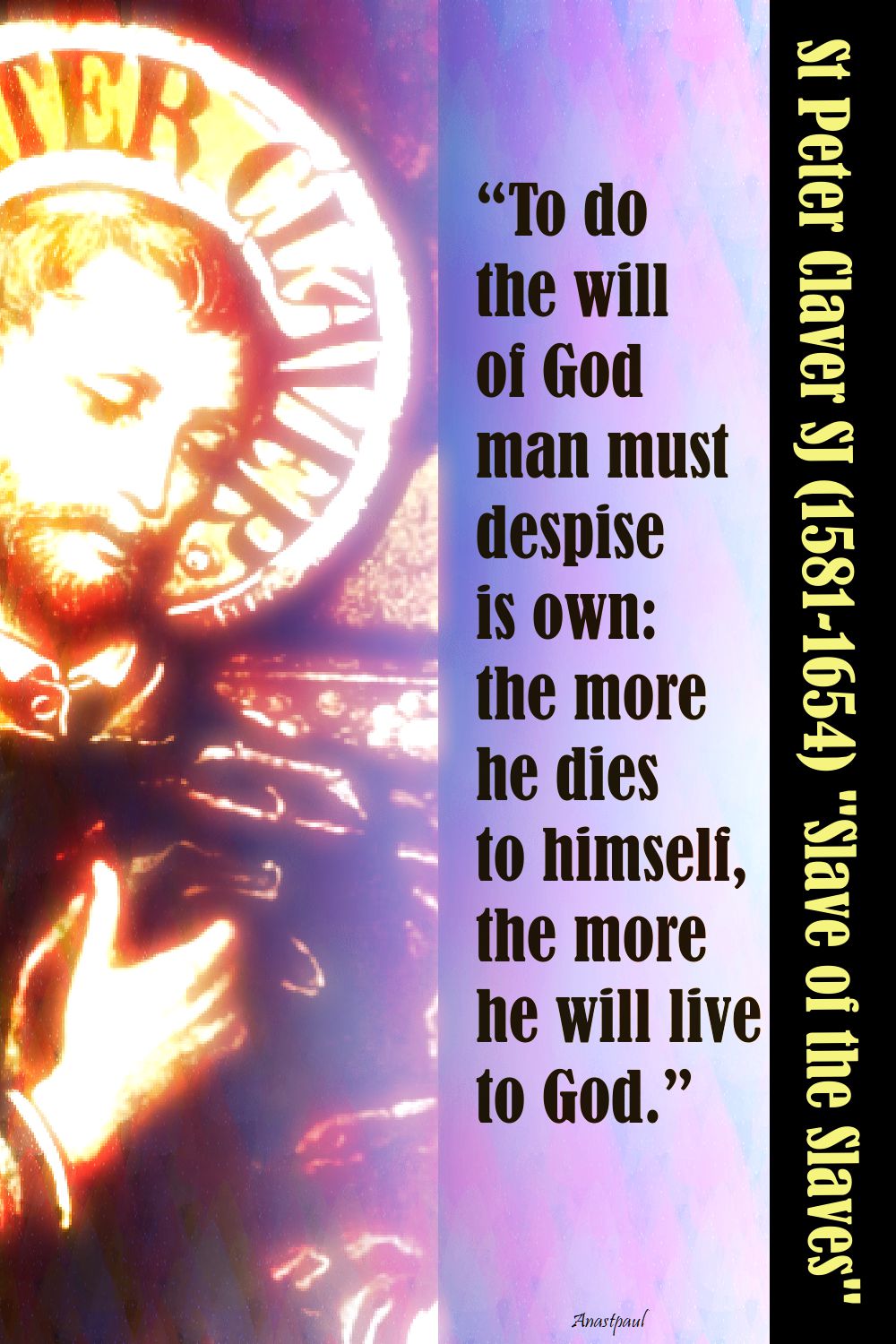
“To do the will of God
man must despise his own:
the more he dies to himself,
the more he will live to God.”

St Peter Claver SJ
(1581-1654)
“Slave of the Slaves”to do the will of god - st peter claver

Posted in JESUIT SJ, MORNING Prayers, SAINT of the DAY, The WORD

One Minute Reflection – September 9 – The Memorial of St Peter Claver

One Minute Reflection – September 9 – The Memorial of St Peter Claver

Has not God chosen the poor in the world to be rich in faith and to be heirs of the kingdom that he has promised to those who love him………….James 2:5

REFLECTION – “This was how we spoke to them, not with words but with our hands and our actions.   And in fact, convinced as they were that they had been brought here to be eaten, any other language would have proved utterly useless.   Then we sat, or rather knelt, beside them and bathed their faces and bodies.”…St Peter Claver SJ (1581-1654) “Slave of the Slaves”this was how we spoke to them - st peter claver

PRAYER – God of mercy and love, You offer all peoples the dignity of sharing in your life. By the example and prayers of St Peter Claver, strengthen us to overcome all racial hatreds and to love each other as brothers and sisters.   We ask this through our Lord Jesus Christ, your Son, who lives and reigns with you and the Holy Spirit, one God, for ever and ever.   St Peter Claver pray for us, amenst peter claver pray for us

Posted in MORNING Prayers, The HOLY GHOST

Our Morning Offering – 9 September

Our Morning Offering – 9 September

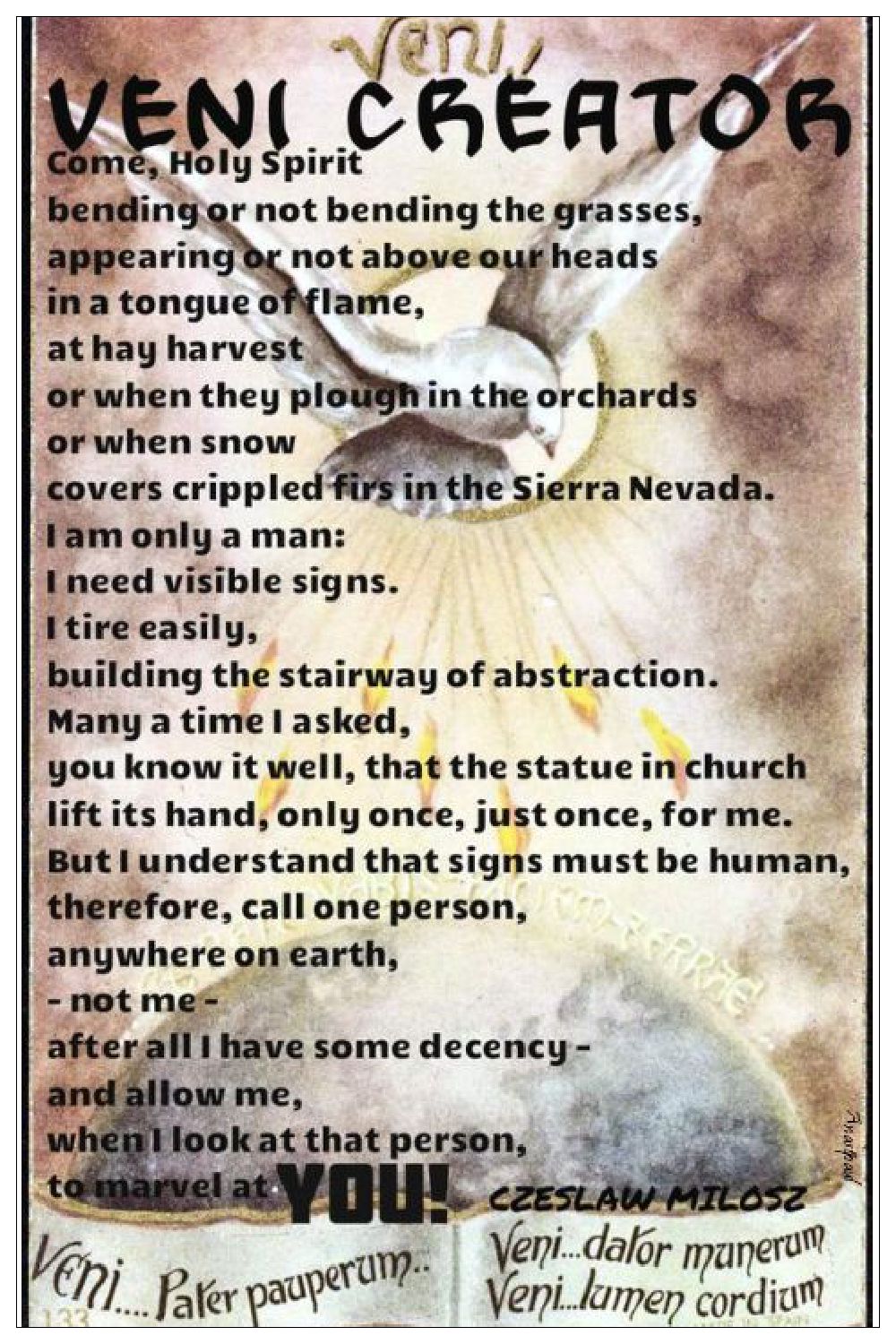
Veni Creator
by Czeslaw Milosz

Come, Holy Spirit
bending or not bending the grasses,
appearing or not above our heads
in a tongue of flame, at hay harvest
or when they plough in the orchards
or when snow covers
crippled firs in the Sierra Nevada.
I am only a man:
I need visible signs.
I tire easily, building the stairway of abstraction.
Many a time I asked,
you know it well, that the statue in church
lift its hand, only once, just once, for me.
But I understand that signs must be human,
therefore, call one person,
anywhere on earth, – not me –
after all I have some decency – and allow me,
when I look at that person,
to marvel at YOU!

VENI CREATOR LARGERveni creator - st john paul

Posted in SAINT of the DAY

Memorials of the Saints – 9 September

St Peter Claver (Memorial) – https://www.youtube.com/watch?v=aYikMp1Gu7Q

St Alexander of Sabine
Bl Antoine-Frédéric Ozanam
St Basura of Masil
St Bettelin
St Dorotheus of Nicomedia
Bl Gaudridus
Bl George Douglas
St Gorgonio of Rome
St Gorgonius of Nicomedia
St Isaac the Great
Bl Jacques Laval
St Joseph of Volokolamsk
St Kieran the Younger
Bl Maria Eutimia Uffing
Bl Mary de la Cabeza
St Omer
St Osmanna
Bl Pierre Bonhomme
St Rufinian
St Rufinus
Bl Seraphina Sforza
St Severian
St Straton
St Teódulo González Fernández
St Tiburtius
St Valentinian of Chur
St Wilfrida
St Wulfhilda

Posted in MORNING Prayers, NOVENAS, The HOLY CROSS

DAY FOUR – NOVENA in honour of the EXALTATION of the HOLY CROSS – 8 September

DAY FOUR – NOVENA in honour of the EXALTATION of the HOLY CROSS – 8 September

The compassion of the suffering Christ

Jesus our Christ, whilst You hung on the cross,
You forgave those who were laughing at You
and asked Your beloved disciple to take care of Your mother.
You welcomed the good thief into paradise.
You continued to be compassionate and serve others fully.
You did not allow the terrible pain to hinder Your love.
Give us the special grace not to be desperate in our moments of sufferings.
Enable us to bear pain with courage and dignity,
to, even in the midst of pain,
to be of help and service to others. Amen

DAILY PRAYER:

Dear Lord Jesus
Who because of Your burning love for us willed to be crucified
and to shed Your Most Precious Blood for the redemption
and salvation of our souls,
to bear the sins of all the history of humanity,
from Adam to the end of time.
look down upon us and grant the petition we ask
…………….( mention your intention)
We trust completely in Your Mercy.
Cleanse us from sin by Your Grace,
sanctify our work,
give us and all those who are dear to us,
our daily bread, lighten the burden of our sufferings,
bless our families,
and grant to the nations, so sorely afflicted,
Your Peace, which is the only true peace,
so that by obeying Your Commandments
we may come at last to the glory of Heaven.

O Cross, you are the glorious sign of victory.
Through your power may we share
in the triumph of Christ Jesus. Amen
Glory Be. (3x)day four - 8 september - holy cross novena - the compassion of the suffering christ

Posted in FEASTS and SOLEMNITIES, MARIAN PRAYERS, MORNING Prayers, PRAYERS of the CHURCH, SAINT of the DAY, The BLESSED VIRGIN MARY

Thought for the Day – – The Feast of the Nativity of the Blessed Virgin Mary

Thought for the Day – – The Feast of the Nativity of the Blessed Virgin Mary

We can see every human birth as a call for new hope in the world.   The love of two human beings has joined with God in his creative work.   The loving parents have shown hope in a world filled with travail.   The new child has the potential to be a channel of God’s love and peace to the world.

This is all true in a magnificent way in Mary.   If Jesus is the perfect expression of God’s love, Mary is the foreshadowing of that love.  If Jesus has brought the fullness of salvation, Mary is its dawning.

Birthday celebrations bring happiness to the celebrant as well as to family and friends. Next to the birth of Jesus, Mary’s birth offers the greatest possible happiness to the world. Each time we celebrate her birth, we can confidently hope for an increase of peace in our hearts and in the world at large.  (Fr Don Miller OFM)

Happy Birthday Mama Mary, pray for us!happy-birthday-mother-mary-pray-for-us-8 sept 2018

Posted in DOCTORS of the Church, FATHERS of the Church, FEASTS and SOLEMNITIES, MARIAN QUOTES, MORNING Prayers, QUOTES of the SAINTS, The BLESSED VIRGIN MARY

Quote of the Day – The Feast of the Nativity of the Blessed Virgin Mary

Quote of the Day – The Feast of the Nativity of the Blessed Virgin Mary

“She is the flower of the field
from whom bloomed
the precious lily of the valley.”

St Augustine (354-430) Father & Doctorshe is the flower of the field - st augustine