Posted in BREVIARY Prayers, CATHOLIC-PRAYERS OF THE CHURCH, FEASTS and SOLEMNITIES, MARIAN PRAYERS, MARIAN QUOTES, MORNING Prayers, QUOTES of the SAINTS, SAINT of the DAY, The BLESSED VIRGIN MARY, The WORD

One Minute Reflection – 8 September – The Feast of the Nativity of the Blessed Virgin Mary

One Minute Reflection – 8 September – The Feast of the Nativity of the Blessed Virgin Mary

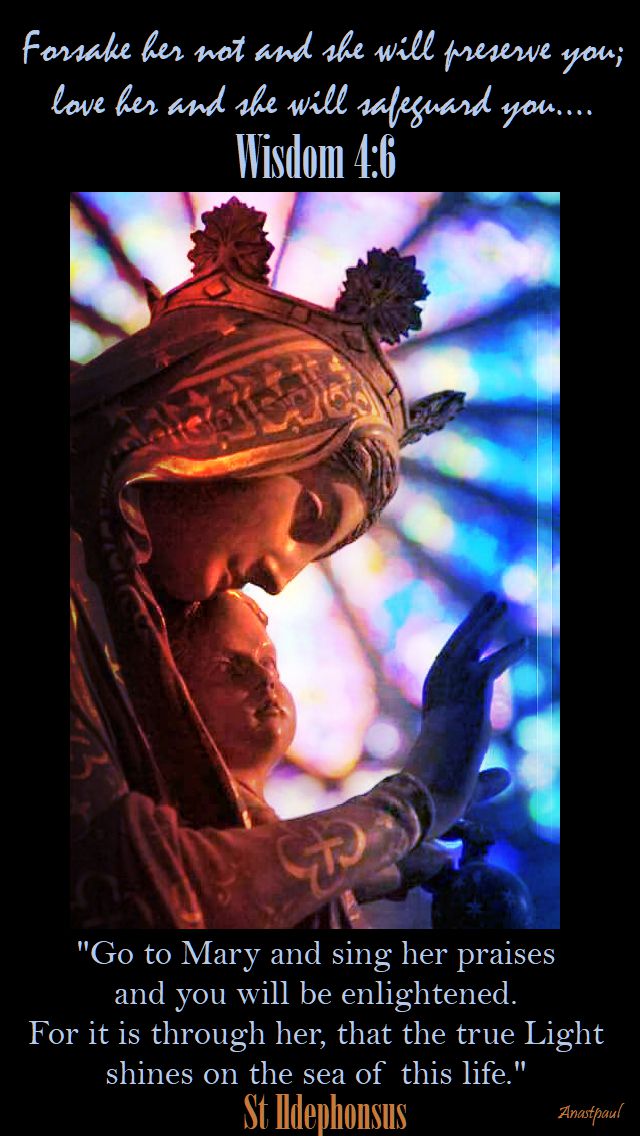
Forsake her not and she will preserve you;
love her and she will safeguard you…..Wisdom 4:6

REFLECTION – “Go to Mary and sing her praises and you will be enlightened.
For it is through her that the true Light shines on the sea of this life.”…St Ildephonsusgor to mary and sing her praises - st ildephonsus

PRAYER – Lord God, the day of our salvation dawned when the Blessed Virgin gave birth to Your Son.
As we celebrate her nativity, grant us Your grace and Your peace.
Through Christ, our Lord, Your Son in union with the Holy Spirit.
Mary, Mother of God, pray for us, amen.blessed virgin mary pray for us

Posted in BREVIARY Prayers, CATHOLIC-PRAYERS OF THE CHURCH, FEASTS and SOLEMNITIES, MARIAN PRAYERS, MORNING Prayers, The BLESSED VIRGIN MARY

Our Morning Offering – 8 September – The Feast of the Nativity of the Blessed Virgin Mary

Our Morning Offering – 8 September – The Feast of the Nativity of the Blessed Virgin Mary

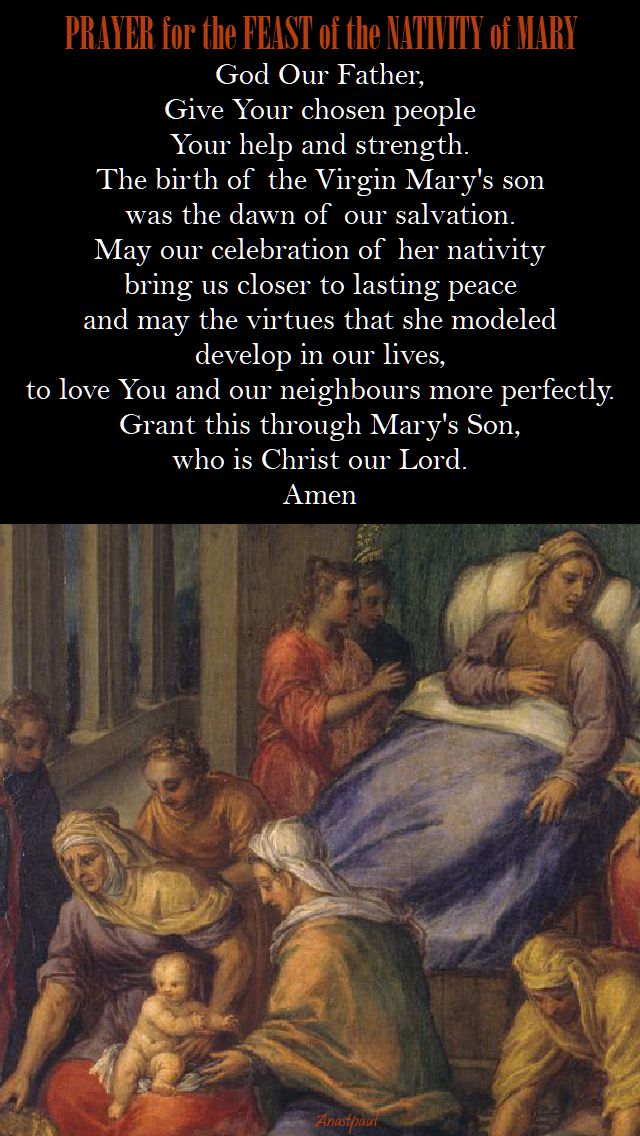
God Our Father,
Give Your chosen people
Your help and strength.
The birth of the Virgin Mary’s son
was the dawn of our salvation.
May our celebration of her nativity
bring us closer to lasting peace
and may the virtues that she modeled
develop in our lives,
to love You and our neighbours more perfectly.
Grant this through Mary’s Son,
who is Christ our Lord. Amen

Adapted from “The Liturgy of the Hours”prayer for the feast of the nativity of mary

Posted in FEASTS and SOLEMNITIES, SAINT of the DAY, The BLESSED VIRGIN MARY

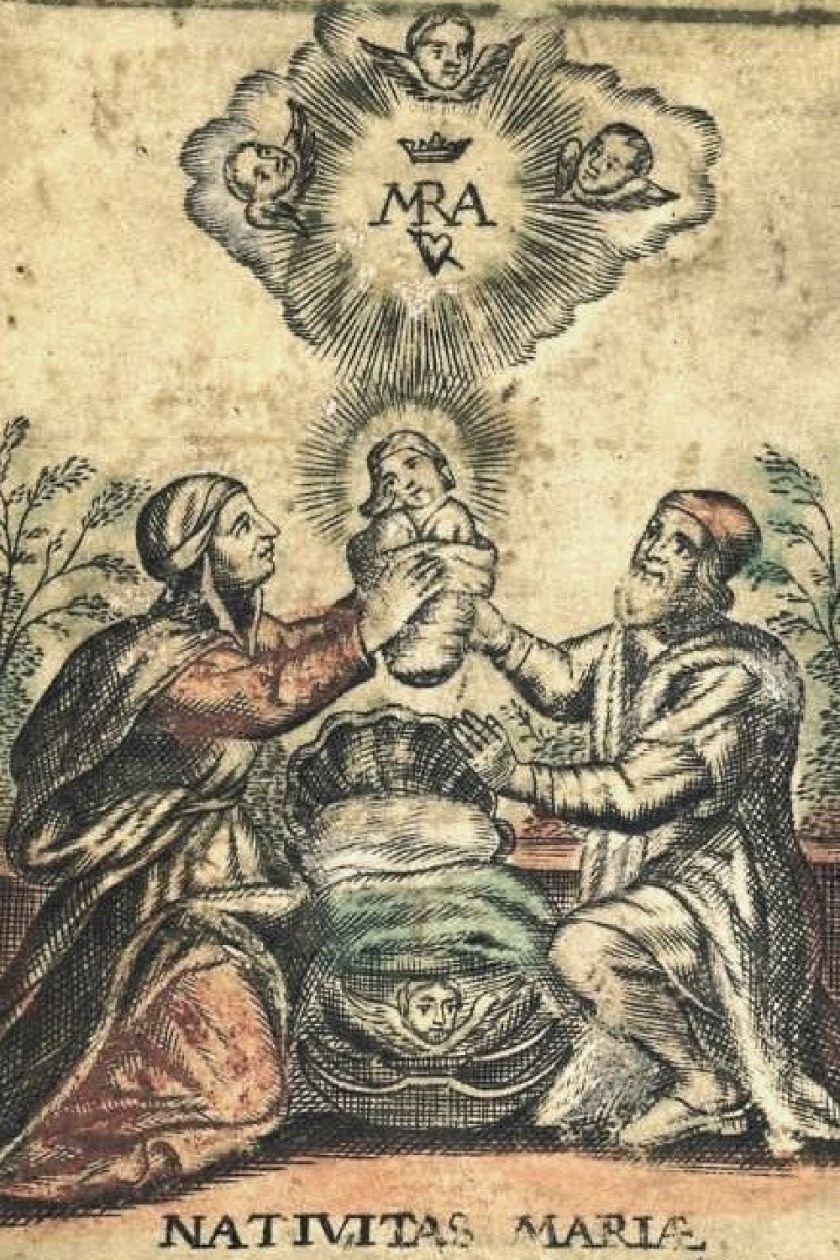
Feast of the Nativity of the Blessed Virgin Mary – 8 September

Feast of the Nativity of the Blessed Virgin Mary – 8 September – The Feast of the Nativity of the Blessed Virgin Mary, the day on which Christians East and West commemorate the birth of Mary, the Mother of God, was celebrated as early as the sixth century.   We know that from the fact that Saint Romanos the Melodist, an Eastern Christian who composed many of the hymns used in the Eastern Catholic and Eastern Orthodox liturgies, composed a hymn for the feast at that time and it probably originated after the Council of Ephesus in 431, which established her right to the title of “Mother of God.”   Patronages: • chefs, cooks and restauranteurs• coffee house owners or keepers
• distillers• drapers• fish dealers or fishmongers• gold workers or goldsmiths• needle and pin makers• potters• silk workers• silver workers or silversmiths• tile makers• 14 cities

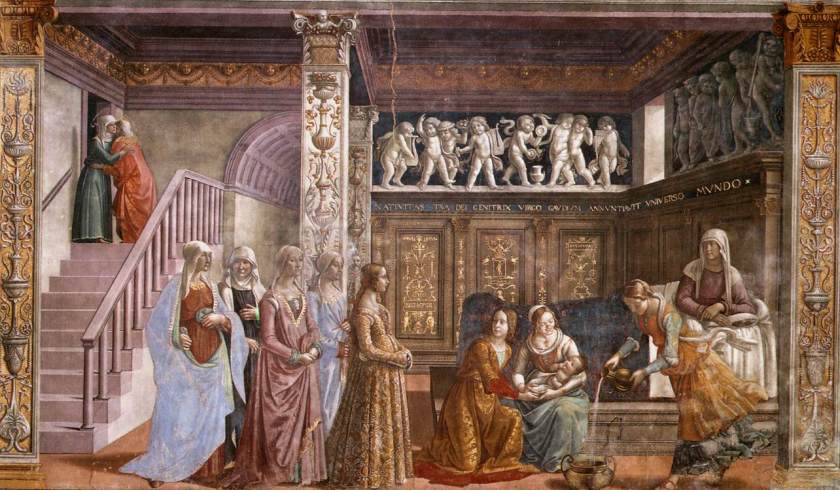
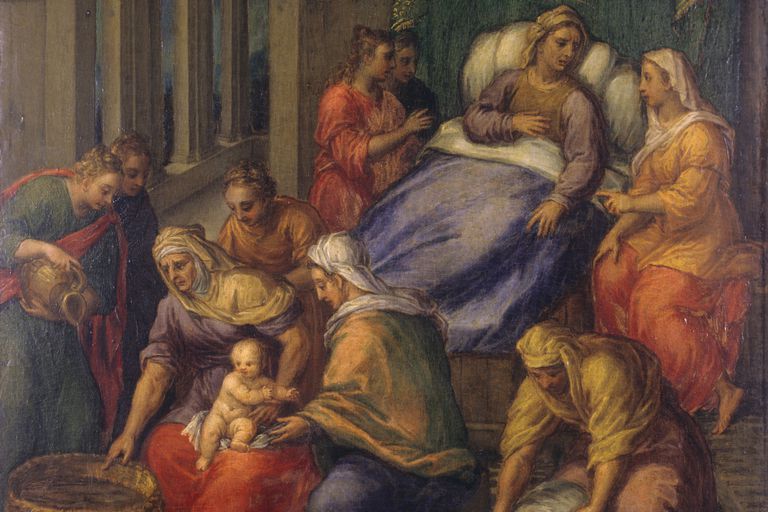
The Feast of the Nativity of the Blessed Virgin Mary spread to Rome in the seventh century but it took a couple of more centuries before it was celebrated throughout the West.Birth_of_St_Mary_in_Santa_Maria_Novella_in_Firenze_by_Domenico_GhirlandaioBirth-of-the-Virgin-Mary-1500-56a1089f3df78cafdaa83d40

HISTORY:  Even though we cannot trace the celebration of the Feast of the Nativity of the Blessed Virgin Mary back any further than the sixth century, the source for the story of the birth of the Blessed Virgin Mary is much older.   The earliest documented version is found in the Protoevangelium of James, an apocryphal gospel written about C 150. From the Protoevangelium of James, we learn the names of Mary’s parents, Joachim and Anna, as well as the tradition that the couple was childless until an angel appeared to Anna and told her that she would conceive.  (Many of the same details appear also in the later apocryphal Gospel of the Nativity of Mary.)BIRTH OF MARY MY EDIT

WHY 8 SEPTEMBER:  The traditional date of the feast, September 8, falls exactly nine months after the feast of the Immaculate Conception of Mary.  Perhaps because of its close proximity to the feast of the Assumption of Mary, the Nativity of the Blessed Virgin Mary is not celebrated today with the same solemnity as the Immaculate Conception.   It is, nonetheless, a very important feast, because it prepares the way for the birth of Christ.  It is also an unusual feast, because it celebrates a birthday.

WHY DO WE CELEBRATE THE BLESSED VIRGIN MARY’S BIRTHDAY?:  The feasts of saints are traditionally celebrated on the day of their death because that is the date on which they entered into eternal life.   And, indeed, we also celebrate the Blessed Virgin Mary’s entrance into Heaven on August 15, the Feast of the Assumption.

There are only three people whose birthdays have traditionally been celebrated by Christians.   Jesus Christ, at Christmas, Saint John the Baptist and the Blessed Virgin Mary. And we celebrate all three birthdays for the same reason:  All three were born without Original Sin.   Christ, because He was conceived by the Holy Spirit and is God;  Mary, because she was kept free from the stain of Original Sin by the action of God in His foreknowledge that she would agree to be the mother of Christ; and Saint John, because he was blessed in the womb by the presence of his Saviour when Mary, pregnant with Jesus, came to aid her cousin Elizabeth in the final months of Elizabeth’s pregnancy (an event we celebrate in the Feast of the Visitation).

Readings: Micah 5:1-4A or Romans 8:28-30;   Psalm 13:6AB, 6C;  Matthew 1:1-16, 18-23 or Matthew 1:18-23

Posted in MORNING Prayers, NOTES to Followers

Apologies – Coffee over the Keyboard – 7 September

Dear all

I did the unmentionable – spilled an entire cup over my keyboard!

Just went to buy a new one.

I’ll be back tomorrow.

With love

God bless you all

Anaapologies! 7 september 2017

Posted in MORNING Prayers, NOVENAS, The HOLY CROSS

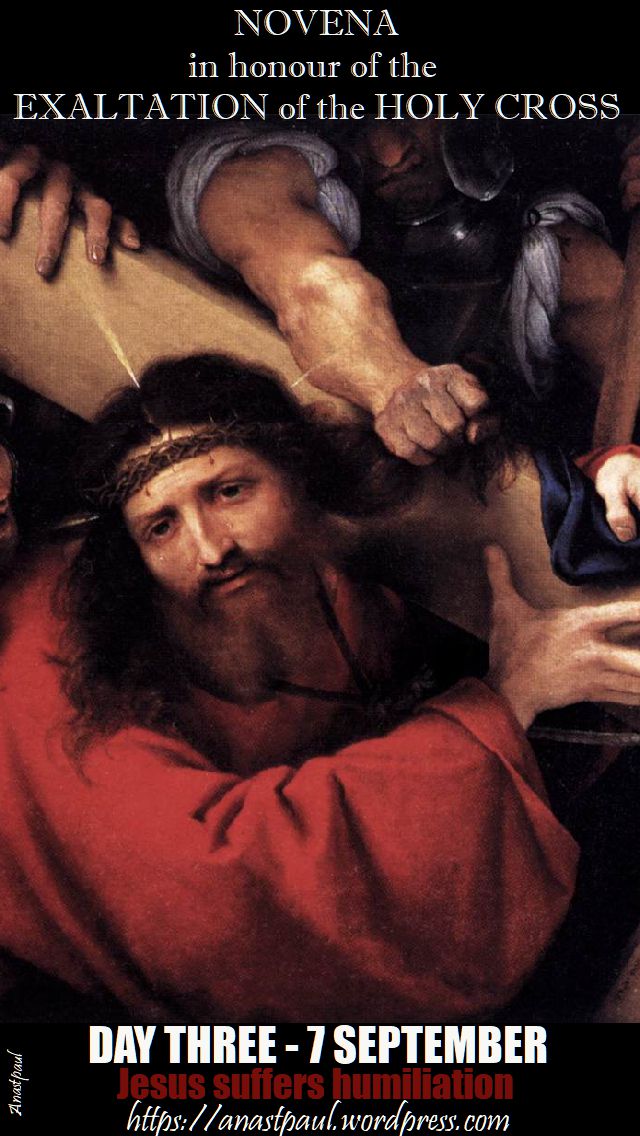
DAY THREE – NOVENA in honour of the EXALTATION of the HOLY CROSS – 7 September

DAY THREE – NOVENA in honour of the EXALTATION of the HOLY CROSS – 7 September

Jesus suffers humiliation

Jesus, you manifested Your power through Your miracles
but in carrying the Cross, You showed
that God preferred to be humility than to be conquest.
You were beaten and spat upon,
mocked and derided.
You suffered humiliation for love of all
as You struggled under the weight of the heavy Cross.
You did this to show Your oneness with the powerless of the earth.
You took the side of the helpless
and You shamed the arrogant and the powerful.
May we, Lord, in our relationship with our brothers and sisters,
avoid domineering attitudes and instead, be of service to them.
May the glory of your cross help us understand
that hearts can never be conquered through imposition or arrogance
but through disinterested service.
Make us servants to one another
and may self-giving characterize our relationships with all.
Amen.

DAILY PRAYER:

Dear Lord Jesus
Who because of Your burning love for us willed to be crucified
and to shed Your Most Precious Blood for the redemption
and salvation of our souls,
to bear the sins of all the history of humanity,
from Adam to the end of time.
look down upon us and grant the petition we ask
…………….( mention your intention)
We trust completely in Your Mercy.
Cleanse us from sin by Your Grace,
sanctify our work,
give us and all those who are dear to us,
our daily bread, lighten the burden of our sufferings,
bless our families,
and grant to the nations, so sorely afflicted,
Your Peace, which is the only true peace,
so that by obeying Your Commandments
we may come at last to the glory of Heaven.

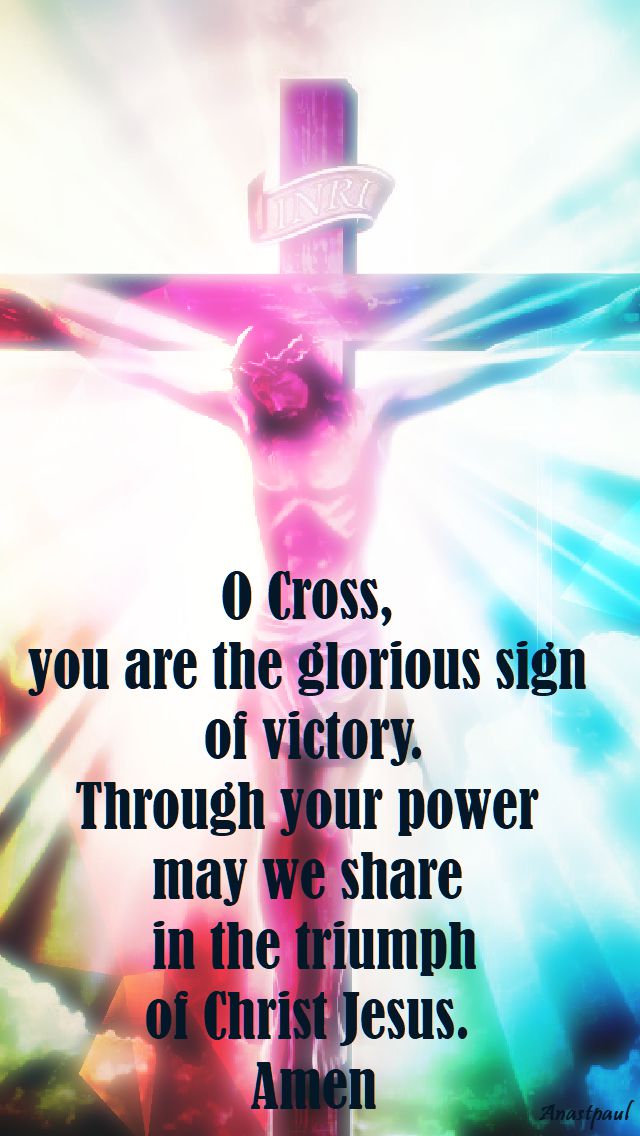
O Cross, you are the glorious sign of victory.
Through your power may we share
in the triumph of Christ Jesus. Amen
Glory Be. (3x)

day three - 7 sept - jesus suffers humiliation - the holy cross novena

Posted in DOCTORS of the Church, FATHERS of the Church, PRAYERS of the SAINTS, The MOST HOLY & BLESSED TRINITY

Our Morning Offering – 7 September

Our Morning Offering – 7 September

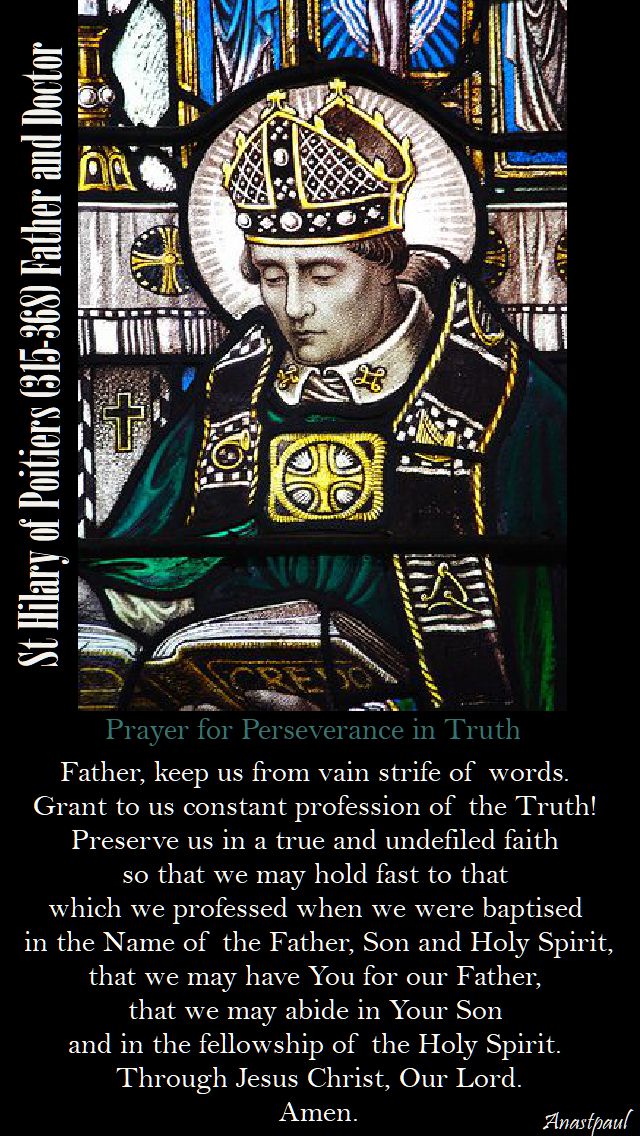
Prayer for Perseverance in Truth
By St HILARY OF POITIERS – (315-368) Father and Doctor

Father, keep us from vain strife of words.
Grant to us constant profession of the Truth!
Preserve us in a true and undefiled faith
so that we may hold fast to that
which we professed when we were baptised
in the Name of the Father, Son and Holy Spirit,
that we may have You for our Father,
that we may abide in Your Son
and in the fellowship of the Holy Spirit.
Through Jesus Christ, Our Lord.
Amen.

This prayer is an excerpt from a sermon ‘On the Trinity’ by Saint Hilary of Poitiers, a bishop and early Church Father of the fourth century and Doctor of the Church, who struggled valiantly against the Arian heresy, defending the divinity of Christ and the doctrine of the Trinity.

prayer for perseverance in truth - st hilary of poitiers

Posted in SAINT of the DAY

Saint of the Day – 7 September – St Cloud (c522-560) Abbot, Confessor

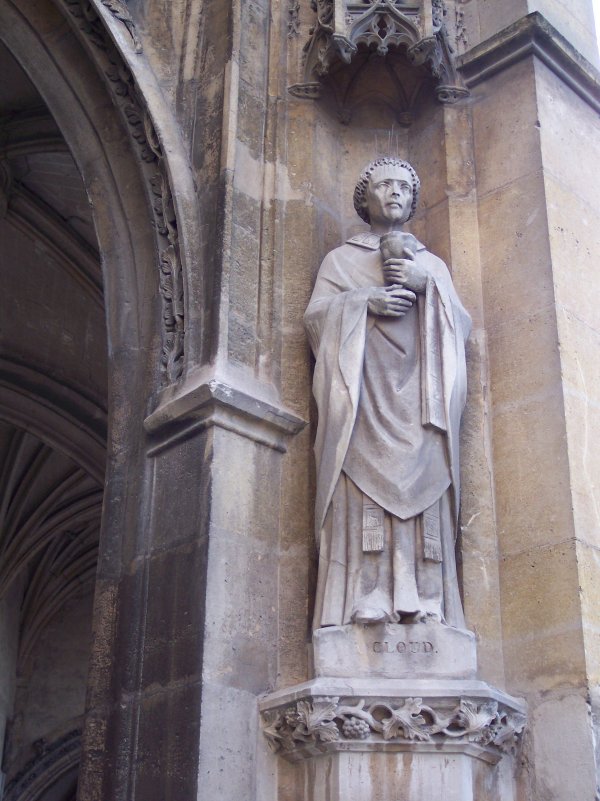
Saint of the Day – 7 September – St Cloud (also known as Clodoald, Clodoaldus, Claud) – (522 in Gaul (modern France) – 560 in France of natural causes).   Priest, Hermit, Confessor and Abbot, apostle of the poor and ill.    Patronages – of nail makers, against boils and fever, Saint Cloud, the Diocese of Minnesota, France.   

cloud1

St Cloud was the son of King Chlodomer of Orléans and his wife Guntheuc. On his death , in the year 511 his kingdom was divided between his four sons, of whom the second was Clodomir.   Thirteen years later he was killed fighting against his cousin, Gondomar, leaving three sons to share his dominions.   The youngest of these sons of Clodomir was St. Clodoald, a name more familiar to English people under its French form of Cloud from the town of Saint-Cloud near Versailles.   When Cloud was eight years old, his uncle Childebert plotted with his brother, to get rid of the boys and divide their kingdom.   The eldest boy, Theodoald was stabbed to death.   The second, Gunther fled in terror but was caught and also killed.   Cloud escaped and was taken for safety into Provence or elsewhere.
Childebert and his brother Clotaire shared the fruits of their crime and Cloud made no attempt to recover his kingdom when he came of age.   He put himself under the discipline of St Severinus, a recluse who lived near Paris and he afterwards went to Nogent on the Seine and had his heritage where is now Saint-Cloud.

Visited by many for counsel and healing, Clodoald in effect gained nothing by keeping himself remote from society.   He therefore returned to Paris, where he was received with joy.   At the people’s request, he was ordained a priest by Bishop Eusebius of Paris in 551 and served the church for some time.

Clodoald established a holy place at Nogent-sur-Seine that is now a collegiate church of canons regular called Saint Cloud wherein his relics are kept.   The village hosting his tomb was renamed Saint-Cloud accordingly.

Posted in SAINT of the DAY

Memorials of the Saints – 7 September

St Alcmund of Hexham
Bl Alexander of Milan
St Augustalus
St Balin
St Carissima of Albi
St Chiaffredo of Saluzzo
Bl Claude-Barnabé Laurent de Mascloux
St Cloud
St Desiderio of Benevento
St Dinooth
Bl Eugenia Picco
St Eupsychius of Caesarea
St Eustace of Beauvais
St Evortius of Orleans
St Faciolus
St Festo of Benevento
Bl François d’Oudinot de la Boissière
Bl Giovanni Battista Mazzucconi
St Giovanni of Lodi
St Goscelinus of Toul
St Gratus of Aosta
St Grimonia of Picardy
St Hiduard
Bl Ignatius Klopotowski
Bl John Duckett
Bl John Maki
Bl John of Nicomedia
Bl Ludovicus Maki Soetsu
Madalberta
Bl Maria of Bourbon
St Marko Križevcanin
St Melichar Grodecký
St Memorius of Troyes
St Pamphilus of Capua
Bl Ralph Corby
St Regina
St Sozonte
Bl Thomas Tsuji
St Tilbert of Hexham

Martyrs of Noli: Four Christians who became soldiers and were martyred together for their faith. A late legend makes them member of the Theban Legend who escaped their mass martyrdom but that’s doubtful – Paragorius, Partenopeus, Parteus and Severinus. They were born in Noli, Italy and martyred in Corsica, France. Attribute – soldiers with a banner of Noli.

Martyred in the Spanish Civil War:
• Blessed Antoni Bonet Sero
• Blessed Ascensión Lloret Marcos
• Blessed Gregorio Sánchez Sancho
• Blessed Félix Gómez-Pinto Piñero

Posted in MORNING Prayers, NOVENAS, Uncategorized

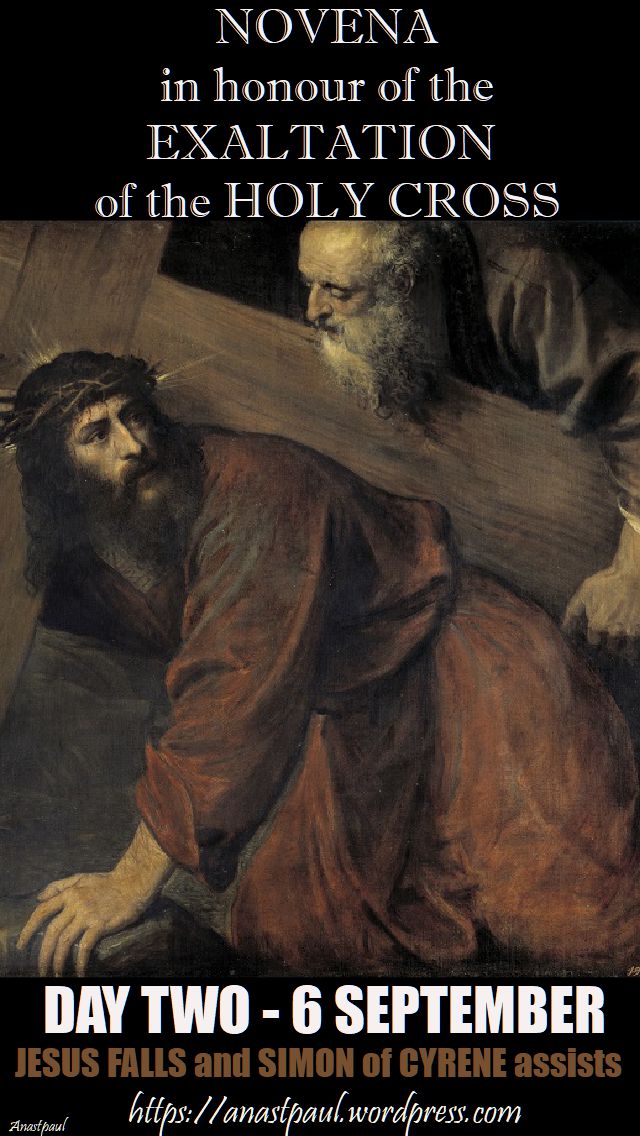
DAY TWO – NOVENA in honour of the EXALTATION of the HOLY CROSS – 6 September

DAY TWO – NOVENA in honour of the EXALTATION of the HOLY CROSS – 6 September

Jesus Falls and Simon of Cyrene Assists Him in carrying the Cross

Jesus, you fell three times while carrying Your cross.
You were exhausted by the tortures and the lack of sleep
and Your executioners had to ask the help of Simon the Cyrene
to help You carry the cross.  You were nearly dead when you reached Calvary.
Simon of Cyrene was the most blessed person
because he was transformed by helping You carry Your cross.
Make us remember, dear Jesus, in our moments of suffering and trials,
that we, too, help carry Your cross and that it is an honour to suffer with You.
Give us hearts that easily respond to the sufferings around us,
believing that when we help the needy and the abandoned,
we are actually serving You. Amen

DAILY PRAYER:

Dear Lord Jesus
Who because of Your burning love for us willed to be crucified
and to shed Your Most Precious Blood for the redemption
and salvation of our souls,
to bear the sins of all the history of humanity,
from Adam to the end of time.
look down upon us and grant the petition we ask
…………….( mention your intention)
We trust completely in Your Mercy.
Cleanse us from sin by Your Grace,
sanctify our work,
give us and all those who are dear to us,
our daily bread, lighten the burden of our sufferings,
bless our families,
and grant to the nations, so sorely afflicted,
Your Peace, which is the only true peace,
so that by obeying Your Commandments
we may come at last to the glory of Heaven.

O Cross, you are the glorious sign of victory.
Through your power may we share
in the triumph of Christ Jesus. Amen
Glory Be. (3x)

day two - 6 Sept - jesus falls and simon of cyrene assists

Posted in MORNING Prayers, QUOTES of the SAINTS, The BLESSED VIRGIN MARY, The HOLY CROSS

Thought for the Day – 6 September

Thought for the Day – 6 September

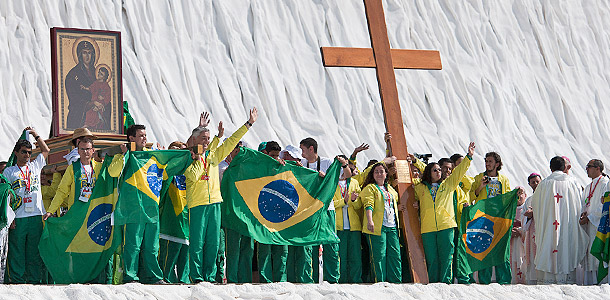
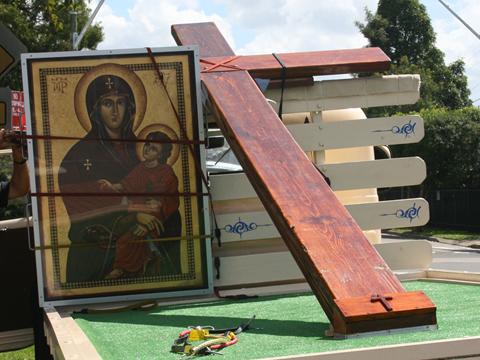
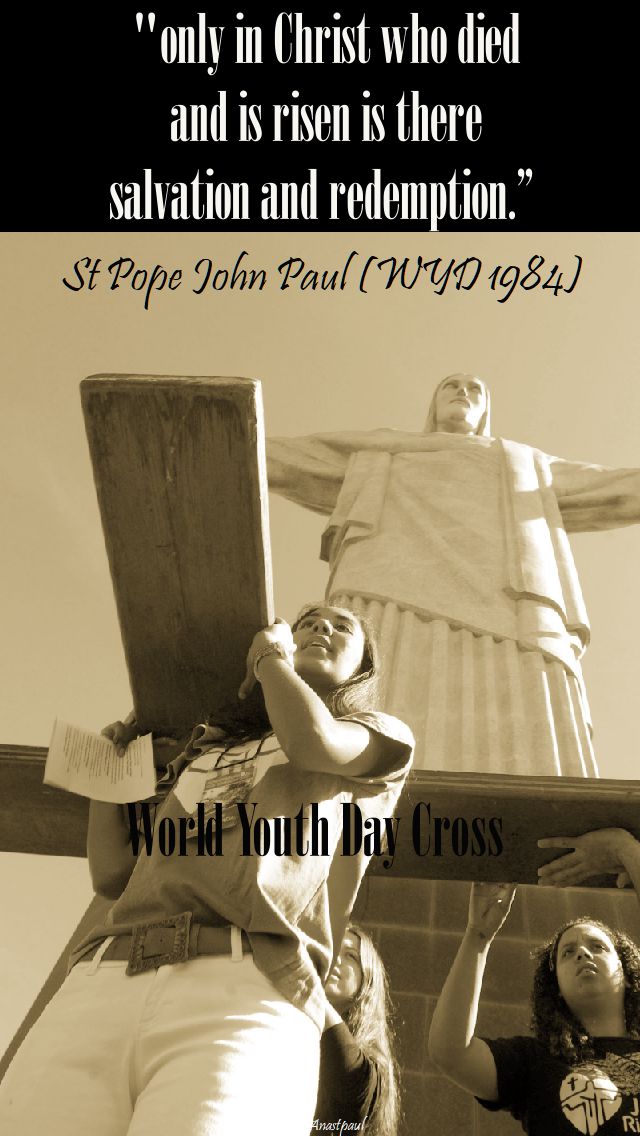
In 1984, at the close of the 1983 Holy Year of the Redemption at the Vatican, St Pope John Paul II entrusted to the young people of the world a simple, 12-foot wooden Cross, asking them to carry it across the world.   This is now the heart of every World Youth Day this  very simple, powerful, ancient Christian symbol:  two large planks of wood, known as the World Youth Day Cross, that many have called the “Olympic Torch” of the huge Catholic festival of young people.Cross-Icon-Brazilian-Pilgrims

The World Youth Day cross has many names:  the Jubilee Cross, the Pilgrim Cross, the Youth Cross.   In 1984, at the close of the 1983 Holy Year of the Redemption at the Vatican, St Pope John Paul II entrusted to the young people of the world a simple, twelve-foot wooden Cross, asking them to carry it across the world as a sign of the love which the Lord Jesus has for humankind and “to proclaim to everyone that only in Christ who died and is risen is there salvation and redemption.”   Since that day, carried by generous hands and loving hearts, the Cross has made a long, uninterrupted pilgrimage across the continents, to demonstrate, as Pope John Paul II had said, “the Cross walks with young people and young people walk with the Cross.”

The cross does not journey alone.   Since 2003 it has been accompanied by an icon of the Blessed Virgin Mary. a copy of the Icon of our Lady known as the ‘Salus Populi Romani’. The original from which this Icon has been copied is considered by some to be from the eighth century and is housed in a chapel in the Basilica of St Mary Major in Rome.   St Pope John Paul II entrusted to the youth an icon of the Blessed Mother that would accompany the cross.   “It will be a sign of Mary’s motherly presence close to young people who are called, like the Apostle John, to welcome her into their lives.”wyd symbols

The World Youth Day Cross and Icon speak to us of the two focal points of the message of Christianity:   of the Cradle and of the Cross;  of Christ who was born of Mary and of Christ who was crucified for us;   of Christmas and Good Friday;  of the Incarnation and the Paschal Mystery.   The Icon and Cross, therefore, are potent symbols of the joy and suffering that we experience in our Christian pilgrimage.

Because we follow a crucified Christ, we enter into solidarity with the world’s suffering masses.   We experience the power and love of God through the vulnerable and suffering.   The Cross teaches us that what could have remained hideous and beyond remembrance is transformed into beauty, hope and a continuous call to heroic goodness.

To celebrate the Triumph of the Cross is to acknowledge the full, cruciform achievement of Jesus’ career.   Jesus asks us to courageously choose a life similar to his own.   Suffering cannot be avoided nor ignored by those who follow Christ.   Following Jesus implies suffering and a cross.   The mark of the Messiah is to become the mark of his disciples. (Fr Rosica)

only in christ - st john paul wyd 1984

Posted in JESUIT SJ, MORNING Prayers, QUOTES of the SAINTS, The HOLY CROSS

Quote of the Day – 6 September

Quote of the Day – 6 September

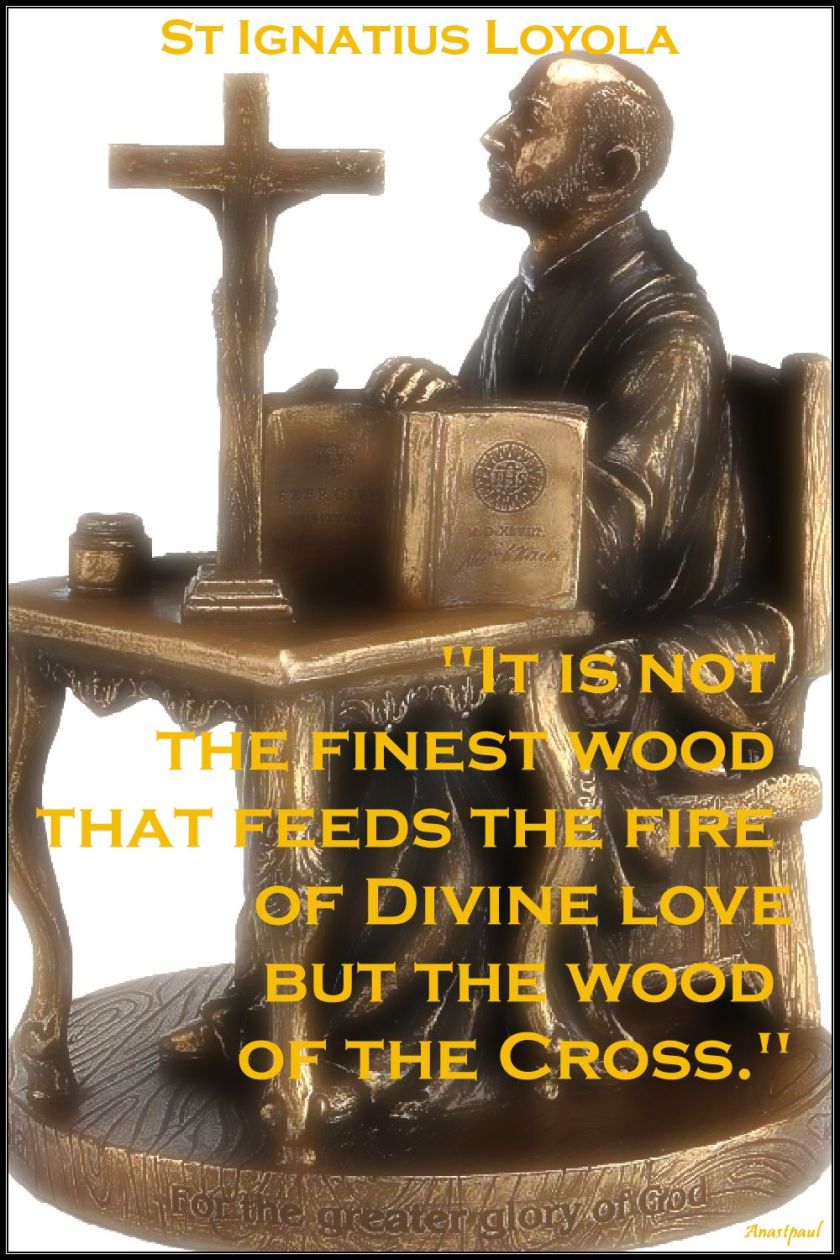
“It is not the finest wood
that feeds the fire of Divine love
but the wood of the Cross.”

St Ignatius of Loyolait is not the finest wood - st iggy

Posted in MORNING Prayers, QUOTES of the SAINTS, The HOLY CROSS, The WORD

One Minute Reflection – 6 September

One Minute Reflection – 6 September

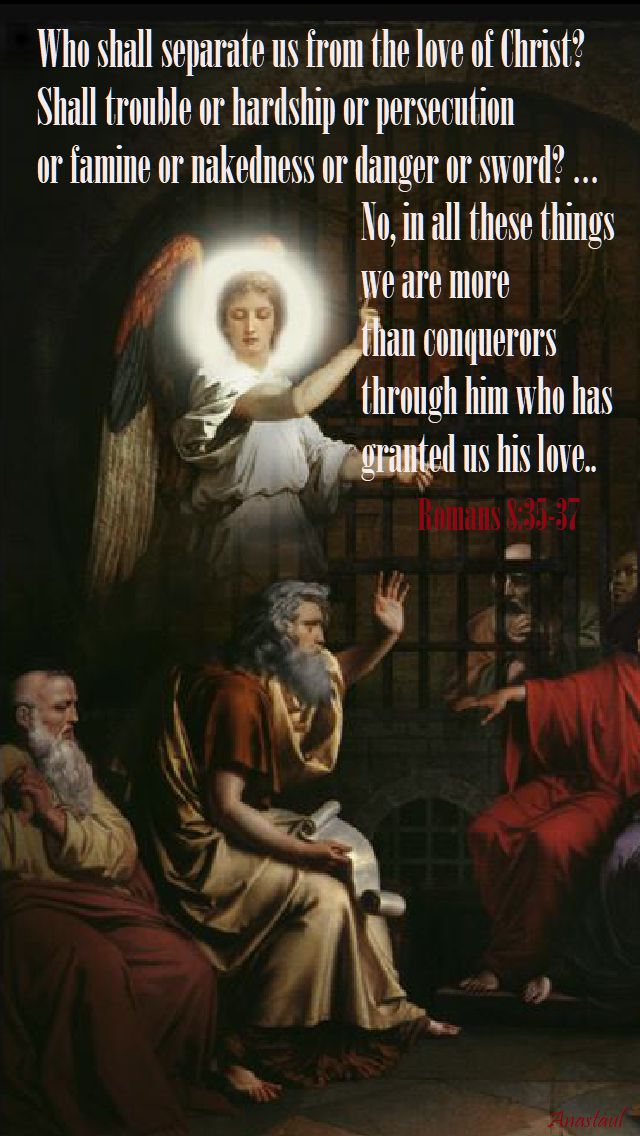
Who shall separate us from the love of Christ? Shall trouble or hardship or persecution or famine or nakedness or danger or sword? … No, in all these things we are more than conquerors through him who has granted us his love…Romans 8:35-37romans 8 35-37

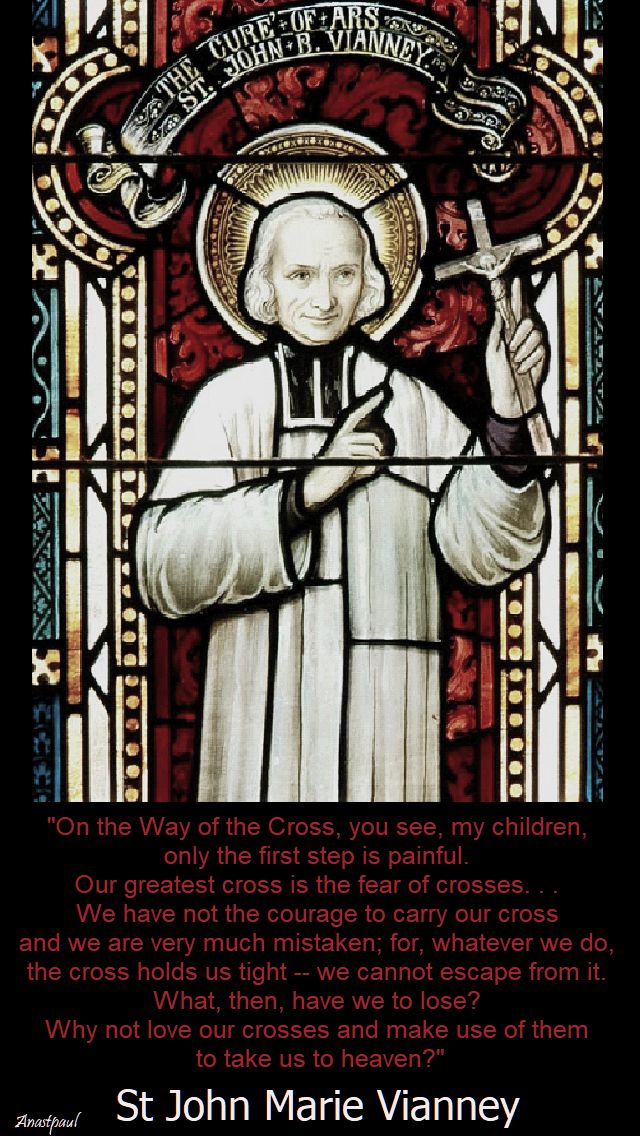
REFLECTION – “On the Way of the Cross, you see, my children, only the first step is painful. Our greatest cross is the fear of crosses. . . We have not the courage to carry our cross and we are very much mistaken; for, whatever we do, the cross holds us tight — we cannot escape from it.   What, then, have we to lose?   Why not love our crosses and make use of them to take us to heaven?”………St Jean Marie Baptiste Vianneyon the way of the cross-st john vianney

PRAYER – Shed Your clear light on our hearts dear Lord, so that walking continually in the way of Your commandments, we may never be deceived or misled but rejoice continually in the clarity of Your Cross, for by Your Holy Cross, You have shown us the way to You. Ameno cross you are the glorious sign of victory - no 1

Posted in MORNING Prayers

Our Morning Offering – 6 September

Our Morning Offering – 6 September

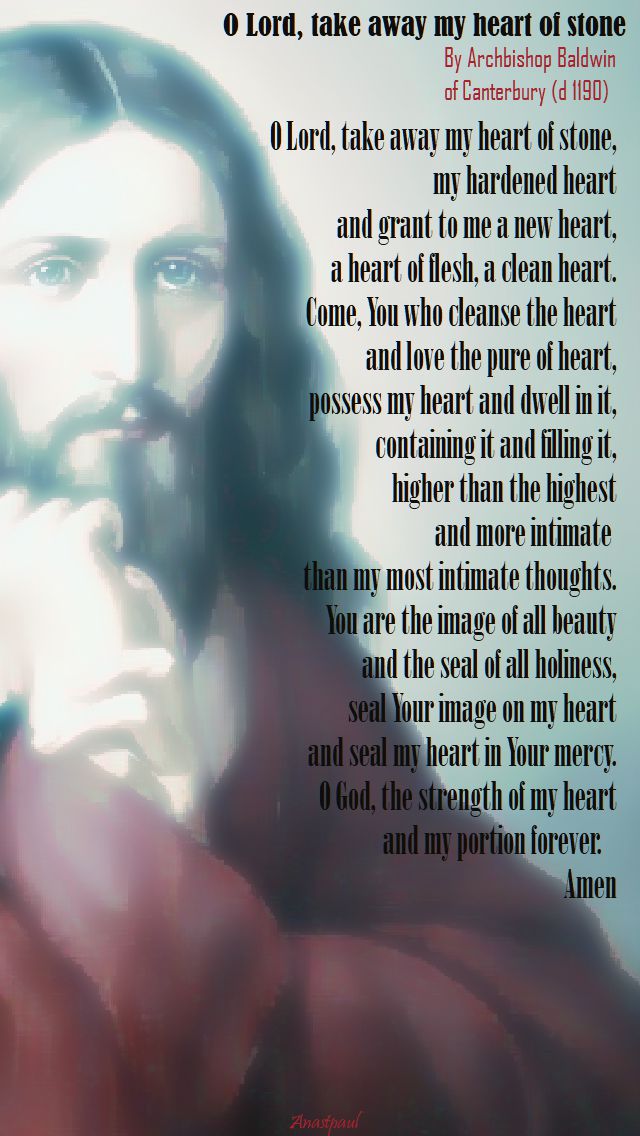
O Lord, take away my heart of stone
By Archbishop Baldwin of Canterbury (d 1190)

O Lord, take away my heart of stone,
my hardened heart
and grant to me a new heart,
a heart of flesh, a clean heart.
Come, You who cleanse the heart
and love the pure of heart,
possess my heart and dwell in it,
containing it and filling it,
higher than the highest
and more intimate
than my most intimate thoughts.
You are the image of all beauty
and the seal of all holiness,
seal Your image on my heart
and seal my heart in Your mercy.
O God, the strength of my heart
and my portion forever.
Ameno lord take away my heart of stone - baldwin of canterbury died 1190


Posted in SAINT of the DAY

Saint of the Day – 6 September – St Magnus of Füssen

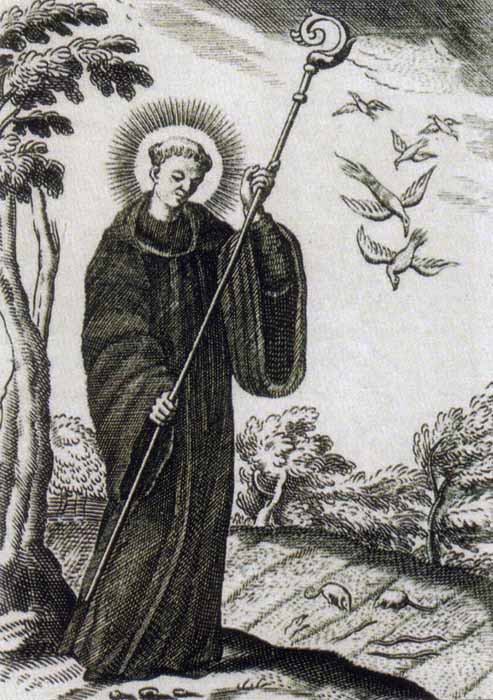
Saint of the Day – 6 September – St Magnus of Füssen – Religious Priest, Monk, Abbot, Missionary, Spiritual student of Saint Columban and Saint Gall at Arbon (part of modern Switzerland) (Died in c 666? or 722? at the monastery at Füssen, Bavaria (in modern Germany) of natural causes).   Patronages –  against caterpillars,• against hail or hailstorms,• against lightning,• against snakes,• against vermin,• for protection of crops.

magnus

St Magnus of was both a monk and a missionary. An interesting story involves him bringing reconciliation between St Gall and his master St Columban.   He is also venerated as one of the Holy Helpers invoked in time of plague such as the Black Death.

Monk of St Gall
Magnus was a monk at St Gall.   One moving story involving him is that, on learning of the death of Columbanus whom Gall had refused to accompany to Bobbio in Italy, Gall sent Magnus to pray at Columbanus’s grave.   Magnus returned with St Columbanus’s staff which on his deathbed Columbanus had instructed to be given to Gall as a gesture of reconciliation in the quarrel which a few years before had separated them.   Magnus is said to have succeeded Gall after his death.

Missionary
Invited by a priest of Augsburg, Magnus went with the support of Bishop Wichbert of that diocese to preach to the pagan people of the Allgäu region of Bavaria.   When he was left alone, Wichbert sent some young clerics to help him and these formed a monastic community later known as Sankt-Mung at Füssen, in Bavaria. Magnus helped the locals clear the land for cultivation and began a mining industry in a nearby mountain.

440px-Füssen_-_Klosterkirche_St._Mang33.in the crypt
Icon of St Magnus in the Crypt of the Monastery of St Magnus at Füssen


DIGITAL CAMERA
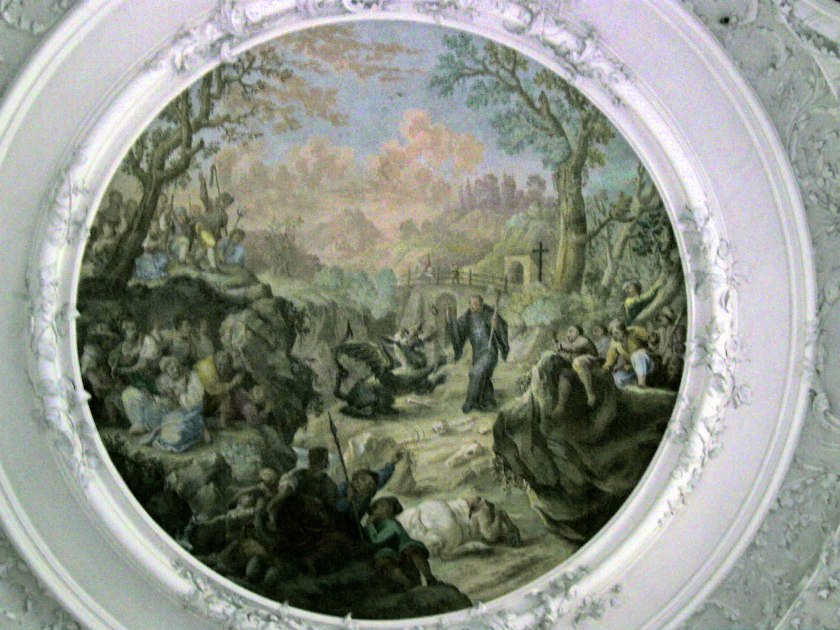
Image of St Magnus on the Ceiling
Füssen_-_Klosterkirche_St._Mang24
Ceiling of the Monastery of St Magnus at Füssen

Death and influence
Magnus died after 26 years of missionary work and his relics were returned to St Gall. He is usually represented as treading on serpents.   He is also named as one of the fourteen Holy Helpers invoked against storms, insects, dragons and other disasters, such as the Black Death.


Posted in SAINT of the DAY

Memorials of the Saints – 6 September

Memorials of the Saints – 6 September

St Arator of Verdun
St Augebert of Champagne
St Augustine of Sens
St Beata of Sens
St Bega
Bl Bertrand of Garrigue
St Cagnoald
St Consolata of Reggio Emilia
St Cottidus of Cappadocia
St Eleutherius the Abbot
St Eugene of Cappadocia
St Eve of Dreux
St Faustus of Alexandria
St Faustus of Syracuse
St Felix of Champagne
St Frontiniano of Alba
St Gondulphus of Metz
St Imperia
St Macarius of Alexandria
St Maccallin of Lusk
St Magnus of Füssen
St Mansuetus of Toul
St Onesiphorus
St Petronius of Verona
St Sanctian of Sens
St Zacharius the Prophet

Martyrs of Africa – 6 saints: There were thousands of Christians exiled, tortured and martyred in the late 5th century by the Arian King Hunneric. Six of them, all bishops, are remembered today; however, we really know nothing about them except their names and their deaths for the faith – Donatian, Fusculus, Germanus, Laetus, Mansuetus and Praesidius.

Martyred in the Spanish Civil War:
• Blessed Diego Llorca Llopis
• Blessed Felipe Llamas Barrero
• Blessed Pascual Torres Lloret
• Blessed Vidal Ruiz Vallejo

Posted in MORNING Prayers, NOVENAS, Uncategorized

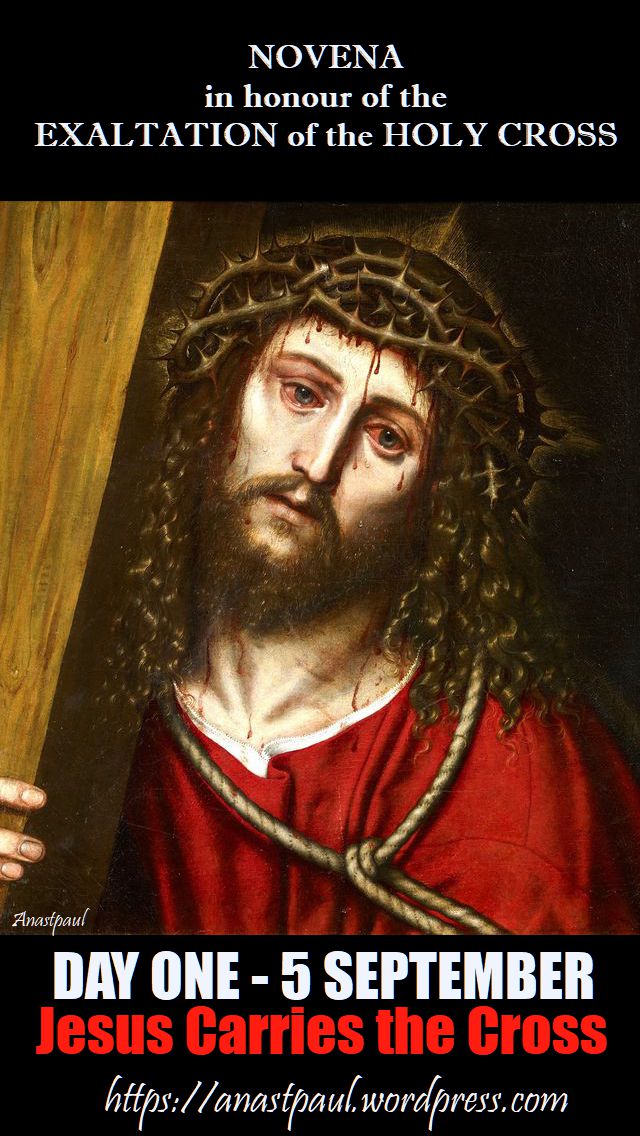
DAY ONE – NOVENA in honour of the EXALTATION of the HOLY CROSS

DAY ONE – NOVENA in honour of the EXALTATION of the HOLY CROSS – 5 September

‘Jesus Carries the Cross’

Jesus our Lord, You carried Your cross through the streets of Jerusalem,
with Your head bloodied by the crown of thorns.
Your enemies mocked You and your friends abandoned You.
You carried the cross, the sins of all humanity,
on Your shoulders and in the silence of Your sufferings, we are reborn.
Jesus our Lord, You taught us that we should also carry others’ sins.
to suffer in silence, yet our sufferings can make reparation for our sins
and the sins of all the word.
Teach us, O Lord, to accept situations that we cannot change
and carry them as you carried Your cross
through the streets of Jerusalem. Amen

DAILY PRAYER:

Dear Lord Jesus
Who because of Your burning love for us willed to be crucified
and to shed Your Most Precious Blood for the redemption
and salvation of our souls,
to bear the sins of all the history of humanity,
from Adam to the end of time.
look down upon us and grant the petition we ask
…………….( mention your intention)
We trust completely in Your Mercy.
Cleanse us from sin by Your Grace,
sanctify our work,
give us and all those who are dear to us,
our daily bread, lighten the burden of our sufferings,
bless our families,
and grant to the nations, so sorely afflicted,
Your Peace, which is the only true peace,
so that by obeying Your Commandments
we may come at last to the glory of Heaven.

O Cross, you are the glorious sign of victory.
Through your power may we share
in the triumph of Christ Jesus. Amen
Glory Be. (3x)

day one - 5 sept - jesus carries the Cross


Posted in MORNING Prayers, NOVENAS, Uncategorized

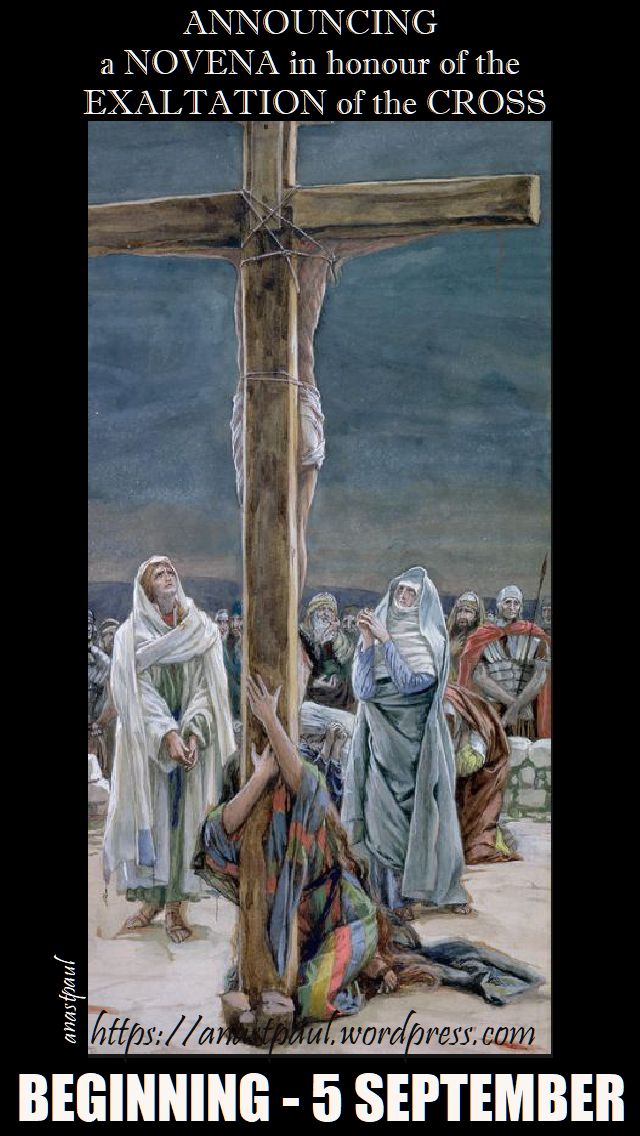
Announcing a Novena for the Feast of the Exaltation of the Holy Cross on 14 September

This feast was observed in Rome before the end of the seventh century.   It commemorates the recovery of the Holy Cross, which had been placed on Mount Calvary by St. Helena and preserved in Jerusalem but then had fallen into the hands of Chosroas, King of the Persians.   The precious relic was recovered and returned to Jerusalem by Emperor Heralius in 629.

The lessons from the Breviary tell us that Emperor Heraclius carried the Cross back to Jerusalem on his shoulders.   He was clothed with costly garments and with ornaments of precious stones.   But at the entrance to Mount Calvary a strange incident occurred. Try as hard as he would, he could not go forward. Zacharias, the Bishop of Jerusalem, then said to the astonished monarch:  “Consider, O Emperor, that with these triumphal ornaments you are far from resembling Jesus carrying His Cross.”   The Emperor then put on a penitential garb and continued the journey.

Triumph of the Cross
This day is also called the Exaltation of the Cross, Elevation of the Cross, Holy Cross Day, Holy Rood Day, or Roodmas.   The liturgy of the Cross is a triumphant liturgy.   When Moses lifted up the bronze serpent over the people, it was a foreshadowing of the salvation through Jesus when He was lifted up on the Cross.   Our Mother Church sings of the triumph of the Cross, the instrument of our redemption.   To follow Christ we must take up His cross, follow Him and become obedient until death, even if it means death on the cross.   We identify with Christ on the Cross and become co-redeemers, sharing in His cross.

We make the Sign of the Cross before prayer which helps to fix our minds and hearts to God.   After prayer we make the Sign of the Cross to keep close to God.   During trials and temptations our strength and protection is the Sign of the Cross.   At Baptism we are sealed with the Sign of the Cross, signifying the fullness of redemption and that we belong to Christ.   Let us look to the cross frequently and realise that when we make the Sign of the Cross we give our entire self to God — mind, soul, heart, body, will, thoughts.

O cross, you are the glorious sign of victory.
Through your power may we share in the triumph of Christ Jesus.

annuncing a novena - exalatation of the cross

Posted in MORNING Prayers, QUOTES of the SAINTS, SAINT of the DAY

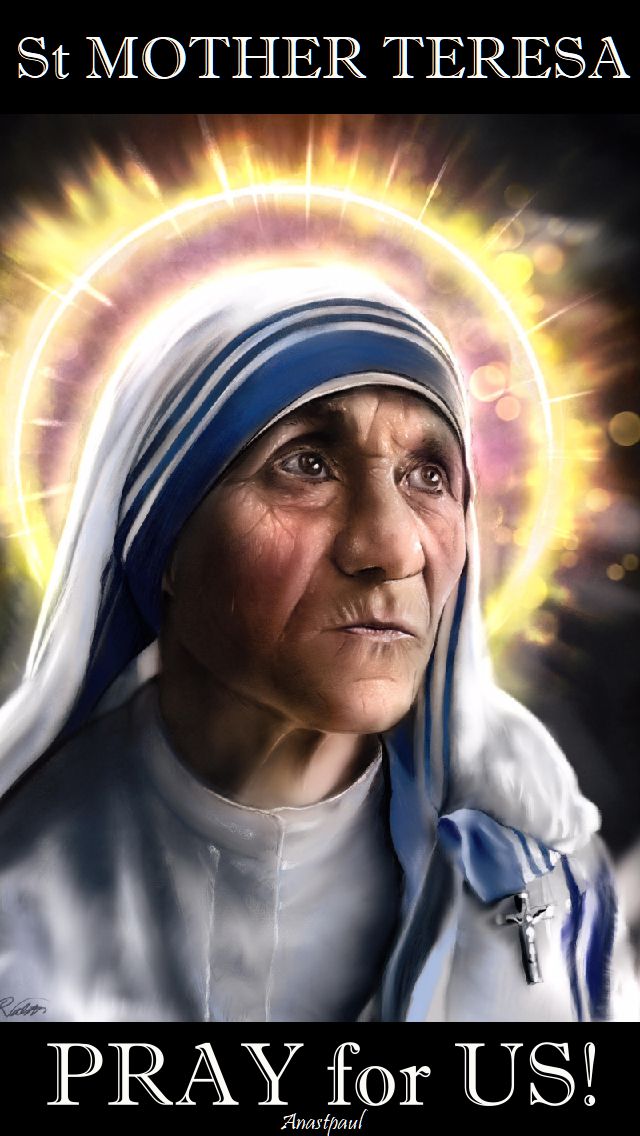
Thought for the Day – 5 September – The Memorial of St Mother Teresa (1910-1997)

Thought for the Day – 5 September – The Memorial of St Mother Teresa (1910-1997)

Through her life and work Mother Teresa gave visibility to the invisible God, as a light bulb makes electricity visible.   As the light bulb does not produce the electricity, so too the power to do good belonged not to her but to the Lord.   There were therefore no grounds for her to be proud.   It was clear to her that the more united she was to Jesus, like the branch to the vine, the more abundantly she would bear fruit for Him.
“Let us thank God and Our Lady” was her spontaneous response when people thanked her for the blessings they received through her prayers.   Aware of the Source of all power, she wrote in the first pages of her handwritten Constitutions:
“It was Jesus Christ on the Cross through His blessed Mother—in His great mercy and love—who chose one of His most unworthy and most incapable of human beings to start His own work among the poor.   Therefore the Society as a whole or in detail is completely and will always remain the sole possession of the Mother of God.”

(Fr Sebastian Vazhakala MC  a member of St Mother Teresa’s Missionaries of Charity, who knew, worked and loved St Teresa for 31 years)

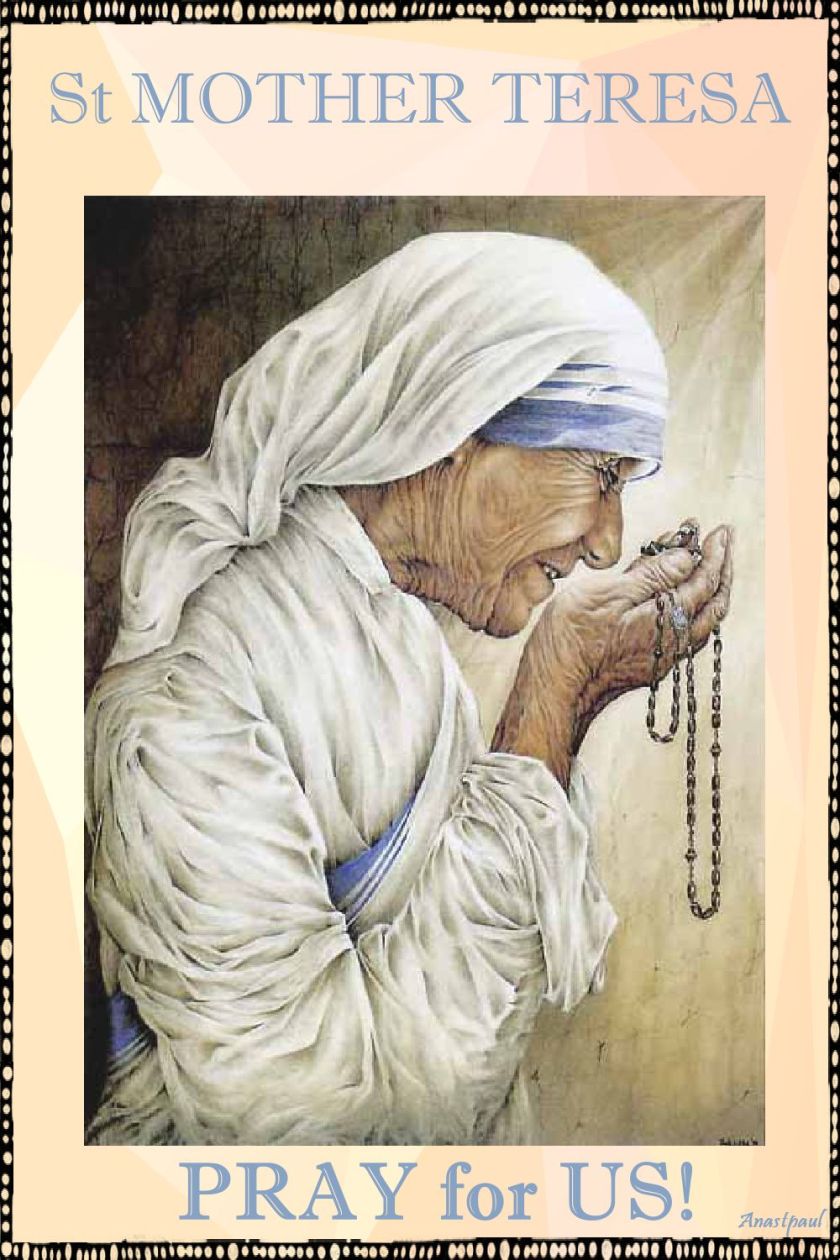
St Mother Teresa Pray for us that we too may make the invisible God visible! “Let us thank God and Our Lady”

st mother teresa - pray for us.2

Posted in MORNING Prayers, QUOTES of the SAINTS, SAINT of the DAY, Uncategorized

Quote/s of the Day – 5 September – The Memorial of St Mother Teresa (1910-1997)

Quote/s of the Day – 5 September – The Memorial of St Mother Teresa (1910-1997)

“The cry of Jesus on the Cross, ‘I thirst’ (Jn 19: 28), expressing the depth of God’s longing for man, penetrated Mother Teresa’s soul and found fertile soil in her heart.”
—Pope John Paul II – 19 October 2003the cry of jesus on the cross - st john paul on mother teresa

“As Lent is the time for greater love, listen to Jesus’ thirst.  “Repent and believe,” Jesus tells us.   What are we to repent?   Our indifference, our hardness of heart. What are we to believe?   Jesus thirsts even now, in your heart and in the poor – He knows your weakness.   He wants only your love, wants only the chance to love you.”jesus thirsts even now

Life is an opportunity, benefit from it.
Life is beauty, admire it.
Life is a dream, realize it.
Life is a challenge, meet it.
Life is a duty, complete it.
Life is a game, play it.
Life is a promise, fulfill it.
Life is sorrow, overcome it.
Life is a song, sing it.
Life is a struggle, accept it.
Life is a tragedy, confront it.
Life is an adventure, dare it.
Life is luck, make it.
Life is too precious, do not destroy it.
Life is life, fight for it.life is an opportunity - my pic - st mother teresa

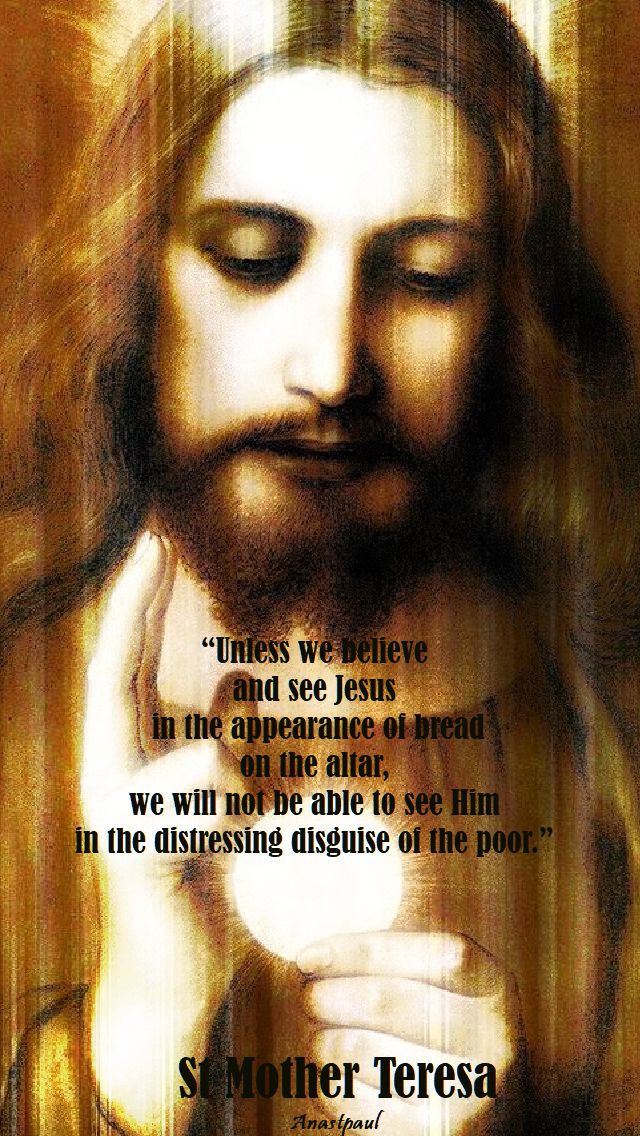
“Unless we believe and see Jesus in the appearance of bread on the altar, we will not be able to see him in the distressing disguise of the poor.”unless we believe - st mother teresa

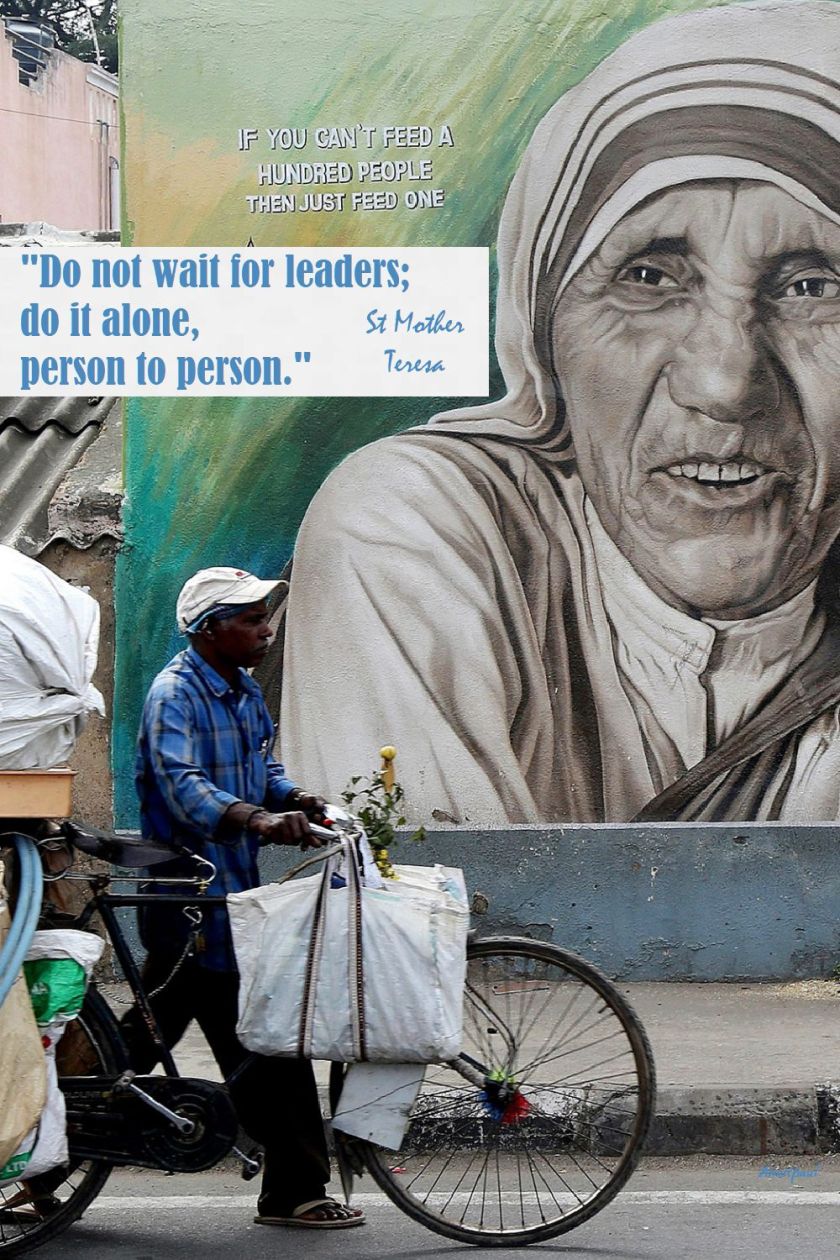
“Do not wait for leaders; do it alone, person to person.”   

“If you can’t feed a hundred people
them just feed one.”do not wait for leaders - st mother t

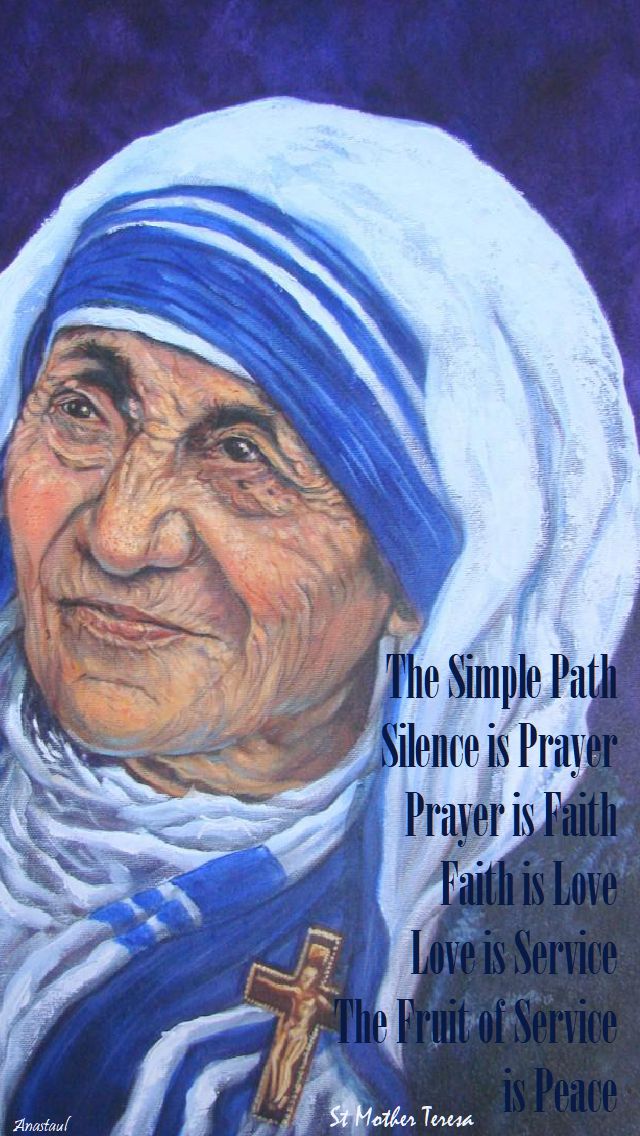
The Simple Path
Silence is Prayer
Prayer is Faith
Faith is Love
Love is Service
The Fruit of Service is Peacethe simple path - st mother t

“The so-called right to abortion
has portrayed the GREATEST of GIFTS
a CHILD
as a competitor
an intrusion and
an inconvenience.”the so-called right to abortion - st mother T

St Mother Teresa of Calcutta, pray for us!

Posted in MORNING Prayers, QUOTES of the SAINTS, SAINT of the DAY, The WORD

One Minute Reflection – September 5 – The Memorial of St Mother Teresa (1910-1997)

One Minute Reflection – September 5 – The Memorial of St Mother Teresa (1910-1997)

Each one has his own gift from God……….1 Cor 7:7

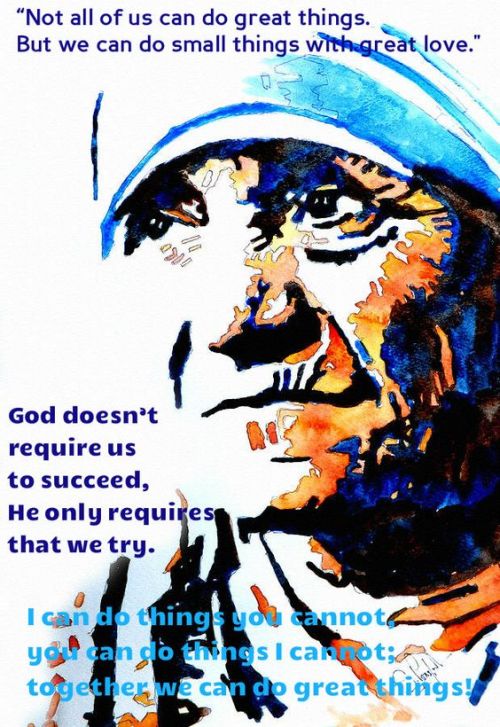
REFLECTION – “Not all of us can do great things.  But we can do small things with great love…..God doesn’t require us to succeed, He only requires that we try…….I can do things you cannot, you can do things I cannot; together we can do great things.” ….St Mother Teresa of Calcutta

not all of us can do great things - st mother teresa.2not all of us can do great things - st mother teresa

PRAYER – Heavenly Father, help me to be holy in the way that You have laid out for me. Let me carry out the duties of my state in life to the full and so attain the holiness proper to me. St Mother Teresa please pray for us that we may all use the gifts we have been given for the Glory of God. Amen

st mother teresa - pray for us

Posted in PRAYERS of the SAINTS, SAINT of the DAY

Our Morning Offering – 4 September

Our Morning Offering – 4 September

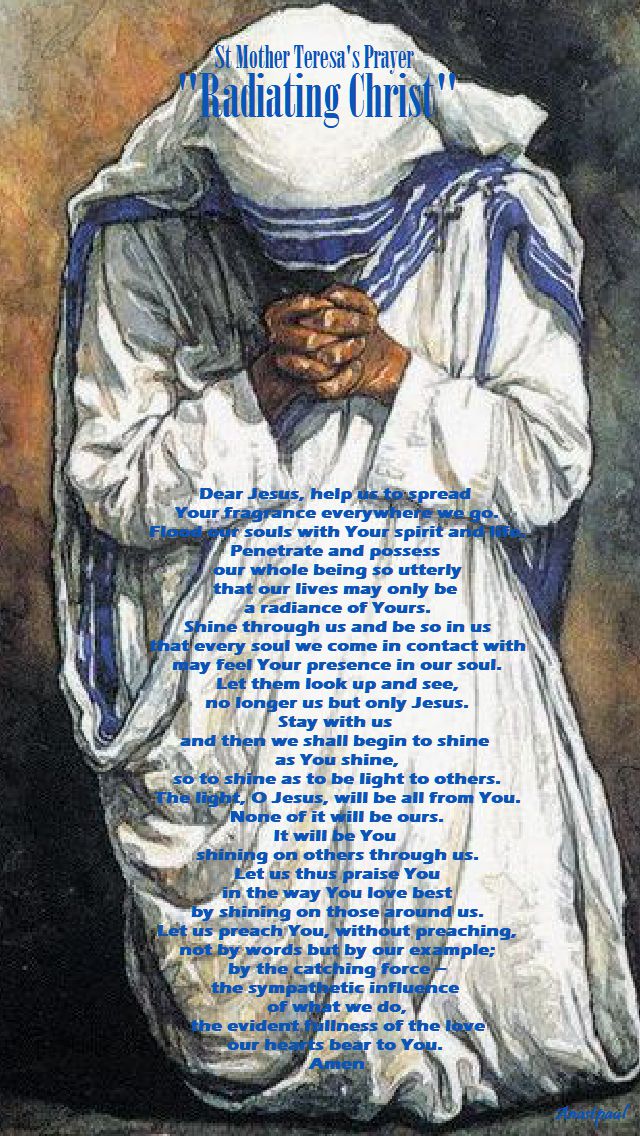
St Mother Teresa’s Prayer
“Radiating Christ”

Dear Jesus, help us to spread
Your fragrance everywhere we go.
Flood our souls with Your spirit and life.
Penetrate and possess our whole being so utterly
that our lives may only be a radiance of Yours.
Shine through us and be so in us
that every soul we come in contact with
may feel Your presence in our soul.
Let them look up and see,
no longer us but only Jesus.
Stay with us
and then we shall begin to shine
as You shine,
so to shine as to be light to others.
The light, O Jesus, will be all from You.
None of it will be ours.
It will be You shining on others through us.
Let us thus praise You in the way You love best
by shining on those around us.
Let us preach You,
without preaching,
not by words but by our example;
by the catching force –
the sympathetic influence of what we do,
the evident fullness of the love
our hearts bear to You. Amen

st mother teresa's prayer - radiating christ

Posted in SAINT of the DAY

Saint of the Day – 5 September – St Mother Teresa of Calcutta MC

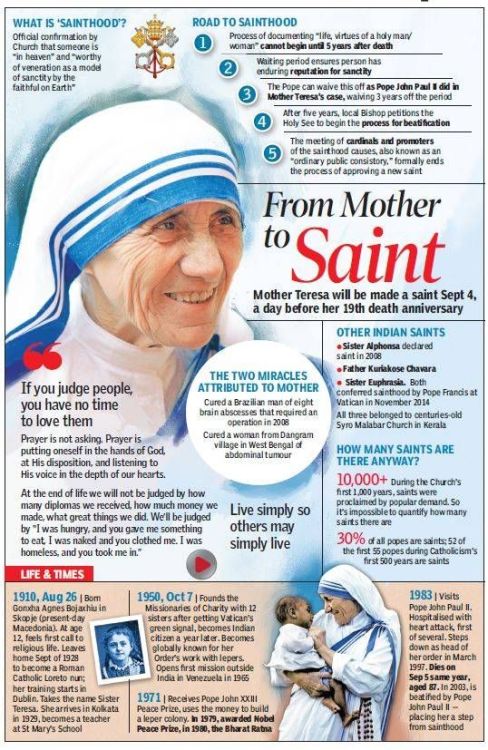
Saint of the Day – 5 September – St Mother Teresa of Calcutta MC (born Agnes Gonxha Bojaxhiu) – Consecrated Religious Nun, Founder of the Order of the Missionaries of Charity, Apostle of Charity, Missionary, Nobel Peace Prize Winner 1978, Anti-Abortion Activist  – (26 August 1910 in Skopje, Albania (modern Macedonia) – 5 September 1997 in Calcutta, West Bengal, India of natural causes).   She was Beatified on 19 October 2003 by St John Paul and Canonised on  4 September 2016 by Pope Francis.   The canonisation miracle involved the healing of brain abscesses of a comatose 42 year old mechanical engineer in Santos, Brazil in 2008.   Patronages – World Youth Day, Missionaries of Charity.   Attributes – Habit, Rosary, Prayer posture, holding a child.
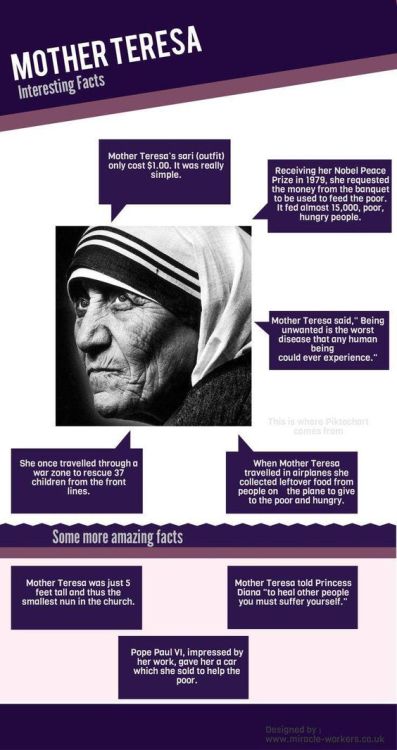
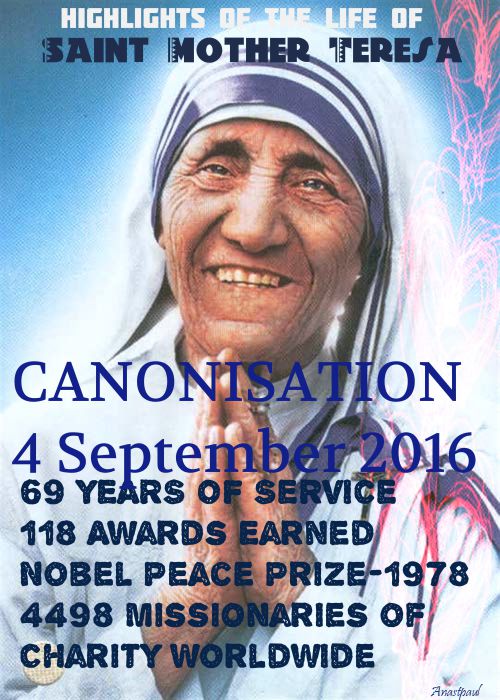
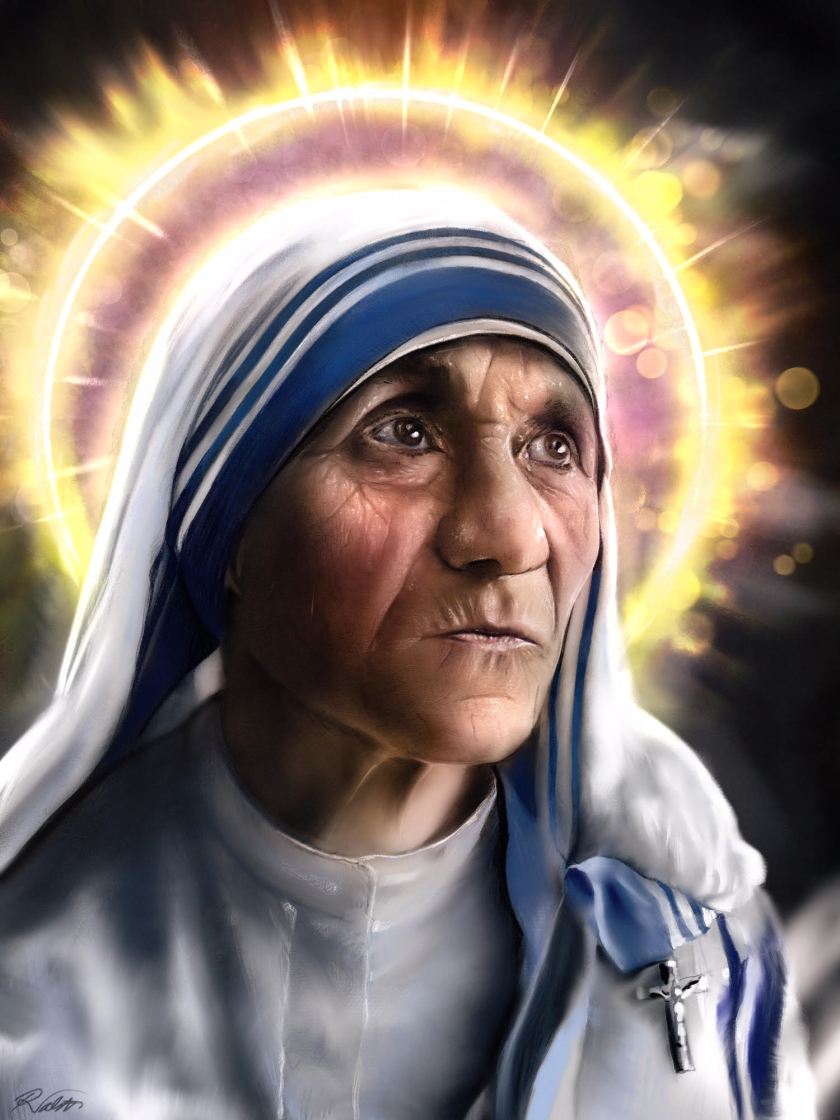
MOTHER TERESA info 1MOTHER TERESA info 2MOTHER TERESA info 3MOTHER TERESA info 5 - my pic


When we think about the difference that love can make, many people very often think of one person: Saint Mother Teresa of Calcutta.   A tiny woman, just under five feet tall, with no tools except prayer, love and the unique qualities God had given her, Mother Teresa is probably the most powerful symbol of the virtue of charity today.

Mother Teresa wasn’t, of course, born with that name.   Her parents named her Agnes—or Gonxha in her own language—when she was born to them in Albania, a country north of Greece.   Agnes was one of four children.   Her childhood was a busy, ordinary one. Although Agnes was very interested in missionary work around the world, as a child she didn’t really think about becoming a nun;  but when she turned 18, she felt that God was beginning to tug at her heart, to call her, asking her to follow him.

Now Agnes, like all of us, had a choice. She could have ignored the tug on her heart.   She could have filled her life up with other things so maybe she wouldn’t hear God’s call.   But of course, she didn’t do that.   She listened and followed, joining a religious order called the Sisters of Loreto, who were based in Dublin, Ireland.   After two months in Ireland, spent mostly learning how to speak English, Agnes got on a boat (in 1928, hardly anyone took trips by plane) and 37 days later she arrived in the beautiful, busy, complicated country of India.   Here, Agnes took her final vows as a sister and took the name Teresa, after Thérèse of Lisieux, the Little Flower.   She spent 15 years teaching in a girl’s school in Calcutta, a job that she loved and was very good at.   But then one day, she heard that call again.
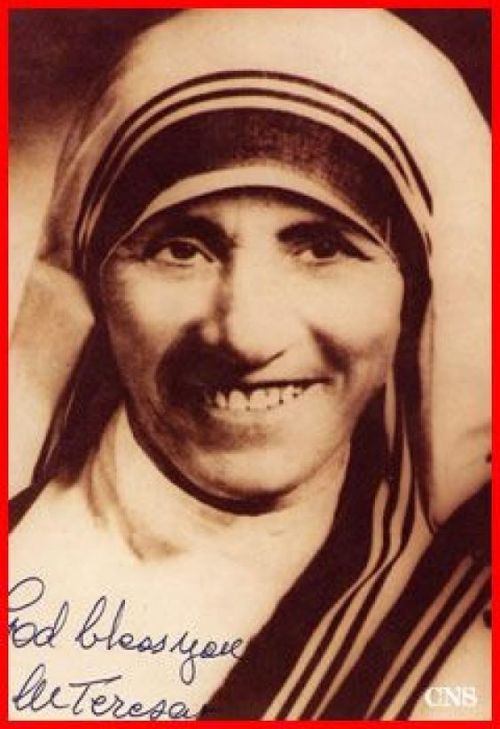
MOTHER TERESA.1.

The voice in her heart was telling her that she was to make a very big change in her life—that she should leave her teaching position and go into the streets of Calcutta and care for the poor.   So Sister Teresa listened and said yes.   She had lived in India for years and she knew how desperate the poor of that country were, especially in the big cities.   It was these people, the dying poor, that Sister Teresa felt a special call to love.   After all, these were people who had absolutely no one else in the world to love them.   Not only were they poor but they were also dying.   Why did their feelings matter?   Wouldn’t they be gone soon enough?   Teresa saw these people differently.   She saw them through God’s eyes, which means that she saw each of them as his dear child, suffering and yearning for some kind touch or word, some comfort in their last days on earth.   She heard that call and chose to live it out—to let God love the forgotten ones through her charity.

As is the case with all great things, Teresa’s efforts started out small.   She got permission to leave her order, to live with the poor and to dress like them, too.   She changed her habit from the traditional one to the sari worn by Indian women.   Her sari would be white with blue trim, the blue symbolizing the love of Mary.   She didn’t waste time, either.   On her very first day among the poor of Calcutta, Mother Teresa started a school with five students, a school for poor children.   That school still exists today.   She quickly got some training in basic medical care and went right into the homes of the poor to help them.   Within two years, Teresa had been joined by other women in her efforts, all of them her former students.   She was soon “Mother Teresa” because she was the head of a new religious order: the Missionaries of Charity.

The Missionaries of Charity tried to care for as many of the dying as they could.   They bought an old Hindu temple and made it into what they called a home for the dying. Hospitals had no room or interest in caring for the dying—especially the dying poor—so the dying had no choice but to lie on the streets and suffer.   The sisters knew this, so they didn’t wait for the poor to come to them.   They constantly roamed the streets, picking up what looked from the outside like nothing but a pile of rags but was actually a sick child or a frail old person.

When a dying person came or was brought to Mother Teresa and her sisters, they were met with nothing but love.   They were washed and given clean clothes, medicine, and—most important—someone who could hold their hand, listen, stroke their foreheads and comfort them with love in their last days.

One of the most feared diseases in the world is leprosy.   It’s a terrible sickness that deadens a person’s nerves and can even cause their fingers, toes, ears and nose to eventually fall away.   You know that in Jesus’ time, lepers were kept away from communities.   Lepers in poor countries like India, where they have a hard time getting the medicines to treat the disease, are often treated the same way.   So Mother Teresa saw people with leprosy in the same way—through God’s loving eyes.   She got the help of doctors and nurses, gathered lepers from the slums and began treating and caring for them in a way that no one before her had tried to do.

Mother Teresa’s work of love started out small but it isn’t small anymore. There are more than four thousand Missionaries of Charity today, living, praying and caring for the helpless in more than a hundred different houses around the world.

From the late 1980s through the 1990s, despite increasing health problems, Mother Teresa traveled across the world for the profession of novices, opening of new houses, and service to the poor and disaster-stricken.   New communities were founded in South Africa, Albania, Cuba and war-torn Iraq.   By 1997, the Sisters numbered nearly 4,000 members and were established in almost 600 foundations in 123 countries of the world.

After a summer of travelling to Rome, New York and Washington, in a weak state of health, Mother Teresa returned to Calcutta in July 1997.   At 21.30 on 5 September, Mother Teresa died at the Motherhouse.   Her body was transferred to St Thomas’s Church, next to the Loreto convent where she had first arrived nearly 69 years earlier. Hundreds of thousands of people from all classes and all religions, from India and abroad, paid their respects.   She received a state funeral on 13 September, her body being taken in procession – on a gun carriage that had also borne the bodies of Mohandas K. Gandhi and Jawaharlal Nehru – through the streets of Calcutta.   Presidents, prime ministers, queens and special envoys were present on behalf of countries from all over the world.

When we think about her work, we can learn all we need to know about love:  it doesn’t take any money or power to love.   It doesn’t take great talent or intelligence.   It simply takes love.

Mother Teresa did wonderful, brave work in caring for the forgotten but if there’s one thing she would want you to remember about love, it’s that you don’t have to travel to foreign countries to practice the virtue of charity.   In fact, love has to start where you live.

She was canonised by Pope Francis at St Peter’s in Rome overflowing with pilgrims and dignataries from every corner of the globe on 4 September 2016.

Official_banner_for_Mother_Teresas_canonization_hangs_in_StPeters_Square_Credit_Daniel_Ibez_CNAVatican Pope Mother Teresa

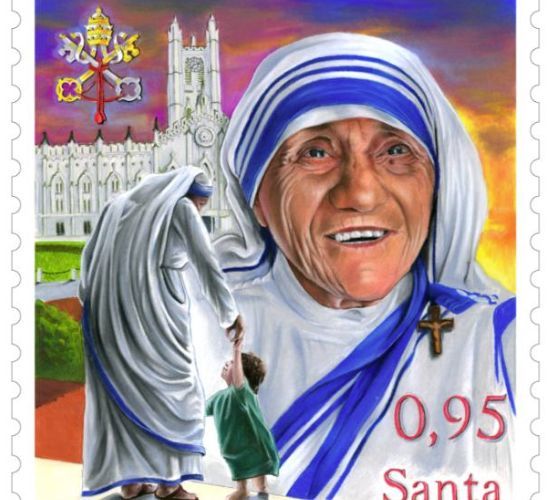
St Mother Teresa - stamp released for her Canonisation 4 Sept 2016MOTHER TERESA.7 - FOR PRAYER

Note: – all the biographies of St Mother Teresa are longed and detailed, this one is written for children – it’s all we need to know.   Loyola Kids Book of Heroes by Amy Welborn

 

Posted in SAINT of the DAY

Memorials of the Saints – 5 September

St Albert of Butrio
St Alvitus of León
Bl Anselm of Anchin
St Anseric of Soissons
St Bertin the Great
St Charbel
Bl Florent Dumontet de Cardaillac
St Genebald of Laon
Bl Gentilis
Bl Gerbrand of Dokkum
St Guise Hoang Luong Canh
Bl John the Good of Siponto
Bl Jordan of Pulsano
St Obdulia
St Phêrô Nguyen Van Tu
St Romulus of Rome
St Mother Teresa of Calcutta
St Victorinus of Amiterme
St Victorinus of Como
Bl William Browne

Martyrs of Armenia – 1,000 saints: A group of up to 1,000 Christian soldiers in the 2nd century imperial Roman army of Trajan, stationed in Gaul. Ordered to sacrifice to pagan gods, they refused and were transferred to Armenia. Ordered again to sacrifice to pagan gods, they refused again. Martyrs. We know the names of three of them, but nothing else – Eudoxius, Macarius and Zeno.

Martyrs of Capua – 3 saints: Three Christians who were martyred together. Long venerated in Capua, Italy. We know their names, but little else – Arcontius, Donatus and Quintius. They were martyred in Capua, Italy.

Martyrs of Nicomedia – 80 saints: A group of 80 Christians, lay and clergy, martyred together in the persecutions of Valens. We know little more than the names of three of them – Menedemo, Teodoro and Urbano. They were locked on a boat which was then set on fire on the shore of Nicomedia, Bithynia (in modern Turkey) c 370.

Martyrs of Porto Romano – 4+ saints: A group of Christians martyred together in the persecutions of Marcus Aurelius. We know little more than their names – Aconto, Herculanus, Nonno and Taurino. c180 at Porto Romano, Italy.

Posted in MARIAN QUOTES, MARIAN TITLES, MORNING Prayers, SAINT of the DAY, The BLESSED VIRGIN MARY

Thought for the Day – 4 September – The Feast of Our Lady of Consolation

Thought for the Day – 4 September – The Feast of Our Lady of Consolation

Pope Benedict XVI encouraged the faithful to pray to Our Lady of Consolation, stating “From Her We Can Always Learn How to Look Upon Jesus:”

“As we come to the conclusion of this solemn celebration, we offer a prayer to Mary Most Holy, who in Turin is venerated as the principal patroness with the title Blessed Virgin of Consolation.   To her I entrust this city and all those who live here.   O Mary, watch over the families and the workers;  watch over those who have lost faith and hope;  comfort the sick, those in prison and all who suffer.   O Help of Christians, sustain the young people, the elderly and persons in difficulty.   O Mother of the Church, watch over her pastors and the whole community of believers, that they may be “salt and light” in the midst of the world.

The Virgin Mary is she who more than any other contemplated God in the human face of Jesus.   She saw him as a newborn when, wrapped in swaddling clothes, he was placed in a manger;  she saw him when, just after his death, they took him down from the cross, wrapped him in linen and placed him in the sepulcher.   Inside her was impressed the image of her martyred Son;  but this image was then transfigured in the light of the Resurrection.   Thus in Mary’s heart was carried the mystery of the face of Christ, a mystery of death and of glory.   From her we can always learn how to look upon Jesus with a gaze of love and of faith, to recognise in that human countenance, the Countenance of God.”
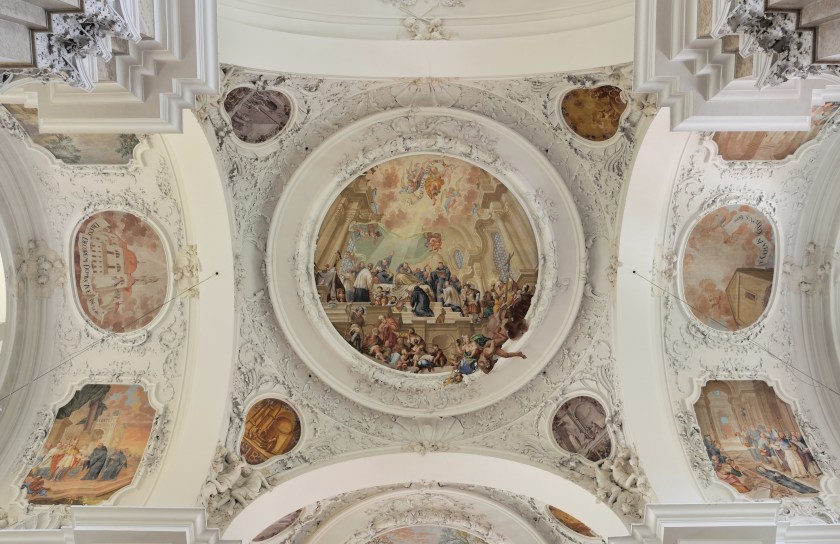
To our Lord and our God, Jesus Christ, we pray for a greater love of His Mother and to our Blessed Mother, Our Lady of Consolation, we lift our prayers for patience, for support and for comfort in our times of confusion, fear and anxiety.    Pray for us, Our Lady of Consolation!our lady of consolation pray for us.2

Posted in DOCTORS of the Church, MARIAN PRAYERS, MARIAN QUOTES, MARIAN TITLES, MORNING Prayers, QUOTES of the SAINTS, SAINT of the DAY, The BLESSED VIRGIN MARY

Quote/s of the Day – 4 September – The Feast of Our Lady of Consolation

Quote/s of the Day – 4 September – The Feast of Our Lady of Consolation

“Has anyone ever come away from Mary,
troubled or saddened or ignorant
of the heavenly Mysteries?
Who has not returned to everyday life
gladdened and joyful
because a request has been granted
by the Mother of God?”

St Amadeus of Lausanne (1110-1159)has anyone come away from mary - St Amadeus of Lausanne (1110-1159)

“As the Mother of Christ,
Mary is the Mother
of our wisdom and justice,
of our holiness and redemption.
She is more our Mother
than the mother of our flesh.”

St Aelred (1109-1166)as the mother of christ - st aelred

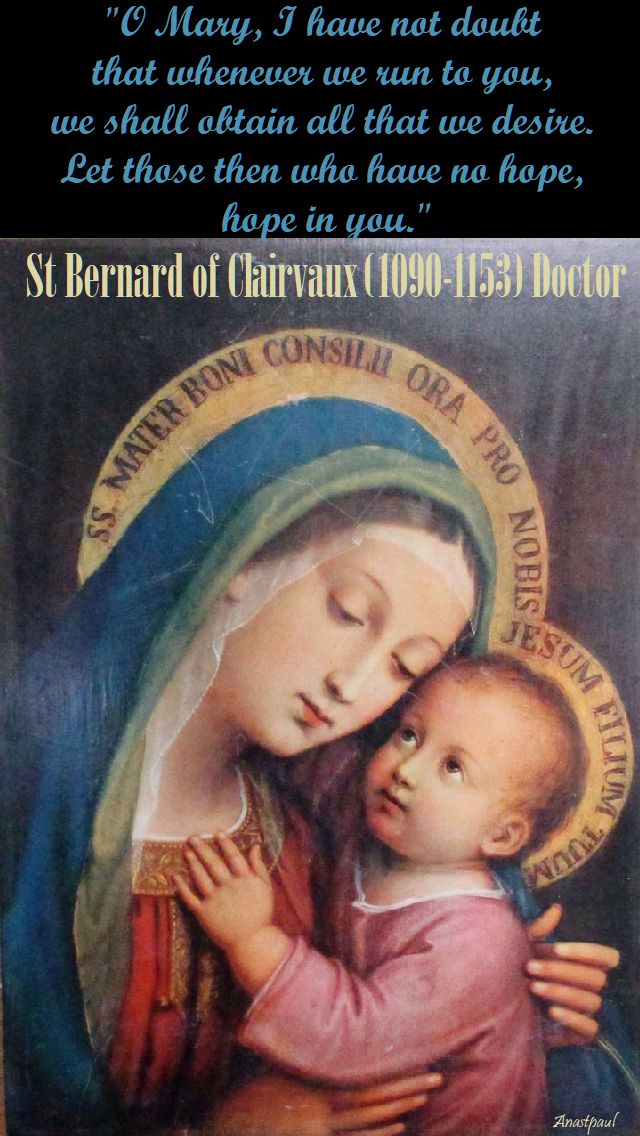
“O Mary, I have not doubt
that whenever we run to you,
we shall obtain all that we desire.
Let those then who have no hope, hope in you.”

St Bernard of Clairvaux (1090-1153) Doctor of the Churcho mary i have not doubt - st bernard

Posted in DOCTORS of the Church, FEASTS and SOLEMNITIES, MARIAN QUOTES, MARIAN TITLES, MORNING Prayers, QUOTES of the SAINTS, SAINT of the DAY, The BLESSED VIRGIN MARY, The WORD

One Minute Reflection – 4 September – The Feast of Our Lady of Consolation

One Minute Reflection – 4 September – The Feast of Our Lady of Consolation

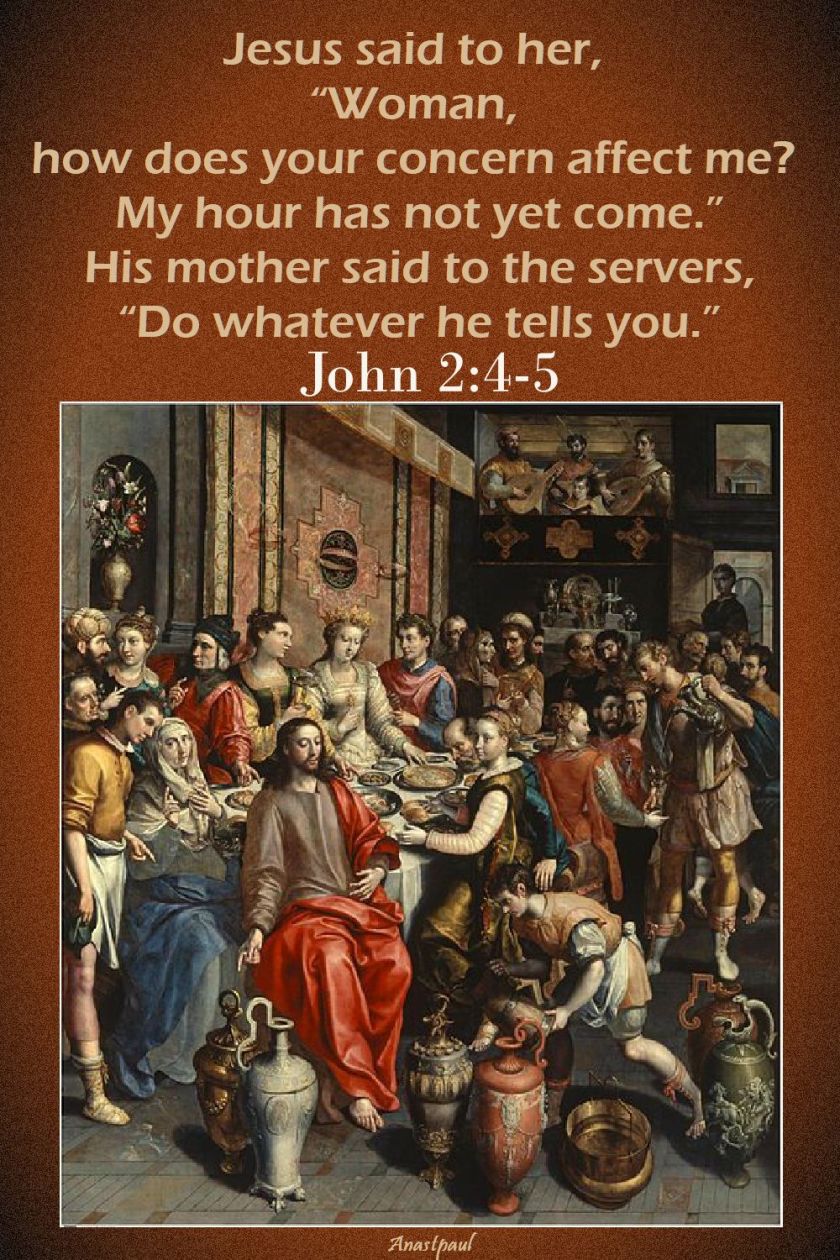
Jesus said to her, “Woman, how does your concern affect me? My hour has not yet come.”
His mother said to the servers, “Do whatever he tells you.”….John 2:4-5jesus said to her, woman - john 2 4-5

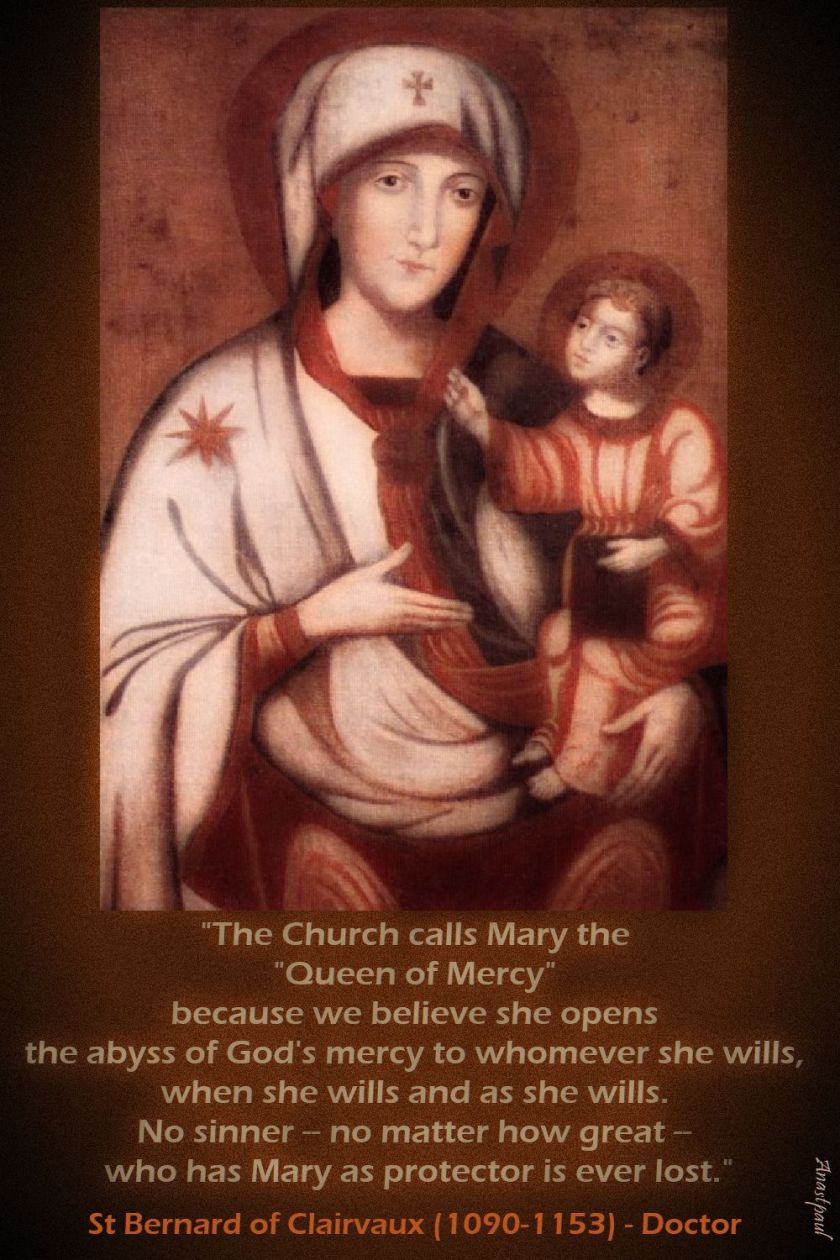
REFLECTION – “The Church calls Mary the “Queen of Mercy” because we believe she opens the abyss of God’s mercy to whomever she wills, when she wills and as she wills.
No sinner — no matter how great — who has Mary as protector is ever lost.”…St Bernard of Clairvaux (1090-1153) – Doctor of the Churchthe church calls mary the queen of mercy - st bernard

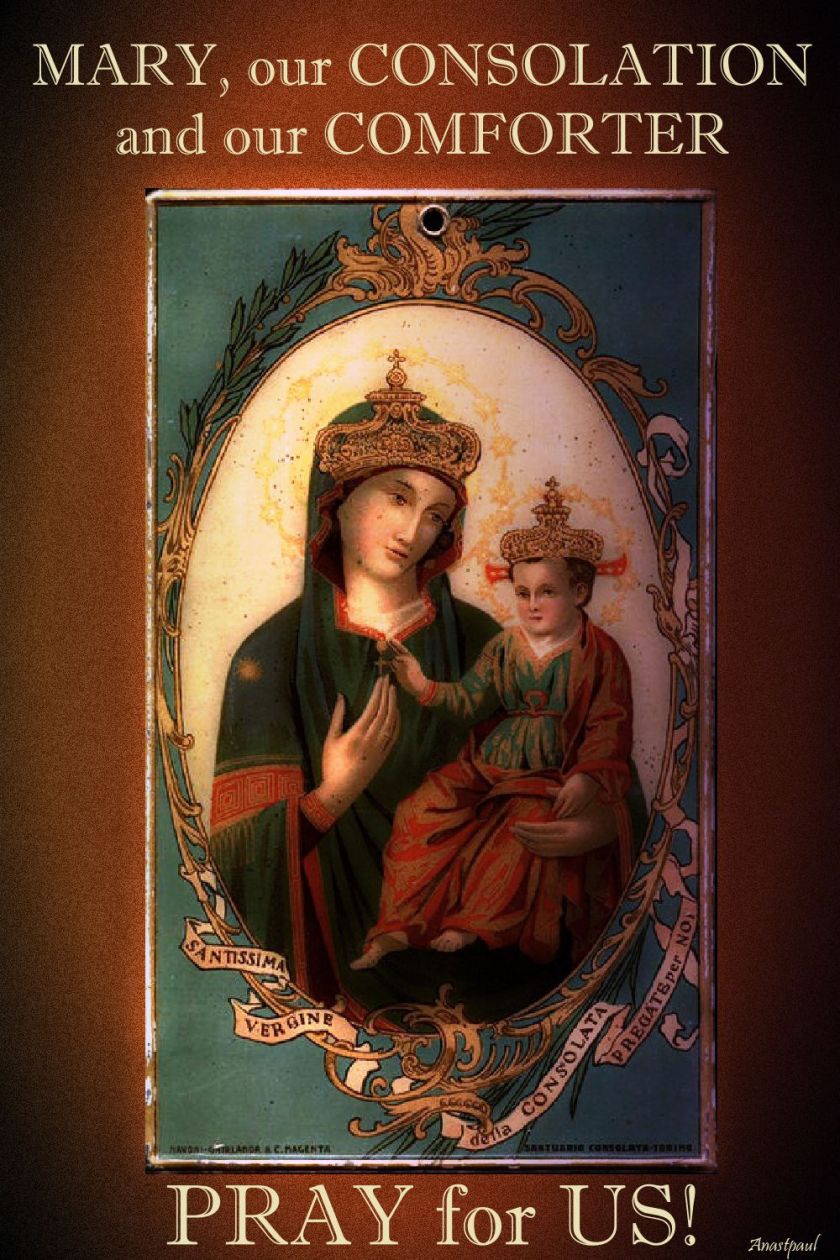
PRAYER – Almighty God, grant that Your faithful, who rejoice in the protection of the Blessed Virgin Mary, may be delivered from every evil here on earth, through her prayer and come to the enduring joys of heaven.  Through our Lord, Jesus Christ, in union with the Holy Spirit Mary, our Consolation and Comforter, pray for us! Amen.mary our consolation - pray for us

Posted in CATHOLIC-PRAYERS OF THE CHURCH, MARIAN PRAYERS, MARIAN TITLES, MORNING Prayers, SAINT of the DAY, The BLESSED VIRGIN MARY

Our Morning Offering – 4 September – The Feast of Our Lady of Consolation

Our Morning Offering – 4 September – The Feast of Our Lady of Consolation

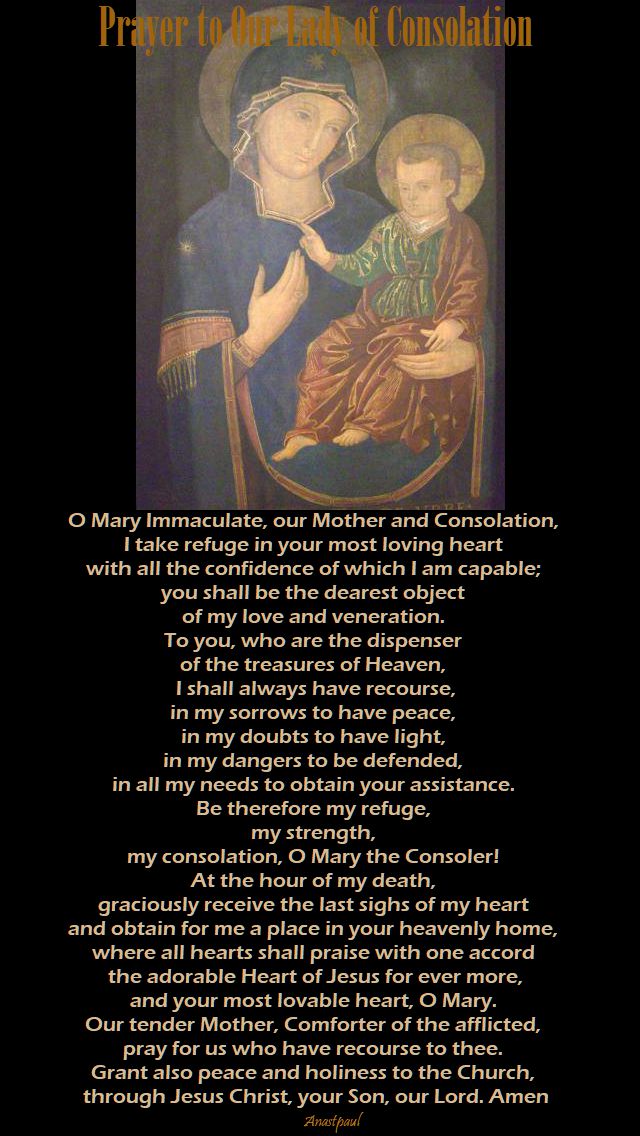
Prayer to Our Lady of Consolation

O Mary Immaculate, our Mother and Consolation,
I take refuge in your most loving heart
with all the confidence of which I am capable;
you shall be the dearest object
of my love and veneration.
To you, who are the dispenser
of the treasures of Heaven,
I shall always have recourse,
in my sorrows to have peace,
in my doubts to have light,
in my dangers to be defended,
in all my needs to obtain your assistance.
Be therefore my refuge,
my strength,
my consolation, O Mary the Consoler!
At the hour of my death,
graciously receive the last sighs of my heart
and obtain for me a place in your heavenly home,
where all hearts shall praise with one accord
the adorable Heart of Jesus for ever more,
and your most lovable heart, O Mary.
Our tender Mother, Comforter of the afflicted,
pray for us who have recourse to thee.
Grant also peace and holiness to the Church,
through Jesus Christ, your Son, our Lord. Amenprayer to our lady of consolation no 2


Posted in FEASTS and SOLEMNITIES, The BLESSED VIRGIN MARY

Madonna della Consolazione / Our Lady of Consolation (1436) – 4 September

Madonna della Consolazione / Our Lady of Consolation

Beginning in the 2nd century, Catholics venerated Mary as Our Lady of Consolation, one of her earliest titles of honour.   The title of Our Lady of Consolation, or Mary, Consoler of the Afflicted, comes from the Latin Consolatrix Afflictorum.   It is found in the Litany of Loreto.

The origin of this invocation is derived from the Augustinian monks who propagated this particular devotion.   In 1436 the Confraternity of the Holy Cincture of Our Lady of Consolation was founded in Bologna, Italy.   It was based on an Augustinian tradition which hold that Saint Monica in the fourth century, was distraught with anxiety for her wayward son, Augustine and that Mary gave her a sash which the Virgin wore, with the assurance that whoever wore this belt would receive her special consolation and protection.   Along with Augustine and Monica, Our Lady of Consolation is one of the three patrons of the Augustinians.   The “Augustinian Rosary” is sometimes called the “Corona (or Crown) of Our Mother of Consolation.”

In the 1700s members of the Augustinian Order introduced devotion to Our Lady of Consolation to the island of Malta.   On 1 December 1722 the Prior General of the Augustinian Order Fr Thomas Cervioni issued the Decree for the erection of the Confraternity of Our Lady of Consolation in the church of St Mark, run by the Augustinians at Rabat, although the devotion had been practiced for some time before. By this time the custom of asking for the final blessing before death in the name of Our Lady of Consolation was very popular and the monks were given a dispensation to leave the monastery at any time to confer it.   Processions in Our Lady’s honour were suspended during the French occupation of 1798 to discourage the gathering of crowds.

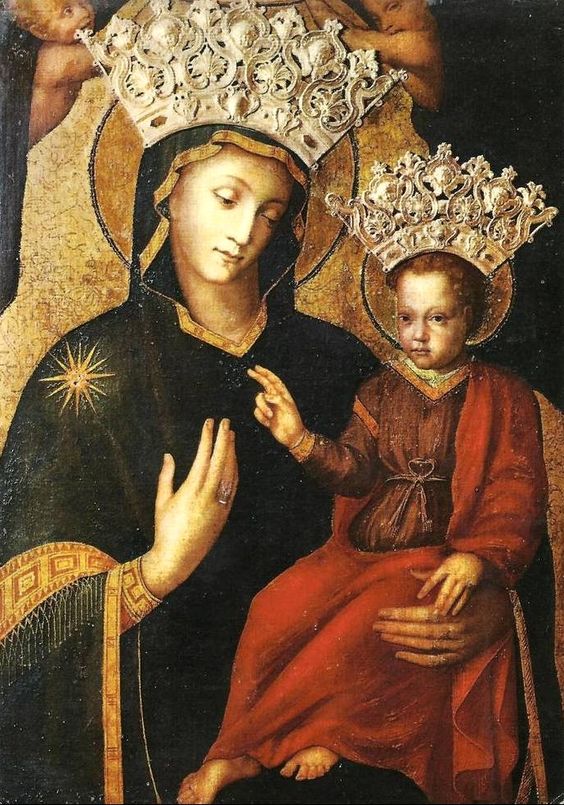
An ancient story relates St Eusebius of Vercelli brought back an icon of Our Lady of Consolation when he was returning from exile in Egypt in 363.   This icon was presented to the city of Turin.   Later St Maximus, Bishop of Turin, established a small shrine to house the icon in a church dedicated to St Andrew.   The icon became the object of great veneration and the church became the Santuario della Consolata.   Giuseppe Allamano, rector of the Santuario della Consolata founded the Consolata Missionaries in 1902;  they brought to devotion to Africa.   At the age of nineteen Joseph Marello of Turin contracted typhus.   He attributed his recovery to Our Lady of Consolation and went on to found the Oblates of St Joseph.

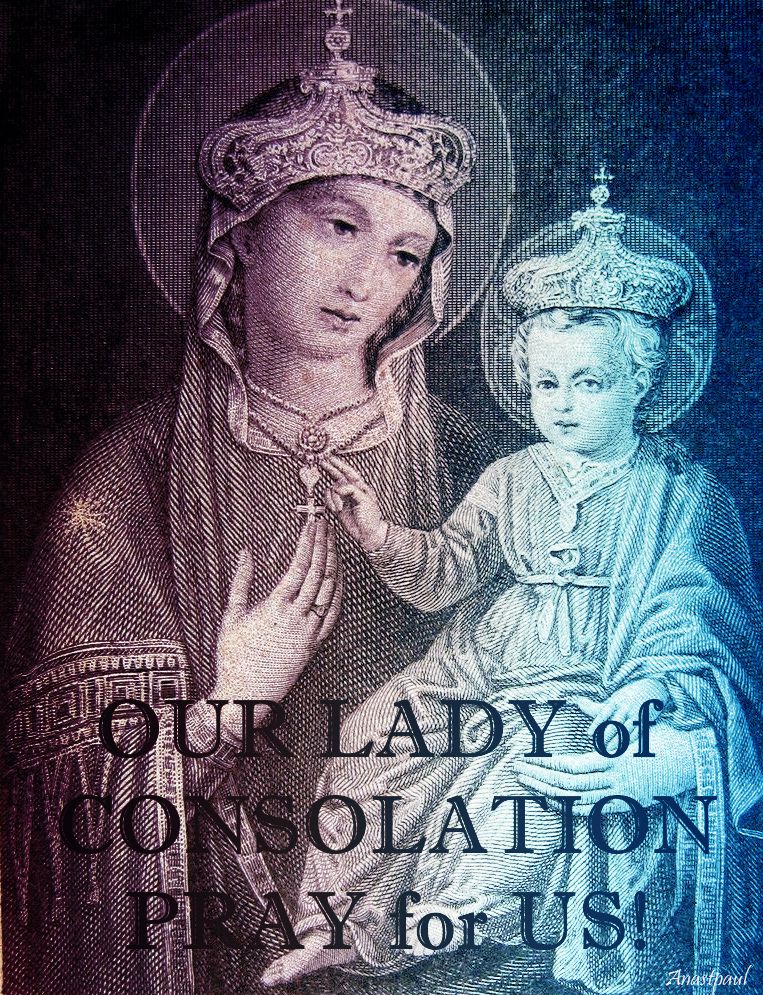
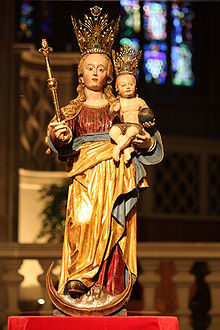
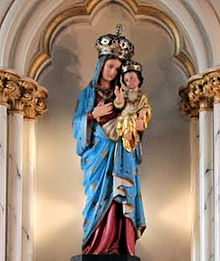
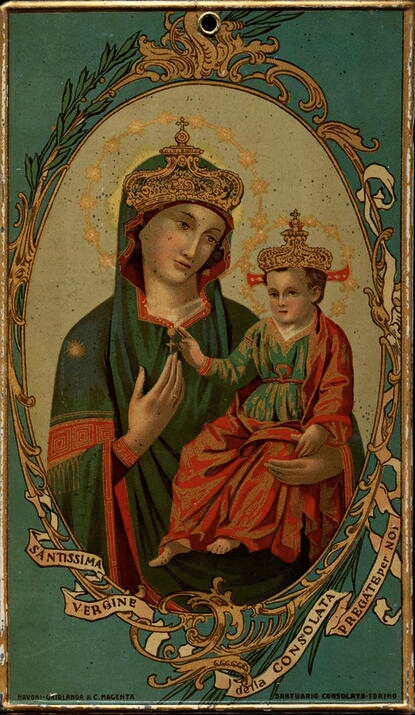
There are several versions of the image of Our Lady of Consolation. The original one is in Turin at the Santuario della Consolata.   A star on her shoulder is characteristic of almost all the images.   The traditional depiction of Our Mother of Consolation in Augustinian houses shows Mary holding the child Jesus on her lap.   Jesus and Mary both hold the Augustinian cincture in their hands.

250px-Consolata_di_torino,_interno,_25
Altar with icon of the Virgin of the Consolation at the Santuario della Consolata or Sanctuary of the Virgin of the Consolation in Turin

In France the dioceses of Vannes, Valence, Montpelier, Laval, Nantes, Périgueux, Tours and many others, possessed churches or chapels dedicated to Mary under this title.   In 1652, Pope Innocent X encouraged devotion to Our Lady of Consolation by establishing a confraternity.

The cult of Our Lady of Luxembourg, Comforter of the Afflicted, was initiated by the Jesuits in 1624 and led to the election of Our Lady as the protectress of the City in 1666 and of the Duchy in 1678.   After the destruction of the old pilgrimage chapel at the time of the French Revolution, the statue of Our Lady of Luxembourg was moved to St Peter church, today’s Cathedral in Luxembourg City.   Statues depicting her can be found in niches in buildings throughout the city of Luxembourg.   From there the devotion was adopted by the English Benedictine nuns of Cambrai.

Immigrants from Luxembourg transposed the cult of Our Lady of Consolation to the United States.

In 1848, Luxembourg immigrants began to settle in the area around Dacada, Wisconsin. The oldest statue of Our Lady of Luxembourg found in the United States, was brought to Dacada by a Luxembourg immigrant, Anna Margaret Deppiesse, in 1849.   Mrs. Deppiesse donated it to St. Nicholas Church, where it can be found in an alcove shrine below the choir loft.   When the church was remodeled in 1941, a mural depicting Our Lady of Luxembourg (Mary, Consoler of the Afflicted) was added to the apse in the sanctuary.   The mural, which honours the parish’s Luxembourgian roots, was painted by liturgical artist, Bernard Grenkhe, using the “al secho” method (i.e., painting on wet plaster so as to make the image permanent.

During the Civil War, three parishioners of St. Augustine’s Parish in Leopold, Indiana fought for the North and were imprisoned at the notorious Andersonville Prison.   Henry Devillez, Isidore Naviaux and Lambert Rogier, formerly of Belgium, vowed that if they survived, one of them would make a pilgrimage to Luxembourg and obtain a copy of the statue of Our Lady of Consolation that stood in their ancestral church.   Rogier went to Luxembourg in 1867 and upon his return enshrined it in St. Augustine’s, where it now stands to the left of the main altar.   In September 2013, Archbishop Joseph W. Tobin of Indianapolis dedicated a larger outdoor garden shrine.

Another centre of veneration and pilgrimage, which also adopted Our Lady, Comforter of the Afflicted is Kevaeler in Germany, not far from the Dutch border.   In 1642 a copperplate engraving, representing Our Lady of Luxembourg, was installed in a sanctuary erected the same year.   It is one of the best visited Catholic pilgrimage locations in north-western Europe.  St Pope John Paul II visited in 1987.

The feast of Our Lady of Consolation is one of the solemnities not inscribed in the General Roman Calendar but which are observed in particular places, regions, churches or religious institutes.   Augustinians observe 4 September, the Benedictines on 5 July.
The popular girls name “Consuela” is derived from this title.

96Olconsolation12
gliwice2
Our Lady of Consolation.2,jpg
Posted in FEASTS and SOLEMNITIES, SAINT of the DAY, The BLESSED VIRGIN MARY

Feast of Our Lady of Consolation and Memorials of the Saints – 4 September

Our Lady of Consolation:  Starting in the 2nd century, Catholics venerated Mary as Our Lady of Consolation, one of her earliest titles of honour. The title of Our Lady of Consolation, or Mary, Consoler of the Afflicted, comes from the Latin Consolatrix Afflictorum. It is found in the Litany of Loreto.

Icona_della_Consolata,_Torino
The original Icon of Our Lady of Consolation in Turin, Italy

St Ammianus the Martyr
St Pope Boniface I
St Caletricus of Chartres
St Candida of Naples
St Candida the Elder
St Castus of Ancyra
Bl Catherine of Racconigi
St Fredaldo of Mende
St Hermione
St Ida of Herzfeld
St Irmgard of Süchteln
St Julian the Martyr
St Magnus of Ancyra
St Marcellus of Chalon-sur-Saône
St Marcellus of Treves
St Maximus of Ancyra
St Monessa
St Moses the Prophet
Bl Nicolò Rusca
St Oceanus the Martyr
Bl Peter of Saint James
St Rebecca of Alexandria
St Rhuddlad
St Rosalia/Rose of Viterbo
St Rufinus of Ancyra
St Salvinus of Verdun
Bl Scipion-Jérôme Brigeat Lambert
St Silvanus of Ancyra
St Sulpicius of Bayeux
St Thamel
St Theodore the Martyr
St Ultan of Ardbraccan
St Victalicus

Martyred in the Spanish Civil War:
• Blessed Adrián Saiz y Saiz
• Blessed Baltasar Mariano Muñoz Martínez
• Facundo Fernández Rodríguez
• Blessed Francisco Sendra Ivars
• Blessed José Bleda Grau
• Blessed José Muñoz Quero
• Blessed José Pascual Carda Saporta
• Blessed Juan Moreno Juárez
• Blessed José Vicente Hormaechea Apoita
• Blessed Pedro Sánchez Barba

Posted in DEVOTIO, FATHERS of the Church, MORNING Prayers, SAINT of the DAY

Thought for the Day – 3 September – The Memnorial of St Pope Gregory the Great (540-604) – Father & Doctor of the Church

Thought for the Day – 3 September – The Memnorial of St Pope Gregory the Great (540-604) – Father & Doctor of the Church

By his writings, St Gregory is one of the Four Fathers of the Latin Church and the influence of his writings dominated the Middle Ages. His Pastoral Care, became the pastoral manual of later centuies and his Moralia laid the foundation for medieval spirtuality.
In his thirteen years as Pope, this “servant of the servants of God”, crowded in a lifetime.
He died in 604, sick and worn out, still dictating letters on his deathbed.   He was buried at St Peter’s and his epitaph called him “the great consul of God.”

St Gregory shows the critical importance of leadership and the fantastic things that a good leader can accomplish.   He influenced every aspect of religious life and is with good reason called “the Great”.
His life shows how important one man’s witness can be.

We are “one man” too – the tiny bit we do might seem inconsequential – but God works in mysterious ways and His Hand covers all the earth – our tiny bit could well be spread by that Hand!

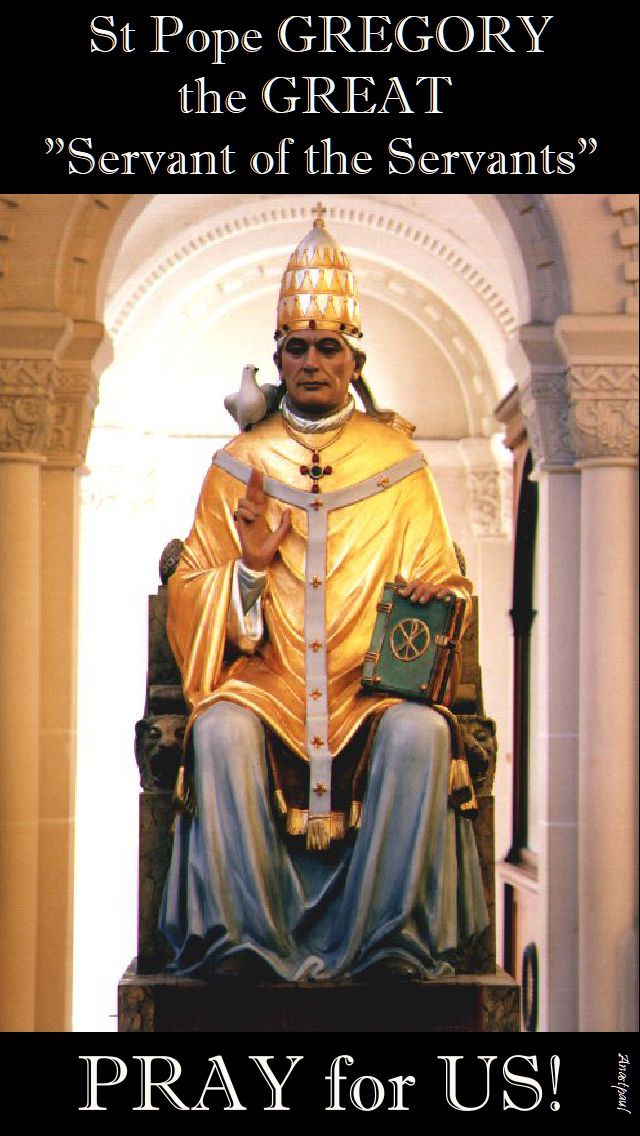
St Gregory the Great, Servant of the Servants, pray for us!st pope gregory pray for us 2