
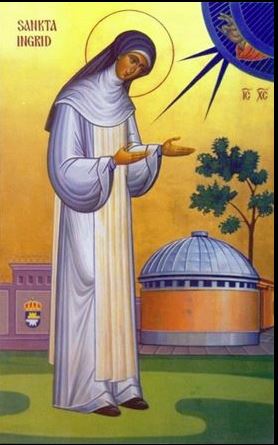
Saint of the Day – 2 September – St Ingrid of Sweden O.P. (Died 1292) – also known as St Ingrid of Skänninge – Dominican Religious and Mystic.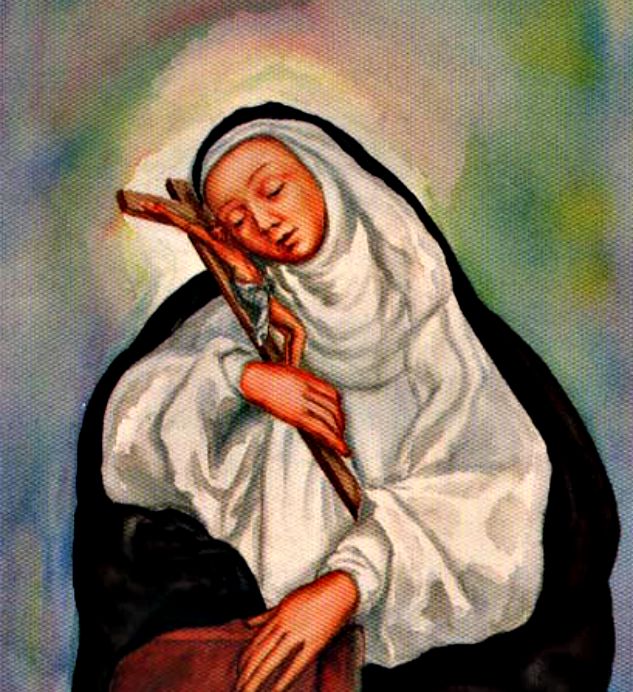
Ingrid Elovsdotter was born in Skänninge, Sweden, in the 13th century. Following the death of her husband, she resolved to consecrate the rest of her life to God. She placed herself under the spiritual direction of Peter of Dacia, a Dominican priest. In one of his letters, Petrus de Dacia has left a description of the ascetic life style and mystic revelations of one of his “spiritual daughters” in this circle of women, which likely refers to Ingrid.
She was the first Dominican nun in Sweden and in 1281 after making a pilgrimage to Rome she founded the first Dominican cloister, called St Martin’s in Skänning, which was formally recognised in 1281, 1 year prior to her death. Ingrid made pilgrimages to Santiago de Compostela, Jerusalem and Rome.
She died in 1282 surrounded by an aura of sanctity. After her death in 1282, Ingrid became object of veneration and pilgrimages to her convent. She was, however, not formally recognised by the Pope as such. When her relative, Bridget of Sweden, was formally recognised by the Pope in 1391, it caused a need to have Ingrid to be granted a similar status as well. At the Council of Costance, an application was made for her canonisation. In 1499, Pope Alexander VI agreed to a Translation (relic), which took place in her convent in 1507.
The remains of Ingrid was removed to the Vadstena Abbey after the Swedish Reformation. In 1645, the skull was stolen from the Vadstena church by Antoine de Beaulieu, who believed it to be the skull of Bridget of Sweden. Antoine de Beaulieu gave the skull to the French ambassador Gaspard Coignet de la Thullerie, who in turn placed it in the church of Courson-les-Carrières in France. In 1959, it was given to the Brigitinesse abbey of Mary’s Refuge in Uden in the Netherlands, where it is exhibited as the skull of Bridget of Sweden.

 AnaStpaul
5 thoughts on “Saint of the Day – 2 September – St Ingrid of Sweden O.P. (Died 1292)”