Posted in SAINT of the DAY

Saint of the Day – 17 September – Blessed Hildegard (1098-1179) Abbess

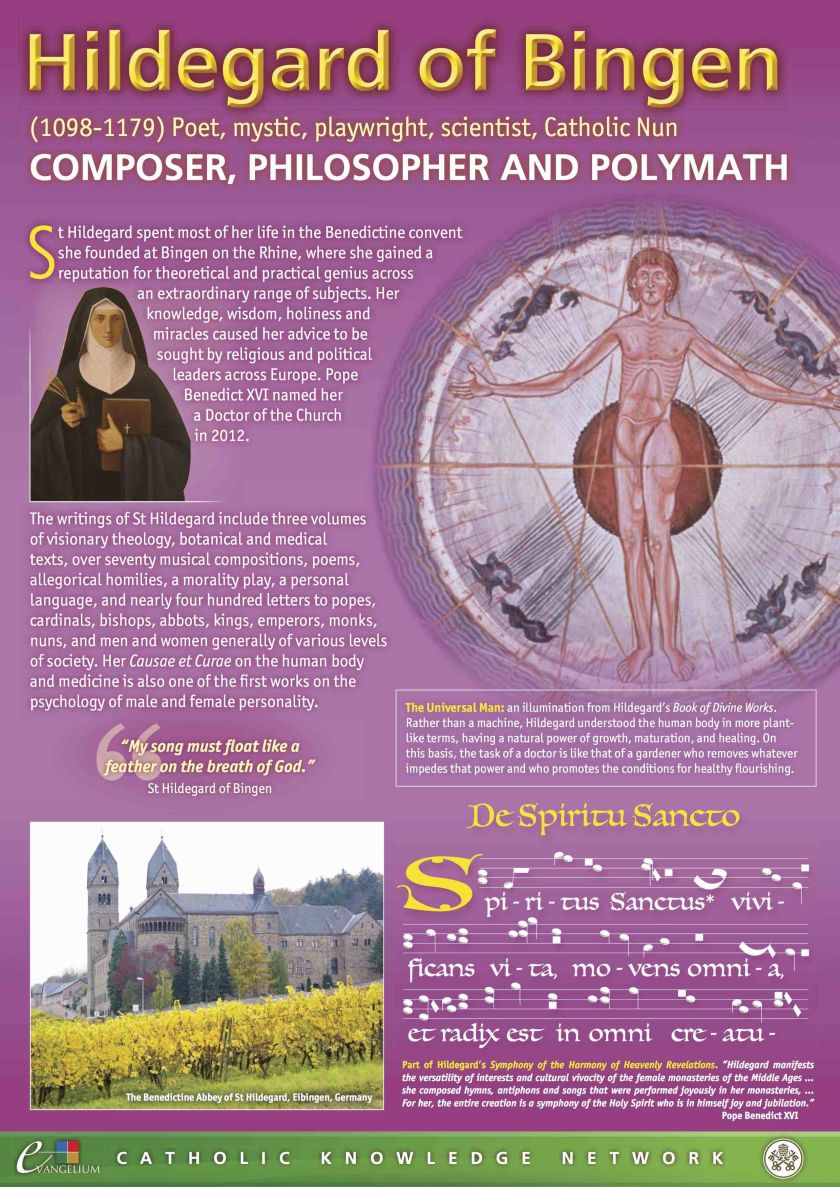
Saint of the Day – 17 September – Blessed Hildegard Abbess at Bingen OSB (1098-1179).   Born in 1098 at Bermersheim, Rhineland Palatinate (modern Germany) and died on 17 September 1179 at Bingen, Rhineland Palatinate (modern Germany) of natural causes.   She was Beatified on 26 August 1326 by Pope John XXII.   St Hildegard is also known as Saint Hildegard and Sibyl of the Rhine, was a German Benedictine Abbess, Theologian, Writer, Composer, Philosopher, Poet, Mystic, Visionary, Founder, Scientist, Artist and Polymath. She is considered to be the founder of scientific natural history in Germany.    Hildegard was elected magistra by her fellow nuns in 1136; she founded the Monasteries of Rupertsberg in 1150 and Eibingen in 1165.   One of her works as a composer, the Ordo Virtutum, is an early example of liturgical drama and arguably the oldest surviving morality play.   She wrote theological, botanical and medicinal texts, as well as letters, liturgical songs and poems, while supervising miniature illuminations in the Rupertsberg manuscript of her first work, Scivias.   She is also noted for the invention of a constructed language known as Lingua Ignota.st hildegard bio infoHILDEGARD VON BINGEN
1. A “light for her people and her time”:  in these words Blessed John Paul II, my Venerable Predecessor, described Saint Hildegard of Bingen in 1979, on the occasion of the eight-hundredth anniversary of the death of this German mystic.   This great woman truly stands out crystal clear against the horizon of history for her holiness of life and the originality of her teaching.   And, as with every authentic human and theological experience, her authority reaches far beyond the confines of a single epoch or society; despite the distance of time and culture, her thought has proven to be of lasting relevance.

In Saint Hildegard of Bingen there is a wonderful harmony between teaching and daily life.   In her, the search for God’s will in the imitation of Christ was expressed in the constant practice of virtue, which she exercised with supreme generosity and which she nourished from biblical, liturgical and patristic roots in the light of the Rule of Saint Benedict.   Her persevering practice of obedience, simplicity, charity and hospitality was especially visible.   In her desire to belong completely to the Lord, this Benedictine Abbess was able to bring together rare human gifts, keen intelligence and an ability to penetrate heavenly realities.514px-Engraving;_German_abbess_and_physician_Hildegard_von_Bingen_Wellcome_L0005783

2. Hildegard was born in 1098 at Bermersheim, Alzey, to parents of noble lineage who were wealthy landowners.   At the age of eight she was received as an oblate at the Benedictine Abbey of Disibodenberg, where in 1115 she made her religious profession. Upon the death of Jutta of Sponheim, around the year 1136, Hildegard was called to succeed her as magistra.   Infirm in physical health but vigorous in spirit, she committed herself totally to the renewal of religious life.   At the basis of her spirituality was the Benedictine Rule which views spiritual balance and ascetical moderation as paths to holiness.   Following the increase in vocations to the religious life, due above all to the high esteem in which Hildegard was held, around 1150 she founded a monastery on the hill of Rupertsberg, near Bingen, where she moved with twenty sisters.   In 1165, she established another monastery on the opposite bank of the Rhine.   She was the Abbess of both.

Within the walls of the cloister, she cared for the spiritual and material well-being of her sisters, fostering in a special way community life, culture and the liturgy.   In the outside world she devoted herself actively to strengthening the Christian faith and reinforcing religious practice, opposing the heretical trends of the Cathars, promoting Church reform through her writings and preaching and contributing to the improvement of the discipline and life of clerics  . At the invitation first of Hadrian IV and later of Alexander III, Hildegard practised a fruitful apostolate, something unusual for a woman at that time, making several journeys, not without hardship and difficulty, to preach even in public squares and in various cathedral churches, such as at Cologne, Trier, Liège, Mainz, Metz, Bamberg and Würzburg.   The profound spirituality of her writings had a significant influence both on the faithful and on important figures of her time and brought about an incisive renewal of theology, liturgy, natural sciences and music. Stricken by illness in the summer of 1179, Hildegard died in the odour of sanctity, surrounded by her sisters at the monastery of Rupertsberg, Bingen, on 17 September 1179.

3. In her many writings Hildegard dedicated herself exclusively to explaining divine revelation and making God known in the clarity of His love.   Hildegard’s teaching is considered eminent both for its depth, the correctness of its interpretation and the originality of its views.   The texts she produced are refreshing in their authentic “intellectual charity” and emphasise the power of penetration and comprehensiveness of her contemplation of the mystery of the Blessed Trinity, the Incarnation, the Church, humanity and nature as God’s creation, to be appreciated and respected.

These works were born from a deep mystical experience and propose a perceptive reflection on the mystery of God.   The Lord endowed her with a series of visions from childhood, whose content she dictated to the Benedictine monk Volmar, her secretary and spiritual advisor and to Richardis von Stade, one of her women religious.   But particularly illuminating are the judgements expressed by Saint Bernard of Clairvaux, who encouraged her and especially by Pope Eugene III, who in 1147 authorised her to write and to speak in public.   Theological reflection enabled Hildegard to organise and understand, at least in part, the content of her visions.   In addition to books on theology and mysticism, she also authored works on medicine and natural sciences.   Her letters are also numerous — about four hundred are extant;  these were addressed to simple people, to religious communities, popes, bishops and the civil authorities of her time.   She was also a composer of sacred music.   The corpus of her writings, for their quantity, quality and variety of interests, is unmatched by any other female author of the Middle Ages.

Her main writings are the Scivias, the Liber Vitae Meritorum and the Liber Divinorum Operum.   They relate her visions and the task she received from the Lord to transcribe them. In the author’s view her Letters were no less important, they bear witness to the attention Hildegard paid to the events of her time, which she interpreted in the light of the mystery of God.   In addition there are 58 sermons, addressed directly to her sisters. They are her Expositiones Evangeliorum, containing a literary and moral commentary on Gospel passages related to the main celebrations of the liturgical year.   Her artistic and scientific works focus mainly on music, in the Symphonia Harmoniae Caelestium Revelationum;  on medicine, in the Liber Subtilitatum Diversarum Naturarum Creaturarum and in the Causae et Curae and on natural sciences in the Physica.   Finally her linguistic writings are also noteworthy, such as the Lingua Ignota and the Litterae Ignotae, in which the words appear in an unknown language of her own invention but are composed mainly of phonemes present in German.

Hildegard’s language, characterised by an original and effective style, makes ample use of poetic expressions and is rich in symbols, dazzling intuitions, incisive comparisons and evocative metaphors.HILDEGARD ICON

4. With acute wisdom-filled and prophetic sensitivity, Hildegard focused her attention on the event of revelation.   Her investigation develops from the biblical page in which, in successive phases, it remains firmly anchored.   The range of vision of the mystic of Bingen was not limited to treating individual matters but sought to offer a global synthesis of the Christian faith.   Hence in her visions and her subsequent reflections she presents a compendium of the history of salvation from the beginning of the universe until its eschatological consummation.   God’s decision to bring about the work of creation is the first stage on this immensely long journey which, in the light of sacred Scripture, unfolds from the constitution of the heavenly hierarchy until it reaches the fall of the rebellious angels and the sin of our first parents.

This initial picture is followed by the redemptive Incarnation of the Son of God, the activity of the Church that extends in time the mystery of the Incarnation and the struggle against Satan.   The definitive Coming of the Kingdom of God and the Last Judgement crown this work.

Hildegard asks herself and us the fundamental question, whether it is possible to know God:  This is theology’s principal task.   Her answer is completely positive: through faith, as through a door, the human person is able to approach this knowledge.   God, however, always retains his veil of mystery and incomprehensibility  . He makes himself understandable in creation but, creation itself is not fully understood when detached from God.   Indeed, nature considered in itself provides only pieces of information which often become an occasion for error and abuse.   Faith, therefore, is also necessary in the natural cognitive process, for otherwise knowledge would remain limited, unsatisfactory and misleading.

Creation is an act of love by which the world can emerge from nothingness.   Hence, through the whole range of creatures, divine love flows as a river.   Of all creatures God loves man in a special way and confers upon him an extraordinary dignity, giving him that glory which the rebellious angels lost.   The human race may thus be counted as the tenth choir of the angelic hierarchy.   Indeed human beings are able to know God in Himself, that is, His one nature in the Trinity of Persons. Hildegard approached the mystery of the Blessed Trinity along the lines proposed by Saint Augustine.   By analogy with his own structure as a rational being, man is able to have an image at least of the inner life of God.   Nevertheless, it is solely in the economy of the Incarnation and human life of the Son of God that this mystery becomes accessible to human faith and knowledge.   The holy and ineffable Trinity in supreme Unity was hidden from those in the service of the ancient law.   But in the new law of grace it was revealed to all who had been freed from slavery.   The Trinity was revealed in a special way in the Cross of the Son.

A second “space” in which God becomes known is His word, contained in the Books of the Old and New Testament.   Precisely because God “speaks”, man is called to listen.   This concept affords Hildegard the opportunity to expound her doctrine on song, especially liturgical song.   The sound of the word of God creates life and is expressed in his creatures.   Thanks to the creative word, beings without rationality are also involved in the dynamism of creation.   But man of course is the creature who can answer the voice of the Creator with his own voice.   And this can happen in two ways:  in voce oris, that is, in the celebration of the liturgy, and in voce cordis, that is, through a virtuous and holy life.   The whole of human life may therefore be interpreted as harmonic and symphonic.Museum - Hildegard von Bingen

5. Hildegard’s anthropology begins from the biblical narrative of the creation of man (Gen 1:26), made in the image and likeness of God.   Man, according to Hildegard’s biblically inspired cosmology, contains all the elements of the world because the entire universe is recapitulated in him;  he is formed from the very matter of creation.   The human person can therefore consciously enter into a relationship with God.   This does not happen through a direct vision, but, in the words of Saint Paul, as “in a mirror” (1 Cor 13:12).   The divine image in man consists in his rationality, structured as intellect and will.   Thanks to his intellect, man can distinguish between good and evil;  thanks to his will, he is spurred to action.

Human beings are seen as a unity of body and soul. The German mystic shows a positive appreciation of corporeity and providential value is given even to the body’s weaknesses. The body is not a weight from which to be delivered.   Although human beings are weak and frail, this “teaches” them a sense of creatureliness and humility, protecting them from pride and arrogance.   Hildegard contemplated in a vision the souls of the blessed in paradise waiting to be rejoined to their bodies.   Our bodies, like the body of Christ, are oriented to the glorious resurrection, to the supreme transformation for eternal life.   The very vision of God, in which eternal life consists, cannot be definitively achieved without the body.

The human being exists in both the male and female form.   Hildegard recognised that a relationship of reciprocity and a substantial equality between man and woman is rooted in this ontological structure of the human condition.   Nevertheless the mystery of sin also dwells in humanity and was manifested in history for the first time precisely in the relationship between Adam and Eve.   Unlike other medieval authors who saw Eve’s weakness as the cause of the Fall, Hildegard places it above all in Adam’s immoderate passion for her.

Even in their condition as sinners, men and women continue to be the recipients of God’s love, because God’s love is unconditional and, after the Fall, acquires the face of mercy. Even the punishment that God inflicts on the man and woman brings out the merciful love of the Creator.   In this regard, the most precise description of the human creature is that of someone on a journey, homo viator.   On this pilgrimage towards the homeland, the human person is called to a struggle in order constantly to choose what is good and avoid evil.

The constant choice of good produces a virtuous life.   The Son of God made man is the subject of all virtues, therefore the imitation of Christ consists precisely in living a virtuous life in communion with Christ.   The power of virtue derives from the Holy Spirit, poured into the hearts of believers, who brings about upright beha  viour. This is the purpose of human existence.   In this way man experiences his Christ-like perfection.vonbingenhildeg

6. So as to achieve this goal, the Lord has given his Church the sacraments.   Salvation and the perfection of the human being are not achieved through the effort of the will alone but rather through the gifts of grace that God grants in the Church.

The Church herself is the first sacrament that God places in the world so that she may communicate salvation to mankind.   The Church, built up from “living souls”, may rightly be considered virgin, bride and mother and thus resembles closely the historical and mystical figure of the Mother of God.  The Church communicates salvation first of all by keeping and proclaiming the two great mysteries of the Trinity and the Incarnation, which are like the two “primary sacraments” and then through administration of the other sacraments.   The summit of the sacramental nature of the Church is the Eucharist. The sacraments produce the sanctification of believers, salvation and purification from sin, redemption and charity and all the other virtues.   However, to repeat, the Church lives because God within her has manifested his intraTrinitarian love, which was revealed in Christ.   The Lord Jesus is the mediator par excellence.   From the Trinitarian womb He comes to encounter man and from Mary’s womb He encounters God.   As the Son of God, He is love incarnate;  as the Son of Mary, He is humanity’s representative before the throne of God.

The human person can have an experience of God.   Relationship with Him, in fact, is not lived solely in the sphere of rationalit but involves the person totally.   All the external and internal senses of the human being are involved in the experience of God.   “But man was created in the image and likeness of God, so that he might act through the five bodily  senses;  he is not divided by them, rather through them he is wise, knowledgeable and intelligent in doing his work (…). For this very reason, because man is wise, knowledgeable and intelligent, he knows creation;  he knows God — whom he cannot see except by faith — through creation and his great works, even if with his five senses he barely comprehends them” (Explanatio Symboli Sancti Athanasii in PL 197, 1073).   This experiential process finds once again, its fullness in participation in the sacraments.

Hildegard also saw contradictions in the lives of individual members of the faithful and reported the most deplorable situations.   She emphasised in particular that individualism in doctrine and in practice on the part of both lay people and ordained ministers is an expression of pride and constitutes the main obstacle to the Church’s evangelising mission to non-Christians.

One of the salient points of Hildegard’s magisterium was her heartfelt exhortation to a virtuous life addressed to consecrated men and women.   Her understanding of the consecrated life is a true “theological metaphysics”, because it is firmly rooted in the theological virtue of faith, which is the source and constant impulse to full commitment in obedience, poverty and chastity.   In living out the evangelical counsels, the consecrated person shares in the experience of Christ, poor, chaste and obedient and follows in his footsteps in daily life.   This is fundamental in the consecrated life.hildegard statue

7. Hildegard’s eminent doctrine echoes the teaching of the Apostles, the Fathers and writings of her own day, while it finds a constant point of reference in the Rule of Saint Benedict.   The monastic liturgy and the interiorisation of sacred Scripture are central to her thought which, focusing on the mystery of the Incarnation, is expressed in a profound unity of style and inner content that runs through all her writings.

The teaching of the holy Benedictine nun stands as a beacon for homo viator.   Her message appears extraordinarily timely in today’s world, which is especially sensitive to the values that she proposed and lived.   For example, we think of Hildegard’s charismatic and speculative capacity, which offers a lively incentive to theological research;  her reflection on the mystery of Christ, considered in its beauty;  the dialogue of the Church and theology with culture, science and contemporary art;  the ideal of the consecrated life as a possibility for human fulfilment; her appreciation of the liturgy as a celebration of life;  her understanding of the reform of the Church, not as an empty change of structure but as conversion of heart;  her sensitivity to nature, whose laws are to be safeguarded and not violated.

For these reasons the attribution of the title of Doctor of the Universal Church to Hildegard of Bingen has great significance for today’s world and an extraordinary importance for women.   In Hildegard are expressed the most noble values of womanhood – hence the presence of women in the Church and in society is also illumined by her presence, both from the perspective of scientific research and that of pastoral activity.   Her ability to speak to those who were far from the faith and from the Church make Hildegard a credible witness of the new evangelisation.

By virtue of her reputation for holiness and her eminent teaching, on 6 March 1979 Cardinal Joseph Höffner, Archbishop of Cologne and President of the German Bishops’ Conference, together with the Cardinals, Archbishops and Bishops of the same Conference, including myself as Cardinal Archbishop of Munich and Freising, submitted to Blessed John Paul II the request that Hildegard of Bingen be declared a Doctor of the Universal Church. In that petition, the Cardinal emphasized the soundness of Hildegard’s doctrine, recognized in the twelfth century by Pope Eugene III, her holiness, widely known and celebrated by the people, and the authority of her writings. As time passed, other petitions were added to that of the German Bishops’ Conference, first and foremost the petition from the nuns of Eibingen Monastery, which bears her name. Thus, to the common wish of the People of God that Hildegard be officially canonized, was added the request that she be declared a “Doctor of the Universal Church”.

With my consent, therefore, the Congregation for the Causes of Saints diligently prepared a Positio super Canonizatione et Concessione tituli Doctoris Ecclesiae Universalis for the Mystic of Bingen.   Since this concerned a famous teacher of theology who had been the subject of many authoritative studies, I granted the dispensation from the measures prescribed by article 73 of the Apostolic Constitution Pastor Bonus.   The cause was therefore examined and approved by the Cardinals and Bishops, who met in Plenary Session on 20 March 2012.   The proponent (ponens) of the cause was His Eminence Cardinal Angelo Amato, Prefect of the Congregation for the Causes of Saints. At the audience of 10 May 2012, Cardinal Amato informed us in detail about the status quaestionis and the unanimous vote of the Fathers at the above-mentioned Plenary Session of the Congregation for the Causes of Saints.   On 27 May 2012, Pentecost Sunday, I had the joy of announcing to the crowd of pilgrims from all over the world gathered in Saint Peter’s Square the news of the conferral of the title of Doctor of the Universal Church upon Saint Hildegard of Bingen and Saint John of Avila at the beginning of the Assembly of the Synod of Bishops and on the eve of the Year of Faith.

Today, with the help of God and the approval of the whole Church, this act has taken place.   In Saint Peter’s Square, in the presence of many Cardinals and Prelates of the Roman Curia and of the Catholic Church, in confirming the acts of the process and willingly granting the desires of the petitioners, I spoke the following words in the course of the Eucharistic sacrifice:  “Fulfilling the wishes of numerous brethren in the episcopate and of many of the faithful throughout the world, after due consultation with the Congregation for the Causes of Saints, with certain knowledge and after mature deliberation, with the fullness of my apostolic authority I declare Saint John of Avila, diocesan priest and Saint Hildegard of Bingen, professed nun of the Order of Saint Benedict, to be Doctors of the Universal Church.   In the name of the Father, and of the Son, and of the Holy Spirit.”HILDEGARD VON BINGEN-LG
Posted in SAINT of the DAY

Memorials of the Saints – 17 September

St Robert Bellarmine SJ (1542-1621) Doctor of the Church (Optional Memorial)
Full details here: https://anastpaul.wordpress.com/2017/09/17/saint-of-the-day-17-september-st-robert-bellarmine-s-j-doctor-of-the-church/

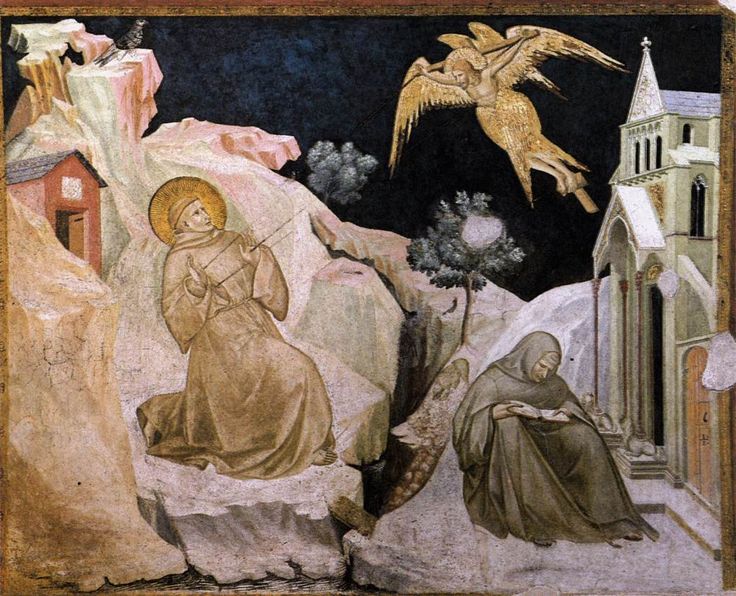
Stigmata of St Francis of Assisi
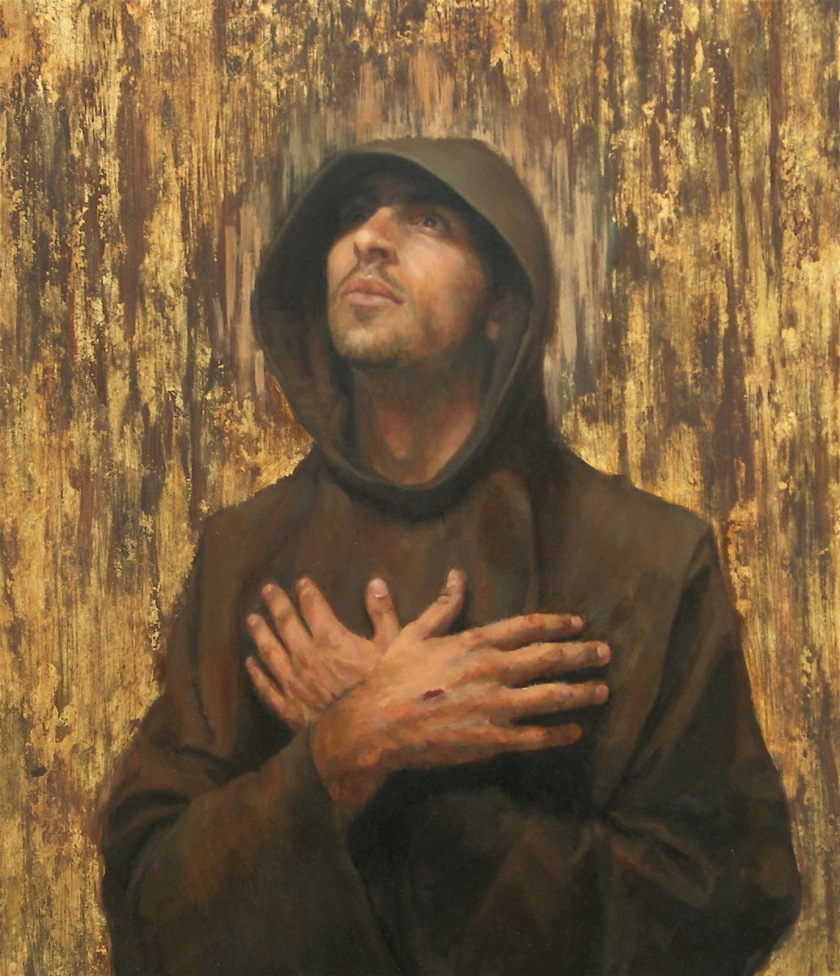
Two years before the great Saint Francis of Assisi died and when he was forty-two years old — one year after he had built the first crib in honour of Our Lord — he went off to a lonely mountain called Mount Alvernia, to prepare himself by forty days of fasting and prayer for the feast of Saint Michael, the greatest of God’s angels, whose feast day is 29 September.   On the feast of the Exaltation of the Holy Cross on 14 September, Saint Francis received in his hands, feet and side the Sacred Wounds from Our Lord’s own body.

Never was a saint more beautifully loved by Jesus than Saint Francis of Assisi.   The wounds Jesus gave him stayed in his hands, feet and side and continually bled for two more years, until he died in 1226.   The day on which Saint Francis received the Five Wounds of Our Lord was 14 September but so, that this beautiful event might have a feast day for itself, the Stigmata of Saint Francis are commemorated today, on 17 September.   The simple liturgy of this holy saint’s life might be put this way –  the crib in 1223, and the Cross in 1224.stigmata-of-st-francis-by-pietro-lorenzettifrancis

https://youtu.be/vT8jlwwhgzY

St Agathoclia
St Brogan of Ross Tuirc
St Columba of Cordova
St Crescentio of Rome
St Emmanuel Nguyen Van Trieu
St Flocellus
St Hildegard von Bingen OSB (1098-1179)

St Justin of Rome
St Lambert of Maastricht
St Narcissus of Rome
St Peter Arbues
St Rodingus
St Satyrus of Milan
St Socrates
Bl Stanislaus of Jesus and Mary
St Stephen
St Theodora
St Uni of Bremen
St Zygmunt Sajna
St Zygmunt Szcesny Felinski

Martyred in the Spanish Civil War
• Blessed Álvaro Santos Cejudo Moreno Chocano
• Blessed Juan Ventura Solsona
• Blessed Timoteo Valero Pérez

Posted in NOTES to Followers

Internet problems!

Apologies for the late posts today dear friends.

no internet - better late than never - 16 sept 2018

Posted in MORNING Prayers, PAPAL SERMONS, The WORD

Thought for the Day – 16 September –  Today’s Gospel: Mark 8:27–35

Thought for the Day – 16 September –  Today’s Gospel: Mark 8:27–35 – Twenty-fourth Sunday in Ordinary Time, Year B

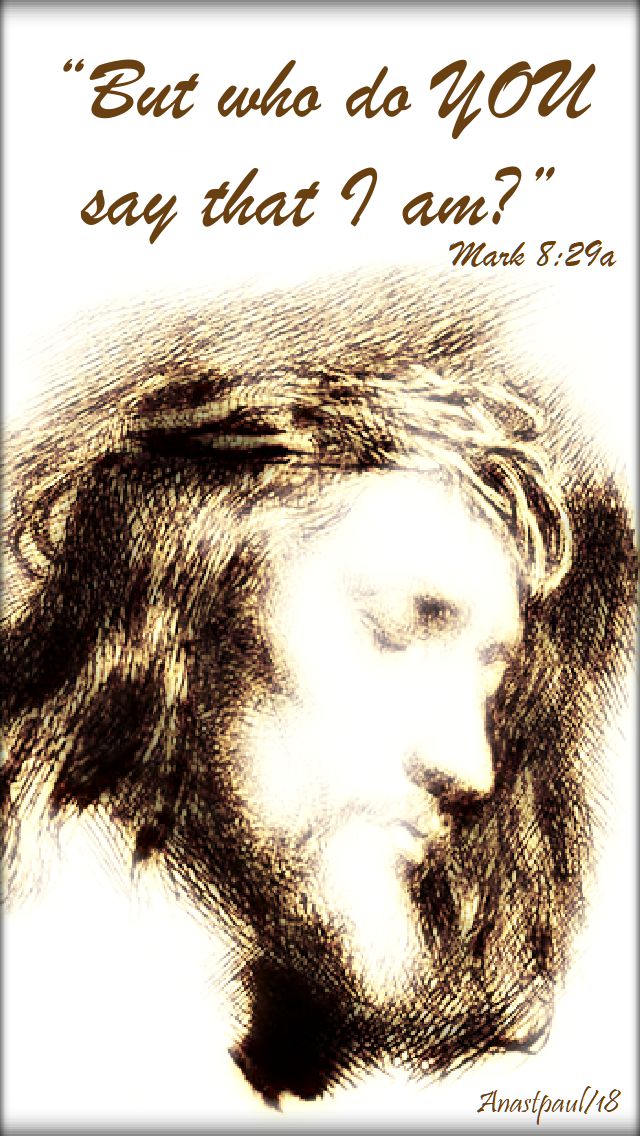
“But who do you say that I am?”

Peter answered him, “You are the Christ.”...Mark 8:29

These same questions are proposed to each of us today:  “Who is Jesus for the people of our time?” and more importantly:  “Who is Jesus for each of us?”, for me, for you,…? Who is Jesus for each one of us?

We are called to make Peter’s answer our own response, joyfully professing that Jesus is the Son of God, the Eternal Word of the Father, who became man to redeem mankind, pouring out the abundance of divine mercy upon it.

The world needs Christ more than ever:  His salvation, His merciful love.

Pope Francis – Angelus, 19 June 2016but who do YOU say that I am mark 8 29a 16 sept 2018

Posted in FATHERS of the Church, MORNING Prayers, QUOTES of the SAINTS, QUOTES on CHARITY, QUOTES on HUMILITY, QUOTES on LOVE, QUOTES on PEACE, QUOTES on the CHURCH, SAINT of the DAY

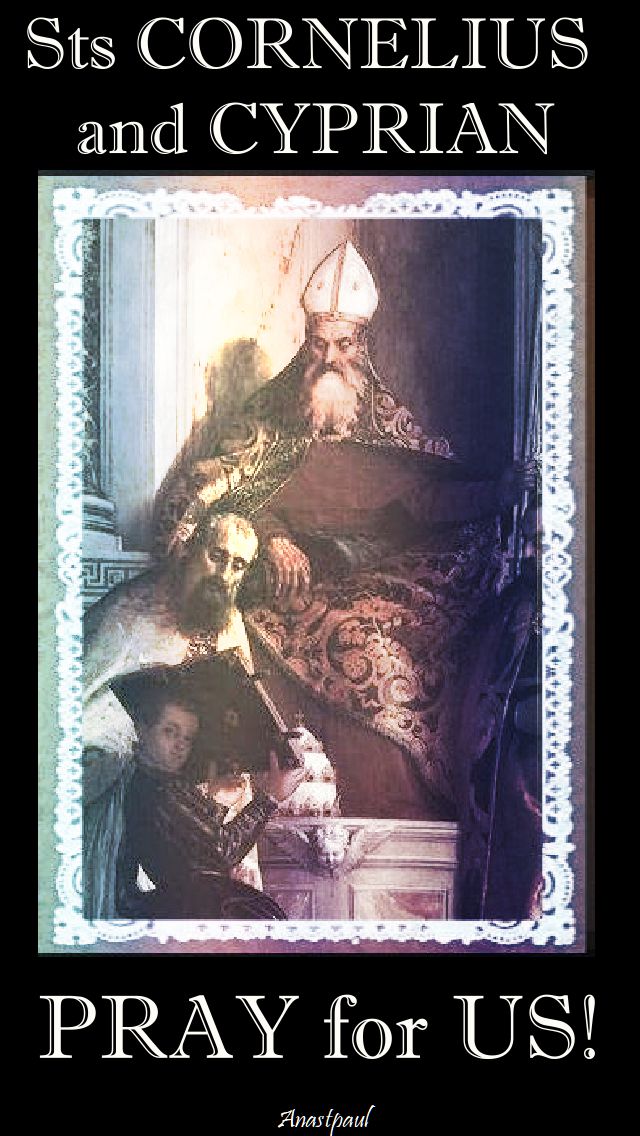
Quote/s of the Day – 16 September – The Memorial of Sts Cornelius and Cyprian Martyrs

Quote/s of the Day – 16 September – The Memorial of Sts Cornelius and Cyprian Martyrs

“We must carry out the will of God
rather than our own.
This is what we pledge to do in the “Our Father”,
which we recite every day.
What a travesty it would be if,
after praying that God’s will be done,
we should carry out that will halfheartedly
and only because we are obliged to do so!we-must-carry-out-the-will-of-god-rather-than-our-own-st-cyprian-of-carthage-190-258

“We have solemnly renounced the world
and therefore, whilst we continue in it,
we should behave like strangers and pilgrims.”we have solemnly renounced the world - st cyprian - 16 sept 2018

“You cannot have God for your Father
if you do not have the Church for your mother….
God is one and Christ is one and His Church is one;
one is the faith and one is the people cemented together
by harmony into the strong unity of a body….
If we are the heirs of Christ, let us abide in the peace of Christ;
if we are the sons of God, let us be lovers of peace.”you-cannot-have-god-for-your-father-st-cyprian-of-carthage-16 sept 2017

“You who are envious, let me tell you
that however often you may seek
for the opportunity of injuring him whom you hate,
you will never be able to do him so much harm,
as you do harm to yourselves.
He whom you would punish through the malice of your envy,
may probably escape but you will never
be able to fly from yourselves.” (St Cyprian from The Unity of the Catholic Church)you-who-are-envious- st cyprian - 16 sept 2017

“Let us remember one another in concord and unanimity.
Let us on both sides of death always pray for one another.
Let us relieve burdens and afflictions by mutual love,
that if one of us, by the swiftness of divine condescension,
shall go hence the first, our love may continue in the presence
of the Lord and our prayers for our brethren and sisters
not cease in the presence of the Father’s mercy.”
St Cyprian from letters (to St Pope Cornelius no 253)

St Cyprian of Carthage (190-258)let-us-remember-one-another-st-cyprian-of-carthage-190-258-16 sept 2017

Posted in MORNING Prayers, QUOTES of the SAINTS, QUOTES on the CROSS of CHRIST, SAINT of the DAY, The BLESSED VIRGIN MARY, The WORD

One Minute Reflection – 16 September – Today’s Gospel: Mark 8:27–35

One Minute Reflection – 16 September – Today’s Gospel: Mark 8:27–35 – Twenty-fourth Sunday in Ordinary Time, Year B and the Memorial of Sts Cornelius & Cyprian and St Ninian

“If any man would come after me,
let him deny himself and take up his cross
and follow me.”…Mark 8:34

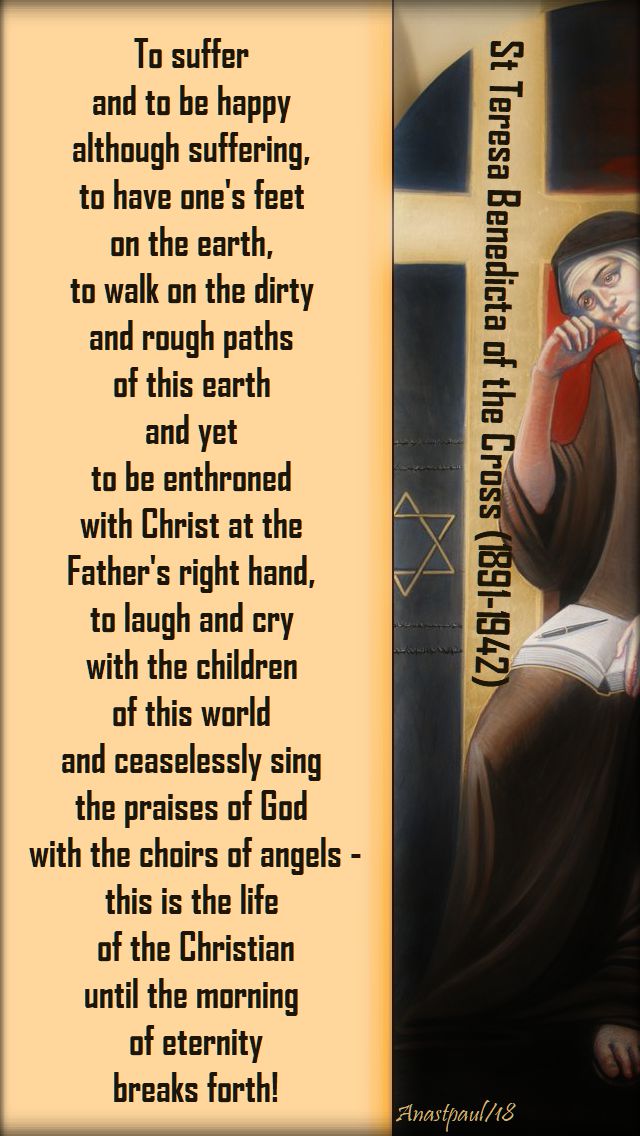
REFLECTION – “Being one with Christ is our sanctity, and progressively becoming one with him our happiness on earth, the love of the cross in no way contradicts being a joyful child of God. Helping Christ carry his cross fills one with a strong and pure joy, and those who may and can do so, the builders of God’s kingdom, are the most authentic children of God.   And so those who have a predilection for the way of the cross by no means deny that Good Friday is past and that the work of salvation has been accomplished.   Only those who are being saved, only children of grace, can in fact be bearers of Christ’s cross.   Only in union with the divine Head does human suffering take an expiatory power.   To suffer and to be happy although suffering, to have one’s feet on the earth, to walk on the dirty and rough paths of this earth and yet to be enthroned with Christ at the Father’s right hand, to laugh and cry with the children of this world and ceaselessly sing the praises of God with the choirs of angels – this is the life of the Christian until the morning of eternity breaks forth.”…St Teresa Benedicta of the Cross (1891-1942)to suffer and to be happy - st t benedicta of the Cross - 16 sept 2018

PRAYER – Look upon us Lord, Creator and Ruler of the whole world, give us the grace to serve You with all our hearts, to take up our cross and follow You, that we may come to know the power of Your love and the forgiveness which You give and You teach.   Grant that by the intercession of Sts Cornelius and Cyprian and St Ninian, we may attain the glory of Your kingdom and see You face to face.   We make our prayer through Christ our Lord with the Holy Spirit, one God forever, amen.sts-cornelius-and-cyprian-pray-for-us-16 sept 2017st ninian pray for us - 16 sept 2018

Posted in MORNING Prayers, NOVENAS

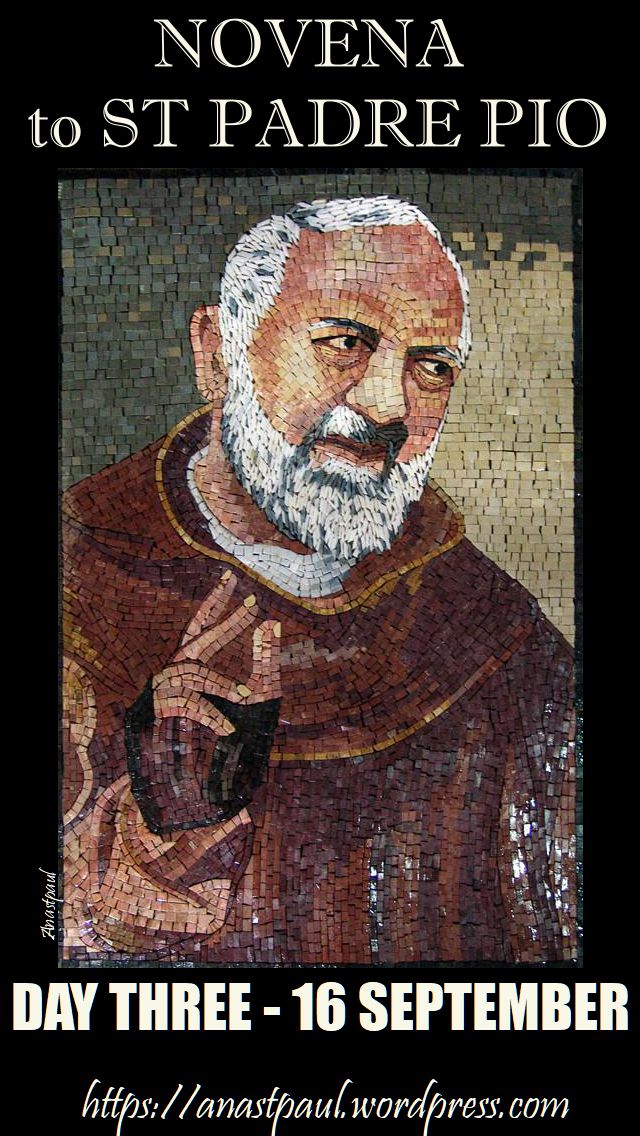
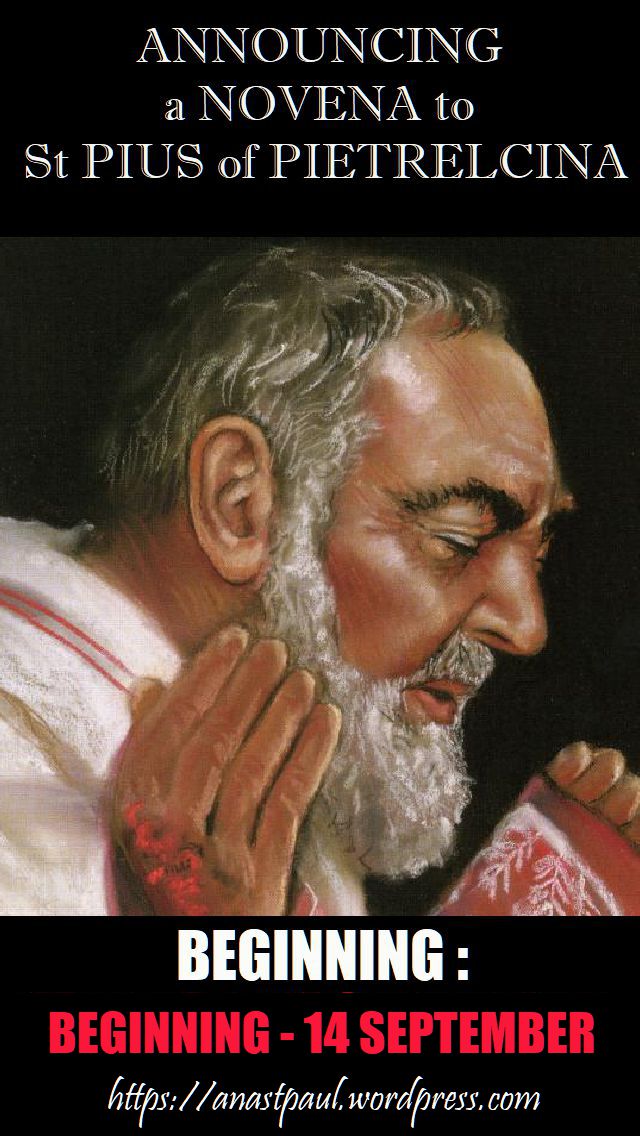
NOVENA to St Padre Pio/St Pius of Pietrelcina – DAY THREE – 16 September

NOVENA to St Padre Pio/St Pius of Pietrelcina – DAY THREE – 16 September

St Padre Pio you have said:

I am greatly comforted and very content in Jesus’ company and who could describe the help it is to me to have Him continually by my side?   This company makes me much more careful not to do anything which would displease God.   It seems to me as if Jesus is constantly watching me.   If it sometimes happens that I lose the presence of God, I soon hear Our Lord calling me back to my duty.   I cannot describe the voice He uses to call me back but I know that it is very penetrating and the soul who hears it finds it almost impossible to refuse what He asks.

Let us Pray:

Gracious God, You generously blessed Your servant, Padre Pio, with the gifts of the Spirit.
You marked his body with the five wounds of Christ Crucified,
as a powerful witness to the saving Passion and Death of Your Son
and as a stirring inspiration to many people of Your infinite mercy, forgiveness and love.
In the confessional, Padre Pio laboured endlessly for the salvation of souls.
Whenever You called, he answered,
serving Your people for the greater good of their souls
and for your Glory.
Through his powerful intercession, many who suffered were healed of sickness and disease.
Endowed with the gift of discernment, he could read people’s hearts.
With dignity and intense devotion, he celebrated daily Mass,
inviting countless men and women to a greater union with Jesus Christ,
in the Sacrament of the Holy Eucharist.
Through the intercession of Saint Pio,
we confidently beseech You to to grant us the grace of
………………. (state your petition here).
Help us to imitate his example of prayerful holiness and compassion,
so that we, too, may faithfully follow the Risen Lord
and one day rejoice in the Kingdom,
where You live and reign forever and ever.
Amenday-three-novena-to-st-padre-pio-16-sept

Posted in DOCTORS of the Church, EUCHARISTIC Adoration, FATHERS of the Church, MORNING Prayers, PAPAL MESSAGES, QUOTES of the SAINTS, QUOTES on PRAYER, SUNDAY REFLECTIONS, The HOLY EUCHARIST / The HOLY MASS

Sunday Reflection – 16 September – Twenty-fourth Sunday in Ordinary Time, Year B

Sunday Reflection – 16 September – Twenty-fourth Sunday in Ordinary Time, Year B

Excerpt from a Letter of His Holiness Pope Benedict XVI,
given on the Occasion of the 16th Centenary
of the Death of St John Chrysostom “Doctor of the Eucharist”

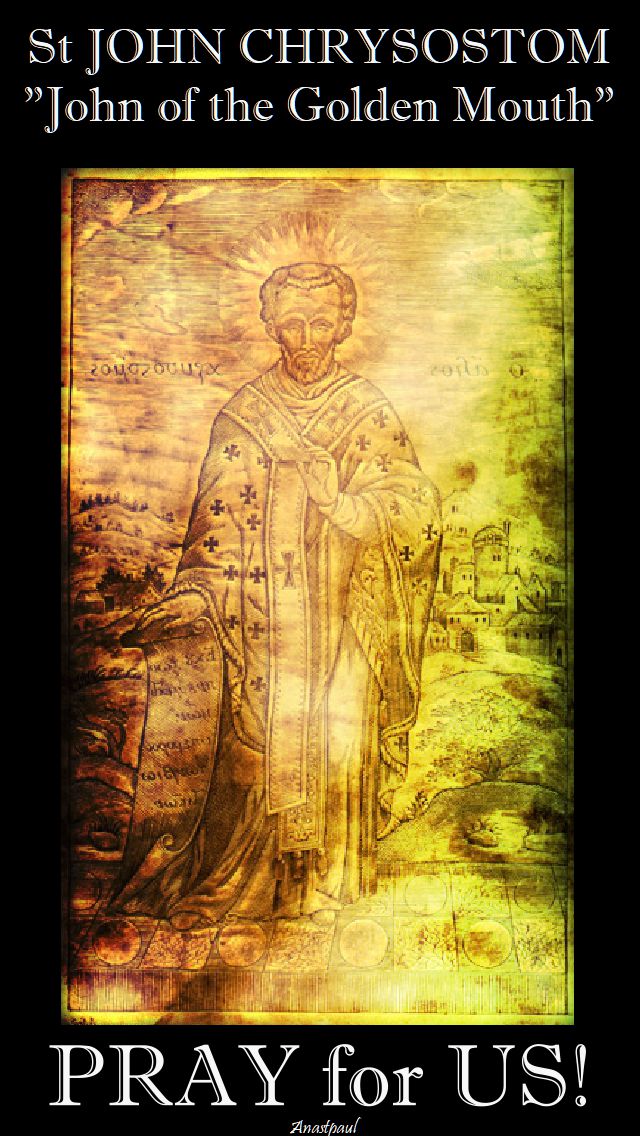
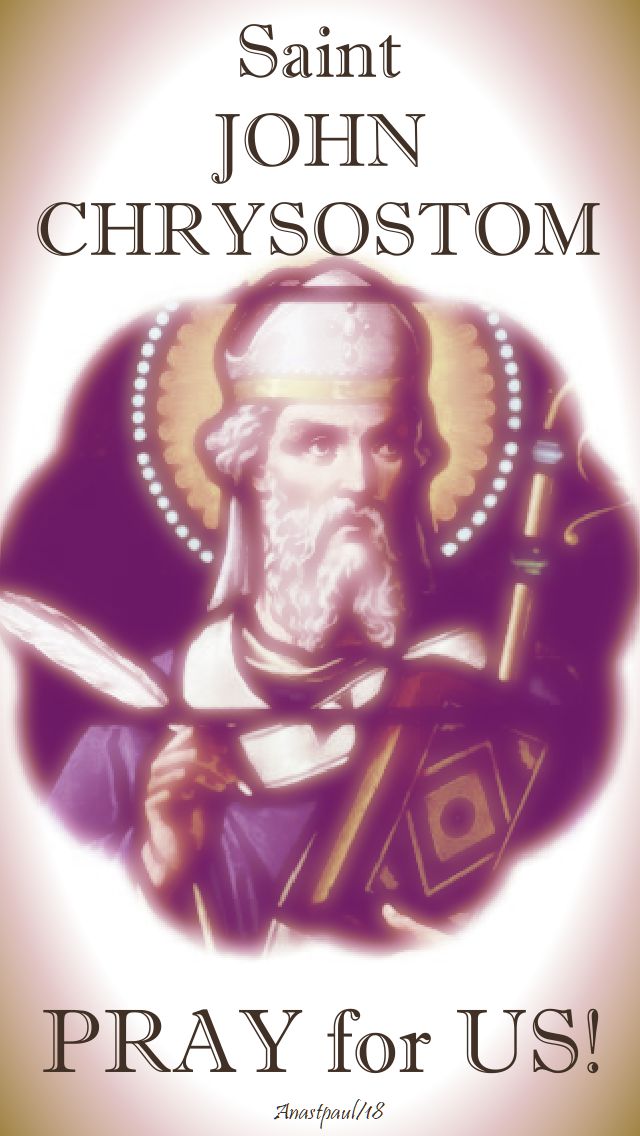
For Chrysostom, the ecclesial unity that is brought about in Christ is attested to in a quite special way in the Eucharist. “Called “Doctor of the Eucharist’ because of the vastness and depth of his teaching on the Most Holy Sacrament”, he taught that the sacramental unity of the Eucharist constitutes the basis of ecclesial unity in and for Christ.   “Of course, there are many things to keep us united. A table is prepared before all… all are offered the same drink, or, rather, not only the same drink but also the same cup. Our Father, desiring to lead us to tender affection, has also disposed this – that we drink from one cup, something that is befitting to an intense love”.   Reflecting on the words of St Paul’s First Letter to the Corinthians, “The bread which we break, is it not a participation in the body of Christ?”, John commented,for the Apostle, therefore, “just as that body is united to Christ, so we are united to Him through this bread”.   And even more clearly, in the light of the Apostle’s subsequent words:  “Because there is one bread, we who are many are one body”, John argued:  “What is bread?   The Body of Christ  . And what does it become when we eat it?   The Body of Christ – not many bodies but one body.   Just as bread becomes one loaf although it is made of numerous grains of wheat…, so we too are united both with one another and with Christ…. Now, if we are nourished by the same loaf and all become the same thing, why do we not also show the same love, so as to become one in this dimension, too?”.

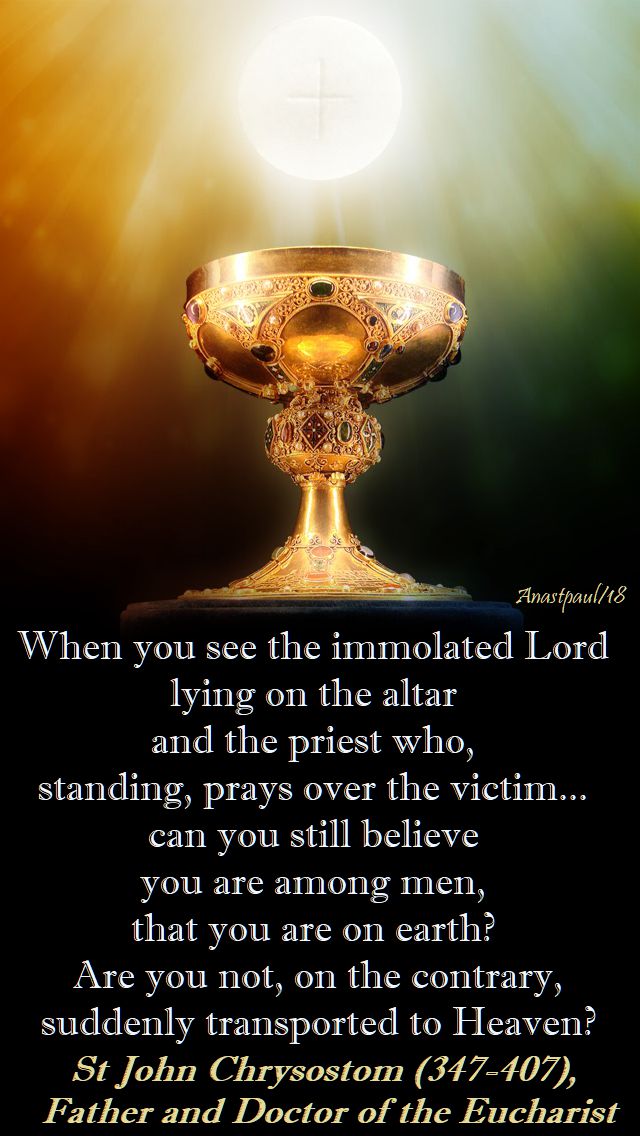
Chrysostom’s faith in the mystery of love that binds believers to Christ and to one another led him to experience profound veneration for the Eucharist, a veneration which he nourished in particular in the celebration of the Divine Liturgy.   Indeed, one of the richest forms of the Eastern Liturgy bears his name:  “The Divine Liturgy of St John Chrysostom”.   John understood that the Divine Liturgy places the believer spiritually between earthly life and the heavenly realities that have been promised by the Lord.   He told Basil the Great of the reverential awe he felt in celebrating the sacred mysteries with these words:   “When you see the immolated Lord lying on the altar and the priest who, standing, prays over the victim… can you still believe you are among men, that you are on earth? Are you not, on the contrary, suddenly transported to Heaven?”   The sacred rites, John said, “are not only marvellous to see but extraordinary because of the reverential awe they inspire. The priest who brings down the Holy Spirit stands there… he prays at length that the grace which descends on the sacrifice may illuminate the minds of all in that place and make them brighter than silver purified in the crucible. Who can spurn this venerable mystery?”.when you see the immolated lord - st john chrysostom - sunday reflection - 16 sept 2018 24th ord time year b

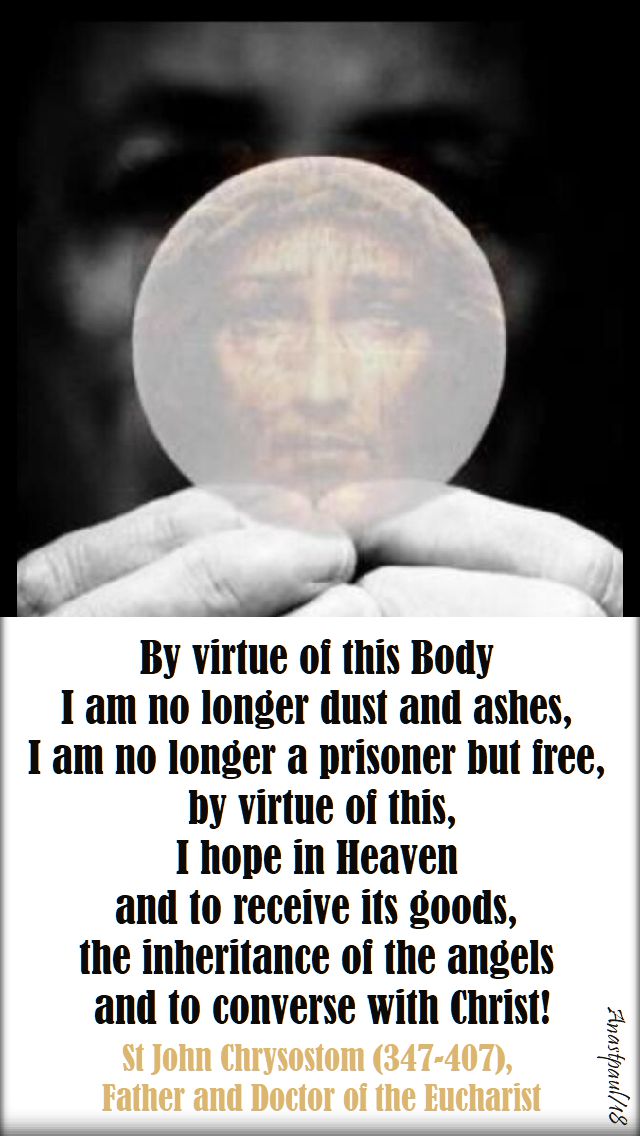
With great depth, Chrysostom developed his reflection on the effect of sacramental Communion in believers:  “The Blood of Christ renews in us the image of our King, it produces an indescribable beauty and does not allow the nobility of our souls to be destroyed but ceaselessly waters and nourishes them”.   For this reason, John often and insistently urged the faithful to approach the Lord’s altar in a dignified manner, “not with levity… not by habit or with formality”, but with “sincerity and purity of spirit”.   He tirelessly repeated that preparation for Holy Communion must include repentance for sins and gratitude for Christ’s sacrifice made for our salvation.   He therefore urged the faithful to participate fully and devoutly in the rites of the Divine Liturgy and to receive Holy Communion with these same dispositions:  “Do not permit us, we implore you, to be killed by your irreverence but approach Him with devotion and purity and, when you see Him placed before you, say to yourselves:  “By virtue of this Body I am no longer dust and ashes, I am no longer a prisoner but free, by virtue of this, I hope in Heaven and to receive its goods, the inheritance of the angels and to converse with Christ'”.by virtue of this body - st john chrysostom - 16 sept 2018

Of course, he also drew from contemplation of the Mystery the moral consequences in which he involved his listeners: he reminded them that communion with the Body and Blood of Christ obliged them to offer material help to the poor and the hungry who lived among them.   The Lord’s table is the place where believers recognise and welcome the poor and needy whom they may have previously ignored.   He urged the faithful of all times to look beyond the altar where the Eucharistic Sacrifice is offered and see Christ in the person of the poor, recalling that thanks to their assistance to the needy, they will be able to offer on Christ’s altar a sacrifice pleasing to God.”...Pope Benedict

He said:
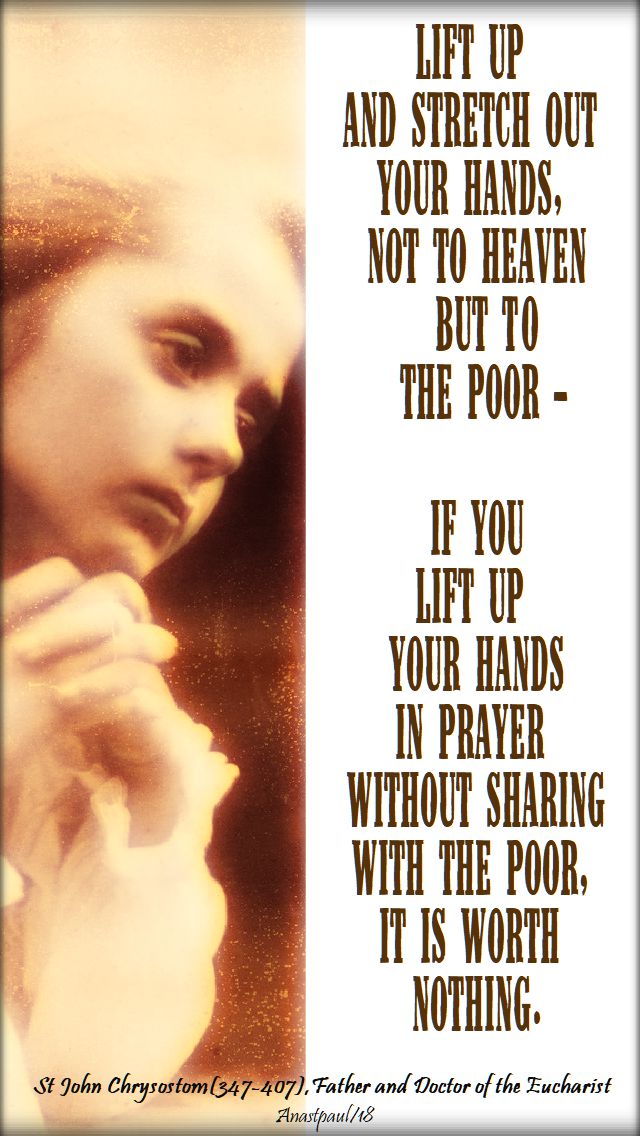
“Lift up and stretch out your hands,
not to heaven but to the poor…
if you lift up your hands in prayer
without sharing with the poor,
it is worth nothing.”lift up and stretch out your hands, not to heaven but to the poor - st john chrysostom - 16 sept 2018

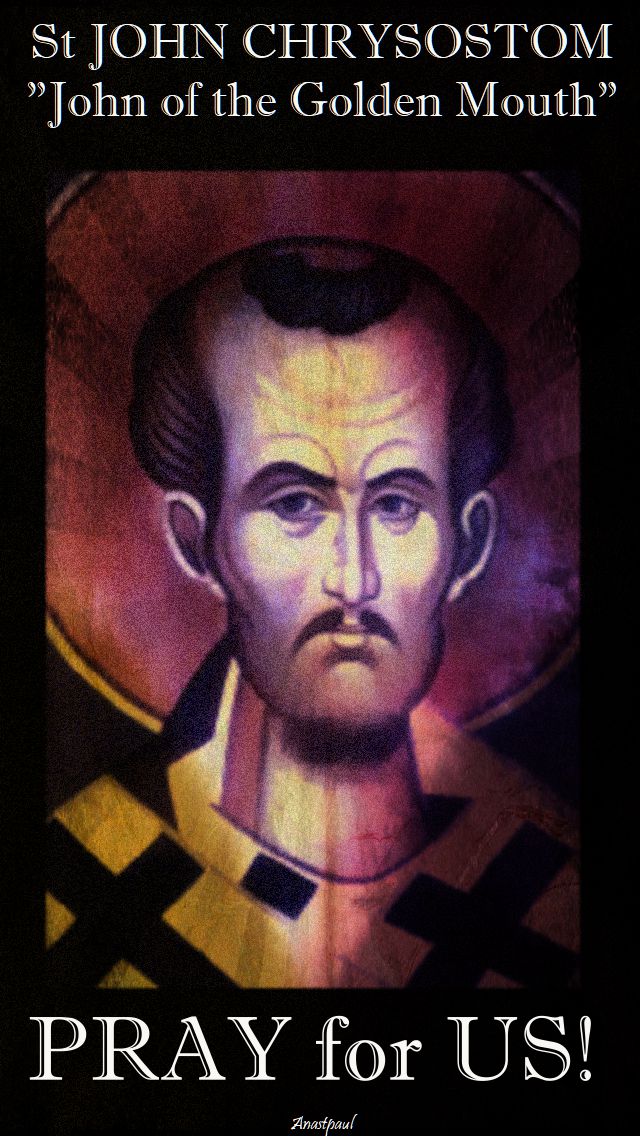
St John Chrysostom (347-407), Father and Doctor of the Eucharist, Pray for us!st john chrysostom pray for us.2

Posted in DOCTORS of the Church, Our MORNING Offering, PRAYERS of the SAINTS, The HOLY EUCHARIST / The HOLY MASS

Our Morning Offering – 16 September – Twenty-fourth Sunday in Ordinary Time, Year B

Our Morning Offering – 16 September – Twenty-fourth Sunday in Ordinary Time, Year B

Jesus, Joy of Loving Hearts
By St Bernard of Clairvaux (1090-1153) Doctor of the Church

Jesus, joy of loving hearts,
You Fount of life,
You Light of men,
from the best bliss that earth imparts
we turn unfilled to You again.
We taste You,
O You living Bread,
and long to feast upon You still:
We drink of You, the Fountainhead,
and thirst our souls from You to fill.
O Jesus, ever with us stay,
make all our moments calm and bright;
chase the dark night of sin away,
shed o’er the world Your holy light.
Amen, Amenjesus joy of loving hearts - st bernard - eucharistic prayer - 16 sept 2018

Posted in SAINT of the DAY

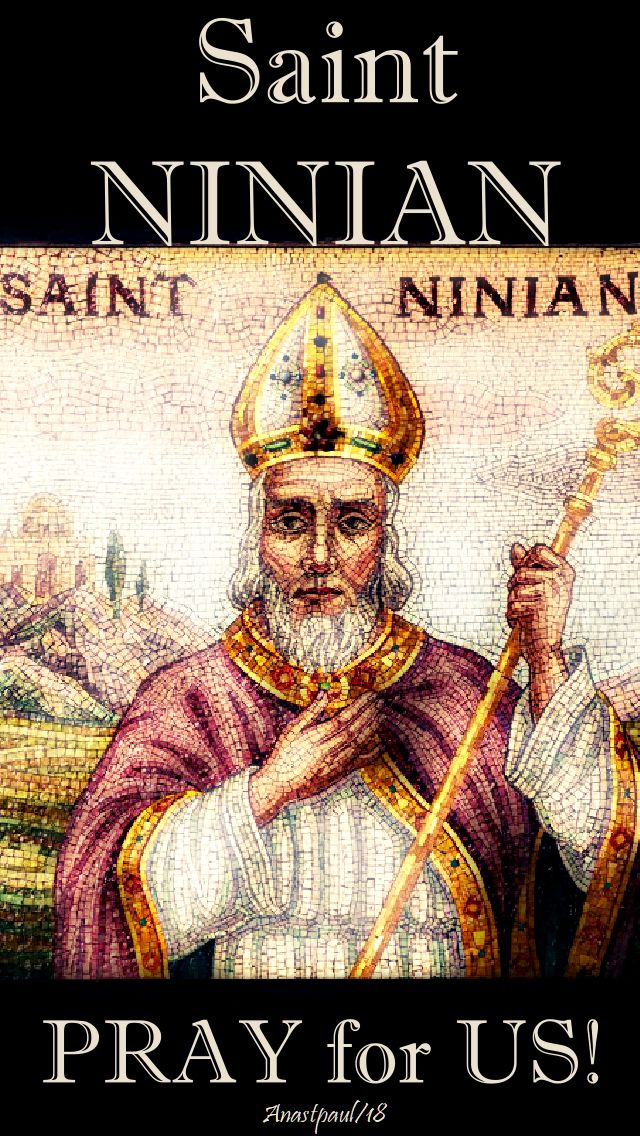
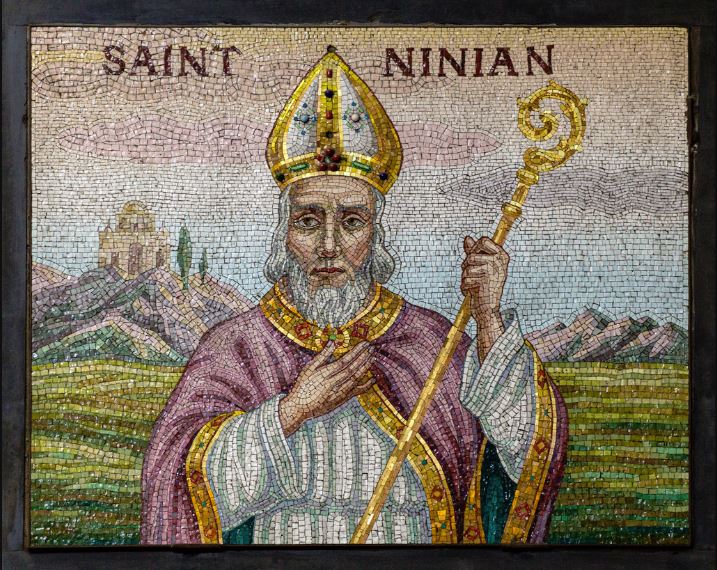
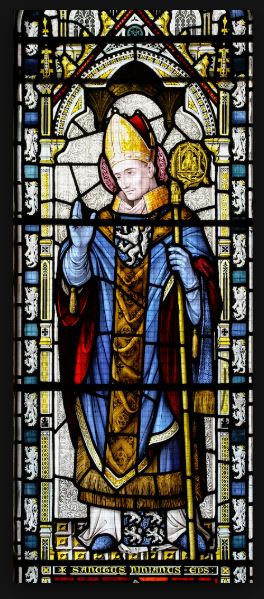
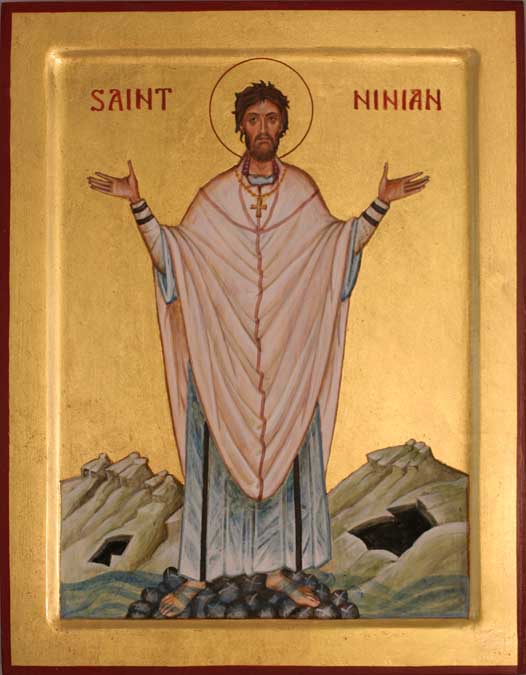
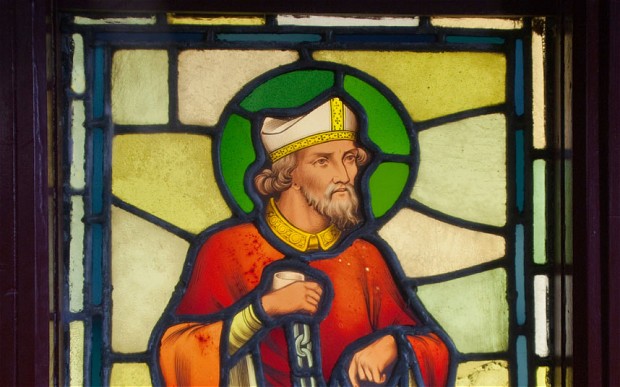
Saint of the Day – 16 September – St Ninian (c 360-Died 432) Apostle to the Southern Picts

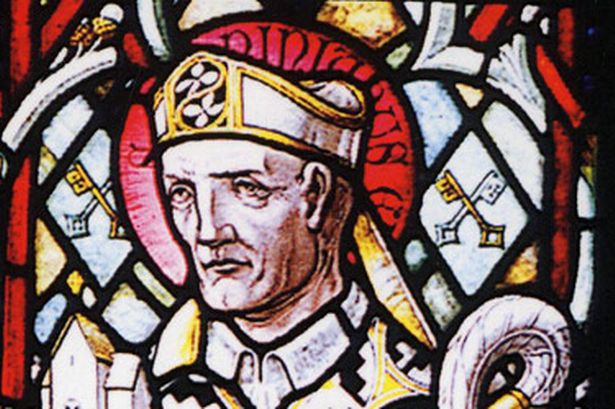
Saint of the Day – 16 September – St Ninian (c 360 – Died 432) Apostle to the Southern Picts, Bishop, Missionary, Monastic Founder, Wonderworker – also known as  Apostle of North Britain,  Apostle of the Southern Picts/Picts,  Dinan, Ninias, Ninianus, Ninus, Nynia, Ninyas, Ringan, Ringen.   St Ninian was born in c 360 at Cumbria, Britain and he died in c 432 of natural causes.   His body was interred at the church at Whithorn Abbey, Scotland but his relics were lost during the Reformation.  Patronages – Shetland Isles, Antigonish, Nova Scotia, Canada, diocese of, Galloway, Scotland, diocese of.Ninian beautiful lg(1)

St Ninian, a Briton by origin, is one of the most venerated saints of Scotland.   He is commemorated as “Apostle of the Southern Picts.”   Although few details of the life and activities of St Ninian are known, in addition to ancient traditions several early written pieces of evidence about the saint have survived.   Our great authority, the Venerable Bede mentions St Ninian in his Ecclesiastical History of the English People (731).   In the ninth century, an anonymous author wrote an account of St  Ninian’s miracles. St Aelred of Rievaulx in the twelfth century and the Irish archbishop James Usher of Armagh early in the seventeenth century wrote about St Ninian as well.

The future saint was most probably born in the second half of the fourth century—perhaps in about 360.   He belonged to the so-called “Roman-British” tradition of early British Christianity.   His native land was most likely Cumbria, at least it is nearly certain that he was born south of Hadrian’s Wall in today’s northern England.   His father, according to some sources, was a local Christian ruler.   While still very young, St Ninian very clearly began to feel a calling to Christianise his native country.   According to tradition, after the saint went to study in Rome, he then visited Gaul where at his monastery in Tours he met St Martin—a great missionary and father of monasticism of Gaul.   There is an opinion that St Ninian was consecrated bishop either in Rome or Gaul (and, if the latter, the consecration was probably performed by St Martin himself).header - st ninian

Inspired by St Martin’s example, in about 394 St Ninian returned to Scotland where he made the Whithorn peninsula in the present-day region of Dumfries and Galloway (south-western Scotland) the centre of his missionary activities.   From here he successfully preached to the Southern Picts and converted many of them to Christ.   He obviously preached to Irish settlers in Scotland as well and his work among them was fruitful.   There is no doubt that St Ninian established his see at Whithorn and also founded a church and a monastery dedicating it to St Martin.   Historians suppose that it was St Martin who sent skilled masons from Gaul to help Ninian build the church at Whithorn.   Whithorn derives its name from the main monastery church whose walls had been built of stone covered with lime plaster, which was a great rarity in Britain at that time.   The very name “Whithorn” can be translated as “lime washed church”, or “white house” and throughout the medieval period this splendid church together with the whole diocese was known as “Candida Casa” (“white house” in Latin).   The church was built in a Roman fashion and according to the best standards of the time.

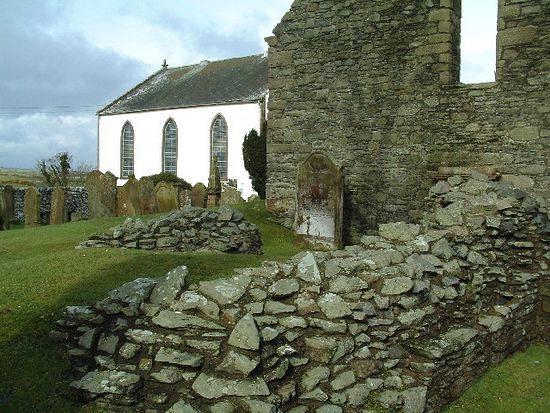
st ninian's chapel
The remains of St Ninians Whithorn Chapel

The monastery founded by St Ninian became a famous missionary and monastic centre. He and his disciples evangelised the Southern Picts and Northern Britons.   Some traditions say that St Ninian’s disciples extended the mission to Scotland in general, which is testified by a large number of churches dedicated to him there and at least three in northern England.   St Ninian, a renowned ascetic and man of prayer, used to live alone in solitude in a cave for prayer – Whithorn indeed played an important role in the development ofChristianity in Britain, along with Iona and Lindisfarne.   St Ninian was probably the first Bishop of Galloway.   During his life St Ninian worked many miracles, which continued through his prayers after his death.

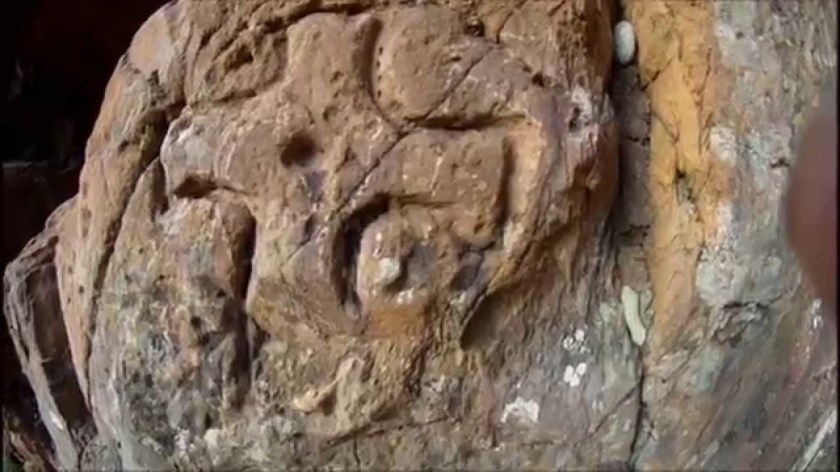
st ninian's cave - maxresdefault
St Ninian’s Cave – detail of His Cross
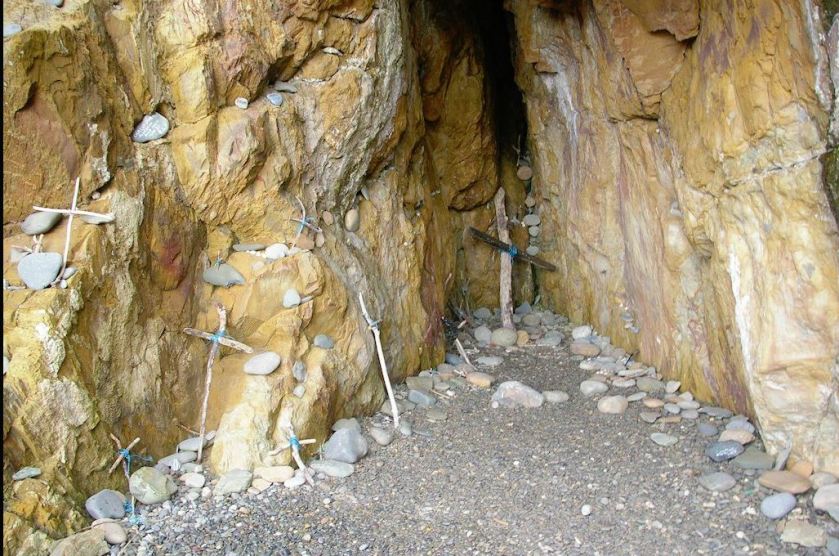
st ninian's cave with pilgrims driftwood crosses
St Ninian’s cave with pilgrims’ driftwood crosses

Some believe that shortly before his death St Ninian may have moved from Scotland to Ireland and died there, though there is no real evidence to confirm this.   According to a legend, at the moment of St Ninian’s repose, a bell began to ring by itself, announcing the death of the righteous man and calling everybody to his deathbed.   St Ninian was buried in a stone coffin near the altar of the church that he had built on Whithorn. Pilgrims flocked to his relics up to the sixteenth century Reformation.

The Whithorn monastery had close connections with Mediterranean countries.   Its monks were famous for their learning and severity of ascetic life, adopted by them from the Christian East.   It was Whithorn where there studied many future missionaries, now venerated in different parts of Scotland.   Today Christian pilgrims visit Whithorn on a par with other important early Christian shrines in northern Britain.   The cave where Ninian used to pray and (possibly) the saint’s personal bell have survived.   The cave is located on the east side of the peninsula.   It is a truly peaceful, quiet place in idyllic surroundings and all Christians who visit it feel the holy bishop’s presence there to this day.   A very ancient settlement, now a district within the city of Stirling in central Scotland, is called St Ninians in honour of the saint.

st ninian apostle to the pics - glass

Excavations carried out on Whithorn in recent times have confirmed the authenticity of the ancient traditions concerning St Ninian (this is true for many other early Christian sites in the British Isles as well).  Specifically, the remains of a very ancient circular church were discovered and its walls had indeed been whitewashed.   Ancient inscribed Christian gravestones as well as very small wattle houses were discovered near the church, which indicates that a monastic community had existed here in the Celtic period. Supposedly, the monastery had more than one church and it definitely had a school. Though it is impossible to ascertain whether this monastery was dedicated to St Martin or not, it was believed that the monastery kept a portion of his relics.   Later, such was the fame of St Ninian that his veneration spread to Kent and to Denmark.   Today he is even venerated in the Nova Scotia province of eastern Canada and in Africa.ninian

Numerous parish churches and chapels dedicated to St Ninian or associated with him are scattered all over southern Scotland.   Nearly all of them are more than 1000 years old.   Some of them were founded by the saint himself and later partly rebuilt, others were founded by his disciples, who spread the Gospel to the north, west and other parts of the country.   One of the greatest disciples of St Ninian was St Kentigern.   Notably, most of the surviving medieval churches dedicated to St Ninian are situated to the south of the Firth of Forth and the Firth of Clyde estuaries, on Orkney (where he is widely venerated), Shetland (of which he is a patron-saint) islands as well as on the Isle of Man, on the island of Bute and on the island of Sanda in the Faeroes.   Ruins of the chapel built by St Ninian as well as early crosses and a holy well have survived on this island.   Local legends relate that the holy bishop is buried on Sanda and that his grave can still allegedly be found here—under an old alder tree.   True, this is just a legend but Sanda originally belonged to the Whithorn Monastery and had close links with its community. St. Ninian’s disciples also erected a chapel on the isle known as “St Ninian’s Isle” after him – this is in Shetland, and the ruins of a twelfth century chapel survive there to this day.

st ninian's well snip
St Ninian’s Well

The Whithorn peninsula is considered to be the main site of the veneration of St Ninian to this day.   Here pilgrims can see ruins of the late medieval Roman Catholic priory, including its nave, vault and the very site where the shrine with St Ninian’s relics used to stand.   The museum on Whithorn houses a large collection of interesting artefacts discovered here during the recent excavations.   In addition to the priory ruins, the parish church, cave and other ancient monuments, the peninsula also has another museum which exhibits a considerable number of ancient Celtic crosses, the oldest of them dating back to the fifth century.   A thirteenth century chapel dedicated to St Ninian has partly survived not far away, though it is now roofless.

May St Ninian continue to evangelise his beloved peoples in Scotland and Northern England and may he pray for us all!st ninian glass 2st-ninian-image-2-114695224

Posted in SAINT of the DAY

Memorials of the Saints – 16 September

St Pope Cornelius (Martyred in 253) (Memorial)
St Cyprian of Carthage (190-Martyred in 258) (Memorial)
Full story here: https://anastpaul.wordpress.com/2017/09/16/saints-of-the-day-16-september-st-pope-cornelius-and-st-cyprian-of-carthage-martyrs/

https://www.youtube.com/watch?v=0elOV8-tQxI

St Abundantius of Rome
St Abundius of Rome
St Andrew Kim Taegon
St Cunibert of Maroilles
St Curcodomus
Bl Dominic Shobyoye
St Dulcissima of Sutri
St Edith of Wilton
St Eugenia of Hohenburg
St Euphemia of Chalcedon
St Geminianus of Rome
St John of Rome
Bl Louis Allemand
St Lucy of Rome
St Ludmila
St Marcian the Senator
Bl Martin of Huerta
Bl Michael Himonaya
St Ninian (Died 432) Apostle to the Southern Picts
Bl Paul Fimonaya
St Priscus of Nocera
St Rogellus of Cordoba
St Sebastiana
St Servus Dei
St Stephen of Perugia
Bl Pope Victor III
St Vitalis of Savigny

Martyrs of the Via Nomentana: Four Christian men martyred together, date unknown – Alexander, Felix, Papias and Victor. They were martyred on the Via Nomentana outside Rome, Italy.

Martyred in the Spanish Civil War:
• Blessed Antonio Martínez García
• Blessed Ignasi Casanovas Perramón
• Blessed Manuel Ferrer Jordá
• Blessed Pablo Martínez Robles
• Blessed Salvador Ferrer Cardet

Posted in MORNING Prayers, NOVENAS, QUOTES of the SAINTS, QUOTES on HUMILITY

NOVENA to St Padre Pio/St Pius of Pietrelcina – DAY TWO – 15 September

NOVENA to St Padre Pio/St Pius of Pietrelcina – DAY TWO – 15 September

St Padre Pio you have said:

I implore you to be faithful and humble and always to keep the great Mother of God before your mental gaze, she who humbled herself more profoundly the more she was exalted. Never, ever be exalted at your virtues but repeat that everything comes from God and give Him the honour and glory.

Let us Pray:

Gracious God, You generously blessed Your servant, Padre Pio, with the gifts of the Spirit.
You marked his body with the five wounds of Christ Crucified,
as a powerful witness to the saving Passion and Death of Your Son
and as a stirring inspiration to many people of Your infinite mercy, forgiveness and love.
In the confessional, Padre Pio laboured endlessly for the salvation of souls.
Through his powerful intercession, many who suffered were healed of sickness and disease.
Endowed with the gift of discernment, he could read people’s hearts.
With dignity and intense devotion, he celebrated daily Mass,
inviting countless men and women to a greater union with Jesus Christ,
in the Sacrament of the Holy Eucharist.
Through the intercession of Saint Pio,
we confidently beseech You to to grant us the grace of
………………. (state your petition here).
Help us to imitate his example of prayerful holiness and compassion,
so that we, too, may faithfully follow the Risen Lord
and one day rejoice in the Kingdom,
where You live and reign forever and ever.

Amenday-two-novena-st-pio-15-sept

Posted in CATHOLIC DEVOTIONS of the Month, DOCTORS of the Church, MARIAN DEVOTIONS, MARIAN PRAYERS, MARIAN QUOTES, MARIAN TITLES, MORNING Prayers, PRAYERS of the SAINTS, QUOTES of the SAINTS, SAINT of the DAY, The BLESSED VIRGIN MARY

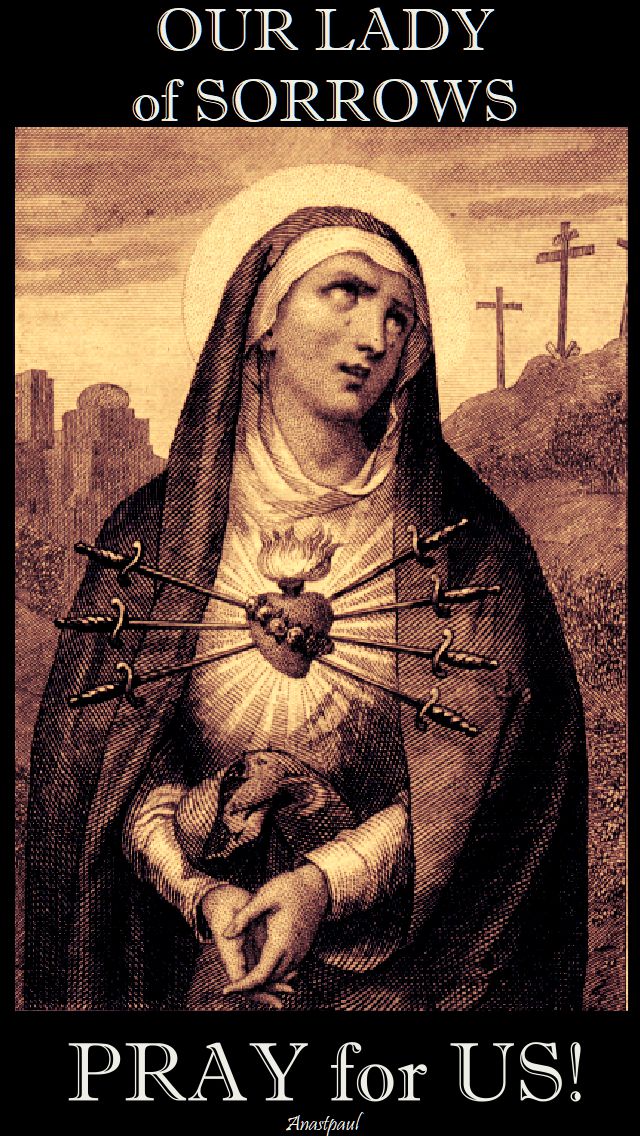
Thought for the Day – 15 September – The Memorial of Our Lady of Sorrows

Thought for the Day – 15 September – The Memorial of Our Lady of Sorrows

The Seven Sorrows of
the Blessed Virgin Mary

1. The prophecy of Simeon
2. The Flight to Egypt
3. Loss of Child Jesus for 3 days
4. Meeting Jesus carrying His Cross
5. The Crucifixion of Jesus
6. The Pieta – receiving Jesus’ Body
7. The Burial of Jesus

“The Liturgy teaches us to meditate on the sorrows of Mary.   So we turn once more to a memory of sadness, an example of patient endurance, to remind ourselves, for our own good, that our whole life here below is beset with trials and difficulties.   It is a life of hardships but at the end, we shall receive the reward of eternal joy.

So we must always take courage – Jesus, Mary and Joseph, give us the certainty of future triumphs.   In every moment of their earthly lives, they knew sorrow, privations and suffering and yet, they always reflected the eternal splendour of heaven.

The lesson all the faithful may learn from such sublime examples, is a continual encouragement and strength, by means of which, rising again after every failure and correcting the faults of our temperaments, we may all seek to reach that shore, whee perfect peace and blessing are to be found.”St Pope John XXIII

John’s account of Jesus’ death is highly symbolic.   When Jesus gives the beloved disciple to Mary, we are invited to appreciate Mary’s role in the Church – she symbolises the Church, the beloved disciple represents all believers.   As Mary mothered Jesus, she is now mother to all his followers.   Furthermore, as Jesus died, he handed over His Spirit. Mary and the Spirit co-operated in begetting new children of God—almost an echo of Luke’s account of Jesus’ conception.   Christians can trust that they will continue to experience the caring presence of Mary and Jesus’ Spirit throughout their lives and throughout history.

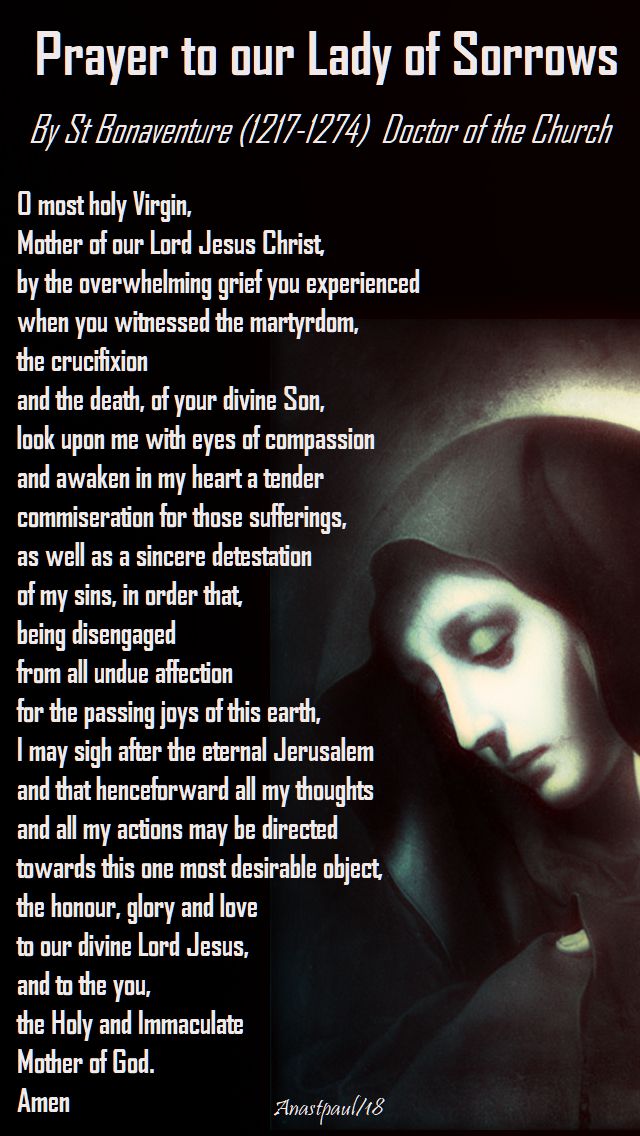
Prayer to our Lady of Sorrows
By St Bonaventure (1217-1274) Doctor of the Church

O most holy Virgin, 
Mother of our Lord Jesus Christ,
by the overwhelming grief you experienced
when you witnessed the martyrdom,
the crucifixion
and the death, of your divine Son,
look upon me with eyes of compassion
and awaken in my heart a tender 
commiseration for those sufferings,
as well as a sincere detestation
of my sins, in order that,
being disengaged from all undue affection
for the passing joys of this earth,
I may sigh after the eternal Jerusalem
and that henceforward all my thoughts
and all my actions may be directed
towards this one most desirable object,
the honour, glory and love 
to our divine Lord Jesus,
and to the you,
the Holy and Immaculate 
Mother of God. 
Amenprayer-to-our-lady-of-sorrows-st-bonaventure-1-sept-2018

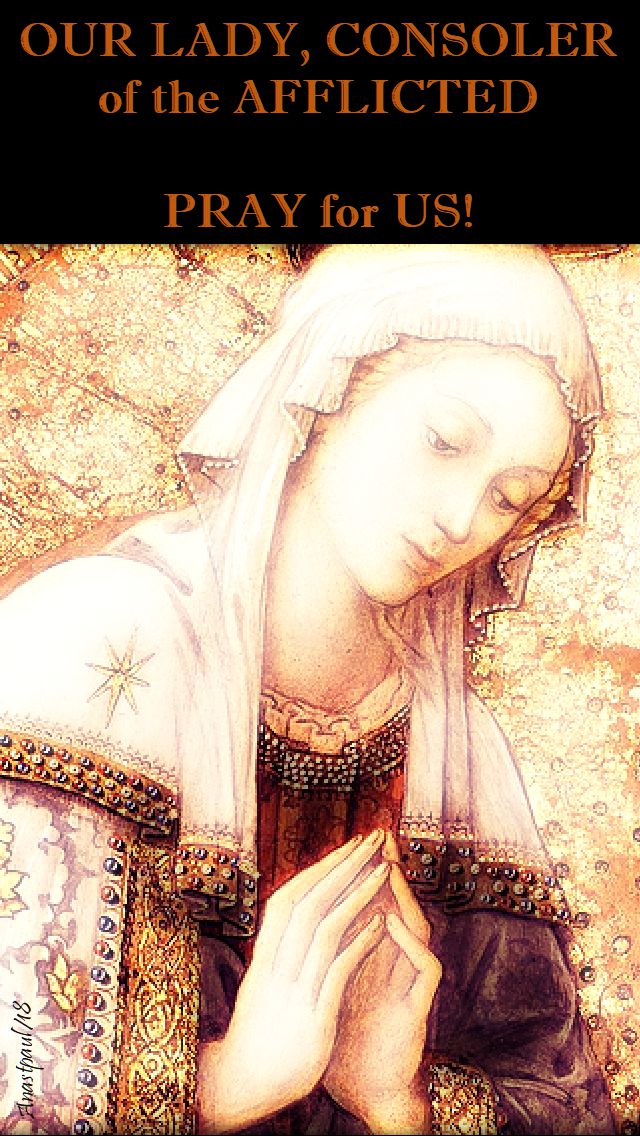
Our Lady of Sorrows,

Our Lady our Mother,

Our Lady our Consoler,

Pray for us all!our-lady-of-sorrows-pray-for-us-2-15 sept 2017holy mary mother of our saviour, pray for us - 17 may 2018our lady consoler of the afflicted - pray for us - 24 may 2018

Posted in CATHOLIC DEVOTIONS of the Month, DOCTORS of the Church, MARIAN DEVOTIONS, MARIAN QUOTES, MARIAN TITLES, MORNING Prayers, QUOTES of the SAINTS, SAINT of the DAY, The BLESSED VIRGIN MARY

Quote/s of the Day – 15 September – The Memorial of Our Lady of Sorrows

Quote/s of the Day – 15 September – The Memorial of Our Lady of Sorrows

“While other martyrs suffered by sacrificing their own lives,
the Blessed Virgin suffered by sacrificing her Son’s life,
a Life that she loved far more than her own;
so that she not only suffered in her soul
all that her Son endured in His Body but moreover,
the sight of her Son’s torments,
brought more grief to her heart,
than if she had endured them all in her own person”.

St Anselm (1033-1109) Doctor of the Churchwhile-other-martyrs-st-anselm- our lady of sorrows - 15 sept 2017

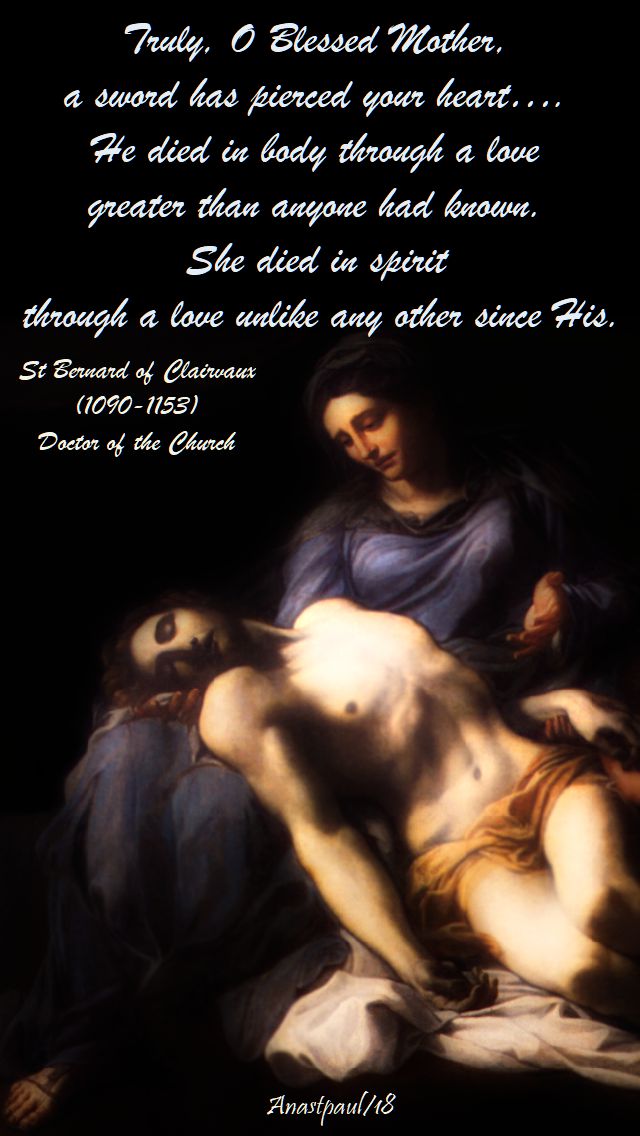
“Truly, O Blessed Mother, a sword has pierced your heart….
He died in body through a love greater than anyone had known.
She died in spirit through a love unlike any other since His.”truly, o blessded mother - st bernard - 15 sept 2018

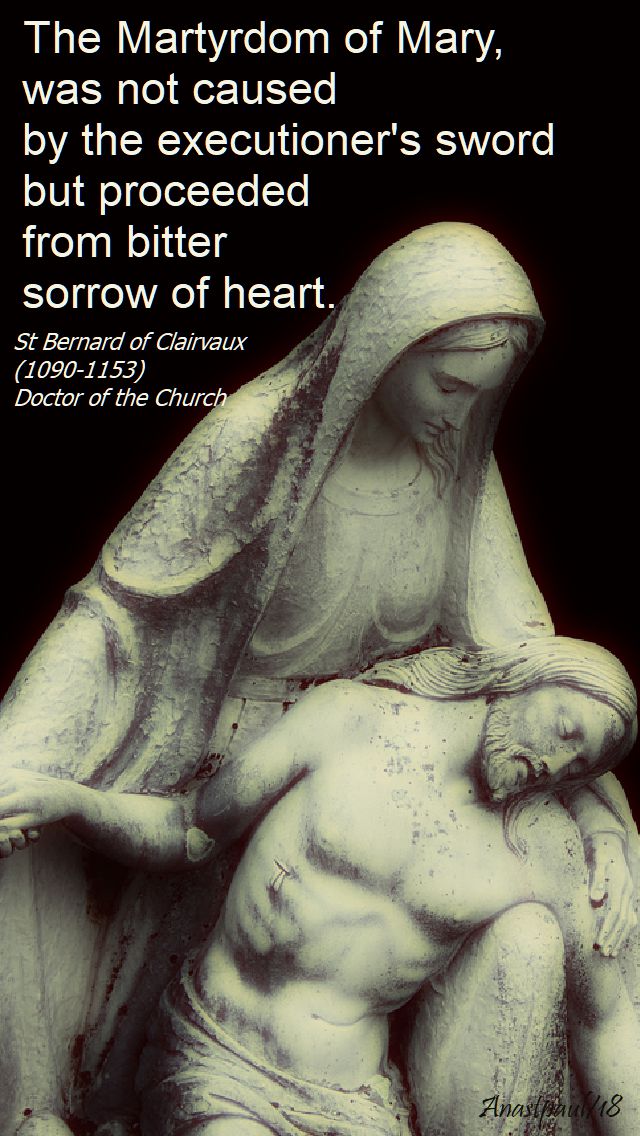
“The Martyrdom of Mary,
was not caused by the executioner’s sword
but proceeded from bitter sorrow of heart.”

St Bernard of Clairvaux (1090-1153) Doctor of the Churchthe martyrdom of mary - st bernard - 15 sept 2018

During the entire course of her life,
the Blessed Virgin Mary, Mother of God,
never deviated in the slightest
from the precepts and examples of her Divine Son.
This was true both in the most sweet joys Mary experienced
and in the cruel sufferings she underwent,
which made the the Queen of Martyr.

Venerable Pope Pius XII (1876-1958)during-the-entire-course-of-her-life-pope-pius-xii.-15 sept 2017

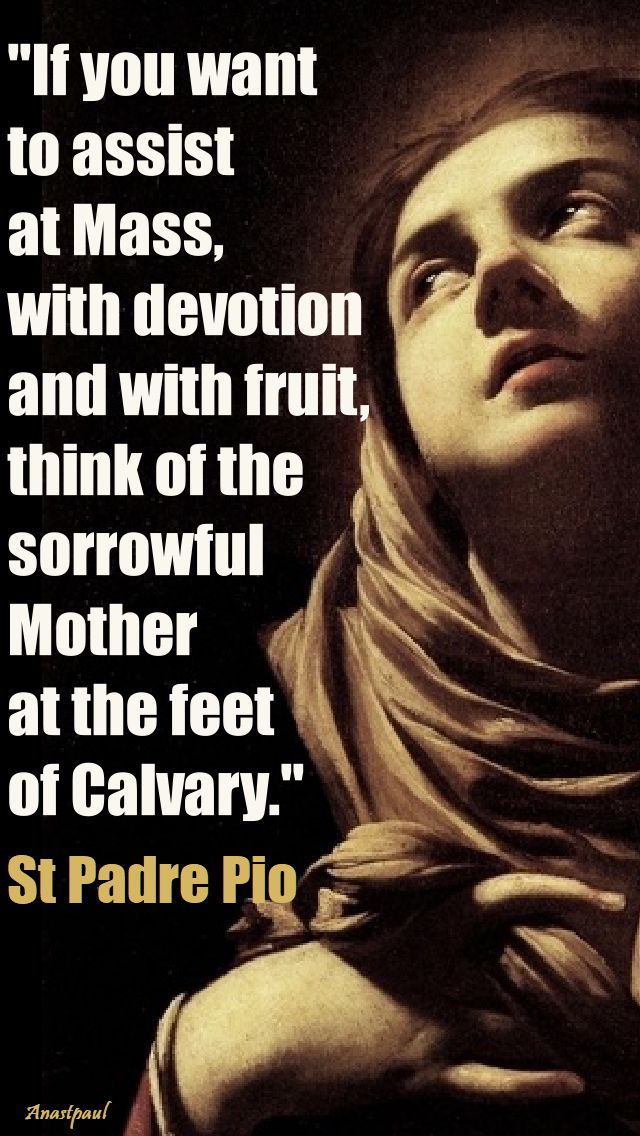
“If you want to assist at Mass,
with devotion and with fruit,
think of the sorrowful Mother
at the feet of Calvary.”

St Padre Pioif-you-want-to-assist-st-pio-our lady of sorrows - 15 sept 2017

Posted in CATHOLIC DEVOTIONS of the Month, MARIAN DEVOTIONS, MARIAN QUOTES, MARIAN TITLES, MORNING Prayers, PAPAL SERMONS, SAINT of the DAY, The BLESSED VIRGIN MARY, The WORD

One Minute Reflection – 15 September – The Memorial of Our Lady of Sorrows

One Minute Reflection – 15 September – The Memorial of Our Lady of Sorrows

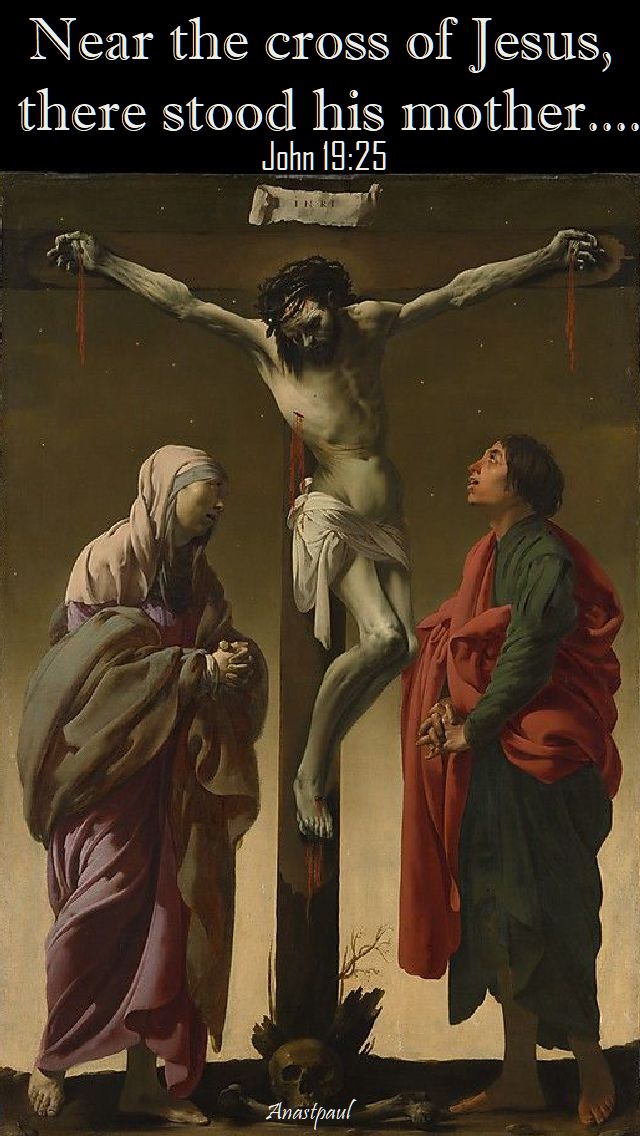
Near the cross of Jesus, there stood his mother…..John 19:25john-19-25-near the cross stood his mother - 15 sept 2017 our lady of sorrows

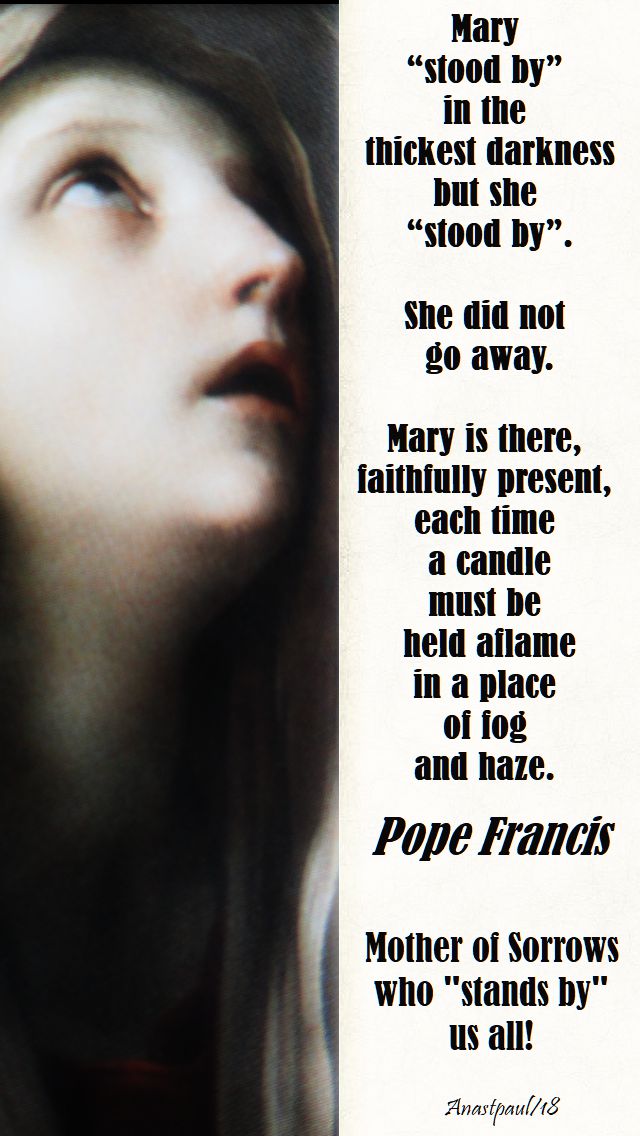
REFLECTION – “Mary “stood by”;  she was simply there  . Here again the young woman of Nazareth, hair now grayed with the passage of time, still struggling with a God who must only be embraced and with a life that has come to the threshold of the darkest night.   Mary “stood by” in the thickest darkness but she “stood by”.   She did not go away. Mary is there, faithfully present, each time a candle must be held aflame in a place of fog and haze.   She does not even know the future resurrection her Son was opening at that instant for us, for all of mankind – she stands there out of faithfulness to the plan of God whose handmaid she proclaimed herself to be on the first day of her vocation but also due to her instinct as mother who simply suffers, each time there is a child who undergoes suffering.   The suffering of mothers – we have all known strong women who have faced their children’s suffering!”…Pope Francis – General audience, 10 May 2017mary stood by - pope francis - 15 sept 2018

PRAYER – Our Father, when Jesus Your Son, was raised up on the Cross, it was Your will that Mary, His Mother, should stand there and suffer with Him in her heart.   Grant that in union with her, the Church may share in the passion of Christ and so be brought to the glory of His Resurrection.   Be our intercessor and our consolation, Our Lady of Sorrows!  We make our prayer through Christ our Lord, with the Holy Spirit, one God forever and ever, amen.our-lady-of-sorrows-pray-for-us.15 sept 2017

Posted in CATHOLIC DEVOTIONS of the Month, CATHOLIC-PRAYERS OF THE CHURCH, HYMNS, MARIAN DEVOTIONS, MARIAN POETRY, MARIAN PRAYERS, MARIAN TITLES, MATER DOLOROSA - Mother of SORROWS, Our MORNING Offering, PRAYERS of the CHURCH

Our Morning Offering – 15 September – STABAT MATER

Our Morning Offering – 15 September – The Memorial of Our Lady of Sorrows

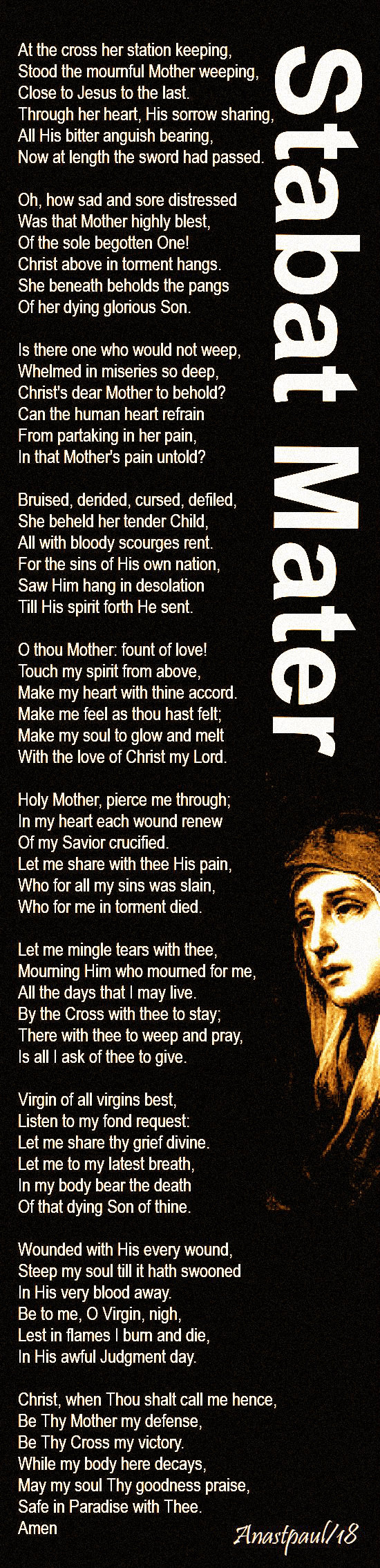
STABAT MATER

At the cross her station keeping,
Stood the mournful Mother weeping,
Close to Jesus to the last.
Through her heart, His sorrow sharing,
All His bitter anguish bearing,
Now at length the sword had passed.

Oh, how sad and sore distressed
Was that Mother highly blest,
Of the sole begotten One!
Christ above in torment hangs.
She beneath beholds the pangs
Of her dying glorious Son.

Is there one who would not weep,
Whelmed in miseries so deep,
Christ’s dear Mother to behold?
Can the human heart refrain
From partaking in her pain,
In that Mother’s pain untold?

Bruised, derided, cursed, defiled,
She beheld her tender Child,
All with bloody scourges rent.
For the sins of His own nation,
Saw Him hang in desolation
Till His spirit forth He sent.

O thou Mother: fount of love!
Touch my spirit from above,
Make my heart with thine accord.
Make me feel as thou hast felt;
Make my soul to glow and melt
With the love of Christ my Lord.

Holy Mother, pierce me through;
In my heart each wound renew
Of my Savior crucified.
Let me share with thee His pain,
Who for all my sins was slain,
Who for me in torment died.

Let me mingle tears with thee,
Mourning Him who mourned for me,
All the days that I may live.
By the Cross with thee to stay;
There with thee to weep and pray,
Is all I ask of thee to give.

Virgin of all virgins best,
Listen to my fond request:
Let me share thy grief divine.
Let me to my latest breath,
In my body bear the death
Of that dying Son of thine.

Wounded with His every wound,
Steep my soul till it hath swooned
In His very blood away.
Be to me, O Virgin, nigh,
Lest in flames I burn and die,
In His awful Judgment day.

Christ, when Thou shalt call me hence,
Be Thy Mother my defense,
Be Thy Cross my victory.
While my body here decays,
May my soul Thy goodness praise,
Safe in Paradise with Thee.
Amen

Note:  This text of the Stabat Mater is one of over 60 translations of this famous Latin hymn that can also be recited in prayer. It is often used when praying the Stations of the Cross. The original Latin text of the Stabat Mater has also been set to music by such composers as Haydn, Rossini, and Poulenc.stabat-mater-as-a-prayer-15-sept-20181 (1).jpg

Posted in CATHOLIC DEVOTIONS of the Month, MARIAN DEVOTIONS, MARIAN QUOTES, MARIAN TITLES, PAPAL SERMONS, SAINT of the DAY, The BLESSED VIRGIN MARY

Memorial of The Seven Sorrows of the Blessed Virgin Mary – 15 September

Memorial of The Seven Sorrows of the Blessed Virgin Mary 

Excerpt from the Homily of His Holiness, Pope Benedict XVI,
at the Esplanade in front of the Basilica of Notre-Dame du Rosaire, Lourdes
Monday, 15 September 2008

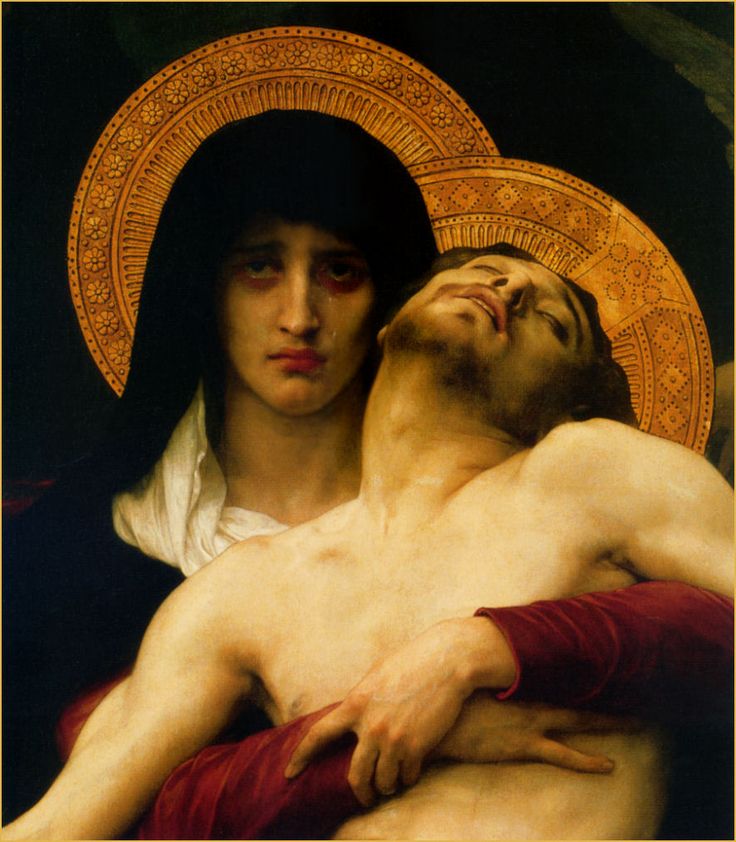
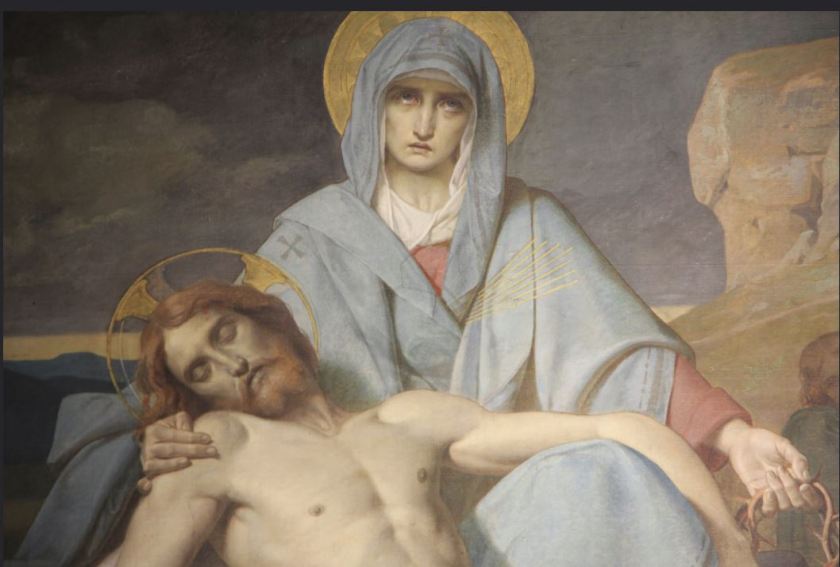
“Yesterday we celebrated the Cross of Christ, the instrument of our salvation, which reveals the mercy of our God in all its fullness.   The Cross is truly the place where God’s compassion for our world is perfectly manifested.   Today, as we celebrate the memorial of Our Lady of Sorrows, we contemplate Mary sharing her Son’s compassion for sinners.700-pietaHEADER & WP ourlady of sorrows - bougeureau

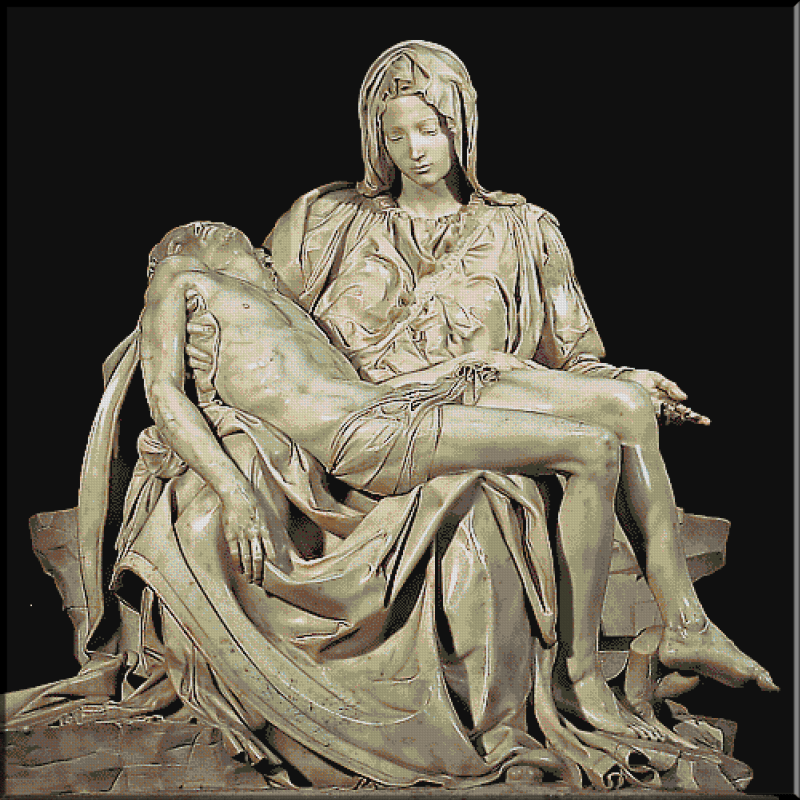
As Saint Bernard declares, the Mother of Christ entered into the Passion of her Son through her compassion (cf. Homily for Sunday in the Octave of the Assumption).   At the foot of the Cross, the prophecy of Simeon is fulfilled:  her mother’s heart is pierced through (cf. Lk 2:35) by the torment inflicted on the Innocent One born of her flesh. pieta - fr james bradley

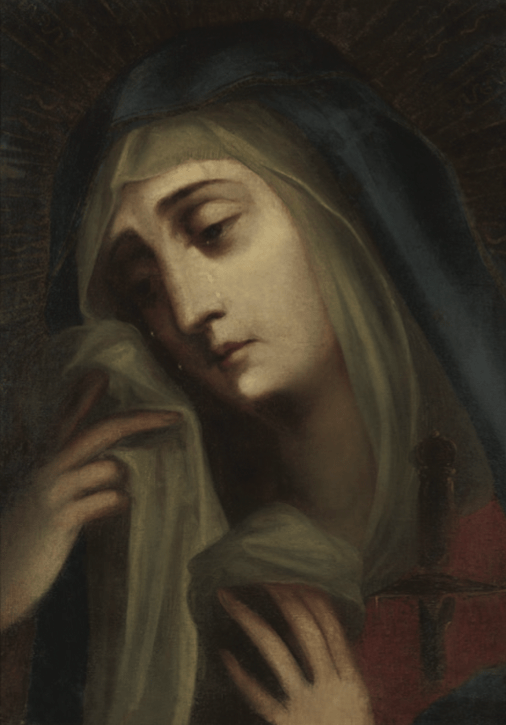
Just as Jesus cried (cf. Jn 11:35), so too Mary certainly cried over the tortured body of her Son. Her self-restraint, however, prevents us from plumbing the depths of her grief;  the full extent of her suffering is merely suggested by the traditional symbol of the seven swords. As in the case of her Son Jesus, one might say that she too was led to perfection through this suffering (cf. Heb 2:10), so as to make her capable of receiving the new spiritual mission that her Son entrusts to her immediately before “giving up his spirit” (cf. Jn 19:30) – that of becoming the mother of Christ in his members.  In that hour, through the figure of the beloved disciple, Jesus presents each of his disciples to his Mother when he says to her –  Behold your Son (cf. Jn 19:26-27).our lady of sorrows

Today Mary dwells in the joy and the glory of the Resurrection.   The tears shed at the foot of the Cross have been transformed into a smile which nothing can wipe away, even as her maternal compassion towards us remains unchanged.   The intervention of the Virgin Mary in offering succour throughout history testifies to this and does not cease to call forth, in the people of God, an unshakable confidence in her, the Memorare prayer expresses this sentiment very well.   Mary loves each of her children, giving particular attention to those who, like her Son at the hour of his Passion, are prey to suffering, she loves them quite simply because they are her children, according to the will of Christ on the Cross.

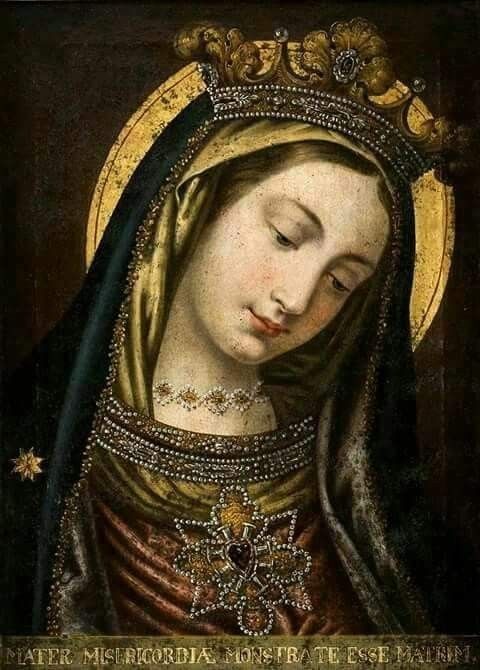
The psalmist, seeing from afar this maternal bond which unites the Mother of Christ with the people of faith, prophesies regarding the Virgin Mary that “the richest of the people … will seek your smile” (Ps 44:13).   In this way, prompted by the inspired word of Scripture, Christians have always sought the smile of Our Lady, this smile which medieval artists were able to represent with such marvellous skill and to show to advantage.   This smile of Mary is for all but it is directed quite particularly to those who suffer, so that they can find comfort and solace therein.   To seek Mary’s smile is not an act of devotional or outmoded sentimentality but rather the proper expression of the living and profoundly human relationship which binds us to her whom Christ gave us as our Mother.

mother of sorrows monstrate

To wish to contemplate this smile of the Virgin, does not mean letting oneself be led by an uncontrolled imagination.   Scripture itself discloses it to us through the lips of Mary when she sings the Magnificat:  “My soul glorifies the Lord, my spirit exults in God my Saviour” (Lk 1:46-47). When the Virgin Mary gives thanks to the Lord, she calls us to witness.   Mary shares, as if by anticipation, with us, her future children, the joy that dwells in her heart, so that it can become ours.   Every time we recite the Magnificat, we become witnesses of her smile.”

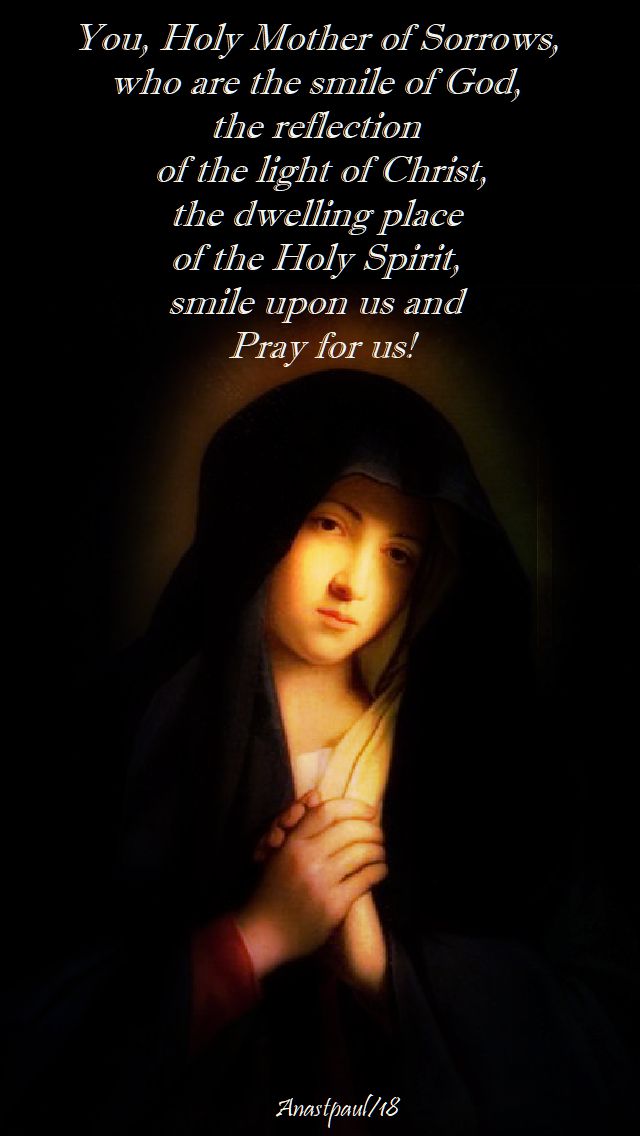
You, Holy Mother of Sorrows, who are the smile of God, the reflection of the light of Christ, the dwelling place of the Holy Spirit, smile upon us and pray for us!you holy mother of sorrows - smile upon us and pray for us - 15 sept 2018

Posted in CATHOLIC DEVOTIONS of the Month, MARIAN DEVOTIONS, MARIAN TITLES, SAINT of the DAY

Memorial of Our Lady of Sorrows and the Saints – 15 September

Our Lady of Sorrows (Memorial)
About this Sorrowful Memorial: https://anastpaul.wordpress.com/2017/09/15/memorial-of-our-lady-of-sorrows-15-september/

St Aichardus
St Albinus of Lyon
Bl Anton Maria Schwartz
St Aprus of Toul
St Bond of Sens
St Catherine of Genoa
Bl Camillus Constanzo
St Emilas of Cordoba
St Eutropa of Auvergne
St Hernan
Bl Jacinto de Los Ángeles and Bl Juan Bautista
St Jeremias of Cordoba
St Joseph Abibos
St Mamillian of Palermo
St Melitina
St Mirin of Bangor
St Nicetas the Goth
St Nicomedes of Rome
St Porphyrius the Martyr
St Ribert
St Ritbert of Varennes
Bl Rolando de Medici
Bl Tommasuccio of Foligno
St Valerian of Châlon-sur-Saône
St Valerian of Noviodunum
St Vitus of Bergamo
Bl Wladyslaw Miegon

Martyrs of Adrianopolis – 3 saints: Three Christian men martyred together in the persecutions of Maximian – Asclepiodotus, Maximus and Theodore. They were martyred in 310 at Adrianopolis (Adrianople), a location in modern Bulgaria.

Martyrs of Noviodunum – 4 saints: Three Christian men martyred together, date unknown – Gordian, Macrinus, Stratone and Valerian.
They were martyred in Noviodunum, Lower Moesia (near modern Isaccea, Romania).

Mercedarian Martyrs of Morocco – 6 beati: A group of six Mercedarians who were captured by Moors near Valencia, Spain and taken to Morocco. Though enslaved, they refused to stop preaching Christianity. Martyrs. – Dionisio, Francis, Ildefonso, James, John and Sancho. They were crucified in 1437 in Morocco.

Martyred in the Spanish Civil War:
Bl Antonio Sierra Leyva
Bl Pascual Penades Jornet

Posted in MORNING Prayers, NOVENAS

NOVENA to St Padre Pio/St Pius of Pietrelcina – DAY ONE – 14 September

NOVENA to St Padre Pio/St Pius of Pietrelcina – DAY ONE – 14 September

St Padre Pio you have said:

“Jesus keeps nothing for Himself of what is done for love of Him and He will repay us very lavishly.
Don’t let us make our happiness depend on enjoying wonderful health, 
or else we should be just like those foolish worldly people to whom it is not given to know the secrets of heaven…. 
Continue to love Jesus and make an effort to love Him more and more, 
without wanting to know anything else, He alone will steer us to the haven of salvation.”

Let us Pray:

Gracious God,
You generously blessed Your servant, Padre Pio, with the gifts of the Spirit.
You marked his body with the five wounds of Christ Crucified,
as a powerful witness to the saving Passion and Death of Your Son
and as a stirring inspiration to many people of Your infinite mercy, forgiveness and love.
In the confessional, Padre Pio laboured endlessly for the salvation of souls.
Through his powerful intercession, many who suffered were healed of sickness and disease.
Endowed with the gift of discernment, he could read people’s hearts.
With dignity and intense devotion, he celebrated daily Mass,
inviting countless men and women to a greater union with Jesus Christ,
in the Sacrament of the Holy Eucharist.
Through the intercession of Saint Pio,
we confidently beseech You to to grant us the grace of
………………… (state your petition here).
Help us to imitate his example of prayerful holiness and compassion,
so that we, too, may faithfully follow the Risen Lord
and one day rejoice in the Kingdom,
where You live and reign forever and ever.

Amenday-one-novena-st-pio-14-sept

Posted in CATHOLIC DEVOTIONS of the Month, FEASTS and SOLEMNITIES, MORNING Prayers, PAPAL SERMONS, QUOTES on the CROSS of CHRIST, SAINT of the DAY, The HOLY CROSS

Thought for the Day – 14 September – Feast of the Exaltation of the Holy Cross

Thought for the Day – 14 September – Feast of the Exaltation of the Holy Cross14-sept-exaltation-of-the-holy-cross 2017

Excerpt – Pope Benedict XVI

 Angelus, 17 September 2006

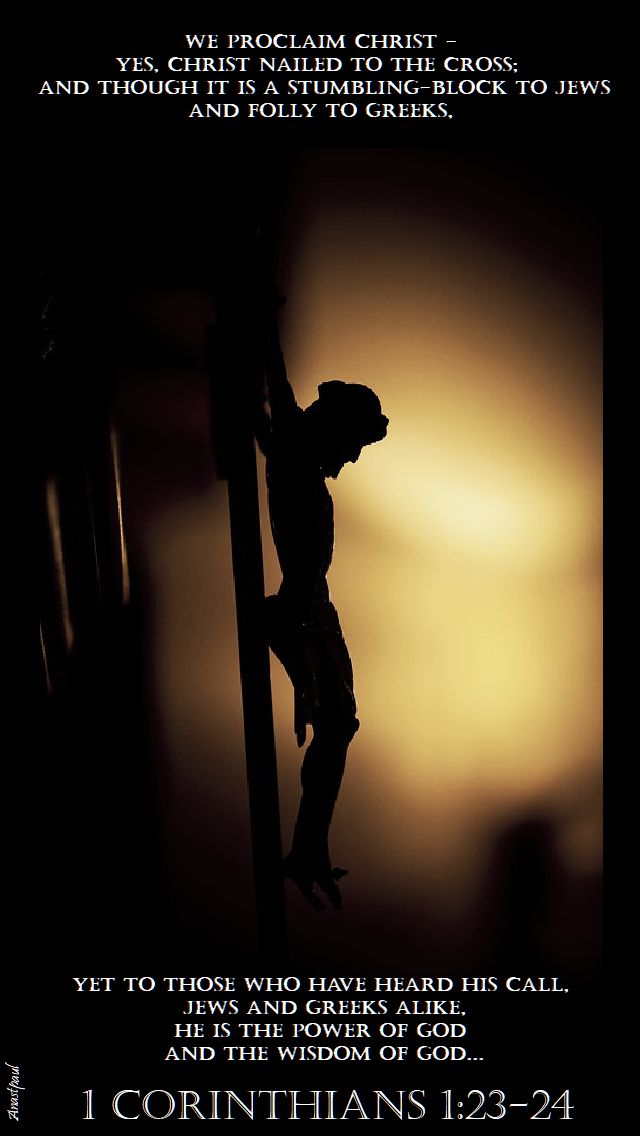
“But what does exalting the Cross mean?   Is it not maybe scandalous to venerate a shameful form of execution?   The Apostle Paul says: “We proclaim Christ crucified, a stumbling block to Jews and folly to Gentiles” (I Cor 1: 23). Christians, however, do not exalt just any cross but the Cross which Jesus sanctified with His sacrifice, the fruit and testimony of immense love.   Christ on the Cross pours out His Blood to set humanity free from the slavery of sin and death.1-corinthians-1-23-24 - we proclaim christ crucified = 14 sept 2017

Therefore, from being a sign of malediction, the Cross was transformed into a sign of blessing, from a symbol of death into a symbol par excellence of the Love that overcomes hatred and violence and generates immortal life.   “O Crux, ave spes unica! O Cross, our only hope!”.   Thus sings the liturgy.

The Evangelist recounts – Mary was standing by the Cross (cf. Jn 19: 25-27).   Her sorrow is united with that of her So  n. It is a sorrow full of faith and love.   The Virgin on Calvary participates in the saving power of the suffering of Christ, joining her “fiat”, her “yes”, to that of her Son.

Dear brothers and sisters, spiritually united to Our Lady of Sorrows, let us also renew our “yes” to God who chose the Way of the Cross in order to save us.   This is a great mystery which continues and will continue to take place until the end of the world and which also asks for our collaboration.

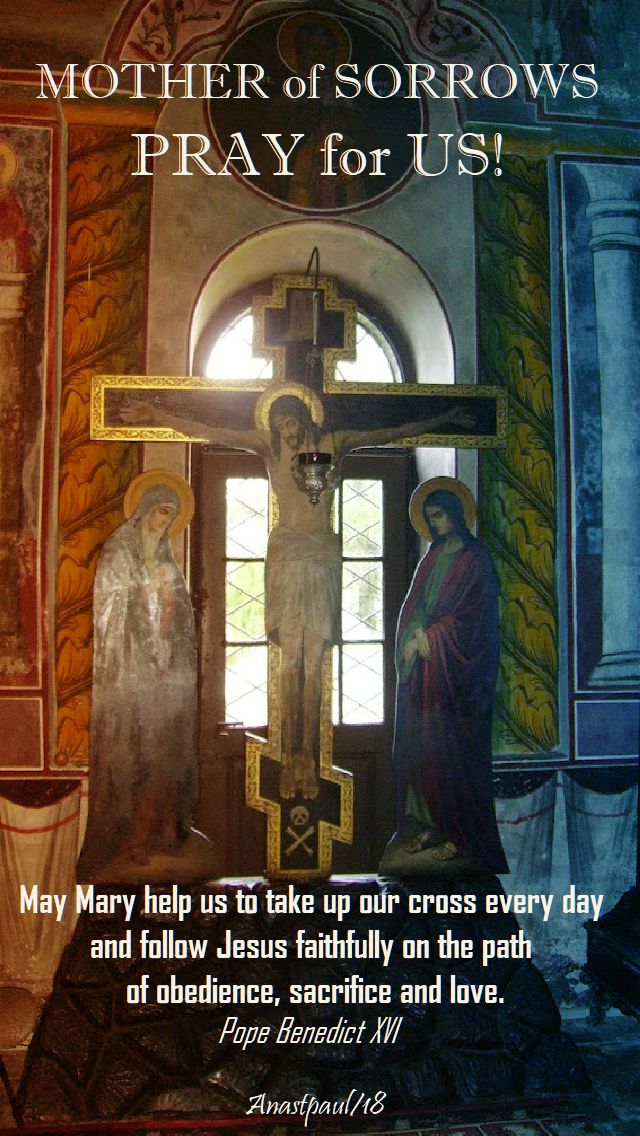
May Mary help us to take up our cross every day and follow Jesus faithfully on the path of obedience, sacrifice and love.”mother of sorrows pray for us - may mary help us - pope benedict - 14 sept 2018

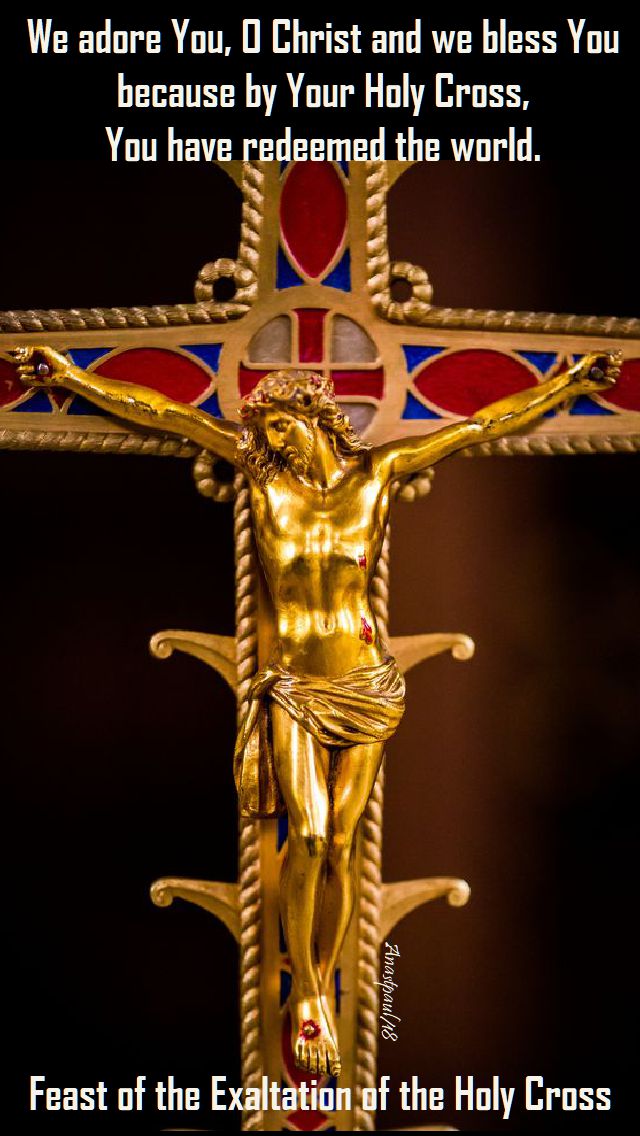
We adore You Christ and we bless You,

for by Your holy Cross You have redeemed the world.

we adore you o christ - 14 sept 2018


Posted in DOCTORS of the Church, FEASTS and SOLEMNITIES, MORNING Prayers, QUOTES on the CROSS of CHRIST, SAINT of the DAY, The HOLY CROSS, Thomas a Kempis

Quote/s of the Day – 14 September – Feast of the Exaltation of the Holy Cross

Quote/s of the Day – 14 September – Feast of the Exaltation of the Holy Cross

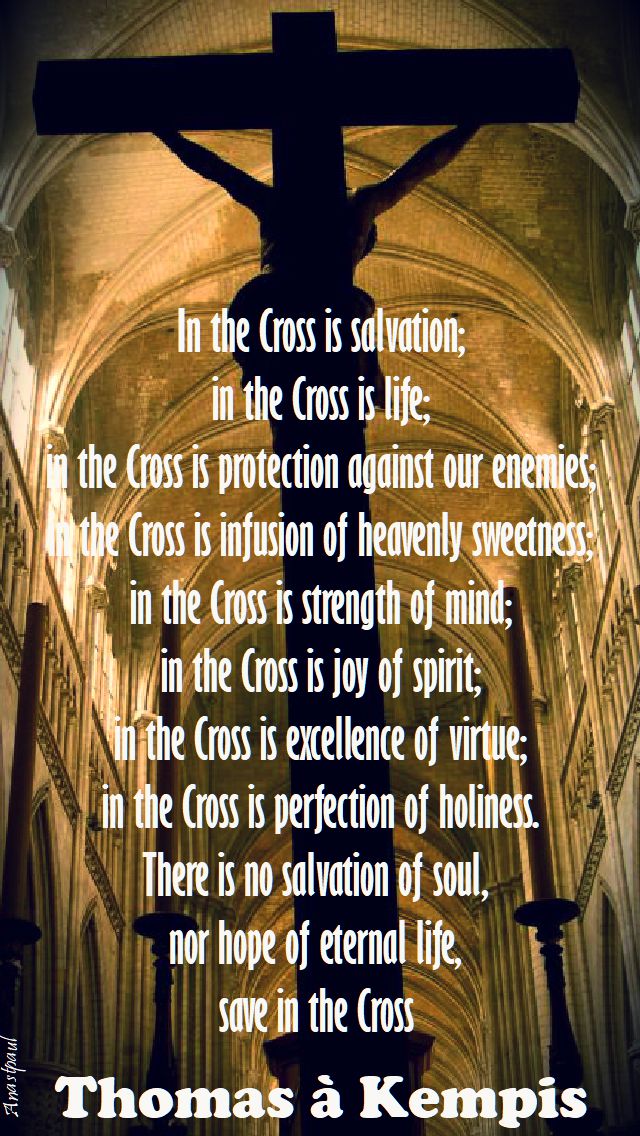
“In the Cross is salvation;
in the Cross is life;
in the Cross is protection against our enemies;
in the Cross is infusion of heavenly sweetness;
in the Cross is strength of mind;
in the Cross is joy of spirit;
in the Cross is excellence of virtue;
in the Cross is perfection of holiness.
There is no salvation of soul,
nor hope of eternal life,
save in the Cross.”

Thomas à Kempis (1380-1471) The Inner Lifein-the-cross-is-salvation-thomas-a-kempis=14 sept 2017

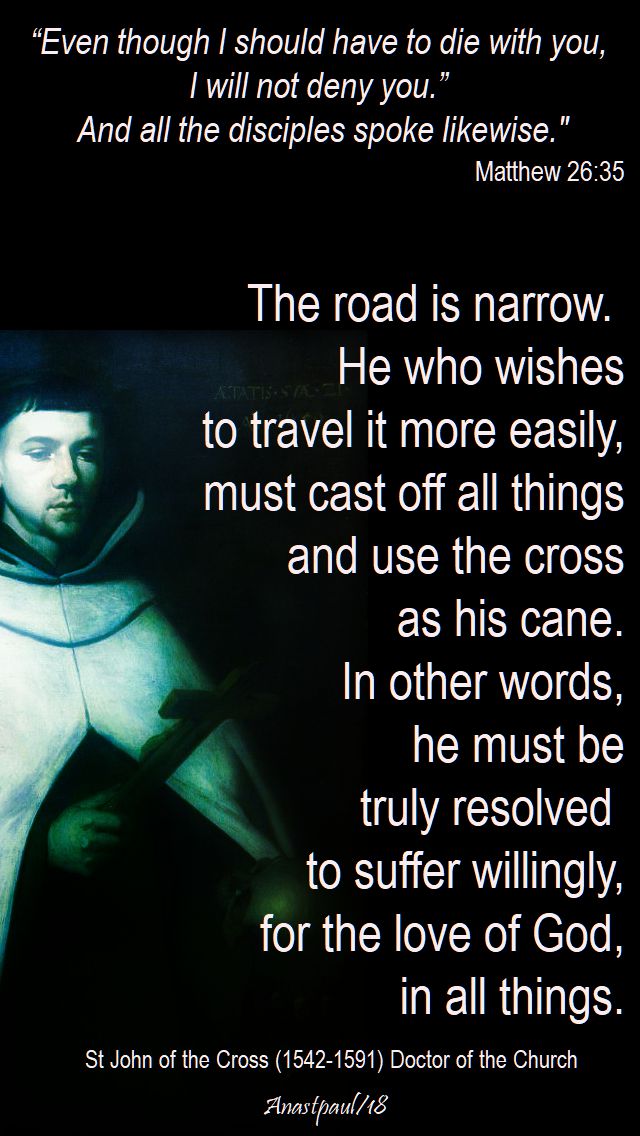
“The road is narrow.
He who wishes to travel it more easily
must cast off all things and use the cross as his cane.
In other words, he must be truly resolved
to suffer willingly for the love of God in all things.”

St John of the Cross (1542-1591) Doctor of the Churcheven-though-i-should-die-matthew-26-35-and-the-road-is-narrow-st-john-of-the-cross-9-july-2018

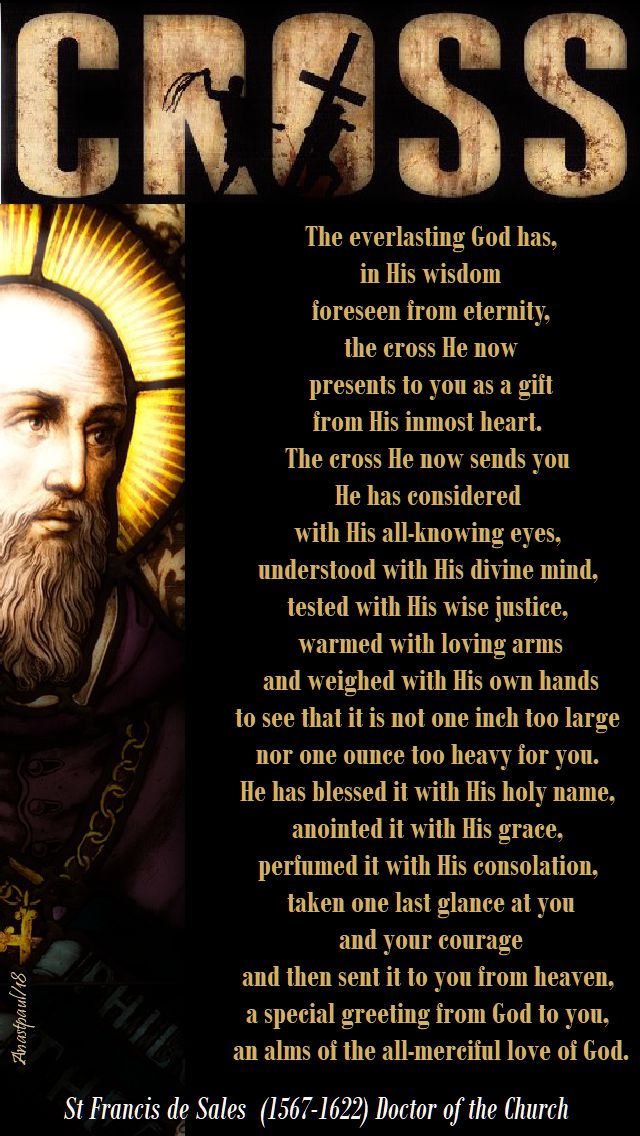
The everlasting God has in His wisdom
foreseen from eternity the cross He now
presents to you as a gift from His inmost heart.
The cross He now sends you
He has considered
with His all-knowing eyes,
understood with His divine mind,
tested with His wise justice,
warmed with loving arms
and weighed with His own hands
to see that it is not one inch too large
nor one ounce too heavy for you.
He has blessed it with His holy name,
anointed it with His grace,
perfumed it with His consolation,
taken one last glance at you and your courage
and then sent it to you from heaven,
a special greeting from God to you,
an alms of the all-merciful love of God.

St Francis de Sales (1567-1622) Doctor of the Churchthe everlasting god has in his wisdom - st francis de sales - 14 sept 2018

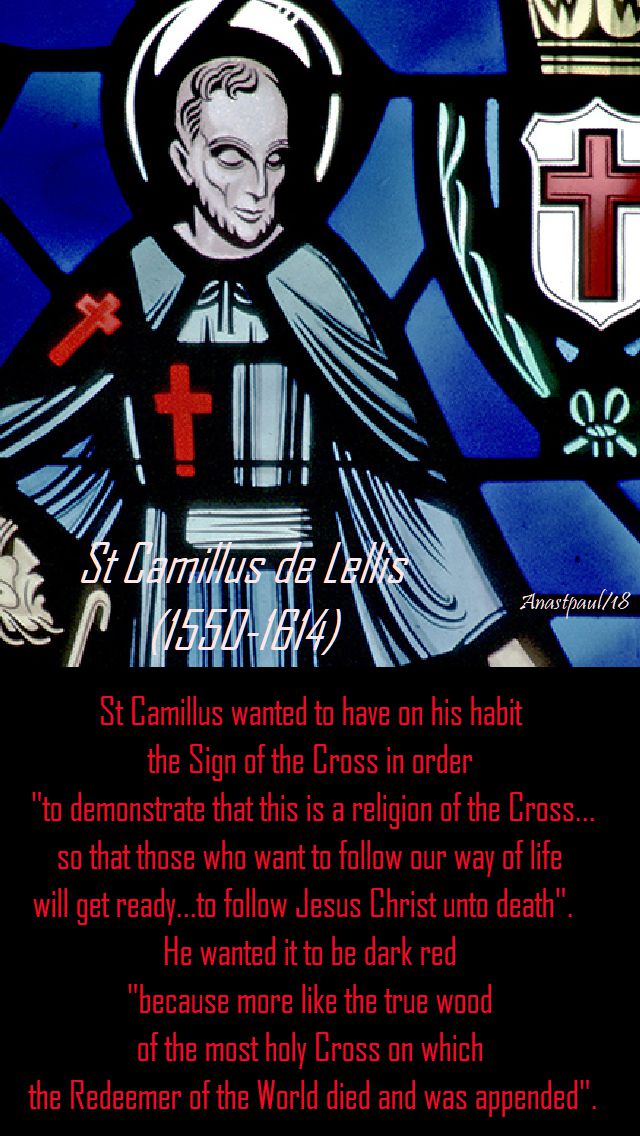
Camillus wanted to have on his habit the Sign of the Cross
in order ‘to demonstrate that this is a religion of the Cross…
so that those who want to follow our way of life will get ready…
to follow Jesus Christ unto death’.
He wanted it to be dark red
‘because more like the true wood of the most holy Cross
on which the Redeemer of the World died and was appended’.

St Camillus de Lellis (1550-1614)st-camillus-wanted-to-have-on-his-habit-14-july-2018

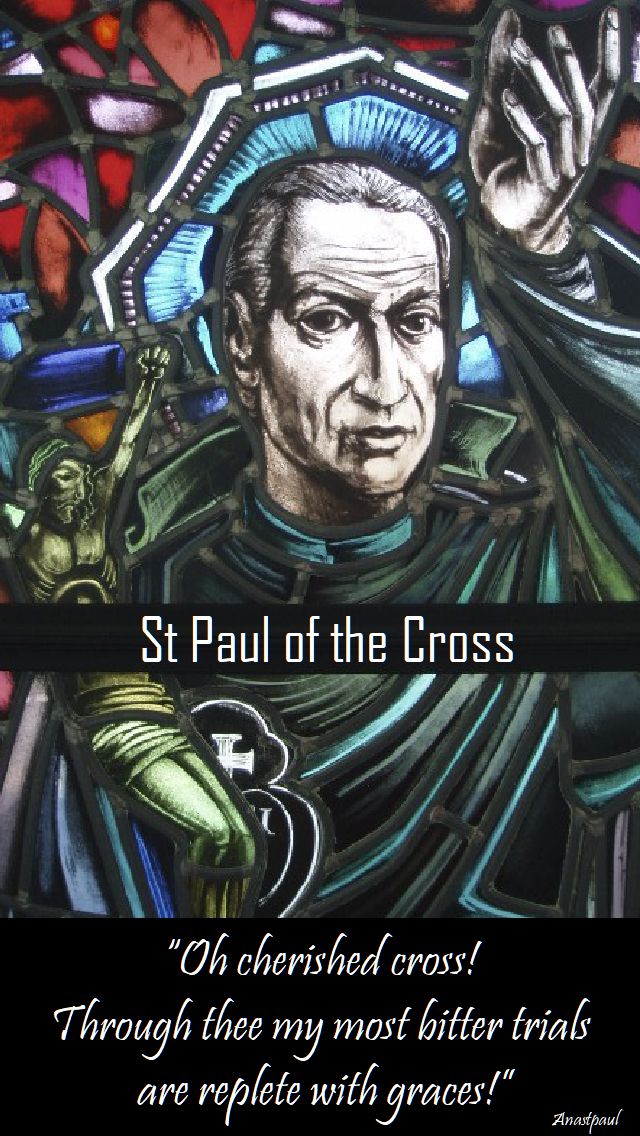
“Oh cherished cross!
Through thee my most bitter trials
are replete with graces!”

St Paul of the Cross (1694-1775)oh-cherished-cross-st-paul-of-the-cross-14 sept 2017

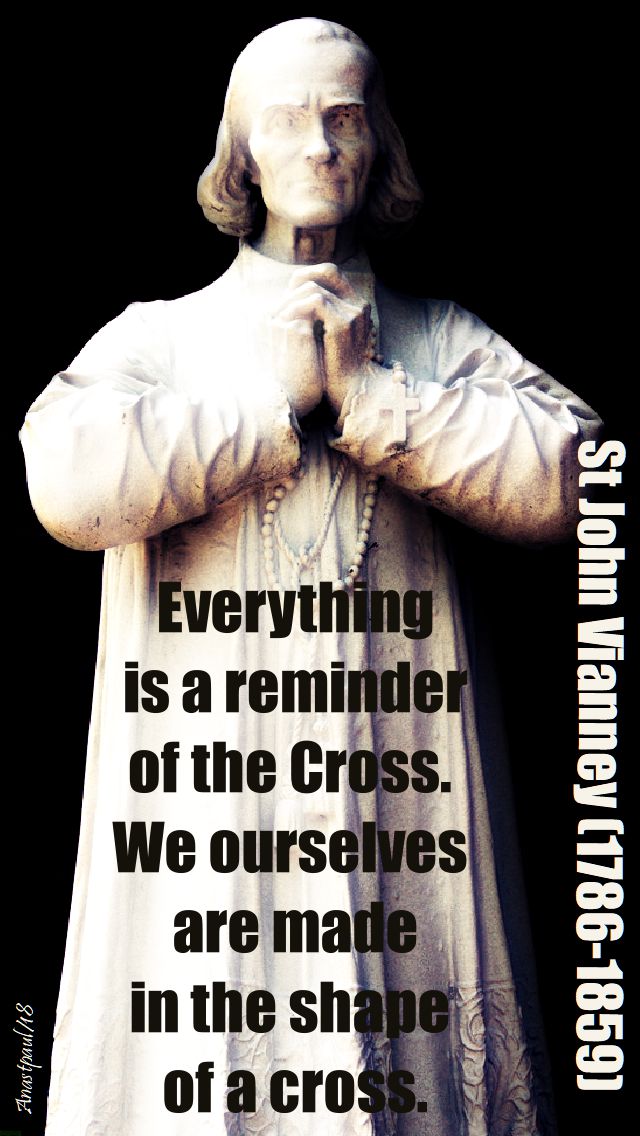
“Everything is a reminder of the Cross.
We ourselves are made in the shape of a cross.”

St John Vianney (1786-1859)everything is a reminder of the cross - st john vianney - 14 sept 2018

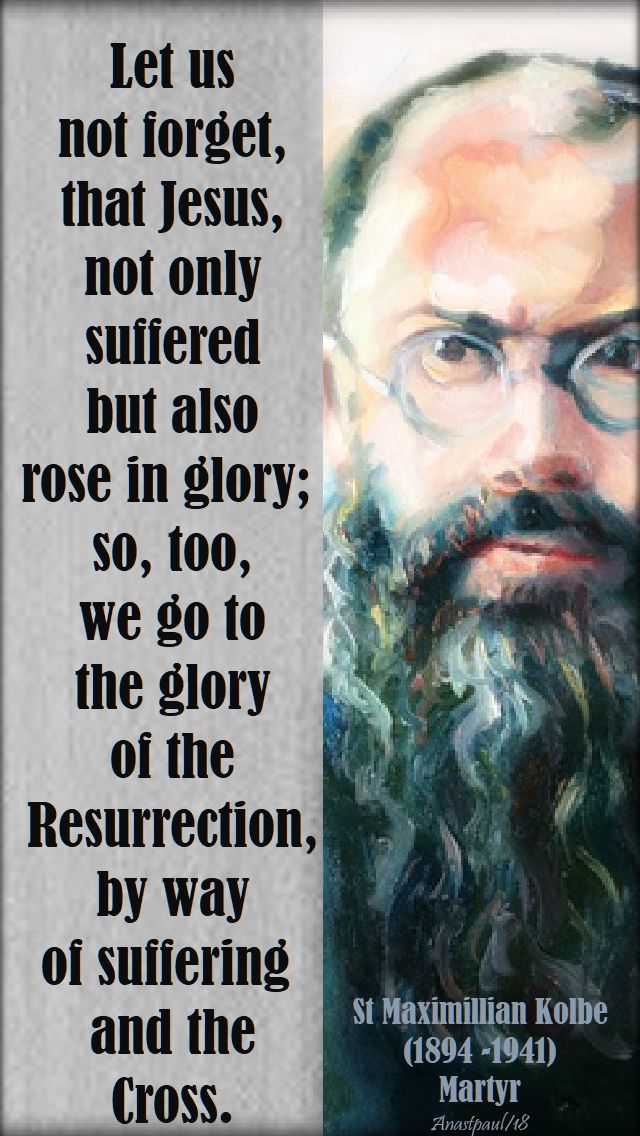
“Let us not forget,
that Jesus not only suffered
but also rose in glory;
so, too, we go to the glory
of the Resurrection,
by way of suffering
and the Cross.”

St Maximillian Kolbe (1894 -1941)let-us-not-forget-st-max-kolbe-14-aug-2018

“There is line from the illuminator of the St John’s Bible that states:
“We have to love our way out of this.”
There is nothing wimpy or namby-pamby
or blind about this conviction.
When we love extravagantly,
we are not purposely blinding ourselves to moral realities—
just the contrary.

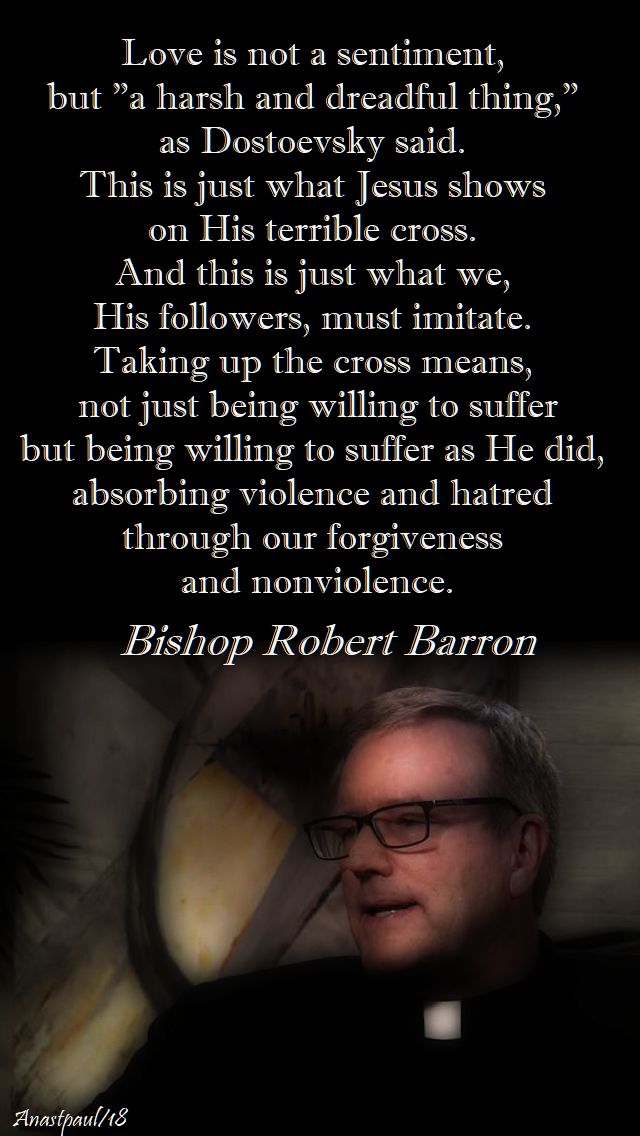
Love is not a sentiment, but “a harsh and dreadful thing,”
as Dostoevsky said.

This is just what Jesus shows on His terrible cross.
And this is just what we, His followers, must imitate.
Taking up the cross means, not just being willing to suffer
but being willing to suffer as He did,
absorbing violence and hatred through our forgiveness and nonviolence.”

Bishop Robert Barronlove-is-not-a-sentiment-robert-barron-3-aug-2018

Posted in DOCTORS of the Church, FATHERS of the Church, FEASTS and SOLEMNITIES, MORNING Prayers, The HOLY CROSS, The WORD

One Minute Reflection – 14 September – Feast of the Exaltation of the Holy Cross

One Minute Reflection – 14 September – Feast of the Exaltation of the Holy Cross

“…And as Moses lifted up the serpent in the wilderness, so must the Son of man be lifted up, that whoever believes in him may have eternal life.”...John 3:14-15and as moses lifted up - john 3 - 14-15 - 14 sept 2018

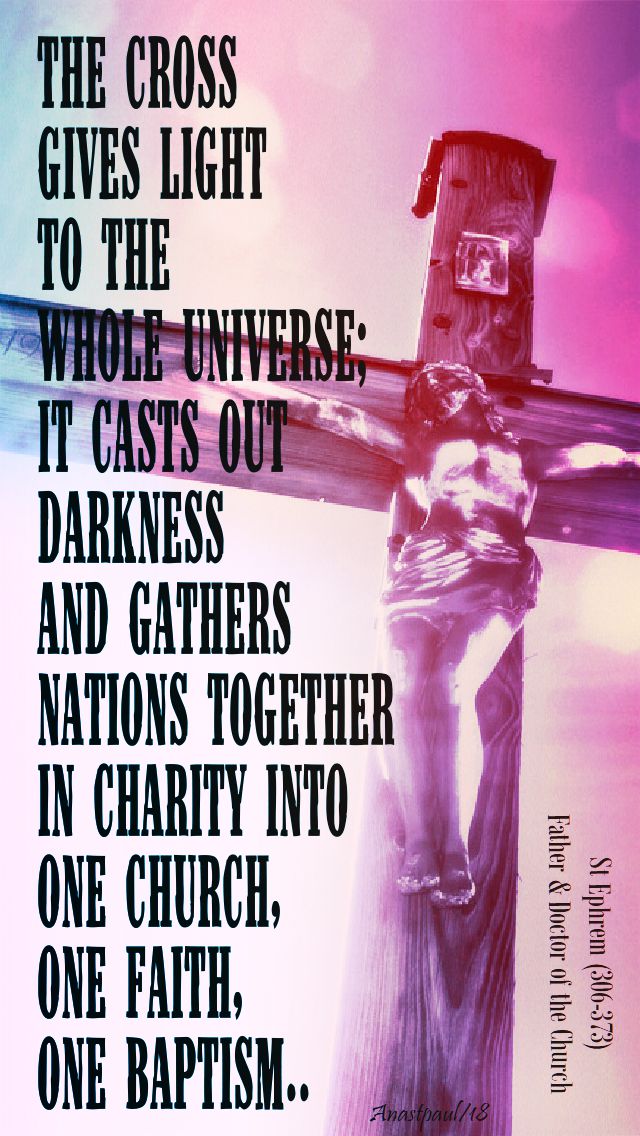
REFLECTION – “From now on, through the cross, all shadows have been dispelled and the truth arises, as the apostle John says:  “The old order has passed away; all things are new” (Rv 21:4-5).   Death has been stripped of prey, hell’s captives liberated;  man is set free;  the Lord reigns;  creation rejoices.   The cross is victorious and all nations, races, languages and peoples (Rv 7:9) come to adore him.   Together, in the cross we find our joy, exclaiming with blessed Paul:  “May I never boast except in the cross of our Lord Jesus Christ” (Gal 6:14).   The cross gives light to the whole universe;  it casts out darkness and gathers nations together in charity into one Church, one faith, one baptism, from West and East, from the North and from the seas.   It stands at the very centre of the world, set up on Calvary.
Armed with the cross, the Apostles go out to preach and gather together in adoration of it the whole universe, treading under foot every hostile power.   Through it the martyrs have bravely confessed the faith, fearless of tyrants’ cunning.   Having taken it upon themselves, monks have joyfully made solitude their home.
When Christ returns, this cross will first appear in heaven, the Great King’s precious sceptre, living, true and holy.   “Then,” says the Lord, “the sign of the Son of Man will appear in heaven” (Mt 24:30).   We will see it escorted by angels, illuminating the earth from one end of the universe to the other, brighter than the sun, proclaiming the Day of the Lord.”…Homily attributed to Saint Ephrem (306-373) Father & Doctor of the Churchthe cross gives light - st ephrem - 14 sept 2018

PRAYER – O God, who willed that your Only Begotten Son should undergo the Cross to save the human race, grant, we pray, that we, who have known his mystery on earth, may merit the grace of His redemption in heaven.
For you placed the salvation of the human race on the wood of the Cross, so that, where death arose, life might again spring forth and the evil one, who conquered on a tree, might likewise on a tree be conquered through Christ.   O cross, you are the glorious sign of victory.   Through your power may we share in the triumph of Christ Jesus.
We adore You Christ and we praise You, for by Your holy Cross You have redeemed the world. Ameno-cross-you-are-the-glorious-sign-of-victory-feast-of-the-exaltation-of-the-holy-cross

Posted in BREVIARY Prayers, FEASTS and SOLEMNITIES, HYMNS, Our MORNING Offering, SAINT of the DAY, The HOLY CROSS

Our Morning Offering – 14 September – Feast of the Exaltation of the Holy Cross

Our Morning Offering – 14 September – Feast of the Exaltation of the Holy Cross

Breviary Hymn
O Cross of Christ
By St Flavian Bishop (Died 449 – Memorial 18 February), from Day’s Psalter 1562

O Cross of Christ, immortal tree
On which our Saviour died,
The world is sheltered by your arms
That bore the Crucified.

From bitter death and barren wood
the tree of life is made;
Its branches bear unfailing fruit
And leaves that never fade.

O faithful Cross, you stand unmoved
While ages run their course;
Foundation of the universe,
Creation’s minding force.

Give glory to the risen Christ
And to His Cross give praise,
The sign of God’s unfailing love,
The hope of all our days.o cross of christ - 14 sept exaltation of the holy cross - 14 sept 2018 breviary hymn

Posted in CARMELITES, SAINT of the DAY

Saint of the Day – 14 September – St Albert of Jerusalem (1149-1214)

Saint of the Day – 14 September – St Albert of Jerusalem (1149-1214) also known as St Albert of Vercelli – Bishop, Canon Lawyer, Diplomat and Peacemaker and is regarded as a Co-Founder of the Carmelite Order.   He was Bishop of Bobbio and Bishop of Vercelli and served as mediator and diplomat under Pope Clement III.   Pope Innocent III appointed him Patriarch of Jerusalem in 1204 or 1205.   In Jerusalem, he contributed the Carmelite Rule of St Albert to the newly-founded Carmelite Order.Albert_01

Saint Albert was born towards the middle of the 12th century in Castel Gualtieri in Emilia, Italy.   He entered the Canons Regular of the Holy Cross at Mortara, Pavia and became Prior there in 1180.   In 1184, he was named bishop of Bobbio and the following year he was transferred to Vercelli which he governed for twenty years.    During this period, he undertook diplomatic missions of national and international importance with rare prudence and firmness – in 1194, he effected a peace between Pavia and Milan and, five years later, also between Parma and Piacenza.

Albert+of+Jerusalem+1

In 1191, he celebrated a diocesan synod which proved of great value for its disciplinary provisions which continued to serve as a model until modern times.   He was also involved in a large amount of legislative work for various religious orders – he wrote the statutes for the canons of Biella and was among the advisers who drew up the Rule of the Humiliates.

In 1205, Albert was appointed Patriarch of Jerusalem and a little later nominated Papal Legate for the ecclesiastical province of Jerusalem.   He arrived in Palestine early in 1206 and lived in Acre because, at that time, Jerusalem was occupied by the Saracens.   In Palestine, Albert was involved in various peace initiatives, not only among Christians but also between the Christians and non-Christians and he carried out his duties with great energy.albert of jerusalem

During his stay in Acre he gathered together the hermits on Mount Carmel and gave them a Rule.  On 14 September 1214, during a procession, he was stabbed to death by the Master of the Hospital of the Holy Spirit, whom Albert had reprimanded and deposed for his evil life, while taking part in a procession on the Feast of the Exaltation of the Holy Cross.

He is honoured by the Carmelites on 17 September.albert

Posted in FEASTS and SOLEMNITIES, SAINT of the DAY

Feast of the Exaltation of the Holy Cross and Memorials of the Saints -14 September

Exaltation of the Holy Cross (Feast)
About this great Feast:  https://anastpaul.wordpress.com/2017/09/14/feast-of-the-exaltation-of-the-holy-crosstriumph-of-the-holy-cross-14-september/

St Aelia Flaccilla
St Albert of Jerusalem (1149-1215)
St Caerealis
Bl Claude Laplace
St Cormac of Cashel
St Crescentian of Carthage
St Crescentius of Rome
St Generalis of Carthage
St Giulia Crostarosa
St Jean Gabriel Taurin du Fresse
St Maternus of Cologne
Bl Notburga
Bl Pedro Bruch Cotacáns
St Rosula of Carthage
St Sallustia
St Victor of Carthage

Posted in MORNING Prayers, NOVENAS

ANNOUNCING a NOVENA to ST PIUS of PIETRELCINA/St Padre Pio (1887-1968) – Beginning Friday 14 September

ANNOUNCING a NOVENA to ST PIUS of PIETRELCINA/St Padre Pio O.F.M. Cap (1887-1968)
Beginning Friday 14 September – Feast Day 26 September

“I want only to be a poor friar who prays… Pray, hope and don’t worry.   

Worry is useless. God is merciful and will hear your prayer…

Prayer is the best weapon we have; it is the key to God’s heart…”

St Pius of Pietrelcina/St Padre Pio (1887-1968)announging-a-novena-to-st-padre-pio-beginning-thurs-14-sept-12 sept 2018

Posted in MORNING Prayers, NOVENAS, The HOLY CROSS

DAY NINE – NOVENA in honour of the EXALTATION of the HOLY CROSS – 13 September

DAY NINE – NOVENA in honour of the EXALTATION of the HOLY CROSS – 13 September

Eternal Love

Lord Jesus, Your cross manifested Your decision
to always do the Father’s will.
That God you revealed shines so resplendently on the Holy Cross.
It is a God who loves because He is pure love.
On the Holy Cross, You gave everything – Your life.
By Your self-giving, we have been redeemed.
May our veneration of Your Holy Cross
enable us to live the challenge of love,
that we, too, may learn to trust, to understand
and to forgive.
That we may remove from our hearts,
hatred, mistrust and resentment
and be like You, a total gift of self.
May Your Holy Cross lead us to life
and communion with our brothers and sisters. Amen.

DAILY PRAYER:

Dear Lord Jesus
Who because of Your burning love for us willed to be crucified
and to shed Your Most Precious Blood for the redemption
and salvation of our souls,
to bear the sins of all the history of humanity,
from Adam to the end of time.
look down upon us and grant the petition we ask
…………….( mention your intention)
We trust completely in Your Mercy.
Cleanse us from sin by Your Grace,
sanctify our work,
give us and all those who are dear to us,
our daily bread, lighten the burden of our sufferings,
bless our families,
and grant to the nations, so sorely afflicted,
Your Peace, which is the only true peace,
so that by obeying Your Commandments
we may come at last to the glory of Heaven.

O Cross, you are the glorious sign of victory.
Through your power may we share
in the triumph of Christ Jesus. Amen
Glory Be. (3x)day-nine-novena-holy-cross-13-sept-eternal-love-13 sept 2017

Posted in DOCTORS of the Church, FATHERS of the Church, GOD the FATHER, MORNING Prayers, PAPAL SERMONS, QUOTES of the SAINTS, QUOTES on FAITH, SAINT of the DAY, The WORD

Thought for the Day – 13 September – 13 September – St John Chrysostom (347-407) Doctor – “John of the Golden Mouth”

Thought for the Day – 13 September – 13 September – St John Chrysostom (347-407) Doctor – “John of the Golden Mouth”

“The Second Paul”

“The Ladder to God”

It is said of John Chrysostom that when he was seated upon the throne of the New Rome, that is, Constantinople, God caused him to be seen as a second Paul, a doctor of the Universe.

Indeed, there is in Chrysostom a substantial unity of thought and action, in Antioch as in Constantinople.   It is only the role and situations that change.

In his commentary on Genesis, in meditating on God’s eight acts in the sequence of six days, Chrysostom desired to restore the faithful from the creation to the Creator:  “It is a great good”, he said, “to know the creature from the Creator”, He shows us the beauty of the creation and God’s transparency in His creation, which thus becomes, as it were, a “ladder” to ascend to God in order to know Him.

To this first step, however, is added a second:  this God Creator is also the God of indulgence (synkatabasis).   We are weak in “climbing”, our eyes grow dim.   Thus, God becomes an indulgent God who sends to fallen man, foreign man, a letter, Sacred Scripture, so that the creation and Scripture may complete each another.   We can decipher creation in the light of Scripture, the letter that God has given to us.   God is called a “tender father” (philostorgios) (ibid.), a healer of souls (Homily on Genesis, 40, 3), a mother (ibid.) and an affectionate friend (On Providence 8, 11-12).

But in addition to this second step – first, the creation as a “ladder” to God and then, the indulgence of God through a letter which he has given to us, Sacred Scripture – there is a third step.   God does not only give us a letter – ultimately, He Himself comes down to us, He takes flesh, becomes truly “God-with-us”, our brother until His death on a Cross.

And to these three steps – God is visible in creation, God gives us a letter, God descends and becomes one of us – a fourth is added at the end.   In the Christian’s life and action, the vital and dynamic principle is the Holy Spirit (Pneuma) who transforms the realities of the world.   God enters our very existence through the Holy Spirit and transforms us from within our hearts.”

Pope Benedict XVI – General Audience 26 September 2007

St John Chrysostom, Pray for us!st-john-chrysostom-pray-for-us-13 sept 2017

Posted in DOCTORS of the Church, EUCHARISTIC Adoration, FATHERS of the Church, MORNING Prayers, QUOTES of the SAINTS, QUOTES on ANGER, QUOTES on CHARITY, QUOTES on CONVERSION, QUOTES on FAITH, QUOTES on FEAR, QUOTES on GRATITUDE, QUOTES on HUMILITY, QUOTES on PRAYER, QUOTES on REPENTANCE, QUOTES on SANCTITY, QUOTES on SILENCE, QUOTES on SIN, QUOTES on the CHURCH, SAINT of the DAY, The HOLY EUCHARIST / The HOLY MASS

Quote/s of the Day – 13 September – the Memorial of St John Chrysostom (347-407) Father & Doctor of the Church

Quote/s of the Day – 13 September – the Memorial of St John Chrysostom (347-407) Father & Doctor of the Church

“Never separate yourself from the Church.
No institution has the power of the Church.
The Church is your hope.
The Church is your salvation.
The Church is your refuge.”

“When you are before the altar where Christ reposes,
you ought no longer to think that you are amongst men;
but believe that there are troops of Angels
and Archangels standing by you and trembling with respect
before the Sovereign Master of Heaven and earth.
Therefore, when you are in Church,
be there in silence,
fear and veneration.”

“If we approach with faith, we too will see Jesus… 
for the Eucharistic table takes the place of the crib.
Here, the Body of the Lord is present, 
wrapped, not in swaddling clothes 
but in the rays of the Holy Spirit.”
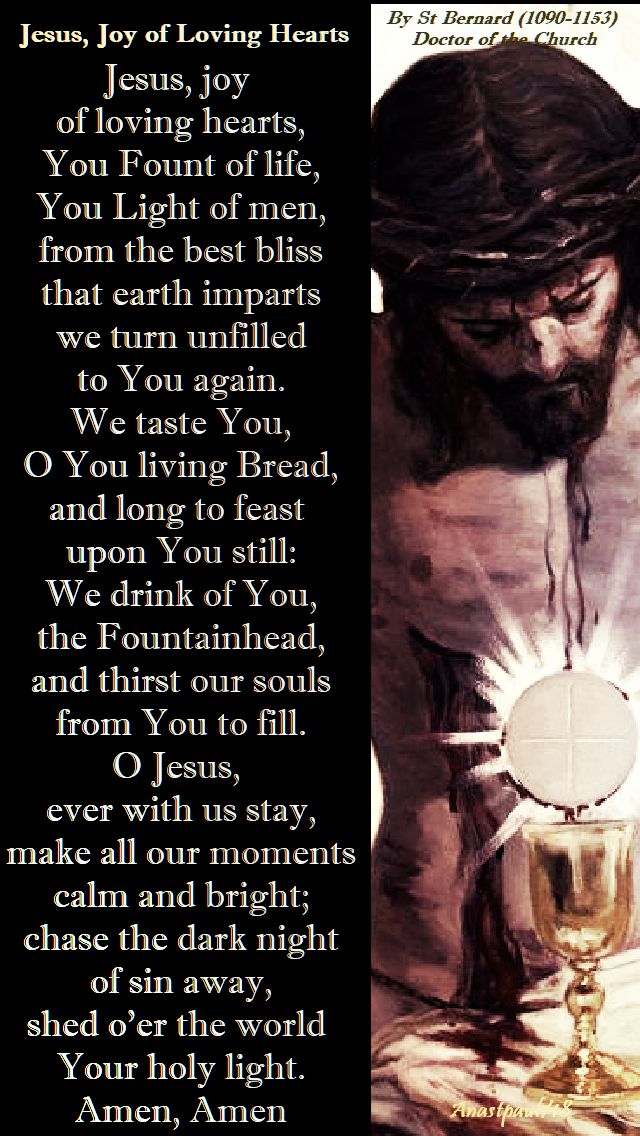
“It is simply impossible to lead,
without the aid of prayer,
a virtuous life.”it is simply impossible - st john chrysostom - 13 sept 2018

“Let the mouth also fast from disgraceful speeches and railings.
For what does it profit if we abstain from fish and fowl
and yet bite and devour our brothers and sisters?
The evil speaker eats the flesh of his brother
and bites the body of his neighbour!”
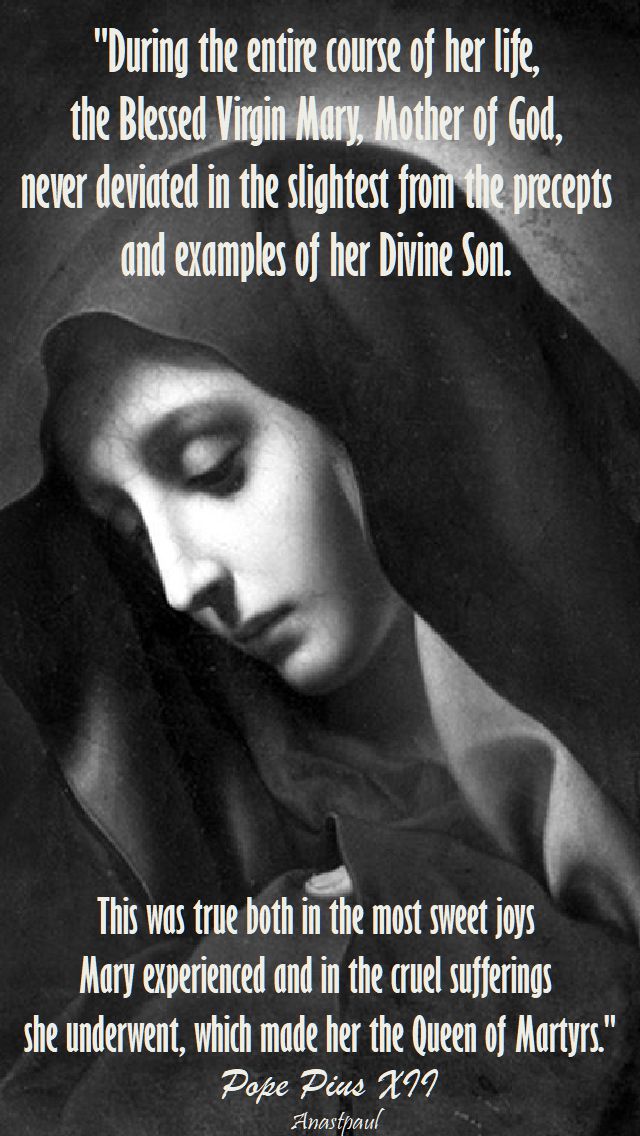
St John Chrysostom (347-407) Father & Doctor

“John of the Golden Mouth”let-the-mouth-also-fast-from-disgraceful-st-john-chrysostom 13 sept 2017

Posted in DOCTORS of the Church, FATHERS of the Church, MORNING Prayers, PAPAL SERMONS, QUOTES of the SAINTS, QUOTES on FORGIVENESS, QUOTES on HUMILITY, QUOTES on LOVE, QUOTES on MERCY, QUOTES on PEACE, QUOTES on PERSEVERANCE, QUOTES on VIOLENCE, SAINT of the DAY, The WORD

One Minute Reflection – 13 September – Today’s Gospel – Luke 6:27–38

One Minute Reflection – 13 September – Today’s Gospel – Luke 6:27–38 – Thursday of the Twenty-third week in Ordinary Time, Year B and the Memorial of St John Chrysostom (347-407) Father & Doctor of the Church

“Judge not and you will not be judged;  condemn not and you will not be condemned; forgive, and you will be forgiven;  give, and it will be given to you;  good measure, pressed down, shaken together, running over, will be put into your lap.   For the measure you give, will be the measure you get back.”...Luke 6:37-38judge not and you will not be judged - luke 6 37-38 - 13 sept 2018

REFLECTION – “O envious one, you injure yourself more than he whom you would injure and the sword with which you wound will recoil and wound yourself.   What harm did Cain do to   Abel? Contrary to his intention he did him the greatest good, for he caused him to pass to a better and a blessed life and he himself was plunged into an abyss of woe.   In what did Esau injure Jacob?   Did not his envy prevent him from being enriched in the place in which he lived and, losing the inheritance and the blessing of his father, did he not die a miserable death?   What harm did the brothers of Joseph do to Joseph, whose envy went so far as to wish to shed his blood?   Were they not driven to the last extremity and well-nigh perishing with hunger, whilst their brother reigned all through Egypt?   It is ever thus;  the more you envy your brother, the greater good you confer upon him.   God, who sees all, takes the cause of the innocent in hand and, irritated by the injury you inflict, deigns to raise up him whom you wish to lower and will punish you to the full extent of your crime.   If God usually punishes those who rejoice at the misfortunes of their enemies, how much more will He punish those who, excited by envy, seek to do an injury to those who have never injured them?”…Saint John Chrysostomit is ever thus the more you envy your brother - st john chrysostom - 13 sept 2018

“It will do us good today to think of an enemy – I think we all have someone who has hurt us or who wants to hurt us or who tries to hurt us.   Ah, this!   The mafia prayer is:   “You will pay for it”, the Christian prayer is:   “Lord, bless him and teach me to love him”…Pope Francis – Santa Marta, 19 June 2018it will do us good today - pope francis 13 sept 2018

PRAYER – Lord God, strength of those who hope in You, by Your will, St John Chrysostom became renowned in the Church, for his astounding eloquence and his forbearance in persecution.   Grant that we may be enriched by his teaching and thus grow in sanctity, to follow the commandments You set forth in Your Word, Your Son who is our Saviour and Redeemer.   By the prayers of St John Chrysostom, may we attain the place You have prepared for us.   We make our prayer through Jesus Christ with the Holy Spirit, one God, forever amen.st john chrysostom pray for us - 13 sept 2018