Our Morning Offering-7 February-Thursday of the Fourth week in Ordinary Time, Year C
May I Love You More Dearly By St Richard of Chichester (1197-1253)
Thanks be to You,
my Lord Jesus Christ
For all the benefits
You have given me,
For all the pains and insults
You have borne for me.
O most merciful Redeemer,
friend and brother,
May I know You
more clearly,
Love You
more dearly,
Follow You
more nearly.
Amen
Saint of the Day – 7 February – St Giles Mary of St Joseph OFM (1729-1812) Religious Franciscan Friar, Apostle of Charity and Prayer, Marian devotee – known as the “Consoler of Naples” and the “Saint of the Little Way” (also known as Egidio Maria da Taranto, Egidio Maria de Saint Giuseppe, Egidio Maria of Saint Joseph and Francesco Postillo).
St Giles Mary was born on 16 November 1729 at Taranto, Apulia, Italy and died on 7 February 1812 at Naples, Italy of natural causes while at prayer. Patronage – Taranto, Italy (chosen on 29 June 1919 by Archbishop Orazio Mazzella of Taranto).
Francesco Postillo was born in Taranto to a very poor family. Cataldo Postillo, his father and Grazia Procaccio, his mother. Three siblings later followed him. He was baptised as Francesco Domenico Antonio Pasquale Postillo.
His father’s death died in 1747 left the 18-year-old Francesco to care for the family. Francesco had to abandon his hope of education and to seek work to provide for his widowed mother and siblings. For a brief period of time he worked as a rope maker.
Although his desire was to become a priest, his lack of education meant that he was unable to fulfil this desire and served instead as a professed religious in the Order of Friars Minor in Naples. He applied to enter the order on 27 February 1754 and made his solemn profession of vows on 28 February 1755 at the convent of Santa Maria delle Grazie in Galatone. He assumed the religious name of “Giles of the Mother of God” but he later altered this instead to “Giles Mary of Saint Joseph”.
For 53 years he served at St Paschal’s Hospice in Naples in various roles, such as cook, porter or most often as official beggar for that community. He often travelled outside the confines of his convent to beg for alms and to aid those who were shunned and isolated, especially the lepers.
“Love God, love God”was his characteristic phrase as he gathered food for the friars and shared some of his bounty with the poor—all the while consoling the troubled and urging everyone to repent. He invited men and women to recognise their own gifts and to live out their dignity as people made in God’s divine image.
The charity which he reflected on the streets of Naples was born in prayer and nurtured in the common life of the friars. St Giles often carried an icon of the Blessed Virgin Mary in a depiction known as Our Lady of the Well when he made sick calls. The people whom Giles met on his begging rounds nicknamed him the “Consoler of Naples.”
In the same year that a power-hungry Napoleon Bonaparte led his army into Russia, Giles Mary of St Joseph ended a life of humble service to his Franciscan community and to the citizens of Naples. The date was 7 February 1812. Huge crowds turned out for his funeral, lamenting the loss of their Consoler.
His relics are enshrined in an urn next to the icon of Our Lady of the Well in the church of San Pasquale Baylón in Taranto.
He was Canonised on 2 June 1996 by St Pope John Paul II. His canonisation miracle involved the cure of Mrs Angela Mignogna in 1937.
Bl Adalbert Nierychlewski
St Adaucus of Phrygia
St Amulwinus of Lobbes
St Anatolius of Cahors
Bl Anna Maria Adorni Botti
Bl Anselmo Polanco
Bl Anthony of Stroncone
St Augulus
St Chrysolius of Armenia
Bl Eugenie Smet
St Fidelis of Merida
Bl Felipe Ripoll Morata St Giles Mary of Saint Joseph OFM (1729-1812)
Bl Jacques Sales
St John of Triora
St Juliana of Bologna
Bl Klara Szczesna
St Lorenzo Maiorano
St Luke the Younger
St Maximus of Nola
St Meldon of Péronne
St Moses the Hermit
St Parthenius of Lampsacus
Bl Peter Verhun Bl Pope Pius IX (1792-1878)
All about Blessed Pope Pius IX: https://anastpaul.wordpress.com/2018/02/07/saint-of-the-day-blessed-pope-pius-ix-1792-1878/
Thought for the Day – 6 February – The Memorial of St Paul Miki S.J. (c 1564-1597) & Companions – 26 Martyrs of Nagasaki
When the first missionaries, like St Francis Xavier, came to Japan in 1549 they were welcomed. Many Japanese became Christians. When the leader Hideyoshi took command, he feared that Christians would take over the government. In 1587, he banished them and destroyed many of their churches. Some missionary priests stayed and went into hiding, dressing like Japanese in order to minister to the Christians.
More than 3,000 Christians were martyred in Japan. On 8 December 1596, Hideyoshi arrested and condemned to death the friars of Miako. Among them were three Japanese Jesuits, six Franciscans (four of them Spanish) and seventeen Japanese laymen. Charged with attempting to harm the government, they were sentenced to crucifixion. Some of these men were very young – Louis was 10, Anthony, 13, Thomas, 16 and Gabriel, 19. The best known is Paul Miki, who was a Japanese of a noble family, a Jesuit brother and a brilliant preacher.
The twenty-six men were tortured and then forced to walk more than 300 miles from Miako to Nagasaki through snow and ice and freezing streams. Along the way they preached to the people who had come out to see them. They sang psalms of praise and joy. They prayed the rosary and told the people that such a martyrdom was an occasion of rejoicing, not of sadness. Finally, on 5 February they reached Nagasaki, where twenty-six crosses awaited them on a hill now called the Holy Mountain. It is said that the Christians ran to their crosses, singing. St Paul Miki said –
“The only reason for my being killed, is that I have taught the doctrine of Christ. I thank God it is for this reason that I die. I believe that I am telling the truth before I die. I know you believe me and I want to say to you all once again – ask Christ to help you become happy. I obey Christ. After Christ’s example, I forgive my persecutors. I do not hate them. I ask God to have pity on all and I hope my blood will fall on my fellow men as a fruitful rain.”
Soldiers bound them to the crosses with iron bands at their wrists, ankles and throats. Then they thrust them through with lances. Many people came to watch the cruel deaths. Hideyoshi and his solders had hoped the example would frighten other Christians. Instead, it gave them the courage to profess their faith as the martyrs had.
These martyrs died an horrendous and agonising death in witness to their faith in Jesus Christ. We may not be asked to make this sacrifice but we are all called upon to bear witness to our faith, sometimes in ways that are very difficult – yes even in our parishes, neighbourhoods and schools. Could we witness thus?
In 1858, Japan again permitted Christianity in Japan. Missionaries found thousands of Christians still in Japan. For two hundred years they had carried on the faith in secret.
Paul Miki was born in Japan and educated by the Jesuits. He would have been the very first Japanese priest if he had escaped arrest, for he had already completed his studies for the priesthood. From his cross he forgave his persecutors and told the people to ask Christ to show them how to be truly happy.
St Paul Miki and the Martyrs of Nagasaki, Pray for Us!
Quote of the Day – 6 February – The Memorial of St Paul Miki SJ (c 1564-1597) & Companions – 26 Martyrs of Nagasaki
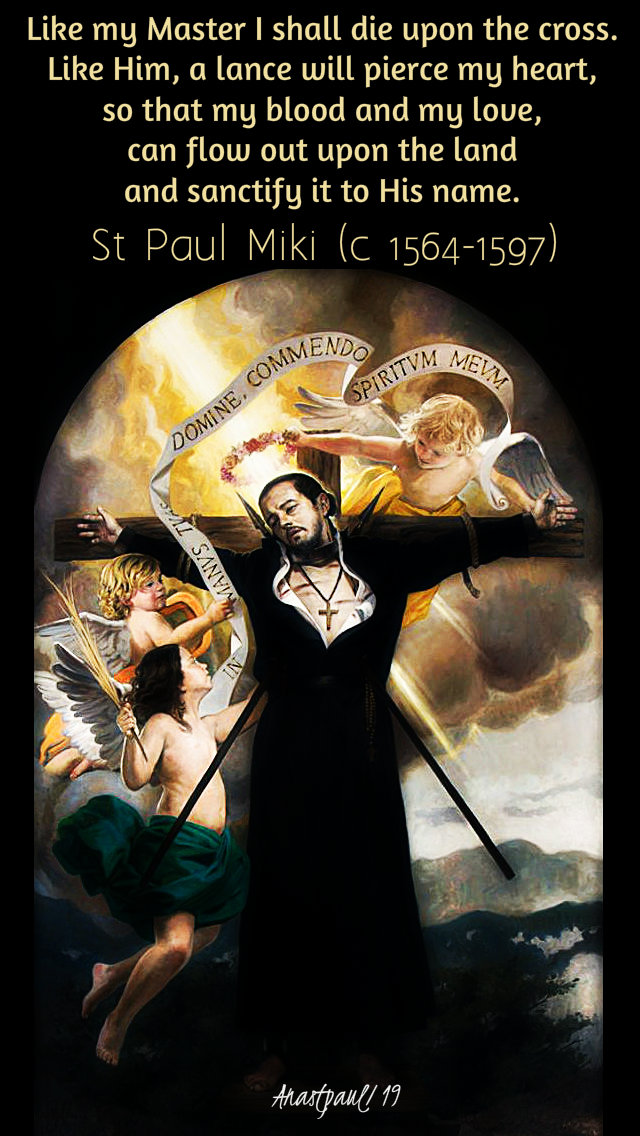
“Like my Master I shall die upon the cross. Like Him, a lance will pierce my heart, so that my blood and my love, can flow out upon the land and sanctify it to His name.”
One Minute Reflection – 6 February – Wednesday of the Fourth week in Ordinary Time, Year C, Gospel: Mark 6:1–6 and the Memorial of St Dorothy of Caesarea (Died 311) and St Paul Miki SJ (c 1564-1597) & Companions/Martyrs of Nagasaki – Martyrs
“Is not this the carpenter?”…Mark 6:3
REFLECTION – “Joseph loved Jesus as a father loves his son and he cared for Him, giving Him the best he had. Joseph took charge of this child as he had been commanded and turned Jesus into a workman, passing on his craft to Him. That is why their neighbours in Nazareth, when they spoke of Jesus, called Him, roughly speaking, a “carpenter” or “the son of a carpenter” (Mt 13:55)…
Jesus must have resembled Joseph in His traits of character and ways of working and talking. His realism, His powers of observation, His way of sitting at table and breaking bread, His attraction for explaining His teaching in a concrete way by taking His examples from everyday things, reflect what Jesus’ childhood and youth were like and therefore His relationship with Joseph. What depths there are in this mystery! This Jesus, who is a man, who speaks with the accent of a particular region of Israel, who resembles a workman named Joseph, is indeed the Son of God. And who can teach God anything? Nevertheless, He is truly man and His life is a normal one – first a child, then a young man who helps Joseph in the workshop and finally, a mature man in the fullness of age: “Jesus advanced in wisdom and grace before God and men” (Lk 2:52).
At the human level Joseph was Jesus’ master. Day by day he surrounded Him with tender affection and cared for Him with joyful self-denial. Is this not a very good reason for thinking this man to be just (Mt 1:19) – this saintly patriarch in whom the Old Testament faith reaches its climax as a master of the interior life?”…St Josémaria Escriva de Balaguer (1902-1975)
“According to the people of Nazareth, God is too great to humble Himself to speak through such a simple man! It is the scandal of the Incarnation – the unsettling event of a God made flesh, who thinks with the mind of a man, works and acts with the hands of a man, loves with a human heart, a God who struggles, eats and sleeps like one of us.
The Son of God overturns every human framework – it is not the disciples who washed the feet of the Lord but, it is the Lord who washed the feet of the disciples (cf. Jn 13:1-20). This is a reason for scandal and incredulity, not only in that period but in all ages, even today.”…Pope Francis – Angelus, 8 July 2018
PRAYER – Lord God, source of strength and grace, grant us eyes to see and ears to hear and hearts to love the Word of Your Son. Make us recognise Your Son in our daily lives and be generous in sharing our faith to all we meet. Grant, we pray, that the prayers of St Dorothy of Caesarea and St Paul Miki and companions, may help us to manifest zeal and courage. Through Jesus Christ, our Lord, in unity with the Holy Spirit, God forever, amen.
Our Morning Offering – 6 February – Wednesday of the Fourth week in Ordinary Time, Year C
O Mary By Ven Fulton J Sheen (1895-1979)
O Mary,
we have exiled your Divine Son
from our lives,
our councils,
our education
and our families!
Come with the light of the sun
as the symbol of His Power!
Heal our wars, our dark unrest,
cool the cannon’s lips so hot with war!
Take our minds off the atom
and our souls out of the muck of nature!
Give us rebirth in your Divine Son,
us, the poor children of the earth,
grown old with age!
Amen
Saint of the Day – 6 February – St Dorothy of Caesarea (died 311) – Virgin, Martyr – also known as Dora, Dorothea – Patronages – horticulture, brewers, brides, florists, gardeners, midwives, newlyweds, love, Pescia in Italy.
St Dorothy is a 4th-century virgin martyr who was executed at Caesarea Mazaca. Evidence for her actual historical existence or acta is very sparse. She is called a martyr of the Diocletianic Persecution, although her death occurred after the resignation of Diocletian himself. She should not be confused with another 4th-century saint, Dorothea of Alexandria. She and St Theophilus the Lawyer are mentioned in the Roman Martyrology as martyrs of Caesarea in Cappadocia, with a feast day on 6 February. She is thus officially recognised as a saint but because there is scarcely any non-legendary knowledge about her, she is no longer (since 1969) included in the General Roman Calendar.
St Dorothy and the Child by Edward Burne Jones
St Dorothy was a young virgin, celebrated at Cæsarea, where she lived, for her angelic virtue. Her parents seem to have been martyred before her in the Diocletian persecution and when the Governor Sapricius came to Cæsarea he called her before him and sent this child of martyrs to the home where they were waiting for her.
She was stretched upon the rack and offered marriage if she would consent to sacrifice, or death if she refused. But she replied that “Christ was her only Spouse and death her desire.”She was then placed in charge of two women who had fallen away from the faith, in the hope that they might pervert her but the fire of her own heart rekindled the flame in theirs and led them back to Christ.
St Dorothy by Francisco de Zubaran
When she was set once more on the rack, Sapricius himself was amazed at the heavenly look she wore and asked her the cause of her joy. “Because,” she said, “I have brought back two souls to Christ and because I shall soon be in heaven rejoicing with the angels.”
Her joy grew as she was buffeted in the face and her sides burned with plates of red-hot iron. “Blessed be Thou,” she cried, when she was sentenced to be beheaded,-“blessed be Thou, O Thou Lover of souls! Who dost call me to Paradise and invitest me to Thy nuptial chamber.”
St Dorothy by Lucas Cranach the Elder
St Dorothy suffered in the dead of winter and it is said that on the road to her passion a lawyer called Theophilus, who had been used to calumniate and persecute the Christians, asked her, in mockery, to send him “apples or roses from the garden of her Spouse.”
The Saint promised to grant his request and, just before she died, a little child stood by her side bearing three apples and three roses. She bade him take them to Theophilus and tell him this was the present which he sought from the garden of her Spouse.
St Dorothy had gone to heaven and Theophilus was still making merry over his challenge to the Saint when the child entered his room. He saw that the child was an angel in disguise and the fruit and flowers of no earthly growth. He was converted to the faith and then shared in the martyrdom of St Dorothy.
St Dorothy by Girolamo Donnini
She is regarded as the patroness of gardeners. On her feast trees are blessed in some places.
St Amand of Maastricht
St Amand of Moissac
St Amand of Nantes
St Andrew of Elnone
Bl Angelus of Furci
St Antholian of Auvergne
St Brinolfo Algotsson
Cassius of Auvergne
Bl Diego de Azevedo St Dorothy of Caesarea (c 279/290-311) Martyr
St Ethelburga of Wessex
Bl Francesca of Gubbio
St Francesco Spinelli
St Gerald of Ostia
St Guarinus
St Guethenoc
St Hildegund
St Ina of Wessex
St Jacut
St Liminius of Auvergne
Bl Mary Teresa Bonzel
St Mateo Correa-Magallanes
St Maximus of Aurvergne
St Mel of Ardagh
St Melchu of Armagh
St Mun of Lough Ree
St Relindis of Eyck
St Revocata
St Saturninus
St Tanco of Werden
St Theophilus
St Theophilus the Lawyer
St Vaast of Arras
St Victorinus of Auvergne
—
Martyrs of Emesa:
St Luke the Deacon
St Mucius the Lector
St Silvanus of Emesa
Thought for the Day – 5 February – Tuesday of the Fourth week in Ordinary Time, Year C – Gospel: Mark 5:21–43 and
Agatha, is claimed as the patroness of both Palermo and Catania. The year after her death, the stilling of an eruption of Mount Etna was attributed to her intercession. As a result, people continue to ask her prayers for protection, against fire.
St Agatha gave herself without reserve to Jesus Christ, she followed Him in virginal purity and then looked to Him for protection. And down to this day, Christ has shown His tender regard for her mortal remains – again and again, during the eruptions of Mount Etna, the people of Catania have exposed her relics for public veneration and thus experienced safety. In modern times, on opening her tomb in which her body lies waiting for the resurrection, her skin has been found to be intact, a sweet fragrance emanating from this temple of the Holy Spirit.
The scientific modern mind winces at the thought of a volcano’s might being contained by God because of the prayers of a Sicilian girl. Still less welcome, probably, is the notion of that saint being the patroness of such varied professions as those of foundry workers, nurses, miners and Alpine guides. Yet, in our historical precision, have we lost an essential human quality of wonder and poetry and even our belief that we come to God by helping each other, both in action and prayer? And, far more than this, from where did it all come from in the first place and, you and I, in and by what power are we upheld?
Jesus Christ, Lord of all things! You see my heart, You know my desires. Possess all that I am – You alone. I am Your sheep. Make me worthy to overcome the devil.
“If you have a good conscience, you would not greatly fear death.”
“The glory of the good, is in their consciences and not, in the tongues of men.”
“Happy is the man who renounces everything, which may bring a stain or burden, upon his conscience”
“He has great tranquillity of heart, who cares neither for the praises, nor the fault-finding of men. He will easily be content and pacified, whose conscience is pure. You are not holier if you are praised, nor the more worthless, if you are found fault with. What you are, that you are; neither by word can you be made greater, than what you are in the sight of God.”
“Love alone makes heavy burdens light and bears in equal balance, things pleasing and displeasing. Love bears a heavy burden and does not feel it and love, makes bitter things, tasteful and sweet.”
“Without labour there is no rest, nor without fighting, can the victory be won.”
“You shall rest sweetly, if your heart condemns you not.”
One Minute Reflection – 5 February – Tuesday of the Fourth week in Ordinary Time, Year C – Gospel: Mark 5:21–43 and The Memorial of St Agatha (c 231- c 251)
…”I say to you, arise.”… Mark 5:41
REFLECTION – ““He took the child by the hand and said to her: ‘Talitha koum’, which means, ‘Little girl…arise.’” “Since you have been born again, you are to be called ‘little girl’. Little girl, arise for my sake – your healing does not come from you.” “And immediately the little girl arose and walked around.” May Jesus touch us, too and at once we shall walk. We may well be paralysed, our deeds may be evil and we may be unable to walk, we may be lying on the bed of our sins… but if Jesus touches us, then we shall immediately be healed. Peter’s mother-in-law was suffering with fever – Jesus touched her hand and she arose and immediately served Him (Mk 1:31)…
“They were utterly astounded and he gave them strict orders that no one should know this.” Do you see now why He put the people out when He was going to work a miracle? He ordered and not just ordered but strictly ordered, that no one should know of this. He ordered the three apostles and He ordered the parents, too, that no one should know. Our Lord ordered them all but the little girl herself, she who had stood up, could not be silent.
“And he said she should be given something to eat” – so that her resurrection might not be thought to be a ghostly apparition. And He Himself, after His resurrection, ate fish and a piece of honeycomb (Lk 24:42)… Lord, I beseech you, touch our hands as we, too, lie prostrate. Make us rise from our bed of sins and enable us to walk. And when we have walked, make them give us something to eat. We cannot eat when we are lying down- unless we are standing, we shall not be able to receive the Body of Christ.”…St Jerome (347-420) – Father & Doctor of the Church
PRAYER – Increase in us, O Lord, the gift of faith, so that we may arise and offer our praise to You and by Your grace, yield fruit from heaven, for the glory of Your Kingdom. Lord God, let St Agatha, who became precious in Your sight through her pure life and valiant martyrdom, plead for our forgiveness. For, with joy and rejoicing, as though to a feast, St Agatha, went to prison and offered her sufferings to You, with many prayers. Through Jesus Christ, Your divine Son, in unity with the Spirit, one God forever. St Agatha, pray for us, amen.
Our Morning Offering – 5 February-Tuesday of the Fourth week in Ordinary Time, Year C
Write Your Blessed Name, Upon My Heart By Thomas à Kempis
Write Your blessed name,
O Lord,
upon my heart,
there to remain so indelibly engraved,
that no prosperity,
no adversity shall ever move me
from Your love.
Be to me a strong tower of defence,
a comforter in tribulation,
a deliverer in distress,
a very present help in trouble
and a guide to heaven
through the many temptations
and dangers of this life.
Amen
Saint of the Day – 5 February – St Adelaide of Guelders (c 970–1015) – Abbess, Apostle of Charity, Miracle-worker, Reformer, Counsellor to the Archbishop of Cologne. She is also known as Adelaide of Vilich, Adelaide of Bellich, Alice, Adelheid, Adalheide. Born in c970 in Geldern, North Rhine-Westphalia, Germany and died on 5 February 1015 at Our Lady of the Capitol convent at Cologne, North Rhine-Westphalia, Germany of natural causes.
When Adelaide was still very young, she entered the convent of St Ursula, Our Lady of the Capitol, founded by her parents in Cologne, where the Rule of St Jerome was followed. About 980, her parents founded the convent of Villich. Adelaide was “redeemed” from the Ursulione convent by exchange with a parcel of land and became abbess of this new convent, initially established as an unusually late example of a community of canonesses. Canons were attached to the convent in order that Mass might be said. Here, Adelaide introduced the stricter Benedictine rule. She insisted that the nuns under her care learn to read Latin, that they might understand the Mass.
According to the Catholic Encyclopedia “the fame of her sanctity and of her gift of working miracles soon attracted the attention of Saint Heribert, Archbishop of Cologne”, who could scarcely have ignored an abbess of her high connections. He appointed her abbess of the convent of St Maria im Kapitol, Cologne, to succeed her sister Bertha, who died about 1000. Emperor Otto III reaffirmed Vilich’s immunities from ecclesiastical interference and the right to appoint its own abbess, a title that remained only briefly in the founding family. She died at her convent in Cologne in the year 1015 but was buried at Vilich, where her feast was solemnly celebrated on 5 February and rapidly attracted pilgrims.
A hagiography, Vita Adelheidis, provides some information regarding her family.
St Adelaide of Guelders (c 970–1015)
St Agatha Hildegard of Carinthia
St Agricola of Tongres
St Albinus of Brixen
St Anthony of Athens
St Avitus of Vienne
St Bertulph
St Buo of Ireland
St Calamanda of Calaf
St Dominica of Shapwick
St Fingen of Metz
Bl Françoise Mézière
St Gabriel de Duisco
St Genuinus of Sabion
St Indract
St Isidore of Alexandria
St Jesús Méndez-Montoya
Bl John Morosini
St Kichi Franciscus
St Luca di Demenna
St Modestus of Carinthia
Bl Primo Andrés Lanas
St Saba the Younger
St Vodoaldus of Soissons
—
Martyrs of Pontus: An unknown number of Christians who were tortured and martyred in assorted painful ways in the region of Pontus (in modern Turkey) during the persecutions of Maximian.
Thought for the Day – 4 February – The Memorial of St John de Britto SJ (1647-1693) Martyr
We are called to serve.
Excerpt from the EUCHARISTIC CELEBRATION IN HONOUR OF ST JOHN DE BRITTO
HOMILY OF HIS HOLINESS JOHN PAUL II Madras Wednesday, 5 February 1986
“Let the peoples praise you, O God, let all the peoples praise you” .
Saint John de Britto, whom we are remembering in today’s liturgical celebration, was born in Lisbon in 1647. After entering the Society of Jesus he followed the footsteps of Saint Francis Xavier to India where he chose to work for the humble and needy in what was then called the Madurai Mission. His patient labours, selfless zeal and genuine love for the poor, won for him their confidence. Like Jesus he was “a sign of contradiction” and his success created jealousy and opposition. As a result, John de Britto died a martyr on 4 February 1693, bearing witness to Christ.
…Saint John de Britto’s life faithfully reflected the life of our Lord and Saviour Jesus Christ, for it was a life of service unto death. Today it challenges all of us to continue with fresh vigour the Church’s role of loving service to humanity. The immense and tender love of Jesus Christ for the poor and the downtrodden, for sinners and the suffering, remains a challenge for every Christian. Christ’s unrelenting stand for truth is a compelling example. Above all, the generosity shown in His suffering and death, as the culmination of His service to humanity and the supreme act of Redemption, is the example for us. We are called to serve.
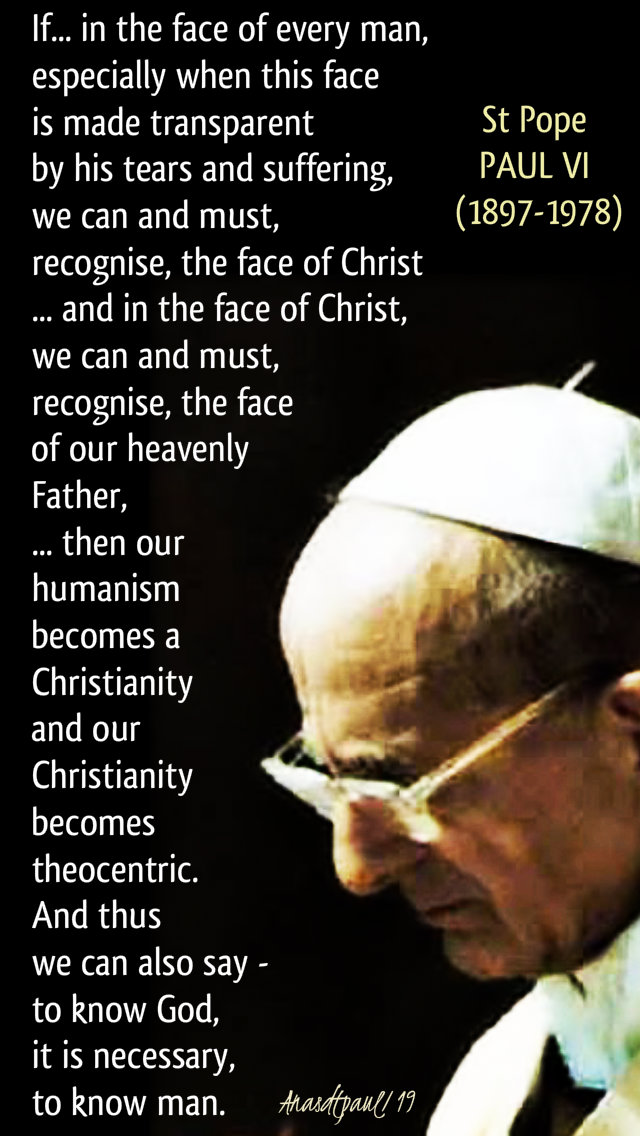
There can be no authentic Christian life without an effective love of our fellow human beings. At the closing of the Vatican Council Pope Paul VI affirmed that ” if… in the face of every man, especially when this face is made transparent by his tears and suffering, we can and must, recognise the face of Christ … and in the face of Christ, we can and must, recognise, the face of our heavenly Father, … then our humanism becomes a Christianity and our Christianity becomes theocentric. And thus we can also say – to know God, it is necessary, to know man.”
Today we live at a time of history when peace and harmony between nations and races is constantly threatened. Division and hatred, fear and frustration – these are among the counter-values of our day. The message of love in Christ Jesus in urgently needed. Hence, the Church’s task of proclaiming the Gospel and of being at the service of society is supremely relevant in India today. This task requires the active collaboration of all sectors of the ecclesial community, especially the laity.
…Through the testimony of your lives, through your words and deeds, the word of God is made known to the minds and hearts of others who seek Him, so that “they also may obtain salvation in Christ Jesus with its eternal glory” – that “they may obtain salvation”!
Brothers and sisters, if we die with Christ, we shall live also with Him, “if we endure, we shall also reign with him” .
Christ – Shepherd, Prophet and Priest – has sealed our hearts with His call just as He touched the hearts of the apostles, the hearts of Saint Thomas, Saint Francis Xavier and Saint John de Britto. May they intercede for the Church in India, for this beloved country and its people!
We will be happy if we remain faithful. For He, Christ, is faithful – “He remains faithful for He cannot deny Himself” .
Brothers and sisters, you are called to be living witnesses to Christ, living witnesses to God’s word, living witnesses to the saving message of love and mercy that Christ revealed to the world. Amen.
Quote/s of the Day – 4 February – The Memorial of Blessed Rabanus Maurus OSB (776-856), St Joseph of Leonissa OFM CAP (1556-1612) and St John de Britto SJ (1647-1693) Martyr
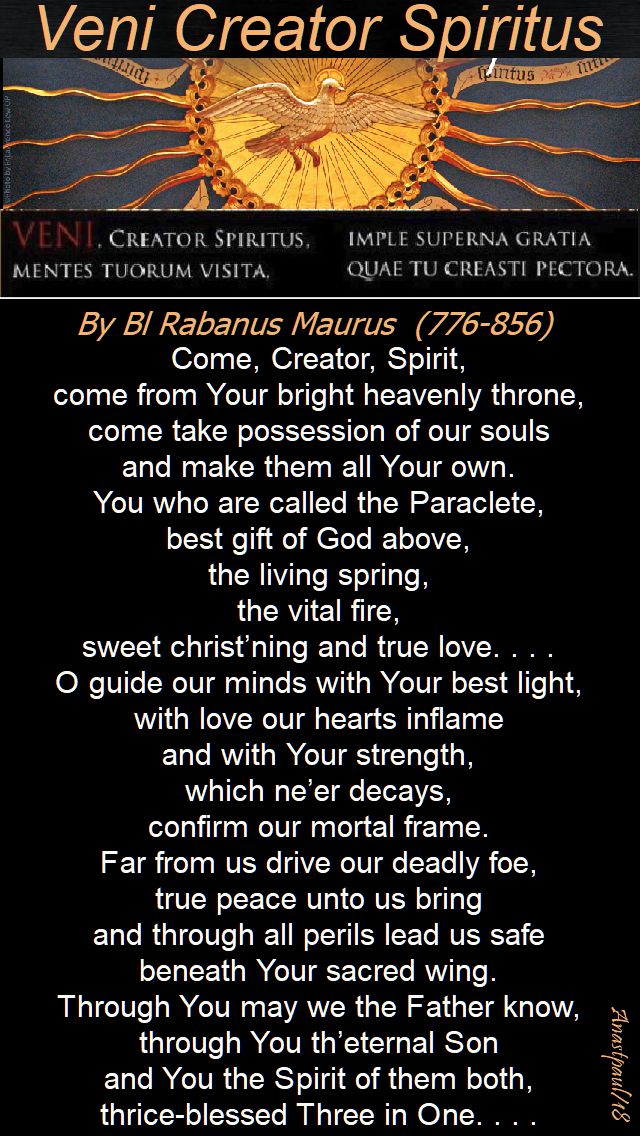
Veni Creator Spiritus
Come, Creator, Spirit, come from Your bright heavenly throne, come take possession of our souls and make them all Your own. You who are called the Paraclete, best gift of God above, the living spring, the vital fire, sweet christ’ning and true love. . . . O guide our minds with Your best light, with love our hearts inflame and with Your strength, which ne’er decays, confirm our mortal frame. Far from us drive our deadly foe, true peace unto us bring and through all perils lead us safe beneath Your sacred wing. Through You may we the Father know, through You th’eternal Son and You the Spirit of them both, thrice-blessed Three in One. . . .
By Blessed Rabanus Maurus (776-856)
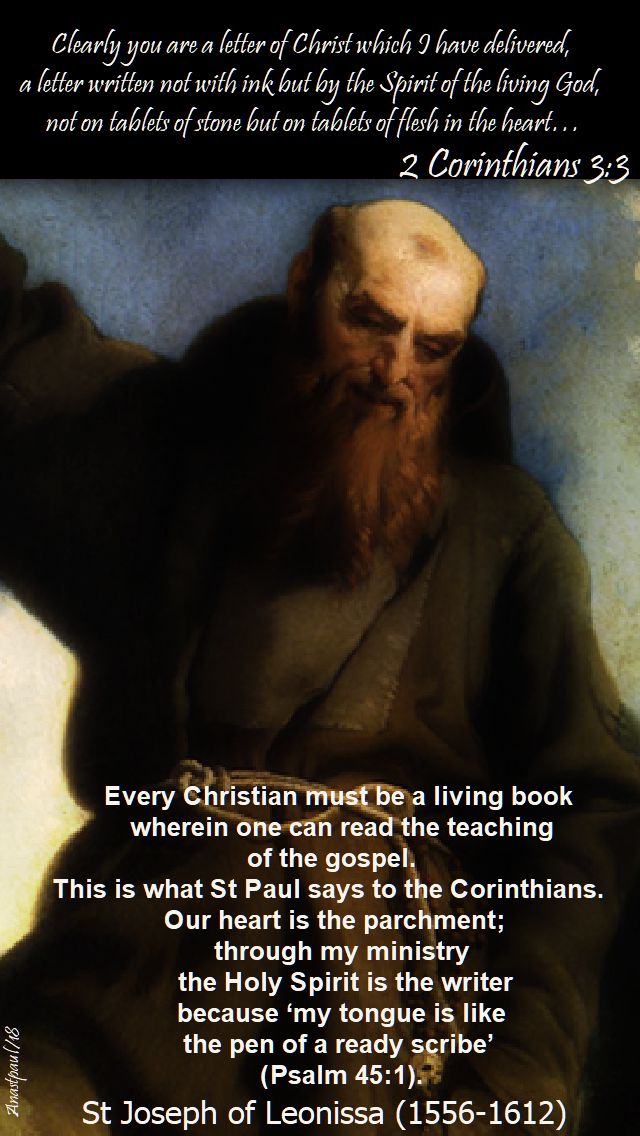
“Every Christian must be a living book wherein one can read the teaching of the gospel. This is what St Paul says to the Corinthians. Our heart is the parchment; through my ministry the Holy Spirit is the writer because ‘my tongue is like the pen of a ready scribe’ (Psalm 45:1).”
St Joseph of Leonissa OFM CAP (1556-1612)
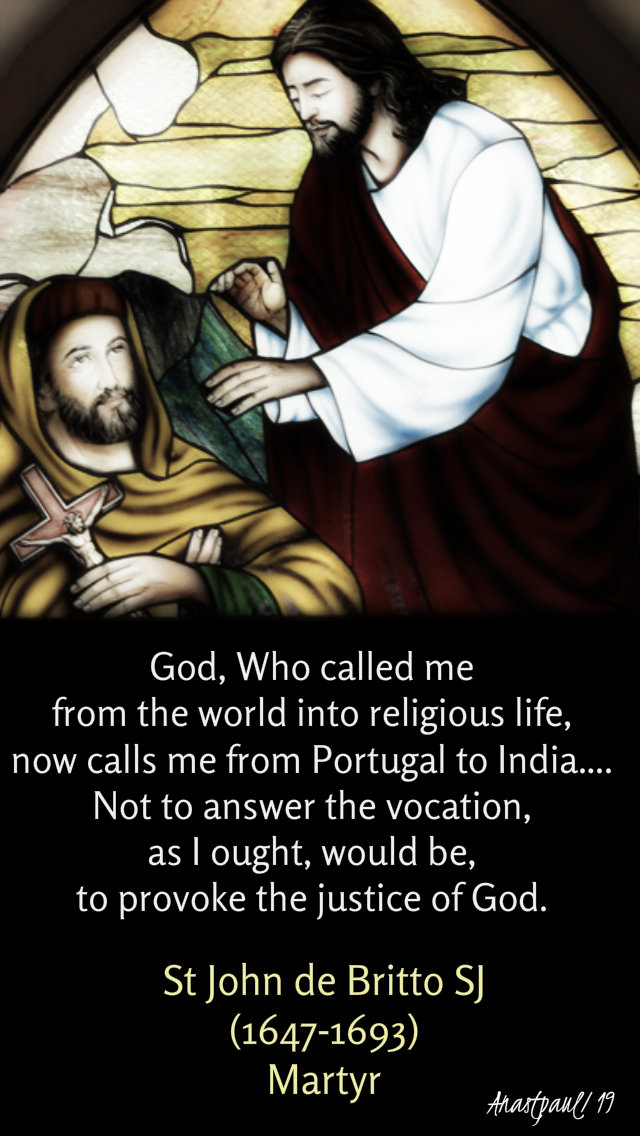
“God, Who called me from the world into religious life, now calls me from Portugal to India…. Not to answer the vocation as I ought, would be to provoke the justice of God.”
One Minute Reflection – 4 February – Monday of the Fourth week in Ordinary Time, Year C, Gospel: Mark 5:1–20 and the Memorial of St John de Britto SJ (1647-1693) Martyr
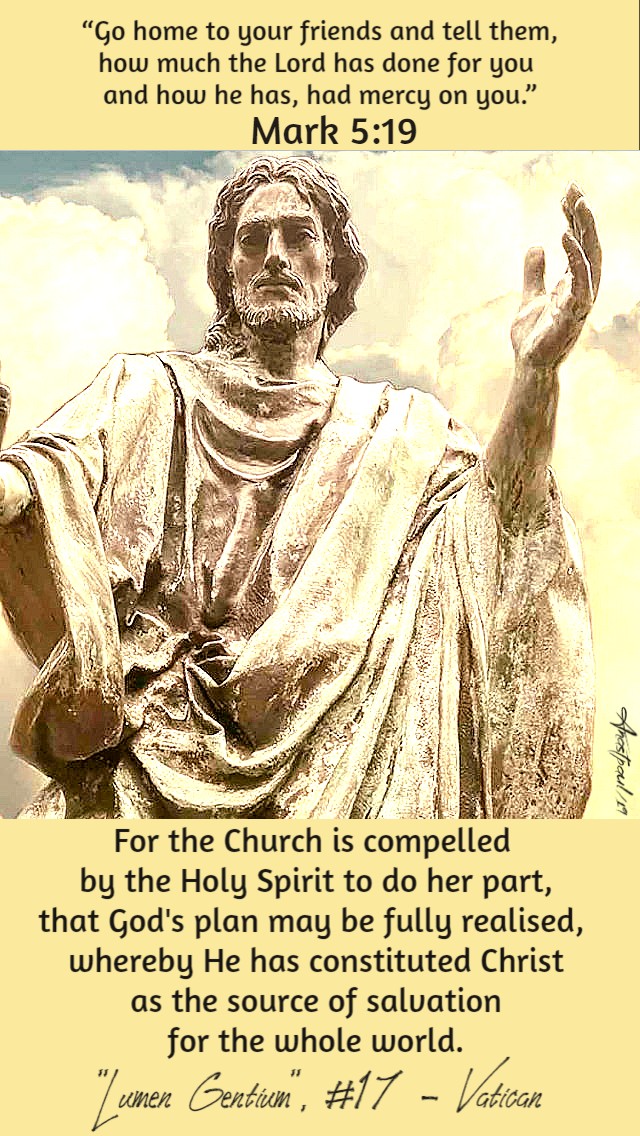
“Go home to your friends and tell them, how much the Lord has done for you and how he has, had mercy on you.”…Mark 5:19
REFLECTION – “As the Son was sent by the Father, so He too sent the Apostles (Jn 20:21), saying: “Go, therefore, make disciples of all nations, baptising them in the name of the Father and of the Son and of the Holy Spirit, teaching them to observe all things whatsoever I have commanded you. And behold I am with you all days even to the consummation of the world”.(Mt 28:19) The Church has received this solemn mandate of Christ to proclaim the saving truth from the apostles and must carry it out to the very ends of the earth.(Acts 1:8) Wherefore, she makes the words of the Apostle her own: “Woe to me, if I do not preach the Gospel” (1Cor 9:16) and continues unceasingly to send heralds of the Gospel until such time as the infant churches are fully established and can themselves continue the work of evangelising.
For the Church is compelled by the Holy Spirit to do her part, that God’s plan may be fully realised, whereby He has constituted Christ as the source of salvation for the whole world. By the proclamation of the Gospel she prepares her hearers to receive and profess the faith. She gives them the dispositions necessary for baptism, snatches them from the slavery of error and of idols and incorporates them in Christ, so that through charity, they may grow up into full maturity in Christ. Through her work, whatever good is in the minds and hearts of men, whatever good lies latent in the religious practices and cultures of diverse peoples, is not only saved from destruction but is also cleansed, raised up and perfected unto the glory of God, the confusion of the devil and the happiness of man.
The obligation of spreading the faith is imposed on every disciple of Christ, according to his state. However, although all the faithful can baptise, the priest alone can complete the building up of the Body in the eucharistic sacrifice. Thus are fulfilled the words of God, spoken through His prophet: “From the rising of the sun until the going down thereof my name is great among the gentiles and in every place a clean oblation is sacrificed and offered up in my name”.(Mal 1:11) In this way the Church both prays and labours in order that the entire world may become the People of God, the Body of the Lord and the Temple of the Holy Spirit.”… Dogmatic Constitution on the Church, “Lumen Gentium”, #17 – Vatican Council II
PRAYER – Lord God and Father, who entrusted the earth to men, to till and care for it and made the sun to serve their needs, give us grace this day, to work faithfully for Your Glord and for our neighbours’ good. As we follow the Way of Your Son, fill us with the Holy Spirit of faith, hope and love. Almighty God, You made Saint John of Britto, an illustrious preacher of the gospel. Through his prayers inflame us with love and with his zeal for souls that we may serve You alone. St John of Britto, pray for us! Through Jesus, our Lord in the unity of the Holy Spirit, God forever and ever, amen.
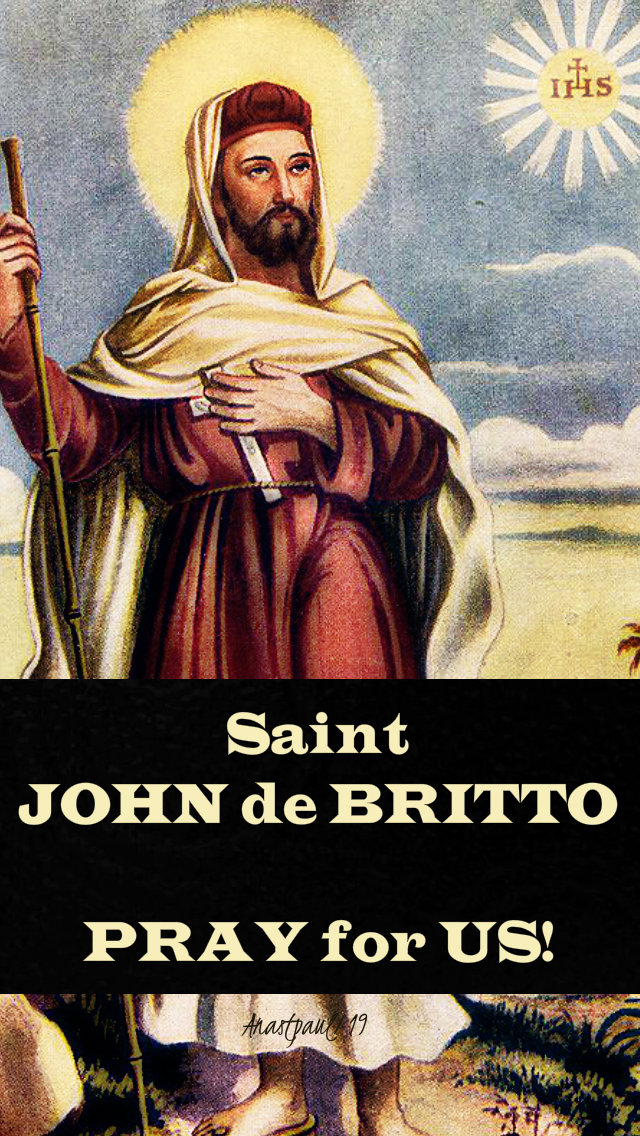
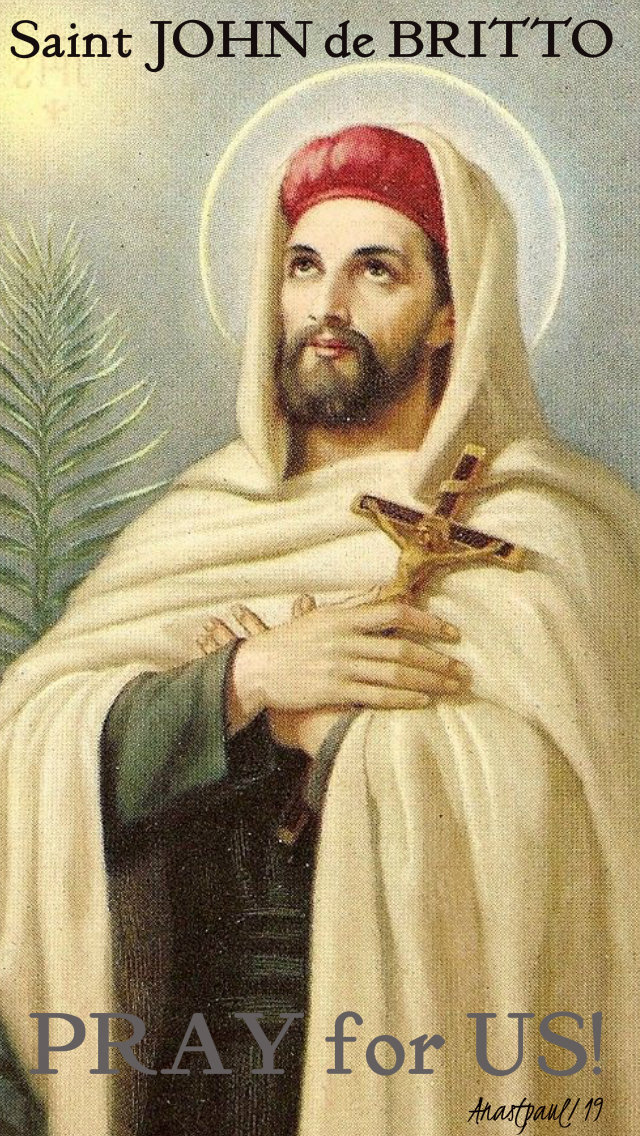
Saint of the Day – 4 February – St John de Britto SJ (1647-1693) also known as Arul Anandar (his Indian title and name) – Martyr, Priest, Missionary, Confessor, Preacher – born João de Brito in Lisbon, Portugal on 1 March 1647 – martyred at Oriyur, Tamil Nadu, India on 11 February 1693 (aged 46). Patronages – Portugal, Diocese of Sivagangai, India.
King Pedro II of Portugal, when a child, had among his little pages a modest boy of rich and princely parents. Much had John de Britto—for so was he called—to bear from his careless-living companions, to whom his holy life was a reproach. A terrible illness made him turn for aid to St Francis Xavier, a Saint so well loved by the Portuguese and when, in answer to his prayers, he recovered, his mother vested him for a year in the dress worn in those days by the Jesuit Fathers. From that time John’s heart burned to follow the example of the Apostle of the Indies He gained his wish.
On 17 December 1662, he entered the novitiate of the Society at Lisbon and eleven years later, in spite of the most determined opposition of his family and of the court, he left all to go to convert the Hindus of Madura. When Blessed John’s mother knew that her son was going to the Indies, she used all her influence to prevent him leaving his own country and persuaded the Papal Nuncio to interfere. “God, Who called me from the world into religious life, now calls me from Portugal to India,” was the reply of the future martyr. “Not to answer the vocation as I ought, would be to provoke the justice of God. As long as I live, I shall never cease striving to gain a passage to India.”
He travelled to the missions of Madurai, in Southern India, present-day Tamil Nadu, in 1673 and preached the Christian religion in the region of the Maravar country. He renamed himself, Arul Anandar in Tamil and for fourteen years he toiled, preaching, converting, baptising multitudes, at the cost of privations, hardships and persecutions.
John at first hoped to win over members of both the higher and the lower castes to Christianity, and so he dressed and lived as an Indian ascetic. He attracted so many members of the lowest caste to Christianity that members of the royalty of Madura saw John as a threat to the caste system. They imprisoned and tortured him but then released him. The Jesuits recalled him to Portugal in 1687 and worked as a missions procurator. King Pedro III (his childhood friend who was now the King) wanted him to stay but in 1690 but after four years, he was allowed to return to Goa and went back to the same territory where he had once been held captive with 24 new missionaries.
The Madurai Mission was a bold attempt to establish an Indian Catholic Church that was relatively free of European cultural domination. As such, Britto learned the native languages, went about dressed in yellow cotton and lived like the people he was seeking to convert – abstaining from every kind of animal food and from wine. St John de Britto tried to teach the Catholic faith in categories and concepts that would make sense to the people he taught. This method, proposed and practised by Fr Roberto de Nobili SJ (1577–1656) (an Italian Jesuit missionary to Southern India. He used a novel method of adaptation (accommodation) to preach Christianity, adopting many local customs of India which were, not contrary to Christianity) met with remarkable success. Britto remained a strict vegan until the end of his life, rejecting meat, fish, eggs and alcohol and living only on legumes, fruits and herbs.
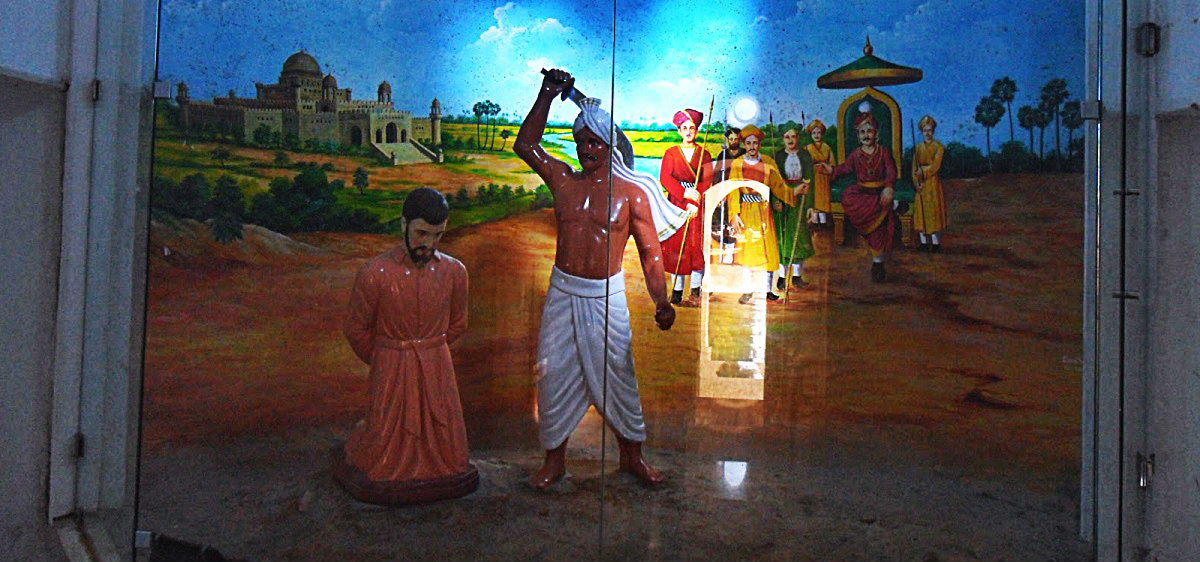
Like St John the Baptist, he died a victim to the anger of a guilty woman, whom a convert king had put aside and, like the Precursor, he was beheaded after a painful imprisonment. St John’s preaching had led to the conversion of a Marava prince who had several wives. When Thadiyathevan, the prince, was required to dismiss all his wives but one, a serious problem arose. One of the wives was a niece of the neighbouring king, who took up her quarrel and began a general persecution of Christians. Britto and the catechists were taken and carried to the capital, Ramnad. Thence he was led to Oriyur, some 30 miles northward along the coast, where he was executed on 4 February 1693.
St John was Beatified by Pope Pius IX on 21 August 1853. He was Canonised by Pope Pius XII on 22 June 1947.
The stained glass below shows St John portrayed in the attire of an ascetic, with a gold flame at each side of his head, representing two miracles attributed to him during his lifetime. The orange-red heart at the right knee and a black yin and yang symbol at the right ankle indicate his love for the people of all India. He stands on greenery, under which is a black scroll weighted down by a scimitar.
The shield of the Society of Jesus consists of a blue circlet on a purple background on which the Jesuit logo, IHS is written above the three nails of the crucifixion of Jesus, surrounded by rays of light. A circle around the shield contains the words “Society of Jesus” and the abbreviated motto of the Society, “A.M.D.G.” (“For the Greater Glory of God”). The foundation date of the Society is 1540.
The Red Sand of St John
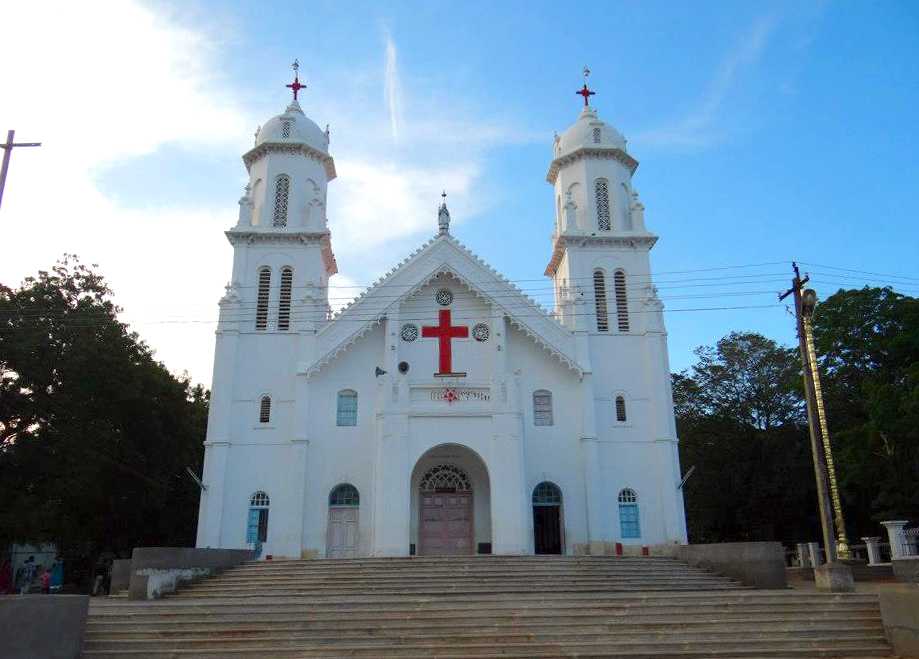
This seashore sightseeing location is one of the most venerable pilgrim centres of Christians in the world, as it is the site of St John de Britto’s martyrdom. It was at this place where the saint was beheaded in 1693. The sand dune here was stained by the blood of the revered saint. There is a shrine constructed in Portuguese style (see below) containing a statue of the saint, known locally as ‘Arul Anandar’ who had modestly offered his neck to the executioner.
The “red sand dune” has become a pilgrimage site where many miracles have been granted. Numerous incurable diseases have been cured by the application of the red sand on the respective body parts. Couples are believed to have blessed with children on visiting the shrine and praying for St John’s intercession. During festivities, pilgrims mainly from Tamil Nadu and Kerala participate irrespective of their caste, creed and religion. Thus, together with Christians, Hindus and Muslims also come to worship at the shrine in thousands, to mark respect to a unique holy man who shed his life and blood at that spot. The occasion appears to be more as a social gathering rather than a religious festival. The auspicious ceremony is a rare opportunity for these simple people to bring gaiety and enthusiasm in their life. The strong faith and enviable ability to combine pleasure and righteousness on a pilgrimage gives a divine atmosphere to the Oriyur feast.
Devotees from other dioceses and districts visit the shrine on specific dates. In February, believers from Dindigul arrive while in June, they are from Karunguli and Nagapattinam. During September more than 25,000 pilgrims visit the shrine for dedicating prayers and offerings. In October, nearly thousands of pilgrims arrive from the neighbouring Sivagangai district and in December, visitors are from Madurai and Melur. Throughout the year, thousands of pilgrims from Sakthikulangara, the only parish in Kerala, visit the St John de Britto shrine to seek the unique blessings.
St Liephard of Cambrai
St Magnus of Fossombrone
St Modan
St Nicholas Studites
St Nithard
St Obitius
St Phileas of Alexandria
Bl Rabanus Maurus
St Rembert
St Themoius
St Theophilus the Penitent
St Vincent of Troyes
St Vulgis of Lobbes
—
Jesuit Martyrs of Japan: A collective memorial of all members of the Jesuits who have died as martyrs for the faith in Japan.
Martyrs of Perga – 4 saints: A group of shepherds martyred in the persecutions of Decius. The only details we have about them are the names – Claudian, Conon, Diodorus and Papias. They were martyred in c 250 in Perga, Asia Minor (in modern Turkey).
Second Thoughts for the Day – 3 February – Fourth Sunday in Ordinary Time, Year C – First Reading: Jeremiah 1:4-5, 17-19
Now the word of the Lord came to me saying, “Before I formed you in the womb I knew you, and before you were born I consecrated you, I appointed you a prophet to the nations.”…Jeremiah 1:4–5
As linked with the Gospel episode of Jesus’ proclaiming the Word of God in Nazareth and the people’s response, it is fair to ponder, all gifts given by the Father of our Lord Jesus Christ to build-up the Body of Christ, the Church. Through Baptism, Confirmation and the Most Holy Eucharist, all have been “set apart” and “appointed” for particular missions throughout our lives, beginning with the call ‘to be holy.’
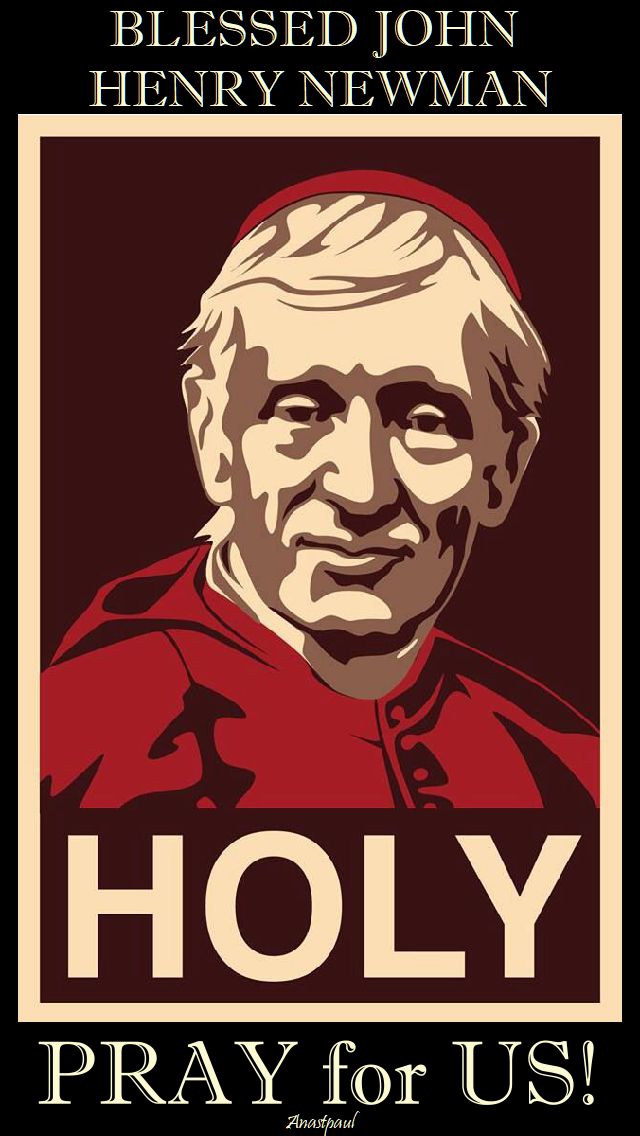
This quote by Blessed John Henry Newman (1801-1890), is written and speaks of you and me:
God has created me to do Him some definite service;
He has committed some work to me
which He has not committed to another.
I have my mission—
I may never know it in this life but I shall be told it in the next.
…I am a link in a chain,
a bond of connection between persons.
He has not created me for naught.
I shall do good,
I shall do His work,
I shall be an angel of peace,
a preacher of truth in my own place, while not intending it,
if I do but keep His Commandments.
…Therefore I will trust Him.
Whatever, wherever I am.
I can never be thrown away.
If I am in sickness, my sickness may serve Him;
in perplexity, my perplexity may serve Him;
in sorrow, my sorrow may serve Him.
…He does nothing in vain.
…He knows what He is about.
Thought for the Day – 3 February – The Memorial of Saint Ansgar OSB (801-865)
The “Apostle of the North” had enough frustrations to become a saint—and he did.
History records what people do, rather than what they are. Yet the courage and perseverance of men and women like Ansgar can only come from a solid base of union with the original courageous and persevering Missionary.
Ansgar’s life is another reminder that God writes straight with crooked lines. Christ takes care of the effects of the apostolate in His own way, He is first concerned about the purity of the apostles themselves.
Sunday Reflection – 3 February – Fourth Sunday in Ordinary Time, Year C
“May we be Worthy”
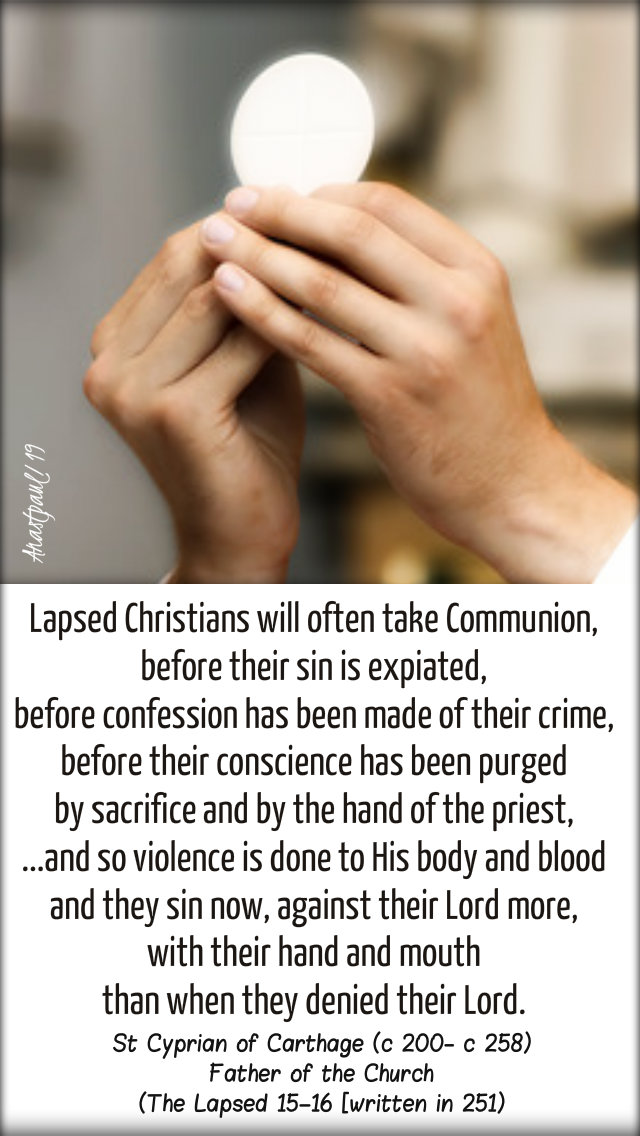
“He [Paul] threatens, moreover, the stubborn and forward and denounces them, saying, ‘Whosoever eats the bread or drinks the cup of the Lord unworthily, is guilty of the body and blood of the Lord’ [1 Cor. 11:27].
All these warnings being scorned and contemned—[lapsed Christians will often take Communion] before their sin is expiated, before confession has been made of their crime, before their conscience has been purged by sacrifice and by the hand of the priest, before the offence of an angry and threatening Lord has been appeased, [and so] violence is done to His body and blood and they sin now, against their Lord, more with their hand and mouth than when they denied their Lord”
St Cyprian of Carthage (c 200- c 258) Bishop and Martyr, Father of the Church (The Lapsed 15–16 [written in 251])
One Minute Reflection – 3 February – Fourth Sunday in Ordinary Time, Year C, Gospel: Luke 4:21–30 and The Memorial of St Blaise – Martyr (Died c 316) and St Ansgar (801-865)
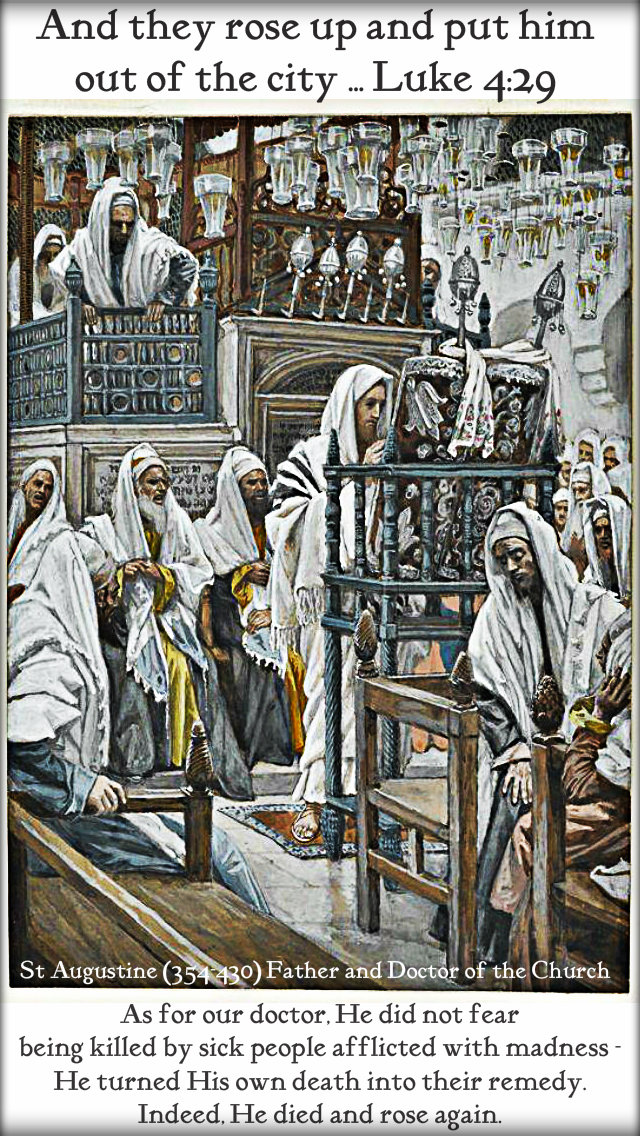
And they rose up and put him out of the city and led him to the brow of the hill on which their city was built, that they might throw him down headlong. But passing through the midst of them he went away….Luke 4:29-30
REFLECTION – “A doctor came amongst us to restore us to health – our Lord Jesus Christ. He discovered blindness in our hearts and promised the light that “eye has not seen and ear has not heard, and has not entered the heart of man” (1Cor 2:9).
The humility of Jesus Christ is the cure for your pride. Don’t scorn what will bring you healing, be humble, you for whom God humbled Himself. Indeed, He knew that the medicine of humility would cure you, He who well understood your sickness and knew how to cure it. While you were unable to run to the doctor’s house, the doctor in person came to your house… He is coming, He wants to help you, He knows what you need.
God has come with humility precisely in order that man might imitate Him. If He had remained above you, how would you have been able to imitate Him? And, without imitating Him, how could you be healed? He came with humility because He knew the nature of the remedy He had to administer – a little bitter, it is true but healing. And do you continue to scorn Him? He who holds out the cup to you and you say: “But what sort of God is this God of mine? He was born, suffered, was covered with spittle, crowned with thorns, nailed on the cross!” O miserable soul! You see the doctor’s humility and not the cancer of your pride. That is why humility displeases you…
It often happens that mentally ill people end up by beating their doctor. When that happens, the unfortunate doctor is not only not distressed by the one who beat him but attempts to treat him… As for our doctor, He did not fear being killed by sick people afflicted with madness, He turned His own death into their remedy. Indeed, He died and rose again.”…St Augustine (354-430) Father and Doctor of the Church
PRAYER – Lord our God, make us love You above all things and all our fellow-men, with a love that is worthy of You. May we look to Your Divine Son in love and imitation. Holy Father, You sent St Ansgar, Monk and Bishop, to bring the light of Christ to many nations of Northern Europe. Through his prayer give us grace to live always in the light of Your truth. Grant too, that by the prayers of St Blaise, we too may be granted the grace to follow Your only Son, no matter our sufferings, to You, in our heavenly home. We make our prayer, through Christ our Lord, in the unity of the Holy Spirit, one God, forever amen.
Our Morning Offering – 3 February – Fourth Sunday in Ordinary Time, Year C
The Bread of Angels By St Bonaventure (1217-1274) Doctor of the Church
Pierce, O most sweet Lord Jesus,
my inmost soul with the most joyous
and healthful wound of Your love,
and with true, calm and most holy apostolic charity,
that my soul may ever languish and melt
with entire love and longing for You,
may yearn for You and for Your courts,
may long to be dissolved and to be with You.
Grant that my soul may hunger after You,
the Bread of Angels, the refreshment of holy souls,
our daily and supersubstantial bread,
having all sweetness and savour
and every delightful taste.
May my heart ever hunger after and feed upon You,
Whom the angels desire to look upon,
and may my inmost soul
be filled with the sweetness of Your savour;
may it ever thirst for You,
the fountain of life,
the fountain of widsom and knowledge,
the fountain of eternal light,
the torrent of pleasure,
the fulness of the house of God;
may it ever compass You,
seek You, find You, run to You,
come up to You, meditate on You, speak of You
and do all for the praise and glory of Your name,
with humility and discretion,
with love and delight,
with ease and affection,
with perseverence to the end
and be You alone ever my hope,
my entire confidence, my riches, my delight,
my pleasure, my joy, my rest and tranquility,
my peace, my sweetness, my food, my refreshment,
my refuge, my help, my wisdom, my portion,
my possession, my treasure;
in Whom may my mind and my heart
be ever fixed and firm and rooted immovably.
Amen
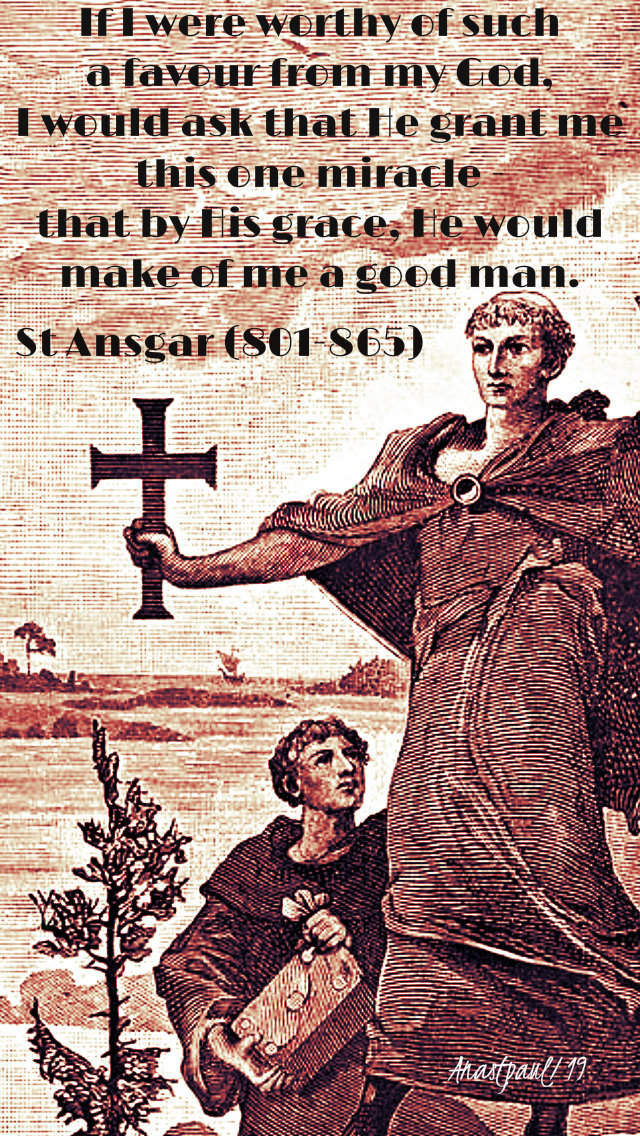
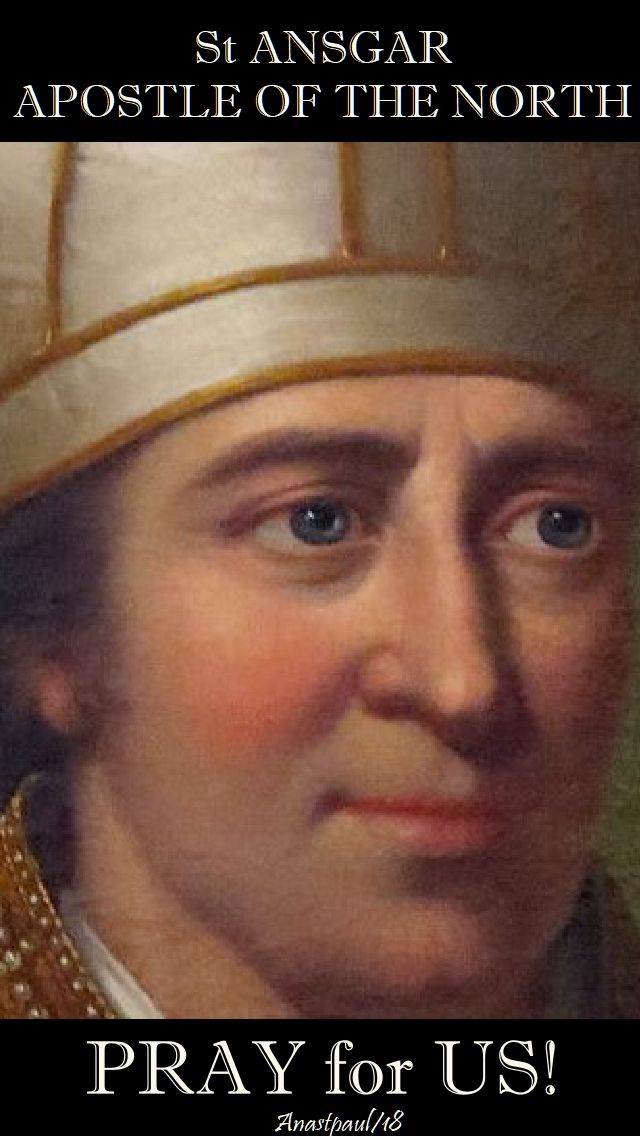
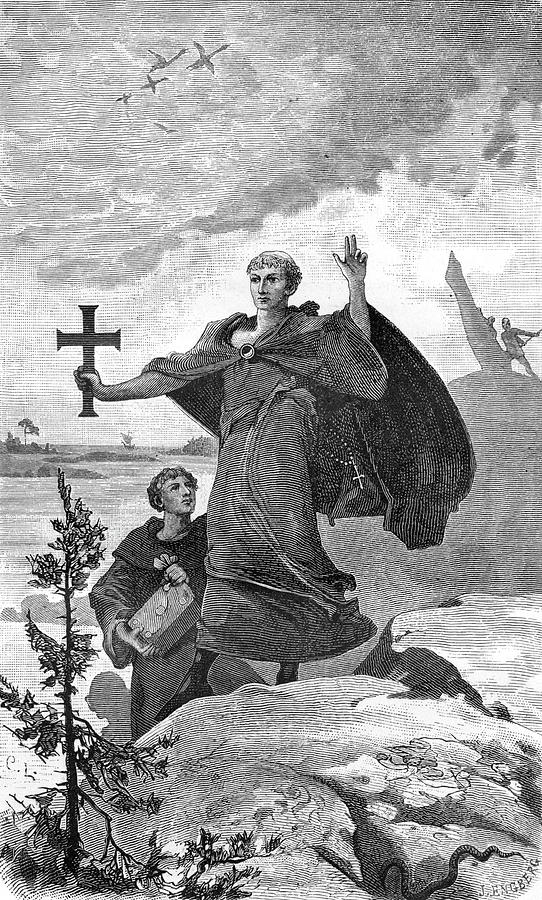
Saint of the Day – 3 February – Saint Ansgar OSB (801-865) “Apostle of the North”, Bishop, Monk, Mystic, Missionary, Preacher, Miracle-worker, Apostle of Charity Ascetic. Patronages – Denmark, Scandinavia, Sweden, Bremen, Germany, diocese of Hamburg, Germany, archdiocese of. He is also known as Anskar or Anschar. St Ansgarwas the Archbishop of Hamburg-Bremen – a northern part of the Kingdom of the East Franks. The See of Hamburg was designated a mission to bring Christianity to Northern Europe and Ansgar became known as the “Apostle of the North”. He was born in 801 at Amiens, Picardy, France and died on 3 February 865 at Bremen, Germany.
Ansgar was the son of a noble Frankish family, born near Amiens. After his mother’s early death, Ansgar was brought up in Corbie Abbey and was educated at the Benedictine monastery in Picardy. According to the Vita Ansgarii – The Life of Ansgar, when the little boy learned in a vision that his mother was in the company of the Blessed Virgin Mary, his careless attitude toward spiritual matters changed to seriousness. His pupil, successor and eventual biographer St Rimbert (830–888) considered the visions, of which this was the first, to be the main motivation of the saint’s life.
Ansgar was a product of the phase of Christianisation of Saxony (present day Northern Germany) begun by Charlemagne and continued by his son and successor, Louis the Pious. A group of monks including Ansgar were sent back to Jutland with the baptised exiled king Harald Klak. Ansgar returned two years later and was one of a number of missionaries sent to found the abbey of Corvey in Westphalia and there became a teacher and preacher. Then in 829 in response to a request from the Swedish king Björn at Hauge for a mission to the Swedes, Louis the Pious appointed Ansgar missionary. With an assistant, the friar Witmar, he preached and made converts for six months at Birka, on Lake Mälaren. They organised a small congregation there with the king’s steward, Hergeir and Mor Frideborg as its most prominent members. In 831 he returned to Louis’ court at Worms and was appointed to the Archbishopric of Hamburg. This was a new archbishopric with a see formed from those of Bremen and Verden, plus the right to send missions into all the northern lands and to consecrate bishops for them. He was given the mission of evangelising Denmark, Norway and Sweden. The King of Sweden decided to cast lots as to whether the Christian missionaries should be admitted into his kingdom. Ansgar recommended the issue to the care of God, and the lot was favourable.
Ansgar was consecrated in November 831 and, the arrangements having been at once approved by Pope Gregory IV, he went to Rome to receive the pallium directly from the hands of the pope and to be named legate for the northern lands. This commission had previously been bestowed upon Ebbo, Archbishop of Reims but the jurisdiction was divided by agreement, with Ebbo retaining Sweden for himself. For a time Ansgar devoted himself to the needs of his own diocese, which was still missionary territory with but a few churches. He founded a monastery and a school in Hamburg.
A depiction of Saint Ansgar from the Church Trinitatis, in Hamburg, Germany
After Louis died in 840, his empire was divided and Ansgar lost the abbey of Turholt, which had been given as an endowment for his work. Then in 845, the Danes unexpectedly raided Hamburg, destroying all the church’s treasures and books and leaving the entire diocese beyond repair. Ansgar now had neither see, nor revenue. Many of his helpers deserted him but the new king, Louis the German, came to his aid. After failing to recover Turholt for him, in 847 he awarded him the vacant diocese of Bremen, where he took up residence in 848. However, since Hamburg had been an archbishopric, the sees of Bremen and Hamburg were combined for him. This presented canonical difficulties and also aroused the anger of the Bishop of Cologne, to whom Bremen had been suffragan but after prolonged negotiations, Pope Nicholas I approved the union of the two dioceses in 864.
Through all this political turmoil, Ansgar continued his mission to the northern lands. The Danish civil war compelled him to establish good relations with two kings, Horik the Elder and his son, Horik II. Both assisted him until his death. He was able to secure recognition of Christianity as a tolerated religion and permission to build a church in Sleswick. He did not forget the Swedish mission and spent two years there in person (848–850), at the critical moment when a pagan reaction was threatened, which he succeeded in averting. In 854, Ansgar returned to Sweden when king Olof ruled in Birka. According to Rimbert, he was well disposed to Christianity.
Ansgar wore a rough hair shirt, lived on bread and water and showed great charity to the poor. Being the first missionary in Sweden and the organiser of the hierarchy in the Nordic countries, he was declared Patron of Scandinavia. Ansgar was buried in Bremen in 865.
His life story was written by his successor as archbishop, Rimbert, in The Life of Ansgar – Vita Ansgarii.
His Relics are located in Hamburg on two places – St. Mary’s Cathedral and St Ansgar’s and St Bernard’s Church.
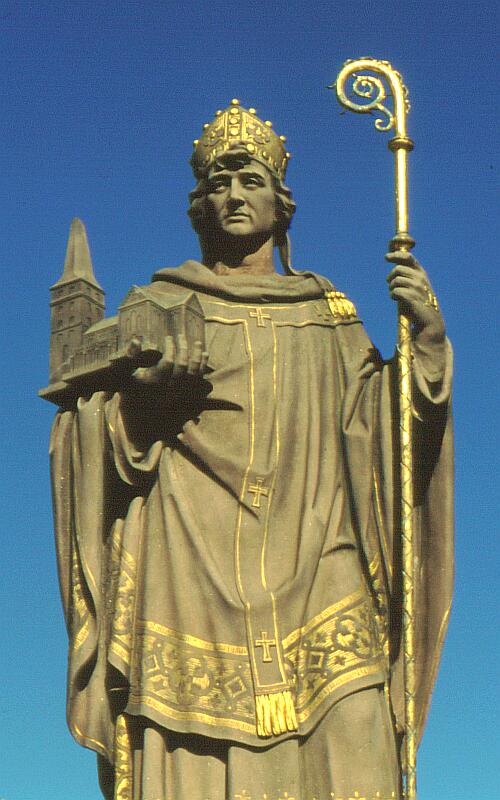
St Ansgar Statue in Hamburg
The Life of Ansgar aims above all to demonstrate Ansgar’s sanctity. It is speaks of St Ansgar’s visions, which, encouraged and assisted Ansgar’s remarkable missionary feats.
Through the course of this work, St Ansgar repeatedly embarked on a new stage in his career following a vision. His studies and ensuing devotion to the ascetic life of a monk were inspired by a vision of his mother in the presence of the Blessed Virgin Mary. When the Swedish people were left without a priest for some time, he begged King Horik to help him with this problem. St Ansgar was convinced he was commanded by heaven to undertake this mission and was influenced by a vision he received when he was concerned about the journey, in which he met a man who reassured him of his purpose and informed him of a prophet that he would meet, the Abbot Adalard, who would instruct him in what was to happen. In the vision, he searched for and found Adalard, who commanded, “Islands, listen to me, pay attention, remotest peoples”, which Ansgar interpreted as God’s will that he go to the Scandinavian countries as “most of that country consisted of islands and also, when ‘I will make you the light of the nations so that my salvation may reach to the ends of the earth’ was added, since the end of the world in the north was in Swedish territory”. Saint Adalard of Corbie (c 751-827), was the cousin of Charlemagne.
There are Statues dedicated to him in Hamburg, Copenhagen, Ribe as well as a stone cross at Birka. A crater on the Moon, Ansgarius, has been named for him.
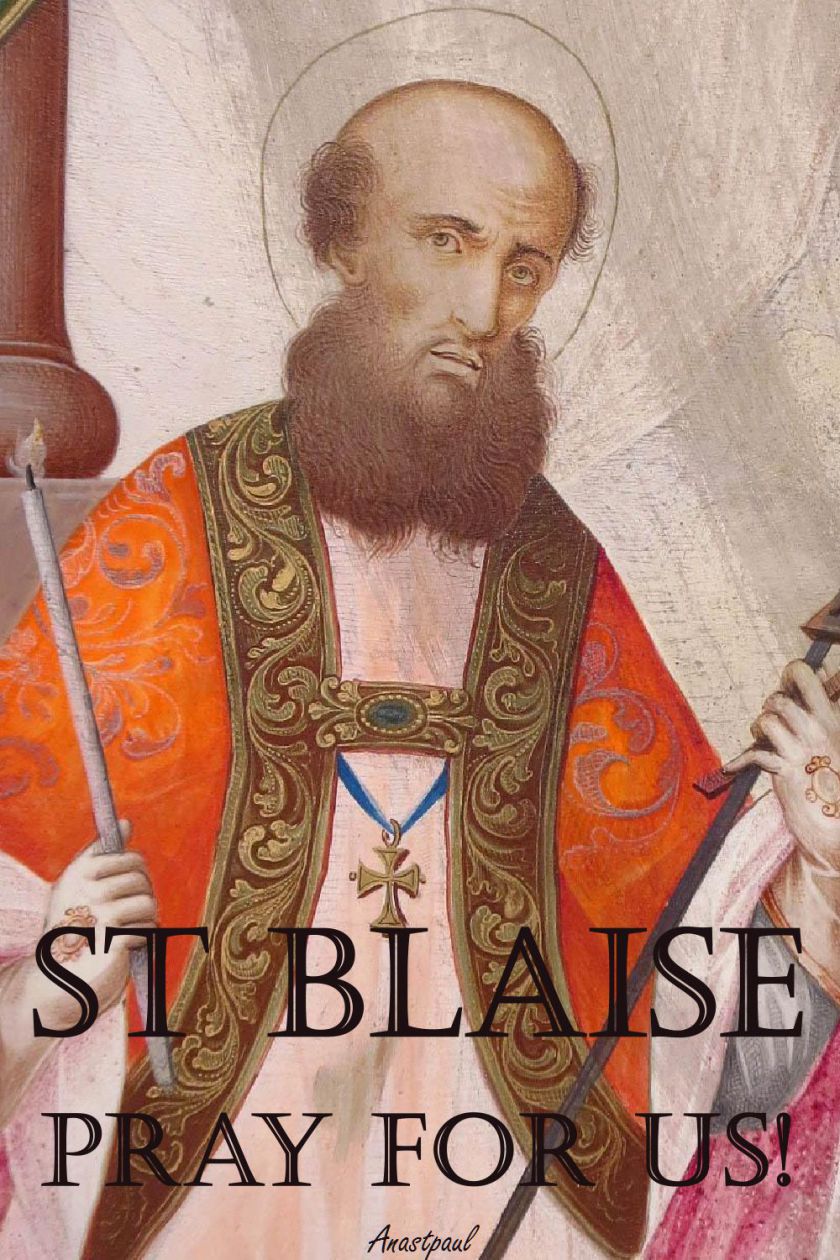
St Blaise (Died c 316) – Martyr (Optional Memorial)
All about St Blaise: https://anastpaul.wordpress.com/2018/02/03/saint-of-the-day-st-blaise-died-c-316-martyr/
St Ansgar OSB (801-865) (Optional Memorial)
Bl Alois Andritzki
St Anatolius of Salins
St Anna the Prophetess
St Berlinda of Meerbeke
St Blasius of Armentarius
St Blasius of Oreto
St Caellainn
St Celerinus of Carthage
St Claudine Thevenet
St Clerina of Carthage
St Deodatus of Lagny
St Eutichio
St Evantius of Vienne
St Felix of Africa
St Felix of Lyons
St Hadelin of Chelles
Bl Helena Stollenwerk
Bl Helinand of Pronleroy
St Hippolytus of Africa
St Ia of Cornwall
St Ignatius of Africa
Bl Iustus Takayama Ukon
Bl John Nelson
Bl John Zakoly
St Laurentinus of Carthage
St Laurentius of Carthage
St Lawrence the Illuminator
St Liafdag
St Lupicinus of Lyon
St Margaret of England
Bl Marie Rivier
St Oliver of Ancona
St Philip of Vienne
St Remedius of Gap
St Sempronius of Africa
St Tigrides
St Werburga of Bardney
St Werburga of Chester
—
Benedictine Martyrs: A collective memorial of all members of the Benedictine Order who have died as martyrs for the faith.
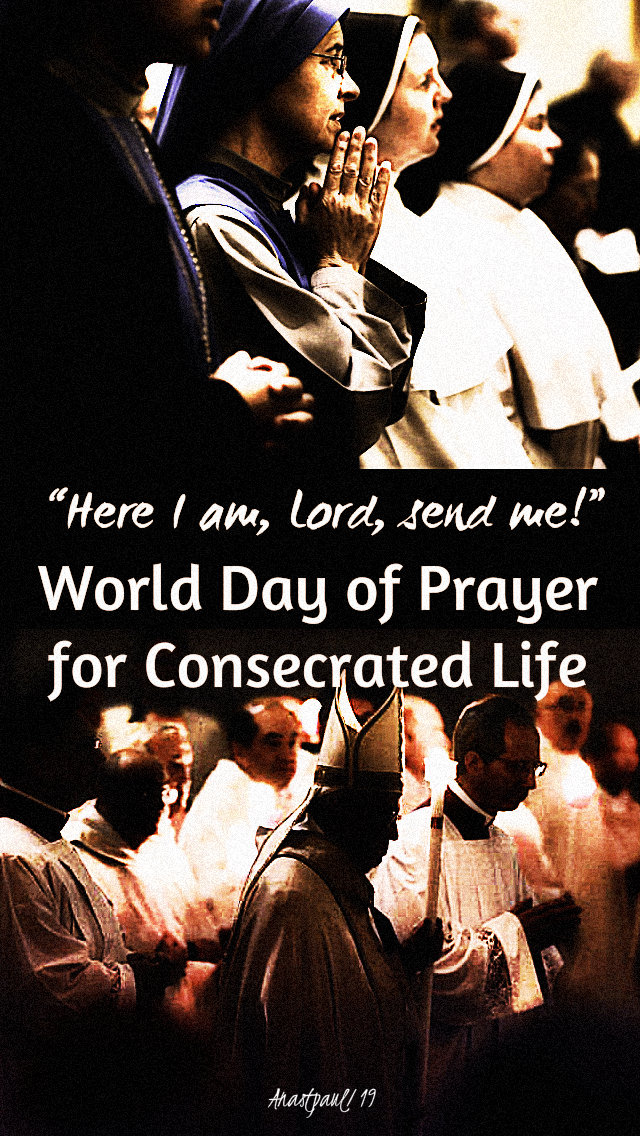
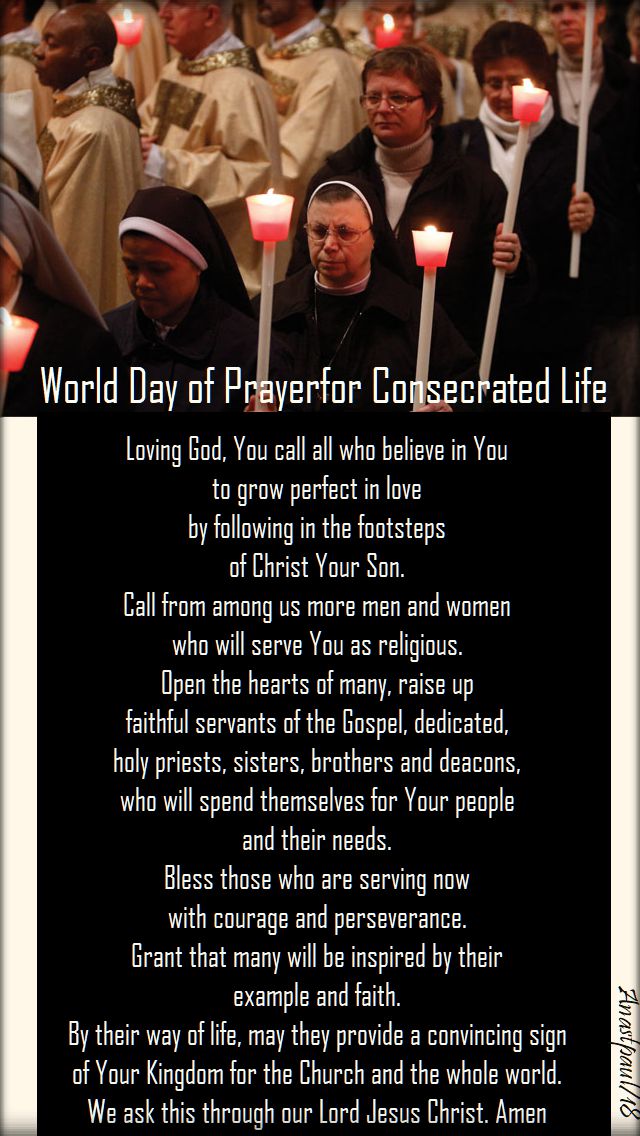
Thought for the Day – 2 February – Feast of the Presentation of the Lord and the World Day of Prayer for Consecrated Life
The celebration of World Day for Consecrated Life invites all the Church to reflect on the role of Consecrated Life within the Christian community. Those who choose to live a consecrated life do so for the sake of the gospel.
Some Christian women and men respond to God’s call to become followers of Jesus through profession of vows and a life dedicated to prayer and service. They live out the consecrated life in different ways. Religious sisters, nuns, brothers, religious priests and monks consecrate their lives through their profession of the evangelical vows and live as part of a community. Secular institutes are another form of living the consecrated life as single people. Those who become followers of Jesus through the consecrated life bless the Church.
And so, as we think about the many ways in which we are called to love in ordinary ways and do it extraordinarily well, let us not forget those women and men who have responded to God’s call to serve as a consecrated religious. This day and Mass is dedicated to them throughout the world. On this World Day for Consecrated Life, may the lives of consecrated women and men be blessed with God’s overwhelming grace of love! May their lives inspire us to hear God’s vocational call. May this tune be forever in our minds and transform our hearts to say boldly:
“Here I am, Lord, send me!”
LET US PRAY FOR ALL CONSECRATED MEN & WOMEN AND FOR VOCATIONS:
Loving God, You call all who believe in You
to grow perfect in love
by following in the footsteps
of Christ Your Son.
Call from among us more men and women
who will serve You as religious.
Open the hearts of many, raise up
faithful servants of the Gospel, dedicated,
holy priests, sisters, brothers and deacons,
who will spend themselves for Your people
and their needs.
Bless those who are serving now
with courage and perseverance.
Grant that many will be inspired by their
example and faith.
By their way of life, may they provide a convincing sign
of Your Kingdom for the Church and the whole world.
We ask this through our Lord Jesus Christ.
Amen














 AnaStpaul
You must be logged in to post a comment.