Quote/s of the Day – 1 August – “Month of the Immaculate Heart of Mary” – Readings: Exodus 16: 2-4, 12-15; Psalms 78: 3-4, 23-24, 25, 54 (24b); Ephesians 4: 17, 20-24; John 6: 24-35
“I am the bread of life”
John 6:35
“For His body, has been given to you under the appearance of bread and His blood, under the appearance of wine, so that, when you have partaken of the body and blood of Christ, you might be one body and one blood with Him. So shall we become Christ-bearers [“Christophers”]. His body and blood are diffused t hrough all our members – see, then, how we become participants in the divine nature!”
St Cyril of Jerusalem (313-350) Father & Doctor of the Church
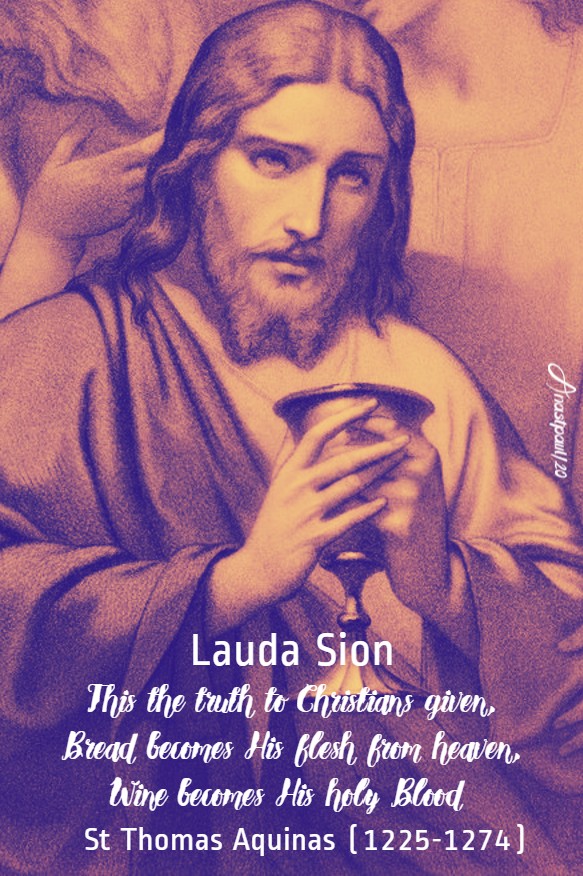
This the truth to Christians given, Bread becomes His flesh from heaven, Wine becomes His holy Blood (Jn 6:55). …
St Thomas Aquinas (1225-1274) Sequence for the feast of Corpus Christi “ Lauda Sion ”
Our Morning Offering – 18 July – “Month of the Most Precious Blood”
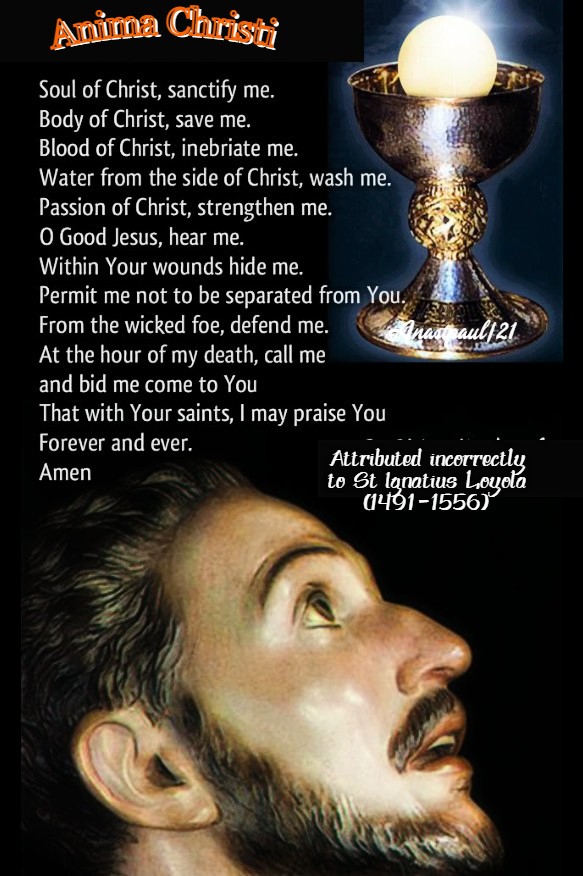
Anima Christi
Soul of Christ, sanctify me Body of Christ, save me Blood of Christ, inebriate me Water from the side of Christ, wash me Passion of Christ, strengthen me Good Jesus, hear me Within Your wounds, shelter me from turning away, keep me From the evil one, protect me At the hour of my death, call me Into Your presence lead me to praise You with all Your saints Forever and ever, Amen
For many years the Anima Christi was popularly believed to have been composed by Saint Ignatius Loyola (1491-1556) , as he puts it at the beginning of his Spiritual Exercises and often refers to it. In the first edition of the Spiritual Exercises Ignatius merely mentions it, evidently supposing that the reader would know it. In later editions, it was printed in full. It was by assuming that everything in the book was written by Ignatius that it came to be looked upon as his composition. On this account the prayer is sometimes referred to as the Aspirations of St. Ignatius Loyola and so my image shows St Ignatius at prayer.
However, the prayer actually dates to the early fourteenth century and was possibly written by Pope John XXII but its authorship remains uncertain. It has been found in a number of prayer books printed during the youth of Ignatius and is in manuscripts which were written a hundred years before his birth. The English hymnologist James Mearns found it in a manuscript of the British Museum which dates to about 1370. In the library of Avignon there is preserved a prayer book of Cardinal Pierre de Luxembourg (died 1387), which contains the prayer in practically the same form as we have it today. It has also been found inscribed on one of the gates of the Alcázar of Seville, which dates back to the time of Pedro the Cruel (1350–1369).
The invocations in the prayer have rich associations with Catholic concepts that relate to the Eucharist (Body and Blood of Christ), Baptism (water) and the Passion of Jesus (Precious Blood and Holy Wounds).
Our Morning Offering – 13 July – “Month of the Precious Blood”
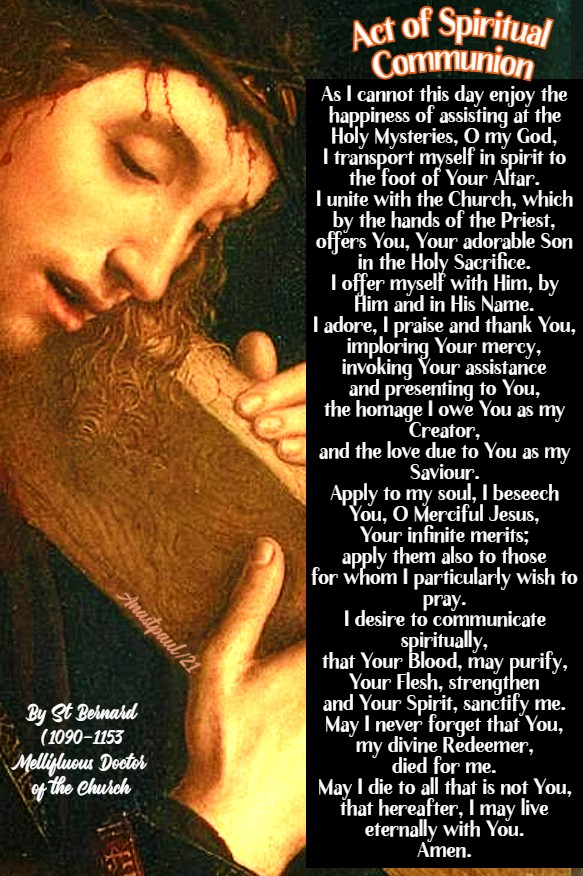
Act of Spiritual Communion By St Bernard (1090-1153 Mellifluous Doctor of the Church
As I cannot this day enjoy the happiness of assisting at the Holy Mysteries, O my God, I transport myself in spirit to the foot of Your Altar. I unite with the Church, which by the hands of the Priest, offers You, Your adorable Son in the Holy Sacrifice. I offer myself with Him, by Him and in His Name. I adore, I praise and thank You, imploring Your mercy, invoking Your assistance and presenting to You, the homage I owe You as my Creator and the love due to You as my Saviour.
Apply to my soul, I beseech You, O Merciful Jesus, Your infinite merits; apply them also to those for whom I particularly wish to pray. I desire to communicate spiritually, that Your Blood, may purify, Your Flesh, strengthen and Your Spirit, sanctify me. May I never forget that You, my divine Redeemer, died for me. May I die to all that is not You, that hereafter, I may live eternally with You. Amen.
Our Morning Offering – 4 July – “Month of the Precious Blood”
For those unable to attend Holy Mass today and for all of us, everyday!
Act of Spiritual Communion By St Alphonsus Maria de Liguori (1696-1787) Most Zealous Doctor
I desire, good Jesus, to receive Thee in Holy Communion and since I cannot now receive Thee in the Blessed Sacrament, I beseech Thee to come to me spiritually and to refresh my soul with Thy sweetness. Come, my Lord, my God and my All! Come to me and never let me ever again be separated from Thee by sin. Teach me Thy blessed ways, help me with Thy grace to imitate Thy example, to practise meekness, humility, charity and all the virtues of Thy Sacred Heart. My divine Master, my one desire is to do Thy will and to love Thee, more and more. Help me, that I may be faithful to the end, in Thy service. Bless me in life and in death, that I may praise Thee, forever in heaven, Amen
Our Morning Offering – 27 June – “Month of the Sacred Heart” – Fifth Sunday after Pentecost
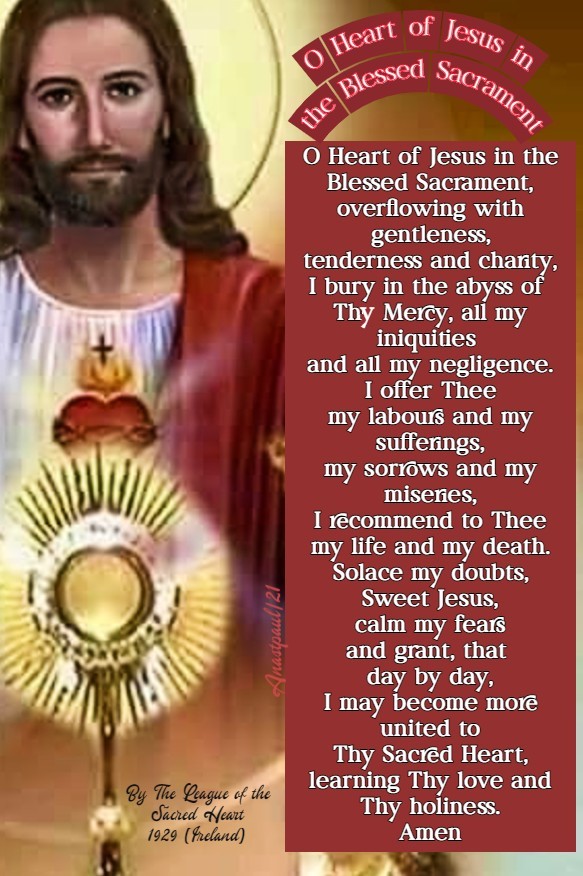
O Heart of Jesus in the Blessed Sacrament By The League of the Sacred Heart 1929 (Ireland)
O Heart of Jesus in the Blessed Sacrament, overflowing with gentleness, tenderness and charity, I bury in the abyss of Thy Mercy, all my iniquities and all my negligence. I offer Thee my labours and my sufferings, my sorrows and my miseries, I recommend to Thee my life and my death. Solace my doubts, Sweet Jesus, calm my fears and grant, that day by day, I may become more united to Thy Sacred Heart, learning Thy love and Thy holiness. Amen
Thought for the Day – 20 June – Meditations with Antonio Cardinal Bacci (1881-1971)
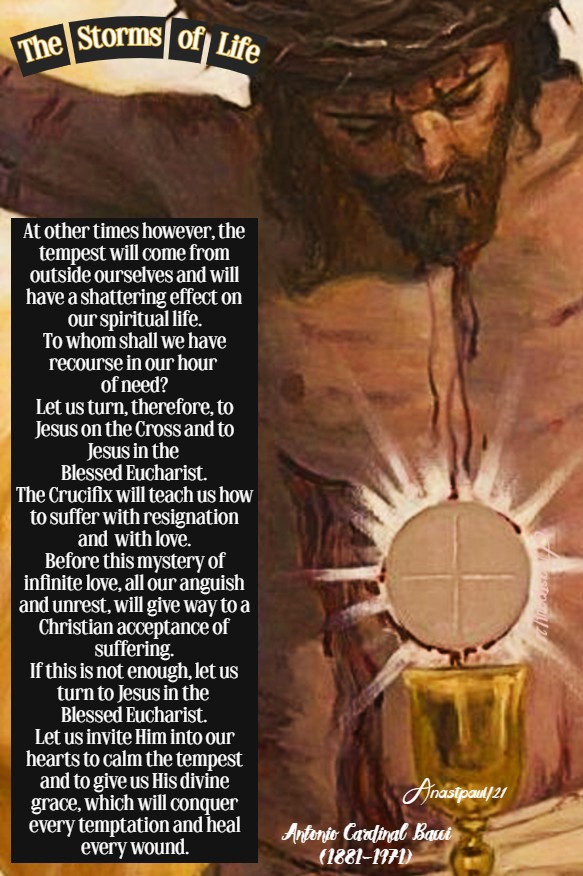
The Storms of Life
“At other times however, the tempest will come from outside ourselves and will have a shattering effect on our spiritual life. It may be some insult which has seriously wounded us. There may be somebody near to us who has grown quite insufferable. Or perhaps suffering will come to us in the guise of illness, disgrace or loss of our dear ones. We shall feel lonely and abandoned in the midst of the storm. To whom shall we have recourse in our hour of need? Shall we turn to our fellow-men? Perhaps there will be nobody able to understand us perfectly, or, if there is somebody who sympathises with us,he may be able to do nothing for us, save to utter a few kind words.
Let us turn, therefore, to Jesus on the Cross and to Jesus in the Blessed Eucharist. The Crucifix will teach us how to suffer with resignation and with love. Before this mystery of infinite love, all our anguish and unrest, will give way to a Christian acceptance of suffering.
If this is not enough, let us turn to Jesus in the Blessed Eucharist. Let us invite Him into our hearts to calm the tempest and to give us His divine grace, which will conquer every temptation and heal every wound.”
Thought for the Day – 9 June – “Month of the Sacred Heart” – Meditations with Antonio Cardinal Bacci (1881-1971)
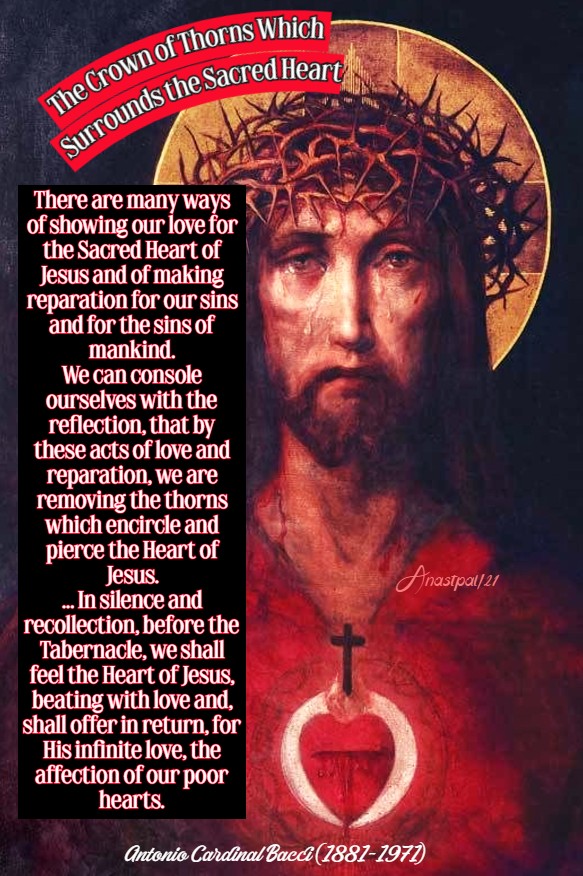
The Crown of Thorns Which Surrounds the Sacred Heart
“There are many ways of showing our love for the Sacred Heart of Jesus and of making reparation for our sins and for the sins of mankind. We can console ourselves with the reflection, that by these acts of love and reparation, we are removing the thorns which encircle and pierce the Heart of Jesus. The simplest ways of doing this, are by prayers, aspirations and expressions of love, directed towards the adorable Heart of our Redeemer and, by visits to Jesus in the Blessed Sacrament. In silence and recollection, before the Tabernacle, we shall feel the Heart of Jesus, beating with love and, shall offer in return, for His infinite love, the affection of our poor hearts.
We can also receive Holy Communion in reparation. When Jesus is in us and we are in Jesus, it will be easier and more pleasant, to offer Him our love and expiation. We can make reparation also, by practising the devotion of the First Fridays of the month. This pious practice, so pleasing to the Heart of Jesus, aims at being a mass offering of love and reparation, for the sins of the entire human race.”
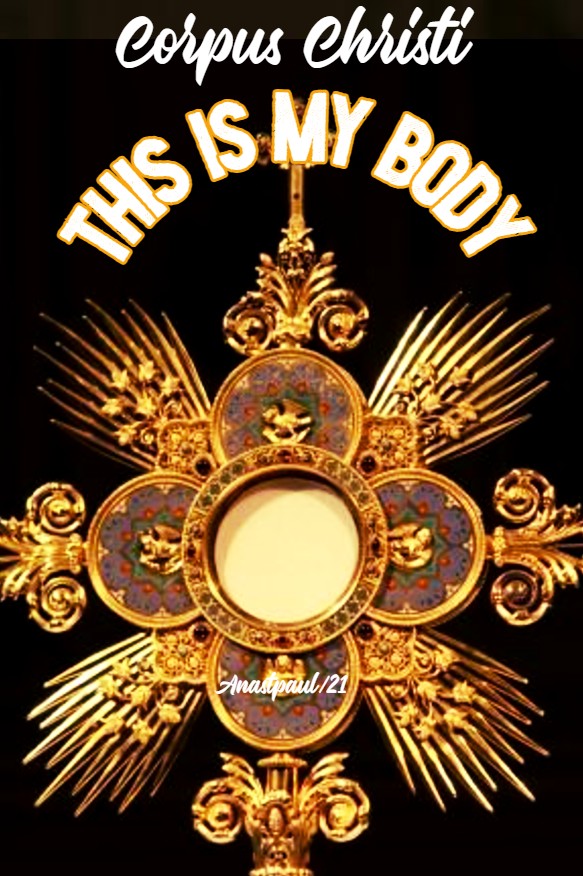
Quote/s of the Day – 6 June – “Month of the Sacred Heart” – Corpus Christi, The Solemnity of The Most Holy Body and Blood of Christ
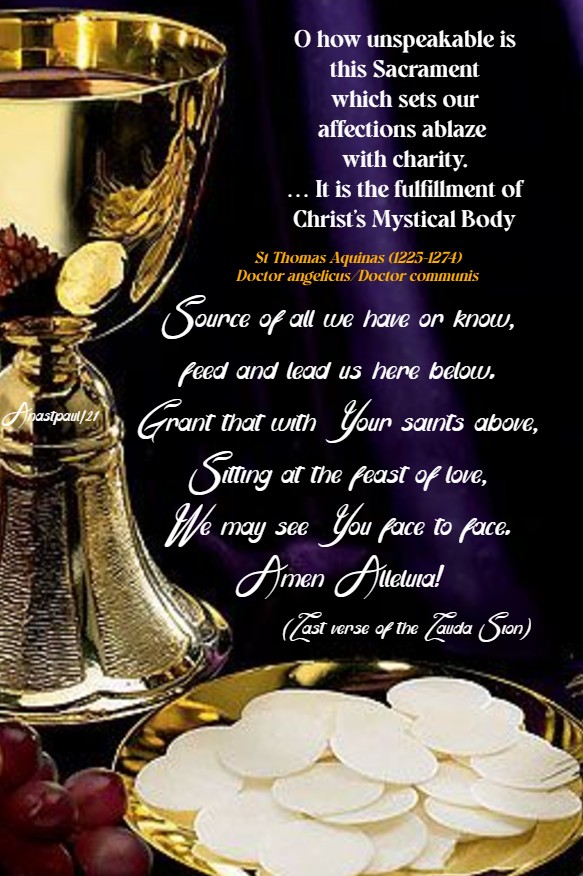
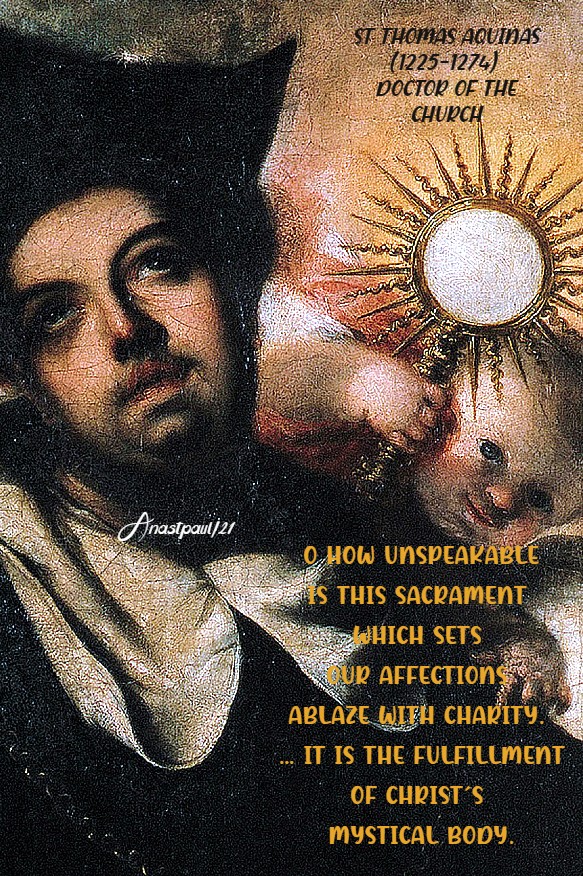
“O how unspeakable is this Sacrament which sets our affections ablaze with charity. … It is the fulfillment of Christ’s Mystical Body.”
“Source of all we have or know, feed and lead us here below. Grant that with Your saints above, Sitting at the feast of love, We may see You face to face.”
Amen Alleluia!
(Last verse of the Lauda Sion)
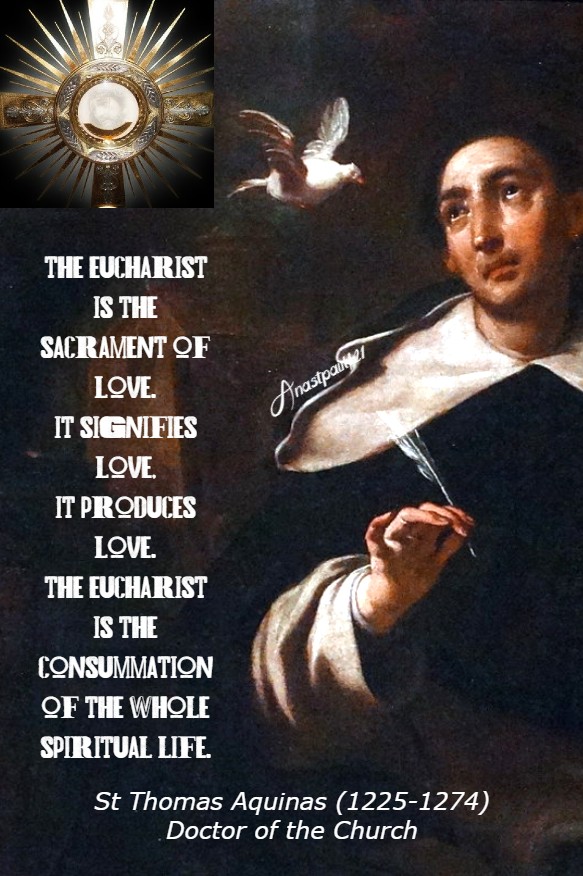
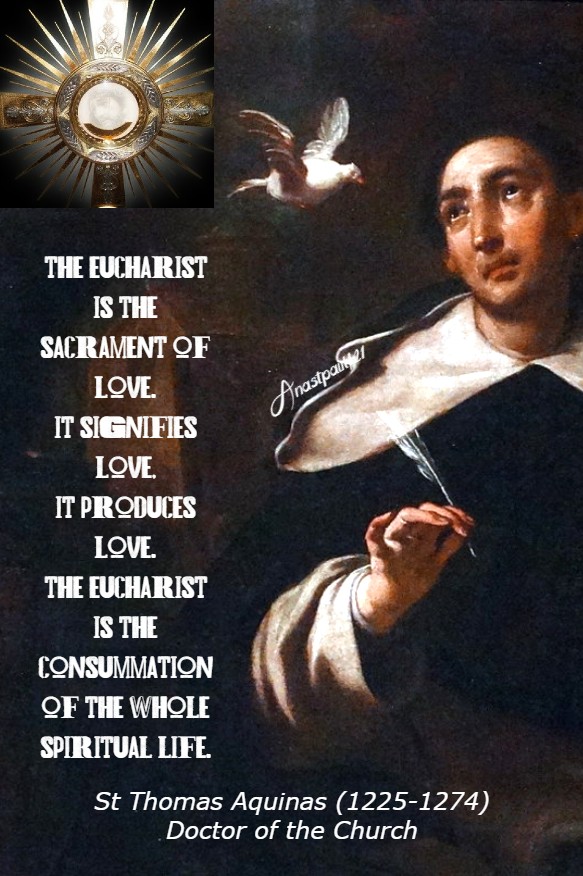
“The Eucharist is the Sacrament of Love. It signifies Love, It produces love. The Eucharist is the consummation of the whole spiritual life.”
St Thomas Aquinas (1225-1274) Doctor angelicus/Doctor communis
Our Morning Offering – 6 June – “Month of the Sacred Heart” – The Solemnity of Corpus Christi – The Most Holy Body ad Blood of Our Lord Jesus Christ
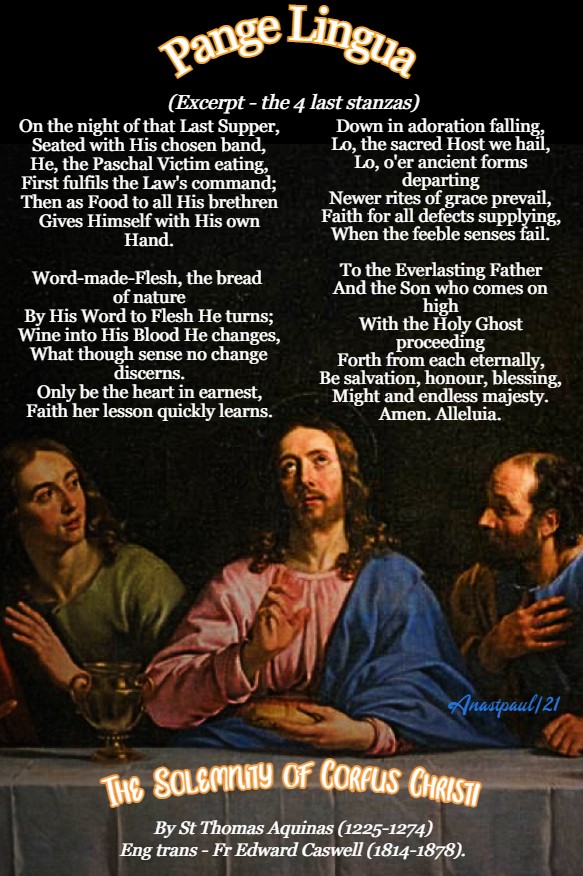
Pange Lingua Sing, My Tongue By St Thomas Aquinas (1225-1274) Eng trans – Fr Edward Caswell CO (1814-1878) (Excerpt on the image – the 4 last stanzas)
Sing, my tongue, the Saviour’s glory, Of His Flesh, the mystery sing; Of the Blood, all price exceeding, Shed by our Immortal King, Destined, for the world’s redemption, From a noble Womb to spring.
Of a pure and spotless Virgin Born for us on earth below, He, as Man, with man conversing, Stayed, the seeds of truth to sow; Then He closed in solemn order Wondrously His Life of woe.
On the night of that Last Supper, Seated with His chosen band, He, the Paschal Victim eating, First fulfils the Law’s command; Then as Food to all His brethren Gives Himself with His own Hand.
Word-made-Flesh, the bread of nature By His Word to Flesh He turns; Wine into His Blood He changes, What though sense no change discerns. Only be the heart in earnest, Faith her lesson quickly learns.
Down in adoration falling, Lo, the sacred Host we hail, Lo, o’er ancient forms departing Newer rites of grace prevail, Faith for all defects supplying, When the feeble senses fail.
To the Everlasting Father And the Son who comes on high With the Holy Ghost proceeding Forth from each eternally, Be salvation, honour, blessing, Might and endless majesty. Amen. Alleluia.
Written by St Thomas Aquinas (1225-1274) for the Solemnity of Corpus Christi, this Hymn is considered the most beautiful of Aquinas’ Hymns and one of the great seven Hymns of the Church. The Hymn is also used on Holy Thursday. The last two stanzas make up the Tantum Ergo (Down in Adoration Falling) that is used at Benediction of the Blessed Sacrament.
PANGE, lingua, gloriosi Corporis mysterium, Sanguinisque pretiosi, quem in mundi pretium fructus ventris generosi Rex effudit Gentium.
Nobis datus, nobis natus ex intacta Virgine, et in mundo conversatus, sparso verbi semine, sui moras incolatus miro clausit ordine.
In supremae nocte cenae recumbens cum fratribus observata lege plene cibis in legalibus, cibum turbae duodenae se dat suis manibus.
Verbum caro, panem verum verbo carnem efficit: fitque sanguis Christi merum, et si sensus deficit, ad firmandum cor sincerum sola fides sufficit.
Tantum ergo Sacramentum veneremur cernui: et antiquum documentum novo cedat ritui: praestet fides supplementum sensuum defectui.
Genitori, Genitoque laus et iubilatio, salus, honor, virtus quoque sit et benedictio: procedenti ab utroque compar sit laudatio. Amen. Alleluia.
Thought for the Day – 4 June – “Month of the Sacred Heart” – Meditations with Antonio Cardinal Bacci (1881-1971)
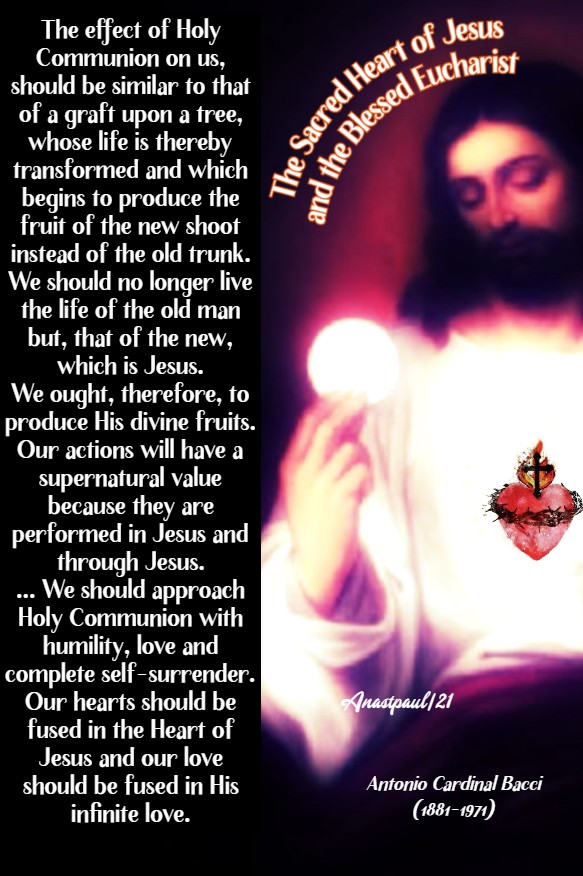
The Sacred Heart of Jesus and the Blessed Eucharist
“By means of this wonderful gift, we can live the life of Jesus Himself.
It is Our Lord Himself, Who says to us: “As the living Father has sent me and as I live because of the Father, so he who eats me, he also shall live because of me” (Jn 6:58). In other words, as He draws His divine and human life from the Father and lives by means of Him, to Whom as God, He is substantially united and equal, so anyone who partakes of the Eucharist, is united closely to Jesus, lives His life and is transformed by His supernatural grace. When Holy Communion is received, therefore, as it ought to be and as the Saints received it, it leads to the mysterious union of which St Paul speaks: “To me to live is Christ” (Phil 1:21). “It is now no longer I that live but Christ, lives in me” (Gal 2:20).
The effect of Holy Communion on us, should be similar to that of a graft upon a tree, whose life is thereby transformed and which begins to produce the fruit of the new shoot instead of the old trunk. We should no longer live the life of the old man but, that of the new, which is Jesus. We ought, therefore, to produce His divine fruits. Our actions will have a supernatural value because they are performed in Jesus and through Jesus. We should be very grateful to the Sacred Heart of Jesus for this gift of His infinite love and goodness. We should approach Holy Communion with humility, love and complete self-surrender. Our hearts should be fused in the Heart of Jesus and our love should be fused in His infinite love.”
Quote/s of the Day – 3 June – Solemnity of Corpus Christi, The Most Holy Body and Blood of our Lord Jesus Christ
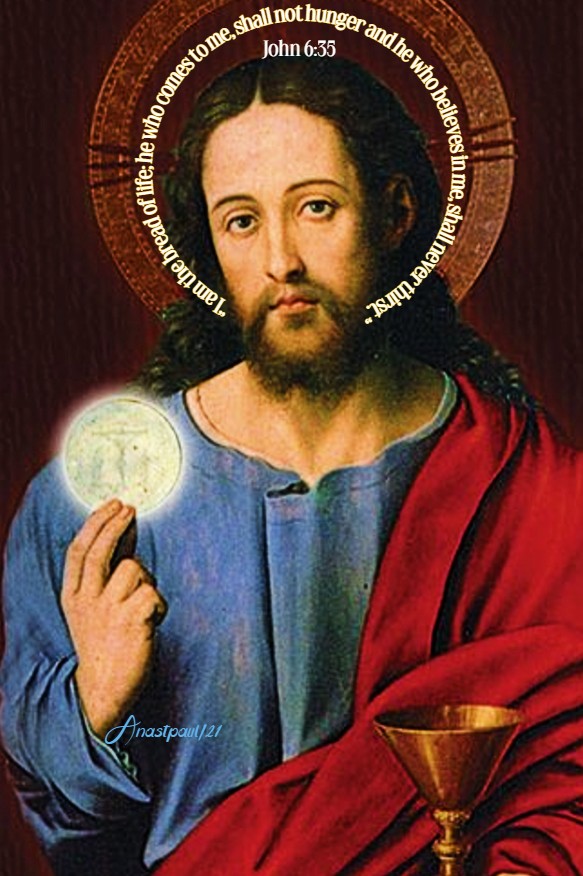
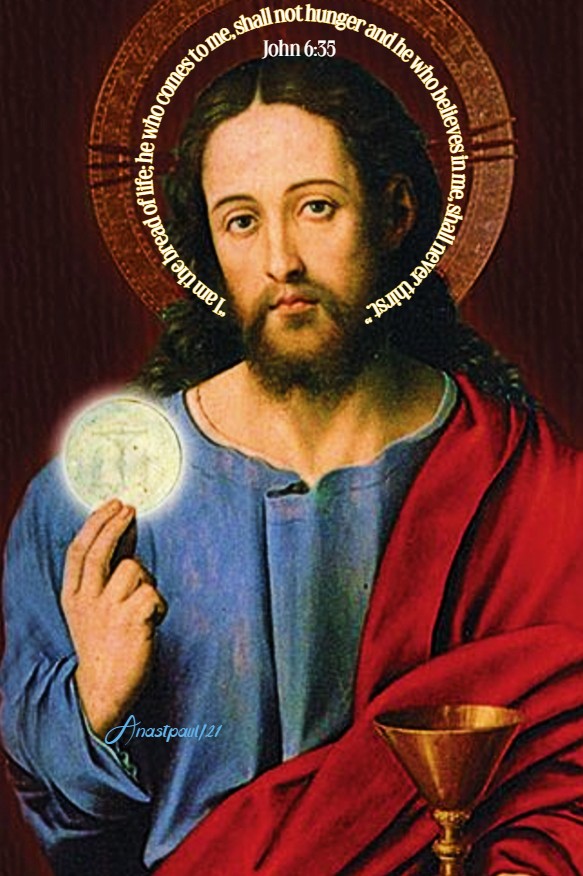
“I am the bread of life; he who comes to me, shall not hunger and he who believes in me, shall never thirst.”
John 6:35
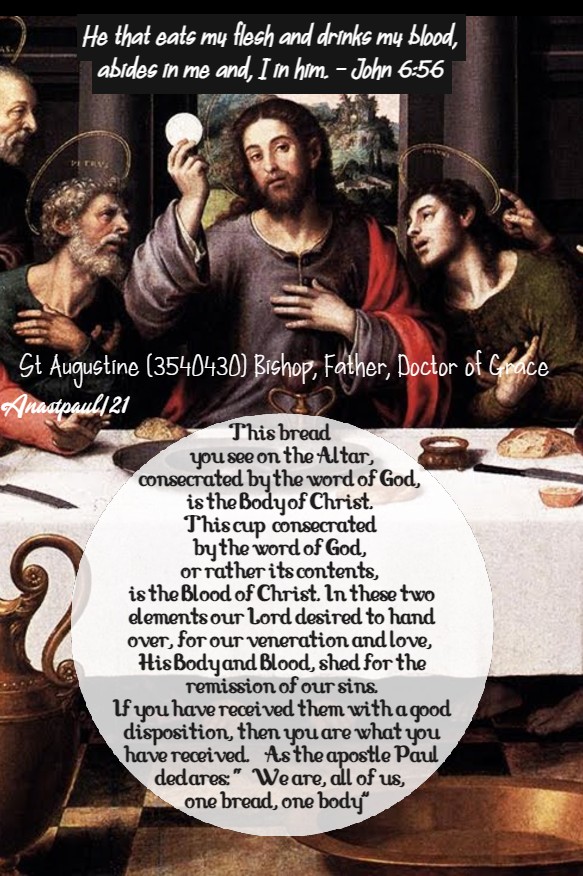
“This bread you see on the Altar, consecrated by the word of God, is the Body of Christ. This cup consecrated by the word of God, or rather its contents, is the Blood of Christ. In these two elements our Lord desired to hand over, for our veneration and love, His Body and Blood, shed for the remission of our sins. If you have received them with a good disposition, then you are what you have received. As the apostle Paul declares: “We are, all of us, one bread, one body” (1 Cor 10,17)…”
St Augustine (354-430) Bishop, Father, Doctor of Grace
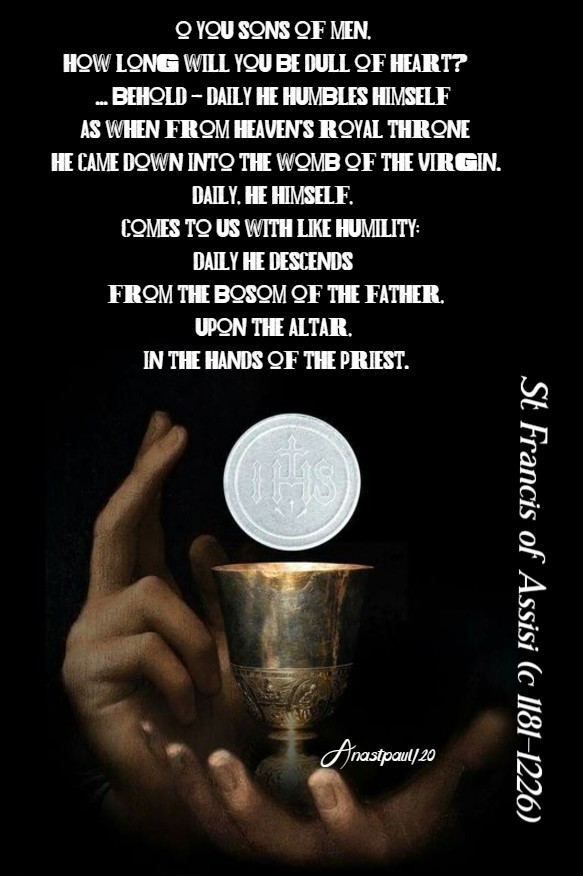
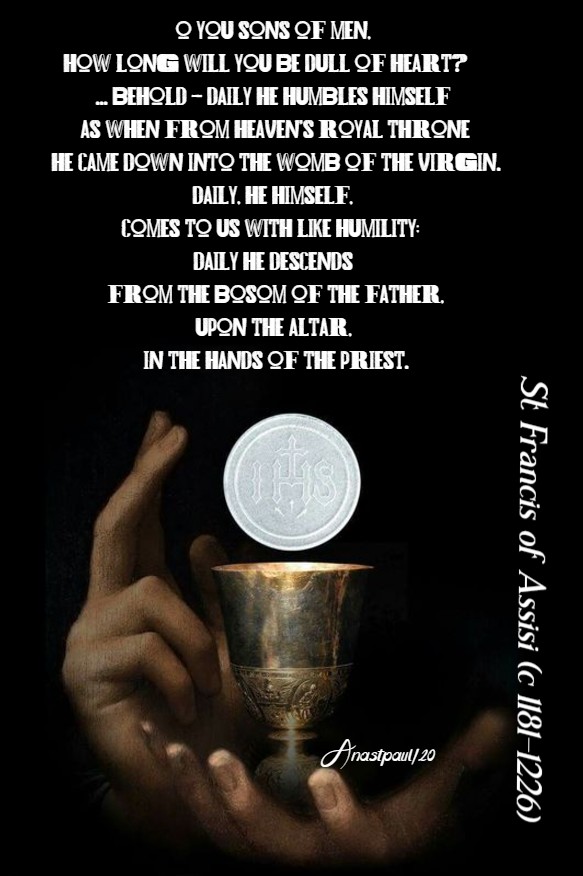
“O you sons of men, how long will you be dull of heart? … Behold – daily He humbles Himself as when from heaven’s royal throne He came down into the womb of the Virgin. Daily, He Himself, comes to us with like humility; daily He descends from the bosom of the Father, upon the Altar, in the hands of the Priest.”
St Francis of Assisi (c 1181–1226)
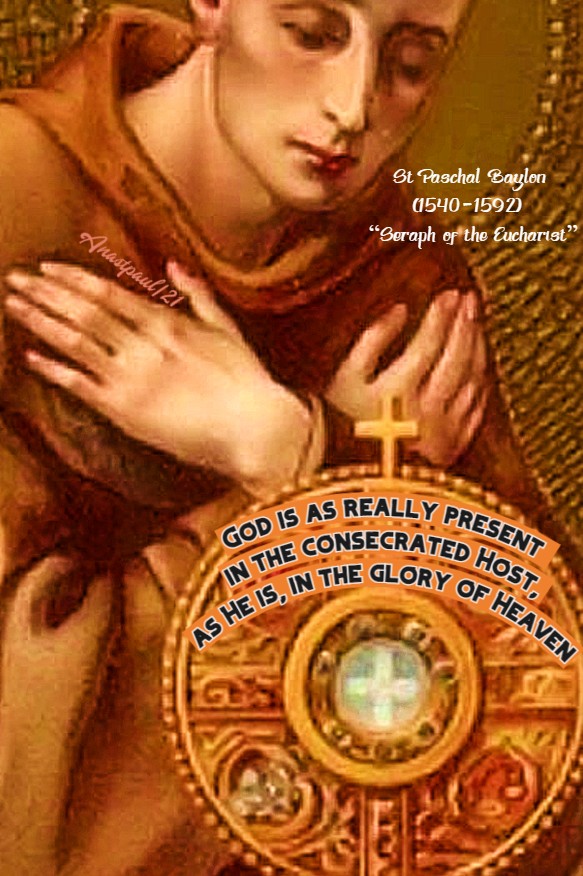
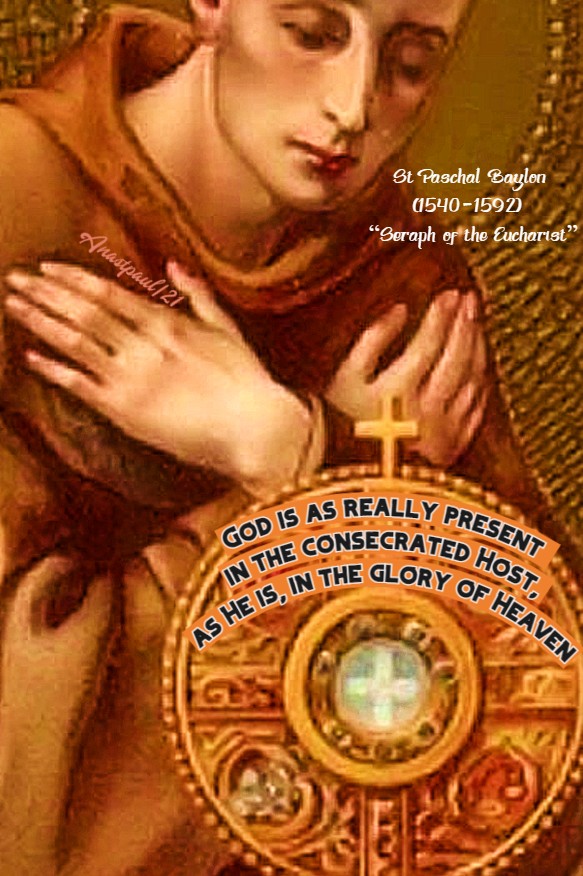
“God is as really present in the consecrated Host, as He is, in the glory of Heaven.”
St Paschal Baylon (1540-1592)
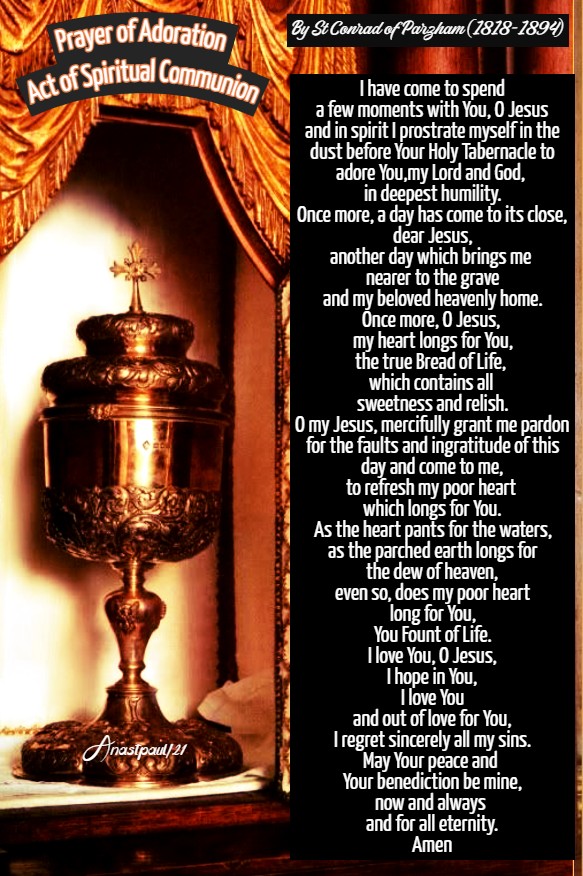
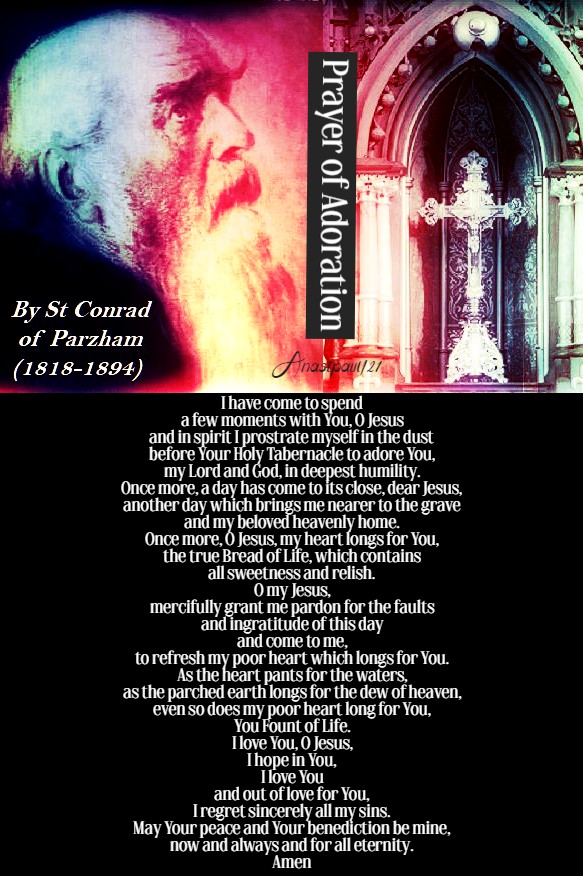
Prayer of Adoration Act of Spiritual Communion By St Conrad of Parzham (1818-1894)
I have come to spend a few moments with You, O Jesus and in spirit I prostrate myself in the dust before Your Holy Tabernacle to adore You, my Lord and God, in deepest humility. Once more, a day has come to its close, dear Jesus, another day which brings me nearer to the grave and my beloved heavenly home. Once more, O Jesus, my heart longs for You, the true Bread of Life, which contains all sweetness and relish. O my Jesus, mercifully grant me pardon for the faults and ingratitude of this day and come to me, to refresh my poor heart which longs for You. As the heart pants for the waters, as the parched earth longs for the dew of heaven, even so, does my poor heart long for You, You Fount of Life. I love You, O Jesus, I hope in You, I love You and out of love for You, I regret sincerely all my sins. May Your peace and Your benediction be mine, now and always and for all eternity. Amen
One Minute Reflection – 3 June – Solemnity of Corpus Christi, The Most Holy Body and Blood of our Lord Jesus Christ, Readings: First: Exodus 24: 3-8, Psalm: Psalms 116: 12-13, 15-16, 17-18 (13), Second: Hebrews 9: 11-15, Gospel: John 6:44-51
“The bread that I will give, is my flesh for the life of the world.” – John 6:51
REFLECTION – “They are wholly mistaken who reject God’s plan for His creation, deny the salvation of the flesh and scoff at the idea of its regeneration, asserting that it cannot put on an imperishable nature. If the flesh is not saved, then the Lord did not redeem us with His Blood, the Chalice of the Eucharist is not a share in His Blood and the Bread which we break is not a share in His Body (1Cor 10,16). For… the human substance, which the Word of God truly became, redeems us with His Blood…
Since we are His members (1Cor 6,15) and are nourished by His creation… He declared, that the Chalice of His creation is His own Blood, from which He augments our own blood and He affirmed, that the Bread of His creation is His own Body from which He gives growth to our being.
So, when the mixed chalice and the baked loaf receive the word of God and when the Eucharistic elements become the Body and Blood of Christ, which brings growth and sustenance to our bodily frame, how can it be maintained that our flesh is incapable of receiving God’s gift of eternal life?
For our flesh feeds on the Lord’s Body and Blood and is His member. So Saint Paul writes: “We are members of his body, of his flesh and of his bones” (Eph 5,30; Gn 2,23). He is not speaking about some spiritual and invisible man…: he is speaking of the anatomy of a real man, consisting of flesh, nerves and bones. It is this that is nourished by His Chalice, the Chalice of His Blood and gains growth from the Bread which is His Body… In the same way, our bodies are nourished by the after being buried in the earth and… rise again in due season, when the word of God confers resurrection upon them “for the glory of God the Father” (Phil 2,11).” – St Irenaeus of Lyons (130-202) Bishop, Theologian and Martyr
PRAYER – Lord Jesus Christ, You gave Your Church an admirable Sacrament, as the abiding memorial of Your Passion. Teach us so to worship the sacred mystery of Your Body and Blood, that ts redeeming power may sanctify us always. Who live and reign with the Father and the Holy Spirit, God forever and ever, amen.
Our Morning Offering – 3 June – Solemnty of Corpus Christ, The Most Holy Body and Blood of our Lord Jesus Christ
St Thomas Aquinas wrote the Liturgy for Corpus Christi when Pope Urban IV added the Solemnity to the universal Church’s Liturgical calendar in 1264. He provided a great sequence, one of the great poems chanted or recited before the proclamation of the Gospel. Lauda Sion is one of only four medieval sequences which were preserved in the Roman Missal published in 1570 following the Council of Trent (1545–1563)—the others being Victimae Paschali Laudes (Easter), Veni Sancte Spiritus (Pentecost) and Dies irae (requiem masses). (A fifth, Stabat Mater, would later be added in 1727.) Before Trent, many feasts had their own sequences. The existing versions were unified in the Roman Missal promulgated in 1570. The Lauda Sion is still sung today as solemn Eucharistic hymn, though its use is optional in the post-Vatican II Ordinary form. As with St Thomas’s other three Eucharistic Hymns, the last few stanzas of the Lauda Sion are often used alone, in this case, to form the “Ecce Panis Angelorum”.
Lauda Sion Salvatorem Sion, Lift Up thy Voice and Sing (Excerpt) By St Thomas Aquinas (1225-1274) Doctor Angelicus / Doctor Communis
Sion, lift thy voice and sing, Praise thy Saviour and thy King, Praise with hymns thy Shepherd true, Dare thy most to praise Him well, For He doth all praise excel, None can ever reach His due.
Special theme of praise is Thine, That true living Bread divine, That life-giving flesh adored, Which the brethren twelve received, As most faithfully believed, At the Supper of the Lord.
Let the chant be loud and high, Sweet and tranquil be the joy Felt to-day in every breast; On this festival divine Which recounts the origin Of the glorious Eucharist.
Quote/s of the Day – 17 May – The Memorial of St Paschal Baylon OFM (1540-1592) “Seraph of the Eucharist,” “Saint of the Blessed Sacrament,” “Servant of the Blessed Sacrament.”
“God is as really present in the consecrated Host, as He is, in the glory of Heaven.”
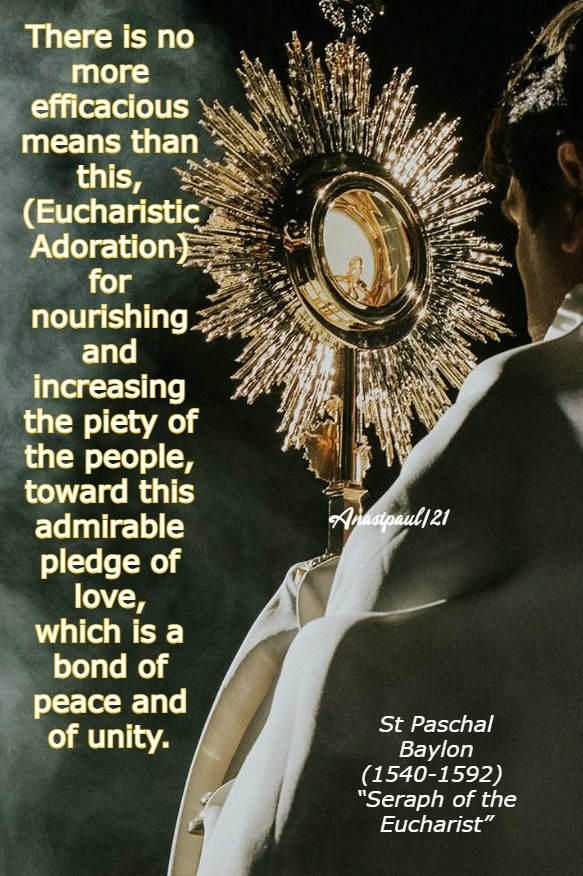
“There is no more efficacious means than this, (Eucharistic Adoration) for nourishing and increasing the piety of the people, toward this admirable pledge of love, which is a bond of peace and of unity.”
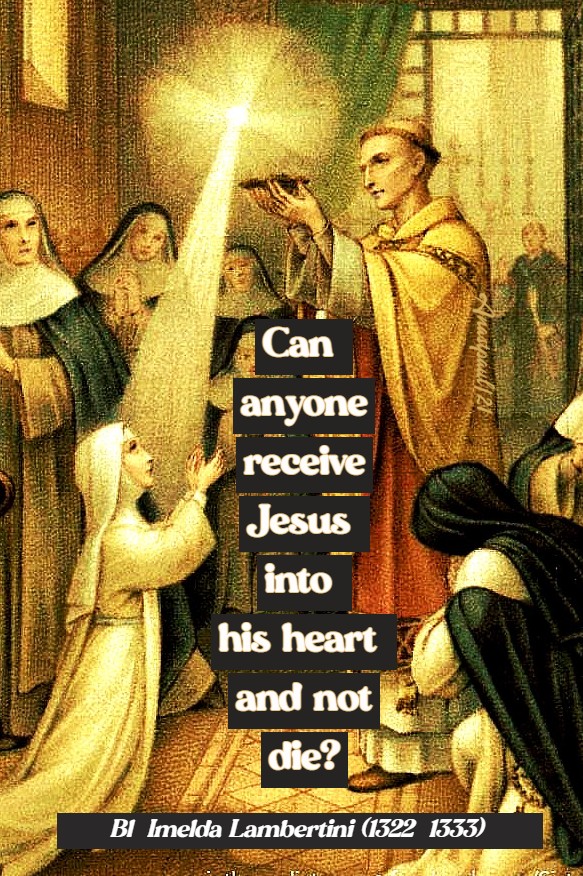
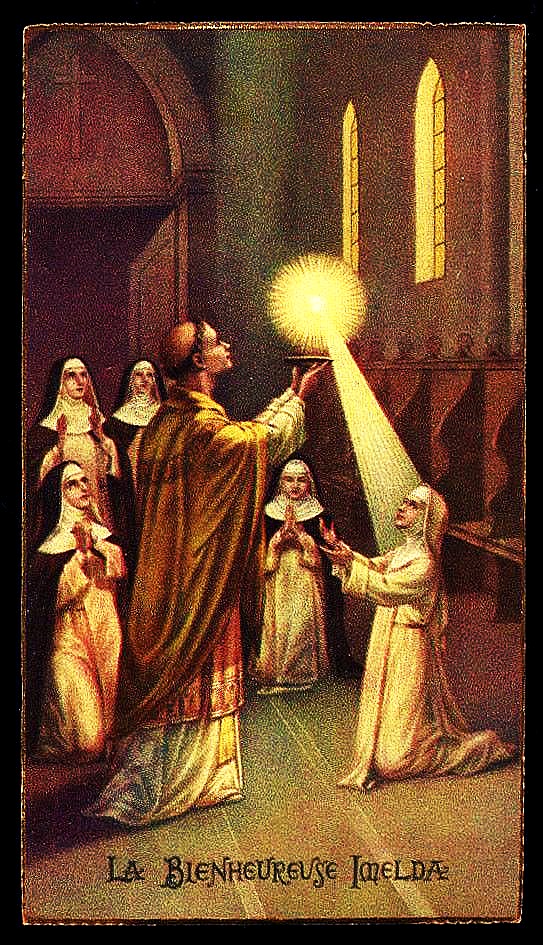
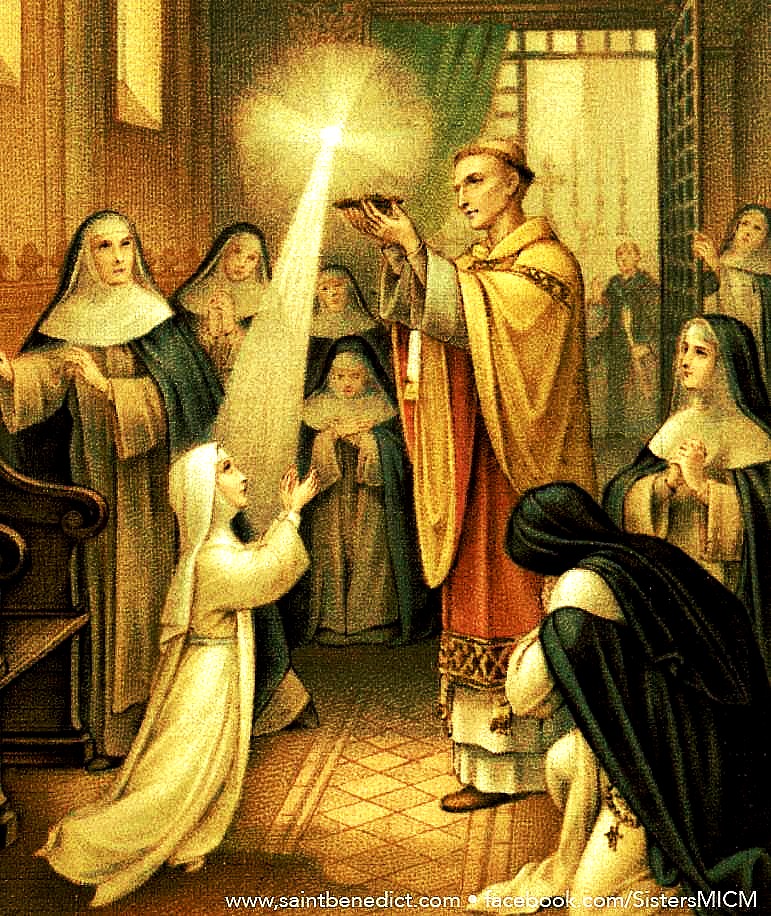
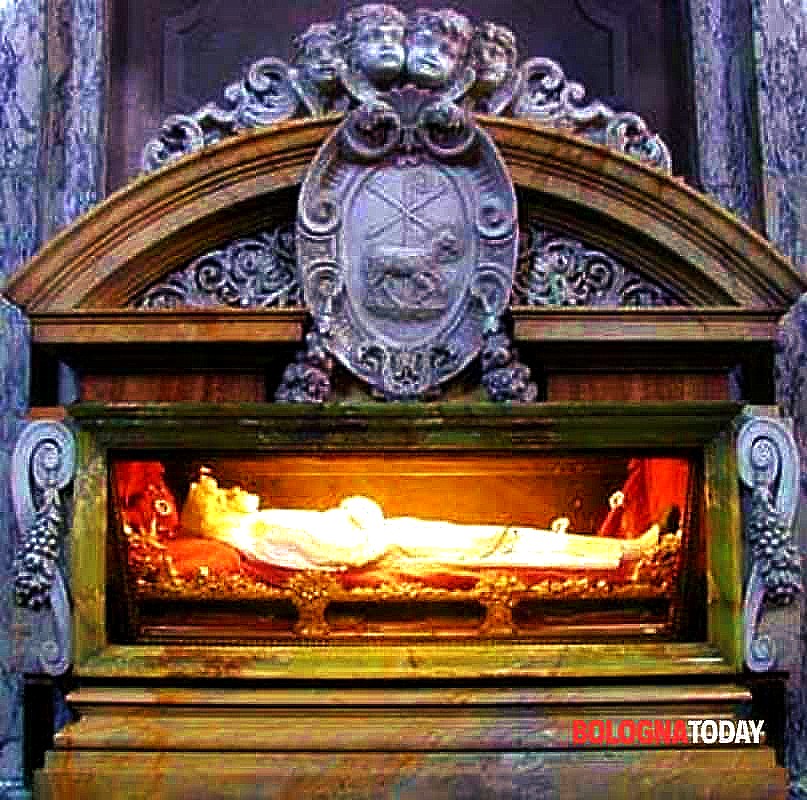
Saint of the Day – 13 May – Blessed Imelda Lambertini (1322-1333) Child Mystic, Virgin. Born in 1322 AS Imelda Dpmenica Lambertini at Bologna, Italy and died on the Feast of the Ascension, 12 May 1333 Bologna, Italy. Patronage – First Communicants (named by Pope Saint Pius X).
Imelda Lambertini was born of a noble family in Bologna, Italy in 1322. Her parents raised her to love her Catholic faith and through their influence she developed a love for prayer, especially for the Mass. Often she would attend Mass and Compline (Night Prayer of the Divine Office) at a nearby Dominican Church. Her mother also taught Imelda to cook and sew for the poor and cultivated in her child an eagerness to perform the corporal works of mercy. Even so, her mother and father, both of whom were getting on in years, were surprised when Imelda asked permission at the tender age of nine to go to live with the Dominican nuns at a neighbouring Monastery. As difficult a decision as this was, her parents evidently sensed the depth of their child’s desire and entrusted her spiritual formation to the Dominicans at Val di Pietra.
At this distance of centuries and culture it is not easy to determine precisely what little Imelda’s status was at the Convent. It seems she was well loved by the Sisters, who allowed her to wear the Dominican habit, to pray with them and to follow their way of life, to the extent that a little girl would be able to do, while still remaining a child. Imelda, we are told, longed (and intensely, it seems) to be allowed to receive Holy Communion with the nuns but in that day, such a thing would have been unheard of for a child her age. Her pleading was again and again gently refused, with the explanation that she would need to wait until she was older and more prepared.
For a time Imelda had to be content with this answer, meanwhile learning to chant Office from hearing the nuns in choir and developing her own interior prayer life in simple childlike ways. The saints, whose stories she had learned from her parents and from the nuns, became her “secret companions” and probably had a hand, in nurturing the longing she felt, to receive Jesus intimately in the Sacrament of the Eucharist. In her private conversations with Jesus, with whom she was developing a deep friendship, we can imagine that she often made known her desire to be allowed to receive Communion. There is no evidence that He put up any opposition to the proposal—but neither did the Sisters relent. And so, Imelda continued, with the intensity of a child, to get to know Jesus more deeply and to desire Him all the more.
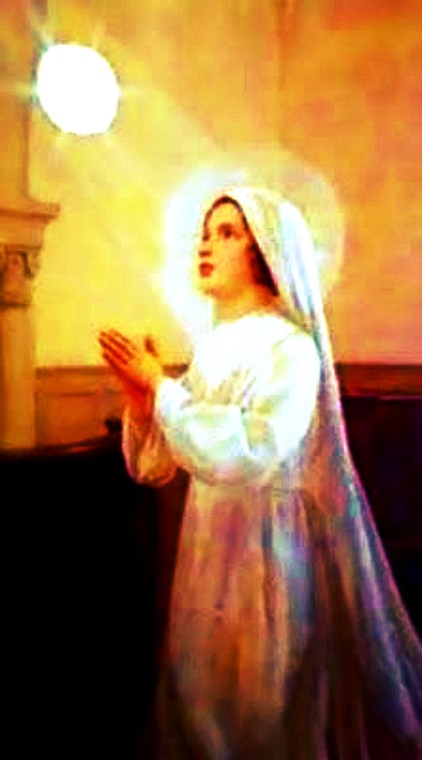
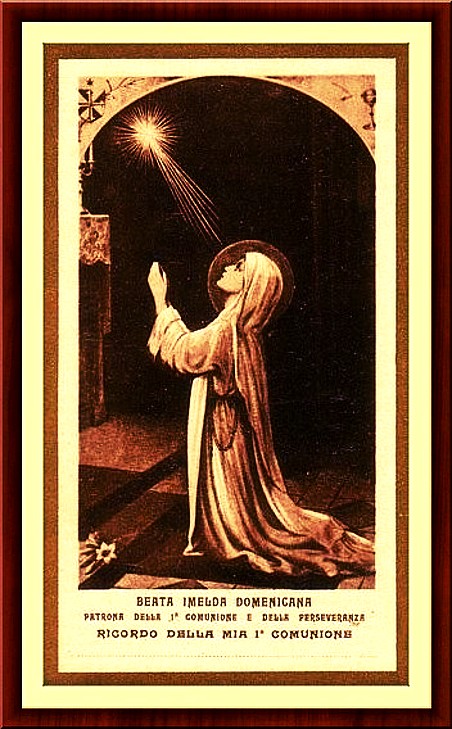
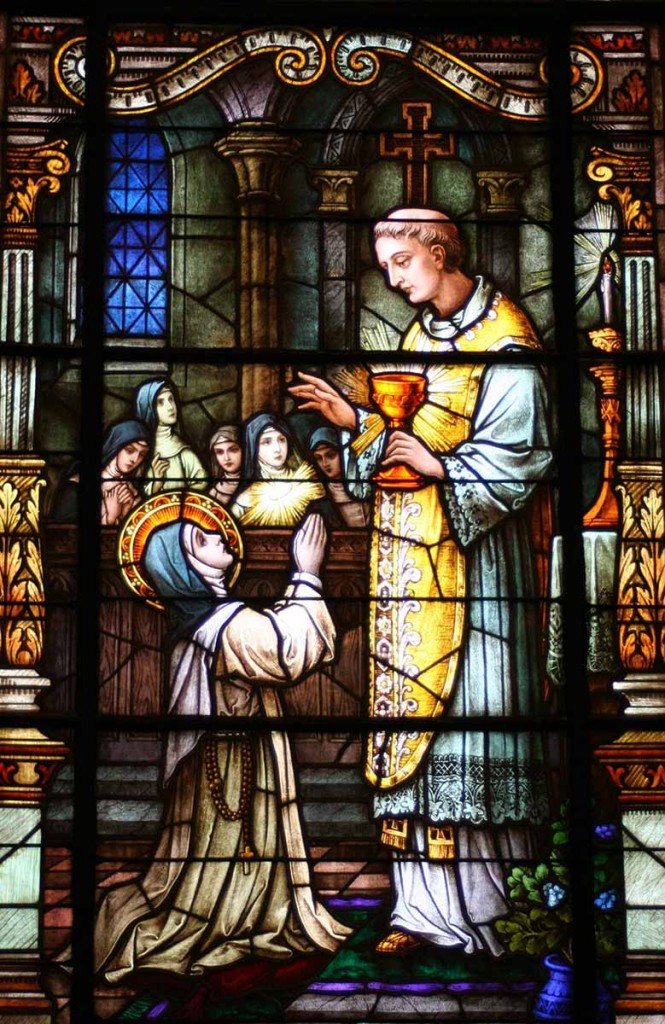
As spring approached, the sisters, who perhaps thought that they had succeeded in diverting Imelda’s “childish fancy” to go to Communion with the grown-ups, were a bit startled when she asked again, shortly before the Feast of the Ascension, to receive her First Holy Communion. (“Asked,” in fact, is not the word. She begged them insistently, it seems.) When the Chaplain was consulted, he agreed with the Sisters and responded with no hesitation that Imelda was much too young. On the Vigil of the Ascension Imelda was in her place in the Chapel, quietly praying as the Sisters received Communion. Then Jesus did a little “insisting” of His own. After Mass, as one of the nuns was clearing the Altar, she heard a noise and looked up to the choir to see Imelda, a glowing light shining above her head, with the Sacred Host suspended in the light.
The Chaplain was called at once and he understood that Jesus Himself was making his desire known. “Let the little children come to Me and do not stop them.” The Priest gave Imelda her First Holy Communion.
We can well imagine that the nuns were amazed and thrilled both at the great blessing to their little one and to their Convent. The Prioress allowed Imelda to remain for some time in thanksgiving and then sent for her to come and have her breakfast. Imelda was still kneeling as they had left her, a smile on her face. Yet when called for, Imelda’s body was still. She had died of pure joy. Her thanksgiving had been well completed and she had nothing left to desire.
Imelda’s story is so well entrenched in the collective memory of her Dominican Brothers and sisters, that it has remained firmly in the Order’s history. She continues to offer the witness of a child with mature desires,and a faith unspoiled in its intensity.
Imelda understood instinctively what many of us have forgotten – that it is the single-hearted who are blessed and that unless we become like children we cannot enter the Kingdom of Heaven.
Lord Jesus Christ, You received into heaven Blessed Imelda, who loved You in the Eucharistic banquet. By her prayers, may we learn to approach Your holy table with that same fervent love and so fulfill our longing to be with You, Who live and reign with the Holy Spirit, one God, forever and ever. Amen
General Calendar of the Order of Preachers
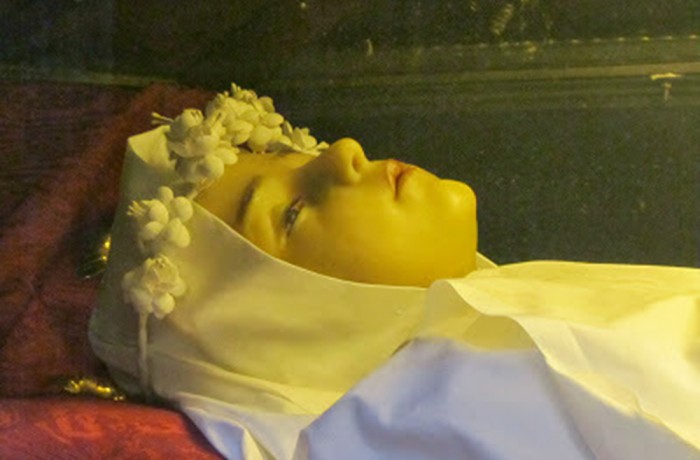
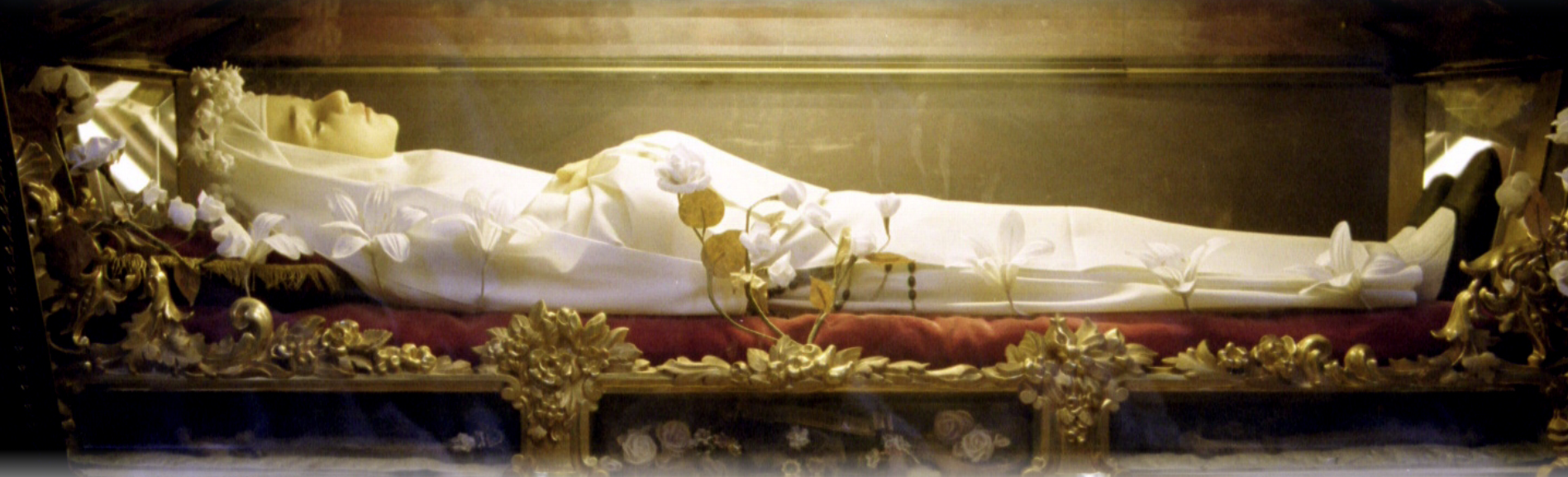
Her remains are kept in Bologna at the Church of San Sigismondo, beneath the wax effigy of her likeness. Blessed Imelda was Beatified on 20 December 1826 by Pope Leo XIII.
Quote/s of the Day – 21 April – Wednesday of the Third Week of Easter, Readings: Acts 8:1-8, Psalm 66:1-7, John 6:35-40 and the Memorial of St Conrad of Parzham OFM Cap. (1818-1894)
“I am the bread of life; he who comes to me, shall not hunger and he who believes in me, shall never thirst.”
John 6:35
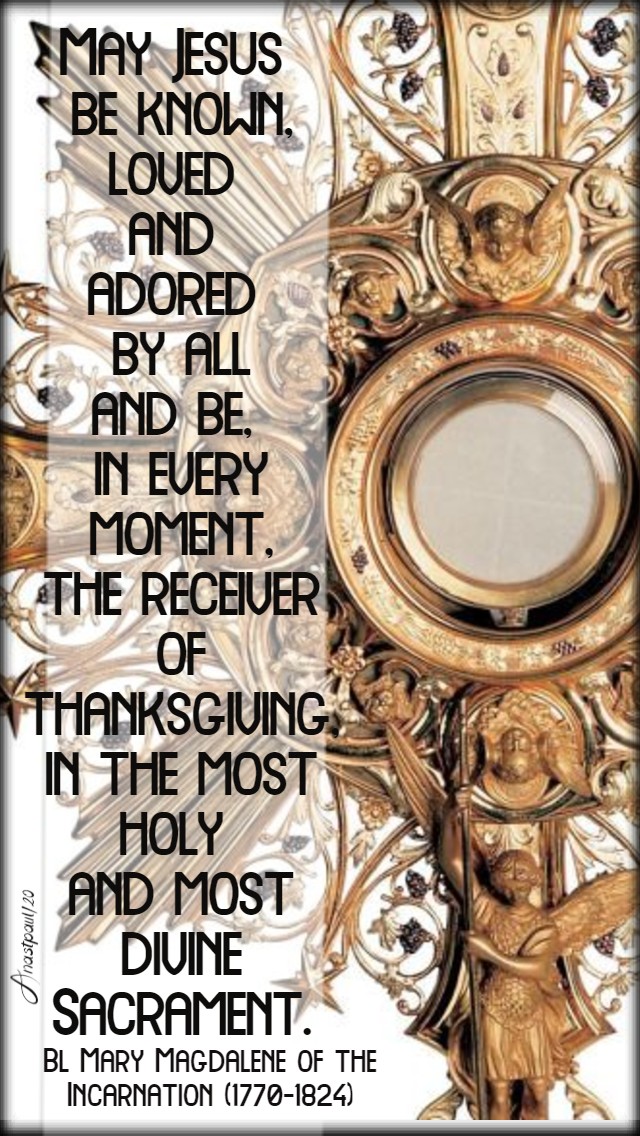
“May Jesus be known, loved and adored by all and be, in every moment, the receiver of thanksgiving, in the most holy and most divine Sacrament.”
Bl Mary Magdalene of the Incarnation (1770-1824)
Prayer of Adoration and Repentance/Night Prayer By St Conrad of Parzham (1818-1894)
I have come to spend a few moments with You, O Jesus and in spirit I prostrate myself in the dust before Your Holy Tabernacle to adore You, my Lord and God, in deepest humility. Once more, a day has come to its close, dear Jesus, another day which brings me nearer to the grave and my beloved heavenly home. Once more, O Jesus, my heart longs for You, the true Bread of Life, which contains all sweetness and relish. O my Jesus, mercifully grant me pardon for the faults and ingratitude of this day and come to me, to refresh my poor heart which longs for You. As the heart pants for the waters, as the parched earth longs for the dew of heaven, even so does my poor heart long for You, You Fount of Life. I love You, O Jesus, I hope in You, I love You and out of love for You, I regret sincerely all my sins. May Your peace and Your benediction be mine, now and always and for all eternity. Amen
Quote/s of the Day – 20 April – Tuesday of the Third Week of Easter, Readings: Acts 7:51–8:1, Psalm 31:3-4, 6-8, 17, 21, John 6:30-35
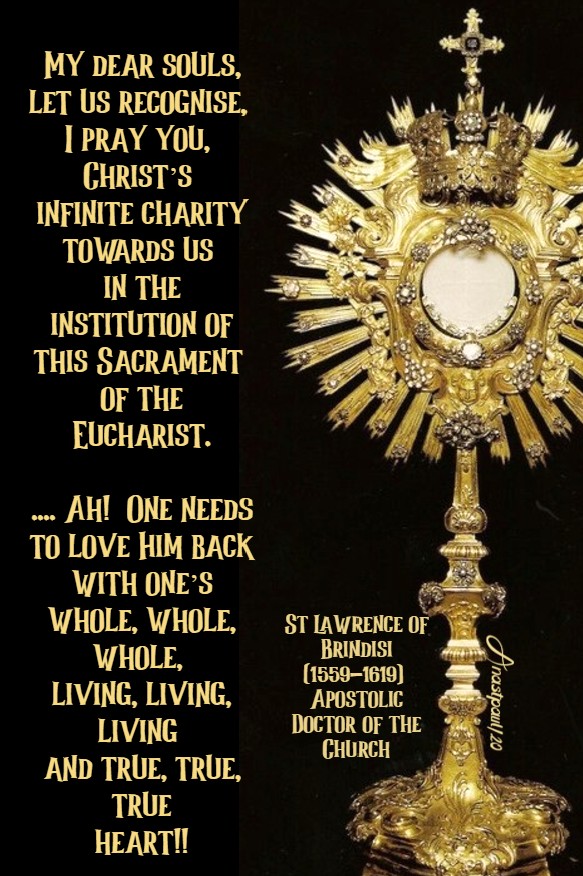
“My dear souls, let us recognise, I pray you, Christ’s infinite charity towards us in the institution of this Sacrament of the Eucharist. In order that our love be a spiritual love, He wills a new heart, a new love, a new spirit for us. It is not with a carnal heart but with a spiritual one, that Christ has loved us with a gratuitous love, a supreme and most ardent love, by way of pure grace and charity. Ah! One needs to love Him back with one’s whole, whole, whole, living, living, living and true, true, true heart!!”
St Lawrence of Brindisi(1559-1619) Apostolic Doctor of the Church
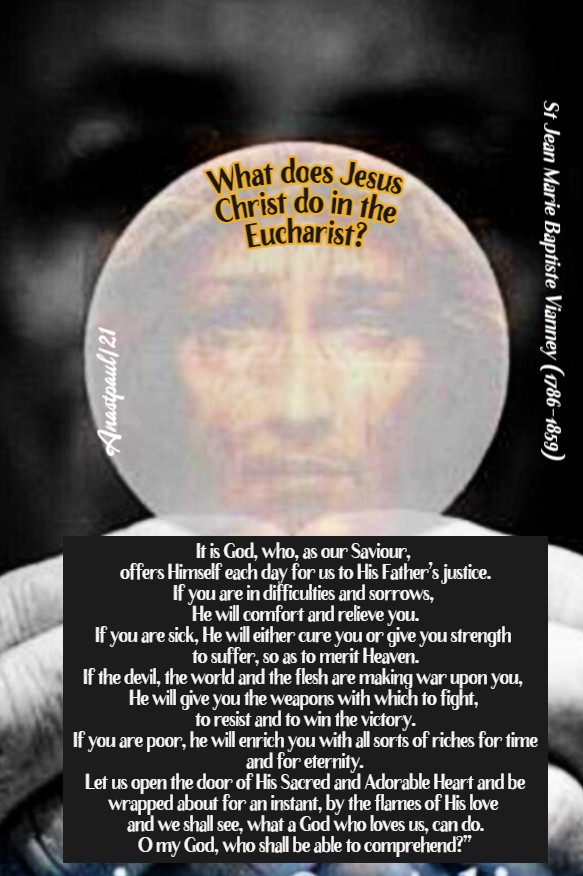
“What does Jesus Christ do in the Eucharist?
It is God, who, as our Saviour, offers Himself each day for us to His Father’s justice.
If you are in difficulties and sorrows, He will comfort and relieve you. If you are sick, He will either cure you or give you strength to suffer, so as to merit Heaven. If the devil, the world and the flesh are making war upon you, He will give you the weapons with which to fight, to resist and to win the victory. If you are poor, he will enrich you with all sorts of riches for time and for eternity. Let us open the door of His Sacred and Adorable Heart and be wrapped about for an instant, by the flames of His love and we shall see, what a God who loves us, can do. O my God, who shall be able to comprehend?”
St Jean Marie Baptiste Vianney (1786-1859)
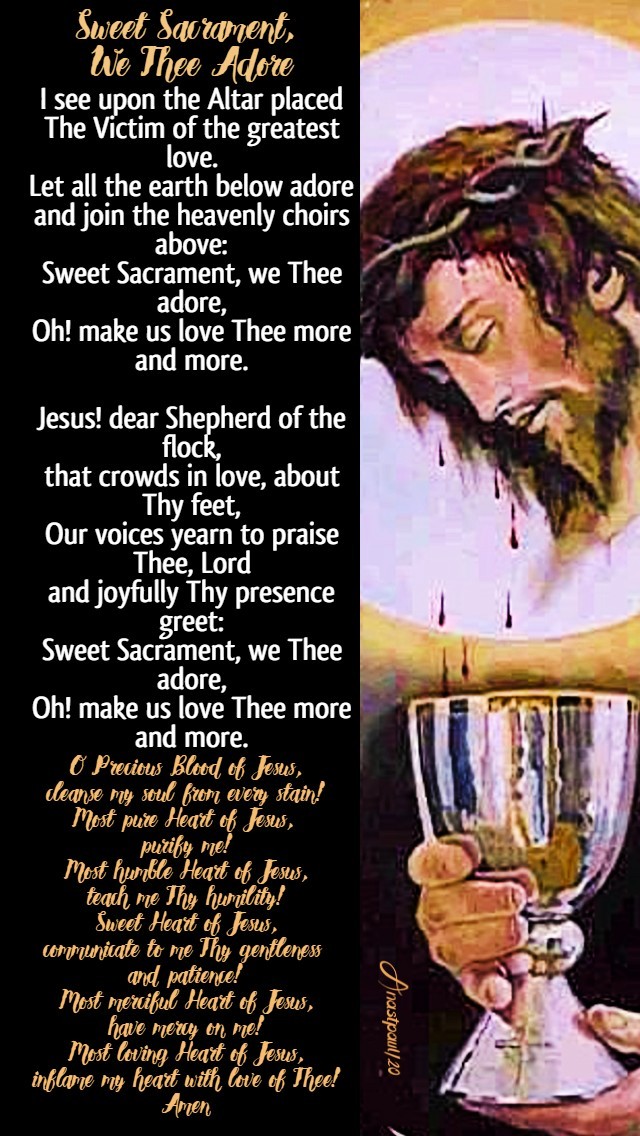
Sweet Sacrament, We Thee Adore
I see upon the Altar placed The Victim of the greatest love. Let all the earth below adore and join the heavenly choirs above: Sweet Sacrament, we Thee adore, Oh! make us love Thee more and more.
Jesus! dear Shepherd of the flock, that crowds in love, about Thy feet, Our voices yearn to praise Thee, Lord and joyfully Thy presence greet: Sweet Sacrament, we Thee adore, Oh! make us love Thee more and more.
O Precious Blood of Jesus, cleanse my soul from every stain! Most pure Heart of Jesus, purify me! Most humble Heart of Jesus, teach me Thy humility! Sweet Heart of Jesus, communicate to me Thy gentleness and patience! Most merciful Heart of Jesus, have mercy on me! Most loving Heart of Jesus, inflame my heart with love of Thee! Amen
One Minute Reflection – 20 April – Tuesday of the Third Week of Easter, Readings: Acts 7:51–8:1, Psalm 31:3-4, 6-8, 17, 21, John 6:30-35
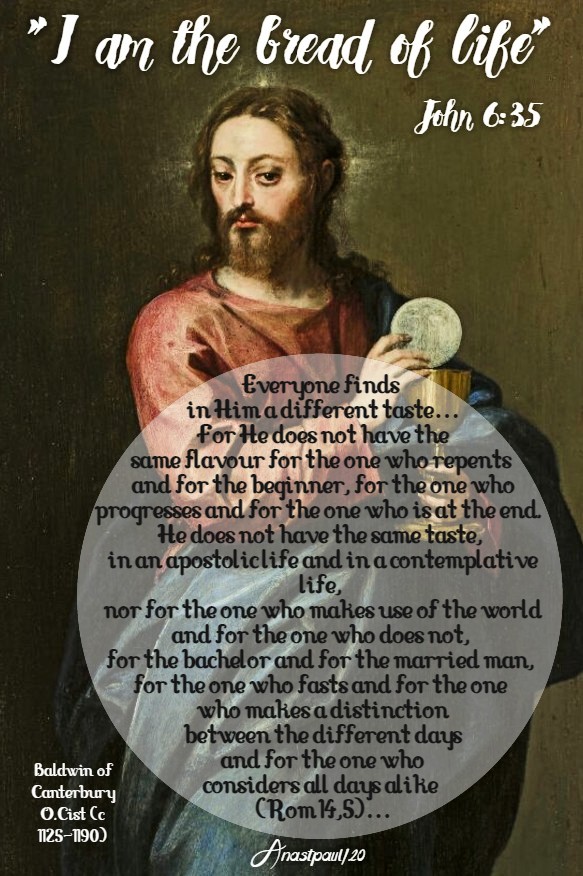
“I am the bread of life, whoever comes to me shall not hunger and whoever believes in me shall never thirst.” … John 6:35
REFLECTION – “God, – Whose nature is goodness, Whose substance is love and Whose whole life is benevolence – sent His own Son into the world, the bread of angels, “because of the great love he had for us” (Eph 2,4), because He wanted to show us the meekness of His nature and the affection He has for His children. “For God so loved the world that he gave his only Son” (Jn 3,16).
This is the real bread that the Lord sent from heaven so that we may eat it…; this is what God, in His goodness, has prepared for the poor (Ps 67,9s). For Christ, who came down form heaven for all men and to the level of each one, attracts everything to Himself through His inexpressible goodness; He does not reject anybody and He receives all men who wish to repent. He gives all those who receive Him, the most delicious taste. He is the only one who can fulfill all our desires… and, He adapts Himself in different ways, to one and the other, according to the tendencies, the desires and the appetites of each one…
Everyone finds in Him a different taste… For He does not have the same flavour for the one who repents and for the beginner, for the one who progresses and for the one who is at the end. He does not have the same taste, in an apostolic life and in a contemplative life, nor for the one who makes use of the world and for the one who does not, for the bachelor and for the married man, for the one who fasts and for the one who makes a distinction between the different days and for the one who considers all days alike (Rom 14,5)…
This bread has a sweet taste because it delivers one from all worries, it heals sicknesses, it eases trials, it assists one’s efforts and strengthens one’s hopes…Those who have tasted it hunger for it, those who hunger, will be satisfied.” – Baldwin of Canterbury O.Cist (c 1125-1190) Cistercian Abbot, then Bishop – The Sacrament of the Altar III, 2
PRAYER – Almighty Father, to whom this world, with all it’s goodness and beauty belongs, give us grace joyfully to begin this day in Your name and to fill it with the active love for You and our neighbour. By the food You give us, to sustain us on this journey, we are brought to holiness in Your Son, our Lord Jesus the Christ, whom You gave to us as our food. May the Mother of Your Son and our mother, lead us to You and be a succour on our way. Through Christ our Lord, with the Holy Spirit, God now and forever, amen.
Acts 7: 51 -60 51 You stiffnecked and uncircumcised in heart and ears, you always resist the Holy Ghost, as your fathers did, so do you also. 52 Which of the prophets have not your fathers persecuted? And they have slain them who foretold of the coming of the Just One; of whom you have been now the betrayers and murderers: 53 Who have received the law by the disposition of angels,and have not kept it. 54 Now hearing these things, they were cut to the heart, and they gnashed with their teeth at him. 55 But he, being full of the Holy Ghost, looking up steadfastly to heaven, saw the glory of God, and Jesus standing on the right hand of God. 56 And he said: Behold, I see the heavens opened, and the Son of man standing on the right hand of God. 57 And they crying out with a loud voice, stopped their ears and with one accord ran violently upon him. 58 And casting him forth without the city, they stoned him and the witnesses laid down their garments at the feet of a young man, whose name was Saul. 59 And they stoned Stephen, invoking and saying: Lord Jesus, receive my spirit. 60 And falling on his knees, he cried with a loud voice, saying: Lord, lay not this sin to their charge. And when he had said this, he fell asleep in the Lord. And Saul was consenting to his death.
Gospel: John 6: 30-35 30 They said, therefore, to him: What sign, therefore, dost thou shew, that we may see, and may believe thee? What dost thou work? 31 Our fathers did eat manna in the desert, as it is written: He gave them bread from heaven to eat. 32 Then Jesus said to them: Amen, amen I say to you,Moses gave you not bread from heaven but my Father giveth you the true bread from heaven. 33 For the bread of God is that which comes down from heaven and gives life to the world. 34 They saidthereforeunto him: Lord, give us always this bread. 35 And Jesus said to them: I am the bread of life, he that comes to me, shall not hunger and he that believes in me, shall never thirst.
Quote/s of the Day – 18 April – The Third Suday of Easter, Readings: First: Acts 3: 13-15, 17-19,salm: Psalms 4: 2, 4, 7-8, 9 (7a), Second: First John 2: 1-5a Gospel: Luke 24: 35-48
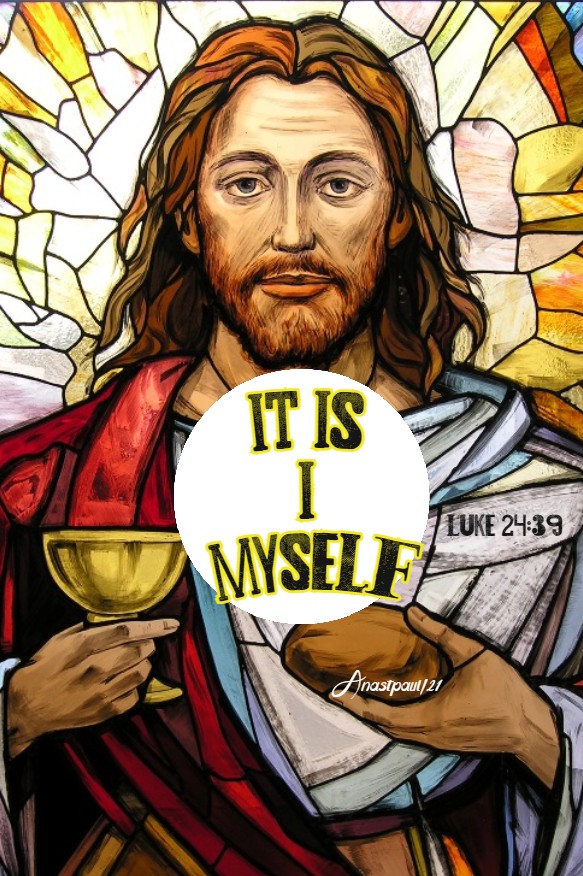
“It is I, Myself.”
Luke 24:39
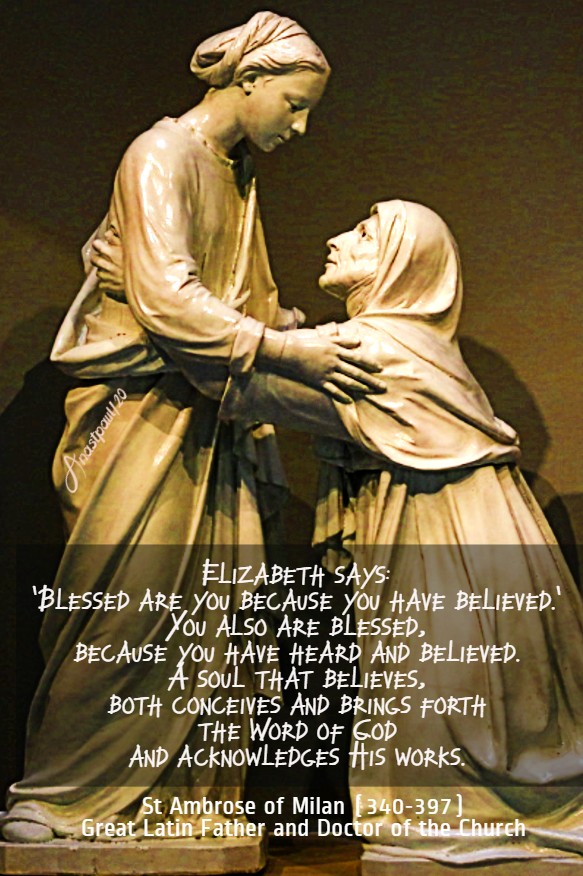
“Elizabeth says: ‘Blessed are you because you have believed.’ You also are blessed, because you have heard and believed. A soul that believes, both conceives and brings forth the Word of God and acknowledges His works.”
St Ambrose of Milan (340-397) Great Latin Father and Doctor of the Church
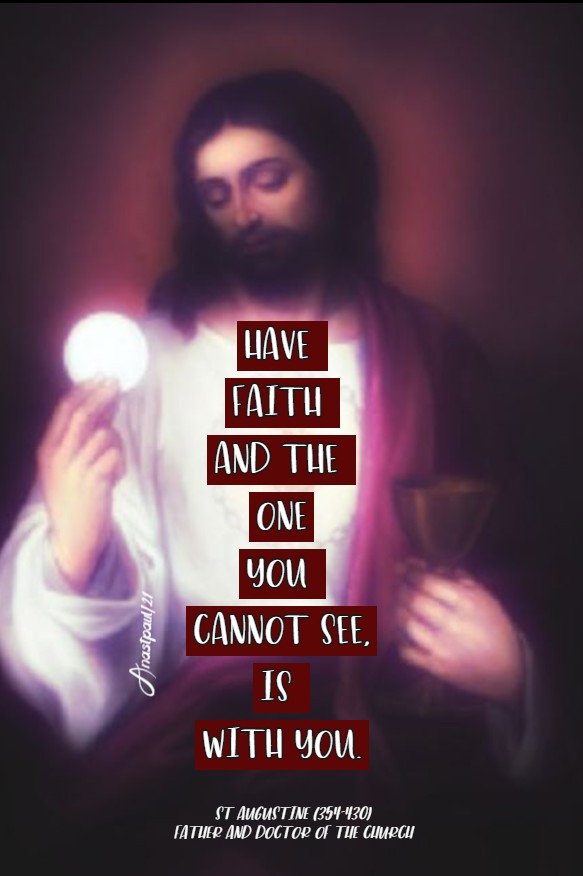
“Have faith and the One you cannot see, is with you.”
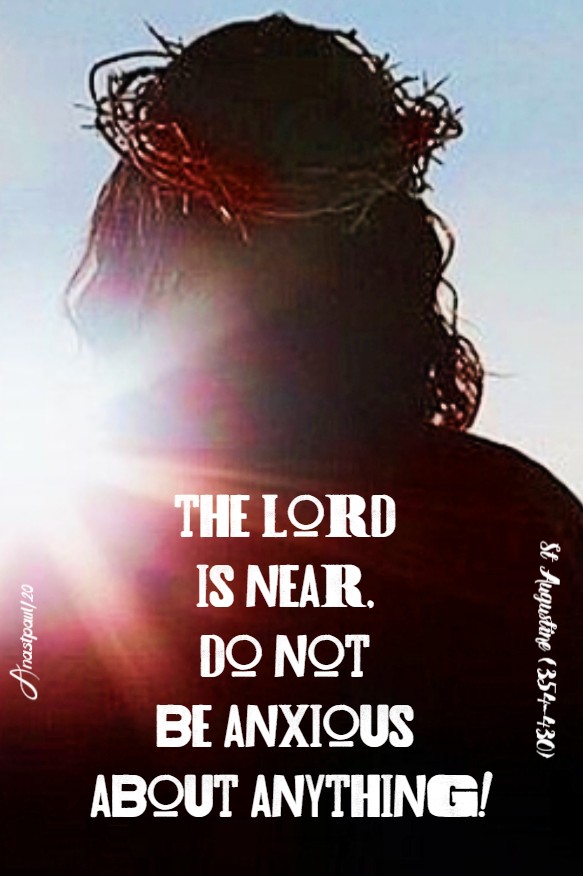
“The Lord is near do not be anxious about anything.”
St Augustine (354-430) Father and Doctor of the Church
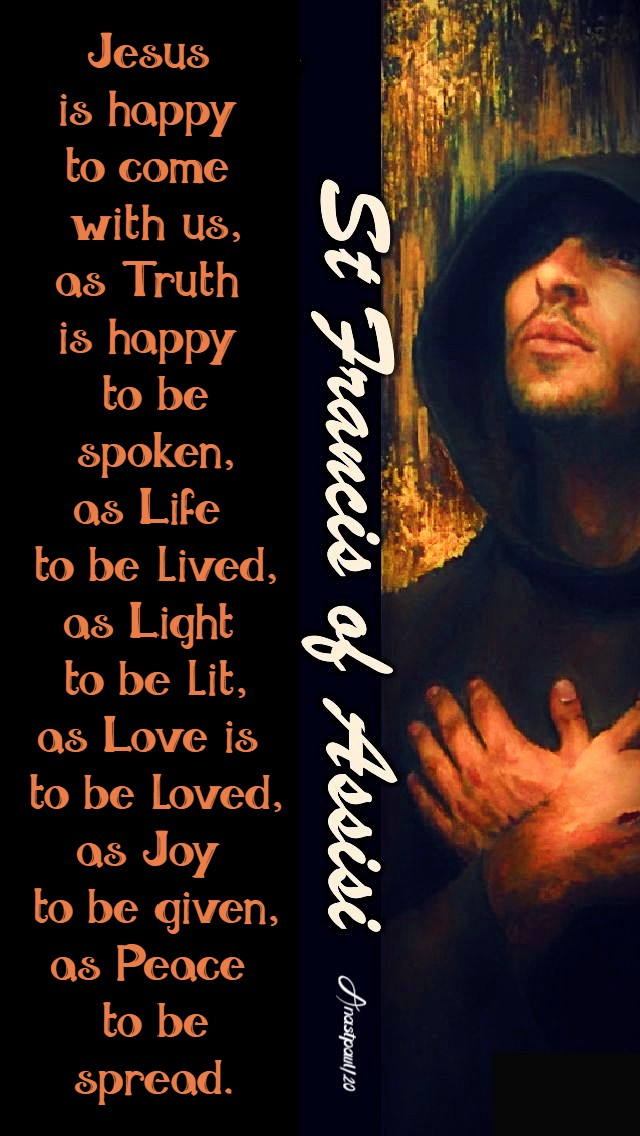
“Jesus is happy to come with us, as Truth is happy to be spoken, as Life to be lived, as Light to be lit, as Love is to be loved, as Joy to be given, as Peace to be spread.”
St Francis of Assisi (1181/2–1226)
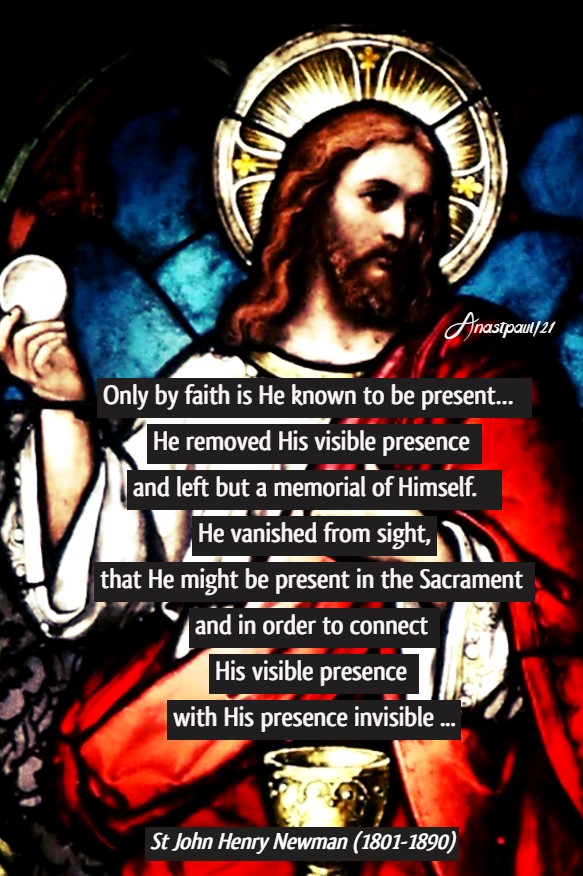
“Only by faith is He known to be present… He removed His visible presence and left but a memorial of Himself. He vanished from sight, that He might be present in the Sacrament and in order to connect His visible presence with His presence invisible … ”
Quote/s of the Day – 16 April – Friday of the Second Week of Easter, Readings: First: Acts 5: 34-42, Psalm: Psalms 27: 1, 4, 13-14, Gospel: John 6: 1-15 and the Month of the Blessed Sacrament
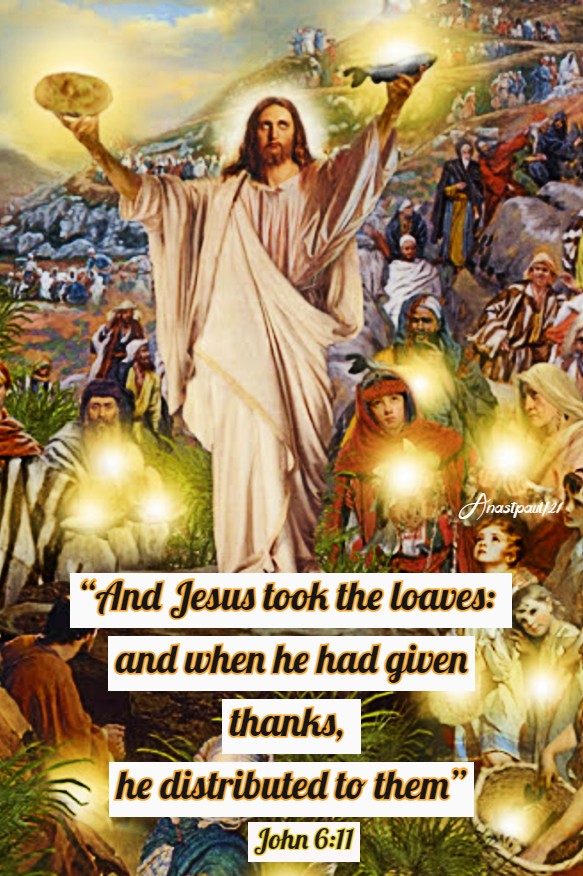
“And Jesus took the loaves: and when he had given thanks, he distributed to them”
John 6:11
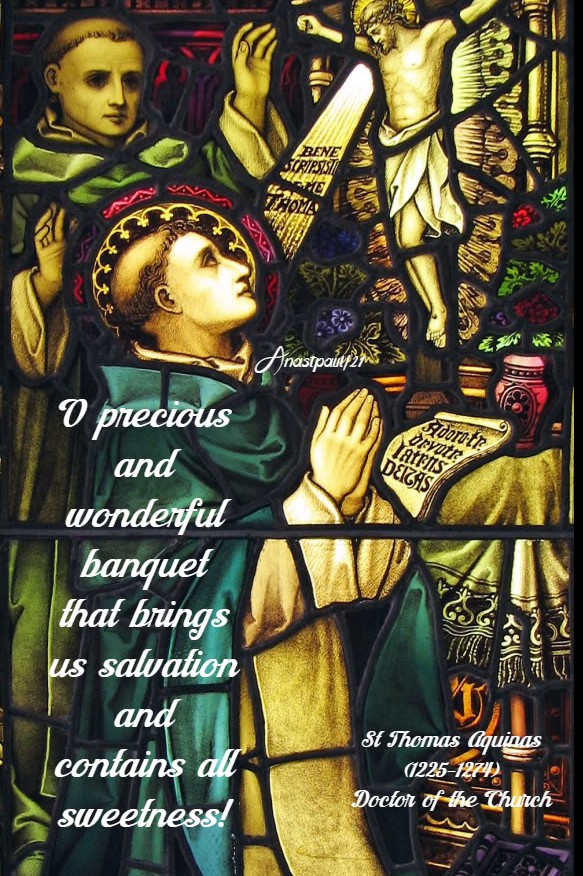
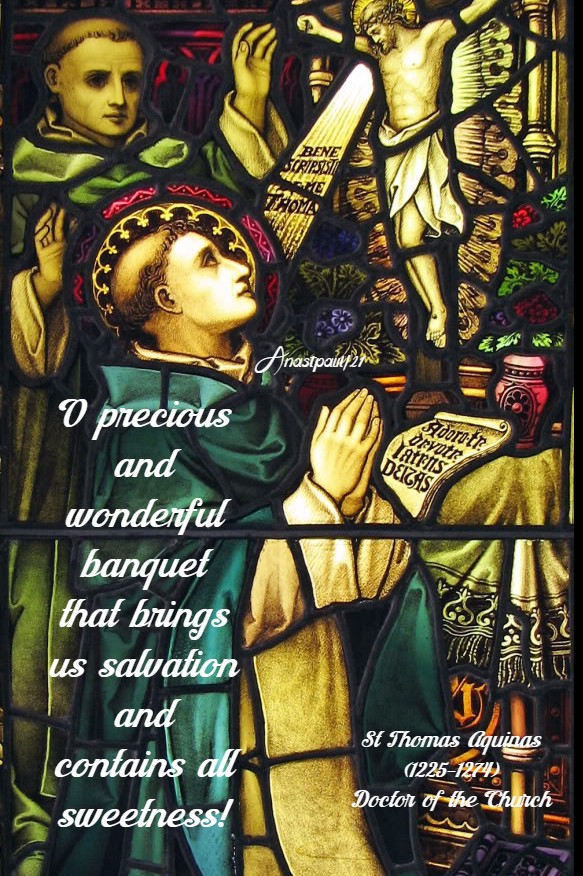
“O precious and wonderful banquet that brings us salvation and contains all sweetness!”
St Thomas Aquinas (1225-1274)
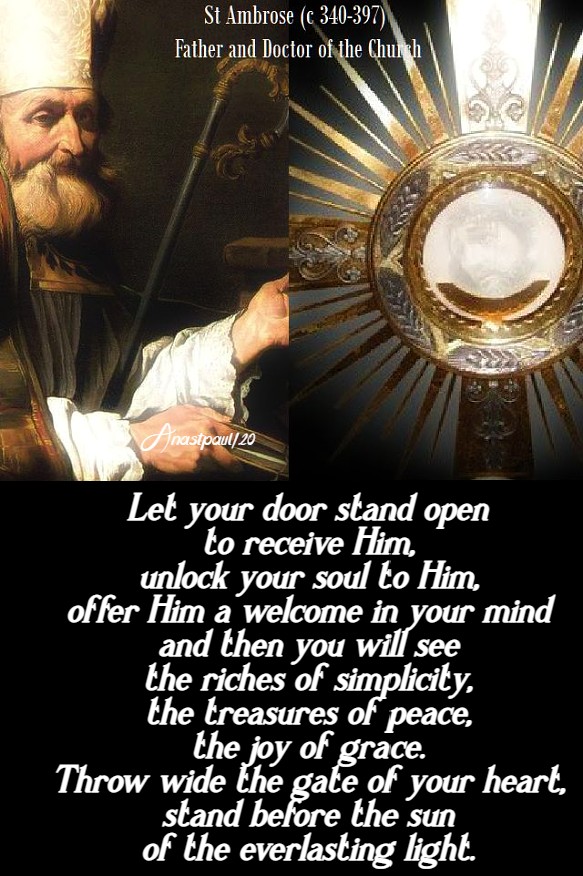
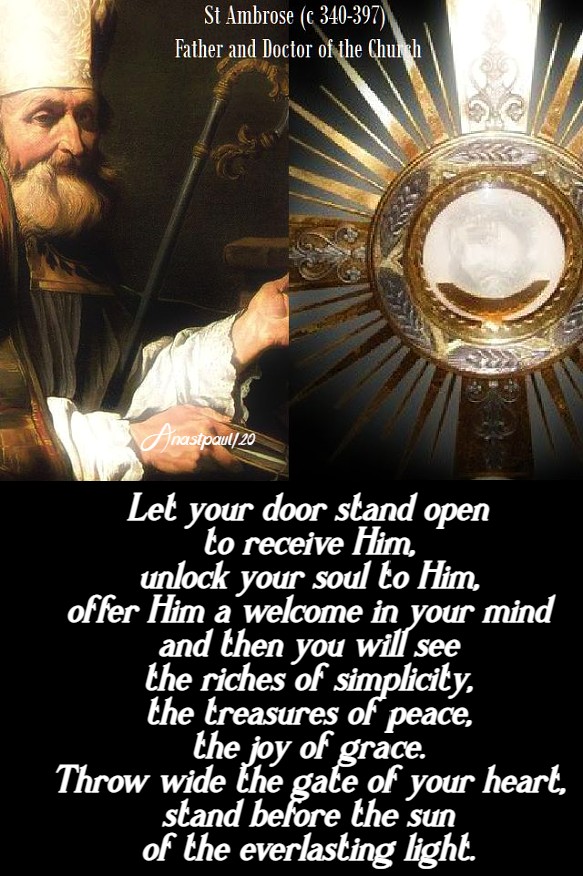
“Let your door stand open to receive Him, unlock your soul to Him, offer Him a welcome in your mind and then you will see the riches of simplicity, the treasures of peace, the joy of grace. Throw wide the gate of your heart, stand before the sun of the everlasting light.”
St Ambrose (340-397) Father and Doctor of the Church
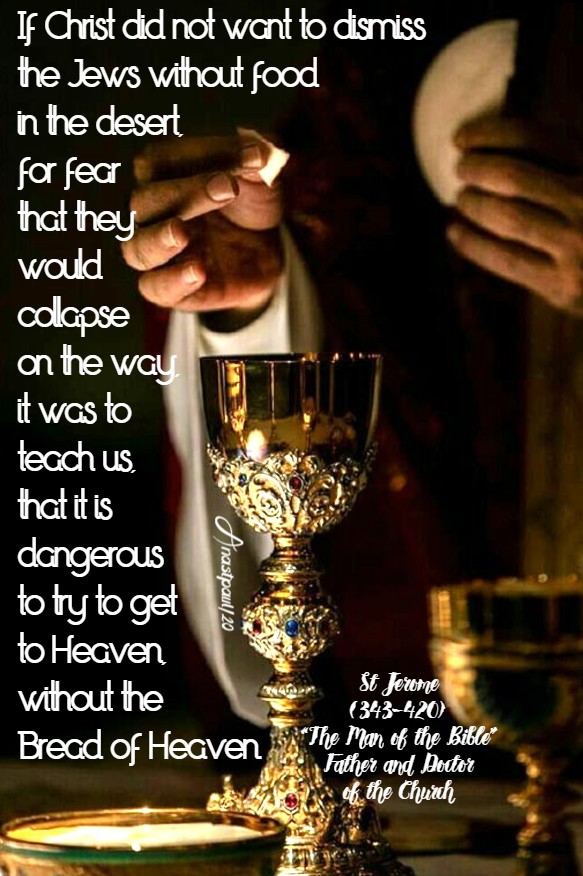
“If Christ did not want to dismiss the Jews without food in the desert, for fear that they would collapse on the way, it was to teach us, that it is dangerous to try to get to Heaven, without the Bread of Heaven.”
St Jerome (343-420) Father and Doctor of the Church
“O you sons of men, how long will you be dull of heart? … Behold – daily He humbles Himself as when from heaven’s royal throne He came down into the womb of the Virgin. Daily, He Himself, comes to us with like humility; daily He descends from the bosom of the Father, upon the altar, in the hands of the priest.”
Thought for the Day – 14 April – Meditations with Antonio Cardinal Bacci (1881-1971)
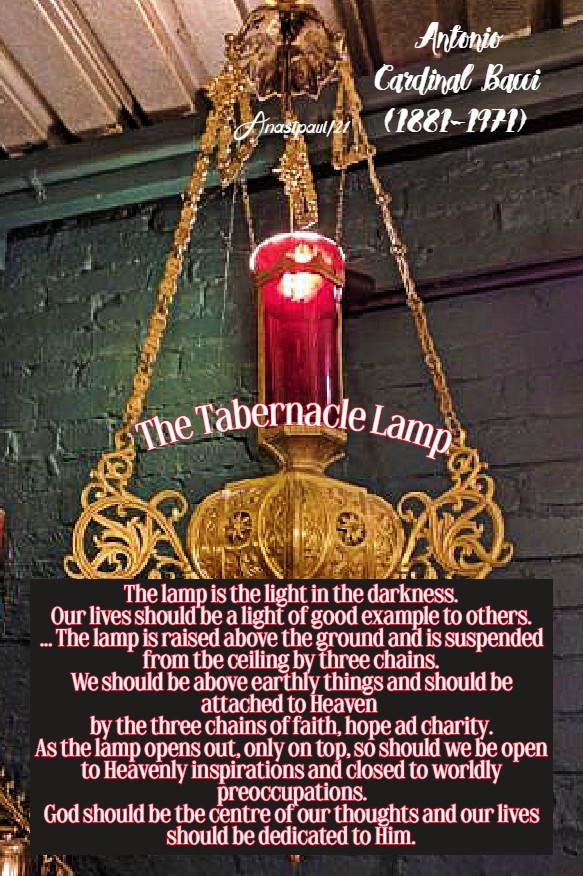
The Tabernacle Lamp
“Look up at the lamp quietly glowin before the Taberncle in honour of the Eucharistic Presence of Jesus, the Light of the world. We also, should be like living lamps of love.
The lamp burns night and day in the Presence of Jesus and burns itself out for Him. For what do we wear out our lives? In useless and unnecessary projects, perhaps for worldly reasons, for the satisfaction of our ego or of our passions? We shall certainly never find peace this way but only disillusionment and remorse.
The lamp is the light in the darkness. Our lives should be a light of good example to others.
The lamp has a flame which gives heat. We should burn with love for God, our one and only good and, for all men, whom we should regard as our brothers in Jesus Christ.
The lamp is raised above the ground and is suspended from tbe ceiling by three chains. We should be above earthly things and should be attached to Heaven by the three chains of faith, hope ad charity. As the lamp opens out, only on top, so should we be open to Heavenly inspirations and closed to worldly preoccupations. God should be tbe centre of our thoughts and our lives should be dedicated to Him. In this way, we shall find peace on earth and happiness hereafter.”
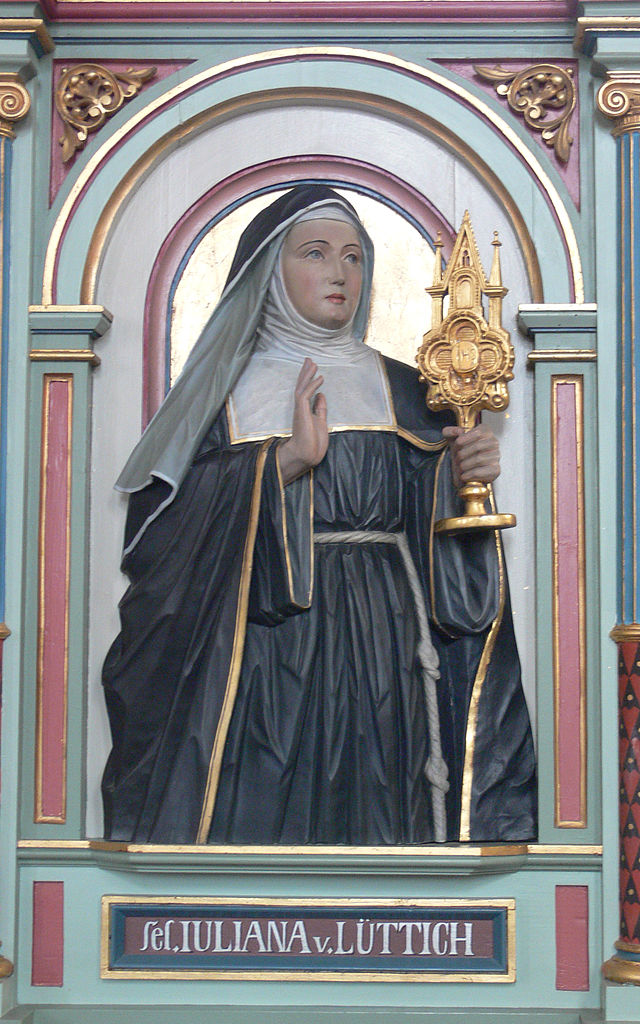
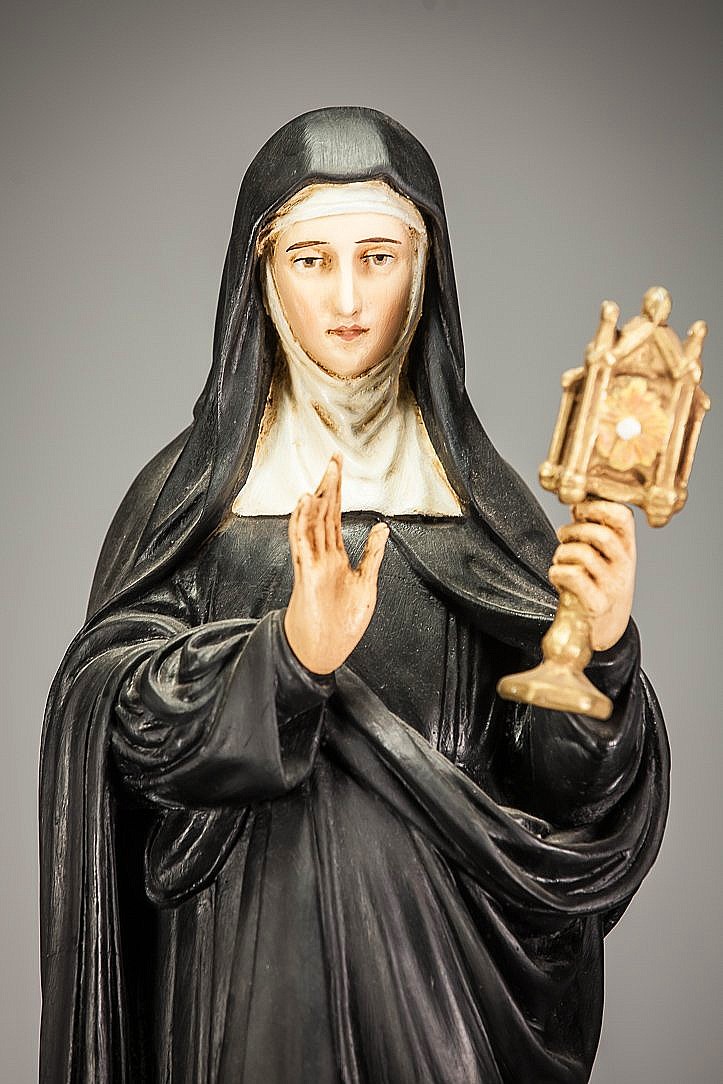
Saint of the Day – 6 April – Saint Juliana of Cornillon (c 1192-1258) Nun, Mystic “Apostle of the Blessed Sacrament.” Born in c 1192 or 1103 at Retinnes, Flanders, Belgium and died on 5 April 1258 of natural causes. Patronage– Devotion to the Blessed Sacrament. St Juliana is little known but the Church is deeply indebted to her, not only because of the holiness of her life but also because, with her great fervour, she contributed to the institution of one of the most important solemn Liturgies of the year, namely the Solemnity of Corpus Christi. She is also known as Juliana of Mount Cornillon, Julliana, Juliana of Liège.
We know several facts about her life, mainly from a Biography that was probably written by a contemporary cleric; it is a collection of various testimonies of people who were directly acquainted with the Saint.
Juliana was born near Liège, Belgium between 1191 and 1192. It is important to emphasise this place because at that time, the Diocese of Liège was, so to speak, a true “Eucharistic Upper Room.” Before Juliana, eminent theologians had illustrated the supreme value of the Sacrament of the Eucharist and, again in Liège, there were groups of women generously dedicated to Eucharistic worship and to fervent communion. Guided by exemplary Priests, they lived together, devoting themselves to prayer and to charitable works.
Orphaned at the age of five, Juliana, together with her sister Agnes, was entrusted to the care of the Augustinian nuns at the Convent and leprosarium of Mont-Cornillon. She was taught mainly by a Sister called “Sapienza” [wisdom], who was in charge of her spiritual development to the time Juliana received the religious habit and thus became an Augustinian Nun.
She became so learned that she could read the words of the Church Fathers, of St Augustine and St Bernard in particular, in Latin. In addition to a keen intelligence, Juliana showed a special propensity for contemplation from the outset. She had a profound sense of Christ’s presence, which she experienced by living the Sacrament of the Eucharist especially intensely and by pausing frequently to meditate upon Jesus’ words: “And lo, I am with you always, to the close of the age” (Mt 28:20).
When Juliana was 16 she had her first vision, which recurred subsequently several times during her Eucharistic adoration. Her vision presented the moon in its full splendour, crossed diametrically by a dark stripe. The Lord made her understand the meaning of what had appeared to her. The moon symbolized the life of the Church on earth, the opaque line, on the other hand, represented the absence of a liturgical feast for whose institution Juliana was asked to plead effectively, namely, a feast in which believers would be able to adore the Eucharist so as to increase in faith, to advance in the practice of the virtues and to make reparation for offences, to the Most Holy Sacrament.
The vision of St Juliana
Juliana, who in the meantime had become Prioress of the convent, kept this revelation that had filled her heart with joy a secret for about 20 years. She then confided it to two other fervent adorers of the Eucharist, Blessed Eva, who lived as a hermit, and Isabella, who had joined her at the Monastery of Mont-Cornillon. The three women established a sort of “spiritual alliance” for the purpose of glorifying the Most Holy Sacrament. They also chose to involve a highly regarded Priest, John of Lausanne, who was a Canon of the Church of St Martin in Liège. They asked him to consult theologians and clerics on what was important to them. Their affirmative response was encouraging.
What happened to Juliana of Cornillon occurs frequently in the lives of Saints. To have confirmation that an inspiration comes from God, it is always necessary to be immersed in prayer to wait patiently, to seek friendship and exchanges with other good souls and to submit all things to the judgement of the Shepherds of the Church. It was in fact Bishop Robert Torote, Liège who, after initial hesitation, accepted the proposal of Juliana and her companions and first introduced the Solemnity of Corpus Christi in his Diocese. Later other Bishops following his example and instituted this Feast in the territories entrusted to their pastoral care.
However, to increase their faith the Lord often asks Saints to sustain trials. This also happened to Juliana who had to bear the harsh opposition of certain members of the clergy and even of the Superior on whom her Monastery depended. Of her own free will, therefore, Juliana left the Convent of Mont-Cornillon with several companions. For 10 years — from 1248 to 1258 — she stayed as a guest at various Monasteries of Cistercian sisters. She edified all with her humility, she had no words of criticism or reproach for her adversaries and continued zealously to spread Eucharistic worship.
She died at Fosses-La-Ville, Belgium, in 1258. In the cell where she lay, the Blessed Sacrament was exposed and, according to her biographer’s account, Juliana died contemplating with a last effusion of love Jesus in the Eucharist, Whom she had always loved, honoured and adored.
Jacques Pantaléon of Troyes was also won over to the good cause of the Feast of Corpus Christi during his ministry as Archdeacon in Lièges. It was he, who, having become Pope with the name of Urban IV in 1264, instituted the Solemnity of Corpus Christi on the Thursday after Pentecost as a Feast of precept for the universal Church.
In the Bull of its institution, entitled Transiturus de hoc mundo, (11 Aug. 1264), Pope Urban even referred discreetly to Juliana’s mystical experiences, corroborating their authenticity. He wrote: “Although the Eucharist is celebrated solemnly everyday, we deem it fitting, that at least once a year. it be celebrated with greater honour and a solemn commemoration.
Indeed we grasp the other things we commemorate with our spirit and our mind but this does not mean, that we obtain their real presence. On the contrary, in this sacramental commemoration of Christ, even though in a different form, Jesus Christ is present with us in His own substance. While He was about to ascend into Heaven, He said ‘And lo, I am with you always, to the close of the age’ (Matthew 28:20)”.
The Pontiff made a point of setting an example by celebrating the solemnity of Corpus Christi in Orvieto, the town where he was then residing. Indeed, he ordered that the famous Corporal with the traces of the Eucharistic miracle which had occurred in Bolsena the previous year, 1263, be kept in Orvieto Cathedral — where it still is today.
While a Priest was consecrating the bread and the wine, he was overcome by strong doubts about the Real Presence of the Body and Blood of Christ in the Sacrament of the Eucharist. A few drops of blood began miraculously to ooze from the consecrated Host, thereby confirming what our faith professes.
Urban iv asked one of the greatest theologians of history, St Thomas Aquinas — who at that time was accompanying the Pope and was in Orvieto — to compose the texts of the Liturgical Office for this great Feast. They are masterpieces, still in use in the Church today, in which theology and poetry are fused into glorious prayers. These texts pluck at the heartstrings in an expression of praise and gratitude to the Most Holy Sacrament, while the mind, penetrating the mystery with wonder, recogniSes in the Eucharist, the Living and Real Presence of Jesus, of His Sacrifice of Love, that reconciles us with the Father and gives us salvation.
Although, after the death of Urban iv the celebration of the Feast of Corpus Christi was limited to certain regions of France, Germany, Hungary and Northern Italy, it was another Pontiff, John XXII who in 1317, re-established it for the universal Church. Since then, the Feast experienced a wonderful development and is still deeply appreciated by the Catholic faithful.
In remembering St Juliana of Cornillon, let us also renew our faith in the Real Presence of Christ in the Eucharist. As we are taught “Jesus Christ is present in the Eucharist in a unique and incomparable way. He is present in a true, real and substantial way, with His Body and His Blood, with His Soul and His Divinity. In the Eucharist, therefore, there is present in a sacramental way, that is, under the Eucharistic Species of bread and wine, Christ whole and entire, God and Man” (n. 282). (Excerpt – Pope Benedict XVI)
St Juliana was Canonised in 1869 by Blessed Pope Pius IX.
The Saints never failed to find strength, consolation and joy in the Eucharistic encounter. Let us repeat before the Lord present in the Most Blessed Sacrament ,the words of the Eucharistic hymn “Adoro te devote”: [Devoutly I adore Thee]: Make me believe ever more in you, “Draw me deeply into faith, / Into Your hope, into Your love.”
“The masterpiece of Jesus Christ’s love for humanity is the Eucharist. The Eucharist is within our reach. We can all get close to Christ the guest and talk with Him and perceive the warmth of His word. The word! How it inflames the spirits! How will the word of Christ inflame them! We can all get to the altar when He immolates Himself and shouts at us: Look how much I have loved and loved you! And we can all sit at His table and eat the bread and drink the intoxicating wine of charity. “
Blessed Marcelo Spínola y Maestre (1835-1906) Cardinal-Priest
Thought for the Day – 12 February – Meditations with Antonio Cardinal Bacci (1881-1971)
Spiritual Communion
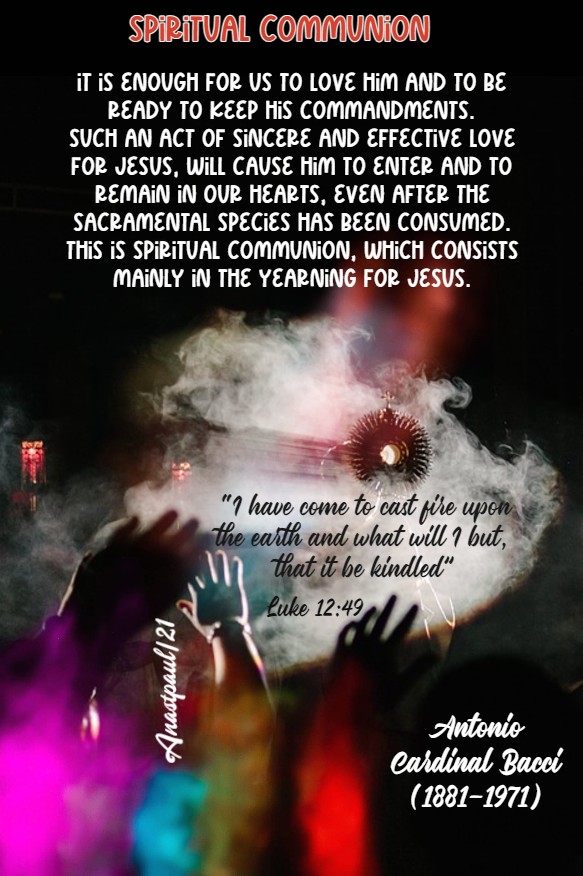
“Jesus, not only desires to come to us but, He desires to remain continually present in us with His love and grace. “If anyone love me, he will keep my word,” He tells us “and, my Father will love him and we will come to him and make our abode with him” (Jn 14:23). It is enough for us to love Him and to be ready to keep His commandments. Such an act of sincere and effective love for Jesus, will cause Him to enter and to remain in our hearts, even after the sacramental species has been consumed. This is Spiritual Communion, which consists mainly in the yearning for Jesus. “I have come to cast fire upon the earth and what will I but, that it be kindled” (Lk 12:49).
Our Morning Offering – 7 February – Sexagesima Sunday
God, my God May I Always Abide in You By St John Damascene (675-749) Father and Doctor of the Church
God, my God, inextinguishable and invisible fire, You make Your angels flaming fire. Out of Your inexpressible love, You have given me Your divine Flesh as food and through this communion of Your immaculate Body and precious Blood, You receive me as a partaker of Your divinity. Permeate all my body and soul, all my bones and sinews. Consume my sins in fire. Enlighten my soul and illumine my mind. Sanctify my body and make Your abode in me, together with Your blessed Father and all-holy Spirit, that I may always abide in You, through the intercession of Your immaculate Mother and all Your saints. Amen
Quote/s of the Day – 28 January – The Memorial of St Thomas Aquinas (1225-1274) Doctor of the Church
St Thomas speaks on the Holy Eucharist
“O precious and wonderful banquet that brings us salvation and contains all sweetness!”
“O how unspeakable is this Sacrament which sets our affections ablaze with charity. … It is the fulfillment of Christ’s Mystical Body.”
“The Eucharist is the Sacrament of Love. It signifies Love, It produces love. The Eucharist is the consummation of the whole spiritual life.”
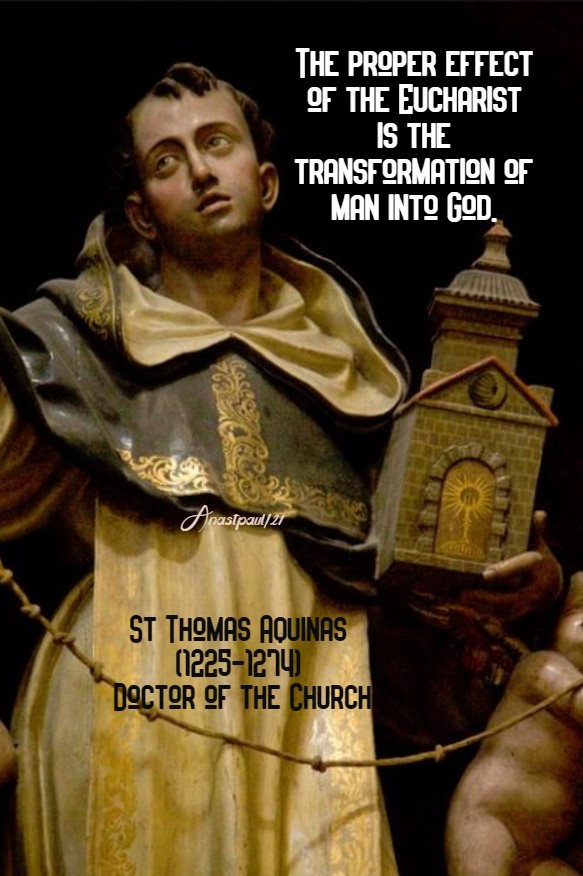
“The proper effect of the Eucharist is the transformation of man into God.”
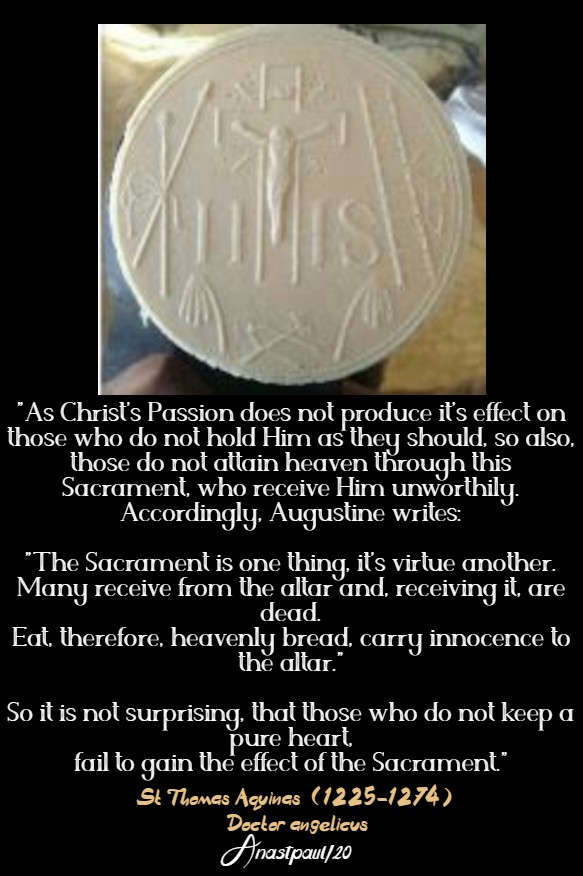
“As Christ’s Passion does not produce it’s effect on those who do not hold Him as they should, so also, those do not attain heaven through this Sacrament, who receive Him unworthily. Accordingly, Augustine writes: “The Sacrament is one thing, it’s virtue another. Many receive from the altar and, receiving it, are dead. Eat, therefore, heavenly bread, carry innocence to the altar.” So it is not surprising, that those who do not keep a pure heart, fail to gain the effect of the Sacrament.”
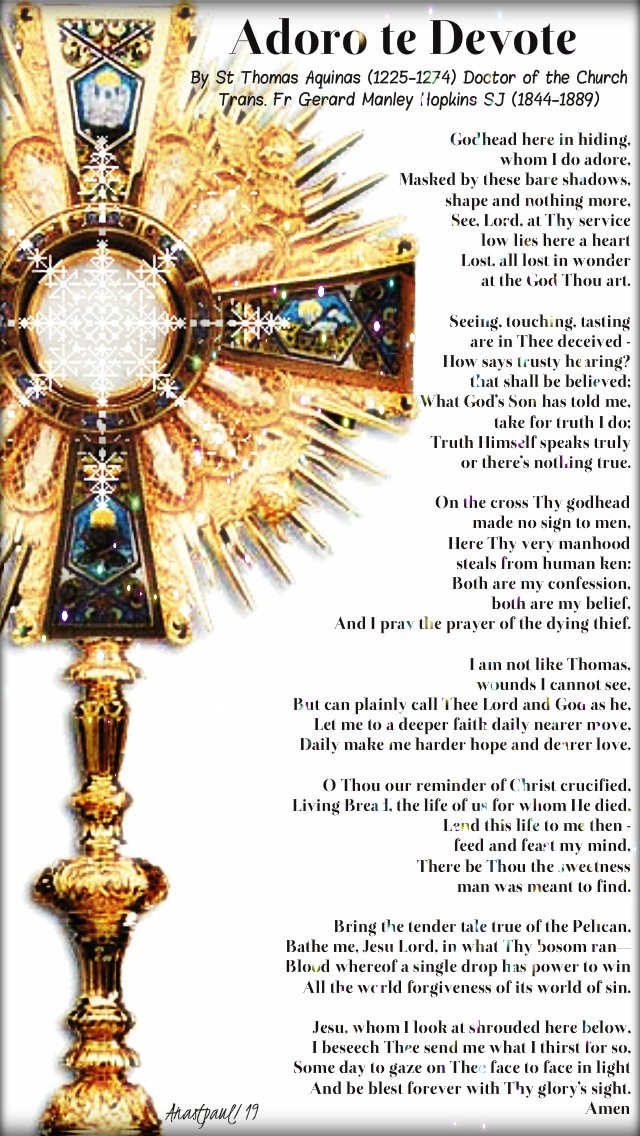
Adoro te Devote Trans. Fr Gerard Manley Hopkins SJ (1844-1889)
Godhead here in hiding, whom I do adore, Masked by these bare shadows, shape and nothing more, See, Lord, at Thy service low lies here a heart Lost, all lost in wonder at the God Thou art.
Seeing, touching, tasting are in Thee deceived – How says trusty hearing? that shall be believed, What God’s Son has told me, take for truth I do, Truth Himself speaks truly or there’s nothing true.
On the cross Thy godhead made no sign to men, Here Thy very manhood steals from human ken – Both are my confession, both are my belief, And I pray the prayer of the dying thief.
I am not like Thomas, wounds I cannot see, But can plainly call Thee Lord and God as he, Let me to a deeper faith daily nearer move, Daily make me harder hope and dearer love.
O Thou our reminder of Christ crucified, Living Bread, the life of us for whom He died, Lend this life to me then – feed and feast my mind, There be Thou the sweetness man was meant to find.
Bring the tender tale true of the Pelican, Bathe me, Jesu Lord, in what Thy bosom ran— Blood whereof a single drop has power to win All the world forgiveness of its world of sin.
Jesu, whom I look at shrouded here below, I beseech Thee send me what I thirst for so, Some day to gaze on Thee face to face in light And be blest forever with Thy glory’s sight. Amen
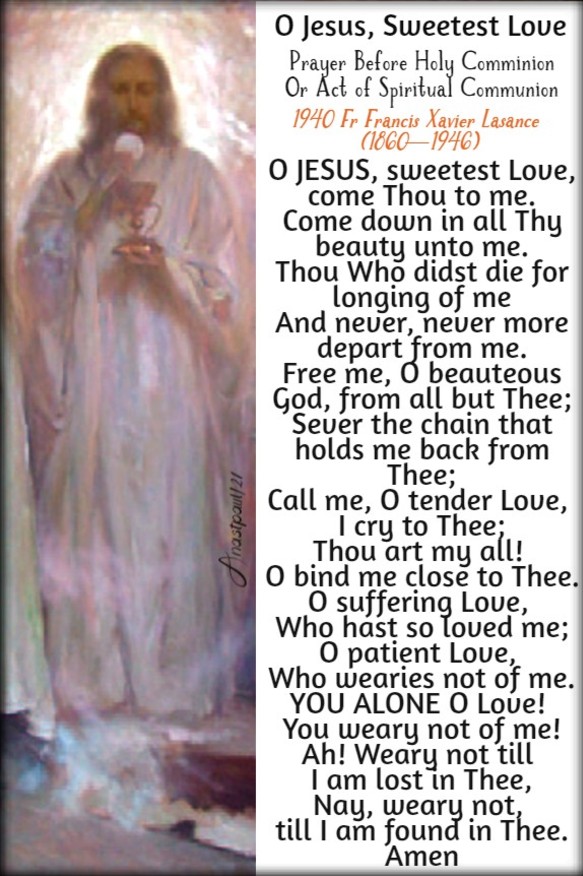
O Jesus, Sweetest Love Prayer Before Holy Comminion Or Act of Spiritual Communion 1940 Fr Francis Xavier Lasance (1860–1946)
O JESUS, sweetest Love, come Thou to me. Come down in all Thy beauty unto me. Thou Who didst die for longing of me And never, never more depart from me. Free me, O beauteous God, from all but Thee; Sever the chain that holds me back from Thee; Call me, O tender Love, I cry to Thee; Thou art my all! O bind me close to Thee. O suffering Love, Who hast so loved me; O patient Love, Who wearies not of me. YOU ALONE O Love! You weary not of me! Ah! Weary not till I am lost in Thee, Nay, weary not, till I am found in Thee. Amen
Quote/s of the Day – 7 December – The Memorial of St Ambrose (c 340-397) – Father and Doctor of the Church
“And this Body, which we make present, is the Body born of the Virgin. Why do you expect to find in this case, that nature takes its ordinary course in regard to the Body of Christ, when the Lord Himself was born of the Virgin in a manner above and beyond the order of nature? This is indeed the true flesh of Christ, which was crucified and buried. This is then, in truth, the Sacrament of His Flesh.”
“Rise, you who were lying fast asleep… Rise and hurry to the Church: here is the Father, here is the Son, here is the Holy Spirit.”
“Let your door stand open to receive Him, unlock your soul to Him, offer Him a welcome in your mind and then you will see the riches of simplicity, the treasures of peace, the joy of grace. Throw wide the gate of your heart, stand before the sun of the everlasting light.”
“Prayer is the wing, wherewith the soul flies to heaven and meditation, the eye, wherewith we see God.”
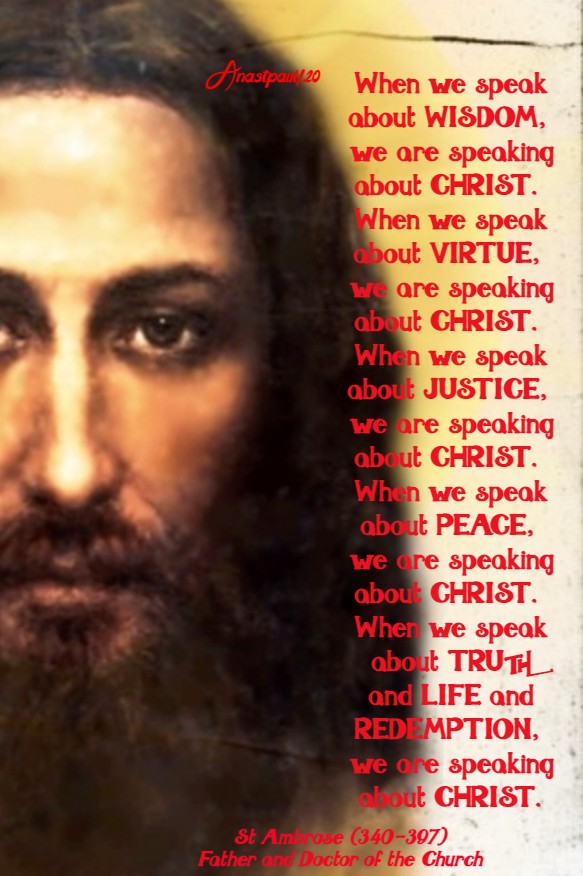
“When we speak about WISDOM, we are speaking about CHRIST. When we speak about VIRTUE, we are speaking about CHRIST. When we speak about JUSTICE, we are speaking about CHRIST. When we speak about PEACE, we are speaking about CHRIST. When we speak about TRUTH and LIFE and REDEMPTION, we are speaking about CHRIST.”
St Ambrose (340-397) Father and Doctor of the Church
Quote/s of the Day – 13 October – Tuesday of the Twenty-eighth week in Ordinary Time, Readings: Ephesians 5:21-33,Psalms 128:1-2, 3,4-5, Luke 13:18-21
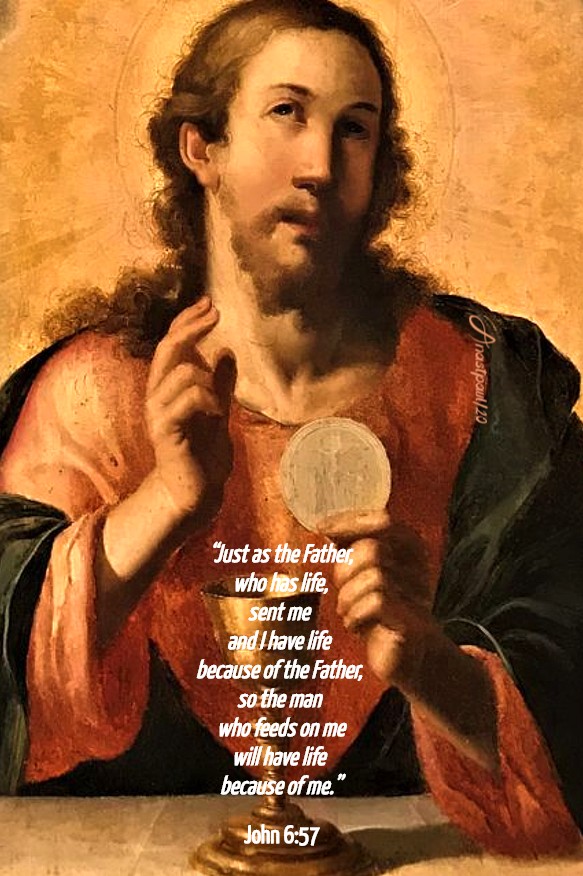
“Just as the Father who has life sent me and I have life because of the Father, so the man who feeds on me will have life because of me.”
John 6:57
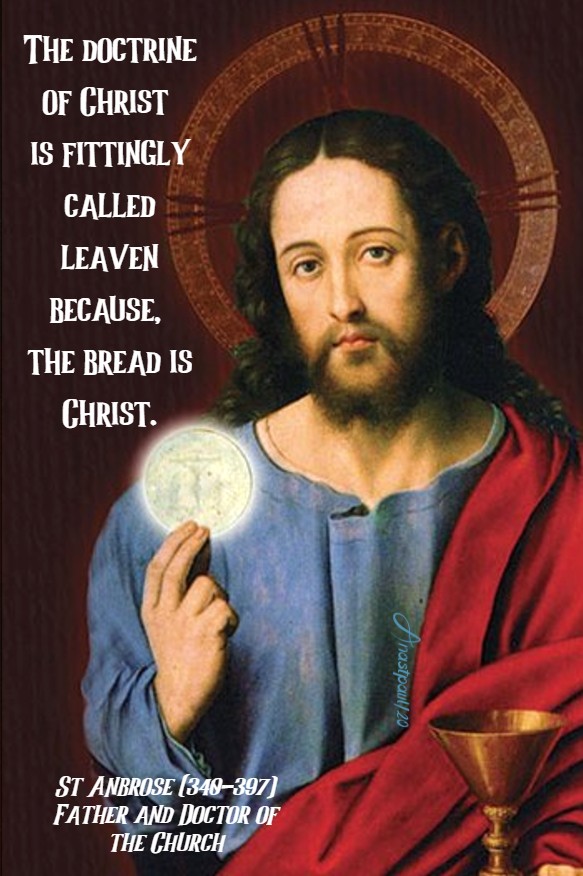
“The doctrine of Christ is fittingly called leaven because, the bread is Christ.”
St Anbrose (340-397) Father and Doctor of the Church
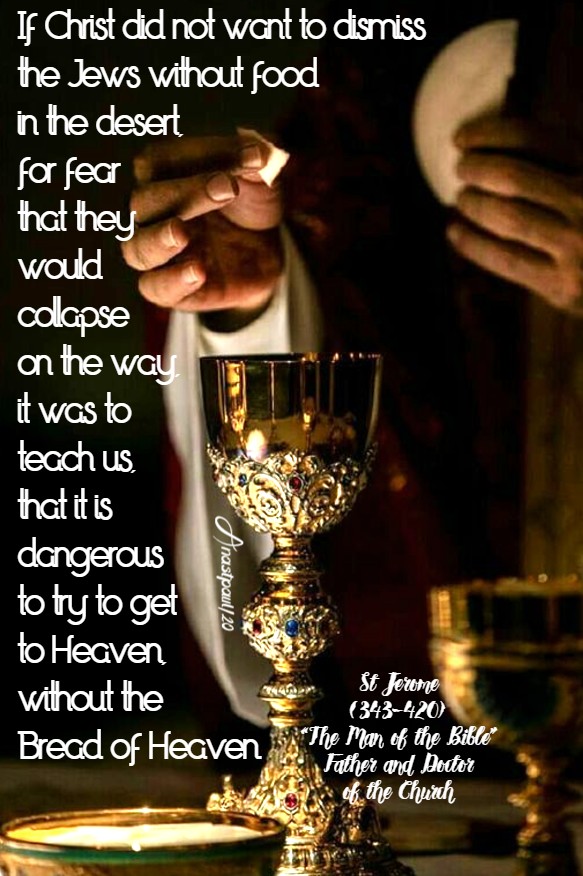
“If Christ did not want to dismiss the Jews without food in the desert, for fear that they would collapse on the way, it was to teach us, that it is dangerous to try to get to Heaven, without the Bread of Heaven.”
St Jerome (343-420) Father and Doctor of the Church
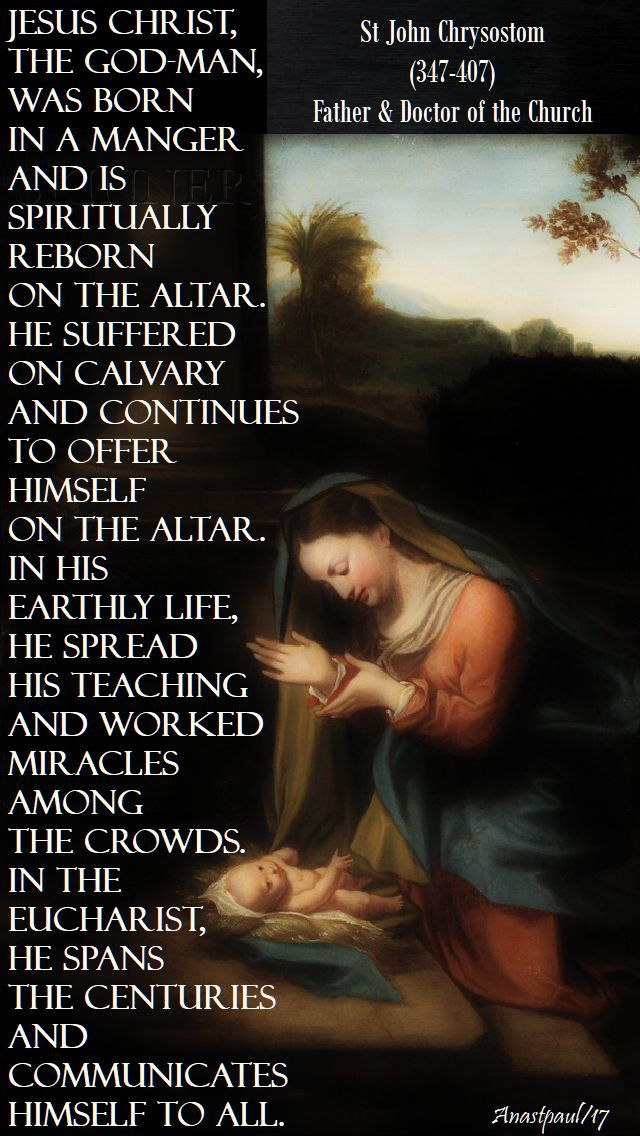
“Jesus Christ, the God-Man, was born in a manger and is spiritually reborn on the altar. He suffered on Calvary and continues to offer Himself on the altar. In His earthly life, He spread His teaching and worked miracles among the crowds. In the Eucharist, He spans the centuries and communicates Himself to all.”
St John Chrysostom (347-407) Father and Doctor
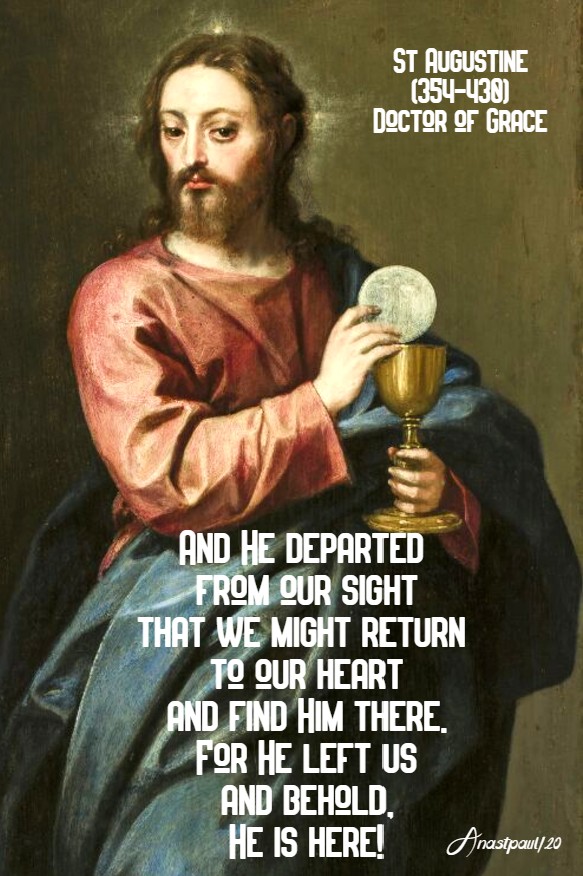
“And He departed from our sight that we might return to our heart and find Him there. For He left us and behold, He is here!”
St Augustine (354-430) Father and Doctor of Grace
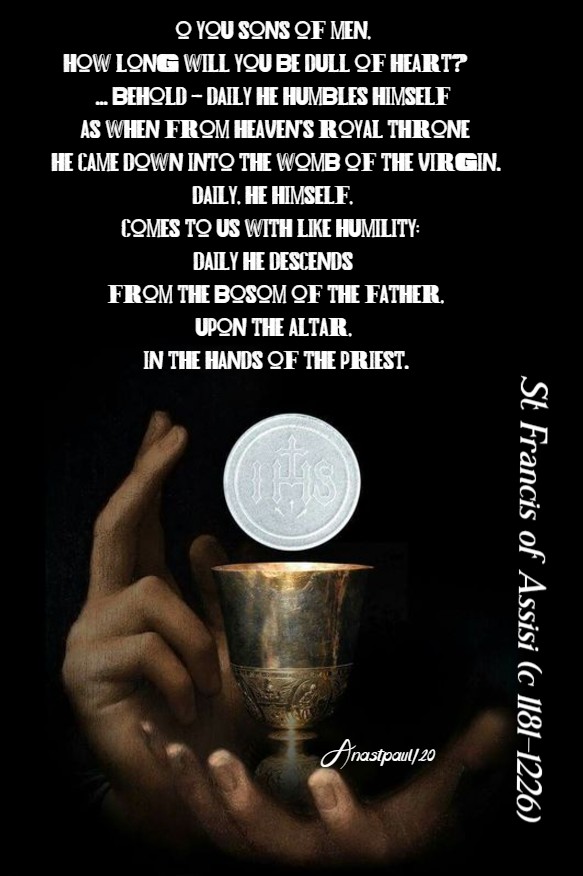
“O you sons of men, how long will you be dull of heart? … Behold – daily He humbles Himself as when from heaven’s royal throne He came down into the womb of the Virgin. Daily, He Himself, comes to us with like humility; daily He descends from the bosom of the Father, upon the altar, in the hands of the priest.”
St Francis of Assisi (c 1181–1226)
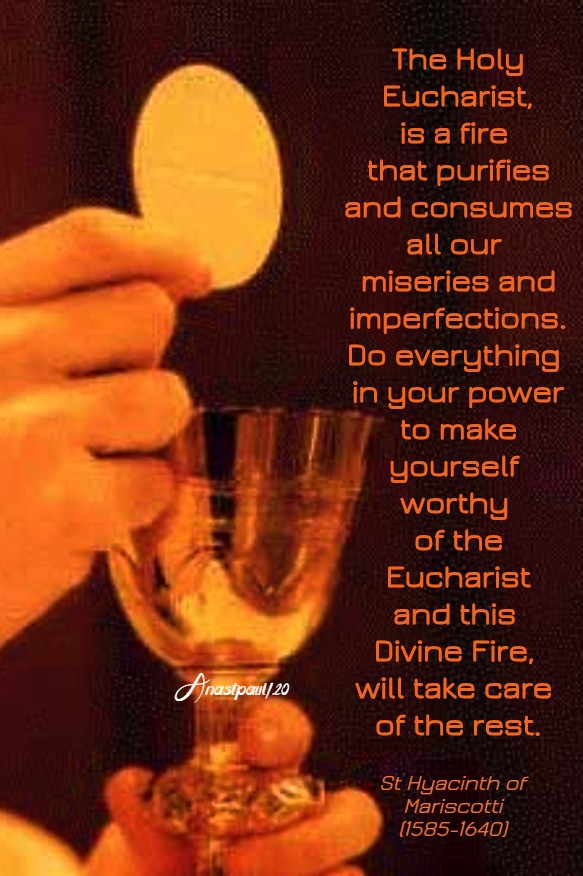
“The Holy Eucharist, is a fire that purifies and consumes all our miseries and imperfections. Do everything in your power to make yourself worthy of the Eucharist and this Divine Fire, will take care of the rest.”






















You must be logged in to post a comment.