Our Morning Offering – 22 February – The Chair of St Peter at Antioch
O Prince of the Apostolic Senate! Hymn to the Prince of the Apostles By St Peter Damian (1007-1072) Cardinal Bishop of Ostia Doctor of the Church
O Prince of the Apostolic Senate! Herald of our Lord! First Shepherd of the Faithful! watch over the Flock intrusted to thee.
Lead us through verdant pastures, feeding us with the nourishment of the Word and lead us, thus fed, into the heavenly fold, whither thou hast already gone.
To thee, Peter, have been delivered the Keys of heaven’s gate and all things, both in Heaven and on earth, acknowledge thy authority.
Tis thou that choosest the City where is to be established the Rock of the True Faith, the foundation of the building, on which the Catholic Church stands immoveable.
Thy shadow, as thou passest by, heals the sick and Tabitha, who made garments for the poor, was raised to life at thy bidding.
Bound with two chains, thou wast set free by an Angel’s power; he bids thee put on thy garments and thy sandals and lo! the prison door is opened.
To the Father unbegotten and to the Only-Begotten Son and to the co-equal Spirit of them both, be praise and kingly highest power. Amen.
St John the Saxon St Limnaes Bl Mohammed Abdalla St Papias of Heirapolis St Paschasius of Vienne St Raynerius of Beaulieu St Thalassius
Martyrs of Arabia – A memorial for all the unnamed Christians Martyred in the desert and mountainous areas south of the Dead Sea during the persecutions of Emperor Valerius Maximianus Galerius.
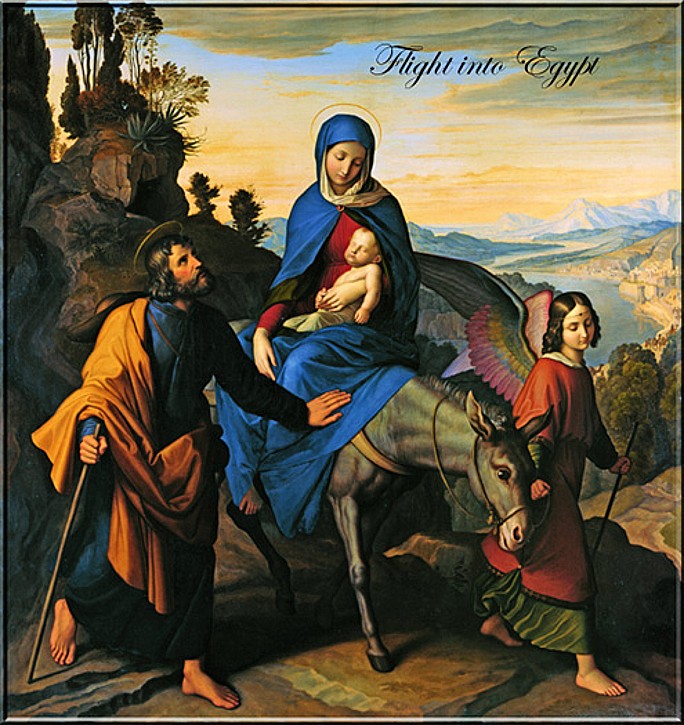
It was on the seventeenth of February, fifty five days after the Nativity of Jesus, when King Herod’s soldiers — sent to slaughter all little boys in Bethlehem and its neighbourhood who were two years old or under, in order to destroy a rival King, Jesus — were getting perilously near the cave at Bethlehem, where at first they little expected Our Lord to be. Saint Joseph received a message from God through an Angel, whereupon he took Our Lady and the Divine Infant and set off leaving the land of the Jews to travel to a land of the Gentiles. They took no-one with them, by way of servants or friends, as Saint Peter Chrysologus tells us.
The Town to which the Holy Family fled was called Fostat. It was three hundred miles from Bethlehem. A Church has been erected there, on the site of the house where the Holy Family lived during their exile. The little Town where the Holy Family lived in Egypt was not far from Heliopolis, a City in which — when Jesus, Mary and Joseph passed through it — statues of pagan gods crashed to the ground. Both Fostat and Heliopolis are not far from Cairo in Egypt.
St Lupiano St Mesrop the Teacher St Polychronius of Babylon St Romulus the Martyr St Secundian the Martyr St Silvinus of Auchy St Theodulus of Caesarea
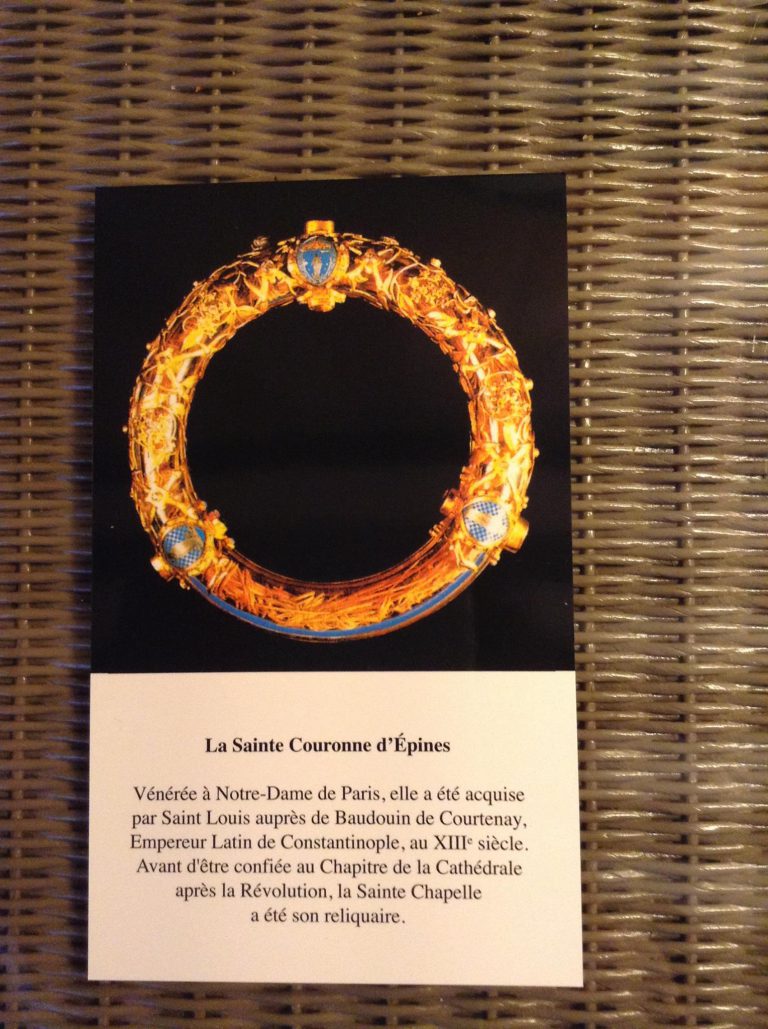
Feast of The Sacred Crown of Thorns of Our Lord Jesus Christ celebrated on the Friday after Ash Wednesday – One of the “Seven Passion Feasts” – celebrated on the the Friday after Ash Wednesday – 16 February 2024
The first Feast in honour of the Sacred Crown of Thorns (Festum susceptionis coronae Domini) was instituted at Paris in 1239, when Saint Louis IX of France brought there the Relic of the Crown of Thorns which was deposited later in the Royal Chapel, erected in 1241–1248 to guard this and other Relics of the Passion. The Feast, observed then on 11 August, though at first special to the Royal Chapel, was gradually observed throughout the north of France.
The Reliquary in France
In the following Century, another festival of the Holy Crown on 4 May, was instituted and was celebrated along with the Feast of the Finding of the True Cross in parts of Spain, Germany and Scandinavia. It was later kept in Spanish Diocese and is observed by the Dominicans on 24 April.
A special Feast on the Monday after Passion Sunday was granted to the Diocese of Freising in Bavaria, by Pope Clement X (1676) and Pope Innocent XI (1689), in honour of the Crown of Thorns of Christ. It was celebrated at Venice in 1766 on the second Friday of March. In 1831 it was adopted at Rome as a Double Major and is observed on the Friday following Ash Wednesday. As it is not kept universally, the Mass and Office are placed in the appendices to the Breviary and the Missal. The Hymns of the Office, which is taken from the 17th Century Gallican Breviary of Paris.
Artist – Carl Heinrich Bloch
This Feast became a part of The Seven Passion Feasts – special Masses related to the Passion of Christ which are celebrated as Feasts on particular days each week, from Septuagesima to the Fourth Week in Lent.
The Feasts and their appointed days are as follows: The Prayer of Our Lord Jesus Christ (in the Garden of Gethsemane)—on the Tuesday after Septuagesima Sunday. The Commemoration of the Passion of Our Lord Jesus Christ (Votive Mass of the Passion)—on the Tuesday after Sexagesima Sunday. The Sacred Crown of Thorns of Our Lord Jesus Christ—on the Friday after Ash Wednesday. The Sacred Lance and Nails of Our Lord Jesus Christ—Ember Friday in Lent (1st Week of Lent). The Most Sacred Shroud of Our Lord Jesus Christ—on Friday of the Second Week in Lent. The Five Sacred Wounds of Our Lord Jesus Christ—on Friday of the Third Week in Lent. The Most Precious Blood of Our Lord Jesus Christ—on Friday of the Fourth Week in Lent.
These Feasts are crowned by the observance of The Compassion of Our Lady (The Seven Dolours of Our Lady) on Friday in Passion Week—1 week before Good Friday. In this way the Mystery of Christ’s Passion is continually kept before the eyes of the faithful as they journeyed through Lent.
These Feasts no longer form part of the Vatican II Roman Missal.
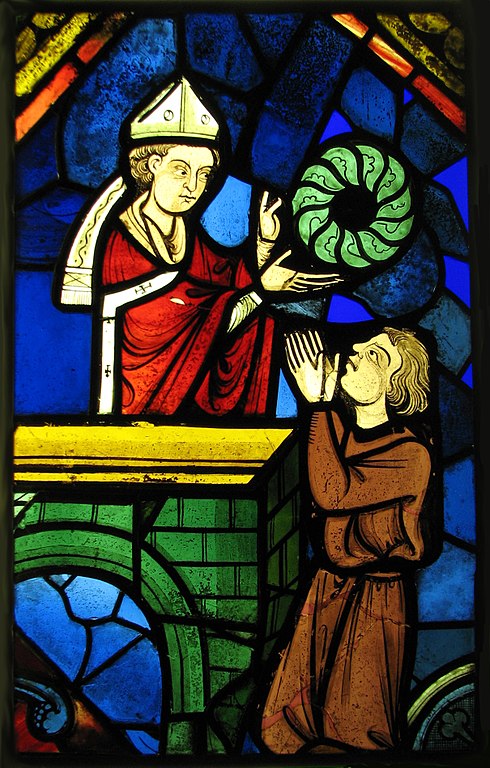
A stained glass window depicts veneration of the Crown of Thorns.
Martyrs of Cilicia – 12 Saints: A group of Christians who ministered to other Christians who were condemned to work the mines of Cilicia in the persecutions of Maximus. They were arrested, tortured and martryed by order of the governor Firmilian. They were Daniel, Elias, Isaias, Jeremy, Samuel. The group also includes the three known have been sentenced to the mines – Pamphilus, Paul of Jamnia, Valens of Jerusalem and those who were exposed as Christians as a result of these murders – Julian of Cappadocia, Porphyrius of Caesarea, Seleucius of Caesarea, Theodule the Servant. They were Martyred in 309 in Cilicia, Asia Minor (in modern Turkey).
Our Morning Offering – 13 February – Feast of the Holy Face of Jesus and Shrove Tuesday
As part of the preparations for Lent, it is appropriate to celebrate the Feast of the Holy Face by spending some time before the Blessed Sacrament and reciting the prayers of reparation. In addition, the repetition of this Devotion each Tuesday in Lent maybe a means of drawing closer to Our Lord during this time of more intense prayer and conversion.
TAKEN FROM THE AUTOBIOGRAPHY OF SR MARY OF ST PETER OCD (1816-1848).
“Do you see how I suffer? Yet, very few understand Me. Those who say they love Me are very ungrateful! I have given My Heart as the sensible object of My great love to men and I give My Face as the sensible object of My sorrow for all the sins of men. I wish that it be venerated by a special Feast on Tuesday, the day before Ash Wednesday. I wish that the Feast be preceded by a Novena in which the faithful make reparation with Me, joining together and sharing in My sorrow.”
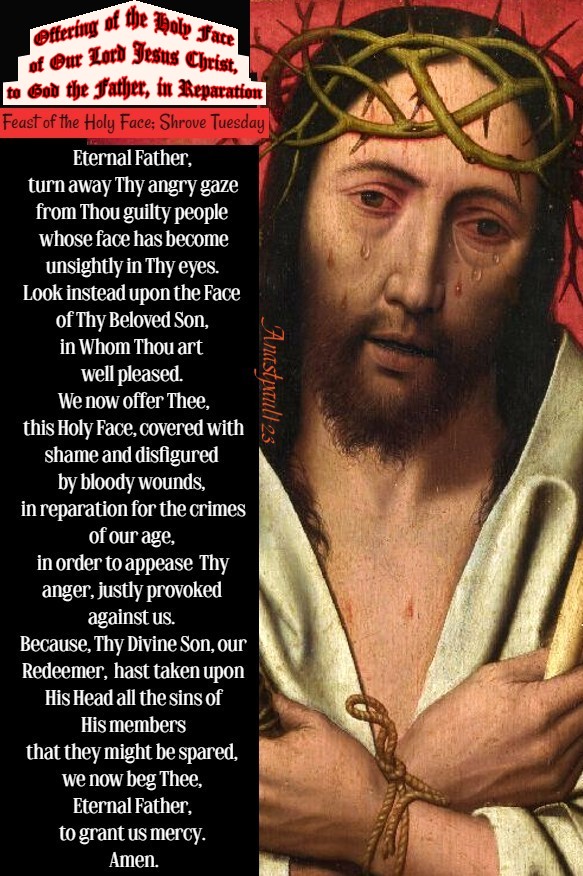
Offering of the Holy Face of Our Lord Jesus Christ, to God the Father, in Reparation
Eternal Father, turn away Thy angry gaze from Thou guilty people whose face has become unsightly in Thy eyes. Look instead upon the Face of Thy beloved Son, in Whom Thou art well pleased. We now offer Thee, this Holy Face, covered with shame and disfigured by bloody wounds, in reparation for the crimes of our age, in order to appease Thy anger, justly provoked against us. Because, Thy Divine Son, our Redeemer, hast taken upon His Head all the sins of His members that they might be spared, we now beg Thee, Eternal Father, to grant us mercy. Amen.
Our Morning Offering – 11 February – Apparition of the Immaculate Virgin Mary at Lourdes
Hail! all Hail! Great Queen of Heaven, Notre Dame de Lourdes Unknown Author First Published in 1905
Hail! all Hail! great Queen of Heaven, Hail sweet Notre Dame de Lourdes, ‘Neath whose care our weary exile, Is from countless ills secured.
Refrain: Then let men and angels praise thee, Fount of grace to all assured, While in gladsome strains we are singing, Hail! sweet Notre Dame de Lourdes Hail! sweet Notre Dame de Lourdes.
Blessed thou above all others, Mary Mistress of the spheres, Star of hope, serenely beaming Through this darksome vale of tears. Refrain
Happy angels joy to own thee, O’er their choirs exalted high, Throned in blissful light and beauty, Empress of the starry sky. Refrain
As the fount is still unsealing Its pure treasures softly fair, May each drop be fraught with healing, Dearest Mother, at thy prayer. Refrain
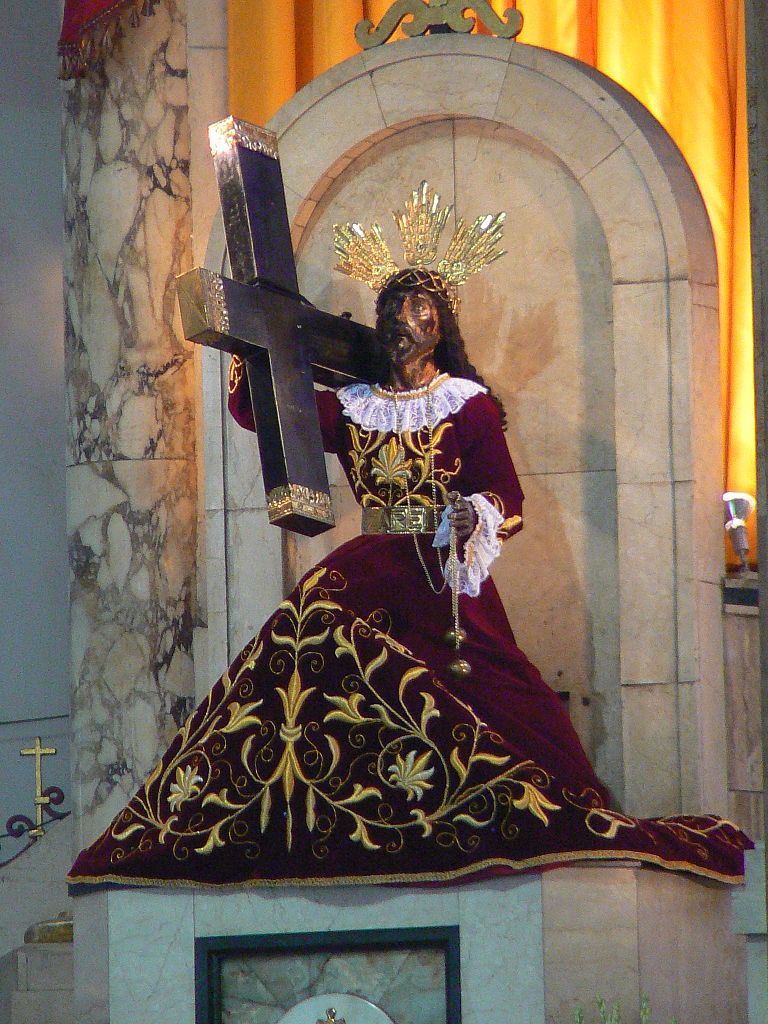
Our Lady of the Candles – Nuestra Señora de la Purificación y la Candelaria, is a Marian title and image venerated by Filipino Catholics. The image, which is enshrined on the balcony of Jaro Cathedral, is known as the Patroness of Jaro District of Iloilo City and the whole of the Western Visayas. The Feast Day of Our Lady of the Candles is on Candlemas (2 February) and is celebrated in Iloilo City with a Solemn Pontifical Mass presided by the Archbishop of Jaro.
St Adalbald of Ostrevant St Adeloga of Kitzingen St Agathodoros of Tyana St Apronian the Executioner Bl Bernard of Corbara St Bruno of Ebsdorf St Candidus the Martyr St Columbanus of Ghent St Cornelius the Centurion St Felician the Martyr St Feock St Firmus of Rome St Flosculus of Orléans St Fortunatus the Martyr St Hilarus the Martyr St Jeanne de Lestonnac (1556-1640) Widow, Mother, Founder
St Lawrence of Canterbury (Died 2 February 619) The Second Archbishop of Canterbury, the successor of St Augustine of Canterbury from 604 until his death in 619, but he was Consecrated as Archbishop by his predecessor, St Augustine, during Augustine’s lifetime, to ensure continuity in the office, Benedictine Monk, Missionary. He was a member of the Gregorian mission sent from Italy to England to Christianise the Anglo-Saxons. About St Lawrence: https://anastpaul.com/2022/02/02/saint-of-the-day-2-february-saint-lawrence-of-canterbury-died-619/
One Minute Reflection – 25 January – Feast of the Conversion of St Paul , Apostle, Acts 9:1-22, Matthew 19,27-29.
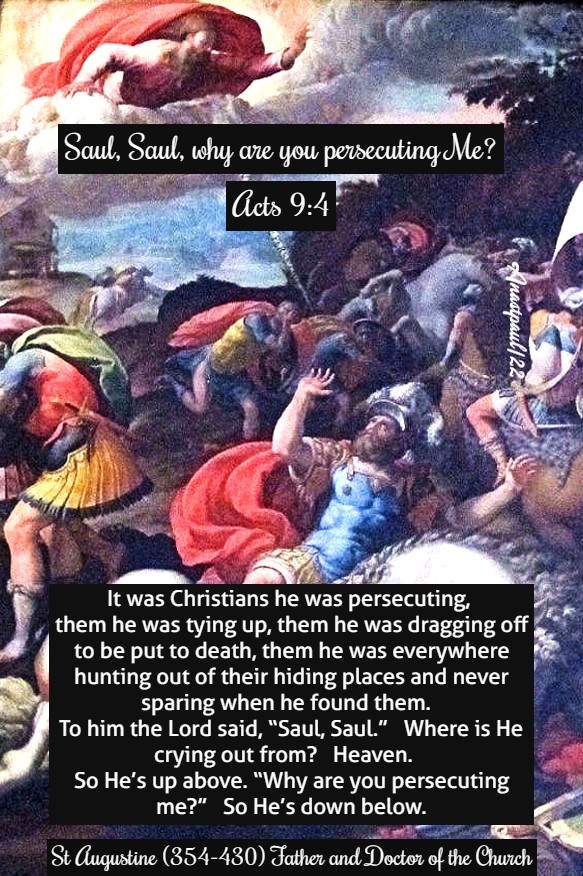
“He fell to the ground and heard a voice saying to him, “Saul, Saul, why are you persecuting Me?” – Acts 9:4.
REFLECTION – “How can we show that He is there and that He is also here? Let Paul answer for us, who was previously Saul. First of all, the Lord’s own Voice from Heaven shows this: “Saul, Saul, why are you persecuting Me?” Had Paul climbed up to Heaven then? Had Paul even thrown a stone at Heaven? It was Christians he was persecuting, them he was tying up, them he was dragging off to be put to death, them he was everywhere hunting out of their hiding places and never sparing, when he found them. To him the Lord said, “Saul, Saul.” Where is He crying out from? Heaven. So He’s up above. “Why are you persecuting Me?” So He’s down below.” – St Augustine (354-430) Bishop of Hippo, Father and Doctor of the Church (Sermon 122).
PRAYER – O God, Who taught the whole world by the preaching of Thy blessed Apostle Paul, grant, we beseech Thee that we, who today celebrate his conversion, may draw closer to Thee, by way of hia example.Through Jesus Christ, Thy Son our Lord, Who lives and reigns with Thee, in the unity of the Holy Ghost, God, world without end. Amen (Collect).
Our Morning Offering – 25 January – Feast of the Conversion of Saint Paul
Great Convert Teacher of the Faith Doctor Egregie Paule Attri. to Elpis (Died c493) Trans. The Benedictines of Saint Cecilia’s Abbey, Ryde, UK
Great Convert Teacher of the Faith Who never ceased from preaching Christ, Saint Paul impart to us your zeal, That we may reach the joys unseen.
All glory to the Trinity, Forever honour, sov’reignty; To God Almighty be all praise, Beginning and the End of all. Amen.
Elpis, first wife of the celebrated Philosopher Boethius, was the daughter of Festus, Consul at Rome, 472 and aunt of St Placidus, a disciple of St.Benedict. The above hymn, as well as, “Aurea luce et decore roseo” are attributed to her. Others also bear her name. She died at an early age, at Padua.
Our Morning Offering – 24 January – Feast of Saint Timothy, Bishop and Martyr
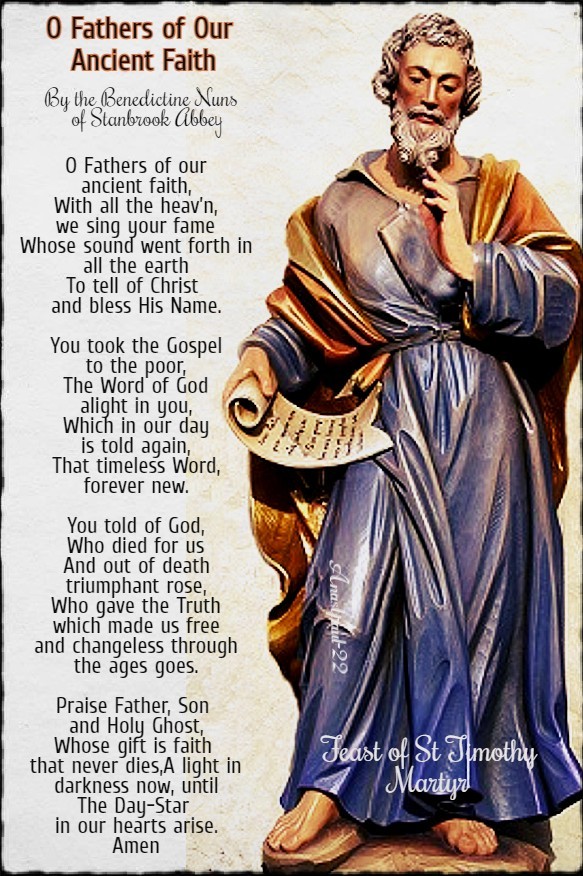
O Fathers of Our Ancient Faith
O Fathers of our ancient faith, With all the heav’n, we sing your fame Whose sound went forth in all the earth To tell of Christ and bless His Name.
You took the Gospel to the poor, The Word of God alight in you, Which in our day is told again, That timeless Word, forever new.
You told of God, Who died for us And out of death triumphant rose, Who gave the Truth which made us free and changeless through the ages goes.
Praise Father, Son and Holy Spirit, Whose gift is faith that never dies, A light in darkness now, until The Day-Star in our hearts arise.
O Fathers of Our Ancient Faith is written by the Benedictine Nuns of Stanbrook Abbey. In the Divine Office it is sung at Morning Prayer in the Common of Apostles. It is set to the anonymous tune associated with the 7th century Latin hymn, Creator Alme Siderum.
St Projectus St Sabinian of Troyes St Suranus of Sora St Thyrsus Bl essed William Ireland SJ (1636-1679) Priest Martyr
Martyrs of Asia Minor – 4 Saints: A group of ChristiansMmartyred together for their faith. The only details to survive are four of their names – Eugene, Mardonius, Metellus and Musonius. They were burned at the stake in Asia Minor.
Martyrs of Antioch: Babylas Epolonius Prilidian Urban
Quote/s of the Day – 18 January – Feast of the Chair of the Apostle, St Peter at Rome – 1 Peter 1:1-7, Matthew 16:13-19 – Scripture search here: https://www.drbo.org/
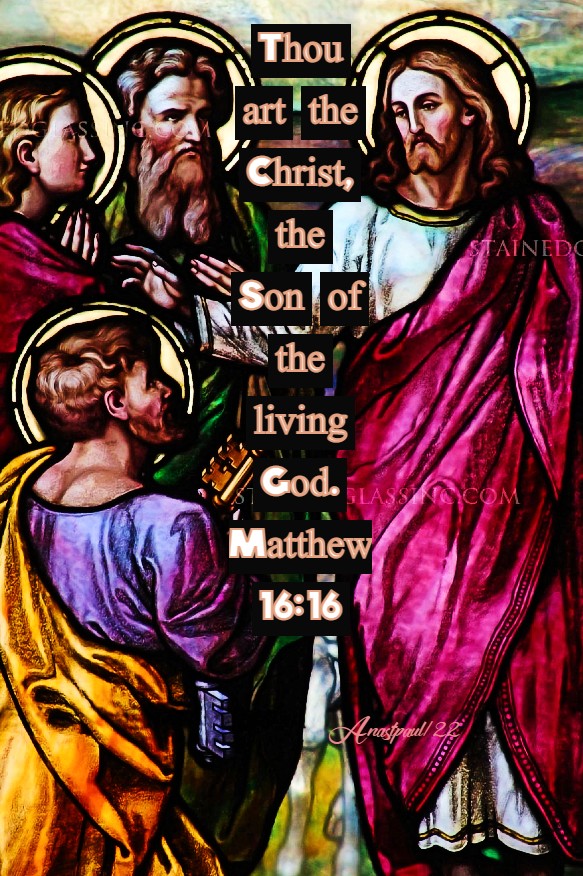
“Thou art the Christ, the Son of the living God.”
Matthew 16:16
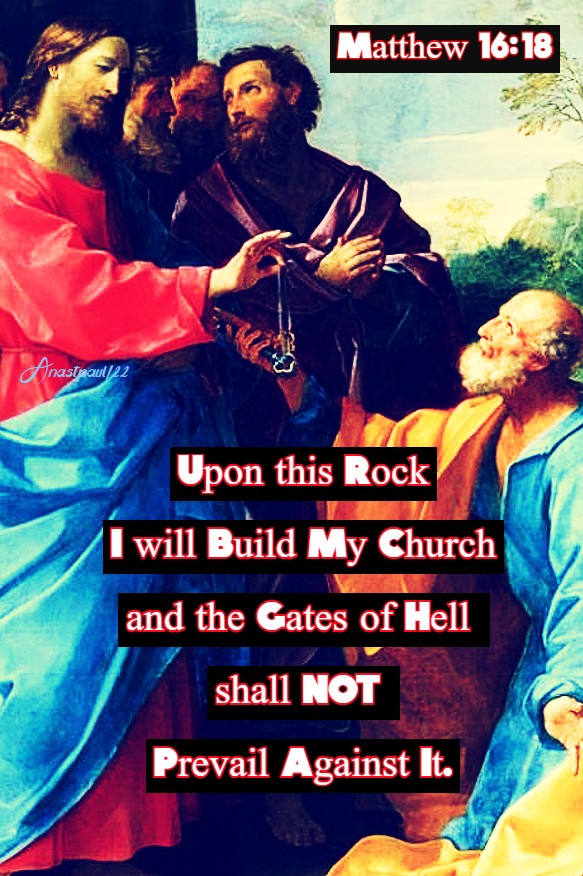
“Upon this rock I will build My Church”
Matthew 16:18
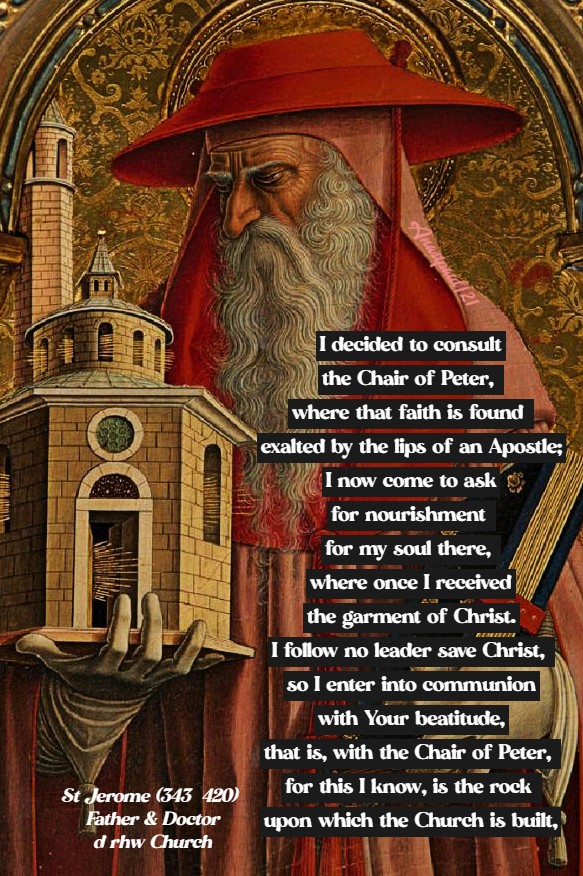
“I decided to consult the Chair of Peter, where that faith is found exalted by the lips of an Apostle; I now come to ask for nourishment for my soul there, where once I received the garment of Christ. I follow no leader save Christ, so I enter into communion with Your beatitude, that is, with the Chair of Peter, for this, I know, is the rock upon which the Church is built.” (cf Le lettere I, 15, 1-2)
St Jerome (343-420) Father & Doctor od rhw Church
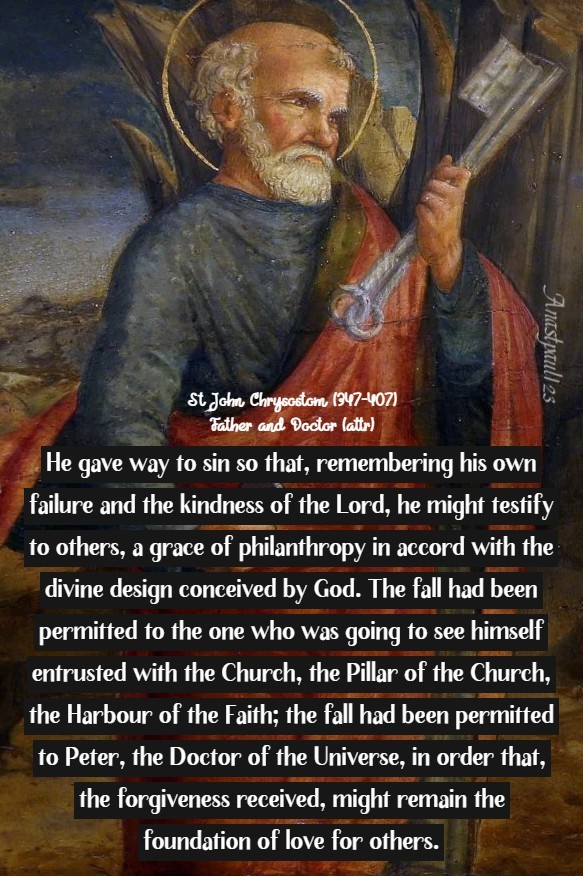
“He gave way to sin so that, remembering his own failure and the kindness of the Lord, he might testify to others, a grace of philanthropy in accord with the divine design conceived by God. The fall had been permitted to the one who was going to see himself entrusted with the Church, the Pillar of the Church, the Harbour of the Faith; the fall had been permitted to Peter, the Doctor of the Universe, in order that, the forgiveness received, might remain the foundation of love for others.”
St John Chrysostom (347-407) Father and Doctor of the Church
“Nothing escaped the Wisdom and Power of Christ, the elements of nature lay at His service, spirits obeyed Him, Angels served Him. … And yet, out of all the world, Peter alone was chosen to stand at the head, for the calling of all the peoples and the oversight of all the Apostles and Fathers of the Church.”
St Pope Leo the Great (400-461) Father and Doctor of the Church
One Minute Reflection – 18 January – Feast of the Chair of the Apostle, St Peter at Rome – 1 Peter 1:1-7, Matthew 16:13-19 – Scripture search here: https://www.drbo.org/
“And I say to thee: That thou art Peter and upon this rock, I will build My Church and the gates of hell shall not prevail against it.” – Matthew 16:18
REFLECTION – “When the twelve holy Apostles had received from the Holy Ghost the power to speak all languages, they divided the regions of the earth amongst themselves, as fields for their Gospel labours. Then was Peter, the Prince of the Apostles, sent to the Capital City of the Roman Empire that he might make the Light to shine, from the head, to the whole body of the civilised nations. At that time, what nation was there which had no representative in Rome? What nations would be ignorant of what Rome had learned?
Here were to be refuted the theories of philosophers, here dissolved the vanities of earthly wisdom, here overthrown the worship of devils, here destroyed the impiety of every sacrilege; here, where superstitious zeal had collected all the error and vanity of the world. Therefore, to this City, O most blessed Peter, thou dost not fear to come and, while thy companion in glory, the Apostle Paul, is still occupied with the government of other Churches, thou dost enter this forest of savage beasts, this deep and turbulent ocean, with more boldness than when thou didst walk upon the water!
Thou hadst already taught those, of the circumcision who had been converted, thou hadst founded the Church of Antioch, the first that bore the noble name of Christian; thou hadst published the law of the Gospel throughout Pontus, Galatia, Cappadocia, Asia and Bithynia and, thou didst not fear for the difficulty of thy work, nor turn back because of thine old age but didst boldly set up the trophy of the Cross of Christ, upon those Roman walls, where the Providence of God had appointed the throne of thine honour and the glorious scene of thy passion.” – St Leo the Great (400-461) Pope, Father and Doctor of the Church (Sermon on the Feast of St Peter’s Chair at Rome).
PRAYER – O God, Who together with the keys of the Kingdom of Heaven didst bestow on thy blessed Apostle Peter the pontifical power of binding and loosing, grant that by the aid of his intercession, we may be released from the bonds of our sins. Through Jesus Christ, Thy Son our Lord, Who lives and reigns with Thee, in the unity of the Holy Ghost, God, world without end. Amen (Collect).
Our Morning Offering – 18 January – Feast of the Chair of St Peter at Rome
O Prince of the Apostolic Senate! Hymn to the Prince of the Apostles By St Peter Damian (1007-1072) Cardinal Bishop of Ostia Doctor of the Church
O Prince of the Apostolic Senate! Herald of our Lord! First Shepherd of the Faithful! watch over the Flock intrusted to thee.
Lead us through verdant pastures, feeding us with the nourishment of the Word and lead us, thus fed, into the heavenly fold, whither thou hast already gone.
To thee, Peter, have been delivered the Keys of heaven’s gate and all things, both in Heaven and on earth, acknowledge thy authority.
Tis thou that choosest the City where is to be established the Rock of the True Faith, the foundation of the building, on which the Catholic Church stands immoveable.
Thy shadow, as thou passest by, heals the sick and Tabitha, who made garments for the poor, was raised to life at thy bidding.
Bound with two chains, thou wast set free by an Angel’s power; he bids thee put on thy garments and thy sandals and lo! the prison door is opened.
To the Father unbegotten and to the Only-Begotten Son and to the co-equal Spirit of them both, be praise and kingly highest power. Amen.
Feast of the Chair of the Apostle, St Peter at Rome: This Feast was instituted to commemorate the establishment of the Holy See at Rome. In 1960, Pope John XXIII removed from the General Roman Calendar, the 18 January Feast of the Chair of Peter at Rome. Two Liturgical Feasts were celebrated in Rome, in Honour of Chairs of Saint Peter, one of which was kept in the Baptismal Chapel of St Peter’s Basilica, the other at the Catacomb of Priscilla. The dates of these celebrations are 18 January and 22 February. The two Feasts were included in the Tridentine Calendar with the rank of Double which, in 1604, Pope Clement VIII raised to the rank of Greater Double. Those traditional Catholics. who do not accept the changes made by Pope John XXIII, continue to celebrate both Feast days: “Saint Peter’s Chair at Rome” on 18 January and the “Chair of Saint Peter at Antioch” on 22 February. https://anastpaul.com/2017/02/22/feast-of-the-chair-of-st-peter-22-february/
Blessed Beatrix d’Este the Younger (c 1230-1262) French Benedictine Nun, Founded a Convent. Beatified in 1774 by Pope Clement XIV. Her memorial date was decreed by Pope Pius VI for today. The Roman Martyrology states: “In Ferrara, Blessed Beatrice d’Este, Nun, who, on the death of her future husband, having renounced the kingdom of this world, consecrated herself to God in a Monastery founded by herself under the rule of Saint Benedict.” Her Life: https://anastpaul.com/2023/01/18/saint-of-the-day-18-january-blessed-beatrix-deste-the-younger-c-1230-1262/
St Catus
Blessed Cristina Ciccarelli OSA (1481–1543) Religious of the Order of Saint Augustine, Mystic, Stigmatist, Apostle of the poor, Reformer, she had a had a particular devotion to the Eucharist and to the Passion and Death of Christ, she was granted the gift of Prophecy, visions and levitation. Beatified in 1841 by Pope Gregory XVI . About Bl Cristina: https://anastpaul.com/2020/01/18/saint-of-the-day-18-january-blessed-cristina-ciccarelli-osa-1481-1543/
St Day/Dye St Deicola of Lure Bl Fazzio of Verona St Leobardus of Tours St Moseus of Astas St Ulfrid of Sverige St Volusian of Tours (Died 496) Bishop
St Peter of Sebaste (c340-c391) Bishop of Sebaste in Lesser Armenia. Member of the glorious family of Saints – He was the younger brother of Basil the Great, Gregory of Nyssa, the famous Christian Hermit Naucratius and Macrina the Younger and a close friend of Gregory of Nazianzen, all Saints. Of course, Basil and Gregory of Nazianzen are both Doctors too. St Pete‘r’s Biography: https://anastpaul.com/2021/01/09/saint-of-the-day-9-january-st-peter-of-sebaste-c-340-c-391-bishop/
St Marcellinus of Ancona (Died c577) Bishop St Marciana Bl Martinus In Eon-min St Maurontius St Nearchus St Paschasia of Dijon St Philip Berruyer St Polyeucte
Martyrs of Africa – 21 Saints: A group of 21 Christians murdered together for their faith in the persecutions of Decius. The only details to survive are 14 of their names – Artaxes, Epictetus, Felicitas, Felix, Fortunatus, Jucundus, Pictus, Quietus, Quinctus, Rusticus, Secundus, Sillus, Vincent and Vitalis. They were Martyred in c 250.
Martyrs of Antioch – 6 Saints: A group of Christians Martyred together during the persecutions of Diocletian – Anastasius, Anthony, Basilissa, Celsus, Julian and Marcionilla.
Quote/s of the Day – 4 January – “The Month of the Most Holy Name of Jesus and of the Holy Family” – Octave of the Holy Innocents
“They could not yet speak but already, they are confessing Christ. Their little bodies are, as yet, unable to engage in combat but already, they are carrying off the Palm of Victory.”
St Quodvultdeus (Died c 453) Bishop at Carthage
“These then, whom Herod’s cruelty tore as sucklings from their mothers’ bosom, are justly hailed as “Infant Martyr Flowers”- they were the Church’s first blossoms, matured by the frost of persecution, during the cold winter of unbelief.”
St Augustine (354-430) Father & Doctor of the Church
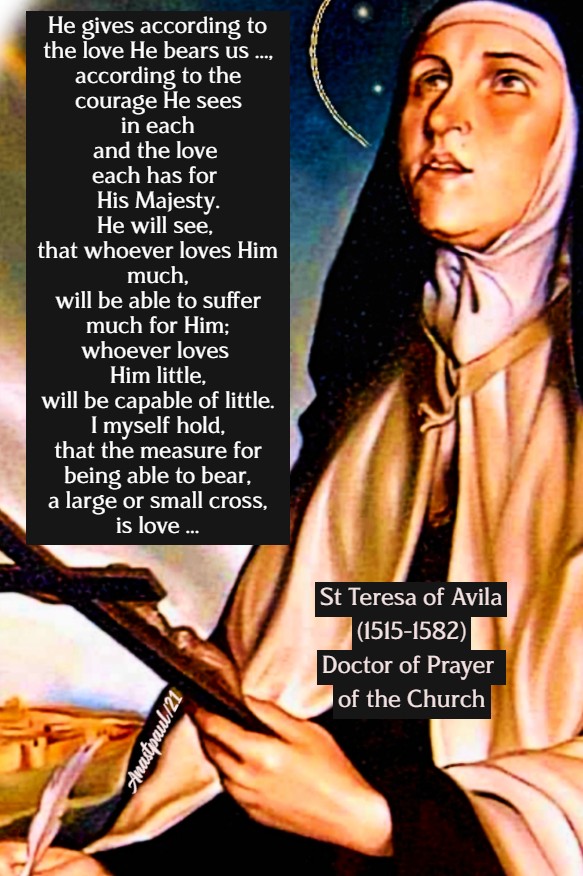
“He gives according to the love He bears us …, according to the courage He sees in each and the love each has for His Majesty. He will see, that whoever loves Him much, will be able to suffer much for Him; whoever loves Him little, will be capable of little. I myself hold, that the measure for being able to bear, a large or small cross, is love …”
St Teresa of Avila (1515-1582) Doctor of Prayer of the Church
Quote/s of the Day – 1 January – “The Month of the Most Holy Name of Jesus and of the Holy Family” – The Octave Day of the Nativity and the Feast of the Circumcision of the Lord – Titus 2:11-15, Luke 2:21 – Scripture search here: https://www.drbo.org/
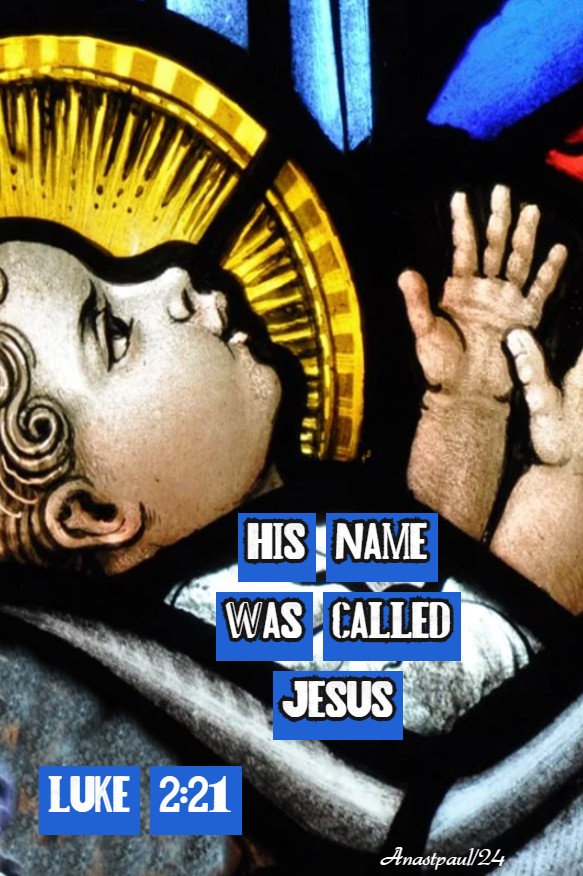
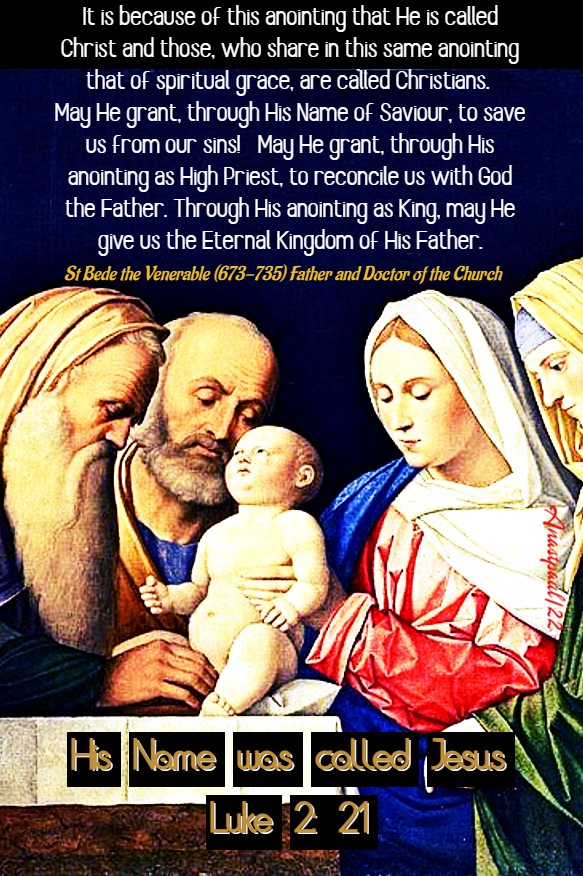
“His Name was called Jesus”
Luke 2:21
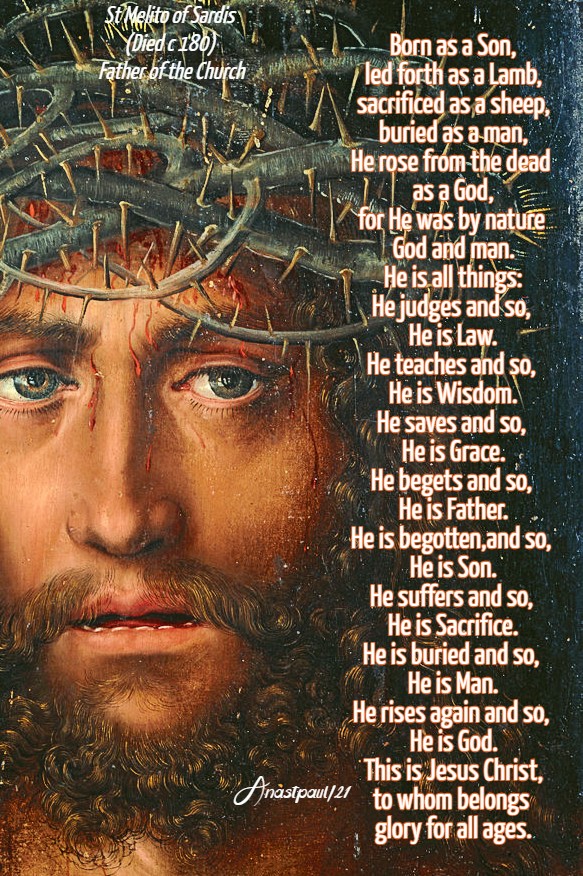
“Born as a Son, led forth as a Lamb, sacrificed as a sheep, buried as a man, He rose from the dead as a God, for He was by nature God and man.
He is all things – He judges and so, He is Law. He teaches and so, He is Wisdom. He saves and so, He is Grace. He begets and so, He is Father. He is begotten,and so, He is Son. He suffers and so, He is Sacrifice. He is buried and so, He is Man. He rises again and so, He is God. This is Jesus Christ, to Whom belongs glory for all ages.”
St Melito of Sardis (Died c180) Bishop, Early Church Father
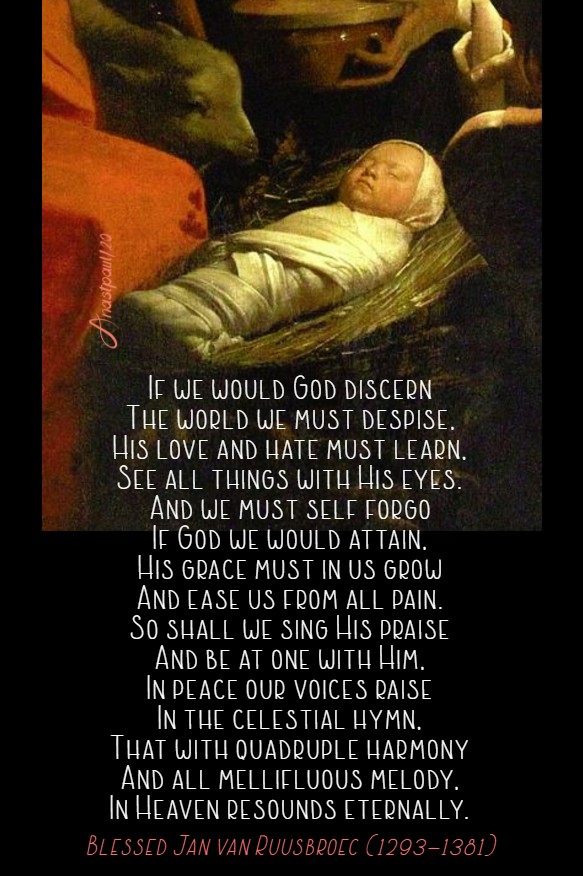
“If we would God discern The world we must despise, His love and hate must learn, See all things with His eyes. And we must self forgo If God we would attain, His grace must in us grow And ease us from all pain. So shall we sing His praise And be at one with Him, In peace our voices raise In the celestial hymn, That with quadruple harmony And all mellifluous melody, In Heaven resounds eternally.”
Blessed Jan van Ruusbroec (1293-1381)
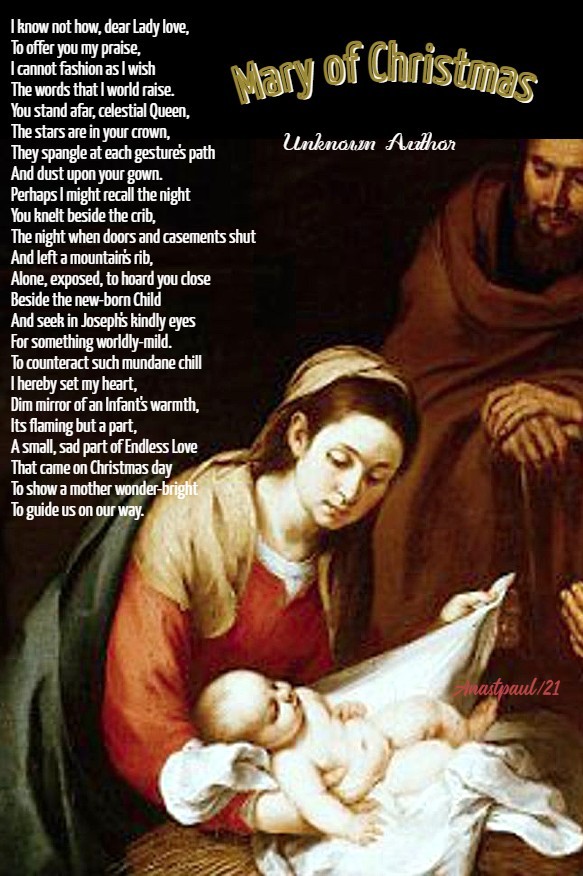
Mary of Christmas Unknown Author
I know not how, dear Lady love, To offer you my praise, I cannot fashion as I wish The words that I would raise. You stand afar, celestial Queen, The stars are in your crown, They spangle at each gesture’s path And dust upon your gown. Perhaps I might recall the night You knelt beside the crib, The night when doors and casements shut And left a mountain’s rib, Alone, exposed, to hoard you close Beside the new-born Child And seek in Joseph’s kindly eyes For something worldly-mild. To counteract such mundane chill I hereby set my heart, Dim mirror of an Infant’s warmth, Its flaming but a part, A small, sad part of Endless Love That came on Christmas day To show a mother wonder-bright To guide us on our way. Amen.
One Minute Reflection – 1 January – “The Month of the Most Holy Name of Jesus and of the Holy Family” – Feast of the Circumcision of the Lord – Titus 2:11-15, Luke 2:21 – Scripture search here: https://www.drbo.org/
“His Name was called Jesus” – Luke 2:21
REFLECTION – “The Name “Jesus” in Hebrew means “salvation” or “Saviour.” It is a Name that for the prophets, referred to a very specific vocation . From whence came these words, sung with great desire to see Him: “My heart will rejoice in Thy salvation and will be joyful because of His salvation; my soul pines for Thy salvation” (Ps 12:6 ;34:9 ;118:81). “Yet will I rejoice in the Lord and exult in my saving God” (Hab 3:18). And especially: “O God, by Thy Name save me” (Ps 53:3). It is as though one were to say: “O Thou Who are called ‘Saviour,’ by saving me, manifest the glory of Thy Name.” And so the Name of the Son, born of the Virgin Mary, is Jesus, according to the Angel’s explanation: “He shall save His people from their sins”…
As for the word “Christ,” this designates priestly or royal status. Priests and Kings were in fact “chrismated” that is to say, anointed with holy oil. By this means, they became signs of Him Who, appearing in the world as true King and High Priest, received the anointing of “the oil of gladness above Thy fellows” (Ps 44:8). It is because of this anointing that He is called Christ and those, who share in this same anointing that of spiritual grace, are called Christians. May He grant, through His Name of Saviour, to save us from our sins! May He grant, through His anointing as High Priest, to reconcile us with God the Father. Through His anointing as King, may He give us the Eternal Kingdom of His Father.” – St Bede the Venerable (673-735) Father and Doctor of the Church (Homily 5; CCL 122,36).
PRAYER – O God, Thou Who by the fruitful virginity of blessed Mary, have bestowed upon mankind the rewards of eternal salvation, grant, we beseech Thee, that we may enjoy the intercession of her, through whom we have been found worthy to receive among us, the Author of Life, our Lord Jesus Christ Thy Son. Who lives and reigns with Thee, in the unity of the Holy Ghost, God, world without end. Amen (Collect).
The Circumcision of the Lord (Holy Day): “At that time, after eight days were accomplished that the Child should be circumcised; His Name was called Jesus, which was called by the Angel, before He was conceived in the womb.” – Luke 2:21 Excerpt from the Catechism of the Council of Trent, (Part IV – “Hallowed be Thy Name“”) https://anastpaul.com/2023/01/01/1-january-feast-of-the-circumcision-of-the-lord/
Titular Feast of the Society of Jesus – But now celebrated on the Feast of the Holy Name of Jesus, which is tomorrow 2 January
Bl Adalbero of Liege St Baglan of Wales St Basil of Aix Bl Bonannus of Roio St Brogan St Buonfiglio Monaldi Bl Catherine de Solaguti St Clarus of Vallis Regia St Clarus of Vienne St Colman mac Rónán St Colman Muillin of Derrykeighan St Concordius of Arles St Connat St Cuan St Demet of Plozévet St Elvan St Eugendus of Condat St Euphrosyne of Alexandria St Fanchea of Rossory St Felix of Bourges St Frodobert of Troyes
St Gisela of Rosstreppe St Gregory Nazianzen the Elder Bl Hugolinus of Gualdo Cattaneo Bl Jean-Baptiste Lego Bl Jean of Saint-Just-en-Chaussée St Justin of Chieti (Died c540) Bishop St Maelrhys St Magnus the Martyr St Mydwyn
St Odilo of Cluny OSB (962-1049) “Archangel of the Monks,” Priest, Monk, 5th Abbot of Clun, Reformer, Apostle of the poor and needy, Marian devotee and promoter of prayer for the Souls in Purgatory. He established All Souls’ Day (on 2 November) in Cluny and its Monasteries as the annual commemoration to pray for all the faithful departed. The practice was soon adopted throughout the whole Church. St Odilo’s Life: https://anastpaul.com/2021/01/01/saint-of-the-day-1-january-saint-odilo-of-cluny-osb-962-1049-the-archangel-of-the-monks/
St Odilo of Stavelot St Peter of Atroa (773–837) Abbpt St Peter of Temissis St Sciath of Ardskeagh St Severino Gallo St Telemachus St Thaumastus of Mainz St Theodotus St Tyfrydog Bl Valentin Paquay St William of Dijon St Zedislava Berka OP (c 1220-1252) Married Laywoman and Mother, Tertiary of the Order of Preachers. Canonised by St Pius X on 28 August 1907.
Breton Missionaries to Britain: Martyred Soldiers of Rome: Thirty soldiers martyred in Rome as a group during the persecutions of Diocletian. We do not even known their names. They were Martyred c 304 at Rome, Italy.
Martyrs of Africa – 8 Saints: Eight Christians Martyred together in Africa, date unknown. The only details we have are four of their names – Argyrus, Felix, Narcissus and Victor.
Quote/s of the Day – 28 December – “The Month of the Divine Infancy and the Immaculate Conception of the Blessed Virgin Mary” – The Holy Innocents, Martyrs – Apocalypse 14:1-5, Matthew 2:13-18 – Scripture search here: https://www.drbo.org/
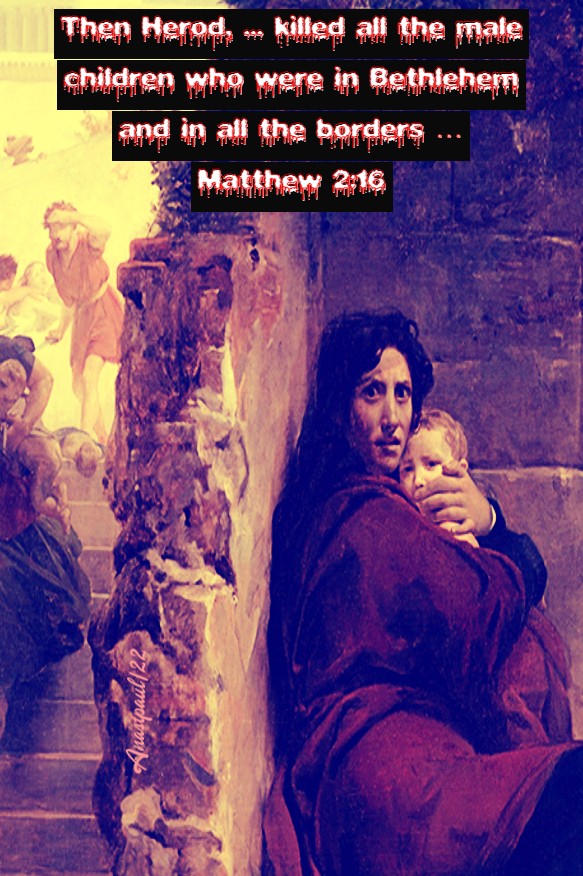
“Then Herod … killed all the male children who were in Bethlehem and in all the borders …”
Matthew 2:16
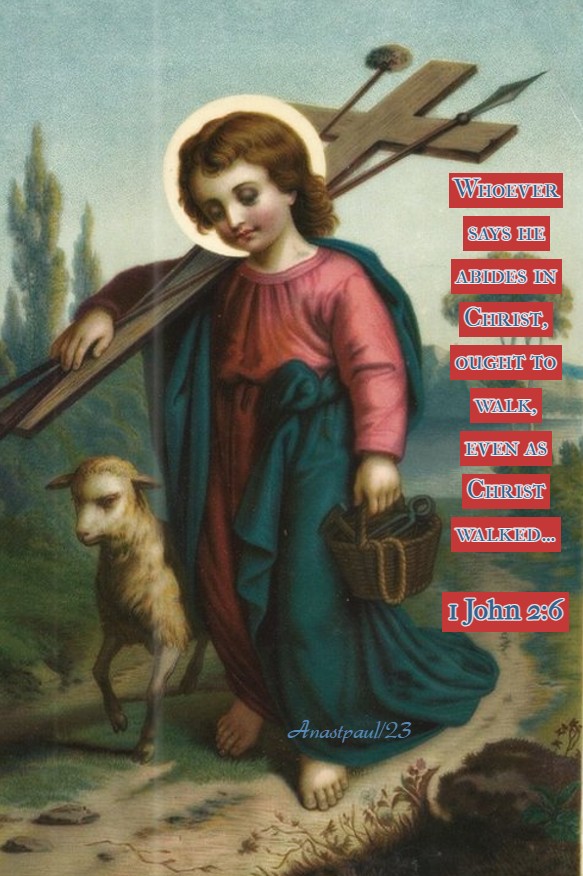
“Whoever says he abides in Christ, ought to walk, even as Christ walked …”
1 John 2:6
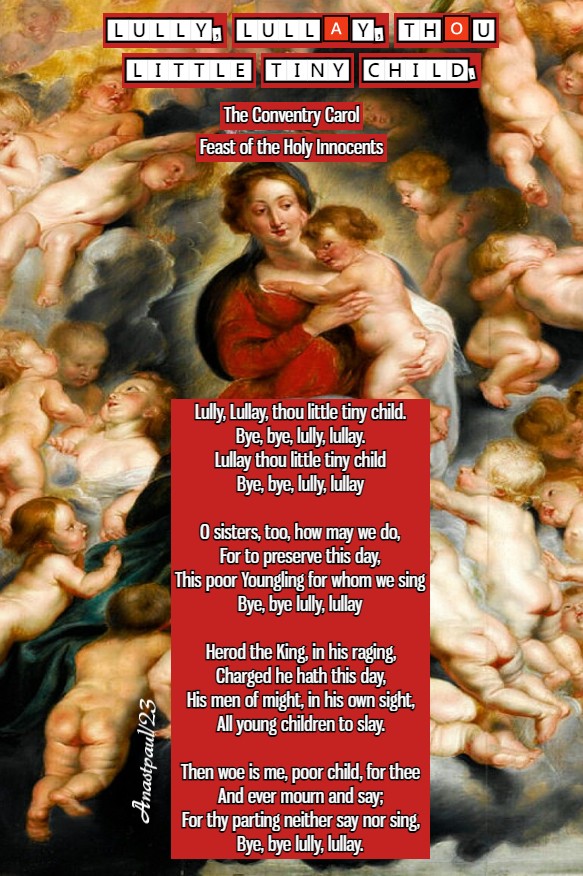
The 15th Century English Carol commemorates the slaughter of the Holy Innocents. Known as the Coventry Carol:
Lully, Lullay, thou little tiny child. Bye, bye, lully, lullay. Lullay thou little tiny child Bye, bye, lully, lullay
O sisters, too, how may we do, For to preserve this day, This poor Youngling for whom we sing Bye, bye lully, lullay
Herod the King, in his raging, Charged he hath this day, His men of might, in his own sight, All young children to slay.
Then woe is me, poor child, for thee And ever mourn and say; For thy parting neither say nor sing, Bye, bye lully, lullay.
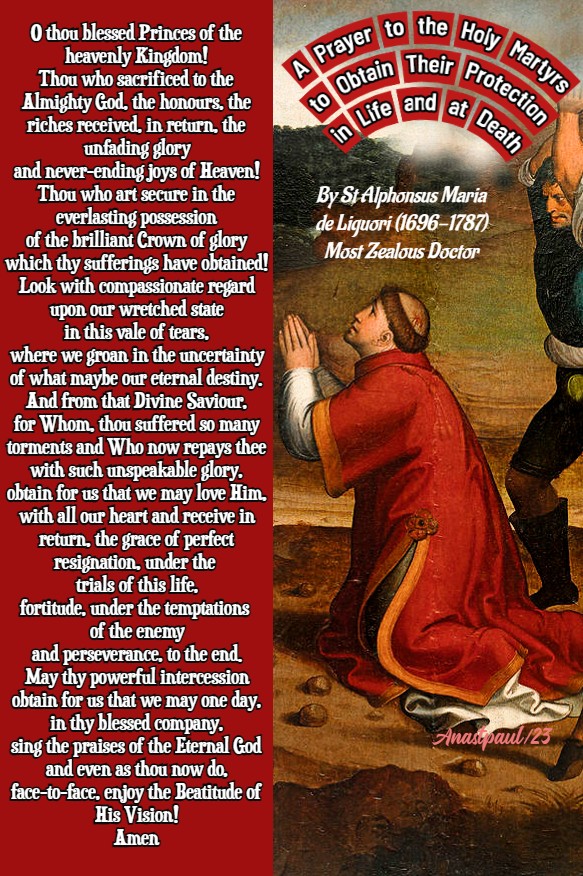
A Prayer to the Holy Martyrs to Obtain Their Protection By St Alphonsus Maria de Liguori (1696-1787)
O thou blessed Princes of the heavenly Kingdom! Thou who sacrificed to the Almighty God, the honours, the riches received, in return, the unfading glory and never-ending joys of Heaven! Thou who art secure in the everlasting possession of the brilliant Crown of glory which thy sufferings have obtained! Look with compassionate regard upon our wretched state in this vale of tears, where we groan in the uncertainty of what maybe our eternal destiny. And from that Divine Saviour, for Whom, thou suffered so many torments and Who now repays thee with such unspeakable glory, obtain for us that we may love Him, with all our heart and receive in return, the grace of perfect resignation, under the trials of this life, fortitude, under the temptations of the enemy and perseverance, to the end. May thy powerful intercession obtain for us that we may one day, in thy blessed company, sing the praises of the Eternal God and even as thou now do, face-to-face, enjoy the Beatitude of His Vision! Amen
One Minute Reflection – 28 December – “The Month of the Divine Infancy and the Immaculate Conception of the Blessed Virgin Mary” – The Holy Innocents, Martyrs – Apocalypse 14:1-5, Matthew 2:13-18 – Scripture search here: https://www.drbo.org/
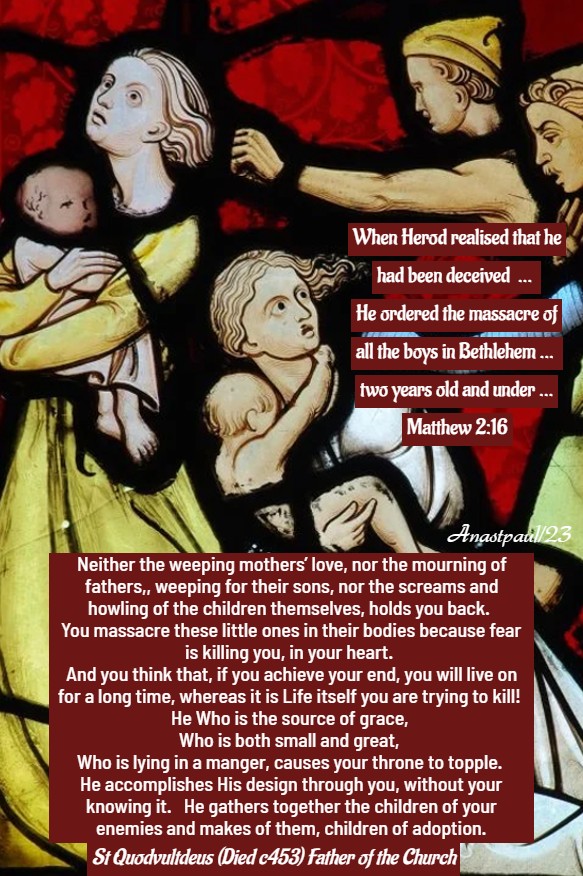
“When Herod realised that he had been deceived by the Magi, he became furious. He ordered the massacre of all the boys in Bethlehem and its vicinity, two years old and under, in accordance with the time he had ascertained from the Magi.“” – Matthew 2:16
REFLECTION – “Why, Herod, do you fear when you hear a King is born? He has not come to dethrone you but to overthrow the devil. But you fail to understand, you take fright and fall into a fury. Because you lost the single child you were seeking, you become the cruel murderer of the many. Neither the weeping mothers’ love, nor the mourning of fathers weeping for their sons, nor the screams and howling of the children themselves, holds you back. You massacre these little ones in their bodies because fear is killing you, in your heart. And you think that, if you achieve your end, you will live on for a long time, whereas it is Life itself you are trying to kill! He Who is the source of grace, Who is both small and great, Who is lying in a manger, causes your throne to topple. He accomplishes His design through you, without your knowing it. He gathers together the children of your enemies and makes of them, children of adoption.
These little ones died for Christ without knowing it; their parents weep for the death of Martyrs. Although they were unable to speak, Christ made them capable of being His Witnesses. See how this King reigns. Already He is setting free and bestowing salvation. But as for you, Herod, you are oblivious of what is happening, you take fright and fall into a rage. And when you get annoyed with a little Child, you are already placing yourself at His service without realising it.
How great the gift of grace is! What are the merits by which these children won the victory? They could not yet speak but already, they are confessing Christ. Their little bodies are as yet unable to engage in combat but already, they are carrying off the Palm of Victory.” – St Quodvultdeus (Died c 453) Father, Bishop at Carthage from c437-c450 (Second sermon on the Creed).
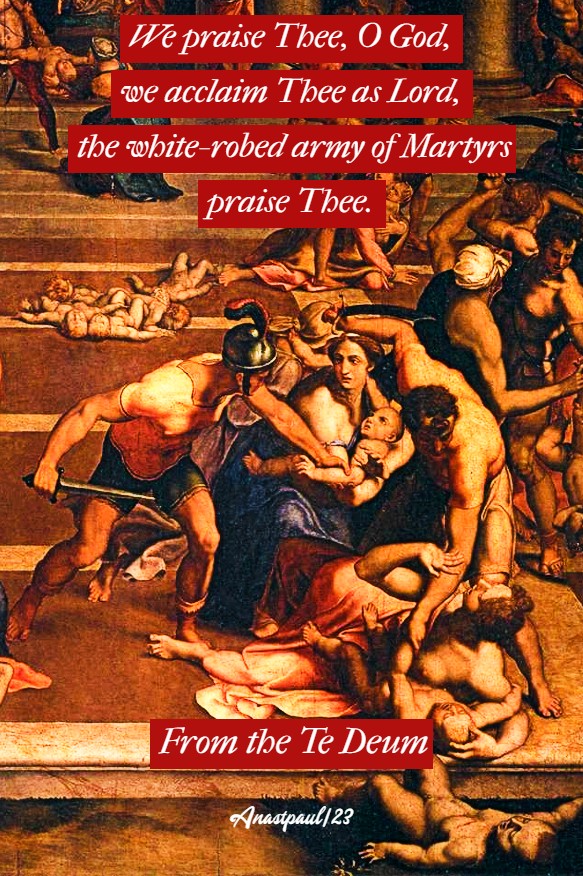
PRAYER – O God, Whose praise the Innocents, Thy Martyrs, this day proclaimed, not by speaking but by dying, put to death in us all the wickedness of sin, so that the faith which our tongue professes, may be proclaimed also by our life.Through the same Jesus Christ, Thy Son our Lord, Who lives and reigns with Thee, in the unity of the Holy Ghost, God, world without end. Amen (Collect). We praise You, O God, we acclaim You as Lord, the white-robed army of Martyrs praise You. (From the Te Deum).

The Nativity of Our Lord, Christmas Day! Celebration of the Anniversary of the Birth of Our Lord. In the earliest days of the Church there was no such Feast, the Saviour’s Birth was commemorated with the Epiphany by the Greek and other Eastern Churches. First mention of the Feast, then kept on 20 May, was made by Clement of Alexandria c 200. The Latin Church began in c 300 to observe it on 25 December, though there is no certainty that Our Lord was born on that day. Today, Priests have the privilege of saying three Masses, at midnight, daybreak and morning. This was originally reserved to the Holy Father alone – beginning about the 4th century he celebrated a midnight Mass in the Lateran Basilica (in which according to tradition, the manger of Bethlehem is preserved), a second in the Church of Saint Anastasia, whose Feast comes on 25 December and a third at the Vatican Basilica. Many peculiar customs of the day are the outcome of the pagan celebrations of the January calendar. The Christmas tree, of which the first known mention was made in 1605 at Strasbourg, was introduced into France and England in 1840. The Feast is a Holy Day of Obligation, preceded by the preparatory season of Advent and by a special Vigil – should it fall on a Friday it abrogates the law of abstinence. Of course, Christmas attracts an Octave, when this wonderful Mystery and Miracle is celebrated for eight days. https://anastpaul.com/2019/12/25/the-solemnity-of-the-nativity-of-our-lord-jesus-christ-25-december-2/ AND: https://anastpaul.com/2018/12/25/the-solemnity-of-the-nativity-of-our-lord-jesus-christ-25-december/ AND: https://anastpaul.wordpress.com/2017/12/25/25-december-the-solemnity-of-the-birth-of-our-lord-jesus-christ-2/
St Adalsindis of Hamay St Alburga of Wilton St Anastasia of Sirmium
One Minute Reflection – 9 December – “The Month of the Divine Infancy and the Immaculate Conception of the Blessed Virgin Mary” – Saturday of the First Week of Advent Within the Octave of the Immaculate Conception of the Virgin Mary, Mother of God – Proverbs 8:22-35, Luke 1:26-28 – Scripture search here: https://www.drbo.org/
“Hail, full of grace!” – Luke 1:28
REFLECTION – “The degeneration caused by sin had obscured the beauty of our original nobility. But when the mother of supreme Beauty is born, our nature finds its purity once more and sees itself moulded according to the perfect model, worthy of God (Gn 1,26)… We had all preferred the world below, to that above. There no longer remained any hope of salvation. The state of our nature cried aloud to Heaven to come to the rescue… Then at last, in His good pleasure, the world’s Divine Artificer determined to make a new world appear, a different world full of harmony and youth.
Now was it not fitting, that a most pure virgin without stain, should place herself at the service of this mysterious plan first of all?… And where was this virgin to be found, if not in this woman, alone of her kind, chosen by the world’s Creator before all generations? Yes, she indeed is Mother of God, divinely named Mary, whose womb gave birth to God Incarnate and whom, He Himself had supernaturally prepared, as His Temple…
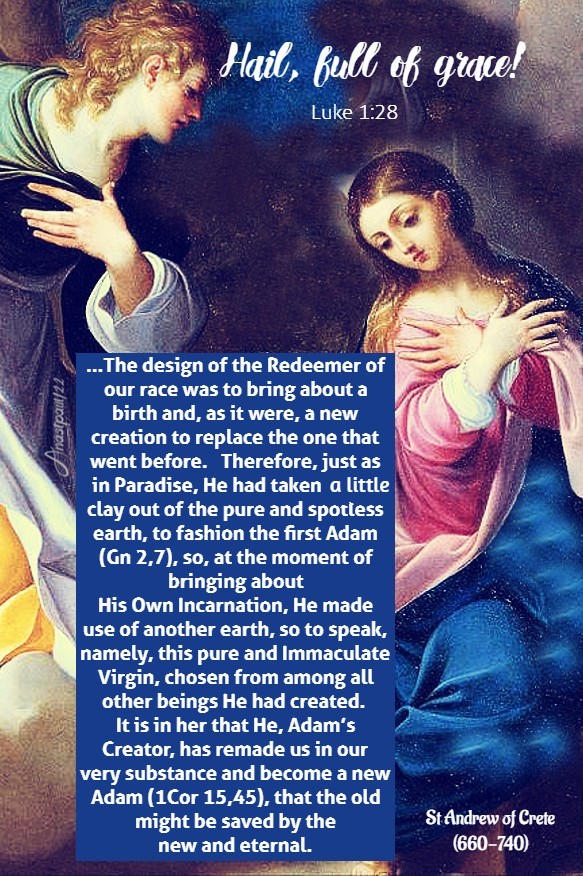
In this way, then, the design of the Redeemer of our race was to bring about a birth and, as it were, a new creation to replace the one that went before. Therefore, just as in Paradise, He had taken a little clay out of the pure and spotless earth, to fashion the first Adam (Gn 2,7), so, at the moment of bringing about His Own Incarnation, He made use of another earth, so to speak, namely, this Pure and Immaculate Virgin, chosen from among all other beings He had created. It is in her that He, Adam’s Creator, has remade us in our very substance and become a new Adam (1 Cor 15:45), that the old might be saved by the new and eternal.” – St Andrew of Crete (660-740) Bishop (Sermon 1 for the Nativity of the Mother of God ; PG 97, 812).
PRAYER – O God, Who by the Immaculate Conception of the Virgin, prepared a worthy dwelling for Thy Son, and Who, by Thy Son’s death, foreseen by You, preserved her from all taint, grant, we beseech Thee through her intercession that we too may come to Thee unstained by sin. Through the same Jesus Christ, Thy Son our Lord, Who lives and reigns with Thee, in the unity of the Holy Ghost, God, world without end. Amen (Collect).
Thought for the Day – 8 December – Meditations with Antonio Cardinal Bacci (1881-1971)
THE IMMACULATE CONCEPTION
“Let us read the first chapter of St Luke’s Gospel in order to try and understand, as far as possible, the Immaculate Conception and the sublime holiness of Mary. “The angel Gabriel was sent from God to a town of Galilee called Nazareth, to a virgin betrothed to a man named Joseph, of the house of David and the virgin’s name was Mary. And when the angel had come to her, he said, ‘Hail, full of grace, the Lord is with thee. Blessed are thou among women’” (Lk 1:26-28). The Blessed Virgin was troubled when she heard these words but the Angel reassured her. He told her that she had found favour with God and added, that she would become the Mother of God, for the Word would become flesh in her womb through the power of the Holy Spirit, in such a manner that in her nature, the privileges of virginity and of the divine motherhood, would be miraculously united. Mary then gave her assent to the will of God and, her ‘fiat’ placed her on a pedestal, high above all the generations of humanity and all the choirs of the angelic kingdom.
It is on this passage of the Gospel, that the Dogma of the Immaculate Conception of Our Lady, chiefly depends. She was full of grace and the supremely beloved of God. How then could she have been subject to the rule of sin which we inherited from Adam? If her soul had been stained with sin at the first moment of her conception, she would not have enjoyed the special favour of God and the plenitude of grace. She was, moreover, predestined to become the Mother of God. Was it possible that the divine Word, Who was to become her Son, could have permitted her soul to have been sullied, even for a single instant, by sin, which deprives us of grace and makes us enemies of God? It was on good grounds, therefore, that the Church defined, that from the first moment of her conception, Mary was free from all taint of sin, by a singular privilege conferred on her by God and through the merits of her divine Son, Jesus Christ.”
One Minute Reflection – 8 December – “The Month of the Divine Infancy and the Immaculate Conception of the Blessed Virgin Mary” – The Feast of the Immaculate Conception – Proverbs 8:22-35, Luke 1:26-28 – Scripture search here: https://www.drbo.org/
“Hail, full of grace, the Lord is with thee: blessed art thou among women” – Luke 1:28
REFLECTION – “Today the Creator of all things, the Word Who is God, has composed a new work sprung from the Father’s heart, to be written, as by a pen by the Spirit, Who is God’s tongue. … Most holy daughter of Joachim and Anne! you who have evaded the attention of the Principalities and Powers and the “flaming arrows of the Evil One” (Col 1:16; Eph 6:16), you dwelt within the bridal chamber of the Spirit and were preserved undefiled, so that you might become the bride of God and God’s Mother by nature. … God’s beloved daughter, the credit of your parents, generation after generation calls you Blessed, as you yourself so truthfully affirmed (Lk 1:48). Worthy daughter of God, our human nature’s beauty, restoration of Eve our first mother! For with your birth, she who fell was raised. … For if, through the first Eve, “death entered the world” (Wis 2:24; Rom 5:12) because she put herself at the service of the serpent, yet Mary, who made herself servant of the Divine Will, deceived the deceiving serpent and brought immortality into the world.
You are more to be valued than the entire creation, for from you alone the Creator received a share in the first-fruits of our humanity. His Flesh was made of your flesh, His Blood of your blood; God was nourished by your milk and your lips kissed the lips of God. … In His foreknowledge of your dignity, the God of all the world, has loved you and, in accordance with His love for you, He predestined you and called you into being “in the final time” (1 Pt 1:20; Heb 1:2) … So let wise Solomon shut his mouth and say no more: “Nothing is new under the sun” (Eccl 1:9).” – St John Damascene (675-749) Father and Doctor of the Church (Homily for the Nativity of the Virgin, 7, 10 – “See, I make all things new” (Apoc 21:5).
PRAYER – O God, Who by the Immaculate Conception of the Virgin, prepared a worthy dwelling for Thy Son, and Who, by Thy Son’s death, foreseen by Thee, preserved her from all taint, grant, we beseech Thee, through her intercession that we too, may come to Thee, unstained by sin. T Through Jesus Christ, Thy Son our Lord, Who lives and reigns with Thee, in the unity of the Holy Ghost, God, world without end. Amen (Collect).
St Anastasia of Pomerania St Anthusa of Africa St Antonio García Fernández St Casari of Villeneuve-lès-Avignon St Eucharius of Trier (Died 3rd Century) Bishop
St Gunthildis of Ohrdruf Bl Johanna of Cáceres St Macarius of Alexandria St Patapius St Rafael Román Donaire
St Romaric (Died 653) Married French noble layman, Abbot, Founder of the renowned Remiremont double Monastery in north-eastern France. Died in 653 of natural causes. He was Canonised on 3 December 1049 by Pope Leo IX. The Roman Martyrology reads today: “In the Monastery of Luxeuil, St Romericus, Abbot, who left the highest station at the Court of King Theodebert, renounced the world and surpassed all others in the observance of monastic discipline.” About St Romaric: https://anastpaul.com/2022/12/08/saint-of-the-day-8-december-saint-romaric-died-653-abbot/
A Day of Fasting and Abstinence, for the Holy Day tomorrow
Vigil of the Immaculate Conception of the Blessed Virgin Mary – 7 December: On this Vigil day, Catholics stand in the remains of the night as the dawn makes its appearance. This resplendent dawn is that Singular Conception, the Immaculate Conception, who ushers in the Light of Christ. A day of Fast and Abstinence following the Rubrics of Pope Pius X for the Universal Calendar of the Church.
“It is through the most Blessed Virgin Mary, that Jesus Christ came into the world and, it is also through her, that He will reign in the world.” – St Louis Marie Grignion de Montfort (1673-1716)
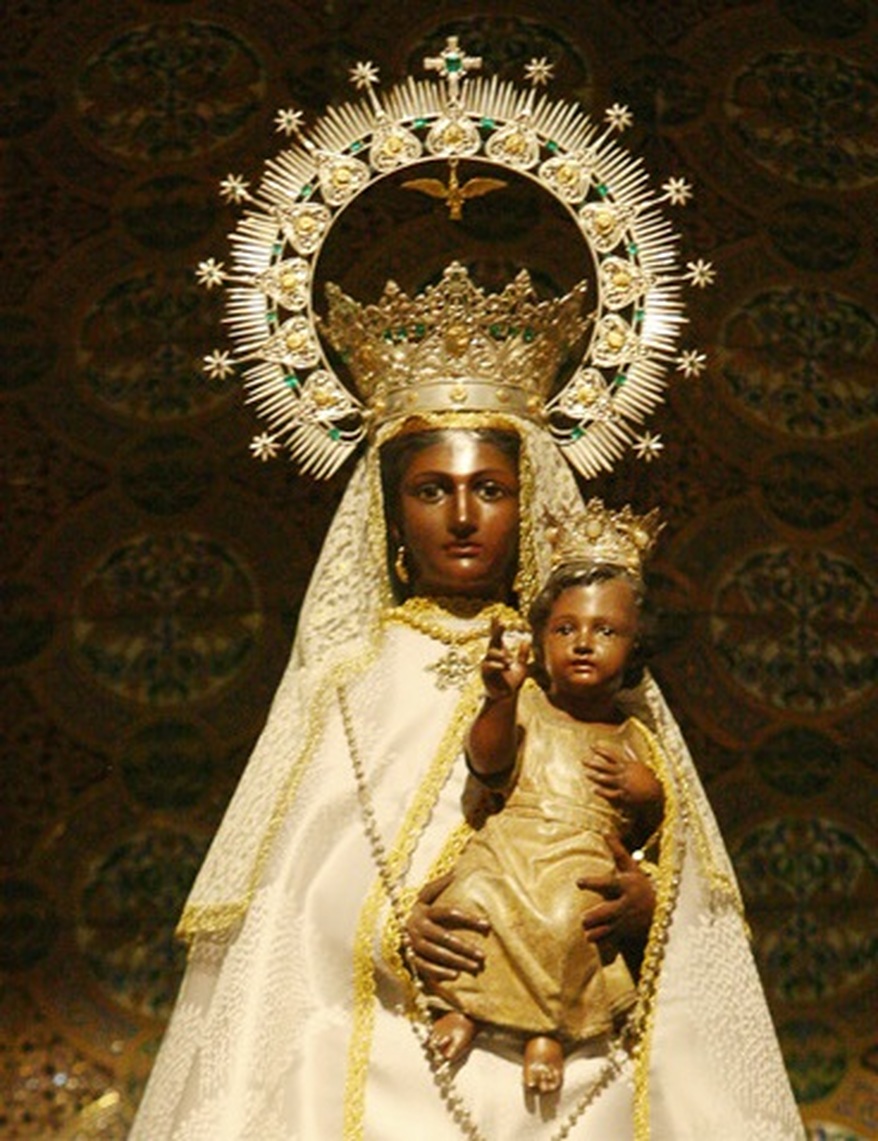
Virgen del Castillo, Inmaculada Concepción / Virgin of the Castle, Yecla, Spain (1642) – 7 and 8 December:
You must be logged in to post a comment.